Should you buy VGC stock, the ticker of Viglacera Corporation on Vietnam’s Ho Chi Minh Stock Exchange? The question resists a simple answer, because inside this single listing sit two businesses with almost nothing in common. The first is a building materials manufacturer: construction glass, ceramic tiles, sanitary ware, clay bricks and roof tiles. That is classical heavy industry, driven by volume, exposed to energy prices, with margins that rise and fall with the domestic construction cycle. The second is an industrial park developer and landlord, holding a land bank spread across several northern Vietnamese provinces. That is a property business, collecting money against long-dated leases, earning high margins, and selling not to Vietnamese households but to the multinational manufacturers relocating production out of China. Both businesses share one balance sheet, one board, and one ticker. This analysis separates them, shows you how to read each with the metrics that actually belong to it, and only then returns to the original question.
Before we begin, a convention between you and this article, the same one every company analysis in this series follows. You will meet dates, names, subsidiary structures and scale figures. All are drawn from public sources: corporate filings, exchange disclosures, regulatory decisions and mainstream financial press. What you will not meet is a figure for last quarter’s earnings, today’s share price, or a current valuation multiple. For a company whose two divisions run on entirely different rhythms, a single quarterly profit number stripped of context will lead you to the wrong conclusion. Instead this article teaches you where to look and how to read it; for the numbers themselves, open the latest research reports on vwealth.
A second convention applies specifically to this ticker. Viglacera is a subsidiary within the Gelex ecosystem, and this series already carries a dedicated analysis of GEX stock and of GEE, Gelex Electric. This article does not retell the parent group’s story. It treats Viglacera as a standalone business with its own assets, its own trade and its own risks, and touches on the ownership relationship only where that relationship genuinely changes your investment decision. If you want the group strategy, read the parent’s analysis; if you want the glass furnaces and the industrial land, read this one.
One more piece of scaffolding for readers new to this market. Vietnamese equities trade on HOSE, where VGC is listed, on the Hanoi exchange, and on UPCoM, a lighter-regulation board. Settlement is T plus two, HOSE applies a daily price band of seven per cent either side of the reference price, and foreign ownership is capped by sector. A full tour of the mechanics is in the guide on how to invest in the Vietnam stock market.
From a 1974 brick and pottery company to a business standing on two legs
Few Vietnamese listed companies are as old as Viglacera, and its age is not merely decorative. It explains why this business owns things a newly formed company cannot simply buy: land, mineral concessions, and a brand that every Vietnamese builder recognises on sight.
1974: beginnings in bricks and pottery
Viglacera’s predecessor was the Building Ceramics and Pottery Company, established in 1974. The context of that year explains the company’s original nature: this was a state entity created to supply the basic construction materials the economy needed, not a business born from one entrepreneur’s idea.
Two consequences run all the way to the present. The first is land and raw materials. A state enterprise operating in building materials across several decades accumulates land use rights in many provinces and extraction rights over the minerals its plants consume, such as clay, kaolin and silica sand. In this industry, having the quarry near the plant is a genuine cost advantage, because building materials are heavy and bulky and freight costs erode margin very quickly.
The second consequence is operating culture. A company with state roots typically carries a large apparatus, many member units, and a slower decision cycle than a private peer. That is a weakness in speed and a strength in stability. When you read Viglacera’s restructuring history over the past fifteen years, read it as a process of trimming the old apparatus to move faster.
1979 to 1992: from a group of workshops to a glass and ceramics union
In 1979 the entity was reorganised into a union of brick, tile and pottery enterprises. In 1992 the name changed to a union of glass and building ceramics enterprises.
The appearance of the word glass in the 1992 name is the most consequential detail of this period, far more than its bureaucratic surface suggests. Construction glass is an entirely different business from bricks. A float glass line demands enormous capital for a single unit, the furnace runs continuously twenty-four hours a day for years and must never be allowed to cool, and energy consumption is immense. In exchange, the barrier to entry is far higher than in brick making.
For a brick and tile company to move into construction glass in the early 1990s was a bold step, and it shaped Viglacera’s standing in Vietnamese building materials to this day. Note this detail, because it is why the company operates in a high-barrier product tier rather than only in the commodity segment.
2006 to 2010: the parent-subsidiary model and the Viglacera name
In 2006 the entity moved to a parent-subsidiary operating model. In 2010 it changed legal form and took the name Viglacera.
The parent-subsidiary model is a technical detail that investors must understand, because it directly affects how you read the consolidated accounts. In this model, the parent holds stakes in many member units at varying percentages, commonly from fifty-one to one hundred per cent. Consolidated statements aggregate all revenue and costs of the units the parent controls, then strip out the profit attributable to non-controlling shareholders on a separate line.
The practical consequence: if you use consolidated net profit to compute valuation multiples, you will be wrong, because part of that profit belongs to minority holders in subsidiaries rather than to you. For a company with more than twenty member units, the error is not small. Always use profit attributable to shareholders of the parent. Readers unfamiliar with Vietnamese reporting conventions should start with Vietnamese financial statements under VAS and IFRS.
2013 to 2014: equitisation
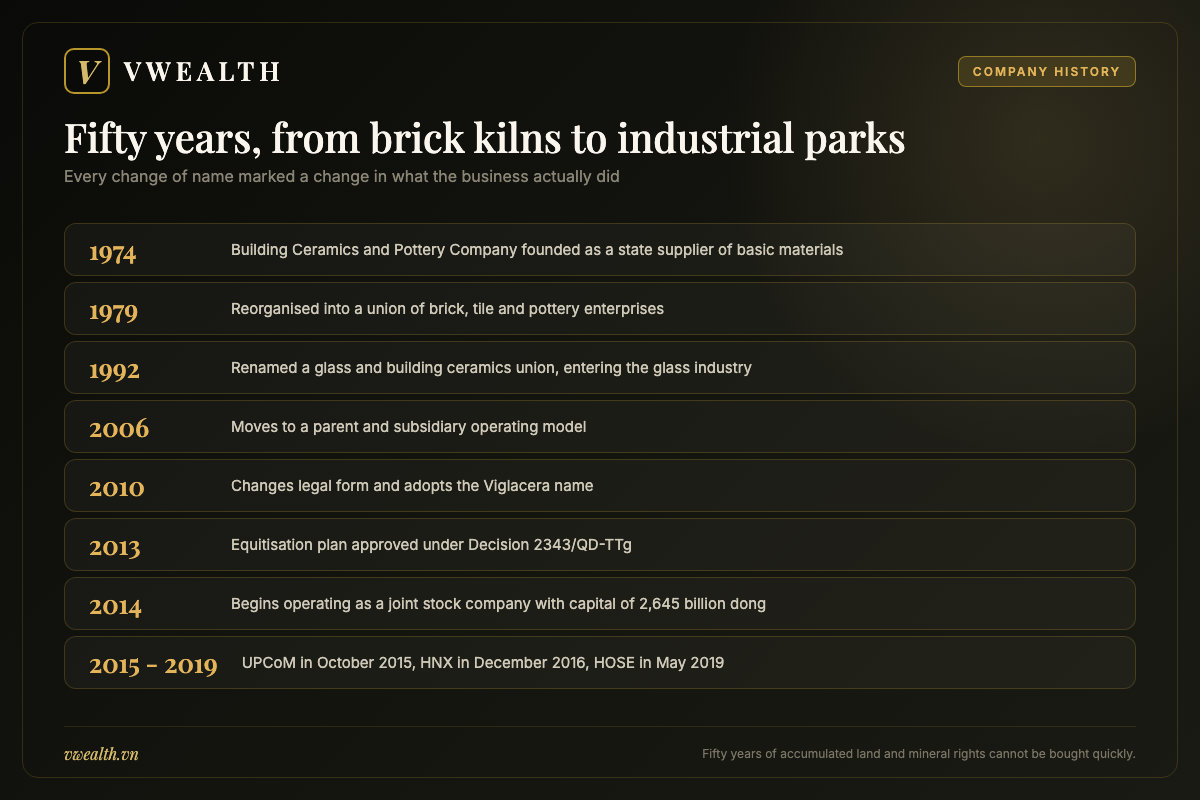
In 2013 the equitisation plan was approved under Decision 2343/QD-TTg. In 2014 the company began operating as a joint stock company, with initial charter capital of two thousand six hundred and forty-five billion dong.
Equitising a large state corporation is a long, multi-step process. What matters to an investor is not the event itself but what it opened up: from that point the company could raise capital from the market, could bring in strategic investors, and, most importantly, became subject to the disclosure discipline of a public company.
2015 to 2019: three exchanges in four years
VGC shares began trading on UPCoM on 15 October 2015, moved to the Hanoi Stock Exchange on 22 December 2016, and moved again to HOSE on 29 May 2019.
Three venue changes in four years is a notable journey with a practical meaning for investors. Each upward move required the company to meet a stricter listing standard on capital, on a record of profitable operations, on free float and on disclosure quality. For foreign investors and funds, a HOSE listing is far more accessible than a UPCoM registration, because many funds carry internal restrictions against the unlisted public company board. The differences between the three venues are set out in Vietnam’s stock exchanges: HOSE, HNX and UPCoM.
From 2019: Gelex arrives and the ownership structure changes hands
The largest recent turning point for Viglacera was a change in ownership. The Gelex group, through GELEX Infrastructure Corporation, became the largest shareholder and took controlling ownership, while the Ministry of Construction retained a substantial stake.
This is an unusual structure on the Vietnamese exchange: a company with two large shareholders, one a private group holding control, the other a state body holding a large but non-controlling position. Chapter two examines what that structure means, because it is one of the two most important variables for VGC stock.
Alongside the change of control, the company also pushed internal restructuring. One notable initiative is a plan to consolidate several listed member units, bringing subsidiary tickers under a single roof. For investors, consolidating member units serves three purposes: it cuts the management and compliance cost of running several listed legal entities at once; it reduces the profit leaking out to non-controlling shareholders; and it makes the consolidated statements easier to read.
Why quarries and land rights are the quiet asset
One asset class inside Viglacera rarely appears in a market commentary, and it is worth pausing on because it is the part of the balance sheet least visible to a screen-based investor.
Building materials manufacturing consumes bulk minerals: clay for bricks and tiles, kaolin and feldspar for ceramics, silica sand for glass. These inputs are heavy, low value per tonne, and expensive to transport. A plant sitting fifty kilometres from its clay source has a permanently worse cost structure than an identical plant sitting five kilometres away, and no amount of operational excellence closes that gap.
A company that spent five decades as the state’s building materials arm accumulated extraction rights and industrial land in locations chosen when land was allocated administratively rather than bought at market prices. Those positions are extremely difficult to replicate today, because a new entrant must negotiate for land at current market value, obtain mineral licences through a competitive process, and secure environmental approvals that have grown considerably stricter.
The investment implication is subtle but important. Part of Viglacera’s competitive position is not a management achievement at all; it is an inheritance. That inheritance protects the cost base but does not by itself produce growth. When you assess this company, credit the inheritance for downside protection and look elsewhere for the growth case.
The same logic applies, in a different form, to the industrial park land. Land assembled and cleared years ago sits on the balance sheet at historical cost, while its value in the current rental market may be several times higher. This is precisely why an earnings multiple understates an asset-rich Vietnamese company and why the asset-based approach in chapter five is the right tool.
| Date | Event | What it means for an investor |
|---|---|---|
| 1974 | Building Ceramics and Pottery Company established | State roots, decades of accumulated land and mineral rights |
| 1979 | Reorganised into a union of brick, tile and pottery enterprises | The multi-subsidiary structure takes shape |
| 1992 | Renamed a union of glass and building ceramics enterprises | Entry into construction glass, a high capital barrier tier |
| 2006 | Moves to the parent-subsidiary model | You must read profit attributable to the parent, not consolidated profit |
| 2010 | Changes legal form and adopts the Viglacera name | Preparation for equitisation |
| 2013 | Equitisation plan approved under Decision 2343/QD-TTg | Opens the route to capital markets |
| 2014 | Operates as a joint stock company, charter capital 2,645 billion dong | Subject to public company disclosure discipline |
| 15 Oct 2015 | VGC begins trading on UPCoM | First step onto an organised market |
| 22 Dec 2016 | Moves to the Hanoi Stock Exchange | Meets a stricter listing standard |
| 29 May 2019 | Moves to HOSE | Becomes accessible to funds with venue restrictions |
Ownership: two large holders, and an unfinished story
If you remember only one thing from this chapter, remember this: VGC carries a variable that most listed Vietnamese companies do not, namely the possibility that the state body sells its remaining stake. That variable could reshape both governance and the supply-demand balance in the shares, and nobody knows its timing.
The current ownership map
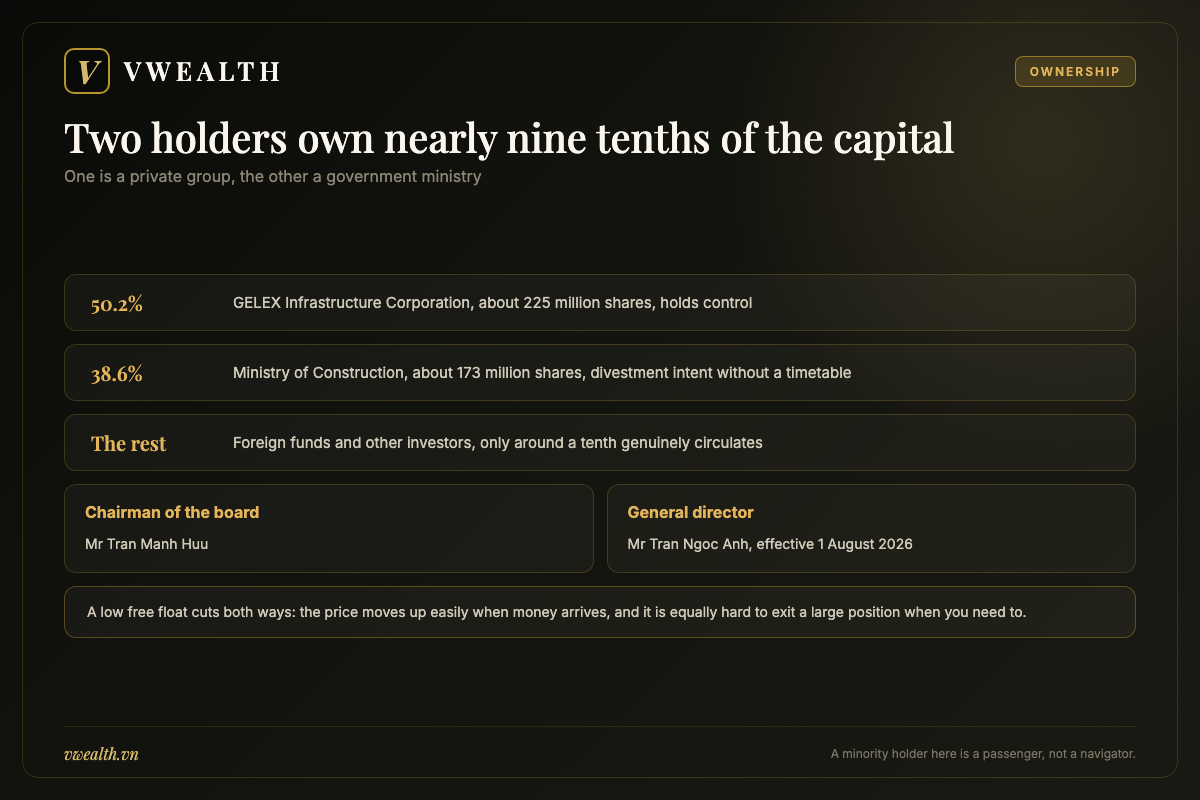
According to published ownership data, Viglacera has roughly four hundred and forty-eight million three hundred and fifty thousand shares outstanding. The largest shareholder is GELEX Infrastructure Corporation with roughly two hundred and twenty-five million shares, about fifty point two per cent. The second largest is the Ministry of Construction with roughly one hundred and seventy-three million shares, about thirty-eight point six per cent. The remainder is spread across foreign funds and other investors, several of the foreign funds holding above one per cent each.
Add the first two together: more than eighty-eight per cent of the capital sits with two holders. This is the single most important technical fact about the stock, and it produces three practical consequences.
The first is a low free float. Only around a tenth of the shares genuinely circulate. For a company of this market capitalisation, a small float makes liquidity far thinner than the size of the business suggests, and makes the price more sensitive to large orders.
The second is concentrated voting power. The controlling shareholder determines most outcomes at the annual meeting. A minority investor in this company participates as a passenger, not as a navigator.
The third, and the most interesting, is the divestment scenario. The regulator has previously indicated an intention to divest the remaining state holding at an appropriate time, following valuation work and with transparency safeguards. That intention has been restated over several years without execution, so the correct posture is to treat it as a real possibility without a timetable, not as an imminent event.
Why the divestment scenario matters so much
For most stocks, a large block sale is bad news because it creates supply pressure. For VGC the story is more nuanced and needs to be read from both sides.
The positive side: a large divestment would materially increase the free float. Better liquidity is a precondition for large funds, including index funds and active foreign managers, to participate at all. Many funds carry minimum liquidity rules; a ticker that fails them is outside the permitted universe no matter how good the fundamentals.
The negative side: a large volume of supply arriving in a short window can weigh on the price, particularly if the broad market is weak at the time. The method also matters enormously: a sale to a single strategic buyer is a completely different event from a competitive public offering, both in price impact and in the governance structure that follows.
The practical conclusion: do not buy VGC purely on divestment expectations. That expectation has existed for years and has repeatedly failed to materialise within the timeframe the market hoped for. Buy for the underlying business, and treat divestment as a bonus if it arrives.
Leadership and the 2026 change in the executive seat
Viglacera’s board is chaired by Mr Tran Manh Huu. The chief executive position changed in 2026: Mr Tran Ngoc Anh was appointed general director effective 1 August 2026, succeeding Mr Nguyen Anh Tuan.
The company also made changes at deputy chief executive level during 2026, appointing a new deputy in July while another departed at the end of 2025.
How to read these changes correctly: at a company where a new controlling shareholder has taken over, executive changes are normal and usually systematic rather than reactive. What you should track is not who came and went but three questions: is the investment decision cycle getting faster; are underperforming member units being dealt with decisively; and is disclosure quality improving. The detailed scoring framework sits in Vietnam corporate governance.
It is worth adding a note on how a state legacy shapes the operating economics in ways that do not appear in any single line of the accounts. A company built up as a ministry’s production arm inherits not only assets but obligations: employment across many provinces, plants sited for reasons that made sense under central planning rather than under market logistics, and a portfolio of member companies of widely varying quality. Restructuring such a group is slow work, and it is rarely completed in one management term.
This is the strongest argument for paying attention to the change of control. A private controlling shareholder with capital discipline has both the incentive and the authority to close or sell the weakest units, consolidate overlapping product lines, and reallocate capital toward the divisions that actually earn a return. The evidence that this is happening will not appear in a press release; it appears in the accounts, as a shrinking non-controlling interest line, a falling count of member companies, and asset disposals at reasonable prices.
Equally, the state’s remaining stake is not purely a liability for the equity story. A large state shareholder can be helpful in a business whose growth depends on obtaining land and project approvals at provincial level. Investors who frame the state holding solely as an overhang waiting to be sold are seeing half the picture; it is also part of why this particular company can assemble industrial land in the first place.
The honest summary is that the ownership structure is genuinely two-sided. It suppresses liquidity and limits minority influence, which are real costs. It also underpins the access to land and approvals that makes the growth division possible, which is a real benefit. Investors should hold both thoughts at once rather than collapsing the question into a single verdict.
Consolidating listed subsidiaries: why this deserves attention
One of the more significant restructuring items is the plan to merge several listed member units, bringing subsidiary tickers together and delisting the ones involved.
Retail investors usually skip this kind of news because it sounds administrative. In fact it affects the value of your holding through three channels.
The first is the profit line. When the parent raises its stake in a member unit from a controlling level toward full ownership, profit that previously leaked out to non-controlling shareholders now stays with parent shareholders. Consolidated revenue does not change, but the profit attributable to you rises.
The second is cost. Maintaining several listed legal entities simultaneously means duplicated audit fees, disclosure costs, annual meeting costs and separate governance apparatus. Consolidation strips out the duplication.
The third is readability. A structure with more than twenty member units and several listed subsidiaries is one that even professional analysts find laborious to unpick. A simpler structure reduces the discount the market applies, because the risk of not understanding the business falls.
What to monitor is the timetable and the exchange ratio. In intra-group mergers, the ratio between parent and subsidiary shares determines which side benefits. Read the published plan and its valuation basis rather than the headline.
Dividends: a notable point of difference
Among Vietnamese industrial property and building materials names, few sustain a regular cash dividend. Viglacera belongs to the group with a tradition of paying cash, and has announced dividend plans for recent years.
The reason lies in the business model itself: leasing industrial park infrastructure produces relatively steady cash inflows, and the building materials arm, thin margins notwithstanding, turns over continuously. This distinguishes VGC from pure property developers, which typically generate cash only on project handover. A broader survey of income names in this market is in Vietnam dividend stocks.
But check the actual payout ratio and the dividend against profit attributable to the parent in the most recent period, rather than relying on a rate announced earlier. During a phase of heavy disbursement into new industrial park projects, capital needs can outrank the dividend.
| Item | Disclosed status | What to keep monitoring |
|---|---|---|
| Shares outstanding | Approximately 448.35 million | Changes if member units are consolidated |
| Controlling shareholder | GELEX Infrastructure Corporation, about 50.2% | Capital allocation strategy across the two divisions |
| State shareholder | Ministry of Construction, about 38.6% | Divestment timetable and method, if any |
| Free float | Only around one tenth of the shares | Liquidity is thin relative to market capitalisation |
| Chairman of the board | Mr Tran Manh Huu | Pace of dealing with weak member units |
| General director | Mr Tran Ngoc Anh, effective 1 August 2026 | Results across both divisions in the first term |
| Dividend | A tradition of cash payment | Capital pressure from new industrial park projects |
Viglacera’s two legs: materials plants and an industrial land bank
This is the most important chapter of the analysis, because every misunderstanding about this ticker starts with treating the two divisions as one. We will pull them apart and examine each with the metrics that belong to it.
Leg one, building materials: four product families, four different economics
Viglacera’s building materials division covers four main families, and each has its own economics.
The first is construction glass, the family with the highest barrier to entry. A float glass line requires very large capital, and more important than the money is an operating characteristic: the glass furnace runs continuously for years and must never be allowed to cool, because a cold furnace means demolishing and rebuilding the refractory lining inside. The consequence is that a glass plant cannot flex output down when demand weakens; it must run and it must sell. This is why construction glass prices can fall very steeply when construction activity stalls. Viglacera’s range also includes ultra-clear glass, a higher grade than ordinary construction glass, used where high light transmission is required.
The second is ceramic tiles. This is a fiercely competitive segment with many domestic producers and pressure from imports. Margins turn on energy cost, on design range and on distribution reach. Tiles are also fashion-sensitive, which means inventory of last season’s designs loses value quickly.
The third is sanitary ware and fittings. Margins here are better than in tiles because brand genuinely matters: consumers choose bathroom fixtures largely on trust in durability and after-sales service. This is the family where Viglacera’s decades of brand accumulation pay off most clearly.
The fourth is fired clay bricks and roof tiles together with non-fired construction materials. This is the original trade, the thinnest margin, but it carries a cost advantage from quarries located near the plants and from local distribution. Non-fired materials also benefit from policy direction encouraging reduced use of fired clay brick.
What all four share: this is an energy-intensive industry. Gas, coal and electricity account for a large share of production cost, and the company does not control those input prices. When you read the gross margin of the materials division, the first thing to do is set it against the energy price level of the same period.
A second point on the materials division concerns the distribution network, which is easy to underrate. Building materials in Vietnam reach the end user largely through a long tail of independent dealers and small builders’ merchants, particularly outside the major cities. Building and holding that network takes years, requires credit terms, and depends on brand recognition among people who buy on habit and reputation rather than specification.
The strategic consequence is that distribution is a partial moat even where the product is close to a commodity. A new entrant with a modern tile plant can match the product but cannot instantly reach the thousands of small outlets through which the product is actually sold. This is why market share in Vietnamese building materials moves slowly even when relative cost positions change.
The financial consequence is that dealer credit sits on the balance sheet. Receivables in a materials business are a strategic asset as well as a working capital item: extending credit is part of holding the network. What you must watch is whether receivable days are stretching faster than sales are growing, because that is the signature of a company buying volume with its balance sheet rather than winning it on product.
There is a third consequence for how you interpret price competition. When demand weakens, producers with heavy fixed costs and inflexible output, glass above all, compete on price first. Producers with strong dealer relationships and recognised brands, typically in sanitary ware, hold price longer and lose volume instead. Watching which of those two patterns shows up in a given period tells you which part of the division is under pressure.
Leg two, industrial parks: sell once, collect for decades
The industrial park division runs on entirely different economics, and it is the reason the market has paid attention to VGC in recent years.
The basic model works like this. The company is allocated or leases a large parcel, carries out site clearance and levelling, builds infrastructure including internal roads, power, water supply and drainage and wastewater treatment, then subleases serviced land to manufacturing investors. Industrial park leases typically run for several decades, and in many cases the tenant prepays most or all of the rent for the full term.
This creates an accounting characteristic you must understand to avoid misreading the statements. Prepaid rent is not recognised as revenue all at once; a portion sits in unearned revenue and is amortised across the years of the lease, depending on the recognition policy the company applies. Cash inflow and recognised revenue therefore do not coincide in time.
The practical consequence for investors: for the industrial park division, the most important figure is not the revenue of the period but the land area newly contracted for lease during the period, and the unearned revenue balance on the balance sheet. Newly contracted area tells you whether the company is selling; the unearned revenue balance tells you how much future revenue has already been banked.
On scale, Viglacera manages roughly one thousand three hundred and twenty-seven hectares of industrial park land across several provinces, including four parks in Bac Ninh and the Phu Ha park in Phu Tho. Expansion continues: an industrial park project in Thai Nguyen with total investment of roughly five thousand four hundred billion dong has been approved, with the company contributing roughly eight hundred and ten billion dong, about fifteen per cent of total investment.
Location is the most valuable detail here. Bac Ninh and the provinces around Hanoi are the heart of Vietnam’s electronics and components manufacturing cluster; Phu Tho and Thai Nguyen sit on the expansion axis of the northern industrial belt as core land runs short and rents rise. In other words, Viglacera’s land portfolio sits directly on the path of foreign investment into northern Vietnam. The wider theme is covered in China plus one and Vietnamese stocks.
It is also worth understanding what the Vietnamese industrial park lease actually is, because it differs from the equivalent contract in most developed markets. The developer does not own the land outright; it holds a land use right granted by the state for a defined term, typically fifty years from the project’s approval. It then subleases serviced plots to tenants for the remaining term of that right. This has two implications. First, an industrial park is a depleting asset with a legally defined end date, not a perpetual rental stream, which is why valuing it on a simple rental yield overstates it. Second, the residual term matters: a plot in a park approved twenty years ago carries a shorter remaining life, and therefore a lower value per square metre, than an identical plot in a newly approved park.
The second structural feature is the fee split. Tenants pay an upfront land sublease payment, and then an ongoing infrastructure management and service charge covering road maintenance, security, wastewater treatment and utilities distribution. The upfront payment is the headline; the service charge is the annuity. As a portfolio matures and occupancy rises, the service charge stream grows and becomes a genuinely recurring, inflation-linked revenue line. Investors focused entirely on new leasing often miss that this recurring layer is quietly compounding underneath.
The third feature is the tenant mix, which determines the durability of the income. A park filled with large multinational electronics assemblers has different risk characteristics from one filled with small domestic processors: the former brings scale, stability and its own supplier ecosystem, but concentrates exposure in one industry and one investment cycle. When you review a developer’s portfolio, ask not only how full the parks are but who fills them.
The supporting layer: worker housing and ready-built factories
Alongside the two main legs, Viglacera also develops residential property and invests in real estate. This division is much smaller, but it has strategic meaning and deserves its own section.
Its logic sits in its link to the industrial parks. A functioning industrial park needs housing for workers, basic commercial services, and ready-built factory space for smaller tenants who do not want to construct their own. A company that already holds land in and around the park finds these a natural extension, and they make the park itself more attractive to tenants.
Worker housing is the most policy-relevant item. It is a state-encouraged activity, typically accompanied by land and credit incentives in exchange for a capped margin. So it is not a profit engine; it is a relationship builder with provincial authorities that strengthens the company’s file when it applies for new projects.
Ready-built factories are the second item worth watching. Instead of leasing only serviced land, the company constructs standard factory buildings and leases them. This requires more capital per hectare but generates more revenue per hectare and reaches small and medium tenants who want to start production immediately. The share of ready-built space in the portfolio is a good indicator of how mature an industrial park developer has become.
How the two legs support each other
The natural question: the two divisions have nothing to do with each other, so why keep both? There are three arguments, and you should weigh all three.
The first is complementary cash flow. Building materials turns over quickly and generates steady cash, which suits funding the investment phase of industrial park projects that need heavy capital and repay slowly. In the other direction, the industrial park division delivers large inflows when contracts are signed, giving the company resources to upgrade manufacturing lines.
The second is access to land. A company with state roots, long experience in construction, and working relationships with provincial authorities across many provinces finds industrial park development a natural extension rather than a leap into a new industry.
The third, and weakest, is cross-selling. In theory the company can supply building materials to the factories built inside its own parks. In practice industrial buildings use little ceramic tile and sanitary ware, so the synergy value here is small.
An honest assessment: the two legs support each other financially more than operationally. And there is a downside you should know: a two-division company is typically valued by the market below the sum of its parts, because investors struggle to score it and sector-specialist funds struggle to place it in a bucket. This conglomerate discount is real in many markets and you should build it into any comparison of VGC against pure industrial park names.
Compared with the pure industrial park names
To position VGC properly, set it beside two peers this series covers separately. The analysis of KBC stock describes an industrial park company with a large northern land bank and an almost pure leasing model. The analysis of BCM stock describes a different model in the south, tied to urban and regional infrastructure development.
Against those two, VGC differs in three ways. First, industrial parks contribute a smaller share of total revenue, because materials still dominates the top line even though its profit contribution is disproportionately small. Second, VGC has steadier operating cash flow thanks to manufacturing, so it depends less on the rhythm of lease signings. Third, VGC carries a variable the private names do not: the possibility of state divestment.
Conversely, the pure industrial park names have a clear advantage in narrative: easy to value on land, easy to compare against each other, and not diluted by a thin-margin manufacturing arm.
The economics of a glass furnace, in detail
The glass business deserves a closer look, because its operating characteristics explain a large part of the volatility in Viglacera’s materials earnings and because very few investors outside the sector understand them.
A float glass line works by floating molten glass on a bath of molten tin, which produces a perfectly flat sheet. The furnace that melts the raw batch operates above one thousand five hundred degrees Celsius and is lined with refractory brick. That lining degrades slowly under heat, and a full rebuild, known in the industry as a cold repair, is required roughly every ten to fifteen years. A cold repair takes months and costs a substantial fraction of the original line investment.
Three financial consequences follow. The first is that output is effectively fixed in the short run. The line runs at its design rate or it does not run; there is no efficient way to produce at sixty per cent. When demand falls, the producer either accumulates inventory or cuts price, and glass is expensive to store because it is fragile and bulky. That is why glass prices fall so sharply in a construction downturn.
The second is that the cold repair is a scheduled, forecastable capital event. An investor who knows roughly when a company’s furnaces were last rebuilt can anticipate both the capital outlay and the period of lost output. This is exactly the kind of detail that separates a considered valuation from a screen-based one, and it belongs in your notes on any glass producer.
The third is that energy is not merely a cost line but a strategic exposure. A furnace running continuously for a decade consumes an enormous quantity of gas or coal, and the producer’s ability to secure long-term supply at predictable prices materially affects returns across the life of the asset.
Set against those constraints, the barrier to entry is genuine. Nobody builds a float line speculatively. That is why the glass segment behaves differently from tiles: fewer competitors, larger swings, and a cost position that is set on the day the line is commissioned.
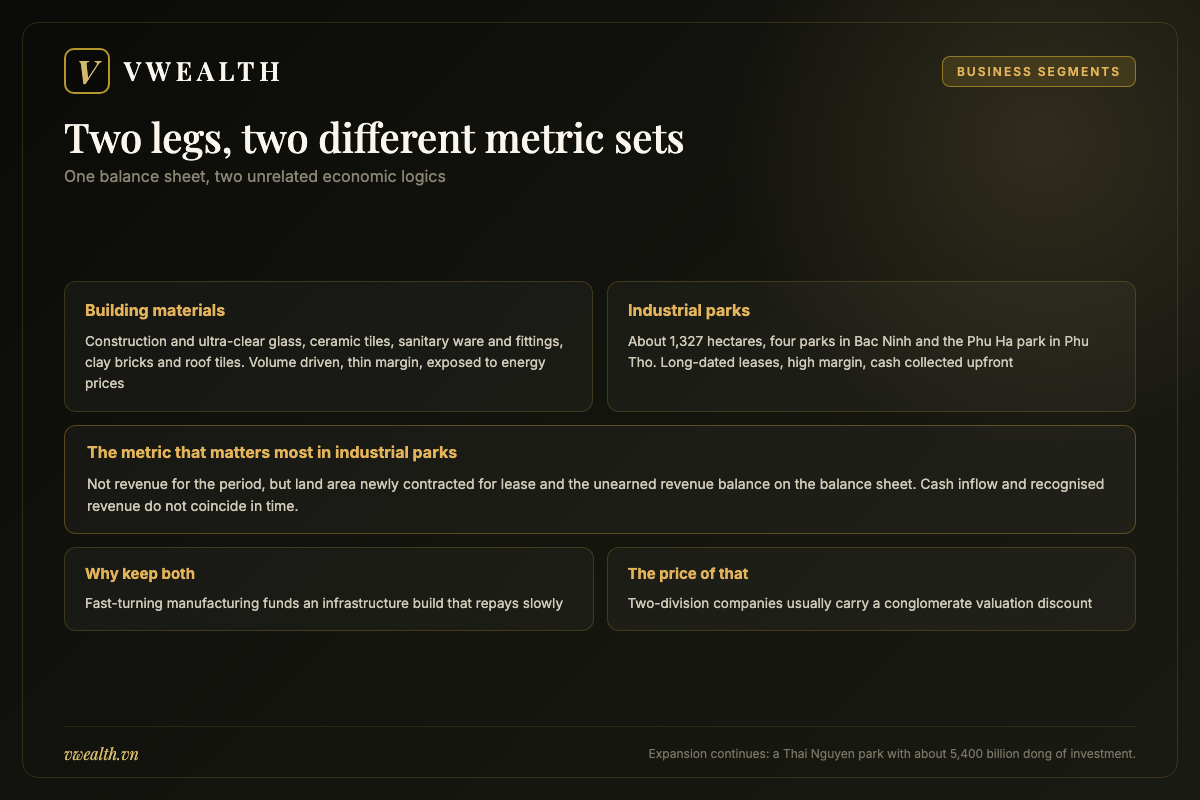
| Criterion | Building materials | Industrial parks |
|---|---|---|
| Economic nature | Volume-driven industrial manufacturing | Long-dated infrastructure development and leasing |
| Customer | Contractors, dealers, Vietnamese households | Manufacturing investors, mostly foreign capital |
| Most important metric | Gross margin against energy prices | Newly contracted lease area in the period |
| Cash flow rhythm | Steady, fast turnover, thin margin | Lumpy, contract-driven, high margin |
| Accounting feature to watch | Write-downs on obsolete design inventory | Unearned revenue amortised over many years |
| Principal risk | Energy prices, oversupply, imports | Pace of foreign investment disbursement, land legal process |
| Competitive barrier | High in glass, low in bricks and tiles | High, since serviced land is hard to replace |
Market position and financial health: reading a company with two accounting models
This chapter does not give you last period’s numbers. It gives you a method, so that whenever you open the accounts you know where to look and in what order.
Step one: separate the divisions before you do anything else
The first move when you open Viglacera’s accounts is to find the segment note on revenue and profit. You need four numbers: materials revenue, materials gross profit, property and industrial park revenue, and property and industrial park gross profit.
The reason to do this first is that the two divisions have wildly different margins. If you look only at the consolidated figure, a quarter in which the industrial park division books several contracts will make the whole company’s margin look dramatically better, and you will wrongly conclude that manufacturing has improved.
Once separated, compute each division’s share of gross profit, not its share of revenue. This is where the real picture emerges: one division can dominate revenue while contributing a small slice of profit.
Metric one: newly contracted area and the unearned revenue balance
For the industrial park division this pair is decisive. Newly contracted lease area in the period is a direct measure of selling power, and it appears several quarters ahead of the corresponding revenue.
The unearned revenue balance on the balance sheet is a store of future profit. A rising balance means the company has collected cash and will recognise revenue progressively in coming years. A company with a large and steadily rising balance has visible forward revenue, even when a particular quarter looks unremarkable.
Alongside those two sits remaining commercial land: how many hectares are serviced and ready to lease, how many are in site clearance, and how many exist only as an in-principle approval. Those three categories carry entirely different values and must never be added together.
Metric two: average rent and occupancy by park
Two further numbers tell you about the quality of the land bank rather than merely its size, and serious investors should compute them.
The first is the average rent per square metre on contracts signed in the period. Industrial land rent is not uniform; it depends on location, on connecting infrastructure, on service quality and on timing. A company signing many contracts at below the regional benchmark is selling an irreplaceable asset cheaply. Conversely, a company signing few contracts at high rents may be holding inventory for a better price, which is rational when land is finite.
The second is occupancy by individual park, not the portfolio average. A portfolio with one nearly full park and one just opening produces the same average as a portfolio with two half-filled parks, but the two situations have entirely different outlooks. A nearly full park means the company is running out of inventory in that province and needs new land; a newly opened park means plenty of room but no proof of demand yet.
Metric three: gross margin of the materials division against energy prices
For the materials division, gross margin is the central line, and it must always be read alongside the energy price level of the same period.
Glass and building ceramics consume gas, coal and electricity in a large share of production cost. When energy prices rise, margin compresses almost immediately, because the company cannot pass the full increase into selling prices in a competitive market. Conversely, a cycle of low energy prices can expand margin without any improvement in management at all.
Alongside that, watch capacity utilisation. With a float glass line that must run continuously, running below capacity means running at a loss, because fixed costs do not fall with output.
Metric four: profit attributable to the parent and the minority line
This is the metric Viglacera’s multi-subsidiary structure forces you to check.
The company holds more than twenty member units at varying stakes, commonly from fifty-one to one hundred per cent. All of their revenue and profit is consolidated, but the profit corresponding to minority ownership is stripped out into the non-controlling interests line.
Track the ratio of non-controlling interests to total net profit across several periods. If that ratio declines, the company is either raising its stakes in member units or concentrating profit at the parent, and that is good news for VGC shareholders. The plan to consolidate listed member units, if executed, moves in exactly that direction.
Metric five: debt structure and maturity
A company that both operates plants and develops industrial parks has two distinct capital needs: working capital for manufacturing, and long-dated capital for infrastructure.
What to check is whether those two needs are funded with two appropriate sources. Short-term borrowing for working capital is normal. Short-term borrowing to fund site clearance and infrastructure is a maturity mismatch, and it is the most common reason industrial property companies get into trouble when credit tightens.
Add one further question: what share of operating profit is consumed by interest expense, and is that share rising or falling across periods.
Metrics six and seven: project legal status and disclosure quality
In Vietnamese industrial property, legal progress matters as much as location. A project with in-principle investment approval but incomplete site clearance and no land allocation decision cannot be leased. Classify each project in the portfolio by legal stage rather than adding up the headline hectares.
The final metric is disclosure quality. Does the company report results by segment? Does it publish contracted lease area each period? Does it explain the status of each project? For a two-division company with many subsidiaries, transparency is what makes valuation possible; its absence forces you to apply a discount.
Two cash cycles running in parallel
One more analytical point completes the reading method, and it concerns the shape of the balance sheet rather than the income statement.
The materials division runs a conventional manufacturing cash cycle. It buys minerals and energy, holds work in progress, carries finished goods across a distribution network, and extends credit to dealers. Cash leaves before it returns, and the gap is measured in months. The balance sheet consequence is inventory and receivables that look heavy relative to revenue, funded largely by short-term borrowing.
The industrial park division runs the cycle in reverse. Capital is spent years in advance on clearance and infrastructure, and then, when a lease is signed, a large prepayment arrives at once. The balance sheet consequence is a large work in progress balance on the asset side and a large unearned revenue balance on the liability side.
Those two patterns are superimposed in a single set of accounts, and a reader who does not separate them will draw wrong conclusions. A rising unearned revenue balance looks like rising liabilities on a screen, but it is the opposite of a problem: it is money already collected against future recognition. A rising inventory balance in the materials division at a time of falling volumes is a genuine problem. Both appear as increases on the same side of the balance sheet.
The practical instruction: when working capital moves, always ask which division moved it. If you cannot tell from the disclosure, that in itself is a finding, and it belongs in the disclosure quality score.
There is also a seasonal rhythm to allow for. Construction activity is affected by the rainy season and by the extended Lunar New Year shutdown, so materials volumes and working capital follow a recurring annual pattern. Comparing one quarter with the immediately preceding quarter, rather than with the same quarter a year earlier, is a common way to reach a wrong conclusion about this sector.

| # | Metric | Where to find it | Red flag |
|---|---|---|---|
| 1 | Newly contracted lease area and unearned revenue | Segment note and balance sheet | Contracted area declining across consecutive periods |
| 2 | Average rent and occupancy by park | Disclosures and management commentary | Rents below the regional benchmark |
| 3 | Materials division gross margin | Segment note, cross-checked against energy prices | Margin compressing while energy prices are flat |
| 4 | Profit attributable to the parent | Consolidated income statement | Non-controlling interests taking a rising share |
| 5 | Debt maturity structure | Balance sheet and borrowings note | Short-term debt funding infrastructure development |
| 6 | Legal stage of each industrial park project | Disclosures and board resolutions | Headline hectares that are not yet leasable |
| 7 | Segment disclosure quality | The full year of filings | The two divisions cannot be separated |
How the market treats VGC stock
A stock’s personality is formed by its register, its industry, and the market’s memory of it. VGC’s personality is distinctive, and understanding it will save you from the wrong expectations.
Liquidity thinner than the market capitalisation suggests
As noted in chapter two, more than eighty-eight per cent of the shares sit with two holders. The genuinely circulating float is therefore far smaller than the headline market capitalisation.
The consequence cuts both ways. Favourably: when good news arrives and money flows in, the price can move quickly because there is little stock available. Unfavourably: when you want out of a large position, the market may not be deep enough to absorb it, and you will sell over several sessions at progressively worse prices.
The practical rule: for tickers with a low free float, size the position smaller than you would for an equally capitalised name with abundant liquidity. Being able to buy does not mean being able to sell at the same price.
There is a second mechanical point specific to Vietnam. HOSE applies a daily price band of seven per cent either side of the reference price. In a thin-float stock, a strong directional move can take the price to the band limit for consecutive sessions, meaning the quoted price is not always a price at which you can transact. Build that into your assumptions before you need to exit.
Valuation: one ticker that needs two methods at once
This is the key technical point of the chapter. Because VGC contains two businesses of different nature, no single valuation method fits the whole company.
The sensible approach is sum of the parts. For the building materials division, this is a cyclical manufacturer, so use a multiple on mid-cycle earnings or on operating cash flow, benchmarked against comparable materials producers. For the industrial park division, value the land: estimate the worth of remaining commercial land using prevailing regional rents, deduct the capital still to be spent, and discount to present value.
Add the two figures, then deduct net debt at group level. This is precisely the asset-based logic set out in the guide to Vietnam stock market valuation, and it suits a land-owning company far better than staring at an earnings multiple.
One caution when doing the sum. Markets usually apply a conglomerate discount. If your parts total comfortably exceeds the current market capitalisation, do not immediately conclude the stock is cheap. Ask whether that gap will ever be recognised, and what would cause it to be recognised. For VGC there are two candidate catalysts, both discussed already: consolidation of listed subsidiaries, and state divestment. Neither has a firm timetable.
A further practical note on the sum-of-the-parts calculation. When you value the industrial land, resist the temptation to apply the current market rent to every remaining hectare. Three adjustments are necessary. Deduct the capital still required to service the unserviced portion, which for raw land can be a substantial share of its eventual value. Apply a time discount reflecting how long it will realistically take to lease the inventory, using the company’s own historical absorption rate rather than an optimistic assumption. And apply the residual lease term, since a plot with twenty-five years left is worth materially less than one with forty-five.
On the materials side, the corresponding discipline is to avoid valuing a peak year. Take the average margin across a full construction cycle, apply it to current capacity, and sanity-check the result against the replacement cost of the plants. If your earnings-based value is far above replacement cost, you are assuming the industry stays tight, which in a chronically oversupplied sector is a strong assumption.
Finally, deduct net debt honestly. In a group with many subsidiaries, some debt sits at member companies where the parent owns only a controlling stake, so a strict calculation should consider the economic share of that debt alongside the economic share of the associated assets. Doing this properly is laborious, which is precisely why the market often does not do it, and why a careful investor can occasionally find a gap between price and value in structures of this kind.
Dividends and a defensive streak
With its tradition of cash dividends, VGC has a defensive quality that many industrial property names lack. In weak markets, stocks paying reliable cash dividends usually fall less, because the yield creates a natural floor.
But do not mistake VGC for a pure income stock. The company is disbursing into new industrial park projects, and that capital requirement can outrank the dividend in some years. If steady income is your primary objective, compare against alternatives before committing.
One further observation about how this stock behaves through a cycle. Because the two divisions respond to different drivers, the share price often reflects whichever story the market is currently paying attention to rather than the blended reality of the business. In periods when foreign investment headlines dominate, VGC trades as an industrial property proxy and moves with the sector. In periods when construction and materials are in focus, it trades as a building materials name. The underlying company does not change between those regimes; only the lens does.
This has a practical use. When the market is valuing the company purely as a materials producer and ignoring the land, the asset-based valuation from chapter five will look conspicuously wide of the price. That gap is not automatically an opportunity, but it is the condition under which an opportunity can exist, and it is worth measuring rather than guessing at. Keep the sum-of-the-parts calculation updated so that you know where the gap stands, rather than reconstructing it in a hurry when the price moves.
The corollary is a warning. When the market is enthusiastic about industrial property and valuing the whole company on the land story, the materials division is effectively being handed to you free, or worse, being ignored while it consumes capital. In those conditions the margin of safety is thinner than it looks, and the appropriate response is to trim rather than to add.
Foreign ownership and the foreign investor’s position
Viglacera’s register includes several foreign funds holding above one per cent, which shows the ticker has genuine appeal to institutional foreign investors, largely on the industrial property story tied to foreign direct investment flows.
Yet the low free float is exactly what stops foreign money from entering in size. That is why the state divestment scenario, if it were executed through a broad public offering, would matter so much to this ticker’s investor base. The mechanics of ownership caps and how to check remaining headroom are set out in foreign room in Vietnam stocks, and a picture of who the institutional holders in this market are is given in what foreign funds hold in Vietnam.
Access for investors based outside Vietnam
A practical note. Buying VGC requires a local securities account and a trading code, and the account opening process for a non-resident involves documentation and a custodian relationship. Complete that process before you have a view you want to act on, not after; the mechanics are in the guide to opening a brokerage account in Vietnam as a foreigner.
If you would rather take exposure to Vietnamese industrial property without single-stock risk, the trade-offs are compared in Vietnam portfolio construction, ETFs versus direct stocks. Be aware, though, that index products in this market are dominated by large caps, and a thin-float mid cap contributes little to them. If you want the specific exposure, you have to own the specific name.
The catalysts the market reacts to
With VGC, four categories of event tend to move the price. The first is anything touching state divestment, including statements of intent. The second is data on registered and disbursed foreign direct investment into manufacturing. The third is news of new industrial park projects being approved or land being allocated. The fourth is energy price movement and policy affecting building materials.
Of those four, only the second and third change intrinsic value. The first is a story that has run for years; the fourth affects near-term margins without changing long-term position.
Industry context: building materials oversupply and the supply chain shift
Viglacera’s two divisions answer to two different contexts, and they need to be described separately.
Context for materials: an industry in chronic oversupply
Vietnam’s building materials industry has a structural feature investors must grasp: in several product segments, domestic capacity exceeds domestic demand.
The cause is easy to understand. During a construction boom, attractive margins pull in new investment; but a materials production line has a useful life of twenty to thirty years while a construction cycle lasts only a few. The capacity built in the good phase is still there long after the good phase ends.
The consequence for producers: very limited ability to raise selling prices, with margins driven mainly by input costs and capacity utilisation. In that setting, Viglacera’s advantages sit in three places: a long-established brand that holds price better in sanitary ware, quarries near the plants that cut freight cost, and a presence in glass, a segment with a high entry barrier.
There is a long-term support for the industry worth counting. Vietnam’s construction demand still has considerable room. Urbanisation is unfinished, major infrastructure programmes are under way, and social housing programmes create demand at the mass-market end.
An overlooked long-term support: urbanisation and the replacement cycle
There is a second support for the materials division that short-term reports usually skip, and it deserves stating for balance.
Demand for building materials does not come only from new construction. It also comes from the repair and replacement cycle of the existing housing stock. Tiles, sanitary fixtures and glass all have finite service lives, and as household incomes rise, people renovate more often and trade up to higher product tiers.
For an economy with a large housing stock in the middle of a living-standards upgrade, this replacement demand grows steadily and is far more stable than demand from new construction. It is not enough to offset a downturn in the construction cycle, but it establishes a floor under volumes and tilts the product mix toward better margins.
It is also why brand carries real value in sanitary ware. When a household renovates, it does not buy the cheapest option; it buys on trust in durability and warranty support. A brand that predates many of its current customers holds an advantage no advertising budget can purchase.
Context for industrial parks: Vietnam in the supply chain shift
This is the far more important context for VGC’s investment story.
Over recent years, global manufacturers have moved part of their production capacity out of China to diversify risk. Vietnam has been one of the principal destinations, thanks to its proximity to China, competitive labour costs, a broad network of trade agreements and political stability.
For an industrial park developer, that wave converts directly into demand for land. But you need to read that demand with discipline, and there are three points to note.
The first: demand is uneven by region. The provinces around Hanoi and Hai Phong attract electronics and components manufacturing; southern provinces lean toward textiles, wood products, food processing and engineering. Viglacera’s land bank is concentrated in the north, so this ticker is tied more closely to electronics investment flows.
The second: core land in the northern industrial centres is running short and rents are rising. That is why projects on the outer ring, in provinces such as Phu Tho and Thai Nguyen, carry strategic weight: when rents in the core exceed what manufacturing investors will accept, capital spreads to adjacent areas with good connecting infrastructure.
The third: registered capital is not disbursed capital. Registered foreign investment is a commitment; disbursed capital is real money entering the economy and turning into factory buildings. For an industrial park company, the metric worth tracking is disbursement into manufacturing and processing, not the registration figure that dominates headlines.
Risks in this context
The supply chain shift is a real story, but it is not a straight line up, and three risks belong on the table.
The first is trade policy in importing countries. As goods made in Vietnam take a rising share of developed-market imports, the likelihood of trade measures aimed at Vietnamese-origin goods rises. That feeds back indirectly into decisions on where to place a factory. The broader country risk picture is collected in the risks of investing in Vietnam.
The second is regional competition. Vietnam is not the only option; neighbouring countries offer their own incentives to attract the same capital, a comparison drawn out in Vietnam versus other emerging markets.
The third is domestic bottlenecks: reliable power supply for industrial production, the depth of the technical labour pool, and the pace of connecting infrastructure. These are factors the developer cannot control but which directly shape a tenant’s decision to sign.
Reading foreign investment data properly: a short manual
Because the industrial park division depends on foreign investment, it is worth setting out how to read that data, since the headline figures reported in the press are frequently the wrong ones.
There are three distinct numbers, and they mean different things. Newly registered capital is the value of licences issued to new projects in the period; it measures intent. Additional capital is expansion commitments by projects already operating; it measures confidence among investors already on the ground, and it is arguably the highest-quality signal in the set. Disbursed capital is money actually spent; it measures what is being built right now.
For an industrial park developer, the sequence runs roughly like this: a manufacturer decides on a country, selects a province, signs a land lease, then registers the project, then disburses over the following one to three years as the factory rises. The land lease therefore comes early in the chain, which means a developer’s contracted area leads the disbursement statistics rather than following them.
Two further refinements matter. The first is sector composition: capital flowing into manufacturing and processing translates into demand for industrial land, while capital flowing into real estate or services does not. Always look at the sector split, not the aggregate. The second is geography: for a company with a northern land bank, the relevant figure is investment into the northern provinces, and a strong national total can mask weakness in the region that matters to you.
Finally, treat single-quarter movements with caution. Foreign investment data is lumpy because one very large project can dominate a period. A rolling twelve-month view of disbursement into manufacturing gives you a far more reliable read on the underlying trend than any single quarter.
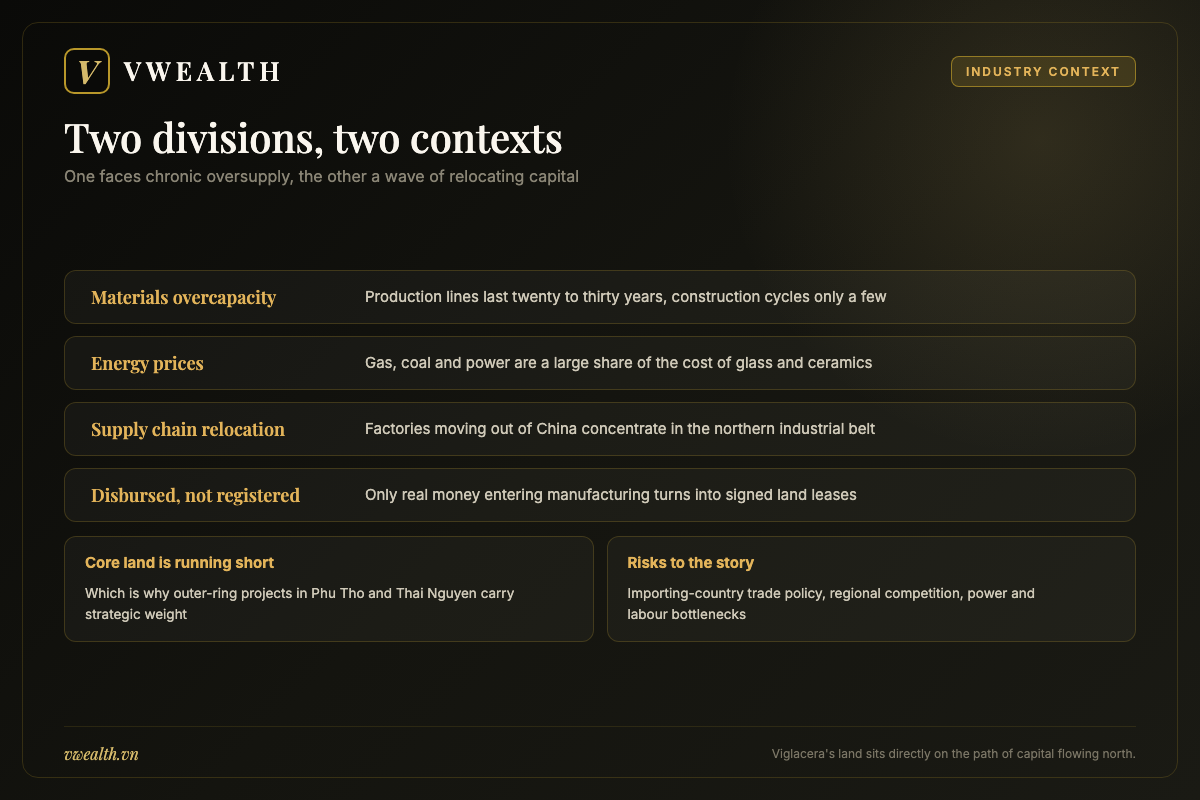
| Force | Effect on building materials | Effect on industrial parks |
|---|---|---|
| Domestic construction cycle | Drives volume and the ability to hold selling prices | Indirect, through demand for factory buildings |
| Energy prices | Direct and fast effect on margin | Small, mainly through infrastructure operating cost |
| Disbursed foreign direct investment | Indirect, through factory construction | The primary driver of lease signings |
| Trade policy in importing countries | Minimal | Affects tenants’ decisions on where to build |
| Public investment and connectivity | Raises demand for mass-market materials | Raises the value of land near new infrastructure |
| Industry-wide overcapacity | Caps pricing power for years at a time | No direct effect |
Outlook: land, divestment, and three scenarios for Viglacera
This chapter contains no price target. It describes the forces at work, then builds three scenarios with the conditions each requires and the early signals that tell you which one you are in.
Five forces pushing forward
The first is expansion of the industrial land bank. The Thai Nguyen project, with total investment of roughly five thousand four hundred billion dong, is a concrete example. Every hectare added to the portfolio is a unit of potential revenue for years to come.
The second is internal restructuring, specifically the plan to consolidate listed member units. If executed, the company cuts the compliance cost of several listed entities, reduces the profit leaking to non-controlling shareholders, and produces accounts that investors can actually read.
The third is foreign investment flowing into manufacturing in northern Vietnam. This force sits outside the company but sets the rhythm of lease signings.
The fourth is the possibility of state divestment. As discussed, this variable could change both governance and share liquidity, but it has no timetable.
The fifth is the domestic construction cycle. If residential property and the infrastructure programme both improve, the materials division will lift capacity utilisation, and in an industry with high fixed costs, every percentage point of utilisation has an outsized effect on profit.
Four forces pushing back
The first is chronic overcapacity in building materials, which limits price increases even when demand recovers.
The second is energy cost. Glass and ceramics are sensitive to gas, coal and electricity prices; a high-price cycle erodes the margin of the division that dominates revenue.
The third is the heavy capital requirement of industrial park development. Site clearance costs tend to rise with land prices, and that spending happens years ahead of the cash it eventually generates.
The fourth is thin share liquidity from the low free float. That is not a business risk, but it is a real risk to your portfolio.
Base case: both legs walking, neither running
In this scenario the industrial park division keeps signing leases at a steady pace on the back of continuing foreign investment, and new projects clear their legal steps one by one to replenish commercial land. The materials division holds acceptable capacity utilisation, with margins fluctuating on energy prices but not collapsing. The company maintains its cash dividend. Ownership does not change.
Conditions: disbursed foreign investment into manufacturing does not fall sharply; legal processes on industrial park projects do not stretch abnormally; energy prices do not spike.
Early signals: newly contracted lease area holds up across periods; the unearned revenue balance rises steadily; materials margin moves sideways rather than compressing.
On current information this is the highest-probability scenario. In it, the shares behave like an asset-rich company without a re-rating catalyst: the value is there, and the market has no particular reason to acknowledge it this quarter.
Bull case: the land bank gets re-rated
In this scenario three things happen together or close together. First, foreign investment into northern Vietnam accelerates, pushing industrial land rents higher and raising the value of the existing land bank. Second, the consolidation of member units completes, lifting profit attributable to parent shareholders without any increase in revenue. Third, genuine progress appears on state divestment in a form that increases the free float.
Conditions: northern industrial land demand stays strong; the company executes its restructuring plan; and the authorities proceed with a divestment method that creates liquidity.
Early signals: regional industrial land rents rise and are confirmed by new contracts; the share of non-controlling interests falls visibly; formal documents on a divestment roadmap appear rather than statements of intent.
In this scenario the market has grounds to value VGC closer to the sum of its parts rather than applying today’s conglomerate discount. But remember the rule: markets re-rate after evidence, not after an announcement.
Bear case: both legs weak at once
In this scenario foreign investment stalls, whether because of global trade turbulence or regional competition, and lease signings slow. At the same time energy prices rise and the domestic construction cycle stays weak, compressing materials margins and cutting utilisation. The company must still disburse on committed industrial park projects, so borrowings rise while cash receipts lag. The cash dividend may be trimmed to preserve capital.
Conditions: disbursement into manufacturing falls across several quarters; energy prices rise and stay high; domestic construction remains subdued.
Early signals: newly contracted area falls across consecutive periods; the unearned revenue balance flattens or falls; short-term borrowings rise faster than work in progress; the dividend plan is revised down.
Be clear about the scope of this scenario. It describes a period of poor financial performance, not a threat to the company’s existence. Viglacera owns land, plants and mineral concessions with real value, and those assets do not vanish when the cycle turns down. What you must be prepared for is waiting time, not a permanent loss of capital.
| Scenario | Conditions required | Early signals | Consequence for the investor |
|---|---|---|---|
| Bull | Northern foreign investment accelerates, subsidiaries consolidated, a real divestment roadmap | Regional rents rise, minority interests shrink, formal divestment documents | Grounds for the conglomerate discount to narrow |
| Base | Steady lease signings, materials holds utilisation | Unearned revenue rising steadily, materials margin sideways | Trades on asset value, no re-rating catalyst |
| Bear | Foreign investment stalls, energy costs high, weak domestic construction | Contracted area falling, short-term debt rising fast, dividend trimmed | A long wait, requiring the temperament to hold |
What would break the thesis
Every investment case should be stated together with the evidence that would falsify it, and this one is no exception. Four developments would genuinely change the view rather than merely making a quarter look bad.
The first is a sustained decline in contracted lease area across four or more consecutive quarters while regional peers continue to sign. That combination would suggest the problem is company-specific, in location, pricing or service quality, rather than a cycle affecting everyone.
The second is evidence that new land cannot be added on economic terms. If site clearance costs rise to the point where the return on a new project falls below the company’s cost of capital, then the industrial park division stops being a growth engine and becomes a run-off asset with a finite life.
The third is a structural deterioration in the materials division that persists through an energy price cycle. Margins that fail to recover when energy costs fall would indicate a loss of pricing position rather than a cost problem.
The fourth is a governance development that reduces minority protection: related-party transactions on unclear terms, an exchange ratio in a subsidiary merger that visibly favours one side, or a deterioration in segment disclosure. In a company where minorities hold roughly a tenth of the capital, governance is not an abstract concern.
Write those four down before you buy, and review them each time results are published. An investment thesis you cannot falsify is not a thesis; it is a hope.
So, should you buy VGC stock?
You now have the material to answer for yourself. This section weighs the arguments and then says which kind of investor this ticker suits.
The case for
First, the company holds roughly one thousand three hundred and twenty-seven hectares of industrial park land in northern Vietnam, sitting directly on the path of foreign investment into manufacturing. Serviced industrial land is an asset that money alone cannot create quickly.
Second, the two-legged model produces steadier cash flow than a pure industrial property company. The manufacturing arm turns over continuously, so the company does not depend entirely on the rhythm of lease signings.
Third, the company has a tradition of paying cash dividends, a rarity in the industrial property and building materials group.
Fourth, a brand accumulated since 1974 carries genuine value in the product families where consumers care about durability, particularly sanitary ware and fittings.
Fifth, quarries near the plants create a cost advantage in an industry where freight erodes margin quickly.
Sixth, a presence in construction glass, including ultra-clear glass, places the company in a product tier with a far higher capital barrier than ordinary bricks and tiles.
Seventh, there are two potential catalysts not fully reflected in the price: the consolidation of listed member units, and the possibility of state divestment.
Eighth, the controlling shareholder has both the incentive and the demonstrated capability to restructure a sprawling state-legacy group, which is precisely the skill this asset base needs.
The case against
First, the free float is very low, only around a tenth of the shares. Thin liquidity is a real risk when you need to exit.
Second, two-division companies typically carry a market discount, because investors struggle to score them and sector funds struggle to place them.
Third, the building materials division sits in an industry with chronic overcapacity, capping pricing power for years.
Fourth, energy costs are a large share of production cost and lie outside the company’s control.
Fifth, the multi-subsidiary structure diverts part of the profit to non-controlling shareholders and makes the consolidated accounts harder to read.
Sixth, the state divestment story has existed for years without materialising in the timeframe the market expected. Buying for that expectation means buying something with no timetable.
Seventh, minority investors have almost no voice in strategic decisions when more than eighty-eight per cent of the capital sits with two holders.
Eighth, for a foreign investor there is a currency layer on top of everything else: earnings and the share price are denominated in dong, and your return in your home currency depends on the exchange rate as well as the business. That exposure is discussed in Vietnam dong currency risk.
| Argument for | The offsetting argument |
|---|---|
| A large northern industrial land bank | Dependent on the pace of foreign investment disbursement |
| Two legs produce steadier cash flow | Conglomerate structures usually attract a valuation discount |
| A tradition of cash dividends | Capital needs for new projects can outrank the dividend |
| A brand built over fifty years | Materials oversupply caps pricing power |
| Quarries close to the plants | Energy costs sit outside the company’s control |
| Two unrecognised potential catalysts | Neither has a firm timetable |
| A controlling shareholder capable of restructuring | Low free float and thin liquidity |
Which investor does this suit
The asset-oriented value investor is the natural owner. If you are comfortable valuing land, accept that asset value can take years to be recognised, and do not need the shares to perform within six months, VGC gives you exactly what you look for: a collection of real assets trading in the shadow of a structure the market finds hard to score.
The thematic investor playing the supply chain shift may also be interested, but should note that VGC is not the purest expression of that theme, because materials still dominates revenue. If you want maximum sensitivity to foreign investment flows, the pure industrial park names serve that objective better.
The income investor can consider VGC as part of a dividend sleeve, but should not weight it heavily, because the payout depends on the capital requirements of new industrial park projects in any given year.
The short-term trader and the newcomer to this market should think carefully. Thin liquidity makes entering and exiting harder than the market capitalisation suggests, and this ticker’s story unfolds over quarters rather than weeks. If you want a more liquid starting point in Vietnamese equities, the discussion of Vietnam blue chip stocks is a better place to begin, and the sector overview in Vietnam real estate stocks puts VGC alongside its peers.
Closing thoughts
Viglacera is the story of a state enterprise created in 1974 to fire bricks, which moved step by step into the high-barrier world of construction glass, and then used its own competence in land and provincial relationships to become an industrial park developer. Not many Vietnamese companies have executed that sequence of expansions while keeping both legs intact.
But the very thing that makes the business durable is what makes the stock difficult. A two-division company, more than twenty member units, two shareholders holding nearly nine tenths of the capital, and a divestment story that has run for years without resolution: all of it makes the company hard to score and easy to discount. The asset value is real; what is uncertain is when and how that value gets reflected in the price.
So, should you buy VGC stock? If you understand that you are buying a combination of industrial land and a group of materials plants, know how to value each separately, accept thin liquidity, and accept that the catalyst may take years to arrive, then VGC is a defensible holding for the long-term asset portion of a portfolio. If you are buying on a divestment headline, because the shares have already run, or because you heard the company owns a lot of land without knowing how many of those hectares are actually leasable, then you are buying a story rather than a business.
One last thing to carry with you. The land, the plants, the quarries and the brand change slowly. Newly contracted lease area, the unearned revenue balance, the materials margin, the debt structure and the legal status of each project change every quarter. Before you place an order, open the latest research report and re-score the seven checks from chapter four. It takes fifteen minutes, and it is the most valuable fifteen minutes in your decision process. If you do not yet have the tools to do it, create a free vwealth account and let the platform read the filings for you.
This article is provided for information and analysis purposes only and does not constitute a recommendation to buy or sell any security. All investment decisions are your own and you bear responsibility for their outcome. Consider consulting a licensed financial adviser before acting.
Research Vietnamese stocks in English with vwealth. Our AI-powered platform turns Vietnamese market data into full English analysis reports — with international payment support and a free 2-month trial for new accounts. Create your free account and read the latest reports.