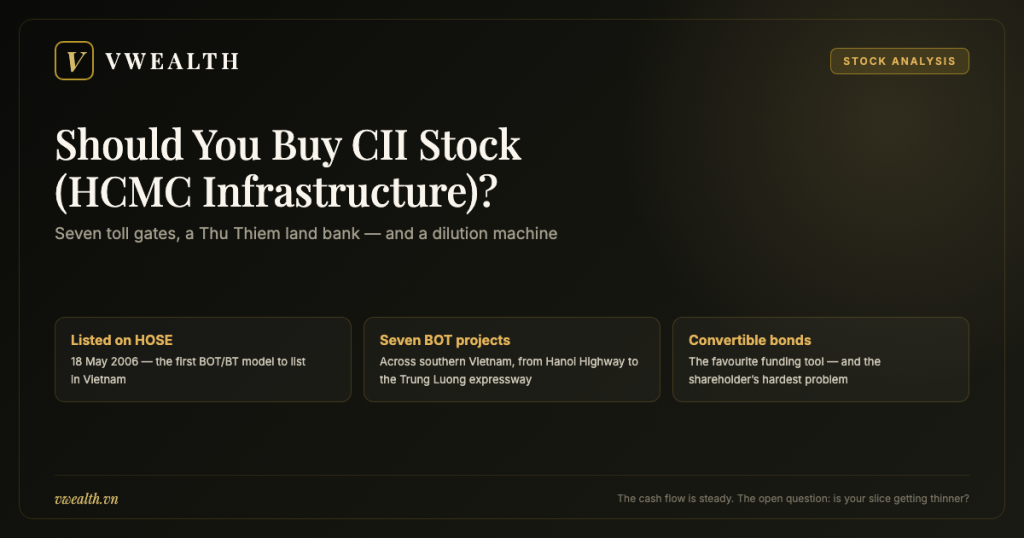
Ask four different Vietnamese investors whether you should buy CII stock and you will get four answers that barely seem to describe the same company — and all four have a point. The first group remembers CII as the wildest ride of late 2021: after a land auction in Thu Thiem printed a price that made global headlines, this ticker was crowned “the king of Thu Thiem land” and went almost vertical, before handing most of it back the following year. The second group treats CII as an income stock, because for a while it did something almost unheard of on the Ho Chi Minh City exchange — it promised a cash dividend every single quarter. The third group refuses to touch it because of one word: dilution. No listed company in Vietnam has leaned on convertible bonds as heavily as CII, and every conversion slices the pie into thinner pieces. The fourth group ignores all of that and looks at one thing only: tens of thousands of vehicles paying a toll every day at the seven road projects this company operates. This article walks you through all four lenses, teaches you how to read the financial statements of a BOT toll-road operator — a very different animal from a property developer or a retailer — and ends with a straight answer about who CII suits and who it will punish.
Before we start, one ground rule. You are going to meet a lot of dates, project names, contract structures, funding rounds and publicly announced events. What you will almost never meet is a number from the most recent quarter: last quarter’s profit, today’s P/E, yesterday’s close, or any price target. The reason is practical. CII earns money from three engines that beat at completely different rhythms — toll revenue that arrives every day, property revenue that lands in lumps when apartments are handed over, and financial gains from selling stakes in project companies that show up out of nowhere. A quarter with one stake sale can print a profit several times larger than the quarter before it; the next quarter, with nothing to sell, the number collapses. Writing down a P/E today makes it nearly meaningless three months from now. Instead of handing you a number with a short shelf life, this article teaches you how to read this particular company’s accounts: what to look at first, in what order, and which line actually tells you something. When you need today’s figures, open the CII research report on the vwealth platform for the current metrics. The article gives you the framework; the report gives you the numbers.
And if you are weighing CII, do not read it in isolation. This company sits at the intersection of two industries: tolled infrastructure and real estate. The picture only sharpens when you place it next to businesses that look related but are built completely differently — next to ACV, which collects near-monopoly fees across Vietnam’s airport system; next to Gemadept, whose seaport assets have a very long useful life; next to REE, which buys operating power and water assets to harvest steady cash; and next to pure residential developers such as those covered in our Nam Long analysis. Those four reference points will show you what CII actually is. If you are new to this market entirely, start with our guide on how to invest in the Vietnam stock market, which covers accounts, foreign ownership limits and settlement before you buy a single share.
From three state shareholders to the owner of seven toll gates: how CII was built
Most large infrastructure companies on Vietnam’s exchanges were born the same way: a state construction corporation gets equitised, arrives with machinery and crews already in place, and then goes looking for projects. CII did it backwards. It was created as a financing vehicle first, and only then went looking for concrete to pour. That detail sounds minor and explains almost everything that followed: why the company is better at raising money than at building things, why the balance sheet is permanently heavy with debt, and why its income statement contains enormous financial gains that an ordinary contractor would never book.
December 2001: three state shareholders and an idea Vietnam had not tried
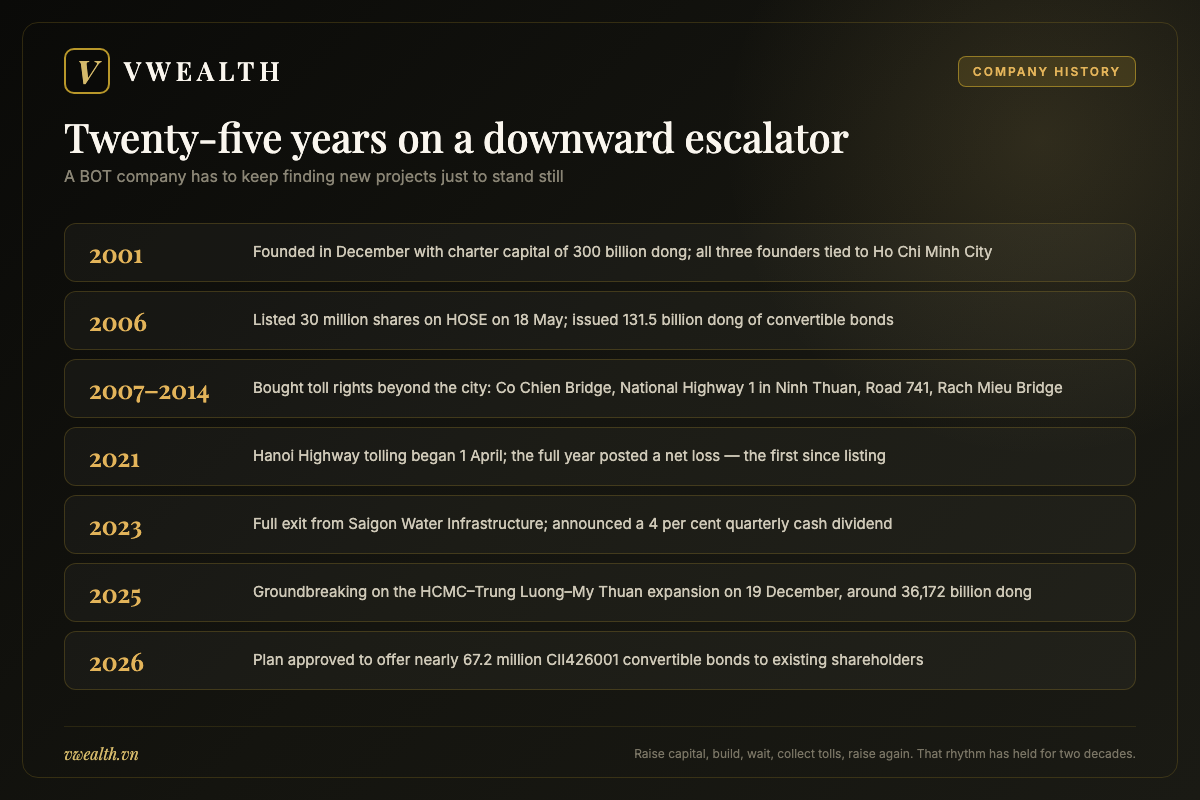
CII was founded in December 2001 with initial charter capital of 300 billion dong, contributed by three founding shareholders: the Ho Chi Minh City Urban Development Investment Fund — known at the time by the abbreviation HIFU, and the forerunner of what later became the city’s State Financial Investment Company — the Youth Volunteer Trading, Services and Import-Export Company, and the Ho Chi Minh City Investment and Services Joint Stock Company. Look at that list again: all three were institutions tied to the municipal government. Not one private hand in sight.
Three hundred billion dong was real money in 2001, but the idea was bigger than the cheque. Ho Chi Minh City faced the arithmetic every fast-growing metropolis faces: the demand for roads, bridges and water systems ran many times ahead of what the budget could fund, and the budget also had to cover schools, hospitals and social spending. The traditional answer was to wait for state capital — and while you wait, the traffic gets worse every year. CII’s idea was to build a joint stock company that sat in between. Because it was not a government agency, it could borrow commercially, issue bonds and raise equity. Because it was not a purely private firm either, the city trusted it with infrastructure projects under public-private contracts.
Here you need three abbreviations that will follow you through this entire article, because they are not just legal paperwork — they determine what the cash flow looks like, and that is why they matter to a shareholder. BOT stands for Build–Operate–Transfer: the company puts up the money, builds the road or bridge, then earns the right to collect tolls for a fixed number of contracted years to recover its investment plus a return, and at the end of the term hands the asset back to the state. BT stands for Build–Transfer: the company builds, hands the asset over immediately, and the state pays it back in cash or — far more commonly in Vietnam between roughly 2010 and 2018 — in land. BOO stands for Build–Own–Operate: build it, own it, run it indefinitely, a structure typically used for water treatment plants.
If you are used to developed-market infrastructure vehicles, the closest mental analogue for a BOT operator is a toll-road concession company such as those listed in Spain, Italy, France or Australia — not an infrastructure REIT and not a utility. The concession model has one defining feature that separates it from almost every other asset class: the cash flow has an expiry date written into the contract. That single sentence will come back repeatedly in this analysis.
18 May 2006: thirty million shares and the first debt that knew how to become equity
On 18 May 2006, CII listed its first 30 million shares on the Ho Chi Minh City Stock Exchange, known as HOSE — Vietnam’s larger of the two main boards, where trading settles on a T+2 cycle and prices are capped by a daily band of plus or minus 7 per cent. The listing mattered beyond the company itself: CII became the first BOT/BT infrastructure investment model to list in Vietnam. Before 2006, if you wanted to “invest in a bridge” in this country, your only option was to become a contractor. From 2006, you could buy a share.
That same year, CII successfully issued 131.5 billion dong of convertible bonds and raised charter capital by another 100 billion dong. Small numbers by today’s standards, but they were the opening shot of a habit that would define the next twenty years. A convertible bond, in plain terms, is debt with an equity trigger built in: an investor lends the company money and collects interest like any bondholder, but at set intervals gains the right to swap the bond for shares at a conversion price agreed in advance. For the company it is close to a dream instrument — long-dated money at a lower coupon than a bank loan, with no principal repayment at all if the holders choose to convert. For existing shareholders it cuts both ways: every conversion creates new shares, and your slice of the same company gets smaller. We will return to this in detail in chapter two, because it is the single most contested issue in any honest discussion of whether to buy CII stock.
2007–2014: collecting toll gates the way other people collect apartments
In this stretch, CII did something few Vietnamese companies of the era considered: it bought toll rights rather than only building them. Instead of always starting from a greenfield site, CII acquired stakes in — or outright bought the operating rights to — BOT projects that were already finished, or half-finished projects whose original sponsors had run out of money. The logic is identical to a buy-to-let landlord’s: you do not have to build the house yourself, you only have to buy it cheaply enough relative to the rent it produces.
The portfolio grew sideways and spread well beyond Ho Chi Minh City. Co Chien Bridge, linking Tra Vinh and Ben Tre in the Mekong Delta. The bypass and widening of National Highway 1 through Ninh Thuan province, structured as two separate projects known as Ninh Thuan 1 and Ninh Thuan 2. Provincial Road 741 in Binh Duong, the industrial belt north of the city. Rach Mieu Bridge across the Tien River, connecting Tien Giang and Ben Tre — a toll plaza that anyone who has ever driven into the Mekong Delta has queued at. Each project is a modest cash stream on its own; together they add up to something that is not modest at all, and more importantly, to something highly predictable. Cars run every single day.
In parallel, CII began splitting itself into specialised boxes: one subsidiary for roads and bridges, one for water, one for property, one for services. That structure would later produce both real strength and real opacity, and we dissect it in chapter four.
Hanoi Highway: the project that defines CII, and a lesson in the word “wait”
If you had to pick one project that captures what CII is, it would be the widening of Hanoi Highway and National Highway 1, from the old Tram 2 junction to the Tan Van interchange. This is the artery connecting central Ho Chi Minh City to Dong Nai, Binh Duong and the wider southeastern industrial region — the road every container heading to or from Cat Lai port travels on.
The project got moving in the early 2010s. But CII was not permitted to start collecting tolls until 1 April 2021. Sit with that gap for a moment: close to a decade of spending money, servicing interest, finishing components and clearing land — with not one dong of toll revenue coming back. This is the cruellest feature of the BOT model and the one equity investors most often miss. Between the moment capital goes out and the moment cash starts coming in, there is a very long hole. Inside that hole the company has costs, has interest expense, and watches its balance sheet swell. If you buy shares in a BOT company in the middle of that hole without knowing where you are in the project lifecycle, you will conclude you are looking at a badly run business, when in fact you are looking at the front half of a J-curve.
And when the hole ends, everything flips fast. From 2021 onward, the Hanoi Highway toll plaza alone became one of CII’s two largest cash engines.
2015–2020: foreign money walks in, and the water business walks out
In this period CII pulled off something very few private Vietnamese infrastructure companies have managed: it attracted international capital into specific business lines, not merely into the parent company. Names that appeared around CII in these years include an investment vehicle associated with the Philippines’ Ayala group through the entity VIAC (No.1) Limited Partnership; Metro Pacific Tollways, a major Philippine toll-road operator, which put money into the roads and bridges arm; and institutions such as Goldman Sachs, Rhinos and the infrastructure credit guarantor GuarantCo. In 2019, CII issued 1,150 billion dong of bonds carrying a GuarantCo payment guarantee — a structure that was genuinely rare for a Vietnamese corporate at the time.
The significance of those names is larger than the money involved. An international infrastructure fund does not write a cheque into a company whose project cash flows it cannot model. The fact that CII could bring them in is indirect evidence that its legal documentation and project-level financial models were solid enough to survive outside due diligence. That is a genuine positive, and worth remembering when you compare CII with infrastructure companies that can only borrow domestically.
But in the same window, CII started the opposite process: selling. The clean water business, run through Saigon Water Infrastructure Corporation — ticker SII — had once been treated as a third pillar, with supply projects in Cu Chi, Thu Duc, Pleiku and Da Lat. At the end of 2021, CII still held 50.61 per cent of it. By mid-March 2022 the board had approved a divestment plan, and in a trading window running from 6 June to 5 July 2023, CII registered to sell more than 32.66 million SII shares — in other words, the entire holding. DNP Water Investment subsequently became SII’s controlling shareholder with roughly 50.6 per cent.
Exiting water tells you something important about strategy: CII accepted a narrower scope in order to concentrate capital on transport. You can read that as discipline, or you can read it as a company that needed cash. The truth usually sits between the two readings.
Late 2021: the Thu Thiem shock, the first annual loss, and the biggest wave in the stock’s history
To understand what happened next, a foreign reader needs to know what Thu Thiem is. Thu Thiem is a new urban area on a peninsula of the Saigon River, directly across the water from District 1 — the historic centre of Ho Chi Minh City. Think of it as the city’s planned answer to Pudong or Canary Wharf: land assembled by the state over decades, cleared, master-planned, and released slowly. Because of its location and scarcity, Thu Thiem land is the single most emotionally charged real estate story in Vietnam.
In December 2021, an auction of four Thu Thiem land plots produced prices that stunned the entire market, with the highest lot bid up to more than 2.4 billion dong per square metre. The market immediately went hunting for companies holding Thu Thiem land — and CII sat at the top of the list, because it owned a land bank in the northern Thu Thiem area received under earlier BT contracts.
The crowd’s logic was simple: if one square metre of Thu Thiem land is worth that, how many times CII’s entire market capitalisation is CII’s land bank worth? The stock went nearly vertical, dragging a cluster of other “infrastructure plus prime land” tickers with it. At the peak, CII was discussed on every forum in the country as a life-changing opportunity.
At precisely that moment, the financial statements were telling a completely different story. In the fourth quarter of 2021, CII reported a net loss of more than 370 billion dong, against a profit of just over 11 billion in the same quarter of 2020. For the full year 2021 the company posted a net loss of more than 240 billion dong — its first annual loss since listing. The cause was not mysterious: prolonged pandemic lockdowns crushed traffic volumes through the toll plazas, while interest expense did not fall by a single dong. That is the clearest possible lesson about BOT risk: the costs are fixed, the revenue is not.
Through 2022 the share price gave back most of the gains. Anyone who bought around the January 2022 peak carries a long scar. Yet 2022 was also the year profit recovered strongly, for two reasons: the toll plazas returned to normal operation, and the company booked financial gains from transferring stakes in property project companies. That paradox — the price falling while profit rose — is the second lesson, and it leads directly to chapter five.
2022 to 2026: Trung Luong–My Thuan, quarterly dividends, then a fresh funding round
From 2022, the Trung Luong–My Thuan expressway began collecting tolls and quickly became the largest single source of BOT revenue. This road is the missing link in the expressway spine running from Ho Chi Minh City into the Mekong Delta, and anyone who has ever sat in a traffic jam on National Highway 1 through Tien Giang understands instantly why drivers will pay to avoid it.
At the end of 2023, CII announced a policy that got the market’s attention: a cash dividend of 4 per cent every quarter, equal to 16 per cent a year on par value. On a market where most listed companies pay once a year and frequently miss their own schedule, a quarterly commitment is unusual. The implicit message was clear: look at us as a cash-generating asset, not as a land speculation vehicle. The company delivered for three consecutive quarters in 2024; the fourth payment slipped into early 2025 but was lifted to 5 per cent.
Then the company’s own ambition cut the policy short. In the second and third quarters of 2025, CII suspended the cash dividend, replacing the third-quarter payment with a 14 per cent bonus share issue. On 19 December 2025, the expansion of the Ho Chi Minh City–Trung Luong–My Thuan expressway formally broke ground as a PPP project with total investment of roughly 36,172 billion dong — call it around US$1.4 billion at an exchange rate near 26,000 dong to the dollar — covering more than 96 kilometres, carried out by a consortium including CII, Deo Ca Group, Tasco, Hoang Long and CII-related entities. The expected payback period is around 17 years and 3 months, with completion and opening targeted for 2028. In early 2026, the board approved deferring the cash dividend for both the 1 January 2026 and 1 April 2026 periods, citing the need to concentrate resources on this project.
And in August 2026, CII finalised a plan to offer nearly 67.2 million convertible bonds under the code CII426001 to existing shareholders, at a par value of 100,000 dong per bond, raising roughly 6,720 billion dong, with a tenor of up to 25 years. We take that structure apart in chapter two, because it is the most vivid illustration available of how CII operates and of what a minority shareholder has to weigh.
Twenty-five years of CII on a single page
| Date | Event | Why it matters to you today |
|---|---|---|
| December 2001 | Founded with charter capital of 300 billion dong; all three founding shareholders were institutions tied to Ho Chi Minh City | Born as a financing vehicle, not a contractor — which explains why it is better at raising capital than at building |
| 18 May 2006 | Listed 30 million shares on HOSE; issued 131.5 billion dong of convertible bonds | First BOT/BT infrastructure model to list in Vietnam; the start of a twenty-year convertible bond habit |
| 2007–2014 | Acquired toll rights beyond Ho Chi Minh City: Co Chien Bridge, National Highway 1 in Ninh Thuan, Provincial Road 741, Rach Mieu Bridge | Cash flow spread across many roads, reducing dependence on any single corridor |
| 2015–2020 | International capital entered at the business-line level; 2019 issue of 1,150 billion dong of bonds guaranteed by GuarantCo | Indirect evidence that project documentation survives outside due diligence |
| 1 April 2021 | Began collecting tolls on the widened Hanoi Highway and National Highway 1 | Ended nearly a decade of pure cost — the clearest example of the BOT J-curve |
| 2021 | Net loss of more than 240 billion dong, the first since listing; Q4 alone lost more than 370 billion | Fixed costs meeting variable revenue: the core risk of the BOT model |
| Dec 2021 – 2022 | Price wave after the Thu Thiem land auction, followed by a deep retreat | The price followed the asset story, not the earnings — the most important valuation lesson this ticker teaches |
| 2022 | Trung Luong–My Thuan expressway begins collecting tolls | Becomes the largest single source of BOT revenue |
| 2023 | Full exit from Saigon Water Infrastructure; announced a 4 per cent quarterly cash dividend policy | Narrowed the scope and repositioned itself as a cash-flow stock |
| January 2024 | Successfully issued convertible bond CII42301, total value more than 2,800 billion dong | More than four thousand retail investors became bondholders — and future shareholders |
| 19 December 2025 | Groundbreaking on the Ho Chi Minh City–Trung Luong–My Thuan expressway expansion, total investment around 36,172 billion dong | The largest project in company history; trading today’s dividend for cash flow after 2028 |
| 2026 | Cash dividend deferred for the first two periods of the year; plan finalised to offer nearly 67.2 million CII426001 convertible bonds | The largest funding round — and the largest dilution question — the company has ever faced |
Read that table straight through and one rhythm repeats with metronomic regularity: raise capital — build a project — wait — collect tolls — raise capital for a bigger project. CII is not a business that accumulates cash and hands it back. It is a business that reinvests continuously, and every reinvestment cycle drags a funding cycle behind it. Understand that rhythm and you understand most of this share’s personality.
A blunt chief executive and a company with no owner
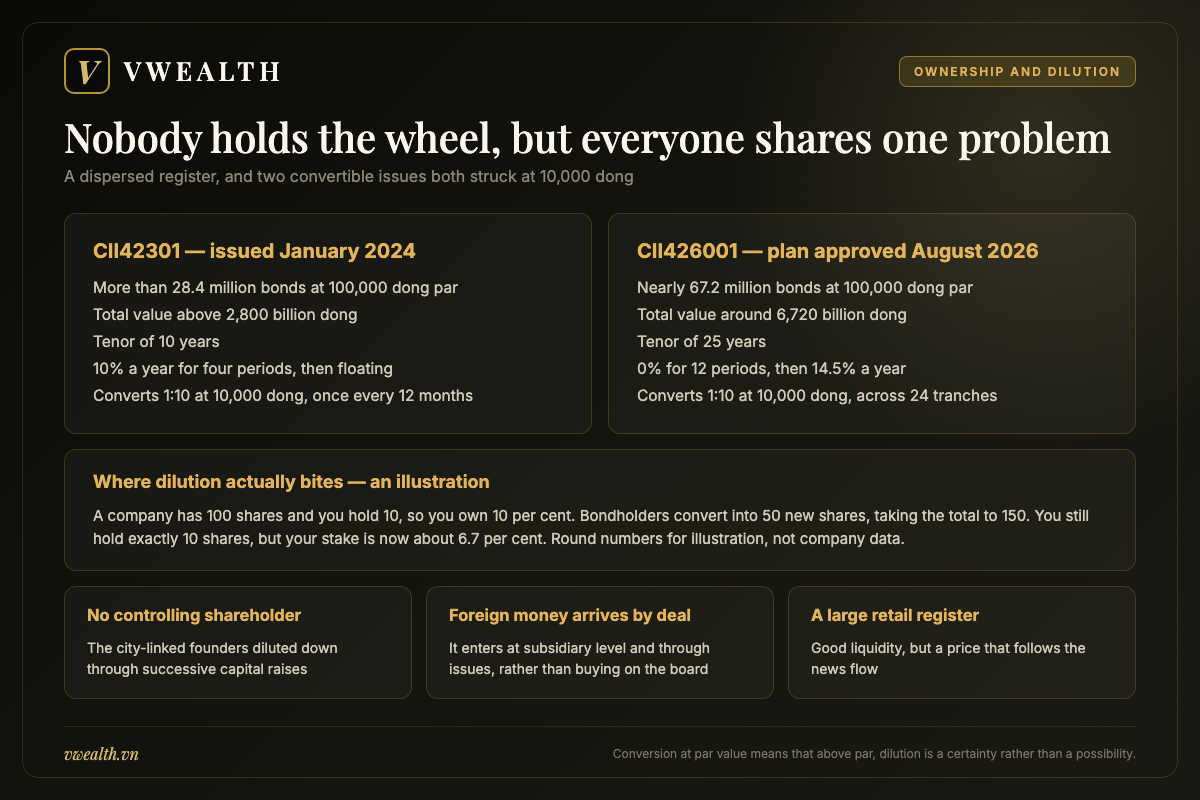
There is something genuinely unusual about CII that you should absorb before you read a single number: this company has essentially no controlling shareholder in the ordinary sense. No founding family with a majority stake. No parent conglomerate standing behind it. The state-linked founding shareholders diluted themselves down through successive capital raises. What has kept CII pointed in one direction for more than twenty years is not ownership at all — it is an unusually long-serving management team, and a chief executive blunt enough to make headlines more than once.
Le Quoc Binh: probably the most direct CEO on the Vietnamese market
Le Quoc Binh has been with CII since its early years and has served as Chief Executive Officer and board member for most of the company’s life. If you have ever watched a CII annual general meeting, you notice immediately what separates him from most listed-company executives in this market: he answers the questions other people dodge.
He does not flinch from stating specific debt numbers when a shareholder asks. He does not soften the explanation that in certain years the company had to accept a loss because a project had not yet reached its toll collection phase. In one interview he complained about the impossible position of running a listed company with a line that landed because it was so ordinary: whatever you do, someone will criticise it. For an investor, that kind of directness is an asset — you spend less time guessing what management actually means.
But being direct is not the same as being right, and it is not the same as being uncontroversial. This is where you need a cold head: judge a board by its sequence of decisions and outcomes over many years, not by how pleasant its statements are to listen to. Someone who speaks beautifully and executes badly is still executing badly; someone who speaks bluntly and picks the wrong project still loses your money.
The 2023 share sale — and how to read it fairly
In October 2023 the market lit up when Le Quoc Binh registered to sell his entire holding of more than 6 million CII shares, equal to roughly 2.13 per cent of capital, in a window running from 10 October to 8 November. For most investors, “CEO sells everything” is a reflexive sell signal.
Binh explained it. He and his wife were exiting the shares in order to move the money into the CII42301 convertible bond the company was then offering. His argument was that for the same amount of cash, holding the convertible would eventually convert into more shares than buying stock on the open market, making it a longer-dated investment in CII rather than a retreat from it. A subsequent correction filed in November 2023 established that the registered and executed volume was 6,040,747 shares, 7,000 fewer than the number initially announced, attributed to a drafting error.
How should you read this? Fairly, which means recording what was disclosed and not speculating about motive. Binh’s explanation has clear financial logic and is verifiable — if he genuinely rotated into the convertible, his economic interest stayed tied to the company and only the instrument changed. What you can take away without any speculation at all is a structural fact: at CII, executives and large shareholders rotating between the common shares and the convertible bonds is normal behaviour, and that makes this company’s shareholder register far more mobile than the market average. If your preference is to see a large shareholder sitting still for decades, CII will make you uncomfortable.
A management team that has been there two decades
The second notable governance feature is stability. The chairman’s seat has been held by Le Vu Hoang since the company’s earliest days, alongside a board and supervisory committee with very little turnover. For a business where each project runs fifteen to twenty years, continuity in the management team is genuinely valuable: the person who signed a BOT contract in 2012 is still the person accountable for explaining it in 2026.
There is a flip side. A management team that stays in place for a very long time, at a company with no controlling shareholder to act as counterweight, can end up facing little internal challenge. This is not an accusation — it is a structural characteristic that any investor should note and monitor over time, in exactly the way you would monitor the proportion of independent directors at any other company.
Ownership: when nobody has the final word
CII has had a parade of large shareholders appear on and disappear from its register. The Ayala-linked fund operating through VIAC (No.1) Limited Partnership pushed its holding above ten per cent at certain points. Metro Pacific Tollways participated at the roads-and-bridges subsidiary level. Other international financial institutions arrived and left with successive funding rounds.
The result is a very dispersed register, with the bulk of shares held by domestic retail investors and by institutions holding moderate stakes. That has three consequences, and you need all three.
First: high liquidity. A large free float means orders fill easily and you can build or exit a sizeable position without much friction. That is a real practical advantage many other Vietnamese infrastructure tickers lack. It also means the foreign ownership limit is rarely the binding constraint here that it is in banking or aviation names — worth knowing, because in Vietnam foreign room is capped by sector and by company charter, and in some tickers it is the reason a foreign buyer simply cannot get filled.
Second: the price is easily driven by crowd emotion. When the shareholder base is mostly retail, a rumour about Thu Thiem land or a decision on road tolls can push the price a long way from intrinsic value within a handful of sessions. Late 2021 is the textbook case.
Third: management has unusually wide discretion. No controlling shareholder means funding plans, convertible bond issues and dividend suspensions are decided largely by the board. If you trust the management team, that is an advantage — they move fast. If you do not, you have virtually no mechanism to change the company’s direction.
Convertible bonds: the best financing machine and the most worrying dilution machine
This is the most important section in this chapter and possibly the most important section in the entire question of whether to buy CII stock. Let us walk through the two most recent convertible issues so you can see the mechanism in concrete terms rather than in theory.
CII42301 was offered publicly to existing shareholders and successfully issued on 25 January 2024, with a subscription rate of roughly 99.05 per cent. Size: more than 28.4 million bonds at a par value of 100,000 dong, raising more than 2,800 billion dong. Tenor: 10 years. Coupon: a fixed 10 per cent per year for the first four interest periods, then floating at a reference rate plus a margin of 2.5 per cent per year. Conversion ratio 1:10 — each 100,000 dong bond converts into 10 shares, equivalent to a conversion price of 10,000 dong per share, exactly par value — exercisable once every 12 months. More than four thousand retail investors bought into this issue; the undistributed portion, more than 11.4 million units, was subsequently offered to company employees on similar terms.
CII426001 was finalised in August 2026 at a far larger scale: nearly 67.2 million bonds at 100,000 dong par, total value around 6,720 billion dong, offered to existing shareholders at a ratio of 10:1 — every 10 rights entitle the holder to buy one bond. The record date for the shareholder list is 27 August 2026, the rights themselves trade from 10 September to 6 October 2026, and the subscription deadline runs to 9 October 2026. The tenor on this issue runs to 25 years. The coupon structure is the part worth staring at: 0 per cent per year for the first 12 interest periods, then jumping to 14.5 per cent per year, paid quarterly. The conversion ratio is again 1:10 at 10,000 dong, spread across 24 tranches.
Read that coupon structure once more, because it says a great deal. For the first three years the company pays no interest at all — precisely the window during which the expressway expansion is under construction and generating nothing. After that the coupon leaps to a punitive level. The implicit message of that design is close to an invitation: convert into equity before the coupon steps up, or the company will have to buy the bonds back. Put differently, this is an instrument engineered to become equity eventually, not to survive 25 years as debt.
What dilution actually does to your wallet — an illustrative example
Plenty of investors hear “dilution” without picturing where it bites. Here is an illustration using round numbers, not the company’s actual figures.
Suppose a company has 100 shares outstanding and earns 1,000 dong a year, so earnings per share are 10 dong. You hold 10 shares, which is 10 per cent of the business. The company issues convertible bonds, and the holders later convert into 50 new shares. Now there are 150 shares. If profit is still 1,000 dong, earnings per share fall from 10 to roughly 6.7 dong, and your ownership falls from 10 per cent to roughly 6.7 per cent. You did not lose a single share, but your slice of the pie shrank by a third.
The point is that the money raised went into a project. If that project generates enough incremental profit — say total profit rises to 2,000 dong — then earnings per share become roughly 13.3 dong, higher than where you started, and you are better off despite owning a smaller percentage. If the project runs late or underperforms, you absorb the dilution and receive nothing back for it.
That is precisely the bet CII shareholders are making. There is no universally correct answer; the answer depends on whether you believe the Ho Chi Minh City–Trung Luong–My Thuan expansion will produce cash flow commensurate with its cost, and whether you have the patience to wait until after 2028. It is also why comparing CII with a developer such as Novaland during its debt restructuring is comparing two very different problems — as our Novaland analysis lays out, one company is diluting to expand its income-producing asset base, the other was restructuring to survive.
The two most recent convertible issues, side by side
| Feature | CII42301 (issued January 2024) | CII426001 (plan approved August 2026) |
|---|---|---|
| Size | More than 28.4 million bonds | Nearly 67.2 million bonds |
| Par value | 100,000 dong per bond | 100,000 dong per bond |
| Total raised | More than 2,800 billion dong | Around 6,720 billion dong |
| Tenor | 10 years | 25 years |
| Coupon | 10 per cent per year for the first four periods, then floating at a reference rate plus 2.5 per cent per year | 0 per cent per year for the first 12 periods, then 14.5 per cent per year, paid quarterly |
| Conversion | 1 bond into 10 shares at 10,000 dong | 1 bond into 10 shares at 10,000 dong |
| Conversion schedule | Once every 12 months | Spread across 24 tranches |
| Offered to | Existing shareholders; unsubscribed portion offered to employees | Existing shareholders at a 10:1 rights ratio |
One small but decisive detail: the conversion price on both issues is 10,000 dong per share. That means whenever CII trades above 10,000 dong, conversion is always profitable for the bondholder, and the arrival of new supply is close to a certainty rather than a possibility. If you plan to hold CII for the long run, model a share count that rises steadily through each conversion tranche, and never take a historical earnings-per-share figure and extrapolate it forward without subtracting the dilution.
The dividend: from a quarterly promise to two deferred payments
CII’s dividend policy is an interesting story about a company trying to reposition itself in the market’s mind. The end-2023 commitment of 4 per cent per quarter — 16 per cent a year on par value — was an explicit attempt to say: stop treating us as a land speculation, start treating us as an asset that pays like a bond.
The company kept its word for three quarters of 2024. The final payment of that year slipped into early 2025 but the rate was raised to 5 per cent, a handling most shareholders accepted. In the second and third quarters of 2025 the cash dividend was suspended, replaced in Q3 by a 14 per cent bonus share issue. Then in early 2026, the 1 January and 1 April periods again came with no cash, on the stated grounds of concentrating capital on the expressway expansion that had broken ground at the end of 2025.
You need to separate two things very carefully here, because many investors conflate them. A bonus share issue is not a dividend in any economic sense: the company hands you nothing, it merely splits the existing shares into more, smaller pieces, and the reference price is adjusted down proportionally. Your wealth immediately before and immediately after is identical. A cash dividend is different — real money leaves the company and arrives in your account.
So the 2025–2026 sequence should be read plainly: CII moved from paying shareholders to retaining capital for investment. That is not automatically bad news — a company building a 36-trillion-dong expressway while still forcing out quarterly cash would be the worrying case. But if you bought CII for the dividend, you need to know that your reason for owning it has temporarily disappeared, and it only comes back when the project starts collecting tolls. Investors who need reliable dividend income usually look toward asset models where the investment phase is already finished, such as REE’s harvesting of dividends from an operating power and water portfolio.
Three governance signals worth tracking
Rather than trying to grade management on feel, track three verifiable indicators. One: at each convertible bond issue, what proportion of existing shareholders subscribe — a high take-up says insiders still believe, while a low take-up that has to be mopped up by employees or partners says the opposite. Two: insider and related-party transactions, all of which are publicly disclosed — not to speculate about motive, but to see how the ownership structure is shifting. Three: whether the company holds to its stated project timelines, especially on the Ho Chi Minh City–Trung Luong–My Thuan expansion. For a BOT company, a one-year delay is not simply a year of delayed revenue — it is an extra year of paying interest while collecting nothing.
How CII makes money: one toll spine, one land bank, and a few side branches
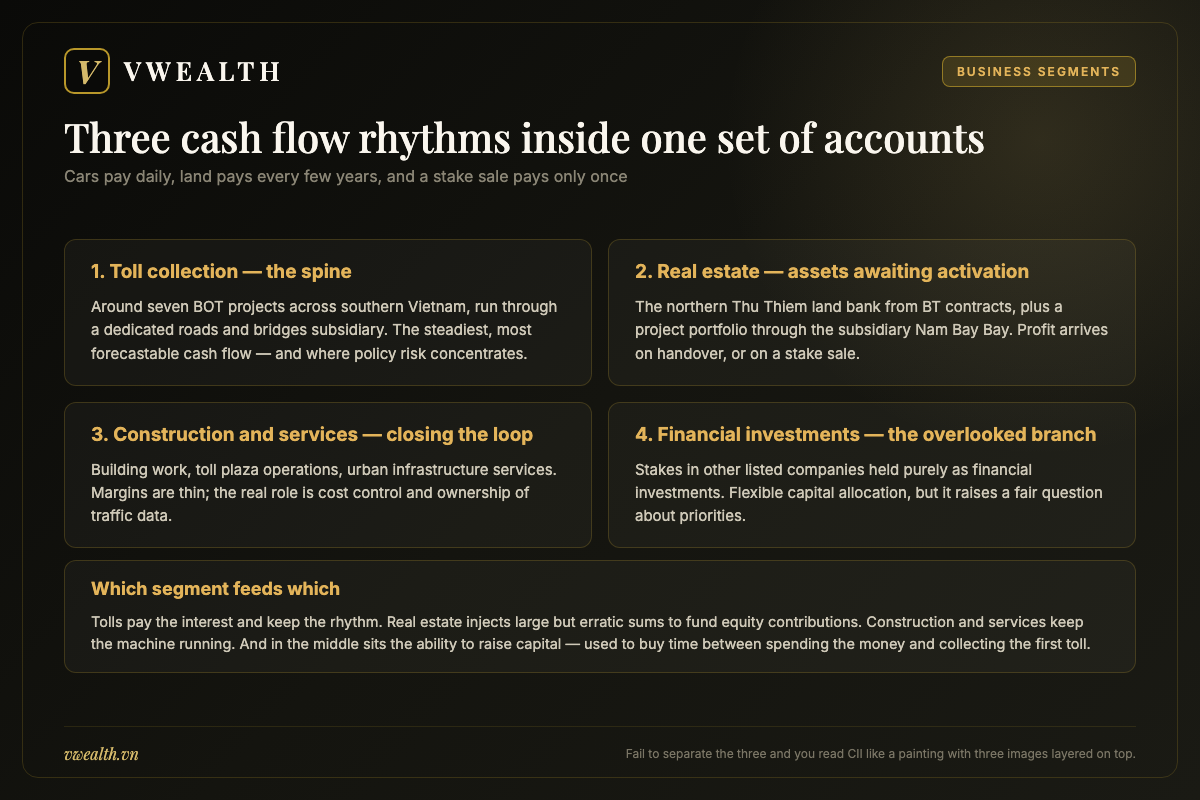
Ask an average Vietnamese investor what CII does and the usual answer is “BOT projects.” True, but incomplete. In practice CII is a bundle of three activities whose economics differ so much that they are almost three separate companies wearing one ticker. They differ in the rhythm of their cash flow, in their risk profile, and — most importantly — in how they appear in the accounts. Fail to separate them and you will read CII’s financial statements the way you would read a painting with three images layered on top of each other.
Segment one: toll collection, the group’s cash machine
This is the spine. CII collects tolls at roughly seven BOT projects, operated mainly through a dedicated roads and bridges subsidiary usually shortened to CII B&R. The strength of this segment is easy to grasp: vehicles do not care about interest rates, do not care about the stock market, and drive every single day. It is about the most predictable cash flow any business model in Vietnam produces.
To give you a sense of the mix, the table below uses 2024 toll revenue figures that Vietnamese financial media compiled at the time. Read it as a map of relative weight, not as a forecast for today — for current figures, open the CII research report on vwealth.
| BOT project | Location | 2024 toll revenue (billion dong) | Note |
|---|---|---|---|
| Trung Luong–My Thuan expressway | Links Ho Chi Minh City to the Mekong Delta | About 1,165 | Largest single source; the missing link in the expressway spine to the Delta |
| Hanoi Highway and National Highway 1 widening | Old Tram 2 junction to Tan Van interchange | About 768 | Tolling began 1 April 2021 after nearly a decade of investment |
| Rach Mieu Bridge | Across the Tien River, Tien Giang–Ben Tre | About 279 | A toll plaza familiar to every road trip into the Delta |
| National Highway 1 upgrade, Ninh Thuan 2 section | Former Ninh Thuan province area | About 246 | Acquired outside Ho Chi Minh City during the portfolio expansion phase |
| Provincial Road 741 | Binh Duong | About 161 | Connects the industrial belt |
| Co Chien Bridge and Ninh Thuan 1 bypass | Tra Vinh–Ben Tre and Ninh Thuan | About 146 (combined) | Ninh Thuan 1 completed its debt obligations at the end of September 2023 |
| Total | Seven projects | About 2,603 | Compiled 2024 figures, used here to show relative weight |
Three things fall out of that table. First, concentration is high. Trung Luong–My Thuan alone accounts for close to half of toll revenue, and the two largest projects together make up roughly three-quarters. Anything that happens to those two corridors — a change in toll policy, an upgrade to a free parallel route, a prolonged accident closure — moves the whole segment. Second, the portfolio spans southern Vietnam rather than sitting inside Ho Chi Minh City, so local risk is spread. Third, one project has already repaid its debt, meaning that from that point on, most of the toll it collects stops flowing to lenders and drops through to profit. That observation leads directly to the single most important concept in valuing a BOT company, which we cover in chapter four.
Segment two: real estate — the land bank, NBB, and the art of selling the project company
CII’s property arm was born naturally out of the BT model. The company builds infrastructure for the state, and the state settles the bill in land. That mechanism gave CII land in locations it could essentially never have bought on the open market — most notably the land bank in the northern Thu Thiem area, at the heart of the new urban district facing District 1 across the Saigon River.
The second component is a network of subsidiaries and associates, the largest of which is Nam Bay Bay Investment Corporation, ticker NBB — itself a listed company. NBB brings CII a portfolio of residential and township projects: Diamond Riverside in District 8, roughly 4.15 hectares, handed over in 2020; the NBB Garden III and NBB II developments; and the De Lagi residential area in Binh Thuan province at more than 124 hectares. The CII–NBB relationship is idiosyncratic: the two co-invest in individual projects at project-specific ratios, and at Diamond Riverside, for instance, the bulk of the investment rights sat with CII.
But the way CII actually earns money from property is the part worth studying. This company does not simply sell apartments the way a conventional developer does. Very often, it sells the entire project company. The clearest example is Thu Thiem River Park: in the second half of 2019, CII acquired almost all of the equity in that entity from a foreign partner; then across 2020–2022, CII progressively transferred its stake to other buyers and booked very large financial gains in the corresponding reporting periods.
This is where you must pay attention when reading CII’s profit line. A gain from transferring a stake in a project company does not sit in gross profit from sales. It appears in financial income, and it is a one-off that does not repeat. A quarter with a deal prints a beautiful number; the next quarter without one falls off a cliff. If you look at CII’s quarterly profit chart without separating recurring cash flow from one-off gains, you will be surprised over and over again — and on a stock market, surprise is usually expensive.
Segment three: construction, services and the supporting branches
Alongside the two main pillars, CII runs a construction arm and urban infrastructure services: operating the toll plazas, urban environmental services, investment advisory. Revenue here is much smaller and margins are typically thin.
Their real role is not profit but closing the loop. When the company runs its own toll operations, it controls the cost base and owns the traffic volume data — the data that underpins the entire financial model of a BOT project. When it has an in-house construction arm, it has more control over schedule. You should treat these segments as the group’s internal infrastructure cost, not as a meaningful profit source.
There used to be a clean water segment through Saigon Water Infrastructure, but as covered in chapter one, that was fully divested in 2023. The fact that CII walked away from a business with steady cash flow and comparatively little policy risk tells you how intense the pressure to concentrate capital on transport had become.
Segment four, the one most people overlook: financial investments
There is an activity at CII that many investors ignore: the company occasionally buys stakes in other listed companies as a pure financial investment. In mid-2026, CII drew attention by spending more than 270 billion dong over roughly a month to lift its holding in PC1 Group from under 5 per cent to nearly 9 per cent of charter capital. Chief executive Le Quoc Binh stated at the time that CII was not seeking and would not stand for a board seat at PC1, and explained the position as a purely financial investment targeting that company’s stable-cash-flow energy infrastructure portfolio.
That activity says two contradictory things. On the positive side, CII thinks flexibly about capital allocation and is willing to buy cash flow where it is cheaper than building it. On the cautionary side, a company that needs capital for a 36-trillion-dong expressway while simultaneously buying shares in other companies invites a fair question about priorities. When you monitor CII, keep an eye on the size of the financial investment portfolio on the balance sheet — if it swells quickly relative to the capital committed to core projects, that is a question worth asking.
Which segment feeds which, and where CII’s moat actually sits
If you drew CII’s internal cash map, it would look like this. Toll collection generates steady daily cash used to pay interest and part of the principal. Real estate, when a deal closes, produces large but erratic sums used to fund equity contributions on new projects or to reduce debt. Construction and services keep the machine running. And sitting in the middle of all of it is the capacity to raise capital — the thing CII is best at — which is used to buy time between the moment money goes out and the moment tolls start coming in.
So what is CII’s durable competitive advantage, its moat? It is not technology and it is not brand. It rests on three concrete things.
First, signed toll rights. A BOT contract granting fifteen or twenty years of toll collection is a time-limited monopoly licence over a specific stretch of road. Nobody can build a competing toll plaza alongside it. That is a strong moat — but it has an expiry date, which is the fundamental difference between CII and a seaport or an airport that can operate essentially indefinitely.
Second, the ability to raise long-dated capital. Very few private Vietnamese companies can arrange ten-year and twenty-year funding that matches the life of the asset. CII can, through convertible bonds, through guarantees from international institutions, and through long-term credit facilities with large banks. In an industry where money has to sit still for years before it earns anything, that capability is itself a barrier to entry.
Third, relationships and a project track record. This is the soft moat and the riskiest one, because it depends on policy. CII was selected into the consortium for the largest expressway expansion in southern Vietnam not because it bid cheapest, but because it has twenty years of experience doing exactly this kind of contract.
A quick comparison for perspective: ACV has an almost absolute moat because it holds the national airport system; Gemadept’s moat comes from port locations and a logistics ecosystem; CII’s moat is contractual — powerful during the term, and zero the day the asset is handed back. That difference feeds straight into how you should value the company, which is exactly what comes next.
Position and financial health: reading the accounts of a BOT company
This is the hardest chapter and also the most valuable one. If you take your familiar toolkit — a low P/E means cheap, high debt is bad, falling profit is weak — and apply it to CII, you will almost certainly reach the wrong conclusion. A BOT business runs on its own financial logic, and without that logic every comparison you make is meaningless.
Where CII sits among Vietnam’s listed infrastructure names
The group of Vietnamese listed companies that live off infrastructure user fees is small. The table below compares CII with its closest structural analogues on the basis of business model, not on scale or period-specific financials.
| Company | Main revenue source | Asset life | Signature risk | How it differs from CII |
|---|---|---|---|---|
| CII | Road tolls under BOT contracts, plus property and gains on project transfers | Finite: the asset reverts to the state at contract end | Toll policy, traffic volume, interest expense, dilution from convertible bonds | Carries a substantial property arm — far lumpier earnings |
| Deo Ca Traffic Infrastructure (HHV) | Road and tunnel tolls, plus construction | Finite, per contract | Similar to CII on policy and volume | More purely a transport infrastructure play; effectively no central-city land bank |
| ACV | Airport infrastructure fees and airport services | Very long, operationally near-indefinite | Aviation cycle, heavy capex on new airports | Near-monopoly nationwide; CII holds monopolies only on specific road segments |
| Gemadept | Seaport operations and logistics | Very long; assets can be upgraded continuously | Global trade, port competition | Owns its assets outright rather than handing them back |
| REE | Dividends and profits from a power, water and office leasing portfolio | Long and diversified | Hydrology, power tariffs, the office market | A financial investor in infrastructure; does not develop transport projects itself |
That table produces one important conclusion: CII has the strongest moat within its contract term and the shortest asset life of the group. Which means a BOT company cannot stand still. It is compelled to keep finding new projects to replace concessions approaching expiry, like walking up a descending escalator just to stay in the same place. Everything we discussed in chapter two — the fundraising, the dilution, the suspended dividend — is a consequence of that structural fact, not a management preference.
Four steps for reading CII’s financial statements, in this order
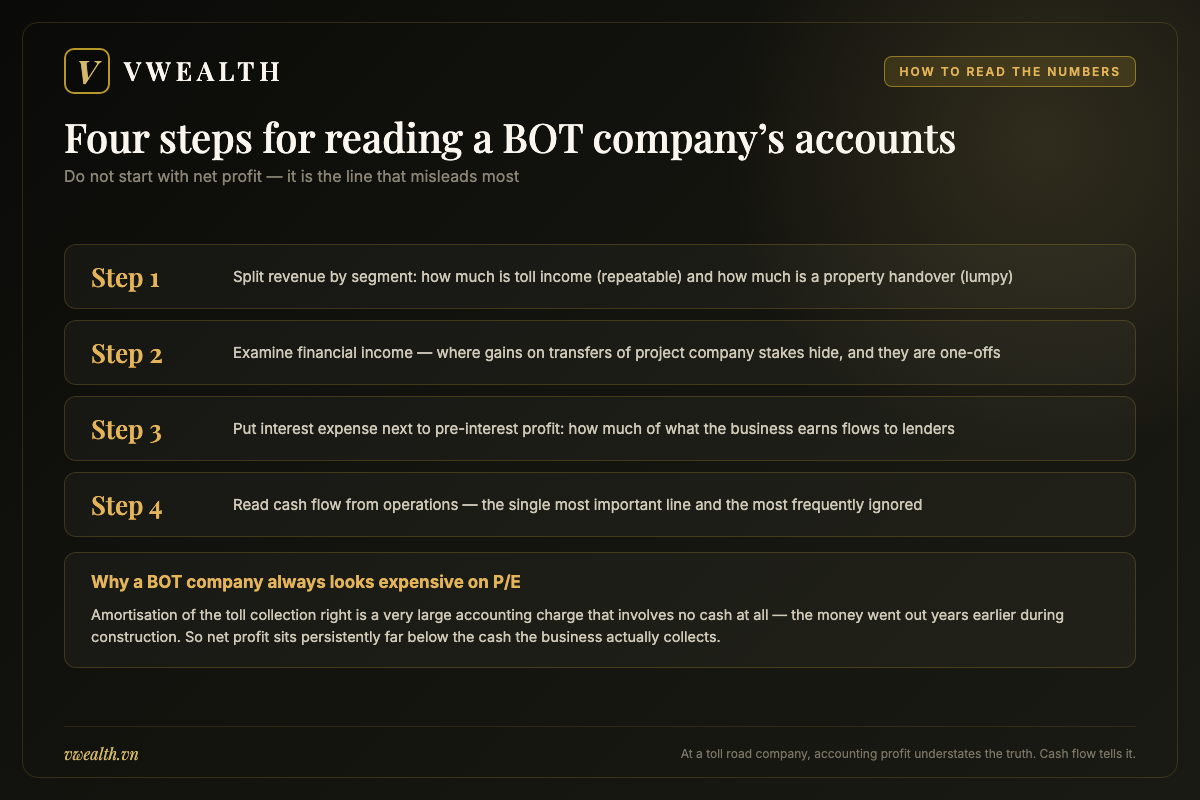
When you open CII’s accounts, do not look at net profit first. Follow this sequence instead.
Step one: split revenue by segment. The notes to the accounts break revenue down by activity. You need to know how much of this period came from toll collection, how much from property handovers, and how much from construction and services. Toll revenue is the repeatable part; property revenue is the lumpy part. This step alone protects you from the most common mistake — celebrating a revenue jump without realising it came from a one-time handover.
Step two: look at financial income. This is where gains on transfers of project company stakes hide, along with revaluation gains and interest income. At CII this line can be as large as or larger than gross profit from the core business. Ask yourself: strip this line out, and is the company still profitable? The answer tells you the quality of that period’s earnings.
Step three: look at interest expense. Put it next to operating profit before interest. The ratio between the two tells you how much of what the business earns is flowing to banks and bondholders. At a BOT company this number is always high, but its trend across quarters is what deserves your attention.
Step four: look at cash flow from operations. This is the most important line and the most frequently ignored. It tells you how much cash the business genuinely collected after paying its operating costs. A healthy BOT company must show positive, stable operating cash flow even in quarters when accounting profit looks poor. Why? Because amortisation of the toll collection right is an enormous accounting charge that involves no cash at all.
Why amortisation is the key to every BOT company
This is the single most valuable concept you can take away from this article. When CII spends several thousand billion dong building a road, that money is not expensed immediately. It is recorded as an asset — specifically as a “toll collection right” or an equivalent intangible — and then written off gradually into expenses across every year of the concession.
Which means that every year, CII’s income statement carries a very large amortisation charge that pulls accounting profit down. But that charge never leaves the till. The real money went out years earlier, during construction.
The consequence is critical: at a BOT company, net profit is persistently far lower than the cash the business actually collects. That is why CII’s P/E almost always looks absurdly expensive, even in periods when the company is collecting cash extremely well. Anyone using P/E to conclude that “CII is far too expensive” has walked straight into this trap.
The more appropriate measures for a BOT business are earnings before interest, tax, depreciation and amortisation — EBITDA — or, more directly still, cash flow from operations. Those two answer the question that actually matters: how much cash does this machine pump out each year to service debt and pay dividends? You can look these up period by period in the CII research report on vwealth rather than reconstructing them by hand from three statements.
Debt: high is normal, but how high is the real question
CII’s balance sheet is always debt-heavy. That is not an anomaly, it is the nature of the industry: you cannot build an expressway out of retained earnings. The typical capital structure of a Vietnamese BOT project has the sponsor contributing an equity portion, the remainder funded by bank loans or bonds, and the toll stream repaying it over time.
So how should you look at CII’s debt? Ask four questions.
Question one: is this debt attached to a project that is collecting, or one that is still being built? Debt against an operating, tolling project is good debt — it has a source of repayment. Debt against a project still under construction is debt that burns cash, because you pay interest without revenue. That is precisely the state CII entered at the end of 2025 with the expressway expansion.
Question two: does the debt maturity match the asset life? This is the lethal risk in infrastructure: borrowing short to fund long. If a company has to roll its debt continuously, one difficult quarter in the capital markets can jam the whole machine. CII has been alert to this for a long time, which is why it pursues long-term credit facilities, ten- and twenty-year bonds, and guarantees from international institutions.
Question three: fixed or floating rate? Most Vietnamese infrastructure debt is floating, referenced to bank base rates. When the rate environment rises by one percentage point, a company carrying several trillion dong of debt sees interest expense rise by tens of billions a year — straight out of profit. That is why infrastructure shares react so violently to interest rate news.
Question four: how much of the debt can become equity? The convertible bond portion on the balance sheet is debt today but may be equity tomorrow. It reduces repayment pressure at the cost of dilution. When you assess CII’s leverage, look at two numbers side by side: the current debt-to-equity ratio, and what that ratio would look like if every convertible bond converted.
Three common traps when reading CII’s numbers
Trap one: comparing this quarter’s profit with last quarter’s. Meaningless if either quarter contained a stake sale. Compare year on year, and separate the recurring portion.
Trap two: using P/B to conclude “cheap.” CII’s book value consists largely of toll rights recorded at investment cost and being amortised down, plus land carried at historical cost. That P/B figure reflects neither the market value of Thu Thiem land nor the remaining cash flow of the BOT contracts. It can simultaneously be too low on the land and too high on the concessions approaching expiry.
Trap three: forgetting to subtract dilution from forward earnings per share. With a conversion schedule spread across many tranches over many years, CII’s share count is a moving variable. Any EPS projection using today’s share count is systematically too optimistic. The correct approach is fully diluted: assume every convertible bond has already converted.
How the market treats CII stock
A company and its shares are two different things. The company runs on the rhythm of construction and tolling, measured in years. The stock runs on the rhythm of the story, measured in weeks. This chapter is about the second one — because in the short run that is what determines whether you make or lose money, no matter how well you have analysed the business.
The personality of the ticker: a cash-flow asset traded as a story stock
If you had to describe CII in one sentence, it would be this: a steady cash-flow business valued on its assets and traded on its headlines. Those three layers sit on top of each other and frequently contradict.
The first layer is the toll cash flow — stable, forecastable, growing slowly with traffic. If that were all there was, CII would trade like a long-dated bond: low volatility, mainly reacting to interest rates.
The second layer is the asset store — the Thu Thiem land bank and the subsidiary project portfolio. Book value sits far below market value, creating the gap investors call hidden value. Every time there is news about Thu Thiem land, the market drags this layer out and re-prices it.
The third layer is the news flow: land auctions, groundbreakings, toll policy, bond issues, insider transactions. This layer drives short-term movement, and with a shareholder base that is mostly retail, it usually beats the other two.
The result is a ticker with a materially wider trading range than the infrastructure sector average. Liquidity is good and you can get in and out easily, but the price is also easily swept along by sentiment. If a few red sessions in a row cost you sleep, this stock’s personality will grind you down.
The Thu Thiem wave: this stock’s most expensive valuation lesson
Let us reconstruct late 2021 calmly, because it is a textbook example of how asset-based valuation can go badly wrong.
The December 2021 auction of four Thu Thiem plots produced record prices, the highest lot bid above 2.4 billion dong per square metre. Immediately afterwards, the market did some simple arithmetic: CII holds a land bank in northern Thu Thiem far larger in area than the plots just auctioned. Valued at the new benchmark, CII’s net asset value must be many times its market capitalisation. Money poured in and the shares went nearly vertical.
Where was that arithmetic wrong? In three places you should remember for the rest of your investing life.
First: the price of one isolated transaction is not the market price. A record auction result is the outcome of one specific auction with one specific set of bidders. It has not been validated by the winners’ ability to pay, and what followed showed that not every auction result reaches completion.
Second: land on the balance sheet and money in your account are very far apart. To turn a Thu Thiem plot into profit, a company has to complete the legal process, pay land use fees at the new valuation, design, obtain permits, build, sell and hand over. That takes years and demands an enormous amount of capital. Net asset value is only the opening position in a long negotiation with time.
Third: rising land prices raise the company’s own costs too. If the company has not yet completed its financial obligations on the land, the new price benchmark can increase what it owes. Expensive land does not automatically make the landowner richer.
While the market was intoxicated with the asset arithmetic, CII’s fourth-quarter 2021 report recorded a net loss of more than 370 billion dong, because lockdowns cut traffic volumes while interest expense held steady. Two stories — a colossal asset base and a loss-making quarter — existed in the same company at the same moment. Anyone who saw only one of them lost.
Three ways to value CII, and which one actually works
| Method | How it works | Advantage | Why it misfires on CII |
|---|---|---|---|
| P/E | Price divided by earnings per share | Fast, easy to compare | Huge amortisation of toll rights suppresses accounting profit; one-off transfer gains make the number jump wildly between quarters — CII’s P/E almost always “looks expensive” |
| P/B | Price divided by book value per share | Suited to asset-heavy businesses | Land is carried at historical cost and so is understated; toll rights are being amortised down and so are overstated — two errors in opposite directions that do not cancel out |
| Project DCF plus property NAV | Present-value the remaining toll stream of each BOT project over its contract term, add the fair value of the land bank, subtract net debt | Tracks the actual economics of the business | Depends on many assumptions: traffic volume, approved toll escalation, discount rate, legal progress on land projects — one wrong assumption skews the whole result |
The third method is the right one in principle, even though it is the hardest. The key idea to hold onto is that every BOT contract is a cash stream with an expiry date. A project with five years of tolling left is worth something entirely different from one with eighteen years left, even if annual revenue is identical. So when you read any research note on CII, your first question should be: how many years of tolling remain on each project? That variable matters more than last quarter’s revenue.
For the property side, the sensible approach is net asset value, but discounted heavily for time and legal risk. Many investors apply a steep discount to land that has not cleared its legal process, and for Thu Thiem specifically — an area with a history of prolonged complications — the discount needs to be thicker still. That is how you should look at the land bank of any Vietnamese developer, not just CII; our analyses of Kinh Bac City and CEO Group walk through the same discipline applied to industrial land and coastal resort land respectively.
Dividends, foreign flows and the shareholder mix
Through 2023 and 2024, the quarterly cash dividend commitment pulled a new class of investor into CII: people looking for regular income rather than a trade. That repositioning effort deserves credit, and while the policy was live it genuinely narrowed the share’s trading range.
Suspending the cash dividend from 2025 and again into 2026 reversed the process. Income-seeking holders have no reason to stay, and the stock has drifted back to its old rhythm, driven far more by news flow.
On foreign flows, CII’s history shows a distinctive pattern: overseas investors have tended to arrive through structured transactions — equity into subsidiaries, purchases of convertible bonds, guarantee arrangements — rather than by accumulating shares on the exchange over long periods. Which means you should not treat net foreign buying or selling on the board as the primary read on institutional conviction in this company. The more reliable indicator is who is writing cheques into the funding rounds, and on what terms.
What typically makes CII stock move
From this ticker’s history you can list the news categories that reliably move the price, so you can watch for them rather than be ambushed.
The positive set: legal progress or new valuation information relating to the Thu Thiem land bank; the signing or groundbreaking of a large infrastructure project involving CII; announcement of a high-value property project transfer; resumption of the cash dividend; and falling interest rates, which hit a heavily indebted company with unusual force.
The negative set: new issuance that causes dilution; project delays; changes in road toll policy or in BOT contract terms; rising interest rates; and reporting periods where profit collapses simply because the prior period contained a one-off gain and this one does not.
There is a subtlety worth spelling out: for CII, news of a convertible bond issue can be both good news and bad news depending on where you stand. For the company it is cheap, long-dated capital — good news. For a minority shareholder who does not subscribe it is dilution — bad news. The rights-offering mechanism is precisely how the company balances the two: exercise your rights and your ownership percentage is preserved; let them lapse and you are diluted. Which means holding CII is not a one-time decision. You will be asked to decide again at every funding round, and each time it takes fresh cash.
One technical detail newer investors often miss: when a company offers convertible bonds to existing shareholders, the subscription rights are usually transferable for a defined window. For CII426001, under the announced plan, the rights trade from 10 September to 6 October 2026.
During a rights trading window, the share price and the rights price interact in a fairly complicated way and liquidity can get disturbed. If you do not understand the mechanics, it is easy to see the shares “fall for no reason” on the ex-rights date when in fact that is only a technical adjustment. The safe rule: before every CII issue, read the announced board resolution carefully, write down the record date, the rights ratio and the conversion price, then calculate for yourself how much additional cash participation would require. If terms like ex-rights date and record date are unfamiliar, our Vietnam stock market guide explains the corporate action calendar in plain English.
The backdrop: where Vietnam’s infrastructure stands, and where private capital fits
No infrastructure company controls its own destiny. CII’s revenue depends on traffic volume, which depends on economic growth and trade. Its access to new projects depends on public investment policy and the legal framework for public-private partnerships. Its cost of capital depends on interest rates. This chapter maps the field CII is playing on.
The expressway race and the size of the opportunity
Vietnam has set out to expand its expressway network substantially during this decade, with target lengths laid out in national infrastructure development plans. The specific figures shift with each planning revision, but the direction does not: transport infrastructure is the number one priority for public investment in this period, particularly in the two growth engines of the southeast region and the Mekong Delta — exactly CII’s core territory.
Why does infrastructure matter so much to Vietnam specifically? The answer lies in the economic model. Vietnam lives on manufacturing and exports. Every container that takes two extra hours to get from a factory in Binh Duong to Cai Mep port because of congestion is a real cost, deducted from a manufacturer’s margin and from national competitiveness. Vietnam’s logistics costs as a share of gross domestic product have long been assessed as high relative to regional peers, and much of that gap comes from connecting infrastructure. Every new kilometre of expressway is not just a construction project — it is a cost reduction for the whole economy.
For the Mekong Delta the case is more urgent still. This is the country’s largest agricultural and aquaculture basin, yet for decades it had essentially one main road corridor to Ho Chi Minh City. The Ho Chi Minh City–Trung Luong–My Thuan–Can Tho expressway spine exists to break that bottleneck. And as you have seen, CII holds two significant pieces of that spine while leading the consortium expanding it.
Why the state needs private capital, and how PPP works
Vietnam’s infrastructure funding requirement is many times what the state budget can supply. That is why the legal framework for public-private partnerships — universally abbreviated as PPP — was elevated into its own dedicated law, effective from the start of 2021 and amended in subsequent years to unblock issues investors had raised.
PPP is fundamentally an exercise in splitting risk. The state supplies planning, legal authority, site clearance and, in many projects, a portion of state capital. The private investor supplies the remaining capital, the organisational capacity to build, and bears the operating risk. In exchange, the investor receives the right to collect tolls for a period long enough to recover its investment plus a reasonable return.
The problem sits inside the word “reasonable.” The entire financial model of a BOT project rests on a traffic forecast running fifteen or twenty years forward. If more vehicles come than forecast, the investor finishes early. If fewer come — because growth slows, because a free parallel route exists, because travel habits change — the payback period stretches and the company absorbs losses for years. One important improvement in the recent legal framework is a revenue-sharing mechanism between the state and the investor for upside and downside surprises, which trims the extreme risk on both sides. For an equity investor, that detail is worth tracking: the degree of risk sharing directly affects how certain the cash flow you are valuing actually is.
The Ho Chi Minh City–Trung Luong–My Thuan expansion that broke ground at the end of 2025 is the archetype of the new PPP generation: very large, with total investment around 36,172 billion dong, funded by an investor consortium, and an expected payback of roughly 17 years and 3 months. That 17-year figure is what you have to weigh against your own investment horizon. If you intend to hold the shares for six months, this project is essentially irrelevant to you except as a source of headlines.
Policy risk: the biggest weakness of any BOT company
Read this section slowly, because it describes a risk no balance sheet can show you.
A BOT company does not set the price of its own product. The toll rate, the escalation schedule, the location of the plaza, the length of the collection period — all of it is approved by state authorities within the contract, and adjusting along the agreed schedule depends on administrative decisions. A retailer facing inflation raises prices; a BOT company facing inflation without an approved toll adjustment simply absorbs it.
Vietnam’s road BOT history in the previous decade had genuinely tense episodes, when the placement of certain toll plazas drew public objections on the grounds that they sat in the wrong place or charged unreasonable rates. The consequence was that some plazas had to stop collecting, reduce rates, or extend their payback periods. For an equity investor that is a clear lesson: BOT risk is not only economic risk, it is social risk. A project runs smoothly only when the people paying feel they are getting commensurate value.
To CII’s credit, most of its portfolio sits on corridors where the value delivered is fairly obvious: roads that were genuinely widened, bridges that were genuinely built, expressways that genuinely cut journey times. That is a less contentious category than plazas placed on old roads with minimal investment. But “less” is not “none,” and you should treat toll policy as a permanent variable in every scenario you build.
One technology change worth noting is the nationwide shift to electronic toll collection. For the company this brings two real benefits: lower staffing costs at the plazas and, more importantly, transparent, verifiable traffic data — the data that underpins the entire project financial model. For an investor, transparent data means project models are less open to doubt, which is a genuine plus for the information quality of the whole sector.
Who is still able to do BOT in Vietnam
Large-scale transport infrastructure in Vietnam is effectively a game with only a handful of players. The reason is simple: the barrier is not technical, it is capital and track record. You have to prove you have done comparable projects, arrange thousands of billions of dong of long-dated funding, and be able to withstand money sitting idle for years.
The group qualified to bid for large projects typically consists of private infrastructure groups with existing operating portfolios, large state construction corporations, and a small number of listed transport infrastructure specialists. The fact that big projects are increasingly tendered to multi-investor consortiums — as with the Ho Chi Minh City–Trung Luong–My Thuan expansion — tells you the capital requirement has outgrown any single company.
For CII, that market structure is both an opportunity and a constraint. An opportunity because there are few competitors and because twenty years of experience cannot be bought. A constraint because working in a consortium means splitting the profit, splitting decision rights, and depending on partners’ capability. When you evaluate a project CII has joined, always ask: what percentage of the consortium does CII hold, and how much cash flow does that percentage actually deliver to the parent company?
Finally, do not forget the single largest macro variable for a heavily indebted business: interest rates. In a low-rate cycle, an infrastructure company benefits twice over — the cost of capital falls, and the present value of long-dated cash flows rises when discounted at a lower rate. In a rising cycle, both effects reverse. If you were allowed to track only one macro indicator while holding CII, track the medium-to-long-term lending rate.
Looking ahead: should you buy CII stock for the 2026–2030 cycle?
This section is not a price forecast. Nobody can forecast the price of a share, and anyone handing you a target accurate to the nearest hundred dong is selling you confidence rather than truth. What can be done — and is far more useful — is to build scenarios with the conditions attached, so you can watch which way reality is drifting.
Three genuine drivers ahead
Driver one: the Ho Chi Minh City–Trung Luong–My Thuan expressway expansion. This is the trump card. The existing route has been over capacity for years, and widening it to 8 lanes on the Ho Chi Minh City–Trung Luong section and 6 lanes on the Trung Luong–My Thuan section will both increase throughput and extend the tolling period under a new contract. If the project lands on schedule around 2028, CII steps onto a completely different cash flow plateau. The catch is that you must accept a long empty stretch before that — the same J-curve we described earlier.
Driver two: the land bank and property projects waiting to be unlocked. The northern Thu Thiem land and the subsidiary project portfolio are still sitting there. Every step of legal progress — completing land financial obligations, obtaining detailed planning approval, meeting the conditions to launch sales — can convert into a substantial profit or a transfer deal. This is a profit source whose timing cannot be forecast but whose value can be very large.
Driver three: the infrastructure cycle and interest rates. The 2025–2030 window is one in which Vietnam is concentrating resources on transport infrastructure. A company with CII’s track record is close to certain to have further opportunities to participate. Alongside that, if the rate environment stays low or eases further, CII’s cost of capital falls while the present value of its long-dated toll streams rises — a double push the market usually reflects in the price fairly quickly.
Three risks you cannot wave away
Risk one, and the largest: dilution. With two large convertible issues outstanding or coming, both struck at a conversion price of 10,000 dong, an increase in the share count across multiple tranches over multiple years is close to certain rather than possible. Even if the company executes well, your per-share economics get thinner if you do not participate in the issues. This is not a latent risk — it is a signed contractual term.
Risk two: project schedule and cost. A 36-trillion-dong project has countless places to slip: site clearance, materials prices, weather, permits. Every year of delay is another year of paying interest without collecting tolls, and with high leverage the cost of delay is much larger than intuition suggests.
Risk three: interest rates and toll policy. Both sit outside the company’s control and can change the entire equation. Higher rates come straight out of profit. An adverse adjustment to the toll escalation schedule or the contract term can cut the present value of an entire project.
Beyond those three, keep two more things in view: the degree of dependence on the two largest toll corridors, and the habit of using project transfer gains to smooth reported profit. That habit is not improper accounting, but it does make it easy for a reader to misjudge the health of the core business.
Three scenarios and the conditions for each
| Scenario | Conditions required | What it looks like in the accounts | What happens to the shares |
|---|---|---|---|
| Bull | The expressway expansion tracks its schedule to completion around 2028; interest rates stay low; at least one large property project clears its legal obstacles and delivers meaningful profit; the cash dividend resumes after the project completes | Operating cash flow rises steadily year on year; the ratio of interest expense to pre-interest profit declines; profit depends less on one-off financial income | Re-rated by the market from “story stock” to “infrastructure cash-flow stock”; the trading range narrows; long-term holders return |
| Base | The large project runs behind schedule but keeps progressing; interest rates go sideways; property projects inch forward; the company keeps raising capital through new issues | Toll revenue grows slowly with traffic; period profit stays lumpy because of transfer gains; the share count rises steadily through conversion tranches | The price swings within a wide band on news flow; your real return depends heavily on whether you participate in the funding rounds |
| Bear | The large project slips significantly or overruns; rates rise sharply; an adverse toll policy adjustment appears; a soft property market makes transfer deals impossible to execute | Interest expense consumes most of pre-interest profit; operating cash flow fails to cover debt obligations; the company is forced to sell assets or issue on unfavourable terms | The dilution spiral accelerates; dividends stay suspended; the valuation is discounted heavily for financial risk |
What you should do with that table is not pick a scenario to believe in. Pin it to the wall and, each quarter, mark which way reality is drifting. Good investing is not about being right on day one; it is about updating quickly when the evidence changes.
Dates worth putting in your calendar
CII gives you a very specific list of events to follow, and helpfully all of them are publicly disclosed.
Every quarter: the financial statements — read using the four steps in chapter four, paying particular attention to financial income and operating cash flow. Every year: the annual general meeting documents and resolutions, where management lays out project plans and dividend policy. Irregularly: board resolutions on issuance, dividends and project transfers; disclosures of insider transactions; progress updates on the expressway expansion; and regulatory decisions on road tolls.
For the CII426001 convertible bond, under the announced plan, three 2026 dates are worth writing down: the record date of 27 August, the rights trading window from 10 September to 6 October, and the subscription deadline of 9 October. If you hold or plan to buy CII around those dates, work out in advance whether you will exercise or let the rights lapse — and if you exercise, where the cash is coming from.

So, should you buy CII stock?
Time to answer the question in the title. The answer is not yes or no — it depends on who you are, how much time you have, and what you can tolerate. But it is not a vague answer either. After seven chapters we have enough to say very specifically who should and who should not.
The case for: four things CII genuinely has
One: toll cash flow with about the highest predictability on the market. Seven BOT projects across southern Vietnam, cars driving every day, money arriving every day. No seasonality, no consumer taste risk, no currency exposure. Very few Vietnamese companies have a revenue base like that.
Two: extremely high barriers to entry. You cannot incorporate a company next week and compete with CII. You need twenty years of track record, working relationships with regulators, and the ability to arrange tens of thousands of billions of dong in long-dated capital. That is a real moat, even if it has an expiry date.
Three: an asset store with hidden value. The northern Thu Thiem land and the property project portfolio are carried at historical cost, far below current market benchmarks. That is a free option attached to the shares: you are not paying extra for it, and if the legal process unlocks, it can deliver substantial value.
Four: reasonably good disclosure. Management answers directly, the company discloses fully, and project structures have been robust enough for international financial institutions to conduct due diligence and participate. Against many companies in the same market cap band, that is a meaningful plus.
The case against: four things that can cost you money
One: dilution is a certainty, not a risk. This is the heaviest mark against. With two large convertible issues struck at par as the conversion price, the share count will rise over the coming years. If you buy and sit still without participating in the issues, your ownership percentage declines systematically.
Two: high leverage during a heavy investment phase. CII has just entered the cash-burning stage of the largest project in its history. For several years the balance sheet will be heavier, interest expense will be high, and the margin of safety thinner than usual.
Three: the cash dividend is suspended. The reason income investors owned this stock is currently invalid, and it only returns when the large project completes.
Four: profit is hard to read and easy to misinterpret. Gains from transferring project company stakes make profit jump violently between quarters. Amortisation of toll rights makes the P/E look expensive. Book value does not reflect the real value of the land. Together, those three make CII one of the hardest tickers on the exchange for an amateur to value.
The scales, side by side
| Dimension | In favour | Against | What tips the balance |
|---|---|---|---|
| Core revenue | Steady, forecastable tolls from seven projects | Heavy concentration in the two largest corridors | Traffic volume on the Ho Chi Minh City–Mekong Delta and southeastern corridors |
| Assets | Central-city land carried at historical cost | Has not converted into cash for years | The pace of legal clearance on each project |
| Capital structure | Can raise long-dated funding matched to asset life | Continuous dilution through convertible bonds | Whether you participate in the funding rounds |
| Profit | Real cash flow exceeds accounting profit thanks to large amortisation | Heavily dependent on one-off financial gains | The share of recurring profit in total profit each year |
| Dividend | Once ran a quarterly payout, rare in this market | Suspended to fund the project | The completion date of the expressway expansion |
| Governance | Long-tenured management, direct communication | No controlling shareholder acting as counterweight | The quality of capital allocation decisions over the next three to five years |
| Uncontrollable risks | The portfolio sits on corridors with clear delivered value | Toll policy and interest rates are set externally | Medium-to-long-term rates and the PPP legal framework |
Who CII suits — and who it absolutely does not
CII may suit you if: you have an investment horizon of three to five years or more and accept that the biggest reward only arrives after the expressway expansion is operating; you understand and accept the dilution mechanism and have cash set aside to participate in issues in order to maintain your ownership percentage; you want exposure to the Vietnamese public investment and infrastructure theme without buying a pure construction contractor; or you are building an infrastructure sleeve and want a range of models alongside ACV, Gemadept and REE.
CII almost certainly does not suit you if: you need regular dividend income to spend, because that policy is suspended; you do not have time to read financial statements and separate one-off gains from recurring profit; you use margin leverage, because a wide-ranging, news-driven ticker like this can push you into a margin call at exactly the wrong moment to sell; you are buying because you heard a story about billion-dollar Thu Thiem land and have never read a line of the accounts; or you invest on a horizon of a few months and need fast results.
There is a third group worth addressing separately: new investors. If this would be one of your first stocks, think very hard. CII requires you to hold three concepts at once — amortisation of toll rights, dilution from convertible bonds, and net asset value based valuation. That is an advanced lesson, not a beginner’s one. Learning it on a simpler ticker will cost you much less in tuition. Businesses with a single, clean revenue model — such as the mall operator covered in our Vincom Retail analysis — are a far gentler place to practise reading Vietnamese accounts.
The last word: do not ask whether CII is cheap, ask what you are buying
The biggest mistake investors make with CII is not buying at the wrong price — it is buying for the wrong reason. Whoever bought the Thu Thiem land story in late 2021 was really buying an option on land prices while believing they were buying an infrastructure business. Whoever bought the 4-per-cent-a-quarter dividend in 2024 was really buying a conditional commitment while believing they were buying a perpetual income stream. Both groups were disappointed, and both for the same reason: they never defined what they were purchasing.
So what are you actually buying with CII? Three things bolted together: a portfolio of toll rights with expiry dates, a store of land that has not yet been activated, and a management team with a permanent appetite to reinvest — with dilution as the price of admission. If that combination appeals and you have both the time and the money to travel with it, CII is a reasonable investment. If even one of the three makes you uncomfortable, find another ticker. The market is not short of choices, and forcing yourself to hold a share that does not match your temperament is the fastest known route to selling at the bottom.
Before you decide, do three very concrete things. First: open the most recent financial statements, find the segment revenue note and the financial income line, and answer for yourself the question “strip out the one-off gain and how much did this company actually earn?” Second: look up the remaining toll collection period for each BOT project, because that is what determines value. Third: recalculate earnings per share on a fully diluted share count, assuming every convertible bond has already converted — that is the number you should be comparing against the market price.
And if you are building a broader portfolio, place CII next to other models to see where it truly differs: next to Novaland and CEO Group, to understand the gap between a company with a base cash flow and one that depends entirely on sales; next to Kinh Bac to see two very different ways of monetising land; and next to Vinhomes to see what scale and speed of execution look like at the other end of the property spectrum. You should also open a vwealth account to track CII’s updated quarterly metrics rather than digging through three financial statements every time you need to check one number.
Research Vietnamese stocks in English with vwealth. Our AI-powered platform turns Vietnamese market data into full English analysis reports — with international payment support and a free 2-month trial for new accounts. Create your free account and read the latest reports.