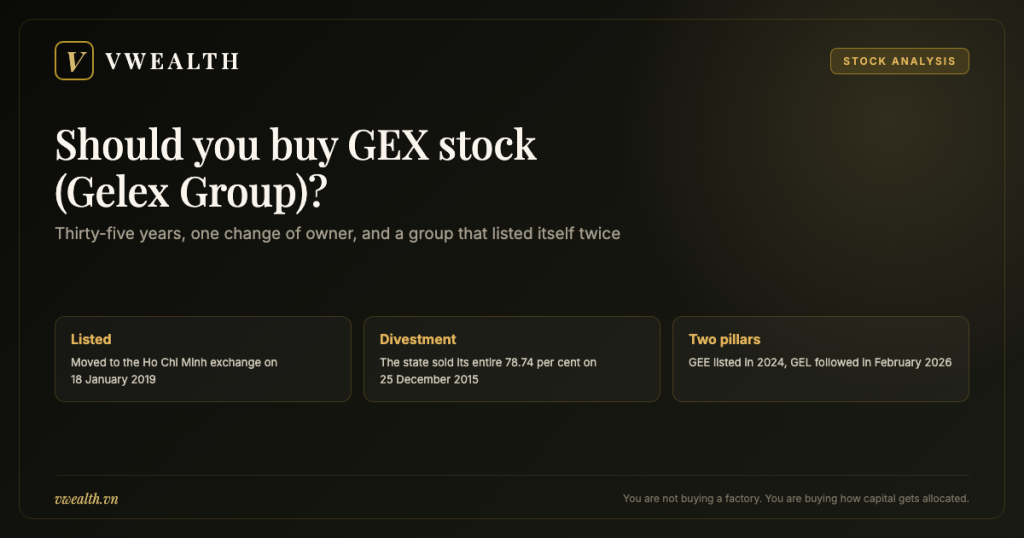
On the morning of 25 December 2015, in roughly thirty minutes of trading, more than 122 million shares in a Vietnamese state corporation changed hands on the UPCoM board. There was no auction, no roadshow, no signing ceremony. The Ministry of Industry and Trade sold its entire 78.74 per cent of the charter capital, collected a little over VND 2,100 billion, and a twenty-five-year-old industrial company began a completely different life. That company was Gelex — ticker GEX on the Ho Chi Minh Stock Exchange today. If you are weighing up whether to buy GEX stock, you cannot skip that morning, because everything that makes this company both attractive and controversial — the speed of its acquisitions, the leverage, the multi-layered group structure, and the rumours that have followed it for a decade — begins at the moment control passed from the state into private hands.
This article is not a recommendation to buy or sell anything. It is a slow walk through the whole file on Gelex Group Joint Stock Company: what the business actually does, how it makes money, who is steering it, why its financial statements are harder to read than those of almost any other listed company in Vietnam, how the market prices it, and what could make that story turn out right or wrong over the next few years. By the end you should be able to answer a more useful question than “is GEX any good”: is GEX a fit for the kind of investor you are.
A word about the numbers, so that you read this in the right spirit. Every historical figure here — the founding year, the listing dates, deal values, ownership percentages as disclosed — comes from company filings and mainstream reporting. But the live financial metrics, the latest quarter’s profit, today’s price-to-earnings ratio, borrowings at the most recent balance sheet date, change every quarter, and a long analytical piece is the wrong place to pin them down. When you need current figures, open the GEX report on the vwealth platform rather than trusting a number written into an article months earlier. Where this article does arithmetic, it says plainly that the arithmetic is illustrative.
One more piece of orientation, and it matters more if you are reading this from outside Vietnam. Before you look at any single ticker here, get the market mechanics straight: our guide to investing in the Vietnam stock market covers what a foreign investor has to sort out first — opening a securities account and obtaining a trading code, what the foreign ownership limit does and does not restrict, why the T+ settlement cycle and the daily price band change how you should size a position — and the broader Vietnam stock market guide maps how the three trading boards and the main sectors fit together. Two conventions will recur below. Amounts appear in Vietnamese dong, and one billion dong is worth roughly forty thousand US dollars at an exchange rate of around VND 26,000 to the dollar; where a figure is large enough to matter, a dollar approximation is given alongside. And “the North” means the industrial belt around Hanoi, Bac Ninh, Hai Duong and Hai Phong, which is where the electronics supply chain has been landing, as distinct from the older manufacturing and consumer market around Ho Chi Minh City in the south.
Finally, a warning about category. GEX is not an operating company in the ordinary sense. It is a holding company — a listed entity whose main assets are shares in other companies rather than factories it runs directly. That single fact changes how you read every line of its accounts, and it is the reason Chapter 4 of this article is longer and more technical than the equivalent chapter would be for a steelmaker or a bank. If you skip everything else, do not skip Chapter 4.
From state electrical corporation to acquisition machine: the history of Gelex
With most listed companies, the history chapter is decoration. You can skip it without damaging your valuation. Gelex is the opposite. The entire shape of the group today — the asset list, the multi-tier ownership, even the reputation for aggressive dealmaking that the market has hung around its neck — is the direct consequence of a chain of decisions running across thirty-five years. You have to walk the chain to understand why GEX looks like nothing else on the exchange.
1990: a child of heavy industry
Gelex was created on 10 July 1990 under a name that could only have come from a planned economy: the Vietnam Electrical Equipment Corporation, established by decision of the Ministry of Heavy Industry. Its brief was clear and thoroughly governmental — make electrical equipment for a country that had just begun the Doi Moi reforms and was short of power, short of transformers, short of cable, short of motors.
Underneath that corporate umbrella sat a collection of factories older than the parent itself. The cable works, the electro-mechanical works, the metering equipment plant — names you will meet again below as brands: CADIVI, HEM, THIBIDI, EMIC. This is the first detail worth holding on to. Gelex was not a start-up that grew. It was a basket handed a ready-made set of real industrial assets, with plants, brand names and distribution channels that had already been running for decades. Whoever ended up holding the basket would inherit cash flow on day one rather than having to build it.
Between 1990 and 2005 Gelex operated like most state corporations of the period: stable production, thin margins, investment decisions travelling through several layers of approval. In 2006 it converted to a parent-and-subsidiary structure. That sounds like a technicality, and at the time it was, but it began to separate the role of capital owner from the role of manufacturer. That parent-subsidiary frame became the skeleton of the holding company it is today.
2010: equitised on paper, still state-run in practice
In 2010 Gelex was equitised and renamed the Vietnam Electrical Equipment Joint Stock Corporation. On paper it was now a joint stock company. In practice, the Ministry of Industry and Trade retained an overwhelming controlling stake, and the way the business ran barely changed.
This half-finished state is worth understanding, because it explains a paradox that recurs across the Vietnamese market in the 2008 to 2015 period: a great many equitised state corporations continued to operate well below potential, holding good assets while generating poor returns on capital. The plants still ran, the brands still had recognition, the market share held — but nobody carried final accountability for what that capital was supposed to earn. The gap between “good assets” and “low returns” is precisely the gap a later generation of private investors moves into. That is what happened to Gelex.
In October 2015, GEX shares began trading on UPCoM. For a company being prepared for divestment, going public was not only about transparency. It created a piece of technical plumbing: from that point on, the state’s stake could be sold through order matching on the exchange rather than through a traditional public auction. That apparently procedural detail became the lead character two months later.
What Vietnam’s divestment wave actually was
If you have not followed Vietnamese equities closely, the phrase “state divestment” needs unpacking, because between roughly 2015 and 2017 it was the single biggest force reshaping the listed market.
Vietnam spent the 1990s and 2000s converting state-owned enterprises into joint stock companies, a process usually translated as equitisation. Equitisation, though, mostly changed the legal form. The state ministry or the state capital manager typically kept the majority, so control did not move. The second phase — divestment — was the part that actually transferred control, and the government accelerated it sharply in the mid-2010s under fiscal pressure and under a policy commitment to pull the state back from sectors it had no reason to be in.
The results were some of the largest transactions in the country’s corporate history. The state’s stake in the brewer Sabeco went to a Thai buyer at the end of 2017 for close to five billion dollars. A tranche of Vinamilk, the dairy company, went to foreign institutions. Dozens of smaller corporations changed hands with far less publicity. For a foreign investor the important structural point is this: a whole generation of Vietnamese private conglomerates was assembled out of assets the state let go in that window, and their managements share a common skill set — they are good at auctions, at block trades, at reading the sequencing of a divestment. Gelex is one of the clearest examples of that generation, which is also why its style attracts both admiration and suspicion.
Thirty minutes on 25 December 2015
The session of 25 December 2015 has a permanent place in UPCoM history. Within about thirty minutes of the opening, the entire holding of the Ministry of Industry and Trade — more than 122 million GEX shares, or 78.74 per cent of charter capital — was sold through order matching, for a total of just over VND 2,100 billion, on the order of eighty million US dollars.
Stop on that figure for a moment. A state corporation with plants across the country, owning some of Vietnam’s leading electrical equipment brands, transferred complete control for a sum smaller than a mid-sized office tower in Singapore. And the buyer was not one name but a set of accounts buying simultaneously inside a very narrow window — something that can only happen if the buying side has the money staged and knows in advance how the sell order will be placed.
The transaction attracted a great many questions in the Vietnamese press afterwards. This is the point at which you need an investor’s cool head rather than a news reader’s hot one. Three things are true at once. First, the trade was executed on the exchange using a method the regulator permitted. Second, no legal finding has ever established that the transaction breached the rules. Third, the fact that a large block of assets changed hands that fast, at that price, is a real data point that an investor is entitled to feed into a judgement about the risk appetite and style of the new management. You do not need to reach a moral verdict in order to analyse the company. You only need to record the finding: this is a business run by people who move quickly and who are very good at the technical machinery of capital markets.
The 32-year-old who took the wheel
In 2016, Nguyen Van Tuan — born in 1984 — became chief executive and a board member of Gelex at the age of thirty-two. In the decade that followed he became one of the names most closely associated with mergers and acquisitions on the Vietnamese exchange.
The formula Gelex applied under him can be reduced to three steps, and if you understand the three steps you understand eighty per cent of how the company grew.
Step one: pick targets that are state-owned businesses with real assets and a low valuation. Not high-growth companies, not technology. Factories. Land banks. Brands with existing market share. These are assets whose book value typically sits far below the market cost of building the same thing new.
Step two: accumulate shares in several waves, using borrowings and bonds as the lever. Buy a piece, raise the stake, use each state divestment round, each auction, each public tender offer. Because the target throws off cash, the target can carry the debt used to buy it.
Step three: consolidate, restructure, then use the newly acquired business as the springboard for the next deal. This is the compounding step. Each successful consolidation increases the group’s asset base and cash flow, which increases its borrowing capacity, which means the next target can be larger than the last.
What you are looking at is what finance calls a leveraged buyout — borrowing to buy a company, then using that company’s cash flow to service the borrowing. There is nothing improper about the model; in developed markets it is a standard technique. But it carries one property you should keep in mind for the rest of this article: it amplifies in both directions. When the assets earn more than the interest, shareholders get rich quickly. When the assets stumble or rates rise, shareholders take the first hit.
The acquisition run: from copper cable to tap water
After 2016 Gelex embarked on a dense run of transactions. The first task was consolidating control of its own traditional subsidiaries in electrical equipment: CADIVI in wire and cable, THIBIDI in transformers, HEM in electro-mechanical manufacturing, EMIC in metering. These were not new purchases but increases in ownership designed to convert Gelex from “major shareholder” into “parent company” — a distinction that matters, because only control allows the group to consolidate the whole of a subsidiary’s revenue and to direct its cash.
In parallel, Gelex stepped outside its core industry. The most notable deal of that period was Song Da Water Investment, which supplies a large part of south-western Hanoi, delivering roughly 300,000 cubic metres of water a day to around 250,000 households. A water utility does not grow quickly, but it offers three things a financial investor likes very much: revenue almost independent of the economic cycle, customers who cannot switch supplier, and cash flow as regular as a clock.
Gelex also moved into renewable energy during Vietnam’s wind and solar boom between 2018 and 2021, and into property with a hotel and several projects in Hanoi. Looked at as of that moment, the portfolio was a group in the act of accumulating rather than organising: electrical equipment, water, wind power, hotels and property all sitting under one parent.
Viglacera, 2019 to 2021: the deal that changed the weight class
If you had to choose one transaction that redefined Gelex, it is Viglacera.
Viglacera is worth introducing properly, because outside Vietnam almost nobody has heard of it and it is now the single most important asset in the group. Viglacera Corporation is an old state building materials business — ceramic tiles, sanitary ware, construction glass, and lightweight bricks — with plants across northern Vietnam and an export presence in dozens of markets. On the disclosed figures it sits among roughly the twenty largest tile producers and thirty largest sanitary ware producers in the world. That is the half of Viglacera that gave it its name.
The other half is the half that made it a takeover target. Over decades, Viglacera assembled a portfolio of industrial parks — serviced industrial land leased to manufacturers — and that portfolio, not the tile kilns, is where the value sits. It is a classic case of a company whose most valuable division is not the one in its name, and the sort of mismatch a patient acquirer looks for.
Gelex approached it in the usual multi-wave manner. From a starting position of roughly 9.8 per cent, the group won an auction for 64 million shares in the March 2019 divestment round, then continued buying through the market and through a public tender offer. On 6 April 2021 Gelex formally became Viglacera’s parent with a combined 50.21 per cent of charter capital — of which the parent company held more than 138 million VGC shares directly, or 30.78 per cent, while a subsidiary held 87.1 million shares, or 19.43 per cent.
Notice how the ownership is split across two legal entities like that. This is a feature that runs through the whole of Gelex and it is the reason the group’s accounts are hard work: control is usually assembled from the sum of several smaller stakes sitting in different companies, rather than one large stake sitting in one place.
After Viglacera was consolidated, Gelex’s scale jumped. Revenue multiplied, total assets ballooned, and so did borrowings. At the annual meeting in May 2022, when shareholders questioned the roughly VND 41,000 billion of debt on the books at the end of 2021, the company’s representatives explained the composition: about VND 13,000 billion came in with the Viglacera consolidation, about VND 3,200 billion related to wind power projects, and about VND 3,000 billion consisted of loans that had been restructured into long-term facilities. At the same meeting, Nguyen Van Tuan stated that Gelex participated in auctions, public tender offers and on-exchange matched and negotiated trades in compliance with the Securities Law.
2021 to 2024: from one corporation to a two-pillar group
In 2021 the company formally renamed itself Gelex Group Joint Stock Company and moved fully to a holding structure. This was not a signage exercise. It was a reorganisation of the entire portfolio into two pillars.
The industrial pillar, managed by Gelex Electric Joint Stock Company, gathering the whole of the electrical equipment business: CADIVI, THIBIDI, HEM, EMIC.
The infrastructure pillar, managed by Gelex Infrastructure Joint Stock Company, gathering building materials and industrial parks — mostly through Viglacera — plus water, energy and industrial property.
Above the two pillars sits GEX itself, playing the role of investor: allocating capital, deciding what to buy and what to sell, raising finance — and not selling a single metre of cable. If you have read our analysis of REE and its multi-sector holding model, the shape will look familiar. But Gelex went a step further than REE, because it let each pillar list on the exchange in its own right.
2024 to 2026: unlocking value by listing the pillars
This is the most recent chapter and the one that matters most to an investor today.
On 14 August 2024, 300 million Gelex Electric shares moved from UPCoM to the Ho Chi Minh exchange under the ticker GEE, with a first-day reference price of VND 37,150 a share, implying a market capitalisation of roughly VND 11,145 billion at listing. On 14 February 2025, after the required six months of trading, GEE came off the list of securities ineligible for margin and became marginable — a technical milestone, but one that matters for liquidity, since a large share of Vietnamese retail trading is done on margin.
The next step was bigger. On 7 January 2026, Gelex Infrastructure successfully auctioned 100 million shares at an average price of VND 28,820, raising more than VND 2,882 billion. On 27 January 2026 the exchange approved the listing, and on 6 February 2026, 890 million GEL shares began trading on the Ho Chi Minh exchange, corresponding to charter capital of VND 8,900 billion and a market capitalisation at listing of about VND 25,640 billion — approximately one billion US dollars.
For an investor these two events change the nature of the analysis. Previously, if you wanted to know what Gelex’s two pillars were worth, you had to estimate it yourself. From 2026 onward the market marks each pillar to market every day, and you can compare the value of Gelex’s stakes in GEE and GEL directly against the market capitalisation of GEX itself. We will come back to that comparison in Chapter 5, because it is the key to the entire valuation debate.
This manoeuvre has a name in international markets: a carve-out, or a partial spin-off. A parent floats a minority of a subsidiary in order to establish a public price for it, in the hope that the parent’s own shares will be re-rated toward the sum of the parts. It has been done repeatedly in Europe and Asia, sometimes with spectacular success and sometimes with none at all, and Chapter 5 explains what determines which of the two you get.
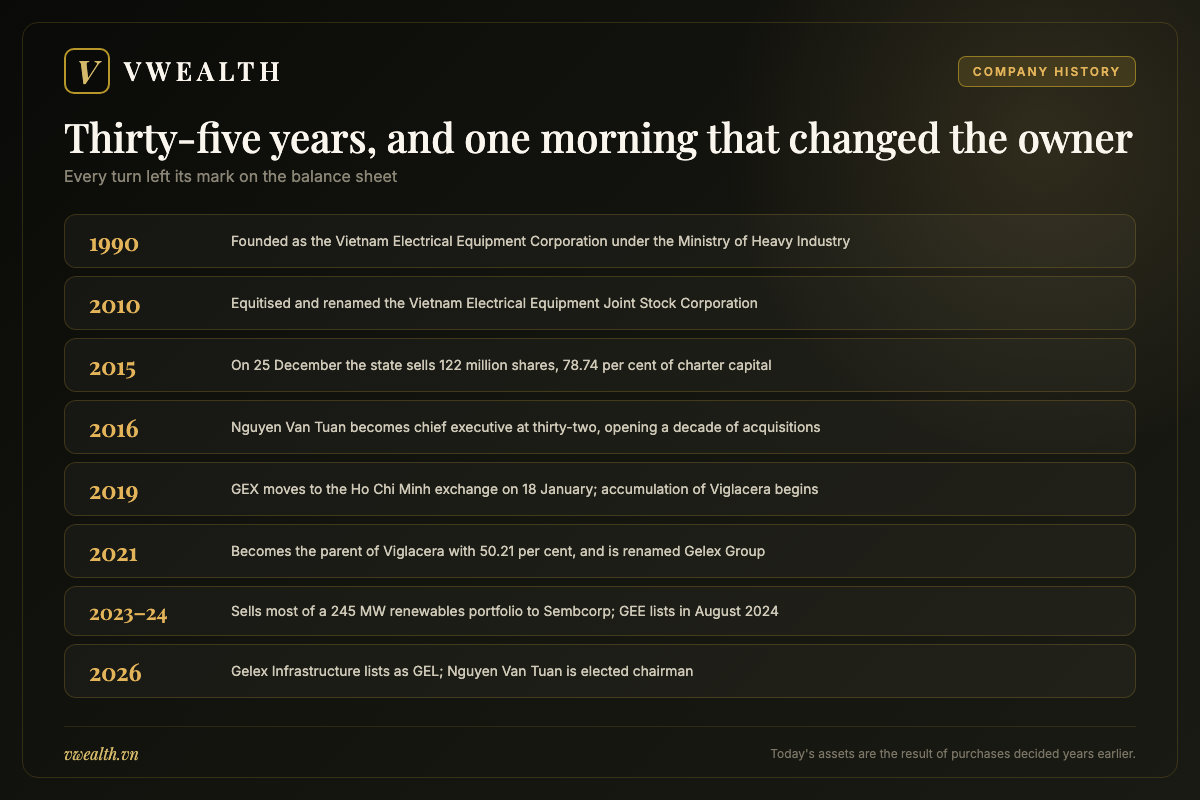
| Date | Event | What it means for an investor |
|---|---|---|
| 10 July 1990 | Vietnam Electrical Equipment Corporation established | Handed a ready-made set of real industrial assets |
| 2006 | Converted to a parent-and-subsidiary structure | The skeleton of the later holding company |
| 2010 | Equitised and renamed Vietnam Electrical Equipment JSC | Good assets, still weak returns on capital |
| October 2015 | GEX shares listed on UPCoM | Created the plumbing for an on-exchange divestment |
| 25 December 2015 | The state sells 122 million shares, 78.74 per cent, for over VND 2,100 billion | New owner, and a completely different operating style |
| 2016 | Nguyen Van Tuan becomes chief executive at 32 | Start of the leveraged acquisition cycle |
| 18 January 2019 | GEX moves to the Ho Chi Minh exchange | Higher disclosure standards and better liquidity |
| March 2019 to April 2021 | Accumulates Viglacera, reaching 50.21 per cent and parent status on 6 April 2021 | The deal that changed the weight class and brought in industrial land |
| 2021 | Renamed Gelex Group JSC, moves to a holding structure | Portfolio organised into two clear pillars |
| November 2023 to June 2024 | Agrees and completes the sale of a 245 MW renewables portfolio to Sembcorp | Exits a difficult segment, books a large one-off financial gain |
| August 2024 | Raises its Eximbank holding to 10 per cent, becoming the largest shareholder | Expansion into financial investment, and a source of debate |
| 14 August 2024 | Gelex Electric moves from UPCoM to HOSE as GEE at a reference price of VND 37,150 | The first pillar gets an independent market price |
| 7 January to 6 February 2026 | Gelex Infrastructure auctions 100 million shares at an average VND 28,820 and lists as GEL | The second pillar gets an independent price, unlocking value |
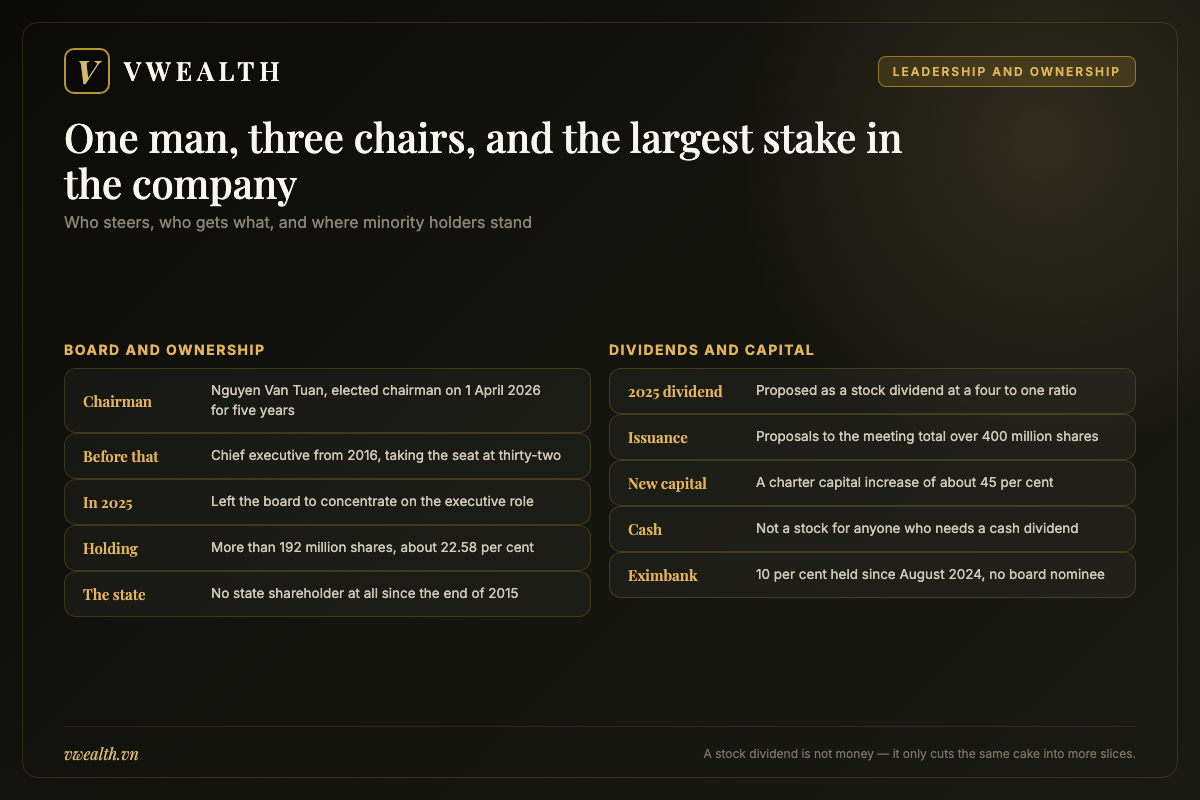
| 1 April 2026 | Nguyen Van Tuan elected chairman for the 2026 to 2031 term | Executive and governance authority combine in one person |
Leadership and ownership: one man, three chairs, and a great many rumours
For most listed companies, the chapter on management is the one you skim. Not here. With Gelex, the question “who is steering” is very nearly the same question as “what will this group buy next, how much will it borrow, and what will it sell”. In a holding company the person who allocates capital matters more than the person who runs the factory — and at Gelex, for a decade, the person allocating capital has been a single name.
A portrait of the man at the top
Nguyen Van Tuan was born in 1984. He joined Gelex in 2016 as chief executive and board member, aged thirty-two — an age at which, in most legacy state corporations in Vietnam, a person is still a deputy head of department.
The interesting thing is not the age but the style. Across ten years, Tuan led Gelex through a sequence of transactions which, laid side by side, show a very consistent logic: always aim at underpriced state assets, always use leverage, always buy in several waves rather than one decisive strike, and always be willing to sell a division back out again when it stops fitting. The sale of the renewables portfolio to Sembcorp in 2023 and 2024 is the clearest illustration of that last point: this was a segment Gelex had poured thousands of billions of dong into building, but when the tariff regime for renewables became uncertain, the group sold most of it rather than clinging on.
That is the profile of a financial investor running a manufacturing group, not of an engineer who came up through the plant. Understand this from the outset, because it determines what you should reasonably expect from GEX. Do not expect the dull stability of a pure manufacturer. What you are buying when you buy GEX is closer to a stake in an industrial investment fund with a highly active manager.
Three chairs in two years: how to read a governance change
The movement of Tuan’s seat between 2025 and 2026 is a small story, but one worth reading carefully.
In early March 2025 he filed to resign as a member of the board for the 2021 to 2026 term, with the stated reason of concentrating on the chief executive role. The resignation took effect on approval at the 2025 annual general meeting. Predictably, the market immediately produced speculation — as it always does when a prominent figure leaves a board.
Read through a corporate governance lens, however, there is a far more mundane explanation available. Separating the supervisory role, the board, from the executive role, the management team, is a governance standard that foreign institutional investors take seriously. And Gelex at that moment was preparing to bring Gelex Infrastructure to market, the point in a company’s life when every governance detail gets inspected.
Then on 1 April 2026, at the first meeting of the board for the 2026 to 2031 term, immediately following the annual general meeting, Nguyen Van Tuan was elected chairman of Gelex Group. The new board has five members.
How should you read that sequence? There are two sides, and an honest investor looks at both. The positive reading: with both pillars now listed and the group structure settled, having the person with the longest view sitting in the chair keeps strategy consistent across a five-year term. The reading that requires caution: governance authority and executive authority have concentrated heavily in one individual, and in a group whose largest decisions are decisions to buy and sell assets, that concentration is a governance risk you accept when you hold the stock.
Ownership: no state shareholder, and one very large individual
Since the 2015 divestment, Gelex has had no state shareholder at all. That is a fundamental difference from many of the companies you may be comparing it against. Look at PV GAS or PV Power, where the state remains the controlling shareholder and every significant decision travels through layers of approval. The trade-off there is predictability at the cost of speed.
Gelex is the mirror image. Nguyen Van Tuan is the largest individual shareholder, holding, as disclosed, more than 192 million GEX shares, or roughly 22.58 per cent of charter capital at the time of the disclosure. You should re-check that percentage in the most recent governance report, because Gelex’s charter capital changes continually through share issues and stock dividends — a single new issue moves the denominator.
That ownership structure produces two consequences pulling in opposite directions, and you have to weigh both.
The good consequence: the interests of the person running the company and those of minority shareholders are aligned to an unusually high degree. When more than a fifth of the decision-maker’s personal wealth sits inside the same shares you hold, the incentive to destroy value is low. Decisions are also fast — Gelex can close a deal worth thousands of billions of dong in a matter of weeks, something a state-controlled company could not manage in several quarters.
The consequence to guard against: effective veto power sits with a very narrow group. On resolutions requiring a high approval threshold — new share issues, related-party transactions, large investments — the voice of a minority holder carries limited weight. Buying GEX means agreeing to travel in the same car as the driver, not agreeing to advise on the route.
Dividends: why Gelex prefers to pay in shares
Gelex’s dividend policy is an accurate reflection of what an expanding group is.
For the 2025 financial year, management put forward a share issue in lieu of a cash dividend at a ratio of four to one — a holder of four shares receives one new share, a 25 per cent stock dividend. Alongside it came a plan to issue a further 20 per cent to raise capital. In total, the issuance proposals brought to the 2026 annual meeting amounted to more than 400 million shares, corresponding to a charter capital increase of roughly 45 per cent.
You need to be precise about what a stock dividend is, because this is where newer investors most often go wrong. A stock dividend is not money. The company pays out nothing; it simply cuts the same cake into more slices. If you hold four shares at VND 30,000 and receive one more, you hold five shares, and in theory the price adjusts to VND 24,000. Your total wealth on the day of the distribution is unchanged. In Vietnam the exchange formally adjusts the reference price on the ex-date to reflect exactly this, so there is not even a cosmetic illusion of a gain.
So why do companies do it? Three practical reasons: to retain cash for further investment rather than paying it out; to increase the share count and thereby improve liquidity; and to raise charter capital in order to expand borrowing capacity, since credit limits in Vietnam are commonly sized against equity.
The implication for you is blunt: GEX is not a stock for anyone who needs dividend income. If you are hunting for a Vietnamese name that pays regular cash to live on, look at mature infrastructure or utility businesses instead. With GEX, your entire return comes from the change in the share price — meaning you have to be right about the company and right about the timing.
One more item for the scales. When a company issues a large volume of new shares, the new capital needs time to earn anything. Through that transition, per-share metrics — earnings per share, book value per share — can flatline or fall even while absolute profit keeps rising. This is one of the main reasons newer investors find themselves saying “the business is doing well but the stock is going nowhere”.
The Eximbank stake, and what a bank holding means in Vietnam
In August 2024, after obtaining approval from the State Bank of Vietnam, Gelex increased its holding in Vietnam Export Import Commercial Joint Stock Bank — Eximbank — from about 85.5 million shares, or 4.9 per cent, to 174.6 million shares, or 10 per cent of charter capital, becoming the bank’s largest shareholder.
Two features of the Vietnamese framework are worth spelling out for a foreign reader. First, bank ownership is regulated far more tightly than ownership of an ordinary company: crossing the major-shareholder threshold requires central bank approval, and the law limits how much of a credit institution a single shareholder and its related parties may hold. Gelex’s step to 10 per cent was therefore not a market purchase that simply happened; it was an approved transaction. Second, Eximbank itself carries history. It is one of the older joint stock commercial banks in Ho Chi Minh City and spent much of the 2010s in a well-documented series of shareholder disputes and board deadlocks, which is why any change on its shareholder register is read closely by the Vietnamese market.
Gelex, for its part, has stated in writing that it does not nominate a representative to Eximbank’s board. From a portfolio standpoint the stake adds a layer to the picture: alongside manufacturing and infrastructure, the group now holds a meaningful position in a commercial bank, which means GEX earnings carry an additional variable outside the core business.
VIX, and the names that get mentioned together
You cannot write an honest analysis of Gelex and step around this section. On Vietnamese investment forums, Gelex is regularly grouped with several other names into what people call an “ecosystem”. The correct way for an investor to handle that is neither to believe it nor to dismiss it, but to separate disclosed fact from unverified inference.
Here are the disclosed facts on VIX Securities. Nguyen Van Tuan was formerly a shareholder in VIX Securities, and during 2022 he and related parties divested their entire holding in that brokerage. On the legal relationship, Gelex has published a statement confirming that VIX Securities is not a member company within the Gelex Group system. Beyond those facts, every other connection you may read on social media is speculation, and speculation is not a basis for an investment decision. If the brokerage itself interests you, we have a separate, standalone analysis of VIX stock that you can read on its own terms.
So what is this section actually for, in decision terms? Not for passing judgement on anyone. It is for putting a number on something very real: rumour risk. GEX is a widely followed, highly liquid stock attached to a well-known individual. That means that whenever an unverified story circulates about Vietnam’s large private groups — true or false — GEX tends to be in the basket that gets sold first and questioned afterwards. If you use margin on this name, you need to have priced that in before it happens rather than after.
| Item | Position as disclosed | What you should re-check yourself |
|---|---|---|
| Person at the top | Nguyen Van Tuan, chairman for the 2026 to 2031 term from 1 April 2026 | Senior personnel changes in extraordinary disclosures |
| Previous role | Chief executive since 2016; resigned from the board in March 2025 to focus on management | Who currently holds the chief executive seat and the legal representative role |
| Personal holding | More than 192 million shares, about 22.58 per cent of capital at the date disclosed | Half-year governance report and insider dealing filings |
| State shareholder | None, since the December 2015 divestment | Not applicable |
| 2025 dividend | Proposed as a stock dividend at a four to one ratio, 25 per cent | Record date and the adjusted reference price after the distribution |
| Capital raising plan | Issuance proposals totalling more than 400 million shares, around 45 per cent more capital | Actual dilution and the pace at which the new money is deployed |
| Large financial investment | 10 per cent of Eximbank since August 2024, with no board nominee | The investment note and any revaluation gain or loss |
| VIX Securities | Gelex states VIX is not a member company; Tuan divested fully in 2022 | Related-party transaction disclosures in the audited accounts |
The core businesses: two pillars, three tiers, and a parent that sells nothing
Try a small experiment. Ask ten Vietnamese investors what Gelex does and you will get ten different answers: electrical cable, ceramic tiles, industrial parks, tap water, wind power, banking. The interesting part is that all ten are correct — and that is exactly the problem. When a company cannot be summarised in one sentence, analysing it means drawing the map before discussing the numbers.
The group map: three tiers and one principle
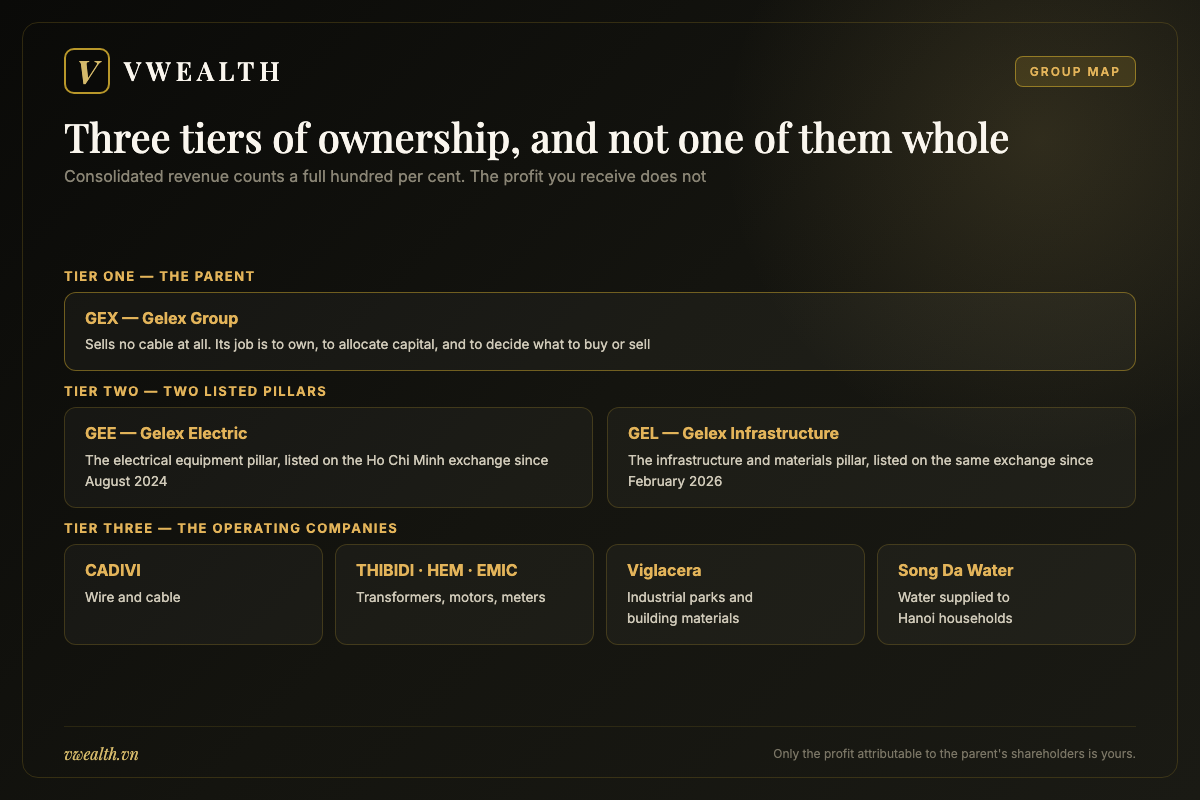
The Gelex structure today has three clear tiers.
Tier one: the parent, GEX. This is Gelex Group Joint Stock Company, the ticker you buy on the Ho Chi Minh exchange. It manufactures no cable and sells no tiles. Its work is to own shares in subsidiaries, decide what to add and what to dispose of, raise capital at group level and push it down, and set strategy. It is, in effect, a professional investor with a legal personality.
Tier two: two intermediate companies, both now listed. Gelex Electric Joint Stock Company, ticker GEE on HOSE since August 2024. And Gelex Infrastructure Joint Stock Company, ticker GEL on HOSE since February 2026. Each of these is itself a sub-holding, owning a portfolio of companies beneath it.
Tier three: the businesses that actually operate. CADIVI, THIBIDI, HEM and EMIC sit under GEE. Viglacera, Song Da Water and the other infrastructure companies sit under GEL.
The single most important principle to remember about this structure: at every tier, Gelex owns less than 100 per cent. The group holds control, enough to consolidate the accounts and direct operations, but the remainder belongs to other shareholders. That creates an arithmetic effect we will dissect properly in Chapter 4: GEX’s consolidated revenue includes 100 per cent of each subsidiary’s revenue, but the profit that genuinely belongs to GEX shareholders is only a fraction of that — and in a three-tier structure the leakage is larger than most people assume.
Pillar one: Gelex Electric and the brands already inside your walls
If your house in Vietnam was built in the last twenty years, there is a high probability that the wiring inside the walls says CADIVI. If your street has a distribution transformer, it very likely says THIBIDI. If your electricity meter was made domestically, there is a good chance EMIC made it.
Gelex Electric gathers all of those brands. This is the oldest part of the group, the most factory-like, and by some distance the easiest to understand.
CADIVI, the Vietnam Electric Cable Corporation. This is the cash cow of the whole system. Wire and cable is a basic industrial good: nobody is excited to buy it, and everybody has to. The output feeds three demand streams — residential construction, industrial construction, and the national transmission and distribution grid.
THIBIDI, the Electrical Equipment Joint Stock Company. Transformers, a product tied directly to capital spending by the power sector. Every time the grid is extended or upgraded, transformer demand follows.
HEM, Hanoi Electromechanical Manufacturing. Electric motors, generators and industrial electrical equipment. The customers are factories.
EMIC, the metering business. Meters and measurement devices, tied to the power sector’s programme of modernising how consumption is measured.
Why copper cable is the boring-but-solid business
A lot of newer investors skip past electrical equipment because it sounds unexciting. That is a mistake, and it is worth understanding precisely why this segment has genuine value.
First, brand barriers in business-to-business industries are extremely durable. A contractor choosing cable does not choose on advertising; he chooses what the supervising engineer will accept, what is already written into the tender documents, and what will not leave him personally exposed if there is a fire. A brand like CADIVI took decades to reach that position, and a new entrant cannot buy that position with a marketing budget.
Second, the distribution system is a real asset. Thousands of dealers and electrical supply shops nationwide, with trade credit relationships that have run for years. That is harder to replicate than a factory.
Third, demand is tied to power infrastructure investment, and power infrastructure investment in Vietnam is not optional. Electricity output has to rise to serve economic growth; rising output requires grid; grid requires wire, cable and transformers. This is policy-driven demand, not consumer-sentiment-driven demand. If you want to see the adjacent link in the same chain, our analysis of PC1 Group describes the power construction contractor that stands immediately next to where Gelex Electric sits — PC1 builds the lines and substations that CADIVI and THIBIDI supply.
But the segment carries a weakness you have to watch closely: the copper price. Copper is the main raw material in electrical cable and represents a very large share of cost of goods sold. When the global copper price rises, the company can book a gain from cheaper inventory bought earlier and margins expand. When copper falls sharply, the reverse happens. Which means the margin of the electrical equipment segment does not purely reflect operating skill; part of it is a commodity price effect. This is why you should never extrapolate one good quarter’s margin across a full year. The pattern is the same one that makes flat steel producers so hard to read; our note on Hoa Sen Group describes the identical mechanism on the steel side, where input price timing regularly outweighs volume growth in a single quarter’s result.
Pillar two: Gelex Infrastructure, with Viglacera at the centre
If Gelex Electric is the straightforward pillar, Gelex Infrastructure is the layered one — and it is where most of the group’s hidden value sits.
The centre of this pillar is Viglacera, ticker VGC. Viglacera has two very different faces, and the market took years to price the second one correctly.
Face one: building materials. Ceramic tiles, sanitary ware, construction glass, unfired bricks. On disclosed figures Viglacera ranks among roughly the twenty largest tile makers and thirty largest sanitary ware makers in the world. This is a business with brand and with scale, but it tracks the property cycle tightly: when property is warm, tiles sell; when property freezes, the kilns run below capacity and margins compress.
Face two: industrial parks. This is the part worth paying for. Viglacera operates roughly 16 industrial parks with a combined land bank of more than 4,500 hectares and, on the company’s own disclosures, has attracted around USD 20 billion of foreign direct investment from names including Samsung, Canon and Amkor Technology. In the second quarter of 2026, Viglacera reported pre-tax profit above VND 1,000 billion, up roughly 42 per cent year on year and the highest quarterly profit in its history, driven by growth in industrial park leasing.
Industrial parks: how the money machine actually works
Spend a moment on the industrial park business model, because this is where most of the infrastructure pillar’s real profit is made, and because it is a model with no exact equivalent in most Western markets.
The developer buys agricultural or undeveloped land cheaply, often years in advance, pays compensation to clear the site, builds the infrastructure — internal roads, power, water, waste water treatment — and then leases the serviced land to manufacturers, usually foreign, on long-term contracts of typically forty to fifty years, most often collecting the rent as a single upfront payment or in a few large instalments.
Three features make this financially attractive.
One: high margins, because the cost base is old. The land was accumulated years ago at low prices; the lease rate today reflects current land values. That spread is the profit.
Two: cash comes in early. Tenants pay most of the rent up front, while the developer may recognise the revenue over the lease term or in a single hit depending on accounting policy. This produces a very large “unearned revenue” line on the balance sheet — an order book that has already been paid for but has not yet reached the income statement. For an analyst that line is a leading indicator worth tracking on its own.
Three: high-quality customers. The tenants are global manufacturers, with minimal credit risk, and once a factory is installed they effectively never move.
The corresponding weaknesses: the supply of cleared land is finite, legal procedures are slow, and the entire demand base depends on foreign direct investment flows. If you want a pure-play reference point for how the market prices this asset class when it stands alone, our analysis of KBC, Kinh Bac City is the closest comparison available on the Vietnamese exchange.
Water, energy, and the quiet assets
Beyond Viglacera, the infrastructure pillar holds a cluster of assets that get mentioned far less but do real stabilising work.
Song Da Water supplies around 300,000 cubic metres of water a day to roughly 250,000 households in the Hanoi area. This is the sort of asset infrastructure investors describe as a bond with pipes attached: demand is close to inelastic, customers cannot switch supplier, and the tariff is set by the regulator, so it cannot spike but nor can it easily collapse. In exchange you take tariff policy risk and operating risk — any incident affecting water quality becomes a public issue immediately.
On energy, Gelex executed a notable strategic reversal. On 10 November 2023, Sembcorp Industries of Singapore — the energy and urban development group in which the state investment company Temasek is the largest shareholder — announced that its subsidiary Sembcorp Solar Vietnam had agreed to acquire majority stakes in a 245 MW Gelex renewables portfolio, at an equity value of up to SGD 218 million, roughly VND 3,800 billion. The portfolio comprised 73 per cent of Song Bung 4A hydropower, 49 MW; 80 per cent of Gelex Ninh Thuan, 68 MW; 100 per cent of Gelex Quang Tri wind power, 88 MW; and Huong Phung 2 and 3 wind power, 50 MW. On 19 June 2024, Sembcorp completed the acquisition of majority stakes in three of the four companies.
Why sell? The answer is in the tariff mechanism. Vietnam attracted its wind and solar build-out with a feed-in tariff — a fixed, above-market price per kilowatt hour guaranteed for a set period, designed to pull private capital into new generation. When that fixed-price window closed, the transitional pricing framework for projects that missed the deadline became less generous and considerably less certain, while the projects themselves had already swallowed enormous capital expenditure and carried long-term debt. Selling to a specialist buyer with a lower cost of capital, taking the cash, booking the financial gain and redirecting the money to a segment with a clearer return is a rational capital allocation decision for a holding company — even though it removes a long-term growth story from the equity narrative.
Industrial property and the newer bets
The infrastructure pillar also has a branch that is growing: developing industrial parks and industrial property directly under the Gelex name, not only through Viglacera.
In February 2023, Gelex signed a partnership with Frasers Property Vietnam to develop high-quality industrial parks in northern Vietnam, with initial investment of around VND 6,000 billion, equivalent to about USD 250 million. The significance is not only the money. Frasers brings the ready-built factory leasing standard and an international tenant base, which moves Gelex from a “sell industrial land” model toward a “lease built factory space” model — one that produces recurring rental cash flow rather than a single lump sum. For an investor, recurring rent is worth a higher multiple than one-off land sales, so a genuine shift in that direction is a re-rating argument in its own right.
More recently, Gelex Infrastructure disclosed that it is pursuing an investment opportunity connected to the Gia Binh airport project, with the capital commitment discussed at above VND 8,000 billion. This is the kind of project that can transform the asset profile of an infrastructure company — and also the kind that demands very large capital, has a very long payback, and depends on legal and administrative progress outside the company’s control. For a shareholder it is simultaneously a growth story and a question mark over funding pressure in the coming years.
And finally there is the Eximbank stake described in the previous chapter. At the portfolio level it adds one more layer: alongside manufacturing and infrastructure, the group carries a significant position in a commercial bank, which means GEX results now include a variable from outside its core industries.
| Pillar or segment | Main company | How it makes money | Principal risk |
|---|---|---|---|
| Electrical equipment: wire and cable | CADIVI, under GEE | High volume, thin but steady margin; brand and dealer network are the moat | Copper price swings; price competition |
| Electrical equipment: transformers, motors, meters | THIBIDI, HEM, EMIC, under GEE | Sales driven by grid and factory investment cycles | Dependent on the pace of power sector disbursement |
| Industrial parks | Viglacera, under GEL | Leasing serviced land bought cheaply years ago, cash collected up front | FDI flows; availability of cleared land; permitting |
| Building materials | Viglacera, under GEL | Tiles, sanitary ware and glass sold into the construction cycle | Property cycle; energy cost for kilns |
| Water | Song Da Water, under GEL | Volume sold per cubic metre, with inelastic demand | Regulated tariff; operational incidents |
| Renewable energy | 245 MW portfolio, majority sold to Sembcorp | Formerly power sales; now largely a completed divestment | No longer a growth driver |
| New industrial property | Partnership with Frasers Property Vietnam | Leasing ready-built factory space for recurring cash flow | Capital intensive; competes with foreign developers |
| Financial investment | 10 per cent of Eximbank | Dividends and change in the value of the holding | Banking sector volatility; reputational linkage |
Position and financial health: how to read the accounts of a three-tier holding
This is the hardest chapter in the article and also the most valuable. Because with GEX, most investor errors do not come from picking the wrong company — they come from reading the right number and misunderstanding what it means. The consolidated accounts of a three-tier group that owns less than all of each tier are among the most easily misread financial statements on the Vietnamese exchange.
This chapter does not print figures for the latest quarter; for those, open the current report on vwealth. What it teaches you is a method, and the method keeps working in every reporting period afterwards.
Competitive position: where it is strong, where it is weak
Before the numbers, settle the competitive position of each segment, because position is what determines whether a number is durable.
Wire and cable: this is where Gelex is strongest. CADIVI is among the leading domestic brands, with distribution across the country and broad acceptance in tender documentation. The position is durable because it rests on technical trust and purchasing habit — two things that change very slowly.
Transformers and metering: a good domestic position, but demand depends heavily on the rhythm of power sector capital spending. A year in which the utility pushes grid investment is a good year; a year of slow disbursement is a flat one.
Industrial parks: a strong position in land, since more than 4,500 hectares across roughly 16 parks is a holding very few Vietnamese companies can match, and most of it sits in the North, precisely the region absorbing the heaviest electronics FDI. The weakness is that the rate at which new land can be added is slowing because of permitting.
Building materials: good brand position in a hard industry. This is the segment with many plants, heavy fixed costs, and pressure from both the property cycle and energy prices.
Water: a natural monopoly within its supply area, capped by a regulated tariff.
Add it up and you have a reasonably balanced portfolio: one defensive segment in water, one stable branded segment in electrical equipment, one growth segment tied to FDI in industrial parks, and one cyclical segment in building materials. That is the portfolio shape of an investor who knows what he is doing, not of someone who bought whatever was available.
Trap one: consolidated revenue is not “your” revenue
When you read a headline saying “Gelex posts tens of thousands of billions in revenue”, pause for a beat.
The consolidation rule is this: if a parent controls a subsidiary, then 100 per cent of that subsidiary’s revenue is added into consolidated revenue, whether the parent owns 51 per cent or 99 per cent. Consolidated revenue therefore measures the size of the machine the group is operating, not the slice of cake belonging to the parent’s shareholders.
With Gelex the gap between those two things is wide, because ownership is diluted through several tiers. Work an illustrative example with invented figures so you can see the mechanism — and note clearly that these are made-up numbers, not the company’s actual accounts:
Suppose GEX owns 80 per cent of an intermediate company, and the intermediate company owns 50 per cent of an operating business. The operating business earns 100. On GEX’s consolidated statements, the full 100 of revenue and profit appears. But the portion genuinely attributable to GEX shareholders is 80 per cent times 50 per cent, or 40. The remaining 60 belongs to “non-controlling interests” — the other shareholders at the two lower tiers.
The practical lesson is direct: when you look at GEX’s accounts, do not stop at “profit after tax”. Find “profit after tax attributable to owners of the parent”. That is the number to use for earnings per share and the number to compare against the price you are paying.
Trap two: how much the minority interest eats
Following on from that, there is a simple ratio you should compute every reporting period, and it takes about thirty seconds.
Divide “profit after tax attributable to owners of the parent” by “total profit after tax”. The result is the retention ratio — the percentage of group profit that actually reaches a GEX shareholder’s pocket.
Track it across eight consecutive quarters and it will tell you things no news bulletin will.
A rising ratio usually means the group is increasing its stakes in subsidiaries, or that a larger share of profit is coming from segments where the parent holds a higher percentage. That is good for GEX holders.
A falling ratio means the opposite: the machine is running harder but your slice is getting thinner. This typically happens when a subsidiary issues new shares to outsiders — for example, when Gelex Infrastructure sold 100 million shares in its IPO, the parent’s percentage of the infrastructure pillar was diluted by definition. Note the subtlety here: that dilution was accompanied by cash coming in, so it is not automatically bad. It is simply something you have to see rather than have happen to you invisibly.
A ratio that jumps for one quarter and returns is usually the signature of a one-off gain or loss sitting in a particular legal entity. That is your cue to open the notes.
Trap three: one-off gains from divestment
This is the most characteristic trap of an active holding company like Gelex.
When the group sells a subsidiary — as it did with the renewables portfolio to Sembcorp — the difference between sale price and book value is recorded as financial income or other income. That amount can be very large: on the Sembcorp deal, Vietnamese brokerages at the time estimated the financial gain could reach around the thousand-billion-dong mark depending on assumptions.
Where is the problem? The gain is real, legitimate, and non-recurring. If you use the profit of a year that contained a divestment to compute a price-to-earnings ratio, the stock looks artificially cheap. The following year, with no deal, profit drops and the P/E springs back up — and you will conclude the business has deteriorated when the core operations may be entirely unchanged.
This explains something you may have noticed. At the 2026 annual general meeting, Gelex reported 2025 results with consolidated net revenue of VND 39,513 billion and pre-tax profit of VND 4,621 billion, beating the targets set by the previous meeting by 5.1 per cent and 52 per cent respectively. Yet the 2026 plan set revenue at VND 44,712 billion, up 13.2 per cent, while targeting pre-tax profit of only VND 3,615 billion — a fall of roughly 21.8 per cent against the 2025 outcome.
On the surface that looks contradictory: revenue up, planned profit down. But if you have understood trap three, a very reasonable reading presents itself. The 2025 profit most likely contained a contribution from items of a one-off nature, while the 2026 plan is built on the base of core operations. That is not necessarily bad news — it may equally be a sign of a management team setting conservative targets. What it is, without question, is a reminder that you cannot compare one year’s profit with another until you have stripped the one-off items out. To see exactly how large the one-off component was in any given period, you have to open the notes on financial income and other income in the audited statements.
Leverage: reading debt at a holding company is not like reading debt at a factory
Gelex’s debt story is the most contested part of the file, and the most frequently misread.
At the annual meeting of May 2022, when shareholders challenged the roughly VND 41,000 billion of borrowings at the end of 2021, management set out the composition: about VND 13,000 billion arrived with the Viglacera consolidation, about VND 3,200 billion related to wind power projects, and about VND 3,000 billion consisted of facilities that had been restructured into long-term debt.
That explanation points at exactly the right principle: in a consolidated group, a subsidiary’s debt sits on the parent’s balance sheet, but so does the subsidiary’s ability to service it. Viglacera’s borrowing to build industrial park infrastructure is repaid out of Viglacera’s own land lease receipts, not out of GEX shareholders’ pockets. Looking at the headline total without asking where the debt sits and what asset stands against it is the quickest route to a wrong conclusion.
So how do you read GEX’s debt properly? Four steps.
Step one: split the debt by legal entity. In the notes, borrowings are usually itemised by facility and by unit. Distinguish debt at the parent, debt at the intermediate holdings, and debt at the operating companies.
Step two: look hardest at debt at the parent. This is the most dangerous debt, because the parent has no sales revenue at all; it lives on dividends received from subsidiaries, management fees, and proceeds from disposals. If parent-level debt is large and the incoming dividend flow does not cover the interest, the group is forced either to sell assets or to issue new shares — both of which are unfavourable to existing shareholders.
Step three: compute net debt to equity. Take total short-term and long-term borrowings, subtract cash, cash equivalents and short-term financial investments, and divide by equity. Track it across several periods to see the trend rather than judging a single point.
Step four: inspect the maturity profile. What percentage of borrowings falls due within the next twelve months? Does the company have enough cash and enough committed facilities to roll it? For a group that uses leverage as a growth tool, the biggest risk is rarely “no profit” — it is usually “cannot refinance at the wrong moment”.
Cash flow: what does the parent actually live on
Very few retail investors ask this question, and it is the central question in any holding company.
The GEX parent has three sources of cash: dividends received from subsidiaries, proceeds from disposals, and newly raised money — bank loans, bonds, share issues.
The first source is the healthy one, because it repeats. But it comes with a condition: the subsidiary has to pay a cash dividend upstream. If Viglacera or Gelex Electric retains its earnings to reinvest, the consolidated statements will still show a large profit while the parent’s own treasury stays dry. This is a very common and very under-discussed failure mode in Asian holding structures.
The second source is attractive but not durable, for the reasons set out under trap three.
The third source is the easiest and the most dangerous. A group that must continually raise fresh capital simply to keep the parent functioning is a group accumulating risk. Conversely, a group raising new capital to fund a specific project with a clearly identifiable return is doing something entirely ordinary.
When you read GEX’s cash flow statement, look for three lines in the parent-only statements rather than the consolidated ones: cash received from dividends and profit distributions, cash paid for interest, and cash received from borrowings. Compare those three against each other and you will know whether the parent is living on real cash flow or on new money.
Six steps to reading a GEX reporting period
Compress this whole chapter into a procedure you can repeat every quarter.
Step 1: read profit attributable to owners of the parent, not total profit. That is the only line that belongs to you.
Step 2: calculate the retention ratio and compare it with prior periods. Is your slice getting thicker or thinner?
Step 3: strip out the one-off profit. Open the notes on financial income and other income, find gains on disposals, revaluations and provision reversals, and take them out to get to core profit.
Step 4: read the segments. How much is electrical equipment earning, how much is infrastructure, and which segment is currently carrying which? Segment reporting by line of business is a holding company analyst’s best friend.
Step 5: check debt by tier and by maturity. Especially parent-level debt and the portion maturing within twelve months.
Step 6: measure progress against the shareholder-approved plan. Management has committed to revenue of VND 44,712 billion and pre-tax profit of VND 3,615 billion for 2026; how far along that road is the cumulative result at the reporting date? A management team that keeps its word over many years is an intangible asset with real value.
| Trap when reading the numbers | How it shows up | How to handle it |
|---|---|---|
| Consolidated revenue looks enormous | Impressive headline figures in the press | Remember it adds 100 per cent of subsidiary revenue even where the parent only controls |
| Profit leaks through multiple tiers | Large total profit, much smaller profit for parent shareholders | Use only profit attributable to the parent; compute the retention ratio every period |
| One-off gains from disposals | A quarter of exceptional profit, with the P/E dropping sharply | Strip the one-off item out before doing any valuation work |
| Large borrowings on the balance sheet | Total debt in the tens of thousands of billions | Split debt by legal entity and match it against the corresponding assets and cash flow |
| Parent short of cash | Consolidated profit is large but the parent keeps borrowing | Read the parent-only cash flow statement, not the consolidated one |
| Dilution at the lower tiers | A subsidiary issues new shares to outside investors | Re-check the parent’s stake in GEE and GEL after every issue |

How the market prices GEX stock
Here is a question newer investors tend to skip: a good business is one thing, but what story is the market currently paying for is quite another. With GEX the distance between those two can be wide — and that distance is simultaneously the opportunity and the trap.
The personality of the stock: wide range, deep liquidity, rumour-sensitive
Every stock has a personality, and GEX’s is easy to recognise after a few years of watching it.
This is a name with high liquidity and a wide trading range. It tends to appear among the leaders when the market runs, and among the heaviest fallers when the market corrects. The reasons are not mysterious: the market capitalisation is large enough for funds and brokerage proprietary desks to participate, the free float is generous, the story is easy to tell, and it is attached to a well-known individual.
The practical consequence: GEX is a high-beta stock — it typically moves more than the index in both directions. If the VN-Index gains 10 per cent, GEX may gain more; if the index falls 10 per cent, GEX usually falls further. Two features of the Vietnamese market make that more consequential than it would be elsewhere. Trading is settled on a T+ cycle, so the shares you buy are not immediately available to sell, which means you cannot exit a position the same afternoon you change your mind. And each stock has a daily price band — a fixed percentage limit above and below the reference price beyond which it cannot trade — which sounds protective but in a genuine panic can leave a stock locked limit-down with no bid, so that you cannot get out at all. If you use margin on this name, the distance from “sitting on a profit” to “receiving a margin call” is shorter than you think.
One further characteristic: GEX reacts very quickly to rumour. When unverified stories about Vietnam’s large private groups circulate, GEX is usually on the list of names sold first. Conversely, when there is news of a deal, a subsidiary IPO or a large infrastructure project, money arrives just as fast. If you are someone who sleeps badly when an account fluctuates, this is not your stock.
Why the P/E ratio is nearly useless here
This is the most important technical point in the chapter.
The price-to-earnings ratio is the most widely used valuation tool, and it works well for a business with one operating segment, stable profit and few exceptional items. Which is to say it works well for almost everything except a holding company like GEX.
Three reasons the GEX P/E misleads.
One: earnings are contaminated by one-off items. In a year with a disposal, profit jumps and the P/E drops to a level that looks very cheap. The next year it springs back. You cannot compare one year’s P/E with another without normalising first.
Two: profit attributable to the parent is only part of consolidated profit. Many data providers compute P/E from consolidated profit rather than parent-attributable profit, and with a multi-tier structure like Gelex’s the resulting error is large — large enough to make the stock look meaningfully cheaper than it is.
Three: the biggest value in GEX is not in earnings but in assets. Industrial park land is carried at historical cost, far below current market value. Stakes in listed companies are in many cases carried at original cost rather than market price. The P/E reflects none of those gaps in either direction.
Sum-of-the-parts: the only sensible approach to GEX
The appropriate way to value a diversified group is sum-of-the-parts, usually abbreviated to SOTP. The idea is simple: rather than valuing the whole thing at once, you value each piece, add them together, and subtract net debt at the parent level.
And this is exactly where the listings of GEE and GEL change everything. Before 2024, valuing the two Gelex pillars meant estimating them yourself, choosing your own comparable multiples and arguing with yourself about the result. Since February 2026, with both GEE and GEL listed on HOSE, the market prices each pillar for you, every trading day.
The procedure you can run yourself takes about fifteen minutes.
Step 1. Look up GEX’s current percentage ownership of GEE and of GEL. The figures are in the consolidated financial statements or the governance report.
Step 2. Take the current market capitalisation of GEE and GEL and multiply each by the corresponding ownership percentage. You now have the market value of the two largest holdings.
Step 3. Add the value of the other assets at parent level — most significantly the 10 per cent of Eximbank, which can be marked at the bank’s current share price.
Step 4. Subtract net borrowings at the parent company.
Step 5. Compare the result with the current market capitalisation of GEX.
The comparison generally lands in one of two states, and each says something different.
The conglomerate discount: when one plus one is less than two
In almost every market in the world, the shares of a parent company trade below the aggregate value of the stakes it holds. That gap is called the holding company discount, or in the diversified case the conglomerate discount, and it exists for four entirely legitimate reasons.
One: you do not control the assets. You buy GEX, but you do not decide when Viglacera leases land or when CADIVI raises prices. You delegate all of that to management.
Two: there is a cost to the intermediate layer. The parent has staff, administrative costs and its own interest expense. Those costs consume part of the value the assets create.
Three: there is capital misallocation risk. The proceeds from selling a good segment can be reinvested into a poor one. That risk is borne by the holder of the parent’s shares, not by the holder of the subsidiary’s shares.
Four: tax and friction on realisation. To convert a shareholding into cash for shareholders, the group has to sell, pay tax, and get through the procedure.
So if you calculate that GEX is trading below the sum of its parts, that does not automatically mean the stock is cheap. The right question is: is the current discount wide or narrow relative to GEX’s own history, and is there any reason for it to close in the foreseeable future? Discounts typically narrow when an event exposes value — a subsidiary IPO, an asset sale above book value, a commitment to a large cash dividend, a share buyback, or a simplification of the structure.
Conversely, if GEX trades above the sum of its parts, the market is paying for confidence in management’s capital allocation skill — paying in advance for deals that have not happened. That is a price that requires everything to go right, and it is a far riskier place to buy.
It is worth being honest about the international record here, because the carve-out strategy Gelex has pursued does not automatically work. In Europe and Asia there are cases where listing subsidiaries permanently narrowed the parent’s discount, and there are equally famous cases where the discount actually widened afterwards, because the market concluded that the parent had become a pure financial wrapper with nothing to add. What separates the two outcomes, in most studies, is whether the parent subsequently returns capital and simplifies, or keeps reinvesting into new complexity. That is the specific thing to watch at Gelex over the next few years.
Dividends, foreign investors and institutional flow
On dividends, Chapter 2 was explicit: Gelex distributes mainly in shares rather than cash, and 2025 continued that pattern with the four-to-one proposal. For a value investor who needs income, that is a mark against. For a growth investor it is reasonable — retained money can compound at a higher rate than distributed money, provided management allocates it well. The entire argument rests on that “provided”.
On institutional flow, GEX is regularly in the sights of foreign investors and brokerage proprietary desks, particularly in periods when the market anticipates a corporate event. Around the milestones of the subsidiary IPO and listings, the stock repeatedly recorded heavy net buying from foreign investors and proprietary desks — behaviour analysts at the time described as positioning ahead of the group’s prospects.
One structural note for foreign readers: like most Vietnamese non-banking companies, GEX carries a foreign ownership limit, and the practical question of whether there is any headroom left in the “foreign room” can affect both your ability to buy and the premium at which blocks change hands. The mechanics of that are covered in the investing guide, but check the current room before you plan a position of any size.
How should you use flow information? Not by copying it. Foreign investors are wrong too, and their time horizon is not yours. The right use is as an indicator of attention: when institutional money moves into a stock, liquidity rises, the trading range widens, and the price can be pushed past fair value in either direction.
The catalysts the market is watching
Finally, a roll call of the events that could change how the market prices GEX. These are not forecasts; they are the things worth marking in your own diary.
Deployment of the Gelex Infrastructure IPO proceeds. After the January 2026 offering, Gelex Infrastructure disclosed that it had deployed VND 2,818 billion of the money raised. Where that capital goes and when it starts earning determines whether the issue created value for shareholders or merely diluted them.
The new share issues. With more than 400 million shares planned under the proposals put to the 2026 meeting, the dilution is real and will weigh on earnings per share in the short term.
The Gia Binh airport project. Gelex Infrastructure has disclosed that it is pursuing the opportunity, with the figure discussed at above VND 8,000 billion. An infrastructure project of that size, if it takes shape, changes both the asset profile and the debt profile of the infrastructure pillar.
Viglacera’s industrial park leasing results. This is the fastest available read on the health of the infrastructure pillar and a direct reflection of FDI flowing into Vietnam.
The copper price and the electrical equipment margin. The fastest available read on the industrial pillar.
The possibility of another disposal. Gelex has demonstrated that it will sell a segment when the logic changes. Any such deal brings both cash and a one-off gain — and, as established above, you have to strip the gain out before you value anything.
The economic and industry backdrop: four winds in one sail
The advantage of a diversified group is that it does not depend on a single industry. The disadvantage is that you have to understand four industries instead of one. This chapter compresses those four down to what actually reaches a GEX shareholder’s pocket.
The power investment cycle: demand that is mandatory, not discretionary
The foundation of the electrical equipment pillar is a very dry fact: Vietnam has to build more generation and more grid. There is no alternative option.
Electricity demand rises faster than economic growth — that is the rule in an industrialising economy, and it is more true still when investment in electronics manufacturing, semiconductors and data centres is arriving in volume. Every new factory needs a connection; every new industrial park needs substations; every kilometre of new line needs tonnes of wire and cable.
The point that matters for an investor: this is demand led by planning and policy, not by consumer sentiment. When the economy is weak, households postpone buying a phone, but the utility cannot postpone relieving an overloaded grid. That gives the electrical equipment segment relatively defensive characteristics compared with the rest of the group. The broader shape of Vietnam’s industrial and energy complex, and how the links in that chain fit together, is laid out in our Vietnam stock market guide if you want to place Gelex against the wider sector.
The risk in this segment is not demand but rhythm. Power sector investment follows disbursement schedules, and disbursement schedules in Vietnam are habitually slower than planned. A year of slow disbursement is a year in which an equipment maker runs below capacity, regardless of how healthy the ten-year outlook is.
Copper: the variable outside anyone’s control
Copper accounts for the bulk of the cost of goods sold in wire and cable, so CADIVI’s margin is tied fairly tightly to the world copper price.
The mechanism runs like this. The company buys copper, manufactures, and sells the finished product after a lag. When copper rises during that lag, the selling price is adjusted upward while the cost sitting in inventory is still the old cost — and the margin expands. When copper falls, the effect reverses, and if it falls far enough the company also has to write inventory down.
The practical lesson: an unusually attractive margin in the electrical equipment segment in any single quarter is not necessarily evidence that the company got better at its job. Before celebrating, look at the copper chart for the same period. And conversely, a compressed margin in a quarter when copper collapsed is not necessarily evidence of lost market share. This is the same discipline you need with any Vietnamese commodity processor; our analysis of Hoa Phat Group works through the identical problem on the steel side, where volume, selling price and input price have to be read together and the profit peak usually arrives one beat after the demand peak.
FDI and the northern industrial belt: the real engine of the infrastructure pillar
This is the strongest wind currently blowing into Gelex.
Vietnam is benefiting from the reorganisation of global supply chains, particularly in electronics. Multinationals want manufacturing capacity outside China, and northern Vietnam — close to the border, close to ports, with rapidly improving transport infrastructure — is one of the destinations being chosen.
Viglacera sits exactly in that spot. On disclosed figures, its network of roughly 16 industrial parks with more than 4,500 hectares of land has attracted around USD 20 billion of foreign direct investment, with tenants including Samsung, Canon and Amkor Technology. The second quarter of 2026, with pre-tax profit above VND 1,000 billion, up around 42 per cent year on year and the highest quarterly figure in the company’s history, indicates that the leasing cycle is in a favourable phase.
But look at the other side too. The industrial park model has three hard limits.
Cleared land is finite. Land that has been leased cannot be leased again. To sustain growth, the developer has to keep adding new land — and that is getting harder and more expensive.
Revenue is lumpy. One large lease signed this quarter can make the quarter look spectacular, and the next quarter can be nearly silent. This is an industry to be read annually, not quarterly.
The demand driver is outside anyone’s control. Tariff policy in major economies, geopolitical shifts, or simply one global group changing its strategy — all of these can slow FDI for a year or two.
Building materials and the property cycle
Viglacera’s tiles, sanitary ware and glass follow a completely different cycle: the residential construction cycle.
The chain of causation is long. Property legal obstacles get cleared, developers launch sales, buyers commit money, projects get built, and only at the fitting-out stage is there demand for tiles and bathroom fixtures. In other words, finishing materials typically recover several quarters after the property market itself, not at the same time. This lag is one of the more common ways investors mistime a building materials position: they buy on the property news and then sit through two or three quarters of disappointing results.
This is also a segment with many plants and heavy fixed costs, so margins fall quickly when utilisation is low. On top of that, making tiles and glass consumes a great deal of energy, so gas and electricity prices feed directly into unit costs.
Policy and competition: who does Gelex stand next to?
On policy, three currents currently run in Gelex’s favour: the push on public investment and transport infrastructure, which raises demand for materials and equipment; the national power development plan, which underwrites the electrical equipment segment; and the policies aimed at attracting high-technology FDI, which raise demand for industrial land.
On competition, the interesting fact is that Gelex has no direct equivalent. In each segment it competes with a different set of names.
In electrical equipment it competes with domestic cable manufacturers and with imports. In industrial parks it competes with specialist park developers, both domestic and foreign. At the level of the diversified group holding power and water assets, the closest model on the exchange is REE — but REE leans toward power generation and mechanical and electrical contracting, while Gelex leans toward equipment manufacturing and industrial property.
The right comparison, therefore, is not “is GEX cheaper than someone else”. It is this: for the same money, would you rather own a basket of assets someone else has selected and manages on your behalf, or select each name yourself? If you believe in the capital allocation ability of Gelex’s management, buying GEX is coherent. If you only like one specific segment — say you only want the electrical equipment exposure — buying GEE directly gives you a purer exposure, without paying the holding company discount and without carrying the risks of the other segments.
| Route in | What you get | What you have to accept |
|---|---|---|
| Buy GEX, the parent | Exposure to all four segments at once; the upside if management allocates capital well | The holding company discount; dilution at several tiers; concentrated governance risk |
| Buy GEE, the electrical pillar | Pure exposure to the steadiest segment, geared to power sector investment | No industrial park exposure; dependence on the copper price |
| Buy GEL, the infrastructure pillar | Exposure to industrial parks, building materials and water | The property cycle; heavy capital needs for new projects |
| Buy VGC, Viglacera | The closest exposure to the industrial land bank and to FDI | Still sits under Gelex control, with limited say for minorities |
| Buy a pure industrial park developer | A simple story that is easy to value | No defensive segment to cushion a slowdown in FDI |
Trend outlook: three scenarios before you decide whether to buy GEX stock
Nobody can forecast a share price, and any piece of analysis that promises you a precise target is selling you confidence rather than truth. What is far more useful is to build three scenarios in advance, attach each one to specific observable conditions, and then mark, quarter by quarter, which way reality is drifting. That is how a serious investor works, and it is what this chapter gives you.
Four drivers and four risks to weigh
Before the scenarios, settle the forces pulling in each direction.
Driver one: value being unlocked in stages. GEE’s move to HOSE in August 2024 and GEL’s in February 2026 turned two previously hard-to-value asset blocks into two publicly quoted numbers. Every time the market re-prices a pillar, the parent gets looked at again too.
Driver two: the FDI and industrial park cycle is favourable. A land bank of more than 4,500 hectares in the right locations is not an asset that can be created quickly, and leasing demand from global manufacturers is still showing up in Viglacera’s results.
Driver three: power investment is mandatory demand. The electrical equipment segment is cyclical but not optional: an economy that wants to grow needs a grid, and a grid needs wire, cable and transformers.
Driver four: an active management team with a track record. Whether or not you like the style, Gelex has repeatedly demonstrated an ability to buy the right thing, sell at the right time, and complete a restructuring. In a holding company that is the single most valuable capability there is.
Set against them are four risks.
Risk one: leverage. A growth model built on debt-funded acquisitions amplifies in both directions. If rates rise sharply or capital markets tighten, financial costs can consume the whole of any operating improvement.
Risk two: dilution. With issuance proposals totalling more than 400 million shares put to the 2026 meeting, corresponding to roughly 45 per cent more capital, earnings per share will be under pressure during the period before the new money starts earning.
Risk three: concentrated governance. Decision-making authority over buying and selling assets sits with a very narrow group. That is both an advantage in speed and a risk in control.
Risk four: rumour and sentiment risk. As a liquid stock attached to a well-known figure, GEX is often sold heavily before information is verified. It is not a business risk, but for a margin user it is a very real risk to the account, capable of forcing a sale at the worst possible moment even when the long-term thesis is unchanged.
The bull case: every link falls into place
In this scenario, FDI into northern Vietnam keeps flowing, Viglacera signs large leases and sustains its momentum in industrial parks. Power sector investment is disbursed on schedule, copper is stable or drifts higher, and the electrical equipment segment holds a healthy margin. The residential property market warms gradually, pulling the building materials segment off the bottom.
At group level, the money raised in the Gelex Infrastructure IPO and in the new issues is deployed into projects with a clearly identifiable return rather than sitting idle. The Gia Binh airport project makes legal progress, converting from “an opportunity being pursued” into an asset with a defined timetable. Core profit grows fast enough to replace the one-off gains of earlier years, so the quality of earnings visibly improves.
In that world, the holding company discount narrows. Institutional investors become willing to pay closer to the sum of the parts, because they trust management to keep creating value rather than destroying it. This is the scenario where the stock gets both rising profit and an expanding multiple — two forces working together, which is the combination that produces the largest re-ratings in any market.
What has to happen for this scenario: FDI holds its pace for at least two years; interest rates do not spike; the legal timetable on the large projects does not slip; and, most importantly, the new share issues have to demonstrate an efficient use of the capital within a few quarters rather than a few years.
The base case: better, but slower than hoped
This is the scenario that experience suggests is most common for large groups in an investment phase.
Here the industrial parks continue to lease, but unevenly — one quarter is a boom, the next records almost nothing, so quarterly results swing widely and short-term investors lose patience. The electrical equipment segment grows steadily but without a breakout, with copper adding noise to the margin. Building materials recovers slowly because the property recovery is patchy.
At group level the issuance plans are executed, charter capital rises, and for the first year or two the new capital has not yet produced a matching profit. Earnings per share go sideways or slightly down even though absolute profit is still rising. The 2026 pre-tax profit target of VND 3,615 billion — about 21.8 per cent below the 2025 outcome — is met or modestly beaten, but the market still remembers the VND 4,621 billion of the prior year and the impression left is of a company going backwards.
The share price in this scenario usually moves sideways within a wide range, with rallies driven by news rather than by fundamentals. What you lose is not money directly but opportunity cost — capital tied up in a volatile stock that goes nowhere while other opportunities pass by. For an investor with a fixed horizon, that is a real loss even though the brokerage statement never shows it as one.
What has to happen for this scenario: essentially nothing special. This is the default outcome when things proceed normally without any particular tailwind.
The bear case: leverage meets an adverse cycle
The bad scenario does not arrive as a single shock. It arrives when several things go wrong at the same time — which is precisely what financial leverage tends to amplify.
Picture it: FDI stalls because of trade tensions or because global manufacturers postpone expansion; industrial parks lease slowly and the infrastructure pillar falls short of plan. At the same time the residential property market has not recovered, and building materials continues to run below capacity. Interest rates rise again, and the financial costs of a group carrying substantial debt rise with them, eating into profit.
In that situation the large investment projects — including infrastructure projects in the thousands of billions of dong — become a burden rather than a driver: the capital has gone out, but the cash is still a long way from coming back. The group is then forced to choose: sell good assets to raise money, which removes long-term growth, or issue new shares at a depressed price, which dilutes existing holders heavily. Both options are unattractive, and the second is the one that historically does the most permanent damage to a shareholder’s position.
On top of that, if a wave of negative rumour about Vietnam’s large private groups appears, GEX — high beta, heavily followed — will be among the hardest hit, and margin holders will be forced to sell, which produces the familiar chain reaction.
One thing has to be said plainly, in fairness: the bear case does not mean bankruptcy. Gelex owns real assets with real value — factories, brands, industrial land, a water supply network. The bear case here means shareholders waiting a very long time, absorbing dilution, and possibly holding a share price below their entry cost for several years.
What has to happen for this scenario: a material FDI slowdown lasting more than a year, combined with a sharp rise in interest rates, combined with one or two large projects slipping badly on schedule.
| Scenario | What has to happen | Consequence for shareholders | Early warning sign |
|---|---|---|---|
| Bull | Strong FDI, good industrial park leasing, power investment on schedule, new capital earning quickly, large projects progressing legally | Core profit rises and the holding discount narrows — two forces compounding | Viglacera industrial park profit rising over several consecutive quarters; the share of one-off profit falling |
| Base | Business as usual: uneven leasing, steady electrical equipment, slow building materials recovery | Earnings per share flat because of dilution; price ranges widely; opportunity cost | Absolute profit rising while parent-attributable profit per share does not |
| Bear | FDI stalls, rates rise, large projects slip, property still not recovered | Financial costs consume the improvement; forced asset sales or issues at low prices; a long wait | Net debt to equity rising fast; the share maturing within twelve months swelling; unearned revenue falling |
Four things belong in your quarterly monitoring notebook, and these four alone are enough: one, profit after tax attributable to owners of the parent, and the retention ratio; two, the share of one-off items within total profit; three, net debt to equity and the maturity structure; four, Viglacera’s industrial park results. Those four numbers will tell you more than a hundred commentaries.
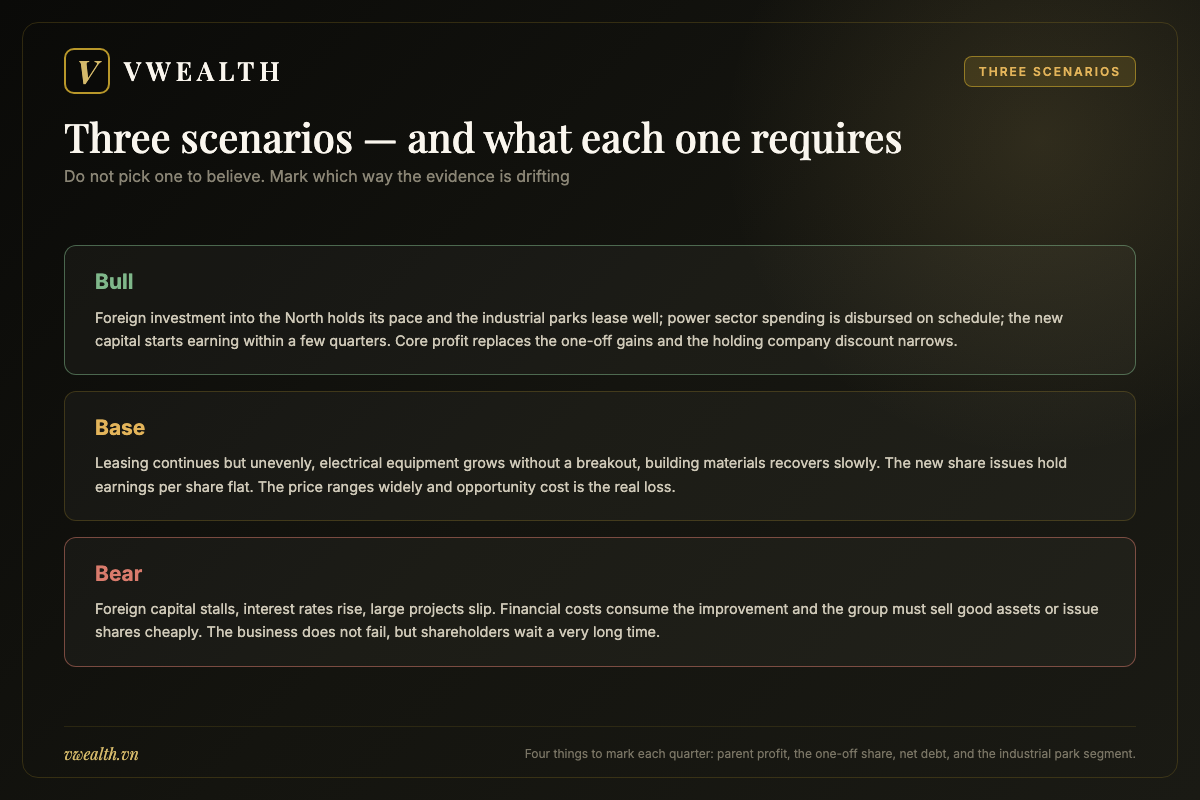
So, should you buy GEX stock?
It is time to put everything together and answer the question in the title directly. But be warned in advance: the answer is not “yes” or “no”. The correct answer always depends on who you are, how much time you have, and how much volatility you can live with.
Weighing it up honestly
On the positive side there are four points that are hard to argue with.
Real assets, not a story. Gelex owns operating factories, leading industrial brands in their categories, more than 4,500 hectares of industrial land through Viglacera, and a water network serving hundreds of thousands of households. These are not numbers on a business plan — they are assets you can stand next to, and they are already generating cash.
The structure is far more transparent than it was five years ago. With both GEE and GEL listed, you can verify the value of the two main pillars from market data instead of trusting somebody else’s estimate. For a small investor that is a substantial improvement in information quality, and it is the single biggest change in the GEX investment case in a decade.
Management’s interests are tied tightly to shareholders’. When the decision-maker holds roughly a fifth of the charter capital, the incentive to destroy value in the company is very low.
A portfolio balanced between defence and growth. Water and electrical equipment hold up the floor; industrial parks pull on the ceiling.
On the negative side there are four points you cannot close your eyes to.
Leverage is the core of the model, not an accident. Gelex grew by borrowing to buy assets. That means in every rate-tightening cycle this company feels the pressure earlier and harder than the market average.
Continuous dilution. Stock dividends, capital raises at the parent, share issues at the subsidiaries — all three thin your slice. You have to accept that the shares you hold will keep representing a smaller percentage of the same asset pool.
The financial statements are hard work. If you do not have the time to strip out one-off gains and compute the retention ratio every quarter, you will misread the business continuously, in both directions.
Rumour risk. This is a name that gets caught in sell-offs driven by unverified information. It is not a business risk, but it is a very real risk to your account.
| Reasons you might buy | Reasons for caution |
|---|---|
| Owns real industrial and infrastructure assets that would be hard to recreate | The growth model leans heavily on borrowed money |
| Both main pillars are listed, which makes a sum-of-the-parts valuation practical | The three-tier structure thins the profit that reaches parent shareholders |
| Management has a record of buying well and selling at the right time | Decision-making authority is concentrated in a very narrow group |
| Direct beneficiary of the FDI cycle and of power sector investment | Plans to issue more than 400 million shares mean meaningful dilution |
| The portfolio contains both defensive and growth segments | Unsuitable for anyone who needs cash dividends |
| High liquidity, easy to enter and exit in normal conditions | High beta, rumour-sensitive, dangerous on margin |
Who GEX suits, and who it does not
GEX may suit you if:
You invest with an asset-based mindset, you accept that value takes time to surface, and your holding period is measured in years rather than months. You have the patience to read the notes to the financial statements every quarter, and you know how to strip out one-off items and calculate the retention ratio. You want simultaneous exposure to the FDI theme, the industrial park theme and the power investment theme without picking each name yourself. And most importantly: you understand that you are delegating capital allocation to an active management team, and you believe in that team after having read its history rather than after having read a headline.
GEX is probably not for you if:
You need a regular dividend income to spend, because GEX distributes mainly in shares. You do not have time to read financial statements and only look at the profit figure in a news summary, because you will be misled repeatedly. You use high margin leverage, because this stock’s trading range can very easily push you into forced selling at the bottom. Or you are uncomfortable holding companies that regularly appear in rumours — even when those rumours have never been substantiated, living alongside them is a psychological cost, and not everybody should pay it.
There is a third group worth addressing separately: the investor who likes one specific part of the ecosystem. If you only believe in the power investment story, buying GEE gives you a cleaner exposure. If you only believe in the industrial park and FDI story, GEL or VGC sits closer to that story. Buying the parent only makes sense when you want the whole package and you trust the person managing the package.
A closing thought: are you buying a business, or buying a capital allocator?
Go back to that morning at the end of December 2015, when more than 122 million shares changed hands in thirty minutes.
Before that morning, Gelex was a state corporation with good assets and average efficiency. Ten years later it is a group with two listed subsidiaries, thousands of hectares of industrial land, consolidated revenue in the tens of thousands of billions of dong, and a permanent place among the most closely watched stocks on the exchange. The difference between those two states did not come from inventing a new product or a breakthrough technology. It came almost entirely from how capital was allocated.
That is the thing to remember most when you are weighing up whether to buy GEX stock. With a pure manufacturer, you are betting on a product and a market. With a holding company like Gelex, you are betting on the quality of the buy and sell decisions of the next ten years. The existing assets are the foundation, but the incremental growth will come from decisions that have not yet been made.
That is a perfectly legitimate bet — a great many investors have grown wealthy travelling alongside good capital allocators, and the entire holding company tradition, from Asia to Europe to North America, rests on exactly that proposition. But it is a fundamentally different bet from buying a good factory and waiting. It requires you to watch more closely, read more carefully, and be willing to change your view when management changes direction.
If, having read this far, you find that work interesting, GEX may well be a name worth your time. If it sounds exhausting, the Vietnamese market contains hundreds of companies with far simpler stories, and there is nothing wrong with choosing simple. The worst thing you can do is buy GEX because it is going up, without knowing what you own. A reasonable starting point is to create a free vwealth account, open the current reports on GEX alongside its two listed subsidiaries, and run the sum-of-the-parts arithmetic Chapter 5 walked you through. Thirty minutes of your own work today is worth more than thirty pieces of commentary.
Research Vietnamese stocks in English with vwealth. Our AI-powered platform turns Vietnamese market data into full English analysis reports — with international payment support and a free 2-month trial for new accounts. Create your free account and read the latest reports.