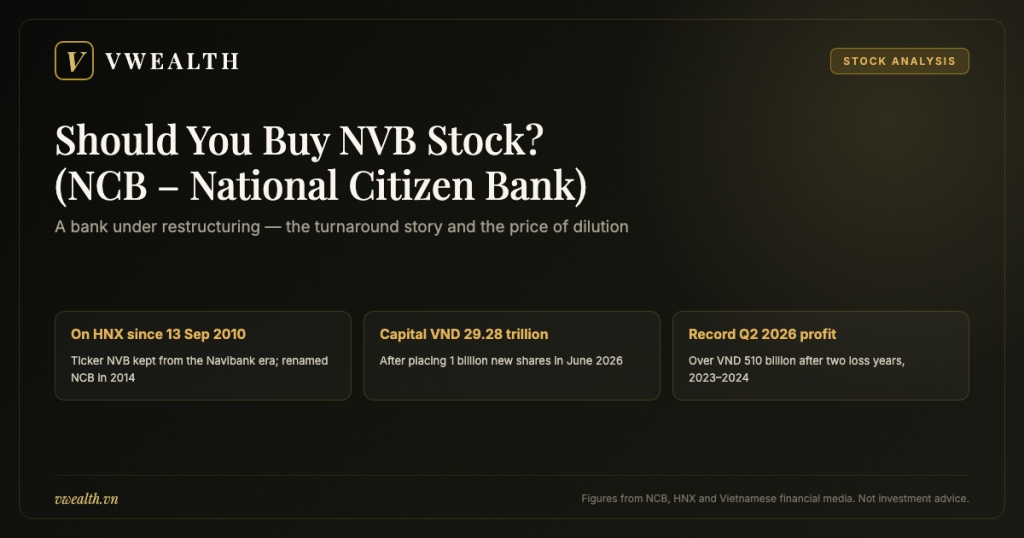
Should you buy NVB stock? The ticker belongs to National Citizen Commercial Joint Stock Bank — better known as NCB — a Vietnamese lender listed on the Hanoi Stock Exchange (HNX), and it is one of the strangest turnaround stories in Vietnam stocks. The bank has carried three names: Song Kien Rural Bank in the Mekong Delta province of Kien Giang, then Navibank, then NCB. It was on the central bank’s 2011 list of nine weak lenders. It lost about VND 669 billion in 2023 and VND 5,129 billion in 2024, then posted its highest-ever quarterly after-tax profit of more than VND 510 billion in the second quarter of 2026. In five years its charter capital grew more than sevenfold, from roughly VND 4.1 trillion to VND 29.28 trillion, almost entirely through private placements to a small group of investors. In September 2026 the stock hit its daily limit-up on 18 September and briefly touched it again on 22 September after the board moved ahead with a plan to lift capital to about VND 62.28 trillion. This is a genuine turnaround — but it comes with a price that minority shareholders need to understand clearly: dilution. This guide walks through the whole story, shows you how to read the financial statements of a bank under restructuring, and gives a balanced answer on who NVB stock suits and who it does not.
First, the names, because they confuse even local investors. NVB is the stock code; NCB is the trading name of Ngan hang Thuong mai Co phan Quoc Dan, which translates as National Citizen Commercial Joint Stock Bank. The ticker is a leftover from the Navibank era — the bank changed its name to NCB in 2014 but kept the old code, which is why Vietnamese media write “NCB (NVB)”. The shares have traded on HNX since 13 September 2010 and have not moved to the larger Ho Chi Minh City Stock Exchange (HOSE). Do not confuse NVB with NAB, the ticker of Nam A Bank, and do not assume today’s NCB is the same institution as the old Navibank: headquarters, management and the shareholder base have all changed.
A note on method, consistent with every article in the vwealth company series. Every event, name, transaction and figure here comes from published information: shareholder meeting documents, NCB’s financial statements and disclosures, notices from HNX and the State Securities Commission, and major Vietnamese financial media such as VnExpress, CafeF, Tuoi Tre, Dan Tri, VietNamNet, Nha Dau Tu and Nguoi Quan Sat, together with financial-statement and trading data compiled by VNDirect. Figures for closed financial years are used as historical markers. We do not quote today’s share price, current P/B or P/E, or any quarterly result after Q2 2026 — those change daily. Wherever a number is our own calculation, it is labelled “vwealth estimate” or “illustrative example”, and where published sources disagree, we show both. For live numbers, open the vwealth analysis reports.
One more framing point, because it is the spine of this article. The vwealth series has already covered several mid-sized private Vietnamese banks — OCB with its Japanese strategic partner Aozora, MSB with its strong current-account base, and Nam A Bank’s digital growth push. Those banks are judged by a simple question: is growth high quality? NCB is different. It is executing a formal restructuring plan (known locally as PACCL, short for “phuong an co cau lai”) under enhanced supervision by the State Bank of Vietnam (SBV). Most of its accounting profit is still being absorbed by legacy clean-up, and existing shareholders are not yet allowed to buy into its capital raisings. So the question of whether to buy NVB stock comes down to three things: how far the restructuring has actually progressed, what the bank’s “real” operating profit is, and what minority shareholders gain and lose as the share count keeps multiplying. If you are new to the market, our guide on how to invest in the Vietnam stock market covers the mechanics — account opening, T+2 settlement, daily price limits and foreign ownership caps.
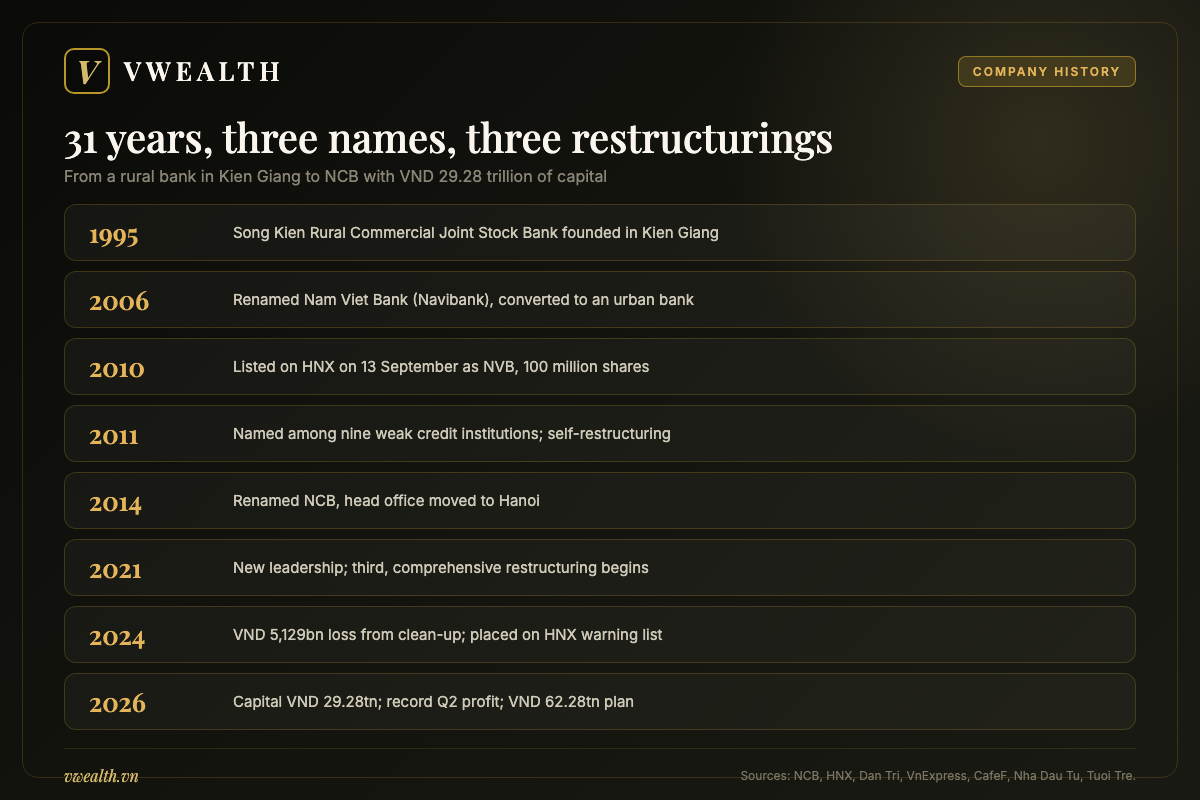
From Song Kien Rural Bank to NCB: 31 years, three names and three restructurings
If you had to summarize NCB’s history in one sentence, it would be this: a small bank that changed owners, names and strategy several times, and took nearly two decades to confront its past losses head-on. Unlike banks that grew steadily behind a state group or a foreign partner, NCB’s path was bumpy — from a rural lender in the Mekong Delta, to an urban bank in Ho Chi Minh City, to a Hanoi-headquartered institution. Understanding this journey is essential to understanding why NCB’s financial statements today contain unusual lines such as “profit before the restructuring plan”, “reversal of accrued interest” and a large block of “other assets”.
1995–2006: a rural bank in Kien Giang
NCB began life as Song Kien Rural Commercial Joint Stock Bank, founded in 1995 in Kien Giang province under a State Bank licence dated 18 September 1995 — which is why NCB still marks its anniversary on 18 September. In the 1990s Vietnam licensed a number of rural joint-stock banks to bring credit to farming and fishing regions. Banks like Song Kien had small capital, a narrow network and customers who were mostly farming households and local traders. The model kept the bank close to its borrowers, but it had one major weakness: concentration. When a harvest failed or commodity prices fell, a loan book concentrated in one region took the hit all at once.
By the mid-2000s, the State Bank raised minimum capital requirements and encouraged rural banks to convert into urban commercial banks if they could meet capital and governance standards. Many did — and most of them changed their names, moved their head offices and brought in new shareholders. Song Kien was no exception. On 18 May 2006, the SBV Governor approved its renaming to Nam Viet Commercial Joint Stock Bank, abbreviated Navibank, and its conversion into an urban commercial bank.
Why should events from twenty years ago matter to an investor today? Because they shaped the DNA of the balance sheet. A bank that transformed quickly during a very hot credit cycle (2006–2010) usually carries loans and assets that later prove hard to recover. Those items, accumulated over many years, are exactly what NCB is now cleaning up under its restructuring plan. When management says “all of these losses originated before 2021”, they are talking about the legacy of that long stretch.
2006–2010: Navibank, urban banking and the HNX listing
As Navibank, the lender expanded into major cities, raised capital and sought a stock-market listing. On 13 September 2010, Navibank shares began trading on HNX under the code NVB; according to Hanoi Moi, the listing covered 100 million shares, matching charter capital of VND 1 trillion when the bank registered its shares for custody in August 2010. By 2010, Vietnam’s market had already been through the 2007 peak and the 2008 crash, but many banks were still queuing to list in order to raise capital and create liquidity for shareholders.
The timing, however, coincided with the cooling of the credit boom. In 2011 the State Bank imposed a 14% annual cap on deposit rates to stop a bidding war for deposits, the property market froze, and small banks came under the heaviest liquidity pressure. NVB’s share price fell almost continuously over the following years. According to VNDirect’s unadjusted trading data, the stock hovered around VND 5,100–5,600 in mid-2016, and between late 2016 and early 2017 it at times traded at only about VND 3,700–4,000 — less than half of its VND 10,000 par value. It was an expensive lesson in buying a small bank stock simply because of a listing story.
2011–2013: on the list of nine weak banks
In 2011, the State Bank named nine credit institutions as weak and in need of restructuring: SCB, Ficombank (De Nhat), TinNghiaBank, Habubank, TienPhongBank, GPBank, Navibank, TrustBank and Western Bank. Fifteen years later, their fates could hardly be more different. SCB, Ficombank and TinNghiaBank were consolidated into a new SCB; Habubank was merged into SHB; GPBank and TrustBank (later renamed Dai Tin, then CBBank) were taken over by the state for zero dong and eventually transferred to larger banks under mandatory transfer schemes; Western Bank merged with PetroVietnam Finance to form PVcomBank. Only two names on the list were allowed by the State Bank to restructure themselves using their own resources: TienPhongBank and Navibank.
The two banks that shared that starting line went very different ways. TienPhongBank, after a new shareholder group led by businessman Do Minh Phu arrived in 2012, became TPBank and, according to CafeF, within about four years had become the textbook self-restructuring success of that era. You can compare with our TPB stock analysis in the same series. Navibank moved far more slowly. Its first restructuring plan was approved in 2012, according to NCB’s chairwoman speaking at the bank’s 2026 annual meeting. But, as she acknowledged, many targets in that plan were missed, partly because of the 2011–2012 property slump.
2013 brought a change of ownership. According to Vietnam Business Insider, shareholders linked to Gami Group — chaired by Mr. Nguyen Tien Dung — took over the stake of the previous shareholder group. The board chair then passed to Mr. Vu Hong Nam (2013), to Ms. Tran Hai Anh, Mr. Dung’s wife (from December 2016), and to Mr. Nguyen Tien Dung himself (from November 2017 until July 2021). For a weak bank, a change of owner is the first step in a restructuring, but not the decisive one: the new owners must bring enough capital and enough governance capability to clean up the balance sheet. The following years show that NCB had not yet achieved that between 2014 and 2020.
2014–2020: renamed NCB, moved to Hanoi, and a quiet decade
On 22 January 2014, the State Bank issued Decision No. 86/QD-NHNN approving the renaming of Nam Viet Bank to National Citizen Commercial Joint Stock Bank. According to the notice published by Dan Tri, the new name took effect on 19 May 2014, the head office moved to 28C–28D Ba Trieu Street in Hanoi’s Hoan Kiem district, and NCB inherited all of Navibank’s rights and obligations. The logo, international trading name and website all changed — only the stock code NVB stayed the same. Rebranding is a common way for restructuring banks to refresh their image, but a new name does not clean up old loans.
For years afterwards, NCB was a minor name. According to financial-statement data compiled by VNDirect, the bank earned about VND 13.5 billion in pre-tax profit and VND 10.8 billion after tax in 2016 — tiny for a bank with tens of trillions of dong in assets. Profit in 2017–2019 was also only a few tens of billions of dong a year. A second restructuring plan was approved in 2019 — and then Covid-19 arrived.
At the end of 2020, according to figures compiled by Nha Dau Tu, NCB had total assets of VND 89,601 billion, customer funding of VND 72,085 billion, loans of VND 39,854 billion and charter capital of VND 4,102 billion — among the smallest joint-stock commercial banks. The most worrying number sat in a line few investors notice: “other assets”. These are non-earning items such as receivables, accrued interest and assets awaiting disposal. According to Nha Dau Tu, between 2013 and 2020 other assets stood at around 14% of NCB’s total assets or higher almost every year, peaking at 23.7% in 2020; adding more than VND 5.8 trillion of bad debt sold to the Vietnam Asset Management Company (VAMC), the figure rose to around 30%. Put simply, nearly a third of NCB’s balance sheet at that time existed “on paper” more than it generated cash.
One small detail explains why investors need to read that line. When a loan turns sour, a bank may not classify it as non-performing immediately and can continue booking “accrued interest” — interest recognized as income although it has not been received. Accrued interest makes accounting profit look better, but it sits on the balance sheet as an “other asset”. When the clean-up finally comes, the bank must reverse that interest, and profit in the clean-up year falls sharply. That is exactly what happened to NCB in 2024.
2021–2024: new leadership and the decision to “cut once and get it over with”
2021 was the turning point. Early in the year, NVB suddenly began trading heavily; according to VNDirect’s unadjusted trading data, the price went from about VND 10,000–11,000 in early January 2021 to a peak of about VND 37,000 on 9 September 2021 (some outlets quote adjusted prices, hence lower figures of roughly VND 7,000 rising to nearly VND 30,000). On the afternoon of 29 July 2021, an extraordinary shareholder meeting elected Ms. Bui Thi Thanh Huong to the board, and the board then elected her chairwoman, replacing Mr. Nguyen Tien Dung, who became vice chairman. According to VnExpress, NVB hit its 10% limit-up that day at VND 20,900, with more than 12.7 million shares matched. On 14 October 2021, NCB and Sun Group signed a comprehensive cooperation agreement.
According to Ms. Huong’s account at the 2026 AGM, the first thing the new leadership did was stop and look honestly at the bank’s condition: many targets from the two previous plans had not been met, and a bank cannot restructure unless it first identifies what is wrong with its own systems. NCB hired Ernst & Young Vietnam to independently assess its financial condition and help design the restructuring plan, and KPMG to evaluate internal controls. According to VietNamNet and Cong dan & Khuyen hoc, NCB’s restructuring plan received the State Bank’s feedback on 7 February 2024 and was approved by the competent authorities in June 2024 (board approval on 28 June 2024), making NCB the first credit institution to complete the approval process for a restructuring plan under the government’s 2021–2025 program for restructuring credit institutions linked to bad-debt resolution (Decision 689/QD-TTg).
In early 2022 (record date 17 January 2022), NCB offered 150 million shares to existing shareholders at VND 10,000 each at a ratio of 100:36.87, raising about VND 1.5 trillion and lifting charter capital to around VND 5,602 billion. Profit in 2022 was close to zero, and in 2023 the bank reported an after-tax loss of more than VND 669 billion, according to its explanation to HNX. The reasons cited were broad economic difficulties, stress in the corporate bond and property markets, and high deposit costs before September 2023. Also in 2023, Mr. Nguyen Tien Dung resigned from the board (in September), which an extraordinary meeting approved about two months later; in June 2023 Mr. Ta Kieu Hung was appointed chief executive.
Then came 2024 — the year to “cut once and get it over with”, in Ms. Huong’s words at the 2025 AGM. On 11 April 2024, HNX placed NVB on its warning list and removed it from the list of stocks eligible for margin trading, because 2023 after-tax profit and retained earnings were negative. On 26 November 2024, NCB closed a private placement of more than 617 million shares to 12 individual investors (per VietNamNet), lifting charter capital to nearly VND 11,780 billion. At the same time, it reversed about VND 2,796 billion of accrued interest on loans and investment securities and wrote down about VND 1,727 billion of other assets under the restructuring plan — resulting in an after-tax loss of VND 5,129 billion for 2024, according to the notes to the financial statements cited by Nha Dau Tu. Management stated that all of these losses originated before 2021. In the same year, total bad debt recovered (principal and interest) was around VND 7 trillion, about 130% of the commitment in the restructuring plan, according to NCB’s leadership at the 29 March 2025 AGM (The Leader).
2025–2026: back to profit, VND 29.28 trillion of capital and a VND 62.28 trillion plan
In Q1 2025, NCB earned about VND 150.8 billion after tax, right after a Q4 2024 loss of more than VND 5 trillion from the clean-up. On 20 October 2025, it closed a private placement of 750 million shares to 17 domestic investors, lifting charter capital to VND 19,280 billion, one year ahead of the schedule in its restructuring plan. For the full year 2025, NCB reported consolidated after-tax profit of VND 78 million — nearly zero, but symbolically important because it ended two consecutive years of losses. Before provisions and accrued-interest reversals under the restructuring plan, profit was about VND 947 billion according to VnExpress, many times the VND 59 billion “pre-restructuring profit” target set by the March 2025 AGM.
On 24 December 2025, an extraordinary meeting elected the 2025–2030 board and approved a private placement of 1 billion shares. At the end of June 2026, the placement closed: 22 professional investors bought all 1 billion shares at VND 10,000, lifting charter capital to VND 29,280 billion — the largest capital raising in the bank’s history and, according to NCB, three years ahead of its restructuring roadmap. According to the notes to the Q2 2026 financial statements, on 22 July 2026 the State Bank issued Decision 1690/QD-NHNN amending the charter capital in NCB’s licence, and the bank recorded the capital increase from that date. In Q2 2026, after-tax profit exceeded VND 510 billion, NCB’s highest quarterly profit. In August 2026, the board sought shareholder approval to issue another 3.3 billion private-placement shares in 2027, lifting capital to about VND 62,280 billion; in September 2026, the board passed a resolution to implement the plan approved by shareholders, with issuance expected in Q1–Q3 2027, and NVB hit its limit-up on 18 September and briefly touched it again on the morning of 22 September.
| Date | Event | What it meant for shareholders |
|---|---|---|
| 1995 | Song Kien Rural Commercial Joint Stock Bank founded in Kien Giang | Started as a small rural lender |
| 18 May 2006 | Renamed Nam Viet Bank (Navibank), converted to an urban bank | Rapid expansion during a hot credit cycle |
| 13 Sep 2010 | 100 million NVB shares listed on HNX | Public market price begins |
| 2011–2012 | Named among nine weak credit institutions; first restructuring plan | Self-restructuring, no merger |
| 2014 | Renamed NCB (Decision 86/QD-NHNN, 22 Jan 2014); head office moves to Hanoi | New brand, ticker NVB unchanged |
| 2019 | Second restructuring plan | Derailed by Covid-19 |
| 29 Jul 2021 | Ms. Bui Thi Thanh Huong becomes chairwoman | Third, comprehensive restructuring begins |
| 2023 | After-tax loss above VND 669 billion; Mr. Ta Kieu Hung becomes CEO | Loss years begin |
| 2024 | Warning list (11 April); VND 5,129 billion loss from clean-up; capital to VND 11,780 billion | No margin; “cut once” approach |
| 2025 | Return to profit (VND 78 million); capital to VND 19,280 billion | Two-year loss streak ends |
| Jun–Jul 2026 | 1 billion shares placed with 22 investors; capital VND 29,280 billion (licence amended 22 Jul 2026) | Largest dilution in the bank’s history |
| Aug–Sep 2026 | Plan to issue 3.3 billion shares in 2027; target capital about VND 62,280 billion | If completed, share count more than doubles |
Looking at the whole journey, NCB has had no shortage of “fresh starts”. What makes this third attempt different from the first two, at least on paper, is three things: an independent review by a Big Four audit firm, a very large amount of new capital in a short time, and a huge loss recognized in one go rather than spread out. The rest of this article tests how far those three things have translated into results.
Leadership and ownership of NVB: a new management team and the shareholder base after the private placements
For a bank under restructuring, the question “who is driving?” matters more than usual. The reason is simple: restructuring is a chain of hard decisions — take a huge loss at once or spread it out, which branches to close, which sectors to lend to, when to sell collateral — and those decisions depend on people more than on procedures. This chapter introduces the people running NCB and then reads the post-2026 shareholder list exactly as the bank published it.
Chairwoman Bui Thi Thanh Huong: a background in audit and bank finance
Ms. Bui Thi Thanh Huong belongs to the generation born in the 1980s and, according to VietNamNet, has more than 20 years of experience in audit, bank finance and corporate management. She was deputy director in charge of finance and chief accountant at SeABank, then deputy CEO in charge of finance and strategy at TPBank. In 2018, after leaving TPBank, she became CEO of Sun Group, one of Vietnam’s largest tourism and property conglomerates. On 29 July 2021 she was elected chairwoman of NCB, and at the extraordinary meeting on 24 December 2025 she was re-elected chairwoman for the 2025–2030 term.
The TPBank line on her résumé is not a minor detail. TPBank was on the same 2011 weak-bank list as Navibank and successfully restructured itself. People who have been inside a successful restructuring tend to bring a particular “toolkit”: independent asset reviews, decisive loss recognition, and technology investment to cut costs. NCB’s approach since 2021 — hiring a Big Four firm to confirm its condition, taking a large loss in one go, trimming its network — resembles that toolkit. Of course, a similar method does not guarantee a similar outcome; investors should judge the bank by its quarterly numbers, not by résumés.
Ms. Huong is also unusually direct about the bank’s past. At the AGM on 2 April 2026, she described implementing the plan as “extremely bumpy, winding, arduous and full of pressure”, and said she expected NCB to complete its restructuring plan by the end of 2027 — returning to the “normal race” roughly two to three years earlier than committed to regulators. For investors, this is a concrete milestone to check against: if the bank announces completion of its restructuring plan by the end of 2027, the turnaround thesis is strengthened; if the date slips, you should ask why.
CEO Ta Kieu Hung and the executive team
Mr. Ta Kieu Hung, born in 1980, holds an MBA from the CFVG programme at the National Economics University. According to VietNamNet and 24h, he has more than 20 years in the industry, including many roles at Techcombank such as head of transformation for retail and SME risk management, head of retail business development, head of retail products and regional director. He joined NCB in December 2022 as deputy CEO and head of retail banking, became acting CEO in April 2023 and was appointed CEO on 27 June 2023. From the 2025–2030 term he also sits on the board.
Under Mr. Hung, NCB has pushed a strategy it calls “Digital Wealth”, including paperless self-service “Digital Branches” with biometric authentication and a “Super App” bundling all banking services on a phone. He has also been the source of the bank’s figures on new-loan quality: according to The Leader, at the 2025 AGM management said new disbursements had a non-performing ratio of about 0.73%, and that NCB would cap bad debt on new loans at 1%; at the December 2025 extraordinary meeting, the bank put the NPL ratio of loans disbursed since 30 June 2024 at only about 0.2%. This number matters because it separates “old” problem loans from “new” lending — but note that it is a management disclosure, not a line item required in the financial statements.
At the end of June 2026, NCB appointed two additional deputy CEOs. According to Dan Tri and VietNamNet, Ms. Dao Mai Huong has more than 21 years of experience at MB, MB Shinsei and PTF, and previously headed NCB’s credit management division. Ms. Nguyen Thi Thuy has more than 22 years of experience at HSBC Vietnam, Ernst & Young Vietnam, Deutsche Bank Vietnam, Hong Leong Bank Vietnam, OCB and Holborn Capital Partners, and previously headed NCB’s financial management division. One oversees credit, the other finance — the two most critical functions for a bank cleaning up its balance sheet.
The 2025–2030 board: eight members, two independent
At the extraordinary meeting on 24 December 2025, according to Bao Phap luat Viet Nam, shareholders elected an eight-member board for 2025–2030 under the new standards of the 2024 Law on Credit Institutions: Ms. Bui Thi Thanh Huong (chair), Ms. Hoang Thu Trang (vice chair), Mr. Duong The Bang, Ms. Nguyen Thi Hai Hoa, Ms. Trinh Thanh Mai, Mr. Ta Kieu Hung (CEO), and two independent board members, Ms. Do Thi Thu Huong and Ms. Lam Thuy Dung. The supervisory board has five members: Ms. Do Thi Duc Minh (head), Ms. Pham Thi Hien, Mr. Le Van Quy, Ms. Vu Kim Phuong and Mr. Nguyen Viet Son. Ms. Pham Thi Hien was a deputy CEO of NCB (VietNamNet, 2023) and is now deputy head of the supervisory board. The same meeting also approved extending the bank’s operating term to 99 years.
Having the CEO on the board is common practice at Vietnamese banks and links strategy with execution. The trade-off is a thinner line between those who supervise and those who are supervised. Two independent members out of eight meets the current regulatory requirement; investors focused on governance can also read the independent directors’ and supervisory board’s reports in the annual report, particularly the section on related-party transactions — something worth reading closely at any bank growing its loan book quickly.
The 22 investors in the 2026 placement: how to read the list
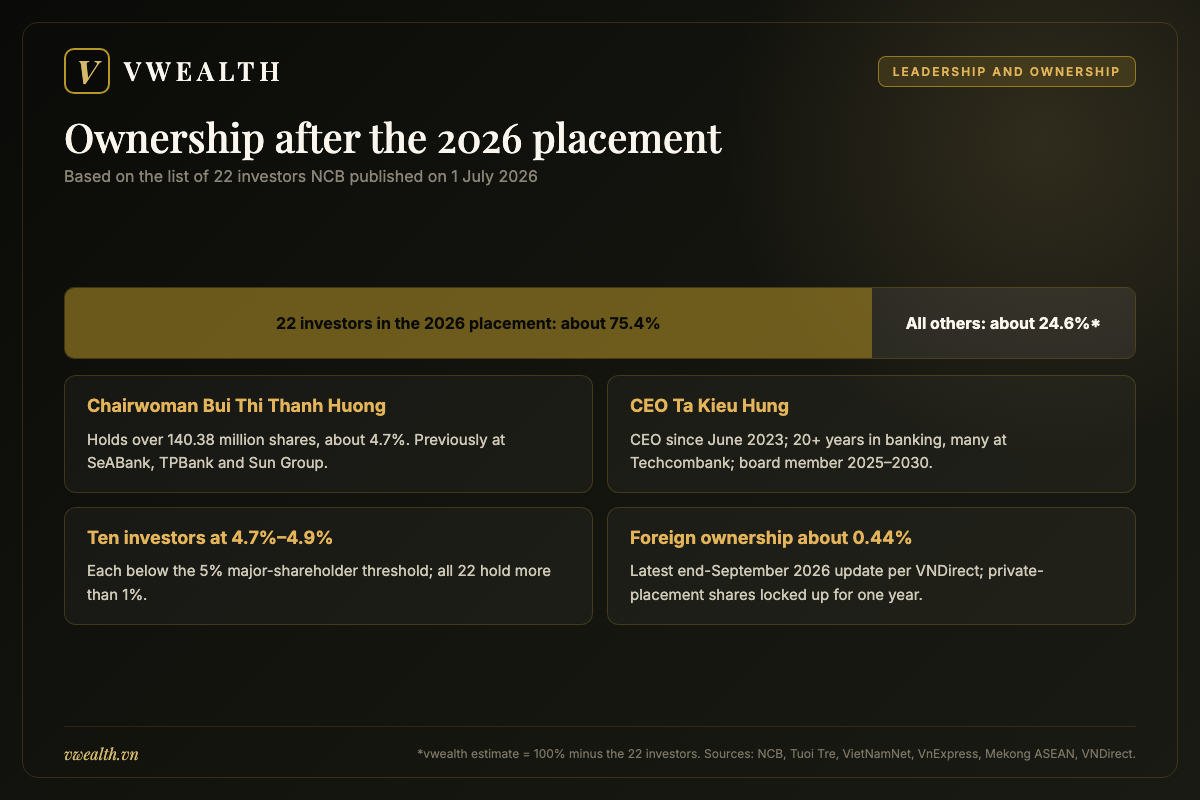
Right after closing the 1-billion-share placement, NCB published the list of 22 participating investors. (The provisional list announced on 21 May 2026 was described by Mekong ASEAN as 20 individuals and 2 institutions, while Dan Tri on 1 July 2026 described all 22 as individual investors; this article simply calls them professional investors.) According to Tuoi Tre, VietNamNet and Dan Tri, all 22 held more than 1% of charter capital after the issue, and together they owned about 75.4% of the bank. Ten held between 4.7% and 4.9% each — all just below the 5% threshold at which an individual is classified as a major shareholder under Vietnam’s Securities Law. The 2024 Law on Credit Institutions requires banks to publish the list of shareholders owning 1% or more of charter capital, which is why this list is public.
| Investor (as disclosed) | Role at NCB | Shares after the issue | Stake |
|---|---|---|---|
| Ms. Le Thi Thu Hang | Individual investor | Over 145.6 million | 4.9% |
| Mr. Duong The Bang | Board member | Over 145.3 million | 4.964% |
| Nguyen Minh Anh, Nguyen Thi Hoang Yen, Vu Thi Tuyen, Vuong Kha Huan, Vuong Kha Nguyen | Individual investors | Over 145.3 million each | 4.9% each |
| Nguyen Duc Anh, Nguyen Hoang Anh Quan, Nguyen Xuan Truong | Individual investors | — | Above 4.9% each |
| Ms. Bui Thi Thanh Huong | Chairwoman | Over 140.38 million | 4.7% |
| Ms. Hoang Thu Trang | Vice chairwoman | 45 million | 1.5% |
| Ms. Pham Thi Hien | Deputy head, supervisory board | 45 million | 1.5% |
| Mr. Nguyen Viet Son | Supervisory board member | Over 34.7 million | 1.1% |
| Remaining investors on the list of 22 | — | — | Above 1% each |
There are three useful ways to read this table. First, these are holdings after the issue, not the number of shares bought in it; many names were already shareholders from earlier rounds. The 22 together own about 75.4%, while the placement itself was 1 billion out of roughly 2.928 billion shares (about 34%, vwealth estimate), meaning much of their stake came from shares they already held. Second, the chairwoman, vice chairwoman, a board member and supervisory board members all put in money at VND 10,000 — above the book value per share cited by management — a “skin in the game” signal many investors value. Third, with roughly three quarters of the bank in the hands of 22 people, the remaining quarter is spread across everyone else; that directly shapes liquidity and how the share price reacts, as discussed in chapter 5.
The table records only what the bank and the press have disclosed. vwealth does not speculate about relationships among the investors or with any organization; any relationship that must be disclosed (related persons) will appear in the corporate governance reports and major-shareholder filings the bank submits to HNX. Those are the sources to read directly.
The partnership with Sun Group: what has been disclosed
Sun Group’s name comes up repeatedly in NCB’s story, so it helps to know exactly what is on the public record. One: NCB’s chairwoman was Sun Group’s CEO before joining the bank (VietNamNet, 2021). Two: on 14 October 2021, NCB and Sun Group signed a comprehensive cooperation agreement, which NCB’s chairwoman said would help the bank reach high-value, especially affluent retail, customers. Three: in the early-2022 rights offering, Sun Group Investment Co., Ltd. (Cong ty TNHH Dau tu Tap doan Mat Troi), a company in the Sun Group ecosystem, bought 737,444 redistributed shares, bringing its holding to 827,780 shares, or 0.15% of capital at the time (CafeF). Four: on the product side, NCB bundles privilege programmes from the Sun Group – NCB – Visa ecosystem into its services for customers and partners, and integrated its iziPay payment solution into Visit Vietnam, a national tourism data platform operated by Sun Group. Five: in its 22 September 2026 agreement with Petrolimex, NCB said it would prioritize funding for fuel-sector projects of Petrolimex and its subsidiaries in which Sun Group participates. Six: the road linking Gia Binh airport with Hanoi, for which NCB became lead financing arranger in September 2026, is developed by Sun Group, according to Nguoi Quan Sat.
For investors, a sensible approach is to treat Sun Group as a major business partner of NCB — a source of affluent customers, tourism and infrastructure projects — and to track the bank’s credit concentration by customer group in the notes to its financial statements. That is a question worth asking of any bank with a large strategic partner, not just NCB.
Dividends: why NCB does not pay one yet, and when it might
If you want Vietnam bank stocks for dividend income, NVB is not currently a candidate. At the 2026 AGM, management said 2025 after-tax profit was effectively zero because the bank proactively made provisions and reversed accrued interest to accelerate its restructuring plan, so it would not distribute profit or allocate to funds. The 2026 plan approved at the 2 April 2026 AGM also states that all profit before the restructuring plan (target: VND 1,416 billion) will be used to resolve legacy financial problems according to the roadmap. The accompanying scale targets were total assets of about VND 189,912 billion (up 16%), customer funding of VND 158,685 billion (up 20%) and loans of VND 131,686 billion (up 35%), with a caveat that growth targets may change depending on the credit quota set by the State Bank (CafeF). By 30 June 2026, total assets had already reached about VND 198,896 billion and loans about VND 133,527 billion — both scale targets exceeded after just six months.
Beyond profit, there is a technical barrier: NCB still has accumulated losses. According to its consolidated financial statements, retained earnings were negative by about VND 5,764 billion at 31 December 2025 and about VND 5,037 billion at 30 June 2026 — so first-half 2026 profit covered only part of the hole. According to NCB’s letter to the State Securities Commission and HNX (reported by CafeLand), the stock remains on the warning list under HNX notice No. 3954/TB-SGDHN of 4 September 2025, because consolidated retained earnings are negative. A bank cannot pay dividends while it has accumulated losses. In other words, before dividends are even on the table, NCB has to complete the legacy clean-up under its plan, eliminate its accumulated losses, and only then generate distributable profit. On management’s own timetable, that is after 2027 at the earliest. This is a value-recovery story, not an income stock.
Another important point: according to the chairwoman at the 2026 AGM, because NCB is implementing a restructuring plan, it is not yet eligible to issue shares to existing shareholders. That is why for three consecutive years the bank has raised capital through private placements to professional investors, and minority shareholders have had no opportunity to buy more shares to maintain their percentage ownership. According to CafeF, management said that once all the plan’s targets are met, the bank will continue to invite investors and move towards offering shares to existing shareholders when eligible under the rules. We return to the consequences in chapter 5.
How NCB makes money: project lending, affluent customers and an unusual “business line” — recovering old debt
An ordinary bank makes money in a familiar way: take deposits at low rates, lend at higher rates, add fee income. NCB does the same, with two twists. First, it is growing its loan book very quickly because the State Bank assigned it a credit growth quota of 35% per year during restructuring, while the average quota for credit institutions in 2026 is about 15%, according to NCB’s chairwoman. (In Vietnam, the central bank still assigns each bank an annual cap on loan growth.) Second, part of the bank’s daily work is recovering and resolving old loans — activity that produces no growth but determines future profit. This chapter takes each line apart.
Corporate lending, supply-chain finance and infrastructure projects
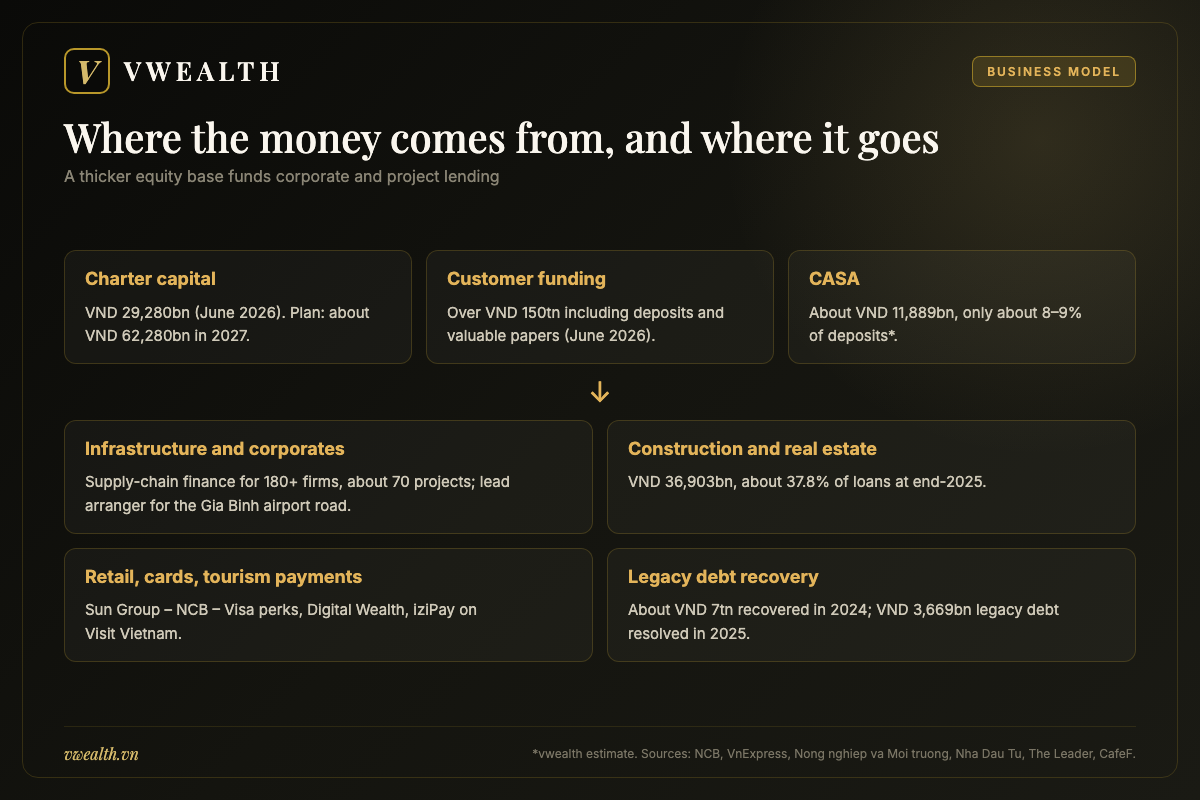
Read NCB’s 2026 press releases and the shift towards corporate and project lending is obvious. The bank says it finances supply chains for more than 180 companies with credit in the thousands of billions of dong, and funds around 70 projects nationwide. Named projects include infrastructure for APEC 2027 in Phu Quoc (a convention centre, theatre and park), the Ben Nha Rong – Khanh Hoi cultural park and riverside greenery along the Saigon River, Ho Chi Minh City’s central square and administrative centre, and the Tran Hung Dao bridge in Hanoi. On 12 September 2026, NCB signed an agreement with Bac Ha Noi Infrastructure and Urban Investment Co., Ltd. to act as lead arranger for the road linking Gia Binh airport with Hanoi — a roughly 13.55 km project needing about VND 17 trillion in total, for which NCB expects to extend a credit line of at least VND 6.8 trillion through the end of 2027.
The use-of-proceeds plan for the proposed 2027 issue makes the direction even clearer. According to the board resolution, of the VND 33 trillion expected, VND 20 trillion is earmarked for key national infrastructure projects; VND 5 trillion for construction and supply companies; VND 5 trillion for tourism and entertainment; and only VND 3 trillion for individual consumer needs. In other words, roughly 90% of the planned new capital would flow to companies and projects (vwealth estimate from those figures).
Infrastructure lending has strengths: large loan sizes mean low processing costs per dong lent, and repayment can be tied to state budget cash flows or large developers. But it has three weaknesses bank investors should understand. One is tenor: long-dated loans must be funded with medium- and long-term money, while most deposits are short-term. Two is concentration: a handful of large borrowers can make up a big share of the book, so a problem at one project can distort a whole year. Three is margin: competition for projects with strong sponsors is fierce, so lending rates are not high. The model’s profitability depends on keeping funding costs low — and that is where large equity helps, as Ms. Huong put it: nearly VND 30 trillion of charter capital “costs 0%” instead of the roughly 8% a year the bank would pay on deposits.
Construction and real estate: more than a third of the loan book
According to Nong nghiep va Moi truong newspaper, citing the bank’s 2025 disclosures, NCB’s loans reached VND 97,544 billion at 31 December 2025, of which lending to construction and real estate business was VND 36,903 billion, or 37.8% of total loans, up more than VND 8.5 trillion from 2024. Six months later, according to Nha Dau Tu, lending to construction and real estate business reached VND 52,624 billion, up 42.5% and about 39% of total loans. Sector groupings can differ between sources, so read the “loans by industry” note in the financial statements directly when comparing periods.
That share is on the high side for Vietnamese banks. It does not automatically mean high risk — an infrastructure construction loan repaid from the state budget is very different from a loan to speculate on land plots. But it does mean NCB’s results are tightly tied to the construction–property cycle and to public investment. When property recovers and public investment disburses quickly, this book is a growth engine; when the cycle turns, as in 2022–2023, it becomes a source of bad debt. NCB’s history has already seen the latter twice.
One legacy item worth noting: NCB holds 203 million shares of Bamboo Airways — collateral pledged by FLC Group for Bamboo Airways’ loans at NCB. According to NCB’s chairwoman at the 29 March 2025 AGM (VnExpress), the bank had found a buyer for the block at a price expected to cover the full principal and interest of the loan, but the buyer requested an extension of payment until 2026 at the latest. Watch this item in the year-end 2026 report: if the sale completes, part of the legacy book is resolved; if not, the bank will need another plan.
Retail: co-branded cards, Digital Wealth and tourism payments
NCB’s retail arm does not chase volume like the big banks; it targets segments — affluent individuals and tourists. The bank ties its cards and accounts to privilege programmes in the Sun Group – NCB – Visa ecosystem (tourism, resorts, entertainment), alongside the NCB Visa Tu Hao card line launched in 2025. On the digital side, the Digital Wealth strategy includes paperless, self-service Digital Branches with biometric authentication and a Super App bringing all banking services to the phone.
Payments have their own angle: tourism. NCB integrated its iziPay payment solution into Visit Vietnam — a national tourism data platform launched on 20 December 2025, operated by Sun Group under the sponsorship of the government, the Vietnam National Authority of Tourism and the National Data Association — in partnership with the National Data Association and Visa, so that visitors can book and pay for services directly. The idea is to turn payments into a competitive advantage for Vietnamese tourism, and tourists into a source of fee income for the bank.
Keep expectations modest. According to VnExpress, NCB’s net fee income in Q2 2026 was about VND 72 billion, against net interest income of about VND 1,033 billion. For full-year 2025, net fee income was nearly VND 189 billion against more than VND 2,371 billion of net interest income. Fees are still a small slice of revenue. Cards, digital and tourism payments may be long-term drivers, but for the next few years NCB’s profit will be decided by lending.
Funding: deposits, valuable papers and a CASA ratio below 10%
Fast lending requires fast funding. At the end of 2025, NCB’s customer deposits stood at VND 127,403 billion, up 33% in the year; including valuable papers (bank-issued certificates and bonds), total funding as reported by the bank to its AGM was about VND 131,937 billion. By 30 June 2026, customer funding including valuable papers exceeded VND 150 trillion. Current and savings account deposits — CASA, the cheapest funding because the bank pays almost no interest on it — were about VND 11,430 billion at end-2025 and about VND 11,889 billion at mid-2026.
Divide one by the other and NCB’s CASA is only about 8–9% of customer deposits (vwealth estimate). Even the 2026 target of VND 15,312 billion of CASA (up 33%) corresponds to only about 9.6% of the VND 158,685 billion funding target (vwealth estimate). For comparison, strong retail franchises in the vwealth series such as MSB have much higher CASA ratios. Low CASA means NCB’s cost of funds is above the market average, and its net interest margin (NIM) depends on lending at higher rates — often meaning riskier borrowers — or on using a large equity base to offset funding costs.
That is why the chairwoman’s “0% cost capital” argument matters to the investment case. When equity is a large share of funding, the bank pays no interest on that portion, so NIM can hold up even with low CASA. But equity is not free to shareholders: they expect a return on it (ROE). The bigger the capital base, the more profit the bank must earn to avoid diluting ROE. That thread connects this chapter to the valuation discussion.
Recovering old debt: the “business line” nobody wants
At a restructuring bank, recovering legacy debt is almost a business line of its own. In 2024, according to NCB’s leadership, total bad debt recovered (principal plus interest) was about VND 7 trillion, around 130% of the amount committed in the restructuring plan. For 2025, the bank targeted at least VND 3.6 trillion; according to Nha Dau Tu, at the extraordinary meeting on 24 December 2025 the bank said it had resolved at least VND 3,669 billion of bad and legacy debt during the year. At the 2026 AGM, CEO Ta Kieu Hung said NCB had resolved bad debt and legacy assets at more than 112% of plan over the previous two years, while acknowledging that the process remains difficult, particularly on legal issues and the attractiveness of the assets to buyers (VnExpress).
This line has an interesting feature: it can generate one-off profits in the future. According to CafeF, Ms. Huong explained that after 2026 the bank will keep resolving legacy items with operating profit and may use part of its charter capital to clean the balance sheet; if it later recovers loans already written off against its own capital, it will book extraordinary income. Put simply, amounts already “erased” from the books come back as profit if they are collected. That is a real source of upside in the turnaround story — but nobody can predict its size or timing, so it should not be part of your base-case expectations.
| Business line | Current role | Strength | What to watch |
|---|---|---|---|
| Corporate and infrastructure lending | Main growth engine; receives most new capital | Large tickets, linked to public investment | Concentration, long tenor, margins |
| Construction and real estate | About 37.8% of loans at end-2025 | Benefits when the cycle turns up | Cycle-sensitive; history of bad debt |
| Retail, cards, digital | Affluent customers, fee income | Partner ecosystem perks, Digital Wealth | Fee contribution still small |
| Tourism payments (iziPay, Visit Vietnam) | Differentiated but early | Linked to international visitor flows | No separate revenue disclosure yet |
| Deposits and valuable papers | Funds all loan growth | Growing with scale | CASA only about 8–9% (vwealth estimate) |
| Legacy debt recovery | Balance-sheet clean-up under the plan | Potential one-off gains | Size and timing unpredictable |
Which line feeds which? New capital and deposits fund corporate and project lending; lending generates interest income; interest income pays for provisions and accrued-interest reversals on legacy loans. Until the clean-up is finished, accounting profit keeps getting pulled back into that loop. NCB’s moat, if it has one, is not technology or network — every bank has those — but two features specific to the restructuring period: a credit quota above the market norm and a very rapidly growing equity base. Both are time-limited advantages that will fade once NCB returns to the “normal race”.
Financial health: reading NCB’s numbers before you decide whether to buy NVB stock
Reading an ordinary bank’s financial statements is hard enough; reading those of a bank under restructuring is harder, because many familiar numbers are bent by the clean-up. Profit can be close to zero while the underlying business genuinely improves; the NPL ratio can fall sharply while the absolute amount of bad debt barely moves. This chapter shows you how to read each of NCB’s key numbers correctly. For a refresher on sector-level concepts, the Vietnam banking sector guide on vwealth is a good starting point.
“Profit before the restructuring plan” versus accounting profit
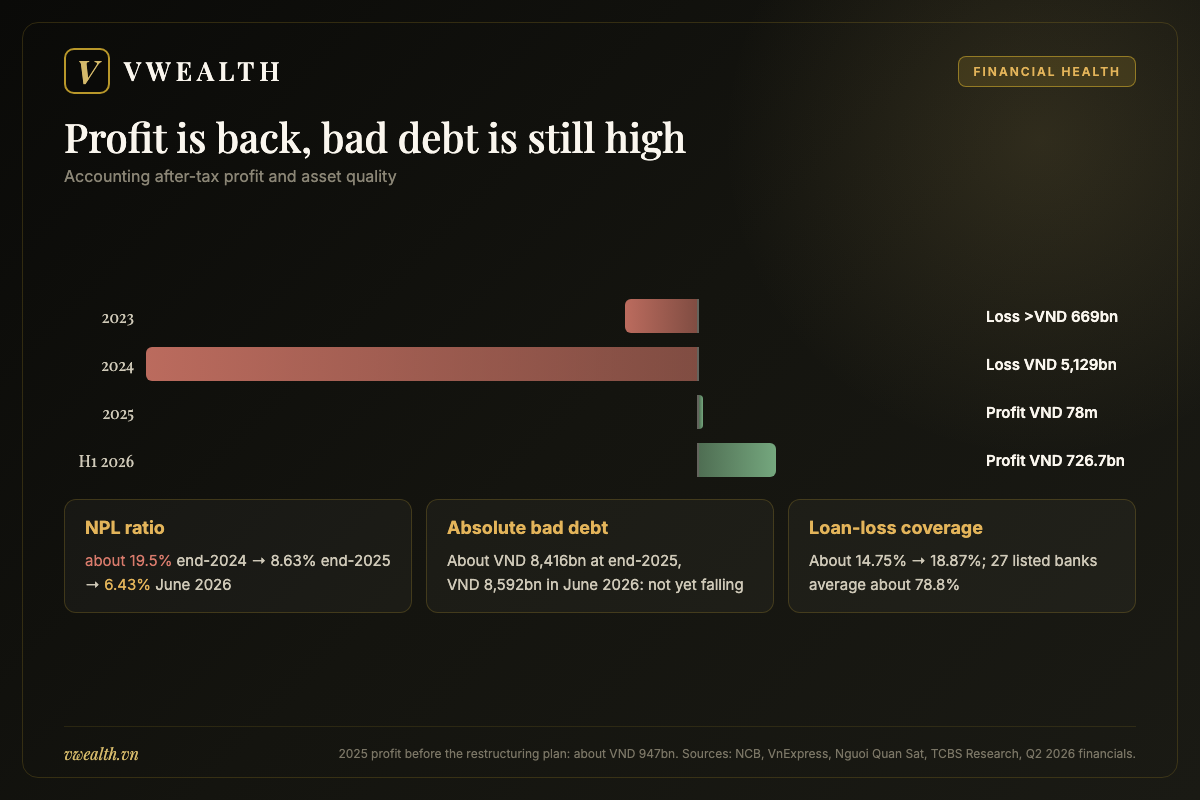
NCB reports two kinds of profit. The first is accounting profit — the number on the income statement after all provisions and after reversing accrued interest under the restructuring plan. The second is “profit before the restructuring plan” — what the bank would have earned without the legacy clean-up charges. 2025 shows how wide the gap can be: profit before the plan was about VND 947 billion, while accounting after-tax profit was just VND 78 million. Almost all operating profit was used for the clean-up.
The quarterly pattern in 2025 makes the point even more clearly. After nine months, according to VnExpress, cumulative after-tax profit was more than VND 652 billion. But in Q4 alone, the bank booked VND 421 billion of additional credit-loss provisions, operating expenses for the quarter rose to VND 717 billion, and it posted a net loss of about VND 652 billion, bringing full-year profit back to almost zero. This was not a sudden deterioration in the business; it was a choice to use profit for the clean-up, consistent with the commitment to “use all profit to implement the restructuring plan”.
The implication for investors: do not value NCB on a P/E of accounting profit during the restructuring years — that number is deliberately compressed by management. Nor should you multiply profit-before-the-plan by a sector P/E and call it fair value — the unresolved legacy items are a real liability to shareholders. A more sensible approach is to track both numbers, and especially how fast the gap between them narrows. When the gap approaches zero, most of the legacy has been dealt with.
Results from 2022 to the first half of 2026
| Period | Accounting after-tax profit | Key notes |
|---|---|---|
| 2022 | Close to zero (VNDirect data: pre-tax about VND 1.2 billion, after-tax about VND 8 million; Dan Tri reported VND 8 billion) | Sources disagree on units; all indicate roughly break-even |
| 2023 | Loss of more than VND 669 billion | High funding costs, stressed customers; warning list from 11 April 2024 |
| 2024 | Loss of VND 5,129 billion | About VND 2,796 billion of accrued interest reversed; about VND 1,727 billion of other assets written down |
| 2025 | VND 78 million | Profit before the plan about VND 947 billion; Q4 loss of about VND 652 billion from provisions |
| Q1 2026 | Pre-tax profit above VND 216 billion | Up 43% from about VND 151 billion a year earlier |
| Q2 2026 | Above VND 510.7 billion | Quarterly record, up about 64% year on year; net interest income about VND 1,033 billion |
| H1 2026 | Above VND 726.7 billion | Up 57% year on year; all earmarked for the restructuring plan |
Two takeaways from the table. First, the turning point came from net interest income: in 2024 it was negative by more than VND 1,782 billion (because of the accrued-interest reversals), in 2025 it was positive at more than VND 2,371 billion, and Q2 2026 alone was about VND 1,033 billion. Second, operating expenses in 2025 fell by about 40%, from about VND 3,392 billion in 2024 to about VND 2,044 billion, according to financial-statement data compiled by VNDirect. In the first half of 2026, according to Nguoi Quan Sat, operating expenses rose 13.8% while total operating income rose 40.2%, bringing the six-month cost-to-income ratio (CIR) down to about 46.6%; pre-provision profit for the half was about VND 1,123 billion, roughly 1.6 times the full-year 2025 figure. Rising income, falling costs — that is the engine of the turnaround. The open question is how much of that engine will still have to go to the clean-up in the second half of 2026 and in 2027. Q4 2025 showed that first-half profit does not necessarily survive to year-end.
Bad debt: from 19.5% to 6.43% — but look at the denominator
The non-performing loan (NPL) ratio is loans in groups 3, 4 and 5 (substandard, doubtful and loss) divided by total loans. At the end of 2024, NCB’s NPL ratio was about 19.5% (vwealth estimate: end-2025 bad debt of VND 8,416 billion was, per Nong nghiep va Moi truong, down 39.4% year on year, against end-2024 loans of VND 71,175 billion). At the end of 2025, according to the notes to the financial statements, group 3–5 debt was about VND 8,417 billion (group 3 about VND 143 billion, group 4 about VND 370 billion, group 5 about VND 7,903 billion) against loans of VND 97,545 billion, a ratio of about 8.63%; some outlets reported 8.27% or 8.4%, likely due to different calculation or rounding. At 30 June 2026, group 3–5 debt was VND 8,592 billion (group 3 about VND 334 billion, group 4 about VND 267 billion, group 5 about VND 7,991 billion), a ratio of 6.43%, according to the Q2 2026 financial statements and Nguoi Quan Sat.
Read closely and you will see that in the first half of 2026 absolute bad debt did not fall — it rose by about VND 175 billion; the ratio fell because loans grew extremely fast, by nearly VND 36 trillion in six months, from VND 97,545 billion to VND 133,527 billion. This is “diluting bad debt with growth”: a bigger denominator makes the fraction smaller. That is fine if the new loans are genuinely good — group 1 (standard) loans rose from VND 88,446 billion to VND 124,236 billion, accounting for more than 99% of the increase; group 2 (special-mention) loans were only about VND 699 billion, or about 0.5% of loans (vwealth estimate). But remember: new loans have not had time to “age”, and bad debt typically surfaces 12 to 24 months later.
For context: according to a TCBS Research report (reported by Dan Viet), the overall NPL ratio of 27 listed banks surveyed was about 2.01% at the end of Q2 2026; NCB’s 6.43% is more than three times that, even though TCBS also placed NVB among the banks with the largest year-on-year drop in NPL ratio. NCB’s bad debt is heavily concentrated in group 5: at 30 June 2026, group 5 was about VND 7,991 billion out of VND 8,592 billion of bad debt, or about 93% (vwealth estimate from the financial statements). Group 5 loans require specific provisions of up to 100% of the portion not covered by collateral, so a high share means large provisioning needs remain. The restructuring plan aims to bring the NPL ratio down to a safe level; watch when it falls below 3%.
Loan-loss coverage below 20%: the number to watch most closely
The loan-loss coverage ratio (LLR) is credit-loss provisions divided by total bad debt. It answers the question: if all bad debt were lost, what share has the bank already set aside? According to Nguoi Quan Sat and the financial statements, NCB’s provisions for customer loans rose from VND 1,242 billion at end-2025 to VND 1,622 billion at mid-2026, lifting coverage from about 14.75% to 18.87%. According to TCBS Research, average coverage at the 27 listed banks fell from 82.9% at end-2025 to 78.8% at the end of Q2 2026 — NCB’s ratio is only about a quarter of that average.
Why can NCB run such low coverage? Two common reasons. First, many bad loans are collateralized, and under Vietnamese rules banks may deduct collateral value when calculating specific provisions — as with the 203 million Bamboo Airways shares. Second, the bank is under a restructuring plan, so provisioning can be phased according to the approved roadmap — the notes to the Q2 2026 financial statements state that provisions for debts sold but not yet collected (including debts sold to VAMC) are made according to the bank’s financial capacity, on the roadmap to 2030 set out in the restructuring plan. Both are legitimate, but both mean part of the risk still sits on the balance sheet: if collateral sells for less than its recorded value, the bank must provision more, and future profit will take the hit.
An illustrative example with round numbers: suppose a bank has VND 8,600 billion of bad debt and VND 1,600 billion of provisions. If it ultimately recovers 60% of the bad debt by selling collateral, the loss is 40% × 8,600 = VND 3,440 billion, leaving a shortfall of about VND 1,840 billion versus existing provisions — which will flow through the income statement in later years. If it recovers 80%, the loss is only VND 1,720 billion, roughly matching provisions. Nobody knows NCB’s actual recovery rate in advance; that is why coverage is the number to check every quarter.
Equity, accumulated losses, book value and operating costs
Charter capital and shareholders’ equity are different things, and at NCB the gap between them matters. Charter capital is the total par value of shares issued; equity is charter capital plus reserves and retained earnings, minus accumulated losses. With accumulated losses in the thousands of billions of dong, NCB’s equity is below its charter capital, and book value per share is below the VND 10,000 par value. According to the chairwoman at the 2026 AGM, book value at the end of 2024–2025 was about VND 7,000 per share, and at its lowest only about VND 5,500. The financial statements are consistent with that: consolidated equity was about VND 13,593 billion at end-2025 and VND 14,320 billion at 30 June 2026, against recorded charter capital of VND 19,280 billion at the time.
On capital adequacy, NCB says raising capital to VND 29,280 billion allows it to fully meet the State Bank’s capital safety ratios; the 2025 raise was described as meeting capital adequacy requirements under Circular 41/2016. vwealth could not find a widely published specific capital adequacy ratio (CAR) figure, so check it directly in the notes to the financial statements or the annual report. As a rough lens, Ms. Huong described nearly VND 30 trillion of charter capital against roughly VND 130 trillion of expected year-end loans as “an extremely solid financial cushion” — but remember that actual equity is lower than charter capital because of accumulated losses.
Operating costs are the clearest bright spot. According to the chairwoman, the cost-to-income ratio (CIR) was above 60% in 2021 and has fallen every year since, approaching peers of similar size. The network shrank from about 90 transaction points in 2021 to just over 60; loans grew more than threefold while headcount fell. At the end of 2025, NCB had 2,293 employees earning an average of about VND 39.83 million per month according to the bank’s disclosures compiled by Nong nghiep va Moi truong — on par with the best-paying private banks. Fewer people, higher pay, more technology: the classic lean formula of a restructuring.
Eight questions to ask every time NCB reports
If you decide to follow NVB, here is a compact checklist.
- How wide is the gap between profit before the plan and accounting profit? A narrowing gap means more of the legacy has been resolved.
- Is net interest income still rising? This is the real engine of the turnaround.
- Is absolute bad debt going up or down? Do not look only at the ratio, because the denominator is growing very fast.
- Are group 2 (special mention) loans swelling? This is usually the “waiting room” for future bad debt.
- How much has loan-loss coverage improved? Rising from below 20% is a good sign; falling is a warning.
- How much “other assets” and accrued interest remain? This is the “on paper” part of the balance sheet.
- How are CASA and funding costs moving? A CASA ratio below 10% needs to improve for the model to be sustainable.
- How large are accumulated losses, and when will HNX take NVB off the warning list? These two milestones unlock margin trading, dividends and rights issues to existing shareholders.
How the market treats NVB stock: warning status, thin liquidity and the price of dilution
Some stocks track quarterly results fairly closely. NVB is not one of them. In 16 years on the exchange, it has fallen below half its par value, multiplied in a few months, then dropped back towards par — and most of the big moves were linked to news about shareholders, leadership and capital raising rather than profit. This chapter helps you understand NVB’s “personality” and, most importantly, what minority shareholders gain and lose through the issues.
NVB’s historical price milestones
The prices below are historical and dated; unless stated otherwise they are unadjusted matched prices from VNDirect data. They show the stock’s range, not a trading signal. In mid-2016 the stock hovered around VND 5,100–5,600, and in late 2016 – early 2017 it at times traded at only about VND 3,700–4,000, before a spike to VND 10,300 on 19 June 2017 and a slide back to about VND 7,300 by mid-July 2017. In 2021, the price went from about VND 10,000–11,000 at the start of the year to VND 20,900 on 29 July 2021 and a peak of about VND 37,000 on 9 September 2021. On 25 March 2022, NVB closed at VND 35,500 and traded in a range of roughly VND 27,000–41,500 in the first half of 2022.
Then came a long decline. In late 2024 the price at times fell to about VND 8,300; on 13 June 2025, NVB closed at VND 11,200. On 1 July 2026, just after the list of 22 investors was published, it opened at VND 14,600 and closed at VND 14,300. In September 2026, according to Nha Dau Tu, the price rose from around VND 11,400 to VND 14,200 over a few sessions after news of the plan to lift capital to VND 62.28 trillion; CafeF reported that on the morning of 22 September 2026 NVB briefly hit its limit-up at VND 14,600 (+9.77%), after four straight gains totalling about 24%.
The lesson from these milestones: investors who bought NVB at VND 30,000–40,000 in 2022 — when the market was pricing in hopes for the new leadership — were still under water four years later, even though the bank did change. Being right on direction but paying too early and too much can still lose money. With turnaround stocks, the entry price matters as much as the story.
Warning list, no margin trading, and the way out
From 11 April 2024, HNX placed NVB on its warning list and on the list of securities not eligible for margin trading, because retained earnings at 31 December 2023 in the audited consolidated statements were negative, according to Dan Tri. According to VNDirect’s corporate-event data, from 19 March 2025 the stock was also moved to the “controlled” category (trading not restricted) because after-tax profit in both 2023 and 2024 was negative; after the bank returned to profit, HNX notice No. 3954/TB-SGDHN dated 4 September 2025 classified the stock as under warning, because consolidated retained earnings were still negative.
Warning status has practical consequences. Without margin, a large group of investors — those who trade on borrowed money — cannot buy NVB with leverage, and many investment funds have internal rules against holding warning-list stocks. Natural demand for the shares is therefore narrower. Conversely, the day NVB leaves the warning list — once accumulated losses are fully offset — could become a catalyst, reopening margin and widening the investor base. According to CafeLand, NCB sent the State Securities Commission and HNX a document on remedial measures and a roadmap, centred on implementing the restructuring plan, growing credit in segments where it has an edge, resolving bad debt, optimizing funding costs and raising CASA.
Dilution round by round: an illustrative example
Dilution happens when a company issues new shares and you do not buy more: your percentage ownership shrinks. At NCB, dilution is not an event but a series. With a par value of VND 10,000, the number of shares outstanding equals charter capital divided by VND 10,000. The table below is an illustrative example for a shareholder who owned 1% of NCB after the 2022 rights offering and did not take part in later private placements (because they were not allowed to).
| Point in time | Charter capital (VND billion) | Shares outstanding (vwealth estimate) | Stake of a 5.6-million-share holder (illustrative) |
|---|---|---|---|
| After early-2022 offering | About 5,602 | About 560 million | 1.00% |
| After 2024 placement | Nearly 11,780 | About 1.18 billion | About 0.48% |
| After October 2025 placement | 19,280 | About 1.93 billion | About 0.29% |
| After June 2026 placement | 29,280 | About 2.93 billion | About 0.19% |
| If the 2027 plan completes | About 62,280 | About 6.23 billion | About 0.09% |
In this illustrative example, after four private placements — if the 2027 plan completes — the shareholder’s percentage shrinks more than tenfold. Compared with 2021, when charter capital was about VND 4.1 trillion (NCB’s chairwoman cited VND 4,168 billion), the 2026 share count is already more than seven times larger. That is the most visible price of the turnaround: existing shareholders were not the ones who supplied most of the capital to rescue the bank, so they will not keep most of the added value if the rescue succeeds. Most of it belongs to those who put money in through the placements.
Ownership dilution also means earnings-per-share (EPS) dilution. A simple illustrative example: if NCB earned VND 1,460 billion of after-tax profit in a year (a hypothetical figure, roughly double the first-half 2026 result), EPS on 2.93 billion shares would be about VND 500; on 6.23 billion shares, only about VND 234. To keep EPS flat after capital more than doubles, profit must also more than double. That is why you cannot just look at total profit growth — you have to divide by the share count.
Issuing above book value: dilutes ownership, not book value
There is another side to dilution that NCB’s management emphasizes, and it is arithmetically correct. When a company issues new shares at a price above its book value per share, the book value of each existing share goes up, not down. According to NCB’s chairwoman, for three consecutive years the bank issued at VND 10,000 while book value was about VND 5,500–7,000; she called the difference a “premium” enjoyed by existing shareholders — at least 30% in 2026, 40% the year before and 50% the year before that.
Illustrative example assuming a book value of VND 7,000: before the 2026 issue there were about 1.93 billion shares and equity of about VND 13.5 trillion (1.93 billion × 7,000). The issue brought in VND 10 trillion. Afterwards, equity of about VND 23.5 trillion divided by about 2.93 billion shares gives about VND 8,000 per share — higher than the starting VND 7,000. This is a vwealth estimate with round numbers, ignoring any profit or loss during the period.
So is the dilution good or bad? The honest answer is both, depending on the yardstick. By book value per share: good, because new money came in above book. By percentage ownership and your share of future profits: you lose most of it, because the new investors now own most of the bank. By market price: it depends on how many times book value the market is willing to pay for NCB. If the market price is well above VND 10,000, issuing at VND 10,000 means selling stakes below market — placement buyers gain relative to on-exchange buyers. If the market price is around or below VND 10,000, as at many points in 2024–2025, VND 10,000 is not a bad price for existing holders. Always compare the placement price with both book value and the market price at the time of issue.
Free float, lock-ups and foreign investors
Free float is the portion of shares that can actually be traded freely, after excluding major shareholders, insiders and locked-up shares. For NVB it is much smaller than the total share count. After the June 2026 placement, 22 investors held about 75.4%; everyone else together held about 24.6% (vwealth estimate). On top of that, private-placement shares are locked up for one year from the end of the offering, except for transfers between professional investors — meaning the 750 million shares from the October 2025 placement unlock around October 2026 (VNDirect data lists 21 October 2026 as their additional trading date), and the 1 billion shares from June 2026 around late June 2027 (vwealth estimate based on when the offering completed).
Low free float cuts both ways. The upside: on good news, the price can rise very fast because few shares are available for sale — as in the run of sharp gains in mid-September 2026. The downside: if you need to sell a large position, you may have to accept a much lower price, and the price is more easily driven by a few large traders. According to VNDirect data, in the first half of 2022 NVB’s typical matched volume was only about 50,000–60,000 shares per session (median), while negotiated (put-through) deals totalled more than 150 million shares — a pattern typical of stocks with concentrated ownership. Each lock-up expiry is a moment to watch trading volume.
Foreign investors are almost absent. Vietnamese banks have a foreign ownership cap (usually 30% of charter capital), but NVB is nowhere near it. According to VNDirect’s foreign ownership data, foreign investors held about 3.1% of NVB at 30 September 2024, falling to about 1.05% at the end of Q1 2026, 0.65% at the end of Q2 and about 0.44% in the latest update at the end of September 2026 — largely because the share count grew through placements to domestic investors. For how foreign ownership limits work in Vietnam, see our explainer on foreign room in Vietnam stocks. For NVB, market upgrade stories and foreign fund flows are not a direct driver as long as the stock stays on the warning list with thin liquidity.
Valuing NVB, and the catalysts the market reacts to
For banks, the most common valuation yardstick is P/B — share price divided by book value per share — read together with ROE. A bank with a sustainable 20% ROE deserves a higher P/B than one earning 8%. At NCB, both parts are moving: book value rises with each above-book issue, while accounting ROE is near zero because profit is used for the clean-up. NVB’s P/B therefore cannot be compared directly with normal banks; the market is paying for expected ROE after 2027, not current ROE. Updated P/B and ROE are in the vwealth reports.
An illustrative way to think about it: suppose that after completing its plan NCB has equity of about VND 30 trillion and earns a 10% ROE — about VND 3 trillion of profit a year. If capital rises to about VND 62 trillion under the 2027 plan, the same 10% ROE requires about VND 6.2 trillion of profit — more than four times the first-half 2026 result annualized (about VND 1.45 trillion, vwealth estimate). These are assumptions to illustrate the scale of the challenge, not forecasts. The takeaway: the bigger the capital base, the harder the “ROE problem”.
As for the stock’s personality, history shows NVB reacts most strongly to five kinds of news: changes in leadership and shareholders (July 2021, March 2022); capital-raising plans and results (June and September 2026); unusually strong quarterly profits; warning-list news; and major partnership agreements (such as Petrolimex on 22 September 2026). By contrast, gradual news like CASA growth or falling CIR rarely moves the price, even though in the long run it is what determines value. If you are a long-term investor, pay attention to the second group; if you trade short term, remember that the first group tends to create short-term peaks more often than trends.
Industry backdrop: NCB amid Vietnam’s bank restructuring wave and the 2026 capital race
No bank restructures in a vacuum. NCB’s success or failure depends heavily on its surroundings: the State Bank’s policy towards weak banks, the property cycle, deposit rates and the overall health of corporate borrowers. For the wider picture, see the vwealth Vietnam banking sector guide.
Fifteen years after the list of nine weak banks: who made it
If you treat the 2011 list as a starting line, fifteen years later the outcomes are sharply divided. TPBank has become a large private bank listed on HOSE. Habubank merged into SHB; SCB, De Nhat and Tin Nghia consolidated into a new SCB. GPBank and TrustBank (later Dai Tin, then CBBank) were acquired by the state for zero dong and later transferred under mandatory schemes to large banks. Western Bank merged with PetroVietnam Finance Corporation to form PVcomBank. NCB is the only one in the group still restructuring itself with shareholder resources, after three plans.
Another useful comparison is Sacombank — not on the 2011 list, but after merging with Southern Bank in 2015 it carried out a multi-year restructuring plan, with profit compressed to deal with legacy assets and no dividends for a long time. Our STB stock analysis shows what a bank going through a similar phase looks like in the final years of its plan. The key difference: Sacombank has a far larger retail franchise and network and a higher CASA, whereas NCB is restructuring from a very small base and relying almost entirely on new capital from private placements.
The 2024 Credit Institutions Law, the restructuring plan and the 35% credit quota
The legal framework for NCB’s restructuring is the government’s program to restructure credit institutions linked to bad-debt resolution for 2021–2025 (Decision 689/QD-TTg) and the 2024 Law on Credit Institutions, with its regime of enhanced supervision and early intervention by the State Bank. According to documents published by NCB, the current plan covers 2023–2025 with a vision to 2030; the State Bank gave its feedback on 7 February 2024 and the board approved it on 28 June 2024. At the 2026 AGM, however, the chairwoman said the third plan “was approved in June 2022, when the shareholders’ meeting approved it and authorized the board”, and CafeF quoted her as saying the plan had been submitted to the State Bank in 2022. These dates are not necessarily contradictory — the plan may have been drafted and approved internally in 2022, then finalized after regulatory feedback in 2024 — but because sources phrase it differently, vwealth reports both. The target date has also moved: in October 2024, NCB told VietNamNet it aimed to complete the restructuring plan by 2029 and to lift charter capital above VND 29 trillion by 2028; by 2026 the completion target had been pulled forward to 2027, and the VND 29.28 trillion capital milestone was reached in mid-2026.
The most distinctive feature of this regime for NCB is the credit quota. According to NCB’s chairwoman, the bank was granted 35% annual credit growth every year from 2022 to 2025, and 35% again in 2026, while the average for credit institutions was around 15%; a few large banks that took over zero-dong banks under mandatory transfers, such as MB, VPBank and HDBank, also received 35%. A high quota lets NCB “grow its way out” of legacy problems — but, as Ms. Huong put it, trust once granted comes with the responsibility to deliver. Once NCB completes its plan, the quota may well revert to the market norm and loan growth will slow.
Rising sector bad debt in 2026 and the race for capital
2026 has not been an easy year for asset quality across the sector. According to TCBS Research’s banking asset-quality report (reported by Dan Viet), total bad debt at the 27 listed banks surveyed was about VND 310 trillion at the end of Q2 2026, 2.4 times the level of Q3 2022; the bad-debt balance rose 16.1%; the overall NPL ratio was about 2.01%; and average coverage fell from 82.9% at end-2025 to 78.8%. TCBS also noted that most of the increase was concentrated in a few banks, that 20 of the 27 banks still cut their NPL ratios year on year, and that the overall ratio may edge up in the second half as some group 2 loans migrate. A bank with a large construction and property book like NCB deserves closer monitoring in that environment.
At the same time, a capital race is under way. Many banks announced large capital increases at their 2026 AGMs to prepare for stricter capital requirements and to create room for growth — according to September 2026 press reports, MB has passed VND 100 trillion of charter capital and VPBank plans to lift its capital to VND 100 trillion. NCB stands out for speed and method: according to VietNamNet, its 2026 charter capital is more than seven times its 2021 level, among the fastest increases in Vietnam; CafeF found that over 2021–2025 NCB had the fastest capital growth of any bank (fivefold). And almost all of it came via private placements, whereas large banks mostly raise capital through stock dividends and rights issues to existing shareholders.
Comparing NCB with peers that have similar stories
Comparing absolute numbers between NCB and other banks can mislead, because NCB is in a special phase. The table below compares by type of story, based on existing vwealth analyses and published information, so you can see where NCB sits on the map of restructuring banks and mid-sized lenders.
| Bank | Type of story | Source of capital for restructuring / growth | Key difference from NCB |
|---|---|---|---|
| NCB (NVB) | Third self-restructuring, targeting plan completion in 2027 | Successive private placements at VND 10,000 | — |
| TPBank (TPB) | Same 2011 weak-bank list; successful self-restructuring within about four years from 2012 | New shareholder group injected capital from 2012, later international shareholders | Finished roughly a decade earlier |
| Sacombank (STB) | Restructuring plan after merging with Southern Bank | Mainly operating profit used to resolve legacy assets | Much larger scale and retail network |
| Nam A Bank (NAB) | Mid-sized bank accelerating through digital | Stock dividends, ESOP, share offerings | Not under restructuring; consistently profitable |
| OCB | Mid-sized bank with a foreign strategic partner | Retained capital, partner Aozora | Meaningful foreign ownership |
Each of these banks has its own vwealth analysis: TPB, STB, NAB, OCB, as well as other mid-sized lenders such as Eximbank and VIB. The biggest lesson from TPBank and Sacombank: successful restructurings usually take longer than first planned, and share prices tend to price in expectations before results actually arrive — in both directions.
Outlook: three scenarios for NCB’s turnaround
Forecasting a bank under restructuring is the humblest task in analysis. vwealth does not give price targets. Instead, this chapter lays out the decisive variables, then sketches three scenarios with the conditions under which each would unfold, so you can check them against each quarter’s numbers.
Five variables that will decide NCB’s future
One, the pace of the legacy clean-up. How much bad debt, accrued interest and other assets remain to be resolved, and how much profit NCB spends on it each year. According to CafeF, management expects to meet about three-fifths of the plan’s key targets by the end of 2026; at the April 2026 AGM the chairwoman said the aim is to complete the whole plan in 2027.
Two, the quality of new lending. Loans grew about 36.9% in the first half of 2026 alone, already beyond the full-year target of VND 131,686 billion approved by the AGM. If the NPL ratio on new loans stays below 1% as promised, the book will gradually “rejuvenate” and get cleaner. If group 2 and group 3 loans from new lending rise after 12–24 months, the story reverses.
Three, completing the 2027 issue. Issuing 3.3 billion shares to raise VND 33 trillion is unprecedented for NCB. Completion would give the bank a very large capital buffer; failure or partial completion would force changes to its project-lending plans.
Four, the property, construction and public investment cycle. With more than a third of loans in construction and property and most new capital headed for infrastructure, NCB is tightly linked to public investment disbursement and the health of large developers.
Five, funding costs. CASA is still low; if deposit rates rise sharply, NCB’s NIM comes under more pressure than banks with high CASA. A large equity base softens that pressure but does not remove it.
Bull case: plan completed in 2027 and a “return to the race”
In this scenario, NCB follows the path management has laid out. Profit before the plan keeps rising thanks to a bigger loan book and cheap funding from thick equity; most legacy items are resolved in 2026–2027; the sale of the 203 million Bamboo Airways shares completes as expected; some previously written-off loans are recovered, generating one-off gains. By the end of 2027 or 2028, accumulated losses are eliminated, NVB leaves the warning list and becomes eligible for margin again. The 2027 issue completes and NCB joins the ten banks with the largest charter capital.
Conditions for this scenario: bad debt on loans disbursed since 2023 stays below 1%; coverage rises steadily every quarter; the gap between profit before the plan and accounting profit narrows; and the property market and public investment avoid a major shock. In this case, NVB’s story shifts from “turnaround” to “growth bank”, and the market may re-rate it on expected ROE. But even if everything goes right, the dilution problem remains: with the share count potentially more than doubling after 2027, profit must rise very strongly for EPS to actually climb.
Base case: the turnaround succeeds, but more slowly than planned
This is the scenario that the history of Vietnamese bank restructurings suggests is most common. NCB’s profit before the plan keeps rising, but some legacy items — especially those backed by hard-to-sell collateral — take longer; plan completion slips to 2028 or later. Accounting profit is positive but below expectations because of continued provisioning, as in Q4 2025. The 2027 issue may complete, but late or in several tranches. NVB stays on the warning list longer, and liquidity stays thin.
Conditions: steady economic growth with no crisis, but sector bad debt keeps creeping up as in the first half of 2026 and collateral recovery is slow. In this scenario the stock may swing sharply on news without a clear trend for a long time — as it did in 2022–2025. Holders need patience and must accept the opportunity cost.
Bear case: fast growth creates a new layer of bad debt
In this scenario, loan growth that was too fast — more than 36% in half a year — produces a new layer of bad debt after 12–24 months, particularly in construction and property. With coverage already low, the bank has to provision heavily and accounting profit turns negative again. The 2027 issue struggles as investors grow cautious, and infrastructure lending plans are cut. Plan completion is pushed far out.
Conditions: the property cycle turns down again, deposit rates rise sharply, a few large borrowers run into trouble, or large collateral (such as the Bamboo Airways shares) cannot be sold as planned. Early signals of this scenario usually show up in group 2 loans and absolute bad debt before they show up in the NPL ratio. NCB’s history already includes two plans that fell short (2012 and 2019); the bear case is not far-fetched.
Early signals to track every quarter
Pulling the three scenarios together, here is a signal list to tick off each time NCB reports. Leaning bullish if: absolute bad debt falls; coverage climbs past 20%, then 30%; the gap between profit before the plan and accounting profit narrows; CASA grows faster than total deposits; a large collateral sale is announced as completed. Leaning bearish if: group 2 loans swell; strong early-year quarterly profit is followed by a large Q4 loss; the 2027 issue is delayed or scaled back; sector deposit rates rise sharply; HNX keeps the warning status after the audited 2026 statements.
Also watch two specific dates: around October 2026, when the 750 million shares issued in 2025 come off lock-up (vwealth estimate based on the 20 October 2025 offering completion), and the audited 2026 financial statements — the accumulated-loss figure in them will determine whether NVB can leave the warning list soon.
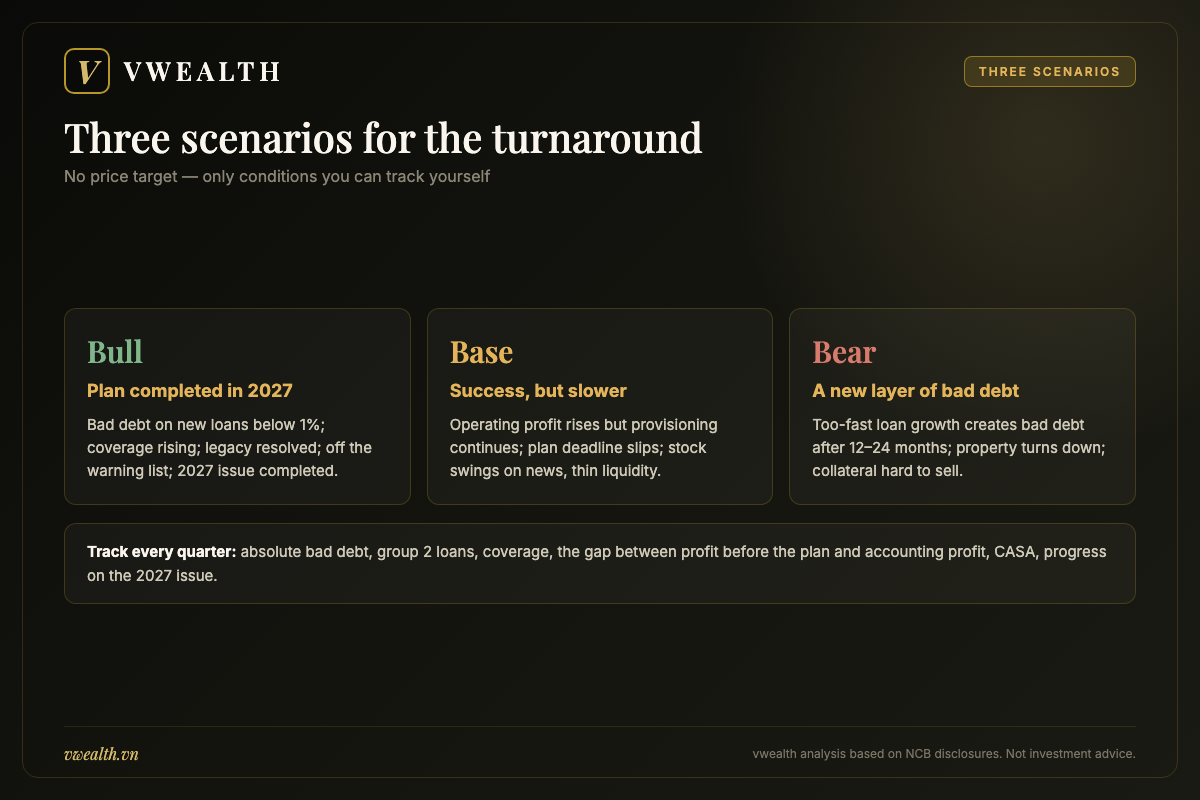
So, should you buy NVB stock? Weighing the pros and cons of a turnaround play
By now you have all the pieces: a formerly weak bank on its third self-restructuring, a new leadership team with restructuring experience, very rapid capital injections, genuinely rising operating profit — but also accumulated losses, high bad debt, low coverage and heavy dilution of minority shareholders. The question of whether to buy NVB stock has no universal answer; it depends on what kind of investor you are and what price you pay.
The strongest arguments in favour
The operating engine is running. Net interest income swung from negative in 2024 to more than VND 2,371 billion in 2025 and about VND 1,033 billion in Q2 2026 alone; Q2 2026 after-tax profit was a record. This is not profit from a one-off asset sale but from core lending.
The legacy has been recognized aggressively. The VND 5,129 billion loss in 2024 shows management chose to “cut once” rather than spread the pain. A bank that has already taken a big loss usually has fewer nasty surprises than one still hiding it.
The capital buffer is thickening fast. Charter capital went from about VND 4.1 trillion in 2021 to VND 29.28 trillion in 2026, issued above book value, lifting book value per share and lowering funding costs.
Insiders put in their own money. The chairwoman, vice chairwoman, a board member and supervisory board members all bought in the 2026 placement, according to the list the bank published.
Plenty of potential catalysts lie ahead. Completing the plan, leaving the warning list, regaining margin eligibility, recovering written-off loans, closing large collateral sales — each could change how the market views NVB.
The arguments against that you cannot ignore
Heavy dilution, and minorities cannot participate. The share count is already more than seven times its 2021 level and could more than double again if the 2027 plan completes. Existing shareholders have not been allowed to buy in the placements. Most of any value created belongs to the new capital providers.
Asset quality is still weak relative to the sector. An NPL ratio of about 6.43% at mid-2026 — more than three times the 2.01% overall ratio of 27 listed banks according to TCBS — and coverage below 20%, against an average of about 79% for that group. Absolute bad debt has not yet fallen.
Risk from hot growth. Loans grew more than 36% in six months, concentrated in construction, property and projects. The new loans have not been tested through a cycle.
No dividend, no margin, thin liquidity. Accumulated losses and warning status make NVB unsuitable for anyone who needs income or uses leverage; low free float makes the price volatile.
| Aspect | Upside | Downside |
|---|---|---|
| Profit | Record net interest income and Q2 2026 profit | Most profit still goes to the clean-up; large Q4 2025 loss |
| Capital | Charter capital VND 29.28 trillion, issued above book | Dilution of ownership and EPS; VND 62.28 trillion plan |
| Asset quality | NPL ratio down from about 19.5% (2024) to 6.43% (June 2026) | Absolute bad debt not yet falling; coverage below 20% |
| Growth | 35% credit quota, large infrastructure projects | Very fast growth, concentrated in construction and property |
| Governance | Big Four review, insiders co-invest | Ownership concentrated among 22 investors (about 75.4%) |
| The stock | Many potential catalysts | Warning list, no margin, no dividend, low free float |
Who NVB stock suits, and who it does not
It may suit: investors with a high risk tolerance who know how to read bank statements, want to put a small part of their portfolio into a turnaround story, and are prepared to follow it quarter by quarter using the signal lists in chapters 4 and 7. Investors of this type usually build positions in steps tied to milestones — for example, adding only when absolute bad debt starts to fall, or when NVB leaves the warning list — rather than making a single bet on the promise of completing the plan.
It does not suit: anyone who needs regular dividends; anyone using margin; anyone without time to read quarterly reports; beginners looking for a “sleep-well” bank stock. For them, banks with stable profit histories, regular dividends and no warning status in the vwealth series are a better fit. Foreign investors should also note that NVB trades on HNX with thin liquidity and very low foreign ownership, so entering and exiting positions may be harder than with large HOSE-listed banks. Whatever group you belong to, do not let a restructuring stock become so large a position that the bear case could damage your whole portfolio.
Frequently asked questions about NVB stock
Are NVB and NCB the same? Yes. NCB is the trading name of National Citizen Commercial Joint Stock Bank; NVB is the stock code, kept from the Navibank era. The shares have traded on HNX since 13 September 2010.
Has NCB stopped losing money? In 2025 NCB earned VND 78 million after tax, ending two loss years in 2023–2024; in the first half of 2026 it earned more than VND 726.7 billion after tax. But the bank still has accumulated losses — about VND 5,037 billion at 30 June 2026 according to its financial statements — so the stock remained on the warning list as of the most recent notices.
Why can’t minority shareholders buy in the capital raisings? According to NCB’s chairwoman, because the bank is implementing a restructuring plan it is not yet eligible to issue shares to existing shareholders; it has pledged to do so when eligible, after meeting the plan’s targets.
Is the VND 62.28 trillion capital plan certain? No. It is a plan to privately place 3.3 billion shares at VND 10,000 during Q1–Q3 2027, approved by shareholders and with a board resolution to implement it; the new shares would be locked up for one year. Execution still depends on regulatory approval and investor demand.
Is NCB connected to Sun Group? What has been disclosed: NCB’s chairwoman was previously Sun Group’s CEO; the two signed a comprehensive cooperation agreement in October 2021 and have co-branded products; a company in the Sun Group ecosystem held about 0.15% of NCB in 2022. Read the bank’s governance reports and major-shareholder disclosures for current information.
Can NVB be bought on margin? Since April 2024, NVB has been on the list of stocks not eligible for margin trading because of its warning status. That can only change once the bank eliminates its accumulated losses and HNX removes the warning.
Final thoughts
NCB is one of the rare stories in the Vietnamese market: a bank from the 2011 weak-bank list that is still standing on its own, still restructuring itself, and — fifteen years on — showing the best operating numbers in its history. Management has done hard things: an independent review, a big one-time loss, a leaner organization — and large investors have committed tens of trillions of dong. If everything goes to plan, 2027 could be the year NCB exits its restructuring plan.
But every turnaround has someone who pays for it. At NCB, minority shareholders pay through dilution: a shrinking ownership percentage across issues they were not allowed to join, no dividends yet, a warning-list stock and thin liquidity. Very fast loan growth and low loan-loss coverage are two risks only time will resolve. So the balanced answer to whether you should buy NVB stock is this: it is a bet on the restructuring process, not a defensive bank stock. If you choose to take part, do so with a small position, a clear list of signals, and an entry price you have carefully compared with book value and the most recent private-placement price. Updated valuation, profit and asset-quality data for NVB and its peers are always available in the vwealth analysis reports.
Research Vietnamese stocks in English with vwealth. Our AI-powered platform turns Vietnamese market data into full English analysis reports — with international payment support and a free 2-month trial for new accounts. Create your free account and read the latest reports.