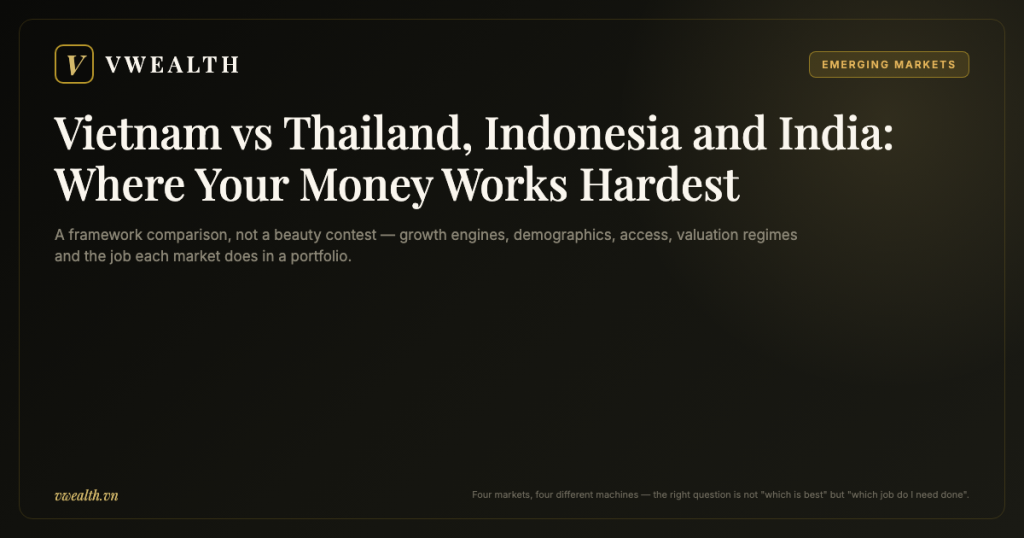
Ask ten investors where emerging-Asia money works hardest and you will get ten verdicts, most of them borrowed from whichever market had the best recent quarter. This guide takes a different route. Instead of crowning a winner, it compares Vietnam vs emerging markets like Thailand, Indonesia and India across the dimensions that actually decide long-term outcomes: growth drivers, demographics, accessibility for foreign investors, valuation regimes, sector composition and currency behavior. By the end, you will not have a tip — you will have a framework, and a clear picture of the specific job each market can do inside your portfolio.
Four Markets, Four Different Machines
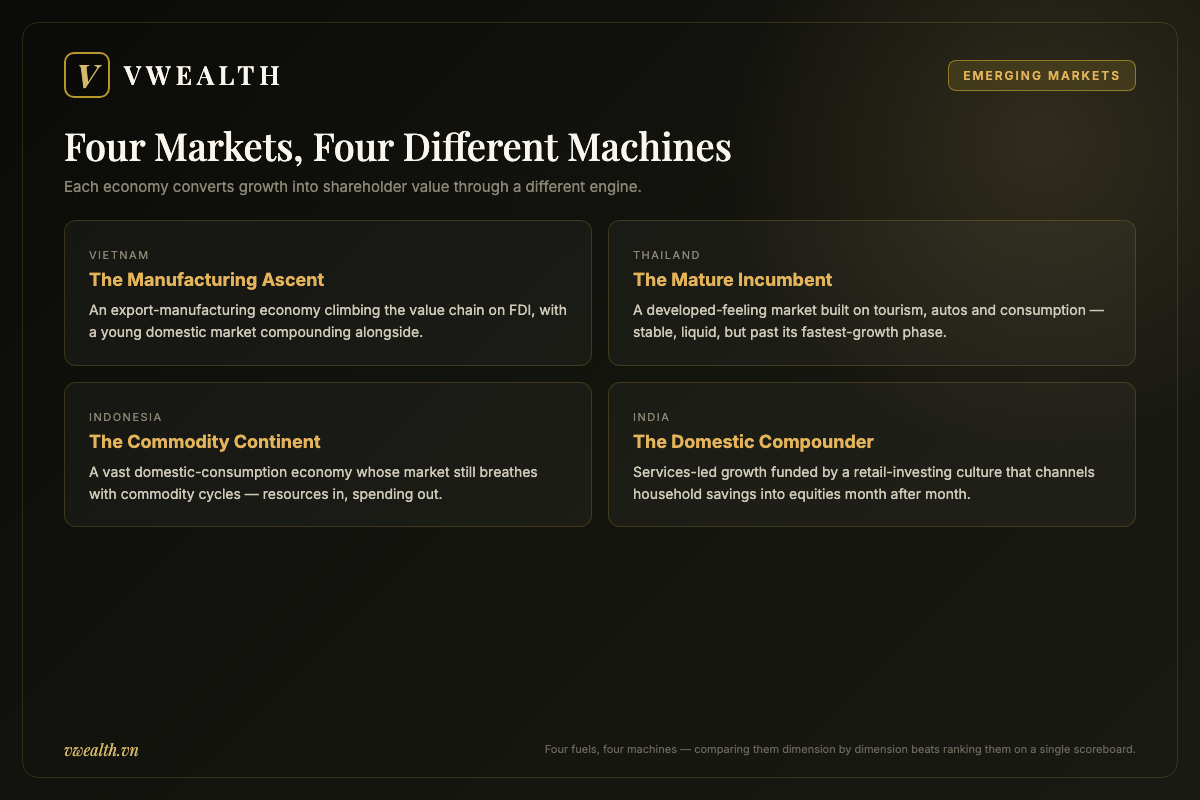
The single biggest mistake in cross-border investing is treating “emerging Asia” as one asset. It is not. Thailand, Indonesia, India and Vietnam are four economies built on fundamentally different engines, and their stock markets reward and punish investors in fundamentally different ways. A comparison that starts with “which one grew faster last year” misses this entirely, because last year’s growth tells you almost nothing about the structure that produced it.
Think of each market as a distinct machine with its own fuel:
Vietnam is the export-manufacturing story. Over the past three decades it has followed the path Japan, South Korea, Taiwan and coastal China walked before it: attract foreign factories with low costs and political stability, plug into global supply chains, move up the value ladder from textiles and footwear toward electronics and components. Its accession to the World Trade Organization in 2007 and the long series of trade agreements since then are the milestones of that strategy. The stock market sits on top of this engine — but, as we will see, it does not mirror it perfectly.
Thailand is the mature regional economy. It industrialized earlier, built a world-class automotive assembly hub and one of the planet’s most visited tourism industries, and then largely plateaued. Its capital market is deep, sophisticated and easy for foreigners to access. Its problem is not access; it is that the underlying economy has grown slowly for years and its population is aging faster than its income level would traditionally suggest — the pattern economists call “getting old before getting rich.”
Indonesia is the commodity-and-consumption giant. It is the fourth most populous country on Earth, sitting on world-scale reserves of coal, nickel, palm oil and other resources, with a huge, young domestic consumer base spread across thousands of islands. Its market cycles have historically followed commodity prices and global liquidity, and its recent industrial policy — pushing foreign firms to process raw materials like nickel domestically instead of exporting ore — is an attempt to convert resource wealth into manufacturing depth.
India is the services powerhouse and the scale story. The most populous country in the world built a globally dominant IT-services and back-office industry, a deep bench of listed companies across nearly every sector, and a domestic retail-investing culture that channels household savings into equities month after month through systematic investment plans. Its market is enormous, liquid and expensive — and it has been “expensive” for so long that the premium itself is a structural feature worth understanding rather than a temporary anomaly.
Four machines, four fuels. The rest of this article compares them dimension by dimension. If Vietnam is the market you know least, start with our complete guide to investing in Vietnam’s stock market as a foreigner — it covers the plumbing this article deliberately compresses.
Growth Drivers: What Actually Powers Each Market
Economic growth is an input, not an outcome, for equity investors. Markets pay for growth that reaches listed companies’ profits — and each of these four economies converts growth into shareholder value through a different transmission channel. Understanding that channel matters more than memorizing any single year’s GDP print.
Vietnam: factories first, then everything downstream
Vietnam’s growth model is export manufacturing funded by foreign direct investment. Global brands build or contract factories in Vietnam; those factories employ millions of workers; those workers’ wages feed urbanization, retail spending, housing demand and banking activity. The sequence matters: FDI is the upstream driver, and most of what trades on the Ho Chi Minh Stock Exchange is downstream of it. The foreign-owned exporters themselves — the electronics assemblers, the apparel contractors — are mostly not listed in Vietnam. What is listed are the banks that finance the domestic boom, the developers that build the housing and industrial parks, the retailers that capture rising wages, and the steelmakers and utilities that supply the construction and power behind all of it.
This creates a subtle but important insight: buying Vietnamese equities is less a bet on exports directly and more a bet on the domestic prosperity that exports fund. The two usually move together over years, but they can diverge over quarters — a strong export cycle with a frozen property market can still be a miserable year for the index.
Thailand: tourism, autos and the search for a second act
Thailand’s listed market reflects a developed-style economy at emerging-market income levels. Tourism is a massive foreign-currency earner and supports airlines, airports, hotels and retail. The automotive sector made Thailand the assembly hub of Southeast Asia. Energy and petrochemical conglomerates anchor the index alongside large banks and telecom operators. The challenge is that each of these engines is mature. Tourism recovers and cycles but does not structurally expand the way it did decades ago; the auto industry faces the global transition to electric vehicles, where Thailand’s incumbency in combustion-engine assembly is less of an advantage; and household debt levels have long constrained domestic consumption growth. Thailand offers stability, yield and liquidity — not acceleration.
Indonesia: commodities, nickel and a continent-sized consumer
Indonesia’s growth transmission runs through two channels. The first is commodities: when coal, palm oil and metals prices are strong, export revenue floods in, the government’s fiscal position improves, the rupiah stabilizes and domestic credit expands. The second is pure demographic consumption: hundreds of millions of people moving from informal to formal economy, from cash to banking, from traditional markets to modern retail and e-commerce. The nickel downstreaming policy — requiring domestic processing of ore that feeds the global battery supply chain — is the boldest attempt yet to weld the two channels together. For investors, the practical consequence is that Indonesian equities carry a commodity beta that Vietnam and India largely lack: the market’s character changes with the resource cycle in a way that must be consciously underwritten, not ignored.
India: services exports, domestic scale and a self-funding market
India’s engine is unusual in Asia because it never ran primarily on manufacturing exports. Its globally competitive sector is services — IT outsourcing, software development, business-process operations — which generate foreign revenue with far less capital investment than factories require. Layered on top is domestic scale: the largest population on Earth generates demand across banking, autos, consumer goods, healthcare and infrastructure that supports one of the deepest listed universes in the emerging world. And uniquely among these four markets, India’s equity market is increasingly funded by its own households: a culture of monthly systematic investment into domestic mutual funds gives the market a persistent domestic bid that cushions it when foreign investors sell. That domestic bid is a structural reason Indian valuations behave differently — a point we return to below.
Demographics: The Slowest-Moving, Most Honest Variable
Demographics will not tell you what a market does next quarter, but over a decade they are among the most reliable forces in economics — because the customers, workers and savers of 2035 have already been born. Here the four markets separate cleanly.
India holds the strongest hand on raw numbers: the world’s largest population with a median age in the twenties, meaning its working-age share will keep expanding for years. The catch is conversion — a demographic dividend only pays if the economy creates productive jobs for the millions entering the workforce annually. India’s challenge is employment quality, not headcount.
Indonesia is similarly young at enormous scale, with the added advantage of already-high workforce participation in a resource-rich economy. Its dividend window stretches comfortably into the 2030s.
Vietnam occupies the productive middle of the demographic arc: a population of roughly one hundred million with high literacy, strong basic education outcomes and a workforce still absorbing migration from farms to factories and cities. But honesty requires the caveat most Vietnam bulls skip: Vietnam is aging faster than its income level would traditionally allow, a consequence of sharply declining birth rates. Its demographic window is real but shorter than Indonesia’s or India’s — which is precisely why the country’s push to move up the manufacturing value chain now, rather than later, matters so much for the investment case.
Thailand has already crossed the line: it is one of the most aged societies in the emerging world, with a shrinking workforce ahead. This does not make Thai equities uninvestable — Japan has delivered fine returns from selected companies for decades despite worse demographics — but it changes what you are buying. In Thailand, you are underwriting corporate quality, dividends and tourism flows, not population-driven expansion.
The demographic scoreboard, then: India and Indonesia have the longest runways, Vietnam has a strong but time-limited window it must exploit through productivity gains, and Thailand has moved into the harvest phase. No figure in this paragraph will change meaningfully for twenty years — which is exactly what makes it useful.
Vietnam vs Emerging Markets on Accessibility: The Dimension Most Comparisons Skip
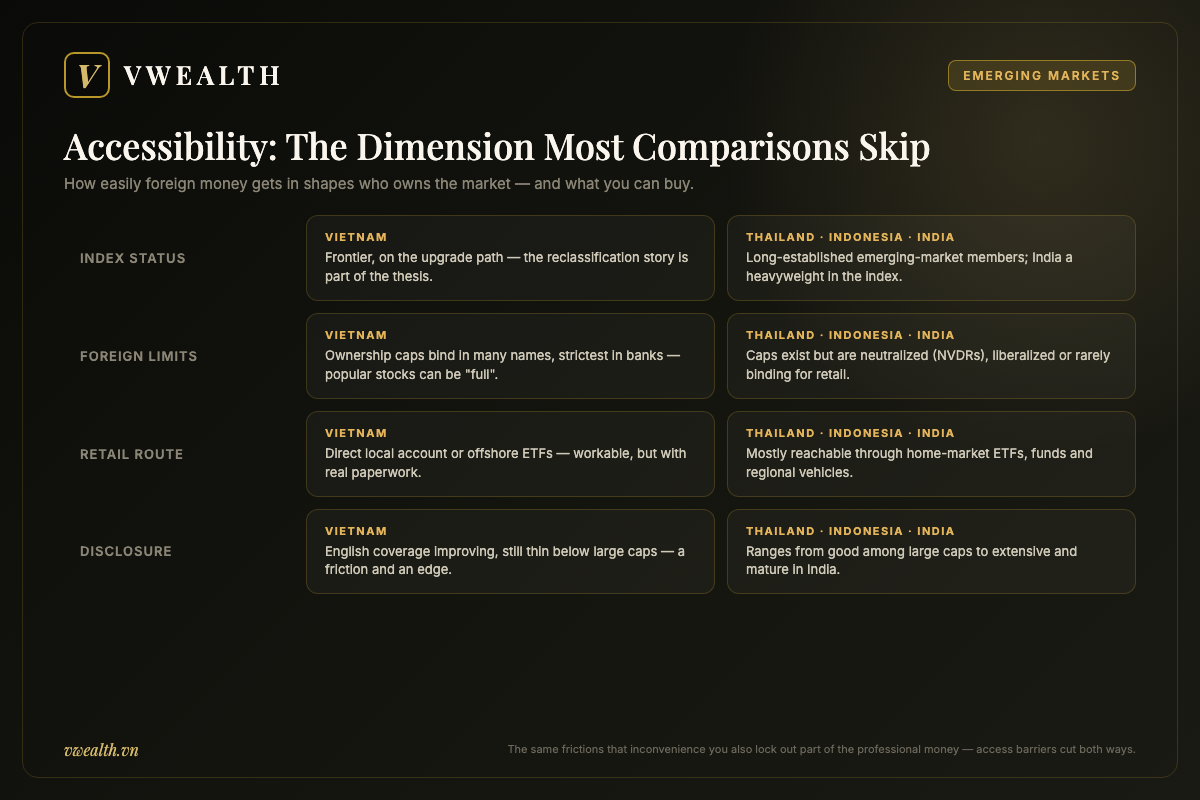
Here is where the comparison stops being academic. Growth you cannot access is a documentary, not an investment. And accessibility — how easily a foreign individual can actually buy, hold and sell shares — differs across these four markets more than any other dimension. It is also the dimension where Vietnam is most distinctive, in both directions.
Thailand: the easy one
Thailand solved its foreign-access problem decades ago. Foreign ownership limits exist, but the market built an elegant workaround: Non-Voting Depositary Receipts, or NVDRs — instruments that give foreigners the economic benefits of a share (price movement and dividends) without the voting rights that ownership caps restrict. Combined with an established brokerage industry accustomed to international clients, English-language disclosure from major firms and full membership in mainstream emerging-market indices, Thailand is operationally the easiest of the four for a foreign individual.
Indonesia: open on paper, practical frictions in reality
Indonesia liberalized foreign ownership of listed shares substantially after the 1997–98 Asian financial crisis, and most of its market is open to foreign buyers without the binding caps Vietnam imposes. The frictions are practical rather than legal: account opening for non-resident individuals involves paperwork, liquidity concentrates in a relatively short list of large names, and English-language disclosure thins out quickly below the top tier. Most foreign individuals access Indonesia through funds or regional ETFs rather than direct accounts — not because they must, but because the convenience trade-off favors it.
India: the hardest door for individuals
India is paradoxical: the deepest, most liquid market of the four is also the hardest for a foreign individual to enter directly. Direct participation runs through the Foreign Portfolio Investor regime — a registration framework designed for institutions, with compliance requirements that make little sense for a person buying modest amounts of stock. In practice, foreign individuals get Indian exposure through ETFs and mutual funds listed in their home markets, or through global depositary receipts of a handful of large companies. The exposure is easy to obtain; the direct relationship with the market is not.
Vietnam: harder plumbing, but a direct door that actually opens
Vietnam sits in an interesting middle position. Its constraints are real: foreign ownership limits cap the foreign share of many companies — most restrictively in banking — and when a popular stock’s foreign “room” fills up, foreigners simply cannot buy more on the exchange, sometimes leading to foreign investors paying premiums in negotiated off-exchange deals. The settlement and account-opening process involves a trading code registration and a dedicated capital account for moving money in and out. We cover the mechanics, including what “room” means day to day, in our step-by-step guide for foreign investors in Vietnam.
But here is the flip side: unlike India, Vietnam’s direct door is genuinely open to individuals. A foreign retail investor can register, open a local brokerage account — increasingly remotely — and trade the same board as locals. And unlike Thailand, the market you are entering is early-stage: under-researched, under-owned by global institutions, and — despite the FTSE upgrade discussed below — still classified as Frontier by MSCI, below its economic weight. Difficulty and opportunity are, in this case, two descriptions of the same fact.
| Dimension | Vietnam | Thailand | Indonesia | India |
|---|---|---|---|---|
| Direct account for foreign individuals | Yes — trading code plus local brokerage account | Yes — straightforward, NVDR route available | Yes, but paperwork-heavy in practice | Effectively institutional-only (FPI regime) |
| Foreign ownership caps | Binding in many names, strictest in banks | Present, but NVDRs neutralize the economics | Largely liberalized post-1998 | Sector caps exist, rarely binding for retail |
| Index classification (major providers) | FTSE: Secondary Emerging (effective 21 Sep 2026); MSCI: still Frontier | FTSE: Advanced Emerging; MSCI: Emerging, long established | FTSE: Secondary Emerging; MSCI: Emerging, long established | FTSE: Secondary Emerging; MSCI: Emerging, heavyweight member |
| English-language disclosure | Improving, still thin below large caps | Good among large caps | Thin below the top tier | Extensive and mature |
| Typical foreign retail route | Direct account or offshore ETFs | Direct account, NVDRs, ETFs | Funds and regional ETFs | Home-market ETFs and funds |
Index Classification: Why a Label Moves Billions
Index classification sounds like bureaucratic trivia until you understand what hangs on it. Providers like MSCI and FTSE Russell sort the world’s markets into buckets — developed, emerging, frontier — and trillions of dollars of passive and benchmarked money allocate according to those buckets. A market’s bucket determines which pools of capital are even allowed to consider it.
Thailand, Indonesia and India have all been established members of the mainstream emerging-market indices for decades — FTSE Russell rates Thailand an Advanced Emerging market and puts India and Indonesia in the Secondary Emerging tier, while MSCI carries all three inside its flagship Emerging Markets index. Their classification is a settled fact, priced in and largely forgotten. Vietnam is the market in transition. FTSE Russell placed Vietnam on its watchlist for a possible upgrade back in 2018, and after years of working through the operational checklist — foreign ownership limits, settlement mechanics, disclosure standards and, above all, the pre-funding requirement that long forced foreign investors to park cash in an account before they could trade — the country finally cleared the bar. In October 2025 FTSE Russell announced Vietnam’s reclassification from Frontier to Secondary Emerging, and after an interim review in March 2026 it confirmed the upgrade would take effect on 21 September 2026, with Vietnamese stocks phased into its global indices through 2027. The specific reforms FTSE singled out were the removal of the pre-funding requirement for foreign institutional investors — replaced by a non-prefunding settlement model — and the establishment of a formal process for handling failed trades, changes introduced under the framework of Circular 68/2024.
MSCI, the other major gatekeeper, tells a different story. As of its 2026 annual market classification review, Vietnam remained a Frontier market and was not even added to MSCI’s watchlist for a potential upgrade. By most accounts Vietnam now meets or nearly meets 17 of MSCI’s 18 accessibility criteria, but the outstanding one — full liberalization of the foreign-exchange market, so that international investors can convert currency freely offshore — has not yet been satisfied. So as of mid-2026 Vietnam sits in an unusual split position: promoted by FTSE, still Frontier under MSCI. For an investor the distinction is not academic, because the two providers anchor different pools of benchmarked money, and the far larger MSCI emerging-market complex is not yet obligated to hold a single Vietnamese share.
Why does this matter for a comparison? Because it defines the setup asymmetry. For Thailand, Indonesia and India, classification is a static feature whose catalyst fired years ago. For Vietnam, the FTSE re-rating is happening in real time — inclusion mechanically requires FTSE emerging-market index funds to buy Vietnamese shares, and historically, markets moving up the classification ladder have tended to attract meaningful foreign inflows around the transition — though the pattern is neither uniform nor guaranteed, and much of the anticipated benefit tends to arrive before the official date as investors front-run the change. The larger MSCI upgrade, meanwhile, still sits ahead of Vietnam rather than behind it: a second potential catalyst that is real but conditional on that final currency reform. The full mechanics — who decides, what criteria remain, and how a long-term investor should size the story without betting everything on a date — are covered in our dedicated piece on Vietnam’s road from frontier to emerging-market status.
The framework point: when you compare Vietnam vs emerging markets that are already inside the club, you are comparing a market mid-transition — one classification catalyst firing in 2026, another still pending — against markets whose catalysts fired long ago. That is neither automatically good nor bad — anticipated inflows can disappoint, and front-running can pull the re-rating forward before the date arrives — but it is a structural difference, not a matter of opinion.
Valuation Regimes: Why “Cheap” and “Expensive” Are Structural, Not Temporary
Now the dimension where investors most often fool themselves. It is tempting to line up four price-to-earnings ratios and declare the lowest number the best buy. This is wrong for a reason worth internalizing: each of these markets trades in its own persistent valuation regime, and those regimes exist for structural reasons that do not disappear just because you noticed the gap. (A price-to-earnings ratio, if the term is new, simply measures how many years of current profit you are paying for a company — a P/E of 15 means fifteen years’ worth.)
We deliberately quote no current numbers here — they would be stale within a quarter. What endures is the shape of each regime and the reasons behind it:
India trades at a persistent premium to almost every emerging market, and has for years. Three structural forces sustain it: the domestic household bid described earlier, which keeps buying regardless of foreign flows; a sector mix tilted toward high-return businesses like IT services and private banks that genuinely deserve higher multiples; and a long track record of nominal earnings growth that compounds through currency depreciation. Investors who spent the past decade waiting for India to “get cheap” mostly waited outside a rising market. The premium is the price of admission to the scale story — the real question is not whether India is expensive but whether the premium is wider or narrower than its own history.
Thailand trades at mature-market multiples for a reason: modest growth expectations are priced accurately. Its market often looks reasonably valued and often is — the multiple reflects an economy that expands slowly. Value traps hide here for investors who see a low multiple and assume mean reversion where the mean itself has shifted down.
Indonesia’s regime swings with the commodity cycle and global liquidity. When resources boom and the rupiah is stable, Indonesia re-rates; when the cycle turns or global rates rise, it de-rates faster than its earnings fall. Buying Indonesia cheap has historically meant buying it when commodities are hated — emotionally difficult, which is why the discount appears at all.
Vietnam carries a frontier discount with a growth profile that arguably belongs in a higher bucket. The discount has identifiable causes: the frontier classification itself long excluded large pools of capital — a barrier the FTSE upgrade taking effect in September 2026 is now dismantling, even as MSCI frontier status still applies; foreign ownership limits impair the marginal buyer; disclosure in English remains thin; and the market’s retail-dominated trading base produces higher volatility than institution-heavy markets. Every one of those causes is, in principle, fixable — and several are actively being fixed. This is the core of the Vietnam valuation argument: not that the market is cheap today by some ratio, but that the reasons for its structural discount are on a reform path, while the reasons for India’s premium or Thailand’s plateau are not going anywhere. Whether that argument pays off, and on what timeline, is exactly the kind of question that deserves ongoing research rather than a one-time verdict — our library of English-language analysis reports on Vietnamese stocks exists to keep that picture current.
Sector Composition: You Are Not Buying “The Economy”
A stock index is not a country. It is a specific, often lopsided sample of a country’s businesses — and the four samples here differ enough to change what an index investment actually is.
Vietnam’s index is dominated by banks, real estate and domestic conglomerates. Financials alone form the largest block by a wide margin, with property developers, steel, retail and food producers filling most of the rest. Notice what is missing: the export-manufacturing sector that drives the economy is mostly foreign-owned and unlisted, and the technology sector consists of only a handful of names. Buying the VN-Index is therefore a leveraged bet on Vietnam’s domestic financial and property cycle — a point that surprises investors who came for the “factory of the world” story.
Thailand’s index tilts toward energy, banks, telecom and tourism-adjacent services — a composition that resembles a developed market a generation ago, heavy in mature cash-generating incumbents and light in high-growth technology.
Indonesia’s index blends large banks — some of the most profitable in the region — with commodity producers and consumer staples. The banks are the crown jewels; the commodity block injects the cyclicality; the consumer names carry the demographic story.
India’s index is the most diversified of the four: private banks, IT-services exporters, consumer goods, autos, pharmaceuticals, energy and industrials all carry meaningful weight. This breadth is itself a risk-management feature — no single sector’s crisis sinks the whole index — and one reason Indian valuations sustain their premium.
| Market | What dominates the index | What the economy has that the index lacks | What an index buy really is |
|---|---|---|---|
| Vietnam | Banks, property, conglomerates, steel, retail | Foreign-owned export manufacturing | A bet on the domestic credit and property cycle |
| Thailand | Energy, banks, telecom, tourism services | High-growth technology exposure | A mature-economy income holding |
| Indonesia | Big banks, commodities, consumer staples | Listed depth beyond the top tier | A commodity-cycle plus consumption hybrid |
| India | Broad: financials, IT, consumer, pharma, autos | Relatively little — the listed universe is deep | A diversified claim on domestic scale |
The practical use of this table: match the index to the thesis you actually hold. If your Vietnam view is “global manufacturing keeps migrating there,” an index fund captures it only indirectly — through the banks and builders that prosper downstream. Stock selection, or at least sector awareness, matters more in Vietnam than in the broader, better-balanced Indian market.
Currency Temperament: The Return Layer Everyone Forgets
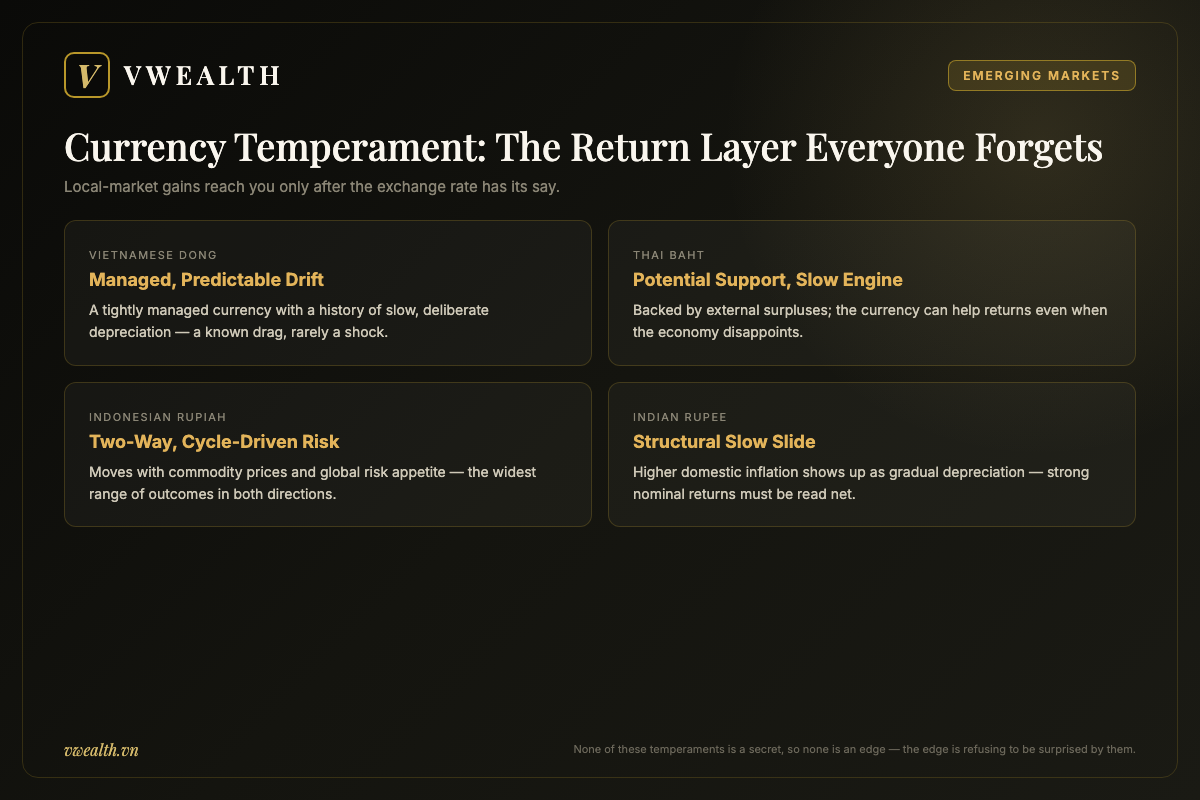
Every foreign equity return is two returns stacked together: what the stock did in local currency, and what the currency did against your home money. Over a decade, the currency layer can quietly add or erase a substantial share of your outcome. Each of these four currencies has a distinct, well-documented temperament — and temperament, unlike level, tends to persist.
The Vietnamese dong is a managed currency with a gentle, deliberate glide. The State Bank of Vietnam sets a daily reference rate and lets the dong trade within a band around it (plus or minus 5% in recent years), historically allowing slow depreciation rather than a free float — in practice a low-single-digit percentage slide against the dollar in a typical year rather than sharp lurches. The practical consequence for a USD-based investor: dramatic single-year currency shocks have been rare, but a modest, persistent drag on dollar returns should be assumed in your planning. We unpack the mechanics and the worked math in our guide to how the dong affects USD investors’ returns — the short version is that the equity thesis must be strong enough to carry a small annual currency toll, and historically Vietnam’s growth story has been exactly that.
The Thai baht has historically been one of emerging Asia’s firmer currencies across long stretches, supported by tourism’s foreign-currency earnings and current-account surpluses — a striking rehabilitation for the currency whose 1997 collapse ignited the Asian financial crisis. A firm currency flatters foreign investors’ returns but pressures the export and tourism competitiveness the economy relies on: Thailand’s blessing and burden in one.
The Indonesian rupiah is the most temperamental of the four. As the currency of a commodity exporter with historically foreign-heavy bond ownership, it strengthens in global risk-on phases and sells off hard when the US dollar tightens — the memory of 1998, when it lost most of its value, still shapes both policy and investor psychology. Indonesian equity investors effectively run a currency position whether they want one or not.
The Indian rupee follows a steady managed-depreciation path, weakening gradually against the dollar over the decades, with the central bank smoothing the ride using one of the world’s largest reserve stockpiles. Indian equities have historically delivered strong nominal returns partly because the economy runs structurally higher inflation — the rupee’s slow slide is the other side of that ledger, and dollar-based investors must always think in net terms.
Framework takeaway: Vietnam and India offer currency predictability with a known drag; Thailand offers potential currency support at the cost of economic dynamism; Indonesia offers the widest two-way currency risk. None of these temperaments is a secret — which means none is an edge. The edge is simply refusing to be surprised by them.
Risk Profiles: What Breaks Each Thesis
A framework comparison is incomplete without the failure modes. Every one of these markets has a specific way of hurting investors, and the ways differ.
Vietnam’s risks cluster around concentration and plumbing. The index’s heavy tilt toward banks and property means a domestic credit or real-estate downturn hits the whole market at once — the corporate-bond and property stress episodes of recent years demonstrated the transmission vividly. Add retail-dominated trading (which amplifies both rallies and panics), foreign-ownership constraints, disclosure gaps below the large-cap tier, and single-party policy risk that is generally pro-growth but can shift abruptly in specific sectors. We maintain a full, regularly revisited treatment in our guide to the real risks of investing in Vietnam — required reading before any allocation, because the bull case only means something once you have priced the bear case.
Thailand’s core risk is stagnation punctuated by politics. Recurring political instability has periodically frozen policy and dented tourism, while the deeper risk is simply that the growth plateau persists — that you collect dividends in a market that goes sideways for another decade. Thai risk rarely arrives as a crash; it arrives as opportunity cost.
Indonesia’s risk is the double cycle: commodities and global liquidity turning down together, dragging the rupiah, the fiscal position and foreign flows simultaneously. Policy nationalism in resources — export bans, ownership renegotiations — adds a layer that foreign investors in extractive sectors must underwrite. When Indonesia de-rates, currency and equities usually fall together, compounding the drawdown in dollar terms.
India’s risk is the premium itself. Paying structurally high multiples means earnings must keep delivering; any multi-year growth disappointment gets punished twice — through earnings and through de-rating. Episodic governance shocks at major conglomerates have periodically reminded investors that depth of market does not equal uniformity of quality. India rarely offers cheap entry; its investors’ risk is time spent waiting for one that never comes, or overpaying at euphoric peaks.
Notice the pattern: Vietnam and Indonesia carry volatility risk — sharp drawdowns within an intact long-term story. Thailand carries stagnation risk. India carries valuation risk. These are different poisons, and your antidote depends on which you can tolerate: volatility rewards patience and staged buying; stagnation punishes it; valuation risk rewards discipline about entry points.
What Job Does Each Market Do in a Portfolio?
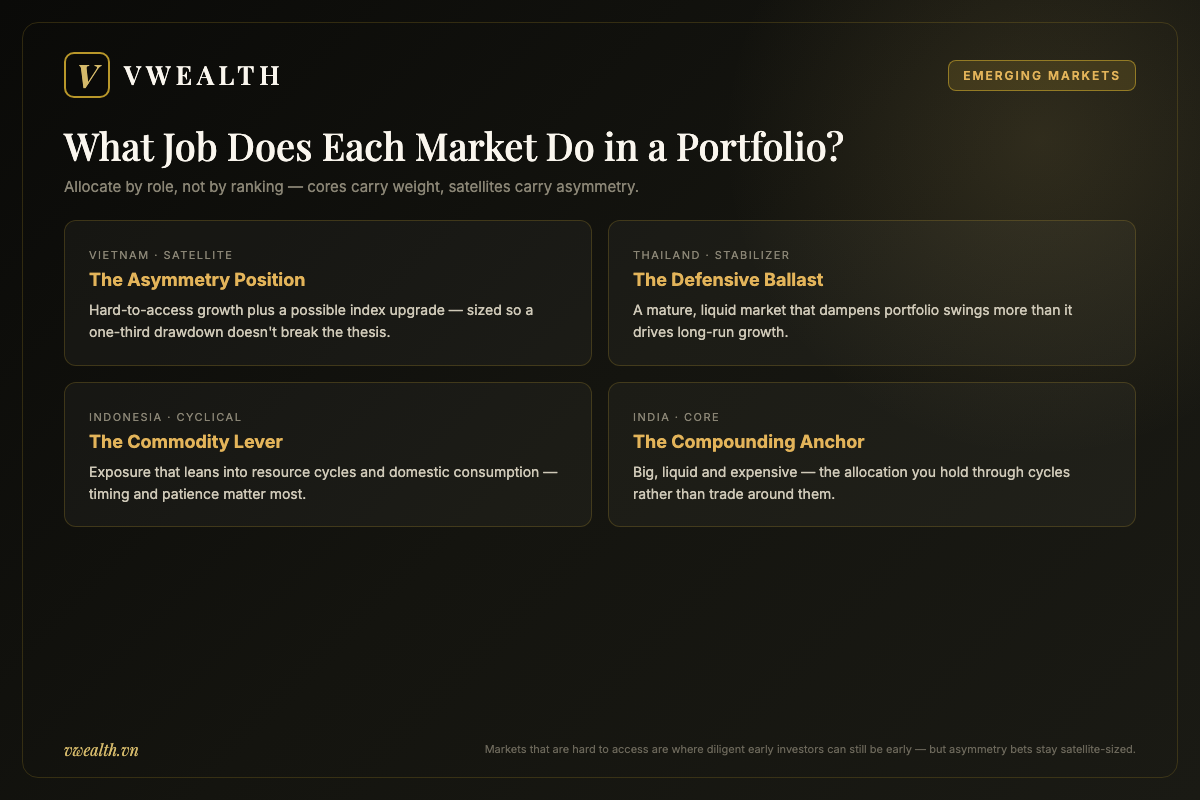
Here the comparison earns its keep. The question was never “which market is best” — it was “what role does each play,” because a portfolio is a team, and you do not field eleven strikers.
India is core growth exposure. Its breadth, liquidity, institutional depth and self-funding domestic bid make it the closest thing emerging Asia offers to a hold-forever allocation. You size it meaningfully, accept the premium, and add on the infrequent occasions the market panics. Most investors should own it through funds — which, as noted, is how the access regime effectively routes individuals anyway.
Indonesia is the cyclical satellite. Its commodity-linked temperament makes it a position to scale up when resources and global liquidity are out of favor and trim when the cycle matures. Held statically, it delivers its long demographic story with stomach-churning interruptions; held cyclically, those interruptions become the entry points.
Thailand is the income and stability sleeve — a market for investors who want Southeast Asian exposure with developed-style accessibility, established dividend cultures and lower drama, and who accept modest growth as the price. It pairs naturally with higher-octane positions elsewhere in the region.
Vietnam is the asymmetry position: the accessibility-constrained growth story. Pull the threads of this article together and Vietnam’s profile becomes distinct. It has the growth engine (manufacturing migration plus urbanization) of an earlier-stage economy. It has a structural valuation discount whose causes — classification, ownership limits, disclosure, plumbing — are specifically the things reform is targeting. Its FTSE classification catalyst is firing now — Secondary Emerging status takes effect on 21 September 2026 — with the larger MSCI upgrade still pending, whereas the other three markets crossed both thresholds years ago. And it has a direct-access door that individual foreigners can actually walk through, unlike India’s. The constraint is the point: markets that are hard to access are exactly where diligent early investors can still be early, because the professional money that irons out mispricings is partially locked out by the same frictions that inconvenience you.
The honest counterweight: asymmetry positions are sized as satellites, not cores. Vietnam’s index concentration, volatility and single-market policy risk argue for a position you can watch fall by a third without abandoning the thesis — because at some point over a multi-year holding period, it likely will, as every frontier and emerging market periodically does.
A Practical Decision Framework: Five Questions Before Allocating
Turn the analysis into a checklist. Before allocating to any of these four markets — or dividing money among them — answer five questions in writing:
1. What is my actual thesis, and does this market’s index express it? “Asia grows” is not a thesis. “Manufacturing keeps migrating to Vietnam and its banking system captures the prosperity” is — and it tells you immediately that Vietnamese financials, not a vague index hope, are your real exposure. Match instrument to idea.
2. Which failure mode can I genuinely tolerate? Volatility (Vietnam, Indonesia), stagnation (Thailand) or valuation compression (India)? Your honest answer — based on how you behaved in past drawdowns, not how you hope to behave — should shape the mix more than any return forecast.
3. What is my access route, and what does it cost me in fidelity? Offshore ETFs are convenient but imperfect: Vietnam-focused funds, for instance, must navigate foreign-ownership limits that create tracking differences against the index. Direct accounts offer fidelity and stock selection at the cost of setup effort. Decide deliberately rather than defaulting.
4. What is my currency assumption? Write down the temperament you are underwriting — gentle drag (Vietnam, India), possible support (Thailand), two-way swings (Indonesia) — so that when the currency does what it historically does, you respond with recognition instead of panic.
5. What would change my mind? Define the exit conditions before entry: for Vietnam, perhaps a reversal of market-access reforms; for India, a multi-year earnings stall at premium multiples; for Indonesia, a structural commodity bear market; for Thailand, evidence the plateau is deepening. A thesis without falsification conditions is a mood.
Investors who work through these five questions typically land not on one market but on a weighted combination — commonly an India core, a Vietnam and/or Indonesia satellite, and Thailand only when income and stability are explicit goals. Your weights will differ; the discipline of assigning them consciously is what matters.
The Bottom Line: Different Machines, Different Jobs, One Framework
So where does your emerging-Asia money work hardest? The framework answer: money works hardest where the growth engine is strong, the entry price underrates it, and you can actually reach it — and it works safest where those conditions are already recognized and priced. India offers recognized, premium-priced scale. Thailand offers accessible maturity. Indonesia offers cyclical demographic power. Vietnam offers the rarest combination in the set — an early-stage growth engine behind access frictions that are visibly, measurably being dismantled — and charges for it in volatility, concentration and homework.
That last word is the real conclusion. Every edge available to a foreign individual in these markets, and in under-researched Vietnam especially, comes from doing the homework most cross-border money skips: reading the actual companies, tracking the actual reforms, understanding the actual index you are buying. Frameworks narrow the field; research closes the deal. Nothing in this article is a recommendation to buy or sell any security — it is an analytical framework for your own further research, and every allocation decision remains yours.
Research Vietnamese stocks in English with vwealth. Our AI-powered platform turns Vietnamese market data into full English analysis reports — with international payment support and a free 2-month trial for new accounts. Create your free account and read the latest reports.
Frequently Asked Questions
How does the Vietnam vs Thailand economy comparison work?
Not by crowning a winner. The useful comparison runs across the dimensions that actually decide long-term outcomes: growth drivers, demographics, accessibility for foreign investors, valuation regimes, sector composition and currency behaviour — Thailand, Indonesia and India each score differently on those.
Which emerging Asian market is best to invest in?
Ask ten investors and you get ten verdicts, most borrowed from whichever market had the best recent quarter. A more useful outcome than a tip is a framework, plus a clear picture of the specific job each market can do in a portfolio.
What separates Vietnam from Thailand and Indonesia?
Chiefly its growth drivers and demographics profile, but also how accessible it is to foreign money — a dimension where Vietnam’s ownership limits make it behave quite differently from its neighbours regardless of valuation.
Does India belong in the same comparison as Vietnam?
It appears in the same emerging-Asia bucket for most allocators, but sector composition and market size differ enough that they rarely compete for the same role. Comparing them on dimensions rather than on recent returns makes that clear.
Should I pick one emerging market or hold several?
That depends on the job each is meant to do. Once you compare on growth drivers, access, valuation and currency rather than on last quarter’s performance, the question shifts from which is best to which combination fits your objective.