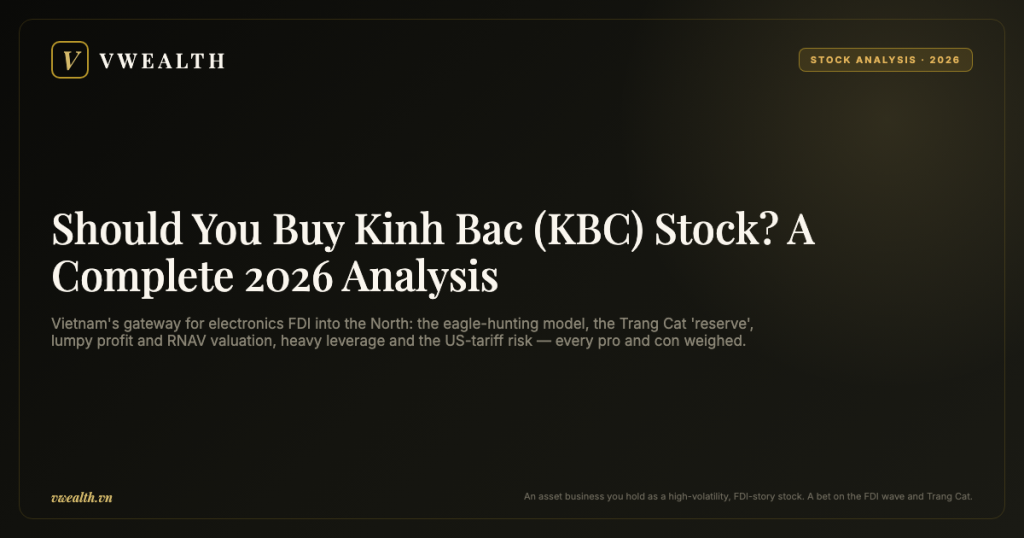
If you had to sum up KBC stock in one sentence, you could say this: it’s the simplest way for an investor on Vietnam’s stock market to bet on the FDI capital flowing into the North. KBC – Kinh Bac City Development Corporation, ticker KBC on HOSE – is one of the country’s largest industrial-park developers, and in practice has become the “kingpin” catching the electronics-technology FDI wave. The world’s component, electronics and circuit-board manufacturing headquarters setting foot in Bac Ninh, Bac Giang, Hai Phong mostly rent land in industrial parks bearing the Kinh Bac brand.
The name KBC is tightly tied to one person: businessman Dang Thanh Tam – once the richest man on Vietnam’s stock market in 2007. Mr. Tam’s story and KBC’s story are almost one: both peaked in glory in 2007, both plunged into the debt-crisis abyss of 2011–2013, then both revived when the supply-chain relocation wave poured into Vietnam. You can’t understand KBC without understanding the captain who steered it through both extremes.
But if you see KBC only as an “FDI-catching” stock, you see just half the story. The other half lies in two words: “the reserve”: an enormous land bank, both industrial land for lease and urban land – most notably the 585-ha Trang Cat urban area in Hai Phong. This is the hidden-asset portion the market still debates how to value, and the driver that makes many investors willing to patiently hold.
There’s a trait you must get used to if you want to hold this stock: KBC’s profit is lumpy. The business books revenue and profit by the rhythm of land handovers – and land handovers aren’t steady quarter by quarter like consumer sales. Some years KBC profits big, some years it nearly “hibernates,” even loses money in some years. 2025 was a boom year: net revenue reached 6,687 billion dong, up as much as 141% year on year; after-tax profit over 2,226 billion dong, more than 5 times the year-earlier period – the second-highest in the company’s history. But that very boom reminds you the 2024 comparison base was very low, and that’s the “bumper-harvest, failed-harvest” nature of this business model.
At the price of 30,000 dong per share (close of 19 June 2026), the question is frank: should you buy KBC, and if so, which kind of investor does it suit? To answer fully, you need to start from the roots – from the day Kinh Bac broke ground on its first industrial park in Que Vo, Bac Ninh – then trace each rise and fall to today. This full analysis will guide you through that whole journey.
KBC market data (updated 19 June 2026)
| Current price | 30,000đ | 2025 revenue | 6,687 bn (+141%) |
| Change (June) | −1.32% | 2025 after-tax profit | 2,226 bn (+426%) |
| P/E (distorted) | RNAV | ~10x | ~39,500đ | Trang Cat reserve | >16,900 bn |
KBC is INDUSTRIAL-PARK real estate — profit is LUMPY, so P/E is distorted; value by RNAV (net asset value) instead. Large debt, six straight years missing KPIs. Source: VWealth + KBC 2025 reports. For reference only.
History and evolution
KBC’s history is a fairly honest mirror of Vietnam’s economic picture over the past two decades: from the time FDI capital began seeking the North, through the property mania and the credit collapse of the early 2010s, to the wave of manufacturing relocation out of China. Understand each of those turns and you’ll understand why KBC stock moves the way it does – and why it’s both attractive and full of risk.
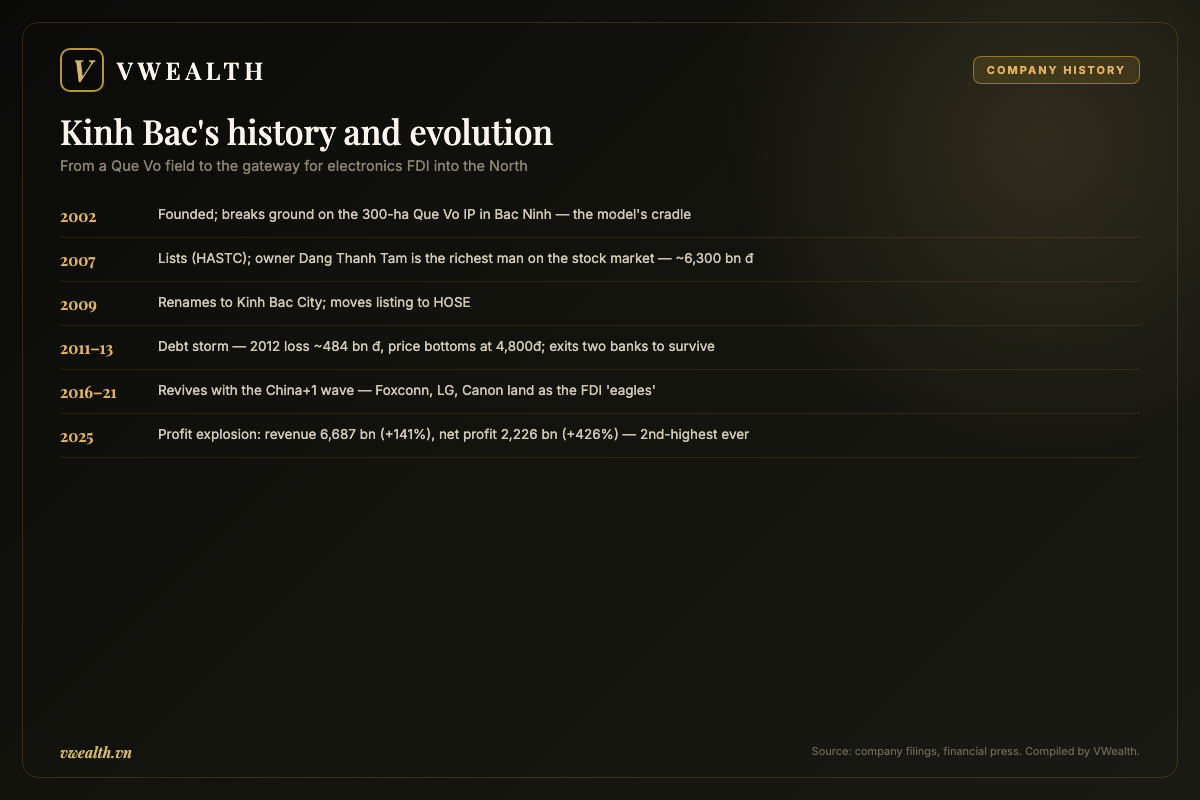
2002–2006: Laying the foundation at Que Vo Industrial Park
Kinh Bac City Development Corporation was founded on 27 March 2002 and formally began operating from April 2003, with an initial function of investing, building and trading urban-commercial-industrial-park-multipurpose-service infrastructure. Right in the name, you see the core philosophy: not building industrial parks alone, but building “cities” tied to industry.
The first, fateful step was Que Vo Industrial Park, Bac Ninh. On 19 December 2002, the Prime Minister signed a decision establishing the 300-ha Que Vo IP, assigning Kinh Bac City Development JSC as the investor to build infrastructure and attract investment. 2002 was also the year the group broke ground on this first project.
Choosing Bac Ninh wasn’t random. This is a province adjacent to Hanoi, on the arterial transport axis linking the capital to Hai Phong port and the northern border – an ideal location for foreign manufacturers to place plants. Remember this detail, because all of KBC’s later strategy revolves around one simple principle: pick the localities about to become FDI destinations, gather land early, build infrastructure, then lease to the “eagles.” Que Vo was later expanded into a complex of about 610 ha (existing Que Vo plus Que Vo expansion), becoming the “cradle” that birthed Kinh Bac’s whole business model.
KBC pioneered the industrial-park-combined-with-urban-services development model in Vietnam. This wasn’t just a way to make money, but a way to create a competitive advantage: with factories here, then housing, services and amenities for workers and experts are right here too.
2007: Listing and the “richest man” peak
2007 was a double milestone. On 18 December 2007, 88 million KBC shares first traded at the Hanoi Securities Trading Center (HASTC, forerunner of HNX). The listing came right as Vietnam’s stock market was in a historic mania, and it instantly made owner Dang Thanh Tam the most-mentioned figure.
With about 30 million KBC shares plus 4.2 million ITA (Tan Tao) shares in hand, Mr. Tam’s total securities wealth then reached nearly 6,300 billion dong – number one on the list of 100 richest on the stock market in 2007. Notably, just a year earlier, in 2006, he was 35th. That leap came precisely from taking Kinh Bac public. This was the phase KBC continuously raised charter capital at dizzying speed: 880 billion dong (November 2007), 1,340 billion dong (June 2008), then 1,991 billion dong (May 2009).
To picture the clan’s scale: Mr. Tam’s business group was part of the Saigon Investment Group (SGI / Saigon Invest) “empire,” and his family – including his elder sister Dang Thi Hoang Yen (Chairwoman of Tan Tao) and younger sister Dang Thi Hoang Phuong – all held high positions on the wealth rankings. This was one of Vietnam’s first “stock-billionaire clans.” But that fast, multi-industry expansion also sowed the seeds of the crisis just a few years later.
2009: Moving to HOSE, defining “Kinh Bac City”
In 2009, the company renamed to Kinh Bac City Development Corporation – JSC and moved its listing from Hanoi to the Ho Chi Minh City Stock Exchange (HOSE). From then, KBC became one of the most representative names of the industrial-park real-estate group on Vietnam’s largest exchange – a position it holds to this day.
Moving exchanges wasn’t just a technical maneuver. It marked Kinh Bac’s ambition to elevate itself: from an industrial-park developer in Bac Ninh, the company wanted to become a national-scale industrial-urban infrastructure developer. Also in this phase, the “electronics FDI attraction formula” began to bear fruit: over 90% of tenants in KBC’s industrial parks were businesses from Japan, Taiwan, Korea, China and Hong Kong – precisely the countries and territories relocating electronics production most strongly.
2011–2013: The debt storm and a life-or-death “escape”
This is the darkest chapter, and also the most important one for you to read carefully – because it shows you the real risk of KBC’s model when it meets a bad credit environment. When the economy fell into crisis, the property market froze and interest rates spiked, Dang Thanh Tam – already diversified into many fields, including banking – was swept into a liquidity vortex.
At the peak, Mr. Tam held two banks: Nam Viet (Navibank, now NCB) and Western Bank (later merged into PVcomBank). But these inefficient non-core investments, plus liquidity difficulties, forced him to fully divest from both in 2013. Navibank’s 2013 governance report shows Mr. Tam and his wife no longer held shares, with over 25 million NVB shares fully pulled out that year.
KBC itself then carried thousands of billions in bond debt. The business had to ask the State Bank to extend payment terms, and was almost unable to access loans throughout 2012–2013. Mr. Tam was forced to withdraw from cherished projects like the 100-floor tower next to Hanoi’s National Convention Center and the Saigon SunBay project. 2012 was the worst year: KBC recorded a business result of about negative 483.9 billion dong, and the share price fell to a bottom of just 4,800 dong.
“I was very afraid” – Mr. Tam himself admitted the mindset of “shrinking through hardship” in this period. For you – an investor – this is an evergreen lesson: a business using high leverage to gather land is wonderful when credit is easy, but can stand at the brink when cash flow reverses.
What’s admirable is that KBC survived. By selling off assets, restructuring debt, abandoning the banking ambition and returning to its core competency – making industrial parks – the business gradually regained balance from the mid-2010s. This “escape” reshaped KBC’s later philosophy: more cautious about diversification, more focused on the cash-generating industrial-land segment.
2016–2021: Revival with the FDI “eagle” wave
When US–China trade tensions escalated and the “China + 1” trend formed, manufacturing capital began leaving China to find new berths, and Vietnam – especially the North – became a top destination. KBC, with ready land in prime locations, fell exactly into the position of beneficiary.
Kinh Bac’s strategy in this phase was colloquially called the “eagle” strategy – that is, focusing on inviting giant multinationals to be the nucleus of each industrial park. KBC’s tenant list reads like a map of the global electronics industry: Canon, Foxconn, LG, Luxshare-ICT, Goertek, JA Solar, Fuyu, Jufeng… When an “eagle” lands, a series of satellite suppliers follows, helping fill the remaining land faster and at better rents.
To serve this wave, KBC expanded its ecosystem beyond Bac Ninh:
- Bac Giang – Quang Chau IP, about 516 ha, where Foxconn placed a large plant; this park has attracted dozens of FDI projects and is being further expanded.
- Hai Phong – Trang Due IP, tied to LG Electronics’ “headquarters”; KBC is continuing with Trang Due phase 3.
- Hung Yen, Long An and later gradually expanding into southern and central provinces – diversifying its footprint to avoid depending on a single region.
Alongside industrial land, KBC develops the urban segment – where most of the “reserve” value is stored. The two most important names are Phuc Ninh Urban Area (Bac Ninh) and especially Trang Cat Urban Area in Hai Phong. The logic is very clear: where there are factories, workers and experts flowing in, there arises housing and service demand – and KBC wants to hold both ends of that value chain.
The “reserve” of Trang Cat: a 585-ha jewel
If you chose one asset symbolizing KBC’s future, it’s the Trang Cat Urban Area. This is Hai Phong’s largest urban project, total area 585 ha, total investment about 11,328 billion dong, of which KBC has poured in thousands of billions of dong for site clearance and leveling. Per the plan, the company expects to transfer about 20–30 ha a year, with hopes of bringing in very large revenue and thousands of billions in annual profit once the project runs.
| Key project | Locality | Type | Role |
|---|---|---|---|
| Que Vo IP | Bac Ninh | Industrial park (~610 ha) | The origin project, the “cradle” of KBC’s model |
| Quang Chau IP | Bac Giang | Industrial park (~516 ha) | Foxconn headquarters |
| Trang Due IP | Hai Phong | Industrial park | LG headquarters; phase 3 underway |
| Trang Cat UA | Hai Phong | Urban area (585 ha) | The largest “reserve,” future revenue source |
| Phuc Ninh UA | Bac Ninh | Urban area | Urban area tied to the Bac Ninh industrial zone |
Why is Trang Cat called “the reserve”? Because its value sits on the books at cost (project inventory has reached nearly 17,000 billion dong), while its market value when sold is expected to be much higher. That gap isn’t reflected in profit until the land is actually handed over – and this is why many long-term investors patiently hold KBC, accepting “failed-harvest” years to await the day “the reserve” is realized.
2022–2025: Blazing expansion and the profit explosion
Entering the first half of the 2020s, KBC accelerated broad-based land accumulation. The group’s total industrial-park land bank was built up to about 5,278 ha – nearly 5.5% of the country’s total industrial land, a figure enough to confirm industry-leading status. The business targets adding over 3,000 ha to its total land bank, including about 2,200 ha of industrial land stretching from Bac Ninh, Thai Nguyen, Hai Phong to Can Tho – a clear “southward march” and footprint diversification.
This expansion came with sharply increased leverage. In 2025 alone, KBC disbursed nearly 19,881 billion dong of direct investment – about 5 times 2024 – and its debt scale rose high. This is a point you need to watch closely: KBC’s “gather land with borrowed capital” model is always a double-edged sword, exactly as the bitter 2011–2013 lesson taught.
The 2025 financial results were very impressive. Net revenue reached 6,687 billion dong, up 141% year on year; after-tax profit over 2,226 billion dong, more than 5 times the year-earlier period and the second-highest in the company’s history. The main driver came from the core segment – industrial-park land and infrastructure leasing – reaching nearly 4,400 billion dong, up 251% and about 66% of total revenue; the rest came from property transfers (about 1,460 billion dong), mainly from social housing in Bac Ninh and the Trang Due project.
However, you need to read this figure clear-eyed: the 2024 comparison base was very low (revenue only about 2,776 billion dong), so the “huge” gain partly comes from the low-base effect. And despite the record, KBC still didn’t complete the plan the AGM set (10,000-billion revenue and 3,200-billion after-tax profit) – a reminder that management’s ambition is always larger than actual results, and “missing profit KPIs” has recurred for years. This is the clearest expression of the lumpy profit nature: results depend on land-handover timing, which is very hard to forecast precisely by year.
By the end of this stretch, KBC’s total assets approached the 70,000-billion-dong mark. The business declared it was entering a “big accumulation cycle,” preparing resources for a new growth phase from 2026, and even elevated Trang Cat to an “AI city” ambition – a way of repositioning “the reserve” in trendier language.
Dang Thanh Tam and his personal imprint on the stock
Throughout that journey, one factor stayed constant: Mr. Dang Thanh Tam remains Chairman and soul of KBC. For you, this is a double-edged sword to weigh. On one hand, he’s someone with vision, relationships and the ability to “hunt eagles” – it was his personal relationships and credibility that helped KBC pull in top FDI conglomerates, and helped the business survive the crisis. On the other, the too-tight bond between a listed business and one individual, plus a history of strong leverage and transactions with the related ecosystem (like Saigontel, the SGI group), is a governance factor that a cautious investor must always weigh.
In sum, today’s KBC is the product of a dramatic journey: originating from a 300-ha industrial park in Que Vo, rising to the “richest man” peak in 2007, nearly collapsing on debt in 2011–2013, then reviving spectacularly by becoming the gateway for electronics FDI into the North, with the Trang Cat “reserve” awaiting its day to bloom. It’s a business with real position, real assets, but also carrying very real risks on leverage and cyclicality.
So what apparatus is running that enormous asset base, and how trustworthy is it? To correctly value a stock whose value mostly lies in the land bank and “FDI-hunting” capacity, you need to scrutinize the people at the helm. The next section – Leadership – dissects exactly that.
Leadership and ownership structure
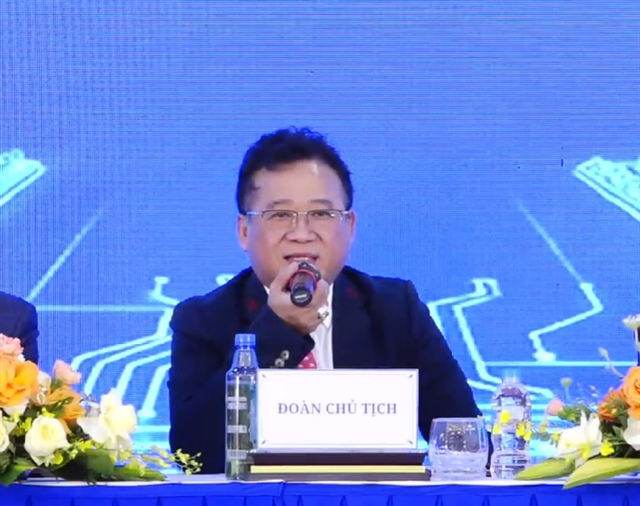
When you hold an industrial-park stock, what you buy isn’t just the land bank and lease contracts. You also buy the negotiating ability of the person in the chairman’s seat, the network of relationships they spent two decades weaving, and the risks stemming from their personality. For KBC, no stock on HOSE has its fate tied to one person as this stock is tied to Mr. Dang Thanh Tam. To understand KBC while skipping Mr. Tam is like reading a novel with the chapter on the protagonist torn out. In this section, you and I dissect three layers: the person at the helm, the tangled ownership structure behind, and the governance quality those things produce.
Dang Thanh Tam — the soul and also KBC’s biggest risk
Mr. Dang Thanh Tam was born on 15 April 1964 in Hai Phong, into a family with a father from the South who regrouped to the North and a Hai Phong mother. In 1976 the whole family moved to HCMC, then in 1982 he returned to his mother’s home to study engineering at the Vietnam Maritime University, later adding law and business administration. His start as a maritime engineer, once working at Saigon Maritime Transport Company in 1988–1996, is worth remembering: Mr. Tam isn’t a born financier, but a project man, a site-negotiator, someone used to the thinking of “turning a patch of land into an industrial park with tenants.” That character deeply imprints KBC’s whole operation to this day (per Vietnamese Wikipedia and a businessman profile).
In 2007, Mr. Dang Thanh Tam was recorded as the richest man on Vietnam’s stock market, with wealth by share value of about 6,300 billion dong. That was the peak of a first generation of real-estate–industrial-park tycoons, tied to the 2006–2007 listing frenzy. He’s also the younger brother of Ms. Dang Thi Hoang Yen — founder of Tan Tao Group (ITA) and a former National Assembly deputy who had to resign in mid-2012. This “Dang family” relationship once made the names KBC and ITA always mentioned together, though legally they are two independent, separately-listed businesses (per CafeBiz and StockBiz).
Mr. Tam’s style is a “hands-on” style. He’s famous for the image of personally “hunting eagles” — himself sitting at the negotiating table with large FDI conglomerates instead of delegating everything to subordinates. The peak of that working style was the 2024–2025 event series: Mr. Tam and Mr. Eric Trump signed a cooperation agreement witnessed by Mr. Donald Trump in Florida, and on 21 May the 1.5-billion-USD Khoai Chau urban–eco-tourism–golf complex (Trump International Hung Yen) broke ground, in cooperation with The Trump Organization. Each time Mr. Tam appears tied to an FDI name or a semiconductor project, KBC stock has sessions that surge (per Tuoi Tre and Dan Tri).
This is where you need to stay clear-eyed. A chairman good at inspiring, daring to speak strongly about FDI and semiconductors — he once affirmed readiness to contribute tens of thousands of billions to develop supporting industry — is a very large intangible asset. But that same person also creates “key-man risk”: the share price swings with the chairman’s statements and appearance schedule, more than with the actual quarterly leasing cash flow. At the 2026 AGM, Mr. Tam even unexpectedly was absent and let management preside — a small detail but enough to show how sensitive the market is to his presence (per Kinh te Chung khoan and Vietstock).
The 2011–2012 lesson: from the peak to the debt abyss then back up
If you want to correctly assess a leadership’s “mettle,” don’t look at when they win, look at when they nearly collapse. The 2011–2013 period was Mr. Tam’s darkest chapter. After years of multi-industry expansion — securities, education, telecoms, healthcare and especially banking — he simultaneously stood behind two banks, Navibank (now NCB) and Western Bank (later merged into PVcomBank). When lending rates spiked to 17–20% a year and the property market froze, KBC had to carry enormous debt and thousands of billions of bond pressure. He was forced to ask for debt-obligation extensions and fully divest from banking in 2013, amid countless surrounding rumors (per compilation from Nha Dau Tu and CafeF).
The lesson from this chapter is very important when valuing KBC today. First, Mr. Tam is someone who dares to use strong leverage and dares to bet big — a trait that once nearly killed the business. Second, he’s also someone who knows how to “shrink to survive”: accepting to cut the banking ambition, returning to the industrial-park core, and indeed revived KBC. Third, the behavior of prioritizing bond repayment over dividends (as we’ll see right below) is precisely the psychological aftereffect of the 2012 debt shock. A cautious investor should see this as both a plus for survival discipline and a reminder that this leadership’s risk appetite is inherently high.
Ownership structure: the family holds control through a tangled network
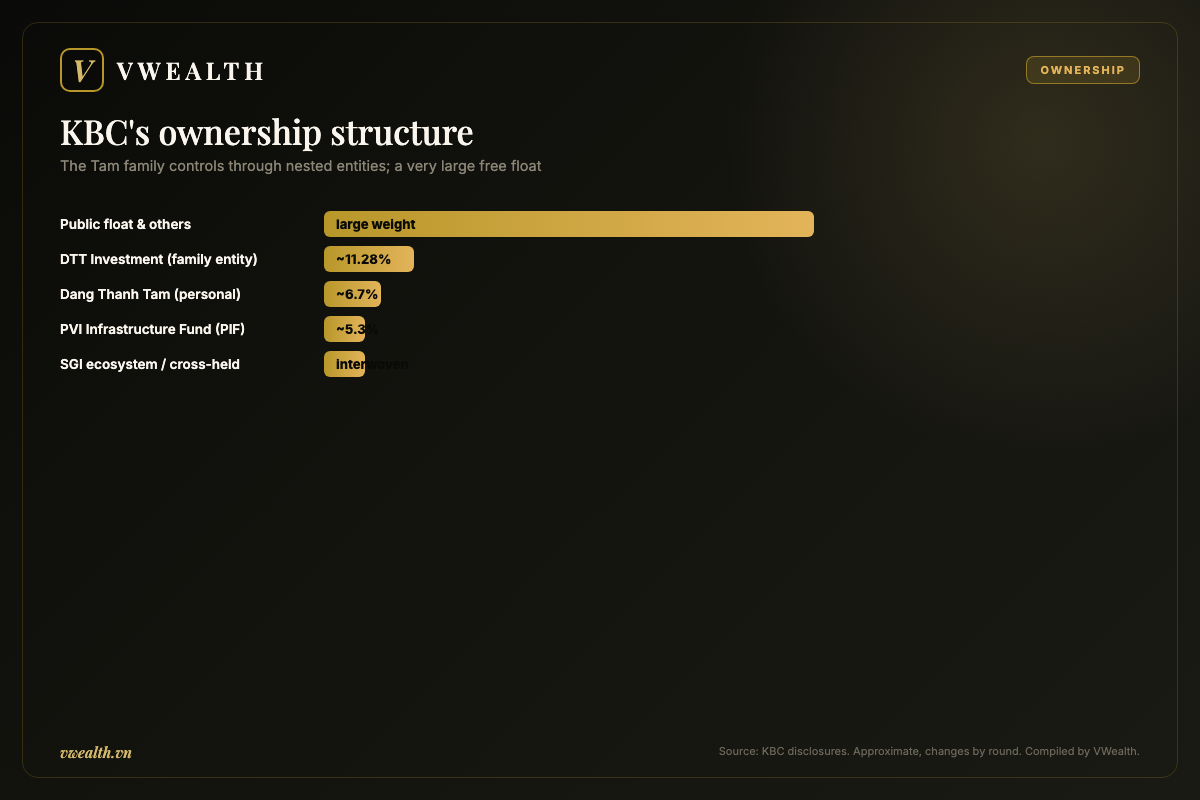
KBC’s ownership structure is a matrix you need patience to untangle. The crux: the Tam family’s actual control is far larger than the personal-ownership figure in his name, because most has been “packaged” into related entities. In early 2025, Mr. Tam made a notable restructuring: from 2 to 21 January 2025, he transferred 86.55 million KBC shares by negotiated method, cutting his personal ownership from 138.67 million shares (18.06%) to about 52.12 million shares (≈6.69%). These shares were used to contribute capital to DTT Investment and Development JSC — an entity Mr. Tam chairs and holds about 90.4% of. Through this, DTT raised its KBC ownership from 0% to 11.28% (per VnEconomy and PHS).
Note the logic here. Nominally, Mr. Tam’s personal ownership dropped sharply below 7%, but in essence controlling power didn’t decline at all — it just changed form from “direct personal” to “indirect via DTT.” Combined, the Tam group (personal ~6.7% + DTT 11.28%) still holds the highest control at KBC. This is a fairly common move by Vietnamese business owners: shifting ownership from individual to entity for convenience in pledging, capital-raising, succession and asset separation. The downside for small shareholders is it makes the ownership structure less transparent and harder to trace the real power flow — you should read the “related party” section in each period’s annual report carefully.
The next complexity layer lies in cross-ownership within the “Saigon Invest (SGI) ecosystem.” KBC is a member of the SGI investment group, and KBC itself is a major shareholder holding about 21.5% of Saigon Telecommunication Technologies JSC — Saigontel (SGT), while Mr. Tam’s DTT also holds about 16.89% of Saigontel. In other words, money and shares circulate among KBC – DTT – Saigontel along fairly winding paths. This kind of cross-ownership structure has the advantage of binding power and flexibly coordinating internal resources, but also carries conflict-of-interest risk: transactions between same-“family” companies need close monitoring to ensure KBC isn’t disadvantaged when transacting with related parties (per Cong Thuong and VnBusiness). Note these ratios fluctuate by trading round; you should verify against the latest disclosure report.
The third layer is new capital entering via the 2025 private placement — the part that “dilutes” the founding group’s weight but adds large institutions to the register. In the private placement at 23,900 dong per share, on 24 June 2025 the PVI Infrastructure Fund (PIF) bought 50 million shares, raising ownership from 0% to 5.31% and becoming a major shareholder (including PVI Fund Management, the group holds ~5.44%). Additionally, SGI Fund Management JSC, VPBank Securities and some individuals joined the raises — this group was once expected to hold around 28% of capital after transactions. KBC’s ownership can be summarized into four blocks as the table below (per CafeBiz and DNSE).
| Shareholder group | Representative | Reference ratio | Note |
|---|---|---|---|
| Founding group (Tam family) | Dang Thanh Tam (personal) + DTT Investment and Development JSC | ~6.7% + 11.28% | The largest actual control; most shifted to the DTT entity |
| Domestic financial institutions | PVI Infrastructure Fund (PIF), SGI Fund Management, VPBank Securities | PIF ~5.3–5.4% | Entered via the 2025 private placement; weight changes by round |
| SGI ecosystem / cross-ownership | Saigontel (SGT)-related and SGI entities | Interwoven, hard to isolate | Scrutinize related-party transactions |
| Public shareholders (free float) | Individual & institutional investors on the exchange | The rest, a large weight | High liquidity, sensitive to news about the chairman |
The message to carry from this table: KBC has a very large free float (so high liquidity, easy to trade) but control is concentrated in the family group through nested entities. That’s a blend of “truly public business” and “family-run business” — a trait that makes KBC both attractive for liquidity and requiring investors to monitor governance more than normal.
Management: the prominent role of CEO Nguyen Thi Thu Huong
If Mr. Tam is the “eagle hunter” on the external front, the one directly running and regularly speaking on operations is Ms. Nguyen Thi Thu Huong — Board member and CEO. Ms. Huong was born in 1971, joined the Board on 27 April 2012 (right in the crisis period, a detail showing she stayed with KBC through the hardest time), holds a PhD in economics and an MBA, and is fluent in Chinese and English — a skill set very fitting for investment promotion and working with FDI, especially investors from China, Taiwan and Korea (per Nguoi Quan Sat and CafeF).
In practice, Ms. Huong is the permanent face conveying KBC’s business plans. She was the one who announced in March 2025 that KBC signed a lease of nearly 31 ha with an Apple-designated technology company at Nam Son – Hap Linh IP; she was also the one who affirmed FDI partners still inject capital into KBC’s industrial parks despite tariff impacts, and the one who strongly declared “we’re not joking, we ask shareholders to respect” about the 2025 ambition. When the plan wasn’t completed, she was also the one who publicly took responsibility before shareholders — a commendably transparent attitude given that not many Vietnamese business leaders are willing to do so (per Nguoi Quan Sat and Mekong ASEAN).
On compensation, the Kinh Bac CEO’s income was once recorded high — nearly 17 billion dong in one year, most recently about over 8 billion dong (down nearly 15% year on year), that is, an average of about 667 million dong a month. Notably, Ms. Huong’s personal ownership of KBC is only about 0.04% of capital — meaning she’s purely a professional executive, not a controlling shareholder. This implies: power and ownership interest remain concentrated in Mr. Tam’s family, while management operates on a “well-paid senior hired-hand” model (per VietnamBiz and Nha Quan Ly).
Governance and dividends: points you need to be especially cautious about
KBC’s governance quality is the part I most want you to weigh carefully. Start with dividend policy — the clearest mirror of how leadership treats shareholders. KBC is famous as a business with erratic dividends, leaning heavily toward retaining cash over distributing. In late December 2022, the company approved a 2022 cash dividend plan of 20% (2,000 dong per share) plus a plan to buy back 100 million shares to reduce charter capital at no more than 34,000 dong per share. But by 2023, the buyback plan was narrowed to 50 million then, along with the cash-dividend plan, both were canceled/not implemented — the reason being the Board prioritized concentrating resources to buy back over 4,000 billion dong of maturing and pre-maturity bond debt, while keeping financial capacity for new projects (per Tin Nhanh Chung Khoan and DNSE).
You must frankly acknowledge: KBC is a stock of the land-bank and FDI growth story, not a stock of steady dividends. If you seek steady annual cash income, KBC will most likely disappoint you. History shows leadership is ready to “flip” the dividend anytime to keep money for projects or repay bond debt.
The second governance point to scrutinize is KBC continually raising capital by large-scale private placement. In 2025–2026 the company has been implementing private placements of hundreds of millions of shares (a 250-million-share round around 24,000 dong, rounds bringing in thousands of billions), and one round even went “unsold” by 147 million shares when many investors quit at the last minute. Private placement helps KBC pump capital fast for site clearance and opening new industrial parks, but simultaneously dilutes existing shareholders’ interests, and the placement price is sometimes lower than market expectation. As a small shareholder, you should watch every issuance resolution closely: who buys, at what price, what dilution level (per BusinessForum and VietnamBiz).
The third point is the “share price chasing statements” risk. As said, each handshake with the Trump Organization or each statement about semiconductors, Apple, FDI can push KBC to surge for a few sessions, then cool when expectations haven’t yet realized into profit. With the chairman’s daring-to-promise-strongly personality, the line between “inspiring vision” and “inflated expectation” is sometimes very thin. Your best defense is to always cross-reference statements with real numbers: leased land area signed, money booked, project legal progress — not buying by news headlines.
To summarize this section, the picture of KBC’s leadership and ownership can be wrapped in one sentence: this is a family-run business under a public cloak, led by a talented but risk-loving captain, with an ownership structure nesting many entities and a professional management trustworthy on FDI capability. Buying KBC is buying both the opportunity and the personality of Mr. Dang Thanh Tam. And once you understand the person at the helm and the ownership network behind, you’ll better read why KBC operates its own way — which leads us to the next section: the industrial-park and urban ecosystem this empire is building.
Industrial-park and urban ecosystem
If you’re just researching KBC and look only at the line “2025 revenue up 141%, reaching nearly 6,687 billion dong,” you easily misunderstand this as a linearly growing business, each year steadily higher than the last. Reality is entirely otherwise. To understand KBC, you need to forget the way of reading a consumer-goods company or a bank, and get used to a very distinctive model: this business is essentially a “value-adding industrial-land trader.” They buy (more precisely, compensate and clear) cheap fields, turn them into land with complete infrastructure, then lease them back to foreign conglomerates at prices many times higher. That enormous gap is the profit. This whole section helps you see through the asset ecosystem behind the revenue figure, so that in the “Position and financial health” section, you understand why a “lumpy”-profit business like KBC is still valued by land bank rather than by any single year’s profit.
The core: industrial-land leasing – KBC’s money-printing machine
Start from the business’s heart. In 2025, industrial-land leasing brought KBC about 4,400 billion dong of revenue, up 251% year on year and about 66% of total revenue. In other words, of every three dong of KBC’s revenue, two come from leasing factory land. This is why people call this segment the “money-printing machine” and the backbone of the whole group.
But how does “industrial-land leasing” work? You need to grasp the four-step chain below, because it decides KBC’s entire profit character:
- Step 1 – Seek approval and planning: KBC gets approval to make an industrial park on a plot, usually people’s agricultural land. This is the hardest step, requiring relationships, legal capacity and capital, and is also the big barrier keeping not everyone able to do this trade.
- Step 2 – Compensation, site clearance: KBC pays people to reclaim land. This is a large cash outlay and is the real “cost” of the plot. The earlier and cheaper a plot is compensated, the higher the later margin.
- Step 3 – Infrastructure investment: Leveling, roads, electricity, water supply-drainage, wastewater treatment plant… turning a field into “clean land” with infrastructure, ready for tenants to build plants.
- Step 4 – Lease industrial land: KBC leases the infrastructure-ready plot to investors (mainly FDI businesses), usually via collecting money once for the whole lease life (often up to 50 years, to the end of the industrial-park project’s term).
The crux you must remember lies in step 4: the tenant pays a lump sum for many decades, and per accounting standards, KBC is allowed to book most of that plot’s revenue and profit right at handover. This isn’t office leasing collecting money steadily each month. It’s more like an outright asset sale. This “collect and book once” mechanism creates KBC’s very distinctive profit character, which we’ll discuss in detail at the end.
The simplest way to understand it: KBC doesn’t lease land “monthly installment” style. They essentially sell 50-year land-use rights and collect money right away. Because the land cost (compensation money from years earlier) is very cheap versus today’s lease price, this segment’s gross margin is very high – around 47% in 2025.
What does a gross margin of about 47% in 2025 mean? Of every 100 dong of land-lease revenue, KBC keeps 47 dong of gross profit before deducting selling, admin and interest costs. For a real-estate business, this is a very enviable figure. The reason isn’t mysterious: many of KBC’s core land banks in Bac Ninh, Bac Giang, Hai Phong were compensated a decade or more ago at low cost, while northern industrial-land lease prices continuously rose with the manufacturing-relocation wave out of China. KBC’s leadership even repeatedly affirmed not cutting lease prices but raising them with the market – a statement you can only make when you hold scarce supply in exactly the golden locations.
The land-bank map: the core industrial parks
KBC’s strength lies not in a single project but in a whole network of industrial parks stretching from North to South. As of end-2024, the business held over 7,000 ha of industrial land, about 5% of the country’s total industrial land bank. This is the figure that makes analysts call KBC the “eldest brother” of the industry. Picture this land bank as an asset portfolio, in which each industrial park is a “mine” with its own reserve, location and tenant base:
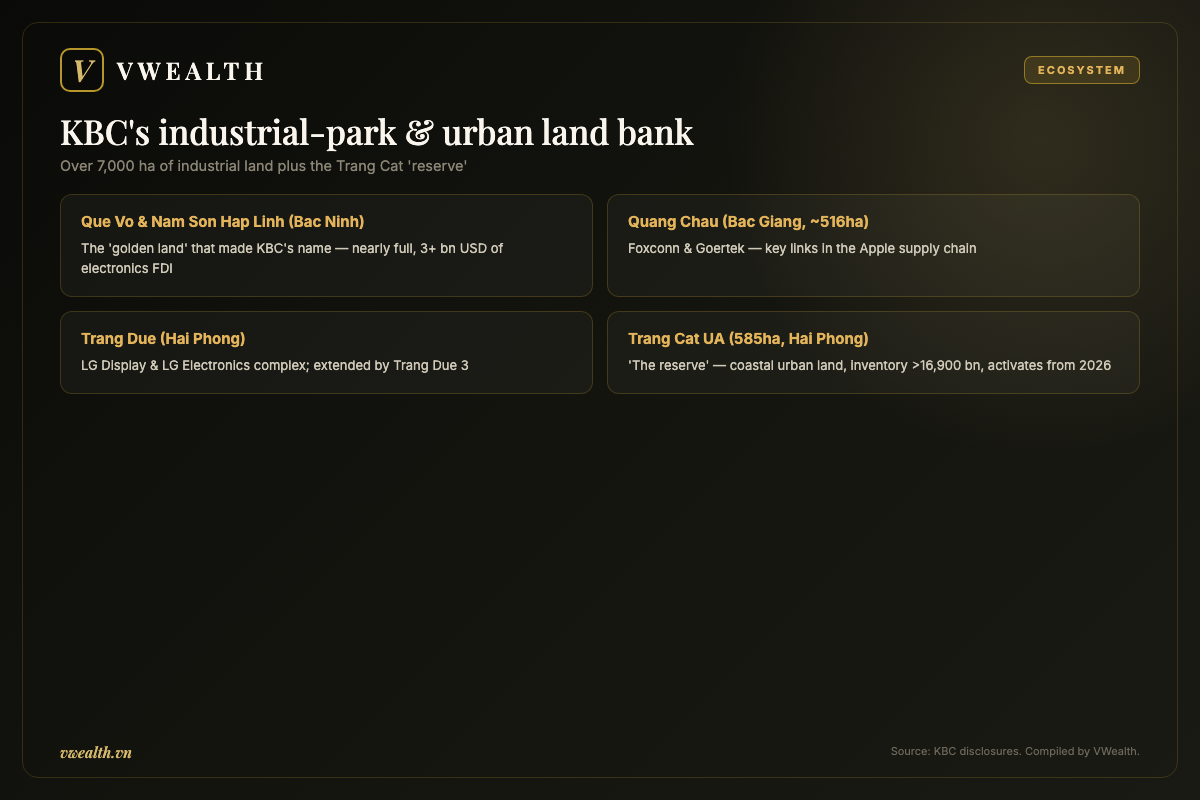
Looking at the map above, you’ll see three very clear value layers. The first layer is the core industrial parks in Bac Ninh and Bac Giang – Que Vo, Quang Chau, Nam Son Hap Linh. This is the “golden land” that made KBC’s name. The Que Vo cluster alone is almost 100% filled on commercial area, attracting over 3 billion USD of investment with hundreds of electronics and precision-mechanics FDI projects. Quang Chau (Bac Giang) hosts the plants of Foxconn and Goertek – important links in the Apple supply chain. The second layer is Trang Due in Hai Phong, tied to the LG Display and LG Electronics complex, being extended by Trang Due 3. The third layer is the new expansion land banks in the South and emerging provinces – Tan Phu Trung (HCMC), Loc Giang, Tan Tap, Nam Tan Tap (Long An), plus projects seeking approval in Hau Giang, Can Tho, Hai Duong, Thai Nguyen. This layer is the “future” helping KBC reduce dependence on a few northern provinces.
To feel the real pace, look at 2025: KBC handed over a total of about 120 ha of industrial land, concentrated in the Hung Yen (about 92 ha) and Nam Son Hap Linh (about 26 ha) clusters, the rest scattered in Quang Chau and Tan Phu Trung. In 2026, leadership targets handing over up to 250 ha, nearly double, with “locomotives” like the Que Vo 2 expansion, Trang Due 3, Nam Son Hap Linh and the Hung Yen land bank. This leaping figure again shows you the business’s “lumpy” character.
The FDI “eagle” tenants: why they choose KBC
A land bank, however beautiful, is meaningless without tenants. And this is where KBC truly makes a difference: this business has positioned itself as a destination for the world’s leading electronics and semiconductor conglomerates – the “eagles” any locality wants to invite. KBC’s tenant list reads like a directory of global tech brands:
- Canon – one of the longest-attached Japanese investors at Que Vo IP.
- Foxconn (Hon Hai) – Apple’s largest assembly partner, strongly present in Quang Chau, Bac Giang; recently also bought a Goertek subsidiary’s stake in Bac Ninh, showing the supply chain increasingly clustering around KBC’s parks.
- LG Display and LG Electronics – a billion-dollar complex at Trang Due, Hai Phong, making it one of the region’s large display and electronics manufacturing centers.
- Goertek, Luxshare – makers of audio components, headphones, wearables for Apple and many large brands.
- JA Solar and many others in energy, semiconductors, precision mechanics.
Why does this tenant base matter to you – an investor? Because tenant quality decides three things. First, pricing power: when names like Foxconn, LG have set up base, a whole satellite supply chain follows, spiking surrounding land-lease demand and letting KBC raise prices. Second, durability of future cash flow: these conglomerates invest billions of USD, not easy to withdraw, so KBC’s land always has waiting tenants. Third, national strategic position: in the wave of electronics and semiconductor manufacturing relocating to Vietnam, KBC sits right at the center of high-tech FDI capital, exactly the story the whole economy is betting on. As of early 2026, the total area of memoranda of understanding (MOUs) KBC has signed reached about 148 ha, concentrated in the Que Vo 1 expansion, Nam Son Hap Linh and Trang Due 3 – meaning the tenants “queuing” for coming years are already fairly dense.
The urban segment: the “reserve” named Trang Cat
If the industrial-park segment is the “money-printing machine” of the present, the urban segment is “the reserve” for the future – and the biggest jewel in that treasure chest is the Trang Cat Urban and Service Area in Hai Phong. You need to pay special attention to this name, because it could be the factor creating KBC’s biggest profit leap in the coming period.
Trang Cat is nearly 585 ha, on the coast within the Dinh Vu – Cat Hai Economic Zone, Trang Cat ward, Hai Phong. To picture the size: this is an urban area planned for over 90,000 residents, with over 25,800 housing products of all types – including about 8,655 low-rise townhouse lots, 3,256 villa lots, 7,178 apartments and over 5,940 social-housing units. A real township, not a small project.
What makes Trang Cat the analysis focus lies in two numbers. First, KBC paid nearly 6,854 billion dong more, raising the total land-use fee paid for the project to nearly 17,800 billion dong – that is, it completed the land-financial obligation ahead of schedule, removing the biggest legal barrier to bring the project into business. Second, that very enormous outlay is booked into the business’s inventory, pushing Trang Cat’s inventory value alone above 16,900 billion dong.
For an ordinary business, “large inventory” is a bad sign – unsold goods, buried capital. But for KBC, over-16,900-billion inventory at Trang Cat is instead an asset awaiting harvest day: it’s coastal urban land already paid for, only awaiting launch. This is an important distinction to grasp when reading a real-estate developer’s financials.
Trang Cat qualified for transfer to partners from the second half of 2025 and is expected to begin contributing significant revenue from 2026. When part of Trang Cat urban land is sold or handed over, the gap between today’s selling price and cost (land money paid) flows straight into profit. This is why many securities firms value KBC by the RNAV method (Revalued Net Asset Value) rather than by a year’s P/E: the business’s true value lies in the unsold plots, of which Trang Cat is the largest asset block.
Besides Trang Cat, KBC’s “reserve” also includes the Phuc Ninh Urban Area (Bac Ninh) and the Trang Due urban land bank. The common trait of this whole group is very large RNAV value but slow development pace, usually snagged on legal procedures and years-long site clearance. This is both an opportunity (hidden assets not fully reflected in the share price) and a risk (capital buried long, cash flow not yet in) you must weigh.
Social housing: a new segment tied to the industrial ecosystem
A new and smart component in KBC’s strategy is pushing social housing right next to the industrial parks. The logic here is very tight and you should grasp it: KBC has ready land, and also ready hundreds of thousands of workers employed in the very FDI plants it leases land to. So building cheap homes to sell to those very workers is a way to “close the loop” of the ecosystem – solving the welfare problem, enjoying policy incentives, and creating a new revenue source.
Specifically, KBC prepared to break ground on a social-housing area of about 50 ha right within the Trang Cat urban area from 2025, and declared it would soon bring about 2.5 million m² of social-housing land to market serving the low-income group. You should see this as a “supporting push” segment rather than the main short-term driver: social-housing margins are capped by regulation, but it helps KBC free up land faster, score points with authorities and strengthen its position when seeking new projects.
The “lumpy” trait: why KBC’s profit is high some years, low others
This is the most important part so you’re not “offside” investing in KBC. Recall step 4 at the start of this section: KBC books most of a plot’s revenue right at handover. The direct consequence is that the business’s profit is “lumpy” – that is, jerky, uneven, entirely dependent on how many hectares they handed over that year and which contracts they booked.
Picture the difference: a coffee chain sells steadily every day so quarterly revenue is nearly the same; but KBC is like a shipyard, in years it launches a big ship revenue explodes, in years the ship is still under construction the books look “gloomy” even though the real value sits on the slipway. That’s why:
- Year-over-year comparison can mislead: 2025 revenue up 141% and after-tax profit up 462% doesn’t mean 2026 will similarly keep rising – it only reflects that 2025 handed over a lot, on a very low 2024 base.
- A low-profit quarter doesn’t mean the business weakens: it may just be that handover time hasn’t come. Q1 2025 once had the industry’s lowest gross margin in two years, but the full year still landed around 47%.
- You must look at “backlog” – signed contracts not yet booked: this is the true health indicator. KBC entered 2026 with about 98 ha of carried-over backlog, plus a plan to hand over 250 ha – that’s why analysts are optimistic even though a single quarter can swing.
In other words, with KBC, you shouldn’t value by one year’s profit, but by the land-bank reserve and the speed of converting that land bank into money. A low-revenue year for KBC is like a gold mine temporarily paused, not a depleted one.
The bottom line: the enormous land bank is the core value
To wrap up this whole section for you to carry: KBC owns a rare two-tier asset ecosystem. The first tier is over 7,000 ha of industrial land – a “money-printing machine” with margins around 47%, nourished by electronics and semiconductor FDI capital from eagles like Foxconn, LG, Canon, Goertek. The second tier is the “reserve” urban land bank whose star is the 585-ha coastal Trang Cat in Hai Phong, land money fully paid, inventory over 16,900 billion dong, ready to activate revenue from 2026, plus satellites Phuc Ninh, Trang Due and the emerging social-housing segment.
It’s precisely the resonance between these two asset tiers – industrial land generating present cash flow, urban land accumulating future value – that is KBC’s true core value, far beyond the fluctuating profit figure of any single year. And to know whether the business has enough financial strength to turn that whole enormous land bank into money without being crushed by debt pressure, we need to move to the next section: KBC’s position and financial health.
Position and financial health
If you glance only at Kinh Bac City Development Corporation’s (ticker KBC) 2025 results, you easily fall into one of two opposite emotional states: elation or doubt. Net revenue 6,687 billion dong, up 141% year on year; after-tax profit 2,226 billion dong, up as much as 426% and the second-highest in the business’s history. Those numbers, standing alone, look like a spectacular comeback. But that same report says KBC completed only about 70% of its annual plan (target 10,000-billion revenue and 3,200-billion profit), marking the sixth straight year the company missed the plan its own AGM set. So should you believe the quadrupling growth figure, or the “missed KPI” figure for six years running?
The most honest answer is: both are true, and both don’t tell the whole truth. To understand KBC, you must shed the habit of reading a business with “next year must beat this year” thinking. This is an industrial-park (IP) developer — a business type with an entirely different financial rhythm from consumer goods, banking or retail. In this section, we dissect three layers: where KBC stands on the industry map, why its profit is so “lumpy,” whether the enormous “reserve” in its inventory is truly pure gold, and most importantly — is its balance sheet strong or weak viewed from debt and cash flow.
Position: a big player on the hottest FDI-capital land
Before discussing the controversial financials, you need to place KBC in its right position. Kinh Bac is one of the few IP developers with top scale and seniority in the North. Their core asset lies not in brand or technology, but in something tangible and increasingly scarce: a large-scale clean land bank, placed exactly in the provinces receiving the FDI capital pouring into Vietnam.
KBC’s project portfolio spans the North’s “industrial capitals” and is expanding: Que Vo and Nam Son Hap Linh (Bac Ninh), Trang Due (Hai Phong), industrial parks in Hung Yen, plus projects underway like Trang Due 3, Que Vo expansion 2, Kim Thanh (Hai Duong), and Gia Loc in Tay Ninh in the South. The tenant names in KBC’s parks are hardly ordinary — Foxconn, Oppo, Luxshare and a series of suppliers in the global electronics chain are present. As long as the “China + 1” supply-chain relocation trend continues, the “host” position of an IP with ready land, ready infrastructure and ready legality is a competitive advantage very hard to copy short-term, because to have a working industrial park, a business must go through years of seeking approval, clearing sites and building infrastructure.
In other words, you’re looking at a business owning a resource the market increasingly needs and increasingly can’t create. That’s the solid foundation of the story. But this very industry nature creates the financial trait that most misleads investors about KBC.
“Lumpy” profit: don’t read KBC by one year
This is the crux — skip it, and you’ll misvalue KBC time and again. An IP developer’s profit doesn’t flow evenly like a dairy company’s or a coffee chain’s revenue. It’s “lumpy” in the literal sense.
The reason lies in revenue recognition. KBC spends years and thousands of billions of dong on compensation, site clearance and infrastructure for an industrial park. Throughout that phase, money continually flows out with almost no revenue flowing in. Then when it signs a land-lease contract with a big FDI player and hands over the land, the entire revenue — sometimes thousands of billions — is booked into a single quarter, a single year. As a result, KBC’s profit chart looks like a jagged mountain range rather than a steady uphill slope.
This mechanism explains the 426% growth you saw at the start. 2024 was a trough year — few handovers, low profit. 2025 was a strong-handover year, with about 120 ha of industrial land changing hands at Hung Yen and Nam Son Hap Linh, plus urban projects. The result: IP-segment revenue alone reached about 4,400 billion dong, 66% of total revenue. The 426% figure is thus not evidence the business is “five times better” — it only reflects that 2025 was the peak of a handover cycle, while 2024 was the trough.
For an IP business, a 400%-growth year proves nothing, and a 50%-decline year condemns nothing. You must read it in multi-year units, and by what’s called backlog.
Backlog — signed but not-yet-handed-over contracts, not yet booked as revenue — is the truly reliable measure of KBC’s future “rice bowl.” When leadership talks about “large-scale contracts about to be signed” and confidently pays a 20% cash dividend for 2026, they’re relying on this seen-but-not-booked revenue layer. So the practical advice when watching KBC: pay less attention to the profit figure of the just-past quarter, and more to leased land area signed, handover progress and remaining commercial land bank. Those are the leading signals.
“The reserve” and the RNAV valuation problem
If lumpy profit is the first trait you must get used to, the enormous hidden asset block is the second. At end-2025, KBC’s inventory nearly doubled to nearly 27,000 billion dong, about 39% of total assets. Of that, the Trang Cat Urban and Service Area (Hai Phong) project alone accounts for over 16,900 billion dong — nearly two-thirds of all inventory.
For most businesses, swelling inventory is usually a bad signal: unsold goods, buried capital, clogged cash flow. But for an IP and urban real-estate developer, “inventory” means something very different. It’s not leftover goods, but the reserve — land bank and projects already invested, awaiting the time to sell. Trang Cat is a prime coastal land bank in Hai Phong, gathered and invested years earlier at low cost. On the books it’s recorded at cost, but its current market value is said to be many times higher.
This is why analysts advise not valuing KBC by P/E. The P/E ratio only makes sense for a business with steady profit; applying it to a lumpy-profit company with assets booked below true value gives a distorted result — a peak year looks falsely cheap, a trough year absurdly expensive. The more fitting method is RNAV (Revalued Net Asset Value), that is, estimating the true market value of the whole land bank and projects then subtracting debt. By this logic, if assets like Trang Cat are revalued at levels banks themselves accept as collateral, KBC’s book value would “surge,” and some estimate the stock’s fair value could exceed the 100,000-dong mark.
However — and here you need to keep a cool head — RNAV is a double-edged sword. Notably, at the 2026 AGM, the leadership led by Chairman Dang Thanh Tam firmly refused to revalue assets at market prices, despite bank and advisor recommendations. Their stated reason is worth pondering: the company wants to book profit upon actual sales, based on real cash flow rather than “assets on paper.” That’s a conservative accounting choice, worthy of respect. But it also tacitly admits a truth: the gap between Trang Cat’s “potential value” and “real money in the pocket” is still very far. A land bank is only truly valuable when it can be sold; while legality isn’t done, leveling isn’t complete and there’s no buyer, it remains only potential on the books. Trang Cat has been “suspended” for years, and how fast or slow it converts into money is the variable deciding the whole KBC investment story.
Financial health: capital-intensive and the price of leverage
Here we touch the part that makes KBC an investment not for the faint-hearted: the financial structure. The IP industry is inherently capital-intensive — money must go out first (compensation, infrastructure) long before it comes back. To simultaneously feed a series of large projects like Trang Cat, Trang Due 3, Que Vo expansion and the Trump International premium real-estate project in Hung Yen, KBC had to concentrate on borrowing and issuance.
The 2025 leverage figures are worth remembering. Total assets touched nearly 69,800 billion dong, up 56% in one year. But most of that increase was funded by debt: KBC’s total outstanding loans surged to about 43,000 billion dong, nearly 19,000 billion higher than at the start of the year. Financial debt alone was about 28,000 billion, of which over 24,000 billion is long-term and nearly 1,000 billion is bonds at a 10.5%-a-year rate maturing right in 2026. The debt-to-equity ratio was pushed to around 107% — much higher than the 40-50% zone KBC maintained in earlier healthy periods.
No less important is cash flow. True to a business at the peak of an investment cycle, KBC’s 2025 operating cash flow was deeply negative, as money was sucked into expanding inventory and pouring into projects. This negative was offset by private share issuance and further borrowing. Frankly: KBC is living on raised capital, not yet on its own cash flow. This isn’t rare and isn’t wrong for a developer sowing seeds for the next cycle — but it makes the business heavily dependent on whether the capital market “opens” or not.
The chart below summarizes KBC’s key 2025 financial metrics for an overall view:
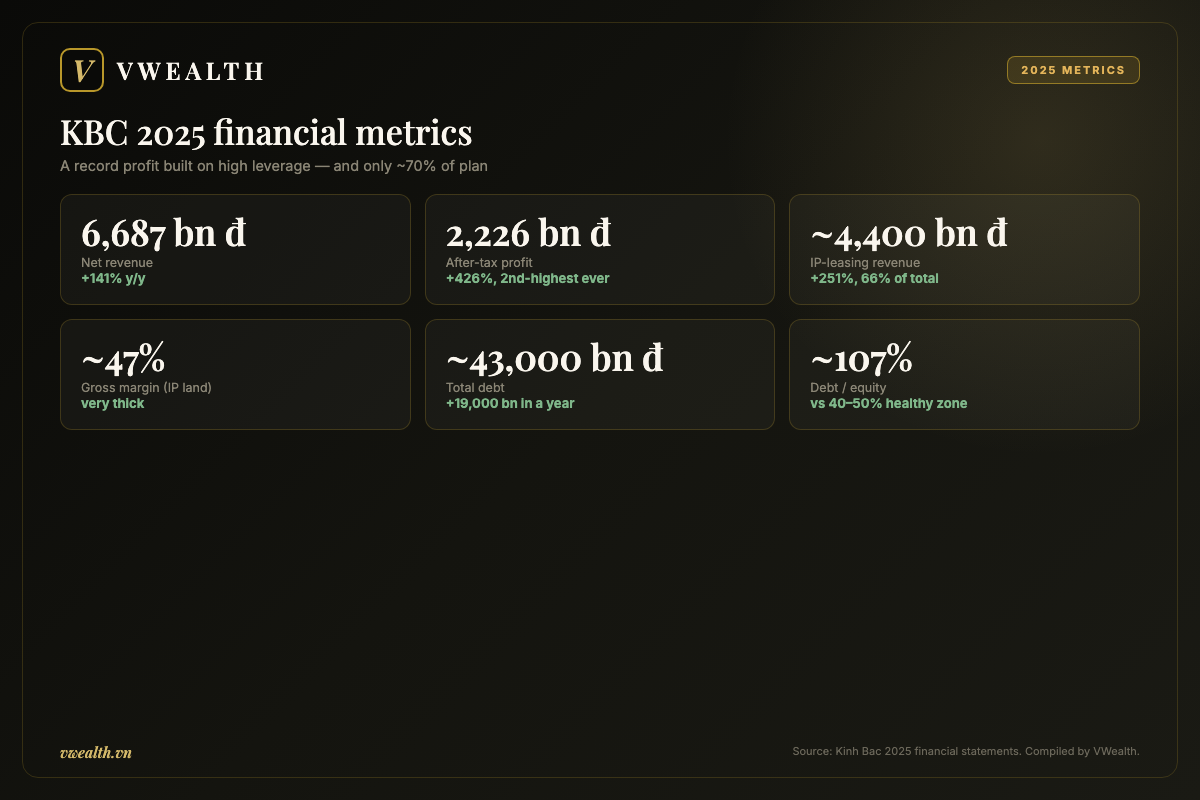
To be fair to KBC, it must be said: high leverage doesn’t automatically mean danger. Most of the debt is long-term, tied to projects with real assets and future cash flow visible through backlog. KBC’s gross margin is still around 47% — very thick versus many other industries — showing that when land is sold, the earning power to repay debt is real. The question isn’t “can KBC repay debt” in a normal scenario, but “what happens if the scenario is abnormal.”
The risks you must not overlook
A balanced analysis must fully name the risks, and for KBC they interweave tightly:
- Legal and project-progress risk. This is the biggest risk, because it hits straight at the ability to “turn the reserve into money.” Trang Cat has been suspended for years due to legal snags and enormous leveling volume. Each year of delay is another year of buried capital, running interest, and RNAV value still only on paper.
- FDI and tariff risk. KBC’s “rice bowl” directly depends on FDI capital continuing to flow strongly into the North. If US tariff tensions or global trade instability make multinationals pause expansion plans, IP-land demand can slow right when KBC needs to hand over for money.
- Interest-rate and capital-market risk. Because it lives on raised capital, KBC is especially sensitive to the cost of capital. Rising rates or tightened property credit will both raise the interest burden and make debt-rollover hard — especially with the 2026-maturing bonds and the large debt maturing in the next 3-5 years.
- Dilution risk. To solve the cash-flow problem, KBC set a plan to sell new shares. This is good news for the balance sheet (reduced debt pressure) but a blade for existing shareholders: the increased share count dilutes per-share interest. You need to watch the issuance price and conditions closely.
All in all, KBC’s financial health is like an athlete straining midway up a climb: the muscles (land bank, position) are strong, but the heart rate (leverage, cash flow) is beating very fast. This isn’t a business to “buy and forget.” It’s a bet on two things: first, that leadership has enough discipline to turn the enormous land bank into money on schedule; second, that the macro environment — FDI and interest rates — is favorable enough for the next handover cycle to go smoothly. If both hold, the Trang Cat “reserve” will be a gold mine and the RNAV valuation will gradually materialize. If one fails, the 43,000-billion leverage becomes real pressure. Understanding that fragile balance is a prerequisite before you observe how the market receives this stock.
Market reception
If you’ve read this far, you’ve grasped who KBC is on Vietnam’s industrial-park real-estate map. But between “a good business” and “a stock worth buying at today’s price” is a gap many investors skip. In this section, I’ll sit with you to dissect that very gap: how the market is valuing KBC, why that price “dances” with each FDI news line, and whether the “national FDI stock” label is truly worth the money you spend.
As of the 19 June 2026 session, KBC stock closed around 30,000 dong, down about 1.32% in June. A number that looks calm at a glance, but for a stock famous for “big waves and strong winds” like KBC, a few percent of monthly movement is sometimes just the lull between two waves. To understand why the price sits here, we must start from the most fundamental question: what measure is KBC being valued by?
Why not rush to trust KBC’s P/E
Do a quick calculation anyone does. KBC’s 2025 after-tax profit reached about 2,226 billion dong. With about 767.6 million shares outstanding (a figure I’ve verified from the business’s disclosures), you get:
- EPS ≈ 2,226 bn ÷ 767.6 million ≈ 2,900 dong per share
- P/E ≈ 30,000 ÷ 2,900 ≈ 10.3 times
- P/B ≈ 1.0 – 1.3 times (depending on when book value is measured)
Looking at this, an investor used to bank or consumer stocks would cheer: “P/E only 10 times, so cheap!” But this is the first trap I want you to avoid. KBC’s P/E is seriously distorted, and using it to value this business is a common mistake.
The reason lies in the business nature. KBC doesn’t sell steadily like a dairy plant. They clear sites and invest in industrial-park infrastructure for years, then at some point sign a large land-lease contract and book a huge lump of profit into one quarter. A year with an eagle profits 5-fold; a year with legal snags profits shrivel. KBC’s profit, in professional language, is “lumpy” — jerky, uneven. Leadership itself admitted 2025 reached only about 69% of the profit plan because the Trang Cat project was delayed and foreign investors pushed back schedules.
Using P/E for a lumpy-profit stock is like measuring an athlete’s heart rate right as he’s sprinting then concluding that’s his resting heart rate. The number is right, but the conclusion is dead wrong.
When the denominator (profit) dances by year, P/E loses almost all comparative meaning. A year KBC profits big, P/E drops to 6-7 times looking extremely cheap; the next year profit thins, P/E surges to 25-30 times looking terribly expensive — while the business’s real assets are almost unchanged. That’s why professional analysts almost never value KBC by P/E, but switch to another measure fitting a “land-holding” business: RNAV.
RNAV — the true measure of a “land-holding” business
RNAV (Revalued Net Asset Value) answers a very practical question: “If today we sold off KBC’s entire land bank at market prices, subtracted all debt, how much is left per share?”
The calculation, simplified, has three steps:
- Add: The value of the remaining industrial-park land bank (the not-yet-leased portion at Que Vo, Nam Son Hap Linh, Trang Due…) valued at current market lease prices, plus the Trang Cat urban area’s value at market prices.
- Subtract: All net debt — and this is a point to note, because KBC’s total debt scale has been recorded by the press at about 30 trillion dong, a level not small at all.
- Divide: The result by shares outstanding to get RNAV per share.
The biggest “reserve” in this calculation is the Trang Cat Urban Area in Hai Phong. This is a project sitting in inventory on the books at nearly 17 trillion dong at cost — but the market value of a coastal Hai Phong urban area, if legally unblocked and sold wholesale, could be much higher than the recorded cost. It’s this gap between Trang Cat’s book value and market value where most of KBC’s “hidden value” resides.
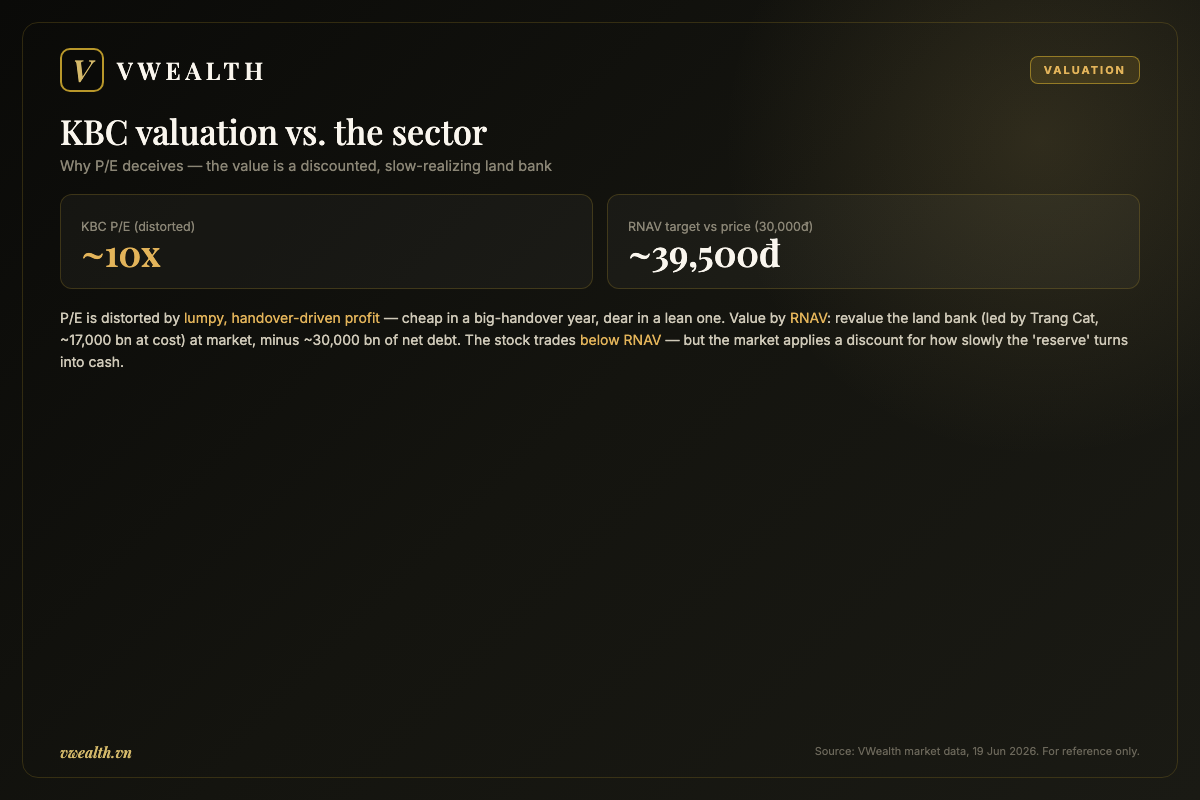
Many analysis reports, when running the RNAV model, produce a fair value notably above the current price — meaning the stock trades below its own asset value. For example, one report set a target price around 39,500 dong (potential of about 16% above their reference price), based on the RNAV foundation. It sounds appealing: buying assets at a discount, what could be better?
But here’s where I want you to pause and think carefully, because this distinguishes the mature investor from the newcomer.
Why the stock trades below RNAV — and that isn’t necessarily a “bargain”
The market isn’t stupid. If KBC clearly deserves 39,500 dong but only sells at 30,000, why don’t people rush to buy until the price matches the value? The answer lies in one phrase: discount for slow asset realization.
RNAV assumes you can sell the entire land bank today at market prices. But KBC’s real life isn’t like that. A project like Trang Cat has been “suspended” for years due to legal procedures, compensation, site clearance. Industrial land for lease also needs an actual eagle to land, needs complete infrastructure, needs time. The value on paper is real, but when it turns into cash in shareholders’ pockets is always a question mark.
The market, very rationally, applies a discount to RNAV to compensate for:
- Time risk: 1 dong received after 5 years is worth less than 1 dong received today. The slower an asset realizes, the deeper the discount.
- Legal risk: Trang Cat has missed deadlines many times. Each miss is a time the market loses patience and widens the discount.
- Execution and leverage risk: With ~30 trillion in debt, the business is “capital-thirsty.” Shareholders themselves have questioned leadership about six straight years of missing plans.
RNAV tells you how much KBC is worth. The discount tells you how far the market believes that value will materialize, and how soon. The gap between the two numbers is the reward — or the trap — awaiting you.
In other words, buying KBC below RNAV isn’t automatically a “bargain.” It’s a bet on timing: you bet the knots will be untied faster than the pessimism the market is pricing. If Trang Cat is unblocked and sold wholesale in the next 1-2 years, the discount narrows and the share price approaches RNAV — you win. If it misses the deadline for a seventh year, the discount holds or widens, and you hold “value on paper” for a few more years.
“National FDI stock” — when a stock lives on story more than numbers
If RNAV is the “head” of the KBC story, the “heart” lies somewhere entirely different: speculativeness and personal money flow. You need to understand this clearly, because it decides your daily experience of holding the stock.
KBC has long been jokingly called by investors the “national FDI stock.” Its liquidity is among the highest in the industrial-park real-estate group — regularly matching tens of millions of shares per session. This makes KBC a favorite playground for wave-chasing individual investors. And what do they chase? The story:
- A news line about the “China + 1” supply-chain relocation wave.
- A signal about semiconductor, high-tech electronics investment pouring into the North.
- A new development in US tariffs — tightening or loosening.
- And especially, a statement by Chairman Dang Thanh Tam, famous for inspiring declarations about eagles, about the “Trang Cat AI mega-city.”
Each such news item can ignite a wave. As a result, KBC has very strong volatility and a high beta — meaning when the general market shakes, KBC usually shakes harder in both directions. It rises faster in euphoria, and falls deeper in panic.
For you, this has two sides. The good side: high liquidity means you enter and exit easily, no fear of being “stuck” for lack of buyers. The downside: KBC’s price often departs from both P/E and RNAV, chasing crowd emotion. A value investor buying KBC for attractive RNAV may still have to endure 20-30% plunges just because of one tariff news line, even though the underlying assets haven’t declined at all. You buy an asset business, but you hold an emotional stock. Those two don’t always move in sync.
Catalysts: three fuses that could push the price up
So what could narrow the RNAV discount and ignite the next wave? I group three main catalysts:
- (1) The electronics-semiconductor FDI wave under the “China + 1” strategy. Northern Vietnam is a destination for large high-tech projects. Trang Due 3 (Hai Phong, 687 ha) reportedly has a large number of investors waiting to lease, including LG registering a significant area. When an eagle actually signs, profit is booked and the FDI story turns from expectation into numbers.
- (2) Legal unblocking and wholesale of Trang Cat. This is the biggest catalyst. If this urban area, nearly 17 trillion at cost, is unblocked and wholesaled to a partner, an enormous part of the “hidden value” materializes, and the RNAV discount narrows quickly.
- (3) New industrial parks coming into operation: Trang Due 3, expansion projects in Hung Yen and new land banks add leasing cash flow in coming years.
Risks: the fuses can also backfire
Fairly speaking, each catalyst has its reverse side:
- US tariffs are the biggest and most unpredictable risk. If the US tightens the tariff wall on Vietnam-made goods, FDI capital may stall, eagles “hold their pens” without signing — and KBC’s whole growth thesis is delayed.
- Trang Cat legal risk recurs: this project has missed deadlines many times, no guarantee this time is different.
- Capital and leverage pressure: with large debt and the need to pour money into many projects at once, KBC may have to issue more shares — diluting existing shareholders’ interests.
- Execution risk: six straight years of missing plans is a scratch on trust leadership needs time to heal.
Dividends: don’t buy KBC waiting for cash
One thing you must set the right expectation for from the start: KBC isn’t a dividend stock. This business’s payment history is very erratic, because its philosophy is to prioritize keeping capital to reinvest in land bank — the “blood” of an industrial-park business.
Notably, at the 2026 AGM, KBC committed to a 20% cash dividend, and this is reportedly the first time since 2018 shareholders get cash back at such an attractive level. That’s a goodwill signal. But read it right: this figure may be paid in multiple tranches, and it comes as the business self-admits being “capital-thirsty.” In other words, KBC’s dividend is an occasional reward, not a steady income stream to rely on. If you’re an investor needing steady annual dividends, KBC isn’t for you.
Foreigners and institutional flows
As a large-cap, high-liquidity stock tied to the FDI story, KBC is always in the sights of foreigners and funds. Foreign net-buy/sell moves at KBC are usually watched closely by the market as an indicator of confidence in Vietnam’s FDI outlook in general. When foreigners net-buy strongly, it’s usually a signal reinforcing the FDI wave; conversely, prolonged net-selling can pressure the price regardless of the asset base. This is a variable you should add to your monitor, alongside Trang Cat legal developments and tariff news.
Summary: what are you betting on when you buy KBC?
Let me wrap this whole section into one sentence you can carry:
KBC is a bet on two things: Vietnam’s FDI wave, and the “reserve” named Trang Cat reflected through RNAV. Its profit is lumpy so don’t trust P/E; its asset value is attractive but discounted for slow realization; and the stock itself is highly volatile, living on the FDI and semiconductor story. This is a stock suited to those who can bear risk and have a long horizon, not to those seeking stability or steady dividends.
If you can bear the shakes, believe in the FDI capital pouring into the North and have enough patience to wait for the Trang Cat “reserve” to materialize, KBC can be an interesting piece in your portfolio. But if you lose sleep every time your account is 20% red in a week, or you need steady dividends to live on, KBC’s “cheapness” on paper may not be for you.
And to understand why I believe that FDI wave isn’t a fleeting fever but a trend with a solid foundation, we need to place KBC in the bigger picture of Vietnam’s whole industrial-park real-estate industry. That’s the subject of the next section — Industry context.
Economic and industrial-park real-estate context
Before you decide anything with KBC stock, there’s a principle you need by heart: an industrial-park (IP) real-estate business is never stronger than the macroeconomy supporting it. KBC doesn’t sell to domestic consumers. Kinh Bac’s customers are foreign manufacturing conglomerates — Foxconn, Goertek, LG, tier-1 suppliers to Apple and Samsung — who sign 50-year land leases only when they believe placing a plant in northern Vietnam is the right decision for the whole coming decade. In other words, KBC’s true value is written by foreign direct investment (FDI), not by the company’s sales team. So this section isn’t a “prelude” you can skip — it’s the backbone of the whole investment thesis.
Where does Vietnam stand in the supply-chain relocation wave?
The biggest picture, and also the most durable driver for the whole IP industry, is the “China Plus One” wave. This isn’t a marketing slogan. As US–China trade tensions persist, Chinese labor costs rise, and geopolitical risk forces multinationals to diversify production locations, Vietnam emerges as one of the clearest beneficiaries. What you need to understand correctly: this isn’t “Vietnam replaces China,” but a distributed-manufacturing model — Vietnam plays the role of a parallel, secondary hub, helping conglomerates reduce dependence on a single geography.
Why is Vietnam chosen? Per manufacturing-ecosystem analyses, production costs in Vietnam are about 30–40% lower than China’s coastal region, along with a network of free-trade agreements (FTAs) covering over 60 economies, a working-age labor force of about 70 million, and a government pursuing among Southeast Asia’s most active industrial-upgrade programs. These numbers don’t directly appear in KBC’s financials, but they’re precisely why KBC’s IP land in Bac Ninh, Hai Phong, Thai Nguyen has tenants willing to pay high rents.
FDI capital: what do the numbers say?
Let’s look at the latest figures for you to feel the capital’s heat — and the cracks beneath it.
- Newly registered FDI capital in Q1 2025 reached nearly 11 billion USD, up over 34% year on year.
- Cumulatively in the first 7 months of 2025, registered FDI reached about 24.09 billion USD, up 27.3% year on year — still growing strongly despite US tariff concerns.
- For full-year 2025, committed FDI reached about 38.42 billion USD, disbursed capital about 27.62 billion USD (up 9% year on year) — the highest disbursement in 5 years.
- Of that, newly registered and adjusted capital into processing-manufacturing reached about 18.6 billion USD, 59.2% of total FDI. This is the money flow KBC truly cares about, because manufacturing is the land tenant.
What you should take: FDI into manufacturing is still very healthy, and it concentrates exactly in the industry KBC serves. This is foundational good news for the whole IP industry generally and KBC specifically.
The semiconductor and electronics wave: right on KBC’s “track”
If you had to choose the most long-term driver, watch the electronics and semiconductor industry. Electronics is Vietnam’s largest manufacturing and export segment — contributing over 30% of total export value, with the computers-and-components group alone exceeding 100 billion USD in 2025. Giants like Samsung, LG, Foxconn, Pegatron, BOE, Intel have built large production facilities in Bac Ninh, Hai Phong, Thai Nguyen — making northern Vietnam one of Asia’s key electronics clusters.
These are precisely KBC’s core areas. The government even targets training 50,000 semiconductor engineers by 2030 and is shifting from final assembly to producing printed circuit boards (PCBs), sensors, optical components. In other words, if the semiconductor wave keeps pouring into Vietnam, KBC sits right on its track. This is why many analysts keep long-term faith in this stock, even though quarterly results can be rugged.
IP industry health: occupancy rate and lease prices
A simple way to check the industry’s “temperature” is to look at two metrics: occupancy rate and land-lease prices. Both currently favor IP owners.
| IP industry metric | North | South |
|---|---|---|
| Occupancy rate (2024 – H1 2025) | ~80–83% | ~92% |
| Average land-lease price/lease cycle (2025) | ~$139/m² | Higher |
| Lease-price rise 2020 – mid-2024 | ~35% | ~67% |
| Forecast lease-price rise 2024–2026/year | ~5–9%/year | — |
In particular, industrial “capitals” like Bac Ninh and Hai Phong — where Apple, Samsung invest heavily — recorded land-lease price rises of about 40% and 30%. When lease prices rise and occupancy is high, IP owners’ leasing margins improve, and businesses owning large land banks in exactly the hot areas (like KBC) have a very clear pricing advantage. This is the bright side of the picture.
But here’s the biggest risk you must not overlook: US tariffs
Now the part optimists often skip. 2025 was the year US tariff policy became the variable governing FDI sentiment. After a tense negotiation phase, by July 2025, the two sides reached a trade deal with a 20% baseline tariff on Vietnamese goods, and 40% on transshipment goods. This 20% is much lower than the 46% once cited, so in a sense it’s a relief. But it’s still a real tariff, and it left a mark on investor behavior.
You need to look squarely at the survey data, because the cautious sentiment is real:
- Per a PwC survey (June 2025), up to 86% of businesses in Vietnam expressed concern about tariff impacts.
- More notably, 44% of FDI businesses said they’d begun relocating plants or dispersing production to other countries.
- Intel delayed an investment worth about 1 billion USD to expand chip production.
This led to a phenomenon observed in Q2–Q3 2025: a portion of FDI investors delayed final decisions — they didn’t cancel, but they waited. For an IP owner like KBC, “customers waiting to decide” means land-lease contract signings slow down, cash flow pushed to later quarters. This is one reason KBC’s profit is “lumpy” — we’ll return to this in the conclusion. On the other hand, to be fair: many brokerage experts assess tariffs unlikely to erode Vietnam’s long-term FDI appeal, because the cost advantage, FTAs and geography remain intact. The issue is time — if the 20% tariff is only temporary and negotiated down gradually, Vietnam stays attractive; if it lasts years, production costs for the US market rise and some other countries may become more competitive.
Industry competition: KBC isn’t alone in the market
A common mistake of new investors is thinking KBC is a monopoly. In reality, this is a crowded industry with many large players, each with its own land bank and footprint:
| IP business | Standout traits |
|---|---|
| BCM (Becamex IDC) | Operates ~7 IPs ~4,700 ha, holds 49% of the VSIP joint venture with Sembcorp; strong in the South (former Binh Duong). |
| VSIP (Sembcorp – Becamex) | The largest IP developer, 20 IPs ~12,000 ha nationwide. |
| IDC (Idico) | Strong profit growth; Q3 profit up ~71% year on year. |
| SIP, SZC, VGC (Viglacera) | Good land banks, assessed by analysts with medium–long-term growth prospects. |
| KBC (Kinh Bac) | Strong in the North’s hottest FDI area; large land bank plus the Trang Cat “reserve.” |
The lesson for you: KBC competes directly with these businesses for the same FDI tenant base. When you assess KBC, you shouldn’t ask “is the industry good” but “does KBC have a better or worse position than rivals in exactly the areas FDI tenants are seeking.” KBC’s advantage lies in sticking close to the North’s electronics-semiconductor clusters; the weakness is lower transparency and profit stability than some rivals.
Land bank and legality: a survival-level knot
Finally, in the IP industry, clean land and complete legality matter more than market demand. You can have customers queuing to lease, but if the land isn’t cleared, isn’t planning-approved, hasn’t fulfilled financial obligations to the state, the business can’t sign contracts and book revenue. This is why the over-3,000-ha land bank KBC accumulated (including about 2,200 ha of industrial land from Bac Ninh, Thai Nguyen, Hai Phong to Can Tho) is both an enormous asset and a risk if legality is suspended. Trang Cat — the project we analyzed in detail earlier — is the most vivid proof of both sides of this coin.
Trend prediction
This section doesn’t aim to “declare” a target price for you to bet on. My goal is to help you picture different possible scenarios, tie each to specific conditions, so you can judge the probabilities by your own belief. In investing, the winner isn’t the one who guesses one scenario right, but the one who prepares for many.
The drivers pushing KBC forward
First, let’s review the “tailwinds” KBC can leverage over the next 1–3 years:
- Semiconductor and electronics FDI keeps pouring into the North. As analyzed, this is the foundational driver. As long as the electronics clusters in Bac Ninh, Hai Phong, Thai Nguyen keep expanding, KBC has tenants. The investor structure is shifting strongly toward Korea (in early 2026, Korea rose to lead with about 37.8% of newly registered capital) — a signal that capital into electronics and EV components is accelerating, exactly KBC’s area “appetite.”
- New IPs coming into operation. KBC has broken ground on projects like Trang Due 3 (~652.73 ha, total capital over 8,000 billion dong, in the Dinh Vu – Cat Hai Economic Zone, Hai Phong). When these new IPs complete infrastructure, they create a new supply of land for lease, expanding the company’s revenue-recognition capacity.
- Unblocking Trang Cat — “the reserve” begins selling from 2026. This is the highest-weight variable. The Trang Cat urban–industrial project in Hai Phong (total area over 800 ha) is expected to become KBC’s main commercial-real-estate driver from 2026, with a plan to wholesale about 20 ha worth about 4,620 billion dong. Trang Cat’s inventory value on the books already exceeds 16,900 billion dong — an enormous asset block awaiting “activation.”
- Social housing and the urban segment. KBC expands into urban and housing development, creating another revenue leg beyond pure industrial-land leasing.
Three scenarios for KBC
Now, place the drivers and risks into three scenarios. I deliberately don’t attach a precise price to each — because that creates false certainty — only describing the direction and qualitative effect on the price.
| Scenario | Trigger conditions | Effect on valuation / price |
|---|---|---|
| Positive | Semiconductor/electronics FDI keeps strong; US tariffs negotiated down or stabilized at an acceptable level; Trang Cat legality unblocked and wholesale begins on schedule from 2026; northern IP land-lease prices keep rising 5–9%/year. | Revenue and profit break out thanks to Trang Cat; “the reserve” turns from inventory into real money; the gap between price and RNAV narrows sharply; the price has room to re-rate clearly upward. |
| Base | FDI stays stable but doesn’t boom; KBC hands over IP land steadily from existing projects; Trang Cat develops but legal/sales progress is slower than expected. | Profit grows moderately but stays lumpy by quarter; P/E valuation hard to reflect true value; the price swings around the current zone, supported by the land bank but lacking a strong catalyst to break out. |
| Negative | US tariffs strongly stall FDI, tenants keep delaying decisions; Trang Cat legality suspended more years; pressure to repay maturing debt and bonds in a hard capital-raising environment. | Leasing revenue slows; Trang Cat “reserve” stays on paper; financial costs erode profit; the price faces downward pressure and high volatility with speculative sentiment. |
The crux to remember: all three scenarios revolve around exactly two variables — FDI flow (affected by US tariffs) and Trang Cat legal/development progress. If you want to track KBC, track exactly these two, don’t get swept along by short-term up-and-down sessions.
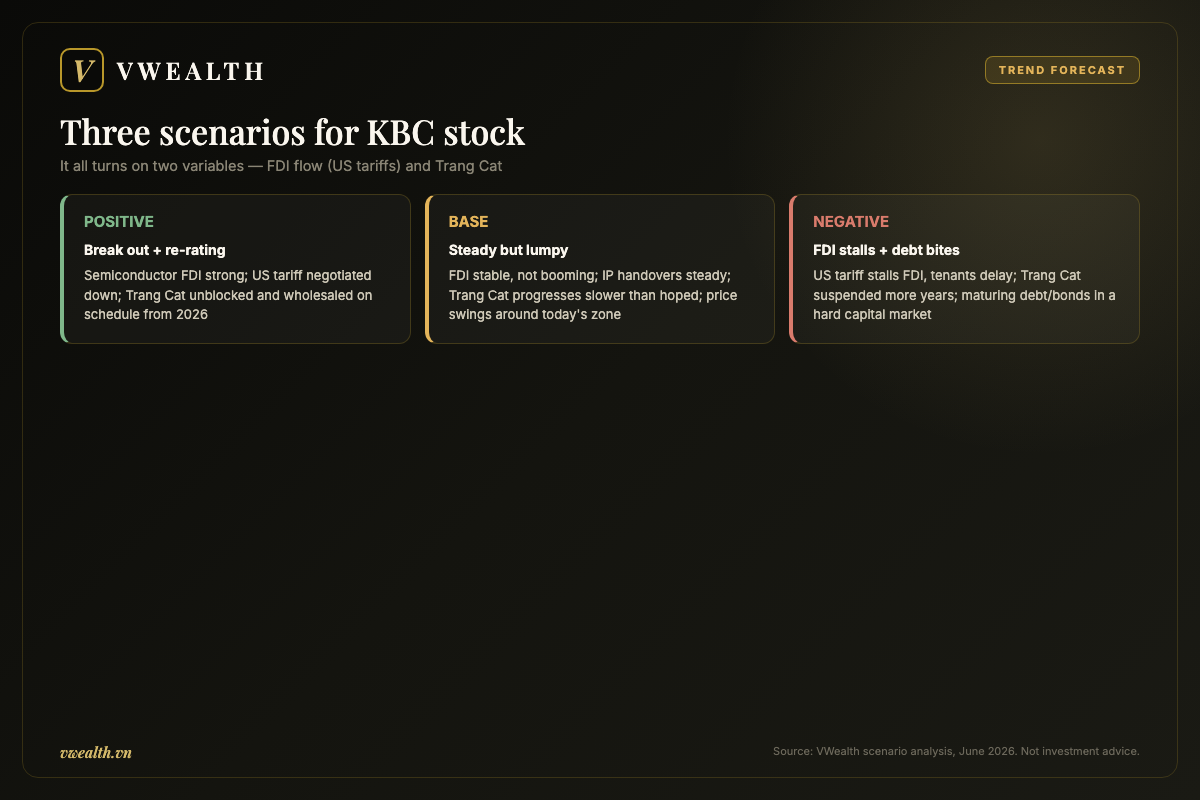
An important note on execution: KBC itself has a history of setting ambitious plans then missing. The company targets after-tax profit of up to 3,000 billion dong for 2026 — an ambitious figure versus the 2025 base. When you read these plans, keep a “trust but verify” attitude: a plan is management’s ambition, not a firm commitment. The gap between plan and execution is precisely the risk you’re bearing.
Should you buy KBC stock?
This is the question you really want answered. But I won’t answer for you with a single “buy” or “sell” — because that would be irresponsible with your money. Instead, I’ll weigh the pros and cons frankly, then help you see whether KBC matches the kind of investor you are. The final decision must be yours, based on your own risk appetite and goals.
On the scale: PROS
- Position in the FDI “eye of the storm.” KBC is one of the leading IP developers in the country’s hottest FDI area — the North, with electronics-semiconductor clusters in Bac Ninh, Hai Phong, Thai Nguyen. You’re buying directly into the “China + 1” wave and the semiconductor wave, not indirectly through a vague story.
- The Trang Cat “reserve” and a large land bank. Trang Cat inventory over 16,900 billion dong plus a land bank over 3,000 ha is a tangible asset block. For this reason, many analysts value KBC by RNAV (Revalued Net Asset Value), and the current price is usually below the estimated asset value — meaning you may be buying assets below their intrinsic value.
- High leasing margins and rising lease prices. In an environment of northern IP land-lease prices rising 5–9%/year and high occupancy, a business owning low-cost land in prime areas enjoys attractive margins.
- Low, accessible price. At about 30,000đ per share and a P/E of about 10 times, KBC is a stock with a low absolute price, easy for individual investors to buy — though, as we’ll see, this P/E must be read very cautiously.
On the scale: CONS
- Lumpy, hard-to-forecast profit. This is KBC’s most uncomfortable trait. 2025 after-tax profit reached 2,226 billion dong, but this comes from handing over large plots in batches — this quarter booms, the next quarter can be nearly blank. You can’t model KBC as a business with steady cash flow.
- Distorted P/E valuation. Precisely because profit is lumpy, KBC’s ~10x P/E easily misleads: it’s “cheap” in a big-handover year and “expensive” in a handover-lean year. Using P/E to compare KBC with a steady-profit stock is a methodological error.
- Trang Cat — legality and development slow for years. “The reserve” only has value when realized into money. Trang Cat has sat on the books for years; legal and sales progress may keep being slow. This 16,900-billion inventory is both a plus (large asset) and a minus (capital “frozen,” not yet generating money).
- Debt, bonds and capital intensity. Developing IPs and urban areas devours enormous capital. KBC disbursed very large investment (nearly 19,881 billion dong in 2025) and relies heavily on borrowing and bonds. In a hard capital-raising environment, pressure to repay maturing debt is a real risk.
- US tariff risk stalling FDI. As analyzed, tariffs made a portion of FDI delay decisions in Q2–Q3 2025. If this trend lasts, KBC’s tenant flow is directly affected.
- High speculative volatility and erratic dividends. KBC is a speculator-favored stock, with a large swing range by news and sentiment. Dividends are uneven, not a choice for those seeking steady income.
Which kind of investor are you? A 4-group frame
The most useful way to decide isn’t to ask “is KBC good or bad,” but to ask “does KBC suit me.” Hold yourself up against the four groups below:
| Investor type | Does KBC suit? | Why |
|---|---|---|
| Growth / risk-tolerant | Best fit | You believe in the long-term FDI-semiconductor story and Trang Cat’s RNAV potential, accept lumpy profit and high price volatility in exchange for large upside if the positive scenario plays out. |
| Value investor | Can suit, but needs patience | You’re drawn by the price below RNAV. But you must accept that this “value” may take years for the market to recognize, and depends on Trang Cat being unblocked. |
| Income / dividend | Low fit | KBC’s dividends are erratic, its cash flow lumpy. If you need steady income, this isn’t an ideal choice. |
| Capital-preservation / stability-first | Not suitable | High volatility, large debt leverage, legal and tariff risk make KBC unsuitable for those prioritizing safe capital preservation. |
As you see, KBC is a stock with a very clear personality. It suits those who believe in the long-term FDI-growth and Trang Cat-RNAV story, willing to “ride a bumpy car” in exchange for potential. It less suits those needing stability, steady dividends, or peace of mind on liquidity and debt. There’s no right answer for everyone — only the right answer for you.
Closing words
KBC is a classic problem of Vietnamese IP real estate: a business sitting on a large asset block in exactly the golden area, benefiting directly from the most durable macro trends (FDI, supply-chain relocation, semiconductors), but simultaneously bearing very real risks on profit lumpiness, debt leverage, Trang Cat legal progress and the tariff variable. The two pans don’t tip decisively to either side — and that’s why you need to weigh it by your own appetite, rather than follow a “stock tip.”
Disclaimer: This article is produced for informational and reference-analysis purposes, and is not a recommendation to buy, sell or hold any security. The figures are compiled from public sources at the time of writing and may change. Investing in stocks always carries risk; you may lose part or all of your capital. You should do your own thorough research and/or consult a licensed financial advisor before making an investment decision. Every decision and investment outcome is your own responsibility.
Research Vietnamese stocks in English with vwealth. Our AI-powered platform turns Vietnamese market data into full English analysis reports — with international payment support and a free 2-month trial for new accounts. Create your free account and read the latest reports.