Vietnam corporate governance is the variable that separates investors who compound quietly for a decade from investors who wake up one morning owning a smaller slice of a different company than the one they bought. The accounting can be clean, the industry can be booming, and the valuation can look cheap — and none of it protects you if the people controlling the company treat minority shareholders as a funding source rather than as partners. This guide explains how control actually works in Vietnamese listed companies, where value quietly leaks away from small shareholders, and how to run a practical 10-point governance check using only public sources, most of them available in English.
Why Governance Matters More in Vietnam Than in Markets You Already Know
In the United States or Western Europe, most large listed companies have no single controlling shareholder. Ownership is spread across thousands of funds and individuals, and management answers — at least in theory — to a board elected by that dispersed crowd. The classic governance problem there is lazy or overpaid managers. Annoying, but rarely fatal.
Vietnam is built differently. The typical listed company has an identifiable controller: a founding family, a founding entrepreneur, a state ministry, or a small group of allied shareholders. That controller usually holds enough votes to decide everything that matters — board seats, dividends, new share issuance, big acquisitions. The governance question is not “will managers work hard?” It is “will the controller share the value the company creates, or find ways to keep a disproportionate slice?”
This changes what you should check before buying. A foreign investor who runs a standard Western-style checklist — independent directors, audit committee, governance code compliance — will get a page full of reassuring checkmarks that tell them almost nothing. Vietnamese companies have learned what boxes global investors like to see ticked. The real information sits elsewhere: in related-party transaction disclosures, in the history of share issuance, in how annual general meetings are run, and in what the controller has done with minority shareholders’ money over the past five to ten years.
None of this means Vietnamese companies are systematically badly run. Many are governed well, and the gap between the best and worst is exactly why governance analysis pays. When most of the market trades on earnings and stories, the investor who also reads the governance record gets a genuine edge: they avoid the slow-motion disasters and they can hold the well-governed compounders with real confidence. If you are new to the market itself, start with our complete guide to investing in Vietnam’s stock market as a foreigner and come back — this article assumes you know the basics of accounts, boards and trading.
Ownership Concentration: The Single Fact That Explains Everything Else
Before you read a single financial statement, answer one question: who controls this company? Everything else in Vietnamese governance analysis flows from the answer.
The three typical control structures
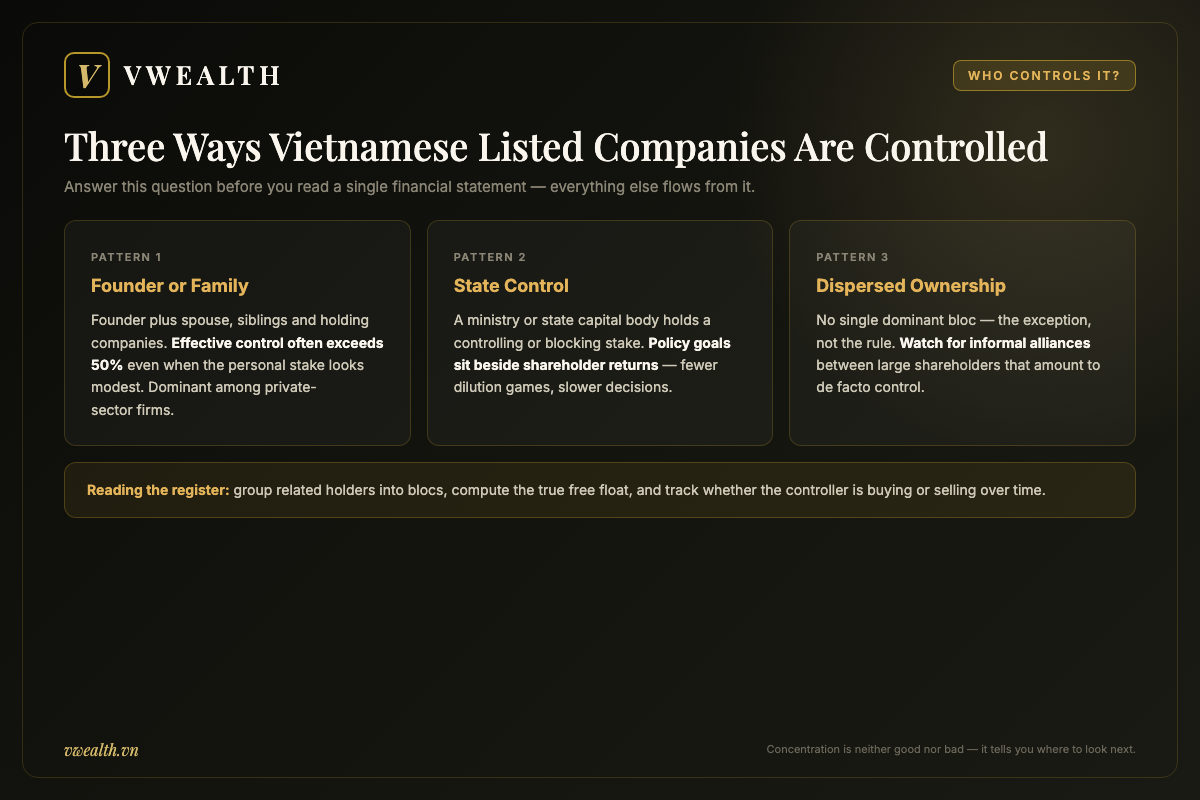
Vietnamese listed companies overwhelmingly fall into one of three ownership patterns.
Founder or family control. A founding entrepreneur, often with spouse, siblings and children as co-shareholders, holds a large direct stake plus additional shares through private holding companies. Add loyal early employees and business partners, and effective control frequently sits well above 50 percent of votes even when the founder’s personal stake looks modest on paper. This is the dominant model among private-sector companies in real estate, retail, consumer goods and manufacturing.
State control. The government, through a ministry, a provincial people’s committee or a state capital-management body, holds a controlling or blocking stake. Many of Vietnam’s largest listed companies by market value were equitized state enterprises — meaning the state converted them into joint-stock companies and sold part, but only part, of the shares to the public. The state’s objectives include policy goals, employment and stability, not just shareholder returns, which cuts both ways: fewer aggressive dilution games, but also slower decisions and occasional priorities that have nothing to do with your return. The dynamics are distinct enough that we cover them separately in our guide to state-owned enterprises on Vietnam’s stock market.
Genuinely dispersed ownership. A minority of companies — often banks with foreign strategic shareholders, or firms whose founders sold down over time — have no single dominant bloc. These are the closest to what Western investors are used to, but they are the exception, and even here, informal alliances between large shareholders can amount to de facto control.
How to read a shareholder register
The shareholder structure appears in every annual report and on stock exchange disclosure pages. Do not stop at the headline table. Three refinements matter.
First, group related holders. A founder with 20 percent, a spouse with 8 percent, a family holding company with 15 percent and a brother with 5 percent is a 48-percent controller, not a 20-percent shareholder. Vietnamese disclosure rules require related parties of internal shareholders to be identified, so the raw material for this exercise is public — you just have to add the rows yourself.
Second, calculate the real free float. Free float means the shares actually available for public trading — total shares minus everything held by the controller, the state, strategic partners and treasury. A company can have a large market value and a thin float, which means prices move sharply on small volumes and your exit may be slower than you expect.
Third, watch changes over time. A controller steadily buying is usually a comforting signal — they are putting their own money next to yours. A controller steadily selling while the company issues optimistic forecasts deserves your full attention. Insider transactions must be disclosed before and after execution: under Circular 96/2020/TT-BTC (the Ministry of Finance’s securities-market disclosure rules, in force since 1 January 2021), “internal persons” of a listed company — board members, executives, the supervisory board, the company secretary — and their related persons must register an intended trade at least three working days before dealing and report the result afterward, and the rule extends to any group of related persons holding 5 percent or more of voting shares. That means a patient reader can reconstruct the whole pattern from exchange announcements, and it is why an undisclosed accumulation or a quietly pledged block is itself a governance failure rather than a footnote.
Concentration itself is neither good nor bad. A capable controlling founder with most of their wealth in the company can be the best ally a minority investor ever has — they want the share price higher for the same reason you do. Concentration only tells you where to look next: at the mechanisms through which a controller could, if so inclined, move value from the company to themselves. Those mechanisms are the subject of the next two sections.
Related-Party Transactions: Where Value Quietly Moves
A related-party transaction — usually abbreviated RPT — is any deal between the listed company and someone connected to its controllers: the founder’s private companies, family members, subsidiaries, affiliates, or entities owned by board members. RPTs are legal, disclosed, and often perfectly sensible. They are also, worldwide, the single most common channel through which controlling shareholders extract value from minority investors. In a market defined by concentrated ownership, the RPT note is the most important page of a Vietnamese annual report.
How value extraction works in practice
Consider an illustrative example — call it Company A, a fictional listed construction-materials producer controlled by its founding family. Nothing dramatic ever appears in the news. But the annual report’s related-party note, read carefully over several years, shows a pattern. Company A buys a large share of its raw materials from a private trading firm owned by the founder’s son, at prices you cannot verify. It sells a meaningful share of output to a private distributor owned by the founder’s daughter — who presumably captures the retail margin. It lends money, interest-free or nearly so, to “affiliates” that never quite repay on schedule. And in the year the founder needed cash, the listed company bought a piece of land from a family company at a valuation set by an appraiser the family chose.
Each transaction was disclosed. Each was approved — by a board the family elected. No single deal was large enough to trip the thresholds that would have handed the decision to shareholders as a whole. The law does draw those lines: Article 167 of the Law on Enterprises 2020 (Law 59/2020/QH14, effective 1 January 2021) sends any contract, loan or asset sale worth more than 10 percent of total assets between the company and a major shareholder — or that shareholder’s related persons — to the General Meeting of Shareholders, and Decree 155/2020/ND-CP raises the same requirement to a 35-percent-of-assets threshold for public companies, aggregated across a series of linked deals. Crucially, the interested shareholder is barred from voting on such a resolution. But a family that keeps each deal below the line never triggers the vote at all. Yet in aggregate, a few percentage points of value leaked out every year. Compounded over a decade, minority shareholders funded a fortune they never shared in. That is the mechanism: not theft, but a thousand small tolls on the road between the company’s revenue and your dividend, each one individually too small to force a shareholder vote.
Reading the RPT note like an analyst
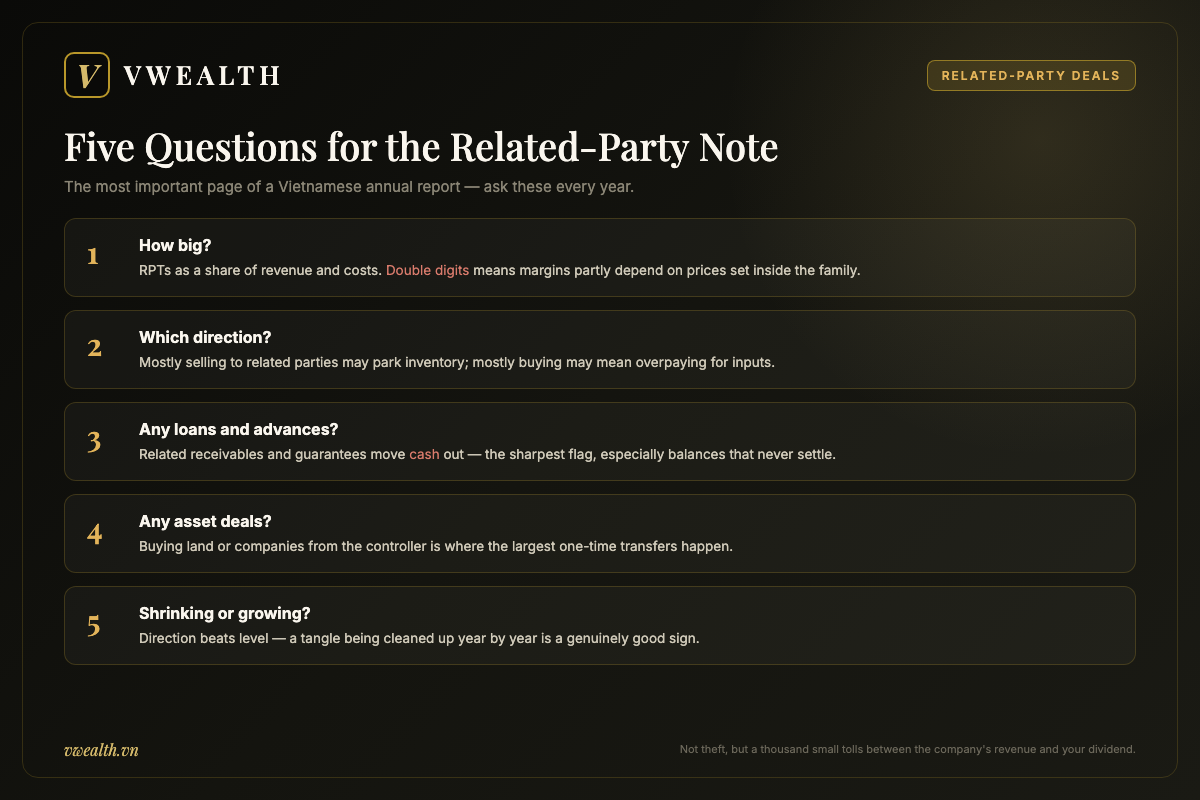
Every audited Vietnamese financial statement contains a related-party disclosure note, and companies with international ambitions publish English versions. When you open it, ask five questions.
How big? Total RPT purchases and sales as a percentage of revenue and costs. Under a few percent is usually noise. Double digits means the company’s profitability partly depends on prices set inside the family, and you should treat reported margins with caution.
Which direction? A listed company that mostly sells to related parties may be parking inventory or booking revenue that real customers have not yet validated. One that mostly buys from related parties may be overpaying for inputs. Both directions can transfer value; the note tells you which pipe to inspect.
Any loans and advances? Receivables from related parties, advances to affiliated contractors, and guarantees for affiliates’ bank loans are the sharpest red flags, because they move cash — not just margin — out of the company. Watch especially for balances that grow year after year without settling.
Any asset deals? Buying land, project stakes or entire companies from the controller is where the largest one-time transfers happen, because asset valuations are far easier to inflate than the price of cement. An independent valuation is a mitigant, not a guarantee — ask who hired the valuer.
Is it shrinking or growing? Direction matters more than level. A company that inherited a tangle of family transactions from its pre-listing days and visibly cleans them up year by year is telling you something good about its trajectory. The reverse pattern is telling you something too.
One practical note on sources: the RPT detail lives in the audited full-year financial statements, not in the glossy front half of the annual report. If you read our walkthrough of Vietnamese financial statements under VAS and how they differ from IFRS, you will know where the notes sit and what the local accounting standards do and do not force companies to reveal.
Share Issuance, Dilution and the ESOP Habit
The second major channel of minority-shareholder loss in Vietnam is not hidden in the notes at all. It happens in plain sight, announced at general meetings and executed through the stock exchange: the persistent issuance of new shares. Dilution — the shrinking of your percentage ownership as new shares are created — is the quiet tax of the Vietnamese market, and companies differ enormously in how heavily they levy it.
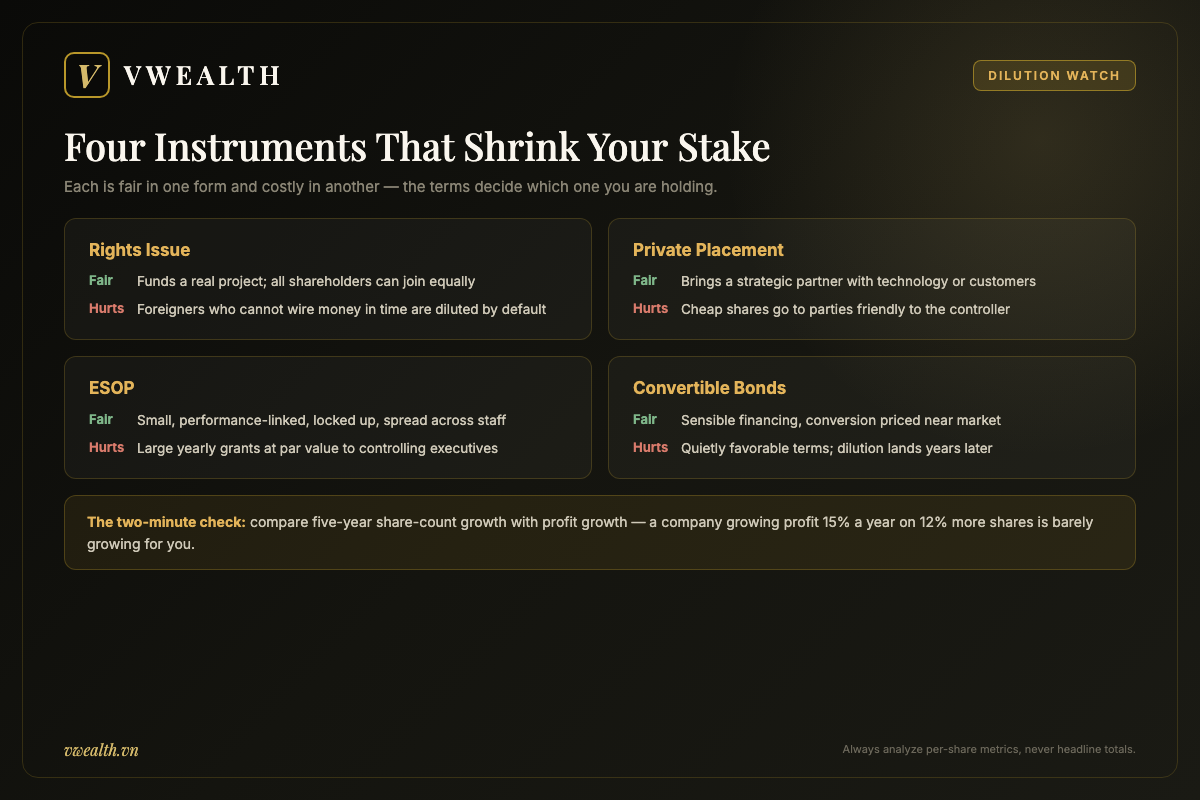
The four instruments to watch
| Instrument | What it is | When it is fair | When it hurts minorities |
|---|---|---|---|
| Rights issue | Existing shareholders may buy new shares in proportion to their holding, usually below market price | Funds a genuinely profitable project; all shareholders can participate equally | Foreigners who cannot easily wire money in time are diluted by default; proceeds fund vague “working capital” |
| Private placement | New shares sold to selected investors at a negotiated price | Brings in a strategic partner who adds technology, customers or credibility | Shares go cheaply to parties friendly to the controller, shifting ownership without a takeover |
| ESOP | Employee stock ownership plan — shares issued to staff at a steep discount, often near par value | Small, performance-linked, with multi-year lock-ups; genuinely spread across staff | Large, repeated annually, concentrated among executives who already control the company |
| Convertible bonds | Debt that the holder can convert into new shares at a preset price | Sensible financing with conversion priced near market | Conversion terms quietly favor the buyer; dilution arrives years later when everyone has forgotten |
A stock dividend — new shares issued to all holders instead of cash — deserves a special note because it confuses many newcomers. It does not dilute anyone: everyone’s slice grows in step, so ownership percentages are unchanged, and the share price mechanically adjusts downward on the entitlement date. It is largely cosmetic. The instruments in the table above are different, because they change who owns what.
Company B: a dilution story in numbers
An illustrative example again — Company B, a fictional mid-sized property developer. Suppose it earns 500 billion dong of profit on 250 million shares: 2,000 dong of earnings per share. Over four years, it runs a five-percent ESOP each year at par value for its executive team, converts a bond issued to a friendly investor, and completes one dilutive private placement. Share count drifts from 250 million to 400 million. Now suppose management delivers what it promised and profit grows 30 percent to 650 billion dong. Earnings per share are 650 billion divided by 400 million — about 1,625 dong. The company grew; your share of it shrank faster. A shareholder who read only the headline profit growth saw a success story. A shareholder who tracked the share count watched their earnings claim fall by roughly a fifth despite everything going right operationally.
That is why experienced Vietnam investors evaluate every company on per-share metrics over multi-year windows, never on headline totals. The two-minute version of the check: pull the share count from five years ago and today (both are in the financial statements), compute the compound growth rate of shares outstanding, and subtract it mentally from any growth number management shows you. A company that grows profit 15 percent a year while growing share count 12 percent a year is, for you, barely growing at all.
ESOP: incentive or transfer?
ESOPs deserve their own paragraph because the same three letters describe two very different practices. The regulatory frame is worth knowing first: for public companies, Decree 155/2020/ND-CP caps employee-share issuance at 5 percent of outstanding shares in any twelve months, requires the plan — including the criteria, the recipient list and the allocation formula — to be approved by the General Meeting of Shareholders, and imposes a minimum one-year transfer lock-up. Those rules set the outer boundary, not the standard of good behavior. In its honest form, an ESOP is a small annual issuance — one or two percent of shares — granted broadly to employees, tied to hitting published targets, and locked up well beyond the statutory minimum so recipients care about long-term value. In its extractive form, it runs right at the 5-percent legal ceiling year after year, priced near par at a fraction of the market, concentrated among a handful of top executives who are often the controlling shareholders themselves, and unlocked the day the one-year minimum expires. The second form is simply a wealth transfer from you to the controller, rebranded as compensation. Because the GMS must approve the plan and the AGM documents disclose the size, price, recipients and lock-up of every ESOP, five minutes of reading settles which kind you are looking at.
Board Independence: The Paper Version and the Real Version
Vietnamese regulation has steadily imported the vocabulary of international governance, and it is worth knowing what the rules actually require. The Law on Enterprises 2020 lets a joint-stock company pick one of two board structures: the traditional two-tier model, with a board of directors plus a separate supervisory board, or a one-tier model, with a board of directors that must include an audit committee and — under the same law — have at least 20 percent of its members qualify as independent directors. Circular 116/2020/TT-BTC, the Ministry of Finance’s public-company governance rules issued on 31 December 2020 under Decree 155/2020, layers on further minimums: a listed company’s board must contain at least one non-executive member if it has three to five seats, at least two if it has six to eight, and at least three if it has nine to eleven, with at least one independent member on the board and an audit committee chaired by an independent director. So the label “independent director” is not marketing — it is a defined status with legal criteria, directors with no material ties to the company or its large shareholders. On paper, boards increasingly resemble those in developed markets.
In practice, remember the arithmetic of control. Directors are elected by shareholder vote, and a 55-percent controller decides, in effect, every seat — including the “independent” ones. An independent director in a controlled company serves at the controller’s pleasure, whatever the label says. This does not make independence meaningless; it makes it something you verify rather than assume.
What does real independence look like from outside? A few observable markers help. Look at who the independent directors are: a retired audit partner, a respected professor of finance, or a former regulator with a public reputation to protect behaves differently from an obscure associate of the founder’s golf circle. Look at tenure: an “independent” director in their twelfth year on the board is independent mostly of the dictionary. Look for resignations: when independent directors or, more tellingly, auditors resign abruptly and without clear explanation, treat it as a fire alarm — people with reputations rarely walk away from comfortable seats without reason. And look at whether the board ever visibly disagrees: a supervisory report or audit-committee note that raises a real concern, in writing, is rare and valuable evidence that the structure has teeth.
One structural quirk worth knowing: Vietnamese companies historically ran a two-tier system with a separate supervisory board — an elected watchdog organ distinct from the board of directors. Companies have been migrating to the single-board model with an audit committee, and you will encounter both structures in annual reports. Neither model is automatically better; in both, the question is the same — do the watchdogs have any incentive to bark?
Finally, check the simplest thing of all: does the CEO also chair the board? Regulation has pushed to separate the two roles, but families sometimes route around the rule by installing a relative or long-time lieutenant in one seat. The org chart tells you the formal answer; the shareholder register tells you the real one.
Disclosure Quality: The Three Tiers of Vietnamese Listed Companies
Disclosure — what a company tells the public, how fast, in what language and in how much detail — varies more in Vietnam than almost any other governance dimension. Usefully for you, disclosure quality is itself a signal: companies that communicate like global businesses usually govern more like them too, because both habits come from the same decision to court institutional and foreign capital.
| Tier | Typical behavior | What it means for a foreign investor |
|---|---|---|
| Tier 1 — International grade | Full English annual report and financial statements; quarterly earnings presentations or analyst calls; an investor-relations contact who answers email; sometimes supplementary IFRS reporting alongside Vietnamese standards | You can do genuine primary research from abroad; the company is deliberately building a reputation it would be expensive to burn |
| Tier 2 — Compliance grade | Vietnamese-language filings on time and complete; partial or delayed English translations; annual report is glossy but thin on the hard questions; IR exists but is passive | Research is possible with translation tools and patience, but you are structurally behind local readers; size positions accordingly |
| Tier 3 — Minimum grade | Bare regulatory filings, Vietnamese only, sometimes late; terse related-party notes; no IR function; AGM materials appear days before the meeting | You cannot adequately monitor this company from abroad; whatever the valuation, the information asymmetry prices you out |
Two refinements make this tiering more useful. First, watch for movement between tiers. A company that starts publishing English reports, hires an IR head and hosts its first analyst call is usually preparing for something — index inclusion, a foreign strategic sale, a capital raise — and the governance house-cleaning that precedes such events often benefits minorities. Deterioration in the other direction, such as English reporting quietly stopping, is an equally informative signal with the opposite sign.
Second, test the disclosure yourself on the questions that matter. Any company can write beautifully about strategy. Check instead whether the annual report answers the awkward questions: does the business-review section explain the year’s margin change with actual causes, or restate the income statement in sentences? Does it name the risks that actually bit competitors, or list generic ones? Did last year’s report state targets, and does this year’s report honestly reconcile against them? A company that gives itself a scorecard and shows you the misses is telling you how it will treat you when something goes wrong — which is the only time governance really matters.
Audit choice belongs in this section too. The large international audit networks and the top domestic firms audit the majority of serious Vietnamese listed companies. An abrupt switch from a major auditor to a small local firm, especially after a disagreement, is one of the most reliable warning signs in any market. The auditor’s opinion page — one page, always worth reading — will also flag qualified opinions and emphasis-of-matter paragraphs, which are auditor-speak for “we need you to look at this.”
The Annual General Meeting: A Window Into How Minorities Are Treated
The annual general meeting — the yearly shareholder assembly that approves dividends, elects directors and authorizes share issuance — is where Vietnamese governance stops being abstract. You do not need to attend to learn from it. The paper trail alone, published before and after every AGM, is one of the richest free governance datasets available.
Before the meeting, companies publish the agenda and draft resolutions. The Law on Enterprises 2020 (Article 143) requires the invitation, agenda, supporting documents and draft resolutions to reach shareholders at least 21 days before the meeting — unless the charter sets a longer period — so a company that dumps hundreds of pages on you at the legal minimum, or bundles a dozen approvals a genuine reader could not digest in three weeks, is telling you how much scrutiny it wants. Read the resolutions the way a lawyer reads a contract, because that is what they are: authorizations the controller is requesting from you. Is the ESOP resolution specific about size, price and lock-up, or does it delegate “details” to the board? Does the capital-raise resolution name a use of proceeds you could later verify, or say “supplementing working capital”? Is the dividend proposed in cash or in shares? Broad, vague delegations to the board are the thing to watch — every future surprise starts life as a vague resolution nobody questioned.
After the meeting, companies publish minutes and vote counts, and this is where the gold sits. In a company with a 60-percent controller, every resolution passes; the information is in the size of the minority “no” vote. A resolution that passes with 68 percent approval in such a company just told you that the floating shareholders — the people who did the same analysis you are doing — voted against it in large numbers. Serial near-unanimous approval of dilutive issuance, by contrast, may just mean the float is not paying attention, which is its own kind of information.
The minutes also record shareholder questions and management answers. Reading two or three years of them tells you whether questioners are engaged with substance, whether management answers or deflects, and whether the meeting is scheduled and run in a way that welcomes scrutiny or discourages it. Small procedural details — meetings called at short notice, held in remote locations, or bundling a dozen unrelated approvals into one vote — are petty, observable and predictive.
One Vietnamese pattern deserves specific mention: the mid-year extraordinary general meeting, or written shareholder consultation, used to approve issuance that was not in the annual plan. Occasionally this reflects a genuine opportunity that appeared mid-year. As a habit, it suggests a controller who prefers to seek approvals when attention is lowest. The frequency of extraordinary approvals is countable from public disclosures, and counting it is worth your time.
The 10-Point Governance Checklist You Can Run From Public English Sources
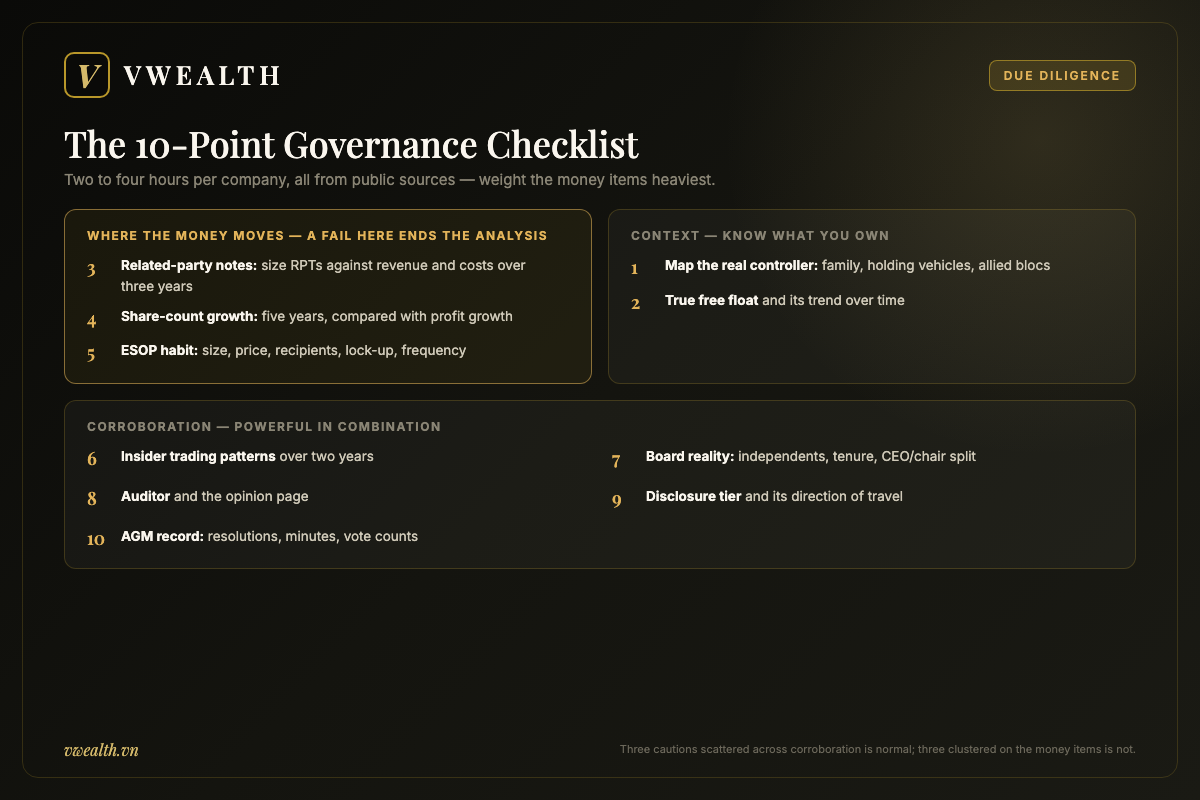
Everything above condenses into a checklist you can complete in two to four hours per company, using annual reports, audited financial statements, exchange disclosures and AGM documents. Score each item pass, caution or fail. The goal is not a precise number; it is to force yourself to look at all ten places where governance problems leave tracks.
| # | Check | Where to look | Fail looks like |
|---|---|---|---|
| 1 | Map the real controller: group family members, holding vehicles and allies into blocs | Annual report ownership section; exchange disclosures | You cannot work out who controls the company — opacity is itself a fail |
| 2 | Compute true free float and its trend | Ownership table minus controller, state, strategic and treasury holdings | Thin float with heavy retail churn and no institutional presence |
| 3 | Read three years of related-party notes; size RPTs against revenue and costs | Audited financial statements, related-party note | Double-digit RPT share, growing related receivables, asset purchases from the controller |
| 4 | Compute five-year share-count growth and compare with profit growth | Financial statements, equity note | Share count compounding at high single digits with no matching per-share value creation |
| 5 | Audit the ESOP habit: size, price, recipients, lock-up, frequency | AGM resolutions and minutes | Large annual ESOPs at par value concentrated among controlling executives |
| 6 | Check insider trading patterns over two years | Exchange announcements of internal-shareholder transactions | Sustained controller selling alongside upbeat guidance |
| 7 | Assess board reality: who the independents are, tenure, CEO/chair split, resignations | Annual report governance section; company announcements | Unexplained departures of independent directors or auditors |
| 8 | Verify auditor and read the opinion page | Audited financial statements, first pages | Downgrade to an obscure auditor; qualified opinions; repeated late filings |
| 9 | Grade disclosure tier and its direction of travel | Company website, IR section, English availability | Tier 3 disclosure, or visible deterioration from a higher tier |
| 10 | Read two years of AGM resolutions, minutes and vote counts | Company website and exchange filings | Vague blanket authorizations; large minority “no” votes ignored; frequent extraordinary approvals |
Weight the items unequally. Items 3, 4 and 5 — related parties, dilution and ESOP — are where the money actually moves, and a clear fail on any of them should usually end the analysis regardless of how attractive the business looks. Items 1 and 2 are context. Items 6 through 10 are corroboration: rarely decisive alone, powerful in combination. Three cautions scattered across the corroborating items are normal for a mid-cap in a developing market; three cautions clustered on the money items are not.
Also respect what the checklist cannot see. It reads history, and controllers change behavior — occasionally for the better, when a company professionalizes ahead of courting foreign capital, and occasionally for the worse, when a founder’s outside ventures start needing cash. That last pattern is worth internalizing: a controller under financial pressure elsewhere is the single most common precursor to extractive behavior at an otherwise decent company. You cannot see a controller’s private balance sheet, but you can see its shadows — pledged shares disclosed to the exchange, sudden dividend pushes, and new related-party lending are the usual silhouettes.
Green Flags: What Good Governance Actually Looks Like Here
Checklists skew negative, so balance the picture. Vietnam has companies whose governance would be respectable in any market, and they share observable habits. There is a real difference between a company that is clean because it has never been tested and one that has visibly chosen cleanliness; the following signals mark the second kind.
A history of treating the share count as sacred. The strongest single green flag is a company that has grown for years while barely issuing shares, funding expansion from its own cash flow and reasonable debt. It means the controller values their own stake the way you value yours — and dislikes dilution for the same reason.
Cash dividends paid through bad years. A long, uninterrupted record of cash dividends — not stock dividends — is hard evidence that profits are real and that the controller shares them. Cash leaving the company treats every shareholder identically; it is the one benefit that cannot be tilted toward insiders.
Foreign institutional shareholders who stay. The presence of long-horizon foreign funds on the register, holding across market cycles, tells you that professional investors with local analysts and legal review reached a positive governance verdict and keep renewing it. Their exit, conversely, is worth noticing even when no explanation is published.
Boring related-party notes. Two lines of immaterial transactions where there could be twenty lines of family dealings is a deliberate choice, sustained over years, and among the most eloquent disclosures a controlled company can make.
Promises reconciled against results. Companies that publish targets and then, the following year, show the scorecard — including the misses — are displaying the internal culture that governance frameworks try to legislate and mostly cannot.
Note that this list does not include a big market value, a famous brand or index membership. Size correlates loosely with disclosure quality, but some of the market’s largest names carry concentrated-control risks, and some mid-caps are immaculately governed. Governance is checked company by company; there are no safe categories.
Running the Check From Abroad: A Practical Workflow
Here is how to sequence the work when you are researching from outside Vietnam, in English, without a local broker’s research desk.
Step one: collect the documents. For any serious candidate you need the last three annual reports, the last three audited full-year financial statements, and the AGM materials for the last two years. Tier-1 companies publish all of this in English on their own investor-relations pages. For others, the Vietnamese originals are on company websites and exchange disclosure portals, and modern machine translation handles Vietnamese financial prose well enough for governance reading — the numbers, which matter most, need no translation.
Step two: run the money items first. Related-party notes, share-count history, ESOP record. Two hours. If the company fails here, stop; you have saved yourself the remaining work and possibly a great deal of money.
Step three: build the timeline. Take fifteen minutes to list, in date order, every capital event and governance event of the past five years: issuances, ESOPs, auditor changes, director resignations, insider trades, extraordinary meetings. Patterns invisible in any single document become obvious in a timeline — the ESOP that lands every year right after good results, the director who resigned two months before the restatement, the placement that always follows the optimistic forecast.
Step four: corroborate and grade. Board reality, disclosure tier, AGM record. Finish the ten-point table and write down — actually write down — a one-paragraph governance verdict. Writing forces honesty about the cautions you were tempted to wave through because the valuation looked attractive.
Step five: re-check annually. Governance is a flow, not a stock. Each year’s annual report, AGM package and disclosure record either extends the pattern you bought or breaks it. The annual re-check takes a fraction of the initial work and is where you catch deterioration early — which, in controlled companies, is the only time catching it helps.
This is exactly the layer of work that is hardest to do from abroad, and it is a large part of why vwealth exists: our platform’s AI-generated English reports on Vietnamese listed companies pull ownership structures, dilution history and financial-statement detail into readable analysis, so the raw material for the checklist above is a search away rather than a translation project. The library of company reports is the natural companion to this checklist, and the VAS-versus-IFRS guide will help you read the underlying statements with the right expectations about what local accounting does and does not show.
The Bottom Line: Price the Governance, Don’t Just Screen It
Corporate governance in Vietnam is not a pass-fail compliance topic; it is a fundamental input into value, as real as margins or growth. Concentrated ownership is the market’s defining feature, and it cuts both ways: the same controller who could dilute you is often the deeply invested founder whose interests are perfectly aligned with yours. Your job is to tell the two apart before you buy, using the tracks every controller leaves in public documents — related-party notes, share-count history, ESOP records, board changes, disclosure habits and AGM behavior.
Three habits summarize the whole discipline. Always analyze per-share, never headline totals. Always read the related-party note before the strategy section. And always weight what controllers did over what they said — five years of documented behavior outpredicts any interview. Companies that pass the ten-point check deserve, and in practice command, a durable premium; companies that fail it are cheap for reasons that a low price does not fix. Understanding how state ownership changes the calculus and how the market’s plumbing works for foreigners completes the toolkit — governance analysis works best when it sits inside a full research process rather than replacing one.
This article is educational analysis for reference, not investment advice or a recommendation to buy or sell any security.
Research Vietnamese stocks in English with vwealth. Our AI-powered platform turns Vietnamese market data into full English analysis reports — including the ownership, dilution and financial-statement detail this checklist relies on — with international payment support and a free 2-month trial for new accounts. Create your free account and read the latest reports.
Frequently Asked Questions
Vì sao cổ đông nước ngoài nên quan tâm đến cơ cấu sở hữu trước khi đầu tư vào một công ty niêm yết ở Việt Nam?
Vì phần lớn công ty niêm yết tại Việt Nam có một bên kiểm soát rõ ràng — gia đình sáng lập, nhà nước, hoặc một nhóm cổ đông liên kết — nắm đủ quyền biểu quyết để quyết định gần như mọi thứ quan trọng: ghế hội đồng quản trị, cổ tức, phát hành cổ phiếu mới, thương vụ lớn. Câu hỏi thực sự không phải là liệu ban lãnh đạo có làm việc chăm chỉ, mà là liệu bên kiểm soát có chia sẻ giá trị công ty tạo ra hay tìm cách giữ phần lớn hơn cho mình. Xác định ai thực sự kiểm soát công ty là bước đầu tiên trước khi tin vào bất kỳ số liệu nào khác trong reports.
Làm sao để đọc đúng danh sách cổ đông và phát hiện mức độ tập trung quyền lực thực sự?
Không nên dừng lại ở bảng cổ đông chính, mà cần nhóm các cổ đông liên quan lại với nhau — vợ/chồng, con cái, công ty holding gia đình — để thấy mức kiểm soát thực tế thường cao hơn nhiều so với con số công bố riêng lẻ. Sau đó tính free float thực (số cổ phiếu thực sự giao dịch tự do) và theo dõi biến động sở hữu theo thời gian. Một bên kiểm soát liên tục mua vào thường là tín hiệu tích cực; ngược lại, bán ra liên tục trong khi công ty đưa ra dự báo lạc quan là điều cần chú ý kỹ.
Giao dịch với các bên liên quan (related-party transactions) ảnh hưởng thế nào đến cổ đông thiểu số?
Đây là kênh phổ biến nhất trên toàn cầu để bên kiểm soát chuyển giá trị ra khỏi công ty, dù mỗi giao dịch đều hợp pháp và được công bố. Vấn đề nằm ở việc các giao dịch nhỏ lẻ với công ty riêng của người nhà sáng lập — mua nguyên liệu, bán qua nhà phân phối liên quan, cho vay lãi suất thấp — có thể không đủ lớn để phải đưa ra biểu quyết cổ đông, nhưng cộng dồn qua nhiều years sẽ rút một phần giá trị đáng kể mà cổ đông thiểu số không được chia.
Ngưỡng nào buộc một giao dịch với cổ đông lớn phải đưa ra Đại hội đồng cổ đông biểu quyết?
Theo Luật Doanh nghiệp 2020, hợp đồng, khoản vay hoặc giao dịch tài sản có giá trị trên 10% tổng tài sản giữa công ty và cổ đông lớn (hoặc người liên quan của họ) phải được Đại hội đồng cổ đông thông qua, và cổ đông có quyền lợi liên quan không được biểu quyết. Nghị định 155/2020/NĐ-CP nâng ngưỡng này lên 35% tổng tài sản đối với công ty đại chúng, tính gộp cho một loạt giao dịch liên kết. Tuy nhiên, một bên kiểm soát có thể giữ mỗi giao dịch dưới ngưỡng để tránh phải đưa ra biểu quyết.
Phát hành cổ phiếu mới (dilution) có phải luôn gây thiệt hại cho cổ đông nhỏ không?
Không phải lúc nào cũng vậy — điều quan trọng là mục đích và cách thực hiện. Phát hành quyền mua cổ phần công bằng khi mọi cổ đông đều được tham gia theo tỷ lệ và vốn dùng cho dự án sinh lời thực sự; ESOP hợp lý khi quy mô nhỏ, gắn với hiệu quả và có thời gian khóa nhiều years. Ngược lại, phát hành riêng lẻ giá rẻ cho các bên thân cận với người kiểm soát, hoặc ESOP lớn lặp lại hàng years chỉ tập trung vào ban lãnh đạo đã nắm quyền, sẽ làm giảm tỷ lệ sở hữu thực của cổ đông nhỏ dù lợi nhuận công ty vẫn tăng.
Cổ tức bằng cổ phiếu (stock dividend) có làm loãng tỷ lệ sở hữu của cổ đông không?
Không, cổ tức bằng cổ phiếu không gây pha loãng vì mọi cổ đông đều nhận thêm cổ phần theo đúng tỷ lệ sở hữu hiện có, nên phần trăm sở hữu của từng người không thay đổi. Giá cổ phiếu sẽ tự động điều chỉnh giảm vào ngày chốt quyền để phản ánh số lượng cổ phiếu tăng thêm. Đây chủ yếu là một thay đổi mang tính hình thức, khác hẳn với phát hành riêng lẻ, ESOP lớn hay trái phiếu chuyển đổi — những công cụ thực sự làm thay đổi cơ cấu sở hữu.