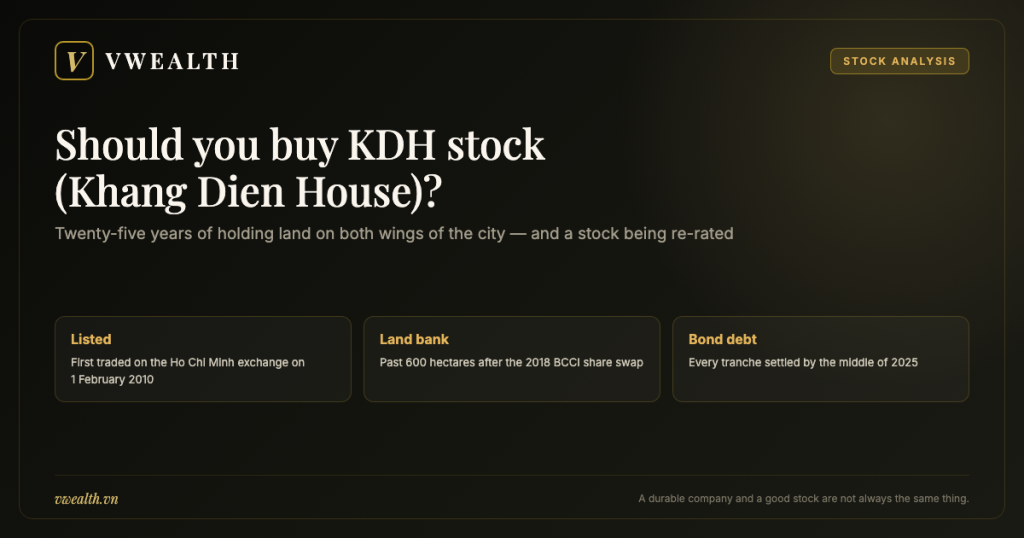
Should you buy KDH stock? For most of the past fifteen years the Vietnamese market answered that question with a single phrase: expensive, but you sleep at night. KDH is the Ho Chi Minh City exchange ticker for Khang Dien House Investment and Trading Joint Stock Company, a residential developer that analysts here habitually file under the heading “defensive property stock” — clean land, completed title deeds, little debt, no drama, and none of the corporate bond scandals that kept holders of its peers awake through the winter of 2022. And yet, in the first seven months of 2026, that same reassuring stock lost more than forty per cent of its value. The two largest foreign funds on its shareholder register both cut their positions. And the founder’s son, a deputy chief executive, registered to buy twenty million shares in the middle of the fall. The company is still standing, the land is still on the balance sheet, but the story has changed. This article walks through twenty-five years of a film director who left the set to sell houses, teaches you how to read the financial statements of a business whose largest asset sits on the line marked “inventories”, and finishes with a straight answer: which kind of investor KDH suits, and which kind it does not suit at all.
Two ground rules before we start, and the first one is about numbers. You are going to meet a great many dated milestones, project sizes, land areas, ownership percentages and shareholder resolutions — all of it publicly disclosed and verifiable. You will meet almost nothing from the most recent quarter: no latest earnings figure, no price-to-book ratio as of today, no closing price. The reason is specific to a residential developer. Khang Dien’s revenue does not flow evenly the way a factory’s or a bank’s does. It sits perfectly still for years while a project is under construction, then lands in a single lump in the two or three quarters when the houses are handed over to buyers. A record quarter may mean nothing more than that project A has finished its structural work. Printing today’s P/E for KDH would not merely be useless six months from now — it would actively mislead you, because, as Chapter 5 explains, this is the one class of stock where the P/E is the single most deceptive number on the board. Instead of handing you a figure with a short shelf life, this article teaches you to read the company’s own numbers. When you want today’s data, open the KDH report on the vwealth platform for the current metrics. The article gives you the framework; the report gives you the figures.
The second rule is about context, and it matters more if you are reading this from outside Vietnam. Before you read any single ticker here, get the mechanics straight: our guide to investing in the Vietnam stock market covers what a foreign investor has to sort out first — how to open a securities account and get a trading code, what the foreign ownership limit actually restricts, why the T+ settlement cycle and the daily price band change how you should size a position — and the broader Vietnam stock market guide maps how the three exchanges and the main sectors fit together. Then put Khang Dien next to its relatives, because this company only takes shape when you can see it against them. Nam Long is the closest thing it has to a sibling — the same affordable-and-mid-market housing model in the south, the same preference for taking a Japanese partner into a project rather than borrowing against it. Novaland is the mirror image, the case study in what happens when a developer runs on maximum leverage. Vinhomes is the company that single-handedly sets the price level of the entire Vietnamese housing market, and its parent Vingroup shows you how property sits inside a Vietnamese conglomerate. Those reference points will show you what KDH actually is — and why, for years, the market was willing to pay visibly more for it than for the rest of the sector.
One more piece of orientation, and then we begin. Almost everything in this story happens in two corners of one city. When you read “the East” here, it means Thu Duc City — the area that used to be District 2 and District 9 of Ho Chi Minh City, merged in 2021 into a single administrative city-within-a-city on the northeast side of the Saigon River. Think of it as Ho Chi Minh City’s Brooklyn: farmland and ponds thirty years ago, now the site of the high-tech park, the metro line, the new expressways and the most expensive new low-rise housing in the country. “The southwest” means Binh Chanh, the flatter, cheaper, more industrial belt on the opposite side of the city. Khang Dien owns land in both, and the difference between those two land banks explains a large part of the investment case.
From film director to landholder of the East: the history of Khang Dien
There is a detail that most people holding KDH stock today have never heard. The man who built this company did not start with cement and steel. He started with a movie camera. Before there was Khang Dien, Ly Dien Son was a film director. And that former trade — the trade of a man who has to see the whole picture in his head before he shoots the first frame — explains a surprising amount about how this company has done property for the twenty-five years since.
The man who changed lanes: Ly Dien Son and VND 10 billion in 2001
Ly Dien Son was born on 30 August 1966 in Vinh Long, a province in the Mekong Delta, and graduated from the University of Culture. In 1993 he released his first film as a director, Nuoc mat hoc tro — “Schoolchildren’s Tears” — and it found an audience. It was a good start in the movie business, and it was also a fork in the road, because within a few years he had walked off the set and into an entirely different game.
In December 2001 he founded Khang Dien House Investment and Trading Company Limited with charter capital of VND 10 billion. At today’s exchange rate that is roughly USD 400,000 — less than the deposit on a single townhouse in Thu Duc now. But in 2001 it was enough for a private company to buy a few small plots on the outskirts of Saigon and start learning the trade. Hold on to that VND 10 billion figure, because the entire story of Khang Dien is the story of a balance sheet that expanded by a factor of several thousand in a quarter of a century — and of the price that expansion carried with it.
Where he chose to buy, and why it mattered
The most consequential decision of those early years was geographic. Son bought in the east of the city: the old District 2 and District 9, today’s Thu Duc City. In the early 2000s that was rice paddy and fish ponds, a long way from the centre, with essentially no infrastructure. Nobody bought land there because they thought it was beautiful. They bought it because it was cheap and they believed it would stop being cheap.
That instinct — buy land before anybody wants it — became the company’s DNA. It is also the direct source of the unusually fat gross margins you will meet in Chapter 4. A developer’s margin is not really a measure of how well it builds. It is a measure of how long ago it bought, and at what price. Khang Dien’s margins today are an echo of purchase decisions taken fifteen and twenty years ago, made by a man who was betting on a map that did not exist yet.
The apprentice years: small townhouses, slow, clean
From 2001 to roughly 2010, Khang Dien did nothing spectacular. It developed small and mid-sized residential compounds in Districts 9 and 2, selling townhouses and villas to the city’s emerging middle class. No mega-project, no township, no advertising blitz. If you had been watching the Vietnamese property sector in that decade, you would not have written the company’s name down.
But it was precisely those quiet years that formed what investors here now call “the Khang Dien character”: small projects, legal paperwork completed before anything is sold, houses handed over together with the title deed, and almost no chasing of the glossy luxury segment.
That last item needs explaining for a foreign reader, because it is the hinge of the whole investment case. In Vietnam, the document that proves you own the right to use a piece of land and the house on it is a land use right certificate, universally known by the colour of its cover — the “pink book” (so hong). Without it, you can live in the house, but you cannot mortgage it, you cannot cleanly sell it, and your legal position is fragile. Because the process of getting the state to issue those certificates is slow and heavily dependent on the developer having settled its land use fees and construction approvals correctly, thousands of Vietnamese families have bought apartments that were finished years ago and still do not have the book. Protests by residents outside their own buildings, banners hanging off balconies demanding the pink book, are a recurring scene on the evening news.
Now ask the reverse question: how many developers in Vietnam have gone twenty-five years without a single significant collective dispute over title deeds? The list is much shorter than you would guess, and Khang Dien is on it. That is the origin of the price premium the market has paid for this stock for the better part of a decade — a premium for peace of mind, which we will take apart in Chapter 5.
2007 and 2010: two doors into the capital market
In 2007 Khang Dien converted from a limited liability company into a joint stock company. That is not merely an administrative step. Converting means accepting outside owners in exchange for capital, and accepting life under a disclosure regime.
On 1 February 2010, KDH shares began trading on the Ho Chi Minh Stock Exchange, the larger of Vietnam’s two main boards. By September 2010 charter capital had been raised to VND 439 billion. If you compare that figure with the company’s capital base today, you will see something important: essentially none of Khang Dien’s growth came from retained earnings. It came from continuously raising fresh capital — through share issues, through bonds, through bank borrowings, through selling stakes in individual projects to foreign partners. That is structural to the industry rather than particular to this company. Property development eats capital. A developer that cannot raise money cannot grow, no matter how good its land is.
2015–2017: a wave of launches and a change in the chairman’s seat
By the middle of the 2010s the Ho Chi Minh City housing market had recovered from the frozen years of 2011 to 2013, and Khang Dien opened the taps. Names arrived in quick succession: Mega Village, Mega Ruby, Lucasta, The Venica, Jamila, Rosita — mostly in the old District 9, mostly townhouses, villas and mid-priced apartments. This was the period in which the company proved it could run several projects in parallel rather than one at a time.
The most significant event of the period, though, happened in a meeting room rather than on a construction site. From 2001 to 2012 Ly Dien Son held both the chairmanship of the board and the chief executive role. Between 2012 and 2013 he stepped down to vice chairman while remaining CEO, then from 2013 to 2017 returned to being both chairman and CEO. In 2017 he resigned the chairmanship in favour of Mai Tran Thanh Trang and moved back to vice chairman, the position he still holds.
A founder voluntarily giving up the top seat while the business is on the way up is rare in Vietnam, where owner-operators tend to stay until they cannot. It can be read as a sign of maturing governance. It can equally be read as an internal rearrangement within a company that remains, in character, a family business. Chapter 2 will help you read it more precisely.
2018 — the leap: swallowing BCCI
If you had to pick one year as the turning point in Khang Dien’s history, it is 2018. That year the company absorbed Binh Chanh Construction Investment Corporation, known as BCCI, through a share swap — paying in its own equity rather than in cash, which is a very intelligent way to buy when you are short of money but rich in market confidence.
The result was startling. Khang Dien’s land bank jumped from roughly 16 hectares to more than 600 hectares. Read that again: a multiple of nearly forty. It came with a set of substantial projects in the southwest of the city — the Phong Phu 2 residential area at 132.92 hectares, the Tan Tao urban area at roughly 120 hectares, the 11A residential and public works area at 17.5 hectares, and the Le Minh Xuan Expanded Industrial Park at 109.9 hectares.
BCCI turned Khang Dien from an east-side developer into a company with a presence on both wings of the city. More importantly, it handed the company the scarcest commodity in this industry: raw material to work with for the next fifteen or twenty years, bought at 2018 prices. The entire investment thesis for KDH today — above all the gross margin we will examine in Chapter 3 — has its roots in that transaction.
2019–2022: launches, bonds, then the storm
After BCCI the company entered the heaviest development cycle in its history. Verosa Park delivered 296 townhouses and villas next to the Thu Duc high-tech park. Safira followed, then Lovera Vista with 1,310 apartments on 1.8 hectares in Binh Chanh, and The Classia formally went on sale on 25 November 2023.
The years from 2017 to 2022 were also the golden age of the Vietnamese corporate bond market, and Khang Dien, like almost every other developer, used the channel to fund projects and top up working capital. This needs saying plainly, because the company’s reputation can make people assume otherwise: for all its caution, Khang Dien did not sit out the bond boom.
Then the storm arrived. From the middle of 2022 the Vietnamese property market froze. The corporate bond channel seized up after a series of high-profile enforcement cases, property credit was tightened, and interest rates jumped. KDH fell hard, bottoming on 10 November 2022 at VND 19,110 per share. But unlike a number of its peers, which had to dump assets or renegotiate debt in a panic, Khang Dien came through without breaking. That live-fire test is what built the reputation it trades on.
2023–2026: Keppel, a bond-free balance sheet and a new fall
In mid-2023, with the market still bleak, Khang Dien announced its most significant transaction since BCCI. Keppel — the Singaporean group, formerly Keppel Corporation, which began as a shipyard and has spent the past two decades turning itself into an asset manager and urban developer with a long history of building in Vietnam, China and India — paid VND 3,180 billion for 49% of two projects, Emeria at 6 hectares and Clarita at 5.8 hectares, in Binh Trung Dong ward, Thu Duc City. Total development cost for the two was estimated at around VND 10,200 billion. Khang Dien kept 51%. Both projects broke ground in October 2023.
This is the model Nam Long has run for years with its Japanese partners: complete the legal work on a project, then sell part of it for cash up front, share the risk, and import the partner’s development standards along with its money. In return, you give away a slice of the future profit. There is no free lunch in that trade — only a choice about which risk you would rather carry.
In July 2024 the company completed a private placement of 110.1 million shares to 19 professional investors at VND 27,250 each, raising roughly VND 3,000 billion and lifting charter capital to VND 9,094 billion. By mid-2025 management reported that every outstanding bond tranche had been settled and that the company had no bond debt left in the market. In October 2025 the low-rise phase of Gladia by the Waters — the Keppel joint venture, with Khang Dien holding 51% — went on sale at VND 200–250 million per square metre.
And then the paradox. At exactly the point where the balance sheet was cleanest of bonds and the project pipeline was the thickest it had ever been, the stock fell. Prices slid steadily from September 2025; by 20 July 2026 the shares were down roughly 43.5% from the start of the year. Dragon Capital and VinaCapital both reduced their holdings. On 23 July 2026, Ly Tuan Kiet — deputy chief executive, and the son of vice chairman Ly Dien Son — registered to buy 20 million KDH shares, with the transaction window running to 21 August 2026.
That is the picture you are standing in front of: a company with a clean record, a large land bank and freshly retired bond debt, whose shares are being sold hard while the family buys. The rest of this article will show you why those two facts do not contradict each other at all.
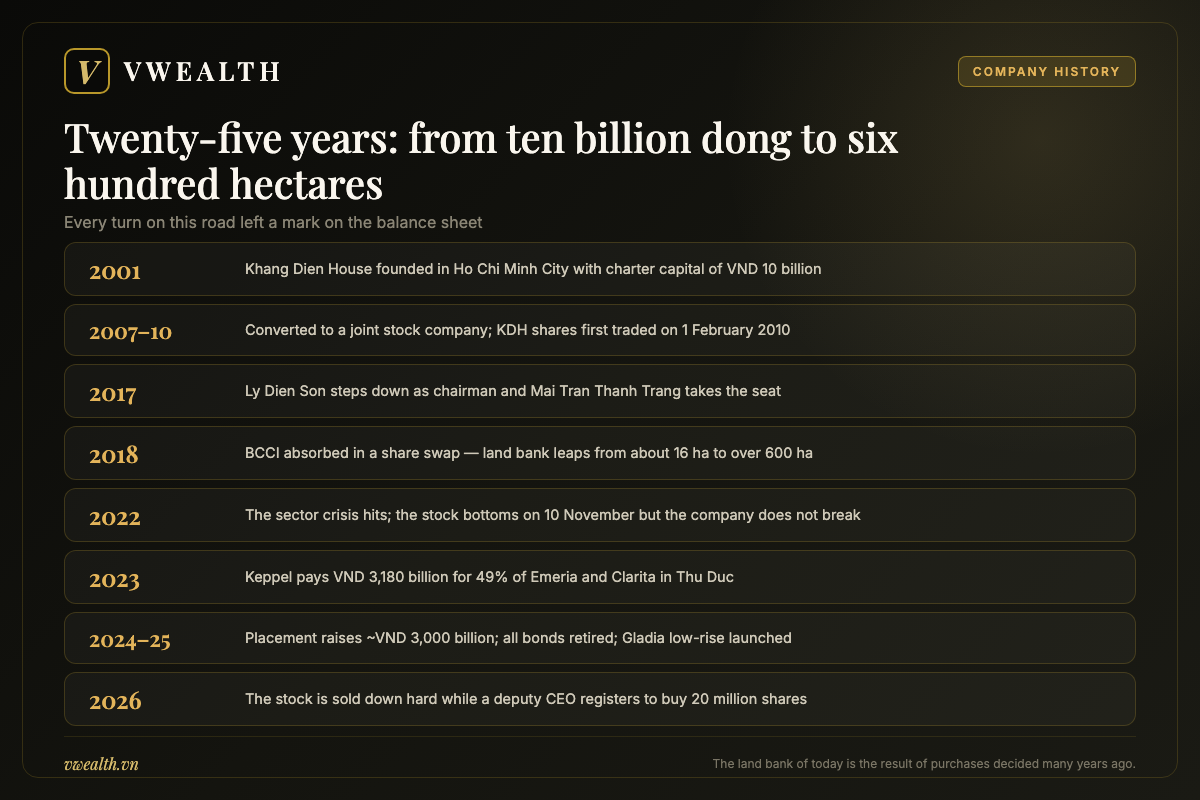
| Date | Event | What it means for an investor |
|---|---|---|
| Dec 2001 | Khang Dien House founded with charter capital of VND 10 billion | The starting point of a family developer on the east side of the city |
| 2007 | Converted to a joint stock company | The mandatory step before a listing |
| 1 Feb 2010 | KDH shares trade for the first time on the Ho Chi Minh Stock Exchange | The business starts living under public scrutiny |
| Sep 2010 | Charter capital raised to VND 439 billion | The beginning of an unbroken chain of capital raises |
| 2015–2016 | Mega Village, Lucasta, The Venica and Jamila launched | Proof the company can run several projects at once |
| 2017 | Ly Dien Son steps down as chairman; Mai Tran Thanh Trang takes over | A smooth handover with the founder still in the building |
| 2018 | BCCI absorbed through a share swap | Land bank jumps from about 16 ha to more than 600 ha — the biggest single turning point |
| 2019–2021 | Verosa Park, Safira, Lovera Vista; participation in the corporate bond market | Steady delivery, but a growing habit of borrowed money |
| 10 Nov 2022 | Shares bottom at VND 19,110 during the sector crisis | The survival test the company passed |
| Mid-2023 | Keppel pays VND 3,180 billion for 49% of Emeria and Clarita | Trading part of tomorrow’s profit for cash today |
| Jul 2024 | Private placement of 110.1m shares at VND 27,250, raising ~VND 3,000 billion; charter capital to VND 9,094 billion | Existing holders diluted in exchange for financial resilience |
| Mid-2025 | All bond tranches settled; no outstanding bond debt | The scariest risk of the 2022–2023 cycle removed from the table |
| Oct 2025 | Gladia by the Waters low-rise phase launched at VND 200–250 million per sqm | The start of a new revenue recognition cycle |
| 2026 | Shares fall sharply; AGM targets profit of VND 1,500 billion; management registers to buy | The gap between the corporate story and the share price widens |
The founder steps back, the family stays: KDH leadership and ownership
In property development you are not buying a production line. You are buying the ability of a group of people to pick the right piece of land, get the paperwork through, build on schedule and sell the result. All four of those are human tasks, not mechanical ones. Which is why, with KDH, reading the board and the shareholder register carefully is not a box-ticking exercise — it is close to being the fundamental analysis.
Mai Tran Thanh Trang: nearly a decade in the chair
Since 2017 the chairmanship of Khang Dien’s board has belonged to Mai Tran Thanh Trang. She took the seat exactly as the company was preparing for the largest transaction of its life — the BCCI merger — and she has now been at the top through the entire 2018 to 2026 cycle, boom and bust included.
Her most quotable moment in front of shareholders came at the 2026 annual general meeting, when she confirmed that from the middle of 2025 the company had settled every bond tranche and had no bond debt outstanding in the market. To a shareholder who lived through the winter of 2022 and 2023, that sentence carries a specific weight. It means Khang Dien’s debt is now bank debt only — the kind you can negotiate, extend and refinance with a named counterparty across a table — rather than bonds held by thousands of retail investors who can all demand their money back on the same day. The distinction is not academic. It is precisely the difference that killed several Vietnamese developers in that cycle and left others standing.
At the same meeting, management stated that the company had no plan to issue bonds or place shares privately in 2026, and would instead rely on cash from sales and long-term credit lines from large banks including VietinBank, OCB and MB. For an existing shareholder that statement matters almost as much as the one about bonds: it means, for now, no further dilution.
Ly Dien Son: the founder who stayed on as deputy
Ly Dien Son now serves as vice chairman. He still holds a meaningful personal stake in the company he founded — disclosures reported in the local press put the figure at around 7.4 million shares, though you should check the latest filing yourself, because insider holdings move with every issuance.
A founder who gives up the top seat without leaving the company is a two-sided signal, and you should read both sides. The positive reading: power is distributed, the business does not depend on one name, and the person who built the culture is still there to defend it. The cautionary reading: handing over inside a small circle is not the same thing as professionalising governance to an international standard. Khang Dien remains, in flavour and in practice, a family company, and you should price its governance risk accordingly rather than assuming the board functions the way a listed developer’s board would in Singapore or Sydney.
The second generation arrives: Ly Tuan Kiet and 20 million shares
Ly Tuan Kiet, a deputy chief executive, is the son of vice chairman Ly Dien Son. On 23 July 2026 he registered to buy 20 million KDH shares, with the trading window running to 21 August 2026. The context of that trade is a stock that had been falling continuously since September 2025 and had lost around 43.5% of its value in a little over half of 2026, while two large foreign funds, Dragon Capital and VinaCapital, were both trimming.
Insiders buying while outsiders sell is one of the signals retail investors love most — and one of the most frequently misread. Here is how to read it properly. Management buying tells you they believe the price is below the intrinsic value they can see from the inside, and that is real information, because it is their own money. But management is also structurally prone to over-optimism about its own company, and a personal share purchase does not fix a single problem in the cash flow statement or move a single approval through a government office one day faster. Treat it as a vote worth noting, not as a guarantee.
There is a further nuance specific to Vietnam. Insider transactions here must be registered with the exchange in advance, with a declared volume and a declared window, and the actual completed volume is disclosed afterwards. A registration is an intention, not an executed trade. It is not unusual for an insider to register a large number and complete far less, citing “market conditions did not meet expectations”. So the follow-up disclosure after 21 August 2026 is at least as informative as the original announcement, and it is the one most people forget to look for.
Foreign funds: Dragon Capital in, VinaCapital out
Khang Dien has long been a familiar name in foreign fund portfolios — partly because its disclosure has been relatively good, and partly because a pure residential developer is easier for an outsider to model than the tangled multi-sector holding structures that are common on this market.
The Dragon Capital group of funds once bought more than 19 million KDH shares in a single episode, with Amersham Industries Limited taking 9.25 million and Vietnam Enterprise Investments Limited taking 9.75 million, lifting the group’s combined ownership from 4.99% to 7.64% of charter capital and, at its peak, past the 9% mark.
Running the other way, VOF Investment Limited, managed by VinaCapital, once bought 10 million KDH shares, taking its position from zero to 1.41% of capital, and then the VinaCapital group unwound it until only 23,425 shares were left — 0.0023% of capital, a symbolic residue before exiting the register entirely.
The lesson is not that one fund was right and the other wrong. It is that two professional institutions, working from the same disclosed data and sitting in the same meetings with the same management team, reached opposite conclusions about the same stock. If you have ever comforted yourself with the thought that following the foreign funds is a safe strategy, KDH is the example that should cure you of it.
A note on the foreign ownership limit
One structural detail matters if you are investing from abroad. Vietnamese listed companies operate under a foreign ownership limit — a cap on the combined percentage of shares that non-Vietnamese investors may hold. The level depends on the sector the company operates in and on what the company’s own charter says, so it is not a single number you can memorise — you look it up per ticker. When a stock’s foreign room is full, overseas buyers can only buy from other overseas sellers, usually at a negotiated premium, and the normal order book becomes useless to them.
For KDH this has practical consequences in both directions. Because the stock is a long-standing institutional holding, its foreign room has historically been actively used, which means the shares you can actually get may be limited by other foreigners’ decisions rather than by your own. And when a large foreign holder such as VinaCapital exits, that room opens up — which is one reason foreign selling in a Vietnamese blue chip is sometimes followed by foreign buying at a better price. Check the available room before you plan a position size; it is published daily by the exchange and by every broker.
Dividends: do not buy KDH for the cash
Khang Dien’s distribution policy is a very accurate reflection of what the industry is. Developers are permanently hungry for capital, so what they most like to hand out is paper, not money.
The record: the ex-date of 21 September 2018 carried a stock dividend at a ratio of 100:5 together with a 5% cash dividend; 11 June 2019 brought a 100:5 stock dividend, 5% cash and a bonus share issue at 100:25; 19 August 2020 was again 100:5 in stock plus 5% cash; and in 2021 and 2022 the company moved entirely to stock dividends at 100:10. The plan put to the 2026 meeting keeps the dividend at 10%.
One point needs stating clearly, because a great many new investors get it wrong: a stock dividend is not income. When a company pays 100:10, you receive 10 extra shares for every 100 you hold, but the reference price is adjusted down proportionally on the ex-date, and the total value of your holding immediately afterwards is unchanged. It is a smaller slice of the same cake, cut more times. The genuine benefits are that liquidity improves and that the company keeps its cash to build with. Note also that in Vietnam these percentages are quoted against the par value of VND 10,000 per share, not against the market price — so a “10% dividend” means VND 1,000 per share of value, which against a market price several times par is a much smaller yield than the headline suggests. If you need a predictable annual income stream, KDH is not your stock, and Chapter 8 will say so in more detail.
What about the ESOP?
The 2026 general meeting approved an employee stock ownership plan of 10.86 million shares for key staff at VND 12,000 per share. An ESOP is a discounted share sale to employees, a tool for keeping good people by turning them into owners.
From an outside shareholder’s point of view an ESOP is always a hidden cost: you are diluted, and the gap between the issue price and the market price is value moving from your pocket into an employee’s. The question is never whether an ESOP exists, but whether the ratio is reasonable and whether it is tied to performance conditions. Against more than 900 million shares outstanding after the 2024 capital increase, 10.86 million is a small number. But if it becomes an annual ritual over many consecutive years, the cumulative effect is not small at all, and this is one line item worth checking in every AGM document.
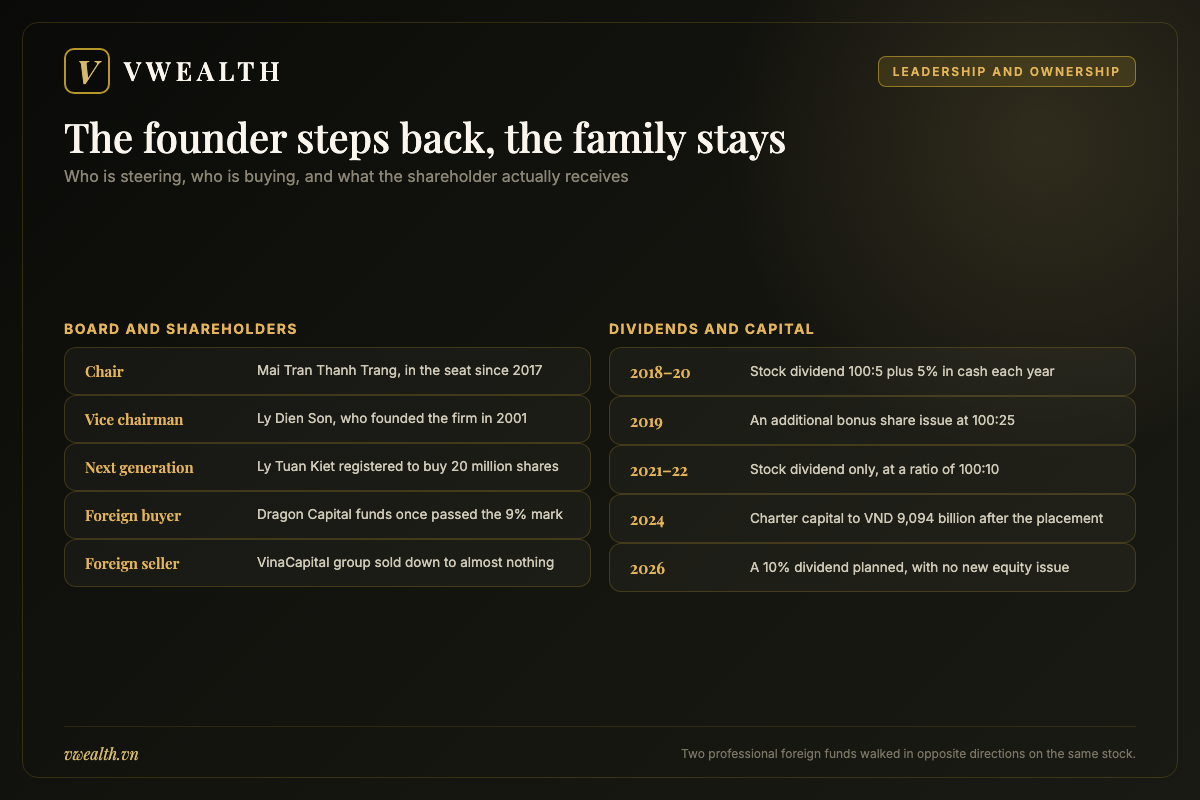
| Ownership and governance item | What has been disclosed | What you should take from it |
|---|---|---|
| Chair of the board | Mai Tran Thanh Trang, in the seat since 2017 | Leadership stability through nearly a decade of turbulence |
| Vice chairman | Ly Dien Son, who founded the company in 2001 | The builder is still present to defend the operating philosophy |
| Next generation | Ly Tuan Kiet, deputy CEO, registered to buy 20m shares (23 Jul – 21 Aug 2026) | A signal of insider confidence, not a guarantee |
| Foreign holder increasing | Dragon Capital funds lifted ownership from 4.99% to 7.64%, peaking above 9% | The company clears the bar for large institutional money |
| Foreign holder decreasing | VinaCapital group entered then exited, down to 23,425 shares (0.0023%) | Professional funds disagree about the same stock |
| Charter capital | VND 9,094 billion after the July 2024 private placement | Growth came with dilution — always work on a per-share basis |
| Dividends 2018–2020 | Stock at 100:5 plus 5% cash each year; a 100:25 bonus issue in 2019 | The company keeps its money to build with |
| Dividends 2021–2022 | Stock only, at 100:10 | No cash flow to shareholders |
| 2026 plan | 10% dividend; no bond issue and no private placement | Dilution paused, funding shifted to bank credit |
| 2026 ESOP | 10.86 million shares at VND 12,000 | A small hidden cost — watch whether it repeats annually |
Four machines that make money: the core businesses of Khang Dien
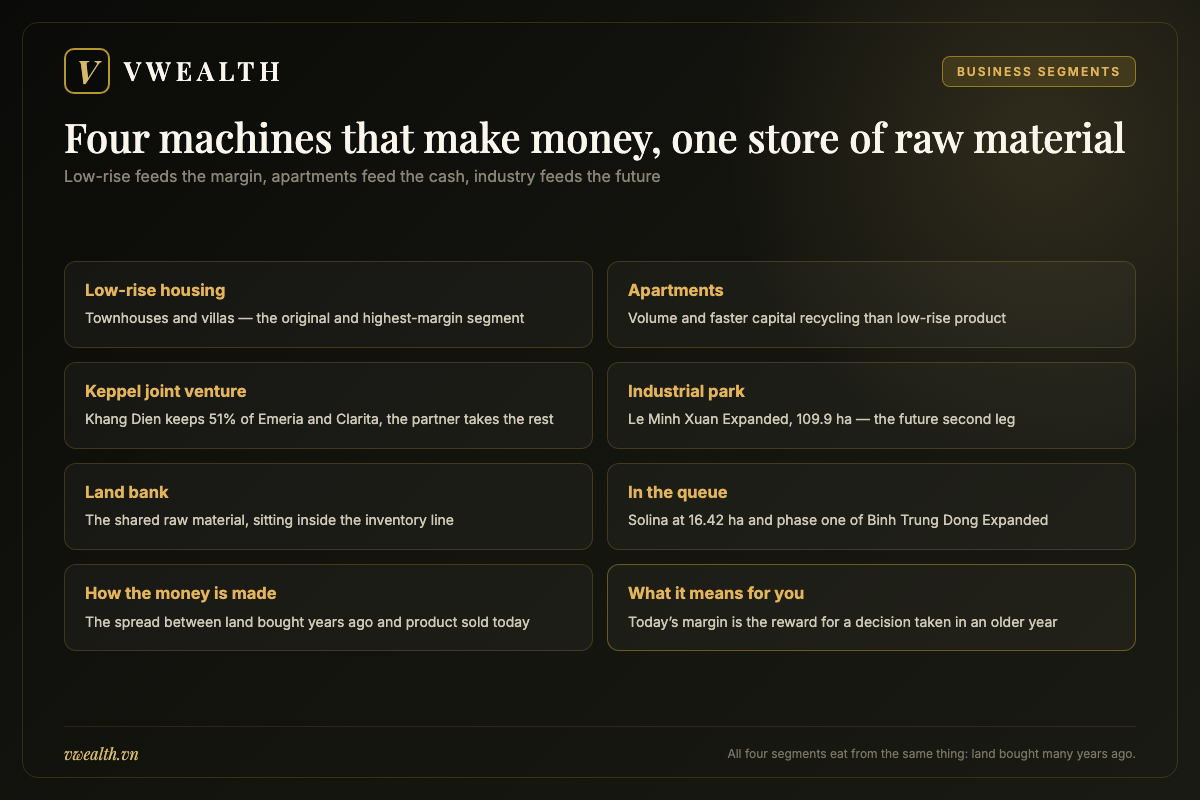
Ask what Khang Dien does and the easy answer is “it sells houses”. True, but shallow. What Khang Dien actually trades in is the spread between the price of a square metre of raw land bought years ago and the price of a square metre of finished product sold today — and most of that spread is created not with bricks but with legal paperwork and patience. Understand that one sentence and every other number in this article becomes readable.
Machine one: low-rise housing, the margin engine
Townhouses, terraced houses, semi-detached and detached villas are the original business and the one that produces the company’s best margins. The reason is simple: a low-rise product comes attached to a land use right, and it is the land that appreciates. The construction on top of it moves roughly with the price of cement and steel, which is to say very little.
The low-rise catalogue runs across two decades: Mega Village, Mega Ruby, Lucasta, The Venica, then Verosa Park with 296 townhouses and villas beside the Thu Duc high-tech park, then The Classia launched in November 2023, and most recently the low-rise phase of Gladia by the Waters, launched in October 2025 at VND 200–250 million per square metre.
The number to notice in this segment is the gross margin. Across the three projects Solina, Emeria and Clarita, analyst projections put gross margin at 52–53%. In most industries a gross margin above fifty per cent belongs to software or patented pharmaceuticals, not to construction. It exists here for one reason only: the land has been sitting in the books for a very long time, carried at the price level of the past.
Machine two: apartments, the volume and cash flow engine
Alongside the low-rise business, Khang Dien develops mid-priced apartment projects: Jamila, Safira, Lovera Vista with 1,310 units on 1.8 hectares in Binh Chanh, and The Privia in the old Binh Tan district with 1,043 apartments, where handovers to buyers began in mid-October 2024.
Apartments carry thinner margins than low-rise, but they do three things low-rise cannot. First, they create volume: a tower can sell a thousand units in a handful of releases, whereas a villa compound has a few hundred at most. Second, they recycle capital faster, because buyers pay in instalments tied to construction milestones. Third, they serve exactly the segment the Ho Chi Minh City market is most short of — housing that ordinary households can actually afford, a subject we take apart in Chapter 6.
The Privia is the textbook illustration of this machine working. The project sold out almost entirely, and the revenue recognised on handover became the prop holding up reported results during a stretch when the larger projects were still under construction.
Machine three: joint ventures with a foreign partner — selling part to move faster
This is the newest machine and the one that has changed the company’s character most. In mid-2023 Keppel of Singapore paid VND 3,180 billion for 49% of Emeria (6 hectares) and Clarita (5.8 hectares) in Binh Trung Dong ward, Thu Duc City. Total development cost for the two projects, land included, was put at roughly VND 10,200 billion. Khang Dien kept 51% and operational control. The combined 11.8-hectare site went to market under the commercial name Gladia by the Waters.
Under the plan, the low-rise phase went on sale in October 2025 and sold more than 100 units worth roughly VND 4,000 billion; 226 low-rise units are expected to complete revenue recognition during 2026; and the high-rise portion of roughly 600 apartments broke ground in the first quarter of 2026 with handover targeted for the fourth quarter of 2027.
It is worth spelling out why a developer would give away half of a good project. The joint venture model solves the permanent dilemma of the Vietnamese developer: land-rich, cash-poor. Instead of borrowing to build the whole thing yourself, you sell 49% to a group with money, collect several thousand billion dong in cash immediately, share the market risk, and borrow the partner’s reputation to help you sell. The price is that you keep only 51% of the eventual profit. This is precisely the road Nam Long has travelled for years with its Japanese partners — and precisely the opposite of the “own everything, borrow to the limit” philosophy that walked several other developers into a dead end in 2022.
For a foreign investor there is a second, less obvious implication. When part of a project sits in a joint venture rather than in a wholly owned subsidiary, the accounting treatment changes what you see. Depending on the structure, the venture’s revenue may not appear in consolidated revenue at all, with only Khang Dien’s share of the result showing up further down the income statement. That means a project can be selling very well and barely move the top line. If you compare KDH’s revenue with a peer’s without checking how much of the pipeline sits in joint ventures, you will draw a false conclusion.
Machine four: the industrial park, a door into a different industry
The largest legacy of the BCCI deal is not only residential land. It is also the Le Minh Xuan Expanded Industrial Park in what used to be Binh Chanh district, 109.9 hectares in total, with phase one at roughly 89 to 90 hectares and an expectation of drawing in around 10,000 workers.
According to disclosures at the 2026 general meeting, phase one has completed its legal process and has been granted its land use right certificate, and the company is building the infrastructure. Work-in-progress cost on the project rose from roughly VND 746.8 billion at the end of 2022 to nearly VND 1,735 billion at the end of 2025, and more than VND 1,842 billion by the end of the first quarter of 2026. As at 31 March 2026 the project was pledged as security for a loan of roughly VND 3,035 billion at MB, Transaction Office 2 branch, replacing a facility at OCB dating from 2025. Management expects to book results from late 2026 and early 2027, once the road connection via Ring Road 3 is complete, with the formal leasing launch anticipated from 2027.
Why should this matter to you? Because industrial property has a completely different cash flow shape from housing. You lease serviced land on long cycles to manufacturers rather than selling homes to families, and the revenue is far steadier than the lumpy rhythm of residential handovers. If Le Minh Xuan works, Khang Dien gains a second leg that smooths the revenue line — the advantage that pure industrial park developers such as Kinh Bac have enjoyed for years. But it remains a future-tense business, and you should not pay today for a cash flow that still exists only on a drawing.
The shared raw material: land bank and land cost
All four machines feed from the same store: the land bank. After BCCI it passed 600 hectares, concentrated in the east and the southwest of Ho Chi Minh City. The strategy management has published for 2026 to 2028 is to bring more than 1,000 low-rise products and around 5,000 apartments to market across roughly 160 hectares.
But a land bank is not a uniform block. The cost of land varies enormously from project to project, and that is what actually determines profit. Take an illustration from the company’s own portfolio: land cost at Emeria and Clarita has been estimated at around VND 250–260 million per square metre, roughly 1.5 times the level of the earlier project The Classia. Same developer, same district, but the plot bought later cost markedly more than the plot bought earlier.
The consequence you need to remember: the 52–53% gross margin of today is not Khang Dien’s permanent margin. It is the reward for land purchase decisions taken in 2018 and before. When the company has to replenish the bank at 2026 prices — with Ho Chi Minh City’s new land price table in force from 1 January 2026 — the margins of later cycles will certainly be thinner, unless selling prices climb faster than land prices do.
The queue: Solina, Binh Trung Dong Expanded and the rest
Three names will determine Khang Dien’s revenue story over the next three years.
The Solina — residential area 11A, 16.42 hectares in Binh Chanh, roughly 500 low-rise products plus around 1,000 apartments, total investment of about VND 5,200 billion and expected revenue of about VND 7,000 billion. Indicative pricing is around VND 10–12 billion per low-rise unit and about VND 4 billion per apartment. The company has completed its financial obligations on roughly 13 of the 16 hectares, and launch is expected between late 2026 and early 2027.
Binh Trung Dong Expanded — phase one covers 18.2 hectares with roughly 200 townhouses and villas, with groundbreaking expected in 2026 and launch in 2027; the full site is planned at roughly 200 low-rise products and 3,500 apartments.
Le Minh Xuan Expanded — as described above, formally launching from 2027.
Look at that list and the single most important feature of KDH at this moment becomes obvious: most of the value sits in front of the company, not inside it. That is why one weak quarter of housing revenue is not necessarily a disaster — and equally why a two-year legal delay would hurt far more than a slow quarter of sales.
| Segment | Representative products | Role in the business | Cash flow shape | Main risk |
|---|---|---|---|---|
| Low-rise housing | Verosa Park (296 units), The Classia, Gladia low-rise phase | Main profit source, high gross margin | Lumpy, tied to handover dates | Narrow buyer pool, high ticket per unit |
| Apartments | Jamila, Safira, Lovera Vista (1,310 units), The Privia (1,043 units) | Volume and capital recycling | Steadier, paid in construction instalments | Thinner margin, fierce competition |
| Keppel joint venture | Emeria (6 ha), Clarita (5.8 ha) — Gladia by the Waters | Trades 49% of profit for cash and credibility | Cash received early on the stake sale | Only 51% of the eventual result |
| Industrial park | Le Minh Xuan Expanded (109.9 ha) | Future second leg, smooths revenue | Long-term leasing, regular | No revenue yet, depends on Ring Road 3 |
| Land bank | More than 600 ha after BCCI; 160 ha planned for 2026–2028 | Shared raw material for all four machines | Sits motionless inside inventories | New plots cost far more than old ones |
Before you ask whether to buy KDH stock: how to read a house seller’s accounts
This is the hardest chapter in the article and the one most worth your time. The financial statements of a residential developer are written in something close to a private language: lines that sound alarming are perfectly normal, and lines that look handsome can be a warning. If you bring the habits you use for reading a bank or a manufacturer to Khang Dien’s accounts, the odds are high that you will reach the opposite of the correct conclusion.
Rule one: developer revenue does not flow, it lands in lumps
A developer buys land in 2018, works through permitting until 2022, builds until 2025 and hands over the houses at the end of 2026. Across those eight years cash goes out continuously and revenue is zero. Then, in the handover quarter, the entire contracted value is recognised at once, and that quarter’s revenue can be ten times the previous one.
The mechanism is accounting policy. A developer may only recognise revenue on a property sale once it has transferred substantially all of the risks and rewards of ownership to the buyer — which in practice usually means the moment of handover. The money customers have already paid in instalments, even though it is sitting in the company’s bank account, is not revenue.
The consequence for you is very concrete. Comparing this quarter’s revenue with last quarter’s at a company like KDH is close to meaningless. Comparing with the same quarter a year earlier is only marginally better. The minimum unit of time for assessing Khang Dien is one project cycle, typically three to five years — and within that window the things to track are not revenue but sales absorption, construction progress and legal progress.
Inventories: the most misleading word in the sector
Open Khang Dien’s balance sheet and the largest line on the asset side is almost always inventories. At the end of 2024 inventories stood at roughly VND 22,179 billion, up 18% from the start of the year and accounting for around 72% of total assets.
The word “inventory” makes an English-speaking investor think of finished goods nobody wants. In property development, most of the inventory line is work in progress: land cost, site clearance and compensation payments, design fees and construction spending on projects under way. It is work in hand, not unsold stock. Inventories swelling while a developer accelerates its pipeline is normal, and can be a good sign.
So when is inventory a bad sign? Three cases should make you uneasy. First, inventories rising while projects make no legal progress — money buried without movement. Second, the “finished properties” sub-line rising steadily across several periods, meaning houses have been built and are not selling. Third, inventories growing mainly on borrowed money rather than on equity or customer deposits.
For KDH the inventory balance has at times ranked among the highest in the sector, reaching nearly VND 18,800 billion at one point and trailing only Vinhomes and Novaland, ahead of both Phat Dat and Nam Long. That figure is simultaneously a strength — years of raw material in hand — and a weakness, because it means an enormous amount of capital is sitting still, waiting for its turn to earn.
Advances from customers: the best forward indicator almost nobody reads
On the liabilities side there is a line called short-term advances from customers. This is money buyers have paid according to the construction schedule but on which the company is not yet allowed to recognise revenue. In accounting terms it is a liability — the company owes those buyers a house. In business terms it is a signed order book for the quarters ahead.
That makes it a better predictor of the future than the revenue line itself. If advances from customers rise sharply while revenue is flat, the company is selling well and the revenue will arrive in later periods. If the line shrinks for several consecutive periods, sales are slowing and you should be careful — even if the current income statement still looks handsome thanks to handovers from an older sales campaign.
In recent periods Khang Dien’s advances line has moved up and down sharply in step with individual project launch dates, which is what you would expect from a company that has not yet entered the heavy selling phase of Solina and Binh Trung Dong Expanded. The current figure is exactly the sort of metric that changes every quarter, so take it directly from the KDH report on the vwealth platform rather than from any article, including this one.
Negative operating cash flow: how negative is too negative?
This is where new investors panic. A company reports a profit of a thousand billion dong and an operating cash outflow of a thousand billion dong, and it looks like fraud. In property development it usually is not.
The reason is that all the money spent buying land and building projects sits within operating cash flow, because property held for sale is inventory rather than a fixed asset. When a developer is in a heavy investment phase — buying more land, breaking ground on several projects at once — deeply negative operating cash flow is close to inevitable. Conversely, large positive operating cash flow usually appears in the harvest phase, when handovers cluster and no new land is being bought.
So where is the line? Ask three questions. One: where is the negative cash actually going — into named projects with published progress, or into receivables and loans to related parties that nobody can explain? Two: what is funding the gap — equity, proceeds from selling stakes in projects to partners, or a continuous chain of new borrowings? Three: how long has the negative phase run — two years is a cycle; six consecutive years without a single positive year is a broken model.
For Khang Dien the answer to the first question is reasonably clear: the money flows into projects with names, addresses and published timelines. The second question is the one worth watching most closely at this point in the story — and that is the subject of the next section.
Leverage: from prudent exemplar to a heavier balance sheet
Khang Dien’s reputation for borrowing little is real and there are numbers behind it. At the end of 2023 net debt to equity stood at roughly 19.5%, among the lowest of any listed Vietnamese developer. To put that in perspective, several peers carried the same ratio at three or four times that level at the same date.
But the picture has shifted. Also in 2023, total liabilities passed VND 10,000 billion for the first time, of which borrowings made up around 58%, or more than VND 6,300 billion. Since then bank borrowing has expanded considerably further to fund the simultaneous development of several large projects, while the bond tranches were retired completely by the middle of 2025.
Read that development calmly, without either whitewashing or catastrophising. The positive: the debt structure is qualitatively cleaner — secured bank debt with a negotiable counterparty rather than bonds scattered across thousands of retail holders. The caution: a company famous for low leverage is now operating with a materially heavier balance sheet, at a time when the cost of capital in the economy is not cheap. If the sales cycle runs slower than planned, interest expense will eat into the very 52–53% gross margin that Chapter 3 celebrated. The latest borrowing figure and net-debt-to-equity ratio should be pulled from an up-to-date report rather than trusted from any milestone you read in an older piece of writing.
One technical point that trips people up here. Vietnamese developers capitalise a large part of their interest expense into inventory while a project is under construction, rather than charging it to the income statement. That means reported finance costs can look modest while the true interest burden is quietly being added to the cost of the houses being built. It surfaces later, as a higher cost of goods sold in the handover year. When you compare a developer’s interest expense to its debt and the implied rate looks impossibly low, capitalised interest is almost always the explanation, and the notes to the accounts will tell you how much.
Quality of profit: earned by selling houses, or by selling shares in projects?
This is the single most valuable reading skill this article can leave you with. A developer’s net profit can come from three sources of very different quality.
Source one — gross profit from property sales. This is core profit, repeatable, and it reflects the actual competence of the business. You find it in the gap between property sales revenue and cost of goods sold.
Source two — financial income. Interest on deposits, interest on loans made, and in particular gains from divesting subsidiaries or transferring stakes in projects. This is real money, but it does not repeat. You can only sell a stake in a given project once.
Source three — asset revaluation, bargain purchase gains and similar items. Profit on paper, with no cash attached.
In recent periods a large part of Khang Dien’s profit has come from source two — investment restructuring transactions and stake transfers — while property sales revenue has not yet entered the concentrated handover phase of Solina and Binh Trung Dong. That is neither wrong nor a trick: selling down project stakes is a publicly declared strategy. But it does mean that if you look at the net profit line and conclude that the company is selling houses well, you have misread it. Always separate the two before forming any opinion.
Six steps for reading one KDH reporting period. Put together, here is a routine you can apply to every set of Khang Dien accounts — and, with small adjustments, to most other listed residential developers.
| Step | What to do | Question to answer | Good sign | Bad sign |
|---|---|---|---|---|
| 1. Handover context | Check whether any project was due for handover this period | Is revenue up or down because of the handover schedule or because of sales strength? | Revenue low because no handover is due, while sales are still brisk | Handover due and revenue still falls short |
| 2. Strip out profit quality | Separate gross profit on property sales from financial income | Is the profit from selling houses or from selling stakes? | Core profit is the majority and growing steadily | Profit comes mainly from one-off items |
| 3. Read inventories by project | Open the inventory note and track each project name across periods | Where is the money buried, and is that project moving? | Work in progress rises alongside new legal milestones | Inventory rises while projects stand still for years |
| 4. Watch advances from customers | Follow the line across at least four consecutive periods | Is the forward order book thickening or thinning? | Jumps after each sales launch | Falls continuously despite new launches |
| 5. Check leverage and interest | Compute net debt to equity; see how much interest is capitalised | Is the company borrowing to build or borrowing to repay? | Borrowings rise in step with projects under construction | Borrowings rise with no new projects started |
| 6. Compare with the AGM plan | Match cumulative results against the revenue and profit targets put to shareholders | Does management keep its word? | Plan met consistently over several years | Repeated misses followed by revised targets |

The premium for peace of mind: how the market values KDH stock
For most of the past decade there has been a phrase in Vietnamese research notes on Khang Dien that comes close to a slogan: good company, never cheap. That is not empty praise. It describes a very specific valuation phenomenon — the Vietnamese market has been willing to pay more for KDH than for most of its peers, year after year, including during stretches when its earnings were unremarkable. This chapter explains why, and more importantly, explains when that extra can disappear.
Why P/E is the worst possible tool for valuing a developer
The price-to-earnings ratio divides the share price by earnings per share. It works well for businesses with steady earnings — banks, consumer goods, retail. It breaks completely for property developers, for the reason you now understand from Chapter 4: their profits land in lumps, on a handover schedule.
Take an illustrative example. A developer hands over a large project this year and earns VND 3,000 billion. Next year no project falls due and it earns VND 300 billion. If the share price does not move, this year’s P/E might be 8 times — which looks cheap — and next year’s 80 times, which looks outrageous. The company has become neither better nor worse between those two years. Only the handover calendar changed.
The classic retail mistake is to buy a property stock in the year its P/E is lowest — which is to say, in the year it has just finished delivering its biggest project, meaning the warehouse has just been emptied. With KDH, set yourself a rule: never make a decision on the P/E of a single year. If you want to use P/E at all, use average earnings across a full project cycle of three to five years.
P/B and the premium the market pays Khang Dien
The more appropriate ratio is price to book — the share price divided by book value per share. For a developer, book value mostly reflects land and work in progress, which is to say the real assets sitting inside the company.
Through most of its listed life, KDH has traded at a P/B above the average for listed residential developers here. Interpreted correctly, that premium is the price the market pays for three things.
One, legal cleanliness. Across twenty-five years Khang Dien has avoided any large-scale title deed dispute of the kind that puts angry residents on the evening news — something not many Vietnamese developers can claim. For a homebuyer that is trust; for an investor it is a lower probability of legal risk, which means future cash flows you can believe in.
Two, low land cost. Book value records land at purchase cost, not market value. With a bank accumulated largely before 2018, the real value of the assets in Khang Dien’s books is considerably higher than the accounting figure. Paying a higher P/B for a balance sheet that understates itself is rational behaviour, not exuberance.
Three, demonstrated financial discipline. Coming through the 2022–2023 crisis without a fire sale is evidence rather than a promise, and evidence is worth paying for.
But — and this is the most important “but” in the chapter — that premium is not a permanent entitlement. It is a reward for reputation, and reputations can be lost. If leverage keeps climbing, if sales launches keep slipping, or if profit keeps arriving from one-off items instead of house sales, the market will quietly take the premium back. The price action from September 2025 through mid-2026, with a decline of roughly 43.5% in a little over half of 2026 alone, can be read exactly as that process: a re-rating, in which the market reconsiders whether KDH still deserves the label “defensive property stock”.
How to build a rough NAV estimate for KDH yourself
The standard valuation tool for a developer is net asset value, or in its fuller form RNAV, revalued net asset value. The idea is simple: add up the value of each project, subtract the debt, divide by the share count.
You can build a crude version yourself, and let me stress that what follows is an illustration of method, not a recommendation of any number.
Step 1: List each project with an estimated saleable area. For KDH that means Gladia (Emeria and Clarita), Solina, Binh Trung Dong Expanded, Le Minh Xuan Expanded, and the undeveloped remainder of the land bank.
Step 2: Estimate revenue for each project by multiplying saleable area by a reference selling price for the location. For Gladia low-rise the published reference is VND 200–250 million per square metre; for Solina the indicated pricing is around VND 10–12 billion per low-rise unit and about VND 4 billion per apartment, with expected total project revenue of roughly VND 7,000 billion.
Step 3: Apply a reasonable net margin to that revenue. If the projected gross margin is 52–53%, then after selling costs, administration, interest and tax the net margin will be substantially lower — use a conservative assumption and write down explicitly what you assumed.
Step 4: Multiply by Khang Dien’s actual economic interest. This is the step people forget most often. At Gladia the company holds only 51%, which means close to half the profit belongs to Keppel.
Step 5: Discount back to the present using the expected recognition date, add cash, subtract all borrowings, and divide by shares outstanding.
The exercise costs you an evening and teaches you more than any P/E ever will. Steps 4 and 5 in particular will show you two things a price chart never says: how much present value evaporates for every year of delay, and how each additional percentage point of interest rate eats into the NAV. If you have never done this for a Vietnamese developer, do it once. The arithmetic will change how you read every launch announcement afterwards.
The personality of KDH on the trading screen
Beyond intrinsic value, every stock has a trading personality you should know before you buy.
KDH is a large-cap within Vietnamese residential property, with deep liquidity, permanently on the radar of foreign funds and domestic institutional money. That brings a practical advantage: you can buy and sell size without moving the price, which is not true of the many small-cap property names on this market.
The flip side is that KDH is dragged very strongly by sector sentiment. When money turns away from property, this stock falls with the group regardless of what is happening inside the company; when the sector is euphoric, it rises with the group. Put differently, buying KDH means betting on the company and on the cycle at the same time. If you are right about the company and wrong about the cycle, you can be correct in the long run and still lose money for a very long time on the way there.
Two mechanical features of the Vietnamese market amplify this, and they surprise most first-time foreign buyers. The first is the daily price band: on the Ho Chi Minh exchange a stock can move only within a fixed percentage of the previous session’s reference price in either direction, and when sentiment turns violently, liquid stocks can lock at the floor with no offers to buy for several sessions in a row. You cannot always get out at the price you see. The second is the settlement cycle: shares bought are not available to sell immediately, so a position taken in a falling market cannot be reversed the same day. Neither feature changes what a company is worth, but both change how a position should be sized. For a cyclical developer that can trend downward for three quarters at a stretch, that is not a footnote.
Dividends: not a reason to hold this stock
As Chapter 2 showed, Khang Dien mostly pays in stock, and in the years when it paid cash the rate was modest. The 10% dividend planned for 2026 does not change that picture.
Compare it with the logic of a genuine dividend stock. A business whose plant is largely depreciated and which needs no major new investment can return its surplus cash to shareholders. Khang Dien sits at the opposite pole: every dong retained has somewhere to go, because buying land and building projects always needs money. For a company in an expansion phase, retaining cash is arguably the better choice for the long-term owner. It is simply not the choice that puts money in your account each year.
The practical conclusion: if you need periodic income, look elsewhere. If you buy KDH, you buy it expecting net asset value to compound project by project — not expecting a cheque.
Catalysts and anti-catalysts: what can turn the price
With a developer, catalysts are nearly always discrete events you can mark on a calendar. Build a watch list rather than staring at a chart.
Positive catalysts worth tracking: the formal launch of Solina and its first-release absorption rate; groundbreaking and launch at Binh Trung Dong Expanded; progress on recognising revenue from the 226 Gladia low-rise units during 2026 and the high-rise handover in late 2027; the infrastructure completion and leasing launch at the Le Minh Xuan industrial park from 2027; completion of financial obligations on the remaining Solina land; and, of course, the outcome of the insider purchase.
Catalysts running the other way: legal progress slower than announced; low absorption at new launches; land use fees rising under the new land price table; higher lending rates for property; and profit continuing to lean on one-off financial gains rather than house sales.
| Criterion | KDH — Khang Dien | NLG — Nam Long | NVL — Novaland | VHM — Vinhomes |
|---|---|---|---|---|
| Product positioning | Mid and upper-mid housing in Ho Chi Minh City | Affordable housing and integrated townships | Resort urban areas and mega-townships | Nationwide mega-townships |
| Main territory | East and southwest of Ho Chi Minh City | Ho Chi Minh City, Long An, Dong Nai, Can Tho | Ho Chi Minh City, Dong Nai, Binh Thuan | Hanoi, Ho Chi Minh City and many provinces |
| Capital philosophy | Historically low leverage, now rising; partnered with Keppel | Prefers equity and Japanese partners | High leverage, heavily bond-funded in the previous cycle | Very large capital base, backed by its parent group |
| Bond position | Fully retired since mid-2025 | Kept at a controlled level | Years of restructuring focus | Large in size but strong repayment capacity |
| Standout strength | Low-cost land bank, clean legal record | A disciplined international partnership model | A very large land bank | Execution speed and dominant market share |
| Standout risk | Revenue concentrated in the future, leverage rising | Growth slower than the market hopes | Debt pressure and damaged market confidence | Dependent on macro demand and on its own scale |
| Suits which investor | Long-term, willing to wait out a project cycle | Long-term, financial safety first | High risk tolerance, betting on a restructuring | Wants a proxy for the whole sector |
That table is a qualitative map, not a ranking. It is worth reading the individual names to calibrate yourself: Vincom Retail shows you the rental side of Vietnamese property, where the cash flow is contractual rather than lumpy, and CEO Group shows you the resort and second-home end of the same industry — two further slices of the same sector, each with a completely different relationship to the cycle.
Land, law and the homebuyer’s wallet: the economic and sector backdrop for KDH
A skilled developer can still lose money if the cycle runs against it. The reverse is also true: the years from 2019 to 2021 showed that even carelessly run companies made large profits when the wave was rising. So before answering whether to buy KDH stock, you have to answer a bigger question: where is the Ho Chi Minh City housing market in its cycle, and in which direction are the freshly rewritten rules pushing it?
The seven-year cycle: boom, freeze, and an uneven recovery
Between 2019 and 2021 Vietnamese property went through a ferocious expansion, fuelled by two things: cheap bank credit and a corporate bond market with almost no barriers to entry. Every developer could raise money, every project sold out, and land prices rose by the month.
From the middle of 2022 both fuel lines were cut at once. The bond channel seized after a series of major enforcement cases, property credit was restricted, and interest rates jumped. The market froze: buyers stopped buying because they were nervous and because they could not borrow, developers stopped launching because nobody was buying, and property share prices went into free fall. KDH bottomed at VND 19,110 on 10 November 2022, and plenty of other names fell a great deal further than that.
From 2024 through 2026 the market has been in a recovery phase, but an uneven one that moves at different speeds in different corners. Liquidity has returned in the segments with complete legal paperwork and genuine end-user demand, while the speculative and resort segments remain cold. Developers with clean land and issued certificates can sell; developers still tangled in procedure remain stuck. That is exactly the sort of market that favours Khang Dien’s legal profile — and exactly the sort of market in which investors confuse “the sector is recovering” with “every stock in the sector is recovering”.
The 2024 Land Law and a wholesale change of legal plumbing
The amended trio of the Land Law, the Housing Law and the Law on Real Estate Business is the largest institutional change this industry has seen in more than a decade. For an equity investor, three effects matter most.
First, the abolition of the state land price framework and a move to market-based land pricing. Vietnam used to work with a rigid, centrally issued land price framework revised only every few years, which sat far below actual market prices. That framework has been scrapped. Provincial land price tables are now built closer to market levels and updated more frequently. For a household whose land is compulsorily acquired, this is good news: compensation rises. For a developer, it is a cost increase, because the land use fee payable to the state is calculated against those tables.
Second, tighter conditions on raising money and on selling homes off-plan. Vietnam’s housing market has long run on off-plan sales, where a buyer pays in instalments during construction — effectively financing the developer at zero interest. The new rules tighten the terms of deposits, of mandatory bank guarantees and of the conditions a project must meet before it may be sold at all. Thinly capitalised developers can no longer bootstrap a project entirely with customer money.
Third, greater transparency in land allocation and investment approvals. This is good in the long run, but during the transition, applying new rules to applications already in flight tends to slow everything down.
Taken together, the new legislation pushes the industry in one clear direction: advantage shifts towards companies that already hold clean land, issued titles and capital. That is close to a description of Khang Dien — but it is also a description of Vinhomes, Nam Long and a handful of others, so do not confuse “has an advantage” with “has a monopoly on the advantage”.
Ho Chi Minh City’s new land price table: a cost increase knocking on the door
On 26 December 2025 the Ho Chi Minh City People’s Council passed Resolution 87/2025/NQ-HDND issuing a new land price table, effective from 1 January 2026. It is the city’s first land price table produced under the 2024 Land Law, and also the first covering the enlarged administrative territory of Ho Chi Minh City following its merger with Binh Duong and Ba Ria–Vung Tau.
What deserves attention is the breadth of application, extended to twelve categories of use, including determining annual land rent, setting the reserve price for land use right auctions, pricing resettlement land, calculating land use tax, calculating registration fees and computing compensation when the state acquires land.
For a company like Khang Dien the impact runs in two opposite directions and you have to weigh both.
The unfavourable direction: every plot on which land use fees still have to be paid from here on will cost more. Development costs on future projects rise, and the gross margin of the next cycle will struggle to hold the 52–53% projected for the current crop of projects.
The favourable direction: the portion of Khang Dien’s land bank on which financial obligations were already settled before that date — such as most of the Solina area, and phase one of Le Minh Xuan, which already holds its certificate — becomes distinctly more valuable relative to a competitor’s land that is only now entering the process. In a market where the input cost for latecomers rises, the party that already paid holds a genuine competitive advantage.
Put another way, the new land price table is both a bill for the future and a gift to the accumulated past. Which side you weight depends on the ratio between the land on which obligations are complete and the land on which they are not — information that sits in the notes to the financial statements and in the AGM documents.
Ho Chi Minh City supply in 2026: more stock, still not enough affordable stock
In 2025 the Ho Chi Minh City housing market recorded more than 12,000 products offered for sale across apartments and low-rise, of which newly launched apartments numbered roughly 7,084 units, a 40% increase on the previous year. Into 2026, supply is expected to double; market forecasts put total apartment launches at around 43,000 units with an expected absorption rate of about 73%, or roughly 31,000 units sold.
More supply has not pulled prices down. The average primary selling price in Ho Chi Minh City has reached around VND 92 million per square metre; across the whole market the average is roughly VND 76 million per square metre of net usable area, up about 8% quarter on quarter and 16% year on year against 2025.
The more worrying part is the composition. Grade C apartments — the affordable, mass-market tier — used to account for more than 80% of transactions in Hanoi and Ho Chi Minh City before 2020, but by the first quarter of 2026 they made up only about 29% of primary supply in Ho Chi Minh City. The segment most Vietnamese households can actually afford is disappearing from the primary market.
For Khang Dien this is a very sharp double-edged sword. The favourable edge: the company’s products sit in the mid and upper-mid tiers, so there are still buyers when the luxury tier saturates. The adverse edge: as the general price level climbs, even a “mid-tier” Ho Chi Minh City product has moved far beyond the reach of most household budgets, and genuine end users are pushed out towards the periphery. Real demand — not supply — is the variable that will decide the absorption speed of Solina, Gladia and Binh Trung Dong Expanded over the next three years.
It is worth pausing on why prices climb while affordability collapses. Three forces do most of the work. Land use fees are rising under the new tables. The pipeline of approved projects narrowed sharply during the 2022–2024 legal bottleneck, so the supply arriving now was permitted in a different era and is concentrated in the higher tiers where developers can recover their costs. And the capital tied up in a project for the years it spends in permitting has to be earned back somewhere, which pushes developers up-market rather than down. None of those forces reverses quickly, which is why “affordable housing will return” is a policy aspiration rather than a forecast you can trade on.
Infrastructure and new administrative boundaries: the map is being redrawn
Two large changes are reshaping the value of individual plots on the map Khang Dien holds.
Ring Road 3. This orbital route runs around the eastern and western sides of the city, connecting directly to areas where Khang Dien has projects. For the Le Minh Xuan Expanded Industrial Park, the company itself has cited the completion of the road connection via Ring Road 3 as the condition for expecting results from late 2026 and early 2027. It is a textbook case of the delivery schedules of the companies that build roads determining the cash flows of the companies that sell houses.
The administrative merger. Ho Chi Minh City’s consolidation with Binh Duong and Ba Ria–Vung Tau creates a megacity with a far wider housing market. In the long run this enlarges the pie. But it also means land in Binh Duong and Ba Ria–Vung Tau — previously dismissed as “the provinces” — now competes directly with land on the old city fringe within the same administrative unit. For homebuyers, more choice. For a developer holding land inside the old city, some dilution of the locational advantage.
Who competes with Khang Dien on the same patch
KDH’s competition is not the entire property sector. It is a very specific group: developers with clean land in and around Ho Chi Minh City and enough capital to build through the 2026 to 2028 window.
Vinhomes is the most formidable, not because it shares a segment but because its scale is sufficient to set the price level and absorb the market’s entire attention every time it launches a township. Nam Long is the closest competitor in philosophy — also clean land, also cautious, also partnered with foreign investors — and competes head-on in affordable housing on the city fringe. Dat Xanh, Phat Dat and other regional developers compete project by project. And there is the group of foreign developers, Keppel among them, along with CapitaLand, Gamuda and various Japanese funds — simultaneously competitors and potential partners, exactly as Keppel is currently both a co-investor and a profit-sharer with Khang Dien at Gladia.
| Sector factor | What it involves | Effect on KDH |
|---|---|---|
| The 2019–2021 cycle | Cheap credit, a bond boom, rapidly rising land prices | The company accumulated land and launched into a friendly market |
| The 2022–2023 crisis | Bond market seized, credit restricted, transactions froze | Came through without breaking — the origin of the defensive reputation |
| The 2024 Land Law | State price framework abolished, fundraising tightened, procedures made transparent | Favours clean-land developers, punishes thinly capitalised ones |
| HCMC land price table from 1 Jan 2026 | Resolution 87/2025/NQ-HDND, applied across twelve categories of use | Land already paid for is worth more; new land costs more to acquire |
| 2026 supply | Expected to double on 2025, around 43,000 units launched, ~73% absorption | Sharper competition at every sales launch |
| Price level | HCMC primary around VND 92 million per sqm; Grade C only ~29% of supply | Good margins, but real demand is being eroded |
| Ring Road 3 infrastructure | Connects the eastern and western sides of the city | The key precondition for Le Minh Xuan Expanded |
| HCMC – Binh Duong – BR-VT merger | Creates a megacity with a much wider housing market | A bigger pie, but the locational advantage is diluted |
Three roads ahead: should you buy KDH stock for the next three years?
By now you have the ingredients: a twenty-five-year-old company with a low-cost land bank, a clean legal record and freshly retired bond debt, carrying several large projects at once on a balance sheet heavier than its own history, in a market where supply is doubling while genuine demand is being ground down by price. This section does not forecast the share price. It does something more useful: it sets out what would have to happen for each scenario to become real, so you can mark for yourself which way the evidence is drifting.
Four forces that could push Khang Dien higher
Driver one — the pipeline reaching harvest. After years of buried capital, Khang Dien is entering the revenue recognition phase for Gladia, followed by Solina and Binh Trung Dong Expanded. Management has set a 2026 plan of VND 4,200 billion in revenue and VND 1,500 billion in net profit, up 44% on the prior year, and published a 2026–2028 strategy to bring more than 1,000 low-rise products and around 5,000 apartments to market across roughly 160 hectares in Ho Chi Minh City. If the company sells at that rhythm, its revenue line will look nothing like the past three years.
Driver two — a bond-free balance sheet. Retiring every bond tranche by mid-2025 and declaring no bond issue or private placement for 2026 removes two risks simultaneously: 2022-style liquidity risk and near-term dilution risk. In an industry where investors still flinch at the phrase “corporate bond”, that is a competitive advantage measured in trust.
Driver three — land bought before the new price table. Every plot on which financial obligations were completed before 1 January 2026 is a cost advantage no latecomer can replicate. With a projected gross margin of 52–53% on the Solina, Emeria and Clarita generation, most of this value already sits in the books, waiting only to be realised through sales.
Driver four — the industrial park leg. If Le Minh Xuan Expanded runs to schedule from 2027, Khang Dien gains regular income from industrial land leasing, which smooths the inherently jerky revenue line of the housing business. That is a structural change, not merely one more project on the list.
Four risks you are not allowed to ignore
Risk one — slow absorption. Ho Chi Minh City supply in 2026 is expected to double, with around 43,000 apartments launched. In a crowded market, a good project can still sell slowly simply because it launched at the wrong moment. With low-rise products priced at VND 10–12 billion per unit, as at Solina, the buyer pool is narrow to begin with.
Risk two — leverage rising exactly when sales slow. The company is expanding bank borrowing to develop several projects at once. If revenue arrives later than planned, interest expense will erode the very margin everyone is counting on. This is the biggest risk, and also the easiest to monitor through the quarterly accounts.
Risk three — the land cost of the next cycle. The new price table makes every plot added from here more expensive. Khang Dien may well earn good money on the current generation of projects and markedly less on the next one, and the market will value the company on its sustainable margin rather than on the margin of a fortunate cycle.
Risk four — the quality of profit. If earnings continue to come mainly from stake transfers and one-off financial items while house sales have not yet recovered, the valuation premium the market once granted KDH will keep contracting — which is precisely what the share price has been doing since late 2025.
The bull case: the harvest cycle runs on time
This scenario requires three conditions to hold at once. One, Solina and Binh Trung Dong Expanded achieve a strong absorption rate in their first releases, confirming that demand in Khang Dien’s segment is still there. Two, Gladia handovers run to schedule — the 226 low-rise units recognised in 2026 and the high-rise block handed over in the fourth quarter of 2027 — so that core revenue gradually replaces one-off financial gains. Three, the Le Minh Xuan industrial park can launch from 2027 as Ring Road 3 completes its connections.
With those three lined up, the company does not merely hit its profit plan; it demonstrates that the model still works after the crisis cycle. The valuation premium returns, and more importantly, investors start pricing KDH off projected project cash flows rather than off sector sentiment.
The trap inside this scenario: it is also the point at which every research note turns bullish, every ratio looks handsome, and it is easy to chase the price at a level that already reflects all of the good news.
The base case: the houses sell, but slower than planned
This is the highest-probability outcome, for the simple reason that in property development almost no project runs to its originally announced timetable.
In this scenario Solina launches but absorbs moderately; Gladia recognises revenue a few quarters later than planned; Le Minh Xuan slips by anything from a few months to a year on procedure or infrastructure; the company remains profitable but does not fully hit the targets put to shareholders. Borrowings stay high, interest expense takes a slice of profit, and operating cash flow stays negative for another year or two before it turns.
What does that mean for a shareholder? It means a share price that moves sideways within a wide range, ticking up on each launch announcement and drifting back down when the quarterly numbers disappoint. You do not lose money catastrophically, but your capital is imprisoned for a long stretch — and for many people, opportunity cost is the most painful loss of all, precisely because it never appears on a statement.
The bear case: the cycle drags on and interest eats the good part
The bear case does not come from the company doing something wrong. It comes from the market refusing to cooperate. It happens if real demand proves weaker than forecast because house prices have outrun incomes, if the doubling of supply forces launches to be stretched out and discounted, if property lending rates edge higher, and if the legal timelines on the remaining projects slip by several more quarters.
In that environment inventories keep swelling, borrowings keep rising to feed the projects, and interest expense stops being fully capitalised and starts biting directly into profit. The company will not collapse — a low-cost land bank and a bond-free balance sheet give Khang Dien a genuinely thick cushion, and that is the fundamental difference between it and the names that broke in the previous cycle. But shareholders would wait a very long time, might face further capital raises, and the historical valuation premium would disappear for good.
What should you tick off every quarter?
Rather than trying to guess which scenario will win, build a checklist and mark it after each set of results. Four indicators are enough to tell you which way reality is drifting.
One, the absorption rate of the most recent launch — disclosed in investor presentations or company bulletins. Two, the advances from customers line on the balance sheet: thickening or thinning. Three, net debt to equity: still climbing or not. Four, the share of gross profit from property sales within total profit — whether the company is living off its trade or off financial engineering. All four update every reporting period, and the fastest place to pull them is the KDH report on the vwealth platform.
A note on discipline while you do this. The temptation with a stock that has fallen 43.5% is to decide in advance which scenario you believe and then read every subsequent disclosure as confirmation. Resist it by writing down, before the next set of results, what number would make you change your mind. If you cannot name that number, you are not analysing the company — you are defending a position.
| Scenario | What has to happen | How it shows up in the accounts | Consequence for shareholders |
|---|---|---|---|
| Bull | Solina and Binh Trung Dong absorb well in the first release; Gladia hands over on schedule; Le Minh Xuan launches from 2027 as Ring Road 3 completes | Property sales revenue rises sharply; advances from customers thicken; operating cash flow turns positive | The valuation premium returns; the main risk is chasing the price once the good news is priced in |
| Base | The product sells but several quarters behind plan; borrowings stay high; AGM targets not fully met | Profit exists but misses the plan; interest erodes the margin; operating cash flow negative for another year or two | Sideways in a wide range; capital tied up; opportunity cost is the real loss |
| Bear | Real demand weak because prices are too high; doubled supply forces prolonged selling; rates rise; legal timelines slip further | Inventories swell; borrowings rise to feed projects; interest bites directly into profit | The company survives on low-cost land and no bond debt, but holders wait a long time and may be diluted again |

So should you buy KDH stock?
Time for a straight answer. There is no universal “yes” or “no”, because the same stock can be a sound investment for one person and a mistake for another. But it is possible to answer the more useful question precisely: what kind of asset KDH is, and who that kind of asset suits.
The case for: what Khang Dien genuinely has
A land bank bought at the price level of the past. After the 2018 BCCI transaction the land bank passed 600 hectares. Most of it was accumulated before Ho Chi Minh City land prices reached their current level and before the new land price table took effect on 1 January 2026. That is a cost advantage no competitor can buy with today’s money, and it is the root of the projected 52–53% gross margin on the Solina, Emeria and Clarita generation.
A rare clean legal record. Across twenty-five years Khang Dien has held to the habit of completing the legal work before selling and handing over homes with the title deed attached. In a market where legal risk is the number one fear of buyers and investors alike, that is an intangible asset with very real value.
A balance sheet clear of bonds. Since mid-2025 the company has had no bond debt outstanding. The risk that killed several developers in the previous cycle has been taken off the table.
A real foreign partner. Keppel committing VND 3,180 billion for 49% of two projects is an independent due diligence exercise by a Singaporean group on the quality of Khang Dien’s land and its ability to execute. That kind of validation is worth considerably more than any amount of self-description in an annual report.
A pipeline you can actually check. Gladia, Solina, Binh Trung Dong Expanded and Le Minh Xuan Expanded all have names, areas and published milestones. You can follow and verify each one, rather than having to trust a vague narrative about future growth.
The case against: what you have to accept if you hold KDH
The value sits in the future, not the present. Most of Khang Dien’s expected profit comes from projects that will be handed over two to five years from now. You pay today for tomorrow’s cash flow, and every delay makes your investment worse even when the company has done nothing wrong.
Leverage is not what it was. A company once famous for net debt to equity of roughly 19.5% at the end of 2023 now runs a far larger bank borrowing programme to feed several projects at once. The label “defensive property stock” needs to be re-examined against the latest figures rather than carried around as a default belief.
Recent profit has not come from the core trade. When most of the profit comes from transferring project stakes and from one-off financial items, the net profit line does not tell you how well the housing business is doing. You have to unbundle it yourself every period, or you will end up praising the wrong thing.
No meaningful cash dividend. Distributions are mostly in stock, which slices the same cake more finely rather than putting money in your account.
The stock follows sector sentiment. Even if your analysis of the company is right, the price can fall with the whole property group for several quarters running — as it did from September 2025 into mid-2026.
So should you buy KDH stock — and who is it for?
If you are a long-term investor. If you work on a three-to-five-year horizon, if you accept that the position may go sideways for a year or two before the market acknowledges the story, and if you are buying because you believe in the net asset value rather than because you expect a blowout quarter — then KDH is one of the few names in this sector worth the effort of deep research.
The reason is specific: very few Vietnamese developers combine all three of clean land, clean legal history and zero bond debt. For a long-term owner those three conditions matter far more than what any single quarter earned.
There is one attached condition you cannot skip, though. You have to buy at a price where both the base case and the delayed case still leave you a margin of safety. Paying the bull case price for a company in an industry that historically almost never delivers on time is the fastest way to turn a correct investment thesis into a losing investment.
And if you are a short-term investor, or you need income? The blunt answer: this is not for you.
KDH has no regular quarterly catalyst the way a bank or a retailer does. Its significant events — launches, handovers, approvals — are quarters and sometimes years apart, and they routinely slip. Between those events the stock drifts with the general mood of the sector, which nobody can forecast.
Anyone who needs regular cash flow should look elsewhere too, because as we have seen, the company has far too many places to spend money to be able to pay a generous cash dividend.
A note for the investor coming from outside Vietnam
If you are reading this from abroad, three practical points sit on top of everything above. First, currency: your return is the share return multiplied by the dong’s move against your home currency, and for a five-year holding period that second term is not a rounding error. Second, access: check the available foreign room in KDH before you plan a position, because the room, not your conviction, may set your maximum size. Third, information latency: the most important disclosures for this company — launch results, absorption rates, legal milestones — are published in Vietnamese first and often only summarised in English later, if at all. If you cannot read the filings yourself, you are dependent on someone who can, and you should be honest with yourself about how much that lag is worth in a market where a single approval can move a stock.
Three questions to ask yourself before you click buy
Question one: can you tolerate seeing no visible progress for six consecutive quarters? If the answer is no, stop here. The property development cycle is longer than the patience of most retail investors, and that is the main reason people lose money in this group — they are right about the company but sell before the story has had time to happen.
Question two: have you separated core profit from one-off profit yourself? If you have never opened the notes to KDH’s financial statements to see how much came from property sales and how much from financial income, you have not really analysed this company. You have read headlines about it.
Question three: what percentage of your portfolio would this be? Property is a long-cycle, high-amplitude industry. However convinced you are, letting a cyclical stock take too large a share of a portfolio is a risk you manufacture yourself — it is not a risk the company handed you.
In closing: a durable company and a good stock are not the same thing
Go back to the paradox at the top of this article. In 2026 Khang Dien has the cleanest balance sheet of bonds it has ever had, the thickest project pipeline of its history, and a Singaporean partner standing alongside it in two large developments. And yet the stock lost more than forty per cent in a little over half a year, foreign funds trimmed, and the founder’s son registered to buy twenty million shares.
That paradox is not hard to understand once you have read this far. Markets do not buy assets; markets buy expectations about how quickly those assets turn into cash. Khang Dien has good assets and is sitting in the slowest stretch of that conversion — the money is all spent, the houses are not yet handed over, and the profit is being borrowed from financial transactions in the meantime. Anyone looking at the assets sees something cheap. Anyone looking at the cash flow sees something premature. Both are right; they simply disagree about the calendar.
So the final answer to whether you should buy KDH stock is this. If you have the time and the discipline to track the four indicators in Chapter 7, this is a company that deserves a place on your long-term watch list, and the periods when the market is most bored with a sector are usually the periods when its prices become most reasonable. But if you are buying because the price has fallen a long way and therefore “must be cheap”, you are buying a thesis you have not tested — and in an industry with a cycle this long, the cost of not testing it is usually measured in years, not months.
| The case for | The case against |
|---|---|
| More than 600 ha of land bank at low cost, accumulated before the new price table | The value lies in cash flow two to five years out, not today |
| A clean legal record over 25 years, homes handed over with title deeds | Leverage is materially above the 19.5% net debt to equity of end-2023 |
| No outstanding bond debt since mid-2025 | Recent profit leans on one-off financial items rather than house sales |
| Keppel paid VND 3,180 billion for 49% of two projects — independent validation | Only 51% of the profit at the joint venture projects |
| A pipeline with names, areas and milestones you can verify | Industry history shows timelines are rarely met as announced |
| Projected gross margin of 52–53% on the current project generation | The next cycle’s margin will certainly be thinner as land costs rise |
| Stable leadership; the next generation buying with personal money | Still a family-flavoured company, not international-standard governance |
| Good share liquidity, easy to enter and exit in size | The price follows sector sentiment regardless of company fundamentals |
| Products sit in a segment where real end-user demand remains | No meaningful cash dividend; distributions are mostly in stock |
This article gives you a framework for reading Khang Dien across many years. The figures for today — the latest net debt ratio, the profit composition of the most recent quarter, the advances from customers line and the valuation relative to its own history — should come from an up-to-date report rather than from memory. And do not stop at one ticker: reading Nam Long, Novaland and Vinhomes alongside it is what will show you where Khang Dien actually stands in the wider picture.
Research Vietnamese stocks in English with vwealth. Our AI-powered platform turns Vietnamese market data into full English analysis reports — with international payment support and a free 2-month trial for new accounts. Create your free account and read the latest reports.