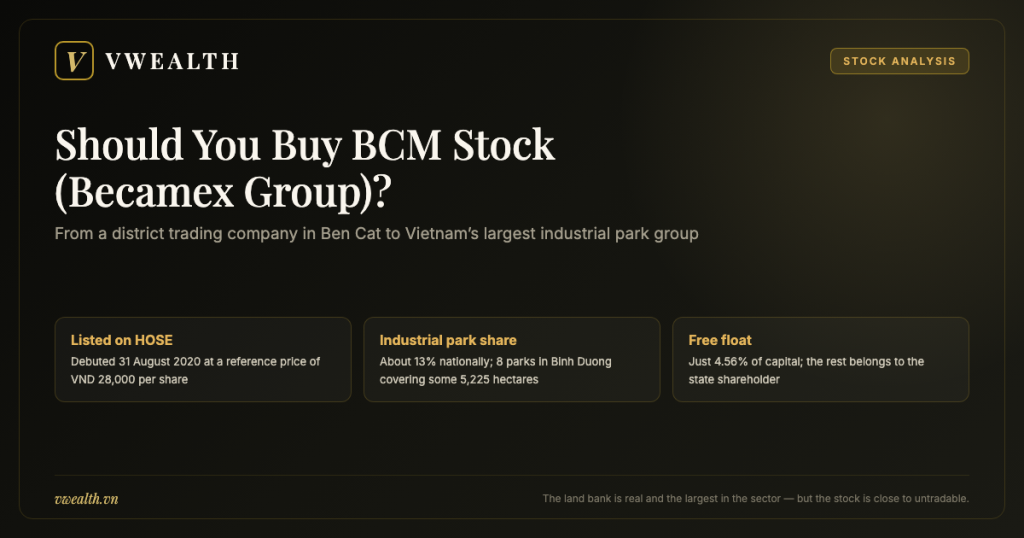
Should you buy BCM stock? The ticker belongs to Becamex Group — formerly Becamex IDC, the industrial park developer that built much of the manufacturing base of Binh Duong, the province that turned Vietnam’s southern corridor into a factory floor for global electronics. BCM is one of the largest companies by market capitalisation on the Ho Chi Minh Stock Exchange, controls roughly 13% of Vietnam’s industrial park market, and stands behind VSIP, the single most recognisable industrial park brand in the country. It is also, in practical terms, almost impossible to buy: the state shareholder holds 95.44% of the equity, leaving the entire investing public a free float of 4.56%. This article walks through the full story — from a district trading company founded in Ben Cat in 1976 to a group targeting a fifteen to twenty billion dollar valuation — teaches you how to read the financial statements of a Vietnamese industrial park developer, and finishes with a straight answer on who this stock suits and who it absolutely does not.
Before we start, one convention between you and this article, the same one used across this series. You will meet a lot of dates, names, project titles and scale figures, all taken from publicly disclosed sources: filings with the stock exchange, shareholder meeting resolutions, company and joint venture announcements, and mainstream financial press. What you will not find here is a current-quarter earnings figure or a valuation multiple as of today. For an industrial park developer, quarterly revenue depends almost entirely on when land and property handovers happen to be recorded, so a quarter can triple or fall by eighty per cent and tell you almost nothing about the underlying business. Instead, this article teaches you where to look and how to look; for the current numbers, open the latest analysis reports on vwealth.
A second convention, and for this particular ticker it matters more than usual. The dominant narrative around BCM for several years has been state divestment and the capital raise that would come with it. This is exactly the kind of story a market turns into expectation, while the part that has actually been approved and the part that is still a proposal are two very different things. This article separates those two categories carefully at every point, and says plainly when something has not been approved yet.
From a district trading company in Ben Cat to the industrial engine of a province
Here is a detail almost no foreign investor notices when they look up the ticker: the name Becamex is not an industrial acronym. It comes from Ben Cat, a rural district in the former Song Be province where the company was founded in 1976 as a general trading company. To understand why this business operates the way it does, and why its ownership structure is so unusual, you have to walk through its turns one by one.
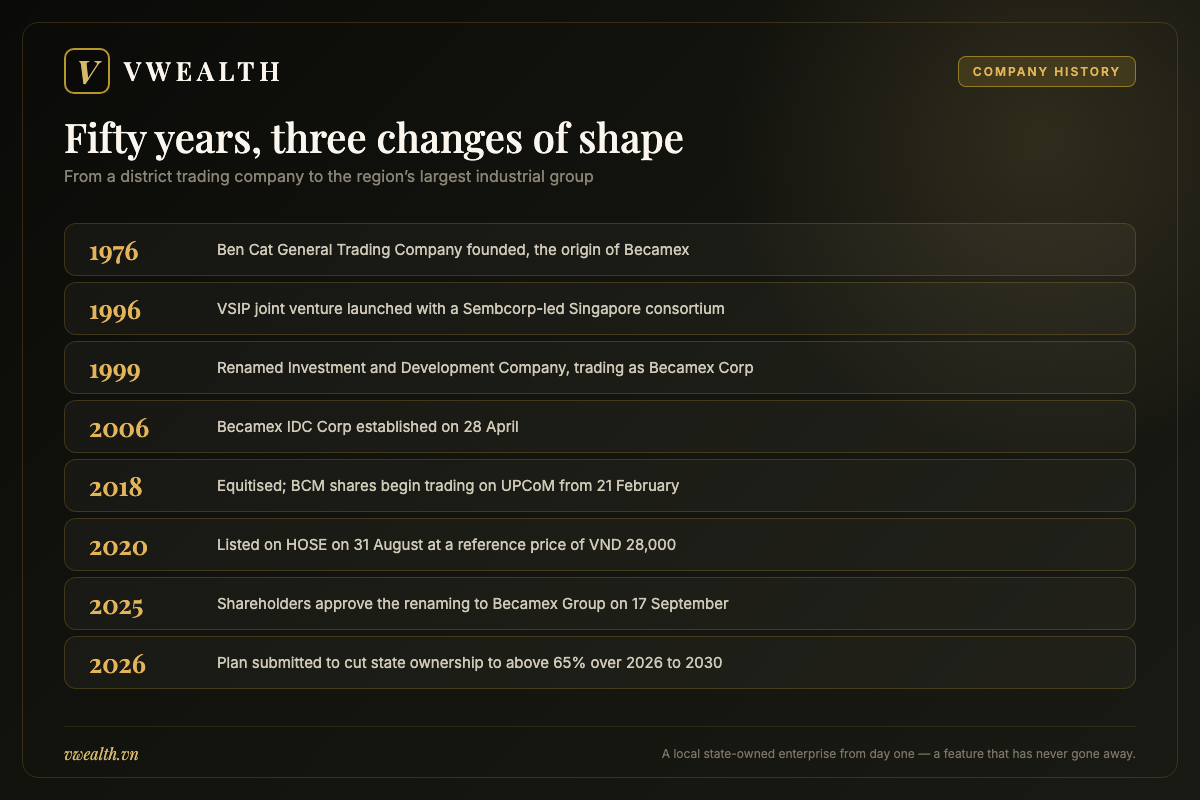
1976: a district-level trading company
In 1976, Ben Cat General Trading Company was established. At the time, a district trading company did exactly what the name suggests: it bought agricultural output, distributed essential goods, and served as the link between local production and the state distribution system. Nothing about it suggested the nucleus of an industrial conglomerate.
Pause on this detail longer than you might think it deserves, because it explains a characteristic that survives intact today. Becamex was born a local state-owned enterprise, and across fifty years it has never left that role. Every major turning point in its history has come from an administrative decision by the provincial government, not from a transaction on a capital market. That is simultaneously the source of its greatest strength and its greatest risk — and this article will return to the point repeatedly.
1992 to 1999: consolidation and the Becamex name
In 1992 the company merged with provincial-level entities to become Song Be Province Trade and Import-Export Company, still trading as Becamex. In 1999 it was renamed Investment and Development Company, trading as Becamex Corp.
The sequence of renamings sounds bureaucratic, but it records a real shift in substance: from trading, to import-export, to investment and development. Each rename came with an expanded mandate. And the final mandate — infrastructure development — was exactly what Binh Duong province, carved out of Song Be in 1997, needed most.
The 1990s context is worth picturing. Vietnam had opened up, foreign capital was starting to arrive, but it kept hitting a practical wall: a foreign manufacturer wanted serviced land with power, water, roads and workable administrative procedures. It did not want to negotiate land clearance itself in a country whose legal system it did not yet understand. Whoever solved that problem attracted the capital. Binh Duong assigned the problem to a state-owned company it controlled, and that company was Becamex.
1996: VSIP and a handshake between two governments
This is the single most important milestone in the company’s history, and the one foreign investors most consistently underweight.
In 1996 the Vietnam–Singapore Industrial Park, known as VSIP, was launched under an economic cooperation initiative between the two governments. Legally, VSIP is a joint venture between Becamex and a Singapore consortium led by Sembcorp Development. Becamex holds 49% of the venture; the Singapore side holds the remainder.
What made VSIP different is not the equity split but the fact that two governments stood behind it. For a Japanese, Korean or European manufacturer weighing an entry into Vietnam in the 1990s and 2000s, the word Singapore in the park’s name functioned as an implicit guarantee about infrastructure standards, governance quality and administrative predictability. That is an intangible asset no competitor in Vietnamese industrial real estate has been able to buy.
From VSIP I in Binh Duong, the model was replicated across the country. According to Sembcorp’s 2025 disclosures, the VSIP network had expanded to roughly 20 industrial and urban parks with a combined footprint of around 12,000 hectares, spread across Binh Duong, Bac Ninh, Hai Phong, Hai Duong, Nghe An, Quang Ngai and other provinces.
For someone buying BCM stock, VSIP carries a very specific accounting consequence that chapter four will dissect: because Becamex holds only 49%, VSIP is not consolidated into Becamex’s financial statements. It appears in a single line — share of profit from joint ventures and associates. And that single line contributes more than half of the group’s profit. In other words, more than half of what you are buying sits in a line item most investors skim past in three seconds.
Why Binh Duong, and what an outsider should know about it
If you have never followed Vietnam closely, Binh Duong may mean nothing to you. It should. For most of the past two decades it has been the country’s clearest example of what deliberate industrial policy at a provincial level can produce.
The province sits immediately north of Ho Chi Minh City, on the road and rail corridor running toward the Central Highlands and the Cambodian border. It has no seaport of its own and no international airport of its own; what it has is proximity to both, flat and buildable land, and an administration that made industrial development its organising priority from the 1990s onward. The results are visible in the composition of its economy: manufacturing and construction dominate, foreign-invested enterprises account for a very large share of industrial output, and the population has grown heavily through internal migration of working-age people from other provinces.
For an investor, three implications follow. First, the province’s growth model and Becamex’s business model are effectively the same model, executed by the same institutional actors. When you assess Becamex you are assessing a development strategy, not just a company. Second, that concentration is itself a risk: a locality whose economy rests on export manufacturing is highly exposed to global demand and trade policy, and so is the developer that houses that manufacturing. Third, the province’s success has consumed its own advantage over time, as land near the city grew expensive and labour supply tightened, pushing new development further north — which is exactly why Becamex’s newer parks such as Bau Bang and Cay Truong sit where they do.
The 2025 merger into Ho Chi Minh City formalised something that had been economically true for a long time: Binh Duong’s industry, the city’s port and airport access, and the surrounding labour catchment function as a single system. Whether that formalisation accelerates infrastructure delivery, or simply places Becamex further down a longer queue of municipal priorities, is one of the genuine open questions in this investment case.
2006: Becamex IDC is created
On 28 April 2006, Investment and Industrial Development Corporation — Becamex IDC Corp — was established through a reorganisation of Becamex Corp. This is when the company took on the shape it broadly still has: industrial parks, urban development, transport infrastructure, services, healthcare and education.
The years from 2006 to 2015 are when Becamex built most of what it owns today. The My Phuoc 1, 2 and 3 parks, then Bau Bang and Thoi Hoa, formed almost a continuous chain running north along National Highway 13. In parallel, the company launched Binh Duong New City, a planned administrative and service district built on former industrial land.
There is a business logic here you need to grasp to understand the whole model. Industrial parks attract factories; factories attract workers and expatriate managers; those people create demand for housing, schools, hospitals and services. A company that owns both the industrial land and the surrounding urban land captures both layers of value. That is the model Becamex pursues, and it is materially different from a pure-play industrial park landlord.
This period also produced the ecosystem of listed subsidiaries and affiliates you will encounter when researching the group: IJC in technical infrastructure and property, TDC in property trading and development, BCE in construction and transport works, and UDJ in urban development. Each handles a link in the chain.
2018: equitisation and a first step onto a public market
On 21 February 2018, following conversion into a joint stock company, BCM shares began trading on UPCoM, Vietnam’s third-tier market for public but not fully listed companies. This was the standard sequence for state enterprise equitisation at the time: convert, list on the unlisted public market, then move to a main board.
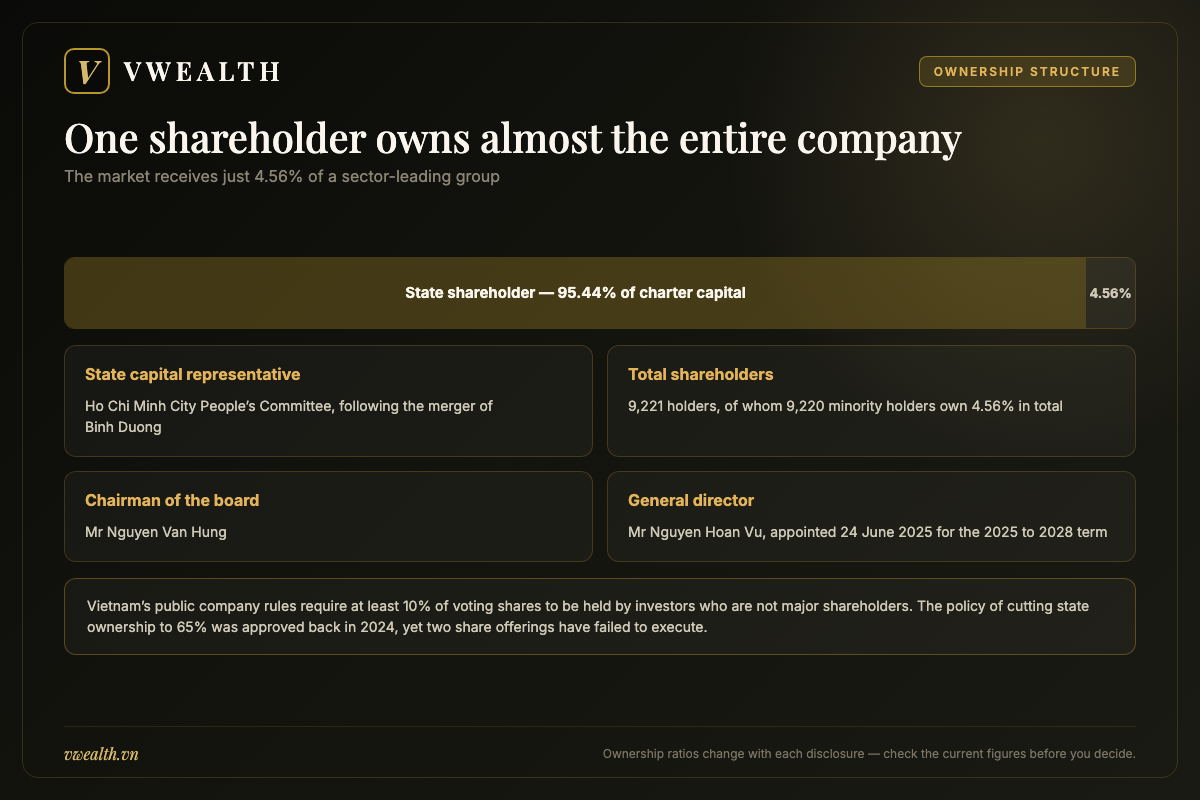
But Becamex’s equitisation had a feature you must remember, because it determines the personality of the stock ever since: state ownership after equitisation remained at 95.44%. The market received under 5% of a company with tens of trillions of dong in assets. Equitisation was complete on paper. Equitisation in the sense of genuinely changing who owns the company had barely begun.
31 August 2020: the HOSE listing
All of BCM’s roughly one billion shares traded for the last time on UPCoM on 19 August 2020 and were deregistered from that market on 20 August. On 31 August 2020, BCM listed on the Ho Chi Minh Stock Exchange at a reference price of VND 28,000 per share, implying a market capitalisation of roughly VND 28,980 billion, about USD 1.2 billion at the time. The reference price was set using the average reference price of the final twenty trading sessions on the previous market.
A main board listing gives a company three things: higher disclosure standards, a continuous market valuation, and eligibility for the indices that funds track. For BCM, the third point matters most, because a company this large is effectively automatic index material even though the quantity of stock that can actually change hands is tiny. This is a paradox chapter five explains in detail, because it directly shapes how the share price behaves.
2025: renamed Becamex Group, and a large administrative event
2025 brought two changes that new researchers frequently miss.
First, on 17 September 2025 the company announced the results of a written shareholder consultation approving a change of name to Becamex Group. The full legal name is now Becamex Investment and Industrial Development Group Joint Stock Company. The ticker remains BCM. If older and newer documents give you two different names, that is why.
Second, and far more consequential: Vietnam’s 2025 restructuring of provincial administrative units brought Binh Duong into Ho Chi Minh City. The direct consequence for BCM shareholders is that the body representing state capital in the company moved from the Binh Duong Provincial People’s Committee to the Ho Chi Minh City People’s Committee. In plain terms, the owner of 95.44% of Becamex changed representatives.
This is not a cosmetic change. The entire roadmap for reducing state ownership — the central investment story for this ticker — must now pass through a new level of government with its own priorities, its own budget and its own view of Becamex’s role inside a mega-city development picture. Chapter two explains why this both opens opportunity and extends uncertainty.
Historical milestones at a glance
| Date | Event | What it means for an investor today |
|---|---|---|
| 1976 | Ben Cat General Trading Company established | Local state-owned roots, a characteristic that has never gone away |
| 1992 | Merged into Song Be Province Trade and Import-Export Company | Scope expanded from district to province level |
| 1996 | VSIP joint venture launched with a Sembcorp-led Singapore consortium | The group’s largest intangible asset; now over half of group profit |
| 1999 | Renamed Investment and Development Company, trading as Becamex Corp | Mandate shifted from trade to infrastructure investment |
| 28 Apr 2006 | Becamex IDC Corp established | Industrial park plus urban development model takes shape |
| 2006 to 2015 | My Phuoc 1-2-3, Bau Bang, Thoi Hoa and Binh Duong New City developed | Low historic cost land bank, the profit base for years afterwards |
| 21 Feb 2018 | Equitised; BCM shares begin trading on UPCoM | State ownership after equitisation still 95.44% |
| 31 Aug 2020 | Listed on HOSE at VND 28,000, market cap about VND 28,980 billion | Index eligible despite a very thin free float |
| 2024 to 2025 | Two public share offering plans submitted but not executed | Hard evidence that the divestment path is difficult |
| 17 Sep 2025 | Shareholders approve renaming to Becamex Group | New name, same ticker |
| 2025 | Binh Duong merged into Ho Chi Minh City | State capital now represented by the HCMC People’s Committee |
| 25 Jun 2026 | Annual general meeting held in Ho Chi Minh City | Roadmap disclosed to cut state ownership to above 65% over 2026 to 2030 |
Read the table vertically and a pattern emerges: a company fifty years old that has been on a main board for only a few years, and in those years has never once completed the public share sale it planned. That is the sharpest difference between BCM and privately owned industrial park developers, and it is both an opportunity and a risk in a very unusual way.
Who owns Becamex, and why 95.44% is the central fact about BCM stock
For most companies, the ownership chapter is the one you skim. For BCM it is the most important chapter in this article. The reason is simple: Becamex’s ownership structure does not merely determine who makes decisions inside the company. It determines whether the stock can be traded at all, how the price behaves, and what the largest potential catalyst is.
Nguyen Van Hung and a new executive team
The chairman of the board is Nguyen Van Hung, a long-serving figure within the company and within Binh Duong’s state enterprise system, and the public face of Becamex in major cooperation events with its Singaporean partner and with the city government after the administrative merger.
The chief executive seat changed in 2025. On 24 June 2025, Becamex appointed Nguyen Hoan Vu, born in 1973, as general director for the 2025 to 2028 term, replacing Pham Ngoc Thuan who had held the role for roughly seven years. Vu is a construction engineer who rose internally, having headed the production and business department, served as deputy general director, and most recently run a group subsidiary specialising in infrastructure development. He has also sat on the boards of several companies in the Becamex ecosystem, including IJC, TDC, BCE and UDJ.
Read this as an analyst rather than as a reader of personnel news. A chief executive whose background is infrastructure, appointed at a moment when the company is prioritising the rollout of road projects and new industrial parks, tells you something about where management weight is being placed. It guarantees nothing about outcomes, but it tells you the direction of effort.
It is also worth stating plainly a feature common to every state-controlled company, not just this one: the executive team is not the final decision maker on the things that matter most. Selling equity, raising capital, committing to large projects — all of these require approval from the state ownership representative and, in many cases, from a higher level still. When you value a company like this, you have to add a variable your financial model has no cell for: the speed of administrative decision making. If this structural feature is new to you, the overview of Vietnamese state-owned enterprises explains how the ownership representation system works and what it means for minority shareholders.
What 95.44% actually means
As of the shareholder record date in May 2026, Becamex had 9,221 shareholders. Of those, the state shareholder held 95.44% of charter capital, or nearly 988 million shares. All 9,220 remaining shareholders combined — every domestic and foreign individual and institution — held 4.56% of the voting shares.
Translate that into the language of someone actually trying to buy the stock. If you wanted to acquire a position equal to 1% of Becamex’s charter capital, you would need to buy nearly a quarter of every share genuinely circulating in the market. At any sensible price, that is not possible. For an institutional fund, BCM is in practice an undeployable stock despite sitting among the largest companies on the exchange.
The second consequence matters even more. The price of a stock with an extremely thin float does not reflect enterprise value in the usual way. A moderate buy order can move the price a long way, and the reverse is equally true. When you see BCM’s market capitalisation quoted in billions of dollars, remember that the figure is calculated by taking the price of the 4.56% that trades and multiplying it across every share outstanding, including the 95.44% the market has never priced.
Why the company is required to reduce state ownership
Many readers see the news that Becamex wants to cut state ownership and assume it is purely a strategic choice. There is a very concrete legal pressure behind it as well.
Vietnam’s public company rules require a minimum of 10% of voting shares to be held by at least 100 investors who are not major shareholders. Becamex has 9,220 small shareholders, far more than the required headcount, but they collectively hold only 4.56%, less than half the minimum threshold. The company currently retains public company status under transitional provisions, but that is a temporary state rather than a stable one.
In other words, cutting state ownership is not simply about raising money. It is a condition of BCM remaining where it currently sits in the market structure. That is why the topic reappears at every annual general meeting, year after year.
The 65% roadmap: what has been approved and what is still a proposal
This is where you must be rigorous, because the market routinely blends these two categories.
What has been formally approved: in June 2024, a government decision approved the policy of reducing state capital at Becamex from 95.44% to a minimum of 65%. The accompanying plan was to offer 300 million shares, roughly 29% of voting shares, through a public auction on the Ho Chi Minh Stock Exchange at a starting price of not less than VND 50,000 per share, targeting proceeds of at least VND 15,000 billion. The intended use of funds was split three ways: roughly VND 6,300 billion for project investment, roughly VND 3,634 billion for capital contributions into member companies, and roughly VND 5,066 billion to repay bond principal and bank debt.
What actually happened: the offering did not go ahead. In late 2024 the company had aimed to raise roughly VND 21,000 billion at a price around VND 69,000 per share, but the market price subsequently fell below that level as global trade tensions made investors cautious about the outlook for foreign direct investment into Vietnam. A scaled-back plan — 150 million shares at VND 50,000 — also went nowhere: when put to shareholders, only 2.85% of voting shares approved it while 95.44% did not vote. That 95.44% is precisely the state ownership figure, which tells you the bottleneck sits at the owner approval stage rather than purely in market conditions.
What is currently a proposal: at the annual general meeting on 25 June 2026, the company said it had proactively built a plan and submitted it to the Ho Chi Minh City People’s Committee — the body now representing state capital after the merger — to reduce state ownership from 95.44% to above 65% during the 2026 to 2030 period. The stated methods are divestment or new share issuance. The company also set out an ambition to reach a market capitalisation of roughly USD 15 to 20 billion by 2030.
Now read those three paragraphs again and draw your own conclusion. A policy approved in 2024 with a completion target of end-2025, two failed attempts at execution, and now a reset with a horizon stretching to 2030 under a new supervising authority. That is not a catalyst with a date. It is a possibility whose probability and timing nobody outside the company has any basis to estimate. Building a buy case on the assumption that divestment happens within twelve months is a fast route to being stuck for years.
Foreign ownership: one large number and one small one
The maximum foreign ownership ratio put to shareholders for BCM sits at 34%. Actual foreign ownership in the stock is around 1.3%.
The gap between those numbers says a great deal. It is not evidence that foreign investors dislike the company — with a 4.56% float, even a willing buyer would find almost no stock available. It is evidence of something else: the current ownership structure is itself blocking foreign capital from entering, regardless of what the legal framework permits.
If you are not familiar with how these caps work in Vietnam, the guide to foreign ownership limits in Vietnamese stocks explains the mechanics and where the binding constraints usually sit. For BCM, the room is not the constraint. Supply of shares is.
Dividends: understand what a stock dividend actually is
The board proposed a 2025 dividend at a ratio of 14%, above the 10% originally planned. The payment form is shares: a holder of 100 shares receives 14 new shares, implying roughly 144.9 million new shares issued from undistributed after-tax profit. For 2026, the planned dividend ratio is 10%.
There is a very common misunderstanding worth clearing up right here. A stock dividend is not income. When a company issues new shares to pay a dividend, total enterprise value does not increase by a single dong; only the share count rises, and the reference price is adjusted downward correspondingly. You receive more paper, not more money. What you actually retain is an unchanged ownership percentage in a company that has kept all of its profit for reinvestment.
For a company funding a large pipeline of infrastructure and industrial park projects, retaining profit is a rational corporate finance decision. But if you are an income investor looking for a recurring cash yield, you need to know that this stock does not produce one.
Ownership and leadership at a glance
| Item | Disclosed position | What an investor should take from it |
|---|---|---|
| State shareholder | 95.44% of charter capital, nearly 988 million shares | Every major decision depends on a single owner |
| State capital representative | Ho Chi Minh City People’s Committee after the Binh Duong merger | The old roadmap must be resubmitted, adding timing uncertainty |
| Minority shareholders | 9,220 holders with 4.56% combined | Extremely thin float, prices move sharply |
| Public company threshold | Minimum 10% held by non-major shareholders | Legal pressure forcing the state ownership reduction |
| Divestment policy | 65% target approved in 2024; two offerings not executed | A policy, not a dated event |
| Current proposal | Above 65% over 2026 to 2030, submitted to the city authority | Long horizon with no execution milestone yet |
| Foreign ownership cap | 34% as put to shareholders | Not the current bottleneck |
| Actual foreign ownership | Around 1.3% | Not lack of interest, lack of available shares |
| Chairman | Nguyen Van Hung | Public face in government and Singapore partner relations |
| General director | Nguyen Hoan Vu, appointed 24 June 2025, term 2025 to 2028 | Infrastructure background, matching the project rollout phase |
| 2025 dividend | 14% in shares, roughly 144.9 million new shares | No cash to shareholders, share count dilution |
| 2026 dividend plan | 10% | Continued preference for retaining capital |
This table is the clearest picture of what you actually buy when you buy BCM: a very small slice of a very large company where near-absolute decision rights sit with one shareholder, and that shareholder has just changed representatives.
How Becamex makes money: dissecting an industrial land group
Ask a typical investor what Becamex does and the answer is almost certainly industrial park land leasing. That answer is correct but incomplete, and the missing part is the part that generates more than half the profit. This chapter separates each revenue source, shows which segment feeds which, and most importantly identifies where the model has a genuine economic moat.
Industrial land leasing: the core operation
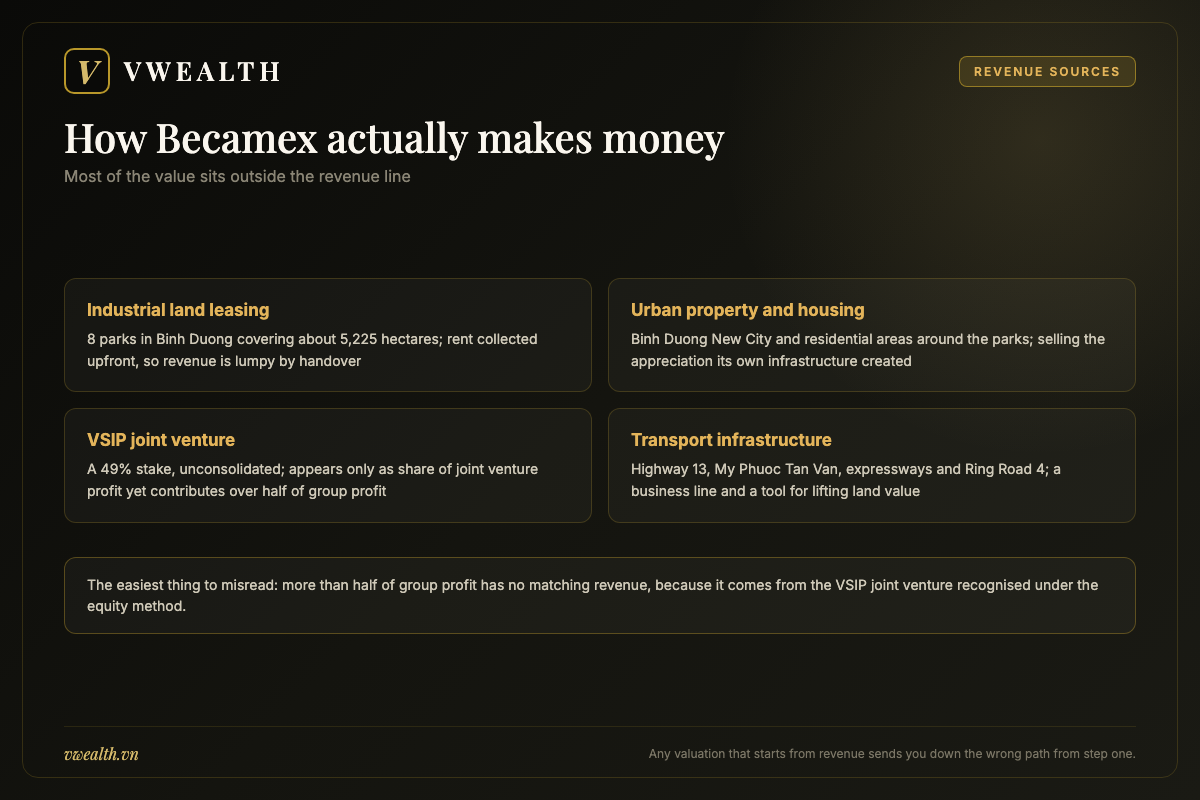
Becamex directly manages 8 industrial parks in Binh Duong covering roughly 5,225 hectares. Including joint ventures and affiliated developments, the total portfolio the group participates in reaches around 15,000 hectares. The company holds roughly 13% of Vietnam’s industrial park market share — a share no other developer approaches.
The core parks are My Phuoc 1, My Phuoc 2, My Phuoc 3, Bau Bang, Bau Bang Expansion and Thoi Hoa. Open a map of Binh Duong and you will see them forming an almost continuous chain along National Highway 13 running from the south of the province toward the north. This is not accidental: Becamex is both the park developer and a participant in developing the road that connects them.
The revenue mechanism needs to be understood precisely, because it governs how you read the financial statements later. The company spends money upfront on land clearance compensation and infrastructure — internal roads, power, water, wastewater treatment — then sub-leases serviced land to tenants under long-term contracts, usually running to the end of the project term. Most of the lease consideration is collected as a single upfront payment or in a few instalments at the start.
This differs fundamentally from an office landlord. An office landlord collects an even stream of rent every month for years. An industrial park developer collects nearly all the money at signing and afterward receives only management and utility fees. The consequence: revenue at an industrial park developer is lumpy, driven by the timing of land handovers, not smooth like a conventional leasing business.
How an industrial land lease actually works in Vietnam
Foreign investors often assume an industrial park developer owns land outright and rents it like a landlord. Vietnam’s land system does not work that way, and the difference matters for how you value the business.
All land in Vietnam is under state ownership; what organisations and individuals hold are land use rights for defined terms and purposes. An industrial park developer is allocated or leased land by the state for the project term, typically fifty years, and pays land use fees or land rent to the state. It then invests in infrastructure and sub-leases serviced plots to tenants for the remaining term of the project.
Three consequences follow. First, the developer’s asset is a wasting one in a legal sense: a lease signed today runs to the end of the original project term, so a park approved in the early 2000s offers a tenant fewer remaining years than a park approved last year. Renewal is possible but is an administrative process, not an automatic right. Second, the compensation and land clearance stage is where most of the risk and most of the value creation sit — it is slow, negotiated household by household in many cases, and a developer that completed clearance a decade ago at a decade-old price holds an advantage no amount of current capital can buy. Third, because most lease consideration is collected upfront while the obligation to provide infrastructure and services runs across decades, the accounting treatment of that upfront cash matters enormously, which is why the unearned revenue line discussed later in this article deserves your attention.
There is also a tenant-side detail worth knowing. Manufacturers signing these leases are usually making a fifteen to twenty-five year commitment involving substantial fixed investment in buildings and equipment. They are not price-sensitive tenants who move for a cheaper offer next year. That stickiness is why occupied land in a well-located park is a genuinely durable revenue base — and why the pace of new land absorption, rather than tenant churn, is the number that matters.
Urban property and housing: the second value layer
The second segment is residential and commercial property, with Binh Duong New City and the residential areas around the industrial parks as flagship projects.
The logic here is worth understanding, because it explains why Becamex’s margins differ from a pure-play park developer. When Becamex acquires cheap agricultural land in the north of the province, builds roads, brings in power and attracts factories, the value of everything around it rises. The industrial portion generates direct leasing revenue; the residential and commercial land nearby appreciates alongside it and is sold later, still carried at a cost base set years earlier.
Put simply: the company does not only sell land, it sells the appreciation its own activity created. Only a developer holding a land bank large enough and contiguous enough can do this, and it explains why Becamex accumulated land so early in places nobody wanted at the time.
Alongside commercial product, the company also develops social housing projects such as Viet Sing and Dinh Hoa. Social housing carries a regulated margin cap, so viewed purely through a profit lens it is not an attractive segment. But it serves another purpose within the model: retaining the labour force for the very industrial parks the company leases out. A park that cannot recruit workers is a park that loses tenants.
VSIP: the largest segment you cannot see in revenue
This is the most important part of the chapter, and the part most frequently missed when investors read BCM’s statements.
Becamex holds 49% of the VSIP joint venture. Because that is below control, VSIP is not consolidated into Becamex’s consolidated financial statements. VSIP’s revenue does not appear in BCM’s revenue line. VSIP’s assets do not appear in BCM’s total assets. The only thing that appears is the proportionate share of profit or loss, recorded on a line called share of profit from joint ventures and associates, sitting modestly in the middle of the income statement.
And that modest line contributes more than 50% of group profit.
Stop and think about the consequences. If you value BCM by taking revenue and applying a margin, you will produce a badly distorted number, because more than half of profit has no matching revenue. If you assess operating efficiency by dividing profit by revenue, you get an artificially attractive margin. And if you want to know the real health of the group’s largest investment, you have to source information about VSIP elsewhere — typically from the Singaporean partner’s disclosures — because BCM’s own report does not tell you.
This is exactly the kind of detail an amateur skips and a serious investor digs into. The guide to reading Vietnamese company financial statements covers the equity method and other local reporting conventions; for BCM, that section is not background reading, it is mandatory.
Transport infrastructure: simultaneously a cost and a tool
Becamex participates in a series of major regional transport projects: the upgrade and widening of National Highway 13, the upgrade of the My Phuoc Tan Van route under a public-private partnership, the Ho Chi Minh City – Thu Dau Mot – Chon Thanh expressway, and the Ring Road 4 section from Thu Bien bridge to the Saigon River.
For an ordinary company, transport infrastructure would be a standalone segment with its own payback maths. For Becamex it is also a tool serving the core business. Every new road that shortens the trip from an industrial park to a seaport or an airport creates headroom for the company’s own land rents. Foreign manufacturers choosing a site look at logistics costs before they look at land rent.
But you have to see the other side of the coin. Transport infrastructure consumes enormous capital, pays back over decades, and in many cases depends on an approved cost recovery mechanism rather than on market pricing. This is one of the main reasons group borrowings sit high — a topic chapter four addresses with numbers.
The member company ecosystem and supporting segments
Around Becamex sits an ecosystem of member companies, many of them separately listed. You will encounter IJC in technical infrastructure and property, TDC in property trading and development, BCE in construction and transport works, and UDJ in urban development. Beyond these, the group is present in healthcare and education, including an international university located in Binh Duong New City, plus a range of urban services.
This structure cuts both ways. The benefit: the group closes its own value chain from land clearance through infrastructure and construction to end product sales. The cost: related-party cash flows and transactions make the consolidated statements harder to interpret, and an outside investor struggles to identify where value is genuinely created. When you read BCM’s notes to the financial statements, the related-party transactions section is one to read carefully, not to skim.
Where Becamex’s moat is, and where it is thin
The first moat is a land bank carried at historic cost. Most of the land Becamex is monetising was accumulated years ago at compensation prices far below today’s. A competitor wanting to create an equivalent land bank now must pay today’s prices. That is a real, measurable advantage that cannot be replicated quickly.
The second moat is institutional relationships. Becamex is a local state enterprise, building infrastructure for the locality, and in many cases acting as the executing arm of local planning. This gives it access to projects and procedures a private developer does not have.
The third moat is the VSIP brand. A multinational choosing a site is not only comparing rent; it is pricing operational risk over the next twenty years. VSIP functions as a warranty that competitors cannot rebuild from scratch.
Now be honest about the thin spots. The first moat depletes: every hectare of low-cost land sold is a hectare that does not come back, and the core parks have been monetised over many years. The second moat cuts both ways: institutional relationships open doors to projects, but they are also why every capital decision waits for approval — which is precisely why two share offerings failed. The third moat sits inside a venture in which Becamex holds a minority, meaning it enjoys the profit without controlling the operation.
Revenue sources compared
| Segment | How it generates cash | Cash flow character | What to monitor |
|---|---|---|---|
| Industrial land leasing | Long-term leases on serviced land, mostly collected upfront | Lumpy, driven by handover timing | Remaining leasable area and absorption pace |
| Urban and commercial property | Selling product on land that appreciated thanks to the group’s own infrastructure | Recognised on handover, concentrated in a few quarters | Units handed over and inventory cost base |
| Social housing | Sales at a regulated margin cap | Low and stable | Its role retaining labour for the parks |
| VSIP joint venture | 49% share of results via the equity method | No matching revenue, cash depends on distributions | Contributes over half of group profit |
| Transport infrastructure | Road project investment recovered under approved mechanisms | Negative for years, very long payback | Funding source and project legal progress |
| Member companies and services | Construction, technical infrastructure, healthcare, education, urban services | Steadier but smaller | Related-party transactions in the notes |
Look at this table and you will see what many investors miss: BCM is a stock where most of the value sits outside the revenue line. Any valuation method that starts from revenue sends you down the wrong path from step one.
Position and financial health: seven things to check before deciding whether to buy BCM stock
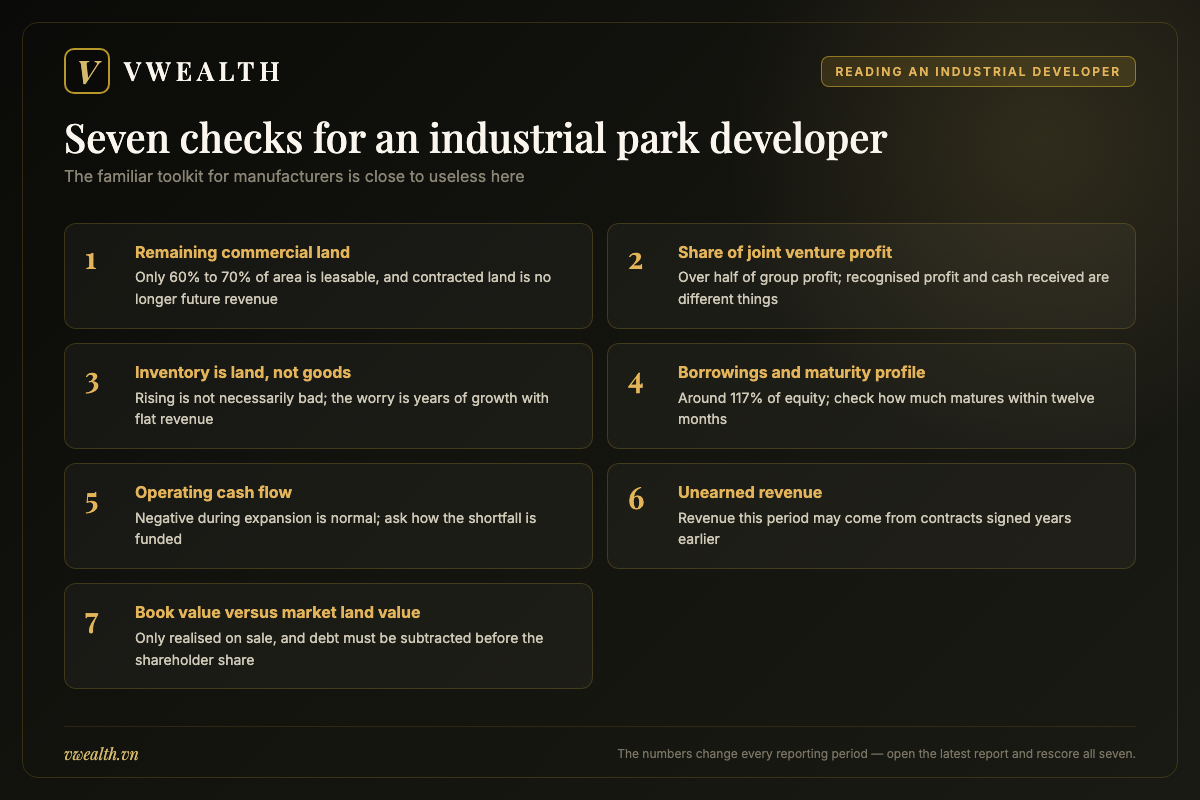
The familiar toolkit you use on a manufacturer — revenue growth, gross margin, inventory turns — is close to useless on an industrial park developer. This chapter gives you seven places to look, and how to look at them, so you can score BCM at any point in time rather than depending on one quarter’s numbers.
Check 1: remaining commercial land, not total land
The first figure every company profile quotes is total area. That figure is nearly meaningless to an investor.
What you need is remaining commercial land available to lease. Within an industrial park, only roughly 60% to 70% of total area is leasable; the rest is internal roads, green space, wastewater treatment and administration. Within the leasable portion, whatever is already contracted is no longer a future revenue source.
As of end-2023 disclosures, Becamex’s remaining industrial park area was around 3.5 million square metres, spread across My Phuoc 1, 2 and 3, Bau Bang, Bau Bang Expansion and Thoi Hoa. That is a figure from a date now several years back, and you must update it yourself, but it demonstrates the approach: a company managing 5,225 hectares does not have 5,225 hectares to sell.
The next question to answer for yourself: at the average leasing pace of recent years, how many years does the remaining area support? And are there approved new projects to follow on? For Becamex the named pipeline includes the Cay Truong industrial park at roughly 700 hectares and Bau Bang Expansion phase two at roughly 380 hectares, alongside concentrated digital technology zones in Binh Duong and Ho Chi Minh City. The company and VSIP have indicated planned 2026 investment exceeding VND 24,000 billion across eight industrial park projects.
Check 2: the share of profit from joint ventures and associates
This is the single most important line in BCM’s income statement, and the easiest to skim past because it occupies one modest row.
The correct approach has three steps. Step one, divide the share of profit from joint ventures and associates by group after-tax profit to establish the real weight. For Becamex this typically exceeds half. Step two, ask whether that profit came with cash into the bank — accounting recognises the proportionate share even if the venture has not distributed anything, so recognised profit and received cash are different things. Step three, compare the recognised share across years to see the trend.
If you remember one thing from this chapter, make it this: when BCM’s profit jumps in a period, the first thing to check is whether the increase came from core operations or from the joint venture line, and if from the venture, whether it came from recurring activity or from a one-off transaction.
Check 3: inventory is not inventory
On an industrial park developer’s balance sheet, inventory is usually very large. But it is not goods sitting in a warehouse awaiting sale.
Inventory here is mainly work in progress: land clearance compensation paid, land use fees remitted, levelling and infrastructure costs incurred on plots not yet leased or sold. In other words, it is land in the process of becoming a product.
The correct reading: rising inventory at an industrial park developer is not the warning signal it would be at a manufacturer; it usually indicates the company is accumulating land for future years. The genuinely concerning pattern is different — inventory rising continuously for several years while revenue does not follow, which means capital is buried in projects that cannot proceed due to legal obstacles or weak absorption.
Open the notes and see how inventory is allocated across projects, which ones have complete legal status and which are still waiting. It is fifteen minutes of work and it tells you more than any summary ratio.
Check 4: borrowings and their maturity profile
This is where an investor has to look directly rather than around.
Becamex’s total borrowings have run at around USD 1 billion, roughly VND 26,333 billion, equal to about 117% of shareholders’ equity. The company owes more than the capital its shareholders have contributed. Financial expense is consequently a large line item and highly sensitive to interest rates.
For an industrial park developer, high leverage is not automatically a bad sign. The model requires spending capital years before collecting revenue, so borrowing is inevitable. The real questions are three more specific ones.
First: does the debt maturity profile match the cash collection cycle of the projects it funds? Financing a twenty-year infrastructure payback with short-term borrowing is a recipe for liquidity risk. You check this in the maturity analysis of liabilities in the notes.
Second: how much debt matures within twelve months, and where does the money to repay it come from? It could be existing cash, proceeds from the next land sale, or refinancing through a new loan or bond issue. Each option carries a different risk, and in a tight credit environment refinancing is not always available.
Third: is interest expense being capitalised into project cost? Property developers may capitalise interest on projects under construction into asset value rather than expensing it immediately. This is compliant with accounting standards, but it means reported profit today carries less interest cost than the economic reality, and that cost will surface in cost of sales when the product is eventually sold.
Check 5: cash flow from operating activities
For BCM, negative operating cash flow has appeared across multiple periods, and you need to interpret it correctly rather than either panicking or ignoring it.
Operating cash flow at an industrial park developer turns negative when the company spends more on compensation, levelling and infrastructure than it collects from tenants and homebuyers in the period. During an expansion phase, negative is normal. The questions are how long, how large relative to company scale, and how the shortfall is funded.
If the shortfall is funded by new borrowing, year after year, you are looking at a company whose asset base grows while its capacity to self-fund does not. That is a state in which any change in interest rates or in access to capital hits harder than average.
Check 6: unearned revenue and the illusion it creates
On BCM’s balance sheet there is a line worth seeking out: unearned revenue. This is money already collected from land tenants but not yet fully recognised as revenue, to be amortised across the lease term.
It matters for two reasons. First, it is evidence of contracts signed — a form of backlog for future years. Second, and more subtly, it creates an effect investors easily misread: revenue recognised in a period may come from contracts signed years earlier, and therefore may not reflect that period’s sales activity at all.
So when you see an industrial park developer’s revenue rise, ask: is this new money from new contracts, or the amortisation of old money? The two answers lead to entirely different conclusions about business health.
Check 7: book value versus the market value of land
The final check is what makes valuing industrial park developers both interesting and dangerous.
Land Becamex accumulated ten or twenty years ago sits on the books at historic cost — the compensation price of that era plus infrastructure spending. The market value of the same plot today is several times higher. That means book value understates real asset value.
This is the argument industrial park bulls typically make, and it is partly right. But you must consider three things before accepting it as an investment case.
First, the gap is only realised when land is sold or leased. Unsold land keeps the gap on paper, while the interest funding that plot must still be paid in cash every period.
Second, the gap does not accrue to you as simply as you might assume, because a large portion of the group’s asset value sits inside a venture in which Becamex holds only 49%.
Third, asset-based valuation requires subtracting debt. With borrowings around 117% of equity, subtracting debt changes the answer dramatically, and a small change in your land price assumption amplifies into a large change in residual value to shareholders. Build at least three land price scenarios rather than trusting a single number from any one report.
What these seven checks say about Becamex’s position
Add them up and a fairly clear picture emerges. Becamex has the leading position in its industry, a low-cost land bank, a profitable joint venture, and a named future project pipeline. That is the asset side.
On the other side is a debt-heavy balance sheet, operating cash flow that does not yet fund the pace of expansion, and an ownership structure that has blocked the one fix that addresses leverage at the root — issuing equity — for several years running. The company sought to raise VND 15,000 billion and had policy approval from 2024, yet has not executed. That is not a technical footnote; it is the central link in the entire investment case for this ticker.
How the market treats BCM stock: a large company with a very small float
Every stock has a personality on the tape, and that personality is set more by who owns it than by what the company does. With BCM the personality is unusual enough that if you do not understand it, you will be repeatedly surprised by what happens to your position.
The paradox of large capitalisation and thin float
BCM sits among the largest companies on HOSE by market capitalisation, qualifying for the indices funds track. Yet only 4.56% of charter capital can actually be traded.
Put those two facts side by side and you get a very particular kind of stock. On one hand it always appears in large-cap lists and gets cited as the representative of Vietnamese industrial real estate. On the other, a moderate flow of money in or out moves the price a long way because there is so little stock on the other side.
The practical consequence for you: BCM’s price movements do not always carry information about the company. They may simply reflect a group of investors buying or selling into thin liquidity. If you are used to reading price action as a signal about intrinsic value, this ticker will mislead you repeatedly.
Liquidity risk here is real, not a boilerplate warning. You may be able to buy at a given price, but when you want to sell a large position during a poor session, you may not find a buyer at anything close to it. For a small retail investor this matters less, but it still needs to be factored into position sizing. If you are unfamiliar with the local market mechanics that make this worse — daily price bands, the T+ settlement cycle, session structure — the guide to Vietnam stock trading rules covers them.
Why P/B and NAV are the right tools and P/E misleads
The price-to-earnings ratio works well for companies with steady earnings. Industrial park developers do not have steady earnings.
BCM’s profit can triple in one period because a large property project was handed over, then fall sharply the next because nothing reached handover stage. Applying P/E to that earnings series produces meaningless numbers: absurdly cheap at a recognition peak and absurdly expensive at a trough.
The more appropriate tools belong to the asset-based family: price to book value, and more carefully, an estimated net asset value in which you revalue the land bank at market prices, add the value of the joint venture stake, and subtract debt. This requires more assumptions, but it at least measures what the company actually owns.
The caution: asset-based results are very sensitive to land price assumptions. Raise your assumed rent per hectare by ten per cent and residual value to shareholders can move by tens of per cent, because the debt subtracted is fixed. That is why you build three land price scenarios rather than trusting a single figure.
One further practical note for investors based outside Vietnam. Because the tradable quantity is so small, BCM is a name where the difference between a limit order and a market order is not academic. Placing a market order into a thin book can execute across several price steps, and Vietnam’s daily price band means a stock can reach its limit and simply stop trading, leaving an order unfilled on a day when you wanted out. Sizing the position so that you never need to transact urgently is not conservatism here; it is the only way the position works.
The personality of BCM stock
Looking back at trading history since listing, a few repeating characteristics are worth knowing in advance.
First, it reacts strongly to news about foreign direct investment flows and about global trade policy. When there is positive news about manufacturing relocation into Vietnam, the industrial park group tends to rise together and BCM rises with it. When trade barriers make headlines, the reverse happens just as fast.
Second, it reacts to news about state divestment and share issuance plans. This story has run for years, so each time the topic resurfaces the market re-prices the probability of it happening.
Third, because the float is thin, its trading range is often wider than the company’s size would suggest. An investor used to the stability of large caps can be caught off guard.
Foreign investors and the problem of no available shares
As covered in chapter two, foreign ownership of BCM is around 1.3% against a 34% cap. This means the ticker barely participates in the foreign flow story that Vietnam’s market upgrade process has generated.
This matters when comparing BCM with peers. An industrial park stock with a high free float and available foreign room benefits directly if passive capital flows into Vietnam. BCM largely stands aside unless its ownership structure changes, because free float is an explicit criterion in index construction. The analysis of the Vietnam market upgrade and index inclusion explains how passive allocations are determined and why float weighting excludes companies like this one.
Comparing BCM with other options in the industrial park group
| Criterion | BCM | Privately owned listed park developers | What an investor should conclude |
|---|---|---|---|
| Land bank scale | Largest in the sector, roughly 13% national market share | Much smaller, usually concentrated in a few provinces | BCM wins clearly on scale and coverage |
| Free float | 4.56% | Usually many times higher | BCM loses clearly on practical tradability |
| Decision making | Depends on approval from the state ownership representative | Board decides faster | Different speeds of response to market opportunity |
| Profit source | Over half from an unconsolidated joint venture | Mostly from consolidated operations | Reading BCM’s statements requires an extra step |
| Leverage | Borrowings around 117% of equity | Varies widely by company | Compare ticker by ticker, not group to group |
| Ability to attract foreign capital | Low due to lack of shares, despite a 34% cap | Higher where room and liquidity exist | BCM benefits little from the upgrade theme |
| Company-specific story | State divestment and equity raise | Land bank expansion, project transfers | BCM has a large catalyst with no schedule |
For a concrete point of comparison, the analysis of KBC stock and Kinh Bac City describes an almost opposite model within the same industry: privately controlled, faster decisions, better liquidity, but without Becamex’s scale of historic-cost land and without a partner of VSIP’s stature behind it. Reading the two side by side shows two very different trade-offs inside one sector.
A second useful comparison is GVR, the Vietnam Rubber Group — also state-controlled, also sitting on an enormous land bank, also carrying a story about converting land into industrial parks, and also constrained by the same decision-making speed. These two tickers share more characteristics with each other than either shares with a private peer. For the sector picture as a whole, the overview of Vietnamese real estate stocks places industrial developers alongside residential and commercial names.
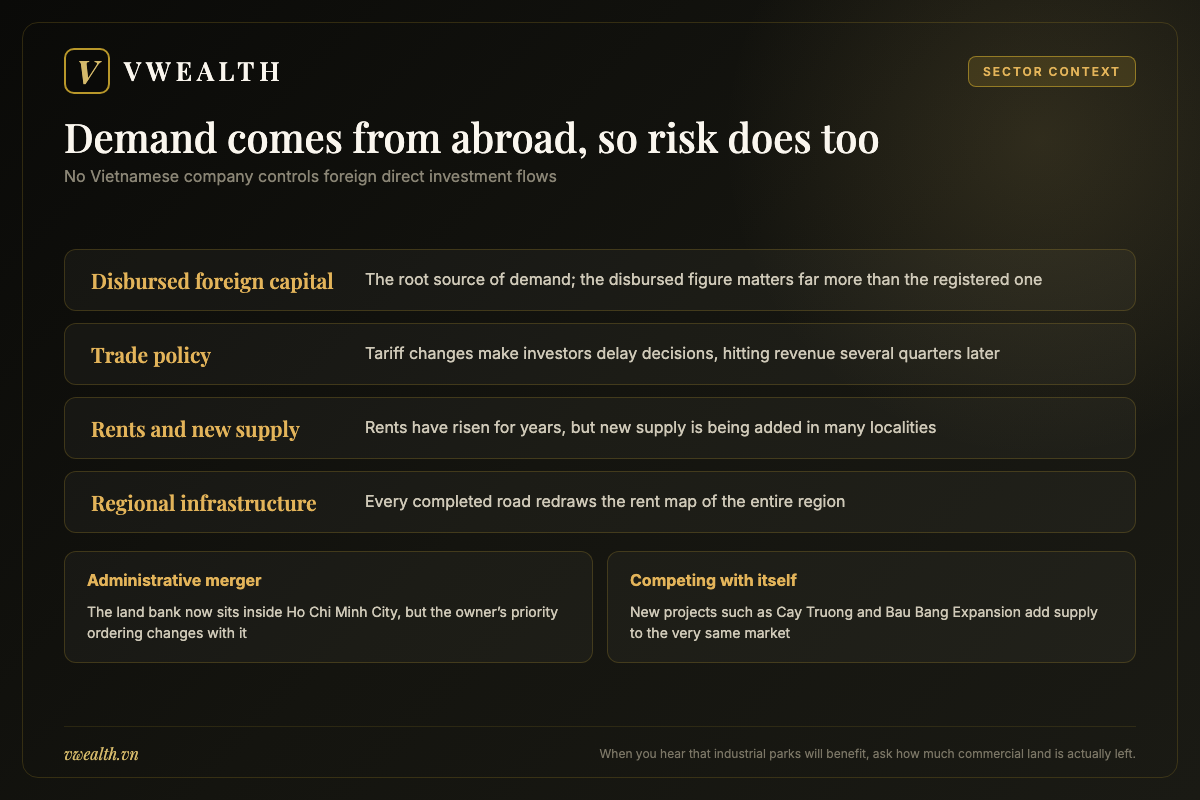
Sector context: Vietnam’s industrial parks between two opposing winds
No company is bigger than its industry. For Becamex this is especially true, because demand for its core product — industrial land — comes almost entirely from foreign direct investment, something no Vietnamese company controls.
Foreign direct investment: the root driver
Demand for Vietnamese industrial land comes from manufacturing plants, and most of those are foreign-invested, concentrated in electronics, machinery, supporting industries, textiles and processing.
Disbursed foreign investment into Vietnam has trended upward for years and reached high levels in recent periods. The disbursed figure matters far more than the registered figure, because registered capital is only a commitment on paper while disbursed capital is real money going into building factories — and factories are what lease land.
When you track this sector, train yourself to separate the two. A year in which registered capital jumps on the back of one multi-billion-dollar announcement while disbursement stays flat has not yet produced any near-term effect on industrial park developers.
Supply chain diversification and its limits
The push by multinationals to spread manufacturing beyond a single hub has driven Vietnam’s industrial park sector for close to a decade. Geography, labour cost, a dense network of trade agreements and political stability are the reasons most often cited. The China plus one theme and the Vietnamese stocks exposed to it covers this dynamic across sectors.
But look at the limits too. First, the wave is uneven: it concentrates in certain industries, and within each industry in a handful of large investors. Second, Vietnam is not the only option; regional peers compete with tax incentives, infrastructure and domestic market size. Third, and most relevant to a company like Becamex: when infrastructure and labour supply in one locality reach their limits, investors look elsewhere, and an advantage accumulated over years does not automatically become permanent.
Labour and power: the two physical constraints
Two constraints rarely appear in sector forecasts but bind harder than either rents or land supply.
The first is labour. An industrial park is only useful to a manufacturer if the manufacturer can staff it. Vietnam’s industrial provinces have historically drawn workers through internal migration, but that supply is neither infinite nor free: as a locality matures, wages rise, housing costs rise, and workers begin choosing provinces closer to home where new parks are opening. This is a structural reason developers keep pushing new projects outward and a structural reason social housing sits inside Becamex’s model despite its capped margin. When you assess a park’s prospects, ask where its workers will come from and what it costs to house them.
The second is power. Electronics and semiconductor-adjacent manufacturing is power-hungry and intolerant of interruption, and increasingly the multinationals doing the siting also carry renewable energy commitments. A park that can offer reliable supply, and ideally a credible clean energy option, competes on a dimension that did not exist a decade ago. This is why industrial developers across the region have been adding rooftop solar and power-related activities to their registered business lines — Becamex included.
Neither constraint shows up in a rent forecast, but both determine which parks fill and which sit half empty. For a company whose remaining commercial land is the core asset, absorption pace is the variable that converts land into cash, and these two constraints are what set it.
International trade policy: the variable nobody controls
This is the sector’s largest and least forecastable risk.
Most output from factories inside Vietnamese industrial parks is exported, with a meaningful share destined for the United States and Europe. Every change in tariff policy or rules of origin feeds directly into the calculations of an investor weighing a new plant.
The transmission runs in a clear sequence: policy changes, investors delay decisions, delayed decisions slow lease signings, and slower signings reduce developer revenue several quarters later. That lag means equity markets typically react to policy news well before the real effect appears in financial statements — and it also means investors easily confuse sentiment-driven moves with genuine impact.
This context is part of why Becamex’s 2024 share offering failed: the market price fell below the intended offer price while investors worried about the capital flow outlook.
Land rents and the competition from new supply
Asking rents for Vietnamese industrial land have risen for several consecutive years, with the south generally above the north. Parks close to international seaports, airports or major expressways consistently command the highest rents thanks to logistics cost advantages.
International property advisers broadly forecast continued rent growth in a base case, at a moderate pace. But read that forecast with one condition attached: new supply is being added, and in areas where supply grows faster than demand, rent growth slows.
For Becamex this cuts both ways. Favourably, its existing parks sit in a corridor with good and improving infrastructure. Unfavourably, the company is itself adding new supply with Cay Truong and Bau Bang Expansion, so part of the competition comes from its own pipeline.
Administrative restructuring and a redrawn planning map
Binh Duong becoming part of Ho Chi Minh City did not only change the name of Becamex’s supervising authority. It changed the position of the entire land bank on the national planning map.
In theory this is good for land value. Land that sat in a neighbouring province now lies inside the boundaries of the country’s largest economic centre, with transport planning designed within a single larger framework. Projects like Ring Road 4 or expressways heading north gain momentum when they sit within one jurisdiction rather than requiring inter-provincial coordination.
But there is a side investors should weigh: inside a much larger locality, Becamex is no longer the single most important state enterprise the way it was in Binh Duong. The owner’s priority ordering may change, and the company’s capital roadmap must now compete with many other priorities in a much larger portfolio.
Regional transport infrastructure: the long-term catalyst
If one macro factor affects Becamex most directly, it is transport infrastructure in the southeastern region. Ring Road 3, Ring Road 4, expressways connecting toward the Central Highlands and Cambodia, and a new international airport all reshape the logistics maths of the whole region.
The mechanism is direct: a park three hours from a port and a park one hour from a port command different rents even with identical internal infrastructure. Every completed road redraws the region’s rent map, and developers whose land sits along the new alignment benefit most.
This is why the infrastructure projects Becamex participates in should not be viewed purely as a low-margin business line. They are investments in the value of the company’s own land bank.
Looking ahead: three scenarios for BCM stock and what triggers each
This section gives no price target, because any number quoted today would be stale before you finished reading. Instead it describes three possible states and lists the specific conditions that let you recognise which one you are in.
Four variables that decide Becamex’s future
The first variable is progress on reducing state ownership. This is the largest and least forecastable. If the company sells equity to the public, three things happen at once: equity capital rises, leverage falls, and the free float expands enough to make the stock genuinely tradable. If it does not, everything stays as it is.
The second variable is disbursed foreign investment into the southeastern region, which determines how fast the remaining land bank is absorbed and how quickly new projects fill.
The third variable is the interest rate environment. With borrowings around 117% of equity, each percentage point change in funding cost hits earnings far harder than it would at a lightly geared company.
The fourth variable is the legal and disbursement progress of regional infrastructure projects, which determines the long-run value of the land bank.
Bull case: the capital bottleneck opens
Conditions for this scenario: the state ownership reduction plan is approved by the ownership representative with a dated roadmap, and at least one offering is executed at an acceptable price.
The chain of effects then runs as follows. The company receives capital to repay debt and fund new projects, financial expense falls, cash flow improves. Simultaneously the free float rises materially, the stock becomes something institutions can actually deploy into, and that alone creates a new layer of demand. On top of the sector’s largest land bank and a profitable joint venture, this is the scenario in which intrinsic value gets recognised by the market.
Early signals: an approval decision specifying share count and a time frame; a registration file submitted to the securities regulator; and a market price holding above the intended offer price long enough to make an offering feasible.
Base case: the company grows, the stock stays stuck
This is the scenario this article considers most likely given the record of recent years.
Here the operating business continues to function: parks lease, property projects hand over on schedule, the joint venture keeps contributing profit, new projects proceed funded by debt. The company grows steadily in asset terms.
But the equity bottleneck does not open. The state ownership roadmap stays in a cycle of proposal and revision, leverage remains high, and operating cash flow continues to rely on borrowing to bridge the gap with investment spending. The stock remains a large-capitalisation name that cannot be traded at scale, with prices driven mainly by sector news and general market sentiment.
For an investor this carries a consequence worth stating plainly: you can be right about the company and still make no money, because what you hold is an asset the market has no mechanism to re-rate.
Bear case: leverage meets a difficult cycle
Conditions for this scenario: foreign investment slows materially because of global trade policy shifts, while interest rates rise or credit conditions tighten.
The company then faces pressure from both sides simultaneously. On revenue, leasing slows and property projects struggle to hand over on plan. On cost, interest rises on an already large debt balance. Operating cash flow, already negative, goes deeper, and the need to refinance peaks precisely when capital markets are least accommodating.
In that situation the company may need to consider transferring part of a project or deferring investment. Both are reasonable management responses, but both reduce long-term value relative to developing in house.
Early signals: financial expense growing faster than total debt; inventory rising while revenue is flat across several consecutive periods; and announcements of project schedule extensions beginning to appear.
The three scenarios summarised
| Scenario | Trigger conditions | What happens to the business | Early signals |
|---|---|---|---|
| Bull | Divestment plan approved with a schedule and an offering executed | Equity up, debt down, stock becomes tradable | Approval decision with share count; registration file submitted |
| Base | Operations fine but the capital roadmap stays suspended | Assets grow on borrowed money, leverage stays high | Shareholder meetings repeating old language with no new milestone |
| Bear | Foreign investment slows while rates rise | Slower revenue, higher interest cost, refinancing pressure | Financial expense outpacing debt growth; inventory up with flat revenue |
Note what these three have in common: all revolve around capital structure rather than around the quality of the operating business. That is what distinguishes BCM from almost every other stock in its sector.
So, should you buy BCM stock? A straight answer
Seven chapters in, it is time to put the pieces together. This section weighs both sides, then says who this stock suits and who it absolutely does not.
The bull side: five reasons Becamex deserves consideration
First, an unmatched sector position. Roughly 13% of Vietnam’s industrial park market, 8 directly managed parks covering about 5,225 hectares in Binh Duong, and a portfolio including joint ventures reaching around 15,000 hectares. No other listed company in the sector comes close.
Second, a low-cost land bank. Most of the land now being monetised was accumulated years ago at the compensation prices of that era. This is a genuine, non-replicable advantage and the source of the core segment’s margin.
Third, the VSIP joint venture. An industrial park brand backed by two governments, expanded to roughly 20 parks totalling around 12,000 hectares according to 2025 disclosures, and contributing more than half of group profit. No competitor can create this with capital alone.
Fourth, position on an infrastructure map that is being redrawn. Becamex’s land sits in the region with the densest infrastructure pipeline in the country, and the merger of Binh Duong into Ho Chi Minh City places that entire land bank inside the boundaries of Vietnam’s largest economic centre.
Fifth, a real catalyst, even without a date. If the state ownership reduction is executed, the impact on both the balance sheet and the stock’s tradability is large and favourable. This is not a rumour — it is a policy with an approval decision behind it that simply has not been executed.
The bear side: six risks you must look at directly
The first risk, and the biggest, is liquidity. With a 4.56% float this is not really a public stock in the ordinary sense. You can buy, but you should never assume you can exit at scale during a bad session.
The second is leverage. Borrowings around USD 1 billion, roughly 117% of equity, inside a model that requires spending capital years ahead of collection. Any rate or credit shock hits this ticker harder than the sector average.
The third is that operating cash flow does not yet fund the pace of expansion, with the gap bridged by borrowing. That state is sustainable in a benign environment but narrows the room to manoeuvre when conditions turn.
The fourth is execution risk on the capital roadmap itself. Policy approved in 2024 with a target of end-2025; two failed attempts; now reset to 2030 under a new supervising authority. That record is data, not pessimism.
The fifth is dependence on foreign investment flows and international trade policy — both entirely outside the company’s control and resistant to any model.
The sixth is the complexity of the financial statements. More than half of profit sits in a joint venture line with no matching revenue; inventory is land that is not yet product; interest may be capitalised. An investor unfamiliar with these three features will misread the company’s health in both directions.
Bull and bear side by side
| Bull side | Bear side |
|---|---|
| Roughly 13% national industrial park market share, largest in the sector | Only a 4.56% free float; liquidity is a real risk |
| Land bank carried at historic cost from years ago | Borrowings around 117% of equity, sensitive to rates |
| VSIP joint venture contributing over half of group profit | Only a 49% stake; profit without operational control |
| Named future project pipeline with defined scale | Operating cash flow does not yet fund the investment pace |
| State ownership reduction has policy approval | Two failed attempts; new horizon stretches to 2030 |
| Land bank now inside Vietnam’s largest economic centre | Dependent on foreign capital flows and trade policy |
| Heavy regional infrastructure investment lifting land value | Complex statements, easily misread in both directions |
Who BCM suits, and who it absolutely does not
For a value investor with a multi-year horizon who accepts liquidity risk: BCM is a case worth studying seriously. You are buying a basket of real assets carried at the cost of the past, plus a stake in Vietnam’s most credible industrial park venture. The conditions are that you build your own asset-based valuation across at least three land price scenarios, subtract debt honestly, and accept that the market may not recognise that value for years.
For an investor playing the public investment and infrastructure theme: this ticker sits at the intersection of both, but you should know there are ways to play the theme with far better liquidity. BCM is for someone who wants to own the underlying asset, not someone who wants to trade the theme.
For an income investor seeking a regular cash yield: this is not the stock. The company pays dividends in shares to retain capital for investment — rational for the company, but it produces no cash for you.
For short-term traders, new investors, or anyone with a low risk tolerance: be extremely cautious. A large-capitalisation stock with a very thin float can move sharply in both directions with no corresponding company news. If you want exposure to Vietnam’s industrial park story without single-company risk, start from the broader framework in how to invest in the Vietnam stock market, which covers account opening, market access routes and diversification for foreign investors.
Four questions to answer before you place an order
Question one: have you opened the latest notes to the financial statements and checked what percentage of after-tax profit the share of joint venture profit represents? If not, you do not know which profit source you are buying.
Question two: have you checked how much debt matures within twelve months and what the company plans to repay it with?
Question three: does your buy case depend on divestment happening within a specific window? If so, ask yourself what you would do if it does not happen within three years — because that is exactly what has occurred in the recent past.
Question four: is this position small enough in your portfolio that you can accept not being able to sell it at your desired price when you need to?
How to keep score after you decide
Whatever you conclude, the decision is not a single event. Set yourself a short review list and run it once per reporting period, because the things that would change your mind on this ticker are specific and observable.
Watch four items in order. First, any formal document from the ownership representative on the divestment plan — a decision naming a share count and a time frame is the one piece of news that changes the investment case outright. Second, the share of profit from joint ventures and associates as a percentage of after-tax profit, which tells you whether the core business is carrying more or less of its own weight. Third, the twelve-month debt maturity schedule alongside cash on hand, which tells you how much refinancing pressure exists before the next reporting period. Fourth, remaining commercial land and the pace at which it is being absorbed, which is the clock running on the core asset.
If all four move favourably at once, you are in the bull scenario and the market will likely notice before you finish reading the report. If the first stays silent while the third tightens, you are drifting toward the bear scenario regardless of how good the land bank looks on paper. Most of the time you will find yourself in the base case, and the discipline that matters there is simply not adding to a position because nothing has happened.
Closing: a large block of value waiting to be unlocked
Becamex’s story is that of a company that has done the hard part extremely well — accumulating land, building infrastructure, attracting factories, creating a joint venture of genuine international standing — while remaining stuck on what should have been the easy part: selling a portion of its own shares to the market.
Fifty years from a district trading company to a group holding roughly 13% of the national industrial park market is a journey few Vietnamese companies have made. But as a stock, BCM has not completed the final step of that journey. As long as 95.44% of the equity sits with a single owner, the value of the business and the value of the shares can remain separate things for a very long time.
So, should you buy BCM stock? If you understand that you are buying a basket of real assets with very poor liquidity, accept that the reward may arrive years late or not at all, can read the joint venture line and the debt structure in the statements, and keep the position small enough that you never have to sell when you cannot — then BCM is a defensible choice for the long-horizon part of a portfolio. If you are buying because you heard divestment is coming, because a large market capitalisation feels safe, or because you believe land never falls in value, then you are buying a story rather than a business.
One last thing to take with you: Becamex’s history, land bank and ownership structure change slowly, but its debt balance, operating cash flow, remaining commercial land, share of joint venture profit and the progress of the divestment roadmap change every reporting period. Before you place an order, open the latest analysis report and rescore the seven checks in chapter four. It takes fifteen minutes, and they are the most valuable fifteen minutes in the whole decision. If you do not yet have the tools to do it, create a free vwealth account and let the platform read the reports for you.
This article provides information and analysis for reference purposes only and is not a recommendation to buy or sell any security. All investment decisions are your own and you bear responsibility for their outcomes. Consider consulting a licensed financial adviser before acting.
Research Vietnamese stocks in English with vwealth. Our AI-powered platform turns Vietnamese market data into full English analysis reports — with international payment support and a free 2-month trial for new accounts. Create your free account and read the latest reports.