The single biggest surprise for foreign investors researching Vietnamese stocks is not the language — it is the accounting. Vietnamese listed companies report under Vietnam accounting standards (VAS), a national rulebook that differs from IFRS in ways that change reported profit, book value and even what counts as debt. A bank that looks cheap on VAS book value might look expensive under IFRS provisioning; a property developer’s “profit” can mean something quite different depending on which framework you assume. This guide walks through what VAS actually is, the conceptual gaps between VAS and IFRS that matter to an investor, how to handle the consolidated-versus-parent statement trap, where to find English filings and how stale they are, and a practical workflow that lets you read Vietnamese financial statements with confidence even if you do not read Vietnamese.
Why Vietnam still runs its own accounting rulebook
Most emerging markets that court foreign capital eventually converge on IFRS — International Financial Reporting Standards, the accounting framework used in over 140 jurisdictions and written by the IASB in London. Vietnam took a different path. In the early 2000s, its Ministry of Finance issued a set of national standards called Vietnamese Accounting Standards, universally abbreviated to VAS. There are 26 of them, issued between 2001 and 2005, and here is the detail that explains almost everything else in this article: they were modeled on the international standards as they existed at that time, and they have not been substantially updated since.
Think about what that means. The international framework has been rewritten several times over the past two decades — new rules for financial instruments, revenue recognition, leases and insurance contracts replaced the older standards that VAS was copied from. VAS, meanwhile, stayed frozen. So the gap between VAS and IFRS is not a matter of translation or minor local flavor. It is a twenty-year drift between a snapshot of old international accounting and the current version.
In practice, day-to-day Vietnamese corporate accounting is governed less by the 26 standards themselves and more by detailed guidance from the Ministry of Finance — for a decade the best-known rulebook was Circular 200 (Circular 200/2014/TT-BTC, issued in 2014), which prescribed the chart of accounts, the format of every statement and the treatment of most transactions. That rulebook has just been replaced: on 27 October 2025 the Ministry of Finance issued Circular 99/2025/TT-BTC, effective 1 January 2026, superseding Circular 200. Circular 99 modernizes the chart of accounts (adding, for example, accounts for biological assets and for global-minimum-tax expense) and expands disclosure requirements, nudging the presentation of Vietnamese statements a step closer to IFRS — but it is guidance operating on top of the same frozen 26 standards, not a full IFRS conversion, so the conceptual gaps described below survive the change largely intact. This is a second cultural difference worth internalizing: VAS is rules-based, descended from a system where accounting served tax collection and state supervision. IFRS is principles-based, built around the question “what information helps an investor?” A Vietnamese accountant asks “which account code and which line of the template does this go in?” An IFRS preparer asks “what is the economic substance?” Neither approach is dishonest — but they produce different numbers from the same business.
None of this should scare you away. Thousands of foreign institutions invest in Vietnam through exactly these statements, and the mechanics of buying in are covered in our guide on how to invest in the Vietnam stock market as a foreigner. But it does mean you cannot lift a ratio from a Vietnamese balance sheet, compare it with a Thai or Indonesian peer reporting under IFRS-based standards, and assume you are comparing like with like. You need to know where the frameworks diverge — and, just as usefully, where they do not.
The conceptual gaps between VAS and IFRS that actually move the numbers
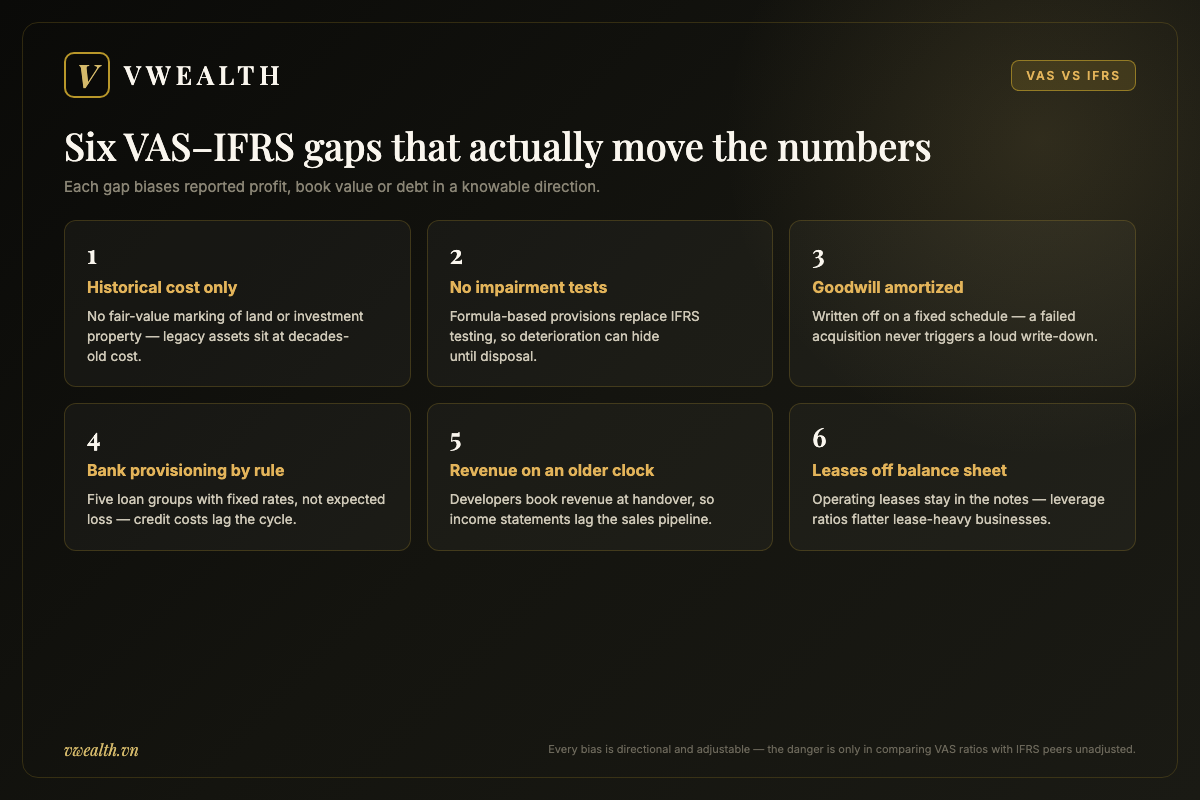
Accounting textbooks list dozens of technical differences between VAS and IFRS. Most of them will never change your investment decision. Six of them will. Each one below follows the same pattern: what VAS does, what IFRS does, and why an investor should care.
1. Historical cost everywhere: the balance sheet as a museum
The deepest philosophical difference is VAS’s near-total commitment to historical cost — recording assets at what was paid for them, and leaving them there. IFRS, by contrast, allows or requires fair-value measurement (updating the carrying amount to current market value) for whole categories of assets: investment property can be carried at fair value, land and buildings can be revalued, and many financial assets must be marked to market through profit or through equity.
Under VAS, investment property — buildings and land held to earn rent or for appreciation — is carried at cost and depreciated. Revaluation of fixed assets is only permitted in narrow administrative situations, such as converting a state-owned enterprise into a joint-stock company, not as an ongoing accounting policy. The consequence: a company that bought prime urban land decades ago carries it at a fraction of what it is worth today, minus accumulated depreciation on any structures.
Why you should care: book value in Vietnam can be dramatically understated for asset-rich companies. When you screen Vietnamese stocks on price-to-book (the ratio of market price to accounting net assets), a P/B of 2.5 for a company sitting on legacy land may be far less demanding than the same ratio for a company whose book value is mostly recent cash and receivables. Historical cost is conservative in one sense — nothing is inflated by optimistic appraisals — but it makes the balance sheet a museum of past transactions rather than a photograph of present value. Investors who do the work of estimating what the assets are actually worth can find genuine mispricings here; investors who take VAS book value at face value will systematically misjudge asset-heavy sectors like real estate, ports and legacy industrials.
2. Impairment: VAS has provisions, IFRS has tests
IFRS contains a comprehensive impairment framework: at every reporting date, companies must check whether assets might be worth less than their carrying amount, and if a formal test confirms it, write them down through the income statement. VAS has no equivalent general impairment standard. What it has instead is a system of provisions — allowances set aside against specific categories: doubtful receivables, devaluation of inventories, and diminution in value of investments.
The provision system covers a lot of ground, but it leaves gaps. Property, plant and equipment under VAS is essentially never tested for impairment the way IFRS requires — a factory rendered uneconomic by a market shift keeps sitting on the balance sheet at depreciated cost. And provisions, unlike IFRS impairments, follow prescriptive formulas: receivables overdue by certain periods attract certain percentage allowances, investments are provisioned against observable price declines. The formula-driven approach means provisions can lag economic reality on the way down — and, importantly for reading income statements, provisions are routinely reversed when the trigger reverses, releasing prior-year charges back into profit.
Why you should care: two things. First, be suspicious of long-lived assets in struggling businesses — VAS will not force the write-down that IFRS would, so the deterioration hides until disposal. Second, watch the provision lines in the income statement from year to year. A weak operating year can be cosmetically rescued by reversing provisions booked earlier. The notes to the statements show provision movements; a profit “recovery” driven by reversals is not the same thing as a business recovery.
3. Goodwill: amortized on schedule, not tested for truth
When one company buys another for more than the fair value of its identifiable net assets, the excess is recorded as goodwill — an intangible representing brand, synergies, or simply overpayment. Under IFRS, goodwill sits on the balance sheet indefinitely and is tested for impairment at least annually: if the acquired business underperforms, a large one-off write-off hits profit, often making headlines. Under VAS, goodwill is simply amortized — charged to expense in equal installments — over a maximum of ten years.
Why you should care: acquisitive Vietnamese companies show a steady drag on reported profit from goodwill amortization that an IFRS peer would not show, which makes their earnings look weaker in good times. But the flip side is more dangerous: because the amortization schedule grinds on regardless of performance, a failed acquisition never produces the dramatic impairment signal that IFRS forces. The bad news is smeared thinly across a decade instead of arriving as a red flag. When you analyze a serial acquirer in Vietnam, you must judge the acquisitions yourself — segment disclosures, subsidiary performance in the notes — because the accounting will not sound the alarm for you.
4. Bank provisioning: fixed percentages versus expected loss
Nowhere does the VAS–IFRS gap matter more than in banks, which is inconvenient, because banks are the largest sector on the Vietnamese exchange. Under the international framework, banks apply an expected credit loss model: they must estimate future losses on every loan from day one, using forward-looking assumptions about the economy, and increase provisions as risk rises — even before a single payment is missed.
Vietnamese banks provision by regulation instead. The State Bank of Vietnam — the central bank — prescribes a classification system that sorts loans into five groups, from Group 1 (current) to Group 5 (potentially irrecoverable), based primarily on days overdue and restructuring history. Each group carries a fixed specific-provision rate that steps up as the classification worsens, from a low single-digit percentage for special-mention loans to full provisioning for loss-group loans, plus a small general provision on the performing book. Collateral value, at prescribed haircuts, reduces the provisionable base.
Why you should care: the backward-looking, formula-based system means Vietnamese bank provisions typically lag the credit cycle. A loan that would already attract meaningful expected-loss provisions under IFRS can sit in Group 1 under local rules until payments actually stop. Reported non-performing loan ratios and reported profits are therefore smoother — and, in a downturn, more flattering — than an IFRS lens would show. This is why professional bank analysts in Vietnam look past the headline NPL ratio to loan-loss coverage, restructured-loan disclosures, accrued interest receivable and Group 2 trends. If you plan to own Vietnamese banks — and it is hard to build a Vietnam portfolio without them — our full guide to Vietnam’s banking sector unpacks these metrics one by one.
5. Revenue and leases: newer IFRS rules with no VAS twin
Two of the most consequential international standards of the past decade simply have no Vietnamese counterpart. The modern IFRS revenue standard requires companies to identify performance obligations in a contract and recognize revenue as each is satisfied — a discipline that reshaped revenue timing for real estate developers, construction firms and software companies worldwide. VAS revenue accounting rests on the older risk-and-reward model, supplemented by ministry guidance. For most steady businesses the outcome is similar; for long-cycle businesses, timing can diverge meaningfully. Vietnamese property developers, under prevailing guidance, generally recognize revenue when completed units are handed over to buyers — which produces famously lumpy income statements: years of quiet construction, then a surge of revenue when a project delivers. A developer’s flat or falling revenue may say nothing about its health if handovers are simply scheduled for next year; the balance sheet lines for inventory (projects under construction) and customer advances (deposits from pre-sold units) often tell you more about the pipeline than the income statement does.
Leases are the second gap. The current international lease standard brought virtually all leases onto the balance sheet as a right-of-use asset and a lease liability — effectively treating long-term rental commitments as debt. VAS retains the old split: finance leases go on the balance sheet, operating leases do not. A Vietnamese retailer, airline or logistics chain renting its stores, aircraft or warehouses shows less debt than an identical IFRS company would.
Why you should care: cross-border comparisons of leverage are biased in Vietnam’s favor. When you compare a Vietnamese retail chain’s debt-to-equity ratio with a regional IFRS peer, remember that the peer’s number includes capitalized leases and the Vietnamese number does not. Check the commitments note — Vietnamese statements disclose future operating-lease payments there — and mentally add a chunk of them back to debt before concluding the local company is conservatively financed.
6. Presentation: the statements you expect but will not find
Finally, some pure presentation gaps that disorient IFRS-trained readers. VAS financial statements contain no statement of comprehensive income — the IFRS statement that captures value changes bypassing profit, such as currency translation differences and revaluation gains. There is also no separate primary statement of changes in equity; equity movements are disclosed in the notes instead. And because so little is carried at fair value, there is no fair-value hierarchy note, and derivative positions receive far thinner disclosure than IFRS would demand. The statements themselves follow a standardized template with numbered line codes — every Vietnamese balance sheet looks structurally identical, which, once you learn the template, is actually a gift to foreign readers.
VAS versus IFRS at a glance: a comparison table
The table below condenses the differences above into a reference you can keep beside any Vietnamese annual report. The direction of bias matters more than the technical detail: for each line, ask “does VAS make this company look better or worse than IFRS would?”
| Topic | VAS treatment | IFRS treatment | Practical bias for investors |
|---|---|---|---|
| Fixed assets and investment property | Historical cost less depreciation; revaluation only in narrow administrative cases | Fair-value or revaluation models available; investment property may be marked to market | VAS book value understated for legacy asset holders; P/B screens misleading |
| Impairment of long-lived assets | No general impairment test; category-specific provisions with formulas | Mandatory impairment testing when indicators exist | VAS hides deterioration in struggling businesses until disposal |
| Goodwill | Amortized over a maximum of ten years | Not amortized; tested for impairment annually | VAS drags reported profit steadily but never flags a failed deal loudly |
| Bank loan provisioning | Five-group classification with fixed rates, largely based on days overdue | Forward-looking expected credit loss from day one | VAS bank profits and NPLs smoother and slower to reflect stress |
| Revenue timing | Older risk-and-reward model; property revenue generally on handover | Performance-obligation model with detailed timing rules | Lumpy revenue for developers; income statement lags the sales pipeline |
| Leases | Operating leases off balance sheet | Nearly all leases capitalized as debt-like liabilities | VAS leverage ratios flatter lease-heavy businesses |
| Comprehensive income and equity statement | Not presented; equity movements in notes | Separate primary statements required | Value changes outside profit are easier to miss under VAS |
| Financial instruments and derivatives | Mostly cost less provisions; thin disclosure | Extensive fair-value measurement and disclosure | Hidden gains or losses on securities portfolios under VAS |
One reassurance: the arithmetic core — double-entry bookkeeping, accruals, consolidation of controlled subsidiaries, the structure of the cash flow statement — is the same in both worlds. A VAS cash flow statement means what an IFRS cash flow statement means. That fact underpins the entire red-flag section later in this article.
Consolidated versus parent-only statements: the trap that catches newcomers
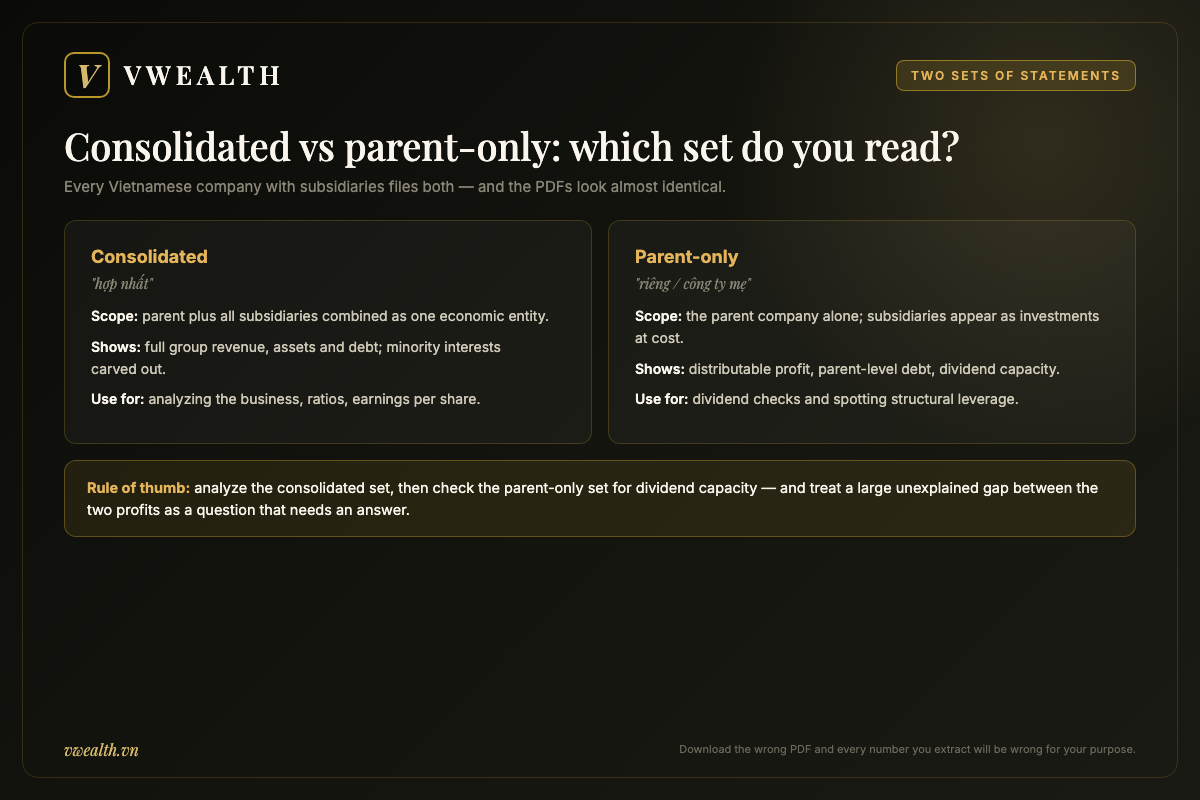
Here is a mechanical detail that has misled more than a few foreign investors. Vietnamese listed companies with subsidiaries publish two complete sets of financial statements every period: consolidated statements (hợp nhất), which combine the parent and all its subsidiaries as one economic entity, and separate or parent-only statements (riêng or công ty mẹ), which show the parent company alone, with subsidiaries appearing merely as investment line items at cost.
Both sets are filed, both are audited at year-end, and both circulate on disclosure portals — often as similar-looking PDFs distinguished only by one Vietnamese word in the title. If you download the wrong one, every number you extract will be wrong for your purpose.
Which set should you read?
For analyzing the business, the answer is almost always the consolidated statements. They capture the full scope of operations: revenue of all subsidiaries, debt of all subsidiaries, the lot. The parent-only statements can be startlingly uninformative for holding-company structures — a parent whose operations sit entirely in subsidiaries may show little revenue of its own, just dividend income trickling up and investments carried at historical cost.
But the parent-only set is not useless; sophisticated readers check it for three things. First, dividends: cash dividends are paid from the parent’s distributable profit, not the group’s, so a company whose consolidated profit is healthy but whose parent-level profit is thin may have less dividend capacity than it appears. Second, structural leverage: if debt sits at the parent while cash flow sits in partly-owned subsidiaries, the parent depends on upstreamed dividends to service it — a subordination problem the consolidated view smooths over. Third, the gap itself: when parent-only profit and consolidated profit diverge sharply, something inside the group — a loss-making subsidiary, a minority-held gem, heavy intercompany dealing — deserves your attention.
Minority interests: who actually owns that profit?
Consolidation brings its own subtlety. When a parent owns, say, 60 percent of a subsidiary, consolidated statements include 100 percent of that subsidiary’s revenue, assets and debt, then carve out the outsiders’ share of profit and equity in lines labeled non-controlling interests or minority interests. In conglomerate-heavy Vietnam, the carve-out can be large. Always take profit attributable to shareholders of the parent — not total consolidated profit — when computing earnings per share or P/E. Screeners occasionally get this wrong for Vietnamese tickers; recomputing one ratio by hand from the actual statements is cheap insurance. The same discipline applies when you assess the giants that dominate the index — our review of Vietnam’s blue-chip stocks shows how often the listed entity sits atop a web of partly-owned subsidiaries.
The IFRS adoption roadmap: direction clear, destination unscheduled
Vietnam knows its accounting framework is a friction point for capital markets, and the government has said so openly. On 16 March 2020 the Ministry of Finance approved a formal roadmap toward IFRS adoption in Decision 345/QĐ-BTC, structured in three stages: a preparation stage in 2020–2021 — translating standards, training accountants, drafting guidance — a voluntary-adoption stage in 2022–2025, in which parent companies of state-owned groups, listed parent companies and large unlisted public companies with the resources and the need could opt in to prepare IFRS consolidated statements after notifying the ministry, and a mandatory stage envisioned “from 2025 onwards,” in which IFRS consolidated statements would become compulsory for those same categories. In parallel, the ministry has signaled that VAS itself will be overhauled into a new set of Vietnamese Financial Reporting Standards (VFRS) drawing closely on IFRS for companies outside the mandatory scope.
Here is the crucial update for anyone relying on that timeline: as of mid-2026 the mandatory stage has not taken binding legal effect. IFRS remains voluntary in Vietnam — no listed company is yet legally required to report under it. The original “from 2025” mandatory date passed without a decree switching it on, and the government has instead advanced the framework on two adjacent tracks: it amended the Law on Accounting in 2024 to underpin IFRS and VFRS, and it issued Circular 99/2025/TT-BTC (effective 1 January 2026) to replace the old Circular 200 and modernize VAS-based reporting. A dedicated circular governing IFRS implementation itself was still in draft as this article was prepared. In short, the destination is set in policy but the mandatory-application date is, at the time of writing, unscheduled — so verify the current status before you rely on any specific deadline.
What should an investor make of this? Three qualitative observations, because the timeline has shifted before and may shift again.
First, the direction of travel is one-way. Every policy signal points toward more IFRS, not less: the roadmap exists, the Big Four audit firms have built IFRS-conversion practices in Hanoi and Ho Chi Minh City, and Vietnam’s reclassification by FTSE Russell from frontier to secondary-emerging-market status — confirmed at the March 2026 interim review and taking effect on 21 September 2026 via phased index inclusion — raises the value of internationally comparable reporting. Some large Vietnamese corporates and banks already prepare supplementary IFRS financial statements voluntarily — for foreign lenders, bond investors or their own group reporting — and more join them each year. If a company you own publishes both, read both: the reconciliation between VAS and IFRS equity is a free lesson in exactly which distortions matter for that specific business.
Second, transition will be noisy, and the noise will create both traps and opportunities. When a company first reports under IFRS, its equity and profit can jump or drop for purely accounting reasons: expected credit losses re-baseline bank provisions, leases land on the balance sheet, fair-value measurement re-marks investment portfolios. Investors who understand that these are restatements of measurement, not changes in the business, will keep their heads while headline ratios lurch. Historically, first-time IFRS adoption in other markets has tended to reward investors who did the reconciliation homework early.
Third, do not wait for IFRS to invest. The roadmap points toward convergence, but VAS statements are audited, standardized and entirely analyzable today, provided you apply the adjustments this article describes. The investors who profit in Vietnam over the coming decade will be those who learned to read VAS now, not those who postponed the market until its accounting looked familiar.
Where to find English filings — and how stale they are
Now the practical question: where does a non-Vietnamese speaker actually get these documents?
The disclosure chain, from fastest to friendliest
Vietnamese-language disclosure comes first and is legally authoritative. Listed companies file with the stock exchanges and the securities regulator, and the filings appear on the exchange disclosure portals and on companies’ own investor-relations pages. The rhythm is quarterly: unaudited quarterly statements arrive within weeks of quarter-end, the semi-annual statements receive a limited auditor’s review, and the full-year statements are audited and published within roughly the first quarter of the following year. An annual report — the glossy document with strategy discussion and governance disclosure — follows the audited statements, and an annual general meeting pack follows that.
English comes later, unevenly. Large-cap companies with meaningful foreign ownership — the major banks, the conglomerates, the consumer champions — typically publish English versions of their audited annual statements and annual reports, and the best of them translate quarterly releases and host English earnings calls. Mid-caps are hit and miss: perhaps an English annual report published months after the Vietnamese original, perhaps nothing. Small-caps are essentially Vietnamese-only. The translation lag is the key operational fact: even at well-covered companies, English documents commonly trail the Vietnamese originals by weeks or months, which means an English-only research process is a structurally late research process. Prices move on the Vietnamese release, not the translation.
Three habits that close the gap
First, learn the template. Because Vietnamese statements follow a standardized format with numbered line items, the balance sheet of any listed company has the same structure. Learn one company’s statement layout and you have learned them all — you can locate net revenue, operating cash flow or short-term borrowings in a Vietnamese-language PDF by position and line code, before any translation exists. The short glossary later in this article gives you the dozen headings that matter.
Second, use machine translation for the notes, not the numbers. The tables translate themselves — digits are digits. What you need translated are the accounting-policy notes, the related-party note and the auditor’s opinion, and modern machine translation handles Vietnamese financial prose well enough for research triage. Translate first; pay for precision only when a position is at stake.
Third, let a platform do the assembly. This is the gap vwealth was built to close: the platform’s AI reads the Vietnamese filings when they drop and produces full English analysis reports — statements digested, ratios computed, history charted — without the translation lag. Browsing the library of English reports on Vietnamese listed companies is the fastest way to see what current VAS filings look like once they have been decoded into an analyst-friendly format.
A ten-second glossary of statement headings
| Vietnamese term | English meaning |
|---|---|
| Bảng cân đối kế toán | Balance sheet |
| Báo cáo kết quả hoạt động kinh doanh | Income statement |
| Báo cáo lưu chuyển tiền tệ | Cash flow statement |
| Thuyết minh reports tài chính | Notes to the financial statements |
| Hợp nhất / Riêng | Consolidated / Separate (parent-only) |
| Doanh thu thuần | Net revenue |
| Lợi nhuận sau thuế | Profit after tax |
| Lợi ích cổ đông không kiểm soát | Non-controlling (minority) interests |
| Phải thu / Phải trả | Receivables / Payables |
| Hàng tồn kho | Inventories |
| Vay và nợ thuê tài chính | Borrowings and finance-lease debt |
| Đã kiểm toán / Chưa kiểm toán | Audited / Unaudited |
Red flags you can read in any language
Here is the encouraging part. The manipulations and stresses that matter most leave fingerprints in the relationships between numbers — and numbers need no translation. The checks below work on any VAS statement, in Vietnamese or English, because they exploit the one discipline no accounting framework can escape: cash.
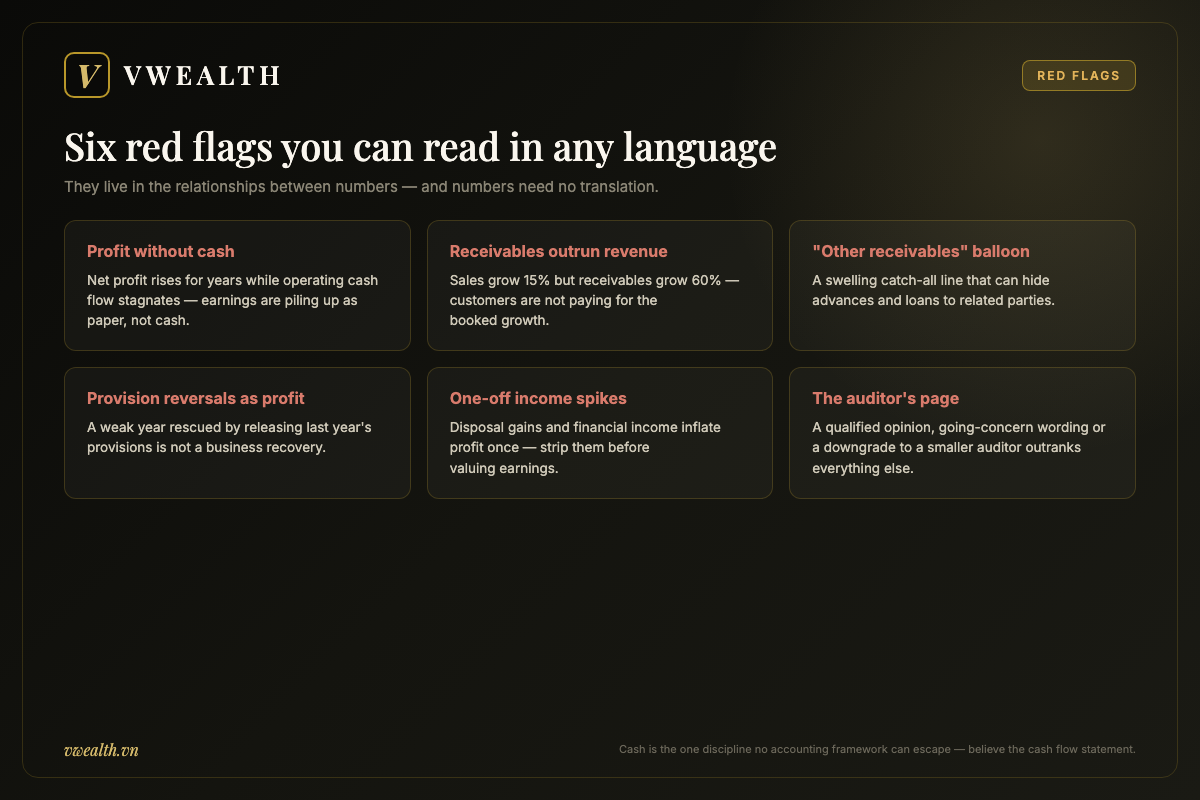
Profit without cash: the master check
Compare cumulative net profit with cumulative operating cash flow over three to five years. In a healthy business, they travel together — cash flow above profit in capital-light businesses, somewhat below in fast-growing ones, but broadly in step over a full cycle. A company that reports rising accounting profit year after year while operating cash flow stagnates or bleeds is telling you, in arithmetic no auditor can soften, that its “earnings” are accumulating somewhere on the balance sheet rather than arriving in the bank. Under VAS — where revenue timing is looser and provisioning more discretionary than under IFRS — this single comparison catches a remarkable share of the market’s eventual blow-ups. Illustrative example: suppose Company A reports profit of 300, 350 and 400 billion dong over three years while operating cash flow shows 50, then negative 20, then 30 billion. The income statement says growth; the cash flow statement says the growth is made of paper. Believe the cash flow statement.
Receivables and “other receivables” outrunning revenue
If revenue grows 15 percent and trade receivables grow 60 percent, the company is booking sales faster than customers are paying for them — sometimes a benign timing issue, sometimes channel stuffing, sometimes sales to related parties who may never pay. Vietnamese balance sheets add a distinctive twist: the line other receivables, a catch-all that can quietly house advances to affiliated companies, loans to shareholders or deposits with vaguely described partners. A large and growing other-receivables balance relative to total assets is one of the most reliable warning signs on a Vietnamese balance sheet, and the related-party note is where you go to find out who is on the other side of it.
Provision reversals and one-off income dressed as recovery
Because VAS provisions reverse through profit, scan the income statement for years where the provision expense line turns negative — a release — or where “financial income” or “other income” spikes. Gains on selling a subsidiary, a revalued stake booked through a deal, or a reversal of last year’s inventory provision all land in profit, and all evaporate next year. Strip one-offs out before you compute any earnings multiple; the recurring earning power of the operating business is the only number worth capitalizing.
The auditor’s page: three lines that outrank everything
Every audited Vietnamese filing opens with the auditor’s report, and three details there outrank anything inside the statements. Who signed it — a Big Four or reputable international network firm carries different weight than an unknown local practice, and a switch from a larger to a smaller auditor is a classic pre-trouble signal worldwide. What kind of opinion — anything other than a clean, unqualified opinion is serious: a qualified opinion (the auditor disagrees or could not verify something material) on a Vietnamese listed company has real consequences, up to trading restrictions on the exchange. And any emphasis-of-matter paragraph, especially wording about going concern — machine-translate this paragraph in full, every time; it is rarely long and never wasted reading.
Structure flags: the parent–consolidated gap and pledged assets
Two final checks tie back to earlier sections. A persistent, unexplained gap between parent-only and consolidated profit signals that value — or damage — is happening inside subsidiaries where disclosure is thinner. And the borrowings note lists collateral: when you see that a company’s inventory, receivables and even shares of subsidiaries are pledged against short-term loans, its flexibility in a downturn is far smaller than the leverage ratio alone suggests.
A practical workflow for the non-Vietnamese speaker
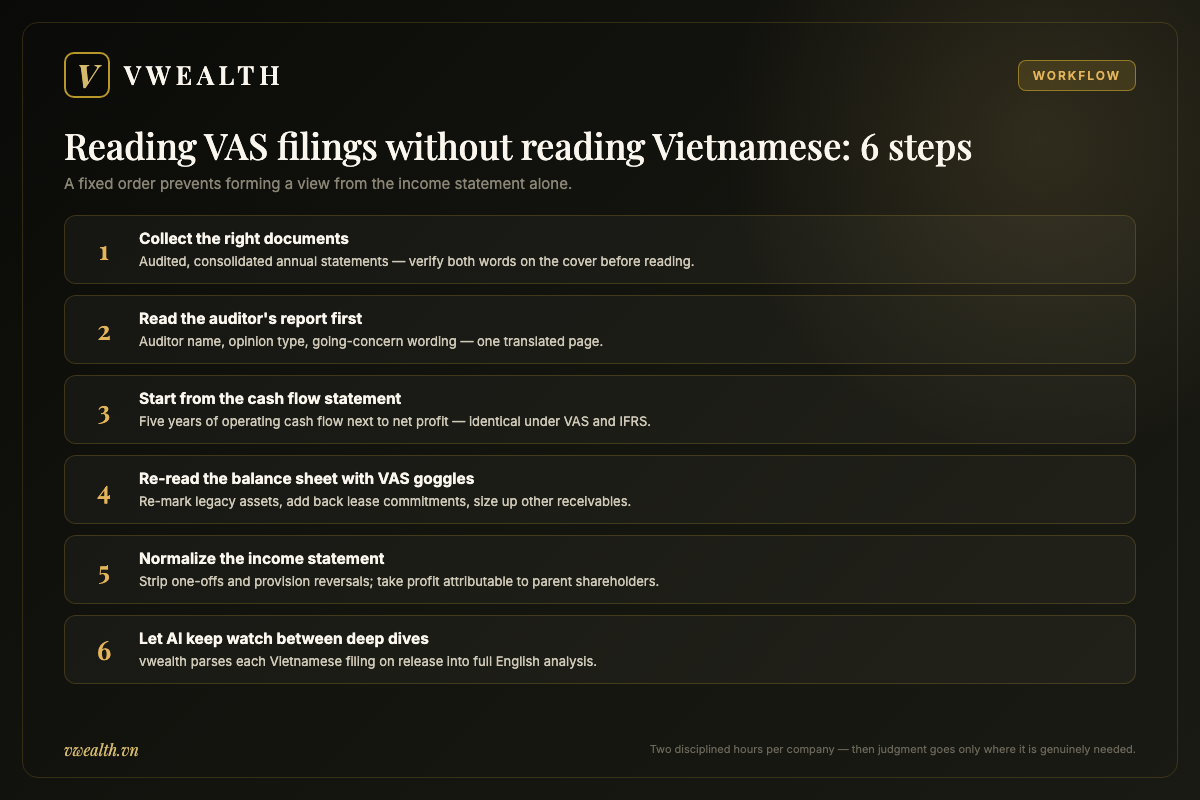
Everything above condenses into a repeatable sequence. Time-box it: an experienced reader gets through steps one to five in about two hours per company, and the discipline of a fixed order prevents the classic error of forming a view from the income statement alone.
Step 1 — Collect the right documents
Get the latest audited consolidated annual financial statements and the most recent quarterly statements, from the company’s investor-relations page or the exchange portal. Verify two words on the cover before reading anything: consolidated (hợp nhất), and audited (đã kiểm toán) for the annual set. If the company publishes voluntary IFRS statements, take those too — the equity reconciliation between the two frameworks is the single most instructive page the company produces.
Step 2 — Read the auditor’s report first
One page, thirty seconds after translation: auditor name, opinion type, emphasis paragraphs. A qualified opinion or a going-concern emphasis does not automatically end the analysis, but it changes the burden of proof for everything that follows.
Step 3 — Start from the cash flow statement
Deliberately backwards from the usual habit. Build the five-year track of operating cash flow next to net profit, then look at what investing cash flow says about capital intensity and what financing cash flow says about the company’s diet — is it funding itself from operations, or from an escalating carousel of short-term borrowing? The VAS cash flow statement is structurally identical to the IFRS one, so this step needs no framework adjustment at all.
Step 4 — Work the balance sheet with VAS goggles on
Now apply this article. Mentally re-mark legacy land and investment property toward reality when judging book value. Add a portion of the operating-lease commitments from the notes back to debt. Question stale long-lived assets in weak divisions, since no impairment test has challenged them. Size up other receivables and cross-check them against the related-party note. For a bank, go past the NPL headline into loan groups, coverage and restructured exposure.
Step 5 — Normalize the income statement
Strip one-off gains, provision reversals and disposal income to estimate recurring operating profit. Take profit attributable to parent shareholders, not the consolidated total, for per-share numbers. For developers and other long-cycle businesses, read customer advances and inventory as the forward order book that the income statement cannot show you yet.
Step 6 — Let the machine keep watch between deep dives
You cannot personally re-run this workflow for every company every quarter — filings drop in Vietnamese, in bursts, four times a year. This is precisely the layer where an AI platform earns its keep: vwealth’s engines parse each new VAS filing as it is disclosed and rebuild the English analysis — ratios, history, flags — so your manual effort goes only where judgment is genuinely required. Pull up any company in the report library and you will see this workflow’s output pre-assembled: cash flow versus profit tracks, balance-sheet quality metrics and provisioning history, in English, without the translation lag.
The bottom line: VAS is a dialect, not a different language
Strip away the intimidation and the situation is this. Vietnamese companies report under a frozen, rules-based, historical-cost framework that understates asset values, smooths bank credit costs, amortizes goodwill instead of testing it, keeps leases off the balance sheet and recognizes some revenue on a different clock than IFRS would. Every one of those biases is knowable, directional and adjustable. The double-entry core is untouched: cash flow statements tell the truth in both frameworks, consolidation logic is the same, and the standardized VAS template — once learned — makes every Vietnamese filing navigable even before translation.
The working rules fit on an index card. Read consolidated, audited statements. Read the auditor’s page first and the cash flow statement second. Distrust book value for asset-rich companies in both directions — hidden value and hidden staleness. Treat provision reversals and one-off income as noise. Watch other receivables and the related-party note like a hawk. Expect the IFRS transition to keep approaching — the roadmap points toward convergence, and companies volunteering IFRS today are handing you free reconciliation lessons — but verify the current status rather than trusting any remembered deadline, and do not postpone the market waiting for it.
Investors who master this dialect early own a genuine edge: most foreign capital still reads Vietnam late, through delayed translations and IFRS assumptions that do not hold. The filings are public, the distortions are systematic, and systematic distortions are exactly the kind an informed reader can correct for. This article is analysis for reference and education, not investment advice; always do your own research before making investment decisions.
Research Vietnamese stocks in English with vwealth. Our AI-powered platform turns Vietnamese market data into full English analysis reports — with international payment support and a free 2-month trial for new accounts. Create your free account and read the latest reports.
Frequently Asked Questions
How do you read financial statements of a Vietnamese company as a beginner?
Start by knowing that Vietnamese listed companies report under VAS, not IFRS, and treat every line item with that lens. Historical cost dominates the balance sheet, so book value can understate asset-rich firms; provisions substitute for impairment testing; and revenue timing for sectors like property can look lumpy for reasons unrelated to business health. Check the notes for provision movements, lease commitments and consolidated versus parent figures before comparing ratios across companies.
What is the difference between reading financial statements under VAS versus IFRS?
The core difference is philosophy: VAS is rules-based, built around account codes and templates, while IFRS is principles-based, asking what best reflects economic substance. This plays out concretely — VAS uses historical cost almost everywhere instead of fair value, has no general impairment test, amortizes goodwill instead of testing it, and keeps most leases off-balance-sheet. Each gap biases the numbers in a predictable direction, so an investor who knows the direction can adjust for it.
How to read financial statements for investing in Vietnamese stocks?
For investing purposes, do not take VAS ratios like price-to-book or debt-to-equity at face value against regional peers reporting under IFRS. Legacy land and buildings sit at historical cost, understating book value for asset-heavy sectors; operating leases stay off the balance sheet, understating leverage for retailers or airlines; and property developer revenue is recognized on handover, so a quiet income statement may just reflect project timing rather than weakness. Cross-check the notes and balance sheet lines like inventory and customer advances for a fuller picture.
How to read a bank's financial statements in Vietnam?
Look past the headline non-performing loan ratio, since Vietnamese banks provision using a five-group classification based mainly on days overdue rather than a forward-looking expected credit loss model. This backward-looking, formula-driven approach tends to lag the credit cycle, making reported NPLs and profits smoother and more flattering during downturns than an IFRS view would show. Loan-loss coverage, restructured-loan disclosures, accrued interest receivable and Group 2 loan trends give a more honest read than the headline number alone.
How do you know if a company's profit or book value understates or overstates the real picture under VAS?
Ask, line by line, whether VAS makes the number look better or worse than IFRS would — the biases are systematic and can be corrected for. Book value tends to be understated for companies holding legacy land or buildings at historical cost; profit can be artificially smoothed by provision reversals in the income statement; and debt appears lower than an IFRS peer’s because most operating leases stay off the balance sheet. None of this means the numbers are wrong, just that they need adjusting before cross-border comparison.
What is EBITDA and how should it be read on a Vietnamese company's financial statements?
There’s no specific treatment of EBITDA described here, but the general caution applies: any profit-based metric derived from a VAS income statement can be distorted by mechanics like goodwill amortization dragging on profit steadily, or provision reversals temporarily boosting it. Before relying on an EBITDA-style figure, check the notes for provision movements and goodwill amortization schedules so the metric reflects operating performance rather than accounting artifacts.