Vietnam runs one of the most talked-about stock markets in Asia, yet most foreign investors still have no idea how to actually buy into it. This guide walks you through the whole journey: why Vietnam earns a place on so many watchlists, the two realistic routes in (offshore ETFs versus a direct Vietnamese brokerage account), how trading really works on the ground, and the rules — ownership limits, currency, taxes — that surprise almost every newcomer. By the end, you will know exactly which route fits you and what your first ninety days should look like.
Why Invest in Vietnam’s Stock Market?
Start with the economy, because the stock market is ultimately a claim on it. Vietnam has spent the past three decades transforming from one of the poorest countries in Asia into one of the world’s most important manufacturing hubs. Global companies producing phones, semiconductor components, furniture, textiles and footwear have poured foreign direct investment (FDI — money that foreign companies invest in factories and operations, as opposed to portfolio flows into stocks) into the country. Each new factory pulls workers from farms into cities, and each of those workers becomes a consumer of banking services, apartments, motorbikes, smartphones and packaged food.
Three structural forces drive the long-term story:
- A young, urbanizing population. Vietnam has roughly one hundred million people, and a large share of them are of working age. Every year, millions of people move up the income ladder and into the formal economy. Consumer companies, banks and property developers are the direct beneficiaries, and all three groups are heavily represented on the stock exchange.
- The manufacturing migration. As global supply chains diversify away from concentration in any single country, Vietnam has been one of the most consistent winners. Industrial park operators, ports, logistics companies and power producers all sit downstream of this shift.
- A market in mid-upgrade. For decades Vietnam sat in the “frontier market” bucket used by index providers, which kept most large global funds out. That is changing right now: in October 2025, FTSE Russell announced Vietnam’s reclassification from Frontier to Secondary Emerging Market, confirmed it at the March 2026 interim review, and set the effective date at 21 September 2026 — with Vietnamese stocks entering FTSE’s global emerging-market indices in tranches from September 2026 into 2027. MSCI, the other major classifier, still lists Vietnam as a frontier market and left it off its upgrade watchlist at the June 2026 review, so the MSCI leg of the story remains ahead. Either way, a structurally larger pool of passive foreign capital is only beginning to arrive.
Now the honest counterweight, because a guide that only sells you the dream is not doing its job. Vietnam’s market is dominated by domestic retail investors — individual traders, not institutions — which makes it more sentiment-driven and more volatile than developed markets. Liquidity outside the largest fifty or so stocks can be thin. Corporate disclosure in English is improving but still patchy. And the market has a genuine boom-and-bust history: the VN-Index (the benchmark index of the Ho Chi Minh City exchange) famously peaked around 1,170 points in early 2007 before the global financial crisis erased most of those gains, and it has gone through several violent cycles since — including a brutal drawdown in 2022 that was followed, remarkably, by a record-setting 2025 in which the index gained roughly 41% and closed the year near 1,784 after touching an intraday record above 1,800 in December. Anyone telling you Vietnam is a smooth compounding machine has not looked at a long-term chart — and anyone extrapolating 2025 forward has not either.
The realistic pitch is this: Vietnam offers exposure to one of the better structural growth stories available to public-market investors, at the cost of higher volatility, extra paperwork and a few market rules you must learn before you trade. If you already have a broad overview of the market from our comprehensive guide to the Vietnamese stock market for investors, this article is the practical layer on top: how to actually get in.
Can Foreigners Legally Buy Vietnamese Stocks?
Yes — and this surprises people who assume frontier markets are closed. Vietnam actively welcomes foreign portfolio investment. Individual foreign investors can open local brokerage accounts, buy shares listed on Vietnamese exchanges, receive dividends and repatriate their money. There is no requirement to live in Vietnam, hold a visa, or set up a company.
Two conditions frame everything, though. First, every foreign investor needs a securities trading code — a registration number issued through the Vietnam Securities Depository and Clearing Corporation (VSDC) that identifies you as a foreign participant. Your broker handles the application; you supply identity documents. This used to be a paper-heavy process, but under Decree 245/2025/ND-CP (issued September 2025 as part of the market-upgrade push) the code is now granted electronically, with VSDC confirming within one business day — and you can trade as soon as the electronic code is issued. Second, foreigners as a group face foreign ownership limits (often shortened to FOL): caps on the total percentage of a company that all foreign investors combined may hold. We will unpack both below, but neither is a reason to walk away. Tens of thousands of foreign individuals and institutions trade Vietnamese stocks every day within these rules.
That leaves the real strategic question, which is not whether you can invest but how: through funds listed on your home exchange, or directly through a Vietnamese brokerage account. Everything else in this guide hangs off that choice.
The Two Routes In: Offshore ETFs vs a Direct Brokerage Account
Route one is to buy a Vietnam-focused exchange-traded fund (ETF — a fund that trades on a stock exchange like a single share and holds a basket of stocks tracking an index) listed in the United States, Europe or elsewhere in Asia. You use your existing brokerage account, place one order, and own a slice of dozens of Vietnamese companies within minutes.
Route two is to open an account with a licensed Vietnamese securities company, wire money into the country through a dedicated capital account, and buy individual stocks on the Ho Chi Minh City exchange yourself.
Neither route is objectively better. They trade off convenience against control, and the right answer depends on how much time, capital and curiosity you bring. Here is the comparison in one table:
| Factor | Offshore Vietnam ETF | Direct Vietnamese brokerage account |
|---|---|---|
| Setup effort | None beyond your existing broker | Days: trading code (now electronic, one business day), capital account, KYC documents |
| What you own | A basket tracking an index, weighted by the fund’s rules | Exactly the stocks you choose, in the sizes you choose |
| Ongoing costs | Annual fund expense ratio (check the factsheet) | Per-trade commissions plus currency conversion costs |
| Foreign ownership limits | The fund manages them for you, sometimes with tracking side effects | You must check remaining foreign room before each order |
| Currency handling | Handled inside the fund | You convert to Vietnamese dong yourself via the capital account |
| Dividends | Distributed or reinvested per fund policy | Paid in dong to your account; you decide what to do |
| Minimum practical size | One ETF share | Worth the paperwork mainly for larger, longer-term commitments |
| Best suited to | Investors who want the market’s beta with zero admin | Investors who want to pick companies and hold for years |
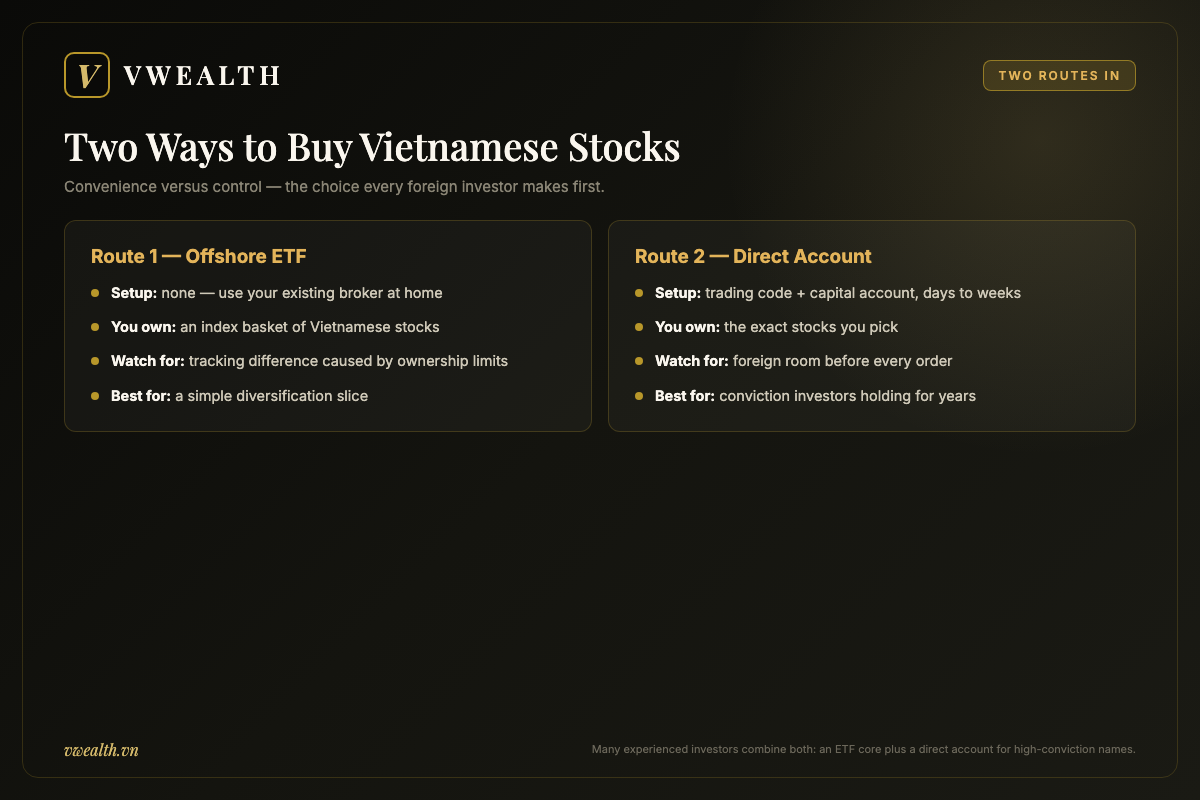
A useful rule of thumb: if your Vietnam allocation is a small diversification slice of a global portfolio, the ETF route almost always wins on simplicity. If Vietnam is a conviction position — you believe specific companies or sectors will outperform the index, and you are willing to do the research — the direct route gives you tools the ETF cannot: stock selection, position sizing and the ability to buy mid-cap companies that no offshore fund holds. Many experienced investors end up using both: an ETF core for broad exposure, plus a direct account for a handful of high-conviction names.
Route One: Buying Vietnam Through ETFs
The ETF universe splits into two families, and the difference matters more than most beginners realize.
Offshore ETFs listed on foreign exchanges
These are funds listed in markets like the United States, Europe and Taiwan that hold portfolios of Vietnamese equities. The three largest and best-known as of mid-2026 are the VanEck Vietnam ETF (ticker VNM, US-listed, tracking the MarketVector Vietnam Local Index), the Fubon FTSE Vietnam ETF (00885, Taiwan-listed, tracking the FTSE Vietnam 30 index of the largest HOSE names), and the Xtrackers FTSE Vietnam Swap UCITS ETF (Europe-listed, tracking a foreign-room-adjusted subset of the FTSE Vietnam All-Share). You buy them in dollars, euros or your home currency, inside your normal brokerage or retirement account. Settlement, custody, dividends and currency conversion all happen invisibly inside the fund. This is the lowest-friction exposure to Vietnam that exists — and once Vietnam formally enters the FTSE emerging-market indices from September 2026, broad EM index funds will begin holding Vietnamese stocks too, giving many investors a small allocation without buying anything Vietnam-specific at all.
The trade-off is a phenomenon called tracking difference — the gap between what the index does and what the fund actually delivers. Vietnam-focused offshore ETFs are unusually prone to it, and foreign ownership limits are a major reason. When a great company’s foreign room is full, the fund simply cannot buy more of it, so the manager substitutes other stocks or holds the position underweight. Over years, these forced substitutions can make the fund’s performance drift meaningfully from the headline index. Before buying any Vietnam ETF, open its factsheet and compare the fund’s multi-year return against its benchmark’s return — the gap is the honest price of convenience. Check the expense ratio while you are there; we deliberately do not quote fee numbers here because they change, and the factsheet is always the current source of truth.
Onshore ETFs listed in Vietnam
Vietnam also has domestic ETFs listed on the Ho Chi Minh City exchange itself, tracking indices such as the VN30 (the thirty largest, most liquid stocks — tracked by the DCVFM VN30 ETF, ticker E1VFVN30) or the VNDiamond index (a basket designed around stocks where foreign room is exhausted, tracked by the DCVFM VNDiamond ETF, ticker FUEVFVND). Here is the elegant trick: because an ETF certificate is a fund unit rather than a direct share, foreigners can often buy onshore ETFs without being blocked by the underlying stocks’ ownership limits. For a foreign investor who wants exposure to full-room, foreigner-favorite stocks, onshore ETFs can be the only realistic way in. The catch is that buying them requires the direct brokerage account described below — which is why the two routes are not entirely separate paths, and why serious investors usually end up reading about both.
Route Two: How Do You Open a Vietnamese Brokerage Account as a Foreigner?
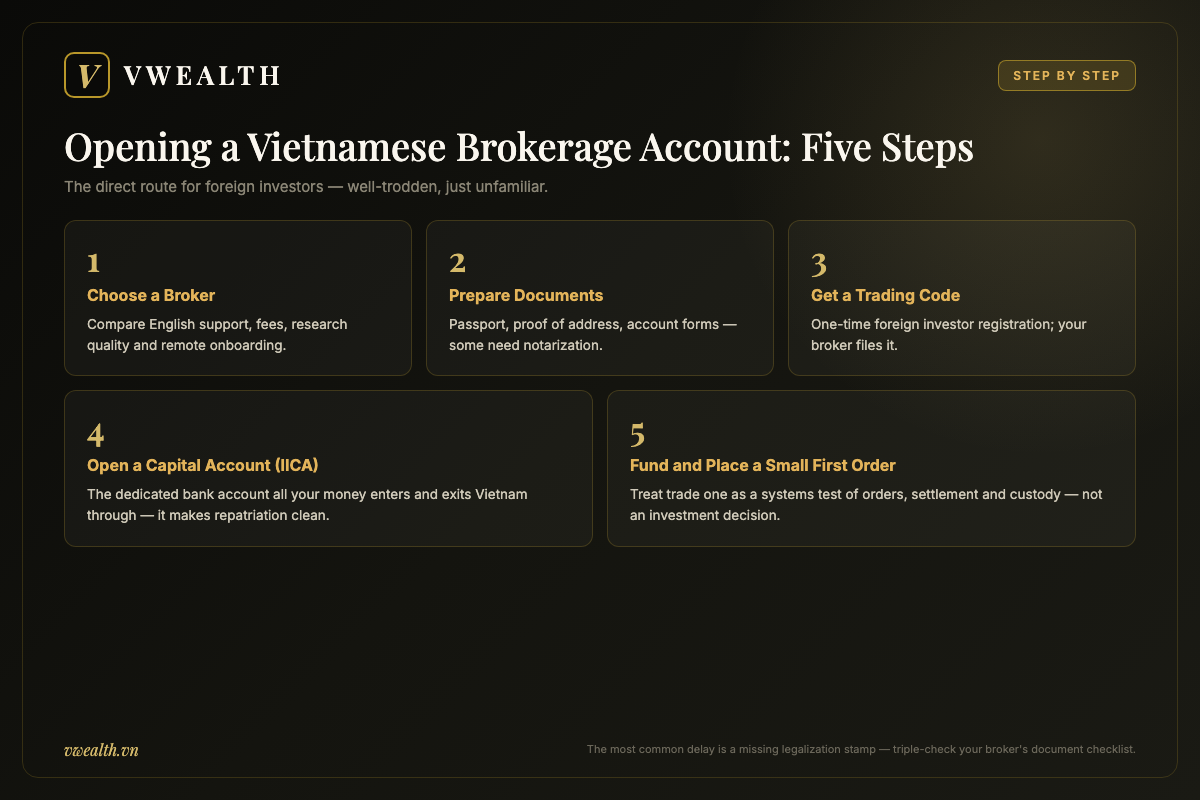
The direct route intimidates people because it involves unfamiliar acronyms, but the process is well-trodden. Brokers onboard foreign clients constantly and will guide you through every step. (A side note for completeness: since Circular 08/2026/TT-BTC took effect in February 2026, foreign investors can also place orders through participating global brokers, which route trades to a local broker without you opening a local trading account — plumbing built mainly for institutions ahead of the FTSE upgrade. For an individual investor, the classic local-broker route below remains the practical path.) Here is the full sequence.
Step 1: Choose a broker
Vietnam has dozens of licensed securities companies. As a foreigner, filter them on four criteria: quality of English-language support (website, app, and human staff), the fee schedule (compare percentage commission per trade across two or three brokers — rates are public on their websites), the depth of English research they publish, and whether they support fully remote account opening for non-residents. The large, established brokers generally score well on all four; the differences show up in research quality and app usability more than in fees.
Step 2: Prepare your documents
Requirements vary slightly by broker, but the core set is consistent: a valid passport, proof of address, and completed account forms. Some documents may need notarization or consular legalization — a stamp from a notary or embassy confirming the copy is genuine — depending on your country and whether you open remotely or in person. If you ever visit Vietnam, opening in person at a branch compresses the whole process into a single afternoon; remote opening works but adds courier and legalization time.
Step 3: Register your securities trading code
Your broker files this application for you with VSDC, the depository. The trading code is a one-time registration that identifies you as a foreign investor across the Vietnamese market. You do not need to renew it, and it moves with you if you later change brokers. Since Decree 245/2025/ND-CP took effect in late 2025, the code is issued electronically — VSDC confirms within one business day of the declaration, with no paper certificate required upfront, and you can trade immediately once the electronic code exists. The practical bottleneck has therefore shifted from the code itself to your own document preparation: the single most common delay is a legalization stamp missing from one document, so triple-check the checklist your broker sends.
Step 4: Open your indirect investment capital account
This is the step with no equivalent in most Western markets, so read it twice. Foreign portfolio money must enter and leave Vietnam through a dedicated bank account called an indirect investment capital account (IICA — formally renamed the “indirect investment account” under State Bank of Vietnam Circular 03/2025/TT-NHNN, effective June 2025, though brokers still use both names) — a special-purpose account in Vietnamese dong at a licensed Vietnamese bank that records every inflow and outflow of your investment capital. You wire dollars (or another currency) into the IICA, convert to Vietnamese dong, and move funds to your brokerage account to trade. When you eventually sell and want your money back, the flow reverses through the same account. The IICA is what makes clean, legal repatriation possible: because every dollar in was documented, every dollar out is straightforward. Your broker usually has a partner bank and will bundle the IICA opening into onboarding.
Step 5: Fund the account and place your first order
Once money lands, trading works through the broker’s app or web platform much like anywhere else: search the ticker, choose order type, set price and quantity. Vietnamese tickers are three-letter codes. Place a small first order — genuinely small — because your goal in week one is to verify the full pipeline works: order, execution, settlement, and the position appearing in your portfolio. Treat the first trade as a systems test, not an investment decision.
One habit worth building from day one: before you buy anything, read at least one proper analysis of the company. If you cannot read Vietnamese financial statements, that habit is hard to sustain manually — which is exactly the gap English-language research platforms exist to fill. The library of AI-generated English analysis reports on vwealth covers Vietnamese listed companies with valuation, financial-health scoring and plain-English summaries, so a foreign investor can do real due diligence without a translator.
How Trading Actually Works: Exchanges, Hours and Rules
Vietnam’s market has its own rhythm, and several mechanics will feel alien if you learned to trade in New York or London. Learn them before your first order, not after your first surprise.
Three trading venues
Vietnamese stocks trade on three boards. The Ho Chi Minh City Stock Exchange (HOSE) hosts the largest companies and nearly all the liquidity foreign investors care about; its benchmark is the VN-Index. The Hanoi Stock Exchange (HNX) lists smaller companies. UPCOM is a lightly regulated board for unlisted public companies — often a waiting room where firms trade before graduating to a full listing. As a foreign beginner, you will realistically spend your time on HOSE, where disclosure standards, liquidity and index membership are all strongest. One piece of recent history worth knowing: in May 2025, after more than a decade of preparation, HOSE switched to a new trading system built with the Korea Exchange (universally called “the KRX system”). It is the technical foundation for features the market has long lacked — a central counterparty clearing mechanism is slated for 2027, with intraday trading and other instruments to follow — so the rulebook below is current as of mid-2026 but genuinely evolving.
The daily schedule
Trading runs on weekday mornings and early afternoons, Vietnam time (UTC+7), with a lunch break in the middle — a genuine pause where the market closes and reopens. On HOSE the day starts with an opening auction from 9:00 to 9:15 (called ATO, where orders accumulate and match at a single opening price), runs through a continuous morning session until 11:30, breaks for lunch until 13:00, continues through the afternoon until 14:30, and ends with a closing auction (ATC) from 14:30 to 14:45 that sets the official closing price. The practical consequence: if you live in Europe or the Americas, Vietnamese market hours fall in your night or early morning, so most foreign retail investors use limit orders placed in advance rather than watching live.
The rules that surprise foreigners most
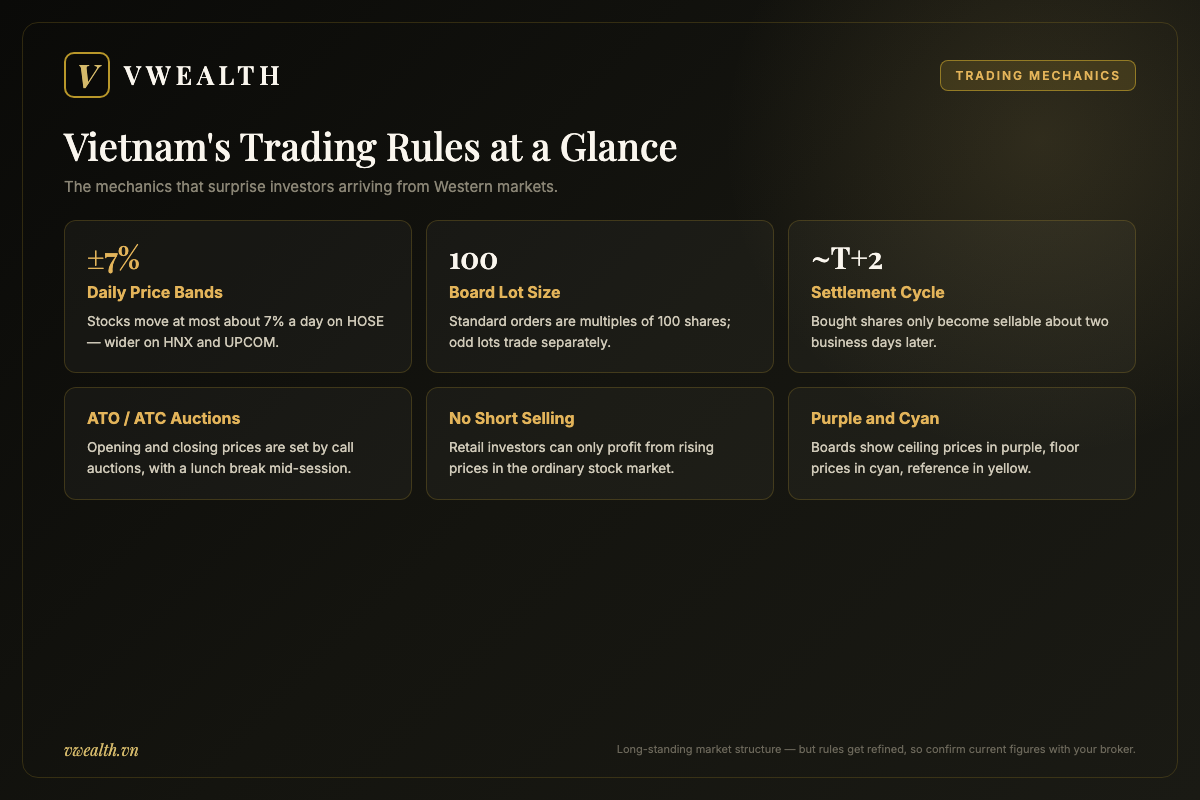
| Rule | How it works | Why it matters to you |
|---|---|---|
| Daily price bands | Each stock can move only a set percentage from its reference price each day — ±7% on HOSE, ±10% on HNX, ±15% on UPCOM | No single-day crashes or moonshots, but big news plays out over several sessions of limit-up or limit-down moves, during which liquidity can vanish |
| Board colors | Prices at the ceiling display purple; prices at the floor display cyan; reference price is yellow | Vietnamese market chatter about “purple” and “floor” stocks will make sense |
| Lot size | Standard orders are multiples of 100 shares; smaller amounts are “odd lots” handled separately with worse liquidity | Size your orders in round hundreds |
| Settlement cycle | T+2: shares you buy arrive in your account around midday two business days after the trade, and can be sold from that afternoon | No same-day round trips on the same shares; plan exits with the lag in mind |
| Pre-funding | Retail investors must have cash in the account before buying; since Circular 68/2024 (November 2024), foreign institutions are exempt, but individuals are not | Wire money before you plan to trade, not on the day |
| Short selling | Not available to retail investors in the ordinary stock market as of mid-2026 (the KRX system supports it technically; regulation has not enabled it yet) | You can only profit from prices rising; there is no quick hedge |
| Margin for foreigners | Broker financing is generally restricted for foreign individual investors | Assume you are investing cash-only, which for beginners is a feature, not a bug |
These figures describe the long-standing structure of the market, but exchange rules do get refined over time — confirm the current numbers with your broker rather than treating any article, including this one, as the rulebook.
The price-band system deserves one extra paragraph because it changes strategy. In markets without bands, bad news is absorbed in one brutal gap down. In Vietnam, a stock hit by serious bad news can fall the maximum percentage, close there with a wall of unfilled sell orders, then repeat the pattern for several consecutive sessions. If you hold it, you may be unable to exit at any price until sellers thin out. The discipline this demands — position sizes you can tolerate being stuck in, and pre-decided exit rules — is the single most important adjustment for traders arriving from developed markets.
What Are Foreign Ownership Limits, and Why Should You Care?
Here is the one-paragraph version every beginner needs; we dissect the topic fully in a dedicated article. Vietnamese law caps the combined stake that all foreign investors may hold in a listed company. The cap depends on the industry: banks sit under the strictest limit — 30% of charter capital in total, though Decree 69/2025/ND-CP (effective May 2025) now allows up to 49% at a handful of banks participating in the rescue of weaker lenders — various other “conditional” sectors have their own caps, and many ordinary businesses can open up to full foreign ownership if their shareholders approve. The unused portion of a company’s cap is called its room. When room runs out, foreigners can no longer buy on the exchange — they can only buy from other foreigners, which sometimes happens in negotiated block deals at a premium above the market price. Practically, this means two things for you. First, always check remaining foreign room before placing an order; every broker app displays it, and an order into a full-room stock simply fails. Second, understand that some of Vietnam’s most admired companies are permanently full — which is precisely why the onshore ETFs described earlier, and their room-workaround design, exist. Ownership limits are also one of the criteria index providers weigh in market-classification decisions — they remain a headline item on MSCI’s accessibility reviews even after the FTSE Russell upgrade — so this seemingly bureaucratic detail connects directly to the market’s biggest long-term catalyst.
Currency: How the Dong Affects Your Returns
When you invest across borders, you always hold two positions whether you like it or not: the stocks, and the currency they are denominated in. Vietnamese stocks are priced in Vietnamese dong (VND), and your real result is the combination of both moves.
The dong operates under a managed float — the central bank lets the exchange rate move within a controlled band around a daily reference rate, rather than either fixing it rigidly or letting it float freely. Historically, the pattern has been long stretches of stability punctuated by gradual, modest depreciation against the US dollar over the years. That is a qualitative description of the past, not a forecast; currencies humble everyone who forecasts them.
The arithmetic is worth internalizing with a hypothetical. Illustrative example: suppose your stock rises 15% in dong terms over a year, and the dong weakens 3% against the dollar in the same period. Your dollar return is approximately 15% minus 3% — about 11.5% after compounding the two effects properly (1.15 × 0.97 ≈ 1.115). The same logic cuts the other way: in a year when the dong is stable and your stock rises, you keep essentially the full return. Over a multi-year holding period, a gently depreciating currency acts like a small annual fee on your returns — real, but survivable if the underlying equity growth is strong enough, and that trade-off is the entire bet.
Three practical notes. First, hedging dong exposure is effectively out of reach for retail investors — the instruments are institutional, and the cost would eat the benefit. Accept the currency exposure as part of the package or choose an offshore ETF and let the fund’s structure handle conversion mechanics. Second, dividends are paid in dong; through the direct route, you decide whether to reinvest them locally (usually the better answer while you are accumulating) or convert and repatriate. Third, always evaluate your Vietnam performance in total return in your home currency — stock moves plus dividends plus currency — because that is the only number that measures what actually happened to your wealth.
Taxes for Foreign Investors, in Brief
The framework, in one paragraph — with the loud caveat that tax rules change and nothing here is tax advice. Vietnam taxes foreign individual investors with unusual simplicity: rather than making you compute annual capital gains, the standard model applies a flat 0.1% tax on the gross proceeds each time you sell listed shares, withheld automatically by the broker at the moment of sale — win or lose, the tax is the same. This per-transaction model survived Vietnam’s big tax overhaul: the new Personal Income Tax Law (No. 109/2025/QH15, passed December 2025 and effective 1 July 2026) keeps the 0.1%-of-sale-price treatment for securities listed on a stock exchange. Cash dividends are subject to 5% withholding at source for individuals. The elegant consequence is that a typical foreign individual has no Vietnamese annual tax filing to prepare for ordinary stock investing — the taxes are collected in real time and you are done. You may, however, still owe tax at home: most countries tax residents on worldwide income, and whether you can credit Vietnamese withholding against your home tax bill depends on your country’s rules and any double-taxation agreement (a treaty between two countries preventing the same income from being fully taxed twice). Keep every trade confirmation and dividend statement, verify the current rates with your broker before you start, and if your position sizes are meaningful, spend an hour with a tax advisor who knows both jurisdictions. That hour is the cheapest insurance in this entire guide.
Seven Common Beginner Mistakes (and How to Avoid Them)
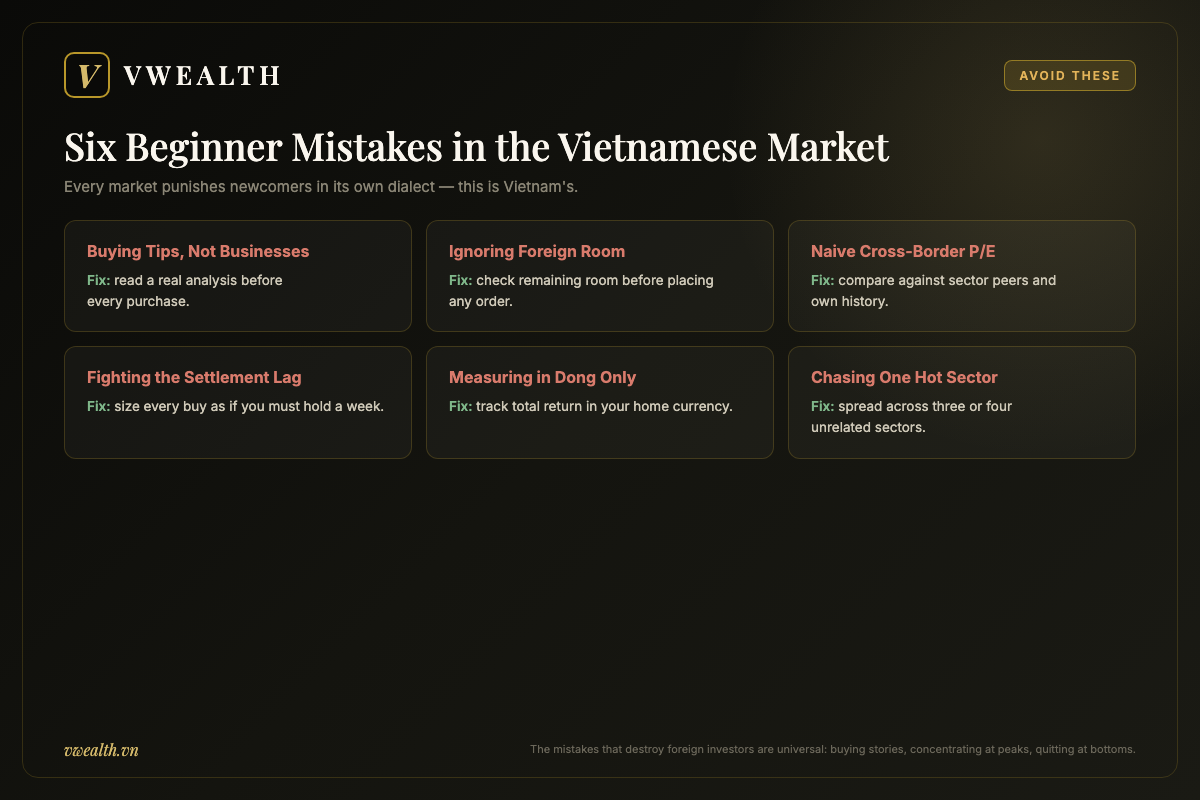
Every market punishes newcomers in its own dialect. These are the seven errors foreign beginners in Vietnam make most often.
1. Buying tips instead of businesses
Vietnam’s retail-heavy market generates a torrent of hot tips — Telegram groups, forum heroes, “sure thing” tickers. Because retail sentiment genuinely moves prices here, tips even work occasionally, which is what makes them poisonous: one lucky trade teaches exactly the wrong lesson, and the strategy fails catastrophically across a full cycle. The antidote is boring and effective — never buy a company whose business model you cannot explain in two sentences, and read an actual analysis before every purchase.
2. Ignoring foreign room until an order fails
You research a bank for a week, decide to buy, and the order bounces because foreign room is zero. Check room first; it is one tap in any broker app. Build the reflex early.
3. Comparing valuations across borders naively
A price-to-earnings ratio (P/E — the share price divided by annual earnings per share, roughly “years of profit you pay for the business”) that looks cheap against US stocks tells you little by itself. Different markets carry different interest rates, growth profiles, disclosure standards and risk premiums. Compare Vietnamese companies against their own sector peers and their own history first, then decide whether the market-level discount or premium makes sense.
4. Trading against the settlement cycle
Newcomers from markets with instant liquidity buy on Monday planning to flip on Tuesday, then discover the shares are not sellable yet. In a fast market, that forced two-day hold can transform a quick trade into an unplanned loss. Until the cycle is second nature, size every purchase as if you must hold it for a week.
5. Measuring returns in dong only
Your account statement shows dong. Your wealth lives in your home currency. A year of decent dong gains can quietly shrink after conversion — track total return in your own currency from day one, or you are grading yourself on the wrong exam.
6. Concentrating in one hot sector at its peak
Vietnamese market cycles have a signature pattern: one sector — brokers, steel, property, banks — becomes the story, multiplies, sucks in every retail investor at the top, then gives most of it back. If a sector has already been the national conversation for a year, the easy money has been made by the people now selling to you. Spread across at least three or four unrelated sectors, always.
7. Assuming information reaches everyone at the same speed
In developed markets, material news hits every terminal simultaneously. In Vietnam, English speakers sit at an information disadvantage: disclosures have historically appeared in Vietnamese first, and English coverage of anything beyond the largest names is thin. This is genuinely improving — under Circular 68/2024, listed companies and large public companies must publish periodic disclosures in English from January 2025 and ad-hoc disclosures from January 2026, with the rest of the market following by 2028 — but a rulebook deadline is not the same as fluent, analyzable English coverage of every mid-cap. You compensate with structure — hold fewer, larger-cap, better-covered companies, and lean on tools that translate the fundamentals systematically. Closing this exact gap is why vwealth exists: the platform’s AI reads Vietnamese financial reports and produces full English analysis reports, giving foreign investors the same fundamental picture domestic analysts see.
What Returns Should You Realistically Expect?
The honest answer nobody puts in a headline: over a full cycle, Vietnamese equities offer the possibility of returns meaningfully above developed markets, purchased with volatility that will test you and drawdowns measured in years, not weeks.
History is the best expectation-setter. The market’s 2007 euphoria took the VN-Index to roughly 1,170 points; the crash that followed erased most of it, and the index needed more than a decade to durably reclaim that level. More recently, the market repeated the pattern in compressed form — a powerful boom into early 2022 followed by a drawdown severe enough to shake out most of the newcomers who arrived during the boom — and then delivered the other side of the coin: a 41% gain in 2025 that carried the index to all-time highs near 1,800 as the FTSE Russell upgrade was confirmed. Both halves of that sequence are the lesson. This is not a defect unique to Vietnam; it is the standard texture of a young, retail-driven market. It means your plan must survive a 30-40% drawdown without forcing you to sell, because over a long horizon you should expect to live through at least one — and it equally means the biggest rewards have gone to investors who were already positioned before the crowd arrived.
Three principles convert that history into strategy. First, size the allocation so the volatility is emotionally affordable — for most diversified investors, Vietnam is a satellite position, not the core. Second, let time do the heavy lifting: the structural story (manufacturing, urbanization, the FTSE emerging-market inclusion now underway and a potential MSCI upgrade after it) plays out over five to ten years, and traders trying to catch each swing mostly donate money to more patient participants. Third, keep buying power in reserve, because this market reliably offers moments when excellent companies trade at panic prices, and the investors who compound best here are the ones with cash and a watchlist ready on those days.
Your First 90 Days: A Practical Starting Plan
Knowledge without sequence produces paralysis, so here is the sequence.
Days 1-30 — build context before capital. Follow the VN-Index daily so its rhythm becomes familiar. Read a broad market overview end to end, learn the ten largest index constituents and what each company actually does, and decide your route: ETF, direct account, or the hybrid of both. If direct, start the paperwork now — the trading code and capital account will process while you continue learning.
Days 31-60 — build a watchlist, not a portfolio. Pick five to eight companies across at least three sectors and study one per week: business model, revenue drivers, valuation versus its own history, foreign room. Write one paragraph per company stating what would make you buy it and at roughly what valuation. This written record is the difference between investing and improvising. To do this in English at reasonable speed, create a free vwealth account and work through the platform’s analysis reports on each watchlist name — the AI scoring gives you a structured second opinion on every company you study.
Days 61-90 — start small and deliberately. Make your first purchases at a fraction of your intended full allocation — a third is a sensible ceiling. The goals are mechanical fluency (orders, settlement, dividend handling) and emotional calibration (how you actually feel during a red week, which no book can teach). Add on a schedule or on genuine price opportunities, never from fear of missing out. By day ninety you will have something rare: a functioning setup, a researched watchlist, real positions and documented reasoning — more infrastructure than most investors build in their first three years.
The Bottom Line: A Market Worth the Paperwork
Strip away the acronyms and the path is short. Vietnam offers a structurally compelling growth market that foreigners can legally and practically access. The lazy-but-effective route is an offshore ETF bought from your sofa; the full-control route is a direct brokerage account with a trading code and a capital account, unlocking individual stocks and onshore funds. The rules that feel strange — price bands, settlement lags, ownership room, a managed currency, sale-based taxes — are all learnable in a weekend and manageable forever after. The mistakes that actually destroy foreign investors here are the universal ones: buying stories instead of businesses, concentrating at peaks, and quitting at bottoms.
Vietnam rewards a specific temperament — patient, diversified, research-driven and unimpressed by hot streaks. If that describes the investor you are, or the one you intend to become, few markets offer a better decade-long canvas. Start with the overview, open the right account for your situation, research before every purchase, and let the structural story work. This article is analysis for reference and education, not investment advice; always do your own research and consult a licensed advisor for decisions involving significant capital.
Research Vietnamese stocks in English with vwealth. Our AI-powered platform turns Vietnamese market data into full English analysis reports — with international payment support and a free 2-month trial for new accounts. Create your free account and read the latest reports.
Frequently Asked Questions
How can a foreigner buy Vietnamese stocks?
There are two realistic routes: offshore ETFs listed on foreign exchanges, or a direct Vietnamese brokerage account. Each has different costs, different access to individual names, and very different amounts of paperwork — the right one depends on how much control you want.
What surprises newcomers most about the Vietnamese market?
The rules: ownership limits that can block a purchase outright, currency handling, and the tax treatment of gains and dividends. These catch almost every newcomer because they have no equivalent in most developed markets.
Is an ETF or a brokerage account better for buying Vietnamese stocks?
An ETF is faster and avoids the account-opening process, but you inherit its costs and tracking gap and cannot pick individual names. A direct account gives full control at the cost of paperwork and ongoing administration.
Why is Vietnam on so many watchlists?
The economy earns it a place: sustained growth, manufacturing relocation and a young population. But being on a watchlist and being buyable are different things, which is why the practical route in matters as much as the thesis.
What should my first ninety days look like?
Choose a route, complete the access step, then learn how trading actually works on the ground before committing size — including the ownership limits and settlement mechanics that differ from home markets.