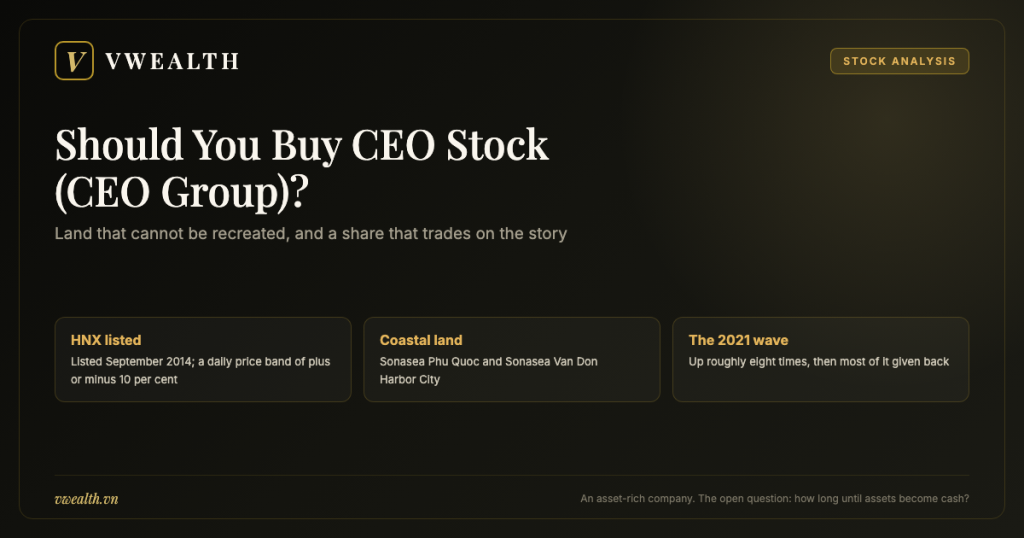
Ask ten Vietnamese retail investors what they think of CEO stock and you will get ten answers loaded with feeling and almost no analysis. One remembers it as the lottery ticket that got away: a share that ran from the low teens of thousands of dong to somewhere around ninety or a hundred thousand in under two months, dragging tens of thousands of newly opened brokerage accounts along for the ride. Another remembers it as a scar: bought at the January 2022 top and watched three quarters of the position evaporate. Both are talking about the same ticker, and both have only touched the surface. Underneath the speculative crust sits a real company — real coastal land in two of the most expensive locations in Vietnam, hotels that actually run, township phases that actually hand over — and real governance problems, including three consecutive years in which the first call of the annual general meeting failed to reach quorum. This article walks through both layers and ends with a blunt answer: which kind of investor CEO stock suits, and which kind should not go near it.
A note on method before we begin, so nothing here surprises you. You will meet a great many dated facts in the pages below — founding dates, capital raises, project sizes, share counts, shareholder registers, regulatory milestones — all of them publicly disclosed. What you will almost never meet is a current-quarter financial figure, today’s P/E, last night’s close, or a price target. The reason is structural rather than coy. CEO Group is a property developer that books revenue on handover, which means profit in one quarter can be many times the quarter before it and then fall back to roughly nothing in the next, depending entirely on whether anything was handed over in the period. A P/E written down today has a very high chance of being meaningless when you reread this in three months. So instead of giving you a number with a short shelf life, this article teaches you to read this particular company’s numbers yourself: where to look, in what order, and which line items actually say something. When you need today’s data, open the CEO analysis report on the vwealth platform. The article gives you the framework; the report gives you the figures.
If you are investing into Vietnam from abroad, one more orientation note. This is a market with its own vocabulary and its own plumbing, and almost none of it maps cleanly onto US or European practice. Vietnam runs two main exchanges with different daily price limits; it has a category of resort property whose ownership status was legally ambiguous for the better part of a decade; it has an ongoing policy conversation about special administrative-economic zones that has moved share prices for eight years without ever fully arriving. Each of those is explained in place as it comes up. If you are entirely new to the market, start with our guide on how to invest in the Vietnam stock market and the broader Vietnam stock market guide, then come back. One small convention: all money figures stay in Vietnamese dong, because that is how the company reports. As a rough mental conversion, twenty-five thousand dong is in the neighbourhood of one US dollar; treat every conversion you do in your head as an approximation, not an exchange rate.
And if you are weighing CEO as part of a Vietnamese property allocation, do not read it alone. The picture only sharpens when you set CEO Group beside peers with genuinely different models: beside Vinhomes, the outright leader in mass residential; beside Nam Long, with its affordable-housing philosophy and conservative balance sheet; beside Novaland, still working through a debt restructuring; and beside the pure industrial-park model of Kinh Bac. Four different reference frames, and it is precisely the differences that show you where CEO actually stands.
From a 1.6 Billion Dong Company to the Owner of Vietnam’s Scarcest Coastline
The history of CEO Group does not follow the usual template of a listed Vietnamese property developer. It did not start with a family that traded land. It did not start as an equitised state enterprise. It did not start as an industrial conglomerate wandering into real estate for the margins. It started with an engineer — more precisely, a project manager for a Japanese contractor — who went out on his own with a capital base so small it reads today like a joke. Understand that starting point and you understand why CEO Group still carries an unusual shape: a construction arm and a services arm running alongside the property arm, rather than a pure-play developer.
2001: Viteco, 1.6 Billion Dong, and a Man Who Had Just Left a Japanese Contractor
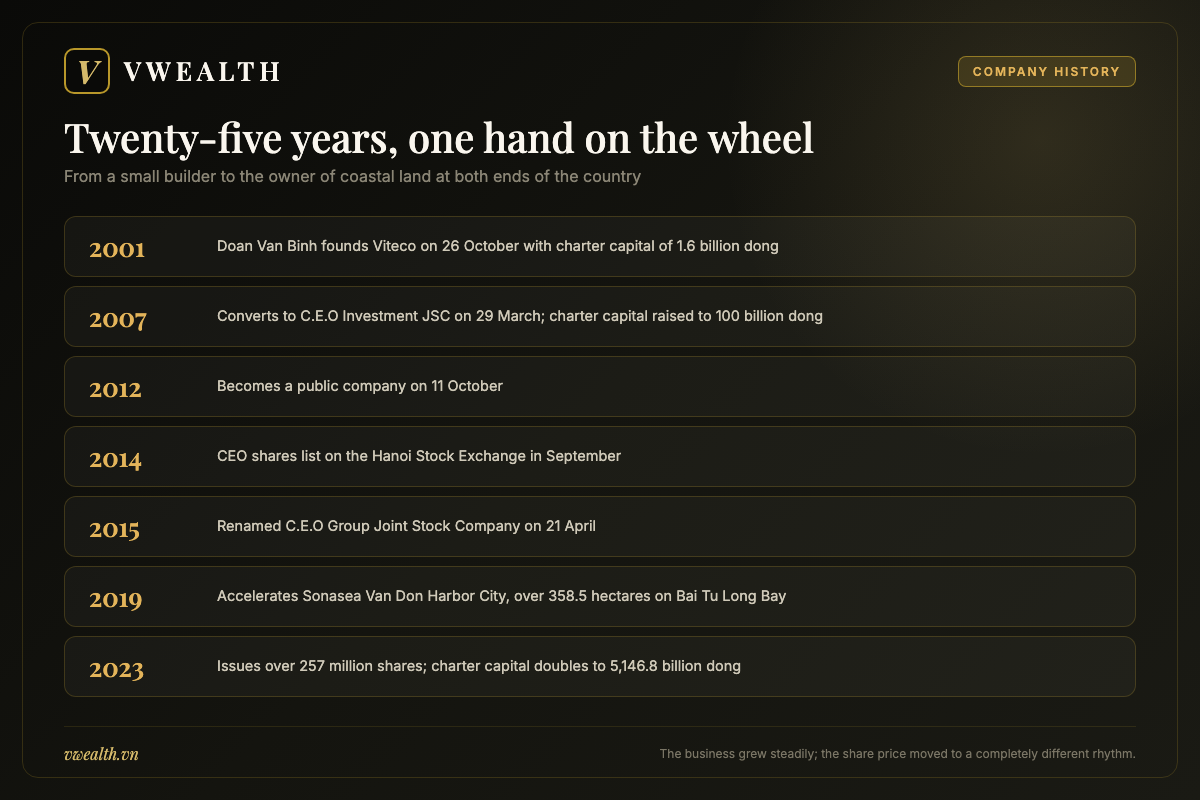
On 26 October 2001, Mr Doan Van Binh founded Vietnam Trading, Construction and Technology Company Limited — abbreviated Viteco — with charter capital of 1.6 billion dong. That number deserves a pause. In 2001, one point six billion dong was enough to buy a few small houses on the outskirts of Hanoi and not much else. It was not the capital base of a man setting out to become a property developer. It was the capital base of a man setting out to practise a trade.
The founder was born on 2 June 1971 in Ha Nam province. He holds a bachelor’s degree in economics from the National Economics University, a master’s degree in law from Hanoi Law University, and bachelor’s degrees in both English and Russian — an academic record that is genuinely unusual among Vietnamese property founders, most of whom came up through the deal rather than the classroom. More consequential than the credentials is the period from 1994 to 2006, during which Mr Binh worked as a project director at TODA Corporation, one of Japan’s large construction contractors. Twelve years inside a Japanese contractor teaches three things that are very hard to teach from a book: schedule discipline, project management process, and the habit of finishing the legal paperwork properly before moving on. You will see traces of all three in how CEO Group has executed since — slower than many competitors, but rarely caught in the sort of legal blow-up that has taken down other Vietnamese names selling apartments that existed only on paper.
The point to file away here, because it returns in the governance chapter, is this: CEO Group was a one-man company from day one. No co-founder of equal standing, no seed fund on the cap table, no parent conglomerate standing behind it. That gives you decision speed. It also gives you a concentration of risk in a single individual, and you have to price that correctly rather than admire it.
2007: A New Name, a Sixty-Fold Capital Raise, and the Turn into Property
On 29 March 2007, Viteco converted into C.E.O Investment Joint Stock Company and simultaneously lifted charter capital to 100 billion dong. Going from 1.6 billion to 100 billion in six years is an enormous jump in proportional terms, and it tells you two things. First, the 2001 to 2007 period produced real accumulation, mostly from trading and construction. Second, converting to a joint stock company and putting the word “Investment” in the name was an unambiguous signal of direction: from building other people’s projects to owning its own.
The timing also matters. 2007 was the peak of Vietnam’s pre-global-financial-crisis property boom. A great many companies pivoted into real estate that year and paid dearly between 2008 and 2013. CEO Group is one of the few that came through the entire cycle intact, and the main reason is that it never put every egg in one basket. While developing its first projects, the company kept the construction business running and added a services arm — including activities that look thoroughly un-property-like, such as manpower training and labour supply. This is a detail newer investors miss when they look at CEO Group today: historically, the “C.E.O” name attached to human resources and training services long before it attached to beachfront villas. The steady trickle of cash from those smaller lines is what carried the company through the 2011 to 2013 property freeze without forced asset sales.
2012 to 2015: Public Company, HNX Listing, and the Word “Group”
On 11 October 2012, the business formally became a public company. Roughly two years later, in September 2014, CEO shares were listed on the Hanoi Stock Exchange (HNX). On 21 April 2015, C.E.O Investment Joint Stock Company was renamed C.E.O Group Joint Stock Company — the name and the group structure that survive to this day, with three declared pillars: real estate, construction and services.
The choice of HNX rather than HOSE looks like a footnote and is not, so it is worth explaining properly here because the consequences run through the whole article. Vietnam has two main exchanges. The Ho Chi Minh Stock Exchange (HOSE) hosts most of the large caps and applies a daily price limit of plus or minus 7 per cent from the previous reference price. The Hanoi Stock Exchange (HNX) is the smaller board and applies a wider band of plus or minus 10 per cent. Three percentage points sounds trivial. It is not. It changes the entire trading personality of a share. On HOSE, a stock needs roughly ten consecutive limit-up sessions to double. On HNX it needs about seven and a half. Ten consecutive limit-up sessions on HNX produce a gain of roughly 159 per cent. For a stock with an easy story to tell and a large retail following, that wider band turns the Hanoi board into the place where speculative waves form fastest — and unwind fastest. CEO is arguably the single clearest example of this phenomenon in the history of the Vietnamese market, and Chapter 5 takes it apart in detail. For overseas readers used to circuit breakers that halt the whole market, note the difference: these are per-stock daily caps that apply every single session, not emergency measures.
The First Bet: Phu Quoc and the Sonasea Brand
If you had to name one decision that shaped the entire fate of CEO stock, it is the decision to go to Phu Quoc. Phu Quoc is Vietnam’s largest island, sitting in the Gulf of Thailand off the south-western coast, closer to Cambodia than to Ho Chi Minh City. It is the country’s flagship beach destination, the closest thing Vietnam has to a Phuket or a Bali, and it has spent the last fifteen years being rebuilt from a quiet fishing island into an international resort market with its own international airport and a visa regime friendlier than the mainland’s.
In the mid-2010s, when the island still had nothing like the airport traffic it has now, CEO Group assembled coastal land in the Duong To area and developed the Sonasea Villas & Resort complex — a mixed resort of beach villas, hotels and commercial space. It was a very particular kind of move, and a recognisably Japanese-contractor kind of move: not buying inner-city land to subdivide and flip for quick cash, but buying a large parcel somewhere nobody yet believed in, then spending years building infrastructure and a brand before selling a single product.
Sonasea became the group’s resort identity from that point on. Later, CEO Group went on to develop Sonasea Residences Phu Quoc across 62.51 hectares, comprising villas, terraced houses, shophouses, apartments and public works, with total investment of roughly 1,693 billion dong — of which around 800 billion dong was expected to be raised through a new share issuance and the remaining roughly 893 billion dong from own funds or other sources. That capital structure — funding projects with shareholder money rather than bank debt or bonds — becomes one of the defining features of CEO Group, and Chapters 2 and 4 examine both edges of that particular blade.
The Second Bet: Van Don and the Special Zone Dream
In the late 2010s, CEO Group opened a second front at the other end of the country. Sonasea Van Don Harbor City is a tourism, resort and entertainment complex master-planned across more than 358.5 hectares on Bai Tu Long Bay, with roughly 2.2 kilometres of coastline, in the Van Don area of Quang Ninh province — the province that also contains Ha Long Bay. Development accelerated from 2019 and parts of the complex began operating in 2020. Within it, the Wyndham Garden Sonasea Van Don hotel is up and running, alongside the Ocean Sport Park water sports area, a public square and a commercial services block. A later phase, Grand Oceania — inspired by Hawaiian resort design, with 225 beach villas and townhouses — broke ground subsequently, which tells you the project is still expanding rather than sold out.
Why does Van Don matter so much to the CEO share story? Because Van Don is not merely a tourism address. Since 2018, Van Don has been one of the three localities most frequently named in Vietnam’s proposals for special administrative-economic units, alongside Bac Van Phong and Phu Quoc. That concept deserves a proper explanation for readers outside Vietnam, because it is the single most important piece of policy context in this article.
A special administrative-economic unit — the phrase most often shortened in English coverage to “special economic zone” — is a designated territory granted its own governance arrangements and its own incentive regime: preferential tax treatment, streamlined investment procedures, longer land tenures, and in some drafts, easier terms for foreign capital and foreign residency. Think of it as the Vietnamese cousin of Shenzhen in the early 1980s or of the free zone models used across the Gulf, rather than of a US-style foreign trade zone. Vietnam has debated the model formally since 2018, when a draft law on special zones triggered enough public controversy that the National Assembly deferred it. The concept has never gone away; it has resurfaced repeatedly in different forms, and every resurfacing moves the shares of companies holding land in the named locations.
In that group, CEO is the first name the market reaches for, because it holds land in Van Don and in Phu Quoc simultaneously. The company became, in effect, the market’s single cleanest listed proxy for the entire special zone narrative. That is an extraordinarily valuable position in terms of attention, and an extraordinarily dangerous one in terms of valuation.
Housing and Industrial Parks: The Second Pillar Nobody Talks About
While the press and the stock forums talked only about Phu Quoc and Van Don, CEO Group was quietly building a second pillar on the mainland. The flagship is River Silk City, a township in Phu Ly city, Ha Nam province — 126 hectares split into the North and South Chau Giang areas, roughly 3,000 villa, shophouse and terraced products, a planned population of 19,000, total investment of about 1,904 billion dong, and six development phases. This is an entirely different animal from resort property: the buyers are genuine end-users or long-term local investors, the product is landed housing with full title, cash comes in more evenly, and it does not depend on the tourism cycle.
The same group includes projects under the CEOHomes brand in Hanoi and its surrounding areas, among them a project in Me Linh where land has already been handed over. In a different direction, the group has developed the CEOZone brand for industrial property — a pivot that a great many Vietnamese developers made between 2022 and 2026, when the housing market was difficult but manufacturing foreign direct investment kept arriving. If you want to understand why industrial parks became so attractive in this cycle, the analysis of Kinh Bac — the closest thing the exchange has to a pure industrial-park developer — is the best comparison available.
2021 to 2023: The Tsunami and the Capital Doubling
The most important stretch in the history of CEO the share — which is not necessarily the same as the history of CEO the company — took place over roughly fourteen months, from late 2021 to early 2023.
From around 12,500 dong per share on 8 November 2021, CEO entered a run of consecutive limit-up sessions and climbed to a peak zone of roughly 90,000 to 100,000 dong in the first days of January 2022 — about eight times over, in less than two months. Remember the backdrop: the Vietnamese market was at a euphoric high, liquidity was at record levels, deposit rates were low, and retail money was pouring in. What deserves more attention than the size of the move is the state of the business underneath it. The stock went limit-up session after session despite being placed under a warning designation and despite posting losses, because the pandemic had flattened the entire hotel and resort operation. In other words: the market was not buying earnings. The market was buying a story.
Then the story ended. Measured against the peak zone set in the first days of January 2022, anyone who bought at the top took a drawdown of roughly 75 per cent in the correction that followed. The most haunting figure is not the loss, though; it is the number of people who took it. CEO’s shareholder count rose roughly eighteen-fold, to 42,765 as at 28 March 2022. A company with revenue in the low thousands of billions of dong suddenly had a shareholder register the size of a major conglomerate’s. That is the moment CEO earned the label “national stock” — a nickname that sounds affectionate and is, in substance, a warning.
In September 2023, the group completed an issue of more than 257 million shares to existing shareholders, raising close to 2,600 billion dong and lifting charter capital from roughly 2,573 billion dong to 5,146.8 billion dong — a doubling in a single round. The proceeds were declared for investment in Sonasea Residences Phu Quoc, for capital increases at subsidiaries, and for working capital. This is the point to carve into memory when you analyse CEO: this company has chosen to fund itself from its own shareholders rather than carry large borrowings. The upside is a balance sheet light on debt and free of bond risk — the thing that killed several peers in 2022 and 2023. The downside is that every time the company needs money, your slice of the business is cut thinner, and earnings per share are diluted accordingly.
Before moving on, look at the whole journey in a single frame. The right-hand column is the one to remember, because it is the investment meaning of each milestone rather than the event itself.
| Period | Key event | What it means for an investor |
|---|---|---|
| 2001 | Mr Doan Van Binh founds Viteco on 26 October 2001 with charter capital of 1.6 billion dong, in trading, construction and technology | The roots are contractor and services, not developer — which is why a construction arm has always run alongside the property arm |
| 2007 | Converts to C.E.O Investment JSC on 29 March 2007; charter capital raised to 100 billion dong | The turn toward owning projects; survived the 2008 to 2013 freeze precisely because it was not yet a pure developer |
| 2012 to 2015 | Becomes a public company (11 October 2012); lists on HNX in September 2014; renamed C.E.O Group on 21 April 2015 | Choosing HNX means a daily band of plus or minus 10 per cent — the single biggest determinant of this share’s trading personality to this day |
| Mid-2010s | Develops Sonasea Villas & Resort in Phu Quoc; builds the Sonasea resort brand | Commits to the model of assembling large land parcels where nobody yet believes — long payback, capital buried for years |
| 2019 to 2020 | Accelerates Sonasea Van Don Harbor City (over 358.5 hectares, 2.2 kilometres of coast); Wyndham Garden Sonasea Van Don begins operating | CEO becomes the market’s near-sole listed proxy for the special zone story, at both ends of the country at once |
| November 2021 to January 2022 | From around 12,500 dong to a peak zone of roughly 90,000 to 100,000 dong; shareholder count rises about eighteen-fold to 42,765 | Living proof of the power of narrative over earnings — and of the price of buying at the top |
| 2023 | Issues more than 257 million shares, raising close to 2,600 billion dong; charter capital doubles to 5,146.8 billion dong | The “equity instead of debt” strategy: a light balance sheet bought with continuous shareholder dilution |
Read that table down the columns and something interesting appears. The milestones that made the share price and the milestones that made the company barely overlap. The business grew steadily through projects and capital raises; the share price jumped and collapsed to the rhythm of macro narratives the business had almost no control over. If you intend to buy CEO, the first question you owe yourself is: which of those two are you actually buying?
Who Steers CEO Group, and Who Actually Owns It
There is a rule that almost never fails when analysing Vietnamese property companies: the balance sheet tells you whether the business is healthy today, but the ownership structure and the quality of governance tell you where it is going. For CEO Group this chapter matters more than usual, because it contains both the clearest bright spot and the clearest blemish in the file — and neither gets much airtime on forums that only discuss price.
Doan Van Binh: The Founder Who Has Never Left the Chair
Unlike many listed companies where the founder steps back and returns only in a crisis, Mr Doan Van Binh has held the chairmanship of CEO Group continuously from 2001 to the present. He sets the group’s direction and development targets — not in the ceremonial sense that a title implies, but in the substantive sense that the company’s largest bets, from Phu Quoc to Van Don, carry his personal fingerprints.
Three features of that portrait are worth remembering. The first is the technocratic base. Twelve years as a project director for the Japanese contractor TODA left behind an execution style that leans on process, moves slowly and deliberately, and puts legal completeness ahead of sales velocity. In an industry where a great many Vietnamese developers have blown up precisely because they sold first and sorted the paperwork later, that is a substantial credit.
The second is the legal base. Mr Binh holds a master’s degree in law and is active in property policy research circles, including writing and publishing work on the real estate market. For a company whose largest asset is a land bank — an asset whose value depends almost entirely on zoning, permits and the legal framework around it — having a chairman who is fluent in the law is not decorative. It is a competitive capability. Foreign investors used to markets where land title is a settled, boring, notarised fact tend to underrate how much of Vietnamese property value is created or destroyed in an administrative office.
The third is the concentration of power, and this one cuts the other way. A business bound this tightly to one individual makes decisions quickly in good times, but an investor has to pay a governance discount for succession risk and for the absence of a genuine counterweight on the board.
The Chief Executive Handover and the Family Question
CEO Group’s executive structure carried a distinctly family character for years. Mr Doan Van Minh — the chairman’s younger brother — worked at the group for more than thirteen years and held the chief executive seat for a long stretch. The board subsequently passed a resolution appointing Mr Cao Van Kien as chief executive in his place.
How should you read that event? There are two interpretations, and both are reasonable depending on what the data shows afterwards. The optimistic reading: this is the professionalisation of the executive machine, the gradual separation of ownership from management, putting operating specialists into operating roles — precisely the path every family business that wants to grow must eventually walk. The cautious reading: senior personnel changes at property developers often coincide with periods when results have disappointed, and changing the general does not automatically translate into better profit. In fact, there was a stretch after the chief executive change during which CEO Group’s quarterly profit fell to its lowest level in many preceding quarters, a development the financial press noted at the time.
The practical conclusion for you: do not read a management change as a buy or sell signal. Treat it as the moment to start counting. Write down the quarter of the appointment, then track the next four to six quarters with three questions. Is sales velocity in the new phases improving? Is the customer prepayment balance rising? Is administrative expense as a share of revenue falling? Those three answers tell you whether the handover produced an actual difference.
The Major Shareholder: One Man Holds a Large Block, and You Need the Latest Number
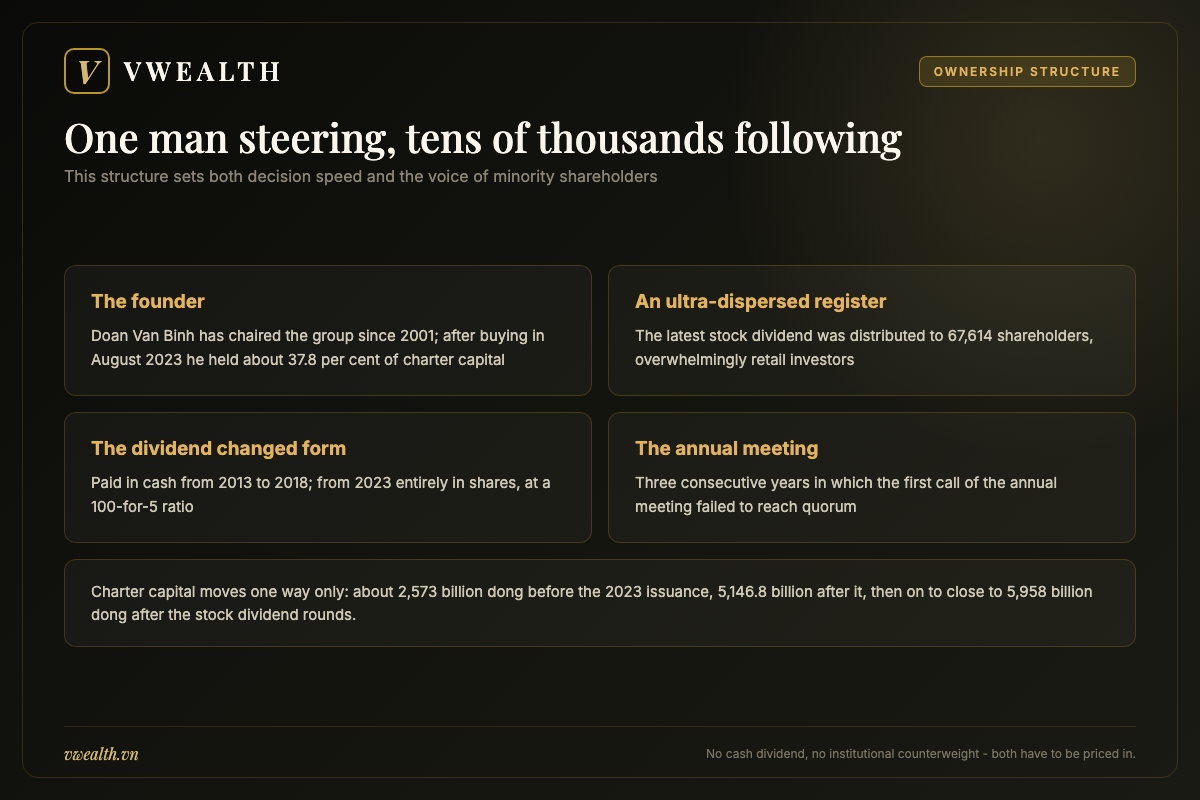
CEO Group’s ownership structure revolves around the chairman. After buying roughly 26.59 million shares in the August 2023 issuance, Mr Doan Van Binh held approximately 97.27 million CEO shares, equivalent to about 37.8 per cent of charter capital at that time. In later tabulations, once total shares outstanding had grown through stock dividends, the ratio is recorded differently — some sources put it at around 34 per cent of a larger share count. The two figures do not contradict each other. The gap is exactly what dilution plus subsequent purchases at different moments looks like.
This is a place where you have to do your own work rather than trust any fixed number in any article, including this one. Major shareholder percentages shift after every issuance, every stock dividend and every insider transaction. The correct way to check is to open CEO Group’s most recent semi-annual or annual corporate governance report and find the section listing major shareholders together with the section on transactions by insiders and related parties. Or, faster: open the CEO analysis report on the vwealth platform, where the ownership section is refreshed against the latest disclosures. What matters is not the number to the decimal place but the qualitative picture: one individual holds somewhere between a third and just under four tenths of the capital, and the remainder is scattered across tens of thousands of small holders. That structure has three direct consequences, and we meet the first one immediately.
Three Straight Years of a Failed First AGM: A Sign of What?
The first consequence, and the largest blemish in CEO Group’s governance file: the company has gone three consecutive years in which the first call of its annual general meeting failed. In the most clearly documented instance, the meeting on 9 April 2025 drew only 33.26 per cent of voting shares in attendance — below the minimum threshold required by the Enterprise Law and the company charter for the meeting to proceed. The group then had to convene a second call, at which the attendance requirement is lower.
A quorum mechanic needs explaining for readers outside Vietnam, because it is stricter than in most Western jurisdictions. Vietnamese company law requires a meaningful proportion of voting shares to be present for the first call of a shareholder meeting to be valid; if that is not met, the company reconvenes with a materially lower threshold, and at a third call the meeting can proceed regardless of attendance. In practice this means a failed first call is embarrassing rather than fatal. But it is still information, and it is not the sort of information a US or European investor would encounter often at home, where proxy voting infrastructure makes quorum a near-automatic formality.
Many investors read this news and conclude immediately that “the company has problems”. That reading is both right and incomplete. Separate it into two layers.
The mechanical layer. When a company has tens of thousands of small shareholders, most of them momentum buyers who arrived in 2021 and 2022 and take no interest whatsoever in voting rights, assembling enough attendance for a first call is arithmetically very hard. The major shareholder holds roughly a third; add a few percentage points from people who genuinely show up and you still do not reach the threshold. This is a common ailment across the whole “national stock” cohort, not something unique to CEO.
The substantive layer. But that mechanical fact is itself important information, and you are not allowed to wave it away. It says the shareholder base of this company is predominantly speculative money rather than long-term money. It says there is essentially no large institutional holder with both the weight and the motivation to sit at the table and question management. And it says that if the interests of the major shareholder and the small shareholders ever diverge, the small shareholders have no instrument to make themselves heard other than selling. For a company that repeatedly issues new shares to raise capital — that is, repeatedly makes decisions which directly dilute your stake — the absence of a governance counterweight is a risk that has to be priced in, not filed as a footnote.
Dividends: From Steady Cash to a 100-for-5 Stock Dividend
CEO Group’s dividend history splits cleanly into two eras, and the boundary between them says a great deal about the company’s cash flow.
The first era, 2013 to 2018: cash dividends. The group paid in cash at 6 per cent for 2013, 800 dong per share for 2014, 900 dong for 2015, and 1,000 dong for each of 2016 through 2018. This was the period when the business was still small, the mainland housing projects produced relatively even cash flow, and management chose to share cash with owners. In parallel, though, the company also ran repeated rights issues to existing shareholders at very high ratios — 1:1, 2:1, 3:2, even 100:98 — to fund investment. Money went out one door and came back in the other.
The second era, from 2023 onward: stock dividends. The company shifted to paying dividends in shares at a 100-for-5 ratio, meaning a holder of 100 shares receives 5 more, applied for 2023, 2024 and continuing thereafter. In the most recent recorded round, the group issued nearly 28.4 million shares to 67,614 shareholders, taking charter capital to close to 5,958 billion dong.
You need to understand what a stock dividend actually is, because this is where new investors go wrong most often. A stock dividend is not money. The company moves nothing out of its accounts; it simply cuts the ownership pie into more slices. If you hold 100 shares out of 1,000 outstanding, you own 10 per cent of the business. After a 100-for-5 distribution you hold 105 shares out of 1,050 — still exactly 10 per cent. The reference price on the ex-date is adjusted down correspondingly. You are not one dong richer at the moment of distribution; you only get richer if the company puts those retained earnings to work and generates new profit with them. This is the same arithmetic as a stock split in Western markets, and it is worth naming plainly because Vietnamese retail commentary frequently treats a stock dividend as a windfall.
So why is the switch from cash to stock worth noticing? Because it signals capital priority. A developer in a heavy investment phase — building infrastructure for new phases at Phu Quoc and Van Don — treats every dong of cash as precious, and retaining it inside the business rather than paying it out is financially rational. But it also carries a very clear message for you: if you are buying CEO for dividend income, you have picked the wrong ticker. The entire expected return on this investment sits in the price differential, not in cash arriving in your account each year. If you need cash dividends inside a Vietnamese property allocation, your search should point toward companies with income-producing rental assets, such as Vincom Retail and its shopping mall portfolio, rather than a resort developer that is still building.
Dilution: The Single Most Important Variable, and How to Track It
Put all of that together and one theme rises out of CEO Group’s ownership file: the share count moves in essentially one direction, which is up. Up through rights issues to fund projects. Up through annual stock dividends. From charter capital of roughly 2,573 billion dong before the large 2023 issuance, the figure went to 5,146.8 billion dong, and then on to close to 5,958 billion dong after the stock dividend rounds.
| Milestone | Action | Effect on existing shareholders |
|---|---|---|
| 2013 to 2018 | Cash dividends of 600 to 1,000 dong per share, alongside repeated high-ratio rights issues to existing holders | Real cash received, but fresh capital had to be committed to maintain a constant ownership percentage |
| September 2023 | Issue of more than 257 million shares raising close to 2,600 billion dong; charter capital from about 2,573 billion to 5,146.8 billion dong | Anyone who did not subscribe saw their stake fall sharply; earnings per share materially diluted |
| From 2023 | Full switch to stock dividends at a 100-for-5 ratio for 2023, 2024 and onward | No cash reaches your account; the reference price adjusts down accordingly |
| Most recent round | Issue of nearly 28.4 million shares to 67,614 shareholders; charter capital to close to 5,958 billion dong | The ultra-dispersed shareholder base is reinforced; the EPS denominator keeps widening |
The way to monitor this is simple enough to become a habit. Every time you open a CEO financial report, do not look at net profit first. Look at the line for weighted average shares outstanding in the basic earnings per share calculation, and compare it with the same period a year earlier. If that denominator is growing faster than profit, then even when absolute profit rises, the value attaching to each share you hold is falling. That is a one-line test, it takes ten seconds, and it filters out an enormous quantity of “double-digit profit growth” headlines that mean nothing at all to the person holding the shares.
To be fair, there is a balancing point that has to be stated. The strategy of using shareholder equity instead of borrowed money is precisely what carried CEO Group through the industry’s worst storm. Through 2022 and 2023, when Vietnam’s corporate bond market for property issuers froze and a series of developers fell into liquidity crises — the forced-margin-selling episode at Phat Dat being one much-discussed example — a balance sheet light on borrowings was a genuine shield. You are paying for that safety with dilution. The right question is not “is dilution good or bad” but “is this level of dilution worth the safety received, and is the money raised being turned into productive assets?” Chapter 4 gives you the tools to answer that for yourself.
What CEO Group Actually Sells: An Anatomy of Four Businesses
Ask ten people who hold CEO shares how the company makes money and nine will probably say “it sells beach villas in Phu Quoc”. That answer is not wrong, but it covers only part of the picture, and the missing part is precisely what keeps the business standing in the years when nothing sells. This chapter dissects each segment, shows which one feeds which, and answers the question that matters most: where is CEO Group’s economic moat, and how durable is it?
The Business Model: Buy Land Cheap, Bury Capital Long, Sell Product Dear
Before the segments, you need the machine as a whole. CEO Group’s core model runs in four beats.
Beat one — assemble land where nobody believes yet. The company looks for coastal or peri-urban parcels with planning potential but no infrastructure, while land prices are still low. That is why CEO was in Phu Quoc very early, before the island became an international destination, and in Van Don before the airport and expressway were finished.
Beat two — do the legal work and the infrastructure. This is the longest beat, the most expensive beat, and it generates precisely zero revenue. Levelling, internal roads, power and water, permits, planning adjustments. For projects of several hundred hectares such as Sonasea Van Don Harbor City, this beat runs for years.
Beat three — build a piece of it and create proof. The developer puts up a hotel or a cluster of amenities first and brings it into operation, to demonstrate to buyers that this is a functioning resort rather than an empty plot. Wyndham Garden Sonasea Van Don, the water sports park and the public square all belong to this beat.
Beat four — sell the product phase by phase. Once infrastructure and amenities exist, the company launches phases in sequence, using the proceeds of one phase to fund the next. Grand Oceania, with its 225 beach villas and townhouses, is one such phase.
These four beats explain, completely, the three financial characteristics you will meet in the next chapter: inventory is always very large, operating cash flow is usually negative during the investment phase, and profit lurches according to handover schedule. If you do not understand this machine, you will misread nearly every number in CEO’s financial statements.
Segment One — Resort Property: Where Both the Story and the Risk Concentrate
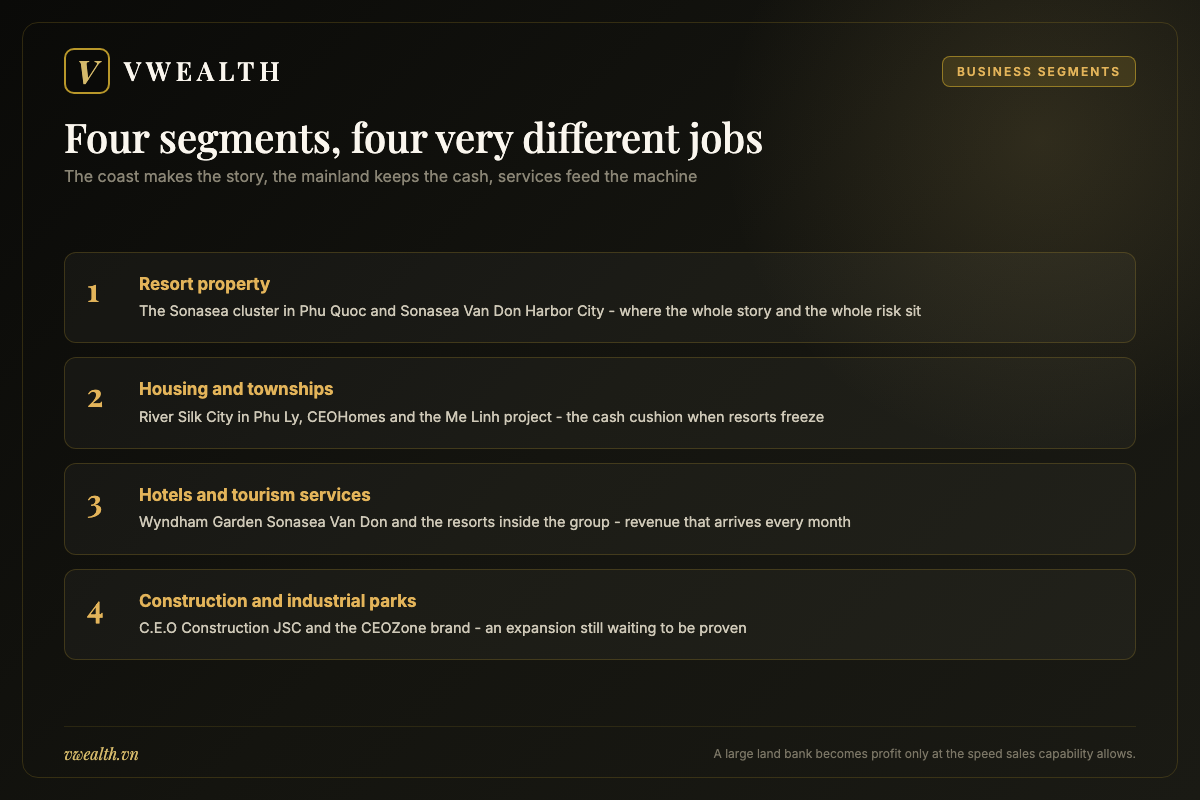
This is the segment that defines CEO Group in the eyes of the stock market. Two flagship complexes sit at opposite ends of the country. In the south, the Sonasea cluster in Phu Quoc, comprising the Sonasea Villas & Resort complex developed since the mid-2010s and the 62.51-hectare Sonasea Residences project with a full product range from villas and terraced houses through shophouses to apartments. In the north, Sonasea Van Don Harbor City across more than 358.5 hectares on Bai Tu Long Bay with 2.2 kilometres of coastline.
In total, the group’s land bank at strategic locations such as Phu Quoc, Van Don and Rach Gia is recorded at more than 830 hectares, and including mainland projects the figure quoted in the press runs to the low thousands of hectares. The specific number moves with time and with counting method — some projects have completed land handover, others are only at in-principle approval — so treat this as a qualitative picture rather than a precise measurement, and check the current project schedule in the latest annual report.
The strength of this segment is obvious. Coastal land in Phu Quoc and Van Don simply cannot be assembled today at anything like the prices of ten years ago. Tighter planning control, land values that have multiplied several times over, and local authorities restricting new land allocations for resort projects have combined to make what CEO already holds genuinely hard to replace. That is a real moat, of the type best described as privileged access to a scarce resource.
But the weakness is equally clear, and you have to look straight at it. Resort property is the hardest segment in Vietnamese real estate, for three compounding reasons. First, the product serves no genuine housing need — a beach villa buyer is buying an investment or a toy, and both of those are discretionary purchases, the first thing to vanish when the economy tightens. Second, most resort product is entangled with a legal question that has never been cleanly resolved, particularly the condotel format. Third, sales depend heavily on rental yield guarantees — and a yield guarantee is a double-edged instrument: it moves product quickly in good times and becomes a heavy financial obligation when occupancy falls short.
Segment Two — Housing and Townships: The Stable Part Nobody Mentions
While the market talks only about the coast, CEO Group holds a mainland portfolio that produces far steadier cash. The representative asset is River Silk City in Phu Ly city, Ha Nam province: 126 hectares split into the North and South Chau Giang areas, roughly 3,000 villa, shophouse and terraced products, a planned population of 19,000, total investment of about 1,904 billion dong, and six phases, of which the early ones are complete. The site sits at the eastern gateway of Phu Ly city, roughly 50 kilometres from Hanoi — a textbook satellite township play. The same group includes CEOHomes-branded projects in and around Hanoi, among them the Me Linh project where land has been handed over.
Why does this segment matter more than the attention it receives? Because it is different from resort property in exactly the places where resort property is weak. The product is landed housing with clean title, buyers have a genuine need to live there or a long-term local investment case, the sales cycle is shorter, less capital is buried, and — most importantly — it does not depend on tourism. When the resort segment froze during the pandemic or when market confidence sagged, it was mainland projects like River Silk City that kept the cash flow from breaking.
If you want to understand why the mainland housing model has been so much better regarded by the market through the 2024 to 2026 cycle, compare it against developers whose capital turns faster. The difference in capital velocity between models is exactly what explains why some companies report a profit every quarter while others wait all year for one large one.
Segment Three — Hotels and Tourism Services: Small, but the Bloodstream
CEO Group does not only sell resort property; it operates it. The group owns and runs hotels and resorts carrying international brands such as Wyndham and Novotel within its own project system, together with attached services such as the water sports park and commercial blocks.
In absolute terms this segment is far smaller than property sales. But it carries three values the numbers do not capture.
The first value: even cash flow. Hotel revenue arrives monthly and does not care whether a project handover falls in this year or the next. In years when the company books no property sales revenue at all, it is this segment together with construction that keeps the machine running.
The second value: product proof. A Wyndham that is genuinely open, with genuine guests, is a stronger sales instrument than any 3D render. It demonstrates to a villa buyer that this resort can actually be operated and can actually attract guests.
The third value, and here is the caution: it is also an obligation. When the developer both operates the property and commits to sharing rental profit with buyers, low occupancy does not merely reduce services revenue — it creates a financial obligation that must be met. This is exactly where a number of Vietnamese resort projects stumbled between 2020 and 2023. When you read CEO’s financial statements, look for the notes on commitments and contingencies to see whether the company carries any unfulfilled profit guarantees.
Segment Four — Construction and Industrial Parks: A Pillar Still Under Construction
The construction arm is a legacy of day one, housed in a dedicated entity, C.E.O Construction Joint Stock Company. In theory, acting as main contractor on your own projects delivers two benefits: control over schedule, and retention of the construction margin instead of handing it to an outside builder. In practice, most of the construction revenue of groups structured this way is intercompany revenue that is eliminated on consolidation, so the contribution to consolidated profit is smaller than the name suggests. Read this segment as an operating capability rather than an independent income source.
The newer direction is industrial property under the CEOZone brand. This is a move many Vietnamese developers have made in the current cycle, because the logic is strong: manufacturing FDI into Vietnam continues to arrive, demand for industrial land leases is stable, and long tenancy agreements produce predictable cash flow — almost the exact inverse of resort property’s characteristics. If CEO Group genuinely builds this pillar at meaningful scale, the company’s risk profile changes materially for the better. But that is an important “if”, and as an investor you should only put it into your valuation once you have seen real leases and real revenue, not when you have seen a press release.
Set the four segments side by side and the picture sharpens. The table below summarises each one’s role and its specific risk, so you can see which produces profit, which keeps the cash rhythm, and which is still a promise.
| Segment | Representative assets | Role in the machine | Specific risk |
|---|---|---|---|
| Resort property | The Sonasea cluster in Phu Quoc, including 62.51-hectare Sonasea Residences; Sonasea Van Don Harbor City at over 358.5 hectares | The largest profit source when handovers occur; the entirety of the share’s valuation story | Discretionary demand tied to the tourism cycle and to confidence; unresolved legal status for lodging formats; capital buried for a very long time |
| Housing and townships | River Silk City (Phu Ly, Ha Nam) at 126 hectares, roughly 3,000 products, six phases; CEOHomes; the Me Linh project | Steadier cash flow and faster capital turnover; the cushion when resort demand freezes | Fierce competition in provincial markets; thinner margins than coastal product |
| Hotels and tourism services | Wyndham Garden Sonasea Van Don; internationally branded hotels and resorts within the group’s projects | Monthly recurring cash; the proof-of-product tool for property buyers | Sensitive to occupancy and seasonality; potential obligations if rental yield guarantees exist |
| Construction and industrial parks | C.E.O Construction Joint Stock Company; the CEOZone brand | Internal control of schedule and cost; the intended route into long-term lease income | Construction revenue is largely intercompany; the industrial park push is early stage and unproven |
Where Is CEO Group’s Moat, and How Durable Is It?
This is the decisive question, and it deserves a straight answer.
Moat one, real and fairly durable: land in locations that cannot be recreated. Coastal land at Phu Quoc and Van Don, in contiguous parcels of hundreds of hectares, is something a company founded today essentially cannot obtain. Not for lack of money, but for lack of time and opportunity — the master plans are full, prices have multiplied, and land allocation policy for resort projects has tightened. This is a durable advantage and it is the most legitimate reason for a long-term investor to be interested in CEO at all.
Moat two, real but thin: the Sonasea brand and execution capability. After years of work, Sonasea has become a recognised name in the northern resort segment, and the company has demonstrated that it can build infrastructure and bring a hotel into genuine operation. But brand in resort property does not create the pricing power that brand creates in retail or consumer goods: a beach villa buyer decides on location, legal status and price, and rarely pays a premium for the developer’s name alone.
And here is where there is no moat at all: large-scale sales capability. Compared with developers that operate vast distribution networks and can absorb thousands of units a quarter, CEO Group is a mid-tier business. That means the land bank, however large, converts into profit only at the pace sales capability allows. This is the central paradox of the CEO investment case, and you have to understand it thoroughly: a company rich in assets, constrained by the speed at which those assets become money. A land bank worth a very large number but requiring twenty years to sell has a present value, after discounting, far smaller than the figure that forum arithmetic tends to produce.
Hold on to that paradox. It returns in Chapter 5 when we discuss how to value CEO, and again in Chapter 7 when we build the three scenarios.
How to Read the Financial Statements of a Resort Developer
Plenty of investors open CEO Group’s accounts for the first time and give up after five minutes. Not because the statements are difficult, but because they are reading them with habits formed on manufacturers and retailers — where revenue arrives evenly each quarter, margins are stable, and growth is measurable in percentages. Applied to a resort developer, those habits point you almost exactly the wrong way. This chapter does not hand you last quarter’s numbers, which change constantly. It hands you something with a longer shelf life: the reading order, and the set of line items that actually matter.
Why CEO’s Profit Lurches, and Why That Is Not a Symptom of Anything Wrong
Start with the single most important point: a property developer books property sales revenue at the moment of handover, not at the moment of contract signing or cash collection. You can sell an entire phase in the first quarter, collect money through the second and third, and recognise all of the revenue and profit only in the fourth, when the units are physically delivered to buyers.
The direct consequence: a quarter with a handover shows very large profit; a quarter without one shows profit near zero, or even a loss, because administrative costs and interest still have to be carried. If you look at a chart of CEO’s quarterly profit, you will see bars so uneven that the company appears to be in trouble. It is not. That is simply the breathing rhythm of the business model. Investors accustomed to US homebuilders, who use a broadly similar closing-based recognition but sell thousands of units a year and therefore average out, tend to underestimate how violent the lumpiness becomes when a company sells a few hundred units in phases years apart.
From this follow three reading rules you should apply rigidly.
Rule one: never compare one quarter with the quarter immediately before it. That comparison is meaningless. Compare this quarter with the same quarter a year earlier, and better still, use trailing twelve month figures to smooth out the handover rhythm.
Rule two: read the balance sheet before the income statement. For a property developer, the balance sheet carries more predictive information than the profit and loss account. Inventory tells you how much the company still has to sell; customer prepayments tell you how much future revenue is already booked; the debt maturity profile tells you whether the company has enough time to wait for handover day.
Rule three: separate core profit from one-off profit. Property developers frequently record gains from disposing of projects, transferring stakes in subsidiaries, or revaluing assets. Those items flatter a quarter and do not repeat. Find the “financial income” line and its accompanying note, and strip them out before concluding how much the company is actually earning from its trade.
Inventory: The Largest Number and the Most Misunderstood
On a developer’s balance sheet, inventory is usually the largest single item. But “inventory” here does not carry the negative meaning it carries in manufacturing, where high inventory means unsold stock going stale. In property, inventory is the accumulated cost of every project not yet handed over: land acquisition, site clearance compensation, levelling, infrastructure, construction in progress, and capitalised interest.
Put differently, inventory is the warehouse of future product. A company with large inventory that is executing on schedule is a company with plenty to sell in coming years. The same number means something entirely different if the projects have stalled.
So how do you tell them apart? With three questions, asked while you have the inventory note open.
Question one: which projects is the inventory sitting in? The note breaks it down project by project. If most of it sits in projects that are actively selling with visible construction progress, that is healthy inventory. If most of it sits in a project that has not appeared in company communications for several years, put a question mark next to it.
Question two: has inventory grown faster than revenue for several consecutive years? If inventory climbs steadily while handover revenue does not keep pace, money is flowing into projects faster than it is flowing back out as profit. That is acceptable for a few years of an investment phase, but stretched too long it becomes a capital efficiency problem.
Question three: is there a provision for inventory impairment? If there is, the company is acknowledging that the recoverable value of some project is below the cost already incurred. That is serious information. Do not skip past it.
Customer Prepayments: The Most Accurate Sales Barometer There Is
If I could only track one line item on CEO Group each quarter, this would be it. Sitting on the liabilities side of the balance sheet, “short-term advances from customers” is the money buyers have already paid for product that has not yet been handed over.
Why does it matter so much? Because it is a leading indicator of revenue. A rising balance means the company is selling right now, even though the income statement shows nothing yet. A sharply falling balance has two possible explanations: either the company has just handed over a batch of product and converted that money into revenue — the good case; or the company is not selling anything new — the bad case. Distinguishing between them is easy: check whether revenue in the period rose correspondingly.
For a company with a handover rhythm as lumpy as CEO’s, customer prepayments give you a view two to six quarters ahead. That is the most powerful instrument available to a retail investor who does not want to build a complicated model. Readers from Western markets can think of it as the closest Vietnamese equivalent of a homebuilder’s backlog disclosure, with one important difference: it is a cash balance, not a contract value, so it understates the total order book and only reflects money actually received.
Leverage and Debt Structure: CEO Group’s Relative Bright Spot
This is where CEO Group differs positively from many peers, and it deserves proper credit.
As covered in Chapter 2, the group’s financial strategy leans toward raising equity — rights issues to existing shareholders — rather than carrying large borrowings or issuing corporate bonds at scale. The 2023 issue raising close to 2,600 billion dong is the clearest example. The result is a balance sheet relatively light on debt compared with the industry norm, and a company that never fell into the bond maturity spiral that swallowed several developers in 2022 and 2023.
When you check this, work in the following order. Step one, calculate borrowings to equity — counting only bank debt and bonds, not total liabilities, because total liabilities include customer prepayments, which are a good thing rather than a burden. Step two, look at tenor: what percentage of borrowings matures within the next twelve months, and does the company have cash plus expected cash flow sufficient to repay it? Step three, find the note on secured assets to see what has been pledged. Step four, check interest coverage — earnings before interest and tax divided by interest expense. For a developer this ratio swings hard with the handover rhythm, so calculate it on a trailing twelve month basis.
One caution for newer investors: low debt does not automatically mean a good company. Low debt with unproductive assets simply means the company is sitting on a pile of dead capital. CEO Group’s problem has never been default risk; its problem is the return generated on the assets it holds. Those are two entirely different questions, and you should know which one you are worrying about.
Cash Flow: Where the Truth Is Hardest to Dress Up
The cash flow statement is the part new investors skip most often and also the most honest part. For CEO Group, read the three flows this way.
Operating cash flow. For a developer in a heavy investment phase, negative operating cash flow is normal — money is flowing into inventory, which is to say into building projects. What you need to check is not the sign but the reason. Open the reconciliation at the top of the statement: if the negative number is driven mainly by “increase in inventories”, that is investment. If it is driven mainly by “increase in receivables”, that is a sign the company is selling but not collecting — considerably more worrying.
Investing cash flow. For CEO, this is where you see additional land acquisition, capital contributions to subsidiaries, and hotel investment. Negative investing cash flow during an expansion phase is entirely reasonable.
Financing cash flow. This is where the company’s strategy shows most clearly. If the inflow comes mainly from “proceeds from share issuance”, the company is living on shareholder capital — precisely CEO Group’s profile. If it comes mainly from “proceeds from short and long-term borrowings” while operating cash flow has been deeply negative for years, that is a far riskier model.
There is one simple test I recommend running annually: add up operating cash flow across the last three to five years. If the total is still deeply negative while the company keeps issuing new shares, then in substance shareholders are funding operations and have not yet received anything back. That is not necessarily a verdict — a long investment phase is intrinsic to resort development — but it tells you the clock is running, and you need to know how much time the company has before it must raise again.
Revenue Against Capital: The Efficiency Question You Cannot Dodge
This is the hardest part to say and it has to be said. CEO Group has charter capital approaching 6,000 billion dong after its capital raises, while consolidated annual revenue runs in the low thousands of billions of dong. The ratio between those two figures — asset turnover — is materially lower than at developers that sell quickly.
That accurately reflects the nature of the model: a great deal of capital is sitting in land and in infrastructure that has not yet produced revenue. But it also poses the question every long-term investor must answer before buying: do you believe this asset base will be converted into cash within a timeframe you can accept? If the honest answer is “possibly, over fifteen or twenty years”, then the actual return on your investment may be far lower than the size of the land bank makes it feel.
To get current figures for each of these measures — asset turnover, borrowings to equity, customer prepayments, trailing four-quarter operating cash flow — check against the CEO analysis report on the vwealth platform rather than assembling numbers by hand.
Eight metrics to score every quarter. This entire chapter compresses into a checklist. Every time a set of financial statements is published, run these eight lines in order and you have done the work.
| # | Metric | How to read it correctly |
|---|---|---|
| 1 | Customer prepayments | Leads revenue by two to six quarters; a rise means product is selling, a fall requires you to check whether revenue rose to compensate |
| 2 | Inventory by project | Read the detailed note; inventory concentrated in actively selling projects is healthy, inventory in projects silent for years is a question mark |
| 3 | Inventory impairment provision | Its appearance means the company concedes recoverable value is below cost already incurred |
| 4 | Borrowings to equity | Count only bank debt and bonds; check separately what matures inside twelve months |
| 5 | Operating cash flow | Negative from rising inventory is investment; negative from rising receivables is selling on credit — two very different stories |
| 6 | Weighted average shares outstanding | Compare with the prior-year period; a denominator growing faster than profit means EPS falls even as absolute profit rises |
| 7 | Core versus one-off profit | Strip out disposal gains, stake transfers and revaluations before judging profit from the actual trade |
| 8 | Trailing four-quarter asset turnover and ROE | Measures how fast assets become money — the inherent weakness of a large land bank model |
These eight matter far more than P/E when you read the accounts of a resort developer. Why P/E is close to useless for CEO, and what to use instead, is the subject of the next chapter.
How the Market Treats CEO Stock
With some companies, once you have analysed the business you are essentially done. CEO is not one of them. With this ticker there is a thick intermediate layer between business value and share price, and that layer is trading personality — created by the shareholder base, the exchange’s price band, the sensitivity to news, and the collective memory of the market. Ignore it and you will buy the right business at the wrong moment, and with a share as volatile as this one, the wrong moment is fully capable of erasing a correct thesis.
Trading Personality: A Ten Per Cent Band and an Ultra-Dispersed Register
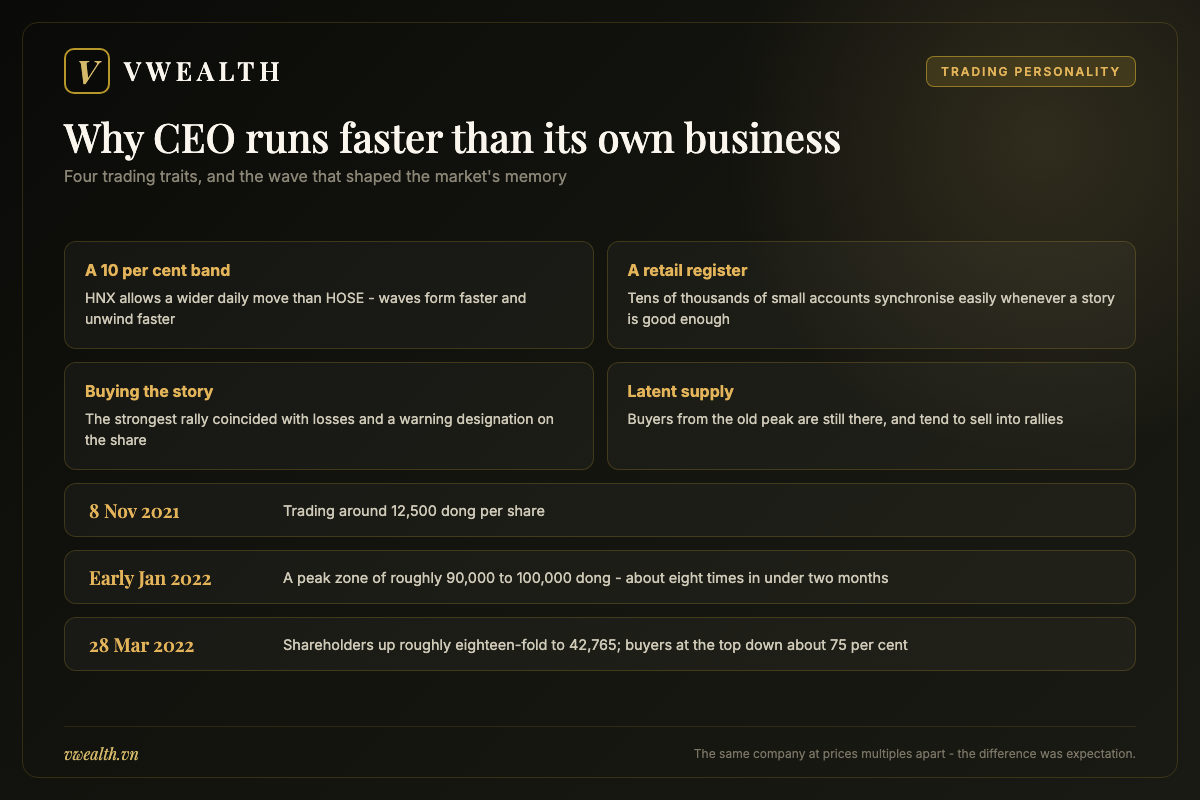
Start with the mechanics of the exchange. CEO is listed on HNX, where the daily price band is plus or minus 10 per cent, against plus or minus 7 per cent on HOSE. For a liquid share with an easy story, those three percentage points create a difference in kind, not merely in degree.
Do the arithmetic. On HOSE, a share needs ten consecutive limit-up sessions to roughly double. On HNX it needs about seven and a half. Extend the run to ten limit-up sessions on HNX and the gain reaches roughly 159 per cent. That number is not merely mathematical; it is the raw material of euphoria. When a share moves that fast, it appears on every leaderboard, in every chat group, in every closing-bell bulletin — and new money finds its own way in. The reverse is identically true: a run of limit-down sessions on HNX erodes an account far faster than on HOSE, and the sensation of not being able to get out spreads panic selling more quickly.
The second factor in CEO’s personality is the shareholder base. In its most recent stock dividend, the company distributed to 67,614 shareholders. That is a very large number for a company of CEO’s revenue scale, and it tells you what kind of money holds this ticker: overwhelmingly retail, mostly not reading financial statements, reacting to news and to price charts. The share therefore has excellent liquidity — you can almost always transact — and violent volatility, because tens of thousands of individual decisions synchronise easily when a story is compelling enough.
The 2021 to 2022 Wave: A Complete Case File on a Mania
You cannot analyse CEO stock without this period, because it still shapes how the market sees the ticker today.
On 8 November 2021, CEO traded around 12,500 dong per share. From there the stock entered a run of consecutive limit-up sessions and climbed to a peak zone of roughly 90,000 to 100,000 dong in the first days of January 2022 — around eight times over in under two months, a move the financial press generally described as roughly 800 per cent.
What happened? Three forces at once.
Force one — macro. Late 2021 was the euphoric peak of the Vietnamese equity market. Deposit rates were low, household savings had built up through the lockdown period, and new brokerage account openings set records month after month. Retail money flooded in and went hunting for stories.
Force two — the sector narrative. Late 2021 and early 2022 was the moment land-rich property names exploded, on expectations around public investment, infrastructure and the reopening of tourism after the pandemic. CEO sat at the perfect intersection of all of it: it had land, it had coastal land, and it had coastal land in exactly the two places every special zone proposal named.
Force three — and this is the largest lesson — the complete absence of earnings. In that period CEO’s hotel and resort operation had been flattened by the pandemic, the company was loss-making, and the share had even been placed under a warning designation. And it still went limit-up session after session. The market was not buying present profit. The market was buying a story about the future, and in a mania, the less present profit there is, the easier future profit is to imagine.
Then came the second half of the story. Against the peak zone of early January 2022, investors who bought at the top faced a drawdown of roughly 75 per cent. And a very large number of people were in that position: CEO’s shareholder count rose roughly eighteen-fold, reaching 42,765 as at 28 March 2022. Which means the overwhelming majority of this company’s shareholders joined during or immediately after the top of the wave.
The consequence still runs today, and technical analysts call it latent supply from higher prices: a great many accounts remain deeply underwater from 2022, and every time the price recovers meaningfully, some of them sell to break even or cut the loss. That is why CEO’s rallies typically meet heavy selling at psychological price levels. This is not chart superstition; it is predictable human behaviour, and it applies to any stock with a shareholder register formed at a single euphoric peak.
Why P/E Is Close to Useless for CEO — and What to Use Instead
The price to earnings ratio assumes that this year’s profit represents the company’s normal earning power. That assumption collapses entirely with CEO, for the three reasons set out in Chapter 4: profit lurches with the handover schedule; profit can contain one-off items from project transfers; and the denominator, the share count, keeps expanding through issuance.
The result is that you can see a very high P/E in a year without handovers and a very low one in a year with a large handover, and neither number reflects value. Using P/E to compare CEO with other names in the sector is comparing two things measured in different units.
So what should you use? Three alternatives, ranked by usefulness.
Tool one — P/B, price to book. This is the most reasonable ratio for a company whose assets are mainly land and property. The correct way to use it is not to compare CEO’s P/B against a bank’s or a manufacturer’s, but against CEO’s own P/B history across cycles, and against the P/B of developers with a similar model. Build yourself a range: the lowest P/B at market bottoms, the highest at wave peaks, and the median. Where the current level sits inside that range tells you far more than any absolute number. One warning specific to Vietnam: book value here is historical cost, not fair value. Vietnamese accounting does not revalue investment property upward the way IFRS permits, so a company holding land bought in 2014 carries it near the 2014 price. That is precisely why P/B on a land-rich Vietnamese developer often looks superficially expensive and can still be cheap — and why the same distortion makes cross-border comparisons with, say, a European property company reporting under IFRS fair value largely meaningless.
Tool two — net asset value based on the land bank. This is the most commonly used method for land-rich companies. The idea: estimate the market value of each project, subtract the costs still to be spent and the financial obligations, add them up, divide by the share count. It sounds simple and it is full of traps, which is the subject of the next section.
Tool three — enterprise value per square metre of land bank. A crude but useful comparison: take market capitalisation plus net debt and divide by total saleable land area. The resulting figure tells you what the market is paying for each square metre of the company’s land, and you can compare it against actual transaction prices for land in the same area. A large gap in either direction is worth investigating.
The NAV Trap: A Worked Illustration
This is the section I would most like you to read carefully, because it is where a great many investors talk themselves into buying at the wrong price.
Consider a purely hypothetical example to illustrate the mechanism — the numbers below are invented for arithmetic convenience and are not CEO Group figures. Suppose a company holds 100 hectares of saleable coastal land. Land in that area is transacting at around 30 million dong per square metre. So the land bank is worth 100 hectares times 10,000 square metres times 30 million, which is 30,000 billion dong. If the company has 500 million shares, “NAV per share” is 60,000 dong. The share is trading at 15,000 dong. So the stock is trading at a quarter of its true value?
That calculation is wrong in four places, and each of them is large.
Error one: the costs still to be spent. Raw land is not product. To sell it, the company still has to pay site clearance compensation, land use fees to the state, infrastructure, construction and marketing. Those can account for a very large share of the final sale price. The 30 million dong per square metre above is the price of land that already has infrastructure, not the price of what the company is holding. Land use fees deserve a specific note for foreign readers: in Vietnam the state is the ultimate owner of all land and grants use rights, and a developer converting a parcel to a saleable format typically owes a substantial land use fee calculated on official land price tables. That obligation is frequently invisible in a forum NAV calculation and can be enormous.
Error two: time. Selling 100 hectares is not a one-year exercise. At realistic sales capability it might take ten to twenty years. A sum received fifteen years from now, discounted back at 12 per cent a year, is worth roughly 18 per cent of its nominal value. Which means 30,000 billion dong far in the future might be worth only a few thousand billion today.
Error three: the sale price is not fixed. Resort property prices move with the cycle. Valuing an entire land bank at cycle-peak prices is a form of systematic optimism.
Error four: dilution. If the company needs to issue more shares to fund development — which is exactly CEO Group’s history — the denominator grows, and NAV per share falls correspondingly.
The practical conclusion: NAV is a good tool for understanding the ceiling of a company’s value in a world where everything goes perfectly, and a poor tool for making a buy decision. When you see someone on a forum divide a land bank by a share count, arrive at X, and argue that the current price is a third of X and therefore a must-buy, ask those four questions before believing it.
Foreign Flows, Institutional Money, and CEO’s Place in a Portfolio
There have been periods of strong net foreign buying in CEO shares, and market bulletins usually make a great deal of it. Read that information in a balanced way. Foreign flows into a mid-sized name like CEO can move the price meaningfully in the short run, but they are not a certificate of quality — a good deal of foreign trading comes from ETFs and index funds transacting a basket, which expresses no view at all on any individual company. Note also that foreign ownership limits apply in Vietnam, capping the total foreign stake in most listed companies; for a name where foreign interest is episodic rather than structural, the limit is rarely the binding constraint, but it is worth checking the current room before assuming you can build a position freely.
More important is what is relatively absent: a large institutional shareholder with a voice. As analysed in Chapter 2, three consecutive years of a failed first AGM call is the clearest evidence of that. A share where most of the free float sits with tens of thousands of retail investors will always have three inherent characteristics: high liquidity, high volatility, and a valuation that regularly strays far from fundamentals in both directions.
From which follows CEO’s reasonable place in a portfolio. This is not a ticker to hold at a large weight and forget. If you want a Vietnamese property core holding, companies with steady cash flow and a stable shareholder structure fit better — comparing against Vingroup and the broader listed property universe will show you the alternatives. CEO fits better as a controlled bet: a small weight, with explicit discipline attached.
Catalysts: Which News Actually Moves CEO
If you follow this ticker, here is the list of news types that genuinely move it, ranked by strength based on the share’s historical reactions.
| News type | Historical impact | Why |
|---|---|---|
| Policy on special zones and special mechanisms for Phu Quoc and Van Don | Very strong | CEO is the clearest listed proxy for this story, in both locations simultaneously |
| International events and major infrastructure in Phu Quoc | Very strong | Expectations of visitor flows and rising land prices transmit directly into land bank value |
| Launch or groundbreaking of a new phase | Medium to strong | Confirms projects are moving and future revenue is forming |
| Plans for a new share issuance | Medium, usually negative short term | Dilution is immediate; the market reacts long before the raised capital produces profit |
| Quarterly results | Weak to medium | The lumpy handover rhythm has taught the market that any single quarter represents nothing |
| Senior management changes | Weak | Read as a governance signal; it takes several quarters to verify any effect |
Look at that table and an uncomfortable but important truth appears: the three news types with the strongest effect on CEO’s share price are all outside the company’s control. Policy, international events, public infrastructure — not one of those decisions is made by CEO Group’s management. That is the precise definition of a thematic speculative stock: its price mainly reflects expectations about the external environment rather than internal capability.
This does not make CEO a bad share. It means you have to know which game you are playing. If you buy CEO, you are betting on policy and on the cycle, with the land bank as collateral for that belief. Anyone who accepts those rules can play. Anyone who thinks they are buying a steady compounder will be disappointed by the second quarter.
Industry Context: The Resort Cycle and the Special Zone Chessboard
A stock like CEO cannot be analysed apart from its industry, because as the catalyst table showed, most of the price impulse comes from outside the company. This chapter builds the context in four layers: the new legal framework, the specific bottleneck of resort property, the two localities that decide the fate of CEO’s land bank, and the competitive map.
The New Legal Framework: Three Laws Changed at Once, and What Actually Changed
The 2024 to 2026 period is the first in which Vietnam’s property market has operated on a legal framework that was essentially rewritten. Three core statutes — the Land Law, the Housing Law and the Law on Real Estate Business — all took effect on 1 August 2024, earlier than originally scheduled. This is the largest synchronised overhaul the sector has seen in more than a decade, and for anyone analysing Vietnamese property from abroad it is the single most important piece of context: comparisons with the pre-2024 era can be misleading, because the rules under which land is priced, sold and financed are genuinely different now.
For a company like CEO Group, four changes matter most.
The first is the new land price framework. The 2024 Land Law abolished the central government’s land price bracket and instructed provinces to build land price tables approaching market levels. For a developer holding land on which land use fees have not yet been paid, this is a very sharp double-edged sword: the book and market value of the asset rises, but so does the financial obligation owed to the state when the project proceeds. For projects where financial obligations were completed earlier, the impact is purely positive. For projects where they were not, input costs rise. This is why, when reading the accounts of a land-rich developer, you must distinguish between land where obligations are settled and land where they are not. The two have very different economic value, and the distinction rarely appears in a headline land bank figure.
The second is tighter regulation of capital raising and of selling future-formed property. The new Law on Real Estate Business tightened requirements on legal progress and on deposit levels before a developer may take money from buyers. Future-formed property — selling units before they are built, the Vietnamese equivalent of off-plan sales — has historically been the primary funding mechanism for the whole industry. Tightening it hurts developers accustomed to selling early to fund construction, and is relatively favourable to companies with a habit of finishing the legal work before launching sales. As set out in Chapter 1, that is exactly the operating culture CEO Group inherited from its founder’s Japanese contractor background.
The third is a higher bar on developer financial capacity. The new framework raises the minimum ratio of owner’s equity to total project investment. A company with a debt-light balance sheet and large equity — CEO’s profile after its capital raises — is in a stronger position to be allocated new projects than a company straining under borrowings.
The fourth is the 2025 restructuring of provincial administrative units, which redrew the administrative map where many companies hold land. For CEO, the most notable change is Phu Quoc, which is now the Phu Quoc special zone within An Giang province following the reorganisation of Kien Giang. In the short term, every administrative change creates procedural lag. In the long term, the special zone designation opens the possibility of a dedicated mechanism — and that possibility is exactly what the market is betting on.
The Resort Bottleneck: The Ownership Certificate Story With No Ending Yet
This is the core problem of the entire segment, and it is worth understanding thoroughly before buying any Vietnamese resort property stock.
The problem starts with a distinction in land category. Ordinary housing is built on residential land, and the buyer receives a land use right certificate of indefinite duration — the document Vietnamese buyers call the “pink book”, which functions as the closest local equivalent of freehold title. Most resort projects, however — and especially the tourist apartment format known everywhere as the condotel — are developed on commercial and services land, which carries a defined term tied to the project. A condotel is a hybrid: a hotel room sold as an individual unit to a private buyer, who then places it back into a rental pool operated by the developer, usually with a promised yield. The format exploded across Vietnamese coastal markets from roughly 2015 to 2019. For years, condotel buyers did not know what they legally owned, and that ambiguity destroyed market confidence.
Decree 10/2023, issued on 3 April 2023 and effective from 20 May 2023, was expected to release the segment: construction works used for tourist accommodation purposes on commercial and services land would, if they met the conditions under land, construction and real estate business law, be certified as to ownership of the works attached to the land. That decree then ceased to be effective on 1 August 2024 when the 2024 Land Law took effect, and the new law continued to broaden the legal basis, allowing buyers of tourist apartments to be granted a certificate of ownership attached to a commercial and services land use right for the duration of the project.
Implementation, however, has remained very slow. The number of projects qualifying for certificates is still described as scarce, and the condotel segment as a whole remains in an extended slump. The reason lies in the gap between the regulation and the administrative procedure at the local level, together with the fact that many projects developed earlier do not meet the conditions under the new standard.
The meaning for a CEO investor is direct and worth memorising: within a resort developer’s product mix, products attached to residential land — villas and townhouses with indefinite title — are easier to sell, achieve better prices, and carry materially lower legal risk than tourist apartments on commercial and services land. When you read about each of CEO’s project phases, find out the land category and the product type. A project of villas, terraced houses and shophouses on residential land has a completely different risk profile from a project weighted toward hotel apartments. This is very likely also why the group’s more recent projects lean more heavily toward low-rise product attached to land.
Two Places That Decide CEO’s Fate: Phu Quoc and Van Don
If you only read one section of this chapter, read this one. The entire long-term investment case for CEO Group rests on two names.
Phu Quoc. This is the story moving fastest. Vietnam will host the Asia-Pacific Economic Cooperation forum — APEC — in 2027 on Phu Quoc, and that has triggered an infrastructure investment programme of considerable scale. Under Decision 948/QD-TTg dated 17 May 2025 of the Prime Minister, the master plan serving APEC 2027 was approved; a system of 21 projects for the conference — comprising 10 public investment projects and 11 under public-private partnership or non-budget capital — has essentially completed investor and contractor selection. The infrastructure list includes airport expansion, an APEC boulevard and an urban transport system. Total investment for APEC 2027 infrastructure at Phu Quoc has been announced at more than 137,000 billion dong.
For readers outside Vietnam, the significance of hosting APEC deserves a sentence of context. APEC is a twenty-one member economic forum spanning the Pacific rim, and its annual leaders’ week brings heads of government, delegations and international media to the host location. Countries typically use it as a forcing function to complete infrastructure that would otherwise take a decade — which is exactly what is happening on Phu Quoc.
Combine that with the special zone mechanism and you have the strongest catalyst package a company with Phu Quoc land could hope for: state-funded infrastructure, an international image upgrade through a regional event, and a new reason for international visitors to come. CEO Group’s Sonasea cluster in Phu Quoc sits squarely inside the beneficiary zone.
Two qualifications, so you do not become over-optimistic. First, infrastructure raises asset value, but it only becomes profit when the company sells product — which returns you to the sales capability bottleneck of Chapter 3. Second, an event like APEC concentrates a push into a single date; after that date the question “and then what” arrives, and tourism markets that have hosted major events all go through a post-event air pocket unless genuine underlying demand is deep enough to fill the gap.
Van Don. This is the longer and more patient story. Van Don is in Quang Ninh province, has its own international airport and expressway connection, and sits in the group of localities directed toward development under a special zone model. CEO Group’s Sonasea Van Don Harbor City, at more than 358.5 hectares, is one of the largest projects in the area, already has an operating Wyndham hotel, and is expanding through phases such as Grand Oceania.
The historical lesson here matters and I would ask you to hold on to it. The Van Don special zone story has been “bought” by the market repeatedly since 2018, and each time it has produced a share price wave before reality caught up. The distance between a policy direction and a genuine, stable stream of tourists sufficient to fill hundreds of hectares of resort product can be ten years or more. If you buy CEO for the Van Don story, answer honestly: do you have the patience for that timeframe, or are you only planning to trade a news wave?
The Competitive Map: Where CEO Sits
Vietnamese real estate is not one market. It is several different markets that happen to share land as a raw material. The table below helps you locate CEO inside that picture.
| Group | Model characteristics | Risk and return profile | Reference names |
|---|---|---|---|
| Large-scale urban housing | Sells apartments and low-rise housing to genuine end-user demand; large distribution networks; fast capital turnover | The steadiest revenue in the sector; sensitive to mortgage rates and to legal supply | Vinhomes, Nam Long |
| Income-producing property | Holds assets and leases them long term; recurring cash flow; little dependence on the sales cycle | Lowest volatility; typically pays cash dividends; slower growth | Vincom Retail |
| Industrial parks | Leases industrial land on long-term contracts; tied to manufacturing FDI | Predictable cash flow; depends on trade policy and on FDI attractiveness | Kinh Bac |
| Resort and thematic land banks | Assembles large parcels in emerging areas, buries capital for years, sells in phases; the share price tracks policy | Highest volatility; lumpy profit; valued on NAV and narrative rather than earnings | CEO Group, DIC Corp |
| Developers in restructuring | Large land banks weighed down by debt and bonds; value depends on progress in resolving financial obligations | Highest existential risk; large recovery potential if restructuring succeeds | Novaland, Phat Dat |
Read that table and you see CEO Group occupying a very particular cell: neither a company with even cash flow nor a company in a debt crisis. It is asset-rich, debt-light, slow-earning, with a share price that tracks a theme. Its strength relative to the restructuring group is that survival is barely a question. Its weakness relative to the housing and rental groups is that you hold nothing in your hand between the waves — no cash dividend, no steady earnings growth.
The industry context is the canvas; CEO’s own three scenarios are the picture painted on it. That is the next chapter.
Three Scenarios Ahead for CEO Stock
By now you have all the ingredients: a company rich in land in two locations with a powerful policy story, a debt-light balance sheet that dilutes continuously, mid-tier sales capability, and a share with a pronounced speculative personality and a heavy collective memory from 2022. What remains is to assemble those pieces into the paths that could plausibly unfold. To be clear in advance: this section gives no price target, and you should be sceptical of anyone who offers a price target for a stock whose three strongest drivers all sit outside the company’s control. What you get instead is conditions — what has to happen for each scenario to become real — and you track for yourself which way reality is drifting.
Three Variables Decide Everything
Variable one — the absorption rate at the resort phases. This is the most important variable and also the one the market watches least, because it never appears in a headline. The tracking method was covered in Chapter 4: watch customer prepayments quarter by quarter, combined with the company’s launch and handover announcements. If the land bank is raw material, sales velocity is factory capacity. Plenty of raw material with low capacity still means slow profit.
Variable two — progress in realising the mechanisms for Phu Quoc and Van Don. This includes the APEC 2027 infrastructure, the special mechanisms for the special zones, and most importantly, genuine tourist arrivals to both locations. Note the difference carefully: a policy direction moves the share price for a few sessions; real visitor flow is what moves property prices and company revenue durably.
Variable three — the need for further issuance and the resulting dilution. History shows CEO Group chooses the equity route. Each new issue thins your stake. The question to track is not “will they issue” but “has the capital raised last time turned into a productive asset yet?” If the previous round has not produced revenue and a new round already needs money, that is a warning signal about capital efficiency.
Base Case: The Land Appreciates, Profit Crawls, the Share Tracks the Theme
This is the scenario I consider most likely, for the simple reason that it is a continuation of what has already been happening for years.
Conditions for it to hold: Phu Quoc infrastructure proceeds broadly on plan but tourism recovers at a moderate pace; Van Don continues to develop slowly; the company sells product in some phases without a breakthrough in velocity; mainland projects such as River Silk City continue to serve as the cash flow cushion; and the group maintains its stock dividend policy alongside periodic issuance.
What that looks like in practice: land bank value rises gradually with the general level of land prices, both on the books and in the market; consolidated revenue and profit stay modest relative to the size of the capital base, with occasional spike quarters when a large handover lands; return on equity remains low; and the share trades in a wide band, with sharp rallies whenever policy or infrastructure news appears and a cooling off once the news passes.
What it means for you: in this scenario, buying and holding CEO for a very long time is not the optimal strategy, because you absorb continuous dilution without receiving cash dividends, while company profit does not grow fast enough to compensate. The better approach is to treat CEO as a thematic cycle bet: define in advance the price zone at which you are willing to buy, the maximum weight, and the exit condition. This requires discipline, and investors without discipline will repeatedly buy at the crest of a news wave.
Bull Case: The Resort Cycle Returns and the Land Bank Reprices
The conditions for this scenario are demanding, and essentially all of them have to appear at once.
First, the legal bottleneck in resort property is genuinely resolved at the implementation level — not merely on paper, but with a visible increase in the number of projects actually receiving ownership certificates. That restores buyer confidence and reopens liquidity for the whole segment.
Second, international tourism to Vietnam grows strongly and durably, particularly arrivals to Phu Quoc before, during and after APEC 2027, sufficient to lift occupancy and room rates to a new level. At that point the economics of owning a resort unit actually work, and buyers return for economic reasons rather than speculative ones.
Third, the special zone mechanism for Phu Quoc and Van Don is translated into policies with real force on tax, on investment procedure and on attracting international capital.
Fourth — and this is the most important internal condition — the company improves its sales velocity, whether through distribution partnerships, joint ventures with commercially capable partners, or the transfer of part of a project to bring cash forward quickly.
If all four hold, CEO is the kind of business with very high positive operating leverage: the fixed costs were incurred years ago, so each additional dong of revenue converts into profit at a high rate. On top of that, the share has a large retail shareholder base and the memory of the 2021 wave is still fresh, so when the story returns, speculative money can return very quickly. This is the scenario CEO holders are waiting for.
But stay honest about probability. Four conditions have to coincide, and three of the four are outside the company’s control. The bull case is not impossible; it simply requires a great many things to be right simultaneously, and you should assign it a modest probability when you size the position.
Bear Case: Time Moves Faster Than Progress
Conditions: the resort segment stays subdued because the legal bottleneck is not cleared at the implementation level; tourism recovers more slowly than expected or concentrates in a handful of destinations; infrastructure completes but real demand does not follow; and the company must keep issuing shares to fund development while previous rounds have not produced commensurate revenue.
Consequences: charter capital keeps expanding, earnings per share are diluted year after year, and return on equity stays low. The share does not crash in the manner of a crisis — the company does not carry debt heavy enough to threaten its existence — but it falls into what investors call a value trap: it looks cheap against its assets, and stays cheap indefinitely because the assets will not convert into cash. Holders bear a very large opportunity cost: money locked for years in a stock paying no dividend while other opportunities in the market come and go.
There is a variant of the bear case that deserves separate attention: governance risk. With ownership concentrated in one individual, a dispersed shareholder base, and three consecutive years of a failed first AGM call, small shareholders have essentially no effective oversight mechanism over large decisions — including decisions to issue more shares, to invest in new projects, and to transact with related parties. This is not an allegation of anything. It is a description of a risk structure. And in investing, a risk structure has to be priced into what you are willing to pay.
Milestones to Mark on Your Tracking Calendar
| Scenario | Key conditions | Early warning signs |
|---|---|---|
| Base | Infrastructure proceeds on plan, sales improve slowly, the company maintains stock dividends and periodic issuance | Customer prepayments flat or slightly rising; profit still lumpy by quarter; trailing four-quarter ROE low |
| Bull | Resort legal status cleared at implementation level; tourism grows strongly; special zone mechanisms made concrete; sales velocity clearly improves | The number of projects granted certificates rises; hotel occupancy and room rates rise; customer prepayments jump for several consecutive quarters |
| Bear | Resort demand stays frozen; real demand does not follow infrastructure; continuous issuance without revenue growth | Inventory grows faster than revenue for years; an inventory impairment provision appears; share count grows faster than profit |
Using this table is simple. Each quarter, when CEO’s financial statements are published, spend fifteen minutes opening three items: customer prepayments, inventory by project, and weighted average shares outstanding. Compare them against the early warning column to see which scenario reality is drifting toward. That is how to monitor an investment without staring at a price screen every day — and with a share as volatile as CEO, not staring at the price screen is the single largest edge you can create for yourself.
Finally, a warning about the psychological trap specific to this ticker: buying into the theme wave. Every time there is news about special zones, about Phu Quoc infrastructure, or about an international event, CEO tends to rally hard for a few sessions and appear everywhere in chat groups. That is precisely the worst moment to buy, because you are buying something everyone learned about at the same time you did. The sensible time to consider a stock like this is during the boring stretches — when there is no news, when volume is thin, when the forums have moved on to a different ticker. That sounds easy and is extremely hard to do, and it is why most retail investors lose money in this cohort even when their long-term thesis turns out to be correct.
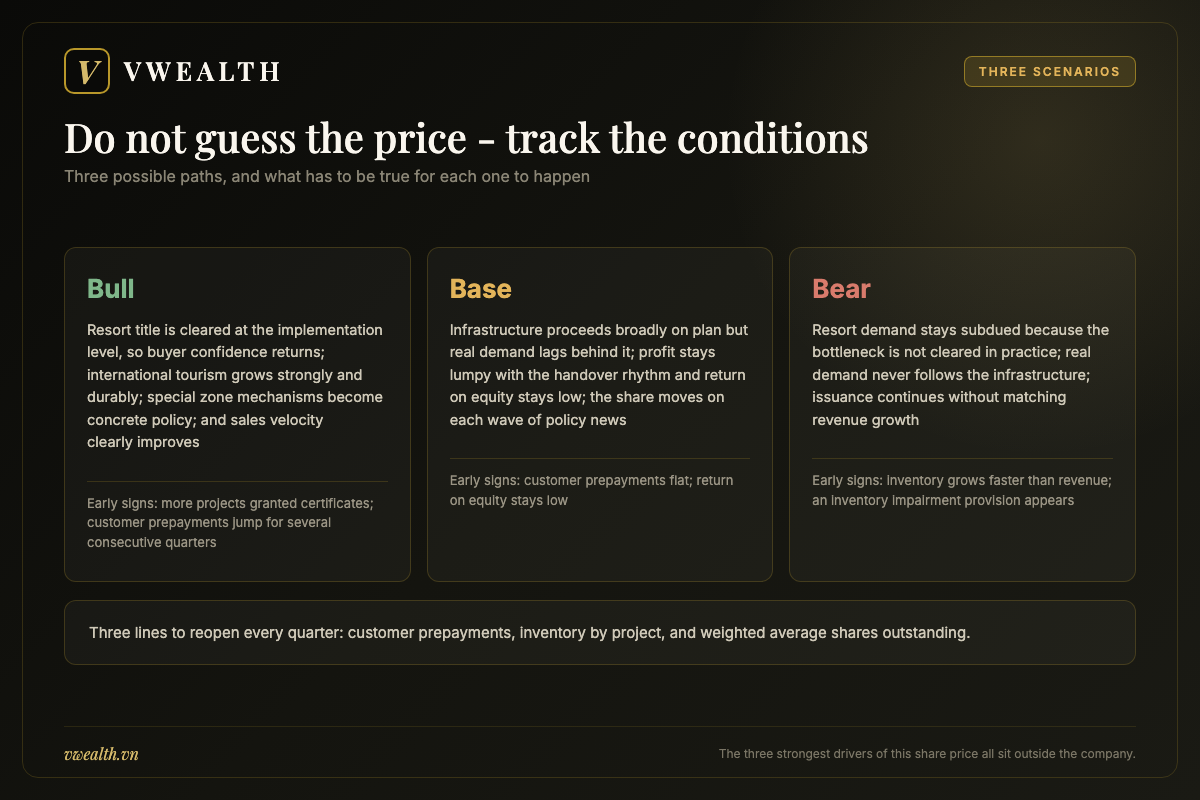
So, Should You Buy CEO Stock?
It is time to answer the question in the title, and I will answer it in the only way I consider honest: there is no single answer that fits everyone. The same stock at the same price can be a sensible decision for one person and a serious mistake for another — not because one is smarter, but because they have different objectives, different time horizons and different tolerance for pain. The job of this chapter is to put both sides of the scale on the table properly, and then tell you which group you belong to.
The Case For: Why People Still Buy CEO
Reason one, and the most legitimate: an irreplaceable land bank. More than 830 hectares at locations such as Phu Quoc, Van Don and Rach Gia, plus the mainland project portfolio, is a body of assets that a company founded today has no way of assembling. This is not a temporary advantage created by good management or clever marketing; it is a structural advantage created by being early in the right place. In an economy where coastal land grows scarcer and planning control grows tighter, the long-term value of that asset base is hard to erode.
Reason two: a debt-light balance sheet. In an industry that has watched larger companies collapse under leverage and bonds over the past decade, CEO Group’s choice to raise equity rather than carry debt makes its existential risk materially lower than many peers. You can complain about the return on capital, but you rarely have to worry about the company disappearing.
Reason three: a unique position in the special zone story. Few listed companies own large land banks at both Phu Quoc and Van Don. That makes CEO the first name the market reaches for whenever the theme heats up. For someone trading thematic cycles, that is a genuinely valuable property.
Reason four: a catalyst with an actual date. Unlike many vague investment narratives, the APEC 2027 infrastructure programme at Phu Quoc has a defined timeline, an approval decision, a list of 21 projects, and an announced investment scale of more than 137,000 billion dong. A catalyst with a date on it is far easier to track and to plan around than a general expectation.
Reason five: liquidity. This gets little attention and matters a great deal in practice. CEO is one of the more liquid names on HNX. You can almost always enter and exit a reasonably sized position without accepting a large spread. For an investment that is by nature a bet, the ability to leave quickly when the thesis breaks is itself an asset.
The Case Against: Risks You Cannot Wave Away
Risk one, and the largest: the speed at which assets become cash. This is the central paradox from Chapter 3. A large land bank combined with mid-tier sales capability means the time required to realise value is very long. And in finance, time is a cost. An asset worth X but requiring twenty years to sell has a present value far below the X that forum NAV arithmetic produces.
Risk two: continuous dilution. From charter capital of roughly 2,573 billion dong to 5,146.8 billion after the 2023 issuance, and on to close to 5,958 billion after stock dividends — that is a one-way trajectory. Every time the company needs money, your share of it shrinks. If you do not participate in the issuances, your ownership percentage declines steadily with nothing offsetting it.
Risk three: the hardest segment in the industry. Resort property serves discretionary demand, remains tangled in a legal bottleneck that has not been cleanly resolved at the implementation level, and depends on the tourism cycle — which is sensitive to every economic wobble, every health scare, every currency move. This is a segment where the downswing lasts longer and the upswing arrives more slowly than in housing.
Risk four: governance and the voice of minority shareholders. Three consecutive years in which the first call of the annual general meeting failed to reach quorum, with the clearest documented instance drawing only 33.26 per cent of voting shares, indicates a shareholder base that is not engaged and an absence of institutional counterweight. Combined with ownership concentrated in one individual and an executive history with a family character, this is a factor that has to be discounted into the price.
Risk five: volatility and the memory of 2022. With a plus or minus 10 per cent band on HNX and tens of thousands of retail holders, CEO’s volatility sits among the highest on the market. On top of that, the latent supply from buyers at the 2022 peak still exists and tends to emerge on rallies. If you cannot tolerate an account moving by double-digit percentages in a week, this ticker will make you take emotional decisions.
Risk six: no cash dividend. Since 2023 the company has paid only stock dividends at a 100-for-5 ratio. Nothing arrives in your account. The entire expected return sits in the price differential — which means you depend completely on someone else being willing to pay more in the future.
The Scale: Both Sides Side by Side
| Factor | For | Against |
|---|---|---|
| Assets | More than 830 hectares at Phu Quoc, Van Don and Rach Gia plus a mainland portfolio — essentially impossible to assemble today | Assets convert to cash very slowly; present value after discounting for time is far below the nominal figure |
| Capital structure | Light on borrowings and bonds; existential risk far lower than the restructuring cohort | Continuous dilution: charter capital from about 2,573 billion to 5,146.8 billion to close to 5,958 billion dong |
| Segment | A unique position in both special zone locations; direct beneficiary of APEC 2027 infrastructure at Phu Quoc | Resort is the hardest segment: discretionary demand, unresolved accommodation title at implementation level, tourism-cycle dependent |
| Governance | A founder engaged throughout, with strong technical and legal foundations; legal work prioritised ahead of sales | Three consecutive failed first AGM calls; minority shareholders lack any instrument to oversee large decisions |
| The share | Good liquidity, easy to enter and exit; reacts strongly and quickly to policy news if you trade thematic cycles | Very high volatility from the plus or minus 10 per cent band and a retail base; latent supply from the 2022 peak |
| Cash to shareholders | Retained earnings reinvested into projects, appropriate for a heavy investment phase | No cash dividend since 2023; all expected return sits in the price differential |
Who CEO Suits, and Who It Absolutely Does Not
Now the most important part of the article.
CEO may suit you if you belong to one of three groups.
Group one — the disciplined thematic cycle investor. You understand that you are betting on policy and on the tourism cycle rather than on earnings growth; you define your buy zone, your maximum weight and your exit condition before you start; you buy during the boring stretches rather than when the ticker is saturating every chat group. For that person, CEO is a reasonable instrument, because it is liquid, it reacts strongly to the theme, and its bankruptcy risk is low.
Group two — the asset-based value investor with a very long horizon and a small position. You believe coastal land will appreciate over the next ten to fifteen years; you accept no dividend and accept dilution; you treat this as a small line in a portfolio, checked once a year rather than once a day. One mandatory condition: the weight must be small, because you are accepting a very large opportunity cost risk.
Group three — the investor who wants exposure to the Vietnamese tourism and special zone theme. If your macro thesis is that Vietnam becomes a substantially larger travel destination over the coming decade, CEO is one of the few direct ways to express that through the stock market. But compare it against the alternatives before committing — airlines, hotel operators and tourism service companies express the same thesis with a different risk profile.
CEO absolutely does not suit you if you fall into one of the following four groups.
If you need steady income. Retirees, people living on dividends, anyone building an income portfolio — this is not your ticker. The company pays no cash dividend and will not in the foreseeable future, because every dong of capital is needed for projects.
If you use margin. With a plus or minus 10 per cent band and volatility among the highest on the market, a short run of declines can trigger a margin call very quickly and force you to sell at exactly the bottom. Borrowing money to buy a thematic speculative stock is the formula for turning a temporary loss into a permanent one.
If your horizon is under a year and you have no clear exit plan. CEO’s catalysts arrive on the schedule of policy and infrastructure, not on yours. Buying because “news is coming” and then holding because “it must be about to move” is the fastest way to turn a short-term speculation into a long-term captivity.
If you are buying because you remember the 2021 price. This is the most common psychological trap with this ticker. That the share once traded at a multiple of today’s price says nothing whatsoever about its value now — least of all when the share count has multiplied since. Anchoring to a past price is a thinking error, not analysis.
If You Still Decide to Buy: A Minimum Discipline Framework, and a Closing Thought
Suppose you have read all of this and still find CEO fits you. Here is the minimum discipline framework I consider mandatory for this ticker.
One — set the position limit before you buy. Decide the maximum percentage of your portfolio CEO may occupy before you place the first order, and write it down. For a stock with thematic speculative characteristics, the weight has to be small enough that if the position goes to zero, your financial plan is untouched.
Two — no leverage. There is no exception to this rule for high-volatility names.
Three — scale in, and buy during the boring stretches. Split your intended amount into tranches, deploy gradually, and favour periods without news. If you notice the ticker being discussed everywhere, treat that as a signal to wait rather than a signal to buy.
Four — monitor by metric, not by price screen. Each quarter, open the accounts and check three lines: customer prepayments, inventory by project, and weighted average shares outstanding. Compare them against the scenario table in Chapter 7 to see where reality is heading. If you would rather save the time, use the CEO analysis report on the vwealth platform, where these metrics are refreshed against the latest filings, and a free account is enough to follow them.
Five — write down the condition that would make you wrong. Before buying, write one sentence: “I will admit this thesis is wrong if…”. For CEO, that sentence might be “if after three more years customer prepayments are still flat while the share count has grown by double digits”. Having a pre-written falsification condition is the only reliable escape from the trap of holding indefinitely.
And here is the closing thought. CEO is one of the clearest illustrations on the Vietnamese market of the difference between a good business and a good investment. C.E.O Group is a real company, twenty-five years old, a survivor of several cycles, never broken by debt, holding assets that time cannot recreate. That is a far more respectable record than the “national stock” caricature the market has hung on it. But a good business bought at the wrong price, at the wrong moment, with the wrong expectations still produces a bad investment — and the forty-odd thousand investors who joined the register around the January 2022 peak are undeniable proof of it.
So the right question is not “is CEO good”. The right question is: are you buying the business or buying the story, and do you have the time and the discipline that the thing you are buying requires? Answer that honestly, then open the report, check the three metrics, score the three scenarios, and decide with today’s data rather than with a memory of a 2021 price. That is the only way to invest in a stock with a personality like CEO’s without turning it into a gamble.
Research Vietnamese stocks in English with vwealth. Our AI-powered platform turns Vietnamese market data into full English analysis reports — with international payment support and a free 2-month trial for new accounts. Create your free account and read the latest reports.