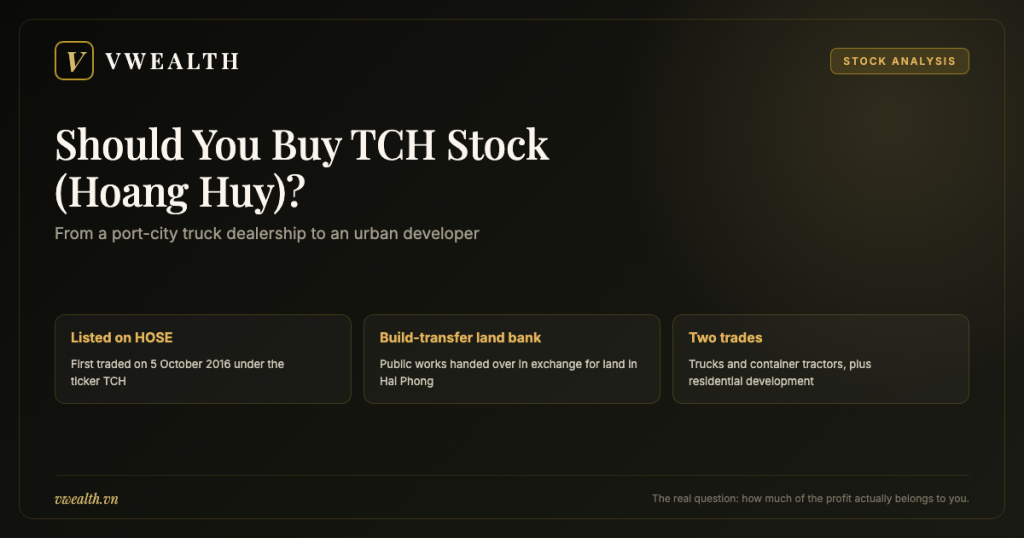
Should you buy TCH stock — the ticker of Hoang Huy Investment Financial Services Joint Stock Company on Vietnam’s Ho Chi Minh Stock Exchange? The question carries a complication most Vietnamese property names do not have. The corporate name contains the words financial services, yet the company does no finance whatsoever. It sells container tractors and trucks, and it is simultaneously the largest residential property developer in Hai Phong, Vietnam’s principal northern port city. Two unrelated trades — until you understand the bridge between them: build-transfer contracts to redevelop dilapidated old apartment blocks, paid for not in cash but in land. That is the key to reading this company. This article travels from a truck dealership opened in 1995 to a three-company group all now listed, and ends at the technical question very few retail investors ask: when you buy a share at the top of a three-tier ownership chain, how much of the profit at the bottom actually belongs to you?
One convention before we begin, the same one used across this series. You will meet many dates, names, projects and scale figures below. All come from disclosed public sources: exchange filings, corporate registration data, shareholder meeting resolutions and mainstream financial media. What you will not find is a most-recent-quarter earnings figure or today’s valuation multiple. At a property developer, quarterly profit depends almost entirely on whether any project reached handover conditions in that quarter, not on business health. This article teaches you where to look and how to read what you find. For current figures, open the latest research reports on vwealth.
A second convention, and it matters for this subject in particular. The build-transfer model — a form of public-private partnership Vietnamese practitioners shorten to BT — has undergone repeated policy change over more than a decade and is widely debated. This article explains the mechanism, the structural risks the mechanism itself creates for an investor, and the disclosed policy developments. It makes no allegation, draws no inference, and offers no judgement about the conduct of any individual or organisation beyond what has been officially disclosed. That is the standing rule of this series for every company it covers.
If Vietnam is a new market for you, the pillar guide on how to invest in the Vietnam stock market covers market access, custody and settlement. This article assumes that groundwork.
From a truck dealership in the port city to Hai Phong’s largest developer
This is one of the most complete industry pivots on the Vietnamese exchange. Very few companies move from vehicle trading into urban development while keeping both feet planted.
October 1995: starting in the vehicle trade
The company’s predecessor was Hoang Huy Trading Company Limited, established in October 1995 in Hai Phong. Its registered activities covered manufacturing, assembling and trading motorcycles and trucks from half a tonne to twenty-five tonnes, importing and exporting passenger and specialised vehicles, plus financial investment and real estate.
The context of 1995 explains why that trade worked. Vietnam had just normalised relations with the United States, foreign trade was expanding rapidly, and Hai Phong was the largest port in the north. Road freight volumes grew quickly while domestic truck manufacturing capacity was essentially nil. Importing and distributing trucks was the right trade in the right place at the right time.
Note this first detail when assessing the company: its original trade was commerce, not manufacturing. Vehicle trading demands working capital, relationships with foreign suppliers, a dealer network and after-sales service. It does not demand technology. The barrier to entry therefore rests on capital and relationships rather than on engineering capability.
It is worth pausing on why a trading company was well placed to become a developer twenty years later, because the connection is not obvious. Vehicle distribution in Vietnam during that era generated cash quickly and required relatively little fixed capital. A dealer collects on delivery, holds inventory for weeks rather than years, and does not need to build factories. Over two decades that produces a pool of retained cash and, just as importantly, a management team accustomed to negotiating large transactions and managing counterparty risk.
Those are precisely the capabilities a public-private partnership contract demands: the ability to commit capital ahead of receiving anything, and the administrative stamina to see a multi-year process through. Very few Vietnamese trading companies of that generation made the leap, which suggests the capability was real rather than incidental.
A note on the corporate name
New investors frequently trip on the name, so it is worth clearing up immediately. The phrase investment financial services does not mean the company operates in banking, brokerage or lending. It reflects the function of a holding company in a group structure: holding equity stakes in member companies and allocating resources among them.
The confusion is not harmless. If you screen for financial sector stocks and encounter this ticker, you will apply an entirely wrong analytical toolkit to a property developer. Read the company by its actual activities, described under principal business lines in the annual report, not by its name.
The vehicle trade also carries a currency dimension that is easy to overlook. Imported vehicles are purchased in foreign currency while sales are denominated in dong, so movements in the exchange rate feed directly into the cost of inventory. A distributor holding several months of imported stock is, in effect, running an unhedged currency position unless it takes deliberate steps to manage it.
This matters to an investor in two ways. First, it is one explanation for margin volatility in the segment that has nothing to do with demand. Second, whether and how the company hedges is disclosed in the notes on financial instruments and financial risk management, and the presence or absence of a considered policy tells you something about the quality of the finance function.
The 2000s and 2010s: container tractors and a position in freight
In the following period the Hoang Huy ecosystem expanded strongly in container tractors — the prime movers that haul shipping containers, the backbone of Vietnamese road freight. According to industry press, the group became the largest importer and distributor of container tractors sourced from the United States market, and its founder acquired a nickname tied to that trade.
In parallel, a separate company within the same ecosystem, Hoang Huy Investment Services Joint Stock Company under the ticker HHS, focused on trucks imported from China. In 2011 HHS signed a cooperation agreement with the Dongfeng group and became a distributor supplying Dongfeng vehicles in Vietnam.
The vehicle business has one characteristic you need in order to read the financial statements later: it is strongly cyclical with thin margins. Demand for new trucks depends on freight volumes, on haulage rates and on operators’ access to credit. When the economy runs hot, unit sales jump; when it cools or credit tightens, sales can fall very sharply in a short period.
The Dongfeng relationship also illustrates something structural about vehicle distribution in emerging markets. A distributorship is a contractual right, not an owned asset. It can be renegotiated, shared with a second distributor, or in time replaced by the manufacturer establishing its own presence. Distributors that treat a franchise as permanent tend to be surprised; those that build service networks, parts operations and customer relationships create value that survives a change of badge.
For an investor, the question to ask about any distribution business is therefore what remains if the franchise ends. Service capacity, workshop locations, trained technicians and an installed base of vehicles requiring parts are all durable. The right to sell a particular brand is not. Where a company discloses the composition of its vehicle segment revenue between unit sales and aftermarket, that split is informative.
2016: three events in a single year
2016 was the pivotal year, and three important things happened almost simultaneously.
First, on 26 May 2016 the State Securities Commission accepted the company’s public company registration file. Second, on 5 October 2016 TCH shares formally listed on the Ho Chi Minh Stock Exchange. Third, in the same year the Hoang Huy ecosystem restructured along group lines, with Hoang Huy Investment Financial Services Joint Stock Company acting as the parent of the member and associated companies.
Also from 2016, the company entered residential property development, working from a land bank obtained through build-transfer contracts to redevelop old apartment blocks in Hai Phong. That was the single largest turning point in the company’s history, and it deserves its own section.
Viewed from another angle, 2016 also marked something important about governance: listing forced the company from the disclosure regime of a private company into that of a public one. For an investor, that is the boundary between having to take management’s word and having audited statements to check against. For companies with a history tied to public-private partnership contracts, that shift is especially valuable, because it brings transactions previously visible only in internal files into the notes to the financial statements and into shareholder meeting resolutions.
The simultaneity of those three events in 2016 was not coincidental. Listing, restructuring into a group and entering property are the three components of one plan: build a holding structure, obtain public capital market access, and use both to fund a capital-intensive new business. Companies that attempt the property pivot without first securing a funding channel frequently stall at the first large project.
For an investor assessing management quality, sequencing like this is meaningful evidence. It shows a team thinking several moves ahead rather than reacting. Whether that same quality of planning applies to the question of replenishing the land bank is the open question this article returns to in the scenarios chapter.
The build-transfer model: the key to this company
To understand how a truck trading company became a city’s leading property developer, you have to understand the BT mechanism. In simple terms, it is a form of public-private partnership in which a company funds and builds a facility serving a public purpose, hands the completed facility to the state, and is paid in land rather than in cash.
In Hai Phong, the public works undertaken related to the redevelopment of deteriorating old apartment blocks. This is exactly the kind of work a local authority urgently needs but struggles to budget for: old blocks are both unsafe and unsightly, while the cost of rehousing thousands of households is very large.
For the company, the consideration is developable land. And here is the economic crux: the land cost embedded in the company’s cost base is not the market price of land, it is the construction cost of the facility handed over. In a residential project, land is normally the single largest cost component, so how the land bank was formed determines most of the project’s margin.
From an investor’s viewpoint, this model has three features to weigh. First, it can generate margins well above those of developers buying land at market prices. Second, it ties the company tightly to one locality — a land bank concentrated in one city means the risk is concentrated there too. Third, and most importantly, it depends on the legal framework governing public-private partnerships, a framework that has changed several times over the past decade and may change again.
There is a social dimension to the build-transfer model in this particular application that is worth stating plainly, because it explains why the arrangement existed at all. Vietnam’s older apartment stock, much of it built decades ago, presents a genuine public policy problem: buildings degrade, safety deteriorates, and residents must be rehoused before anything can be demolished. Financing that from a municipal budget competing with schools, hospitals and roads is difficult.
A model that mobilises private capital to solve it, paying in land rather than in cash, addresses a real constraint. Understanding that helps an investor see why the model was adopted, and equally why it attracts close scrutiny: the fairness of the exchange between public works delivered and land granted is exactly the question the regulatory framework has been progressively tightened to address.
The projects: the scale of the Hai Phong land bank
The Hoang Huy ecosystem’s Hai Phong pipeline includes several completed and ongoing projects. According to disclosed information, Hoang Huy New City phase two in Thuy Nguyen covers roughly 49.4 hectares with total investment above 15,000 billion dong. Hoang Huy Commerce in the Kenh Duong and Vinh Niem area carries investment of roughly 3,706 billion dong. Hoang Huy Grand Tower in So Dau carries roughly 1,486.5 billion dong.
Beyond Hai Phong, the group also holds assets in Hanoi, including the Golden Land building. But the centre of gravity is unmistakably the port city, and that is what you must factor into geographic concentration risk.
10 October 2025: the grandchild company lists
A recent development matters to the whole group. CRV Real Estate Group Joint Stock Company, established in 2006 and the entity that directly develops most of the group’s property projects, was approved for listing on HOSE on 30 September 2025 and began trading on 10 October 2025 with more than 672 million shares.
The significance runs well beyond adding a ticker to the board. From that point, the market can value the group’s property arm directly rather than inferring it through the parent. For a TCH holder that is both improved transparency and an awkward question: if the property arm is now separately priced, what exactly does the parent share represent? Chapters two and five answer that with ownership arithmetic.
Milestone summary table
| Date | Event | Why it matters to an investor today |
|---|---|---|
| Oct 1995 | Hoang Huy Trading Company Limited established in Hai Phong | The original trade is commerce, not manufacturing |
| 2000s | Expansion into imported container tractors | The capital base that funded the property phase |
| 2011 | HHS becomes a Dongfeng distributor in Vietnam | The Chinese truck line within the ecosystem |
| 26 May 2016 | Public company registration file accepted | Preparation for listing |
| 5 Oct 2016 | TCH shares list on HOSE | Nearly a decade of price history across cycles |
| 2016 | Group restructuring with TCH as parent | Origin of the multi-tier ownership chain |
| From 2016 | Entry into residential property using a build-transfer land bank | The largest turning point, changing the company’s nature |
| 30 Sep 2025 | CRV Real Estate approved for HOSE listing | The property arm begins to be valued independently |
| 10 Oct 2025 | More than 672 million CRV shares begin trading | Three group companies now listed simultaneously |
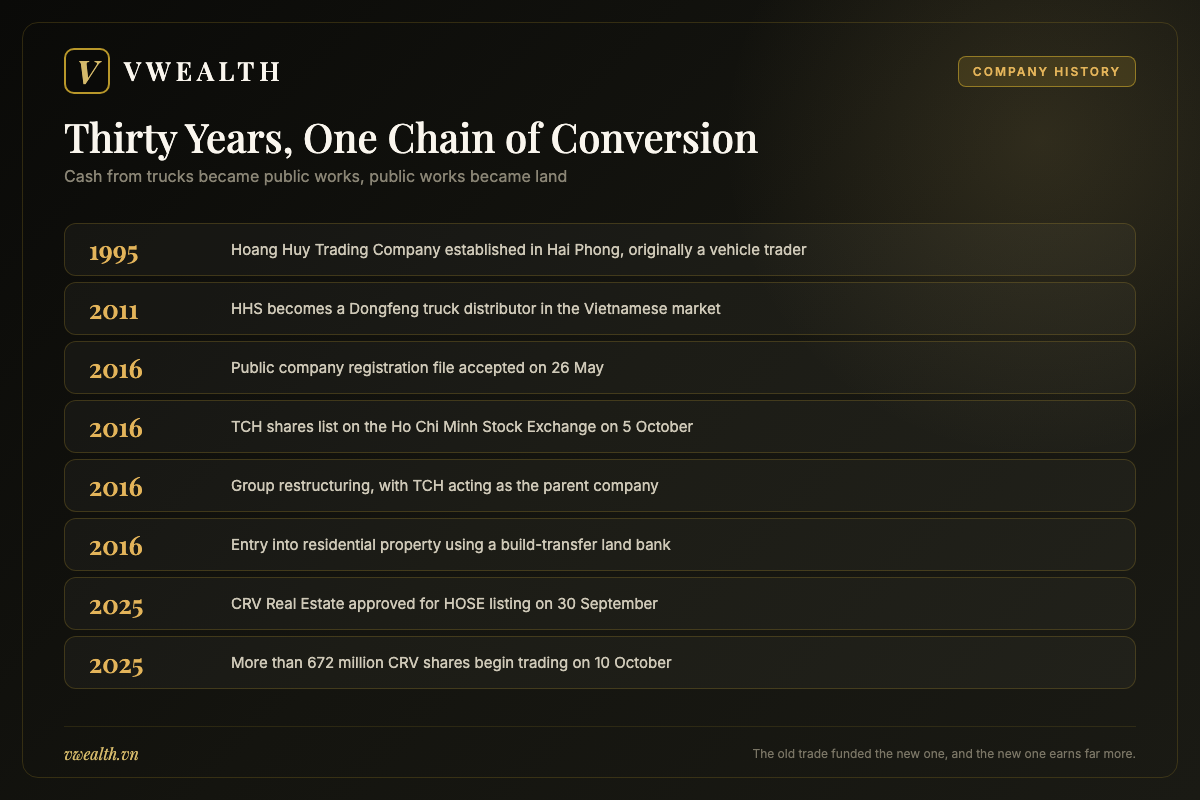
Look back across the timeline and a pattern emerges: this company grew by converting an advantage in one industry into an advantage in another. Cash accumulated from vehicle trading became the capital to execute public works. Public works became a land bank. The land bank became residential projects. It is a skilful chain of conversions, but it also means today’s value rests on a link the company does not control: policy on public-private partnership and on land.
Who runs Hoang Huy, and the three-tier chain you must draw on paper
This is the most important chapter in the article. Not because there is anything unusual about the management, but because the group’s ownership structure directly determines how much of a dong of profit earned at the bottom survives the journey to a TCH shareholder.
Do Huu Ha and a genuine family business
Do Huu Ha is Chairman of the Board of TCH, and also holds the chairmanship at other companies in the same ecosystem, including HHS and CRV Real Estate. According to disclosed corporate records as at end-2025, he held more than 275 million TCH shares, making him the largest individual shareholder.
The TCH leadership shows the clear signature of a family business. Hoang Thi Huyen serves as General Director. Nguyen Thi Ha and Pham Hong Dung are Vice Chairs of the Board. The management team includes Do Huu Hung and Do Huu Hau as Deputy General Directors, alongside Ho Thi Xuan Hoa and Nguyen The Hung.
The family model has two faces, and an investor should look at both dispassionately. The upside: decisions are fast, the horizon is long because there is no pressure to manage quarterly optics, and the people running the company have most of their personal wealth tied to its value. The limitation: internal control depends heavily on individuals, succession is a genuine risk, and minority shareholders have effectively no influence on any decision. A usable framework for scoring this appears in the guide to corporate governance in Vietnam.
Family-controlled companies are common across Southeast Asian markets, and international investors have developed reasonable heuristics for assessing them. The most useful is to look at how the family treats minority shareholders when it has no obligation to treat them well: whether dividends are paid consistently, whether related party transactions are disclosed in detail rather than in aggregate, whether the audit is performed by a firm with a reputation to protect, and whether the annual report explains difficulties rather than only successes.
None of these are guarantees. But a company that scores well on all four over many years has demonstrated something that no governance code can mandate, and a company that scores poorly has told you something important regardless of how good its assets are.
The chain: TCH owns HHS, HHS owns CRV
This is the part where the article asks you to stop and draw a diagram, because it completely changes how you read the profit line.
According to disclosed ownership information, TCH holds approximately 51 percent of HHS, and HHS holds approximately 51 percent of CRV Real Estate. CRV is the entity that directly develops most of the group’s property projects.
Now run the arithmetic that so many retail investors skip. Suppose CRV generates one hundred dong of after-tax profit. The share attributable to HHS shareholders is roughly fifty-one dong; the remainder belongs to CRV’s other shareholders and is reported as non-controlling interests. Go up one more tier: of that fifty-one dong, the share attributable to TCH shareholders is roughly fifty-one percent again, or about twenty-six dong.
Put plainly, one hundred dong of profit created at the development tier arrives at the top-level parent’s shareholders as roughly a quarter. On TCH’s consolidated statements the other seventy-four dong still appears within consolidated after-tax profit, but it is not yours — it sits on the non-controlling interests line immediately below.
This is why, for this company specifically, the article sets a hard rule: when computing any earnings-based valuation metric, use profit after tax attributable to owners of the parent, never consolidated profit after tax. Using the wrong line makes the stock look far cheaper than it is. The mechanics of separating these lines in Vietnamese statements are covered in the guide to reading Vietnamese company financial statements in English.
There is a cash consequence as well as an accounting one. Profit recognised at a lower tier only physically reaches a higher tier when the subsidiary declares a dividend. If the subsidiary retains all earnings to fund new projects, the parent still books its share of profit on the consolidated statements but receives no cash at all. For a TCH shareholder that means the parent’s ability to pay cash dividends depends on whether money actually travels up the chain. Alongside earnings, therefore, track the dividend resolutions at the lower tiers. Very few analyses of group-structured companies mention this.
Three related tickers on the board: which tier do you buy?
Since October 2025 all three companies in the chain have traded on HOSE. Investors therefore face a choice most do not realise they are making.
Buying CRV means buying the development engine directly, undiluted by any tier. Buying HHS means buying the middle tier: the CRV stake plus HHS’s own truck business. Buying TCH means buying the top tier: the HHS stake plus the parent’s own vehicle operations and assets.
As a general principle, the higher the tier, the larger the discount to the underlying asset value, because the market discounts structural complexity and the fact that upper-tier shareholders do not control lower-tier cash directly. In exchange, upper tiers usually carry additional standalone assets and can offer a more attractive entry if the discount widens too far. There is no universally right answer; what is mandatory is knowing which tier you own and why.
There is a practical consequence of the tier choice that deserves spelling out. Because the three companies trade separately, their prices can and do move differently, and the implied valuation of the property arm can differ depending on which ticker you look through. An investor who tracks all three will occasionally see the market price the same underlying assets at meaningfully different levels.
Whether that is exploitable depends on liquidity and on your holding period. Arbitraging such gaps is difficult in practice for an individual investor, particularly in a market with settlement delays and no straightforward way to short. The more realistic use is as a sanity check: if the tier you own looks expensive relative to the others on a look-through basis, that is a reason to pause.
The parent’s own vehicle business: the forgotten piece
When the market discusses TCH, almost the entire conversation is about property. But the parent retains its own operations in manufacturing, assembling and trading trucks and specialised vehicles.
That business plays a dual role worth understanding. On profit, it contributes modestly compared with property in years when large projects hand over. On cash flow and stability, it is the steadier leg, because vehicles sell year-round while apartment handovers cluster into specific periods. For a property developer, having a second revenue stream that runs continuously is rare and valuable.
Dividends and profit distribution policy
A property developer’s dividend policy must always be read against project funding needs. A company deep in a development cycle needs to retain cash, and its payout ratio is therefore usually lower than a company past its heavy investment phase.
Three things to check in any profit distribution proposal. First, whether the dividend is paid in cash or in shares, since a share dividend puts nothing in your pocket and simply subdivides what you already own. Second, the payout ratio measured against profit attributable to owners of the parent, not against consolidated profit. Third, whether the company is simultaneously issuing new shares. The note on governance practice in Vietnam covers how to assess dilution proposals put to shareholder meetings.
Ownership and leadership summary
| Item | Disclosed position | What an investor should take from it |
|---|---|---|
| Chairman | Do Huu Ha, also chairman at HHS and CRV | One person decides across all three tiers |
| Chairman’s TCH holding | More than 275 million shares per end-2025 records | Largest individual holder, interests tied to company value |
| General Director | Hoang Thi Huyen | Executive role separated from the chair |
| Leadership composition | Several family members across board and management | Fast decisions, but internal control rests on individuals |
| Ownership chain | TCH holds roughly 51 percent of HHS, HHS roughly 51 percent of CRV | Bottom-tier profit reaches TCH holders as roughly a quarter |
| Three listed group companies | TCH, HHS and CRV all on HOSE since October 2025 | You must choose a tier, and know why |
| Parent vehicle business | Manufacture, assembly and trading of trucks and specialised vehicles | Continuous cash flow offsetting lumpy property revenue |
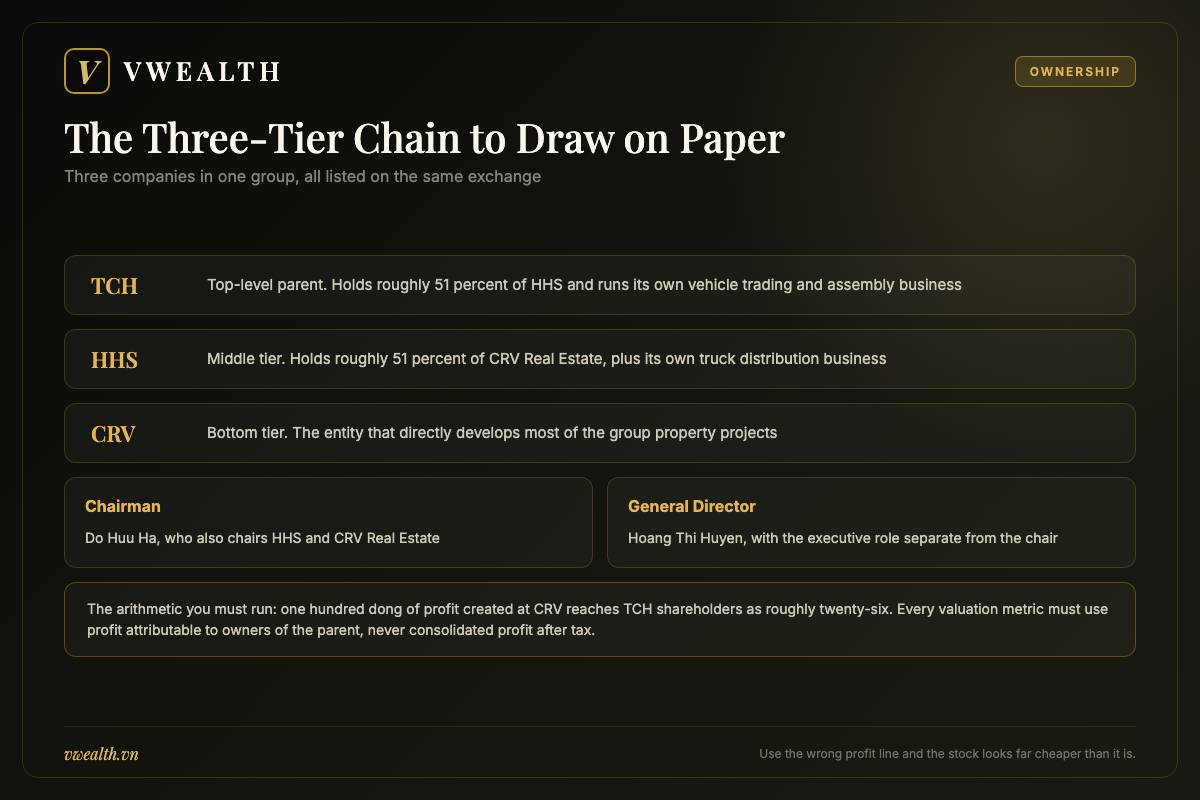
Summarise the chapter in one sentence: with TCH, the crucial question is not how much the company earns but how much of that belongs to you. Get that wrong and every valuation that follows is wrong with it.
How Hoang Huy makes money: two trades and the bridge between them
The company has two revenue sources with entirely different characters, and the interesting part is that they are less separate than they look. This chapter dissects each, then identifies the bridge.
Trade one: trading and assembling trucks and specialised vehicles
This is the original business. The model is straightforward: import or assemble vehicles, build a dealer and service network, sell to haulage companies and owner-operators, usually alongside instalment financing arranged through banks or leasing companies.
Three factors drive results here. First, the freight cycle: cargo volumes through ports, domestic haulage tonnage, freight rates. Second, credit conditions, because most trucks are bought with borrowed money, so when rates rise or banks tighten, unit sales fall immediately. Third, import policy, emissions standards and axle load regulations, any of which can reshape the market with a single decree.
On margin, vehicle distribution is a thin business. A distributor’s value added sits in service, parts and inventory turnover, not in the spread on the sale price. Remember that when you see large vehicle revenue producing modest profit — that is normal for the industry, not a red flag.
One further point about the vehicle business affects how you read the balance sheet. Vehicle trading requires large inventory measured by value, because each container tractor is expensive and stock must be held to deliver on demand. High inventory in this segment is normal, not a sign of unsold goods. What matters is turnover: inventory days for the vehicle segment across periods. If days lengthen while sales do not grow, that is the warning. Because consolidated statements combine vehicle and property inventory, you must read the notes to separate them before drawing conclusions.
A further consideration for the vehicle segment is the shape of the customer base. Buyers are typically haulage businesses and owner-operators rather than large corporates, which means credit quality is dispersed and heavily dependent on the health of the freight market. When haulage rates fall, operators defer replacement purchases first and default on financing second.
For a distributor, that translates into a demand cycle that turns down faster than the broad economy and recovers with a lag. If the company also carries receivables from dealers or provides any form of sales support financing, those balances deserve attention in a downturn. The receivables note, broken down by counterparty type where disclosed, is where to look.
Trade two: residential property development
This is where most of the profit comes from, and where every story about the stock originates. The company develops apartment and township projects, principally in Hai Phong, with some assets in Hanoi.
Vietnamese residential revenue recognition has a feature newcomers regularly misread. Developers sell apartments on a payment schedule and collect progressively from buyers, but revenue and profit are recognised only when units meet handover conditions. Throughout construction, the cash collected sits under advances from customers on the balance sheet, within liabilities rather than revenue.
The result is a highly lumpy income statement: a year with several handovers shows very high profit, and a year with none shows very little. Judging business health from a single year is the most basic error made with this sector. The right approach appears in the note on Vietnamese real estate stocks.
One practical matter about Vietnamese residential sales worth explaining for an international reader. Developers may sell future-formed housing — units not yet built — but only after a provincial authority confirms in writing that the project meets the statutory conditions, which include completed foundations and a bank guarantee covering buyer deposits. That confirmation is a hard gate.
This is why the legal milestone tracking described in chapter four is not administrative trivia. Until that letter exists, a project cannot legally take customer money at scale, which means it cannot fund itself from presales and must be carried entirely on the company’s balance sheet. The date that letter arrives is, for practical purposes, the date a project becomes a financial asset rather than a financial burden.
The bridge: build-transfer contracts
Chapter one described the BT mechanism legally. Here the point is to see it as a financial bridge.
Vehicle trading generated cash and accumulated capital. That capital let the company fund public works first and receive land afterwards — something only a financially capable party can do. The land received became the input for residential projects, and residential projects generate margins several times those of vehicle trading.
Seen that way, this is not two companies sharing a name. It is a chain of capital conversion in which the old trade funds the new one, and the new one earns far more per dong deployed.
But the bridge rests on a pier the company does not control: the legal framework for public-private partnership. That is structural risk, not operating risk, and chapter six returns to it.
One clarification, to remove any ambiguity. Describing the mechanism and the structural risks it creates for investors is ordinary analytical work, applicable to every company that uses public-private partnership arrangements. It is not a judgement on any specific transaction by any specific company. The series relies only on officially disclosed information and draws no inference beyond it, and the article recommends you apply the same standard to your own reading.
It also helps to be explicit about what the bridge does not do. It does not remove the need for development capability. Receiving land cheaply is only the first step; the company still has to design a product the local market wants, build it to an acceptable standard, sell it, and hand it over. Cheap land invested in an unwanted product destroys value just as efficiently as expensive land does.
So when assessing this company, the land bank explains the potential margin, but the sales absorption rate explains whether that potential is being realised. Both need to be tracked. A developer with a superb land position and slow sales is not a bargain; it is a company with capital tied up in a product the market is not choosing.
Geography: the advantage and the risk sit in the same place
Concentrating the land bank in Hai Phong is simultaneously the company’s greatest strength and its greatest vulnerability.
The strength is clear. Hai Phong is northern Vietnam’s largest port and industrial centre, attracts substantial foreign direct investment, hosts a large migrant workforce, and enjoys continually upgraded transport links to Hanoi and the northern economic zone. Housing demand there rests on genuine economic fundamentals rather than on speculation alone. The company is the leading developer in that specific city, with local knowledge an outside developer cannot easily match.
The vulnerability is equally clear. When the entire land bank sits in one market, every movement in that market — prices, supply, zoning, purchasing power — hits directly with nothing to offset it. A developer with projects across several provinces can let one region cover another; a single-market developer cannot.
It is worth quantifying the geographic point rather than leaving it qualitative. A developer operating in a single city faces correlated risk across its entire portfolio: the same local supply pipeline, the same local employment base, the same provincial approval process, the same local sentiment. If the city adds a large volume of competing supply in one year, every project in the portfolio faces the same pressure simultaneously.
The offsetting consideration is depth of knowledge. A developer that has worked one city for a decade knows which districts absorb supply, which price points move, and how the approval process actually functions. In Vietnamese property, that local knowledge has historically been worth a great deal, and it is one reason single-market developers have often outperformed national ones on margin even while carrying more concentration risk.
Where the moat is, and where it is thin
The company’s competitive position has three layers. The first is a land bank formed at below-market cost, producing margins that market-price buyers struggle to match. The second is demonstrated capability in executing large public-private partnership projects, which requires capital and experience working with local authorities. The third is brand and sales reach within the Hai Phong market.
Three thin spots. First, this moat depends on policy rather than on technology or a national brand, so it can change faster than a manufacturer’s moat. Second, a land bank is a finite asset: once developed, the company must find new sources, and new sources may be considerably more expensive. Third, geographic concentration removes any ability to diversify risk internally.
Segment comparison table
| Criterion | Trucks and specialised vehicles | Residential property development |
|---|---|---|
| Revenue character | Continuous year-round with unit sales | Lumpy, recognised at handover |
| Margin | Thin, value sits in service and turnover | High, thanks to low land formation cost |
| Capital requirement | Mainly working capital for inventory | Very large, spanning years before revenue |
| Key variables | Freight cycle, interest rates, import policy | Project legal status, housing demand, land policy |
| Role in the group | Cash source and steady revenue | Main profit source, drives the equity valuation |
| Principal risk | Industry cycle and price competition | Geographic concentration and policy change |
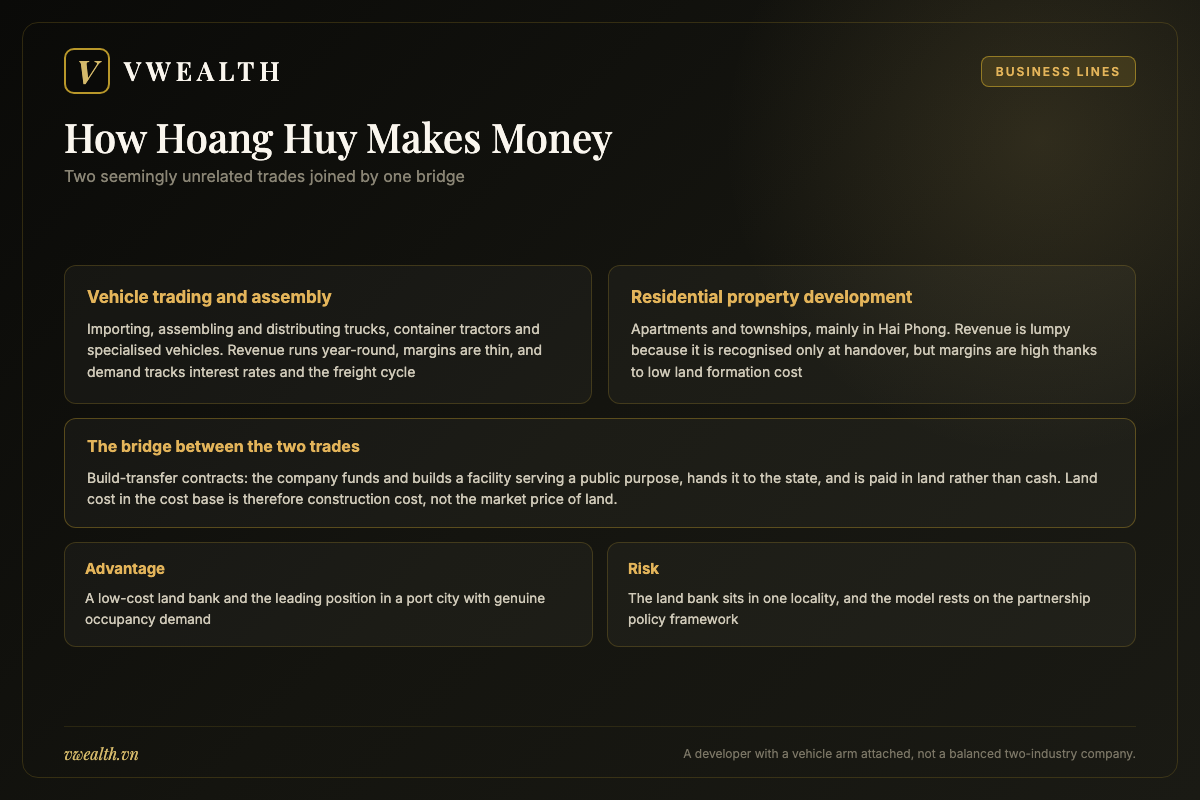
Compressed into one sentence: TCH is a property developer with a vehicle trading arm attached, not a balanced two-industry company. Valuing it is mainly about valuing the land bank and execution capability; the vehicle business acts as a cash flow cushion, and that is a valuable role rather than a secondary one.
Position and financial health: seven checks before you buy TCH stock
For a property developer sitting on top of a multi-tier ownership chain, the reading toolkit differs from the familiar one. These seven checks are ordered by importance for this specific company.
Check 1: profit attributable to owners of the parent, not consolidated profit
This is check number one and chapter two explained why. Because of the three-tier chain, a substantial share of consolidated profit belongs to non-controlling interests at the lower tiers.
Practically: open the consolidated income statement and find the section where after-tax profit splits into two lines — attributable to owners of the parent, and attributable to non-controlling interests. Use only the first for every calculation. Also track the ratio between the two across periods: if the non-controlling share is rising, less of the value created below is flowing upward.
Before the checks, one orientation note that saves confusion. Vietnamese listed companies report under Vietnamese Accounting Standards, which differ from IFRS in several respects relevant to property developers, notably in the presentation of advances, in segment disclosure practice, and in the treatment of certain project costs. Larger companies often publish supplementary material that bridges the gap.
None of these differences prevent meaningful analysis. They mean you should build your baseline from audited annual statements, use interim reports to track direction rather than composition, and avoid comparing a Vietnamese developer’s ratios directly against an IFRS peer without first confirming the components are defined the same way.
Check 2: advances from customers and unearned revenue
For a developer this is the best available predictor of profit in coming years, far better than last year’s revenue.
Advances from customers sit within liabilities on the balance sheet and represent money buyers have already paid for units not yet handed over. A large and rising balance signals good sales and a pipeline of future revenue recognition. A shrinking balance with no new launches is an early warning of a profit gap several years out.
There is a useful companion reading: compare advances against property inventory in the same period. The ratio tells you how much of what is being built has already been sold. A high ratio means absorption is strong and construction is largely funded by buyer money rather than borrowings. A low and falling ratio means the company is building faster than it is selling, and the gap must be funded by equity or debt. That is one of the best early indicators of financial strain at a developer.
A second refinement on advances worth adopting: look at the trend in advances alongside the number and size of projects currently open for sale. A rising advances balance driven by one very large launch tells a different story from a rising balance spread across several projects. The first is a concentrated bet on one product finding its market; the second indicates broader absorption.
Neither is inherently better, but they carry different risk profiles, and knowing which one you are looking at changes how you interpret a subsequent slowdown. Companies usually disclose enough in shareholder materials to make this distinction, even when the balance sheet presents only a single number.
Check 3: property inventory and its composition
A developer’s inventory comprises work in progress — money already sunk into projects under construction — and finished property held for sale.
Three questions when reading the inventory note. First, which projects hold the inventory and where are they in their life cycle? Second, is any project sitting in inventory year after year with no progress, which usually signals a legal or site clearance obstacle? Third, is finished property held for sale rising, because completed but unsold stock means the company built something it cannot move.
Check 4: project legal status
In Vietnamese real estate, legal status decides more than location does. A beautiful project that does not yet qualify for sale generates no revenue at all while interest and costs keep running.
The legal milestones worth tracking include in-principle investment approval, land allocation or lease, detailed planning approval, the construction permit, and the authority’s confirmation that the project qualifies for the sale of future-formed housing. Companies typically update progress in shareholder meeting materials and annual reports, and this narrative section deserves closer reading than the numbers.
One more note on legal milestones for readers unfamiliar with the Vietnamese process. The sequence is genuinely long, and each step can take from months to years depending on the project, the locality and the complexity of any land clearance involved. Delays are common enough that experienced local investors treat management timelines as optimistic by default.
The useful discipline is to record the milestone dates management gives, then check them against what actually happened a year later. A company whose stated timelines prove roughly accurate over several projects has demonstrated something valuable about both its execution and its candour. A company that repeatedly misses without explanation has told you to discount its future guidance.
Check 5: borrowings, maturity profile and capitalised interest
Property is a leveraged industry. The question is not whether debt exists but whether it is matched to the project life cycle.
Look at three things. First, the debt to equity ratio, both against the company’s own history and against similarly sized developers. Second, the maturity profile: large short-term borrowings while projects remain years from handover is a mismatch, and maturity mismatch is the most common reason developers get into trouble even when their projects are sound. Third, the portion of interest capitalised into project cost rather than expensed in the period — this flatters current profit and pushes the cost into the future as higher cost of sales at handover.
One further aspect deserves attention in the Vietnamese context: where the funding comes from. Bank borrowing carries different terms and maturities from corporate bond issuance, and Vietnam’s corporate bond market went through a substantial restructuring after 2022. What you want to know is the composition of the company’s funding, its maturities, and whether large amounts fall due at a single point. The borrowings note in the audited annual report is the fullest presentation of this, and it repays close reading far more than the headline debt figure.
Two supplementary ratios help sanity-check a developer’s leverage. The first is net debt against the carrying value of inventory, which indicates how much of the project pipeline is debt-funded. The second is interest cost against operating profit before financing, which shows how much of the operating result is consumed by servicing debt.
Neither ratio has a universally correct level, because both depend on where the portfolio sits in its cycle. What they are useful for is comparison: against the company’s own history, and against developers of comparable size and stage. A ratio that deteriorates steadily across several years while the project mix has not changed is a signal worth taking seriously.
Check 6: related party transactions and balances
In a three-tier ecosystem under common ownership, the related party note is compulsory reading.
Four things to examine: loans, advances or deposits between group entities; transfers of projects or equity interests within the group and their pricing; receivable and payable balances with related parties at period end; and any cross-guarantees.
To be clear: intra-group transactions in a corporate group are normal and often necessary for allocating capital between projects. What an investor needs is enough transparency to assess them, not their absence.
For this company specifically the note carries an extra layer of meaning. Because the property arm sits at the grandchild level, cash serving projects may pass through several tiers before reaching its use. Tracing the path of money through the notes is the only way an outside shareholder can understand the group’s real capital structure. If you find that exercise too complex to complete, that itself is information: structural complexity is a genuine risk, and an investor should price it by demanding a larger discount, or by choosing a simpler company.
There is one further balance sheet item specific to a group with this history: long-term receivables or other assets arising from public works handed over but not yet fully settled in land. Where such balances exist, they represent value the company has delivered and not yet received, and their size and ageing matter.
Any such item should be identifiable in the notes on other receivables or other long-term assets. What you want to understand is how long the balance has been outstanding and whether the counterparty obligation is documented in a way that makes eventual settlement clear. This is the kind of detail that separates a careful reading from a superficial one.
Check 7: operating cash flow across several years
The final check, and for property the reading must be different. Negative operating cash flow during a construction phase is normal: money goes out to build while inflows lag. Strongly positive cash flow in a handover year is equally normal.
What matters is the full cycle. Cumulate operating cash flow across three to five years, covering both investment and harvest years, and compare it with cumulative profit attributable to owners of the parent over the same period. If a complete cycle passes and cash has still not arrived in proportion to recognised profit, find out where it is sitting.
The seven checks in one table
| Metric | Where to find it | Healthy sign | Warning sign |
|---|---|---|---|
| Profit attributable to owners of the parent | Foot of the consolidated income statement | Stable or rising share of the total | Non-controlling share growing over time |
| Advances from customers | Liabilities section of the balance sheet | Large and rising across periods | Shrinking with no new launches |
| Property inventory | Inventory note | Concentrated in projects progressing on schedule | Projects static for years, finished stock piling up |
| Project legal status | Annual report, AGM materials | Milestones completed as planned | Milestones pushed back repeatedly without explanation |
| Borrowings and maturities | Balance sheet and borrowings note | Maturities matched to project life cycle | Heavy short-term debt with handover far away |
| Related party transactions | Related party note | Reasonable scale with pricing terms disclosed | Large persistent balances, hard-to-verify internal transfers |
| Operating cash flow | Cash flow statement | Full-cycle cumulative matching profit | A complete cycle passes and cash never arrives |

What do the seven checks say about TCH’s position? They say this is the leading developer in a growing industrial port city, holding a land bank formed at low cost, with an additional trading arm generating steady cash. They also say the multi-tier structure substantially dilutes what reaches parent shareholders, that risk is concentrated in one local market, and that the foundation of the model depends on the policy framework. That is the profile of a company with a real advantage carrying constraints an investor must accept knowingly.
How the market treats TCH stock: cycles, discounts and three related tickers
Nearly a decade of HOSE trading has given this stock a recognisable personality, and the grandchild company’s listing in late 2025 added a new variable.
Trading personality: driven by the property cycle, not by quarterly results
Vietnamese property stocks share a trait: prices follow expectations about the sector cycle and about policy, not quarterly profit. The reason lies in the revenue recognition mechanics described in chapter three — quarterly profit reflects sales made years earlier, not present conditions.
Three categories of news move the sector: land and property credit policy, the interest rate environment, and project-specific legal developments. For TCH, add a fourth: news concerning the public-private partnership framework, because that is the foundation of the model.
Why asset-based valuation fits better than earnings-based valuation
For a company whose profit jumps with the handover calendar, a single year’s price to earnings ratio is close to meaningless in isolation. In a heavy handover year the multiple looks very cheap. In a year with no project reaching completion it looks very expensive. Neither reflects value.
Two approaches suit better. The first is asset-based: estimate the market value of the land bank and projects, subtract debt, derive net asset value, and compare against market capitalisation. This is conceptually correct but requires assumptions about selling prices and timing. The second is price to book, simpler but flawed here, because the book value of a land bank formed through build-transfer contracts sits well below market value, making the ratio look mechanically high. The framework for handling both appears in the note on Vietnamese market valuation.
There is a technical point specific to this company. Land obtained through build-transfer contracts is carried at formation cost, meaning the value of the handed-over public works plus related costs. That figure is usually materially below the current market value of the same land.
The consequence runs both ways. First, book value understates economic value, so the price to book ratio looks higher than it should. Second, margins at handover will be very high because cost of sales is low. Understanding both directions stops you from concluding the stock is expensive purely because one ratio looks elevated.
For TCH the article repeats one mandatory adjustment: every earnings-based calculation must use the line attributable to owners of the parent, and every asset-based calculation must deduct the portion attributable to non-controlling interests. Skipping that adjustment is the most common error made with multi-tier group structures anywhere.
The holding company discount: a phenomenon that only appeared in late 2025
Before October 2025 the market had no way to value the group’s property arm separately; everything had to be inferred through the parent. Once CRV shares began trading, that changed.
Investors can now run a comparison that was previously impossible: take CRV’s market capitalisation, multiply by TCH’s indirect ownership, add an estimated value for the vehicle business and the parent’s other assets, and compare the total against TCH’s own market capitalisation. The gap is the discount the market applies to the group structure.
That discount moves with time and sentiment, so this article does not quote a figure. What matters is the mechanism: holding company discounts exist in every market and have legitimate causes — upper-tier shareholders do not control lower-tier cash directly, and taxes and frictions on moving money between tiers are real. But when a discount widens too far it creates opportunity, and when it narrows very quickly that usually signals the market has become optimistic about cash flowing upward.
A related point about how a look-through valuation can mislead if applied carelessly. Multiplying the grandchild’s market capitalisation by the indirect stake assumes that the grandchild’s own market price is a fair estimate of its value, which is only as reliable as that market price. In a thin market or immediately after a listing, prices can be unrepresentative.
The disciplined approach is to run the look-through calculation as one input among several, alongside an independent estimate of land bank value and a view on the vehicle business, rather than treating it as the answer. Anchoring entirely on another market price simply relocates the valuation problem rather than solving it.
Liquidity and the investor base
TCH is among the more liquid Vietnamese property names, traded far more actively than most mid and small capitalisation developers. Individual investors can therefore enter and exit reasonably easily, but that same liquidity makes it a favourite of short-term flow, so realised volatility exceeds what earnings justify.
Foreign investors should also note the market mechanics: Vietnamese equities settle on a T plus two basis, HOSE applies a seven percent daily price band around the reference price, and foreign participants must trade through a licensed local custodian with a registered trading code. The details are in the guide to Vietnamese trading rules. Property is the sector that reacts most sharply to credit policy news, so be especially careful about margin leverage here.
Comparing TCH with other Vietnamese property options
| Company | Land bank model | Main geography | Investor characteristic |
|---|---|---|---|
| TCH (Hoang Huy) | Land bank from build-transfer contracts | Hai Phong, some Hanoi | High margin, single-market concentration, multi-tier ownership |
| VHM (Vinhomes) | Very large land bank from multiple sources | Nationwide | Largest in the sector, deep liquidity |
| NLG (Nam Long) | Land purchase plus foreign joint ventures | Southern Vietnam and suburbs | Affordable segment, Japanese partners |
| KDH (Khang Dien) | Long-term accumulation in one district cluster | Eastern Ho Chi Minh City | Clean land bank, deliberate pace of development |
| VIC (Vingroup) | Conglomerate holding property among other arms | Nationwide | Complex structure, multiple business drivers |
The table highlights TCH’s core differentiator against most listed Vietnamese developers: how the land bank was formed. That is simultaneously the source of superior margins and the source of policy risk. For the sector-wide picture before selecting a name, see the overview of Vietnamese real estate stocks.
Context: Hai Phong, land policy and the fate of the partnership model
Context matters more than usual here, because both of the company’s trades sit on a policy foundation. This chapter examines four forces.
Force one: Hai Phong and the northern economic zone
Hai Phong combines three attributes few Vietnamese localities hold together: deep-water ports, industrial parks attracting foreign direct investment, and transport links to Hanoi and neighbouring provinces. Those three produce a steady inflow of workers, and workers need housing.
That is the genuine foundation of housing demand in this city, unlike markets where prices rise mainly on expectation. For a developer holding the leading position in that specific city, it is a durable advantage.
Administrative boundary changes and provincial reorganisation in recent years also affect zoning and the value of peri-urban land. This is a variable to follow through official planning documents rather than rumour, because property is the sector most easily led by unverified planning talk.
Vietnam’s broader urbanisation trend supports the demand case beyond any single city. The country’s urban population share has risen steadily for decades and remains below the level of most regional peers, which implies a long runway. Household formation among a young population adds to that, as does the gradual shift from multi-generational housing toward independent households in urban areas.
None of that guarantees any particular developer succeeds, and demand at the national level says nothing about supply at the local level. But it does mean the sector as a whole is not fighting a structural decline, which is more than can be said for property markets in several other Asian economies. The demographic backdrop is set out in the note on Vietnam’s demographic investment case.
Force two: the public-private partnership framework
This is the foundational variable for the company’s model, and its trajectory over the past decade has been eventful.
What an investor needs to grasp is the nature of the issue: in a build-transfer contract, the two sides of the exchange — the completed public works and the land used as payment — are valued at different points in time, and valuing both is complex work. That is precisely why the framework has been revised repeatedly toward tighter requirements on valuation, tendering and oversight.
For a company that already holds land from completed contracts, policy change does not remove the existing land bank. But it affects the ability to add new land through the same route, and that is the long-term growth question. What you should do is follow official legislation on this contract form and how the company describes its plans to replenish land in shareholder meeting materials, rather than rely on forum commentary.
A word on how to handle policy information, since this is where individual investors are most easily misled. The only reliable sources are enacted legislation and official announcements from competent authorities. Commentary, analysis and rumour about future policy direction may prove right or wrong, but they are not a basis for valuing a company. The standing rule of this series when writing about any company touching legal or policy matters is the same: state only what has been officially disclosed, distinguish clearly between information and expectation, draw no inference and make no allegation.
For an international investor there is one further reason to follow this framework closely: it is the single largest source of uncertainty in any long-term forecast for this company, and it is not the kind of uncertainty that diversification within Vietnamese property removes. Developers using conventional land purchase face a different risk profile entirely.
That argues for treating a position in TCH as an expression of a specific view rather than as generic sector exposure. If your intent is simply to own Vietnamese residential property growth, a developer with a conventional land acquisition model may express that view with fewer moving parts. If your intent is to own an unusually high-margin land bank and you are prepared to underwrite the policy question, this is a different and more specific proposition.
Force three: property credit and interest rates
Vietnamese residential property is sensitive to credit in two directions at once. On the developer side, projects need borrowed funds, and when credit tightens progress slows and finance costs rise. On the buyer side, most purchasers use mortgages, so lending rates determine effective purchasing power.
When both turn unfavourable, the market can freeze quickly — as the whole sector experienced across 2022 and 2023. Conversely, when rates fall and credit loosens, demand returns just as fast.
There is a second-order effect of the rate cycle specific to developers with presale funding. When rates fall and buyers return, a developer collects advances faster, which reduces its own need to borrow and lowers finance costs at exactly the moment revenue is improving. The mechanism amplifies results in both directions and is one reason property earnings look more volatile than the underlying demand swing would suggest.
For an investor this means the sector’s operating leverage is not only about fixed costs. It is also about the funding mix shifting between customer money and bank money as conditions change, and that shift is visible in the balance sheet well before it appears in the income statement.
Force four: the freight cycle for the vehicle business
For trucks and container tractors, the variables are cargo volumes and vehicle financing conditions. Throughput at Hai Phong port, import and export activity, and transport infrastructure investment are all publicly observable indicators.
One correlation point deserves emphasis: both of the company’s trades are sensitive to interest rates and to the economic cycle, merely through different channels. That means the two segments do not hedge each other as well as they appear to — when the economy weakens, truck sales and housing demand fall together. Investors frequently misjudge this, assuming a two-industry company is inherently safer than a single-industry one.
Public infrastructure investment: supportive of both trades
A fifth force supports both segments in the same direction: public investment in transport infrastructure. Expressways, port facilities and regional connections raise land values along their corridors while simultaneously generating freight demand and demand for vehicles. For a company holding land in a corridor being upgraded, that is direct value accretion that requires no action on its part.
The forces at a glance
| Force | Effect on property | Effect on vehicles | What to monitor |
|---|---|---|---|
| Hai Phong and northern economy | Favourable, creates genuine housing demand | Favourable, raises freight demand | Foreign investment inflows and port throughput |
| Public-private partnership framework | Determines ability to replenish the land bank | No direct effect | Enacted legislation on this contract form |
| Credit and interest rates | Two-directional, hitting developer and buyer | Works through vehicle financing | Rate levels and property credit guidance |
| Freight cycle | Indirect, through employment and income | Direct, drives unit sales | Cargo volumes and trade activity |
| Public infrastructure investment | Favourable, lifts land values | Favourable, creates specialised vehicle demand | Disbursement progress on regional projects |
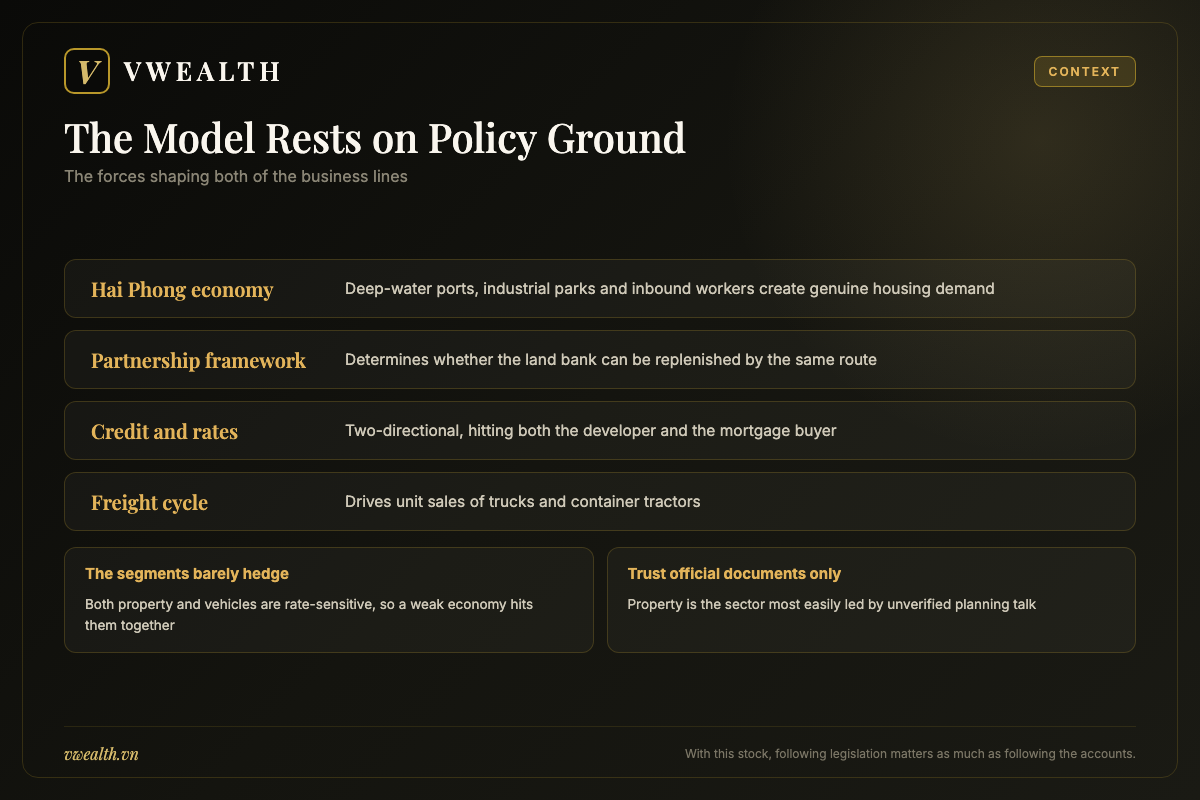
Summing up: the company sits in a locality with sound economic fundamentals, but its land formation model depends on a policy framework still being refined. That is why, with this stock, following legislation matters as much as following the financial statements.
Looking forward: three scenarios for TCH and what each one requires
No price targets. Three scenarios with conditions, so you can track which branch reality is following.
Four variables that decide the outcome
The first variable is the handover schedule of projects already sold. It determines profit for the next several years and is the easiest to monitor, since the company reports progress in shareholder materials and annual reports.
The second is the ability to replenish the land bank. The current bank is finite; the long-term growth question is where the next source comes from and at what cost.
The third is the interest rate environment and credit conditions, which act simultaneously on housing demand and on vehicle sales.
The fourth, specific to this company, is whether cash travels up the three-tier chain — that is, whether CRV pays dividends to HHS and HHS to TCH. If cash does not move upward, TCH shareholders own profit on paper only.
Infrastructure deserves one more sentence because of how directly it interacts with this particular land bank. Land value in a port city is highly sensitive to connection: a district that gains a bridge, an expressway interchange or an upgraded arterial road can shift from peripheral to convenient within a single project cycle. A developer holding land in such a district captures that revaluation without deploying additional capital.
The converse also holds. Infrastructure timelines slip frequently, and land held on the assumption of a connection that arrives five years late carries five years of holding cost. When management explains a land position by reference to planned infrastructure, the disciplined response is to check the status of that infrastructure independently.
Optimistic scenario: handovers on schedule and the land bank replenished
Here the large Hai Phong projects hand over as planned, profit attributable to parent shareholders rises clearly, the company secures new land at reasonable cost, and dividends flow steadily up the chain. Alongside that, the vehicle business benefits from a recovering freight cycle.
Conditions required: legal milestones on the next projects completed on time, an interest rate environment supportive of purchasing power, and a policy framework that permits continued participation in land-generating projects.
Early signals: advances from customers rising across periods, announced completion of legal milestones on new projects, and an improving share of profit attributable to parent shareholders.
Base case: harvesting the existing land bank, then answering the next question
This is the scenario the article considers most likely. The company hands over its existing projects progressively, profit swings sharply between years with the handover calendar, the vehicle business runs steadily at a modest level, and the valuation moves with the broad property cycle.
In this branch the question of the next land source remains open. It is not urgent for several years, because the existing bank provides plenty of work, but the market will press it harder as the large projects complete.
The base case also implies something about holding period. If profit jumps with the handover calendar, a holding of under a year is mainly a bet on market sentiment rather than on business results. Extend the horizon across at least one full handover cycle and operating performance begins to dominate your return. That is also why this article stresses tracking legal progress and advances from customers rather than quarterly profit: those two tell you when the next handover cycle falls, while quarterly profit only recounts the cycle already past.
It is worth naming explicitly what the base case implies about the discount. If the group continues to operate as it does today, with cash largely retained at the lower tiers to fund development, then the holding company discount has a rational basis and there is no particular reason to expect it to close. If instead the group begins routing dividends upward consistently, the case for a narrower discount strengthens materially.
That makes the dividend behaviour of the lower tiers one of the highest-information signals available to a TCH shareholder, and it is disclosed in ordinary shareholder resolutions that anyone can read. Few things about this company are as easy to monitor and as directly relevant to the valuation question.
Adverse scenario: legal delay or a cooling housing market
The adverse case has two branches. The first is legal: one or more flagship projects take longer than planned to complete procedures, leaving capital immobilised in inventory while finance costs continue. This is the most common risk in Vietnamese property and has caused difficulty for many developers, including those with good land.
The second is market: housing demand weakens because rates rise or household incomes soften, slowing the sales pace. For a company concentrated in one city, there is no other market to compensate.
A further branch is specific: if the policy framework makes replenishing land through the previous route materially harder, the market may lower the valuation it applies even while current results remain good, because the long-run outlook has changed.
Before working through the branches, it is worth stating what would prove this article’s framing wrong. If TCH’s profit began arriving evenly every quarter rather than jumping with handovers, the description of it as a typical developer would need revision. If the share of profit attributable to parent shareholders rose substantially with no change in ownership percentages, the dilution arithmetic in chapter two would have missed something. Deliberately identifying what would falsify your view, before buying, is more useful than gathering further confirmation, and it gives you a selling rule that does not depend on the price.
Scenario summary table
| Scenario | Conditions required | How it shows in the accounts | Early signal to watch |
|---|---|---|---|
| Optimistic | Handovers on schedule, land replenished, dividends flowing up | Parent-attributable profit rising, durable positive cash flow | Advances rising, new project legal milestones completed |
| Base case | No shock, harvesting the existing bank | Profit jumping with the handover calendar | No clear information on the next land source |
| Adverse | Legal delay or weakening housing demand | Inventory swelling, finance costs rising, cash negative for long | Milestones repeatedly deferred, visibly slower sales |
What all three share is that the company does not lack assets. The land bank is there, the vehicle business runs, and the balance sheet is not the fragile kind. What differs between branches is the speed at which assets convert into cash, and that speed is largely outside the company’s control. That is the nature of this industry.
So, should you buy TCH stock? A straight answer
You now have the material. This closing chapter does three things: weighs the case for, weighs the case against, and says plainly who this stock suits.
The case for: five reasons TCH deserves consideration
First, a land bank formed below market cost, producing margins that developers buying land at market prices struggle to match. This is a measurable advantage, not a sentiment.
Second, a leading position in a market with genuine economic fundamentals. Hai Phong has ports, industry and an inbound workforce, so housing demand there rests on real occupancy needs rather than purely investment appetite.
Third, an additional vehicle trading arm generating continuous cash flow — rare for a pure-play developer and helpful for surviving years with no handovers.
Fourth, leadership whose interests are closely tied to company value, with most of the founder’s wealth held in the shares themselves.
Fifth, the grandchild company’s listing from late 2025 raises transparency across the group and gives investors a reference point for valuing the property arm that did not previously exist.
A sixth point sits slightly outside the standard list and concerns optionality. Because the parent retains a trading business alongside its stake in the property chain, it has more than one way to deploy capital as conditions change. In a weak property market it can lean on the vehicle business; in a strong one it can direct resources toward development. That flexibility does not appear as a line in any statement.
Treat it as a reason to require a slightly smaller discount than you otherwise would, rather than as a reason to pay a premium. Advantages that cannot be measured tend to prove smaller in practice than they look in a strategy presentation, and the honest position is to acknowledge the uncertainty rather than resolve it in either direction.
The case against: six risks you have to face directly
First, the three-tier ownership chain substantially dilutes what reaches parent shareholders. It is a technical risk with a direct valuation impact, and many retail investors overlook it entirely.
Second, geographic concentration. The core land bank sits in one city, with no other market to compensate when that one struggles.
Third, the land formation model depends on the public-private partnership framework, which has changed repeatedly and may change again. This is structural risk, not operating risk.
Fourth, the lumpiness of profit under the handover calendar makes earnings-based valuation easy to get wrong, and tempts short-term investors to buy at moments that merely look cheap.
Fifth, the two business lines hedge each other less well than they appear to, since both are sensitive to interest rates and to the economic cycle.
Sixth, the family business character leaves minority shareholders with very little influence, and makes succession a genuine risk to monitor.
Before the table, one framing point about how to hold these two lists in mind. The strengths listed above are largely about assets already in place: land already obtained, a position already established, cash already generated. The risks are largely about the future: whether new land can be obtained, whether policy holds, whether cash travels upward.
That asymmetry is characteristic of a company that has executed well historically and now faces a question about the next phase. It argues for valuing what exists with some confidence, while applying a genuine discount to any assumed continuation of the growth model. Investors who conflate the two — treating a proven past as evidence of an assured future — are the ones most likely to overpay here.
Weighing both sides
| In favour | Against |
|---|---|
| Land bank formed at low cost, producing high margins | Three-tier chain dilutes profit reaching the parent |
| Leading position in a market with real occupancy demand | Risk concentrated in a single locality |
| Vehicle trading arm generating continuous cash flow | Land formation model depends on the policy framework |
| Leadership interests tied closely to company value | Lumpy profit makes valuation easy to get wrong |
| Grandchild company listing improves transparency | Both segments sensitive to rates, limited internal hedging |
| Reasonable liquidity for a mid-cap developer | Minorities have little influence, succession risk present |
Who this stock suits, and who it definitely does not
For the long-term value investor: TCH can fit if you are willing to do the hard part — estimating land bank value yourself, adjusting for non-controlling interests, and following project legal progress. If you do not intend to do that work, there are far easier companies to assess.
For the growth investor: this is not a steady grower. Profit follows the handover calendar, and long-term growth depends on an unresolved question about the next land source.
For the income investor: a developer’s dividend policy always bends to project funding needs, so this is not a first choice if you need reliable cash flow. Recall also that cash must travel up three tiers before it can be paid out.
For the short-term trader: the name is reasonably liquid and reacts strongly to policy news, so it sits on many watchlists. But precisely because it reacts strongly, the risk of chasing headlines is at its highest. Define your exit before you enter, and think very carefully before using margin leverage in the property sector.
A note on position sizing within a Vietnamese portfolio. Property names in this market correlate strongly with one another and with the credit cycle, so holding several of them concentrates rather than diversifies. Adding a developer to a portfolio that already contains banks compounds the effect further, since Vietnamese bank earnings are themselves heavily exposed to property collateral quality.
If your intent is genuine diversification, the useful contrast is between an asset-heavy, cycle-driven developer and a business whose earnings depend on household consumption or on export demand. Those respond to different conditions. Pairing two property names, or a property name with a lender heavily exposed to property, achieves far less separation than the ticker count suggests.
Five questions to answer before you place an order
Question one: in the latest reporting period, what percentage of consolidated after-tax profit was attributable to owners of the parent, and is that percentage rising or falling?
Question two: where does the advances from customers balance stand relative to prior periods, and which projects does it correspond to?
Question three: what legal milestone have the largest projects reached, and when is the next one expected?
Question four: if you take the grandchild company’s market capitalisation, multiply by the indirect ownership and compare against TCH’s own capitalisation, what is the current discount, and what reason do you have to believe it will narrow?
Question five: how long do you intend to hold, and what will you do if a flagship project slips eighteen months? Answering that before you buy will save you far more than answering it while you are down.
One final practical suggestion on process. Because so much of the analysis here depends on documents rather than on numbers, set up a simple routine: read the annual report in full once a year, read shareholder meeting materials when they are published, and check the exchange disclosure page for the three group companies periodically. That is perhaps four or five hours a year.
For an investor holding a position of any size, that is a modest commitment relative to the information advantage it produces. Most of what determines the outcome here is disclosed; it is simply disclosed in prose rather than in a headline number, and therefore ignored by anyone screening the market mechanically.
Closing: a bridge built on policy ground
The Hoang Huy story is one of converting advantages. Cash from vehicle trading became the capability to execute public works. Public works became a land bank. The land bank became townships that changed the face of a port city. Few Vietnamese companies have completed that chain of conversion so fully.
But what made the success is also where the risk lives. The bridge between the two trades was built on policy ground, and that ground is laid by others. That is why, with this stock, the hardest part of the investor’s job is not reading the financial statements but judging which way the policy ground will shift.
So, should you buy TCH stock? If you understand that you are buying a developer concentrated in one city, accept that profit arrives on a handover calendar rather than evenly, are prepared to adjust every calculation for the three-tier ownership chain, and treat tracking project legal progress as part of the job of holding it — then TCH is a reasonable holding within a Vietnamese property allocation. If you are buying because you heard the company has cheap land, because the shares just rallied, or because of a planning rumour with no official confirmation, you are buying an expectation rather than a business.
One last thing to carry with you. Hoang Huy’s land bank, local position and ownership structure change slowly. Its advances from customers, inventory, legal progress, debt profile and valuation change every quarter. Before placing an order, open the latest research and score the seven checks from chapter four again. It takes fifteen minutes, and they are the most valuable fifteen minutes in the entire decision. If you do not yet have the tools to do that, create a free vwealth account and let the platform read the filings for you.
This article provides information and analysis for reference purposes only and is not a recommendation to buy or sell any security. All investment decisions are yours alone, and you bear responsibility for their outcomes. Consider consulting a licensed financial adviser before acting.
Research Vietnamese stocks in English with vwealth. Our AI-powered platform turns Vietnamese market data into full English analysis reports — with international payment support and a free 2-month trial for new accounts. Create your free account and read the latest reports.