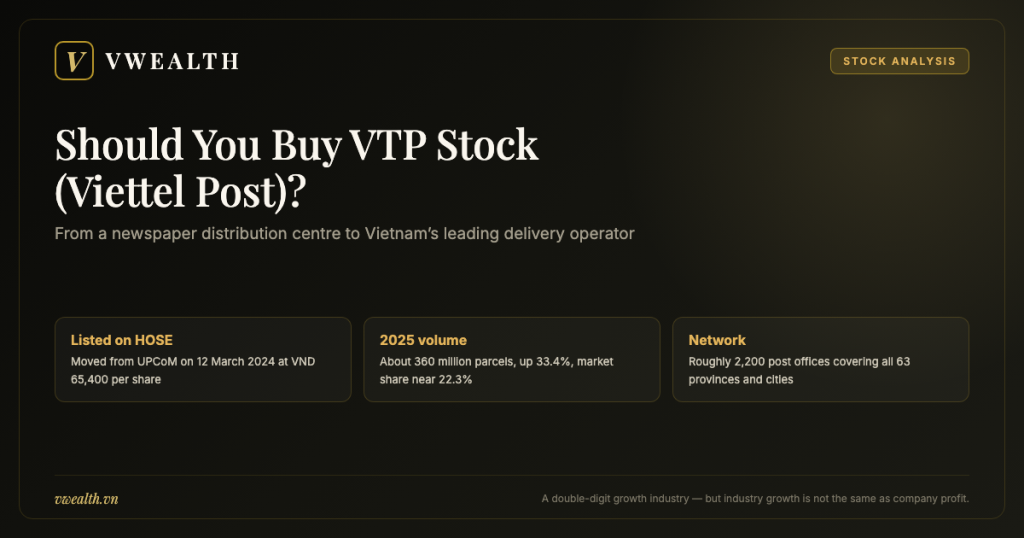
Should you buy VTP stock? The ticker belongs to Viettel Post, the express delivery and logistics arm of Viettel, Vietnam’s largest telecoms group. For a foreign investor, VTP is one of the most direct listed ways to own the growth of Vietnamese online consumption: in 2025 the company handled roughly 360 million parcels, up 33.4% — about twice the industry’s average growth rate — lifting its market share to around 22.3%. And yet that same year, revenue above VND 20,684 billion translated into net profit of only VND 404.89 billion. That gap is the whole story of this stock, and of the industry it operates in. This article traces the full path from a newspaper distribution centre founded in 1997 to the country’s leading express delivery operator, teaches you how to read the financial statements of a delivery company — a business where looking at revenue is the fastest way to reach a wrong conclusion — and finishes with a straight answer on who this stock suits and who it absolutely does not.
Before we start, one convention between you and this article, the same one used across this series. You will meet a lot of dates, names, project titles and scale figures, all taken from publicly disclosed sources: exchange filings, shareholder meeting resolutions, company announcements and mainstream financial press. What you will not find here is a current-quarter earnings figure or a valuation multiple as of today. For a delivery company, margins move with every industry-wide pricing round, so this article teaches you where to look and how; for the current numbers, open the latest analysis reports on vwealth.
A second convention specific to this ticker. VTP belongs to the Viettel ecosystem, and that brings both advantages and constraints. This article describes both neutrally, based on disclosed information, and does not speculate about anything that has not been disclosed.
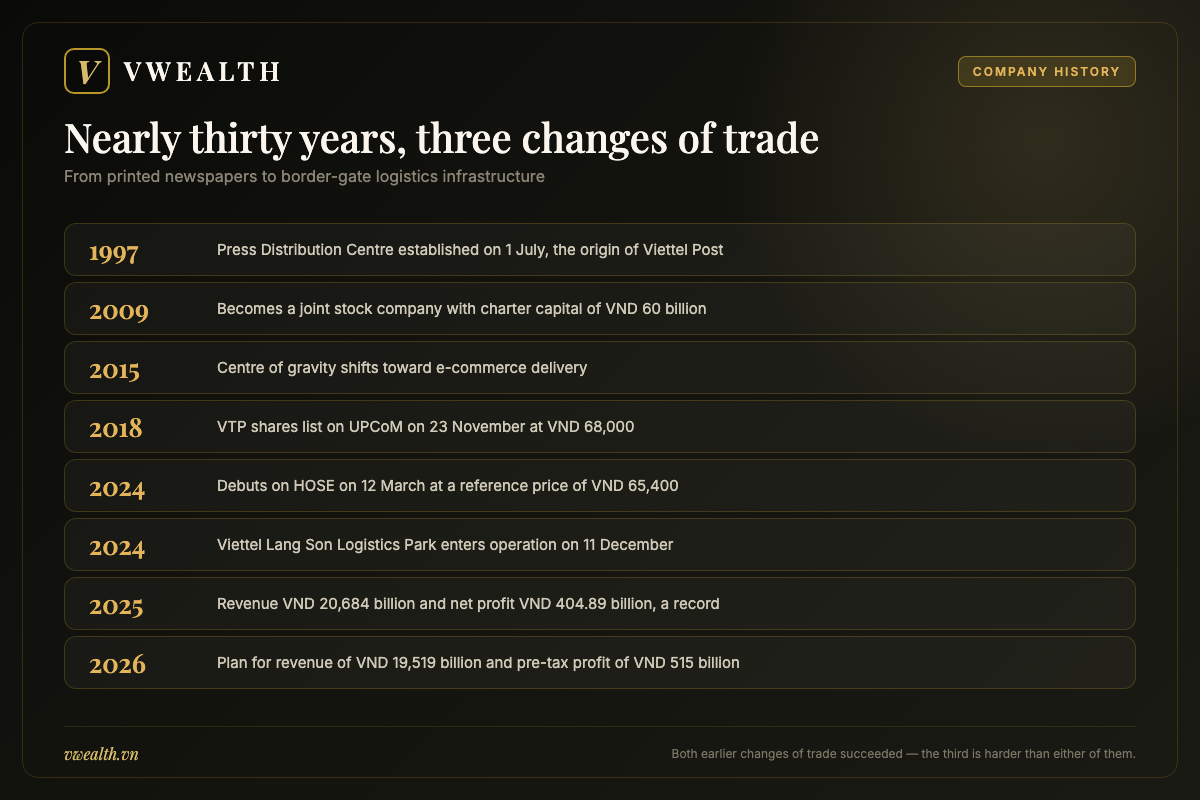
From a newspaper distribution centre to the market’s leading delivery operator
Here is a detail almost no foreign investor knows: this company was created to do something that has nearly ceased to exist — distributing printed newspapers. To understand how it became one of Vietnam’s largest e-commerce delivery businesses, you have to walk through its turns one by one.
1 July 1997: a newspaper distribution centre
On 1 July 1997, the Press Distribution Centre was established, the predecessor of today’s Viettel Post. Its original mission was specific: get printed newspapers into readers’ hands.
Pause here longer than the detail seems to deserve, because it explains a characteristic that survives today. Newspaper distribution is a miniature but brutal logistics problem: thousands of delivery points spread across the country, small volumes, low value per item, and absolutely no tolerance for delay — a newspaper delivered a day late is a newspaper with zero value. An organisation that solved that problem for years already possessed the hardest asset in express delivery: a network reaching down to commune level, and an operating culture built around the clock.
What Vietnam’s e-commerce market looks like from the outside
If you have not followed Vietnam closely, some context on the demand side will make the rest of this article far easier to read.
Vietnam has roughly a hundred million people, a median age well below most of Asia, near-universal smartphone penetration in urban areas, and a retail landscape that skipped much of the department store era and went straight from traditional markets and small shops to mobile commerce. Online shopping in Vietnam is dominated by regional marketplace platforms rather than by a single domestic champion, and the typical order is small: a household item, a cosmetic, a piece of clothing, frequently under the equivalent of ten or fifteen dollars.
Two features of that market matter enormously for a delivery company. The first is that cash on delivery has historically been a large share of transactions, which means the courier is also a payment collection point — adding operational complexity and working capital considerations that do not exist in markets where everything is prepaid. The second is that the small average order value places a hard ceiling on what anyone can charge for delivery. If the item costs the equivalent of eight dollars, a shipping fee approaching a dollar is already a significant fraction of the purchase, and the platform absorbing or subsidising it feels every increase.
Put those together and you get the structural condition of the industry: enormous and growing volume, extremely limited pricing power, and a customer base concentrated in a handful of platforms with strong negotiating leverage. Any investment case in Vietnamese delivery has to start by accepting those three facts rather than hoping they will change.
The opportunity, correspondingly, is not in the delivery fee itself. It is in whoever can drive cost per parcel below what competitors can achieve, and in whoever can attach higher-margin services — warehousing, fulfilment, cross-border handling — to the same network. That framing is exactly what Viettel Post’s current strategy is built on, and it is the lens to use for the rest of this article.
2006 to 2009: restructuring and equitisation
In 2006 the unit became Viettel Post One Member Limited Liability Company. In 2009 it converted into a joint stock company with initial charter capital of VND 60 billion.
That VND 60 billion figure is worth remembering, because it is the benchmark for everything that followed. From charter capital of VND 60 billion, by 2026 the figure had reached roughly VND 2,018 billion — more than thirty times in about seventeen years, through repeated capital raises.
The post-equitisation period was also when the company expanded its post office network aggressively. Today the system comprises roughly 2,200 post offices covering all 63 provinces and cities — a number you should read not as marketing material but as genuine infrastructure that is hard to replicate.
2015 to 2020: e-commerce changes the game entirely
This is when the nature of the business changed for the second time.
As online shopping took off in Vietnam, demand for individual home delivery grew exponentially. From mainly serving letters, parcels and corporate clients, Viettel Post shifted its centre of gravity to e-commerce delivery — a market with enormous volume but very low value per shipment.
This shift matters more than it appears. Delivering a corporate parcel and delivering an e-commerce order are two economically different jobs. The first has few shipments, high value each, and customers who are not especially price sensitive. The second has enormous volume, very low value each, and customers — usually the e-commerce platforms themselves — who are extremely price sensitive because they can switch provider with a click.
The entire profit story of VTP in recent years, which chapter four dissects, originates in this shift.
23 November 2018: listing on UPCoM
On the morning of 23 November 2018, 41.4 million VTP shares began trading on UPCoM at a reference price of VND 68,000 per share, hitting the daily ceiling at VND 95,200 within the first minutes of trading.
That reaction tells you the market psychology of the time: investors saw VTP as a direct way to participate in Vietnam’s e-commerce wave without buying shares in a foreign platform. That thesis is broadly still valid today, but it comes with conditions this article will spell out.
12 March 2024: moving to the HOSE main board
On 12 March 2024, VTP shares began trading on the Ho Chi Minh Stock Exchange at a reference price of VND 65,400 per share, implying a valuation of close to VND 8,000 billion. The listing decision had taken effect on 21 December 2023.
A main board listing delivered three things: higher disclosure standards, eligibility for the indices funds track, and a much broader investor base than UPCoM offered. For a company entering a phase of large-scale logistics infrastructure investment, all three had value.
11 December 2024: the Viettel Lang Son Logistics Park
This is the third major turning point, and the one shaping the company’s strategy for the coming decade.
On 11 December 2024, the Viettel Lang Son Logistics Park entered operation in Cao Loc district, Lang Son province. It is the first facility of its kind in Vietnam, with total investment of nearly VND 3,300 billion, covering more than 143 hectares, with capacity to process up to 1,500 container trucks a day.
Its location is the crucial point: adjacent to the Huu Nghi and Coc Nam border gates, with direct connections to the Hanoi – Lang Son expressway and to the Vietnam – China international railway line. A key component is a bonded warehouse comprising roughly 5,880 square metres of warehouse and 8,700 square metres of yard, serving storage, transshipment and customs clearance on the Vietnam – China trade route.
Read this event as an analyst, because it is an unambiguous strategic statement. The company is seeking to step out of the price war in parcel delivery — where margins keep thinning — and into a segment with far higher barriers to entry: border-gate logistics infrastructure, where the asset is land, warehousing, yard space and licences rather than a freight rate.
2025 to 2026: record profit and a plan for lower revenue
In 2025, Viettel Post recorded consolidated revenue of VND 20,684 billion, meeting 98.36% of plan; pre-tax profit of VND 514.57 billion, exceeding plan by 1.67%; and net profit of VND 404.89 billion, up 5.7% year on year and the highest in company history. Return on equity reached 23.7%. The company handled roughly 360 million parcels during the year, up 33.4% — about twice the industry average — lifting market share to around 22.3%.
The 2026 plan approved by shareholders contains a striking feature: target consolidated revenue of VND 19,519 billion, below what was actually achieved in 2025, while target pre-tax profit of VND 515 billion is essentially flat, with return on equity projected at 18.7%.
A plan for lower revenue with unchanged profit is unusual, and it is an important signal. It indicates the company is deliberately cutting very low margin revenue — typically trading revenue, where the top line is large but the profit contribution is minimal — to concentrate on what actually generates earnings. Chapter four explains why this is the correct reading, and why revenue is the single most misleading number in a delivery company’s report.
Historical milestones at a glance
| Date | Event | What it means for an investor today |
|---|---|---|
| 1 Jul 1997 | Press Distribution Centre established, predecessor of Viettel Post | Roots in nationwide network reach and clock-driven operations |
| 2006 | Converted into a one-member limited liability company | Preparation for equitisation |
| 2009 | Became a joint stock company with charter capital of VND 60 billion | The benchmark for the entire capital-raising journey since |
| 2015 to 2020 | Centre of gravity shifts to e-commerce delivery | Business economics change entirely: high volume, thin margin |
| 23 Nov 2018 | VTP shares list on UPCoM at a reference price of VND 68,000 | Market prices the stock on the e-commerce story |
| 21 Dec 2023 | HOSE listing decision takes effect | Preparation for the main board move |
| 12 Mar 2024 | Debuts on HOSE at VND 65,400, valuing the company near VND 8,000 billion | Enters the field of view of funds and indices |
| 11 Dec 2024 | Viettel Lang Son Logistics Park enters operation | Strategic move out of the freight rate war |
| 2025 | Revenue VND 20,684 billion, net profit VND 404.89 billion, a record | 360 million parcels, market share around 22.3% |
| 2026 | Plan for revenue of VND 19,519 billion and pre-tax profit of VND 515 billion | Deliberately cutting thin-margin revenue while holding profit |
| 2026 | Over 50 million shares offered to holders and nearly 30 million issued as a dividend | Charter capital to roughly VND 2,018 billion, with dilution |
Read the table vertically and you see a company that has changed its business twice in under thirty years — from newspapers to parcels, then from parcels to logistics — and is in the middle of a third change. That is the single most important thing to grasp before valuing this stock.
Who runs Viettel Post and what belonging to the Viettel ecosystem really means
For VTP the ownership chapter is shorter than for many tickers, because the structure is simple: one controlling shareholder, and that shareholder is one of Vietnam’s largest corporate groups. Precisely because it is simple, the analysis worth doing is not about the percentage but about what the relationship provides and what it constrains.
Nguyen Viet Dung and the executive team
The chairman of Viettel Post’s board is Nguyen Viet Dung, appointed for the remainder of the 2024 to 2029 term with effect from 26 August 2024. He also holds a strategy leadership role at the Viettel Military-Telecommunications Industrial Group and has many years of experience across telecommunications and postal services.
The general director is Phung Van Cuong, born in 1981, appointed as chief executive and legal representative from 6 February 2025. He previously spent many years in telecommunications within the Viettel ecosystem.
Both top positions being filled within a short window, with executives drawn from the parent group’s strategy and telecommunications arms, is a signal worth noting. It suggests the parent is directly involved in redirecting the business at a moment when the model has to change. It guarantees nothing about outcomes, but it tells you the level of priority attached.
The Viettel shareholding and what a controlling stake means
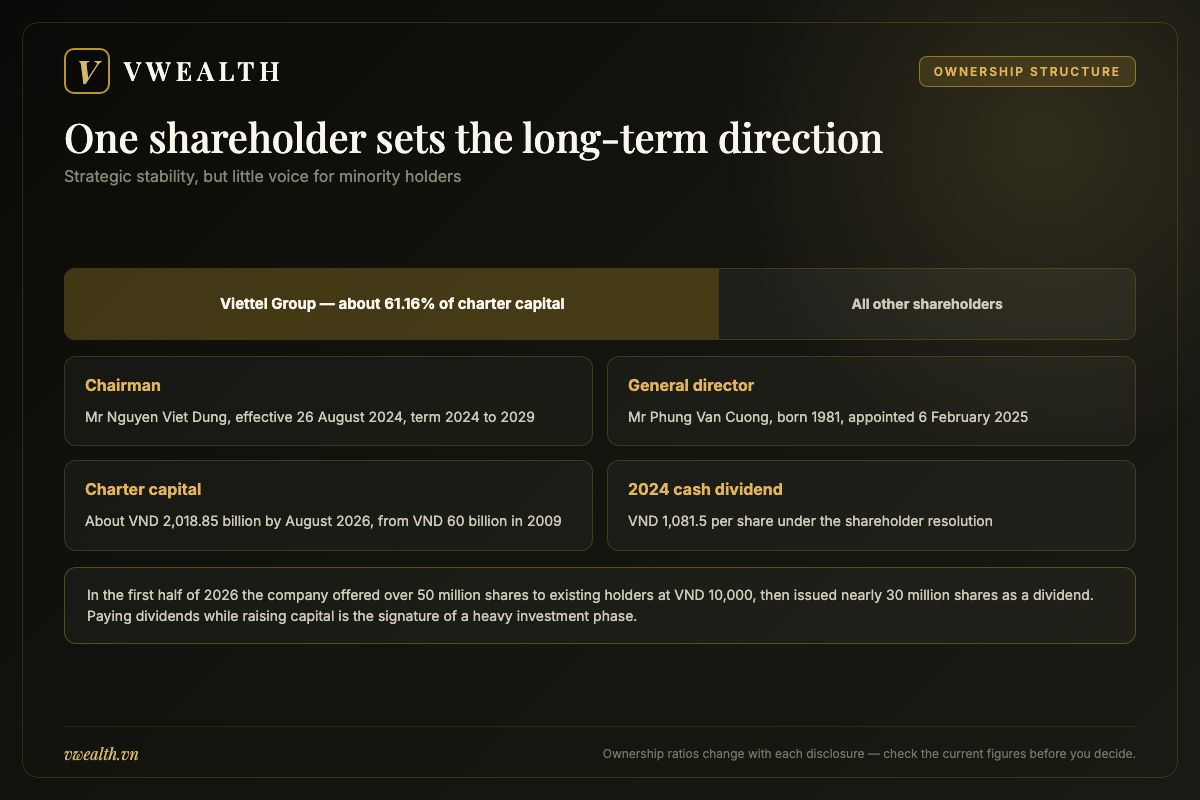
The Viettel Military-Telecommunications Industrial Group is the controlling shareholder of Viettel Post, holding more than 105.2 million VTP shares, equivalent to roughly 61.16% of charter capital.
Translate that into the language of someone buying the stock, with both the benefits and the costs.
The first benefit is stability of direction. A shareholder holding above sixty per cent means long-term strategy is not disrupted by opposing shareholder blocs, and the company can pursue infrastructure projects that take years to pay off — such as a logistics park — without pressure to prove results every quarter.
The second benefit is the ecosystem. Viettel has nationwide telecommunications infrastructure, technology capability, a strong brand and established relationships with the administrative system. For a logistics business these are not abstract advantages: they are the foundation for deploying dispatch systems, route optimisation, order data processing and network expansion faster than competitors. Vietnamese groups of this type operate under a particular governance model, and the overview of state-linked enterprises in Vietnam explains how ownership representation and decision rights typically work.
The first cost is a lower free float than at companies with dispersed ownership. With nearly two thirds of capital held by one shareholder, the quantity of stock genuinely trading is far smaller than the market capitalisation suggests, and that amplifies price movement.
The second cost, and the subtler one: minority shareholders have no substantive voice in major decisions. When the company commits thousands of billions of dong to an infrastructure project, or decides to sacrifice margin to defend market share, that decision has been shaped before it reaches the shareholder meeting. You need to assess whether you agree with the controlling shareholder’s direction, because you will follow it either way.
Viettel Post among the group’s other listed companies
Several companies belonging to the Viettel ecosystem are listed on the Vietnamese market, and investors often refer to them collectively as the Viettel group of stocks. VTP is one of them, alongside businesses in international telecoms investment and in telecoms infrastructure construction.
Belonging to the same family has two implications, and they should be kept separate.
The first is about price behaviour. Stocks in a common ecosystem tend to be traded thematically: when one member reports strong results, the whole group often draws attention at once. This is market psychology rather than fundamental linkage, and it produces price swings unrelated to VTP’s own operations.
The second is fundamental and far more important. These companies operate in entirely different industries — express delivery and logistics, international telecoms investment, and infrastructure construction — with three different business models, cost structures and risk profiles. Sharing a parent does not make their results correlated.
The practical conclusion: do not use one Viettel-family company’s results to infer another’s outlook, and do not treat owning several of them as diversification — they share one governance risk and one capital allocation logic from the parent.
The other Viettel businesses and what the parent brings
It is worth being concrete about what the parent relationship actually delivers, because “ecosystem synergy” is a phrase that often means nothing.
Viettel is a telecommunications and technology group with nationwide network infrastructure, a large engineering workforce, and substantial in-house software capability. For a delivery business, three of those translate into something measurable.
The first is connectivity and data. A delivery network runs on continuous location and status data from tens of thousands of couriers and vehicles. A parent that owns the underlying telecommunications infrastructure lowers both the cost and the friction of running that system at national scale.
The second is software and automation. Sorting centre automation, route optimisation and demand forecasting are software problems as much as logistics problems, and having engineering capability inside the group rather than buying it from vendors changes both cost and iteration speed.
The third is balance sheet and credibility. A company backed by a group of this size finds it easier to fund a three-thousand-billion-dong infrastructure project, and easier to be taken seriously as a counterparty by provincial authorities and large corporate customers.
What the relationship does not deliver is protection from the market. The parent cannot make e-commerce platforms pay more per parcel, and it cannot stop a well-funded foreign competitor pricing below cost. Ecosystem advantages lower the cost base and speed execution; they do not create pricing power. Keep that distinction clear when you weigh the bull case, because conflating the two is the most common error in analysis of this stock.
Related-party transactions within a large ecosystem
As a member of a diversified group, Viettel Post transacts with entities in the same ecosystem: using infrastructure and telecommunications services, and providing logistics services back to sister companies.
This is a normal structure and is disclosed as required. What this article emphasises is how to read it: the related-party transactions note tells you what share of revenue and cost comes from within the ecosystem. A high share is not bad, but it means part of the result is not the outcome of competition in an open market. You should know that number rather than guess it.
Capital allocation: where the money raised is going
For a company raising equity repeatedly, how the proceeds are deployed is as important as how much is raised, and it is worth setting out plainly.
The pattern of recent years is consistent: capital raised is going into fixed logistics assets rather than into funding operating losses or into acquisitions of unrelated businesses. The Lang Son logistics park with nearly VND 3,300 billion of total investment is the flagship, and construction of a logistics centre in Da Nang followed, with investment disbursement accelerating sharply within a six-month window.
This distinction matters. A company raising equity to plug an operating hole is in a different situation from a company raising equity to buy assets it will own for decades. The second is a capital allocation decision you can evaluate on its merits: is the asset worth what it costs, and will it earn an acceptable return?
Those questions do not yet have final answers, because the assets are new. What you can evaluate now is the logic: moving from a service business with no barriers into an asset business with high barriers, in a location tied to a large and structural trade flow, is a defensible strategic direction. Whether execution matches the logic is what the next several years of reporting will reveal.
The corresponding warning is about pace. A company that raises equity every year to fund an expanding pipeline is asking shareholders for a continuing commitment, not a one-off one. Before buying, decide whether you are willing to be that kind of shareholder — and if not, size the position on the assumption that your percentage stake will shrink over time.
Foreign ownership and foreign participation
With the controlling shareholder above sixty per cent, the practical room for foreign investors at VTP is constrained by the available free float rather than by any legal ceiling.
If ownership caps in Vietnam are new to you, the guide to foreign ownership limits in Vietnamese stocks explains how they work. For VTP, treat the level of foreign participation as a sentiment indicator for the Vietnamese e-commerce theme generally, rather than as a determinant of price.
Dividends and capital raises
Viettel Post has a tradition of paying dividends, which distinguishes it from many growth companies. Shareholders approved a 2024 cash dividend of VND 1,081.5 per share.
In parallel, the company has been raising capital. In the first half of 2026 it offered more than 50 million shares to existing shareholders at VND 10,000 per share, then issued nearly 30 million shares as a stock dividend. Charter capital stood at roughly VND 2,018.85 billion as of August 2026.
You need to look at both together to see the real picture. The company is paying cash dividends while simultaneously raising capital from the same shareholders — the signature of a business entering a heavy investment phase, when operating cash flow is not yet sufficient to fund the pace of infrastructure expansion. This is strategically coherent, but it means you should expect to contribute additional capital if you want to maintain your ownership percentage.
Ownership and leadership at a glance
| Item | Disclosed position | What an investor should take from it |
|---|---|---|
| Controlling shareholder | Viettel Military-Telecommunications Industrial Group, roughly 61.16% | Stable strategy but little minority voice |
| Chairman | Nguyen Viet Dung, effective 26 August 2024, term 2024 to 2029 | Drawn from the parent group’s strategy function |
| General director | Phung Van Cuong, born 1981, appointed 6 February 2025 | Telecoms background, suited to digitising operations |
| Charter capital | Roughly VND 2,018.85 billion as of August 2026 | Up more than thirtyfold from VND 60 billion in 2009 |
| 2026 rights offering | Over 50 million shares to existing holders at VND 10,000 | Holders must subscribe to maintain their stake |
| 2026 stock dividend | Nearly 30 million additional shares issued | Dilutes shares outstanding |
| 2024 cash dividend | VND 1,081.5 per share | A dividend tradition, unlike many growth names |
| Network | Roughly 2,200 post offices across all 63 provinces | Infrastructure that is hard to replicate quickly |
| Intra-ecosystem transactions | Present and disclosed as required | Read the notes to know the actual proportion |
The table shows the core point: buying VTP means buying a minority slice of a company whose direction is set by its parent, and the current direction is to accept heavy investment today in exchange for position ten years from now.
How Viettel Post makes money: dissecting a delivery business
Ask a typical investor what Viettel Post does and the answer is almost certainly delivery. That answer is correct but incomplete, and the missing part is where the company is betting its future. This chapter separates each revenue source, shows which segment feeds which, and identifies where the model has a genuine moat.
The core: express delivery and e-commerce fulfilment
This is the segment producing most of the volume and the source of the company’s brand.
The mechanism looks simple: the company charges a fee per parcel delivered, and profit is the spread between that fee and the cost of collection, sorting, line haul and last-mile delivery. Behind that simplicity sits a brutal scale problem.
The cost base of a delivery network is largely fixed: post offices must be leased, sorting centres built, trucks run their routes whether full or half empty, and couriers must be present in each area. As volume rises, those fixed costs spread across more parcels and cost per parcel falls. This is why express delivery is an industry where scale determines everything, and why operators are willing to cut prices to win volume.
In 2025, Viettel Post handled roughly 360 million parcels, up 33.4% — about twice the industry average — lifting market share to around 22.3%. That is an excellent operational result. But you must set it against another market fact: the average shipping price in April 2026 was around VND 16,500 per parcel, down roughly 20.5% from the 2025 average.
Those two numbers side by side tell the whole industry story: volume rising strongly, prices falling faster still. The company does considerably more work for not much more money. This is what you must understand before concluding anything about this stock.
Last mile: where most of the cost sits and where optimisation is hardest
There is a concept in logistics that investors should know because it explains almost the entire cost problem of a delivery company: the last mile, meaning the leg from the final distribution hub to the recipient’s door.
Line haul between provinces is the easiest part to optimise: one truck carries thousands of parcels, cost per parcel is small, and technology handles route planning reasonably well. The last mile is the opposite. A courier on a motorbike may deliver a few dozen orders a day, each to a different address, with a real probability that nobody is home. Last-mile cost therefore usually accounts for the majority of the total cost of delivering a parcel.
Three consequences follow for assessing VTP.
First, order density within an area matters more than national volume. A courier working a high-density area completes more deliveries in the same time, so cost per parcel is materially lower. This is why operators compete fiercely for volume in major cities, and why extending coverage into rural areas — while creating a competitive advantage — raises average cost.
Second, first-attempt delivery success rate is an operational metric with direct financial meaning. Every failed attempt doubles the cost while revenue stays the same.
Third, automating sorting and optimising delivery routes is where technology creates the largest difference. This is precisely where an advantage inherited from the parent group’s technology ecosystem can convert into a measurable cost advantage — if it is deployed effectively.
The economics of a single parcel, worked through
The following is an illustrative example with round numbers, not a statement of any company’s actual costs. Its purpose is to show you the shape of the economics so you recognise them when reading a real report.
Imagine a parcel carried for a fee of 20 units. Collection from the seller costs 3 units. Sorting at origin and destination costs 3 units combined. Line haul between provinces costs 3 units. Last-mile delivery costs 8 units. Total direct cost is 17 units, leaving a gross margin of 3 units, or fifteen per cent. Out of that 3 units the company must still cover selling expenses, administration, and depreciation on sorting centres and vehicles. What reaches net profit is a fraction of a unit.
Now cut the fee by twenty per cent, to 16 units, because the industry is in a price war. Direct cost does not fall automatically — the courier still rides the same distance. Gross margin collapses from 3 units to essentially nothing, and net profit turns negative unless the company finds cost savings fast.
Where can those savings come from? Mostly from the largest line: last mile. If higher order density in an area lets a courier complete forty deliveries a day instead of thirty, last-mile cost per parcel falls by a quarter. That is why volume growth is not vanity in this industry — it is the only defence against price compression. It also explains why a company will accept a low price to win a large platform’s volume in a city: the incremental parcels lower the cost of every other parcel on the same route.
Run the example forward instead. Suppose pricing stabilises at 18 units while density improvements have brought last-mile cost down to 6.5 units. Gross margin goes from 3 units to 5.5 units — an eighty per cent increase in gross profit from a ten per cent price recovery combined with a modest efficiency gain. That asymmetry is operating leverage, and it is the mathematical heart of the bull case for this stock.
The same asymmetry works in reverse, which is the bear case. Keep this example in your head when you read the company’s quarterly numbers; it will tell you more than any summary ratio.
Warehousing, transport and trading services
This group of segments is the fastest growing and is identified by management as the new growth pillar. According to disclosures, warehousing, transport and trading services contributed more than 42% of the incremental revenue in 2025.
The group contains several fundamentally different activities, and you need to distinguish them.
Warehousing and transport is logistics for corporate clients: storage, inventory management, bulk freight. Margins are better than in parcel delivery and contracts are longer, but it requires investment in warehouses and vehicles.
Trading services requires particular care when reading. At many logistics companies, trading revenue comes from buying and selling goods — a figure that can be very large but carries almost no margin, because the company merely acts as an intermediary. Rising trading revenue makes total revenue look attractive while contributing almost nothing to profit.
This is exactly why the 2026 plan targets revenue below what was achieved in 2025 while holding the profit target flat. Cutting thin-margin revenue is the correct management decision, even though it makes the headline number look less impressive to anyone reading quickly.
Border-gate logistics infrastructure: the largest bet
This is the most important part of the chapter, because it is where the company is placing its future.
The Viettel Lang Son Logistics Park, operating since 11 December 2024, carries total investment of nearly VND 3,300 billion across more than 143 hectares, with capacity to handle up to 1,500 container trucks a day. Its bonded warehouse component comprises roughly 5,880 square metres of warehouse and 8,700 square metres of yard, sitting beside the Huu Nghi and Coc Nam border gates with direct links to the Hanoi – Lang Son expressway and the international railway.
Why is this bet notable? Because it changes the type of business the company is in.
Parcel delivery is a service: barriers to entry are relatively low, customers switch easily, and price is the main competitive lever. Border-gate logistics infrastructure is an asset: it requires land, large capital, a bonded warehouse licence, and a location beside a border crossing — things a competitor cannot create in a year or two regardless of funding.
Market conditions support the direction. Import-export turnover through Lang Son has kept growing, and the volume of cargo vehicles through the province’s border gates continues to rise at double-digit rates. Vietnam – China trade is a large and structural flow, not a short-lived trend.
But look at the other side too. A three-thousand-billion-dong project takes time to fill capacity, and during the ramp-up period depreciation and operating costs are incurred in full. The company has also broken ground on a logistics centre in Da Nang, meaning capital outflow continues. This is why profit comes under pressure precisely during the heaviest investment phase — and why investors with short horizons are usually disappointed by this ticker.
Where Viettel Post’s moat is, and where it is thin
The first moat is a nationwide network of roughly 2,200 post offices across all 63 provinces. A new entrant wanting comparable coverage must spend years and a great deal of money, absorbing losses throughout because volume is insufficient.
The second moat is technology and infrastructure capability inherited from the parent ecosystem. In an industry where route optimisation and sorting automation determine cost per parcel, this is a measurable advantage.
The third moat is brand and reliability. In published service quality assessments, Viettel Post sits among the operators with the lowest rates of lost or damaged shipments in the market. For corporate customers and higher-value goods, that matters more than price.
The fourth moat, currently under construction, is border-gate logistics infrastructure — an asset class with far higher barriers than a delivery service.
Now be honest about the thin spots. The first and second moats reduce cost per parcel, but they do not stop a competitor pricing below its own cost to win share — which is what is happening. The third has value for a segment of customers, but most e-commerce volume is low-value goods where buyers care more about the shipping fee than about loss probability. And the fourth is still in its investment phase, not its harvest phase.
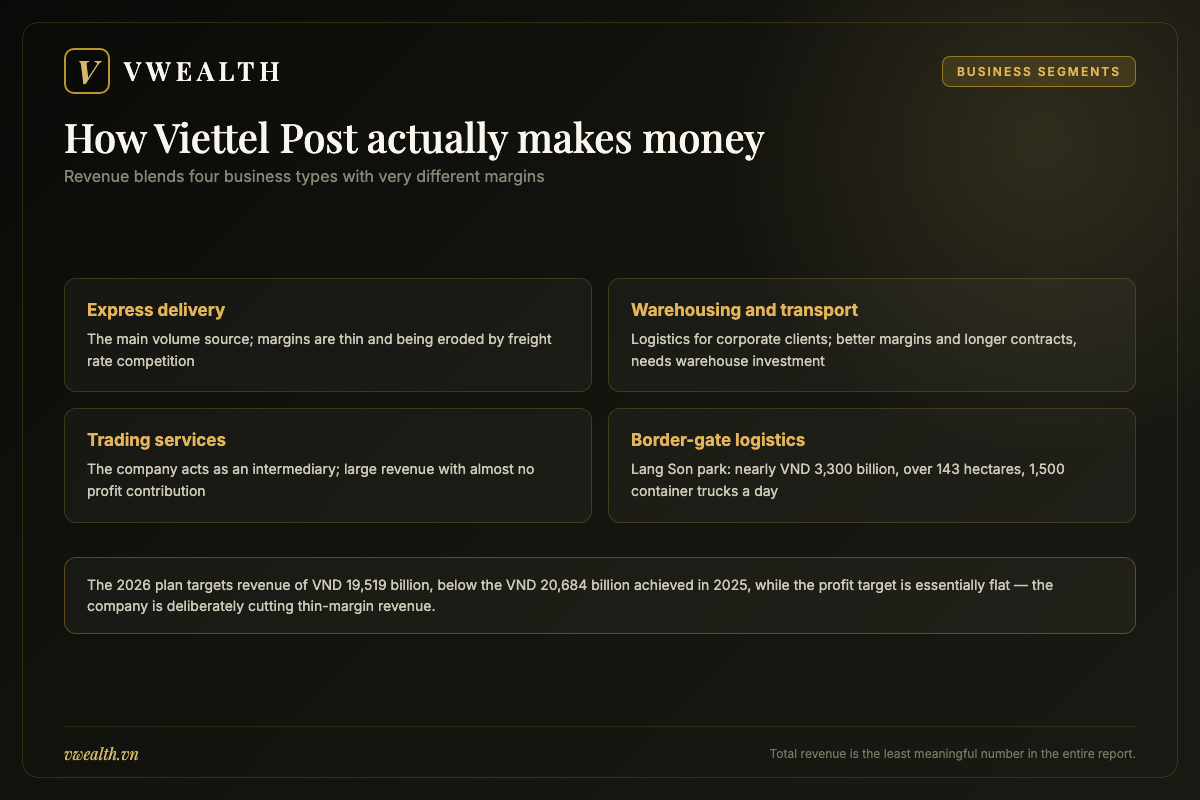
The segments compared
| Segment | How it generates cash | Margin character | What to monitor |
|---|---|---|---|
| Express delivery and e-commerce fulfilment | Fee per parcel, profit is the spread over network cost | Thin and being eroded by price competition | Parcel volume and average price, always both together |
| Warehousing and transport | Logistics services for corporate clients under longer contracts | Better than parcel delivery, needs warehouse and fleet investment | Share of total revenue and growth rate |
| Trading services | Buying and selling goods as an intermediary | Very thin, flatters revenue but contributes little profit | This is the revenue the company is deliberately cutting in 2026 |
| Border-gate logistics infrastructure | Bonded warehousing, yard, clearance and transshipment services | Higher once capacity fills, but that takes time | Utilisation rate and progress of the next phase |
Look at the table and you will see what many investors miss: Viettel Post’s revenue is the least meaningful number in the entire report, because it blends four business types whose margins differ by multiples. Chapter four shows you what to look at instead.
Position and financial health: seven things to check before deciding whether to buy VTP stock
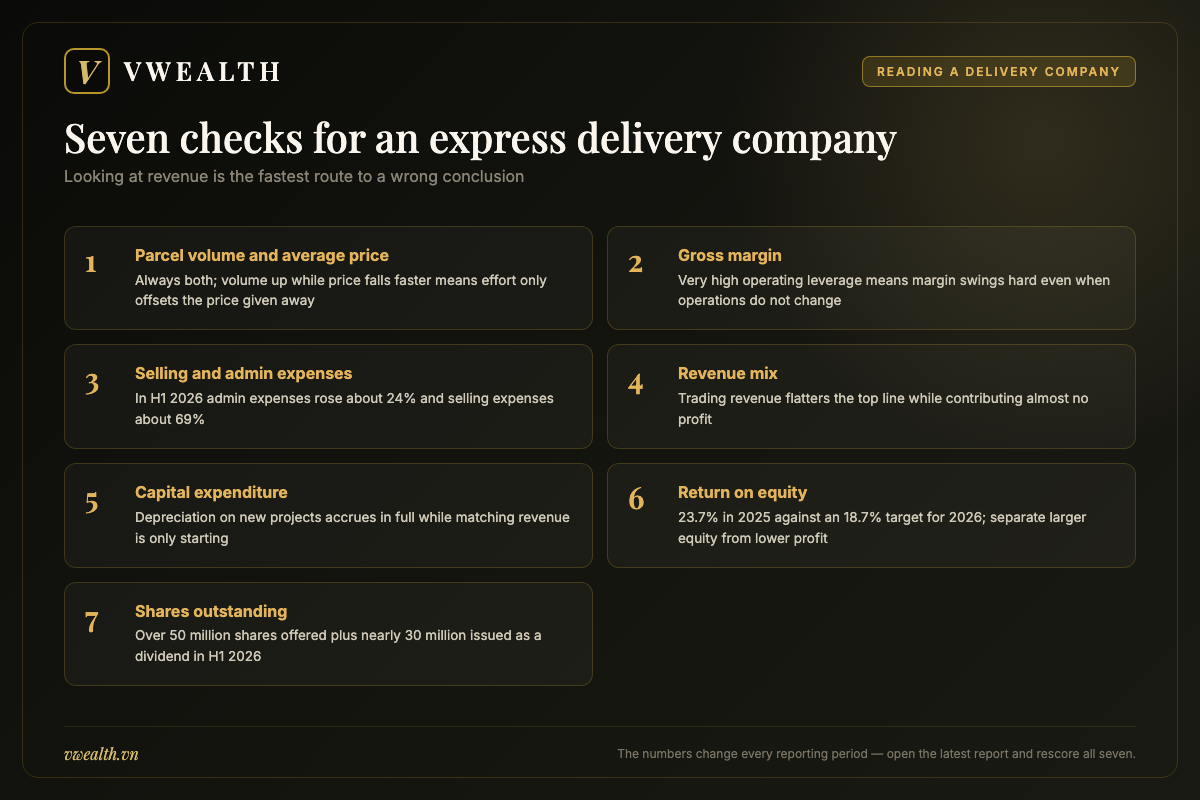
The familiar toolkit — revenue growth, gross margin — applied directly to a delivery company produces wrong conclusions in both directions. This chapter gives you seven places to look, and how to look at them, so you can score VTP at any point in time.
Check 1: parcel volume and average price, always both together
This is the most important pair of metrics, and the pair most investors only half examine.
Delivery revenue equals volume multiplied by average price. Volume rising 33.4% in 2025 is a genuine operational achievement. But if the market’s average price fell more than twenty per cent over the same period, most of the effort to grow volume merely offsets the price that was given away.
The correct approach: each period, find both numbers. If the company does not disclose average price, estimate it by dividing delivery segment revenue by parcel volume. The trend of that ratio across periods tells you whether the company is winning or paying for share with profit.
This is the only metric that answers the central question about this ticker: is volume growth creating value, or buying market share with earnings?
There is a second reason this pair matters more here than at most companies. Market share, the number that generates headlines, is measured in parcels rather than in revenue or profit. A company can therefore report rising market share in every period while its economics deteriorate, and the headline will still read well. Share of a market that is destroying value is not obviously worth having — unless you believe, as management evidently does, that scale reached now converts into pricing power or cost advantage later. That belief is the load-bearing assumption of the entire investment case, and the volume-and-price pair is the only evidence that will confirm or refute it.
Check 2: gross margin and operating leverage
Express delivery has very high operating leverage: most costs are fixed, so once volume passes breakeven each additional parcel contributes strongly to profit, and the reverse is equally true.
This has a consequence you must grasp: a delivery company’s gross margin swings far more than a manufacturer’s even when nothing about operations has changed. An industry-wide price cut can pull gross margin down very fast, and a price recovery can push it up just as fast.
The correct approach: track gross margin across several consecutive periods rather than one, and always ask whether the movement came from pricing or from operating efficiency. Those two causes lead to entirely different investment conclusions.
Check 3: selling expenses and administrative expenses
These are two line items investors often skip, but at a delivery company they matter greatly.
During intense competition, the company must spend more to retain large customers and to expand its base of smaller ones. Selling expenses growing faster than revenue signals that the company is paying more for each dong of revenue it wins.
In the first half of 2026, the company recorded administrative expenses up roughly 24% and selling expenses up roughly 69%, while revenue grew far more slowly. This is the kind of fact to confront rather than skip: it shows the fight for market share is expensive, and the cost appears in exactly these two lines.
The correct approach: compute selling plus administrative expenses as a percentage of revenue across periods. A continuously rising ratio is a more worrying signal than one weak quarter of profit.
Check 4: revenue mix and the trading revenue trap
As chapter three explained, VTP’s revenue blends business types whose margins differ by multiples.
The specific trap is trading revenue: it can represent a large share of the total while contributing almost nothing to profit. An investor who sees revenue rising sharply without decomposing it will misjudge the company’s health.
The clearest evidence is the 2026 plan itself: target revenue of VND 19,519 billion, below the VND 20,684 billion achieved in 2025, while target pre-tax profit of VND 515 billion is essentially flat against the VND 514.57 billion delivered. The company is deliberately cutting revenue that does not earn.
The correct approach: ignore the headline revenue figure and focus on delivery revenue plus warehousing and transport revenue. Those two segments determine enterprise value.
A practical routine: each quarter, note estimated average price per parcel, note gross margin, note the combined selling and administrative expense ratio, and note shares outstanding. Four numbers, five minutes. Together they tell you whether the business is getting better, whether the industry is getting better, and how much of either is reaching you. Everything else in the report is commentary on those four.
Check 5: capital expenditure and the depreciation phase
This is the check that explains why profit comes under pressure exactly when the company is performing well operationally.
The Lang Son logistics park carries total investment of nearly VND 3,300 billion, and the company has broken ground on a Da Nang logistics centre with sharply accelerating disbursement. Every dong invested in fixed assets generates depreciation for years afterward, whether or not the asset is fully utilised.
The mechanism is clear: during construction and early operation, costs are fully incurred while revenue is only starting. Profit is therefore compressed even though the investment itself is sound.
The correct approach: open the cash flow statement, look at cash spent on fixed asset investment during the period, and compare with cash from operating activities. The ratio between them tells you where the company sits in its investment cycle.
Check 6: return on equity and the quality of it
In 2025, Viettel Post’s return on equity reached 23.7%, among the higher figures in Vietnamese logistics. The 2026 plan targets 18.7%.
The gap between those numbers does not entirely reflect a deteriorating business, and you need to understand why. When a company raises fresh equity through share offerings, the denominator of the calculation increases immediately, while profit generated by that new capital takes time to appear. Return on equity therefore falls arithmetically before it falls or rises in substance.
The correct approach: when you see return on equity falling at a company that has just raised capital, separate the two causes — larger equity base or smaller profit.
Check 7: shares outstanding and the pace of dilution
The final check bears most directly on your interest.
In the first half of 2026 the company offered more than 50 million shares to existing shareholders at VND 10,000 per share, then issued nearly 30 million shares as a stock dividend. Charter capital reached roughly VND 2,018.85 billion by August 2026.
The consequence: even when absolute profit rises, earnings per share can stagnate or fall because the share count grows faster. This is what investors overlook when comparing this year’s profit with last year’s.
The correct approach: always compute earnings per share using the weighted average share count after all completed issuances, and ask yourself whether you are prepared to subscribe at the next offering.
A closing note on all seven. None of them require access to management, a broker relationship, or a subscription data terminal. Every one can be computed from the published financial statements and the company’s own disclosures, and the whole exercise takes under half an hour per reporting period. That is unusually accessible for a business this operationally complex, and it means the informational disadvantage a retail investor typically faces is smaller here than in most sectors. The advantage goes to whoever actually does the work rather than to whoever has the better data feed.
The corollary is that the common failure mode with this stock is not lack of information; it is looking at the wrong number. Revenue, market share and parcel counts are all published, all impressive, and all capable of rising while the business earns less. The seven checks above exist precisely to keep you from being persuaded by the impressive numbers when the important ones are moving the other way.
What these seven checks say about Viettel Post’s position
Add them up and the picture is clear. VTP holds a leading market share position, a nationwide network that is hard to replicate, recognised service quality, and a coherent strategy for stepping out of the price war by building logistics infrastructure. That is the asset side.
On the other side is an industry in a fierce price war, very thin margins, selling expenses rising fast, a heavy investment phase compressing profit, and continuous dilution. Both sides are real. The crux is whether you believe today’s infrastructure investment converts into profit within a few years — because that is the entire investment case for this ticker.
How the market treats VTP stock: a story stock in a commodity industry
Every stock has a personality on the tape. For VTP that personality is shaped by one thing: this is a stock the market buys for the future story more than for the current numbers.
A stock priced on expectations
From its very first session on UPCoM in 2018, VTP hit the daily ceiling. When it moved to HOSE in 2024, the reference price of VND 65,400 valued the company at close to VND 8,000 billion.
What stands out is that this valuation has always reflected expectations about the future of Vietnamese e-commerce rather than current profit. With net profit in the hundreds of billions of dong, this stock has never looked cheap on a conventional price-to-earnings basis.
The practical consequence: when the market believes the story, the stock commands a high price; when belief wavers, the correction is severe. This is the character of every stock priced on growth expectations, and it demands that you be very clear about what you are buying.
Why the P/E on this ticker always looks high
Three causes compound, and you should separate them.
The first is that industry margins are structurally thin. A company collecting more than VND 20,000 billion in revenue and earning a few hundred billion has a net margin of only a few per cent — a characteristic of express delivery worldwide, not specific to Vietnam.
The second is the investment phase. Depreciation from new infrastructure projects compresses accounting profit while the corresponding revenue has not yet fully appeared.
The third is the ongoing price war, squeezing margins across the industry at exactly this moment.
A more suitable approach: instead of comparing market capitalisation with a compressed year of profit, ask what margin the company could achieve once the price war ends and the infrastructure projects reach reasonable utilisation. Then build three scenarios around that answer. This is the right way to value a business midway through a model transition.
The personality of VTP stock
Looking back at trading history, a few repeating characteristics are worth knowing in advance.
First, it reacts strongly to news about e-commerce and online marketplaces. Positive news about Vietnamese e-commerce growth tends to lift the stock, and the reverse holds.
Second, it is sensitive to news about price competition. Whenever the market perceives the price war intensifying, the stock comes under visible pressure.
Third, it reacts to news about border trade and border-gate infrastructure — a factor that only appeared after the company announced its border logistics strategy.
Fourth, each rights offering creates short-term price pressure, particularly when the offer price is far below the market price.
Practical notes for investors based outside Vietnam
A few mechanics matter here. Vietnam operates daily price bands, so a stock can hit its limit and effectively stop trading for the session — meaning an order may go unfilled on the day you most want to act. Settlement runs on a T-plus cycle, so shares bought are not immediately available to sell.
Rights offerings deserve particular attention with this name, because VTP has run them repeatedly and at prices well below market. If you cannot participate, your stake is diluted at a steep discount. Confirm with your custodian well before the record date whether you are able to subscribe and what the process is; discovering you cannot on the closing day is an avoidable and expensive surprise.
Service quality as an investable metric
One under-used data source deserves highlighting, because it is unusual for an industry to publish objective comparative performance data at all.
Vietnamese authorities and industry bodies periodically publish assessments comparing delivery operators on measurable dimensions: on-time delivery against committed transit times, and rates of lost or damaged shipments. In published assessments, Viettel Post has featured among the operators recording the lowest rates of lost or damaged items in the market, with some competitors matching it on that measure and others leading on transit time.
Why does this matter to an investor rather than to a customer? Three reasons.
First, it is verification. Every company claims operational excellence in its investor materials; very few industries produce independent numbers that let you check. When a company’s claims and the published data agree, that is a small but real signal about the reliability of management’s other statements.
Second, quality has direct financial consequences. Lost and damaged shipments generate compensation costs, and failed deliveries double the cost of the last mile while producing no additional revenue. An operator with structurally better execution has a lower cost base, not merely a better reputation.
Third, quality is the only lever that can win business in a price war without cutting price. Corporate customers shipping higher-value goods, and platforms handling categories where damage is costly, will pay a premium for reliability. That is where a delivery company escapes commoditisation without needing the industry to change.
When you review this company each period, look for these published assessments alongside the financial statements. They are the closest thing this industry offers to an independent audit of operating capability.
Comparing VTP with other logistics options
| Criterion | VTP | Port and air cargo names | What an investor should conclude |
|---|---|---|---|
| Asset type | Post office network, vehicles, warehouses under construction | Berths, air cargo terminals, fixed infrastructure | VTP’s assets are more flexible but less protected |
| Margins | Very thin, under price competition pressure | Much higher thanks to natural monopoly positions | This is the largest difference between the two groups |
| Growth driver | E-commerce volume and border trade | Import-export turnover and cargo throughput | VTP is tied more to domestic consumption |
| Competition | Very intense, including well-funded foreign players | Limited by location and licensing | VTP has no natural protection like a port |
| Ownership | Controlling shareholder at roughly 61.16% | Varies widely by ticker | VTP’s free float is more constrained |
| Cycle position | Heavy investment phase, profit compressed | Many have passed their large capex phase | VTP requires more patience |
For a concrete comparison, the analysis of GMD and Gemadept describes a logistics company with an almost opposite model: fixed berth assets, high margins from geographic position, but growth tied to trade flows rather than domestic consumption. The analysis of SCS, the Saigon Cargo Service terminal shows a more extreme version of the same principle: an air cargo terminal with very high margins thanks to a near-monopoly position at one airport. And VSC and Viconship gives you the northern port perspective.
Read them side by side and you draw the most important lesson about logistics investing: value depends on how many other people can do the same job you are doing. Ports and cargo terminals are protected by location; delivery networks are not. The sector overview of Vietnamese aviation and logistics stocks places these groups at very different points on that spectrum.
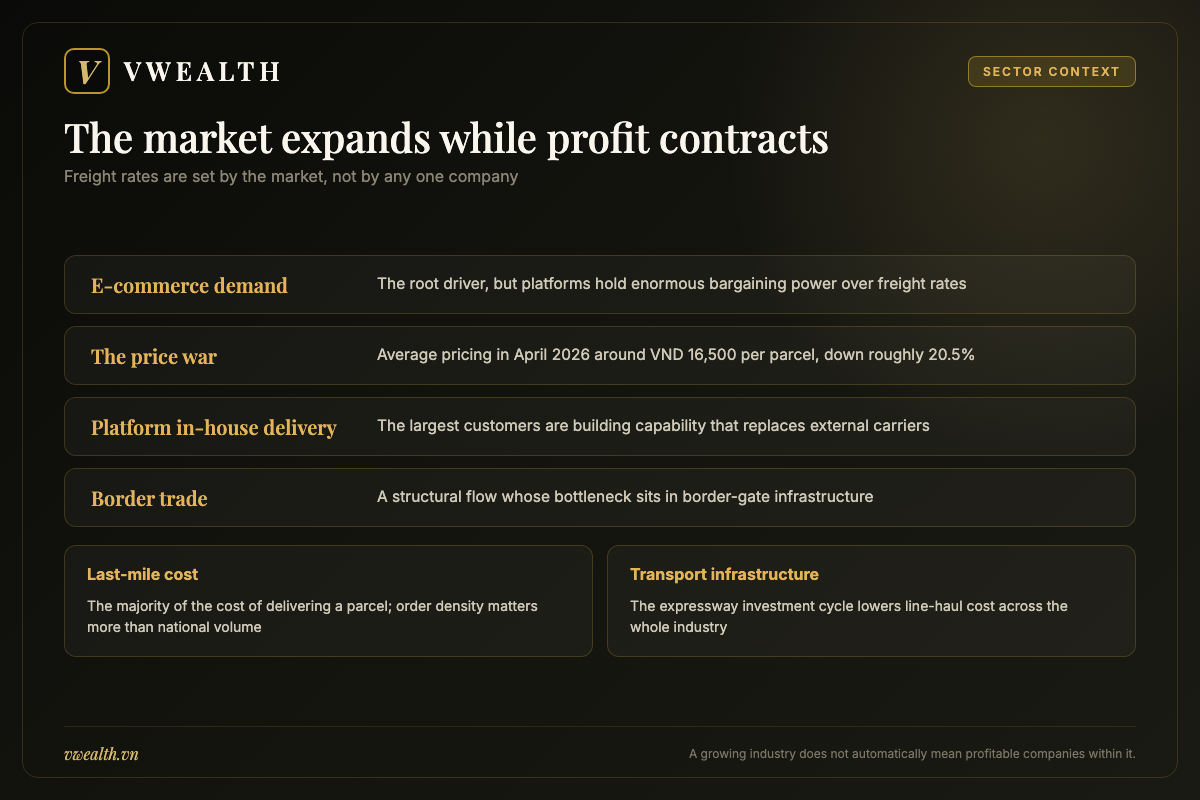
Sector context: the market expands while profit contracts
No company is bigger than its industry. For VTP this is especially true, because the freight rate — the variable that determines profit — is set by the market rather than by the company.
E-commerce: the root driver and also the source of pressure
Demand for delivery services in Vietnam comes primarily from online shopping. The postal market is expanding fast, with parcel counts rising sharply year after year. The broader Vietnamese consumer sector picture and the country’s demographic profile both support the structural case for online consumption growth over the coming decade.
But you must understand the true nature of the relationship. E-commerce platforms are the largest customers of delivery companies, and they hold enormous bargaining power for two reasons: massive order volumes, and the ability to switch provider easily. When one customer accounts for a large share of your volume, that customer sets the price, not you.
This is why an industry with double-digit volume growth has steadily thinning margins. Industry growth does not automatically become profit growth for companies within it.
There is one more dynamic worth naming. Because platforms compete with each other on delivery speed and on shipping subsidies offered to shoppers, the pressure they apply to carriers is not purely about price — it is also about service level. A carrier can be asked to deliver faster, to cover more remote areas, and to handle returns more smoothly, all while accepting a lower rate. Each of those requests raises cost. When you read that a delivery company’s margins compressed, the cause is often this combination rather than the headline rate alone.
The price war and the number to face directly
This is the single most important fact about the current sector environment.
The average shipping price in April 2026 was around VND 16,500 per parcel, down roughly 20.5% from the 2025 average. The strategy of cutting prices to win share is forecast to continue, with delivery operators competing intensely as the market expands rapidly.
Picture what that number means for a business. If average price falls twenty per cent, the company must grow volume roughly twenty-five per cent just to hold revenue flat — before considering profit, since higher volume also raises variable costs. This is the problem the whole industry is solving.
The one bright spot: a prolonged price war usually ends with weaker-capitalised competitors exiting or being absorbed. A company with a solid balance sheet and a shareholder strong enough to endure the period emerges in a materially better position when prices recover. That is a legitimate investment thesis, but it demands a long horizon and tolerance for several weak quarters.
The competitive structure of the market
Vietnam’s express delivery market has an unusual competitive structure compared with other industries.
The first group is domestic delivery companies with long-established networks, of which Viettel Post is the largest. Their advantages are coverage, brand, and corporate client relationships.
The second group is foreign-invested operators, typically backed by regional groups with very deep resources and a willingness to absorb losses for years to win share.
The third group, and the one creating the biggest structural change, is the in-house delivery arms of the e-commerce platforms themselves. When a platform runs its own courier fleet, it is simultaneously customer and competitor to independent delivery companies — and it can direct volume to its own arm.
This is the most important structural risk a VTP investor must understand: volume from e-commerce platforms is not secure volume, because those platforms are building replacement capability. A company overly dependent on a few platforms carries substantial risk.
The correct strategic response is diversifying the source of volume: developing corporate customers outside the platforms, developing logistics services for manufacturers, and building infrastructure assets the platforms cannot replicate themselves. Viettel Post is pursuing all three, and that is worth crediting when you assess management. The overview of Vietnam’s retail sector gives useful context on how online and offline channels are evolving alongside each other.
It is also worth being precise about what “the price war ends” would actually look like, since the bull case depends on it. It does not require prices to rise. It requires them to stop falling, which happens when the marginal competitor can no longer fund losses. Watch for consolidation announcements, for foreign-backed operators scaling back, and for the disappearance of aggressive promotional rates in the market. Those are the observable events that would mark the turn, and they typically appear in industry commentary before they appear in any company’s margin line.
Border trade: a new and structural driver
This part of the context is not yet fully priced by the market, and it relates directly to the company’s new strategy.
Trade between Vietnam and China is very large and structural, tied to Vietnam’s role in regional supply chains. Lang Son is one of the main gateways for that flow, with import-export turnover maintaining growth and cargo vehicle volumes through the province’s border gates rising at double-digit rates.
The bottleneck in that flow for years has been infrastructure: parking, storage, customs procedures and waiting time. A logistics park capable of processing up to 1,500 container trucks a day, with a bonded warehouse, sitting beside the border gate and connected to both the expressway and the international railway, is a direct answer to that bottleneck.
For an investor, the meaning is this: this segment has fundamentally different economics from parcel delivery. It is infrastructure, with high barriers to entry, and it is not subject to the kind of price compression that afflicts a freight rate war. If it reaches reasonable utilisation, it can change the profit structure of the entire company.
Cross-border e-commerce and the low-value goods question
One sector development deserves separate attention because it cuts both ways and is genuinely hard to forecast.
A large and growing share of what Vietnamese consumers buy online originates outside the country, predominantly from China, arriving either through cross-border marketplace platforms or through consolidated import channels. For a delivery company this flow is attractive: the parcels still need domestic last-mile delivery, and the cross-border leg creates demand for exactly the bonded warehousing and customs handling capability that a border-gate logistics park provides.
But the same flow attracts policy attention. Governments across the region have been reconsidering how low-value imported goods are taxed and how quickly they clear customs, on the grounds that very cheap imports compete with domestic producers and that the volume strains customs capacity. Any tightening changes both the volume and the economics of cross-border parcels; any loosening does the opposite.
The honest position for an investor is that this is a genuine two-sided uncertainty rather than a risk with a knowable direction. What you can say with more confidence is structural: whichever way the rules move, physical goods still have to cross a border, be stored, be cleared and be delivered. An operator that owns the infrastructure where that happens is better positioned than one that only owns a fleet of motorbikes, because infrastructure captures value regardless of who is shipping what.
That is, in essence, the argument for the Lang Son investment restated in policy terms. It is also why this article treats the border logistics segment as the most important thing to monitor at this company — more important than any single quarter’s parcel count.
The regulatory framework for postal services
Postal and express delivery in Vietnam is a conditional business, operating under licences issued by the state regulator. This has three implications for investors.
First, there is a real if modest legal barrier for newcomers. Capital alone does not create a nationwide delivery network; an operator must meet licensing, infrastructure and capability conditions. This barrier is not high enough to deter large foreign-backed competitors, but it filters out fragmented small players.
Second, service quality is measured and published. Assessments of on-time delivery rates and rates of lost or damaged items are conducted and made public, creating an objective basis for comparison between operators. For an investor this is a valuable and underused data source: it tells you which company actually operates well, rather than which one markets best.
Third, and most worth monitoring, is the policy direction on e-commerce and cross-border platforms. Changes in tax rules, in customs procedures for low-value goods, or in platform responsibility for fulfilment all feed directly into delivery volumes and cost structures. This is the kind of change markets rarely price promptly, and therefore where a diligent investor can be early.
Transport infrastructure and national logistics costs
The final contextual factor is general infrastructure. Logistics costs in Vietnam have long been assessed as high relative to regional peers as a share of gross domestic product, chiefly because connecting infrastructure has been incomplete.
The current infrastructure cycle — the north-south expressway, ring roads, new ports and airports — reduces line-haul time and cost. For a delivery company this is a tailwind: lower transit cost improves margin directly, in a cost category the company cannot optimise further on its own.
Treat this as a quiet favourable current: it generates no headlines but gradually improves the cost structure of the whole industry over years.
Looking ahead: three scenarios for VTP stock and what triggers each
This section gives no price target, because any number quoted today would be stale before you finished reading. Instead it describes three possible states and lists the specific conditions that let you recognise which one you are in.
Four variables that decide Viettel Post’s future
The first variable is the industry’s average freight rate. This is the largest and lies entirely outside the company’s control. Whether the price war ends sooner or later determines most of the profit trajectory over the next three years.
The second is the utilisation ramp at the logistics infrastructure projects, particularly the Lang Son park and the Da Nang centre.
The third is the degree of dependence on volume from e-commerce platforms, and how fast the company diversifies away from it.
The fourth is the pace of dilution: how much more equity the company must issue to fund its investment plan.
One framing helps hold all four together. Three of the four are outside the company’s control — pricing, platform behaviour, and to a large extent the pace at which a new logistics park fills. Only the fourth, how much equity it issues and on what terms, is fully management’s decision. When you assess this company period by period, judge management primarily on the variable they control and on how well they position for the three they do not.
Bull case: the price war cools just as infrastructure comes online
Conditions: industry average pricing stabilises as weaker-capitalised competitors withdraw, while the Lang Son park reaches high utilisation and the Da Nang centre opens on schedule.
The chain of effects then runs as follows. Delivery margins recover on a much larger volume base — and because this industry has high operating leverage, each percentage point of price recovery produces a strong profit increase. In parallel, the logistics infrastructure segment begins contributing revenue at materially higher margins, changing the profit structure of the whole company.
This is the scenario in which the market re-rates the stock differently, because the investment case shifts from story to numbers.
Early signals: average pricing stops falling across several consecutive periods; gross margin improves; warehousing and infrastructure revenue rises clearly as a share of the total; and selling expenses as a share of revenue begin to decline.
Base case: volume grows, profit moves sideways
This is the scenario this article considers most likely given recent developments.
Here the company keeps taking share faster than the industry, parcel volume grows steadily, and the network expands. But the price war continues, gross margin does not improve, and selling expenses stay elevated to retain customers. At the same time, depreciation from new infrastructure keeps accruing while those projects have not reached optimal utilisation.
The result is a company that is larger in scale and stronger in position, but with absolute profit close to flat. And because the share count has risen after the offerings, earnings per share may fall.
For an investor this carries a consequence worth stating plainly: you are right about the company’s position and still earn nothing, and you must keep waiting. The real question is whether you have the patience for that horizon.
Bear case: a prolonged price war meets volume loss
Conditions: pricing continues to fall while one or more large e-commerce platforms expand their in-house delivery arms, reducing the volume they hand to external operators.
The company then faces pressure from two sides at once. On revenue, volume plateaus exactly as pricing falls. On cost, the network has already been expanded and the fixed costs already incurred — and in an industry with high operating leverage, falling volume drives profit down far faster than revenue.
At the same time the infrastructure projects are in their heaviest depreciation phase. This is a situation where profit can contract materially across several periods, and the company may need to defer subsequent projects.
Early signals: parcel volume growth slowing clearly relative to the market; the revenue share from large customers declining; and gross margin continuing to compress across multiple periods.
The three scenarios summarised
| Scenario | Trigger conditions | What happens to the business | Early signals |
|---|---|---|---|
| Bull | Pricing stabilises as logistics infrastructure comes online | Margins recover on a larger volume base; profit structure changes | Average price stops falling; gross margin improves; warehousing share rises |
| Base | Price war persists while investment continues | Scale and position improve but profit is flat and per-share diluted | Volume growing well while gross margin fails to improve over several periods |
| Bear | Pricing keeps falling as platforms expand in-house delivery | Volume plateaus, operating leverage reverses, profit contracts fast | Volume growing slower than the market; large-customer share declining |
Note what these three share: all revolve around pricing and volume sourcing, not around whether the company operates well or badly. The company is operating well — the industry is in a difficult phase.
So, should you buy VTP stock? A straight answer
Seven chapters in, it is time to put the pieces together. This section weighs both sides, then says who this stock suits and who it absolutely does not.
The bull side: five reasons Viettel Post deserves consideration
First, market share position and the pace of share gains. Roughly 360 million parcels in 2025, up 33.4% — about twice the industry average — lifting share to around 22.3%. In an industry where scale determines cost per parcel, gaining share during a difficult period has lasting value.
Second, a network that is hard to replicate. Roughly 2,200 post offices across all 63 provinces is an asset a new entrant would need years and substantial capital to build, absorbing losses throughout.
Third, recognised service quality. In published assessments of delivery service quality, the company sits among those with the lowest rates of lost or damaged shipments — a factor that matters for corporate clients and higher-value goods.
Fourth, a clear strategy for escaping the price war. The Lang Son logistics park with nearly VND 3,300 billion of investment, a bonded warehouse beside the Huu Nghi border gate, capacity for 1,500 container trucks a day — this is a move from selling a service to owning infrastructure, and infrastructure is not squeezed the way a service is.
Fifth, a controlling shareholder strong enough to endure a long stretch. In a price war, the company with solid financial backing is the one still standing when weaker-capitalised rivals withdraw.
The bear side: six risks you must look at directly
The first risk, and the largest, is the price war. Average shipping pricing in April 2026 was around VND 16,500 per parcel, down roughly 20.5% from the 2025 average, and the trend is forecast to persist. No single company controls this variable.
The second is structurally thin margins. More than VND 20,000 billion of revenue producing a few hundred billion of net profit means even a small movement in costs produces a large movement in profit.
The third is selling and administrative expenses rising fast. In the first half of 2026, administrative expenses rose roughly 24% and selling expenses roughly 69%, far faster than revenue.
The fourth is structural risk from the customers themselves. When e-commerce platforms build in-house delivery arms, they are simultaneously customer and competitor. This risk cannot be neutralised by operating better; it can only be reduced by diversifying volume sources.
The fifth is the heavy investment phase compressing profit. Depreciation from infrastructure projects accrues in full while the corresponding revenue is only starting.
The sixth is dilution. More than 50 million shares offered to holders plus nearly 30 million issued as a dividend in the first half of 2026 is meaningful dilution relative to the size of charter capital.
Bull and bear side by side
| Bull side | Bear side |
|---|---|
| Roughly 360 million parcels in 2025, share to around 22.3% | Average pricing down roughly 20.5%, with the price war set to continue |
| Roughly 2,200 post offices across all 63 provinces, hard to replicate | Structurally very thin margins |
| Service quality among the best on loss and damage rates | Selling and administrative expenses rising faster than revenue |
| Lang Son logistics park moves the company toward owning infrastructure | E-commerce platforms are both customers and competitors |
| Controlling shareholder strong enough to endure a difficult period | Depreciation on new projects compresses profit before revenue arrives |
| An established tradition of paying cash dividends | Substantial dilution from the first-half 2026 issuances |
| Border trade is a new and structural growth driver | Constrained free float with the controlling shareholder near 61.16% |
Who VTP suits, and who it absolutely does not
For a growth investor with a three to five year horizon accepting medium to high risk: VTP is one of the most direct ways to participate in the growth of Vietnamese online consumption. The conditions are that you track average pricing and gross margin every quarter, and accept that profit may move sideways for several years while the infrastructure is built.
For a value investor: this ticker is hard to approach conventionally, because current profit is compressed by both the price war and the depreciation phase. If you want exposure, estimate a normalised margin for the business once the industry stabilises and value on that basis across three scenarios, rather than using the latest period’s earnings.
For an income investor seeking cash yield: the company does pay cash dividends, but look at the whole picture — it is simultaneously paying dividends and raising capital from shareholders, meaning the net cash reaching your pocket is smaller than the dividend figure suggests.
For new investors or anyone with a low risk tolerance: be cautious with a stock priced on expectations in an industry running a price war. If you want exposure to Vietnamese logistics and consumption without single-company risk, start from the broader framework in how to invest in the Vietnam stock market, which covers market access, account opening and diversification for foreign investors.
Four questions to answer before you place an order
Question one: have you calculated average pricing by dividing delivery segment revenue by parcel volume, and looked at the trend across several periods? If not, you do not know whether the company is winning or buying share with profit.
Question two: have you stripped trading revenue out of the total to see the part that actually earns?
Question three: does your buy case depend on the price war ending within a specific window? If so, ask yourself what you would do if it runs three years longer.
Question four: are you prepared to contribute capital at future offerings to maintain your ownership percentage?
How to keep score after you decide
Whatever you conclude, the decision is not a single event. Run a short review list once per reporting period, because the things that would change your mind here are specific and observable.
Watch four items in order. First, estimated average price per parcel and its trend — the single number that governs this business. Second, gross margin, which tells you whether volume growth is converting into value. Third, the share of revenue from warehousing, transport and border-gate infrastructure, which tells you whether the model transition is actually happening. Fourth, shares outstanding, which tells you how much of any improvement reaches each share you hold.
If all four move favourably at once, you are in the bull scenario. If volume keeps growing while the first two deteriorate, you are in the bear case regardless of how impressive the market share headline looks. Most of the time you will be in the base case, and the discipline that matters there is not adding to a position simply because nothing has gone wrong.
Closing: a company changing its trade for the third time
Viettel Post’s story is that of a company that has successfully changed its trade twice and is in the middle of a third change. From distributing printed newspapers to delivering parcels, then from parcel delivery to e-commerce fulfilment, and now from delivery services to owning logistics infrastructure.
Both earlier transitions succeeded, which says a great deal about the organisation’s adaptability. But the third is harder than the first two, because it requires large capital, a long horizon, and it is happening exactly when the core business is under the heaviest pricing pressure it has ever faced. The company must build its future with money earned from a present that is being squeezed.
So, should you buy VTP stock? If you understand that you are buying a company midway through a model transition, accept that profit may move sideways for several years while infrastructure is built, can read average pricing and gross margin rather than just revenue, and are willing to subscribe at future offerings — then VTP is a defensible choice for the long-horizon growth part of a portfolio. If you are buying because e-commerce is booming and therefore assume delivery companies must be highly profitable, you are missing the single most important point: a growing industry does not automatically mean profitable companies within it.
One last thing to take with you: Viettel Post’s network, market share and strategy change slowly, but average pricing, gross margin, the selling expense ratio, logistics park utilisation and shares outstanding change every reporting period. Before you place an order, open the latest analysis report and rescore the seven checks in chapter four. It takes fifteen minutes, and they are the most valuable fifteen minutes in the whole decision. If you do not yet have the tools to do it, create a free vwealth account and let the platform read the reports for you.
This article provides information and analysis for reference purposes only and is not a recommendation to buy or sell any security. All investment decisions are your own and you bear responsibility for their outcomes. Consider consulting a licensed financial adviser before acting.
Research Vietnamese stocks in English with vwealth. Our AI-powered platform turns Vietnamese market data into full English analysis reports — with international payment support and a free 2-month trial for new accounts. Create your free account and read the latest reports.