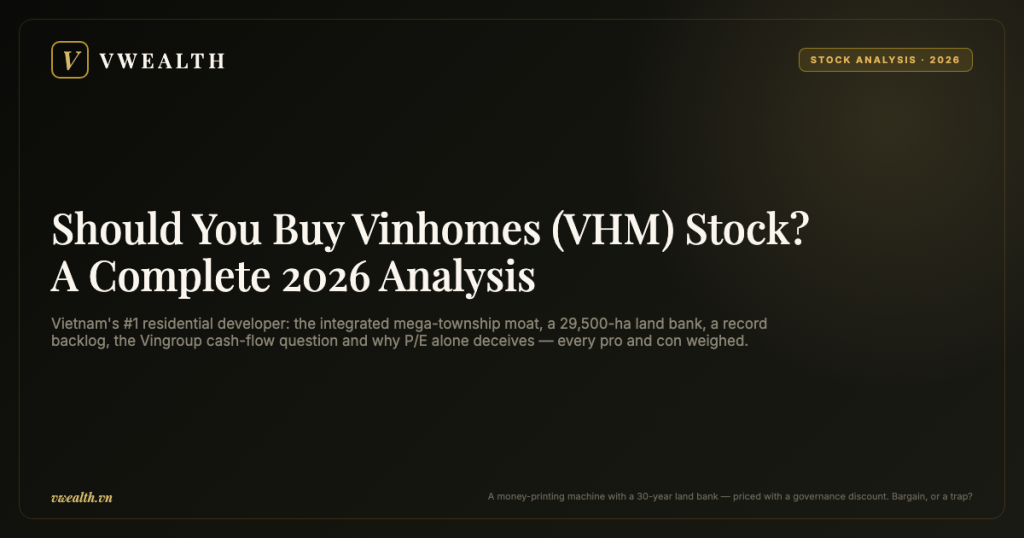
If you stand in the heart of Hanoi or Saigon and look out at the “cities within a city” rising on former marshland, deserted islands or long-forgotten fringes, chances are you’re looking at the product of a single business: Vinhomes Joint Stock Company (HOSE: VHM). This is not merely a real-estate developer. It is Vietnam’s number-one residential real-estate developer by almost every measure you can think of: land bank, presales, absolute profit, and weight on the index. Among investors, VHM is often given a nickname that’s no exaggeration: the “money-printing machine” of the Vingroup ecosystem.
The numbers speak louder than any praise. Closing 2025, Vinhomes recorded record presales of about 205,300 billion dong, up as much as 98% from 2024 — that is, nearly double in a single year. Consolidated after-tax profit reached 42,111 billion dong, the highest in the company’s history, about 1.6 billion USD; consolidated net revenue exceeded 154,000 billion dong. In Q4 2025 alone, for the first time a Vietnamese residential real-estate business recorded revenue over 100,000 billion dong in a single quarter. Behind those numbers is an unrecognized-revenue backlog of over 186,000 billion dong — mostly sold but not yet handed over, meaning near-future profit already “locked” on the books.
And then, right at the market’s most euphoric moment, VHM stock closed the 19 June 2026 session at 145,300 dong per share, having just corrected about 4.4% after a hot run around record-dividend news and the AGM. That jolt poses exactly the question you’re probably carrying as you open this article: should you buy VHM at the current price, and which kind of investor does this stock really suit?
That question can’t be answered properly if you look only at the blinking price board. A large-cap stock like VHM must be understood from the roots: where it came from, how its business model differs, which generations of projects it passed through to become today’s “kingpin,” and what its enormous land bank means for your wallet. In this full analysis, we’ll dissect each layer. And to begin, nothing makes more sense than returning to the origin — because Vinhomes’ founding history is the map that lets you read its future direction.
VHM market data (updated 19 June 2026)
| Current price | 145,300đ | 2025 presales | ~205,300 bn (record) |
| Change (June) | −4.41% | 2025 after-tax profit | ~42,000 bn |
| P/E | P/B | ~15x | once <1x | Backlog | ~186,000 bn |
Source: VWealth price data + Vinhomes 2025 reports. Figures move session to session — for reference only.
History and evolution
To understand why VHM today can “print” over 40,000 billion dong of profit a year, you need to step back and see that Vinhomes is not a lucky real-estate startup. It is the crystallization of nearly two decades of accumulating land bank, capital and mega-township operating experience — spun off, repackaged and listed at the ripest moment.
From Vingroup’s residential real-estate segment
Vinhomes did not arise from nothing. The “Vinhomes” brand was originally the name of the residential real-estate product line of Vingroup — the empire built by billionaire Pham Nhat Vuong, starting from Vincom (malls) and Vinpearl (resorts) before pushing deep into housing. For years, projects bearing the Vinhomes name were scattered within Vingroup’s structure, alongside retail, tourism, healthcare, education and later the VinFast auto business.
The organizational turning point was Vingroup’s decision to spin off the entire residential real-estate development segment into an independent legal entity: Vinhomes Joint Stock Company. This move was not just a corporate-chart reshuffle. It allowed the group’s “golden-egg” segment to be valued separately, drew international capital directly into housing, and made transparent the cash flows of an activity very hard to isolate when lumped inside a multi-industry conglomerate. For you — an investor — this means: when you buy VHM, you’re buying the residential real-estate machine on its own, not bearing the joint profit-and-loss of VinFast or other heavily-investing segments in the Vingroup family.
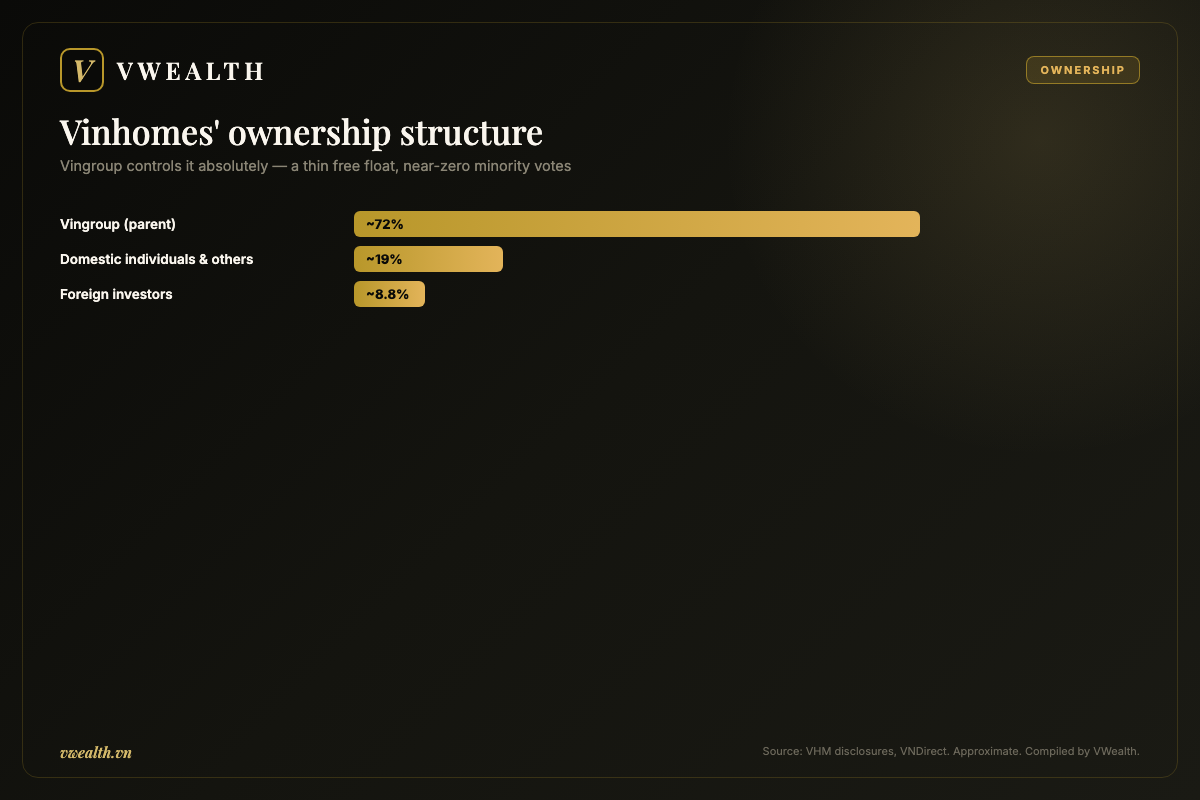
To this day, the “parent–child” relationship remains very tight. Vingroup (ticker VIC) owns about 69–72% of Vinhomes’ charter capital (at some points recorded higher, around 73.5% depending on the calculation), acting as parent company and absolute controlling shareholder. This is a point to keep in mind throughout: VHM is both a profit engine and a “cash source” the parent can rely on — for instance, in the record 2026 dividend, Vingroup alone is expected to receive about 18,000 billion dong thanks to this holding.
The “integrated mega-township” model — what makes Vinhomes different from the rest
If it only had large scale, Vinhomes still wouldn’t be special enough. What makes the difference — and is also the key to understanding why VHM’s margins are abnormally high versus the industry — is the “integrated mega-township” model.
An ordinary developer buys a plot of a few hectares, builds an apartment tower or a townhouse block, sells it all, then goes looking for the next project. Vinhomes does it entirely differently. They assemble enormous land banks — usually hundreds of hectares, some measured in thousands — then master-plan a whole “miniature city” on them: apartments, villas, shophouses, mixed with schools (Vinschool), hospitals (Vinmec), malls (Vincom Mega Mall), parks, lakes, amusement parks (VinWonders) and greenery.
The philosophy here can be summed up in the very spirit Vinhomes itself promoted at its early projects:
“Resort living in the heart of the city” — where up to 70% of the area is devoted to landscaping, greenery and shared space, instead of being filled with concrete to maximize the number of units sold.
This approach creates three economic advantages you should grasp. First, because customers buy not just a home but a whole self-contained living ecosystem, Vinhomes can price higher and sell faster — the foundation for thick margins. Second, a mega-township can be exploited over many years, many subzones and many sales phases, giving a long, predictable revenue stream. Third, the infrastructure and amenities run by the Vingroup family (schools, hospitals, malls) make the real-estate value self-appreciate over time, creating a “loop” that retains residents and drives secondary prices. This is something a small developer can almost never replicate, and the reason VHM is seen as being “in a class of its own” on the exchange.
Project generations — Vinhomes’ evolution map
The easiest way to feel Vinhomes’ scale and growth momentum is to follow the flow of project generations. Each generation is not only larger in area, but shows an increasingly “infinite” ambition in land bank.
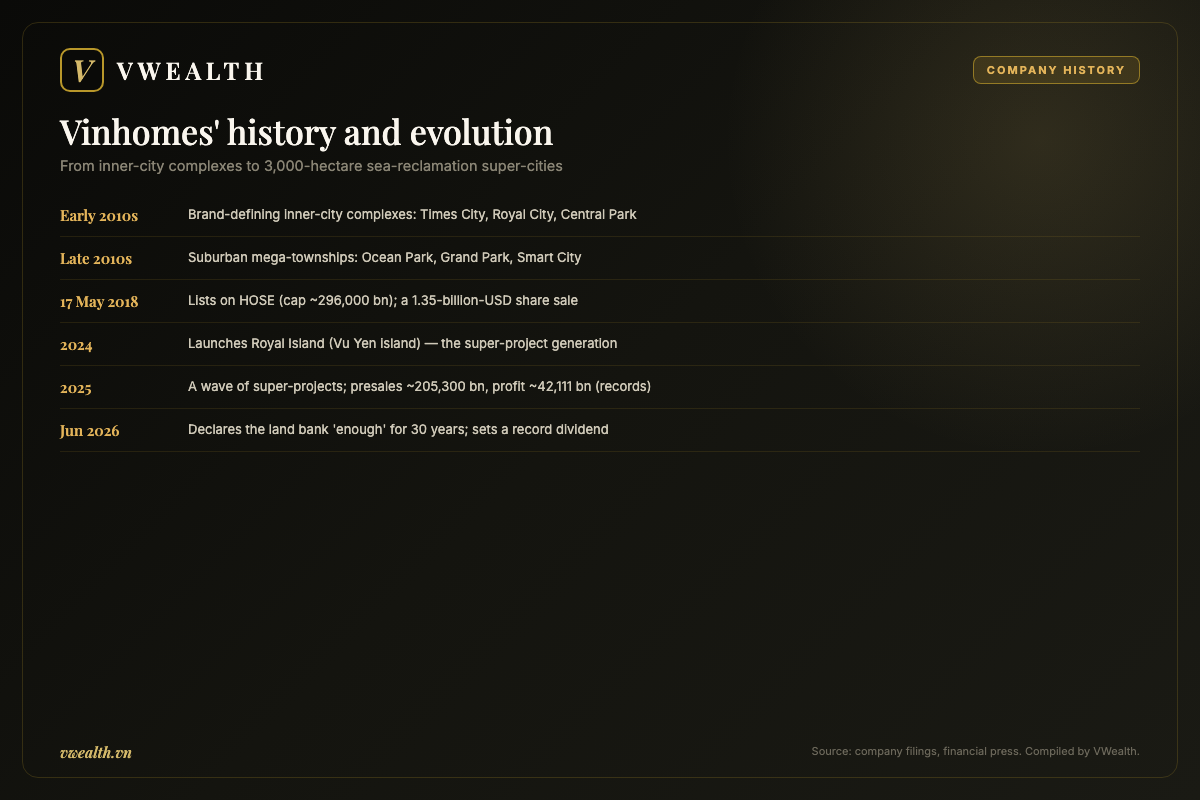
The first generation — inner-city complexes (early 2010s): These are the brand-defining projects. Vinhomes Times City (Hanoi) — the capital’s first multifunctional urban complex, integrating an underground Vincom Mega Mall, a Vinmec hospital, a Vinschool and an aquarium. Vinhomes Royal City — a “mini Europe” with an underground shopping and ice-skating area. Vinhomes Central Park (HCMC) — inspired by New York’s Central Park, tied to the iconic Landmark 81 tower. These projects proved Vinhomes could turn expensive inner-city land into best-selling premium complexes.
The second generation — suburban mega-townships (late 2010s to early 2020s): This was the leap in scale. Vinhomes Ocean Park (Gia Lam, Hanoi) spanning up to 420 ha, total investment over 87,000 billion dong, notable for an artificial “saltwater lake-sea.” Vinhomes Grand Park (HCMC) and Vinhomes Smart City (Nam Tu Liem, Hanoi, 280 ha, about 80,000 billion dong of capital) brought the mega-township concept to the fringes, where land is cheaper but Vinhomes self-builds the infrastructure and amenities to “pull” residents in. This was the phase where the mega-township model truly revealed its revenue-generating power.
The third generation — super-projects and urban islands (from 2024 onward): Ambition was pushed to a new level. Vinhomes Royal Island (Vu Yen, Hai Phong) — launched in March 2024 — is an “island city” model within the urban area, expected to supply about 8,300 products including eco-villas, shophouses and townhouses, plus a VinWonders amusement park. In the same group are a series of super-projects launched in 2025: Vinhomes Wonder City (Dan Phuong, Hanoi, ~133 ha), Vinhomes Golden City (Hai Phong, 240 ha), Vinhomes Green City (Tay Ninh, ~197 ha) and especially Vinhomes Green Paradise (Can Gio) with an enormous scale of about 2,870 ha. The Vinhomes Co Loa project (Dong Anh, Hanoi, 265 ha) is also among the strategic drivers. It’s precisely these super-projects of this generation that directly caused 2025 presales to explode to nearly double.
Note the logic running throughout: from inner-city complexes → suburban mega-townships → islands and super-cities, each step Vinhomes expands notably in area and “self-creates” value in lands the market didn’t previously price highly. For investors, this is an important signal: VHM’s growth doesn’t depend on the market having ready cheap, beautiful land, but comes from the ability to turn “raw” land into a valued city.
The 2018 listing milestone — one of the largest equity deals
On 17 May 2018, VHM shares officially debuted on HOSE at a reference price of 92,100 dong per share. On the very first trading day, Vinhomes’ market cap reached about 296,000 billion dong — immediately placing the company among the largest businesses on Vietnam’s stock market.
More important than the listing itself was the accompanying share sale. Vinhomes distributed nearly 268 million shares to investors via negotiated deals, at a total value of about 30,700 billion dong (equivalent to 1.35 billion USD) — the largest equity deal in years and honored by the international financial community: IFR Asia named it “Frontier Markets Equity Issue 2018,” The Asset voted it “Best IPO in Vietnam,” and Finance Asia ranked it “Best Vietnam Deal.” In other words, right upon listing, VHM was infused with large foreign capital and “stamped” as a regional-scale deal.
The table below summarizes the historical milestones you should remember:
| Milestone | Event | Meaning for investors |
|---|---|---|
| Early 2010s | Vinhomes shapes the brand via Times City, Royal City, Central Park | Proves capacity to develop premium inner-city complexes |
| Late 2010s – early 2020s | Suburban mega-townships: Ocean Park, Grand Park, Smart City | The mega-township model unleashes revenue-generating power |
| 17 May 2018 | HOSE listing, cap ~296,000 bn dong; 1.35-billion-USD share sale | Enters the largest-cap group, draws foreign capital, internationally honored |
| 2024 | Launches Vinhomes Royal Island (Vu Yen island, Hai Phong) | Begins the “super-project” and urban-island generation |
| 2025 | Launches a series of super-projects; presales ~205,300 bn, profit ~42,111 bn | Double record of sales and profit, nearly double the prior year |
| Jun 2026 | Declares it will stop expanding the land bank as it’s “enough”; sets a record dividend | Land bank enough for 5–7 years; shifts focus to exploitation |
The VN30 pillar role and weight on the market
After listing, VHM quickly became one of the pillar stocks of the VN30 basket — the 30 largest-cap, most-liquid stocks on HOSE. This has a practical consequence you need to understand if you plan to invest: VHM is not just a stock, it’s a “locomotive” of the VN-Index. In some sessions, the “Vin family” trio (VIC, VHM, VRE) alone pulled the overall index up over 30 points; VHM at times contributed nearly 9 points to the VN-Index.
This weight is a double-edged sword. The upside: VHM is always in the sights of large funds, index funds (ETFs) and foreigners, so liquidity is abundant and you can easily buy and sell in size. The point to note: as a pillar, VHM is also a target for large money flows in and out; the 4.4% correction on 19 June 2026 after a hot run, or sessions of heavy foreign selling, show VHM’s volatility can be fast and wide-ranging. If you’re faint-hearted before short-term jolts, this is something to weigh.
An enormous land bank — a “granary” for the next 30 years
If you had to choose one number to understand why Vinhomes is valued differently, it’s the land bank. As of end-2025, Vinhomes owned the largest land bank in Vietnam’s real-estate market, about 29,500 ha. Adding nearly 20 projects in the procedural pipeline with a total area over 20,000 ha, the total potential land bank could reach about 49,500 ha.
That land bank is so large that, in June 2026, per the direction of Vingroup Chairman Pham Nhat Vuong, Vinhomes declared it would stop expanding its land bank in Vietnam because it’s “enough” — they’ve accumulated enough land to continuously develop projects for about the next 30 years. This is a rare declaration in the industry: most developers must race to acquire land, while Vinhomes affirms it’s already sated and is shifting to an exploitation phase.
For you, this enormous land bank has three layers of meaning. One, it’s a “growth cushion” — VHM’s sales and profit for many years don’t depend on whether it can buy new land, only on executing and selling from its existing stock. Two, the land was accumulated earlier at low cost, so when launched at today’s market prices, margins have very wide room — the root of the over-42,000-billion profit. Three, ceasing to “burn money” on land makes Vinhomes’ cash flow more abundant, opening the way for large dividends — like the record dividend plan the market was buzzing about in 2026.
What this journey means for your investment decision
Summing up the whole history, you see an impressive growth line: born from Vingroup’s housing segment, spun off and listed via a regional-scale deal, passing through three increasingly large project generations, rising to a VN30 pillar, and now sitting on enough land for three decades. This is not the story of a business searching for a foothold — but of a business already in the number-one position and optimizing that position.
But a glorious history doesn’t automatically turn into profit for shareholders. A 30-year land bank has value only if developed at the right pace; thick margins are durable only if the real-estate market absorbs well; and a machine as large as Vinhomes depends heavily on the quality and vision of those at the helm. The 19 June 2026 price correction reminds you that valuation at the peak always demands clear-headedness. So before we get to the financial numbers, valuation and buy–sell recommendations, we need to scrutinize the brain running this machine. That’s the subject of the next section: Leadership.
Leadership and the relationship with Vingroup
When you hold VHM shares, you’re not just buying Vietnam’s largest real-estate developer. You’re indirectly betting on one of the most complex parent–child relationships on the exchange: Vinhomes is the “golden-egg child” of billionaire Pham Nhat Vuong’s Vingroup (ticker VIC). Understanding the nature of this bond — what it gives you and what it takes from you — matters far more than reading a dry P/E table. In this section, as someone who has followed the Vingroup ecosystem for years, I want to sit down and dissect each layer with you: who runs Vinhomes, how the tie to the parent really operates, and where the points are that you must scrutinize before putting money in.
Ownership structure: who really holds Vinhomes
The first point, and the one that governs everything: Vinhomes is not a company with dispersed ownership. Per disclosures and market analysts, Vingroup holds the overwhelming share of Vinhomes’ charter capital — the figure cited is in the range of about 69–73% in recent periods, and after buying about 370 million more shares, some analysts (like VNDirect) project this could edge up to around 75.7%. You should read these numbers cautiously — the ownership ratio fluctuates with each issuance, treasury-share purchase and stock dividend, so always cross-check the latest governance report when making decisions. But the essence doesn’t change: Vingroup is the absolute controlling shareholder.
What does this mean for you, an individual investor? It means the truly freely-tradable shares on the market (free float) are quite thin relative to VHM’s enormous market cap. The rest, after subtracting Vingroup’s stake, is divided among foreigners and domestic investors. A thin free float has two sides: liquidity can swing hard when large money flows in and out, and more importantly — every AGM resolution is almost predetermined by the parent’s votes. You’re a shareholder, but your voting voice, in reality, is very small.
Vinhomes’ leadership: “Vingroup people”
One trait to grasp about Vinhomes’ leadership is the internal rotation within the Vingroup ecosystem. This is not a company recruiting its CEO from the external labor market; senior leadership seats are usually coordinated among the group’s pillars.
Per disclosures, the Vinhomes Board Chairman seat is currently held by Mr. Pham Thieu Hoa. The press calls Mr. Hoa one of the “founding stalwarts” long attached to the Vingroup family, having held the Vinhomes CEO role before being elected Chairman (replacing his predecessor Ms. Nguyen Dieu Linh). Someone rising from an executive role into the Chairman’s seat shows very strong internal succession.
The CEO seat — the person directly steering daily business — is entrusted to Ms. Nguyen Thu Hang. Per disclosures, Ms. Hang was appointed Vinhomes CEO around May 2022 and joined the Board as a member from 2023. Ms. Hang is a face regularly appearing in reports tied to the tens-of-thousands-of-billions profit Vinhomes brings in. I stress: these names and titles can change each AGM, so before investing, verify the Board and management list in the latest governance/annual report — don’t trust an old article.
On compensation, reports show pay for Vinhomes’ leadership is among the market’s highest — total Board compensation was once cited around 20 billion dong a year, with the top figure receiving several billion dong. Notably, in some periods the CEO’s income even exceeded the Chairman’s — reflecting that Vinhomes pays by actual executive role rather than by title. For you, this is a neutral signal: high pay paired with high profit results is acceptable, but it also reminds you this is an apparatus held firmly in the hands of people loyal to the parent.
The crux to engrave: Vinhomes’ leadership is skilled and experienced, but they are “Vingroup people.” When the interests of small VHM shareholders and the interests of the parent conflict, you should not expect management to side with the minority.
The parent–child relationship with Vingroup: a double-edged sword
This is the most important part, and I want you to view it evenly, both the bright and the dark side.
The bright side: enormous backing from the parent
Being Vingroup’s “child” gives Vinhomes advantages no domestic rival can match. First is the land bank. Many of Vinhomes’ mega-projects originate from the parent and family members developing the legal framework and clearing the site, then transferring it. A classic example is the Vinhomes Co Loa (Vinhomes Global Gate) project tied to VEF — Vingroup planned to transfer the related capital/shares to Vinhomes “at cost” when the project entered development. This mechanism gives Vinhomes a ready “project stock” to keep launching, instead of having to bid for land from scratch.
Second is brand and operating resources. The “Vinhomes” name comes with the Vinschool (education), Vinmec (healthcare), Vincom Retail (malls) ecosystem, creating an “all-in-one” mega-township for which homebuyers are willing to pay more. This ecosystem advantage is a very large intangible asset, and it comes directly from being a link in Vingroup.
Notably, Vinhomes’ leadership itself has affirmed the company is capable of executing independent projects even without Vingroup support. That’s a shareholder-reassuring statement, and it shows Vinhomes wants to build the image of a self-sufficient business. But you should read this statement with healthy skepticism — being self-sufficient in construction capacity is one thing, being independent in land-bank and capital sources is another.
The dark side: profit “siphoned” up to fund the group’s ambitions
This is the biggest risk a VHM investor must face squarely. Vinhomes is the money-printing machine of the whole Vingroup family — it generates real profit, real cash flow. Meanwhile, the parent Vingroup is pouring enormous resources into VinFast — the electric-vehicle segment that is capital-hungry and unprofitable for years. The natural question: is Vinhomes’ rich cash flow flowing upward to shoulder the group’s other ambitions?
The mechanism of cash flowing up is mainly through two channels. The first, and most obvious, is dividends. When Vingroup holds about 72% of Vinhomes, of every dong of dividend Vinhomes pays, nearly three-quarters flows straight to the parent’s coffers. In 2025, Vinhomes announced a cash dividend of 60% — that is, 6,000 dong per share, with a total scale of about 24,600 billion dong, described as the largest cash payout in the company’s history. Vingroup alone is estimated to receive about 18,000 billion dong. Interestingly, Vinhomes paid almost no cash dividend during 2022–2024 (the most recent before that was a 2,000-dong-per-share dividend for FY2021). Suddenly unleashing a record cash payout right when the parent needs capital for big ambitions is a fact you should question yourself.
The second channel, more subtle, is internal transactions and lending. I’ll analyze this in detail below.
| Dividend/cash-flow fact | Content | Meaning for small shareholders |
|---|---|---|
| Cash dividend 2021 | ~2,000 dong/share | A modest level |
| Cash dividend 2022–2024 | Almost no cash paid | Retaining profit to reinvest |
| Cash dividend 2025 | 6,000 dong/share (~24,600 bn dong) | Record; ~18,000 bn to Vingroup |
| Undistributed after-tax profit end-2025 | Over 202,000 bn dong (per disclosure) | A “reservoir” for upcoming payouts |
Related-party transactions: where investors must scrutinize most
If you only have time to scrutinize one thing in Vinhomes’ financials, scrutinize the related-party transactions note. This is where the nature of the parent–child relationship is revealed most clearly.
There are two main types of internal transactions you need to understand. The first is business cooperation contracts (BCCs): in many projects, Vinhomes plays the main role in capital and development, in exchange taking most of the project profit — analyses cite Vinhomes taking around 90–99% of a project’s profit. The BCC mechanism lets Vinhomes book large revenue/profit without necessarily holding the entire project’s legal title. For shareholders, this is both a plus (Vinhomes takes the best part) and a point for caution (a complex structure, hard to isolate real risk).
The second type is internal lending and project acquisitions. Vinhomes lends to other member units in the Vingroup family at rates described as at commercial levels; it also acquires shares/projects from the parent (like the Co Loa/VEF case). The point you must question is: how large are the receivables and loans to related parties versus equity? Are the rates truly “market”? Is the project-acquisition price “at cost” truly fair to small VHM shareholders, or is it favoring cash flow to the group?
My principle when reading a business within a large group: revenue and profit can be pretty, but if a large part of assets sits in “related-party receivables” and “internal lending,” then the quality of that profit should be discounted in your mind. Money on paper is not yet money in the shareholder’s pocket.
The conflict-of-interest risk here is real and structural, not speculation. When the same group of people (led by Mr. Pham Nhat Vuong) controls both Vingroup and Vinhomes, every internal transaction — from project-transfer prices, lending rates, to the timing and scale of dividends — can be arranged to optimize for the whole group’s interest, which is not always aligned with the interests of VHM minority shareholders alone. This is the “governance discount” you should subtract from the valuation.
Strategic dependence on Mr. Pham Nhat Vuong
A non-financial but unignorable risk: Vinhomes, like the whole Vingroup family, is tightly tied to the vision and reputation of one individual — Mr. Pham Nhat Vuong. He decides the whole group’s capital-allocation strategy: how much to pour into VinFast, how much to take from Vinhomes, which fields to expand into (like high-speed rail with VinSpeed, where a Vinhomes executive was also moved over). This “key-man risk” is a double-edged sword: it’s the engine of blazing growth, but it also concentrates risk into one point. Any change related to Mr. Vuong’s role, health or strategic decisions can directly impact VHM’s price in ways pure fundamental analysis can’t foresee.
Treasury shares: when the group steps in to support the price
There’s an event you should remember as evidence of both the bright and dark side of this structure. In late 2024, Vinhomes executed the largest treasury-share buyback in the history of Vietnam’s stock market: registering to buy up to 370 million shares, and by the end of the trading period (about 23 Oct–21 Nov) had bought about 247 million shares — about 66.75% of the registered amount. The stated reason was that VHM’s price was below intrinsic value, so buying back would “protect the company’s and shareholders’ interests.” In fact, from the announcement of the plan, VHM’s price rose strongly — at one point up about 38%.
This is good news for you short-term: the business has a “cash chest” large enough to confidently support the price, and this move usually creates psychological momentum. But look further: a company aggressively using cash to buy treasury shares instead of pouring it all into project development also shows that managing the share price and large-shareholder interests are placed very high. As Vingroup’s ownership gradually rises (partly thanks to share purchases), control becomes more concentrated — reinforcing exactly the governance risk we just discussed.
The bottom line: what are you buying when you buy VHM?
To sum up for you to carry along: buying VHM is buying an industry-leading real-estate business, with seasoned leadership (Chairman Pham Thieu Hoa, CEO Nguyen Thu Hang — always verify against the latest report), backed by Vingroup’s enormous land bank, brand and ecosystem. But that package of advantages comes with a “membership fee”: cash flow can be coordinated up to the parent via dividends and internal transactions, your voting rights have almost no weight, and the whole ship depends on one individual’s steering. That’s not exactly a reason to avoid VHM — many shareholders still benefit greatly from this stock — but it’s a reason to demand a clearer “margin of safety” on valuation, and to read the related-party note in each financial report as the most important part.
Having understood “who steers and steers for whose interest,” the next step is to see how that cash-generating machine operates on the ground — that is, Vinhomes’ products and mega-townships, where all the real profit is born. That’s the subject of the next section.
Products and mega-townships

If you want to understand why Vinhomes (ticker VHM) is consistently the most profitable real-estate business on Vietnam’s stock market, you shouldn’t start from the balance sheet. You should start from a very everyday question: why is a family willing to pay 80 million dong per square meter for an apartment at Grand Park, while a few kilometers away there are projects at half the price? The answer lies entirely in this chapter. VHM’s whole earning power comes not from selling bricks and concrete, but from something far harder to copy: the ability to create a complete “miniature city,” where buyers purchase not just a place to live but an entire lifestyle. Once you grasp this logic, all the financial numbers in later sections become surprisingly easy to read.
In this section, I’ll dissect three layers with you: first, the “integrated mega-township” model — VHM’s core money-printing machine; second, the three product segments spanning from luxury to social housing; and third, the portfolio of key mega-projects carrying revenue, along with the enormous land bank behind them as an “ammunition depot” for years of growth. Finally, I’ll show you how this model and land bank create an “economic moat” — what keeps rivals at bay.
The “integrated mega-township” model — why it prints high margins
Imagine two developers each with a 100-ha plot on the outskirts. Developer A builds homes, sells them, then leaves. Residents move in and must fend for themselves: which school for the kids, where to see a doctor, where to shop on weekends, where’s the park to jog. Developer B does it entirely differently. Right from the master plan, B has embedded into the plot a Vinschool inter-level school, a Vinmec hospital or clinic, a Vincom mall, a system of parks, retention lakes, internal roads, and a management apparatus at premium-service standard. Vinhomes is Developer B — and that’s the whole secret.
What matters here isn’t “more amenities is nicer.” The core is that the three pillars Vinschool (education), Vinmec (healthcare) and Vincom (retail) belong to the same Vingroup ecosystem. When VHM plants a Vinschool and a Vinmec hospital into a project, they don’t have to negotiate with a third party, wait for a partner, or share profit externally. They just coordinate internally within the group. This closed “three-pillar” advantage can be replicated by almost no other developer in Vietnam, because no one else has a chain of schools, a chain of hospitals, and a chain of malls large and branded enough to attach to a residential project.
The economic impact of this on VHM plays out on two fronts you need to distinguish clearly:
- Raising the selling price (the margin side). An apartment in an “empty” development and an apartment in a mega-township with a ready international school, hospital, mall and parks are two products entirely different in perceived value. Buyers pay extra for convenience, for peace of mind about their children’s living environment, for liquidity on resale. That “extra” is the margin VHM pockets, because the land and construction cost of the housing portion doesn’t rise proportionally.
- Selling fast (the capital-turnover side). A high margin that sells slowly doesn’t produce good profit, because capital is buried and interest erodes it. The integrated amenity system makes Vinhomes products appealing, and brand trust helps them sell fast from the very first launch phase, usually through a deposit–phased-launch format. Selling fast means cash comes back early, capital turns over many times, and each turn breeds more profit.
Pin this formula firmly, because it’s the key to the whole analysis: high margin multiplied by fast capital turnover = superior return on capital. The integrated mega-township optimizes both sides at once. That’s why in 2025, VHM recorded consolidated net revenue of about 153,271 billion dong, up nearly 50% year on year, and after-tax profit of 43,335 billion dong — numbers I’ll analyze in detail in the “Financial position and health” section.
A little-noticed angle: integrated amenities are also a “self-generating value machine.” When residents move in, Vinschool has students, Vincom has customers, Vinmec has patients — these service segments self-profit and simultaneously bring the township “alive,” pulling later launch phases’ prices higher than earlier ones. VHM is both the home-seller and the beneficiary of the very bustle it creates. That’s a self-reinforcing loop an ordinary developer lacks.
Three segments: from luxury to Happy Home social housing
A common mistake in viewing VHM is thinking it’s only a rich-people’s brand. In fact, Vinhomes’ product portfolio is designed like a funnel covering almost the entire housing-demand pyramid, and you need to understand this structure to correctly assess the business’s market potential.
- The premium – luxury segment. This is the brand’s “face,” concentrated in expensive apartment and villa lines (e.g. tiers like Diamond for luxury), low-rise villas and shophouses in large mega-townships. This segment has the highest margin, where VHM “squeezes” maximum value from the brand and class amenities like golf courses, marinas and equestrian academies.
- The mid-range segment. This is the core generating large sales by volume — mid-tier apartment lines (e.g. Sapphire, Ruby) in mega-townships like Smart City or Grand Park, where a single project can release tens of thousands of units. The margin per unit is lower than luxury, but the massive sales scale compensates, and this is the segment with the most durable real demand from the urban middle class.
- Happy Home social housing (a new segment). This is a strategic move you should watch closely. VHM targets developing 500,000 affordable homes over about 5 years, with prices ranging from about 300 million to 950 million dong per unit. Each Happy Home project is around 50–60 ha on the fringes of large cities. The reason VHM can sell so cheaply, per management, is that social-housing land is state-allocated, designs are heavily optimized, and importantly VHM has large-scale construction advantages to pull costs down.
For you — an investor valuing the stock — the Happy Home segment has a double meaning. On one hand, its margin is much thinner than luxury, so don’t expect it to “breed” profit like Royal Island. On the other, it opens an enormous market by volume (affordable-housing demand always exceeds supply), helps VHM leverage its construction and materials-purchasing capacity at super-large scale, and builds good relations with authorities — very valuable when seeking approvals for high-profit commercial mega-projects. View Happy Home as a “long-term runway” rather than an “instant profit engine.”
Key mega-projects — where revenue is truly created
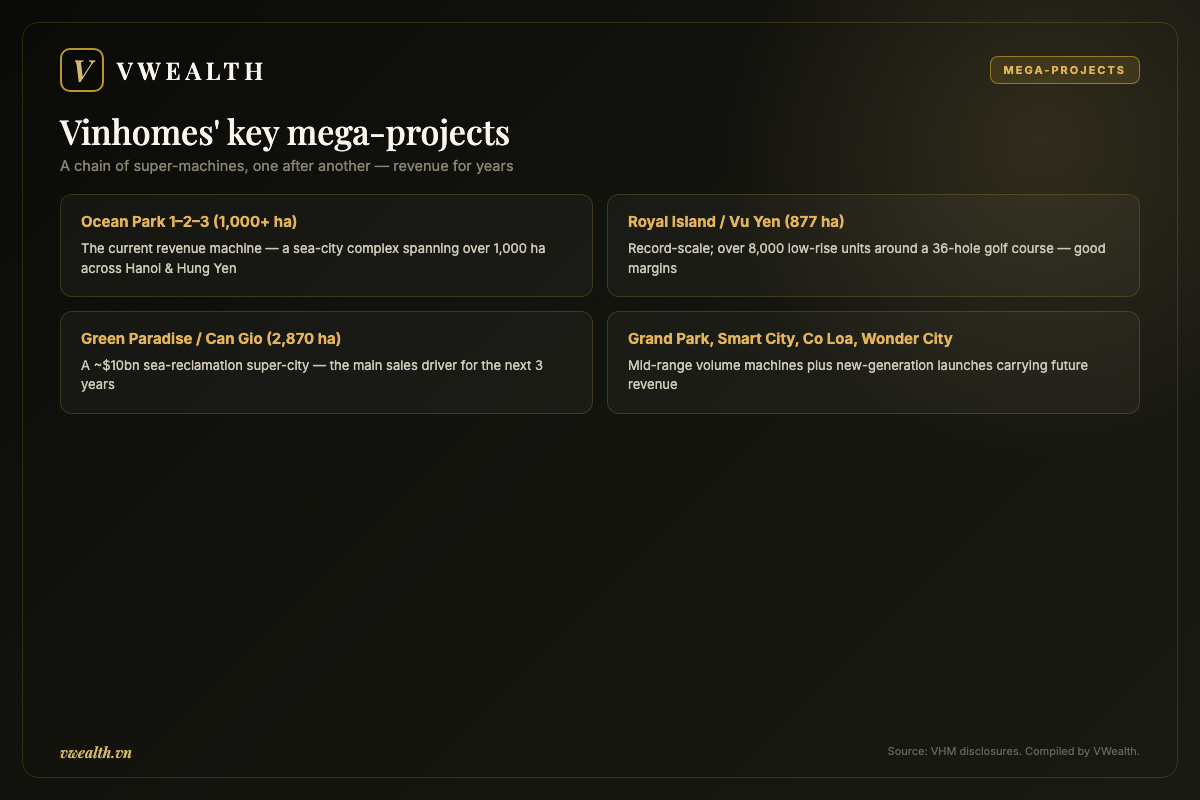
Now we go into the “core” of the story: the specific mega-projects that carry, and will carry, VHM’s results. I’ll analyze each by scale and contribution role, so you see the picture isn’t a few lucky projects, but a chain of “super-machines” one after another.
The Ocean Park 1 – 2 – 3 cluster (Hanoi and Hung Yen): the current revenue machine
This is the project cluster whose name you need to know, because it’s precisely the main revenue driver for VHM right now. Ocean Park 1 is in Gia Lam (Hanoi), while Ocean Park 2 and 3 are in Van Giang (Hung Yen). Ocean Park 2 has a total area of about 458 ha with nearly 13,000 low-rise units and 24 apartment towers; Ocean Park 3 is about 294 ha with over 8,400 low-rise units and 10 apartment towers. All three “sea districts” embrace a sea park and the VinWonders entertainment complex, forming a super sea-city complex spanning over 1,000 ha — one of the standout scale highlights in the North. In earnings reports, handovers at Ocean Park 2–3 are consistently cited as the main revenue source, alongside Royal Island.
Royal Island – Vu Yen island (Hai Phong): a record-scale mega-project
If you had to choose one project that most clearly expresses the “integrated mega-township” ambition pushed to its peak, it’s Vinhomes Royal Island on Vu Yen island, Hai Phong. With a total area of about 877 ha, it’s introduced as the largest-scale project Vingroup has ever developed. The project has over 8,000 low-rise units (villas, townhouses, shophouses) surrounding a 36-hole golf course spanning up to 160 ha, plus “one-of-a-kind” amenities like an equestrian academy, a marina, a VinWonders park and a European-style plaza. About 359 ha are devoted to greenery and water landscape. Royal Island’s role for VHM is very clear: along with Ocean Park 2–3, it’s one of the two main pillars of handover revenue in the 2025 period, thanks to the high weight of good-margin low-rise products.
Grand Park (HCMC) and Smart City (Hanoi): two high-volume sales machines
These two mega-townships perfectly illustrate the mid-range segment sold by scale. Vinhomes Grand Park in eastern HCMC is about 271.8 ha, with an apartment system of over 40,000 units across the Sapphire, Ruby and Diamond lines plus villas and shophouses. Grand Park is also vivid evidence of the model’s value-creation power: apartment prices in the early phase (around 2019) were around 30–38 million dong per square meter; by 2025 the level had risen to about 80 million dong per square meter. In Hanoi, Vinhomes Smart City (Tay Mo – Dai Mo) spans over 280 ha with 58 apartment towers, positioned as a smart urban area with all three apartment lines. These two projects are steady sales “grinders” thanks to a large middle-class customer base and products more affordable than high-end low-rise.
Co Loa – Dong Anh (Vinhomes Global Gate): a mega-project with a “differentiating weapon”
Vinhomes Co Loa (commercial name Global Gate) in Dong Anh, Hanoi is about 385 ha, of which about 90 ha are reserved for the National Exhibition and Fair Center (The Grand Expo) — oriented to become one of Asia’s large exhibition centers. The remaining about 295 ha is an urban area of apartments, villas, townhouses, shophouses, 5-star hotels and Grade-A offices. What you need to recognize here is a new “value-creation formula”: a national exhibition center doesn’t directly generate large profit, but it pulls crowds, events and prestige to the area, thereby lifting the price of all the surrounding urban real estate VHM holds. This is the trick of “using a class public amenity as leverage for the commercial portion” — an upgraded version of the integrated mega-township thinking.
Wonder City – Dan Phuong (Hanoi): a new mega-project launched in the West
Vinhomes Wonder City in Dan Phuong, Hanoi is about 133 ha, total investment around 18,400 billion dong, with over 2,300 low-rise units plus apartment towers, introduced as a large housing project started in Hanoi in 2025. Wonder City matters because it’s among the “new-generation” projects launched in 2025–2026 that will take turns with Royal Island and Ocean Park to carry revenue in the coming years — that is, future revenue, not exhausted revenue.
Green Paradise – Can Gio (HCMC): a sea-reclamation super-project shaping the future
This is the long-term “trump card” you absolutely must know. Vinhomes Green Paradise in Can Gio, HCMC is Vietnam’s largest sea-reclamation super-city at about 2,870 ha — over 10 times Grand Park and nearly 7 times Ocean Park 1 — with estimated total investment of about 10 billion USD. The project sits at HCMC’s sea gateway, three sides facing the East Sea, one side next to a UNESCO-recognized world biosphere reserve, positioned as a leading tourism–economy–entertainment super-city in the South. The project has completed most of its basic infrastructure and entered the sea-reclamation phase. For you, Green Paradise symbolizes VHM’s leap in scale: it shows the business has shifted from building 100–400-ha townships to 1,000–3,000-ha mega-townships, and beyond.
Vinhomes Industrial Zone: a new segment diversifying revenue
Finally, don’t overlook industrial real estate. Through the company VHIZ (VHM owns over 99%), Vinhomes formally entered the industrial-park field in 2020. Recent plans include developing industrial parks in Hai Phong (like Tan Trao and Ngu Phuc, total area over 465 ha, investment nearly 9,700 billion dong, rolled out from 2025–2026). The IP segment is appealing because it creates stable rental revenue, less cyclical than housing, and resonates well with the wave of manufacturing relocation into Vietnam and with Vingroup’s own manufacturing ecosystem (like the VinFast plant in Hai Phong). This is the piece that helps VHM depend less on a single cash flow from home sales.
An enormous land bank — an “ammunition depot” for years of growth
All the projects you just read about, however grand, are just the visible part. What makes VHM’s strength durable lies in the land bank. Per the 2025 annual report, as of year-end Vinhomes owned a land bank of about 29,500 ha — the largest in Vietnam’s real-estate market, equivalent to over 295 million m². To picture the size: a few years ago the figure cited was around 18,000 ha and was already assessed as “enough to develop projects for about 30 years.” Now the land bank has swelled to nearly 1.5 times, and the business has nearly 20 more projects finalizing procedures with a total area over 20,000 ha.
Why does this matter so much that I call it an “ammunition depot”? In real estate, the biggest barrier isn’t the money to build homes, but having clean, correctly-located, large-enough land with complete legal status. Good land is increasingly scarce and expensive. A business with a 30-year land bank means it has locked in the input material for three decades of growth, at a cost formed years earlier — much cheaper than today’s market price. Each time it launches a new phase, the gap between the old land cost and the current selling price is precisely the margin VHM pockets. Notably, the group’s leadership even signaled it will “stop expanding the land bank as it’s enough” — a confidence only possible when the ammunition depot is truly abundant.
This land bank also explains why VHM’s backlog (sold but not-yet-recognized revenue) is always very large — at one point exceeding 120,000 billion dong. This is revenue almost “firmly in hand,” to be booked gradually upon handover, giving profit visibility for many quarters ahead. For you, a high backlog plus an enormous land bank are two indicators that VHM’s growth momentum is not a one-season story.
How the model plus land bank creates an “economic moat”
Here I want to assemble the pieces into a strategic picture with you, because this is the part that decides how you value the stock. An “economic moat” is what keeps competitors from invading and eroding a business’s profit. VHM doesn’t have one moat, but many layers stacked on each other:
- The ecosystem moat. The closed “three-pillar” advantage of Vinschool – Vinmec – Vincom within Vingroup is almost unreplicable. A rival wanting to build an equivalent integrated mega-township would have to build a whole chain of reputable schools, hospitals and malls itself — something needing decades and billions of USD.
- The scale and brand moat. The ability to develop 1,000–3,000-ha projects (Royal Island, Green Paradise) requires capital, construction and operating capacity at a class very few domestic businesses reach. The Vinhomes brand helps sell fast right at launch, creating a capital turnover small rivals lack.
- The land-bank moat. 29,500 ha of land at a cost formed earlier is “cheap raw material” locked in for decades. A rival wanting to compete must buy land at today’s price level — that is, starting out already losing on margin.
- The relationship and legal moat. The ability to be allocated enormous land, sea-reclamation land, or projects with national-scale public infrastructure (the Co Loa exhibition center) reflects a capacity to work with authorities at a scale most businesses lack. The Happy Home and IP segments further reinforce this relationship.
The three factors — the integrated model, the brand, the land bank — don’t add up but multiply together. The integrated model raises margins; the brand helps sell fast to turn over capital; the enormous land bank ensures cheap raw material for decades. The result is a machine that’s both highly profitable, durable, and hard for rivals to catch. That’s why I want you to remember this products chapter as the foundation for reading the financial numbers ahead.
A note to keep you clear-headed: a strong economic moat doesn’t mean the stock is risk-free. Super-large scale also means enormous capital needs, dependence on the real-estate cycle, on credit policy and on the market’s absorption capacity. A 10-billion-USD sea-reclamation super-project, if it sells slowly, will bury a great deal of capital. So however beautiful the model, you still must scrutinize financial health — which is exactly what we do next.
In sum, products and mega-townships are not just VHM’s “goods for sale,” but the very source of its competitive advantage and earning power. The integrated mega-township model creates high margins and fast sales; the three segments cover the whole demand pyramid; the mega-project portfolio from Ocean Park, Royal Island to Green Paradise carries revenue for years; and the 29,500-ha land bank stands behind like an inexhaustible ammunition depot. These four layers form a multi-tiered economic moat. Now, let’s move to the next section — “Financial position and health” — to verify whether this beautiful machine is truly healthy in cash flow, debt leverage and profitability.
Financial position and health
When you hold a real-estate business’s financial report, there’s one thing you must know by heart before reading any number: this stock group is unlike any other on the exchange. A tech company or a retailer recognizes revenue almost instantly — sell today, money on the books today. But a developer like Vinhomes is entirely different. They sell you an apartment today, collect money by construction progress over two or three years, but are only permitted to recognize that money as revenue and profit at the moment they hand over the keys. This very lag — the gap between “sold” and “recognized” — is the key to understanding why VHM is one of the stocks whose future profit you can forecast most reliably on Vietnam’s market. In this section, we’ll dissect each layer: Vinhomes’ dominant position, its enormous “reserve,” the power of presales, the enviable margins, and the points you need caution about in the cash-flow picture.
The number-one position with no real rival in residential real estate
Start with scale, because scale in this industry isn’t just pride — it’s a competitive advantage measurable in money. From 2010 through end-2025, Vinhomes cumulatively sold about 309,000 products including apartments, villas and townhouses, equivalent to total sales exceeding the 1-quadrillion-dong mark. To picture how large this is: no listed real-estate developer in Vietnam comes even close to a small fraction of that handover scale. Vinhomes isn’t the leader in a crowded race — they almost play in their own division.
The foundation of this position is the land bank. By end-2025, Vinhomes held about 29,500 ha of land — the largest in Vietnam’s real-estate market, far ahead of every rival. In real estate, the land bank is the “raw material” for producing profit for years to come. A company with a small land bank must continually buy new land at expensive market prices, eroding its margin. A company with an enormous land bank accumulated years earlier at low cost can “leisurely” develop project after project without pressure to buy dear. That’s why Vinhomes’ land-bank scale isn’t just a nice slide number — it’s a cushion protecting profit for a whole decade.
What does this number-one position mean in practice for you — an investor? First, Vinhomes can develop thousand-hectare mega-townships small rivals can’t dream of, from Ocean Park and Smart City in Hanoi to Grand Park in HCMC, Royal Island in Hai Phong and a series of new mega-projects like Green Paradise, Wonder City, Golden City. Second, the Vinhomes brand has become a standard of trust for Vietnamese homebuyers — helping them sell faster, at higher prices and with better absorption rates even in a tough market. Third, scale creates an “upward spiral” effect: large projects attract residents, residents create community and amenities, amenities lift the value of later-sold subzones. This is a machine a new rival finds very hard to squeeze into.
The “reserve” — a profit buffer already locked in for the future
Now we come to the most important, and most easily misunderstood, concept for those new to real-estate stocks: unrecognized revenue, or the market’s colloquial term, the “reserve” (in English, unrecognized revenue or backlog).
Imagine it very simply. You sign a contract to buy a Vinhomes apartment today for 5 billion dong. You put down a deposit, then pay by construction progress over 2 years. Vinhomes has definitely sold that apartment — the contract is signed, money has begun flowing in. But by Vietnam’s real-estate accounting rules, Vinhomes is not yet permitted to book that 5 billion as revenue, because it hasn’t handed the home to you. That 5 billion sits “pending” on the balance sheet, waiting for handover day to be “released” into revenue and profit. Add up all the signed-but-not-handed-over contracts of tens of thousands of customers, and you get the “reserve” figure.
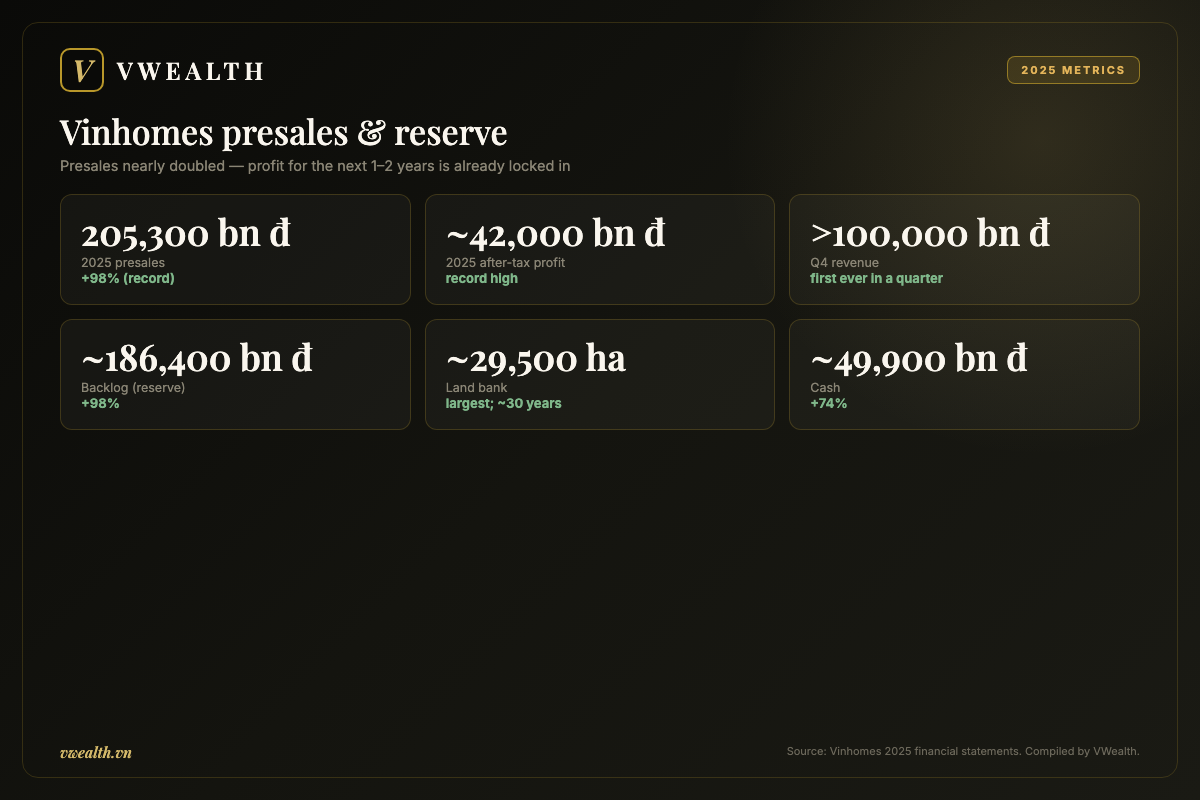
By end-December 2025, Vinhomes’ unrecognized revenue reached about 186,400 billion dong — up 98% from end-2024, that is, nearly double. As of Q3 2025, the backlog figure (including wholesale deals) was even recorded at about 223,900 billion dong.
Why does this make VHM special? Because these 186,400 billion dong are almost pre-locked profit, only waiting for the booking moment. Vinhomes’ full-year 2025 revenue was about 154,000 billion dong. That means the existing “reserve” alone is larger than a year’s operating revenue — enough to ensure most of the revenue and profit for the next one to two years, almost regardless of whether the market absorbs more new goods.
This is precisely what sets Vinhomes apart from most other real-estate stocks. With many small property businesses, you never know for sure whether they’ll profit next year, because it depends entirely on whether new project launches succeed, whether legal snags arise. With Vinhomes, thanks to this enormous backlog, you can forecast profit far more reliably. Analysts often estimate about 60% of Vinhomes’ revenue comes from the pre-locked “reserve,” with only about 40% from newly recognized presales in the year. In other words, most of Vinhomes’ future profit isn’t a prediction, but the disbursement of something already sitting on the books.
An important note so you don’t get too optimistic: a large “reserve” doesn’t mean money will come like pouring water. Converting backlog into profit depends on the handover pace of projects. If a mega-project is delayed for legal or construction reasons, the corresponding profit is pushed to the next year. So backlog is an assurance about the scale of future profit, not an absolute guarantee of the timing of each dong’s recognition.
Presales — the most important indicator, and a record 2025
If you were only allowed to look at one number when assessing a real-estate stock, an industry professional would choose presales rather than reported revenue or profit. The reason is the very lag we just discussed: accounting revenue reflects what was sold 2-3 years ago and only just handed over; presales reflect the business’s current health — how much they’re selling right now. Presales are the source that replenishes the “reserve,” the future years’ profit being formed.
And here’s why Vinhomes’ 2025 deserves to be called a historic year:
- Total full-year 2025 presales reached about 205,300 billion dong — up as much as 98% from 2024, that is, nearly double in a single year. This is the highest presales figure in the business’s history.
- In Q4 2025 alone, recognized revenue exceeded 100,000 billion dong in a single quarter for the first time — over 3 times the year-earlier period, an unprecedented milestone for any Vietnamese real-estate business.
- The driver came from a wave of mass launches of new mega-projects: Green Paradise, Wonder City, Golden City, Green City, Royal Island, plus new subzones of Ocean Park 2-3 and Golden Avenue.
Nearly doubling in a single year isn’t just a nice achievement — it signals that the “reserve” for 2026-2027 is being filled at an unprecedented pace. In other words, if 2025 was already a record for profit, then 2025’s record presales are laying the foundation for the possibility of a new profit peak in the coming years. This is what you need to remember: for a real-estate stock, today’s presales are a mirror reflecting tomorrow’s profit.
High gross margin — the sweet fruit of a low-cost land bank
A business can sell a lot yet still earn thin if its cost is too high. Vinhomes is the opposite — it’s one of the developers with margins among the region’s best, and this doesn’t come from luck.
Look at the 2025 summary numbers: net revenue about 154,000 billion dong, and if you include revenue from business-cooperation and wholesale activities recognized by another method, total converted revenue exceeds 183,900 billion dong. After-tax profit reached about 41,000-42,000 billion dong — a record net profit in the company’s history. For a business to keep over 40,000 billion dong of profit from 154,000 billion of revenue, the net margin must be very high versus the industry norm.
So what’s the source of this thick margin? There are two pillars:
- A low-cost land bank. As said, Vinhomes accumulated most of its land bank years earlier, when land was much cheaper than now. When it develops projects and sells at today’s market prices, the gap between selling price and land cost is very large — and that gap is precisely the gross margin.
- The mega-township model. When building a thousand-hectare urban area instead of a small project, Vinhomes leverages enormous scale advantages: infrastructure, amenity and marketing costs are spread across a very large number of products. More importantly, the very amenities and community Vinhomes creates raise the value of later-launched subzones — they sell the first subzone to build amenities, then those amenities help sell the next subzone at a higher price. This is a self-appreciating loop small projects can’t have.
Combining these two factors, Vinhomes not only sells more than rivals — each dong of revenue it makes is also “richer” in profit. For you, this means VHM’s earning power is more durable, less eroded by rising land costs than businesses that must continually buy new land.
Financial health: abundant cash, but read the cash flow carefully
A healthy balance sheet is what separates a real-estate business that survives the cycle from one that collapses when credit tightens. Vinhomes is in a relatively solid position on this front.
- Total assets at end-2025 reached about 786,400 billion dong, up about 39% in the year.
- Equity about 247,900 billion dong, up about 12% — a very thick capital base, helping the business withstand market shocks.
- Cash and cash equivalents surged to about 49,900 billion dong, up as much as 74% from the start of the year. This abundant cash is an important liquidity shield, especially in an industry where the biggest risk often comes from running out of cash midway.
However, this is the part you need to read with the clearest eyes, and I want to be frank so you’re not swept along by glossy profit numbers. Vinhomes is a link in the Vingroup ecosystem, and that creates cash-flow peculiarities individual investors often overlook.
First, the leverage of the whole Vingroup has risen sharply. By end-2025, Vingroup’s consolidated liabilities rose 42% to about 970,000 billion dong, of which total financial debt rose from about 224,000 billion to over 335,000 billion dong. Vinhomes is the main cash-generating machine for the whole ecosystem — including very capital-hungry ambitions like VinFast. This means Vinhomes’ cash flow doesn’t entirely “stay” within Vinhomes.
Second, and more important for you: part of the profit and cash flow of companies in the Vingroup family comes from internal transactions and related lending. There have been cases where a Vingroup subsidiary recorded revenue from financial activities (mainly lending to other entities) higher than its core business. With Vinhomes, you need to note that internal receivables and loans within the group can make the actual quality of operating cash flow differ from the accounting profit figure. “Pretty” profit on paper doesn’t always equal free cash flow truly flowing into shareholders’ pockets. When reading VHM’s report, always compare profit against operating cash flow and keep an eye on the scale of related-party receivables — that’s where both opportunity and risk are hidden.
A notable signal of leadership’s confidence: Vinhomes executed the largest treasury-share buyback in the history of Vietnam’s stock market, with the stated purpose that VHM was trading below intrinsic value. A business spending its own money to buy back its own shares is usually a message that leadership believes the stock is cheaper than intrinsic value — and also shows they have enough liquidity to do it.
The cyclicality of real estate — why high years and low years are normal
Before closing, there’s an industry trait you must understand, or you’ll panic in a year Vinhomes reports low profit and be overly euphoric in a year they report a peak. That is the cyclicality and lumping of profit by handover pace.
Recall the core principle: Vinhomes only recognizes profit upon handing over a project. And a thousand-hectare mega-project doesn’t hand over evenly every month — it hands over in large batches, lumped into certain quarters when buildings and subzones are completed. The consequence is that Vinhomes’ profit doesn’t rise in a smooth straight line, but jumps in steps: in years of heavy handover, profit surges (like Q4 2025 with over 100,000 billion in revenue); in years falling into a “rest gap” between handover batches, profit is lower.
This leads to a common mistake I want you to avoid: don’t judge Vinhomes by a single year’s profit figure alone. A year of lower profit isn’t necessarily a sign of business weakness — it may just be a gap between two handover cycles, while presales and the “reserve” keep swelling. Conversely, a peak-profit year like 2025 doesn’t mean next year is certainly higher, because it still depends on the handover pace of the next mega-projects.
The right way to read is to look at the trio of leading indicators: presales (current selling strength), the “reserve” backlog (profit locked for the future), and mega-project execution progress (the timing of profit release). When all three are strong — like the 2025 picture with presales nearly doubling and a 186,400-billion backlog — then even if annual profit fluctuates up and down, the foundation for long-term value creation remains very solid. And it’s precisely this combination of the number-one position, an enormous reserve, thick margins and a cash-rich balance sheet that you need to weigh as we move to the next section — how the market receives and values VHM stock.
Market reception
If you’ve ever heard someone call VHM a “national stock,” it’s not wrong. This is among the largest-cap tickers on HOSE, a heavyweight pillar in the VN30 basket, and the face representing Vietnam’s whole residential real-estate industry on the stock market. But behind that “national” label is a valuation story full of contradictions: there were periods the market valued VHM unbelievably cheaply relative to the profit it generates, then vertical rally waves that made latecomers wonder if they were buying the top. This section helps you understand how the market really “prices” VHM, and why valuing a real-estate stock is far harder than valuing a bank or a consumer stock.
First, look at the real numbers. On 19 June 2026, VHM’s price stood at 145,300 dong per share (VWealth plugin data), having just corrected about 4.4% in a month. Set this against the price of just over 40,000 dong in early 2025, and you immediately see this stock’s terrifying range: in about a year, VHM went from “shunned” to “market-leading star.” That’s the starting point for our dissection.
Valuing a real-estate stock: why P/E alone is not enough
For most stocks, new investors tend to cling to a single metric: P/E (price to earnings per share). The logic is simple — P/E tells you how many dong you must pay to “buy” a dong of the business’s annual profit. Low P/E means cheap, high P/E means expensive. But for a real-estate business like Vinhomes, that thinking easily makes you misread the nature.
The reason lies in how real estate recognizes profit. A mega-township project like Vinhomes Ocean Park, Grand Park or Royal Island can be sold (launched, contracted) over many years, but profit only “bursts” into the financials at the handover moment. The consequence is that VHM’s profit is lumped by year: years of many mega-project handovers see profit surge, years in mid-cycle see profit sag. After-tax profit in 2025 was estimated around 42,000 billion dong — a very large figure — but it doesn’t mean next year will be the same. So if you take a “handover-peak” year’s profit and divide to compute P/E, you’ll see a falsely cheap stock; conversely, take a “trough” year and you’ll see a falsely expensive one.
Let’s estimate with real numbers. VHM has about 4.35 billion shares outstanding. Divide 42,000 billion of profit by this, and EPS falls to about 9,000–10,000 dong. At a price of 145,300 dong, the P/E is about 15 times. But note: this same stock, in early 2025 when the price was around 43,000 dong and the market used a lower profit level, had its P/E recorded by many securities firms at just around 6.8–9 times, and P/B (price to book) at times dropped below 1, meaning the market valued the stock below even its accounting net asset value. That’s a rarely-seen discount for an industry leader.
Precisely because both P/E and P/B have limits, real-estate analysts must use a third measure — and this is a concept you need to grasp firmly.
RNAV — the “land-bank treasure” and how a beginner should value it
RNAV stands for Revalued Net Asset Value. Imagine this: on the accounting books, a plot Vinhomes bought years ago is still recorded at historical cost — the price at purchase. But the plot’s real market value today may be much higher, especially once it has infrastructure, legal status and is ready for development. RNAV is the calculation that tries to “revalue” the entire land bank and work-in-progress projects at current market value, minus debt, to arrive at the real value a shareholder owns.
In the simplest terms: P/E asks “how much does this business earn each year?”, while RNAV asks “if you sold off all the land and projects at today’s market prices and repaid all debt, how much is each share really worth?”. For a land-bank “kingpin” like Vinhomes, the second question is what truly reflects the underlying assets.
This is why you often see analyst reports set VHM’s target price based on RNAV. For example, a March 2025 report using RNAV gave a target price of 56,200 dong per share — 18% above the price at the time. Note: RNAV isn’t an absolutely “correct” number. It depends heavily on the analyst’s assumptions — how much they value each square meter of land, what margin a project will sell at, how they discount future cash flow to the present. Two analysts can arrive at notably different RNAV figures. So view RNAV as an “asset-value map” for reference, not as gospel.
In sum, a serious investor views VHM through all three lenses at once: P/E to know how much the market pays for profit, P/B to compare with book value, and RNAV to estimate the land bank’s true value. When all three signal “cheap,” that’s the most notable moment.

Price action: the 2025 wave and VHM’s “temperamental” nature
If there’s a single most condensed story about VHM in the past two years, it’s the 2025 wave. The stock went from around 40,000 dong at the start of the year to the triple-digit zone, with a gain recorded by many sources of up to about 200% in 2025 — that is, tripling. The 52-week range as of mid-2026 spanned from about 67,000 dong to over 173,000 dong, an enormous range for a billion-dollar-cap stock.
This “temperamental” nature isn’t random. VHM’s price is driven by three interwoven layers of force, and you need to distinguish them:
- The real-estate cycle. As a pure housing stock, VHM rises and falls with expectations about the property market: project legality, home-loan rates, buyer absorption. When the market believes real estate is “warming,” VHM is usually the ticker that runs first and hardest.
- Sentiment about the Vingroup ecosystem. This is a distinctive layer. VHM isn’t traded as an independent business, but is always viewed through the lens of both the parent Vingroup and the “child” VinFast. Every major piece of news about Vingroup or VinFast — even if not directly related to home sales — can create sentiment waves on VHM.
- Index flows. As a VN30 pillar with a large weight, VHM is in the portfolios of most ETFs tracking the VN30 and VN-Diamond. When money flows in/out of these funds, VHM is bought/sold “mechanically” regardless of fundamentals, amplifying the range.
The 4.4% correction in the most recent month, set against the prior tripling wave, is vivid illustration: after an overly-hot run, a stock “resting” and jolting is normal and shouldn’t be hastily read as a trend reversal.
The “cheap” paradox: why is the industry leader discounted?
This is the most interesting debate, and also the part that most confuses new investors. For a long time, despite generating enormous profit, VHM traded at abnormally low P/E and P/B versus its own potential. A business earning tens of thousands of billions a year whose stock at times traded below book value — sounds like a bargain. But the market rarely gives anything for free; that “cheapness” is really a risk discount investors impose themselves. The concerns usually raised include:
- Worry about internal group cash flow. Institutional investors’ biggest concern is whether VHM’s abundant home-sales cash flow is being redirected to support other ambitions in the Vingroup ecosystem, especially VinFast — a capital-devouring segment. When shareholders aren’t sure the cash they generate will stay with them, they demand a discount.
- Real-estate-specific risk. Project legality, market liquidity, debt burden and dependence on a few large mega-projects are all risks that make investors cautiously value it low.
- Governance and transparency issues. For any large multi-industry family conglomerate, the market usually applies a “governance discount” for the complexity of ownership structure and related-party transactions.
Let me be frank: this is a debated point, not a closed conclusion. The optimists argue these concerns are overblown, that VHM is a money-printing machine with Vietnam’s top land bank and the discount is an opportunity. The cautious argue the discount exists for a reason and will persist as long as the internal cash-flow story isn’t clear. The tripling in 2025 shows the optimists prevailed in the recent period — but that doesn’t erase the nature of the debate.
Record treasury buyback and dividends: what does leadership say with money?
There’s a market saying: listen to what leadership does with their money, not just what they say. And in 2024, Vinhomes did something well worth listening to. The business approved a plan to buy back 370 million treasury shares, about 8.5% of total outstanding shares, at an estimated cost around 15,000 billion dong, entirely from available cash. This is recorded as the largest share buyback in the history of Vietnam’s stock market.
What matters isn’t just the scale, but the reason the business stated: Vinhomes itself said the price was below the company’s real value. When leadership — those who understand the internals best — spend 15,000 billion to buy back their own shares in the low zone, it’s a powerful signal they believe the stock is cheaply valued. For an individual investor like you, this action is worth far more than any verbal commitment. And looking back: the record treasury buyback in the low zone in 2024 came right before the tripling wave of 2025 — a coincidence hard to overlook.
On dividends, in 2025–2026 the story turned decisively generous. The Board approved a 2025 dividend plan in both cash and stock at a very large total value, including a cash-dividend component announced at a high level and a large stock component. This is a notable change from the earlier image of a cash-hoarding business, and it reinforces the message that VHM’s cash flow is healthy enough to both reinvest and return to shareholders.
Foreigners and index weight
Another paradox you should know: VHM’s tripling in 2025 happened not thanks to foreigners, but almost the opposite. Foreign ownership of Vinhomes fell to a record low since listing — from about 12.3% to 8.77% by end-2025, with the number of foreign shareholders falling from 1,610 to 1,289. In other words, it was domestic money — individual and domestic institutional investors — that drove the recent wave. VHM’s shareholder count also rose to nearly 25,000 by end-2025, reflecting strong appeal to domestic retail investors.
Foreigners net-selling while the price still rose strongly has two interpretations. The optimist says: domestic demand is strong enough to carry the stock, and if foreigners return to net buying, that would be an added boost. The cautious says: foreign investors — strict on governance and cash flow — are voting with their feet, and that’s a signal to note. Both views have merit, and once again, this is a point for you to weigh rather than follow one side.
On index weight, there’s not much to debate: VHM is one of the largest pillars of the VN30 and VN-Index. Any ETF tracking these baskets must hold VHM by its weight. That’s both a plus — the stock always has a “base” demand from index flows — and a minus, because it makes VHM bought and sold mechanically with ETF flows, amplifying volatility in rebalancing sessions.
Is VHM cheap, or a trap?
After all this, you face the thorniest question: at the current 145,300 dong, with a P/E around 15 times, is VHM still cheap — or has the tripling wave moved it from “discounted cheap” to “fully valued,” even overshooting? The arguments for “cheap” are clear: the enormous land bank valued by RNAV is usually above the market price, leadership bought record treasury shares in the low zone, cash flow is healthy enough for large dividends. But the “trap” warnings can’t be dismissed either: the stock just tripled in a year, foreigners retreated to a record low, and the internal-cash-flow worry — the root of the historical discount — hasn’t been fully resolved.
The truth is there’s no absolute answer, because it depends on what you believe about the future of the property industry and how Vingroup allocates cash. And that’s precisely why we can’t assess VHM in a vacuum. A real-estate stock, however strong, is a boat drifting on the tide of the whole industry. To know whether VHM is substantively cheap or expensive, you need to place it in the bigger picture — legal health, interest rates, housing demand and the cycle of Vietnam’s whole real-estate industry. That’s exactly what we enter next.
Economic and real-estate industry context
To assess a real-estate stock like VHM, you can’t look only at the business’s own financials. Property stocks are among the most sensitive assets to the economic cycle: they rise and fall with interest rates, with money flows, with legal policy and with crowd psychology. A good business in a downward industry cycle can still make investors lose money for many quarters. Conversely, an industry leader standing at the recovery phase of the cycle can generate growth unimaginable in another phase. So before discussing “buy or not,” you need to clearly locate: where is Vietnam’s real-estate market in its cycle?
Which phase of the cycle is the market in?
The short answer: the market has passed the bottom of the 2022-2023 liquidity crisis and is in a recovery phase, entering the early stage of a new growth cycle. But this is an uneven and selective recovery, not a simultaneous rising wave like 2017-2019.
Recall the picture two years ago. Late 2022 and through 2023, the market was nearly frozen. The corporate-bond channel was tightened, a series of developers lost the ability to roll over debt, lending rates at times reached 14-15% a year, real homebuyers waited for prices to fall while investors were stuck with unsellable goods. That was the classic “recession” and “bottom” phase of a real-estate cycle: liquidity exhausted, confidence collapsed, primary prices frozen while secondary prices in many places fell deeply under cut-loss pressure.
By 2025, the picture had clearly changed color. Per published market data, 2025 recorded about 88,000 commercial-housing transactions, up 78% from 2024 and the highest in the whole 2019-2025 period. This is a very notable number, because it shows liquidity — the crisis phase’s fatal weak point — has substantively returned. When liquidity recovers, large developers with clean-legal products are the first to benefit, and that’s precisely Vinhomes’ position.
A point to remember about Vietnam’s real-estate cycle: it doesn’t run purely on market supply-demand like many countries, but is strongly governed by policy. The 2022 crisis was largely due to tightened credit and bonds; the 2025 recovery is largely due to loosened policy and unclogged legal processes. Whoever understands the policy rhythm usually reads the market rhythm.
Four drivers supporting the new cycle
This recovery doesn’t come from a single cause but the resonance of several drivers. You should understand each factor well, because they’re also the pillars the VHM investment thesis rests on.
1. The new legal framework — a foundational push
This is the most important and most structural driver. The industry’s three backbone laws — the Land Law, the Housing Law and the Real Estate Business Law — took effect simultaneously from 1 August 2024, 5 months earlier than the original schedule. The most fundamental change is that the 2024 Land Law eliminated the old land-price framework and shifted to applying a land-price table close to market prices, updated annually.
For a business like Vinhomes, the meaning of this change is double. On one hand, making land prices transparent and market-based helps clear the biggest bottleneck that left a series of projects “suspended” for years: the appraisal and land-use-fee calculation step. When the legal process is unclogged, developers with large land banks and execution capacity like Vinhomes can speed up launches. On the other hand, a market-close land-price table also raises input costs for new projects — a double-edged sword to remember in the risk section.
2. Public investment and inter-regional infrastructure
Vietnam is in a record public-investment disbursement phase, focused on highways, ring roads, airports and inter-regional connectivity. For real estate, infrastructure directly creates added value: a project next to a new ring road or near an international airport can appreciate notably just from improved connectivity. Vinhomes is a master at betting on future infrastructure axes — from Hanoi’s ring roads, the Nhat Tan – Noi Bai corridor to inter-regional links in the South. Wherever infrastructure goes, the value of the business’s “reserved” land bank is activated to there.
3. Low interest rates stimulate demand
Unlike 2022-2023, the interest-rate level in the second half of 2024 and 2025 fell to the low zone, easing the financial burden for both homebuyers and developers. Low rates do two things at once: lower the cost of home-loan capital, making the “buy” decision easier; and reduce the appeal of safe money-holding channels like savings, pushing part of idle money toward real estate as a shelter and yield channel. This very money flow is the fuel for the resounding launch successes you’ll see in the prediction section.
4. Urbanization and long-term base demand
Behind all the short-term drivers is an irreversible long-term trend: Vietnam’s urbanization rate is still low versus the regional norm, the population is young, the middle class expands fast, and migration to large cities continues. This is the “base demand” — why Vietnamese residential real estate, despite many up-and-down cycles, is still seen as a structural growth story for decades to come. For a business building integrated mega-townships like Vinhomes, this is the ultimate market all efforts aim at.
Five industry risks you must not overlook
An honest writer can’t tell only the rosy story. The very drivers above, viewed from another angle, also hide risks. These are five industry risks you must weigh seriously before betting on any real-estate stock, VHM included.
- Project legal risk. Although the new laws unclogged things on paper, actual implementation at the local level still has lag and inconsistency. A project can face delayed permits, delayed land-use-fee calculation or site-clearance snags, burying capital and pushing back the profit-recognition timing. For thousand-hectare mega-projects, a single legal link going wrong is enough to shift the whole group’s plan.
- Real demand versus speculation. This is the current cycle’s most worrying risk. Many market analyses point out that 2025’s transaction momentum came mainly from investment demand rather than real housing need. New supply concentrated in premium, high-value products serving investors and even speculation. A market led by speculation is always fragile: when sentiment reverses, money exits much faster than it entered.
- Home prices too high versus income. Real-estate prices in Vietnam, especially in Hanoi and HCMC, have risen into the region’s highest group and far outstrip most households’ affordability. Even on the fringes — where affordable products should be supplied — actual selling prices far exceed average incomes. The mismatch between product structure and people’s purchasing power is a sign of unsustainability. When prices detach from income, at some threshold the market is forced to correct.
- Interest-rate reversal. Low rates are the current prop; but if inflation returns or currency pressure forces monetary tightening, rising rates will choke liquidity just as happened in 2022. More worrying, some analyses warn the risk could show clearly in 2027-2028, when the group of high-price buyers of 2025 using large leverage runs out of principal grace periods; if incomes don’t rise correspondingly and the market has no room for strong price gains, financial pressure will build up.
- Lumped supply. After the legal unclogging phase, a large number of previously-suspended projects may all be unblocked and released within a short period. When supply booms while real demand can’t keep up, price and absorption pressure will rise, especially in the premium segment already crowded with sellers.
To sum up the industry picture: you’re looking at a market entering a real recovery phase, supported by new laws, infrastructure, low rates and urbanization — but a lopsided recovery tilted toward investment and premium, with cracks in affordability and leverage risk smoldering below. This is precisely the stage on which Vinhomes stands.
Trend prediction
This section doesn’t aim to “predict” where the share price will go — no one does that reliably. The goal is to help you picture the possible scenarios based on what the business has announced and how the market is moving, so you can build your own expectations on a sound basis.
The growth launchpad: an unprecedented mega-project portfolio
What makes Vinhomes’ story special in the coming period is the scale of its project portfolio in development — described as “unprecedentedly massive.” Let’s review the mega-projects that will shape the business’s near future:
- Vinhomes Green Paradise (Can Gio, HCMC) — a sea-reclamation super-city of about 2,870 hectares, total investment announced at up to about 10 billion USD (equivalent to over 217,000 billion dong). The project formally broke ground on 19 April 2025, three sides facing the sea, developed on an ESG++ model with about 70% of the area for green space, water and public amenities. Vinhomes’ leadership identifies this as the main sales-growth driver for the next 3 years.
- Vinhomes Co Loa / Global Gate (Dong Anh, Hanoi) — a super-city at the capital’s northern gateway, holding a National Exhibition and Fair Center among Asia’s largest, on the Nhat Tan – Noi Bai development corridor.
- Vinhomes Wonder City (Dan Phuong, Hanoi) — a project launched in early 2025 with an impressive absorption rate, and a factor contributing a surge to Q1 results.
- Along with a series of other projects like Vinhomes Green City (Tay Ninh), Vinhomes Golden City (Hai Phong) and Happy Home Trang Cat, forming a launch network stretching across all three regions.
The real strength lies in the “reserve”: signed sales not yet recognized as revenue (backlog) announced at a very thick level — over 138,000 billion dong at one point in 2025. This is like a pre-“locked” profit stockpile, waiting for handover to convert into revenue and profit in coming years, giving the business much higher profit visibility than an ordinary developer.
Sales and profit targets
2025 closed with record numbers you should remember as anchors: total sales reached about 205,252 billion dong, nearly double 2024; after-tax profit reached about 42,000 billion dong — the highest in the business’s history. With such a foundation plus a thick backlog and a series of new mega-projects entering the recognition phase, analysts’ expectations for the coming years lean toward maintaining a high profit level, though the growth rate may not repeat 2025’s leap.
Three scenarios for VHM stock
Based on the industry context and the business’s health, you can picture three scenarios. Note this is a condition–consequence framework, not a certain price forecast.
- Positive scenario. Conditions: the legal status of the three mega-projects (Can Gio, Co Loa, Wonder City) keeps being unclogged on schedule; rates stay low; launches achieve high absorption rates as Wonder City proved; backlog is handed over and recognized smoothly. Consequence: profit holds its peak or sets a new one, cash flow is abundant, the market re-rates the stock optimistically. With a P/E around 15x currently not at all expensive for a growing industry leader, upside re-rating room has a basis.
- Base scenario. Conditions: the market recovers but stays lopsided and selective as now; a few projects face legal delays but overall it runs; rates stay stable in the low zone. Consequence: profit stays flat at a high level but swings with each project’s handover rhythm — Vinhomes’ inherent “cyclical lumping” trait. The share price moves in a range, reflecting intrinsic value without a strong re-rating catalyst.
- Negative scenario. Conditions: rates reverse up; speculative demand retreats; premium supply lumps up making absorption slow; a mega-project’s legal snag drags on; or the business’s cash flow is strained by having to support other segments in the ecosystem. Consequence: presales stall, future profit is doubted, the market discounts risk into the price and the stock faces correction pressure despite still-solid fundamentals.
What you should take away: these three scenarios aren’t mutually exclusive over time. VHM could entirely pass through a base phase then turn positive when Can Gio enters its recognition wave, or briefly fall into a short-term negative scenario if the macro worsens. Your job is to track the right “trigger conditions” — legal progress, launch absorption rates, interest rates and cash flow — rather than blindly guessing a price number.
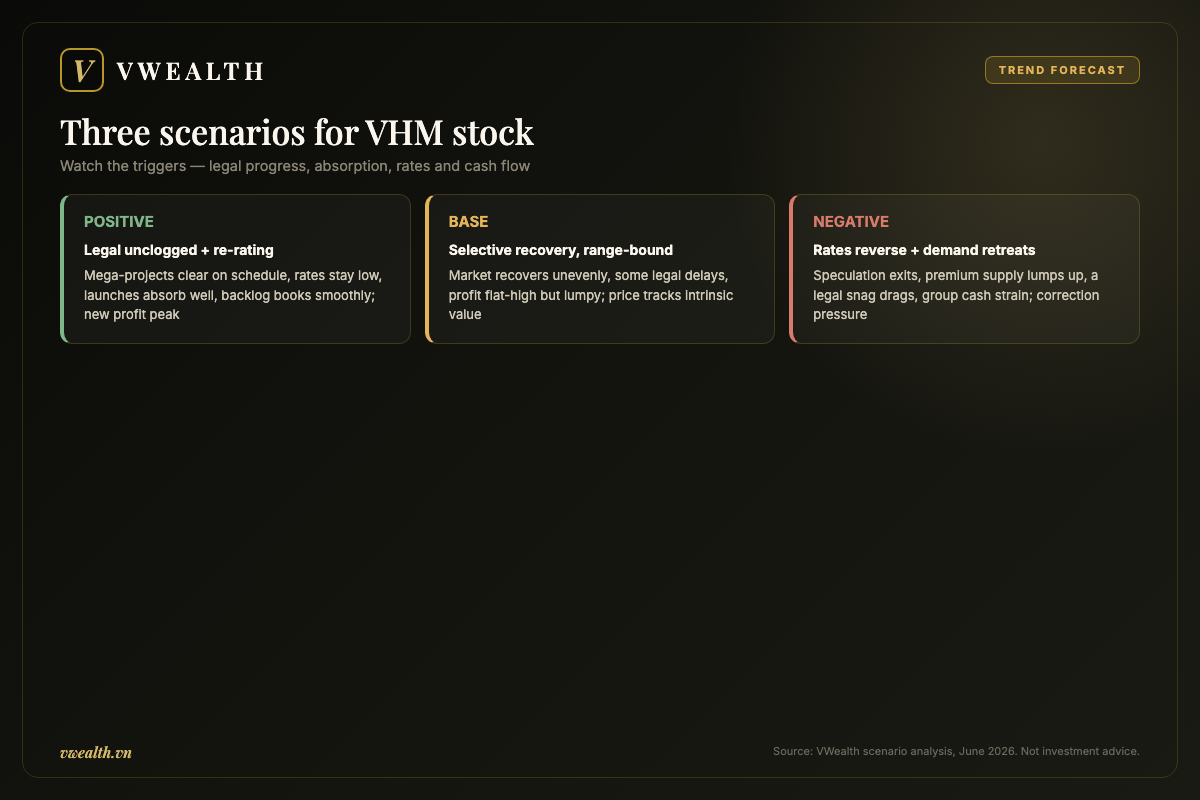
Should you buy VHM stock?
This is the question you truly care about, and also the part where the writer must be most careful. Let me say plainly from the start: this article does not give a buy or sell recommendation. The only goal is to put all the pros and cons honestly on the scale, then hand the decision back to you — the only one who truly understands your risk appetite, time horizon and financial goals.
Weighing the pros
- The number-one position in real estate. Vinhomes is not only the industry’s largest business by market cap and profit, but also the only entity in Vietnam capable of developing thousand-hectare integrated mega-townships. In an industry where entry barriers (capital, land bank, construction capacity, brand) are extremely high, this leading position is a durable competitive advantage.
- A thick “reserve” backlog. Signed-but-not-recognized sales of over 138,000 billion dong give rare profit visibility. You don’t have to guess whether the business will sell — a large part is already sold, only awaiting handover.
- High margins and an enormous land bank. Thanks to accumulating land early at low cost and a standardized development process, Vinhomes’ margins are among the industry’s highest. The enormous land bank spread across large cities and satellite areas is the foundational asset ensuring a product pipeline for years.
- Not-expensive P/E valuation. At a P/E around 15x on record profit, the stock isn’t overvalued relative to the business’s quality and position. Compared with many other growth stocks on the market, this is a relatively reasonable valuation for an industry leader.
- Treasury buyback. The treasury-buyback move is usually read by the market as a signal leadership believes the stock is undervalued, while supporting the price and shareholder interests short-term.
Weighing the cons
- Profit lumped by cycle. This is a trait, not a flaw, but you must understand it. Vinhomes’ profit depends on mega-project handover timing, so it can surge one year then go flat the next. If you expect steady year-on-year growth, this “lumping” trait can disappoint and drive share-price volatility.
- Dependence on Vingroup and cash flow feeding VinFast. Vinhomes is the money-printing machine of the Vingroup ecosystem. The risk is this abundant cash flow could be redirected to support other segments — especially VinFast, a capital-devouring field. The interests of Vinhomes shareholders and the group’s interests don’t always fully align, and this is a point to watch closely through the group’s internal transactions.
- Governance and related-party transaction risk. The complex group structure with many related-party transactions requires investors to place great trust in governance transparency. This is a hard-to-quantify but unignorable risk for any business within a large ecosystem.
- The real-estate cycle and legal risk. As analyzed in the industry section, this whole story depends on the recovery cycle continuing and legal processes staying unclogged. A rate reversal, retreating speculative demand or a mega-project’s prolonged legal snag can all skew the entire scenario.
- Low cash dividends. Vinhomes prioritizes retaining profit to reinvest in mega-projects, so its cash-dividend ratio is usually low. If you’re an investor seeking steady cash flow, this stock doesn’t serve that goal well.
Four investor types, four views
The same stock, but the answer to “does it suit me” differs by who you are. Hold yourself up against this frame:
- Long-term value investor. You’ll note the industry-leading position, enormous land bank, high margins and reasonable P/E — the fundamental factors. What you must accept: lumped profit volatility and governance risk, requiring patience through a whole cycle.
- Growth investor. You’re drawn by the Can Gio and Co Loa mega-project story and a thick backlog promising a breakout. But you must stay clear-eyed that this growth isn’t linear and depends heavily on legal progress.
- Income (dividend) investor. Frankly, VHM is less suitable for you because its cash dividend is low. The business prioritizes reinvestment over paying cash.
- Short-term trader. You care about price rhythm around launch events, legal news and treasury-buyback moves. This is an arena requiring discipline and tight risk management, because volatility can be very strong with the news flow.
Closing words
Vinhomes is an excellent business standing at the recovery phase of a rising industry cycle, with record numbers and a project portfolio arguably among the most ambitious in the history of Vietnamese real estate. At the same time, it also carries very real risks about cyclicality, dependence on the parent ecosystem, and a market recovering but still mismatched between price and real purchasing power. Both sides are true at once — and how you weigh them depends on you.
Disclaimer: This article is produced for informational and reference-analysis purposes, and is not advice or a recommendation to buy, sell or hold any security. The figures are compiled from public sources at the time of writing and may change. Investing in stocks always carries the risk of capital loss. You should do your own thorough research and/or consult a licensed financial advisor before making any investment decision. Every decision and investment outcome is your own responsibility.
Research Vietnamese stocks in English with vwealth. Our AI-powered platform turns Vietnamese market data into full English analysis reports — with international payment support and a free 2-month trial for new accounts. Create your free account and read the latest reports.