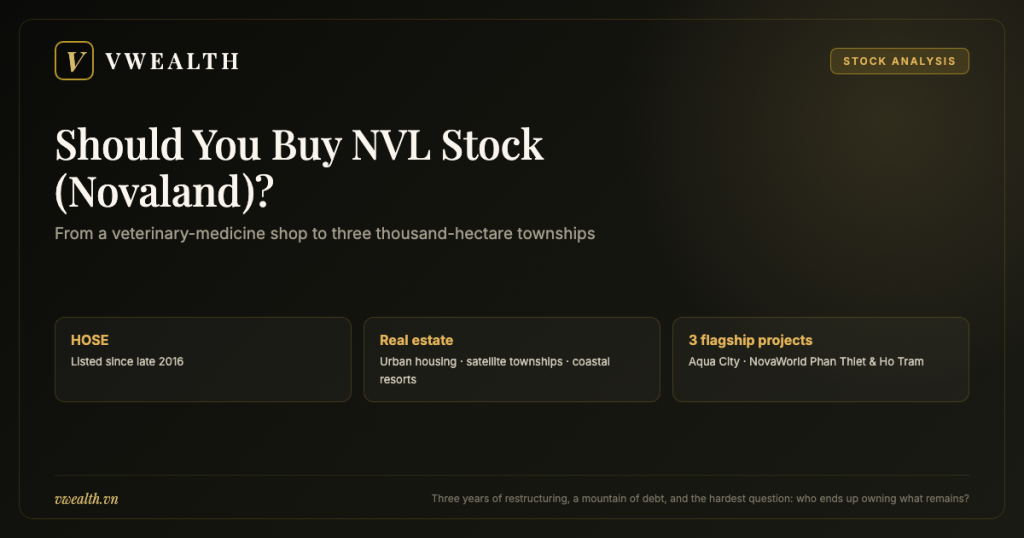
Few tickers divide Vietnamese investors the way NVL stock does. No Va Land Investment Group Corporation — Novaland, listed on the Ho Chi Minh Stock Exchange under the code NVL — was once the second-largest listed property developer in the country and made its founder a dollar billionaire, before collapsing through roughly seventeen consecutive limit-down sessions at the end of 2022 and spending the next four years renegotiating almost every debt it owed. To one half of the market, NVL is the textbook lesson on leverage. To the other half, it is one of the few large caps on the exchange that could still return a multiple of your money, because the company is sitting on thousands of hectares of land in locations nobody can assemble any more. This article takes no side. It walks through the entire Novaland story — from a veterinary medicine shop founded in 1992 to three thousand-hectare “cities” on the coast — teaches you how to read the balance sheet of a developer in the middle of a restructuring, and ends with a blunt answer: which kind of investor NVL suits, and which kind should stay away entirely.
A word on method before we start. You will find a great many dated facts in this article: founding dates, listing prices, project names, ownership structures, bond restructuring terms and regulatory milestones — all of them publicly disclosed. What you will almost never find is a current-quarter financial figure, a today’s P/E, or a price target. The reason is simple. For a company in Novaland’s position, those numbers change every quarter and sometimes every share issuance, and a figure written today can be flatly wrong by the time you read this three months from now. Rather than hand you a number with a short shelf life, this article teaches you to read the company’s own numbers yourself. When you need the current data, open the NVL analysis report on the vwealth platform. That is the right division of labour: the article gives you the framework, the report gives you today’s figures.
If you are investing in Vietnam from abroad, one more note. Vietnamese real estate has its own vocabulary — future-formed housing, land use fees, the “pink book” ownership certificate, the corporate bond channel that froze in 2022 — and none of it maps cleanly onto US or European practice. Where those terms appear, they are explained in place. If you are new to the market entirely, start with our guide on how to invest in the Vietnam stock market and the broader Vietnam stock market guide, then come back here. And read NVL beside its peers rather than alone: the picture only sharpens when you place Novaland next to Vinhomes, the residential market leader, next to Nam Long and its deliberately conservative balance sheet, and next to the wider Vingroup complex through VIC. Now, to the beginning of the story — which starts somewhere almost nobody expects.
From a veterinary medicine shop to coastal “cities”: the history behind NVL stock
There is one detail in Novaland’s corporate biography that almost every investor asks about twice on first hearing: the property group that became the second-largest real estate company on the Vietnamese exchange started life selling veterinary medicine. Not land, not construction, not finance — drugs for pigs, poultry and farmed shrimp. It sounds like a piece of trivia, but if you are considering putting money into NVL stock, it is actually the key to the company’s temperament. Novaland has always been a company of large pivots, driven by a founder willing to bet an entire business on an industry he had never worked in. The first pivot took the group from agriculture into property and made its founder a billionaire. The second took it from apartment towers in downtown Saigon out to thousand-hectare “cities” on the coast — and very nearly swept everything away.
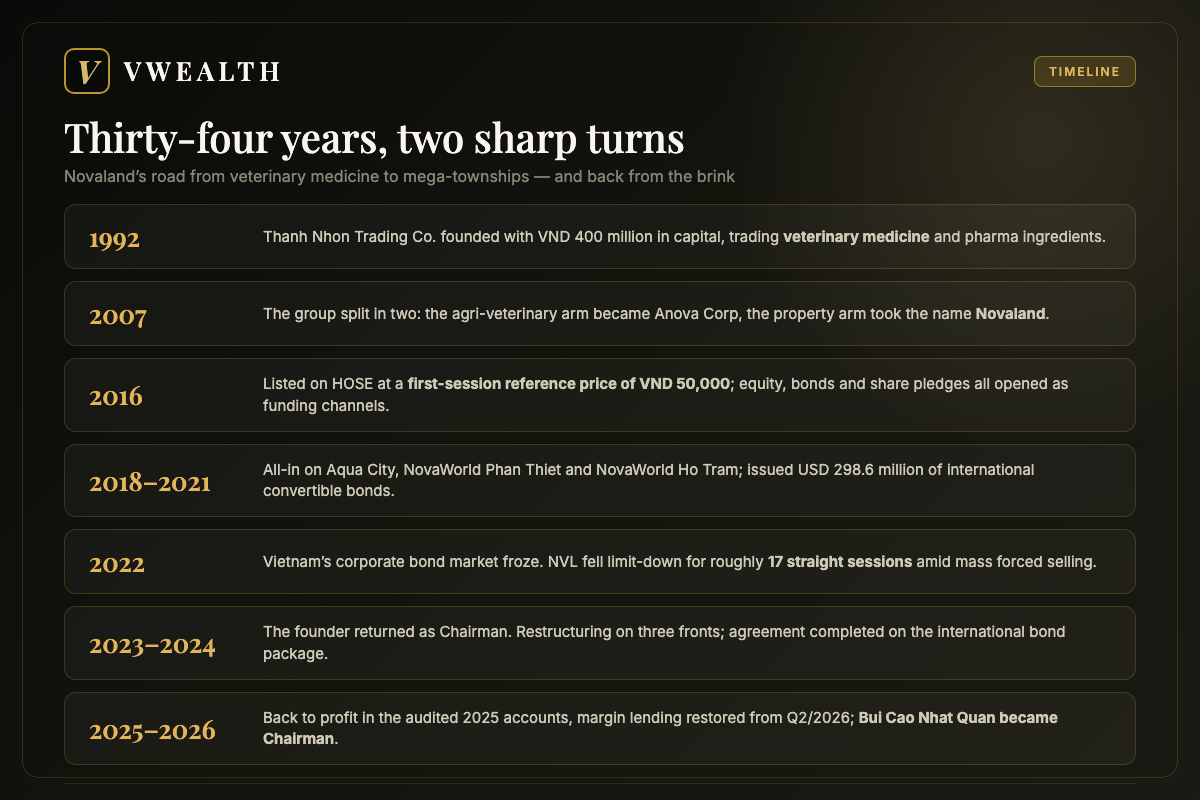
1992: a company called Thanh Nhon, capitalised at VND 400 million
On 18 September 1992, Bui Thanh Nhon founded Thanh Nhon Trading Company Limited with charter capital of VND 400 million — a sum that, at the exchange rates of the day, was a small business by any standard. The registered lines of business were veterinary medicine, pharmaceutical raw materials, chemicals and aquaculture treatments. The context matters: Vietnam had opened its economy only a few years earlier under the Doi Moi reforms, industrial-scale animal husbandry was just beginning to form, and a man trained in animal husbandry and veterinary science — Nhon was born in 1958 in Dong Thap province in the Mekong Delta — could see a very specific gap. Farmers were raising more pigs, more chickens and more shrimp every year, while the medicines available to them were scarce, inconsistent in quality and unbranded.
Thanh Nhon did not stop at distribution. The company partnered with a Philippine counterpart to build a veterinary pharmaceutical plant called Bio Pharmachemie, then expanded into animal feed, farms and raw materials. Remember this detail, because it repeats itself in every subsequent phase of Novaland’s life: this company does not like being one link in a chain, it likes owning the whole chain. Sell medicine, then build the factory. Do property, then handle everything from land assembly through master planning, construction, sales and, finally, the operation of the finished township. That “own the whole chain” gene is simultaneously the source of the group’s strength and the origin of all its later trouble, because owning the whole chain means tying up capital at every stage.
Also during the 1990s, the company touched real estate for the first time, in a very modest way: building villas in Thao Dien, in what was then District 2 of Ho Chi Minh City, and leasing them to expatriates working in the city. It was a side activity, effectively parking idle capital in an asset. But people close to the business say it was exactly this period that showed Nhon something important — the margins on developing and leasing housing in a rapidly urbanising city were far better than selling animal medicine, and more importantly, the scale of that opportunity had almost no ceiling.
2007: the split that created the Novaland brand
2007 was the first, and probably the most consequential, turning point in the group’s history. Bui Thanh Nhon’s cluster of companies was restructured and split into two distinct blocks. One block retained the agriculture, veterinary medicine and food businesses, later consolidated as Anova Corp with members including Anova Feed, Anova Farm, Bio Pharmachemie and Anova Pharm. The other formally entered real estate under a new brand: Novaland.
Pause on that decision, because it says a great deal about how the group’s leadership thinks. In 2007, the veterinary business was the reliable cash generator: it had factories, market share and steady cash flow. Real estate was the opposite — capital intensive, dependent on administrative approvals, long-cycle and high-risk. Instead of using property cash to feed the veterinary arm or vice versa in the loose conglomerate style common in the region, the founder separated them entirely so that each side answered for its own capital and its own results. That is a clean piece of governance, and it was rare among Vietnamese family businesses at the time.
For you as an investor weighing NVL, that detail carries a very practical implication. When you buy NVL stock, you are not buying the veterinary business, you are not buying Anova, and you are not buying the whole ecosystem that carries the “Nova” name. You are buying exactly one listed legal entity — No Va Land Investment Group Corporation — and its subsidiaries. The other names in the family, from NovaGroup in its role as a holding shareholder through the consumer, services and education arms, sit outside the perimeter of the shares you hold. Confusing “the Nova ecosystem” with “NVL the listed company” is one of the most common errors people make when reading news about this group, and it is a mistake that cuts both ways: good news about a Nova-branded venture does not necessarily accrue to your shares, and bad news about one does not necessarily hit them either.
The 2010s and the HOSE listing in December 2016
The stretch from 2009 to 2016 is when Novaland built its reputation, and it did so in the most classic way an urban developer can: assemble sites inside Ho Chi Minh City, build mid- and high-end apartment projects, sell fast, recycle the capital. Sunrise City in District 7, introduced in 2009, was the project that established the brand. After it came a long list of names that anyone who bought a home in Saigon during that decade will recognise: The Sun Avenue, Golden Mansion, Orchard Garden, Sunrise Riverside, Palm City, Victoria Village, Lakeview City, The Grand Manhattan.
The model at that stage was simple and very effective. Novaland bought partially permitted projects from other developers — typically businesses that had run out of capital after Vietnam’s 2011–2013 property downturn — completed the paperwork, re-planned the site, built and sold. Because it was buying projects rather than raw land, the interval between spending money and having a sellable product was far shorter than doing compensation and site clearance from scratch. This is the genuinely important point: Novaland’s true core competence during this period was legal and administrative execution plus project acquisition, not construction.
Understand that clearly, because it explains both the later success and the later failure. A company that is good at “unblocking project paperwork” holds an enormous competitive advantage in a market where procedure is the biggest bottleneck. But it is an advantage that depends on the policy environment. When rules change, and when older projects are reviewed retroactively, the very projects that were cheap because they were “stuck” become the burden. Novaland captured the entire upside of this advantage through the 2010s, and paid for its downside through the 2020s.
At the end of December 2016, NVL stock formally listed on the Ho Chi Minh Stock Exchange with a first-session reference price of VND 50,000 per share. It was a loud debut: Novaland immediately entered the group of largest listed property companies by market capitalisation, and Bui Thanh Nhon joined the ranks of the wealthiest people on the Vietnamese market.
The listing brought more than prestige. It opened three doors that an unlisted developer does not have: equity capital from domestic and foreign investors, bond issuance at lower cost thanks to greater transparency, and the ability to use the shares themselves as collateral for loans. All three are legitimate, ordinary financial tools. But when all three are opened to their maximum at the same time, they produce a capital structure that is extremely fragile in the face of a shock — something the market would witness six years later.
One comparison worth filing away: Novaland listed much later than several peers but grew far faster. While Nam Long chose slow growth alongside Japanese partners and a low debt ratio, Novaland chose speed. Neither choice is absolutely right. But when the cycle turned, the two choices led to radically different fates, and that contrast is the single biggest lesson Vietnamese property investors took away from 2022–2023.
The biggest bet: leaving the inner city to build “cities”
Around 2018–2019, Novaland executed its second pivot, and the most expensive one in its history: shifting focus from inner-city apartment projects to mega-townships and integrated resort complexes covering thousands of hectares on the urban fringe and along the coast. Three names define this era — Aqua City in Dong Nai province, NovaWorld Phan Thiet in Binh Thuan, and NovaWorld Ho Tram in Ba Ria–Vung Tau — each of them roughly a thousand hectares in scale.
The logic behind the decision was not unreasonable, and it deserves a fair hearing. First, developable land inside Ho Chi Minh City had run dry and compensation costs were rising steeply; to sustain growth, a developer had to go further out. Second, regional connecting infrastructure was being built aggressively — the Dau Giay–Phan Thiet expressway, Long Thanh International Airport, the ring roads — promising to cut travel times from Ho Chi Minh City to the coast down to two or three hours. Third, the “second home” model combined with leisure tourism was booming across several countries in the region. Put those three together and you had an investment thesis that sounded genuinely persuasive in 2019.
The problem lay elsewhere. A thousand-hectare township is not an apartment project scaled up. It differs in three ways that turn out to be existential. First, capital: you must fund roads, power, water, landscaping and amenities across the entire site before the first home is worth anything. Second, time: the development cycle runs seven to ten years, which means you must survive at least one downturn. Third, permitting: the larger the scheme, the more procedures, the more agencies whose sign-off you need, and the higher the probability that one step gets stuck. Novaland committed the bulk of its resources to three such projects simultaneously, and financed them primarily with borrowings and bonds.
By this point you have enough information to guess what comes next. A company with three enormous unfinished projects, funded by short- and medium-term debt, dependent on continuous sales to keep the money circulating. That structure needs only one shock at either end — the bond market freezing, or homebuyers stopping — for the whole machine to seize. At the end of 2022, both shocks arrived at once.
The storm of 2022: when bonds and confidence broke together
In early 2022, Bui Thanh Nhon stepped down as Chairman of Novaland’s Board of Directors and left the board entirely, handing the chairmanship to Bui Xuan Huy and the chief executive role to Nguyen Ngoc Huyen. In governance terms this was a prepared generational transition, and at the time the press received it as a sign of corporate maturity.
Less than a year later, the market turned violently. In the second half of 2022, Vietnam’s corporate bond market effectively froze following a series of high-profile enforcement cases involving bond issuance, which destroyed retail investor confidence and made new issues all but impossible. At the same time, credit to the property sector was tightened, interest rates rose quickly, and homebuyers — especially the investment buyers who dominate resort projects — stopped writing cheques. For a company that depended on the “presell, collect, keep building” cycle, that was the worst possible configuration of events.
What happened on the screen is remembered by anyone who followed the market then. NVL stock went through a run of roughly seventeen consecutive limit-down sessions at the end of 2022 with virtually no bids. For readers outside Vietnam, that phrase needs unpacking: HOSE applies a daily price band of plus or minus 7% around the previous session’s reference price, so a “floor” session is a 7% fall with no buyers at the limit. Seventeen of them in a row compounds to a decline of well over two-thirds, and because there are no bids, holders cannot exit at any price in between. This is where the financial structure exposed its full weakness: a very large number of NVL shares held by the major shareholder group had been pledged as collateral for loans. When the price fell hard, those loans triggered collateral calls, and when the calls could not be met in time, the shares were force-sold into the market — adding selling pressure, pushing the price lower, triggering the next round of forced sales. It is a self-amplifying spiral that nobody inside the company can stop by willpower.
On the project side, the three biggest construction sites — Aqua City, NovaWorld Phan Thiet and NovaWorld Ho Tram — all slowed to a crawl. Sales activity was close to paralysed and cash dried up, while bond and loan maturities kept arriving on schedule. For Bui Thanh Nhon’s family, the crisis stripped hundreds of millions of NVL shares out of their hands through forced sales, sharply reducing their ownership and evaporating most of their paper wealth.
One point about reading this period fairly. A company hitting a liquidity wall during a sector-wide crisis is not the same thing as a company doing something wrong. 2022–2023 saw developers large and small across Vietnam fall into the same condition, from listed names such as Phat Dat and Dat Xanh through countless unlisted companies. What set Novaland apart was scale: because it had made the largest bet, it took the heaviest blow. When you assess NVL today, keep two things separate — ordinary business risk, which every property developer carries, and the project-level administrative and legal matters that are handled through their own state processes and are discussed in detail later in this article.
2023–2026: the founder returns and the long restructuring
In late 2022, in the middle of that record run of limit-down sessions, Novaland announced a comprehensive restructuring strategy accompanied by the return of Bui Thanh Nhon to the chairman’s seat — the second time he had taken it. This was not a public relations gesture. With the company needing to renegotiate with dozens of creditor groups, having the founder, with his entire reputation and personal wealth behind him, physically at the negotiating table was close to a precondition.
The restructuring can be summarised as three fronts running in parallel. The first front was debt: negotiating extensions, swapping bonds for real estate products or for shares, and selling assets and projects to raise cash for repayment. In the first six months of 2023 alone the company repaid roughly VND 9,000 billion of debt. The second front was project legal status: working patiently with provincial authorities to complete master planning approvals, land use fee determinations and construction permits for the three mega-projects. The third front was construction and handover: only delivered product produces recognised revenue, and only revenue breaks the vicious circle.
A landmark on the debt front was the international convertible bond — USD 298.6 million, coupon 5.25%, issued in 2021 to international investors and maturing in 2026. In mid-2024, Novaland completed a restructuring of that instrument after bondholders representing approximately 85.66% of the outstanding value approved amended terms. The principal outstanding, after capitalised interest, was set at approximately USD 320.9 million from the effective date of 5 July 2024, with a mechanism allowing bondholders to convert into shares at three points in time at progressively lower conversion prices, starting at VND 40,000 per share. Persuading an international bondholder group to extend rather than demand immediate repayment was one of the most meaningful outcomes of the entire process, because it bought the company the thing it needed most: time.
By 2025 the picture began changing colour. Novaland recorded a return to positive after-tax profit in the order of a thousand billion dong, following the record loss of 2024, driven mainly by handovers at NovaWorld Phan Thiet, NovaWorld Ho Tram, Aqua City, Sunrise Riverside and Palm City. The interesting part — and the part you must interpret correctly — is that 2025 revenue actually declined year on year. In other words, that positive profit did not come from selling more; it came from the mechanics of revenue recognition and from financial and restructuring activity. This is the crux of reading a restructuring company’s accounts, and we dissect it in the financial chapter.
The audited 2025 profit had one very practical market consequence. At the start of the second quarter of 2026, HOSE published its list of securities ineligible for margin trading and NVL was no longer on it. The stock had previously lost margin eligibility for late submission of its reviewed half-year 2024 report, and then remained ineligible because after-tax profit attributable to the parent’s shareholders was negative in every reviewed and audited report from H1 2024 through H1 2025. For a stock with as heavy a retail shareholder base as NVL, regaining margin eligibility matters materially for liquidity — though it also widens the swings in both directions.
On the human side, April 2026 marked a symbolic milestone. At the annual general meeting on 23 April 2026, Bui Cao Nhat Quan — Bui Thanh Nhon’s son, born in 1982 — was elected Chairman of the Board for the 2026–2031 term. Bui Thanh Nhon moved to chair a newly created Strategy and ESG Committee, advising on medium- and long-term development strategy. This handover happened in a completely different context from the one in 2022: the first time, a company at its peak was being handed over; this time, a company that has just climbed off the bottom is being handed over, with the full weight of its debt still ahead of it.
| Period | Key events | What it means for an investor |
|---|---|---|
| 1992–2006 | Thanh Nhon Trading Co. Ltd founded 18 Sep 1992 with VND 400 million capital, selling veterinary medicine; Bio Pharmachemie plant built; villas in Thao Dien leased to expatriates | The “own the whole chain” gene forms here; property is initially only a side activity |
| 2007–2009 | Restructuring splits the group into Anova Corp (agriculture and veterinary) and Novaland (real estate); Sunrise City launched | The later listed entity is purely the property business — the veterinary arm is not part of NVL |
| 2010–2016 | A run of inner-city HCMC apartment projects: The Sun Avenue, Golden Mansion, Sunrise Riverside, Palm City, Lakeview City and others | Core competence is permitting and acquiring stalled projects, not construction |
| Dec 2016 | HOSE listing at a first-session reference price of VND 50,000 per share | Three funding channels open at once — equity, bonds, share pledges — and leverage begins to build |
| 2018–2021 | Pivot to mega-townships and resorts: Aqua City, NovaWorld Phan Thiet, NovaWorld Ho Tram (each roughly 1,000 ha); USD 298.6 million international convertible bond issued in 2021 | Capital buried in long-dated infrastructure, financed mainly with debt |
| 2022 | Founder leaves the board early in the year; corporate bond market freezes; NVL falls limit-down for about 17 consecutive sessions; widespread forced selling of pledged shares | A classic lesson in share-pledge risk and funding long assets with short debt |
| Late 2022–2024 | Founder returns as chairman; three-front restructuring across debt, permitting and construction; roughly VND 9,000 billion repaid in H1 2023; international convertible bond restructuring effective 5 Jul 2024 | Time is bought; immediate liquidity risk falls but does not disappear |
| 2025 | Return to positive after-tax profit in the thousand-billion-dong range after the record 2024 loss; revenue still declines; close to 1,000 villas and townhouses handed over | Profit owes more to restructuring than to sales — read the composition carefully |
| 2026 | Removed from the margin-ineligible list from Q2; Bui Cao Nhat Quan elected chairman for 2026–2031 on 23 Apr 2026; plans to issue hundreds of millions to billions of new shares | Liquidity improves, but dilution becomes the single largest variable |
Looked at end to end, Novaland is not a story about luck. It is a story about deliberate bets. The first bet — abandoning veterinary medicine for property — won handsomely. The second — abandoning the inner city to build coastal cities — was right about the vision and wrong about the timing and the funding structure. Today the company is in the middle of its third bet: trading away existing shareholders’ ownership, through new share issues and debt-for-equity swaps, in exchange for the ability to survive and finish what it started. Whether you want to join that third bet depends enormously on how you judge the people steering it — which is the subject of the next chapter.
Who steers Novaland — and who actually owns it
There is an old line among investors: when you buy shares in a healthy company you are buying its results; when you buy shares in a company under restructuring you are buying its people. For NVL that is almost literally true. No valuation model can solve for “will dozens of creditor groups keep agreeing to extend?” or “will the province approve the land use fee determination this quarter or next?” Those questions rest on the negotiating skill, credibility and stamina of a specific set of individuals. So this chapter is not a courtesy introduction to management. It is a core part of the investment case.
Bui Thanh Nhon: the man who took the hot seat twice
Bui Thanh Nhon was born in 1958 in Dong Thap, studied animal husbandry and veterinary science, and started his business at thirty-four with VND 400 million of charter capital and a veterinary medicine shop. Thirty years later he headed one of Vietnam’s largest property groups and appeared on billionaire lists. That is an unusual trajectory, and it points to two traits: an ability to see opportunity where others have not yet looked, and a risk appetite well above the local norm.
The most revealing episode in his record is not a success but the crisis. In early 2022 he voluntarily stepped off the board and handed over to the next generation. At the end of 2022, when the company fell into the forced-selling and bond spiral, he came back. During the rescue phase the family shareholder group used its own shares and personal assets to support the company — and lost most of those shares through forced sales. The family’s aggregate ownership fell sharply from pre-crisis levels.
Read this detail in both directions, not one. The positive reading: the founder did not walk away, and put his own wealth in the same boat as minority shareholders — a degree of commitment not many Vietnamese business leaders demonstrated during that crisis. The cautious reading: the structure of pledging shares as loan collateral is precisely what amplified the 2022 collapse. Personal commitment is a mark of business integrity, but it does not substitute for discipline about leverage. When you assess any family-controlled listed company, ask two independent questions at once: is management’s interest aligned with shareholders, and is management financially disciplined? Those two things do not always travel together.
The April 2026 handover and today’s executive team
At the annual general meeting on 23 April 2026, Bui Cao Nhat Quan was elected Chairman of Novaland’s Board of Directors for the 2026–2031 term, succeeding his father. Born in 1982, Quan holds a business administration degree from Western Washington University in the United States, joined Novaland in 2007 and held executive and board positions before stepping back in 2017. In other words, this is not an outsider parachuted in: he spent close to a decade inside the company, then close to another decade off stage, before returning.
In parallel, Novaland established a Strategy and ESG Committee chaired by Bui Thanh Nhon, tasked with advising on medium- and long-term development strategy and sustainability standards. This is a common arrangement in family businesses during succession: the founder does not vanish but moves from executive decision-making to direction-setting and reputational underwriting.
For an investor, this handover raises a practical question you should track quarter by quarter rather than settle in advance: do the relationships with creditor groups and with provincial authorities — relationships built on the founder’s personal standing — transfer intact to the next generation? This is a risk specific to family-controlled companies, and you will meet it in many other listed names in Vietnam. The way to verify it is not through statements at a shareholder meeting but through concrete outcomes: how many more projects got their land use fees determined, how many more bond tranches got extended, how many more ownership certificates were issued to residents.
At the executive level, Duong Van Bac serves as Chief Executive Officer and legal representative. In an ordinary company, the CEO is accountable for operations and business results. In a company under restructuring like Novaland, most of the executive team’s time goes to three very different jobs: negotiating with creditors, processing project permits, and choreographing cash so there is just enough to keep building and just enough to service maturing debt.
This leads to an implication many investors miss. Conventional management metrics — gross margin, selling costs as a percentage of revenue, revenue per employee — are temporarily not accurate measures of the quality of Novaland’s management. The correct measure is progress across the three fronts. When you read a headline about NVL, ask yourself: does this reduce debt, does it unblock a permit, does it move a product into a deliverable state? Any item that cannot answer at least one of those three questions is, for the most part, noise.
NovaGroup, Diamond Properties and the family circle
Novaland’s ownership is a multi-layered structure you need to picture clearly. The two largest shareholders are both entities within the founding family’s ecosystem. NovaGroup JSC is the single largest shareholder — an entity in which Bui Thanh Nhon is himself the largest shareholder. Diamond Properties JSC is the second largest, chaired by Cao Thi Ngoc Suong, Nhon’s wife. Alongside them, Bui Cao Nhat Quan holds a meaningful stake in NVL directly.
Before the crisis, the family group held a commanding proportion of the company. After the forced sales of 2022–2023 and the subsequent voluntary sales made to generate cash for financial obligations, that proportion fell sharply and continues to move. Through 2026, Diamond Properties has repeatedly registered to sell portions of its NVL holding and has frequently not completed the registered volume — a small detail, but worth watching, because it suggests cash pressure still exists at the major-shareholder level.
This is a large difference from the sector peers you may be more familiar with. At Vinhomes, the parent shareholder holds a stable controlling stake that barely moves. At Novaland, the ownership structure is a moving variable, rewritten with every debt swap and every issuance. For an individual investor, that means you cannot treat the shareholder table you read today as a fixed picture — you must update it with each disclosure.
A note for foreign investors: room, disclosure and what you can actually buy
If you are investing from outside Vietnam, three structural features of this market shape how you interact with a name like NVL, and none of them are obvious from a Bloomberg screen.
The first is the foreign ownership limit, universally called “room” in local usage. Vietnam applies a general cap of 49% foreign ownership for listed companies in non-conditional sectors, with tighter limits in restricted industries — banking, for instance, is capped at 30%. Real estate development falls under the general regime rather than the bank regime. What matters in practice is not the headline cap but the remaining room: when foreign holdings approach the ceiling, buying is blocked at the exchange level regardless of price, and shares can trade at a premium in negotiated blocks. For a stock like NVL where foreign participation fell heavily after 2022, room has generally not been the binding constraint that it is in the most crowded blue chips — but you should check the current figure with your broker before sizing a position rather than assuming.
The second is settlement and trading mechanics. Vietnamese equities settle on a T+2 basis, meaning shares bought today are available to sell two business days later. Combined with the daily price band of plus or minus 7% on HOSE, this produces a very specific hazard in a volatile name: if a stock gaps limit-down with no bids, you cannot exit until buyers reappear, and the position you thought was liquid becomes untradeable for days. That is not a theoretical scenario for NVL; it is exactly what happened in late 2022. Any position sizing you do in this stock should assume that, in a stress event, you will not be able to sell at the price on your screen.
The third is disclosure rhythm. Vietnamese listed companies report quarterly, with a reviewed half-year report and an audited annual report, and they are also required to publish ad-hoc disclosures for material events — share issuances, major shareholder transactions, board changes. For a restructuring company, the ad-hoc disclosures often matter more than the quarterly numbers, because that is where issuance prices, debt swaps and permit milestones appear first. If you follow NVL passively through quarterly results only, you will consistently learn about the things that actually move the stock several weeks after the domestic market does.
| Shareholder group | Characteristics | What to monitor |
|---|---|---|
| NovaGroup JSC | Largest shareholder; an entity in which Bui Thanh Nhon is the largest shareholder | Sales, share pledges and participation in debt-for-equity swaps |
| Diamond Properties JSC | Second largest shareholder, chaired by Cao Thi Ngoc Suong | Registered sales versus volume actually executed — a read on cash pressure |
| Founding family individuals | Bui Cao Nhat Quan and related parties holding directly | Ownership percentage after each issuance — a measure of “same boat” alignment |
| Bondholders converting into equity | A new group emerging from debt swaps and the international convertible bond | Conversion timing and prices — the pipeline of potential new supply |
| Domestic retail investors | A very large shareholder count; sets day-to-day liquidity | Liquidity behaviour since margin eligibility was restored |
| Foreign investors | Weight swings sharply with confidence in the sector | Net buying and selling around legal and permitting announcements |
Dilution: the most important variable in today’s ownership structure
If you remember only one thing from this chapter, remember this: Novaland’s ownership structure is being rewritten, and the way it is rewritten will determine most of the value attached to each share you hold.
The reason is direct. The company does not have enough cash to retire its debt out of operating cash flow in the near term, so a large part of its obligations is being settled by issuing new shares — either handed directly to creditors, or placed privately to raise cash for repayment. Through 2026, Novaland has been running several capital-increase components at the same time: a bonus share issue of over 167 million shares to existing shareholders at a 40:3 ratio, with a record date of 11 June 2026, lifting charter capital from roughly VND 22,345 billion to roughly VND 24,021 billion; a planned employee stock ownership issue; a planned private placement of up to 800 million shares; and share issuance to swap bond principal. Added together, the total potential new share count runs into the billions.
Work through an illustrative example with round numbers to feel the weight of that. Suppose a company has 2 billion shares outstanding and a post-restructuring enterprise value of X. Value per share is X divided by 2 billion. If the company issues another 1 billion shares to wipe out part of its debt, enterprise value rises — because debt falls — but the share count rises 50%. Whether the net result is good or bad for you depends entirely on one question: how much debt does each new share extinguish? Issue at a high price and each share cancels a lot of debt, so existing holders lose little. Issue at a low price and existing holders bear a heavy cost. This is why the issuance price and the conversion price are the most important numbers for an NVL shareholder — more important than the quarterly profit line.
For the international convertible bond, the disclosed mechanism gives bondholders three conversion dates at progressively lower prices, starting at VND 40,000 per share. Track the relationship between the market price and those conversion prices yourself, because it tells you whether bondholders have any incentive to convert — and if they do, when the new shares will appear. For current figures on shares outstanding, charter capital and the progress of each issuance tranche, take them from the latest NVL analysis report on vwealth rather than relying on the numbers in any article, including this one, because they change constantly.
Dividends: do not expect cash in this phase
The last and most practical part for your wallet: dividends. The answer is blunt. If you are looking for a steady dividend stream, NVL is not your stock, and probably will not be for several more years.
The reason is not stinginess but arithmetic. A company still carrying a large debt load will always prefer to use every dong of cash to reduce debt or to finish unfinished projects, because both create far more value than distributing cash. Beyond that, restructuring agreements with creditors commonly carry covenants restricting cash dividend payments until debt obligations fall below agreed thresholds.
What you may encounter instead is a stock dividend or bonus share issue — like the 167 million-plus bonus shares at a 40:3 ratio in 2026. Understand what that actually is: a bonus issue creates no new value. You hold more shares, each representing a smaller slice of the same company, and the reference price is adjusted accordingly on the ex-rights date. Its real effect is to increase the share count, improve liquidity and lower the nominal price per unit — technically useful, but not a “bonus” in the everyday sense of the word. If you want a Vietnamese property stock with a more consistent cash distribution history, compare against names such as Vincom Retail, whose cash-generating mall portfolio has a very different profile, before making a decision.
To sum up the people-and-ownership picture: a founding family that lost most of its paper wealth to this very company and stayed anyway, a successor generation that has just inherited an unprecedented debt load, and a shareholder register that will keep changing because every step of the debt workout comes attached to new shares. To judge whether that structure is worth the risk, the next step is to look at the machine that actually produces the money — what Novaland really sells.

What Novaland actually sells: an anatomy of three project pillars
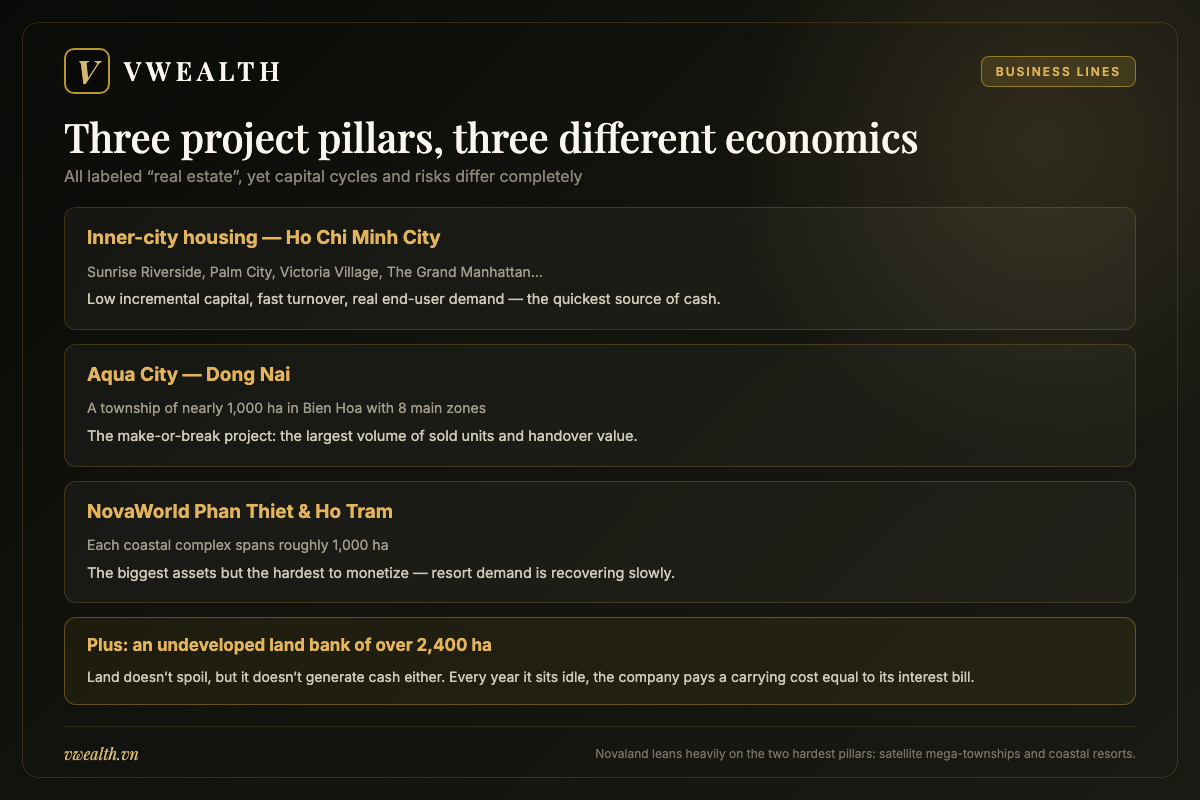
Ask ten investors what Novaland does and nine will say “real estate”. The answer is correct and useless, rather like saying that Vinamilk is in “food”. Inside that label sit three businesses with completely different economics: inner-city apartments, suburban mega-townships, and coastal resort property. They differ in capital turnover, in customer type, in sensitivity to interest rates, and — most importantly — in the probability of selling anything in a weak market. Novaland carries all three, weighted heavily towards the two hardest ones. Understand that and you understand most of the risk in the stock.
The business model: buy land, clear permits, presell, hand over later
Before the individual pillars, grasp the general machine. A Vietnamese residential developer runs a four-step cycle. Step one, assemble land — through your own compensation and site clearance, through auction, or by buying somebody else’s project. Step two, complete the legal package: in-principle investment approval, the 1/500 detailed master plan, the financial obligations on the land, and the construction permit. Step three, build and launch sales — typically once the project qualifies for the sale of “future-formed housing”, collecting payments in instalments tied to construction progress. Step four, hand over and issue the ownership certificate, known locally as the “pink book”.
For readers used to other markets, two of those steps deserve translation. “Future-formed housing” is the Vietnamese legal category for selling a home before it exists — broadly comparable to off-plan sales in the UK or presales in Australia, but with statutory preconditions: the foundation must be complete for an apartment building, the project must have the right paperwork, and the developer must have a bank guarantee covering its delivery obligation. The “pink book”, meanwhile, is the certificate of land use rights and ownership of the house and assets attached to the land. Until a buyer holds one, their ownership is contractual rather than registered, which limits resale and mortgage options. That is why certificate issuance counts are treated as real news in Vietnam and not as administrative trivia.
The crucial point that many newer investors misread sits between step three and step four. Money paid by customers on the instalment schedule flows into the company immediately, but under accounting standards revenue is only recognised at handover. That means there can be a gap of several years between when the company collects the cash and when it reports the revenue. This explains a paradox you will meet when reading Novaland’s accounts: falling revenue does not necessarily mean fewer sales, and rising revenue does not necessarily mean more sales — it may simply reflect how many units happened to be handed over this year.
For Novaland, that collect-to-recognise gap was stretched abnormally by the 2022–2024 cycle: units were sold, cash was partly collected, but the sites stopped, so nothing could be handed over. Revenue could not be recognised, while the “advances from customers” line ballooned on the balance sheet. You will see that line take centre stage in the financial chapter. It is simultaneously an obligation — the company owes each of those buyers a house — and a block of future revenue with its seat already reserved.
Pillar 1: inner-city Ho Chi Minh City homes, the fastest cash
This is the oldest and the least stressful part of Novaland. The portfolio includes projects familiar to any Ho Chi Minh City homebuyer: Sunrise Riverside, Palm City, Victoria Village, Lakeview City, The Grand Manhattan, alongside a range of other apartment schemes in and near the urban core.
Why does this segment matter more than its share of revenue suggests? Three reasons. First, housing in the core of a major city serves genuine end-user demand — people buying to live in, not to flip — so it still sells in a weak market. Second, each project is far smaller than a mega-township, which means the capital needed to carry a project across the finish line is much lower, which suits a cash-constrained company. Third, most of these projects were finished or nearly finished before the crisis, so what remains is mainly completing paperwork and handing over — converting inventory into revenue and cash at low incremental cost.
In the company’s 2026 plan, inner-city clusters such as The Grand Manhattan and Victoria Village are among the groups expected to contribute revenue and profit. One operating target disclosed by management is worth tracking closely: the goal of delivering thousands of ownership certificates for its Ho Chi Minh City projects. A certificate count sounds purely administrative, but for a shareholder it is one of the most honest indicators of progress on the legal front — because certificates are only issued once every financial obligation and procedure has been completed.
Pillar 2: Aqua City, the make-or-break project
If you had to pick one project that decides the fate of NVL stock over the next three years, it is Aqua City. This is a township of nearly 1,000 hectares in Bien Hoa, Dong Nai province, master-planned into multiple sub-zones including Phoenix Island, The Sun Harbor, River Park, The Grand Villas, The Valencia, The Stella, The Elite and The Suite.
Aqua City has two characteristics that put it at the centre of every conversation about the company. First, it carries a very large volume of already-sold product at high contract values — which makes it simultaneously the largest source of future revenue and the heaviest delivery obligation. Second, Aqua City was the project whose master-plan approval was suspended during the crisis, and the reinstatement of that planning adjustment was the single biggest psychological turning point of the whole restructuring.
According to company updates, Aqua City is targeted for construction completion during 2026 and continued handover of approximately 9,200 units across 2026–2027, with ownership certificates beginning to be issued to residents from the second quarter of 2026. These are very specific milestones, and precisely because they are specific they become the yardstick against which promises are tested. If you follow NVL, mark those dates in your calendar and check reality against them quarter by quarter — that is a more honest assessment of management than any research note.
One detail requires careful reading. The subsidiary operating this project recorded a very sharp fall in revenue and profit in 2025 against the prior year, driven mainly by a several-fold decline in the number of properties handed over to customers. To a hasty reader, that is bad news. To someone who understands the revenue recognition cycle, it was signposted in advance: 2024 was a year of concentrated handovers for one batch of product, 2025 was a construction year for the next. What you need to verify is not this year’s revenue figure but the construction progress and the number of units that will qualify for handover in the years after.
Pillar 3: NovaWorld Phan Thiet and NovaWorld Ho Tram, the hard part
The two coastal resort complexes, each around a thousand hectares, in Binh Thuan and Ba Ria–Vung Tau, are Novaland’s largest asset holding and its hardest problem. Hard for three stacked reasons.
The first is demand. Resort real estate serves investment and discretionary demand, not shelter. When the economy weakens or rates rise, this is the first item cut from the household budget. Vietnam’s entire resort property segment has been through a period of very thin liquidity since 2022, and its recovery lags residential noticeably.
The second is the operating model. A resort project only becomes genuinely valuable when it operates: when there are tourists, when occupancy exists, when the amenities are running. If everything sells but the township stands empty, secondary prices fall and the confidence of the next cohort of buyers collapses. This is why the company must keep spending on operations even when it has not sold anything new — at NovaWorld Phan Thiet, hundreds of villas have been brought into operation and many more are being fitted out for commercial exploitation.
The third reason is the legal status and the financial obligations on the land. This is the most sensitive point and needs to be stated precisely. Certain Novaland projects — NovaWorld Phan Thiet among them — fall into the group of projects whose land-related financial obligations must be recalculated following the conclusions of state inspections and reviews. This is a long-running administrative and land-law question about how the reference date for calculating land use fees should be determined; it is not a finding about the company’s business conduct. Nor is it unique to Novaland: the same issue affects a long list of projects across the country, which is exactly why the National Assembly issued Resolution No. 170/2024/QH15 to create a general resolution mechanism. For NovaWorld Phan Thiet, the direction under that resolution is to reset the land fee calculation date to 2008 rather than 2017, and the company has targeted completing the land use fee determination during the second quarter of 2026. This is one of the single most important milestones to watch, because until the land financial obligation is settled, the project cannot operate fully on a legal footing.
At NovaWorld Ho Tram, the project has received permits for infrastructure and building construction but remains held up on the extension of its investment approval and its land use term. In other words, each of Novaland’s large projects is parked at a different station along the same legal journey, and they are not progressing at the same speed.
| Project pillar | Economics | Role during restructuring | Principal risk |
|---|---|---|---|
| Inner-city HCMC housing | Genuine end-user demand, low incremental capital, fast turnover | Fastest source of cash and revenue; where near-term credibility is rebuilt | Limited remaining land bank; dependent on certificate issuance pace |
| Aqua City (Dong Nai, ~1,000 ha) | Suburban township, heavy infrastructure spend, long cycle | The make-or-break project: largest volume of sold product and delivery value | Construction and certificate timelines; dependent on regional infrastructure |
| NovaWorld Phan Thiet (Binh Thuan, ~1,000 ha) | Resort and second home, investment demand, thin liquidity | Large asset but slow to monetise; awaiting land use fee determination | Land financial obligation unresolved; segment recovering slowly |
| NovaWorld Ho Tram (Ba Ria–Vung Tau, ~1,000 ha) | Coastal resort close to Ho Chi Minh City, distance advantage | Infrastructure and building permits granted; investment approval extension pending | Land use term and extension procedures |
| Undeveloped land bank (over 2,400 ha) | Long-dated asset generating no cash until developed | A pool of assets for divestment, partnership or debt swaps | Selling from weakness; carrying cost and interest erode value |
The land bank and the moat question: the greatest advantage is also the heaviest burden
Novaland has disclosed an undeveloped land bank of more than 2,400 hectares, concentrated in areas with economic and tourism development potential. That number is the main reason value investors still look at NVL with a certain hunger: in a market where assembling even a few dozen contiguous hectares has become extremely difficult, owning thousands of hectares is an advantage that cannot be recreated.
But undeveloped land is a peculiar asset class, and you need to see both faces of it. The bright side: land does not spoil, does not go out of fashion, and over the long run tends to appreciate with urbanisation. The dark side: land does not generate cash by itself. Every year of holding it, the company pays interest on the capital used to buy it, pays maintenance costs, and carries the risk of planning and policy changes. For a company with a cost of capital as high as Novaland’s currently is, time is the enemy: each year that passes without putting a hectare to work, that hectare becomes more expensive by exactly the amount of the interest bill.
That is why divestments, project transfers and development partnerships appear so persistently in Novaland’s plans. In principle, selling assets to reduce debt is the right choice when the cost of capital is high. In practice, selling assets from a position of weakness rarely achieves a good price — the buyer knows you need the money. This is one of the cruellest trade-offs management has to weigh: sell cheaply to survive, or hold for value and carry more interest.
Which brings us to the hardest question in this chapter. Does Novaland have a durable competitive advantage — what investors call a moat?
The honest answer is yes, but a fragile and conditional one. Its largest advantage is a large-scale land bank in already-planned locations, something a new entrant essentially cannot assemble at a reasonable cost given current land prices and procedures. Its second advantage is brand and customer base: despite the crisis of confidence, Novaland remains a widely recognised name in the mid- to high-end southern market. Its third is two decades of accumulated experience navigating the permitting of very large projects.
All three advantages, however, share one condition: the company must retain enough capital to exploit them. A moat is only worth something if you are alive to stand behind it. That is the fundamental difference between NVL and peers with healthy balance sheets. Nam Long holds a far smaller land bank but can choose when to develop it; Novaland holds a far larger one but the timing is decided by its creditors and by the permitting queue. In investing, the option on timing is an intangible asset of enormous value — and it is exactly what Novaland currently lacks.
Reading the financial health of a developer in restructuring
This is the most important chapter in the article, and also the one most individual investors skip because it looks difficult. So let us be direct: if you cannot read Novaland’s balance sheet, you should not own this stock. With an ordinary company you can be lazy about the accounts and still muddle through by watching profit growth. With a company in restructuring, the financial statements are where every answer lives — and where every misunderstanding begins. This chapter teaches you how to read them. It deliberately does not hand you last quarter’s numbers. You get those from the current analysis report; the framework you keep for years.
Why Novaland’s statements do not read like a normal company’s
For a manufacturer or a retailer, the usual reading order is revenue, gross margin, net profit, and only then the balance sheet. For a property developer under restructuring, that order must be completely reversed. You read the balance sheet first, the debt notes first, the cash flow statement first — and the income statement last, with a sceptical eye.
The reason is that the income statement of this kind of company is dominated by three factors that are easy to misread. The first is handover timing: revenue spikes or slumps mainly because more or fewer units were delivered this year, not because current sales are strong or weak. The second is one-off financial income: gains on disposing of subsidiaries, gains on revaluing investments, or reversals of provisions. The third is the effect of the debt restructuring itself: when a liability is renegotiated on favourable terms, the company may recognise a financial benefit — genuine in accounting terms, but not cash produced by operations.
This is the key to Novaland’s 2025 paradox: after-tax profit returned to the thousand-billion-dong range following a multi-thousand-billion record loss in 2024, while revenue fell by more than twenty percent. An ordinary company cannot simultaneously sell less and earn more. A company in restructuring absolutely can — and you must open the notes to find out where that profit came from, rather than glance at the profit line and conclude that the business has recovered.
One more structural note for readers used to IFRS. Vietnamese listed companies report under Vietnamese Accounting Standards, which differ from IFRS in several ways that matter here: there is no fair-value revaluation of investment property held for development, capitalised borrowing costs sit inside inventory, and consolidation scope changes when subsidiary stakes are sold or diluted. The practical consequence is that a Novaland balance sheet carries land and work in progress broadly at historical cost plus capitalised expenses, not at current market value. That cuts both ways: the asset side may understate the market worth of land bought years ago, and it also means a “book value per share” screen tells you very little about this company.
Inventory: the biggest number and the most misread
On Novaland’s balance sheet, inventory is an enormous line item, in the hundreds of trillions of dong bracket together with receivables and work in progress. But a developer’s “inventory” is not a retailer’s inventory.
For a retailer, inventory is unsold stock — the more the worse, because goods can go out of fashion, expire, or need discounting. For a property developer, inventory is mostly the cost already sunk into projects under construction: land purchase, compensation, infrastructure, shell construction, capitalised interest. In other words, it is work in progress, not unsold goods. When a project completes and is handed over, this balance converts into cost of goods sold, matched against recognised revenue.
So the right question when looking at Novaland’s inventory is not “is it big or small” but the following three. One: which projects does this inventory sit in, and where is each of those projects on the legal journey? Inventory in a project that already qualifies for sale and is under construction is worth something completely different from inventory in a project still stuck in procedure. Two: how fast is inventory converting into revenue? If only a small share is released each year, the time to work through the whole balance is very long, and interest accrues throughout. Three: how much of the inventory is pledged as collateral for borrowings? Pledged assets cannot be freely sold to repay other debts.
All three questions are answerable from the notes to the financial statements. That is why, with NVL, reading the notes matters many times more than reading the headline totals.
Advances from customers: revenue with its seat already booked
The second line you must look at is “advances from customers”, short-term and long-term — money buyers have already paid on the instalment schedule but which the company cannot yet recognise as revenue because handover has not happened. At Novaland this sits in the tens of trillions of dong; the figure disclosed at the time of the 2026 plan update was over VND 20,000 billion.
Read this line as a two-sided map. Side one, the positive: this is near-certain future revenue. The buyer exists, the money is in. When the company can hand over, this converts into revenue and profit without selling a single additional unit. For a company struggling to make new sales, that is the most valuable revenue source it has. Side two, the obligation: every dong in this line corresponds to a promise to deliver a home. The company must spend more money to finish construction, to fit out, to obtain certificates. If it lacks the capital to complete, that “future revenue” can turn into disputes and refund obligations.
The number you should therefore try to estimate is the ratio between the capital still required to complete and the value of cash already collected. That calculation is not printed anywhere; you have to build it from project notes and the capital expenditure plan. But it is the central question: does Novaland have enough money to deliver everything it has already sold?
Mapping the layers of debt: do not look at total debt, look at each layer
Novaland’s total liabilities stood at approximately VND 191,015 billion at the end of 2025, against total assets of approximately VND 249,908 billion. Those are very large numbers, and looking only at the total will alarm you without teaching you anything. The useful approach is to separate the debt into layers by nature, because each layer carries a different level of danger.
Layer one is advances from customers — as noted, this is a debt owed to customers in the form of product rather than money, and it carries no interest. Layer two is trade payables, contractor payables and other payables — operating debt, with no or low interest, and generally renegotiable on timing. Layer three is bank borrowings — interest-bearing, secured, with a defined repayment schedule. Layer four is domestic bonds, which split further into bonds held by institutions and bonds held by individual investors. Layer five is offshore debt, comprising the convertible bond package and foreign loans.
This layering is not an academic exercise. It explains why restructuring progress differs so sharply between groups. According to management updates, the workout of bonds held by institutional investors has passed 90%, while retail bonds — held by individual investors — were only around 30–40% resolved, with the company targeting a rise above 90% during 2026 through asset sales, swaps into real estate product, or swaps into shares. The gap is easy to understand: negotiating with one institution holding a trillion dong is far simpler than negotiating with thousands of individuals holding a few hundred million each, every one of them with a different situation and a different tolerance for risk.
One genuinely positive indicator deserves recording: the company has stated that it no longer has non-performing debt with domestic credit institutions and has obtained credit limits from several banks. For a business that stood at the edge of a liquidity failure, the banking system’s willingness to extend lines again is a signal about access to capital — though it says nothing yet about the cost of that capital or the collateral conditions attached.
On near-term pressure, the number to hunt for in every report is debt maturing within the next twelve months. That figure determines whether the company spends the year scrambling. In restructuring updates, management has cited twelve-month maturities in the tens of trillions of dong. Compare it against three sources: cash on hand, expected cash from handovers, and the capacity to sell assets. If those three together fall short, the shortfall will be covered by extensions or by share issuance — and both have a price.
Cash flow and the going-concern emphasis: where the truth cannot be dressed up
If you have only ten minutes to read an NVL report, spend all ten on the cash flow statement. Profit can be shaped by recognition policy, by one-off items, by provision reversals. Cash does not lie.
Three lines to read in order. Operating cash flow: the money the business generates from selling and delivering product after construction and operating costs. For a developer with many projects mid-build, a negative figure here is normal — the cash is buried in concrete. What you track is the trend: is the negative number narrowing quarter by quarter, and does any quarter flip positive on the back of concentrated handovers?
Investing cash flow: for Novaland in this phase, a positive number here typically comes from selling assets, transferring projects or disposing of subsidiaries. This is “selling the furniture to pay the mortgage” — reasonable in a difficult period, but if it runs for years, the asset base that generates future value thins out.
Financing cash flow: new borrowings, repayments, share issuance. This is where you see what the company is actually living on. If operating cash flow is negative while financing cash flow is positive because of new borrowings, the company is using new debt to feed old debt. If financing cash flow is positive because of share issuance, shareholders are carrying the load — through dilution.
Now the technical part that very few individual investors know to look for. In an audit report, alongside the audit opinion, there may be a section called an “emphasis of matter” relating to the going concern assumption. In plain language: the auditor is flagging that the company’s ability to continue operating normally depends on certain conditions being met — successful debt extension negotiations, asset sales, or new capital being raised.
For Novaland this language has appeared before and was described in the financial press as the company’s “survival conditions”. The right way to read it is neither panic nor dismissal. An auditor raising the matter does not mean the company is about to fail; it means the outcome depends on conditions outside management’s absolute control. What you should do is read that list of conditions — it is usually itemised quite specifically — and turn it into your own monitoring checklist. Every quarter, tick each line: has this condition been met yet? That is a far more professional way to follow a restructuring stock than watching the price board.
| Metric to track | Where to find it | Good signal | Bad signal |
|---|---|---|---|
| Debt maturing within 12 months | Notes on borrowings and bonds | Falling quarter by quarter; mix shifting from short to long term | Not falling, or falling only through repeated extensions |
| Retail bond workout ratio | Disclosures and restructuring update meetings | Approaching the level already reached with institutions (above 90%) | Stalled around 30–40% |
| Advances from customers | Balance sheet | Steadily converting into revenue as handovers occur | Flat for several quarters — meaning nothing is being delivered |
| Operating cash flow | Cash flow statement | Negative figure narrowing; occasional positive quarter from handovers | Deeply negative for a long stretch, funded by new borrowings |
| Ownership certificates issued to residents | Company disclosures and project news | Rising steadily in both inner-city projects and Aqua City | Behind the publicly committed schedule |
| Going concern emphasis | Audit and review reports | The list of conditions shrinking period by period | The list unchanged or getting longer |
| Shares outstanding | Charter capital change disclosures | Rising alongside a materially corresponding fall in debt | Rising sharply while debt falls disproportionately little |
Those seven rows are the minimum monitoring set for NVL. You do not need to know today’s P/E; you need to know which way these seven numbers are heading. For the period-by-period figures, look them up in the updated NVL analysis report on the vwealth platform, where these metrics are already extracted quarter by quarter — saving you the work of reading several hundred pages of notes.

How the market treats NVL stock
Some stocks follow earnings. Some stocks follow headlines. NVL belongs to the second category to an extreme degree. Over the past four years, this ticker’s limit-up and limit-down sessions have almost always been attached to a single item of news: a project cleared a procedural hurdle, a bond tranche was extended, an inspection conclusion was published, an issuance was registered. Understanding NVL’s trading personality matters as much as understanding the business — because it determines how you will actually experience owning it.
The personality of NVL: a news stock with a wide band and a long memory
NVL has one of the largest individual shareholder bases on the exchange, numbering in the tens of thousands of accounts. That ownership structure produces a clear characteristic: the stock reacts strongly and quickly to news, usually far beyond the news item’s genuine economic significance. A procedural unblocking at one project can drive several consecutive up sessions, even though the real financial impact will take many quarters to appear. Conversely, an unfavourable headline can trigger a sell-off even when the content changes nothing fundamental.
Second characteristic: a very wide trading range. In 2026 alone the stock went through a strong advance and then a correction of more than 30% from the highs. To someone used to trading bank shares or consumer names, that amplitude looks abnormal; for NVL it is the normal state of affairs. You have to accept that before you buy, not discover it after your account is down twenty percent.
The third characteristic is one people rarely say out loud: NVL carries a great deal of collective memory. Very many investors lost heavily in this name during 2022–2023 and still hold it at prices far above where it trades. That creates a layer of latent supply on every rally: each time the price reaches the break-even zone of an older cohort, selling pressure appears. This is a real market-psychology phenomenon, and it is why the price recovery of stocks that have crashed hard tends to be saw-toothed rather than smooth.
Trading mechanics that shape the experience: bands, T+2 and forced selling
Foreign investors coming from deeper markets should understand three mechanical features that make Vietnamese volatility feel different from the same percentage move elsewhere.
The daily price band on HOSE is plus or minus 7% of the reference price. On the upside this dampens euphoria; on the downside it produces the specific pathology of the “locked floor”, where the stock sits at minus 7% with a queue of sellers and no buyers. Nothing trades. The following day it opens lower and may lock again. This is why a Vietnamese stock can lose two-thirds of its value in a few weeks without ever offering you a chance to exit at an intermediate price, and it is precisely the mechanism that trapped NVL holders at the end of 2022.
Settlement is T+2, so shares purchased today cannot be sold until two business days later. In a fast-moving name this adds a compulsory holding window you did not choose. Combined with the band, it means that a two-day adverse move can take a position materially underwater before you are legally able to act on it.
The third feature is margin, and its interaction with the above. Vietnamese brokers lend against eligible securities, and forced liquidation is automated when collateral coverage falls below threshold. In a locked-floor sequence, forced liquidation orders queue at the floor and cannot execute, which means the broker’s exposure grows for several days and then unwinds violently when a bid finally appears. This is not hypothetical — it is the mechanical description of what happened to NVL in late 2022, and it is the reason the margin question below matters more here than it would elsewhere.
Why P/E is nearly useless for NVL — and what to use instead
New investors typically open a data screen, look at the P/E, compare it against the sector average and conclude the stock is cheap or expensive. With NVL that approach is not merely useless, it is dangerous.
Reason one: the denominator is unstable. Novaland’s profit during the restructuring has swung violently between years — a multi-thousand-billion loss in one year, a thousand-billion profit in another driven by non-recurring items. A ratio divided by a number that jumps like that produces noise, not information.
Reason two: the numerator is unstable too. The share count is rising continuously through issuances, bonus shares and bond conversions. Earnings per share are therefore being diluted in a way that is hard to forecast.
Reason three, the most fundamental: for a company whose value sits in its assets rather than its current earnings stream, an earnings-based valuation method is simply the wrong tool. The sensible approach is asset-based — estimate the market value of the projects and the land bank, subtract all debt, and divide by the fully diluted share count. Analysts call this RNAV, revalued net asset value.
But RNAV has its own traps, and you should know them in advance. Trap one is the price assumption: valuing a hectare in Phan Thiet at 2019 expectations versus at actual current transaction prices produces two answers a long way apart. Trap two is cost and time: a project that needs another seven years and tens of trillions of dong to complete must be discounted heavily in present value. Trap three is dilution: if you compute RNAV on today’s share count while ignoring the billions of shares about to be issued, your number will be absurdly high. The practical rule with NVL: always compute on the fully diluted share count, and always use conservative sale price assumptions.
The margin story: cut off, then released
A technical detail with very real price consequences: eligibility for margin trading. NVL was placed on the list of securities ineligible for margin trading after the late submission of its reviewed H1 2024 financial report, and remained there because after-tax profit attributable to the parent’s shareholders was negative across the reviewed and audited reports from H1 2024 through H1 2025.
After the audited 2025 report recorded a positive profit, NVL met the criteria and came off the list. On 2 April 2026, HOSE published a list of 68 securities ineligible for margin trading in the second quarter of 2026 — three fewer than the prior quarter — and NVL no longer appeared on it.
The implication for you has two sides. Positive: restored margin eligibility means leveraged money can return, liquidity improves, and psychologically it marks the end of an extended period as a “flagged” stock in the exchange’s eyes. Cautionary: margin is a double-edged instrument. Leverage is precisely what amplified the 2022 collapse. When a highly volatile stock regains margin eligibility, subsequent corrections tend to be deeper and faster because forced selling is added to ordinary selling. If you intend to hold NVL, set yourself one rule: do not use leverage on a stock that is already leveraged at the company level.
Dilution seen from the valuation side
The previous chapter discussed dilution in terms of ownership. From a valuation standpoint, it is something you must build into every number you compute.
Take a purely hypothetical illustration with round figures — not the company’s actual numbers. Suppose a developer has net assets after debt of VND 40,000 billion and 2 billion shares outstanding. Value per share is VND 20,000. Now the company issues another 1 billion shares at VND 12,000 to repay debt. After the issue, net assets rise to VND 52,000 billion because VND 12,000 billion came in and went to debt, the share count becomes 3 billion, and value per share is approximately VND 17,300. Existing holders lost about 13% of value per share even though the company got healthier.
Conversely, if the issue were priced at VND 25,000, net assets become VND 65,000 billion on 3 billion shares, roughly VND 21,700 per share — existing holders gain. That is the whole story: issue high and incumbents benefit, issue low and incumbents are diluted. And the cruel irony is that the more distressed a company is, the harder it is to issue high.
So when you see the headline “Novaland approved to issue additional shares”, do not rush to celebrate or to worry. The only questions worth asking are: issued to whom, at what price, and how much debt does each dong raised extinguish? Those three numbers determine whether the news is good or bad for you specifically.
Foreign flows, institutional money and where NVL sits in a portfolio
Before the crisis, NVL was among the property stocks most closely followed by foreign investors and institutional funds, partly because of its market capitalisation and partly because it served as a proxy for the southern residential market. After 2022, most institutional money withdrew from highly leveraged property names and rotated into balance sheets that could be slept on.
That has a consequence worth knowing: NVL today is largely a domestic retail game. Price action therefore carries more psychology than analysis, rallies can overshoot fair value and declines can undershoot it. If you are a patient, disciplined investor, that characteristic creates opportunity; if you are prone to following the crowd, it is a trap.
A useful way to position NVL is to place it against sector peers along an axis of balance sheet quality. At the safest end sit Vinhomes with its scale of handovers and Nam Long with its low leverage. Adjacent to them are property companies with recurring rental income such as Vincom Retail, and industrial-park developers with a completely different demand driver such as Kinh Bac. In the middle sit developers recovering from the difficult cycle, such as Dat Xanh and DIC Corp. At the highest-risk end — and with the largest rebound potential if everything goes right — sits NVL. This is not a ranking of good and bad; it is a ranking by risk. Where you choose to sit on that axis depends on your appetite and on the weight you intend to allocate.
Catalysts: what news actually moves NVL
Finally, here is the list of news types capable of moving NVL materially, ranked by genuine impact rather than by how loud they sound.
| Type of news | Real impact | Why |
|---|---|---|
| Final determination of land use fees at a major project | Very high | Unlocks the entire chain behind it: permits, sales, certificate issuance |
| Completion of a swap or extension on a large debt tranche | High | Directly reduces the twelve-month maturity wall — the survival variable |
| Disclosure of a specific private placement price | High | Determines the scale of loss or gain for existing shareholders |
| Sale or transfer of a major project | Medium to high | Depends on price: cash for debt, but the loss of a future value engine |
| Quarterly handover and certificate issuance figures | Medium | Confirms whether commitments are turning into reality |
| General policy news for the property sector | Medium | Lifts the whole sector; NVL benefits more because of its high sensitivity |
| Major shareholder and insider transactions | Low to medium | Mostly short-term sentiment; rarely changes fundamentals |
The takeaway: the top three news types all concern debt and legal status, not revenue or profit. That is the clearest evidence that NVL at this point is not a stock priced on business results — it is a stock priced on the probability of a successful restructuring.
Industry context: a new cycle for Vietnamese real estate
No property company swims against the cycle for long. Novaland collapsed because the cycle turned, and if Novaland recovers, most of the credit will belong to the cycle as well. So before discussing company-specific scenarios, you need a picture of where the industry stands — specifically four things: the new legal framework, the mechanism for unblocking legacy projects, actual supply and demand, and the cost of money.
The new legal framework: three laws and the land price tables
From 2026, the market operates under a legal framework entirely different from the previous cycle, with the 2024 Land Law, the 2023 Housing Law and the Law on Real Estate Business all in force, together with new provincial land price tables applied from 1 January 2026.
For a company like Novaland, this framework cuts two ways. The favourable direction: clearer rules on how land can be accessed — state allocation, auction, tender, or negotiated transfer of land use rights — narrow the grey zones and reduce the risk of retrospective review later. For projects executed under the new process, the legal footing is firmer and buyers trust the product more.
The unfavourable direction: the new land price tables are generally substantially higher than the old ones, which raises land use fees. For a project that has not yet settled its land financial obligation, that can be a cost far larger than originally budgeted, thinning the development margin. And for projects that must have their obligations redetermined, the question of which price table applies, and as at what date, becomes a multi-trillion-dong question — which is exactly why the special mechanisms described below matter so much.
There is a second-order effect worth noting for anyone modelling the sector. Higher land price tables raise the replacement cost of every future project, which mechanically increases the value of land already assembled and paid for at older prices. In a normal market that would be unambiguously good for a company holding thousands of hectares. In Novaland’s case the benefit is real but deferred and conditional, because the land in question mostly still carries unsettled obligations and unfinished infrastructure. Rising replacement cost helps the owner of finished, clean-title land far more than it helps the owner of land still in the queue.
Resolution 170 and the land use fee knot
Resolution No. 170/2024/QH15 of the National Assembly is among the documents with the most direct influence on the group of property companies carrying legacy projects, Novaland included. The resolution’s purpose is to create a mechanism for definitively resolving projects that already have inspection conclusions, review findings or court judgments — projects that have been suspended for years because it was unclear which rules applied, and as at what point in time.
To avoid any misreading, this needs stating plainly: it is a general mechanism covering many projects across the country, not a policy for any single company. The substance of what the resolution addresses is a technical land-law question — redetermining the reference date and the method for calculating financial obligations — and not an assessment of any developer’s business conduct. For NovaWorld Phan Thiet, the direction under this mechanism is to reset the land fee reference date to 2008 instead of 2017. The specific figure awaits a decision by the competent authority, but the principle is easy to grasp: calculating against the 2008 land price base produces a materially lower obligation than calculating against the base of nearly a decade later.
For an investor, this is one of the largest single variables affecting the company’s value, and it lies entirely outside the company’s control. What you should do is not guess the number but track the process: has the decision been issued, which projects does it cover, how much must be paid, and by when. Until those figures are fixed, every estimate of Novaland’s asset value carries a very wide error band.
Supply, demand and the great divergence of 2026
The common thread through 2026 market reports is one word: divergence. The market no longer rises or falls as a block the way it did in previous cycles; it has split into groups with quite different fates.
The clearest beneficiary is end-user housing in the two largest cities. High urbanisation combined with the continued migration of skilled labour into Hanoi and Ho Chi Minh City keeps generating genuine demand, while shrinking inner-city land pushes new supply outward. The second group is projects with clean legal status: 2026 is regarded by many research houses as a turning point, as a number of projects complete their procedures, adding transparent supply and helping restore market confidence.
The slowest group to recover remains resort property and investment products far from the urban centres. This is a direct disadvantage for Novaland, because two of its three mega-projects sit squarely in that group. In fairness, though, NovaWorld Ho Tram enjoys a distance advantage relative to Ho Chi Minh City, and connective infrastructure across the southeastern region is improving significantly with Long Thanh airport and the expressway network — factors that could shorten the recovery time for this segment compared with more remote destinations.
One more supply-side dynamic matters for a company in Novaland’s position. Because so few developers were able to launch new projects between 2022 and 2025, the pipeline of ready-to-sell product in the south is unusually thin relative to demand. A company that manages to bring completed, fully permitted inventory to market during a supply-constrained window enjoys better pricing power than the same company would in a normal year. That is a genuine tailwind, and it applies to Novaland’s inner-city portfolio in particular — the part of the business that is closest to being deliverable.
Interest rates, credit and the ghost of the bond market
For real estate, the cost of capital matters as much as revenue. Three funding channels feed this industry: bank credit, corporate bonds, and homebuyers’ money.
The credit channel depends on the general level of interest rates and on policy. When mortgage rates are tolerable, buyers borrow and developers sell — the cash cycle turns. When rates are high, both ends jam at once. This is a macro variable you should follow continuously if you hold property stocks, because it affects the whole sector more powerfully than any individual company’s efforts. It is also why the health of the banking system is not a separate topic from the health of property; if you want to see the other side of the same trade, our analysis of Techcombank, a bank with heavy property exposure, is a useful companion read.
The bond channel is where the deepest scar was left. After the collapse of confidence in 2022, the property corporate bond market has taken years to rebuild. For Novaland, resolving over 90% of bonds held by institutional investors is a meaningful achievement, but the retail bond tranche at roughly 30–40% resolved remains the bottleneck to be cleared during 2026. There is a general lesson here for the whole industry: when you raise long-term capital from thousands of individual investors using short-term instruments, the cost of restructuring later is many times larger than the interest you saved at issuance.
The third channel — homebuyers’ money — is in reality the cheapest form of financing available and the riskiest one for the buyer. When the market loses confidence in a developer’s ability to deliver on time, this channel shuts instantly. For Novaland, delivering on schedule and issuing ownership certificates to residents is not merely a contractual duty: it is the only way to reopen the cheapest source of capital it has.
The competitive map: where NVL sits in the sector
Vietnamese residential property has no absolute winner, but the gap between companies in balance sheet quality widened enormously through the last cycle. The table below positions NVL against the criteria investors actually care about when comparing within the sector.
| Criterion | NVL’s position | Sector comparison |
|---|---|---|
| Land bank scale | Among the largest; over 2,400 ha undeveloped beyond the three mega-projects | Far ahead of most listed developers, behind only the market leaders |
| Financial leverage | Highest in the group; liabilities are a very large share of total assets | The opposite of companies that chose a low-debt strategy |
| Product mix | Weighted heavily towards suburban townships and resort property | A disadvantage against peers focused on end-user housing in major cities |
| Project legal status | In the process of resolution; some projects awaiting final land obligations | Behind peers with clean-title projects, but a resolution mechanism now exists |
| Near-term handover capacity | A large volume of already-sold product awaiting completion | Substantial revenue potential provided construction capital is available |
| Expected dilution | Very high, from debt swaps and new issuance | Well above the sector norm |
| Sensitivity to policy news | Very high | The clearest sentiment proxy for the sector among large caps |
Look at that table and the portrait comes through clearly: this is a company with one of the largest asset bases in the sector and the weakest capital structure in it. That is precisely the definition of a high-beta stock — it rises more than the market when the sector is favourable and falls further when it is not. If you want exposure to a Vietnamese property recovery with lower risk, the sector offers plenty of choices at different points on the risk curve, from Vingroup at the conglomerate level down to focused developers. If you want the largest possible rebound amplitude and accept the corresponding probability of failure, NVL expresses that view more purely than anything else on the exchange.
Resort property: the hardest segment and Novaland’s particular problem
To close this chapter, the segment that determines most of Novaland’s asset value deserves its own treatment: resort and second-home property.
This segment in Vietnam has a structural problem that has never been fully solved: the utilisation problem. Someone who buys a beachfront villa usually does not buy it to live in but to rent out and hold for appreciation. That only makes sense if the area draws enough tourists, has enough service infrastructure, and has a competent rental operator. If those three do not converge, the product loses liquidity, secondary prices fall, and a wave of distressed selling follows.
This is why Novaland has had no choice but to keep investing in operations at NovaWorld Phan Thiet even with cash tight: hundreds of villas have been brought into commercial operation and hundreds more are being fitted out. It costs money in the short term, but it is a necessary condition for protecting the value of everything still unsold. From an investment standpoint, treat this as a mandatory expense rather than a discretionary one, and build it into your estimate of the company’s capital needs over the coming years.
The outlook for this segment is tied closely to tourism. If international and domestic visitor numbers keep growing, and if connective infrastructure keeps shortening travel times, large integrated resorts have a chance to become genuinely income-producing assets rather than expensive inventory. But that is a story measured in years, not quarters — and it is exactly why NVL only suits investors with a long horizon, a point the final two chapters make explicit.
Three scenarios ahead: should you buy NVL stock for the next cycle?
You now have all the ingredients: the history, the people, the assets, the debt structure, how the market prices it and where the industry stands. What remains is to assemble them into plausible scenarios. One principle first: this section gives no price target and forecasts no specific profit number. For a company whose outcome depends on regulatory decisions, creditor goodwill and the sector cycle, any detailed numerical forecast is false precision. Something far more valuable is knowing which conditions lead to which outcome — so that when reality unfolds, you recognise which scenario you are in before the crowd does.
The three variables that decide everything — and what is currently going right
Every Novaland scenario turns on exactly three variables, and importantly, those three are close to independent of one another, meaning they can move in different directions at the same time.
Variable one: legal progress and land financial obligations. Specifically, finalising land use fees at the major projects, extending investment approvals, and issuing ownership certificates to residents. This variable sits in the hands of state agencies; the company can push but cannot decide. It is the most important of the three, because without it the other two cannot function.
Variable two: the ability to raise capital, and the price of that capital. The company needs money to build, to complete, and to service maturing debt. That money comes from three sources — sales, asset disposals, share issuance — and each carries its own cost. The crux is not whether capital can be raised but at what price, because that is what determines how much of the remainder belongs to existing shareholders.
Variable three: the market cycle, particularly in the resort and suburban segments. Even with permits cleared and capital in hand, if nobody buys, the product sits there. This variable depends on interest rates, middle-class incomes, connective infrastructure and market confidence.
The practical way to use these three: every quarter, score each variable as improving, flat or deteriorating. All three improving means you are in the bull scenario. One improving and two flat means you are in the base case. Any variable clearly deteriorating means it is time to re-examine the entire thesis.
Before the three scenarios, take stock of what is genuinely moving in the right direction, because a scenario is not a forecast from nothing — it is an extrapolation from the present state.
First, the company returned to profit in its audited 2025 accounts after the record 2024 loss, and the direct consequence was removal from the margin-ineligible list from the second quarter of 2026. That is a technical milestone, but a meaningful one: it ends an extended period of being a restricted stock.
Second, on the debt front, over 90% of institutional bonds have been dealt with, the roughly USD 300 million international convertible bond was successfully restructured with the consent of holders representing approximately 85.66% of outstanding value, and the company has stated it no longer has non-performing debt with domestic credit institutions while holding credit limits from several banks.
Third, the legal front has shown real progress: key projects have been unblocked at multiple stages so they can proceed, the resolution mechanism under Resolution 170/2024/QH15 exists, and the company has set a target of completing the land use fee determination for NovaWorld Phan Thiet during the second quarter of 2026, alongside beginning certificate issuance at Aqua City from the same period.
Fourth, future revenue already has its seat booked: over VND 20,000 billion of advances from customers, together with a plan to hand over approximately 9,200 units at Aqua City across 2026–2027. Management’s 2026 business plan also targets a sharp increase in net revenue and profit versus 2025.
Those four points are real and should not be dismissed. But remember too: a plan is a plan, and with Novaland over the past three years the gap between plan and execution has repeatedly been wide. That is why we need three scenarios rather than one.
Base case: the restructuring grinds on, slowly but steadily
This is the highest-probability scenario in this writer’s view, and also the least dramatic.
Conditions for it: legal work at the major projects continues to be unblocked but runs several quarters behind commitments; the company raises capital through a mix of asset sales and share issuance at prices that are not disastrously low; residential property recovers steadily while resort property lags; interest rates stay at a tolerable level.
How it plays out: the company hands over most of its already-sold product at the inner-city projects and a large portion at Aqua City, recording revenue that rises gradually year by year. Debt falls slowly, mainly through conversion into equity rather than through operating cash flow. The share count rises considerably. The company does not become insolvent, but neither does it return to normal growth. Resort property remains a burden.
Consequences for shareholders: the share price oscillates within a wide range on news flow, without a durable uptrend until the market can see genuinely positive operating cash flow. Anyone buying and holding in this scenario needs a great deal of patience, and most of the return, if it comes, arrives late rather than evenly.
Bull case: every knot comes undone on schedule
The conditions for this scenario are quite specific, and you can verify each one as it happens. First, the land financial obligation at NovaWorld Phan Thiet is finalised within the stated window and at a level the company can pay. Second, Aqua City completes construction and issues ownership certificates on schedule, bringing buyer confidence back — this matters because it reopens the cheapest financing channel, homebuyers’ money. Third, the retail bond workout ratio is lifted to a level comparable with the institutional group. Fourth, the private placement is executed at a good price, meaning genuine institutional investors believe the story. Fifth, the resort market warms up on the back of tourism and infrastructure.
How it plays out: revenue and profit rise sharply as tens of trillions of dong sitting in advances from customers convert into revenue through successive handovers. Debt falls quickly on a combination of sales, asset disposals at good prices, and swaps executed at higher share prices. Interest costs fall, and provision reversals may appear as projects have their financial obligations favourably redetermined. Most importantly, the 2,400-plus hectares of undeveloped land shift from being an interest burden to being the project pipeline for a new cycle.
Consequences for shareholders: this is the scenario with the widest upside, because when a company moves from “might not survive” to “certainly survives”, the risk discount the market applies to it falls dramatically — and the share price responds multiplicatively rather than additively. That is precisely why some investors remain willing to accept the risk in NVL.
Bear case: time runs faster than progress
This scenario requires no catastrophe. It requires only one thing: that everything happens more slowly than expected while debt obligations keep falling due exactly on schedule.
Conditions that lead there: the land financial obligation determination drags on for several more quarters or comes back at a level beyond the company’s capacity to pay; construction and handover delays exhaust buyers’ patience, producing disputes and refund demands; the resort market stays frozen so the largest asset cannot be monetised; interest rates rise again and push up the cost of capital; and share issuance has to be executed at very low prices because there is no alternative.
How it plays out: the company is forced to sell good assets at poor prices to meet maturing obligations — and it sells precisely the projects with the highest earning potential, because those are the easiest to sell. Debt falls, but so does the future profit engine. Issuing shares at low prices multiplies the share count while enterprise value does not rise proportionally, severely eroding the value attributable to existing holders. The auditor’s going concern emphasis remains in place.
Consequences for shareholders: this is the scenario where you can be “right about the company and wrong about the stock” — Novaland survives, completes its projects, but the value that belonged to old shareholders has largely been transferred to creditors and new investors through dilution. This is the risk specific to investing in restructuring companies, and it is the one most people fail to anticipate.
| Scenario | Key conditions | Early warning signs | Consequence for existing shareholders |
|---|---|---|---|
| Bull | Land obligations finalised at an affordable level; handovers and certificates on schedule; retail bond workout above 90%; private placement at a good price; resort segment warms up | The competent authority’s land use fee decision is published; certificate issuance to residents accelerates; institutional investors join the placement | Risk discount compresses sharply; the widest recovery amplitude of the three |
| Base | Legal progress continues but behind commitments; mixed funding from asset sales and issuance; residential recovers, resort flat | Committed milestones slip by a few quarters but still advance; negative operating cash flow narrows | Wide, news-driven price swings without a durable uptrend; demands long patience |
| Bear | Land obligations high or protracted; delivery delays generate disputes; resort frozen; rates rise; issuance forced at very low prices | Good projects sold cheaply; advances from customers flat for several quarters; going concern emphasis does not narrow | The company survives but most value shifts to creditors and new investors; incumbents heavily diluted |
Milestones to mark on your calendar
Rather than watching the price board daily, here is the list of substantive milestones to wait for. One, the decision on land financial obligations at NovaWorld Phan Thiet — the single most important marker. Two, the actual number of ownership certificates issued to Aqua City residents against the commitment to begin from the second quarter of 2026. Three, the retail bond workout ratio disclosed at each update. Four, the executed prices of private placements and debt-for-equity swaps. Five, operating cash flow in the quarterly reports — a durable flip from negative to positive is the strongest signal you can wait for. Six, whether the auditor continues to raise the going concern matter in the annual report.
Notice what is not on that list: quarterly earnings per share, headline revenue growth, and the daily share price. Not because they are irrelevant, but because for this company at this point in its life they are lagging, noisy indicators of things the six items above tell you earlier and more clearly.
The psychological trap called “it’s cheap now”
This chapter ends with the warning this writer considers the most important in the whole article.
NVL stock today trades far below its historical peak. That creates a powerful illusion: the feeling that it is “cheap”, the feeling that “it has already fallen so far it can hardly fall further”, the feeling that “it only needs to get halfway back to the old high for me to multiply my money”. All three feelings are anchoring bias — a common cognitive error in which you take a past price as the reference point for present value.
Why it is a trap: that old peak price was formed on a completely different share count, a different debt structure and different sector expectations. After billions of new shares are issued, the price that corresponds to the same enterprise value is far lower than the old number. Comparing today’s price with the 2021 peak is like comparing two different units of measurement.
Escaping the trap is simple: never use a past price as your basis. Use three questions only — how much debt does the company still owe, what are the assets worth after discounting for time and completion cost, and how many shares will exist after full dilution. Those three give you a number that means something. The 2021 high does not.
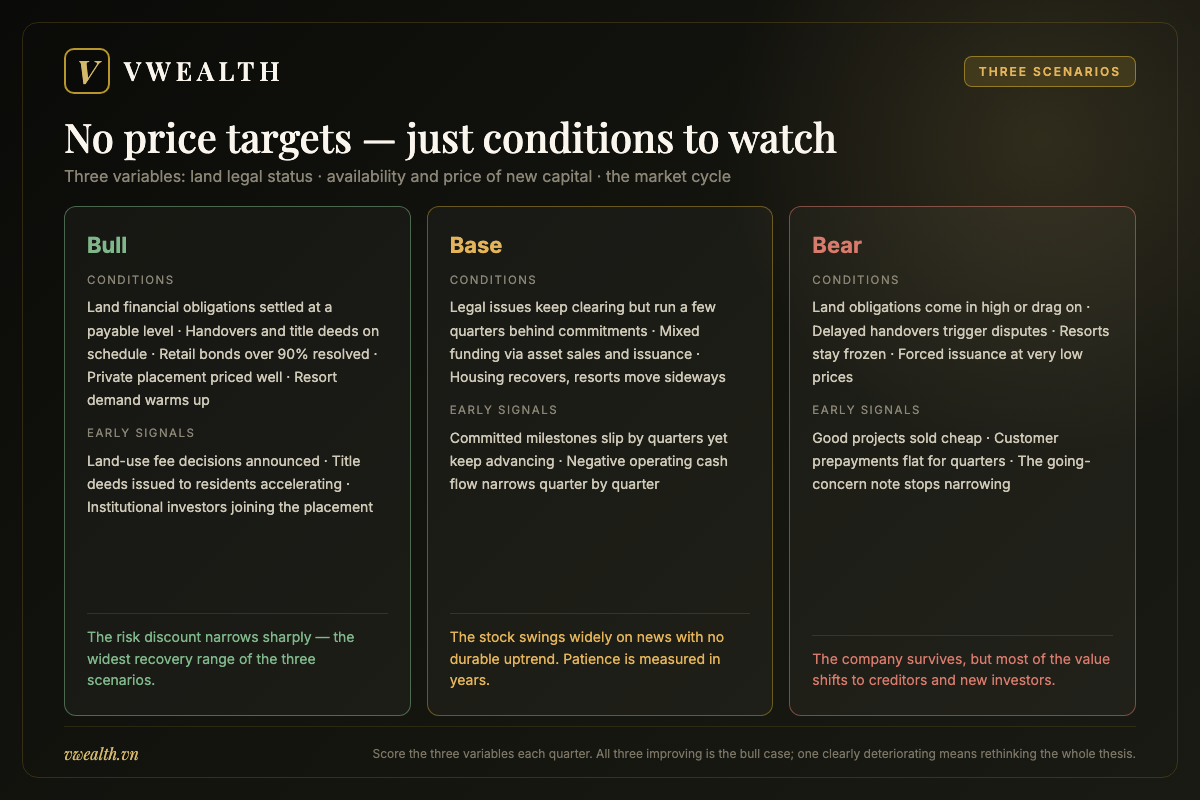
So, should you buy NVL stock?
After all this dissection, it is time to answer the question posed at the start. And the most honest answer is this: whether you should buy NVL stock depends on who you are, not on who Novaland is. With the same company at the same price, NVL can be a rare asymmetric opportunity for one person and a serious financial mistake for another. This chapter helps you work out which one you are.
The bull side: why people still buy NVL
Start by giving the supporting arguments a fair hearing, because they are not unreasonable.
The first advantage is an asset base that cannot be recreated. Novaland owns three mega-projects of roughly a thousand hectares each plus an undeveloped land bank of more than 2,400 hectares. With land access procedures tightening and the new land price tables rising sharply, no new entrant could assemble an equivalent holding at a rational cost. This is a structural advantage, not a temporary one.
The second advantage is future revenue with its seat already booked. More than VND 20,000 billion in advances from customers, plus a plan to hand over approximately 9,200 units at Aqua City across 2026–2027, is a revenue source that requires no new customers. For a company that finds new sales difficult, that is a precious asset.
The third advantage is actual, verifiable progress on the restructuring. Over 90% of institutional bonds resolved, the roughly USD 300 million international convertible bond restructured, no non-performing debt with domestic credit institutions, credit limits granted by several banks, a return to profit in the audited 2025 accounts, and margin eligibility restored from the second quarter of 2026 — this is a chain of events that actually happened, not a set of promises.
The fourth advantage is that a legal mechanism now exists. Resolution 170/2024/QH15 creates a route for resolving legacy projects, and for NovaWorld Phan Thiet the direction of resetting the land fee reference date to 2008 could make a very large difference to the final obligation.
The fifth advantage is mathematical: asymmetry. When a company is priced by the market at a level that reflects a high probability of failure, every step that confirms it will not fail produces a far larger price response than the same step at an ordinary company. This is the entire logic of turnaround investing, and it is a legitimate strategy — provided you understand and manage the risk that comes attached.
The bear side: risks that cannot be waved away
Now the other side of the ledger, and it carries just as much weight.
The first and largest risk is dilution. The company is running several capital-increase components at once — bonus shares, an employee scheme, a private placement of up to 800 million shares, issuance to swap bond principal, plus the conversion rights under the international bond. The potential increase in the share count is very large. For existing shareholders this is the quietest and most corrosive risk, because it does not arrive labelled as bad news; it is usually announced as good news about the restructuring.
The second risk is the absolute size of the debt. Total liabilities of approximately VND 191,015 billion against total assets of approximately VND 249,908 billion at the end of 2025 is a very thin equity cushion. A modest downward revaluation of the assets can erode that equity quickly.
The third risk is dependence on factors outside the company’s control. Legal progress is decided by state agencies, the resort cycle by the market, willingness to extend by creditors. However capable management is, it can influence only part of the outcome.
The fourth risk is time. Even in the good scenario, completing three mega-projects and definitively clearing the debt takes years. If you are investing with an expectation of results within six months, you are not buying a stock — you are betting on headlines.
The fifth risk is volatility. Given its news-driven character, wide trading range and heavy retail ownership, NVL’s swings can exceed most buyers’ psychological tolerance. Many people who lost money in this name did so not because their analysis was wrong but because they sold at the exact low of a correction they had not braced for.
| The bull case | The bear case |
|---|---|
| Three mega-projects of ~1,000 ha each plus over 2,400 ha of undeveloped land — an asset base that cannot be recreated | Liabilities of ~VND 191,015 billion against total assets of ~VND 249,908 billion at end-2025 — a thin equity cushion |
| Over VND 20,000 billion in advances from customers — future revenue that already has buyers | Significant capital is still required to complete construction before that converts into revenue |
| Over 90% of institutional bonds resolved; the ~USD 300 million offshore package restructured | Retail bonds only around 30–40% resolved — the bottleneck of 2026 |
| Return to profit in the audited 2025 accounts; margin eligibility restored from Q2 2026 | The 2025 profit came with falling revenue — earnings quality needs close inspection |
| Resolution 170/2024/QH15 opens a mechanism for resolving legacy project legal status | The final land financial obligation figure is still unfixed — a very wide valuation error band |
| Asymmetry: confirmation of survival can trigger a substantial re-rating | Large-scale dilution can transfer most of the value to creditors and new investors |
| Improving southeastern infrastructure supports Aqua City and NovaWorld Ho Tram | The resort segment is the slowest-recovering part of the entire market |
Who NVL suits
On the basis of everything above, here is the portrait of the investor NVL may suit.
First, the turnaround investor who understands clearly that they are buying a probability, not a cash flow. This person accepts that the outcome could be zero, and therefore allocates only a small weight in the portfolio — typically no more than 3–5% for an ordinary individual investor. The key point is that they size the bet so that losing it does not disturb their personal financial plan.
Second, the investor with a long horizon, at least three to five years, and the discipline to track the company quarterly using the metric set laid out in the financial chapter. This is not a buy-and-forget stock.
Third, the investor who already has a solid portfolio foundation of stable assets, and who uses NVL as a controlled high-risk sleeve to raise the expected return of the whole book.
Fourth, the investor with the psychological steadiness to watch a position fall 30–40% without capitulating, provided the original thesis has not been invalidated. That sounds simple and is in practice achieved by very few people; assess yourself honestly rather than optimistically.
Fifth — and this is specific to international readers — the investor who has already made peace with Vietnam’s country-level characteristics: currency risk on the dong, a market that can gap through a price band without letting you out, quarterly reporting in Vietnamese with English translations arriving later, and a legal environment where administrative decisions genuinely move valuations. If any of those give you pause in the abstract, they will give you far more pause in a drawdown.
Who NVL does not suit
This list is shorter but more important, and you should read it more carefully than the one above.
NVL does not suit anyone who needs dividend income. The company will prioritise every dong for debt reduction and construction, and restructuring agreements with creditors typically restrict cash distributions.
NVL does not suit anyone using leverage. Buying a company that is already highly leveraged at the corporate level with borrowed money is stacking risk on risk — and that exact mechanism created the 2022 disaster for a great many accounts.
NVL does not suit money that has a near-term purpose: school fees, a house deposit, an emergency reserve. The moment you need to withdraw may land precisely in the middle of a deep correction, and at that point you no longer have the option to wait.
NVL does not suit beginners. This is one of the hardest stocks on the exchange to read: you need to interpret debt notes, understand property revenue recognition, and quantify dilution. If you are still building those skills, start with companies whose accounts are easier to read — an industrial park developer with a simpler revenue model such as Kinh Bac, or a conservatively financed residential developer such as Nam Long — and come back to NVL afterwards.
Finally, NVL does not suit anyone buying because “it looks cheap versus the old high”. As set out in the previous chapter, that is anchoring bias, and for a company issuing billions of new shares, comparison with past prices has lost its meaning.
If you still decide to buy: a minimum discipline framework
Suppose that after all of this you still want to participate. Here is the minimum discipline framework this writer considers reasonable, to be adjusted to your own circumstances.
One, decide your position size before you buy, not after. Write down a specific number and do not exceed it, even when the price rises and you feel you are missing out.
Two, scale in against milestones rather than against price. Instead of buying more when the price falls a given percentage, add when a substantive condition is confirmed — land use fees finalised, certificate issuance on track, operating cash flow turning positive. This anchors your decisions to the company rather than to the price board.
Three, write down your investment thesis and your invalidation conditions at the outset. For example: “I am buying because I believe the legal status of the three major projects will be completed within two years and the company will move to positive operating cash flow. I will sell if four consecutive quarters pass with no new legal progress, or if the company is forced to issue shares below the price threshold I am prepared to accept.” Having a pre-written invalidation condition is the only reliable way to avoid deceiving yourself later.
Four, update the numbers on a schedule instead of relying on impressions. Review the seven-metric set from the financial chapter every quarter. If you do not have time to read the notes, use an updated analysis report where those metrics are already extracted. Free accounts on the vwealth platform include the English-language NVL report, which is the fastest way to keep that checklist current without reading Vietnamese filings.
Five, never use leverage. Not on this one.
Final word
Novaland is one of the richest teaching cases the Vietnamese stock market has produced. It began in a veterinary medicine shop with VND 400 million of capital, executed a spectacular industry pivot to become a leading property group, then fell off a cliff in a cycle reversal that its own capital structure magnified many times over. The past four years have been four years of doing one thing only: trying to stay alive long enough for the assets in hand to turn into cash.
As of today, the company has achieved more than most observers expected at the end of 2022. The institutional debt has largely been dealt with, the offshore bond has been restructured, the legal status of key projects has moved, the audited accounts have returned to profit and the stock has regained margin eligibility. But the hardest part is still entirely ahead: retail bonds, an unsettled land financial obligation, a resort segment recovering more slowly than anything else, and a debt load large enough that every mistake remains expensive.
So, should you buy NVL stock? If you are looking for a comfortable investment with income and undisturbed sleep, the answer is no, and you should look elsewhere in the market — our introduction to investing in Vietnam points to steadier places to start. If you are looking for an asymmetric opportunity, understand that you are buying a probability rather than a certainty, accept that most of your capital could be lost, and have both the patience and the discipline to follow a company over several years using specific metrics instead of emotion — then NVL is one of the very few stocks on this exchange that offers exactly that kind of opportunity, at exactly the price the risk deserves.
The most important thing, and the thing this article most wants to leave with you: do not decide on the basis of how a name makes you feel. Open the report, find the seven metrics listed above, score the three scenario variables for yourself, and decide using today’s data rather than a memory of a 2021 price. That is the only way to invest in a company under restructuring without turning the investment into a gamble.
Research Vietnamese stocks in English with vwealth. Our AI-powered platform turns Vietnamese market data into full English analysis reports — with international payment support and a free 2-month trial for new accounts. Create your free account and read the latest reports.