
The practical problem with Vietnam company financial statements in English is not the accounting standard. It is that you often cannot find the document, and when you do you are not sure whether you are holding the right version.
Larger listed companies frequently publish an English set. Many do not, and among those that do, the English version sometimes appears weeks after the Vietnamese one and occasionally with less detail in the notes.
This piece is the practical companion to our explainer on how Vietnamese accounting standards differ from IFRS. Here we deal with finding the right document, and with a six-line triage that tells you in fifteen minutes whether a company is worth a proper read.
Where do you find Vietnam company financial statements in English?
Short answer: Three places, in order — the company’s own investor relations page, the exchange’s disclosure portal, and the annual report, which more companies translate than translate quarterly statements. English publication is voluntary, so availability varies by company and by reporting period.
Four things to establish before reading any number
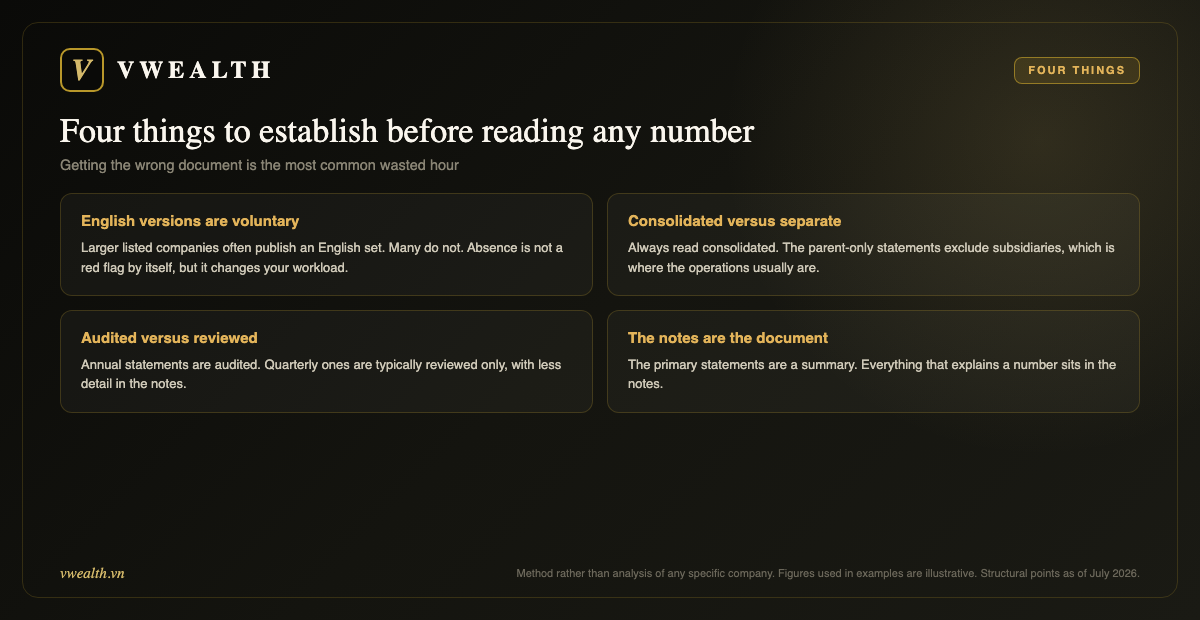
1. Whether an English version exists
Check the company’s investor relations page first, then the exchange disclosure portal. If neither has one, the annual report is the next best option — companies that translate nothing else often translate the annual report, because it doubles as a marketing document.
Absence of an English set is not in itself a warning sign. Plenty of well-run mid-caps serve an entirely domestic shareholder base and have no reason to translate. It does mean more work for you.
2. Consolidated versus separate
The one that catches people most often.
Vietnamese companies publish both a consolidated set covering the group and a separate set covering only the parent entity. If the group holds its operations in subsidiaries — common — the separate statements show almost nothing useful.
Always read consolidated. If the two sets differ substantially, the difference is where the business actually is.
3. Audited versus reviewed
Annual statements are audited. Quarterly statements are typically subject to a lighter review, with fewer notes and less detail.
Practical consequence: use quarterly statements to track direction, and the audited annual set to form a view. The notes you need for the sixth line below often only exist in the annual document.
4. The notes are the document
The three primary statements are a summary. Every number that requires explanation is explained in the notes, and the notes are typically several times longer than the statements themselves.
If you are reading a two-page summary, you are reading the cover of the book.
Six lines, in this order
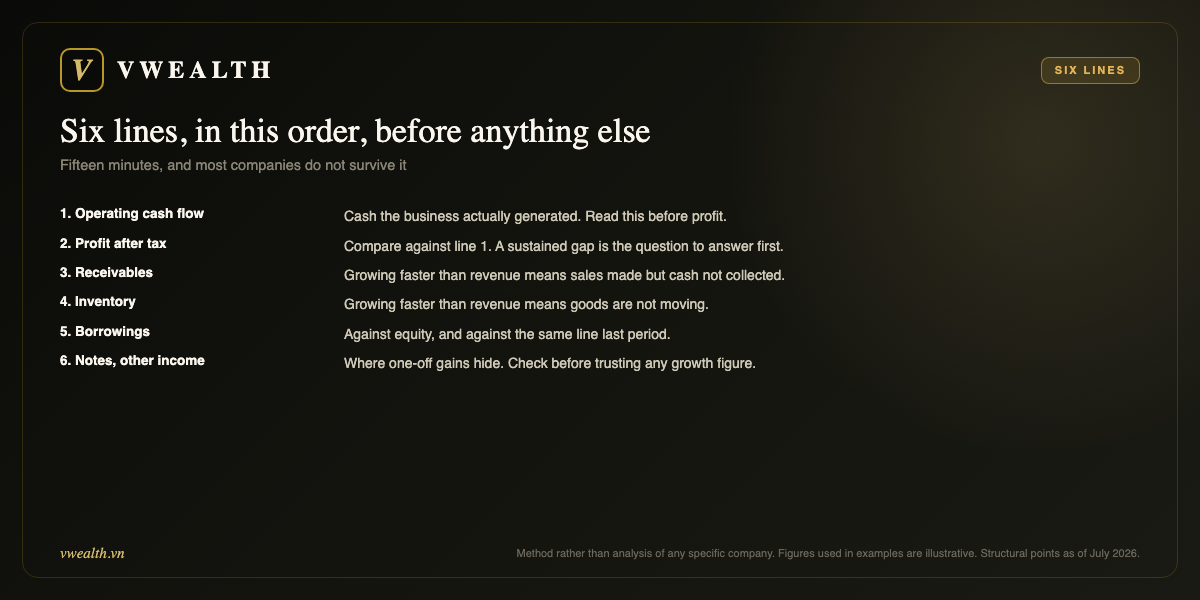
1. Operating cash flow
First section of the cash flow statement. Cash the business actually generated from operations.
Read this before profit, for a simple reason: profit can be recognised when goods are delivered but not yet paid for. Cash flow cannot be. Either the money arrived or it did not.
2. Profit after tax
Now read it, and read it against line one.
A gap in a single quarter is normal — collection cycles do not align with revenue recognition. A gap sustained across four or five quarters is the question to answer before reading anything else.
3. Receivables
Balance sheet, current assets. Money customers owe.
Compare its growth rate against revenue growth. Receivables growing substantially faster means the company is selling on longer credit terms — revenue still looks good while its quality deteriorates.
4. Inventory
Same comparison. Inventory outpacing revenue means goods are moving more slowly, which frequently precedes discounting.
Important exception: for property developers, inventory is work in progress and rising inventory can be a positive. Establish the sector before interpreting any line. We cover the sector in how Vietnamese real estate stocks really work.
5. Borrowings, short and long term
Against equity for the leverage level, and against the prior period for the direction.
The useful question is not whether borrowings are high but what they fund. Expansion and refinancing are different situations that look identical on this line.
6. The notes, other income
The line most readers skip, and where the surprises live.
Asset disposals, revaluations, provision reversals, one-off settlements. These are genuine profit under the accounting standard and they do not repeat.
If most of a company’s profit growth comes from here, the growth figure on the screen does not describe the operating business.
A worked example
Illustrative figures, chosen to show the method.
Line 1 — operating cash flow: 120 billion dong, against 180 billion in the prior period. Down.
Line 2 — profit after tax: 260 billion, against 200 billion. Up 30%.
The two move in opposite directions. Profit rises by nearly a third while cash generated falls by a third. That gap is the thing to explain before reading further.
Line 3 — receivables: up from 300 to 480 billion, a 60% increase, against revenue growth of 18%.
Found it. Receivables are growing more than three times as fast as revenue. Sales are being made; cash is not arriving.
Line 4 — inventory: up 12%, slower than revenue. Not the issue.
Line 5 — borrowings: up from 200 to 340 billion. The company borrowed while its cash was tied up in receivables.
Line 6 — notes: other income includes 45 billion from an asset disposal.
Strip that out and operating profit is 215 billion against 200 billion — growth of 7.5%, not 30%.
What fifteen minutes produced
A headline growth figure of 30% that is actually 7.5% from operations, accompanied by a sharp increase in credit sales and additional borrowing to bridge the cash gap.
None of that says the company is bad. It says the first number you saw did not describe what is happening — which is the entire purpose of the exercise.
Four comparisons that carry the information
Individual numbers say very little. The information is in the relationships between them, and four pairs do most of the work.
Profit against operating cash flow
Already covered as lines one and two, and it is the most important pair. When they diverge, the cause is almost always in receivables or inventory — cash is tied up in one of the two.
Revenue growth against receivables growth
Receivables outpacing revenue means credit terms are loosening. Sometimes that is a deliberate commercial strategy in a competitive period; sometimes it is the only way volume was achieved. The notes on receivables ageing, where provided, distinguish the two.
Revenue growth against inventory growth
The same logic at the other end of the chain. Inventory building faster than sales is an early indicator of demand weakness, visible before it reaches the revenue line.
Pre-tax profit against tax expense
An underused cross-check. If pre-tax profit rises sharply while the tax charge does not, part of the increase may come from items taxed differently — frequently the one-off gains sitting in other income.
This gives you a quick read on line six without working through the whole notes section.
Sector adjustments
The six lines apply broadly. Three sectors need modifications.
Banks
A different statement structure entirely. No inventory, revenue defined differently, and the decisive variables are asset quality — the non-performing loan ratio and the provisioning against it.
The six-line triage does not transfer. Use the approach in our banking sector guide instead.
Property developers
Revenue is recognised on handover, so this year’s profit reflects sales made two or three years ago.
The two lines that matter most are inventory — work in progress — and advances from customers, which is cash already collected but not yet recognised as revenue and therefore a forward indicator of earnings.
Cyclical manufacturers
A single year of earnings tells you where in the cycle the company is, not what it earns through a cycle. Read several years together, and lean on the balance sheet rather than the income statement.
Our piece on steel and industrials covers reading the cycle position.
Screening several companies efficiently
If you are working through a list rather than a single name, run it in rounds.
Round one — two lines. Operating cash flow and profit only. Both positive and not wildly divergent, and the company proceeds. Two minutes each.
Round two — the remaining four lines. Only for survivors of round one. Ten minutes each.
Round three — the full read. Notes, annual report, several years of history. Reserved for the short list.
This keeps the effort proportional to the probability that a name is worth owning, rather than reading everything evenly and running out of attention at the fifth company.
Five red flags
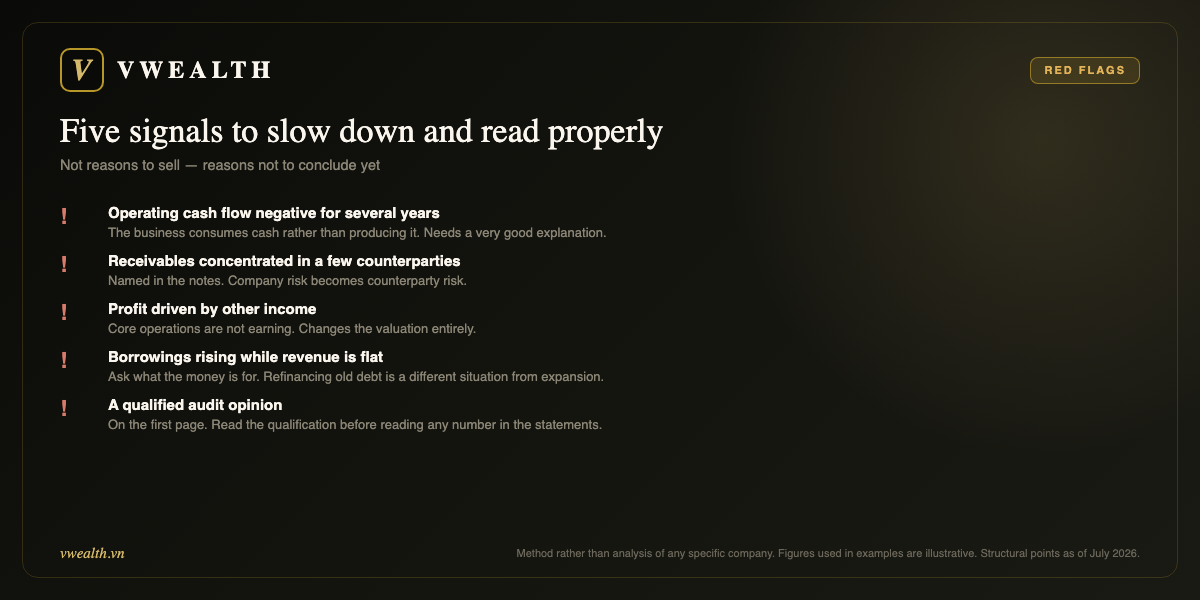
Negative operating cash flow across several years
The business consumes cash rather than generating it. Explicable for a young company in an investment phase; it requires a strong explanation for a mature one.
Receivables concentrated in a few counterparties
The notes usually name the largest balances. Where most receivables sit with one or two parties, the company’s risk is largely their credit risk.
Profit driven by other income
Core operations are not earning enough. Not necessarily a problem in one year, but it changes how the business should be valued.
Borrowings rising while revenue is flat
Read the notes on borrowings and on investing activities. Money raised to fund expansion is a different story from money raised to repay existing debt.
A qualified audit opinion
First page of the audit report. If the auditor has qualified their opinion, read the qualification before any number in the statements — it tells you what even the auditor could not verify.
Terminology that trips people up
Four terms whose English rendering differs enough from developed-market convention to cause confusion.
Advances from customers. Cash collected before revenue is recognised. In property this is the single most informative forward indicator and it sits on the liabilities side, which surprises people.
Other income and other expenses. Catch-all lines that can contain material one-off items. Always trace them to the notes.
Provision for doubtful debts. How much of receivables the company itself does not expect to collect. Comparing this against total receivables over several years is informative about management’s realism.
Par value. Appears in dividend announcements and in the equity section. Vietnamese dividend announcements are stated as a percentage of par value rather than of market price, which routinely misleads foreign readers. Covered in Vietnam dividend stocks.
What the statements will not tell you
Three things no amount of careful reading extracts, worth naming so the limits are clear.
Competitive position. The accounts show what the company earned. They do not show why customers chose it, or whether that reason is durable.
Management quality. The closest available proxy is comparing what management promised in earlier shareholder meeting documents against what subsequently happened. That comparison is more informative than any ratio.
What is coming. Statements describe the past. A policy change, a new entrant, a technology shift — none appear until they have already affected results.
This is why financial statements are excellent at eliminating companies and poor at confirming them. Use them to narrow, then do different work on what remains.
Governance context worth carrying
Two structural features of the Vietnamese market shape how the accounts should be read, and neither is visible in the numbers themselves.
Ownership is often concentrated. A founding family or the state frequently holds a controlling stake. That affects related-party transactions, dividend policy and the weight minority shareholders carry — and the related-party notes become correspondingly more important.
Group structures can be complex. Holdings across subsidiaries and associates mean the consolidated picture and the parent-only picture diverge, sometimes substantially. It also means the related-party note is one of the most information-dense pages in the document.
Neither is a warning by itself. Both are reasons to read the notes on related parties and on group structure before forming a view. More context in corporate governance in Vietnam and state-owned enterprises.
Building a record
The six lines become considerably more useful when recorded over time rather than read once.
One row per company per quarter, six columns. After four quarters the direction of each line is visible, and direction carries more information than any single reading.
What to look for in the series: receivables and inventory growing persistently faster than revenue, operating cash flow drifting away from profit, borrowings rising without a corresponding investment. Each is invisible in one quarter and obvious across four.
The record also does something less obvious. It shows you which companies you keep looking at and never buy — which is usually a sign that something in the numbers is repeatedly failing to convince you, and worth articulating.
The disclosure calendar
Knowing when documents appear saves a great deal of refreshing.
Quarterly statements follow each quarter end, subject to a filing deadline. Reviewed rather than audited, with abbreviated notes.
Semi-annual statements receive a fuller review and carry more detail than an ordinary quarter.
Annual audited statements arrive after year end and are the authoritative set. This is the document to read properly.
The annual report follows, usually ahead of the shareholder meeting. It contains management commentary, strategy and governance disclosure that the statements alone do not, and it is the document most likely to exist in English.
Shareholder meeting materials include the resolutions put to a vote — dividend policy, share issuance, board changes. For a minority investor these are frequently the most consequential documents of the year, and they are published in advance.
A practical habit
Diarise the annual report and the shareholder meeting materials for companies you hold. The quarterly statements can be checked when convenient; those two cannot, because the meeting has a date and the vote happens whether you read the materials or not.
One closing observation
The single most valuable habit in reading these documents is reading them before forming a view rather than after.
Approached after a decision, the statements supply evidence for whatever you already believe — there is enough in any set of accounts to support several conclusions. Approached before, they eliminate candidates efficiently and cheaply.
Fifteen minutes, six lines, in order. Most companies will not survive it, and that is the point.
Verifying what you read
Three cross-checks that cost little and catch most misreadings.
Check the prior-year comparative
Every statement shows the prior period alongside. If a company restated its comparatives, the restatement is disclosed in the notes — and restatements are worth understanding, because they change what last year’s numbers meant.
Check the statements against each other
Profit in the income statement should reconcile to the opening line of the cash flow statement. Retained earnings on the balance sheet should move by profit less dividends. Where these do not tie, the notes explain why — and reading that explanation is usually informative.
Check against the exchange filing
Where a company’s own website and the exchange portal differ, the exchange filing is authoritative. Website versions are occasionally outdated or abbreviated.
This matters most for the annual set. It matters less for quarterly numbers that will be superseded shortly anyway.
If you can only do one thing
Compare operating cash flow against profit after tax, over the last four periods.
One comparison, four data points, five minutes. It captures the majority of what the full six-line process would tell you, because most accounting problems eventually show up as cash failing to follow profit.
It will not tell you whether a company is a good investment. It will tell you whether the headline number describes reality — and that is the question worth answering first.
Frequently asked questions
Should I trust machine translation of the Vietnamese version?
For the primary statements, generally yes — the line items are standardised and numbers are numbers. For the notes, be careful: that is where nuance lives and where a translation error changes meaning.
How do the accounting standards differ from IFRS?
Enough to matter for comparisons across markets. The differences are covered in our piece on VAS and IFRS.
How long does a full read take?
The six-line triage takes fifteen minutes. A proper read of an annual set including notes is several hours, and only worth doing for companies that survived the triage.
Where is the exchange disclosure portal?
Each exchange operates its own, and listed companies are required to file there. It is the authoritative source when a company’s own site is out of date.
Do these companies hold earnings calls?
Less commonly than in developed markets, and where they occur they are frequently conducted in Vietnamese. The annual shareholder meeting documents are often the richest source of management commentary available in translation.
Are quarterly numbers reliable enough to act on?
Reliable enough to track direction, not to form a view. They are reviewed rather than audited and carry abbreviated notes, which means line six — the one that most often changes a conclusion — is frequently unavailable until the annual set.
What if only the Vietnamese version exists?
The primary statements remain readable with translation, because the structure is standardised. If a company’s disclosure is genuinely inaccessible to you and you cannot verify what you own, that is itself a piece of information about whether to own it.
Summary
Working with Vietnam company financial statements in English starts with getting the right document: consolidated, audited where possible, with the notes attached.
Then six lines in order, beginning with operating cash flow rather than profit. Fifteen minutes eliminates most companies, and the ones that survive deserve the several hours a proper read requires.
And the line most often skipped — other income in the notes — is the one that most often changes the conclusion.
Further reading: corporate governance in Vietnam, state-owned enterprises, and the complete guide to the market.
This article is for information and education. It is not investment, accounting or tax advice, and it is not a recommendation of any security. Structural points as of July 2026.