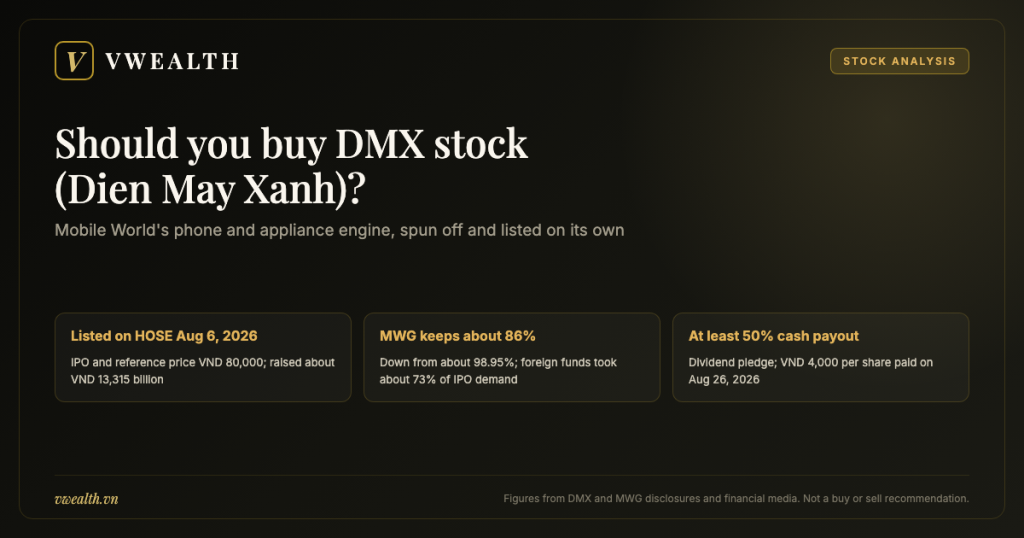
Should you buy DMX stock? DMX is the ticker of Dien May Xanh Investment Joint Stock Company, which began trading on the Ho Chi Minh City Stock Exchange (HOSE) on August 6, 2026, and it has quickly become one of the most searched new listings among Vietnamese and foreign investors alike. The reason is simple. For the first time in more than twenty years, the phone-and-appliance retail engine inside Mobile World Group — the business behind the thegioididong.com and Dien May Xanh store chains that almost every Vietnamese household has walked into — trades as a separate stock, with its own financial statements and its own dividend promise. The IPO raised about VND 13.3 trillion (roughly USD 500 million) at VND 80,000 per share, around three quarters of the demand came from foreign funds, and MSCI added the stock to its indexes through a fast-entry review on listing day. But behind those headlines sits a company whose parent still owns about 86%, which paid its parent more than VND 38 trillion in dividends just before the IPO, and which sells products that move in clear boom-and-bust cycles. This analysis tells the whole story, shows you how to read DMX’s own numbers, and ends with a straight answer on who DMX stock suits and who it does not.
First, let us get the names right, because this story involves three confusingly similar labels. DMX is the stock code of Cong ty Co phan Dau tu Dien May Xanh — in English, Dien May Xanh Investment JSC. This legal entity used to be called The Gioi Di Dong JSC (Mobile World JSC), the operating subsidiary that runs the thegioididong.com, Dien May Xanh and TopZone chains. MWG is the ticker of Mobile World Investment Corporation, the parent company that has been listed on HOSE since 2014 and now acts increasingly like a holding company, owning DMX, the Bach Hoa Xanh grocery chain and a few smaller businesses. And “Dien May Xanh” in everyday Vietnamese speech is the name of the appliance chain with the green stick-figure mascot — the name literally means “Green Electronics”. When you buy DMX, you are not buying Bach Hoa Xanh, the An Khang pharmacies or AVAKids. You are buying the phone, laptop and appliance retail core, its technical-service arm, and a 45% stake in the EraBlue joint venture in Indonesia.
A second ground rule, shared by every article in the vwealth company-analysis series: dates, names, deals and figures here come from published sources — the IPO prospectus, shareholder-meeting documents, exchange filings from DMX and MWG, brokerage research and major financial media. Figures for fiscal years that have closed are used as historical reference points. We deliberately do not quote today’s share price, today’s P/E, today’s market capitalization or the latest quarter’s profit; those numbers change daily and are easy to misread. Wherever a figure is our own calculation, it is labeled “vwealth estimate” or “illustrative example”. For up-to-date numbers, open the vwealth analysis reports.
If you are new to investing in Vietnam, start with our guide on how to invest in the Vietnam stock market, which covers practical matters such as trading accounts for foreigners, the T+2 settlement cycle, the ±7% daily price limit on HOSE and foreign ownership limits. Those mechanics matter for DMX too, especially its thin free float.
Finally, the thread that runs through the whole piece. vwealth has already published a full analysis of MWG, the Mobile World parent company, covering the group’s journey from a handful of phone shops to the Bach Hoa Xanh grocery bet. This article does not retell that story. Here, the question of whether to buy DMX stock comes down to three narrower but sharper issues: how far a “pure” electronics retail machine — no longer carrying a loss-making grocery chain — can grow profits when its store count is essentially flat; whether the promised cash dividends are sustainable after the VND 38 trillion payout to the parent; and whether a parent that owns 86% will protect or squeeze minority shareholders like you.
From a phone shop on Nguyen Dinh Chieu Street to DMX stock: 22 years of a retail machine
Some companies go public young and grow up on the exchange. DMX did the opposite. It listed when it was already Vietnam’s largest phone and appliance retailer, with 2025 revenue of about VND 109.5 trillion (roughly USD 4.2 billion) and net profit of about VND 5.8 trillion. In other words, you are not buying a start-up story; you are buying a machine that has been running for more than two decades. To judge whether it can keep running fast, you need to know how it was assembled, where it broke down, and why management chose to spin it off now.
2004–2009: one phone shop and an obsession with standardization
In March 2004, five founders — including Nguyen Duc Tai, who later became the face of the whole group — set up Mobile World Co., Ltd. with initial capital of about VND 2 billion. In October that year, a store of about 200 square meters opened on Nguyen Dinh Chieu Street in Ho Chi Minh City. At the time, selling phones in Vietnam was the domain of small shops with inconsistent prices, a mix of grey-market and official goods, and warranties that depended on the seller’s mood.
What set Mobile World apart early on was not cheaper prices but standardization: publicly posted prices, a website with detailed product information, staff trained to fixed procedures and, most importantly, internal systems. In 2007, the private equity firm Mekong Capital invested, and the company converted to a joint-stock structure — creating The Gioi Di Dong JSC, the direct predecessor of today’s DMX. Around the same time, the company built its own ERP system (enterprise resource planning software that tracks inventory, prices, sales and payroll in real time) instead of buying SAP or Oracle, and rolled out uniform KPIs. By 2009, it had about 40 stores.
This may sound like dry history, but it is the root of the competitive advantage we return to in chapter 3. A retailer with thousands of stores that knows exactly which warehouse holds each refrigerator and how many units sell per hour can adjust prices and restock far faster than its rivals.
2010–2015: dienmay.com, the Dien May Xanh rebrand and a nationwide rollout
In late 2010, the company tested a new chain called dienmay.com, selling televisions, refrigerators, washing machines and air conditioners — big, expensive items that need home delivery and installation. Instead of squeezing TVs into phone shops, management opened a separate chain, because buying a washing machine is a completely different experience from buying a phone: it needs large display space, longer consultations and installation services.
The early years were unspectacular. In 2015, the chain was rebranded as Dien May Xanh; Vietnamese media reported that the name dienmay.com (“electronics.com”) was too generic, did not position the brand and gave no advantage in Google searches. At the same time, the group entered a phase of frantic expansion — averaging about five new stores a week in 2015–2016 — and reached all 63 of Vietnam’s provinces at the time. The green stick-figure mascot and its catchy TV jingles became familiar in small towns across the country.
During this period, the parent company MWG listed on HOSE on July 14, 2014. Note that what went public then was the whole group, not the electronics chain alone. Capital-market funding helped the group expand Dien May Xanh and launch Bach Hoa Xanh in 2015 — a grocery chain that needed enormous capital and years of losses before turning a profit. This detail matters to DMX shareholders: for almost a decade, cash generated by phones and appliances had to “feed” a different business.
2017–2019: the Tran Anh acquisition, the push north and a new-generation CEO
Dien May Xanh grew quickly in the south and centre of the country, but the north had strong local appliance chains. In 2017, the group merged in Tran Anh, a well-known Hanoi electronics chain, to gain instant store locations and customers in the north. According to summaries based on annual reports, the chain’s appliance market share rose from about 8% in 2015 to about 30% in 2017, roughly equal to several traditional rivals combined.
In September 2018, Doan Van Hieu Em was appointed CEO of The Gioi Di Dong JSC, the legal entity running both the thegioididong.com and Dien May Xanh chains. He joined the company in March 2007 and worked his way up from the finance and accounting department through product-line manager, head of the mobile phone division and director of the electronics–telecommunications division; since April 2019 he has also sat on MWG’s board. He is the person running DMX today, and Vietnamese media describe him as Mobile World’s “second generation” of leaders.
2020–2022: peak store count, TopZone and a first step into Indonesia
COVID-19 lockdowns closed stores in waves, but they also sent demand for laptops and tablets for remote study and work soaring. The group kept expanding; according to compiled figures, the Dien May Xanh chain peaked at about 2,284 stores in 2022.
On October 22, 2021 — the day the iPhone 13 went on sale in Vietnam — the first four TopZone stores opened in Ho Chi Minh City and Hanoi as Apple Authorized Resellers. Apple approved the store designs and reviewed the sales process. TopZone was the group’s answer to iPhone buyers who increasingly wanted an “Apple Store-like” environment rather than a shelf inside a multi-brand phone shop.
On November 24, 2022, the first EraBlue store opened in Ciledug, Tangerang, Indonesia. EraBlue is a joint venture between Erajaya, a major Indonesian phone distributor, and the Mobile World side, which owns 45%. Remember that 45%: it means EraBlue’s revenue is not consolidated into DMX; only DMX’s share of EraBlue’s profit or loss is recorded under the equity method.
2023: the “super-cheap” price war and a costly lesson about cycles
Anyone thinking about buying DMX should remember 2023 in detail. Spending on non-essential goods fell sharply after the late-2022 shocks in Vietnam’s property and corporate bond markets. According to MWG’s 2023 results, almost every product category shrank: phones, laptops, washing machines and home appliances fell about 10–20%, while TVs, tablets and watches dropped 30–50%. To defend market share, the group launched deep discounts that the media dubbed its “super-cheap” (gia re qua) campaign. The result: MWG’s consolidated revenue fell about 11% to roughly VND 118.3 trillion, and net profit collapsed about 96% to around VND 168 billion — the lowest since 2013.
That VND 168 billion was the whole group’s figure, after absorbing losses at Bach Hoa Xanh and smaller chains, so it does not fully reflect the electronics business alone. But the message is clear: when consumer demand falls and the whole industry starts a price war, an electronics retailer’s margins can be squeezed to almost nothing within a few quarters. That is the personality DMX stock inherits, even though it is currently in an upswing.
2024–2025: “fewer stores, better stores” and a record profit year
After the 2023 shock, the group shifted from “open as many as possible” to “fewer but better”. According to the IPO prospectus, about 400 underperforming stores were closed and about 34,700 employees moved to performance-linked pay. At the end of 2025, the group had 1,012 thegioididong.com stores (including TopZone) and 2,008 Dien May Xanh stores — noticeably fewer than at the peak.
Yet revenue and profit rose strongly. In 2025, the DMX legal entity reported revenue of about VND 109,479 billion (up 17.3%) and net profit of about VND 5,801 billion (up 56.1% from about VND 3,717 billion in 2024), lifting its net margin to about 5.3% from about 4.0%. According to a Techcom Securities (TCBS) research report, the thegioididong.com chain including TopZone generated about VND 37,300 billion (up 24%), the Dien May Xanh chain about VND 68,400 billion (up 15%), and revenue at existing stores grew more than 20%. DMX contributed nearly 70% of MWG’s revenue and about 82% of its profit in 2025 — which is why the market calls DMX the financial “backbone” of the group.
2025–2026: a new legal entity, the IPO and the HOSE listing
In November 2025, MWG’s board approved a restructuring of its subsidiaries along business lines. The Gioi Di Dong JSC was renamed Dien May Xanh Investment JSC and took over 100% of Tho Dien May Xanh JSC (the “Dien May Xanh Technicians” service company — nearly 10 million shares with a par value of about VND 100 billion), while the An Khang pharmacy chain moved to another group entity. Chairman Nguyen Duc Tai explained the logic with a memorable image: a Dien May Xanh television and a fish at Bach Hoa Xanh share management practices but have very little to do with each other as products.
In December 2025, the board approved an IPO of Dien May Xanh in 2026 — much earlier than the “around 2030” timeline mentioned before. DMX shareholder meetings in January and March 2026 approved an offering of up to 179.5 million shares (about 16.3% of outstanding shares) at a floor price of VND 16,163, equal to book value per share at the end of 2025. The final offer price was set at VND 80,000 per share, with Vietcap Securities as adviser. The subscription window ran from May 27 to June 17, 2026.
The result: about 166.44 million shares were sold, raising about VND 13,315 billion and lifting charter capital to about VND 12,677 billion. Institutional investors accounted for about 90% of subscriptions — foreign funds about 73% and domestic funds about 17%. On August 6, 2026, DMX debuted on HOSE at a reference price of VND 80,000, implying a market value of about VND 101,418 billion (roughly USD 3.9 billion) — joining the group of Vietnamese companies worth more than VND 100 trillion on its first day.
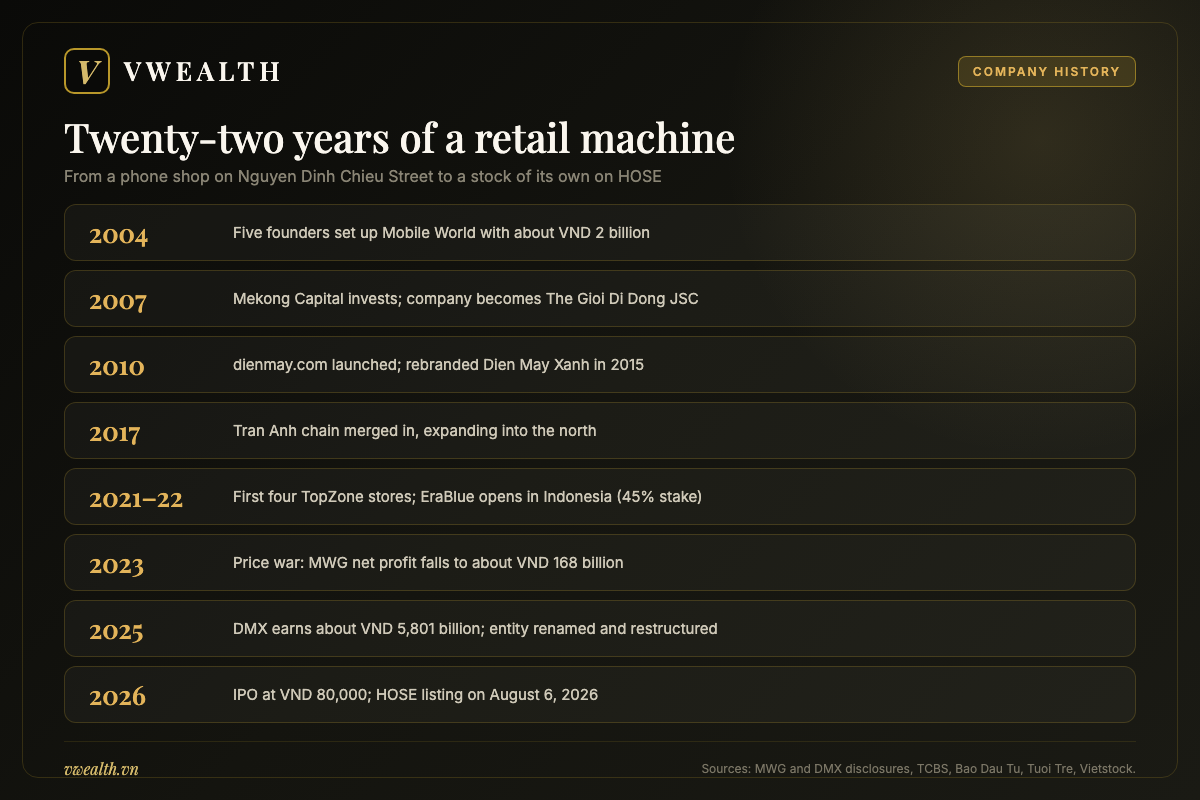
| Date | Event | Why it matters to DMX shareholders |
|---|---|---|
| Mar 2004 | Five founders set up Mobile World Co., Ltd. with about VND 2 billion | Origin of the standardization culture and in-house systems |
| 2007 | Mekong Capital invests; company becomes The Gioi Di Dong JSC | Direct legal predecessor of DMX |
| Late 2010 | dienmay.com chain launched | Start of the appliance business |
| Jul 14, 2014 | Parent MWG lists on HOSE | The whole group goes public; electronics not yet separate |
| 2015 | dienmay.com rebranded Dien May Xanh; nationwide rollout | Vietnam’s best-known appliance retail brand |
| 2017 | Tran Anh chain merged in | Market share gains in the north |
| Sep 2018 | Doan Van Hieu Em becomes CEO of the operating entity | Today’s DMX chief executive |
| Oct 22, 2021 | First four TopZone stores open | Dedicated channel for Apple customers |
| Nov 24, 2022 | First EraBlue store in Indonesia (45% stake) | Growth option outside Vietnam |
| 2023 | Price war; MWG net profit falls to about VND 168 billion | Lesson on cycles and margins |
| 2025 | DMX earns about VND 5,801 billion; entity renamed and restructured | Record profit year before the IPO |
| Aug 6, 2026 | DMX lists on HOSE at a VND 80,000 reference price | First chance for outside investors to own the electronics business directly |
Looking back across the timeline, DMX has lived three “lives”: a start-up that standardized phone retailing, a nationwide appliance expansion inside a multi-business group, and now a separately listed company that barely opens new stores and lives on sales per square meter and on the services it sells alongside each product. The next chapter looks at who is steering in this third life — and who has the final say.
Leadership and ownership of DMX: an 86% parent, a CEO betting his own money, and what minority shareholders need to know
For most listed stocks, the question “who owns this company?” needs little more than a glance at the major-shareholder list. For DMX it is the most important question of all. The parent, MWG, owns about 86% of the shares, which means every major decision — how much dividend to pay, how much to borrow, whether to issue more shares or bonds — is effectively decided by MWG. Minority investors like you ride in the same boat, but the parent holds the wheel. Before thinking about the share price, you need to understand whether the person steering has the same interests as you.
Nguyen Duc Tai: one man, two chairman’s seats
Nguyen Duc Tai chairs the boards of both MWG and DMX. As one of the five founders, he has been at the centre of every turning point in the group’s history, from the first store in 2004 to the decision to pour resources into Bach Hoa Xanh and, now, the decision to list Dien May Xanh separately. Our MWG analysis covers his leadership style and famous remarks in detail; what matters here is the dual role.
A single person chairing both the parent and the listed subsidiary is very common in Vietnamese business groups, and it has advantages: a unified strategy and less friction between layers of management. But it also raises a familiar governance question. When the interests of MWG and of DMX’s minority shareholders diverge — over the dividend payout ratio, for instance, or the pricing of intra-group transactions — who stands up for the minority? For now, the answer depends on DMX’s independent board members and on the quality of its disclosures. This is something to read carefully in DMX’s first corporate governance report and annual report. Our explainer on corporate governance in Vietnam gives useful background on how boards and controlling shareholders typically work in local companies.
One notable detail: according to pre-IPO disclosures, Mr. Tai’s family registered to buy about 1.9 million DMX shares in the IPO, worth about VND 152 billion at VND 80,000 per share, and VnExpress reported that he used entirely personal funds. After DMX listed, between July 31 and August 13, 2026 he also bought 1 million MWG shares at an average price of close to VND 72,000. In other words, the founder is positioned in both stocks.
Doan Van Hieu Em: the driver and the “real money” test
DMX’s CEO is Doan Van Hieu Em. As described in chapter 1, he joined Mobile World in March 2007, has run the operating entity for the two chains since September 2018, and has sat on MWG’s board since April 2019. Asked about DMX, he has called the company his “spiritual child”. On listing day he said that going public “is not a destination but the beginning of a new growth cycle”, with the goal of doubling the company’s scale and value by 2030.
Anyone can say the right things; putting real money behind the words is more telling. According to insider-trading disclosures, in May 2026 he sold 2 million MWG shares to fund his participation in the DMX IPO. Before the listing he held about 3.83 million DMX shares (about 0.302%), bought another 268,000 shares on August 6 to reach about 4.1 million (about 0.32%), registered in late August to sell another 1 million MWG shares, and in early September registered to buy another 732,000 DMX shares between September 10 and October 9, 2026. Another board member, Vo Ha Trung Tin, also registered to buy 100,000 DMX shares between September 18 and October 17, 2026.
How should you read these trades? On the positive side, an executive moving personal wealth into the company he runs is a genuine “skin in the game” signal — his interests are tied directly to the DMX share price and dividends. On the other hand, do not treat it as the only reason to buy: insider purchases do not guarantee short-term price gains, and moving from MWG to DMX may simply reflect his new role. He himself has said clearly that he does “not advise whether to buy, hold or sell” DMX or any other stock, and that choosing between MWG and DMX depends on each investor’s risk tolerance, return requirements and cash-flow needs.
Who owns DMX: an 86% parent, with the rest mostly in fund hands
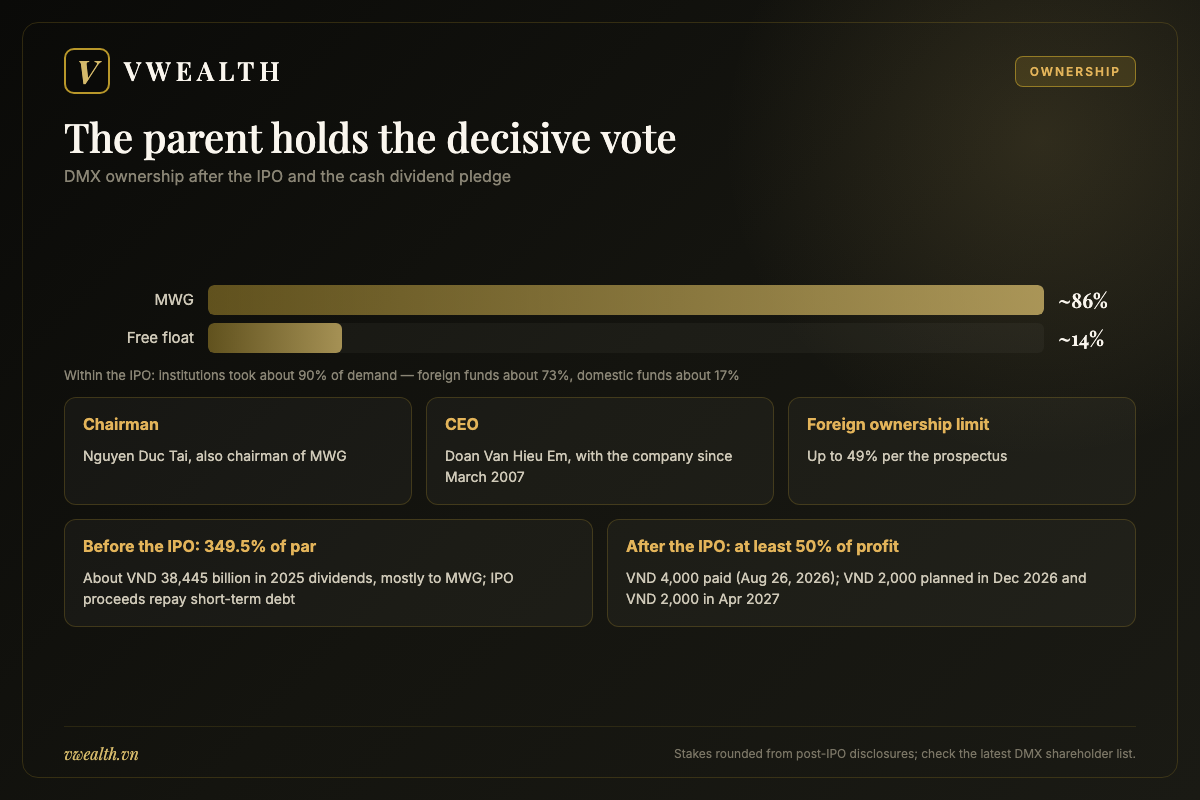
Before the IPO, MWG owned about 98.95% of DMX. Had all 179.5 million offered shares been sold, the stake would have fallen to about 85.08%. Because the offering was not fully subscribed — about 166.44 million of 179.5 million shares were sold — MWG’s actual stake is about 86.0%. By vwealth’s calculation from the published figures, roughly 13 million shares went unsold; press reports cite figures between 13.5 and 14 million depending on rounding, so the key takeaway is a success rate of about 92–93%.
The remaining 14% or so — the “free float”, meaning shares that can actually trade freely — is largely held by around 60 domestic and foreign investment funds. Dragon Capital is the most prominent name: before the IPO it confirmed a subscription of at least USD 50 million, equal to more than 16 million shares or about 9% of the offering, and said the IPO price was “significantly low” relative to value. The rest is held by DMX and MWG executives and some individual investors.
On foreign ownership, the prospectus sets DMX’s foreign ownership limit at 49%. Because MWG already owns 86% and only about 14% can trade, foreign investors in practice are unlikely to hit the cap — the real constraint is thin liquidity, not the limit itself. If you want to understand how foreign ownership limits work in Vietnam, our guide on foreign room in Vietnam stocks is a good starting point.
| Shareholder group | Reference stake | Notes |
|---|---|---|
| MWG (parent) | About 86.0% after the IPO | Down from about 98.95%; original plan was 85.08% |
| Foreign funds via the IPO | About 73% of IPO subscriptions | Dragon Capital subscribed at least USD 50 million |
| Domestic funds via the IPO | About 17% of IPO subscriptions | Institutions made up about 90% of total demand |
| Doan Van Hieu Em (CEO) | About 0.32% after Aug 6, 2026 | Registered to buy 732,000 more shares, Sep 10–Oct 9, 2026 |
| Nguyen Duc Tai’s family | About 1.9 million shares subscribed in the IPO | About 0.15% of capital — vwealth estimate |
| Foreign ownership limit | 49% | Per the prospectus; actual free float only about 14% |
MWG versus DMX interests: VND 38 trillion in dividends and the minority-shareholder question
This is the section many IPO previews skipped, and you should not. According to Nha Dau Tu and The Investor, in 2025 — before the IPO — DMX paid dividends of 349.5% of par value, totalling about VND 38,445 billion, of which MWG received about VND 38,041 billion thanks to its 98.95% stake. To put that in perspective, the payout was about 6.6 times DMX’s own 2025 net profit (vwealth estimate: 38,445 divided by 5,801). In other words, the parent pulled out almost all of DMX’s accumulated profits before opening the door to new shareholders.
The second piece of the puzzle is the use of IPO proceeds: according to the published plan, all proceeds are to be used to repay short-term bank loans. Put the two pieces together and you see a structure familiar from IPOs around the world: the subsidiary pays a large dividend to its parent, its operating cash shrinks and it leans more on short-term borrowing, and then money from new investors pays down those loans. Nothing in this structure is illegal — the dividend came from lawful retained earnings, the plan was approved by shareholders and disclosed in the prospectus. But economically, you should understand that your IPO money did not go into new stores or new capacity; it mainly helped DMX’s balance sheet “lighten up” again after the large payout to its parent.
A side effect worth remembering: when equity is reduced through dividends, return on equity (ROE) automatically looks better. According to the standalone figures disclosed, DMX’s ROE was about 31.1% in 2025 versus about 19.5% in 2024. Part of that jump came from genuinely higher profits, and part from a smaller denominator — equity. Chapter 4 shows you how to separate the two effects.
Beyond dividends, the parent–subsidiary relationship shows up in day-to-day intra-group dealings. According to the list of member companies in the notes to MWG’s Q1 2026 consolidated financial statements, Mobile World Information Technology Co., Ltd. is a direct subsidiary of MWG, not of DMX. That raises questions you should look for in the “related-party transactions” note of DMX’s financial statements: how shared technology, customer data and brands are priced and charged; whether DMX lends to or guarantees the parent or sister companies; how shared leases and logistics costs are allocated. This article has no information to say whether these items are large or small — which is exactly why you should check them when the reports are published, or read the summary in the DMX report on vwealth.
Dividend policy: a minimum 50% of profit paid in cash
If there is one reason DMX has caught the attention of income-focused investors, it is a clearly stated dividend policy. Right after listing, DMX paid a cash dividend of 40% of par (VND 4,000 per share) from undistributed profit in its audited 2025 financial statements, with a record date of August 19, 2026 and payment on August 26, 2026 — a total of more than VND 5 trillion. Under the announced plan, DMX expects to pay an interim VND 2,000 per share in December 2026 and another VND 2,000 per share in April 2027 after its annual general meeting, meeting its commitment to pay out at least 50% of 2026 net profit in cash. The company has also said it will consider distributing the remaining profit in shares combined with post-IPO share premium, at an expected ratio of 1:1.
Added up, a buyer at the IPO price could receive VND 8,000 per share in cash within about twelve months of listing if everything goes to plan — about 10% of the IPO price. But read the fine print: the first VND 4,000 came from accumulated 2025 profit, not recurring earnings; and the 10% is measured against VND 80,000, not the price you would pay today. There is also a discrepancy you should know about: pre-IPO shareholder documents planned a post-IPO dividend of at most VND 3,200 billion from retained earnings and a 2026 dividend rate of 25% of par; the 40% actually paid in August 2026 exceeded that original plan.
In September 2026, DMX scheduled an extraordinary general meeting for October 29, 2026 (record date October 5, 2026) with two main items: a plan to pay a cash dividend from undistributed 2026 profit, and a plan for a private placement of bonds with warrants. Bonds with warrants give bond buyers the right to buy DMX shares at a preset price in the future; if exercised, the share count rises and existing shareholders are diluted. The size, exercise price and timing will be set out in the meeting documents, and you should read them before judging the impact. For a broader view of how Vietnamese companies pay dividends, see our guide to Vietnam dividend stocks.
How DMX makes money: three store chains, an installment engine and 8,000 technicians
If you think DMX simply “sells TVs, fridges and phones”, you are seeing only the tip of the iceberg. The part below the waterline — and the part management is now focusing on — is what happens after the air conditioner is sold: the installment loan the customer signs at the counter, the extended warranty, the cleaning visit six months later, the technician who comes to fix it. The prospectus calls this strategy “Customer Lifetime Value” — the total profit a customer brings over the whole relationship, not just on the first purchase. This chapter goes through each business line, looks at which one feeds which, and asks where DMX’s real moat lies.
The Dien May Xanh chain: two thirds of revenue, driven by air conditioners and hot summers
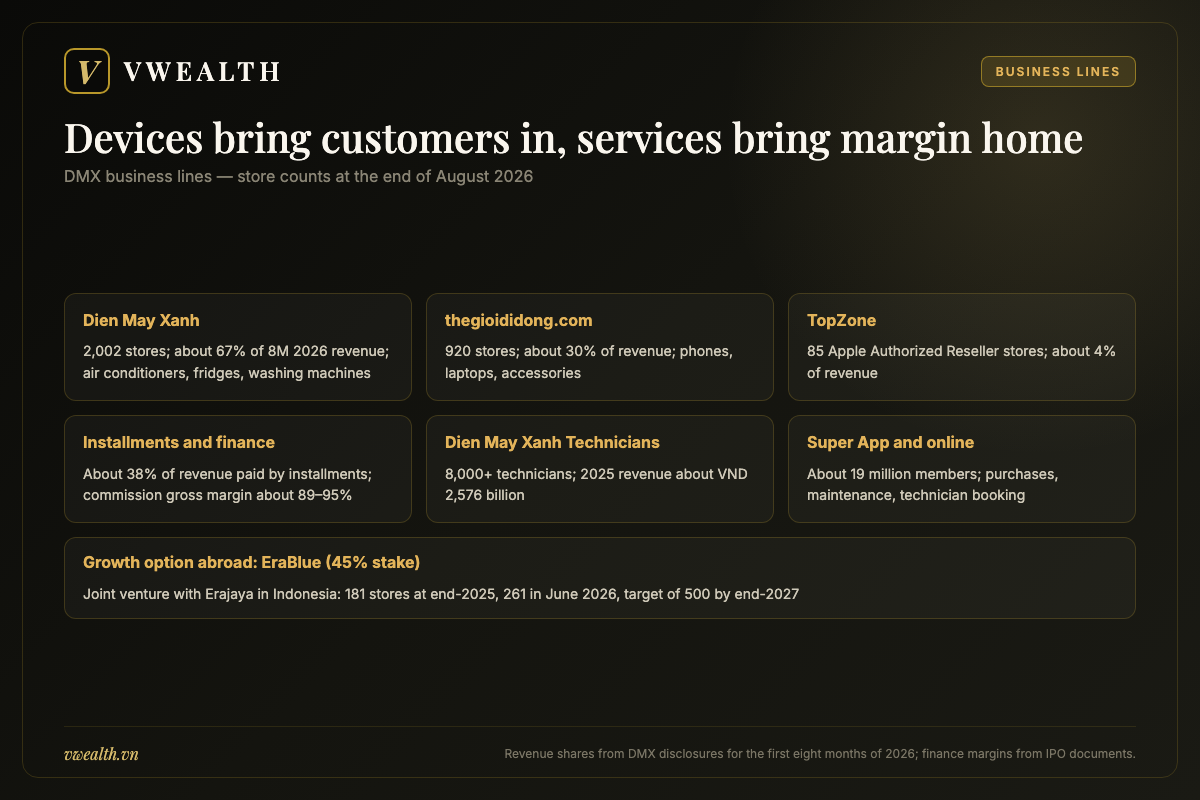
The Dien May Xanh chain is the biggest engine. According to DMX’s disclosures for the first eight months of 2026, the chain accounted for about 67% of revenue, and at the end of August 2026 it had 2,002 stores — six fewer than at the start of the year. In 2025, it generated about VND 68,400 billion in revenue, up about 15%.
Its product range falls into a few groups: cooling appliances (air conditioners, refrigerators, washing machines), consumer electronics (TVs, speakers), small home appliances (rice cookers, water purifiers, fans, stoves), plus phones and laptops sold alongside. Air conditioners are the most weather-sensitive: an early, long, hot summer can lift a whole quarter’s sales, while a mild summer can drag it down. In the first eight months of 2026, according to the company, air conditioners and Apple products each grew about 50%, laptops about 40%, and home appliances and refrigerators about 30% year on year.
Dien May Xanh runs several store formats. According to TCBS, average monthly revenue in 2025 was about VND 0.9 billion per store for the small format (Model S) and about VND 2.7 billion for the medium format (Model M). These numbers explain why closing small stores and steering customers to larger ones lifted profits: every store carries fixed rent and staff costs, so the higher the revenue per store, the lower the fixed cost per dong of sales.
The thegioididong.com chain: phones, laptops and the upgrade cycle
The thegioididong.com chain — where it all began; the name means “mobile world” — accounted for about 30% of revenue in the first eight months of 2026 and had 920 stores at the end of August 2026. In 2025, the chain (including TopZone) generated about VND 37,300 billion, up about 24%. Its main products are phones, laptops, tablets, smartwatches and accessories.
Phones are a saturated category in unit terms: almost every Vietnamese adult already owns a smartphone. Growth therefore comes from two sources: the replacement cycle (customers switching to a new phone every two or three years) and trading up (moving from budget phones to mid-range and premium models, foldables and AI-enabled devices). Laptops are similar, with brands and retailers now pushing AI PCs. The chain’s advantage is scale: with an estimated phone market share of about 50% according to TCBS, DMX is often first in line for new-model allocations and in-store marketing support from brands.
TopZone: 85 stores for Apple users
TopZone is the smallest chain, at about 4% of revenue in the first eight months of 2026 and 85 stores, unchanged since the start of the year. But it plays a strategic role: it keeps the highest-spending customers — iPhone, MacBook and iPad users — inside DMX’s ecosystem instead of letting them drift to other Apple resellers or online channels. According to the company, TopZone’s same-store revenue rose about 35% in the first eight months of 2026, the fastest of the three chains.
The downside is dependence on a single brand. Apple’s launch calendar, pricing policy and any expansion of its own online or physical stores in Vietnam directly affect TopZone. Margins on Apple products are also generally thin, so TopZone’s real value lies in pulling customers into the ecosystem to sell accessories, warranties and installment plans.
Installments and financial services: small in revenue, big in profit
This may be the most interesting business line in the prospectus. DMX does not lend money — consumer finance companies and banks do, and they carry the credit risk. DMX acts as the point of sale: staff help customers apply for installment plans, customers sign with the finance company in the store, and DMX earns a commission. According to Tuoi Tre, citing the IPO documents, the gross margin of the financial-services segment was about 91.9% in 2024, 88.9% in 2025 and about 94.5% in Q1 2026 — the highest of any segment. In 2025, about 70% of this segment’s revenue came from consumer-finance commissions and 30% from bank-agent and bill-collection services.
Why does this matter? Because installments are the lubricant of the appliance trade. According to the company’s figures for the first eight months of 2026, revenue paid through installment plans rose about 44% year on year and made up about 38% of total revenue, up from about 35% in 2025. The prospectus also cites a survey showing that about 74% of consumers with a purchase need consider paying by installments. Every refrigerator sold on installments brings two profit streams: the gross profit on the fridge, and an almost pure-profit commission from the finance company.
The flip side is dependence on the health of consumer finance. If consumer bad debts rise and finance companies tighten approvals, or if rules on commissions or loan insurance fees change, this profit stream can shrink quickly. When reading DMX’s reports, it is worth looking at the installment share alongside the asset quality of Vietnam’s big consumer-finance lenders — the two numbers tend to move together.
Dien May Xanh Technicians and after-sales service: turning a purchase into a relationship
Tho Dien May Xanh JSC — moved under DMX in the late-2025 restructuring — employs more than 8,000 technicians who install, maintain and repair products for the chains’ customers and for outside clients, including corporate contracts. According to TCBS, in 2025 the unit had revenue of about VND 2,576 billion and net profit of about VND 201 billion — its first profitable year.
Another trace of the “sell services” strategy is unearned revenue — cash customers have prepaid for services to be delivered later, such as extended warranties. According to Vietstock’s reading of the prospectus, this item grew from about VND 21.7 billion at the end of 2024 to about VND 537 billion at the end of 2025 and about VND 612.7 billion at the end of Q1 2026. It is still small relative to revenue of more than VND 100 trillion, but its growth shows DMX is selling prepaid service packages — a steadier kind of revenue than selling devices.
Why is this a weapon against e-commerce? You might save a few hundred thousand dong buying an air conditioner online, but who will install it, honour the warranty and clean it every year? A network of thousands of technicians covering every province is something e-commerce platforms cannot build quickly.
Online sales and the Super App are part of this service layer too. According to the company, the Super App and other online channels generated about VND 12,070 billion in revenue in the first eight months of 2026; in August 2026 alone about VND 2,506 billion, more than 21% of that month’s revenue. The Super App has about 19 million members and serves as a customer hub: purchase history, maintenance schedules, loyalty points and technician bookings. Crucially, DMX’s online channel is not separate from its stores — online orders are usually delivered and installed from the nearest warehouse or store. So online growth does not make stores redundant; it lets each store serve more customers, including those who never walk in.
EraBlue in Indonesia: a 45% growth option
EraBlue is DMX’s only business outside Vietnam. In the joint venture with Erajaya, the Vietnamese side owns 45%. According to published figures, EraBlue had 181 stores at the end of 2025 and 261 stores in June 2026, with targets of 500 stores by the end of 2027 and 1,000 by 2030, plus a roadmap toward an IPO in Indonesia. According to TCBS, EraBlue’s medium-format stores generate about VND 4.0 billion per month — about twice the equivalent Dien May Xanh format in Vietnam — despite selling at prices about 30% lower.
In profit terms, EraBlue is still small for DMX: according to the standalone figures disclosed, DMX’s share of EraBlue was a loss of about VND 44.5 billion in 2024, turning to a profit of about VND 24.35 billion in 2025. Because DMX owns only 45% and uses the equity method, you will not see EraBlue’s revenue in DMX’s top line — only its share of profit or loss. Think of EraBlue as an “option”: if it becomes a big success, it could contribute meaningfully in the long run; if not, the impact on DMX’s current earnings is limited. Indonesia, with more than 270 million people and relatively low penetration of modern electronics retail, is the kind of market Vietnam was a decade or so ago.
Which business feeds which — and where DMX’s moat really lies
| Business | Reference scale | Role | Main risk |
|---|---|---|---|
| Dien May Xanh chain | 2,002 stores (Aug 2026); about 67% of 8M 2026 revenue | Main revenue engine, where services are cross-sold | Weather, consumer demand, price competition |
| thegioididong.com chain | 920 stores; about 30% of revenue | Drives regular traffic and the upgrade cycle | E-commerce, low-price small chains |
| TopZone | 85 stores; about 4% of revenue | Keeps high-spending customers | Dependence on Apple |
| Financial services | Gross margin about 89–95% | High profit, no direct credit risk | Lender tightening, regulatory change |
| Dien May Xanh Technicians | 8,000+ technicians; 2025 revenue about VND 2,576 billion | Moat against e-commerce, recurring revenue | Labour costs, service quality |
| EraBlue (45%) | 261 stores (Jun 2026) | Regional growth option | Competition in Indonesia, currency |
The overall picture is clear: selling devices brings in traffic; selling services brings in margin. Phones and air conditioners carry thin margins, but they bring customers through the door. Once a customer is there, installment commissions, warranty packages and installation services are where DMX earns its higher margins. That is why DMX could reach a net margin of about 5.3% in 2025 — well above what a pure electronics retailer usually earns.
In vwealth’s view, DMX’s moat has four overlapping layers. The first is purchasing scale: with more than 3,000 stores and an estimated share of about half the phone market and close to half the appliance market, DMX has bargaining power with Samsung, Apple, LG and Daikin that small chains lack. The second is home-built operating systems — ERP, CRM, logistics — accumulated since 2007. The third is a physical service network — nearby stores and technicians who come to your home. The fourth is customer data — tens of millions of people who have bought at least once, enabling cross-selling. None of these layers is unbreakable, but the combination makes the model hard to copy in full. For comparison, read how FPT Retail — a direct rival in phones and laptops — has built its moat in a completely different way, through the Long Chau pharmacy chain.
Market position and financial health: reading the numbers of a “pure electronics machine” before you buy DMX stock
For years, investors who wanted to know how much Mobile World’s phone and appliance business earned had to guess from the chain-level revenue MWG published, then subtract an estimated loss for Bach Hoa Xanh. The IPO changed that: for the first time there are standalone financial statements for the DMX entity. But having the numbers does not mean reading them correctly. This chapter shows you the pairs of numbers you should read together, and the traps specific to DMX.
Market share: “about half” — but every source gives a different number
Every source agrees that DMX is Vietnam’s largest phone and appliance retailer; the exact numbers differ, and you should know that rather than trust a single figure. TCBS (June 2026) estimates that in 2025 the thegioididong.com, Dien May Xanh and TopZone chains held about 50% of the phone market and about 45% of the appliance market, and elsewhere describes appliance share as 40–50%. Management has previously estimated its 2024 appliance share at about 50%. An article in Dan Tri in September 2026 cited about 60% of phones and about 40% of appliances. All three are estimates using different methods (some include e-commerce, some count only modern chain retail).
The common message: DMX has a clear leadership position, but precisely because it already holds roughly half the market, there is limited room to grow by taking more share. From here, growth has to come from the overall market expanding, customers trading up to more expensive products, and selling more services per customer.
Profit: from about VND 3.7 trillion to about VND 5.8 trillion in a year
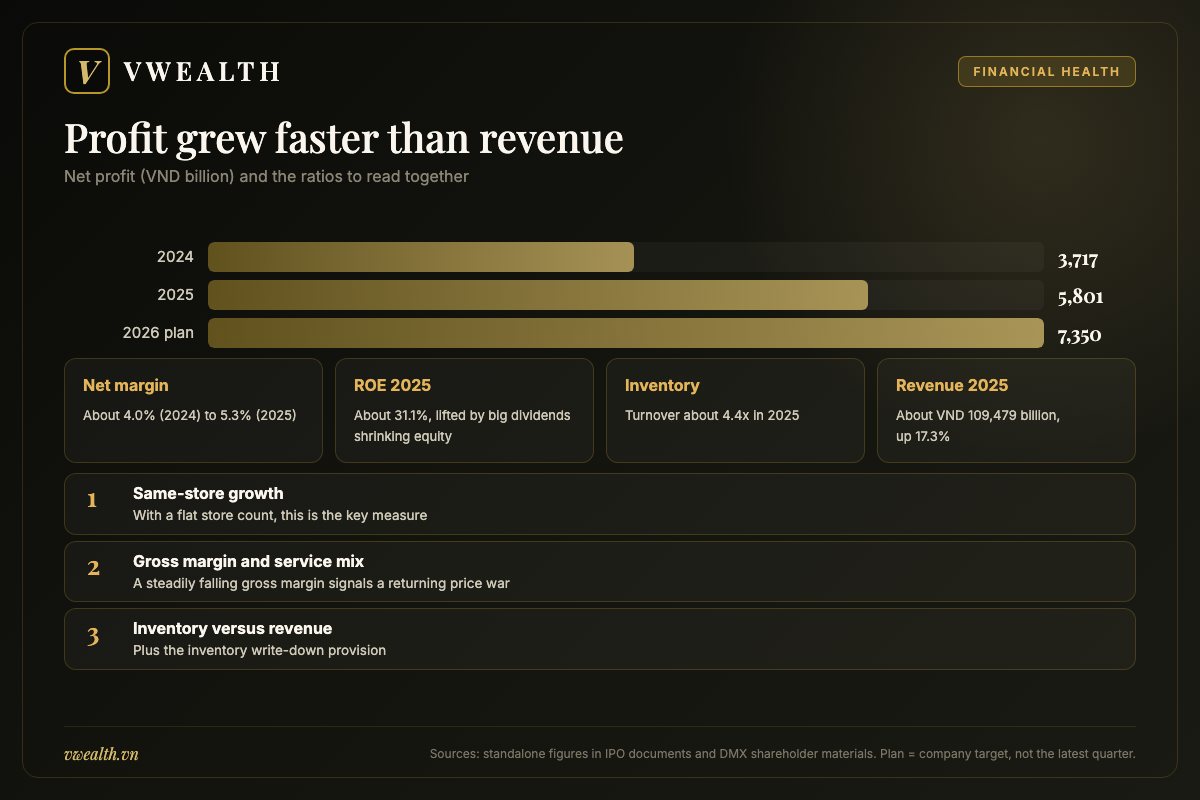
According to the standalone figures in the IPO documents, DMX’s net profit was about VND 3,717 billion in 2024 and about VND 5,801 billion in 2025 (up 56.1%), on revenue of about VND 109,479 billion (up 17.3%). The net margin rose from about 4.0% to about 5.3%. Some analyses use 2025 figures adjusted to the new structure (excluding An Khang and AVAKids and consolidating Dien May Xanh Technicians), showing revenue of about VND 107,000 billion and profit of about VND 6,100 billion. The two sets differ because the scope of consolidation differs, not because either is wrong; when comparing, just use one set consistently.
The striking point is this: revenue grew about 17% while profit grew about 56%. The gap comes from operating leverage — when fixed costs (rent, base salaries, depreciation) barely move because no new stores are opened, each additional dong of revenue drops largely to profit. Operating leverage is wonderful when sales rise and brutal when they fall — as 2023 proved.
Illustrative example (hypothetical numbers, not a forecast): suppose a store has revenue of 100, a gross margin of 20% and fixed costs of 15. Profit is 20 − 15 = 5. If revenue rises 20% to 120, gross profit is 24, minus 15 in fixed costs leaves 9 — up 80%. If revenue falls 20% to 80, gross profit is 16, leaving 1 — down 80%. Same store, same gross margin; a 20% swing in revenue produces a fourfold swing in profit. That is DMX’s personality in a nutshell.
The 2026–2030 plan and the gap with broker forecasts
According to shareholder documents and the prospectus, DMX’s 2026 plan targets revenue of about VND 122,500 billion (up about 12%) and net profit of about VND 7,350 billion (up about 27%); for 2027, about VND 135,000 billion in revenue and VND 8,472 billion in profit. Further out, the company targets 2030 revenue of about VND 182,000 billion (roughly USD 7 billion) and profit of about VND 13,000 billion — implying compound annual growth of about 11% in revenue and 16% in profit over five years.
By contrast, a Vietcap forecast cited in the press before the IPO put 2026 much higher: revenue of about VND 130,847 billion and profit of about VND 9,324 billion — the basis for the widely quoted “roughly 10x” 2026 P/E at the IPO price. Keep the distinction clear: VND 7,350 billion is the company’s own plan; VND 9,324 billion is a forecast by a securities firm that was also the IPO adviser. According to DMX’s disclosures, revenue in the first eight months of 2026 rose about 29% year on year and reached about 71% of the full-year target — so actual results are running ahead of the company’s plan. For the latest quarterly profit figures, check the DMX report on vwealth, as those change every quarter.
Inventory and turnover: stock on the shelf is cash on the shelf
For an electronics retailer, inventory is the biggest and riskiest asset: an old-model TV sitting in a warehouse for six months may have to be sold at a loss when the new model arrives. According to the standalone figures disclosed, DMX’s inventory was about VND 18,869 billion at the end of 2024 and about VND 23,054 billion at the end of Q1 2026 (gross value about VND 23,369 billion, implying an inventory write-down provision of about VND 315 billion — vwealth estimate from those two figures). Inventory turnover was about 4.4 times in 2025, up from about 4.2 times in 2024.
A turnover of 4.4 times means the average item sits in stock for about 83 days (365 divided by 4.4 — vwealth estimate). When reading reports, watch for two signals: inventory growing faster than revenue (which may mean stocking up for peak season — normal — or slow-moving goods — worrying), and a sudden jump in the inventory provision (a sign of clearance sales). The air-conditioner season and Tet, the Lunar New Year holiday, are the two times inventory usually swells.
A 31% ROE: how much is real, and how much comes from a smaller denominator
According to the standalone figures disclosed, DMX’s ROE was about 31.1% in 2025 (about 19.5% in 2024) and its return on assets (ROA) about 10.9%. An ROE above 30% is among the highest on the Vietnamese market. But as chapter 2 explained, in 2025 DMX paid about VND 38,445 billion in dividends, mostly to MWG. That payout shrank equity sharply and pushed ROE, measured on average equity, higher.
The way to separate the two effects is to look at ROA and net margin together. ROA — profit over total assets — is less affected by dividend payouts, because total assets usually do not shrink as much as equity (to the extent the dividend was replaced by borrowing, total assets stay roughly unchanged — this is vwealth’s reasoning and should be checked against the balance sheet). An ROA of about 10.9% is still a good number for a retailer and shows genuine improvement in operating efficiency. But when you compare DMX’s 31% ROE with that of MWG or FRT, you are comparing companies with very different capital structures. After the IPO, equity rose by about VND 13,315 billion, so ROE may not stay above 30% in coming years even if profits keep growing. Our guide on reading Vietnamese company financial statements in English is a useful companion here.
Cash, borrowings and cash flow after the IPO. The use of IPO proceeds has been disclosed: repaying short-term bank loans. Media coverage around the listing cited cash and short-term investments of about VND 44,670 billion; check that figure against the reviewed half-year financial statements to confirm the date and composition. For retailers, one point is counter-intuitive: a company can hold a lot of bank deposits and a lot of short-term debt at the same time. Retailers often borrow short term to buy inventory (sometimes earning early-payment discounts from suppliers), while cash collected from customers sits in term deposits until the loans fall due. So what matters is net debt (borrowings minus cash and deposits) and its trend over several quarters, not any single number. Operating cash flow is also seasonal: quarters before Tet or the hot season are often negative because of stock building, and the following quarter positive as goods are sold. Judge cash flow on a full year or the sum of the last four quarters, and compare it with profit: if operating cash flow is well below profit for several years in a row, profit is getting “stuck” in inventory or receivables.
| Metric | 2024 | 2025 | 2026 plan | Notes |
|---|---|---|---|---|
| Revenue (VND billion) | — | About 109,479 | About 122,500 | 2025 up 17.3%; restated scope about 107,000 |
| Net profit (VND billion) | About 3,717 | About 5,801 | About 7,350 | Vietcap 2026 forecast about 9,324 |
| Net margin | About 4.0% | About 5.3% | — | Up thanks to operating leverage and services |
| ROE | About 19.5% | About 31.1% | — | Inflated by large dividends shrinking equity |
| Inventory turnover | About 4.2x | About 4.4x | — | Q1 2026 inventory about VND 23,054 billion |
| Dividends paid | — | 349.5% of par (about VND 38,445 billion) | At least 50% of profit | 2025 payout mostly to MWG, pre-IPO |
Seven questions to ask every time DMX reports
Rather than memorizing the numbers above — they will be stale in a few quarters — keep a checklist to test each new DMX report against:
1. How fast is same-store revenue growing? Because DMX barely opens new stores, revenue growth is almost the same as same-store growth. A drop into single digits signals the cycle is slowing.
2. Is gross margin rising or falling? A steadily falling gross margin usually means heavy promotions or a returning price war.
3. Is the share of installment and service revenue rising? This is the high-margin source; a falling share means losing an important support.
4. Is inventory growing faster or slower than revenue? And is the inventory write-down provision jumping?
5. How has net debt changed after dividend payments? Every large dividend takes cash out of the company — see whether it is replaced by operating cash or new borrowing.
6. What is new in related-party transactions? Receivables, payables, loans and service fees with MWG and sister companies.
7. Is the share of profit from EraBlue growing steadily? This tells you whether the growth option outside Vietnam is taking shape.
How the market has received DMX stock: a green debut, MSCI fast entry and the puzzle of valuing it apart from its parent
A newly listed stock is like a new player joining a football team: everyone is curious, expectations run high, and the first few weeks rarely reflect long-term ability. The market has now had almost two months to get to know DMX. This chapter recounts what happened, then shows you how to put DMX on the valuation scales yourself without relying on any advertised P/E figure.
The debut session and the first month of trading
On August 6, 2026, DMX matched at VND 81,300 in the opening auction (ATO), about 1.6% above the VND 80,000 reference price. The first session closed at VND 82,000, up about 2.5%. According to VietnamFinance, the highest close in the first month was VND 90,000 (August 12–13), with an intraday high of about VND 90,600; by August 28, after 17 trading sessions, the stock closed at VND 79,900 — roughly back at the IPO price. Note that August 18 was the ex-dividend date for the VND 4,000 dividend, so the reference price was adjusted down that day; when comparing with the IPO price, add back the dividend received.
In September 2026, according to press reports, DMX at times traded below its IPO price even though business results kept growing. This is not unusual for large IPOs anywhere in the world: once the initial excitement fades, some investors take profits, money rotates to other stories, and the price starts to reflect long-term expectations rather than short-term trading hopes. For the current price and recent moves, see the DMX report on vwealth.
MSCI, FTSE and index money
One unusual feature: on DMX’s first trading day (August 6, 2026), MSCI announced it would add DMX as a large-cap constituent under its early-inclusion treatment for significant IPOs, effective August 20, 2026, in indexes including the MSCI Vietnam Standard and MSCI Frontier Markets indexes. Index-tracking funds (ETFs — exchange-traded funds that buy baskets matching an index) had to buy DMX according to its weight, which partly explains why foreign investors were net buyers of about VND 682–700 billion on August 7 alone and about VND 800 billion over the first month.
The wider backdrop: FTSE Russell upgraded Vietnam to Secondary Emerging market status, with Vietnamese stocks entering FTSE indexes from September 21, 2026. Local media have also discussed the possibility of DMX joining domestic indexes such as the VN30 in future reviews, but that depends on listing-age, free-float and liquidity criteria — in particular, a free float of only about 14% may cap DMX’s weight in free-float-adjusted indexes. For more on which stocks stand to benefit from the upgrade, see our piece on FTSE’s Vietnam upgrade and its beneficiaries.
Valuing DMX on its own: three P/E ratios for the same price
When you read that “DMX IPO’d at a P/E of only about 10x”, ask immediately: based on which year’s profit? At the same market value of about VND 101,418 billion implied by the IPO price, the P/E comes out very differently depending on the denominator (all figures are vwealth estimates, rounded):
| Method | Profit used as denominator | P/E at the IPO price (vwealth estimate) | Comment |
|---|---|---|---|
| Trailing 2025 profit | About VND 5,801 billion | About 17.5x | Most certain, but misses 2026 momentum |
| Company’s 2026 plan | About VND 7,350 billion | About 13.8x | Plans tend to be set conservatively |
| Vietcap 2026 forecast | About VND 9,324 billion | About 10.9x | Source of the “about 10x” figure; from the IPO adviser |
No method is “right” in absolute terms. What matters is knowing which denominator you are using and how reliable it is. For a cyclical retailer, the lowest P/E usually appears at the peak of the profit cycle — when earnings are at their highest and about to plateau — while the highest P/E often appears at the bottom, when earnings are temporarily crushed. In 2023, MWG’s P/E rose very high because profit was close to zero, yet in hindsight that was an opportunity zone. Our guide to Vietnam stock market valuation explains this trap in more depth.
MWG or DMX: understanding the holding-company discount
This is the question many MWG holders are asking themselves. Buy MWG and you own, indirectly, about 86% of DMX, plus about 95% of Bach Hoa Xanh, the smaller chains, and the cash and debt at the parent level. Buy DMX and you own the pure electronics business directly and receive dividends directly, but you get no Bach Hoa Xanh exposure.
Around the world, holding-company shares usually trade below the sum of the parts they own — the “holding-company discount” — because investors bear an extra layer of costs and capital-allocation decisions, and valuation is harder. Illustrative example of the calculation (round numbers, IPO price): 86% of DMX’s value of about VND 101,418 billion is about VND 87,200 billion. If MWG’s market value at the same time was below or only slightly above that figure, the market was implicitly valuing Bach Hoa Xanh and everything else at close to zero or even negative — a very deep holding-company discount. You can redo this calculation with current prices from the vwealth reports.
The choice between the two tickers therefore depends on your beliefs. If you think Bach Hoa Xanh will become a major profit engine and the parent allocates capital well, MWG gives you both stories, possibly at a discount. If you only want steady cash flow from a mature electronics business without the grocery risk, DMX is the cleaner vehicle. Our MWG stock analysis helps you judge the other side of the comparison.
Dividends: 10% of the IPO price in twelve months — but read the fine print
As chapter 2 explained, if all plans are carried out, a buyer at the IPO price could receive VND 8,000 per share in cash within about twelve months of listing — about 10% of the IPO price. That yield is far above bank deposit rates and is why many investors put DMX in the “dividend stock” bucket.
The fine print: the first VND 4,000 came from accumulated 2025 profit and is a one-off; the next VND 4,000 corresponds to the policy of paying at least 50% of 2026 profit. Over the long run, DMX’s recurring dividend yield depends on two variables: annual profit and the price you pay. Illustrative example: if DMX earned VND 8,000 billion in a year and paid out 50% in cash, total dividends would be VND 4,000 billion; divided by about 1.268 billion shares, that is about VND 3,150 per share, or about 3.9% on a VND 80,000 price. The planned 1:1 bonus share issue, if carried out, would double the share count, halving both dividends per share and the reference price — it would not make you richer or poorer, only change the unit of measurement.
The stock’s character and the catalysts the market tends to react to
With less than two months of trading history, it is early to talk about DMX’s “personality”. But based on the business and shareholder structure, a few traits can be sketched. First, a free float of about 14%, mostly held by funds, means liquidity may be thinner than for stocks of similar market value with higher free floats; the price can swing sharply when a few large funds rebalance. Second, DMX is sensitive to monthly sales data — the company has a habit of publishing monthly revenue, and the market tends to react to same-store growth. Third, as a consumer-discretionary stock, DMX will be sensitive to macro news on consumer demand, consumer lending rates and incomes.
Catalysts to mark on your calendar: monthly and quarterly results; the extraordinary general meeting on October 29, 2026 (2026 dividend and bonds with warrants); the expected interim dividend in December 2026; index reviews (MSCI, FTSE, VN30); the planned 1:1 bonus share issue; and peak selling seasons such as Tet and the hot season. For a broader look at how international investors are positioned in Vietnam, see what foreign funds hold in Vietnam.
The industry backdrop: a saturated market in units, where the race has shifted to value and services
A refrigerator lasts ten years. An air conditioner lasts eight or nine. A phone lasts about three. That is why electronics retail does not grow as steadily as food retail: people eat every day, but they only buy a refrigerator when the old one breaks, when they move into a new home, or when they have spare cash. Understanding that buying rhythm is the key to judging DMX not only in 2026 but in the years that follow.
Market size and growth rate
According to the market analysis in the IPO documents, as reported in the press, the total market DMX targets is expected to reach about USD 15 billion by 2030, growing at a compound rate of about 8.2% a year. Compared with DMX’s 2025 revenue of about VND 109,479 billion (about USD 4.2 billion by press conversions), DMX is already a very large block of that market — which means its long-term growth is unlikely to far outpace the market unless it expands into services or abroad.
Another notable data point, from NIQ/GfK Vietnam as cited by Dan Tri: in 2025, the appliance market shrank about 9% in volume but grew about 12.6% in value. Vietnamese households bought fewer units, but each unit was more expensive — inverter air conditioners replacing standard ones, multi-door fridges replacing two-door models, bigger TV screens replacing smaller ones. This trading-up trend favours a large retailer like DMX, because expensive items typically need advice, installments and installation — exactly DMX’s strengths.
The appliance cycle: new homes, incomes, weather and product launches
Four main forces drive appliance demand up and down. The first is housing: every new apartment handed over means a new set of fridge, washing machine, air conditioner and TV. The property freeze of 2022–2023 coincided with the appliance downturn. The second is income and consumer confidence: appliances are discretionary, and people postpone purchases when they worry about their jobs. The third is weather: a hot summer can push air-conditioner sales sharply higher. The fourth is the product launch calendar: each autumn’s new iPhone, the wave of AI laptops, new TV generations.
The replacement cycle matters too. The surge in home study and work devices during COVID-19 (2020–2021) created a large installed base of laptops and phones with three- to four-year lifespans — due for replacement around 2024–2026. This is one of the reasons securities firms give for the sector’s recovery. But replacement cycles also peak: once that wave passes, growth can slow even if nothing else changes.
For foreign readers, a bit of context helps. Vietnam has a population of more than 100 million, a young and increasingly urban workforce, and a hot climate across most of the country — which makes air conditioning a steadily growing need rather than a luxury. Household penetration of many appliances is still rising outside the biggest cities. Those are long-term tailwinds; the cycle discussed above determines how smoothly the market rides them. Our overview of Vietnam consumer sector stocks places DMX in that wider consumer story.
E-commerce: the biggest rival is not a store chain
Ten years ago, Dien May Xanh’s rivals were chains like Nguyen Kim or Dien May Cho Lon; today the most formidable competitor is the customer’s own phone screen. According to TCBS, in Q1 2026 alone, sales of phones and tablets on four e-commerce platforms (Shopee, TikTok Shop, Lazada and Tiki) reached about VND 7,134 billion (up about 45%), and home appliances about VND 6,840 billion (up about 22%). For comparison, also according to TCBS, DMX’s Q1 2026 revenue was about VND 32,471 billion. The platforms are still much smaller than DMX, but growing faster.
E-commerce platforms are strong on price, convenience and livestream selling; their remaining weakness, as TCBS notes, is long-term warranty and after-sales service — installation, maintenance and repair. That is exactly the front DMX has chosen to defend, with its technicians and extended warranties. At the same time, DMX is fighting back with its own online channel: as chapter 3 showed, online and Super App sales accounted for more than a fifth of revenue in some months of 2026.
On policy, from July 1, 2025, under Decree 117/2025/ND-CP, e-commerce platform operators must withhold and pay taxes on behalf of households and individuals selling on their platforms. The rule narrows the tax-cost gap between small online sellers and fully compliant chain retailers — a relative positive for formal retailers such as DMX, though the size of the effect is hard to measure precisely.
Rival chains: FPT Shop, CellphoneS, Nguyen Kim and the rest
In phones and laptops, according to TCBS, the market is concentrated among a few large chains: thegioididong.com, FPT Shop, Viettel Store and CellphoneS. FPT Shop belongs to FPT Retail (ticker FRT), which is now channelling much of its resources into the Long Chau pharmacy chain; CellphoneS and Hoang Ha Mobile are smaller but nimble, strong online and in price-competitive segments. In appliances, traditional chains such as Nguyen Kim (about 55 centres) and Dien May Cho Lon (about 60 stores) are far smaller than Dien May Xanh’s roughly 2,000 stores.
Distributors such as Digiworld (ticker DGW) and Petrosetco (ticker PET) are not direct competitors but links further up the supply chain — they import from brands and wholesale to retail chains, including DMX. If you want to understand how phones and laptops travel from brand to shelf, our analyses of DGW stock and PET stock cover the upstream side of this story.
| Rival / channel | Strengths | Impact on DMX |
|---|---|---|
| E-commerce platforms (Shopee, TikTok Shop, Lazada, Tiki) | Price, convenience, livestreams; fast growth (Q1 2026 phones and tablets up about 45%) | Price pressure on accessories and mass-market items; weak on installation and warranty |
| FPT Shop (FRT) | Second-largest phone and laptop chain, similar installment model | Direct competition in phones and laptops; FRT prioritizes Long Chau |
| CellphoneS, Hoang Ha Mobile | Nimble online, competitive prices, tech-enthusiast community | Compete for young, urban customers |
| Viettel Store | Wide network linked to a mobile operator | Competes in phones, SIMs and devices |
| Nguyen Kim, Dien May Cho Lon | Large urban centres, long-established brands | Much smaller scale; local competition |
Macro factors: consumption, consumer credit and the exchange rate
Three macro variables affect DMX directly. The first is income growth and domestic consumption — when the economy grows well and jobs are stable, people are willing to replace air conditioners and buy new TVs. The second is consumer credit: with about 38% of revenue paid through installments, any change in consumer lending rates or finance-company approval policies feeds straight into sales. The third is the exchange rate: most phones and appliances are imported or contain imported components, so a weaker dong can push retail prices up and slow demand, or squeeze margins if retailers cannot pass costs on.
For comparison with another retailer of high-value goods that is also exposed to consumer demand, but in its own way, read our PNJ stock analysis.
Outlook: three scenarios for DMX stock and the conditions behind each
DMX management aims to double the company’s scale and value by 2030. Securities firms publish differing profit forecasts. vwealth does not give a price target; instead, this chapter lists the variables that will decide where DMX goes and three scenarios with concrete conditions for you to track. As each condition is met or missed, you will see which way the story is leaning.
Six variables that will shape DMX’s future
1. Same-store growth. With a store count that is essentially flat (about 3,000 stores), this is the most important measure. It was above 20% in 2025 and about 28–35% by chain in the first eight months of 2026. Those rates are very high and cannot last forever; the question is where they settle.
2. Services’ share of profit. Finance commissions, extended warranties, technical services — if this share rises, DMX’s margins can hold up even when device sales slow.
3. Price-competition intensity. Whether e-commerce platforms or rival chains spark a new round of discounting like 2023.
4. Consumer-credit health. With about 38% of revenue paid through installments, rising or falling consumer bad debt shows up in sales almost immediately.
5. The parent’s capital discipline. Whether the dividend policy is honoured, whether bonds with warrants cause major dilution, whether intra-group dealings are transparent.
6. EraBlue’s expansion pace. From 261 stores in mid-2026 toward 500 by end-2027 — can it get there and stay profitable?
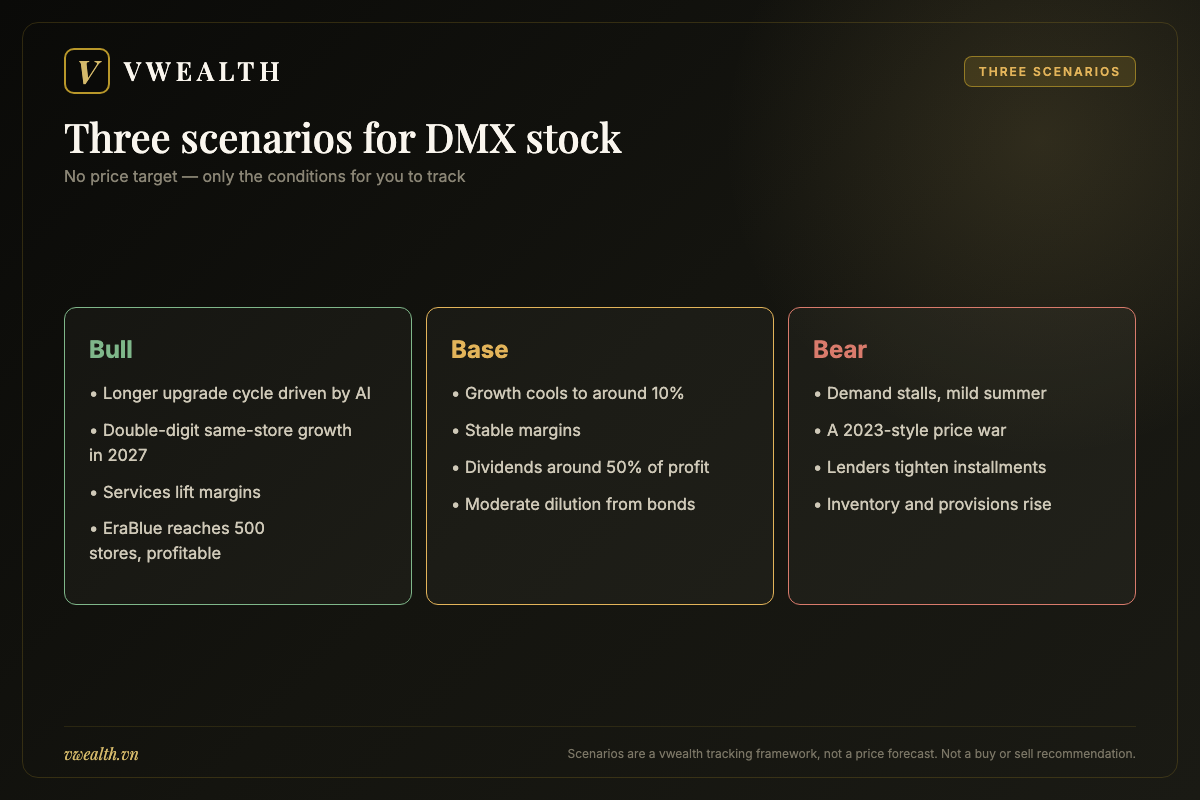
Bull case: a longer upgrade cycle and services lifting margins
In this scenario, domestic consumption keeps recovering, the housing market warms up and drives appliance demand for new homes, and the wave of AI devices (phones, laptops, smart appliances) creates a longer upgrade cycle than expected. DMX keeps same-store growth in double digits through 2027, while the share of installment, extended-warranty and technical-service revenue keeps rising, allowing net margin to hold or edge up. Actual 2026 profit comfortably beats the company’s VND 7,350 billion plan, approaching the more optimistic broker forecasts. EraBlue hits its store targets, contributes more visible profit and moves closer to an Indonesian IPO.
On the market side, DMX joins more indexes, foreign money keeps flowing into Vietnam’s largest retailer after the upgrade, cash dividends are paid on schedule and the 1:1 bonus issue improves liquidity. Conditions for this scenario: same-store growth does not drop below double digits in coming quarters, gross margin does not slip, and there is no industry-wide price war.
Base case: growth cools to around 10%, dividends stay steady
This is the scenario vwealth considers most reasonable as a reference point. After the strong 2025–2026 recovery, revenue growth gradually eases to about 8–12% a year — consistent with the company’s long-term plan (about 11% compound revenue growth to 2030) and with TCBS’s forecast of about 8–10% annual growth for the electronics business. Profit grows slightly faster than revenue thanks to services, but there are no more 50% growth years. Cash dividends are paid steadily at around 50% of profit.
In this scenario, DMX looks like a “moderate growth, good dividend” stock: not explosive, but steady. Illustrative example (hypothetical, not a forecast): if profit grows 12% a year from the planned VND 7,350 billion in 2026, 2030 profit would be about VND 11,570 billion (7,350 × 1.124) — below the company’s VND 13,000 billion target. To reach VND 13,000 billion from VND 7,350 billion, profit must grow about 15.3% a year for four years (vwealth estimate). This simple calculation gives you a yardstick: each year, is actual profit running above or below the 15% line?
Conditions for the base case: same-store growth slows but stays positive; e-commerce keeps taking share in small items but without triggering a price war; consumer credit is stable; any bonds with warrants are moderate in size.
Bear case: demand stalls and the price war returns
The bear case does not require a crisis. It only takes the replacement wave peaking earlier than expected, a stalling housing market and a mild summer that slows air-conditioner sales for same-store revenue to fall back to low single-digit growth or decline. If at the same time e-commerce platforms or rival chains push discounts to win share, DMX will have to choose between defending market share and defending margins — exactly the 2023 dilemma. With operating leverage as in the chapter 4 example, profit could fall much faster than revenue.
On top of that, rising consumer bad debt could lead finance companies to tighten installment approvals, cutting both sales and commissions. On governance, if the parent prioritizes pulling cash out through dividends above the company’s cash-generating ability, or if bonds with warrants cause significant dilution, minority shareholders would bear the cost. Warning signs that the bear case is arriving: same-store growth in single digits for two consecutive quarters, falling gross margin, inventory growing faster than revenue, and rising inventory provisions.
| Factor | Bull | Base | Bear |
|---|---|---|---|
| Same-store growth | Double digits through 2027 | Eases to about 8–12% | Low single digits or negative |
| Margins | Edge up thanks to services | Stable | Squeezed by a price war |
| Installments and consumer credit | Rising share, stable bad debt | Stable around current levels | Lenders tighten approvals |
| Dividends and capital | As promised, minor dilution | Around 50% of profit | Heavy dilution or dividends beyond capacity |
| EraBlue | Reaches 500 stores, clearly profitable | Slower openings, small profit | Back to losses |
Should you buy DMX stock? A straight answer for each type of investor
After seven chapters, it is time to pull everything together. The answer to whether you should buy DMX stock is not “yes” or “no” for everyone, but “yes for whom, and under what conditions”. This chapter weighs the pros and cons, then identifies the investors DMX suits.
The compelling positives
A leadership position that is hard to dislodge. With roughly half the phone market and close to half the appliance market by most estimates, more than 3,000 stores and operating systems built in-house over almost twenty years, DMX has scale advantages no domestic rival can match in the short term.
The “sell devices, earn on services” model is working. Net margin rose from about 4.0% to about 5.3% in one year; the financial-services segment has a gross margin of about 89–95%; the technician arm turned profitable for the first time; unearned revenue from prepaid service packages has grown quickly. These are signs that DMX is shifting from “one-off sales” to “long-term customer relationships”.
A clear cash dividend policy. A commitment to pay at least 50% of profit in cash, VND 4,000 per share already paid right after listing, and specific plans for interim payments in December 2026 and April 2027. For income-seeking investors, that clarity is rare on the Vietnamese market.
Cleaner and easier to understand than the parent. With DMX, you know exactly what you own: the phone and appliance business, the services around it and 45% of EraBlue — without the risks of a grocery chain or pharmacies.
Management in the same boat. The CEO moved personal wealth from MWG into DMX, the chairman and his family bought in the IPO, and another board member registered to buy after listing. Foreign funds took about 73% of IPO demand, and MSCI added the stock on listing day.
The negatives you cannot ignore
A cyclical industry with high operating leverage. 2023 showed that profit can almost vanish when demand falls and a price war breaks out. Profits in 2025–2026 are benefiting from the replacement cycle; when the cycle turns, profit can fall faster than revenue.
Growth through expansion is exhausted. The store count is flat and market share is already around half. Long-term growth depends on the overall market, services and EraBlue — the old formula of “open more stores, grow revenue” no longer applies.
Minority shareholders sit behind an 86% parent. Before the IPO, the parent took out about VND 38,445 billion in dividends; IPO proceeds go to repaying short-term debt; the same person chairs both companies; and the upcoming extraordinary meeting will discuss bonds with warrants that could dilute existing holders. None of this is illegal, but all of it reminds you that small shareholders do not hold the decision-making power.
Thin liquidity and free float. Only about 14% of shares trade freely, mostly held by funds. The price can swing sharply when index flows or a few large funds change their weightings. For foreign investors used to deep markets, this matters for both entry and exit.
E-commerce is growing fast. Phone and tablet sales on the platforms rose about 45% in Q1 2026. DMX has a service moat, but small, easy-to-buy-online items will face increasing competition.
| Pros | Cons |
|---|---|
| Market leader in phones and appliances, 3,000+ stores | Cyclical industry; the 2023 lesson still applies |
| Financial services with about 89–95% gross margin; technician arm profitable | High installment share makes DMX sensitive to consumer credit |
| Commitment to pay at least 50% of profit in cash dividends | First VND 4,000 was from accumulated profit and will not recur |
| Separate from Bach Hoa Xanh, easier to value | Parent owns 86% and took about VND 38,445 billion in pre-IPO dividends |
| Large foreign funds, MSCI fast entry, upgrade backdrop | Free float about 14%, thin liquidity |
| EraBlue as a regional growth option | Bonds with warrants could dilute shareholders |
Who DMX stock suits — and who it does not
It suits investors seeking dividends plus moderate growth. If you want a stock with steady cash dividends, an industry leader that is easy to understand, and you accept low double-digit growth over the long run, DMX deserves a place on your watch list. The key is to buy at a price where the recurring dividend yield (excluding the one-off VND 4,000) still looks attractive relative to deposit rates.
It suits investors who understand cycles. If you are comfortable with retail stocks rising and falling with consumer demand, and have the discipline to add when the market is most pessimistic — as some investors did with MWG in 2023 — DMX’s cyclicality is more opportunity than risk.
It suits investors who want electronics without groceries. If you like Mobile World’s electronics business but do not want Bach Hoa Xanh risk, DMX is the direct way to own that part.
It does not suit those seeking explosive growth. DMX is a mature business. The years of 50% profit growth came from recovering off a low base, not from its normal rhythm.
It does not suit traders who need deep liquidity. With a thin free float and prices that can jump on fund flows, it is hard to move large positions in and out without affecting the price.
It does not suit investors who put heavy weight on minority rights. With the parent owning 86%, minority votes at shareholder meetings are largely advisory.
Frequently asked questions about DMX stock
Which company is behind the DMX ticker? DMX is Dien May Xanh Investment JSC, the legal entity formerly called The Gioi Di Dong JSC, which runs the thegioididong.com, Dien May Xanh and TopZone chains and the Dien May Xanh Technicians service business, and owns 45% of the EraBlue joint venture in Indonesia.
When and where did DMX list? DMX began trading on HOSE on August 6, 2026 at a reference price of VND 80,000 per share, after an IPO that raised about VND 13,315 billion.
How is DMX different from MWG? MWG is the parent, owning about 86% of DMX as well as Bach Hoa Xanh and other businesses. DMX covers only the phone and appliance business and related services.
Does DMX pay dividends? Yes. DMX paid VND 4,000 per share on August 26, 2026, plans interim payments of VND 2,000 in December 2026 and VND 2,000 in April 2027, and has committed to paying at least 50% of net profit in cash.
Can foreigners buy DMX stock? Yes, through a Vietnamese securities account. The foreign ownership limit is 49% according to the prospectus; in practice the constraint is the thin free float rather than the limit.
Does buying DMX give exposure to Bach Hoa Xanh? No. Bach Hoa Xanh belongs to MWG, not DMX.
What is DMX’s share price and P/E today? This article does not quote current figures because they change daily; check the DMX report on vwealth for up-to-date numbers and comparisons with MWG and FRT.
Final thoughts
DMX is a mature business with more than twenty years of history, leading Vietnam’s phone and appliance retail market, which went public on record profits. Its strengths are real: scale, operating systems, a service network and a service-driven earnings model that is improving margins. Its weaknesses are also real: a cyclical industry, little room left for store expansion, and minority shareholders standing behind a parent that owns 86%.
The answer to whether you should buy DMX stock therefore depends on two things to watch over the next 12–18 months: where same-store growth settles once the upgrade cycle peaks, and whether the parent keeps its dividend promises and capital discipline toward minority shareholders. If both go well, DMX could become one of the dividend-plus-moderate-growth names worth holding for the long term among Vietnam stocks in the retail sector. If not, the share price will simply reflect the industry’s inherent cyclicality.
This article is for information and analysis only and is not a recommendation to buy or sell. Before deciding, check current figures — price, P/E, latest quarterly profit, inventory, borrowings — in the vwealth analysis reports, and consider your own risk tolerance. If you follow Vietnamese retail, our analyses of MWG, FRT, DGW, PET and PNJ make good points of comparison. You can sign up for a vwealth account to follow the DMX report as it is updated each quarter.
Research Vietnamese stocks in English with vwealth. Our AI-powered platform turns Vietnamese market data into full English analysis reports — with international payment support and a free 2-month trial for new accounts. Create your free account and read the latest reports.


