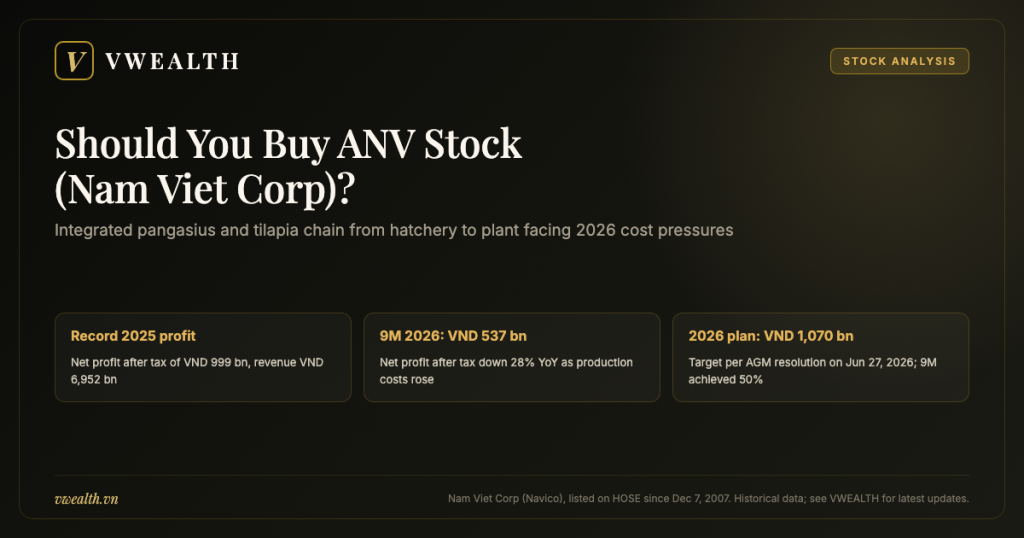
Whether foreign and domestic investors should buy ANV stock — the ticker symbol of Nam Viet Corporation (Navico) listed on the Ho Chi Minh Stock Exchange (HOSE) — has emerged as one of the most polarizing debates in Vietnam stocks after the company delivered a historic performance in 2025. In that blowout year, the Long Xuyen-based seafood exporter generated approximately VND 999 billion in net profit after tax, a staggering twenty-one-fold surge compared to the prior year. Few market observers recall that Nam Viet began its corporate journey in 1993 not in aquaculture, but as a provincial civil and industrial construction contractor, only pivoting to pangasius farming and processing in 2000. Over the ensuing quarter-century, the company transformed itself into one of the world’s preeminent pangasius producers, commanding a fully integrated, closed-loop value chain encompassing broodstock, aquafeed milling, extensive farming hectares, automated filleting facilities, and an emerging tilapia export division. However, as operating conditions shifted in 2026, rising global fishmeal costs, surging refrigerated ocean freight, and evolving US trade barriers compressed operating margins and triggered an earnings retreat despite resilient topline expansion. This in-depth analysis unpacks the entire corporate trajectory of ANV stock, evaluating the core fundamentals, structural competitive moats, balance sheet risks, and valuation dynamics to help institutional and individual investors determine whether Navico represents an attractive cyclical opportunity or a value trap.
Before examining the underlying financial mechanics, several corporate and market designations require immediate clarification to avoid widespread investor confusion. On the Ho Chi Minh Stock Exchange, ANV stock represents Nam Viet Corporation, widely recognized in commercial seafood trade as Navico. In various third-party financial databases and broker feeds, investors occasionally encounter the entity label “Amicogen Nam Viet” attached erroneously to ticker ANV. That is an outright data misclassification. Amicogen Nam Viet is a separate 50-50 joint venture entity established by Nam Viet to extract high-purity collagen and gelatin peptides from freshwater fish skins; it is not the publicly traded parent corporation. Furthermore, within the specialized realm of Vietnamese aquaculture and seafood export equities, the primary listed benchmark is Vinh Hoan Corporation (ticker VHC). For investors seeking a direct comparative assessment between these two industry titans, vwealth has published an extensive evaluation in our VHC stock analysis, and this article will cross-reference Vinh Hoan at critical analytical junctions where industry positioning diverges.
For international investors allocating capital into Vietnam stocks, understanding the local market micro-structure is critical. Nam Viet trades on the HOSE under standard Vietnamese equity market rules: transactions operate on a T+2 settlement timeline (settling effectively on the afternoon of T+2), within a daily price fluctuation ceiling and floor of ±7% based on the previous session’s reference price, and in standard board lots of 100 shares. In Vietnam, statutory par value is fixed at VND 10,000 per share, which serves as the legal denominator for percentage cash dividend declarations. Moreover, unlike premium banking institutions or select industrial leaders where the statutory Foreign Ownership Limit (FOL) is chronically maxed out, foreign ownership in ANV stock remains exceptionally low at roughly 1% according to brokerage filings. This negligible foreign participation leaves the legal foreign room almost entirely unoccupied, granting international funds unconstrained market access without paying off-market over-the-counter premiums.
In strict alignment with the research standards established across the corporate equity series at vwealth, all timeline milestones, executive profiles, transactional data, and corporate metrics cited throughout this dossier originate exclusively from officially disclosed corporate filings. These primary documents include Navico’s corporate disclosures and investor relations reports, the formal minutes and resolutions of the 2026 Annual General Meeting of Shareholders (AGM), authoritative equity research from domestic and foreign securities brokerages such as Shinhan Securities, FPTS, BSC, and SSI, alongside accredited domestic financial journalism. Historical audited data from closed fiscal periods serve as structural empirical anchors. This analysis explicitly omits fleeting daily market closing prices, real-time intraday price-to-earnings (P/E) ratios, and unreleased quarterly figures. In a high-beta commodity exporter where net earnings can double or contract by half based on anchovy quotas off the coast of Peru or tariff determinations in Washington D.C., spot numbers decay rapidly. Where analytical calculations reflect internal proprietary synthesis, they are explicitly tagged as a “vwealth estimate” or an “illustrative example.” For real-time updated valuations and AI-driven screening scores, investors should access the ongoing coverage reports on vwealth.
Ultimately, one foundational premise governs this entire investigation: ANV stock is not a smooth, compound-growth defensive play akin to modern grocery retail or digital enterprise software. It is an agricultural export manufacturing powerhouse operating in cyclical international commodity markets. Corporate profitability is governed by three macro variables over which corporate management possesses only partial control: the wholesale price realization of whitefish fillets in destination markets across the United States, China, and Brazil; input prices of feed commodities including fishmeal and soybean meal; and international trade policies, tariffs, and technical sanitary barriers. Consequently, the core question of whether to buy ANV stock centers on whether the record-setting performance of 2025 represents an isolated cyclical peak or a permanently elevated structural operating baseline — especially as input cost inflation, US trade tariff revisions, and administrative land regularizations at the Binh Phu mega-complex converge on the company’s dual-species pangasius and tilapia platform.
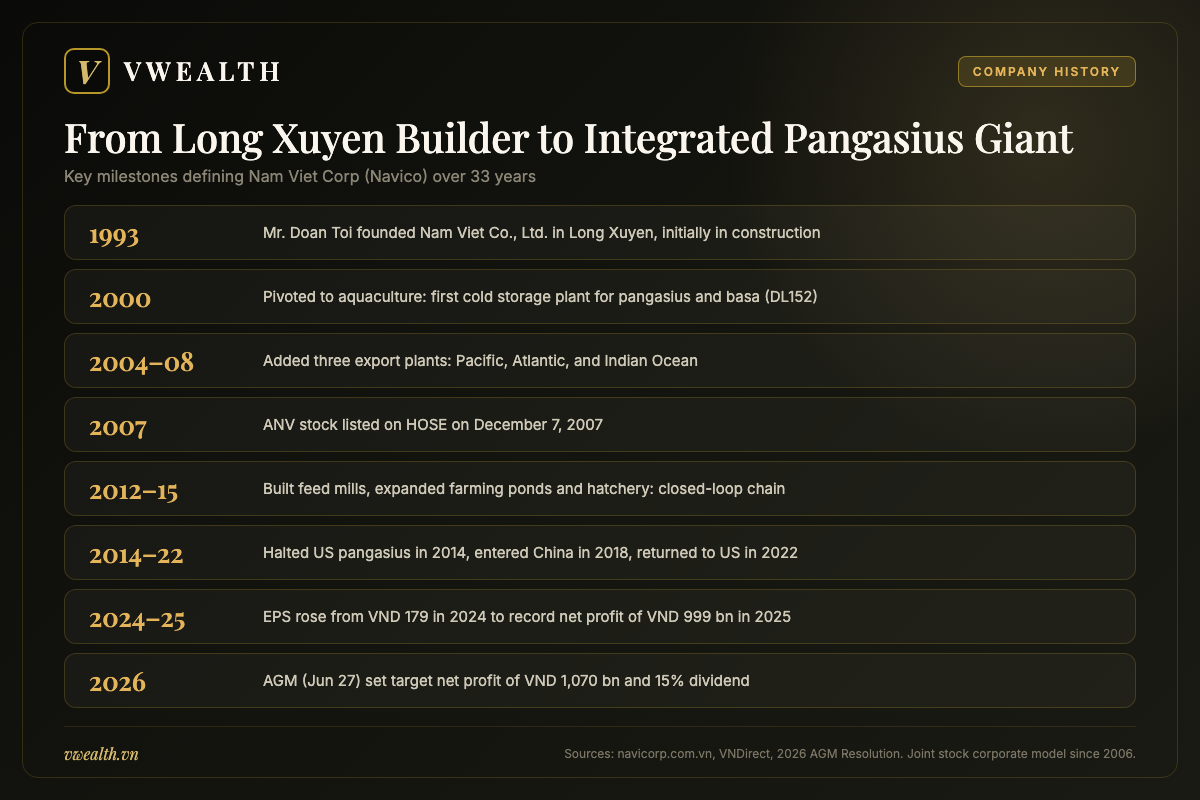
From Long Xuyen Construction Crew to Pangasius Giant: Nam Viet’s 33-Year Journey
In the Mekong Delta of southern Vietnam, most seafood dynasties trace their corporate roots to a humble family-owned earthen fishpond or an artisanal riverbank filleting station. Nam Viet took an entirely unconventional route. The enterprise originated far away from fish farming, emerging from the civil engineering and industrial construction sectors in Long Xuyen City, An Giang Province, during the early 1990s. This unconventional outsider pedigree explains much of Navico’s operational philosophy over subsequent decades: an aggressive propensity for heavy fixed-asset deployment, continuous factory construction, an engineering focus on physical infrastructure, and an uncompromising commitment to internal self-sufficiency rather than relying on external third-party suppliers. To properly evaluate ANV stock today, one must trace the six defining chapters of this 33-year corporate transformation.
1993–2000: A Construction Company Pivots to Pangasius
In 1993, entrepreneur Doan Toi established Nam Viet Company Limited in Long Xuyen, An Giang. According to official corporate history disclosures published by Navico, the company’s foundational commercial activities were rooted entirely in civil and industrial construction. The enterprise constructed residential buildings, erected manufacturing workshops, developed municipal roads, and laid utility infrastructure. That era coincided with the initial economic opening of the Mekong Delta under Vietnam’s Doi Moi reforms. As trade barriers softened, demand for agricultural processing plants, cold warehouses, and riverine logistic depots skyrocketed across An Giang and neighboring provinces, providing a capable local contractor with robust order books and steady cash flows.
The decisive turning point arrived in the year 2000. Recognizing the immense, untapped export potential of the Mekong River basin, Nam Viet boldly pivoted into commercial seafood processing by commissioning the Nam Viet Cold Storage Factory in Long Xuyen, designated with the official export sanitary approval code DL152, focused exclusively on pangasius (tra and basa catfish). Why would an established construction contractor abandon civil engineering to embrace aquaculture? The historical macro context provides the answer. During the late 1990s, pangasius cultivated along the nutrient-rich tributaries of the Hau River began capturing the attention of international seafood importers, particularly in the United States. Global buyers discovered that Vietnamese striped catfish yielded a neutral-tasting, firm-textured white fillet that served as an exceptionally affordable, high-yield alternative to increasingly scarce and expensive wild-caught marine whitefish such as Atlantic cod, haddock, and Alaska pollock.
With an abundant riverine resource base directly at its doorstep and proprietary construction expertise that allowed the company to erect specialized insulated processing plants at a fraction of the capital cost incurred by competitors, the strategic leap was both logical and opportunistic. A minor historical distinction is vital here: various financial media articles occasionally report that Nam Viet was “founded in 2000.” In reality, the year 2000 marked the operational pivot into seafood processing; the legal founding entity — Nam Viet Company Limited — was officially registered in 1993, as confirmed across state corporate registries, VNDirect profile filings, and Navico’s own archival corporate literature. Hence, the accurate characterization is: founded in 1993, entered seafood in 2000. When this chapter references a 33-year journey, it measures the full corporate lineage dating back to that initial 1993 foundation.
The first structural lesson for prospective equity investors is forged in this era: Nam Viet is an owner-operator enterprise shaped and steered by its singular visionary founder for over three decades. Corporate governance style, operational risk appetite, capital allocation strategies, and the highly concentrated equity ownership structure that characterizes ANV stock today all reflect the personal footprint of Mr. Doan Toi.
Four Processing Plants in Eight Years (2000–2008)
If a single operational imperative characterized Nam Viet during the 2000–2008 era, it was relentless physical expansion. Following the successful operational launch of the DL152 plant in 2000, the company broke ground on its second major industrial processing complex, dubbed the Pacific Factory (Thai Binh Duong), export code DL384, entering commercial service in 2004. In 2006, Nam Viet commissioned its third massive plant, the Atlantic Factory (Dai Tay Duong), export code DL408. By 2008, the fourth facility — the Indian Ocean Factory (An Do Duong), export code DL18 — was fully operational. Erecting four major industrial processing plants named after the world’s oceans in just eight years captured the founder’s aggressive global ambition.
Simultaneously in 2006, Nam Viet completed its corporate restructuring from a private limited liability company into a joint stock enterprise, formally registering as a joint stock company on October 2, 2006. Equitization was the necessary legal prerequisite to access broader capital markets, setting the stage for what would become an explosive public stock exchange debut a little over a year later.
In commercial seafood exports, plant sanitary codes such as DL152 or DL384 are far more than mere administrative tracking tags. To export frozen fish products into demanding international jurisdictions like the European Union, each physical manufacturing site must undergo rigorous hygiene audits by veterinary authorities and secure an authorized veterinary approval code. Operating multiple independent processing complexes with distinct sanitary codes provides an exporter with substantial commercial flexibility. It equips the enterprise with diversified processing lines to fulfill massive supermarket purchase orders, allows concurrent specialization across diverse product specifications, and cushions the broader business against systemic operational disruption if a single facility experiences temporary regulatory holds. For an enterprise striving for global scale, these certified processing assets represented a tangible economic moat.
During this period, Navico publicly declared that in 2007 it attained the position of the world’s largest exporter of pangasius meat by volume. While this assertion reflects the company’s internal corporate declarations — which vwealth presents as a self-reported milestone rather than an independently verified global market share census — it accurately mirrors the strategic posture of that era: scale fast, capture raw tonnage, and worry about downstream margin optimization later.
Listing in 2007 and the Crash of 2008
On December 7, 2007, ANV stock officially listed on the Ho Chi Minh Stock Exchange (HOSE) with a standard par value of VND 10,000 per share. The timing of the initial public listing was momentous: late 2007 represented the absolute euphoric crescendo of Vietnam’s first historic stock market boom. Liquidity was overflowing, retail trading fervor reached unprecedented heights, and virtually any large-scale industrial exporter listing on the HOSE command hefty speculative valuations. Nam Viet stepped onto the public stage at that peak, boasting four operational factories, a surging export brand, and an irresistible Mekong Delta growth narrative.
However, within twelve months, the 2008 Global Financial Crisis struck international trade and capital markets with brutal force. Archival financial data documented by domestic business journals such as VnEconomy captures the stark paradox of that turbulent period. During the first nine months of 2008, Nam Viet generated an impressive VND 2,514 billion in revenue and VND 237.3 billion in net profit after tax. Demonstrating strong corporate solvency and cash generation, the board declared and paid an interim cash dividend of 18%. Yet, by November 7, 2008, the market price of ANV stock had cratered to VND 21,000 per share, shedding 55.79% of its market value compared to early September 2008 levels. The underlying enterprise remained solidly profitable and paid generous cash dividends, but equity valuations evaporated by more than half in just two months.
This episode delivers an invaluable historical lesson that ANV stock continues to teach market participants today: the equity valuation of a cyclical commodity exporter does not merely reflect its immediate trailing accounting earnings. It is acutely sensitive to broader macroeconomic risk appetite, international liquidity conditions, and forward expectations regarding global consumer demand. In late 2008, equity markets grew terrified that consumer belt-tightening across North America and Europe would choke demand for imported seafood, while commercial lenders tightened export credit facilities. Consequently, investors liquidated cyclical positions well ahead of any formal deterioration in reported operational numbers. This recurring pattern of “strong trailing profitability accompanied by sharp equity drawdowns” has resurfaced multiple times across Navico’s public trading history — most visibly during the 2026 trading year.
Closing the Value Chain (2012–2015)
Navigating through the aftermath of the 2008 financial crisis, Nam Viet’s executive leadership recognized that competing purely as an unintegrated toll-processor filleting externally procured fish exposed the company to extreme raw material price whipsaws. When local farm-gate fish prices surged due to regional supply shortages, independent processors saw their operating margins completely crushed. Conversely, when fish prices collapsed, independent smallholder farmers incurred severe losses, neglected fish feeding, abandoned pond maintenance, and triggered catastrophic raw material shortages in the following harvesting cycle. To permanently insulate itself from this vicious agricultural cycle, Navico initiated a strategic pivot toward full upstream integration: bringing every single step of the value chain under direct corporate ownership.
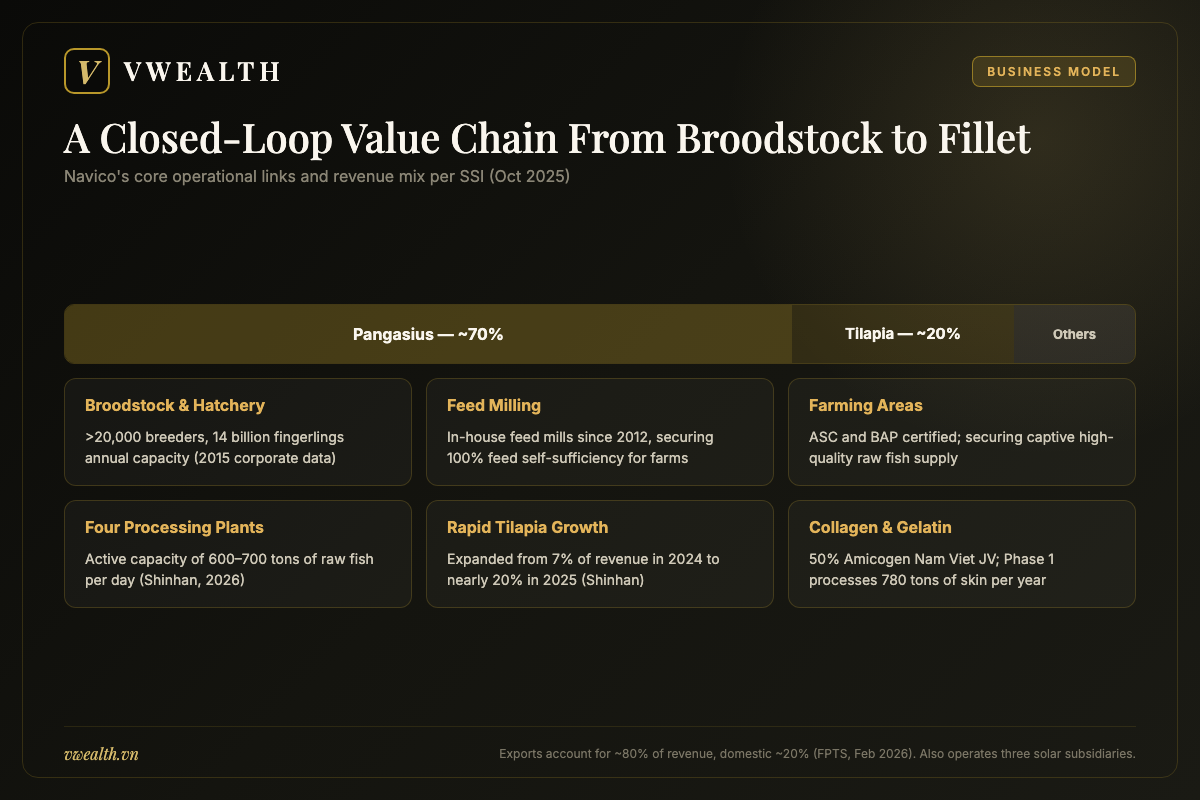
The transformation commenced in earnest in 2012 with the grand opening of Navico’s dedicated aquafeed manufacturing complex, boasting an initial design capacity exceeding 200,000 metric tons per annum. In 2013, the company dramatically expanded its proprietary aquaculture water surface from 100 hectares to 300 hectares, providing sufficient controlled farming capacity to harvest over 120,000 metric tons of raw fish annually. In 2014, Navico expanded aquafeed milling capacity to 400,000 metric tons per annum, established a specialized riverine tilapia farming division comprising over 4,000 floating cage pontoons deployed along the Mekong River, and constructed a modern broodstock breeding center producing 150 million fingerlings annually. By 2015, the company maintained a high-quality broodstock herd of over 20,000 mature breeders with an aggregate hatchery output capability of 14 billion fry and fingerlings per annum. According to official corporate statements, this achievement fully closed Navico’s 100% vertically integrated value chain: fingerling genetics, aquafeed production, farming grow-out, industrial filleting, cold storage, and direct international shipping.
Why does full vertical integration matter so profoundly in pangasius economics? Consider the fundamental cost anatomy of a frozen fish fillet. Over 70% of the manufacturing cost of a finished fillet is dictated by the farm-gate cost of the whole raw fish, and approximately 65% to 70% of the operating expense of growing that fish consists of commercial aquafeed. An unintegrated downstream processor purchasing fish from independent farmers bears the full volatility of open-market farm-gate prices. In contrast, an integrated operator that formulates its own specialized extruded feeds and raises fish in company-owned biosecure ponds controls stocking densities, feeding conversion ratios (FCR), fillet meat color (eliminating undesirable yellow-meat pigmentation through precise nutritional formulas), harvest timing, and baseline production costs. The strategic trade-off, however, is immense: full integration demands heavy fixed capital investments in agricultural land leases, pond excavation, water aeration infrastructure, feed silos, and floating barges, saddling the corporate balance sheet with elevated fixed assets, regular depreciation burdens, and direct exposure to biological farming risks.
Crucially, owning an in-house feed mill does not magically immunize an enterprise from raw material inflation. Navico’s feed mills must still procure marine fishmeal, soybean meal, wheat bran, and vitamin premixes on international commodity markets. While vertical integration captures internal milling margins and guarantees nutritional quality, when global marine fishmeal prices skyrocket — as occurred violently throughout 2026 — the resulting cost inflation flows straight into the cost of goods sold (COGS).
Exiting the US in 2014, Entering China in 2018, and Returning to the US in 2022
Nam Viet’s commercial export narrative resembles a strategic game of chess played across three major continental theaters: North America, China, and South America. In 2014, as documented in comprehensive research coverage by Shinhan Securities, Navico made the difficult decision to completely halt direct pangasius exports to the United States due to punitive antidumping tariff duties. For international investors unfamiliar with US trade mechanics, a brief explanation is necessary. Under US trade statutes, antidumping duties are protective tariffs assessed on foreign imports deemed to be sold below “fair market value.” The US Department of Commerce (DOC) recalculates these corporate tariff rates through annual Administrative Reviews, commonly referred to as “Period of Review” (POR) proceedings. Each individual investigated exporter is assigned a specific cash deposit rate expressed in US dollars per kilogram or ad valorem percentage. When an exporter is slapped with an exorbitant administrative duty, commercially viable shipments to the US market become economically impossible.
Having lost access to the lucrative US market, Navico directed its export machinery eastward. In 2018, the company executed a strategic push into mainland China — a development corporate management officially celebrated as a monumental operational milestone. The commercial payback materialized with extraordinary speed. According to official trade reports reviewed by Dau Tu Newspaper, during the first nine months of 2019, Nam Viet achieved VND 3,102 billion in net revenue and VND 506 billion in profit; its third-quarter net profit alone reached VND 153 billion (a 34% year-on-year surge), driven almost entirely by insatiable Chinese purchasing orders. Across subsequent operating years, China cemented its status as Navico’s single largest export destination by revenue volume.
Then, in 2022, the American export channel reopened. Comprehensive trade filings compiled by Shinhan Securities highlight that Navico secured an effective antidumping tariff rate of 0.00 USD per kilogram across several successive POR determinations, allowing the company to triumphantly re-enter the US market. The ability to arbitrage production volumes concurrently between the United States and mainland China granted Navico unprecedented commercial agility: whenever domestic consumer spending softened or restaurant demand waned in one geopolitical sphere, sales teams redirected container allocations to the other.
Interspersed between these trade pivots was the extraordinary operating year of 2021. According to corporate filings reported by Dau Tu, unprecedented post-pandemic disruptions in international ocean shipping triggered an exponential surge in container freight rates. Consequently, despite generating positive cash flow from operations of VND 344 billion, Nam Viet’s 2021 net profit after tax plunged to approximately VND 128 billion — representing just 63% of its 2020 earnings. For an enterprise exporting voluminous, heavy, low-unit-value frozen cargo in specialized refrigerated containers (reefers), ocean freight inflation can wipe out half of consolidated net earnings overnight. Meanwhile, on March 30, 2020, Navico established the Amicogen Nam Viet Joint Venture Company to extract bioactive collagen peptides and gelatin from discarded fish skins, initiating its first strategic move into high-margin biotechnology.
There was also a brief corporate detour that few contemporary market participants recall. In March 2022, Nam Viet committed VND 81 billion to establish Nam Viet Real Estate One Member Company Limited, marking an experimental divergence from agribusiness. However, this property subsidiary was quietly dissolved pursuant to a formal Board of Directors resolution on April 3, 2023. For disciplined equity investors, management’s prompt decision to terminate an experimental non-core venture and re-concentrate capital into core seafood operations was a reassuring signal of corporate discipline rather than an operational failure.
Bottoming in 2024, Record Profits in 2025
The two most recent completed fiscal years demonstrate the extreme cyclical volatility inherent in ANV stock. In 2024, according to financial disclosures cited by Phap Luat Vietnam Newspaper, Navico’s basic earnings per share (EPS) collapsed to a meager VND 179 per share. Full-year net profit after tax hovered around VND 48 billion — an internal vwealth estimate calculated by reverse-engineering domestic media reports confirming that 2025 net earnings of VND 999.5 billion were “nearly 21 times higher” than the prior year. For an industrial enterprise supporting four massive processing facilities, hundreds of aquaculture hectares, and over 6,000 personnel, VND 48 billion in net income represented little more than operational break-even.
Yet, it was precisely during the challenging cyclical trough of 2024 that Navico laid the physical infrastructure for its explosive 2025 renaissance. In July 2024, two flagship developments within the Binh Phu mega-complex — comprising a 450-hectare high-tech aquaculture grow-out farm and a 150-hectare centralized three-tier pangasius breeding nursery — were formally commissioned into commercial production, as documented by An Giang Newspaper. On July 5, 2025, Navico formalized a high-level strategic distribution alliance with AV09 Comercio Exporter in Brasília, successfully participating in Vietnam’s first official direct container shipment of pangasius, basa, and black tilapia into the massive Brazilian consumer market.
The financial culmination in 2025 was nothing short of breathtaking. Disclosures presented at the 2026 Annual General Meeting revealed that full-year consolidated revenue reached VND 6,952 billion (finishing at 115% of management’s initial annual plan), profit before tax reached VND 1,152 billion, and net profit after tax finalized at VND 999 billion (recorded precisely in formal AGM Resolution No. 73/NQ as VND 999.478 billion). Based on Shinhan Securities research calculations, full-year EPS leapt to VND 3,754 per share — an extraordinary twenty-one-fold surge above 2024 levels. On June 27, 2026, Navico convened its AGM in An Giang under the triumphant corporate theme: “Firm Chessboard – Leading the Era,” reflecting management’s supreme operational confidence.
The fundamental question that modern investors must answer is whether 2025 represented a permanent structural elevation in Navico’s baseline earning power or merely an exceptional cyclical alignment of peak selling prices and lag-time input costs. The historical milestones summarizing this 33-year corporate evolution are structured below.
| Year | Strategic Milestone | Investment & Analytical Significance |
|---|---|---|
| 1993 | Doan Toi establishes Nam Viet Co., Ltd. in civil and industrial construction | Foundational establishment of a tightly held owner-operator business |
| 2000 | Pivots to commercial aquaculture; launches processing plant DL152 in Long Xuyen | Strategic commercial entry into pangasius and basa export processing |
| 2004–2008 | Commissions Pacific (DL384), Atlantic (DL408), and Indian Ocean (DL18) plants | Erects four large-scale EU-certified export processing plants in eight years |
| Oct 2, 2006 | Converts legally into a Joint Stock Company model | Restructures corporate vehicle to prepare for public capital market listing |
| Dec 7, 2007 | Lists ANV stock on the Ho Chi Minh Stock Exchange (HOSE) | Public debut timed precisely at the euphoria peak of the 2007 market boom |
| 2008 | 9M revenue VND 2,514B, net profit VND 237.3B, pays 18% cash dividend; stock drops to VND 21,000 | Highlights classic commodity cyclicality: strong trailing profits accompanied by severe market sell-offs |
| 2012–2015 | Builds 400k-ton feed mill, expands to 300 ha ponds, achieves closed-loop supply | Full vertical integration captures milling margins and secures raw fish supply |
| 2014 | Suspends direct US pangasius exports due to prohibitive antidumping duties | Loss of a prime high-value geographic market forces corporate reorientation |
| 2018 | Executes strategic commercial entry into the mainland China market | China rapidly expands to become Navico’s largest geographic export destination |
| 2020 | Establishes Amicogen Nam Viet 50-50 joint venture for collagen and gelatin | Initial strategic foray into high-margin bioactive by-product valorization |
| 2022 | Re-enters US market following favorable 0.00 USD/kg antidumping review rates | Restores high-margin dual-market arbitrage between China and the US |
| Jul 2024 | Binh Phu mega-complex (450 ha farming + 150 ha nursery) enters production | Massive physical expansion unlocking captive supply for both pangasius and tilapia |
| Jul 2025 | Signs strategic distribution alliance with AV09 in Brasília, Brazil | Unlocks high-growth South American export corridor |
| 2025 | Record financial results: revenue VND 6,952B, net profit VND 999B, EPS VND 3,754 | Cyclical peak earnings driven by high US tilapia pricing and capacity expansion |
Who Steers Navico: The Doan Toi Family and Executive Governance
For many publicly traded corporations on emerging stock markets, the question of “who truly controls corporate decision-making” yields a fragmented answer — an uneasy equilibrium between state-owned holding vehicles, private equity syndicates, institutional asset managers, and a rotating board of directors. At Nam Viet, there is no ambiguity whatsoever. A single founding family commands the overwhelming majority of voting equity, the company’s visionary patriarch continues to serve directly as chief executive officer, and the second generation has firmly integrated into senior executive management. Dissecting the power structure and governance architecture at Navico is an indispensable prerequisite for evaluating ANV stock, as every strategic choice — from cash dividend distribution ratios to multi-trillion-dong capital expenditures — directly reflects the family’s long-term commercial perspective.
Doan Toi: Founder and Majority Shareholder
Mr. Doan Toi is the foundational architect of Nam Viet, having established the enterprise in 1993 and steered it across every transformation detailed in the preceding chapter. According to the official minutes and resolutions of the 2026 Annual General Meeting of Shareholders (AGM) convened on June 27, 2026, Mr. Doan Toi currently occupies the executive roles of Vice Chairman of the Board of Directors and General Director (Chief Executive Officer). International investors exploring historical press archives or older corporate marketing brochures may notice him referenced as “Chairman of the Board.” That reflects historical board compositions; under contemporary governance filings, the formal chairmanship resides with an executive lieutenant, allowing Mr. Toi to focus squarely on day-to-day operational execution.
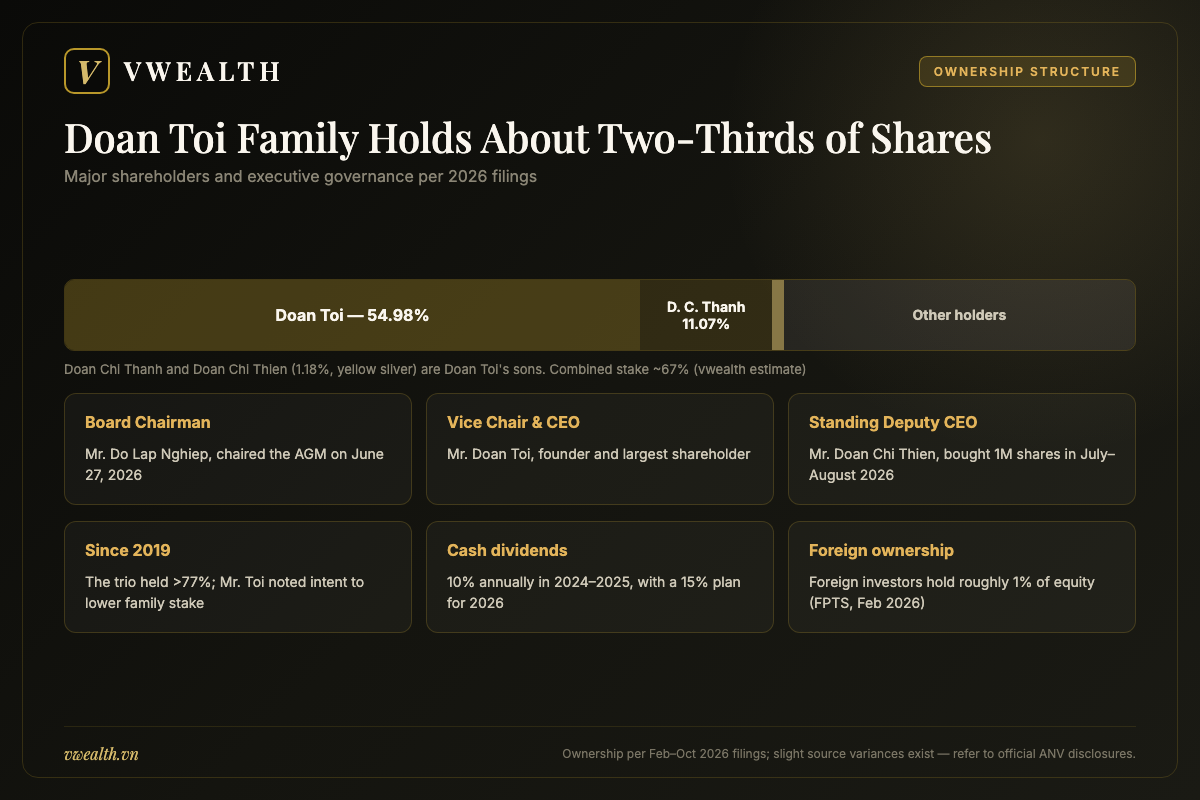
In terms of equity control, Mr. Doan Toi holds an absolute controlling majority in Nam Viet. Financial press reports published by Phap Luat Vietnam Newspaper in February 2026 and October 2026 verify that he personally owns 146.61 million shares, representing 54.98% of the company’s total chartered voting capital. While third-party institutional research reports may occasionally show marginal fractional variances depending on the specific date of registry closure, the core reality remains immutable: one individual holds more than half of the company. Following the historic earnings performance of 2025, domestic financial media reported that the market value of Mr. Toi’s personal equity holding in ANV stock crossed VND 3,885 billion.
What does commanding an absolute majority of 54.98% mean under Vietnamese corporate jurisprudence? Under the Law on Enterprises of Vietnam, standard AGM resolutions — including annual business operational plans, audited financial statement approvals, executive board compensation packages, and ordinary cash dividend distributions — require an approval threshold of over 50% of the total voting shares present at the meeting. In effect, Mr. Doan Toi exercises unchallenged sovereign control over corporate resolutions. This concentrated governance model presents two contrasting faces to prospective minority shareholders. On the positive side, it ensures singular strategic consistency, rapid operational decision-making free from bureaucratic paralysis, and an owner whose personal fortune is inextricably tied to corporate solvency. On the risk side, public minority investors have essentially zero structural leverage to block strategic pivots, re-direct capital allocation, or force higher dividend payouts if their investment thesis diverges from the founder’s vision.
Mr. Toi’s transactional behavior regarding ANV stock reveals much about his operational posture. In April 2025, when preliminary headlines broke indicating that the United States was considering a punitive 46% reciprocal tariff on Vietnamese imports, panic-selling engulfed the seafood sector, forcing ANV stock to hit its -7% daily limit-down floor across multiple consecutive trading sessions. In the midst of that market panic, Mr. Doan Toi stepped onto the open market and personally purchased 3 million shares. Buying heavily when market sentiment capitulates demonstrates an owner’s unyielding conviction in the underlying replacement value of his assets — a contrarian bet that yielded immense paper gains during the record-breaking 2025 operational year that followed.
The Second Generation: Doan Chi Thanh and Doan Chi Thien
The second generation of the Doan family has established a prominent presence across both the equity ownership ledger and the day-to-day operational hierarchy. Mr. Doan Chi Thanh, Mr. Toi’s son, owns over 29.5 million shares, representing an 11.07% equity stake in Nam Viet according to official holdings registers cited by Phap Luat Vietnam in October 2026. This holding makes Mr. Thanh the second-largest individual shareholder in the corporation after his father.
Meanwhile, his brother, Mr. Doan Chi Thien (born in 1989), represents the active operational face of the next generation. Pursuant to Board of Directors Resolution dated December 31, 2025, Mr. Thien was formally appointed as Deputy General Director, and the June 27, 2026 AGM minutes record his executive designation as Permanent Deputy General Director. On the open exchange, Mr. Thien executed a notable insider acquisition: according to transaction disclosure filings reported by VnBusiness, between July 28 and August 11, 2026, he acquired 1 million shares of ANV stock on the HOSE. This transaction expanded his direct equity stake from roughly 0.8% to 1.18%, elevating his personal ownership above 3 million shares. Crucially, this acquisition was executed immediately after ANV stock suffered a steep market correction exceeding 40% between February and late July 2026.
The leadership succession process at Navico has been telegraphed for years. As early as the 2019 Annual General Meeting, Mr. Doan Toi publicly expressed his desire to gradually transfer executive operating reins to Doan Chi Thien, as reported by Dau Tu Newspaper. Mr. Thien’s elevation to Permanent Deputy General Director in 2026 marks a tangible milestone in this generational transition. For international investors analyzing family-controlled Vietnam stocks, generational handovers represent critical inflection windows. Strategic priorities, technological adaptability, and capital allocation discipline often shift under younger leadership, requiring investors to closely scrutinize managerial performance over multi-year operational cycles.
Aggregating these core family holdings — Mr. Doan Toi’s 54.98%, Mr. Doan Chi Thanh’s 11.07%, and Mr. Doan Chi Thien’s 1.18% — reveals that the immediate founding family directly controls approximately 67% of Nam Viet’s chartered capital. This figure represents an internal vwealth estimate derived by summing officially disclosed holdings, excluding any extended relatives or affiliated legal entities. In its July 20, 2026 institutional equity research update, Shinhan Securities reported that other miscellaneous shareholders hold approximately 33.1%, with an effective market free float of roughly 90 million shares. FPTS research dated February 12, 2026, highlighted that total foreign institutional and retail ownership in ANV stock stood at an exceptionally modest ~1%.
Chairman Do Lap Nghiep and the Current Board of Directors
Pursuant to official AGM Minutes No. 72/BB and AGM Resolution No. 73/NQ dated June 27, 2026, the Chairman of the Board of Directors of Nam Viet is Mr. Do Lap Nghiep, who concurrently serves as Deputy General Director. Mr. Nghiep formally presided as Chairman of the meeting during the 2026 AGM. Consequently, the operational leadership triage at Navico is structured as follows: Mr. Do Lap Nghiep serves as Chairman of the Board and Deputy General Director; Mr. Doan Toi serves as Vice Chairman of the Board and General Director (CEO); and Mr. Doan Chi Thien functions as Permanent Deputy General Director.
This dual-hat executive configuration is widely observed across privately founded, family-dominated Vietnamese corporations. The formal chairmanship is assigned to a veteran corporate director, while the primary founding owner retains the chief executive position to exercise unhindered daily administrative and operational authority. While board governance and daily operational oversight are legally demarcated on corporate filings, de facto executive power remains firmly anchored in the controlling family.
The 2026 AGM proceedings also illustrated an extraordinary degree of voting unanimity among registered shareholders. Corporate voting records confirm that 69 shareholders and authorized proxies attended the meeting in An Giang, representing 219,856,889 voting shares. The production and business operational review for 2025 alongside the 2026 business plan were ratified with an absolute 100% approval vote, while the 2025 profit distribution proposal passed with 99.96% shareholder approval. In an enterprise where a single family alliance commands two-thirds of the outstanding equity, near-unanimous AGM voting tallies are standard practice.
In terms of corporate capitalization, Nam Viet maintains chartered capital of approximately VND 2,667 billion (as of September 30, 2025), corresponding to roughly 266.2 million ordinary shares in issue. This chartered capital base expanded steadily over recent operating years via successive bonus share issuances funded from owner’s equity and undistributed retained earnings throughout 2023 and 2024, pursuant to Board of Directors resolutions passed on December 21, 2023, July 5, 2024, and Resolution No. 152 approving the charter capital expansion on November 13, 2024.
From “Over 77% Family Control” to the Strategic Divestment Promise
In 2019, Dau Tu Newspaper published a headline that captured widespread market attention: the father and two sons of the Doan Toi family held over 77% of Thuy San Nam Viet’s chartered capital. That concentration intensified that year when Mr. Doan Toi executed a negotiated block trade to acquire 2.6 million shares, expanding his personal stake from 48.54% to 50.58%, which then represented 64.5 million shares. The subsequent leap in his absolute share count to over 146 million shares today primarily reflects the proportional bonus share distributions executed from corporate equity reserves during 2023–2024, alongside periodic direct market purchases (an internal analytical interpretation synthesized by vwealth from published capital expansion filings).
Fascinatingly, during that same 2019 AGM, Mr. Doan Toi openly acknowledged to assembled shareholders that the family’s ownership concentration was excessively high. According to Dau Tu, he expressed an explicit desire to search for reputable institutional investors to dilute family ownership down, explicitly citing the strategic precedent of Minh Phu Seafood — Vietnam’s leading shrimp exporter that famously brought in foreign strategic investors to enhance corporate standards. Later, in October 2025, Phap Luat Vietnam Newspaper cited an institutional note from SSI Securities stating that Navico leadership anticipated divesting a portion of the family’s equity stake to a foreign strategic partner in the coming year.
Yet, as of late 2026, the family’s aggregate ownership has only moderately compressed from over 77% to approximately 67% (vwealth estimate), primarily through organic capital restructurings rather than external placements. No concrete strategic transaction with an international seafood conglomerate or institutional private equity fund has been finalized in disclosed filings. For public minority investors evaluating ANV stock, this unrealized promise represents a key monitoring point. Introducing a reputable multinational partner could substantially expand the public free float, improve trading liquidity on the HOSE, and instill independent governance oversight within the boardroom. Conversely, as long as this strategic divestment remains aspirational, ANV stock will trade as a closely held family vehicle with low foreign participation (~1% foreign room utilization according to FPTS).
Insider Transactions in 2025–2026: Buying Dips and Selling Highs
Tracking the timing and direction of corporate insider transactions provides equity analysts with a window into internal sentiment. Across 2025 and 2026, trading patterns among Navico insiders established an unmistakable divergence: members of the core founding family consistently deployed capital to buy aggressively into severe market sell-offs, whereas non-family executive directors registered share disposals near multi-year valuation highs.
On the accumulation side, Mr. Doan Toi stepped in to acquire 3 million shares in April 2025 when market overreaction regarding proposed US reciprocal tariffs sent ANV stock spiraling limit-down. Fifteen months later, between July 28 and August 11, 2026, his son Doan Chi Thien accumulated 1 million shares following a brutal 41% drawdown in the stock. Conversely, on the divestment side, regulatory filings reported by VnBusiness reveal that Chairman Do Lap Nghiep registered to sell his entire personal holding of 900,000 shares (roughly 0.34% of chartered capital) between January 7 and February 5, 2026, while Deputy General Director Nguyen Van Vy registered to divest 100,000 shares, with formal transaction completion reports filed on January 28, 2026. This wave of executive profit-taking took place when ANV stock was trading at multi-year peaks following the historic 2025 earnings announcement.
Disciplined equity analysts should avoid interpreting insider transactions mechanically. Corporate directors sell shares for myriad personal reasons — tax planning, asset diversification, or liquidating incentive options — without necessarily signaling an impending corporate collapse. Similarly, founding families occasionally accumulate equity to defend voting thresholds or project market confidence rather than signaling pure intrinsic undervaluation. Nevertheless, the observable empirical reality remains compelling: when ANV stock experienced panic-driven drawdowns in 2025 and 2026, the individuals possessing the most intimate real-time knowledge of feed costs, processing orders, and overseas receivables consistently deployed personal capital to absorb market supply.
2026 Governance Shifts: Executive Reshuffles and Auditing Oversight
The 2026 operating year witnessed several notable executive transitions that were formally documented on Navico’s corporate investor relations portal. Pursuant to Board of Directors Resolution dated June 5, 2026, the company officially relieved Ms. Duong Thi Kim Huong of her duties as Deputy General Director. Subsequently, on September 7, 2026, the Board of Directors approved the appointment of a new Chief Financial Officer. These personnel shifts followed the aforementioned executive elevation of Mr. Doan Chi Thien to Permanent Deputy General Director at the close of 2025.
Regarding independent financial oversight, the 2026 AGM ratified the selection of A&C Auditing and Consulting Company Limited (a member of Baker Tilly International) to conduct the independent audit of Nam Viet’s 2026 interim and annual financial statements, with the formal auditing engagement contract executed on July 13, 2026. For institutional investors navigating emerging Asian markets, the pedigree and continuity of the external auditing firm represent an essential governance safeguard, as audited balance sheets provide the sole reliable foundation for verifying inventory valuation methodologies, biological asset capitalization, and trade receivable aging.
The appointment of a new Chief Financial Officer is particularly critical against the backdrop of 2026. As subsequent financial chapters will expose, Navico’s operating cash flow turned deeply negative during the first half of 2026, while short-term bank borrowings, working capital requirements, and customer receivables expanded aggressively. The newly appointed CFO will face immediate scrutiny regarding working capital discipline, inventory turnover management, and liquidity planning ahead of impending capital expenditure programs.
The following table consolidates the verified ownership distribution and executive leadership structure of Nam Viet based on officially disclosed public filings.
| Shareholder / Executive | Corporate Title / Capacity | Reported Shareholding | Equity Ownership % | Filing Source & Reference Period |
|---|---|---|---|---|
| Mr. Doan Toi | Vice Chairman of the Board, General Director (CEO) | 146.61 million shares | 54.98% | Phap Luat Vietnam Newspaper (Feb 2026 & Oct 2026) |
| Mr. Doan Chi Thanh | Son of Mr. Doan Toi | Over 29.5 million shares | 11.07% | Phap Luat Vietnam Newspaper (Oct 2026) |
| Mr. Doan Chi Thien | Permanent Deputy General Director | Over 3.0 million shares | 1.18% | VnBusiness (post-transaction Aug 2026) |
| Mr. Do Lap Nghiep | Chairman of the Board, Deputy General Director | Disposed entire 900,000 shares | 0.34% prior to disposal | VnBusiness & Corporate IR (Jan 2026) |
| Doan Toi Family Combined | Immediate Founding Family Alliance | Over 179.1 million shares | ~67% (vwealth estimate) | Synthesis of official filings above |
| Foreign Shareholders | Institutional & Retail International Investors | Undisclosed absolute volume | ~1.00% | FPTS Equity Research (Feb 12, 2026) |
| Public Free Float | Domestic Retail & Unaffiliated Investors | ~90.0 million shares | ~33.10% | Shinhan Securities Research (Jul 20, 2026) |
This ownership distribution confirms that ANV stock operates as a textbook family enterprise: equity ownership is heavily concentrated in the founding dynasty, foreign institutional participation is virtually nonexistent, and the public trading float remains restricted to approximately 90 million shares. The structural implications for equity market liquidity, institutional trading impact, and share price volatility will be scrutinized in detail across Chapters 5 and 7.
The Closed-Loop Engine: From Broodstock to Walmart Shelves
To grasp the operational architecture supporting ANV stock, consider the biological life cycle of a single commercial pangasius within Navico’s industrial ecosystem. The fish hatches inside a proprietary climate-controlled breeding hatchery, matures inside biosecure grow-out ponds excavated across the company’s farming basins, consumes precision aquafeed manufactured exclusively inside Navico’s feed mills, and is harvested by specialized corporate transport barges that deliver live cargo directly to the riverfront berths of the company’s four processing facilities. From there, automated filleting lines skin, trim, inspect, and quick-freeze the meat into export-grade vacuum-sealed cartons destined for major international retail shelves across the United States, Brazil, and mainland China. Simultaneously, discarded fish skins are routed directly into a dedicated biotechnology joint venture to synthesize pharmaceutical-grade marine collagen peptides. This is the physical reality behind the “closed-loop integrated value chain” frequently touted in Navico filings — and the primary analytical arena for identifying the company’s structural competitive moat.
Hatcheries, Aquafeed, and Farming Basins: The Chain’s Bedrock
In its comprehensive institutional equity research report dated July 20, 2026, Shinhan Securities identified Nam Viet as the sole corporate seafood enterprise in Vietnam operating an absolute 100% vertically integrated value chain — controlling genetics, hatcheries, aquafeed formulation, grow-out farming, processing, and direct global export distribution. While international investors should evaluate such brokerage characterizations with analytical rigor, the underlying physical assets documented in corporate filings substantiate an extraordinary level of operational integration.
On the aquaculture farming front, Shinhan filings indicate that Navico operates approximately 250 hectares of legacy traditional grow-out water surface, reinforced by the newly commissioned Binh Phu mega-aquaculture complex. The Binh Phu agricultural zone comprises 150 hectares dedicated to high-density three-tier pangasius nursery breeding and 450 hectares engineered for high-tech commercial grow-out ponds. These farming facilities hold prestigious international certifications, specifically the Aquaculture Stewardship Council (ASC) standard and the Best Aquaculture Practices (BAP) 2-star to 3-star ratings. For institutional capital assessing export agribusinesses, ASC and BAP accreditations represent critical commercial gatekeepers. Elite Western supermarket conglomerates, including Walmart, Costco, and European retail chains, maintain strict sustainable sourcing mandates that legally disqualify uncertified seafood suppliers. Without documented ASC/BAP traceability, Vietnamese pangasius cannot penetrate high-margin supermarket shelf space.
The Binh Phu mega-complex constitutes the crown jewel of Navico’s upstream expansion. According to investigative reports published by An Giang Newspaper, the complex encompasses two distinct capital projects: a VND 4,500 billion investment in 450 hectares of high-tech aquaculture grow-out infrastructure and a VND 1,000 billion allocation toward the 150-hectare three-tier breeding center. Management successfully consolidated approximately 90% of the planned agricultural land fund, and both specialized zones commenced active commercial operations in July 2024. Interestingly, institutional research from BIDV Securities (BSC) highlights that Navico subsequently repurposed approximately 70% of Binh Phu’s 600-hectare water surface toward the intensive cultivation of black tilapia — a strategic pivot that underscores Binh Phu’s central role in the company’s dual-species export strategy. (The administrative and land regulatory procedures surrounding Binh Phu will be analyzed objectively in Chapter 7).
Regarding commercial nutrition, Nam Viet operates an industrial aquafeed milling subsidiary that delivers complete feed self-sufficiency across 100% of the company’s active farming ponds. While public documentation exhibits minor variances regarding exact nameplate metric capacity versus daily line output, the operational takeaway for investors is definitive: Navico does not purchase commercial fish feed from external feed multinationals like CP Group or Cargill. Controlling the feed formulation internally allows Navico to fine-tune nutritional conversion ratios (FCR) and eliminate yellow pigmentation in the fillet meat, ensuring a pristine white product required by premium overseas buyers. Nevertheless, equity analysts must remember the essential economic caveat underscored by FPTS research: the foundational cost inputs of aquafeed — namely marine fishmeal, soybean meal, and wheat — must still be purchased at prevailing world commodity market prices. When global marine protein prices spike, corporate production costs escalate in lockstep.
Four Processing Facilities and the Capacity Utilization Puzzle
The downstream manufacturing core of Nam Viet’s empire resides in its four primary industrial processing complexes: the flagship Nam Viet processing plant (DL152), the Pacific Factory (DL384), the Atlantic Factory (DL408), and the Indian Ocean Factory (DL18). According to operational data compiled by Shinhan Securities, these four facilities possess an aggregate design capacity capable of processing approximately 1,360 metric tons of raw live fish per day. However, historical actual throughput has hovered around 600 to 700 metric tons per day, with executive management targeting an operational ramp-up toward 1,000 metric tons per day commencing in 2026.
Understanding processing capacity utilization is vital for decoding Navico’s operating leverage. An industrial seafood processing facility carries immense fixed operating overhead: heavy depreciation on automated filleting lines, industrial refrigeration systems, cryogenic blast freezers, refrigerated cold-storage warehousing, veterinary laboratory staff, and wastewater treatment infrastructure. When processing lines operate at only 50% of nameplate design capacity, every metric ton of processed fillet must absorb an outsized allocation of fixed depreciation and plant overhead, depressing operating profit margins. Conversely, as harvest volumes expand — fueled by captive fish yields from the Binh Phu complex and fresh retail purchase orders from North and South America — fixed overhead costs are distributed across significantly greater finished tonnage. This operational leverage represents a core explanatory variable behind the explosive profit expansion observed in 2025, where Phap Luat Vietnam noted that third-quarter earnings surged dramatically due to concurrent improvements in processing throughput and wholesale price realizations.
However, operating leverage functions as a double-edged sword. If international consumer demand wavers or export shipping routes face bottlenecks, unutilized industrial plant capacity morphs into a heavy fixed-cost drag. This dynamic explains why experienced analysts evaluating ANV stock monitor physical export volume metrics rather than focusing exclusively on top-line revenue figures. Topline revenue can temporarily expand during inflationary spikes even as underlying processing volumes stagnate. In its forward baseline projections, BSC estimated that Navico’s pangasius export volume would expand to 77,871 metric tons in 2026, representing a 13% year-on-year volume expansion — an empirical operational benchmark against which investors should evaluate subsequent full-year corporate operational disclosures.
Pangasius at ~70%, Tilapia at ~20%: The Second Growth Engine
If an investor were asked to identify the single most impactful operational evolution at Nam Viet over the past two years, the answer would not be pangasius — it would be commercial tilapia. According to Shinhan Securities research, tilapia expanded from a modest ~7% contribution to consolidated revenue in 2024 to nearly 20% in 2025. Following an institutional briefing in October 2025, SSI Securities documented that Navico’s consolidated product revenue split stood at roughly 70% pangasius, approximately 20% tilapia, with the remaining 10% generated across ancillary segments. Financial disclosures reported by Phap Luat Vietnam confirmed that Navico’s wholly owned subsidiary, Indian Ocean Company Limited, established itself as Vietnam’s single largest exporter of tilapia during the first eight months of 2025.
What structural market dynamic catalyzed this explosive tilapia ascension? Tilapia is a globally ubiquitous freshwater whitefish, commanding massive, deeply established consumption across North America, Latin America, and Europe. For decades, the United States market was overwhelmingly supplied by low-cost imports from mainland China. However, when geopolitical trade tensions escalated and Washington threatened to impose punitive tariffs of up to 155% on Chinese tilapia shipments, American retail procurement directors scrambled to secure alternative, tariff-exempt supply origins. Navico, possessing certified high-tech farming ponds at Binh Phu, specialized hatchery genetics, and certified processing lines, stood ready to fill the vacuum. In 2025, tilapia represented an astonishing 54% of Navico’s total export revenue generated from the US market, with first-half US export turnover surging by 113%.
For investors evaluating ANV stock, the emergence of tilapia delivers significant strategic advantages alongside clear operational vulnerabilities. On the positive side, it broadens Navico’s commercial product catalog, allowing corporate sales teams to cross-sell dual-species containers (pangasius plus tilapia) to the same tier-one global supermarket buyers — including Walmart, Costco, and Kroger — while maximizing water-surface utilization across the Binh Phu basins. On the risk side, tilapia directly pits Navico against the immense industrial scale of Chinese aquaculture. When Chinese domestic supply surges or international shipping lanes stabilize, aggressive price competition can rapidly erode wholesale export prices. Indeed, market updates compiled by elibook based on FPTS findings revealed that during the second quarter of 2026, export prices for Vietnamese tilapia softened even as upstream production costs and raw pangasius fish costs trended upward — confirming that Navico’s second growth engine remains vulnerable to global agricultural commodity cycles.
Examining consolidated turnover by product line, Shinhan Securities noted that frozen finished seafood products accounted for 84.2% of consolidated revenue in 2025. During the first half of 2026, finished seafood sales generated VND 3,641 billion, while the renewable solar electricity division contributed VND 54 billion, and other ancillary business lines generated VND 84 billion. The fundamental analytical reality is undeniable: despite interesting peripheral developments in solar power and biotechnology, Nam Viet remains overwhelmingly an industrial exporter of frozen whitefish fillets.
Subsidiary Network: Processing, Feed Milling, and Three Solar Units
Behind the corporate brand of Navico sits a structured constellation of wholly owned subsidiary companies, with each legal vehicle tasked with managing a distinct operational phase of the integrated chain. According to Shinhan Securities corporate filings, Nam Viet Corporation holds 100% equity ownership in the following operating entities: Indian Ocean Company Limited (specializing in seafood processing, fishmeal, and fish oil extraction, with charter capital of VND 36 billion), Nam Viet Binh Phu Company Limited (managing the Binh Phu aquaculture farming zone, capitalized at VND 540 billion), Nam Viet Aquafeed Processing Company Limited (formulating aquafeed, capitalized at VND 196 billion), alongside three specialized renewable energy units: Nam Viet Solar (VND 180 billion), Indian Ocean Solar (VND 5 billion), and Atlantic Solar (Dai Tay Duong Solar, VND 5 billion).
The presence of three dedicated “Solar” entities on Navico’s balance sheet occasionally puzzles international investors. These entities were established to develop commercial rooftop solar photovoltaic installations across the massive roofs of the company’s cold-storage warehouses, feed mills, and processing plants. Because seafood processing and deep-freeze cold storage require immense, uninterrupted electrical power to sustain refrigeration compressors, deploying rooftop solar allowed Navico to offset peak retail utility tariffs and claim carbon-reduction credits. However, from an investment standpoint, solar revenue remains modest (generating VND 54 billion in the first half of 2026), serving as an operational cost-mitigation asset rather than an independent corporate growth driver.
Indian Ocean Company Limited warrants particular analytical attention. Beyond executing industrial filleting, this subsidiary operates specialized rendering lines that process biological fish by-products — including fish heads, skeletal bones, visceral offal, and fat trimmings — into high-protein fishmeal and crude fish oil. In an integrated pangasius operation, over 60% of the living fish’s body weight consists of by-products. Transforming this processing waste into commercial fishmeal and fish oil captures substantial incremental revenue per harvested kilogram. Management has also shown a willingness to prune non-performing non-core ventures: in May 2025, the Board of Directors formally dissolved Nam Viet Organic Fertilizer One Member Company Limited, following the previous liquidation of its property unit in 2023.
Collagen and Gelatin: The Amicogen Nam Viet Joint Venture
The quest to ascend into higher-margin specialized biochemical manufacturing is embodied in Amicogen Nam Viet Company Limited. Established as a 50-50 joint venture between Nam Viet Corporation and Amicogen Inc. (a prominent South Korean industrial biotechnology specialist), the JV was capitalized with a direct equity contribution of VND 63 billion from Navico, according to Shinhan Securities filings. The enterprise was specifically engineered to extract premium marine collagen peptides and gelatin from fresh pangasius skins.
According to industrial research from Phu Hung Securities (PHS), Phase 1 of the Aminavico collagen extraction plant entered trial commercial commissioning in April 2023, boasting an initial processing throughput capacity of roughly 780 metric tons of raw fish skins per year. Industry reports from VASEP noted that Navico subsequently injected an additional VND 38 billion into this fish-skin collagen valorization initiative. Collagen peptides represent a high-value biochemical ingredient utilized globally across functional nutritional supplements, anti-aging cosmetics, and pharmaceutical formulations, commanding wholesale prices per kilogram that dwarf frozen food fillets by multiple orders of magnitude.
However, institutional investors evaluating ANV stock must maintain strict perspective regarding the JV’s current financial contribution. Amicogen Nam Viet is an equity-accounted joint venture (50% holding) rather than a consolidated operating subsidiary. Its operational balance sheet is diminutive compared to Nam Viet’s consolidated asset base of over VND 5,800 billion at year-end 2025. Financial performance from the JV is recognized on Navico’s income statement under “share of profit or loss in associates and joint ventures,” without inflating consolidated topline turnover. Collagen and gelatin represent an intriguing long-term optionality play on biological upcycling, but they do not constitute the primary driver of current corporate cash flows.
Domestic Distribution at ~20%: The Bach Hoa Xanh Retail Channel
While Navico’s corporate identity is defined by global trade, domestic distribution within Vietnam provides an essential commercial shock absorber. According to FPTS research dated February 12, 2026, international exports generate approximately 80% of Navico’s consolidated turnover, while domestic Vietnamese sales contribute the remaining ~20%. A significant portion of this domestic volume is channeled through Bach Hoa Xanh — the prominent modern grocery supermarket chain operated by Mobile World Group (MWG).
For investors monitoring Vietnam’s modern retail modernization, domestic supermarket placement provides Navico with a stable counter-cyclical sales outlet. When international shipping rates spike or export tariff disputes delay ocean containers, domestic retail channels absorb fresh and frozen inventory without exposing the company to ocean freight volatility, foreign exchange fluctuations, or overseas trade embargoes. Nonetheless, pangasius in Vietnam has historically competed against an abundance of fresh wild-caught marine seafood and local aquaculture, resulting in relatively modest domestic pricing power. Domestic distribution acts as an effective operational buffer, but international exports remain the primary determinant of corporate profitability.
The following table structures Nam Viet’s primary subsidiary holdings and joint-venture investments based on audited disclosures and brokerage compilations.
| Subsidiary / JV Entity | Core Operational Domain & Strategic Role | Chartered Capital / Navico Contribution | Navico Equity Stake |
|---|---|---|---|
| Indian Ocean Co., Ltd. | Fillet processing, fishmeal, fish oil rendering; primary tilapia export vehicle | VND 36.0 billion | 100.0% |
| Nam Viet Binh Phu Co., Ltd. | Management and biological operation of the Binh Phu mega-farming complex | VND 540.0 billion | 100.0% |
| Nam Viet Aquafeed Processing Co. | Dedicated manufacturing of specialized extruded feeds for internal ponds | VND 196.0 billion | 100.0% |
| Nam Viet Solar Energy Co., Ltd. | Industrial rooftop solar power generation across processing facilities | VND 180.0 billion | 100.0% |
| Indian Ocean Solar Co., Ltd. | Rooftop solar electricity installation at Indian Ocean plant | VND 5.0 billion | 100.0% |
| Atlantic Solar Co., Ltd. | Rooftop solar electricity installation at Atlantic processing plant | VND 5.0 billion | 100.0% |
| Amicogen Nam Viet Co., Ltd. | Bioactive marine collagen and gelatin extraction from fish skin (Joint Venture) | VND 63.0 billion | 50.0% |
Scrutinizing this subsidiary map confirms where Navico concentrates its financial resources. Equity capital is overwhelmingly deployed into the upstream foundation: the Binh Phu farming complex and dedicated aquafeed milling assets. The biological and infrastructural moat of ANV stock rests upon captive raw material security, biosecurity certifications, and complete nutritional control. However, this heavy fixed-asset architecture also leaves the company burdened with large working capital needs — biological livestock swimming in ponds, feed ingredients stored in silos, and frozen containers on the water — exposing the entire integrated system to severe margin compression whenever global commodity feed costs escalate.
Pangasius Between Three Giants: The United States, China, and Brazil
When an agribusiness enterprise channels roughly 80% of its physical production into international trade lanes across 70 countries, its corporate destiny becomes inextricably linked to foreign geopolitical policies, import tariff schedules, and foreign exchange movements. In its July 2026 sector review, Shinhan Securities concluded that Nam Viet boasts the most geographically diversified export footprint in Vietnam’s seafood industry. Yet, despite shipping containers across Europe, Southeast Asia, and the Middle East, three continental powerhouses overwhelmingly dictate Navico’s financial results: the United States, mainland China, and Brazil. This chapter evaluates each primary market before examining the two overarching exogenous forces that no individual corporate exporter can control: global marine fishmeal inflation and refrigerated ocean freight volatility.
China: From Primary Growth Engine to Tilapia Margin Pressure
As traced in Chapter 1, mainland China was the vital commercial lifeline that re-energized Nam Viet following its departure from the US market in 2014. Commencing with its formal strategic entry in 2018, Navico experienced an explosive revival driven by voracious Chinese consumer demand for whitefish. Chinese restaurant chains, hotpot franchises, and institutional catering providers embraced Vietnamese pangasius as an affordable, high-yield boneless white meat. For several consecutive years, China stood undisputed as Navico’s largest geographic export destination by sales volume.
However, recent market research compiled by Shinhan Securities highlights a gradual, structural decline in China’s overall revenue contribution. This deceleration stems from a combination of cooling domestic Chinese macroeconomic consumption and aggressive state-backed initiatives encouraging internal consumption of domestically cultivated freshwater carp and marine whitefish. Furthermore, in the specialized domain of black tilapia, China is not merely an export client — it is the world’s most formidable competing producer. According to agricultural trade analyses published by Dien Dan Doanh Nghiep, intense competition from Chinese tilapia farming syndicates created significant downward pricing pressure on Navico’s commercial export contracts throughout 2026.
For international equity investors evaluating ANV stock, China’s shrinking percentage share is not inherently a bearish development, provided Navico can successfully reallocate container volume into higher-margin Western and Latin American jurisdictions. Indeed, that precise geographic arbitrage was the key catalyst behind the explosive profit expansion witnessed in 2025, when lucrative American and Brazilian sales comfortably compensated for softening Chinese wholesale volumes.
The United States: Antidumping Tariffs Across POR Cycles and the Tilapia Breakthrough
The United States seafood market represents the holy grail of international whitefish exports. American consumers, supermarket chains, and food service distributors pay premium dollar-denominated prices for standardized, boneless, deep-skinned white fillets. However, accessing this lucrative consumer market requires navigating a formidable regulatory obstacle: annual US Department of Commerce (DOC) Antidumping Duty Administrative Reviews, formally known as Period of Review (POR) proceedings. Under these proceedings, the DOC calculates firm-specific duty rates expressed in US dollars per kilogram of imported product.
Historical research compiled by Shinhan Securities documents Navico’s regulatory track record across recent review cycles. The company secured a zero-tariff determination (0.00 USD/kg) under both POR17 and POR18. Under POR19, the DOC assessed a modest duty of 0.14 USD/kg, which subsequently reverted to 0.00 USD/kg under POR20. However, in the preliminary results for the POR21 administrative review (covering shipments between August 2022 and July 2023), published in the Federal Register in February 2026, the DOC assessed a preliminary cash deposit duty of 0.23 USD/kg for Nam Viet. By contrast, its primary listed Vietnamese competitor, Vinh Hoan Corporation (VHC), maintained an unblemished 0.00 USD/kg rate, while the punitive Vietnam country-wide rate stood at 2.39 USD/kg. (These figures represent preliminary administrative findings; final determinations remain subject to verification and formal administrative publication).
While an antidumping duty of 0.23 USD per kilogram might appear modest to an uninitiated investor, in the fiercely contested global whitefish trade — where gross processing margins are measured in tens of cents per kilogram — a 0.23 USD/kg tariff disadvantage creates a tangible commercial wedge against competitors enjoying zero-duty status. The historical progression of Navico’s antidumping duties is summarized in the table below.
| Administrative Review Cycle | Navico Antidumping Duty Rate | Regulatory & Competitive Context |
|---|---|---|
| POR17 Review | 0.00 USD / kg | Zero-tariff status enables competitive US commercial re-entry (Shinhan) |
| POR18 Review | 0.00 USD / kg | Sustained duty-free export access supporting volume expansion |
| POR19 Review | 0.14 USD / kg | Minor administrative tariff assessment absorbed by export margins |
| POR20 Review | 0.00 USD / kg | Restoration of complete zero-duty status across US shipments |
| POR21 Review (Preliminary Feb 2026) | 0.23 USD / kg | Preliminary rate; VHC received 0.00 USD/kg; country-wide rate at 2.39 USD/kg |
The US narrative in 2025, however, was fundamentally redefined by commercial tilapia. According to Shinhan Securities, when Washington threatened to impose sweeping tariffs of up to 155% on Chinese tilapia shipments, American retail buyers frantically sought alternative supply chains. Navico seized the opening: in 2025, tilapia generated an incredible 54% of Navico’s total US export sales, powering a 113% year-on-year surge in first-half US revenue. SSI Securities noted that additional 100% tariffs imposed on select Chinese goods starting November 1, 2025, further accelerated American supermarket interest in Vietnamese suppliers. According to BSC institutional research, Navico capitalized on this tailwind by securing commercial supply contracts with three of America’s largest food retailers: Walmart, Costco, and Kroger.
Simultaneously, a structural supply contraction in wild-caught whitefish created an unprecedented commercial vacuum. Shinhan Securities highlighted that international fishing regulators enforced severe harvesting quota reductions on wild Atlantic cod and Alaska pollock due to depleted marine biomass. With wild-caught marine whitefish supplies severely constrained and wholesale prices soaring, institutional food service operators and supermarket chains turned aggressively to farm-raised pangasius and tilapia as dependable, price-stable substitutes.
Reciprocal Tariffs, Section 122, and Section 301: The Volatile 2026 US Trade Policy
Beyond commodity-specific antidumping duties, Vietnamese seafood exporters navigating the US market faced an unprecedented barrage of shifting cross-sector trade policies across 2025 and 2026. According to trade policy documentation outlined by Shinhan Securities, the regulatory sequence unfolded with dizzying speed: an initial 10% reciprocal tariff took effect on August 7, 2025, but was subsequently struck down on February 24, 2026, following a landmark US Supreme Court ruling. The US administration immediately countered by enacting a temporary 10% supplemental duty under Section 122 of the Trade Act of 1974, spanning February 24 to July 24, 2026. Upon expiration, Washington enacted a four-year tariff under Section 301 (targeting alleged labor standard and forced labor concerns), assessing a 12.5% duty on designated Vietnamese imports effective July 24, 2026.
For global investors, the primary takeaway is not the legal minutiae of each statutory trade clause, but rather the extreme regulatory volatility characterizing the US corridor. US trade policy altered three distinct times in less than twelve months. When trade taxes shift unpredictably, an exporter generating over half of its US turnover from tilapia and the balance from pangasius must continually re-open wholesale price negotiations with American retail buyers. Whether the incremental tariff burden is absorbed by the Vietnamese processor, shared with the American importer, or passed along to retail shoppers depends entirely on relative bargaining power. In April 2025, the US announcement of a proposed 46% reciprocal tariff on Vietnamese goods was enough to send ANV stock to its daily floor for several sessions — an empirical reminder of the equity’s hypersensitivity to Washington’s trade rhetoric.
Brazil and South America: Expanding Horizons Amid Emerging Technical Barriers
July 5, 2025 marked a historic commercial breakthrough for Nam Viet. In the federal capital of Brasília, Navico executed a comprehensive strategic partnership agreement with AV09 Comercio Exporter, successfully participating in the formal departure of Vietnam’s inaugural official container shipment of pangasius, basa, and tilapia directly into the Brazilian market. Shinhan Securities noted that Navico also forged an operational distribution alliance with JBS S.A. — one of the world’s largest food processing conglomerates — with an explicit focus on distributing premium, deep-skinned frozen tilapia fillets across South America. In an institutional briefing in October 2025, SSI Securities confirmed that Nam Viet was the sole Vietnamese seafood enterprise actively servicing the Brazilian market at that time.
Shinhan’s regional data indicates that Latin America (spearheaded by Brazil and Mexico) alongside Thailand evolved into Navico’s fastest-growing geographic export bloc. For equity analysts, geographic diversification delivers immense structural value: every container successfully cleared into Santos or Veracruz reduces Navico’s systemic dependency on Washington and Beijing. This robust geographical diversification explains why Navico’s 2025 earnings explosion exhibited far greater financial breadth than historical cyclical upturns that relied strictly on a single bilateral trade route.
However, pioneering new export corridors invariably introduces new regulatory hurdles. Shinhan reported that throughout 2026, Brazilian agricultural authorities began tightening sanitary and technical quarantine barriers on imported Vietnamese tilapia. While Brazilian ports have not instituted an outright ban, heightened technical scrutiny, prolonged port-side microbiological inspection holds, and cumbersome sanitary documentation can delay cargo clearance and inflate container demurrage costs. The structural vulnerability observed here mirrors that of other Vietnamese agricultural leaders navigating overseas sanitary barriers — an operational dynamic examined in our in-depth HNG stock analysis regarding fresh fruit export corridors — reminding investors that market expansion is rarely frictionless.
Fishmeal Prices and Ocean Freight: Two Uncontrollable Global Variables
While the United States, China, and Brazil dictate the wholesale pricing power of Navico’s top line, the company’s cost of goods sold is held hostage by two macroeconomic forces completely beyond the Mekong Delta’s control: global marine fishmeal inflation and international refrigerated ocean shipping freight.
High-protein marine fishmeal represents the irreplaceable nutritional backbone of commercial aquafeed formulations. The global benchmark price for marine fishmeal is established off the coast of Peru, where the world’s largest industrial anchoveta reduction fishery operates. According to research from Viet Dragon Securities (VDSC, reported via Fili in October 2026), international fishmeal prices in 2026 rocketed by 55% year-on-year to reach approximately 2.34 USD per kilogram. This dramatic cost spike was driven by a 17% reduction in Peru’s official anchoveta fishing quota caused by the disruptive oceanic heating of the El Niño weather phenomenon, compounded by aggressive feed-mill purchasing from mainland China. Shinhan Securities similarly recorded a 42% surge in fishmeal input prices compared to year-end 2025 levels. These data points converge on a single economic reality: despite possessing state-of-the-art internal feed mills, Navico’s captive feed manufacturing division was forced to absorb crushing cost inflation.
Compounding this input cost shock was the resurgence of global maritime logistics inflation. Reminiscent of the supply-chain bottlenecks of 2021 (which slashed Navico’s net earnings by 37%), geopolitical conflict in the Middle East and military friction involving Iran ignited commercial shipping surcharges throughout 2026. The Vietnam Association of Seafood Exporters and Producers (VASEP) issued formal industry warnings characterizing skyrocketing refrigerated container (reefer) freight rates as the central “boulder” obstructing seafood profitability in the second half of 2026. VASEP noted that while aggregate Vietnamese seafood export turnover expanded by 12.8% to reach nearly 5.8 billion USD during the first half of 2026, the underlying logistics expense required to deliver perishable frozen cargo to foreign ports expanded at a far more punishing rate.
This dynamic illustrates how a capital-intensive manufacturing exporter can experience expanding top-line sales alongside violently contracting net profitability. In heavy cyclical manufacturing industries — a dynamic examined in our comparative TVN stock analysis on steel margins during scrap metal spikes — cost-push inflation cannot easily be passed onto international buyers when end-market competition is fierce. In 2025, operating stars aligned: raw material costs lagged while wholesale fillet prices surged. In 2026, the cost curve caught up with vengeance. Chapter 5 examines the resulting financial wreckage and balance sheet consequences.
Dissecting Navico’s Numbers: The Record 2025 Peak and 2026 Braking Cycle
There exists a specific category of publicly listed enterprises that cannot be accurately understood by analyzing a single twelve-month reporting window. Nam Viet is the quintessential embodiment of that archetype. If an analyst examines only the audited financial statements of 2025, they behold a magnificent agribusiness titan generating nearly one trillion dong in net earnings, shattering annual performance targets, and delivering a share price that nearly doubled in four months. If that same analyst examines the financial statements across the first nine months of 2026, they encounter an entirely different narrative: consolidated turnover continues to climb, yet net earnings have plummeted by almost thirty percent. Both financial representations are empirically factual. The purpose of this chapter is to juxtapose these contrasting periods, dissecting the forces that propelled profitability to historical zeniths, uncovering the cost pressures pulling it downward, and training investors on which specific balance sheet items to scrutinize.
A vital analytical caveat must precede this financial review: all metrics, financial figures, and valuation multiples cited below represent verified historical data documented across closed reporting periods, accompanied by precise chronological anchors. In strict adherence to vwealth research standards, intraday market prices, real-time spot P/E multiples, and unreleased quarterly figures are intentionally excluded. In a high-beta cyclical exporter where operating margins expand or contract dramatically based on oceanic anchoveta catches or administrative tariff reviews in Washington, static spot valuations quickly lose relevance. Investors seeking real-time valuation updates and AI-driven quality scores should consult the active analytical reports on vwealth.
The 2025 Financial Explosion: VND 6,952 Billion Revenue and VND 999 Billion Profit
Pursuant to official AGM Resolution No. 73/NQ ratified at the June 27, 2026 Annual General Meeting of Shareholders, Nam Viet concluded fiscal year 2025 with consolidated net revenue of VND 6,952 billion, profit before tax of VND 1,152 billion, and net profit after tax of VND 999.478 billion. Consolidated revenue achieved 115% of executive management’s initial annual budget. More remarkably, when compared against the initial annual pre-tax profit target of VND 500 billion established at the beginning of 2025, actual full-year profit before tax finished at more than double the budgeted threshold. Institutional calculations from Shinhan Securities confirmed that full-year consolidated turnover expanded by 42.8% year-on-year. Basic earnings per share (EPS) rocketed to VND 3,754 per share — compared to a meager VND 179 per share reported for 2024 by Phap Luat Vietnam Newspaper.
To contextualize the magnitude of this operational turnaround: in 2024, each circulating share of ANV stock generated less than two hundred dong in net earnings; twelve months later, that same share generated nearly four thousand dong. This was not routine incremental growth — it represented a violent cyclical inflection. For equity analysts evaluating ANV stock, the decisive question is: what generated this explosive performance, and how many of those catalytic tailwinds remain structural?
A granular quarterly post-mortem of 2025 reveals three distinct operational tailwinds converging concurrently. The first was harvest volume: the Binh Phu mega-complex, having entered commercial production in July 2024, began supplying massive volumes of captive raw fish, granting Navico’s industrial filleting lines an abundant, low-cost supply of raw material. The second was wholesale price realization: the North American seafood market experienced a severe shortage of wild-caught marine whitefish (Alaska pollock and Atlantic cod) due to steep fishing quota cuts, forcing institutional buyers to bid up farm-raised whitefish. The third driver was an aggressive product mix transformation: commercial tilapia, which contributed a modest ~7% of corporate sales in 2024, surged to nearly 20% of consolidated turnover in 2025 according to Shinhan Securities — accounting for a staggering 54% of all export turnover generated in the United States.
Financial records reported by Phap Luat Vietnam illustrate the operational cadence of that blowout year. In the third quarter of 2025 alone, consolidated turnover crossed VND 2,000 billion (up 52% year-on-year), gross profit reached VND 487 billion (surging 182%), and net profit after tax finalized at VND 283 billion — a tenfold explosion compared to the prior-year period. Cumulative nine-month 2025 revenue reached VND 4,832 billion (up 36%), profit before tax reached VND 857 billion (expanding over thirteenfold), and net profit after tax finalized at VND 747.9 billion (a 17.6-fold surge). The fourth quarter of 2025 sustained this momentum, generating VND 2,119 billion in turnover (up 56%) and approximately VND 252 billion in net profit after tax (expanding 42.5-fold).
A crucial analytical lesson emerges here: triple-digit and quadruple-digit percentage growth figures appear intoxicating in headline news feeds, but they were artificially magnified by the depressed 2024 baseline. When an agribusiness generates only a few billion dong in profit during a cyclical trough, a return to normal operational profitability mathematically produces thousands of percent in optical growth. This is the classic “low-base optical trap” in cyclical seafood investing. Investors who buy blindly based on trailing growth percentages often enter the equity near the cyclical peak. The disciplined methodology requires tracking absolute quarterly profit levels — measuring current earnings power against the company’s historical peak quarters — rather than relying on percentage growth rates.
The First Nine Months of 2026: Rising Topline, Sliding Margins
Buoyed by the euphoric results of 2025, Navico’s Board of Directors tabled an ambitious operational roadmap at the AGM on June 27, 2026: target consolidated net revenue of VND 7,700 billion, profit before tax of VND 1,260 billion, net profit after tax of VND 1,070 billion, and an annual cash dividend payout of 15% on par value. In essence, executive leadership signaled that 2026 would not only match, but comfortably exceed, the historic records set in 2025. However, operational results across the first nine months demonstrated that sustaining peak cyclical margins was far more arduous than anticipated.
The First Quarter of 2026 opened with apparent strength: consolidated turnover reached VND 1,841.3 billion (expanding 66.4% year-on-year), while net profit after tax reached VND 195.36 billion (a 48% advance), according to Thuong Hieu & Cong Luan. However, beneath this polished exterior, two critical structural divergences materialized: consolidated gross profit margin compressed from 20.2% to 17.7%, and net cash flow from operating activities plunged to negative VND 174.86 billion. When revenue surges while gross margins compress, and accounting profits rise while operating cash flow turns sharply negative, financial analysts receive an early warning that input cost inflation is outpacing wholesale price adjustments.
The Second Quarter of 2026 delivered the full impact of that reality check. Consolidated revenue reached VND 1,937.05 billion, sustaining positive top-line growth of 12.2%. However, gross profit collapsed by 35.9% to VND 311.76 billion, as the quarterly gross margin compressed from 28.2% in the prior-year period to 16.1%. Compounding this gross-level deterioration, financial expenses surged by 102% to VND 38.94 billion, while combined selling and administrative expenses (SG&A) expanded by 24.8% to VND 140.48 billion. Consequently, second-quarter net profit after tax crashed to VND 134.87 billion, marking a severe 59.5% year-on-year contraction. Cumulative first-half revenue reached VND 3,778.34 billion (up 33.4%), but net profit after tax fell 29% to VND 330.23 billion.
The Third Quarter of 2026 demonstrated a modest sequential rebound from the Q2 trough, yet trailing comparisons remained negative. According to financial data compiled by Fili, third-quarter turnover reached VND 2,071 billion (up 4% year-on-year), while cost of goods sold rose 10% to VND 1,666 billion, pulling gross profit down 17% to VND 405 billion. Selling expenses rose 12% to VND 133 billion, and financial expenses surged 94% to VND 33 billion (partially cushioned by a 108% increase in financial income to VND 27 billion). Third-quarter net profit after tax finalized at VND 207 billion, representing a 27% year-on-year contraction.
Aggregating the first nine months of 2026, Nam Viet generated VND 5,849 billion in consolidated turnover (up 21% year-on-year) and VND 537 billion in net profit after tax (down 28%). Measured against the ambitious full-year AGM budget, the enterprise achieved approximately 76% of its annual revenue target, but only 50% of its annual net profit goal. The divergence between these two figures encapsulates Navico’s operational dilemma in 2026: processing facilities are processing and exporting greater physical volume, but each dong of commercial revenue is retaining substantially less net profit.
The table below consolidates the recent quarterly and nine-month financial trajectory of Nam Viet across both operating phases.
| Reporting Financial Period | Consolidated Turnover (VND B) | Net Profit After Tax (VND B) | Year-on-Year NPAT Change | Official Reporting Source |
|---|---|---|---|---|
| Third Quarter 2025 (Q3/2025) | Over 2,000 (+52%) | 283.00 | ~10x surge vs Q3/2024 | Phap Luat Vietnam Newspaper |
| First 9 Months 2025 (9M2025) | 4,832 (+36%) | 747.90 | 17.6x surge vs 9M2024 | Phap Luat Vietnam Newspaper |
| Fourth Quarter 2025 (Q4/2025) | 2,119 (+56%) | ~252.00 | ~42.5x surge vs Q4/2024 | Phap Luat Vietnam Newspaper |
| Full Fiscal Year 2025 (FY2025) | 6,952 (+42.8%) | 999.48 | Nearly 21x vs FY2024 | AGM Resolution No. 73/NQ |
| First Quarter 2026 (Q1/2026) | 1,841.3 (+66.4%) | 195.36 | +48.0% vs Q1/2025 | Thuong Hieu & Cong Luan |
| Second Quarter 2026 (Q2/2026) | 1,937.05 (+12.2%) | 134.87 | −59.5% vs Q2/2025 | VnBusiness & Disclosures |
| Third Quarter 2026 (Q3/2026) | 2,071 (+4.0%) | 207.00 | −27.0% vs Q3/2025 | Fili Financial Compilation |
| First 9 Months 2026 (9M2026) | 5,849 (+21.0%) | 537.00 | −28.0% vs 9M2025 | Fili Financial Compilation |
Examining the quarterly net profit trajectory — VND 283 billion (Q3/2025), ~VND 252 billion (Q4/2025), VND 195 billion (Q1/2026), VND 135 billion (Q2/2026), and VND 207 billion (Q3/2026) — confirms that peak cyclical profitability was established in the second half of 2025, followed by a sharp margin contraction in Q2/2026 and a moderate stabilization in Q3/2026.
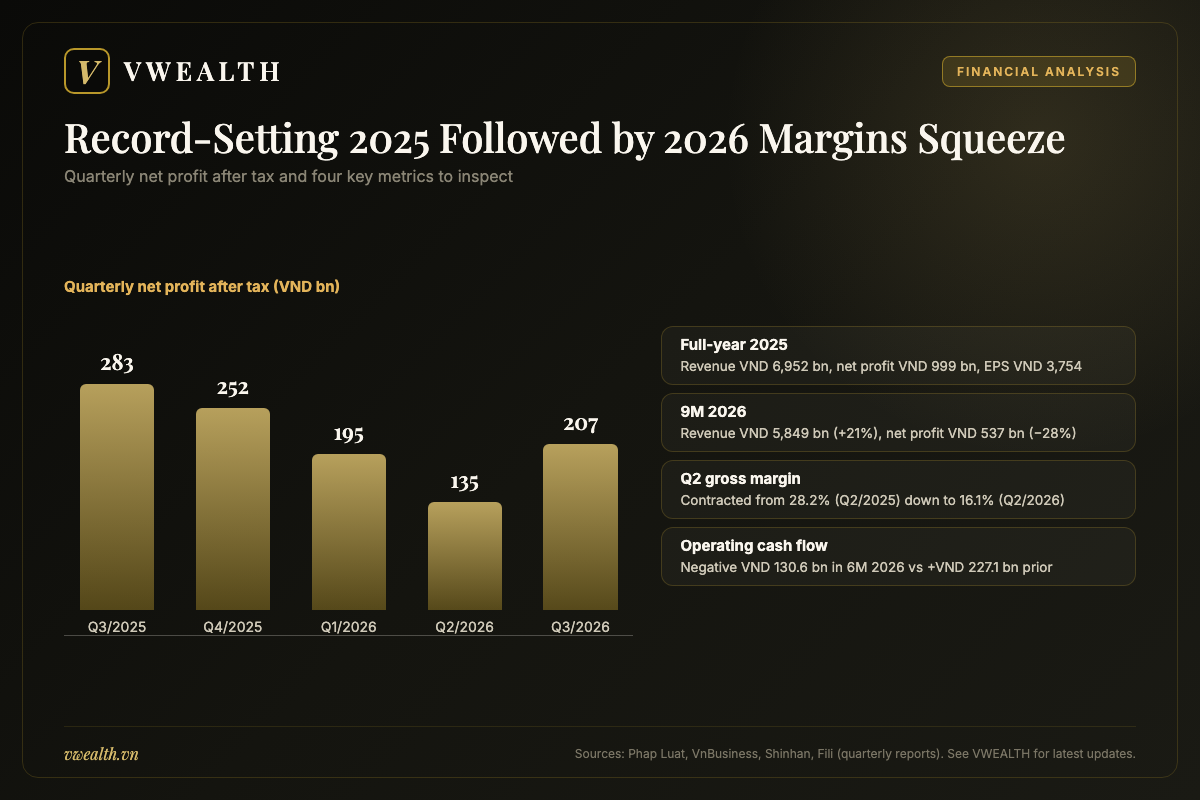
Gross Margin Compression: Collapsing from 28.2% to 16.1%
If an institutional portfolio manager could monitor only one operating metric to assess Navico’s operational health, that metric must be consolidated gross profit margin — the percentage of revenue remaining after subtracting direct manufacturing cost of goods sold. In an integrated aquaculture enterprise, COGS consists overwhelmingly of biological grow-out expenses, where commercial aquafeed represents the single largest operational cost. As FPTS research emphasized, aquafeed formulation expenses — driven by global prices of fishmeal, soybean meal, and agricultural commodities — dictate Navico’s bottom line.
Consider an illustrative example to comprehend the sheer financial leverage of gross margin fluctuations. Assume Navico delivers VND 2,000 billion in quarterly export sales. At a 28% gross margin (achieved during the peak of 2025), gross profit stands at VND 560 billion. If that gross margin compresses to 16% (the level recorded in Q2/2026), gross profit shrivels to VND 320 billion. A 12 percentage point gross margin contraction instantly vaporizes VND 240 billion in quarterly gross operating profit. Because administrative salaries, plant security, debt interest, and logistics overhead cannot easily be slashed in proportion, nearly the entire VND 240 billion gross profit decline drops straight through to bottom-line net income. This mathematical reality explains why second-quarter net profit collapsed by 59.5% despite positive topline growth.
What triggered this gross margin collapse? Across the brokerage research spectrum, analysts identify a singular primary culprit: the explosive surge in global marine fishmeal prices. Shinhan Securities documented a 42% spike in fishmeal procurement costs compared to year-end 2025, while VDSC calculated a 55% year-on-year surge to 2.34 USD/kg, driven by Peru’s 17% anchoveta quota cut and aggressive Chinese purchasing. When feed ingredient costs escalate so violently, an integrated processor can only defend operating margins if it successfully raises export fillet prices at an equivalent pace. However, VDSC estimated that while Navico’s average selling price (ASP) increased by roughly 9% in 2026, raw material feed costs surged by 15%. That negative spread ate away at gross profit.
Simultaneously, commercial tilapia experienced an adverse price cycle. According to market research compiled by elibook based on FPTS data, export realizations for Vietnamese tilapia softened during the second quarter of 2026, even as raw pangasius farming costs climbed. Tilapia provided the turbocharger for Navico’s 2025 expansion, but as Chinese competitors ramped up export discounting, Navico’s second growth engine faced compressed realizations.
For the first nine months of 2026, Navico’s consolidated gross margin settled at approximately 17.8% [vwealth estimate: VND 1,043 billion gross profit divided by VND 5,849 billion revenue]. While the third quarter rebounded to approximately 19.6% [vwealth estimate: VND 405 billion divided by VND 2,071 billion], it remained depressed compared to the 28.2% achieved in Q2/2025. When evaluating subsequent quarterly earnings releases, investors should calculate gross margin before looking at net income: a return above 20% confirms operational recovery, while a retreat toward 16% signals that feed inflation continues to suppress profitability.
Balance Sheet and Cash Flows: Receivables, Inventories, and Short-Term Borrowing
Reported accounting profit reflects accrual conventions, but corporate solvency is governed by cash flows. For Navico across 2026, the expanding divergence between accrual net income and cash realization warrants meticulous examination.
As of December 31, 2025, financial disclosures reported by Phap Luat Vietnam showed Nam Viet with total consolidated assets of VND 5,825 billion, total liabilities of VND 2,298 billion, and total interest-bearing debt of VND 1,653 billion. Six months later, as of June 30, 2026, total assets expanded by 10.5% to reach VND 6,433.7 billion. Scrutinizing the asset composition reveals that this balance sheet growth was concentrated entirely in working capital: short-term trade receivables rose to VND 1,421.5 billion (consuming 22.1% of total assets), while inventories climbed to VND 1,312.7 billion (accounting for 20.4% of total assets). To fund this ballooning working capital requirement, total interest-bearing borrowings expanded to VND 1,862.9 billion — consisting of VND 1,824 billion in short-term bank debt and a mere VND 38.9 billion in long-term debt. Total debt represented roughly 48.3% of owner’s equity.
The operational interpretation is straightforward: Navico is booking robust sales, but international clients are taking longer to remit cash (expanding receivables), while more biological fish remain swimming in ponds and frozen inventory sits in cold storage (expanding inventories). To bridge the cash gap created by capital trapped in receivables and unsold fish, management drew heavily on short-term bank credit lines. Consequently, net cash flow from operating activities (CFO) for the first six months of 2026 plunged to negative VND 130.6 billion — a complete reversal from the positive VND 227.1 billion generated during the same period in 2025. With cash flow from investing activities registering negative VND 68.8 billion, corporate liquidity was sustained by net cash inflows from financing activities of positive VND 209.1 billion — confirming that short-term bank debt was the primary mechanism balancing cash requirements.
This debt structure does not represent an acute solvency crisis. In the Vietnamese seafood export sector, revolving short-term credit facilities are standard operating practice; commercial banks extend working capital loans collateralized by export letters of credit and frozen warehouse inventory. A debt-to-equity ratio of ~48% is conservative compared to capital-intensive industrial peers. Nonetheless, two operational vulnerabilities require ongoing monitoring. First, surging short-term borrowings directly inflate financial expenses when benchmark interest rates rise — as evidenced by Navico’s finance costs doubling across Q2 and Q3/2026. Second, if customer receivables become delinquent or frozen inventories encounter delayed shipping schedules, liquidity pressures could intensify, particularly as management juggles planned capital expenditures alongside generous cash dividend distributions.
When reviewing Navico’s balance sheet each quarter, institutional investors should focus on three diagnostic questions: Are trade receivables growing faster or slower than top-line revenue? Are inventories expanding due to proactive stockpiling ahead of holiday demand, or because containers are moving slowly? Has cumulative operating cash flow rebounded into positive territory? Answering these three questions provides far deeper insight into corporate financial health than passively scanning the net income line.
Wall Street of Vietnam Consensus: Brokerage Revisions and Historical Valuation Multiples
Equity research brokerages tracking ANV stock have adjusted their forward earnings projections with remarkable volatility over the course of 2026. Analyzing these revisions offers a masterclass in how professional analysts interpret commodity cycles.
In February 2026, FPTS published an equity research update establishing a “Monitor” recommendation on ANV stock, forecasting full-year 2026 revenue of VND 7,411 billion and net profit after tax of VND 1,095 billion. Around the same period, BSC projected full-year consolidated turnover of VND 7,702 billion and net profit after tax attributable to parent company shareholders of VND 1,177 billion. Both domestic institutions modeled 2026 as an extension of the record-breaking 2025 cycle, closely aligning with the ambitious targets executive management subsequently presented to the June AGM.
However, by July 27, 2026 — following the disclosure of the bruising second-quarter margin contraction — Shinhan Securities issued a substantial downgrade. Shinhan lowered its investment recommendation to “Hold”, slashed its 2026 net profit forecast to VND 864 billion (on revenue of VND 7,549 billion), and projected an even steeper cyclical deceleration for 2027: forecasting revenue of VND 5,926 billion and net profit after tax of VND 718 billion.
| Securities Brokerage | Research Publication Date | 2026F Revenue (VND B) | 2026F NPAT (VND B) | Investment Rating & Stance |
|---|---|---|---|---|
| FPTS Securities | February 12, 2026 | 7,411 | 1,095 | Monitor |
| BSC Securities | Early 2026 Initial Run | 7,702 | 1,177 (Parent NPAT) | Growth Baseline Projection |
| Shinhan Securities | July 27, 2026 Revision | 7,549 | 864 | Hold |
| AGM Corporate Budget | June 27, 2026 Ratification | 7,700 | 1,070 | Official Management Target |
Comparing these institutional projections reveals a telling dynamic: consensus expectations regarding consolidated turnover barely budged. All institutions concurred that Navico would successfully generate between VND 7,400 billion and VND 7,700 billion in gross commercial sales. The massive divergence centered entirely on net profitability: spanning a spread exceeding VND 300 billion between the most bullish forecast (BSC’s VND 1,177 billion) and the most conservative view (Shinhan’s VND 864 billion). Wall Street of Vietnam agreed that Navico could move fish; they vehemently disagreed on how much profit each kilogram of fish would retain. That divergence centers precisely on the gross margin variable analyzed above.
Regarding equity valuation dynamics, the historical trading behavior of ANV stock exhibits the quintessential traits of a high-beta commodity play. On October 16, 2025, ANV stock traded at VND 30,600 per share — marking a 92.6% advance from its June 19, 2025 level. On that session, ANV stock commanded a trailing price-to-earnings (P/E) multiple of 136.8x, whereas its primary listed peer, Vinh Hoan (VHC), traded at an earnings multiple of roughly 9.92x. That three-digit trailing P/E multiple did not signify that Navico was fundamentally fourteen times more expensive than Vinh Hoan. Rather, it reflected the fact that trailing twelve-month earnings were still weighed down by the depressed earnings of 2024, while market pricing had aggressively front-run the explosive earnings of 2025. This is the classic P/E trap in cyclical equities: peak trailing P/E multiples invariably appear near cyclical earnings troughs, while optical single-digit P/E multiples frequently appear precisely when earnings touch cyclical peaks.
The subsequent market correction was equally violent. Between February 4 and July 22, 2026, ANV stock plunged 41.3%, declining from VND 29,200 to VND 17,150 per share, establishing a 52-week trading corridor spanning VND 15,700 to VND 34,500 per share as of August 2026. A 100%+ spread between 52-week highs and lows is the volatility toll investors must pay when holding ANV stock. Trading liquidity remains moderate: according to Shinhan Securities, 90-day average daily turnover (as of July 2026) stood at roughly 0.64 million shares, representing approximately VND 11 billion per session, with foreign institutional ownership pinned near ~1% (FPTS). For investors seeking a broader comparison of how the market values industry leaders, our comprehensive VHC stock analysis provides a complementary benchmark for Vietnam’s aquaculture export sector.
Because daily P/E and price-to-book (P/B) multiples fluctuate continuously with each trading session and quarterly filing, static spot valuation figures are intentionally omitted here. Investors are strongly advised to access real-time valuation updates and comparative multi-year multiples directly through the dedicated analytical reports on vwealth.
Capital Allocation: Cash Dividends, Navico Tower, and Capex Commitments
When an agribusiness enterprise delivers a historic windfall profit, its subsequent capital allocation choices reveal everything about executive management’s strategic mindset. Do controlling insiders prioritize returning surplus cash directly to minority shareholders, reinvesting in core manufacturing productivity, or diverting capital into speculative non-core real estate ventures? At Nam Viet, the deployment of corporate capital across 2025 and 2026 branched into three distinct pathways: predictable cash dividend distributions, multi-hundred-billion-dong factory modernizations, and select infrastructure initiatives that warrant disciplined analytical examination.
Consistent 10% Cash Dividends and the 15% Target for 2026
Pursuant to official AGM documentation ratified on June 27, 2026, Nam Viet completed its fiscal year 2024 dividend distribution via cash payments totaling VND 133.128 billion, corresponding to 5% of statutory par value. For fiscal year 2025, corporate resolutions established a cumulative 10% cash dividend payout structured in two equal 5% tranches. In October 2025, the company established a formal shareholder record date combining the final 5% distribution of 2024 with an initial 5% interim payment for 2025 — disbursing an aggregate 10% cash dividend (~VND 266.2 billion) to shareholders in late 2025. Looking ahead, the 2026 AGM formally ratified an elevated annual cash dividend target of 15% on par value.
For international investors allocating into Vietnam stocks, dividend declarations expressed as percentages require precise mathematical translation. Under Vietnamese corporate practice, percentage dividend declarations are calculated against the statutory par value of VND 10,000 per share, rather than the prevailing market price of the equity. Consequently, a 10% cash dividend equates to exactly VND 1,000 per share per annum, while a 15% dividend declaration translates to VND 1,500 per share. An investor’s realized cash dividend yield is entirely a function of their acquisition entry price. Consider an illustrative example: an investor acquiring ANV stock at VND 20,000 per share secures a respectable 5.0% gross cash dividend yield on a 1,000 VND payout. Conversely, an investor who buys ANV stock at VND 30,000 per share during a euphoric rally realizes an effective cash yield of only 3.3%. For cyclical equities, entering at elevated valuation peaks substantially degrades cash yield economics.
Relative to consolidated earnings power, Navico’s historical dividend payout ratio has been remarkably conservative. In 2025, the enterprise generated VND 999.5 billion in net profit after tax, yet total cash dividends allocated for that fiscal year (combining both 5% tranches) totaled approximately VND 266.2 billion. This represents an effective dividend payout ratio of roughly 27% [vwealth estimate: 2 × VND 133.128B / VND 999.478B]. Executive management intentionally retained nearly three-quarters of record net earnings to reinforce working capital buffers and self-fund upstream aquaculture expansion. For a manufacturing exporter that operates with revolving short-term credit lines and experienced negative operating cash flow in early 2026, retaining earnings is financially prudent. However, it also indicates that ANV stock should not be evaluated as a high-yielding defensive utility proxy; it remains a growth-and-cycle vehicle where capital appreciation dominates total return expectations.
| Dividend Distribution Tranche | Payout % (on VND 10k Par) | Cash Value Per Share | Execution & Payment Timing | Official Verification Source |
|---|---|---|---|---|
| Final Dividend Fiscal Year 2024 | 5.0% of par value | VND 500 per share | Combined payout late 2025 | AGM Resolution No. 73/NQ, VnBusiness |
| Interim Tranche 1 Fiscal Year 2025 | 5.0% of par value | VND 500 per share | Combined payout late 2025 | AGM Resolution No. 73/NQ, VnBusiness |
| Final FY2025 + Interim FY2026 | 5.0% + 5.0% = 10.0% | VND 1,000 per share | Ex-Date Oct 29, 2026; Pay Dec 15, 2026 | Phap Luat Vietnam & BOD Res Oct 9, 2026 |
| Full-Year 2026 Corporate Plan | 15.0% of par value | VND 1,500 per share | Subject to 2026 full-year results | AGM Resolution No. 73/NQ (Art. 3) |
The October 2026 Capital Payout: VND 1,000 Per Share
On October 9, 2026, Navico’s Board of Directors formally approved a resolution authorizing the concurrent disbursement of the remaining 5% cash dividend for fiscal year 2025 alongside an interim 5% cash dividend advance for fiscal year 2026. Combining these two tranches delivered a gross cash payout of VND 1,000 per share, absorbing an aggregate cash outlay exceeding VND 266 billion. The formal ex-dividend date (Giao dich khong huong quyen — GDKHQ) was established as October 29, 2026, with the official electronic cash settlement scheduled for December 15, 2026. For foreign investors, market mechanics dictate that shares purchased on or after October 29, 2026 do not carry the entitlement to this payout, and the stock’s market reference price on the HOSE was adjusted downward by VND 1,000 on that trading morning in standard compliance with exchange regulations.
The strategic timing of this capital distribution warrants analytical scrutiny. Management committed to distributing over VND 266 billion in liquid cash precisely during an operating window when first-half net profitability had contracted by 29% and first-half operating cash flow registered a deficit of negative VND 130.6 billion. Domestic financial media, including Phap Luat Vietnam, highlighted this juxtaposition: Navico disbursing hundreds of billions in cash dividends amidst noticeable cost-push profit margin compression. There are two competing interpretations. The optimistic perspective holds that management possesses robust visibility regarding second-half operating cash collection and prioritized honoring capital commitments to public shareholders. The cautious perspective notes that disbursing large cash dividends while operating cash flow is negative inevitably forces the enterprise to rely on short-term bank borrowings, expanding financial leverage.
A minor analytical note regarding future dividend expectations: because an interim 5% advance for 2026 was incorporated into this October distribution, achieving the AGM’s full-year 15% dividend target leaves an outstanding 10% dividend (~VND 1,000 per share) to be considered in 2027. Whether that remaining payout is distributed in cash or bonus shares will depend entirely on how full-year 2026 audited net earnings materialize.
Navico Tower: The VND 150 Billion Headquarters and Financing Structure
Within official documentation prepared for the 2026 AGM, as reported by Thuong Hieu & Cong Luan, Nam Viet outlined plans for the construction of Navico Tower on a prime 1,061-square-meter land parcel, carrying a projected total capital expenditure of approximately VND 150 billion. Financing for the project was slated to combine proceeds from equity share issuances alongside medium-term bank borrowings. This disclosure followed earlier statements cited by SSI Securities in October 2025, where corporate executives indicated they were contemplating an allocation of roughly VND 300 billion toward a modern corporate office building in 2027. Originating from distinct reporting periods, these disclosures reflect evolving corporate planning rather than finalized, rigid cash commitments.
From an equity valuation perspective, a commercial office headquarters does not harvest or process additional seafood. Institutional investors naturally question the funding mechanisms supporting non-core physical assets. If project financing relies on issuing new equity shares, existing shareholders face earnings dilution. If funded through medium-term debt, interest charges add to financial overhead at a time when borrowing costs have already escalated. Relative to Navico’s consolidated asset base exceeding VND 6,400 billion, a VND 150 billion building does not pose a systemic balance sheet threat; nevertheless, it serves as a qualitative indicator of capital discipline. Investors with long memories will recall the short-lived establishment of a real estate subsidiary in 2022 (subsequently dissolved in 2023), confirming that non-core property allocations require vigilant monitoring.
Factory Modernization: The VND 500 Billion Plant Upgrade Plan
In contrast to corporate real estate, capital allocated directly toward industrial processing infrastructure enhances operational productivity. According to SSI Securities findings in October 2025, Navico planned to allocate approximately VND 500 billion across a three-to-five-year horizon toward comprehensive factory modernizations, while evaluating an additional VND 300 to 400 billion investment in an advanced processing facility during 2026. Shinhan Securities noted that while Navico’s four primary filleting plants possess an aggregate design throughput of 1,360 metric tons of raw fish per day, actual operational throughput averaged 600 to 700 metric tons per day, with executive initiatives targeting an increase toward 1,000 metric tons per day starting in 2026.
Analyzing these operational targets alongside planned capex indicates that Navico does not face a shortage of physical factory structures; rather, management is focused on expanding daily capacity utilization and automating processing lines. Strategic priorities outlined at the 2026 AGM align with this objective: rolling out modern Enterprise Resource Planning (ERP) software, integrating artificial intelligence and big data analytics across logistics chains, and maintaining rigorous international certifications including ASC, BAP, and GlobalG.A.P. Navico also established a targeted full-year export revenue objective of 260 million USD for 2026 (according to official corporate disclosures).
For equity investors, investments in processing modernization represent productive capital deployment if they succeed in increasing daily finished output per unit of fixed overhead. Moving plant throughput from 600–700 metric tons up to 1,000 metric tons per day allows fixed plant depreciation and administrative expenses to be absorbed across substantially greater export volume — functioning as one of the few structural operational levers capable of offsetting global fishmeal inflation. However, the economic viability of this operating leverage hinges entirely on international order books; if consumer demand across destination markets falters, higher processing capacity merely magnifies idle overhead burdens.
Binh Phu Mega-Complex: Two Projects Totaling VND 5,500 Billion in Capital
The largest capital undertaking on Nam Viet’s historical ledger is the Binh Phu mega-complex in An Giang Province. According to detailed investigative coverage by An Giang Newspaper, the complex comprises two integrated investment licenses: a 450-hectare high-tech aquaculture farming zone budgeted at VND 4,500 billion, and a 150-hectare centralized three-tier pangasius nursery center budgeted at VND 1,000 billion. The enterprise successfully acquired and cleared approximately 90% of the designated land fund, bringing both specialized zones into commercial operation in July 2024. The combined project capital allocation of VND 5,500 billion [vwealth estimate: VND 4,500B + VND 1,000B] approximates the entirety of Nam Viet’s consolidated balance sheet at year-end 2025 — demonstrating that this figure represents the cumulative multi-year project investment ceiling rather than a single-year cash expenditure.
The Binh Phu complex is the operational linchpin supporting Navico’s dual-species expansion, with BSC estimating that roughly 70% of its 600-hectare water surface was allocated to intensive tilapia production. The success of Navico’s tilapia export drive to the United States and Latin America depends fundamentally on the biosecurity, water quality, and harvesting yields achieved across these ponds. Consequently, any administrative, environmental, or legal procedures surrounding Binh Phu have immediate operational significance — an issue examined with strict journalistic objectivity in the risk analysis that follows. For investors seeking comparative insights into how Vietnamese capital markets value extensive agricultural land assets and infrastructure scale, our analysis of industrial landholder SIP stock provides a valuable perspective on asset-heavy development frameworks.
The primary capital expenditure and asset modernization initiatives across Nam Viet are summarized in the table below.
| Capital Investment Initiative | Disclosed Capital Scale | Chronological Anchor & Source | Strategic & Shareholder Impact |
|---|---|---|---|
| Binh Phu High-Tech Farming Zone | 450 ha; VND 4,500B total project capital | An Giang Newspaper (Oct 2026) | Provides captive, biosecure fish supply; foundational asset for tilapia expansion |
| Binh Phu 3-Tier Fingerling Nursery | 150 ha; VND 1,000B total project capital | An Giang Newspaper (Oct 2026) | Secures genetic quality, disease resistance, and fingerling self-sufficiency |
| Processing Factory Modernization | ~VND 500B across 3–5 year horizon | SSI Institutional Briefing (Oct 2025) | Expands daily throughput toward 1,000 tons/day; lowers fixed unit costs |
| New Processing Facility (Under Review) | VND 300B to 400B capital allocation | SSI Institutional Briefing (Oct 2025) | Contingent expansion dependent on sustained US and South American retail demand |
| Navico Tower Headquarters | ~VND 150B; 1,061 m² land parcel | AGM 2026 Corporate Disclosures | Non-core corporate facility; requires scrutiny of equity dilution vs bank debt |
Key Risk Factors and Three Operating Scenarios for Navico
The stellar financial results of 2025 demonstrated what Nam Viet can achieve when all macroeconomic and operational stars align: generating nearly one trillion dong in net profit. The subsequent operational friction of 2026 demonstrated that when a single critical variable — marine fishmeal inflation — moves against the company, operating profitability can compress by nearly a third even as commercial sales continue to expand. This chapter consolidates the primary operational, geopolitical, regulatory, and balance sheet risks confronting Navico into a disciplined risk matrix, before constructing three forward operating scenarios to help investors navigate upcoming earnings announcements. vwealth does not issue speculative price targets; our analytical objective is to equip investors with the operational benchmarks required to determine which scenario is unfolding in real time.
Input Cost Volatility: Fishmeal, Reefer Freight, and Borrowing Costs
Input cost inflation is not a theoretical vulnerability for Navico; it is an active operational headwind that eroded gross margins throughout 2026. Global marine fishmeal benchmark prices surged by approximately 42% compared to year-end 2025 levels according to Shinhan Securities, or roughly 55% year-on-year to 2.34 USD per kilogram according to VDSC filings. The root causes originated thousands of miles from the Mekong River: Peruvian marine authorities enacted a 17% cut in industrial anchoveta fishing quotas due to warmer ocean temperatures induced by El Niño, while Chinese livestock and aquaculture operations aggressively accumulated inventories. While Navico’s captive feed mills insulate the company from third-party milling markups, they do not insulate the company from global raw material inflation — self-manufacturing commercial feed does not equal immunity from world fishmeal prices.
The second layer of input inflation resides in maritime shipping logistics. VASEP characterized refrigerated container (reefer) freight charges as the primary “boulder” weighing down seafood export profitability across the second half of 2026, exacerbated by shipping route diversions and geopolitical friction surrounding the Middle East and Iran. Navico is intimately familiar with this operational threat: in 2021, severe container shipping disruptions caused consolidated net profit to collapse to VND 128 billion (just 63% of 2020 levels). The third cost pressure is financial: rising short-term bank debt caused financing costs to roughly double across Q2 and Q3/2026. Compounding these dynamics, VDSC observed that selling expenses as a percentage of revenue trended upward as the company expanded commercial marketing initiatives in overseas retail channels.
When tracking this risk factor in forthcoming quarters, investors should monitor three primary data points: Peruvian anchoveta quota announcements, world fishmeal benchmark price trends, and the consolidated gross profit margin disclosed in Navico’s quarterly financial statements. When gross margin stabilizes above 20%, input cost pressures are abating; if it remains depressed near 16%, input inflation remains an active drag on equity performance.
Trade Policy and Tariff Headwinds: Antidumping Reviews, Section 301, and Brazil Standards
The United States seafood market delivered lucrative margins in 2025, but it also carries the highest regulatory unpredictability. Regarding the annual US Antidumping Duty Administrative Reviews (POR) on frozen pangasius, the preliminary determination for POR21 (spanning August 2022 to July 2023), published in February 2026, assigned Nam Viet a preliminary duty of 0.23 USD per kilogram. While preliminary rates are subject to administrative revision and do not shutter export access, an effective tariff of 0.23 USD/kg eliminates Navico’s competitive price advantage relative to direct peers like Vinh Hoan (which secured 0.00 USD/kg). Investors must await the Department of Commerce’s final administrative determination to verify the permanent duty rate.
Simultaneously, broader US cross-sector trade regulations continue to fluctuate. Following the judicial invalidation of the temporary 10% reciprocal tariff by the US Supreme Court in February 2026, the US enacted an interim 10% duty under Section 122 through July 2026, followed by the imposition of a 12.5% four-year tariff under Section 301 (targeting alleged labor standard and forced labor concerns) effective July 24, 2026. While Navico successfully passes portions of these general tariffs along to American retail partners, frequent trade tax adjustments complicate long-term supermarket contracting and inject margin friction into wholesale supply agreements.
In South America, Brazil — which Navico successfully penetrated through strategic distribution partnerships in 2025 — enacted stricter technical and sanitary inspection protocols on Vietnamese tilapia throughout 2026. While Brazilian ports have not suspended import licenses, heightened microbiological sampling and extended customs verification cycles lengthen container turnaround times. In contrast to high-tech digital enterprises like those analyzed in our CMG stock analysis, agricultural exporters are perpetually exposed to sudden phytosanitary and trade policy interventions in foreign jurisdictions.
Land and Environmental Procedures at Binh Phu: Official Disclosures
Given the commercial importance of the Binh Phu mega-complex, administrative and land regulatory procedures surrounding the site require rigorous, objective presentation based strictly on disclosed official statements. On October 13, 2026, An Giang Newspaper reported that the Chairman of the An Giang Provincial People’s Committee, Mr. Ho Van Mung, conducted a high-level field inspection across Nam Viet’s high-tech agricultural developments at Binh Phu. During the working session, provincial leaders formally tasked the provincial Department of Finance alongside the Provincial Inspectorate with formulating concrete administrative proposals to address regulatory bottlenecks associated with Central Inspection Commission Notice No. 714-TB/UBKTTW. Provincial authorities explicitly emphasized the imperative to “continue rectifying risks of state budget loss and ensuring absolute legal compliance,” while affirming that the ultimate objective of the session was to untangle procedural hurdles to facilitate high-tech agricultural execution.
In response, on October 17, 2026, Nam Viet published a formal corporate announcement on its official portal. The company confirmed that management is actively coordinating with provincial administrative bodies to regularize pending land procedures as the formal foundation for securing comprehensive environmental operating permits, emphasizing that daily production, farming grow-out, and processing operations across the Binh Phu complex continue to function entirely normally.
For equity analysts, the appropriate posture is to track subsequent formal regulatory disclosures published by provincial authorities and corporate investor relations. The Binh Phu complex houses 450 hectares of high-tech aquaculture grow-out basins and 150 hectares of nursery facilities, serving as the biological engine for Navico’s tilapia expansion. Disciplined investors should avoid speculative conjecture, monitoring the formal finalization of land use certificates, environmental permits, and related statutory filings as empirical milestones.
Concentrated Ownership and Thin Float Liquidity
As documented in Chapter 2, the founding Doan family directly controls approximately 67% of Nam Viet’s chartered capital [vwealth estimate: 54.98% held by Mr. Doan Toi, 11.07% by Mr. Doan Chi Thanh, and 1.18% by Mr. Doan Chi Thien]. Shinhan Securities estimated that the effective public free float comprises roughly 90 million shares out of 266.2 million circulating shares, while FPTS research confirmed that foreign institutional and retail ownership stands at a meager ~1%. Average 90-day trading liquidity as of July 2026 hovered around 0.64 million shares per session, representing approximately VND 11 billion in daily turnover.
Ownership concentration creates distinct structural dynamics. On one hand, family alignment is exceptionally tight; executive owners have repeatedly demonstrated a willingness to absorb open-market supply during panic sell-offs — exemplified by Mr. Doan Toi purchasing 3 million shares in April 2025 and Mr. Doan Chi Thien acquiring 1 million shares in July–August 2026. On the other hand, corporate governance power rests entirely in the hands of a single family alliance. Furthermore, a constrained public float means that equity market pricing can exhibit severe volatility upon unexpected news headlines. While daily turnover of VND 11 billion provides adequate liquidity for retail investors, institutional funds executing multi-million-dollar portfolio adjustments cannot trade ANV stock without causing substantial market impact.
Executive management’s periodic indications regarding diluting family holdings to welcome a foreign strategic partner — originally articulated at the 2019 AGM and re-iterated via SSI briefings in late 2025 — would serve as a major structural catalyst if executed. Bringing in an international agribusiness conglomerate would instantly expand the institutional float and enhance corporate governance standards. However, until definitive agreements are signed, ANV stock will continue to trade as a tightly controlled owner-operator asset.
The Risk of Missing the 2026 Full-Year Profit Target
At the June 2026 Annual General Meeting, shareholders ratified a full-year 2026 net profit after tax target of VND 1,070 billion. Across the first nine months of 2026, cumulative net profit after tax finalized at VND 537 billion. Consequently, to fully achieve the AGM profit target, Nam Viet must generate approximately VND 533 billion in net profit after tax during the fourth quarter alone [vwealth estimate: VND 1,070B target minus VND 537B nine-month actual].
To place this quarterly earnings requirement into historical perspective: the single most profitable quarter in Navico’s entire corporate history was Q2/2025, which generated approximately VND 333 billion in net profit (based on Shinhan Securities figures), while the company’s strongest performance across 2026 thus far was Q3 with VND 207 billion. To fulfill the annual budget, fourth-quarter net earnings would need to surpass the historic quarterly record by roughly 60%. While year-end holiday container shipments to Western retail chains provide seasonal volume support, achieving VND 533 billion in net profit within three months appears mathematically improbable given that global marine fishmeal costs remain elevated.
Equity markets price forward expectations rather than absolute accounting totals. While Nam Viet is well on track to fulfill its top-line revenue budget (having secured 76% of its annual sales target through nine months), falling short of the annual profit target could trigger short-term market disappointment among retail participants who anchored expectations to the AGM’s VND 1,070 billion figure. Disciplined investors should proactively decouple their investment thesis from the official 2026 profit budget, modeling baseline operational expectations around realistic margin realities.
Three Forward Scenarios for 2026–2027: Catalysts, Baselines, and Downside Cases
Rather than attempting to forecast an exact spot earnings number, institutional analysts construct multi-variable operating scenarios anchored to verified brokerage research models. The following framework outlines three potential operational paths for Navico across 2026 and 2027.
The Bull Scenario. Global marine fishmeal prices experience a sharp cyclical correction over coming quarters as Peruvian anchoveta biomass recovers and fishing quotas normalize. Reefer freight rates stabilize, while consumer demand across the United States and Brazil continues to absorb expanding shipments of pangasius and tilapia. The final determination for POR21 is revised downward from the preliminary 0.23 USD/kg rate, restoring duty-free parity. Consolidated gross margin rebounds sustainably above 20%, allowing full-year corporate earnings to approach the optimistic projections established early in the year: VND 1,095 billion (FPTS) to VND 1,177 billion (BSC). Given the VND 537 billion achieved through nine months, this scenario operates primarily as a forward earnings baseline for 2027 rather than an achievable 2026 outcome.
The Base Case Scenario. Global feed ingredient costs remain elevated but cease escalating, while modest upward adjustments in export fillet prices begin filtering into contracted wholesale orders. Commercial processing throughput expands as plant utilization edges toward 1,000 metric tons per day, allowing operating leverage to partially neutralize input inflation. Full-year 2026 net earnings align with Shinhan Securities’ revised forecast of roughly VND 864 billion — marking a retreat from 2025 records, yet standing hundreds of percent above 2024 trough levels. This baseline outcome requires fourth-quarter net profit to reach approximately VND 327 billion [vwealth estimate: VND 864B minus VND 537B], roughly matching the peak quarters of 2025.
The Bear Scenario. Global fishmeal inflation persists due to recurrent climatic disruptions off South America, while shipping surcharges remain elevated. Export realizations for commercial tilapia deteriorate further as Chinese producers flood international markets. Concurrently, US trade authorities enforce strict Section 301 duties and Brazil expands sanitary documentation holds on Vietnamese shipments. Under this severe contraction, consolidated turnover slides to VND 5,926 billion and net profit after tax drops to VND 718 billion in 2027 (in line with Shinhan Securities’ conservative forward forecast). Under this scenario, the market definitively classifies 2025 as an isolated cyclical summit rather than a permanently elevated structural baseline.
| Operating Scenario | Core Operational & Macroeconomic Assumptions | Reference Benchmark NPAT | Authoritative Modeling Source |
|---|---|---|---|
| Bull Scenario (Recovery) | Fishmeal prices normalize; POR21 rate improves; US/Brazil demand expands; gross margin > 20% | VND 1,095B to 1,177B (Forward) | FPTS (Feb 2026) & BSC (Early 2026) |
| Base Case (Consolidation) | Feed costs stabilize at elevated plateau; processing throughput ramps; export ASPs edge higher | VND 864B (FY2026 Revised) | Shinhan Securities (July 27, 2026) |
| Bear Scenario (Contraction) | Feed inflation persists; ocean freight spikes; tilapia ASPs drop; trade barriers intensify | VND 718B NPAT; Rev VND 5,926B (2027F) | Shinhan Securities (July 27, 2026) |
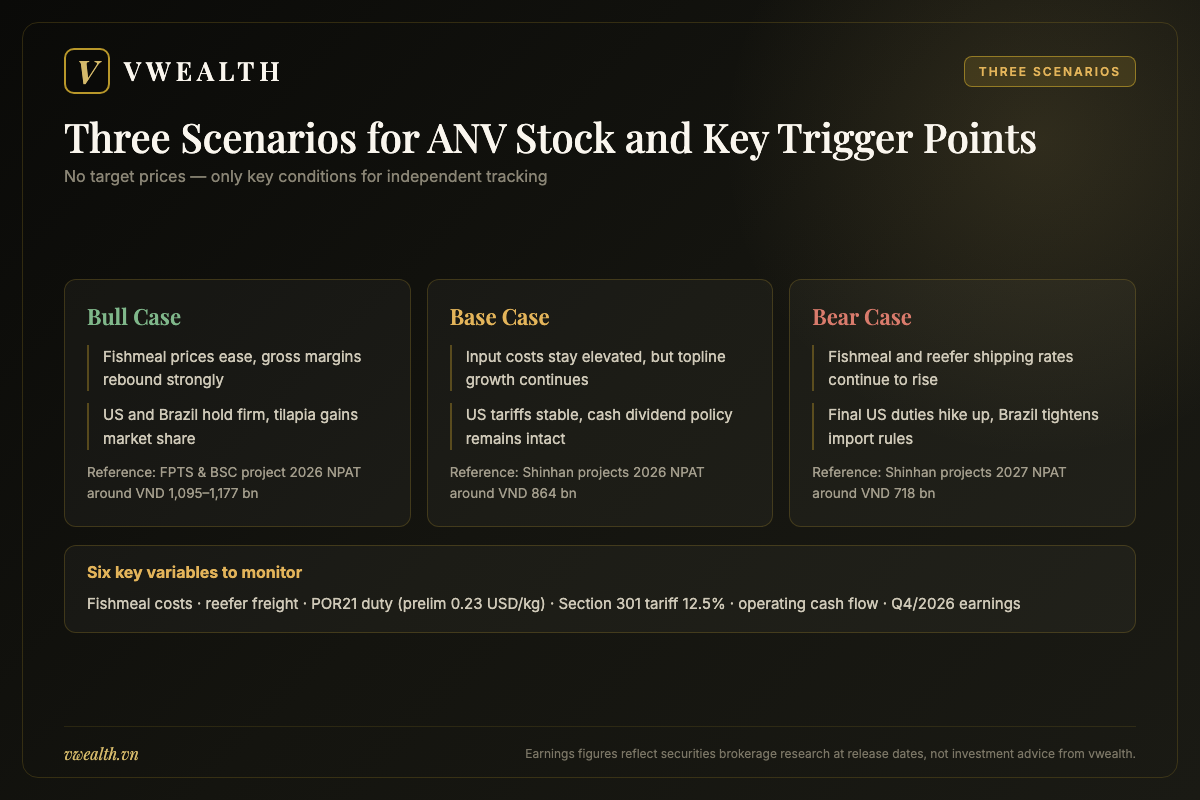
How should active investors utilize this scenario matrix? As Navico releases subsequent quarterly financial statements, investors should cross-reference reported gross profit margins and quarterly net earnings against the assumptions above. The two most reliable leading indicators are international fishmeal prices and Navico’s quarterly gross margin; the vital confirming indicator is cumulative cash flow from operations. When all three indicators trend favorably, the Bull Scenario gains empirical support; when all three deteriorate, investors must avoid anchoring valuation models to past peak earnings.
Should You Buy ANV Stock? A Balanced Risk-Reward Framework for Global Investors
Having traversed Nam Viet’s 33-year corporate history from its provincial construction origins to its record-shattering 2025 performance and subsequent 2026 margin compression, international investors arrive at the ultimate question: should you buy ANV stock? An intellectually honest answer cannot be condensed into a binary recommendation. Whether Navico represents an exceptional buying opportunity depends entirely on an investor’s personal risk tolerance, the entry valuation multiple paid relative to normalized mid-cycle earning power, and one’s forward outlook regarding global fishmeal inflation, reefer shipping freight, and Western trade policies over the next eighteen months. This final chapter synthesizes the core investment thesis into an actionable decision-making framework.
Investor Fit: Navigating Agribusiness and Commodity Cycles
ANV stock is unequivocally not a “buy-and-forget” compounder. It exhibits the structural DNA of a high-beta agricultural commodity equity: corporate profitability is governed by wholesale whitefish realizations and commercial feed ingredient costs — two volatile economic variables over which corporate management possesses limited pricing control. Consequently, equity valuations swing dramatically: the stock can surge by over 90% in four months (as witnessed during the euphoric rally of mid-2025) and shed more than 40% in five months (as observed across the first half of 2026). ANV stock is well-suited for investors demonstrating three distinct characteristics:
First, investors possessing a high tolerance for equity volatility who can withstand steep cyclical drawdowns without liquidating positions during market panics. Second, investors with the operational discipline to monitor quarterly financial filings — tracking gross margins, operating cash flows, trade receivables, and Peruvian fishmeal quota releases. Third, contrarian market participants who understand the foundational law of cyclical commodity investing: buying cyclical equities when trailing earnings look magnificent and optical P/E multiples appear exceptionally low is frequently the most dangerous entry window, whereas accumulating shares when news flow is gloomy, gross margins are depressed, and market expectations have capitulated often delivers the most asymmetrical risk-reward profile.
Conversely, for conservative investors seeking predictable quarter-on-quarter compound growth, uninterrupted free cash flow, and high defensive dividend yields with minimal portfolio maintenance, ANV stock is poorly suited. While the company maintains an admirable track record of declaring regular cash dividends, the absolute payout ratio remains modest relative to peak earnings, and the effective cash yield is heavily diluted if shares are purchased near cyclical peaks. Institutional investors constructing balanced multi-asset portfolios across emerging Vietnam stocks must recognize that seafood processing represents a cyclical growth play rather than a stable bond proxy.
The Bull Case: Closed-Loop Integration, Market Diversification, and Reliable Cash Returns
Absolute Vertical Integration. Controlling a 100% closed-loop value chain — spanning genetic broodstock, centralized fingerling nurseries, proprietary aquafeed manufacturing, biosecure farming basins, and advanced filleting facilities — provides Navico with a structural operational foundation that pure toll-processors cannot replicate. Shinhan Securities identified Navico as Vietnam’s only fully closed-loop operator. While internal feed mills cannot escape global commodity prices, they eliminate third-party tolling markups, guarantee consistent white fillet meat quality, and provide the rigorous ASC and BAP biosecurity certifications mandatory for supplying tier-one Western retail giants like Walmart, Costco, and Kroger.
Robust Geographical and Product Diversification. Navico has permanently moved beyond its historical vulnerability of relying almost exclusively on Chinese wholesale buyers. Commercial tilapia has established itself as an authentic second growth engine, contributing ~20% of consolidated turnover and generating 54% of US export turnover in 2025. Concurrently, the American market has re-emerged as a high-margin anchor, strategic distribution partnerships in Brazil and South America have opened high-growth consumer corridors, and domestic retail supermarket placement via Bach Hoa Xanh absorbs ~20% of commercial output without ocean shipping risk. This multi-market footprint ensures that when demand softens in one jurisdiction, sales directors can reallocate container volume to thriving markets.
Proven Peak Earnings Power and Shareholder Alignment. The extraordinary operating results of 2025 demonstrated that during favorable cyclical alignments, Navico can generate nearly VND 1,000 billion in net profit after tax. Even amidst the severe input cost shocks of 2026, the company generated VND 537 billion in nine-month net profit — proving that baseline earning power has advanced far above the depressed break-even levels of 2024. Furthermore, management consistently shares capital through cash dividends (10% paid for 2024 and 2025, with 15% targeted for 2026), and founding insiders have repeatedly backed the company with personal capital during severe market downturns — exemplified by Mr. Doan Toi purchasing 3 million shares in April 2025 and Mr. Doan Chi Thien acquiring 1 million shares in August 2026.
The Bear Case: Margin Thinning, Operating Cash Drain, and Policy Vulnerabilities
Gross Margins Held Hostage by Global Commodity Costs. The precipitous collapse of Navico’s consolidated gross margin from 28.2% down to 16.1% across 2026 serves as a stark reminder that operating profits can deteriorate rapidly. Navico’s captive feed mills remain exposed to global marine fishmeal inflation driven by Peruvian anchoveta quota cuts and El Niño oceanic cycles. Neither company executives nor equity analysts can accurately forecast marine biomass disruptions off South America, leaving corporate margins exposed to exogenous commodity shocks.
Negative Operating Cash Flow and Expanding Short-Term Bank Debt. For the first six months of 2026, Navico’s net cash flow from operating activities sank to negative VND 130.6 billion, driven by expanding trade receivables and inventory build-ups. To fund working capital, the enterprise expanded short-term bank borrowings to VND 1,824 billion, pushing financial expenses up by roughly 100% across Q2 and Q3/2026. While revolving export credit facilities are standard in seafood trade, sustaining negative operating cash flows while disbursing hundreds of billions in cash dividends increases balance sheet vulnerability if trade collections slow down.
Geopolitical and Administrative Policy Headwinds. The preliminary 0.23 USD/kg antidumping duty assessed under US POR21 eliminates Navico’s competitive tariff advantage relative to zero-tariff peers like Vinh Hoan. Furthermore, shifting US Section 301 duties and heightened sanitary inspection barriers on tilapia entering Brazilian ports inject operational friction into key export routes. Domestically, administrative and land regulatory procedures surrounding the vital Binh Phu mega-complex require ongoing monitoring by investors awaiting formal licensing resolutions.
Concentrated Dynasty Control and the Imminent 2026 Target Miss. The founding Doan family controls roughly 67% of voting capital, leaving the public free float restricted to ~90 million shares and daily trading liquidity modest at ~VND 11 billion per session. Finally, with nine-month 2026 net profit at VND 537 billion against an AGM annual budget of VND 1,070 billion, achieving the full-year profit target requires an improbable fourth-quarter net profit of ~VND 533 billion [vwealth estimate]. An inevitable headline profit target shortfall could trigger short-term retail selling pressure.
| Analytical Dimension | The Bull Case (Competitive Strengths & Catalysts) | The Bear Case (Operational Risks & Vulnerabilities) |
|---|---|---|
| Integrated Business Model | 100% closed-loop value chain from genetics to export; ASC/BAP certified | Captive feed mills remain exposed to global marine fishmeal inflation |
| Market Diversification | Dual-species platform (pangasius + tilapia); diversified across US, Brazil, China | Preliminary 0.23 USD/kg POR21 rate; Brazil sanitary barriers; China tilapia rivalry |
| Earnings Capacity | Demonstrated ~VND 1,000B peak annual earnings power in 2025 | 9M2026 profit contracted 28%; high probability of missing 2026 budget |
| Balance Sheet & Cash Flow | Manageable debt-to-equity ratio of ~48%; liquid inventories and receivables | H1/2026 operating cash flow negative VND 130.6B; financing costs doubled |
| Corporate Governance | Founding insiders purchase shares during market sell-offs; 10%–15% cash dividends | Concentrated family control (~67%); public free float restricted to ~90M shares |
| Strategic Assets & Capex | Binh Phu mega-complex provides immense captive aquaculture acreage | Pending administrative land regularization at Binh Phu; non-core Navico Tower capex |
Key Milestones and Data Catalysts to Monitor Through Early 2027
Rather than establishing a static market position, active investors evaluating ANV stock should formulate a rigorous operational watchlist spanning six critical forward catalysts:
1. Fourth-Quarter and Full-Year 2026 Financial Results. Scrutinize whether full-year net profit after tax aligns closer to Shinhan’s revised baseline projection of VND 864 billion, retreats toward conservative broker estimates, or stages an unexpected surge. Pay close attention to whether full-year operating cash flow rebounds into positive territory following the October dividend payment.
2. Consolidated Gross Profit Margin Trajectory. Monitor whether quarterly gross profit margins expand sustainably back above the 20% benchmark, or whether they remain compressed within the 16%–18% band. Gross margin expansion represents the definitive indicator that cost-push inflation is being absorbed.
3. International Fishmeal Pricing and Peruvian Anchoveta Quotas. Track official biomass acoustic survey announcements from Peru’s marine institute (IMARPE). Normalizing anchoveta catch quotas and stabilizing fishmeal prices below 2.00 USD/kg will signal immediate margin relief for Navico’s feed milling division.
4. Final DOC Determination on US Antidumping Review POR21. Await the formal administrative publication of final POR21 duty rates. A revision from the preliminary 0.23 USD/kg rate back toward zero would restore full competitive parity in the high-margin American whitefish market.
5. Official Administrative Resolutions Regarding Binh Phu. Follow corporate and provincial announcements regarding the formal regularization of land procedures and the issuance of environmental permits for the Binh Phu mega-farming zone, ensuring the long-term legal security of Navico’s tilapia farming base.
6. Strategic Shareholder Restructuring Updates. Monitor any formal regulatory filings regarding the introduction of an international strategic corporate partner or private equity syndicate to dilute the founding family’s 67% equity concentration, which would dramatically expand public float liquidity and institutional coverage.
A Disciplined Pre-Investment Checklist
Before allocating capital into ANV stock, global investors should execute a disciplined three-step verification process. First, open Navico’s latest interim financial report and calculate the trailing gross margin, cross-referencing it against historical cyclical ranges. Second, verify the direction of cumulative operating cash flows and ensure short-term bank borrowings are not growing at an unsustainable rate relative to sales turnover. Third, value the enterprise against “normalized mid-cycle earnings” rather than anchoring expectations to the euphoric peak of 2025 (VND 999.5 billion) or the depressed trough of 2024 (VND 48 billion).
Consider an illustrative example: if an investor models Navico’s sustainable mid-cycle earning power at approximately VND 800 billion in net profit per annum across its 266.2 million circulating shares, normalized baseline EPS equates to roughly VND 3,000 per share. An investor can then benchmark prevailing market prices against this normalized earnings baseline to calculate an effective mid-cycle P/E multiple, cross-referencing that figure against industry peers like Vinh Hoan (VHC) and Navico’s own multi-year trading history. Adjusting one’s normalized earnings assumptions alters the resulting valuation conclusions — which is why disciplined investors must continually perform independent calculations utilizing real-time corporate filings rather than relying on static third-party headlines.
In conclusion, Nam Viet Corporation represents a formidable industrial agribusiness enterprise commanding authentic physical assets, an internationally certified closed-loop production chain, and demonstrated peak-cycle earning power. Yet, the operating challenges of 2026 deliver an undeniable lesson: in agricultural export manufacturing, corporate earnings do not expand along a straight line. Investing in ANV stock is fundamentally a strategic bet on global commodity cycles — marine feed costs, wholesale whitefish realizations, and international trade policy dynamics — and on management’s ability to navigate those cycles with superior operational agility. To monitor real-time financial ratios, gross margin updates, and AI-driven equity valuation models across Vietnamese equities, investors can create a free vwealth account and track Navico’s operational evolution across forthcoming earnings releases. This dossier is presented exclusively for analytical and educational purposes and does not constitute a formal investment recommendation to buy or sell securities.
Research Vietnamese stocks in English with vwealth. Our AI-powered platform turns Vietnamese market data into full English analysis reports — with international payment support and a free 2-month trial for new accounts. Create your free account and read the latest reports.


