Every note on the FTSE Vietnam emerging market upgrade eventually arrives at the same question: which stocks do foreign funds have to buy? And almost every answer you will read is a list of the largest companies in the index, presented as if size alone made a beneficiary.
It does not. The step that gets skipped is the one that matters most — checking whether foreign money has anywhere to go in that name. In Vietnam, a large number of the biggest listed companies are at or near their foreign ownership ceiling, and a stock at the cap cannot absorb a single additional dollar from an index fund.
This piece explains the mechanics: what foreign room is, why the banking sector splits into two very different groups, the three further ceilings hiding inside the headline cap, and a four-question screen you can run yourself.
Which stocks actually benefit from the FTSE Vietnam emerging market upgrade?
Short answer: A genuine beneficiary meets three conditions at once — it appears on FTSE’s official constituent list, it has foreign ownership headroom remaining, and it trades with enough liquidity to absorb institutional orders. Miss the second condition and index inclusion has almost no price effect, regardless of how large the company is.
Why foreign room is the deciding variable
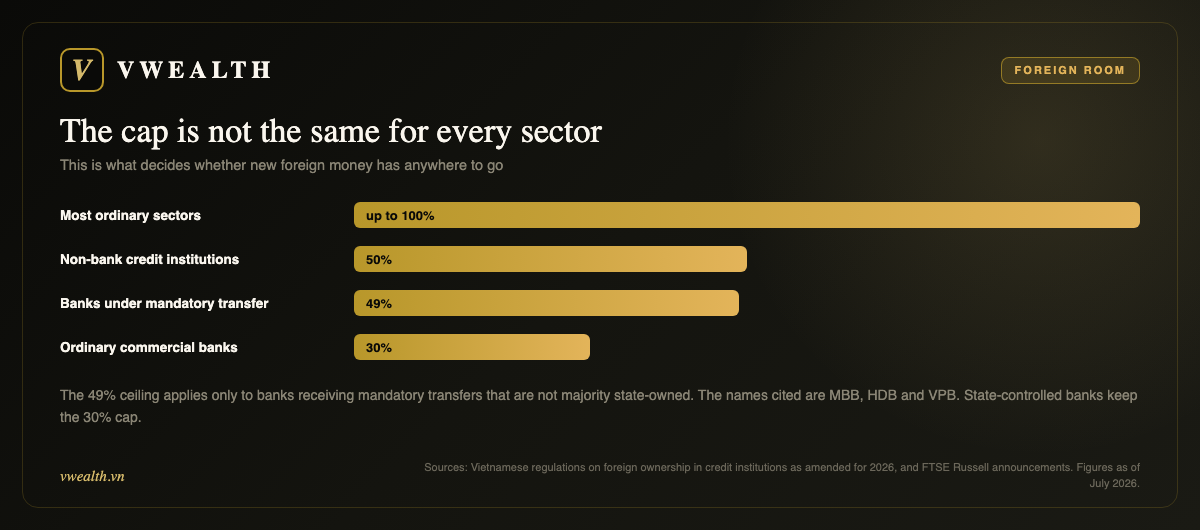
Foreign room is the maximum share of a company that all foreign investors combined may hold. It is not set by the company — it is set by regulation, and it varies sharply by sector.
The mechanism is simple
An index fund must buy to track its basket. If the name is at its cap, it cannot buy — regardless of what the index requires and regardless of how much cash it holds.
When that happens the effective index weight is adjusted down, the forced demand largely disappears, and the price impact is far smaller than the headline weight suggests.
A name with real headroom and decent liquidity is the opposite case: the forced demand actually reaches the price.
The caps by sector
Most ordinary sectors permit foreign ownership up to 100%. Credit institutions are treated very differently.
Ordinary commercial banks: 30%. This is the general ceiling and it covers most listed banks, including those where the state holds a controlling stake.
Banks under mandatory transfer: up to 49%. Amended rules allow banks receiving mandatory transfers as part of restructuring to exceed 30% and go as high as 49% of charter capital, provided the bank is not majority state-owned. The names cited are MBB, HDB and VPB.
Non-bank credit institutions: 50%.
The gap between 30% and 49% is enormous in terms of available headroom. It is the single clearest structural distinction inside Vietnam’s largest index sector, and it is why those three banks sit in a different position from the rest.
Three more ceilings hide inside the 30%
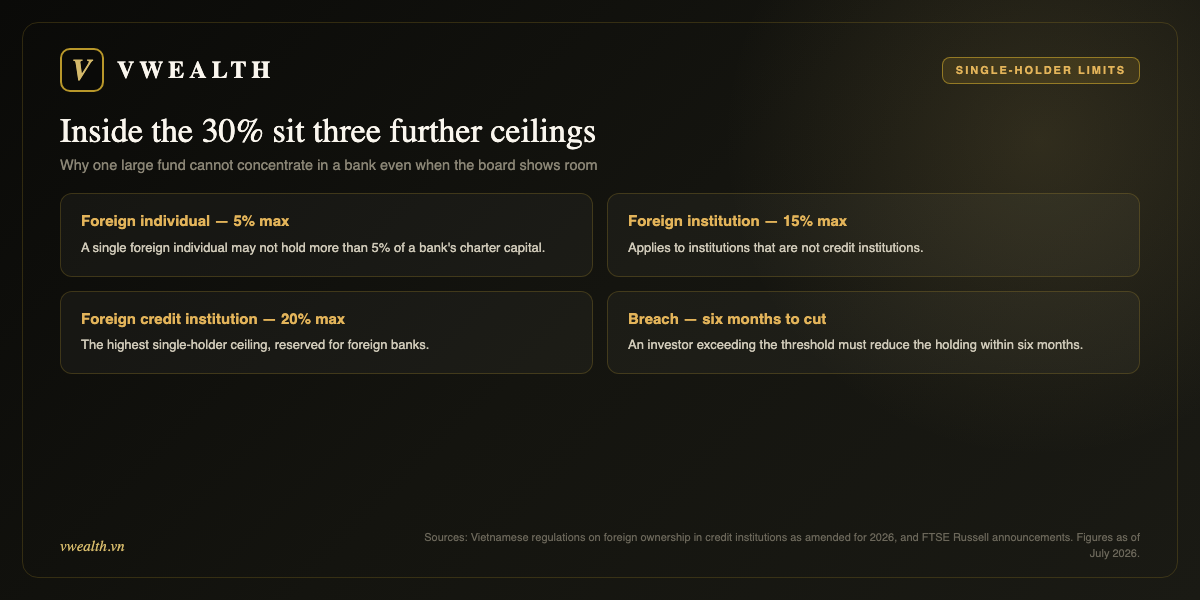
This detail appears in almost no beneficiary list, and it explains something many investors find puzzling: a bank shows available room, yet foreign buying stays muted.
Within the 30% aggregate ceiling, regulation also caps individual holders:
A foreign individual: 5% of charter capital.
A foreign institution that is not a credit institution: 15%.
A foreign credit institution: 20%.
So even when the aggregate line shows headroom, a given fund may already be at its own ceiling. The remaining room is only usable by a different holder who has not yet reached theirs.
And breaches are not permanent: an investor above the threshold must reduce the holding within six months. There is a forced-selling mechanism, not simply a buy-and-hold outcome.
The seven named stocks, and how to read the list
FTSE Russell has identified around 28 stocks likely to enter FTSE Global All Cap. Four large caps — HPG, VCB, VIC, VHM — and three mid caps — MSN, SAB, VNM.
That is sourced and real. Reading it as a buy list gets three things wrong.
Trap one: the list is not final
FTSE states the list is indicative and subject to change. The official constituent list is expected in August 2026 and confirmed at the September semi-annual review. Any name dropped late loses the anticipation premium already sitting in its price.
Trap two: inclusion is not the same as benefit
A bank at its 30% cap can still be on the list. The index fund records it as a constituent but cannot meaningfully add to it. The price effect is much smaller than for a same-list name with headroom.
Put differently: the list answers “what goes into the basket”, not “what receives new money”.
Trap three: the flow is smaller than the language implies
Vietnam represents roughly 0.22% of FTSE Emerging and 0.34% of FTSE Emerging All Cap. A fund tracking FTSE Emerging with $10bn under management buys around $22m of Vietnamese equities — divided across 28 names, then phased into 2027.
The full weight and timeline analysis is in our piece on what actually changes in September.
A four-question screen
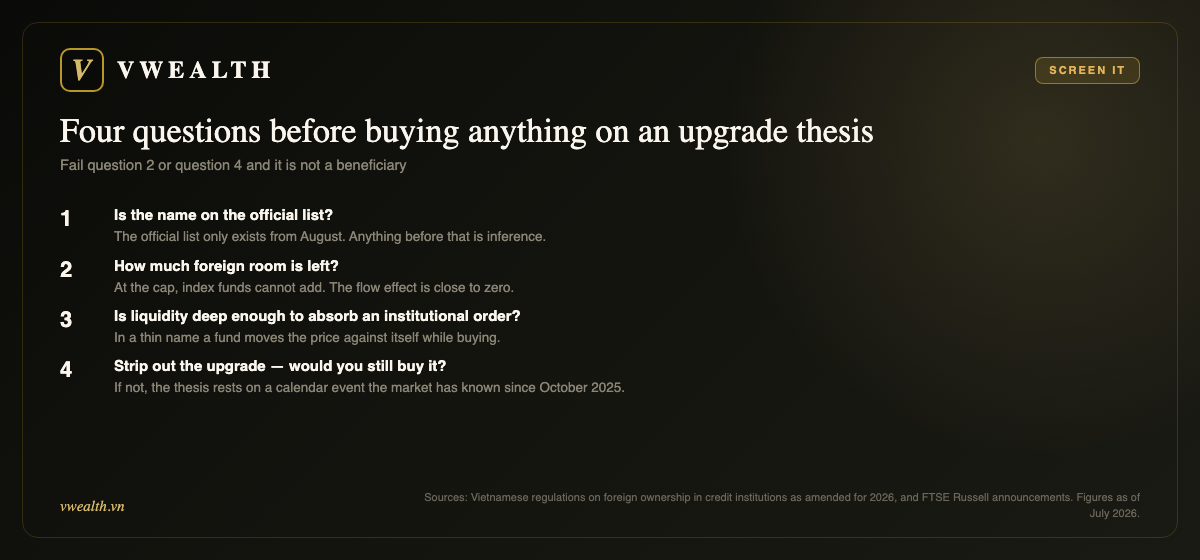
Question 1: is it on the official list?
Before August 2026 the honest answer for every name is “not confirmed”. The lists circulating are inferred from market cap and liquidity screens.
If someone selling you an idea states it as certain, ask for the source document.
Question 2: how much foreign room is left?
The most important question and the easiest to check. Current foreign ownership is published daily by the exchange and appears on most broker price boards.
What you want is the gap between current ownership and the cap. A wide gap means headroom. A zero gap means all foreign activity in that name is foreigners trading with each other — no new money entering.
Question 3: is liquidity deep enough?
A fund needing to buy several million dollars in a thin name pushes the price up while buying, then fills at a worse average. Many funds simply avoid such names even when the index includes them.
A quick check: average daily traded value over three months, compared with the size of the order the flow implies.
Question 4: strip out the upgrade — would you still buy it?
This filters hardest.
If removing the upgrade leaves you with no reason to own the stock, your thesis rests entirely on a calendar event the market has known about since October 2025, plus a list that is not final.
The company work still has to be done. Our sector analysis covers the ground: banking, steel and industrials, real estate, consumer and what blue chip actually means here.
Which sectors are structurally better placed
Stated as mechanics, not as recommendation.
Sectors with genuine headroom
Manufacturing, consumer, retail and industrials are not subject to the tight financial-sector caps, so foreign money has somewhere to go.
This is why the four large caps named include a steel producer and two property names rather than being all banks.
Banks: a sharply divided group
Banking is the largest sector weight in the index and the most tightly capped. Within it, the three names permitted up to 49% occupy a materially different position from the rest.
Brokers: an indirect beneficiary
Securities firms do not benefit from being bought — they benefit from market-wide turnover rising. That is a different mechanism, dependent on whether liquidity genuinely increases rather than on index membership.
Three common errors
Buying the list evenly
Splitting capital equally across twenty names copied from a forum guarantees most of it lands in names with no headroom.
Confusing net foreign buying with upgrade benefit
Foreign investors buy for many reasons. Connecting the two without checking the room figure is the easiest way to convince yourself of something untrue.
Ignoring the currency leg
Your return is in dollars and the dong does not float freely. Currency moves can erase an equity gain, and they also shape the behaviour of the very flows you are counting on. See what the dong means for USD returns.
Three flow mechanisms, ranked by certainty
“Benefit” usually bundles three very different things together. Separating them makes the whole question tractable.
Mechanism 1 — passive flow: most certain, smallest
Index-tracking funds are obliged to buy in proportion to weight. This is demand that will definitely appear, can be estimated in advance, and is the only one of the three you can size with arithmetic.
It is also the smallest, because Vietnam’s weight is 0.22% to 0.34% and because inclusion is phased into 2027.
Mechanism 2 — active flow: much larger, far less certain
These are funds that do not track the index but benchmark against it. Once Vietnam sits in the emerging category it enters their investable universe — many mandates simply prohibit frontier market exposure.
The potential size dwarfs passive flow. But nothing compels it: each manager decides on valuation, earnings growth and currency outlook. Nobody is obliged to show up.
Mechanism 3 — domestic front-running: fastest, most reversible
This typically appears earliest and moves hardest, because it requires only a headline rather than any operational change. It also reverses fastest when expectations are not met.
The three do not arrive at the same time and do not carry the same reliability. Blending them is the root of most mispriced expectations.
What history suggests
Several markets have been through reclassification, and a pattern recurs often enough to note — with the caveat that each market differs and the comparable sample is small.
Most of the move occurs before the effective date. Markets price the expectation from announcement. For Vietnam the clock started in October 2025, meaning much of that distance has already been travelled.
Post-inclusion is frequently flat or negative. Early buyers take profit while passive flow trickles in on schedule.
The real beneficiaries are often not the most-discussed names. The most-discussed names are usually the largest, and in Vietnam the largest tend to be the ones at their foreign cap.
What to monitor between now and September
Three things, each a few minutes.
Record today’s foreign room for every name you follow. Without a baseline you cannot see change. Memory is not a baseline.
Watch market-wide traded value. A sustained rise in turnover before September is evidence of active flow arriving — a far more meaningful signal than passive flow arithmetic.
Diarise August. The official list is the only genuinely new information left. Read the source document rather than someone’s summary of it.
A worked example of the arithmetic
Rather than accepting the phrase “billions of dollars”, do the division.
Take the total sum tracking FTSE Emerging and call it X. Vietnam’s weight is 0.22%. Required buying is 0.22% of X — then divided across 28 names by investable market cap.
The largest constituent takes the largest slice, and that slice is still a fraction of 0.22%.
Then subtract further: any name at its cap cannot be bought, and its weight is redistributed. Then divide again by the number of inclusion tranches running into 2027.
After those three divisions, the amount reaching any single name in any single quarter is far smaller than the headline implies. This is not a bearish argument — it is long division.
None of which makes the upgrade meaningless. It means that if your thesis rests on passive flow, you should compute the number first and compare it against the company’s market cap. If the forced buying equals a few normal trading sessions, it will not reset the price level.
What actually changes for the long run
Strip away the one-off flow story and one change carries far more weight: the removal of the prefunding requirement for foreign institutions.
Previously a foreign institution had to have cash in the account before placing an order. For a fund running billions across dozens of markets that is a real operational cost and a real currency risk — and many mandates prohibit prefunding into a frontier market outright.
Removing it opens the door to active money, not just index-tracking money. And unlike an index event, it does not expire at the next review.
Put simply: index flow is an event, infrastructure is a state. The second one lasts longer.
How foreign room works in practice, step by step
For readers who have never traded a capped market, the mechanics are worth spelling out, because they behave unlike anything in a developed market.
The cap is aggregate, not per investor
All foreign holders share one pool. When the pool is full, no foreign buyer can add — not because of anything they did, but because of what everyone else already holds.
This creates a queue effect with no queue. There is no mechanism entitling you to the next available share; it goes to whoever transacts first when a foreign seller appears.
Foreign sellers create the only supply
In a capped name, the only way a foreign buyer gets shares is if another foreign holder sells. Domestic sellers do not release foreign-eligible shares.
The practical result is a separate, thinner market operating inside the visible market — and often at a premium, since foreign buyers compete for a fixed pool.
Why the premium matters for the upgrade thesis
Where a foreign premium already exists, index funds arriving must pay it. That reduces the attractiveness of the trade and, in some cases, causes funds to under-weight the name relative to its index weight.
This is another reason a capped stock is a weaker beneficiary than its size suggests: not only is the volume constrained, but the price of what volume exists is worse.
How caps change
Caps are set by regulation and can be amended — the move allowing certain banks up to 49% is exactly that. So a name that is capped today is not permanently capped.
For a long-term investor this is worth tracking, because a cap increase on a name with strong foreign demand is a genuine structural change, independent of any index decision.
The limits of this analysis
Being explicit, because a piece like this invites more certainty than the evidence supports.
We do not know the final constituent list. Nobody outside FTSE does until August.
We do not publish a total flow figure. Published estimates vary widely because they rest on assumptions about how much benchmarked money is genuinely passive. We prefer to give the weight, which is sourced, over a dollar total that is inferred.
We do not forecast price reaction. Historical patterns from other markets are informative, not predictive, and the comparable sample is small.
Everything stated above as fact is dated and sourced. Everything else is labelled as observation.
Reading the September review when it lands
When FTSE publishes the September semi-annual review, three items in that document matter more than the headline.
The final constituent count. If it differs materially from 28, the per-name flow assumption everyone has been working from changes with it.
The stated inclusion schedule. How many tranches, at what intervals, and what proportion in each. This determines whether flow spreads over two quarters or five.
Any conditions attached. Reviews sometimes note areas requiring continued progress. Those notes are where the next round of risk lives, and they are usually phrased mildly enough to be skipped.
Reading the source takes twenty minutes and puts you ahead of most commentary, which will be written from a press summary rather than the review itself.
If you are building a position anyway
No recommendation, but three practical points if you have already decided to act.
Size against liquidity, not conviction. In a market this size, the constraint that bites first is how much you can exit without moving the price. Work backwards from the exit.
Separate the trade from the investment. If part of your position exists for the September event and part exists because you like the business, hold them as two decisions with two exit rules. Blending them means the trade half never gets closed.
Assume the currency moves against you. Not as a forecast, as a stress test. If the position only works with a stable dong, it is a currency position wearing an equity costume.
Frequently asked questions
Can a stock at its cap still rise?
Yes, but not because of new foreign money. It can rise on earnings or on domestic flow. The specific “upgrade beneficiary” component is largely absent.
Are the three 49% banks guaranteed winners?
A higher ceiling is a necessary condition, not a sufficient one. Current ownership versus the cap, liquidity and earnings all still matter.
Should I wait until August?
No recommendation here. Informationally, August is when the only genuinely new fact arrives — the official list. Everything else has been public since October 2025.
Where do I check foreign room?
Exchange disclosures and most broker price boards publish it daily. Record both the current ratio and the cap, not merely whether room exists.
What if the final list differs from the indicative one?
Names dropped lose the premium already priced in; names added unexpectedly gain it. It is a two-way risk and the main argument against concentrating before August.
Summary
The FTSE Vietnam emerging market upgrade does not have a beneficiary list — it has a set of conditions. Official inclusion, remaining foreign room, and liquidity depth, all three together.
The second condition is the one nearly every published list ignores, and it is the one that decides the outcome. A capped stock inside an index basket is still a stock new foreign money cannot buy.
The fourth screening question is the most useful of all, because it puts the decision back where it belongs: on how the business is actually trading.
Further reading: the complete guide to the Vietnamese market, foreign ownership limits explained, and an honest assessment of the risks.
This article is for information and education. It is not a recommendation to buy, sell or hold any security. Figures are as of July 2026.