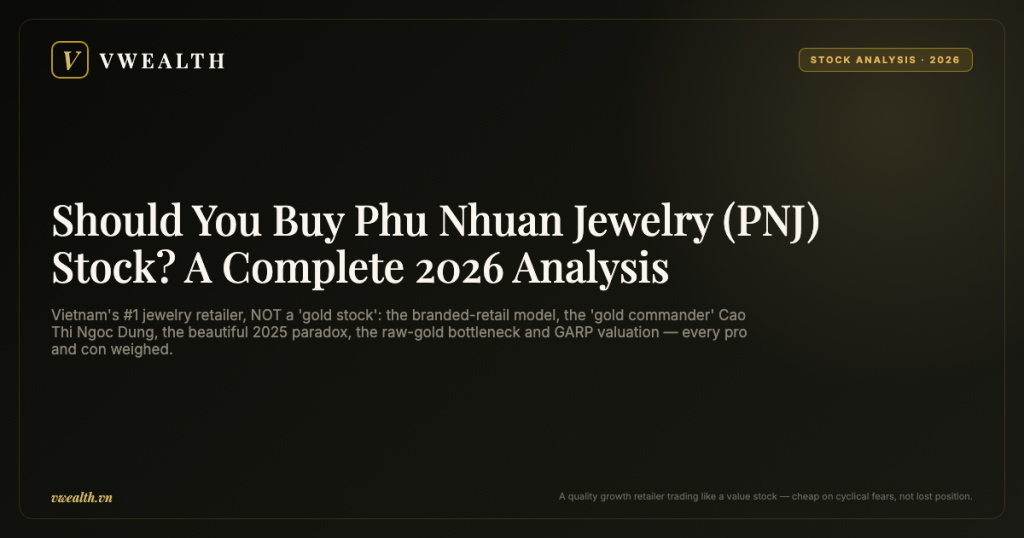
If you had to pick one stock to explain to a newcomer what “quality retail growth” means on Vietnam’s exchange, many veterans would point straight to PNJ. Phu Nhuan Jewelry JSC (HOSE: PNJ) is currently Vietnam’s number-one jewelry retailer, the only jewelry business listed on the exchange, and the name tied to the image of “gold commander” Cao Thi Ngoc Dung — the woman who started from a small gold shop in Phu Nhuan district in 1988 with assets of just 7.4 taels of gold and 20 employees, then built an entire jewelry empire.
What makes PNJ worth studying carefully isn’t the word “gold” in its name. Many new investors buy PNJ thinking it’s a “gold stock” — gold price up, PNJ up. That’s a costly misunderstanding. PNJ’s real story is the story of a consumer retailer: the business earns money by crafting and selling branded, high-margin jewelry through a chain of nearly 400 stores nationwide — not by “flipping” gold-bar price spreads. This difference is so important it decides whether PNJ fits your investment appetite or not.
The clearest proof just happened in 2025. Amid still-weak consumer purchasing power and a 24K raw-gold supply tightened to scarcity, PNJ’s 24K gold revenue “evaporated” about 43%, and total net revenue even fell year on year to just under 35,000 billion dong. Yet after-tax profit set a historic record: 2,829 billion dong, up 33.9% and beating the annual plan by 44%. A paradox only explainable when you understand what PNJ essentially is: thin-margin gold-bar revenue fell, but the company poured resources into the thick-margin jewelry segment — so the less raw gold it sold, the fatter its profit.
At 67,100 dong/share (session of 19 June 2026), the question for you isn’t simply “is PNJ cheap or expensive,” but: do you believe in the story of a jewelry retailer growing resiliently across many economic cycles, and what kind of investor does this stock suit? To answer, you first need to understand the journey PNJ has traveled — because PNJ’s history is precisely the explanation for every number today.
PNJ market data (updated 19 June 2026)
| Current price | 67,100đ | 2025 revenue | ~35,000 bn |
| Change (June) | +1.98% | 2025 after-tax profit | 2,829 bn (+33.9%) |
| P/E | Gross margin | ~8x | 22% | Market share | Dividend | ~55% (branded) | 20% |
Source: VWealth price data + PNJ 2025 reports. Figures move by session — for reference only.
History and evolution
PNJ’s history isn’t the story of a joint-stock company set up to do business. It began as a product of a transitional era — when Vietnam had just entered Doi Moi (economic reform), and gold trading was first “unleashed” to become a legal commodity rather than something banned. Understanding those roots, you’ll understand why PNJ always carries two selves within: on one side the traditional “gold trading” base, on the other the aspiration to become a modern, region-class jewelry retailer. PNJ’s whole nearly-40-year journey, ultimately, is the process of the second self gradually prevailing over the first.
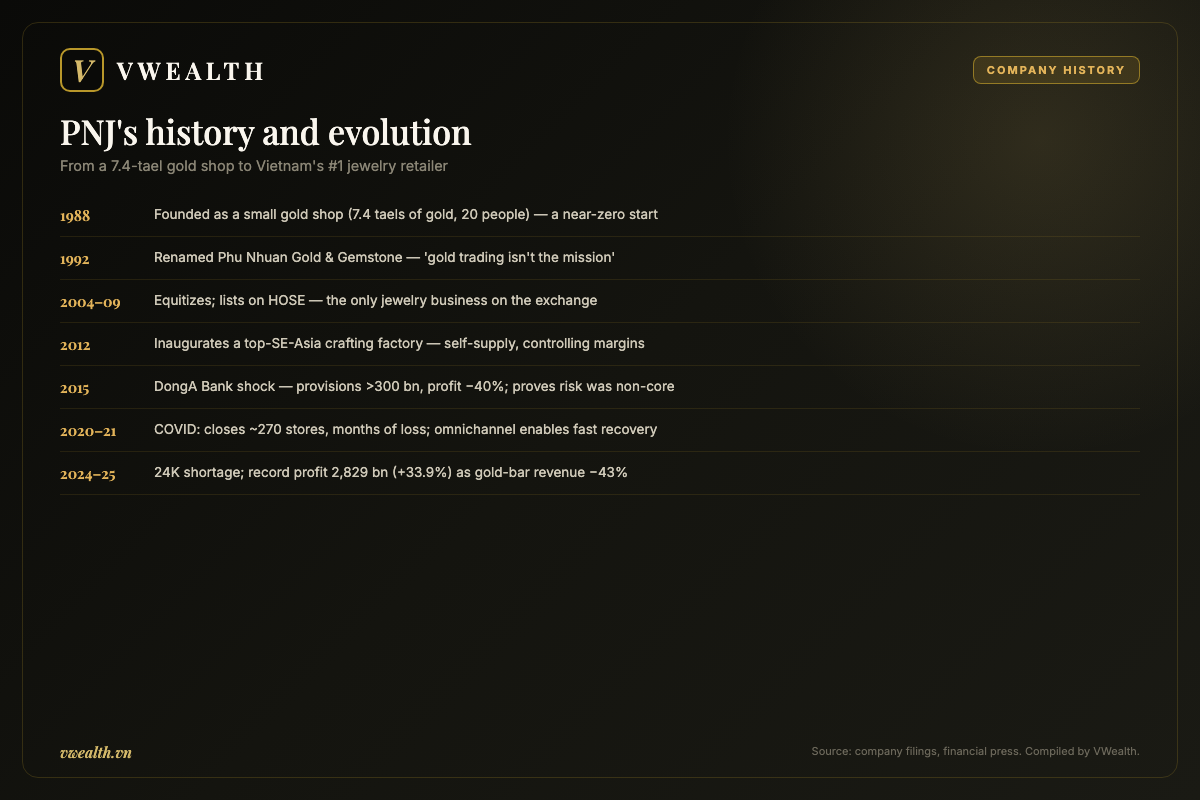
1988–1992: A small gold shop and a woman who had never traded gold
On 28 April 1988, Phu Nhuan Gold and Silver Trading Store was born, under the Phu Nhuan District People’s Committee, HCMC. This was the late 1980s, when the State allowed the establishment of gold-and-silver enterprises on a pilot model to formally turn this industry into a commodity. The person entrusted to lead this fledgling store was Ms. Cao Thi Ngoc Dung — then a young state official who, by her own account, “knew nothing about the gold and gemstone business.” The store’s initial assets were equal to just 7.4 taels of gold, with about 20 people.
You should pause a moment at that 7.4-tael figure. In investing, people talk about “durable competitive advantage” and “brand assets.” All of those for PNJ today grew from a starting point of nearly zero. What made the difference wasn’t capital, but a thinking choice from the very start. When given the chance for a foreign joint venture, Ms. Dung declined — she believed if the world could craft industrial jewelry, Vietnamese could too. She imported machinery to produce the first industrial jewelry pieces, rather than just trading raw gold. That was the first seed of the entire later strategy.
In 1992, the store was upgraded and renamed Phu Nhuan Gold and Gemstone Company. A later saying of Ms. Dung became a “manifesto” shaping the company’s identity, which you need to remember to understand PNJ: “I don’t see gold trading as PNJ’s mission.” For most Vietnamese gold shops, gold trading is the trade. For PNJ, from very early, gold trading was just the base — while the mission was crafting and selling branded jewelry.
“I don’t see gold trading as PNJ’s mission.” — Cao Thi Ngoc Dung. This line is the key to not confusing PNJ with a “gold-price-flipping stock.”
The strategic turning point: from thin-margin “gold trading” to thick-margin “jewelry retail”
This is the most important part of PNJ’s whole history — and something that, if skipped, means you’ll never value this stock correctly. Picture two completely different business models under the same roof:
- Gold-bar and raw 24K gold trading: very thin margins (just a few percent), dependent on the world gold price, under increasingly tight State control, with almost no brand value. This is the model of most traditional gold shops.
- Crafting and retailing branded jewelry: gross margins many times higher (PNJ’s jewelry has gross margins in the tens of percent), with value in design, craftsmanship, brand and shopping experience — not just gold weight. This is the model of a modern consumer retailer.
Over a decade ago, PNJ proactively shifted its focus from the first model to the second. The reason was clear-headed: PNJ’s leadership saw gold-bar margins as too low and increasingly tightly controlled, while the era’s trends and rising middle class opened enormous room for fashion jewelry. They chose “the hard road” — building a brand, a factory, a store chain — rather than “the easy road” of continuing to trade gold.
The result of this choice shows clearly in the revenue mix: by 2023, retail jewelry accounted for about 66.8% of total revenue, and more importantly, contributed most of the profit. It’s precisely because of this shift that PNJ could create the 2025 paradox you saw at the start: 24K gold revenue fell 43% but profit still peaked. When raw gold is scarce, PNJ simply prioritizes channeling that scarce gold into high-margin jewelry crafting, “letting go” of the thin-margin raw-gold segment. A business that only knows how to trade gold would be paralyzed in that situation; a jewelry retailer profits all the more.
The meaning for you is very clear: valuing PNJ by “gold price” logic is a mistake. You must value it as a retailer — looking at store count, revenue per store (SSSG), jewelry gross margin, and middle-class purchasing power. Those are the true levers of this stock’s value.
2004–2009: Equitization and listing — stepping into the light of transparency
On 2 January 2004, PNJ formally equitized, converting from a state-owned enterprise (under the local Party’s economic arm) into Phu Nhuan Gold and Gemstone JSC. This was an ownership shift, paving the way for capital raising and listed-standard governance.
In March 2009, PNJ shares officially listed on the Ho Chi Minh City Stock Exchange (HOSE), with charter capital raised to 400 billion dong. This milestone has two large meanings you should note. First, PNJ became — and remains — the first and only jewelry business listed on Vietnam’s stock market. If you want to “bet” methodically on the rise of Vietnam’s jewelry industry, there’s almost no choice other than PNJ. Second, listing forced PNJ to make its numbers transparent, subject to market oversight — which later helps investors clearly distinguish “PNJ’s health” from external fluctuations (like the DongA Bank affair we’ll discuss below).
2012 onward: Building a crafting factory, modernizing governance and some stumbles
A jewelry retailer ambitious to lead the region can’t just buy goods to resell. In 2012, PNJ inaugurated a large-scale jewelry-crafting factory — assessed as one of the region’s largest jewelry-crafting facilities, allowing PNJ to self-supply products rather than depending on outsiders. This was a foundational decision: controlling production means controlling quality, designs, new-product speed and margins. Today PNJ operates a factory system with capacity of millions of products a year — among the largest in Southeast Asia.
Alongside the factory, PNJ began modernizing governance. In the early 2010s, the company hired international consultants to restructure its strategy, applied methodical management models and deployed an enterprise resource planning system (ERP/SAP). The goal was to turn PNJ from a “magnified gold shop” company into a retail chain operating to international standards — managing inventory on a pull model, optimizing goods turnover across hundreds of points of sale.
But that modernization journey wasn’t all roses — and this is something you need to know for a clear-headed, un-rosy view. The 2012–2014 restructuring once had to “step back” to handle risks. Most memorable was the “ERP incident”: deploying the new management system (2018–2019) hit snags, causing operating disruption and affecting results at one point. PNJ paid the price, learned the lesson, then stabilized the system. For an investor, this detail has its own value: it shows PNJ is a business that dares to invest ahead — and sometimes stumbles — rather than a perfect machine. The ability to fix mistakes and move on is part of leadership quality.
The DongA Bank shadow: the biggest test of mettle
No chapter in PNJ’s history stirred the stock more than the period entangled with DongA Bank. Ms. Cao Thi Ngoc Dung is the wife of Mr. Tran Phuong Binh — former CEO of DongA Bank, who later faced legal trouble in that bank’s major case. PNJ was once a major shareholder of DongA Bank (holding about 7.7%).
When DongA Bank was placed under special control by the State Bank in 2015, PNJ took a double shock. The roughly 395-billion-dong investment in DongA Bank had to be provisioned over 300 billion dong; plus losses from real-estate divestment, PNJ’s financial costs jumped nearly 5-fold and 2015 after-tax profit fell over 40% versus 2014. On the exchange, PNJ shares were sold off on fears of “family association.”
This was precisely the test of mettle. Instead of letting the company sink along, Ms. Dung and leadership separated PNJ’s fate from DongA Bank’s fate: provisioning decisively to “clean up” the balance sheet, while pouring all effort into the core business of jewelry retail. The result was that after just the 2015–2016 period, PNJ surged strongly, with profit growing continuously in the following years, taking the company clean out of the “DongA Bank shadow.” For you — an investor — the lesson is: PNJ’s biggest past risk came from outside the core business (financial investments, personal ties), not from retail capability. And the ability to overcome that crisis is a significant plus for governance quality.
COVID-19: the fire that tests the retail model
In 2020–2021, the pandemic dealt a direct blow to every retailer with physical stores. In July 2021 alone, PNJ had to close over 60% of its system due to social distancing in HCMC and 19 southern provinces; at one point temporarily closing up to 270 stores, with several consecutive loss-making months — rare in the company’s history.
But COVID actually proved the value of the “ahead-of-time” investments PNJ had made. Thanks to going digital a few years earlier, the system still took online orders while stores were closed; PNJ operated with an omnichannel mindset — combining online and offline into one unified whole. As a result, cumulative results recovered quickly right when it reopened. For you, this is evidence PNJ’s model has good resilience through crisis cycles — a valuable quality in a retail stock.
2024–2025: Tightened gold management, 24K raw-material shortage and record profit
The most recent period was another kind of test. From the second half of 2024 through all of 2025, Vietnam’s gold market was heavily tightened, and 24K raw-gold supply became scarce for a prolonged period. Add still-weak consumer purchasing power, and this should have been a bad scenario for a gold-industry business.
In fact PNJ turned adversity into a relative advantage. When raw gold was scarce, the company applied a flexible purchasing policy to solve the supply problem, while proactively prioritizing the gold it obtained for the high-margin jewelry segment rather than thin-margin gold bars. The consequence: 2025 24K gold revenue fell about 43% (to just over 6,610 billion dong), total net revenue fell to nearly 35,000 billion — but after-tax profit set a record of 2,829 billion dong, up 33.9%, at 144% of the annual plan. Going further, analysts even forecast PNJ’s gross margin could touch 24% in 2026.
| Milestone | Event | Meaning for investors |
|---|---|---|
| 28/4/1988 | Founding Phu Nhuan Gold and Silver Trading Store (7.4 taels of gold, 20 people) | A starting point of nearly zero — all value today was built |
| 1992 | Renamed Phu Nhuan Gold and Gemstone Company | Shaping identity: “gold trading isn’t the mission” |
| 2/1/2004 | Equitization | Paving the way for capital raising, corporate-standard governance |
| 3/2009 | Listing on HOSE, charter capital 400 bn | The only jewelry business on the exchange — transparency |
| 2012 | Inaugurating a large regional crafting factory | Self-supply production — controlling quality and margins |
| 2015 | DongA Bank shock, provisioning >300 bn, after-tax profit down over 40% | Risk came from non-core financial investment, not retail |
| 2020–2021 | COVID: at times closing ~270 stores, losing money for months | Omnichannel enabled fast recovery — a resilient model |
| 2024–2025 | Tightened gold management, 24K shortage; record profit 2,829 bn (+33.9%) | Proof PNJ is a high-margin retailer, not a “gold-price flipper” |
Today: a jewelry empire of nearly 400 stores
From a small store in 1988, PNJ today operates a system of nearly 400–414 stores spread across provinces, with about 7,000 staff, plus a factory system among the largest in Southeast Asia. Besides the mid-to-high-end-positioned parent brand PNJ, the company also developed Style by PNJ — a jewelry and accessories brand aimed at young, individualistic customers — to widen the customer base and step into the fashion segment faster. The declared ambition is to keep expanding the chain toward the 500-store mark, cementing its position as the number-one jewelry retailer and reaching Asian-regional stature.
Looking back over nearly 40 years, you’ll see a red thread running through: PNJ continuously chose the harder but more valuable road — industrial crafting rather than a joint venture, branded jewelry rather than gold bars, a modern retail chain and large factory rather than a gold-shop model. Each stumble — DongA Bank, the ERP incident, COVID, raw-gold shortage — became a test the company passed and grew stronger from. But such a resilient story doesn’t happen by itself. It’s led by specific people — headed by “gold commander” Cao Thi Ngoc Dung and the successor team. And that’s precisely what you need to examine next: who is PNJ’s leadership, and do they truly deserve your trust (and money).
Leadership and ownership structure

If you want to understand why PNJ has held the leading position in Vietnam’s jewelry industry for decades, you can’t skip this section. For a retail business, products can be copied, premises can be contested, but the people at the helm and the power structure behind are what decide how far the business goes. PNJ is a rare case in Vietnam: a large public company yet bearing the deep imprint of a founder, while operating to professional governance standards many other listed groups must learn from. When you put money into PNJ stock, you’re essentially placing faith in a leadership apparatus and a very distinctive ownership structure that this section will analyze carefully for you.
Cao Thi Ngoc Dung — the “gold commander” who built an empire
It’s hard to separate PNJ’s story from the woman who built it. Ms. Cao Thi Ngoc Dung, born 1957 in Quang Ngai, graduated from HCMC University of Economics in Commercial Economics, is PNJ’s incumbent Chairwoman. In 1988, while Head of Planning at Phu Nhuan General Trading Company, she was appointed Director of a small gold shop — PNJ’s predecessor — with a starting point press materials often recall as just about 20 staff and very modest initial capital equal to just a few taels of gold. From that starting point, she took PNJ to become a region-leading jewelry business with thousands of staff and a network of hundreds of stores nationwide.
Vietnamese media gave her many nicknames — “gold-and-silver commander,” “gold-and-silver queen,” “iron lady of the jewelry industry.” These titles aren’t empty flattery, but reflect a reality: nearly her whole career is tied to a single business, and she led it through many stormy periods where not a few other businesses collapsed. What you should note as an investor is her strategic vision: instead of letting PNJ drift along the volatile, legally risky gold-bar business, she early steered the company into a professional jewelry retailer, building a brand, investing in production and distribution. In a widely cited statement, she stressed that gold trading isn’t PNJ’s mission — a manifesto showing she views the business at the level of a consumer brand rather than just a magnified gold shop.
Her mettle was also forged through personal trials. Per many articles, right at her career peak in the early 2000s, she faced a serious illness and overcame it with willpower and optimism. On international recognition, she was named by Forbes among Asia’s influential female entrepreneurs (2018) and received a Lifetime Achievement award for the Asian jewelry industry from JNA (2019). You should understand these awards don’t directly raise the share price, but they’re indicators of reputation and management capacity — an important intangible asset for a premium retail brand.
The DongA Bank shock: a test of the helmsman’s mettle
This part must be presented cautiously, as it involves others’ private lives and legal matters. However, as an investor, you must understand the 2015–2016 period to correctly assess PNJ’s leadership’s risk-management capacity. Ms. Cao Thi Ngoc Dung’s husband is Mr. Tran Phuong Binh, former leader of DongA Bank. When DongA Bank fell under the State Bank’s special control in 2015 and Mr. Tran Phuong Binh later faced legal trouble, market sentiment toward PNJ stock was clearly negatively affected due to the family tie and because PNJ had a financial investment in that very bank.
On the numbers — and this is what you should view coldly from a financial angle — per press materials citing PNJ’s financials, the company once held a significant stake in DongA Bank (mentioned at about 7.7%, with the investment value around 395 billion dong). When the bank ran into trouble, PNJ had to provision heavily for this investment: in 2015 alone, provisioning over 300 billion dong plus a loss from divesting a real-estate company caused PNJ’s financial costs to spike and after-tax profit to fall sharply versus the prior year. By end-2016, PNJ had completed 100% provisioning for this investment.
The most valuable point for investors isn’t that loss, but how PNJ handled it. Provisioning decisively and transparently helped the company “cut losses” from the past, so the core business — jewelry retail — accelerated again right after. This is precisely the test showing PNJ’s leadership chose to face risk rather than delay.
What’s the lesson you draw here? One, founder- and family-related risk was once a real variable for PNJ, reminding you that a business tightly tied to one individual always carries “key-person risk.” Two, how the company overcame this period — full provisioning, no hiding, then quick profit recovery from the core — actually reinforces faith in governance quality. Looking back, the “DongA Bank shadow” turned out to be a chapter affirming mettle rather than an ending, exactly as many articles at the time described Ms. Dung’s mettle.
Generational handover and a professional executive team
One thing that sets PNJ apart from most Vietnamese family businesses is that the company proactively professionalized its executive apparatus rather than maintaining a “one person decides all” model. The executive (CEO) role is separated from the Chair role, and the CEO seat for many years has been given to a non-family member. This is a governance trait you should value highly, as it reduces dependence on one individual and creates a foundation for sustainability.
The person tied to PNJ’s strongest transformation phase is Mr. Le Tri Thong, holding the CEO position since 2018. Mr. Thong has a solid academic and management background — he worked at the global strategy-consulting group Boston Consulting Group (BCG) and was involved in banking management (DongA) before joining PNJ. Under him, PNJ pushed professionalization, restructuring and especially digital transformation, taking the company from a traditional retailer toward a data-and-technology-based management model.
You need to update an important, recent piece of information: per PNJ’s disclosure, Mr. Le Tri Thong will hand over the CEO position from 3 April 2026, per personal wish and a succession roadmap the Board prepared in advance. The appointed successor is Mr. Phan Quoc Cong — a manager born in 1970 with over 30 years of experience, who worked at major groups like Electrolux Vietnam and Nestlé Vietnam, as well as having startup and tech-investment experience. Notably, after leaving the CEO seat, Mr. Le Tri Thong doesn’t leave PNJ but continues as Vice Chairman of the Board, focusing on strategic planning and long-term development direction. The handover timing was chosen right after the peak Q1 business season — a small detail but showing the care in how PNJ designs the succession.
This handover style is very important to you. A sudden CEO change usually worries investors, but at PNJ this is a prepared roadmap, with the predecessor staying on the Board to preserve continuity, and an experienced successor. That’s the sign of an organization running by institution rather than personal sentiment.
Besides, the generational handover within the founding family is also happening in an orderly way. Ms. Cao Thi Ngoc Dung’s daughter, Ms. Tran Phuong Ngoc Thao — highly educated abroad — has become deeply involved at PNJ. Per materials, from 2019 Ms. Thao took charge of digital transformation, laying the foundation for the company’s digital-transformation center; and from 27 April 2023, she was elected Vice Chairwoman of PNJ’s Board. The successor generation joining in technology — the future growth driver of retail — rather than immediately taking the executive helm, shows the founding family is empowering cautiously and strategically.
Ownership structure: professionally private, no state shadow
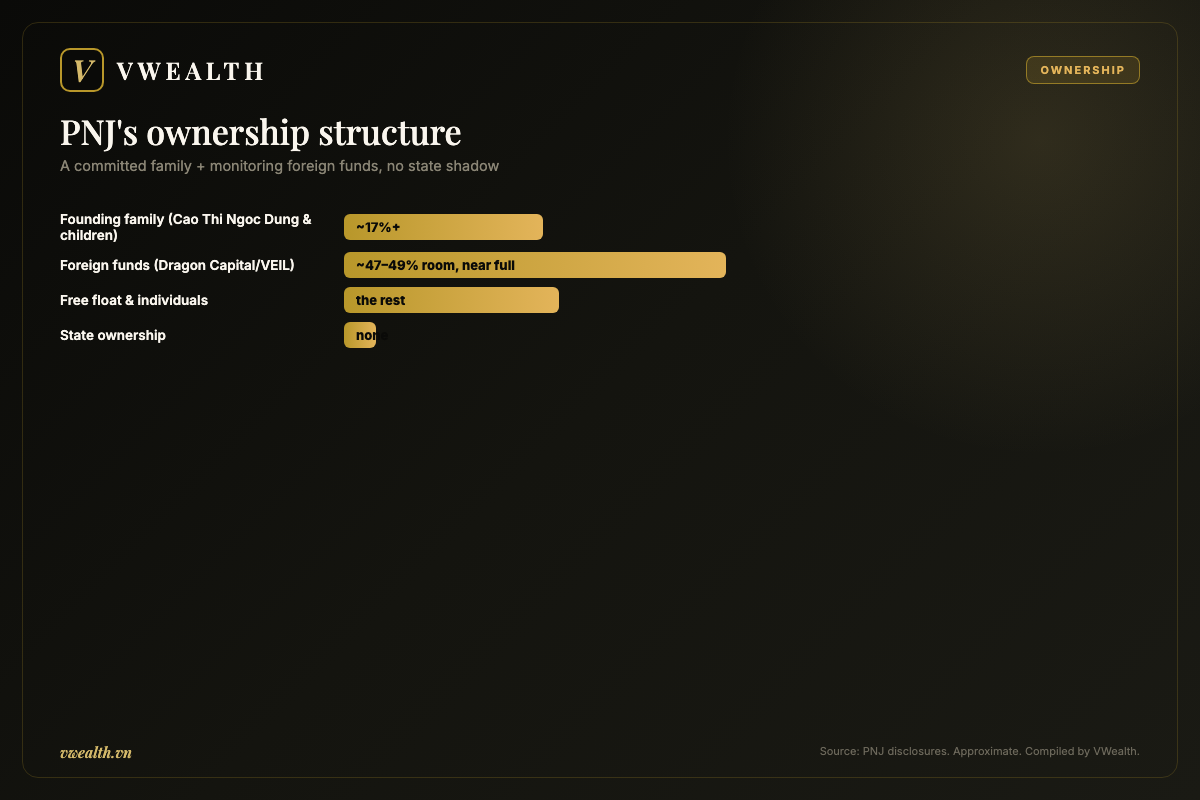
Analyzing PNJ’s ownership structure, there are three points you need to remember, as they directly impact governance quality and the stock’s appeal.
First, PNJ is a purely private business, with no controlling state capital. This is a fundamental difference from many other industry-leading businesses on the exchange that were once equitized state enterprises. No “state hand” means business decisions are made by market logic, nimble and consistent with shareholder interest, unconstrained by non-commercial goals.
Second, the founding family holds a significant stake, creating tight interest alignment. Per press materials (figures as of 2024–early 2025, for reference and subject to change with share issuances), Ms. Cao Thi Ngoc Dung herself owns about over 10% of PNJ; her daughters also hold significant ratios — for example Ms. Tran Phuong Ngoc Thao is mentioned around 3.5% after buying more shares in late 2024–early 2025, and another daughter, Ms. Tran Phuong Ngoc Giao, around 3.7%. Combined for the whole family, the stake is a weighty number. For you, the most important meaning is: management’s interest and shareholders’ interest are set in the same direction. When the leading family holds a large stake, they have strong motivation to protect long-term enterprise value rather than chase short-term gains.
Third, PNJ’s foreign room is usually nearly filled, with steady presence of reputable foreign funds. The standout is the Dragon Capital group — one of the largest and longest-standing fund managers in Vietnam. Per transaction disclosures, the Dragon Capital group has repeatedly moved in and out of the 5% major-shareholder threshold: for example, one instance was recorded raising ownership above 5% (around 5.06%), with member funds like Vietnam Enterprise Investments Limited (VEIL) holding significant weight, alongside other international institutions in the group. PNJ shares continuously appearing in large foreign funds’ portfolios is an indirect “quality stamp” — these funds have deep analysis teams and rigorous vetting processes, so their presence reflects faith in the business’s fundamentals and governance.
Combining these three factors creates a fairly ideal ownership structure for long-term investors: on one side a committed, engaged founding family, on another a professional foreign-fund bloc playing an oversight and market-discipline role, with the rest a free float large enough for liquidity and transparency. You get the stability of a business with a real owner, while still benefiting from the governance standards of a public company monitored by demanding institutional investors.
| Ownership group | Traits | Meaning for investors |
|---|---|---|
| Founding family (Ms. Cao Thi Ngoc Dung and her children) | Holds a significant controlling stake; directly on the Board and strategic direction | Management and shareholder interests aligned; high long-term commitment |
| Foreign funds (Dragon Capital/VEIL and international institutions) | Foreign room usually nearly filled; repeated moves around the 5% major-shareholder threshold | Governance “quality stamp”; adds oversight and market discipline |
| Public shareholders (free float) | Free-float shares large enough on HOSE | Good liquidity, price transparency, easy position entry/exit |
| State ownership | No controlling state capital | Decisions by market logic, unconstrained by non-commercial goals |
Methodical governance culture and steady dividend policy
A premium retail brand like PNJ can’t run well relying only on personal decisions. What you should value is that PNJ has built a systematic governance culture: separating the Chair and CEO roles, hiring a professional CEO from outside, investing early in digital transformation and data-based governance, while designing a prepared succession roadmap rather than leaving a power vacuum. This discipline helps the company maintain stability even amid changes at the very top.
Good governance culture must ultimately be verified by how the business treats shareholders — and here, PNJ’s dividend policy is a clear plus. PNJ maintains a tradition of steady cash dividends over many years. Per materials, in recent years the company kept a cash dividend around 20% of par each year (usually split into an advance and the remainder), and this payment history has continued unbroken since listing. Besides, the company also issues bonus shares from equity to strengthen charter capital.
For investors, a steady cash-dividend policy isn’t just cash flow received. It’s also a signal that leadership is confident in cash-flow and core-profit health, while consistently showing respect for shareholder rights.
Note that the ownership and dividend figures above are for reference at specific points and may change after each AGM or share issuance; before deciding, cross-check against PNJ’s latest annual report and disclosures. Even so, the overall picture is very clear and stable: a strong-willed founder laid the foundation, a professional executive team continues, an ownership structure balanced between a committed family and monitoring foreign funds, plus a shareholder-respecting governance culture.
Understanding this “software” — the people and the power structure — you have half the story. The other half lies in the “hardware”: the very jewelry products and retail system that turned leadership’s vision into real revenue and profit. That’s what the next section, “Products and system,” takes you deep into.
Products, retail system and business model
Before you decide to put money into a stock, there’s a question that seems simple but decides almost everything: how does this business actually make money? For PNJ, the answer is far more interesting than the familiar image of “a big gold shop.” You’re looking at a manufacturer, a consumer brand and a modern retailer wrapped in the same company. Understanding how these three layers stack up, you’ll understand why in 2025 gold-bar revenue “evaporated” nearly by half yet PNJ’s profit still set a historic peak — a paradox scratching not a few new investors’ heads.
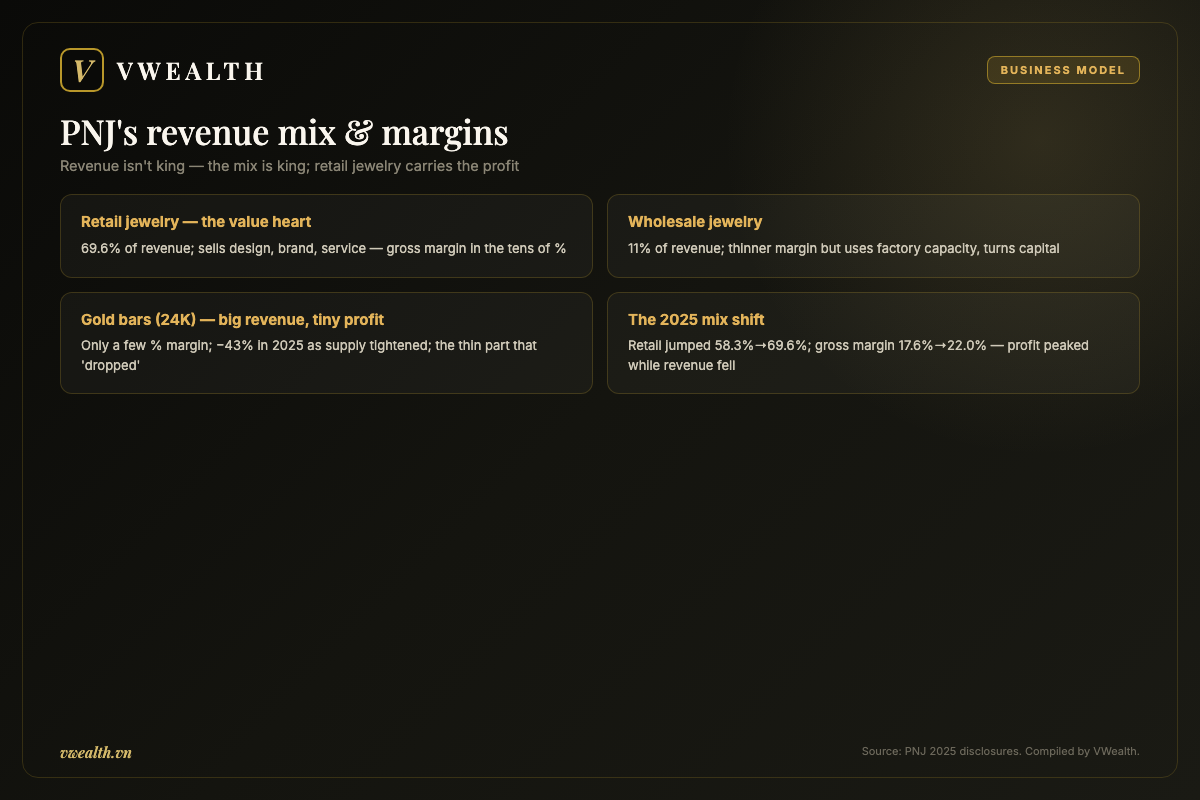
Let’s start with the backbone number of 2025: jewelry accounted for about 80.6% of total revenue, of which retail 69.6% and wholesale 11%; the rest mainly gold bars and some ancillary segments. In the same year, the trailing-12-month average gross margin reached 22.0%, a strong improvement from 17.6% in 2024. These two numbers don’t stand alone — they tell you a story of how PNJ proactively pivoted its revenue mix to “eat” a thicker margin. We’ll dissect each layer.
Three revenue segments, three vastly different margins
A common newcomer mistake is lumping all of PNJ’s revenue into one basket. In reality, PNJ’s revenue comes from three sources of vastly different “quality.” You need to distinguish them clearly, because the same dong of revenue from one source can profit many times more than from another.
(a) Retail jewelry — the value-creating heart. This is when PNJ sells a ring, earrings or necklace directly to you — the end consumer — at a store or online. In this segment, PNJ doesn’t just sell “gold by weight”; they sell design, brand, experience, service and warranty. That’s why the gross margin here is very high, up to tens of percent — far higher than the rest. When you pay for a PNJ jewelry piece, a large part of the money is for crafting, for design, for the peace of mind about fineness and correct gold purity, not just for the metal block. This is why retail is seen as the value core of the whole business.
(b) Wholesale jewelry — thinner margin but helps turn capital. In this segment, PNJ sells to other gold shops and small stores — that is, to resellers. Because customers here are professional traders who bargain hard and buy in bulk, the margin is notably lower than retail. In exchange, wholesale utilizes factory capacity, keeping production running steadily and turning capital. In 2025 wholesale contributed about 11% of revenue and rose slightly year on year — a stable leg but not where fat profit is made.
(c) Gold bars — large revenue, tiny profit. This is the most misleading segment. Gold bars (24K gold, SJC gold…) are essentially a commodity with publicly listed daily prices. PNJ earns nearly just a very small buy-sell spread, so the gross margin is only a few percent, sometimes near break-even. So why still sell it? Because gold bars draw customers into stores and “inflate” revenue to enormous numbers. But you must remember: gold-bar revenue is “good-looking but light on meat” — impressive on the report but contributing very little to the bottom-line profit.
Remember a rule: with PNJ, revenue isn’t king. The revenue mix is king. A dong of revenue from retail jewelry is “heavier” many times over than a dong from gold bars.
Now the 2025 paradox becomes clear: 24K gold revenue fell about 43% because gold prices were too high and supply was tightened, dragging total revenue to look unattractive on paper. But because the “dropped” part was the thinnest-margin part, while the part staying and growing was thick-margin retail jewelry, the retail weight jumped from 58.3% (2024) to 69.6% (2025) — up as much as 11.2 percentage points. The mix tilted decisively toward the fat-profit part, pulling the whole company’s gross margin from 17.6% to 22.0%. Gold bars gone, profit still peaked — that’s not luck, it’s the mechanical consequence of selling more higher-margin goods.
A modern retail chain: entirely different from a traditional gold shop
If you picture PNJ as a row of old-style gold-and-silver glass cabinets, you’ll misjudge this business’s nature. PNJ operates a modern retail chain on an “experience retail” model: stores designed like fashion boutiques, with advisors, fitting spaces, a unified brand-identity system and consistent service standards nationwide. This is what separates PNJ from thousands of family gold shops — where you buy based on personal trust with the owner and gold-by-weight prices.
As of end-Q3 2025, PNJ’s system had about 429 stores, and the business aims to reach the 500-store mark in coming years. More important than count is the brand tiering within one ecosystem, so PNJ can “hit” many different customer segments:
- PNJ (the flagship chain): gold, diamond and silver jewelry for a wide segment, from mass to mid-to-high-end. This is the revenue backbone and where most of the ~400 stores sit.
- Style by PNJ: a jewelry-accessories line aimed at youth, softer prices but still made to jewelry standards (ensuring craftsmanship). This is how PNJ “nurtures” a young Gen Z customer base, so a few years later they become premium-jewelry buyers.
- PNJ Watch: the watch and fashion-accessories segment, a small share of total revenue but helping raise store-visit frequency and widen the basket.
- PNJ Art (CAO Fine Jewellery / the art-premium line): the finely crafted, high-end-diamond jewelry segment, aimed at high-income customers.
Besides, PNJ also exploits international franchise brand power with lines like Disney|PNJ, PNJ Hello Kitty, Doraemon|PNJ… — a smart way to reach young customers and create story-rich products. All these lines aren’t separate companies, but “drawers” in the same retail machine, sharing the factory, the parent brand and the operating system.
PNJ also pushes omni-channel — unified-channel selling, seamlessly connecting physical stores and online. You can view models online, reserve at the nearest store, or buy online and receive at home. For a high-value, emotional item like jewelry, keeping a seamless experience between online and offline is an advantage small gold shops almost can’t copy.
Integrated value chain: from gold bar to the ring on your hand
This is the part “below the surface” but which decides why PNJ’s margins are durable. Unlike many retailers that only buy and resell, PNJ self-designs and self-produces most of its products. The business operates a jewelry-crafting factory among the largest in Southeast Asia, with capacity of millions of products a year. When you control production, three things happen:
- Controlling quality and correct gold purity — a survival factor for customer trust. A brand that loses credibility on gold purity loses everything.
- Controlling margins — self-production means PNJ keeps the value-added part (crafting, design) rather than sharing it with a third party.
- Proactively designing and mastering trends — PNJ launches new models fast, diverse, keeping up with tastes, rather than depending on external supply.
Put together, you have a closed value chain: design → factory crafting → distribution through a branded retail chain → direct sale to end consumers. Every link is PNJ-controlled. This is precisely the business’s “economic moat” — a set of advantages rivals find very hard to overcome: factory scale, a brand reputation accumulated over decades, a ~400-store network, and relationships with international diamond and gemstone partners. A newly opened gold shop can imitate a store, but can’t in a day or two build the region’s largest factory or a nationwide brand trust.
Brands and segments: covering from mass to premium
PNJ’s strength lies in not choosing a single segment but covering nearly the whole price spectrum. Young, lower-budget customers have Style by PNJ; mass customers buying wedding and gift jewelry have the flagship PNJ line with diverse gold-silver-diamond models; premium customers have PNJ Art and select diamond lines. Partnering with international diamond and gemstone partners and franchise brands helps PNJ both elevate its image and secure rich materials and product stories.
For you — the investor — this multi-brand strategy has very practical meaning: it helps PNJ reduce dependence on a single customer group, expand the “pie” of branded jewelry (still small versus non-branded gold in Vietnam), and create long-term growth room as the middle class expands.
A risk you mustn’t overlook: raw-gold supply
However beautiful a model, it has an Achilles’ heel, and for PNJ that’s raw-gold supply. For over a decade since Decree 24/2012/ND-CP took effect, importing raw gold was nearly frozen, and the State monopolized many gold-related steps. To get raw material for jewelry production, businesses in the industry often had to scramble from market sources with no small legal and supply risk.
When gold-market management tightened, PNJ once fell into a 24K gold shortage, with a period of almost no gold-bar transactions for lack of supply. This is why the business forecasts the gold-bar segment may no longer contribute significant revenue from 2025 onward. You need to read this risk two ways:
- The negative side: a raw-material shortage can choke production capacity, affecting the very high-margin jewelry segment — this is a major operating risk, not a small matter.
- The positive side: the part that “drops” first is the thin-margin gold-bar segment. Then the revenue mix automatically shifts toward retail jewelry, pulling gross margin up — exactly what happened in 2025. If policy allows raw-gold imports to loosen, this will be a large catalyst relieving the raw-material bottleneck for PNJ.
In other words, gold-management policy is both a risk and a variable that can flip into an opportunity. As an investor, you should closely watch every move to amend Decree 24 and the gold-import mechanism — that’s one of the biggest levers for PNJ’s prospects.
Bottom line: why this model creates advantage
Putting it all together, you’re looking at a business with three stacked layers of advantage. The first layer is branded retail — where PNJ sells added value (design, service, trust) rather than gold by weight, bringing high, durable margins. The second layer is crafting capability — the region’s largest factory helping control quality, master design and keep margins. The third layer is a wide store-chain network plus a multi-brand ecosystem and omni-channel, creating scale rivals find hard to copy.
These three layers don’t just add up but multiply: a strong brand helps sell at good prices; proactive production helps keep margins and launch models fast; a wide chain amplifies both. That’s why in a year gold bars “evaporated,” PNJ still peaked in profit — the business model was designed so the fattest-profit part is the most durable part. Having understood this money-making machine, you have the foundation to move to the next section: examining PNJ’s true competitive position and financial health, to see how solid a financial frame this machine runs on.
Position and financial health
When you put PNJ stock on the scale, one question must be answered before any question about valuation or price prospects: is this business truly healthy, and is its market position solid enough to turn that health into sustainable growth? 2025 gave us a rare dataset to illuminate that question — a year superficially tinged with paradox, but underneath telling a very clean story about business quality. In this section, you and I will dissect each layer: PNJ’s true competitive position, why profit peaked while gold revenue plunged, the financial traits of a business “sitting on a mountain of gold,” and the risks a clear-headed investor mustn’t overlook.
Number-one position: a giant in a still-fragmented market
To understand PNJ’s value, you need to understand the structural paradox of the very industry it dominates. Vietnam has about 10,000 gold-and-gemstone stores, the vast majority traditional gold shops, self-run family businesses, unbranded, unstandardized in design and quality. This is a market enormous in size but extremely fragmented in structure. In that picture, PNJ isn’t just the leader — it’s nearly the only branded player at nationwide scale.
The number says it all: PNJ holds about 55% market share in the branded jewelry segment, with the country’s largest retail store system. But here’s the crux you need to remember — if you count the whole jewelry market (including countless small gold shops), PNJ’s share is estimated at only around 20-27%. The gap between those two numbers is precisely the business’s long-term growth room.
Picture it this way: PNJ dominates a small, rich island (the branded segment), but around that island is a whole ocean of market share held by small, weak players unable to compete on design, reliability or experience. Each time a traditional gold shop closes or a young customer shifts to buying branded, PNJ’s slice grows larger.
This shift isn’t mere theory. Consumption trends in Vietnam are clearly shifting from “buying gold to store” to “buying jewelry to beautify and express,” especially among young urban customers. When consumers care more about design, origin, warranty and shopping experience than just weighing gold, the advantage tilts decisively toward a brand that has invested decades in production capacity, store systems and reputation. The State’s gold-market tightening in 2024-2025 even inadvertently accelerated this filtering: many small establishments unable to comply had to shrink, leaving room for a methodical business like PNJ to capture.
Coming with the position is expansion ambition. PNJ keeps increasing store count, aiming for hundreds of points of sale nationwide — not just to sell more but to cement its physical distribution network, an asset rivals find hard to copy short-term. It must be said plainly: the new-store opening pace has slowed notably versus the earlier boom, reflecting caution amid weak purchasing power. But still opening net stores in a hard year shows leadership views this as a temporary cycle rather than a structural downturn.
The beautiful 2025 paradox: gold revenue “evaporates,” profit peaks in history
This is the most interesting part, and also the part where, if you just glance at press headlines, you easily misunderstand. In 2025, PNJ recorded net revenue of 34,976 billion dong — nearly flat, and the 24K gold segment (gold bars, raw gold) even plunged over 40% year on year. Yet after-tax profit reached 2,829 billion dong, up as much as 33.9% and at 144% of the annual plan — the highest in its nearly 37-year history.
Revenue stalls but profit peaks — how can that be? The answer is contained in one word: mix. And to let you see this shift visually, let’s look at the 2025 core financial metrics.
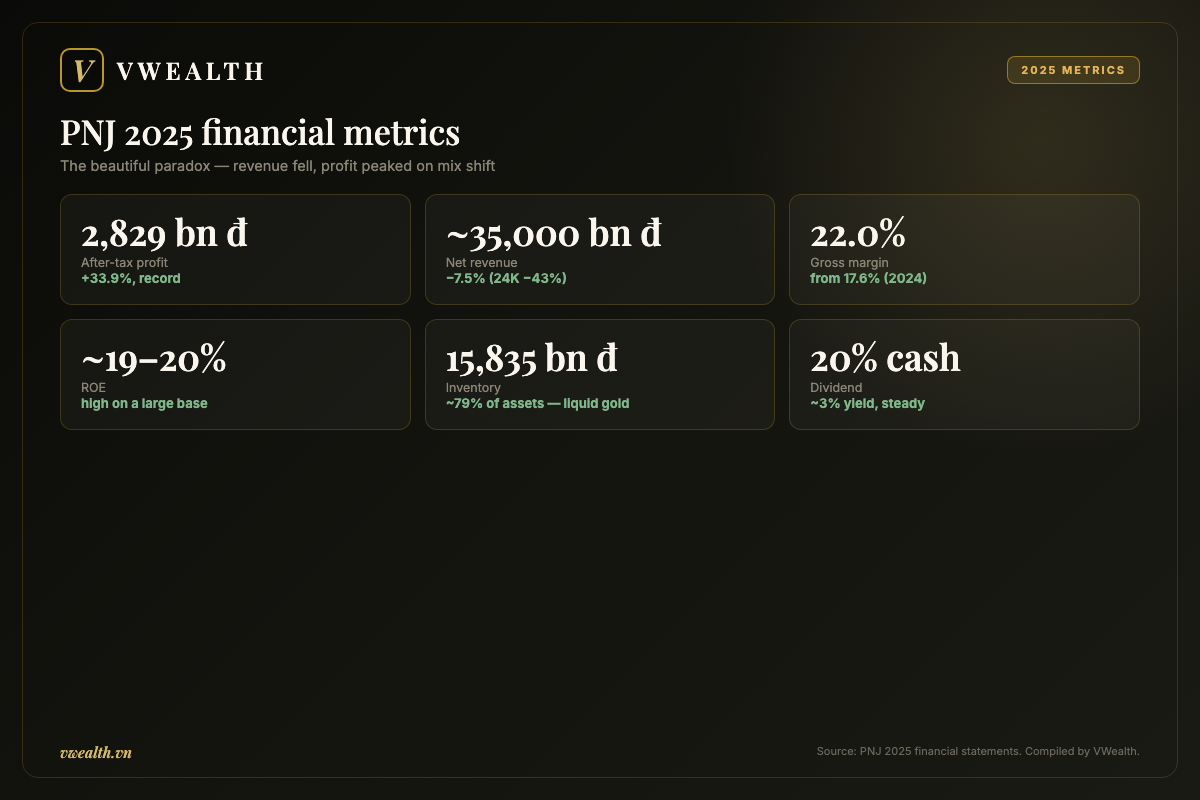
Let’s dissect the logic behind those numbers. 24K gold revenue is an extremely thin-margin segment — essentially, selling gold bars is nearly just “transiting” a commodity with a listed price, with very low profit per dong of revenue. When this segment shrank for lack of supply (from management tightening), it dragged down total revenue but barely hurt profit. Conversely, the retail jewelry segment — where PNJ creates most value-added through design, brand and high margins — took an ever-larger share of the mix. In 2025, jewelry alone contributed about 80% of total revenue, with retail dominating within it.
The direct consequence is that gross margin jumped from 17.6% (2024) to 22.0% (2025) — an improvement of nearly 4.4 percentage points, extremely rare for a mature retailer in just one year. When each dong of revenue generates more profit, and the mix tilts toward the best-earning part, the result is a far more efficient profit-generating machine even though revenue scale is unchanged.
Profit quality: real money from retail, not luck
As an investor, you should be wary whenever you see a profit spike — because it may come from unsustainable sources like asset revaluation, extraordinary income, or simply luck riding commodity prices. So what kind is PNJ’s record profit: real profit or paper profit?
The evidence tilts decisively toward “real profit.” Most of the increase comes from three very basic, repeatable sources: first, the revenue mix shifting to high-margin retail jewelry as analyzed; second, retail revenue still growing positively despite weak overall demand, showing continued share gains; third, leadership tightly controlling operating costs, optimizing per-store efficiency rather than chasing revenue at all costs. These are all structural drivers tied to the business’s core capability, not a one-time gain.
I want you to note this subtle but important difference. A gold business can “profit big” in a gold-price-rising year simply from inventory value swelling — that’s cyclical profit, easily evaporating when the price reverses. But the core creating PNJ’s 2025 record came from the substantially improved gross margin of the retail jewelry operation. In other words, even stripping the favorable gold-price factor, PNJ’s business “engine” is running stronger than before. That’s what’s worth the money.
Financial traits: a business “sitting on a mountain of gold”
PNJ’s balance sheet looks like no ordinary retailer’s, and you need to understand this trait to avoid misreading signals. Total assets at end-2025 reached about 20,168 billion dong, up nearly 3,000 billion in a year. But the shocking point is the composition: inventory alone accounted for about 15,835 billion dong — nearly 79% of total assets, up sharply from 10,941 billion the prior year.
For an ordinary business, inventory at 79% of total assets would be a red alarm — a sign of unsold goods, buried capital, clogged cash flow. But for PNJ, inventory is largely gold and jewelry — assets with near-cash liquidity, globally listed prices, and most importantly: rising in value when gold prices go up. This is a very distinctive double-edged sword you need to weigh carefully.
- The favorable side: in a gold-price-rising environment like 2024-2025, this enormous inventory self-profits — gold bought at low prices, when sold or revalued is more expensive, creating a layer of “inventory gain” supporting results. PNJ also cleverly uses its very gold and silver as collateral to borrow at favorable rates, turning inventory into a flexible financial resource.
- The risk side: this is a very working-capital-heavy model. To expand scale, PNJ must pump more money to stockpile gold — in 2025 alone, the business spent over 4,800 billion dong on raw materials, many times the prior year. And if gold prices reverse sharply down, that inventory can turn to eroding profit rather than supporting it. PNJ is well aware of this: there were periods the business proactively cut gold inventory sharply ahead of price plunges to hedge risk.
On debt structure, the picture needs a balanced view. On one hand, PNJ maintains a prudent financial philosophy, holding much cash and traditionally relying less on debt than the general level — a foundation helping the business stay solid through volatile cycles. On the other, it must also be said fairly: to fund gold-stockpiling in a high-price year, PNJ raised debt significantly, with new borrowings totaling thousands of billions of dong. However, because these loans are secured by the very gold — a highly liquid asset — the actual financial risk is far lower than the nominal debt figure. This is “gold-backed debt,” not debt to cover losses.
One metric you should watch closely at this business is inventory turnover. When inventory swells faster than sales pace, turnover slows, meaning capital is “soaked” longer and cash flow is pressured. The 2025 inventory increase was mainly strategic stockpiling amid scarce supply and rising gold prices — a deliberate choice, but also a point to monitor closely in coming quarters.
Profitability: high ROE on a large capital base
PNJ’s capital efficiency stays impressive, with ROE around 19-20% — a respectable number for a working-capital-intensive retailer as noted. This means: despite having to “bury” a large amount of capital in gold inventory, PNJ still generates a return on equity superior to most listed businesses.
Sustainably high ROE is usually a sign of a real competitive advantage — here, brand strength, design capability and system scale allowing PNJ to price products at high margins that customers still accept. When gross margin is lifted to 22% while asset turnover is maintained, ROE is “fueled” healthily by business-operation quality, not by excessive financial leverage. This is the kind of ROE long-term investors favor: coming from performance, not from risk.
Risks: points you’re not allowed to overlook
An honest analysis can’t just paint rosy. PNJ is a good business, but “good” doesn’t mean “no risk.” There are two large risk groups you need to factor into your investment calculation.
First, the raw-gold bottleneck. This is PNJ’s most structural and distinctive risk. The State tightening gold-market management from the second half of 2024 made raw-gold supply scarce. The direct consequence: the 24K gold-bar segment nearly “paralyzed” — at one point the whole system had no gold-bar transactions, and this segment’s revenue is forecast to possibly contribute nothing significant from 2025 onward. More seriously, if the shortage persists, it affects not only gold bars but also limits the ability to produce jewelry — the very profit-generating segment. PNJ must prioritize allocating its scarce gold to jewelry production over gold-bar trading, but this puts a ceiling on output growth. In other words, even when market demand is strong, PNJ may not have enough “raw material” to meet it. This is a risk beyond the business’s control, dependent on macro management policy.
Second, weak purchasing power when gold is too expensive. Hot gold prices are the double-edged sword we mentioned. On one hand it beautifies inventory value; on the other it pushes jewelry input costs up and makes products expensive for consumers’ wallets. Jewelry is a non-essential item — when the economy is hard and prices are high, this is usually the first spending cut. The slow purchasing-power recovery in the recent period tested this. PNJ overcame it largely by grabbing more share and lifting margins, but if purchasing power stays weak while gold prices anchor high, pressure on retail revenue growth is real.
Beyond the two core risks, you should also note: the working-capital-intensive model makes PNJ sensitive to the gold-price cycle and interest-rate level; and the slowing new-store pace shows the room for width-growth is gradually narrowing, forcing the business to grow more in depth (per-store performance).
Summary: a healthy machine facing real headwinds
So gathering it up, what does PNJ’s financial-health picture say? You’re looking at a true industry leader — dominating the branded jewelry segment, still with wide room to take share from a fragmented market, and especially having just proven the ability to substantially raise profit quality. The record 2025 profit wasn’t luck but the result of a correct strategy: proactively shifting to high-margin retail, controlling costs, and turning the gold-bar shortage into a chance to streamline the mix.
At the same time, you’re not allowed to forget that this healthy machine runs amid very real headwinds: the raw-material bottleneck capping growth, and high gold prices being both friend and foe. A wise investor will assess PNJ not by choosing between “good” or “bad,” but by weighing: is the quality of its position and financial health enough to offset these distinctive risks, at the price the market is offering? With high ROE, improving gross margin and a balance sheet backed by liquid gold, much evidence shows PNJ is in a solid defensive stance. And that very solidity explains how the market receives this stock — the topic we’ll analyze right next.
Market reception
If you open the board on 19 June 2026 and look at the PNJ line, the number showing is 67,100 dong (real data from the VWealth plugin). To someone glancing over, that’s just a price. But to an investor who has followed PNJ for a decade, 67,100 dong tells an entirely different story: an industry-leading jewelry retailer, with a record after-tax profit of 2,829 billion dong in 2025, being valued by the market at the lowest P/E zone in years. In this section, you and I will dissect why the market “treats” PNJ this way — and more importantly, whether that cheapness is a temporary bargain or a warning about a slowing growth story.
How the market receives a stock never lies just in the price. It lies in the valuation people are willing to pay per dong of profit, in foreign-capital flows, in the dividend history the business has paid through ups and downs, and in the expectation story investors attach to the future. PNJ is an especially interesting case, because it combines three easily-misleading traits: it’s both a growth retail stock, a stock “linked” to gold, and a stock whose foreign room is nearly always full. Those three layers stack up, creating a valuation picture where, if you look at only one angle, you easily conclude wrong.
Valuation: a growth stock trading like a value stock
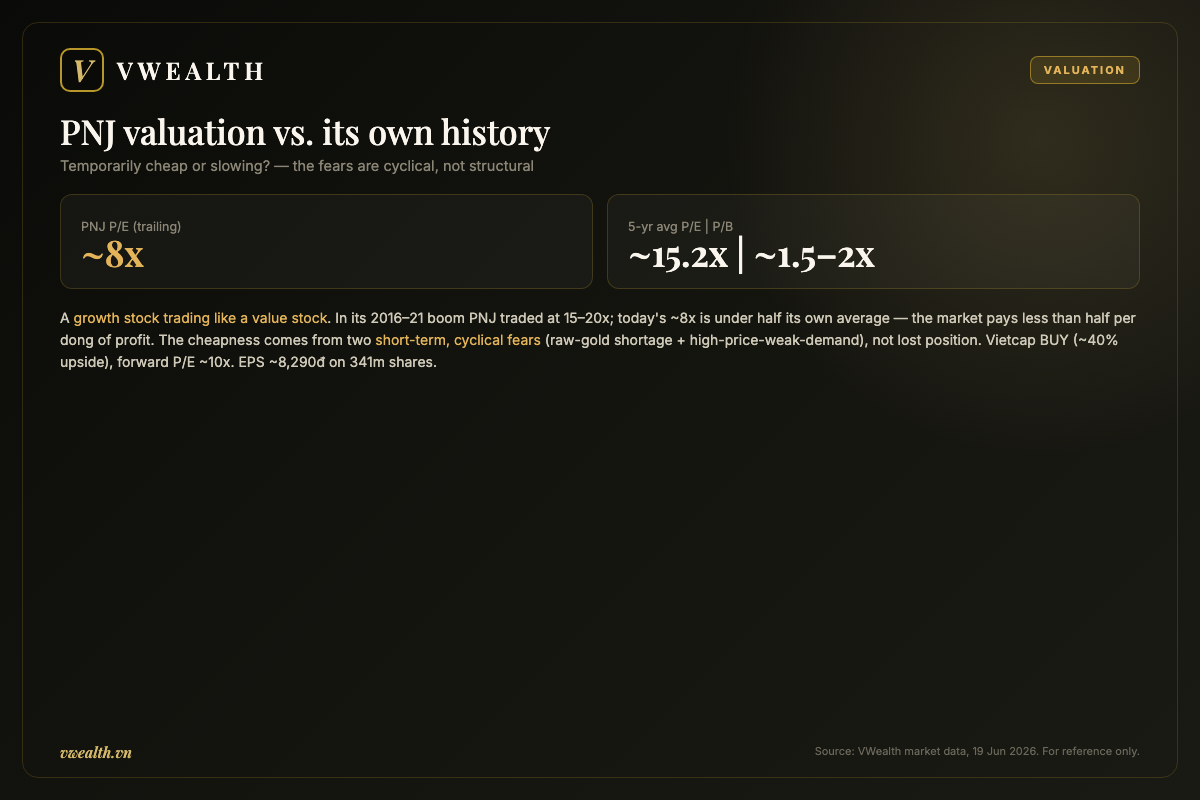
Let’s start with the most basic calculation you can verify yourself. PNJ’s 2025 after-tax profit reached 2,829 billion dong. Shares outstanding are 341,149,107 units (this figure is verified through the business’s disclosure, after a 2:1 bonus-share issuance pushed charter capital above 5,100 billion dong). Dividing 2,829 billion by 341 million shares, you get basic earnings per share (EPS) of about 8,290 dong. Placing the 67,100-dong price over that EPS, PNJ’s P/E ratio is only about 8.1x. Using a more conservative rounded EPS of 8,000 dong, P/E is also only around 8.4x. On P/B, with equity accumulated over years of retained earnings, PNJ’s price-to-book ratio is now around 1.5–2x — clearly below the 3x P/B this stock was once used to.
Why are these numbers worth pausing on? Because PNJ isn’t an aged value business, growing single-digit then standing still. Throughout 2016–2021, this was a double-digit compound-growth machine each year thanks to the retail-transformation story — expanding the store chain, digitizing operations, moving into the fashion-jewelry segment for youth. Such a business, by the GARP (Growth At a Reasonable Price) school, should trade at a P/E above the market level to reflect future profitability. And history was indeed like that.
In its high-growth years, PNJ frequently traded at a P/E of 15–20x. Its 5-year average is around 15.2x. Against that, the P/E around 8x now means the market is paying for each dong of PNJ’s profit less than half of its own historical habit.
This is precisely the core paradox you need to grasp: a stock once valued as a “growth stock” is now being valued by the market as a “value stock.” When an industry leader falls from a P/E of 15–20 to a P/E of 8, there are only two possibilities. Either the market is wrong and this is a bargain buy, or the market sees something about the future making it no longer willing to pay the old multiple.
So what does the market fear? There are two big fears weighing on PNJ’s valuation, and both are real rather than imagined.
First is the raw-gold shortage fear. In 2025, not a few PNJ stores fell into announcing out-of-stock with no clear reopening date. The cause lies in tight management of raw-gold supply on the market, making it hard for the business to import enough gold to craft. For a jewelry retailer, raw material isn’t just an input cost — it’s the condition to have goods to sell. When shelves are empty, revenue falls very directly, regardless of whether customer demand remains.
Second is the weak-purchasing-power fear. Domestic gold prices anchoring high created a double-edged sword we’ll analyze more later. For the jewelry segment specifically, high gold prices push selling prices up, while consumers’ wallets are tightening after a hard economic period. 24K gold sales — the product line most sensitive to price — fell clearly. PNJ’s total 2025 revenue thus fell about 7.5% year on year, though profit still peaked thanks to improved gross margin.
These two fears together create the question every PNJ investor must answer: “Is this 8x P/E temporarily cheap, or a sign that growth has slowed for the long term?”
My view leans toward the former, but not blindly. The reason is that the nature of both fears is cyclical and policy-driven, not an erosion of the business’s competitive capability. The raw-material shortage is a gold-management-policy issue — and the gold-market legal framework is being adjusted, opening the possibility of supply being unblocked more in the future. Weak purchasing power is a consumption-cycle issue — when household incomes recover, demand for wedding, gift and store-of-value jewelry will return as a hard-to-change cultural pattern in Vietnam. Meanwhile, PNJ’s industry-leading position — the store network, crafting capability, brand — remains intact. In other words, profit may be suppressed by external factors, not by PNJ losing its footing.
That’s why large securities firms generally keep positive recommendations. Vietcap issued a BUY with an expected upside of nearly 40%, assessing the forward P/E for 2026 and 2027 around 10.1x and 9.4x as attractive versus the 5-year average of 15.2x. ACBS also kept a BUY in its mid-2026 update report. When many independent analysts see the gap between market price and intrinsic value, that’s a signal worth your attention — though of course, a recommendation isn’t a promise.
Price behavior: the journey of a “national” retail stock
To understand why today’s 67,100 dong carries much meaning, you need to place it in PNJ’s price history. This is one of the “national” stocks on HOSE — meaning nearly every individual investor has heard of it, considered buying, or is holding.
The 2016–2021 period was the golden age. PNJ rode the retail-transformation story and the boom of Vietnam’s middle class. The stock continuously broke peaks, joined the triple-digit-price club and took the business’s market cap past the one-billion-USD mark. The historic peak (on adjusted prices) was set around November 2021, in the 108,000-dong zone. That was the peak of faith: the market then was willing to pay a high P/E believing PNJ would keep growing double-digit for many more years.
After that peak came a prolonged correction and sideways phase. The current 67,100 dong — versus the adjusted peak around 108,000 dong — shows the stock has retreated notably in expectation valuation, even though the business’s absolute profit in 2025 is at a record high. This out-of-sync — peak profit but trough valuation — is precisely what makes PNJ a case worth studying.
The important thing to remember is that PNJ’s price is sensitive to three variables, and these three don’t always move in the same direction:
- Consumer purchasing power. This is the most basic driver. Jewelry is a non-essential item; when the economy is hard, it’s one of the first spending cuts. Every signal about income, consumer confidence, or the peak wedding season reflects into PNJ’s revenue expectations.
- Gold-management policy. This is the “political” variable investors often underrate. The legal framework on importing, trading and crafting gold directly decides whether PNJ has enough raw material to operate. A policy change can loosen or tighten supply after just one document.
- Gold prices. This is the most misleading variable, because it has two opposing effects.
On gold prices’ two-sided effect, you need to distinguish clearly. On one hand, rising gold prices benefit the gold inventory PNJ holds — inventory asset value rises, and the business can record a better margin on gold bought earlier at low prices. This is part of why 2025 revenue fell but profit still peaked. On the other hand, rising gold prices disadvantage jewelry purchasing power: when each jewelry piece is more expensive, consumers hesitate more, and 24K gold and premium-jewelry sales stall. In other words, high gold prices are good for the balance sheet but bad for sales. Any investor looking at only one side easily concludes wrong about PNJ.
Dividends: a resilient reward through every cycle
If you’re an investor who favors stability, PNJ’s dividend history is a significant plus. This is a business that pays cash dividends steadily over the years, even in volatile market periods. For 2025, PNJ paid a cash dividend of 20% of par — that is, 2,000 dong per share — of which 10% was advanced in early January 2026 and the rest paid after.
At 67,100 dong, the 2,000-dong dividend corresponds to a dividend yield of about 3%. This number isn’t too high for a pure value stock, but not small for a stock still with growth room. More important than the absolute yield is the resilience: PNJ maintains a steady cash-dividend policy over many years, combined with bonus-share issuance — most recently a 2:1 bonus, issuing about 170.6 million more shares. Bonus shares aren’t hard cash, but they reflect a business accumulating enough retained earnings to share with shareholders in many forms.
For you, the practical meaning is: even if the share price moves sideways during the wait for the growth story to return, you still receive a steady dividend cash flow. That’s a form of “being paid to wait” — a trait long-term funds value highly.
Foreigners: why is the room always full?
One of PNJ’s most recognizable market traits is that its foreign room (foreign ownership limit) is nearly always full. The foreign ownership ratio at PNJ is regularly around 47–49%, close to the allowed ceiling. This isn’t accidental, but a very telling indicator worth reading carefully.
When a stock’s foreign room is always full, it means demand from foreign investors always exceeds supply. Foreign funds wanting to buy more usually have to wait for another foreign fund to sell — they can’t buy directly from the market when the room is full. PNJ is among few industry-leading consumer-retail stocks that foreigners are willing to hold tight, because it represents the domestic-consumption story of a 100-million-person economy getting richer. That’s the kind of “foundational asset” regional funds want in their long-term portfolios.
Among PNJ’s foreign shareholders, the most notable name is Dragon Capital — one of the longest-standing and most influential foreign funds on Vietnam’s stock market. Dragon Capital’s ownership behavior at PNJ over the past year-plus is an interesting story, and it teaches you a lesson about reading foreign moves:
- In May 2025, the Dragon Capital group sold 100,000 PNJ shares, cutting ownership to 4.9972% and formally leaving the major-shareholder seat (the major-shareholder threshold is 5%).
- But by February 2026, this very fund group bought 522,000 more shares, raising the ratio back above 5% and returning to major-shareholder status.
Why does this matter to you? Because it shows even a veteran foreign fund trades around PNJ’s major-shareholder threshold — out then in — rather than fleeing outright. Dragon Capital returning after the price had discounted deeply, right into the historically low valuation zone, is a fairly clear signal that smart money assesses this price zone as attractive for the long term. Of course, you shouldn’t buy just because a fund buys; but when the foreign room is full, large funds move around the 5% threshold, and valuation is at a multi-year trough, those three data points together create a context worth serious consideration.
Note additionally that since early 2024, the general foreign trend across Vietnam’s whole market has been net-selling — and PNJ also faces this pressure. But the crux is that despite net-selling, PNJ’s foreign room stays nearly full. That means whenever a foreign fund sells, another foreign fund immediately buys to fill the spot. This “rotation within the foreign bloc,” rather than a mass capital withdrawal from the stock, is evidence that fundamental faith in PNJ hasn’t been shaken.
Summary of how the market is receiving PNJ
Putting all the pieces together, the picture emerges fairly consistent. You’re looking at a quality growth retail stock — jewelry industry leader, record profit, resilient cash dividends, foreign-favored with a full room — yet being valued at a P/E of about 8x, less than half its own historical average. This cheapness doesn’t come from the business weakening, but from two real short-term fears: raw-gold shortage from management policy, and weak jewelry purchasing power from high gold prices plus tight consumer wallets.
The question “temporarily cheap or slowing growth?” thus has an answer leaning toward the former: PNJ is a quality growth retail stock, cheaply valued due to short-term and cyclical fears, not because of losing its position. If gold supply is unblocked and consumer purchasing power recovers, the gap between the current 8x P/E and the historical 15x P/E is precisely the valuation room that could be filled. Conversely, the risk lies in these fears lasting longer than expected, keeping profit from breaking out and the market keeping the valuation low.
To answer that question thoroughly, you can’t look at PNJ alone. You need to understand the context of the whole jewelry-retail industry and Vietnam’s gold market — where all of PNJ’s fears and opportunities originate. That’s what we’ll analyze in the next section on industry context.
Economic and jewelry–gold industry context
To understand why PNJ made a record after-tax profit of 2,829 billion dong in 2025 — up 33.9% year on year — yet the stock still trades around 67,100 dong at a P/E of about 8–9x, you can’t just look at the business’s own financials. A jewelry retailer like PNJ lives at the intersection of three big currents: the structure of Vietnam’s jewelry industry, the violent swings of gold prices, and the gold-management policy framework being rewritten. This section dissects each current so you see the base picture PNJ stock stands on.
A still very fragmented market — and that’s the opportunity
The most important point to grasp is that Vietnam’s jewelry market remains deeply fragmented. The whole industry’s size was estimated at about 1.09 billion USD in 2023, but most sales still lie with thousands of small gold shops running on a traditional family model, unbranded, unstandardized in design, without clear invoices. Branded jewelry — products with designs, warranties, a store system — accounts for only a small slice of the whole industry, and within that slice PNJ holds about 55% share.
You should read this 55% two ways. First: PNJ is already the absolute leader in the branded jewelry segment, with no domestic rival (DOJI, Bao Tin Minh Chau, Diamond World) or international one (Pandora) coming close. Second, and more interesting for a long-term investor: the branded segment is still only a small part of the total market, meaning the room for PNJ to “eat” share from small gold shops is still very wide. As consumers shift from traditional gold shops to branded stores, PNJ’s slice grows not only with industry growth but also through share gains. This is precisely the core growth thesis you need to verify throughout this article.
In a fragmented industry, a branded leader usually grows faster than the industry itself, because it both rides the general growth wave and pulls customers from weaker players. PNJ is in exactly that position.
Long-term drivers: the middle class and urbanization
The thesis’s momentum comes from demographics. Per McKinsey data widely cited by analysts, Vietnam’s consuming class will add about 36 million people during 2021–2030. This is a customer bloc with income enough to cross the threshold from “buying gold to store” to “buying jewelry to wear, to express, to gift.” This new middle-class group tends to seek fashionable, finely designed, branded products — exactly PNJ’s segment.
Picture a jewelry brand’s demand drivers as separate pillars:
- Wedding jewelry. Vietnamese wedding culture is tightly tied to gold and jewelry. This is a demand stream little elastic to the economic cycle, ceremonial in nature, and a segment PNJ exploits strongly through wedding collections.
- Gifts and emotion. Jewelry is increasingly bought as a gift — holidays, birthdays, anniversaries. This is a high-margin segment because customers buy by design and brand rather than raw-gold price.
- Store-of-value and investment. In East Asian culture, gold remains a store of wealth. When gold prices rise, demand for storing via plain rings and gold bars surges — a low-margin but large-cashflow segment.
Along with urbanization — as people crowd into cities where PNJ stores are densely present — these three pillars create a solid demand base for the business over the coming decade. This is PNJ’s “beautiful story” part you should note, but don’t stop there, because the gold variable below is where risk and opportunity interweave.
Record gold prices — a double-edged sword
2025 was an unprecedented year for the gold market. Domestic SJC gold-bar prices rose from the 82–84 million dong/tael zone at the start of the year to 154–155 million dong/tael by year-end, that is up nearly 85% in just twelve months. Prices kept peaking. This wasn’t a background fluctuation, but a price shock reshaping the industry’s entire consumption behavior and profit structure.
For a business like PNJ, high gold prices are a true double-edged sword, and you need to understand both edges to not be over-convinced by one side.
The good edge. First, PNJ holds a very large gold inventory; when gold prices climb, that inventory value rises, creating revaluation gains and supporting margins short-term. Second, high gold prices ignite store-of-value and investment demand — people rush to buy plain rings and gold bars as a haven, drawing cash flow through PNJ’s system. The 24K gold segment thus rose strongly in revenue even as crafted jewelry stalled.
The bad edge. But high gold prices also make each jewelry piece notably more expensive, right when consumers’ purchasing power hasn’t recovered strongly. The consequence shows right in industry data: global gold-jewelry crafting output fell as much as 19% in 2025, to 1,646 tons — the lowest in five years. In Vietnam specifically, total gold consumer demand fell the most in the region, up to 24% year on year, to about 9 tons. In other words, when gold is too expensive, many mass customers hesitate before a jewelry piece, and the crafted-retail segment — where PNJ earns the highest margin — faces pressure.
This is the paradox you must remember: the same gold-price variable both pumps revenue for the thin-margin store-of-value segment and erodes output in the high-margin jewelry segment. PNJ still reaching a gross margin of about 22% and record profit in that context shows the business’s ability to regulate its product mix, but also reminds you this result depends on where gold prices stand and how purchasing power recovers.
The gold policy framework is being rewritten
The third context layer, and perhaps the least noticed by individual investors, is policy change. On 26 August 2025, the Government issued Decree 232/2025/ND-CP amending Decree 24/2012 on gold-business management, effective 10 October 2025. This is the biggest amendment to the gold-management framework in over a decade.
The core points you need to grasp:
- Removing the state monopoly on gold-bar production. The decree abolishes the rule that the State monopolizes gold-bar production and monopolizes the import-export of raw gold for gold-bar production. In its place is a conditional-licensing mechanism: qualified businesses and credit institutions are licensed by the State Bank to produce gold bars, allocated quotas and per-instance import-export licenses.
- Controlling raw-material supply via a quota-license mechanism. Importing raw gold is no longer held by a single gateway, but stays within the framework of quotas the State Bank allocates.
- Transaction transparency. All gold buy-sell transactions of 20 million dong/day/customer or more must go through payment accounts, in line with the economy-wide trend of tightening e-invoicing.
Why does this matter to PNJ stock? Look at two time layers.
Short-term: PNJ’s biggest bottleneck in recent years is precisely the shortage of legal raw gold to craft. When domestic supply is tightened, the domestic-international gold-price spread is pushed high, and a crafting business like PNJ must scramble for raw material, sometimes having to limit production of some product lines. The new licensing mechanism opens the possibility of PNJ — as a large, transparent, qualified business — being allocated an official raw-material import quota. If this materializes, the raw-material bottleneck is untied, and this is a direct catalyst for margins as well as output.
Long-term: the transparency requirement — e-invoices, account payments, gold-origin control — will weigh heavily on thousands of small gold shops used to running informally. Many small shops will struggle to comply, compliance costs rise, some exit the market. This is precisely the indirect push helping PNJ — already standardized, with an invoice system, with transparent origin — keep grabbing share from the weaker group. The gold-transparency policy, seen this way, is a long-term “tailwind” for the leader.
In summary, the industry context puts PNJ in a dual position: benefiting from structural trends (rising middle class, market consolidating toward brands, policy clearing out the small-player field), but simultaneously bearing cyclical risk (too-high gold prices squeezing purchasing power, raw-material supply still dependent on allocated quotas). The whole prediction section below revolves around weighing these two forces.
Trend prediction
Having the base picture, you need a framework to imagine the future. Let’s start with the announced business strategy, then place it into three scenarios with clear conditions and price consequences. Note: these are analytical scenarios for you to assess yourself, not buy-sell advice.
The strategy PNJ is pursuing
PNJ’s direction over the next few years is fairly consistent and you can sum it into five axes:
- Expanding the store system. PNJ maintains an opening pace of about 25 stores a year, aiming for nearly 500 stores by 2027. Expansion isn’t just increasing count but fine-tuning the model: small stores to cover points, large flagship-concept stores (PNJ Next) to raise recognition and experience.
- Pushing high-margin retail jewelry. The business prioritizes shifting the revenue mix toward crafted jewelry — where margins are much higher than gold bars — through design collections and emotion-based, holiday-based sales campaigns.
- Omni-channel. Combining physical stores with online for seamless shopping, leveraging customer data to personalize. This is the tech-investment direction helping PNJ keep distance from traditional gold shops.
- Diversifying raw-material sources. Reducing dependence on one supply channel, proactively finding legal raw gold — and this is where the new licensing mechanism could become an advantage if PNJ is allocated an import quota.
- Benefiting from transparency. Leveraging its compliant-business position to expand share as the small-player field shrinks.
This strategy is fundamentally a continuation of what took PNJ to the number-one spot. The question isn’t whether the strategy is right — it is — but how much the external environment (gold prices, purchasing power, raw-material policy) will support or hinder it. That’s why you need three scenarios.
Three future scenarios
Positive scenario. Conditions: middle-class purchasing power recovers clearly as the macroeconomy stabilizes; gold policy moves toward opening raw-material supply, PNJ is allocated an official raw-gold import quota, untying the production bottleneck; while the business keeps grabbing share from small gold shops squeezed by transparency requirements. Consequence: the high-margin crafted-jewelry segment accelerates, gross margin improves on the current 22% base, profit maintains double-digit growth momentum. In this scenario, the current 8–9x P/E is seen as too cheap for the growth quality, and the market has room to re-rate the stock above the 67,100-dong zone. This is the “beautiful story” materializing.
Base scenario. Conditions: the economy and purchasing power recover slowly and steadily; gold prices move sideways in the high zone or rise slightly; raw material is partly loosened through the licensing mechanism but not abundant; PNJ keeps opening stores on plan and gaining more share but at a moderate pace. Consequence: revenue and profit grow steadily, gross margin swings around 21–22%, dividends are maintained. This is the most likely scenario — PNJ remains a good retail machine, growing durably but not explosively. The share price moves with real profit growth, with little valuation jump unless a policy catalyst appears.
Negative scenario. Conditions: the raw-gold shortage persists — the licensing mechanism is slow to deploy or quotas trickle, PNJ lacks enough legal gold to craft; combined with weak purchasing power as gold prices keep anchoring at record highs, making jewelry expensive for mass consumers. Worse, if gold prices reverse sharply down, PNJ’s large gold inventory could shift from a “rising asset” to a source of revaluation loss. Consequence: crafting output falls, gross margin is compressed, profit growth stalls or reverses. In this scenario, the current low P/E is no longer “cheap” but correctly reflects the risk, and the share price could face correction pressure.
Note that all three scenarios revolve around the same two variables: raw-gold supply (decided by policy) and purchasing power (decided by gold prices and the macro). Those are the two clock hands you need to watch to know which scenario PNJ is drifting toward.
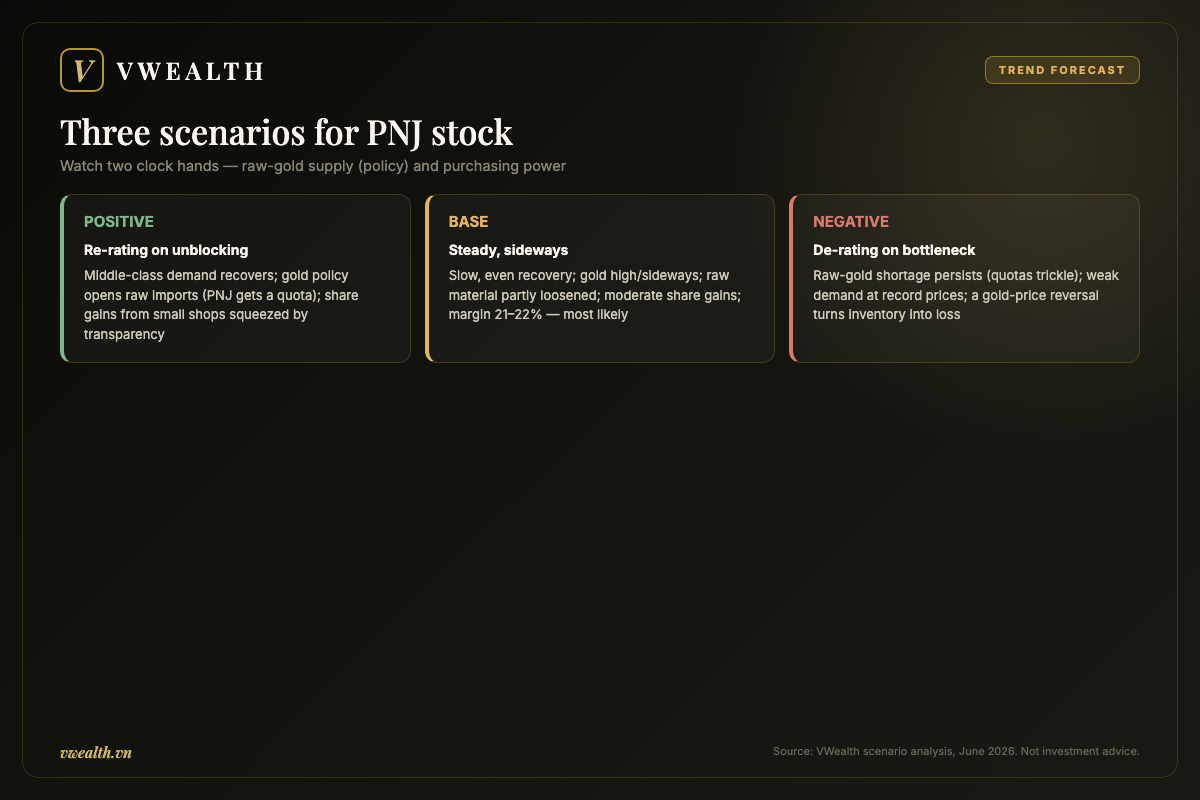
Should you buy PNJ stock?
By here you have enough data to weigh for yourself. This section doesn’t issue a “buy” or “sell” verdict — that decision is yours and depends on your risk appetite, goals and portfolio. An analyst’s job is to put both sides of the scale clearly so you can tip it yourself.
What’s truly attractive about PNJ
- Undisputed number-one position. PNJ holds about 55% of the branded jewelry share, far ahead of every rival. In an industry where the brand is the barrier, this leading position is hard to dethrone.
- Record profit and improved margin. 2025 after-tax profit reached 2,829 billion dong, up 33.9%, with gross margin around 22%. This is evidence the business regulates its product mix well right in a year of violent gold-price swings.
- Long-term share-gain room. The market is still fragmented with thousands of small shops; the trend toward brands plus the gold-transparency policy creates a “runway” for PNJ to keep expanding its slice.
- Cheap valuation on quality. A P/E of 8–9x is low for an industry leader with high ROE and growing profit. If the growth theses hold, this is an attractive valuation.
- Steady dividends and financial health. PNJ maintains a stable dividend-payment history, giving shareholders cash flow alongside price-appreciation expectation.
Risks you’re not allowed to overlook
- Dependence on tightened raw-gold supply. This is the biggest risk. The crafting capability — where PNJ earns high margins — depends directly on being allocated a raw-material import quota. The new licensing mechanism is an opportunity, but also a point of uncertainty: if deployed slowly, the bottleneck remains.
- Purchasing power sensitive to high gold prices. Gold anchoring at record highs makes jewelry expensive; industry crafting output already fell 19% in 2025, gold demand in Vietnam fell 24%. If this trend persists, PNJ’s high-margin segment faces pressure.
- Inventory risk when gold prices reverse. The large gold inventory is an advantage when prices rise, but becomes a burden if gold prices fall sharply, creating revaluation losses.
- Store growth has limits. Opening 25 more stores/year to nearly 500 by 2027 is good, but prime locations are finite; growth via new points will slow, forcing PNJ to rely more on per-store productivity.
- Competition. DOJI, Bao Tin Minh Chau, Diamond World and international brands like Pandora all want their share of the premium segment.
Which kind of investor does PNJ suit?
To position yourself, look through the four common investor types and see where PNJ falls:
| Investor type | What they seek | Does PNJ fit? |
|---|---|---|
| Deep-value investor | Abnormally cheap stocks, buying below asset value | Not really — PNJ is relatively cheap but a quality business, not a “cigar butt” |
| High-growth investor | Explosive growth, accepting expensive valuation | Partly — PNJ grows well but it’s durable retail growth, not tech-style skyrocketing |
| GARP investor (growth at a reasonable price) | Good business, steady growth, bought at reasonable valuation | Very suitable — this is the typical portrait of PNJ |
| Income investor | High, stable dividends, low volatility | Partly — steady dividends but the share price swings with gold prices/purchasing power |
As the table shows, PNJ is a stock typical for GARP-school investors — growth at a reasonable price — in retail. It suits those who believe in Vietnam’s long-term structural story: an expanding middle class, consumers shifting to branded jewelry, policy clearing out the small-player field for the leader. If you believe that story and can accept short-term swings with gold prices and purchasing power, PNJ is a candidate worth studying carefully.
Conversely, if you need an absolutely defensive stock, unable to bear quarters where weak purchasing power or a gold-price reversal rocks the results, then PNJ’s sensitivity to the gold variable may keep you up at night. The decision lies in where you place yourself on that risk spectrum.
Closing words
PNJ’s story, condensed, is the story of a quality leader in an industry with much room, trading at a not-expensive valuation, but tightly bound to two variables it doesn’t fully control: gold-supply policy and consumer purchasing power against record gold prices. The competitive advantage is clear; the risks are real and shouldn’t be taken lightly. Your job is to weigh both sides of that scale by your own appetite and goals.
Disclaimer: This article is produced for analysis and informational purposes, and is not a recommendation to buy, sell or hold any security. The figures and assessments are based on data at the time of writing and may change. The stock market always carries risk; share prices can rise or fall. You should research carefully and/or consult a licensed financial advisor before making an investment decision. Every decision and investment risk is your own.
Research Vietnamese stocks in English with vwealth. Our AI-powered platform turns Vietnamese market data into full English analysis reports — with international payment support and a free 2-month trial for new accounts. Create your free account and read the latest reports.