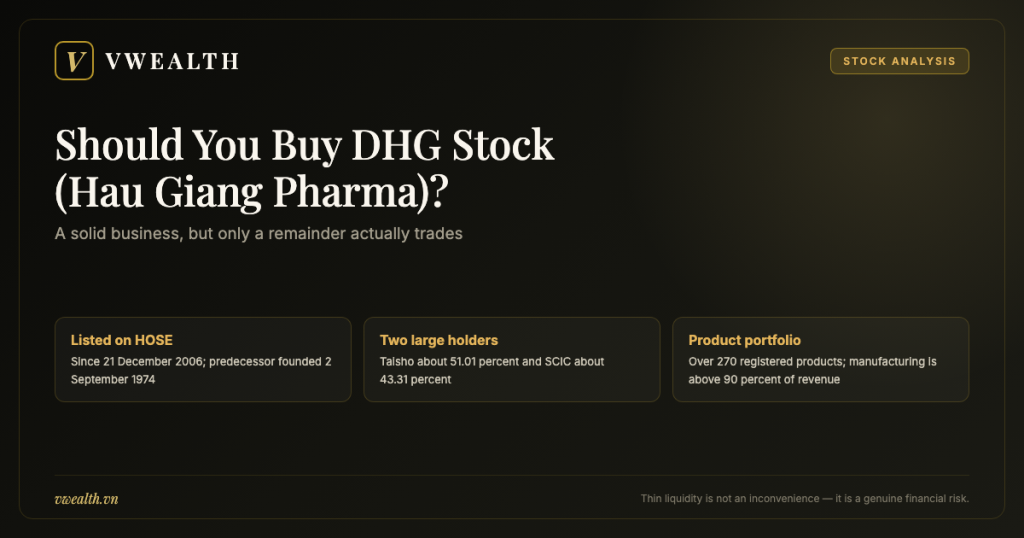
Should you buy DHG stock — the Ho Chi Minh Stock Exchange listing of DHG Pharmaceutical Joint Stock Company, known in Vietnam as Duoc Hau Giang — is a question that has to open with a warning rather than a compliment. The company’s two largest shareholders control more than ninety-four percent of the charter capital: Japan’s Taisho Pharmaceutical holds roughly 51.01 percent and the State Capital Investment Corporation holds roughly 43.31 percent. What genuinely floats on the market is somewhere around five to six percent of the shares. The consequence is that DHG’s daily traded value is very thin relative to a company of its market capitalisation, and if you plan to buy a meaningful position and sell it within days, the market may simply have no room for you. That is the first risk you must accept before hearing anything good about the business. This analysis walks from a pharmaceutical works founded in 1974 to Vietnam’s leading domestic drugmaker, explains how to read a generic pharmaceutical company’s accounts — something few retail investors are ever taught — and closes with a straight answer about which kind of investor DHG suits, and which kind it does not.
Before we start, a ground rule that applies to every company analysis in this series. You will encounter dates, names, brand names and scale figures, all drawn from public disclosure: company profiles on financial data portals, statements from the company itself, and mainstream financial media. What you will not find here is the latest quarter’s financials or today’s valuation multiples. Pharmaceutical margins move with sales channel mix and with the outcome of individual hospital tenders, so this article teaches you where to look and how to read it, and points you to the current research reports on vwealth for live numbers.
One more ground rule. This is the first article in the series to cover a pharmaceutical company, so it pauses to explain the industry basics — how generic drugs differ from originator drugs, how the hospital channel differs from the pharmacy channel, and how manufacturing standards determine what you are allowed to bid for. If you already know the sector, skim those passages. If you do not, they are the most important part of understanding why two drugmakers with identical revenue can be worth very different amounts. Readers new to this market should also start with our guide on how to invest in the Vietnam stock market.
From a 1974 pharmaceutical works to Vietnam’s leading domestic drugmaker
There is a detail in DHG’s history that few investors notice: this company was not born in Can Tho, and it was not born in peacetime. Its predecessor was the 2/9 Pharmaceutical Works, established on 2 September 1974, before national reunification. The name 2/9 came from the founding date, and it stayed with the enterprise through its early decades.
A wartime pharmaceutical works and its Mekong Delta roots
Pause on that origin, because it explains a characteristic that persists today: DHG is a distinctly Mekong Delta company, headquartered in Can Tho rather than Hanoi or Ho Chi Minh City.
That sounds like an inconsequential geographic detail, but it created an advantage competitors find hard to replicate. The company grew by selling medicine to people across the western provinces, through small pharmacies in district towns, market towns and rural centres — precisely the places where a drugmaker headquartered in a major city would need years and a great deal of money to build relationships. That distribution network eventually became the company’s most valuable asset, no less important than its factories.
Keep this idea in mind throughout the article: for a generic drugmaker, the hard part is not manufacturing the tablet. The hard part is getting that tablet onto the counter of a pharmacy in a remote district and persuading the person behind it to recommend yours instead of ten equivalent alternatives.
2004: equitisation with charter capital of 80 billion dong
In 2004 the enterprise converted into a joint stock company with initial charter capital of 80 billion dong.
That 80 billion dong figure is worth remembering, because it is the benchmark for everything that followed. Charter capital today corresponds to more than 130 million shares outstanding, meaning the capital base has multiplied many times over since equitisation — largely through bonus share issues and capitalisation of owners’ equity rather than by repeatedly asking shareholders for fresh cash.
This is a qualitative signal worth noting. A company that grows its capital base mainly out of retained earnings is a company that funds itself. A company that must repeatedly issue new shares for cash is one whose growth is purchased with shareholders’ money. Our piece on corporate governance in Vietnam covers how to spot the difference in filings, and it applies cleanly here.
21 December 2006: DHG lists on HOSE
DHG shares were formally listed on the Ho Chi Minh Stock Exchange on 21 December 2006.
This was the period of Vietnam’s first stock market boom, and DHG was among the earlier domestic manufacturers to reach the exchange. For years afterwards the ticker served as a textbook example of the defensive cohort: revenue largely insulated from the economic cycle, because illness does not follow business seasons; steady cash dividends; and management that never wandered into unrelated industries.
If that defensive quality interests you, our overview of Vietnamese consumer sector stocks offers a comparison framework across industries with inelastic demand, and pharmaceuticals sit at the most defensive end of that spectrum.
The turning point: when a Japanese group took control
If one event changed the nature of this company, it was Taisho Pharmaceutical becoming the controlling shareholder with roughly 51.01 percent of charter capital.
To grasp what that number means, you need a legal detail specific to the Vietnamese market: foreign investors may not own more than a set proportion of a listed company, known as the foreign ownership limit or foreign room. In many sectors the default ceiling is 49 percent. A foreign shareholder can only cross the halfway mark once the company has gone through the process of raising that ceiling. In other words, Taisho holding more than half the capital was not the result of quiet accumulation on the exchange — it was the outcome of a deliberate process with the agreement of the parties involved. Our explainer on Vietnam foreign ownership limits covers the mechanism and how to check available room for any ticker.
Who is Taisho? It is a Japanese pharmaceutical company established in 1912, internationally known for over-the-counter brands including the Lipovitan-D energy drink and the Pabron cold remedy line, among many other consumer health products. According to the most recent figures published in international sources, the group employed roughly six thousand three hundred people on a consolidated basis and generated revenue in the hundreds of billions of yen. In 2019 it completed the acquisition of UPSA, a French pharmaceutical manufacturer. And one detail that matters a great deal to DHG shareholders: Taisho itself delisted from the Tokyo Stock Exchange following a management buyout, meaning DHG’s parent is no longer a publicly listed company in Japan.
That last point is not trivial. When a parent is publicly listed, it faces disclosure obligations and pressure from its own shareholders, and that indirectly imposes discipline throughout the group. When the parent has gone private, its decision horizon can be longer and more patient, but it is also less scrutinised. That is a qualitative change in the governance environment that DHG’s minority shareholders now live inside.
The state shareholder stayed: an unusual structure
What makes DHG’s ownership genuinely unusual is that alongside a controlling foreign shareholder, the State Capital Investment Corporation still holds roughly 43.31 percent.
Very few Vietnamese listed companies have two large shareholders at near-balanced weights, one a foreign industrial group and the other the state capital manager. This structure creates a distinctive equilibrium: neither party can single-handedly pass matters requiring a high voting threshold, and every significant decision requires coordination.
For minority holders, that balance is both a support and a constraint, and chapter two examines it closely. For now, note the simple arithmetic: 51.01 percent plus 43.31 percent equals 94.32 percent. What remains for every other investor in the market is a remainder.
What the company actually makes today
Before moving on from history, it is worth pausing on what this business physically produces, because abstractions about the pharmaceutical sector obscure how ordinary the products are.
DHG’s registered portfolio exceeds 270 products, and the commercially important ones sit in categories any Vietnamese household recognises. Hapacol is the analgesic and antipyretic line, the medicine most people reach for when a child runs a fever. Telfor sits in the antihistamine category for allergies. Bocalex covers vitamins. Alongside these are health supplement products including Natto DHA and Biofermin.
Notice what these have in common. They are not specialty hospital medicines administered under supervision. They are everyday products bought over a counter, often without a prescription, frequently by the same household repeatedly over decades. That is the profile of a branded consumer business more than a science business, and it explains why the company’s marketing spend and distribution reach matter as much as its laboratories.
Manufacturing capacity is described in the billions of product units per year, which sounds abstract until you translate it: a country of roughly a hundred million people, each buying a handful of tablets several times a year, adds up to volumes measured in billions of units. The company is sized to serve a national market, and its scale advantage over the hundreds of small domestic manufacturers is exactly that.
One more structural fact worth carrying forward: self-manufactured goods account for over ninety percent of revenue, with the remainder from distributing third-party products. That ratio is a quality marker. A drugmaker with a large trading share in its revenue is partly a logistics business wearing a pharmaceutical label, and its margins reflect that.
The milestone table
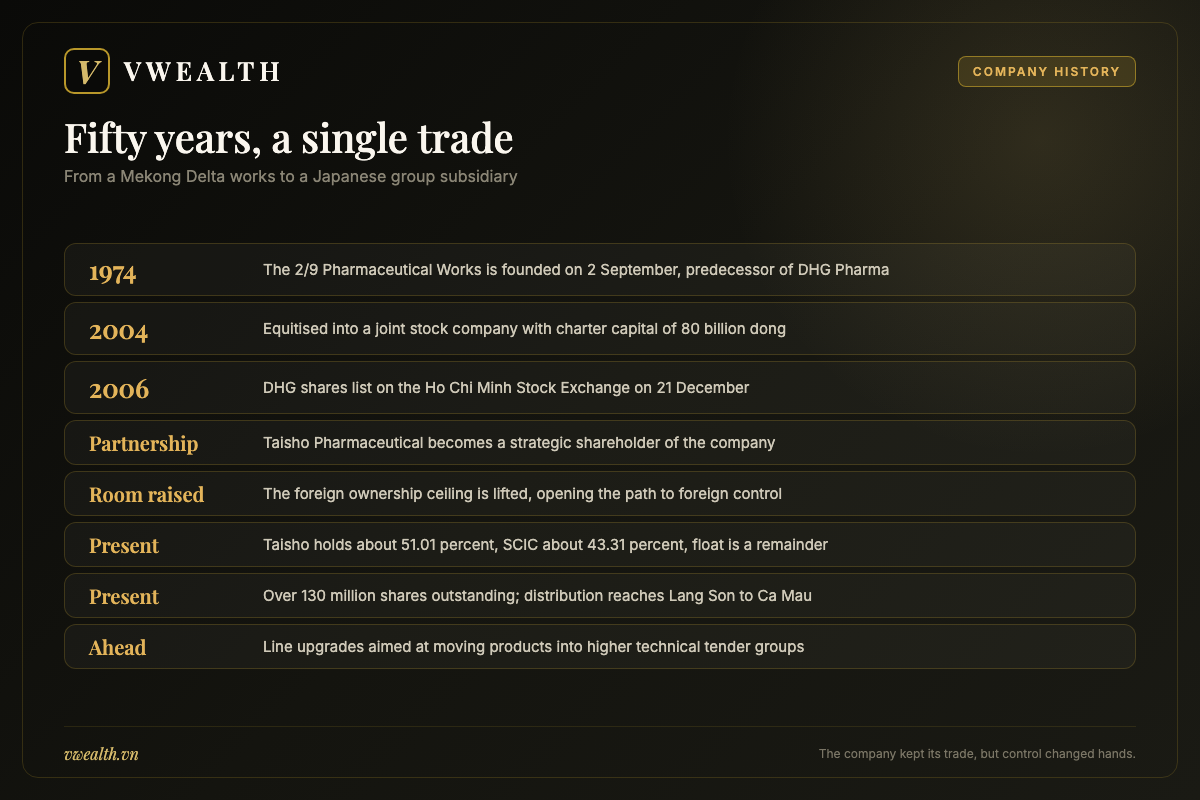
| Date | Event | Why it matters to an investor today |
|---|---|---|
| 2 September 1974 | 2/9 Pharmaceutical Works founded, predecessor of DHG Pharma | Mekong Delta roots and a rural distribution network |
| 2004 | Converted to a joint stock company with 80 billion dong charter capital | Benchmark for the whole subsequent capital growth story |
| 21 December 2006 | DHG shares listed on HOSE | Entry into the market’s defensive cohort |
| Strategic partnership period | Taisho Pharmaceutical becomes a strategic then controlling shareholder | Changes governance and long-term product direction |
| After the foreign ceiling was raised | Taisho reaches roughly 51.01 percent of charter capital | Decision-making power passes to the foreign holder |
| Present | SCIC retains roughly 43.31 percent, free float remains very thin | Liquidity is a permanent risk for smaller investors |
| Present | More than 130 million shares outstanding | Capital base multiplied many times since 2004 |
| Present | Over 270 registered products, distribution reaching from Lang Son to Ca Mau | Portfolio breadth and distribution depth are the two pillars |
Read the table vertically and you see a trajectory unlike most Vietnamese listed companies. This is not a story about an entrepreneur building a business then expanding into many industries. It is the story of a former state enterprise that was equitised, kept its trade, and gradually passed into the hands of a foreign group in the same industry — and through all of it, kept doing exactly one thing: making and selling medicine.
Two shareholders hold 94 percent: the minority investor’s core problem
At most listed companies the ownership chapter is the dullest part of the analysis. At DHG it is the opposite: this chapter determines everything else. If you only have time for one chapter, read this one.
The ownership picture and a subtraction
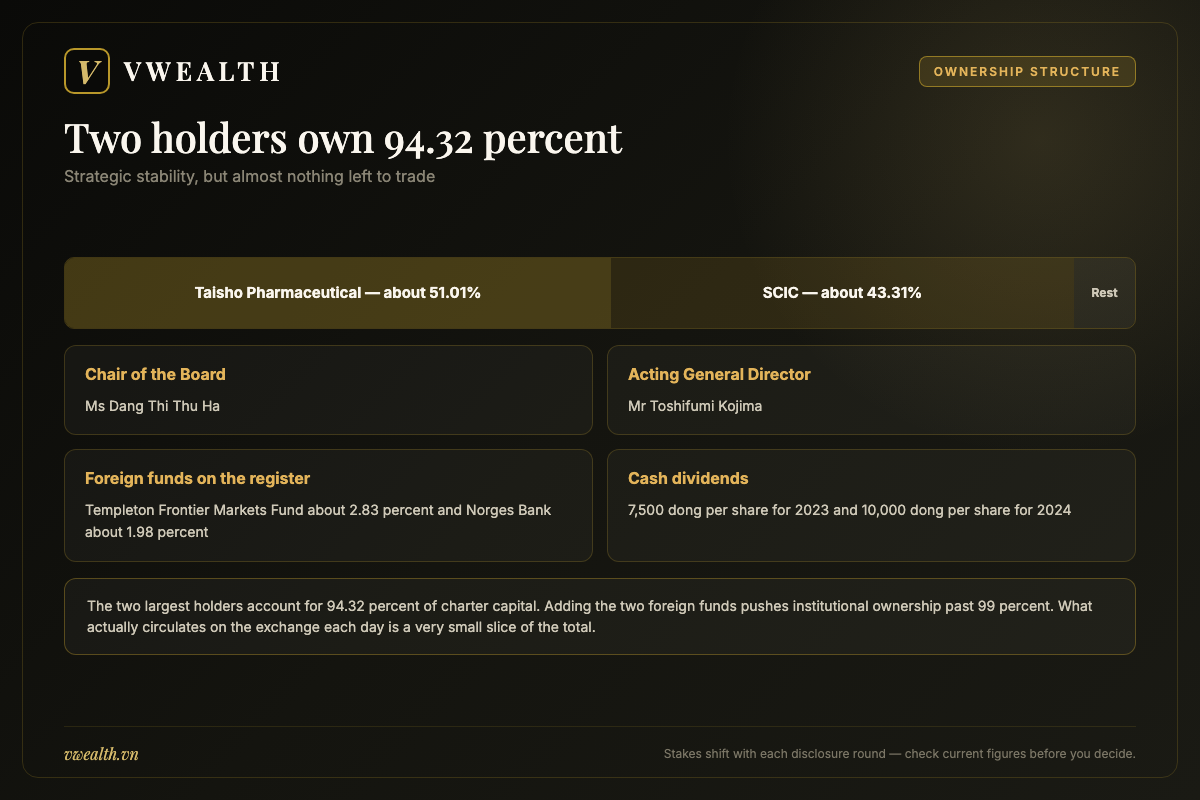
Taisho Pharmaceutical holds roughly 51.01 percent of charter capital, corresponding to about 66.7 million shares. The State Capital Investment Corporation, universally abbreviated SCIC, holds roughly 43.31 percent, about 56.6 million shares. The register of substantial holders also includes foreign funds such as Templeton Frontier Markets Fund at around 2.83 percent and Norges Bank at around 1.98 percent.
Now do the subtraction. Total shares outstanding exceed 130 million. The two largest holders account for 94.32 percent. Add the two foreign funds and institutional ownership passes 99 percent. What actually circulates on the exchange each day is a very small slice of the total.
This is not a technicality. It is the living condition you accept if you buy this ticker, and it colours everything else: the price can be pushed up or pulled down by orders that are not large, matched volume per session is small, and exiting a position within a single day becomes practically impossible once your size passes a modest threshold. Vietnam’s market microstructure adds further constraints — daily price bands and settlement timing — covered in our guide to Vietnamese trading hours and price bands.
Why a thin float is more dangerous than it sounds
Many investors hear the phrase low liquidity, nod, and move on, thinking that a small position makes it irrelevant. Consider three concrete situations instead.
Situation one: you need cash urgently. Nobody plans for this, but it happens. With a liquid ticker you place a sell order and fill within minutes near the market price. With a name like DHG, you may have to walk the price down several ticks to complete your sale, and that shortfall is a real cost, not a theoretical risk.
Situation two: unexpected bad news. When natural buying interest is already thin, an unfavourable announcement can empty the bid side entirely. The price falls much harder than the news itself justifies, because nothing is there to catch it.
Situation three, which few people consider: good news also causes trouble. On a favourable announcement the price can run rapidly because there is no stock offered, and whoever buys at that moment easily pays well above fair value. A thin float widens the band of mispricing in both directions.
The practical rule: with a thinly floated name, size your position against average daily traded value rather than against how much you like the business. That is a hard discipline, and it separates experienced investors from newer ones.
Management: a structure that mirrors the ownership
The Chair of the Board is Ms Dang Thi Thu Ha. The Acting General Director is Mr Toshifumi Kojima. The Board includes Mr Jun Kuroda. The executive team includes deputy general directors Ms Nguyen Ngoc Diep, Mr Tomoyuki Kawata and Mr Osamu Fujimori. The Production Director is Mr Nguyen Ngoc Chuong.
Reading that list, you immediately see what the ownership table predicted: the executive team blends Vietnamese managers with executives seconded by the Japanese strategic shareholder, with Japanese nationals occupying the top executive role and key positions covering production, quality and finance.
This is the classic governance model where a foreign group acquires control of a domestic company in the same industry. The implications for shareholders have two clear sides.
The positive side: the company gains access to the quality management standards, manufacturing processes and product development experience of a group that has operated for more than a century. In pharmaceuticals, where factory standards directly determine which market segment you are permitted to sell into, that transfer has measurable economic value rather than being a matter of prestige.
The side requiring care: when the controlling shareholder is a foreign group in the same industry, decisions about product portfolio, export markets and where the subsidiary is allowed to compete all sit inside the parent’s overall calculus. A subsidiary is usually positioned within the parent’s value chain, and that positioning is not necessarily the one that maximises profit for the subsidiary alone. Watching related party transactions is the practical way to monitor this risk, because that is where it eventually shows up as numbers.
The state shareholder: anchor or obstacle?
SCIC is the body charged with managing state capital in equitised enterprises. Its retention of more than forty percent of DHG produces several concrete consequences.
First, it is a genuine counterweight. At that level, the state shareholder can block matters requiring a high approval threshold at the general meeting. The controlling foreign shareholder cannot simply do as it pleases.
Second, the presence of state capital usually correlates with a preference for cash dividends, because the state holding needs to produce a revenue stream. This is why companies with large state stakes tend to maintain steadier distribution policies than the market average. Our overview of Vietnamese state-owned enterprises describes this pattern across the market.
Third, and this is the most important unknown: SCIC operates divestment programmes approved for successive periods. If and when this holding is transferred, DHG’s ownership structure changes fundamentally. Who the buyer would be, at what price, and what happens to liquidity afterwards are all large variables that nobody can forecast with confidence. Investors should treat this as something to monitor through official disclosure rather than as a story to bet on. A comparable case where a foreign strategic shareholder took control of a Vietnamese market leader is described in our analysis of SAB, Sabeco.
Dividends: the main reason many holders stay
DHG’s distribution policy is the clearest bright spot in the investment case.
The company has maintained a tradition of regular cash dividends for many years, paying 7,500 dong per share for the 2023 financial year and 10,000 dong per share for 2024, the latter in two instalments.
Note how those figures are expressed: dong per share, not a percentage of par value. For a company whose market price is several times par value, converting dividends into a percentage of par produces impressive-sounding numbers that convey nothing useful. What you want is the dividend yield: annual cash dividend divided by the price you actually pay. That is the figure comparable with deposit rates and with other investment options.
Worth noting is that the payout has trended upward in recent years. For a company that does not require heavy expansion capital expenditure, generates stable operating cash flow, and has two large shareholders who both want cash, a strong dividend policy is the logical outcome of the structure rather than momentary generosity. If you are building a portfolio along these lines, our overview of Vietnam dividend stocks is a sensible starting point.
What the two-shareholder balance means in practice
The near-balanced split between a controlling foreign group and a large state holder is unusual enough to deserve a closer look at how it actually plays out.
In ordinary business, the majority holder prevails. Appointing executives, approving the annual plan, setting the business direction — these follow the controlling stake. So in day-to-day terms, the company is run according to the parent group’s judgment.
In extraordinary business, the picture changes. Matters such as amending the charter, restructuring the company, or approving certain major transactions typically require a supermajority under Vietnamese company law and the company’s own charter. At those thresholds, a holder with more than forty percent has an effective veto. That is why the state holding functions as a real constraint rather than a passive stake.
For minority shareholders this produces a particular kind of protection. You are not relying on your own votes, which are numerically irrelevant. You are relying on the fact that two large parties with partially different objectives must agree before anything structural happens. Deadlock is uncomfortable for the company but is a form of shelter for small holders, because it makes value-transferring actions harder to execute.
The corollary is that if the state holding is ever sold, that shelter disappears. Whoever buys it may align entirely with the existing controlling shareholder, in which case the balance ends. This is the strongest reason to treat any disclosure about divestment as material information rather than as a trading rumour, and to read it carefully when it appears.
Ownership table and its consequences
| Shareholder | Indicative stake | What you should infer |
|---|---|---|
| Taisho Pharmaceutical | About 51.01% | Control, appoints executives, sets long-term product direction |
| SCIC, the state capital manager | About 43.31% | Voting counterweight, favours cash dividends, divestment unknown |
| Templeton Frontier Markets Fund | About 2.83% | Frontier markets fund |
| Norges Bank | About 1.98% | Sovereign fund holding through a broad mandate |
| All other holders | Remainder | Very thin free float, low daily liquidity |
This table explains almost the entire trading personality of DHG. You are not buying a freely floating security; you are buying a small residual slice of a company whose control has already been divided between two large parties.
How DHG makes money: generics, two channels and a network
This is the most important chapter technically. Pharmaceuticals run on a specific rulebook, and if you apply ordinary consumer goods logic to a drugmaker you will misvalue it systematically.
Originator drugs and generics: the root distinction
Start with the most basic concept.
A new drug is invented by a large pharmaceutical company after years of research and multiple rounds of expensive clinical trials. To compensate for that investment, the company receives a patent granting exclusive sales for a defined period. During exclusivity, prices are high and margins are enormous.
When the patent expires, other companies may manufacture products with the same active ingredient, the same strength and the same dosage form. Those are generics. Having avoided the original research cost, generics sell far more cheaply, and competition shifts from innovation to manufacturing cost, quality and distribution.
DHG Pharma is a generic manufacturer. What does that mean for an investor? It means you should not expect a profit leap from the company inventing a new molecule. But you also avoid the terrifying risk of the innovator business, where a company can pour billions into a compound and fail at the final trial stage. The economics of a generic maker sit closer to those of a branded consumer goods company than to those of a biotechnology firm.
Two sales channels and why you must separate them
Medicine reaches patients in Vietnam by two very different routes, and every pharmaceutical analysis must begin by separating them.
The first is the hospital channel, commonly called ETC, covering prescription medicines supplied through healthcare facilities. Here the company’s real customer is not the patient but the hospital, and the sales mechanism is tendering. Hospitals run drug procurement tenders under regulation, companies submit bids, and price decides the outcome among products within the same technical group. This channel offers large volumes and large contracts but thin margins that depend on each tender round.
The second is the pharmacy channel, commonly called OTC, covering medicines sold over the counter. Here the customer is the consumer and the seller is the pharmacist behind the counter. Competition runs on brand, on consumer awareness, and above all on relationships with the pharmacy network. Margins in this channel are typically better than in hospitals, but it demands continuous investment in brand and in field sales staff.
DHG’s traditional strength is the pharmacy channel, with brands familiar to Vietnamese consumers such as Hapacol in the analgesic and antipyretic category, Telfor in antihistamines, Bocalex in vitamins, and health supplement products such as Natto DHA and Biofermin. This is a major difference between DHG and drugmakers that live mainly on hospital tenders.
The analytical principle: when reading a pharmaceutical company’s report, the first task is to find the revenue split by channel. Two companies with identical revenue but different channel mixes will have entirely different margins, stability and appropriate valuations.
The distribution network: the hardest asset to copy
If you had to name DHG’s most durable competitive advantage, it would not be the factory and it would not be a formulation — it would be the distribution network.
The company operates a nationwide branch network described as reaching from Lang Son in the far north to Ca Mau at the southern tip, covering urban and rural markets alike. The number of distribution branches disclosed publicly runs to several dozen across the country.
Understand why this is valuable. Vietnam has tens of thousands of pharmacies, most of them small shops run by individual pharmacists, scattered across towns and residential areas. To sell there, you need a field force that visits each counter, introduces products, delivers, collects payment, handles returns and maintains relationships. Building that network takes years and a great deal of money, and once it exists, a newcomer finds it very hard to break in.
This is precisely why a foreign pharmaceutical group chooses to buy control of a domestic company rather than build from scratch. Factories can be built. Formulations can be licensed. But relationships with tens of thousands of pharmacy counters spread across a country cannot be acquired quickly by any route other than buying the company that already has them.
Manufacturing: scale and portfolio breadth
On manufacturing capability, the company is described as having capacity in the billions of product units annually and a portfolio of more than 270 registered products. Manufacturing contributes over ninety percent of annual revenue, with the remainder coming from trading and distributing third-party products.
The high manufacturing share is a positive worth noting. Revenue from self-manufactured goods carries far better margins than revenue from distributing someone else’s products. A pharmaceutical company with a large trading share in revenue may look substantial but is effectively in the logistics and reselling business.
On raw materials, the company imports active ingredients from international suppliers, including suppliers in the United States, Italy and Spain. This is characteristic of essentially the entire Vietnamese pharmaceutical industry: domestic fine chemical capacity remains small, so most active ingredients must be imported. The direct implication for investors is that input costs are exposed to exchange rates and global raw material prices, while selling prices in the hospital channel are constrained by tender outcomes. Our piece on Vietnamese dong currency risk describes that transmission mechanism, and pharmaceuticals are among the most exposed sectors.
Factory standards: what determines which league you play in
This is the technical point outside investors most often skip, and it directly determines margins.
A pharmaceutical plant must meet good manufacturing practice standards, internationally abbreviated GMP. But GMP is not a single level. Several standards exist with different degrees of stringency, ranging from the World Health Organisation standard through to the standards of drug regulators in Europe, Japan and other reference countries.
Why does this matter? Because under the rules governing drug tenders at public healthcare facilities, medicines are sorted into technical groups, and the highest group is reserved for products made on lines certified to the most demanding regulators’ standards. A product in a high technical group competes only against others in the same group, meaning against far fewer rivals, and therefore commands a better price.
In other words, upgrading a production line to a higher standard is not image spending. It is an investment that opens a market segment with better margins. This has been the investment direction analysts watch at DHG since the Japanese strategic shareholder arrived, and it is where you should look in the annual report: which lines have been upgraded, to what standard, and what share of revenue comes from products in the higher technical groups.
Health supplements: a higher-margin piece with a boundary worth understanding
Alongside medicines, a drugmaker with consumer brands usually carries a health supplement range — vitamins, minerals, probiotics and supportive products. At DHG this category appears through brands familiar on pharmacy shelves.
You need to understand the regulatory boundary between the two, because it shapes both the opportunity and the risk. Medicines must pass a rigorous marketing authorisation process, must demonstrate therapeutic efficacy, and may state therapeutic claims. Health supplements follow a simpler product declaration route, but in exchange may not be advertised as treatments for disease.
Three things matter to investors. First, health supplements typically carry better margins than commodity generics, because competition rests more on brand than on price. Second, barriers to entry in this category are lower, so competitors are numerous and the commercial life of a successful product tends to be shorter than that of a medicine. Third, this category carries greater regulatory risk on advertising, and periodic tightening of advertising enforcement can dent revenue in the short run.
In short, this category raises margins and also raises volatility. When you see a drugmaker’s gross margin improve, check whether the improvement comes from climbing into higher technical drug groups or merely from pushing supplements. Those two causes support very different conclusions about earnings quality.
Why brand matters in an industry that looks purely scientific
There is a paradox in generic pharmaceuticals that outsiders find puzzling: if two tablets contain the same active ingredient at the same strength in the same form, why would a consumer pay more for a name?
The answer has three layers.
The first layer is trust. With a product you put inside your body, the consumer has no way to verify quality independently. They rely on a name they know, have used repeatedly, and have seen family members use. This is why a familiar antipyretic brand can hold its position for decades.
The second layer is the recommender. In the pharmacy channel, the actual decision maker is usually the pharmacist behind the counter rather than the customer. A product that pharmacists trust and actively recommend has an enormous advantage over one that merely sits on the shelf. Earning that trust requires time, consistent quality and a diligent field force.
The third layer is prescribing habit. In hospitals, doctors develop habits around products they have used and found safe. Those habits are very hard to shift with a price cut.
Together these layers create a soft but durable moat, and they are why a branded generic maker is valued more highly than a pure contract manufacturer.
Where the moat is strong and where it is thin
It is worth being precise about competitive advantage, because vague talk of a moat has misled a great many investors.
DHG’s moat is strong in three specific places. It is strong in the small independent pharmacy channel, where relationships built over decades and a field force covering the country are extremely hard to replicate. It is strong in a handful of consumer brands where repeat purchase and pharmacist recommendation have compounded over many years. And it is strong in scale of manufacture, which lets the company spread fixed costs across volumes that hundreds of small domestic competitors cannot approach.
The moat is thin in three equally specific places. It is thin in commodity generics, where any adequately equipped manufacturer can produce an equivalent tablet and compete purely on price. It is thin in the hospital channel, where relationships matter far less than technical group classification and bid price. And it is thin against modern pharmacy chains, whose scale gives them the leverage to compress supplier margins and to substitute private label products.
Understanding this asymmetry changes how you read company news. An announcement about winning share in independent pharmacies reinforces the strong part of the moat. An announcement about volume growth in commodity products reinforces nothing much at all. And an announcement about a distribution agreement with a large chain is genuinely ambiguous: it grows revenue while shifting bargaining power away from the manufacturer.
The strategic question facing the company over the next decade is whether the strong parts of the moat can be extended — through higher technical group products and stronger brands — faster than the thin parts are eroded by consolidation and price competition. Nothing in the current disclosure answers that question definitively. It is the thing to watch.
Anatomy of the business model
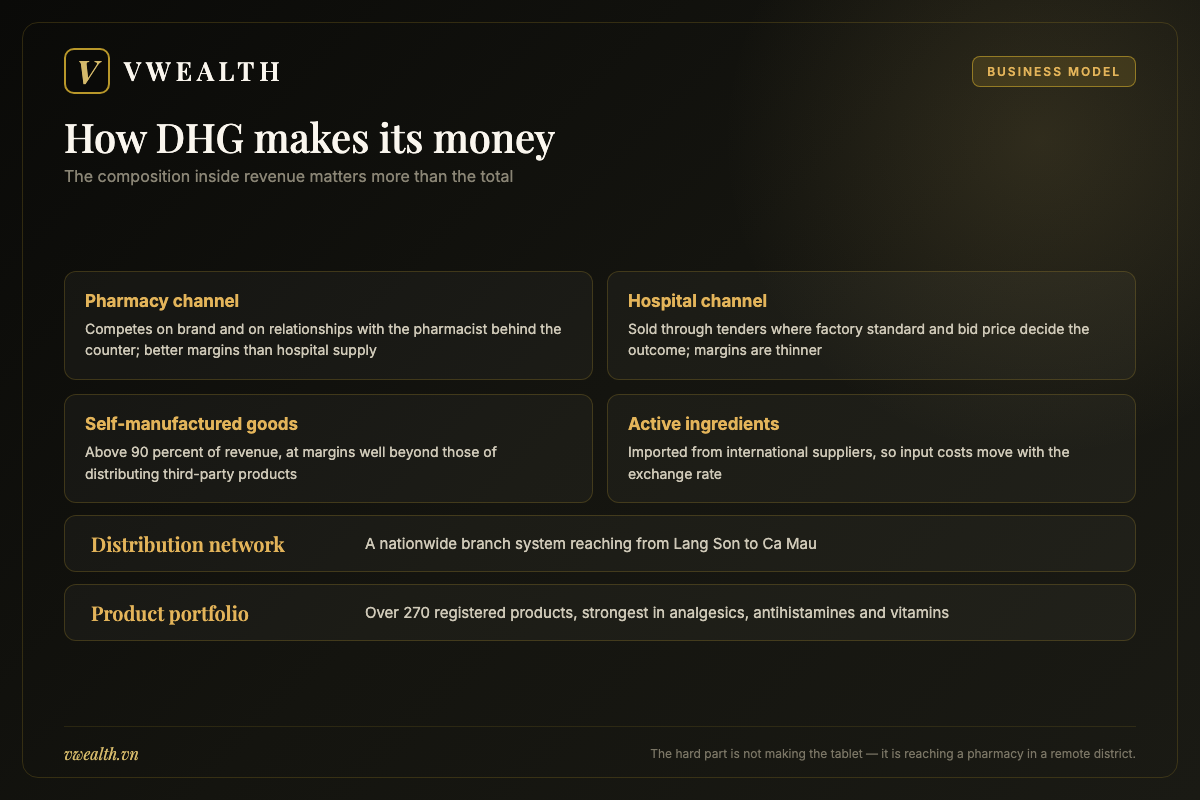
| Component | Nature | Margin | What decides success |
|---|---|---|---|
| Pharmacy channel (OTC) | Over-the-counter medicines and supplements sold through pharmacies | Better than hospital channel | Brand, distribution reach, pharmacist relationships |
| Hospital channel (ETC) | Supply to healthcare facilities through tenders | Thinner, tender dependent | Factory standard and bid price |
| Self-manufactured goods | Over 90 percent of revenue | Materially higher than traded goods | Plant efficiency and raw material cost |
| Traded goods | Distribution of third-party products | Very thin | Network scale, adds little value |
| Active ingredients | Imported from international suppliers | A cost, not revenue | Exchange rates and global raw material prices |
| Distribution network | Nationwide branch system | A fixed cost and also the moat | Outlet density and field force productivity |
Read that table and you understand why two drugmakers with identical revenue can differ enormously in profit. The composition inside revenue matters more than total revenue, and that is truer in pharmaceuticals than in most industries.
Financial position: seven things to check in a pharmaceutical company
This chapter does not hand you last quarter’s figures. It hands you a reading routine you can repeat every quarter and every year. When you finish, open the research reports on vwealth and score the seven items below against current data.
Item one: revenue split by sales channel
Always start here. The proportion of revenue from the pharmacy channel versus the hospital channel is the single highest-value piece of information in a drugmaker’s report.
Why? Because the two channels carry meaningfully different margins and different stability. Pharmacy revenue is tied to brand and consumer habit, so it is steadier. Hospital revenue is tied to tender outcomes, so it can step-change: winning a large tender lifts revenue sharply, losing it creates an immediate hole.
When you see total revenue rise, the next question must be which channel rose. Growth in the pharmacy channel is high-quality growth. Growth in the hospital channel driven by one large tender is growth whose repeatability deserves a question mark.
Item two: gross margin and product mix
A generic maker’s gross margin is the product of three forces: selling price, raw material cost and product mix.
The point to watch is that gross margin can rise without the company becoming any better at its job, simply because higher-margin products gained share within the sales basket. Conversely, a falling gross margin is not necessarily bad news if the cause is a push into a new lower-margin but larger-volume line.
The correct reading combines gross margin with the revenue composition note, and looks across many quarters rather than concluding from a single period.
Item three: selling expenses as a share of revenue
This ratio is especially important for a company strong in the pharmacy channel, and it is also the most commonly misread.
A drugmaker’s selling expenses cover salaries and commissions for the field force, brand advertising, pharmacy programme costs and the cost of running the distribution system. At a company with genuine consumer brands, this line is large and cannot simply be cut.
The crucial thing to understand is that selling expense here is closer to investment than to pure operating overhead. Cutting marketing spend for one year makes that year’s profit look better, but it gradually erodes brand position and pharmacy relationships — and the damage surfaces in revenue several years later. When profit rises because selling expenses were cut sharply, ask a question rather than applaud.
Item four: inventory and days inventory outstanding
Pharmaceuticals have a characteristic few industries share: products expire, and expired stock must be destroyed rather than discounted the way unsold clothing is.
Inventory at a drugmaker therefore deserves closer attention than usual. An unusual lengthening of days inventory outstanding signals either that products are selling more slowly than planned, or that the company is stockpiling raw materials in anticipation of price rises. Those two causes lead to opposite conclusions, so you must read the notes to see whether the increase sits in raw materials or in finished goods.
Also watch the inventory write-down provision. A sudden increase there usually signals a batch with either sales or shelf-life problems.
Item five: receivables and customer quality
This is where the two sales channels show up plainly on the balance sheet.
Selling to pharmacies typically involves short collection cycles and diffuse risk. Selling to hospitals through tenders typically involves longer payment cycles, dependent on the disbursement pace of the healthcare facility and of the health insurance system.
So when the hospital channel’s share of revenue rises, expect days sales outstanding to lengthen too. That is not automatically bad, but it means the same level of profit now comes with a larger working capital requirement. Read the cash flow statement to confirm that reported profit is converting into actual cash.
Item six: cash, borrowings and capital efficiency
Leading domestic drugmakers usually carry very light balance sheets, because the business model does not demand continuous heavy capital expenditure the way steel or power generation does. A plant, once built, can run for years on moderate maintenance spending.
The consequence is that cash accumulates. That is good for safety but raises a capital efficiency question: bank deposits earn far less than the return on equity the core business generates.
At DHG, the concentrated ownership structure gives this question a relatively clear answer: both large shareholders have an incentive to receive cash, so surplus tends to be distributed. You should track the payout ratio against net profit across years to confirm the trend continues.
Item seven: line upgrade capital expenditure and high-tier product share
The final item looks forward.
As chapter three explained, factory standards determine which technical group a company can compete in during tenders, and a higher group means fewer rivals and better prices. Capital spending on line upgrades is therefore an early indicator of margins several years out.
Look for three pieces of information in the annual report: which lines are being upgraded, how far the work has progressed, and how the share of revenue from higher technical group products has changed over time. Those three numbers say more about the future than any line in last quarter’s income statement.
A supplementary item: the product registration pipeline
Beyond the seven items above, there is an eighth worth tracking for anyone holding this name for years rather than quarters: the product registration pipeline.
Every medicine sold requires a marketing authorisation, and authorisations have finite terms requiring renewal. At the same time, growth for a generic maker comes largely from registering new products — typically molecules whose patents have recently expired, or new formulations and strengths of existing molecules.
What this means practically is that a drugmaker’s future revenue is partly visible today, in the queue of registration dossiers filed and pending. Companies disclose this at varying levels of detail, but annual reports usually indicate how many new products were launched in the year and how many are in development.
Two patterns are worth distinguishing. A company launching many products but all in crowded commodity categories is generating revenue without improving earnings quality. A company launching fewer products but in categories with fewer competitors, or on newly certified lines, is doing something more valuable even if the immediate revenue contribution looks smaller.
The second pattern is what a strategic shareholder with technology is supposed to enable, and it is the single clearest test of whether the partnership is producing value for minority shareholders or merely changing the nameplate on the boardroom door.
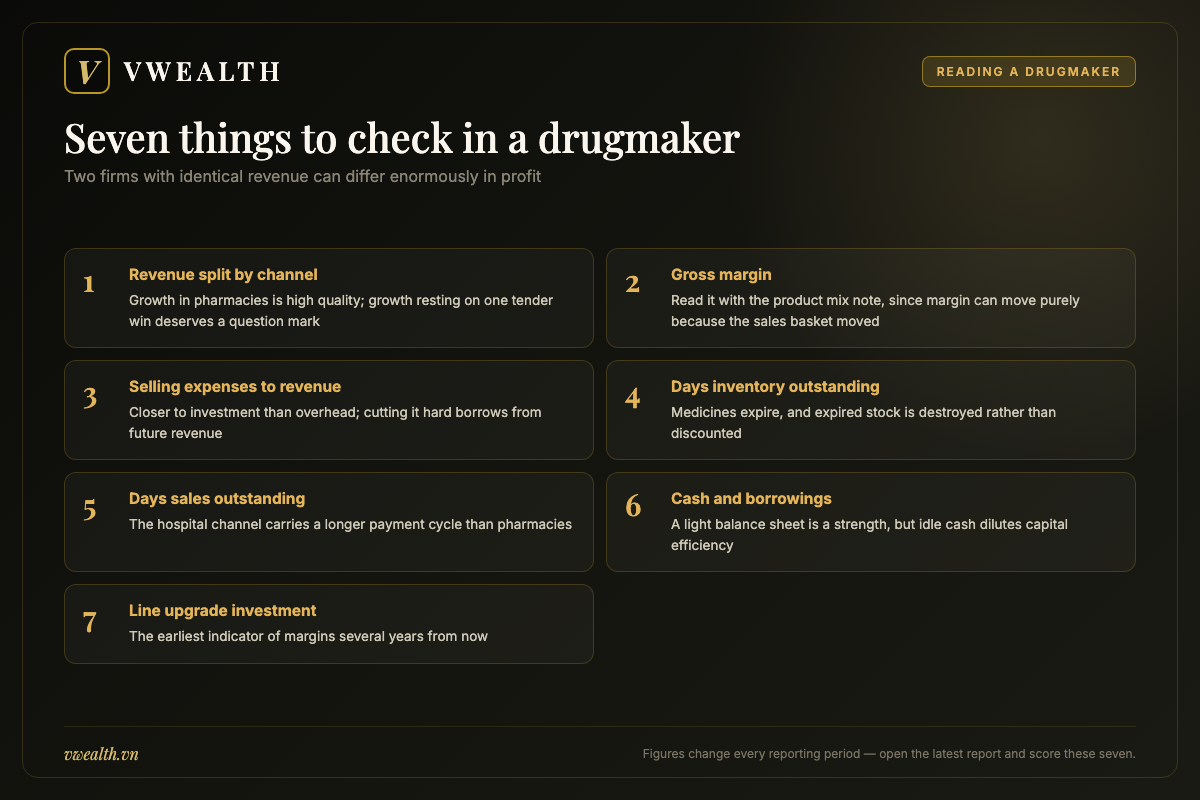
The seven-item scorecard
| Item | Where to find it | Healthy sign | Warning sign |
|---|---|---|---|
| Revenue split by channel | Revenue notes, annual report | Pharmacy channel growing steadily on brand | Growth resting on one large tender win |
| Gross margin | Income statement | Improvement alongside a shift to higher-margin products | Gradual decline across quarters with no explanation |
| Selling expenses to revenue | Income statement | Stable, moving with revenue growth | Sharp cuts used to flatter one year’s profit |
| Days inventory outstanding | Balance sheet and notes | Stable, low write-down provisions | Unusual lengthening in finished goods |
| Days sales outstanding | Balance sheet, cash flow statement | Consistent with the channel mix | Lengthening across several consecutive periods |
| Cash and borrowings | Balance sheet | Low debt, surplus returned to shareholders | Cash accumulating for years with no stated plan |
| Line upgrade investment | Annual report, AGM materials | Clear progress, rising high-tier product share | Plans deferred year after year |
These seven items matter far more than headline revenue.
How the market treats DHG stock
The business is one thing; the stock is another. This chapter covers DHG’s trading personality, which you learn only by observation.
Personality: very slow, very little news, very little discussion
DHG is one of the least discussed tickers on Vietnamese investment forums despite the company being an industry leader. The reason is simple: there is nothing to trade. When more than ninety-four percent of the shares sit motionless in two institutional hands, there is not enough activity to generate a market narrative.
The result is a narrow daily range, slow response to index waves, and a price that generally settles around a dividend yield long-term holders find acceptable.
This has a positive implication rarely mentioned: the stock is largely immune to crowd psychology. For an investor prone to being swept along by price action, holding a low-volatility name can be an advantage in discipline. But that advantage is paid for in liquidity, and the price is not cheap.
Valuation: which yardstick fits a drugmaker
For a pharmaceutical company with consumer brands, common measures such as price to earnings and price to book both work, because earnings are relatively stable and are not distorted by the large one-off items typical of infrastructure businesses.
But three caveats apply.
First, compare against the company’s own valuation history across years, not only against the market average. A company with brands, good margins and reliable dividends usually trades above the market average, and that is rational rather than irrational.
Second, apply a liquidity discount. In developed markets, institutional investors routinely discount hard-to-trade securities, and that is sound practice. A good business you cannot exit deserves a lower price than an equivalent business with deep liquidity.
Third, for a stock held primarily for income, the dividend yield is the most practical measure. Compare it against long-term deposit rates and against other income names, then ask whether the spread adequately compensates for business risk plus liquidity risk. Our broader piece on Vietnamese market valuation sets out how local multiples compare with regional peers.
Foreign investors and available room
DHG is one of the few listed companies whose foreign ownership ceiling has been raised to a level permitting a foreign shareholder to take control. That has two implications.
The first is that in theory the stock remains open to further foreign buying. The presence of funds such as Templeton Frontier Markets Fund and Norges Bank shows the name sits within the field of view of international institutions.
The second is more practical: when the great majority of shares already sit with two strategic holders, remaining headroom on paper generates little actual demand, because there is simply nothing to buy. Our explainer on foreign ownership limits covers how to distinguish theoretical room from shares genuinely available.
DHG against other defensive options
Vietnam’s pharmaceutical sector has few large listed names, so to place DHG it helps to compare against companies with similar defensive characteristics and similar foreign strategic ownership models.
| Ticker | Industry | Ownership structure | Stock characteristics |
|---|---|---|---|
| DHG | Branded generic pharmaceuticals | Controlling foreign holder plus large state holder | Strongly defensive, steady dividends, very thin liquidity |
| VNM | Dairy and nutrition | Large state holder plus many foreign funds | Defensive, deep liquidity, large scale |
| SAB | Alcoholic beverages | Controlling foreign strategic shareholder | Moderately defensive, exposed to consumption policy |
| MCH | Branded fast moving consumer goods | Part of a domestic group ecosystem | Brand-led growth, traded on UPCoM |
| NT2 | Gas-fired power, infrastructure | Controlling state-linked parent | Infrastructure style defence, dividend tracks fuel costs |
The table shows the defensive cohort is not homogeneous. VNM is defensive with abundant liquidity. MCH is brand-led but trades on a different exchange. NT2 is infrastructure-style defence where the risk sits in fuel prices. DHG is its own species: the steadiest demand in the group, and the hardest to trade.
The dividend yield anchor and interest rates
One relationship deserves separate treatment because it explains more of DHG’s price movement than company news does: the link to interest rates.
When a stock is held primarily for its dividend, the market implicitly prices it to a required yield. If deposit rates fall, the yield investors accept from a defensive equity falls with them, and the share price rises even though nothing changed at the company. If deposit rates rise, money leaves income equities for safer alternatives, and the price comes under pressure for reasons entirely unrelated to the business.
For a Vietnamese income stock, this makes the domestic rate environment a first-order variable. A retail saver comparing a bank deposit against a dividend stock is making a direct substitution decision, and that decision is repeated across millions of savers.
There is a second-order effect too. Thin liquidity amplifies this mechanism. When flows into income equities pick up and there is very little stock available, the price adjusts more sharply than it would in a liquid name. The same is true in reverse. So DHG can look unusually volatile for a defensive business precisely because it is not easy to trade.
The practical implication is that if you are buying for income, you should form a view on the direction of domestic rates before deciding your entry timing, and you should expect your mark-to-market value to move with the rate cycle even in years when the business itself is entirely uneventful.
Why the stock is rarely mispriced downward for long
One counterintuitive feature of a register this concentrated deserves mention, because it partly offsets the liquidity risk.
When almost all the shares are held by parties who are not selling, the supply available to push the price down is limited. A wave of retail selling can only push so far before it exhausts itself, simply because there are not many retail shares in existence. This is the mirror image of the risk described earlier, and it means sharp declines in this name have historically tended to be shallow in duration even when they are steep in the moment.
That said, do not overweight this comfort. It describes the behaviour of the float, not the value of the business. If the underlying earnings deteriorate structurally, a small float does not prevent a permanent repricing; it merely changes the path the price takes to get there.
The practical use of this observation is narrow but real: for a patient buyer with a multi-year horizon, moments of forced retail selling in a thinly floated quality business are among the better entry opportunities available, precisely because the selling is mechanical rather than informed. Recognising the difference between mechanical selling and informed selling is one of the more valuable skills in this market.
Catalysts
For a low-news stock like DHG, the list of events worth watching is short.
First, the dividend decision at the annual general meeting. Second, any official disclosure regarding the state shareholder’s divestment plans. Third, progress and results of production line upgrade projects. Fourth, changes to drug tendering regulations at public healthcare facilities, which rewrite the rules of the hospital channel. Fifth, movements in exchange rates and imported active ingredient prices.
Four of those five appear only a few times a year and all are officially announced. That is one reason this ticker suits investors who cannot watch the market daily.
The Vietnamese pharmaceutical sector: the arena DHG competes in
Pharmaceuticals offer one of the most attractive macro stories in Vietnam, and also one where an attractive story most easily makes investors forget the difficult part. This chapter sketches a map that is sufficient to work with.
Demographics: the long-term driver nobody disputes
Demand for medicine is tied to two things: population size and age structure.
Vietnam has a large population, and more importantly its rate of ageing is accelerating. An ageing population consumes considerably more medicine than a young one, particularly in chronic disease categories such as cardiovascular conditions, diabetes and musculoskeletal disorders — conditions requiring consistent medication over many years.
Running alongside that is rising healthcare spending per capita as incomes grow. As people earn more, they no longer buy medicine only when seriously ill; they begin spending on health supplements, vitamins and preventive products. That is precisely the segment where a company strong in the pharmacy channel has an advantage. Our piece on the Vietnamese demographic investment case quantifies the underlying shift.
This is the most certain long-term tailwind in the entire investment case for this ticker, and it does not depend on the economic cycle.
But sector growth does not automatically become profit
Here we must be blunt so you avoid a familiar inference trap.
Vietnam’s pharmaceutical market is growing, but most of the market’s value sits with imported medicines, particularly in specialty and originator products. Domestic manufacturers concentrate in commodity generics, where competitors are numerous and entry barriers for simple products are not high.
In other words, the pie is getting bigger, but the tastiest slice lies in territory domestic producers have not yet reached. The genuine growth path for a domestic drugmaker is not selling more of the same commodity products; it is climbing into higher segments: more complex products, lines certified to stricter standards, and therefore competition against fewer rivals.
That is exactly why factory upgrade capital expenditure matters so much, and why the involvement of a strategic shareholder with technology becomes a decisive factor.
Health insurance and the tender mechanism: the largest hand on the market
In the hospital channel, the final decision maker is not the patient but the management and payment system.
The drug tender mechanism at public healthcare facilities sorts medicines into technical groups based on manufacturing standards, and a product competes only within its own group. The winning price from a previous round commonly becomes a reference ceiling for the next, creating systematic downward pricing pressure over time.
For investors, the consequence is that hospital channel margins tend to erode gradually unless the company keeps moving products into higher technical groups. It is a race to stand still, and it consumes capital continuously.
Conversely, that same grouping mechanism creates a substantial reward for whoever manages to climb. Fewer rivals means better prices, and the gap can be considerable.
The pharmacy channel is changing: modern retail chains
A structural change is underway in the pharmacy channel that investors must track: the rise of modern pharmacy retail chains.
Previously the market consisted of tens of thousands of small independent pharmacies. As large chains appear and expand rapidly, the balance of bargaining power shifts. A chain with several thousand outlets has far more leverage than an individual pharmacy, and can demand deeper discounts, better payment terms, and even develop private label products competing directly with the manufacturer’s own.
For a company whose core advantage is a relationship network with small pharmacies, the chain trend is a double-edged sword. On one hand, selling to chains is more efficient logistically and provides access to major urban markets. On the other, every percentage point of share migrating from independents to chains erodes part of the traditional competitive advantage.
This is the most significant structural risk to DHG’s business model over the coming decade, and because it unfolds slowly it is easily overlooked. Our analysis of Vietnamese retail sector stocks describes the consolidation dynamic from the retailer’s side.
Domestic competition and pressure from imports
Vietnam’s pharmaceutical industry contains hundreds of manufacturers, most of them small and concentrated in commodity products. Competition in that segment is intensely price driven.
Above it, multinational pharmaceutical companies dominate specialty and originator products at high prices. Between those two layers sits the gap that leading domestic firms are trying to fill: high-quality generics manufactured on internationally certified lines, priced below originator products but above commodity generics.
DHG’s position on that map is at the front of the domestic pack, with brand and distribution advantages, supported by a strategic shareholder helping it climb. That is a good position, but not a monopoly position.
Policy and regulatory risk
Pharmaceuticals rank among the most heavily regulated industries anywhere, and that creates both a moat and a risk.
The moat: marketing authorisations, factory standards and registration procedures create genuine entry barriers. A newcomer cannot simply sell medicine because it has money and a building.
The risk: any change in rules on drug registration, tendering, price declaration or the insurance reimbursement list can reshape the commercial picture within a few quarters. This is a risk that financial analysis cannot forecast; it can only be monitored through policy announcements.
Health insurance coverage: the payer behind the patient
One more actor deserves a place on the map, because it quietly determines a large share of the market’s shape: the health insurance system.
Vietnam has expanded health insurance coverage substantially over recent decades, and a large majority of the population now holds coverage. That matters commercially in two directions.
The favourable direction is volume. When treatment is reimbursed, people seek care they would otherwise postpone, and the total quantity of medicine consumed rises. Broadening coverage is one of the most reliable long-run drivers of pharmaceutical demand in any developing economy.
The less favourable direction is price. A single large payer negotiating on behalf of an entire population has enormous purchasing leverage, and payers everywhere use that leverage to hold down drug prices. The reimbursement list determines which products are paid for and at what level, and inclusion or exclusion from that list can transform a product’s commercial prospects overnight.
For an investor, the takeaway is that the pharmaceutical market is not a normal consumer market where willingness to pay sets the price. In the reimbursed portion of the market, an administrative decision sets it. That is why regulatory monitoring is not optional for anyone holding a pharmaceutical stock for the long run.
Exports and the regional opportunity
A question that naturally follows any discussion of a domestic drugmaker with a foreign parent is whether exports offer a growth path.
In principle, yes. A manufacturing line certified to a stringent international standard can supply not only the domestic market but regional markets with comparable regulatory requirements. Southeast Asia contains several large, growing pharmaceutical markets, and a producer with a cost base in Vietnam has a structural cost advantage over producers in higher-cost economies.
In practice, several obstacles stand in the way. Each destination market requires its own product registration, a process taking years. Each requires either a local distribution partner or an owned network, and as this analysis has argued repeatedly, distribution is the hardest part of the pharmaceutical business to build. And critically, when the parent group already has its own presence in regional markets, the subsidiary’s export ambitions must fit within the group’s plan rather than compete with it.
So exports belong in the long-term optionality column rather than the base case. They are a genuine possibility that would materially change the growth ceiling, but nothing in the current disclosure justifies building them into a valuation. Watch for concrete announcements — registrations obtained, distribution agreements signed, export revenue disclosed as a separate line — rather than statements of ambition.
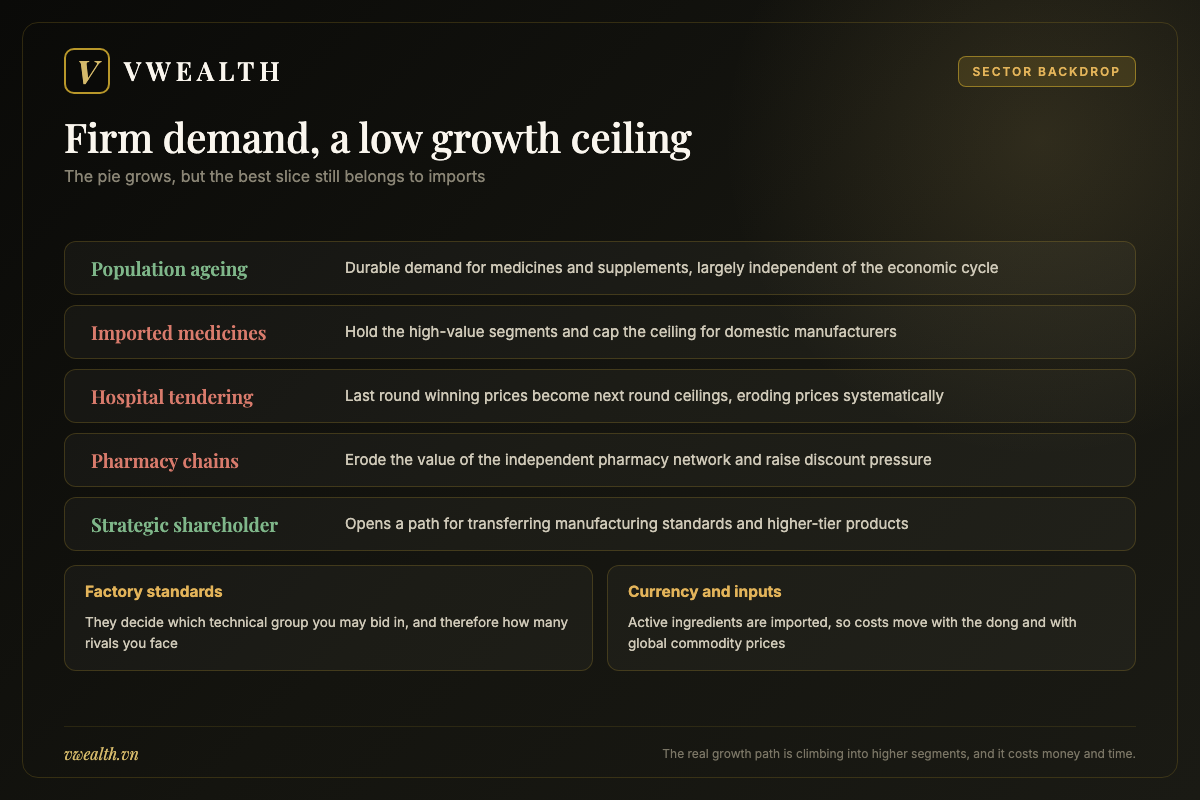
Forces shaping the sector and their effect on DHG
| Force | Direction of impact on DHG | Time horizon |
|---|---|---|
| Population ageing and rising health spending | Positive: durable demand for medicines and supplements | Long term, highly reliable |
| Imported medicines dominating high-value segments | Negative: caps the growth ceiling for domestic makers | Long term |
| Technical grouping in hospital tenders | Mixed: erodes prices but rewards those who climb | Each tender round |
| Expansion of pharmacy retail chains | Negative: erodes the traditional distribution advantage | Medium to long term, slow moving |
| Domestic commodity generic competition | Negative: relentless price pressure at the simple end | Continuous |
| Exchange rates and active ingredient prices | Negative when the dong weakens or inputs rise | Commodity and monetary cycles |
| Technology transfer from the strategic shareholder | Positive: opens the path to higher technical segments | Long term, depends on parent decisions |
| Changes in pharmaceutical regulation | Mixed and hard to forecast | Irregular |
Overall, DHG stands on one of the market’s firmest demand foundations, but its growth ceiling is limited by where it sits in the industry value chain. That is a balanced picture, and the scenarios below turn on whether the company can climb.
Looking ahead: three scenarios for DHG
This chapter offers no price target. Instead, three scenarios with the conditions each requires, so you can check them against reality.
Drivers already visible
Before the scenarios, the drivers grounded in established fact.
The first is structural demand: an ageing population, rising healthcare spending per capita, and spreading awareness of preventive health.
The second is a nationwide distribution network with branches reaching from Lang Son to Ca Mau — an asset that already exists and does not need to be rebuilt.
The third is the relationship with a strategic shareholder carrying more than a century of pharmaceutical experience, opening the possibility of technology, manufacturing standards and product portfolio transfer.
The fourth is a healthy balance sheet and a long tradition of cash dividends, at 7,500 dong per share for 2023 and 10,000 dong per share for 2024.
Base case: the dividend machine runs steadily
The base case assumes the company holds its position in the pharmacy channel, grows revenue roughly in line with the domestic pharmaceutical market, maintains stable margins, and sustains its cash dividend policy.
Under these conditions the stock oscillates around a dividend yield long-term holders find reasonable, with a narrow range and low liquidity. Investors receive most of their return through dividends rather than capital gains.
Conditions for this to hold: no major change in ownership structure, the distribution network holds share against chain consolidation, and raw material costs do not spike.
Bull case: the climb into higher segments succeeds
The bull case requires three things together.
First, line upgrade projects complete and the company moves a meaningful share of products into higher technical groups in tendering, opening a better-priced segment with fewer rivals.
Second, the strategic shareholder transfers additional products or technology, giving the portfolio higher-margin items domestic rivals cannot match.
Third, the company holds its position in the pharmacy channel while capitalising on retail chain expansion rather than being squeezed by it.
When those three coincide, margin improvement becomes structural rather than temporary, and the market may pay a higher multiple for the improved earnings quality.
Bear case: squeezed from both sides
The bear case requires no surprises, only for existing trends to continue unfavourably.
The assumptions: pharmacy retail chains keep expanding and taking share from independents, reducing the value of the traditional distribution network while increasing discount pressure on manufacturers. In parallel, domestic commodity generic competition keeps pressing prices while imported raw material costs rise on a weaker currency.
The result is margins compressing gradually across years, revenue growing more slowly than the market, and dividend headroom narrowing. For a stock held primarily for income, a payout cut creates selling pressure, and with thin liquidity the price can correct far harder than the operating reality warrants.
A different bear variant has nothing to do with operations: an unexpected change in ownership structure that works against minority holders. This is low in probability but high in impact, and the only defence is following official disclosure rather than speculating.
What would break the thesis
Separately from the three scenarios, it is useful to name explicitly what would invalidate the investment case rather than merely make it a worse year.
The first breaker would be a sustained decline in the pharmacy channel’s share of revenue accompanied by falling gross margin. That combination would indicate the distribution moat is genuinely eroding rather than merely being tested, and it is the pattern most likely to appear if chain consolidation moves faster than expected.
The second breaker would be a material and sustained cut to the dividend without a corresponding investment programme to justify it. For a stock whose entire holder base is there for income, a payout cut with no visible reinvestment purpose would signal either deteriorating cash generation or a change in the parent’s intentions for the subsidiary’s cash.
The third breaker would be a pattern of expanding related party transactions with the parent group on terms that are hard to assess. This is the classic channel through which value migrates from a subsidiary to a parent, and it shows up in the notes long before it shows up in the headline numbers.
The fourth breaker would be repeated deferral of line upgrade capital expenditure. If the path to higher technical segments is the growth story, and that path keeps slipping, then the growth story is not real and the stock is simply a slowly declining income asset that should be priced as such.
None of these are predictions. They are tripwires. Setting them in advance, in writing, is what stops an investor from rationalising deterioration one quarter at a time.
Indicators worth putting on a calendar
Quarterly, read the revenue split by channel and the gross margin. Annually, read the shareholder meeting materials carefully for the profit distribution plan, capital expenditure plans and related party transactions. At any time, follow disclosures on changes among substantial shareholders and on drug tendering regulation.
Three groups of indicators, each taking a few minutes per period. That is the entire monitoring workload this ticker demands.
Should you buy DHG stock? Weighing both sides
Now to the question in the title. The answer is not a single word, because the same stock can be a sound choice for one investor and a mistake for another.
The case for: what you actually get
First, you get a business with about the steadiest demand on the market. People cut spending on travel, on clothes, on a new phone when the economy turns. They do not cut the fever medicine for their child. Inelastic demand is a genuine moat, and pharmaceuticals sit at the most defensive end of the entire consumer complex.
Second, you get a nationwide distribution network that a new entrant cannot replicate in a few years. This is an intangible asset absent from the balance sheet that nonetheless generates most of the company’s value.
Third, you get a portfolio of consumer brands already established in Vietnamese consumers’ minds, spanning analgesics and antipyretics, antihistamines, vitamins and health supplements.
Fourth, you have a strategic shareholder that is a Japanese pharmaceutical group with more than a century of operating history, bringing manufacturing standards and technology transfer capability that a domestic company would find extremely hard to build alone.
Fifth, a consistent and rising cash dividend policy, at 7,500 dong per share for the 2023 year and 10,000 dong per share for 2024.
Sixth, the ownership structure, while thinning liquidity, delivers strategic stability. There is no risk of a surprise takeover battle, no internal power struggle, and no management team gambling shareholder money on unrelated industries.
Seventh, and often underrated, the business requires very little forecasting skill from you. You are not asked to predict technology adoption or fashion cycles. You are asked to track a handful of publicly disclosed variables.
The case against: what you are actually accepting
The first and largest risk is liquidity. With free float reduced to a remainder after two shareholders take 94.32 percent, buying and selling in meaningful size is genuinely difficult. This is not an inconvenience; it is a financial risk.
The second risk is the growth ceiling. As a generic maker, the company gets no profit leap from inventing a new drug. The highest-value portion of Vietnam’s pharmaceutical market still belongs to imports, and climbing into higher segments demands sustained investment over many years.
The third risk is pharmacy retail consolidation, a trend that gradually erodes the company’s core competitive advantage while increasing discount pressure from buyers.
The fourth risk is the hospital tender mechanism, where the previous round’s winning price becomes the next round’s reference ceiling, producing systematic price erosion.
The fifth risk is dependence on imported raw materials, exposing input costs to exchange rates and global active ingredient prices while selling prices cannot adjust as flexibly.
The sixth risk is the parent relationship. When the controlling shareholder is a foreign group in the same industry, the subsidiary’s position within the group value chain is decided by the group, and that position does not necessarily maximise minority shareholder value. The parent’s delisting from the Japanese exchange reduces group-level disclosure.
The seventh risk is the state divestment unknown. If and when the state holding is transferred, the ownership structure and governance picture change in ways nobody can predict with confidence.
The balance sheet of arguments
| In favour | Against |
|---|---|
| Inelastic demand, the most defensive corner of consumer | Very thin liquidity, hard to enter or exit in size |
| Nationwide distribution network hard to replicate | Pharmacy chains are eroding that very advantage |
| Established consumer brand portfolio | Growth ceiling capped by the generic segment |
| Strategic shareholder with technology and standards | Subsidiary positioning decided by the parent group |
| Consistent and rising cash dividends | Hospital tendering creates systematic price erosion |
| Light balance sheet, stable operating cash flow | Imported active ingredients bring currency exposure |
| Stable strategy, no diversification adventures | Unknown timing and terms of state divestment |
| Little rumour flow, immune to crowd psychology | Thin trading widens the band of mispricing |
Which investor does DHG suit
Four profiles should let you place yourself accurately.
The income investor who prioritises cash flow over growth. This is where DHG fits best, given the consistent cash payout record and stable sector demand. The mandatory condition: buy in a size the liquidity can bear, and accept that this is a multi-year holding rather than something you can exit quickly. Within a diversified income portfolio, DHG is a reasonable component at moderate weight.
The long-term value investor who buys businesses and holds for years. DHG fits this framework well: an understandable business, a real moat, a healthy balance sheet, and management that does not gamble. Thin liquidity barely inconveniences this group, since they never intended to trade anyway. The task is to determine a fair value range including a liquidity discount, then wait patiently.
The growth investor looking for a business that doubles in a few years. DHG does not fit. Demand is reliable but a leading generic maker typically grows at a measured pace, and breakout growth requires climbing into higher technical segments — a process measured in years rather than quarters. If your criterion is sustained double-digit revenue growth, look elsewhere.
The short-term trader hunting momentum and range. DHG is close to the worst possible choice on the entire exchange. Thin liquidity means large slippage costs, the narrow range means small potential gains, and sparse news flow means no catalyst to trade. This is a name to avoid entirely with that style.
Practical notes for investors based outside Vietnam
If you are reading this from abroad, several mechanical points apply with unusual force to a name like DHG.
Foreign investors need a securities trading code and an account with a local broker before buying Vietnamese listed shares. Settlement follows a local cycle, and daily price bands cap how far a stock can move in one session.
Foreign ownership limits apply and vary by sector and company charter. In DHG’s case the ceiling has been raised, but as explained above, theoretical headroom does not mean shares are available. Before sizing a position, check not just the room but the actual traded volume over recent weeks.
Dividends are paid in Vietnamese dong, which introduces a currency consideration for anyone measuring returns in another base currency. For a stock whose primary attraction is income, currency movement is part of the return calculation rather than a footnote.
Finally, for foreign institutions accustomed to deeper markets, the position size rule bears repeating: with a float this thin, even a modest allocation by developed market standards can represent many weeks of average trading volume.
How to size a position in a thinly traded name
Because liquidity is the defining constraint here, it deserves one concrete framework rather than repeated warnings.
Start by looking up the average daily traded value over the past three months, not the past week — a single unusual session distorts short windows badly. Then decide how many days you would be willing to spend building the position and how many days you would accept spending to exit it under stress. Exiting is the binding constraint, because you choose when to buy but not always when to sell.
A common institutional rule of thumb is that a position should be exitable within a set number of trading days while representing no more than a modest fraction of each day’s volume, on the reasoning that taking a large share of daily volume moves the price against you. Applying that logic to a thinly traded name usually produces a maximum position far smaller than an enthusiastic investor first imagines.
Then apply a second constraint: the position should be small enough that if it became untradeable for an extended period, it would not compromise your broader plans. Illiquid holdings should never be the part of a portfolio you might need to convert to cash at short notice.
Finally, build in tranches with limit orders rather than market orders. On a thin book, a market order can walk several price steps and hand away a meaningful part of your expected annual dividend in a single execution. Patience during accumulation costs nothing but time; impatience costs real money.
None of this argues against owning the stock. It argues for owning the right amount of it, which is a different question and one most investors skip.
Three questions to ask yourself before placing an order
Question one: if you had to sell this entire position within a week, could you accept the price the market might offer? If not, reduce the size until the answer becomes yes.
Question two: are you buying for the dividend or for price appreciation? If the latter, write down specifically what would cause the price to rise, then check whether that thing is within the company’s control.
Question three: have you read the revenue split by channel in the most recent report? That is the fifteen minutes with the highest information value in the entire research process for this name.
A note on comparing DHG with regional pharmaceutical peers
Investors familiar with pharmaceutical companies in India, Indonesia or Thailand often try to map DHG onto a peer they already know, and the mapping usually goes wrong in a predictable way.
Large Indian generic manufacturers are primarily export businesses, selling into regulated Western markets where approval from a stringent regulator is the core asset and domestic distribution matters comparatively little. DHG is the opposite: a domestic market business where distribution is the core asset and regulatory certification is the growth lever rather than the foundation.
Indonesian and Thai peers are structurally closer, being domestically focused branded generic businesses in similarly sized emerging markets. But most of them trade with substantially deeper liquidity, which alone justifies a valuation difference.
The practical guidance is to be careful with peer multiples. A multiple drawn from an export-oriented Indian manufacturer says almost nothing about what a domestically focused Vietnamese branded generic maker with a five percent float is worth. Comparison is most useful against the company’s own history and against Vietnamese defensive names with comparable ownership structures, which is why the table earlier in this chapter was constructed the way it was.
Closing thoughts
DHG Pharma is the story of a Mekong Delta pharmaceutical works founded in 1974 that went through equitisation, listed on the exchange, and became a component in the value chain of a century-old Japanese pharmaceutical group — while throughout that journey continuing to do exactly one thing: manufacture and sell medicine to Vietnamese people.
What makes the story notable is not scale but steadiness. In a market where a great many listed companies change industry, change owner and change strategy repeatedly, DHG is one of the few tickers whose entire operating business can be described in three sentences with reasonable confidence that those three sentences will still be accurate in five years.
So, should you buy DHG stock? If you understand that you are buying a small residual slice of a company that already has an owner, accept that trading will be slower and costlier than usual, treat the dividend as the primary reward, and think in years rather than months, then DHG is a sensible piece for the defensive part of a portfolio. If you are buying because the pharmaceutical sector is growing and you assume every drugmaker therefore wins, you are missing what matters most: the highest-value portion of Vietnam’s pharmaceutical market still sits in territory domestic producers have not reached, and the climb there costs both money and time.
One last thing to carry with you. DHG’s ownership structure, distribution network and brand portfolio change slowly, but the revenue split by channel, gross margin, days inventory, days receivable and payout ratio change every reporting period. Before you place an order, open the latest research report and score the seven items from chapter four again. It takes fifteen minutes, and it is the most valuable quarter of an hour in the whole decision process. If you do not yet have the tools, create a vwealth account and let the platform read the filings for you.
This article is provided for information and analysis purposes only and does not constitute a recommendation to buy or sell any security. All investment decisions are your own and you bear responsibility for their outcomes. Consider consulting a licensed financial adviser before acting.
Research Vietnamese stocks in English with vwealth. Our AI-powered platform turns Vietnamese market data into full English analysis reports — with international payment support and a free 2-month trial for new accounts. Create your free account and read the latest reports.


