If you are asking yourself “should I buy AAA stock?”, know that the question comes with a paradox built right into it. In 2025, An Phat Bioplastics’ consolidated net revenue shrank by 16%, from VND 12,782 billion to VND 10,728 billion — and yet profit after tax attributable to shareholders of the parent company still edged up to VND 373 billion, beating the target set by the annual general meeting by 37%. In the first nine months of 2026 the same pattern played out even more clearly: revenue fell by roughly 12% while consolidated profit after tax rose by roughly 45%. A business that began as a plastic-bag workshop with VND 500 million of capital in Nam Sach in 2002, and now runs a chain of packaging plants selling to more than 70 countries, appears to be deliberately “getting smaller” in order to get stronger. Or is profit simply moving from one line to another — out of consolidated revenue and into income from associates? This analysis retells twenty-four years of An Phat Bioplastics, walks through the people at the helm, the business lines and how to read this particular company’s financial statements, so that by the end you can answer for yourself who AAA stock suits and who it does not.
Before the story begins, a few names need to be pinned down, because they are easy to confuse. AAA is the ticker of An Phat Bioplastics Joint Stock Company (in Vietnamese, Cong ty Co phan Nhua An Phat Xanh), listed on the Ho Chi Minh City Stock Exchange (HOSE). Its parent is An Phat Holdings Group Joint Stock Company — a separate business with its own ticker, APH. Buying APH means buying an entire group with many subsidiaries; buying AAA means buying the plastics and packaging company at the centre of that group, together with the investments AAA itself holds. AAA’s list of subsidiaries and associates also includes two other listed companies: Hanoi Plastics JSC (ticker NHH) and An Tien Industries JSC (ticker HII). This analysis is about AAA alone; the other tickers appear only where they help you see the threads connecting them.
A second convention, shared by every company profile in this vwealth series. Dates, names and figures come from published information: the company’s 2025 annual report, the resolutions of the 2026 annual general meeting, the profit-variance explanations the company files with the State Securities Commission of Vietnam and HOSE, the share-transaction reports of An Phat Holdings, company profiles on Vietnamese market-data websites, and the domestic financial press. We deliberately do not quote today’s share price, market capitalisation or current P/E ratio — those numbers change every trading session. Where a calculation is vwealth’s own, it is labelled “vwealth estimate”; worked examples are labelled “illustrative example”. For up-to-date figures, open the latest vwealth research reports. If you want the wider picture of the manufacturing universe AAA belongs to, start with our pillar guide to Vietnam’s manufacturing and industrial stocks.
If you are new to Vietnamese equities, a few mechanics are worth knowing. Vietnam has three trading venues: HOSE, the main board where most large and mid-sized companies trade; HNX, the smaller Hanoi exchange; and UPCoM, a market for public companies that have not met, or not sought, a full listing. Each exchange caps how far a stock can move in a single session, foreign ownership is limited company by company, and many international funds can only buy stocks that sit on HOSE or inside benchmark indices. Our guide on how to invest in the Vietnam stock market explains account opening, price limits, settlement and foreign-ownership rules in detail. AAA’s own history, as you will see, includes a move from HNX to HOSE — exactly the kind of step that changes who can own a stock.
And one idea runs through this entire analysis. Whether you should buy AAA stock does not hinge on whether the plastics industry is good or bad — the industry keeps growing steadily year after year. It hinges on a much narrower question: after taking its plastic-resin trading arm out of consolidation and pouring capital into a new plant and industrial parks, is AAA’s profit really coming from making packaging — where gross margin has gone from 11.6% to 13.9% in 2025 and about 16.1% in the first nine months of 2026 — and is that profit durable enough to carry negative investing cash flow and rising debt?
From a VND 500 million plastic-bag workshop in Nam Sach to “An Phat Bioplastics”: twenty-four years of AAA
Many listed companies have a biography that opens with a big deal or a slice of state capital. An Phat Bioplastics opens with something utterly ordinary: the plastic bag. The thing you carry home from the market, the thing wrapped around a loaf of bread, the liner in your kitchen bin — a product so cheap that almost nobody wonders who makes it. But precisely because it is cheap, plastic bags are a game of scale. Whoever can produce more tonnes, buy raw material more cheaply and deliver more reliably to demanding supermarket chains and distributors abroad, wins. The twenty-four years of An Phat are the story of a provincial manufacturer trying to climb that ladder of scale — and then realising, at some point, that scale alone is not enough.
2002–2006: Anh Hai Duy Co., Ltd., VND 500 million and the first thin-film plant
In September 2002, the company that would become An Phat Bioplastics was born under a name few investors remember today: Anh Hai Duy Co., Ltd. Its corporate profile on Vietstock, one of Vietnam’s main market-data providers, records two founding members and charter capital of VND 500 million. To put that in perspective, VND 500 million in 2002 was enough to rent a small workshop, buy a few film-blowing machines and a few dozen tonnes of plastic resin — no more. It was the scale of a large household business, not yet a factory.
The first turning point came in 2005. According to the company’s 2025 annual report, that was the year its first thin-film packaging plant began operating at Nam Sach Industrial Park in Hai Duong province, with a design capacity of 13,200 tonnes a year. In the same period the company broke ground on plant No. 2 at An Dong Industrial Cluster, with an initial capacity of 9,600 tonnes a year. Together, the two plants represented more than 22,000 tonnes of design capacity — a huge leap from a VND 500 million workshop three years earlier.
What is thin-film packaging, and why does it matter to the AAA story? Simply put, it is bags and films made from PE (polyethylene) resin blown into very thin layers: supermarket bags, garbage bags, roll bags, liners. Film-blowing technology is not especially difficult, so barriers to entry are low. The difficulty lies elsewhere: to sell to customers in Europe or Japan, a manufacturer has to meet very strict standards for quality, consistency, printing and delivery times. From its earliest years An Phat chose the export route — and that choice shaped almost every move that followed.
One small detail in the annual report is worth noticing. Ms. Hoa Thi Thu Ha — today a member of AAA’s Board of Directors and Deputy General Director in charge of finance — worked as an accountant at Anh Hai Duy Co., Ltd. itself from 2005 to March 2007. Someone who moved from the accounting desk of a small workshop to the finance chair of a listed company with tens of trillions of dong in total assets tells you something about An Phat’s character: the core team has stayed for a very long time and grown up with the company. That is a strength (people who understand the business from the roots up) and also something investors should note when they look at governance — Chapter 2 returns to it.
2007–2009: equitisation, constant capital raising and the “Green Environment” name
In March 2007, Anh Hai Duy Co., Ltd. was converted into a joint-stock company, An Phat Plastic and Packaging JSC, headquartered at An Dong Industrial Park in Nam Sach. The first enterprise registration certificate of the joint-stock company is dated 9 March 2007 — and by September 2025 that certificate had been amended 37 times. Thirty-seven amendments in eighteen years hints at the company’s pace of change: capital increases, name changes, new business lines and new addresses as administrative boundaries shifted.
Charter capital at equitisation was VND 30 billion — sixty times the VND 500 million of 2002. In 2007 alone, according to Vietstock, it was raised again to VND 60 billion in April and VND 66 billion in December. Raising capital that fast usually serves a concrete purpose: building more plants. In packaging, every additional tonne of capacity needs machinery, factory space and working capital to buy resin — which makes up most of the cost of the finished product.
In 2009 the company changed its name again, to An Phat Plastic and Green Environment JSC. It sounds odd for a plastic-bag maker — a product often cast as the enemy of the environment. In hindsight, though, it was an early signal of the direction the company would genuinely pursue a decade later: environmentally friendly and biodegradable packaging. Also in 2009, plant No. 3 reached stable operation, lifting total production capacity to 36,000 tonnes a year. And the company invested in An Phat Yen Bai Plastic and Mineral JSC — today called An Tien Industries, ticker HII on HOSE — to secure a supply of CaCO3 (calcium carbonate) powder, an additive mixed into plastic resin to lower costs and improve some mechanical properties of the film.
The Yen Bai investment deserves a pause, because it is the first example of a strategic habit An Phat would repeat again and again: moving upstream in the supply chain. Rather than just buying raw material and blowing film, An Phat wanted to make its own additives, later compounded resin, then trade raw materials, and eventually develop the industrial parks that house its plants. The strategy helps control costs, but it also made the company sprawl into many business lines, each with a different risk profile — and that is exactly what the company has been reorganising in 2025–2026.
2010–2013: an HNX listing and a plant built only for Japanese customers
In April 2010, charter capital was raised to VND 99 billion, and in July 2010 AAA shares were officially listed on the Hanoi Stock Exchange (HNX), with an initial listing of 9,900,000 shares — exactly VND 99 billion divided by the VND 10,000 par value. The AAA ticker was born. For a provincial company, listing was not only about raising money; it was also a passport for dealing with foreign customers and banks, because financial statements had to be audited and information disclosed on a regular schedule.
Two years later, charter capital doubled to VND 198 billion (November 2012). And 2013 brought a milestone the annual report records with some pride: plant No. 5 started operating, dedicated entirely to the Japanese market, bringing total production capacity to 57,000 tonnes a year. Building a whole plant for one market sounds extravagant, but it reflects how Japanese buyers work: their technical requirements, quality checks and procedures are so specific that separating the production line is the most efficient answer. In return, once a supplier is inside a Japanese supply chain, customers tend to stay for the long haul.
This is the first lesson about AAA’s “moat” worth remembering. A plastic bag carries no patent, but a reputation for delivering to spec for the world’s most demanding customers cannot be built in a year or two. A newcomer can buy identical film-blowing machines; what it cannot easily buy is a multi-year record of zero rejected shipments with a Japanese retail chain. Chapter 3 looks more closely at this layer of advantage and at its limits.
From 2014 to mid-2016, charter capital kept climbing steadily: VND 396 billion (October 2014), VND 495 billion (October 2015) and VND 519 billion (May 2016). Each step up in capital was a step up in capacity. But HNX at the time had thinner liquidity and fewer large funds watching it than HOSE, so the next move was almost inevitable.
2016–2020: the move to HOSE and the capacity race
In November 2016, AAA switched exchanges. The shares were delisted from HNX on 18 November 2016 and began trading on HOSE on 25 November 2016, with almost 52 million shares transferred. By the end of that year, charter capital reached VND 569.65 billion (rounded to VND 570 billion in the annual report). On HOSE, AAA entered the arena of investment funds and larger institutional investors, and gained the ability to raise capital on a bigger scale.
And capital was raised. In 2017 and early 2018, plants No. 6 and No. 7 came on stream; charter capital rose to VND 592.5 billion (July 2017) and then VND 836 billion (the annual report places this in 2017; Vietstock records January 2018). Also in 2017, An Tien Industries (HII) listed on HOSE, and AAA appeared in rankings such as VNR500, FAST 500 and 50 Vietnam Best Growth. In 2017 the company also co-founded An Phat Plastic Complex JSC — today An Phat Hi-Tech Industrial Park Co., Ltd. — at the An Phat Complex, formerly the Kenmart – Viet Hoa Industrial Park. For the first time, a plastic-bag maker stepped into industrial real estate.
2018 was the year of fastest acceleration. In October 2018 an extraordinary general meeting approved the issue of VND 400 billion of bonds with warrants; by December 2018 charter capital had jumped to VND 1,712 billion — double in a single year. An Tien Industries raised its capital to VND 278.5 billion. The An Phat Hi-Tech Industrial Park began initial operations. And most memorably, the company launched ANECO, its environmentally friendly packaging brand, in Vietnam — a name that would later travel all the way to Amazon.
In April 2019, An Phat Plastic and Green Environment JSC officially took the name it uses today: An Phat Bioplastics JSC (Nhua An Phat Xanh in Vietnamese). The word “Bioplastics” in the English name is a clear statement of positioning: the company wants to be seen as a green-materials business, not merely a plastic-bag factory. The annual report also notes that in the same year the company stepped up the development of its industrial-park real estate.
2020 closed the capacity race with an acquisition: AAA bought An Vinh Packaging Plastics JSC, expanding into industrial packaging — woven bags, sacks and bulk packaging for heavy goods — and lifting packaging capacity to 120,000 tonnes a year. In the same year the company received the Prime Minister’s emulation flag for comprehensive excellence and was named among the Top 10 best annual reports in the mid-cap group. From 13,200 tonnes in 2005 to 120,000 tonnes in 2020, packaging capacity had grown roughly ninefold in fifteen years (vwealth estimate: 120,000 / 13,200).
2019–2025: ten capital increases and the price of growth
If there is one red thread through AAA’s history that investors must understand, it is capital raising. Look at the sequence, based on Vietstock and the annual report: VND 2,111.99 billion (27 July 2020), VND 2,217.59 billion (5 November 2020), VND 2,967.59 billion (26 May 2021), VND 3,264.34 billion (27 September 2021), VND 3,822.74 billion (July 2022) and VND 3,937.42 billion (September 2025). Going from VND 500 million in 2002 to VND 3,937.42 billion in 2025 is an increase of roughly 7,875 times (vwealth estimate: VND 3,937.42 billion / VND 0.5 billion).
Capital raising has two sides, and you need to look at both. The positive side: new money paid for plants, the An Vinh acquisition and industrial parks — assets that generate revenue. The side to weigh carefully: every new share issue means profit has to be split into more pieces. If profit does not grow as fast as the share count, earnings per share (EPS) get “diluted”. That is how a company can grow enormously in size while its long-standing shareholders do not become proportionately richer. AAA currently has 393,742,730 shares listed and outstanding.
In the same period, new business lines took shape. In 2021, An Phat 1 Industrial Park received its investment certificate, and the ANECO brand registered its trademark in the United States and went on sale on Amazon. In 2022, ANECO won Vietnam’s National Brand title for the first time, and AAA was named for the fourth time to the Ministry of Industry and Trade’s list of Reputable Exporters. In 2023, ANECO won “The Polaris – Seller of the year” category at Amazon Global Selling Vietnam. In 2024, AAA and AnEco won National Brand status for the second consecutive time, and subsidiary An Phat Complex received the Sao Vang Dat Viet (Golden Star of Vietnam) award.
The most recent capital increase, to VND 3,937.42 billion in September 2025, came from an employee share ownership plan (ESOP): 11,468,234 shares with a total par value of about VND 114.7 billion, funded from undistributed profit after tax as of 31 December 2024, allocated to 777 staff and completed on 29 August 2025. HOSE approved the additional listing of these shares in its notice No. 1779 dated 26 September 2025. This was an ESOP rewarded out of retained earnings, not one where employees paid cash for their shares — Chapter 2 explains who received how much.
2024–2026: plant No. 8, restructuring and An Phat Holdings becomes the parent
The last three years have changed AAA more than any period since it moved to HOSE — not by growing bigger, but by rearranging itself. The first milestone was November 2024, when plant No. 8 at An Dong Industrial Cluster in Nam Sach was completed and began operating, according to The Leader. Its main products are not plastic bags but plastic flooring panels and compounded plastic resin, aimed at exports to the United States. In 2024, more than 7% of AAA’s revenue came from the U.S. market — a share also reported by the newspaper Nha Dau Tu, citing the audited 2024 financial statements.
The second milestone was 2025 — the year of ownership restructuring. At the annual general meeting held on the morning of 28 April 2025, management presented its most conservative business plan since 2019: revenue of VND 9,179 billion and profit after tax of VND 273 billion, down 28% and 26% respectively from actual 2024 results. The reason, according to Nha Dau Tu: the company planned to cut its ownership in the plastic-resin trading business from the second quarter of 2025, so consolidated revenue would fall; profit would fall because of the restructuring of non-core investments and higher depreciation at plant No. 8. As a result, according to the 2025 annual report, AAA no longer consolidates its plastic-resin trading, CaCO3 powder and logistics businesses — they became associates, where AAA records only its share of profit in proportion to its ownership.
Actual 2025 results came in well ahead of that cautious plan: consolidated net revenue of VND 10,728 billion, 17% above plan, and profit after tax attributable to parent-company shareholders of VND 373 billion, 137% of plan. Chapter 4 dissects why revenue fell while profit still rose.
The third milestone concerns ownership. Between 11 and 29 June 2026, An Phat Holdings bought 6,000,000 AAA shares through order matching on the exchange, raising its stake from 191,787,394 shares (48.71%) to 197,787,394 shares (50.23%); including related persons, the holding reached 201,449,628 shares (51.16%), according to the transaction report published on 1 July 2026. By crossing the 50% line, An Phat Holdings formally became AAA’s parent company — something Chapter 2 analyses in detail.
At the same time, the map changed. After Vietnam’s 2025 provincial mergers, AAA’s headquarters at Lots CN11+CN12, An Dong Industrial Cluster, now sit in Nam Sach commune, Hai Phong city, rather than Nam Sach district, Hai Duong province. The first plant of 2005, plant No. 2 and plant No. 8 of 2024 all stand on the same strip of land in Nam Sach — An Phat has grown, but it has never left home.
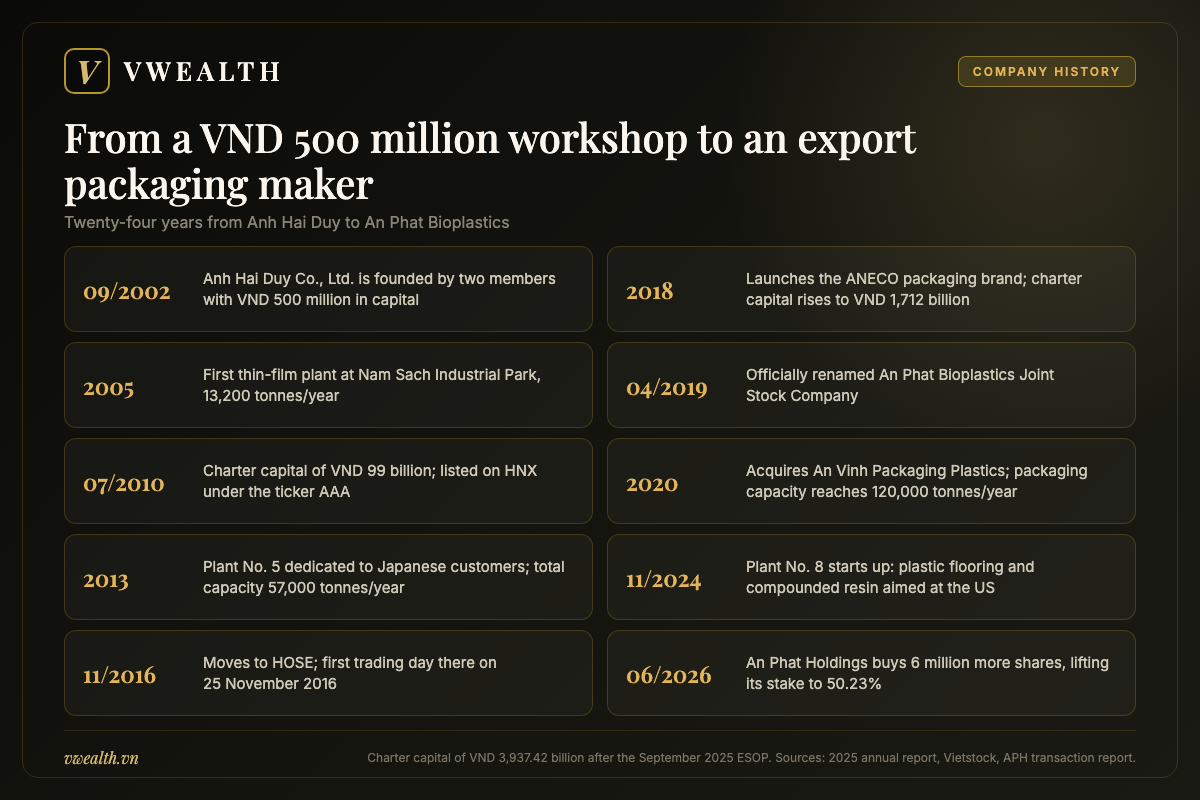
Here is a summary table of the key milestones, so you can see AAA’s twenty-four years at a glance:
| Year | Event | Charter capital / capacity | Source |
|---|---|---|---|
| Sep 2002 | Anh Hai Duy Co., Ltd. founded by 2 members | Capital VND 500 million | Vietstock |
| 2005 | First thin-film plant at Nam Sach IP; plant No. 2 breaks ground at An Dong cluster | 13,200 tonnes/year; plant No. 2 initially 9,600 tonnes/year | 2025 annual report |
| Mar 2007 | Converted into An Phat Plastic and Packaging JSC | Capital VND 30 billion → VND 66 billion (Dec 2007) | Vietstock, 2025 annual report |
| 2009 | Renamed An Phat Plastic and Green Environment; plant No. 3; investment in An Phat Yen Bai (now HII) | Total capacity 36,000 tonnes/year | 2025 annual report |
| Jul 2010 | Listed on HNX under ticker AAA | Capital VND 99 billion; 9.9 million shares | Vietstock, 2025 annual report |
| 2013 | Plant No. 5 dedicated to the Japanese market | Total capacity 57,000 tonnes/year | 2025 annual report |
| 25 Nov 2016 | First trading day on HOSE | Capital VND 569.65 billion (Dec 2016) | Vietstock |
| 2017–early 2018 | Plants No. 6 and 7; An Phat Plastic Complex founded (An Phat Complex IP) | Capital VND 836 billion | 2025 annual report, Vietstock |
| 2018 | ANECO launched; An Phat Hi-Tech IP begins initial operations | Capital VND 1,712 billion (Dec 2018) | 2025 annual report, Vietstock |
| Apr 2019 | Renamed An Phat Bioplastics JSC | — | Vietstock, 2025 annual report |
| 2020 | Acquires An Vinh Packaging Plastics, enters industrial packaging | Packaging 120,000 tonnes/year; capital VND 2,217.59 billion (Nov 2020) | 2025 annual report, Vietstock |
| 2021 | An Phat 1 IP receives investment certificate; ANECO on Amazon U.S. | Capital VND 3,264.34 billion | 2025 annual report |
| 2022 | ANECO wins National Brand for the first time | Capital VND 3,822.74 billion | 2025 annual report |
| Nov 2024 | Plant No. 8 (plastic flooring, compounded resin) starts operating | — | The Leader |
| 2025 | Resin trading, CaCO3 powder and logistics deconsolidated; ESOP of 11.47 million shares | Capital VND 3,937.42 billion (Sep 2025) | 2025 annual report, Vietstock |
| Jun 2026 | An Phat Holdings buys 6 million more shares and becomes the parent | Stake 50.23% | APH transaction report |
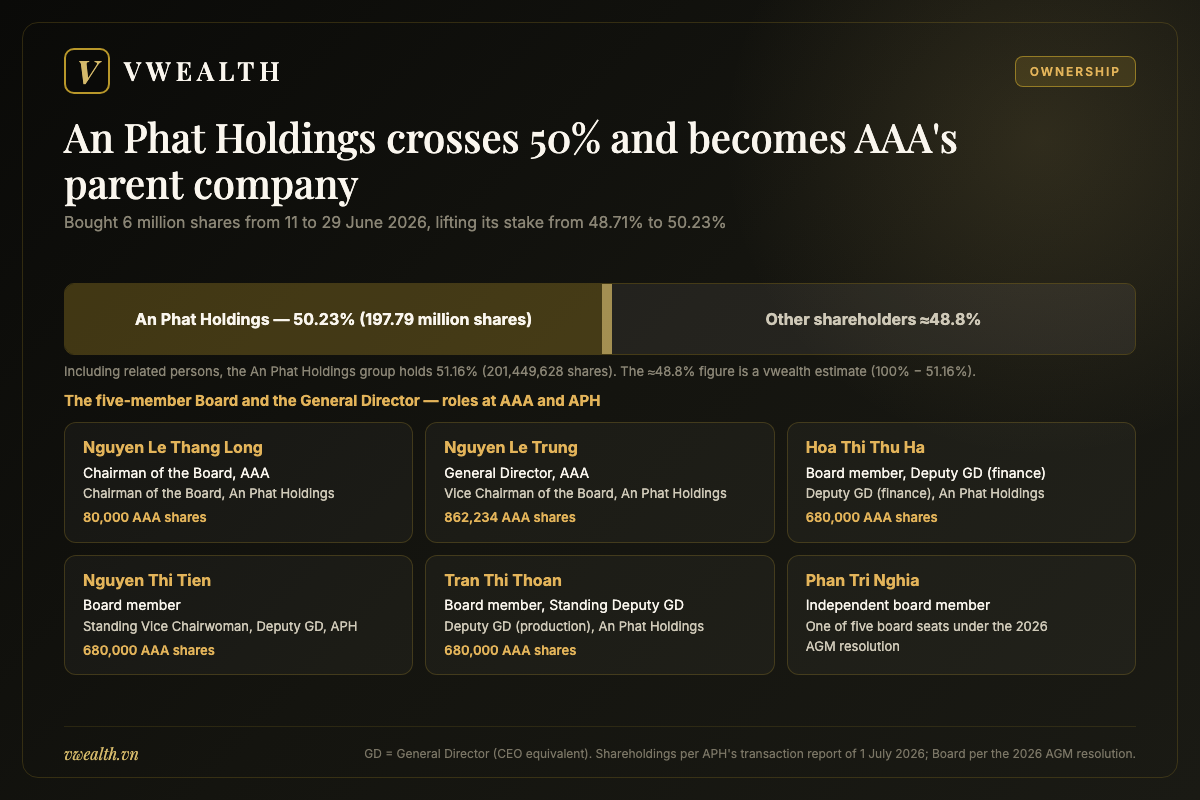
Who steers An Phat Bioplastics: a five-member board and parent company An Phat Holdings
To understand a private Vietnamese company, you almost always have to ask “who really owns it”. With AAA, the answer is not an individual holding a large block of shares but a group: An Phat Holdings. Nearly all of AAA’s key executives hold a parallel role at the parent, and their personal stakes in AAA are small. That creates a structure minority investors need to understand clearly: decision-making power sits with the group, and you — a minority shareholder — ride in the boat the group is steering.
Chairman Nguyen Le Thang Long: chairing both tiers
The current Chairman of AAA’s Board of Directors is Mr. Nguyen Le Thang Long, aged 42 according to his Vietstock profile, who has held the post since 2021. According to the transaction report published on 1 July 2026, he is also Chairman of the Board of An Phat Holdings — in other words, he heads both the parent and the subsidiary. His personal holding in AAA is 80,000 shares, equivalent to 0.02% of capital.
A 0.02% stake may make you pause at first: the head of the company barely owns any shares? In a group structure, though, this is common. The power of AAA’s chairman does not come from AAA shares in his own name but from his position at An Phat Holdings — the shareholder holding 50.23% of AAA. Put differently, management’s economic interest in AAA runs mainly through the parent rather than directly.
What does this mean for you? When the interests of An Phat Holdings and AAA’s minority shareholders line up — both want AAA to be profitable and pay regular dividends, for example — the structure works smoothly. When they do not fully line up — for instance in asset purchases and sales, capital contributions or loans between AAA and other group companies — minority shareholders need to read resolutions and related-party transaction reports carefully. That is not suspicion; it is standard practice for anyone investing in a subsidiary of a larger group, in Vietnam as much as in developed markets.
General Director Nguyen Le Trung: nearly twenty years at the wheel
If the chairman sets the direction, the General Director (the Vietnamese equivalent of a CEO) rows the boat every day. At AAA that role belongs to Mr. Nguyen Le Trung, aged 50 according to Vietstock, who has run the company since 2007 — that is, since it had just been converted into a joint-stock company. He is also AAA’s legal representative. On 15 May 2026, AAA announced his reappointment as General Director.
At the parent, Mr. Trung is Vice Chairman of the Board of An Phat Holdings. His personal holding in AAA is 862,234 shares, or 0.22% — the largest among the leadership team, and exactly the number of ESOP shares he was allocated in the 2025 issue, according to Thuong Truong newspaper.
Nearly twenty years in the same executive seat is rare on the Vietnamese stock market. The advantages are obvious: continuity of strategy, long relationships with export customers and knowledge of every plant from the day it was built. The other side, which investors weigh for any company with a long-tenured executive team, is succession planning — a question the available disclosures do not address, so this analysis does not speculate further.
The women who have been there since Anh Hai Duy — and one independent director
After the 2026 annual general meeting, AAA’s Board of Directors has five members, according to the meeting’s resolution: Mr. Nguyen Le Thang Long, Ms. Nguyen Thi Tien, Ms. Hoa Thi Thu Ha, Mr. Phan Tri Nghia and Ms. Tran Thi Thoan. Notably, three of the five are women, and all three also hold positions at An Phat Holdings.
Ms. Hoa Thi Thu Ha is a board member and Deputy General Director in charge of finance at AAA, and also Deputy General Director in charge of finance at An Phat Holdings. As Chapter 1 mentioned, she was an accountant at Anh Hai Duy Co., Ltd. (2005 to March 2007) and has stayed with the company for almost two decades since. She is also the person who often speaks for the company to shareholders about export markets — for example on the SPC flooring sold to the United States in 2025 (Chapter 3 comes back to this). She holds 680,000 AAA shares (0.17%).
Ms. Tran Thi Thoan, born in 1985 and holding a master’s degree in economic management, is AAA’s Standing Deputy General Director and Deputy General Director in charge of production at An Phat Holdings. She has been with AAA since 2009 according to Vietstock, and was elected to the Board by the 2026 general meeting to fill a seat whose term had ended. She holds 680,000 shares (0.17%).
Ms. Nguyen Thi Tien is a member of AAA’s Board and also Standing Vice Chairwoman of the Board and Deputy General Director of An Phat Holdings, holding 680,000 shares (0.17%). Ms. Ha, Ms. Thoan and Ms. Tien hold the same 680,000 shares each — matching the 2025 ESOP allocation that Thuong Truong reported for Ms. Tien and Ms. Ha.
Mr. Phan Tri Nghia is the independent board member. On a board where four of five people play a parallel role at the parent, the independent seat is the one minority shareholders should watch most closely: in principle, an independent director is expected to review decisions from the standpoint of all shareholders, especially transactions involving related parties.
The executive team also includes Deputy General Director Nguyen Xuan Co; Chief Accountant Nguyen Thi Thuy Van (since 2018, also the person authorised to disclose information); Head of the Supervisory Board Nguyen Thi Giang; and two Supervisory Board members, Ms. Nguyen Thi Phuong and Ms. Van Thi Lan Anh. (Vietnamese companies have a Supervisory Board elected by shareholders, a body that oversees the board and management, roughly comparable to an audit committee.) The 2025 financial statements were audited by Ernst & Young Vietnam Ltd. — one of the Big Four audit firms — according to the 2026 meeting resolution.
An Phat Holdings crosses 50%: what a parent shareholder means for you
On 8 June 2026, Tin nhanh Chung khoan, a Vietnamese securities news outlet, reported that An Phat Holdings (HOSE: APH) had registered to buy 6 million AAA shares to lift its stake from 48.71% to 50.23%, over an expected window from 11 June to 10 July 2026, through negotiated deals and/or order matching. The transaction finished ahead of schedule: according to the result report An Phat Holdings published on 1 July 2026, all 6,000,000 shares were bought through order matching between 11 and 29 June 2026, with a value at par of VND 60 billion. After the deal, An Phat Holdings held 197,787,394 shares, or 50.23% of AAA; including related persons, 201,449,628 shares, or 51.16%. MoneyF summed it up on 2 July 2026: An Phat Holdings had officially become the parent company of An Phat Bioplastics.
From 48.71% to 50.23% is only 1.52 percentage points, but the 50% threshold has clear legal and accounting meaning. With more than half of the voting shares, a major shareholder can on its own pass resolutions that require more than 50% of votes at a general meeting — electing board members, approving the business plan, distributing profit. Before, at 48.71%, An Phat Holdings was already the controlling shareholder in practice, because the remaining shareholders rarely all attend and all vote against it. The 2026 annual general meeting is an example: 42 shareholders attended, representing 200,237,067 shares, or 50.85% of voting shares, and every item was approved with 100% of votes.
That 50.85% attendance figure tells you two things. First, most of the votes at AAA’s meetings belong to the parent and its related persons. Second, very few minority shareholders take part directly. Roughly 48.8% of AAA shares sit outside An Phat Holdings and its related persons (vwealth estimate: 100% − 51.16%), yet the voice of that block at the general meeting is almost negligible.
For you — if you are thinking about becoming a small shareholder of AAA — this means you are not buying decision-making power; you are buying the right to a share of profits and dividends as the parent decides. So the question to ask is not “who is in control” (that is settled) but “does the parent have an incentive to make AAA perform well for all shareholders?” The fact that An Phat Holdings spent its own money buying shares on the exchange, rather than receiving shares through a private placement, is a signal many investors read as the parent believing in AAA’s value — but that is only one reading, and Chapter 5 discusses the effect on the stock’s liquidity in more depth.
One practical habit worth adopting: each year, when AAA publishes its general meeting documents and board resolutions, look for the section on related-party transactions — dealings between AAA and An Phat Holdings and other companies in the group. For a company with a list of subsidiaries and associates as long as AAA’s (An Trung Industries, Luong Dien Ngoc Lien Industrial Park, An Phat 1 Hi-Tech Industrial Park, Hanoi Plastics, VIEXIM, An Phat International, An Vinh Packaging Plastics, An Cuong Hi-Tech Building Materials, An Phat Hi-Tech Industrial Park, AFC Ecoplastics, An Phat PBAT Manufacturing, Ankor Bioplastics, An Tien Industries and Vinh Packaging Plastics — according to Vietstock), this is the information that shows where cash is flowing inside the group.
The 2025 ESOP and dividend policy: who gets what
AAA shareholders need to understand two tools for sharing value: bonus shares for employees (ESOP) and dividends.
On the ESOP: the issue completed on 29 August 2025 distributed almost 11.5 million shares (exactly 11,468,234 according to HOSE’s additional listing notice) to 777 staff, with a total par value of about VND 114.7 billion, funded from undistributed profit after tax as of 31 December 2024. According to Thuong Truong, Mr. Nguyen Le Trung received 862,234 shares, while Ms. Nguyen Thi Tien and Ms. Hoa Thi Thu Ha received 680,000 shares each. Together those three account for 2,222,234 shares, or about 19.4% of the ESOP (vwealth estimate: 2,222,234 / 11,468,234); the rest went to 774 other people.
ESOPs are a familiar double-edged sword. The good edge: they tie the team’s interests to the share price and help retain talent. The edge to weigh: existing shareholders are diluted, because retained earnings — which belong to all shareholders — are converted into shares for one group of people. The 2025 ESOP was equivalent to about 3% of the shares outstanding before the issue (vwealth estimate: VND 114.68 billion / VND 3,822.74 billion of prior charter capital) — not a large dilution, but worth noting.
On dividends: the 2026 general meeting approved a cash dividend for 2025 at a rate of 3%, or VND 300 per share, totalling VND 118,122,819,000. HOSE set the ex-dividend date at 21 July 2026 (notice No. 1509 dated 10 July 2026). In Vietnam, dividends are quoted as a percentage of the VND 10,000 par value rather than of the market price, which is why “3%” here means VND 300 per share. The distribution plan also spells out that the parent company’s standalone profit after tax for 2025 was VND 185.88 billion, while consolidated profit after tax attributable to parent-company shareholders was VND 372.91 billion; 12% (VND 44.75 billion) went to the bonus and welfare fund and 2% (VND 7.46 billion) to management and community; remaining undistributed profit after tax was VND 381.41 billion.
Pay attention to the gap between VND 185.88 billion (AAA’s standalone parent-company profit) and VND 372.91 billion (consolidated profit attributable to parent shareholders). Cash dividends can only be paid out of profit that the AAA legal entity itself holds — profit sitting in subsidiaries has to be passed up as intra-group dividends before the parent can use it. That is one reason why companies with many subsidiaries often pay lower dividends than their consolidated statements might suggest.
Total dividends of VND 118.12 billion equal about 32% of 2025 consolidated profit attributable to parent shareholders (vwealth estimate: 118.12 / 372.91). With its 50.23% stake, An Phat Holdings is the largest recipient, at roughly VND 59.3 billion (vwealth estimate: 197,787,394 shares × VND 300). If you are looking for a stock to live on dividends, 3% of par value is thin; and because the yield an investor actually earns depends on the market price paid, not on par value, check the current figures in the vwealth AAA research reports before judging the payout.
The table below brings together the key people, their parallel roles at the parent and the number of AAA shares they hold, according to An Phat Holdings’ transaction report published on 1 July 2026:
| Name | Role at AAA | Role at An Phat Holdings | AAA shares (stake) | With AAA since |
|---|---|---|---|---|
| Nguyen Le Thang Long | Chairman of the Board | Chairman of the Board | 80,000 (0.02%) | Chairman since 2021 |
| Nguyen Le Trung | General Director, legal representative | Vice Chairman of the Board | 862,234 (0.22%) | 2007; reappointed May 2026 |
| Nguyen Thi Tien | Board member | Standing Vice Chairwoman and Deputy General Director | 680,000 (0.17%) | — |
| Hoa Thi Thu Ha | Board member, Deputy General Director (finance) | Deputy General Director (finance) | 680,000 (0.17%) | Accountant at Anh Hai Duy from 2005 |
| Tran Thi Thoan | Board member (elected 2026), Standing Deputy General Director | Deputy General Director (production) | 680,000 (0.17%) | 2009 |
| Phan Tri Nghia | Independent board member | — | — | — |
| An Phat Holdings Group JSC | Parent company | — | 197,787,394 (50.23%); with related persons 201,449,628 (51.16%) | Parent since 29 Jun 2026 |
Thin-film packaging, SPC flooring and industrial parks: how An Phat Bioplastics makes money
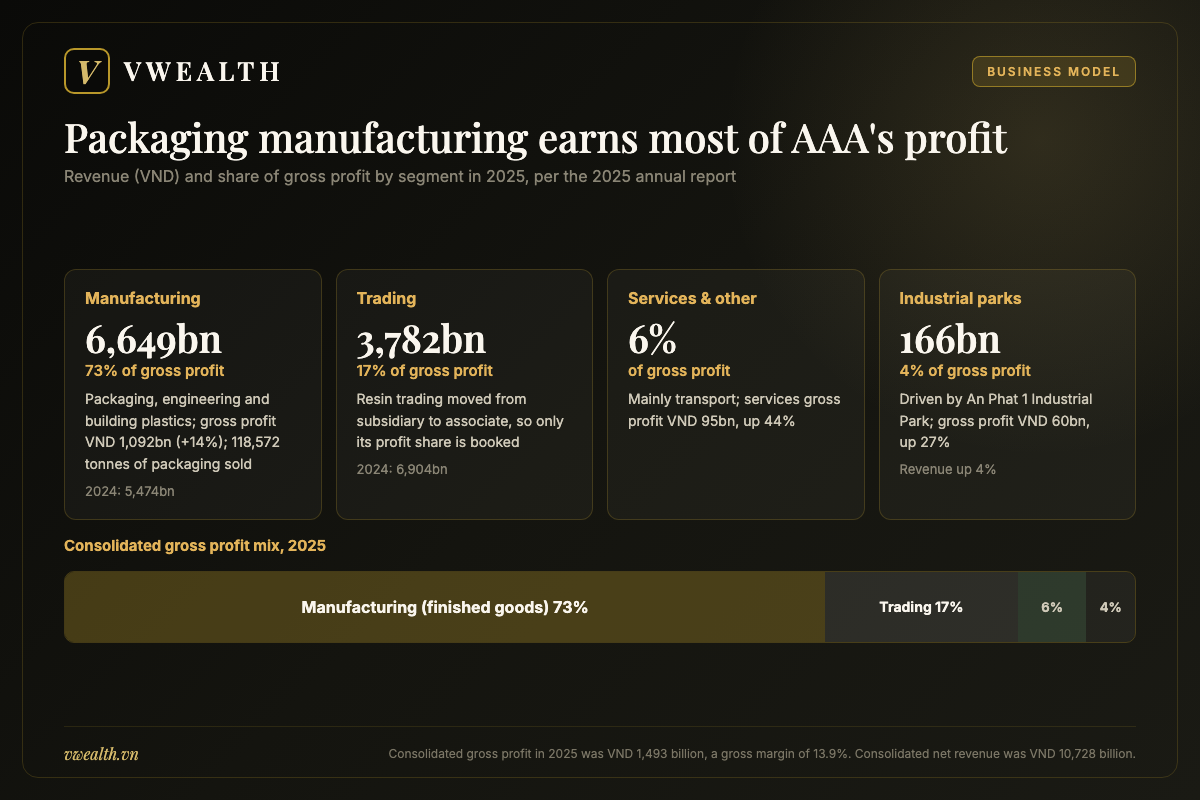
If you remember only one number about AAA’s business model, make it this one: in 2025, manufacturing generated 73% of the company’s gross profit, according to the annual report. The rest was split between trading goods (17%), services and other (6%) and industrial real estate (4%). A year earlier the picture was very different: resin trading made up most of revenue while earning little. This chapter goes through each segment, shows which one feeds which, and asks where AAA’s real competitive advantage lies.
First, a note on how to read the numbers. “Revenue” and “gross profit” tell two different stories. A segment can bring in a lot of revenue but very little profit — like resin trading, where the company buys and resells raw materials on thin margins. Conversely, a small-revenue segment such as industrial real estate can carry high margins. When assessing AAA, give more weight to each segment’s share of gross profit than to its share of revenue.
Export thin-film packaging: the original business and the main “moat”
This is the business that made the An Phat name from 2005: supermarket bags, garbage bags, roll bags and thin films of all kinds — mostly sold abroad. Vietstock’s company profile describes AAA as the largest producer of plastic bags, running 7 packaging plants with total capacity of 108,000 tonnes a year, plus the An Phat – Yen Bai CaCO3 additive plant with capacity of 222,000 tonnes a year. The annual report states that after the An Vinh deal in 2020, overall packaging capacity (including industrial packaging) rose to 120,000 tonnes a year.
In 2025, packaging sales volume reached 118,572 tonnes, up 11% year on year. The annual report names Europe, Japan and the United States as the three most important markets for packaging; overall, the company’s customers span more than 70 countries and territories. To serve distant customers, AAA has representative offices in Hanoi, Ho Chi Minh City, Singapore and the United States; its plants are located in Hai Duong (now part of Hai Phong), Yen Bai, Hanoi and Hung Yen.
AAA’s edge in this business does not come from proprietary technology — PE film blowing is widespread. It comes from three things combined. The first is scale: selling more than 118,000 tonnes a year lets the company buy resin in large volumes and spread fixed costs over many tonnes of output. The second is its customer record: retail chains in Japan or Europe do not switch suppliers over small price differences, because the damage from defective goods far outweighs the savings. Plant No. 5, dedicated to Japan since 2013, is evidence of a relationship invested in for the long term. The third is compliance experience: being named for the fourth time to the Ministry of Industry and Trade’s list of Reputable Exporters (2022) shows a consistent export record over many years.
The limits of this moat need stating plainly. A plastic bag is close to a commodity; when customers have many options in low-cost countries, a manufacturer’s pricing power is limited. Margins therefore depend heavily on the spread between selling prices and resin prices — something AAA does not control. And the trend in many markets to restrict single-use plastic bags is a long-term pressure the company itself recognised when it adopted the “Green Environment” name back in 2009.
If you want to compare AAA with an exporter of plastic products in a different segment — office and school supplies — our analysis of TLG stock (Thien Long Group) shows a model built on brand and distribution channels, quite unlike AAA’s model built on manufacturing scale.
Industrial packaging, engineering plastics and SPC flooring: the fast-growing lines
In 2025, revenue from plastic products and supporting industries rose 22% year on year and made up 62% of consolidated net revenue. Gross profit from manufacturing rose from VND 955 billion to VND 1,092 billion (+14%). The annual report explains that the main driver was not only traditional thin-film bags but industrial packaging, engineering plastics and construction plastics consolidated for a full year.
Industrial packaging came to AAA through the 2020 acquisition of An Vinh Packaging Plastics JSC. Unlike supermarket bags, industrial packaging serves businesses: bulk bags, woven sacks, packaging for agricultural produce and building materials. There are fewer customers, but orders are larger and steadier.
Engineering plastic components and moulds are plastic parts used in industrial manufacturing. According to the annual report, this product group sells mainly in the domestic market — a useful counterweight for a company that otherwise relies heavily on exports.
Plastic construction flooring — usually called SPC flooring (stone plastic composite, a rigid vinyl plank with a stone-powder core) — is the newest business and points almost entirely outward: the annual report says it is exported mainly to the United States. Plant No. 8 at An Dong, operating since November 2024, makes mainly plastic flooring panels and compounded resin. According to The Leader, Ms. Hoa Thi Thu Ha said AAA’s main export to the United States is SPC flooring, subject to a 5% tariff, while its main competitor in Thailand had also seen tariffs raised from 0 to 10% (remarks made around April–May 2025). In 2024, the United States accounted for more than 7% of AAA’s revenue.
Why does SPC flooring deserve attention? According to Vietnam Customs data cited in the annual report, Vietnam’s plastic-product exports to the United States in 2025 reached USD 3.767 billion, or 50.4% of total plastic-product export turnover, and within plastics shipped to the U.S., construction plastics made up 35% — the largest group. In other words, AAA is stepping into precisely the segment Vietnam sells most of to America. The flip side is that this business is tied tightly to the trade policy of a single market; Chapter 6 analyses that risk in detail.
And compounded resin is plastic resin pre-blended with additives, colours and fillers to a formula for each application. For AAA, it is the next step in the “move upstream” strategy that began with the Yen Bai calcium carbonate investment in 2009.
AnEco and the biodegradable dream
The word “Bioplastics” in AAA’s English name is not decoration. In 2018 the company launched ANECO — environmentally friendly packaging — in Vietnam. In 2021 ANECO registered its trademark in the United States and went on sale on Amazon. In 2022 ANECO won National Brand status for the first time; in 2023 it won “The Polaris – Seller of the year” at Amazon Global Selling Vietnam; and in 2024 AAA and AnEco won National Brand for the second consecutive time. AAA’s list of subsidiaries and associates also includes An Phat PBAT Manufacturing JSC — PBAT being a type of biodegradable plastic commonly used to make bags and films.
What stands out about ANECO is how it sells. Most of AAA’s packaging revenue comes from B2B contracts — sales to distributors and retail chains. Putting ANECO on Amazon is an experiment in selling directly to consumers abroad under the company’s own brand, rather than manufacturing for someone else’s. If it works, it is a path out of the “commodity product” trap described above.
Still, keep this business in proportion. The disclosures this analysis relies on do not break out ANECO’s revenue or profit, so it is impossible to say how much it has contributed. The 2025 annual report says only that, in its 2026 strategy, the company will expand its range of fully biodegradable products and continue promoting the ANECO brand. It is a strategic business with titles and awards, but for an investor it remains an option on the future rather than today’s profit engine.
Resin trading: from consolidated subsidiary to associate
This is the segment that explains most of the swings in AAA’s numbers over the past two years, so it is worth understanding thoroughly. For many years AAA ran a raw-materials trading business: buying PE, PP and other resins and reselling them to other plastics manufacturers. It brought in very large revenue on thin margins — the nature of commodity trading.
According to the “Revenue by segment” chart in the annual report, trading revenue fell from VND 6,904 billion in 2024 to VND 3,782 billion in 2025, while manufacturing revenue rose from VND 5,474 billion to VND 6,649 billion. Trading now accounts for only 35% of revenue and 17% of gross profit. The reason: the company no longer consolidates its trading subsidiaries and records only its share of their profit as an associate.
The difference between “consolidation” and “associate” is the key. When AAA controls a subsidiary (usually with more than 50%), all of that subsidiary’s revenue, costs, assets and liabilities are added into AAA’s statements. When AAA’s stake drops to the level of significant influence only (usually between 20% and 50%), the company becomes an associate: its revenue no longer appears in AAA’s accounts, and only AAA’s share of its profit is booked on a separate line — “share of profit or loss from joint ventures and associates”. AAA’s revenue therefore shrinks, but its profit does not necessarily fall with it.
And in 2026 that associate line jumped. AAA’s profit-variance explanation for the first quarter of 2026 states clearly that profit from the trading segment, held through associates, rose sharply because resin prices spiked in March amid political instability in the Middle East. According to MoneyF, income from joint ventures and associates in the first nine months of 2026 reached VND 133.76 billion, about 3.5 times the VND 38.64 billion of the same period a year earlier. The lesson: this income depends on resin prices — a variable that moves with oil prices and geopolitics — so it is hard to treat as a steady source of profit in every year.
Industrial real estate and logistics: small, high-margin and capital-hungry
From a company that needed land for its own plants, An Phat gradually became a developer of industrial land for others to lease. The business took shape step by step: in 2017 it co-founded An Phat Plastic Complex at the An Phat Complex site (formerly Kenmart – Viet Hoa Industrial Park); in 2018 An Phat Hi-Tech Industrial Park began initial operations; in 2021 An Phat 1 Industrial Park received its investment certificate. The list of subsidiaries and associates also includes Luong Dien Ngoc Lien Industrial Park JSC.
According to the 2025 annual report, industrial real-estate revenue in 2025 was VND 166 billion (+4%), driven by An Phat 1 Industrial Park, with gross profit of VND 60 billion (+27%). That implies a gross margin of about 36% (vwealth estimate: 60 / 166) — far higher than the company-wide figure of about 13.9%. But in absolute terms it is only 4% of gross profit. The services business, mainly transport, contributed VND 95 billion of gross profit (+44%).
Why keep an eye on such a small business? Because it eats capital. At the end of 2025, AAA’s long-term construction in progress rose to VND 2,384 billion (+94.6%), which the annual report attributes to building a new plant and the Luong Dien Ngoc Lien Industrial Park; investment property stood at VND 1,270 billion. Together those two items come to about VND 3,654 billion (vwealth estimate), many times the industrial-park segment’s annual revenue. Industrial parks follow a “spend first, collect later” model: infrastructure, land compensation and site levelling take years before plots can be leased out gradually. If leasing is slow, the capital sits idle while interest costs keep running.
If you want to understand how the market values dedicated industrial-park developers, our analyses of SIP stock (Saigon VRG) and IDC stock (IDICO) are good points of comparison. The crucial difference: for SIP or IDC, industrial parks are the core business; for AAA, they are a side business of a plastics company — so when you look at AAA, treat its industrial parks as assets that need time to pay off, not yet as the main profit engine.
In summary, here is how AAA’s segments looked in 2025 compared with 2024:
| Segment | 2024 revenue | 2025 revenue | Share of 2025 gross profit | Notes |
|---|---|---|---|---|
| Manufacturing (packaging, engineering plastics, construction plastics) | VND 5,474 billion | VND 6,649 billion | 73% (finished goods) | Gross profit VND 955 → 1,092 billion (+14%); 118,572 tonnes of packaging sold (+11%) |
| Trading (goods) | VND 6,904 billion | VND 3,782 billion | 17% | Trading subsidiaries no longer consolidated; only associate income recorded |
| Services and other (mainly transport) | — | — | 6% | Services gross profit VND 95 billion (+44%) |
| Industrial real estate | — | VND 166 billion (+4%) | 4% | Gross profit VND 60 billion (+27%), driven by An Phat 1 IP |
| Whole company (consolidated) | VND 12,782 billion | VND 10,728 billion | Gross profit VND 1,493 billion | Gross margin 11.6% → 13.9% |
Source: An Phat Bioplastics 2025 annual report. A “—” means the report does not break out that figure. Segment revenues do not add up exactly to the consolidated total because of intra-group adjustments and the company’s own grouping.
Read the financial statements before deciding whether to buy AAA stock: why revenue fell while profit rose
If you open AAA’s recent financial statements and look only at the top line — net revenue — you could easily conclude the business is in decline: VND 12,782 billion in 2024, VND 10,728 billion in 2025, VND 7,504.25 billion in the first nine months of 2026 (down about 12% year on year). Look at the bottom line — profit after tax — and the story runs the other way. This chapter shows you how to read AAA’s own numbers: separating revenue that shrank “because the scope of consolidation changed” from revenue that shrank “because the business did worse”, and understanding margins, finance costs, associate income and the balance sheet. It is also the most important part of this analysis before you answer the question of whether to buy AAA stock.
2025 revenue down 16%: mostly a change in consolidation scope
The 2025 annual report shows consolidated net revenue of VND 10,728 billion, down 16% from 2024 but 17% above plan. The company states the main reason directly: ownership restructuring, with plastic-resin trading, CaCO3 powder and logistics no longer consolidated. Set that against the “Revenue by segment” chart and the picture is clear: trading revenue fell by about VND 3,122 billion (6,904 → 3,782), while manufacturing revenue rose by about VND 1,175 billion (5,474 → 6,649) (vwealth estimate from the two pairs of figures). The core business grew; what “disappeared” was raw-materials trading revenue that moved into associates.
Over a longer run, consolidated net revenue for 2021–2025, according to the annual report, was VND 13,143 billion, 15,290 billion, 12,622 billion, 12,782 billion and 10,728 billion respectively. Revenue peaked in 2022, when raw-material prices were high and trading was still fully consolidated. The lesson for reading AAA: do not compare revenue across years as if comparing apples with apples, because the scope of consolidation has changed. A year with lower revenue is not necessarily a worse year for the business.
On profit: consolidated profit after tax in 2025 was VND 424 billion (+33%), and profit after tax attributable to parent-company shareholders was VND 373 billion (+1% from VND 369 billion in 2024), 137% of the general meeting’s target. In 2023 that figure had been only VND 153 billion. The 2025 consolidated net margin was about 4.0% (424 / 10,728; the annual report also states 4.0%). Note that the 2025 plan was very conservative — revenue of VND 9,179 billion and profit after tax of VND 273 billion — so “beating the plan” partly reflects a low bar, something worth remembering whenever you read a plan-completion ratio.
Gross margin: 11.6% → 13.9% → 16.1%
Gross margin is the percentage of each dong of revenue left after deducting cost of goods sold (raw materials, direct labour, plant depreciation). For a plastics company it is the single most important ratio, because it tells you how much the company earns from turning resin into products.
In 2025, AAA’s cost of goods sold was VND 9,235 billion, or 86.1% of revenue, compared with VND 11,298 billion (88.4%) in 2024. Consolidated gross profit reached VND 1,493 billion (+0.6%), and gross margin rose from 11.6% to 13.9%. In the first nine months of 2026, according to MoneyF, cost of goods sold was VND 6,295.58 billion (down about 14.6%), gross profit about VND 1,208.58 billion (+3.7%), and gross margin rose from about 13.7% to 16.1%. For the first quarter of 2026 alone, Bao Dau Tu (Investment newspaper) reported gross margin rising from 12% to 16.2%.
Two forces pushed gross margin up, and you need to separate them. The first is mix: when the thin-margin trading business is removed, the average gross margin rises automatically, even if no individual segment performs better. The second is genuine efficiency: manufacturing gross profit grew 14% in 2025 (955 → 1,092 billion), and manufacturing’s share of gross profit rose from 64% to 73%. The company’s explanation for the third quarter of 2026 also notes that net revenue rose while cost of goods sold rose more slowly than revenue, improving gross profit. It is the second force that has lasting value.
Here is a check you can run yourself every quarter: look at gross profit in billions of dong, not just gross margin in percent. If gross margin rises but absolute gross profit stays flat or falls, most of the improvement comes from mix. In 2025, gross profit rose only 0.6% even though gross margin rose 2.3 percentage points — a sign that mix played a big role. In the first nine months of 2026, gross profit rose 3.7% — still a modest gain compared with the jump in profit after tax.
Finance costs, divestment and associate income: what explains the fast profit growth
If gross profit rose only slightly, where did the rapid growth in profit after tax come from? The answer lies in the lines further down the income statement.
In 2025, according to the annual report: financial income was VND 173 billion (−36.2%); finance costs were VND 232 billion (+15.4%), of which interest expense was VND 134 billion (−16.3%); income from associates and joint ventures was VND 44 billion (2024: VND 57 billion); selling expenses were VND 542 billion (−24.4%); general and administrative expenses were VND 379 billion (−0.3%). Operating profit reached VND 557 billion (+8.4%). Other profit was negative VND 20 billion, versus negative VND 98 billion in 2024. Profit before tax was VND 537 billion (+29.1%). Exchange-rate and interest-rate differences on borrowings caused a loss of VND 60.4 billion (2024: a loss of VND 51 billion); provisions for bad debts were VND 2.7 billion.
What stands out? Selling expenses fell sharply (partly because trading is no longer consolidated), and the loss on “other profit” narrowed considerably — those two factors account for much of the rise in 2025 profit before tax.
In 2026 the story shifts to divestment and associates. According to Bao Dau Tu, finance costs in the first quarter of 2026 were only VND 36.78 billion (−77.3%), mainly because there was no repeat of the VND 118.7 billion in capital-transfer and divestment costs booked a year earlier; income from joint ventures and associates in the first quarter was VND 37.68 billion. For the first nine months of 2026, according to MoneyF, finance costs were VND 153.52 billion (same period last year: VND 190.81 billion), but interest expense rose to VND 135.05 billion (from VND 98.73 billion); income from joint ventures and associates reached VND 133.76 billion, about 3.5 times the year-earlier figure; and operating profit was VND 594.58 billion (from VND 435.69 billion).
This is the crux of reading AAA’s 2026 profit: a significant part of the increase comes from the fact that the year-earlier period carried a divestment loss (which has not recurred) and from associate income surging on the back of resin prices — two factors that are one-off or cyclical. “Core” profit from manufacturing also rose, but more slowly. Meanwhile, interest expense has turned upward — a signal worth watching, because it is linked to the company borrowing more to invest.
Three quarters of 2026 through the company’s profit explanations
Whenever profit after tax changes sharply compared with the same period a year earlier, Vietnamese listed companies must send an explanation to the State Securities Commission and the exchange, and AAA does so. These short documents are often ignored, but for AAA they are the fastest way to see how the company itself explains its profit.
Q1 2026: consolidated profit after tax of VND 162.60 billion, versus VND 55.51 billion a year earlier, up 192.9%; standalone profit after tax of VND 174.71 billion (+518.9%). The reasons given: no repeat of the prior-year divestment loss, and profit from the trading segment held through associates rose sharply as resin prices spiked in March because of political instability in the Middle East. In the standalone accounts, the parent received higher dividends from subsidiaries. Bao Dau Tu added that first-quarter revenue was VND 2,224.07 billion (−42.3%) and profit after tax attributable to the parent was VND 153.67 billion (+239.7%), 44.3% of the full-year profit plan. Note that VND 162.60 billion is consolidated profit, while VND 153.67 billion is the portion attributable to parent-company shareholders — two different measures.
First half of 2026: consolidated profit after tax of VND 365.10 billion, versus VND 236.47 billion a year earlier, up 54.39%; standalone profit after tax of VND 279.33 billion (+214.68%). For the standalone accounts, the reason given was improved results at subsidiaries, leading to reversals of provisions for impairment of investments in subsidiaries and lower finance costs.
Q3 2026: according to explanation No. 2810/2026/CV-AAA dated 28 October 2026, consolidated profit after tax was VND 159.86 billion, versus VND 125.43 billion a year earlier, up 27.45%; standalone profit after tax was VND 111.75 billion (+80.14%). The reasons: higher operating profit at the parent and higher income from associates and joint ventures; net revenue rose while cost of goods sold rose more slowly than revenue, improving gross profit. MoneyF reports third-quarter consolidated net revenue of VND 2,823.35 billion, up about 19.2% — meaning revenue in this quarter grew again year on year.
Adding it up, consolidated profit after tax for the first nine months of 2026 was about VND 525.0 billion, against about VND 361.9 billion a year earlier (vwealth estimate, adding the half-year and third-quarter figures from the two explanations; consistent with the VND 524.95 billion and VND 361.90 billion reported by MoneyF). Nine-month revenue was VND 7,504.25 billion, down about 12.1% from VND 8,535.86 billion a year earlier. Profit growth is slowing quarter by quarter — +192.9% in the first quarter, +27.45% in the third — partly because the “low base” effect from the first-quarter 2025 divestment loss has passed. That is natural, but it is also why you should not extrapolate first-half growth to the full year.
One caution when comparing with the plan: the 2026 general meeting set targets of VND 9,527 billion in consolidated revenue and VND 347 billion in consolidated profit after tax attributable to the parent — lower than 2025 actuals by about 11% and 7% respectively (vwealth estimate: 9,527 / 10,728; 347 / 373). After nine months, revenue had reached about 79% of plan (7,504.25 / 9,527). Profit is a different matter: the VND 524.95 billion figure is consolidated profit, including the share belonging to non-controlling interests, whereas the VND 347 billion plan refers only to the portion attributable to parent-company shareholders. The two numbers cannot be set side by side to conclude that the company has already beaten its plan; you need to wait for the parent-attributable profit figure in the full-year report.
The balance sheet: cash, borrowings and investing cash flow
The income statement tells you how much the company earned; the balance sheet and cash-flow statement tell you where those earnings sit and what the company is spending money on. For AAA, this part matters as much as profit.
At the end of 2025, according to the annual report: consolidated total assets were VND 12,892 billion (−6%); consolidated equity VND 6,079 billion (−3%); liabilities VND 6,812 billion (52.8% of total capital, −9.6%), of which current liabilities were VND 3,280 billion (−20.6%). The liabilities-to-equity ratio was about 1.12 times (vwealth estimate: 6,812 / 6,079). Current assets were VND 4,533 billion (−30%, 35% of total assets); cash and short-term financial investments VND 1,852 billion (−41%), reflecting spending on the new plant and industrial real estate. Short-term receivables were VND 1,505 billion (−16%), and trade receivables as a share of revenue fell from 9.4% to 6.6% — a sign of faster collection. Inventory was VND 943 billion (−27%). Long-term assets were VND 8,359 billion (+13.9%), including fixed assets of VND 2,782 billion, investment property of VND 1,270 billion and long-term construction in progress of VND 2,384 billion (+94.6%).
As of 30 September 2026, according to MoneyF: liabilities had risen to VND 7,505.41 billion, up about VND 693 billion from the start of the year; borrowings and finance-lease liabilities were about VND 3,485.76 billion (up about VND 455 billion), comprising short-term loans of VND 2,292.59 billion and long-term loans of about VND 1,193.18 billion. Cash and cash equivalents were VND 1,246.49 billion (start of year: VND 1,553.49 billion); short-term financial investments were VND 1,155.45 billion (start of year: about VND 552.15 billion). Construction in progress fell from VND 2,384.09 billion to VND 1,909.43 billion — a sign that part of the work had been completed and transferred into assets in use.
Cash flow for the first nine months of 2026: net cash from operating activities was VND 470.48 billion (same period last year: VND 586.79 billion); net cash used in investing activities was VND 1,448.80 billion (same period last year: VND 782.16 billion), including VND 933.03 billion spent on purchasing and building fixed assets. Put simply, the cash generated by the business over nine months covered only about a third of the cash spent on investment (vwealth estimate: 470.48 / 1,448.80 ≈ 32%). The gap was filled with existing cash and new borrowing.
The right way to read this: heavy negative investing cash flow is not bad in itself — the company is building plants and industrial parks to grow. But it raises two questions you should track in every report. First, are the new assets (plants, industrial parks) starting to generate revenue and profit in proportion to what was spent? Second, are borrowings and interest expense growing faster than core profit? Interest expense for the nine months has already risen from VND 98.73 billion to VND 135.05 billion; if that trend continues while gross profit grows only a few percent, the pressure will land on net profit. For the latest debt and cash balances each quarter, check the vwealth research reports on AAA.
The table below gathers the main income-statement items for quick comparison. A “—” marks an item the source does not report separately for that period:
| Item (VND billion) | 2024 | 2025 | 9M 2025 | 9M 2026 |
|---|---|---|---|---|
| Consolidated net revenue | 12,782 | 10,728 | 8,535.86 | 7,504.25 |
| Gross profit | — | 1,493 | — | ~1,208.58 |
| Gross margin | 11.6% | 13.9% | ~13.7% | 16.1% |
| Income from joint ventures and associates | 57 | 44 | 38.64 | 133.76 |
| Interest expense | — | 134 | 98.73 | 135.05 |
| Consolidated profit after tax | — | 424 | 361.90 | 524.95 |
| Profit after tax attributable to parent shareholders | 369 | 373 | — | — |
Sources: 2025 annual report (2024 and 2025 columns); MoneyF, 29 October 2026, based on the Q3 2026 financial statements (9M columns). The 2026 general meeting’s plan: revenue of VND 9,527 billion and parent-attributable profit after tax of VND 347 billion.
Having read these first four chapters, you now have the raw material on AAA’s history, people, business model and financial health: a large-scale export packaging maker that is shrinking its thin-margin trading arm, channelling capital into manufacturing and industrial parks, with 2026 profit propped up significantly by one-off and cyclical factors. The next part looks at AAA stock on the exchange, the context of Vietnam’s plastics industry, the scenarios ahead and the answer for each type of investor. If you want to see how other Vietnamese manufacturers have handled similar questions of scale, capital and cycles, our analysis of BMP stock (Binh Minh Plastics) offers a useful contrast within the plastics sector.
AAA on the Exchange: Nearly 394 Million Shares, a Thin Dividend and a Parent That Crossed 50%
The first four chapters told you who An Phat Bioplastics (An Phat Xanh in Vietnamese, ticker AAA) is, who runs it, where its money comes from and what its books are saying. This chapter changes the angle. Instead of looking at the business, we look at the share certificate. The two are closely linked, but they are not the same thing. A company can steadily improve its operations while its stock goes nowhere for years, and the reverse also happens: a share price can run several quarters ahead of the earnings that are supposed to justify it. When you buy AAA, you are not buying the factories in Nam Sach district of Hai Duong province. You are buying a slice of a future stream of profits, held inside a structure where one parent shareholder already owns more than half.
This article will not quote today’s share price, today’s market capitalization or today’s P/E ratio. The reason is simple: those figures change every trading session, and a long-form analysis pinned to one specific price would be out of date within weeks. Instead, this chapter shows you how to do the math yourself, using An Phat Bioplastics’ own published numbers, so that when you open a price board you know how much you are paying for each dong of profit or each dong of book value.
A “Crowded” Stock: 393.7 Million Shares Outstanding and Who Really Holds Them
According to the company profile on Vietstock, a leading Vietnamese financial data portal, AAA has 393,742,730 shares listed and outstanding. At the standard Vietnamese par value of VND 10,000 per share, that matches the charter capital of VND 3,937.42 billion after the employee share issue (known locally as ESOP, an employee stock ownership plan) was completed at the end of August 2025. Nearly 394 million shares is a large count compared with many manufacturers listed on the Ho Chi Minh City Stock Exchange (HOSE), Vietnam’s main board. But the “outstanding” figure does not tell the whole story. What matters more to you is how many shares are genuinely free-floating, meaning held by people who are willing to buy and sell on any given day.
According to the trading result report that An Phat Holdings disclosed on June 30, 2026, after buying an additional 6 million shares between June 11 and June 29, 2026, that company held 197,787,394 AAA shares, equal to 50.23% of the capital. Including related parties, the group’s holding rises to 201,449,628 shares, or 51.16%. That leaves roughly 48.84% outside the parent shareholder and its related parties (vwealth estimate: 100% minus 51.16%). Part of that remaining block still sits with funds and institutional investors who hold for the long term, so the portion that actually floats is lower still. This is a very familiar pattern for stocks that belong to a private Vietnamese conglomerate: one large block stays put, and a smaller block sets the daily rhythm of the price.
Why does this matter to you? Picture a market stall. If half the goods in the market belong to one seller who never puts them on display, then prices in that market are set by the other half. When good news arrives, there are fewer goods available to sell, so the price reacts more sharply. When bad news arrives, the sellers who rush out at the same time are still only the other half, but buyers thin out too. For AAA, the fact that the parent owns more than half does not mean the stock will rise or fall. It means you are trading in the “other half” of the market, where the mood of retail investors plays a fairly large role. Vietnam’s stock market is famously retail-driven, which makes this point even more relevant for a foreign reader used to institution-dominated markets. If you are new to how the Vietnamese market works, our pillar guide on how to invest in the Vietnam stock market explains the exchanges, trading sessions and account rules.
One more detail: the 2026 annual general meeting of shareholders (AGM) was attended by 42 shareholders representing 200,237,067 shares, or 50.85% of voting shares, and every item on the agenda passed with 100% approval. That 50.85% figure tells you something practical: most of the voting power present at the meeting almost overlaps with the parent group’s block. Minority shareholders have the right to attend, ask questions and vote, but the strategic direction of An Phat Bioplastics is essentially decided at the An Phat Holdings level. Knowing this before you buy helps you set the right expectations: you are a passenger, not the driver.
Valuing AAA Without a Target Price: Two Formulas, Two Estimated Figures
Most individual investors ask one question: “Is this stock expensive or cheap?” The honest answer is that expensive or cheap depends on the price you pay relative to what you get. The two most common yardsticks are P/E (price divided by earnings per share) and P/B (price divided by book value per share). Here we only work out the “denominator” part: the earnings and the book value that belong to each AAA share. You then supply the price yourself.
Step one: earnings per share (EPS). According to the 2025 annual report and the 2026 AGM resolution, profit after tax attributable to shareholders of the parent company in 2025 was VND 372.91 billion (roughly VND 373 billion). Divide that by 393.74 million shares and you get an EPS of about VND 947 per share. This is a vwealth estimate to illustrate the formula, not the official EPS in the financial statements. The official EPS may differ because accountants use the weighted average number of shares over the year (the ESOP was only completed at the end of August 2025) and may deduct the allocation to the bonus and welfare fund. Vietnamese companies commonly set aside part of profit for such a fund for employees, and under Vietnamese accounting practice it can be deducted when calculating EPS. The 2026 AGM resolution states that the bonus and welfare fund allocation was 12%, equal to VND 44.75 billion, so the official EPS is likely to be lower than the raw figure above.
Step two: book value per share (BVPS). Consolidated owners’ equity at the end of 2025 was VND 6,079 billion. Divided by 393.74 million shares, BVPS comes to about VND 15,400, again a vwealth estimate. One technical point needs to be stated clearly: the VND 6,079 billion is consolidated equity, which includes non-controlling interests (the capital that other shareholders hold in An Phat Bioplastics’ subsidiaries). The portion that truly belongs to AAA shareholders is somewhat lower. So the VND 15,400 figure should only be treated as a reference point, not a precise book value.
Step three: combine with the price yourself. Once you have both denominators, take the share price at the moment you look, divide it by EPS to get P/E, and divide it by BVPS to get P/B. This article deliberately does not pair these figures with any price, because the price changes every session. You can find current figures, updated with the latest quarterly results, in vwealth’s stock analysis reports. The key point to remember: for a company that has just restructured, as An Phat Bioplastics has, 2025 EPS may not represent its “normal” earning power. Profit for the first nine months of 2026 rose much more strongly than in the same period a year earlier, so if you use last year’s EPS, the P/E will look higher than reality; if you use the latest four quarters of profit, the P/E will look lower. Neither method is absolutely “right”. There is only the method that fits the question you are asking.
A small tip: instead of asking “what P/E counts as cheap?”, ask “what is this P/E assuming about where profit is heading?” If the market pays a low P/E for AAA, it may be worried that 2026 profit relies on income from associates and is hard to repeat. If the market pays a high P/E, it may believe the gross margin of the manufacturing business has improved for good. Chapter 4 gave you enough facts to judge which assumption is more reasonable.
P/B also needs its own reading for An Phat Bioplastics. The company’s assets are not only packaging factories but also investment property (VND 1,270 billion at the end of 2025) and long-term assets in progress (VND 2,384 billion at the end of 2025, down to VND 1,909.43 billion at September 30, 2026). Industrial park land and factories under construction are carried at historical cost, so a low P/B is not necessarily “cheap” if those assets take a long time to pay back, and a high P/B is not necessarily “expensive” if the industrial park land later leases well. Reading AAA’s P/B means asking: of that roughly VND 15,400 of book value, how much is generating cash today and how much is still waiting?
| Metric | Figure used | How it is calculated | Note |
|---|---|---|---|
| 2025 profit after tax attributable to parent shareholders | VND 372.91 billion | Published figure (2026 AGM resolution, 2025 annual report) | Before bonus and welfare fund deduction |
| Shares outstanding | 393,742,730 shares | Listed figure (Vietstock) | After the August 2025 ESOP |
| Raw 2025 EPS | ~VND 947 per share | VND 372.91 billion / 393.74 million shares | vwealth estimate, illustration only |
| Consolidated owners’ equity, end of 2025 | VND 6,079 billion | Published figure (2025 annual report) | Includes non-controlling interests |
| Raw BVPS | ~VND 15,400 per share | VND 6,079 billion / 393.74 million shares | vwealth estimate, reference only |
| Current P/E and P/B | Not stated in this article | Current price / EPS or BVPS | See updated vwealth reports |
A 3% Dividend and the Dilution Story: How Much Cash Actually Reaches You
For many investors, dividends are the most visible “harvest” from holding a stock. At AAA, that harvest is fairly modest. Under the 2026 AGM resolution, the 2025 dividend is paid in cash at a rate of 3%, meaning VND 300 per share, for a total payout of VND 118,122,819,000. A note for foreign readers: Vietnamese companies quote dividends as a percentage of the VND 10,000 par value, not of the market price, so “3%” here simply means VND 300 per share. HOSE announced July 21, 2026 as the ex-rights date. If you held 10,000 AAA shares before that date, your dividend would be VND 3 million before personal income tax (an illustrative example).
What is the payout ratio relative to profit? Divide the total dividend of VND 118.12 billion by consolidated profit attributable to parent shareholders of VND 372.91 billion and you get about 32% (vwealth estimate). But if you compare it with the separate (parent-only) profit after tax, which under Vietnamese law is the direct source for paying dividends, the figure of VND 185.88 billion gives a ratio of about 64% (vwealth estimate). The two numbers differ because consolidated profit includes earnings that stay inside subsidiaries and associates and have not necessarily flowed up to the parent as cash. The lesson: when you assess the dividend capacity of a multi-layered group, look at the separate financial statements too, not just the consolidated ones.
After the distribution, remaining undistributed profit after tax stands at VND 381.41 billion. This is the “reserve” that future AGMs can use to pay further dividends, issue bonus shares or retain for reinvestment. With factory and industrial park investment plans under way, it is hard to expect An Phat Bioplastics to switch to a high cash dividend policy in the short term, but that is a decision for the shareholders’ meeting, and this article does not try to predict it.
The other side of the story is dilution. Looking back at the timeline in chapter 1, you will see that An Phat Bioplastics’ charter capital has grown through many rounds: from VND 99 billion when it listed on the Hanoi Stock Exchange (HNX) in 2010 to VND 3,822.74 billion in 2022 and VND 3,937.42 billion after the 2025 ESOP. Every capital increase adds to the share count. If profit grows faster than the number of shares, existing shareholders benefit; if not, EPS gets dragged down. In the 2025 ESOP alone, the company distributed 11,468,234 shares to 777 employees, with a total par value of VND 114.7 billion, funded from undistributed profit up to December 31, 2024. Compared with about 382.27 million shares before the issue (charter capital of VND 3,822.74 billion), the dilution was around 3% (vwealth estimate).
Put the two numbers side by side and something interesting appears: the 2025 cash dividend was 3% of par value, and the 2025 ESOP also diluted shareholders by about 3%. Put simply, the value employees received through the ESOP was roughly the same size as the cash that all shareholders received through the dividend. ESOPs are not bad in themselves. They retain talent and align staff interests with shareholders. But if you are buying AAA for its dividend, remember to count this hidden cost as well. Investors who build a portfolio around income usually look at total shareholder yield, which means dividends minus net dilution, rather than the headline dividend alone.
There is also an angle few people notice: who receives most of the dividend? With 197,787,394 shares, An Phat Holdings would receive about VND 59.3 billion from the 2025 cash dividend (vwealth estimate: 197,787,394 × VND 300). In other words, more than half of the dividend cash flows up to the parent. That partly explains why AAA’s dividend policy is tied to the capital needs of the whole An Phat group, not just those of An Phat Bioplastics.
The Parent Buys Another 6 Million Shares: A Signal, or Just Corporate Housekeeping?
On June 8, 2026, the Vietnamese securities newspaper Tin nhanh chung khoan reported that An Phat Holdings (ticker APH on HOSE) had registered to buy 6 million AAA shares between June 11 and July 10, 2026, through negotiated deals and/or order matching, to lift its stake from 48.71% to 50.23%. The trading result report published later showed the transaction was completed early, through order matching, between June 11 and June 29, 2026. The transaction value at par was VND 60 billion. After the deal, An Phat Holdings officially became the parent company of An Phat Bioplastics in the legal sense, as MoneyF reported on July 2, 2026.
How should you read this event? There are two interpretations, and both contain some truth.
Interpretation one: a vote of confidence. When a major shareholder puts real money into buying more shares on the open market, it is usually seen as a sign that it sees value at that price. An Phat Holdings is the party that understands An Phat Bioplastics best, with Chairman Nguyen Le Thang Long chairing the boards of both companies. When the best-informed party chooses to buy more, small investors have reason to pay attention.
Interpretation two: a matter of group structure. Crossing 50% is not just a few extra percentage points. With more than half the shares, An Phat Holdings can control decisions that require a majority at the shareholders’ meeting and can consolidate An Phat Bioplastics into its own financial statements as a subsidiary. The motive may lie in the parent’s own financial picture rather than in a view on the share price. This article does not speculate about motives that the published documents do not state.
In market terms, there is one concrete consequence: 6 million shares bought through order matching means the free float shrank slightly, by about 1.5 percentage points of capital (vwealth estimate: 6 million / 393.74 million shares). The reduction is not large, but it adds to the trend you saw above: more and more shares are “staying put”. If An Phat Holdings keeps buying in the future, the trend will become clearer; if not, the current structure will hold. Following major shareholder trading reports on the exchange’s disclosure pages is the simplest way to know.
Catalysts You Can Mark on Your Calendar
A “catalyst” is an event that can make the market take a fresh look at a stock. For AAA, there are three milestones already on the calendar, no guessing required.
Milestone one: the Q4 2026 and full-year 2026 financial statements. After nine months, consolidated profit after tax reached VND 524.95 billion, up about 45% year on year (nine months of 2025: VND 361.90 billion), according to MoneyF citing Kinh te Chung khoan on October 29, 2026. The 2026 AGM plan set consolidated profit after tax attributable to parent shareholders at VND 347 billion. This needs to be said very clearly: these two numbers sit on two different bases. The VND 524.95 billion figure is consolidated profit after tax, which includes the share belonging to non-controlling interests in subsidiaries. The VND 347 billion figure is the portion attributable to parent shareholders. So you should not divide one by the other and claim the company has beaten its plan; the portion attributable to parent shareholders is lower than VND 524.95 billion and will be shown clearly in the 2026 financial statements.
The sources of the profit increase also need a careful read. First, income from joint ventures and associates for the first nine months of 2026 reached VND 133.76 billion, about 3.5 times the same period a year earlier (VND 38.64 billion). Most of it came from the plastic resin trading business, which has now become an associate (a company in which AAA holds a significant but non-controlling stake, so only its share of profit is booked rather than its revenue). That business benefited when resin prices spiked in March 2026 because of political instability in the Middle East, according to the company’s Q1 2026 explanatory letter to regulators. Second, this year there is no divestment loss like the one in the prior-year period: Q1 2025 alone carried VND 118.7 billion of capital transfer and divestment costs (Bao Dau tu). Third, gross margin for the nine months improved from about 13.7% to 16.1%. On the other hand, net revenue for the nine months fell about 12.1% to VND 7,504.25 billion, mainly because the company no longer consolidates the resin trading business. Read all three sources of growth and the one source of decline together, and you will see that the profit jump is not simply a case of “selling more goods”.
Milestone two: the 2027 annual general meeting. This is where management announces next year’s plan and the proposal for distributing 2026 profit. The thing to watch is whether the plan numbers stay as conservative as they have been for the past two years, and whether the dividend rate changes now that 2026 profit is higher.
Milestone three: progress at the factories and industrial parks. Construction in progress fell from VND 2,384.09 billion at the start of the year to VND 1,909.43 billion at September 30, 2026, meaning part of the assets under construction has been completed and moved into fixed assets. Once assets start operating, both revenue and depreciation expense begin to be recorded. Each quarterly report will tell you whether these new assets are contributing to profit or weighing on it.
The chart below summarizes An Phat Bioplastics’ revenue and profit over recent years. Note: the nine-month 2026 column uses consolidated profit after tax, a different metric from the earlier years (profit attributable to parent shareholders).
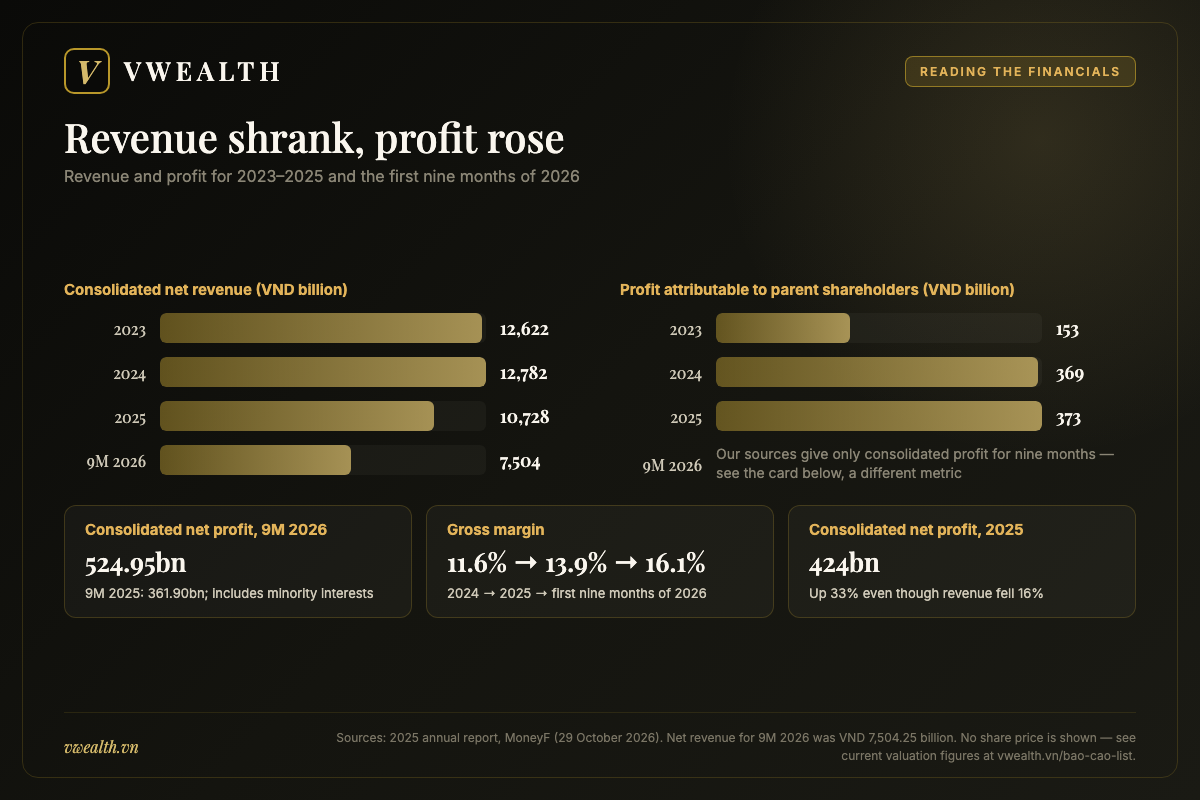
Vietnam’s Plastics Industry, Worth More Than USD 34 Billion: US Tariffs, Resin Prices and Green Pressure
No company grows in isolation from its industry. However good An Phat Bioplastics may be, resin prices are still set by the global oil and gas market, import tariffs are still set by the governments of buying countries, and rules on plastic waste are still set by lawmakers. This chapter places An Phat Bioplastics within the picture of Vietnam’s plastics industry, so you can see which winds are blowing in its favor and which are blowing against it. For an overview of comparable listed companies, see vwealth’s guide to Vietnam manufacturing and industrial stocks.
Industry Size: More Than 6,000 Companies, and Two Ways of Counting Export Turnover
According to the Vietnam Plastics Association (VPA), as cited by CafeF on October 15, 2026, Vietnam’s plastics industry has more than 6,000 companies and was worth about USD 34.3 billion in 2025, up about 9.2% from USD 31.4 billion in 2024. Also according to the VPA, plastic product exports in 2025 were estimated at about USD 10 billion (up 13.7%), and the first nine months of 2026 reached USD 8.9 billion (up 13%).
But if you open An Phat Bioplastics’ 2025 annual report, you will find a different number: Vietnam’s plastic product export turnover in 2025 was USD 7.473 billion, up 11.1%, shipped to more than 190 markets. The company cites this figure from Vietnam Customs data. Why is there a gap of nearly USD 2.5 billion? The documents reviewed for this article do not explain the difference. The most reasonable interpretation is that the two sources count different scopes: Customs uses specific groups of tariff codes, while the industry association uses its own statistical method. This article keeps both, states the source of each, and does not mix them in a single calculation. Whenever you read industry news, always ask “whose number is this, and what does it count?” before comparing.
Whichever way you count, two trends overlap: Vietnam’s plastics exports are growing at double-digit rates every year, and the industry is highly fragmented, with thousands of companies. In a fragmented industry, scale is an advantage: large companies buy raw materials at better prices, invest in more modern machinery and can fulfill large orders from foreign retail chains, where smaller firms struggle to get a foothold. With packaging sales volume of 118,572 tonnes in 2025, An Phat Bioplastics belongs to the group with real scale in thin-film packaging.
Plastic Bags and Thin Film: Billion-Dollar Product Groups, With the US Taking Half
An Phat Bioplastics’ 2025 annual report cites Customs data showing that in 2025 three plastic export product groups exceeded USD 1 billion each: plastic plates, sheets and film; building and construction articles; and plastic bags. Together these three groups made up 59.7% of total export turnover. This is exactly An Phat Bioplastics’ playing field: thin-film packaging and bags belong to the first and third groups, while the SPC (stone plastic composite) flooring made at Factory No. 8 falls into the building articles group.
The more striking detail lies in the destination markets. In 2025, Vietnam’s plastics exports to the United States reached USD 3.767 billion, accounting for 50.4% of the total and up 22.2%. Within shipments to the US, construction plastics made up 35%, plates, sheets and film 24%, plastic bags 14%, household goods 8% and other products 19%. In other words, of every two dollars of Vietnamese plastics exports, one goes to the US. That is an opportunity, because the US is a large market with strong purchasing power. But it is also concentration risk: a single change in tariff policy in Washington can hit the entire industry at once.
Where does An Phat Bioplastics stand in this story? According to its audited 2024 financial statements, as cited by Nha dau tu and The Leader, the US market accounted for more than 7% of the company’s revenue in 2024. That share is far lower than the US share of the industry’s plastics exports. The 2025 annual report states that Europe, Japan and the US are the three most important markets for the packaging business, while SPC flooring is exported mainly to the US. A company with a relatively diversified basket of markets absorbs a shock from any single market more lightly than one that has put everything in one place. Compared with other exporters that depend heavily on the US, such as the case you can read about in our analysis should I buy TNG stock, An Phat Bioplastics’ concentration risk is therefore more spread out.
Imported Raw Materials and Oil Prices: The Variable No Plastics Maker Controls
PE (polyethylene), PP (polypropylene) and other plastic resins are the “rice” of the plastics industry, the staple input that everything else depends on. According to an analysis by Tin nhanh chung khoan on October 29, 2026, more than 70% of Vietnam’s demand for plastic raw materials is met by imports (according to some industry studies), and resin prices are closely linked to oil and gas prices. An Phat Bioplastics’ 2025 annual report states that Vietnam imported about 9.658 million tonnes of plastic raw materials in 2025, worth USD 12.532 billion, up 14.6% in volume and 8.3% in value; PE and PP alone made up 47.3% of the volume. In the first nine months of 2026, according to the VPA as cited by CafeF, Vietnam imported about 7.3 million tonnes of plastic raw materials (up 1.9%), worth USD 10.3 billion (up 8.7%).
Notice that the value of imports in the first nine months of 2026 grew faster than the volume. That means the average price per tonne of raw material has gone up. For a manufacturer, rising input prices cut both ways. If the company can pass the increase on to its selling prices, margins hold. If it cannot, margins get squeezed. A comparison: Binh Minh Plastics (BMP), a construction plastics maker focused on the domestic market, reported Q3 2026 revenue of VND 1,462.9 billion (down 4.5%), with cost of goods sold up 9.4% and gross profit down 19.7%, according to Tin nhanh chung khoan. You can read more about that company in our analysis should I buy BMP stock.
For An Phat Bioplastics, resin prices act in two different directions. In the packaging manufacturing business, higher raw material prices are a cost. In the resin trading business, now held in an associate, a spike in resin prices can instead bring in profit, as the Q1 2026 explanatory letter noted when prices jumped in March because of instability in the Middle East. This is a partial “natural hedge”: when production costs rise, trading profit can offset some of it. But do not rely on this mechanism too heavily, because trading profit depends on the timing of purchases and sales, and it can reverse quickly when resin prices turn down.
US Tariffs and Competition With Thailand: The View From an Insider
In 2025, the United States’ reciprocal tariff policy forced every Vietnamese exporter to redo its calculations. In April and May 2025, Ms. Hoa Thi Thu Ha, Deputy General Director of An Phat Bioplastics, told The Leader that the company’s main export product to the US was SPC flooring, subject to a 5% tariff, while its main competitor in Thailand had also seen its tariff rise from 0 to 10%. The point of her remark was clear: in export competition, what matters is not only the absolute tariff rate but the rate relative to rivals in the same market.
This article does not speculate about the current tariff rate on Vietnamese plastic flooring entering the US, because there is no updated company document on that figure. What you should do is follow official US tariff announcements on Vietnamese plastic goods and compare them with competing countries such as Thailand. For An Phat Bioplastics, the US accounted for more than 7% of revenue in 2024, so the direct impact is limited; but Factory No. 8 is designed to export to the US, so the future of that investment is closely tied to trade policy between the two countries.
There is also a positive factor on the European side: the Vietstock company profile notes that Vietnamese plastic packaging gained an advantage when the EU removed anti-dumping duties on Vietnamese products. Europe and Japan are two important markets for An Phat Bioplastics’ packaging business, so a fairer playing field in the EU lets the company compete on quality and price without carrying extra trade-defense duties.
EPR, Biodegradable Packaging and Green Standards: Pressure That Is Also an Opportunity
Ask which trend will shape the plastics industry over the next ten years and the most common answer is “going green”. According to a Vietstock article on October 12, 2026, packaging is the most widespread application of plastics, and the industry faces increasingly strict requirements on managing products after use, both at home and in importing markets. VPA Chairman Dinh Duc Thang, quoted by CafeF, stressed green transformation across the entire product life cycle and said that enforcing extended producer responsibility (EPR) should drive collection and recycling.
What is EPR? Put simply, it is a mechanism that makes manufacturers and importers responsible for a product even after the consumer throws it away: either they organize collection and recycling themselves, or they contribute money toward it. For a company that makes bags and thin film, EPR means extra cost. But it also means that environmentally friendly products gain a competitive edge as the rules tighten.
This is where An Phat Bioplastics placed its bet early. As chapter 3 described, its compostable packaging brand AnEco was launched in 2018, registered as a trademark in the US and has been sold on Amazon since 2021. The 2025 annual report says the 2026 strategy includes expanding fully biodegradable products and continuing to promote the AnEco brand. This article has no separate revenue figure for that line, so it cannot assess how much it contributes. What is certain is that if green regulations in Europe, Japan or Vietnam tighten further, a company that already has the product line, the brand and the sales channels will be better placed than rivals starting from scratch.
The table below places An Phat Bioplastics next to two other plastics and materials companies that vwealth has analyzed, so you can see how different business models can be within the same broad industry. The table uses only qualitative information and figures sourced in this article.
| Criterion | AAA (An Phat Bioplastics) | BMP (Binh Minh Plastics) | TLG (Thien Long) |
|---|---|---|---|
| Main products | Thin-film packaging, industrial packaging, SPC flooring, engineering plastic components | Construction plastics (pipes, fittings) | Stationery, school supplies |
| Main markets | Exports: Europe, Japan, US; customers in 70+ countries | Mainly domestic | Domestic and export |
| Raw material risk | Imported resin; partly offset by trading profit at an associate | Q3 2026 cost of goods sold up 9.4%, gross profit down 19.7% | See the dedicated analysis |
| Activities beyond manufacturing | Industrial park real estate, logistics | Focused on manufacturing | Focused on manufacturing and distribution |
| Analysis on vwealth | This article | Should I buy BMP | Should I buy TLG |
The takeaway from the table: they are all “plastics stocks”, but each company faces different winds. BMP is sensitive to the domestic construction market, An Phat Bioplastics is sensitive to overseas packaging demand and global resin prices, and Thien Long is tied to consumer spending and education. Do not lump them all into one basket just because you hear that “the plastics industry is struggling”. If you are interested in industrial materials more broadly, our analysis should I buy MSR stock is a very different example of a materials company exposed to commodity price cycles.
Forecasting the Trend: Three Scenarios for An Phat Bioplastics After Its Restructuring
By now you have all the pieces: a large-scale packaging company that has just taken its trading business out of consolidation, is pouring capital into new factories and industrial parks, and saw profit for the first nine months of 2026 rise strongly thanks to better gross margins, higher income from associates and the absence of divestment losses. The natural question is: what happens next?
This chapter does not answer with a profit forecast or a target price. Forecasting the profit of a company exposed to global resin prices, US tariff policy and the pace of industrial park development is something even professionals often get wrong. Instead, we do something more useful: list the drivers that already exist on paper, then describe three possible pictures, each with specific conditions and signs that let you recognize it yourself. When new information arrives, you only need to ask: which scenario does this push An Phat Bioplastics toward?
The Drivers Already on Paper
First, Factory No. 8 is already running. According to The Leader, the plant in An Dong industrial cluster, Nam Sach, was completed and began operating in November 2024. Its main products are plastic flooring and compound plastic pellets, aimed at export to the US. It is no longer a project on the drawing board but an asset that already generates revenue and has started to be depreciated.
Second, gross margin has improved across three consecutive published milestones. From 11.6% in 2024 to 13.9% in 2025, reaching 16.1% in the first nine months of 2026. Gross profit of the manufacturing business rose 14% in 2025, from VND 955 billion to VND 1,092 billion, thanks to industrial packaging, engineering plastics and construction plastics being consolidated for the full year. These are historical facts, not promises about the future, but they show that the restructuring is moving in the direction management described.
Third, the 2026 plan was set low, and nine-month results are already in. The 2026 AGM approved a plan for consolidated revenue of VND 9,527 billion and profit after tax attributable to parent shareholders of VND 347 billion. Actual nine-month results: net revenue of VND 7,504.25 billion (about 79% of the revenue plan, vwealth estimate) and consolidated profit after tax of VND 524.95 billion. As stressed in chapter 5, these two profit metrics sit on different bases, so the comparison is for reference only and should not be read as a percentage of the profit plan.
Fourth, the parent has locked in control. With 50.23% since June 2026, An Phat Holdings can coordinate strategy among the group’s companies more clearly. That may be positive if it helps divide roles cleanly, but it also raises the importance of transactions between An Phat Bioplastics and related parties, which you should read carefully in the financial statements.
The Favorable Scenario: Manufacturing Carries Profit, New Assets Start Generating Cash
In the brightest picture, An Phat Bioplastics’ profit increasingly comes from its own packaging and engineering plastics plants rather than from one-off items. For that picture to become reality, several conditions need to happen together.
Condition one: packaging exports to Europe, Japan and the US stay stable. Packaging sales volume rose 11% in 2025 to 118,572 tonnes. The favorable scenario requires demand in these three markets not to weaken and major customers to keep placing orders. The 2025 annual report says the company wants to diversify its customer base to reduce concentration risk; if that goes smoothly, manufacturing revenue will be more resilient.
Condition two: resin prices move favorably. The best case is not resin prices that are very cheap or very expensive, but prices that rise moderately: enough for the trading business at the associate to make money, while the factories pass higher costs on to selling prices. It is a delicate balance, but the first nine months of 2026 showed it can happen: income from associates rose sharply while manufacturing gross margin still improved.
Condition three: investment spending turns into profitable assets. In the first nine months of 2026, investing cash flow was negative VND 1,448.80 billion, including VND 933.03 billion spent on purchasing and building fixed assets. The favorable scenario is one in which this spending soon becomes revenue from the factories and rental income from the Luong Dien Ngoc Lien industrial park and An Phat 1 industrial park, so that operating cash flow recovers and is sufficient to service debt.
Condition four: trade policy does not get worse. US tariffs on Vietnamese plastic flooring and packaging do not rise faster than those on competitors, and the EU continues to treat Vietnamese plastic goods fairly.
Signs that this scenario is playing out: gross margin holds in the following quarters even as income from associates declines; net cash flow from operating activities recovers; construction in progress keeps moving into fixed assets while manufacturing revenue grows.
The Base Scenario: Tracking the Plan, Profit Moving Sideways With the Investment Cycle
The most likely scenario is usually the “boring” one. In this picture, An Phat Bioplastics operates close to the plan approved by the 2026 AGM, meaning consolidated revenue of VND 9,527 billion and profit attributable to parent shareholders of VND 347 billion, plus or minus small swings driven by raw material prices. The nine-month results have shown the company has a cushion relative to its profit plan, so the base scenario does not require anything special.
Conditions for the base scenario: export packaging demand neither surges nor drops sharply; income from associates returns to a more normal level after the resin price volatility of early 2026; and debt stays around its current level. To give you a sense of “current level”: at September 30, 2026, borrowings and finance lease liabilities were about VND 3,485.76 billion (up about VND 455 billion from the start of the year), consisting of VND 2,292.59 billion short term and about VND 1,193.18 billion long term, according to MoneyF.
In this scenario, the AAA story will revolve mainly around two questions: how much “core” profit comes from manufacturing once the associates’ share is stripped out, and when the large investments begin to produce income. Signs to recognize it: gross margin hovering around the level already achieved, income from associates gradually declining compared with the first nine months of 2026, and investing cash flow becoming less negative as large projects are completed.
An important note: the base scenario is not a “bad scenario”. A packaging company that runs steadily, has customers in more than 70 countries and earns consistent profit is a valuable asset. You simply should not expect the profit growth of the first nine months of 2026 to repeat every year, because part of it comes from comparing against a prior-year period that carried a divestment loss.
Export manufacturers such as packaging makers tend to move at different rhythms through the economic cycle. If you want to place AAA in that broader context and compare it with other sectors, our guide on investing in the Vietnam stock market is a good starting point.
The Adverse Scenario: Several Headwinds Blowing at Once
A bad scenario does not need a disaster. It only needs a few unfavorable factors to coincide.
Risk one: US tariffs rise more than for competitors. Factory No. 8 is designed to export plastic flooring to the US. If US tariff policy changes in a way that is unfavorable specifically to Vietnamese goods compared with Thailand or other competing countries, this investment could take longer to pay back.
Risk two: raw material prices rise faster than selling prices. BMP’s Q3 2026 results show this can happen in the plastics industry: cost of goods sold rose 9.4% while revenue fell 4.5%. If An Phat Bioplastics ends up in a similar situation in its manufacturing business, gross margin could slip back, and this time trading profit at the associate may not be enough to offset it.
Risk three: income from associates reverses. Income from joint ventures and associates in the first nine months of 2026 was VND 133.76 billion, about 22.5% of net operating profit of VND 594.58 billion (vwealth estimate). This portion depends on resin price movements and trading activity. If resin prices fall sharply, its contribution could shrink quickly.
Risk four: industrial park investments are slow to pay back and interest costs rise. Interest expense for the first nine months of 2026 was VND 135.05 billion, about 37% higher than the VND 98.73 billion in the same period a year earlier (vwealth estimate). If leasing at the industrial parks is slow while debt keeps rising to fund investment, interest costs will eat into profit. The 2025 annual report also shows that exchange rate and interest rate differences caused a loss of VND 60.4 billion in 2025, a reminder that financial risk lies not only in interest rates but also in currency movements.
Warning signs to watch: gross margin falling for two consecutive quarters; income from associates dropping sharply while manufacturing profit does not rise; operating cash flow continuing to lag the prior-year period (VND 470.48 billion in the first nine months of 2026, versus VND 586.79 billion in the first nine months of 2025); and debt rising further while assets under construction fail to turn into revenue.
| Scenario | Conditions | Signs to watch |
|---|---|---|
| Favorable | Stable packaging exports to the EU, Japan and the US; resin prices rising moderately; new assets starting to generate cash; trade policy not getting worse | Gross margin holding as associate income declines; operating cash flow recovering; manufacturing revenue growing |
| Base | Operations close to the 2026 AGM plan; associate income back to normal; debt around the September 30, 2026 level | Gross margin around the level already achieved; investing cash flow less negative as projects complete |
| Adverse | US tariffs unfavorable specifically to Vietnamese goods; raw material prices rising faster than selling prices; associate income reversing; industrial parks slow to pay back, interest costs rising | Gross margin down two quarters in a row; operating cash flow below the prior-year period; debt rising while construction in progress has not produced revenue |
The graphic below summarizes the three scenarios by their conditions, alongside two published reference points for comparison: the 2026 AGM plan and the actual results for the first nine months of 2026. It contains no forecast figures.
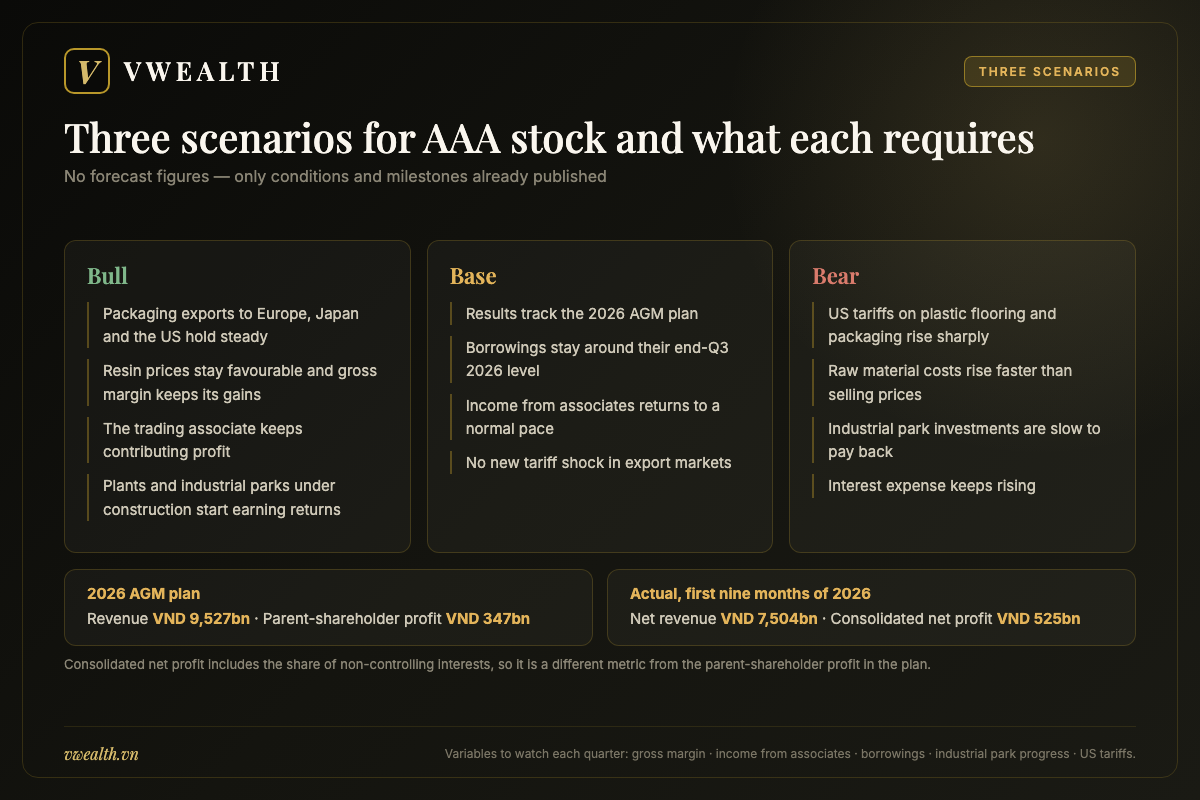
Should You Buy AAA Stock? Weighing the Pros and Cons for Each Type of Investor
Seven chapters are behind us. Now it is time to answer the question that brought you to this article: should you buy AAA stock? The honest answer is that there is no single answer for everyone. The same stock can be an opportunity for one person and an unrewarded risk for another. This final chapter weighs the pros and cons using the facts we have, then helps you work out which group you belong to.
The Pros: Scale, Improving Margins and a Parent That Has Locked In Control
Scale in thin-film packaging. Packaging sales volume reached 118,572 tonnes in 2025, up 11%. Customers are spread across more than 70 countries and territories, with Europe, Japan and the US as the three most important markets. In an industry with more than 6,000 companies, that scale gives An Phat Bioplastics an edge in buying raw materials, handling large orders and keeping demanding customers.
Gross margin improving steadily across published milestones. From 11.6% (2024) to 13.9% (2025) and 16.1% (first nine months of 2026). After the low-margin trading business was removed from consolidation, what remains is the part of the company that earns more on each dong of revenue.
Strong profit growth in the first nine months of 2026. Consolidated profit after tax was VND 524.95 billion, up about 45% year on year. Although part of this came from associate income and from the absence of divestment losses, the result is still well above the VND 347 billion profit plan for parent shareholders (a different basis, compared for reference only).
The parent increased its stake with real money. An Phat Holdings bought 6 million shares through order matching in June 2026 to cross the 50% threshold. Even if the motive may be partly about governance, the largest shareholder spending money to buy more is still a positive fact for many investors.
Industrial park land assets. Investment property of VND 1,270 billion at the end of 2025 and the industrial park projects form a pool of assets beyond packaging that could deliver long-term rental cash flow if leasing goes well.
The Cons: Profit Leaning on Non-Manufacturing Items, Negative Investing Cash Flow and a Thin Dividend
The quality of earnings needs close scrutiny. About 22.5% of net operating profit in the first nine months of 2026 came from associate income (vwealth estimate), a portion that depends on resin prices. The year-on-year profit increase was also helped by the prior-year period carrying a divestment loss. These factors are hard to repeat consistently.
Large negative investing cash flow and rising debt. In the first nine months of 2026, investing cash flow was negative VND 1,448.80 billion, almost double the prior-year period (negative VND 782.16 billion). Net cash flow from operating activities was VND 470.48 billion, lower than a year earlier. Borrowings and finance lease liabilities rose by about VND 455 billion to about VND 3,485.76 billion. Subtracting cash and short-term financial investments (VND 1,246.49 billion + VND 1,155.45 billion), net debt was about VND 1,084 billion at September 30, 2026 (vwealth estimate). Relative to consolidated owners’ equity of VND 6,079 billion at the end of 2025, this level of net debt is not yet large, but the upward trend deserves monitoring.
A thin dividend. The 2025 cash dividend was only 3% of par value (VND 300 per share), and more than half of that cash goes to the parent. Investors looking for steady income will find AAA is not yet an attractive choice.
Shrinking revenue. Net revenue fell 16% in 2025 and about 12.1% in the first nine months of 2026. The main cause is the restructuring, but for someone looking only at the surface, falling revenue is still a hard number to “sell” as a growth story.
Minority shareholders have a limited voice. The parent group and its related parties hold 51.16%, so strategic direction is mainly decided by An Phat Holdings.
| Factor | Pro | Con | Supporting data |
|---|---|---|---|
| Packaging scale | Edge in raw material buying, large orders | Depends on export demand | 118,572 tonnes sold in 2025 (+11%); 70+ countries |
| Margins | Improved after restructuring | Sensitive to resin prices | Gross margin 11.6% (2024) → 13.9% (2025) → 16.1% (9M 2026) |
| Profit | Strong growth in 9M 2026 | Partly from associate income; prior-year period had a divestment loss | Consolidated profit after tax VND 524.95 billion (+~45%); associate income VND 133.76 billion |
| Cash flow and debt | Investing for long-term growth | Negative investing cash flow, rising debt and interest costs | 9M 2026 investing cash flow −VND 1,448.80 billion; borrowings ~VND 3,485.76 billion; interest expense VND 135.05 billion |
| Dividend | Cash dividend paid for 2025 | Low rate, ESOP dilution | 3% (VND 300 per share) for 2025; ESOP 11.47 million shares |
| Shareholders | Parent increased its stake | Minority shareholders have little say | APH 50.23%; 51.16% with related parties |
Should You Buy AAA Stock as a Dividend, Growth or Short-Term Investor?
If you are a dividend investor. You want a steady cash stream that grows every year. AAA does not currently meet that goal well: a rate of 3% of par value is low, and with capital needs for factories and industrial parks, the company has reasons to retain earnings. The actual dividend yield you receive depends on the price you pay (VND 300 divided by the share price), so calculate it yourself when you check the price. If income is your aim, AAA should only be a small position, not a pillar of your portfolio.
If you are a long-term growth investor. Your question is whether, after the restructuring, core manufacturing profit will grow sustainably. The data on gross margin and manufacturing gross profit is a supportive signal. But you need to accept a period of negative investing cash flow and rising debt. This suits patient investors who are willing to follow every quarterly report and accept that large investments take time to deliver results.
If you are a short-term trader. With an ownership structure in which more than half the shares sit with the parent group, AAA’s price can be quite sensitive to news such as quarterly results, resin price headlines or US tariff announcements. That is a natural environment for short-term traders, but it is also a place where it is easy to lose if you react slowly. If you choose to trade it, set a clear stop-loss and do not use more leverage than you can handle. Vietnam’s daily price limits on HOSE also mean that sharp moves can stretch over several sessions, so position sizing matters.
If you are a beginner. AAA is a good lesson in reading the reports of a company that has just restructured: falling revenue does not necessarily mean the business is doing badly, and rising profit does not necessarily mean it is sustainable. If you are not yet comfortable reading consolidated versus separate financial statements, learn that first before committing money, and start with a small amount.
Five Self-Check Questions Before You Commit Money
Before placing a buy order for AAA, answer the five questions below. Any question you cannot answer yet is an area you need to research further.
1. Did gross margin hold in the latest quarter? If gross margin stays around the level already achieved even as associate income declines, that is a sign core profit is healthy.
2. What share of profit comes from associates? The larger this portion, the more profit depends on resin prices and the harder it is to predict.
3. Is net debt rising or falling? Take total borrowings and subtract cash and short-term financial investments. If net debt keeps rising while revenue does not keep pace, financial risk is increasing.
4. Have the industrial parks and new factories started producing revenue? Track construction in progress and industrial park real estate revenue in the quarterly reports.
5. How are US and EU trade policies toward Vietnamese plastic goods changing? Trade news can change the picture for Factory No. 8 faster than any financial statement.
Conclusion: A Company “Getting Smaller to Get Stronger”, but the Real Test Lies Ahead
The An Phat Bioplastics of 2026 is very different from the An Phat Bioplastics of a few years ago. Revenue is smaller because the trading business has left the consolidated accounts, margins are better, nine-month profit has risen strongly, and the parent now owns more than half. These are real changes, backed by published figures. But the real test still lies ahead: will profit from the packaging factories themselves be durable enough to carry heavy investment spending and rising debt, once associate income and the “no more divestment loss” effect fade?
This article does not recommend buying or selling. It gives you a map: where An Phat Bioplastics makes its money, how to read its numbers and which signs to track. The final decision is yours, based on your goals, your risk appetite and the price at the moment you look. For up-to-date valuation, profit figures and scores based on the latest reports, you can open vwealth’s stock analysis reports, or sign up for a vwealth account to follow AAA alongside other stocks in the same industry. To compare it with other Vietnamese manufacturers, browse our coverage of Vietnam manufacturing and industrial stocks, including SIP and IDC if the industrial park angle interests you.
Research Vietnamese stocks in English with vwealth. Our AI-powered platform turns Vietnamese market data into full English analysis reports — with international payment support and a free first month when you subscribe in the VWEALTH app. Create your free account and read the latest reports.