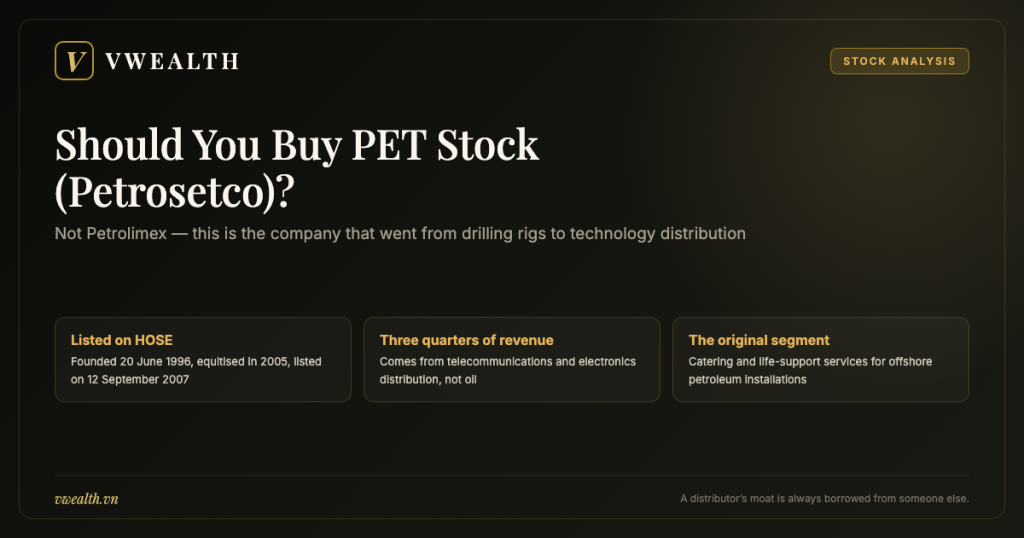
Should you buy PET stock? The question has a problem built into its first line: many people asking it do not know which company they are asking about. The ticker suggests oil, the search box helpfully suggests “Petrolimex”, and the reader ends up looking at an entirely different business. PET is the ticker of Petroleum General Services Corporation, trading as Petrosetco — and today roughly three quarters of its revenue comes not from oil and gas but from distributing phones, laptops and consumer technology across Vietnam. It is one of the most complete transformations any former Vietnamese state-linked enterprise has managed. This analysis separates PET from Petrolimex at the outset, follows thirty years of reinvention, teaches you how to read the accounts of a distributor — a business model that will mislead you badly if you start from the revenue line — and ends with a straight answer about who this stock suits.
A note on method before we begin. You will find dates, names, brands and scale figures throughout, all from public sources: founding decisions, exchange filings, shareholder meeting resolutions and mainstream financial press. What you will not find is a current-quarter number or a current valuation multiple. For a distributor with very thin margins, those figures swing violently between quarters with product launch cycles and inventory positions, so an article still being read two years from now would mislead within ninety days. Instead this piece teaches you where to look; for the current numbers, open the latest analysis reports on vwealth.
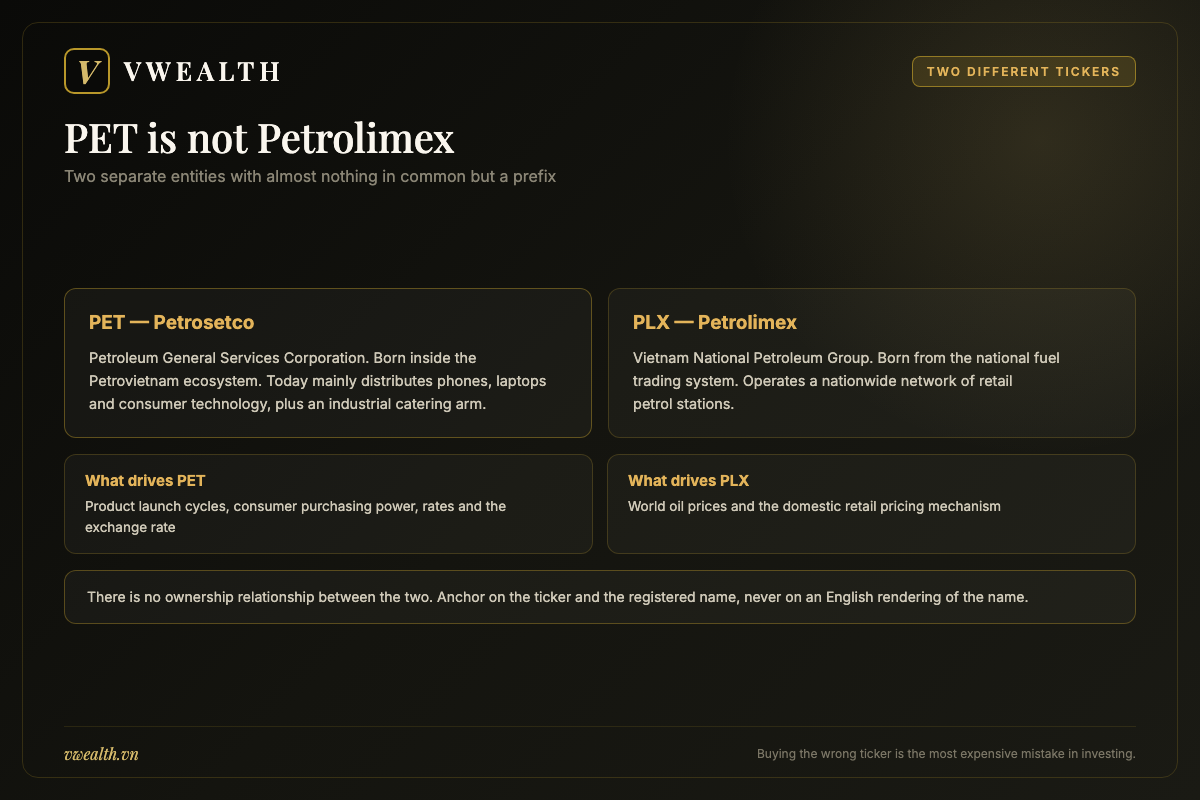
PET is not Petrolimex: two companies, two different worlds
This chapter should not need to exist. It does, because this is the single most common confusion among people researching the PET ticker, and buying the wrong stock is the most expensive mistake in investing.
Three fundamental differences
The first difference is legal identity. PET is the ticker of Petroleum General Services Corporation, known internationally as Petrosetco. PLX is the ticker of Vietnam National Petroleum Group, known as Petrolimex. Two entirely separate legal entities, two different tickers on the same HOSE exchange, with no ownership relationship between them.
The second difference is origin. Petrosetco was born inside the ecosystem of Petrovietnam, the national oil and gas exploration and production group. Petrolimex comes from the fuel trading system, originating as the importer and distributor of refined fuel for the country. One was created to service extraction operations; the other was created to retail fuel.
The third difference, and today the largest, is what they actually do. Petrolimex operates a nationwide network of petrol stations; if you want to understand that model, our analysis of PLX stock and Petrolimex covers that company separately. Petrosetco today is primarily a technology equipment distributor — phones, laptops, accessories, appliances — plus an industrial catering business with a remarkable competitive position that the third chapter examines in detail.
Why the confusion persists
Three causes compound. One, both names start with the prefix “Petro” and both evoke oil. Two, Petrosetco’s full legal name still contains the words “Petroleum” and “General Services” even though most of its revenue left that industry long ago — a legacy of history rather than a description of the present. Three, search engines learn from user behaviour, so once enough people type the wrong thing, the wrong suggestion reinforces itself.
The practical lesson for an investor, and especially for a foreign investor working across a language barrier: check the company’s full registered name on the board before you place an order, and do not trust three letters. It is a small habit that has saved many people from buying a business whose model is the opposite of what they intended to buy.
What a foreign investor should verify before buying either ticker
The naming confusion is worse for someone researching from outside Vietnam, because both companies appear in English-language databases under translated names that sound similar and both are described with the word “petroleum”. Three verification steps remove the risk entirely.
First, check the exchange code, not the company name. PET and PLX are distinct four-character-free tickers on HOSE, and every broker platform shows them separately. Second, check the sector classification: PET is classified within trading and distribution services, PLX within oil and gas retail. Third, check the revenue composition in the most recent annual report — if three quarters of revenue sits under telecommunications and electronics, you are looking at Petrosetco.
There is a fourth check worth doing for any Vietnamese company, not just this pair. Vietnamese corporate names are frequently long, descriptive and translated inconsistently between data vendors, so the same company can appear under three different English names across three screens. Always anchor on the ticker and the tax code rather than on any English rendering of the name.
It is also worth understanding why the legal name lags reality. Changing a Vietnamese company’s registered name requires a shareholder resolution and a filing with the business registration authority, and companies frequently postpone it because the process touches every contract, licence and bank account. The lag is administrative rather than a sign of anything concealed — which is exactly why Petrosetco is now putting a rename to its shareholders.
PET and PLX side by side
| Criterion | PET — Petrosetco | PLX — Petrolimex |
|---|---|---|
| Legal name | Petroleum General Services Corporation | Vietnam National Petroleum Group |
| Origin | The Petrovietnam ecosystem | The national fuel trading system |
| Main activity today | Technology distribution and industrial catering | Fuel import and retail |
| Revenue character | Wholesale equipment, very thin margins | Retail fuel with state-managed pricing |
| Most important variable | Product launch cycles and consumer purchasing power | World oil prices and the retail pricing mechanism |
Look at that table and you will see two companies with essentially nothing in common except a prefix. From this point the article discusses only Petrosetco.
Thirty years of reinvention: from feeding oil rigs to selling iPhones
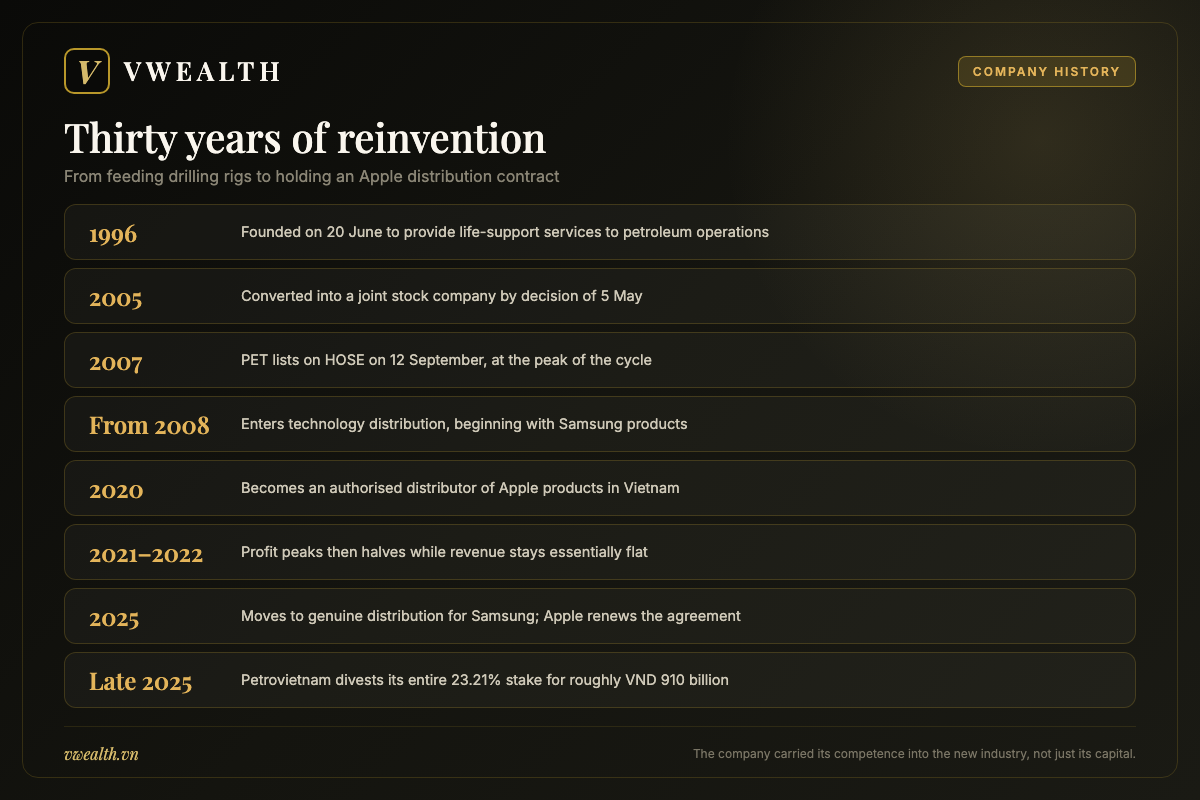
If you had to name one Vietnamese listed company whose 1996 business description and today’s share almost no words in common, Petrosetco would be the leading candidate. The story deserves telling properly, because it explains both the strength and the weakness of the company you can buy today.
1996: created to serve the oil and gas industry
Petrosetco was established on 20 June 1996 by administrative decision, formed by consolidating several service units within the oil and gas ecosystem. Its original mandate was specific and unglamorous: provide life-support services to petroleum operations. That meant cooking for offshore rigs, arranging accommodation, laundry, cleaning and logistics for offshore installations.
It is work without prestige but with two valuable characteristics. First, it produces steady cash largely independent of the oil price, because whether or not a rig is drilling, the people on it still have to eat. Second, it demands supply chain execution under harsh conditions — a capability the company would later carry into an entirely different industry.
Why a petroleum services firm chose technology distribution
This question deserves a proper answer, because it is the key to understanding the company. At first glance, a unit that cooked meals and ran logistics for drilling rigs moving into selling phones looks like an arbitrary leap. But if you strip away the industry label and look at the underlying capability, the shift is far more coherent than it appears.
Offshore logistics demands three capabilities. First, supply chain management under strict time constraints: supply vessels run to a schedule, and missing one leaves an entire rig short. Second, working capital management: the company pays for goods up front, collects later, and lives on the turn. Third, managing relationships with large institutional customers on long contracts with rigorous procedures.
Technology distribution demands exactly those three capabilities, with a different cargo and a different rhythm. Purchase to the product launch calendar rather than the supply vessel calendar. Fund an inventory batch rather than a catering contract. Deal with Apple rather than an oil contractor. Viewed through capability rather than industry, this was not a jump into another business but the same skill set applied to a far larger market.
There is a wider lesson for investors here. When assessing a company that pivots, do not ask whether the new industry resembles the old one; ask whether the core capability transfers. A great many diversification efforts fail because the company carries its money into a new sector without carrying its competence. Petrosetco belongs to the smaller group that carried both.
2005 and 2007: equitisation, then listing
On 5 May 2005 the enterprise was converted into a joint stock company by decision of the industry regulator. Just over two years later, on 12 September 2007, PET shares listed on the Ho Chi Minh Stock Exchange.
The listing date is worth noting. 2007 was the peak of Vietnam’s first equity mania and the year immediately before the global financial crisis. A company listing at a cycle peak usually leaves its first cohort of shareholders underwater for years, and Petrosetco was no exception. Keep that context in mind when you look at the long-term price chart.
From 2008: the first step into technology distribution
The transformation began around 2008, when the company entered technology distribution starting with Samsung products. It was not an overnight success. Phone distribution is a low margin, fiercely competitive and working-capital-heavy business. Petrosetco spent more than a decade building position, and during that decade progressively added notebook brands including Acer, Dell, HP, Lenovo and Asus to the portfolio.
The decade that did not work, and why it matters
Company histories are usually written backwards from the successful outcome, which makes the twelve years between entering distribution in 2008 and winning the Apple appointment in 2020 sound like patient groundwork. It is worth resisting that framing, because those years contain the more useful information.
For most of that period the company was a mid-sized distributor of second-tier brands in a market with several similar competitors, earning thin margins on high volumes and periodically reporting results that disappointed its own plan. There was no obvious moment where the strategy was validated. The company kept adding brands, kept building warehouse coverage, and kept funding working capital, without any guarantee that a flagship appointment would ever arrive.
Two lessons follow for anyone valuing the company today. The first is about time horizons: capability in this business compounds slowly and invisibly, and the payoff arrives in discrete steps rather than smoothly. An investor holding through 2012 or 2016 would have seen very little evidence they were right. The second is about attribution: the Apple appointment looks in retrospect like the turning point, but it was the consequence of a decade of unglamorous investment in exactly the things Apple audits.
The uncomfortable corollary is that the same could be true of the catering expansion now underway. If it works, it will work slowly, and the years before it works will look like years of little progress.
2020: the Apple contract that changed the trajectory
The biggest inflection came in June 2020, when Petrosetco formally became an authorised distributor of Apple products in Vietnam. The timing was striking: 2020 was the pandemic year and also the year the oil price collapsed, meaning both of the company’s older segments were under pressure simultaneously. The Apple contract arrived exactly when it was needed.
Becoming an Apple authorised distributor means more than winning a commercial contract. Apple selects carefully and imposes demanding requirements on warehousing systems, display standards, warranty processes and financial capacity. Being chosen is a certification of operational competence. But it carries a price: margins on Apple product are thin, and the distributor must front very large amounts of working capital for each new inventory cycle.
Why the Apple relationship is harder to win than it looks
It is easy to read “authorised distributor” as a routine commercial arrangement. It is not, and understanding why tells you something durable about the company.
A global brand appointing a distributor in a market like Vietnam is delegating control over how its products reach consumers, and control is the thing such brands guard most carefully. The requirements therefore extend well beyond price. The distributor must demonstrate warehousing that meets specified security and environmental standards, systems that can report sell-through data at the level of individual retail doors, warranty and service processes that match the brand’s global standard, staff trained to the brand’s specification, and the balance sheet to fund inventory at scale without stretching payment terms.
The financial requirement deserves emphasis because it is the one investors underestimate. Product for a major launch must be paid for before it is sold, in foreign currency, in volume. A distributor that cannot fund that cycle cannot hold the appointment regardless of how good its logistics are. This is why the appointment functions as a certification: it is evidence a company cleared a bar set by an outside party with no incentive to be generous.
The corollary is the risk. Everything that makes the appointment valuable also makes it revocable. The brand sets the terms, reviews them periodically, and can appoint additional distributors when it judges that competition among its distributors serves it better. The July 2025 renewal removed that uncertainty for a period; it did not remove it permanently.
2021 and 2022: the peak, then the landing
2021 was the best year in the company’s history to that point, with revenue of roughly VND 17,598 billion and net profit of roughly VND 311.5 billion, more than double the prior year. The following year the picture inverted: 2022 revenue was essentially flat at roughly VND 17,665 billion, while net profit fell to roughly VND 167.84 billion, down about forty-six percent, completing only around half the profit plan.
That pair of numbers is the single most important lesson about the distribution business, and it is worth remembering above any other figure in this article. Revenue barely moved; profit lost nearly half. This happens because a distributor’s margin is so thin that a small decline in selling price, or inventory that must be marked down, or an increase in borrowing costs, is enough to evaporate the entire profit. With this model, revenue tells you almost nothing about corporate health.
2025: Samsung and a new operating model
From 1 January 2025, the Samsung relationship shifted from a fulfilment service model to genuine distribution: the company imports on its own account, distributes, and develops the retail channel. Within the first quarter, Petrosetco had covered more than 1,200 retail outlets nationwide for the Samsung channel.
The difference between the two models matters. Under fulfilment, the company performs logistics services for a fee — low risk, low reward, no inventory ownership. Under genuine distribution, the company buys the goods outright, carries inventory and price risk, and in exchange can earn a higher margin and control the channel. This decision increases both the opportunity and the risk, and you should track it through the inventory line rather than the revenue line.
In July 2025, Apple signed a renewed authorised distribution agreement with Petrosetco for the following period. The renewal matters because it removes, for another contract cycle, the largest risk any distributor lives with: losing the flagship brand.
Late 2025: Petrovietnam exits completely
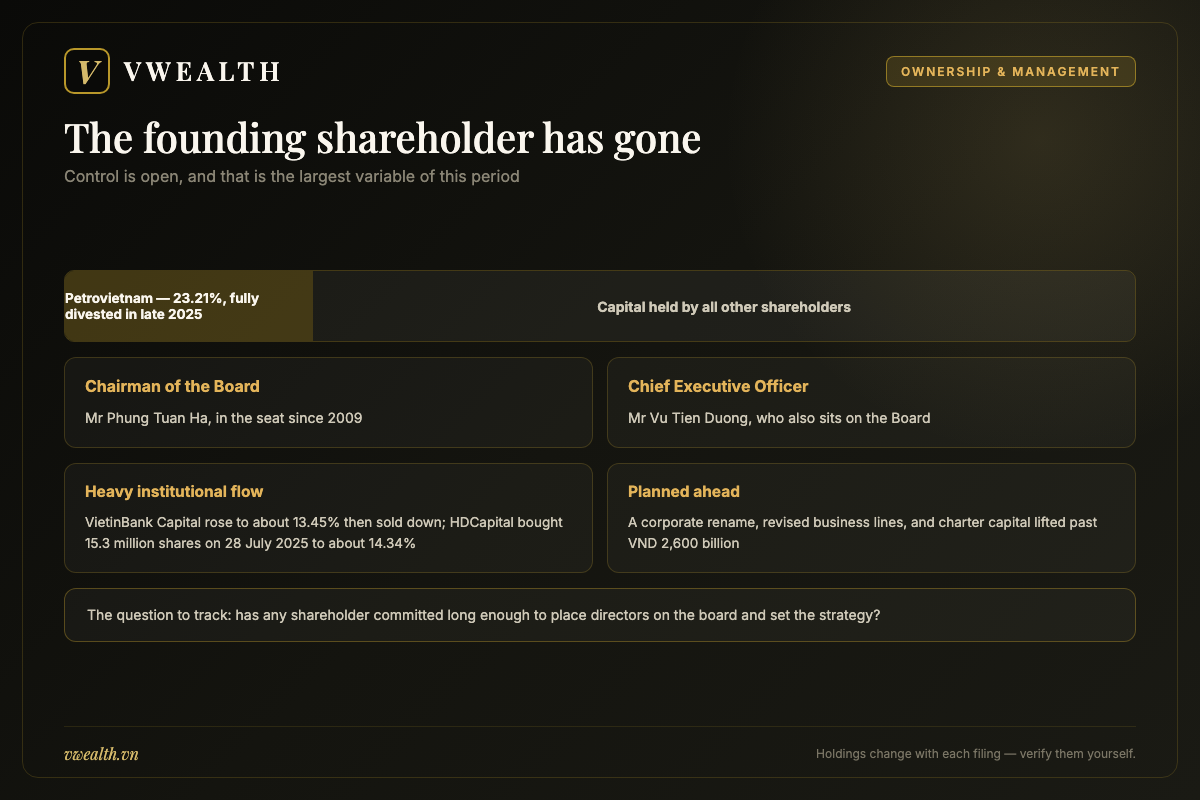
The most structurally significant recent event came at the end of 2025, when Petrovietnam completed the divestment of its entire state stake of 23.21% of charter capital, realising roughly VND 910 billion. From that point Petrosetco ceased to be a company with a state shareholder.
This is a bigger turning point than a financial transaction appears. It ends the ownership link with the ecosystem that created the company, clears the way to rename the business and adjust its registered activities to match reality, and simultaneously creates a vacuum of control that the next chapter examines. For the wider context, our overview of Vietnamese state-owned enterprises and the divestment programme places this case in its proper frame.
Key milestones at a glance
| Date | Event | Why it matters to an investor |
|---|---|---|
| 20 June 1996 | Founded to provide life-support services to petroleum operations | Origin is services, not extraction |
| 5 May 2005 | Converted to a joint stock company | First step out of the state enterprise framework |
| 12 September 2007 | PET shares list on HOSE | Listed at the peak of the equity cycle |
| From 2008 | Enters technology equipment distribution | Beginning of a decade-long transformation |
| June 2020 | Becomes an authorised Apple distributor | Step change in scale and standing |
| 2021 then 2022 | Profit peaks then halves on flat revenue | The clearest illustration of thin-margin leverage |
| 1 January 2025 | Moves to genuine distribution for Samsung | More opportunity and more inventory risk |
| Late 2025 | Petrovietnam divests its entire 23.21% stake | Ends the ownership link with the former parent |
Who owns Petrosetco now, and who runs it?
This chapter carries unusual weight, because Petrosetco has just been through the largest change that can happen to an ownership structure: the founding shareholder left entirely. What follows is still taking shape, and you should read it as a story in progress rather than a finished picture.
Mr Phung Tuan Ha: chairman since 2009
According to disclosed company filings, Mr Phung Tuan Ha has served as chairman of the board of Petrosetco since 2009. That figure is notable: seventeen consecutive years in the top seat, spanning the entire period in which the company moved from petroleum services into technology distribution.
For an investor, that continuity has two faces that must be read together. The positive face is strategic consistency: a transformation running more than a decade is only possible if the decision-maker does not change halfway. The face to monitor is that at a company which has just lost its controlling state shareholder, a long-tenured management team can become the most influential group in the register while a new supervisory structure has not yet formed. Our guide to corporate governance in Vietnamese listed companies sets out the criteria for assessing this from public filings.
Mr Vu Tien Duong: chief executive and board member
The chief executive role is held by Mr Vu Tien Duong, who also sits on the board. Other disclosed board members include Ho Minh Viet, Pham Thi Hong Diep and Nguyen Nhu Long. The registered head office is in the Petrovietnam Tower at 1-5 Le Duan Street, District 1, Ho Chi Minh City.
As with all personnel information, verify this before acting, particularly during a period when the company is repositioning and seeking a new strategic investor. Senior appointments are the fastest-moving item after an ownership transition.
The Petrovietnam exit and the vacuum it left
At the end of 2025 Petrovietnam sold its entire holding of 23.21% of charter capital for roughly VND 910 billion. Before that it was the largest shareholder and a source of both reputational backing and industry relationships.
Losing the state shareholder creates three practical changes. First, the company gains freedom in commercial decisions, no longer routed through parent group approval layers. Second, it loses an invisible layer of credibility, which had real value when dealing with large partners and with banks. Third, and most important for minority shareholders, control becomes open: whoever accumulates enough shares will shape the company’s future.
New shareholders and a turbulent year
The post-divestment period has seen heavy institutional flow in both directions. VietinBank Capital became a major shareholder after acquiring 9.35 million PET shares in a negotiated trade, lifting its stake from roughly 4.96% to roughly 13.45% of charter capital — and then sold 7.8 million shares, reducing the holding to roughly 2.06%. In the other direction, in the session of 28 July 2025, HDCapital purchased 15.3 million shares, lifting its stake from zero to roughly 14.34% and becoming a major shareholder. Subsequent disclosures indicate both institutions have again increased their holdings.
How should you read this sequence? There are two reasonable interpretations. The first: institutional money is interested in the company now that the state ownership barrier has been removed, which is a positive signal about its appeal. The second: financial institutions trading in and out on short cycles suggests they treat the shares as a financial position rather than a strategic commitment.
Your task is not to pick one interpretation but to monitor. Concretely, read the major shareholder and insider transaction disclosures and ask one question: has any shareholder committed for long enough to place people on the board and shape strategy? While the answer remains no, the company is still in transition.
What the divestment means for governance standards
There is a governance dimension to the Petrovietnam exit that deserves separate treatment, because it cuts in an unexpected direction for investors used to assuming state ownership is simply a drag.
State shareholding in a Vietnamese listed company brings costs that are well documented: slower decisions, approval layers, and objectives that are not purely commercial. But it also brings something minority shareholders quietly benefit from — a large shareholder subject to state audit and disclosure requirements, with limited scope for related-party dealing and strong incentives against irregular transactions. Removing that shareholder removes the drag and the guardrail together.
What replaces it determines everything. If a strategic investor with operating expertise takes a controlling stake and builds a professional board, the company ends up better governed and faster moving than before. If instead the register stays fragmented among financial holders trading short cycles, the practical result is a long-tenured management team accountable to nobody in particular.
For a minority investor the monitoring approach is concrete rather than philosophical. Read the related-party transaction note in each annual report and check whether it grows. Read the board composition and check whether genuinely independent members appear. Read the resolutions of the annual meeting and check whether large capital commitments pass with clear support or with visible dissent. All three are available in public filings and all three move before headline numbers do.
The rename and the capital raise
Following the founding shareholder’s exit, the company plans to put a corporate rename to shareholders along with an adjustment of its registered business lines, and has a plan to lift charter capital past VND 2,600 billion. Current charter capital per disclosed filings stands at roughly VND 1,553.56 billion.
A rename sounds cosmetic, but in this case it has substance. A company deriving three quarters of revenue from technology distribution while still carrying “Petroleum General Services” in its name is carrying a mismatch between identity and reality — and as the first chapter showed, that mismatch is precisely what creates the confusion with Petrolimex.
The capital raise deserves closer reading. Raising capital through new issuance is dilution: the share count rises, and if profit does not rise proportionally, earnings per share falls. For a distributor that needs large working capital, raising equity is operationally sensible, but existing shareholders must account for the dilution effect.
Dividend policy
Petrosetco maintains a dividend tradition, but at levels appropriate to a distribution business rather than the generosity of an infrastructure operator. The company also has a habit of combining cash dividends with bonus share issues — a way of retaining cash for working capital while increasing the share count.
The point to understand is that for a distributor, cash is not surplus. Every dong retained can fund additional inventory, and every dong paid out is a dong that must be borrowed from a bank to replace. The PET payout ratio should therefore not be compared directly with companies generating abundant free cash flow. If you want equity income, our guide to dividend stocks in Vietnam points to more suitable candidates.
A point of debate: the securities portfolio
There is a detail in the Petrosetco accounts that investors should know about and assess for themselves. According to disclosed information, at the end of 2025 the company held a trading securities portfolio with a cost basis of roughly VND 333 billion, of which equities made up around seventy-one percent, with certificates of deposit and fund certificates making up the rest. Within the equity portion, the largest positions by cost were VIX at roughly fifty-seven percent, VPB at roughly nineteen percent, GEX at roughly eleven percent and EIB at roughly one percent.
This article passes no judgement on the decision, but raises three questions a shareholder is entitled to ask. First, why does a distributor that always needs working capital deploy capital into the shares of other companies? Second, given that management’s core competence is supply chain execution, what edge do they hold in equity investing? Third, gains or losses on this portfolio make reported profit swing with the broad market, which makes assessing core operating performance harder.
The practical response is to separate distribution and service results from financial results when you read the accounts. Only the first tells you how the business is actually performing. Our primer on reading Vietnamese financial statements in English shows where these items sit in a VAS-format report.
Ownership phases and what to watch
| Phase | Ownership character | Consequence | What to watch |
|---|---|---|---|
| Before late 2025 | Petrovietnam holds 23.21% of capital | Reputational backing, but slow decisions | No longer applicable |
| Late 2025 | Full divestment realising roughly VND 910 billion | Operational autonomy, control left open | Who fills the vacuum |
| Post-divestment | Institutional funds trading in size both ways | Register not yet settled | Major shareholder disclosures |
| Planned ahead | Rename, revised activities, capital increase | Identity matches reality, but dilution follows | Shareholder meeting resolutions |
How Petrosetco makes money: anatomy of a distributor
Read this chapter slowly, because distribution is the most misread model on the exchange. By revenue, PET is one of the market’s larger companies. By profit, it is mid-table. The gap between those two views is the entire story.
Technology distribution: three quarters of revenue
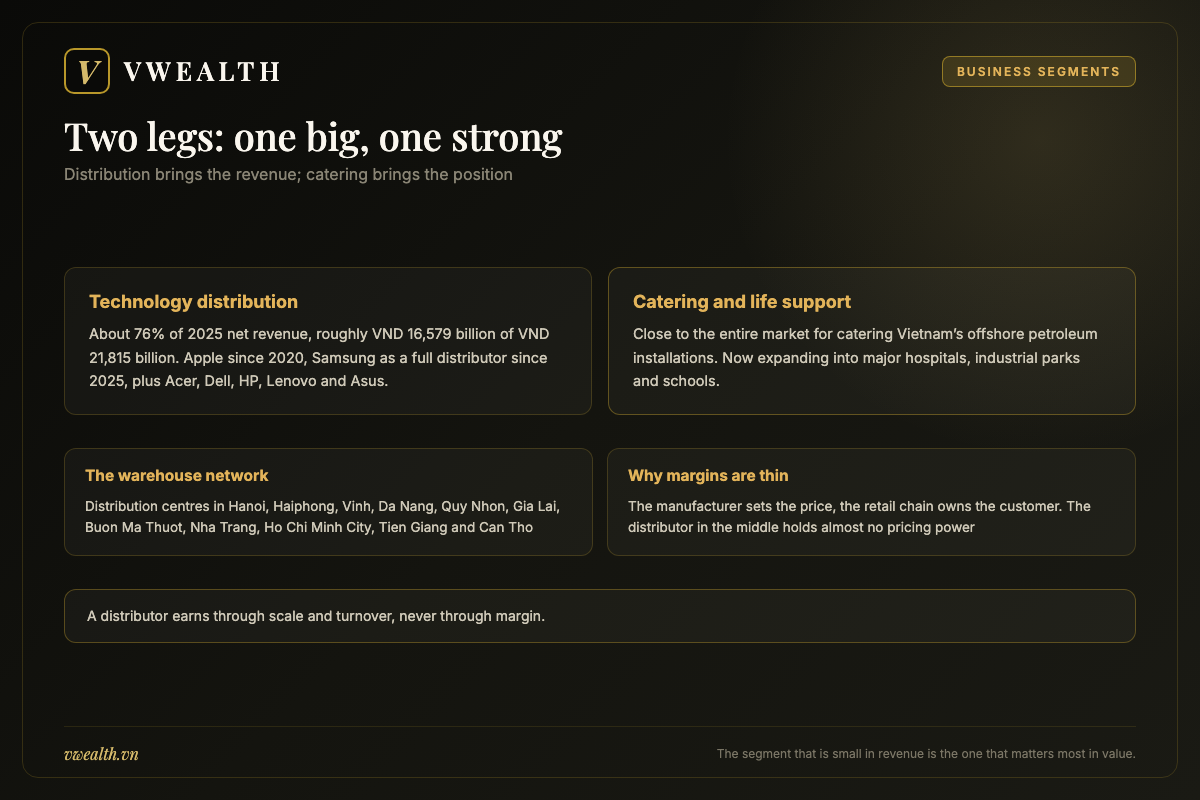
This is the core segment today. On 2025 figures, telecommunications and electronics distribution accounted for roughly seventy-six percent of net revenue, equivalent to roughly VND 16,579 billion out of total company revenue of roughly VND 21,815 billion.
The brand portfolio is broad: Apple products since 2020, Samsung under a genuine distribution model since the start of 2025, and notebook brands including Acer, Dell, HP, Lenovo and Asus. Across 2024 and 2025 the company added further partners including Honor handsets, Belkin accessories, fulfilment services for TCL, and brands such as Transcend, Zotac and Fender audio equipment.
Broadening the brand portfolio is deliberate strategy and should be read correctly. For a distributor, each brand is a revenue source but also a concentration risk. Few large brands can mean better margins through scale, but losing one contract removes a large slice of revenue. Many small brands is safer but operationally more complex and fragments inventory.
Industrial catering: the older segment with the stronger position
This segment gets less attention but holds the company’s strongest competitive position. According to information disclosed at the shareholder meeting, Petrosetco holds close to the entire market for catering services to offshore petroleum installations in Vietnam.
That near-total position is not accidental. Catering an offshore rig is nothing like catering onshore: food must be shipped by supply vessel on a fixed schedule, stored under constrained conditions, handled under strict safety procedures, and staff must complete offshore safety training. The barrier is not culinary skill but the ability to run a logistics chain in a hostile environment — precisely the capability the company accumulated thirty years ago.
What makes this segment interesting now is that the company is expanding it beyond petroleum. According to disclosed information, Petrosetco has been rolling out services at major hospitals including Viet Duc Hospital in Hanoi, Cho Ray Hospital in Ho Chi Minh City and the Hanoi Oncology Hospital, is pursuing cooperation with Thong Nhat Hospital, and is targeting industrial parks and schools as new segments.
The strategic logic is strong. Hospital and industrial-park catering is a large market with stable demand, little cyclicality, and crucially a materially better margin than equipment distribution. If the expansion succeeds, the profit mix shifts toward something far more durable than it is today — even while the revenue mix remains dominated by distribution.
What the catering expansion has to prove
Because the catering segment carries so much of the long-term case, it is worth being explicit about what would count as evidence that the expansion is working, rather than leaving it as a general hope.
The first test is contract retention rather than contract wins. Winning a hospital catering contract is a tendering achievement; holding it through a renewal cycle at an acceptable margin is an operating achievement, and only the second tells you the economics work. Watch for renewals, not announcements.
The second test is margin at scale. Offshore catering commands its margin partly because of the difficulty premium — few competitors can do it at all. Hospital and industrial park catering has far more potential competitors, so the margin there will be structurally lower. The question is whether it remains high enough to lift the company’s blended profit quality, and the segment note is where you find out.
The third test is capital intensity. Expanding catering requires central kitchens, distribution vehicles, food safety certification and staff, all of which consume capital that could otherwise fund distribution inventory or be paid out. If the segment grows while consuming capital at a rate that starves the core business, the expansion could be value-destroying even while looking successful on a revenue line.
Judge the segment on those three tests over several years rather than on any single announcement. Catering is the part of this company that could genuinely change what it is worth, which is exactly why it deserves a stricter standard of evidence than the distribution business does.
What is left of the petroleum business
Investors reasonably ask: with “Petroleum” still in the name, how much of the business still touches that industry? The honest answer is that the petroleum-linked portion is far smaller than at founding, and it exists as services rather than as extraction or fuel trading.
Specifically, today’s petroleum-linked activity consists of catering and life-support services for rigs and major petroleum projects, plus related logistics services. This is the original 1996 segment, and as noted it retains a very strong position within its scope.
Three distinctions prevent misreading. One, the company does not explore, produce or refine, so world oil prices do not flow directly into revenue as they do for upstream names. Two, the company does not retail fuel; that is Petrolimex. Three, the remaining petroleum work is contracted services, which is far more stable than anything priced off crude. When you read a headline about the oil price, do not infer an effect on PET; the only transmission channel is the activity level of offshore installations, meaning the number of people who need feeding.
The channel shift and where distribution goes next
One structural change is worth understanding because it affects the distributor’s role rather than merely its volumes. The route from brand to consumer in Vietnam is fragmenting: alongside the traditional path through distributor to retail chain, brands increasingly sell through their own branded stores, through official storefronts on e-commerce marketplaces, and through direct arrangements with the largest retail chains.
Each of those routes potentially bypasses a link. But in practice the picture is less threatening to the distributor than it first appears, for a specific reason: someone still has to import, clear customs, hold stock, handle warranty logistics and finance the inventory. Online sales do not eliminate those functions; they relocate where the sale is recorded. A distributor that can serve marketplace fulfilment as competently as it serves physical dealers remains in the chain.
This is precisely what the fulfilment arrangements in the Petrosetco portfolio represent. Providing fulfilment services for a brand is lower margin than distributing on own account, but it is also lower risk and it keeps the company embedded in the brand’s operations. The mix between the two models across the portfolio is worth tracking, because it tells you how the company is positioning against the channel shift.
The risk to watch is different from disintermediation. It is that as brands gain better visibility into sell-through data, they gain leverage to compress distributor margins that were already thin. Better information flows toward whoever has the most power in the chain, and in this chain that is not the distributor.
The warehouse network and distribution reach
A distributor’s physical capability lives in its warehouses and its reach. Petrosetco operates distribution centres across many provinces, including Hanoi, Haiphong, Vinh, Da Nang, Quy Nhon, Gia Lai, Buon Ma Thuot, Nha Trang, Ho Chi Minh City, Tien Giang and Can Tho.
That network is a genuine asset even though it does not present attractively in the accounts. Its value is that when an international brand wants to enter Vietnam, it needs a partner able to get product to a store in Buon Ma Thuot on a comparable timeline to a store in District 1. Very few Vietnamese companies can do that, which is why global brands appoint a very small number of distributors.
Why distributor margins are so thin
Picture the flow of a single phone. The manufacturer sets the price to the distributor. The distributor adds a very small increment and sells to the retail chain. The retail chain adds its own and sells to you. Of those three links, who holds pricing power? The manufacturer does, because the brand is theirs. The retailer holds some, because it owns the customer touchpoint. The distributor in the middle holds almost none.
That is why gross margins in technology distribution typically sit in the low single digits, with net margins thinner still. A distributor earns through scale and turnover rather than through margin: sell a great deal, turn the capital quickly, and control financing costs tightly.
The direct consequence is extreme sensitivity to three variables. Interest rates, because working capital is largely borrowed. Exchange rates, because imported goods are paid for in foreign currency while sales are collected in dong. And inventory, because technology hardware loses value rapidly the moment a new model launches. For the currency channel specifically, see our note on the Vietnamese dong and currency risk.
Petrosetco against the other roles in the chain
| Role | Example | Pricing power | Financial character |
|---|---|---|---|
| Brand manufacturer | Apple, Samsung | Very strong, sets the wholesale price | High margin, not listed in Vietnam |
| Distributor | Petrosetco | Effectively none | Large revenue, very thin margin, heavy working capital |
| Retail chain | The large listed store chains | Partial, through owning the point of sale | Better margin than distribution, heavy occupancy cost |
| Catering services | The Petrosetco catering arm | Real, through a near-monopoly offshore position | Smaller revenue, better margin, more stable |
This is why the catering segment, small in revenue terms, is disproportionately interesting in value terms. For the perspective of the retail link sitting downstream of the distributor, our analyses of MWG stock and FRT stock cover two concrete examples in the same value chain.
Where the Petrosetco moat sits
Ranked by durability, the company’s defences run as follows. Strongest is the position in offshore catering: high operational barriers, few customers, and switching suppliers is expensive and risky. Second is the relationship with international brands: being selected by Apple and having the contract renewed is a certification a new entrant cannot buy. Third is the nationwide warehouse network.
The weakest layer, and this needs stating plainly, is the distribution business itself. Nothing prevents a brand from appointing a second distributor, or moving to selling directly to the largest retail chains. A distributor’s moat is always borrowed from someone else.
Position and financial health: seven checks before you buy PET stock
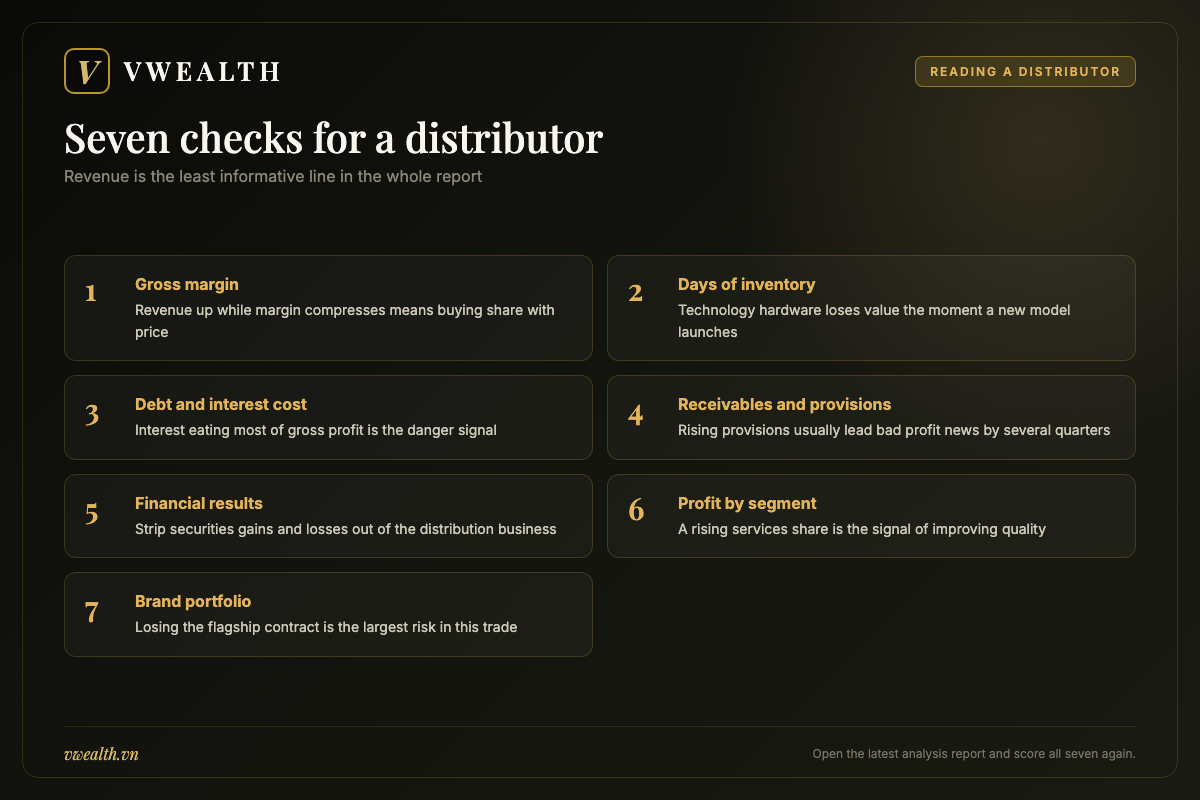
This chapter does not expire. If you remember the seven points below, you can read PET filings for years without further guidance.
Check 1: do not start with revenue
For a distributor, revenue is the least informative line in the accounts. The 2021 and 2022 pair proved it: revenue essentially unchanged between the two years while profit fell by nearly half. Revenue tells you how much product moved, not how much the company kept.
Start instead with absolute gross profit and the gross margin. If gross margin holds or improves while revenue grows, that is healthy growth. If revenue grows while margin compresses, the company is buying share with price — a strategy that can make sense briefly but is not durable.
Check 2: days of inventory
This is the make-or-break metric for a technology distributor. Inventory here is nothing like inventory at a steel or cement producer: a phone sitting too long in a warehouse loses value when the next model launches, and that write-down lands straight in profit.
Calculate average days of inventory and compare across quarters. A sustained upward trend is the earliest warning signal available, usually appearing before profit declines. Pay particular attention to the quarters immediately preceding the major brands’ launch seasons.
A worked illustration of thin-margin leverage
Because this is the most important thing to understand about PET, work through an illustration. The figures below are invented to teach the mechanism, not drawn from the company.
Suppose a distributor sells 10,000 units at a cost of 100 each and a selling price of 105. Revenue is 1,050,000, gross profit is 50,000, a gross margin of about four point eight percent. After selling costs, administrative costs and interest expense, suppose 15,000 of pre-tax profit remains.
Now change one thing slightly. Suppose competition pushes the selling price from 105 to 104 — a cut of less than one percent. Revenue falls to 1,040,000, barely moving. But gross profit drops from 50,000 to 40,000, and pre-tax profit drops from 15,000 to 5,000. A sub-one-percent change in price wipes out two thirds of the profit.
That is the mechanism behind the 2021 and 2022 pair. It is also why the market assigns low multiples to distributors: when profit can move three times as violently as revenue, your ability to forecast next year is poor, and everything hard to forecast gets discounted. The practical conclusion is never to extrapolate a good year’s margin. Look at average gross margin across at least three to five years and treat that as the anchor.
Check 3: seasonality, and why one quarter misleads
There is a common trap when reading PET results: comparing a quarter to the one immediately before it. For a technology distributor that comparison almost always produces a wrong conclusion.
The industry is strongly seasonal, and the season is set by the major brands’ launch calendar rather than by weather or holidays. When a flagship handset launches, the distributor must import a large volume weeks beforehand, carry the inventory, then push it out over a short window. The launch quarter shows a revenue spike; the quarter before shows high inventory and negative cash flow; the quarter after can be quiet.
Three consequences follow. Only year-on-year comparisons are meaningful. A quarter with high inventory is not automatically bad news — you need to know whether it is pre-launch stock or unsold old-model stock, and those mean opposite things. And a single quarter’s operating cash flow can be deeply negative while the business is perfectly healthy, simply because the cash is sitting in goods. Look at trailing four-quarter operating cash flow rather than single quarters.
Why return on equity flatters a distributor
One more reading habit worth building, because it prevents a specific error. Distributors frequently show respectable return on equity, and an investor screening on that metric can conclude the business is higher quality than it is.
The arithmetic explains why. Return on equity decomposes into margin, asset turnover and leverage. A distributor scores terribly on margin, magnificently on asset turnover, and typically carries substantial leverage through short-term borrowing. Multiply a very thin margin by a very high turnover and a meaningful leverage multiple, and the product can look similar to a business with a fat margin and no debt at all.
But the two are not equivalent as investments. The high-margin business can absorb a price shock; the high-turnover, high-leverage business cannot. When conditions turn, the leverage that flattered returns on the way up amplifies the damage on the way down, and asset turnover falls at exactly the moment inventory is hardest to move.
The practical adjustment is to decompose the ratio rather than take it at face value, and to ask which of the three components is doing the work. For PET, know before you buy that the answer is turnover and leverage, not margin. That single fact reframes both the valuation you should be willing to pay and the position size you should be willing to hold.
Check 4: working capital turnover and debt structure
A distributor lives on short-term borrowing. It borrows to import, sells, collects, repays, and repeats. The faster the cycle, the more profit each unit of capital produces.
Two metrics to read together: total short-term debt against equity, and interest expense against gross profit. The second matters most — if interest expense consumes a large share of gross profit, the company is essentially working for its banks, and one rate cycle can erase the profit entirely.
Reading the cash conversion cycle as one number
The three working capital checks — inventory, receivables and payables — are more useful combined than separate, and the combination has a name worth knowing: the cash conversion cycle. It is days of inventory plus days of receivables minus days of payables, and it tells you how many days of funding the business must supply between paying for goods and collecting for them.
For a distributor this single number is close to a summary of operational health. A shortening cycle means the company is funding fewer days of working capital per unit of sales, which frees cash and reduces interest expense without any improvement in margin at all. A lengthening cycle means the opposite, and it usually lengthens for one of three reasons: goods are moving more slowly, dealers are paying later, or suppliers have tightened terms.
Each of those three causes carries a different implication, which is why you calculate the components as well as the total. Slow-moving goods point to demand or product mix problems. Slower dealer payment points to stress in the retail channel. Tighter supplier terms often point to the supplier’s assessment of the distributor’s own credit standing, which is the most serious of the three.
Build the number for the last eight quarters when you first research the company, and update it each quarter thereafter. It takes a few minutes from figures that are all in the published statements, and it will tell you more about PET than any commentary you will read, including this one.
Check 5: receivables and dealer credit quality
A distributor sells on credit to dealers and retail chains. Receivables are therefore always large, and their quality determines real risk. In the notes, find the provision for doubtful receivables and compare the ratio across years. A rising provision ratio signals stress in the channel, usually several quarters ahead of bad profit news.
Check 6: separate core results from financial results
As the second chapter set out, the company holds a meaningful trading securities portfolio. Gains and losses there flow into reported results and blur the picture. Take operating profit, strip out unusual financial income and add back financial losses, and you have a figure that reflects the distribution and services business.
Check 7: brand concentration
The final check is not a number but a list. Know which brands the company distributes, which contracts are approaching renewal, and which brand carries the largest weight. A distributor that loses its flagship contract loses revenue immediately and finds it very hard to replace.
The good news is that Apple renewed in July 2025 and Samsung moved to genuine distribution at the start of the same year. But the nature of this risk is that it never disappears; it is only pushed out by one contract cycle.
The seven checks and where to find them
| Check | Where to find it | Good sign | Warning sign |
|---|---|---|---|
| Gross margin | Income statement | Stable or improving as revenue grows | Revenue up while margin compresses |
| Days of inventory | Balance sheet and notes | Stable or falling across quarters | Rising steadily, especially pre-launch |
| Debt and interest cost | Balance sheet, financial expense note | Interest small relative to gross profit | Interest consuming most of gross profit |
| Receivables and provisions | Trade receivables note | Provision ratio steady | Provisions rising quickly year on year |
| Financial results | Financial income and expense notes | Small relative to core profit | Securities gains or losses dominating |
| Profit by segment | Segment note | Services share of profit rising | All profit coming from distribution |
| Brand portfolio | Annual report, disclosures | Flagship contracts renewed long | A major brand appointing another distributor |
How the market treats PET stock: a share that follows the consumer cycle
Understanding the business is one thing; understanding the share is another. With PET the two diverge enough to warrant a chapter of their own.
Why PET trades below retail sector multiples
The market assigns low multiples to distributors, and it does so for reasons rather than prejudice. Three of them. First, thin margins make profit highly volatile, and markets discount uncertainty. Second, the company owns neither the brand nor the end customer, so intangible value is close to zero. Third, the model consumes working capital, meaning revenue growth always brings a matching demand for funding.
The consequence is that you should not compare PET’s multiple with retail chains or technology companies, even though they sit in the same value chain. The correct comparison is against PET’s own valuation history and against companies with similar distribution models. Our overview of valuation levels across the Vietnamese market provides the sector benchmarks.
Which yardstick to use
For a distributor, a price-to-earnings ratio has the drawback that earnings swing hard, so at a cycle trough the ratio can look absurdly high precisely when the stock is cheap. A more practical reading uses three layers. First, price to book value, since a distributor’s assets are mostly inventory and receivables and therefore relatively close to realisable value. Second, average earnings across a multi-year cycle rather than a single year. Third, market capitalisation against gross profit, which avoids financial cost volatility distorting the picture.
If you are not used to matching the yardstick to the business model, remember the general principle: applying one ratio to every industry is the fastest route to a wrong valuation.
The trading personality of PET stock
Three characteristics to know. One, PET has reasonable liquidity as a mid-cap name, so building and exiting a position is not the practical obstacle it is with very thin stocks. Two, the price is sensitive to news about consumer purchasing power and about the major brands’ launch cycles — a successful new handset season can lift expectations before any results are published. Three, the share tends to move more violently than the broad market in both directions, exactly as you would expect from a business with high financial leverage and thin margins.
For an investor the third characteristic matters most. When markets are strong and rates are low, PET benefits twice: purchasing power rises and funding costs fall. When markets are weak and rates rise, the company is hit twice in the other direction. This is a stock that amplifies the cycle rather than smoothing it.
Building a position in a cyclical name
Because PET amplifies the cycle, how you build and exit the position matters as much as picking the company. Three practical principles are worth writing down.
First, buy on conditions rather than on price. With a cyclical, a low price is not a buy signal — low prices usually appear when operating conditions are at their worst and can get worse still. The conditions worth waiting for are a rate environment that has begun to ease, days of inventory that have stopped rising, and a gross margin that has bottomed and flattened.
Second, define the exit in advance. With a durable-moat business you can hold for many years. With a distributor, holding through an entire downcycle means handing back most of the upcycle’s gains. Write down the sell conditions before you buy: rates turning back up, inventory swelling persistently, or gross margin compressing while revenue still grows.
Third, cap the position size. High financial leverage plus thin margins means the swing on this holding is wider than intuition suggests. A moderate weight is what lets you keep discipline when the stock moves against you, rather than being forced to sell at the low.
Practical mechanics for a foreign investor
Some execution notes specific to buying a Vietnamese mid-cap from outside the country. You need a securities trading code and an account with a local broker before you can trade at all, and the account opening process takes time, so it is not something to start after you have formed a view.
Once trading, three market conventions shape execution. The daily price band limits how far a stock can move in one session, which cuts both ways: it caps a gap against you and also prevents you exiting quickly when you want to. The settlement cycle means shares bought are not immediately available to sell, so a same-day reversal is not a risk control available to you. And order matching runs in defined sessions with a closing auction, so the last print of the day is not always where continuous trading left off.
PET’s mid-cap liquidity means none of this is prohibitive, which is a genuine advantage over the thinner names in the same sector. Still, the sensible approach with a cyclical is to build across sessions using limit orders rather than to establish a full position in one decision, and to size the holding on the assumption that the exit will take longer than the entry did.
Finally, remember the currency layer. Your return is the stock return combined with the dong’s move against your home currency, and for a company whose cost of goods is already exposed to that same rate, the two are not independent. A weakening dong hurts the company’s margins and your translated return simultaneously.
Catalysts that move PET stock
Four categories of news to watch. First, distribution contract news: new signings, renewals, or the loss of a major brand. Second, ownership news — in the post-divestment period, an institution accumulating enough to take a board seat is a heavyweight event. Third, shareholder meeting decisions on the rename, the capital increase and the revised business lines. Fourth, the interest rate path, which feeds directly into working capital costs.
Foreign ownership
PET is an ordinary trading and services company, not in one of the sectors subject to tight foreign ownership restrictions such as banking or aviation. That said, foreign interest in distributors tends to run lower than in brand owners, simply because the model struggles to produce the durable competitive advantage long-horizon funds look for. Our explainer on foreign ownership limits in Vietnam covers how to check remaining room.
A final framing point that applies to the whole chain rather than to this company alone. Vietnam’s consumer technology market is one where the visible names — the store chains people walk into — capture most investor attention, while the distributors that make those stores possible trade quietly at lower multiples. That gap is not an inefficiency waiting to be arbitraged; it reflects a real difference in the durability of the two positions. But it does mean that when the cycle turns favourable, the repricing in the quieter names can be proportionally larger, simply because they started from a lower base and their earnings move with more leverage.
PET against the alternatives in consumer technology
| Ticker | Role | Strength | What to watch |
|---|---|---|---|
| PET | Technology distribution plus catering services | Relationships with global brands, strong catering position | Very thin margins, dependent on distribution contracts |
| MWG | Retail chains selling directly to consumers | Owns the point of sale and the customer data | Heavy occupancy and staffing costs |
| FRT | Technology retail plus a pharmacy chain | Two parallel growth engines | Pharmacy needs time to reach scale economics |
| PLX | Fuel retail, unrelated to PET | Nationwide station network | Retail prices set within a state framework |
One final reminder so nobody confuses them: the last row appears purely for contrast. PLX is an entirely separate company with no ownership relationship to PET.
The Vietnamese technology distribution industry in 2026
You cannot judge Petrosetco without understanding the industry it stands in. Technology distribution in Vietnam has three characteristics that define the rules of the game.
First: the market is saturated by unit count
Smartphone penetration in Vietnam is already very high. That means industry growth no longer comes from adding new users but from the replacement cycle and from users upgrading into higher price tiers. This is a fundamental break from the situation a decade ago, and it explains why industry revenue can move sideways for several quarters at a time.
For a distributor, a replacement market rather than an expanding one has two consequences. The cycle becomes sharper: sales concentrate around launch events rather than spreading evenly. And product mix matters more than unit count: selling one premium device generates far more absolute value than selling three entry-level ones, even if the percentage margin is similar.
Premiumisation: the trend that offsets saturation
Set against the saturation problem is a countervailing trend worth weighing properly, because it is the main reason the industry is not simply in decline.
As household incomes rise, Vietnamese consumers move up the price ladder within the same product category. A replacement phone is a more expensive phone; a first laptop becomes a better laptop; categories that were aspirational become routine. For the industry this means value can grow even when unit volumes are flat, and it means the mix of what passes through a distributor’s warehouse shifts toward higher-ticket items.
For a distributor specifically, premiumisation has an ambiguous effect that is worth being precise about. Higher average selling prices raise revenue and raise absolute gross profit per unit, which is good. But they also raise the working capital required to hold the same number of units, and they raise the value at risk if inventory has to be marked down. Premiumisation therefore increases both the reward and the capital intensity of the same operation.
The practical implication is that you should not read rising revenue per unit as unambiguously positive without checking the inventory and financing lines alongside it. The broader demographic and income backdrop driving this shift is covered in our note on Vietnam’s demographics and the consumption case.
Second: competition from Chinese brands
According to information disclosed at the shareholder meeting, Apple’s market share is under pressure from Chinese brands, and the company’s stated approach is to maintain a measured level with Apple in order to preserve share in that competitive context.
This is a movement to watch closely, because it affects a distributor in two opposing directions. The adverse direction: if the flagship brand loses share, the distributor’s volumes follow. The favourable direction: every new brand entering the market needs a distributor, and a company with a nationwide warehouse network is the natural candidate. Petrosetco adding brands such as Honor to the portfolio suggests it is playing the second direction.
Third: consumer purchasing power is an external variable
Technology hardware is highly discretionary: when incomes tighten, people postpone replacing a device long before they cut essentials. Industry sales are therefore a fairly sensitive indicator of consumer health generally.
According to points raised at the shareholder meeting, tariff policies in major economies may indirectly reduce consumer purchasing power through their effect on employment and incomes in export industries. This is a transmission channel investors often overlook: a company that exports nothing can still be affected by international trade policy, through the wallets of its end customers. Our survey of Vietnamese retail sector stocks tracks that purchasing power indicator for the sector as a whole.
Where distribution margins could actually improve
Given how much of this article emphasises thin margins, it is only fair to set out where genuine improvement could come from, because it is not impossible and the company is visibly pursuing it.
The first source is product mix. Distributing accessories, audio equipment and niche brands generally carries better percentage margins than distributing flagship handsets, because competition for those lines is less intense and the brands need the distributor’s channel more than the distributor needs them. The steady addition of accessory and component brands to the portfolio is consistent with this.
The second source is services attached to the goods. Warranty handling, device trade-in programmes, extended service plans and financing arrangements at the point of sale all generate revenue with a very different margin structure from the hardware itself. A distributor positioned to run those programmes on behalf of brands captures value that pure logistics never would.
The third source is the model shift already underway: moving from fulfilment to genuine distribution, as with Samsung from the start of 2025. Genuine distribution carries inventory and price risk but pays a wider spread. Whether that trade works is an empirical question you can answer from the accounts — compare the gross margin trend against the inventory trend over several quarters and you will see whether the extra risk is being compensated.
None of these turns a distributor into a high-margin business. Together they could shift a thin margin to a slightly less thin one, and on a revenue base of this size a small shift in margin is a large shift in profit. That asymmetry works in both directions, which is the whole point.
The catering market picture
If distribution is the segment under pressure, catering is the segment with headroom. The industrial and hospital catering market in Vietnam is professionalising: large hospitals and industrial parks increasingly outsource the function rather than running it themselves, as food safety and process requirements tighten.
For a company that already operates in the harshest environment there is — an offshore drilling rig — serving an onshore hospital is technically easier. The real barrier lies in tendering and in relationships with the institutional customer. That is why the specific hospital contracts already disclosed matter: they are evidence the company can clear that barrier, not merely a statement about potential.
Macro factors: rates and the exchange rate
Two macro variables have a direct and quantifiable effect on PET. Interest rates work through working capital cost: the company borrows short term to import, so each percentage point moves straight into financial expense. The exchange rate works through cost of goods: imports are settled in foreign currency while sales are collected in dong, so when the dong weakens, cost of goods rises while selling prices cannot adjust immediately.
This is why PET is often grouped among the beneficiaries of a falling rate environment. But be precise about it: benefiting from cheaper funding is not the same as intrinsic growth. A company whose profit improves because borrowing got cheaper has not necessarily improved its competitive position at all.
A new direction to watch: infrastructure projects
According to information disclosed at the 2026 annual shareholder meeting, management discussed participating in several projects under build-transfer contracts and stated there was no financial obstacle to doing so.
This deserves cautious monitoring, not because the direction is inherently wrong but because it is a step into a field far from the core competence. Vietnamese market history contains many examples of trading companies expanding into infrastructure or property and struggling because the capital cycle is far longer than the one they know. The practical test is the investing cash flow line: until significant cash actually flows out, this remains a plan rather than a realised risk. For the broader context of country-level exposures, see our guide to the risks of investing in Vietnam.
Looking forward: three scenarios for PET stock and the conditions that produce each
No price target here. Instead, three scenarios with the specific conditions that let you recognise which one you are in.
Four variables that decide the outcome
The first is consumer purchasing power for technology hardware, which sets the size of the pie. The second is the relationship with the major brands: retained, extended, or partly lost. The third is the pace at which catering expands beyond petroleum, which determines profit quality. The fourth is who becomes the controlling shareholder now that Petrovietnam has gone, and which direction they want the company to take.
The fourth variable is unusual, because it does not exist at most listed companies. At a business with a settled register you analyse the strategy that exists. At PET in this period, future strategy depends on a party who has not fully appeared yet.
The optimistic scenario: both legs strong
Here rates stay low, easing working capital costs; consumer demand recovers; the company retains Apple and executes well on the genuine distribution model with Samsung; and catering expands successfully into hospitals and industrial parks at better margins. A strategic shareholder emerges, places directors on the board and sets a clear long-term direction.
Recognition conditions: gross margin improving across quarters rather than revenue alone rising; the services share of segment profit increasing in the notes; and a disclosure confirming an institution has become a controlling shareholder alongside changes to the board.
Note the caveat even here: the plan to lift charter capital past VND 2,600 billion means dilution. Rising profit does not automatically translate into rising earnings per share.
The base scenario: a good distributor in a hard industry
This is the case the article considers most likely. The company retains its flagship distribution contracts, revenue grows slowly with consumer demand, margins remain as thin as the industry dictates, and catering expands more slowly than planned because hospital and industrial park tenders take time. The register keeps churning without any party committing for the long term.
For shareholders this produces a stock that tracks the consumer and interest rate cycles: decent gains during cheap money and healthy demand, sharp declines when both reverse. No structural re-rating upward, but no collapse either.
Recognition conditions: gross margin oscillating around its historical level; segment profit mix essentially unchanged year to year; and major shareholder disclosures continuing to show short-cycle trading rather than accumulation.
The bad scenario: losing one leg while the other is not yet steady
The bad case needs no catastrophe, just three ordinary things at once. First, a flagship brand appoints a second distributor or shifts to selling directly to the large retail chains. Second, rates rise and inflate working capital costs at the moment inventory is high. Third, weak consumer demand forces inventory to be marked down.
These three are strongly correlated, which is what makes the case dangerous. When demand weakens, goods move slowly, inventory rises, the company borrows more to fund working capital, interest expense grows, and the inventory itself loses value. Four effects compounding on an already thin margin can erase profit within a few quarters — precisely what happened between 2021 and 2022, if in a milder form.
Early recognition conditions: days of inventory rising for two consecutive quarters or more; interest expense taking a growing share of gross profit; and any news that a major brand is restructuring its Vietnamese channel.
A separate variable: strategic drift
Beyond those three sits a possibility of a different character: the company deploying resources into a new field — infrastructure, property, or financial investment at greater scale. The existing securities portfolio and the discussion of build-transfer projects are both signals in that direction.
This article does not judge that direction right or wrong, because the answer depends on execution capability nobody can yet verify. But investors should recognise that if it happens at scale, the original thesis — buying a technology distributor with a stable services arm — no longer holds, and you would need to value the company from scratch.
The scenarios side by side
| Scenario | Main conditions | Effect on the business | Early signal |
|---|---|---|---|
| Optimistic | Low rates, brands retained, catering expands well | Better profit quality, a strategic shareholder arrives | Gross margin improving, services share of profit rising |
| Base | Contracts held, slow growth with consumer demand | Stock tracks the cycle without re-rating | Flat margin, unchanged profit mix |
| Bad | Flagship brand lost, rates rise, inventory high | Profit can be erased within a few quarters | Days of inventory rising, interest expense swelling |
| Strategic drift | Resources move into infrastructure or financial assets | The original investment thesis no longer applies | Large investing cash outflows away from core |
So, should you buy PET stock? A straight answer
The honest answer is not yes or no but a description clear enough for you to decide whether you belong to the group this suits.
The case for: five reasons PET deserves consideration
First, the company has demonstrated genuine adaptive capability. Moving from catering drilling rigs to becoming an authorised Apple distributor is a distance very few former Vietnamese state-linked enterprises have travelled. Adaptability is an asset that never appears on a balance sheet.
Second, the relationships with major international brands. Apple renewing in July 2025 and Samsung moving to genuine distribution at the start of the same year are two independent confirmations from two of the most demanding organisations in the industry.
Third, the catering segment, with a near-total position offshore and a clear runway into hospitals, industrial parks and schools. This carries better and more stable margins than distribution, and if it grows the profit quality of the whole company changes with it.
Fourth, the Petrovietnam exit opens the possibility of the company being governed to private-sector standards, deciding faster, and welcoming a strategic investor bringing both capital and capability.
Fifth, distributors trade at low multiples generally, so if the company genuinely improves profit quality there is real re-rating headroom.
The case against: six risks to face directly
First, thin margins are a structural feature, not a temporary problem. Nothing turns a distributor into a high-margin business while it remains in the middle of the chain.
Second, dependence on distribution contracts. The moat here is borrowed, and the lender can reclaim it at the end of a contract term.
Third, sensitivity to interest rates and the exchange rate above that of most listed companies, because of the heavy working capital model and imported goods.
Fourth, inventory risk in technology hardware, the fastest-depreciating ordinary goods there are.
Fifth, an unsettled register following the founding shareholder’s exit. This is both opportunity and risk, and at present it leans toward uncertainty.
Sixth, the securities portfolio and the possibility of drift into fields outside the core competence. Both make results harder to read and the investment thesis less clear.
Weighing both sides
| In favour | Against |
|---|---|
| Proven ability to transform across thirty years | Thin margins are structural to the industry |
| Confirmed relationships with Apple and Samsung | The moat depends on contracts partners control |
| Catering holds a strong position with room to grow | Catering is still small relative to total revenue |
| Greater autonomy after the state shareholder exit | Control is open and institutions trade short cycles |
| Low sector multiples leave re-rating headroom | The capital raise brings dilution for existing holders |
| A genuine nationwide warehouse network | High sensitivity to rates, currency and inventory |
Who PET suits, and who it absolutely does not
The cyclical investor. The best fit. If you understand that PET amplifies the consumer and interest rate cycles, buy when rates are on a downward path and demand is bottoming, and sell when both reverse, then PET is a reasonable instrument. The condition attached: you must track inventory and interest expense every quarter.
The investor looking for a restructuring story. Also a fit, but requiring patience and tolerance for uncertainty. The story is a post-divestment company finding a strategic shareholder and lifting profit quality through services. If that plays out, today’s low multiple leaves room. If it does not, you own an ordinary distributor for several years.
The value investor seeking a durable moat. A weaker fit. Most of the PET moat is borrowed from international brands, and the core criterion of value investing is an advantage the company owns itself. The catering segment does meet that test, but it is not yet large enough to define the whole company.
The income investor. Not a fit. The company needs to retain cash for working capital, and the model does not generate the abundant free cash flow an infrastructure business does. Our guide to Vietnamese dividend stocks points to more suitable candidates for that objective.
Four questions to answer before you place the order
One: are you certain you are buying Petrosetco and not Petrolimex? The question sounds absurd, and it is exactly why the first chapter exists.
Two: have you opened the latest filings and calculated days of inventory and the ratio of interest expense to gross profit? Those two numbers matter far more than revenue.
Three: have you separated distribution profit from securities portfolio results? If not, you are looking at a blended figure.
Four: if tomorrow a major brand appointed a second distributor in Vietnam, what would you do? Without an answer, you are not ready to buy.
Turning the thesis into a monitoring routine
An analysis only earns its keep if it converts into something you do. For PET the routine has four items and takes under an hour a quarter.
Each quarter, open the financial statements and update three numbers: days of inventory, interest expense as a share of gross profit, and gross margin. Write them in a row alongside the previous four quarters. Almost everything that will eventually matter shows up in that small table before it shows up in the headline profit.
Each year, read the segment note and record what share of gross profit came from services rather than distribution. That single ratio is the clearest measure of whether the long-term strategy is working, and it moves slowly enough that an annual check is sufficient.
On an ongoing basis, keep an alert for two event types: any disclosure touching the distribution agreements with the major brands, and any major shareholder transaction. Those two categories account for most of the genuinely price-moving news this company produces.
Finally, write your thesis in one paragraph before buying, including the condition that would falsify it. For most holders that condition reads something like: a flagship brand restructures its Vietnamese channel while inventory is high and rates are rising. Having it written down in advance is what lets you act on the news rather than rationalise it after the fact.
The bottom line: a highly adaptive company standing at the hardest link in the chain
If Petrosetco had to be summarised in one sentence, it would be this: a company with rare adaptive capability, standing at the link in its chosen value chain that holds the least power.
The first clause deserves respect. Very few Vietnamese companies have travelled from petroleum logistics to authorised distributor for one of the most demanding brands on earth, while retaining a near-total position in their original segment. The second clause must be faced squarely: distribution makes nobody rich quickly, and it punishes mistakes in inventory and working capital severely.
So should you buy PET stock? If you understand that you are buying a thin-margin business with genuine operating capability, accept that results will swing with the consumer and rate cycles, treat the catering segment as the part of the long-term story most worth following, and are prepared to sell when the cycle conditions reverse — then PET is a defensible holding at a moderate weight. If you are buying because you saw revenue in the tens of thousands of billions of dong and read that as a sign of scale advantage, you are looking at the right number and drawing the wrong conclusion. Investors new to this market should begin with our foundation guide on how to invest in the Vietnam stock market before taking a position in any single name.
One last thing to carry away. The history, brand portfolio and business model of Petrosetco change slowly, but gross margin, days of inventory, interest expense, the shareholder register and the valuation change every quarter. Before you place an order, open the latest analysis report and score the seven checks from the fourth chapter again. It takes fifteen minutes, and it is the most valuable fifteen minutes of the whole decision. If you do not yet have the tools, create a vwealth account and let the platform read the filings for you.
This article provides information and analysis for reference purposes only and is not a recommendation to buy or sell any security. All investment decisions are your own and you bear responsibility for their outcome. Consider consulting a licensed financial adviser before acting.
Research Vietnamese stocks in English with vwealth. Our AI-powered platform turns Vietnamese market data into full English analysis reports — with international payment support and a free 2-month trial for new accounts. Create your free account and read the latest reports.