Whether you should buy HHS stock — the listed ticker of Hoang Huy Investment Services Joint Stock Company on the Ho Chi Minh City Stock Exchange (HOSE) — is one of the most intriguing yet misunderstood questions in the Vietnamese market. In the second quarter of 2025, HHS stock grabbed headlines across regional financial media after reporting an astonishing net after-tax profit of VND 3,505.6 billion, eclipsing the company’s cumulative earnings over its entire operating history. Just twelve months later, in the second quarter of 2026, after-tax earnings contracted by approximately 99% to VND 31.6 billion, creating an optical collapse that bewildered casual observers. In reality, nothing collapsed at the operational level; rather, this dramatic statistical swing reflects the technical accounting consolidation of Hoang Huy Real Estate Investment JSC (CRV) as a subsidiary in June 2025. Originally established as a dedicated commercial truck distributor in Hai Phong, HHS has transitioned into the vital middle layer of a three-tier corporate pyramid, anchored above by parent Hoang Huy Financial Services JSC (TCH) and underpinned below by CRV’s extensive residential land bank. This comprehensive analysis deconstructs the company’s financial evolution, separates recurring cash flow from paper revaluation gains, and addresses the fundamental dilemma for foreign investors: what are you actually buying when you allocate capital to HHS stock today?
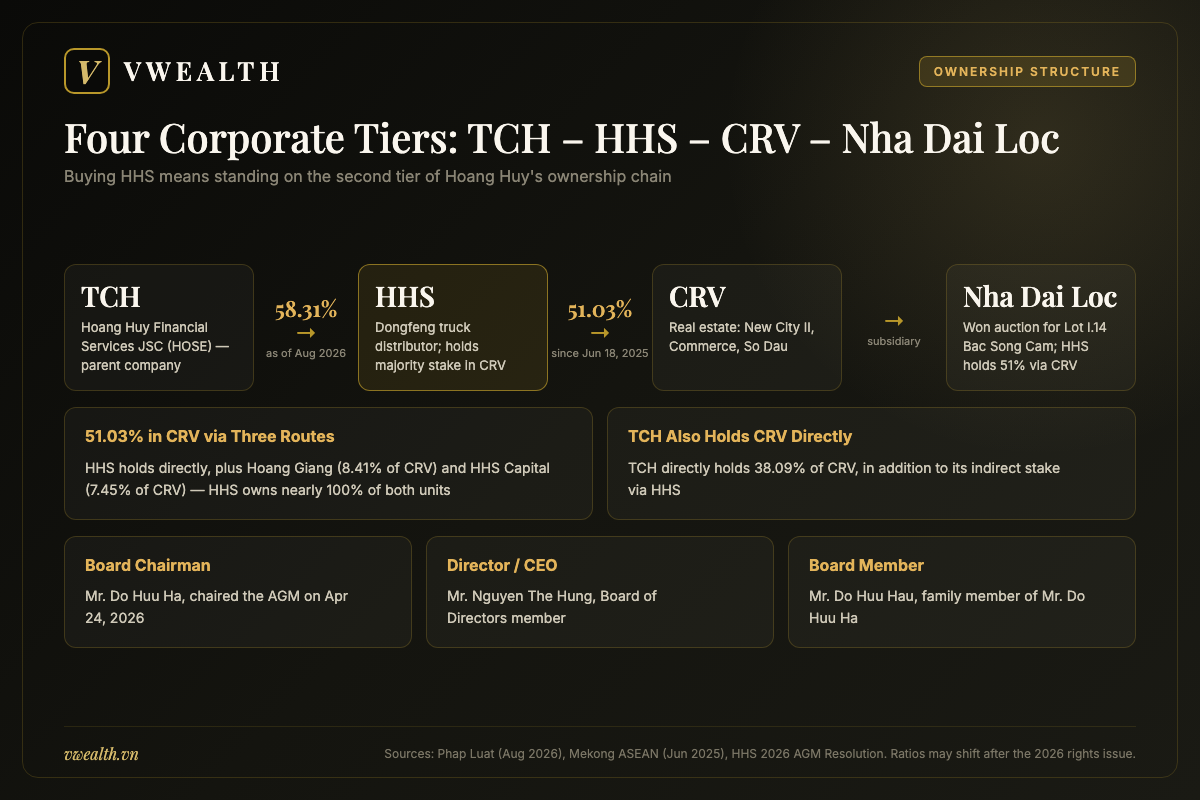
Before examining the balance sheet and operational mechanics in depth, foreign investors navigating Vietnam stocks must clearly differentiate between three corporate entities that are frequently conflated in market commentary. TCH is the ticker of Hoang Huy Financial Services Investment JSC — the ultimate parent company, which held approximately 58.31% of HHS equity as reported by Phap Luat Viet Nam in August 2026. HHS is the ticker of Hoang Huy Investment Services JSC — the operating holding entity under review in this analysis. CRV is the ticker of Hoang Huy Real Estate Investment JSC — the specialized property developer in which HHS secured a controlling 51.03% stake in June 2025, and which directly owns prime residential developments such as Hoang Huy Commerce, Hoang Huy – So Dau, and Hoang Huy New City II. The vertical chain of control flows systematically downward: TCH → HHS → CRV → Nha Dai Loc (the project entity that won the auction for prime land plot I.14 in Thuy Nguyen, Hai Phong). Investors who have already studied our analysis of TCH stock understand the perspective from the apex of the group; this report examines the middle conduit, where heavy commercial vehicle distribution and high-value residential property development converge on a single consolidated balance sheet.
A second analytical convention governs this study, consistent with the institutional standards of the vwealth corporate research series: all operational timelines, executive appointments, transaction structures, and balance sheet figures are drawn strictly from officially verified corporate filings, disclosures on Vietstock, the audited resolution of the 2026 Annual General Meeting (AGM) of HHS, and primary financial press reports (including Mekong ASEAN, Phap Luat Viet Nam, and Stockbiz). In accordance with institutional research principles, this report does not quote daily fluctuating spot share prices, unadjusted trailing price-to-earnings (P/E) multiples, or current price-to-book (P/B) ratios. For an enterprise whose reported net profit can oscillate by two orders of magnitude due to a one-time accounting revaluation entry, automated screen metrics become instantly obsolete and economically misleading. Where analytical calculations or normalized multiples are derived, they are explicitly designated as a “vwealth estimate” or an “illustrative example.” For real-time normalized valuation multiples, audited quarterly statements, and institutional scoring models, readers are encouraged to consult the live vwealth equity research reports.
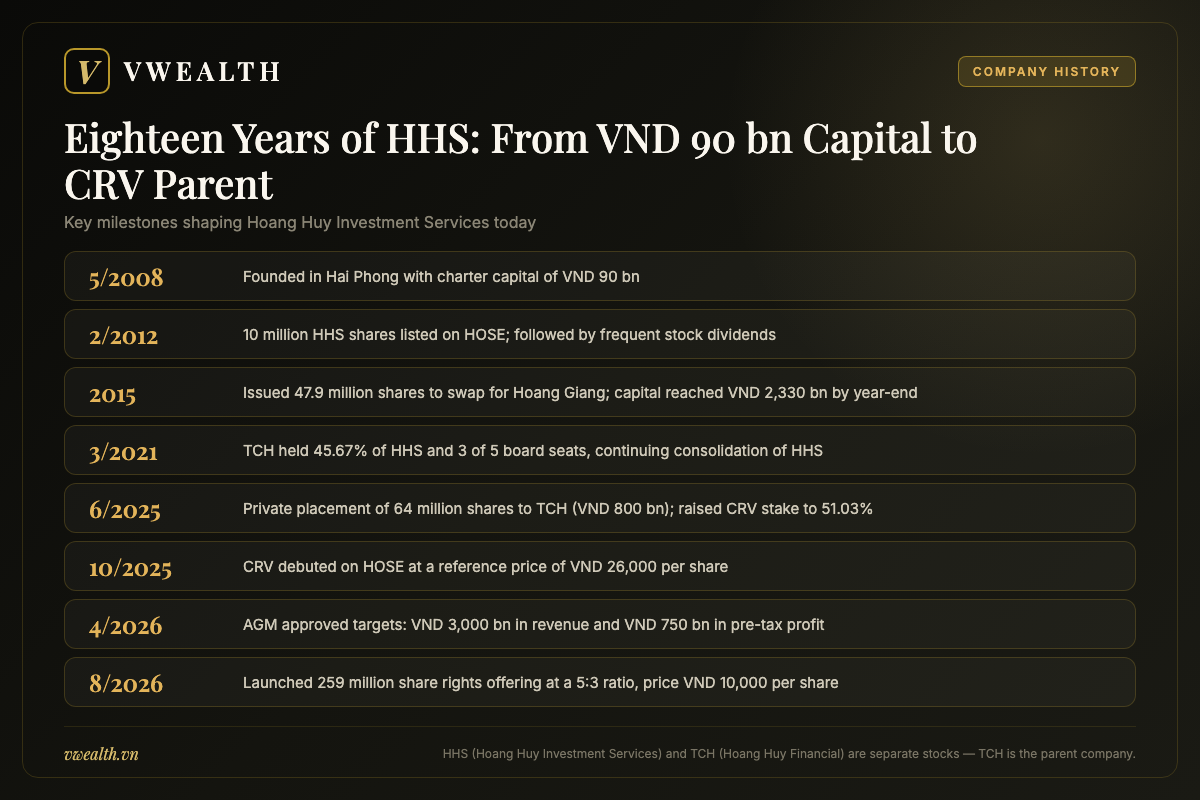
From Hai Phong Truck Dealership to the Gateway of Hoang Huy Real Estate
Certain public enterprises have corporate histories neatly circumscribed by a single flagship product or retail brand. HHS represents an entirely different corporate archetype: its trajectory is defined by a series of deliberate, multi-year structural transformations. Originally established as a commercial automotive link within the regional Hoang Huy industrial network in the northern port city of Hai Phong, HHS rapidly expanded its equity base through an aggressive sequence of share issuances and stock dividends. Over the subsequent decade, it gradually accumulated minority equity stakes in sister real estate entities before executing a decisive corporate reorganization in mid-2025 to become the direct controlling parent of CRV. With each corporate transformation, the underlying accounting rules governing HHS financial statements fundamentally changed. Understanding these structural inflection points is the prerequisite for understanding why HHS reported earnings can surge into the thousands of billions of Vietnamese dong in one fiscal year and contract to tens of billions in the next, while the underlying physical enterprise remains entirely intact.
Roots in 2008: VND 90 Billion in Capital and a License in Hai Phong
On May 10, 2008, the Hai Phong Department of Planning and Investment granted initial Business Registration Certificate No. 0203004289 to Hoang Huy Investment Services Joint Stock Company, establishing the business with an initial charter capital of VND 90 billion, as documented in corporate profile data on 24hMoney. The newly founded company established its headquarters at 116 Nguyen Duc Canh Street in Hai Phong — an address that remains the registered executive corporate domicile today (situated in the former Le Chan District, now administratively reorganized under An Bien Ward).
The year 2008 was an exceptionally challenging period for corporate ventures across emerging Asia, characterized by runaway inflation, double-digit central bank policy rate hikes, and severe contractions across domestic equity and credit markets. However, for the broader Hoang Huy ecosystem, 2008 marked a foundational industrial turning point in commercial transportation. According to historical records published on the corporate website of parent entity TCH, the Hoang Huy industrial network was officially licensed to assemble commercial trucks on January 28, 2008, under License No. 523/UBCD-CN. This manufacturing operation featured modern assembly lines and dedicated commercial showrooms spanning over 45,703 square meters located at Km9 on the New National Road 5 corridor in An Duong, Hai Phong. It is vital for institutional analysts to draw a clear jurisdictional boundary here: that physical manufacturing and assembly infrastructure belonged strictly to the parent entity TCH, rather than to HHS. HHS was established during that identical year to serve an entirely complementary, purely commercial role — operating as an import, marketing, and dealership distribution arm specializing in heavy commercial trucks.
To conceptualize the foundational operational model of HHS, global investors should view it as a specialized commercial trading house: importing fully assembled heavy vehicles and chassis from overseas manufacturers, distributing them to domestic logistics operators, civil infrastructure contractors, and mining conglomerates throughout Vietnam, and capturing gross retail spreads alongside recurring aftermarket maintenance and spare parts margins. However, this commercial distribution business possessed an inherent, structural vulnerability that persists to this day: imported vehicles must be settled in foreign currency (predominantly US dollars), whereas sales to domestic end-users are priced and collected in Vietnamese dong (VND). Consequently, acute swings in the USD/VND exchange rate directly exert compression pressure on gross margins whenever local retail price adjustments cannot immediately mirror currency devaluations — an operational risk explicitly highlighted in Vietstock’s institutional coverage profile of HHS.
Listing on HOSE in 2012 and a Relentless Sequence of Share Dividends
In March 2011, HHS carried out a private issuance of 1 million additional shares, increasing its charter capital from the initial VND 90 billion base to VND 100 billion. Less than a year later, on February 15, 2012, 10 million ordinary shares of HHS were officially listed and commenced public trading on the Ho Chi Minh City Stock Exchange (HOSE). While market historical records uniformly document the February 2012 listing date, the far more significant analytical story lies in the remarkable cascade of equity capital expansions that unfolded immediately following its public debut.
Merely three months following its initial listing on HOSE, on May 25, 2012, HHS distributed a 50% stock bonus to shareholders, expanding its registered charter capital from VND 100 billion to VND 150 billion. Shortly thereafter, on August 8, 2012, the company executed another bonus share distribution, elevating charter capital further to VND 225 billion. On April 18, 2013, HHS deployed a dual-tranche capital increase, distributing a 50% stock dividend while simultaneously conducting a preferential rights offering to existing shareholders at an execution ratio of 5:1, pushing total charter capital to VND 382.5 billion. In October 2014, capital expanded once more to VND 573.6 billion via a 20% stock dividend combined with a 10:3 preferential rights issue, with each corporate action meticulously chronicled in historical filing archives on Vietstock.
International portfolio managers evaluating corporate governance in emerging markets often compare this aggressive distribution rhythm to an orchardist repeatedly grafting and cloning branches: the nominal count of trees in the grove multiplies rapidly, but the immediate harvest of marketable fruit does not necessarily experience a commensurate expansion. Stock bonuses and stock dividends do not inject a single cent of fresh liquid capital into a corporation’s bank accounts; they represent internal equity reclassifications from retained earnings or capital reserves into common stock, subdividing the existing equity base into a larger volume of individual shares. Only direct cash rights issues — such as the 5:1 preferential offering in 2013 or the 10:3 cash call in 2014 — genuinely augment the enterprise’s cash reserves. Analysts assessing HHS historical performance during this era must scrupulously separate these two distinct mechanisms of balance sheet expansion. Both dilute historical earnings per share (EPS), but only the latter equips management with incremental liquidity to deploy into operating assets.
The 2015 Hoang Giang Share Swap: The First Brick of the Corporate Holding Chain
The year 2015 marked the first major structural turning point in the corporate evolution of HHS. In March 2015, the charter capital of HHS surged to VND 1,109 billion through a combined capital action: a 10% stock dividend alongside the issuance of 47.9 million new common shares specifically designated to execute a share swap to acquire an equity controlling interest in Hoang Giang Services Development Joint Stock Company (Hoang Giang), as reported by Vietstock. A share swap in the Vietnamese market is a non-cash corporate acquisition structure whereby the acquiring company issues its own newly created equity directly to target shareholders in exchange for their equity in the target enterprise. Through this transaction, existing owners of Hoang Giang surrendered their shares in exchange for newly minted HHS stock, transforming Hoang Giang into a subsidiary of HHS.
Why did this specific 2015 transaction prove so historically consequential for the company? Because ten years later, when financial analysts examined the intricate legal pathways connecting HHS to the extensive property portfolio of CRV, Hoang Giang served as one of the three primary corporate conduits channeling equity ownership of CRV directly onto the HHS balance sheet. According to investigative corporate disclosures cited by Mekong ASEAN, HHS presently maintains an equity ownership stake of 99.794% in Hoang Giang, while Hoang Giang in turn holds an 8.41% direct equity interest in CRV. A share-swap transaction executed in early 2015 thus laid the foundational cornerstone for the multi-tier property holding structure that institutional investors are analyzing in 2026.
Later in that same watershed year, in November 2015, HHS executed what was then the largest equity capital mobilization in its public history: a comprehensive 1:1 preferential rights offering (granting existing shareholders the right to purchase one new share for every share held), complemented by a 10% stock dividend and a 10% cash dividend. This multifaceted capital raise propelled the company’s registered charter capital to VND 2,330 billion. Within a concise three-year span between 2012 and 2015, HHS charter capital had expanded exponentially from VND 100 billion to VND 2,330 billion. By 2016, charter capital reached VND 2,747.44 billion, after which it entered a multi-year period of relative plateau. Capital expansion resumed in January 2022 to reach VND 3,214.48 billion, advanced to VND 3,471.60 billion in December 2023, reached VND 3,679.85 billion in August 2024, and ultimately reached VND 4,319.85 billion following the private placement completed in June 2025 (Vietstock). Measured from its modest inception of VND 90 billion in 2008 to approximately VND 4,320 billion in 2025, HHS charter capital expanded by approximately 48 times — a vwealth estimate derived by dividing VND 4,319.85 billion by the original VND 90 billion base.
The Hoang Huy Ecosystem Is Broader Than HHS: Defining the Boundaries
A prevalent analytic error encountered among international investors screening Vietnamese public equities is attributing the operational milestones, industrial manufacturing assets, and commercial contracts of the overarching Hoang Huy industrial group indiscriminately to HHS. To build a robust financial valuation, foreign analysts must strictly delineate the corporate boundaries separating the parent entity from the listed subsidiary.
According to the official corporate history detailed on the corporate website of parent company TCH (hoanghuy.vn), the original Hoang Huy enterprise commenced commercial operations around October 1995, concentrating initially on the manufacturing, assembly, and distribution of motorcycles, light commercial vehicles, and heavy trucks ranging from 0.5 to 25 tons. In 2015, the parent enterprise TCH achieved a major commercial milestone by becoming an official distributor for International brand heavy tractor-trailers manufactured by Navistar Inc. (United States), culminating in the signing of a landmark commercial cooperation agreement valued at $1.8 billion on November 12, 2017. All of these high-profile commercial milestones belong exclusively to the parent entity TCH, rather than to HHS. The commercial automotive brand distributed by HHS, as explicitly documented in Vietstock filings, is Dongfeng Motor Corporation of China, focused specifically on heavy-duty commercial trucks and hydraulic dump trucks.
Similarly, when domestic financial media report on prominent “Hoang Huy real estate” urban developments throughout Hai Phong, the physical land parcels and development permits are legally vested in CRV. Prior to June 2025, HHS functioned solely as an associate equity investor in CRV, recording its proportional share of CRV net income via the equity accounting method on the income statement without consolidating underlying balance sheet accounts. It was only after June 2025 that CRV attained legal subsidiary status under HHS, allowing the full consolidation of CRV property revenues, gross land inventory, and contractual liabilities into the financial accounts of HHS. Meanwhile, the legal entity name “Hoang Huy Financial Services” designates parent corporation TCH, rather than an operational line of business within HHS.
Why is this legal and structural differentiation so critical for investment decision-making? Because it fundamentally governs what economic assets you acquire when you purchase shares. Investing in TCH captures the pinnacle of the conglomerate hierarchy, incorporating Navistar tractor-trailer distribution alongside direct and indirect stakes in CRV. Investing in CRV provides direct, unadulterated exposure to the underlying real estate development portfolio. Investing in HHS, conversely, represents capital allocation into a hybrid operating holding vehicle: a legacy commercial dealership distributing Dongfeng heavy dump trucks, combined with a 51.03% controlling equity interest in CRV consolidated onto its corporate balance sheet.
2021: A VND 200 Billion Profit Target, the Temporary HNX Migration, and Share Reallocations
The 2021 fiscal year witnessed three distinct corporate events that provide essential context for understanding long-term shareholder dynamics at HHS. First, according to financial reporting by CafeF on March 30, 2021, the Annual General Meeting of HHS approved a full-year net after-tax profit target of VND 200 billion alongside an extraordinary resolution authorizing the temporary migration of its share listing from HOSE to the Hanoi Stock Exchange (HNX). This temporary transfer was a pragmatic tactical response shared by dozens of leading Vietnamese public corporations in early 2021, when the legacy matching engine of HOSE experienced acute technical transaction overloads during the historic surge in domestic retail trading liquidity. Following comprehensive software upgrades and infrastructure modernization on HOSE, HHS trades smoothly on HOSE today, where it remains formally listed in Vietstock records.
Second, during the first quarter of 2021, HHS generated net revenue of VND 137.6 billion and an after-tax net profit of VND 55.8 billion; however, its gross profit margin contracted sharply from 30.2% in the prior-year period to 7.9%, as reported by Doanh Nghiep Hoi Nhap. This contraction underscored the volatile pricing dynamics and margin cyclicality inherent in vehicle importing during post-pandemic supply chain disruptions. Third, in June 2021, enterprise founder and Chairman Do Huu Ha officially registered to divest his entire direct personal holding of 14.8 million shares of HHS (as reported by Tin Nhanh Chung Khoan on June 21, 2021). Concurrently, parent corporation TCH unveiled an acquisition plan to purchase exactly 14.8 million shares of HHS, designed to raise TCH’s direct ownership interest from 45.67% to 51.06%. Both regulatory disclosures involved the identical block of 14.8 million shares, representing a classic intra-ecosystem restructuring that centralized legal voting control within the parent entity rather than individual family ownership accounts.
2025: The Defining Year When HHS Became the Direct Parent of CRV
If an investment analyst were required to isolate a single calendar year that fundamentally redefined the investment thesis for HHS stock, 2025 stands out as the definitive watershed. On March 25, 2025, the Board of Directors of HHS formally adopted an ambitious corporate restructuring resolution to transform CRV from an equity-accounted associate company into a legally controlled direct subsidiary, as documented by Mekong ASEAN. Management executed this transformation via a coordinated two-step capital transaction.
Step one: on June 6, 2025, HHS successfully concluded a private equity placement of 64 million common shares to parent company TCH, raising VND 800 billion in gross proceeds. This transaction implied an effective issuance valuation of VND 12,500 per share — a vwealth estimate calculated by dividing the VND 800 billion proceeds by 64 million issued shares. Step two: on June 18, 2025, HHS deployed these funds alongside internal working capital to acquire approximately 50.1 million shares of HHS Capital Joint Stock Company, elevating HHS’s ownership in HHS Capital to 99.99%. Because HHS Capital held a 7.45% direct equity stake in CRV, this acquisition — combined with existing direct and indirect holdings — elevated HHS’s consolidated equity control over CRV to exactly 51.03%. The total acquisition cost for HHS Capital comprised VND 800 billion sourced from the private placement plus VND 502.5 billion drawn from HHS’s internal cash balances.
Foreign portfolio managers should carefully trace the circular flow of capital that facilitated this reorganization: parent corporation TCH injected VND 800 billion of cash into HHS through the private placement; HHS subsequently deployed that exact capital (supplemented by VND 502.5 billion of its own accumulated funds) to acquire HHS Capital; and the culmination of the transaction was that HHS crossed the decisive 50% legal ownership threshold in CRV. Every participating corporate counterparty resided within the identical Hoang Huy conglomerate ecosystem. The transaction was fully compliant with Vietnamese securities regulations and disclosed transparently; nonetheless, external minority investors must recognize that the single most consequential corporate transaction of 2025 was engineered and executed at the conglomerate holding level.
The immediate accounting ramification of this transaction surfaced with extraordinary force in the second quarter of 2025: HHS posted a quarterly net profit after tax of VND 3,505.6 billion, driven by financial income of approximately VND 3,504 billion generated almost exclusively by the statutory fair value revaluation of HHS’s pre-existing investment stake in CRV upon achieving legal consolidation control (Mekong ASEAN). As detailed in Chapter 4, this was a non-cash, non-recurring accounting entry. Four months later, in October 2025, subsidiary CRV conducted its own public listing debut on HOSE with an initial reference price of VND 26,000 per share, establishing an initial market capitalization of approximately VND 17,500 billion, which advanced to roughly VND 21,000 billion after the stock hit its statutory upper trading ceiling in its inaugural trading session.
2026: The April 24 AGM and the Planned VND 2,590 Billion Rights Offering
On April 24, 2026, the Annual General Meeting of HHS convened to formally ratify corporate financial targets for the 2026 fiscal year, approving net sales guidance of VND 3,000 billion, a consolidated pre-tax profit target of VND 750 billion, a 7% dividend, and an extensive new equity financing proposal to issue 259 million additional common shares (Stockbiz, cross-verified against the official AGM resolution). In August 2026, the Board of Directors enacted a formal corporate resolution to execute this rights offering to existing shareholders, scheduling execution across the fourth quarter of 2026 and the first quarter of 2027. The offering structure entails a subscription ratio of 5:3 (allowing shareholders holding 5 existing shares to purchase 3 new shares) at an exercise price of VND 10,000 per share, targeting gross capital mobilization of approximately VND 2,590 billion (with financial press reports citing VND 2,591 billion to VND 2,592 billion due to mathematical rounding).
The stated commercial purpose of this substantial capital call is to acquire approximately 260 million newly issued shares of Nha Dai Loc — the specialized development company in which HHS currently maintains an indirect 51% ownership through CRV. Nha Dai Loc is the designated entity that successfully secured development rights to urban land plot I.14 in the Bac Song Cam New Urban Area in Thuy Nguyen, Hai Phong. While subsequent chapters of this report explore the mathematical mechanics of shareholder dilution and rights execution, the immediate strategic takeaway is unambiguous: HHS is systematically deepening its capital allocation into the underlying real estate development hierarchy of the northern port city.
| Milestone | Corporate Action / Event | Post-Event Charter Capital | Data Source |
|---|---|---|---|
| May 10, 2008 | Incorporation in Hai Phong under License 0203004289 | VND 90 billion | 24hMoney |
| February 15, 2012 | Official public listing of 10 million shares on HOSE | VND 100 billion | Vietstock |
| March 2015 | Share swap of 47.9 million shares for Hoang Giang stake + 10% stock dividend | VND 1,109 billion | Vietstock |
| November 2015 | 1:1 rights offering + 10% stock dividend and 10% cash dividend | VND 2,330 billion | Vietstock |
| March 2021 | AGM approves VND 200B profit target and temporary listing transfer to HNX | VND 2,747.44 billion | CafeF, Vietstock |
| June 2025 | Private placement of 64 million shares to TCH; secures 51.03% stake in CRV | VND 4,319.85 billion | Mekong ASEAN, Vietstock |
| October 2025 | Subsidiary CRV lists on HOSE with VND 26,000 reference price | — | Mekong ASEAN |
| April 24, 2026 | 2026 AGM approves VND 3,000B revenue target and VND 750B PBT plan | — | AGM Resolution, Stockbiz |
| August 2026 | Board resolution approving 5:3 rights issue of 259 million shares | VND 6,912 billion (projected if fully subscribed) | Phap Luat Viet Nam |
Who Steers HHS: The Three-Tier Ownership Structure of TCH, HHS, and CRV
In many publicly listed corporations, the fundamental question of “who decides strategy” points straightforwardly to a visionary founder or an independent professional management board. At HHS, the answer points to a centralized corporate conglomerate. HHS does not operate as an isolated business entity; it functions as the pivotal middle tier of a three-layered holding structure. Consequently, nearly every decisive strategic maneuver — whether executing massive charter capital expansions, acquiring subsidiary operating companies, or issuing hundreds of millions of new shares — originates from the strategic objectives formulated at the parent conglomerate level. For foreign investors evaluating Vietnam stocks, grasping this ownership architecture is not a subjective exercise in passing moral judgment; it is the essential prerequisite for evaluating where your economic interests reside within the capital stack and how much voting leverage your shares truly command.
TCH Holds 58.31%: The Parent Company and Its Controlling Influence
According to investigative corporate coverage published by Phap Luat Viet Nam in August 2026, Hoang Huy Financial Services Investment JSC (TCH) is the ultimate controlling parent company of HHS, holding a 58.31% equity interest. With this absolute majority stake, TCH possesses sufficient voting power to unilaterally pass every ordinary corporate resolution that requires a simple majority (>50%) of voting shares present at any general meeting. Furthermore, for special corporate matters requiring a qualified supermajority — such as fundamental asset disposals, major restructuring initiatives, or charter amendments that require a 65% approval threshold under the Vietnamese Enterprise Law — TCH still commands the overwhelming preponderance of the votes cast, as demonstrated by the attendance dynamics at the 2026 AGM detailed below.
This 58.31% controlling interest was not static; it was constructed through deliberate phases of consolidation. Back on March 31, 2021, TCH held only 45.67% of HHS equity. Nevertheless, TCH already fully consolidated HHS into its audited group financial statements at that time because 3 out of the 5 seats on the HHS Board of Directors were occupied by appointed representatives of TCH (Doanh Nghiep Hoi Nhap). This represents a vital lesson in international accounting standards and Vietnamese corporate governance: effective economic control is measured not merely by mathematical equity thresholds, but by the legal and practical authority to govern an entity’s financial and operating policies. Later in 2021, TCH outlined an acquisition program to purchase 14.8 million HHS shares to elevate its stake to 51.06%. Subsequently, in June 2025, TCH subscribed to the private placement of 64 million new HHS shares for VND 800 billion, further cementing its ownership to the 58.31% figure documented in 2026.
Portfolio managers should conceptualize parent corporation TCH as the designated driver of the vehicle, while minority retail and institutional shareholders occupy the passenger seats. Passengers retain the flexibility to disembark at their own discretion (by liquidating their positions on the open exchange), but they rarely possess the ability to alter the vehicle’s pre-planned itinerary. This reality does not imply that the corporate journey is inherently disadvantageous: as the largest equity owner, TCH’s ultimate economic interests are fundamentally aligned with the long-term enterprise valuation of HHS. However, during intra-ecosystem corporate transactions — such as TCH subscribing to private equity placements of HHS, or HHS purchasing operating subsidiaries from affiliated ecosystem entities — the exact transaction valuation and exchange pricing warrant rigorous examination within audited filings.
The Do Huu Ha Family and Executive Management Governance
According to the official 2026 AGM resolution of HHS (published on the company’s investor relations portal at hoanghuyhhs.vn), Mr. Do Huu Ha serves as the Chairman of the Board of Directors and personally presided as chairman over the shareholder assembly on April 24, 2026. The executive presidium presiding over the meeting also featured Mr. Nguyen The Hung — Board Member and General Director (Chief Executive Officer) — alongside Mr. Do Huu Hau, Board Member. According to corporate profile coverage by Stockbiz, Mr. Do Huu Hau is an executive member of the founding Do Huu Ha family.
Mr. Do Huu Ha is the widely recognized industrial patriarch indelibly linked to the commercial development of the Hoang Huy brand across Hai Phong, exerting leadership across both TCH and HHS. An essential nuance for international analysts to observe is that, as noted in the historical review, Mr. Do Huu Ha registered in June 2021 to divest his entire personal direct holding of 14.8 million HHS shares. Since that transaction, the Do Huu Ha family’s legal authority over HHS has been exercised primarily through Board governance seats and through the corporate ownership pyramid of parent company TCH, rather than via individual direct equity accounts at the HHS level. This governance structure is characteristic of prominent family-run industrial conglomerates listed in Vietnam: legal ownership and voting control are consolidated at the apex holding level, while public operating subsidiaries execute conglomerate mandates under direct corporate oversight.
The operational implication for institutional investors is clear: any thorough evaluation of HHS must be conducted in close conjunction with an analysis of TCH’s strategic roadmap. When TCH formally articulates new corporate guidelines concerning municipal land acquisitions, urban zoning, or real estate project execution in Hai Phong, those directives inevitably propagate directly into the operating calendars of HHS and CRV. Reviewing the annual general meeting resolutions of all three interconnected entities provides the most dependable framework for anticipating corporate developments before they impact market sentiment.
The Ownership Pipeline into CRV: Three Conduits Totalling 51.03%
The 51.03% controlling equity interest that HHS holds in real estate developer CRV is not held within a single direct account. Rather, it is aggregated through three separate corporate conduits. The first conduit is through Hoang Giang Services Development JSC — in which HHS maintains a 99.794% equity stake — which directly holds an 8.41% interest in CRV. The second conduit is through HHS Capital JSC — which HHS acquired up to 99.99% ownership in June 2025 — which directly holds a 7.45% stake in CRV (Mekong ASEAN). The third conduit is HHS’s direct corporate equity holding. Subtracting the two indirect stakes (8.41% + 7.45% = 15.86%) from the 51.03% total yields an estimated direct holding of approximately 35.17% — a vwealth estimate derived from publicly disclosed regulatory filings.
Concurrently, parent company TCH maintains a substantial direct ownership interest in CRV, holding 256.1 million CRV shares, which corresponds to a 38.09% direct equity stake. Prior to HHS’s acquisition of HHS Capital, the collective triumvirate comprising HHS, Hoang Giang, and TCH collectively controlled 549.146 million CRV shares, representing an overwhelming 81.67% of total CRV equity (Mekong ASEAN). This structural arrangement reveals that parent conglomerate TCH exercises dual-layered control over CRV: holding a substantial minority stake directly (38.09%), while simultaneously governing CRV’s majority owner (HHS with 51.03%).
Why did management engineer such a complex multi-tier holding structure? Public regulatory filings do not articulate a singular corporate rationale for this specific architecture. However, the concrete financial consequence for equity investors is completely transparent: under Vietnamese Accounting Standards (VAS), reaching 51.03% allows HHS to fully consolidate 100% of CRV’s balance sheet assets, total liabilities, and gross revenues into its audited accounts. Crucially, however, the net earnings that genuinely belong to HHS common shareholders represent strictly 51.03% of CRV’s net profit. The remaining 48.97% of CRV earnings is segregated on the consolidated income statement under “Non-Controlling Interests” (NCI), reflecting the economic ownership of external CRV shareholders — among which parent corporation TCH is the dominant recipient. When dissecting HHS financial statements, foreign analysts must focus uncompromisingly on “net profit after tax attributable to equity holders of the parent company” as the true measure of recurring earning power.
14,392 Shareholders and 63.75% Voting Power Present at the AGM
The primary meeting documentation from the 2026 Annual General Meeting provides an authoritative empirical snapshot of the shareholder register of HHS. At the record date of March 23, 2026, HHS recorded a total of 14,392 shareholders holding 431,985,968 outstanding ordinary shares. When the shareholder assembly convened on April 24, 2026, the aggregate voting power physically present or represented by legal proxy amounted to 275,400,562 shares, representing exactly 63.7522% of total voting shares. Every strategic management proposal presented was overwhelmingly approved by an average voting consensus of approximately 99.9%.
Placing these figures into proper analytical perspective illuminates the underlying power structure. TCH alone owned 58.31% of the total share capital. Therefore, of the 63.75% voting presence registered at the assembly hall, the parent corporation accounted for the vast majority of all votes cast. The collective presence of the remaining 14,300+ public and retail shareholders contributed barely 5.4% of total voting shares. Attending the annual general meeting remains essential for institutional investors seeking to engage executive leadership, examine long-term land bank permitting schedules, and review operational disclosures. Nevertheless, these empirical participation metrics remind foreign investors that minority shareholders cannot realistically expect to alter the corporate trajectory of HHS via proxy voting. The pragmatic investment decision for external capital is whether to ride alongside conglomerate management or deploy capital elsewhere in the Vietnamese market.
Emerging Major Shareholders in 2026
The 2026 calendar year brought new institutional names into the formal regulatory disclosure filings of HHS. In October 2026, an investor group led by Mr. Dinh Quang Chien — a prominent member of executive leadership at real estate developer Lideco (Tu Liem Urban Development JSC) — formally filed a regulatory report disclosing the acquisition of major shareholder status in HHS, according to official corporate filing logs listed on Stockbiz and substantiated by financial press reports from Mekong ASEAN and CafeF dated October 27, 2026. Concurrently, Tra Xom Hydropower JSC submitted official disclosure reports documenting changes in its major shareholding ownership position in HHS.
This report documents these regulatory disclosures strictly as officially recorded public transactions; detailed individual equity percentages, specific execution timetables, and the long-term investment intentions of these institutional parties should be verified directly from primary disclosure filings on the HOSE information portal. Under Vietnamese securities legislation, a “major shareholder” (co dong lon) is defined as any entity or individual possessing 5% or more of the voting shares of a listed corporation, a threshold that triggers mandatory public disclosure obligations upon entry, exit, or each 1% incremental trading fluctuation. In a corporate structure where the parent conglomerate controls nearly sixty percent of the equity, the emergence of external institutional major shareholders represents a notable market dynamic worth monitoring in subsequent quarterly filings.
This institutional activity follows earlier substantial shareholder transactions in 2025. In May 2025, financial media reported that a major shareholder of HHS executed the open-market sale of more than 2.3 million shares after the equity experienced a rapid rally of nearly 50% within approximately one month (Mekong ASEAN news headlines on May 22 and June 9, 2025). Major shareholder transactions represent public market information: they illustrate how informed participants manage portfolio liquidity, but they do not, in isolation, dictate intrinsic enterprise value.
Intra-Ecosystem Transactions: The 64 Million Private Placement to TCH
A closer look at the watershed transaction of June 2025 provides an instructive case study in how the parent tier and the operating tier transact across the Hoang Huy corporate structure. HHS issued 64 million new ordinary shares via a targeted private placement to parent company TCH, generating VND 800 billion in proceeds — establishing an effective transaction price of approximately VND 12,500 per share (vwealth estimate). That VND 800 billion cash injection, combined with VND 502.5 billion drawn from HHS’s accumulated cash reserves, was immediately directed toward purchasing HHS Capital, which held 7.45% of CRV.
A targeted private placement to a controlling parent corporation inherently exhibits two contrasting facets. On the positive side: the operating subsidiary secures immediate, non-debt capital without relying on unpredictable external underwriting conditions, while the parent demonstrates tangible balance sheet commitment by injecting substantial real equity into the enterprise. On the cautionary side: public minority shareholders are completely excluded from participating in the capital round, resulting in immediate dilution of their proportional ownership claims, while the negotiated subscription price relative to prevailing secondary market pricing demands close inspection. This analysis passes no subjective judgment on the fairness of the valuation; investors may readily compare the VND 12,500 issue price against the prevailing secondary trading range of HHS stock during May and June 2025 using the historical charting tools on vwealth.
| Corporate Legal Entity | Target Entity / Investment | Equity Percentage | Reporting Date | Data Source |
|---|---|---|---|---|
| TCH (Hoang Huy Financial Services) | HHS | 58.31% | August 2026 | Phap Luat Viet Nam |
| TCH | HHS | 45.67% | March 31, 2021 | Doanh Nghiep Hoi Nhap |
| HHS (Combined Direct + Indirect) | CRV | 51.03% | June 18, 2025 | Mekong ASEAN |
| HHS (Direct Ownership) | CRV | ~35.17% (vwealth estimate) | Post-June 2025 | Derived from Mekong ASEAN filings |
| Hoang Giang (HHS holds 99.794%) | CRV | 8.41% | 2025 | Mekong ASEAN |
| HHS Capital (HHS holds 99.99%) | CRV | 7.45% | June 18, 2025 | Mekong ASEAN |
| TCH (Direct Ownership) | CRV | 38.09% | 2025 | Mekong ASEAN |
| CRV | Nha Dai Loc (Lot I.14 Project) | Subsidiary; HHS holds ~51% indirect stake | 2026 | Mekong ASEAN |
The matrix above serves as the indispensable mental framework that foreign investors must maintain whenever interpreting corporate announcements regarding Hoang Huy entities. An announcement stating that “CRV launches pre-sales for a major residential phase” translates directly into future consolidated revenue on the HHS income statement; a headline reporting that “TCH increases its ownership stake” alters voting dominance at the apex level; and a disclosure that “Nha Dai Loc raises charter capital” triggers a substantial equity funding requirement at the HHS level — as vividly illustrated by the VND 2,590 billion rights issue planned for 2026.
The Twin Engines: Dongfeng Heavy Trucks and Hai Phong Land Bank
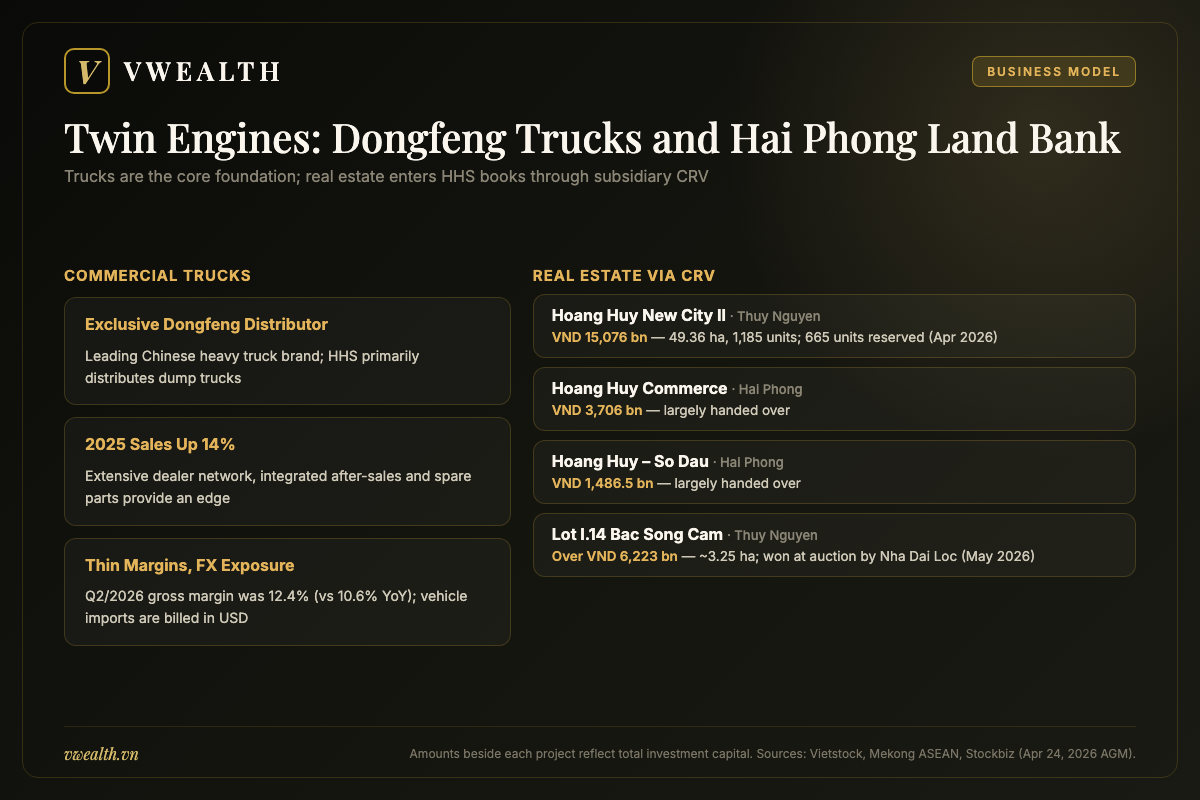
When foreign analysts open the consolidated financial statements of HHS from the second half of 2025 onward, they immediately encounter two distinct operating engines functioning at completely divergent economic rhythms. The first engine is commercial vehicle distribution: generating recurring quarterly sales, turning inventory rapidly, operating on thin gross margins, and absorbing the operational impacts of foreign exchange fluctuations and domestic infrastructure construction cycles. The second engine is residential real estate development through CRV: absorbing massive capital over multi-year gestation periods, locking liquidity into land clearance and vertical construction, and subsequently recognizing concentrated bursts of revenue and gross profit upon contractual residential handovers. Comprehending the financial interaction of these two operating engines is the indispensable foundation for interpreting the balance sheet evolutions examined in the subsequent chapter.
Dongfeng Heavy Trucks: Exclusive Distribution and the Dump Truck Focus
According to the verified corporate profile on Vietstock, HHS serves as the exclusive authorized national distributor of Dongfeng commercial heavy trucks in Vietnam. Dongfeng Motor Corporation ranks among China’s three largest heavy commercial vehicle manufacturers, and HHS’s product lineup is heavily concentrated in heavy-duty hydraulic dump trucks (xe tu do) — specialized commercial vehicles engineered for civil construction sites, aggregate quarries, reclamation projects, and bulk construction materials transport. While the formal statutory business registration of HHS encompasses broader activities — including general real estate trading, retail automotive sales for vehicles under 12 seats, trailer chassis fabrication, and specialized transport services — the operational core of its automotive division remains commercial heavy truck importation and distribution.
According to executive commentary at the 2026 AGM cited by Stockbiz, unit sales of Dongfeng trucks expanded by 14% year-over-year in 2025, and commercial vehicle deliveries tracked steadily in line with corporate guidance throughout the first quarter of 2026. Management attributes its commercial resilience to an established nationwide dealer network, comprehensive after-sales maintenance support, and a robust inventory of synchronized original equipment manufacturer (OEM) replacement parts. In the heavy commercial vehicle market, operational uptime is the primary economic metric: a heavy dump truck idling at a construction site for a week awaiting imported replacement valves or transmission components represents direct operational revenue loss for fleet operators. Consequently, commercial transport contractors exhibit high customer stickiness toward distributors with proven local aftermarket capabilities, providing HHS with a defensible, albeit modest, operational moat. For institutional investors comparing automotive distribution business models across Vietnam stocks, vwealth has published a detailed analysis of Tasco stock (HUT), which approaches automotive retail and transport infrastructure from an entirely distinct strategic angle.
Thin Gross Margins and Foreign Exchange Exposure: Inherent Headwinds of Commercial Vehicle Importing
Commercial vehicle distribution across Southeast Asia is an inherently thin-margin trading operation. In the first quarter of 2021 — prior to the corporate consolidation of CRV — HHS’s standalone gross profit margin compressed sharply from 30.2% in the prior-year period to 7.9% (Doanh Nghiep Hoi Nhap). Even in the second quarter of 2026, when consolidated financial results incorporated real estate operations, the consolidated gross profit margin stood at 12.4%, edging up from 10.6% in the second quarter of 2025 (Mekong ASEAN). These single-to-low-double-digit gross margins confirm that the primary revenue recorded during regular operating quarters continues to reflect commercial trading with limited pricing power.
Gross margin measures the percentage of revenue remaining after subtracting direct cost of goods sold (COGS). Consider an illustrative example: suppose a heavy commercial vehicle retails domestically for VND 2.0 billion, while the direct cost of importation, overseas manufacturer invoice pricing, import tariffs, and logistics freight equals VND 1.8 billion, generating a gross profit of VND 200 million, or a 10% gross margin. In this operational reality, if the US dollar appreciates against the Vietnamese dong such that import replacement costs increase by merely 5% (to VND 1.89 billion) and competitive domestic market conditions prevent the dealer from immediately passing that cost hike onto retail buyers, gross profit drops to VND 110 million — cutting the gross margin almost in half to 5.5%. This dynamic explains why Vietstock explicitly flags foreign exchange risk in its coverage of HHS: import shipments are invoiced in USD, while domestic sales collections are denominated in VND. Whenever the Vietnamese dong undergoes depreciation pressure against the greenback, HHS management must navigate the unenviable trade-off between sacrificing market share by raising vehicle prices or sacrificing operational profitability by absorbing currency devaluations.
Hoang Huy New City II: 49.36 Hectares and 1,185 Residential Units in Thuy Nguyen
Turning to the second, far more capital-intensive operating engine: real estate development through subsidiary CRV. Established in 2006, CRV has assembled a high-conviction urban portfolio in northern Vietnam, headlined by Hoang Huy – So Dau (total investment VND 1,486.5 billion), Hoang Huy Commerce (total investment VND 3,706 billion), and the flagship master-planned development Hoang Huy New City II located in Thuy Nguyen, Hai Phong (total planned investment capital of VND 15,076 billion spanning 49.36 hectares), as reported by Mekong ASEAN. New City II is the single largest real estate asset in the corporate ecosystem, and it represents the epicenter where HHS’s consolidated financial trajectory throughout 2026 and 2027 will be determined.
Empirical disclosures presented at the April 24, 2026 AGM (documented by Stockbiz) reveal that Hoang Huy New City II comprises a total master-planned inventory of 1,185 residential units. As of that assembly date, 665 units had secured formal customer deposits, 595 binding sale-and-purchase contracts had been executed, and 520 units remained in available inventory. Phase 1 residential handovers for completed apartments were scheduled to commence in July and August 2026, backed by a commercial banking partnership providing an 18-month 0% interest rate mortgage support program for retail homebuyers. Most crucially from a balance sheet perspective, Mekong ASEAN reported that as of June 30, 2026, New City II had accumulated approximately VND 4,132 billion in short-term customer advances (nguoi mua tra tien truoc) on the liability ledger, establishing a massive pre-funded financial cushion as the project prepared for low-rise residential deliveries.
Delivered Legacy Projects: Hoang Huy Commerce, So Dau, and Gold Tower
In property development, projects that have completed their handover cycles transition from revenue drivers into balance sheet liquidity generators. According to quarterly financial reviews published by Mekong ASEAN in mid-2026, CRV’s key legacy residential developments — including Hoang Huy Commerce (Tower H1), Hoang Huy – So Dau in Hai Phong, and the Gold Tower commercial and residential complex on Nguyen Trai Street in Hanoi — have essentially concluded their active unit handover cycles. In addition, the Pruska Town development in Hai Phong represents another historically delivered residential landmark widely associated with the Hoang Huy brand.
When an urban project concludes its delivery phase, incoming customer cash flow is fully realized, construction accounts payable are resolved, and the residual commercial retail podiums or unsold parking facilities generate modest recurring rental yields. However, these completed assets no longer generate high-margin quarterly revenue spikes on the income statement. Consequently, consolidated real estate revenue for HHS in the near term is almost entirely dependent upon the execution velocity of Hoang Huy New City II. International investors wishing to benchmark this single-project handover dependency against a multi-asset diversified Vietnamese developer can examine our analysis of Ha Do Group stock (HDG), which balances residential property handovers with steady renewable energy generation.
Lot I.14 Bac Song Cam: 3.25 Hectares and Over VND 6,223 Billion in Total Capital Outlay
While New City II provides the current revenue pipeline, the designated multi-year growth engine for the group resides in Lot I.14/CTHH-01 located within the Bac Song Cam New Urban Area in Thuy Nguyen, Hai Phong. According to regulatory disclosures reported by Mekong ASEAN, Lot I.14 spans approximately 3.25 hectares of prime urban land. Project company Nha Dai Loc — a subsidiary operating within the CRV group hierarchy — was officially awarded the land use rights after winning a competitive municipal land auction pursuant to Decision dated May 7, 2026, with formal physical land handover executed by local authorities on July 23, 2026. The initial opening auction reserve price exceeded VND 1,282 billion.
The total planned capital expenditure for the Lot I.14 development is projected to exceed VND 6,223 billion; excluding initial land-use fee outlays, the net construction, civil engineering, and infrastructure development budget stands at approximately VND 4,897 billion. This massive capital commitment represents the fundamental commercial catalyst behind HHS’s proposed 259 million share rights offering in 2026. Under the capital deployment plan disclosed by Mekong ASEAN, HHS intends to channel approximately VND 2,590 billion in mobilized proceeds to subscribe to roughly 260 million newly issued shares of Nha Dai Loc. For international analysts, the strategic question extends beyond evaluating the commercial viability of Lot I.14: portfolio managers must determine how much net economic value will ultimately flow to HHS common shareholders after passing through several corporate holding tiers, and recognize that with land handover completed only in July 2026, marketable commercial handovers will require several years of development gestation.
The “Hai Phong First” Blueprint: Regional Geographic Concentration and Green Development
During the 2026 shareholder assembly, executive leadership explicitly reaffirmed its strategic blueprint of concentrating primary corporate resources in Hai Phong, while leaving open the long-term potential to expand into other high-growth provinces, framed alongside a formal commitment to sustainable “green” urban architecture (Stockbiz). A hyper-focused regional geographic focus confers distinct operational strengths: extensive institutional relationships with municipal administrative bodies, an entrenched local supply chain, and deep, household-level brand equity that attracts local homebuyers. However, this regional concentration also creates systemic geographic risk: HHS’s property earnings are tethered exclusively to the macroeconomic health, foreign direct investment (FDI) inflows, and residential absorption rates of Hai Phong. If the port city thrives, the entire ecosystem prospers; if local property demand softens, HHS lacks geographic diversification across Hanoi or Ho Chi Minh City to cushion the impact.
At the subsidiary operational planning level, CRV formulated ambitious financial targets for its designated fiscal years (which run from April 1 to March 31): targeting net revenue of VND 4,000 billion and an after-tax profit of VND 1,600 billion for Fiscal Year 2025 (ending March 31, 2026), followed by revenue guidance of VND 5,000 billion and after-tax profit of VND 2,000 billion for Fiscal Year 2026 (ending March 31, 2027), as reported by Mekong ASEAN. Foreign analysts must bear in mind that CRV’s staggered fiscal year does not align with HHS’s standard calendar fiscal year (January 1 to December 31), which produces natural quarterly consolidation lags. Furthermore, these targets represent executive management guidance, not guaranteed financial outcomes.
Which Engine Feeds Which: Evaluating Cash Flow Generation and Asset Allocation
Evaluating both operating divisions side-by-side reveals an asymmetrical corporate structure. The commercial truck business provides an operational pulse of recurring commercial activity: turning over inventory, generating daily liquidity, and supporting overhead costs, but operating with compressed single-digit profit margins that cannot meaningfully move the valuation needle for a company with tens of thousands of billions of dong in assets. The real estate division through CRV, conversely, dominates more than three-quarters of consolidated assets, holds virtually all deferred customer prepayments, and accounts for over 90% of prospective consolidated earnings volatility.
| Project / Operating Division | Geographic Location | Total Investment Capital | Operating Scale / Units | Development Status (Reporting Date) | Data Source |
|---|---|---|---|---|---|
| Dongfeng Heavy Truck Distribution | Nationwide, HQ in Hai Phong | — | 2025 Unit Sales +14% YoY | Active commercial trading; Q1 2026 tracking plan | Vietstock, Stockbiz |
| Hoang Huy – So Dau | Hai Phong City | VND 1,486.5 billion | High-rise mixed-use complex | Substantially completed handovers (2026) | Mekong ASEAN |
| Hoang Huy Commerce (Tower H1) | Hai Phong City | VND 3,706 billion | High-rise residential complex | Substantially completed handovers (2026) | Mekong ASEAN |
| Gold Tower Complex | Nguyen Trai, Hanoi | — | Commercial and residential tower | Substantially completed handovers (2026) | Mekong ASEAN |
| Hoang Huy New City II | Thuy Nguyen, Hai Phong | VND 15,076 billion | 49.36 ha; 1,185 total units | 665 deposited, 595 signed (Apr 2026); ~VND 4,132B prepayments | Stockbiz, Mekong ASEAN |
| Lot I.14 Bac Song Cam (Nha Dai Loc) | Thuy Nguyen, Hai Phong | Over VND 6,223 billion | ~3.25 ha urban land | Auction won May 2026; site handed over July 23, 2026 | Mekong ASEAN |
How to Read HHS Financial Statements After the CRV Consolidation
The financial reports of HHS represent arguably the most frequently misread set of financial statements on the Vietnamese stock market. This misinterpretation does not stem from deliberate accounting opacity, but from a structural transformation of the underlying reporting entity. Prior to June 2025, HHS was a specialized commercial automotive trading firm carrying a substantial long-term minority investment in an associate developer. Following the consolidation completed in June 2025, HHS became an integrated real estate and industrial group whose consolidated assets expanded more than fivefold. Comparing 2025 reported earnings against 2024, or contrasting the second quarter of 2026 against the second quarter of 2025, is mathematically equivalent to evaluating two entirely distinct corporate entities. This chapter establishes the rigorous analytical framework necessary to deconstruct each distinct reporting era.
Pre-2025 Financial Architecture: A Modest Operating Entity Anchored by Associate Profits
In the 2023 fiscal year, HHS adopted an annual corporate plan targeting net revenue of VND 400 billion and an after-tax net profit of VND 230 billion. In the first six months of 2023, the company reported consolidated net revenue of VND 91 billion yet posted an after-tax net profit of VND 135 billion — an apparent accounting paradox where net profit substantially exceeded total gross sales (Mekong ASEAN). The underlying explanation was straightforward: of that VND 135 billion in net earnings, VND 115 billion was generated by HHS’s proportional share of net profits from associate company CRV, in which HHS held a 43.56% equity interest at that time. In the isolated second quarter of 2023, net revenue contracted by 24.7% year-over-year to VND 62.3 billion, yet net profit after tax expanded by 57.72% to VND 64.5 billion.
This historical performance illustrates the foundational principle of reading HHS financial accounts: top-line revenue and bottom-line earnings historically moved in completely opposite directions because operating profitability was decoupled from commercial dealership sales. Under standard equity accounting principles, an investor holding between 20% and 50% of voting shares in an associate entity records its proportional share of that associate’s net income directly on its income statement under “share of profit from associates.” Crucially, this accounting entry does not bring top-line revenue onto the investor’s ledger, nor does it guarantee immediate cash inflows, unless the associate entity formally declares and disburses cash dividends.
The consolidated balance sheet as of June 30, 2023, revealed this holding architecture in stark relief: total assets stood at VND 4,556 billion, of which the long-term investment in associate CRV accounted for VND 3,126.5 billion — representing more than two-thirds of the entire asset base. On the liability side, HHS had completely extinguished all interest-bearing financial debt, reducing borrowings from VND 138.3 billion at the beginning of the year to zero. This was the true identity of HHS prior to the consolidation: a virtually debt-free corporate vehicle whose capital was predominantly allocated to a minority equity stake in an affiliated property development company, supported by a modest commercial vehicle trading arm.
Fiscal Year 2024: VND 571 Billion in Revenue and VND 368.6 Billion in Net Profit
During the 2024 fiscal year, HHS generated net revenue of VND 571.23 billion, reflecting a robust 55.82% increase over 2023, while net profit after tax reached VND 368.62 billion, representing a modest increase of 4.76% (Mekong ASEAN). This divergence — where top-line revenues expanded vigorously while net earnings barely moved — reaffirmed that bottom-line profitability remained heavily dictated by associate earnings rather than commercial truck margins. The Board of Directors resolved not to distribute any shareholder dividends for the 2024 fiscal year, citing the necessity of preserving internal liquidity to support the strategic restructuring of its investment in CRV.
A high-level ratio analysis reveals that reported after-tax profit for 2024 equaled roughly 65% of total sales revenue — a vwealth estimate calculated as VND 368.62 billion divided by VND 571.23 billion. No commercial heavy vehicle importer or automotive dealership operating anywhere in Southeast Asia generates a 65% net profit margin from distributing commercial trucks. This optical margin anomaly made sense only when analysts recognized that the vast preponderance of reported profit was derived from CRV’s residential development earnings recognized via the equity method, rather than gross retailing margins generated on New National Road 5 in Hai Phong.
Second Quarter of 2025: Deconstructing the VND 3,505.6 Billion Accounting Gain
The second quarter of 2025 represents the most critical accounting event in the modern corporate history of HHS. For that three-month reporting period, HHS posted a headline after-tax net profit of VND 3,505.6 billion. The income statement revealed financial revenue of approximately VND 3,504 billion, which Mekong ASEAN reported was derived almost in its entirety from the fair value revaluation of HHS’s pre-existing investment in CRV upon executing full consolidation control.
The statutory mechanics governing this entry follow the mandatory standards of business combination accounting under Vietnamese Accounting Standards (VAS). When an investing enterprise transitions from holding an associate stake under the equity method to acquiring legal voting control (thereby converting the investee into a fully consolidated subsidiary), the acquirer is required to remeasure its previously held equity interest at its fair market value as of the acquisition date. Any resulting positive difference between the calculated fair value and the historical carrying book value must be recognized immediately as financial income on the consolidated income statement. In the case of HHS, its associate investment in CRV had been recorded on the balance sheet at approximately VND 3,126.5 billion in mid-2023. When remeasured at prevailing market-based valuation parameters in June 2025, the fair value assessment substantially exceeded the historical carrying value, generating an extraordinary paper revaluation gain of more than VND 3,500 billion.
Foreign portfolio managers must keep three definitive realities in mind regarding this quarterly profit surge. First, it is strictly a non-recurring, one-off gain: it occurs exclusively at the precise statutory moment control is established and cannot be replicated in subsequent operational periods. Second, it is entirely non-cash: HHS did not execute an asset sale, nor did it receive a liquid cash distribution into its treasury accounts; the transaction merely marked an existing asset up to current fair value. Third, it artificially expanded book equity and accumulated undistributed profits, severely distorting historical return on equity (ROE) and automated trailing P/E multiples. Consider an illustrative example: an investor screening Vietnamese equities using an automated terminal in late 2025 would observe HHS trading at an extraordinarily low trailing P/E multiple. That multiple was completely artificial — not because the shares were undervalued, but because the denominator was inflated by an accounting revaluation gain that would never recur.
This dynamic explains why mainstream financial headlines in mid-2026 proclaimed that HHS second-quarter net profit had “collapsed by 99%.” Consolidated net profit in the second quarter of 2026 was reported at VND 31.6 billion, compared to the VND 3,505.6 billion posted in the second quarter of 2025. No operational disaster occurred: the commercial truck business and property developments continued normal operations; the base period simply contained an extraordinary multi-trillion-dong non-cash revaluation credit. Viewing that 99% earnings decline without isolating the accounting gain is the fastest path to misinterpreting HHS’s operational trajectory.
Full-Year 2025 Performance: VND 892 Billion in Sales and Over VND 3,500 Billion in Accounting Earnings
At the outset of the 2025 fiscal year, HHS adopted operating guidance calling for net revenue of VND 1,000 billion, net after-tax profit of VND 500 billion, and a planned dividend payout of 12% (Mekong ASEAN). The actual full-year financial outturn, as detailed in 2026 AGM assembly documentation cited by Stockbiz, revealed net sales revenue of VND 892 billion and consolidated after-tax net profit exceeding VND 3,500 billion, propelled by gross financial income exceeding VND 3,773 billion. Consequently, core commercial sales achieved roughly 89% of annual guidance (a vwealth estimate of VND 892 billion against the VND 1,000 billion target), while headline net earnings surpassed management’s baseline plan by several hundred percent due to the accounting revaluation gain.
Shareholder dividends for the 2025 fiscal year were subsequently approved at a rate of 7% paid in common stock, rather than the originally contemplated 12% cash/stock distribution. As of December 31, 2025, the consolidated balance sheet showed cash and cash equivalents of over VND 791 billion, a total debt-to-equity ratio of 0.42 times, and a total debt-to-total assets ratio of approximately 0.3 (Stockbiz). For an operating corporate group that had recently consolidated a major property development company with extensive multi-trillion-dong urban commitments, these leverage ratios reflected an exceptionally conservative financial posture.
First Six Months of 2026: Core Revenue Up 67% and After-Tax Profit of VND 82 Billion
The semi-annual financial statements for the first half of 2026 provide the earliest opportunity for international analysts to conduct a relatively consistent year-over-year revenue comparison, as CRV’s operating activities were consolidated throughout the entire interim period. According to audited figures cited by Mekong ASEAN, HHS generated net revenue of VND 233.8 billion in the second quarter of 2026 (an increase of 25% year-over-year) and a gross profit of VND 29 billion (an increase of 47%), driving consolidated gross profit margin from 10.6% to 12.4%. Financial income for the quarter stood at VND 34.8 billion, yielding pre-tax profit of VND 48.5 billion and net profit after tax of VND 31.6 billion.
On a cumulative basis for the first six months of 2026, HHS recorded net revenue of VND 478.3 billion (representing a 67% year-over-year expansion), pre-tax profit of VND 101.7 billion, and consolidated net profit after tax of VND 82 billion (representing a 97.7% contraction against the revaluation-inflated first half of 2025). The correct analytical takeaway is clear: core operational business volume is expanding steadily, but recurring normalized earning power currently resides at tens of billions of dong per quarter, rather than thousands of billions. When measured against full-year 2026 guidance targets of VND 3,000 billion in revenue and VND 750 billion in pre-tax profit, the first six months delivered approximately 16% of the revenue goal and 13.6% of the pre-tax earnings target (vwealth estimates). The realization of full-year corporate guidance is thus heavily contingent upon the execution velocity of residential unit handovers at Hoang Huy New City II during the second half of the year.
Balance Sheet Quality as of June 30, 2026: VND 18,900 Billion in Inventory and VND 4,185 Billion in Advances
The transformation of the balance sheet between mid-2023 and mid-2026 illustrates the structural impact of the CRV consolidation. Total consolidated assets multiplied from VND 4,556 billion as of June 30, 2023, to VND 24,042 billion as of June 30, 2026 — an expansion of approximately 5.3 times (a vwealth estimate derived by dividing VND 24,042 billion by VND 4,556 billion). This dramatic expansion reflects the statutory absorption of CRV’s balance sheet accounts.
Deconstructing the asset composition as of June 30, 2026, reveals three key balances. First, real estate inventory stood at approximately VND 18,900 billion (reflecting a 17% increase), representing roughly 79% of total consolidated assets (a vwealth estimate of VND 18,900 billion divided by VND 24,042 billion). This massive inventory balance reflects capitalized site clearance costs, land acquisition expenditures, and ongoing construction work-in-progress across New City II and sister development sites. Second, liquid cash and cash equivalents stood at VND 124.6 billion, representing an 84% contraction from the VND 791 billion reported at year-end 2025, illustrating that corporate liquidity was actively consumed by project development and land bidding commitments. Third, short-term financial investments (primarily short-term bank deposits) amounted to VND 977.4 billion, providing an essential secondary liquidity reserve.
On the financing and equity side of the balance sheet as of June 30, 2026, total liabilities stood at VND 7,342 billion. Crucially, short-term customer advances (nguoi mua tra tien truoc ngan han) stood at VND 4,185 billion, comprising over 57% of total corporate liabilities. Under Vietnamese property accounting, customer advances represent contractual progress payments made by residential homebuyers. This liability carries zero interest cost, requires no cash debt service, and automatically reclassifies directly into top-line revenue upon physical unit delivery. Furthermore, long-term interest-bearing bank debt was completely eliminated, declining from VND 390 billion to zero, while deferred tax liabilities stood at over VND 2,156 billion. Total equity stood at VND 16,701 billion (inclusive of non-controlling interests), underpinned by accumulated undistributed after-tax profits of VND 4,537 billion.
| Reporting Period | Net Sales Revenue | Net Profit After Tax | Analytical Commentary / Context |
|---|---|---|---|
| Q1 2021 | VND 137.6 billion | VND 55.8 billion | Gross margin dropped from 30.2% to 7.9% (Doanh Nghiep Hoi Nhap) |
| 6M 2023 | VND 91.0 billion | VND 135.0 billion | VND 115B derived from associate profit in CRV (Mekong ASEAN) |
| FY 2024 | VND 571.23 billion | VND 368.62 billion | No shareholder dividend distributed (Mekong ASEAN) |
| Q2 2025 | — | VND 3,505.6 billion | Virtually all from fair value revaluation upon CRV consolidation — one-off |
| FY 2025 | VND 892.0 billion (sales) | Over VND 3,500 billion | Financial revenue exceeded VND 3,773 billion (Stockbiz) |
| Q2 2026 | VND 233.8 billion | VND 31.6 billion | Contracted 99% YoY due to extraordinary revaluation base effect |
| 6M 2026 | VND 478.3 billion | VND 82.0 billion | Achieved ~16% of full-year revenue plan (vwealth estimate) |
| Balance Sheet Metric | June 30, 2023 | December 31, 2025 | June 30, 2026 |
|---|---|---|---|
| Total Assets | VND 4,556 billion | — | VND 24,042 billion |
| Cash and Cash Equivalents | — | Over VND 791 billion | VND 124.6 billion |
| Investment in CRV (Associate) | VND 3,126.5 billion (43.56%) | Consolidated as Subsidiary | Consolidated as Subsidiary |
| Real Estate Inventory | — | — | ~VND 18,900 billion |
| Short-Term Customer Advances | — | — | VND 4,185 billion |
| Interest-Bearing Debt | VND 0 (VND 138.3B at start) | Debt/Equity of 0.42x | Long-term debt reduced from VND 390B to 0 |
| Total Owner’s Equity | — | — | VND 16,701 billion (includes NCI) |
How the Market Prices HHS Stock: Stripping One-Off Accounting Gains Before Looking at P/E
The preceding chapters explored the operational biography of HHS, its three-tiered ownership matrix, its two distinct operating divisions, and the post-consolidation accounting framework. This chapter addresses the practical question that every international investor confronts: how is the market pricing HHS stock, and does the equity represent an attractive risk-adjusted entry point? In conventional equity research, an analyst retrieves the current market quote, checks the trailing P/E multiple against domestic industry peers, examines the price-to-book ratio, and arrives at an initial valuation assessment. For HHS during the 2025–2026 period, following this standard screening routine is virtually guaranteed to lead to erroneous investment conclusions. The root cause lies in a single accounting entry recorded in the second quarter of 2025: the financial income credit of approximately VND 3,504 billion recognized when HHS marked its pre-existing investment in CRV to fair value upon executing statutory consolidation.
In accordance with the rigorous methodology of this report, we do not cite real-time spot prices, live trailing P/E multiples, or intraday P/B ratios. In a market subject to the ±7% daily price limit bands of the Ho Chi Minh City Stock Exchange (HOSE) and the T+2 settlement cycle, spot figures fluctuate continuously. Moreover, for an enterprise preparing to execute a massive 259-million-share rights offering, unadjusted valuation multiples can fundamentally shift overnight. Instead, this chapter examines verified historical pricing milestones, deconstructs how accounting distortions warp standard valuation multiples, and outlines the precise normalization methodology required to determine intrinsic economic earning power. For live normalized multiples and institutional consensus tracking, investors should access the updated corporate profiles on the vwealth equity research platform.
Historical Price Milestones: From VND 6,680 in 2021 to the VND 11,000 Range in August 2026
To understand how the market has historically valued HHS stock, the most illuminating approach is to anchor historical transaction prices to specific corporate inflection points. The first reference milestone occurred on May 10, 2021, when HHS shares closed at VND 6,680 per share, as documented in financial reporting by Doanh Nghiep Hoi Nhap covering TCH’s strategic plan to acquire an additional 14.8 million shares. At that juncture, HHS was a substantially smaller operating entity: its standalone commercial truck revenue totaled a few hundred billion dong, bottom-line net profit was heavily dependent on equity-accounted associate dividends from CRV, and parent corporation TCH held an initial 45.67% equity stake.
The second pricing phase unfolded throughout 2025 — the year of corporate restructuring. As domestic market participants recognized that HHS would consolidate CRV as a legal subsidiary and subsequently recognize an extraordinary multi-trillion-dong accounting gain on its income statement, aggressive speculative buying entered the stock. According to headline financial reports published by Mekong ASEAN in May and June 2025, HHS stock experienced a sharp upward re-rating of nearly 50% within roughly one month. Taking advantage of this substantial liquidity window, an institutional major shareholder executed the open-market sale of more than 2.3 million shares. The absolute cyclical peak of this multi-year valuation wave occurred around October 2025 — coinciding precisely with subsidiary CRV’s public listing debut on HOSE at an initial reference price of VND 26,000 per share, which surged to its daily trading ceiling in its inaugural session.
The third major pricing milestone materialized in August 2026. Following months of secondary market digestion, Mekong ASEAN reported that HHS stock had settled into the VND 11,000 range — representing a contraction of roughly 50% from its October 2025 peak. On August 26, 2026, HHS shares closed at VND 10,950 per share, establishing an issuance discount of approximately 9% relative to the proposed rights offering exercise price of VND 10,000 per share (Phap Luat Viet Nam). On August 27, 2026, financial filings cited by Vietstock highlighted that HHS share price had retreated by more than 40% over the preceding twelve-month period, reflecting market digestion of the sharp year-over-year earnings contraction in the first half of 2026.
A More Than 40% Share Price Decline Over Twelve Months: The Market Reassesses Non-Recurring Profits
Why did HHS stock experience a steep downward re-rating of more than 40% between mid-2025 and mid-2026? The fundamental driver was the market’s progressive realization that the VND 3,505.6 billion after-tax profit reported in 2025 was a one-time accounting windfall that generated zero ongoing cash flow. Retail market participants who purchased shares near the autumn 2025 peak — enticed by automated stock screeners displaying an optically depressed trailing P/E multiple — were blindsided when subsequent quarterly filings revealed normalized net profits receding to VND 30 to VND 50 billion.
This dynamic illustrates a classic behavioral phenomenon observed across emerging stock exchanges: market participants initially bid up share prices in anticipation of a massive headline earnings spike; yet when subsequent quarterly reports display headline net profit drops of 97% to 99% due to the base-year effect, broad retail sentiment violently reverses. In reality, the operational health of HHS did not deteriorate by 99% between 2025 and 2026. The commercial truck business expanded unit sales by 14%, and CRV’s property projects advanced toward residential handovers. The steep share price contraction was not an operational breakdown, but a market-wide recalibration as speculative excess unwound and valuation multiples realigned with core operating fundamentals.
Why the Trailing 2025 P/E for HHS Is Misleading — And How to Calculate Normalized Core Multiples
Price-to-Earnings (P/E) is defined as current share price divided by annual earnings per share (EPS). The mathematical vulnerability of this metric becomes acute when net income includes substantial non-operating, non-recurring accounting credits. In fiscal year 2025, HHS reported consolidated after-tax profit exceeding VND 3,500 billion, driven by financial revenue of more than VND 3,773 billion, of which approximately VND 3,504 billion was generated by the one-off CRV revaluation. If an automated financial portal calculates EPS using this unadjusted net income figure, the resulting EPS reaches several thousand dong per share, causing the trailing P/E ratio to appear extraordinarily low (often between 1.0x and 2.5x).
Investing based on this unadjusted figure is a critical mistake. Consider an illustrative example of normalized earnings calculation: an analyst must systematically strip out the VND 3,504 billion revaluation gain from total financial income, deduct the corresponding deferred tax adjustments, and isolate the recurring operational earnings derived from commercial vehicle sales and recurring property deliveries. Furthermore, the analyst must isolate only the portion of net profit attributable to equity holders of the parent company, excluding the non-controlling interest share belonging to external CRV owners. When calculated on this normalized, recurring basis, HHS’s actual operational EPS in 2025 was modest. An investor evaluating HHS must evaluate whether the prevailing market price is attractive relative to recurring operating cash flows, rather than anchoring to a non-repeatable paper revaluation.
Gross Book Value vs. Non-Controlling Interests: Why Unadjusted P/B Misrepresents Valuation
A parallel analytical pitfall distorts the Price-to-Book (P/B) ratio. Following the full consolidation of CRV, total owners’ equity on HHS’s consolidated balance sheet stood at VND 16,701 billion as of June 30, 2026. Dividing this total equity balance by the 431,985,968 outstanding common shares yields an unadjusted gross book value per share of approximately VND 38,660 — a vwealth estimate derived by dividing VND 16,701 billion by 431.99 million shares.
An inexperienced analyst comparing a market price in the VND 11,000 range against a gross book value of VND 38,660 might conclude that HHS is trading at a deep discount to book value of roughly 0.28x. This deduction is fundamentally flawed. The VND 16,701 billion equity figure represents consolidated group equity, which includes the substantial equity claims of Non-Controlling Interests (NCI). Because HHS owns only 51.03% of CRV, roughly 49% of CRV’s underlying net assets belong legally to external shareholders — including parent entity TCH. The equity strictly attributable to common shareholders of the parent company (HHS) is substantially lower than total group equity. When assessing P/B, institutional analysts must deduct non-controlling interests from the numerator. Failing to make this adjustment creates a false impression of deep asset undervaluation.
Comparing TCH, HHS, and CRV: Three Tickers Encapsulating the Same Underlying Land Assets
One of the most distinctive institutional characteristics of the Vietnamese equity market is that the identical portfolio of residential land assets in Hai Phong — encompassing Hoang Huy New City II, Lot I.14 Bac Song Cam via Nha Dai Loc, and legacy developments like Hoang Huy Commerce and So Dau — is packaged and traded simultaneously across three distinct listed tickers on the Ho Chi Minh City Stock Exchange:
CRV represents the pure-play, asset-level operating vehicle. CRV directly owns the project development licenses, holds the municipal construction permits, and interfaces directly with residential homebuyers. CRV debuted on HOSE in October 2025 at an initial reference price of VND 26,000 per share, establishing an initial equity market valuation of roughly VND 17,500 billion to VND 21,000 billion. CRV operates on a non-calendar fiscal year (April 1 to March 31) and established ambitious internal targets calling for net revenue of VND 4,000 billion and after-tax profit of VND 1,600 billion for FY2025, expanding to VND 5,000 billion in revenue and VND 2,000 billion in net profit for FY2026 (Mekong ASEAN).
HHS represents the intermediate operating holding company, controlling 51.03% of CRV’s equity while directly operating the exclusive Dongfeng commercial heavy truck distribution network. Purchasing HHS stock is effectively buying a 51% proportional claim on CRV’s residential profits through a corporate holding layer, bundled alongside an automotive dealership operating on thin gross margins.
TCH represents the apex conglomerate holding company, holding a controlling 58.31% stake in HHS, a 38.09% direct equity stake in CRV, and the Navistar International tractor-trailer dealership, alongside broader group assets. For institutional investors comparing conglomerate structures across Vietnam stocks, vwealth has published an in-depth standalone report on TCH stock.
In classical corporate finance theory, holding companies almost universally trade at a measurable structural discount to the net asset value (NAV) of their underlying holdings — a phenomenon termed the “holding company discount.” This discount compensates public shareholders for additional layers of administrative overhead, dividend tax frictions, minority agency risks, and the inability of holding company investors to directly liquidate the underlying subsidiary assets. Consider an illustrative example using hypothetical figures: if HHS’s 51.03% equity stake in CRV commands an implied market value of VND 9,000 billion, yet HHS’s own total equity market capitalization is valued by the market at only VND 5,000 billion, that VND 4,000 billion gap represents the market’s combined holding company discount, net of HHS’s standalone commercial truck operations, corporate cash reserves, and liabilities. Investors can readily calculate this holding discount by comparing the market capitalizations of CRV and HHS on any identical trading day.
The strategic question for foreign portfolio managers is straightforward: if an investment thesis is predicated on the urban real estate expansion of Hai Phong, which corporate tier offers the optimal risk-reward ratio? Investing directly in CRV provides immediate, unencumbered exposure to project deliveries without holding-company leakage. Allocating capital to HHS captures a potential holding-company valuation discount, but subjects the investor to substantial equity dilution via the 5:3 rights issue and introduces commercial vehicle foreign exchange exposure. Investing in TCH captures the entire corporate pyramid, but introduces a dual-layered holding discount. For broader perspective on real estate developer valuations, investors should examine the comprehensive overview in vwealth’s sector report on Vietnamese real estate stocks.
Accessing the vwealth Platform for Live HHS Multiples and Clean Financial Data
This report deliberately refrains from quoting daily spot P/E ratios, P/B multiples, or intraday enterprise values. For an equity preparing to issue 259 million new shares to finance an unbuilt real estate development, secondary pricing multiples are dynamic and rapidly outdated. Furthermore, trailing four-quarter earnings figures will fluctuate dramatically as residential deliveries at Hoang Huy New City II are recognized across quarterly filings.
When reviewing live valuation reports on the vwealth platform, institutional investors should apply a four-part analytical checklist. First: has the reported net income used to compute P/E been rigorously stripped of the one-off June 2025 revaluation credit, and does it represent strictly the net earnings attributable to equity holders of the parent company? Second: does the stated book value per share exclude the substantial equity claims of non-controlling interests in CRV? Third: does the outstanding share count account for prospective share dilution resulting from the 259-million-share rights offering? Fourth: what is the prevailing holding-company discount of HHS relative to its proportional stake in CRV when priced on the exact same trading session? Rigorously answering these four questions elevates an investment evaluation far above casual market commentary that relies on unadjusted financial screeners.
| Date / Period | Share Price / Market Event | Underlying Corporate Context | Data Source |
|---|---|---|---|
| May 10, 2021 | HHS closes at VND 6,680 per share | TCH held 45.67%, planned to acquire 14.8M shares | Doanh Nghiep Hoi Nhap |
| May–June 2025 | Share price rallies ~50% in one month; major shareholder divests >2.3M shares | Corporate restructuring: HHS elevates CRV stake to 51.03% | Mekong ASEAN (Headline news) |
| October 2025 | Cyclical valuation peak; subsidiary CRV lists on HOSE at VND 26,000 ref price, hits ceiling | CRV consolidated as legal subsidiary of HHS since June 2025 | Mekong ASEAN, Nhadautu |
| August 2026 | HHS trades around VND 11,000 (~50% below Oct 2025 peak) | Board of Directors resolves to implement 259M share rights issue | Mekong ASEAN |
| August 26, 2026 | HHS closes at VND 10,950; VND 10,000 rights issue price is ~9% below market | 5:3 rights issue subscription ratio | Bao Phap Luat Viet Nam |
| August 27, 2026 | Share price down >40% over preceding 12 months | Consolidated H1 2026 net profit down 97.7% YoY due to base effect | Vietstock (Headline news) |
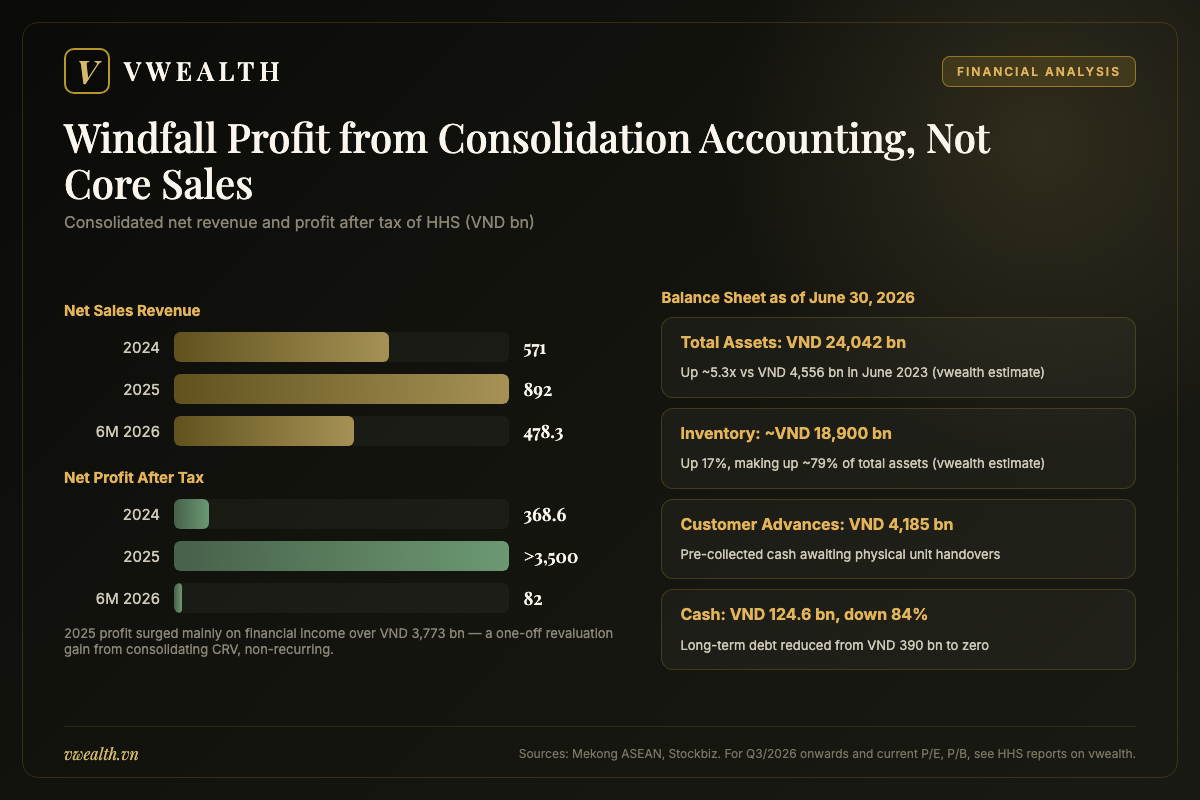
Dividends, Capital Increases, and the Mechanics of Share Dilution for HHS Stock
While the previous chapter examined the market price that secondary investors pay for HHS equity, this chapter examines the fundamental denominator that determines what each share represents: the total volume of outstanding common shares. The corporate trajectory of HHS is characterized by near-continuous equity capital expansion — growing from an initial VND 90 billion in 2008 to approximately VND 4,320 billion by 2025, an expansion of roughly 48 times according to a vwealth estimate. With the planned 2026 rights offering scheduled to elevate registered charter capital to approximately VND 6,912 billion, public shareholders must routinely confront an inescapable corporate dilemma: contribute additional cash capital to maintain proportional ownership, or accept severe structural share dilution.
Capital Expansion History (2012–2015): The Recurring Habit of Share-Based Dividends
The historical section of this report outlined the chronological sequence of corporate actions following HHS’s public debut; here we analyze them through the specific lens of shareholder dividend policy. Throughout the critical formative period between 2012 and 2015, HHS rarely distributed conventional cash dividends, opting instead for an aggressive, continuous sequence of share capital expansions: a 50% stock bonus in May 2012; an additional bonus share issue in August 2012 lifting capital to VND 225 billion; a 50% stock dividend paired with a 5:1 rights offering in April 2013 elevating capital to VND 382.5 billion; a 20% stock dividend alongside a 10:3 cash rights issue in October 2014 pushing capital to VND 573.6 billion; a 10% stock dividend paired with the 47.9-million-share Hoang Giang acquisition swap in March 2015 elevating capital to VND 1,109 billion; and culminating in November 2015 with a massive 1:1 rights issue combined with a 10% stock dividend and a 10% cash dividend, which catapulted charter capital to VND 2,330 billion.
The critical takeaway for international investors is that corporate stock distributions do not generate immediate wealth for the recipient: the total number of shares increases, the secondary market price adjusts downward by the exact theoretical mathematical factor on the ex-rights date, and the aggregate portfolio value remains unchanged at the opening bell. A stock dividend creates enduring value only if the earnings retained within the corporate treasury are successfully reinvested into operating assets that generate a return on invested capital (ROIC) exceeding the shareholder’s cost of capital. In the case of HHS, the vast majority of capital mobilized during that historic expansion phase was channeled into building equity ownership in sister property developer CRV — an investment that subsequently generated the massive fair value revaluation in 2025. Whether CRV’s underlying residential developments will generate sufficient long-term cash flow to justify this expanded share count remains the central question to be answered by project handovers.
Zero Dividends in 2024 Followed by a 7% Stock Dividend in 2025
During the 2024 fiscal year, HHS distributed zero dividends to shareholders; the Board of Directors explicitly justified this capital retention by citing the strategic necessity of preserving internal liquidity to execute the corporate restructuring of its equity investment in CRV (Mekong ASEAN). At the beginning of the 2025 fiscal year, management initially outlined a 12% dividend guidance target; however, the resolution ratified by the Annual General Meeting on April 24, 2026, established the final 2025 dividend at 7% paid entirely in shares (at a distribution ratio of 100:7), while establishing an identical 7% stock dividend target for fiscal year 2026. According to reporting by Stockbiz, this 7% stock distribution entails the issuance of approximately 48 million new common shares, representing a nominal par value of roughly VND 480 billion.
A closer look at this disclosure reveals a notable mathematical detail. If calculated strictly against the 431,985,968 shares currently outstanding, a 7% distribution would require issuing approximately 30.2 million shares. The disclosed figure of approximately 48 million shares aligns far more closely with a 7% distribution calculated against approximately 691 million shares — representing the prospective post-issuance share base following the planned 259-million-share rights offering (a vwealth estimate of 691 million multiplied by 7% equals roughly 48.4 million shares). This mathematical relationship suggests that corporate execution of the 7% stock dividend may occur subsequent to the completion of the rights offering, though investors must verify the official record date filings. If this sequencing holds, investors subscribing to new shares in the rights issue would also be eligible to receive the 7% share dividend on their newly acquired equity.
More fundamentally, despite maintaining accumulated undistributed after-tax profits of VND 4,537 billion on its balance sheet as of June 30, 2026, HHS chose to pay its annual dividend strictly in stock rather than cash. This strategic choice is entirely consistent with the financial reality depicted in Chapter 4: liquid cash balances stood at only VND 124.6 billion, the accumulated earnings balance consists primarily of non-cash accounting gains derived from the CRV consolidation, and the company requires substantial capital to fund upcoming development commitments. Investors prioritizing consistent cash dividend yields will not find that profile in HHS stock during its current capital-intensive phase.
The 5:3 Rights Offering at VND 10,000 per Share: Where Will the VND 2,590 Billion Go?
The proposed 2026 equity rights issue represents the single largest capital mobilization undertaking by HHS since 2015. Formally ratified at the April 24, 2026 AGM and enacted via Board resolution in August 2026, the offering grants existing shareholders the right to subscribe to 259 million new ordinary shares at an execution ratio of 5:3 (every 5 existing shares held entitles the owner to purchase 3 new shares) at an exercise price equal to statutory par value of VND 10,000 per share. The gross targeted capital mobilization is approximately VND 2,590 billion (with financial press reports citing VND 2,591 billion to VND 2,592 billion due to mathematical rounding). The newly issued shares carry no post-issuance transfer restrictions, with regulatory execution targeted across the fourth quarter of 2026 and the first quarter of 2027. If fully subscribed, HHS charter capital will expand from approximately VND 4,320 billion to roughly VND 6,912 billion, expanding total outstanding shares from approximately 432 million to 691 million.
According to regulatory disclosures documented by Mekong ASEAN, the explicit commercial purpose of this capital raise is to deploy the mobilized VND 2,590 billion to subscribe to roughly 260 million newly issued shares of Nha Dai Loc — an entity in which HHS currently maintains an indirect 51% ownership interest through CRV. Nha Dai Loc is the project vehicle that was awarded development rights to urban Lot I.14/CTHH-01 in the Bac Song Cam New Urban Area in Thuy Nguyen, Hai Phong (spanning ~3.25 hectares, with an opening auction reserve price exceeding VND 1,282 billion and a total projected investment capital requirement exceeding VND 6,223 billion, including approximately VND 4,897 billion in construction outlays).
Tracing the flow of capital reveals three significant corporate implications. First, HHS is transitioning from holding Nha Dai Loc strictly indirectly via CRV to establishing an additional direct equity holding, introducing an additional layer of structural complexity into the group’s legal hierarchy. Second, the mobilized capital is allocated to an early-stage greenfield development that received site handover only in July 2026, meaning that commercial handovers and cash generation will require a multi-year gestation period. Third, with liquid cash reserves at VND 124.6 billion as of June 30, 2026, this rights issue is an essential financing prerequisite for the group’s land commitments; if public subscription falls short, management will be forced to seek alternative debt or equity arrangements.
Furthermore, the offering price of VND 10,000 per share stood merely 9% below the secondary market closing price of VND 10,950 recorded on August 26, 2026 (Phap Luat Viet Nam). In traditional equity underwriting, rights offerings to existing shareholders typically feature a pricing discount of 20% to 40% below secondary market levels to incentivize shareholder participation. A narrow 9% pricing spread leaves little economic value in the subscription rights. If the secondary market price of HHS stock weakens toward or below VND 10,000 during the active subscription period, public retail shareholders will have little financial incentive to exercise their rights. Under such circumstances, the subscription commitment of controlling parent company TCH (which holds 58.31%) becomes the critical factor determining whether the rights issue reaches its funding target. Public disclosure filings have not yet confirmed the specific subscription guarantees of TCH or its post-offering ownership stake.
Charter Capital Expanding from VND 4,320 Billion to VND 6,912 Billion: An Illustrative Example with 1,000 Shares
Because the mechanics of equity dilution can seem abstract, it is instructive to trace an illustrative example based on an investor holding 1,000 shares of HHS stock prior to the ex-rights registration date. Under the approved 5:3 rights issue ratio, the investor is allocated 600 purchase rights (calculated as 1,000 shares multiplied by 3/5). Each individual right entitles the owner to purchase one new share at the statutory exercise price of VND 10,000. To fully exercise these rights and defend against equity dilution, the shareholder must deposit an incremental VND 6,000,000 in liquid cash (600 rights multiplied by VND 10,000), expanding their total position to 1,600 shares and preserving their proportional ownership percentage in the enterprise.
Now consider the alternative scenario where the shareholder lacks incremental liquidity or elects not to participate in the capital call. The shareholder retains their original 1,000 shares, but the company’s total outstanding share count expands from approximately 432 million shares to 691 million shares. The non-participating shareholder’s proportional ownership claim in HHS suffers severe dilution: the mathematical dilution factor is exactly 3 divided by (5 + 3), which equals 37.5% — a vwealth estimate derived by dividing 3 new shares by the 8 post-issuance shares. The non-participating shareholder now owns 37.5% less of the company’s future dividend streams, underlying land assets, and voting power than they did prior to the rights issue.
Furthermore, on the ex-rights date, the secondary market share price on HOSE is mathematically adjusted downward via standard exchange settlement formulas to incorporate the issuance of new shares at VND 10,000. If an investor neither exercises their subscription rights nor sells those rights in the secondary market during the trading window, they incur an immediate unrecoverable loss of economic value. For international investors building an exposure to HHS stock, the ability and willingness to commit fresh capital during rights issues is not an optional consideration; it is an operational necessity required to maintain portfolio value.
| Date / Corporate Action | Capital Expansion Mechanism | Transaction Ratio / Scale | Post-Event Charter Capital | Data Source |
|---|---|---|---|---|
| May 2012 | Bonus share distribution | 50% bonus ratio | VND 150.0 billion | Vietstock |
| August 2012 | Bonus share distribution | — | VND 225.0 billion | Vietstock |
| April 2013 | Stock dividend + preferential rights issue | 50% stock dividend + 5:1 rights | VND 382.5 billion | Vietstock |
| October 2014 | Stock dividend + preferential rights issue | 20% stock dividend + 10:3 rights | VND 573.6 billion | Vietstock |
| March 2015 | Stock dividend + Hoang Giang share swap | 10% stock dividend + 47.9M shares | VND 1,109.0 billion | Vietstock |
| November 2015 | Preferential rights issue + stock/cash dividend | 1:1 rights + 10% stock + 10% cash | VND 2,330.0 billion | Vietstock |
| Dec 2021 – Jan 2022 | Share dividend + bonus share issue | Nearly 47 million shares issued | VND 3,214.48 billion | CafeF, Vietstock |
| FY 2024 | No dividend distribution executed | Capital conserved for CRV buyout | VND 3,679.85 billion (Aug 2024) | Mekong ASEAN, Vietstock |
| June 2025 | Private placement to parent company TCH | 64M shares at VND 12,500/share | VND 4,319.85 billion | Mekong ASEAN, Vietstock |
| 2026 (Planned) | 2025 stock dividend distribution | 100:7 ratio (~48 million shares) | Subject to official execution | Stockbiz |
| Q4 2026 – Q1 2027 (Target) | Rights offering to existing shareholders | 5:3 ratio, 259M shares at VND 10,000 | VND 6,912.0 billion (Projected) | Phap Luat VN, Mekong ASEAN |
The 2026 Strategic Guidance and Three Scenarios for HHS Stock
In accordance with institutional equity research standards, this analysis does not publish speculative price targets. Forecasting the exact market valuation of a real estate holding enterprise in Vietnam is subject to numerous external variables — encompassing municipal permitting timelines, statutory fire-safety inspection certifications, commercial mortgage interest rate environments, and broad macroeconomic sentiment — variables that even senior corporate executives cannot fully control. Instead, this chapter places HHS’s approved 2026 annual guidance alongside its interim half-year financial results, isolates the primary operational variables that dictate financial performance, and constructs three prospective corporate scenarios with clearly defined conditions. When subsequent quarterly statements are released, investors can objectively evaluate which trajectory is unfolding.
The Full-Year 2026 Target: VND 3,000 Billion in Revenue and VND 750 Billion in Pre-Tax Profit
The Annual General Meeting of HHS convened on April 24, 2026, officially approved corporate guidance for the 2026 fiscal year featuring net sales revenue of VND 3,000 billion, consolidated pre-tax profit of VND 750 billion, and a planned 7% dividend payout. When contrasted against the net commercial sales revenue of VND 892 billion recorded in 2025, the 2026 revenue target requires top-line sales to multiply by approximately 3.4 times — a vwealth estimate calculated as VND 3,000 billion divided by VND 892 billion. By any objective metric, this corporate target requires a discontinuous operational leap rather than incremental baseline growth.
This substantial top-line expansion cannot be delivered by the commercial truck division. While Dongfeng vehicle sales expanded by 14% year-over-year in 2025 and commercial deliveries tracked steadily in the first quarter of 2026, an automotive dealership operating on thin gross margins cannot physically triple group-wide sales revenue within a single fiscal year. Consequently, the vast preponderance of guidance revenue must originate from the real estate division of subsidiary CRV — specifically, the scheduled residential unit handovers of completed low-rise villas, townhouses, and high-rise apartments at Hoang Huy New City II in Thuy Nguyen, Hai Phong. Under Vietnamese real estate accounting principles, property developers are legally prohibited from recognizing revenue upon contract execution or upon receipt of cash down-payments; top-line revenue and associated gross margins can be recognized on the income statement strictly upon physical unit handover to the homebuyer following receipt of official municipal occupancy permits. Therefore, HHS’s 2026 corporate guidance is fundamentally an operational commitment regarding construction and handover velocity.
Furthermore, the consolidated pre-tax profit target of VND 750 billion requires careful institutional dissection. Because this figure represents fully consolidated group performance, it incorporates 100% of CRV’s projected operating earnings. However, as established in Chapter 2, approximately 49% of CRV’s equity is owned by non-controlling external shareholders (including parent corporation TCH). Consequently, the net profit after corporate income tax that ultimately accrues to common equity holders of HHS will represent a substantially smaller net sum than the headline VND 750 billion pre-tax figure suggests.
Achieving 16% of Revenue in the First Half: The High Stakes of Back-Loaded Deliveries
During the first six months of 2026, HHS recorded net revenue of VND 478.3 billion (up 67% year-over-year), pre-tax profit of VND 101.7 billion, and after-tax net profit of VND 82 billion. When evaluated against full-year 2026 targets, a vwealth estimate indicates that the company achieved approximately 16% of its full-year revenue goal (VND 478.3 billion against VND 3,000 billion) and roughly 13.6% of its annual pre-tax profit target (VND 101.7 billion against VND 750 billion). In mathematical terms, to achieve full-year guidance, the second half of 2026 must deliver approximately VND 2,520 billion in net revenue and VND 648 billion in pre-tax profit — a vwealth estimate representing the remaining residual targets.
This interim achievement rate does not automatically indicate that HHS will miss its annual targets. Across the Vietnamese property sector, revenue recognition is notoriously back-loaded: construction milestones, completion certificates, and buyer handover schedules overwhelmingly cluster into the third and fourth quarters. In macroeconomic research covering the broader conglomerate, parent entity TCH has been projected by financial analysts to achieve net revenue of VND 5,865 billion (+74% YoY) and net profit of VND 1,625 billion (+60% YoY) in 2026, supported by an aggregate land bank of approximately 90 hectares and ongoing pipeline research across 7 planned projects covering roughly 330 hectares (Tap Chi Kinh Te Tai Chinh). Institutional brokerage updates, such as research published by SHS on TCH in May and August 2026, track these group-wide developments closely. Because TCH consolidates CRV and HHS into its own group results, group earnings projections are inextricably linked to the handover trajectory of Hoang Huy New City II. Any downward revision in parent-level research serves as an early indicator for HHS.
VND 4,132 Billion in Customer Advances: A Secured Pipeline Awaiting Handover Recognition
The single most critical balance sheet item providing fundamental support for HHS’s back-loaded 2026 revenue guidance is the substantial balance of short-term customer advances. As documented by Mekong ASEAN, Hoang Huy New City II had accumulated approximately VND 4,132 billion in customer advances on its consolidated balance sheet as of June 30, 2026. This balance represents cash down-payments deposited by homebuyers who have executed binding purchase contracts, awaiting final physical delivery of their completed properties.
Unlike many distressed property developers across emerging markets that carry high inventory with minimal buyer interest, HHS has already secured committed pre-sales for a substantial portion of its portfolio. The primary operational risk is therefore not retail demand absorption, but execution velocity: completing final architectural finishes, securing municipal fire-safety inspection sign-offs, and coordinating customer move-in schedules before the December 31 reporting cut-off. If regulatory approvals or physical handovers slip by even a few weeks into the first quarter of 2027, the corresponding revenue recognition automatically migrates into the subsequent fiscal year.
Three Prospective Scenarios: On-Time Deliveries, 2027 Slippage, or Subscribed Capital Shortfall
Prior to examining each scenario, foreign analysts must monitor five primary operational variables that govern HHS’s financial trajectory. First, the handover execution schedule of Hoang Huy New City II — the dominant variable dictating 2026 reported revenue. Second, the commercial sales absorption pace for the 520 uncommitted units at New City II — governing cash flow visibility into 2027. Third, the capital subscription outcome of the 259-million-share rights offering — determining whether HHS secures equity funding for Lot I.14 or must incur substantial debt. Fourth, the operational resilience of the Dongfeng truck distribution division — providing recurring cash flow while absorbing USD/VND exchange rate fluctuations. Fifth, the broader property cycle in Hai Phong — encompassing local retail mortgage rates, infrastructure completion, and competitive residential supply in Thuy Nguyen.
Bull Scenario: On-Time Handover Execution and Successful Rights Mobilization. Under this optimistic trajectory, residential handovers of completed low-rise units and apartments at Hoang Huy New City II proceed smoothly across the third and fourth quarters of 2026. The vast majority of the VND 4,132 billion in customer advances is recognized as top-line revenue, allowing HHS to meet or closely approach its full-year targets of VND 3,000 billion in revenue and VND 750 billion in pre-tax profit. Concurrently, controlling shareholder TCH and public investors participate actively in the 5:3 rights offering, successfully mobilizing approximately VND 2,590 billion in equity capital. This enables project company Nha Dai Loc to initiate civil construction on Lot I.14 in Bac Song Cam without burdening the balance sheet with high-interest bank borrowings, while the remaining 520 units at New City II sell steadily under the 18-month subsidized mortgage program. Under this scenario, HHS’s audited 2026 statements demonstrate that the company can generate multi-hundred-billion-dong core operational profits without non-recurring revaluations, potentially narrowing the holding-company discount. However, this outcome requires simultaneous alignment across construction execution, municipal permitting, and equity underwriting.
Base Scenario: Phased Handover Recognition with Corporate Results Moderating Below Target. In this baseline projection, physical unit deliveries advance, but operational handovers cluster late in the fourth quarter or experience minor administrative pacing. Consequently, only a moderate portion of the VND 4,132 billion in customer advances is formally recognized as revenue during calendar year 2026, while the remaining balance rolls forward into 2027. Consolidated net revenue expands significantly compared to 2025, but falls short of the ambitious VND 3,000 billion guidance figure. The 5:3 rights issue successfully concludes — potentially extending into the first quarter of 2027 — with parent company TCH absorbing its full proportional entitlement, while unsubscribed retail rights are redistributed. The fundamental investment thesis remains intact — a prime Hai Phong urban land portfolio held through an operating structure — but institutional investors must exercise patience into 2027 to observe peak operational profitability. Secondary share pricing likely fluctuates in response to interim quarterly filings rather than embarking on a sharp re-rating.
Bear Scenario: Handover Slippage into 2027 and Equity Underwriting Shortfall. Under this cautious scenario, unit handovers encounter unforeseen municipal permitting or inspection delays, pushing the bulk of New City II revenue recognition into 2027 and leaving full-year 2026 revenue far below corporate guidance. Simultaneously, secondary market weakness compresses HHS share price below the VND 10,000 rights issue exercise price during the active subscription window, eliminating economic incentives for public retail shareholders to commit fresh capital. As a result, public subscription rates fall short, requiring management to either delay site development on Lot I.14 or secure expensive commercial bank debt to bridge funding requirements, at a time when internal cash reserves stand at a modest VND 124.6 billion. Concurrently, broader residential demand in Hai Phong softens, slowing sales absorption across the remaining 520 units at New City II. This scenario does not imply insolvency risk — HHS possesses substantial tangible assets, zero long-term interest-bearing debt as of June 30, 2026, and strong conglomerate backing from parent company TCH — but it suggests that equity valuation multiples could remain depressed for an extended period, subjecting public shareholders to structural dilution without immediate operational payoff.
| Core Operating Variable | Bull Scenario (Optimistic) | Base Scenario (Consensus) | Bear Scenario (Cautious) |
|---|---|---|---|
| New City II Unit Deliveries | On-schedule handovers in Q3–Q4 2026 | Partial handovers, back-loaded in late Q4 | Permitting/handover slippage into 2027 |
| VND 4,132B Customer Advances | Majority recognized into 2026 revenue | Portion recognized; balance rolls into 2027 | Vast majority deferred into 2027 |
| 2026 Guidance Targets (3,000B / 750B) | Met or closely approached | Strong growth YoY, but below guidance | Falls substantially short of targets |
| 259M Share Rights Issue | Fully subscribed; raises ~VND 2,590B | Completed; may extend into Q1 2027 | Retail undersubscription; funding shortfall for I.14 |
| 520 Remaining Units (April 2026) | Rapid sales absorption via rate subsidies | Steady, gradual commercial absorption | Sluggish sales demand in Thuy Nguyen |
| Dongfeng Commercial Truck Division | Sales growth sustains 2025 pace (+14%) | Stable trading volume and steady margin | FX depreciation pressure and margin squeeze |
| Empirical Baseline Anchors | H1 2026: Rev VND 478.3B, PBT VND 101.7B; Cash VND 124.6B; Inventory ~VND 18,900B (June 30, 2026) | ||
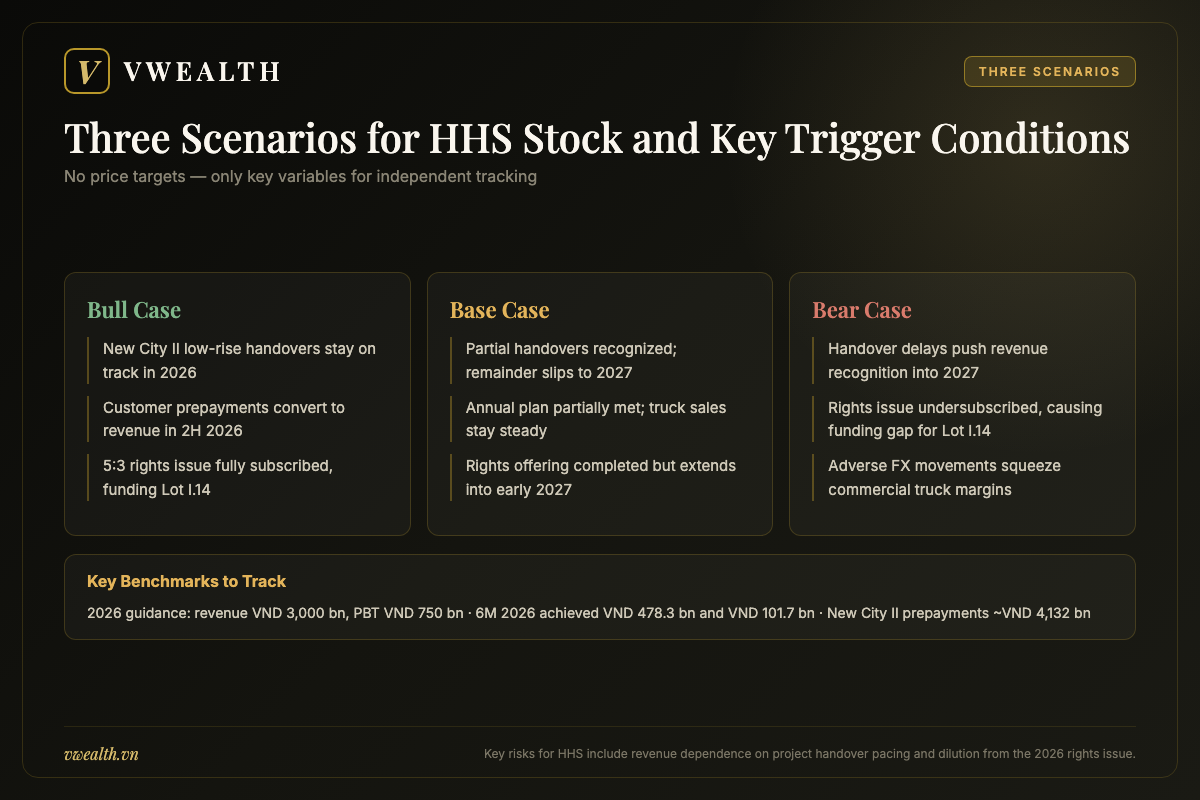
Should You Buy HHS Stock? Weighing Upsides and Downsides Across Investor Profiles
Having examined HHS across multiple analytical dimensions — an extraordinary accounting profit generated by corporate restructuring, a secondary market valuation that retreated roughly 50% from its peak, an impending rights offering set to expand share count by roughly 60% (a vwealth estimate of 259 million new shares divided by 432 million existing shares), and an ambitious 2026 guidance plan heavily reliant on back-loaded residential handovers — foreign investors arrive at the central question: should you buy HHS stock? There is no universal recommendation suitable for every investor. The answer depends fundamentally on your capital horizon, your willingness to participate in cash rights issues, and your conviction regarding the urban real estate cycle in Hai Phong. This concluding chapter synthesizes the core investment merits and drawbacks, evaluates suitability across different investor profiles, and provides an actionable operational monitoring checklist.
The Investment Merits: Prime Land Bank, Substantial Pre-Sales Buffer, and Zero Long-Term Debt
Substantial, Tangible Urban Land Bank in the Active Harvest Phase. Through its 51.03% controlling stake in CRV, HHS governs a premier property portfolio centered on the high-growth urban corridors of Hai Phong. The crown jewel is Hoang Huy New City II — representing a total planned capital commitment of VND 15,076 billion across 49.36 hectares in Thuy Nguyen — supplemented by completed legacy assets like Hoang Huy Commerce and So Dau, and the pipeline development at Lot I.14 in Bac Song Cam through Nha Dai Loc. These represent legally secured, master-planned physical assets with documented construction progress, rather than early-stage speculative land concepts.
Substantial Pre-Funded Revenue Visibility. The presence of approximately VND 4,132 billion in short-term customer advances on the balance sheet for New City II as of June 30, 2026, provides revenue visibility rarely matched among mid-cap developers on HOSE. The demand absorption has already occurred for a substantial portion of the project inventory; management does not need to identify new buyers to recognize multi-trillion-dong revenues — it simply needs to complete physical handovers.
Exceptionally Conservative Financial Debt Structure. As of December 31, 2025, HHS maintained a debt-to-equity ratio of only 0.42 times, and by June 30, 2026, long-term interest-bearing debt had been fully extinguished to zero (down from VND 390 billion). Of the VND 7,342 billion in total liabilities, over 57% consists of interest-free customer down-payments (VND 4,185 billion), and more than VND 2,156 billion represents deferred tax obligations. Neither liability requires cash debt servicing or creates bank refinancing vulnerabilities. In a capital-intensive real estate sector where excessive financial leverage frequently causes corporate distress during credit tightening cycles, HHS maintains an exceptionally unencumbered balance sheet.
Non-Real Estate Operational Cash Flow Diversification. The Dongfeng commercial truck distribution business provides an independent operational heartbeat that generates recurring commercial liquidity separate from residential property development cycles. With unit sales expanding by 14% year-over-year in 2025 and supported by an entrenched nationwide dealer network and synchronized parts inventory, the automotive division provides continuous operational baseline revenues. For institutional investors comparing automotive and infrastructure distribution models in Vietnam, our analysis of Tasco stock (HUT) offers an informative comparative benchmark.
The Investment Drawbacks: Non-Recurring 2025 Earnings Spike, Thin Cash Reserves, and Imminent Dilution
The Peak Accounting Profit Cycle Has Concluded. The consolidated net profit exceeding VND 3,500 billion recorded in 2025 was primarily the artifact of a non-recurring fair value revaluation credit of approximately VND 3,504 billion upon the statutory consolidation of CRV. This accounting entry generates zero operating cash flow, cannot be duplicated in subsequent fiscal years, and severely distorts unadjusted financial screeners. HHS’s recurring operational earning power is currently scaling from tens of billions of dong per quarter, rather than thousands of billions.
Compressed Liquid Cash Reserves Relative to Capital Commitments. Liquid cash and cash equivalents contracted by 84% during the first half of 2026, declining from over VND 791 billion at year-end 2025 to VND 124.6 billion as of June 30, 2026. Corporate capital is overwhelmingly locked within real estate inventory (~VND 18,900 billion, representing roughly 79% of total assets). Consequently, the enterprise maintains minimal liquid cushion to fund the upcoming development expenditures of Lot I.14 without successfully executing the planned rights offering or securing new bank credit.
Substantial Imminent Share Dilution from the 5:3 Rights Issue. The planned issuance of 259 million new shares to existing shareholders will expand the outstanding share count by roughly 60%. Shareholders who do not exercise their subscription rights will suffer an immediate proportional ownership dilution of approximately 37.5%. Furthermore, with the VND 10,000 exercise price sitting merely 9% below the secondary market closing price of VND 10,950 recorded on August 26, 2026, the narrow pricing spread offers minimal economic buffer against secondary market volatility.
Structural Holding Company Friction and Minority Interest Leakage. Because HHS holds 51.03% of CRV, nearly half (48.97%) of all residential profits generated by New City II legally belongs to non-controlling external shareholders (predominantly parent company TCH). External investors holding HHS stock capture only their proportional fraction of half of CRV’s earnings, while absorbing the operational holding-company overhead and corporate capital calls.
Key Structural Risks: Geographic Vulnerability in Hai Phong and Foreign Exchange Volatility
Acute Geographic Concentration in Hai Phong. Virtually the entirety of HHS’s real estate asset portfolio is geographically concentrated within Hai Phong City, predominantly in Thuy Nguyen. While Hai Phong represents one of northern Vietnam’s premier industrial and logistics powerhouses, this singular geographic concentration ties corporate earnings entirely to regional municipal policies, local infrastructure completion rates, and regional residential demand. A slowdown in local property absorption cannot be offset by diversified developments in Hanoi or southern Vietnam.
Commercial Vehicle Foreign Exchange Sensitivity. The commercial automotive division imports Dongfeng heavy commercial vehicles and components denominated in US dollars, while retail sales contracts are settled in Vietnamese dong. Rapid depreciation of the VND compresses gross margins, forcing management to absorb currency losses or risk losing market share to domestic assemblers.
Controlling Shareholder Dominance and Related-Party Governance. Parent corporation TCH controls 58.31% of HHS equity and holds significant direct stakes in CRV. Strategic capital allocation, intra-group equity transactions, and rights issuance timetables are directed at the conglomerate holding level, leaving public minority shareholders with negligible influence over board-level governance.
Who Should Consider HHS Stock, and Who Should Exercise Caution?
Potentially Suitable for Long-Term Value Investors Bullish on Hai Phong Urbanization. Investors with an investment horizon of 1 to 3 years who maintain high conviction in the industrial and economic transformation of Hai Phong, possess the cash liquidity to participate fully in the 5:3 rights issue to defend against dilution, and have benchmarked HHS against CRV and TCH to confirm that the prevailing holding-company discount offers an attractive risk-adjusted entry point. For this investor category, periods of optically depressed headline earnings comparisons may provide favorable entry windows if recurring operational cash flows are accurately recognized.
Potentially Suitable for Special Situations and Holding-Company Arbitrageurs. Institutional market participants who actively monitor holding-company NAV discounts, track the operational progress of the 259-million-share rights offering, and have the analytical discipline to re-evaluate underlying core profitability following every quarterly financial disclosure.
Investors Who Should Exercise Caution or Stand Aside:
- Income and Dividend Investors Seeking Cash Yield: HHS distributes dividends in stock and must conserve cash for capital expenditures; it does not offer recurring cash income.
- Investors Without Capital to Exercise Rights: Non-participating shareholders face a severe 37.5% structural dilution of their earnings claim.
- Momentum Traders Relying on Automated Valuation Multiples: Unadjusted trailing P/E and unadjusted P/B metrics are fundamentally distorted by non-cash revaluation entries and non-controlling interest accounting.
- Investors With Heavy Existing Property Exposure: Allocating capital to HHS introduces concentrated single-province real estate risk. Institutional investors seeking to rebalance portfolios into consumer or export cyclical sectors can evaluate our standalone research on retail leader Dien May Xanh stock (DMX) or export aquaculture producer Nam Viet stock (ANV).
The Monitoring Checklist: Q3–Q4 2026 Filings, Handover Trajectory, and Capital Subscription Rates
For institutional investors monitoring HHS stock over the forthcoming 6 to 12 months, the following seven operational checkpoints provide the essential roadmap:
1. Audited Q3 and Q4 2026 Income Statements. Monitor whether net sales revenue exhibits the projected back-loaded surge relative to the VND 478.3 billion recorded in the first half of 2026. Track the reduction in short-term customer advances (VND 4,185 billion as of June 30, 2026) — a decline directly indicates that buyer deposits have successfully converted into recognized revenue. Verify whether real estate inventory (~VND 18,900 billion) begins its expected handover drawdown.
2. Net Profit Attributable Strictly to Equity Holders of the Parent Company. Disregard consolidated headline profit. Isolate the specific accounting line recording net profit attributable to common shareholders of the parent entity, and verify that it contains zero non-operating financial revaluation items.
3. Physical Handover Milestones at Hoang Huy New City II. Track the pace of low-rise and apartment unit deliveries, official receipt of municipal fire-safety inspection sign-offs, and commercial sales absorption across the remaining 520 units.
4. Subscription Execution of the 259-Million-Share Rights Issue. Review the official ex-rights date, public shareholder subscription uptake, the distribution mechanism for any unsubscribed shares, TCH’s post-offering equity ownership percentage, and the chronological sequencing relative to the planned 7% stock dividend.
5. Site Development Timetable for Lot I.14 in Bac Song Cam. Monitor groundbreaking milestones by project company Nha Dai Loc following site handover on July 23, 2026, and track any supplementary commercial debt arrangements.
6. Major Shareholder Regulatory Disclosures. Monitor subsequent filing updates from the investor group led by Mr. Dinh Quang Chien and Tra Xom Hydropower JSC to identify whether external institutional capital is accumulating or distributing shares.
7. Live Valuation Spread Between CRV, HHS, and TCH. Calculate the market capitalization of all three entities on the identical trading day to evaluate whether the holding-company discount is expanding or compressing.
| Analytical Dimension | Investment Merits (Upside Drivers) | Investment Demerits (Downside Risks) | Empirical Baseline Data Points |
|---|---|---|---|
| Operating Earnings Quality | Core operational sales expanding: H1 2026 net revenue +67% YoY | 2025 earnings driven by non-recurring one-off revaluation gain | VND 3,504B financial gain in Q2 2025; H1 2026 net profit VND 82B |
| Revenue Backlog Visibility | Substantial contracted pre-sales awaiting physical delivery | Entirely dependent upon construction and municipal handover velocity | ~VND 4,132B in customer advances at New City II (June 30, 2026) |
| Balance Sheet Structure | Zero long-term bank debt; debt/equity of 0.42x at year-end 2025 | Liquid cash reserves severely compressed; high inventory concentration | Cash VND 124.6B; real estate inventory ~VND 18,900B (June 30, 2026) |
| Capital & Dividend Policy | Mobilizes equity funding for major Lot I.14 project | 37.5% dilution for non-subscribers; zero cash dividend distributed | 259M share rights issue at 5:3, VND 10,000; 7% stock dividend |
| Corporate Holding Structure | Supported by apex industrial conglomerate TCH | Intermediate tier owning 51.03% of CRV; holding-company discount | TCH holds 58.31% of HHS; TCH directly holds 38.09% of CRV |
| Geographic Exposure | Deep operational relationships and brand recognition in Hai Phong | High vulnerability to a single regional municipal property market | New City II spans 49.36 ha; 520 units uncommitted at April 2026 |
| Commercial Truck Division | Independent cash flow stream; 2025 unit sales expanded 14% YoY | Low gross margin profile; acute sensitivity to USD/VND currency swings | Consolidated Q2 2026 gross profit margin stood at 12.4% |
Ultimately, the decision to invest in HHS stock reduces to three fundamental questions. First: do you believe that Hoang Huy New City II will execute residential handovers with sufficient velocity to convert over VND 4.1 trillion in customer advances into robust recurring operational revenues throughout 2026 and 2027? Second: do you possess the capital liquidity and conviction to contribute fresh cash at a 5:3 ratio to defend against a 37.5% share dilution, trusting that the mobilized VND 2.59 trillion will generate attractive long-term returns at Lot I.14? Third: across the corporate hierarchy of TCH, HHS, and CRV, does HHS offer the optimal risk-reward entry point at prevailing market valuations? If your analytical answers lean affirmatively, HHS warrants thorough institutional diligence; if major uncertainties remain, awaiting subsequent quarterly disclosures is the prudent course of action.
To evaluate these dynamics with precision, foreign investors require continuous access to normalized financial models — stripping non-recurring revaluations, tracking customer advance burn rates, and benchmarking holding-company discounts in real time. We invite you to create your free vwealth account to monitor updated valuation metrics and institutional research reports across the Vietnamese market. This analysis is provided for educational and institutional research purposes, and does not constitute a direct solicitation or recommendation to buy or sell any security.
Research Vietnamese stocks in English with vwealth. Our AI-powered platform turns Vietnamese market data into full English analysis reports — with international payment support and a free 2-month trial for new accounts. Create your free account and read the latest reports.