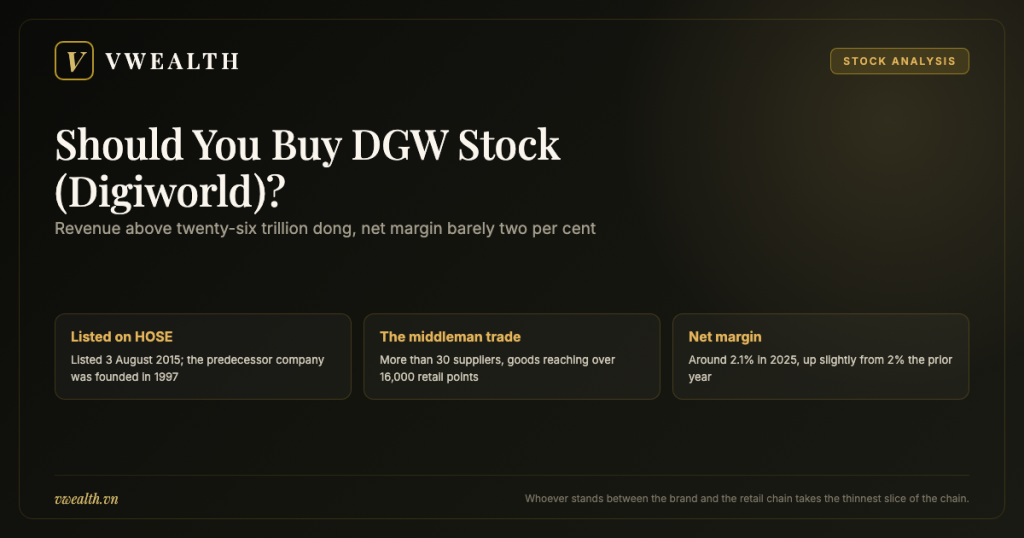
Should you buy DGW stock — the HOSE-listed shares of Digiworld Corporation — is a question most people get wrong before they even start, because they assume this is a phone retailer. It is not. Digiworld sells almost nothing directly to you. It sits one link earlier in the chain: it takes products from global brands, does everything required to make those products reach Vietnamese consumers, and hands them to the retail chains you know by name. That is a completely different business, with completely different margins, completely different risks, and a completely different way of reading the accounts. This article traces the company from a small firm called Hoang Phuong in 1997, through the 2017 Xiaomi deal that transformed it, to the 2026 plan to restructure into a holding company, and ends with a straight answer about which kind of investor this stock suits and which kind it does not.
Before we start, one convention between you and this article, the same one that governs every company analysis in this series. You will meet many dates, brand names, transaction details and scale figures. All of them come from public disclosure: exchange filings, shareholder meeting resolutions, the company’s own statements, and mainstream financial media. What you will not find is a figure for the most recent quarter or a valuation multiple as of today. For a distributor, revenue and margin swing with seasonality and with the product launch calendars of the brands it carries — meaning a single quarter tells you almost nothing. Instead this article teaches you where to look and how to read it; for current numbers, open the latest research reports on vwealth.
The second convention: this is not a buy or sell recommendation. The final chapter states plainly who this stock suits, but the decision remains yours.
From a workshop called Hoang Phuong to Digiworld: thirty years in the middle
Here is something about Digiworld that surprises most investors: the company is older than most of the technology brands it distributes in Vietnam. Before Xiaomi existed, before Apple sold an iPhone, the predecessor of Digiworld was already bringing technology products into the Vietnamese market.
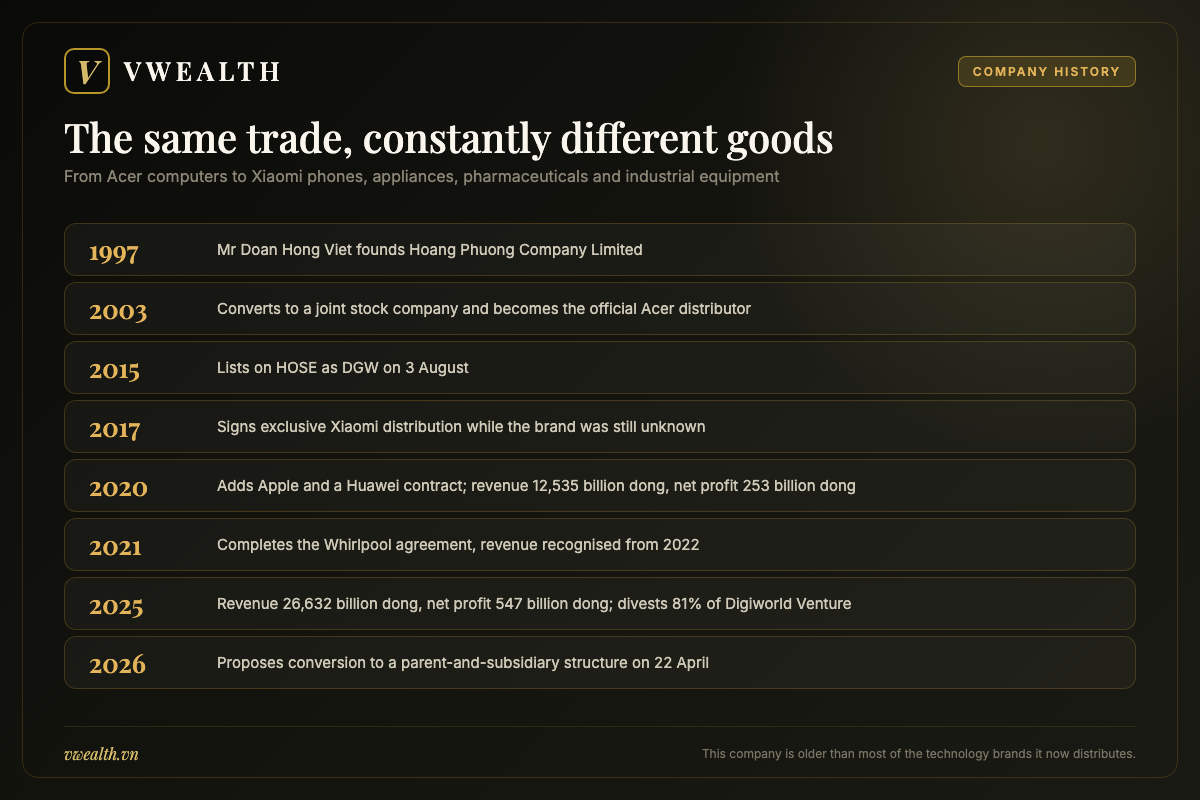
1997: a limited liability company named Hoang Phuong
In 1997 Mr Doan Hong Viet founded Hoang Phuong Company Limited — the predecessor of today’s Digiworld Corporation.
Put that date in context. In 1997 Vietnam had been connected to the internet for only a few months. A personal computer was a luxury item. Very few Vietnamese companies could handle importation, customs, warranty service and structured distribution of technology equipment. Whoever could do that owned a hard-to-replace function, simply because foreign brands cannot build an operating machine in a market they do not yet understand.
That is the origin of the entire business model you will read about in chapter three. Digiworld does not sell its own products. It sells the capability to bring someone else’s products into a market that someone else cannot enter alone.
2003: incorporation and the Acer distribution contract
In 2003 the company converted into a joint stock company and, at the same time, became the official distributor for Acer in Vietnam. Mr Doan Hong Viet has served as chairman of the board from that point onward.
The Acer contract was the pivotal one, because it proved something to every other brand: this Vietnamese company can do what an international corporation needs done. In distribution, credibility compounds in a very concrete way — brand A being satisfied makes brand B easier to sign, and each new contract makes the machine more efficient because the same warehouse, the same sales force and the same service network can carry more product lines.
The period from 2003 to roughly 2015 was an accumulation phase. The company signed a series of major computing brands, built warehouses, built its network of retail points, and built its warranty operation. No dramatic leap, but the foundation thickened year after year.
3 August 2015: listing on HOSE as DGW
On 3 August 2015 DGW shares began trading on the Ho Chi Minh City Stock Exchange.
Listing gives a distributor three things, and all three matter more than people assume. First, a funding channel — and distribution is working-capital hungry, because you pay the brand before you collect from the retail chain. Second, a higher disclosure standard, which reassures international brands evaluating a partner. Third, a continuous market valuation, which becomes the basis for later mergers and acquisitions.
The third point matters most, because as you will see, Digiworld’s strategy over the following decade has been tightly bound to acquiring new pieces.
2017: the Xiaomi deal that changed the company
This is the largest single turning point in Digiworld’s history, and it deserves telling properly.
In 2017 Digiworld signed an exclusive distribution agreement for Xiaomi in Vietnam. At the time Xiaomi was not a big name — not in Vietnam, and not yet genuinely large globally. Taking on distribution for a brand nobody knew carried real risk: you buy the inventory, you fund the marketing, and you spend effort convincing retail chains to give shelf space to an unfamiliar name.
The market knows the outcome. Xiaomi became one of the best-selling phone brands in Vietnam, and Digiworld went from being a computer distributor to a serious player in mobile phones — a category with far larger revenue scale.
Draw the right lesson from this, and the right lesson is not that Digiworld is good at picking brands. It is that in distribution, the biggest reward comes from betting early on a brand that has not yet arrived, and that reward carries symmetric risk. Had Xiaomi failed, the investment would have been written off. Digiworld was very right once. That does not guarantee the next bet, and when you hear the company announce a new partnership with an unfamiliar brand, remember both sides of the wager.
2020 to 2021: Apple, Huawei, Whirlpool and three steep years
In 2020 Digiworld added Apple distribution rights and a market expansion services contract with Huawei. Combined with Xiaomi momentum, and combined with a pandemic that pushed demand for remote work and remote learning devices sharply higher, the 2020 result was strong: revenue reached 12,535 billion dong, up 48%, and net profit reached 253 billion dong, up 56%.
At the end of 2021 the company completed an agreement with Whirlpool, a leading global home appliance manufacturer, with revenue from the partnership recognised from 2022 onward.
Those three years were the fastest growth in company history. But read them with clear eyes: a meaningful share of that growth came from circumstance — an equipment demand boom during the pandemic — rather than purely from internal capability. And what booms on circumstance usually has a payback period afterwards, when demand has been pulled forward and buyers do not need new devices for several years.
2022 to 2025: hunting for pieces outside technology
In the years that followed, Digiworld’s strategy shifted visibly toward horizontal expansion into non-technology categories.
The company added home appliance brands such as Whirlpool, beverage names such as Lotte Chilsung and AB InBev, and office equipment brands including Microsoft, Logitech and Philips. It also entered pharmaceuticals and health supplements, and completed a merger with Achison to open the door to industrial equipment distribution.
The logic behind that sequence is clear and deserves credit. Phones and computers share three uncomfortable traits: large scale but very thin margins, dependence on the launch cycles of a handful of brands, and gradual saturation as Vietnamese households acquire enough devices. The newer categories are smaller in scale but carry thicker margins and depend less on the technology cycle.
In 2025 the company also moved in the opposite direction: it divested 81% of its stake in Digiworld Venture, indirectly exiting its investment in Vietmoney. That is a notable signal on capital allocation discipline — knowing when to exit an underperforming piece matters as much as knowing when to buy a new one.
2026: converting to a parent-and-subsidiary structure
At the annual general meeting held on 22 April 2026, the company put forward a comprehensive restructuring plan converting to a parent-and-subsidiary model. Under the plan, the parent focuses on capital management, strategic direction, governance and oversight, while specific assets and operations move into subsidiaries for specialisation.
At the same meeting the company set 2026 targets of consolidated revenue above 31,500 billion dong, roughly 18% growth, and net profit of 660 billion dong, roughly 20% growth. The new board term expands from five to six members with a minimum of two independent directors, and Ms Pham Vu Thanh Giang was elected as an additional independent director.
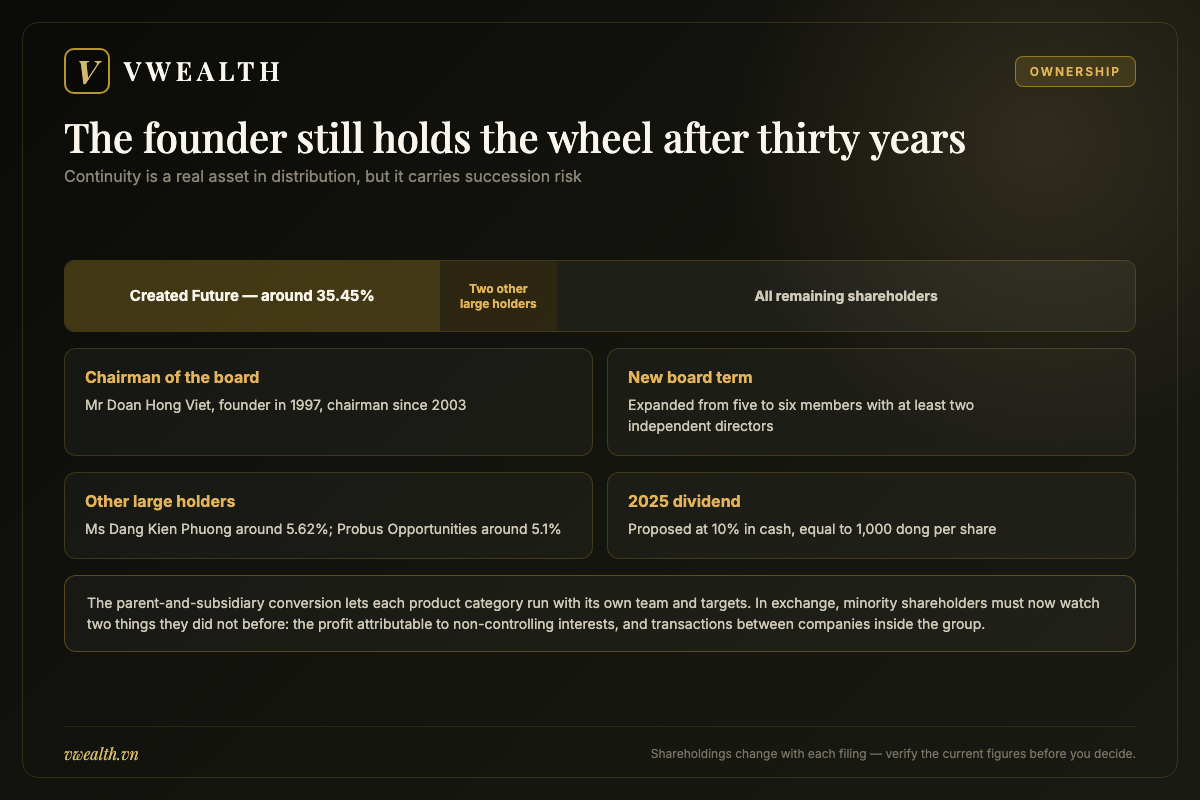
A holding structure is a natural step for a business carrying this many different product categories inside one legal entity. It lets each segment have its own team, its own targets, and in theory its own funding or a strategic partner at the subsidiary level. But it also makes the consolidated accounts more complex, and minority investors need to pay closer attention to non-controlling interests and to intra-group transactions.
A summary of the key milestones
| Date | Event | What it means for an investor today |
|---|---|---|
| 1997 | Mr Doan Hong Viet founds Hoang Phuong Company Limited | The core trade has always been bringing foreign technology into Vietnam |
| 2003 | Converts to a joint stock company; becomes official Acer distributor | The pivotal contract that opened the door to other international brands |
| 3 Aug 2015 | Lists on HOSE as DGW | A working capital funding channel and a basis for later acquisitions |
| 2017 | Signs exclusive Xiaomi distribution while the brand was still unknown | The largest turning point; opened the far larger phone category |
| 2020 | Adds Apple and a Huawei services contract; revenue 12,535 billion dong, net profit 253 billion dong | The steepest growth years, partly driven by pandemic demand |
| End 2021 | Completes the Whirlpool agreement, revenue recognised from 2022 | The first genuine step outside technology |
| 2022 to 2025 | Adds beverages, office equipment and pharmaceuticals; merges with Achison in industrial equipment | A deliberate strategy to reduce dependence on the device cycle |
| 2025 | Divests 81% of Digiworld Venture, exiting the Vietmoney investment indirectly | Evidence of capital allocation discipline, not only acquisition appetite |
| 22 Apr 2026 | Proposes conversion to a parent-and-subsidiary structure; targets revenue above 31,500 billion dong | Fits a multi-category portfolio, but makes the accounts more complex |
Read the table vertically and you see a business with a strikingly consistent strategy across nearly thirty years: always the same trade, constantly different goods. The trade is bringing other people’s products into the Vietnamese market. The goods went from computers to phones, then to appliances, beverages, pharmaceuticals and industrial equipment. That distinction is the single most important thing to hold on to when evaluating this company.
Who runs DGW and who actually owns it
For a distributor, the question of who is at the wheel matters more than in most industries, because the company’s core asset does not sit on the balance sheet. It sits in relationships with brands. A distribution contract is a relationship between people, built over years and losable in a quarter. The person at the top determines much of its quality.
Mr Doan Hong Viet and a rare kind of continuity
Mr Doan Hong Viet founded the business in 1997 and has served as chairman of the board of Digiworld Corporation since 2003. At the 2026 annual general meeting he was again the voice setting out the company’s strategic direction.
Nearly thirty years under one leader is rare on the Vietnamese exchange, and it cuts two ways.
The favourable side is clear. That continuity is a real asset in distribution. International brands evaluate partners partly on relationship length, and a company whose decision-maker has not changed in three decades finds long-term contracts easier to sign. A founder still holding the wheel also tends to think in longer horizons than a hired management team measured on annual targets.
The unfavourable side is equally clear and routinely ignored. Heavy dependence on one individual is succession risk. When most brand relationships run through one person, the question of whether the machine runs itself is a real one, and no financial statement answers it for you. The indirect check is to observe who negotiates and signs the newer contracts, and how much authority sits with the next management layer.
One governance signal worth recording as positive: the 2026 to 2031 board term expands from five to six members with a minimum of two independent directors, and Ms Pham Vu Thanh Giang was elected with a background in finance and corporate governance. Increasing independent representation is the right direction at a company with such a strong individual imprint. For context on what governance standards in Vietnam actually look like, see our guide to corporate governance in Vietnam.
Ownership: a controlling group and everyone else
According to disclosure, Digiworld’s three major shareholders are Created Future Company Limited with roughly 35.45% of charter capital, Ms Dang Kien Phuong with roughly 5.62%, and Probus Opportunities with roughly 5.1%. The remainder is spread among smaller holders.
Read that register in three layers.
The first layer is the group associated with the founder, held through the entity with the largest stake. A holding above one third gives real control over direction but falls short of the level needed to pass resolutions requiring a higher threshold. In other words, the founding group has substantial practical power but still needs support from other shareholders on the most significant decisions.
The second layer is the institutional shareholders, including a foreign institution. The presence of a foreign institutional holder usually comes with higher expectations on transparency and governance, which benefits minority holders.
The third layer is the free float, which determines the stock’s day-to-day liquidity.
A methodological note: shareholdings change with each filing, and with foreign funds on the register they can change fairly often. Always verify the current figure rather than trusting a number you read somewhere months ago.
Dividends: a notable difference from pure growth names
Under the plan put to the 2026 meeting, the board proposed a 2025 cash dividend at a ratio of 10%, equal to 1,000 dong per share, to be paid during 2026. The company also plans an employee share ownership issue of 2.2 million shares at 10,000 dong per share.
Those two items say different things, and you should keep them apart.
Maintaining a cash dividend shows the business generates real cash and that management chooses to share some of it rather than retain everything. For a model that consumes substantial working capital, still paying cash is a good signal about earnings quality. That said, 1,000 dong per share is modest by income-investor standards; this is not a dividend stock in the sense described in our guide to Vietnamese dividend stocks.
Employee share issuance always has two faces. The favourable one is retaining key people — critically important at a company whose assets are relationships and individuals. The unfavourable one is dilution: each issue increases the share count, and where the issue price sits below the market price, the difference is effectively a cost borne by existing shareholders. At 2.2 million shares the dilution in this particular round is small relative to shares outstanding, but the principle compounds across years and should be tracked.
The holding structure: what minority shareholders should watch
The conversion to a parent-and-subsidiary model is the largest structural change the company has put to shareholders in years, so it deserves analysis from a minority perspective.
Three points in favour. One, giving each category its own team and targets clarifies accountability, and lets group management see which segments genuinely earn their capital. Two, the structure permits raising capital at the segment level, or selling a stake in a subsidiary to a strategic partner without diluting at group level. Three, it suits a portfolio that has become too diverse to manage inside a single legal entity.
Three points to watch. One, consolidated reporting becomes more complex, and the share of profit attributable to non-controlling interests can grow over time — meaning consolidated profit rises while the portion belonging to you rises more slowly. Two, intra-group transactions need monitoring through the related-party note. Three, group-level administrative cost can swell during the early phase of restructuring.
None of those three is inherently a bad sign. They are simply places you now have to look that you did not have to look before.
Ownership and leadership at a glance
| Item | Disclosed position | What an investor should take from it |
|---|---|---|
| Chairman | Mr Doan Hong Viet, founder in 1997, chairman since 2003 | Continuity is a real asset, but carries succession risk |
| Largest shareholder | Created Future Company Limited, roughly 35.45% of charter capital | Controls direction, but not enough for supermajority resolutions alone |
| Individual major shareholder | Ms Dang Kien Phuong, roughly 5.62% | Holdings change with each filing |
| Foreign institutional holder | Probus Opportunities, roughly 5.1% | Usually associated with higher transparency expectations |
| New board term | Expanded from five to six members with at least two independent directors | The right direction at a founder-dominated company |
| New independent director | Ms Pham Vu Thanh Giang, finance and corporate governance background | Strengthens independent oversight on the board |
| 2025 dividend | Proposed 10% in cash, equal to 1,000 dong per share | Real cash, but a modest yield for income investors |
| Employee share issue | 2.2 million shares at 10,000 dong per share | Retention benefit in exchange for small dilution |
| Group structure | Parent-and-subsidiary conversion proposed at the 22 April 2026 meeting | Watch non-controlling interests and related-party transactions |
How DGW makes money: the anatomy of market expansion services
This is the most important chapter in the article, because if you misunderstand the business model, every number that follows will be misread.
Market expansion services: five jobs a foreign brand cannot do alone
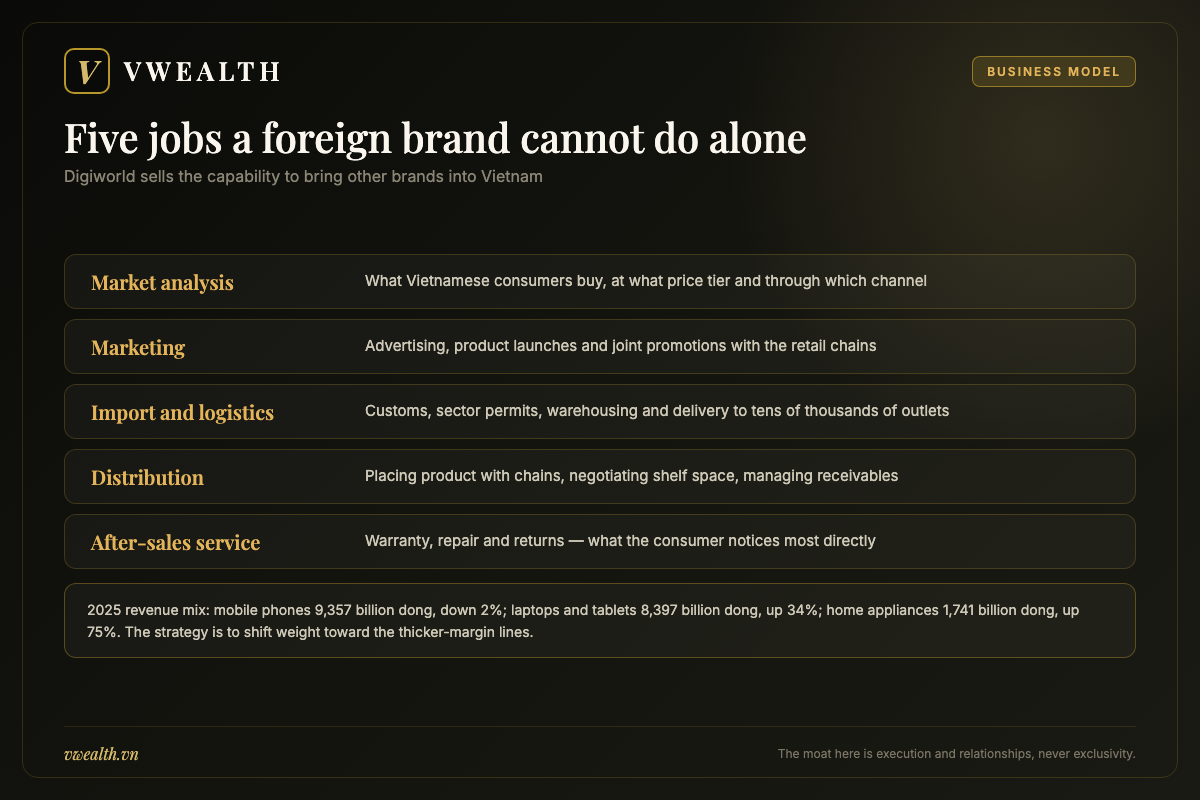
Digiworld calls its model market expansion services, abbreviated MES. That sounds abstract, but the substance is concrete: it is five groups of tasks a foreign brand must complete to sell in Vietnam, and almost no brand can complete all five alone when it first arrives.
The first is market analysis. What Vietnamese consumers buy, at what price tier, through which channel, and how competitors are positioned. A Chinese or Korean brand arriving fresh has none of that data.
The second is marketing execution. Advertising, product launches, working with local influencers, running promotions jointly with retail chains. This is the most cash-intensive and most locally specific part.
The third is import, warehousing and logistics. Customs procedures, sector-specific permits, warehouse space, and delivery to tens of thousands of retail points across the country. It sounds mundane, but this is a genuine barrier to entry, because it requires capital and years of accumulation.
The fourth is distribution. Placing product with retail chains, negotiating shelf space, managing receivables with each chain.
The fifth is after-sales service. Warranty, repair, returns. This is what consumers feel most directly and what many brands least want to handle themselves.
Put the five together and you see why the trade has value: the brand only needs to be good at making the product, and outsources the entire task of reaching Vietnamese consumers to a partner with an existing machine. Digiworld reports working with more than 30 suppliers and delivering to more than 16,000 retail points nationwide, through chains you would recognise such as Mobile World, FPT Shop and CellphoneS.
The product portfolio: from phones to motor oil
Digiworld runs several product groups in parallel, and each differs sharply in both scale and margin.
Mobile phones is the largest revenue line. In 2025 the segment produced 9,357 billion dong, down roughly 2% year on year. Large scale, thinnest margin, and driven by the launch cycles of a handful of brands.
Laptops and tablets ranks second at 8,397 billion dong in 2025, up roughly 34%. That growth rate is notable, and the driver the company cites is the wave of devices with integrated artificial intelligence — a new replacement cycle following the post-pandemic saturation.
Home appliances reached 1,741 billion dong in 2025, up roughly 75%, with brands including Xiaomi, Philips and Cuckoo. Small in scale but the fastest-growing line in the portfolio.
Beyond those three, the company operates office equipment with brands such as Microsoft and Logitech, consumer goods and beverages with Lotte Chilsung and AB InBev, pharmaceuticals and health supplements, and industrial equipment following the Achison merger.
At the 2026 meeting management also made a notable strategic statement: it is not yet the right time to distribute electric vehicles, and instead the company is entering the motor oil category. That is an excellent illustration of distributor thinking — categories are chosen on turnover, margin and fit with the existing machine, not on the glamour of the story.
What a distribution contract actually contains
Because the contract is the company’s real asset, it is worth understanding what one typically covers — and what it does not.
A distribution agreement usually sets out four things. The territory and the channel: which country, and whether the distributor may serve modern trade, traditional trade, e-commerce, or all of them. The product scope: which model lines are covered, which are excluded, and whether new launches are automatically included. The commercial terms: transfer pricing, payment terms, volume commitments, rebate structures tied to hitting targets, and who funds marketing. And the term itself: usually one to three years, with renewal conditions.
Three things such contracts almost never contain, and their absence is the structural risk of the whole trade.
They rarely contain permanent exclusivity. Exclusivity, where granted, is typically time-limited and conditional on performance. A brand that grows large in a market almost always wants a second source of distribution eventually, both to hedge and to create price tension.
They rarely contain protection against the brand going direct. If the brand decides to open its own subsidiary and take distribution in-house, the contract governs the wind-down but does not prevent the decision.
And they rarely give the distributor any claim on the brand equity it helped build. Every dong of marketing spend that made a brand familiar to Vietnamese consumers increases the brand’s value, not the distributor’s, which is why success can paradoxically increase the risk of being replaced.
This is not a reason to avoid distributors. It is a reason to size positions with the understanding that the earnings stream rests on renewable agreements rather than owned assets, and to treat any single contract as a variable rather than a constant.
Why the margins in this trade are so thin
Understand this before you look at any DGW number.
In 2025 the company reported revenue of 26,632 billion dong and net profit of 547 billion dong. That is a net margin of roughly 2.1%, up slightly from 2% the prior year.
Two per cent sounds very low, and it is — but that is the nature of the trade rather than a sign of weakness. A distributor sits between a brand and a retail chain, and both sides hold bargaining power. The brand controls supply and can add another distributor at any time. The retail chain controls shelf space and the direct consumer relationship. Whoever stands in the middle takes what is left, and what is left is thin by construction.
The implication for how you read the accounts is significant: at a two per cent margin, a small change in costs or in selling prices produces a very large change in profit. If gross margin slips half a percentage point while costs hold, profit can fall by a quarter. That is why distributor stocks are volatile even when revenue is comparatively steady.
Operating leverage also runs the other way. If the company holds costs while revenue grows, profit grows much faster than revenue. 2025 illustrates it: revenue rose roughly 21% while net profit rose roughly 23%, helped by selling expenses falling from 5.8% to 5.1% of revenue and administrative expenses falling from 1.1% to 0.8%.
The unit economics of adding one more brand
To see why a distributor behaves the way it does, work through what happens when it signs one additional brand.
The incremental revenue is whatever that brand sells in Vietnam. The incremental gross profit is that revenue multiplied by the negotiated spread, which for hardware is low single digits and for thicker categories somewhat more. So far, unremarkable.
The interesting part is the incremental cost. Much of the machine is already paid for. The warehouse exists. The delivery network exists. The relationships with retail chains exist. The finance, customs and compliance functions exist. What the new brand genuinely adds is inventory funding, some incremental warehouse space, a product team, and marketing spend — much of which the brand itself co-funds under the contract.
That asymmetry is the whole logic of the business. Because a large share of costs is already sunk into shared infrastructure, each additional brand contributes disproportionately to operating profit, provided it reaches reasonable volume. It is why a distributor’s profit can grow considerably faster than its revenue in a good stretch, and it is why management is structurally motivated to keep adding categories.
The same asymmetry runs in reverse and explains the risk. When a large brand leaves, the revenue disappears immediately but the shared infrastructure cost does not. The warehouse still costs what it cost. The staff are still employed. That is why losing a major contract hits profit harder than the revenue share alone would suggest, and why distributors respond to such losses by aggressively pursuing replacements even on unattractive terms.
Keep this asymmetry in mind when you assess any announcement. A new contract is worth more than its revenue implies. A lost contract costs more than its revenue implies. Neither shows up correctly if you look only at the top line.
Why Digiworld moved into pharmaceuticals and fast-moving consumer goods
Among Digiworld’s categories, the two that most surprise investors who think of it as a technology company are pharmaceuticals with health supplements, and fast-moving consumer goods including beverages.
The logic is tight when viewed from the machine’s perspective. Both categories require exactly the five jobs Digiworld already performs: market analysis, marketing, import and logistics, distribution to points of sale, and after-sales support. The difference lies in the type of outlet and the storage requirements, not in the nature of the work.
The financial attraction is obvious. Pharmaceuticals and supplements carry considerably thicker margins than technology hardware, because the value sits in the formulation and the brand rather than in components. Fast-moving consumer goods bring high repeat purchase frequency, meaning far steadier revenue than a phone somebody replaces once every three years.
But these are also the two hardest categories in the portfolio, and you should know why before expecting too much.
In pharmaceuticals the barrier is regulation. Marketing authorisation, storage condition compliance, and rules on advertising health-related products are all strict and all time-consuming. The distribution channel is also different: pharmacies and hospitals operate on their own logic, nothing like an electronics chain.
In beverages and fast-moving goods the barrier is network reach. The category demands coverage across hundreds of thousands of traditional retail outlets, high delivery frequency, and a very large field sales force. Incumbents have built that over decades. A newcomer must either build it from scratch or accept coverage limited to modern trade.
The right way to score both is with patience. Do not expect them to reshape the revenue mix within two years. Watch instead whether the company sustains its commitment across several years or quietly withdraws, because in distribution, exiting a category is as ordinary as entering one.
Seasonality: why quarter-on-quarter comparisons mislead
One practical point that trips up investors new to this sector: Digiworld’s results are strongly seasonal, and the seasonality has two separate drivers.
The first driver is the brand launch calendar. Global technology brands announce flagship devices at fixed points in the year, and a distributor’s revenue spikes in the quarters that contain those launches and the subsequent sell-in to retail. A quarter without a major launch will look weak for reasons that have nothing to do with the business.
The second driver is the Vietnamese consumption calendar. The lead-up to the Lunar New Year is the strongest consumer spending period of the year, and its timing moves between the fourth quarter and the first quarter depending on the lunar calendar. That shift alone can make two consecutive years look very different when compared quarter by quarter.
The consequence is simple but often ignored: compare each quarter with the same quarter a year earlier, never with the immediately preceding quarter. And when comparing full years, check whether the Lunar New Year fell inside or outside the reporting period in each of them.
A second-order effect worth noting: because the distributor must build inventory ahead of the peak, both inventory and short-term debt typically peak in the quarter before revenue does. Seeing inventory rise sharply at that point is normal. Seeing it rise sharply after the peak has passed is not.
Where the moat is and where it is thin
The right question about a distributor is: if a brand wanted to drop Digiworld and either go direct or switch partners, how hard would that be?
Three genuine sources of advantage exist.
The first is logistics infrastructure and retail reach. Building warehouses, a sales force, and relationships with tens of thousands of outlets takes years and money. A brand entering the market has no cheaper option than renting an existing machine.
The second is scale economics inside the machine. The same warehouse, the same delivery fleet and the same service centre can carry many categories. Each new contract lowers average cost, which is precisely why the company keeps adding categories.
The third is track record with brands. In this trade, having succeeded with Xiaomi, Apple and Whirlpool is the strongest reference letter available when negotiating with the next brand.
But the moat is thin in one crucial place and you must face it: distribution contracts are rarely permanently exclusive. A brand can add a second distributor to create competition and compress margin. This has happened in practice to Digiworld itself: the market reacted sharply when news emerged that Xiaomi was adding a distributor in Vietnam. That is a structural risk of the trade, not a company-specific flaw, and it never goes away.
The honest conclusion: Digiworld’s moat is an execution moat and a relationship moat, not an exclusivity moat. The company holds its position by performing consistently, not through any legal or technological barrier.
How DGW differs from PET and from the retail chains
This is where investors most often get confused, so it needs a table.
| Type of business | Position in the chain | Margin | Principal risk |
|---|---|---|---|
| Distributor such as Digiworld | Between the manufacturer and the retail chain | Very thin, a low single-digit percentage of revenue | Losing a distribution contract; the brand adding a rival partner |
| Retail chains such as Mobile World or FPT Shop | Direct contact with the consumer | Thicker than a distributor but carries heavy store and staff costs | High fixed costs; weak demand turns to losses immediately |
| Manufacturers | Head of the chain, owning brand and technology | Thickest, but requires very large research spending | Product obsolescence; global competition |
| State-linked multi-sector distributors | Mid-chain, usually with additional service lines | Thin, blended with adjacent businesses on different margins | Mixed revenue structure that is hard to value cleanly |
Among listed Vietnamese distributors, DGW’s closest comparable is PET. Both distribute technology hardware but differ in origin, in adjacent categories and in shareholder structure. Read the separate analysis of PET, Petrosetco alongside this one, because comparing two firms in the same trade is the fastest way to see each one’s specific strengths and weaknesses.
Further down the chain, two names worth placing alongside are MWG, Mobile World and FRT, FPT Retail. What makes them interesting is that they are simultaneously Digiworld’s customers and counterparties with bargaining power over it. When you read the retail chains’ results, you are indirectly reading the health of DGW’s demand.
Position and financial health: seven things to check before you buy DGW stock
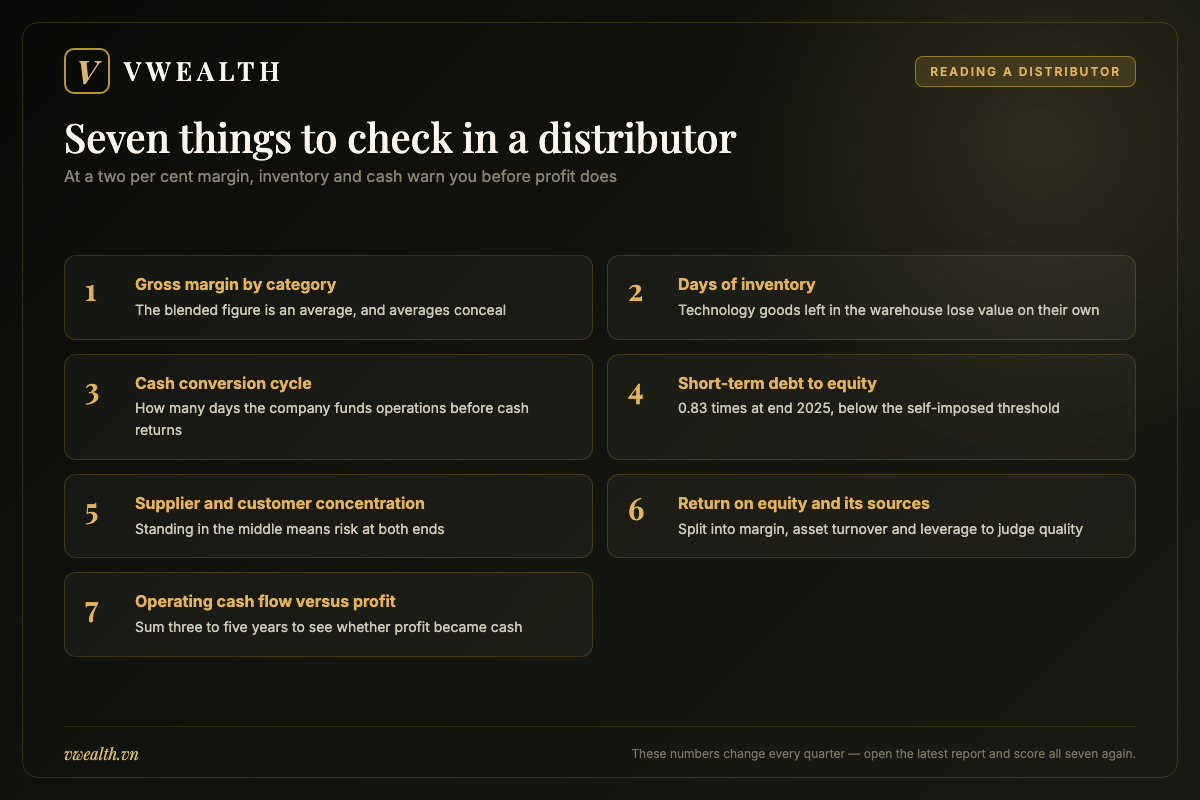
This chapter is the teaching section. The seven checks below form a framework for reading any distributor, with notes on what each one requires specifically for DGW.
Check 1: gross margin by category, not the blended figure
The blended gross margin of a multi-category business is an average, and averages conceal.
How to read it properly: split gross margin by category where the company discloses it, or at minimum track the revenue weight of each category. If weight shifts from thin-margin to thick-margin lines, the blended margin improves even if no individual line changes. Conversely, a quarter in which phones take an unusually high share will drag the blended figure down while telling you nothing bad.
For DGW this is the centre of the investment case. The entire expansion into appliances, beverages, pharmaceuticals and industrial equipment is an effort to shift the mix toward thicker margins. The way to score that strategy is to track the revenue share coming from outside phones and computers across several years. If that share rises steadily, the strategy is working. If it flatlines, the company remains a pure technology hardware distributor whatever it says.
Check 2: inventory turnover
For a distributor, inventory is the largest asset and also the largest risk.
Why risky? Because technology goods lose value quickly. A batch of phones sitting too long must be discounted to clear, and the discount comes straight out of an already thin margin. In this business, inventory does not merely tie up capital — it evaporates in value.
How to read it properly: compute average days of inventory and compare across periods and against peers in the same trade. A sudden jump in days is the earliest warning signal available, and it typically appears one or two quarters before profit falls.
Check 3: the cash conversion cycle
This is the metric retail investors rarely compute, and for a distributor it is close to existential.
The cash conversion cycle equals days of inventory plus days of receivables minus days of payables. It answers a very practical question: for how many days must the company fund its own operations before the cash comes back?
For a distributor the number is usually positive and fairly large, because you pay the brand first and collect from the retail chain later. That is exactly why the model consumes working capital, and why the company carries short-term borrowings.
How to read it properly: track the trend across periods. A shortening cycle means better negotiation at both ends, and every day shortened is real cash saved. A lengthening cycle alongside rising revenue signals that the company is buying growth by loosening terms for customers.
Check 4: short-term debt and the debt-to-equity ratio
Because the model is working-capital hungry, a distributor always carries meaningful short-term debt. That is normal. The question is magnitude.
According to figures disclosed for 2025, Digiworld’s debt-to-equity ratio stood at 0.83 times, below the one-times threshold the company set for itself. Setting a discipline threshold and publishing it is a governance positive, because it gives shareholders a yardstick for oversight.
How to read it properly: look at debt to equity together with interest expense relative to operating profit. At a two per cent margin, interest expense is large enough to flip a year’s result in a rising rate environment. This is why distributor stocks are more rate-sensitive than most people assume.
Check 5: supplier and customer concentration
This is the most characteristic risk of standing in the middle, and it exists at both ends.
On the supplier end: if a handful of brands account for most revenue, losing one or having terms tightened creates a large hole. On the customer end: if a handful of retail chains account for most revenue, bargaining power tilts heavily toward them, and receivables concentrate in a few counterparties.
How to read it properly: open the trade receivables note and check whether any counterparty carries a large share, and read the revenue-by-product note to estimate supplier concentration. Companies rarely disclose brand-level detail, so you must infer from the category mix.
Check 6: return on equity and how it is generated
For a distributor, return on equity viewed alone is misleading, because it can be high through leverage rather than efficiency.
Read it properly by decomposing into three parts: net margin multiplied by asset turnover multiplied by the leverage factor. In this trade the first term is always small and the second must be large — that is the essence of a fast-turnover, thin-margin model. If return on equity is high mainly through the third term, its quality is materially lower.
Quick check: if asset turnover is falling while return on equity holds, the company is almost certainly compensating with borrowings. That works for a few years but not through a full cycle.
Check 7: operating cash flow versus reported profit
For a working-capital heavy business, this is the most honest number in the entire report.
Profit can rise while cash flow is negative, if the increase sits entirely in inventory and receivables. That is not fraud, but it means growth is being funded with capital rather than converted into cash.
How to read it properly: sum operating cash flow across three to five consecutive years and compare with total net profit over the same span. If the two are close, earnings quality is good. If cumulative cash flow is materially lower, the company is continuously feeding capital into the working cycle, and you must ask why. Our guide to reading Vietnamese financial statements covers where these items sit under local accounting standards.
How the seven checks fit together
The seven checks are not a list to tick off independently. They form a chain, and reading them as a chain is what separates useful analysis from a spreadsheet exercise.
Start at the mix, because the mix drives gross margin. Gross margin, combined with the cost ratios, drives operating profit. Operating profit minus interest, which depends on how much working capital the model consumes, drives net profit. And how much working capital the model consumes is exactly what the inventory and cash conversion figures measure. So the chain runs: mix to margin, margin to profit, profit to cash, and cash back to how much debt is needed to fund the next cycle.
Reading it as a chain tells you which combinations are healthy and which are warnings. Rising revenue with a stable cash conversion cycle and falling cost ratios is genuinely healthy growth. Rising revenue with a lengthening cycle and rising debt is growth being purchased. Flat revenue with an improving mix and a shortening cycle is quietly excellent, even though the headline looks dull.
The most dangerous combination to recognise early is rising profit alongside deteriorating working capital. It looks like success in the news headline and it is the standard early pattern of a distributor pushing inventory into the channel faster than the channel can sell it. When you see it, the question to ask is whether receivables and inventory grew faster than revenue. If both did, the profit is being lent to the channel rather than earned from it.
None of this requires sophisticated modelling. It requires four numbers from the balance sheet, three from the income statement, and one from the cash flow statement, computed consistently across several years. That is the whole exercise, and it is more informative than any target price you will read about this company.
What the seven checks say about DGW
Put them together and the portrait is clear. DGW is a very large revenue business with a very thin margin, actively shifting its category mix toward thicker margins, running a published debt discipline, and having recently improved its cost ratios materially.
That is the portrait of a well-run company in a hard trade. What you have to decide is not whether the business is good, but whether you want to own a model that earns two per cent — because every advantage and every risk in this stock flows from that number.
How the market treats DGW stock: a share tied to the consumer cycle
The business is one thing; the stock is another. This chapter is about the second half.
Valuing a distributor: do not rely on the earnings multiple alone
The price-to-earnings ratio is the most familiar tool, but for a thin-margin business it hides a serious trap.
The trap is this: when margin is around two per cent, profit swings violently through the cycle. In a good year profit jumps and the earnings multiple looks very cheap. In a bad year profit contracts and the same share price suddenly looks expensive. If you buy when the multiple looks cheapest, you may well be buying at the top of the cycle.
Three ways to handle it. First, use average profit across several years rather than a single year, to smooth the cycle. Second, look alongside at the price-to-sales ratio, because revenue is far steadier than profit in this trade. Third, always ask where the current margin sits relative to the company’s own historical range — if margin is at a multi-year high, assume mean reversion.
This article does not state DGW’s current valuation, in line with the convention at the top. Open the current research on vwealth for the day you are reading.
The personality of the stock
Every stock has a trading personality, and personality determines whether you can hold it comfortably.
DGW has a fairly strong one, for three reasons combined.
First, this is a stock geared to consumer purchasing power. When the economy is good and people are willing to replace phones and laptops, revenue rises and operating leverage amplifies profit. When purchasing power weakens, the same process runs in reverse at the same speed.
Second, results are visibly seasonal. Technology brands launch products on fixed calendars, and the year-end shopping season is materially stronger. That makes comparing consecutive quarters nearly meaningless — you must compare with the same quarter a year earlier.
Third, the stock reacts sharply to distribution contract news. A story about a new brand, or a story about an existing brand adding a partner, both produce visible moves.
Practical conclusion: if you plan to hold DGW, prepare for quarters that look bad purely because of seasonality, and for sharp sessions driven by a single line of contract news.
There is one more feature of the personality worth naming, because it is easy to misread as a defect. Because the business is genuinely large in revenue terms and genuinely small in profit terms, the market’s opinion of it can change far faster than the business does. A modest revision to expected margin — half a percentage point either way — mathematically implies a very large revision to expected earnings, and the share price moves accordingly. Investors used to businesses where price roughly tracks operating reality find this disconcerting.
The correct response is not to try to trade around it. It is to accept that the price will be noisier than the business, to buy in tranches rather than in one order, and to judge whether you were right by the operating metrics rather than by the quotation. If the mix keeps improving, the cash cycle keeps shortening and cash flow keeps tracking profit, the thesis is intact regardless of what any three-month stretch of price action suggests.
Dividends and liquidity
As covered in chapter two, the company maintains a cash dividend but at a modest level. That places DGW in an interesting middle position: not a pure growth stock that pays nothing, and not a dividend stock with a meaningful yield.
Liquidity sits in the healthier tier of HOSE, comfortable for retail investors to enter and exit. That is a practical advantage often overlooked when comparing with smaller names in the same sector.
Foreign investors and the ownership question
Distribution is not among the sectors subject to a low foreign ownership cap, and the presence of a foreign institutional holder among the major shareholders shows the name is on some funds’ radar. The general framework is set out in our guide to foreign ownership limits in Vietnamese stocks.
For any investor, what matters is not whether foreign accounts bought or sold in a given week, but whether a foreign institution holds a meaningful stake over the long run. Long-term institutional holders tend to demand higher disclosure standards, and that is an indirect benefit to every minority shareholder.
Practical mechanics for a foreign investor buying this stock
If you are investing from outside Vietnam, several market mechanics shape what owning this stock feels like day to day, and they differ from what you may be used to.
Settlement runs on a cycle that means shares you buy are not immediately available to sell, so same-day round trips are not possible in the way they are in developed markets. Every stock also trades inside a daily price band, narrower on HOSE than on Vietnam’s other venues. The band cuts both ways: it slows panic, but in a genuine rush for the exit a stock can lock at the floor with no bid, and you simply cannot sell that day. For a consumer-cycle name, that is not a theoretical concern.
Access itself requires a securities trading code and a local custody arrangement, and account opening for a non-resident takes longer than in most markets. Currency adds a second layer of return you did not choose: your outcome in your home currency is the stock’s outcome multiplied by the dong’s move against it. For a company that already carries currency risk in its cost of goods, you are effectively taking that exposure twice.
Disclosure is the third thing to plan for. Vietnamese companies file in Vietnamese first, and English versions of financial statements are often summarised or delayed. For a name where the thesis depends on reading inventory and cash flow notes carefully, you need a reliable route to the underlying filings rather than to headline figures alone.
None of this argues against owning Vietnamese equities. It argues for sizing the position with those frictions in mind, and for building it over time rather than in a single order.
Comparing DGW with the other choices in retail and distribution
The listed universe of companies involved in getting goods to Vietnamese consumers is more varied than it looks.
| Model | Main advantage | Main drawback | Suits which investor |
|---|---|---|---|
| Multi-category distributor | Low fixed capital, expands quickly by adding contracts | Very thin margin, dependent on brand contracts | Someone accepting thin margin in exchange for expansion speed |
| Large retail chain | Direct consumer contact and customer data | Very heavy fixed store and staff costs | Someone betting on long-run purchasing power and able to sit through cycles |
| Technology company with its own products | Thick margins, high value added | Requires continuous research investment | Someone seeking quality growth and accepting a higher valuation |
| High-value, thick-margin retail | Far better margins than electronics | Sensitive to the premium consumption cycle | Someone wanting consumer exposure without thin-margin amplification |
For a full picture, put DGW alongside four names representing those four models: PET as the closest peer in the same trade, MWG for large-scale retail, FPT for a technology company with its own products and services, and PNJ for thick-margin high-value retail. Against those four you will see clearly which flavour of risk you are choosing.
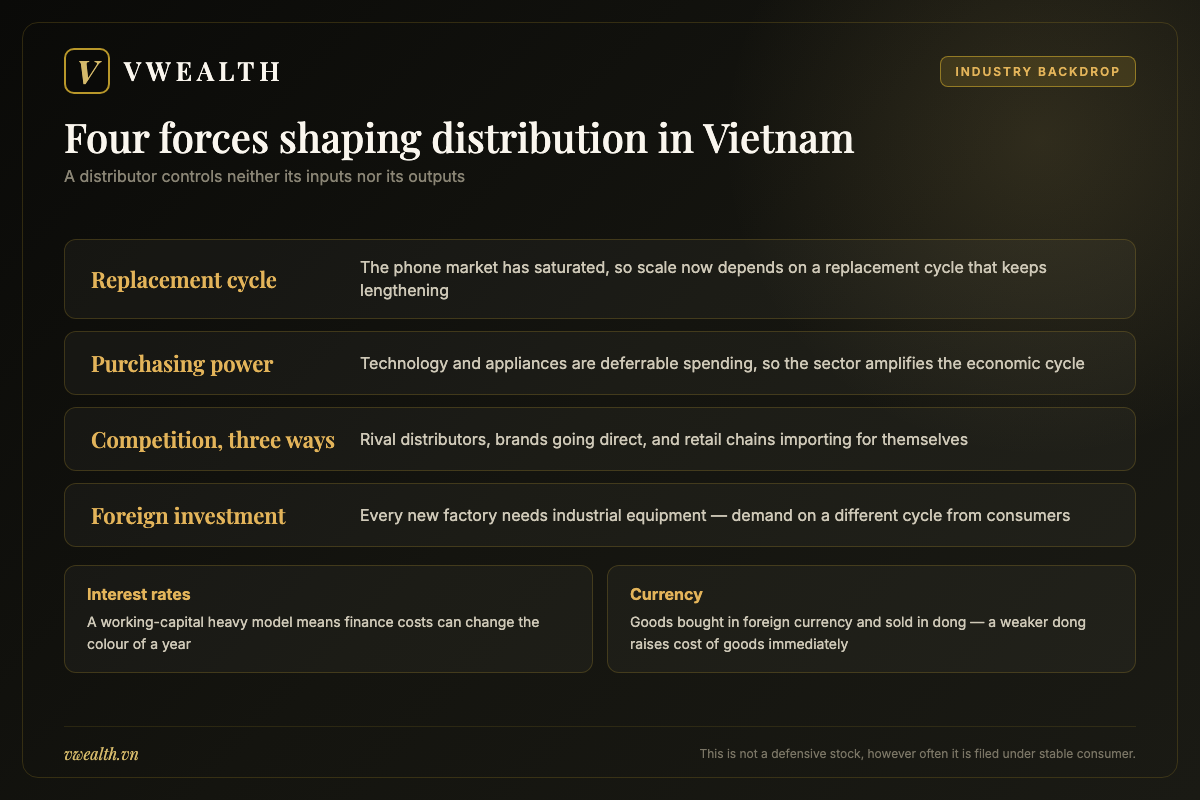
Industry backdrop: four forces shaping distribution in Vietnam
No business lives outside its industry. For a distributor the dependence is unusually high, because it controls neither its inputs nor its outputs.
The device replacement cycle and phone market saturation
Vietnam’s smartphone market has passed the phase of growth from new users. Essentially everyone who needs a phone has one. From here, market size depends on the replacement cycle, and that cycle is lengthening everywhere in the world because devices last longer and generational improvements feel smaller.
That structural reason is why Digiworld’s phone line was roughly flat in 2025 with a decline of about 2%. Do not read that number as a company failure — it reflects the state of the whole market.
More interesting is that laptops and tablets grew roughly 34% in the same year. If the replacement cycle driven by AI-capable devices is real and lasts several years, that is a meaningful driver. If it turns out to be a short wave, this year’s high base becomes next year’s comparison problem. That is the variable to watch most closely in the near term.
Vietnamese consumer purchasing power
Technology and home appliances are deferrable spending. When income feels uncertain, people keep the old phone another year. When income improves, pent-up demand releases very quickly.
That makes distribution and retail amplifiers of the economic cycle. They are not defensive. Our analysis of Vietnam’s consumer sector stocks draws the line between staples and deferrable goods, and that line is exactly what separates a defensive consumer name from DGW.
Competition inside the distribution trade itself
This trade has one crucial characteristic: the barrier to entry is capital and operating capability, not a licence or a technology. Which means anyone with enough money and patience can enter.
Competitive pressure therefore arrives from three directions at once. The first is other distributors of similar scale. The second is the brands themselves, which once large enough in Vietnam have an incentive to build their own machine and keep the margin they currently pay an intermediary. The third is the large retail chains, which once capable of importing directly can bypass the distribution layer.
All three pressures are permanent. The only way a distributor protects itself is by making replacement expensive: broader logistics reach, better after-sales service, and a category portfolio diverse enough that nobody wants to unpick it piece by piece.
Foreign direct investment and the industrial equipment line
This is the most interesting new driver in Digiworld’s portfolio.
Vietnam continues to attract foreign direct investment into manufacturing. Every new factory needs industrial equipment, and that demand grows with the number of factories rather than with consumer purchasing power. It is a source of demand on a completely different cycle from consumer goods, and therefore genuine diversification. The structural case is set out in our piece on Vietnam’s demographic and industrial investment case.
The Achison merger fits that logic. But judge it by results rather than by concept: track the revenue share and margin of the industrial equipment line across several years, and see whether it genuinely becomes a third pillar beside phones and computers.
Enterprise digitalisation and data infrastructure
The company has also flagged a focus on digital infrastructure, technology equipment and data centres to serve enterprise digital transformation.
The logic holds: enterprise customers buy in larger order values, on steadier cycles, and are far less promotion-sensitive than consumers. Margins in enterprise solutions are typically thicker than in consumer hardware sales.
What deserves caution is that this line demands a different capability: not just delivery but consulting, implementation and technical support. That is capability the specialist technology solution companies already have and are competing hard with. A distributor entering this arena meets a different set of competitors from the ones it knows.
E-commerce and the shifting sales channel
A quiet but important shift for the distribution trade is that the sales channel itself is changing.
A decade ago a phone travelled one route from brand to user: brand to distributor, distributor to retail chain, consumer to store. Today there are at least three more routes. Brands sell direct through their own online storefronts. Large marketplaces import and sell directly. And smaller merchants on those marketplaces source through shorter paths.
For a distributor this is simultaneously a threat and an opportunity, depending on the response.
The threat is that every new route can bypass the intermediary. If a brand is confident and large enough, it has an incentive to keep the margin it currently pays.
The opportunity runs the other way: online selling in Vietnam still needs exactly the capabilities a distributor already has — warehousing, delivery, returns handling, warranty. Many brands would rather outsource the entire e-commerce back end than build it. This is why online store operation has become a new service line for distributors across Asia.
What to watch at DGW is whether it builds that service line, and whether it appears as a distinct segment in reporting. A distributor that only supplies physical stores faces shrinking ground. A distributor that also runs the online channel on behalf of brands expands its role precisely as the old channel slows. Our overview of Vietnam’s retail sector covers how the channel mix is shifting.
Modern trade versus traditional trade, and why the split matters
One structural feature of Vietnamese retail deserves explanation for anyone comparing this market with a developed one.
Vietnam has two parallel retail systems. Modern trade covers organised chains — supermarkets, electronics chains, convenience stores, pharmacies belonging to a brand. Traditional trade covers the enormous population of independent shops, market stalls and family-run outlets that still handle a very large share of everyday commerce.
The two systems require completely different distribution capabilities. Modern trade means few counterparties, large orders, formal contracts, structured payment terms, and negotiation leverage sitting with the chain. Traditional trade means hundreds of thousands of counterparties, small orders, informal relationships, cash or short credit, and a very large field sales force.
Digiworld’s core technology business runs almost entirely through modern trade, because electronics in Vietnam consolidated into chains earlier than most categories. That is efficient — you serve a national market through a manageable number of relationships — but it concentrates bargaining power in a handful of customers.
The newer categories are where this matters. Beverages, fast-moving consumer goods and pharmaceuticals reach their full market only through traditional trade, and building that reach is a different and much more expensive exercise than adding another electronics chain. When you assess how far the diversification strategy can go, this is the practical ceiling to keep in mind: a distributor built for modern trade can enter new categories, but it will initially capture only the modern-trade share of each one.
Watch for signs the company is building traditional-trade capability — field sales headcount, coverage figures, or partnerships with existing traditional-trade distributors. Those would indicate the diversification has a longer runway than the current channel allows.
What mature distribution markets tell you about the endgame
It is worth asking where this trade ends up, because other Asian markets have travelled further down the same road and offer a rough map.
In markets where organised retail matured earlier, three things generally happened to technology distributors. First, consolidation: the number of meaningful distributors fell, because scale economics reward the largest player and the smallest ones cannot fund inventory. Second, disintermediation in the largest categories: the biggest brands eventually built their own subsidiaries in their biggest markets, taking distribution in-house for flagship products while leaving smaller lines with partners. Third, a shift in what the surviving distributors sell: away from pure logistics and toward higher-value services such as retail operations, e-commerce management, financing for retailers, and after-sales networks.
All three trends are visible in Vietnam already, at different speeds. Consolidation favours DGW, which sits among the larger players. Disintermediation is the structural threat, and it hits hardest exactly where revenue is largest. The shift toward services is the strategic response, and it is what the company’s moves into enterprise solutions and multi-category expansion are effectively attempting.
The practical takeaway for an investor is about time horizon. Over a two-to-three-year view, the distribution model in Vietnam is robust: the market is not yet mature enough for widespread disintermediation, and organised retail is still growing. Over a ten-year view, the question is genuinely open, and the answer depends on whether the company converts itself into a services business before its core logistics function commoditises.
That does not make the stock a poor investment. It makes it a stock whose long-term case must be reassessed periodically rather than assumed, and it argues for weighting the evidence about the newer, less commoditised lines more heavily than their current revenue share suggests.
Interest rates and the currency: two variables rarely linked to distribution
These two macro variables affect DGW more than most people assume, and the reason lies in the business model itself.
On interest rates: the model requires substantial working capital, so short-term borrowing is permanent. Rising rates increase finance costs, and at a two per cent net margin that is large enough to change the colour of a year’s result.
On the currency: goods are imported in foreign currency and sold in dong. When the dong weakens, cost of goods rises, and the company must choose between absorbing the difference or raising prices and selling more slowly. Neither choice is comfortable. This is a permanent risk for any importer, and something to read alongside any unusual quarterly margin. Our guide to dong currency risk explains the transmission mechanism for foreign investors in more detail.
Looking ahead: three scenarios for DGW stock and what triggers each
This chapter contains no price target. For a business earning two per cent, a twelve-month price target is really a forecast of the whole economy’s purchasing power. What is useful instead is a set of conditions: if this happens, that scenario becomes real.
The four variables that decide the DGW outcome
The first variable is the device replacement cycle. If the wave of AI-capable computers produces a multi-year replacement cycle, the company’s second-largest line has a durable driver. If not, a high base becomes a headwind.
The second is the pace at which the mix shifts toward thicker-margin categories. This is the variable the company controls most, and it is measurable through the revenue share outside phones and computers.
The third is the durability of the large distribution contracts. This is a binary risk: contracts intact means business as usual; a contract lost or shared shows up within a couple of quarters.
The fourth is consumer purchasing power and the interest rate environment. These two macro factors drive both revenue and finance costs, and they usually move together in the unhelpful direction: when rates rise, purchasing power typically weakens.
The optimistic scenario: a long replacement cycle and new categories taking off
Four conditions must hold at once. The AI-capable computer replacement cycle runs long, keeping the computing line growing for several years. The newer categories — appliances, beverages, pharmaceuticals, industrial equipment — keep growing quickly and steadily lift their share of total revenue, pulling the blended gross margin up. Consumer purchasing power recovers. And the major distribution contracts remain stable.
In this scenario operating leverage works in the favourable direction: revenue rises while the cost ratio continues to fall, so profit grows markedly faster than revenue. The company meets or beats its published 2026 plan and, more importantly, the market begins to value DGW as a diversified distributor with a sustainably improving margin rather than as a pure technology hardware distributor. That change of valuation category, rather than the profit figure itself, is the largest prize for shareholders.
Early signal: the revenue share from outside phones and computers rising for four consecutive quarters, with blended gross margin improving genuinely rather than only through cost cuts.
The base case: steady growth without much margin improvement
This is the highest-probability path, because reshaping the revenue mix of a business above twenty-six thousand billion dong always takes longer than planned.
Conditions: moderate purchasing power. Phones remain flat, computers slow after the wave, and the newer categories grow well in percentage terms but from bases too small to change the overall mix. Costs rise with the holding company restructuring.
Outcome: revenue grows at a high single-digit or low double-digit rate, profit grows correspondingly, and net margin hovers around current levels. The cash dividend continues at a modest level.
For a shareholder this means the stock trades with the rhythm of the consumer group, with no specific reward for the restructuring story. It is a perfectly acceptable scenario, but it requires you to have bought at a sensible valuation in the first place, because no growth surge will compensate for overpaying.
The adverse scenario: losing a major contract, or weak demand meeting rising rates
There are two distinct paths into the adverse case.
The first is company-specific: a major brand terminates its contract, or adds a second distributor that splits volumes and compresses margin. With revenue concentrated in a few product groups, the impact appears quickly and clearly in the accounts.
The second is systemic: purchasing power weakens while interest rates rise. Revenue falls, inventory backs up and must be discounted to clear, finance costs climb, and all three squeeze a margin that was only two per cent to begin with. This is operating leverage running in reverse: a ten per cent revenue decline can cut profit by far more than ten per cent.
One point to remember: in this scenario distributor stocks typically fall further than the index, because the market simultaneously prices earnings risk and inventory risk. If you plan to buy this stock, decide in advance how you would behave through such a year.
The three scenarios side by side
| Scenario | Conditions required | How it shows in the accounts | Early signal |
|---|---|---|---|
| Optimistic | Long replacement cycle; new categories lift their share; purchasing power recovers; major contracts stable | Profit grows faster than revenue; blended gross margin genuinely improves | Revenue share outside phones and computers rising four quarters running |
| Base case | Moderate purchasing power; new categories grow fast from small bases; restructuring costs | Revenue and profit both grow moderately; net margin flat | Gross margin unchanged while revenue still rises |
| Adverse | A major contract lost or shared; or weak demand alongside rising rates | Inventory backs up and is discounted; finance costs rise; profit falls faster than revenue | Days of inventory jumping sharply; the cash conversion cycle lengthening |
These scenarios carry no fixed probabilities. The right way to use the table is to reopen it each quarter, compare with real data, and ask which column you are in.
What would change the picture, in either direction
A discipline worth adopting before you buy anything: write down in advance what evidence would make you change your view. Here are the items that should do it for DGW.
Evidence that would strengthen the case: the revenue share outside phones and computers climbing above a third of the total; blended gross margin improving for consecutive years rather than only cost ratios falling; the industrial equipment line reaching a scale where it is reported separately and carries a visibly better margin; cumulative operating cash flow keeping pace with cumulative profit over a five-year window; and the emergence of a named successor with clear operating authority.
Evidence that would weaken it: days of inventory rising for two or more consecutive quarters while revenue is flat; the cash conversion cycle lengthening while the company reports growth; a major brand publicly appointing an additional distributor in Vietnam; debt to equity moving above the self-imposed threshold without a stated reason; or the newer categories being quietly dropped from segment commentary, which usually means they are being wound down.
The value of writing these down in advance is that it removes the temptation to reinterpret bad news as good. Distributor businesses deteriorate slowly and visibly in the working capital numbers long before the profit line reflects it, which means a disciplined investor genuinely has time to react — but only if they have decided beforehand what they are watching for.
So should you buy DGW stock? The straight answer
You now have the facts. This chapter puts them on two sides of a scale and states plainly who this stock suits.
The case for: five reasons DGW deserves consideration
First, a consistent and proven strategy. Nearly thirty years in the same trade, constantly changing the goods, with at least one bet that succeeded on a scale that transformed the company. This is not an investment case resting on a plan that has never been executed.
Second, the category mix is shifting in the right direction. The 2025 result showed home appliances up roughly 75% and computers up roughly 34% while phones were flat. That is evidence the diversification strategy is producing real results rather than sitting on a slide.
Third, cost and debt discipline. Selling expenses fell from 5.8% to 5.1% of revenue and administrative expenses from 1.1% to 0.8% during 2025. Debt to equity stood at 0.83 times, below the company’s self-imposed threshold. In a thin-margin model, cost discipline is competitive advantage.
Fourth, it still pays a cash dividend. Among expanding businesses, sustaining a cash dividend is indirect evidence that profit converts into actual cash rather than sitting entirely in inventory and receivables.
Fifth, it also knows how to cut. Divesting 81% of Digiworld Venture and exiting the Vietmoney investment indirectly during 2025 signals capital allocation discipline. Plenty of companies only know how to buy.
The case against: six risks to look at squarely
First, the margin is too thin. At around two per cent, every small movement in input costs, operating expense or interest produces a large swing in profit. This is structural and cannot be fixed by good management.
Second, distribution contract risk. The company’s most important asset does not sit on the balance sheet and can be lost through a counterparty’s decision. Brands adding a second distributor has happened in this market before.
Third, inventory risk. Technology goods depreciate quickly. A prolonged weak demand cycle forces discounting to clear stock, and the discount comes straight out of a thin margin.
Fourth, dependence on the consumer cycle. Technology and appliances are deferrable spending. This is not a defensive stock, even though many people file it under stable consumer.
Fifth, succession risk and founder dependence. The business has been shaped by one founder for nearly thirty years. That is a strength right up until the day it becomes a question, and nobody knows that date in advance.
Sixth, new complexity from the holding structure. The new structure requires you to track non-controlling interests and intra-group transactions, items you did not need to watch before.
The scale, side by side
| In favour | Against |
|---|---|
| Nearly thirty years in the same trade, with at least one transformative success | Net margin of roughly two per cent amplifies every movement |
| Category mix shifting toward thicker-margin lines | Those lines are still small and cannot reshape the mix near term |
| Clear cost discipline, with cost ratios falling steadily | The risk of losing or sharing a major distribution contract is permanent |
| Debt to equity below the self-imposed threshold | A working-capital heavy model is very sensitive to interest rates |
| Maintains a cash dividend, a sign profit becomes real cash | The dividend yield is too modest for income investors |
| Willing to divest underperforming investments | Inventory depreciation risk is intrinsic to technology goods |
| Industrial equipment ties to foreign investment, a different cycle from consumers | Succession risk and the added complexity of a group structure |
Who DGW suits and who it definitely does not
For the growth investor with moderate risk tolerance: this can fit, provided you understand that growth here comes from adding categories and contracts, not from any proprietary product. Your thesis should attach to a verifiable metric — for example, what revenue share outside phones and computers must reach, and by when.
For the value investor: this name requires care precisely where the trap is. Do not compute a multiple from a single strong year, because a thin margin makes profit swing violently. Use multi-year average profit, and check cumulative operating cash flow to confirm the profit turned into cash.
For the income investor seeking cash dividends: the company does pay, but 1,000 dong per share is modest. If periodic cash flow is your first priority, there are better fits on the exchange.
For the new investor or anyone with a low risk appetite: be careful not to file this under defensive consumer. It is not defensive. If you want exposure to the Vietnamese consumption story without the amplification a thin margin brings, consider the more diversified approach described in our guide to investing in the Vietnamese stock market.
Four questions to answer before you place the order
Question one: have you computed days of inventory and the cash conversion cycle for the last four quarters? For a distributor those two numbers sound the alarm earlier than profit does.
Question two: have you summed operating cash flow across three to five years and compared it with total profit for the same period? If not, you do not yet know whether the profit became cash.
Question three: does your buying thesis depend on one specific distribution contract? If so, ask yourself what you would do if that contract were shared with another partner.
Question four: are you buying in a year when margin sits at the high end of its historical range? If so, assume mean reversion and recalculate whether the price still makes sense.
Three common mistakes when analysing DGW
Before the conclusion, three errors worth naming explicitly, because each one recurs in discussions of this stock.
The first mistake is treating brand strength as company strength. Distributing for Apple and Xiaomi is often cited as evidence of quality. It is evidence of a commercial relationship, not of an owned asset. The brands’ success accrues to the brands. What accrues to the distributor is a service fee embedded in a thin spread, for as long as the relationship lasts.
The second mistake is valuing the company on peak-cycle earnings. Because operating leverage amplifies both directions, the earnings multiple looks most attractive exactly when profit is most extended. Anyone who buys thin-margin businesses on a single year’s earnings will systematically buy them at cycle highs. Multi-year averaging is not a refinement here; it is a necessity.
The third mistake is reading revenue growth as business improvement. A distributor can grow revenue simply by adding a large, low-margin contract, and doing so can reduce blended margin and increase working capital needs at the same time. Revenue is the least informative line in this company’s accounts. Gross profit by category, the cash conversion cycle and operating cash flow all tell you more.
Avoid those three and you will analyse this business better than most of the commentary you will encounter about it.
Closing: a company that sells capability, not products
The story of Digiworld is the story of a business that understands exactly what it sells. It does not sell phones, or laptops, or rice cookers. It sells the capability to bring those things into a market their brand owners cannot enter alone. Because it understands that correctly, it has been able to keep changing the goods without changing the trade — from Acer computers in 2003, to Xiaomi phones in 2017, to Whirlpool appliances in 2022, and now to industrial equipment and motor oil.
But that trade carries an inherent price: whoever stands in the middle takes the thinnest slice of the chain. Every advantage DGW has — fast expansion, low fixed capital, the ability to add new categories — comes from standing in the middle. And so does every risk.
So should you buy DGW stock? If you understand that you are buying a well-run machine in a thin-margin trade, if you accept that profit will swing with the consumer cycle and with interest rates, if you track inventory and cash flow rather than only profit, and if you buy on a multiple computed from multi-year average earnings rather than the best year — then DGW is a reasonable choice within the consumer and distribution part of a portfolio. If you buy because a company that distributes for Apple and Xiaomi must surely be fine, you are buying somebody else’s brand rather than a business.
One last thing to carry with you. Digiworld’s strategy, ownership and brand roster change slowly, but gross margin, days of inventory, the cash conversion cycle, borrowings and the valuation change every quarter. Before you place an order, open the latest research report and score the seven checks from chapter four again. It takes fifteen minutes, and it is the most valuable quarter hour in your entire decision process. If you do not yet have the tools to do it, create a free vwealth account and let the platform read the filings for you.
This article is provided for information and analysis purposes only and is not a recommendation to buy or sell any security. All investment decisions are your own and you bear responsibility for their outcome. Consider consulting a licensed financial adviser before acting.
Research Vietnamese stocks in English with vwealth. Our AI-powered platform turns Vietnamese market data into full English analysis reports — with international payment support and a free 2-month trial for new accounts. Create your free account and read the latest reports.