In the first quarter of 2026, Dat Xanh Real Estate Services Joint Stock Company (Dat Xanh Services, ticker DXS on the Ho Chi Minh City Stock Exchange) reported net profit attributable to shareholders of the parent company of more than VND 189 billion, up 372% year on year and equal to 36% of its full-year profit target in just three months. In the two quarters that followed, the same organization, with the same network of more than 15,000 sales staff and collaborators, reported back-to-back losses. One year, three quarters, three very different moods: that is the quickest way to understand why the question “should I buy DXS stock?” never has a one-line answer. DXS is a property distributor that has been through fifteen years, ten capital increases, one loss-making year, a pivot from “selling on behalf of others” to “project developer”, and now sits under a parent company that has just changed its name. This analysis walks from the company’s roots, the people at the helm and how it makes money to the numbers in its financial statements, so that you can answer the central question for yourself: can DXS escape its fate as a “thermometer” of Vietnam’s housing market?
Before going further, two names need to be stated precisely, because they are easy to confuse. DXS is the stock ticker of Dat Xanh Real Estate Services Joint Stock Company, which trades under the name Dat Xanh Services. Its parent company is Bluemarq Group (formerly Dat Xanh Group, ticker DXG). The parent’s shareholders approved the name change on April 17, 2026; the company received its business registration under the new name on May 6, 2026 and announced it officially on May 20, 2026. The DXG ticker itself did not change. The interesting twist is that, in the rebranding, the real estate services business kept the DAT XANH brand, so DXS today is the part of the group that “kept the old name” inside a group wearing new clothes. Buying DXG means buying an entire group spanning investment, development, asset management and services; buying DXS means buying the distribution and services arm on its own, plus a slice of projects that DXS’s member companies develop themselves. These are two different investment decisions, and this article is only about DXS.
A note on sources and numbers, as with every company profile in this series. Dates, names and figures come from published information: DXS’s 2025 annual report, its consolidated financial statements for the third quarter of 2026 and the accompanying explanatory letter, board resolutions published on CafeF, financial data from VNDirect Securities, and Vietnamese financial media. Where vwealth has divided or added figures to produce a number, the article says “vwealth estimate”. We deliberately do not quote today’s share price or market capitalization; for the latest numbers, open the latest vwealth stock reports.
If you are new to investing in Vietnam, a few mechanics matter for this stock. DXS trades on HOSE, the country’s main board, where the daily price limit is ±7% and trades settle on a T+2 basis. Foreign ownership is capped company by company (the so-called “foreign room”), and many Vietnamese retail investors buy on margin borrowed from their brokers, which means that whether a stock is “marginable” can noticeably affect its liquidity. Our guide on how to invest in the Vietnam stock market covers account opening and these rules in detail.
From a VND 54 billion company to Dat Xanh’s “distribution arm”: the 15-year journey of DXS
Many people assume DXS is a “young” business because its shares only listed in 2021. In fact, the story begins about a decade earlier, and it is tightly bound to the way Dat Xanh built a network of regional member companies. If you want to understand why DXS today is simultaneously a broker, an underwriter of unsold inventory and the holder of thousands of billions of dong in project inventory, you need to walk that road from the start.
2011: a small services company inside Dat Xanh
In July 2011, Dat Xanh Services was established with initial charter capital of VND 54 billion. According to the “development milestones” section of the company’s 2025 annual report, Dat Xanh set up Dat Xanh Mien Trung (Dat Xanh Central Vietnam) in the same year, completing a network of member companies that covered all three regions of the country. In other words, DXS was not born as an independent business hunting for clients; it was born as one piece of a group that already had a name, already had projects and already had sales teams in each region.
VND 54 billion is a small figure next to the company’s current size. To put it in perspective: at the end of 2025, DXS’s charter capital was VND 5,791,031,240,000, corresponding to 579,103,124 listed shares. Going from 54 billion to more than 5,791 billion is an increase of more than a hundredfold in roughly thirteen years. Most of that increase did not come from earning money and keeping it; it came from share issues, bonus shares and employee share issues, which you will see in detail later in this chapter.
The question worth asking about 2011 is this: why would a property group spin its services business off into a separate company? The answer lies in the nature of brokerage. A developer building a project needs large amounts of capital, a land bank and time to wait for permits. A broker needs people, customer data and relationships with many different developers. Housing the services business in its own legal entity allows it to serve other developers’ projects, not just sell homes for the parent. That road eventually led DXS to more than 250 developers and landowners as partners, as the company states in its 2025 annual report.
Covering three regions: from Dat Xanh South in 2009 to Dat Xanh Mekong in 2018
If you read the timeline in the annual report, you will notice that DXS starts its own history in 2009, not 2011. The reason is that the network DXS now manages grew out of member companies founded before it. In 2009, Dat Xanh laid the foundation by establishing Dat Xanh Mien Nam (Dat Xanh South). In 2010, the group expanded north with Dat Xanh Mien Bac (Dat Xanh North). In 2011, Dat Xanh Services and Dat Xanh Central Vietnam were founded. Nam Trung Bo Real Estate (South Central Coast) followed in 2016. In 2018, Dat Xanh Mien Tay (Dat Xanh Mekong) was set up to strengthen the group’s presence in the Mekong Delta.
Organizing by region is not an administrative detail. Vietnam’s housing market is intensely local: a buyer in Hanoi differs from a buyer in Can Tho in product taste, in ability to borrow from banks and in how long they take to decide. A sales team that excels in Thu Duc, the eastern tech-and-residential hub of Ho Chi Minh City, will not necessarily be able to sell land plots in Quang Ngai on the central coast. By creating member companies region by region, Dat Xanh, and later DXS, kept sales forces that understood their local markets while sharing a single brand and a common pipeline of products.
By the end of 2025, that network had grown to 56 member companies, five more than a year earlier, with DXS owning between 51% and 100% of each subsidiary. Its footprint stretches from Hanoi, Quang Ninh and Thanh Hoa in the north; through Da Nang, Quang Nam and Quang Ngai in the center; to Ho Chi Minh City, Can Tho and the wider Mekong Delta in the south. The company’s 2026 plan mirrors that map: the north and the south are each expected to contribute about 40% of revenue, and the center about 20%, with Da Nang, Quang Nam and Hue as the focus.
There is one consequence worth remembering from the history chapter onward. Because DXS owns as little as 51% of many subsidiaries, part of the network’s profit does not belong to DXS shareholders but to the minority shareholders of those subsidiaries. In 2025, that share was about VND 172 billion out of consolidated profit after tax of VND 523 billion. Chapter 4 returns to this point in detail, because it determines the “real” profit you are entitled to when you hold DXS shares.
2019–2020: DXMD Vietnam, Real Agent and the LinkGroup deal
2019 was a turning point that few people noticed. According to the annual report, DXS restructured its services business model that year and established DXMD Vietnam. In 2020, it launched Real Agent, a technology platform for property distribution, and completed an M&A deal with LinkGroup. Together, these three events point in one clear direction: DXS wanted to turn brokerage, a trade that traditionally runs on personal relationships, into a system with processes and tools that could be replicated.
Picture traditional property brokerage in Vietnam as a giant marketplace: each agent keeps a private book of clients, moves from one project to the next, and when the agent leaves, the client book leaves too. A platform like Real Agent aims to pull data, inventory lists and transaction workflows into one place, so that the company, not just the individual agent, owns the relationship with buyers. The 2025 annual report still lists “sales technology” as one of the eight service packages DXS offers developers, which means the idea from 2020 is still part of today’s model.
The LinkGroup deal also matters because it was one of DXS’s first acquisitions. By 2026, M&A was still among the priorities that CEO Tran Quoc Thinh set out at the shareholders’ meeting, but this time aimed at operations, asset management and land banks. Looking back, DXS is a business used to growing by bolting on companies, not merely by hiring more people.
2021: IPO in May, HNX listing in July, a move to HOSE in September — and ten capital increases
In May 2021, DXS carried out its initial public offering (IPO). On July 15, 2021, its shares listed on the Hanoi Stock Exchange (HNX). Less than two months later, from September 6, 2021, the shares moved to the Ho Chi Minh City Stock Exchange (HOSE), Vietnam’s main board. 2021 was also the year DXS posted net revenue of VND 4,329 billion, the highest in the 2019–2025 data series used in this article. Listing at the peak of the business cycle made the DXS story easy to tell, but it also set investor expectations very high from the very first trading sessions.
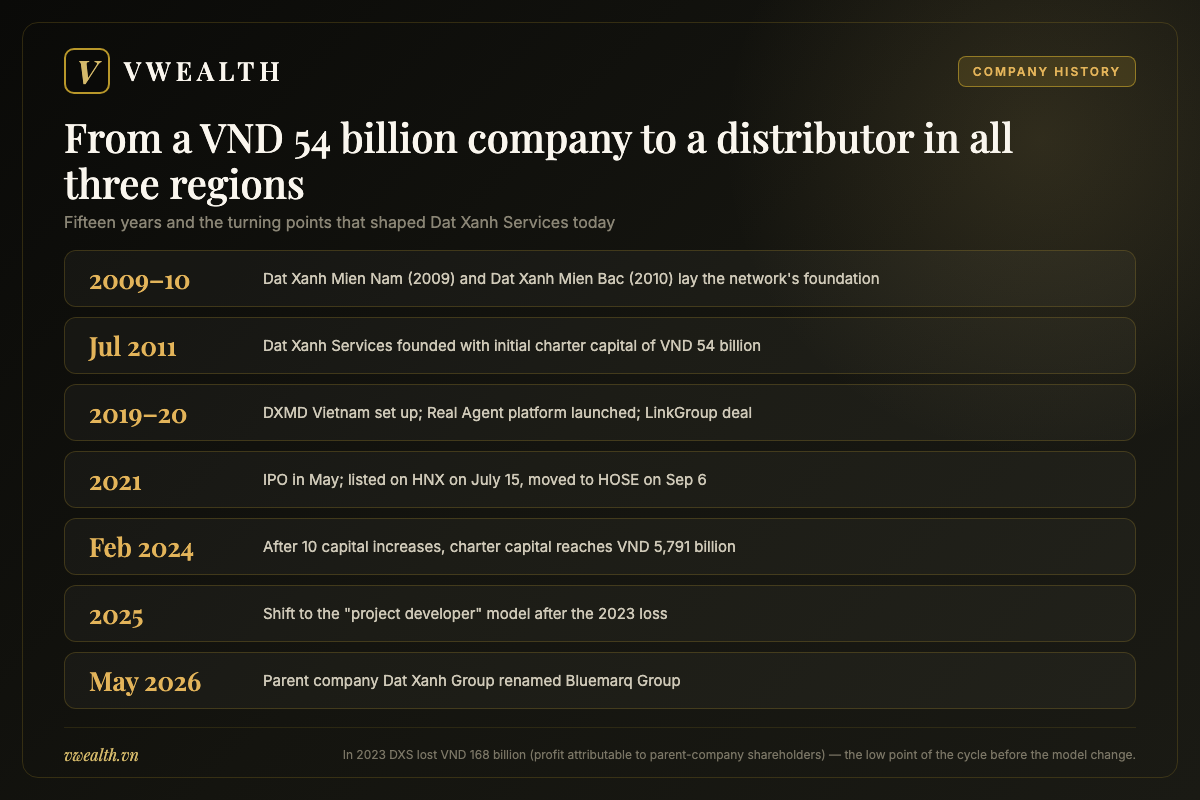
The story of DXS’s charter capital is one of the most revealing details in the company’s history. The “charter capital increases” chart in the 2025 annual report lists these milestones (in VND billion): 54 (July 2011) → 100 (December 2015) → 1,100 (July 2018) → 1,419 (March 2019) → 3,000 (April 2019) → 3,225 (July 2020) → the IPO in May 2021 → 4,119 (June 2022) → 4,531 (December 2022) → 5,741 (October 2023) → 5,791 (February 2024). Ten capital increases in total. The last one, in February 2024, came when the company completed an issue of shares funded from owners’ equity together with an employee stock ownership plan (ESOP), lifting capital to VND 5,791.03 billion.
This article does not give the exact capital figure at the time of the IPO, because the annual report and VNDirect’s data show two different numbers for 2021. That is a good habit to adopt when you read company documents yourself: when two credible sources disagree on a figure that does not change your conclusion, do not simply pick one at random.
Why do capital increases matter to you? Because every time capital grows and profit does not grow in step, the profit attributable to each share gets thinner. This is called “dilution”. Think of a cake: if you cut it into more slices without baking a bigger cake, every slice gets smaller. In 2019, when charter capital reached VND 3,000 billion (the April 2019 milestone), DXS’s profit attributable to parent-company shareholders was VND 1,061 billion. In 2025, with capital close to VND 5,800 billion, that profit was VND 352 billion. The cake has been cut into far more slices, while the filling has not returned to its old size. If you want to know how to read earnings per share and other line items in Vietnamese reports, vwealth’s guide to Vietnamese company financial statements in English explains it in more depth.
2023: a VND 168 billion loss and a lesson in cycles
If 2021 was the peak, 2023 was the trough. The housing market went quiet, buyers stayed on the sidelines and project launches became rare. For a business that lives on transaction fees, when transactions stall, revenue drops straight down. DXS’s net revenue in 2023 fell to VND 1,997 billion, less than half of the VND 4,096 billion recorded in 2022. Profit after tax attributable to parent-company shareholders was a loss of VND 168 billion, the first time DXS had lost money since listing.
One concrete consequence of that loss: from August 30, 2023, DXS shares were no longer eligible for margin trading, because the profit after tax attributable to the parent in the reviewed 2023 half-year financial statements was negative. For a retail investor, “losing margin” means you can no longer borrow from your broker to buy the stock. Leveraged money, which is a big part of trading liquidity on Vietnam’s exchanges, drains out of the ticker. Only on March 7, 2025 did DXS return to HOSE’s list of margin-eligible securities.
Also in 2023, DXS established Dat Xanh Commercial to expand into the commercial segment. In hindsight, that was a move against the tide: setting up a new company while the whole industry was shrinking. And as you will see in Chapter 3, that very company later ended up on the restructuring list. In December 2025, DXS amended its plan to transfer its entire stake in Dat Xanh Commercial to a party other than DXG; in April 2026, the board approved the dissolution of Dat Phat Hung Real Estate Joint Stock Company, the new name of Dat Xanh Commercial.
The lesson of 2023 for anyone reading the financial statements is clear: property brokerage has high “operating leverage”. Fixed costs such as offices, staff and management systems do not fall as fast as revenue. When revenue halves, profit can swing from positive to negative. Conversely, when revenue recovers, profit can rebound very sharply, as happened in 2025 and in the first quarter of 2026.
2025–2026: from “selling for others” to “project developer”, and a parent renamed Bluemarq
In 2025, DXS announced that it was transforming its model into that of a “project developer” in order to secure its own supply of products. The phrase is easy to misread, so it is worth hearing how the company itself explains it. At the 2025 annual general meeting (AGM), Chairman Nguyen Truong Son said that of the eight service components of a project, DXS takes part in seven as a service provider; the company does not act as a co-developer but partners with developers to secure its pipeline of products. Put simply, DXS does not buy land and build homes like a pure developer. Instead, it takes on almost the entire workload of a developer as a package, from product advisory, permitting, project management, construction and financing arrangements to sales and operations.
In the same year, on March 31, 2025, Tran Quoc Thinh became chief executive officer, replacing Pham Thi Nguyen Thanh, who had been with Dat Xanh since 2013, served as CEO of DXS for almost four years and moved into the role of vice chairwoman. The first year of the new model delivered net revenue of VND 3,966 billion, profit after tax attributable to the parent of VND 352 billion and profit before tax of VND 662 billion, up 94%. Against the 2025 AGM targets (revenue of VND 5,156 billion and parent-attributable profit of VND 412 billion), DXS achieved about 77% of its revenue target and about 85% of its profit target. Both ratios are vwealth estimates, calculated by dividing actual results by the plan.
2026 opened with two changes at the top. The AGM on April 24, 2026 elected the board of directors for the 2026–2030 term, and on the same day Nguyen Truong Son was re-elected chairman. At the parent level, Dat Xanh Group officially became Bluemarq Group and restructured itself into four platforms: BLUEMARQ Investment, BLUEMARQ Development, BLUEMARQ Asset Management, and a real estate services business under the DAT XANH brand. The 2026 plan approved by DXS shareholders targets revenue of VND 5,300 billion and profit after tax attributable to the parent of VND 527 billion, roughly 50% higher than the 2025 result.
And then the first three quarters of 2026 told a story that did not move in a straight line: a large profit in the first quarter, losses in the second and third. Chapter 4 goes into the details. What matters here is that DXS’s fifteen-year history has never been a smooth upward line. It is a series of ups and downs that track the housing market, and the “project developer” model is the latest attempt to flatten those swings.
| Year | Event | What it means for DXS shareholders today |
|---|---|---|
| 2009–2010 | Dat Xanh founds Dat Xanh South (2009) and Dat Xanh North (2010) | The roots of the member-company network that DXS manages |
| July 2011 | Dat Xanh Services founded with VND 54 billion in capital; Dat Xanh Central Vietnam set up the same year | Services split into a separate legal entity able to serve developers outside the group |
| 2016–2018 | Nam Trung Bo Real Estate (2016) and Dat Xanh Mekong (2018) established | Coverage extended to the South Central Coast and the Mekong Delta |
| 2019–2020 | Restructuring and creation of DXMD Vietnam (2019); Real Agent launch and LinkGroup acquisition (2020) | A push to systematize and digitize brokerage |
| 2021 | IPO in May; HNX listing on July 15; move to HOSE from September 6 | Became a public stock subject to disclosure discipline |
| 2023 | Loss of VND 168 billion (attributable to the parent); margin eligibility lost from August 30; Dat Xanh Commercial founded | The clearest evidence of how cyclical the model is |
| February 2024 | Share issue from owners’ equity and ESOP completed; capital reaches VND 5,791.03 billion | The last of ten capital increases; a large share count thins earnings per share |
| 2025 | Shift to the “project developer” model; new CEO from March 31; back on the margin list on March 7; profit of VND 352 billion | First year of the new model, with profit recovering |
| 2026 | Board elected for 2026–2030 (April 24); parent renamed Bluemarq Group (registered May 6); profit target of VND 527 billion | High expectations, while the second and third quarters show losses |
Looking at the whole table, one simple observation stands out: whenever DXS makes a major organizational change, it is usually just after a trough or in preparation for a new cycle. In 2019, it restructured its services model; in 2025, it changed models after the 2023 loss; in 2026, it restructured its portfolio of member companies as the market slowed again. That is the reflex of a company used to living with cycles, and a reminder that DXS investors need to get used to the same rhythm.
Who steers DXS, and who owns it
For a services company, the biggest assets are not factories or mines; they are people and relationships. That is why, when you assess DXS, the question “who is running it?” matters as much as “how much does it earn?”. This chapter introduces the members of the board of directors and the executive team based strictly on what the company has published, then moves on to the shareholder picture, in which the parent company Bluemarq Group holds a majority.
Chairman Nguyen Truong Son: twelve years at Dat Xanh
Nguyen Truong Son has chaired the DXS board since October 28, 2021, and also chairs its Strategy Council. According to the 2025 annual report, he holds an MBA from Maastricht University, has more than 17 years of experience in property analysis, appraisal and investment, and has spent 12 years with Dat Xanh Group, where he served as deputy CEO for investment, deputy CEO for sales and marketing, and CEO of DXS.
That sequence of roles shows that Son came up through both sides of the trade: the investment side (appraising projects and deciding whether to commit money) and the sales side (marketing and selling). For a business moving from brokerage to “project developer”, that combination makes sense: the person at the top needs to read both a project’s feasibility spreadsheet and the market’s real purchasing power. On April 24, 2026, after shareholders elected the new board, Son was again chosen as chairman for the 2026–2030 term.
At the 2025 AGM, it was Son who explained the “seven out of eight” model: DXS takes part in seven of the eight workstreams of a project as a service provider and does not act as a co-developer. This is a sentence worth remembering, because it marks the boundary between two ways DXS can take on risk. A service provider’s risks (losing fees, collecting cash late) are different from a developer’s risks (holding land, holding debt, holding unsold inventory).
CEO Tran Quoc Thinh: a systems builder from logistics and aviation
If Son is a property man, the person running the business day to day has a very different résumé. Tran Quoc Thinh, vice chairman of the board and CEO since March 31, 2025, has more than 21 years of experience, according to the annual report, at organizations such as Indo Trans Logistics, Thai Airways, Qatar Airways, Keppel Logistics and Long Hau Industrial Park, before joining Dat Xanh Group in 2014. He also sits on the boards of Dat Xanh North (DXMB), Regal Group and Cara Group, three member companies that play major roles in the DXS network.
Logistics and aviation are industries that live by process: flight schedules, supply chains, squeezing costs out of every small step. Putting someone with that background in charge of a brokerage signals that DXS wants to run as a system, in keeping with the idea of a “project developer” that offers a full package of services. At the 2026 AGM, Thinh spoke about moving from fees earned on each transaction toward recurring cash flow, expanding into project development, property management and operations, asset leasing, financial services and technology, along with M&A in operations, asset management and land banks. In 2025, he was also the one who explained why DXS needed a new model: many developers lack the capability to develop projects, so DXS provides services from design and construction to sales and capital arrangement.
As for personal holdings, VNDirect’s shareholder data as of January 12, 2024 show Thinh owning 200,000 shares and Chairman Nguyen Truong Son owning 500,000 shares. These figures are almost three years old and are included only to give you a sense of scale: compared with more than 579 million listed shares, the direct holdings of the two most senior leaders are very small. Real decision-making power lies with the parent company, as the section below shows.
A five-member board and an Audit Committee
The DXS board of directors has five members. Besides Son and Thinh, there are three other names worth knowing.
Ha Duc Hieu, board member, has nearly 21 years of experience in finance, securities and property investment, and has served as chief financial officer, head of investment and finance, and deputy CEO for finance. At the 2025 AGM, Hieu gave the update on the progress of projects developed within the DXS network, including Regal Complex Da Nang.
Le Dang Quoc Hung was elected to the board as an additional member at the 2025 AGM. He has more than 20 years of experience in banking and finance and began his career at the Vietnam Development Bank. According to the 2025 annual report, he is the chief financial officer and board secretary of Dat Xanh Group, the parent company now called Bluemarq Group. He is also a member of DXS’s Audit Committee. Having the parent’s CFO on a subsidiary’s board is a common way for a parent to keep a close eye on the cash flow and capital structure of its network.
Tran Thanh Tan has been an independent board member and chairman of the Audit Committee since May 2021. He previously worked in investment banking at Shinhan Securities and SSI Securities, and now runs a wealth management firm in Singapore. The Audit Committee has two members: Tan as chairman, and Hung.
At the AGM on April 24, 2026, held online, shareholders elected all five of these people to the board for the 2026–2030 term. In other words, the leadership core did not change through the election. That is a sign of stability, but it also means that the “project developer” strategy will continue to be steered by the same people who launched it.
You should read that structure in two directions. On the positive side, the board includes someone who understands property, someone who understands operations, someone who understands finance, and an independent member with an investment banking background. On the watch side, only one of the five is listed as independent, and at least one member also holds a senior finance role at the parent company. When DXS signs contracts with parties inside the group, the oversight role of the Audit Committee and the independent member is something you should read carefully in the annual corporate governance report.
Changes in the executive team during 2026
The 2025 annual report lists the executive team as: CEO Tran Quoc Thinh; acting deputy CEO for sales and marketing Trinh Thi Kim Lien; chief accountant Nguyen Huynh Quang Tuan; chief financial officer Nguyen Hoang Duc; director of business and product development Nguyen Thi Kim Thoa; and deputy director of human resources and administration Nguyen Thi Bich Hanh.
During 2026, the finance and accounting team saw several announced changes. On June 8, 2026, the board appointed Nguyen Nhat Thien as chief accountant. On August 10, 2026, the board issued a resolution removing Nguyen Hoang Duc from the position of chief financial officer and appointing Mai Nguyen Lan Nhi as board secretary and authorized information disclosure officer. These resolutions were published in line with the required procedures and did not give detailed reasons.
For you, the sensible reading is a neutral one: personnel changes in finance during a year of restructuring the business model and the portfolio of member companies are not unusual. What is worth doing is following the next sets of financial statements, especially the audited 2026 report, to see whether the presentation, the auditor’s opinion and the notes stay as consistent as in previous years. According to the 2025 annual report, DXS’s auditor is EY Vietnam.
A parent with 55.37% and the Bluemarq story
As of December 31, 2025, DXS’s largest shareholder was Dat Xanh Group Joint Stock Company, now Bluemarq Group, with 320,658,349 shares, or 55.37% of capital. A majority stake (above 50%) means the parent can decide every matter that requires an ordinary majority vote at the shareholders’ meeting, from electing the board to approving the business plan and the profit distribution plan.
The 2025 DXS AGM also allowed Dat Xanh Group to raise its ownership in DXS without making a public tender offer. Under Vietnamese rules, a shareholder that wants to cross certain ownership thresholds in a public company usually has to make a tender offer, that is, offer to buy from all shareholders on the same terms. By waiving this requirement, the AGM opened the way for the parent to raise its stake more quickly if it chooses to. This is a right, not a transaction: you should follow major shareholders’ trading reports to see whether the parent actually uses it.
The parent–subsidiary relationship cuts both ways. The upside is product supply: a distributor whose parent is a large developer has an edge in accessing projects within the group. The point to scrutinize is related-party transactions. For example, the notes to the 2025 consolidated financial statements show a brokerage deposit with the related party Ha An of VND 2,055.75 billion at year-end, compared with VND 1,950.65 billion at the start of the year. A large deposit with a related party does not mean anything is wrong, but it is the place where you should read the notes carefully every period: where the money goes, what the repayment terms are and whether any provision has been made.
As for the name change: the DXG AGM on April 17, 2026 approved renaming Dat Xanh Group as Bluemarq Group; the business registration under the new name was issued on May 6, 2026, and the official announcement came on May 20, 2026. Bluemarq reorganized into four platforms, namely BLUEMARQ Investment, BLUEMARQ Development and BLUEMARQ Asset Management, with the real estate services business keeping the DAT XANH brand. For DXS shareholders, the notable point is that the “Dat Xanh” brand, which has been synonymous with property brokerage in Vietnam for fifteen years, stays with DXS. A brand that homebuyers and brokers know well is an intangible asset that is hard to value but very real.
On profit distribution to shareholders, be careful with one easily misread number. The 2025 cash flow statement shows “dividends paid” of VND 99.57 billion (VND 3.70 billion in 2024). In consolidated accounts, this line can include dividends that subsidiaries pay to their own minority shareholders, so you cannot conclude that it is the cash dividend DXS paid to its own shareholders. If you are an income investor looking for regular dividends, check DXS’s own AGM resolutions and record-date announcements rather than relying on this line.
Victory Holding’s exit on December 18, 2025 and the remaining shareholder base
Before December 2025, DXS’s second-largest shareholder was Victory Holding Investment Limited, part of the VinaCapital group, with 46,479,895 shares, or 8.03% of capital. On December 18, 2025, Victory Holding sold its entire stake and ceased to be a major shareholder. That day, foreign investors were heavy net sellers of DXS on the exchange: the divestment itself showed up on the trading board.
Selling more than 46 million shares in a single session is a decisive way to exit. Investment funds have many reasons to sell a position, such as the end of a fund’s life, portfolio rebalancing or a reassessment of prospects, and the published disclosures did not give a specific reason. This article does not speculate on the fund’s behalf. What you can note is that after that day, DXS lost its second-largest shareholder, and its ownership structure tilted even further toward the parent.
The shareholder list as of December 31, 2025, less than two weeks after the Victory trade, shows the following picture: 9,957 shareholders in total. Domestic investors numbered 9,878 and held 89.87% of capital, of which individuals held 19.33% and institutions 70.54%. Foreign investors numbered 79 and held 10.13%, of which institutions held 9.93% and individuals 0.20%. The maximum foreign ownership allowed in DXS is 50%, so the “foreign room”, Vietnam’s term for the headroom left under the foreign ownership cap, is still very wide.
| Shareholder group (December 31, 2025) | Number of shareholders | Ownership | Notes |
|---|---|---|---|
| Bluemarq Group (formerly Dat Xanh Group, ticker DXG) | 1 | 55.37% | 320,658,349 shares; counted within domestic institutions |
| Domestic institutions (including the parent) | Part of the 9,878 domestic shareholders | 70.54% | Excluding the parent, about 15.17% (vwealth estimate: 70.54% − 55.37%) |
| Domestic individuals | Part of the 9,878 domestic shareholders | 19.33% | Retail investors |
| Foreign institutions | Part of the 79 foreign shareholders | 9.93% | After Victory Holding sold 8.03% on December 18, 2025 |
| Foreign individuals | Part of the 79 foreign shareholders | 0.20% | Foreign ownership cap of 50% |
| Total | 9,957 | 100% | 579,103,124 listed shares |
The table carries one important lesson for trading. The “free float”, the portion of shares that actually changes hands day to day, is considerably smaller than the 579 million listed shares, because the parent holds more than half and other domestic institutions hold another slice. When the free float is small, a large trade like Victory’s can have a visible impact on the share price. Chapter 5 covers liquidity in more detail; for now, remember that with DXS, every major decision sits with the parent, and holding the shares means riding a train that Bluemarq is driving.
If you want to compare this “parent owns a majority” structure with other Vietnamese property companies, vwealth’s analyses of NLG stock (Nam Long) and KDH stock (Khang Dien) show different ownership models, in which the company acts as its own developer rather than sitting inside a parent–subsidiary system like DXS.

How DXS makes money: brokerage, underwriting and the pivot to project development
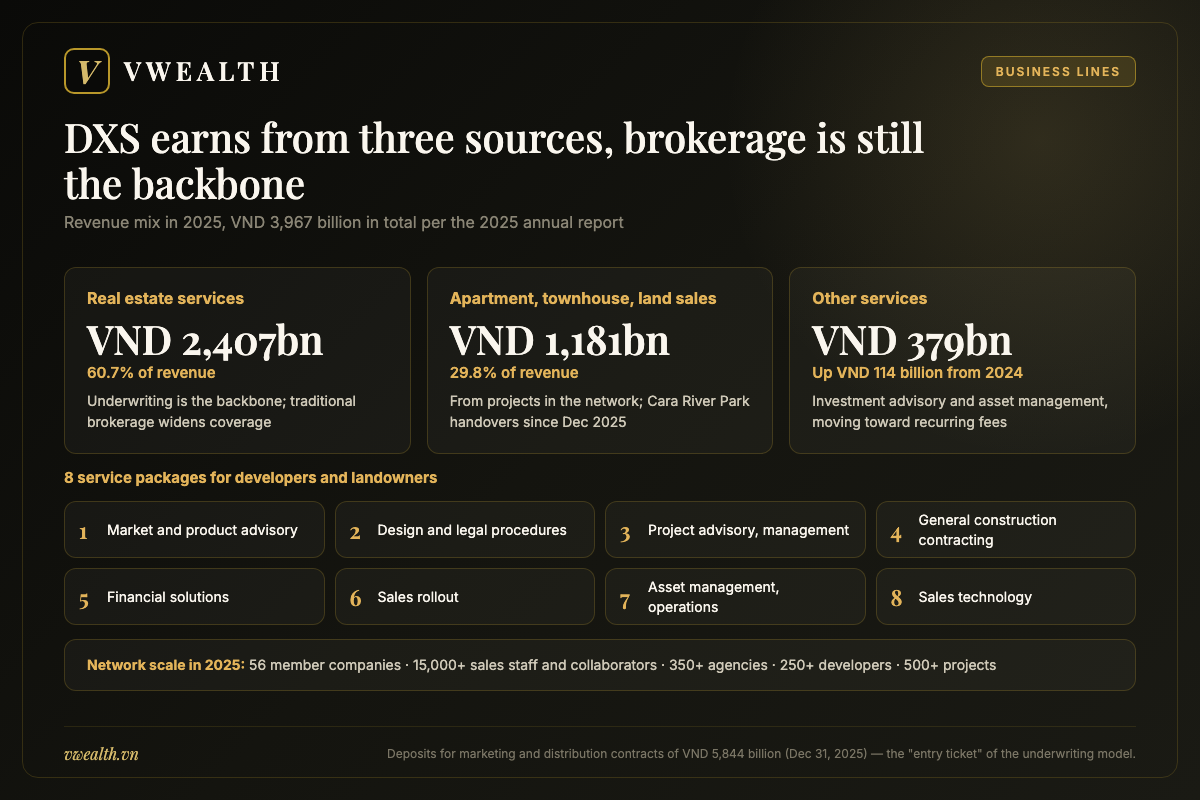
Ask an ordinary person how a property brokerage makes money and the answer will almost certainly be “commissions”. With DXS, the answer is far more complicated. In 2025, the company’s total revenue of VND 3,967 billion came from three sources that are different in nature: real estate service fees, sales of apartments, townhouses and land plots from projects within the network, and other services such as investment advisory and asset management. Each source is recognized on its own rhythm and carries its own risks, and understanding them is the only way not to be caught off guard by erratic quarterly results.
Real estate services: the pillar behind 60.7% of 2025 revenue
The real estate services segment brought in VND 2,407 billion in 2025, or 60.7% of total revenue, a share 13 percentage points higher than in 2024. This is “brokerage” in the broad sense: advisory, marketing and distribution of products for developers, including underwriting contracts.
Look at the five-year series and you will see how violently this segment swings. Real estate services revenue was VND 1,329 billion in 2021 (30% of total revenue), rose to VND 2,349 billion in 2022 (57%), fell to VND 611 billion in 2023 (31%), recovered to VND 1,233 billion in 2024 (47%) and reached VND 2,407 billion in 2025 (60.7%). Between 2022 and 2023, services revenue lost nearly three quarters in a single year: that was the moment the market froze and buyers disappeared. Between 2023 and 2025, the figure almost quadrupled. A business line that can stretch and shrink that much is one tied directly to the pace of market transactions.
The annual report names the projects where DXS ranked “Top 1 for successful transactions” in 2025, including The Privé, A&T Sky Garden, Symlife and A&T Saigon Riverside. Member company Dat Xanh North (DXMB) was named “Best Real Estate Advisory and Business Developer of 2024” and met the standards of the Vietnamese Professional Ethics and Code of Conduct for brokers (VPEC). These awards do not turn directly into cash, but in brokerage, reputation is what makes a developer choose you as lead agent rather than one of dozens of agents.
The services segment is also the first to feel it when the market slows. DXS’s explanatory letter on its third-quarter 2026 results states that brokerage revenue fell 30.5% year on year, because the housing market was under pressure from high interest rates and cautious buyers. Just nine months after a strong 2025, the biggest pillar shrank again, exactly the temperament this segment’s history has shown.
Underwriting versus traditional brokerage: more than VND 5,800 billion in deposits as the “entry ticket”
DXS runs two brokerage channels: underwriting, which is the revenue pillar, and traditional brokerage, which widens its reach. The two channels differ on one fundamental point: who bears the risk of homes that do not sell.
In traditional brokerage, DXS sells on behalf of a developer; it earns a fee on each unit sold, and if a unit does not sell, it earns nothing. The broker’s risk is mainly wasted effort and marketing costs. Underwriting, known in Vietnam as “bao tieu”, is an entirely different story: the distributor commits to selling a certain volume of units and usually has to place a large deposit with the developer to secure distribution rights, in exchange for higher fees or exclusive control of the inventory. In other words, underwriting turns the broker into a party that shares market risk with the developer.
The numbers show how large that “entry ticket” is. The notes to the 2025 consolidated financial statements show deposits and collateral for project marketing and distribution contracts of VND 5,844 billion at year-end, up from VND 4,924 billion at the start of the year. As of March 31, 2026, DXS’s other receivables exceeded VND 7,700 billion, mostly deposits for marketing and distribution contracts of nearly VND 5,800 billion. To put that in perspective, the deposit balance at the end of 2025 was larger than the company’s total revenue for the whole of 2025.
You can think of these deposits as a rental security deposit, only measured in thousands of billions of dong. When a distribution contract is completed, meaning the project sells out and the parties settle accounts, the deposit is returned or offset. If the project sells slowly, the deposit stays with the developer for longer; if the developer runs into trouble, whether the money can be recovered becomes a real question. That is why DXS’s assets do not sit mainly in cash or its own property but in receivables. Chapter 4 analyzes this item closely from a balance-sheet perspective.
The upside of underwriting is just as clear: when the market is strong, a distributor holding exclusive inventory can sell quickly, earn high fees and turn its capital over fast. It is no accident that the company itself calls underwriting the revenue pillar of its brokerage business. The model works like leverage: it amplifies profits when the market rises and amplifies pressure when it falls.
Selling apartments, townhouses and land plots from projects in the network
The second source of revenue is property sales: apartments, townhouses and land plots from projects developed by DXS’s member companies. In 2025, this segment brought in VND 1,181 billion, or 29.8% of total revenue. The five-year series shows its share shrinking over time: VND 2,978 billion in 2021 (68% of total revenue), VND 1,498 billion in 2022 (36%), VND 1,225 billion in 2023 (61%), VND 1,113 billion in 2024 (43%) and VND 1,181 billion in 2025. In 2022, there was also VND 169 billion of construction revenue; that line fell to zero in 2024–2025.
The annual report explains that the lower share of property sales in 2025 was because large revenue from projects developed by member companies had not yet been recognized. This is an accounting feature you need to understand. In Vietnamese property accounting, revenue is usually recognized only when a unit is handed over to the buyer, not when the contract is signed or the deposit is collected. A project can sell out one year and still have to wait until construction and handover are complete before it “shows up” in the income statement. That is why this segment follows the rhythm of handovers, which is very uneven from quarter to quarter.
Which projects are sitting in the “warehouse” waiting for handover? As of March 31, 2026, DXS’s inventory was more than VND 5,100 billion, including more than VND 2,400 billion of completed property and more than VND 2,300 billion of property under construction at projects such as Regal Legend, La Maison, Dat Quang Riverside and Tuyen Son. By September 30, 2026, inventory had risen to VND 5,452.0 billion, compared with VND 5,110.3 billion at the start of the year. At the 2025 AGM, the company also named Regal Legend, Regal Pavillon, Regal Victoria and Cara River Park; at the time, Ha Duc Hieu said Regal Complex Da Nang had its legal permits and was expected to go on sale in the fourth quarter of 2025.
Two names in the ecosystem are worth knowing. Regal Group operates in the luxury segment; according to the 2025 annual report, it joined the “hundred-billion profit club” for the second year in a row, was ranked among the Top 10 reputable developers of 2025 and trades on UPCoM under the ticker RGG. CARA Group developed Cara River Park in Cai Rang district, Can Tho, which was completed and handed over from December 2025 and received a VRES Excellent 2025 certification. Cara River Park is a concrete example of the “project developer” model reaching the finish line: from a project inside the network to homes handed over to buyers.
The first quarter of 2026 is the clearest illustration of the handover effect. Net revenue for that quarter was nearly VND 1,416 billion, up 176% year on year, and profit attributable to the parent exceeded VND 189 billion, up 372%. When a large handover lands in one quarter, that quarter shines; when there is no handover, the next quarter can go dark. Recognizing revenue on handover is common to all Vietnamese developers, and you can compare it in vwealth’s analyses of NVL stock (Novaland) and VHM stock (Vinhomes).
Eight service packages for developers and landowners: a “developer” that is not a co-developer
At the 2025 AGM, DXS presented eight integrated service packages for developers and landowners: (1) market and product advisory; (2) design and legal procedures; (3) project advisory and management; (4) general construction contracting; (5) financial solutions; (6) sales advisory and execution; (7) asset management and operations; and (8) sales technology.
These eight packages are a developer’s “toolkit”. A company that owns land but lacks project development experience can hire DXS to do almost everything: research what to build and for whom, obtain permits, manage construction, arrange financing, and then sell and operate the project after handover. That is why CEO Tran Quoc Thinh says many developers lack project development capabilities, and DXS fills that gap.
The subtle point lies in Chairman Nguyen Truong Son’s statement that “DXS does not act as a co-developer”. In theory, a full-service model lets DXS collect fees at more stages without taking on all of the land bank risk. In practice, the DXS network still has member companies that develop their own projects (Regal, Cara and others) and still has thousands of billions of dong in underwriting deposits. So when you read about the “project developer” model, understand it as a blend: part fee-based services, part project risk carried through member companies and through deposits.
There is one more link in the ecosystem that few people notice: DXS-FERI, the company’s research institute. It publishes market reports and buyer surveys, data that feed directly into the “market and product advisory” package. For a distributor, understanding customers before competitors do is a competitive advantage, and Chapter 6 uses DXS-FERI’s own data to discuss the market.
The network: 56 member companies and more than 15,000 sales staff and collaborators
A distributor’s greatest competitive asset is reach. According to the 2025 annual report, the DXS network has more than 15,000 sales staff and collaborators, has distributed more than 500 projects, and works with more than 350 distribution partners and agencies and more than 250 developers and landowners. At the end of 2025, DXS had 56 member companies, five more than a year earlier. Headcount across the network was around 4,000, up about 70% during the year; sources differ slightly, from “nearly 4,000” to “more than 4,000”, so this article uses the round figure.
The figures of 15,000 and 4,000 tell two different stories. 4,000 is the network’s staff; 15,000 includes the full force of sales staff and collaborators, people paid commission per transaction. This model gives DXS a very large sales force without carrying the full fixed cost: collaborators only earn when they sell. The trade-off is that when the market turns difficult, collaborators can leave quickly, and when the market recovers, the company has to recruit again.
The DXS ecosystem is not just a set of regional brokerages. The annual report describes it as including a property technology company, financial services, project development, media and support services. Each piece serves one of the eight service packages: technology for sales, financial services for capital arrangement, media for marketing.
The network is also being pruned. On January 14, 2026, the DXS board approved in principle the transfer of its entire stake in Dat Xanh South, an associate company, at a minimum price equal to book value. In December 2025, DXS amended its plan to transfer its entire stake in Dat Xanh Commercial to a party other than DXG, with completion expected in 2026; on April 6, 2026, the board approved the dissolution of Dat Phat Hung Real Estate Joint Stock Company, the new name of Dat Xanh Commercial. You can read this chain of decisions as a portfolio clean-up: keeping the units that fit the new model and exiting those that no longer do.
Other services and the push toward recurring fees
The third source of revenue is the smallest but may matter most in the long run: other services, including investment advisory, asset management and value-added services. In 2025, this segment generated VND 379 billion, up VND 114 billion from 2024.
Why does a segment worth less than a tenth of revenue deserve attention? Because it is the direction management spelled out at the 2026 AGM: moving from fees earned on each transaction toward recurring cash flow. Brokerage fees only arrive when someone buys; fees for managing and operating a building or an urban township arrive every month, whether the sales market is hot or cold. A company with a high share of recurring revenue is less cyclical, and that is exactly what DXS is trying to achieve.
Some concrete steps have been announced. In September 2025, the board approved the establishment of Primo Estates Real Estate Services Joint Stock Company. On October 30, 2026, board resolution No. 13 approved a capital contribution to set up a new subsidiary; the file name of the disclosure describes it as a property management and operations company. These are only first steps: you will need to wait for future reporting periods to see how large the recurring business grows and how much it contributes to profit.
| Year | Real estate services (VND billion, share) | Apartments, townhouses and land plots (VND billion, share) | Construction (VND billion) | Full-year net revenue (VND billion) |
|---|---|---|---|---|
| 2021 | 1,329 (30%) | 2,978 (68%) | — | 4,329 |
| 2022 | 2,349 (57%) | 1,498 (36%) | 169 | 4,096 |
| 2023 | 611 (31%) | 1,225 (61%) | — | 1,997 |
| 2024 | 1,233 (47%) | 1,113 (43%) | 0 | 2,438 |
| 2025 | 2,407 (60.7%) | 1,181 (29.8%) | 0 | 3,966 (the annual report’s revenue mix uses a total of 3,967; other services 379) |
Sources: DXS 2025 annual report (revenue mix), VNDirect and the annual report (net revenue). A dash means the source does not break out the figure for that year. Shares are as published by the company; where a year’s shares add up to less than 100%, the remainder belongs to other small segments.
Read the table by column and you see a shift: in 2021, property sales were the main source; by 2025, services had risen to more than six tenths of revenue. Read it by row and you see the amplitude of the swings: no column rises steadily across the five years. Put the two together and the story of Chapter 3 is this: DXS has a large distribution machine, is trying to bolt a recurring-fee engine onto it, while the project sales business still moves to the rhythm of handovers.
Reading DXS’s financial health: cyclical profits, heavy receivables, negative cash flow
The first three chapters described who DXS is and what it does. This chapter answers the question every investor eventually has to ask: what do those activities leave behind in the financial statements? The short answer: profits follow the cycle, assets sit largely in receivables, and operating cash flow is usually negative. The long answer requires going through the numbers one by one, and you will see that each of them has a reason rooted in the business model described in Chapter 3.
Revenue and profit 2019–2025: a peak in 2019, a trough in 2023, a recovery in 2025
DXS’s net revenue (VND billion) over seven years: 4,091 (2019), 3,249 (2020), 4,329 (2021), 4,096 (2022), 1,997 (2023), 2,438 (2024), 3,966 (2025). Profit after tax attributable to parent-company shareholders: 1,061 (2019), 873 (2020), 539 (2021), 345 (2022), a loss of 168 (2023), 141 (2024), 352 (2025).
Notice one detail: revenue in 2021 and 2022 was still as high as in 2019, yet profit attributable to the parent had already declined from 1,061 to 539 and then 345 billion dong. In other words, even before the 2023 collapse, DXS’s ability to turn revenue into profit for its own shareholders had weakened. Gross profit tells the same story: VND 2,661 billion (2021), VND 2,329 billion (2022), VND 710 billion (2023), VND 1,178 billion (2024) and VND 1,714 billion (2025). The gross margin in 2025 was about 43%, a vwealth estimate calculated as 1,714 divided by 3,966.
2025 was a clear recovery year: consolidated profit after tax of VND 523 billion and profit before tax of VND 662 billion, up 94%. Expenses in 2025 included selling expenses of VND 640 billion, general and administrative expenses of VND 399 billion and interest expense of VND 96 billion. Against the 2025 AGM plan, DXS achieved about 77% of its revenue target and about 85% of its profit target; as calculated in Chapter 1, these are vwealth estimates.
A useful exercise is to put 2025 profit next to 2019 profit. Revenue in the two years was roughly the same (around VND 4,000 billion), but profit attributable to the parent in 2025 was only about a third of the 2019 figure. The gap comes from several places: a different revenue mix (services rather than project sales), the cost of running a larger network, and the share of profit that goes to minority shareholders in subsidiaries. That is why you should not look at “revenue is back to its old level” and conclude that “profit will return to its old level too”.
2026, three quarters, three moods: a VND 189 billion profit in Q1, losses in Q2 and Q3
First quarter of 2026: net revenue of nearly VND 1,416 billion, up 176%; profit after tax attributable to parent-company shareholders of more than VND 189 billion, up 372%. In a single quarter, DXS reached 27% of its full-year revenue target and 36% of its profit target.
Second quarter of 2026: net revenue of VND 627 billion, down 35% year on year; a pre-tax loss of about VND 42 billion; a loss attributable to the parent of VND 37 billion, compared with a profit of VND 216 billion in the second quarter of 2025. CafeF placed DXS among the ten companies with the largest losses in the second quarter.
Third quarter of 2026, according to the consolidated financial statements published on October 30, 2026: net revenue of VND 633.7 billion, down 26.7% from VND 864.1 billion a year earlier; a consolidated loss after tax of VND 27.67 billion (versus a profit of VND 98.64 billion a year earlier); and a loss attributable to the parent of VND 23.18 billion. The explanatory letter states that brokerage revenue fell 30.5% because the housing market was under pressure from high interest rates and cautious buyers. DXS’s separate (parent-only) financial statements for the third quarter, which cover only the DXS legal entity without consolidating subsidiaries, show profit after tax of just VND 14.78 billion, down 90%, because there were no dividends from subsidiaries; financial income fell from VND 117.82 billion to VND 26.49 billion.
For the first nine months of 2026 combined: net revenue of VND 2,676.05 billion (nine months of 2025: VND 2,341.66 billion, an increase of about 14%, vwealth estimate); consolidated profit after tax of VND 217.54 billion (VND 458.18 billion a year earlier); and profit attributable to the parent of VND 129.26 billion (VND 333.82 billion a year earlier). Basic earnings per share (EPS) for the nine months were VND 223, compared with VND 576 a year earlier. Against the full-year plan of VND 5,300 billion in revenue and VND 527 billion in parent-attributable profit, DXS has completed about 50% of the revenue target and about 25% of the profit target, again a vwealth estimate.
There is a striking paradox here: nine-month revenue rose, yet profit fell by more than half. Part of the explanation lies in costs. In the first nine months of 2026, interest expense was VND 96.63 billion (VND 66.78 billion a year earlier), general and administrative expenses were VND 309.93 billion (VND 188.34 billion) and selling expenses were VND 486.86 billion (VND 477.91 billion). The sharp rise in administrative costs matches the expansion of the network, with more member companies and more staff, while brokerage revenue has been shrinking since the second quarter. This is the “operating leverage” mentioned in Chapter 1: fixed costs move first, revenue follows later.
A balance sheet “heavy” with receivables: VND 7,689 billion in other receivables and rising provisions
At the end of 2025, DXS had total assets of VND 16,843 billion. Of that, short-term receivables were VND 9,758 billion, and “other receivables” alone were VND 7,689 billion. Divide other receivables by total assets and you get about 46%, a vwealth estimate. In other words, nearly half of DXS’s assets are money that other parties are holding and will have to pay back to the company.
Most of those other receivables are the underwriting deposits described in Chapter 3: VND 5,844 billion of deposits and collateral for project marketing and distribution contracts at the end of 2025. This is a way of reading the notes that you can apply to any brokerage: when you see a large “other receivables” line, turn to the notes to find out what it consists of, who is holding the money, whether they are related parties and how much the company has provisioned.
On provisions, two figures move in the same direction. The provision for doubtful short-term receivables rose from VND 203 billion (end of 2024) to VND 284 billion (end of 2025). The provision for deposits and advances specifically was VND 199.4 billion at the end of 2025, compared with VND 114.0 billion previously. Rising provisions mean the company has itself judged that part of its receivables carries collection risk and has booked the cost of that risk in advance. Compared with thousands of billions of dong in deposits, the provisions are still small, but the upward direction is something you should track in every reporting period.
Negative operating cash flow in four of five years, and borrowings of nearly VND 3,000 billion
DXS’s net cash flow from operating activities (VND billion): negative 875 (2021), negative 2,566 (2022), negative 186 (2023), positive 218 (2024), negative 137 (2025). Four out of five years were negative, including profitable years. For the first nine months of 2025, operating cash flow was negative VND 153.9 billion, compared with a positive VND 310.3 billion in the same period a year earlier.
Why would a profitable company so often have negative operating cash flow? For DXS, the answer is tied to deposits and inventory. Underwriting deposits paid to developers and money invested in projects under construction all flow out through operating cash flow before revenue and cash come back in. Accounting profit is recognized at handover; cash goes out at the time of the deposit and during construction. That timing gap is filled with borrowing.
DXS’s borrowings at the end of 2025 consisted of short-term loans of VND 1,967 billion and long-term loans of VND 1,026 billion, about VND 2,993 billion combined (vwealth estimate, adding the two); at the end of 2024, the figures were VND 1,834 billion short term and VND 378 billion long term. In 2025, cash flow from financing activities was positive VND 801 billion, while principal repayments on loans were VND 3,074 billion, meaning the company borrowed more in new loans than it repaid. Total liabilities at the end of 2025 were VND 8,010 billion.
By March 31, 2026, liabilities had fallen 8% to more than VND 7,400 billion, borrowings exceeded VND 3,000 billion (about 41% of liabilities) and total assets were more than VND 16,500 billion. By September 30, 2026, short-term loans stood at VND 1,790.9 billion (VND 1,967.3 billion at the start of the year) and long-term loans at VND 1,028.8 billion. The consequence for the income statement was visible above: interest expense for the first nine months of 2026 rose to VND 96.63 billion, already slightly above the full-year 2025 figure (VND 96 billion).
Against equity of VND 8,832 billion at the end of 2025, borrowings were about 34%, a vwealth estimate. That ratio on its own is not the biggest worry. What you should track is not leverage but the ability to generate cash: when operating cash flow is persistently negative, the company depends on recovering deposits and taking on new loans to keep running.
Minority interests: why consolidated profit is not the same as profit for DXS shareholders
In 2025, DXS’s consolidated profit after tax was VND 523 billion, but profit attributable to parent-company shareholders was only VND 352 billion. About VND 172 billion, or about 33% of consolidated profit (vwealth estimate), belonged to non-controlling interests, that is, the other shareholders who co-own subsidiaries with DXS.
This detail stems from the structure described in Chapter 1: DXS owns between 51% and 100% of its subsidiaries. When a subsidiary in which DXS holds only 51% earns a large profit, almost half of that profit belongs to other shareholders. Within equity at the end of 2025, non-controlling interests amounted to VND 2,488 billion, so the equity that actually belongs to DXS shareholders was about VND 6,344 billion (vwealth estimate: 8,832 minus 2,488). Return on equity attributable to parent-company shareholders (ROE) in 2025 was about 5.7%, a vwealth estimate calculated as 352 billion divided by the average of opening and closing parent-attributable equity.
Whenever you read a headline saying “DXS earned X billion dong”, always ask: is that consolidated profit or profit attributable to the parent? Only the second number is used to calculate EPS, and it is the part you are actually entitled to as a shareholder.
Advances from customers rise to VND 1,254.9 billion: a signal of project revenue in the pipeline
One number on the balance sheet moves in the opposite direction from the second- and third-quarter results. “Short-term advances from customers” rose from VND 857.1 billion at the start of 2026 to VND 1,254.9 billion on September 30, 2026. A year earlier, at the end of 2024, this line stood at VND 398 billion.
Advances from customers are payments that homebuyers have made according to the contract payment schedule for units the company has not yet handed over, so they have not yet been booked as revenue. Think of it as a queue: on handover, this balance turns into revenue and profit. The increase shows that projects in the network are still selling and collecting cash; it simply is not yet time to recognize them. Even so, it is not a promise of profit next quarter: the timing of handovers depends on construction progress and paperwork, and margins differ from project to project. This way of reading the balance sheet works for any company with a development business; you can try it right away on vwealth’s analysis of CEO Group stock, another Vietnamese property name with a large development pipeline.
| Period | Net revenue (VND billion) | Gross profit (VND billion) | Profit after tax attributable to the parent (VND billion) | Operating cash flow (VND billion) |
|---|---|---|---|---|
| 2021 | 4,329 | 2,661 | 539 | Negative 875 |
| 2022 | 4,096 | 2,329 | 345 | Negative 2,566 |
| 2023 | 1,997 | 710 | Loss of 168 | Negative 186 |
| 2024 | 2,438 | 1,178 | 141 | Positive 218 |
| 2025 | 3,966 | 1,714 | 352 | Negative 137 |
| 9 months of 2026 | 2,676.05 | — | 129.26 | — |
Sources: VNDirect, the 2025 annual report and DXS’s consolidated financial statements for the third quarter of 2026. A dash marks an item this article does not use because the source is unclear or sources disagree.
| Self-check ratio | DXS figure (2025) | How to read it |
|---|---|---|
| Gross margin | About 43% (vwealth estimate: 1,714/3,966) | High because services make up most of revenue; watch it as the mix shifts toward project sales |
| ROE attributable to the parent | About 5.7% (vwealth estimate) | Low compared with the return equity investors normally expect; look at the trend over several years |
| Borrowings / equity | About 34% (vwealth estimate: 2,993/8,832) | Leverage is not the hot spot; the main risk lies in cash flow |
| Other receivables / total assets | About 46% (vwealth estimate: 7,689/16,843) | A ratio specific to the underwriting model; track it together with provisions every quarter |
These four ratios will not tell you whether to buy, but they give you a set of yardsticks to check every time DXS publishes a new report. If the gross margin holds, ROE edges up, other receivables gradually fall and operating cash flow turns positive, the “project developer” model is proving itself. If the opposite happens, you have grounds for caution. If you are still building your toolkit for Vietnamese equities, start with our guide on investing in Vietnam stocks, or create a free vwealth account to follow DXS’s reports as they come out. The second half of this analysis looks at how the market has treated the stock, the industry and macro backdrop, and condition-based scenarios, before answering the question of whether you should buy DXS stock.
How the market has treated DXS stock: from Vietnam’s “number one broker” on listing day to years of cyclical swings
The first four chapters showed you what DXS does and what its books look like. This chapter changes the lens. Instead of asking how the business is performing, it asks how Vietnam’s stock market has treated DXS shares over the past five years. Those two questions are more different than most people assume. A company can earn steady profits while its stock goes nowhere because nobody is paying attention; equally, a company that posts one losing quarter can see its shares dumped because investors fear something worse is coming. With DXS, the way the market reacts tells you a great deal about the “personality” of the stock — and that personality is something you will have to live with if you decide to hold it in your portfolio.
This article deliberately does not quote any 2026 share price, market capitalization or current P/E ratio. Those numbers change every trading session, and a long-form analysis anchored to them goes stale quickly. Instead, this chapter walks through the real events that have moved the stock, and then shows you how to run the valuation math yourself using up-to-date figures, which you can open in vwealth’s list of the latest analysis reports.
From HNX to HOSE in 2021: listing while the housing market was still hot
DXS carried out its initial public offering in May 2021, listed on the Hanoi Stock Exchange (HNX) on July 15, 2021, and less than two months later — from September 6, 2021 — moved its listing to the Ho Chi Minh City Stock Exchange (HOSE). A switch between exchanges that fast is unusual. It signals that the company and its parent wanted DXS shares on Vietnam’s largest bourse, where most investment funds and retail investors are active, as quickly as possible.
To see why sitting on HOSE matters, you need to know something that is rarely spelled out for newcomers: many investment funds, especially foreign funds and index funds, have internal rules that restrict them to stocks listed on the main exchange, or to stocks eligible for the benchmark indices they track. Being on HOSE does not guarantee that funds will buy, but being off HOSE almost guarantees that many of them cannot. For a company that has just gone public and wants institutional shareholders, moving early was a sensible step.
The timing of the listing also deserves attention. In 2021, DXS’s net revenue reached VND 4,329 billion, the highest of the 2019–2025 period, and the sale of apartments, townhouses and land plots brought in VND 2,978 billion, or about 68% of revenue. Investors who bought DXS back then were buying a company near the top of the cycle, even if nobody could name it that way at the time. Profit after tax attributable to shareholders of the parent company was VND 539 billion in 2021, lower than VND 1,061 billion in 2019 and VND 873 billion in 2020 — in other words, profit had already been falling for three straight years by the time the stock listed.
The lesson here is not that “listing at the peak is bad.” The lesson is that for real estate services stocks, results in the listing year usually reflect the state of the housing market at that moment more than the durable capability of the business. Whenever you read the prospectus or first annual report of a property brokerage, ask straight away: which phase of the cycle is the market in right now?
Losing and regaining margin eligibility (August 30, 2023 → March 7, 2025): a sentiment gauge few people watch
Margin trading means borrowing money from a securities company to buy more shares, using those same shares as collateral. In Vietnam, margin lending is a major source of trading activity, and not every stock qualifies. The exchanges set eligibility criteria, and one of them is that the company must not have posted a loss in its most recent audited or reviewed reporting period.
On August 30, 2023, DXS was removed from the list of margin-eligible securities because profit after tax attributable to parent company shareholders in its reviewed 2023 half-year report was negative. For the full year 2023, DXS lost VND 168 billion at the level attributable to parent shareholders, and net revenue fell to just VND 1,997 billion, less than half of the 2022 figure.
Why does losing margin eligibility matter for the share price? Imagine you are an investor holding DXS with borrowed money. On the day the stock is cut from the margin list, your broker no longer accepts DXS as collateral. You either have to deposit more cash or sell part of your holding to repay the loan. When many people face that situation at once, selling pressure piles up in a short window — not because anyone has just re-assessed the value of the business, but because the rules force them to sell. At the same time, investors who like to use leverage — an important part of liquidity in Vietnam’s market — lose interest in the stock.
Almost a year and a half later, on March 7, 2025, DXS returned to HOSE’s list of margin-eligible securities. That milestone came after 2024 brought a return to profit: VND 141 billion attributable to parent shareholders on net revenue of VND 2,438 billion. Regaining margin eligibility did not make the business any better, but it reopened the door to a pool of money that had been forced to stand on the sidelines.
There is one thing you should check for yourself as you follow DXS from here. In 2026, DXS posted losses in Q2 (a loss of VND 37 billion attributable to the parent) and in Q3 (a loss of VND 23.18 billion), yet the nine-month cumulative result was still a profit of VND 129.26 billion thanks to a big Q1. Margin eligibility is assessed on audited or reviewed reporting periods, so the reports that matter are the reviewed half-year statements and the audited annual statements, not individual quarters. You do not need to guess; simply remember that for a stock whose quarterly profit swings as much as DXS’s does, margin status is a real variable, and every time it changes, short-term money changes direction with it.
In short, DXS’s margin history works like a thermometer for sentiment. In 2023 it read cold; in 2025 it warmed up again. Long-term investors should not buy or sell because of margin status, but they should understand that some of the stock’s deepest drops can come from market mechanics, not only from fundamentals.
A 26.7% stock dividend in 2023 and ESOP shares: dilution or a way to keep people?
On October 13, 2023, DXS closed its shareholder register for a stock dividend at a ratio of 100:26.7 — for every 100 shares held, shareholders received 26.7 new shares. On November 20, 2023, 120,980,747 new shares were additionally listed. According to the capital-increase chart in the 2025 annual report, charter capital went from VND 4,531 billion (December 2022) to VND 5,741 billion (October 2023), and then to VND 5,791 billion (February 2024) after the issuance from owners’ equity and ESOP shares.
Many new investors treat a stock dividend as a “gift.” In accounting terms, it is really a transfer of part of retained earnings (or another equity source) into charter capital. Total shareholders’ equity stays the same; only the number of shares goes up. You held 100 shares before and 126 shares after (fractional shares are usually handled under the rules of the specific issuance), but your percentage ownership of the company is exactly the same. On the market, the share price is technically adjusted on the ex-rights date to reflect this.
So what is the real effect? It is in the denominator. Future earnings per share (EPS) are divided by a larger number of shares. If profit does not rise in step, EPS will be lower. In DXS’s case, the stock dividend landed in 2023 — the very year the company made a loss — which makes the question “can profit catch up with the new share count?” very concrete. In 2025, profit attributable to parent shareholders was VND 352 billion; divided by roughly 579.1 million shares, that gives EPS of about VND 608 (a vwealth estimate). That is still far below the 2019–2020 era, when profit was higher and the share count smaller.
ESOP — an employee stock ownership plan, under which shares are issued to staff — works in a similar way but on a smaller scale. According to the corporate events calendar on VNDirect, a tranche of 1,250,000 shares is listed or registered each year (for example on January 13, 2025 and January 13, 2026) under the employee share selection program. Compared with more than 579 million shares outstanding, each tranche is a very small slice. For a services business whose most important asset is its people — a workforce of about 4,000 employees and a network of more than 15,000 sales staff and collaborators — ESOP is a reasonable retention tool. What you should do is watch whether the size of the ESOP stays moderate, rather than treat it as a major risk.
One point needs to be made clearly about cash dividends. On the 2025 consolidated cash flow statement, the line “dividends paid” shows VND 99.57 billion (2024: VND 3.70 billion). But that is a consolidated figure, and it may include dividends that subsidiaries paid to their own minority shareholders. So you should not read it as “DXS paid VND 99.57 billion in cash dividends to DXS shareholders.” If you want to know what DXS pays its own shareholders, look at DXS’s own general meeting resolutions and record-date announcements. This is a textbook example of why vwealth’s guide to reading Vietnamese company financial statements in English keeps reminding you to separate consolidated figures from parent-only figures.
Foreign investors and major shareholders: Victory Holding leaves in a single session
If you had to pick the single most memorable market event for DXS in 2025, it would be the session of December 18, 2025. That day, Victory Holding Investment Limited — part of the VinaCapital group — sold its entire stake of 46,479,895 DXS shares, equal to 8.03% of the company, and ceased to be a major shareholder. Foreign investors were heavy net sellers of DXS in that session, mostly because of Victory Holding’s own exit.
Before that, the stock had been sliding for a while. According to Dau Tu Chung Khoan (Investment Securities newspaper), from September 3, 2025 to December 22, 2025, DXS shares fell about 32% and traded below their 200-session moving average (MA200). The MA200 is the average closing price over the last 200 sessions, roughly a year of trading; when the price sits below that line, technical analysts usually treat the long-term trend as weak. You do not need to be a chartist to use this information: it simply tells you that over those three and a half months, there were more people wanting to sell than wanting to buy.
What stands out is that the shareholder list dated December 31, 2025 — just thirteen days after Victory sold — still showed foreign investors holding 10.13% of DXS, spread across 79 shareholders (institutions 9.93%, individuals 0.20%). In other words, even after the largest foreign shareholder left, a group of other foreign institutions remained. Vietnam caps foreign ownership in many listed companies, but DXS’s foreign ownership limit is 50%, so that “foreign room” is not a constraint at the moment.
How should you read a fund’s exit? There are two easy mistakes. The first is to treat it as a sign that “the fund knows something bad.” In practice, funds sell for many reasons: the fund reaching the end of its life, portfolio rebalancing, moving money to other opportunities, or simply having held long enough. The second mistake is to treat it as irrelevant. That is also wrong: when a shareholder with 8.03% walks away, someone else has to absorb those shares, and the supply pressure in the period before the deal is real.
The sensible way to read it is to look at what remains. At the end of 2025, the parent company — Bluemarq Group (formerly Dat Xanh Group, ticker DXG) — held 55.37%. Domestic institutions together held 70.54% and domestic individuals 19.33%. With ownership that concentrated, the true free float is significantly smaller than the number of shares outstanding. Average trading volume in 2025 was 3,172,565 shares per day, according to the annual report — plenty for individual investors to get in and out comfortably, but an institution wanting to buy or sell a few percent of the company would need many sessions, or a negotiated block trade like Victory’s.
One more point on major shareholders: DXS’s 2025 annual general meeting approved allowing DXG to raise its ownership in DXS without having to make a public tender offer. That is an enabling clause, not a commitment to buy. But it shows that the largest shareholder has a ready mechanism to increase its stake if it chooses to — something worth keeping in mind when you think about future supply and demand for the stock.
Profits like a roller coaster: seven years in one chart
Before talking about valuation, you should look at the whole path of DXS’s earnings in a single frame. Profit after tax attributable to parent shareholders went from VND 1,061 billion (2019) to VND 873 billion (2020), VND 539 billion (2021) and VND 345 billion (2022), then fell to a loss of VND 168 billion (2023), recovered to VND 141 billion (2024) and VND 352 billion (2025). In 2026, Q1 brought a profit of more than VND 189 billion, Q2 a loss of VND 37 billion and Q3 a loss of VND 23.18 billion, leaving a nine-month total of VND 129.26 billion.
Net revenue has a similar shape but with fewer breaks: VND 4,091 billion (2019), VND 3,249 billion (2020), VND 4,329 billion (2021), VND 4,096 billion (2022), VND 1,997 billion (2023), VND 2,438 billion (2024), VND 3,966 billion (2025) and VND 2,676.05 billion for the first nine months of 2026. Interestingly, nine-month revenue in 2026 was higher than in the same period a year earlier (VND 2,341.66 billion, an increase of about 14% by vwealth’s estimate), yet profit attributable to the parent was much lower (VND 129.26 billion versus VND 333.82 billion). Revenue up, profit down: that signals costs rising faster, or a revenue mix tilting toward lower-margin activities. The Q3 report points to both. General and administrative expenses for nine months rose from VND 188.34 billion to VND 309.93 billion, and interest expense from VND 66.78 billion to VND 96.63 billion.
The chart below puts those numbers side by side so you can see DXS’s “personality” at a glance.
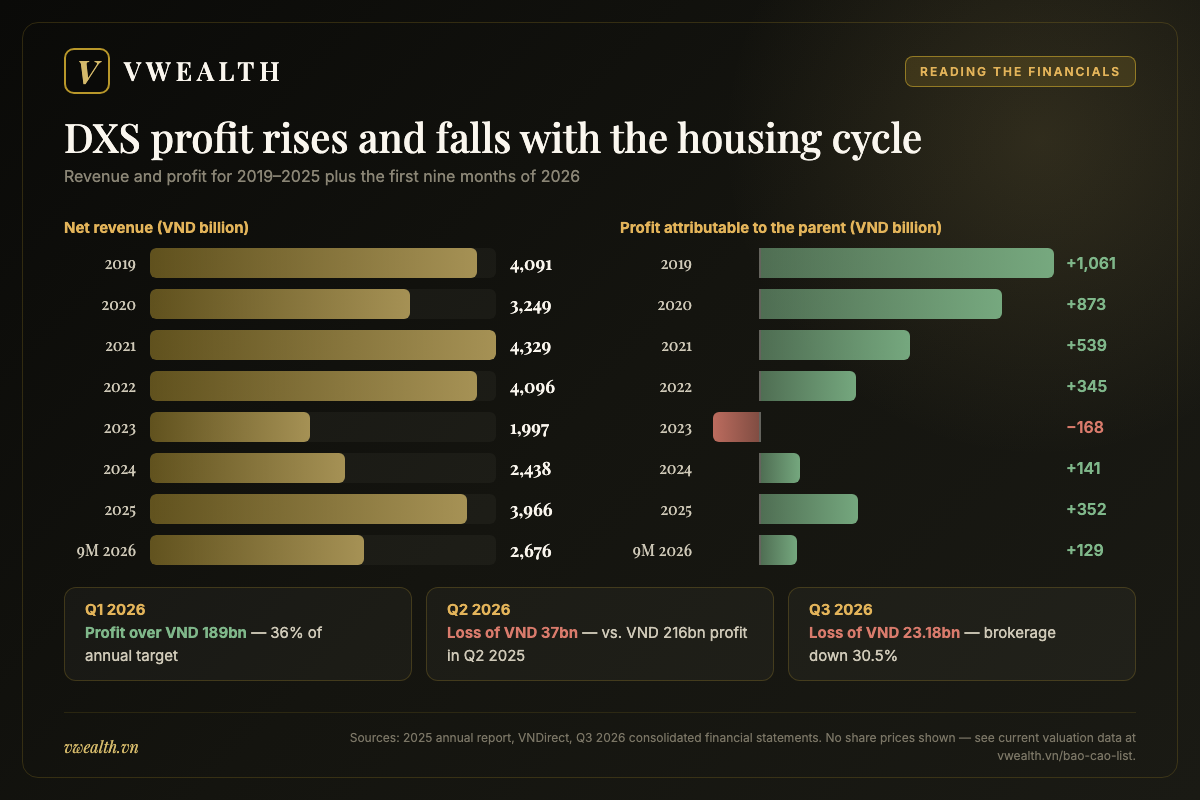
If you could draw only one conclusion from this chart, it would be this: DXS is not a steady growth stock. It is a cyclical stock, tightly linked to the rhythm of home buying and selling. Cyclical stocks are not bad, but they need a different valuation approach from steady growers — which is the subject of the next section.
How to value DXS yourself: P/B, P/E and why you must use figures attributable to parent shareholders
This section does not give a fair value or a price target. Its purpose is to hand you the tools to do the math yourself whenever you open updated figures. The two most common yardsticks are P/E (price to earnings per share) and P/B (price to book value per share). With DXS, both require a preparation step that many people skip.
Step 1 — strip out the minority shareholders’ share. DXS owns between 51% and 100% of its subsidiaries. On consolidation, all of a subsidiary’s revenue and profit is added in, including the portion that belongs to that subsidiary’s other shareholders. In 2025, consolidated profit after tax was VND 523 billion, but VND 172 billion of that belonged to non-controlling interests — about 33% (a vwealth estimate). The portion attributable to DXS shareholders was only VND 352 billion. Likewise, consolidated equity at the end of 2025 was VND 8,832 billion, of which non-controlling interests accounted for VND 2,488 billion, so equity attributable to parent shareholders was roughly VND 6,344 billion (a vwealth estimate). If you use consolidated figures to compute P/E or P/B, DXS will look “cheaper” than it really is.
Step 2 — calculate book value per share (BVPS). The formula: BVPS = equity attributable to parent shareholders ÷ shares outstanding. Using end-2025 figures: VND 6,344 billion ÷ about 579.1 million shares ≈ VND 10,950 per share (a vwealth estimate). Once you have the share price on the day you look, P/B = market price ÷ BVPS. A P/B below 1 means the market is paying less than book value; above 1 means it is paying more.
Step 3 — calculate EPS. 2025 EPS ≈ VND 352 billion ÷ 579.1 million shares ≈ VND 608 (a vwealth estimate). Basic EPS for the first nine months of 2026, according to the Q3 consolidated financial statements, was VND 223 (same period a year earlier: VND 576). P/E = market price ÷ EPS of the last four quarters.
| Metric | Formula | DXS figure to use as the denominator | What to watch when reading it |
|---|---|---|---|
| BVPS | Equity attributable to parent shareholders ÷ shares outstanding | ≈ VND 10,950 (end-2025, vwealth estimate) | Remove the VND 2,488 billion of non-controlling interests before dividing |
| P/B | Market price ÷ BVPS | Use the price on the day you check | Assets are heavy in receivables and deposits — check asset quality before trusting a low P/B |
| Annual EPS | Profit after tax attributable to parent shareholders ÷ weighted average shares | ≈ VND 608 (2025, vwealth estimate) | Profit swings sharply by quarter; use the last four quarters |
| Nine-month EPS | As reported in the financial statements | VND 223 (9M 2026); VND 576 (9M 2025) | Losses in Q2–Q3 2026 dragged EPS down |
| P/E | Market price ÷ EPS of the last four quarters | Use updated price and EPS | At the bottom of the cycle, low EPS makes P/E look very high — that does not necessarily mean expensive |
An illustration of how to read it, without using a real price: suppose you open a report and see that DXS’s P/B is below 1. The next question is not “buy now” but “how solid is that book value?” For DXS, most current assets sit in receivables: at the end of 2025, short-term receivables were VND 9,758 billion, of which other receivables were VND 7,689 billion, mostly deposits paid under project marketing and distribution contracts. Provisions for doubtful receivables rose from VND 203 billion to VND 284 billion during 2025, and provisions for deposits and advances rose from VND 114.0 billion to VND 199.4 billion. If part of those deposits cannot be fully recovered, book value will be revised down. So a low P/B at DXS has to be read together with the quality of those deposits — a low multiple only means something when the assets behind it can be trusted.
Conversely, suppose the trailing four-quarter P/E looks very high. With a cyclical stock, that may be because earnings are at a trough rather than because the price is too expensive. Many experienced cyclical investors even put it the other way round: buy cyclicals when P/E is high (earnings are depressed) and be careful when P/E is low (earnings are at a peak). That saying is not a law, but it reminds you not to apply P/E mechanically to DXS.
You can find daily updated price, P/E and P/B figures for DXS and its sector peers in the latest analysis reports on vwealth. This article only helps you know which framework to put those numbers into. If you are new to the market’s mechanics — daily trading bands, settlement cycles, foreign ownership limits — vwealth’s pillar guide on how to invest in the Vietnam stock market covers the basics.
Vietnam’s property brokerage sector in 2026: interest rates, inventory and hesitant buyers
A real estate brokerage does not sell its own products. It sells the ability to bring buyers to other people’s products — and earns a fee when the deal closes. That is why the health of DXS comes down to a very simple question: how many people put down money for a home this month? This chapter walks through Vietnam’s housing market in 2025 and in Q3 2026, so you can understand why the same organization can make a large profit in Q1 and then lose money in the two quarters that follow. For the developer side of the same market, vwealth’s analyses of Vinhomes (VHM) and Nam Long (NLG) are good starting points.
2025: a recovering market and a 53% jump in supply
According to data from DXS-FERI — DXS’s own real estate market research institute — presented in the 2025 annual report, Vietnam’s economy grew by about 8.02% in 2025. Primary housing supply reached more than 133,000 units, up 53% from 2024. The absorption rate — the percentage of units launched for sale that buyers put a deposit on or signed contracts for — was around 50–55%, nearly double the previous year.
Those three numbers go a long way toward explaining why 2025 was a recovery year for DXS: net revenue climbed to VND 3,966 billion, profit before tax reached VND 662 billion (up 94%), and the real estate services segment brought in VND 2,407 billion, or 60.7% of revenue. For a broker, more supply means more projects to take on for distribution; higher absorption means each project sells faster, fees come in sooner and deposits are refunded earlier.
In the same annual report, DXS-FERI set out its outlook for 2026. This is the company’s own forecast, reported here so you can see how DXS’s research unit viewed 2026 at the start of the year — it is not a vwealth projection. On supply, the company’s research unit forecast more than 125 new projects, with the North at about 60,056 units (44%, 43 projects), the South at about 54,795 units (40%, 46 projects), the Central region at about 11,614 units (9%) and the Mekong Delta (the West) at about 9,848 units (7%). It also sketched three scenarios for the 2026 housing market:
- Ideal scenario: floating mortgage rates of 9–11%, absorption of 50–60%.
- Expected scenario: floating mortgage rates of 10–12%, absorption of 40–50%.
- Challenging scenario: floating mortgage rates of 12–14%, absorption of 25–35%.
The value of these three scenarios for you is not in deciding which one is “right.” It is that they show DXS itself treats mortgage rates and absorption as the two decisive variables. As you read the Q3 2026 section below, you can place the actual numbers next to the frame the company drew at the start of the year.
Q3 2026: absorption falls to a two-year low
According to the Vietnam Real Estate Market Research and Evaluation Institute (VARS IRE), as cited by Vietstock in October 2026, Vietnam saw 31,844 new housing units launched and 12,520 successful transactions in Q3 2026. The absorption rate was 39.3% — the lowest in two years. The Ministry of Construction recorded about 92,000 transactions in the quarter, down 8% from Q2; inventory reported by developers stood at around 51,950 homes and land plots, nearly double the same period a year earlier.
In Hanoi, CBRE recorded 3,900 apartments sold in Q3 2026, down 33% from Q2 and down 66% year on year. Average apartment prices, according to VARS IRE, remained high: about VND 79.3 million per square meter in Hanoi and about VND 88.3 million per square meter in Ho Chi Minh City.
Set against the frame DXS-FERI drew at the start of the year, Q3’s 39.3% absorption sits right on the line between the “expected” and “challenging” scenarios. That is actual data, not speculation, and it matches what DXS’s own financial statements say: in its explanation of Q3 2026 results, the company said real estate brokerage revenue fell 30.5% because the housing market was under pressure from high interest rates and cautious buyers. Net revenue for Q3 was just VND 633.7 billion, compared with VND 864.1 billion in the same quarter a year earlier.
Notice the paradox? Apartment prices remain high and inventory has nearly doubled, yet transactions are falling. For developers, that is a cash flow problem. For a broker like DXS, it is a revenue problem: when customers do not close, no brokerage fee is earned, but the sales force and offices still have to be paid every month. This is the operating leverage of the brokerage model — strong on the way up, equally strong on the way down.
Floating mortgage rates of 13–15% and buyers taking three to five months to decide
Why are buyers hesitating? The shortest answer lies in the mortgage contract. According to Vietstock (October 2026), fixed rates for the first 12 months are commonly 8.5–11.5% a year, but after the promotional period, floating rates at some banks rise to 13–15% a year. In Vietnam, most home loans work this way: a teaser fixed rate followed by a floating rate tied to the bank’s own reference. On a mortgage that runs for many years, a few percentage points of difference can lift the monthly installment significantly. Owner-occupiers understand that; investor-buyers understand it even better.
Compare that with DXS-FERI’s frame: floating rates of 13–15% at some banks are already above the 12–14% band the company assigned to its “challenging” scenario. Of course, that is the level at some banks after the promotional period, not the market-wide average. But it is enough to explain the mood.
Two surveys make that mood more concrete. Batdongsan.com.vn, Vietnam’s largest property listings site, surveyed 530 brokers: 36% said their clients were postponing decisions, 25% said clients were waiting for prices to fall, and only 18% said clients were ready to close; 46% of brokers named high interest rates as the biggest barrier. DXS-FERI, for its part, surveyed 968 customers: 76% of buyers needed three months or more to make up their minds, and nearly 40% took five months or longer.
That 76% figure is worth pondering from the perspective of a DXS shareholder. It means a sales campaign launched this quarter may only show results next quarter, or the quarter after that. Brokerage revenue therefore lags the moment the market turns. When interest rates start to fall, do not expect DXS’s reports to reflect it in the very next quarter; and conversely, when the market starts to deteriorate, deals that “ripened” earlier can keep revenue up for a while longer. Understanding this lag helps you avoid overreacting to any single quarter.
Three new laws and the professionalization of real estate brokerage
Beyond interest rates, there is a longer-term force acting on the brokerage industry: the legal framework. According to DXS’s 2025 annual report, the 2024 Land Law, the 2023 Housing Law and the 2023 Law on Real Estate Business took effect and were rolled out over 2024–2025, aiming to make the market more transparent and standardized.
For a large brokerage, standardization is usually more good news than bad. The reason is compliance cost. When the law demands more transparent transactions, tighter paperwork and more professional brokers, small independent agents who work informally find it harder to survive; meanwhile a system with processes, training and sales technology like DXS spreads compliance costs across a large scale, so the cost per transaction is lower. The 2025 annual report also notes that Dat Xanh North (DXMB), a unit within the group, met the standards of the Code of Ethics and Professional Conduct for real estate brokerage (VPEC) — a sign that the company is actively moving toward standardization.
The downside of new laws is the transition period. As new rules are rolled out, developers must complete their legal documentation again, and some projects launch later than planned. For a broker, a delayed launch means delayed revenue, while the deposit already paid to the developer stays where it is. This is one reason why the legal progress of each project in the distribution portfolio — something you can hardly see in the financial statements — has a real impact on DXS.
One more detail worth remembering: DXS’s CEO said at the 2025 annual general meeting that many developers lack project development capability, so DXS provides a full package from design and construction to sales and financing arrangements. Read against the new legal framework, that remark can be understood this way: as procedures become more complex, smaller developers need a partner to handle more stages for them — and that is the opportunity for a broker to expand into project development services, as Chapter 3 described.
Parent company Bluemarq moves in step: Q3 2026 seen from DXG’s side
DXS does not stand alone. Its parent — Bluemarq Group (formerly Dat Xanh Group, ticker DXG) — is both the shareholder holding 55.37% and an important source of projects. Reading the parent’s reports therefore lets you cross-check the picture at DXS. This section only covers the points that relate directly to DXS.
According to CafeBiz (October 31, 2026), in Q3 2026 Bluemarq reported revenue of VND 682 billion (down 36%) and profit after tax of VND 3.2 billion (down 98%). For the first nine months, revenue was about VND 2,882 billion (up 5%) and profit after tax VND 252 billion (down 51%). The company explained that high mortgage rates made buyers cautious, and revenue from apartments, land plots and brokerage all fell in Q3 — almost exactly the same explanation DXS gave.
Yet the same report contains a number pointing the other way: Bluemarq’s advances from customers rose to more than VND 9,056 billion, the highest ever. Advances from customers are money buyers have paid according to the contract schedule but that has not yet been recognized as revenue because the project has not been handed over. Under Vietnamese accounting, developers book revenue at handover, so this is revenue “in waiting.” At DXS, the equivalent item also rose: short-term advances from customers reached VND 1,254.9 billion on September 30, 2026, compared with VND 857.1 billion at the start of the year.
That two-sided picture is what you should carry into the next chapter: the market for new transactions is slow, but part of future revenue is already “locked in” through contracts awaiting handover. New transactions drive the brokerage segment; handovers drive the segment that sells real estate from projects within the network. Other EN analyses on vwealth — for instance Khang Dien (KDH) and Novaland (NVL) — show the same handover-driven revenue pattern from the developer’s side.
The table below gathers the market indicators mentioned above for easy comparison.
| Indicator | 2025 | Q3 2026 | Source |
|---|---|---|---|
| Housing supply launched | More than 133,000 primary units (+53%) | 31,844 newly launched units | DXS-FERI (2025 annual report); VARS IRE |
| Absorption rate | About 50–55% | 39.3% — lowest in two years | DXS-FERI; VARS IRE |
| Transactions | — | 12,520 primary transactions (VARS IRE); about 92,000 transactions, −8% vs Q2 (Ministry of Construction) | Vietstock, October 2026 |
| Inventory reported by developers | — | About 51,950 homes and plots, nearly double a year earlier | Ministry of Construction (via Vietstock) |
| Hanoi — apartments sold | — | 3,900 units, −33% vs Q2, −66% year on year | CBRE (via Vietstock) |
| Mortgage rates | — | Fixed for the first 12 months at 8.5–11.5%; floating at 13–15% at some banks | Vietstock, October 2026 |
| DXS brokerage revenue | Real estate services VND 2,407 billion (60.7% of revenue) | Down 30.5% year on year | 2025 annual report; Q3 2026 consolidated financial statements |
Where is DXS stock heading? Growth drivers, risks and three condition-based scenarios
This chapter does not predict the share price and does not put a number on future profit. The reason is simple: for a company that, within 2026 alone, has posted one quarter with a profit of more than VND 189 billion followed by two straight losing quarters, any projected figure would easily give you a false sense of certainty. Instead, this chapter does something more useful: it identifies what will determine DXS’s results and, for each scenario, which conditions would have to occur. The only reference points are figures that have already been published: the 2026 shareholder-approved plan and the actual nine-month results.
The annual general meeting on April 24, 2026 set a plan of VND 5,300 billion in revenue and VND 527 billion in profit after tax attributable to parent shareholders — about 50% more than the VND 352 billion of 2025. After nine months, DXS had achieved VND 2,676.05 billion in revenue and VND 129.26 billion in profit attributable to the parent, equivalent to about 50% of the revenue plan and about 25% of the profit plan (vwealth estimates). In other words, roughly three quarters of the full-year profit plan still lies ahead, while the two most recent quarters were both loss-making. That is the real starting point for every scenario.
Driver one: handovers of projects within the network — the lesson of Q1 2026
Q1 2026 is the clearest example of how sharply DXS can rebound. Net revenue was nearly VND 1,416 billion, up 176%; profit after tax attributable to the parent was more than VND 189 billion, up 372%. That single quarter delivered 27% of the full-year revenue plan and 36% of the full-year profit plan.
How can one quarter be that big? The answer lies in the segment that sells apartments, townhouses and land plots from projects within the network. Unlike brokerage fees — which trickle in whenever a deal closes — revenue from selling property is only recognized when the unit is handed over to the buyer. A project that hands over in bulk can pour a large amount of revenue into a single quarter. Cara River Park in Cai Rang, Can Tho, which began handovers in December 2025, is an example of that kind of project.
On March 31, 2026, DXS’s inventory exceeded VND 5,100 billion, including more than VND 2,400 billion of completed property and more than VND 2,300 billion of property under construction at projects such as Regal Legend, La Maison, Dat Quang Riverside and Tuyen Son. By September 30, 2026, inventory had risen to VND 5,452.0 billion. Short-term advances from customers rose to VND 1,254.9 billion (VND 857.1 billion at the start of the year). Together, these two figures tell you that there is product waiting, and there are customers who have already paid and are waiting.
For this driver to work, the condition is progress: projects must be completed, legally eligible for handover, and buyers must take possession. At that point, advances from customers turn into revenue, inventory turns into cost of goods sold, and profit is recognized. The timing of handovers is decided by project progress rather than by the market — which makes this a driver you can track through company disclosures instead of guessing.
One caveat: because these projects sit in subsidiaries that DXS does not own 100%, part of the profit will belong to non-controlling interests. As calculated in Chapter 5, that portion was about 33% of consolidated profit in 2025 (a vwealth estimate). When you read a headline such as “DXS posts big profit on handovers,” check the line for profit attributable to parent shareholders.
Driver two: moving from per-transaction fees to recurring cash flow
At the 2026 annual general meeting, CEO Tran Quoc Thinh outlined a shift away from a model that earns fees deal by deal toward one that generates recurring cash flow: expanding project development, property management and operations, asset leasing and exploitation, and financial and technology services; and looking for M&A opportunities in operations, asset exploitation and land bank.
To see why this direction matters, think about two ways of making money. A brokerage fee is like a car salesperson’s commission: you earn on each car sold, and in a slow month income drops to almost nothing. A property management fee is like a subscription: a completed building needs managing every month, whether the housing market is hot or cold. Businesses with more subscription-style revenue are usually valued more steadily by the market because their profits fluctuate less.
Concrete steps have already been taken. In September 2025, the board approved setting up Primo Estates Real Estate Services JSC; on October 30, 2026, board resolution No. 13 approved a capital contribution to establish a subsidiary that the disclosure documents describe as being in property management and operations. In 2025, the other services segment (investment advisory, asset management and value-added services) reached VND 379 billion, VND 114 billion more than in 2024.
At the same time, DXS has been trimming its portfolio: dissolving Dat Phat Hung Real Estate JSC (the new name of Dat Xanh Commercial) under a resolution dated April 6, 2026, and approving the transfer of its entire stake in Dat Xanh South (an associate) at a minimum price equal to book value under a resolution dated January 14, 2026. Shedding non-core pieces to concentrate resources on the new direction is sensible — but its effectiveness has to be measured by results in the quarters ahead.
The condition for this driver to become real is scale. At VND 379 billion in 2025, the other services segment accounted for less than a tenth of revenue. For recurring cash flow to genuinely cushion the weak brokerage quarters, this segment has to grow many times over. That is a multi-year job, not a one-quarter one.
Key risks: interest rates, slow deposit refunds and rising costs
Mortgage rates. This is the biggest external variable. As Chapter 6 showed, post-promotion floating rates at some banks are at 13–15% a year, and absorption in Q3 2026 was only 39.3%. DXS has no control over this variable.
Slow deposit refunds. The underwriting model requires DXS to place deposits with developers to secure distribution rights. On March 31, 2026, DXS’s other receivables exceeded VND 7,700 billion, of which deposits under marketing and distribution contracts were nearly VND 5,800 billion. When a project sells slowly, the deposit stays with the developer for longer, which means DXS has to use other sources — including borrowings — to run its business. Provisions for deposits and advances rose from VND 114.0 billion to VND 199.4 billion during 2025, showing that this risk is not merely theoretical.
Costs growing faster than revenue. In the first nine months of 2026, general and administrative expenses rose from VND 188.34 billion to VND 309.93 billion, interest expense from VND 66.78 billion to VND 96.63 billion, and selling expenses from VND 477.91 billion to VND 486.86 billion. Borrowings at September 30, 2026 comprised VND 1,790.9 billion of short-term loans and VND 1,028.8 billion of long-term loans. The system has expanded to 56 member companies and about 4,000 employees; if revenue does not keep pace, a large organization becomes a burden.
Subsidiary income in the parent-only statements. The separate (parent-only) financial statements for Q3 2026 show profit after tax at the DXS parent of just VND 14.78 billion, down 90%, because there were no dividends from subsidiaries; financial income fell from VND 117.82 billion to VND 26.49 billion. This reminds you that DXS’s ability to pay dividends to its own shareholders depends on its subsidiaries passing profits up the chain.
Three scenarios for DXS: optimistic, base and adverse — conditions only, no promised numbers
The three scenarios below are not forecasts. They are three “maps” you can check against every time new information comes out: which conditions are actually happening, and which scenario DXS is drifting toward. The only reference points are published figures — the 2026 plan of VND 5,300 billion in revenue and VND 527 billion in profit attributable to the parent; and the nine-month actuals of VND 2,676.05 billion and VND 129.26 billion.
Optimistic scenario — the cycle turns at the same time as handovers. Conditions: mortgage rates cool noticeably, especially the post-promotion floating portion; market absorption returns to the range achieved in 2025; projects in the network such as Regal Legend, La Maison, Dat Quang Riverside and Tuyen Son are handed over on schedule, converting advances from customers into revenue; and distribution deposits are refunded steadily as projects sell out. In that case, DXS would repeat the Q1 2026 picture more often, and the gap between actual results and the shareholder-approved plan would narrow. How to recognize it: brokerage revenue starts growing year on year again, and deposit provisions stop rising.
Base scenario — a slow market, with handovers keeping the rhythm. Conditions: mortgage rates stay at current levels and absorption hovers around the Q3 2026 level; brokerage remains weak but does not deteriorate further; some projects in the network are still handed over. In that case, DXS’s profit would rise and fall with the handover calendar — profitable in some quarters, loss-making in others, as 2026 has already shown — and whether the shareholder-approved plan is met would depend almost entirely on whether a large handover happens in Q4. How to recognize it: brokerage revenue moves sideways, and advances from customers decline gradually (as they convert into revenue) without being replenished by new contracts.
Adverse scenario — prolonged high rates and stuck deposits. Conditions: floating rates of 13–15% persist; absorption stays low and developer inventory keeps building; projects are delayed in handover because of developers’ legal or financial problems; distribution deposits are refunded slowly, forcing DXS to set aside more provisions; and administrative and interest costs keep rising as they did in the first nine months of 2026. In that case, pressure would build on the balance sheet: operating cash flow — already negative in four of the five years from 2021 to 2025 — would keep needing borrowings to fill the gap. How to recognize it: provisions for receivables and deposits rise sharply, borrowings increase, and losses extend over several more quarters.
The image below summarizes the three scenarios by their conditions, alongside the published plan and actual figures.
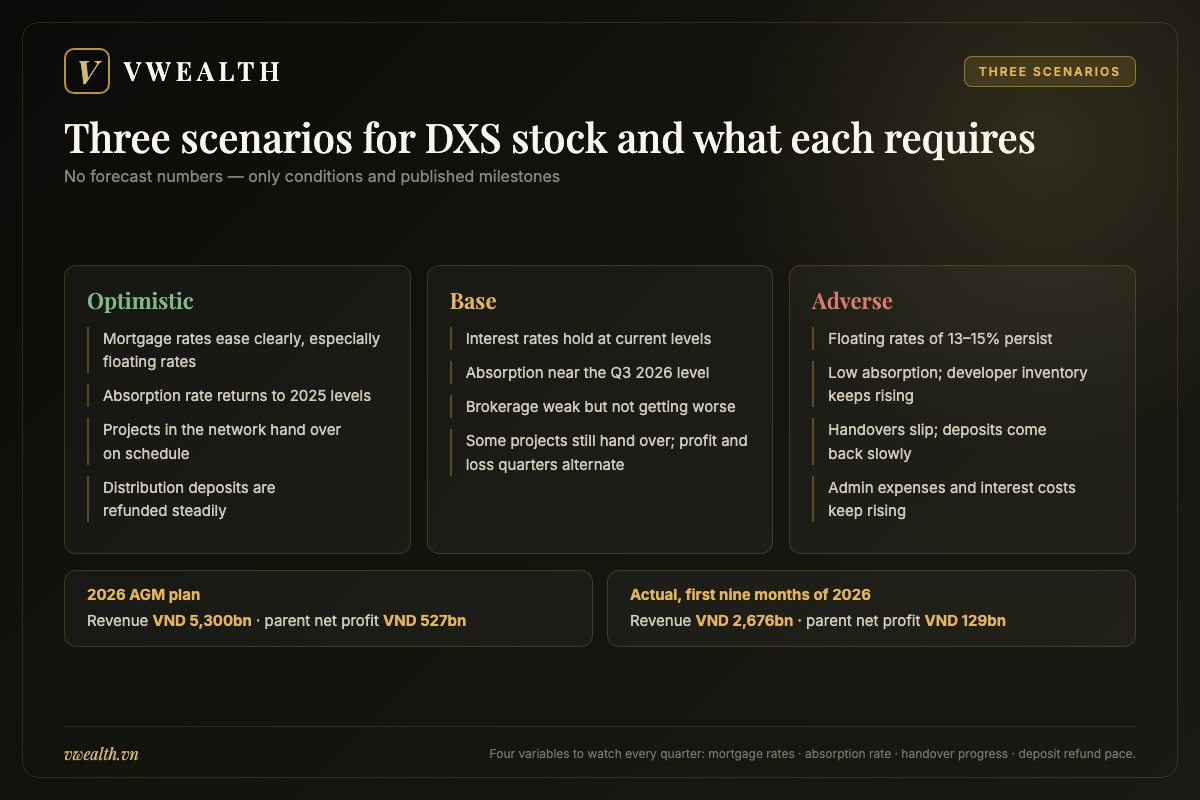
You will notice that all three scenarios revolve around the same four variables: mortgage rates, absorption, handover progress and the pace of deposit refunds. That is no accident. For DXS, nearly every business outcome comes back to these four variables — and they are also the four things you should be tracking.
Signals to watch every quarter
Rather than guessing, you can turn those four variables into a checklist to run each time DXS publishes quarterly results. It takes about fifteen minutes, but it helps you see which scenario DXS is drifting toward before the share price reflects it.
1. Market absorption. Follow the quarterly reports from VARS IRE, CBRE, the Ministry of Construction and DXS-FERI itself. Reference points: 50–55% in 2025, 39.3% in Q3 2026. Absorption moves first, and DXS’s brokerage revenue usually follows with a lag — remember that 76% of buyers need three months or more to make a decision.
2. Advances from customers. On DXS’s balance sheet, this line is revenue that “already has a buyer and is waiting for handover.” Reference points: VND 857.1 billion at the start of 2026, VND 1,254.9 billion on September 30, 2026. If this line rises, more contracts have been signed; if it falls while property sales revenue rises, handovers are underway; if it falls and revenue does not rise, that is a signal to dig deeper.
3. Other receivables and deposit provisions. Reference points: other receivables of VND 7,689 billion at the end of 2025, deposits under marketing and distribution contracts of nearly VND 5,800 billion on March 31, 2026; provisions for deposits and advances of VND 199.4 billion at the end of 2025. What you want to see is deposits being refunded gradually and provisions no longer rising. The notes to the financial statements give the detail; vwealth’s guide to Vietnamese company financial statements in English shows where to look.
4. Q4 2026 results versus plan. After nine months, DXS had reached about 25% of its full-year profit plan (a vwealth estimate). Q4 results — published in early 2027 — will show whether the company made large handovers in the final quarter, and the 2027 annual general meeting will have to explain the gap against the plan. How management explains it and sets the new plan is valuable information in itself.
5. Administrative and interest expenses. Nine-month 2026 reference points: administrative expenses of VND 309.93 billion, interest expense of VND 96.63 billion. If revenue does not grow while these two lines keep rising, margins will continue to erode.
6. Profit attributable to parent shareholders, not consolidated profit. Always read the bottom line. In 2025, roughly a third of consolidated profit belonged to non-controlling interests (a vwealth estimate).
Should I buy DXS stock? Weighing the pros, the cons and who it suits
By now you have walked through the whole story: a large brokerage within the Dat Xanh system, now part of Bluemarq Group, trying to shift from “selling on behalf of others” to “co-developing projects” and “earning recurring fees”; a stock that once lost margin eligibility and saw its second-largest shareholder leave in a single session; and a 2026 that opened with a big profitable quarter followed by two losing ones. The question of whether to buy DXS stock has no single answer for everyone. It depends on who you are, what you look for in a stock and what you can tolerate. This chapter weighs both sides, then lets you place yourself in the picture.
The pros: a large network, a supply of projects from the ecosystem and a strong rebound on handovers
A distribution network that is hard to copy. According to the 2025 annual report, DXS has 56 member companies, more than 15,000 sales staff and collaborators, and more than 350 distribution partners and agents; it works with more than 250 developers and landowners and has distributed more than 500 projects. The network stretches from Hanoi, Quang Ninh and Thanh Hoa through Da Nang, Quang Nam and Quang Ngai to Ho Chi Minh City, Can Tho and the Mekong Delta. In 2025, DXS ranked first for successful transactions at The Privé, A&T Sky Garden, Symlife and A&T Saigon Riverside. Building a network like this takes many years and a lot of capital; it is a genuine competitive advantage.
A supply of projects from the ecosystem. The parent company holds 55.37% and is also a major developer. For a broker, having a “big client” in-house helps secure project supply even when new products are hard to find in the market. On top of that, companies within the system such as Regal Group (the luxury segment, traded on UPCoM under the ticker RGG) and CARA Group also develop their own projects.
A strong profit rebound on handovers. Q1 2026 showed that when a large handover takes place, DXS’s profit can jump sharply — profit attributable to the parent of more than VND 189 billion, up 372%. Inventory of VND 5,452.0 billion and advances from customers of VND 1,254.9 billion at September 30, 2026 are the raw material for the next rounds of handovers.
A clear direction. The move toward recurring cash flow already has concrete steps behind it: establishing Primo Estates (September 2025), contributing capital to set up a property management and operations subsidiary (October 30, 2026), and trimming non-core units. The other services segment grew by VND 114 billion in 2025. If this direction succeeds, DXS will become less dependent on the cycle.
A beneficiary of industry standardization. The new legal framework demands more professional brokerage. A system with established processes like DXS can absorb compliance costs more easily than small independent brokers.
The cons: cyclical profits, assets tied up in deposits and negative cash flow
Profits depend on the cycle. Over the past seven years, profit attributable to the parent went from VND 1,061 billion (2019) to a loss of VND 168 billion (2023) and back to VND 352 billion (2025). In 2026, Q2 and Q3 were loss-making. Brokerage revenue in Q3 2026 fell 30.5%. In a business like this, one good year does not guarantee the next.
Assets concentrated in receivables and deposits. At the end of 2025, short-term receivables were VND 9,758 billion, of which other receivables were VND 7,689 billion — nearly half of total assets of VND 16,843 billion (a vwealth estimate). Deposits for project marketing and distribution contracts amounted to VND 5,844 billion, including a brokerage deposit with the related party Ha An of VND 2,055.75 billion. Provisions for doubtful receivables and for deposits both rose in 2025. DXS’s book value therefore depends heavily on its ability to recover these amounts.
Negative operating cash flow in most years. Net cash flow from operating activities was negative VND 875 billion (2021), negative VND 2,566 billion (2022), negative VND 186 billion (2023), positive VND 218 billion (2024) and negative VND 137 billion (2025) — negative in four of five years. In 2025, financing cash flow was positive VND 801 billion, meaning the company took on additional net borrowings to fill the gap. Borrowings at the end of 2025 were about VND 2,993 billion (a vwealth estimate, adding short- and long-term loans), and interest expense for the first nine months of 2026 rose to VND 96.63 billion.
Profits shared with minority shareholders. About 33% of consolidated profit in 2025 belonged to non-controlling interests (a vwealth estimate). News about “consolidated profit” can lead you to overestimate the part that actually belongs to you as a DXS shareholder.
The full-year plan is still far off. After nine months, DXS had reached only about 25% of its profit plan (a vwealth estimate). Its second-largest shareholder sold out entirely in December 2025. These are facts to weigh honestly — not to be afraid of, but to know exactly what risk you are taking on.
Should I buy DXS stock as a dividend, value or cyclical investor?
If you are a dividend investor. DXS is not an obvious choice. Profits fluctuate, operating cash flow has been negative in most years, and the DXS parent’s ability to pay depends on dividends from subsidiaries — the parent-only Q3 2026 statements showed profit falling 90% without them. Recent history has also leaned toward stock dividends (the 100:26.7 ratio in 2023). Investors who need a steady annual cash income should look elsewhere.
If you are a value investor. DXS may come onto your radar when its P/B is low — but as Chapter 5 explained, P/B only means something when the assets behind it can be trusted. For DXS, the key question is the quality of more than VND 5,800 billion in deposits. Only if you can read the notes yourself and understand which project each deposit is tied to and how that project is progressing do you have a basis for calling a low P/B “cheap.” Otherwise, a low P/B may simply be an accurate reflection of risk.
If you are a cyclical investor. This is the group DXS suits best. The stock reflects the rhythm of the housing market quite faithfully: mortgage rates, absorption and buyer sentiment. If you can track those indicators and are patient enough to wait for the cycle, DXS is one way to participate in the sector’s recovery. But remember two things: cyclical stocks usually move ahead of business results, and you need to be able to stomach deep drops such as the roughly 32% decline over three and a half months in late 2025.
If you want to compare. Within the real estate group, each company sits at a different point on the value chain. Developers with land banks, such as those covered in vwealth’s analyses of NLG stock, KDH stock or CEO Group stock, make money by selling their own products; DXS mainly makes money by selling on behalf of others and providing services around projects. Put them side by side and you will see that each model’s risk sits in a different place: developers carry land bank and project legal risk, while brokers carry market liquidity and deposit risk.
A six-question checklist before you put money into DXS
Before placing an order, answer the six questions below. If there is one you cannot yet answer, that is where you need to do more research — not where you should guess.
1. Which phase is the housing market in? What was the absorption rate in the latest quarter, compared with 50–55% in 2025 and 39.3% in Q3 2026? Are mortgage rates going up or down?
2. What was profit attributable to parent shareholders over the last four quarters? Are you mistakenly looking at the consolidated figure?
3. Which way are deposits and provisions heading? Are other receivables gradually declining, and have deposit provisions stopped rising?
4. Are any projects in the network about to be handed over? Are advances from customers rising or falling, and is inventory turning into revenue?
5. Are you valuing DXS on P/B or P/E, and with which figures? Have you calculated BVPS after removing non-controlling interests? Have you checked the updated price, P/B and P/E in vwealth’s analysis reports?
6. What will you do if the stock falls by another third? In late 2025 the stock dropped about 32% in three and a half months. If that happens again, will you sell, hold or buy more? Answer before you buy, not when it happens.
The table below brings together the pros and cons discussed, along with where you can track each factor.
| Factor | Pro | Con | Where to track it |
|---|---|---|---|
| Distribution network | 56 member companies, 15,000+ sales staff and collaborators, 500+ projects, 250+ developers (2025) | A large organization is costly when the market is slow; administrative expenses rose to VND 309.93 billion in 9M 2026 | Annual report; administrative expenses in quarterly financial statements |
| Project supply | Parent Bluemarq (DXG) holds 55.37% and is a major developer | Dependent on the parent’s business rhythm; DXG earned VND 3.2 billion in Q3 2026 | DXG’s financial statements; new project announcements |
| Project handovers | Profit of more than VND 189 billion in Q1 2026 on handovers; advances from customers of VND 1,254.9 billion (September 30, 2026) | Handover timing is uneven, so profit bunches into a few quarters | Advances from customers; inventory |
| Underwriting deposits | Secure exclusive distribution rights and give leverage with developers | Other receivables of VND 7,689 billion (end-2025); deposit provisions rose to VND 199.4 billion | Notes on receivables and provisions in the financial statements |
| Cash flow and borrowings | Operating cash flow was positive VND 218 billion in 2024 | Operating cash flow negative in 4 of 5 years 2021–2025; borrowings of about VND 2,993 billion at end-2025 (vwealth estimate) | Cash flow statement |
| Recurring cash flow | Primo Estates; property management subsidiary (October 30, 2026); other services +VND 114 billion in 2025 | Still small in scale (VND 379 billion in 2025) | Revenue breakdown in the annual report |
| 2026 plan | Profit target of VND 527 billion, about 50% above 2025 | 9M 2026 reached about 25% of the profit plan (vwealth estimate); losses in Q2–Q3 | Q4 2026 financial statements; 2027 AGM |
Final thoughts: DXS is a “thermometer” for Vietnam’s housing market
If you had to sum up DXS in a single image, it would be a thermometer. When the housing market warms up — rates fall, buyers return, projects sell quickly — DXS benefits early and strongly: brokerage fees rise, deposits are refunded quickly, and projects in the network are handed over smoothly. When the market cools, DXS feels it early and clearly too: brokerage revenue falls, deposits sit for longer, and the large organization becomes a burden. 2026 has shown both states within just three quarters.
The central question for DXS in the years ahead is whether the company can escape its fate as a “thermometer” by moving into project development and recurring fees. The first steps have been taken, but their scale is still small compared with brokerage. Until recurring cash flow is large enough to act as a cushion, DXS will remain a stock that rises and falls with mortgage rates.
So whether you should buy DXS stock depends on whether you want to bet on Vietnam’s housing cycle — and whether you have the patience and the tools to follow that cycle. If you do, DXS is a direct way to take part, with a large distribution network and a supply of projects from the Bluemarq ecosystem. If you need stability, regular dividends or predictable earnings, DXS is probably not the right fit at this point.
Whichever path you choose, do not decide on the basis of a single quarter. Track the four variables — mortgage rates, absorption, handover progress and the pace of deposit refunds — across several reporting periods. You can create a free vwealth account to follow DXS’s figures quarter by quarter, compare them with DXG and other Vietnamese real estate stocks, and then make up your own mind. This article is meant to help you understand the business; it is not a recommendation to buy or sell.
Research Vietnamese stocks in English with vwealth. Our AI-powered platform turns Vietnamese market data into full English analysis reports — with international payment support and a free first month when you subscribe in the VWEALTH app. Create your free account and read the latest reports.