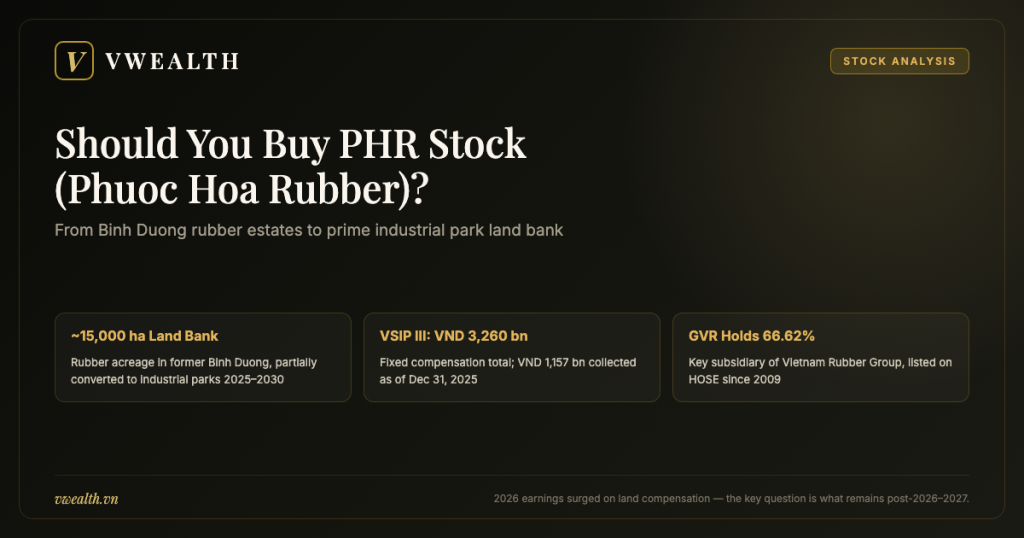
Whether you should buy PHR stock — the ticker of Phuoc Hoa Rubber Joint Stock Company on the Ho Chi Minh City Stock Exchange (HOSE) — sounds on the surface like an ordinary question about an agricultural plantation operator, but the real answer lies in an entirely different asset class. In 2026, this enterprise, with extensive landholdings in the Phu Giao and Tan Uyen districts of the former Binh Duong province, reported that it had surpassed its full-year earnings target after just nine months, and the bulk of those profits did not come from latex tapping, but from handing over agricultural acreage for massive industrial park developments such as VSIP III and a specialized mechanical engineering zone developed by THACO. On parcels that once grew straight rows of rubber trees, global industrial icons like LEGO, Danish jewelry maker Pandora, and a major data center project have broken ground. This comprehensive guide unpacks the entire corporate trajectory: from an early post-reunification state plantation, through its 2008 equitization and 2009 HOSE listing, to cross-border expansions into Cambodia, high-dividend cycles, and its strategic transformation into an industrial land platform. By the end, international and local investors will have a clear, balanced answer on whether to buy PHR stock, who this ticker fits, and who should stay away.
Before examining the financial statements, several key entities and market terms must be clearly identified for international market participants navigating Vietnam stocks. PHR is the listed ticker of Phuoc Hoa Rubber Joint Stock Company on HOSE. Its controlling parent entity is the Vietnam Rubber Group, officially known in domestic financial filings as VRG, whose flagship parent company shares trade under the ticker GVR. According to shareholder registry data updated by VNDirect on September 11, 2026, GVR holds a controlling 66.62% stake in PHR. Consequently, when international allocators evaluate PHR stock, they are analyzing a state-controlled subsidiary operating within a vast agricultural and industrial ecosystem comprising dozens of sister entities. Some subsidiaries within the VRG orbit focus purely on natural latex production, while others specialize in industrial park development. In this enterprise research series, vwealth previously analyzed an ecosystem peer, SIP stock of Saigon VRG — an industrial developer generating cash through park leasing and utility provision. PHR stands uniquely at the intersection: it is historically an agricultural latex cultivator, geographically a massive landholder in southern Vietnam’s industrial heartland, and strategically transitioning into an industrial real estate and compensation recipient.
Consistent with vwealth’s institutional research methodology across Vietnamese equities, all chronological milestones, executive names, industrial projects, and operational figures cited throughout this analysis are drawn strictly from publicly audited disclosures. These include Phuoc Hoa Rubber’s annual reports and formal corporate filings, regulatory disclosures on HOSE, research reports from domestic institutions including DSC, VDSC, TCBS, FPTS, and Mirae Asset Securities, as well as domestic financial press publications. Audited financial statements from completed fiscal periods serve as definitive historical records. In adherence to strict analytical discipline, this report does not state intraday share prices, current spot price-to-earnings (P/E) multiples, or subjective target prices from brokerage houses. For a company whose bottom line can swing by hundreds of billions of Vietnamese dong simply because an official provincial land recovery decree is signed a quarter earlier or later, spot pricing metrics become obsolete rapidly. Where quantitative estimates are synthesized by vwealth’s analytical team, they are explicitly marked as “vwealth estimate”, while scenario models are designated as an “illustrative example”. Real-time valuation multiples and standardized financial scoring are available directly on vwealth’s analytical reports portal.
The central premise running through this entire dossier is that PHR can no longer be evaluated as a traditional agricultural commodity stock. A decade ago, PHR stock moved in near-perfect synchronization with benchmark natural rubber latex contracts traded on the Singapore Exchange (SICOM) or the Shanghai Futures Exchange (SHFE). Today, it represents a hybrid “land-conversion vehicle”: each fiscal year, selected parcels of mature rubber plantations are legally transferred to provincial industrial zone developers. In return, Phuoc Hoa receives substantial cash compensation, site clearance assistance, and liquidation proceeds from harvested rubber timber. Accounting standards dictate that these vast lump sums flow directly into “other income” rather than operational core revenue. Therefore, determining whether to buy PHR stock hinges on a decisive forward-looking question: once the extraordinary windfall compensation from the 2026–2027 conversion phase is fully collected, can Phuoc Hoa successfully convert its remaining acreage into recurring annual industrial park operating cash flows, or will its corporate earnings mean-revert to the baseline of an ordinary commodity planter?
From Phu Giao Plantation to VSIP III Landlord: Four Decades of Phuoc Hoa Rubber
While many corporate biographies begin with an ambitious founder, an entrepreneurial venture, or an initial retail storefront, the history of Phuoc Hoa Rubber begins strictly with land. Long before corporate registration certificates and stock tickers existed, straight rows of Hevea brasiliensis stretched across the fertile basaltic red soils of northern Binh Duong province — productive agricultural assets originally established by French colonial rubber concessions in the early 20th century and subsequently placed under State management after 1975. Over the ensuing four decades, that contiguous land bank supported a state-owned farm, an official State-Owned Enterprise (SOE), and eventually a publicly listed joint-stock corporation on HOSE. Today, those very hectares are systematically being carved out and handed over to premier international industrial park consortia. Tracing the evolving commercial and legal role of this land bank provides foreign allocators with the fastest and most rigorous understanding of why PHR stock remains simultaneously lucrative, volatile, and complex to model.
From State-Owned Plantation to State Enterprise: 1975–2007
Phuoc Hoa Rubber’s 2014 Annual Report outlines its institutional origins with concise administrative precision. The predecessor to the modern enterprise was the Phuoc Hoa Rubber Plantation. Immediately following the reunification of Vietnam, the facility was nationalized and renamed the Phuoc Hoa State-Owned Rubber Farm. In 1982, the General Department of Rubber established Phuoc Hoa Rubber Company. On March 4, 1993, the company was formally re-established under a ministerial decree issued by the Ministry of Agriculture and Food Industry, officially becoming a state-owned enterprise directly subordinated to the Vietnam Rubber Corporation (now Vietnam Rubber Group – VRG). Between 1993 and 2008, the enterprise operated under a formal business license granted by the Department of Planning and Investment of Song Be province — an administrative territory that younger generations now encounter only in historical geographies, as Song Be was partitioned in 1997 into the two distinct modern provinces of Binh Duong and Binh Phuoc.
This historical and administrative detail carries profound legal and financial implications for foreign investors evaluating how to invest in Vietnam stock market. In Vietnam, under constitutional and land law principles, land is entirely under public ownership and managed by the State. Enterprise operators do not hold freehold titles in the Western legal sense; rather, their core productive acreage consists of land allocated or leased by the State specifically for perennial agricultural purposes. When provincial master plans designate agricultural tracts for industrial park development, agricultural enterprises like PHR do not “sell real estate” on the open market. Instead, provincial authorities execute formal land recovery decisions (quyết định thu hồi đất), and the designated park developer provides monetary compensation for assets attached to the land (primarily mature rubber tree stands), site clearance support payments, and contractual profit-sharing arrangements, while the enterprise retains the right to auction the logged timber. Grasping this institutional mechanism prevents foreign analysts from committing the common error of treating PHR as a private real estate owner capable of liquidating property parcels at prevailing open-market commercial real estate prices.
During its decades as a state-owned enterprise, Phuoc Hoa built a substantial, integrated industrial processing complex to support its harvesting operations. According to corporate filings in its 2014 Annual Report, the company constructed three major primary latex processing facilities: the Bo La factory located in Phuoc Hoa commune with an annual capacity of 6,000 tonnes; a specialized centrifuged latex processing plant also located in Phuoc Hoa with an annual capacity of 3,000 tonnes; and the flagship Cua Paris processing factory situated in Ben Cat, boasting an annual capacity of 18,000 tonnes. Combined, these three processing centers provided an aggregate annual processing capacity of 27,000 tonnes — an operational benchmark that remains cited in VNDirect’s institutional company profile. In recognition of its agricultural output and supply chain integration, the enterprise was conferred the prestigious national title “Labor Hero of the Renovation Period” (Anh hùng Lao động thời kỳ đổi mới) in 2005.
Equitization in 2008 and HOSE Listing in August 2009
The comprehensive state-owned enterprise equitization drive of the mid-2000s catalyzed a major structural shift across Vietnam’s natural rubber sector. On November 26, 2007, the Board of Directors of Vietnam Rubber Group approved the corporate restructuring plan converting Phuoc Hoa Rubber Company into a joint-stock entity. Shortly thereafter, on December 12, 2007, the Ministry of Agriculture and Rural Development issued the formal equitization decree, establishing the binding prerequisite that the State must retain a decisive controlling equity interest exceeding 50% of chartered capital. On February 28, 2008, the founding general meeting of shareholders established Phuoc Hoa Rubber Joint Stock Company, culminating in the issuance of its initial joint-stock Business Registration Certificate on March 3, 2008.
The newly equitized entity swiftly prepared for a formal public listing on Vietnam’s premier stock exchange. Corporate records indicate that Phuoc Hoa filed its formal listing dossier with the Ho Chi Minh City Stock Exchange (HOSE) on May 14, 2009. HOSE granted in-principle regulatory approval on June 24, 2009, issued the official listing license under ticker PHR on August 4, 2009, and the stock officially commenced secondary market trading on August 18, 2009. At that juncture, the Vietnamese equity market was mounting an aggressive cyclical recovery from its early 2009 global financial crisis lows. Rubber equities rapidly emerged as institutional investor favorites due to their defensive balance sheets, abundant net cash holdings, near-zero long-term debt, and exceptionally generous cash dividend payouts. While certain secondary market databases display disparate listing dates, this analysis adheres strictly to the primary timeline recorded in the company’s audited disclosures.
The state-mandated ownership covenant requiring VRG to retain over 50% voting control explains why, through late 2026, the state parent continues to hold a 66.62% supermajority in PHR. Far from being a passive historical footnote, this ownership concentration fundamentally shapes the investment profile of PHR stock. It directly limits the secondary market free-float, dictates high cash dividend extraction policies to fund parent-level state capital budgets, and heavily influences the regulatory speed at which provincial authorities approve plantation land handovers for national industrial projects.
Crossing the Border into Cambodia: Kampong Thom and Long-Term Capital Cycles
By the late 2000s, commercial rubber acreage in Binh Duong and southeastern Vietnam had reached geographical saturation, leaving virtually no virgin land for domestic agricultural expansion. In response, member enterprises of the Vietnam Rubber Group launched ambitious cross-border investment campaigns into neighboring Cambodia and Laos. Phuoc Hoa executed this regional strategy through the establishment of a dedicated subsidiary, Phuoc Hoa Kampong Thom Rubber Development Co., Ltd., situated in Santuk district, Kampong Thom province, Cambodia. Corporate filings from the 2014 Annual Report disclose that the project carried a total projected capital expenditure of VND 1,130 billion, funded equally through 50% internal equity and 50% commercial bank debt, covering a vast government land concession of 9,184 hectares.
By December 31, 2014, the Kampong Thom subsidiary had completed planting across 7,659.64 hectares, absorbing a cumulative invested capital of VND 841.08 billion. Notably, the operational plan projected that latex tapping would only commence in 2015 on an initial tract of 503 hectares planted in 2009. International investors analyzing plantation economics must carefully internalize this six-year gestation gap. Natural rubber trees demand an extensive six to seven-year “basic construction” phase — a biological gestation period characterized entirely by ongoing capital expenditures for fertilization, soil maintenance, irrigation, road infrastructure, and disease control without producing a single kilogram of commercial output. During this lengthy capex cycle, interest expenses and maintenance costs accumulate continuously. If global rubber prices experience a sharp downcycle precisely when newly planted acreage enters commercial maturity, projected internal rates of return (IRR) can compress severely.
Phuoc Hoa Kampong Thom remains a fully consolidated operating subsidiary in PHR’s 2026 organizational structure. In early 2026, domestic financial press reported that PHR planned to purchase over USD 11 million worth of natural rubber latex from this Cambodian subsidiary. The overseas concession has thus matured into an indispensable external raw material pipeline, supplying Phuoc Hoa’s domestic processing facilities as domestic acreage in Binh Duong is increasingly cleared for manufacturing zones.
Concurrently with its cross-border agricultural push, Phuoc Hoa initiated a disciplined divestment program to unwind non-core financial holdings. Disclosures in the 2014 Annual Report reveal that the enterprise successfully liquidated equity stakes across three outside investments — including a divestment from Saigon VRG Investment Joint Stock Company (the corporate entity trading today under ticker SIP) — booking a financial divestment net profit exceeding VND 24 billion. Management channeled those liquidated proceeds to fund the ongoing capex requirements of Kampong Thom, secondary agricultural projects in Dak Lak province, and its strategic subsidiary, Tan Binh Industrial Park Joint Stock Company. In historical hindsight, this represents a striking strategic paradox: more than a decade ago, Phuoc Hoa divested from a specialized industrial park affiliate to finance rubber plantations abroad, whereas today, the enterprise is generating its largest windfalls by repurposing its domestic plantations back into modern industrial infrastructure.
Top 5 Rubber Producer Status and High-Yield VRG Dividend Traditions
In its standardized institutional company profile filed on VNDirect, Phuoc Hoa Rubber positions itself as one of the top five enterprises in Vietnam in terms of cultivated rubber area and annual latex output. Historical baseline figures record an aggregate plantation area of 15,227 hectares and three automated processing factories providing 27,000 tonnes of annual capacity. Public filings and institutional research notes frequently report slightly disparate total acreage figures depending on whether Cambodian concession lands are consolidated or reported separately. Institutional analysts generally adopt the practical baseline: Phuoc Hoa oversees approximately 15,000 hectares of prime agricultural land in the former Binh Duong territory, supplemented by several thousand mature hectares under its Cambodian subsidiary.
The financial architecture of a mature rubber enterprise — characterized by fully depreciated tree plantations, legacy processing infrastructure, minimal financial leverage, and a dominant state-owned parent entity — represents the classic formula for exceptional cash dividend distributions. Historically, PHR stock established a solid reputation among income-oriented institutional allocators as a dependable high-yield instrument. According to corporate resolutions reported by Mekong ASEAN, Phuoc Hoa distributed a phenomenal total cash dividend of 59.5% for fiscal year 2022 (equivalent to VND 5,950 per share against a standard par value of VND 10,000). The company executed this payout in three separate tranches during calendar year 2023: a 20% tranche in February, a 20% tranche in May, and a final 19.5% tranche in September 2023.
Subsequent corporate events documented by VNDirect record a 30% cash dividend for fiscal year 2023 (VND 3,000 per share, paid on December 27, 2024), followed by a 13.5% cash dividend for fiscal year 2024 (VND 1,350 per share, paid on September 26, 2025). A clear correlation emerges upon dissecting this historical distribution track record: PHR’s annual dividend generosity does not correlate strictly with natural latex commodity cycles, but is almost entirely dictated by the realization of lump-sum land compensation windfalls. Fiscal year 2022 generated unprecedented dividend distributions not because latex reached record prices, but because initial tranches of compensation from the VSIP III industrial park project flowed onto the income statement. In essence, Phuoc Hoa’s extraordinary dividend yields are not the recurring fruits of agricultural harvesting, but the monetary monetization of its industrial land bank.
2024 Downturn and 2025 Rebound: High Latex Prices Meet Depressed Net Profits
Fiscal year 2024 provided the most compelling institutional case study illustrating the structural divergence between Phuoc Hoa’s core agricultural performance and its reported bottom-line profits. According to corporate governance data published by Mekong ASEAN, Phuoc Hoa’s approved 2024 business plan established a conservative target for consolidated profit before tax (PBT) of VND 277.1 billion, representing a steep 48% decline year-on-year. Projected profit after tax (PAT) was budgeted at VND 245 billion, down 46% year-on-year — marking the lowest corporate earnings guidance formulated by the enterprise since 2016.
Paradoxically, calendar year 2024 delivered exceptional commodity tailwinds for physical rubber producers across Southeast Asia. Disclosures cited by Industry and Trade Magazine (Tạp chí Công Thương) reveal that Phuoc Hoa’s average realized selling price for processed rubber latex in 2024 surged to VND 45.3 million per tonne, jumping 32% year-on-year and establishing a 10-year pricing zenith. How could an enterprise experience its highest commodity selling prices in a decade while concurrently budgeting its lowest corporate earnings in eight years? The explanation lies squarely in land conversion accounting: in preceding fiscal years, consolidated earnings were heavily elevated by substantial land handover compensation, whereas the 2024 budgeting period coincided with a temporary administrative lull between major industrial compensation tranches. Inexperienced retail investors who bought PHR stock solely on soaring international rubber quotations faced disappointing earnings reports. Commodity pricing provides only a baseline cushion; industrial land clearance drives the super-cycle.
Financial momentum resumed strongly in fiscal year 2025. Consolidated net revenue reached approximately VND 1,790 billion, rising 10% year-on-year, while consolidated PBT reached approximately VND 631 billion, up 16% year-on-year, according to corporate figures reported by Phap Luat Viet Nam. In the first quarter of 2025 alone, net profit after tax reached approximately VND 100 billion (reported as VND 96 billion or VND 103 billion across disparate financial reporting feeds). Comprehensive data synthesized from TCBS research highlights extreme intra-year quarterly earnings volatility throughout 2025: Q3/2025 PAT surged dramatically to approximately VND 265 billion, whereas Q4/2025 PAT collapsed to roughly VND 35 billion. This pronounced volatility represents the unmistakable operational footprint of land compensation accounting, where multi-hundred-billion dong cash receipts are booked in concentrated lump sums upon the formal signing of site handover milestones. Underscoring the compliance sensitivity of these items, HOSE issued a formal regulatory reminder to PHR on April 21, 2026, regarding delayed explanatory disclosures concerning net profit variances between its audited 2025 financial statements and its self-compiled Q4/2025 quarterly report.
2026 Pivot: Shifting from an Agricultural Firm to an Industrial Infrastructure Play
If financial analysts must designate a single watershed year defining Phuoc Hoa’s corporate evolution, 2026 stands out unequivocally. On February 3, 2026, PHR stock surged to its maximum daily 7% ceiling limit on HOSE to reach VND 67,900 per share, lifting corporate market capitalization beyond VND 9,200 billion and approaching its all-time historical highs set in early 2022. This rally was directly triggered by the Board of Directors announcing an aggressive 2026 profit before tax target exceeding VND 950 billion. Regulatory momentum accelerated on May 19–20, 2026, when Phuoc Hoa officially received provincial land recovery decisions for the Bac Tan Uyen 1 Industrial Park — a dedicated 700+ hectare mechanical engineering industrial park developed by automotive conglomerate THACO.
At the Annual General Meeting held on May 28, 2026, shareholders overwhelmingly approved a transformative capital distribution plan: an 80% bonus share issue funded from the corporate Development and Investment Fund alongside a 14% cash dividend for fiscal year 2025. This combined 94% total shareholder distribution represented the largest single capital distribution executed by the enterprise since its 2009 listing, as highlighted by financial daily Nha Dau Tu.
Following this milestone assembly, domestic institutional equity analysts formally declared that Phuoc Hoa had executed a decisive structural pivot: evolving from a traditional state plantation operator into an industrial infrastructure and land monetization powerhouse. By October 2026, management disclosed that cumulative earnings had exceeded the ambitious full-year target within just nine months. On October 16, 2026, the company convened an Extraordinary General Meeting (EGM) to formally update corporate business lines, amend its corporate charter and internal governance regulations, and restructure board personnel. As will be examined in subsequent chapters, 2026 was not remarkable because Phuoc Hoa’s rubber trees yielded a biological miracle, but because its agricultural soil was repriced at institutional industrial real estate valuations.
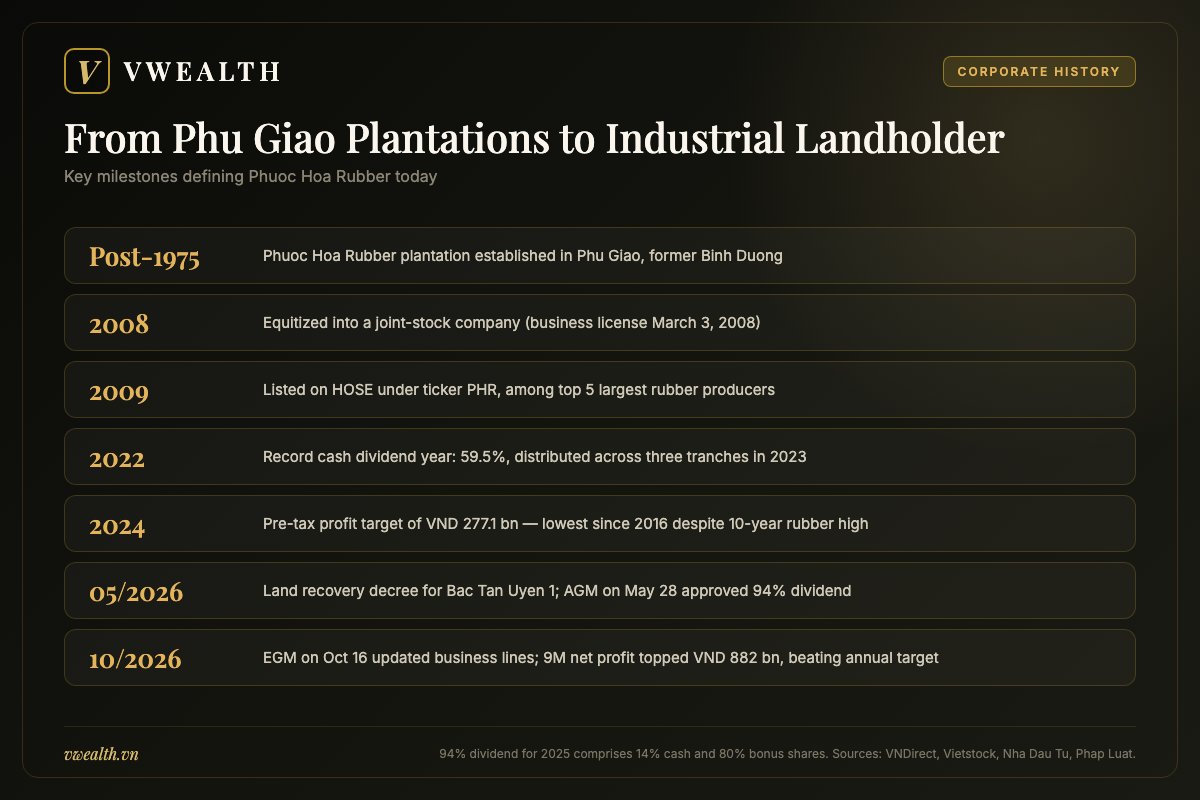
The chronological table below synthesizes the defining strategic milestones shaping Phuoc Hoa Rubber’s four-decade transformation.
| Timeframe | Strategic Event / Milestone | Official Source |
|---|---|---|
| Post-1975 | Nationalization of historical plantations; establishment of Phuoc Hoa State-Owned Rubber Farm | PHR 2014 Annual Report |
| 1982 | General Department of Rubber establishes Phuoc Hoa Rubber Company | PHR 2014 Annual Report |
| March 4, 1993 | Re-established as an official SOE under Vietnam Rubber Corporation (now VRG) | PHR 2014 Annual Report |
| February 28, 2008 | Founding shareholder meeting for equitization; corporate registration granted March 3, 2008 | PHR 2014 Annual Report; VNDirect |
| August 18, 2009 | PHR stock officially debuts on Ho Chi Minh City Stock Exchange (HOSE) | PHR 2014 Annual Report |
| 2014 | Cambodian Kampong Thom subsidiary completes 7,659.64 ha planting; non-core divestments yield VND 24B+ profit | PHR 2014 Annual Report |
| 2022 | Historic cash dividend of 59.5% distributed across three separate tranches during 2023 | Mekong ASEAN |
| 2024 | Conservative earnings target (lowest since 2016) budgeted despite 10-year high average rubber selling prices | Mekong ASEAN; Industry and Trade Magazine |
| May 19–20, 2026 | Receipt of official provincial land recovery decisions for Bac Tan Uyen 1 Industrial Park (THACO) | Nha Dau Tu; Phap Luat Viet Nam |
| May 28, 2026 | AGM approves 80% bonus share issue plus 14% cash dividend (94% total distribution) | Nha Dau Tu |
| October 16, 2026 | EGM approves business line restructuring, charter amendments, and governance overhaul | Phap Luat Viet Nam |
Who Steers PHR: GVR Dominance, VinaCapital Group, and the 0% Foreign Ownership Limit
When institutional portfolio managers examine the shareholder registry of an emerging market enterprise, the operative inquiry is never simply who holds wealth, but who wields decisive statutory voting control. Among Vietnam stocks, state-owned subsidiaries present distinct governance characteristics. With Phuoc Hoa Rubber, the concise answer is unequivocal: Vietnam Rubber Group (VRG) holds unchallenged control. However, the comprehensive institutional reality is substantially more nuanced. Ownership concentration explains why a corporation generating record net earnings has historically barred newly arriving foreign capital, why its dividend yields exhibit cyclical spikes, and why critical decisions regarding land handovers — the enterprise’s most lucrative economic asset — must navigate multiple echelons of bureaucratic state oversight.
GVR Controls 66.62%: The Practical Meaning of a State-Owned Subsidiary on HOSE
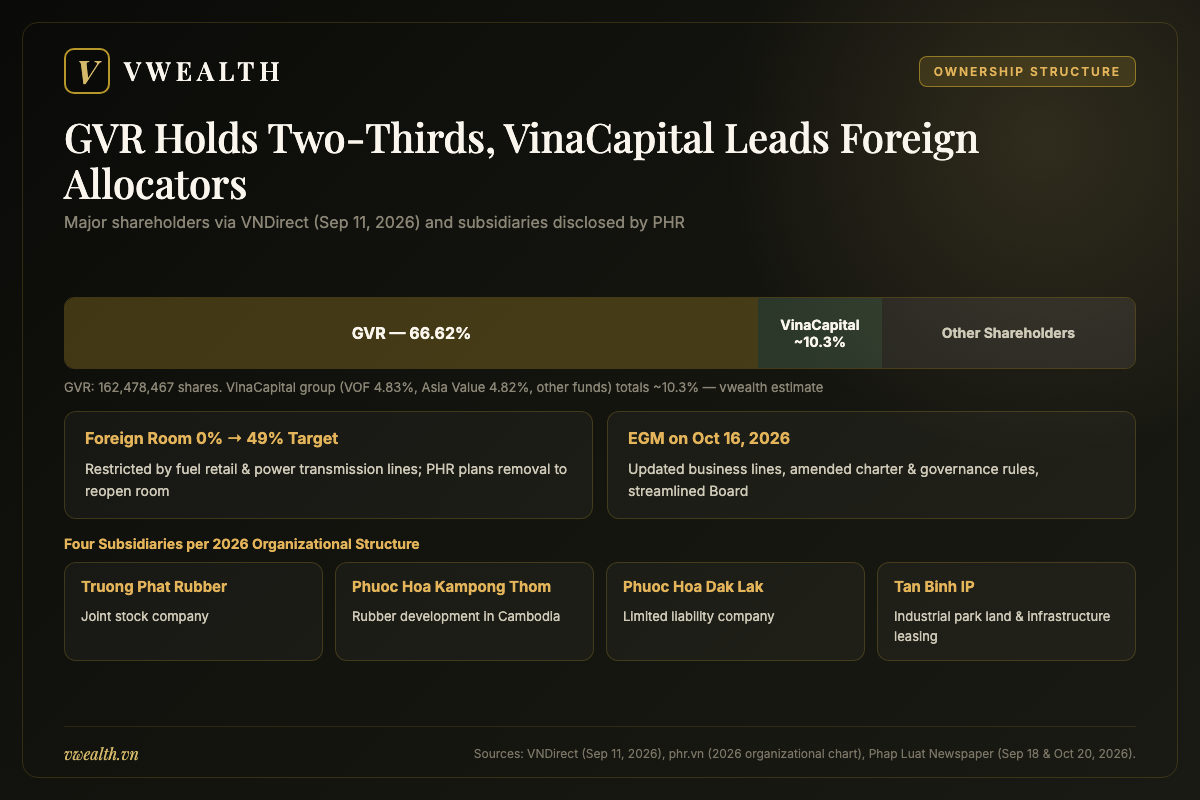
According to shareholder registry data compiled by VNDirect as of September 11, 2026, Vietnam Rubber Group (HOSE: GVR) owns 162,478,467 shares of PHR, representing exactly 66.62% of corporate equity capital. In corporate governance practice under Vietnam’s Law on Enterprises, holding a supermajority exceeding 65% confers absolute statutory control. A 65%+ shareholder can unilaterally approve all fundamental corporate resolutions at the General Meeting of Shareholders without requiring the consent of minority participants — encompassing corporate charter amendments, major asset transactions exceeding statutory value thresholds, long-term operational plans, and annual dividend distribution ratios. In practical terms, no strategic capital allocation, board election, or land handover agreement can materialize at PHR without the explicit concurrence of GVR, which is itself a state-controlled mega-corporation supervised by central state ownership authorities.
In its comprehensive equity research report released in August 2026, securities firm DSC categorized Phuoc Hoa Rubber as the “core operational pillar of GVR,” anchored by its management of over 15,000 hectares of strategic land in Binh Duong. For public equity allocators, this state-affiliated lineage represents a double-edged sword. On the advantageous side, PHR benefits immensely from GVR’s institutional relationships with central ministries, provincial People’s Committees, and top-tier industrial infrastructure developers like VSIP. Furthermore, it leverages group-wide technical expertise in executing plantation clear-cutting, land zoning transitions, and industrial master planning. On the cautionary side, major compensation packages, asset divestments, and dividend declarations must strictly adhere to state capital preservation regulations and parent-level financial targets. As will be detailed regarding VSIP III, the ultimate financial compensation rate was formally revised and locked into a fixed monetary structure specifically to satisfy directives from the State Audit Office of Vietnam (Kiểm toán Nhà nước), rather than emerging purely from open private negotiation between PHR and its park partner.
For international public market investors, high state ownership carries a direct liquidity implication: secondary market free-float is structurally constrained. With GVR locking up two-thirds of outstanding equity, the actual freely floating share supply circulating among institutional funds and retail traders is relatively tight. Consequently, when positive catalysts emerge — such as major land compensation decrees — high buying pressure interacting with limited secondary market liquidity can trigger aggressive upward share price volatility, frequently pushing the stock against its daily HOSE 7% price ceiling. Conversely, during cyclical commodity downturns or regulatory delays, the thin free-float can exacerbate downward corrections.
The VinaCapital Group: The Anchor Foreign Institutional Shareholder
Behind GVR’s dominant majority, the most prominent institutional presence on Phuoc Hoa’s cap table is the investment fund complex managed by VinaCapital, one of Vietnam’s premier asset management organizations. Registry records updated by VNDirect on September 11, 2026, disclose substantial holdings across several distinct offshore and domestic investment vehicles. Specifically, VOF Investment Limited (the operational vehicle of VinaCapital Vietnam Opportunity Fund) holds 11,772,370 shares, equivalent to approximately 4.83% of chartered capital. Concurrently, Asia Value Investment Limited holds 11,753,814 shares, representing approximately 4.82%. In addition, the domestic VinaCapital Market Access Equity Fund (Quỹ Investing Cổ phiếu Tiếp cận Thị trường VinaCapital) holds approximately 1.40 million shares, or roughly 0.58%. Aggregating these cross-holdings alongside related ETF and affiliated vehicles yields a total combined stake of approximately 10.3% for the VinaCapital complex, according to a vwealth estimate. It must be noted that this quantitative aggregation represents an analytical estimate calculated by vwealth from individual public shareholder filings; these fund entities operate as distinct legal entities and do not formally report as a unified affiliated investor group.
Why would a sophisticated foreign institutional asset manager maintain an anchor position in a state-controlled agricultural enterprise across multi-year macroeconomic cycles? The strategic rationale aligns directly with the fundamental thesis outlined in Chapter 1. Phuoc Hoa possesses exceptional underlying assets: contiguous acreage situated directly in the heart of southern Vietnam’s industrial and logistics corridor, substantial net cash reserves, near-zero long-term debt obligations, and a demonstrated willingness to distribute cash dividends. For value-oriented institutional managers, PHR exemplifies a classic asset-play: carrying legacy agricultural book values on its balance sheet while sitting on prime real estate destined for industrial repricing. Patient institutional capital has effectively treated PHR stock as a long-term call option on Vietnam’s structural manufacturing boom. Outside of the VinaCapital complex, state-owned commercial lender VietinBank maintains an equity holding of approximately 1.20 million shares, representing roughly 0.49% of corporate capital.
The 0% Foreign Room Constraint: Root Causes and the Path to Reopening
Among foreign institutional allocators exploring Vietnam manufacturing and industrial stocks, few regulatory constraints create as much initial confusion as PHR’s foreign ownership limit (FOL), colloquially referred to on domestic trading desks as “room ngoại.” According to legal disclosures reported by Phap Luat Viet Nam in September 2026, the statutory maximum foreign ownership room at Phuoc Hoa Rubber stood at exactly 0.00%. For global emerging-market fund managers accustomed to standard 49% or 100% foreign caps, a zero-percent room appears anomalous for an agricultural rubber producer.
The underlying legal cause does not stem from sovereign restrictions on natural rubber cultivation or industrial real estate. Rather, it is the direct consequence of legacy administrative classifications within Phuoc Hoa’s registered business lines. Historically, the company registered secondary commercial activities that fall under Vietnam’s negative list for foreign market access under national investment legislation — specifically petroleum and retail gasoline retailing, alongside electrical power transmission activities. Under Vietnamese regulatory practice, if a listed enterprise maintains even a dormant secondary business code that restricts foreign market access, state securities regulators must enforce the most restrictive ownership cap across the entire corporate entity. As a result, PHR’s foreign ownership room was mechanically clamped to zero.
A 0% foreign room does not mandate that incumbent foreign shareholders liquidate their existing positions; historical foreign investors like VinaCapital can legally continue to hold their shares. Crucially, however, foreign room restrictions prohibit foreign market participants from executing net purchases on the secondary exchange. This institutional barrier effectively severs PHR stock from international capital inflows, precluding participation from global emerging market funds, frontier market active strategies, and benchmark exchange-traded funds (ETFs). According to reporting by Phap Luat Viet Nam, executive leadership initiated formal procedures to deregister and excise these non-core restricted business activities, paving the way to formally reopen the foreign ownership room to 49%. Financial press reports have not detailed why the target threshold was established at 49% rather than an unrestricted 100%, meaning investors must consult primary shareholder documentation once formal regulatory clearances are issued. For foreign investors analyzing how market access rules govern foreign fund allocations, detailed structural mechanics are covered in vwealth’s guide on how to invest in Vietnam stock market.
The October 16, 2026 EGM: Business Line Restructuring and Board Changes
The decisive procedural step toward dismantling the foreign room constraint occurred at the Extraordinary General Meeting (EGM) of Shareholders held on October 16, 2026. As documented by Phap Luat Viet Nam, shareholders formally convened to approve comprehensive updates to the corporate business registry, amend the corporate Charter, and restructure internal corporate governance guidelines. While published press accounts did not enumerate the technical line-by-line inventory of removed and retained industry codes, the overarching strategic objective was clear: eliminating market-access bottlenecks and modernizing internal governance frameworks to align with regulatory standards. In adherence to analytical rigor, this report does not speculate on whether regulatory approvals for the 49% room expansion have been fully finalized; investors must monitor formal statutory filings from PHR and HOSE.
In addition to charter revisions, the October 16 EGM enacted notable governance personnel adjustments. Ms. Nguyen Thi Phi Nga was formally relieved of her position as a member of the Board of Directors following her personal resignation request. Crucially, Ms. Nga retains her operational executive post as Vice Chief Executive Officer (Vice CEO) of Phuoc Hoa Rubber. Such governance recalibrations are standard practice among equitized state-owned enterprises in Vietnam, where dual-hatted executives serving concurrently on the supervisory board/board of directors and executive management are progressively segregated to enhance internal governance independence and comply with modern corporate governance decrees.
Executive Leadership: Chairman Huynh Kim Nhut and CEO Tran Hoang Giang
Governance data compiled from CafeF corporate leadership profiles (verified October 28, 2026) confirms that the Chairman of the Board of Directors of Phuoc Hoa Rubber is Mr. Huynh Kim Nhut. Mr. Nhut was formally elected Chairman for the 2023–2028 tenure on June 28, 2023, following official corporate personnel announcements. In listed SOE subsidiaries controlled by a state parent, the Board Chairman typically acts as the designated representative of state equity capital, ensuring that long-term corporate strategy, major investment outlays, and dividend policies harmonize with the broader directives of the parent group.
Daily executive operations are led by Chief Executive Officer Tran Hoang Giang. According to executive transition reporting by Mekong ASEAN, on June 30, 2025, the Board of Directors approved the departure of former CEO Nguyen Van Tuoc, simultaneously appointing Mr. Giang — who was then serving as Vice CEO — to take executive charge of the enterprise starting July 1, 2025. On May 6, 2026, the Board formally ratified Mr. Giang’s appointment as Chief Executive Officer. Born in 1980, Mr. Giang holds a Master’s degree in Economics and represents an executive groomed entirely within Phuoc Hoa’s operational ranks, having joined the corporation in 2003. Over his corporate career, Mr. Giang served as Chief Accountant of Phuoc Hoa Rubber and held board-level director positions at both Tan Binh Industrial Park Joint Stock Company and Nam Tan Uyen Industrial Park Joint Stock Company. Upon his formal elevation to CEO of the parent company, Mr. Giang relinquished his concurrent role as CEO of the Cambodian subsidiary, Phuoc Hoa Kampong Thom, transferring oversight of overseas plantation operations to Vice CEO Vuong Nguyen Phuong Lam.
Mr. Giang’s professional background provides essential context for institutional analysts evaluating PHR stock. An executive leader possessing deep professional roots as a Chief Accountant who simultaneously served on the governing boards of two established industrial park developers possesses precisely the specialized technical skill set required for Phuoc Hoa’s current strategic era: meticulously structuring complex land compensation accounting while guiding raw plantation acreage through the multi-year regulatory pipeline of industrial park conversion. According to CafeF records, Phuoc Hoa’s senior executive apparatus comprises CEO Tran Hoang Giang; Vice CEOs Vo Thanh Tung, Vuong Nguyen Phuong Lam, and Nguyen Thi Phi Nga; Chief Accountant Vo Thanh Hai; and Head of the Supervisory Board Nguyen Hong Ha.
The structured table below delineates the major institutional ownership architecture of Phuoc Hoa Rubber based on primary registry data.
| Shareholder Entity | Recorded Shares Held | Ownership Percentage | Data Verification Date |
|---|---|---|---|
| Vietnam Rubber Group (VRG – HOSE: GVR) | 162,478,467 | 66.62% | September 11, 2026 |
| VOF Investment Limited (VinaCapital) | 11,772,370 | ~4.83% | September 11, 2026 |
| Asia Value Investment Limited (VinaCapital) | 11,753,814 | ~4.82% | September 11, 2026 |
| VinaCapital Market Access Equity Fund | ~1,400,000 | ~0.58% | September 11, 2026 |
| Joint Stock Commercial Bank for Industry and Trade (VietinBank) | ~1,200,000 | ~0.49% | September 11, 2026 |
| Combined VinaCapital Group Holdings | — | ~10.3% (vwealth estimate) | September 11, 2026 |
Analyzing this ownership registry yields three fundamental institutional conclusions. First, GVR and the VinaCapital fund group collectively command approximately three-quarters (75%) of the company’s total chartered equity, leaving an exceptionally narrow circulating float for secondary market retail and institutional participants. Second, as long as the foreign ownership room remains capped at 0%, foreign institutional holders can only maintain or reduce their positions; they cannot inject incremental capital, rendering offshore funds net potential sellers rather than prospective buyers on secondary dips. Third, if regulatory approvals successfully reopen foreign room to 49%, foreign active managers, regional frontier funds, and index-tracking ETFs could unleash substantial new institutional demand for PHR stock. This potential catalyst explains why mundane corporate charter amendments at the October 2026 EGM attracted intense scrutiny from domestic and regional equity analysts.
A final operational dimension of Phuoc Hoa’s corporate governance is revealed in the official 2026 Organizational Master Chart published on its corporate portal (phr.vn). Under the overarching authority of the General Meeting of Shareholders sits the Board of Directors (working alongside the Supervisory Board), directing the Executive Management Board supported by seven functional departments. Operationally, the domestic rubber footprint is divided across six designated plantations: Bo La, Hung Hoa, Tan Hung, Lai Uyen, Hoi Nghia, and Nha Nai, complemented by the specialized Mechanical Processing and Construction Enterprise. In addition, the corporate hierarchy encompasses four key operating subsidiaries: Truong Phat Rubber JSC, Phuoc Hoa Kampong Thom Rubber Development Co., Ltd. (Cambodia), Phuoc Hoa Dak Lak Rubber Co., Ltd., and Tan Binh Industrial Park JSC. Remembering the specific names of these agricultural plantations is critical for equity analysts, as several — notably Bo La — re-emerge in provincial planning documentation as target sites for forthcoming industrial cluster conversions, including the Bo La 3 and Bo La 4 Industrial Clusters.
The Twin Engines of Phuoc Hoa: Rubber Plantations and Industrial Land Banks
Visiting Phuoc Hoa commune in the pre-dawn darkness reveals the traditional imagery of Southeast Asian commercial agriculture: plantation laborers wearing headlamps methodically tapping rubber bark, milky white latex steadily dripping into collection cups, and transport tractors hauling liquid raw material toward primary processing mills. This is Phuoc Hoa’s primary operating engine, functioning uninterrupted since the early plantation era. However, driving through the adjacent districts of Tan Uyen, Bau Bang, or Ben Cat presents an entirely different industrial reality: mature rubber stands being systematically cleared by heavy bulldozers, vast parcels being leveled, and perimeter security fencing being erected for export manufacturing hubs. Both activities belong to the exact same enterprise, yet they operate under radically divergent economic rhythms. This chapter dissects both operational engines.
Natural Rubber Latex: Harvesting, Purchasing, and Commercial Sales Across 9M/2026
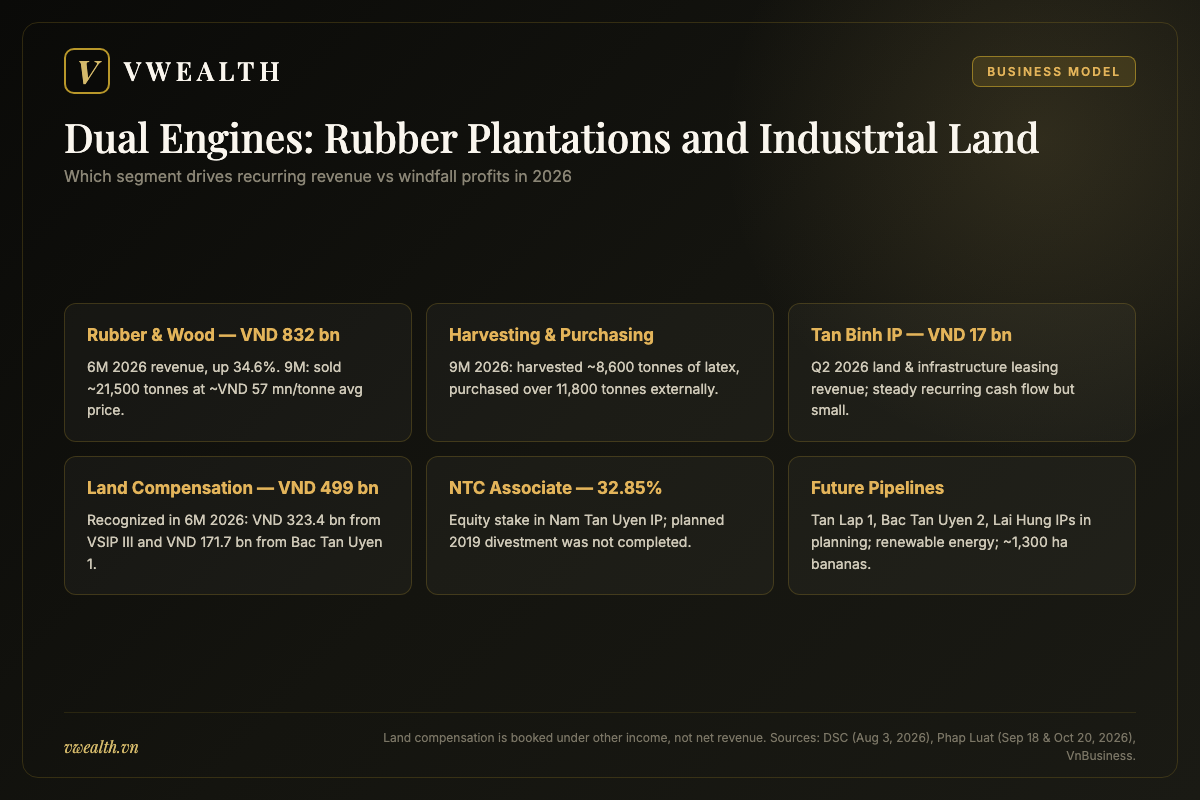
Agricultural rubber operations continue to generate the largest line item within Phuoc Hoa’s reported gross commercial revenues. According to corporate operational data reported by Phap Luat Viet Nam in October 2026, during the first nine months (9M) of 2026, the company harvested approximately 8,600 tonnes of natural latex from its own plantations, purchased more than 11,800 tonnes from independent external growers, and recorded aggregate commercial sales of approximately 21,500 tonnes of finished processed rubber products. The average realized selling price over the nine-month period reached approximately VND 57 million per tonne.
Institutional analysts must closely scrutinize the structural relationship between internally harvested output and third-party procurement volume. External third-party purchasing (11,800 tonnes) substantially surpassed internal plantation extraction (8,600 tonnes). This operational dynamic signifies that Phuoc Hoa’s industrial processing factories no longer function solely to process agricultural output from captive plantations. Instead, the company operates extensively as an industrial aggregator, processor, and secondary trading distributor, capturing processing and distribution margins. The blended gross profit margin on externally sourced latex is inherently narrower than captive production, as the enterprise must pay prevailing open-market spot rates for raw cup lump rather than incurring purely agricultural harvesting and maintenance costs. This structural shift reflects an inevitable operational reality: as mature rubber acreage is progressively recovered and rezoned for industrial development, Phuoc Hoa’s domestic tapping area naturally contracts, compelling management to source external feedstock to maintain high capacity utilization across its 27,000-tonne processing network. For historical context, the approved 2024 operating plan budgeted internal tapping output at 12,400 tonnes (with an average plantation yield of 1.41 tonnes per hectare), processing throughput of 22,400 tonnes, and total sales volume of 33,100 tonnes, as cited by Mekong ASEAN.
From a revenue perspective, corporate filings reported by Phap Luat Viet Nam indicate that gross revenue from rubber and timber operations reached VND 832 billion in the first six months (6M) of 2026, marking a robust 34.6% expansion year-on-year. Equity research from DSC confirms that in Q2/2026 alone, standalone rubber segment revenue reached VND 385 billion, up 12.2% year-on-year, supported by an average realized price of VND 56.4 million per tonne, representing a 12.8% pricing increase. The fact that price growth outpaced volume growth underscores a vital analytical takeaway: top-line expansion across the core rubber division was overwhelmingly driven by cyclical commodity pricing strength rather than physical extraction growth.
Q4/2026 Guidance and the Realized Price Target of VND 62 Million Per Tonne
According to executive guidance reported by Phap Luat Viet Nam, Phuoc Hoa established ambitious operational targets for the fourth quarter (Q4) of 2026: internal tapping output of 5,100 to 6,200 tonnes, external commercial purchasing exceeding 3,100 tonnes, and commercial sales of approximately 7,000 tonnes. Fourth-quarter rubber segment revenue is targeted at VND 434 billion, predicated on an expected average realized selling price of VND 62 million per tonne. In southern Vietnam, the fourth quarter historically represents the seasonal peak of the agricultural tapping calendar, which explains why projected output in a single quarter equals more than half of the cumulative volume produced across the preceding three quarters.
However, institutional allocators should recognize that the targeted realization rate of VND 62 million per tonne represents an internal managerial aspiration rather than a contracted hedge. This optimistic target should be weighed against more conservative institutional projections. For instance, in a comparative equity research survey compiled in late May 2026, securities firm MBS adopted a conservative baseline assumption of VND 48.5 million per tonne for Phuoc Hoa’s 2026 average realized price, citing structural demand risks associated with automotive manufacturing overcapacity in mainland China. The wide spread between management’s VND 62 million target and MBS’s VND 48.5 million assumption illustrates the inherent commodity sensitivity of the agricultural division. Across a sales volume of 7,000 tonnes, a pricing divergence of several million dong per tonne translates into substantial swings in quarterly gross profit. Global rubber supply dynamics, tariffs, and environmental regulations governing this segment are examined thoroughly in Chapter 6.
Tan Binh Industrial Park: A Modest but Predictable Infrastructure Cash Flow
Phuoc Hoa’s secondary operating engine — the recurring, predictable industrial leasing component — is managed directly through its operational subsidiary, Tan Binh Industrial Park Joint Stock Company. Disclosures synthesized by DSC reveal that in Q2/2026, revenue derived from industrial land leasing and park infrastructure maintenance reached VND 17 billion, advancing 0.8% year-on-year. While this absolute monetary figure appears modest in comparison to aggregate quarterly corporate earnings, its economic quality differs fundamentally from agricultural commodity sales. Industrial park tenants sign multi-decade land lease contracts, establishing long-term recurring utility, maintenance, and facility management cash flows that exhibit virtually zero correlation with global commodity market fluctuations.
Occasionally, this leasing division experiences sharp revenue surges resulting from statutory revenue recognition methodologies. Disclosures from Industry and Trade Magazine record that in Q1/2025, Phuoc Hoa’s industrial park real estate revenue spiked 103% year-on-year following the execution of a major long-term lease contract recognized under the upfront lump-sum revenue method, propelling the division’s quarterly gross profit to VND 25 billion, a 90% surge. Under Vietnamese Accounting Standards (VAS) governing industrial zone developers, leases where the tenant executes full upfront payment for a 50-year term can, under specific regulatory criteria, be booked immediately as one-time revenue rather than amortized evenly over five decades. Consequently, when quarterly filings display triple-digit percentage expansions in industrial revenue, equity analysts must verify whether the expansion reflects organic capacity growth or the concentrated booking of a single upfront lease. For institutional allocators seeking to analyze how specialized developers structure upfront versus amortized land accounting, vwealth’s analysis of KBC stock of Kinh Bac City provides a detailed corporate comparison.
Strategic Stake in Nam Tan Uyen and the NTC 3 Expansion Pipeline
Beyond its controlling stake in the Tan Binh zone, Phuoc Hoa Rubber holds a vital strategic equity investment in Nam Tan Uyen Industrial Park Joint Stock Company (HOSE: NTC), an established industrial developer operating within the same regional manufacturing basin. Corporate filings maintain PHR’s associate ownership stake at 32.85% — an equity holding established prior to 2019 that was reaffirmed in institutional research published by BSC in 2025. In 2019, Phuoc Hoa formulated an initial plan to divest its equity interest in NTC, but the transaction was ultimately shelved, according to reporting by VnBusiness.
This associate holding delivers steady equity earnings booked on PHR’s income statement under “share of profit from associates.” In its August 2026 research update, securities firm VDSC projected that equity earnings from NTC would moderate to approximately VND 26 billion in 2026, representing a 55% year-on-year decline primarily attributable to modifications in revenue recognition accounting at the associate level. Over the medium term, however, VDSC highlighted significant project delivery catalysts: Nam Tan Uyen’s flagship expansion project, the NTC 3 Industrial Park, is projected to begin handing over approximately 51 hectares of leasable land during 2026, commanding premium rental rates estimated at USD 160 to USD 170 per square meter over the remaining statutory lease term. While these brokerage forecasts are subject to operational delivery schedules, they illustrate that Phuoc Hoa maintains direct exposure to an established, highly profitable industrial operating entity alongside its direct land holdings.
Renewable Energy and Tissue-Cultured Bananas: Incubating High-Tech Seeds
As mature rubber acreage is cleared, management is actively deploying unutilized land buffers and industrial infrastructure to cultivate secondary high-tech revenue streams. According to reporting by Phap Luat Viet Nam in October 2026, Phuoc Hoa is actively conducting feasibility studies for rooftop and ground-mounted renewable energy installations situated within the Tan Binh Industrial Park cluster, as well as the Binh Co 1 and Binh Co 2 designated project areas. Concurrently, the company is surveying green electricity consumption demand among multinational manufacturing tenants operating inside Tan Binh. Institutional research published by VDSC in May 2026 noted that provincial planning frameworks encompass up to 12 potential renewable energy project sites across the group’s land bank. The commercial logic is straightforward: export-oriented manufacturing enterprises — particularly European and American multinational supply chains subject to strict carbon accounting standards — require access to certified renewable power to fulfill corporate ESG mandates.
The second strategic incubation pillar centers on high-tech commercial agriculture. Phuoc Hoa is advancing an ambitious tissue-cultured commercial banana plantation project encompassing approximately 1,300 hectares, currently awaiting formal provincial investment policy approval. Research projections by VDSC suggest that between 2028 and 2030, Phuoc Hoa could systematically transition approximately 300 hectares of aging rubber stands per year into commercial banana cultivation. International investors should approach both initiatives with realistic expectations: neither renewable energy nor tissue-cultured bananas currently generates material operating revenue. At this juncture, they represent long-term strategic call options rather than immediate corporate earnings drivers.
Industrial Zones in 1/2000 Zoning Pipeline: Tan Lap 1, Bac Tan Uyen 2, and Lai Hung
The most compelling component of Phuoc Hoa’s second economic engine is its extensive pipeline of forthcoming industrial zone conversions. According to corporate operational disclosures reported by Phap Luat Viet Nam in October 2026, Phuoc Hoa is actively formulating detailed 1/2000-scale master zoning plans (quy hoạch phân khu 1/2000) for several major future industrial parks: Tan Lap 1, Bac Tan Uyen 2, Lai Hung, and the Tan Binh Industrial Park Phase 2 Expansion. Furthermore, the company is monitoring statutory administrative procedures for two specialized industrial clusters: the Bo La 3 and Bo La 4 Industrial Clusters. In the residential real estate segment, Phuoc Hoa has successfully resolved legacy legal bottlenecks, securing formal land-use right certificates (Giấy chứng nhận quyền sử dụng đất) for a 3.3-hectare tract within the Phuoc Hoa Residential Area. According to institutional forecasts by VDSC, the Tan Lap 1 Industrial Park is slated for active ground development starting in 2028, with approximately 200 hectares of mature rubber plantations scheduled for early timber liquidation and clearance during 2027.
For international investors unfamiliar with Vietnamese administrative procedures, the formulation of a 1/2000 master zoning plan represents an early procedural phase within a multi-year project gestation lifecycle. Following master zoning clearance, an industrial park project must secure formal Prime Ministerial or provincial Investment Policy Approval (Chủ trương đầu tư), complete official land recovery and environmental impact assessments, execute site clearance compensation, finalize infrastructure engineering works, and obtain leasing permits before generating commercial revenue. Each procedural milestone spans anywhere from several quarters to multiple years. Consequently, this extensive project pipeline must be monitored as an indicative medium-term asset pipeline rather than guaranteed near-term cash flows.
The structured comparative table below contrasts Phuoc Hoa’s operational divisions, illustrating which segments drive top-line scale, which deliver steady recurring income, and which represent early-stage incubation.
| Operating Division | Most Recent Public Operational Data | Core Economic Characteristics | Primary Information Source |
|---|---|---|---|
| Rubber Harvesting & Timber | 6M/2026 Revenue: VND 832B (+34.6%); 9M/2026: 8.6k t tapped, 11.8k t bought, 21.5k t sold; avg price ~VND 57M/t | Largest accounting top-line; volatile; exposed to international commodity pricing | Phap Luat Viet Nam (Sept & Oct 2026) |
| Industrial Park Leasing (Tan Binh) | Q2/2026 Revenue: VND 17B (+0.8% YoY) | Modest scale; long-term recurring cash flows; low commodity correlation | DSC Equity Research (Aug 2026) |
| Land Compensation & Conversion | 6M/2026 Realized Income: VND 499.3B | Massive lump-sum windfalls; booked under ‘other income’; dictated by administrative decrees | DSC Equity Research (Aug 2026) |
| Associate Investment in NTC (32.85%) | 2026 Projected Associate Profit: ~VND 26B (-55% YoY due to accounting change) | Equity profit share; leveraged to NTC 3 delivery and USD 160–170/m² rental rates | VDSC via Elibook (Aug 2026) |
| Renewable Energy (Solar) | Feasibility studies underway across Tan Binh, Binh Co 1 & 2 clusters | Early-stage incubation; zero material current revenue; captive tenant demand | Phap Luat Viet Nam (Oct 2026) |
| High-Tech Agriculture (Bananas) | ~1,300 ha tissue-cultured banana project awaiting policy approval; ~300 ha/yr conversion | Early-stage incubation; speculative call option for 2028–2030 horizon | Elibook (May 2026); Phap Luat Viet Nam |
Examining this multi-segment overview exposes a critical accounting phenomenon that standard top-line financial metrics obscure: the segment generating the vast majority of Phuoc Hoa’s corporate profits in 2026 — agricultural land compensation and conversion assistance — does not appear within gross net sales (Doanh thu thuần). Instead, it is recorded entirely within “other net income” (Thu nhập khác). Deconstructing this compensation engine is the central focus of Chapter 4.
Land Compensation: A Winning Lottery Ticket or a Finite Cash Flow Stream?
Consider the fundamental economics of an established commercial rubber plantation: trees planted over a decade ago yield steady, modest agricultural operating margins year after year. Suddenly, provincial planning authorities rezone that precise agricultural parcel for high-tech industrial park infrastructure. The designated industrial developer pays statutory compensation for biological assets on the land, provides site clearance support subsidies, and permits the enterprise to auction the logged rubber timber. In that single fiscal year, the plantation operator receives a cash windfall equivalent to decades of cumulative latex tapping. However, by the following year, that agricultural plantation has permanently ceased to exist. In essence, this dynamic encapsulates Phuoc Hoa’s corporate reality across the 2025–2027 cycle — except that the scale is measured across hundreds of prime hectares and thousands of billions of Vietnamese dong. This chapter conducts a detailed project-level audit.
VSIP III: 691 Hectares, VND 3,260 Billion, and the State Audit Price Fixing Decree
The cornerstone asset within Phuoc Hoa’s land conversion pipeline is the Vietnam-Singapore Industrial Park III (VSIP III), a flagship master-planned industrial development spanning approximately 1,000 hectares, of which 691 hectares comprises recovered rubber plantation land compensated directly to PHR, as documented by Industry and Trade Magazine. On parcels that once grew rubber trees, global industrial titans have established world-class manufacturing campuses: the LEGO Group secured 44 hectares to build its flagship carbon-neutral factory, Danish luxury jeweler Pandora leased 7.5 hectares for a global crafting facility, and the SAM DigitalHub consortium committed to 50 hectares for hyperscale data center infrastructure. For international allocators tracking supply chain diversification toward Vietnam, VSIP III represents the preeminent destination — and its physical bedrock was carved directly out of Phuoc Hoa’s agricultural estate.
The contractual compensation structure governing VSIP III underwent a profound legal transformation. According to institutional research historical reviews cited by Elibook, Phuoc Hoa was originally entitled to receive a 20% ongoing share of net land leasing profits generated across the lifetime of the industrial zone. Under that profit-sharing model, cash inflows were structured to stream gradually as VSIP III progressively executed tenant leases. However, during 2026, this variable profit-sharing mechanism was formally dismantled in favor of a fixed-price settlement: Phuoc Hoa successfully renegotiated its aggregate compensation and support package into a guaranteed lump-sum commitment of VND 3,260 billion, translating to an average unit compensation rate of approximately VND 4.72 billion per hectare, according to disclosures reported by Phap Luat Viet Nam and DSC. Institutional research from Elibook confirms that locking in this fixed monetary settlement was executed pursuant to binding recommendations from the State Audit Office of Vietnam (Kiểm toán Nhà nước).
This structural revision carries vital strategic ramifications for equity valuation. Under the legacy profit-sharing arrangement, Phuoc Hoa carried operational risk regarding the leasing velocity of VSIP III, while retaining exposure to potential rental rate inflation. Under the fixed-rate structure, Phuoc Hoa relinquished upside participation from future rental escalations in exchange for absolute monetary certainty. For a state-controlled corporation governed by strict state capital auditing statutes, financial certainty and transparent accounting boundaries took precedence over speculative upside. For equity analysts, it converted an ambiguous multi-year cash flow forecast into a verifiable, auditable milestone schedule.
VND 1,157 Billion Collected: Mapping the Remaining VND 2,103 Billion for 2026–2027
Out of the negotiated VND 3,260 billion VSIP III compensation package, corporate records confirm that Phuoc Hoa had collected VND 1,157 billion in actual cash receipts through December 31, 2025. The remaining balance of VND 2,103 billion is contractually scheduled for progressive disbursement across fiscal years 2026 and 2027, according to reporting by Phap Luat Viet Nam and Nha Dau Tu. While securities firm VDSC estimated the remaining balance at roughly VND 2,150 billion in external models, this report relies on the official company baseline figure of VND 2,103 billion.
According to equity research compiled by DSC, Phuoc Hoa formally booked VND 323.4 billion in compensation revenue from VSIP III during the first six months (6M) of 2026, with Q2/2026 alone accounting for VND 228.4 billion. Crucially, institutional investors must distinguish between accounting recognition and actual liquidity realization. A forensic balance sheet review conducted by TCBS in August 2026 highlighted that the entire VND 323.4 billion recognized during 6M/2026 remained lodged within short-term accounts receivable (specifically driving “other receivables” up to VND 356.9 billion), having not yet cleared into liquid cash. Consequently, consolidated operating cash flow (CFO) for the six-month period totaled only VND 177.9 billion. In short, substantial earnings were formally recorded on the income statement while cash collection remained in transit. While the fixed compensation figure is legally binding and backed by a top-tier developer, tracking the precise timing of cash receipts versus paper accruals across quarterly filings is essential for cash-flow modeling.
Bac Tan Uyen 1 with THACO: Over VND 1,400 Billion, with ~VND 500 Billion in 2026
The second major pillar supporting Phuoc Hoa’s compensation windfall is the Bac Tan Uyen 1 Industrial Park, an expansive specialized mechanical engineering industrial hub developed by Truong Hai Group (THACO) through its real estate and infrastructure arm, Thadico. On May 19–20, 2026, Phuoc Hoa officially received provincial land recovery decrees for this project. According to primary corporate disclosures, total compensation value exceeds VND 1,400 billion — derived predominantly from early tree clearance, site handover support, and timber liquidation — of which approximately VND 500 billion is scheduled for accounting recognition within calendar year 2026, as reported by Nha Dau Tu and Phap Luat Viet Nam.
Institutional brokerage reports present slight variations regarding exact land area and gross monetary figures: DSC models 786 hectares at an estimated unit compensation rate of VND 2.1 to 2.57 billion per hectare, yielding an aggregate figure of roughly VND 1,651 billion; VDSC models approximately 704 hectares yielding roughly VND 1,448 billion; and Mirae Asset utilizes a baseline figure of VND 1,440 billion. In adherence to conservative analytical discipline, this dossier adopts the company’s explicit baseline of “over VND 1,400 billion” across an area spanning approximately 700 to 790 hectares depending on definitive boundary surveys. The stark variance in unit compensation — VND 2.1 to 2.57 billion per hectare at Bac Tan Uyen 1 versus VND 4.72 billion per hectare at VSIP III — illustrates that land conversion values are not homogeneous across the province. Unit economics depend heavily on geographical location, negotiation mechanics, intended industrial usage, and municipal infrastructure connectivity.
According to DSC research, Phuoc Hoa booked VND 171.7 billion in compensation from Bac Tan Uyen 1 during 6M/2026, including roughly VND 35.87 billion recognized in Q2/2026 from THACO’s mechanical engineering zone. DSC projected that during the second half of 2026 (H2/2026), Phuoc Hoa could book an additional ~VND 360 billion (corresponding to 140–171 hectares), with the residual balance of approximately VND 908 billion distributing across 2027 and 2028. Investors should note that these forward disbursement schedules represent brokerage projections rather than contractually guaranteed corporate covenants.
HCMC – Thu Dau Mot – Chon Thanh Expressway: 81 Hectares for VND 203 Billion
Agricultural land recoveries are not triggered solely by commercial industrial park developers; major national transportation arteries also intersect Phuoc Hoa’s contiguous estate. The planned Ho Chi Minh City – Thu Dau Mot – Chon Thanh Expressway includes an approximate 10-kilometer segment traversing Phuoc Hoa’s plantation concessions, resulting in the public recovery of 81 hectares. According to filings cited by Industry and Trade Magazine, gross pre-tax compensation allocated for this transportation corridor is budgeted at VND 203 billion. An initial handover tranche comprising roughly 34 hectares was executed during the first quarter of 2025.
While VND 203 billion is modest relative to multi-trillion dong industrial park settlements, this project highlights a critical structural dynamic: Phuoc Hoa’s land bank is situated directly within southern Vietnam’s most rapidly urbanizing infrastructure corridor. In addition to industrial parks, expressways, regional ring roads, and municipal public works frequently require agricultural land acquisitions. Each municipal recovery yields an immediate one-time cash compensation payment alongside timber liquidation receipts, while permanently extinguishing agricultural production on that acreage. Over the long term, high-speed regional expressway access significantly elevates the intrinsic commercial value of Phuoc Hoa’s adjacent remaining land parcels in the eyes of future industrial park joint ventures. For foreign investors analyzing regional infrastructure tailwinds across Binh Duong’s industrial landscape, detailed context is available in vwealth’s review of Vietnam manufacturing and industrial stocks.
The Mechanics of “Other Income”: Why Net Profits Explode While Net Revenue Inches Forward
Grasping the accounting mechanics of “Other Income” (Thu nhập khác) is indispensable for any investor evaluating PHR stock. On standard Vietnamese financial statements prepared under VAS, Net Revenue (Doanh thu thuần) captures solely recurrent commercial activities: natural latex processing, commercial timber sales, and ongoing industrial utility and park leasing services. By contrast, monetary compensation for agricultural land recovery, site clearance subsidies, and mature tree liquidation receipts are legally classified under “Other Income.” Net other profit (Lợi nhuận khác) is calculated by subtracting direct liquidation and clearance costs from other income. This entire net figure bypasses operating revenue and operating profit, flowing directly into consolidated Profit Before Tax (PBT).
This accounting structure generates dramatic optical distortions on the income statement: in reporting quarters characterized by major land handover milestones, Phuoc Hoa’s bottom-line net earnings can multiply कई times while net operating revenue exhibits only single-digit percentage movement. For example, corporate data cited by Phap Luat Viet Nam confirms that in Q1/2026, Phuoc Hoa’s net other profit exploded to VND 232.3 billion, compared to an insignificant VND 0.5 billion in the identical period of 2025 — driven entirely by site handover compensation and plantation liquidation. Disclosures synthesized by Elibook show that in Q2/2026, net other profit accounted for a staggering 58.3% of consolidated profit before tax. Put plainly: during that quarter, nearly six out of every ten dong of corporate pre-tax profit originated from land clearance, while core recurrent agricultural and leasing operations supplied just over four dong.
Recognizing this structural segregation reveals why conventional valuation heuristics fail. An investor who observes surging 2026 net profit and applies a standard historical P/E multiple of 12x or 15x is committing a grave analytical error. Land compensation earnings do not possess the repeatability or terminal value of recurring operating cash flows; they represent one-off capital liquidations that must be stripped out and modeled as finite monetary annuities. Chapter 5 explores this forensic earnings decomposition in detail.
39% of 2025–2030 Land Conversion Pipeline: What Remains After 2027?
According to institutional research by Mirae Asset Securities (reported by Phap Luat Viet Nam in September 2026), total land conversion compensation anticipated by Phuoc Hoa across the 2026–2027 window exceeds VND 3,500 billion — comprising approximately VND 1,440 billion from Bac Tan Uyen 1 and the residual VND 2,103 billion from VSIP III, with calendar year 2026 alone absorbing roughly VND 1,500 billion. Concurrently, DSC projected total one-off windfall income for 2026 at approximately VND 1,564 billion. Mirae Asset highlighted a crucial strategic parameter: these two flagship industrial projects collectively represent approximately 39% of the total rubber plantation acreage slated for industrial conversion under the provincial 2025–2030 master plan.
The decisive strategic question for long-term equity holders centers on what occurs once this two-year cycle concludes. Quantitative projections published by VDSC forecast that Phuoc Hoa’s “Other Net Income” will reach VND 2,127 billion in 2026, remain elevated at VND 2,045 billion in 2027, and subsequently plunge to an ordinary baseline of approximately VND 77 to 78 billion annually. If these projections materialize, corporate earnings will encounter a steep “earnings cliff” post-2027. The decisive factor determining whether this cliff can be smoothed out is the execution trajectory of the remaining pipeline — representing roughly 61% of planned conversion acreage, according to a vwealth estimate by subtraction. The forthcoming pipeline encompassing Tan Lap 1, Bac Tan Uyen 2, Lai Hung, and Tan Binh Expansion Phase 2 must transition from paper blueprints into licensed construction. While logged rubber timber yields modest proceeds of VND 100 to 244 million per hectare (VDSC estimate), the immense economic value resides within the provincial land recovery and compensation framework. If the remaining 61% of planned conversion acreage generates comparable financial compensation to the initial 39%, the medium-term asset value is vast; however, because commercial pricing terms, regulatory timelines, and partner agreements have not been formalized for new zones, linear extrapolation is analytically invalid.
The structured table below synthesizes the primary land compensation projects shaping Phuoc Hoa’s balance sheet based on public corporate disclosures and verified brokerage research.
| Development Project | Recovered Land Area | Total Monetary Value | Recognized Realization | Residual Disbursement Schedule | Primary Source |
|---|---|---|---|---|---|
| VSIP III Industrial Park | 691 ha (of ~1,000 ha total) | VND 3,260B (fixed rate, ~VND 4.72B/ha) | VND 1,157B collected to Dec 31, 2025; VND 323.4B booked in 6M/2026 | VND 2,103B scheduled across 2026–2027 | Phap Luat Viet Nam; DSC; Nha Dau Tu |
| Bac Tan Uyen 1 IP (THACO) | ~700–790 ha depending on survey | Over VND 1,400B (company baseline) | VND 171.7B booked in 6M/2026 (~VND 35.87B in Q2/2026) | ~VND 360B projected H2/2026; ~VND 908B across 2027–2028 (DSC) | Nha Dau Tu; DSC; VDSC |
| HCMC–Thu Dau Mot–Chon Thanh Expressway | 81 ha (~10 km right-of-way) | VND 203B (gross pre-tax budget) | Phase 1 (~34 ha) executed in Q1/2025 | Disbursed in accordance with civil construction progress | Industry and Trade Magazine |
| Tan Lap 1, Bac Tan Uyen 2, Lai Hung, Tan Binh Ext. | Unannounced | Unannounced | Zero accounting recognition to date | 1/2000 zoning drafting; Tan Lap 1 development targeted from 2028 (VDSC) | Phap Luat Viet Nam; Elibook |
Evaluating this project matrix clarifies why institutional equity desks frequently employ the analogy of a “winning lottery ticket” when describing PHR stock. Yet in legal and corporate reality, land conversion is not random luck. It is a highly structured administrative process governed by municipal planning, ministerial approvals, negotiated compensation formulas, and state audits. As DSC research points out, compensation velocity is inextricably linked to provincial legal clearances, zoning approvals, and partner capital expenditure budgets — meaning that actual cash delivery can easily deviate from consensus market expectations. Indeed, research from VDSC cited by Elibook noted that in Q2/2026, certain compensation bookings materialized at a slower pace than initially modeled.
Furthermore, land holdings present regulatory balance sheet liabilities alongside monetary windfalls. Disclosures from TCBS reveal that Phuoc Hoa officially petitioned municipal tax authorities to reconsider a formal notification assessing annual state land rental obligations at VND 413.8 billion — reflecting a steep 5.6-fold surge in applicable statutory land rental unit rates — with municipal tax organs yet to issue a definitive ruling at reporting date. Agricultural land is the ultimate source of Phuoc Hoa’s windfall earnings, but as regional land valuations are marked upward across southern Vietnam, state rental obligations on retained plantation acreage can expand concurrently.
Ultimately, is land compensation a temporary lottery ticket or a finite, manageable cash flow? The objective answer is that it functions as both, depending entirely on an investor’s investment horizon. Over the 2026–2027 window, it represents an immense cash flow stream, relatively certain in aggregate monetary volume but volatile in quarterly realization timing. Beyond 2027, it becomes a pipeline of unpriced development options. Investors purchasing PHR stock purely on headline 2026 net earnings without modeling the post-2027 cliff are buying an optical illusion; investors who evaluate the residual 61% conversion land bank alongside long-term industrial leasing options are investing in a structural transformation. To see how an ecosystem peer successfully completed this transition into an unassailable recurring utility and park operator, institutional investors should consult vwealth’s institutional analysis of SIP stock of Saigon VRG.
Interpreting PHR’s Financial Statements: Blockbuster Profits from Rubber Groves or Land Recovery Decrees?
Consider an intuitive analogy: an acquaintance who owns an extensive agricultural rubber plantation informs you that his annual profits have tripled year-on-year. A discerning institutional allocator does not immediately inquire how much profit was earned, but rather where that profit originated. If the earnings expansion was driven by higher physical latex extraction yields and superior realized commercial market prices, there is a strong biological and operational probability that those cash flows can repeat in subsequent fiscal years. If, however, the financial surge was produced because provincial authorities recovered a major corner of the plantation for industrial zone development and paid statutory site compensation, that cash inflow represents a strictly non-recurring windfall for that specific parcel. The financial statements of Phuoc Hoa Rubber in 2026 tell the exact story of that plantation owner — with the critical difference that the capital figures are denominated in thousands of billions of Vietnamese dong.
This chapter is not designed to assign an arbitrary score to PHR stock. Instead, it provides global institutional investors with a forensic accounting blueprint to deconstruct Phuoc Hoa’s financial statements into three distinct earnings layers: the core agricultural layer (latex extraction and processing), the corporate treasury layer (interest income earned on massive commercial bank deposits), and the extraordinary conversion layer (“other net income” derived from land compensation and tree liquidation). Deconstructing these three layers explains why identical headline earnings numbers lead different market participants to draw opposite valuation conclusions: some view the stock as deeply discounted, while others perceive it as artificially inflated. Chapter 4 examined the underlying physical projects; this chapter audits how those transactions materialize across the balance sheet, income statement, and cash flow statement.
2025 Baseline: Net Revenue of VND 1,790 Billion and Profit Before Tax of ~VND 631 Billion
Establishing an objective baseline is essential to quantify the magnitude of Phuoc Hoa’s 2026 earnings acceleration. According to audited consolidated financial data synthesized by domestic financial press, Phuoc Hoa recorded full-year 2025 net revenue of approximately VND 1,790 billion, representing a 10% increase year-on-year, while consolidated profit before tax (PBT) reached approximately VND 631 billion, advancing 16% year-on-year. Fiscal year 2025 was a solid operational period, but not a blockbuster windfall year. Natural latex commodity pricing had staged an aggressive recovery starting in 2024 — when Phuoc Hoa’s average realized selling price climbed to VND 45.3 million per tonne, marking a 10-year high — and that pricing momentum carried into 2025.
The crucial analytical insight from fiscal 2025 lies in its extreme quarterly earnings distribution. Institutional equity research published by TCBS in August 2026 demonstrates that Phuoc Hoa’s quarterly consolidated profit after tax (PAT) exhibited pronounced volatility throughout 2025: approximately VND 100 billion in Q1 (reported as VND 96 billion or VND 103 billion across different financial feeds), VND 95 billion in Q2, surging dramatically to VND 265 billion in Q3, before dropping sharply to just VND 35 billion in Q4. A pure agricultural commodity producer almost never displays a 7.5-fold earnings variance between consecutive quarters, because physical tapping output and benchmark commodity pricing shift gradually along seasonal and biological curves. This acute quarterly asymmetry provides immediate evidence of lumpy, non-operational revenues intruding upon the income statement.
Market analysts do not need to guess what triggered this variance. An equity research update published by FPTS Securities in late 2025 explicitly confirmed that Q4/2025 contained zero compensation profit recognition from the VSIP III project. Conversely, research commentaries covering Q3/2025 highlighted a “dual catalyst”: elevated commodity rubber pricing converging with substantial lump-sum compensation bookings from VSIP III. Tracking quarterly earnings sequences thus establishes a reliable diagnostic rule: quarters that record major land compensation handovers display massive earnings spikes, whereas quarters devoid of land handovers revert to baseline plantation economics.
A notable compliance footnote warrants inclusion in every investor’s due diligence checklist: on April 21, 2026, the Ho Chi Minh City Stock Exchange (HOSE) issued a formal compliance reminder to Phuoc Hoa regarding its delayed disclosure of an official explanatory document detailing the variance between its audited 2025 annual net profit and its self-compiled Q4/2025 quarterly statement. Material variances between unaudited quarterly numbers and final audited year-end accounts are relatively common among state-controlled enterprises managing complex asset liquidations. For foreign investors evaluating PHR stock, the takeaway is clear: never formulate long-term valuation models solely on self-reported quarterly estimates; always verify audited annual statements and examine statutory reconciliation footnotes.
Q1/2026: Other Net Profit Reaches VND 232 Billion, Rising from Virtually Zero
The first quarter of 2026 marked the onset of Phuoc Hoa’s financial transformation. Consolidated net revenue reached VND 468.3 billion, advancing 50.3% year-on-year. Gross profit expanded to VND 117.1 billion, up 14.3% year-on-year. Financial revenue — generated predominantly from interest income on short-term bank deposits — totaled VND 28.51 billion. Up to this point on the income statement, the company appeared to be an agricultural producer enjoying a cyclical commodity upswing.
Then comes the decisive accounting line item: “Other Net Profit” (Lợi nhuận khác) totaled VND 232.3 billion, compared to an insignificant VND 0.5 billion in Q1/2025. Corporate filings confirm that this surge originated entirely from official land handover compensation, site clearance assistance subsidies, and the commercial liquidation of logged rubber timber. Consequently, consolidated net profit after tax reached VND 285.08 billion, representing a massive 177% year-on-year surge (certain research feeds cited a 192% surge by isolating parent company net profit rather than consolidated net income). When examining financial headlines, analysts must meticulously verify whether cited figures reflect consolidated net profit or net profit attributable to parent company shareholders, as both are valid under their respective accounting definitions.
Executing a forensic decomposition reveals the true earnings balance. Standalone gross profit from regular operations (VND 117 billion) combined with treasury financial income (VND 28.5 billion) represented the entire recurring commercial operational engine prior to selling, general, and administrative (SG&A) expenses and taxation. By contrast, net other profit from land clearance (VND 232 billion) stood at nearly double the entire operational gross profit. In short, during Q1/2026, recovered agricultural acreage generated far more bottom-line profit than the thousands of hectares of trees remaining in active production. While highly lucrative, this reality must be factored into any P/E multiple calculation.
A secondary operational revelation emerged from Q1 filings: according to research from VNDirect, Phuoc Hoa’s standalone gross margin on core rubber operations contracted to approximately 25.5% in Q1/2026, as raw material procurement costs — particularly prices paid for third-party cup lump — escalated faster than final export selling prices. The apparent paradox of net revenue jumping 50% while operating gross profit rose only 14% reflects the operational reality described in Chapter 3: Phuoc Hoa is increasingly reliant on purchasing raw latex from independent farmers to keep its processing mills running at scale, and third-party trading inherently delivers narrower gross margins than captive harvesting.
Q2/2026: Profit Before Tax of VND 453 Billion, with 58% Driven by “Other Income”
The second quarter of 2026 sustained this earnings trajectory with heightened intensity. Consolidated net revenue reached VND 406.3 billion, up 10.4% year-on-year. Blended gross margin strengthened to 34.2%, compared to 26.9% in Q2/2025, buoyed by average realized rubber selling prices rising 12.8% to VND 56.4 million per tonne. Concurrently, treasury financial income surged 149.1% year-on-year to VND 42.6 billion, reflecting expanded interest earnings generated from the massive influx of cash compensation collected from earlier project phases.
Consolidated profit before tax reached VND 452.9 billion. Within this figure, net other profit contributed approximately VND 264 billion, accounting for an astonishing 58.3% of total pre-tax profit. According to research documentation from DSC, this Q2 windfall encompassed approximately VND 228.4 billion in compensation from VSIP III alongside VND 35.87 billion from THACO’s Bac Tan Uyen 1 mechanical engineering zone. Consolidated profit after tax reached VND 370.2 billion, surging 291.1% year-on-year to achieve the highest quarterly net profit recorded by the company since Q4/2022, with the portion attributable to parent company equity holders reaching VND 364.1 billion.
The 58.3% ratio represents the single most critical structural metric of Chapter 5. It confirms that for every 100 dong of pre-tax profit generated during Q2/2026, more than 58 dong originated not from harvesting rubber or collecting industrial park maintenance fees, but from transferring land titles to developers. The remaining 42 dong constituted actual operating profits and treasury deposit yields. If an analyst simply annualizes Q2/2026 earnings per share (EPS) by multiplying by four, they are implicitly assuming that Phuoc Hoa will transfer land to developers at the identical physical pace every quarter indefinitely — an assumption unsupported by physical land reality.
Moreover, Q2/2026 actual realization actually fell short of aggressive brokerage projections. Institutional research from VDSC indicated that compensation recognition pace during the quarter lagged initial internal projections, causing net profit attributable to parent company shareholders to miss their forecast. When an enterprise’s bottom line is governed by the exact date on which municipal land handover protocols are executed, administrative delays of several weeks can effortlessly shift hundreds of billions of dong from one reporting quarter to the next. This lumpy timing represents an inherent operational trait that any investor holding PHR stock must anticipate.
6M and 9M/2026: Surpassing Full-Year Targets in Just Three Quarters
Aggregating the first two quarters reveals an extraordinary mid-year performance. For the first six months (6M) of 2026, Phuoc Hoa recorded consolidated net revenue of VND 875 billion, up 28.9% year-on-year, and consolidated net profit after tax of VND 655.3 billion — already exceeding full-year 2025 net profit by 32%. Total other income booked during the six-month period totaled approximately VND 499 billion, representing a 40-fold expansion over the identical period of 2025. According to DSC, net profit attributable to parent company equity holders totaled VND 643 billion, advancing 243.9% year-on-year. On a parent-company standalone basis, corporate filings compiled by TCBS indicated 6M total revenue of VND 1,183 billion (completing 51.9% of the full-year parent target of VND 2,280 billion) and parent net profit of VND 473 billion (completing 60.7% of the full-year parent target of VND 779 billion).
By the end of the third quarter, corporate disclosures confirmed that cumulative 9M/2026 net profit after tax surpassed VND 882 billion, advancing approximately 91% year-on-year and officially exceeding the company’s full-year 2026 profit guidance within just nine months. Here, analysts must be alert to a subtle reporting trap. Certain financial media reports attempted to calculate standalone Q3 net profit, but subtracting 6M cumulative net profit (VND 655 billion) from 9M cumulative net profit (VND 882 billion) yields roughly VND 227 billion — a figure that diverges from standalone quarterly numbers published in quick press blurbs. Such discrepancies routinely occur when external media conflate pre-tax with post-tax figures, or mix parent standalone data with consolidated accounts. In adherence to analytical rigor, this report relies strictly on the official cumulative 9M net profit baseline of >VND 882 billion.
Surpassing full-year targets in three quarters is an impressive headline achievement, but investors must analyze how that annual budget was constructed. The parent company’s original 2026 PAT target of VND 779 billion represented an aggressive 57% increase over 2025, explicitly factoring in anticipated land compensation tranches. Surpassing that target reflects earlier-than-anticipated compensation accounting and supportive commodity latex pricing, rather than an unexpected biological doubling of plantation productivity. This explains why executive leadership, as reported in February 2026, openly discussed a “potential pre-tax profit capacity of approximately VND 2,000 billion” under an ideal scenario where full land compensation packages were realized simultaneously, despite adopting a conservative statutory guidance figure.
Leading domestic institutional brokerages formulated highly bullish full-year 2026 projections reflecting these land windfalls. Equity research from DSC projected full-year 2026 consolidated net profit attributable to parent shareholders at VND 1,792 billion; MBS modeled consolidated net profit at VND 1,666 billion (a 91% surge); and Mirae Asset projected consolidated revenue of VND 1,873 billion yielding a net profit of VND 1,759 billion. All three institutional targets represent a 2.5 to nearly 3-fold expansion over 2025 earnings. Allocators should recognize these institutional projections as conditional models: if provincial compensation milestones materialize according to technical schedules, earnings will align with those targets; if administrative delays occur, the unbooked residual simply rolls into 2027.
Paper Earnings vs. Hard Cash: The VND 323.4 Billion VSIP III Compensation Stays in Receivables
Forensic balance sheet analysis separates institutional investors from speculative retail market participants. When screening Vietnam stocks for cash-generation quality, accrual accounting principles dictate that revenue and other income are recognized when the statutory right to receive payment is legally finalized, regardless of whether actual cash has transferred into corporate bank accounts. To evaluate cash flow quality, investors must turn directly to the Statement of Cash Flows and the Balance Sheet.
A specialized institutional balance sheet audit conducted by TCBS in August 2026 revealed a vital divergence. Out of the VND 499.3 billion in gross land compensation recognized during 6M/2026 (comprising VND 323.4 billion from VSIP III and VND 171.7 billion from Bac Tan Uyen 1), the entire VND 323.4 billion from VSIP III remained classified as an uncollected asset under “other receivables,” elevating total other receivables on the balance sheet to VND 356.9 billion. Over the identical six-month period, consolidated net operating cash flow (CFO) totaled only VND 177.9 billion, compared to reported net profit after tax of VND 655.3 billion.
Juxtaposing these two figures — VND 655 billion in reported net income against VND 178 billion in operating cash flow — demonstrates an operating cash conversion ratio of less than 30%. For an ordinary manufacturing corporation, a conversion spread this wide would raise immediate red flags regarding uncollectible customer debt or unsold inventory accumulation. For Phuoc Hoa, however, the fundamental explanation is structural: the VSIP III joint venture has legally committed to a fixed VND 3,260 billion compensation package under State Audit oversight, meaning counterparty default risk is exceptionally low. The divergence is purely one of milestone disbursement timing. Furthermore, under standard Vietnamese corporate accounting practice, cash proceeds originating from agricultural land handovers are frequently categorized within the Statement of Cash Flows under Investing Cash Flows (cash inflows from asset liquidation) rather than Operating Cash Flows. Analysts must audit both cash flow schedules concurrently.
A valid commercial explanation does not excuse investors from ongoing monitoring. It provides a precise metric for quarterly tracking: in subsequent quarterly filings, investors must verify whether “other receivables” decline and cash deposits expand proportionally. If receivables clear into cash, paper profits successfully materialize into liquidity. If receivables continue to expand across successive quarters without corresponding cash collections, earnings quality deteriorates. According to official disclosures, Phuoc Hoa had collected VND 1,157 billion in cash from VSIP III through year-end 2025, with the remaining balance of VND 2,103 billion contractually scheduled across 2026 and 2027. Tracking this collection pipeline provides a clear benchmark to evaluate cash conversion.
Concurrently, a notable financial liability hangs over the land portfolio. Disclosures from TCBS confirm that Phuoc Hoa received an official municipal notification assessing annual state land rental fees at approximately VND 413.8 billion, driven by an estimated 5.6-fold surge in statutory land rental unit rates. Phuoc Hoa formally petitioned tax organs to review and adjust this assessment, and as of the reporting date, tax authorities had not issued a final determination. For a corporate entity overseeing thousands of hectares of prime provincial land, appreciating regional real estate values represent a massive windfall upon conversion, but concurrently threaten to escalate annual carrying costs on retained plantation acreage. If this tax assessment is upheld without modification, it will impose a material recurring cost drag on core operating earnings in coming periods.
PHR’s Cash Fortress: ~VND 2,665 Billion in Cash and Bank Deposits with Virtually Zero Debt
While the timing of land compensation accruals requires careful monitoring, Phuoc Hoa’s underlying balance sheet structure is pristine. As of March 31, 2026, total corporate assets reached VND 6,456.9 billion. Cash and short-term financial investments (primarily structured commercial bank term deposits) totaled VND 2,378 billion; net tangible fixed assets stood at VND 1,711 billion; total liabilities were recorded at VND 1,936 billion, of which long-term liabilities totaled approximately VND 1,417 billion. Crucially, short-term interest-bearing bank debt was a negligible VND 6.9 billion, with zero long-term interest-bearing debt.
By the conclusion of Q2/2026, according to balance sheet compilations by TCBS, total cash and bank term deposits expanded to approximately VND 2,665 billion, representing 38.1% of total consolidated assets. Total shareholders’ equity grew from approximately VND 4,222 billion to VND 4,862 billion, marking a 15.2% capital expansion. Total bank debt stood at approximately VND 160 billion, resulting in a net cash position (total cash minus interest-bearing debt) of approximately VND 2,505 billion. Annualized return on equity (ROE) reached a robust 22.1%, according to research data synthesized by VDSC.
Institutional allocators should observe that total liabilities of VND 1,936 billion far exceed interest-bearing bank debt of VND 160 billion. This indicates that the vast majority of Phuoc Hoa’s balance sheet liabilities do not consist of interest-bearing commercial borrowings subject to debt-service covenants. Instead, a major portion of long-term liabilities (approximately VND 1,417 billion) comprises unearned revenue, tenant advances, and long-term provisions associated with industrial land management. When evaluating financial leverage, analysts must prioritize net interest-bearing debt — which is deeply negative — over gross accounting liabilities.
This immense cash fortress confers three decisive strategic advantages. First, Phuoc Hoa is completely insulated from commercial interest rate fluctuations and credit tightening cycles. Second, massive bank deposits generate substantial financial interest income, as evidenced by Q2 financial revenue jumping 2.5-fold year-on-year. Third, and most importantly for equity holders: an unencumbered corporate treasury must eventually be deployed — either reinvested into high-return industrial park developments or distributed to shareholders through cash dividends.
Core Operating Earnings vs. One-Off Windfalls: A Framework for Proper Valuation
The structured chronological table below consolidates Phuoc Hoa’s reported financial performance across key operating periods from Q1/2025 through 9M/2026 based on official public disclosures.
| Financial Reporting Period | Net Revenue (VND) | Other Net Profit / Income (VND) | Net Profit After Tax (VND) | Primary Information Source |
|---|---|---|---|---|
| Full-Year 2025 | ~VND 1,790B (+10% YoY) | VSIP III compensation booked (peaked in Q3) | PBT ~VND 631B (+16% YoY) | Phap Luat Viet Nam |
| Quarter 1/2025 | ~VND 311B | Negligible (~VND 0.5B) | ~VND 100B (sources cite 96–103B) | Industry & Trade Mag; TCBS |
| Quarter 1/2026 | VND 468.3B (+50.3% YoY) | VND 232.3B (vs ~0.5B in Q1/2025) | VND 285.08B (+177% YoY) | Phap Luat Viet Nam |
| Quarter 2/2026 | VND 406.3B (+10.4% YoY) | ~VND 264B (58.3% of total PBT) | VND 370.2B (+291.1% YoY) | DSC; Elibook |
| First 6 Months 2026 | VND 875B (+28.9% YoY) | ~VND 499B (~40x YoY expansion) | VND 655.3B (exceeds FY25 by 32%) | DSC; TCBS |
| First 9 Months 2026 | — | — | Exceeds VND 882B (+~91% YoY) | Phap Luat Viet Nam |
To establish an accurate valuation framework, let us examine an earnings decomposition model. This constitutes an illustrative example of institutional analytical thinking, rather than a definitive financial forecast. Suppose that in a given operating year, Phuoc Hoa generates VND 1,000 billion in total consolidated profit before tax: comprising VND 600 billion from land compensation and tree liquidation, VND 100 billion from treasury deposit interest, and VND 300 billion from core rubber sales and industrial park leasing operations. If an investor values that entire VND 1,000 billion earnings base using a single market P/E multiple, they are treating a finite VND 600 billion land liquidation windfall as a permanent recurring annuity.
The methodologically sound approach is a Sum-of-the-Parts (SOTP) valuation: capitalize the VND 300 billion core recurring earnings using appropriate agricultural and industrial park operating multiples, discount the remaining contracted land compensation cash flows to net present value (NPV) based on clear delivery schedules (such as the uncollected VND 2,103 billion VSIP III balance), and add back net surplus cash (VND 2,505 billion). Combining these three distinct asset components yields an economically sound enterprise valuation.
This structural decomposition also explains why leading securities firms publish widely disparate fair-value assessments for PHR stock. Some research desks deploy comprehensive SOTP models that isolate the unharvested land conversion pipeline; others rely heavily on blended earnings multiples during peak compensation years. Investors should look beyond final target prices and scrutinize the underlying operational assumptions: specifically, the projected timeline of compensation cash disbursements and the assumed normalized earnings baseline once the compensation super-cycle concludes.
Institutional research from VDSC outlines the forward earnings shape: Phuoc Hoa’s other net income is projected to reach approximately VND 2,127 billion in 2026 and VND 2,045 billion in 2027, before dropping sharply to a normalized baseline of roughly VND 77 to 78 billion annually in subsequent years. Investors should visualize Phuoc Hoa’s projected net profit trajectory as a towering mountain peak spanning 2026 and 2027, followed by a steep descent into a normalized valley. If equity markets price PHR stock solely on the peak of the mountain, investors buying at the summit face severe multiple compression when earnings mean-revert. If, however, the market has already fully priced in the post-2027 normalization valley, the risk-reward calculation changes completely.
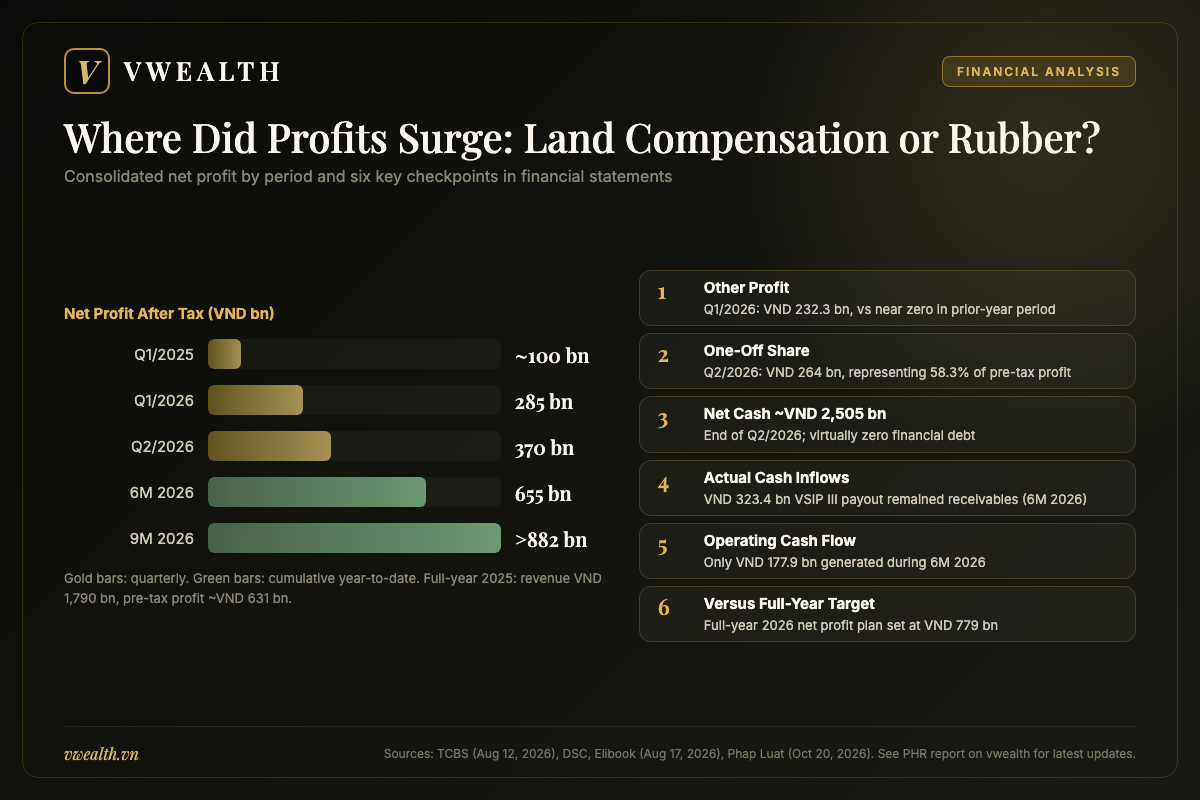
Secondary market price action has reacted aggressively to these land conversion announcements. On February 3, 2026, immediately following the Board’s public announcement of an annual pre-tax profit target exceeding VND 950 billion, PHR stock surged by its maximum daily 7% ceiling limit to VND 67,900 per share on HOSE, driving total market capitalization beyond VND 9,200 billion and approaching its all-time historical peak recorded in early 2022. This historical price movement illustrates how sensitive domestic equity flows are to compensation announcements; current valuations and real-time multiples should be verified on vwealth’s platform. A secondary constraint governing buying liquidity is the 0% foreign ownership room: foreign institutional funds cannot inject new capital into PHR stock due to legacy business registrations in fuel retail and power transmission, concentrating secondary price discovery entirely within domestic retail and institutional trading desks. Once the EGM’s charter reforms reopen foreign room to 49%, external institutional demand could re-enter the stock. To understand how foreign ownership ceilings and ETF weightings dictate institutional capital flows, consult vwealth’s guide on how to invest in Vietnam stock market.
In summary, when auditing Phuoc Hoa’s financial statements, allocators must evaluate three decisive questions: what percentage of pre-tax profit originates from “other income”; have compensation receivables cleared into liquid bank deposits; and are core operating earnings from rubber harvesting and industrial park leasing expanding or contracting? Answering these three questions provides far greater institutional insight than celebrating headline profit records in financial press releases.
Rubber Prices, EUDR Compliance, and the Industrial Park Race: The Post-2027 Landscape
While the preceding chapter audited internal accounting entries, this chapter examines the macroeconomic forces operating beyond the plantation gates. Phuoc Hoa’s normalized core profitability — the operational cash generation remaining once conversion windfalls taper off — is governed by two independent macroeconomic arenas: the international physical natural rubber market, where prices are set on commodity bourses in Singapore, Shanghai, and Tokyo; and the industrial land leasing market across southeastern Vietnam, which determines the economic value of Phuoc Hoa’s underlying soil. Analyzing these two markets provides the structural foundation for evaluating the forward scenarios detailed in Chapter 7.
Global Rubber Reaches 2017 Peak: USD 2,370 Per Tonne in June 2026
According to commodity market documentation from DSC in August 2026, benchmark international natural rubber prices surged to approximately USD 2,370 per tonne in June 2026 — establishing the highest commodity quotation recorded since 2017 and reflecting a 32% price appreciation from the beginning of the calendar year. Subsequently, benchmark contracts underwent a technical correction, consolidating around USD 2,180 per tonne by late July. For the second half of 2026, DSC projected global prices to trade within a range of USD 2,050 to USD 2,150 per tonne, maintaining an 8% to 13% elevation over prior-year levels.
Vietnam’s official physical export prices tracked this international trajectory closely. Consolidated trade statistics through late July 2026 confirm aggressive year-on-year export price expansions across primary rubber grades: SMR20 climbed 27.6%, STR20 advanced 25.7%, RSS3 rose 29.2%, and concentrated liquid latex surged 32.1% year-on-year. Translating this directly into Phuoc Hoa’s operational realization, the company achieved an average selling price of approximately VND 57 million per tonne across the first nine months of 2026, while management established an aspirational Q4 realization target of VND 62 million per tonne. Compared to the average realized price of VND 45.3 million per tonne logged in 2024, prevailing price realizations provide substantial top-line support.
What structural drivers propelled this commodity rally? Global supply constraints represent the primary catalyst. Research from the Association of Natural Rubber Producing Countries (ANRPC) highlighted an anticipated structural global deficit of 600,000 to 800,000 tonnes annually extending through 2028, caused by biological plantation aging across primary Southeast Asian producing nations, declining tree yields, and depressed global inventory buffers. For 2026 alone, international industry estimates projected a global supply deficit of 300,000 to 500,000 tonnes. Because Hevea rubber trees require an extensive six to seven-year biological gestation period before yielding commercial latex, global supply is highly price-inelastic. Plantation operators cannot rapidly scale extraction in response to elevated pricing, causing agricultural rubber super-cycles to persist across multi-year horizons rather than fleeting quarters.
However, natural rubber faces a crucial synthetic competitor: petroleum-derived synthetic rubber. When global crude oil quotations surge, synthetic rubber feedstock costs escalate, prompting global tire manufacturers to substitute natural latex, driving up natural rubber prices. Conversely, when crude oil softens, synthetic alternatives become cheaper, exerting downward pressure on natural latex. Equity analysts at DSC attributed the post-June 2026 pricing correction partially to this mechanism: as geopolitical friction between the United States and Iran de-escalated, crude oil cooled, synthetic rubber prices eased, and industrial demand rebalanced.
Recent trading history provides a sober reminder of commodity volatility. In April 2025, when global trading desks reacted to mounting trade policy friction and tariff anxieties surrounding the United States, benchmark TSR20 and RSS3 contracts plummeted approximately 20% and 18% respectively within weeks. For a producer whose commercial selling contracts are linked to international spot benchmarks, a 20% commodity price decline flows directly into operating gross margins, because agricultural labor, plantation weeding, fertilizer inputs, and transport costs do not contract proportionally.
Not all institutional research desks have adopted bullish commodity assumptions. In an institutional survey compiled in late May 2026, securities firm MBS adopted a cautious baseline assumption modeling Phuoc Hoa’s 2026 average realized price at only VND 48.5 million per tonne, citing macroeconomic headwinds and automotive manufacturing overcapacity in mainland China. While Phuoc Hoa’s actual nine-month realization (~VND 57 million per tonne) outperformed that conservative estimate, MBS’s caution emphasizes that long-term investors should never extrapolate cyclical price peaks indefinitely.
China, Tire Manufacturing, and EU Anti-Dumping Duties
Mainland China represents the world’s largest aggregate consumer of natural rubber and the single largest export destination for Vietnamese agricultural latex. Because more than 70% of global natural rubber consumption is absorbed by the automotive tire manufacturing sector, the operational health of China’s automotive supply chain is the primary external variable governing commodity demand for producers like Phuoc Hoa.
A pivotal trade policy development emerged during 2026 when the European Union formally imposed definitive anti-dumping duties ranging from 4.3% to 45.3% on automotive and truck tires imported from China, according to trade disclosures cited by DSC. This tariff enforcement creates complex cross-currents for Vietnamese raw rubber exporters. On the negative side, if Chinese domestic tire manufacturers experience export volume compression into the European single market, their aggregate procurement of raw Vietnamese cup lump could soften. On the positive side, international tire conglomerates are accelerating supply chain diversification by expanding manufacturing operations across Southeast Asia — including domestic factories in Vietnam — increasing local demand for domestically processed latex. While the net balance shifts over time, foreign investors must recognize that regulatory decisions formulated in Brussels directly impact raw latex pricing in Phuoc Hoa’s home districts.
EUDR: Why Deforestation Traceability is the New Passport for Natural Rubber
The European Union Deforestation Regulation (EUDR) represents one of the most stringent regulatory compliance regimes ever applied to global agricultural supply chains. The statute mandates that specific commercial commodities entering the European Union — including natural rubber and timber — must provide auditable, geolocated proof that cultivation did not occur on land deforested or degraded after December 31, 2020. Compliance necessitates mapping precise GPS polygonal boundaries for every agricultural parcel, logging verifiable chain-of-custody documentation, and linking every commercial shipping container to verified non-deforested origin acreage. Producers unable to satisfy these rigorous technical audits face total market exclusion from European supply chains or severe price penalties from global tire brands supplying Western markets.
Phuoc Hoa has proactively engineered a compliance infrastructure. According to official corporate disclosures, the company deployed a dedicated “Plantation Database and Product Origin Traceability Portal” (accessible at eudr.phr.vn) explicitly designed to satisfy EUDR compliance criteria, featuring an integrated order-tracking interface for international commercial buyers. Establishing this digital infrastructure represents a concrete operational milestone. However, operating a digital tracking architecture does not automatically certify that 100% of export volume has secured formal customer audit clearance; published corporate sources have not disclosed comprehensive third-party EUDR audit certifications for the entirety of Phuoc Hoa’s output. Investors must track forthcoming corporate disclosures regarding the precise percentage of sales cleared for EUDR-sensitive markets.
In this regulatory environment, Phuoc Hoa’s legacy state-plantation heritage confers a structural competitive advantage over fragmented smallholders. Because Phuoc Hoa’s core plantations sit on contiguous state agricultural land established decades ago, verifying that these estates were not established through recent deforestation is straightforward compared to dispersed independent smallholders. However, Phuoc Hoa’s commercial model presents a distinct compliance vulnerability: during the first nine months of 2026, the company purchased more than 11,800 tonnes of raw latex from external smallholders and traders. Verifying the precise GPS origin and non-deforestation compliance of thousands of independent smallholder plots is technically demanding, making supply-chain traceability for purchased latex an essential issue for institutional governance audits.
Rubber Gross Margins: Higher Selling Prices Do Not Guarantee Proportional Profits
A common error committed by generalist equity investors is assuming that a 30% increase in international rubber benchmark prices automatically translates into an equivalent or greater expansion in Phuoc Hoa’s consolidated gross profit. In operational reality, gross margin elasticity is heavily governed by raw material procurement ratios. Phuoc Hoa operates with two distinct raw material streams: captive plantation extraction and external third-party purchasing. Internally tapped latex from captive plantations carries relatively stable cash harvesting and depreciation costs; when selling prices surge, operating leverage kicks in and gross margins expand rapidly. Conversely, third-party cup lump purchased from independent farmers must be acquired at prevailing spot rates; when market prices escalate, procurement input costs rise simultaneously, keeping trading gross margins compressed.
Operational data from 9M/2026 illustrates this dynamic clearly: Phuoc Hoa harvested approximately 8,600 tonnes from captive trees, purchased over 11,800 tonnes from third parties, and commercialized 21,500 tonnes of finished product. Because third-party procurement volumes exceeded captive extraction, blended corporate margins reflect both profiles. In Q1/2026, research from VNDirect revealed that Phuoc Hoa’s rubber segment gross margin contracted to approximately 25.5% despite rising selling prices, as domestic procurement competition pushed input costs up faster than export realizations. In Q2/2026, blended gross margin rebounded to 34.2% as average realized selling prices accelerated to VND 56.4 million per tonne. Understanding this raw material mix is essential: commodity price surges deliver powerful gross profit expansion on captive acreage, but create cost inflation across the commercial purchasing division.
The structured analytical table below summarizes the key macroeconomic and industry drivers governing Phuoc Hoa’s agricultural operations.
| Macroeconomic / Industry Driver | Impact Vector on PHR | Verified Reference Metric | Primary Information Source |
|---|---|---|---|
| Global Supply Deficit | Strong Price Support | ANRPC: structural deficit of 600,000–800,000 t/yr to 2028 | DSC; Industry & Trade Mag |
| Vietnam Realized Export Prices (to 07/2026) | Positive Top-Line Growth | SMR20 +27.6%, STR20 +25.7%, RSS3 +29.2%, Latex +32.1% YoY | Phap Luat Viet Nam |
| Crude Oil & Synthetic Rubber Easing | Downward Price Pressure | Peak of USD 2,370/t in June 2026 moderated to ~USD 2,180/t in July | DSC Equity Research |
| EU Anti-Dumping Duties on Chinese Tires | Bilateral / Complex | EU tariffs of 4.3%–45.3% prompt manufacturing shifts to ASEAN | DSC Equity Research |
| Chinese Automotive Demand Exposure | Downside Cyclical Risk | MBS conservative baseline assumed 2026 price of VND 48.5M/t | Elibook (May 2026) |
| Third-Party Procurement Volume Dominance | Gross Margin Compression | 9M/2026: 8.6k t tapped vs >11.8k t purchased; Q1 margin 25.5% | Phap Luat Viet Nam; VNDirect |
| EUDR Traceability Mandate | Mandatory Compliance | PHR deployed dedicated digital traceability system (eudr.phr.vn) | Official corporate portal |
Southeast Vietnam Industrial Parks: Why Rubber Concessions Became Prime Real Estate
The second decisive macroeconomic context centers on the industrial real estate landscape of southern Vietnam. Phuoc Hoa’s land bank is situated in the former Binh Duong province, an economic territory integrated directly adjacent to the expanded Ho Chi Minh City metropolitan industrial corridor. When multinational manufacturing consortia seek hundreds of hectares to construct mega-scale assembly facilities, hyperscale data centers, or regional logistics hubs, mature state rubber plantations represent the premier target asset class. Large, contiguous parcels held under a single state-corporate owner eliminate the protracted legal friction, fragmented title disputes, and multi-year compensation negotiations that paralyze private residential or smallholder farmland clearance.
This dynamic is vividly illustrated by the blue-chip tenant roster at VSIP III, an industrial park developed directly on former Phuoc Hoa plantation land: LEGO committed 44 hectares for its regional manufacturing hub, Pandora leased 7.5 hectares for jewelry production, and the SAM DigitalHub consortium secured 50 hectares for data center infrastructure. Furthermore, at Nam Tan Uyen 3 (NTC 3) — developed by PHR’s 32.85%-owned associate NTC — VDSC projected headline land lease rates of USD 160 to USD 170 per square meter over the remaining statutory term. To understand the economic power of this land transformation, consider an illustrative example comparing land yields: one hectare of rubber plantation yields approximately 1.41 tonnes of latex per year (based on Phuoc Hoa’s 2024 operating baseline), generating roughly VND 60 to 80 million in annual gross revenue. By contrast, when that same single hectare (10,000 square meters) is repurposed for industrial infrastructure commanding USD 160 per square meter, its commercial leasing value represents approximately USD 1.6 million in lifetime economic value. This massive economic spread explains why plantation land has become exceptionally valuable.
Phuoc Hoa is far from alone in navigating this industrial transformation. Provincial giant Becamex IDC acts as the cornerstone infrastructure developer across Binh Duong and represents the Vietnamese joint-venture partner alongside Sembcorp in VSIP; investors can evaluate this developer perspective in vwealth’s guide to Vietnam manufacturing and industrial stocks. Within the Vietnam Rubber Group orbit, Saigon VRG represents an enterprise that executed this pivot years ago, evolving into a dedicated park developer analyzed in vwealth’s review of SIP stock of Saigon VRG. To compare Phuoc Hoa against nationwide industrial developers operating across northern and central Vietnam, allocators can examine vwealth’s analysis of KBC stock of Kinh Bac City.
The fundamental structural distinction that investors must internalize is that Phuoc Hoa currently operates predominantly as a land-ceding partner receiving compensation and site subsidies, rather than as an independent master developer leasing industrial park infrastructure at scale. Standalone park leasing revenue generated through its Tan Binh subsidiary contributed a modest VND 17 billion in Q2/2026. The pivotal strategic question for the post-2027 era is whether Phuoc Hoa can successfully transition into a primary equity investor and developer across its forthcoming pipeline — Tan Lap 1, Bac Tan Uyen 2, Lai Hung, and Tan Binh Expansion Phase 2 — and at what developmental speed. Disclosures from Mirae Asset highlight that VSIP III and Bac Tan Uyen 1 collectively absorb approximately 39% of the rubber land slated for conversion under the provincial 2025–2030 master plan. The remaining 61% represents an unharvested asset pipeline awaiting formal development execution.
Three Forward Scenarios for PHR: What Must Happen for the Stock to Advance?
In commercial forestry, a rubber tree plantation yields latex continuously for approximately two to three decades, after which biological productivity diminishes, requiring the stand to be clear-cut and replanted. Phuoc Hoa Rubber currently stands at an analogous juncture, but across its entire corporate enterprise: the multi-year cycle of “liquidating” agricultural land for industrial parks is delivering the most substantial financial windfalls in corporate history, and the pivotal question is what operational assets will be “planted” to generate steady corporate cash flows once this conversion phase concludes. In adherence to analytical discipline, this chapter presents no speculative target prices. Instead, it isolates the critical operational variables and articulates three comprehensive forward scenarios, detailing the verifiable milestones required for each outcome to materialize.
Execution and Timing Risks: Dependence on Legal Decrees, Zoning, and Counterparty Liquidity
Every bullish institutional earnings forecast formulated for Phuoc Hoa Rubber rests upon an indispensable foundational premise: that municipal land recovery decrees and partner compensation disbursements arrive strictly according to projected technical schedules. In its August 2026 equity research report, securities firm DSC explicitly cautioned that compensation velocity is subject to municipal legal approvals, statutory zoning reviews, and the financial budgeting capabilities of counterparties, meaning quarterly bookings can diverge materially from market consensus. The second quarter of 2026 provided an empirical demonstration of this friction: according to institutional research from VDSC, compensation recognition lagged initial internal schedules, resulting in net earnings missing brokerage models.
According to milestone projections synthesized by DSC, during the second half of 2026, VSIP III is projected to contribute an additional ~VND 700 billion (corresponding to 148 hectares), Bac Tan Uyen 1 is modeled to contribute ~VND 360 billion, and the residual balance of approximately VND 908 billion from Bac Tan Uyen 1 is slated to disburse across 2027 and 2028. Every single monetary entry across this forward pipeline requires an official provincial land recovery decision, an executed bilateral site handover protocol, and an actual commercial bank transfer. A procedural delay of a single quarter in executing an administrative handover protocol pushes hundreds of billions of dong from one fiscal period into the next. Concurrently, public infrastructure handovers — such as the 81-hectare corridor recovered for the Ho Chi Minh City – Thu Dau Mot – Chon Thanh Expressway (with total pre-tax compensation budgeted at VND 203 billion, following an initial 34-hectare handover in Q1/2025) — depend strictly on national public capital disbursement velocity.
Furthermore, an adverse regulatory liability hangs over the land portfolio, as documented in Chapter 5: Phuoc Hoa received a formal municipal assessment for annual state land rental fees totaling approximately VND 413.8 billion, reflecting an estimated 5.6-fold surge in statutory land rental unit rates. The enterprise has officially petitioned municipal tax authorities to review and moderate this liability, and tax organs had not issued a binding reassessment at the reporting date. If this state rental assessment is upheld without mitigation, it will impose a substantial recurring cost drag that directly counteracts the financial benefits of rising regional land values.
The Post-2027 “Profit Cliff”: When Other Income Normalizes to ~VND 77–78 Billion Annually
The foremost strategic consideration for institutional allocators evaluating PHR stock is not the absolute quantum of 2026 net profit, but the sustainability of earnings in 2028 and beyond. Quantitative projections formulated by VDSC forecast that Phuoc Hoa’s other net income will peak at approximately VND 2,127 billion in 2026, remain elevated at VND 2,045 billion in 2027, and subsequently plunge to an ordinary baseline of approximately VND 77 to 78 billion annually. If these brokerage models materialize as projected, Phuoc Hoa’s bottom-line earnings will experience a dramatic contraction post-2027, reverting toward the underlying earnings baseline of an agricultural commodity producer operating with an extensive treasury surplus.
Consider an illustrative example demonstrating this financial contraction. Suppose that during peak conversion years, other net income from land clearance accounts for 70% of consolidated pre-tax profit. When land compensation windfalls terminate and other income normalizes to zero, consolidated pre-tax profit mechanically contracts to roughly 30% of peak levels, excluding incremental treasury interest earned on accumulated cash balances. An equity investor who purchases shares at an optically “cheap” single-digit trailing P/E multiple calculated on peak 2026–2027 windfall earnings could witness their effective holding multiple expand three-fold when bottom-line earnings mean-revert. This is the structural “earnings cliff” that long-term allocators must model today.
What strategic operational developments could bridge this post-2027 earnings gap? Three operational pathways exist. First, executing new compensation handovers across the remaining 61% of planned conversion acreage — such as Tan Lap 1, which VDSC projects for ground development starting in 2028, with approximately 200 hectares of rubber timber scheduled for early liquidation in 2027. Second, establishing recurring industrial leasing revenue streams by transitioning Phuoc Hoa from a passive land ceder into an active equity joint-venture developer across newly zoned industrial parks. Third, monetizing high-tech incubation initiatives such as industrial rooftop solar installations and the 1,300-hectare tissue-cultured banana project. Crucially, all three bridging mechanisms currently reside within the master-zoning or policy-approval phase, meaning their commercial cash-flow timelines cannot be treated as contracted certainties.
Dilution from the 80% Bonus Share Distribution: The Pie Remains Constant While Slices Multiply
According to formal regulatory event filings, Phuoc Hoa established September 14, 2026, as the official shareholder record date (with ex-rights trading occurring on September 11, 2026) for an 80% bonus share distribution (ratio 100:80), funded entirely from the corporate Development and Investment Fund. Under this approved corporate distribution, the enterprise issued approximately 108.4 million new shares, expanding chartered capital from roughly VND 1,355 billion to approximately VND 2,439 billion. Investors should consult official HOSE supplementary listing notices to verify the final post-issuance circulating share count.
From a balance sheet perspective, a bonus share issue does not alter corporate enterprise value. Economic assets and net equity remain completely unchanged; accounting reserves are simply reclassified from retained capital funds into statutory chartered capital. However, the corporate action mechanically alters every per-share valuation metric. Consider an illustrative example: if an enterprise generates VND 1,000 billion in net profit across 100 million outstanding shares, earnings per share (EPS) equals VND 10,000. Following an 80% bonus distribution, total outstanding shares expand to 180 million, mechanically compressing EPS to approximately VND 5,556, even though aggregate corporate earnings remain unchanged. When examining historical research reports or consensus target prices published prior to the ex-rights date, analysts must adjust per-share figures by dividing by 1.8 before making direct comparisons with secondary exchange quotations.
A second structural consequence involves cash dividend distribution commitments. In Vietnam, statutory cash dividends are universally declared as a percentage of statutory par value (VND 10,000 per share). When an enterprise pledges a specific cash dividend percentage against a chartered capital base that has expanded by 80%, the absolute monetary cash required to fund that distribution expands by exactly 80%. Consequently, the corporate cash dividend commitments for 2026 analyzed in Chapter 8 must be evaluated in tandem with the expanded chartered equity base.
Commodity Cycle Reversal: The Core Operating Foundation Is Sensitive
Calendar year 2026 delivered an exceptional commodity environment for natural rubber producers across Southeast Asia. Yet, operating within a cyclical bull market makes it easy to overlook that commodity prices can experience swift, structural corrections. The fundamental risks that could depress international rubber prices were detailed in Chapter 6: moderating crude oil prices reducing synthetic rubber production costs, macroeconomic softness or automotive manufacturing overcapacity in mainland China, and regional supply chain friction arising from trade tariffs. The sharp 20% correction experienced by benchmark TSR20 contracts in April 2025 demonstrates how trade policy announcements can trigger sudden market downdrafts.
In the post-2027 operating environment, as one-off land conversion windfalls taper off, international rubber pricing will re-emerge as the primary determinant of Phuoc Hoa’s operating profitability. Because Phuoc Hoa’s captive tapping acreage is steadily contracting due to industrial park development, third-party cup lump procurement will occupy an increasingly dominant share of total processing throughput (surpassing 11,800 tonnes against 8,600 tonnes harvested internally in 9M/2026). As a result, operating gross margins will become increasingly sensitive to the spread between third-party procurement input costs and finished export benchmark realizations. Allocators must track both benchmark commodity indices and the internal operational procurement mix across quarterly reports.
Three Forward Scenarios: Structural Assumptions and Quarterly Verification Catalysts
Bull Scenario: Seamless Compensation Execution, Reopened Foreign Room, and Pipeline Continuity. In this constructive scenario, the residual VND 2,103 billion in VSIP III compensation is disbursed smoothly across 2026 and 2027 in strict alignment with corporate guidance, while Bac Tan Uyen 1 compensation clears predictably toward its >VND 1,400 billion target. Phuoc Hoa successfully completes the regulatory deregistration of petroleum retail and power transmission business lines, allowing state regulators to formally reopen the foreign ownership room to 49%, unlocking structural buying demand from foreign institutional funds and regional ETFs. Provincial authorities issue formal investment policy approvals for Tan Lap 1, enabling site clearance and timber liquidation starting in 2027, with ground construction commencing in 2028 as modeled by VDSC. Concurrently, secondary industrial parks (Bac Tan Uyen 2, Lai Hung, Tan Binh Phase 2) achieve transparent 1/2000 zoning progress. Management deploys a portion of its VND 2,500+ billion cash surplus to secure direct developer equity stakes in new parks, establishing long-term recurring leasing income. High cash dividend distributions are maintained. Under this scenario, the post-2027 “profit cliff” is smoothed out, and public equity markets value PHR stock as a premium industrial land developer rather than a commodity planter.
Base Case Scenario: Windfalls Concentrate in 2026–2027 Followed by Normalization. This scenario mirrors the quantitative projections modeled by VDSC: massive other net income is booked across 2026 and 2027, followed by a sharp normalization toward approximately VND 77 to 78 billion annually starting in 2028. Compensation cash is collected successfully, but exhibits quarterly timing lumpiness. Forthcoming industrial park projects remain anchored within the regulatory planning and zoning pipeline, failing to generate significant commercial cash flows prior to 2028. Benchmark natural rubber prices trade near historical mid-cycle averages, retreating from 2026 cyclical peaks. Corporate cash reserves expand aggressively over the two-year window and are partially distributed to shareholders via dividends. In this scenario, 2028 net earnings contract sharply relative to 2026–2027 levels, and the equity’s primary investment appeal rests upon its net cash fortress and dividend yield.
Bear Scenario: Administrative Gridlock, Commodity Downdraft, and Tax Headwinds. This adverse scenario materializes if land recovery and site clearance at Bac Tan Uyen 1 face protracted administrative delays due to municipal master plan revisions or partner capex reprioritization, while uncollected VSIP III receivables remain tied up on the balance sheet. Simultaneously, international rubber prices experience an aggressive downcycle driven by falling crude oil prices and softening global automotive sales. Municipal tax authorities uphold the annual state land rental fee assessment of approximately VND 413.8 billion without modification, imposing a severe recurring cost drag on plantation operations. Statutory deregulation of restricted business codes encounters bureaucratic delays, keeping foreign ownership capped at 0%. Quarterly reported net earnings experience severe downside volatility, institutional brokerages downgrade earnings models, and speculative capital that entered the stock chasing headline earnings records exits rapidly.
The structured matrix below synthesizes the core assumptions and quarterly verification catalysts defining these three scenarios.
| Forward Scenario | Primary Structural Assumptions | Quarterly Verification Catalysts | Primary Information Source |
|---|---|---|---|
| Bull Scenario | Compensation on schedule; FOL reopened to 49%; Tan Lap 1 licensed for 2028; PHR co-develops parks | VSIP III receivables decline, cash expands; corporate charter filings; 1/2000 zoning approvals | Company disclosures; Phap Luat Viet Nam; VDSC |
| Base Case Scenario | Windfalls concentrate in 2026–2027 then drop to ~VND 77–78B/yr; mid-cycle rubber pricing | Declining other income ratio over time; stable realized rubber selling prices; steady cash payout | VDSC via Elibook; DSC |
| Bear Scenario | Bac Tan Uyen 1 delayed; rubber prices slump; state land rent of ~VND 413.8B upheld; FOL stays 0% | Other receivables expand across quarters; CFO remains deeply depressed; rubber gross margin contracts | DSC; TCBS Equity Research |
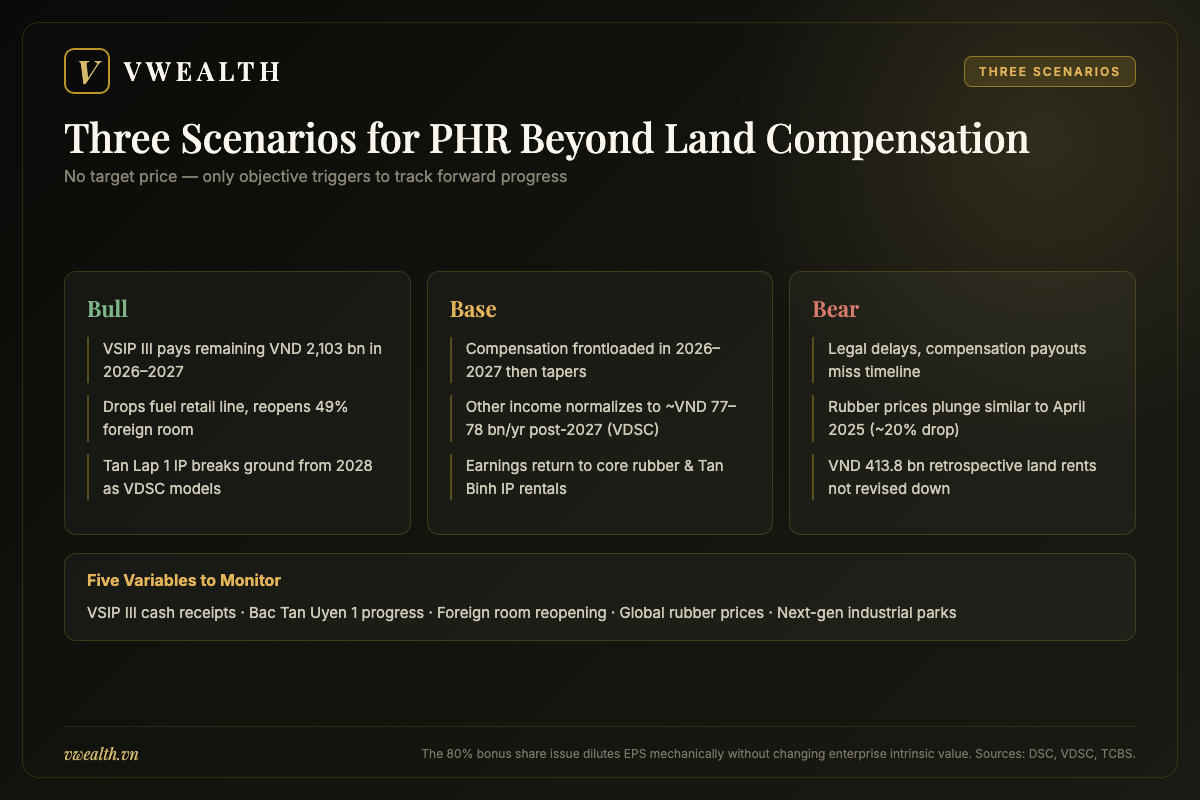
The practical utility of this scenario framework is straightforward: whenever Phuoc Hoa releases an audited quarterly report, regulatory filing, or AGM disclosure, allocators can audit the actual data points against these verification catalysts to determine which scenario is unfolding. While domestic securities brokerages maintain positive broad-market coverage on PHR stock, all institutional recommendations are explicitly contingent upon underlying land compensation timelines. When operational assumptions shift, consensus recommendations adjust rapidly; independent allocators who systematically monitor these balance-sheet catalysts will identify inflection points long before they are reflected in headline brokerage revisions.
Should You Buy PHR Stock? Dividend Yields, 2026 Guidance, and the Investor Due Diligence Checklist
Throughout this comprehensive investigation, institutional allocators have observed that Phuoc Hoa Rubber operates with two distinct corporate faces. One face is that of a disciplined, defensive agricultural plantation enterprise possessing an unassailable cash fortress of more than VND 2,500 billion in net cash, virtually zero long-term debt, and capitalizing on the strongest international rubber pricing environment witnessed in nearly a decade. The other face is that of a finite industrial land conversion concession with a definitive geological reserve, being aggressively harvested and monetized across the 2026–2027 window. Consequently, the fundamental question of whether you should buy PHR stock admits no universal answer. It depends entirely on which corporate face you are purchasing, at what prevailing secondary market multiple, and across what investment time horizon.
Fiscal Year 2025 Capital Distribution: 14% Cash Dividend Plus 80% Bonus Shares (94% Aggregate Rate)
For fiscal year 2025, Phuoc Hoa’s General Meeting of Shareholders approved an exceptional capital distribution plan: a 14% cash dividend (equivalent to VND 1,400 per share against standard par value) alongside an 80% bonus share issue executed under a 100:80 distribution ratio. Official corporate filings record September 14, 2026, as the statutory shareholder record date, with cash dividend disbursements completing by October 15, 2026. Domestic financial media described this combined 94% total shareholder distribution as the largest aggregate capital distribution executed by the corporation since its 2009 public listing. Institutional allocators must maintain analytical precision: the 80% bonus component represents newly issued equity shares funded from corporate capital reserves rather than cash liquidity; actual liquid cash returned to shareholders was 14%.
Examining Phuoc Hoa’s historical cash dividend track record reveals a corporate policy characterized by high generosity but pronounced cyclical variability: fiscal 2022 delivered a record 59.5% cash dividend (disbursed in three separate tranches across 2023); fiscal 2023 yielded a 30% cash dividend; fiscal 2024 distributed 13.5%; and fiscal 2025 paid 14%. Among dividend-paying Vietnam stocks, cash dividend yields track bottom-line net income and actual land compensation cash realization. For dividend-focused investors, the primary takeaway is unequivocal: never extrapolate a peak windfall dividend year into an ordinary perpetual yield baseline.
2026 Minimum 25.09% Cash Dividend Commitment and Annual Corporate Targets
According to official AGM corporate documentation reported across financial press, Phuoc Hoa’s Board of Directors established a binding minimum cash dividend guidance of 25.09% for fiscal year 2026. If this 25.09% statutory rate is applied against the expanded chartered capital base following the 80% bonus share distribution (~VND 2,439 billion), the total monetary cash deployed to fund shareholder dividends will expand dramatically relative to prior fiscal years. Investors should monitor forthcoming Board resolutions to confirm the definitive chartered capital baseline applied and the formal tranche disbursement schedule.
For parent-company standalone operations, the approved 2026 business plan targets gross revenue of at least VND 2,280 billion, representing an 8% increase year-on-year, and standalone net profit after tax of VND 779 billion, advancing 57% year-on-year. In February 2026, initial Board resolutions established a pre-tax profit target of approximately VND 953 billion, while executive management publicly highlighted a “potential pre-tax earnings capacity of roughly VND 2,000 billion” in an idealized scenario where full industrial compensation packages aligned concurrently. Concurrently, operational guidance mandated a minimum 10% increase in labor productivity alongside a minimum 5% reduction in production unit costs. As established in Chapter 5, cumulative 9M net profit of >VND 882 billion has already surpassed the full-year target within three quarters. Therefore, the institutional debate is no longer whether guidance will be achieved, but how much surplus cash will be directed toward special shareholder distributions versus retained for upcoming industrial park equity co-investments.
The structured analytical table below weighs the fundamental bullish strengths against the primary investment risks governing PHR stock based strictly on verified corporate data.
| Bullish Strengths / Upside Catalysts | Investment Risks / Operational Headwinds |
|---|---|
| Net cash fortress of ~VND 2,505B (end Q2/2026); minimal interest-bearing debt (VND 160B) | 2026–2027 net profits overwhelmingly dependent on ‘other income’ (58.3% of Q2/2026 PBT) |
| VSIP III fixed contract locked at VND 3,260B; remaining VND 2,103B collecting across 2026–2027 | VND 323.4B VSIP III compensation booked in 6M/2026 remained uncollected; 6M CFO was VND 177.9B |
| Bac Tan Uyen 1 compensation committed at >VND 1,400B (~VND 500B targeted for 2026) | Site handover velocity subject to municipal approvals, zoning, and partner budget timelines |
| Global rubber prices near 2017 highs; structural ANRPC supply deficit through 2028 | Commodity price volatility: benchmark contracts can plunge 20% quickly as in April 2025 |
| Remaining ~61% conversion pipeline: Tan Lap 1, Bac Tan Uyen 2, Lai Hung, Tan Binh Ext. | Post-2027 ‘profit cliff’: other income projected by VDSC to normalize to ~VND 77–78B/yr |
| 2026 minimum cash dividend guidance pledged at 25.09% | FOL currently capped at 0% pending charter deregulation; state land tax assessment (~VND 413.8B) pending |
Investor Suitability: Who Should Buy PHR Stock, and Who Should Avoid It?
Suitable for Allocators Prioritizing Tangible Assets and Fortress Balance Sheets. Investors seeking exposure to deeply capitalized companies where liquid cash exceeds all financial debt, backed by vast prime real estate assets undergoing institutional repricing, will find PHR a compelling asset-play. Corporate value is anchored within the pristine balance sheet and irreplaceable geographic land concessions rather than short-term operating income volatility.
Suitable for Patient, Long-Term Dividend Collectors. State-controlled subsidiaries operating with low capital reinvestment intensity, massive cash balances, and a parent group (VRG) that relies on subsidiary dividend upstreaming represent reliable cash distribution vehicles. However, income investors should calculate their long-term dividend yield expectations based on normalized post-2027 cash flows rather than peak conversion windfall payouts.
Suitable for Cyclical Investors Understanding Commodity and Industrial Transitions. Investors familiar with global agricultural commodity cycles who can navigate seasonal latex pricing swings without panicking during quarterly margin compressions are well-positioned. For comparative perspective on agricultural restructuring models across Vietnam’s corporate landscape, investors can review vwealth’s analysis of HNG stock of HAGL Agrico. Furthermore, allocators evaluating multi-segment infrastructure and property cash-flow transitions can contrast Phuoc Hoa with hybrid developers examined in vwealth’s review of DPG stock of Dat Phuong Group.
Unsuitable for Investors Chasing Headline “Record Earnings” Momentum. Generalist market participants who buy PHR stock solely because 9M profits surged 91% and implicitly assume that net earnings will expand at comparable rates indefinitely are buying the peak of the mountain while ignoring the normalized valley. Purchasing an asset conversion windfall at peak trailing multiples represents a classic emerging-market equity trap.
Unsuitable for Portfolios Requiring Linear, Predictable Quarterly Earnings. Because bottom-line profitability is governed by the timing of municipal land handover decrees, quarterly earnings will exhibit severe lumpiness. Risk-averse allocators distressed by sudden 50% quarterly net income contractions should avoid the stock.
Unsuitable for Foreign Retail Investors While Foreign Room Remains Clamped. As long as the statutory foreign ownership room remains capped at 0%, foreign market participants cannot execute new secondary market purchases through standard brokerage accounts. Offshore investors must await formal regulatory confirmation of the 49% foreign room reopening.
The Institutional Monitoring Checklist and Using vwealth Real-Time Valuation Scoring
Rather than attempting to forecast intraday share price movements, institutional portfolio managers should track a concise operational checklist across quarterly filings. Every checklist indicator connects directly to an audited structural risk or operational catalyst analyzed in this dossier.
1. VSIP III Cash Liquidity Realization. Compare “other receivables” against short-term cash term deposits across consecutive balance sheets. Benchmark: VND 1,157 billion collected in cash through year-end 2025; remaining VND 2,103 billion scheduled across 2026–2027; audit whether the VND 323.4 billion recognized in 6M/2026 clears from receivables into liquid cash.
2. Bac Tan Uyen 1 Handover Execution. Monitor realization against the company’s >VND 1,400 billion total compensation baseline, with ~VND 500 billion targeted for 2026 recognition (VND 171.7 billion booked in 6M/2026 across ~700–790 hectares).
3. Ratio of Other Net Profit to Profit Before Tax. Q2/2026 reached 58.3%. If this ratio contracts because core agricultural or leasing earnings expand, it indicates healthy diversification; if it contracts because municipal handovers stalled, it signals operational friction.
4. Operating Cash Flow to Net Profit Spread. 6M/2026 operating cash flow (CFO) of VND 177.9 billion diverged sharply from net profit of VND 655.3 billion. This cash-conversion gap must narrow as compensation receivables clear.
5. Regulatory Foreign Ownership Room Deregistration. Track official corporate disclosures regarding the formal removal of petroleum retail and power transmission business lines, followed by HOSE notices confirming the reopening of foreign room to 49%.
6. Benchmark Rubber Prices and Procurement Proportions. Monitor Phuoc Hoa’s realized selling price (achieved ~VND 57 million per tonne across 9M/2026 against a Q4 target of VND 62 million) alongside the operational volume ratio between third-party purchased cup lump and captive plantation extraction.
7. Pipeline Industrial Zone Zoning Clearances. Track municipal 1/2000 zoning approvals for Tan Lap 1, Bac Tan Uyen 2, Lai Hung, and Tan Binh Expansion Phase 2; monitor feasibility studies for the Tan Binh, Binh Co 1, and Binh Co 2 renewable energy clusters; and track investment policy approvals for the 1,300-hectare tissue-cultured banana initiative.
8. Municipal Land Rental Liability Determination. Track official municipal tax authority determinations regarding the contested ~VND 413.8 billion state land rental fee assessment.
This institutional dossier deliberately excludes spot market P/E, P/B, or daily share price quotes, as these figures fluctuate continuously and, in Phuoc Hoa’s case, change meaning dramatically with every quarterly compensation booking. To access real-time valuation multiples, examine earnings statements with one-off compensation stripped out, and compare Phuoc Hoa against peer rubber planters and specialized industrial park developers across Vietnam, international allocators can create your free vwealth account and review the latest institutional reports on vwealth’s analytical reports portal. The platform’s automated financial models evaluate balance sheets across consecutive reporting periods, allowing allocators to audit every item in the checklist above without manual data extraction.
Final Takeaway: A Legacy Plantation Harvesting Its Own Soil
Phuoc Hoa Rubber represents a unique corporate case study across Vietnam’s equity landscape: a half-century-old agricultural plantation enterprise currently operating at the exact confluence of two simultaneous macroeconomic super-cycles. The first is a cyclical bull market in physical natural rubber, with benchmark quotations hovering near seven-year highs. The second is a secular industrial real estate boom across southern Vietnam, systematically converting fertile rubber plantations into world-class manufacturing campuses at exponential value multiples. In 2026, both super-cycles converged simultaneously onto Phuoc Hoa’s balance sheet, culminating in nine-month net earnings surpassing VND 882 billion and beating full-year targets ahead of schedule.
However, harvesting land is fundamentally different from harvesting latex. Rubber trees tapped at dawn yield fresh latex the following morning; acreage transferred to VSIP III or THACO’s Bac Tan Uyen 1 is permanently extinguished from the agricultural asset base. Consequently, determining whether to buy PHR stock converges on two decisive questions. First: will booked compensation receivables translate into liquid corporate cash on schedule, and how will executive leadership deploy that cash — through generous shareholder dividends or disciplined developer co-investments? Second: once the 2026–2027 conversion phase concludes, can Phuoc Hoa successfully convert its remaining 61% land conversion pipeline into high-margin recurring industrial park leasing revenues, or will corporate earnings mean-revert to the baseline of a traditional commodity planter operating with a large cash surplus? If prevailing market valuations price PHR stock based on the conservative base case while you identify verifiable balance-sheet catalysts supporting the bull scenario, the stock presents an exceptional risk-adjusted opportunity. If, however, secondary markets price peak 2026 windfall earnings as an enduring perpetual annuity, the downside risk heavily outweighs the reward.
This report equips international allocators with the forensic tools required to audit Phuoc Hoa’s unique financial statements, rather than providing an absolute buy or sell recommendation. Always verify real-time corporate filings before allocating capital, and invest strictly within individual risk parameters.
Research Vietnamese stocks in English with vwealth. Our AI-powered platform turns Vietnamese market data into full English analysis reports — with international payment support and a free 2-month trial for new accounts. Create your free account and read the latest reports.


