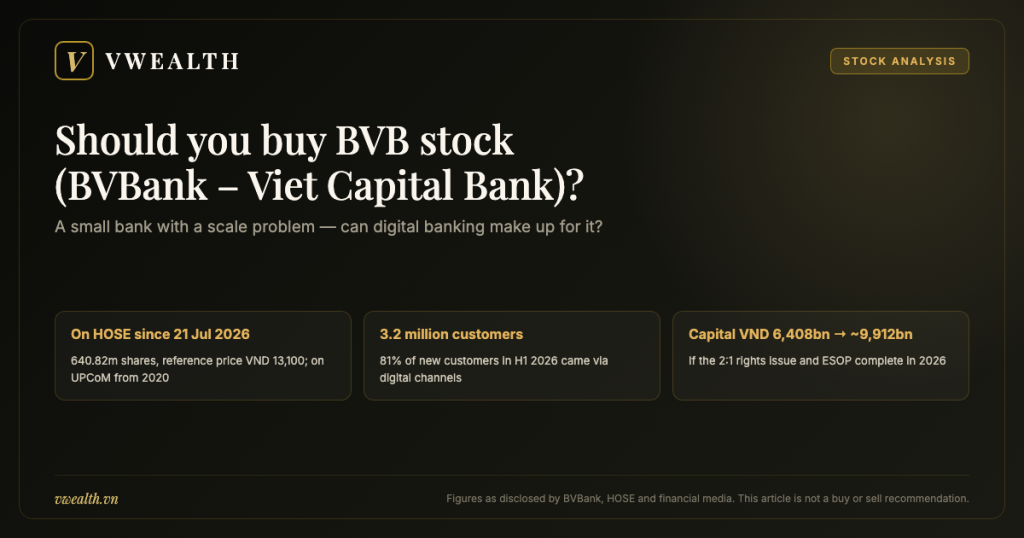
Should you buy BVB stock? The question has become harder to ignore since 21 July 2026, when Viet Capital Commercial Joint Stock Bank — better known today as BVBank — moved its shares from the UPCoM trading venue to a full listing on the Ho Chi Minh City Stock Exchange (HOSE). On one side of the ledger, the bank reported pre-tax profit of about VND 547 billion in the first half of 2026, more than it earned in the whole of 2025, and its customer base passed 3.2 million people, with more than eight in ten new customers arriving through a smartphone app. On the other side, BVBank holds only around 0.54% of Vietnam’s banking-system assets, its return on equity in 2025 was only about 6% by vwealth’s estimate, its non-performing loans by debt group rose in the first half of 2026, and it is asking shareholders for more than VND 3.2 trillion of fresh capital. Among Vietnam stocks in the banking sector, this is the story of a small bank betting almost its entire strategy on digital banking to compensate for the one thing it lacks most: scale. This analysis walks through BVBank’s 34-year journey from Gia Dinh Bank to HOSE, shows you how to read the numbers of a small, fast-growing Vietnamese lender, and gives a balanced answer on who BVB stock suits — and who it does not.
First, some housekeeping on names, because they trip up many foreign investors. BVB is the ticker of Ngân hàng Thương mại Cổ phần Bản Việt, whose official English name is Viet Capital Commercial Joint Stock Bank. For years the bank used the English abbreviation “Viet Capital Bank”; since May 2023 the official abbreviation has been “BVBank”. Older documents therefore say Viet Capital Bank or VietCapital Bank, newer ones say BVBank — it is the same legal entity. BVB traded on UPCoM (Vietnam’s unlisted public company market, run by the Hanoi Stock Exchange) from 9 July 2020 until July 2026, and has been listed on HOSE since 21 July 2026 with 640.82 million shares. Do not confuse BVB with BVH (Bao Viet Holdings, the insurer) or BVS (Bao Viet Securities). And do not confuse BVBank with Vietcap Securities (ticker VCI): the two share historical roots in the “Ban Viet” (Viet Capital) name but are separate companies, separately listed, with separate financial statements.
A note on method, consistent with every article in vwealth’s company-analysis series. Facts, names, transactions and figures come from published information: BVBank’s 2026 listing prospectus, its reviewed consolidated financial statements for the first half of 2026 and other disclosures, VNDirect’s trading and standardised financial data, notices from HOSE, the Hanoi Stock Exchange, the State Securities Commission and the State Bank of Vietnam, plus Vietnamese financial media such as CafeF, Vietstock, VnEconomy, VnExpress, Báo Investing, Nhà Investing, CafeLand and Người Quan sát, and the rating agency Fitch. Figures for closed financial years are used as historical reference points. We do not quote today’s share price, today’s P/B or P/E, or profits for quarters after Q2 2026, because those change constantly. Where a figure is vwealth’s own calculation, it is labelled “vwealth estimate” or “illustrative example”. Where sources disagree, we show both. For current numbers, open the latest vwealth analysis reports.
Finally, the thread that runs through this whole piece. In this series vwealth has already covered several small and mid-sized private Vietnamese banks: Nam A Bank, which has grown its balance sheet very quickly, NCB, a restructuring story funded by private placements, and SeABank, with its history of a foreign strategic partner. Each was read through a different question. For BVBank the question is: how far can technology make up for a lack of scale in a small bank? Deciding whether to buy BVB stock therefore comes down to three things: whether the fast-growing digital customer base turns into thicker profits, whether asset quality keeps pace with lending growth, and what minority shareholders gain and lose in the largest capital raise in the bank’s history. If you are new to the market itself, vwealth’s guide on how to invest in the Vietnam stock market covers the basics — account opening, T+2 settlement, daily price limits and foreign ownership rules.
From Gia Dinh Bank to BVBank: 34 years of a bank that chose to go slowly
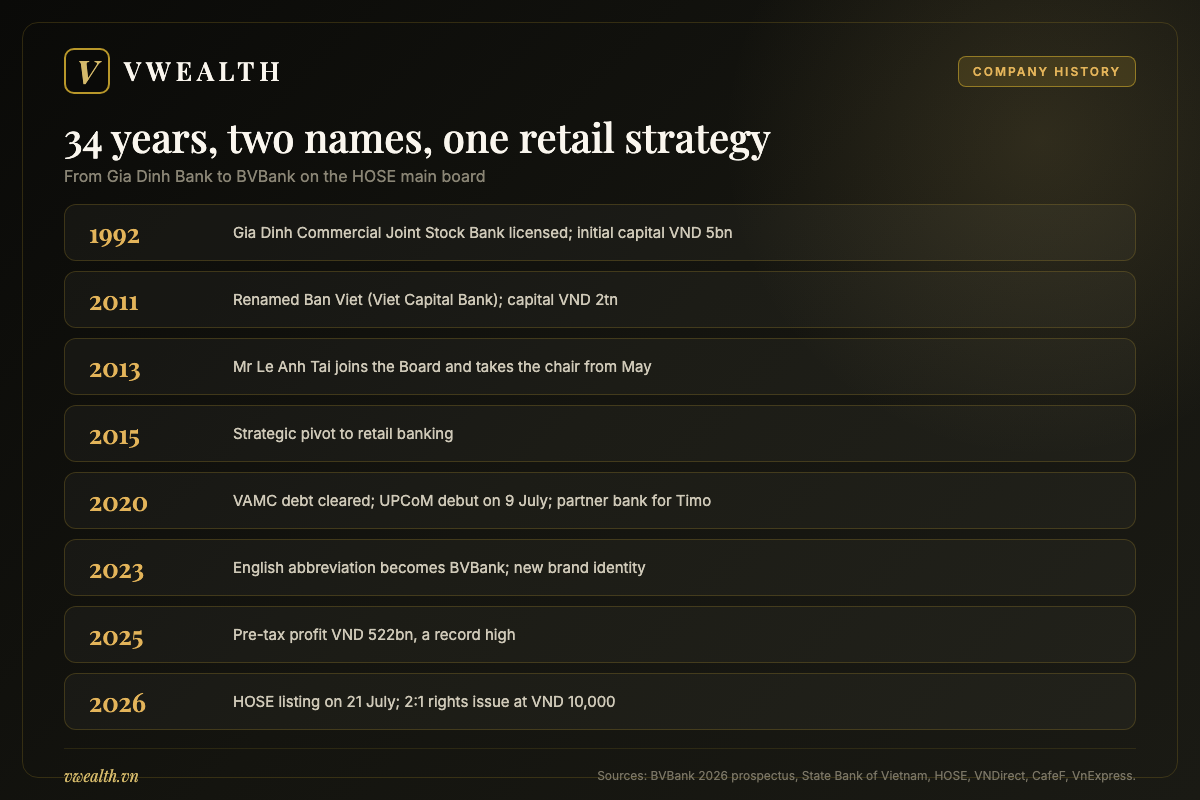
If you had to summarise BVBank’s history in one sentence, it might be this: a small bank with no powerful parent group, no foreign strategic partner and no merger, which survived several difficult cycles in Vietnamese banking by moving slowly. As Chairman Le Anh Tai told VnExpress in 2026, while many lenders chose rapid expansion or mergers, BVBank chose “its own path”: restructuring, investing in technology and standardising governance. For investors, “slow” cuts both ways. It is a strength (few scandals, no forced restructuring) and a weakness (after more than three decades it is still one of the smallest banks on the exchange). Understanding this journey is the key to understanding why BVBank now pours so much energy into its apps.
1992: Gia Dinh Bank starts with about VND 5 billion of capital
BVBank began life as Gia Dinh Commercial Joint Stock Bank (GiaDinhBank), which received operating licence No. 0025/NH-GP from the State Bank governor on 22 August 1992 and licence 576/GP-UB from the Ho Chi Minh City People’s Committee on 8 October 1992, according to the bank’s 2026 listing prospectus — licence 0025 is the one the State Bank amended in 2023 when the bank changed its English abbreviation. According to the bank’s own account of its history (VnExpress, 2026), Gia Dinh’s initial charter capital was just VND 5 billion. To put that in perspective, it is far less than BVBank’s average monthly pre-tax profit in the first half of 2026 (about VND 90 billion, a vwealth estimate from VND 547 billion over six months).
The prospectus shows how slowly the early years went. Between 1994 and 2005, charter capital only reached VND 80 billion and the network had just five outlets. Capital rose to VND 210 billion in 2006 and VND 444.6 billion in 2007; on 18 September 2007 the bank signed a strategic cooperation agreement with Vietcombank, under which Vietcombank would maintain a 30% stake and become its sole strategic shareholder. Capital reached VND 500 billion in February 2008 and VND 1 trillion in December 2008, while the network grew from 5 outlets in 2005 to 28 in 2009. In other words, Gia Dinh once had a “big brother” in the industry — a detail rarely mentioned when BVBank today is described as a bank without a controlling shareholder.
The early 1990s were the first boom in Vietnamese joint-stock banking. After the 1990 banking ordinances allowed non-state commercial banks, dozens of joint-stock banks appeared within a few years, most named after places — Gia Dinh, Saigon Industrial and Commercial, Nam A, Dong A — and each served customers in a narrow area. Gia Dinh was typical: headquartered in Ho Chi Minh City, lending mostly to small traders, household businesses and small companies in the south.
Why should events from three decades ago matter to a buying decision today? For two reasons. First, that small-customer DNA is still intact: in 2025, according to BVBank, almost 95% of its loan book was retail lending to individuals and small and medium-sized enterprises. Second, the tiny starting point explains why BVBank has always had to raise capital almost continuously just to meet capital standards and sustain growth — a feature that BVB shareholders need to accept from day one.
2011–2013: a new name, Ban Viet, and new leadership
The first turning point came in 2011. According to the bank, charter capital rose to VND 2 trillion and the bank was renamed Ban Viet Commercial Joint Stock Bank, abbreviated in English as Viet Capital Bank, under State Bank Decision 2665/QĐ-NHNN (as noted in the H1 2026 financial statements). On 9 January 2012, Gia Dinh officially switched to the new brand identity. In 2011 the bank also planned to lift capital from VND 2 trillion to VND 3 trillion to meet the legal minimum — at the time the State Bank required commercial banks to hold at least VND 3 trillion of capital. According to the prospectus, the VND 3 trillion level was reached in Q3 2011 and then held for several years.
In February 2012, according to VnEconomy (republished by CafeF), Ms Nguyen Thanh Phuong was announced as Chair of the Board of Viet Capital Bank, replacing Mr Do Duy Hung, who moved to the Chief Executive role. Ms Phuong, born in 1980, graduated from the National Economics University in Hanoi, holds an MBA from the University of Geneva, and had worked as deputy finance director of Holcim Vietnam and investment director of the London AIM-listed fund VietnamHolding. At that point she also chaired Viet Capital Asset Management, Viet Capital Securities and Viet Capital Real Estate. This is why the “Ban Viet” name became attached to an entire family of financial businesses — a point we return to in the next chapter.
In May 2013, Ms Phuong temporarily stepped down as Chair for maternity leave, and Mr Le Anh Tai — elected to the Board only on 23 April 2013 — took the chair from 3 May 2013, while Ms Phuong remained a Board member. Since then Mr Le Anh Tai has been the face of BVBank’s Board; at the extraordinary shareholders’ meeting in December 2025 he was re-elected to the 2025–2030 Board, and the bank’s 2026 announcements all identify him as Chair.
2015–2019: a pivot to retail and a clean exit from VAMC
The years 2011–2015 were the hardest in modern Vietnamese banking. Bad debt surged after a credit and property boom; in 2013 the State Bank created the Vietnam Asset Management Company (VAMC) to buy banks’ bad loans in exchange for special bonds; and a wave of small banks were merged or taken over. Ban Viet was not among the banks forced to restructure, but like many peers it sold part of its bad debt to VAMC in exchange for special bonds.
According to Chairman Le Anh Tai in 2026 interviews, 2015 was the “pivotal milestone” when the bank shifted its strategy to retail banking. Rather than chase size through big-ticket corporate lending or a merger, management chose to focus on three customer groups: individuals, small and medium-sized enterprises (SMEs) and household businesses — the family-run shops and traders that make up a large part of Vietnam’s economy. From 8 June 2016, Mr Ngo Quang Trung — a Board member and Deputy CEO since April 2015, with more than 15 years at Vietcombank — became Chief Executive, replacing Mr Do Duy Hung, who stepped down for personal reasons (Dân trí). According to the prospectus, in 2016–2018 the bank rolled out its “modern multi-product retail bank” strategy, worked with KPMG to build a loan approval and origination system (LOS), became one of the first 10 banks certified under the PCI-DSS card-security standard, and built new digital banking for individuals and businesses — an early sign that the retail push would be paired with technology investment. By end-2018 the network had 70 outlets.
The key clean-up milestone came in May 2020: according to disclosures at the 26 June 2020 shareholders’ meeting (reported by VietnamBiz and Infonet), Viet Capital Bank had bought back all of its VAMC bonds ahead of maturity and fully cleared its bad debt at VAMC. In 2019 the bank’s pre-tax profit was VND 158 billion — a very small figure. The prospectus also notes that Ban Viet was the 12th bank allowed by the State Bank to apply the Basel II capital adequacy ratio early, and a pioneer in opening payment accounts on mobile phones through electronic identity verification (eKYC).
2020–2022: UPCoM, Timo, and the exit of old major shareholders
On 9 July 2020, 317.1 million BVB shares began trading on UPCoM at a first-day reference price of VND 10,700. According to the prospectus at the time, the bank had just one major shareholder (holding 5% or more): Saigon New Urban Area Investment JSC (Saigon NIC), with more than 40.8 million shares, or 12.88%. Pre-tax profit in 2020 was about VND 201 billion.
That same year BVBank stepped into digital banking in an unusual way. Timo — a digital banking platform founded in 2015 and often described as Vietnam’s first — chose Ban Viet as its new partner bank and launched the Timo Plus app in September 2020; the prospectus describes Ban Viet as the “strategic partner providing the platform for the Timo Plus digital bank”. Timo has no banking licence of its own, so BVBank provides the licence, clearing and deposit insurance for Timo’s customers. Chapter three looks at what that relationship means for shareholders.
The years 2021–2022 were when the old major shareholders left. In May 2021 the bank cut its foreign ownership limit from 30% to 5% (under a shareholder resolution of 29 April 2021; the State Securities Commission confirmed the 5% limit in an official letter of 30 June 2021); the Board argued that a 30% “room” was “rather large relative to trading volume” and that a flexible mechanism was needed to stabilise the share price. In the same month BVB rose 63% in a single month. Saigonbank twice put its 8.26 million BVB shares up for auction at a starting price of VND 22,800, but no investors registered; it then exited Ban Viet in late 2021 (Báo Investing). In October 2021 Sacombank advertised for sale a debt of more than VND 1 trillion owed by Phuong Nghi Construction Trading Co (starting price VND 905.4 billion), secured by 40.86 million BVB shares owned by Saigon NIC. Between 29 December 2021 and 9 March 2022, Saigon NIC sold about 22.66 million shares, keeping 18.2 million (4.96%) and ceasing to be a major shareholder (CafeF). Since then BVBank has had a highly dispersed ownership structure — a feature analysed in chapter two.
2023–2025: the BVBank name, a profit trough, and recovery
On 26 May 2023 the State Bank issued Decision 1001/QĐ-NHNN changing the bank’s English abbreviation from Viet Capital Bank to BVBank. Ban Viet was the second bank to change its abbreviation around that time, two weeks after LienVietPostBank became LPBank. On 1 December 2023 BVBank launched a new logo and identity with the slogan “We start with You”. The stated reason was a name that is short and easy to say and remember — sensible for a bank trying to reach individual customers through their phones.
In 2023, charter capital rose in two steps — to VND 4,221.5 billion on 31 May and VND 5,016.8 billion on 19 June — through a 15% stock dividend combined with a 25% rights issue recorded in March 2023, and the network reached 116 outlets (prospectus). Business-wise, 2023 was a hard year. According to Nhà Investing, BVBank’s after-tax profit fell sharply in 2023 before improving in 2024 and 2025; after-tax profit in 2025 reached VND 417 billion, about 7.3 times the 2023 level. The financial statements (VNDirect data) show 2023 pre-tax profit of only about VND 72 billion and after-tax profit of about VND 57 billion. Pre-tax profit recovered to about VND 391 billion in 2024 and rose a further 34% in 2025 to VND 522 billion — the highest in the bank’s history.
Capital kept rising steadily. In August 2024 the bank paid a 10% stock dividend from equity (about 50.2 million shares), taking capital to about VND 5,518 billion. In June–July 2025 it sold almost 69 million new shares to existing shareholders (an 8:1 ratio) at VND 10,000 each, lifting charter capital from VND 5,518 billion to VND 6,208 billion; it then issued 20 million employee stock-option (ESOP) shares to reach VND 6,408.2 billion. In roughly five years since joining UPCoM, charter capital therefore went from about VND 3,171 billion (317.1 million shares in 2020) to VND 6,408 billion — about double (vwealth estimate), through all three channels: stock dividends, rights issues at par and ESOP.
On the people side, Mr Ly Hoai Van (born 1979) formally became Chief Executive on 7 October 2025 after serving as acting CEO; he joined BVBank in March 2025 as a member of its Strategy Committee. On 26 December 2025 an extraordinary shareholders’ meeting elected the Board and Supervisory Board for 2025–2030 and approved the 2026 capital plan. To comply with the 2024 Law on Credit Institutions, which bars people from simultaneously sitting in governance or management at two such organisations, Ms Nguyen Thanh Phuong, Mr Ngo Quang Trung and Ms Phan Thi Hong Lan (former Head of the Supervisory Board) did not continue into the new term.
2026: the move to HOSE and the largest capital raise in the bank’s history
2026 has been packed with events. The move to HOSE was not a new idea: shareholders had already approved it at the 2024 and 2025 annual meetings (Thời báo Tài chính Việt Nam), and the 16 April 2026 annual meeting was the third year in a row it was put to them. This time things moved quickly. In June 2026 HOSE received and then approved the listing application; on 26 June 2026 Fitch Ratings assigned BVBank a first-time long-term Issuer Default Rating (IDR) of B+ with a Stable outlook; on 8 July 2026 the State Bank issued its approval for a capital increase of up to VND 3,504 billion (Báo Investing); the last UPCoM trading day was 8 July and the UPCoM registration was cancelled on 9 July; and on 21 July 2026 all 640.82 million BVB shares debuted on HOSE under Decision 543/QĐ-SGDHCM at a reference price of VND 13,100.
In September 2026, after the State Securities Commission cleared the offering, the bank set 24 September as the record date for a rights offering of more than 320.4 million shares at a 2:1 ratio (every two shares held entitle the holder to buy one new share) at VND 10,000 per share. If both this offering and 30 million ESOP shares are completed, charter capital will rise from VND 6,408 billion to about VND 9,912 billion, an increase of almost 55% — measured by money raised in one go, the largest capital increase in the bank’s history (vwealth’s reading of the capital history in the prospectus). At the same time BVBank contributed 10% of the capital to found an insurer (VSI Insurance JSC, licensed by the Ministry of Finance on 21 July 2026) and dropped an old bond plan in favour of a new public bond offering of about VND 1.3 trillion with a seven-year tenor.
The table below summarises the key milestones.
| Date | Event | What it means for shareholders |
|---|---|---|
| 22 Aug 1992 | Gia Dinh Commercial Joint Stock Bank licensed (No. 0025/NH-GP); initial capital VND 5bn | Started as a small joint-stock bank in Ho Chi Minh City |
| 18 Sep 2007 | Strategic cooperation with Vietcombank, which keeps a 30% stake; capital reaches VND 1 trillion by end-2008 | A period with a domestic strategic shareholder |
| 2011 – 9 Jan 2012 | Renamed Ban Viet Commercial Joint Stock Bank (Viet Capital Bank); capital VND 2tn | Linked to a family of “Ban Viet” financial businesses |
| Feb 2012 – May 2013 | Ms Nguyen Thanh Phuong becomes Chair; Mr Le Anh Tai takes over as interim, then long-term, Chair | Stable leadership for more than a decade |
| 2015 | Strategic pivot to retail banking (per bank leadership) | Customer base of individuals, SMEs and household businesses |
| May 2020 | Early buyback of all VAMC bonds; bad debt at VAMC fully cleared | Largest legacy problem resolved |
| 9 Jul 2020 | 317.1m BVB shares start trading on UPCoM at VND 10,700 | Public market price begins |
| Sep 2020 | Timo chooses Ban Viet as partner bank (Timo Plus) | First step into digital banking via a partner |
| 2021 – Mar 2022 | Foreign room cut from 30% to 5%; Saigonbank and Saigon NIC sell out | Ownership becomes highly dispersed |
| 26 May 2023 | Abbreviation changed to BVBank (Decision 1001/QĐ-NHNN) | Brand repositioned towards digital retail |
| 2023–2024 | Stock dividends of 15% (2023) and 10% (Aug 2024); capital reaches VND 5,518bn | Capital raised through both stock dividends and rights issues |
| 2025 | Record pre-tax profit of VND 522bn; charter capital VND 6,408bn | Recovery after very low 2023 profit |
| 21 Jul 2026 | 640.82m shares debut on HOSE at VND 13,100 | Access to a broader institutional investor base |
| Sep–Oct 2026 | Rights issue of 320.4m shares at 2:1 and VND 10,000; target capital about VND 9,912bn | Shareholders must pay up or accept dilution |
What stands out is not any single milestone but the timing: it took 28 years for the bank to reach a trading venue (UPCoM) and six more to reach a main-board listing. Compare Nam A Bank, also founded in 1992, which joined UPCoM in 2020 and moved to HOSE on 8 March 2024 — BVBank moved about two and a half years later.
BVB leadership and ownership: a long-serving chairman and a dispersed shareholder base
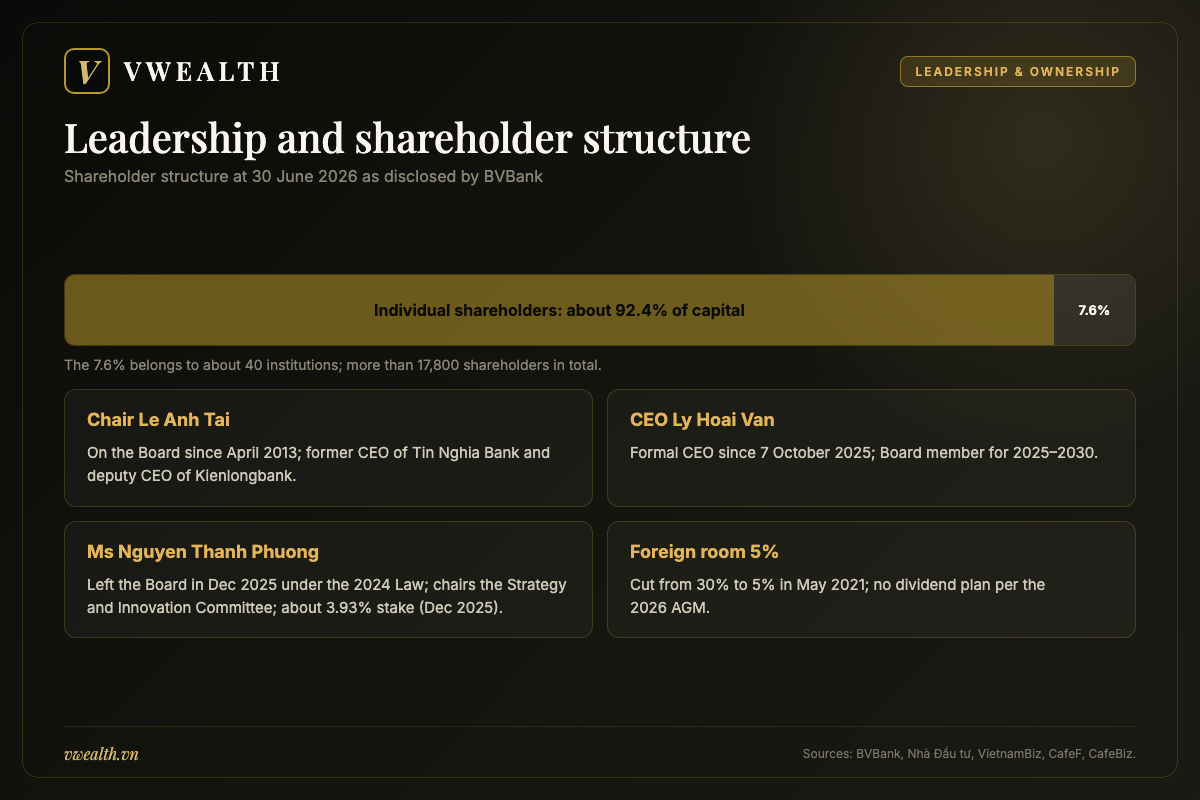
When analysing a bank, many investors look first at “who owns it”. For Vietcombank or BIDV the answer is the state. For OCB there is a Japanese strategic shareholder. For SeABank there is a founding family and, historically, a French banking group. BVBank is harder to pin down: according to the bank itself, at 30 June 2026 it had more than 17,800 shareholders, of which only about 40 institutions held a combined 7.6% of capital, while individuals held the remaining 92.4%. There is no single controlling owner. This chapter helps you read that structure correctly — and understand what it means for minority shareholders.
Chairman Le Anh Tai: more than thirteen years on the Board
Mr Le Anh Tai, born in 1972, holds an MBA from the University of Economics Ho Chi Minh City (1997–2000 cohort). According to a profile published by CafeF in 2013, he rose through accounting and lending: credit officer at Tan Viet Bank (1996–2001), internal audit specialist at ACB, corporate credit specialist at BIDV’s Ho Chi Minh City branch, then almost four years at Nam A Bank in several branch-director roles. From 2008 to 2010 he was CEO of Vietnam Tin Nghia Bank, then briefly deputy CEO of Kienlongbank in 2012 before joining Ban Viet. He was elected to the Board on 23 April 2013 while serving as deputy CEO in charge of credit, customer policy and product development, and took the chair on an interim basis in May 2013.
The notable point is that Mr Tai is a career banker — he came up through lending and branches rather than representing a large shareholder. In a VnExpress feature in July 2026, management’s most important decision was described as “not chasing scale at any cost”, and the bank’s message around the HOSE listing was that more than a decade of “foundation-building” is now giving way to a new growth cycle. That is a claim investors can test with numbers: if it is true, the cost-to-income ratio (CIR) should fall and return on equity should rise over the coming years.
CEO Ly Hoai Van and the executive team
Mr Ly Hoai Van formally became Chief Executive on 7 October 2025 after State Bank approval; he had previously been acting CEO. According to the bank’s announcement, he had served as deputy CEO at other credit institutions before joining BVBank, and he also sits on the 2025–2030 Board. Born in 1979, he has more than 25 years in finance and banking and joined BVBank in March 2025 as a member of its Strategy Committee. In 2026 the bank made further senior appointments: on 12 January Mr Nguyen Hoang Son became Deputy CEO in charge of finance and Ms Tran Thi Kim Thu Chief Accountant; on 15 June Mr Nguyen Dang Di became Head of Retail Banking (CafeF). Mr Nguyen Hoang Son also signed the H1 2026 financial statements under authorisation.
Another name that appears often in technology projects is deputy CEO Phan Viet Hai, who spoke at the June 2026 signing with Oracle to upgrade the core banking system and called it “our most important project in 2026 and 2027”. For a bank betting on digital, the strength of its technology and operations team matters as much as its sales force.
The 2025–2030 Board and the Strategy and Innovation Committee
The extraordinary shareholders’ meeting of 26 December 2025 elected a six-member Board: Mr Le Anh Tai, Mr Nguyen Nhat Nam, Mr Ly Hoai Van, Ms Nguyen Thi Thu Ha, Mr Pham Quang Khanh and Mr Pham Thanh Son (independent member). According to the plan announced then, the Board would elect a second independent member. That was completed at the 16 April 2026 annual meeting, when Mr Le Minh Huan was elected as an independent Board member, bringing the Board to seven (H1 2026 financial statements). The Supervisory Board has five members: Mr Ly Cong Nha (Head), Ms Nguyen Thi Thanh Thuy, Mr Le Hoang Nam, Ms Nguyen Thi Thanh Tam and Ms Bui Thi Quanh.
A detail worth noting is Ms Nguyen Thanh Phuong’s role after leaving the Board. According to the bank, she stepped down to comply with the 2024 Law on Credit Institutions but remains Chair of BVBank’s Strategy and Innovation Committee, “directly in charge of strategic planning, modernisation, business direction and human-resource management”. In other words, she still helps set the bank’s strategic direction, just without a Board seat. When you read BVBank’s long-term strategy, it therefore makes sense to look at the Strategy and Innovation Committee as well as the Board.
| Position (latest disclosure) | Person | Notes |
|---|---|---|
| Chair of the Board | Mr Le Anh Tai | On the Board since 23 Apr 2013; former CEO of Tin Nghia Bank |
| Board member and CEO | Mr Ly Hoai Van | Formal CEO since 7 Oct 2025 |
| Board members | Mr Nguyen Nhat Nam, Ms Nguyen Thi Thu Ha, Mr Pham Quang Khanh | 2025–2030 term |
| Independent Board members | Mr Pham Thanh Son, Mr Le Minh Huan | Mr Son from 26 Dec 2025; Mr Huan from 16 Apr 2026 |
| Chair, Strategy and Innovation Committee | Ms Nguyen Thanh Phuong | Left the Board in Dec 2025 under the 2024 Law; about 3.93% stake (Dec 2025) |
| Supervisory Board | Mr Ly Cong Nha, Ms Nguyen Thi Thanh Thuy, Mr Le Hoang Nam, Ms Nguyen Thi Thanh Tam, Ms Bui Thi Quanh | Five members, 2025–2030 term |
Shareholder structure: dispersed, with more than 92% held by individuals
As noted above, at 30 June 2026 institutional shareholders held only about 7.6% of BVBank. With some 40 institutions sharing that 7.6%, no institution plays a controlling role — a sharp contrast with 2020, when Saigon NIC alone held 12.88% at the time of the UPCoM debut. Among individuals, the name most cited by the press is Ms Nguyen Thanh Phuong: according to VietnamBiz and CafeF (December 2025), she directly held almost 25.2 million BVB shares, about 3.93% of capital. At the same time, Viet Capital Asset Management (VCAM), a company linked to Ms Phuong that held no BVB shares beforehand, registered to buy up to 2 million BVB shares between 23 December 2025 and 20 January 2026, which would give it about 0.31% if completed. At the July 2026 listing, Deputy CEO Nguyen Hoang Son said the Board and executive team owned about 11% of charter capital and domestic investors 99.96% (Báo Pháp luật Việt Nam). The listing prospectus records 18,572 shareholders at 15 April 2026, with foreign holders owning only 0.0489%.
This structure has three practical consequences for minority shareholders. First, there is no obvious “backstop” owner: in a downturn there is no parent group or strategic partner ready to buy shares or inject capital. Every BVBank capital raise has to rely on existing shareholders and market investors — which is why offerings are almost always priced at the VND 10,000 par value. Second, the risk of a controlling shareholder steering the bank towards related-party interests is lower than at banks with concentrated ownership — a governance positive. Third, the 2024 Law on Credit Institutions tightened ownership caps (individuals at most 5%, institutions at most 10%, a shareholder together with related persons at most 15% of charter capital) and requires banks to publish the list of shareholders holding 1% or more together with their related persons. That published list on BVBank’s website is the most authoritative source if you want to know exactly who owns what.
On foreign investors, the bank cut its foreign ownership limit from 30% to 5% in May 2021. The 2026 listing prospectus still gives a 5% foreign ownership cap under the charter (confirmed by the State Securities Commission in letter 3248/UBCK-PTTT of 30 June 2021), while actual foreign ownership was just 0.0489% at 15 April 2026. Foreign investors should check the remaining room on their broker’s price board before placing orders. vwealth’s explainer on foreign room in Vietnamese stocks explains how these caps work. A 5% limit means that foreign inflows — expected to grow after FTSE Russell’s upgrade of Vietnam — are unlikely to be a meaningful driver for BVB unless the bank reopens its room.
BVBank and Vietcap: shared “Ban Viet” roots, separate companies
Many investors ask whether BVBank is “Vietcap’s bank”. The short answer is no: they are separate legal entities. But there is a historical and personnel link worth knowing. Viet Capital Securities (VCSC) was founded in 2007 with Ms Nguyen Thanh Phuong as founder and Chair; in 2023 it renamed itself Vietcap Securities (ticker VCI). In 2012, while chairing Viet Capital Bank, Ms Phuong also chaired the securities firm, the fund manager and the real-estate company bearing the Ban Viet name. In December 2025 she left BVBank’s Board to comply with the 2024 Law but remains Chair of its Strategy and Innovation Committee and an individual shareholder with about 3.93%.
In practice the two have visible touchpoints: Vietcap representatives attended the ceremony for BVB’s HOSE listing on 21 July 2026, and Vietcap’s research team is one of the sources the press quotes on BVB (for example on the bank’s target of VND 20 trillion of charter capital by 2028 and a P/B of around 1x). These are public, entirely lawful facts. Still, as a general rule for reading broker research, when a research house has historical or personnel ties to the company it covers, read its views alongside independent sources. This article also does not treat BVBank and Vietcap as a single bloc: each company’s earnings, capital and risks are separate.
Dividends: no payout plan, profits retained to build capital
At the annual meeting on 16 April 2026 the bank said that 2025 profit remaining after mandatory reserves was almost VND 337 billion and that it had no plan to pay dividends. This fits the way the bank has raised capital in recent years: it retains profit to build capital, turns part of retained earnings into shares for shareholders (a 15% stock dividend recorded in March 2023 and 10% in August 2024, per VNDirect event data and Tạp chí Công Thương), and when it needs more it sells new shares to existing shareholders at par, plus ESOP shares. In other words, BVB shareholders have received “dividends” in shares, not yet in cash.
Why no cash dividend? The basic reason is the capital adequacy ratio (CAR — regulatory capital divided by risk-weighted assets). Every extra dong of lending needs more equity as a buffer. With annual profits of only a few hundred billion dong while total assets grow by tens of trillions, retained earnings cannot fund growth on their own; paying cash dividends would simply force the bank to raise even more capital. When Fitch rated BVBank in June 2026, it estimated that the VND 3,504 billion capital increase would lift the capital adequacy ratio by about 4 percentage points, providing a buffer for long-term loan growth of roughly 16–18% a year.
For minority shareholders the message is clear: if you want a bank stock that pays regular cash dividends, BVB does not currently fit. Any return for BVB holders would have to come from growth in book value per share and a possible market re-rating — and it comes with the obligation to put in more money at each offering if you do not want to be diluted. Chapter five illustrates this with a worked example.
How BVBank makes money: retail loans, household businesses and an app ecosystem
Picture a hypothetical grocery-shop owner in Binh Duong. In the morning she opens the Digistore app to issue an e-invoice to a wholesale buyer; at lunchtime customers pay by scanning a QR code and the money lands in her BVBank account; at the end of the month the bank looks at that cash flow to decide whether to extend her a working-capital loan for new stock. That is the picture BVBank wants to paint: a bank that does not need a branch on every corner but instead “lives” on the phones of millions of individuals and household businesses. This chapter takes each business line in turn so you can see which ones actually bring in money and which are still consuming it.
Retail lending: 95% of the book, but two sectors make up almost 70%
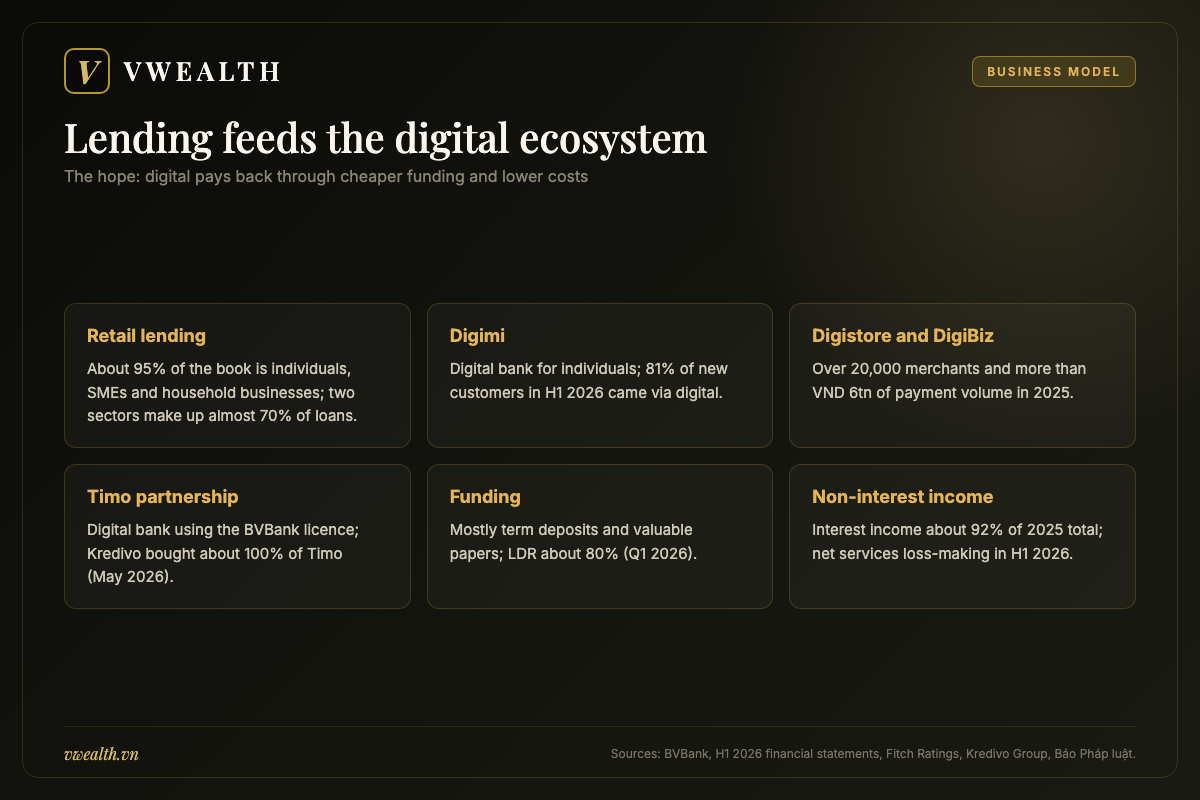
According to disclosures at the 2026 annual meeting, almost 95% of BVBank’s loan book is retail lending to individuals and SMEs; the half-year 2026 update adds micro-enterprises and household businesses. Credit outstanding was about VND 78,240 billion at end-2025, up 15% in the year; at the end of Q2 2026 the bank reported credit of about VND 84,721 billion, up 8% year to date.
“Retail” does not mean the risk is spread thinly across sectors, however. According to the notes to the reviewed H1 2026 consolidated financial statements, lending is concentrated in two large groups: wholesale and retail trade plus car and motorbike repair, with about VND 33,030 billion (39.6% of loans, up about 28.8% year to date), and real-estate business, with about VND 25,048 billion (30%, up about 8.5%). Together they account for almost 70% of customer loans; the third-largest group is household consumption and production at about VND 7,964 billion (9.6%). VietNamNet, compiling banks’ half-year reports, adds another detail: at 30 June 2026 real-estate collateral at BVBank was worth about VND 111,184 billion, roughly 83% of total collateral value. Put simply, whether the borrower is an individual or a household business, the final cushion under most loans is still property.
This matters for two reasons. First, trade is a fast-turnover sector that fits the bank’s stated focus on production, trade, supply chains and retail (Q3 2025 results release), but it is sensitive to consumer spending. Second, when property is the dominant collateral, the speed of bad-debt recovery depends on the liquidity of the property market: if the market is sluggish, foreclosures take longer and recoveries may be lower than expected. Fitch, as summarised in BVBank’s announcement of the rating, assessed the loan book as well collateralised with moderate loan-to-value (LTV) ratios — reassuring, but no substitute for tracking bad debt every quarter.
Digimi, DigiBiz and Digistore: three apps for three customer groups
BVBank builds its digital ecosystem around customer segments rather than a single all-purpose app. Digimi is the digital bank for individuals, which the bank calls “all-in-one”: credit-card applications, unsecured loans, savings, 24/7 transfers, QR payments, investments and spending management. Compared with 2024, the number of Digimi transactions in the first nine months of 2025 rose 71% and funds raised through digital channels rose 103% (Q3 2025 results release). DigiBiz is the app for corporate clients. Digistore is a sales-management platform for household businesses and small firms: order management, cash in/out, electronic invoicing, cashless payments and access to credit. According to the prospectus, BVBank was among the first banks to roll out this multi-utility sales-management system with built-in e-invoicing (in 2025), and it worked with the Ministry of Public Security on electronic identification through VNeID.
The bank’s own figures show how heavily it relies on digital channels. In 2025, 89% of new customers came through digital channels, the total customer base grew 28% to more than 2.9 million, online transactions rose 289%, and transactions through partner channels alone exceeded 720 million. Digistore signed up more than 20,000 merchants with more than VND 6 trillion of payment volume in 2025 (Báo Pháp luật Việt Nam, citing the bank). In the first half of 2026 the total customer base reached 3.2 million (up 10% year to date) and 81% of new customers came via digital channels.
Add-on services keep coming: BVBank describes itself as a pioneer in connecting to Napas for VietQR Global cross-border QR payments; it launched Google Wallet payments for BVBank Visa credit cards (June 2026); it rolled out a VND 2.5 trillion SME credit package priced at least 1 percentage point per year below the market (August 2026); and it signed a partnership with HRS — a major Oracle Hospitality partner — to plug bank payments directly into hotel and restaurant management software. At the core, in June 2026 the bank signed with Oracle to upgrade its Flexcube core banking system from version 11 to 14.8, with go-live targeted for Q2 2027; the core is the “heart” that processes more than 40 satellite systems.
Timo: a digital bank “borrowing” BVBank’s licence
One piece that many BVB analyses overlook is Timo. Founded in 2015 and regarded as Vietnam’s first digital banking platform, Timo has no banking licence of its own. Since September 2020 it has partnered with Ban Viet: BVBank provides the licence, regulatory compliance, clearing and deposit insurance, while Timo handles the interface and customer experience. On 6 May 2026 Kredivo Group — a digital financial services group operating in Indonesia, Vietnam and Thailand — announced the acquisition of about 100% of Timo; business-registry records show Kredivo Vietnam holding 99.99% of Timo’s operating company from April 2026. Kredivo’s release calls Timo “a Vietnamese digital banking platform developed in cooperation with BVBank”; the banking licence stays with BVBank.
For BVB investors this model has two sides. On the positive side, BVBank gains another channel to young, tech-savvy customers without bearing all the marketing and product-development costs itself, and Timo customers’ deposits are funding for the bank. On the watch-list side, partnerships can change — Timo itself switched from its previous partner bank to Ban Viet in 2020 — and under a new owner Timo’s strategy may shift. The public BVBank disclosures we reviewed do not break out Timo’s contribution to deposits or profit, so you should not assign a specific number to it; treat it as a valuable distribution channel that the bank does not fully control.
Funding: term deposits, valuable papers and the cost of money
A bank that is strong in digital is usually expected to have a high CASA ratio — the share of current and savings (non-term) accounts in total deposits — because customers keep money in payment accounts for daily spending, which costs the bank almost nothing in interest. The figures BVBank publishes, however, show a funding base still tilted towards term deposits. At 30 September 2025 the bank said that “growth in funding with terms of 12 months or more accounted for 73%”, helping it “stay proactive on funding”. At the end of Q1 2026, according to the financial statements (VNDirect data, reported by Vietstock), customer deposits were about VND 74,033 billion and valuable papers issued about VND 27,305 billion — meaning a meaningful share of funding comes from certificates of deposit and bonds, which usually pay more than ordinary deposits. By 30 June 2026 valuable papers had fallen to about VND 24,428 billion while customer deposits rose to VND 81,338 billion. BVBank has also sold public bonds: the prospectus lists two outstanding issues, BVB124020 (about VND 1,469 billion, issued September 2024) and BVB125003 (about VND 1,254 billion, issued January 2025), both six-year bonds with first-year coupons of 7.9% and 8.2%.
The bank does not state a CASA ratio in its releases; it only said that CASA brought in through Digistore in Q3 2025 was 2.4 times the previous quarter. But the notes to the H1 2026 financial statements let you work it out: customer demand deposits were about VND 5,952 billion at end-2025 and VND 6,070 billion at 30 June 2026, roughly 8.3% and 7.5% of customer deposits (vwealth estimate). In other words, term deposits grew much faster than demand deposits in the first half of 2026. Check this figure yourself each quarter in the notes on customer deposits. If the digital story works, the share should rise over time; if it stays flat or falls, digital has so far delivered “more customers” but not “cheaper money”. One positive signal: Fitch noted BVBank’s loan-to-deposit ratio (LDR) at about 80% at end-Q1 2026, among the lowest of banks its size — the bank is not liquidity-stretched.
Non-interest income and new ventures: insurance, FX and payments
This is a long-standing weakness. In 2025 net interest income made up about 92% of total operating income. Non-interest sources improved — net FX trading income rose 88% in 2025, and other income rose thanks to recoveries of written-off debt — but net fee income turned negative: according to Thời báo Tài chính Việt Nam, net service income in Q1 2026 was minus VND 19.2 billion (versus plus VND 18 billion a year earlier); according to CafeLand’s reading of the half-year report, the services segment posted a net loss of VND 28.3 billion in H1 2026 (versus a profit of VND 14.5 billion), driven by sharply higher payment-service costs. A bank investing heavily in cards, wallets and payments typically bears cashback, promotional and partner costs in the early years; but if fee revenue does not overtake those costs within a few years, services will keep dragging on returns.
Two new directions in 2026 are worth noting. The first is insurance: the notes to the separate H1 2026 financial statements record a transfer of VND 50 billion as “capital contribution to establish VSI Insurance JSC”, for a 10% stake; the company received Ministry of Finance licence No. 103/GP/KDBH on 21 July 2026, trades in English as Vietsure Insurance, and is headquartered in the same building as BVBank’s head office (CafeF). The second is cross-border payments and solutions for service industries (VietQRGlobal, the HRS partnership). Both are too small to change the income mix in the short term, but they show the bank searching for fee income beyond lending.
A 126-outlet network: branches still anchor the digital bank
For all the talk about apps, BVBank is not a branchless bank. According to the notes to the H1 2026 financial statements, at 30 June 2026 it had a head office, 41 branches and 84 transaction offices — 126 outlets in total — and 2,893 staff. The head office is in the HM Town building, 412 Nguyen Thi Minh Khai, Ho Chi Minh City. The Q3 2025 results release says the 126 outlets span 22 provinces and cities (after Vietnam’s merger of administrative units).
Over time the network grew steadily: 5 outlets in 2005, 28 in 2009, 70 at end-2018, 87 in 2020, 116 in 2023 and 126 from 2024 (listing prospectus). So in the last two years BVBank has barely added outlets, while its customer base grew from about 2.3 million to 3.2 million (vwealth estimate, based on more than 2.9 million at end-2025 after 28% growth that year). That is the most concrete evidence for the strategy management describes — growing customers without depending on new physical branches. Branches are still needed for corporate clients, secured loans to household businesses and large deposits, while growth in individual customers is pushed to Digimi.
The bank also has a single wholly owned subsidiary: BVBank’s Debt Management and Asset Exploitation Company (AMC), set up in 2011 to manage and realise collateral — an important tool when most collateral is property. For investors, the metric to watch is operating cost per outlet: if the outlet count stays flat while income keeps rising, the cost-to-income ratio has room to fall further.
Which business feeds which — has digital become a moat?
Put the pieces together and BVBank’s economics are simple. Lending is almost the only money-making engine, generating more than nine-tenths of income. Funding comes mainly from term deposits and valuable papers and is not cheap. The digital ecosystem is a customer-acquisition engine — very effective judging by the share of new customers it brings in — but it does not yet pay for itself through fees. In other words, digital is currently “fed” by interest income, in the hope that it will later pay back through cheaper deposits, lower operating costs and better cross-selling.
BVBank’s real moat — a hard-to-copy advantage — if it has one, lies in having chosen a niche early and gone deep: household businesses and small merchants, just as the rules on electronic invoicing and taxation for household businesses were changing. A household business that already uses Digistore to issue invoices, collect payments and manage orders will be reluctant to switch banks — a classic switching-cost moat. But this moat is still narrow: just over 20,000 merchants signed up to Digistore (2025) is small relative to the country, and large banks are launching similar tools. Watch two indicators: the number of merchants on Digistore and payment volume through the platform, because they are the closest measures of how deep the moat really is.
| Business line | Current role | Latest disclosed figures | What to watch |
|---|---|---|---|
| Retail, SME and household-business lending | Main income source (net interest income about 92% of 2025 total income) | Credit about VND 84,721bn at end-Q2 2026 | Two sectors are almost 70% of loans; 83% of collateral is property |
| Digimi (individuals) | Main customer-acquisition channel | Total customers up 28% in 2025; 81% of H1 2026 new customers came via digital | Conversion into non-term deposits and cross-selling |
| Digistore, DigiBiz (merchants, companies) | Creates switching costs for customers | More than 20,000 merchants, over VND 6tn payment volume in 2025 | Active merchants and platform payment volume |
| Timo (partner) | Digital-bank distribution using BVBank’s licence | Kredivo Group bought about 100% of Timo (announced 6 May 2026) | Partnership after Kredivo’s acquisition of Timo (May 2026) |
| Services, FX, debt recovery | Secondary income | Net services loss of over VND 28bn in H1 2026; FX up 88% in 2025 | Whether net services returns to positive |
| VSI Insurance | New investment | VND 50bn contributed, 10% stake | Licensing progress and results |
If you want to compare how other banks use digital, vwealth’s analyses of TPBank — another early technology bettor — and Nam A Bank with ONEBANK give two useful reference points.
Financial health: reading BVBank’s numbers before deciding whether to buy BVB stock
When a bank reports “Q2 profit up 24.5 times”, the natural reflex is to see a breakthrough. But in banking, the bottom line is often the least reliable number when read in isolation: it is shaped by provisioning, recoveries of old debt and last year’s base. This chapter does not aim to give you a “good” or “bad” verdict; it teaches you to read BVBank’s reports in the right order — where profit comes from, how efficiently capital is used, what asset quality looks like, and whether the bank has enough capital and liquidity buffers. For a refresher on concepts such as P/B and ROE for banks, vwealth’s Vietnam banking sector guide is a good starting point.
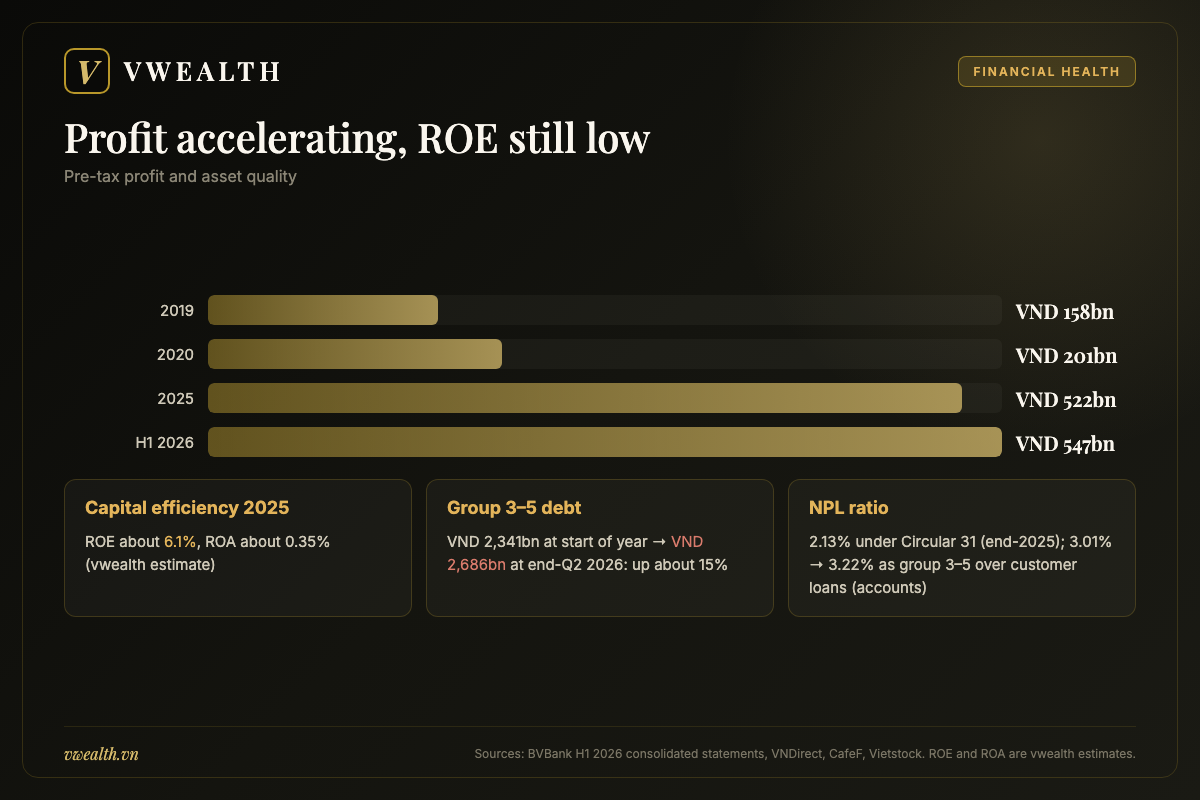
The profit record, 2019 to H1 2026
The table below gathers the published profit figures. Note the comments column: some rows are vwealth estimates derived from other published numbers, not figures the bank stated directly.
| Period | Pre-tax profit | After-tax profit | Notes and sources |
|---|---|---|---|
| 2019 | VND 158bn | About VND 126bn | UPCoM listing documents (VietnamBiz); VNDirect data |
| 2020 | About VND 201bn | — | Financial statements (VNDirect data) |
| 2023 | About VND 72bn | About VND 57bn | VNDirect data; consistent with “2025 was 7.3x 2023” (Nhà Investing) |
| 2024 | About VND 391bn | About VND 311bn | Financial statements (VNDirect data) |
| 2025 | VND 522bn (+34%) | VND 417bn | BVBank; Q4 2025 only about VND 85bn pre-tax |
| Q1 2026 | About VND 215.6bn (+169%) | — | Consolidated Q1 statements (Thời báo Tài chính Việt Nam); after-tax about VND 172bn |
| Q2 2026 | Almost VND 332bn (24.5x) | About VND 265bn | Consolidated Q2 statements (CafeF, Tin nhanh Chứng khoán) |
| H1 2026 | About VND 547bn (almost 6x) | VND 437bn | About 78% of the VND 700bn plan; management is aiming for about VND 1tn for the year |
To benchmark 2026 as a whole, remember the targets approved at the 16 April 2026 annual meeting: total assets of VND 155,000 billion (up 16%), deposits from businesses and individuals of VND 111,686 billion (up 14%), credit of VND 92,552 billion (up 18%), pre-tax profit of VND 700 billion (up 34%), bad debt below 3%, and 30% growth in new customers. By end-Q2 2026 total assets had reached about 92% of target and profit about 78%; after the half-year results, management raised its full-year pre-tax profit ambition to about VND 1,000 billion (Báo Pháp luật Việt Nam, CafeF). In Q1 2026 alone the bank delivered about 31% of the annual profit plan.
Over the long run, pre-tax profit went from VND 158 billion (2019) to VND 522 billion (2025), roughly 3.3 times in six years (vwealth estimate). But the path was not smooth: in 2023 after-tax profit was only a few tens of billions, and in Q4 2025 — the quarter just before the bank revived its listing plan — pre-tax profit was only about VND 85 billion, far below Q3 2025’s VND 343 billion. A bank whose quarterly profit swings this much is one whose results depend heavily on the timing of provisions and recoveries, not yet a steady earnings machine.
Q2 2026 profit up 24.5 times: read the base and the components
There are two ways to read “24.5 times”. The first is the base: pre-tax profit in the first half of 2025 was only about VND 93 billion, of which Q2 2025 contributed a mere VND 13 billion or so (quarterly financial statements, VNDirect data), so Q2 2025 was a very weak quarter. Strong growth from a low base is recovery, not necessarily a breakthrough.
The second — more important — is the components. In the first half of 2026 net interest income reached VND 1,680 billion, up 46%; total operating income was VND 1,841 billion, up 48%; operating expenses were VND 920 billion, up just 12.2%; so pre-provision operating profit (PPOP) was about VND 920 billion, more than double a year earlier; and provisions were VND 373 billion, up 14.1%. That is a good sign: most of the increase came from core interest income and cost control, not from cutting provisions. The bank says its cost-to-income ratio fell by almost 9%; simply dividing VND 920 billion of costs by VND 1,841 billion of income gives a CIR of about 50% for H1 2026 (vwealth estimate).
Digging into Q1 2026, however, the financial statements (as reported by Thời báo Tài chính Việt Nam and Vietstock) show two points to watch: net service income was minus VND 19.2 billion (versus plus VND 18 billion a year earlier), while net other income jumped to more than VND 80 billion from about VND 1 billion — mainly because the bank recovered more than VND 79 billion from loans previously written off against provisions, versus just VND 605 million a year earlier (Vietstock). For the whole of H1 2026 the cash-flow statement shows about VND 125 billion collected from written-off debt, versus about VND 25 billion a year earlier. Recovering old debt is real money and the result of collection work, but it does not recur forever. When reading future quarters, strip “other income” out of profit to see what comes from the recurring business.
ROE of about 6% and the problem of scale
This is the central number of the whole article. Based on the 2025 financial statements, BVBank’s return on equity (ROE) was only about 6.1% (VND 417 billion of after-tax profit over average equity of about VND 6,800 billion) and return on assets (ROA) about 0.35% — vwealth estimates. Put simply: for every 100 dong of shareholder capital, the bank generated about 6 dong of profit in 2025 — below long-term deposit rates at many points in time. According to Mr Hoang Nam, head of research at Vietcap, as quoted by Vietstock and CafeF, banks with ROE around 10% typically trade at a P/B of about 1.5–1.7x. ROE is the measure that decides what valuation a bank deserves.
Why is ROE low? Scale. According to Nhà Investing, BVBank’s total assets at end-2025 were about VND 133,048 billion, around 0.54% of the system; loans were about 0.47% and deposits about 0.8% of market share. A small bank still carries almost all the fixed costs of a big one: core banking systems, cybersecurity, compliance, reporting, audit, risk management teams. Spread over a small balance sheet, cost per unit of assets is high. On top of that, small banks usually pay more for deposits to retain savers and find it harder to win large, low-risk corporate borrowers.
This is exactly the “scale problem” digital is supposed to solve. If apps let the bank open accounts, lend and collect payments without adding branches, cost per customer falls as the customer base grows. Here is an illustrative example with hypothetical numbers: a bank has VND 500 billion a year of fixed technology costs. With 1 million customers, technology cost per customer is VND 500,000; with 3 million customers it falls to about VND 167,000. That is operating leverage. But leverage only works if each customer brings real revenue: deposit balances, loans, card fees, payment fees. In H1 2026 BVBank showed costs rising far more slowly than income — a first sign of operating leverage. The question is whether it can be sustained over several years.
Bad debt: 2.13% or above 3%? Two ways to read one number
This is where published sources disagree, and you should know both. According to the 2026 shareholder-meeting documents, BVBank’s bad-debt ratio under Circular 31/2024 fell to 2.13% at end-2025. Meanwhile the loan-classification table in the notes to the reviewed H1 2026 consolidated statements gives a group 3–5 ratio to customer loans of about 3.01% at end-2025 and 3.22% at 30 June 2026 (CafeLand arrives at the same figures); Vietstock reported 2.89% for the same date. The difference may come from the denominator (total credit exposure as defined by regulation, including bonds and purchased debt, versus customer loans only) and classification; we do not attempt to reconcile the methods.
Whichever measure you use, the H1 2026 trend deserves attention. According to the notes to the H1 2026 financial statements, substandard debt (group 3) rose from about VND 281 billion to VND 432 billion, doubtful debt (group 4) from VND 395 billion to VND 524 billion, and loss debt (group 5) from VND 1,665 billion to VND 1,730 billion; total bad debt went from about VND 2,341 billion to VND 2,686 billion, an increase of about 15% (Vietstock calculates 14.7%), while customer loans grew about 7.3%. All three groups rose, and special-mention debt (group 2) — the waiting room for bad debt — also rose from about VND 817 billion to VND 1,038 billion. In Q1 2026 alone, group-5 debt hit about VND 1,739 billion, its highest ever and 70.5% of bad debt (Thời báo Tài chính Việt Nam). As for the provisioning cushion, loan-loss provisions were about VND 1,087 billion at end-2025 and VND 1,170 billion at 30 June 2026, so loan-loss coverage fell from about 46% to about 44% (vwealth estimate; VietnamBiz puts BVBank at 43%, among the lowest of the 27 banks it surveyed). Group 5 makes up almost two-thirds of bad debt — the loans least likely to be recovered, which usually require near-full provisioning. The bank’s 2026 plan is to keep bad debt below 3%, and that is the benchmark to check every quarter.
Why is rising bad debt alongside strongly rising profit not necessarily a contradiction? Because they sit on different “floors” of the report. Profit reflects income from the whole book (most borrowers still pay on time) plus recoveries of old debt; bad debt reflects new loans running into trouble. When a bank grows lending fast into small borrowers, some loans will sour after 12–24 months — that lag is normal. What is not normal is bad debt outpacing provisions for several quarters in a row, pushing the coverage ratio down.
Off-balance-sheet written-off debt, liquidity and capital buffers
A bank can “resolve” bad debt by using provisions to write the loan off its balance sheet, then track it off balance sheet and keep trying to collect. According to the H1 2026 consolidated financial statements, BVBank’s written-off bad debt still tracked off balance sheet was about VND 4,000 billion at end-2025 and about VND 4,140 billion at 30 June 2026. Against customer loans of about VND 83,385 billion at the same date, that is roughly 5% (vwealth estimate). The good side: this is a pool to recover from — in H1 2026 the bank collected about VND 125 billion from written-off debt, and in Q3 2025 alone its group-5 recoveries were 68% higher than the total for the first six months of the year. The side to watch: a large off-balance-sheet pool shows that balance-sheet clean-up is not finished, and recoveries depend on the property market, where 83% of collateral sits.
On liquidity, the signals are fairly positive. Fitch noted an LDR of about 80% at end-Q1 2026, among the lowest for banks of similar size. According to the H1 2026 cash-flow statement, net operating cash flow was a positive VND 1,596 billion or so, compared with a negative VND 589 billion a year earlier; customer deposits grew by about VND 9,924 billion during the period, more than loan growth (about VND 5,700 billion). The flip side of deposits growing faster than loans is that the bank pays interest on money it has not yet lent out, which pressures net interest margin (NIM) if it persists.
On capital, BVBank’s equity at end-June 2026 was about VND 7,922 billion against total assets of about VND 141,974 billion — equity equal to only about 5.6% of assets (vwealth estimate). That is why the 2026 raise matters: Fitch says it will lift the capital adequacy ratio by up to about 4 percentage points. Beyond tier-1 capital from shares, the bank also plans to issue about VND 1.3 trillion of public bonds with a seven-year tenor (floating rate equal to the average 12-month retail savings rate at BIDV, Vietcombank, VietinBank and Agribank plus a 3.6% margin, according to Vietstock) to boost tier-2 capital, with issuance expected between Q4 2026 and Q1 2027. Fitch’s B+ rating sits in the “speculative” range of the international scale — normal for a small Vietnamese bank — and having a rating at all makes it easier to tap international funding.
Eight questions to ask every time BVBank reports
Instead of memorising dozens of figures, use these eight questions as a quarterly checklist:
- How fast is net interest income growing relative to loans? If NII outpaces loan growth, NIM is improving.
- How much of profit is “other income”? This is mostly recoveries of old debt and does not recur steadily.
- Has net service income turned positive? This is the most direct test of whether the digital ecosystem is making money.
- Is CIR still falling? If digital is working, costs should grow more slowly than income for several quarters in a row.
- Are group 3, 4 and 5 loans rising or falling in absolute terms? Do not look only at ratios, because the loan denominator is growing.
- How is loan-loss coverage changing? Provisions should rise in line with bad debt.
- What share of deposits is non-term (CASA)? Check the notes to the financial statements.
- What is the capital adequacy ratio after the capital raise? The capital buffer decides how much room there is to grow in later years.
To see these indicators updated every quarter and compared with similar-sized banks, you can use vwealth’s analysis reports instead of piecing them together from many sources.
How the market has treated BVB stock: from UPCoM to HOSE, and rights issues at par
A stock reflects not only the company but also who holds it. BVB is held mainly by individuals, with no large fund or strategic shareholder acting as an anchor. The result is a stock with a fairly erratic personality: it rallied hard in the 2021 bank-stock wave, then drifted for years with thin liquidity on UPCoM. The 2026 move to HOSE is an attempt to change that personality. This chapter shows how the market has treated BVB and which factors could re-rate it — in either direction.
From VND 10,700 on UPCoM to VND 13,100 on HOSE: historical price milestones
On 9 July 2020 BVB joined UPCoM at a reference price of VND 10,700. Ten months later, in the 2021 bank-stock rally, BVB was one of the strongest bank stocks of May 2021: it closed at VND 23,000 on 28 May 2021, up 63% from the end of April (Tin nhanh Chứng khoán), including limit-up sessions on 21 and 28 May (VNDirect trading data). Its highest closing price of the period was VND 26,400 on 24 November 2021 (CafeF cites a peak of VND 26,151 on an adjusted basis) — the period when Saigonbank was exiting — then it fell sharply as Saigon NIC kept selling; on 17 March 2022 it stood at VND 19,700.
In the years that followed BVB traded much lower. On the last session of 2025 (31 December) the stock closed at VND 13,200, about 14% above its end-2024 close of VND 11,600 (VNDirect data). On 21 July 2026 BVB debuted on HOSE at a reference price of VND 13,100 with a first-day trading band of ±20%, implying a market capitalisation of about VND 8,395 billion (vwealth estimate: VND 13,100 × 640.82 million shares). On its first day it opened at VND 13,900 and closed at VND 13,400, with more than 12.3 million shares traded. In the following months, according to Nhà Investing and Mekong ASEAN, the share price declined — to VND 11,150 on 15 September 2026 — narrowing the gap between the market price and the VND 10,000 offer price of the September 2026 rights issue. For the current price and market value, check a live price board or vwealth’s reports.
The lesson from these milestones is not “cheap” or “expensive” but this: BVB has reacted strongly both to speculative money (2021) and to share supply from exiting major shareholders (2021–2022). When the 320-million-share offering completes, the new supply — with no transfer restrictions — will be a similar factor to consider.
BVB’s personality: a stock owned by individual investors
Three traits shape how BVB trades. First, ownership: more than 92% of capital is in the hands of individuals, so retail sentiment dominates and the price moves easily on news. Second, liquidity: according to VNDirect order-matching data, average volume from the HOSE debut to 25 September 2026 was about 1.25 million shares per session, and about 1.1 million shares (roughly VND 12 billion) per session across the 17 sessions of September 2026 (vwealth estimate), adequate for individual investors but thin for a fund wanting to buy a few percent of the bank. Third, steady new supply: the bank raises capital almost every year, alternating between stock dividends from retained earnings (15% in 2023, 10% in 2024) and rights issues plus ESOP at the VND 10,000 par value.
The third trait needs careful reading. BVBank has also paid stock dividends out of retained earnings — the kind that requires no new money from shareholders — but with annual profit of only a few hundred billion dong, that source cannot grow capital quickly, so the big steps up (2023, 2025 and the 2026 round) all required rights issues at par. Stock dividends do not require shareholders to put in more money; rights issues at par do. Owning BVB for the long term therefore means keeping cash aside to buy more whenever the bank raises capital — or accepting a shrinking ownership percentage.
The 2:1 rights issue at VND 10,000: an illustrative example
The 2026 offering has these terms: more than 320.4 million shares, a 2:1 ratio, a price of VND 10,000, an ex-rights date of 23 September 2026, a record date of 24 September 2026, and a subscription and payment window of 29 September–19 October 2026. On the ex-rights date of 23 September 2026 the reference price was adjusted to VND 10,550 from the previous close of VND 10,850 (VNDirect data). There are also 30 million ESOP shares (VND 300 billion at par). If both complete, the share count rises from 640.82 million to about 991 million (vwealth estimate).
Illustrative example (hypothetical figures, not market prices): you hold 10,000 BVB shares before the record date. At 2:1 you have the right to buy 5,000 new shares at VND 10,000, costing VND 50 million. Suppose the market price before the ex-rights date is VND 12,000. The theoretical ex-rights price is (2 × 12,000 + 1 × 10,000) / 3 ≈ VND 11,333. If you exercise, you own 15,000 shares worth about VND 170 million in theory — exactly the VND 120 million you had plus the VND 50 million you paid: no gain, no loss at that moment. If you neither exercise nor sell your rights, you still have 10,000 shares, now worth about VND 113.3 million in theory — roughly VND 6.7 million “lost” compared with before, value that transfers to buyers of the new shares. If you sell your rights within the permitted window, you recoup part of that.
The lesson: when an offering is priced below the market, shareholders who do not participate always lose ownership share and theoretical value. A shareholder who does not buy will see their ownership fall by about 35% if both the rights issue and ESOP complete (vwealth estimate: 1 – 640.82/991.2). Conversely, if the market price approaches or falls below the offer price, shareholders have little incentive to subscribe, and unsubscribed shares are usually reallocated by the Board to other investors under the plan approved by shareholders. The take-up rate of this offering will be a useful indicator of BVB shareholders’ own confidence.
Foreign room at 5%, margin eligibility and liquidity after the move
A move to HOSE is usually expected to bring three things: better liquidity, margin-lending eligibility, and attention from funds, including foreign ones. For BVB, each comes with conditions.
On margin, under HOSE rules securities listed for less than six months are on the list of stocks ineligible for margin trading — VNDirect’s event data shows BVB flagged as non-marginable from 23 July 2026 with the reason “listed for less than six months”. Counting from 21 July 2026, the six-month mark falls around late January 2027 (vwealth estimate); besides listing time, the stock must meet other criteria such as positive profit and a clean audit opinion. Margin eligibility could boost liquidity, but also volatility when the market corrects.
On foreign funds, a 5% foreign ownership limit (per the 2021 announcement) is a major barrier. FTSE Russell upgraded Vietnam to Secondary Emerging market status, effective from the 21 September 2026 session; FTSE-tracking funds can only buy stocks with available foreign room that also meet size, liquidity and free-float criteria. With a market value below VND 10 trillion and 5% room, BVB is unlikely to be a direct beneficiary. vwealth’s piece on FTSE upgrade beneficiaries explains how these funds pick stocks.
Valuation: P/B around 1x and what it would take to re-rate
Bank stocks are usually valued on P/B (price to book value per share), because a bank’s assets are mostly financial and book value reflects fairly closely the “wealth” belonging to shareholders. At the time of the exchange move, Mr Hoang Nam, head of research at Vietcap (quoted by Vietstock and CafeF), described BVB as trading around 1x P/B, while banks with ROE around 10% typically trade at 1.5–1.7x. We do not quote today’s P/B because it changes with the daily price; you can look up current figures in vwealth’s reports.
The sensible way to read P/B is next to ROE. A bank with 6% ROE trading at 1x book means the market is paying full book value for capital that earns only 6 dong a year per 100 — neither obviously cheap nor obviously expensive. For BVB to be re-rated to a higher P/B, the bank needs to prove that ROE can rise sustainably into double digits. A simple illustrative calculation by vwealth: if equity after the raise is about VND 11,400 billion (VND 7,922 billion at end-Q2 2026 plus about VND 3,504 billion of new capital, before retained earnings), then reaching 10% ROE would require after-tax profit of about VND 1,140 billion a year — about 2.7 times 2025. This is not a forecast, just a way to see how the raise enlarges the denominator and sets a higher bar for profits.
The catalysts the market tends to react to for BVB include quarterly results (especially beats against plan), the outcome of the rights issue, news on margin eligibility and foreign room, and any strategic partnership. On the other side, news of rising bad debt, a weak quarter like Q4 2025, or a wave of new shares landing in accounts after the offering can weigh on the price.
Industry context: small banks in the 2026 listing wave and capital race
No bank stands outside the cycle of the whole system. In 2026 Vietnamese banking has three big currents at once: small banks are leaving UPCoM for HOSE one after another, almost every bank is raising capital, and digital competition has moved from “do you have an app?” to “does your app make money?”. Placing BVBank in that picture helps you see whether its strengths and weaknesses are unique or shared by small banks generally. vwealth’s Vietnam banking sector guide gives the broader context.
The small-bank migration to HOSE
BVBank is not moving alone. On 15 January 2026 more than 582 million Kienlongbank (KLB) shares moved to HOSE; more than 1 billion VietBank (VBB) shares began trading on HOSE on 14 July 2026, a week before BVB; ABBank is implementing its own transfer plan, expected from Q4 2026 (MarketTimes, Nhịp sống kinh doanh); and VietABank listed VAB on HOSE on 22 July 2025. Nam A Bank had moved to HOSE in March 2024. In effect, almost the whole group of small banks that once “sheltered” on UPCoM is converging on the main board.
The common motive is that HOSE is seen as a market with higher standards of disclosure, governance and internal control, which helps attract domestic and foreign institutions and makes later capital raising easier. But precisely because so many banks are listing, “newly on HOSE” is no longer BVB’s own story. Investors will compare BVB with VBB, KLB, ABB and VAB — banks of similar size — on ROE, asset quality and valuation. In that group BVB needs a distinctive story, and the one the bank has chosen to tell is digital retail banking.
The 2026 capital race: when everyone is raising capital
Raising capital in 2026 is an industry-wide theme. As vwealth has covered, NCB wants to lift capital from VND 29,280 billion to VND 62,280 billion through private placements, and Nam A Bank is raising capital to prepare for Basel III requirements under Circular 14/2025. According to Vietstock (republished by CafeF), in an analysis featuring Vietcap’s views, BVBank has a long-term goal of VND 20 trillion of charter capital by 2028 — more than three times today’s VND 6,408 billion and about double the roughly VND 9,912 billion after the 2026 raise. Note that sources differ: documents for the December 2025 extraordinary meeting (reported by Nhà Investing) set 2025–2030 targets of VND 14 trillion of charter capital, VND 296 trillion of total assets and VND 179 trillion of loans. Treat VND 14 trillion by 2030 as the figure put to shareholders, and VND 20 trillion by 2028 as a goal mentioned in discussions with analysts.
Three forces make the race intense. System-wide credit is growing faster than deposits, so banks need more equity as a buffer. Capital standards are tightening along the Basel III path. And capital size determines single-borrower lending limits and competitiveness. For a small bank like BVBank the race is unfavourable in a very specific way: large banks raise capital from tens of trillions of dong of retained profits each year, while BVBank has to ask shareholders for money. The size gap is therefore hard to close through capital raising alone.
The 2024 Law on Credit Institutions: what changes for BVBank
The 2024 Law on Credit Institutions affects BVBank in at least three visible ways. First, the ban on simultaneous governance or management roles at two institutions meant Ms Nguyen Thanh Phuong, Mr Ngo Quang Trung and Ms Phan Thi Hong Lan did not continue on the Board and Supervisory Board for 2025–2030. Second, ownership caps were tightened (5% for individuals, 10% for institutions, 15% for a shareholder together with related persons), limiting the ability of any one shareholder to build a controlling stake. Third, the requirement to publish the list of shareholders holding 1% or more, with related persons, gives minority investors another tool to understand who stands behind a bank.
For BVB shareholders these are broadly moves towards greater transparency. The thing to watch is whether the personnel changes disrupt strategy — the bank has deliberately kept Ms Phuong as Chair of the Strategy and Innovation Committee to ensure continuity, as described in chapter two.
Comparing BVBank with its neighbours in the vwealth series
The table below does not compare current financial figures (each bank reports at different times and numbers change every quarter); it compares structural features — which change slowly and shape each stock’s “personality”. Figures for other banks come from vwealth’s published analyses.
| Bank (ticker) | Exchange | Ownership profile | Main story | Key risk to watch |
|---|---|---|---|---|
| BVBank (BVB) | HOSE since 21 Jul 2026 | Dispersed, over 92% individuals; foreign room 5% (per 2021 notice) | Digital retail bank: Digimi, Digistore, Timo partnership | ROE about 6% (2025), rising group 3–5 debt in H1 2026, loss-making services |
| NCB (NVB) | HNX | Concentrated among private-placement investors | Restructuring; capital VND 29,280bn, plan VND 62,280bn | Dilution, low bad-debt coverage |
| Nam A Bank (NAB) | HOSE since 8 Mar 2024 | Founding family’s stake declining; lots of unused foreign room | Very fast asset growth; 2025 pre-tax profit VND 5,254bn | CASA below 7%, interbank-driven growth |
| OCB | HOSE | Japanese strategic shareholder Aozora | Mid-sized private bank with international ties | See the dedicated analysis |
| MSB | HOSE | See the dedicated analysis | CASA ratio among the higher group | See the dedicated analysis |
Set against these banks, BVBank is far smaller than Nam A Bank in absolute profit (VND 522 billion versus VND 5,254 billion of 2025 pre-tax profit, about one-tenth), has no foreign strategic partner like OCB, and no large investors injecting capital like NCB. What BVBank does have is a dispersed ownership structure, a retail strategy followed consistently for more than ten years, and a digital ecosystem that already reaches millions of customers.
The digital race: when every bank says it is “digital”
In 2026 almost every bank has an app, online account opening and QR payments. Nam A Bank runs a new core system and has launched Open Banking 3.0; the big banks have their own digital brands with tens of millions of users. In that context, BVBank’s “89% of new customers from digital channels” is no longer unusual — many banks report similar ratios because opening an account in an app has become the default.
The real advantage therefore lies not in “being digital” but in which segment digital serves and how it turns into money. BVBank has picked a specific niche: household businesses and small merchants, just as the tax and e-invoicing rules for household businesses were changing from 2026 — the bank has actively launched tools to help household businesses with the tax transition and e-invoicing. If Digistore becomes the daily operating tool for tens of thousands of household businesses, BVBank will have payment flows and transaction data to lend more accurately — an advantage large banks cannot copy quickly, because this customer base is small, fragmented and needs tailor-made products. Conversely, if large banks and e-wallet payment platforms move into the same niche at lower cost, BVBank’s first-mover edge could fade.
Outlook: can digital banking make up for BVBank’s lack of scale?
Forecasting a small bank is always hard: a few large bad loans or a single policy change can knock an entire year off course. So this chapter gives no price target. Instead, vwealth identifies the variables that matter and builds three scenarios — bull, base and bear — with the conditions under which each would play out. Use them as a map: each quarter, when BVBank reports, see which scenario the numbers are leaning towards.
Five variables that will decide BVBank’s future
One, operating leverage from digital. Will operating costs keep growing more slowly than income? In H1 2026 costs rose 12.2% while income rose 48%; if that gap persists even at a smaller size, ROE will gradually improve. Two, asset quality. Group 3–5 debt rose about 15% in H1 2026; if that trend continues while loans grow 16–18% a year, as the Fitch-cited plan envisages, provisioning will eat into profit. Three, cost of funds. Will the share of non-term deposits rise thanks to Digimi and Digistore, at a time when system-wide deposit rates are under pressure? Four, capital raising. Will shareholders take up the whole 2026 offering, and how will the long-term capital target (VND 14 trillion by 2030 per shareholder documents, VND 20 trillion by 2028 per discussions with analysts) be achieved? Five, the property market. With about 83% of collateral in property and about 30% of customer loans in real-estate business (vwealth estimate: VND 25,048 billion out of about VND 83,385 billion), debt recovery depends heavily on property liquidity.
Beyond these five, two uncertainties deserve mention: the Oracle Flexcube core upgrade targeted for Q2 2027 — core-system migrations can cause service disruption if implementation goes badly — and the relationship with Timo after Kredivo Group’s acquisition of the platform.
Bull case: digital starts paying for itself
In this scenario BVBank meets or beats the roughly VND 1 trillion pre-tax profit that management is aiming for in 2026, and keeps growing in 2027. Shareholders take up nearly all 320 million new shares and the capital buffer strengthens as Fitch expects. More importantly, earnings quality improves: net service income turns positive thanks to payment fees from Digistore and cards; the share of non-term deposits rises; CIR keeps falling; absolute bad debt flattens or declines while loans keep growing. The new core system goes live on time in Q2 2027.
Conditions for this scenario: pre-provision operating profit keeps rising for several quarters in a row; “other income” (old-debt recoveries) shrinks as a share of profit while profit still grows; group 3–5 loans stop rising. Then ROE could move gradually towards double digits and the market would have grounds to value BVB above book value. Even in this case, dilution from further raises towards its long-term capital targets would make per-share gains grow more slowly than total profit.
Base case: real growth, but ROE improves slowly
This is the scenario vwealth considers closest to BVBank’s historical trajectory. 2026 profit beats the VND 700 billion plan but may not reach VND 1 trillion; quarters swing with the timing of provisions and recoveries, as in 2025 when Q4 made only about VND 85 billion pre-tax after VND 343 billion in Q3. Customer numbers keep growing at double-digit rates each year, but conversion into non-term deposits and service fees is slow. Bad debt hovers around the plan of below 3% as measured by the bank.
In this case capital rises about 55% after the 2026 raise while profit grows more slowly, so ROE may not improve much and could even dip temporarily as the equity “denominator” jumps. The stock may hover around book value, reacting to each quarterly result and each share issue. Holders still benefit from gradually rising book value, but a big re-rating is hard to expect.
Bear case: fast growth creates a new layer of bad debt
The bear case happens if rapid lending to small borrowers — who are vulnerable when consumer spending weakens — creates a new layer of bad debt after 12–24 months, just as a slowing property market makes collateral hard to sell. Group 3–5 debt keeps growing faster than loans, forcing more provisioning; profit falls back to the few-hundred-billion level of 2023–2024. Off-balance-sheet recoveries slow, and “other income” no longer fills the gap. Meanwhile funding costs rise with deposit competition and NIM narrows.
In this scenario the next raise towards the long-term capital targets becomes harder because shareholders lose the incentive to buy at par, and the bank might have to seek a strategic investor or a private placement — meaning the ownership structure and minority shareholders’ position could change. Early warning signs: a sharp rise in group-2 (special-mention) loans, a falling coverage ratio, and quarterly profit relying more and more on other income.
Early signals to watch every quarter
The three scenarios are not mutually exclusive — reality is usually a mix. To see which way BVBank is leaning, track these signals every quarter rather than just the bottom-line profit:
- Outcome of the 2026 rights issue (distribution planned for 29 September–19 October 2026): the take-up rate by existing shareholders and how many shares need to be reallocated.
- Group 2, 3, 4 and 5 loans in absolute terms in the notes to the financial statements, versus loan growth.
- Net service income: a move from negative to positive would show the digital ecosystem starting to earn.
- Other income as a share of pre-tax profit; the lower, the more profit comes from recurring business.
- Non-term deposits as a share of customer deposits.
- Digistore merchant numbers and payment volume as disclosed by the bank.
- Progress on Oracle Flexcube (target go-live Q2 2027) and any service-disruption notices.
- Foreign room and margin status of BVB on HOSE.
If you would rather have these indicators updated and compared with similar-sized banks, create a vwealth account to read the latest analysis reports instead of assembling them yourself.
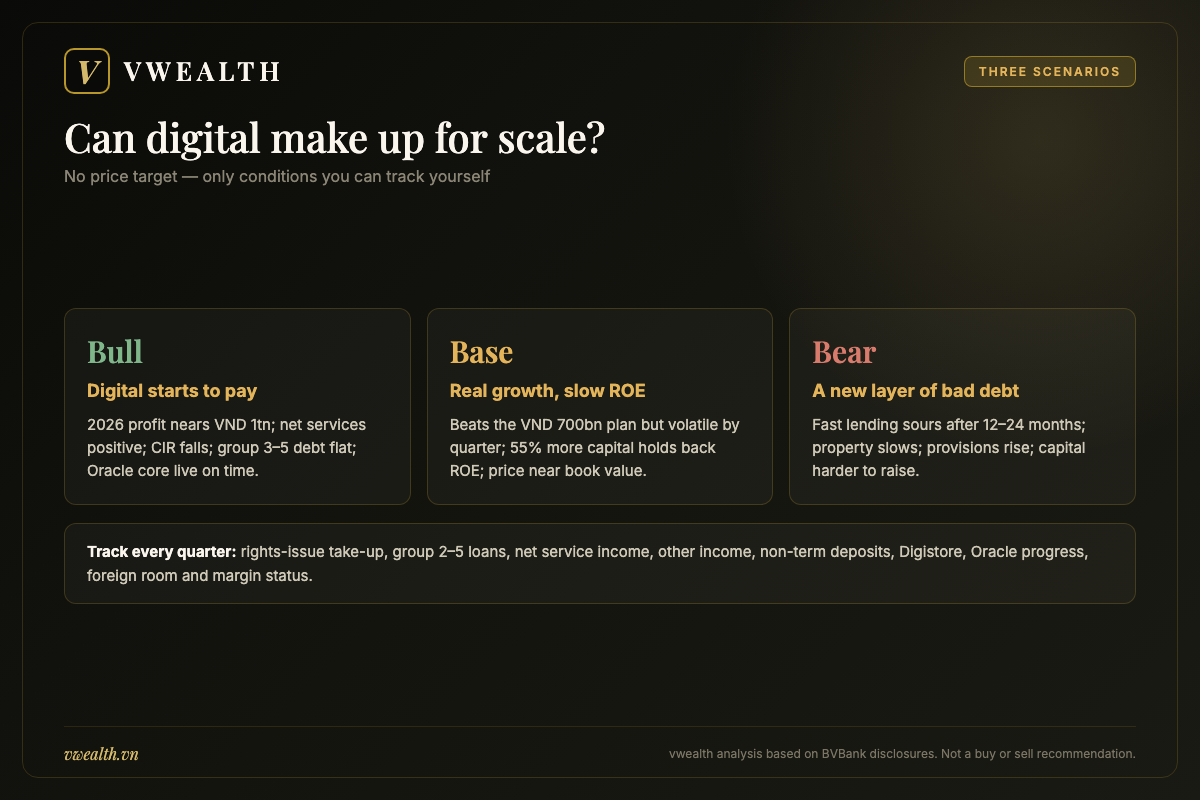
So, should you buy BVB stock? Weighing a small bank’s bet on digital
After seven chapters, it is time to pull things together. The answer to “should I buy BVB stock?” is not a universal yes or no; it depends on who you are, what you need from the investment and what risks you can tolerate. Below we weigh the positives and negatives even-handedly, then outline which kinds of investors might find BVB a fit.
The compelling positives
Profit is recovering strongly from the core business. Pre-tax profit in H1 2026 was about VND 547 billion, more than the whole of 2025; net interest income rose 46% and operating costs only about 12%. Most of the increase came from core business rather than provision cuts — provisions still rose.
A consistent strategy and stable leadership. Mr Le Anh Tai has been associated with the chairmanship since 2013, and the retail strategy has been pursued since 2015. The bank has not gone through forced restructuring or a merger, and it cleared its VAMC debt in 2020.
A digital ecosystem with real scale. More than 3.2 million customers, over eight in ten new customers from digital channels, Digistore with more than 20,000 merchants in 2025, and the role of licensed partner bank for Timo — assets a small bank would struggle to build without moving early.
Comfortable liquidity and an international rating. An LDR of about 80% at end-Q1 2026 according to Fitch, a B+ rating with Stable outlook; Fitch estimates the 2026 raise will lift the capital adequacy ratio by about 4 percentage points.
The HOSE listing opens up catalysts. Possible margin eligibility once conditions are met, greater institutional attention, and a valuation described as around book value at the time of the move — if ROE improves, there is room for a re-rating.
The negatives you cannot ignore
Small scale and low returns on capital. Around 0.54% of system assets, 2025 ROE of about 6% and ROA of about 0.35% (vwealth estimates). After a capital increase of almost 55%, profit has to rise very strongly just to keep ROE from falling.
Signs of deteriorating asset quality. Group 3, 4 and 5 loans all rose in H1 2026; total bad debt rose about 15% while loans grew about 7.3%; loan-loss coverage is only about 44%; off-balance-sheet written-off debt is about VND 4,140 billion; 83% of collateral is property. Sources also disagree on the NPL ratio (2.13% as disclosed by the bank at its 2026 meeting, about 3.22% for group 3–5 loans over customer loans in the half-year financial statements).
Income depends almost entirely on lending. Net interest income was about 92% of 2025 income, and the services segment lost money in H1 2026. Quarterly profit swings with the timing of provisions and recoveries.
No cash dividends and recurring dilution. The bank has no cash dividend plan; capital is raised through stock dividends, rights issues at par and ESOP, with a target of VND 14 trillion of capital by 2030 in its shareholder documents (and VND 20 trillion by 2028 in discussions with analysts) — so more calls for capital are likely.
Low foreign room and dispersed ownership. A 5% foreign limit restricts foreign inflows; there is no strategic shareholder or parent group to support the bank in hard times.
| Criterion | Positive | Negative |
|---|---|---|
| Profit growth | H1 2026 exceeded full-year 2025; pre-provision profit doubled | Low comparison base; volatile quarterly profit |
| Capital efficiency | Operating leverage emerging (costs growing slower than income) | ROE about 6% in 2025; capital up almost 55% after the raise |
| Asset quality | Recoveries of written-off debt up sharply (about VND 125bn in H1 2026); Fitch assessed LTVs as moderate | Group 2–5 debt rising; NPL coverage about 44%; about VND 4,140bn off balance sheet; collateral mainly property |
| Business model | Digital ecosystem, household-business niche, Timo partnership | Services loss-making; interest income about 92% |
| Shareholders and stock | Dispersed ownership, low controlling-shareholder risk; now on HOSE | No cash dividend; recurring rights issues at par; 5% foreign room |
Who BVB stock suits, and who it does not
It may suit investors with medium-to-high risk tolerance who want to bet on a “small bank improves efficiency through digital” story, have a multi-year horizon, are ready to put in more money at rights issues to maintain their stake, and have the discipline to read quarterly reports against the signal list in chapter seven. For such investors, BVB should be a small part of a banking allocation, alongside larger, more stable banks.
It does not suit investors who need regular cash dividends; those looking for a defensive, low-volatility bank stock; those without spare cash to take part in capital raises; and foreign investors if room remains at 5%. If you are new to Vietnamese bank stocks, start with vwealth’s Vietnam banking sector guide and how to invest in the Vietnam stock market to build the foundation for judging the numbers in this article.
A cautious approach, offered as an illustrative example rather than a recommendation: instead of buying everything at once, an interested investor could split the amount into several tranches and deploy them as quarterly results come in — for example, adding only when two consecutive quarters show improving net service income and no increase in group 3–5 loans. This turns the “early signals” in chapter seven into concrete conditions for action.
Frequently asked questions about BVB stock
Which bank does BVB stock belong to? BVB is the ticker of Viet Capital Commercial Joint Stock Bank (Ngân hàng TMCP Bản Việt), abbreviated BVBank (Viet Capital Bank before May 2023), originally Gia Dinh Commercial Joint Stock Bank, founded in 1992.
Where does BVB trade? Since 21 July 2026, BVB has been listed on the Ho Chi Minh City Stock Exchange (HOSE) with 640.82 million shares and a first-day reference price of VND 13,100. From 9 July 2020 it traded on UPCoM.
Is BVBank related to Vietcap Securities (VCI)? They are separate legal entities with shared “Ban Viet” roots. Ms Nguyen Thanh Phuong — founder and Chair of Vietcap — chaired Viet Capital Bank from 2012 and sat on BVBank’s Board until December 2025; she now chairs BVBank’s Strategy and Innovation Committee and holds about 3.93% (as of December 2025).
Does BVBank pay dividends? According to its April 2026 annual meeting documents, the bank has no dividend plan; profit is retained to build capital.
How does the 2026 capital raise work? BVBank is offering more than 320.4 million shares to existing shareholders at 2:1 and VND 10,000 per share, record date 24 September 2026, distribution planned for 29 September–19 October 2026, plus 30 million ESOP shares. If completed, charter capital rises from VND 6,408 billion to about VND 9,912 billion.
What is BVBank’s bad-debt ratio? The bank reported 2.13% under Circular 31/2024 at end-2025; measured as group 3–5 loans over customer loans in the H1 2026 financial statements, the ratio was about 3.01% at the start of the year and 3.22% at end-Q2 2026. The 2026 plan is below 3%. Check the latest quarterly report for current figures.
Can foreign investors buy BVB? In May 2021 the bank cut its foreign room to 5%; the 2026 listing prospectus keeps that cap, and actual foreign ownership was only 0.0489% at 15 April 2026. Foreign investors should check remaining room on the price board before ordering; see vwealth’s guide to foreign room in Vietnamese stocks.
The bottom line
BVBank is a quiet story in Vietnam’s stock market: a small bank born in 1992, with no big owner and no foreign partner, which came through the crises without forced restructuring and spent more than a decade on retail before producing its best year (2025) and best half-year (H1 2026) on record. Management has done what is needed to enter a new phase: a HOSE listing, an international credit rating, a core-system upgrade and a capital increase of almost 55%.
But the central question has no definitive answer yet: can digital make up for scale? The ecosystem has proven it can attract customers; it has not yet proven it can turn them into thick profits, double-digit ROE and cheap funding. Meanwhile group 3–5 debt is rising, and shareholders must keep putting in money at par for the bank to grow. The balanced answer to “should you buy BVB stock?” is therefore this: it is a bet on a small bank’s execution over the next few years, not a defensive bank stock or a dividend stock. If you choose to take part, do so with a small position, a clear list of signals to track every quarter, and preparation for further capital calls. Updated valuation, profit and bad-debt figures for BVB and its peers are always available in vwealth’s analysis reports.
Research Vietnamese stocks in English with vwealth. Our AI-powered platform turns Vietnamese market data into full English analysis reports — with international payment support and a free 2-month trial for new accounts. Create your free account and read the latest reports.


