Should you buy MSB stock — the ticker for Vietnam Maritime Commercial Joint Stock Bank on the Ho Chi Minh City exchange — is a question most people ask for a very specific reason: they have heard the stories around the ticker rather than learned about the bank. Rumours about absorbing a distressed lender, speculation about a higher foreign ownership ceiling, property developers appearing on the shareholder register — those three topics dominate most of what the market says about MSB. This article does the opposite: it starts with the bank. From an operating licence numbered 0001, issued in 1991 in the port city of Hai Phong, MSB has become a mid-sized private lender with one of the highest ratios of non-interest-bearing deposits in the Vietnamese system. The article walks through that story, teaches you how to read a bank’s financial statements — a business type where the standard industrial toolkit will almost certainly mislead you — and ends with a direct answer: which kind of investor MSB suits, and which kind it absolutely does not.
Before we begin, one convention between you and this article, the same used across this series. You will encounter many dates, names, transactions and scale figures, all drawn from publicly disclosed sources: exchange filings, shareholder meeting resolutions, the bank’s own announcements, and mainstream financial media. What you will not find is a figure for the most recent quarter or today’s valuation multiple. For a bank, those metrics move every quarter and are shaped by both the economic cycle and monetary policy. Instead, the article teaches you where to look and how to look; for current numbers, open the research reports on vwealth.
One more convention, and it is the most important. Some topics around MSB are speculative in nature — particularly the story about receiving a mandatory transfer of a weak bank. The article handles these according to the principle used throughout this series: state only what has been officially disclosed, clearly separate disclosed information from market expectation, and draw no inferences. Where something has not been announced, the article will say so plainly rather than convert it into an investment thesis.
From licence number 0001 in Hai Phong to a mid-sized private bank
There is a detail in MSB’s history that few investors know, and it is worth starting there: this bank’s operating licence carries the number 0001. Not as a figure of speech — that is the actual reference number on the document signed by the Governor of the State Bank of Vietnam. To understand how the bank operates today, you have to walk each bend of its road.
1991: the earliest licensed joint stock bank
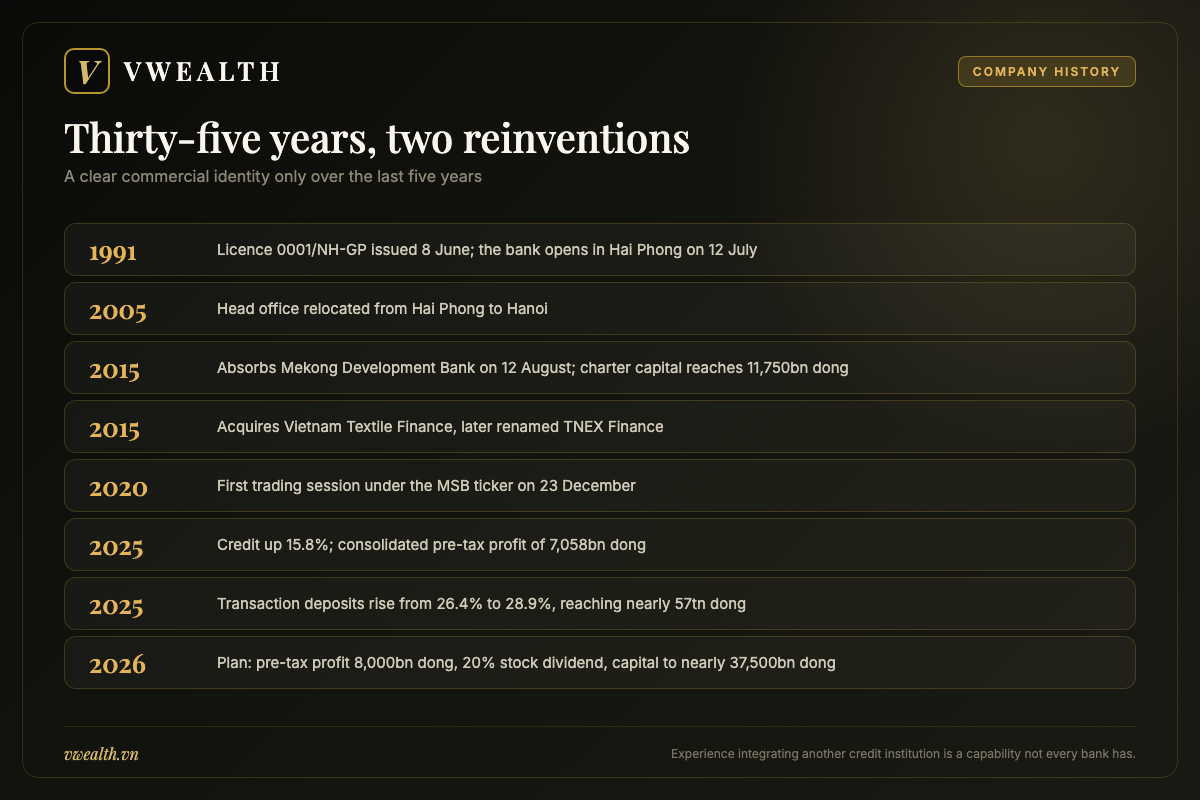
On 8 June 1991, Vietnam Maritime Commercial Joint Stock Bank was established under licence number 0001/NH-GP issued by the Governor of the State Bank. On 12 July 1991, the bank formally opened and began operating in the port city of Hai Phong.
Pause on the context of 1991. Vietnam had begun its economic reform programme only a few years earlier, the banking system had just been split into two tiers, and the concept of a joint stock commercial bank was entirely new. That a bank was founded in Hai Phong, tied to the maritime sector, reflects the economic logic of the moment precisely: ports were the gateway for trade, and trade required financial services.
The Maritime name was not merely a label. For many early years, the bank’s core client base was tied to shipping, ports and import-export businesses. Remember this, because it explains a characteristic that persists today: MSB has a traditional strength in corporate banking and in services tied to payment flows, rather than having been a pure retail bank from the outset.
2005: leaving Hai Phong for Hanoi
In 2005, the bank moved its head office from Hai Phong to Hanoi. Administratively a formality; strategically a declaration that the bank no longer wished to be an institution tied to one province and one industry.
The period that followed was the boom era of Vietnamese banking. Credit grew very fast, dozens of joint stock banks expanded their branch networks, and many institutions multiplied their charter capital within a few years. MSB joined that wave, expanding into major cities and diversifying its client base beyond the maritime sector.
But this was also the period in which the problems accumulated that the entire Vietnamese banking system would spend nearly a decade resolving. Rapid credit growth in an environment of immature risk management produced bad debt, and from around 2012 the sector entered a long restructuring cycle. That backdrop leads directly to the most significant turning point in MSB’s history.
2015: merging with MDB and buying a finance company
On 12 August 2015, MSB formally absorbed Mekong Development Joint Stock Commercial Bank, known as MDB, lifting charter capital to 11,750 billion dong. In the same year, the bank acquired Vietnam Textile Finance Joint Stock Company and converted it into a wholly owned finance subsidiary.
Both transactions took place within the banking sector restructuring programme driven by the regulator. At the time, Vietnam had far more credit institutions than the economy could support, and many smaller ones lacked the capital to meet new prudential standards. Merger was the encouraged route.
For MSB, the MDB deal brought capital scale and a branch network, particularly in the Mekong Delta where MDB had its roots. The finance company acquisition brought a consumer lending licence — a permit that was very hard to obtain new at that time and highly sought after. Notably, the bank announced it had completed the integration of both banks’ information technology systems in four days, the shortest such timeline in the market then.
Read this chapter with an analyst’s eye. A bank with hands-on experience integrating another credit institution possesses a capability not every lender has. That capability becomes valuable whenever the sector enters another restructuring round — and it is the factual basis behind the speculation surrounding this ticker discussed in the next chapter.
2012 to 2015: the restructuring years, and why they still matter
The stretch between the credit boom and the MDB merger deserves a section of its own, because it shaped the risk culture of every Vietnamese bank operating today, MSB included.
After 2011, the system faced a bad debt problem large enough that the government created a dedicated asset management company to warehouse non-performing loans. Banks sold impaired assets into that vehicle in exchange for special bonds, provisioning against them over several years. The mechanism bought time; it did not eliminate the losses, it spread them. For roughly half a decade, a meaningful share of the sector’s reported profit was consumed by provisioning against legacy assets rather than reflecting current operations.
Two consequences follow for how you read a Vietnamese bank today. The first is that long-run profit series from that era are not comparable with today’s, because the provisioning burden distorts them. If you see a chart showing a decade of earnings growth for any Vietnamese bank, check whether the early years were depressed by legacy clean-up. The second is that the banks which emerged strongest were those that recognised losses earliest rather than deferring them — which is exactly why the coverage ratio described in chapter four is such a revealing metric.
For MSB specifically, this period explains why the 2015 merger happened when it did and why the bank spent the following years rebuilding rather than expanding aggressively. The identity described in chapter one, focused on low-cost deposits and payment services, was formed in the aftermath of that clean-up. It is a strategy built by an institution that had learned what fast credit growth costs.
2020: listing on the Ho Chi Minh City exchange
At the end of 2020, the bank’s shares formally listed on the Ho Chi Minh City Stock Exchange under the ticker MSB, with the first trading session on 23 December 2020. This was the period when many Vietnamese private banks moved their shares onto the main exchange rather than trading over the counter.
Listing delivers three things to a bank. First, a transparent and repeatable channel for raising tier one capital, which matters enormously in an industry where capital sets the ceiling on credit growth. Second, higher disclosure standards, giving investors and the regulator a clearer view of the balance sheet. Third, a continuous market valuation, which provides the basis for any sale of a stake to a strategic partner.
That third point matters particularly for MSB, because as chapter two shows, the foreign strategic shareholder story is one of the central themes around this ticker.
2021 to 2025: finding an identity
After listing, MSB pursued a fairly clear direction: build a base of individual and small and medium enterprise customers, push digitalisation hard, and above all optimise the ratio of non-interest-bearing deposits. The bank also developed a separate digital banking brand and renamed its finance subsidiary TNEX Finance.
The results of that period have been disclosed. In 2025, MSB’s credit growth reached 15.8 per cent, consolidated customer lending exceeded 205 thousand billion dong, total assets grew more than 27 per cent, and consolidated pre-tax profit reached 7,058 billion dong. Current account and savings account deposits reached nearly 57 thousand billion dong, up almost 40 per cent, lifting the ratio from 26.4 per cent to 28.9 per cent — keeping the bank among the five highest in the system on that measure. At year end, the bank served nearly 8 million individual customers and more than 100 thousand corporate customers.
That 28.9 per cent deposit ratio is the figure worth dwelling on longest, and chapter three explains in detail why it matters so much to a bank.
Milestone summary table
| Date | Event | Why it matters to an investor today |
|---|---|---|
| 8 June 1991 | Licence 0001/NH-GP issued; bank opens in Hai Phong on 12 July 1991 | Licence seniority and a corporate client base rooted in the maritime sector |
| 2005 | Head office relocated from Hai Phong to Hanoi | A declaration of the shift from provincial lender to national bank |
| 2006 to 2011 | Rapid expansion alongside the system-wide credit boom | The period when problems accumulated that the sector spent a decade resolving |
| 12 August 2015 | Absorbs Mekong Development Bank; charter capital reaches 11,750 billion dong | Hands-on experience integrating another credit institution |
| 2015 | Acquires Vietnam Textile Finance, later renamed TNEX Finance | Ownership of a consumer lending licence, an asset hard to obtain new |
| 23 December 2020 | First trading session on the Ho Chi Minh City exchange under MSB | Opens a transparent capital channel and creates a basis for stake sales |
| 2021 to 2024 | Digitalisation push; focus on individual and small business customers | An identity built on low-cost deposits and payment services |
| 2025 | Credit up 15.8 per cent, consolidated pre-tax profit 7,058 billion dong, deposit ratio to 28.9 per cent | Evidence the low-cost deposit strategy is producing measurable results |
| 2026 | Shareholders approve a pre-tax profit target of 8,000 billion dong, a 20 per cent stock dividend, and charter capital of nearly 37,500 billion dong | A capital expansion with substantial dilution plus a set of subsidiary transactions |
Read that table vertically and you see a bank with a very long institutional history that has only defined a clear commercial identity over roughly the last five years. That is a meaningful difference from private banks whose strategy stabilised much earlier, and it is both an opportunity and a risk.
Who runs MSB and who actually owns it
For a bank, the ownership question matters more than in almost any other industry, for two reasons. First, a bank operates with depositors’ money, so the regulator imposes strict limits on how much an individual, an institution and their related parties may own. Second, the shareholder structure feeds directly into related-party lending risk — the most distinctive and most serious risk in Vietnamese banking.
Tran Anh Tuan and the executive team
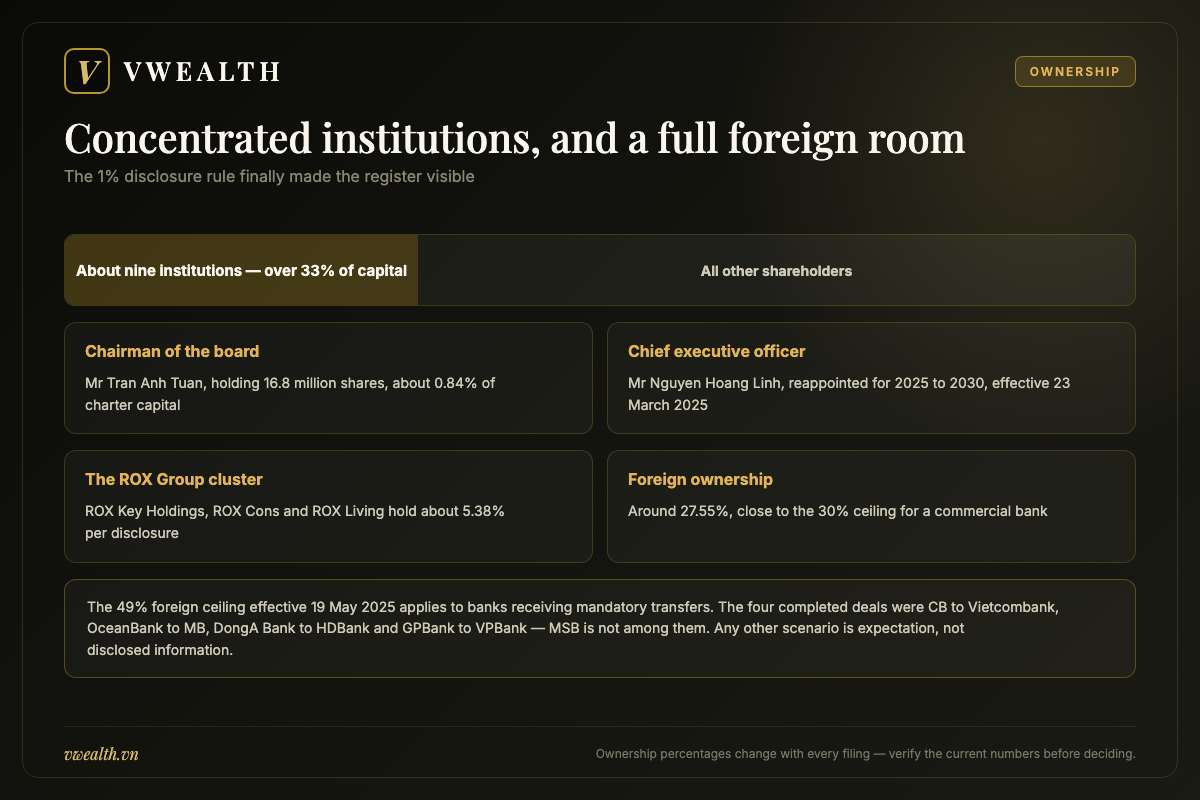
Mr Tran Anh Tuan serves as Chairman of the Board of MSB. According to disclosure, he owns 16.8 million shares, equivalent to roughly 0.84 per cent of the bank’s charter capital.
That 0.84 per cent figure deserves correct interpretation. Vietnam’s Law on Credit Institutions strictly limits how much of a bank an individual may own, and a low direct stake held by the person at the top is common across the industry rather than unusual. It also means you cannot judge how closely leadership interests align with shareholders simply from direct ownership.
On the executive side, Mr Nguyen Hoang Linh was reappointed Chief Executive Officer for a five-year term running from 2025 to 2030, effective 23 March 2025, after the State Bank issued its written approval of the appointment. According to disclosure, he was born in 1977, graduated from the National Economics University, holds a master’s degree in business administration from Hanoi University of Science and Technology, and has more than 26 years of experience in finance and banking.
The reappointment detail matters more than it appears. In banking, executive stability has genuine practical value: credit strategy, risk appetite and governance culture take years to embed in an organisation. A chief executive reappointed for a full new term signals continuity, and it stands in contrast to banks that change their top executive repeatedly.
The shareholder register: nine institutions holding over a third
This is the part of the chapter to read most carefully. According to the list of shareholders holding 1 per cent or more of charter capital that MSB discloses under regulation, roughly nine institutional shareholders hold a combined total of more than 33 per cent of the bank’s charter capital. Within that group are companies belonging to the ROX Group ecosystem, formerly named TNG Holdings. Per disclosure, the group comprising ROX Key Holdings, ROX Cons and ROX Living holds approximately 5.38 per cent of MSB.
The requirement to publish shareholders holding 1 per cent or more is a newer provision of the Law on Credit Institutions, intended to increase ownership transparency across the banking system. It is because of that rule that investors can now see a more detailed ownership picture at many banks, not only MSB.
It must be said clearly and fairly: a cluster of companies from the same corporate ecosystem holding shares in a bank is a common feature of Vietnamese banking, and in itself it is not a breach of anything, provided ownership stays within legal limits and transactions are fully disclosed. This article makes no inference about motive and none about anything undisclosed.
What the article recommends is that you do what any professional bank analyst does: read the related-party lending note in the audited financial statements, examine the credit mix by industry, and track concentration in the largest customer group. These are three publicly disclosed metrics, and they give you an answer grounded in data rather than in speculation.
How Vietnamese ownership rules shape a bank’s register
International readers will find the Vietnamese bank ownership framework unusual, and understanding it explains a great deal about what you see on any register, including MSB’s.
The Law on Credit Institutions caps how much a single individual may own in a bank, caps the combined holding of an institution, and caps the total held by any shareholder together with their related parties. Those caps have been tightened over successive revisions. The practical effect is that no Vietnamese private bank has a single dominant owner in the way that, say, a family-controlled Asian conglomerate might. Control, where it exists, is distributed across multiple legal entities each holding a compliant stake.
The transparency requirement introduced with the most recent revision — publishing every shareholder holding 1 per cent or more, along with their related parties — was designed precisely to make that distribution visible. It is the reason investors can now see clusters of affiliated companies on registers where previously they saw only a list of names below the old disclosure threshold.
How you should use this: the disclosure tells you which economic groups are present, and the related-party lending note tells you whether that presence translates into credit exposure. Those are two separate questions, and conflating them is the most common analytical error made about Vietnamese banks. Presence on a register is a fact about ownership; credit concentration is a fact about the loan book. Judge the bank on the second, using the first only as a reason to check more carefully.
Foreign ownership near the ceiling: a genuine constraint
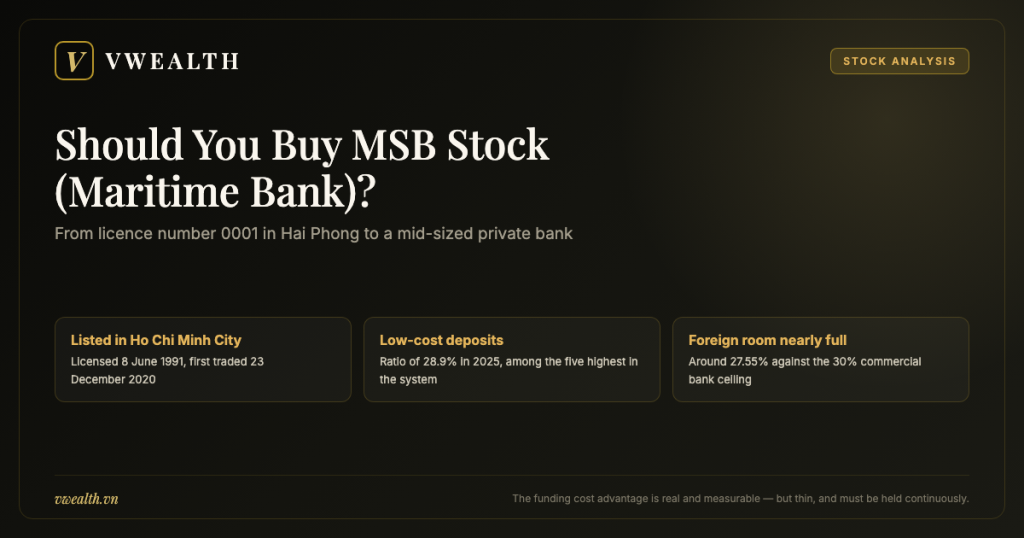
Foreign ownership at MSB is already close to its cap. According to disclosed figures, the foreign ownership ratio sits at around 27.55 per cent, while the general ceiling for a Vietnamese commercial bank is 30 per cent. MSB is among the listed banks that are effectively full. For readers unfamiliar with the mechanism, foreign ownership limits — known locally as the room — are covered in the pillar article on how to invest in the Vietnam stock market.
A near-full room cuts both ways. Positively: it demonstrates that foreign investors have assessed the bank and bought up to the limit, generally read as a signal about asset quality and governance. Negatively: it blocks new foreign inflows. When the Vietnamese market receives fresh foreign capital — for instance under a market reclassification scenario — tickers that are already full cannot benefit directly, because there are simply no shares available to buy.
This is why the room-widening story carries particular weight for this ticker, and it is the subject of the next section.
Room widening and mandatory transfers: separating information from expectation
This is the most misunderstood topic around MSB, so the article will set it out very clearly, layer by layer.
The first layer is the regulation. From 19 May 2025, a decree on foreign ownership ratios at credit institutions took effect, permitting foreign ownership at banks that receive mandatory transfers to rise to a maximum of 49 per cent, in place of the previous 30 per cent ceiling. This is issued regulation, not expectation.
The second layer is what has actually happened. During late 2024 and early 2025, the State Bank completed the transfer of four weak banks: CB to Vietcombank, OceanBank to MB, DongA Bank to HDBank, and GPBank to VPBank. These are four completed and announced transactions.
The third layer, and this is the crux: MSB is not among those four banks. What the market discusses about MSB possibly participating in a similar transaction in future is expectation, not disclosed information. The article states this not to rule out any possibility, but so that you classify it correctly: an unconfirmed expectation should not be the foundation of an investment thesis.
How to use this properly: if you buy MSB, buy it for what the bank has demonstrably achieved and disclosed, then treat any room-widening scenario as a possible bonus. If your thesis only works when a rumour becomes fact, it is a fragile thesis.
Dividends and the 2026 capital plan
At the 2026 annual general meeting, MSB put forward a plan to pay a 20 per cent dividend in shares, while raising charter capital to nearly 37,500 billion dong through an issue to existing shareholders at a ratio of up to 20 per cent, equivalent to a maximum of 624 million new shares. Shareholders also approved a plan to contribute capital to or acquire shares in a securities company and a fund management company so that they become subsidiaries of the bank.
Two points to understand correctly here. First, a stock dividend is not cash in your pocket — it divides the same pie into more slices, and the reference price is adjusted accordingly. For a bank, paying dividends in shares is the way to retain profit as own capital, and own capital determines the ceiling on credit growth. That is a commercially sound choice, but do not mistake it for income.
Second, the plan to buy a securities company reflects a broader industry trend: banks want a complete financial ecosystem so they can cross-sell. According to management commentary, the bank is targeting securities firms with clean balance sheets and charter capital of roughly 300 to 500 billion dong — meaning it wants to buy a licence and a small platform to develop itself, rather than an established franchise with large market share.
Ownership and leadership at a glance
| Item | What has been disclosed | What you should track |
|---|---|---|
| Chairman of the board | Mr Tran Anh Tuan, holding 16.8 million shares, about 0.84 per cent of charter capital | The corporate governance report and the related-party lending note |
| Chief executive officer | Mr Nguyen Hoang Linh, reappointed for 2025 to 2030, effective 23 March 2025, born 1977 | Continuity in credit strategy and risk appetite |
| Institutional shareholders | Roughly nine institutions holding over 33 per cent combined; the ROX Group cluster around 5.38 per cent | Credit mix by industry and concentration in the largest customer group |
| Foreign ownership | Around 27.55 per cent, close to the 30 per cent commercial bank ceiling | Remaining room changes daily; check the exchange disclosure system |
| Room widening to 49 per cent | Decree effective 19 May 2025, applying to banks receiving mandatory transfers | MSB is not among the four completed transfers; any other scenario is expectation |
| 2026 dividend | Proposal for a 20 per cent dividend paid in shares | A stock dividend retains capital; it is not cash income |
| 2026 capital raise | Charter capital to nearly 37,500 billion dong; up to 624 million new shares to existing holders | The fully diluted share count and the return earned on new capital |
Again, a reminder: ownership percentages change with every disclosure. Before deciding, open the most recent filing or the current research report on vwealth to verify.
How MSB makes money: anatomy of a commercial bank
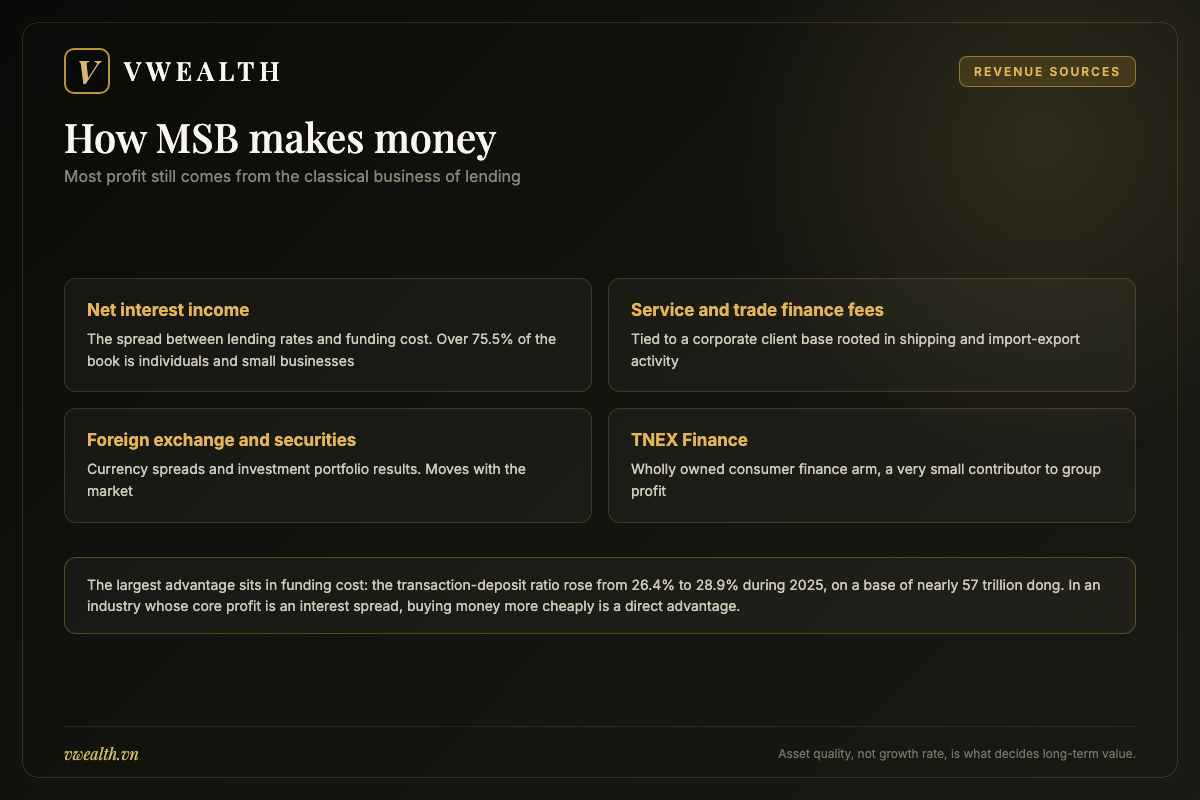
A bank makes money in a way that is simple in principle and complex in practice: raise deposits at one rate, lend at a higher one, and keep the spread after operating costs and credit risk costs. Alongside sit non-interest revenues from services. At MSB, that structure has several distinctive features.
Low-cost deposits: MSB’s clearest competitive advantage
If you could pick one metric to describe MSB’s commercial identity, it would be the ratio of current account and savings account deposits to total deposits — the proportion of customer money sitting in transaction accounts, on which the bank pays little or no interest.
Why does this matter so much? Because it determines cost of funds. A bank with a high proportion of transaction-account money buys its funding cheaply, and in an industry whose core profit is an interest spread, a lower funding cost translates directly into a wider margin, or into the ability to lend at competitive rates while still preserving margin.
According to disclosure, MSB’s ratio rose from 26.4 per cent to 28.9 per cent during 2025, on a base of nearly 57 thousand billion dong, up almost 40 per cent, keeping the bank among the top five in the system on this measure. That is a notable position for a mid-sized lender, since the leaders on this metric are usually banks with very large networks or with distinctive corporate client bases.
But there is something you must know about this metric: it is highly sensitive to interest rates. When term deposit rates rise, customers shift money out of transaction accounts into term deposits to earn interest, pushing the ratio down across the whole system. So when comparing this figure across years, look at it alongside the interest rate environment of each year rather than comparing it in isolation.
Lending: focused on individuals and small businesses
According to 2025 disclosure, more than 75.5 per cent of MSB’s loan book comes from its strategic segments of individual customers and small and medium enterprises. Customer lending at the parent bank level exceeded 201 thousand billion dong, plus nearly 4 thousand billion dong at the finance subsidiary, taking consolidated lending above 205 thousand billion dong at year end.
Concentrating on these two segments has clear logic. Lending to individuals and small businesses typically carries a wider margin than lending to large corporates, because large corporates have negotiating power and many alternatives. A book spread across many small borrowers also has lower concentration risk than one clustered in a handful of large exposures.
The downside must be stated plainly. Lending to small borrowers carries higher operating cost per loan and demands effective credit scoring and collection systems. And in a difficult economy, small businesses and household enterprises are usually the group affected earliest and hardest. That is why chapter four devotes a section to reading asset quality.
The digital bank and the retail build
Alongside its traditional franchise, MSB developed a separate digital banking brand aimed at customers who never visit a branch. This deserves attention because it is the mechanism by which the bank has been adding the transaction accounts that produce its funding advantage.
The economics of a digital-first retail bank differ substantially from branch banking. Customer acquisition cost is lower but so is the average balance per customer, which means the model only works at scale. The pay-off is not usually in fees — most digital banking services in Vietnam are free — but in the deposit balances and in the data those accounts generate, which improves credit scoring for later lending.
By the end of 2025 the bank served nearly 8 million individual customers and more than 100 thousand corporate customers. Those are large numbers for a mid-sized institution, and they are the base from which the transaction-deposit ratio is built. The relevant question for an investor is not how many customers exist but how many are active and how many treat this bank as their primary account. A dormant account contributes nothing to funding.
What to watch: growth in active customers rather than total registered customers, average balance per retail customer, and the share of transactions conducted through digital channels. Where the bank discloses these, they tell you whether the acquisition push is producing genuine funding or simply inflating a headline. Where it does not, the transaction-deposit ratio itself remains the best available proxy.
Non-interest income: the segment that determines earnings quality
A bank’s non-interest income comprises payment service fees, guarantee fees, trade finance fees, foreign exchange trading gains, income from securities investments, and income from distributing insurance products.
For MSB, the two most notable groups are payment and trade finance fees — tied to a corporate client base rooted in shipping and import-export — together with foreign exchange trading. These are highly repeatable revenues tied to customers’ real activity, distinct from one-off items.
When reading the accounts, calculate the share of non-interest income in total operating income and track it across several quarters. A bank with a high and stable non-interest share typically earns a higher valuation multiple, because that income is less sensitive to the interest rate cycle than net interest income. But be careful to distinguish non-interest income from repeatable services versus income from asset sales or recoveries of written-off debt — two very different things in quality.
Trade finance: the legacy franchise that still earns
One part of MSB that receives little attention but explains a meaningful share of its fee income is trade finance — the business of financing and guaranteeing import and export transactions.
Vietnam is one of the most trade-intensive economies in the world relative to its size, with total goods trade substantially exceeding gross domestic product. Every one of those shipments requires banking: letters of credit, import financing, export receivable discounting, foreign exchange conversion, and guarantees. The fees are individually small but recur on every transaction, and the relationships are sticky because switching provider mid-supply-chain is disruptive.
For a bank founded to serve the maritime and port sector, this is the natural inheritance. It also explains why foreign exchange trading income appears as a meaningful line: a bank financing importers and exporters handles currency conversion as a matter of course, and that flow generates spread income independent of the credit cycle.
The strategic significance is that this income is countercyclical relative to lending in one specific way: it depends on trade volumes rather than on domestic credit demand. In a year when domestic borrowing weakens but exports hold up, this franchise cushions the result. It will not offset a serious credit problem, but it is a genuine diversification that a purely domestic retail bank does not have.
What to watch: the trade finance and foreign exchange lines within non-interest income, and the bank’s commentary on corporate customer numbers. If the corporate franchise is being neglected in favour of the retail push, that shows up here first.
TNEX Finance and a divestment that keeps not happening
TNEX Finance Company Limited, the successor to the finance company MSB acquired in 2015, has charter capital of 500 billion dong and is wholly owned by the bank. At the end of 2024, it had total assets of 3,807 billion dong, loans outstanding of 1,774 billion dong, total revenue of 358.8 billion dong, and pre-tax profit of approximately 5 billion dong.
Pre-tax profit of about 5 billion dong on nearly 3,800 billion dong of assets tells the story: this is a business operating close to break-even. MSB management has repeatedly put a divestment plan to shareholders, seeking a strategic partner to take a partial or full stake with a buyer experienced in consumer finance. The 2025 annual meeting was the second time the plan was tabled.
However, according to the fourth quarter 2025 financial statements, TNEX Finance remains a wholly owned subsidiary — meaning the bank has not found a buyer. This detail deserves thought. It shows two things: the market for consumer finance companies in Vietnam has cooled considerably from its earlier active phase, and a plan approved by shareholders is not the same as a plan that can be executed.
For an investor, the sensible view is this: if the deal completes, it produces a one-off gain and tidies the portfolio, letting the bank focus on its core. If it does not, the impact on consolidated profit is limited anyway, because this unit’s earnings are tiny relative to the parent. Do not make it a pillar of your thesis.
Where the MSB moat sits, and where it is thin
Banking as an industry has a weak moat, because products are nearly identical and customers switch ever more easily. But defensive layers do exist, and at MSB there are three.
The first layer is a low cost of funds from the high transaction-deposit ratio. This is the most genuine and most measurable layer. Transaction deposits attach to payment accounts, and payment accounts attach to daily habit — something harder to change than a maturing savings deposit.
The second layer is relationships with long-standing corporate clients, particularly in trade-linked industries. Corporate banking relationships are stickier than retail ones, because they involve credit lines, guarantees and trade finance facilities that take time and cost to move.
The third layer is technology and digitalisation. The bank has disclosed that it has standardised and automated core workflows from approval through disbursement to operations. This is the thinnest layer, because every bank is investing in the same direction and the technology gap between large banks keeps narrowing.
The honest conclusion: MSB has a specific, measurable advantage in cost of funds, but nothing prevents a competitor from taking customers with better rates or a more convenient product. This is a well-positioned mid-sized bank, not an institution with a monopoly position.
The revenue sources compared
| Revenue source | Nature | Volatility | What decides success |
|---|---|---|---|
| Net interest income | The spread between lending rates and funding cost | Moderate, following the rate cycle and credit growth | The transaction-deposit ratio and the credit growth quota granted |
| Service and trade finance fees | Payment, guarantee and import-export financing fees | Lower, tied to real corporate client activity | Size of the corporate client base and trade volumes |
| Foreign exchange and securities | Currency spreads and investment portfolio gains and losses | High, dependent on market movements | Discipline in market risk management |
| Consumer finance subsidiary | Unsecured consumer lending | Very high; wide margins but high credit risk | Collection effectiveness; currently a very small contributor to group profit |
Look at that table and you see that most of MSB’s profit still comes from the classical business of lending. That is normal for Vietnamese banks generally, and it means asset quality — not growth rate — is what determines long-term value. The next chapter teaches you how to read that asset quality.
Financial position and health: seven checks before you decide on MSB stock
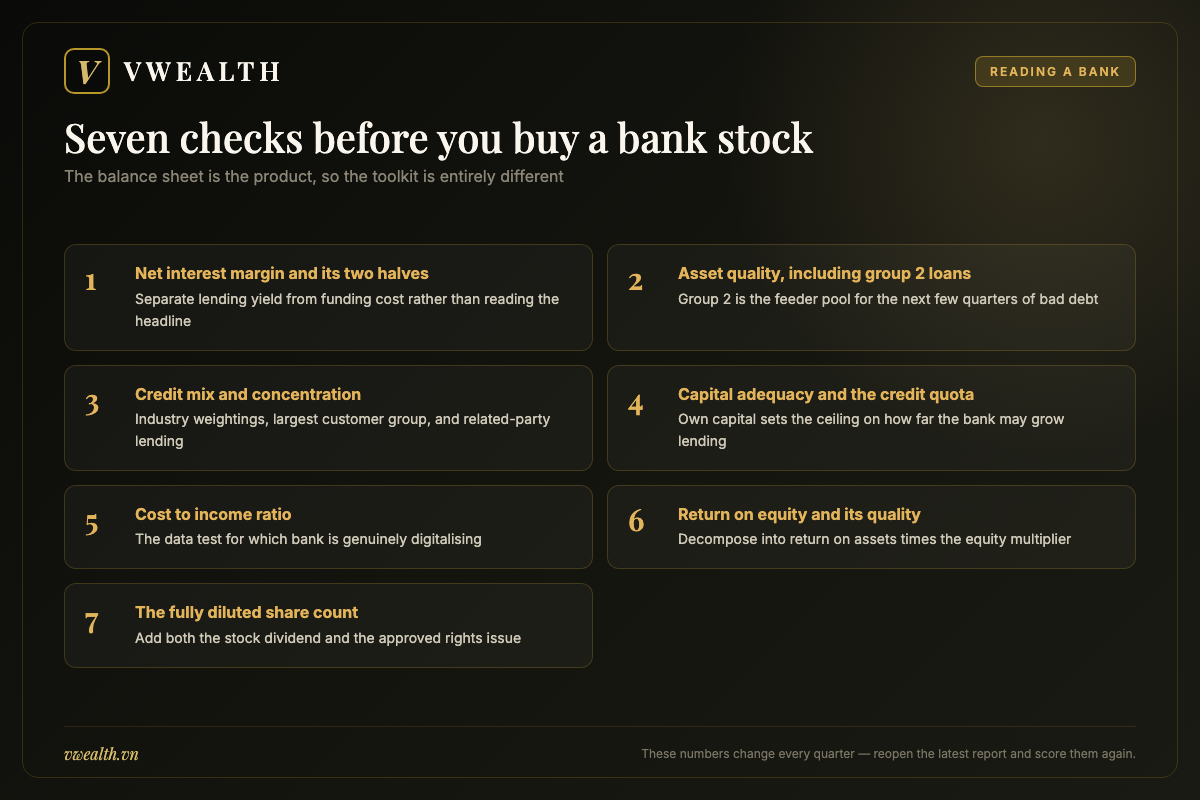
This is the most important chapter in the article. A bank is a business whose balance sheet is the product, so the analytical toolkit differs entirely from that used for a manufacturer. The seven checks below are what you should use instead.
Check 1: net interest margin and the two halves that make it
Net interest margin is the difference between the yield on earning assets and the cost of funds, expressed over total earning assets. It is the central metric for any bank.
But do not stop at the headline. Split it into two halves. The lending yield half depends on portfolio mix: individual and small business lending yields more than large corporate lending. The funding cost half depends on the transaction-deposit ratio and on how much of the balance sheet is funded by interbank borrowing or issued paper.
At MSB, the funding cost half is where the bank has an advantage thanks to its high transaction-deposit ratio. What you need to verify is whether that advantage survives changes in the rate environment. How to check: compare MSB’s average cost of funds against private banks of similar size across several quarters, particularly quarters in which system-wide deposit rates rose.
Check 2: asset quality, and you must look at group 2 loans
This is the single most important of the seven. The non-performing loan ratio, measured as group 3 to group 5 loans over total lending, is the number everyone sees. But professional analysts look at two further things.
The first is group 2 loans, meaning special-mention loans — those overdue by less than 90 days. This group is not yet classified as non-performing but is the feeder pool for future non-performing loans. A bank whose group 2 balance is rising quickly while its headline bad debt ratio stays low has a problem that has not yet surfaced in the headline number.
The second is the loan loss coverage ratio, calculated as provisions already booked over total non-performing loans. This tells you how much the bank has set aside in advance against loans likely to be lost. A high coverage ratio is a buffer for future years’ profits; a low ratio means provisioning costs still lie ahead.
For a bank with a large weighting towards individual and small business borrowers, as MSB has, these three metrics must be tracked together and across a run of quarters, because that customer group reacts quickly to economic shifts.
Check 3: credit mix by industry and concentration
Total loans outstanding tells you nothing about risk. Risk lies in where the money was lent.
Three questions to answer from the notes. First, the loan mix by industry, particularly exposure to real estate and construction — the most cyclical sectors and the ones that have caused the largest losses in Vietnamese banking history. Second, concentration in the largest customer group: if a significant share of the book sits with a handful of borrowers, risk is no longer diversified. Third, lending to related parties and to parties connected with major shareholders.
The third is particularly important for any Vietnamese bank with large institutional shareholders, and MSB is in that category as chapter two set out. To repeat the principle: this article does not speculate. The correct approach is to read the disclosed figure in the notes, compare it against the legal limit, and track the trend across periods. If the numbers sit within limits and are fully disclosed, that is data; if you feel disclosure is insufficient, express that as a valuation discount rather than as an accusation.
Check 4: capital adequacy and the credit growth quota
The capital adequacy ratio measures own capital against risk-weighted assets. It determines how far a bank may expand credit, and it is why Vietnamese banks raise capital continuously.
For MSB, the plan to raise charter capital to nearly 37,500 billion dong in 2026 should be read through this lens: not surplus ambition but a condition for continued credit growth. Equally, paying dividends in shares rather than cash serves the same objective — retaining profit as own capital.
Read capital adequacy alongside the credit growth quota that the State Bank grants each bank annually. This is a distinctive feature of the Vietnamese market: even with sufficient capital and sufficient customer demand, a bank’s credit growth is limited by its allocated quota. Banks with good asset quality and those participating in restructuring weak institutions have generally received more favourable quota treatment.
Check 5: the cost to income ratio
The ratio of operating expenses to total operating income measures efficiency. For a bank it directly reflects the payoff from digitalisation: when workflows are automated, the bank serves more customers without a proportional increase in headcount.
MSB has disclosed that it has standardised and automated core workflows from approval through disbursement to operations. If that is true and effective, it must show up in this ratio: cost to income declining over time while customer numbers and loan balances rise.
This is one of the best ways available to test a company’s claims with data. Every bank says it is digitalising; only this ratio tells you who actually is.
Check 6: return on equity and the quality behind it
Return on equity is the summary measure for a bank. But a high number is not automatically good, because it can come from high leverage or from under-provisioning.
How to test the quality: decompose it into return on assets multiplied by the equity multiplier. If a high return on equity comes mainly from leverage, that is profit accompanied by greater risk. If it comes from a strong return on assets, that is genuine efficiency.
One technical note for MSB: equity is rising quickly through issuance and stock dividends. When the denominator expands, return on equity falls arithmetically even if the underlying business has not deteriorated. Fix one calculation convention and apply it consistently across periods and across banks.
Check 7: the fully diluted share count and real earnings per share
For a bank paying a 20 per cent stock dividend while also issuing up to 20 per cent more shares to existing holders, the share count will rise materially. Historical earnings per share is therefore not usable for valuing the future.
Build a small table: shares currently outstanding, plus shares issued for the dividend, plus shares from the rights offering already approved. That total is the real denominator. With the ratios announced, the denominator could rise by roughly forty per cent if both plans complete in full.
The practical implication: if you expect profit to grow thirteen per cent under the 2026 plan while the share count grows more than that, your earnings per share falls rather than rises. This is the most common trap in valuing bank stocks during a capital expansion, and it is why price to book is used more than price to earnings for this sector.
Provisioning policy: where bank earnings can be shaped
There is one further thing to understand about bank accounts that does not fit neatly into the seven checks but affects all of them: provisioning is partly a policy choice.
Vietnamese regulation prescribes minimum provisioning rates by loan classification, so there is a floor. But banks may and do provision above the minimum, and the decision about how far above is management’s. A bank that provisions generously in a strong year builds a buffer that flatters the following weak year; a bank that provisions at the floor reports higher profit now and carries the cost later.
Neither approach is wrong, but they produce very different-looking earnings from identical underlying loan books. This is why the coverage ratio is more informative than the profit line for comparing banks. A bank with 100 per cent coverage and modest reported profit may be in better shape than one with 50 per cent coverage and impressive reported profit.
How to test this at MSB: track the coverage ratio and the annual provisioning charge together over several years. If coverage is rising while the charge is stable, the bank is building a buffer out of growing income — the healthiest pattern. If coverage is falling while profit rises, reported earnings are being supported by lower provisioning rather than by better operations. That distinction will not appear in any headline, and finding it is precisely the work that separates an investor from a headline reader.
A practical note on reading Vietnamese bank disclosures
For an international investor, several practical points make this work faster. Vietnamese banks classify loans into five groups, with groups 3, 4 and 5 constituting non-performing loans and group 2 being the special-mention category described above; the breakdown appears in the notes rather than on the face of the balance sheet. Quarterly reports are typically unaudited and less detailed than the audited annual statements, so the related-party and concentration disclosures you most want are usually available only once a year.
The credit growth quota is not published as a single official list, but banks frequently reference their allocation in analyst briefings and at annual meetings. Capital adequacy under Basel standards is disclosed by most listed banks, though the exact framework applied can differ, so check which standard the figure refers to before comparing across institutions.
Set the seven checks up once as a spreadsheet with one column per period, and updating later takes minutes rather than hours. That habit turns a one-time analysis into ongoing monitoring, which is what owning a bank actually requires.
What the seven checks say about MSB’s position
Taken together, the portrait is this. MSB is a mid-sized private bank with a specific and measurable advantage in cost of funds thanks to a high transaction-deposit ratio, with a corporate client base tied to international trade, growing credit faster than the sector average, and expanding capital to sustain that pace. The risks concentrate in two places: the asset quality of a loan book weighted towards individuals and small businesses when the economy slows, and the degree of transparency around credit connected to large shareholders.
If you want to compare this framework with other banks in the same tier, read the analyses of VIB, TPBank and MB — three lenders doing the same work with markedly different shareholder structures and customer strategies.
How the market treats MSB stock: portrait of a mid-tier bank ticker
Understanding a bank is one thing; understanding how the market prices it is another. Bank stocks make up a very large share of Vietnamese market capitalisation, so they are driven both by broad flows and by name-specific characteristics.
Why price to book is the primary tool for bank stocks
For banks, price to book is used more than price to earnings, for two reasons. First, a bank’s equity sits closer to economic value than a manufacturer’s, because its assets are financial rather than depreciated plant. Second, bank earnings can be materially shaped by provisioning policy, making them less reliable than book value in any single period.
The correct method is to pair the multiple with sustainable return on equity. The general principle: a bank with a high and durable return on equity deserves a higher book multiple. If two banks trade at the same multiple but differ in return on equity, the one earning more is relatively cheaper.
One technical point for MSB: when the bank issues new shares to existing holders, book value per share changes depending on the issue price relative to current book value. Recompute book value after the plans complete before concluding whether the stock is cheap or expensive.
The character of the MSB ticker
If you had to describe MSB in one sentence, it would be this: a mid-tier private bank stock with reasonable liquidity, a nearly full foreign room, and more expectation-driven narrative than the sector average.
Three consequences follow. First, the ticker generally moves with the broader banking sector, because flows into this group tend to be sector-wide rather than selective. Second, the trading range of mid-tier banks is typically wider than that of the state-controlled lenders, given smaller size and a higher proportion of retail investors. Third, and this is particular to MSB, the ticker is unusually sensitive to speculative news about restructuring and room widening.
Prepare for that third characteristic. A ticker carrying multiple expectation narratives will have sessions of sharp movement disproportionate to any change in fundamentals. If you hold for the long term, treat those sessions as noise; if you intend to trade the news, remember that most rumours do not materialise and that late entrants usually bear the cost.
Dividends: understanding what a stock dividend really is
MSB proposed a 20 per cent dividend in shares for 2026, drawing on roughly 4,558 billion dong of remaining profit after statutory reserve appropriations.
For newer investors this is the easiest thing to misread. A stock dividend creates no new value. You receive more shares, but the reference price is adjusted down proportionally, so the total value of your holding at the moment of distribution is unchanged. Value arrives later, and only if the retained profit is deployed to generate new earnings.
For a bank the argument for paying in shares is strong: own capital sets the ceiling on credit growth, so every dong retained is raw material. But it also means that if you are seeking steady dividend income, fast-growing private banks are not the right place to look.
Foreign investors and the full-room problem
As chapter two set out, foreign ownership at MSB stands at around 27.55 per cent against a 30 per cent cap. That creates an interesting paradox.
As a signal, a nearly full room is a positive: it shows foreign investors have evaluated and bought. As a matter of future flows, it is a negative: when a new wave of foreign capital enters the Vietnamese market, this ticker cannot absorb any of it. Under a reclassification scenario with passive money flowing in, banks with room remaining benefit more directly.
This is also why the prospect of a 49 per cent ceiling carries such weight specifically for banks that are already full. But as analysed, that provision applies to banks receiving mandatory transfers, and MSB is not among the four completed transactions. Keep the boundary firm between regulation that exists and a scenario that has not occurred.
What actually moves Vietnamese bank stocks
Understanding the flow dynamics of this sector helps you interpret price action that otherwise looks random.
Banks are the largest sector weight in the Vietnamese index, so they are the default destination for broad market flows. When domestic retail sentiment turns positive, money enters banks first because they are liquid and familiar. That creates sector-wide moves in which individual fundamentals matter very little in the short run — an excellent bank and a mediocre one can rise together for weeks.
Three catalysts reliably move the sector as a group. The first is monetary policy signalling, particularly anything suggesting a change in the rate environment. The second is the annual credit quota allocation season, when the market learns how much each bank may grow. The third is regulatory news about ownership, provisioning or capital standards, which reprices the whole group at once.
Name-specific catalysts are narrower: quarterly results, a strategic shareholder transaction, or a change in the foreign ownership position. For MSB, the ticker also responds to the restructuring and room-widening narratives discussed earlier, which is why it can move on days when the sector does not.
The practical use of this: if you hold MSB and the price moves sharply, first check whether the whole sector moved. If it did, the move tells you nothing about this bank. If it did not, look for a name-specific disclosure before assuming anything. Distinguishing sector beta from company news is a simple discipline that prevents a large share of unnecessary trading.
MSB against the alternatives in the banking sector
| Criterion | MSB | State-controlled banks | Leading private banks |
|---|---|---|---|
| Principal advantage | Low cost of funds from a high transaction-deposit ratio | Scale, network, and cheap funding from state and household deposits | Operating efficiency, technology and distinctive client franchises |
| Core segments | Individuals and small businesses, over 75.5 per cent of the book | Large corporates, state-linked clients and mass retail | Varied; many focus on retail or a specific sector |
| Shareholder structure | Many institutional holders; ecosystem-linked cluster holds a notable share | State controlled | Varied; several have foreign strategic shareholders |
| Foreign room | Nearly full at around 27.55 per cent | Usually room remaining given large state holdings | Varies widely; some already full |
| Distinctive risk | Asset quality of small borrowers; transparency of shareholder-linked credit | Decision speed and policy obligations | Concentration in one sector or one client group |
| The question to ask | Is the low funding cost durable, and which way are group 2 loans moving | Is growth constrained by the policy role | Will the specific advantage be levelled over time |
The table deliberately avoids ranking, because ranking requires current figures the article should not fix in place. Other names worth studying alongside MSB include ACB and Techcombank, both private lenders with very different funding profiles.
The Vietnamese banking backdrop: caught between two pressures
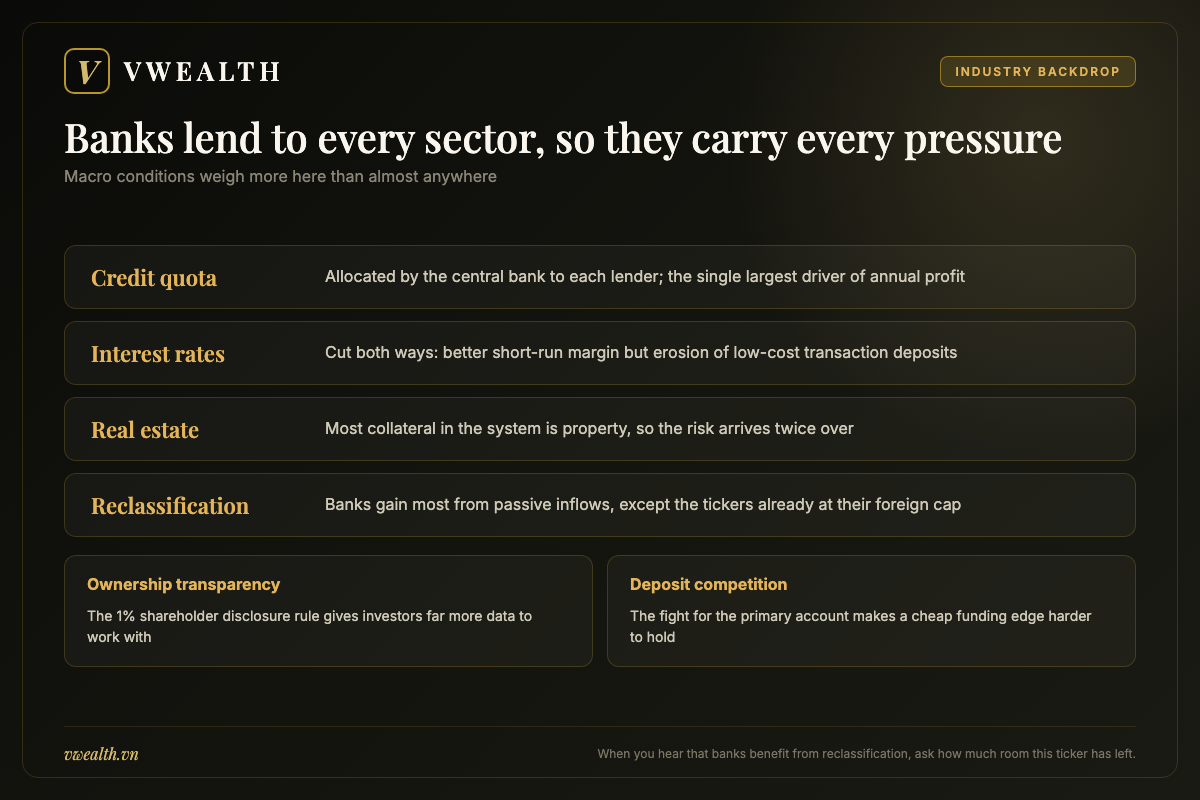
Bank stocks reflect the health of the whole economy, because banks lend to every sector. Macro conditions therefore matter more for this group than for almost any other.
Credit quotas: a distinctive feature of the Vietnamese market
The State Bank of Vietnam allocates a credit growth quota to each bank, and this is among the most important variables for annual profit. Banks with strong capital adequacy, good asset quality and participation in restructuring weak institutions have generally received more favourable allocations.
For MSB, credit growth of 15.8 per cent in 2025 indicates the bank received a relatively good quota and used most of it. What you should track is the allocation in subsequent years, and more importantly the quality of that growth — rapid expansion accompanied by rapidly rising group 2 loans is a signal to be cautious about.
For an international reader, this quota system is worth understanding properly because it has no direct equivalent in most developed markets. It means that in Vietnam, a bank’s growth is not purely a function of demand and capital; it is also an administrative allocation. That places a premium on regulatory standing in a way that does not show up in any financial ratio.
Interest rates: a variable that cuts both ways
The rate environment affects a bank in two opposing directions, and this is where many newer investors go wrong. When rates rise, net interest margin typically improves in the short run because lending rates reprice faster than deposit rates. But sustained high rates reduce borrowers’ ability to service debt, raise bad debt, and dampen demand for new credit.
For MSB there is an additional specific effect: high deposit rates typically reduce the system-wide transaction-deposit ratio, because customers shift money into term deposits. That erodes precisely this bank’s main competitive advantage.
The practical implication is that MSB is not a straightforward beneficiary of rising rates in the way a bank funded mainly by term deposits might be. Its earnings profile is better suited to a low or moderate rate environment where transaction balances stay high and borrowers stay current.
Real estate and system-wide asset quality
You cannot discuss Vietnamese banking without discussing real estate. A significant proportion of collateral in the system is property, and a portion of direct lending sits in the sector. When the property market struggles, banks face a double impact: borrowers struggle to repay, and collateral falls in value or becomes hard to liquidate.
This is why the credit mix metric in chapter four matters so much. You do not need to forecast the property market; you only need to know how much exposure the bank you own actually has, and that figure is in the notes to the financial statements.
It is also worth understanding a structural feature of Vietnamese bank lending: even loans classified to other sectors are frequently secured on property. So a bank’s true property sensitivity is usually larger than its direct real estate lending line suggests. When assessing this, look at the collateral composition disclosure rather than only the industry breakdown.
Deposit competition: the fight for the primary account
There is a competition in Vietnamese banking that investors rarely notice but which directly determines MSB’s advantage: the fight to be the customer’s primary transaction account.
In recent years, virtually every bank has made transfers free, waived account maintenance fees, given away memorable account numbers, and invested heavily in mobile applications. The reason is not that those services are profitable — they are barely profitable directly — but that the transaction account is where non-interest-bearing deposits are created. Whichever bank receives the customer’s salary, pays their bills and handles daily spending has the cheap funding.
The consequence is that a low-cost deposit advantage gets harder to hold. Modern customers keep accounts at several banks and move money between them in seconds. Switching a primary account is no longer the chore it was a decade ago.
For MSB this means today’s 28.9 per cent is not automatically preserved for tomorrow. The bank must invest continuously to hold position, and that investment shows up in operating expenses. This is exactly why you should read the transaction-deposit ratio alongside the cost to income ratio: if the deposit ratio holds but costs balloon to sustain it, the net benefit has been eroded.
Market reclassification and foreign flows
Banks make up a large share of Vietnamese market capitalisation, so under a scenario where the market is upgraded from frontier to emerging status, this is the group that benefits most from passive inflows. However, as noted, tickers already at their foreign ownership cap cannot absorb that capital.
So when you hear the argument that banks benefit from reclassification, ask one further question: how much room does the specific ticker have left. The answer may mean the general argument does not apply to your particular case.
Vietnamese banking against regional peers
For an international investor, some regional context helps calibrate what the numbers mean.
Vietnamese banks generally run higher net interest margins than their peers in Thailand, Malaysia or Singapore, reflecting a less saturated credit market and a higher policy rate environment. They also generally run higher return on equity, but with correspondingly thinner capital buffers and a shorter track record under international capital standards. The sector is in an earlier stage of development: credit penetration relative to the economy has grown very fast, retail banking products are still broadening, and non-interest income remains a smaller share of the total than in more mature markets.
Two structural features distinguish Vietnam from most regional comparators. The credit quota system, described earlier, has no direct equivalent in most neighbouring markets and caps growth administratively. And foreign ownership limits are considerably tighter for banks than for most other sectors, which constrains both the investor base and the ability to bring in strategic partners.
The implication for valuation is that Vietnamese bank multiples should not be compared with regional peers mechanically. Higher returns argue for higher multiples; thinner buffers, administrative growth caps and shorter disclosure histories argue for lower ones. Where the balance falls is a judgement, but making it explicitly is better than importing a regional average and assuming it applies.
The market reclassification story matters here too: part of what an upgrade would deliver is simply a larger pool of investors willing to make that judgement at all, which tends to narrow the discount applied to markets that international funds are not benchmarked against.
Policy direction: ownership transparency is the dominant trend
Policy towards Vietnamese banking has been consistent for years: tighten ownership limits for individuals and institutions, require disclosure of shareholders holding 1 per cent or more, restrict related-party lending, and raise capital standards towards international practice.
For investors this trend is good news over the long run even if it causes short-term disruption. More transparency means more data with which to assess, and lower systemic risk. In MSB’s case, it was precisely the 1 per cent disclosure rule that allowed the market to see the ownership structure described in chapter two — something investors could previously only speculate about.
Looking forward: three scenarios for MSB stock and the conditions for each
This section offers no price target, because any number would be stale before you finished reading. Instead it describes three future states and the specific conditions that identify which one is unfolding. Reopen this table each quarter and mark off what has actually occurred.
The four variables that decide the outcome
The first variable is asset quality, measured by group 2 loans, the non-performing ratio and coverage. This is the most important variable for any bank, because a single year of elevated provisioning can erase several years of profit growth.
The second is the ability to sustain a high transaction-deposit ratio. This is the bank’s main competitive advantage, and it is sensitive to interest rates and to the intensity of digital competition.
The third is the return earned on new capital. The bank is raising charter capital towards nearly 37,500 billion dong. If that capital is lent out at good quality with margins intact, absolute profit rises accordingly. If credit growth is capped by quota or the new lending is of lower quality, return on equity falls.
The fourth is the institutional narrative: the annual credit quota, the possibility of a wider foreign ownership ceiling, and progress on the subsidiary acquisitions. This group affects near-term profit least but affects the valuation multiple most.
The optimistic scenario: asset quality holds while credit grows fast
In this case the economy sustains its growth, rates stay low or moderate, and borrowing demand from individuals and small businesses recovers well. MSB receives a favourable credit quota, deploys the new capital, and holds its transaction-deposit ratio at a high level. Group 2 loans and non-performing loans move sideways or lower, allowing the bank to reduce provisioning charges.
Identifying conditions: group 2 loans do not rise while lending grows strongly; the loan loss coverage ratio improves; the transaction-deposit ratio holds or increases; the cost to income ratio keeps falling; return on equity does not decline after the capital raise.
In that scenario, shareholder reward comes from two sources: profit rises and the price to book multiple expands. If the room-widening story also advances, the rerating could be larger still.
The base scenario: bigger, with flat earnings per share
This is the outcome the article regards as most likely, because it requires the fewest ideal conditions. The bank completes the capital raise and the stock dividend, is larger, and grows absolute profit in line with plan. But the share count rises faster, leaving earnings per share flat. The transaction-deposit ratio holds but does not improve, because deposit competition is intense. The room-widening narrative produces nothing concrete.
Identifying conditions: absolute profit rises while earnings per share is essentially unchanged across four quarters; return on equity slips modestly against the pre-raise period; group 2 loans tick up without yet converting into material non-performing loans.
For an investor, the base case means the stock trades with the broader banking sector, and your result depends almost entirely on where in the cycle you bought.
The adverse scenario: asset quality deteriorates on a freshly enlarged capital base
The adverse case does not require a crisis. It requires only that the economy slows for several quarters, or that the property market stays difficult, for individual and small business borrowers — precisely MSB’s portfolio focus — to come under repayment pressure. Group 2 loans rise, migrate into non-performing loans, force higher provisioning, and profit contracts.
In that state, a bank that has just raised substantial capital faces an additional disadvantage: a larger equity base with lower profit causes return on equity to fall considerably faster than absolute profit does. The market usually responds by lowering the price to book multiple, producing a compound effect on the share price.
Identifying conditions: group 2 loans rising across consecutive quarters; the coverage ratio falling; provisioning charges growing faster than operating income; the transaction-deposit ratio dropping sharply as customers shift into term deposits.
What would make this analysis wrong
Every analysis rests on assumptions, and stating them explicitly is more useful than pretending they do not exist. Three assumptions underpin everything above, and each could fail.
The first is that the low-cost deposit advantage is durable enough to matter over a multi-year holding period. The article has argued it is real but thin. If the digital experience gap across Vietnamese banks closes faster than expected, or if a prolonged high-rate environment drives transaction balances into term deposits across the system, the central pillar of the case weakens considerably.
The second is that the loan book behaves as a diversified small-borrower portfolio should. Diversification protects against idiosyncratic default but not against a common shock: if the whole small business sector comes under pressure at once, having many small exposures rather than a few large ones provides much less protection than the concentration statistics suggest.
The third is that disclosed figures adequately represent the underlying position. This is an assumption made about every listed company, but it deserves stating explicitly for banks, where the gap between reported and economic asset quality can be wide and where the tools available to an outside investor are limited to what the notes disclose.
If you disagree with any of these three, the conclusions in chapter eight change accordingly. That is not a weakness of the analysis; it is how analysis is supposed to work. Writing assumptions down means you can check them against reality later, rather than discovering afterwards that you never knew what you were relying on.
One practical note on using the scenarios. They are not mutually exclusive across time: a bank can spend two years in the base case and then move into either of the others as conditions change. The purpose of the early signals column is to tell you when that transition is under way, ideally before it shows up in the reported profit line. Group 2 loans in particular tend to move one to three quarters ahead of the non-performing ratio, which itself moves ahead of the provisioning charge that finally hits earnings. That lag is your warning window, and it is the single most useful thing to know about monitoring a bank.
The three scenarios summarised
| Scenario | Required conditions | Early signals | Consequence for shareholders |
|---|---|---|---|
| Optimistic | Solid economic growth, low rates, favourable credit quota, quality deployment of new capital | Group 2 loans flat while lending grows; coverage ratio improves; cost to income falls | Profit and the price to book multiple rise together |
| Base | Flat economy, intense deposit competition, no concrete progress on room widening | Absolute profit rises while earnings per share stays flat | The stock tracks the banking sector; entry point determines the result |
| Adverse | Slowing economy, prolonged property weakness, rising rates | Group 2 loans rise repeatedly; coverage falls; provisioning accelerates; deposit ratio drops | Profit falls on an enlarged equity base and the multiple compresses |
To be explicit: no probabilities are attached, because any probability would merely be an opinion. The value of the table sits in the early signals column — things you can verify from disclosed data each quarter.
So should you buy MSB stock? A straight answer
After seven chapters it is time to answer the question in the title. The article will not tell you to buy or not to buy, because that decision is yours and depends on things the article cannot know. What it can do is put the case for and the case against on the scales honestly.
The case for: five reasons MSB deserves consideration
First, the funding cost advantage is real and measurable. A transaction-deposit ratio near 28.9 per cent, placing the bank among the five highest in the system, is a notable position for a mid-sized lender, and it translates directly into a better margin.
Second, the results have been verified by disclosed figures. In 2025, credit grew 15.8 per cent, total assets rose more than 27 per cent, and consolidated pre-tax profit reached 7,058 billion dong. That is execution evidence, not a promise.
Third, the loan book is spread across individual and small business customers, more than 75.5 per cent of the total. Compared with banks that concentrate lending in a handful of large exposures or a single sector, this structure carries lower concentration risk.
Fourth, the executive team is stable. A chief executive reappointed for a full five-year term signals continuity of strategy, which has genuine practical value for a bank.
Fifth, a nearly full foreign room indicates that international investors have assessed the bank and bought close to the limit. Equally, if the policy environment shifts towards a wider ceiling, this is the group with the most rerating headroom.
The case against: six risks you must look at squarely
First, asset quality risk. A book concentrated in individuals and small businesses carries good margins but is also the group hit earliest when the economy weakens. This is a structural risk, not a temporary one.
Second, material dilution. With a 20 per cent stock dividend plus an issue of up to 20 per cent to existing shareholders, the share count could rise by roughly forty per cent if both plans complete. Earnings per share may stay flat even as total profit grows.
Third, the shareholder structure requires scrutiny. Roughly nine institutional shareholders hold more than 33 per cent, including companies from a shared corporate ecosystem. This is disclosed data, not an allegation, but it means you must read the related-party lending note and the industry credit mix each period.
Fourth, the full foreign room blocks new international inflows. In a scenario where Vietnam attracts large foreign capital, this ticker cannot absorb it, a relative disadvantage against banks with room remaining.
Fifth, the ticker carries several unconfirmed expectation narratives. Speculation about receiving a mandatory transfer has no official announcement, and MSB is not among the four completed transactions. Stocks that move on rumour tend to produce sharp sessions disconnected from fundamentals.
Sixth, the competitive advantage can be eroded. A high transaction-deposit ratio results from a good digital experience and a suitable client base, but every bank is investing in the same direction. The technology gap between large banks is narrowing.
The case for and against, side by side
| For | Against |
|---|---|
| Low funding cost from a transaction-deposit ratio among the highest in the system | That advantage is rate-sensitive and is being chased down by competitors’ investment |
| Disclosed 2025 results: credit up 15.8 per cent, consolidated pre-tax profit 7,058 billion dong | Asset quality of small borrowers is a structural risk when the economy slows |
| A diversified book, over 75.5 per cent from individuals and small businesses | Substantial dilution: a 20 per cent stock dividend plus up to 20 per cent new issuance |
| Stable leadership, with the chief executive reappointed for 2025 to 2030 | Concentrated institutional ownership requires scrutiny of related-party credit each period |
| Hands-on experience integrating another credit institution from the 2015 transaction | Expectations of a mandatory transfer have no official announcement |
| Foreign investors have bought close to the ownership cap, a quality signal | A full room blocks new foreign inflows under a market reclassification scenario |
Who MSB suits, and who it definitely does not
For the growth investor with moderate to high risk tolerance who believes in Vietnam’s credit growth trajectory and holds for several years: MSB is a defensible choice among mid-sized private banks, particularly if you value a funding cost advantage over sheer scale. The condition is that you monitor asset quality every quarter and are willing to subscribe to further capital raises.
For the value investor: MSB requires two extra steps many people skip. Step one is recomputing book value per share after the issuance plans complete. Step two is assessing whether the current coverage ratio is sufficient to protect that book value through a difficult year. Skipping step two is the classic error in valuing bank stocks.
For the income investor seeking steady cash dividends: this is not the right name. The bank is retaining all profit in the form of stock dividends to build own capital, which is right for the bank but produces no cash flow for you.
For the newcomer or the low-risk-tolerance investor: be careful with a ticker carrying multiple expectation narratives. If you want exposure to Vietnamese banking growth without single-institution risk, a diversified approach across the sector or through funds is the more sensible route.
For the international investor specifically, three further points. First, the foreign room means you may simply be unable to buy on the exchange at times, and may have to trade in the negotiated market at a premium. Second, currency: your return in hard currency terms depends on the dong as well as on the share price. Third, disclosure timing: the most useful notes on related-party lending and concentration appear in the audited annual report, so your monitoring cadence for those items is annual rather than quarterly.
Four questions to answer before you place an order
Question one: have you opened the most recent financial statement notes and looked at the group 2 loan ratio and the coverage ratio? If not, you do not know what asset quality you are buying.
Question two: have you recomputed earnings per share and book value per share after the stock dividend and rights issue complete?
Question three: does your buying thesis depend on a scenario that has not been officially announced? If so, ask yourself what you will do if it does not occur within two years.
Question four: is your position small enough that you would stay calm if the entire banking sector fell sharply in a single quarter?
Closing: a bank that found an identity and is now testing how far it stretches
The MSB story is the story of an institution with a very long history that only found a clear position for itself over roughly the last five years. From a bank tied to the maritime sector in Hai Phong, through a merger during the industry restructuring, to a mid-sized private lender with a specific funding cost advantage — that is a longer journey than younger private banks took to define themselves.
That identity has genuine value. But it is also thin, in the sense that it rests on a single metric, the transaction-deposit ratio, and that metric is sensitive both to interest rates and to a digital experience contest every bank is now entering. The company can do everything right and still watch its advantage narrow, simply because competitors are doing it right too.
So should you buy MSB stock? If you understand that you are buying a mid-sized private bank with a real funding cost advantage, accept that the expansion comes with substantial dilution, are willing to read asset quality notes every quarter, and do not build your case on scenarios that have not been announced — then MSB is a defensible choice within the banking sector. If you are buying because you heard a transaction is coming, because the stock has just run, or because you assume banks cannot lose money, then you are buying a narrative rather than a business.
One last thing to carry with you: the history, ownership structure and strategy of MSB change slowly, but group 2 loans, the coverage ratio, the transaction-deposit ratio, capital adequacy, the share count and the valuation change every quarter. Before you place an order, open the latest research report and score the seven checks from chapter four again. It takes fifteen minutes, and they are the most valuable fifteen minutes in the whole decision process. If you do not yet have the tools to do that, create a vwealth account and let the platform read the filings for you.
This article provides information and analysis for reference purposes only and is not a recommendation to buy or sell any security. All investment decisions are your own and you bear responsibility for their outcomes. Consider consulting a licensed financial adviser before acting.
Research Vietnamese stocks in English with vwealth. Our AI-powered platform turns Vietnamese market data into full English analysis reports — with international payment support and a free 2-month trial for new accounts. Create your free account and read the latest reports.