In the landscape of Vietnam’s private banks, there are names tied to hot growth, names tied to real-estate and corporate-bond risk, and one name that is almost always mentioned first whenever analysts discuss the word “prudence”: Asia Commercial Joint Stock Bank, ticker ACB on the HOSE exchange. If you are looking for a leading private retail bank with no trace of state ownership, a balance sheet widely regarded as the cleanest in the system, and a return on equity (ROE) among the highest in the industry for many years running, then ACB is almost the default candidate to put on the scale.
But 2025 just closed on a milestone that made even the stock’s admirers pause. For the first time in 13 years, ACB’s profit went backwards. Consolidated pre-tax profit for 2025 reached 19,538 billion dong, down about 7% year on year and falling well short of the 23,000-billion-dong plan management itself had set at the start of the year. Total assets still crossed the historic one-quadrillion-dong mark, bad debt was still held very low at around 1.09%, and ROE was still above 20% — meaning the bank remains very healthy and very safe. The problem lies elsewhere: the profit-printing machine that had grown as reliably as clockwork for more than a decade has begun to stall.
That is the paradox this full analysis wants to dissect with you. ACB is the story of a bank that is “safe but stalling.” At a price of 22,200 dong per share (close of 19 June 2026), is the caution that carried ACB through so many storms still an advantage, or is it becoming an anchor dragging back its growth in a market where rivals are accepting higher risk to run faster? More importantly for your wallet: should you buy ACB, and which kind of investor does this stock suit? To answer, you cannot look only at one year’s numbers. You need to understand what forged ACB — especially the 2012 shock that shaped the entire risk-management philosophy behind today’s clean balance sheet.
ACB market data (updated 19 June 2026)
| Current price | 22,200đ | 2025 pre-tax profit | 19,538 bn (down) |
| Change (June)* | −10.84% | Bad debt | ~1.1% (lowest) |
| P/E | P/B | ~7–8x | ~1.3x | ROE | ~17.6% (still top) |
*June’s decline is mostly a technical adjustment from the stock dividend, not a fundamental drop. Source: VWealth price data + ACB 2025 reports. For reference only.
History and evolution
To understand why ACB is so “clean,” why management deliberately stayed out of the corporate-bond and real-estate-lending games — the very ground that helped many rival banks report huge profits and then pay dearly — you need to step back more than thirty years, to a time when a private bank in Vietnam was still a young and deeply doubted idea.
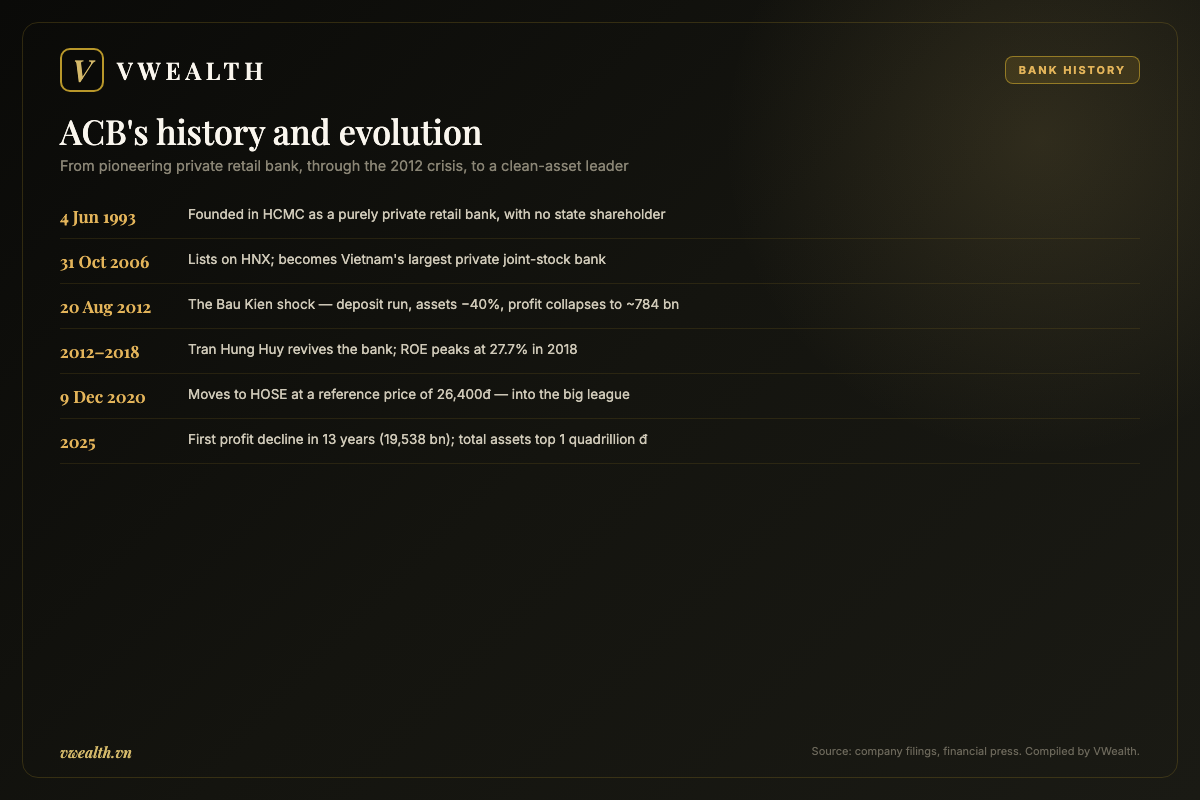
1993–2000: the pioneering private bank chooses retail
Asia Commercial Joint Stock Bank officially began operating on 4 June 1993, headquartered in Ho Chi Minh City. ACB’s core difference from most of the large banks of its era lay right in its ownership structure: this was a purely private bank with no state shareholder. While the “giants” like Vietcombank, BIDV, VietinBank and Agribank carried state-owned roots and mainly served large state corporations and projects, ACB was born having to find its own niche market to survive.
That niche was retail — serving individual customers and small and medium-sized private enterprises (SMEs). This was a pioneering strategic choice in the early 1990s, when consumer credit, bank cards and personal financial services were still almost virgin land in Vietnam. ACB made history by becoming one of the first joint-stock commercial banks to issue international Visa and MasterCard credit cards, opening the way for a whole generation of modern banking services. By 2000, the bank restructured its operations and expanded into securities with the founding of ACB Securities (ACBS), beginning to shape the model of a diversified financial group that still kept retail banking as its backbone.
Remember this “retail roots” detail, because it is not just a line of history. It was precisely the scattered, small-scale base of individual and SME customers — instead of a concentration on a few dozen large corporate borrowers taking on enormous loans — that created a diversified, risk-spread credit portfolio, one of the foundational reasons ACB’s asset quality remains stable to this day.
2006: listing on HNX, stepping into the market spotlight
On 31 October 2006, ACB shares officially listed on the Hanoi Stock Exchange (HNX). This was the first golden era: ACB quickly rose to become the largest private joint-stock commercial bank in Vietnam by the late 2000s and early 2010s. Listing also meant ACB had to be more transparent, subject to the scrutiny of tens of thousands of shareholders and investors — a market discipline that not every private bank of that time was ready to embrace.
During this period ACB also attracted reputable strategic and foreign shareholders. Standard Chartered was once a strategic shareholder, bringing international governance standards. In particular, the investment fund Dragon Capital — through entities such as Dragon Financial Holdings — became a long-standing foreign shareholder of ACB, a bond rare in its durability on Vietnam’s stock market. The presence of these veteran foreign institutional investors was, in a sense, a “quality stamp” for the bank’s governance discipline.
2012: the “Bau Kien” shock — the event that shaped ACB’s entire DNA
Then came 2012 — the pivotal year that, if you skip it, you will never truly understand today’s ACB.
On the evening of 20 August 2012, Mr. Nguyen Duc Kien — known by his nickname “Bau Kien,” one of the most powerful figures and an influential shareholder at ACB — was arrested by the Ministry of Public Security’s investigative police. He was prosecuted and later sentenced to 30 years in prison on charges related to illegal business, deliberate wrongdoing and violations in economic activity. This arrest was not just a legal headline; it was a bomb that shook Vietnam’s entire private-banking system at the time.
The consequences for ACB were immediate and devastating:
- A panic run on deposits: Shaken confidence caused nearly 17,000 billion dong of deposits to be pulled from ACB in 2012 alone. The bank faced a genuine liquidity crisis.
- Total assets plunged: The scale of total assets fell nearly 40%, from the position of largest private bank down to just over 176,000 billion dong at the end of 2012.
- Profit collapsed: After-tax profit in 2012 fell to only around 784 billion dong — a figure astonishingly small against the industry-leading position ACB had once held.
- A senior-leadership crisis: A cascade of upheaval at the top forced ACB to restructure its management under enormous pressure.
This was the biggest event in ACB’s history. From being the largest private bank at the start of the 2010s, the bank almost had to start over — and it took many years to reclaim its place among the leading private banks.
But the deepest lesson you should draw from 2012 is not “ACB nearly collapsed.” It is that this very pain drilled into ACB an obsession with risk management that no lecture could ever teach. After 2012, the bank’s culture shifted decisively toward extreme prudence. ACB deliberately stayed out of the two high-return but high-risk games that many rivals plunged into over the following decade: corporate bonds and large-scale speculative real-estate lending. When Vietnam’s corporate-bond market blew up in crisis in 2022–2023, saddling a string of banks with bad debt, ACB was almost entirely on the sidelines — because its portfolio simply did not hold those “bombs.” The “cleanest balance sheet in the system” you hear about today is, ultimately, the direct legacy of a fear internalized in 2012.
2012–2020: a spectacular recovery under Tran Hung Huy
The man who bore the burden of raising ACB from the rubble was Tran Hung Huy, who took the Chairman’s seat in September 2012 when he was barely over 30 — one of the youngest bank chairmen in Vietnam at the time, and assuming office at the darkest possible moment. ACB’s recovery over the following near-decade is one of the most successful restructuring journeys in Vietnam’s banking industry.
The numbers tell their own story:
| Milestone | Pre-tax profit | Marker |
|---|---|---|
| 2012 | ~ record low (after-tax ~784 bn) | Bottom of the Bau Kien crisis |
| 2017 | 2,656 billion dong | Breakout begins, ROE ~14% |
| 2018 | 6,389 billion dong | 2.4× the prior year, peak ROE ~27.7% |
| 2022 | 17,114 billion dong | Record, ~17× the 2012 level |
| 2023 | > 20,000 billion dong | All-time profit peak |
Alongside the profit rebound came a surge in profitability. In 2012–2016, ACB’s ROE languished below 10% under the weight of clearing up the crisis. But from 2017 the ratio jumped to 14%, then soared to a peak of 27.7% in 2018. Since then, ACB has consistently kept ROE above 20% — a durable achievement that placed the bank among the highest returns on equity in the industry. Total assets also grew more than fourfold over roughly a decade under Tran Hung Huy, from 176,308 billion dong in 2012 to over 718,000 billion dong at the end of 2023.
What stands out is that ACB achieved all these impressive numbers without trading away its risk standards. It did not need to plunge into corporate bonds or finance mega real-estate projects to make a profit. Instead, ACB stuck with its retail model: lending to individuals, household businesses, and small and medium enterprises, channeling capital into segments that generate real income with low risk. This is when the title “the number-one retail bank for efficiency” was cemented — not the largest by scale, but the most efficient per unit of capital and the safest per unit of assets.
December 2020: moving to HOSE, entering the big league
Having recovered on solid footing, ACB made a move that symbolized its new standing. The 2020 annual general meeting approved the exchange transfer, and on 9 December 2020, ACB shares officially debuted on HOSE (the Ho Chi Minh City Stock Exchange) at a reference price of 26,400 dong per share, after suspending trading on HNX from 2 December.
Moving from HNX to HOSE was not simply a change of listing venue. HOSE has the greatest liquidity, gathers the industry-leading businesses, and is where important indices such as the VN30 are calculated. Listing on HOSE meant ACB shares could tap a larger flow of capital from both domestic investors and foreign funds, qualify for key indices and ETFs — thereby lifting liquidity and valuation. This was a “coming of age” in capital-market terms, marking ACB’s formal arrival alongside the largest private banks on Vietnam’s stock market.
2025: profit stalls — when caution has a price
And now we reach 2025, the year that poses the biggest question for the ACB investment thesis. After 13 years of continuous profit growth since the 2012 bottom, ACB reported a profit that went backwards for the first time.
- Pre-tax profit: 19,538 billion dong, down about 7% from 2024 — and well short of the ambitious 23,000-billion-dong plan set at the start of the year.
- Total assets: crossed the historic one-quadrillion-dong mark, confirming a scale in the system’s “heavyweight” class.
- Asset quality: bad debt was controlled at a very low ~1.09%, still among the lowest in the whole industry.
- Profitability: ROE stayed above 20%, meaning the bank remained highly efficient even in a difficult year.
So why did profit fall? Two intertwined causes, both well worth your reflection as an investor. First, a squeezed net interest margin (NIM). As banks raced to cut lending rates to win credit market share while funding costs would not fall in step, the margin a bank earns on each unit of capital was eroded. ACB’s 2025 NIM was estimated by analysts to retreat toward 3.4–3.5%, below its golden-era levels. Second, and more important philosophically: ACB deliberately raised risk provisions sharply, roughly doubling them year on year to over 3,300 billion dong. This was not because the portfolio suddenly deteriorated, but a choice to prioritize reinforcing the safety “buffer” on the balance sheet — true to the cautious DNA ingrained since 2012.
In other words, 2025 was a vivid illustration of ACB’s very paradox: safety and growth are sometimes two tugging sides of the same coin. When the bank chooses to prioritize asset quality, build provisions, and refuse to chase high-risk lending for instant profit, the price is slower profit growth. For a safety-first investor, this is good news — it shows management does not sacrifice discipline to chase pretty short-term numbers. But for an investor expecting fast growth, it is a warning sign that the ACB “money printer” has entered a mature phase, where the easy double-digit growth of the past may no longer repeat.
It is precisely this mirror of history — a bank forged through crisis, choosing the cautious path and now having to balance safety against growth — that raises the key question: who is steering the ACB ship today, and where will their vision for 2025–2030 take this stock? To answer, we need to look closely at the bank’s leadership and ownership structure.
Leadership and ownership structure
When you analyze a bank, there is a truth professional investors keep reminding one another: the numbers on the financial statements tell you the story of the past, while the quality of leadership and the ownership structure reveal the story of the future. With Asia Commercial Bank (ticker ACB), this is perhaps the most fascinating and important part of the whole analysis. Because ACB is unlike any other bank on the exchange in its “roots”: this is a purely private financial institution, tied to a founding family, that passed through a life-or-death storm and was reborn under the hand of a young chairman who later became a media phenomenon. Let us peel back each layer.
Tran Hung Huy — the heir who became chairman in the storm
The man at the very top of ACB today is Mr. Tran Hung Huy, Chairman of the Board. According to public sources, Mr. Huy was born on 4 December 1978 in Ho Chi Minh City, holds an MBA from Chapman University (USA) and a PhD in Economics from Golden Gate University (USA). In other words, the head of ACB is not a “risen-through-the-ranks” leader but a formally trained man with a solid academic foundation in finance, completing his doctoral dissertation around 2011 before pouring all his energy into his career at the bank.
But what makes Mr. Huy’s story special is not the degree. It is the timing and circumstances in which he took the chairman’s seat. Mr. Tran Hung Huy is the son of Mr. Tran Mong Hung — one of ACB’s founders and the man who held the Chairman’s seat throughout 1994–2008. This, then, is a family succession in the truest sense: the second generation taking over the founding generation’s legacy. Yet this succession did not unfold in a serene handover ceremony; it was thrust into the middle of the largest crisis in ACB’s history.
In 2012, the “Bau Kien affair” — the entanglement in legal proceedings of Mr. Nguyen Duc Kien, an influential figure connected to ACB — dealt the bank a heavy blow. Confidence wobbled, customers withdrew deposits, the share price plunged, and senior leadership was thrown into turmoil. It was against that “boiling oil, blazing fire” backdrop that Mr. Tran Hung Huy, at only about 34, was chosen to sit in the “hot seat” of Chairman — by many press accounts, becoming the youngest bank chairman in the history of Vietnam’s banking industry at the time.
Picture it: a 34-year-old taking the helm of a ship listing in a storm. Most leaders at that age are still accumulating experience. Mr. Huy had to learn and rescue a whole financial institution — with tens of thousands of employees and the trust of millions of customers — at the same time.
More than a decade later, the results have answered for that choice. ACB not only survived the post-2012 period but rose to become one of the healthiest private banks in the system, with asset quality among the best and stable, high profitability. Mr. Huy’s journey to “revive the Asia Commercial empire” is often cited by the financial press as a textbook example of crisis management and endurance. You should note, of course, that this success is not the work of one individual but of an entire machine; yet the chairman’s stabilizing and directing role in that sensitive period is hard to deny.
The “dancing chairman” image and the value of soft brand equity
There is an aspect of Mr. Tran Hung Huy you will struggle to find in any other bank leader in Vietnam: he is a “media phenomenon.” In June 2023, at the gala celebrating ACB’s 30th anniversary, Mr. Huy suddenly appeared on stage playing an instrument, singing and dancing “with full energy” — a performance utterly at odds with the discreet, stern image typical of bank owners. The clip spread wildly on social media; by press accounts, in just 24 hours his name generated tens of thousands of mentions.
Why should a detail that seems like “showbiz” matter to you — an investor? Because in retail banking, brand and goodwill are intangible assets with real value. Marketing analysts commented that the chairman’s few minutes on stage created a media effect equivalent to an enormous advertising budget, while “rejuvenating” and “humanizing” the image of a bank once seen as old-fashioned. For a bank centered on individuals and SMEs like ACB, having its leader become a beloved, relatable symbol is a soft competitive advantage — something that lowers customer acquisition costs and strengthens loyalty. Of course, you should view this with measure too: personal charisma cannot replace a financial foundation, but it is a value-adding complement that not every rival possesses.
Founder Tran Mong Hung and the legacy of a cautious culture
To understand why ACB operates as it does today, you need to go back to the man who laid the foundation: Mr. Tran Mong Hung. Born in 1953 in Tien Giang province, he graduated with a bachelor’s degree in Banking from the University of Economics Ho Chi Minh City and was one of ACB’s co-founders in the early 1990s. He was the first general director while also holding the Chairman’s seat throughout 1994–2008, and was highly regarded within the industry for his skill in people management and building organizational culture. On 25 April 2024, Mr. Tran Mong Hung passed away at the age of 72 — closing the role of the founder, but the legacy of governance thinking he left behind still permeates how ACB operates.
That most important legacy, as you can observe through the numbers, is a culture of caution toward risk that has become almost the bank’s “DNA.” After the 2012 shock, ACB drew a hard-won lesson about risk discipline and pursued it faithfully for more than a decade. At the 2024 annual general meeting (4 April 2024), Mr. Tran Hung Huy himself publicly reaffirmed these defining principles:
ACB does not lend for real-estate project investment but only lends to individuals to buy houses and land; as for corporate bonds, ACB does not invest and has no intention of investing in the coming period, instead stepping up its holdings of government bonds.
This is a remarkable strategic positioning. During 2022–2023, when the corporate-bond and speculative real-estate markets fell into crisis, dragging up bad-debt risk at many banks with an aggressive risk appetite, ACB was almost entirely out of that game. As a result, ACB’s asset quality is among the “cleanest” in the system, with bad debt kept low — at many points below or around the 1% threshold, notably lower than the industry average. When you weigh an investment in a bank stock, this “clean assets” trait is one of the most valuable defensive factors, because it minimizes the risk of surprise “debt bombs” eroding profit and equity.
Ownership structure: a purely private bank, no state “umbrella”
This is perhaps the trait that makes ACB most unique when placed beside its peers. Unlike Vietcombank (VCB), VietinBank (CTG) or BIDV (BID) — where the State holds a controlling stake — and unlike MBBank (MBB) with its army-rooted shareholders, ACB has no state shareholder. This is a purely private bank in the truest sense, governed by market logic from beginning to end.
This has two sides you need to weigh carefully. The upside: ACB is not driven by policy objectives or “rescue” missions that state-owned banks sometimes have to shoulder; its decision-making is flexible, fast, and oriented toward efficiency and shareholder interests. The point to note: the bank also lacks the implicit “protective umbrella” from the State that some state-rooted institutions are tacitly assumed to enjoy. That said, given its large scale and systemic importance, ACB remains among the closely supervised banks and plays a significant role in the economy.
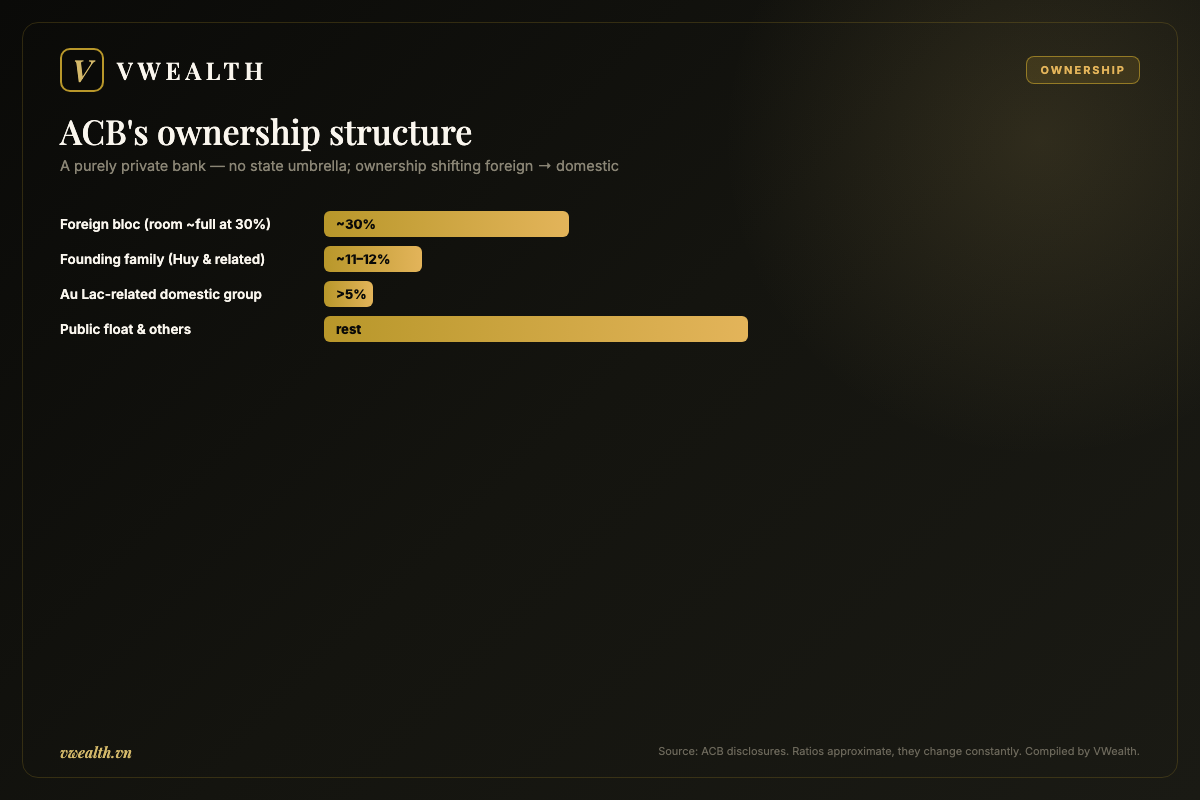
So who really owns ACB? Based on disclosures and financial press, the shareholder picture can be sketched as follows (you should treat these as reference ratios at the time of disclosure, since the ownership structure of listed banks changes constantly with market trading):
The founding family group. Chairman Tran Hung Huy together with related individuals and organizations is recorded as holding a combined total around 11–12% of capital (of which Mr. Huy’s personal direct ownership is a few percent, with the rest belonging to related persons and related legal entities). This is the core shareholder group, representing the founding family’s continuity and long-term commitment to the bank. Note that under new regulations, the combined ownership of a shareholder and related persons is capped (the ceiling cited is 15%), so this group has essentially approached the legal limit.
The foreign shareholder bloc. ACB has a long history with foreign investors, the classic name being Dragon Capital — a “marriage” spanning nearly three decades. However, this structure shifted sharply in 2024–2025. According to disclosures, the Dragon Capital group at one point reduced its stake and was no longer a major shareholder (ownership fell to around 5% or below the 5% “major shareholder” threshold). Alongside, entities such as Whistler Investments Limited and Sather Gate Investments Limited (mentioned in connection with Alp Asia Finance), together with many other foreign funds like SmallCap World Fund, VinaCapital (via VOF PE Holding), Boardwalk South, and Prudential Vietnam, all appear on the shareholder list with ratios changing over time. Notably, in 2025 many foreign funds sharply trimmed their ACB positions, while some domestic groups (referred to by the press as the Au Lac-related group) raised their ownership to major-shareholder levels. This reflects an ongoing shift in ownership from “foreign” to “domestic.”
Overall, you can see ACB as a bank with a relatively dispersed ownership structure, with a founding family group as a stable core, a seasoned layer of foreign shareholders (though restructuring), and the rest being the public float on the exchange. There is no state hand holding a controlling stake — this is both a source of governance dynamism and a factor you should keep in mind when assessing the stock’s overall risk appetite.
Governance: prudence paired with sharp marketing
If you had to sum up the governance style of ACB’s leadership in one sentence, you could say: this is a combination of “solid defense at the core and clever offense in the brand.” At the core — risk management, loan-portfolio structure, the choice not to play with corporate bonds and speculative real estate — ACB shows a caution bordering on conservatism. In brand and customer experience, the bank appears youthful, modern and smart about using media, with the viral image of its chairman the clearest proof.
This combination is no accident. It is the product of a historical lesson: ACB once nearly collapsed over risk tied to an individual and to market confidence in 2012, so the bank understands the value of two things — clean assets and public trust. Both traits are being consistently preserved by the current leadership.
Dividends: a steady reward for patient shareholders
One concrete expression of the “share the fruits with shareholders” philosophy is ACB’s steady and generous dividend policy. At the 2025 annual general meeting, the bank approved a dividend plan for 2024 with a total ratio of 25%, comprising 10% in cash and 15% in stock. According to the disclosure, the stock portion alone (15%) corresponded to issuing about 670 million new shares, thereby raising ACB’s charter capital from about 44,667 billion dong to roughly 51,367 billion dong. The record date to receive the 2024 dividend (both cash and stock) was set at 26 May 2025.
More important than a single figure is the consistency: this is recorded as the fifth consecutive year ACB has maintained a high dividend, and the bank plans to keep applying the 25% ratio for 2025, alongside a pre-tax profit target of about 23,000 billion dong. For you — especially if you are an investor who likes a steady cash flow — this “cash-plus-stock” combination has a double meaning: the cash portion delivers a real dividend yield within the year, while the stock portion boosts internal capital so the bank can expand its business without diluting through fresh external issuance. A sustainable dividend policy like this is often a sign of a management team confident in its earning power and respectful of shareholder interests.
To close this section, keep three core points about ACB’s “soul” in mind: one, the bank is led by a founding-family successor, with a young chairman forged through crisis who brings a rare brand advantage; two, this is a purely private bank with no state shareholder, run by market logic and pursuing a cautious culture that keeps assets clean; three, management shares the fruits steadily through a 25% dividend policy for years on end. This foundation of governance and ownership is the platform for the entire ecosystem ACB is building — the subject you will explore next, on the “ACB ecosystem.”
Ecosystem and business segments
If you are just beginning to research ACB stock, there is an important question to answer before discussing price: how does this bank make money, and is that money-making model “strong” or “fragile”? Because for a bank, the health of the business engine decides almost everything — from crisis resilience and earnings quality to the dividend you receive each year. This section dissects ACB’s entire ecosystem: the core bank, the revenue sources, the subsidiaries, and explains why ACB has for years been called Vietnam’s leading private retail bank with the system’s cleanest asset quality.
The 2025 picture sets the stage for the whole story: ACB’s total assets officially crossed the one-quadrillion-dong mark — a milestone only a very small group of Vietnamese banks reach — with credit growth of about 15.2%, a bad-debt ratio controlled at around 1.09% among the lowest in the industry, and ROE held above 20%. These three numbers, placed side by side, tell a rare story: growing fast, keeping assets clean, and earning high returns all at once. Most banks manage only two of the three. Let us start at the heart of the machine: retail banking.
The heart of the machine: the number-one retail and SME bank
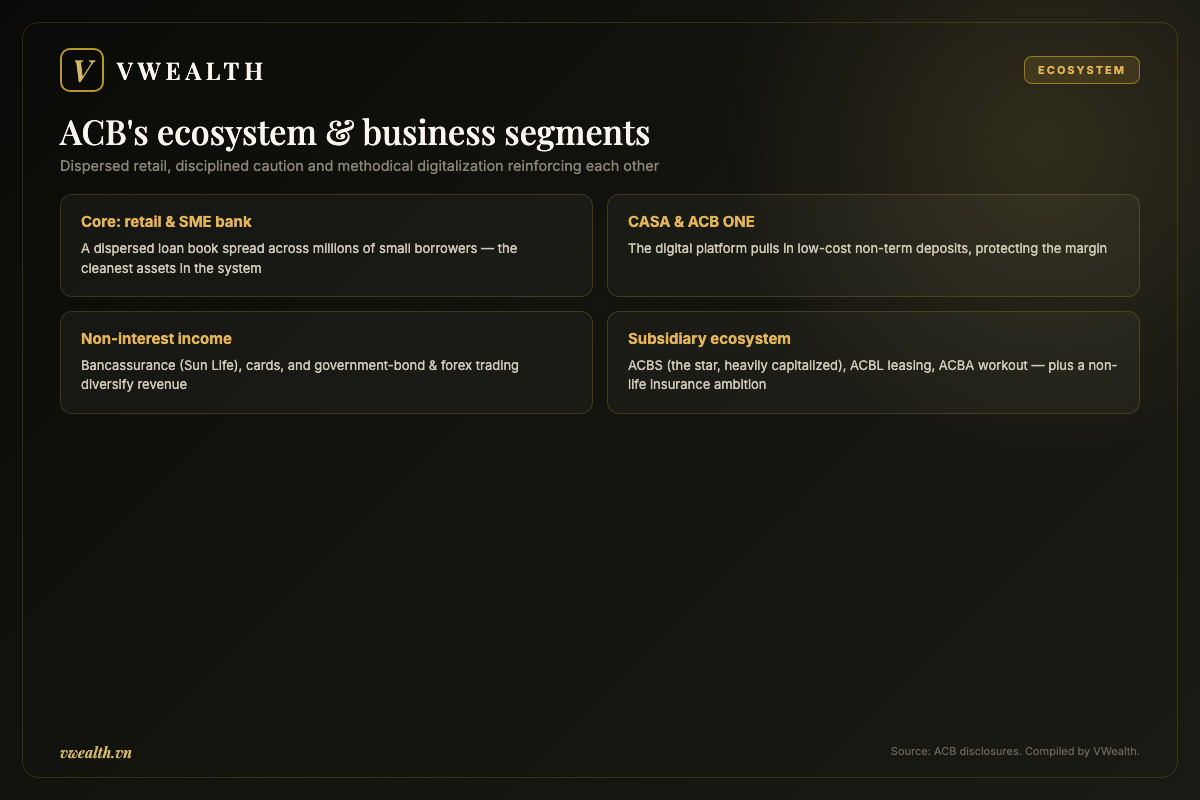
To understand ACB, you need one keyword: retail. In banking, “retail” means serving the masses — individual customers (home loans, consumer loans, savings, cards) and small and medium enterprises (SMEs). Its opposite is “wholesale” — concentrating lending on a few large corporations and a few trillion-dong projects. These two models differ fundamentally in risk, and this is exactly where ACB creates its advantage.
Picture it with an everyday example. There are two lenders. The first lends 1 dong each to 10 friends. The second gives all 10 dong to a single friend. When that one friend defaults, the second lender loses everything. The first lender, if one friend welches, still has the other nine loans. That is precisely ACB’s philosophy: a dispersed loan portfolio, spreading risk across millions of customers instead of betting on a small group of “big shots.” When one individual customer runs into trouble, the bank’s loss is only a tiny sliver of the whole.
Why does this matter so much to you — the investor? Because the biggest collapses in recent Vietnamese banking history all stemmed from credit concentration: pouring capital into a few property tycoons, a few corporate-bond deals, and then, when the market turned, the whole bank wobbled. ACB stayed almost entirely out of that game. This is why in the years when the real-estate and corporate-bond markets were in crisis (2022–2023), while many banks strained under swelling bad debt, ACB kept its bad-debt ratio among the lowest in the system. The dispersion model is not a short-term tactic — it is a risk-management philosophy ingrained in this bank’s DNA over two decades.
ACB’s retail position did not appear by chance. It is the result of decades of building a middle-class individual customer base in the big cities, especially Ho Chi Minh City — where ACB has its deepest roots. This customer base has a prized trait: stable income, disciplined financial behavior, low risk of mass default. In parallel, ACB pushed hard into the SME segment — the small and medium businesses that are the “backbone” of the economy but are often overlooked by large banks because they are hard to serve. ACB turned this difficulty into a competitive advantage: understanding SMEs, serving SMEs well, and earning attractive margins from this group.
Net interest income and NIM — the core coin
The largest revenue source for any bank, ACB included, is net interest income — the gap between the interest earned from borrowers and the interest paid to depositors. The metric that measures how “fat” this gap is is called NIM (Net Interest Margin). A high NIM means the bank lends at high rates while funding itself cheaply; a low NIM means the margin thins out.
In 2025, ACB’s NIM came under pressure to narrow — in Q3 2025 it retreated toward 3.1%, down from the start of the year. The cause was not that ACB grew weaker, but that the whole industry cut lending rates together to compete and support the economy, while funding costs edged up. This is a shared headwind every retail bank must face. The point to remember: with a model tilted toward retail and SMEs, ACB’s NIM over the long run remains more durable than banks that depend on large-corporate lending — because retail customers have far less bargaining power over rates than corporations do.
CASA and cost of capital — the silent weapon
If NIM is the result, then CASA is one of the “levers” that produces it. CASA (Current Account Savings Account) is the ratio of non-term deposits — money customers leave in payment accounts, earning nearly zero interest. Think simply: term savings deposits force the bank to pay 5–6% a year in interest; money in payment accounts, the bank uses almost “for free.” The more CASA, the cheaper the bank’s cost of capital, and the fatter its margin.
CASA is one of ACB’s competitive “moats.” At the end of 2025, ACB’s CASA ratio improved to around 22–23%, among the leaders in the retail-banking bloc and in the industry’s top tier. Why does a thick CASA base matter to you? Because it is a stable, cheap source of funding that helps ACB withstand rate volatility well — when rivals must race to raise deposit rates to attract money, ACB already has a large pool of low-cost deposits sitting quietly in payment accounts.
The weapon that helps ACB gather CASA and expand its customer base is its digitalization strategy, spearheaded by the digital-banking platform ACB ONE. You can think of ACB ONE as a “branch in your phone”: customers open accounts, transfer money, borrow, invest, and buy insurance without going to a counter. Every customer who uses the app regularly is a customer keeping money in a payment account — that is, a source of CASA. ACB is investing heavily in Big Data and artificial intelligence to both automate operations (cutting costs) and improve experience and retention. This is a virtuous loop: digitalization pulls in more customers → customers use the app → CASA rises → cheaper capital → fatter margins → resources to reinvest in technology.
A view for beginners: When evaluating a retail bank, don’t look only at profit. Look at the CASA ratio and the quality of the customer base. High CASA and clean assets are the signs of a model “healthy from the roots” — it may not produce a blowout profit in one quarter, but it helps the bank stand firm across many cycles. ACB is a textbook example of the “slow but steady” philosophy.
Non-interest income — a new engine of revenue diversification
A bank that lives on lending alone is a bank easily hurt when credit stalls. That is why ACB actively expands its non-interest income — money made not from the interest gap, but from service fees and other business activities. In 2025, it was precisely this segment that “carried” and pulled up ACB’s profit as NIM narrowed. This is an important bright spot to remember when reading ACB’s financials.
- Bancassurance (selling insurance through the bank): ACB exclusively distributes the life insurance of Sun Life Vietnam through its network and earns commissions. This was once the “golden goose” of the banking industry. However, note: the whole insurance industry is in a difficult phase after rounds of inspection and tightened rules on selling insurance through banks, putting revenue in this segment under pressure at most banks. ACB is no exception, though it still expects recovery and long-term growth for the insurance segment.
- Cards and payment services: fees from credit cards, debit cards, payments and transfers — a steady, low-risk revenue stream that grows with the reach of the retail customer base and the degree of digitalization.
- Government-bond, foreign-exchange and gold trading: this was the breakout point in 2025. Forex trading rose sharply, and securities trading (mainly government bonds — the safest asset class) surged. ACB took good advantage of interest-rate and exchange-rate movements to profit from its investment portfolio — a high-quality revenue source because it rests on low-risk assets, not speculation.
The big picture: ACB is shifting from a “pure lending” bank into a financial institution with more diversified revenue — and this makes profits more sustainable, less dependent on a single credit cycle.
The subsidiary ecosystem — completing the financial-services chain
ACB is not just a bank. Around the core bank is an ecosystem of subsidiaries that helps ACB serve customers across the full financial lifecycle and open new revenue. For a beginner, you can picture each subsidiary as an “arm” reaching into its own area:
- ACBS (ACB Securities): this is the most notable arm right now. ACBS is being heavily capitalized by ACB, with charter capital raised to thousands of billions of dong to push brokerage, margin lending, and especially proprietary trading — investment. In the context of Vietnam’s stock market being expected to be upgraded, a well-capitalized securities firm is a weapon that helps ACB capture inflows and diversify income beyond banking. This is the most watchable growth segment in the ecosystem.
- ACBL (ACB Leasing): specializes in financial leasing — a form of financing that lets businesses buy machinery, equipment and vehicles. This is a complementary piece for ACB’s core SME customer base.
- ACBA (ACB Asset Management): handles the workout, recovery and exploitation of assets from problem loans. For a bank that prizes asset quality like ACB, ACBA is the “cleanup division” that keeps the balance sheet clean.
Notably, ACB is in the process of expanding its ecosystem into non-life insurance — setting up a separate insurance company with an ownership structure through ACBA and ACBS themselves. This is a move to complete a closed financial-services chain: from deposits, lending and securities investment through to insurance — all within one ecosystem. Management’s ambition is to turn ACB into an efficient financial group in its 2025–2030 strategy, not merely a bank.
The biggest moat: clean asset quality
If you could pick only one reason to call ACB a “different” bank, it would be clean asset quality. This is not a marketing slogan — it is a measurable competitive advantage, and the “moat” that protects ACB across economic cycles.
Specifically, ACB almost does not engage in speculative lending to the highest-risk areas: speculative real-estate projects and risky corporate bonds. While many banks used these two segments to grow fast in 2020–2021, ACB deliberately stood aside. As a result, when the bond and property storm hit in 2022–2023, ACB did not have to shoulder “debt bombs” like many rivals. This is living proof of the value of caution: you don’t see it when the market is favorable, but it saves the whole bank when the market turns.
In 2025, this discipline continued to show: bad debt was kept in the low zone around 1.09% (among the lowest in the system), while ACB actively raised provisions sharply — that is, deliberately “set aside” more money for risk than required. A sharp rise in provisions can make short-term profit and ROE a touch less brilliant, but it strengthens the safety “buffer” for the cycles ahead. For a long-term investor, this is the mark of a cautious management that puts durability above short-term achievement — a rare and valuable quality.
| Business pillar | Role in the ecosystem | Meaning for the investor |
|---|---|---|
| Retail & SME banking | Core earner, dispersed portfolio | Low risk, durable income through the cycle |
| CASA & digitalization (ACB ONE) | Lower cost of capital, expand customers | Fatter margins, resilience to rate swings |
| Non-interest income | Revenue diversification | Profit less dependent on a single credit cycle |
| Subsidiary ecosystem | Complete the financial-services chain | New growth potential (ACBS, insurance) |
| Clean asset quality | The safety “moat” | Survive and break out after a crisis |
The bottom line: why this model creates ACB’s position
Put all the pieces together. ACB is a leading retail and SME bank, with a dispersed loan portfolio that reduces concentration risk; a thick CASA base nurtured by the ACB ONE digitalization strategy that keeps its cost of capital competitive; an increasingly diversified income structure with bancassurance, cards, services, and government-bond and forex trading; a subsidiary ecosystem (ACBS, ACBL, ACBA and the insurance ambition) that is gradually being completed; and, over all of it, a culture of caution with asset quality among the cleanest in the system.
The three factors — dispersed retail, disciplined caution, and methodical digitalization — are not three separate strategies. They resonate together to create an institution that both grows well and rarely stumbles badly. That is why ACB has for years stood among the leaders in efficiency (ROE above 20%) while keeping clean assets — a combination very few banks achieve at the same time.
But a healthy business model is only half the story. The other half is: how is that competitive position reflected in the specific financial numbers, and how healthy is ACB’s balance sheet? That is exactly what we dissect next — Financial position and health — where the business philosophies just discussed are tested against each line of data.
Financial position and health
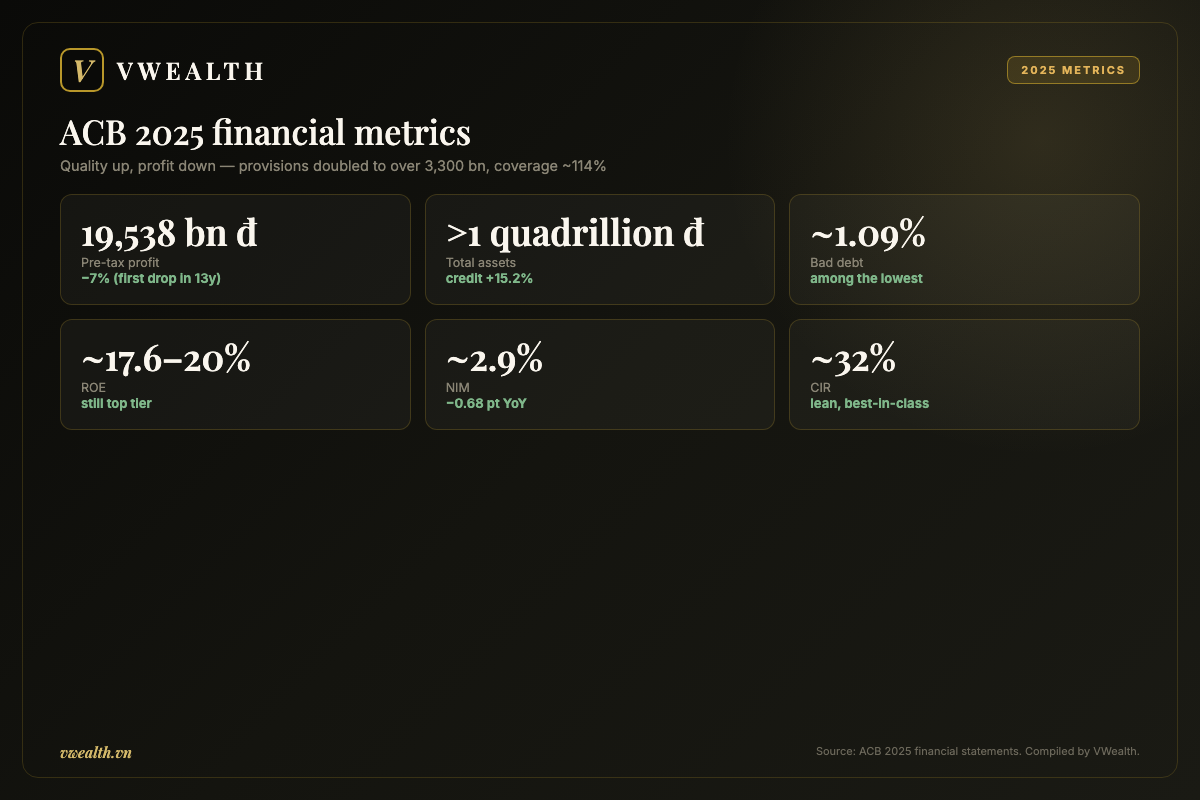
If you looked at only one of ACB’s numbers in 2025 — pre-tax profit of 19,538.7 billion dong — you would draw the wrong conclusion. That figure is both the first time the bank’s profit went backwards since 2013 and a notable miss against the 23,000-billion plan ACB set at the start of the year. But in that same year, the bank’s total assets crossed the one-quadrillion-dong mark for the first time (reaching 1.026 quadrillion), credit grew 15.2%, bad debt held at 1.09% among the lowest in the system, and ROE stayed anchored above 20% — a number most Vietnamese banks only dream of. The same company, the same fiscal year, tells two almost opposite stories. This section exists to help you understand why both stories are true — and which is the part that matters to a long-term investor.
The right way to read a bank is not to read one year’s profit, but to read the quality of the balance sheet behind that profit. A bank can earn big for a few years by lending recklessly, then lose it all in one year when bad debt erupts. Another bank can earn more modestly but sleep soundly every year. ACB belongs to the second group, and that is what you should pin down before going deeper.
Position: the leading private retail bank by efficiency
There are many ways to call a bank “leading.” Some banks lead by total-asset scale. Some lead by absolute profit. ACB leads on a much harder and much more durable measure: efficiency of capital use, measured by ROE — return on equity.
ROE answers a very practical question for you, the capital provider: for each dong of shareholder capital put into the bank, how many dong of profit does it generate each year? For many years running, ACB has kept ROE above 20%. This is not the achievement of one lucky boom year, but a steady, extended line. To give you a sense of how rare that is: very few Vietnamese private banks sustain ROE above 20% continuously for years without trading it off through riskier lending or hiding bad debt. ACB did it while keeping the industry’s cleanest loan portfolio — and that is what commands respect.
ACB’s “leading private retail” position does not come from marketing, it comes from its business structure. For years, the bank built its foundation around individual customers and small and medium enterprises (SMEs). This is a hard-to-serve customer base — dispersed, each loan small, requiring a good network and appraisal process — but once built it is extremely hard to copy and delivers stable margins, little dependent on a few “big” borrowers. Picture the difference: a bank that lends to 10 large corporations gets rich fast, but if one corporation defaults the whole balance sheet shakes; a bank that lends to hundreds of thousands of individuals and small businesses grows more slowly but spreads risk thin. ACB chose the second path, and that is the root of every strength that follows.
Asset quality: the most precious “moat”
If you had to choose a single reason to care about ACB as a long-term investment, it would be asset quality — and this is where the story becomes truly convincing.
In 2025, ACB’s bad-debt ratio stood at 1.09%, among the lowest in Vietnam’s entire banking system. For a point of comparison: the “safe” threshold set by regulators is below 3%, and many banks in 2025 struggled to keep bad debt under that mark as a prolonged real-estate freeze dragged on. ACB is not only below that threshold — it is far below it.
But a low bad-debt figure alone does not tell the whole story. What makes it a genuine “shield” is the composition of the loan portfolio behind that number:
- A portfolio dispersed across retail and SMEs. Risk is spread over a great many small loans instead of concentrated in a few enormous ones. When a few customers run into trouble, it is a scratch rather than a mortal wound.
- Almost no exposure to speculative real estate. While the whole industry worried about loans poured into stalled property projects and illiquid land, ACB largely stayed out of this arena.
- Almost no risky corporate bonds. The corporate-bond storm of 2022–2024 evaporated the profits of quite a few banks and finance companies. ACB was largely immune because it deliberately avoided them from the start.
This is what investors call an “economic moat” — a defensive advantage hard to breach. In an industry whose biggest fear in this period is smoldering real-estate bad debt ready to erupt, a bank almost untouched by the two most toxic risk sources is an intangible asset, but an extremely valuable one. You don’t see it in one good year’s profit line, but you will be grateful for it in a bad year for the whole industry — that is when weak banks must provision massively and profit collapses, while ACB merely sways gently.
Concrete evidence of that caution: in 2025, ACB actively raised risk provisions to over 3,300 billion dong, up as much as 107.6% year on year. The bad-debt coverage ratio (money already provisioned against total bad debt) was lifted to around 114%, from about 78% at the end of 2024. In plain terms: for every 100 dong of existing bad debt, ACB has more than 114 dong ready to handle it. This is a buffer built proactively, not scrambled together in a fire — and this surging provision is one of the reasons profit fell in 2025. It is a deliberate trade-off.
A bank that cuts provisions to report a pretty profit is borrowing from the future. A bank that raises provisions while bad debt is still low is saving for the hard years. ACB in 2025 is in the second camp — and that is why the falling profit figure should not alarm you.
But 2025 profit fell — and you need to look the reason in the eye
An honest writer must not gild the lily. ACB’s 2025 pre-tax profit fell — for the first time since 2013 — and missed the 23,000-billion plan by more than 3,400 billion. This is not a small detail; it is the biggest risk in the current ACB investment story, and you need to understand it to its roots rather than gloss over it. There are three causes stacked on top of each other.
First — NIM narrowed. NIM (net interest margin) is the gap between the rate the bank lends out and the rate it pays to raise funds — put plainly, banking’s “gross margin.” In 2025 this margin was squeezed by two pressures: fierce lending-rate competition forced banks to cut rates to keep customers, and ACB itself proactively subsidized rates for customers to preserve relationships while the economy was still difficult. As a result, total operating income for the year was nearly flat, edging up just 0.8% to about 33,798 billion dong. When “gross margin” doesn’t grow but provisioning costs rise sharply, the final profit inevitably contracts.
Second — higher provisions. As noted above, provisions more than doubled (+107.6%), eating directly into profit. In accounting substance, this is interest “held back for defense,” not money lost — if bad debt does not worsen, part of it can be reversed back into profit in later years. But in the year it is booked, it remains a very real, direct deduction.
Third — the insurance segment struggled. Revenue from bancassurance — once the “golden goose” of non-interest income for many banks — weakened across the whole industry after a period of tightened regulation and falling buyer confidence. ACB was not outside this trend, so a non-interest segment that once helped support NIM could no longer offset much.
Notably, if you isolate profit from core operations (before deducting provisions), the figure still reached about 22.9 trillion — meaning the bank’s “engine” still ran nearly at planned capacity. The gap between this 22.9 trillion and the final 19.5 trillion of profit is precisely the part ACB deliberately “set aside” through provisioning. This helps you distinguish: the 2025 profit drop was largely due to a cautious choice, not a broken business.
Even so, don’t take the real risk lightly. Profit growth stalling — and even going backwards — is a change in the story. For years, ACB was priced as a steadily growing machine plus top-tier asset quality. When the “steady growth” leg is tested, the market is forced to re-rate. ROE — ACB’s pride — has also slipped from a peak around 24–25% in prior years to around 20% and shows signs of further pressure. It is still among the leaders, but the trajectory is heading down rather than up, and that is what you must watch closely in the coming quarters: whether NIM bottoms and recovers, whether provisions cool, and whether non-interest income finds a new engine (such as ACBS securities, whose profit rose 46% in 2025) to replace insurance.
Capital safety, operating cost and the buffer
The final part of the health picture is the less glamorous metrics that speak to the solidity of the foundation — and here ACB shines again.
- Capital adequacy (CAR) expected above 12%. CAR measures a bank’s own capital against risk-weighted assets — like a shock-absorbing cushion. The regulatory minimum is 8%; ACB above 12% means it has ample room both to absorb a shock if one comes and to keep growing credit.
- Cost-to-income ratio (CIR) among the best in the industry, around 32%. CIR tells you how much operating cost a bank spends to generate 100 dong of income. A figure around 32% — a sharp improvement from about 40% a few years ago — shows ACB runs lean, not weighed down by a bloated apparatus eating into profit. In a year when income is hard to grow, a low CIR is exactly the cushion that keeps profit from falling further.
- Ample liquidity. The loan-to-deposit ratio (LDR) around 79% and the ratio of short-term funding used for medium- and long-term lending at 24.4% — both safely within regulatory limits. The bank does not “stretch” its liquidity to chase growth.
- CASA around 22–27%. CASA is the proportion of non-term deposits (money in payment accounts, at nearly 0% interest) in total funding. The higher the CASA, the cheaper the cost of capital and the more NIM is protected. ACB’s 22–27% is decent, though not yet in the absolute top tier — and this is also room to improve: if ACB can lift CASA, that is a direct remedy for the narrowing NIM.
Add it all up, and you have a bank with a well-fortified balance sheet: thick capital, lean operating costs, comfortable liquidity, and provisions raised proactively on an already-clean portfolio. Management, through the words of CEO Tu Tien Phat, says plainly that it prioritizes “the sustainability of growth and long-term adaptability over the speed of expansion.” The 2025 profit drop is the tangible price of that philosophy — ACB chose to build a buffer today rather than wring out profit for the prettiest short-term number.
So when you close this data sheet, keep two parallel propositions in mind rather than one. The optimistic proposition: ACB owns asset quality and safety among the best in Vietnam, a moat especially precious in a period when the whole industry frets about bad debt. The cautious proposition: ACB’s profit-growth machine has stalled for the first time in over a decade, and until NIM bottoms and non-interest income finds a new pillar, this remains the central risk in the investment story. A very strong foundation, set against a very real question about the growth engine — that is exactly the mindset you should carry into the next section, where we see how the market received ACB stock in the face of this “quality up, profit down” paradox.
Market reception
If you opened the price board in mid-June 2026 and saw ACB down more than 10% in a single month, your first reaction was probably a jolt. One of the private banks considered the “cleanest” and most disciplined in the system falls double digits? But before you rush to conclude something is broken inside the business, read the numbers carefully with me. Because the story here is not a fundamental collapse — it is largely a technical illusion created by the stock-dividend mechanism. Misread this point, and you could sell at the very bottom of a high-quality asset that is being cheaply priced.
In this section, I’ll take you through three layers: why ACB’s price “fell” while your assets did not shrink at all, why the market prices a bank with ROE above 20% at a P/E of only around 7–8 times, and finally — whether that cheap price is a deserved discount or an overlooked opportunity.
The “10.84% drop” of June: read it right, don’t read it in fear
According to VWealth plugin data, ACB’s closing price on 19 June 2026 was 22,200 dong per share. Against the start of the month, the recorded change was about −10.84%. That figure, bare on a news line, looks like a disaster. But most of it comes from a completely normal, well-anticipated event: the ex-dividend date.
Specifically, ACB set the record date for its 2025 dividend comprising cash and stock, with the stock component at 15% (that is, for every 100 shares you hold, you receive 15 new shares). When a company issues extra shares to pay a dividend, the number of shares outstanding rises, but the real value of the bank — its equity, profit, assets — does not automatically grow. To preserve total market value, the exchange (HOSE) will adjust the reference price down accordingly on the ex-dividend date.
To put it plainly so you can picture it: a stock dividend is like cutting a pizza from 8 slices into 9. Each slice is smaller, but the pizza — your portion — is still whole. The price per share falls, but the number of shares you hold rises, and the total value of your portfolio is essentially unchanged.
Let’s do the math to put your mind at ease. Suppose before the record date you held 1,000 ACB shares at a reference price of about 25,000 dong — worth 25 million dong. After adjusting for the 15% stock dividend, the reference price is pulled to around 21,700–22,000 dong, but your share count rises to 1,150. Take 1,150 times about 21,700, and you still get roughly 25 million dong. Add the cash-dividend portion (700 dong per share) flowing straight into your account, and in reality you come out ahead, not behind. The “−10.84%” on the screen is therefore a blend of a technical adjustment (mostly) and normal market fluctuation — not a signal that the bank is deteriorating.
This is the point I want engraved: for stocks that pay stock dividends regularly like ACB, the “raw” (unadjusted) price chart will always show vertical drops on the record date. If you look only at the nominal price and not the adjusted price, you will keep misreading a rising business as a falling one. Every serious data platform — and the VWealth price board — has an adjusted-price mode to erase this illusion.
Valuing ACB: cheap in a baffling way, or cheap for a reason?
Now to the core part every investor must answer: at 22,200 dong, is ACB expensive or cheap? Put the valuation numbers on the table.
ACB’s 2025 pre-tax profit reached 19,538 billion dong. After the stock dividend, the number of shares outstanding has expanded considerably — now around 5.8 billion shares (far above the 4.5 billion of the earlier period, precisely because of successive stock-dividend rounds). With that profit base and the diluted share count, trailing four-quarter EPS falls to about 2,800 dong, pushing the P/E to around 7.9 times. ACB’s P/B is now about 1.3 times, and its market capitalization is about 128,800 billion dong.
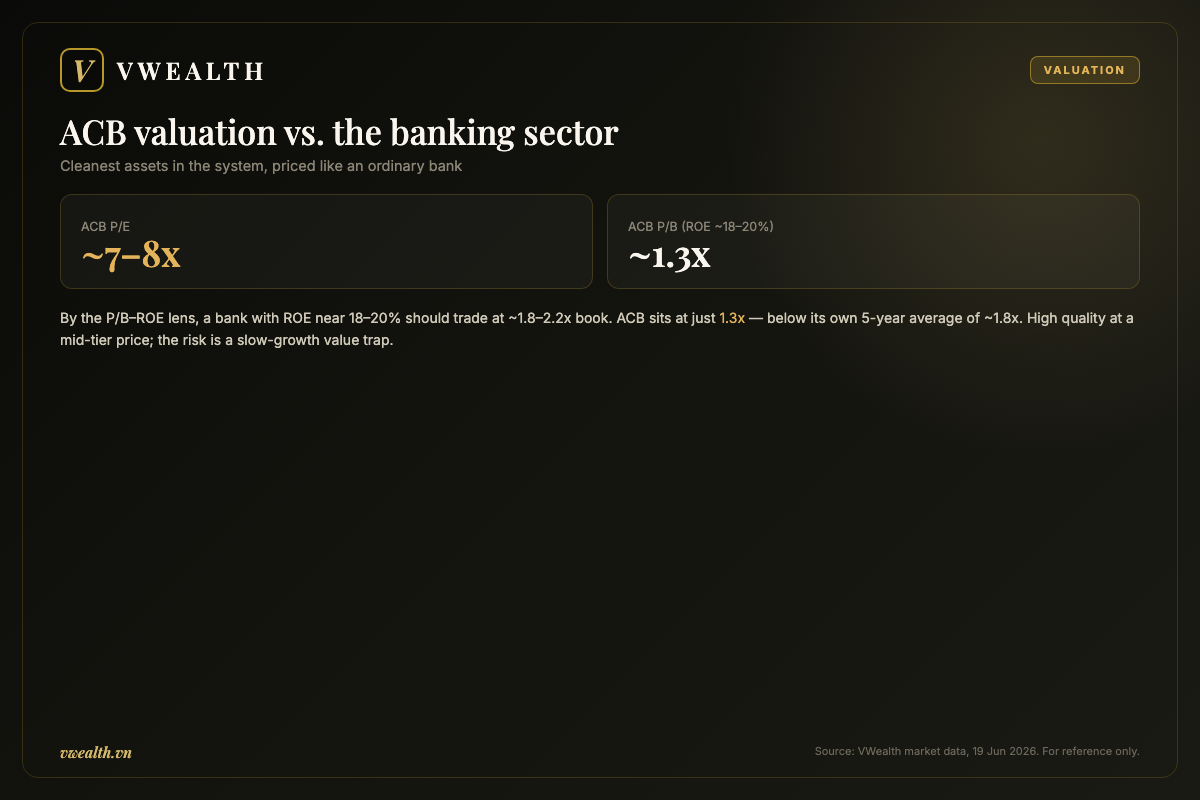
For an anchor: ACB’s 5-year average P/E is about 8.4 times and its average P/B around 1.8 times. So even against its own history, ACB now trades below its average valuation — especially the P/B of 1.3 times, a notably low zone for a bank with the system’s top-tier asset quality. And if you use a calculation based on the high pre-tax profit base and assume lower dilution, the P/E could even look toward 6.5 times. Whichever number you use, the conclusion is the same: the market is paying a very modest price for ACB’s stream of profit.
So why is such a good bank valued so cheaply? The market is not always right, but it rarely prices something cheap for no reason. Two specific worries weigh on ACB’s valuation:
- Stalling profit growth. The parent bank’s net profit in 2025 fell about 7% year on year, to around 15.6 trillion dong. For a stock whose investors are used to steady double-digit profit growth, one year going backwards is enough to make the market lower expectations and “penalize” the valuation.
- A narrowing net interest margin (NIM). ACB’s 2025 NIM narrowed to around 2.9%, down nearly 0.7 percentage points. NIM is a bank’s “gross margin” — when it thins, the market fears the core profit engine is weakening in a low-rate, fiercely competitive lending environment.
This is the trade-off you must price: ACB is cheap because it is in a slow-growth phase. The question is not “is ACB good” — the answer is almost self-evidently yes. The right question is: has the current discount fully priced in the slow-growth risk, or is the market penalizing too heavily?
Valuing a bank by P/B and ROE: the sharpest lens
For bank stocks, the valuation tool I trust most is not P/E but the pairing of P/B with ROE. The reason is very technical: bank profit can swing because of provisions or one-off income — making EPS and P/E noisy. But book value is more stable, and ROE tells you how many dong of profit the bank generates per dong of equity. The foundational principle: the higher a bank’s ROE, the higher the P/B it deserves, because each dong of its capital “breeds” more profit.
Applied to ACB: 2025 ROE was about 17.6%, and in strong quarters ROE still exceeded 20% — among the industry’s highest. By the P/B–ROE logic, a bank with ROE around 18–20% typically “deserves” to trade at a P/B of 1.8 to 2.2 times or higher. Yet ACB is at only 1.3 times. This gap between “should be” and “actual” is precisely the discount the market is applying to the stock.
In short: ACB owns a set of quality metrics (high ROE, bad debt at just around 0.97% — far below the industry average) but carries the price of a mid-tier bank. That is the definition of a “high-quality, cheaply valued” stock.
Of course, this discount is not entirely irrational. If ACB’s ROE keeps sliding from the 20% zone toward 17% and lower as NIM narrows and credit growth slows, then a low P/B is reasonable — the market is pricing a future of lower ROE than the past. The reward for you, as an investor, lies here: if ACB holds ROE around 18–20% and bad debt stays clean, then a P/B of 1.3 times is an attractive entry point; if ROE truly declines structurally, then this cheap price is deserved. This is a bet on quality being maintained, not a bet on explosive growth.
Price action, liquidity and appeal to big money
One thing that sets ACB apart from most small- and mid-cap stocks is ample liquidity. With trading volume regularly in the many millions of shares per session (the 19 June session alone saw over 7.4 million units matched), ACB is a stock that both individual and large institutional investors can move in and out of without worrying about being “stuck” on liquidity. This is an underrated but crucial attribute: high liquidity means when you need to sell, there will always be a buyer at a reasonable price — and that is why large funds favor this group of stocks.
ACB is also in the basket of stocks foreigners favor for their quality. Foreign investors typically seek transparent, well-governed businesses with clean assets — and ACB meets all those criteria. The clearest proof: ACB’s foreign room is almost always full at the 30% ceiling. When the room is full, foreigners wanting to buy more must buy from another foreign investor (a negotiated deal), often at some premium — a sign that the demand to own exceeds the supply.
Among the foreign shareholders, Dragon Capital is the long-standing, emblematic name. Funds within the Dragon Capital group have held ACB through many market cycles, with ownership at many points exceeding 8%. The persistent presence of a regional-scale value investor is an indirect “quality stamp”: professional investors, with deep access to the business, have chosen to stay for the long haul. That does not guarantee the price will rise, but it says a great deal about faith in the fundamentals.
Steady dividends: a reward for patience
Another reason ACB is a stock you “can hold for a long time” is its policy of steady and generous dividends. ACB maintains a tradition of paying a total dividend of around 25% each year, combining both cash and stock:
- The cash component delivers real cash flow into your account — with the cash dividend and the current price, the cash-dividend yield falls to about 3.1%. This is “interest” you receive even if the share price stays flat, comparable to part of a savings-deposit rate but paired with upside potential.
- The stock component lets the bank retain capital to grow assets and lending while increasing the number of shares you hold — the very mechanism that created the “illusion of a price drop” we analyzed at the start of this section.
For a long-term investor, this combination is fairly ideal: you get periodic cash flow and are “compounded” more shares each year. Over time, if the bank keeps earning well, this growing accumulated share count becomes a quiet compounding machine — as long as you don’t panic-sell every time you see the nominal price “drop” on the record date.
The bottom line: high quality at a cheap price — in exchange for slow growth
If I had to sum up how the market is receiving ACB in one sentence, I’d put it this way: ACB is a high-quality stock being valued cheaply, and that cheap price is the price paid for a growth rate that has slowed.
You are looking at a bank with assets among the cleanest in the system (bad debt below 1%), ROE among the leaders, ample liquidity, full foreign room, steady dividends and a loyal institutional shareholder like Dragon Capital — all trading at a P/E around 7–8 times and a P/B of just 1.3 times, below even its own historical average. The “risk” part sits neatly in the growth question: is the narrowing NIM and the profit that went backwards in 2025 a temporary pause, or the start of a structurally lower earnings plateau?
The answer to that question lies not inside the stock but in the bigger picture: the interest-rate cycle, the credit health of the economy, and the competitive position of private banks. And that is exactly what we dissect next — Industry context — so you can place ACB’s cheap valuation in its proper frame of reference.
Economic and banking-industry context
No bank stock can be valued apart from the macroeconomic machine and the general health of the whole industry. ACB is no different. To understand why this bank’s 2025 pre-tax profit fell — for the first time since 2013 — and why the market still prices the stock at a P/B of only about 1.2 times despite asset quality among the best in the system, you need to place ACB in the right big picture: a fast-growing economy that is squeezing the margins of the entire banking industry.
An economy running fast but “pressing” rates low
In 2026, Vietnam’s macro picture has two starkly contrasting shades. On one hand, economic growth is in a hot phase. Q1 2026 GDP rose 7.83% — the highest in 16 years — and the National Assembly set a full-year growth target of 10% or more, an ambitious figure reflecting a determination to push public investment, production and domestic consumption. GDP per capita is projected to reach 5,400–5,500 USD. On paper, this is an ideal environment for banking: a fast-growing economy means high demand for loans, businesses expanding, and people spending and taking out home loans more.
On the other hand — and this is the crux — to achieve that growth rate, monetary policy must loosen and keep rates at a low level. The State Bank steers rates to support the economy, keeping inflation around 4.5% and requiring commercial banks to cut lending rates to “pump blood” into businesses. Industry-wide credit growth reached 19.1% in 2025, and the target for 2026 is set by many analysts in the 15–16% zone (some forecasts keep credit at a 20% pace).
At a glance, strong credit growth is good news for banks. But there is a paradox you must grasp: when banks are forced to lend cheaply to support the economy while funding costs do not fall correspondingly, the net interest margin (NIM) gets choked. This is the central theme of Vietnam’s banking industry in this period, and the key to understanding ACB’s own story.
Industry-wide NIM narrows — and why ACB is under heavier pressure
NIM (Net Interest Margin) is the gap between the rate a bank lends out and the rate it pays depositors. It is a bank’s “basic wage.” When NIM narrows, even if the loan book grows, core profit is still eroded.
In 2025–2026, industry-wide NIM narrowed under two simultaneous pressures:
- Pressure from the lending side: Lending rates were pulled down to support businesses and stimulate the economy. The output got cheaper.
- Pressure from the funding side: Deposit rates did not fall correspondingly; indeed, some banks had to compete for deposits as system liquidity tightened. The cost of capital did not keep pace downward.
When output falls faster than input, NIM is squeezed from both sides. Analysts such as MBS Research and S&I Ratings both view NIM as the industry’s “most unpredictable variable” for 2026, with a risk of further erosion if liquidity strains persist.
So why is ACB under heavier NIM pressure than many other banks? The answer lies in ACB’s very business model: a purely retail bank, light on cheap CASA funding.
CASA (Current Account Savings Account) is the ratio of non-term deposits — money customers keep in payment accounts, for which the bank pays almost no interest or very little. The higher the CASA, the cheaper the bank’s cost of capital and the more NIM is protected.
This is ACB’s structural weakness against the “giants” with a special CASA advantage:
- Vietcombank (VCB) enjoys an enormous flow of payment deposits from large corporations, remittance flows and the international payment system — abundant CASA, extremely low cost of capital.
- MB (MBBank) has the army and Viettel ecosystem and the App MBBank digital platform that pulls in a very large pool of retail CASA.
- ACB focuses on dispersed retail credit — lending to individuals, household businesses, and SMEs — but does not own a giant cheap-CASA “tap” like VCB or MB. Most of ACB’s funding is term deposits, that is, expensive capital.
The consequence is very concrete: ACB’s NIM in 2025 fell to only about 2.92%, down as much as 0.68 percentage points year on year. This is the direct cause that pulled net interest income down and dragged full-year pre-tax profit to 19,538 billion dong — the first decline after more than a decade of continuous growth. When the whole industry is squeezed on NIM, the bank that lacks a cheap-CASA “cushion” feels the blow most clearly, and ACB is in that group.
Real-estate and bond bad-debt risk — where ACB shines again
If NIM is ACB’s weakness versus the industry, asset quality is where ACB excels — and this is the part you should pay special attention to, because it shapes the stock’s “defensive thesis.”
The biggest risk hanging over Vietnam’s banking industry for the past few years is bad debt arising from two sources:
- Real-estate lending and stalled property projects: When the property market freezes, developers’ cash flows clog and large loans risk turning into bad debt.
- Corporate bonds: Many banks hold bonds of real-estate groups; when these businesses hit liquidity trouble, the value of those investments is threatened.
Regulators are tightening real-estate credit, and liquidity pressure is bearing down on the whole system. This is the “dark cloud” that makes investors anxious about the asset quality of banks in general.
But ACB has little exposure to either risk. ACB’s dispersed retail model means the loan book is spread thin across a great many small loans (individuals borrowing to buy homes to live in, household businesses, SMEs) rather than concentrated in a few property “sharks.” ACB is also famously cautious, almost never “holding” real-estate corporate bonds like many other banks. The results are reflected straight in the numbers:
| Asset-quality metric (end 2025) | ACB | Industry context |
|---|---|---|
| Bad-debt ratio (NPL) | ~1.09% | Among the lowest in the system; many banks notably higher |
| Real-estate bond exposure | Very low | Some banks hold large amounts, exposed to valuation risk |
| Loan-book structure | Dispersed retail | Many banks concentrate on real-estate credit, more vulnerable |
The crux is this: in an environment where the whole market fears real-estate and bond bad debt, ACB’s “clean assets” become a genuinely valuable defensive advantage. When industry-wide risk rises, banks with clean books do not have to strain under massive provisioning, are not surprised by bad loans suddenly surfacing. You are paying for peace of mind — an intangible but valuable asset in a volatile market. Notably, even a “clean” bank like ACB doubled its risk provisions in 2025, showing management proactively cushions for every scenario rather than hiding risk.
The upgrade and foreign-room stories — a tailwind for the whole industry
One major macro factor is reshaping capital flows into bank stocks: the upgrade of Vietnam’s stock market. FTSE Russell has officially confirmed the roadmap to upgrade Vietnam from a Frontier market to a Secondary Emerging Market, effective from September 2026.
What does this mean for you? When Vietnam is upgraded, international funds tracking emerging-market indices will be obliged to buy Vietnamese stocks — and large-cap, highly liquid bank stocks like ACB are prime candidates in this foreign capital’s “shopping basket.” In parallel, the Government is reviewing plans to raise foreign ownership limits (foreign room) in non-essential sectors, along with a new legal framework (Circular 08/2026) improving foreign investors’ access mechanism.
For a high-quality but cheaply valued stock like ACB, the upgrade story is a potential catalyst that could drive a re-rating. However, you also need to stay clear-eyed: the decision to deploy capital by foreigners depends not only on the upgrade, but also on market quality, liquidity and long-term confidence. The upgrade is a favorable wind, not a guaranteed ticket.
Trend prediction
Having understood the industry context, your next question is surely: where will ACB go? This section does not aim to “predict” the share price, but to help you see management’s response strategy clearly and sketch scenarios with clear conditions — so you can judge the probabilities according to your own appetite.
What is ACB doing to counter the NIM pressure?
ACB’s leadership is not sitting still watching NIM be eroded. Their response strategy revolves around four axes:
- Push non-interest income through ACBS: When interest income (dependent on NIM) is squeezed, ACB focuses on developing its securities firm ACBS to compensate. ACBS is building a five-year development strategy with advice from top strategy firms, planning to raise charter capital to 3,000 billion dong in 2026 with a profit target of 1,800 billion. In a context where the stock market benefits from the upgrade story, this is an arrow pointed in the right direction — turning the capital market’s favorable wind into real revenue.
- Digitalize to cut costs and pull in CASA: ACB is pushing digital banking to improve experience, reduce operating costs, and most importantly draw more non-term deposits (CASA) — the very “antidote” to its expensive-capital weakness.
- Hold asset quality firm: ACB does not chase hot growth at all costs. It proactively raises provisions and keeps lending discipline, accepting slower growth in exchange for safety.
- Recover the bancassurance segment: The linked-insurance segment once fell over 20% amid market difficulties, but has shown recovery signs with Q1 2026 revenue up 33% and hopes to contribute over 1,000 billion dong for the year.
On targets, ACB’s leadership set a 2026 pre-tax profit plan of over 22,300 billion dong — that is, expecting to regain growth momentum after the 2025 decline. Q1 2026 profit reached about 5,400 billion dong, and the bank continues to pay a total dividend of 20% (7% cash, 13% stock). This is a signal that management is confident 2025 was only a temporary “trough” rather than the start of a long-term downtrend.
Three scenarios for ACB
No one can forecast a share price precisely. But you can prepare mentally by imagining three scenarios with clear conditions and consequences. Treat this as a map, not a prophecy.
Positive scenario: NIM recovers and re-rating
Conditions: Industry-wide NIM bottoms then recovers as rates stabilize and liquidity eases; ACB’s credit grows well on the 10% economic momentum; ACBS booms on the September 2026 upgrade wave; foreign capital pours in after the upgrade.
Consequence: Profit regains double-digit growth momentum, and ROE returns to the zone above 20%. In that case, the current P/B of just ~1.2 times is seen as too cheap for a high-quality bank, and the market re-rates the stock to a higher level. This is the “eat the dividend and enjoy the price gain” scenario.
Base scenario: sideways, collect the dividend
Conditions: NIM stabilizes at a low level but does not worsen; credit grows steadily; profit recovers mildly toward the target but without a breakout; asset quality stays clean.
Consequence: The share price fluctuates within a narrow band, with no strong re-rating. Your main reward comes from steady dividends (cash + stock) and the peace of mind of a defensive asset. This is the most likely scenario in the short term — a “sleep well” investment, modest but stable returns.
Negative scenario: NIM keeps narrowing, profit falls further
Conditions: Liquidity strains persist, cost of capital stays expensive while lending rates cannot rise; ACB still lacks cheap CASA; the stock market cools so ACBS cannot offset the shortfall.
Consequence: NIM narrows further, and 2026 profit falls for a second consecutive year. In that case, the current cheap valuation would be seen as “cheap for a reason,” and the stock could go sideways or fall slightly further. This is the “value trap” risk you truly need to weigh.
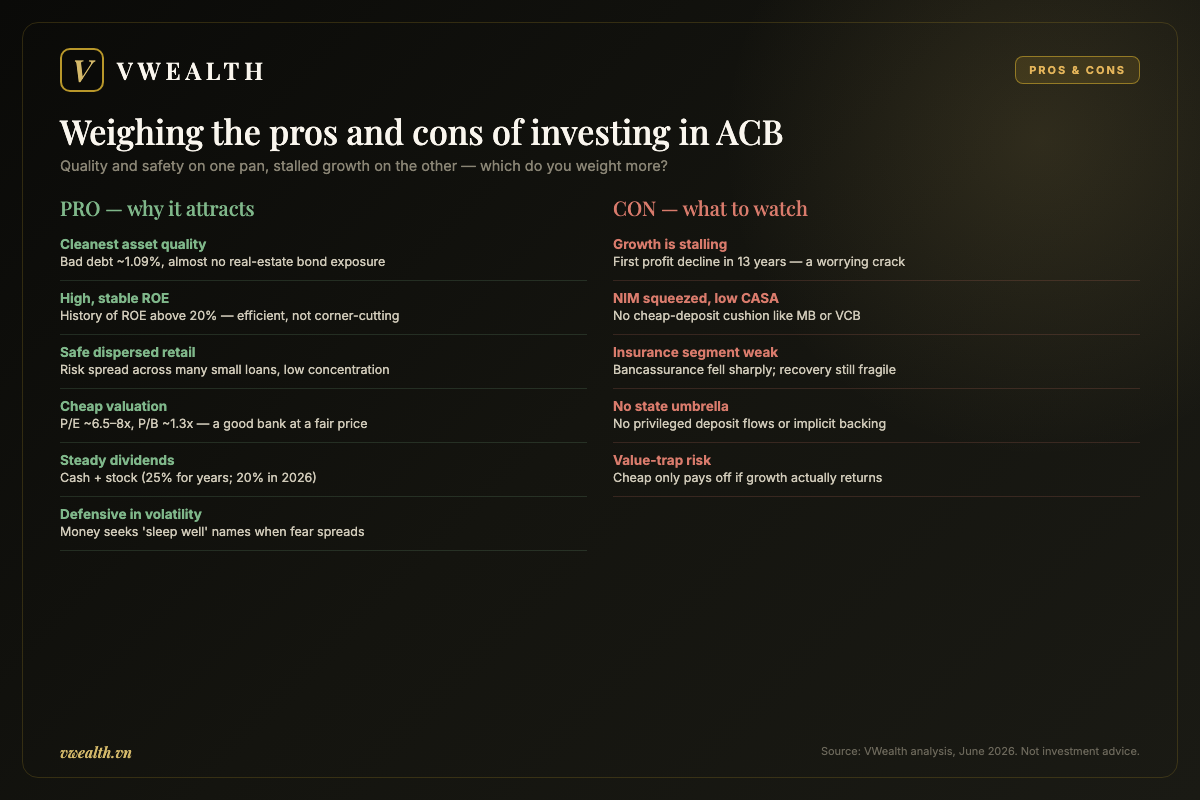
The table above summarizes the tug-of-war between ACB’s advantages and risks. Read it carefully before moving to the conclusion, because your entire decision will hinge on which column you weight more heavily.
Should you buy ACB stock?
By now, you have all the pieces. The question “should you buy ACB?” actually has no single right answer for everyone — it depends on what kind of investor you are. Let us weigh the two pans of the scale honestly.
The PRO pan — why ACB is attractive
- The cleanest asset quality in its group: With bad debt at just ~1.09% and almost no exposure to real-estate bonds, ACB has one of the cleanest books in the system. In an environment where the whole industry worries about bad debt, this is a substantive defensive advantage.
- High and stable ROE: ACB sustains return on equity among the highest, a history of ROE above 20%. This is the sign of an efficiently run bank, not growth by “cutting corners.”
- A safe, dispersed retail model: The loan book is spread thin across many small loans, with little concentration risk. A few large customers defaulting cannot topple the bank.
- Cheap valuation: A P/E of ~6.5 times and a P/B of ~1.2 times is a low valuation relative to ACB’s asset quality and ROE history. You are buying a good bank at a reasonable price.
- Steady dividends: The policy of paying dividends in both cash and stock (20% in 2026) delivers real income and a reward for patience.
- Good defense in volatile markets: When bad-debt fears spread, money tends to seek out “sleep well” names like ACB.
The CON pan — what should make you wary
- Growth is stalling: 2025 pre-tax profit fell to 19,538 billion — the first decline in 13 years. For a stock bought for its stability and steady growth, this is a worrying crack.
- NIM narrows from a lack of cheap CASA: ACB does not have an abundant non-term-deposit “cushion” like MB or VCB. When the industry is squeezed on margins, ACB feels the blow more heavily — a structural weakness, not easily fixed in the short term.
- The insurance segment is struggling: Bancassurance was once an engine of non-interest income but has fallen sharply; though there are recovery signals, this segment still faces the pressure of a difficult insurance market.
- No state “umbrella”: Unlike VCB or BIDV, ACB is a private bank, without the privileged deposit flows from the state sector or the position of implicit backing.
- “Value trap” risk: A cheap valuation is only truly an opportunity if growth returns. If profit keeps going sideways or falling, the stock can stay “cheap forever” — leaving you stuck with an asset that doesn’t appreciate.
Four kinds of investors — whom does ACB suit?
The most useful way to answer for yourself is to hold yourself up against four common investor frames:
| Investor type | Priority | Does ACB fit? |
|---|---|---|
| Growth hunter (Growth) | Fast profit growth, strong price breakouts | Less suitable — ACB is in a stalling phase, not a hot-growth story |
| Quality/safety-first (Quality/Defensive) | Clean assets, low risk, sleep well | Very suitable — this is ACB’s “home turf” |
| Income hunter (Income) | Steady dividend cash flow | Suitable — stable cash + stock dividends |
| Value hunter (Value) | Buying cheap relative to intrinsic quality | Suitable if you believe growth returns; beware the value trap if not |
In other words: ACB suits those who prioritize quality, safety and dividends, buying a good asset at a cheap valuation, and willing to accept slow growth in a period when the industry is squeezed on margins. If you are someone hunting for a stock that “explodes” and doubles in a year, ACB is most likely not the choice for you. But if you treat your portfolio like a garden that needs durable, pest-resistant trees bearing steady fruit — then ACB deserves a place on your research list.
Disclaimer: This article is produced for informational and reference-analysis purposes, and is not a recommendation to buy, sell or hold any security. The figures cited are drawn from public sources at the time of writing and may change. Every investment decision carries risk and is yours alone; do your own thorough research and/or consult a licensed financial advisor before committing capital. vwealth.vn and the author bear no responsibility for any losses arising from the use of information in this article.
Research Vietnamese stocks in English with vwealth. Our AI-powered platform turns Vietnamese market data into full English analysis reports — with international payment support and a free 2-month trial for new accounts. Create your free account and read the latest reports.
Read more sector analysis: Vietnam’s Banking Sector: A Foreign Investor’s Guide to the Market’s Backbone