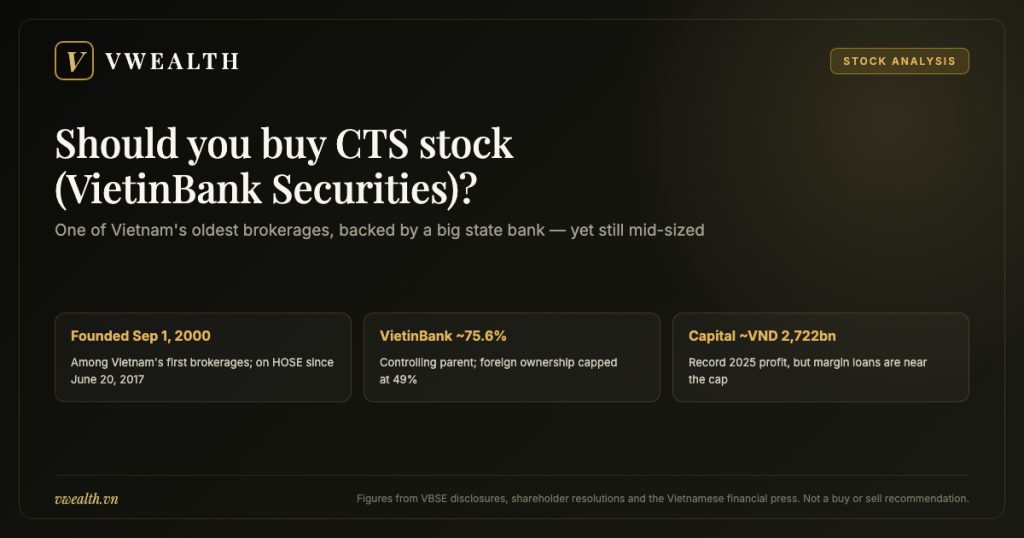
Should you buy CTS stock? The ticker belongs to VietinBank Securities Joint Stock Company (VBSE), the brokerage arm of Vietnam Joint Stock Commercial Bank for Industry and Trade (VietinBank, ticker CTG), one of the country’s big state-controlled lenders. On paper it looks like an easy call: a firm founded on September 1, 2000, just weeks after Vietnam’s stock market opened, backed by a bank with the State Bank of Vietnam as its controlling shareholder and Japan’s MUFG as its strategic partner. Yet more than 25 years later its charter capital is only about VND 2,722 billion, a fraction of what younger bank-owned rivals now carry. In 2025 it posted a record pre-tax profit of about VND 714.6 billion, nearly two and a half times the prior year, and the share price rallied more than 70% in three months. Then, for 2026, management set a profit plan more than a third lower. An old firm with a rich parent that still calls itself “mid-sized” is the puzzle at the heart of this CTS stock analysis, and solving it is the key to deciding whether CTS belongs in your portfolio.
Some names first, because this company has changed its name more often than most. CTS is the ticker. The shares have traded on the Ho Chi Minh City Stock Exchange (HOSE) since June 20, 2017, and before that were listed on the Hanoi Stock Exchange (HNX) from 2009. From its 2009 equitization until late 2025 the legal name was Vietnam Bank for Industry and Trade Securities Joint Stock Company, usually shortened in English to VietinBank Securities. On November 18, 2025, an extraordinary shareholders’ meeting approved a new name, VietinBank Securities Joint Stock Company, abbreviated VBSE; the company had already moved its website from cts.vn to vbse.vn in late August 2025. The ticker stayed CTS. In this article “VBSE”, “VietinBank Securities” and “CTS” all mean the brokerage, while “VietinBank” or “CTG” means the parent bank.
A second ground rule, shared by every article in the vwealth company-analysis series: dates, names, deals and figures come from public disclosures — shareholder-meeting resolutions, HOSE filings, financial statements as summarized by Vietnam’s financial press, and company profiles on market-data portals. Numbers we derived ourselves are labeled “vwealth estimate”. We do not quote today’s share price, current P/E or P/B, current market capitalization or the latest quarter’s profit. Those numbers change daily, and for a brokerage with a large proprietary trading book like VBSE they can swing sharply from one quarter to the next. Open the latest vwealth report whenever you need current figures.
If you are new to Vietnamese equities, a few local mechanics matter throughout this piece. HOSE shares settle on a T+2 basis, daily price moves are capped at plus or minus 7% from the reference price, and foreign investors face ownership ceilings (“foreign room”) set by law or by a company’s own charter. Our guide on how to invest in the Vietnam stock market walks through account opening, trading hours and those limits in detail.
One more note for readers following the series: this is our third brokerage analysis in eight days, after our TCX analysis of Techcom Securities and our piece on VPS (VCK). TCBS is a story about the industry’s largest equity base and corporate bonds; VPS is a story about a retail brokerage machine with no parent bank. CTS is a different animal altogether: small, old, with a wealthy but cautious parent, profits that swing with its proprietary book, and a margin-lending business that is already pressing against the legal ceiling. The goal here is not to repeat those stories but to show you what makes CTS stock unusual among Vietnam stocks in the securities sector.
More than 25 years of VietinBank Securities: first to arrive, never the fastest
Some companies read like the biography of a younger child in a comfortable family: born early, raised properly, never short of food, but never handed a large enough share of the family fortune to break away on their own. VietinBank Securities is that kind of company. To understand why it is still mid-sized today, you have to start at the beginning.
2000: born alongside Vietnam’s stock market
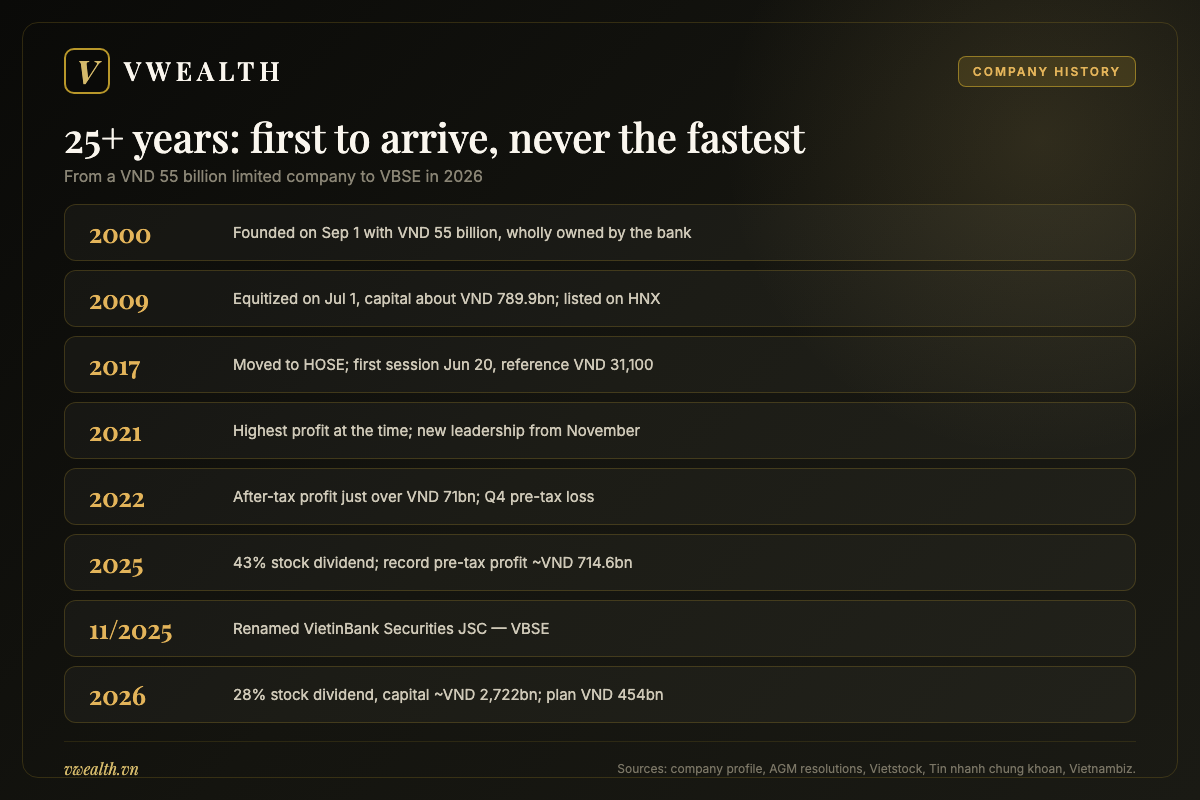
On July 28, 2000, the Ho Chi Minh City Securities Trading Center held its very first trading session with just two listed stocks. Less than five weeks later, on September 1, 2000, the chairman of what was then Vietnam Bank for Industry and Trade signed Decision No. 126/QD-HDQT-NHCT1 establishing a wholly owned limited-liability securities company with initial charter capital of VND 55 billion. Vietnamese financial media recounting the company’s history routinely place it among the country’s first seven securities firms.
VND 55 billion was not a small sum in 2000, but context matters. The whole market consisted of a handful of tickers, individual investors placed orders on paper slips at the trading floor, and almost nobody in Vietnam had formal training in the securities business. A state-owned bank opening a brokerage then was a bit like opening a shop on a street that did not yet have foot traffic: the right call on vision, with no clue when customers would arrive.
From day one the company carried two traits that would follow it for two decades. First, it was the offspring of a state bank, so its governance culture was closer to banking than to an aggressive retail brokerage. Second, its natural advantage lay with the parent bank’s large corporate clients — companies that needed to issue bonds or shares and wanted financial advice — rather than with the retail crowd.
2006–2009: the first boom, equitization and an HNX listing
Vietnam’s first stock-market mania came in 2006–2007: the VN-Index crossed 1,000 points for the first time and dozens of new brokerages were licensed. Bank-owned brokerages expanded capital and hired aggressively. Then the 2008 global financial crisis sent the index into free fall, and many young securities firms began to lose money.
With the market still shaken, the company completed its equitization on July 1, 2009, becoming a joint-stock company with charter capital of about VND 789.9 billion. In the same year CTS shares listed on the Hanoi exchange. From then on VietinBank no longer owned 100%; outside shareholders arrived, and the company acquired a new daily scorecard in the form of its share price.
The long formal name dates from this point and lasted 16 years. In its 2025 rebranding proposal, the company itself admitted that clients often got the name wrong and simply called it “CTS”. It is a small detail that says a lot: for a long time this brokerage’s brand was not strong enough for people to remember it.
2010–2016: quiet years and a lesson about capital
After equitization, Vietnam’s market spent most of a decade moving sideways with bouts of turbulence: the 2011–2012 bad-debt crisis, a banking-sector restructuring, then a slow recovery. Many brokerages cut capital, surrendered licenses or merged. VietinBank Securities survived without losing its franchise but did not grow much either. Charter capital went from roughly VND 790 billion in 2009 to about VND 1,070 billion before a 2021 increase — only around VND 280 billion added in about a decade.
If you want to understand why VBSE is “small” today, this is the period to study. An independent brokerage that wants to grow raises money from investors. A subsidiary of a state-controlled bank that wants to grow needs the parent to inject cash or to accept dilution by outside shareholders, and both paths require layers of approval, including from the State Bank of Vietnam, which represents the state’s ownership in VietinBank. In gloomy markets, nobody had a compelling reason to push for more capital for a brokerage.
2017: moving house from HNX to HOSE
On June 15, 2017, CTS was delisted from HNX, and June 20, 2017 was its first trading day on HOSE with a reference price of VND 31,100 per share. Companies usually switch exchanges to reach larger investors, since HOSE hosts the big-cap names, the ETFs and most foreign money.
But changing exchanges does not make a company bigger. The VND 31,100 figure is a useful historical marker, with one warning: the share count has grown several times since then through stock dividends, so “unadjusted” and “adjusted” historical prices on charting software can be very far apart. Comparing CTS prices across years without adjusting is the most common mistake investors make with this stock.
2021–2024: a new generation of leaders, a market up and down
In 2021 a wave of first-time investors flooded Vietnam’s market and liquidity hit records. VietinBank Securities benefited like the rest of the industry: 2021 pre-tax profit was roughly VND 482 billion (vwealth estimate, inferred from press reports that the 2022 plan of VND 505.17 billion was only about 4.8% above the 2021 result). That stood as the company’s highest profit until 2025.
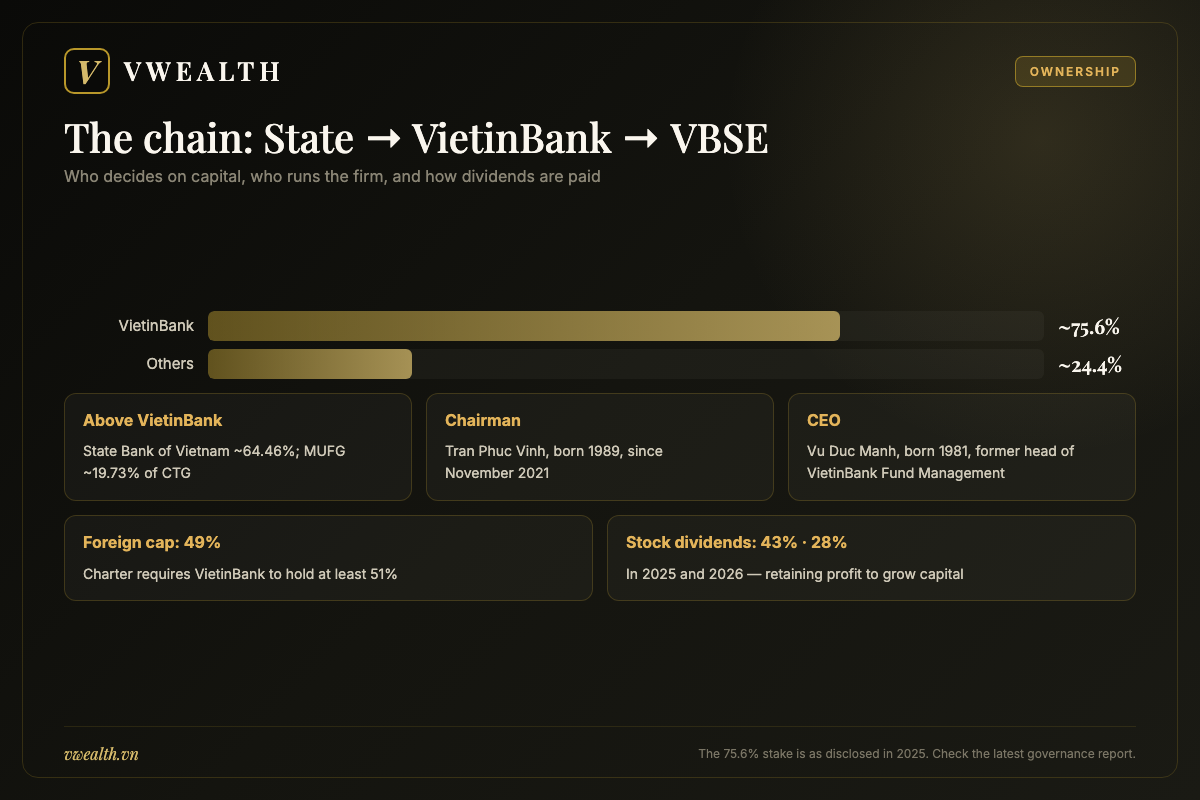
Also in 2021, shareholders approved raising charter capital from VND 1,070 billion to just over VND 1,149 billion via a stock dividend funded by 2018–2020 profits. On November 11, 2021, the company replaced both its chairman and its chief executive: Tran Phuc Vinh, born in 1989, became chairman, and Vu Duc Manh, born in 1981, became CEO. Both came from VietinBank’s capital-markets division. It was an unusual generational shift for a subsidiary of a state-controlled bank — the new chairman was in his early thirties.
Then 2022 arrived and everything reversed. Equities fell hard and the corporate-bond market froze after a series of high-profile cases. VietinBank Securities booked roughly VND 872 billion in revenue for 2022, but after-tax profit was just over VND 71 billion; in the fourth quarter alone it posted a pre-tax loss of about VND 7.2 billion. The VND 505 billion plan set at the start of the year became a distant memory. That was the first lesson for CTS shareholders: this company’s earnings can fall very hard when its proprietary book moves against the market.
Profit recovered to about VND 231 billion pre-tax in 2023 and about VND 287 billion pre-tax (VND 231 billion after tax) in 2024, beating the VND 280 billion plan. Behind the annual totals were wobbly quarters: second-quarter 2024 after-tax profit was only VND 20.9 billion, down about 73% year on year, as gains on financial assets fell sharply. In that quarter the proprietary desk sold its entire stake in VIX — another brokerage — carried at a cost of about VND 249.2 billion, and bought into Vietnam Container Corporation and Gelex.
2025: a record year, the biggest capital increase in its history and a new name
2025 was the year VietinBank Securities got noticed. In June 2025 it issued about 64 million shares as a 43% stock dividend (43 new shares for every 100 held), lifting charter capital to about VND 2,127 billion — described by the press as the largest capital increase in its 25-year history. Second-quarter after-tax profit reached about VND 175.7 billion, more than eight times the year-earlier figure, and the company had to file an explanation because profit rose over 700%. The stock climbed about 71% from late April to July 24, 2025, when it hit VND 38,100 — reported as an all-time high — and market capitalization reached roughly VND 8.1 trillion for the first time.
For full-year 2025, pre-tax profit came in at about VND 714.6 billion, up 148.7%, with after-tax profit of about VND 577.4 billion. Total assets topped VND 12.5 trillion, up roughly 50% in the year. CTS shares gained about 33.5% over 2025. And on November 18, 2025, shareholders approved the VBSE name, following the “Securities + parent bank name” formula used by BIDV Securities and MB Securities.
2026: another stock dividend, a cautious plan and an upgraded market
The annual general meeting on April 21, 2026 approved a 2026 pre-tax profit plan of VND 454 billion, about 36.5% below the 2025 result, with a planned dividend of 9%. Shareholders also approved issuing about 59.55 million shares as a 28% stock dividend out of undistributed profit through 2025, with a record date of June 15, 2026, lifting charter capital to about VND 2,722 billion in July 2026. Chairman Tran Phuc Vinh told shareholders that even with equity above VND 2,800 billion the firm remained “mid-sized” and that a further capital increase in 2026 was a priority — the stated target being charter capital of around VND 3,000 billion, subject to review by VietinBank and the State Bank of Vietnam.
Also in 2026, FTSE Russell formally moved Vietnam into its Secondary Emerging market category, with Vietnamese stocks entering its indices from September 21, 2026 in phases through September 2027. For brokerages this is an industry-wide tailwind. For VBSE, the question is whether a firm with a small balance sheet has enough capacity to capture its share.
| Date | Milestone | Why it matters to CTS shareholders today |
|---|---|---|
| Sep 1, 2000 | Founded as a limited-liability securities company with VND 55 billion | One of Vietnam’s first brokerages; state-bank DNA |
| Jul 1, 2009 | Equitized with charter capital of about VND 789.9 billion; listed on HNX | Outside shareholders arrive, VietinBank keeps control |
| Jun 20, 2017 | First HOSE session, reference price VND 31,100 | Historical price marker; adjust for later stock dividends |
| Nov 2021 | Tran Phuc Vinh becomes chairman, Vu Duc Manh becomes CEO | Current leadership, drawn from VietinBank’s capital-markets unit |
| 2022 | After-tax profit just over VND 71 billion; Q4 pre-tax loss of about VND 7.2 billion | Earnings can collapse when the proprietary book turns |
| Jun 2025 | 43% stock dividend; charter capital about VND 2,127 billion | Growth funded by retained earnings, not fresh outside money |
| 2025 | Record pre-tax profit of about VND 714.6 billion; renamed VBSE on Nov 18 | A very high base for future comparisons |
| 2026 | Pre-tax plan VND 454 billion; 28% stock dividend, capital about VND 2,722 billion; FTSE inclusion from Sep 21 | Still small versus rivals; further capital raising unresolved |
Step back and a pattern emerges. VietinBank Securities has always arrived on time — born with the market, listed early, renewed its leadership just before the 2021 boom, rebranded ahead of the market upgrade — but it has never had enough capital to run faster than its rivals. The rest of this analysis explains why, and what that means if you are weighing whether to buy CTS stock.
Who runs VBSE and who really owns CTS stock
At TCBS people talk about Nguyen Xuan Minh; at VPS, about Nguyen Lam Dung — individuals whose names are tied to their firms. VietinBank Securities is different. You will struggle to find a founder or a single powerful individual behind it. The party that actually decides its fate is a legal entity, VietinBank, and behind VietinBank stands the Vietnamese state. Understanding that chain of ownership matters more than profiling any one executive, because it explains nearly everything you will see later: small capital, slow capital raising, a capped foreign-ownership limit and a conservative management style.
For readers outside Vietnam, it helps to know how the country’s big state-controlled banks relate to their securities subsidiaries. Each of the large state-linked lenders — Vietcombank, BIDV, VietinBank and Agribank — owns or controls a brokerage, and in every case the brokerage is small relative to the bank. The bank’s management board appoints the subsidiary’s leaders, often rotating them from the bank’s own capital-markets or treasury units. Strategy is therefore shaped as much by the parent’s priorities and regulatory constraints as by the brokerage’s own ambitions. That context explains why the personal profiles below matter less than they would at an independent firm.
Tran Phuc Vinh: a young chairman from the capital-markets desk
Tran Phuc Vinh was born in 1989 in Nghe An province and graduated from the National Economics University in Hanoi. Before being named chairman of VietinBank Securities in November 2021, he had served as deputy head of VietinBank’s capital markets department, deputy director of its North Hanoi branch, and acting chief executive of VietinBank Securities itself. In other words, he did not parachute in; he had already run the company before taking the board chair.
A chairman in his early thirties is rare at a subsidiary of a state-controlled bank. You can read that in two ways. The optimistic reading: the parent wanted a new generation of leaders fluent in technology and modern capital markets, and moves such as the rebrand, the new website and the push into investment banking fit that reading. The cautious reading: at a state-bank subsidiary, the chairman’s authority has limits. The biggest decisions — raising capital, selling stakes, bringing in a strategic investor — must be approved by the parent and by regulators. When asked about new capital at the 2026 AGM, Vinh himself said the plan was under review by VietinBank and the State Bank of Vietnam.
His remarks to shareholders over the years also give a sense of style. In 2024 he said he hoped it would be a “breakthrough year” for CTS shares; in 2026 he stressed that the firm was still mid-sized and needed more capital. There have been no grand promises about market share — a tone consistent with the culture of a state-owned bank.
Vu Duc Manh and the executive team: a fund manager at the helm
Chief executive Vu Duc Manh was born in 1981 in Phu Tho province. He holds an MBA from the University of Oklahoma in the United States and a bachelor’s degree in finance and banking from Vietnam’s Banking Academy. Before joining VietinBank Securities he headed VietinBank’s capital markets department and served as chairman and chief executive of VietinBank Fund Management Company.
His fund-management background helps explain why VBSE emphasizes discretionary account management (portfolios built to each client’s mandate and risk appetite), structured products and investment banking. In statements during 2025 and 2026, Manh spoke of doubling the scale of operations in 2026, of getting the firm into the top 15 brokerages by market share, and of growing active clients by roughly 30%. Notice the ambition: top 15, not top 5. It is a notably honest piece of self-positioning.
The organization is lean. By mid-2025 the company had about 239 employees, with headquarters in Hanoi and branches in Hanoi, Da Nang and Ho Chi Minh City. Compared with retail brokerages that employ thousands of sales agents, this is a compact outfit — an advantage on cost, a limitation on the ability to win retail clients.
Board seats rotate with each AGM. At the 2025 meeting, for example, shareholders removed Dang Anh Hao and Phan Thi Huyen Trang from the board and elected Bui Thi Thanh Thuy and Pham Viet Hung. At state-bank subsidiaries, board changes usually reflect personnel moves within the parent bank rather than shifts in strategy.
VietinBank owns about 75.6%, and the state stands behind VietinBank
According to company disclosures and financial press reports from 2025, VietinBank owns about 75.6% of VietinBank Securities. Because the recent capital increases were stock dividends distributed pro rata to all shareholders, that percentage should in principle be unchanged after the 43% issue in 2025 and the 28% issue in 2026. A practical warning if you check this yourself: some data portals still show VietinBank’s share count from before a stock dividend while showing the updated number of listed shares, so dividing one by the other yields a percentage that is too low. Cross-check with the latest corporate-governance report.
Above VietinBank sits the state. The State Bank of Vietnam, acting as the owner’s representative, holds about 64.46% of VietinBank, and Japan’s MUFG Bank holds about 19.73% as a strategic foreign shareholder. In August 2026 the government asked for a plan to raise the state’s stake in VietinBank to at least 65%. In practical terms, VBSE is a grandchild of the state: not a state-owned enterprise in the strict legal sense, but every major capital decision passes through a bank the state controls. If you want to understand the parent in depth, see our guide to Vietnam’s banking sector.
That ownership chain has three practical consequences. One, the firm faces almost no risk of being orphaned or taken over. Two, raising fresh capital — whether from the parent or outsiders — requires multiple layers of approval, so it is slow. Three, minority and parent interests do not always align: the bank may see its brokerage as a tool for serving corporate clients, while minority shareholders want it to maximize return on equity.
A 49% foreign-ownership cap: a door half open
Under current Vietnamese law, foreign investors can own up to 100% of a securities company. At VietinBank Securities, however, the company charter requires VietinBank to hold at least 51%, so the board proposed and shareholders approved a foreign-ownership limit of 49% (as reported from the 2022 AGM). In reality, with VietinBank at about 75.6%, the “free” portion available for anyone to trade — domestic or foreign — is only about a quarter of the shares.
Keep that in mind when you hear that “the market upgrade will bring foreign money into brokerage stocks”. Index funds typically weight stocks by free-float market capitalization. A stock with three quarters of its shares locked up by a parent bank and a market value of a few trillion dong is unlikely to show up on the radar of large index funds. The 49% cap is not what is holding foreign money back today — the free float is far below that level anyway — but it would become the binding ceiling if VietinBank ever decided to sell part of its stake to foreign investors.
A partial sale by VietinBank is not a new idea. In 2022 the chairman said the company was studying issuing shares to raise outside capital, including finding a strategic investor. No such deal has been announced since. If you hold CTS hoping for a foreign strategic partner, treat that as a possibility with no timetable, not a defined catalyst.
Dividends: plenty of shares, little cash
VBSE’s dividend policy mirrors its capital problem. At each AGM the company typically announces an “expected” dividend rate for the coming year — 10% for 2022, 2023 and 2024; 9% for 2025 and 2026. But the largest recent distributions have been paid in shares: the 2021 issue funded by 2018–2020 profits (capital from VND 1,070 billion to just over VND 1,149 billion), the 43% issue in 2025 funded by about VND 655 billion of retained earnings through 2024, and the 28% issue in 2026 funded by undistributed profit through 2025.
The reason is simple. A Vietnamese brokerage can lend on margin up to twice its equity, and when fresh money is hard to obtain, the quickest way to enlarge the balance sheet is to retain profits and convert them into shares. For you as a shareholder, that means CTS is not the right choice if you need a steady cash income, but the policy makes sense if you accept bonus shares and trust the company to deploy retained capital well.
An illustrative example of what stock dividends do: suppose you held 1,000 CTS shares before the 2025 issue. Afterwards you held 1,430 shares, and after the 2026 issue about 1,830 shares (1,430 × 1.28). Your percentage ownership did not change, and neither did the book value you own at the moment of the split. What changed is that future profits are divided among more shares. When you compare CTS earnings per share across years, always use share-count-adjusted figures.
| Ownership layer | Who | Disclosed stake | What to watch |
|---|---|---|---|
| Controlling shareholder of VBSE | VietinBank (CTG) | About 75.6%; charter requires at least 51% | Any stake sale, strategic investor or fresh capital injection |
| Foreign cap at VBSE | Foreign investors | Maximum 49% | Only relevant if VietinBank reduces its stake |
| Controlling shareholder of VietinBank | State Bank of Vietnam | About 64.46%; plan to raise to at least 65% | State capital policy toward the bank and its subsidiaries |
| Strategic shareholder of VietinBank | MUFG Bank (Japan) | About 19.73% | No direct stake in VBSE |
| Other VBSE shareholders | Domestic and foreign individuals and institutions | About one quarter | Liquidity and free float |
One more link in the chain is worth remembering. VietinBank’s own shareholder meetings have discussed heavy pressure to raise the bank’s capital as lending grows. A parent busy strengthening its own balance sheet is less likely to prioritize a large injection into its brokerage — a connection you should keep in mind throughout this analysis.
How VBSE makes money: a brokerage powered by proprietary trading and margin loans
Imagine opening a brokerage’s income statement with the name blacked out. If the biggest revenue line is brokerage commissions, it is probably VPS. If it is margin interest and bond distribution, it might be TCBS. And if the biggest line is sometimes gains on financial assets and sometimes lending interest, with profits jumping around quarter to quarter like an electrocardiogram, there is a good chance you are looking at VietinBank Securities. This chapter takes the business apart line by line so you can see which segment feeds which, and why CTS earnings are harder to predict than those of the large brokerages.
For a refresher on how Vietnamese brokerages make money in general, our overview of the best stock companies in Vietnam compares the major business models. Here we focus on what is specific to VBSE.
Proprietary trading: the strongest engine and the biggest risk
Proprietary trading means a brokerage using its own money to buy and sell shares, bonds and certificates of deposit. Under Vietnamese accounting rules, the results show up in lines such as gains on financial assets at fair value through profit or loss (FVTPL — assets held for trading and marked to market), income from held-to-maturity investments (HTM — typically deposits, CDs and bonds) and gains on available-for-sale assets (AFS).
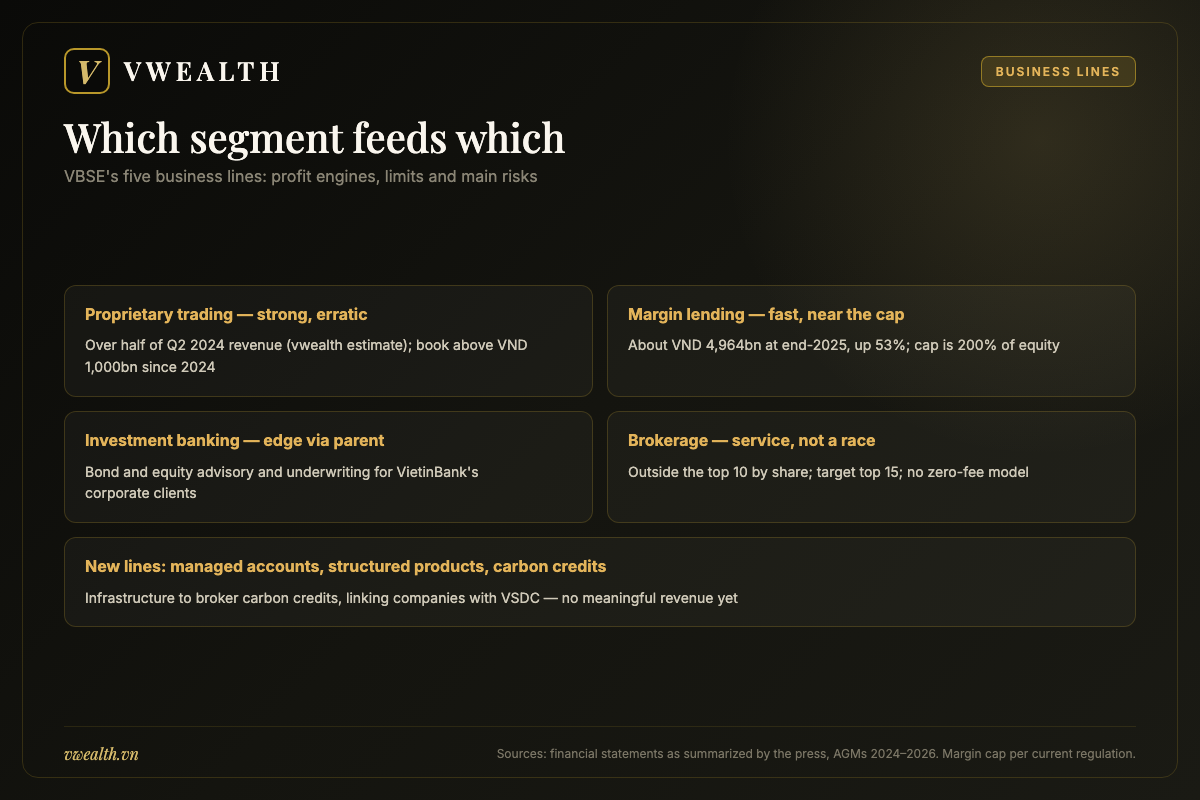
At VietinBank Securities, proprietary trading accounts for a very large share of revenue. Take the fourth quarter of 2023: operating revenue exceeded VND 311 billion, of which the proprietary desk contributed about VND 136 billion. Or the second quarter of 2024: operating revenue of about VND 273.7 billion included FVTPL gains of about VND 121.2 billion, HTM income of about VND 24.3 billion and AFS gains of about VND 10.3 billion — roughly VND 156 billion combined, or more than half the quarter’s revenue (vwealth estimate from disclosed figures). When those lines fell by nearly half year on year, after-tax profit for the quarter dropped about 73%.
The proprietary book is also large relative to capital. In 2024 the chairman said it exceeded VND 1,000 billion; at the end of the second quarter of 2024 the listed-equity portfolio alone had a cost basis of about VND 1,058 billion and an unrealized loss of about VND 83.3 billion. Positions have at times been concentrated: the VIX stake, carried at about VND 249.2 billion, was sold in full that quarter, while the desk put about VND 209.9 billion into Vietnam Container Corporation and about VND 129 billion into Gelex. According to press reports, the proprietary portfolio remained large through mid-2026.
What does that mean for you? In a rising market, a proprietary book of one to several trillion dong sitting on less than VND 3 trillion of equity can amplify profits dramatically — part of the reason 2025 profit rose almost 150%. In a falling market, or when a few large holdings drop, profits can evaporate just as fast, as in 2022 or the second quarter of 2024. Put simply, buying CTS stock means buying a leveraged slice of market risk, not just a financial-services business.
Management knows this. In late 2025 the company said it would reduce the contribution of proprietary trading and expand investment banking. That is the right direction in theory, but verify it with numbers: is the share of FVTPL gains in operating revenue actually falling quarter after quarter?
Margin lending: growing fast, but hitting the capital ceiling
Margin lending means a brokerage lending clients money to buy additional shares, with those shares pledged as collateral. The brokerage earns interest; the risk is that a sharp price drop leaves the collateral short of the loan. In Vietnam, margin lending is tightly linked to market sentiment because retail investors dominate trading.
VBSE’s margin book has grown steadily: about VND 2,777 billion at the end of 2023 (then a company record), about VND 2,902 billion at the end of the first quarter of 2024, down to about VND 2,657 billion at the end of the second quarter of 2024, and then up to about VND 4,964 billion at the end of 2025 — more than 53% growth in the year, and about 40% of short-term assets. For 2026 the company says it aims to keep average margin balances around VND 4,500 billion at competitive rates. Lending interest has become an increasingly important revenue line: even in the second quarter of 2024, when trading gains fell, lending income rose about 40.9% to around VND 78.2 billion.
Here is the pivotal point of this entire analysis. Vietnamese rules cap a brokerage’s total margin lending at 200% of its equity. With equity of just over VND 2,800 billion, as the chairman stated at the 2026 AGM, and margin loans of nearly VND 5,000 billion at the end of 2025, VBSE’s margin-to-equity ratio was already around 1.7–1.8 times (vwealth estimate), leaving only a thin sliver before the ceiling. The press quoted the company as saying that further lending growth depends directly on new capital.
In other words, the healthiest growing business at VBSE is also the one most tightly locked by the size of its capital base. That is why the capital-raising story is not a side issue but the central variable when you ask whether to buy CTS stock.
Investment banking: a natural edge through VietinBank, not yet a big number
Investment banking covers advising companies on issuing shares and bonds, listing advice, capital restructuring, and underwriting — committing to buy any securities that do not sell. VietinBank Securities offers the full range, for corporate as well as government bonds, and often acts as lead underwriter in syndicates.
In theory, this is where VBSE’s natural advantage is greatest. VietinBank has one of Vietnam’s largest corporate client books — state groups, manufacturers, infrastructure and energy companies. When a borrower wants to shift part of its funding from bank loans to bonds or equity, the brokerage within the same ecosystem gets the first call. The chairman has cited VBSE’s advisory role on a VND 2,900 billion green bond issue by BIM Group, and management has talked about using client data from the parent bank to sharpen both proprietary trading and investment banking.
In practice, keep a cool head. A 2026 industry report by S&I Rating, quoted by Vietstock, found that just three firms — TCBS, VPBankS and HDS — account for about 80% of the industry’s investment-banking revenue. VBSE is not in that group. Its investment-banking business has strategic value and may deliver large deals in some years, but it is not yet a steady profit pillar. When management talks about “expanding IB”, watch advisory and underwriting revenue in the financial statements rather than stopping at the promise.
Brokerage: no zero-fee race, outside the top 10
Brokerage — charging a fee on each client trade — is a modest business at VBSE. The company is not in the top 10 by brokerage market share on either HOSE or HNX; management’s 2026 goal is to reach the top 15. Brokerage revenue does rise with the market — in the second quarter of 2024 it grew about 39% to around VND 34.1 billion — but it remains a small slice of the total.
In 2024, while many rivals followed the zero-fee model pioneered by TCBS, VBSE’s leadership stated it would not chase zero fees. That choice is rational for a firm without a large client base: free trading only makes sense if you use it as a funnel to sell margin loans and other products at huge volume. But it also means VBSE has no weapon to win retail market share quickly.
Think of brokerage at VBSE as a service line rather than a growth line: it retains existing clients, including referrals from VietinBank, and generates margin demand. The target of growing active clients by about 30% in 2026 is worth tracking, because hitting it would show that the parent’s ecosystem is genuinely being tapped.
New lines: managed accounts, structured products and carbon credits
Beyond the four traditional segments, VBSE talks about three new directions. First, discretionary account management — customized portfolios run under each client’s mandate. Second, structured products and trading platforms for professional investors. Third, and most interesting, carbon markets: at the 2026 AGM the company said it was building infrastructure to act as an intermediary for trading emissions allowances and carbon credits, connecting businesses with the Vietnam Securities Depository and Clearing Corporation (VSDC), by adapting existing technology rather than building new systems to save costs.
Carbon credits are an appealing story, tied to Vietnam’s net-zero-by-2050 goal and VietinBank’s green-finance strategy. For a stock investor, however, put it in the right place: it is a long-dated option with no meaningful revenue yet, and it depends on how quickly a domestic carbon exchange comes to life. Do not let it carry too much weight in your reasons for owning CTS.
Which segment feeds which, and where the moat lies
Put the pieces together and a clear structure emerges. Proprietary trading is a powerful but erratic profit engine. Margin lending is steadier and growing fast, but capped by capital. Investment banking is a strategic advantage thanks to VietinBank but not yet a pillar. Brokerage is a service line, not a market-share weapon.
VBSE’s moat — its hard-to-copy advantage — is the relationship with its parent: the corporate client base, the credibility of a state-bank brand, and access to funding on better terms than small independent brokerages. VIS Rating estimates that bank-affiliated brokerages increased their share of margin lending from 19% in 2022 to 30% in 2024, and S&I Rating puts the average ROE of that group around 14.3% versus 7.8% for small competitors. But this moat is only valuable if the company has enough capital to exploit it — and that is precisely VBSE’s weak spot.
| Segment | How it earns | What disclosed figures show | Depends on | Main risk |
|---|---|---|---|---|
| Proprietary trading | FVTPL, HTM and AFS gains | More than half of Q2 2024 revenue (vwealth estimate); book above VND 1,000 billion since 2024 | Market direction, stock selection | Sharp quarterly swings in profit |
| Margin lending | Interest income | About VND 4,964 billion at end-2025, up more than 53% | Equity (200% cap), funding cost | Capital ceiling; credit losses in a crash |
| Investment banking | Advisory and underwriting fees | Occasional large deals; not among the three firms with 80% of industry IB revenue | VietinBank’s corporate clients | Frozen bond market |
| Brokerage | Trading commissions | Outside the top 10; target top 15 | Market liquidity, client numbers | Zero-fee competition from larger rivals |
| New lines | Management fees, carbon trading fees | No meaningful revenue yet | Regulation, a carbon exchange | Investment costs before returns |
Financial position and health: reading the numbers before you buy CTS stock
If you look at only one number — 2025 profit up almost 150% — you might conclude that VBSE is a growth stock. If you look at only one other — a 2026 plan more than a third lower — you might think the company is in decline. Both readings are wrong for the same reason: for a brokerage with a large proprietary book, a single year tells you very little. This chapter shows you how to read VBSE’s own numbers, in the order a professional analyst would.
Scale: VND 2,722 billion of charter capital in context
After the 28% stock dividend completed in July 2026, VBSE’s charter capital stands at about VND 2,722 billion; shareholders’ equity, according to the chairman at the April 2026 AGM, is above VND 2,800 billion. (Charter capital is the par value of issued shares; equity adds retained earnings and reserves. At roughly VND 25,000 to the US dollar, VND 2,800 billion is a little over USD 110 million — vwealth estimate at an indicative exchange rate.)
Set that against other bank-affiliated brokerages over the same period. TCBS raised charter capital to about VND 27,739 billion; VPBankS has equity of almost VND 34,000 billion after its IPO; MB Securities (MBS) is running a rights offering to lift capital from about VND 6,673 billion to VND 10,000 billion; Vietcombank Securities (VCBS) went from VND 2,500 billion to VND 8,500 billion in late May 2026 with a plan to reach VND 12,500 billion; and BIDV Securities (BSC, ticker BSI) has charter capital of about VND 2,700 billion after its June 2026 dividend but aims to lift equity above VND 11,000 billion over 2026–2027.
Vietnamese financial media quoted VBSE management as acknowledging that even at about VND 2,700 billion, its capital remains well below competitors operating with VND 10,000–14,000 billion. In plain terms, VBSE stands next to the other bank-owned brokerages at one third to one tenth of their size. That does not make CTS a bad stock — a small company can grow faster from a low base — but it sets the limit on margin lending, on underwriting capacity and on resilience in a bad market.
Profit trajectory: read 2022 to understand 2026
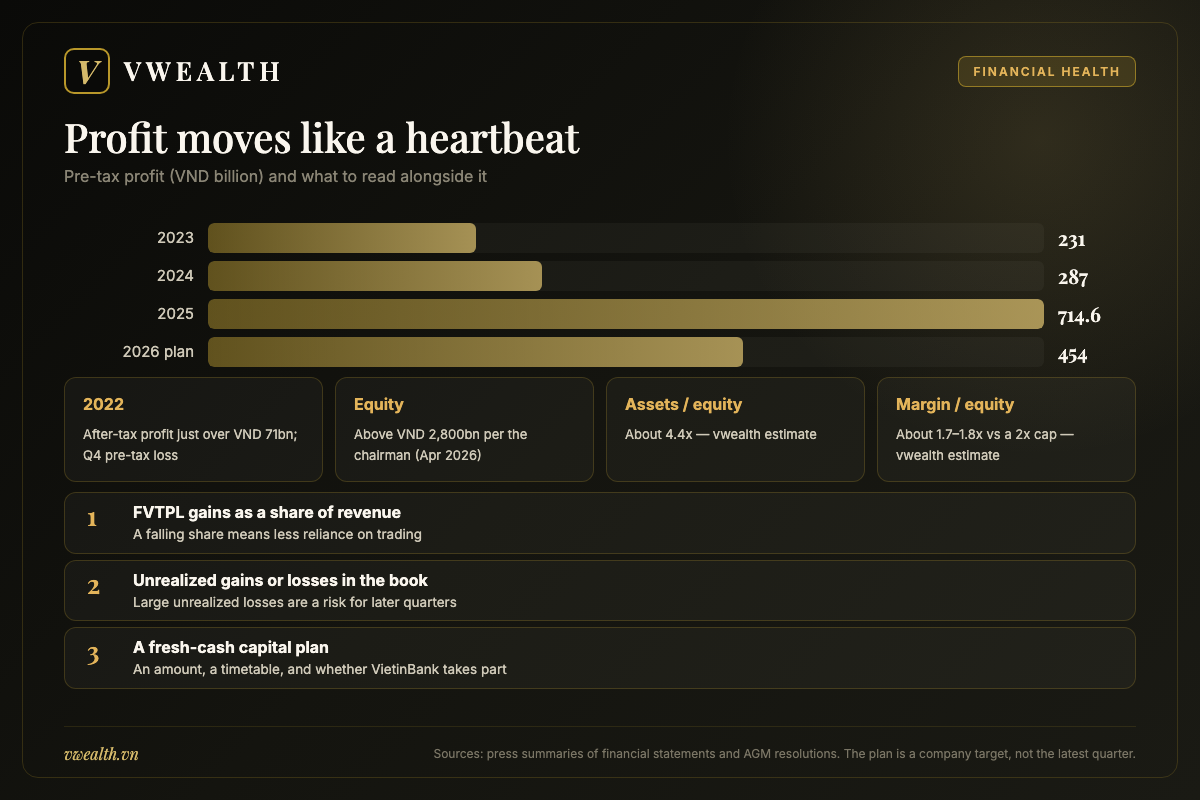
The table below gathers closed-year profit figures that the financial press has compiled from company reports. Read it like a heartbeat monitor, not a straight line.
| Year | Reported profit | Context |
|---|---|---|
| 2021 | Pre-tax about VND 482 billion (vwealth estimate from the 2022 plan) | Retail investor boom, record liquidity |
| 2022 | After-tax just over VND 71 billion; revenue about VND 872 billion; Q4 pre-tax loss about VND 7.2 billion | Deep equity sell-off, frozen corporate bond market |
| 2023 | Pre-tax about VND 231 billion | Recovery; year-end margin book about VND 2,777 billion, a record at the time |
| 2024 | Pre-tax about VND 287 billion, after-tax about VND 231 billion; revenue above VND 1,200 billion | Beat the VND 280 billion plan; Q2 after-tax profit only VND 20.9 billion |
| 2025 | Pre-tax about VND 714.6 billion (+148.7%), after-tax about VND 577.4 billion | Record year; total assets above VND 12,500 billion |
| 2026 (plan) | Pre-tax VND 454 billion (−36.5% versus 2025) | Approved at the April 21, 2026 AGM; planned dividend 9% |
The first thing to notice: 2025 profit was about 2.5 times 2024 and roughly ten times 2022 after-tax profit. No service business grows that fast organically; most of the surge came from proprietary trading, lending and brokerage all moving in the same direction in a hot market. The second thing: management set a much lower plan for 2026 — an implicit admission that 2025 will be hard to repeat. If you value CTS on 2025 earnings as if they were “normal”, you are overestimating the company’s sustainable earning power.
For 2026 quarterly results — current figures — please open the latest vwealth report. What we can say here is that the press reported early-2026 quarters well below the record-year comparisons, with proprietary trading no longer as favorable as the year before — exactly the heartbeat pattern visible in the table above.
Earnings quality: is revenue or cost driving profit?
A useful way to judge earnings quality is to compare revenue growth with cost growth. The second quarter of 2025 is a clear example: total revenue of about VND 578.8 billion rose 111%, while operating expenses rose only 45% to about VND 361.4 billion. That gap is why after-tax profit rose more than 700%. The company attributed the jump to brokerage, gains on selling financial assets, lending interest and other investments all performing well.
The right conclusion is that VBSE has very high operating leverage. Fixed costs — staff, technology, interest — do not rise in step with revenue, so most incremental revenue drops to the bottom line. The reverse is also true: when revenue falls, costs do not shrink fast enough, and profit contracts faster than revenue. That is what happened in the fourth quarter of 2022 and the second quarter of 2024.
When you read the statements, split profit into two buckets: the “repeatable” part (margin interest minus funding cost, brokerage fees, advisory fees) and the “opportunistic” part (FVTPL gains, gains on asset sales). The bigger the first bucket, the more reliable the earnings. At VBSE the second bucket has historically been large, which is why the market has been reluctant to pay a high multiple for this stock even in its record year.
Leverage and funding: assets around four times equity
VBSE’s total assets exceeded VND 12,500 billion at the end of 2025, against equity of just over VND 2,800 billion. Assets were therefore about 4.4 times equity (vwealth estimate), meaning most of the balance sheet is funded with debt — bank borrowings, short-term paper and client cash held temporarily. That is normal for a brokerage, but it has two consequences.
First, financial expenses deserve close attention. When borrowing rates rise, or when debt grows to fund margin loans and trading positions, interest costs can eat much of the profit — and the press did report a sharp rise in VBSE’s financial expenses during 2026. Second, this is exactly where a bank subsidiary’s advantage should show up: if VBSE can borrow from the banking system more cheaply than independent brokerages, its margin-lending spread will be better. But lending from the parent bank itself is subject to legal limits on credit to subsidiaries under Vietnam’s Law on Credit Institutions, so the advantage is not unlimited.
The first ratio to check when you open VBSE’s balance sheet is margin loans divided by equity. As calculated in the previous chapter, it was around 1.7–1.8 times at the end of 2025 (vwealth estimate), close to the 2x cap. If the ratio keeps approaching 2x without new capital, lending growth will have to stop — however good the market is.
Returns: high ROE in good years, so average across several
Return on equity (ROE) measures how much profit each dong of shareholder capital generates. In 2025, with after-tax profit of about VND 577 billion and average equity of roughly VND 2,500 billion, VBSE’s ROE was above 20% (vwealth estimate) — well above the 14.3% average S&I Rating reported for bank-affiliated brokerages. In 2022, however, after-tax profit of just over VND 71 billion on equity of somewhat more than a thousand billion dong meant an ROE in the low single digits.
The lesson: with CTS, never value the stock on one year’s ROE. Average at least three to five years, including the bad ones. For a broader discussion of how foreign investors can evaluate Vietnamese financial stocks, see our comprehensive guide to the Vietnam stock market.
A note on accounting for readers used to IFRS or US GAAP. Vietnamese brokerages report under Vietnamese Accounting Standards and a dedicated reporting template set by the Ministry of Finance. The categories — FVTPL, HTM, AFS, loans — look familiar, but the presentation differs: gains and losses on FVTPL assets are shown gross on separate revenue and expense lines, so “operating revenue” can rise even in a quarter when trading was a net loss. Always net the FVTPL gain line against the FVTPL loss line before drawing conclusions, and read the notes on the proprietary portfolio, where cost and market value of each major holding are disclosed. Financial statements are published quarterly in Vietnamese; check the company website for any English versions of the audited reports.
Seven questions to ask every time VBSE reports
Rather than memorizing dozens of numbers, carry seven questions into each quarterly report.
One — what share of operating revenue comes from FVTPL gains? A falling share signals the company is keeping its promise to reduce reliance on trading. Two — which stocks dominate the proprietary book, and are they showing unrealized gains or losses against cost? A large unrealized loss is a time bomb for later quarters. Three — where is margin-to-equity relative to the 2x ceiling? Four — how much is left of lending income after interest expense; is the net spread of the lending business narrowing?
Five — is advisory and underwriting revenue genuinely rising, or is it still a handful of one-off deals? Six — does the capital-raising plan have a timetable, what form will it take (stock dividend, rights issue to existing shareholders, private placement), and will VietinBank take part? Seven — are financial expenses growing faster or slower than revenue? If faster for several quarters in a row, leverage is hurting rather than helping.
These seven questions are why this article does not give you the latest quarter’s figures: numbers go stale in three months, but the questions stay useful. When you open the vwealth report on CTS, check exactly these seven places.
How the market treats CTS stock: a small cap that rides the sector’s waves
TCX and VCK have IPO stories to tell: offer prices, subscription multiples, debut sessions. CTS does not. It has been listed since 2009 and has lived through nearly every cycle in Vietnam’s market. So the right question about CTS stock is not “how did investors receive its IPO?” but “how does this stock behave in each wave of the brokerage sector?”
Stock personality: steep rallies, decisive drops
Brokerage stocks generally have high beta — they move more than the overall market — because their earnings depend directly on trading volume and share prices. CTS is even more sensitive than the sector average for two reasons: a small market capitalization and earnings that lean heavily on proprietary trading.
2025 illustrated that personality vividly. From late April to July 24, 2025, CTS rose about 71%, including consecutive limit-up sessions after the company reported second-quarter profit up more than 700%, reaching VND 38,100 — described by the press as an all-time high — with market value touching about VND 8.1 trillion for the first time. For the full year the stock gained about 33.5%. But by late March 2026, as the market cooled and the new profit plan came in much lower, the stock was down nearly 20% from the start of the year.
If you own CTS, be ready for swings of that size. A stock that can rise more than 70% in a quarter can also fall by tens of percent in another quarter without any fundamental change in the business. HOSE’s daily limit of plus or minus 7% from the reference price is a band CTS has touched at both ends.
Why CTS draws so much attention despite its size
CTS is among the tickers Vietnamese investors search for and talk about quite often, even though its market value is only a few trillion dong. There are at least four reasons, all verifiable in the news flow. First, the VietinBank name: many people bank with VietinBank and are curious about its brokerage. Second, sharp rallies like 2025’s draw short-term traders. Third, a steady stream of corporate events — the VBSE rebrand, 43% and then 28% stock dividends, capital-raising talk — keeps the ticker in the headlines. Fourth, whenever the market talks about a “brokerage stock wave” ahead of the upgrade, investors hunt for small brokerage names in the hope they will outrun the big ones.
That attention cuts both ways. It helps liquidity during busy periods. But it also means the price reflects crowd psychology more than it would in a stock dominated by institutional holders. When the crowd leaves, the price can fall faster than fundamentals justify.
Valuing a small brokerage: P/B matters more than P/E
For banks and brokerages, price-to-book (P/B) is usually more useful than price-to-earnings (P/E), because their assets are mostly financial assets carried close to market value while earnings swing widely. For CTS that logic is even stronger: a P/E based on 2025 earnings looks very cheap, while a P/E based on 2022 earnings looks very expensive — and neither reflects “normal” earning power.
A more sensible approach has three steps. Step one: estimate a “normal ROE” as a multi-year average. Step two: compare CTS’s current P/B with its own history and with brokerages of similar size. Step three: ask what P/B is reasonable for that normal ROE given high trading risk. A rough rule: a company whose sustainable ROE exceeds its cost of equity deserves a P/B above 1; one whose sustainable ROE falls short can reasonably trade below 1.
We do not print today’s P/B for CTS for a simple reason: it changes daily and shifts sharply after each stock dividend as the share count grows. Open the vwealth report to see current P/B and P/E together with the stock’s historical valuation range.
Foreign investors and the FTSE Russell upgrade: expectations need recalibrating
On October 7, 2025, FTSE Russell announced it would reclassify Vietnam from Frontier to Secondary Emerging status effective September 21, 2026, with inclusion phased in over four tranches: 10% in September 2026, a further 20% in March 2027, 35% in June 2027 and the final 35% in September 2027. For the brokerage sector the effect is indirect: more foreign capital means more liquidity, which means more commissions, more margin demand and more issuance advisory. Our article on whether Vietnam is an emerging market walks through the scenarios in detail.
For CTS specifically, the direct effect of index flows is probably small. As noted in chapter two, about three quarters of the shares sit with VietinBank, free float is about a quarter, and market value is a few trillion dong. Large index funds favor stocks with big free-float capitalization. If CTS benefits, it will most likely be indirectly, through higher earnings as market liquidity rises, rather than through foreign funds buying CTS shares.
There is one exception worth watching. If VietinBank ever sells part of its stake to a foreign strategic investor — something with no concrete plan today — the free float and foreign interest could change significantly. That is why the 49% cap is worth remembering.
Catalysts that could change how the market sees CTS
Five developments could make the market re-rate CTS, up or down. First, fresh capital. The roughly VND 3,000 billion target mentioned by the chairman is a small step; a larger offering with VietinBank’s participation or a strategic investor would lift the margin ceiling. Second, earnings quality. Several consecutive quarters in which profit comes mainly from lending, brokerage and investment banking rather than trading would help the market believe in a higher “normal” earnings level.
Third, market liquidity after the upgrade. Management has set out a good-case target of VND 40,000–50,000 billion in daily market turnover; average daily turnover in the first quarter of 2026 was about VND 30,000 billion according to the figures the company cited. Fourth, big investment-banking mandates from VietinBank’s ecosystem, especially in green bonds and sustainable finance. Fifth, a carbon exchange — if it launches quickly and VBSE is among the first intermediaries, the long-term story gains weight. In the other direction, a quarter with a big trading loss or news that capital raising has been postponed could knock the stock down more than seems “fair”.
Industry backdrop: bank-owned brokerages are growing fast — all but one
If you have read our TCX and VCK analyses, you already know the story of the capital race and the 2025 wave of brokerage IPOs. This chapter does not retell it. Instead it looks at the race from VBSE’s seat: a subsidiary of a state-controlled bank watching the subsidiaries of private banks pull ahead, and why that gap is hard to close.
The rise of bank-affiliated brokerages
According to VIS Rating, bank-affiliated brokerages increased their share of margin lending from 19% in 2022 to 30% in 2024. The reason lies in three advantages independents struggle to match: cheaper funding thanks to the parent bank, a ready client base for cross-selling, and brand credibility. VPBankS is the extreme example: since VPBank took it over in 2022, total assets grew roughly 260-fold, from about VND 280 billion to more than VND 73,000 billion, with margin loans above VND 36,000 billion by the first quarter of 2026.
VBSE belongs to the same “bank child” group but has followed a very different path. The difference is not the team’s competence; it is the owner. Private banks such as VPBank, Techcombank or MB can decide quickly to pour tens of trillions of dong into their brokerages because that is part of their competitive strategy. A bank controlled by the state must weigh its own capital needs — already under pressure to meet capital-adequacy requirements as lending grows — and go through the approval process of the state owner’s representative.
Still, the state-bank group is moving too. Vietcombank lifted VCBS’s capital from VND 2,500 billion to VND 8,500 billion in May 2026 with a plan to reach VND 12,500 billion; BIDV Securities aims to lift equity above VND 11,000 billion. So the “state-ownership barrier” is not insurmountable. If VietinBank follows Vietcombank’s path, VBSE’s story could change quickly. That is why this is the single most important variable to track.
The capital race: the gap is widening
In early 2026 the whole brokerage industry entered an unprecedented capital race. VIX won approval to offer nearly 919 million shares to lift capital from about VND 15,300 billion to VND 24,500 billion; VPS planned a bonus-share issue taking capital from about VND 15,200 billion to VND 24,300 billion; Vietcap (VCI) approved raising capital from VND 8,500 billion to over VND 11,400 billion; MBS was offering shares to reach VND 10,000 billion; and SSI’s capital stood at about VND 24,900 billion. At the end of 2025, industry-wide margin lending was about VND 400,000 billion — a record — led by TCBS with over VND 43,000 billion and SSI with nearly VND 39,000 billion.
Place VBSE, with about VND 2,722 billion of charter capital and nearly VND 5,000 billion of margin loans, in that picture and it holds a little over 1% of industry margin lending (vwealth estimate). The capital race widens the gap every quarter: firms with more capital lend more, earn more and retain earnings to raise capital again. A company growing capital mainly through retained earnings, as VBSE does, will always trail unless it gets a big injection. For direct comparisons, see our analyses of SSI stock and VIX stock.
Brokerage competition: a game for players with scale
The zero-fee model TCBS launched at the start of 2023 has gradually spread. For large players, low commissions are an acceptable price for pulling clients into margin loans and other products. For small players, a fee war is unwinnable. VBSE chose not to join, keeping its fees and focusing on advisory and managed accounts — a rational choice that also means brokerage market share is unlikely to jump.
Competition also comes through technology. Large brokerages spend hundreds of billions of dong on trading apps, AI-driven advice and electronic onboarding. VBSE says it prefers to adapt existing technology rather than build from scratch to save money — sensible financially, but hard to differentiate on user experience.
There is also a quieter form of competition that foreign readers often overlook: competition for talent. Experienced brokers, analysts and investment bankers in Vietnam move between firms quickly when a well-capitalized rival offers bigger bonuses or larger balance sheets to work with. A mid-sized firm with a state-bank pay culture can find it hard to keep star staff during boom years. VBSE’s lean headcount of around 239 people in mid-2025 limits cost, but it also means the departure of a few key people in investment banking or proprietary trading could matter more than it would at a large house.
Debt capital markets and green finance: VBSE’s potential home turf
If there is one area where the parent relationship creates a real edge, it is debt capital markets — corporate bonds, bank bonds and green bonds. After the 2022 shock, Vietnam tightened corporate-bond rules on professional-investor status, credit ratings and disclosure, and issuers with strong fundamentals backed by large banks gained favor. That environment suits advisers linked to state-controlled banks.
Green finance is the second layer. VietinBank has published a sustainable-finance framework and green credit packages; VBSE has advised on green bonds and is preparing carbon-trading infrastructure. Vietnam targets net-zero emissions by 2050, and a domestic carbon market is being built along a pilot roadmap. If VBSE becomes one of the first intermediaries in that market, it could own a niche that larger rivals have not prioritized.
New infrastructure and the upgrade: shared benefits, unevenly split
A new trading system in operation since 2025, the removal of the pre-funding requirement for foreign institutional investors, and FTSE Russell’s reclassification are infrastructure changes that help the whole industry. The benefits will not be shared evenly, though: firms with foreign institutional clients, the capital to offer custody services and English-language research teams will capture most of them. VBSE has the VietinBank brand in front of foreign counterparts — MUFG is the parent bank’s strategic shareholder — but there is no public evidence that serving foreign institutions is a core focus of the company.
VBSE versus other bank-affiliated brokerages
The table below places VBSE next to brokerages with banks behind them. Capital figures are as reported at various points in 2025–2026; check them again when you read this, since the capital race is ongoing. For deeper profiles, see our analysis of MBS stock and our VCK stock analysis of VPS for the opposite model — a firm that separated from its bank.
| Firm (ticker) | Bank behind it | Reported capital | Profile | Difference from VBSE |
|---|---|---|---|---|
| VBSE (CTS) | VietinBank, about 75.6% | Charter capital about VND 2,722 billion (Jul 2026) | Large proprietary book relative to capital, IB via parent, brokerage outside top 10 | — |
| TCBS (TCX) | Techcombank, about 80% at listing | Charter capital about VND 27,739 billion | Largest equity base, leading margin book, bonds | About ten times larger; private parent decides fast |
| VPBankS (VPX) | VPBank | Equity near VND 34,000 billion after IPO | Very fast asset growth since 2022, strong IB | Heavily capitalized by its parent from the start |
| MBS (MBS) | MB | Offering to lift capital from about VND 6,673 billion to VND 10,000 billion | Wide network, many retail clients | Raises fresh cash from shareholders |
| BSC (BSI) | BIDV; Hana Securities about 35.01% | About VND 2,700 billion charter capital; equity target above VND 11,000 billion | Korean strategic shareholder | Similar size today but already has a foreign partner and a big plan |
| VCBS (unlisted) | Vietcombank | VND 2,500 billion to VND 8,500 billion (May 2026), plan VND 12,500 billion | State-controlled parent injecting heavily | Shows the path VietinBank could choose |
The table shows VBSE is closest to BSC in current capital and closest to VCBS in ownership structure. The difference is that both rivals have announced large capital plans, while VBSE has so far targeted only about VND 3,000 billion.
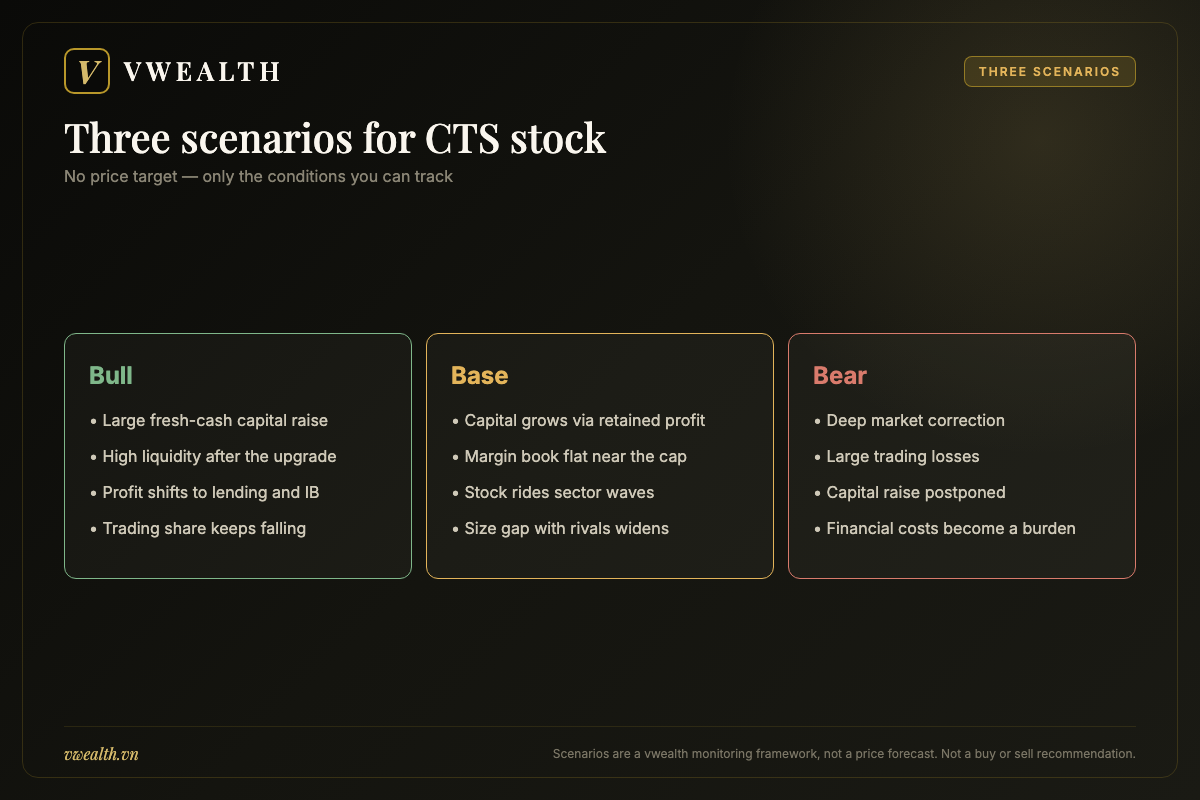
Outlook: three scenarios for CTS stock and the conditions behind each
Forecasting the share price of a small brokerage is close to pointless: one good or bad quarter on the proprietary desk is enough to break any model. What is useful is identifying the variables that will decide VBSE’s future and asking how the picture changes if they go one way or the other. We do not offer a price target; the three scenarios below are a framework you can monitor yourself.
Five variables that will shape VBSE’s future
The first variable is capital. Will there be a fresh-cash capital increase, how large, and will VietinBank take up its share? This matters most because it opens or locks the ceiling on margin lending and underwriting capacity. The second is market liquidity. The upgrade, low interest rates and the return of retail money would lift commissions, margin demand and trading gains all at once.
The third is trading discipline. Will the company really reduce the weight of proprietary trading as promised, and diversify its book rather than concentrating in a few large positions? The fourth is how deeply VietinBank’s ecosystem is tapped — the number of clients referred from the bank and the number of issuance mandates from the parent’s corporate borrowers. The fifth is funding cost. Interbank and deposit rates determine the spread on margin lending.
Bull case: fresh capital lifts the ceiling in a busy market
Conditions: VietinBank and regulators approve a meaningful fresh-cash capital increase — much larger than the roughly VND 3,000 billion now being discussed — or a strategic investor is found; market liquidity stays high after the upgrade; and the company shifts its profit mix toward lending, brokerage and investment banking.
In this scenario the margin book has room to keep growing instead of stalling near the 2x equity cap; issuance mandates from VietinBank’s clients rise steadily; profit relies less on FVTPL gains. The market could begin valuing CTS as a genuine bank-backed brokerage rather than a small trading-driven stock — accepting a P/B above its own historical average. Early signs to watch for: a capital-raising resolution with a concrete amount and timetable, and a declining share of FVTPL gains over several consecutive quarters.
Base case: slow growth funded by retained earnings
Conditions: the company keeps growing capital mainly via stock dividends and retained earnings, perhaps with a small top-up; markets alternate between good and bad years; proprietary trading remains a significant contributor.
This is close to the picture management has drawn for itself: a cautious 2026 plan, stock dividends to enlarge capital, a “top 15” rather than “top 5” ambition. Profit would fluctuate around an average — higher than in 2022–2024 thanks to a larger capital base, but rarely repeating 2025. CTS in this scenario remains a stock that rides the sector’s waves: sharp rallies in hot markets, deep pullbacks when markets cool. The size gap with other bank-owned brokerages keeps widening.
Bear case: a trading accident while capital is still small
Conditions: a deep or prolonged market correction (from rising interest rates, geopolitical stress, or foreign flows disappointing after the upgrade); several large holdings in the proprietary book fall sharply; the capital-raising plan is postponed.
In this scenario profit could drop back to 2022-like levels, with the possibility of loss-making quarters; the margin book would have to shrink; financial expenses would become a burden because most assets are funded with debt. The stock could fall faster than the sector because of its small size and crowd-driven trading. Management itself cited Middle East volatility when setting the 2026 plan — external shocks are beyond anyone’s control. The only cushion in the bear case is the parent: it is hard to imagine a VietinBank-branded brokerage facing a serious liquidity crisis without support. But “supported enough to survive” is very different from “generating returns for minority shareholders”.
A practical way to use these scenarios is to write down, today, which early signs you will check each quarter and what you will do if they appear. For example: if a capital-increase resolution with an amount and timetable is published, you might reassess upward; if unrealized losses in the trading book rise for two consecutive quarters while financial costs outpace revenue, you might cut your position. Writing the rules down before the news arrives protects you from reacting emotionally to a stock that moves as sharply as CTS does.
Illustrative example: how much the margin ceiling limits profit
To see why capital is the biggest variable, try a simple calculation. This is an illustrative example using round assumptions, not a forecast.
Suppose VBSE’s equity is VND 2,800 billion. The margin cap is 200% of equity, or a maximum of VND 5,600 billion. If loans already stand at VND 5,000 billion, only VND 600 billion of headroom remains. Assume the lending business earns a net spread (interest from clients minus funding cost) of 4% a year: that VND 600 billion would add at most about VND 24 billion of pre-tax profit a year — small next to swings in trading income.
Now suppose the company raises VND 3,000 billion of new equity, taking the total to VND 5,800 billion. The new margin cap is VND 11,600 billion, adding VND 6,600 billion of headroom. At the same 4% spread, fully lending that headroom would add about VND 264 billion of pre-tax profit a year. But equity would more than double, so ROE improves only if the new capital is deployed as efficiently as the old. And the share count would rise, so earnings per share would depend on the issue price.
The lesson: a capital increase is a necessary condition for VBSE to grow, but it is not automatically good for existing shareholders. An issue priced below book value dilutes them; an issue priced well and deployed efficiently benefits them. When capital-raising news breaks, read the issue price and the stated use of proceeds carefully before celebrating.
| Scenario | Conditions | Early warning signs | Implication for CTS stock |
|---|---|---|---|
| Bull | Large fresh-cash capital increase; high liquidity after the upgrade; profit mix shifts to lending and IB | A resolution with an amount and timetable; FVTPL share falling for several quarters | Re-rated as a genuine bank-backed brokerage |
| Base | Capital grows mainly through retained earnings; markets alternate | Regular stock dividends; margin book flat near the cap | Rides sector waves, high volatility, widening size gap |
| Bear | Deep market correction; trading losses; capital increase postponed | Unrealized portfolio losses grow; financial costs outpace revenue | Profit drops sharply, stock falls faster than the sector |
So, should you buy CTS stock? A straight answer
After seven chapters, back to the original question. Should you buy CTS stock? The honest answer is: it depends on what you are looking for. CTS is not a “good” or “bad” stock in absolute terms; it is a tool with a very distinct personality, suited to some investors and poorly suited to others. This final chapter weighs the pros and cons and helps you place yourself.
The compelling positives
First, a strong and stable parent. VietinBank is one of Vietnam’s four big state-controlled commercial banks, with MUFG as a strategic shareholder. For VBSE that means a very low risk of collapse, a credible brand when dealing with large companies, and better access to funding than an independent brokerage of the same size.
Second, longevity and an investment-banking foundation. Over 25 years of operation, relationships with VietinBank’s corporate clients and experience advising on bonds — including green bonds — cannot be bought in a year or two. If Vietnam’s debt capital market develops strongly after its restructuring, VBSE starts from a good position.
Third, high earnings leverage in good markets. 2025 showed that when everything lines up, VBSE’s profit can double or triple. A small-cap stock also reacts more strongly to good news. For risk-tolerant investors who can time the sector, that is an attractive trait.
Fourth, the capital story is a valuable option. If VietinBank chooses the path Vietcombank took with VCBS, VBSE’s scale could change quickly. Holders today own an “option” on that decision — even if nobody knows whether it will ever be exercised.
Fifth, a pragmatic management style. A cautious 2026 plan, modest market-share goals, no zero-fee race, reuse of existing technology — these choices suggest a leadership team that understands its limits and will not burn capital in races it cannot win.
The negatives you cannot ignore
First, heavy reliance on proprietary trading. 2022 and the second quarter of 2024 showed how hard profit can fall. You cannot extrapolate from a good year, and the market will not pay a high multiple for opportunistic earnings.
Second, small and slow-growing capital. With charter capital of about VND 2,722 billion, margin loans near the 2x equity cap, and every fresh-cash capital decision requiring approval from the parent and regulators, VBSE is constrained precisely in its best-growing business. Meanwhile rivals are multiplying their capital.
Third, little voice for minority shareholders. VietinBank holds about 75.6%; every AGM resolution is essentially decided by the parent. The bank’s interests — serving corporate clients, staying safe, complying with state-capital rules — do not always coincide with maximizing returns for minority holders.
Fourth, cash dividends are not a strength. The large recent distributions have all been in shares. If you need steady cash income, other Vietnam stocks are better suited.
Fifth, limited direct benefit from the upgrade. A free float of about a quarter and a small market value make it hard for CTS to enter large index-fund portfolios. The “foreigners buy brokerage stocks” story is likely to flow to the large names first.
| Aspect | Pro | Con |
|---|---|---|
| Ownership | VietinBank and the state behind it; very low collapse risk | Slow capital raising; minority holders have little say |
| Business model | IB and bond franchise via the parent’s ecosystem | Profit depends on trading and swings sharply |
| Margin lending | Fast growth, steadier than trading | Loan book near the 2x equity cap |
| Brokerage | No cash burned in a fee war | Outside the top 10; hard to grow quickly |
| Dividends | Bonus shares enlarge the capital base | Little cash; EPS diluted |
| The stock | Reacts strongly to good news; decent liquidity in sector rallies | High volatility, low free float |
| Future | Option on a large capital raise, carbon credits, green finance | Gap with rivals widens without new capital |
One more practical point for international investors. Buying CTS requires a Vietnamese securities account and a trading code for foreign investors, and because the free float is small, order sizes that are trivial on a large-cap name can move the price of CTS noticeably on a quiet day. Use limit orders rather than market-style orders, check average daily trading value before sizing a position, and remember that HOSE settles on a T+2 basis, so the cash from a sale is not available immediately. None of this is a reason to avoid the stock, but it does mean position size should reflect liquidity, not just conviction.
Which investors CTS suits
Traders of the brokerage-sector cycle. If you are experienced at reading liquidity waves and can live with big swings, CTS has a lot of “bounce” in hot markets. The condition is disciplined profit-taking and stop-losses.
Investors betting on VietinBank’s capital decision. If you believe VietinBank will sooner or later have to scale up its brokerage to avoid falling behind Vietcombank, BIDV and the private banks, CTS is the most direct way to express that view. Remember it is a bet on a decision with no timetable.
Investors adding a small brokerage name to a portfolio that already holds large ones. If you already own SSI, TCX or VCK, a small allocation to CTS can raise your portfolio’s sensitivity to the sector cycle. It should not be a core position. For foreign investors weighing how to access such names at all, our guide to investing in Vietnam stocks from abroad covers the practicalities.
Who should avoid it
Investors who need regular cash dividends — the stock-dividend policy does not serve that need. Buy-and-forget holders — with volatile profits and an unresolved capital story, CTS requires quarter-by-quarter monitoring. Anyone who cannot stomach a drawdown of several tens of percent — history shows such drops can happen within months.
Investors buying purely on the expectation of foreign inflows after the upgrade should also think again: as discussed, CTS is unlikely to be the first stop for index funds. And investors buying simply because of the VietinBank name should remember that the parent’s brand protects the company from failure, but does not guarantee returns for shareholders.
Final thoughts
VietinBank Securities is one of the paradoxes of Vietnam’s stock market: the earliest to arrive but never the fastest, the child of a large bank that still describes itself as mid-sized. 2025 showed the company can earn very well when the market cooperates; 2022 and 2024 showed it can run out of breath quickly when the market turns. The cautious 2026 plan is a reminder that management itself does not treat the record year as the norm.
So, should you buy CTS stock? If you trade the sector’s waves with discipline and accept volatility, CTS can be a useful tool at a moderate weight. If you are betting on a big capital injection from VietinBank, treat it as an option with no expiry date and do not over-allocate. If you are looking for a stable financial stock to hold for years and collect dividends, there are better choices among the large banks and brokerages. The most important thing to watch over the next one to two years is not quarterly profit but a single question: will VietinBank decide to let its brokerage grow up?
This article is for information and analysis only and is not a recommendation to buy or sell. Before deciding, check current figures — price, P/B, P/E, the latest quarter’s profit, margin balances and the proprietary book — in the vwealth analysis report, and consider your own risk tolerance. If you are interested in Vietnamese brokerages, our analyses of SSI, HCM, MBS, SHS, VIX, ORS, TCX and VCK are good points of comparison — for instance our HCM stock analysis, our SHS stock analysis and our ORS stock analysis, the latter two being other mid-sized brokerages to set beside CTS. You can create a vwealth account to follow updated CTS reports each quarter.
Research Vietnamese stocks in English with vwealth. Our AI-powered platform turns Vietnamese market data into full English analysis reports — with international payment support and a free 2-month trial for new accounts. Create your free account and read the latest reports.