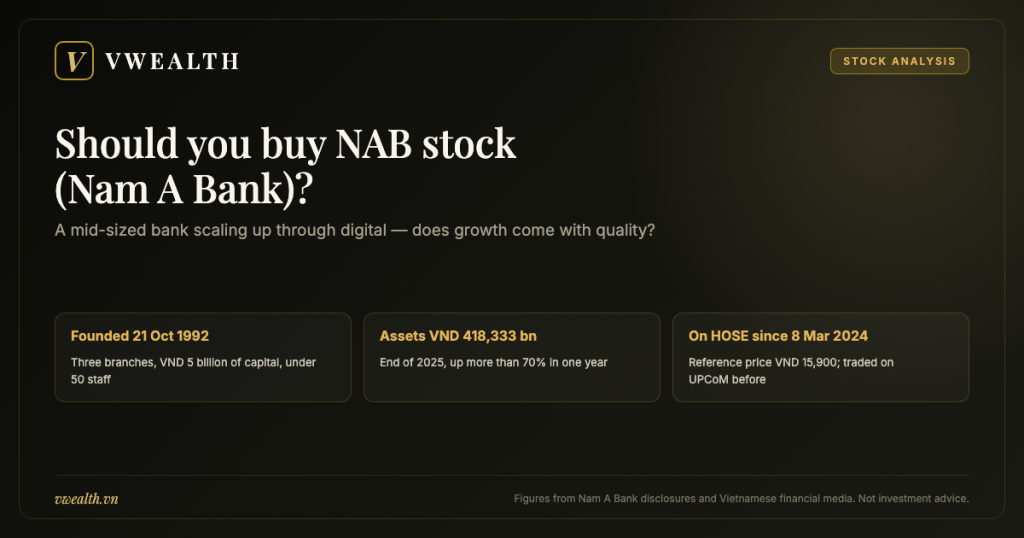
Should you buy NAB stock? The ticker belongs to Nam A Commercial Joint Stock Bank — Nam A Bank — a Ho Chi Minh City lender listed on the Ho Chi Minh Stock Exchange (HOSE), and in early 2026 it published a number that made investors look twice: total assets grew by more than 70% in a single year, to VND 418,333 billion at the end of 2025, lifting the bank into the top 15 in Vietnam by balance-sheet size. This is a bank that opened in 1992 with three branches and VND 5 billion of capital, spent decades closely associated with the family of the late businesswoman Tran Thi Huong and the Hoan Cau group, moved onto the UPCoM market in 2020 and graduated to HOSE in 2024. Nam A Bank sells itself on two words, “Digital” and “Green”: self-service ONEBANK branches, an Open Banking app, a brand-new Oracle core banking system, about USD 160 million of funding from international lenders in 2025 and almost USD 350 million in the first eight months of 2026. Read the financial statements closely, however, and the picture gets more complicated: current-account deposits of only about 5–6% of customer deposits, a capital adequacy ratio drifting lower, and a share count that grows every year through bonus issues. This analysis walks through the whole story, shows you how to read Nam A Bank’s own numbers, and gives a straight answer on whether its growth comes with quality — and which kind of investor NAB stock suits.
First, the name, because Vietnamese bank names can be confusing for foreign readers. NAB is the ticker of Ngan hang Thuong mai Co phan Nam A, officially Nam A Commercial Joint Stock Bank, usually branded Nam A Bank (the local press sometimes writes NamABank). Its head office is at 201–203 Cach Mang Thang Tam Street in Ho Chi Minh City. Do not confuse it with VietABank (Viet A Bank, ticker VAB) or Bac A Bank (ticker BAB): three similar-sounding names, three unrelated banks with different shareholders. NAB shares have traded on HOSE since 8 March 2024; before that they traded on UPCoM, Vietnam’s market for unlisted public companies, from 9 October 2020.
Second, our conventions, as in every stock analysis in the vwealth series. Events, names, transactions and figures in this article come from published information — annual reports, shareholder meeting documents, reviewed consolidated financial statements and disclosures by Nam A Bank, ratings from Moody’s and FiinRatings, trading data from VNDirect, and major Vietnamese financial media such as VnExpress, CafeF, VietNamNet, Dau tu Chung khoan (Investment and Securities Newspaper) and Bao Dau tu. Figures for closed financial years are used as historical reference points. We deliberately do not quote today’s share price, current P/B or P/E, or the latest quarterly profit, because they change daily. Where a figure is vwealth’s own calculation, it is labelled “vwealth estimate” or “illustrative example”. For live numbers, open the vwealth analysis reports. If you are new to the market itself — trading hours, T+2 settlement, daily price limits, foreign ownership caps — start with our guide on how to invest in the Vietnam stock market.
One last point sets the frame for the whole piece. vwealth has already covered several mid-sized private Vietnamese banks — OCB with its Japanese strategic shareholder Aozora, MSB with one of the highest current-account ratios and SeABank after selling its consumer finance arm to AEON. Nam A Bank is a different species: a mid-sized bank that has chosen to scale up very fast, with digitalisation as its headline story. So the question of whether to buy NAB stock comes down to three things: what actually produced the 2025 asset jump, whether digitalisation has lowered the bank’s funding costs yet, and whether profit is growing fast enough to outrun the dilution from constant share issuance.
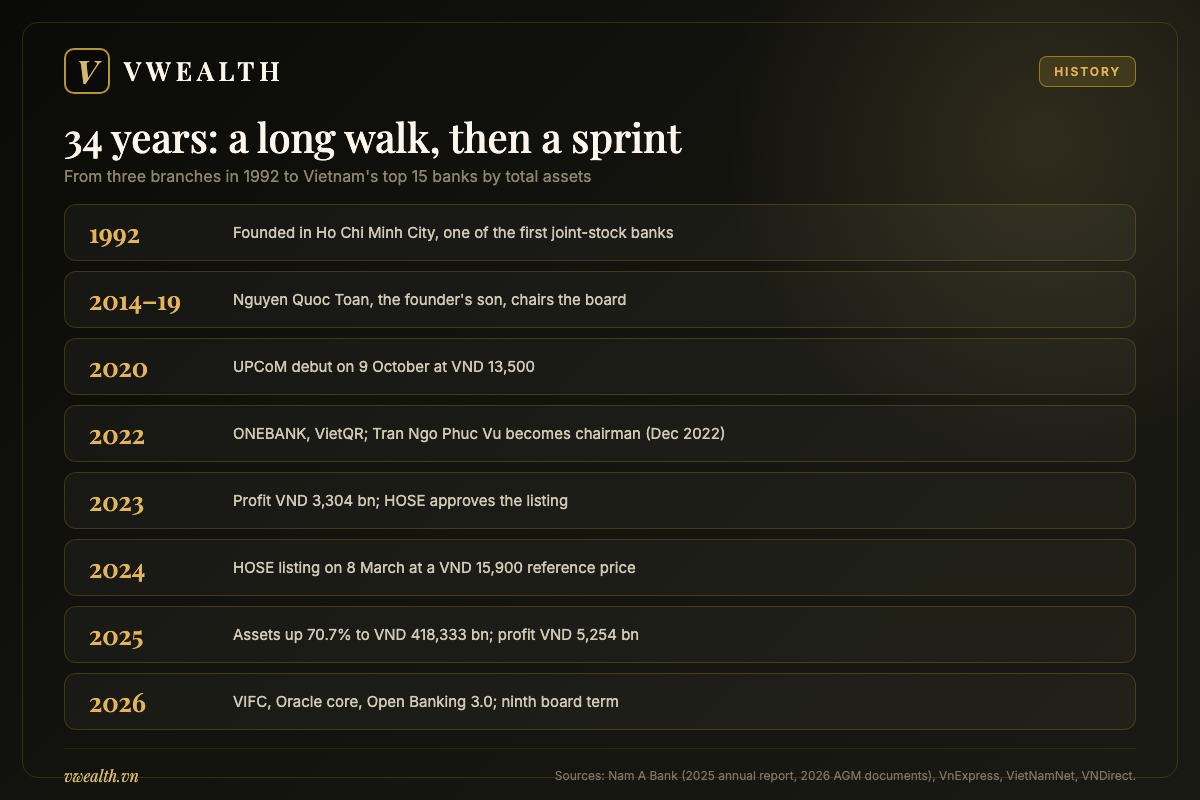
From three branches in 1992 to Vietnam’s top 15: Nam A Bank’s 34-year journey
Some Vietnamese banks grew big because a state conglomerate stood behind them. Others grew because a foreign strategic partner brought capital and processes. Nam A Bank fits neither pattern. For almost three decades it was a small bank tied to a single business family in Ho Chi Minh City, slow to raise capital and repeatedly late on its listing plans. Then, over roughly the last five years, it accelerated at a pace rarely seen in the sector. To understand why NAB today combines impressive growth numbers with persistent weaknesses, you need to walk the journey from the beginning.
1992: one of the first joint-stock banks after Vietnam’s banking reforms
Nam A Bank opened for business in Ho Chi Minh City on 21 October 1992. The timing matters. In 1990 Vietnam passed two banking ordinances that, for the first time, separated the State Bank of Vietnam (the central bank) from commercial banking and allowed privately owned joint-stock banks to take deposits and lend. A wave of small urban and rural joint-stock banks followed within a few years. Nam A Bank was one of the first commercial joint-stock banks of that wave.
Its starting scale is hard to picture next to today’s balance sheet. According to the bank’s own description, it began with three branches, VND 5 billion of charter capital and fewer than 50 employees. According to VnExpress, its founder was Tran Thi Huong — widely known as “Tu Huong” — who also founded the Hoan Cau Group.
Why should a 1992 founding story matter to an investor in 2026? For two reasons. First, most of the small joint-stock banks born in the early 1990s no longer exist independently: some were merged, some acquired, some restructured under special supervision. Surviving more than thirty years is a meaningful fact in itself. Second, the long association with a founding family explains much of NAB’s later character: slow capital raising, a shareholder register that takes effort to read, and a drawn-out transition of control.
2000–2016: a family bank and a revolving chair
Through the 2000s and early 2010s, Nam A Bank was a small lender focused mainly on southern Vietnam. The chairmanship in the years that followed was tied to the founding family. According to VnExpress, Nguyen Quoc Toan — Mrs Huong’s son — chaired the board from March 2014, was removed at an extraordinary shareholder meeting in July 2015 (Phan Dinh Tan replaced him), and returned as chairman at the annual meeting on 15 April 2016, which elected the seventh-term board for 2016–2021.
On ownership, the bank’s 2015 prospectus, as cited by VnExpress, showed Mr Toan’s family as the largest group of individual shareholders with more than 11.63% combined: Mr Toan alone held 15 million shares, or 5% of charter capital; his younger brother Nguyen Quoc My — then the bank’s vice chairman — held 4.31%; and Mrs Huong held 0.47%. The fact that 15 million shares equalled 5% of the bank implies charter capital of only about VND 3,000 billion at the time (vwealth estimate derived from that ratio).
This was also when Vietnam’s banking system went through a restructuring after the 2011–2012 bad-debt crisis. For Nam A Bank, 2015 was eventful. According to VnExpress, the market was abuzz that year with talk of Nam A Bank merging into Eximbank; Eximbank’s shareholder meeting was postponed and the State Bank carried out an inspection before considering any deal. In March 2015, Tran Ngo Phuc Vu — then Nam A Bank’s chief executive — and Tran Ngoc Tam — then a deputy CEO — resigned to stand for Eximbank’s board; but at Eximbank’s extraordinary meeting on 15 December 2015, Mr Vu was not on the candidate list. In 2016 he returned to Nam A Bank’s board. The merger never happened. The Eximbank side of that story is covered in our EIB stock analysis.
2017–2019: a family upheaval, slow capital growth and rising profit
Mrs Huong passed away in 2017. According to VnExpress, a dispute over shares arose within the family afterwards. In 2019 the bank announced that Nguyen Quoc Toan would step down as chairman to focus on resolving the internal family dispute, having already delegated his duties to Tran Ngo Phuc Vu, the standing vice chairman. Nam A Bank stated at the time that this was a civil dispute over shares within the family and “entirely unrelated to the bank’s operations”.
Commercially, this was a period in which Nam A Bank was still small and slow to raise capital. According to the bank’s 2019 annual report, charter capital was VND 3,353 billion at the end of 2018 and VND 3,890 billion at the end of 2019; total assets rose from VND 75,059 billion to VND 94,687 billion; and the capital adequacy ratio at the end of 2019 was 9.66%. For comparison, by the end of 2025 charter capital was VND 17,157 billion and total assets VND 418,333 billion.
Yet profit started climbing. According to the same annual report, pre-tax profit was VND 743 billion in 2018 and VND 925 billion in 2019, up 24.4% and above the VND 800 billion target set by shareholders; the NPL ratio at the end of 2019 was 1.97%. Those were the first bricks of the acceleration that followed.
2020–2022: UPCoM, building ONEBANK and a new chairman
On 9 October 2020, about 389 million NAB shares — equal to charter capital of VND 3,890 billion — began trading on UPCoM at a reference price of VND 13,500; the stock closed its first session at VND 16,000 (VNDirect trading data). 2020 was also the first year pre-tax profit exceeded VND 1,000 billion (VND 1,005 billion); it reached VND 1,799 billion in 2021 and VND 2,268 billion in 2022, according to the 2025 annual report. Charter capital grew accordingly, to VND 5,134 billion at the end of 2021 and VND 8,464 billion at the end of 2022.
During the same period Nam A Bank built its ONEBANK digital ecosystem: self-service points open 365+ days a year, where customers can open accounts, place term deposits, pay bills and deposit or withdraw cash using QR codes under the national VietQR standard. According to VietNamNet, ONEBANK and the OPBA transaction robot were already in place before January 2022; on 10 January 2022 Nam A Bank was one of the first two banks to work with the national payment operator NAPAS on VietQR payments through Vietnam’s National Public Service Portal. By September 2023 the network passed 100 ONEBANK points, taking total business locations to almost 250 (VietNamNet).
Leadership changed fundamentally in 2022. In December 2022, Tran Ngo Phuc Vu — a former chief executive and later standing vice chairman — became chairman of the board (Lao Dong, 9 December 2022). The board list for the final stretch of the eighth term (2021–2026) in the bank’s governance report includes no members of the founding family. For many investors this closed the “family bank” chapter in terms of management; ownership is analysed in the next chapter.
2023–2024: a profit surge and becoming one of 18 banks on HOSE
2023 was a year of sharp profit growth. According to the 2025 annual report, 2023 pre-tax profit was VND 3,304 billion, about 45.7% above 2022’s VND 2,268 billion (the preliminary figure released in early 2024 was “over VND 3,300 billion, up 50%”), and total assets reached VND 209,896 billion at year-end. In August 2023 the State Bank approved an increase in charter capital from almost VND 8,500 billion to more than VND 10,500 billion (VietNamNet) — the last step before moving exchanges.
NAB was delisted from UPCoM on 29 February 2024, with a final close (28 February) of VND 16,500. On 8 March 2024, more than 1 billion NAB shares — over VND 10,580 billion at par — began trading on HOSE at a reference price of VND 15,900. On its first day NAB rose 6.29% to VND 16,900 on volume of about 5.6 million shares (VNDirect data). According to VietNamNet and VnExpress, Nam A Bank was the only bank approved for a HOSE listing in 2023, and with NAB there were 18 banks listed on HOSE.
Also in March 2024, Tran Khai Hoan — a long-serving executive — became a board member and acting chief executive, succeeding Tran Ngoc Tam, who stayed on the board as vice chairman. 2024 closed with pre-tax profit of VND 4,545 billion, up about 37.6%, and total assets of VND 245,129 billion.
2025–2026: a 70% asset jump, the international financial centre and a new board term
2025 was the year Nam A Bank made headlines. According to the annual report, total assets rose from VND 245,129 billion to VND 418,333 billion — an increase of VND 173,204 billion, or 70.7%. VietNamNet’s industry round-up ranked this as the fastest asset growth in the sector in 2025, well ahead of the next two, MB (about 43%) and NCB (38%). Pre-tax profit reached VND 5,254 billion, up 15.6%, and the bank entered the group of the 15 largest credit institutions by assets — while the asset target shareholders had set for 2025 was only VND 270,000 billion, meaning the result beat plan by 55%.
On 11 February 2026, at an event of the Vietnam International Financial Centre in Ho Chi Minh City (VIFC–HCMC), Nam A Bank officially became one of the centre’s strategic investors. At the annual general meeting on 20 March 2026 in Da Lat — the earliest bank AGM of the season — shareholders approved in principle a wholly owned single-member commercial bank operating within the VIFC framework, and elected a seven-member board for the ninth term (2026–2031), including two independent members. On 10 April 2026, Tran Khai Hoan was formally appointed chief executive after two years as acting CEO. In July 2026 the bank switched on a new Oracle FLEXCUBE 14.8 core banking system and released version 3.0 of its Open Banking app. On 22 September 2026 the State Bank signed a decision amending the charter capital in Nam A Bank’s licence after the bonus issue and ESOP, lifting it above VND 21,588 billion.
| Year | Milestone | Why it matters to investors today |
|---|---|---|
| 1992 | Founded on 21 October in Ho Chi Minh City with three branches and VND 5 billion of capital | One of the first joint-stock banks; survived several cycles |
| 2014–2019 | Nguyen Quoc Toan chairs the board (interrupted July 2015–April 2016, when Phan Dinh Tan took over) | The “family bank” era; slow capital growth |
| 2015 | Talk of a merger with Eximbank; Nam A Bank executives stand for Eximbank’s board, then return | No deal; the bank stays independent |
| 2017–2019 | Mrs Huong dies (2017); Mr Toan steps down, Mr Vu runs the board (2019) | Gradual shift from family to professional managers |
| 9 Oct 2020 | Starts trading on UPCoM at VND 13,500 | Daily market pricing begins |
| 2021–2022 | ONEBANK, OPBA, VietQR; Tran Ngo Phuc Vu becomes chairman (Dec 2022) | Management transition; the “Digital” story begins |
| 2023 | Profit VND 3,304 billion; HOSE approves the listing | Preparing the exchange move |
| 8 Mar 2024 | Listed on HOSE at a VND 15,900 reference price | Opens the door to institutional money |
| 2025 | Assets up 70.7% to VND 418,333 billion; profit VND 5,254 billion | Top-15 by assets; questions about growth quality |
| 2026 | VIFC, ninth board term, Oracle core, Open Banking 3.0; charter capital plan VND 22,588 billion | From scaling up to proving quality |
Step back and the curve is unusual: almost thirty years of walking, then five years of sprinting. According to the board’s report to the 2026 AGM, between the end of 2020 and the end of 2025 total assets rose from VND 134,315 billion to VND 418,333 billion, deposits from businesses, individuals and debt securities from VND 105,211 billion to VND 211,119 billion, loans from VND 89,172 billion to VND 198,263 billion, and pre-tax profit from VND 1,005 billion to VND 5,254 billion. Shareholders’ equity grew from VND 8,025 billion (end-2021) to VND 23,431 billion (end-2025), almost 2.9 times (vwealth estimate from the annual report). Over the same five years, though, the NPL ratio went from 0.83% to 2.15%. Sprinters are fast, but they can also run out of breath. The rest of this analysis checks how that breathing looks.
| Indicator (VND billion) | 31 Dec 2020 | 31 Dec 2025 | Change |
|---|---|---|---|
| Total assets | 134,315 | 418,333 | About 3.1x |
| Deposits from businesses, individuals and debt securities | 105,211 | 211,119 | About 2x |
| Loans to businesses and individuals | 89,172 | 198,263 | About 2.2x |
| Consolidated pre-tax profit | 1,005 | 5,254 | About 5.2x |
| NPL ratio | 0.83% | 2.15% | Up 1.32 percentage points |
Source: Nam A Bank board report on the eighth term, 2026 AGM documents. The “change” column is vwealth’s arithmetic. Note the first and third rows: total assets grew much faster than customer loans — that gap is the subject of chapter 4.
Leadership and ownership of NAB: professional managers and the major shareholders
For a bank, the question of who owns it matters far more than for a manufacturer. A bank lends out depositors’ money, so every governance risk — lending to related parties, cross-ownership, conflicts of interest — can eventually turn into bad debt. At Nam A Bank the picture has a particular feature: the people running the bank own only small stakes, while the list of large shareholders consists of institutions and individuals that each come with a group of related persons. This chapter helps you read that picture objectively, strictly on the basis of what the bank has disclosed.
Chairman Tran Ngo Phuc Vu: a manager, not an owner
Tran Ngo Phuc Vu has chaired Nam A Bank’s board since December 2022 and remains chairman for the ninth term (2026–2031). Before that he had been chief executive, left in 2015 to stand for Eximbank’s board, returned to Nam A Bank’s board in 2016 and served as standing vice chairman — the person to whom Mr Toan delegated his duties in 2019 (VnExpress). In other words, he rose through management rather than being a capital-contributing owner.
The governance reports make this explicit. In Nam A Bank’s H1 2026 governance report (insider list as of 30 June 2026), the shareholding field for Mr Vu personally is blank — he holds no NAB shares in his own name. A non-owning chairman is not unusual in Vietnamese banking — the law simply requires the chairman to be elected by the board, not to be the largest shareholder. For investors, though, it has a practical consequence: you cannot infer the bank’s direction from the chairman’s own economic interest; you have to look at the shareholders behind the board.
CEO Tran Khai Hoan and the executive team
Tran Khai Hoan, born in 1978, holds an MBA and has more than 20 years in banking. According to VnExpress, at Nam A Bank he served successively as head of a business centre, deputy CEO, deputy CEO and chairman of the bank’s debt management and asset exploitation company, and then standing deputy CEO. From March 2024 he was a board member and acting CEO, and he was formally appointed CEO from 10 April 2026. It was he who presented the 2025 results and the 2026 plan to shareholders in March 2026.
The detail about chairing the debt management company is worth noting. The Debt Management and Asset Exploitation Company is Nam A Bank’s only subsidiary, wholly owned by the bank. Mr Hoan’s time at the helm coincides with the NPL ratio peaking — 2.33% at the end of 2024 and 2.85% at mid-2025 — and then falling to 2.15% at the end of 2025 and 1.47% by mid-2026. Putting someone with a debt-resolution background in the CEO seat signals the bank’s priority: protect asset quality while scaling up.
The ninth-term board has seven members: Tran Ngo Phuc Vu (chairman), Tran Ngoc Tam (standing vice chairman and former CEO, who spoke at the HOSE listing ceremony in 2024), Vo Thi Tuyet Nga (vice chairwoman), Tran Khai Hoan, Nguyen Duc Minh Tri, and two independent members, Ngo Thi Hong Van and Pham Cong Tuan Ha (VnExpress; H1 2026 governance report). The ninth-term supervisory board has four members — Nguyen Minh Tuan, Nguyen Thi My Lan, Nguyen Thi Bich Phuong and Tran Van Ngung — and an extraordinary shareholder meeting on 25 July 2026 elected an additional supervisory board member. Among the deputy CEOs are Hoang Viet Cuong, Ho Huy Cuong, Le Anh Tu, Nguyen Vinh Tuyen and Vo Hoang Hai — who spoke for the bank at the 2026 signing ceremonies with ADB, SIFEM and FMO.
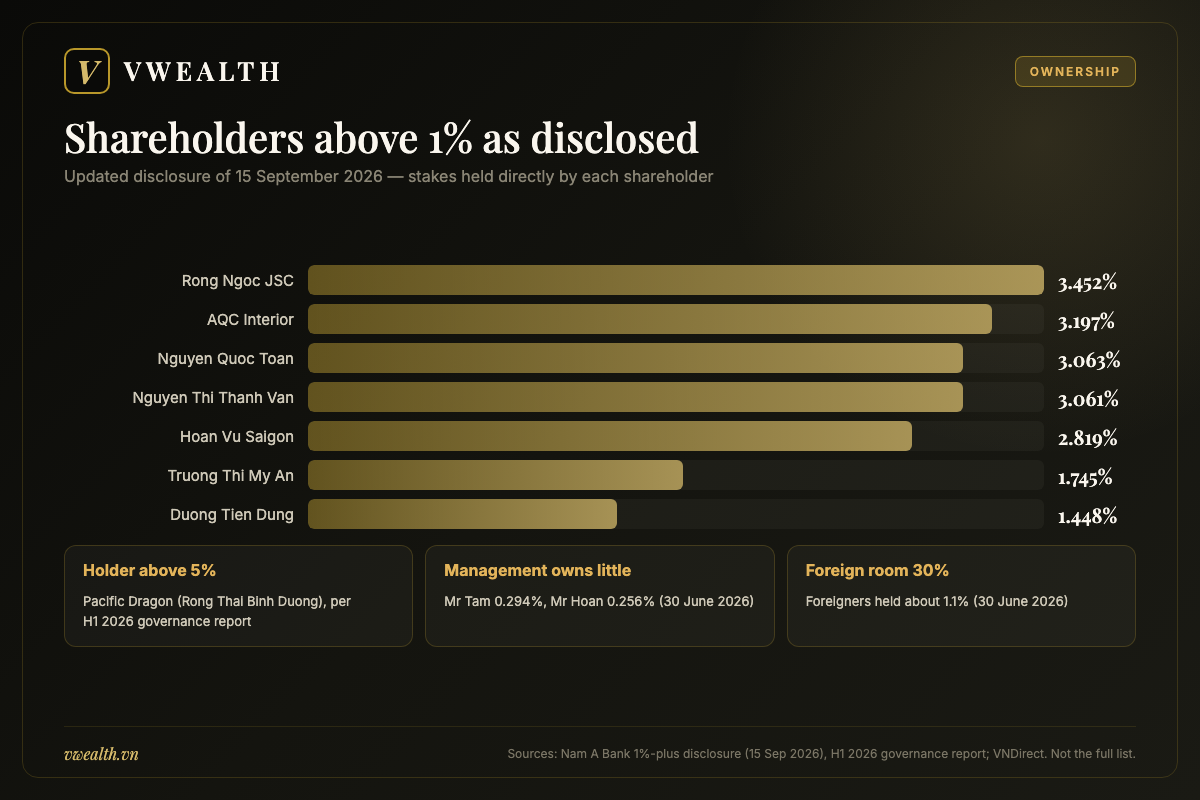
As for management’s own holdings, the governance report as of 30 June 2026 lists Tran Ngoc Tam with 6,340,621 shares (0.294%), Tran Khai Hoan with 5,532,745 shares (0.256%) and Vo Thi Tuyet Nga with 380,468 shares (0.018%). These numbers may shift after each ESOP round — shares sold to employees at VND 10,000 — but in substance the executive team holds small stakes. ESOP ties management’s interests to the share price; the flip side is dilution for existing shareholders, which we analyse in chapter 5.
Reading the 1%-plus shareholder list
Since 1 July 2024, Vietnam’s Law on Credit Institutions No. 32/2024/QH15 has required banks to publish the names of shareholders holding 1% or more of charter capital, together with the holdings of their related persons. Nam A Bank updates this list periodically on its investor page. The most recent “updated and supplementary” disclosure, dated 15 September 2026 (information provided by shareholders up to that date), lists the shareholders below. Note that this is an update covering shareholders whose information changed, not the full list of 1%-plus holders.
| Shareholder (disclosure of 15 Sep 2026) | Shareholder’s own stake | Stake of related persons |
|---|---|---|
| Rong Ngoc JSC | 3.452% | Not stated |
| AQC Interior Design and Construction Co., Ltd | 3.197% | 0.318% |
| Hoan Vu Saigon JSC | 2.819% | Not stated |
| Nguyen Quoc Toan | 3.063% | 7.463% |
| Nguyen Thi Thanh Van | 3.061% | 7.465% |
| Truong Thi My An | 1.745% | 4.384% |
| Duong Tien Dung | 1.448% | 4.681% |
Source: Nam A Bank, “Updated and supplementary disclosure of shareholders owning 1% or more of charter capital”, 15 September 2026. Separately, the H1 2026 governance report lists Pacific Dragon Co., Ltd (Rong Thai Binh Duong) as a shareholder owning more than 5% of voting shares (since 2 October 2012). Check the latest full list on the bank’s investor page before drawing conclusions about the ownership structure.
The founding family and related persons: reading what has actually been disclosed
The natural question after reading that table is how much the founding family still owns. The 15 September 2026 disclosure shows Nguyen Quoc Toan with 3.063% in his own name and his related persons with 7.463% — about 10.53% combined (vwealth’s addition). The document does not name the related persons, so this article does not speculate. For comparison, the 2015 prospectus showed Mr Toan’s family with more than 11.63% combined. In other words, after more than ten years and many capital increases, the holdings linked to Mr Toan and his related persons, as disclosed, remain at roughly a tenth of the bank.
A second point: several rows show a “related persons” column that is large relative to the direct stake. That is how the law requires the list to be presented — each 1%-plus shareholder must declare the holdings of their related persons — so the same group of people can appear on more than one line. You therefore should not add up both columns across every row to infer a group’s total. Identifying related persons is the disclosure responsibility of shareholders and the bank, under the regulator’s supervision. What investors should know is that the legal cap — 15% for a shareholder together with related persons — applies to every group.
Why does this matter? For any bank whose large shareholders are institutions and individuals with other business interests, lending to related parties always deserves monitoring. Nam A Bank’s governance report includes an appendix on transactions between the bank and major shareholders, insiders and related persons, along with the board resolutions authorising them. You do not need to speculate beyond that, but you should read that appendix and the “related party transactions” note in each year’s financial statements: loan balances, deposits and receivables with these parties, and whether they are rising or falling.
One more piece explains why the register “looks” dispersed. The 2024 Law on Credit Institutions tightened ownership caps: an individual may own no more than 5% of a bank, an institution no more than 10%, and a shareholder together with related persons no more than 15%. These caps mean ownership at many private banks is spread across many entities and individuals — not only at Nam A Bank, as we discussed for LPBank and SeABank. The mandatory 1% disclosure list exists precisely to improve transparency in that environment.
Dividends: almost entirely in shares, plus ESOP and private placements
If you want a Vietnamese bank that pays regular cash dividends, NAB is not it. In recent years Nam A Bank has paid dividends almost exclusively in shares, alongside ESOP issues and a planned private placement. That is a deliberate choice: the bank needs to retain profit to grow capital, because fast asset growth requires capital to keep pace in order to maintain its capital adequacy ratio. In 2024, 2025 and 2026 the dividends were all paid in shares, at 25%, 25% and 20% respectively.
| Year | How capital was raised | Charter capital after the round (VND billion) |
|---|---|---|
| 2018–2019 | Small capital increases | 3,353 (end-2018) → 3,890 (end-2019) |
| 2021–2022 | Several issuance rounds | 5,134 (end-2021) → 8,464 (end-2022) |
| 2023 | State Bank approves a capital increase (Aug 2023) | About 10,580 at the HOSE listing |
| 2024 | 25% stock dividend (264.5 million shares) plus 50 million ESOP shares at VND 10,000 | 13,725 |
| 2025 | 25% stock issue (over 343.1 million shares); an 85 million-share ESOP was approved but not carried out | 17,157 |
| 2026 | 20% stock issue (343.1 million shares, completed 12 May 2026) and 100 million ESOP shares; 100 million-share private placement pending | 20,588 → over 21,588 (licence amended 22 Sep 2026) → planned 22,588 |
Sources: Nam A Bank 2019 and 2025 annual reports, 2026 AGM documents and H1 2026 governance report; VietNamNet, VnExpress, Bao Phap luat Viet Nam. According to the board’s report, for the 2025 ESOP “the board prudently reviewed and did not proceed” in light of changes in policy and regulation, and a VND 2,000 billion private convertible bond plan was “proactively postponed”. The bank has also said it is aiming for charter capital of VND 25,000 billion to prepare for Basel III requirements under Circular 14/2025/TT-NHNN.
A stock dividend does not make you richer on the day it is paid: the total value of your holding stays the same, you simply own more shares and the price adjusts down. The benefit only arrives if future profit grows faster than the share count, so that earnings per share (EPS) keep rising. ESOP shares at VND 10,000 and private placements are different: they are new shares issued to other people, and they genuinely reduce your percentage ownership. The 2026 ESOP went to 3,782 employees, with all shares locked up for the first year and half of them for a further year. The VND 10,000 price is below both the market price and book value per share — illustrative example: equity of VND 25,892 billion divided by about 2,059 million shares on 30 June 2026 gives roughly VND 12,600 per share (vwealth estimate). That is what shareholders pay to retain the team — whether it is worth it depends on how much profit that team generates.
How Nam A Bank makes money: retail, SMEs, international funding and a fast-inflating balance sheet
Every commercial bank does the same basic thing: raise money cheaply, lend it out at a higher rate, and keep the spread after operating costs and credit losses. The differences lie in where the funding comes from, where the loans go, and what other revenue the bank earns. Nam A Bank’s answers have some distinctive features: the bank describes its focus as retail and small and medium-sized enterprises, with priority on green and agricultural lending; but the notes to its financial statements paint a more specific picture, tilted towards corporate and trade customers. It relies increasingly on international borrowing and debt securities, and uses digital channels to widen the customer base. This chapter takes each piece in turn.
Lending to businesses, household traders and individuals: the backbone of interest income
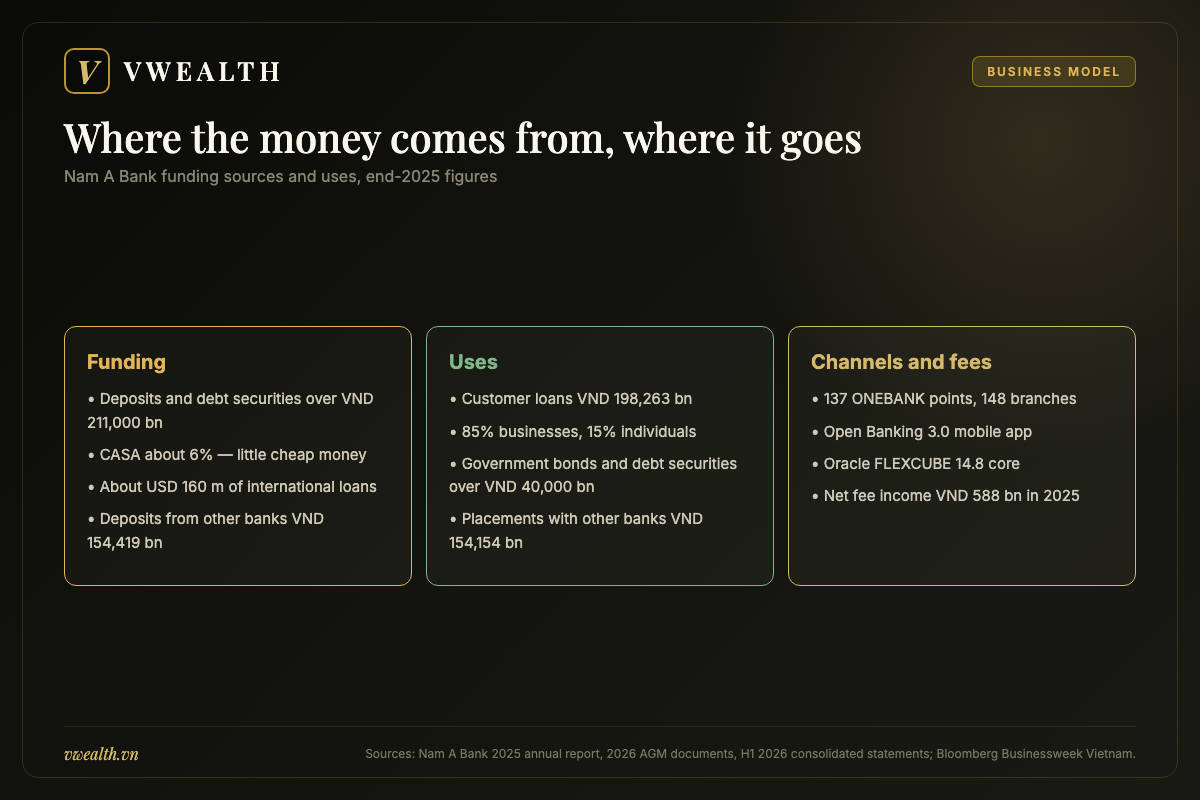
According to the board’s report, Nam A Bank’s loans to businesses and individuals grew from VND 89,172 billion at the end of 2020 to VND 198,263 billion at the end of 2025 — more than 2.2 times in five years. On the reviewed consolidated financial statements, “loans to customers” rose from VND 197,608 billion (31 December 2025) to VND 218,790 billion (30 June 2026), up 10.7% in six months.
Who are the borrowers? The notes to the financial statements answer quite clearly: on 30 June 2026 loans to economic organisations made up 87.56% of the book — limited liability companies alone 64.55% and joint-stock companies 22.43% — while loans to individuals were only 12.44% (15.04% at the end of 2025). In other words, despite the “retail” message, most of NAB’s lending goes to businesses; many may be small and medium-sized firms, but the report does not break that group out. Keep this in mind when comparing NAB with pure retail banks, where individual lending usually makes up a much larger share.
Why SMEs and trade? Because those are the segments where a mid-sized bank can actually compete. Large corporates usually borrow from state-owned banks or top private banks at very thin rates; a bank of Nam A Bank’s size can rarely win them without pricing loans at a loss. Household businesses, traders and small companies, by contrast, accept higher rates in exchange for flexibility and fast approvals. Margins are higher there — but so are risks, since these borrowers are sensitive to the economic cycle and often pledge real estate as collateral. By sector, wholesale and retail trade is the largest group at VND 99,562 billion (about 45.5% of loans on 30 June 2026, vwealth estimate), followed by real-estate business at VND 33,475 billion (about 15.3%) and accommodation and food services at VND 22,928 billion (about 10.5%).
Net interest income — the gap between interest earned on loans and investments and interest paid to depositors — is the main revenue line. In 2025 Nam A Bank’s total operating income was VND 11,534 billion, of which net non-interest income was VND 2,918 billion (annual report). That implies net interest income of about VND 8,616 billion, up about 8.6% on 2024 (vwealth estimate; Bloomberg Businessweek Vietnam reported net interest income up VND 679 billion, about 9%). Roughly three-quarters of income still comes from the interest spread (vwealth estimate: 8,616 / 11,534 ≈ 75%). Keep that 8.6% in mind: total assets rose more than 70%, loans rose 18.2%, yet net interest income grew only 8.6%. The gap between those numbers is the central theme of chapter 4.
Agriculture, aquaculture and green credit: where the international money goes
One of Nam A Bank’s distinctive messages is its focus on green credit and on value chains in agriculture, aquaculture and renewable energy. In October 2024 the bank said it aimed to lift green credit to 20–25% of its loan book, two to three times the share at the time (VnExpress). But set the message next to the numbers: according to the notes to the financial statements, loans to agriculture, forestry and fisheries were VND 8,980 billion on 30 June 2026, only about 4.1% of total loans (vwealth estimate). At the end of 2025 the bank’s network comprised 148 traditional branches and transaction offices plus 137 ONEBANK points nationwide.
That focus is tightly linked to international funding. Development finance institutions such as the IFC, FMO and Proparco typically lend medium- and long-term money to banks on condition that it flows to specific segments: micro-enterprises, SMEs, agriculture, green projects, women-owned businesses. According to Nam A Bank, in 2025 it raised roughly USD 160 million from international lenders through bilateral and syndicated loans, including USD 30 million from GCPF and Symbiotics (Bloomberg Businessweek Vietnam). The list grew in 2026: in March the bank joined an IFC trade finance programme with an expected limit of USD 50 million and was working with Proparco on about USD 30 million of green funding (VnExpress); on 25 June 2026 it signed up to the Asian Development Bank’s Trade and Supply Chain Finance Program with a USD 50 million limit; on 6 August 2026 it received another USD 20 million of green credit from SIFEM and funds managed by responsAbility of Switzerland — taking international funding raised since the start of the year to almost USD 350 million; and on 25 September 2026 it signed an unsecured USD 60 million, five-year loan from the Dutch development bank FMO, earmarked for green projects, micro-enterprises, SMEs, agriculture and businesses led by women or young people (VnExpress). The bank’s list of partners also includes J.P. Morgan, BlueOrchard and Symbiotics.
International funding means two things for shareholders. First, it is long-term money, more stable than short-term deposits — valuable for a bank with a low share of current-account deposits. Second, to borrow from these institutions the bank must pass environmental and social risk reviews, report transparently and meet disbursement commitments; Nam A Bank publishes stand-alone ESG reports for 2023, 2024 and 2025 on its investor page. But keep the scale in perspective: a few hundred million US dollars is a few thousand to just under ten thousand billion dong — a small slice of total funding above VND 450,000 billion. It is a plus for reputation and funding quality, not the driver of the bank’s average cost of funds.
ONEBANK, Open Banking 3.0 and an Oracle core: what digitalisation is for
If there is one thing Nam A Bank wants the public to remember, it is “Digital”. The effort has three layers. The first is automated physical access: ONEBANK points open 24/7 for account opening, savings, payments and QR cash deposits and withdrawals. The ONEBANK network passed 100 points in September 2023, reached 125 at the end of 2024 and 137 at the end of 2025. By September 2024, deposits raised through ONEBANK totalled almost VND 10,000 billion, about 6% of the bank’s total deposits (VnExpress) — significant for a young channel, but still a small part of the picture.
The second layer is the Open Banking mobile app and its add-ons: a transaction robot called OPBA, cross-border QR payments in Thailand, Laos and Cambodia, and fully online secured loans. By September 2025, the bank said, more than 98% of transactions were done through digital channels (VnExpress). In May 2026 Nam A Bank and the retail cooperative Saigon Co.op announced a comprehensive strategic partnership to build a finance-and-consumption ecosystem. In July 2026 the bank released Open Banking 3.0, designed around the idea of being “refined like tea — modern in every touch”, echoing the “Tea Bank” cultural positioning management introduced ahead of the ninth board term.
The third layer, less visible but the most important, is core infrastructure. Also in July 2026, Nam A Bank went live on Oracle FLEXCUBE Universal Banking 14.8, implemented with Oracle Consulting and the local integrator SVTECH (VietNamNet). Its microservices architecture lets the bank upgrade individual functions without taking the whole system down, connect partners via APIs and use machine-learning models to flag suspicious activity, according to the bank. At the banking sector’s digital transformation event on 18 August 2026, Nam A Bank also showcased a “digital citizen station” model and a cross-border QR Global payment solution (Tien Phong).
So what is digitalisation for, from a shareholder’s point of view? In theory it creates value in four ways: raising current-account and savings deposits (CASA) as customers use their accounts for daily payments; cutting the cost of serving each customer; growing fee income; and improving risk management through data. “Digital” needs to be proven in specific financial metrics, not just branding. Chapter 4 does exactly that — and the results so far are mixed: cost-to-income fell sharply at one point and fee income is growing fast, but CASA is only about 5–6%.
Interbank lending and debt securities: the part of the balance sheet that ballooned
This is the business line that rarely appears in bank profiles, yet it explains most of the 2025 asset jump. Besides lending to customers, a bank can deposit with and lend to other banks on the interbank market, buy government bonds and buy debt securities issued by other credit institutions. On the funding side it can also borrow on the interbank market and issue its own bonds and certificates of deposit.
According to Nam A Bank’s 2025 results, its holdings of government bonds and debt securities issued by credit institutions exceeded VND 40,000 billion, up 92.1%; the bank said explicitly that 2025 asset growth was driven by deposit-taking, lending and “active transactions on the interbank market and trading in valuable papers” (Bao Dau tu). The balance sheet makes it clearer: according to Bloomberg Businessweek Vietnam, Nam A Bank’s deposits at other credit institutions rose from VND 36,520 billion at the end of 2024 to about VND 154,154 billion at the end of 2025; on the other side, deposits from other credit institutions at Nam A Bank reached VND 154,419 billion. The reviewed interim consolidated statements confirm both year-end figures and show them at VND 131,972 billion and VND 142,293 billion respectively on 30 June 2026.
Put simply, a very large part of the new assets consists of money other banks deposited with Nam A Bank, which Nam A Bank in turn placed with other credit institutions, with the two sides of roughly similar size. This activity boosts size and can earn a spread on interbank rates, but margins are much thinner than on customer loans and it is sensitive to market liquidity conditions. It also explains why total assets move so much: from VND 418,333 billion at the end of 2025 to VND 451,517 billion on 30 June 2026, even as deposits placed with other credit institutions fell by about VND 22,000 billion over the same period — the interbank book moves on its own rhythm, separate from the loan book.
Non-interest income: fast-growing fees, but partly one-off debt recoveries
In 2025 Nam A Bank’s net non-interest income rose from VND 1,114 billion to VND 2,918 billion, an increase of 161.9% (annual report). That sounds impressive, but the bank attributes the increase mainly to “recovery of debts previously written off”, along with capital-market investments; trading of investment securities alone contributed VND 235 billion, double the previous year. Net fee income was VND 588 billion; foreign exchange and debt-securities trading contributed VND 265 billion (Bao Dau tu, Dau tu Chung khoan).
Recovering written-off loans is real income, but it is essentially one-off: once an old loan has been recovered, that income does not recur at the same scale. According to the notes to the financial statements, written-off bad debts tracked off balance sheet were VND 2,825.5 billion at the end of 2025 — about 1.43% of loans — and fell to VND 2,669.7 billion by 30 June 2026 (the ratio is a vwealth estimate). That is good for asset quality, but it also means the pool of “old debts to recover” is small, so you should not extrapolate 2025’s non-interest income growth into future years.
The more durable part is fees. In the first half of 2026, net fee income reached VND 447.8 billion, up 60.5% year-on-year; investment securities trading brought in VND 177.7 billion, up 69.2%; but foreign exchange trading lost VND 49.9 billion against a VND 31.7 billion profit a year earlier, according to the reviewed interim consolidated statements and the bank’s explanatory letter. Rapid fee growth is the clearest positive signal digitalisation can point to — provided it persists over several periods.
In addition, the 2026 AGM approved in principle setting up or acquiring subsidiaries and affiliates in securities, leasing, insurance, debt management, remittances, gold trading, factoring, credit cards, payment intermediation and credit information (Nguoi Quan Sat). For now these are intentions — the board reported that in 2025 conditions were “not yet really suitable” for acquisitions or stake-building; the only subsidiary today is the wholly owned debt management and asset exploitation company. If some of these pieces materialise, NAB’s revenue mix could diversify — but each would also need capital.
| Business line | Role | Disclosed facts | What to watch |
|---|---|---|---|
| Lending to businesses and individuals | Main source of interest income | Customer loans VND 197,608 billion (end-2025), VND 218,790 billion (30 Jun 2026); individuals 12.44%, businesses 87.56% | Special-mention loans, NPLs, real-estate share (15.3%) |
| Green credit, agriculture, SMEs | Priority segment, tied to international funding | About USD 160 million international funding in 2025; almost USD 350 million in the first eight months of 2026; FMO USD 60 million (Sep 2026) | Disbursement as committed; agriculture, forestry and fisheries only about 4% of loans |
| Interbank, government bonds, debt securities | Scale and liquidity management | Government bonds and debt securities over VND 40,000 billion (+92.1% in 2025) | Thin margins, market liquidity risk |
| Fees, cards, payments | Fee income linked to digital | Net fees VND 588 billion (2025), VND 447.8 billion (H1 2026, +60.5%) | Fee share of total income |
| Written-off debt recoveries, investment securities | Supplementary, lumpy income | Helped lift net non-interest income from VND 1,114 billion to VND 2,918 billion in 2025 | One-off; do not extrapolate |
What feeds what — and where Nam A Bank’s moat lies
Put the pieces together and NAB’s model works like this: term deposits from households and businesses, self-issued debt securities, international loans and interbank borrowing form the funding base; that funding supports loans to trading, services and real-estate businesses and to individuals, plus a very large interbank and securities book; the digital channels (ONEBANK, Open Banking) are the front door for acquiring customers and earning fees.
Where is the moat — a competitive advantage that is hard to copy? There are three candidates. One is access to long-term international funding, built over years and many rounds of due diligence. Two is operating cost: the cost-to-income ratio (CIR) fell to 33.2% in 2025 from 44% in 2024, according to the bank — although much of the improvement came from the jump in non-interest income. Three is speed of technology execution — the bank describes its core replacement as one of the fastest core-system upgrades completed in Vietnam.
Equally, it is worth being blunt about where the moat does not yet exist. The bank lacks a “captive” customer ecosystem of the kind enjoyed by banks tied to big conglomerates (airports, airlines, retail chains, telecoms), has no consumer finance company and has no foreign strategic shareholder. Most importantly, current-account deposits — the most durable funding-cost advantage in banking — are a weakness rather than a strength. A bank that calls itself “Digital” but has a low CASA ratio is a paradox that needs explaining, and that is the first question of the next chapter.
Financial health: does NAB’s growth come with quality?
This is the most important chapter, and the one that directly answers the question posed at the start: when a mid-sized bank accelerates through digitalisation, is the growth real quality or just size? To answer it you do not need total assets — the most eye-catching and least informative number. You need six things: what drives profit, what the new assets consist of, what funding costs look like, how bad debts really stand, whether capital is thick enough, and whether cash flow matches reported profit. For a primer on how Vietnamese banks are valued and compared, see our Vietnam banking sector guide.
Eight years of profit: from VND 743 billion to VND 5,254 billion
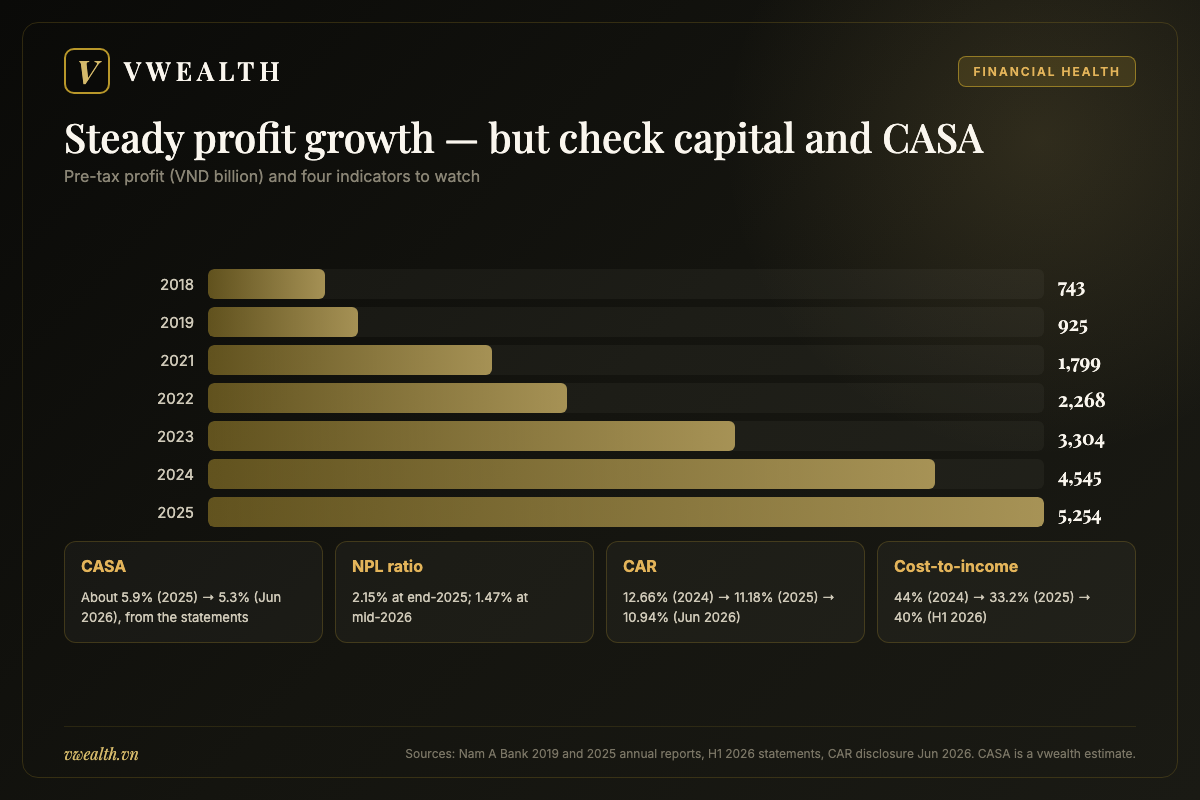
Viewed as a long series, Nam A Bank’s profit line is unusually smooth: it rose every year in the period for which figures have been published. But the table below adds two columns that news summaries usually skip — profit before provisions and provision expense — because those two columns tell you where the profit actually comes from.
| Year | Pre-provision profit (VND bn) | Provision expense (VND bn) | Pre-tax profit (VND bn) | Notes |
|---|---|---|---|---|
| 2018 | — | — | 743 | 2019 annual report |
| 2019 | — | — | 925 | Above the VND 800 bn plan |
| 2020 | — | — | 1,005 | UPCoM listing year |
| 2021 | 2,579 | 780 | 1,799 | Total assets VND 153,238 bn |
| 2022 | 3,131 | 863 | 2,268 | Charter capital VND 8,464 bn |
| 2023 | 4,152 | 848 | 3,304 | Up about 45.7% |
| 2024 | 5,066 | 521 | 4,545 | Up about 37.6%; lowest provisions in the series |
| 2025 | 7,717 | 2,463 | 5,254 | Up 15.6%; provisions jump |
| H1 2026 | 3,064 | Net reversal of 95 | 3,159 | Up 25% year-on-year; full-year plan VND 6,200 bn |
Sources: Nam A Bank 2019 and 2025 annual reports (2021–2025 financial indicators table), 2026 AGM documents, reviewed interim consolidated financial statements for H1 2026. For 2023 growth, the preliminary figure published in early 2024 was “up 50%”, while dividing the 2025 annual report’s numbers gives about 45.7% — the gap likely reflects preliminary versus audited figures.
Read the two middle columns and the story looks quite different from the headlines. In 2025, pre-provision profit rose from VND 5,066 billion to VND 7,717 billion — about 52% (vwealth estimate) — but provision expense also rose almost fivefold, from VND 521 billion to VND 2,463 billion, so pre-tax profit grew only 15.6%. Within the pre-provision gain, net interest income — the core — grew only about 8.6%; the big driver was net non-interest income rising from VND 1,114 billion to VND 2,918 billion, including recoveries of written-off loans, and CIR falling from 44% to 33.2%. In other words, in 2025 the bank used part of an unusual income boost to build thicker provisions.
The first half of 2026 ran the other way. According to the reviewed statements, total operating income rose only about 3% to VND 5,143 billion and operating expenses rose about 28.5% to VND 2,079 billion, so pre-provision profit fell from VND 3,375 billion to VND 3,064 billion (about 9%). Pre-tax profit still rose 25% because credit provisions were a net reversal of about VND 95 billion, compared with a charge of VND 854 billion a year earlier. The bank’s own explanatory letter spells it out: provision expense down VND 949 billion, net interest income up only VND 65 billion (about 2%). Q1 2026 looked similar: consolidated profit after tax rose 34.3% to VND 1,311 billion while net interest income fell about 2% and provision expense dropped by VND 474 billion. Dan Viet newspaper headlined the Q2 2026 results: “Sharply lower credit provisions lift Nam A Bank’s Q2 profit 17%”.
The reading lesson: a bank’s pre-tax profit can rise in three ways — higher income, lower operating costs, or lower loan-loss provisions. The third is sustainable when bad debts are genuinely falling and fragile when the bank is merely provisioning less. For NAB, 2025 was a year of strong income (including one-off items) and heavier provisioning; the first half of 2026 was a period of falling NPLs and provision reversals, but the number-one engine — net interest income — has barely moved while the balance sheet keeps growing.
Unpacking the 70% asset jump: how much was lending, how much interbank
Total assets rose by VND 173,204 billion in 2025. Let’s split that using published figures. Loans to businesses and individuals grew 18.2%, adding VND 30,525 billion. Government bonds and debt securities issued by credit institutions grew 92.1% to over VND 40,000 billion, adding about VND 19,000 billion. Together that is about VND 49,500 billion — less than 30% of the asset increase. Most of the rest sits in one line: deposits placed with other credit institutions rose from VND 36,520 billion to VND 154,154 billion, adding about VND 117,600 billion — roughly 68% of the asset increase. This is a vwealth estimate based on published figures, intended only to show relative proportions.
The funding side is consistent with that picture: deposits from other credit institutions at Nam A Bank reached VND 154,419 billion at the end of 2025, while customer deposits were VND 177,811 billion. By 30 June 2026, customer deposits had risen to VND 200,096 billion and issued debt securities from VND 33,308 billion to VND 44,306 billion, while deposits from other credit institutions fell to VND 142,293 billion. In other words, the 2025 asset jump was mostly a jump in interbank and securities positions, not a jump in customers; the first half of 2026 shows funding starting to shift back towards customers and debt securities.
There is nothing improper about that — many banks use the interbank market to manage liquidity and earn spreads. But it matters for how you read “top 15 bank”. Ranking by total assets puts NAB next to banks with far more equity and far larger customer franchises; ranked by customer loans or by equity, NAB sits lower. And because interbank assets carry thin margins, a 70% asset jump alongside 8.6% net interest income growth is exactly what you would expect. The bank reported a 2025 net interest margin (NIM) of 2.6%; Bloomberg Businessweek Vietnam, working from the financial statements, put it at 2.67% — the lowest since 2021. For comparison, NIM stood at 3.77% as of 30 September 2024 according to the bank (VnExpress), and about 3.3% in the first half of 2025 according to FiinRatings.
CASA of about 5–6%: the biggest weakness of a self-styled digital bank
CASA is the share of current-account (non-term) deposits in total deposits — the money customers leave in payment accounts for daily spending. Under Vietnamese rules, interest on such deposits is capped at 0.5% a year, whereas by mid-2026 effective deposit rates — including promotions — for 6- to 12-month terms had climbed to around 8–9% a year, roughly 1–2 percentage points above end-2025 levels (Tien Phong). That gap makes CASA almost “free” funding and the most durable cost advantage in banking.
This is where Nam A Bank is weakest. You can work it out from the notes to the financial statements: non-term customer deposits were VND 10,547 billion out of total customer deposits of VND 177,811 billion at the end of 2025, about 5.9%; on 30 June 2026 they were VND 10,542 billion out of VND 200,096 billion, about 5.3% (vwealth estimate). Bloomberg Businessweek Vietnam also put the bank’s 2025 CASA at 6% and its cost of funds at about 4.5%. The absolute amount barely moved while term deposits rose by more than VND 22,000 billion in six months — meaning all new deposits were expensive money. At many large private banks the ratio is in double digits; you can compare directly in vwealth’s other bank analyses.
Why would a bank with ONEBANK, Open Banking and a shelf of digital awards have such low CASA? A few plausible reasons. NAB’s customer base leans towards term depositors and provincial household businesses rather than large corporates with huge payment flows. It lacks an ecosystem that “locks in” cash flows, such as a conglomerate’s payroll or a big retail chain’s payments — the 2026 Saigon Co.op agreement may be a step in that direction, but it is far too early to see results. And in 2026, rising term deposit rates pushed savers at many banks to move money from payment accounts into term deposits, so CASA pressure is not unique to NAB.
The consequence is that NAB’s funding cost is more sensitive to market rates than that of high-CASA banks. When deposit rates rise, NAB pays more on almost all of its funding, whereas a bank with 30% CASA feels it on only about 70% of its deposits. That is why NAB’s NIM struggles to break higher, and it is the most direct test of the “Digital” story: if NAB’s CASA reaches double digits in the next few years, digitalisation is creating real value; if it stays around 5–6%, digitalisation is mainly cutting operating costs and lifting fees.
Bad debt: from a 2.85% peak to 1.47% — and the weight of Group 5 loans
Good news first. After a period of rising bad debt, Nam A Bank’s asset quality is improving. According to the reviewed consolidated statements, loans in Groups 3–5 totalled about VND 3,222 billion on 30 June 2026 out of VND 218,790 billion of loans, an NPL ratio of 1.47%, down from 2.16% at the end of 2025 (the bank reports 2.15%, and 1.93% before adjusting for credit bureau CIC data). Special-mention (Group 2) loans fell from VND 2,588 billion (1.31% of loans) to VND 1,183 billion (0.54%). Loan-loss provisions of VND 2,201 billion give NPL coverage of about 68%, up from about 54% at the end of 2025.
Over the longer run, the 2025 annual report shows year-end NPL ratios for 2021–2025 of 1.57%, 1.63%, 2.11%, 2.33% and 2.15%; according to the bank’s quarterly releases, the most recent peak was 2.85% on 30 June 2025, followed by 2.53% (before CIC) and 2.73% (after CIC) on 30 September 2025. Moody’s cited about 2.2% for the end of 2025. Small differences between sources usually come from before- or after-CIC adjustments and consolidated versus standalone numbers. The direction is clear: NPLs crept up in 2022–2025 and then fell sharply in the first half of 2026.
Now the points to watch. First, the NPL mix is skewed to the worst category. Vietnam classifies loans in five groups, with Group 5 being “loss” loans. According to the notes to the financial statements, Group 5 loans rose from VND 2,447.3 billion to VND 2,584.9 billion, about 80.2% of total NPLs on 30 June 2026 (vwealth estimate). The NPL ratio fell largely because doubtful (Group 4) loans dropped from VND 1,550 billion to VND 277 billion and the denominator — total loans — grew fast, not because the absolute stock of Group 5 loans shrank. Second, coverage of about 68% still means provisions do not cover all bad debts. Third, real-estate business loans were VND 33,475 billion on 30 June 2026, about 15.3% of the book and almost flat against VND 33,186 billion at the end of 2025 (notes to the financial statements); Bloomberg Businessweek Vietnam reported that this line had grown about 66% during 2025. It is a number worth tracking every quarter.
One point deserves fair credit: NAB’s written-off bad debts tracked off balance sheet were only about 1.43% of loans at the end of 2025 (vwealth estimate from the financial statements). The “shadow of the past” is relatively small. Overall, asset quality is not NAB’s biggest worry, but thin provisioning buffers and the high share of Group 5 loans are two numbers to track every quarter.
Capital, costs and cash flow: why NAB keeps raising equity
The capital adequacy ratio (CAR) is regulatory capital divided by risk-weighted assets; the State Bank requires at least 8%. According to the 2025 annual report, Nam A Bank’s CAR ran as follows: 9.46% (2021), 8.92% (2022), 11.16% (2023), 12.66% (2024) and 11.18% (2025). On 30 June 2026, according to the bank’s capital adequacy disclosure, CAR was 10.86% on a standalone basis and 10.94% consolidated, with a Tier 1 ratio of about 7%. Still above the minimum, but the trend of the last two years is clear: risk assets are growing faster than capital.
Moody’s uses a stricter yardstick. On 12 February 2026 Moody’s raised Nam A Bank’s outlook from Stable to Positive, keeping the long-term deposit and issuer ratings at B2 and the long-term counterparty risk rating at B1. At the same time Moody’s noted that the bank’s tangible common equity to risk-weighted assets ratio (TCE) had fallen from 8.0% at the end of 2024 to 7.2% on 30 September 2025 “due to rapid asset expansion”, and spelled out the upgrade conditions: return on tangible assets (ROTA) above 1% and TCE sustainably above 8%. Domestically, FiinRatings assigned Nam A Bank a first-time long-term rating of A- with a Stable outlook on 16 September 2025. According to Bloomberg Businessweek Vietnam, the bank is also rated B+ by Fitch Ratings.
A simple comparison shows how thin capital is: at the end of 2025 NAB had VND 23,431 billion of equity against VND 418,333 billion of assets, about 5.6%; SeABank at the same date had VND 40,373 billion of equity on VND 396,443 billion of assets, about 10.2% (vwealth estimate from published figures). Thin capital flatters return on equity — according to the annual report, average ROE in 2025 was 19.20% (2024: 20.61%) and average ROA 1.22% (2024: 1.55%) — but it also explains why the bank keeps issuing shares, sold VND 2,000 billion of public bonds (the first VND 1,000 billion tranche completed on 30 December 2025 with almost 300 investors, the second in the first half of 2026) to bolster Tier 2 capital, and targets VND 25,000 billion of charter capital ahead of full Basel III compliance under Circular 14/2025/TT-NHNN.
On costs, NAB has a bright spot: CIR fell from 44% in 2024 to 33.2% in 2025. But in H1 2026 CIR rose to about 40%, as total operating expenses grew about 28.5% (from VND 1,618 billion to VND 2,079 billion) while total operating income grew just over 3% (reviewed consolidated statements). Also worth knowing: the 2026 AGM approved setting aside 20% of any pre-tax profit above plan as a staff bonus, booked as personnel expense. The new core system, network expansion and staffing may explain part of it, but operating efficiency needs a few more quarters of observation.
Finally, cash flow and accrued interest. According to the H1 2026 interim consolidated financial statements, interest and fees receivable rose from VND 6,986.8 billion to VND 10,147.3 billion (up 45.2%) in six months, and net operating cash flow was negative VND 16,433.4 billion, driven mainly by new lending, securities purchases and higher placements with other banks. Negative operating cash flow during credit expansion is normal for banks and should not be read the way you would for a manufacturer. But accrued interest growing faster than interest income deserves attention: it means part of the booked interest revenue has not yet been collected in cash.
Eight questions to ask every time NAB reports
Pulling it all together, here is a toolkit for reading Nam A Bank’s reports each quarter, rather than just the profit headline.
| # | Question | Where to find it | Good sign |
|---|---|---|---|
| 1 | How fast is net interest income growing relative to loans? | Income statement | In line with or faster than loan growth |
| 2 | Is pre-provision profit rising or falling? | Operating income minus operating expenses | Rising, not just lower provisions |
| 3 | What share of assets is interbank? | Balance sheet: placements with and loans to other banks | Stable or declining |
| 4 | Is CASA moving up? | Customer deposit notes | Rising towards double digits |
| 5 | Are Group 5 loans rising or falling in absolute terms? | Loan classification notes | Falling in value, not just as a ratio |
| 6 | What is loan-loss coverage? | Provisions divided by NPLs | Moving towards 100% |
| 7 | CAR and equity-to-assets? | CAR disclosure, balance sheet | Stable or higher after each issuance |
| 8 | Accrued interest and real-estate exposure? | Other assets; loans by sector | Receivables growing slower than interest income; sector breakdown disclosed |
If you would rather not retype every line yourself, these indicators are updated in the vwealth NAB report after each disclosure.
How the market treats NAB stock: steady dilution, an almost empty foreign room
A good bank is not necessarily a good stock, and vice versa. Share prices reflect market expectations, how the bank distributes profit, and which money is actually present. Three features shape NAB’s personality as a stock: the share count rises every year, foreign investors are almost absent, and liquidity comes mainly from domestic retail investors. We do not quote today’s price or P/B; check the vwealth NAB report for current numbers.
From VND 13,500 on UPCoM to VND 15,900 on HOSE: historical price markers
NAB debuted on UPCoM on 9 October 2020 at a reference price of VND 13,500 and closed its first session at VND 16,000. On its last UPCoM session (28 February 2024) it closed at VND 16,500. On 8 March 2024 the HOSE reference price was VND 15,900, with a ±20% band for the first session; NAB closed day one at VND 16,900, up 6.29%, giving a listing-day market value of almost VND 17,000 billion (VietNamNet). It closed at VND 16,650 on 29 March 2024; the reference price was VND 16,300 on 9 July 2024; and on 1 July 2025 it closed at VND 16,850, about 5.6% above the 31 December 2024 close of VND 15,950 (VNDirect price data; vwealth’s arithmetic). All of these are nominal prices, not adjusted for bonus issues.
Looking at that series you might conclude NAB went sideways around VND 16,000–17,000 for more than a year. Not quite: over that period shareholders also received 25% bonus shares (ex-date 11 July 2024) and another 25% (10 July 2025), followed by 20% (11 May 2026). A flat nominal price while the share count grows 25% a year means holders’ wealth still rose. That is why, for Vietnamese banks that issue a lot of bonus shares, you should always use adjusted price charts — past prices scaled down by each issue ratio — rather than nominal prices.
Dilution: bonus shares, ESOP and private placements — an illustrative example
Two kinds of issuance need to be distinguished. Bonus shares or stock dividends (20% in 2026) go to all shareholders pro rata: you receive more shares, your percentage does not change, and the financial statements restate prior-period EPS for comparability. ESOP (100 million shares at VND 10,000, already issued) and the private placement (100 million shares for up to 100 professional investors, locked up for one year, expected to complete in the second half of 2026) are new shares issued to others: your ownership genuinely shrinks.
Illustrative example (using period-end share counts and ignoring the timing of issues within the year): at the end of 2025, charter capital of VND 17,157 billion corresponds to about 1,715.7 million shares. After the 20% bonus that becomes about 2,058.8 million. Adding 100 million ESOP shares and 100 million placement shares gives about 2,258.8 million. The “real” dilution from ESOP and the placement is 200 million on 2,058.8 million, about 9.7%. If 2026 profit hits the plan, up 18%, bonus-adjusted EPS would rise by about 1.18 / 1.097 − 1 ≈ 7.6%. If profit grows only 10%, EPS is roughly flat (1.10 / 1.097). If profit does not grow, EPS falls almost 9%. These are vwealth estimates purely to illustrate the mechanism; actual figures depend on issue timing and actual profit.
The lesson: for NAB, “how much will profit grow” is not enough. The right question is “will profit grow faster than new share issuance”. To be fair in the other direction: a placement priced above book value per share increases book value per share for existing holders, whereas ESOP at VND 10,000 — below the roughly VND 12,600 book value per share on 30 June 2026 (vwealth estimate) — does the opposite. The placement price is therefore a number worth waiting for.
A 30% foreign room almost unused, and the FTSE upgrade
Vietnam caps foreign ownership in listed companies; for commercial banks the cap — the “foreign room” — is 30%. Nam A Bank’s room is 30%, but actual foreign ownership is tiny. According to VNDirect ownership data, foreigners held about 0.10% of NAB on 31 March 2024, about 1.78% in mid-2025 and about 1.11% on 30 June 2026. With about 2,159 million shares outstanding after the ESOP, the 30% room equals roughly 647.6 million shares, and on 25 September 2026 about 626.9 million shares of room were still unused — foreigners had filled only about 3% of it (vwealth estimate). If you are new to the concept, our explainer on foreign room in Vietnam stocks covers it in detail.
Open room is an open door, not an inflow. Foreign investors, especially institutions, prefer banks with large market capitalisation, deep liquidity, stable ROE, transparency and a strategic shareholder. The catalyst could be the market upgrade: FTSE Russell officially reclassified Vietnam as a Secondary Emerging market effective 21 September 2026, with the investable weight phased in over four tranches: 10% (September 2026), a further 20% (March 2027), 35% (June 2027) and the final 35% (September 2027) (Nguoi Quan Sat). In the September 2026 review, NAB was one of two banks — alongside SSB — among the 62 stocks added to the FTSE Vietnam All-Share FOL-adjusted Index, the version adjusted for foreign ownership limits (VietnamFinance, Nha Dau tu). But NAB was not among the 27 Vietnamese stocks added to the FTSE Global All Cap Index — the basket that matters more for emerging-market index trackers (Thoi bao Tai chinh Viet Nam). In other words, NAB sits on the outer ring of upgrade-driven flows for now. Our piece on FTSE upgrade beneficiaries explains the flow mechanics.
Valuing NAB: read P/B alongside ROE and capital thickness
Bank stocks are usually valued on P/B — price divided by book value per share — because a bank’s assets and liabilities are mostly financial and carried close to fair value. The general rule: banks with high, sustainable ROE deserve higher P/B. NAB’s average ROE of 19.20% in 2025 ranks among the better figures in the sector. On ROE alone, NAB might look “worth” as much as top-tier banks.
But as chapter 4 showed, NAB’s high ROE comes with thin capital: equity is only about 5.6% of assets. ROE equals ROA times leverage; average ROA in 2025 was 1.22%, down from 1.55% in 2024 — average, not outstanding. Two banks with the same 20% ROE, one with 2% ROA and moderate leverage and the other with about 1.2% ROA and high leverage, carry very different risks, and the market usually assigns the second a lower P/B. Banks that frequently issue ESOP below book value also tend to trade at a discount. So when comparing NAB’s P/B with other banks, compare three things together — ROE, ROA and CAR — never P/B alone.
One useful reference point: the 2026 private placement of 100 million shares is reserved for professional investors. When it completes, the price they actually pay — above or below the roughly VND 12,600 book value per share on 30 June 2026 (vwealth estimate) — will be a meaningful signal of how “big money” values NAB. Historical P/B and peer comparisons are available in the vwealth NAB report.
NAB’s stock personality and the catalysts the market reacts to
In sum, NAB behaves like a mid-sized, domestically owned bank stock: it moves with retail money flows and the banking sector, is little affected directly by foreign flows, and tends to rally around bonus-share and capital-raising news. Regular bonus shares also create short-term supply bumps when new shares become tradable.
Catalysts the market tends to react to include: quarterly results (especially against the VND 6,200 billion 2026 profit plan); progress and pricing of the 100 million-share private placement; the VIFC member bank; new international loans; Moody’s rating actions (the outlook is Positive); the market-upgrade timeline; and any news of a strategic shareholder. On the downside, bad news could come from a further drop in CAR, NPLs turning up, or a sharp rise in deposit rates squeezing margins — to which NAB, with its low CASA, is more sensitive than most banks.
Industry context: Vietnam’s 2026 funding race and where NAB sits among mid-sized private banks
No bank stands outside the system’s cycle. Credit growth, interest rates, regulation and digital competition all hit NAB directly — and as a mid-sized bank with low CASA, NAB tends to feel these shifts more sharply than the big banks.
Credit growing faster than deposits: the 2026 funding race
Vietnam is an economy where companies and households borrow mainly through banks rather than bond or equity markets. In 2025 GDP grew 8.02%, according to figures cited by Nam A Bank’s board in its report to the 2026 AGM. According to FiinRatings (as reported by Vietnambiz), system credit grew about 19% in 2025, above the “normal” 15% target of earlier years, and credit-to-GDP was already above 140%.
The problem is that deposits have not kept up. By the end of April 2026, system deposits were up only about 2.2% year-to-date while credit had grown 4.4% (Tien Phong); by the end of July, credit was up about 8.98% and deposits 5.75% (Thuong Truong). When lending outpaces deposits, banks compete on rates for funding: effective rates for 6- to 12-month deposits climbed to around 8–9% a year. For NAB this is a tough environment: with almost no cheap funding, its cost of funds rises nearly across the board. On the other hand, NAB has a relative advantage in being used to raising money through debt securities (VND 44,306 billion on 30 June 2026, up from VND 33,308 billion at the end of 2025, per the financial statements) and long-term international loans — two channels less exposed to savers shifting from payment accounts into term deposits. The bank is also bound by credit quotas set by the State Bank: management said it was allocated VND 5,000 billion for Q1 2026 and had about VND 1,300 billion left by the March AGM (VnExpress).
The 2024 banking law, Basel III under Circular 14 and the international financial centre
Three policy shifts shape NAB’s path. First, the 2024 Law on Credit Institutions (effective 1 July 2024) lowered ownership caps, required disclosure of 1%-plus shareholders and tightened related-party lending. For a bank with NAB’s history of concentrated shareholder groups, the law is healthy pressure: more transparency, less governance risk, even if it makes the register look more dispersed than the underlying reality.
Second, Circular 14/2025/TT-NHNN on capital adequacy under Basel III requires more granular risk measurement and thicker capital buffers. Nam A Bank says it was an early adopter of full compliance, but its plan to lift charter capital to VND 25,000 billion shows it knows a CAR around 10.9% is not generous while assets are still growing quickly. More capital means more shares — the dilution loop discussed in chapter 5.
Third, the Vietnam International Financial Centre (VIFC) in Ho Chi Minh City began operating in 2026 under its own legal framework. NAB became one of the strategic investors of VIFC–HCMC on 11 February 2026 and has shareholder approval in principle to set up a wholly owned member bank there, to improve access to international funding and serve customers with cross-border needs (Nguoi Quan Sat); according to Bloomberg Businessweek Vietnam, the working name is “Tea Bank”. It is an interesting strategic option but still at an early stage; the financial payoff depends on VIFC’s detailed rules and on execution. Note also that in 2025 shareholders approved expanding the network abroad, but the board held off because it “needed more time for a comprehensive assessment” of each country’s economic, cultural and legal specifics — a sign of caution worth acknowledging; the 2026 AGM approved the plan again.
NAB versus SeABank and other mid-sized private banks
To place NAB properly, compare it with SeABank — a private bank with a similar asset base at the end of 2025 that vwealth has analysed. The table uses only published 2025 figures.
| Metric (2025) | NAB (Nam A Bank) | SSB (SeABank) |
|---|---|---|
| Pre-tax profit | VND 5,254 bn (+15.6%) | VND 6,868 bn (+13.73%), in a year it handed over consumer finance company PTF to AEON |
| Total assets, year-end | VND 418,333 bn (+70.7%) | VND 396,443 bn (almost +22%) |
| Shareholders’ equity | VND 23,431 bn (about 5.6% of assets) | VND 40,373 bn (about 10.2% of assets) |
| ROE | 19.20% (average) | 14.62% |
| CIR | 33.2% | 33.01% |
| International funding | About USD 160 million raised in 2025 | Over USD 1.1 billion raised in total |
| Core story | Rapid scale-up, “Digital” and “Green”, interbank | Restructuring along business lines, thick capital |
Sources: Nam A Bank 2025 annual report and results release; VnExpress (SeABank reports VND 6,868 billion profit). Equity-to-assets ratios are vwealth estimates. ROE may be calculated differently across banks.
The table highlights NAB’s unusual position: a larger balance sheet than SeABank but lower profit; a higher ROE but roughly half the capital cushion. The two banks run at almost the same CIR, so the key difference lies in balance-sheet structure: SeABank keeps thick capital, while NAB uses leverage and the interbank market to grow. For OCB — with its Japanese strategic shareholder Aozora — and MSB — one of the banks with high CASA — you can read the detailed numbers in vwealth’s dedicated analyses. NAB is the “fastest runner” — with all the pros and cons that implies. For different takes on retail banking in Vietnam, see our analyses of TPBank, an early digital mover, and VIB.
The digital race: when everyone is digital, where is the edge?
By 2026 almost every Vietnamese bank offers a mobile app, eKYC (electronic identity verification), free transfers, QR payments and some kind of AI assistant. The banking sector’s digital transformation event in August 2026 took “Smart banking in the era of data and AI” as its theme — AI and data have become table stakes, not anyone’s unique edge. Large banks such as Techcombank, MB and VPBank have tens of millions of customers and technology budgets many times larger; pure digital banks compete too.
In that race, a mid-sized bank’s edge does not lie in having more features but in three places: lower cost-to-serve through automation (NAB’s low CIR is partial evidence), serving a specific segment better than big banks do (household businesses, agriculture, provinces), and faster decision-making. The limitation: if digital channels do not attract payment balances — CASA — the funding-cost advantage stays with banks that own large cash-flow ecosystems. Put simply, digitalisation makes NAB cheaper at serving customers, but not yet cheaper at borrowing from them.
Outlook: three scenarios for NAB stock and the conditions behind each
Nobody knows where NAB’s price will go, and this article offers no price target. What is more useful is to identify the variables that drive the story and describe three scenarios with concrete conditions you can track yourself. 2026 is the first year of the ninth board term (2026–2031), with a plan for pre-tax profit of VND 6,200 billion (up 18%), total assets of VND 480,000 billion, loans of VND 240,000 billion, deposits of VND 280,000 billion and an NPL ratio no higher than 2.5%; which scenario unfolds will tell you whether the shift from “growing size” to “growing quality” works.
Five variables that will decide Nam A Bank’s future
One: does net interest income catch up with size? The new assets — especially the interbank and securities book — need to generate proportionate interest income, and NIM needs to hold or rise from 2.6%. Two: CASA. This is the most direct test of the digital strategy and of ecosystem tie-ups such as Saigon Co.op. Three: asset quality. NPLs are at their lowest since 2021 (1.47% at mid-2026), but absolute Group 5 loans have not fallen and coverage is thin; the plan tolerating NPLs up to 2.5% also shows room to deteriorate. Four: capital. CAR and TCE need to stop falling after each issuance; the VND 25,000 billion charter capital goal and Moody’s upgrade conditions (TCE above 8%, ROTA above 1%) are concrete markers. Five: shareholders and governance. The outcome of the private placement — who buys and at what price — and whether a strategic investor, particularly a foreign one, arrives while the room is still almost empty.
Bull case: size turns into quality
Conditions: 2026 profit meets or beats the VND 6,200 billion plan, driven mostly by net interest income and fees rather than lower provisions; NIM improves; CASA edges up thanks to ecosystem partnerships and the new app; NPLs stay below 2% with coverage moving towards 80–100%; the private placement is completed above book value, perhaps with a large institutional investor; Moody’s upgrades the rating; the VIFC member bank starts operating and opens cheaper international funding. In this scenario EPS grows faster than dilution, foreign investors begin to notice a high-ROE bank with plenty of room, and the market has reason to value NAB closer to quality private banks.
Base case: moderate growth, the digital story needs more time
Conditions: profit grows around 10–20% a year, close to plan; NIM flat; CASA stays in single digits; NPLs between 1.5% and 2.5%; the bank keeps paying stock dividends and issuing ESOP every year; CAR held around 10–11% through continuous capital raising; no strategic shareholder. In this scenario EPS grows slowly and much of the value created is shared with new shares. The stock would likely follow the banking sector, with short bursts around bonus-share and capital news. This is the scenario closest to what has happened since NAB moved to HOSE.
Bear case: too fast, too thin, wrong rate cycle
Conditions: deposit rates keep rising, sharply increasing funding costs for a low-CASA bank and compressing NIM; the interbank book shrinks, making income volatile; NPLs climb back above 2.5–3% as loans written quickly in 2025–2026 season; provisions must rise sharply on a thin buffer; CAR approaches levels that force slower lending or share issuance at low prices; profit stalls or falls while the share count keeps rising. In this scenario EPS declines, the valuation is discounted and the “top 15 bank” narrative loses its pull.
| Factor | Bull | Base | Bear |
|---|---|---|---|
| Profit | Above VND 6,200 bn, mostly from interest income and fees | Up 10–20% a year | Flat or down |
| NIM, CASA | NIM rising; CASA approaching double digits | NIM around 2.6%; CASA single digits | NIM falling as funding costs rise |
| NPLs and coverage | Below 2%, coverage 80–100% | 1.5–2.5%, coverage around 60–70% | Above 2.5–3%, provisions surge |
| Capital | CAR and TCE improve; Moody’s upgrade | CAR 10–11% via steady raises | CAR near floor; issuance at low prices |
| Shareholders | Strategic investor; foreign inflows | No partner; domestic money | Dilution outpaces profit |
Early signals to watch every quarter
Rather than waiting for annual reports, you can spot which scenario is unfolding from five numbers in each quarterly release: pre-provision profit (up or down year-on-year); net interest income versus loan growth; absolute Group 5 loans and coverage; reported CAR; and the share of interbank placements in total assets. If three of the five move in the bull direction for two consecutive quarters, the story is improving. If three move in the bear direction, revisit your thesis. All five indicators are updated in the vwealth NAB report after each disclosure.
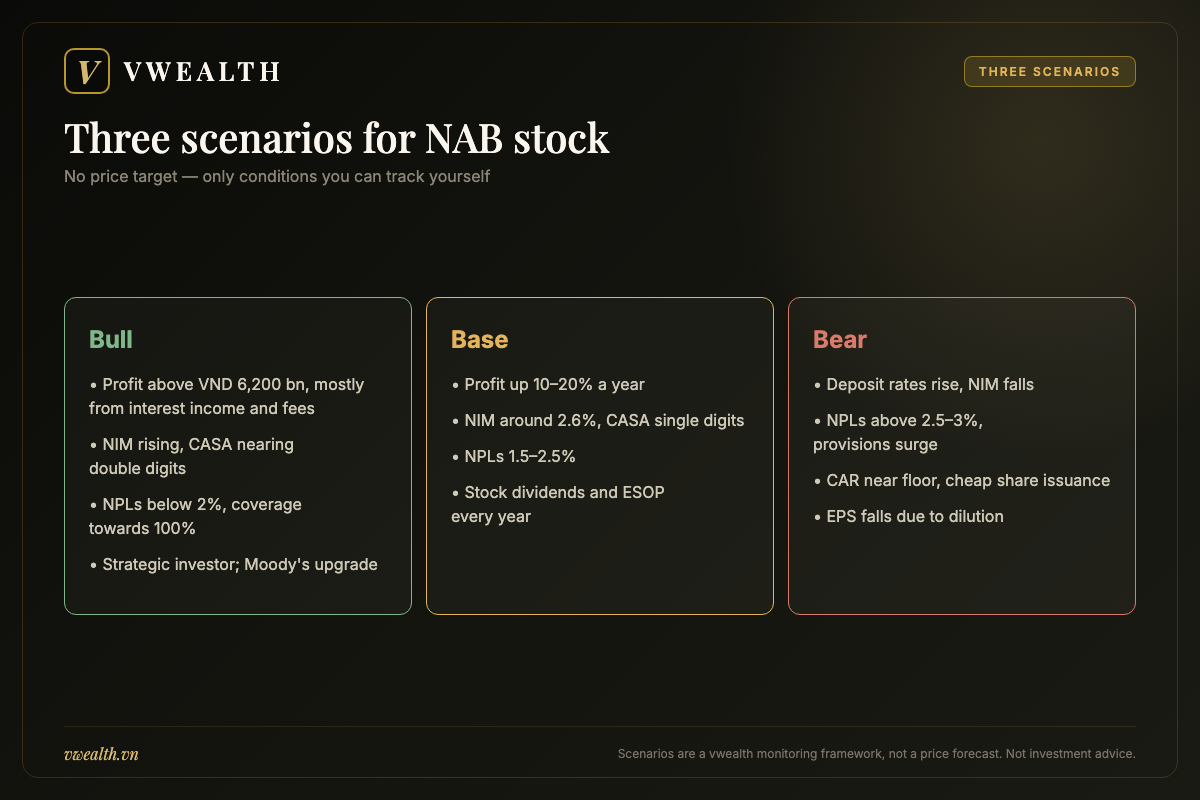
So, should you buy NAB stock? A straight answer for each type of investor
After seven chapters, it is time to pull everything together. There is no universal answer to whether you should buy NAB stock, because its risk–return profile is quite distinct: fast growth and high return on equity, but thin capital, expensive funding and regular dilution. It suits some investors and clearly does not suit others.
The genuine positives
Profit has risen every year for many years. From VND 743 billion in 2018 to VND 5,254 billion in 2025, with no down year in the published series, and another 25% rise in H1 2026. Pre-provision profit rose about 52% in 2025, allowing thicker provisioning. High ROE, an average 19.20% in 2025, among the better figures in the sector. Lean operations, with CIR around 33% in 2025. Falling NPLs: from a 2.85% peak at mid-2025 to 1.47% at mid-2026; off-balance-sheet write-offs low. Credibility with international lenders: IFC, ADB, FMO, Proparco, SIFEM, GCPF, Symbiotics; about USD 160 million of international funding in 2025 and almost USD 350 million in the first eight months of 2026; Moody’s outlook raised to Positive and an A- rating from FiinRatings. Foreign room almost untouched, and the stock was just added to the FTSE Vietnam All-Share FOL-adjusted Index — if the quality story materialises, there is ample room for foreign money. A clear, consistent strategy under a stable executive team since 2024, backed by concrete steps: a new core system, VIFC, ecosystem partnerships.
The negatives you cannot ignore
Low CASA (about 5–6% on the financial statements), making funding costs rate-sensitive and capping NIM, which was only 2.6% in 2025. Asset growth is mostly interbank and securities, while net interest income grew only about 8.6% in 2025 and about 2% in H1 2026. Thin capital: equity about 5.6% of assets (vwealth estimate), CAR down from 12.66% at the end of 2024 to about 10.9% at mid-2026, Moody’s TCE at 7.2%. Constant dilution: bonus issues of 25%, 25% and 20% in three consecutive years plus ESOP and a private placement — profit must outgrow new share issuance for holders to truly benefit. Virtually no cash dividends. Recent profit quality: in H1 2026 pre-provision profit fell about 9% and pre-tax profit rose thanks to provision reversals; 2025 leaned significantly on recoveries of written-off debt. Group 5 loans about 80% of NPLs, with coverage around 68%. A shareholder register made up of institutions and individuals that each come with groups of related persons — worth following through the 1%-plus disclosures and the related-party appendix.
| For | Against |
|---|---|
| Profit up every year from 2018 to 2025 | Profit growth slowed just as assets grew fastest |
| Average ROE of 19.20% in 2025 | ROE boosted by leverage; average ROA of 1.22% is only average |
| CIR around 33% in 2025 | CIR back near 40% in H1 2026 as operating expenses rose about 28.5% |
| NPLs at 1.47%, low write-offs | Group 5 loans about 80% of NPLs; coverage about 68% |
| Long-term international funding, credibility with DFIs | CASA about 5–6%, rate-sensitive funding costs |
| 30% foreign room almost empty; new FTSE index member | No strategic shareholder; foreign investors not yet engaged |
| Regular stock dividends, continuous capital growth | Dilution from ESOP and placements; almost no cash payouts |
Who NAB stock suits — and who it does not
NAB may suit investors with medium-to-high risk tolerance who want exposure to a “mid-sized bank transformation” story, can hold for two to three years and are willing to read each quarterly report against the eight questions in chapter 4. It can also fit as a small growth sleeve in a portfolio that already holds larger, safer Vietnamese banks, and it suits those who believe the market upgrade will gradually bring foreign capital even to banks with empty foreign room.
NAB does not suit investors who need steady cash dividends; those who want a defensive bank with thick capital and high CASA to sleep through a rising-rate cycle — top-tier banks, or MSB on the CASA front, fit better; investors unwilling to track bank-specific metrics; and anyone buying on the “assets up 70%” headline without understanding what that growth consists of. For foreign investors specifically, remember the practical points: you need a Vietnamese securities account, trades settle on a T+2 basis, daily price moves on HOSE are capped at ±7%, and foreign purchases are subject to the room — all covered in our guide to investing in Vietnam stocks.
Frequently asked questions about NAB stock
Which bank does NAB stock represent? NAB is the ticker of Nam A Commercial Joint Stock Bank (Nam A Bank), founded on 21 October 1992 and headquartered in Ho Chi Minh City, listed on HOSE since 8 March 2024 (it traded on UPCoM from 9 October 2020).
Is Nam A Bank a family bank? According to VnExpress, Tran Thi Huong (“Tu Huong”) founded both Nam A Bank and the Hoan Cau Group; she died in 2017. According to the disclosure of 15 September 2026, Nguyen Quoc Toan — her son and a former chairman — holds 3.063% in his own name and his related persons hold 7.463%. At board level, no member of the founding family sits on the current board; the chairman is Tran Ngo Phuc Vu and the CEO is Tran Khai Hoan.
Does NAB pay cash dividends? In recent years NAB has paid mainly in shares: 25% in 2024, 25% in 2025 and 20% in 2026, alongside ESOP issues. Each year’s policy is set by the shareholder meeting.
Why did Nam A Bank’s assets jump more than 70% in 2025? The bank attributes it to deposit-taking, lending, interbank activity and debt-securities trading. By vwealth’s estimate from published figures, loans and the government bond and debt securities book explain less than 30% of the increase; deposits placed with other credit institutions alone rose by about VND 117,600 billion, roughly 68% of the increase.
What is NAB’s foreign ownership limit? 30%. Actual foreign ownership is very low — about 1.11% on 30 June 2026 according to VNDirect data. Check the current figure on a price board or in the vwealth report.
Is Nam A Bank related to VietABank or Bac A Bank? No. They are three different banks (tickers NAB, VAB and BAB) with similar-sounding names.
What are NAB’s current price, P/B and P/E? We do not publish live figures because they change daily; check the vwealth NAB report for up-to-date numbers and peer comparisons.
Final thoughts
Nam A Bank is a rare story in Vietnamese banking: almost thirty years as a small, founder-linked lender, then five years that carried it into the top 15 by assets, with profit more than five times its 2020 level. It has genuine strengths — high ROE, lean costs, falling NPLs and a small pool of written-off debt, credibility with international lenders, professional management and a consistent strategy.
But the answer to the question this article set out to test — when a mid-sized bank accelerates through digitalisation, does its growth come with quality? — is, for now, partly. Digitalisation has made NAB leaner and helped fees grow fast; yet the 2025 scale jump sits mostly in interbank markets, CASA is only about 5–6%, capital is getting thinner and profit growth in the first half of 2026 relies heavily on provision reversals. So the case for buying NAB stock does not rest on the “assets up 70%” headline, but on three things to watch over the next 12–18 months: whether net interest income catches up with size, whether CASA escapes single digits, and whether profit grows faster than the new share count. If all three improve, NAB could become one of the more interesting Vietnamese bank stories of the post-upgrade era. If not, it remains a fast-growing bank whose stock will struggle to outperform.
This article is for information and analysis only and is not a recommendation to buy or sell. Before deciding, check up-to-date figures — price, P/B, latest quarterly profit, NPLs, CAR, CASA — in the vwealth analysis reports, and weigh your own risk tolerance. If you are following Vietnam’s mid-sized banks, our analyses of OCB, MSB, SeABank, Eximbank, LPBank, TPBank and VIB make useful comparisons.
Research Vietnamese stocks in English with vwealth. Our AI-powered platform turns Vietnamese market data into full English analysis reports — with international payment support and a free 2-month trial for new accounts. Create your free account and read the latest reports.