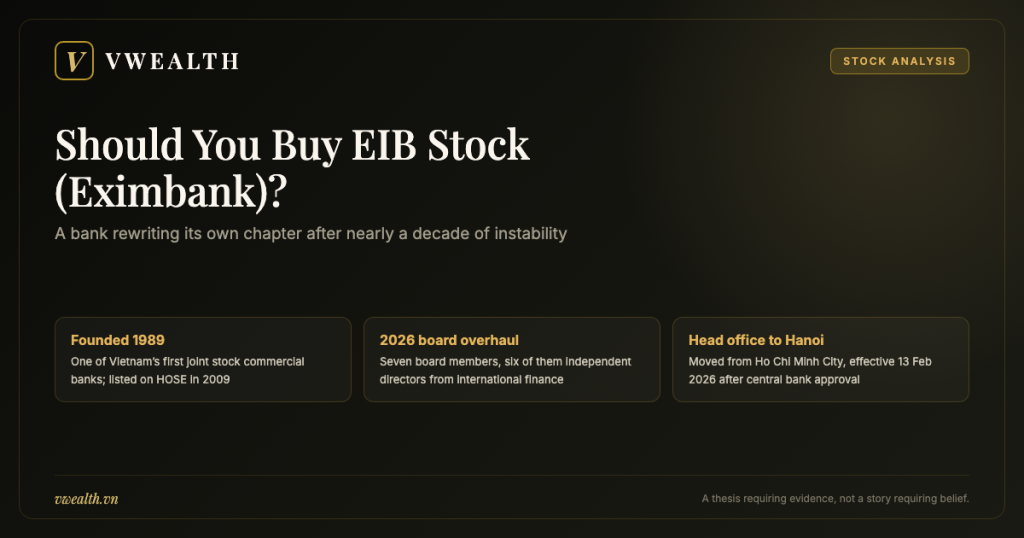
Anyone asking whether to buy EIB stock usually knows half the story already: Eximbank is the Vietnamese bank associated with nearly a decade of disputes between shareholder groups, holding the domestic record for changes of chairman and for shareholder meetings that could not be convened. Most people do not know the other half, and the other half is the part worth reading. During 2026 this bank moved its head office from Ho Chi Minh City to Hanoi, replaced almost its entire board of directors, and installed a governance structure with no precedent in Vietnamese banking — a board on which six of seven seats are held by independent directors, most of them from international financial institutions. This analysis retells Eximbank’s thirty-seven years using only what has been formally disclosed, teaches you how to read the accounts of a bank in restructuring, and ends with a straight answer.
Two conventions before we start.
The first concerns figures. You will encounter dates, names, ownership percentages and scale figures, all drawn from public sources: the establishment decision, board and shareholder meeting resolutions, exchange filings and mainstream financial media. What you will not find is a figure for the latest quarter, a current valuation multiple, or a price target. For current numbers, open the research reports on vwealth.
The second concerns how the governance disputes are described. This article recounts only events that were formally disclosed or reported by mainstream media, in chronological order. It does not assign responsibility to any individual or group, does not speculate about motives, and does not reach conclusions about who was right. That is not evasion; it is the only way to write usefully about a subject like this.
If you are new to this market, the guide on how to invest in the Vietnam stock market covers the mechanics, and the Vietnam banking sector guide explains the regulatory architecture referenced throughout.
Thirty-seven years of a first-generation joint stock bank
Eximbank is not a young institution. It belongs to the first generation of joint stock commercial banks in Vietnam, founded when the concept itself was new to the economy.
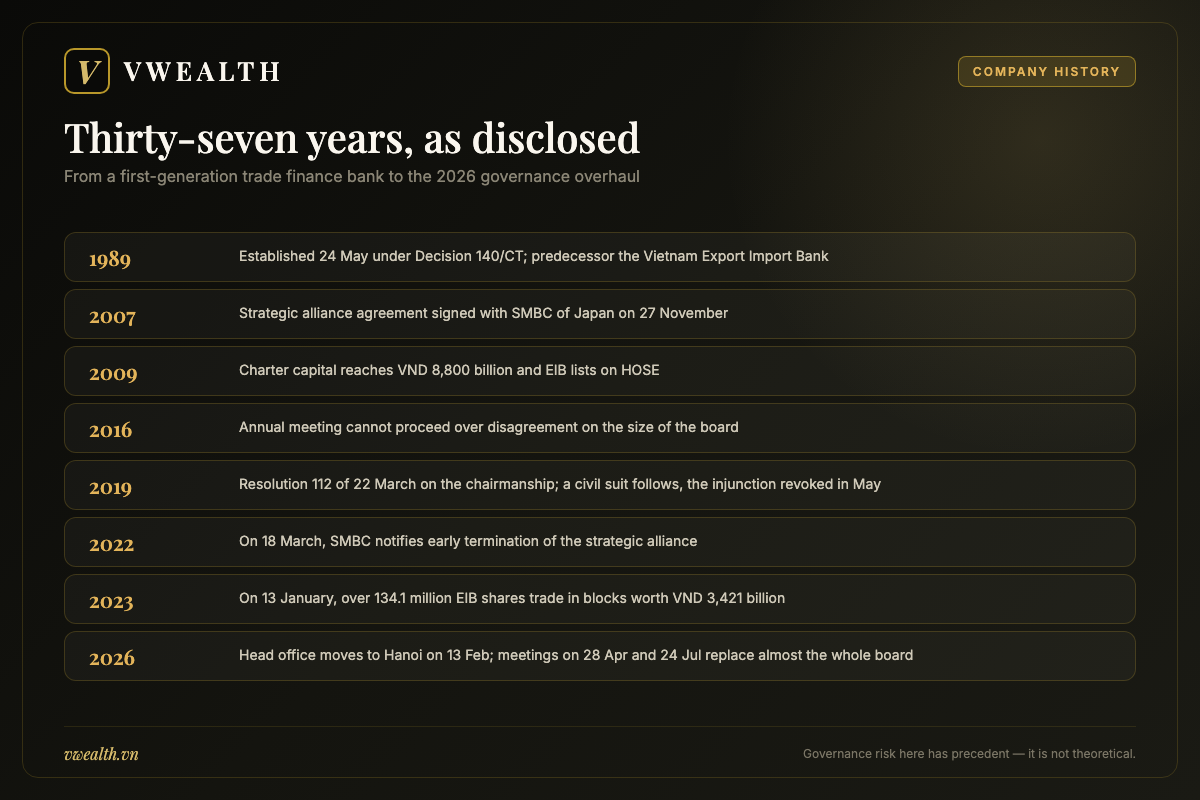
1989: born to serve import and export
The bank was established on 24 May 1989 under Decision number 140/CT of the Chairman of the Council of Ministers, its predecessor being the Vietnam Export Import Bank. It is one of Vietnam’s earliest joint stock commercial banks.
The name states the original mandate plainly. In the late 1980s Vietnam was opening to trade, and import-export companies needed an institution that could issue letters of credit, finance working capital against a shipment, and process international settlements. That work requires correspondent relationships with foreign banks and expertise in trade documentation — capabilities the banking system at the time barely possessed.
Remember this for the later chapters: Eximbank’s origin is a wholesale bank serving trading companies, not a retail bank. Its historical strength is trade finance and international settlement. The commercial story of the following three decades is, at heart, the story of this bank trying to move from a wholesale base to a modern retail model.
What being a first-generation joint stock bank actually meant
A note on context, because the significance of a 1989 founding is easy to miss from outside Vietnam.
Before the economic reforms of the late 1980s, Vietnam operated a single-tier banking system in which the central bank also performed commercial functions. The separation into a two-tier system — a central bank plus commercial banks — was one of the structural reforms of that period, and the first joint stock commercial banks were established in its immediate aftermath.
That means Eximbank was created in an environment with no established commercial banking practice to inherit, no domestic pool of trained bankers, and no regulatory precedent for most of what it was being asked to do. The institutions founded in that window had to build the profession alongside building the business.
Two consequences run through this bank’s later history. The first is that its trade finance capability was assembled from scratch and represented genuine scarcity value for years. The second is that governance frameworks for joint stock banks in Vietnam developed gradually over the following decades — and several of the specific rules that would have constrained the disputes described below did not exist in their current form when the ownership structure was originally formed.
2007: a strategic alliance with a Japanese partner
In 2007 Eximbank signed strategic cooperation agreements with seventeen domestic and international partners, the most significant being the strategic alliance agreement dated 27 November 2007 with Sumitomo Mitsui Banking Corporation of Japan, commonly abbreviated SMBC.
This was the era in which many Vietnamese banks sought foreign strategic shareholders. The logic was clear: a foreign partner brought three things domestic banks lacked — capital, governance standards and technology. For a bank rooted in trade finance, having a large Japanese bank behind it added a further dimension: access to the network of Japanese companies investing in Vietnam.
For years this was regarded as one of the flagship Vietnam-Japan banking alliances. Its ending, fifteen years later, is described below.
2008 to 2010: capital raises and a listing
Charter capital rose to 7,220 billion dong in 2008. In 2009 it increased further to 8,800 billion dong and EIB shares were formally listed on the Ho Chi Minh Stock Exchange. In 2010 charter capital reached 10,560 billion dong.
Three consecutive years of substantial capital increases show that in this period Eximbank ranked among the largest joint stock banks in the system by capital. This matters for understanding market sentiment toward the ticker: many long-standing investors still remember Eximbank at the standing it held in this era, and measure the present against that memory.
From 2015: a period of disputes between shareholder groups
This section needs to be precise and restrained.
From 2015 onward, Eximbank went through numerous chairmen of the board, saw several shareholder groups unable to reach agreement on control of the bank, and had at least six shareholder meetings that could not be convened. According to financial media reporting, this is the bank holding the record for changes of board chairman and for cancelled or postponed shareholder meetings over roughly a decade.
Several specific milestones were disclosed or widely reported.
In 2016 the annual general meeting could not proceed because the parties could not agree on whether the board should have nine or eleven members. This is a textbook example of the deadlock the bank faced: the problem lay not in operating results but in the inability to reach consensus on governance structure.
2019 was the most contentious stretch. On 22 March 2019 the board issued Resolution 112 electing Ms Luong Thi Cam Tu as Chairman of the Board and removing Mr Le Minh Quoc from the position. Mr Le Minh Quoc filed suit against board members and requested that the Ho Chi Minh City People’s Court apply an interim injunction; the court granted it, and in May 2019 the measure was revoked.
In 2022, two days after the 2021 annual general meeting — a meeting that had itself been postponed due to the pandemic and to disagreements — Eximbank elected Ms Luong Thi Cam Tu as Chairman of the Board for term seven, replacing Mr Yasuhiro Saitoh.
To reiterate: these are disclosed corporate governance and civil proceedings events. This article does not evaluate the merits of any party’s position and does not speculate about motives. For an investor, the value of knowing this sequence lies in one thing only: it tells you that governance risk at this institution has precedent, rather than being theoretical. For broader context on how governance works in this market, see the overview of corporate governance in Vietnam.
2022 and 2023: the Japanese partner departs
On 18 March 2022, SMBC formally notified Eximbank of the termination of the strategic alliance agreement. The agreement signed on 27 November 2007 was terminated ahead of schedule at SMBC’s request.
The actual divestment followed. In the trading session of 13 January 2023, more than 134.1 million EIB shares changed hands in negotiated block trades with a total value of 3,421 billion dong; foreign investors sold nearly 132.8 million shares, equivalent to roughly 10.8% of capital, to domestic buyers.
For an investor this event has three implications.
The first concerns capital and standards. A large foreign strategic shareholder typically anchors governance standards and serves as a reserve source of capital. When that shareholder leaves, the bank loses both.
The second concerns the ownership structure. A substantial block moved from a long-term partner into domestic hands, opening a new chapter in the shareholder picture.
The third concerns foreign ownership room. When a large foreign holding is sold, the room reopens, creating headroom for a new partner — or, as in Eximbank’s later case, for a decision to cap that room at a low level, discussed in chapter two.
February 2026: the head office moves to Hanoi
Eximbank announced the relocation of its head office from Ho Chi Minh City to Hanoi, effective 13 February 2026, following approval by the State Bank of Vietnam. The new head office is located in Hoan Kiem district, Hanoi.
For a bank, relocating the head office is not administrative housekeeping. It requires central bank approval, an amendment to the operating licence, and revision of a long list of legal documents. It is also a signal about where the centre of gravity sits, since a head office is normally located near where decisions are made.
Eximbank was founded and grew in Ho Chi Minh City, tied to the southern import-export business community for decades. The move to Hanoi therefore marks a considerable shift.
2026: the governance overhaul
2026 was the busiest governance year in the bank’s recent history, with two significant shareholder meetings.
The annual general meeting on 28 April 2026 was attended by 215 shareholders representing 66.46% of voting shares. The meeting removed and replaced numerous members of the board of directors and of the supervisory board. Ms Pham Thi Huyen Trang, an independent director, chaired the session. On profit distribution, the meeting agreed to pay no dividend, retaining earnings to strengthen capital.
The extraordinary general meeting on 24 July 2026 went considerably further. Shareholders approved restructuring the board to seven members, six of them independent, and elected new members. Mr Nguyen Le Quoc Anh was elected to the board and immediately afterwards elected by the board as Chairman with effect from 24 July 2026.
Chapter two examines what this new structure means, because it is the single largest point of difference between EIB and every other bank ticker on the exchange.
Key milestones at a glance
| Date | Event | Why it matters |
|---|---|---|
| 24 May 1989 | Established under Decision 140/CT; predecessor the Vietnam Export Import Bank | One of Vietnam’s first joint stock commercial banks |
| 27 Nov 2007 | Strategic alliance agreement signed with SMBC | Begins fifteen years with a Japanese strategic shareholder |
| 2008 – 2010 | Charter capital rises from 7,220 to 10,560 billion dong | Ranked among the largest joint stock banks by capital |
| 2009 | EIB shares listed on HOSE | Enters the listed-company disclosure regime |
| 2016 | Annual general meeting could not proceed over disagreement on board size | Start of a prolonged governance deadlock |
| 22 Mar 2019 | Resolution 112 on the chairmanship; a civil suit and interim injunction follow, revoked in May 2019 | The most contentious point of the dispute period |
| 18 Mar 2022 | SMBC notifies early termination of the strategic alliance | End of the foreign strategic shareholder relationship |
| 13 Jan 2023 | More than 134.1 million EIB shares traded in blocks worth 3,421 billion dong | Ownership structure fundamentally altered |
| 13 Feb 2026 | Head office relocated from Ho Chi Minh City to Hanoi after central bank approval | A shift after decades based in the south |
| 28 Apr 2026 | AGM replaces numerous board and supervisory board members; no dividend | The governance overhaul begins |
| 24 Jul 2026 | EGM approves a seven-member board with six independent directors; Mr Nguyen Le Quoc Anh becomes Chairman | A governance structure without precedent in Vietnamese banking |
The 2026 governance overhaul and the shareholder picture
If there is one reason to study EIB closely this year, it is in this chapter. Eximbank is running a governance experiment no listed Vietnamese bank has attempted.
Nguyen Le Quoc Anh: an outsider to the current Vietnamese banking establishment
The Chairman of the Board since 24 July 2026 is Mr Nguyen Le Quoc Anh, born in 1966, a United States citizen. He holds bachelor’s, master’s and doctoral degrees in nuclear engineering from Purdue University in the United States, together with a master’s degree in economics.
What makes the appointment notable for investors is his most recent experience in the industry: he served as Chief Executive Officer of Techcombank from 2016 to 2020. That was a period of very strong profit growth at Techcombank, with pre-tax profit rising from over 2 trillion dong in 2015 to 12,838 billion dong in 2019.
One clarification to prevent a misreading: a person who ran bank A successfully does not thereby guarantee the same outcome at bank B. Two banks have different customer bases, different balance sheet structures and different starting points. What that experience genuinely establishes is that the new board contains someone who understands in detail how a modern Vietnamese retail bank operates — and that is a substantive change from the preceding period.
A board that is almost entirely independent
This part has no precedent.
The extraordinary general meeting of 24 July 2026 approved a board structure of seven members, of whom six are independent directors. According to disclosures and financial media reporting, the new-term board comprises Mr Nguyen Le Quoc Anh together with Ho Poh Wah, Richa Goswami, Ooi Huey Tyng, Michael Richard Harte and Chua Teck Huat Bill — people whose backgrounds are in large international financial institutions. Mr Nguyen Quoc Hung was elected to a role connected with the audit function.
Pause to understand why this is unusual.
At most Vietnamese joint stock banks, the board consists largely of representatives of major shareholders’ capital, plus the one or two independent directors the law requires as a minimum. That structure reflects the reality of ownership: whoever puts in the most money has the loudest voice.
The structure Eximbank has just created inverts this. Most seats belong to people who represent no shareholder’s capital and who are expected to decide on the basis of expertise and of the bank’s collective interest. In corporate governance theory this is regarded as a high standard — and it is also very rare in practice in emerging markets.
Why this structure may be the answer to the old problem
Set the new structure beside the history in chapter one and its logic becomes clear.
Eximbank’s long-running problem was not a shortage of capital or of customers. It was that shareholder groups could not agree on who controlled the board, and that deadlock paralysed decision-making at the highest level, with consequences flowing down through the whole organisation.
A board composed mostly of independent directors is the most direct way to break that deadlock: when no seat belongs to a particular shareholder group, the contest for seats loses most of its meaning. In theory, decisions then get made on expertise rather than on the balance of forces.
Combined with a chairman experienced in running a large retail bank, the message to the market is fairly clear: the bank wants to move from governance based on shareholder power to governance based on systems and expertise.
And why it is also an untested risk
In fairness, the model raises questions nobody can answer, because there is no Vietnamese precedent.
The first question concerns commitment. Independent directors do not hold large stakes, so their personal financial interest in the bank is far smaller than a major shareholder’s. That is a strength in terms of objectivity and a weakness in terms of long-term incentive.
The second question concerns local market knowledge. A board with many members from international finance brings standards and experience, but Vietnamese retail banking has particularities in customer behaviour, in the relationship with the regulator and in collateral enforcement that international experience does not substitute for.
The third question concerns speed. A new board needs time to understand the balance sheet, the credit portfolio and the organisation. During that period, decisions may come more slowly.
The right reading for an investor: this is a change with real potential and also an experiment with no result yet. Do not value it as though the outcome were already settled in either direction.
Who the major shareholders are
After the Japanese partner exited, Eximbank’s shareholder picture was reshaped.
According to disclosed information, the largest shareholder is now Gelex Group with a holding around 10% of capital. Gelex first appeared on Eximbank’s list of shareholders holding more than 1% in July 2024. Alongside it, VIX Securities has been recorded at roughly 5% and Vietcombank at roughly 4%.
This detail will matter to anyone reading other pieces in this series. Gelex is the parent of Gelex Electric, analysed in the piece on GEE stock, and the group itself is listed and analysed in the piece on GEX stock. An investor holding several names in this ecosystem should be aware of accumulating concentration risk without noticing it.
How ownership limits work for Vietnamese banks
The 10% figure attached to the largest shareholder is not arbitrary, and understanding why explains a great deal about the Vietnamese banking landscape.
The Law on Credit Institutions caps ownership at a bank on three levels: an individual shareholder, an institutional shareholder, and a shareholder together with its related persons. The ceilings are deliberately restrictive, and they have been tightened over successive amendments. The purpose is straightforward: to prevent a bank becoming a captive funding source for the ecosystem of whoever controls it.
Two practical implications follow. The first is that no private Vietnamese bank can legally have the kind of dominant single owner that is unremarkable in many other markets, which is why concentration in this sector expresses itself through groups of related holders rather than through one large stake. The second is that the disclosure regime for shareholders holding 1% or more, extended in recent years, made the real picture across the sector considerably sharper than it had been.
For Eximbank specifically, this is the frame within which its largest shareholder’s stated intention to consider raising its stake has to be read. Any such increase depends entirely on what the legal framework permits at the time, which is why the statement was made conditionally.
The largest shareholder’s stated position
Gelex has set out its position publicly at its own shareholder meeting.
Group management stated that it regards the Eximbank holding as a long-term investment and does not participate in running the bank, while noting it may consider raising its stake to 15% if the legal framework permits. The group also referred to nominating a representative to the bank’s board as an independent director, subject to regulatory approval.
Three points for investors. First, this is a publicly stated position, and like any stated position it can change with time and circumstances. Second, the ownership ceilings in the Law on Credit Institutions are a real constraint, so any plan to increase a stake depends on the legal framework. Third, having a large institutional shareholder with a stated long-term commitment is a significant change from the period in which no party held clear sway.
Foreign ownership room and a notable decision
After the Japanese partner’s exit, foreign ownership at Eximbank fell sharply, opening substantial room.
The bank subsequently approved capping foreign ownership at 6%, materially below the ceiling the law permits for credit institutions. You should verify the prevailing level in the most recent disclosure, as this parameter can be adjusted by resolution.
Why would a bank voluntarily cap its foreign room low? Two reasons are common in practice. The first is preserving headroom for a future sale to a specific strategic partner at a negotiated price, rather than letting the room fill gradually with financial investors buying on the exchange. The second is controlling the shareholder structure during a governance-sensitive period.
For foreign investors the consequence is direct: building a meaningful position in EIB on the exchange is substantially restricted. The mechanics are explained in the guide to foreign ownership limits in Vietnamese stocks.
Ownership and governance summary
| Item | Disclosed position | What to re-check yourself |
|---|---|---|
| Largest shareholder | Gelex Group, around 10% of capital, on the above-1% list since July 2024 | The most recent 1% shareholder disclosure |
| Other institutional holders | VIX Securities around 5%, Vietcombank around 4% | Disclosed transactions |
| Chairman | Mr Nguyen Le Quoc Anh, born 1966, since 24 Jul 2026 | Latest personnel resolutions |
| Board structure | Seven members, six of them independent | Current member list and biographies |
| Executive management | At the April 2026 AGM, Mr Tran Tan Loc held the senior executive role | Most recent chief executive appointment filing |
| Dividend | 2026 AGM agreed to pay none, retaining earnings for capital | Profit distribution resolutions in later years |
| Foreign ownership room | Approved cap at 6% | Prevailing foreign ownership level |
| Head office | Relocated to Hanoi, effective 13 Feb 2026 | Updated operating licence |
How Eximbank makes money: from trade finance toward retail banking
A bank earns in three ways: the spread between lending and funding rates, service fees, and investment results. This chapter covers where Eximbank does those three things and with whom.
The root: trade finance and international settlement
This is the business tied to the bank’s own name and its historical strength.
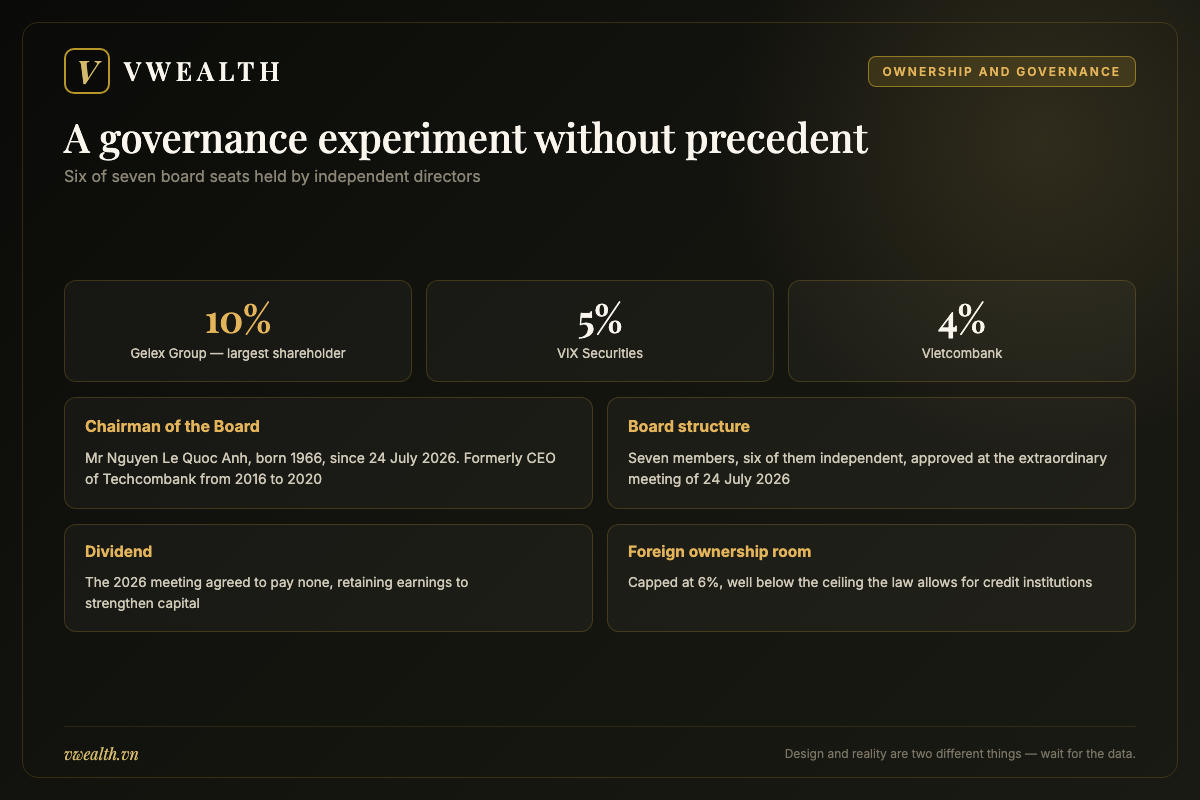
Trade finance is the product family serving import-export companies: issuing letters of credit, discounting documents, payment guarantees, working capital financing against shipments, and foreign exchange for settlement. It has three characteristics worth an investor’s attention.
The first is that it generates fee income alongside interest income. Every letter of credit issued and every document set processed produces a fee. Fee income does not consume regulatory capital the way lending does, making it high-quality earnings.
The second is that it brings transaction deposits. A company that routes its international settlements through a bank generally keeps its operating cash there, and transaction deposits are the cheapest funding a bank can obtain.
The third is that it is tied to foreign exchange activity. A bank strong in trade finance normally has steady income from currency transactions for customers — low risk when it is pure service provision, and high risk if it shifts into proprietary trading.
The practical question for Eximbank is how much of that historical position survives after a turbulent period. This is something you can check yourself by tracking the share of service income and foreign exchange income in total operating income over several years.
How a letter of credit earns money, in concrete terms
It is worth walking through the mechanics once, because trade finance is described abstractly far more often than it is explained, and it is the core of this bank’s identity.
A Vietnamese importer agrees to buy goods from an overseas supplier. The supplier does not know the importer and will not ship without assurance of payment. The importer will not pay in advance without assurance of delivery. The bank resolves this by issuing a letter of credit: an undertaking to pay the supplier once specified shipping documents are presented and found to conform.
The bank earns in several places along that chain. It charges an issuance fee for taking on the payment undertaking. It may charge an amendment fee if terms change. It earns a document examination fee when the papers arrive. If it finances the importer while goods are in transit, it earns interest. If the transaction requires currency conversion, it earns a spread. And throughout, the importer’s operating balances sit in an account at that bank.
Three things follow for an investor. First, a single trade relationship generates several distinct revenue lines rather than one. Second, most of those lines are fee-based, meaning they do not consume regulatory capital the way a loan does. Third, the relationship is sticky, because moving trade banking to a competitor means re-establishing correspondent arrangements and credit lines.
That is why the share of service income in total operating income is the single best proxy for whether Eximbank still holds the franchise its name refers to.
Retail and small and medium enterprises
Like every Vietnamese joint stock bank, most of the recent period’s growth is expected to come from retail — mortgages, consumer lending, credit cards, individual deposits — and from small and medium enterprises.
This is a harsh competitive arena, and the starting position deserves an honest look. During years in which other banks invested heavily in technology, in brand and in expanding their customer base, Eximbank was in governance deadlock. The gap accumulated over that period is a real gap, not an impression.
That does not mean it cannot be closed. Vietnamese banking has seen institutions change rank materially within five to seven years given the right strategy and the stability to execute it. But it does mean that any investment case resting on Eximbank rapidly catching the leading cohort deserves serious scrutiny.
What a wholesale-to-retail transition actually requires
The sentence “moving from a wholesale base to a retail model” is easy to write and hard to execute, so it is worth setting out what it actually demands.
A wholesale bank serves a few thousand corporate relationships, each large, each managed by a relationship officer, each generating revenue across several products. Its competitive edge is expertise, credit judgement and correspondent reach. Its cost base is concentrated in skilled people.
A retail bank serves millions of small relationships, each generating little revenue individually, none of which can be manually managed. Its edge is distribution, brand trust and unit economics. Its cost base is concentrated in technology, branches and marketing, and its returns depend on driving the cost of serving one customer down toward zero.
These are different businesses that happen to share a licence. Converting from one to the other requires investment in systems before revenue arrives, patience through several years of negative operating leverage, and — critically — stability at the top for long enough to see the investment through. That last requirement is precisely what Eximbank lacked during the period in which its competitors were making exactly this transition.
This is why the accumulated gap discussed above is not simply a matter of years lost. It is a matter of a specific, capital-intensive, multi-year build that competitors completed and this bank did not.
Network and customer base
Eximbank operates branches and transaction offices across many provinces, with a historical density weighted toward the south, reflecting its origins.
The head office relocation to Hanoi raises an operational question worth monitoring: where the focus of network and customer development will sit in the coming period. This is not a rhetorical question — for a bank, shifting geographic focus brings changes in regional staffing, in the corporate customer portfolio and in the cost structure.
How to check: track the number and distribution of service points across annual reports, and track the regional composition of the loan book where the bank discloses it.
Asset quality: the area to examine most closely
For any bank that has passed through an extended period of governance instability, asset quality is the first place to look.
The reason is mechanical. A lending decision is made today but its consequences surface several quarters or several years later. A period in which oversight at the top was fragmented can leave traces in the credit portfolio long after that period ends.
This is not an allegation about Eximbank’s current portfolio — it is a general principle applying to every credit institution. But it explains why chapter four of this article concentrates on non-performing loans, special mention loans and coverage ratios, and why you should read those before reading the profit line.
The non-performing loan target set at the 2026 annual general meeting is below 2.5%. That target figure is itself information: it tells you where management positions the bank’s asset quality relative to the sector.
Why the bank chose to pay no dividend
The 2026 annual general meeting agreed to pay no dividend, prioritising retained earnings to strengthen capital.
For investors accustomed to reliable dividend payers this may look like a negative. But the context of the decision matters.
Regulatory capital determines how large a credit growth quota a bank is granted and how much loss it can absorb. For a bank in restructuring targeting double-digit credit growth, retaining all earnings is a financially sound defensive decision.
It is also a sharp contrast with other Vietnamese banks currently paying substantial cash dividends. Both are banks, but at different points in their lifecycle the profit distribution choice differs entirely — and that tells you more about each institution’s position than any corporate introduction would.
Business lines at a glance
| Business line | Main customers | Income type | Historical strength | What to check |
|---|---|---|---|---|
| Trade finance and international settlement | Import-export companies | Service fees plus interest income | The bank’s origin and its name | Share of service income in operating income |
| Foreign exchange | Companies with currency needs | Spread on transactions | Accompanies the trade finance franchise | Separate customer service from proprietary trading |
| Individual retail | Urban individuals | Interest and fees | Long-established southern network | Technology gap versus the leading cohort |
| Small and medium enterprises | Mid-sized companies | Interest income | Traditional customer relationships | Credit risk through the economic cycle |
| Legacy asset resolution | Not a business line | Affects results through provisions | Not applicable | Special mention loans, NPLs and coverage |
Seven checks to run before you buy EIB stock
Reading bank accounts is nothing like reading a manufacturer’s. A bank has no inventory and no factories; its largest asset is a book of loans, which is to say a collection of other people’s promises to pay. The quality of those promises decides everything.
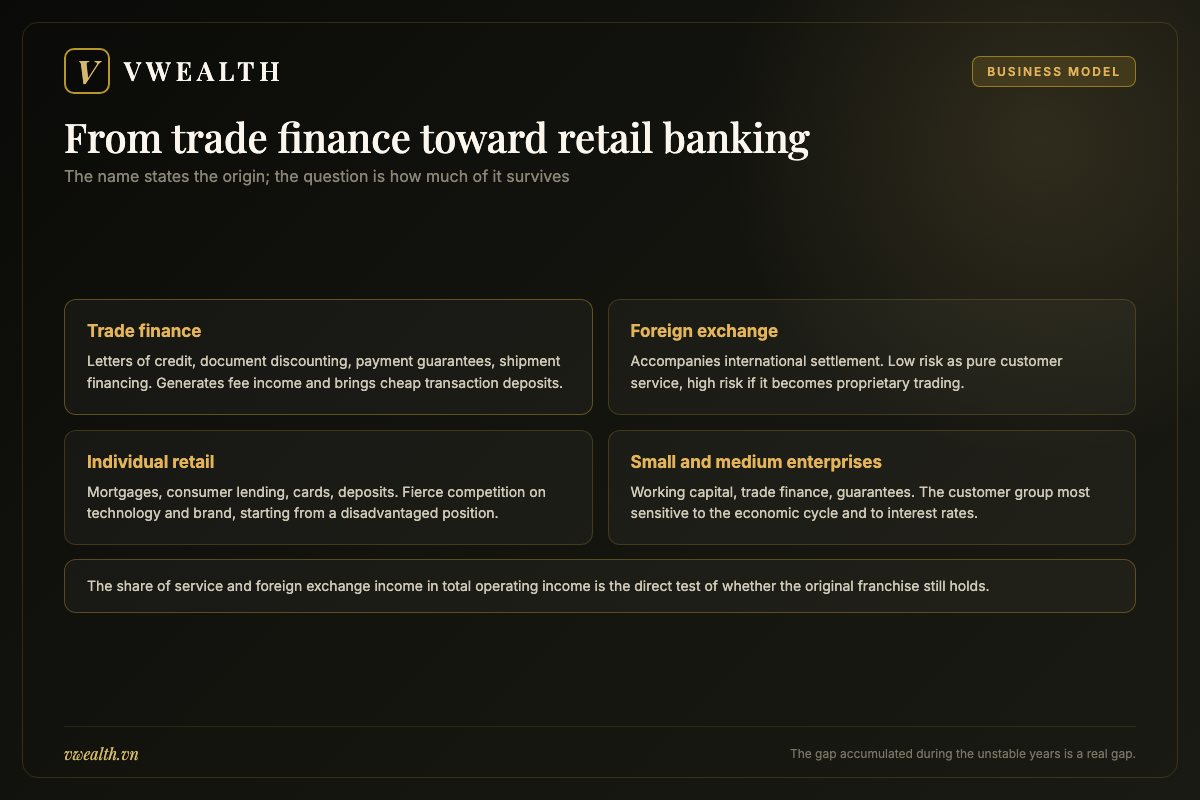
For a bank in restructuring like Eximbank, the order in which you read matters even more: read asset quality first, read profit second. The note on Vietnamese financial statements under VAS and IFRS explains where each disclosure sits and how Vietnamese loan classification differs from what you may be used to.
Why the reading order matters this much
A methodological note first, because it applies to every bank and not only to this one.
A bank’s income statement has a feature that makes it easy to misread: the credit loss provision charge sits near the bottom, after total operating income has already been summed. That means a bank can show excellent operating income and still report modest profit, simply because it provisioned heavily. Conversely, a bank that provisions lightly reports attractive profit while the problem remains sitting in the portfolio.
Reading profit first and asset quality second is therefore reading backwards. You form an initial impression from a number shaped by an accounting choice, and then have to correct that impression — something human psychology does badly.
The correct order is: special mention loans, then non-performing loans, then coverage, then profit. Read that way, the profit figure arrives already in context.
Check 1: special mention loans, the earliest indicator
Start here rather than with the headline bad debt ratio, because special mention loans have the shortest lag.
Group two loans, or special mention loans, are exposures past due by a short period but not yet classified as non-performing. This is the waiting room. Some of these will be repaid and return to group one; the rest will slip into group three and become non-performing.
A rapid rise in group two in one quarter therefore usually foreshadows a rise in non-performing loans several quarters later. An investor watching only the headline ratio will always get the news later than one watching group two.
How to check: open the loan classification note in the financial statements, record the proportion in each group across at least four consecutive quarters, and look at the direction rather than at any single period’s level.
Check 2: the non-performing loan ratio and the stated target
The non-performing loan ratio is the share of loans classified into groups three, four and five, divided by total loans. Eximbank’s 2026 annual general meeting set a target of keeping this below 2.5%.
A stated target has two uses for an investor. The first is that it tells you where management assesses its own current position. The second, and more important, is that it creates a yardstick for scoring execution: at period end, compare actual against the stated target and record how reliable the commitments proved.
For a bank that has just replaced nearly its whole board, tracking delivery against stated targets over the first two to three years is the most practical way to assess the new machinery.
Check 3: the loan loss coverage ratio
This must be read together with the bad debt ratio, and many investors skip it.
The coverage ratio is total loan loss provisions divided by total non-performing loans. It tells you what proportion of the problem book has already been provided for.
The reading rule: a bank with a low bad debt ratio but thin coverage is riskier than one with a higher ratio and heavy coverage. Provisions already taken are costs already recognised; if the loan is ultimately lost, it creates no fresh shock to earnings. Thin coverage means that cost still lies ahead.
This is also the metric that says most about management’s prudence. In a restructuring, a new team often provisions aggressively at the outset to clean the balance sheet, accepting weak profit in the short term. If you see that at Eximbank, do not read it simply as bad news.
Check 4: capital adequacy and the no-dividend decision
The capital adequacy ratio is regulatory capital divided by risk-weighted assets. It answers how much loss the bank can absorb and how far it is permitted to grow.
The 2026 decision to pay no dividend affects this metric directly and positively: all retained earnings thicken regulatory capital.
How to check: track the ratio across periods and set it against the targeted pace of loan growth. If the bank plans double-digit credit growth, capital adequacy has to be thick enough to support that growth; otherwise the plan exists only on paper.
Check 5: net interest margin and the funding mix
Net interest margin is the difference between the average yield earned on interest-earning assets and the average cost of funding, expressed as a percentage of interest-earning assets.
For Eximbank the companion metric is the share of demand deposits in total deposits. This is the portion of funding that is effectively free, and for a bank rooted in serving trading companies, corporate transaction deposits ought to be a natural strength.
That makes this ratio a direct test of whether the trade finance franchise retains its position. If demand deposits improve across periods, the bank is recapturing corporate operating cash flows. If the ratio is flat or falling, the bank is having to buy funding with interest rates, and that compresses the margin.
The margin mechanics international readers often miss
It is worth explaining why Vietnamese bank margins move the way they do, because the pattern differs from several developed markets.
On the asset side, a large share of lending carries rates that reset periodically against a reference, so lending yields adjust downward fairly quickly when policy rates fall. On the liability side, term deposits carry fixed rates until maturity, so funding cost falls only as deposits mature and are rolled. The result is a lag: in a cutting cycle, asset yields fall before funding costs do, and margins compress temporarily even at a well-run bank.
The reverse holds in a tightening cycle. Lending yields rise first, funding costs catch up later, and margins look flattering — until credit quality begins to suffer from the higher rates borrowers now face.
The practical implication: judge margin performance relative to the sector at the same point in the cycle, never in isolation. A bank without a clear funding cost advantage feels each phase of the cycle more sharply than one with a deep base of cheap deposits.
Two liquidity ratios foreign investors frequently miss
Beyond capital adequacy, Vietnamese banks operate under two liquidity constraints that rarely appear in international coverage, and both bear on a bank in restructuring.
The first is the loan-to-deposit ratio, capped by the regulator. It limits how much of a bank’s customer deposit base can be lent out, requiring a portion to be held in liquid form. A bank with a strong deposit franchise has natural headroom under this cap; a bank leaning on interbank funding does not.
The second is the cap on the proportion of short-term funding that may be used for medium and long-term lending. This exists because Vietnamese depositors overwhelmingly place money on short tenors while borrowers, particularly mortgage borrowers, want long ones. The regulator has tightened this ratio in steps over several years, and each tightening pressures banks that relied on the mismatch.
Why this matters for EIB: a bank rebuilding its funding base has to satisfy both constraints while also growing lending, and the two objectives pull against each other. When you compare EIB against peers, check these two ratios alongside capital adequacy. Together they tell you how much of any granted credit quota the bank can actually use — which is a different question from how much quota it receives.
Check 6: the cost-to-income ratio
The ratio of operating expenses to total operating income measures operating efficiency. For a bank in restructuring it needs one specific caveat.
Restructuring periods usually carry one-off costs: technology investment, personnel changes, expenses connected with relocating the head office and reorganising the network. These push the cost ratio up in the short term without reflecting recurring operating efficiency.
The correct reading is to separate one-off items from recurring costs where the notes permit, and to compare the trend over several years rather than over one quarter. At the same time, ask yourself: does that spending create a visible new capability, or is it simply cost?
Check 7: loan mix and the non-interest income share
The final check has two complementary parts.
The first is the loan book by economic sector and by customer type, found in the notes to the financial statements. Three questions: what share goes to real estate and construction, what is the split between individual and corporate lending, and how concentrated is exposure to a small number of large borrowers?
The second is the share of non-interest income. For Eximbank this is not only an earnings quality metric but an identity metric: a bank rooted in trade finance ought to show a higher share of service and foreign exchange income than the sector average. If that share is low, the bank has become an ordinary lender and has lost its historical advantage.
The seven checks and where to find them
| # | Metric | What it means | Good sign | Warning sign |
|---|---|---|---|---|
| 1 | Special mention loans | The earliest asset quality indicator | Stable or declining across quarters | Rising fast while headline NPLs are unchanged |
| 2 | Non-performing loan ratio | Loans already classified groups three to five | At or below the stated target | Above target with no clear explanation |
| 3 | Loan loss coverage ratio | The provision buffer already taken | Thickening across periods | Thinning while bad debt rises |
| 4 | Capital adequacy ratio | Loss absorption and growth headroom | Thickening through retained earnings | Insufficient to support planned loan growth |
| 5 | Net interest margin and demand deposits | Quality of the funding base | Demand deposit share improving | Having to buy funding at high rates |
| 6 | Cost-to-income ratio | Operating efficiency | Falling once one-off costs end | Rising persistently without new capability |
| 7 | Loan mix and non-interest income | Where risk sits and whether identity survives | Service and FX income gaining share | Complete dependence on the interest spread |
How the market treats EIB stock
This chapter is about the share, not the bank. With EIB the distance between those two is larger than with most tickers.
What a governance discount actually is
The phrase appears repeatedly in this article, so it deserves a definition rather than being left as jargon.
A governance discount is the gap between what a business would be worth if investors trusted that decisions were made in shareholders’ collective interest, and what the market actually pays given doubt on that point. It is not a line in any financial statement. It shows up as a persistently lower valuation multiple than comparable businesses command on the same fundamentals.
The discount exists because governance uncertainty raises the range of possible outcomes rather than shifting the central estimate. An investor cannot model a deadlocked board or an unexpected change of strategy; they can only demand to be paid more for bearing the possibility. That demand expresses itself as a lower price.
Two things follow. First, removing a governance discount produces a return that has nothing to do with profit growth — the same earnings simply get capitalised at a higher multiple. That is the entire mechanism behind a turnaround investment case. Second, discounts of this kind are removed slowly and on evidence, not on announcement. Markets that have been disappointed by a name repeatedly require several years of consistent behaviour before repricing it, which is why the timeframe discussion later in this article is not a formality.
A stock with a distinctive personality
Within the listed banking group, EIB has long been known as a share whose price behaviour does not track operating results closely.
The reason is that for many years the most important variable for this stock was not quarterly profit but news about the shareholder register and senior personnel. Every report of a large block trade, of a shareholder meeting being convened, of a change in the chairmanship, produced a strong reaction.
Two consequences follow. The first is that valuation models based purely on financial data have had limited predictive power for this name. The second is a trading range wider than a bank of comparable size would normally show.
The open question for the coming period: once the governance structure settles, will this stock gradually begin behaving like an ordinary bank share — tracking profit and asset quality? That is among the most interesting things to watch.
Which valuation measure works
For banks, the standard measure is price to book value, paired with return on equity. The logic: two banks each hold one dong of equity; whichever generates more profit from it deserves a higher price per dong of book value.
For a bank in restructuring there is an additional layer: reported book value may not be final book value, because it depends on how much further provisioning is required.
The practical approach is to adjust it yourself: estimate the provisioning that may still be needed based on the current coverage ratio relative to the sector norm, deduct that from equity, and only then compute the ratio. The number you get will be less flattering than the raw one, and that is exactly the point of the exercise.
This is also one of the classic traps: buying something that looks cheap on price to book while the book value itself is about to be reduced.
Why the market pays different prices for the same reported profit
There is another variable the market always prices into bank shares, even when nobody says it aloud: how trustworthy the reported profit number is.
Bank profit depends heavily on provisioning decisions, and provisioning carries a degree of discretion within the regulatory framework. A bank that provisions heavily reports lower profit this year but more certain profit later.
With EIB in restructuring, if the new team chooses to clean the balance sheet, you will see weak reported profit for a year or two. An investor reading that number mechanically will reach the wrong conclusion. An investor reading it alongside the coverage ratio will understand what is happening.
No dividend: what that means for you
The decision to pay no dividend and retain earnings for capital has three implications.
The first, and most obvious: if you buy shares for dividend income, EIB is not a candidate at this stage. Nothing more to discuss.
The second: all retained earnings thicken regulatory capital, and regulatory capital is the condition for receiving a credit growth quota. In other words, the dividend you are not receiving is being spent on buying growth headroom.
The third: when a bank resumes paying dividends after a period of retention, the market generally reads that as a signal that the consolidation phase is complete. That is a catalyst worth watching for.
Low foreign room and its practical effect
As noted in chapter two, the bank approved capping foreign ownership at 6%.
The market consequence has two sides. The constraining side is that foreign investors are largely unable to build meaningful positions on the exchange, removing a source of demand other bank shares enjoy when foreign capital flows into Vietnam.
The other side is that headroom for a future strategic sale remains fully intact. For a bank that has just constituted a board drawn largely from international financial institutions, the market will inevitably speculate about that possibility.
The practical rule remains: never buy a bank share solely on the expectation of a foreign strategic sale. If it happens, treat it as a bonus; if not, your case must still stand.
Index membership and passive flows
One structural feature worth a note, because it interacts with everything else in this chapter.
Vietnamese index providers, and the funds tracking them, apply eligibility screens based on listing venue, market capitalisation, free float and trading turnover. Free-float adjustment matters here: a stock’s index weight reflects the shares actually available to trade, not the headline capitalisation.
EIB’s register is moderately concentrated by Vietnamese bank standards — a largest holder around 10%, two other institutions at roughly 5% and 4% — which leaves a substantial tradable pool. That is favourable for index eligibility. Working against it is the low foreign ownership cap, which limits how much of that pool international passive money can actually access.
The net effect is that EIB participates in domestic sector flows more readily than in foreign ones. When you read commentary about Vietnamese bank shares benefiting from international reclassification, apply a discount to that argument for this particular ticker.
Catalysts worth watching
For EIB the catalyst list is longer than for most bank shares, which is both the opportunity and the risk.
The first category is evidence of the new governance machinery working: delivery against stated targets, particularly the non-performing loan target.
The second is senior executive appointments and the stability of the team afterwards.
The third is changes in the list of shareholders holding above 1%, including whether the largest holder increases its stake.
The fourth is decisions on foreign room and the possibility of a strategic partner.
The fifth is a resumption of dividends, if and when that occurs.
Comparing EIB with other Vietnamese banks
| Bank | Current phase | Notable strength | How it differs from EIB |
|---|---|---|---|
| Eximbank (EIB) | Governance restructuring with a near-fully independent board | Trade finance roots, a large institutional shareholder stating long-term intent | No dividend, foreign room capped low |
| Vietcombank (VCB) | Stable, state-controlled | Lowest funding cost in the sector, strong asset quality | Decades of governance stability, small free float |
| ACB | Urban retail with steady growth | Asset quality consistent across cycles | No extended governance deadlock in its history |
| Sacombank (STB) | Late stage of legacy asset resolution | The completion-of-restructuring story | Its issue was assets, not governance disputes |
| TPBank (TPB) | Digital-first with a light physical footprint | Low operating cost through digital channels | Completed its restructuring long ago and chose technology |
The table makes an important point: these banks sit at different stages of their lifecycle, and comparing them on a single ratio is the fastest route to a bad decision. A bank in restructuring and a bank in steady state should not be measured against the same expectation.
The Vietnamese banking sector in 2026
No bank lives outside monetary policy or outside the health of the economy. This chapter sketches the landscape Eximbank operates in.
The credit growth quota system
The State Bank of Vietnam allocates a credit growth quota to each bank, and a bank may not lend beyond the ceiling granted for the year.
Quotas are allocated on several factors, including asset quality, capital adequacy and compliance record. For a bank in restructuring this creates a direct loop: improve asset quality and thicken capital, receive a wider quota, and a wider quota permits profit growth.
This is why the no-dividend decision and the metrics in chapter four are not separate topics. They sit in the same causal chain.
Rates and sector-wide margins
The largest macro variable for any bank is the level of interest rates, and the mechanics were described in chapter four.
What matters specifically for Eximbank is that a bank without a clear funding cost advantage experiences each phase of the cycle more sharply than one with a deep base of low-cost deposits. That amplifies both the good phases and the difficult ones.
Exchange rate policy and why it reaches the loan book
A bank whose business is entirely domestic still lives with the exchange rate, and the transmission runs through policy rather than through its own balance sheet.
When pressure builds on the dong, the central bank’s room to keep domestic rates low narrows, because a wide gap between domestic and international rates encourages capital to leave. Defending the currency therefore tends to mean holding domestic rates higher than growth conditions alone would justify.
For banks that produces two effects at once. Higher rates support margins in the short run, since asset yields reprice faster than funding costs. But higher rates also increase the debt service burden on borrowers, and after a lag that shows up as rising special mention loans and then rising non-performing loans.
A period of currency pressure is therefore not straightforwardly good or bad for a bank share. It is good for the next two quarters of reported margin and bad for the four quarters of asset quality that follow. For a bank whose entire investment case rests on asset quality improving, that second effect matters considerably more than the first.
System-wide asset quality
The bad debt picture across Vietnamese banking is tied closely to two groups: real estate and small and medium enterprises.
Real estate is highly cyclical, and when the market freezes both developers and homebuyers struggle to service debt, producing bad loans in the corporate book and the retail book at the same time. Small and medium enterprises are the segment most sensitive to the economic cycle and to interest rates.
For Eximbank, checking the real estate share of the loan book is mandatory rather than optional. It determines how exposed the bank is in a downturn.
The property cycle and bank balance sheets
One mechanism deserves its own explanation, because it is the single most common route by which Vietnamese bank earnings deteriorate.
Property lending reaches a bank’s balance sheet through more channels than the obvious one. There is direct lending to developers. There is mortgage lending to buyers. There is lending to construction contractors and materials suppliers whose revenue depends on projects proceeding. And there is lending to unrelated businesses that pledged property as collateral, where a fall in property values reduces the security behind loans that have nothing to do with real estate.
That fourth channel is the one investors most often underestimate. In a market where property is the dominant form of loan collateral, a downturn in property prices weakens the recovery value across a large part of the loan book at once, independent of what those borrowers actually do for a living.
For Eximbank the practical instruction is unchanged but the reasoning is now clearer: when you open the sector breakdown of the loan book, the property share is informative but incomplete. The fuller picture requires the collateral composition disclosure as well, where the bank provides it.
Governance standards are rising across the sector
One trend that works in favour of Eximbank’s story is that governance and prudential standards across Vietnamese banking are being raised.
Rules on disclosing shareholders above 1%, on ownership limits for shareholders and related persons, and on credit concentration limits for a single customer and related group have all been tightened in recent years. The objective is to prevent an individual or group turning a bank into a funding vehicle for its own ecosystem.
For a bank that has just constituted a near-fully independent board, this policy direction runs in the same direction as its internal change. That is a contextual positive, though it does not by itself guarantee results.
Competition from digital banks
The retail competition in Vietnam is fought on digital experience rather than on interest rates.
Banks investing heavily in apps are winning younger urban customers through instant account opening, free transfers and bundled services. This is a front on which a bank emerging from prolonged instability starts at a disadvantage.
The practical check is to track the number of active customers and the demand deposit ratio — two metrics that directly reflect whether the bank has secured a place in customers’ daily financial lives.
Market classification and foreign flows
The story around a potential upgrade in Vietnam’s market classification bears directly on the banking group, which carries the largest weight in the market.
For EIB, however, capping foreign room at a low level substantially reduces the benefit from those flows relative to other bank shares. This is a concrete point to weigh when comparing within the sector.
Consolidation pressure
A further force shaping the environment is the long-running effort to strengthen the banking system.
Vietnam has a sizeable number of banks relative to the size of its economy, and policy for many years has aimed at resolving weak institutions and raising standards across the board. Each tightening of prudential requirements raises the capital and systems cost of running a bank, which disadvantages smaller and weaker institutions.
For a mid-sized bank in restructuring, that trend is both pressure and opportunity: pressure because capital and systems requirements rise, opportunity because market share tends to concentrate with institutions that meet the standard.
Country-level risks that sit above all of this
Finally, a bank is a leveraged play on its home economy. Anything affecting Vietnamese growth, employment, property prices or the currency shows up in a bank’s loan book within a few quarters.
For a foreign investor, a position in EIB is therefore not only a view on this bank’s restructuring. It is also a view on Vietnamese macro conditions and on the property cycle. The summary of risks of investing in Vietnam covers those country-level variables in detail.
Three scenarios for EIB stock and what triggers each one
This section contains no price target. For a bank in restructuring, a target price depends on how far the restructuring succeeds — something nobody forecasts reliably. What is more useful is a conditional framework with verification points attached.
The four variables that decide the outcome
The first variable is the actual effectiveness of the new governance machinery. This is the most important variable and also the hardest to measure, because it only becomes visible through results across several quarters. The most practical measure: compare delivery against the targets that were publicly stated.
The second variable is asset quality. For every bank this is the existential variable, and for a bank that has passed through an extended period of weak oversight at the top it deserves particular scrutiny.
The third variable is the ability to reclaim position in the original franchise — trade finance and international settlement — measured through the share of service income and the demand deposit ratio.
The fourth variable is the stability of the shareholder register. Given this bank’s history, that is not a secondary variable.
The optimistic scenario: the restructuring works
Conditions: the new governance machinery operates without senior personnel upheaval for at least two consecutive years; the bank meets or beats its non-performing loan target while thickening coverage; capital adequacy improves through retained earnings, opening the way to a wider credit growth quota; the trade finance franchise recovers, visible in a rising share of service income; and the shareholder register stays stable with the largest institutional holder maintaining its stated commitment.
What it looks like in the accounts: special mention loans declining; coverage thickening; the cost-to-income ratio falling once one-off restructuring costs end; the demand deposit share improving; and, after several years, the possibility of resuming dividends.
What the market does: re-rates from a discount applied for governance risk toward the sector norm. For bank shares, removing a governance discount has a far larger effect than the profit growth in the same period, because it changes how the market classifies the business rather than merely changing a number.
The base case: slow and uneven improvement
Conditions: the new team is stable but needs longer than expected to understand the organisation and execute strategy; asset quality improves slowly, with good quarters and weak ones; restructuring costs extend beyond a single year; the retail franchise remains under heavy competitive pressure without establishing a differentiator; credit quotas sit around the sector average.
What it looks like in the accounts: profit rising but unevenly between quarters; the bad debt ratio oscillating around the target; the cost ratio falling slowly; still no dividend.
What the market does: maintains the current discount and waits for evidence. The share price follows the banking group’s rhythm plus episodic moves on governance news. This is the highest-probability scenario and the one to treat as the default.
The adverse scenario: instability returns or assets prove worse
Conditions: fresh upheaval at board or executive level before the new machinery has produced results; or a review of the credit portfolio reveals a larger provisioning requirement than expected, forcing heavy charges; at the same time a weakening economic cycle raises bad debt across the sector; and the credit growth quota is narrowed because prudential metrics fall short.
What it looks like in the accounts: special mention loans rise first, non-performing loans follow; coverage thins, or is preserved only through outsized provisioning charges; profit falls sharply; capital adequacy fails to improve despite the absence of dividends.
What the market does: widens the discount, treating this as a case where governance risk was not resolved. In this phase bank shares typically fall further than the profit decline alone would suggest, because the market worries about what has not yet been recognised.
One variable specific to EIB: an untested governance experiment
Beyond the four sector variables, EIB carries one of its own: a board model that is almost entirely independent and has never been tried at a listed Vietnamese bank.
No precedent means no statistical basis for forecasting. The model could become a template for the whole sector if it demonstrates that governance based on expertise outperforms governance based on shareholder power. It could equally run into execution problems that theory does not anticipate, particularly in a market where relationships and local knowledge carry weight.
For an investor, the correct handling is to recognise this as a two-sided source of uncertainty — potentially very good, potentially disappointing — and to demand a wider margin of safety rather than trying to guess.
Scenario summary
| Factor | Optimistic | Base case | Adverse |
|---|---|---|---|
| New governance machinery | Stable and delivering within two years | Stable but needs more time | Fresh upheaval appears |
| Asset quality | Target met, coverage thickening | Slow improvement, uneven by quarter | Provisioning requirement larger than expected |
| Trade finance franchise | Recovers, service income share rises | Flat | Continues losing position |
| Capital adequacy | Thickens, widening credit headroom | Improves slowly | Fails to improve despite no dividend |
| Shareholder register | Stable, largest holder maintains commitment | Little change | Churn creates strategic drift |
| Market treatment | Governance discount removed | Discount maintained, awaiting evidence | Discount widened |

So should you buy EIB stock? A straight answer
You now have the facts. This section does not dodge the question, but it also does not issue an instruction, because the right answer depends on who you are.
The case for: six reasons EIB deserves consideration
The first is the nature of the investment case itself. EIB is a turnaround situation, not a growth situation. With this kind of share, the largest source of return is not the business getting bigger but the market removing the discount it has applied. If the restructuring succeeds, that discount is something that can narrow considerably.
The second is that the governance change is substantive rather than cosmetic. Replacing nearly the whole board, constituting a structure with six of seven seats independent, and putting someone with large-scale retail banking experience in the chair — those are changes verifiable through resolutions, not through press releases.
The third is the arrival of a large institutional shareholder that has publicly described its holding as a long-term investment. After years in which no group established a stable position, that is a meaningful change.
The fourth is the trade finance and international settlement heritage. That is a genuinely valuable capability in an economy where trade accounts for a very large share of activity, and it produces fee income and cheap transaction deposits when properly exploited.
The fifth is the decision to pay no dividend. It sounds like a negative, but for a bank at this stage retaining all earnings to thicken capital is the financially correct defensive choice, and it opens the way to a wider credit growth quota.
The sixth is that the policy backdrop runs in the same direction: governance and prudential standards across the sector are being raised, and a bank moving proactively in that direction benefits from the environment.
The case against: seven risks to face squarely
The first risk is governance risk with precedent. This is the most important point and should not be softened. Nearly a decade of history shows that board-level deadlock has occurred repeatedly at this specific institution. The new structure is designed to prevent recurrence, but design and reality are two different things.
The second risk is that the governance model has no Vietnamese precedent. A board that is almost entirely independent, largely drawn from international finance, has not been tested under Vietnamese banking conditions.
The third risk is that asset quality has not been proven through a cycle. Any institution that passed through a period of fragmented senior oversight needs time and multiple periods of data to demonstrate that its credit portfolio is sound.
The fourth risk is the accumulated competitive gap. During years when rivals invested heavily in technology and customer acquisition, this bank was in an unstable period. That gap is real.
The fifth risk is the absence of a dividend. If the investment case does not play out, you have no cash flow compensating you for the waiting.
The sixth risk is foreign room capped low, which reduces the benefit from foreign capital flows relative to other bank shares.
The seventh risk is time. Restructuring a bank is measured in years, not quarters. An investor expecting results within six months will almost certainly be disappointed.
Weighing the two sides
| In favour | Against |
|---|---|
| A turnaround case with room to remove a governance discount | Governance risk with clear precedent at this institution |
| Substantive governance change, verifiable through resolutions | The new model has no precedent and is untested |
| A large institutional shareholder stating long-term intent | Asset quality not yet proven through a full cycle |
| Genuine trade finance and settlement heritage | Accumulated competitive gap in technology and customer base |
| All earnings retained to thicken capital and widen credit headroom | No dividend, so no cash flow while you wait |
| Sector-wide governance standards rising in the same direction | Foreign room capped low, limiting foreign flows |
| Chairman with large-scale retail banking experience | Success at another bank does not guarantee the same here |
| A far clearer ownership picture than in the preceding period | Restructuring is measured in years, not quarters |
Which kind of investor EIB suits
This is the most practical part of the article. The same stock at the same price produces four different answers for four different investor types.
For the long-term value investor, EIB falls into the turnaround category — a situation value investors do look for, and also the category with the highest failure rate within that discipline. If you go that way, two rules are mandatory. First: value on book value you have adjusted yourself for the provisioning that may still be required, not on reported book value. Second: define specific verification milestones in advance and accept withdrawal if they do not occur on schedule.
For the growth investor, EIB is not a suitable choice at this stage. A bank’s growth is capped by its credit quota and by its capital, and this bank is consolidating its base rather than expanding. The story here is recovery, not growth, and the two demand different kinds of patience.
For the income investor, the answer is short: no. The bank has agreed to pay no dividend in order to retain earnings for capital, and for an institution in restructuring, resuming a regular dividend is a matter of years rather than of next year.
For the short-term trader, EIB offers dense news flow and a wide range, which are the two things traders look for. But this is also the ticker that attracts more rumour than any other in the banking group, and trading on unverified reports in a name with this history is the fastest way to lose money. If you trade it, set your stop before you enter rather than inventing one afterwards.
And there is one group EIB almost certainly does not suit: anyone who wants a quiet holding, anyone unwilling to read the loan classification note every quarter, and anyone planning to concentrate a large share of a portfolio into an unproven turnaround.
Extra notes for investors based outside Vietnam
If you are investing from abroad, five mechanical points apply to EIB specifically.
The first, and most binding, is the foreign ownership cap the bank has approved at 6%. Verify the remaining room before assuming you can build a position at all. A ticker at its foreign limit trades at a premium in the offshore market and is effectively closed on the exchange.
The second is settlement. Vietnamese equities settle on a cycle that means shares bought today are not immediately available to sell.
The third is the daily price band. Bank shares move as a group, and in a strong sector move a stock can reach its limit in either direction, leaving you unable to transact where you wanted.
The fourth is currency. Your return is the share price return multiplied by the dong’s move against your home currency. For a domestically focused bank whose earnings are entirely in dong, that is not a detail over a long holding period.
The fifth is disclosure language and accounting standards. Vietnamese banks report under domestic standards, and loan classification and provisioning rules differ from what you may be used to. Full statements and shareholder meeting materials are frequently published in Vietnamese first, with English versions arriving later or in summary form. For a turnaround case where the whole thesis depends on reading the asset quality notes, that gap matters more than usual.
How to approach a turnaround position sensibly
A note on execution, because it matters more here than with a steady-state bank.
Turnaround cases have a characteristic failure mode: the investor buys the story at the beginning, the improvement takes longer than expected, the position becomes uncomfortable, and the investor sells at the point of maximum discouragement — which is often shortly before the evidence finally arrives, or shortly after it has become clear the thesis was wrong. Either way, the decision gets made on emotion rather than on data.
The defence against that is to convert the thesis into a checklist before you buy. Write down the specific metrics that would confirm progress — declining special mention loans, thickening coverage, improving capital adequacy, rising service income share — and the timeframe you will allow. Then scale into the position across several reporting periods as those conditions are confirmed, rather than committing everything at the start.
This also protects against the opposite error: adding to a losing position out of stubbornness. If the checklist is written down in advance, you will know the difference between a thesis that is progressing slowly and one that has been refuted.
Three mistakes investors commonly make with this ticker
Before the checklist, three errors specific to EIB worth naming.
The first is judging the bank entirely by its past. The dispute history is real and should not be dismissed, but a decade-old reputation is not a forecast. The changes made in 2026 are large enough that they deserve to be assessed on their own merits rather than pre-judged.
The second is the opposite error: treating the governance overhaul as a solved problem. A new board is an input, not an outcome. What matters is what appears in the asset quality data over the following two to three years.
The third is buying on price to book without adjusting the book. This is the single most expensive mistake available with a bank in restructuring, because the reported equity figure is precisely the number most likely to be revised by future provisioning.
Six questions to answer before you place the order
Question one: have you looked at the special mention loan ratio and the coverage ratio for the most recent period, and which way are they trending?
Question two: have you adjusted book value yourself for the provisioning that may still be required, or are you using the reported figure?
Question three: have you written down the targets stated at the shareholder meeting so you can score delivery at period end?
Question four: have you confirmed the current senior executive team through the bank’s official filings?
Question five: how long are you giving this thesis to prove itself, and what will you do if that period passes without evidence?
Question six: if the price falls materially after you buy with no bad news on asset quality, will you add, hold, or sell? Answer that before buying.
Closing: a bank rewriting its own chapter
Eximbank is a case on which it is hard to stay neutral. Its name is attached to nearly a decade of governance instability that the market has not forgotten. It has also just made the most far-reaching changes any listed Vietnamese bank has made to its own machinery: replacing almost the entire board, constituting a near-fully independent structure, relocating the head office, and installing a chairman with a background in running a modern retail bank.
Both halves are true at once, and that is exactly why the ticker is hard to value. Look only at the first half and you miss one of the most notable reform efforts the sector has seen. Look only at the second and you forget how many reform efforts in banking history have gone nowhere.
The clear-headed approach is to treat this as a thesis requiring evidence rather than a story requiring belief. The evidence here is specific and easy to check: the special mention loan ratio, the coverage ratio, capital adequacy, the share of service income, and delivery against stated targets. Four or five quarters of data will tell you more than any analysis piece.
The final question to ask yourself is not “is EIB a good bank” — at present it is a bank repairing itself, no more and no less. The right question is: are you willing to commit capital to an unfinished repair, with no dividend while you wait, accepting that the evidence only arrives after several quarters? If yes, the remaining task is to buy at a price that already deducts the provisioning you have estimated yourself, and to check the data patiently each quarter. If no, then no price is cheap enough.
This article provides information and an analytical framework. It is not a recommendation to buy or sell. The governance dispute events are recounted exactly as disclosed or as reported by mainstream media, and are not intended to assign responsibility to any individual or organisation. Every investment decision is yours alone and depends on your financial circumstances, risk tolerance and time horizon. For current data and the latest developments, consult official filings and the research reports on vwealth before acting.
Research Vietnamese stocks in English with vwealth. Our AI-powered platform turns Vietnamese market data into full English analysis reports — with international payment support and a free 2-month trial for new accounts. Create your free account and read the latest reports.