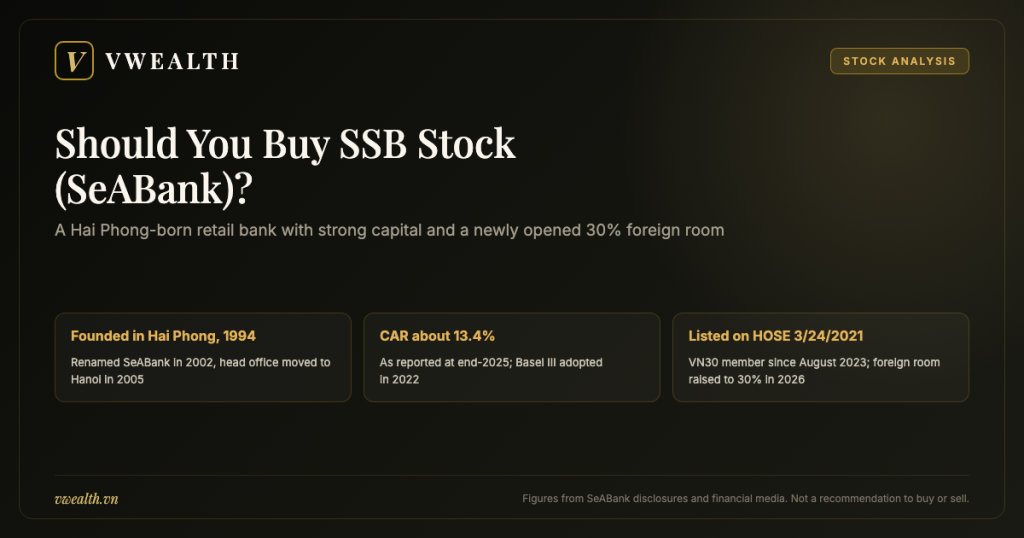
Should you buy SSB stock? SSB is the ticker of Southeast Asia Commercial Joint Stock Bank — better known as SeABank — on the Ho Chi Minh City Stock Exchange (HOSE), and it is one of the most searched mid-sized bank stocks among Vietnamese retail investors. The reason is easy to see. Few Vietnamese stocks come with a story like this one: a bank born in the port city of Hai Phong in 1994, mentored for almost a decade by French banking group Société Générale, closely associated with the family of businesswoman Nguyen Thi Nga and the BRG Group, listed on HOSE on its own “birthday” of March 24 in 2021, and then seller of an entire consumer finance company to Japan’s AEON for VND 4.3 trillion — only for the buyer to demand the deal be voided a few months later. Behind those headlines sits a bank whose charter capital almost tripled in five years, which pays dividends almost exclusively in shares, and which has just raised its foreign ownership limit from 5% to 30%. This analysis walks you through the whole story, shows you how to read SeABank’s own numbers, and ends with a straight answer on who SSB stock suits and who it does not.
First, let us get the names right, because they confuse many foreign readers. SSB is the stock code of Ngan hang Thuong mai Co phan Dong Nam A — in English, Southeast Asia Commercial Joint Stock Bank. The official short name is SeABank, with a capital “A”; you will see “SeaBank” and “Seabank” online, but they all refer to the same lender. Do not confuse SeABank with MSB (Vietnam Maritime Commercial Joint Stock Bank, formerly Maritime Bank). The two banks happen to share Hai Phong roots, both moved their head offices to Hanoi, and both listed on HOSE around the same time, but they are separate legal entities with completely different shareholder groups. Nor should you confuse it with “SeaBank” brands used by digital banks elsewhere in Southeast Asia. When you buy SSB, you are buying shares of the Vietnamese parent bank headquartered at 198 Tran Quang Khai Street in Hanoi.
A second ground rule, shared by every article in the vwealth company-analysis series: dates, names, deals and figures in this article come from published sources — SeABank’s annual reports, shareholder-meeting documents and exchange filings, statements from counterparties such as the International Finance Corporation (IFC) and AEON Financial Service, Moody’s rating actions, and major financial media. Figures for fiscal years that have closed are used as historical reference points. We deliberately do not quote today’s share price, today’s P/B or P/E, or the latest quarter’s profit; for a bank that has just booked a large one-off gain from selling a subsidiary, such numbers are misleading and go stale quickly. Wherever a figure is our own calculation, it is labeled “vwealth estimate” or “illustrative example”. For up-to-date numbers, open the vwealth analysis reports.
If you are new to investing in Vietnam, you may want to start with our guide on how to invest in the Vietnam stock market, which explains practical matters such as trading accounts for foreigners, the T+2 settlement cycle, daily price limits (±7% on HOSE) and foreign ownership limits. Those mechanics matter a lot for SSB in particular, as you will see.
Finally, the thread that runs through this whole piece. In this series we have analyzed many private Vietnamese lenders — VPBank, with its FE Credit consumer finance arm and Japanese partner SMBC, Techcombank, and MSB, SeABank’s fellow Hai Phong native. SeABank is a different animal: a mid-sized retail bank with no consumer finance subsidiary anymore, no foreign strategic shareholder, and a clearly identifiable family at the center of its ownership. The question of whether you should buy SSB stock therefore comes down to three things: whether core earnings, stripped of the one-off gain from selling PTF, can grow steadily; whether stock dividends are diluting your stake faster than profits are rising; and what the newly opened 30% foreign room might lead to next.
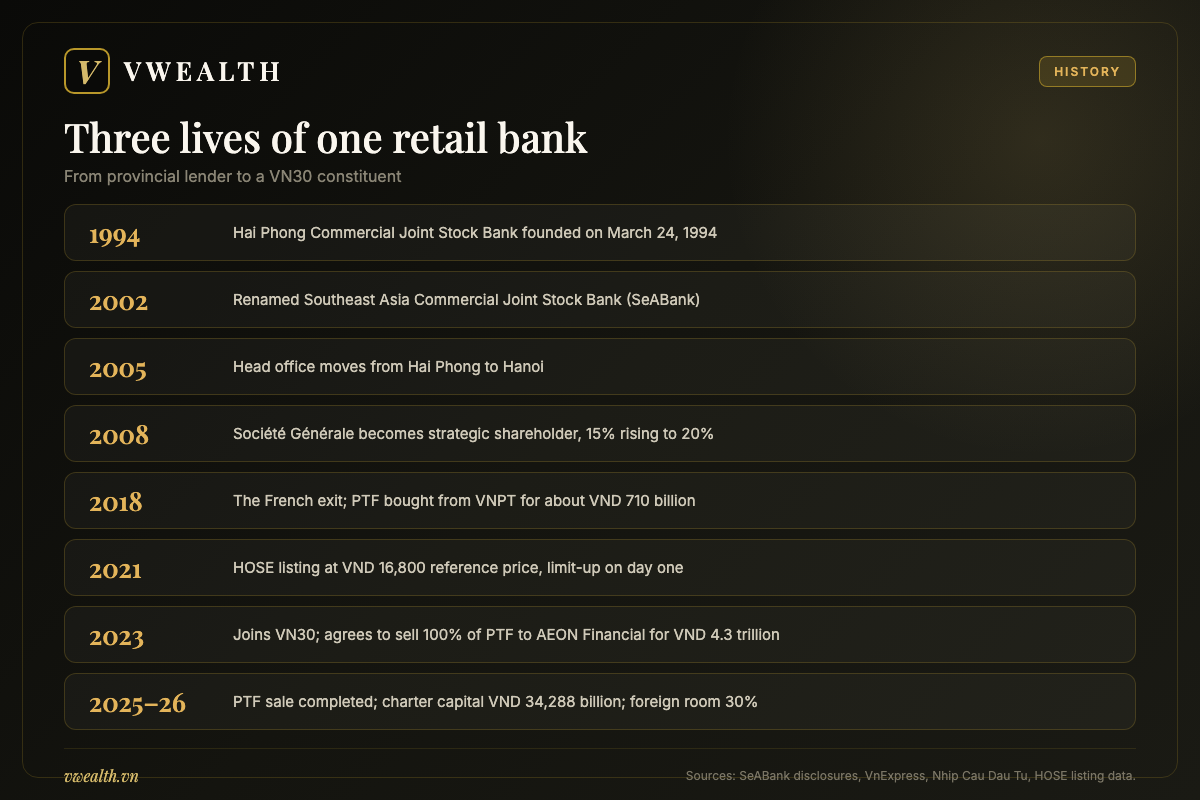
From Hai Phong Bank to SeABank: three decades of new names, a new home and changing partners
Some banks are born big because their parent is a state-owned conglomerate. SeABank was not. It started life as a small joint-stock bank in a port city and survived an era in which many of Vietnam’s small urban and rural lenders were forced either to grow up or disappear. Understanding that journey helps explain today’s SeABank: cautious about aggressive expansion, but unusually active in tapping international funding and in buying and selling pieces of its business.
1994: Hai Phong Commercial Joint Stock Bank opens in a port city
On March 24, 1994, Hai Phong Commercial Joint Stock Bank was officially established. This was the early wave of Vietnam’s joint-stock banks, which emerged after the 1990 banking ordinances opened the sector to non-state players. Dozens of small urban and rural joint-stock banks appeared in provincial cities, most of them serving local traders and small businesses. Hai Phong Bank was no exception: a regional lender tied to the commerce, shipping and small enterprises of one of Vietnam’s main port cities.
Why should an investor today care about the origins of a provincial bank? Because most of the small joint-stock banks of the 1990s did not make it this far. Some were merged, some were acquired, and a handful ended up restructured under special state supervision. The ones that survived and eventually listed were typically those that found a shareholder group with enough financial muscle to inject capital and change the business model in time. For SeABank, that group is linked to the family of Nguyen Thi Nga — whom several public sources, including the Vietnamese-language Wikipedia, describe as one of the bank’s founders in 1994.
A small but telling detail: as recently as April 2025, SeABank still held its annual general meeting of shareholders in Hai Phong. The head office moved long ago, but the tie to its birthplace remains.
2002–2005: a new name, and a move to Hanoi
In September 2002, Hai Phong Commercial Joint Stock Bank renamed itself Southeast Asia Commercial Joint Stock Bank — SeABank. The new name signaled ambition: no longer a city bank, but a bank with regional aspirations. In 2005, the head office moved from Hai Phong to Hanoi. That was the real turning point: from then on, SeABank grew its capital, assets and branch network rapidly.
The years 2005–2007 were a period of feverish capital raising across Vietnam’s banking system. The State Bank of Vietnam (SBV) imposed a roadmap of minimum legal capital for commercial banks, forcing small lenders either to raise capital or merge. SeABank chose to raise capital and expand. During the same period, Nguyen Thi Nga also held leadership roles at Techcombank — Vice Chair from 2002 to 2005 and Chair from 2005 to 2006, according to her public biography — before concentrating on SeABank.
The move to Hanoi was more than a change of address. A bank that wants to do retail banking nationwide needs to be close to the highest-income customers, the largest corporations and the regulator. It is also part of why SeABank was able to attract heavyweight strategic partners shortly afterwards.
2007–2008: Mobifone, Société Générale and a decade-long retail apprenticeship
In August 2007, mobile operator VMS Mobifone became a strategic shareholder of SeABank with an initial stake of about 8%, later reduced to about 6% (according to a 2013 summary by Nhip Cau Dau Tu magazine). But the deal that put SeABank on the map came next: on August 6, 2008, French banking group Société Générale officially became SeABank’s foreign strategic shareholder.
On the size of the stake, sources differ slightly, and you should know that. Some reports say Société Générale held 20% from August 2008; others give a more detailed account in which the French group started at around 15% and then bought more to reach a maximum of 20% — which was the ceiling for a single foreign strategic investor in a Vietnamese bank at the time. What all sources agree on is that Société Générale sent experts who were deeply involved in the bank’s day-to-day operations, supporting governance, risk management and the development of retail banking. State gas company PV Gas also appeared among the strategic shareholders, with about 1.51% at the end of 2011.
Almost ten years with a European banking group inside the house left clear marks on how SeABank works: risk-management systems, standardized retail products, and a habit of dealing with international financial institutions. When you see SeABank raising hundreds of millions of dollars from the IFC, Proparco or FMO today, part of the root lies in this period.
But the partnership did not last forever. Like many of the foreign bank investments in Vietnamese lenders made in 2007–2008, Société Générale gradually withdrew. By the end of 2018, SeABank no longer had any foreign investor among its major shareholders; the French group’s full exit was reported around late 2018 to early 2019. After the French left, SeABank set its foreign ownership limit at 0% — a decision that would shape SSB’s trading for years to come.
2018: the French leave, PTF arrives and a new leadership generation takes over
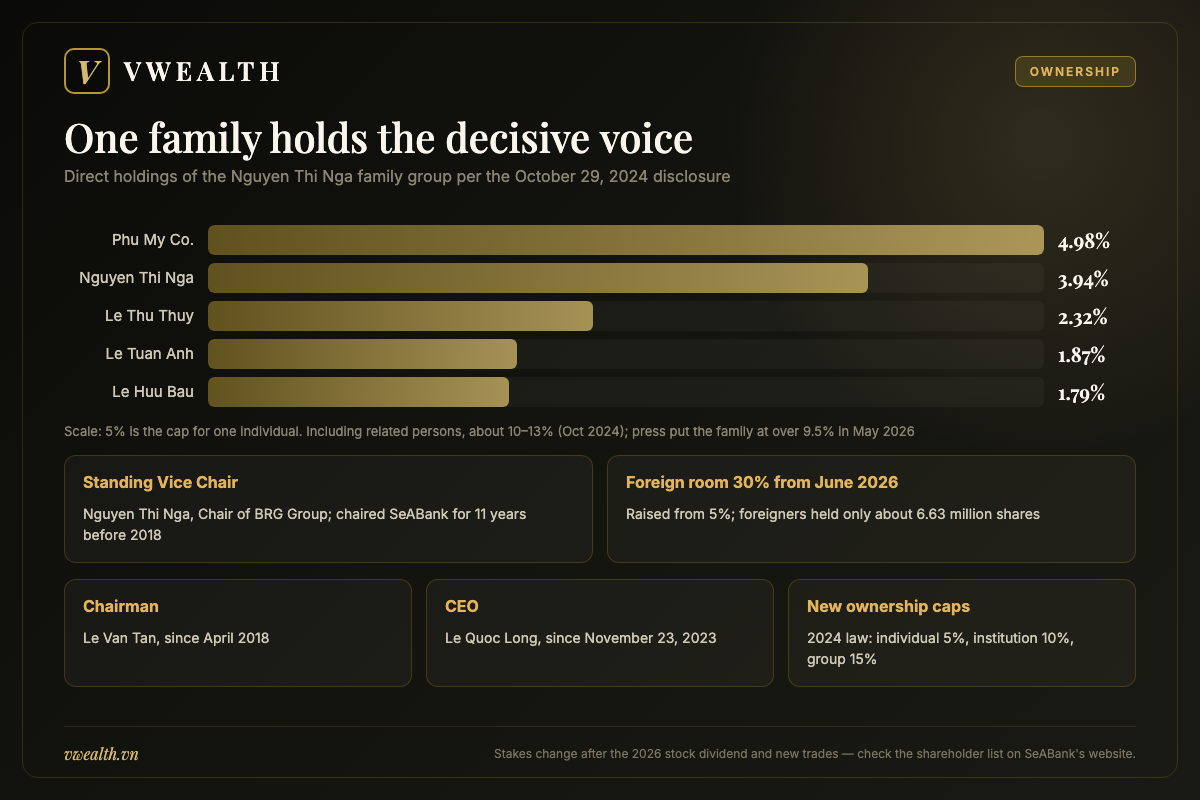
2018 was a year of transformation. On the governance side, Nguyen Thi Nga — who had chaired the bank for about 11 years — moved to the role of Standing Vice Chair of the Board, and Le Van Tan became Chairman in April 2018. The change was explained as compliance with new rules restricting concurrent leadership positions across institutions. Also in 2018, Le Thu Thuy — Nguyen Thi Nga’s daughter, born in 1983 — became Chief Executive Officer, and Le Tuan Anh — her son — joined the Board as Vice Chair.
On the business side, SeABank made a small acquisition that turned out to be very significant. In June 2018, after completing the paperwork, state telecom group VNPT formally handed over Post and Telecommunication Finance Company (PTF) to SeABank. Media reports at the time put the deal value at about VND 710 billion. PTF was a small finance company; SeABank bought it to gain a consumer lending arm alongside the parent bank. Remember that VND 710 billion — five years later, SeABank would sell PTF for roughly six times as much.
One caveat before you jump to conclusions: the gap between the purchase price and the sale price was not all “profit” for SeABank, because over those five years the parent had to inject more capital and grow PTF. The actual gain booked in the 2025 financial statements is a different number, which we cover in chapter 4.
2021–2023: listing on its birthday, joining the VN30 and raising capital nonstop
On March 24, 2021 — exactly 27 years after its founding — more than 1.2 billion SSB shares (precisely 1,208,744,208) were listed on HOSE at a reference price of VND 16,800 per share. SeABank was the third bank to list on HOSE that year. On debut day, with the ±20% trading band that HOSE applies to a newly listed stock’s first session, SSB hit the ceiling at VND 20,150; the market capitalization was reported at about VND 24.2 trillion, or more than US$1 billion.
Listing directly on HOSE, rather than registering first on the less regulated UPCoM market as many banks did during a waiting period, mattered for investors: better liquidity, stricter disclosure standards, and eligibility for the major indices.
After listing, SeABank entered a period of continuous capital increases through stock dividends, bonus shares, rights offerings to existing shareholders and employee share ownership plans (ESOP). Charter capital went from about VND 12,088 billion at listing to about VND 14,785 billion at the end of 2021 and about VND 20,403 billion in early 2023. On March 1, 2023, SSB was added to the MSCI Frontier Markets Index. On July 17, 2023, HOSE announced that SSB would join the VN30 — the index of the 30 largest and most liquid stocks on the exchange — effective August 7, 2023. According to VnEconomy, SeABank’s market capitalization at the close on July 17, 2023 was about VND 71,402 billion, roughly three times its value on listing day.
2023–2026: selling PTF to AEON, a post-deal storm and a 30% foreign room
On October 20, 2023, SeABank signed an agreement to transfer 100% of PTF to AEON Financial Service — the financial services arm of Japanese retail group AEON — for VND 4.3 trillion (roughly US$175 million at 2023 exchange rates, a vwealth estimate). The two sides also signed a memorandum of understanding on strategic cooperation. On December 30, 2024, the State Bank of Vietnam approved the transfer, and on February 3, 2025, SeABank formally handed PTF over to AEON Financial.
That seemed to be the end of it. But on June 6, 2025, AEON Financial Service announced it had notified SeABank that it considered the share transfer agreement invalid, saying that during post-merger integration it had found “significant discrepancies” between the accounting information disclosed before signing and the actual situation at PTF. AEON demanded a full investigation, reimbursement of transaction-related costs, compensation for damages, and signaled it would pursue legal procedures. SeABank said at the time that this was the first notification it had received and that it was contacting AEON to clarify. SSB shares came under pressure in the following days.
Less than two months later, on July 31, 2025, the two sides announced that they had agreed to resolve the matter. According to their statements and reporting by Vietnam Investment Review, AEON Financial Service withdrew its preliminary notice regarding reconsideration of the transaction; both parties committed to support PTF’s debt resolution and business growth; AEON signed a cooperation agreement with SeABank to develop retail products; and AEON confirmed that SeABank neither participated in nor had knowledge of the loan-loss provisioning discrepancies at PTF. No specific financial terms were disclosed.
In 2026, several more milestones followed: in June 2026, SeABank completed a capital increase to VND 34,288 billion by paying its 2025 dividend in shares at a 20.5% ratio; also in June 2026, the bank raised its foreign ownership limit from 5% to 30%; Moody’s kept its Ba3 rating but upgraded the outlook to “positive”; and in August–September 2026, SSB was added to the MSCI Frontier Markets, FTSE Global All Cap (effective September 21, 2026) and MarketVector Vietnam Local indices. In September 2026, Nguyen Thi Nga was awarded the state title of Labor Hero, and SeABank received the First-Class Labor Order.
| Date | Milestone | Why it matters for SSB investors today |
|---|---|---|
| March 24, 1994 | Hai Phong Commercial Joint Stock Bank founded | A private urban bank with no state parent |
| September 2002 | Renamed Southeast Asia Commercial Joint Stock Bank (SeABank) | Ambitions beyond one city |
| 2005 | Head office moves to Hanoi | Start of rapid capital and network growth |
| Aug 2007 – Aug 2008 | Mobifone (about 8%), then Société Générale (15% rising to 20%) become strategic shareholders | A decade-long apprenticeship in European-style retail banking and risk management |
| 2018 | Société Générale exits; PTF acquired from VNPT (about VND 710 billion); Le Van Tan becomes Chairman | Foreign room set at 0%; SeABank owns a finance company |
| March 24, 2021 | HOSE listing at VND 16,800 reference price; limit-up to VND 20,150 on day one | First historical price marker on the main exchange |
| August 2021 | Foreign room raised from 0% to 5% | Very limited access for foreign investors |
| August 7, 2023 | Joins the VN30 index | Domestic index-fund flows |
| Oct 20, 2023 – Feb 3, 2025 | Signs and completes sale of 100% of PTF to AEON Financial for VND 4.3 trillion | Large one-off gain in 2025 |
| June 6 – July 31, 2025 | AEON seeks to void the deal; both sides then agree a resolution and AEON withdraws its notice | Deal-related legal risk resolved, per disclosures |
| June 2026 | Charter capital VND 34,288 billion; foreign room raised to 30% | Opens the door to a possible new foreign strategic investor |
| Aug–Sep 2026 | Added to MSCI Frontier, FTSE Global All Cap and MarketVector Vietnam Local | Passive foreign money starts paying attention |
Looking back over the timeline, SeABank has lived three lives: a provincial joint-stock bank; a retail bank coached by a European partner; and today’s version — a VN30-listed bank with no foreign strategic partner, led by one family, now facing the question of whether it will find a new foreign “partner” after opening its foreign room to 30%.
Leadership and ownership of SSB: the Nguyen Thi Nga family, the BRG ecosystem and a professional management team
For many bank stocks, the question “who owns it?” has a simple answer: the state, a foreign bank, or a large private conglomerate. For SeABank, the answer is more nuanced. No single shareholder owns more than a few percent, but when you add up the members of one family and their related companies, you find a group with a decisive voice. Understanding this group is the first thing to do before asking whether you should buy SSB stock.
Nguyen Thi Nga and the BRG ecosystem: the guiding hand
Nguyen Thi Nga was born on August 17, 1955 in Hanoi and graduated from the National Economics University. According to her public biography, she has been associated with SeABank since its early days, served as Vice Chair and then Chair of Techcombank between 2002 and 2006, founded BRG Group in 2009 and has chaired it ever since. BRG operates in real estate, golf courses (such as Kings’ Island and Legend Hill), hotels (such as the Hilton Hanoi Opera), trading and other sectors; it is also the developer behind a widely reported project that includes a 108-story financial tower. She chairs the Vietnam Private Entrepreneurs Association and in September 2026 received the state title of Labor Hero.
At SeABank, Nguyen Thi Nga is Standing Vice Chair of the Board — a position she has held since 2018 after roughly 11 years as Chair, and to which she was re-elected from April 12, 2024. Vietnamese Wikipedia describes SeABank as being “within the BRG Group ecosystem”. For investors, that phrase cuts both ways. On the positive side, the bank has a long-standing, knowledgeable shareholder group with every incentive to keep it healthy, since it is one of the family’s most important assets. On the watch-list side, when a bank sits in an ecosystem that includes real estate businesses, investors should pay attention to related-party transactions — loans, guarantees, bonds or collateral linked to companies in the same ecosystem — in the notes to the financial statements.
Le Thu Thuy and Le Tuan Anh: the second generation on the Board
Le Thu Thuy, born in 1983, is the daughter of Nguyen Thi Nga and Le Huu Bau, who is CEO of BRG Group. She served as SeABank’s CEO from 2018 and was the public face of the bank during its preparation for listing. On July 11, 2022, she stepped down as CEO at her own request — the stated reason being to “focus more deeply on bank governance” — and remained Vice Chair of the Board. Le Tuan Anh, Nguyen Thi Nga’s son, has sat on SeABank’s Board since 2018 as Vice Chair.
Having two generations of one family on the board of a listed bank is not unusual in Vietnam, and it is neither good nor bad in itself. What you should watch is behavior: whether the family is buying or selling, when, and at what scale. In recent years family members have both bought and sold. For example, in May–June 2026, Le Huu Bau registered to buy 5 million SSB shares (raising his stake from about 1.779% to 1.955%), while Le Tuan Anh registered to sell 5 million shares (cutting his stake from about 1.278% to 1.102%) for “personal financial restructuring”. The press described this as wealth reshuffling within the family rather than a reduction of control. Earlier, in early 2026, a registered sale of 6 million shares by Le Tuan Anh was not carried out; by September 2026, media reported that he had sold 8 million shares.
Management: Chairman Le Van Tan and CEO Le Quoc Long
Le Van Tan has chaired SeABank’s Board since April 2018. After Le Thu Thuy stepped down as CEO in 2022, Loic Michel Marc Faussier — a French senior deputy CEO — was put in charge of day-to-day management pending a formal appointment. Since November 23, 2023, Le Quoc Long has been CEO. The fact that a foreign executive once ran the bank on an interim basis shows that SeABank still maintains a management team with international experience, partly a legacy of the Société Générale era.
The 2025 shareholders’ meeting elected an additional independent foreign board member, and the 2026 meeting changed one member of the Supervisory Board. These are small moves, but they signal that SeABank wants to raise its governance standards ahead of welcoming more foreign capital. For investors, a board with genuinely independent members — especially foreigners with banking experience — is a necessary brake in a bank with a strong family shareholder group.
In September 2026, as the share price rallied sharply, several deputy CEOs registered to sell small amounts of stock (from tens of thousands to under 100,000 shares each). These amounts are tiny relative to the share count, but worth noticing: insiders taking partial profits after a fast run-up is common, not necessarily a bad signal — but not a good one either.
Who owns SSB: reading the list of 1%+ shareholders
Vietnam’s 2024 Law on Credit Institutions requires banks to publish the list of shareholders holding 1% or more of charter capital, together with the holdings of their related persons. SeABank published this list on October 29, 2024, with 17 shareholders. The table below extracts the group linked to Nguyen Thi Nga’s family — the most important group to understand.
| Shareholder | Direct shares | Direct stake | Stake including related persons |
|---|---|---|---|
| Phu My Development and Investment Co., Ltd. | 141,178,983 | 4.980% | 9.910% |
| Nguyen Thi Nga | 111,583,628 | 3.936% | 10.954% |
| Le Thu Thuy | 65,646,053 | 2.316% | 12.575% |
| Le Tuan Anh | 53,113,566 | 1.873% | 13.017% |
| Le Huu Bau | 50,615,266 | 1.785% | 13.105% |
How to read the table: the last column shows how much the group each person belongs to holds. Under the October 2024 list, this figure ranges around 10–13% depending on whose perspective you take, because the legal definition of “related person” differs slightly for each individual. According to press compilations in May 2026 (after later trades and capital increases), the family held about 273 million shares, or more than 9.5% of capital — with Nguyen Thi Nga at about 4.221% and Le Thu Thuy at about 2.307%. The 9.5% and 10–13% figures are not contradictory; they differ in scope (whether Phu My and other related parties are included) and timing. Check the latest shareholder list on SeABank’s website.
The rest of the 17-name list consists of individuals and entities each holding roughly 1.7–4.6%. Foreign investors own very little — as of June 2026 only about 6.63 million shares, under 0.3% of capital by vwealth’s estimate based on roughly 2.8 billion shares outstanding at the time. In other words, SSB is almost entirely held by domestic investors.
The 2024 Credit Institutions Law and ownership caps: why SSB’s register “looks” dispersed
The 2024 Law on Credit Institutions, effective July 1, 2024, tightened ownership caps: an individual may not own more than 5% of a bank’s charter capital, an institution not more than 10%, and a shareholder together with related persons not more than 15%. These limits are why you rarely see a single individual owning 20–30% of a private Vietnamese bank anymore. SeABank’s structure — several family members and companies each holding a few percent — sits within that framework.
The law also requires more transparency about major shareholders and related persons, restricts lending to related parties and caps total exposure to a single customer group. For small investors, this is good news: you have the data to check for yourself, and banks operate under a tighter legal framework against “backyard” lending.
| What to check | Where to find it | Why it matters for SSB |
|---|---|---|
| List of 1%+ shareholders | SeABank website, Investor Relations | Track the family group’s stake over time |
| Related-party transactions | Notes to the audited financial statements | The bank sits in an ecosystem with real estate businesses |
| Insider share trades | HOSE disclosures | Reflects insiders’ view of valuation |
| Independent board members | Governance report, AGM materials | Counterweight to family shareholders |
| Dividend policy and ESOP | Annual AGM resolutions | Determines the pace of dilution |
How SeABank makes money: secured retail lending, small businesses and well-priced international funding
Every commercial bank, in the end, does the same job: it gathers money cheaply, lends it out at a higher rate, and sells additional services for fees. The differences lie in whom the bank lends to, where it gets its funding and which services it sells. For SeABank, the answers paint a fairly clear picture: a retail and small-business bank that prefers secured lending, that no longer carries a high-risk consumer finance arm after selling PTF, and that makes up for a shortage of cheap deposits with long-term loans from international development finance institutions.
Before looking at each segment, one concept needs explaining. A bank’s total operating income (TOI) has two parts: net interest income (the difference between interest earned on loans and investments and interest paid to depositors and lenders) and non-interest income (fees, insurance commissions, foreign exchange, securities trading, recoveries of written-off loans and one-off items). In 2025, SeABank’s TOI was about VND 14,114 billion, of which non-interest income was about VND 4,410 billion — up more than 80% from 2024, largely because of the gain from selling PTF. In other words, if you strip out that one-off item, net interest income remains the backbone that feeds the whole bank.
Retail banking: mortgages, car loans and household business lending
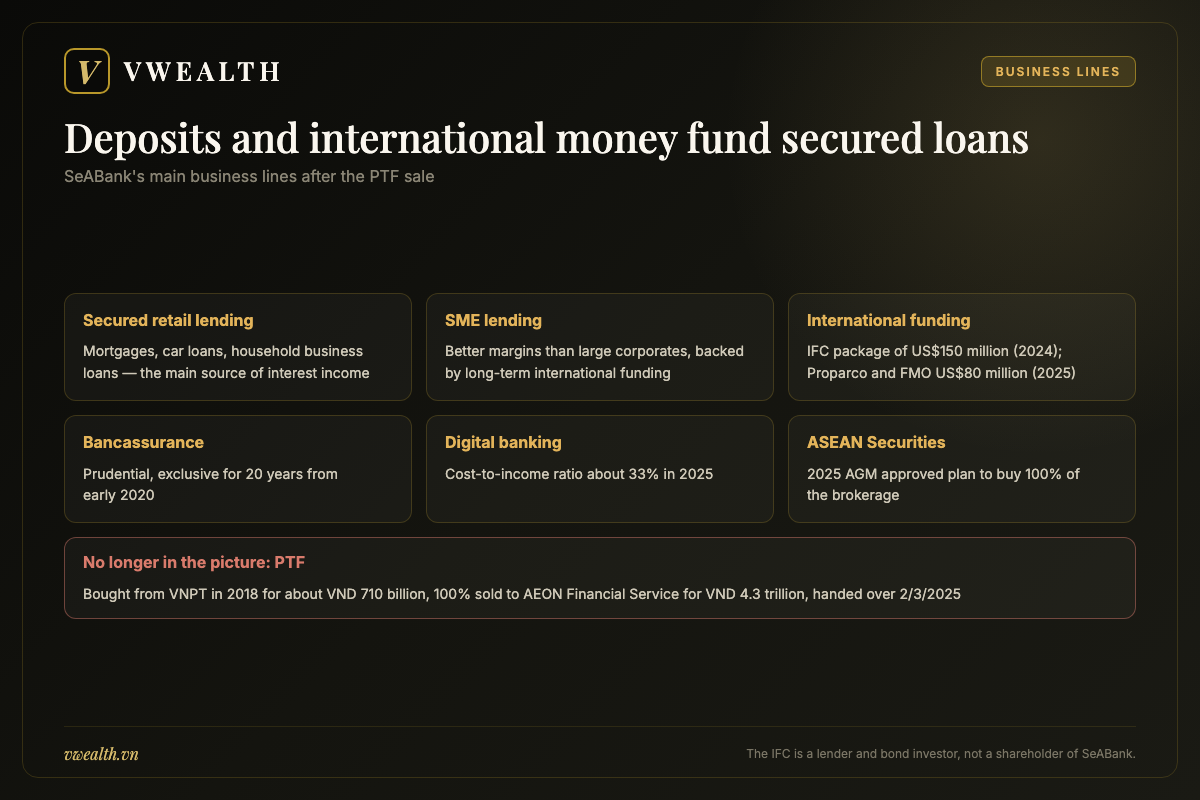
For years SeABank has described its goal as becoming “the most preferred retail bank”. In practice, retail at SeABank mostly means secured lending to individuals: home loans, car loans, and business loans to households and small traders. Home-loan packages for young buyers, with promotional rates in the early years of the loan, were among the products SeABank marketed heavily in 2025.
Why does secured lending matter? Imagine two loans of VND 500 million each. The first is an unsecured consumer loan: high interest, but if the borrower defaults the bank has almost nothing to recover. The second is a mortgage secured on the house it finances: a much lower rate, but if the borrower defaults the bank still has an asset to sell. SeABank’s model leans toward the second type. Margins are lower than at banks that specialize in unsecured lending, but losses when things go wrong are usually smaller. The trade-off is sensitivity to the property market: when real estate freezes, collateral is hard to sell and bad debt can rise even though loans are “secured”.
After selling PTF, SeABank no longer owns a consumer finance company. That is a major difference from VPBank (FE Credit) and HDBank (HD Saison) — two lenders whose consumer finance arms have delivered high margins but also large bad debts when the economy struggled. SeABank has chosen a lower-risk path, but it has also given up a high-margin engine. Instead, it signed a cooperation agreement with AEON Financial Service and PTF to develop retail products together — in effect “selling the child but still doing business with it”.
The PTF sale also fits a broader pattern that foreign readers may recognize. Over the past several years, Japanese financial groups have been among the most active buyers of Vietnamese consumer lending businesses — SMBC’s purchase of 49% of VPBank’s FE Credit is the best-known example. For Japanese groups facing a slow-growing home market, Vietnam offers a young population and low penetration of consumer credit. For Vietnamese banks, selling consumer finance arms to such buyers crystallizes value, brings in capital and moves a high-risk business off the consolidated balance sheet. SeABank’s sale of PTF to AEON Financial Service belongs to the same logic, even if the post-closing dispute showed that such deals can have unexpected aftershocks.
Small and medium-sized enterprises: where international capital flows in
The second segment is lending to small and medium-sized enterprises (SMEs). Many big banks are lukewarm about this group because loans are small and appraisal costs are high, yet SMEs pay better margins than large corporates. SeABank uses a particular advantage here: long-term funding from international development finance institutions.
In 2024, the IFC — a member of the World Bank Group — announced a US$150 million financing package for SeABank, comprising a US$75 million loan for SME lending (with a focus on women-owned businesses), a US$25 million blue bond (financing sustainable activities related to oceans and water) and a US$50 million green bond (financing green buildings, renewable energy and energy efficiency). According to the IFC, this was Vietnam’s first-ever blue bond issuance. In the first quarter of 2025, SeABank received a further US$80 million from Proparco (France) and FMO (the Netherlands) for SME lending. According to the bank, funding raised from international institutions totaled about US$850 million in 2024 and about US$1.1 billion by the end of the first quarter of 2025.
One clarification to avoid a common misunderstanding: the IFC here is a lender and bond investor, not a shareholder of SeABank. Many readers see headlines like “IFC pours capital into SeABank” and assume the IFC bought equity — it did not. This money is long-term debt with maturities and interest, but it has two big benefits: long tenors (allowing the bank to make medium- and long-term loans more safely) and a stamp of approval on governance quality, since these institutions conduct rigorous due diligence before disbursing.
Cards, digital banking and bancassurance with Prudential
On the services side, SeABank pursues a strategy it calls “digital convergence”: digitizing products, moving transactions onto its mobile app and using technology to cut operating costs. The clearest result is the cost-to-income ratio (CIR), which fell to about 33.01% in 2025, among the lower levels in the sector. CIR is operating expenses divided by operating income: a CIR of 33% means that for every 100 dong of income, the bank spends about 33 dong on salaries, rent, technology and so on, before provisions for credit losses. Note that because 2025 TOI includes the PTF gain, that year’s CIR looks somewhat better than the underlying reality.
In insurance, since early 2020 SeABank and Prudential Vietnam have run an exclusive bancassurance partnership (selling insurance through the bank) with a 20-year term. Long exclusive deals like this usually come with a large upfront fee paid to the bank and amortized over time, plus commissions on sales. But Vietnam’s life insurance market went through a crisis of confidence in 2022–2023 after numerous complaints about mis-selling of investment-linked products, and regulators tightened the rules on selling insurance through banks. As a result, bancassurance is a steady fee source but no longer the strong growth engine it was before 2022.
Cards and payments help attract current-account deposits and fee income. However, SeABank is not among the market leaders in credit cards the way VPBank or VIB are; its strength is stability rather than scale.
ASEAN Securities and other pieces of non-interest income
The shareholders’ meeting on April 25, 2025 approved a plan to acquire 100% of ASEAN Securities Corporation (founded in 2006, charter capital of VND 1,500 billion at the time) to make it a subsidiary. ASEAN Securities already had an account-opening partnership with SeABank. In August 2026, the brokerage completed a rights offering of 150 million shares, raising its charter capital to VND 3,000 billion. Completion of SeABank’s full ownership depends on regulatory approvals — check the latest filings. If completed, SeABank would gain an additional source of non-interest income from brokerage, margin lending and wealth management, following a path already taken by other banks such as MB (with MBS) and Techcombank (with TCBS, now listed as TCX).
SeABank also has the usual sources of non-interest income: foreign exchange, securities investment, recoveries of written-off loans and payment fees. In 2025 specifically, there was an additional gain of about VND 2,607 billion from the disposal of a subsidiary (PTF), according to figures from the financial statements cited by the press — and that will not recur.
| Segment | Role | Strength | Main risk |
|---|---|---|---|
| Secured retail lending | Main source of interest income | Lower losses on default than unsecured loans | Sensitive to the property market |
| SME lending | Better margins than large corporates | Long-term funding from IFC, Proparco, FMO | Small firms are vulnerable in a slowdown |
| Cards, payments, digital banking | Draws deposits and fees | Helps keep CIR low | Fierce competition from large banks and e-wallets |
| Bancassurance (Prudential, exclusive 20 years from 2020) | Steady fees | Long-term contract | Life insurance market slowed after 2022 |
| ASEAN Securities (planned 100% acquisition) | Broadens non-interest income | Benefits from active stock markets | Earnings swing with the market cycle |
| PTF (sold in 2025) | Former consumer finance arm | Delivered a large one-off gain | No contribution from 2025 onwards |
Which segment feeds which — and where SeABank’s moat lies
If you had to describe SeABank in one sentence: household deposits and long-term international borrowings fund secured loans to individuals and small businesses; digital services and bancassurance add fees; and the buying and selling of subsidiaries (PTF in the past, ASEAN Securities now) provide irregular boosts.
SeABank’s moat is not as wide as that of banks with huge customer ecosystems. It lacks the abundant current-account deposits of Techcombank or MB, the nationwide networks of the state-owned banks, and a parent conglomerate that funnels millions of customers its way. Its advantages are smaller but real: access to international funding at good prices thanks to its governance reputation; low operating costs; and a stable, long-standing shareholder group. For investors, this means SSB is unlikely to become a “breakout growth” stock, but it could be a steadily compounding bank if it keeps asset quality under control.
Financial health: read the numbers before deciding whether to buy SSB stock
Reading a bank’s financial statements is very different from reading those of a manufacturer. Banks have no “inventory” or “sales revenue”; what you need to examine is the quality of earnings, the quality of assets (the loans), the resilience of capital and the stability of funding. This chapter goes through each of the four using SeABank’s actual figures, and shows you how to read them yourself when new reports come out. If you want a refresher on how Vietnamese banks are structured and regulated, our Vietnam banking sector guide is a good starting point.
Six years of profit: four times higher, with one down year and one year “with a gift”
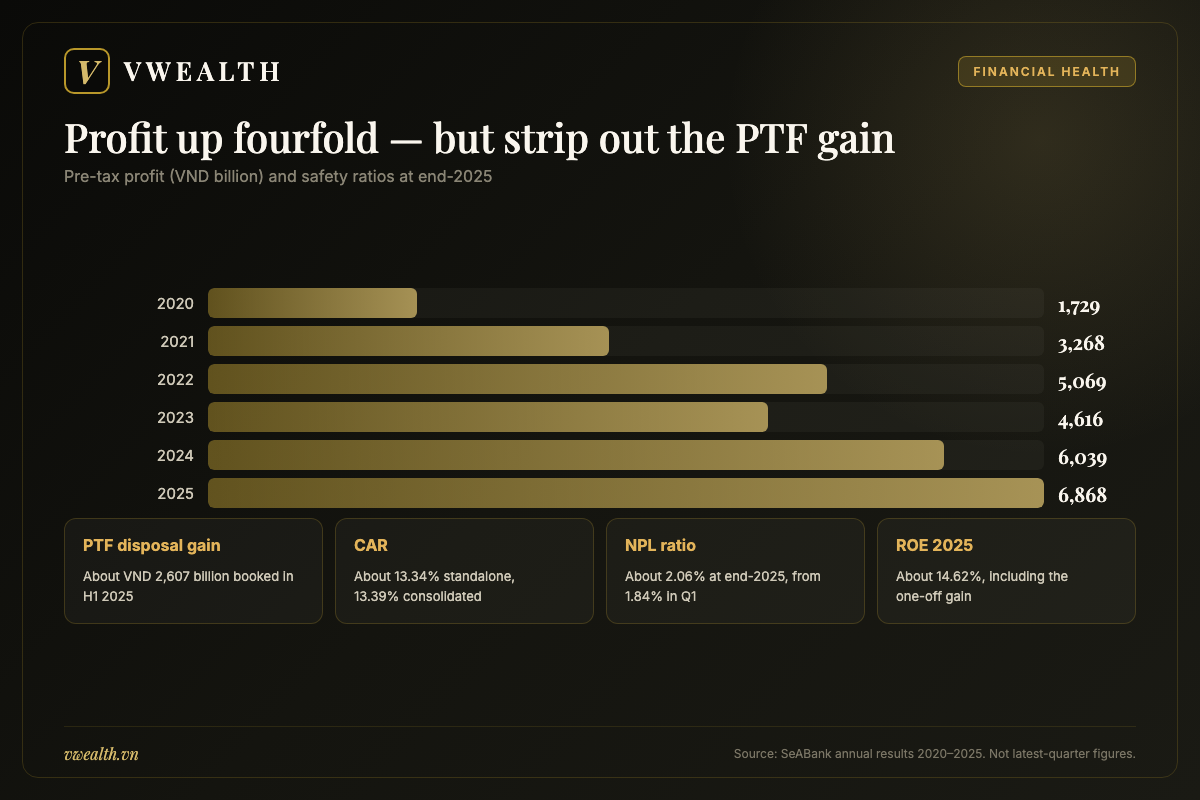
SeABank’s pre-tax profit rose from about VND 1,729 billion in 2020 to about VND 6,868 billion in 2025 — roughly a fourfold increase in five years. But the path was not a straight line. In 2023, profit fell from 2022, as the whole banking sector had to set aside more provisions for rising bad debts after the corporate bond and property shocks of late 2022. 2024 saw a strong rebound. 2025 was a record — but part of it came from the one-off gain on selling PTF.
| Year | Pre-tax profit (VND billion) | Change | Notes |
|---|---|---|---|
| 2020 | about 1,729 | +24% vs 2019 | Year before listing |
| 2021 | about 3,268 | nearly doubled | Year of HOSE listing |
| 2022 | about 5,069 | strong growth | 104% of plan achieved |
| 2023 | about 4,616 | down about 9% | ROE about 13.03%; sector under bad-debt pressure |
| 2024 | about 6,039 | +31% | Total assets about VND 325,699 billion |
| 2025 | about 6,868 | +13.73% | Includes PTF gain; total assets about VND 396,443 billion |
Source: SeABank business results and shareholder-meeting documents over the years. The 2023 percentage decline is a vwealth estimate derived from 5,069 and 4,616. For readers used to US dollars: VND 1,000 billion (VND 1 trillion) is roughly US$38–40 million at 2025–2026 exchange rates (vwealth estimate), so SeABank’s 2025 pre-tax profit was in the region of US$260–270 million.
2025: stripping out the PTF gain to see “core” earnings
This is where investors who skim headlines get misled. In the first quarter of 2025 — the quarter in which SeABank handed PTF over — the bank reported pre-tax profit of about VND 4,350 billion, up 189% year on year; non-interest income for that quarter was about VND 3,369 billion, up 378%. According to figures from the financial statements cited by the press, the gain on disposal of the subsidiary booked in the first half of 2025 was about VND 2,607 billion.
If you subtract that disposal gain from full-year 2025 pre-tax profit (about VND 6,868 billion), you are left with about VND 4,261 billion. This is a rough vwealth estimate, because other factors — deal-related costs, PTF’s contribution in January 2025, changes in provisions — are not broken out in enough detail in public reports. That estimate is lower than 2024 profit (about VND 6,039 billion). In other words, if our rough split is close, “core” earnings in 2025 did not grow but fell — partly because the bank lost PTF’s contribution and partly because of provisioning costs.
The consequence is visible in 2026: the pre-tax profit target approved by shareholders is about VND 7,068 billion, only about 3% above 2025. In the first half of 2026, profit fell sharply year on year because the comparison base included the PTF gain — which produced some alarming headlines in the Vietnamese press. The lesson: when evaluating SSB, compare core with core, not a year with a gift against a year without one. For quarterly updates, see the SSB report on vwealth.
Asset quality: bad debt, provisions and what to keep an eye on
In Vietnam, non-performing loans (NPLs) are loans in groups 3, 4 and 5 — more than 90 days overdue or assessed as likely to be lost. SeABank’s NPL ratio was about 1.84% at the end of the first quarter of 2025, rose to about 2.06% at the end of 2025, and continued edging up in the first half of 2026, according to the semi-annual report. The bank’s 2026 target is to keep it below 3% — the threshold regulators regard as a warning level. Compared with banks that have large consumer finance arms, this level is not high; but the upward trend is something to monitor.
Two other ratios should be read alongside NPLs: the loan-loss coverage ratio (credit-loss provisions divided by NPLs — the higher, the thicker the cushion) and group 2 loans (loans 10–90 days overdue, the “waiting room” for future NPLs). A bank with low NPLs but surging group 2 loans and thin coverage is more worrying than a bank with slightly higher NPLs but ample coverage. Both figures are in the notes to SeABank’s quarterly financial statements.
On corporate bonds: after the 2022 shock, corporate bonds (especially property developer bonds) held in banks’ investment portfolios became a hot spot. This article does not have sufficiently reliable, verified data on the size of SeABank’s corporate bond holdings, so rather than guess, check the “investment securities” and “trading securities” lines in the financial statements to see how many bonds issued by economic entities the bank holds and whether they are provisioned. For a bank whose major shareholders sit in an ecosystem that includes property businesses, exposure to related parties is also a question worth asking every quarter.
Finally, the PTF episode is a reminder that accounting figures at a subsidiary can differ from reality — AEON itself found provisioning discrepancies at PTF after buying it (although AEON later confirmed SeABank neither participated in nor knew of them). The fact that SeABank no longer owns PTF makes its consolidated balance sheet “cleaner” on the consumer finance side.
Capital and ratings: CAR above 13%, Basel III and Moody’s
The capital adequacy ratio (CAR) is a bank’s own capital divided by its risk-weighted assets. Vietnamese regulations require a minimum of 8%. At the end of 2025, SeABank’s standalone and consolidated CAR were about 13.34% and 13.39% respectively — among the higher levels in the system. A high CAR means three things: a thick buffer against large losses; room to grow lending without raising capital immediately; and a better chance of receiving a generous credit-growth quota from the State Bank.
SeABank was one of the first Vietnamese banks to implement Basel III standards, announcing the results in May 2022. Basel III is the international framework for capital, liquidity and risk management, stricter than Basel II. Early adoption does not lift profits immediately, but it makes it easier to borrow internationally and to attract foreign investors.
On credit ratings, Moody’s has kept SeABank’s long-term deposit rating at Ba3 and its baseline credit assessment (BCA) at b1 for several consecutive years, and in 2026 upgraded the outlook from “stable” to “positive”. Ba3 is below investment grade — normal for Vietnamese banks, whose ratings are generally constrained by the sovereign rating. A “positive” outlook means an upgrade is possible within 12–18 months if the metrics continue to improve.
Funding: falling current-account deposits, offset by international money
In 2025, SeABank’s customer deposits plus valuable papers issued totaled about VND 221,791 billion, up about 11.58%; outstanding credit was about VND 244,972 billion, up about 16.69%. Notice that lending grew faster than deposits, and that total assets (about VND 396,443 billion) are considerably larger than customer funding. By vwealth’s estimate from these figures, customer deposits and valuable papers accounted for only about 56% of total assets — the rest came from equity, deposits and borrowings from other credit institutions (the interbank market) and international loans.
The weak spot that must be named plainly is CASA — current and savings account deposits (non-term deposits) as a share of total deposits. Such deposits cost the bank almost nothing, so a high CASA ratio lowers funding costs. According to press compilations, SeABank’s CASA ratio was around 19% in 2024 but fell sharply in 2025, with SeABank among the banks posting the steepest declines in the sector. Sources use different bases (some divide by customer deposits, others by total funding), so the exact figures vary; the downward direction is consistent across sources. Falling CASA means higher funding costs and pressure on the net interest margin (NIM).
SeABank compensates with international funding: about US$850 million raised from foreign institutions in 2024, and about US$1.1 billion by the first quarter of 2025. This is long-term, stable money, but it is not as cheap as current-account deposits, and it carries currency risk if not fully hedged.
Seven questions to ask every time SSB reports
Instead of reading hundreds of pages, you can use these seven questions as a quarterly checklist. Vietnamese banks publish consolidated and standalone statements within roughly a month after each quarter ends; the notes are where the answers live.
| # | Question | Where to look | Good sign |
|---|---|---|---|
| 1 | Is net interest income growing? | Income statement | Grows with lending, not dependent on one-offs |
| 2 | Does non-interest income include one-offs? | Notes on other income, subsidiary disposals | Fee income rising, not deal-driven |
| 3 | Where are NPLs and group 2 loans heading? | Loan classification notes | Both stable or falling |
| 4 | What is loan-loss coverage? | Provisions divided by NPLs | Rising or holding |
| 5 | CASA and funding costs? | Non-term deposits, interest expense | CASA stops falling, NIM stable |
| 6 | How much CAR headroom remains? | Capital adequacy report | Above 11–12% after growth |
| 7 | Related-party exposure? | Related-party notes | Small and transparent |
How the market treats SSB stock: stock dividends, a narrow foreign room and index-inclusion waves
A good bank is not necessarily a comfortable stock to own. A stock’s personality depends on who holds it, which money flows can reach it, and how the company shares profits with shareholders. On all three counts SSB has distinctive traits you should understand before placing an order.
The debut and historical price markers
On March 24, 2021, SSB debuted on HOSE at a reference price of VND 16,800 and hit the 20% ceiling at VND 20,150 in its first session. 2021 was a boom year for Vietnamese equities, fueled by a wave of new retail investors, and banks led the market. By mid-2023, SeABank’s market capitalization was about VND 71,402 billion when it was selected for the VN30.
When you look at SSB’s price history, however, remember one crucial technical detail: adjusted prices. Because SeABank pays stock dividends almost every year, the reference price is adjusted down on each ex-rights date. If you compare today’s price with VND 16,800 in 2021 without adjusting, you will completely misjudge the return from holding the stock. Use adjusted price charts in trading platforms or in vwealth reports.
In September 2026, SSB staged a very strong rally: according to press reports, the stock rose about 48% in less than a month to a three-year high, before some sharp corrective sessions and rebounds — right as FTSE Russell’s upgrade of Vietnam took effect and SSB was added to international indices. A stock that rises that fast typically swings hard in both directions over the following weeks.
VN30, MSCI, FTSE, MarketVector: index money
SSB joined the MSCI Frontier Markets Index on March 1, 2023 and the VN30 on August 7, 2023. In August–September 2026 it was added to three international indices: MSCI Frontier Markets (in a new review), FTSE Global All Cap — as one of 27 Vietnamese stocks added, effective September 21, 2026, when Vietnam’s upgrade by FTSE Russell took effect — and the MarketVector Vietnam Local Index, where SSB was the only new addition in the third-quarter 2026 review.
A brief explanation of the VN30 for readers outside Vietnam: it is HOSE’s blue-chip index of 30 stocks, selected by market capitalization, free float and liquidity and reviewed twice a year. Several domestic ETFs and a growing number of derivative contracts reference it, so VN30 membership brings both steady index demand and more attention from institutional investors. Losing membership works the other way, which is why the semi-annual reviews are watched closely by SSB holders.
Why does this matter? ETFs and index funds that track these benchmarks must buy stocks according to their index weights, regardless of the fund manager’s view. When a stock is added, a wave of “forced” demand appears around the effective date. But SSB presented a paradox: until June 2026 its foreign room was only 5%, so foreign funds that wanted to buy had little space. Raising the room to 30% is therefore the necessary condition for passive foreign money to actually flow in. For more on which stocks benefit from the upgrade, read our analysis of FTSE’s Vietnam emerging-market upgrade and its beneficiaries.
Stock dividends and the dilution problem
This is SSB’s single most important trait for income investors: SeABank pays dividends almost exclusively in shares, and in some years pays none at all. Profits for 2024 were retained in full, with no dividend paid in 2025, to strengthen capital. Profits for 2025 were distributed as a 20.5% stock dividend (about 583.8 million new shares), completed in June 2026, lifting charter capital to VND 34,288 billion. The 2026 AGM also approved up to 40 million ESOP shares for employees, which would take charter capital to about VND 34,688 billion once completed.
A note for foreign readers on how this works in Vietnam: a “20.5% stock dividend” means you receive 20.5 new shares for every 100 shares you hold (par value is VND 10,000 per share, so the percentage is expressed against par). Unlike a cash dividend, no money leaves the company — earnings are simply converted into share capital.
| Date | Charter capital (VND billion) | Main source of increase |
|---|---|---|
| Listing, March 2021 | about 12,088 | — |
| End of 2021 | about 14,785 | Rights offering, stock dividend, ESOP |
| Early 2023 | about 20,403 | Stock dividends, 2022 ESOP |
| 2023 | about 24,537 – 24,957 | 2022 stock dividend (14.5%) and bonus shares (5.8%), ESOP |
| 2024 | about 28,350 | 2023 stock dividend plus shares from equity, nearly 13.6% combined |
| 2025 | about 28,450 | 10 million ESOP shares; 2024 profit retained, no dividend |
| June 2026 | about 34,288 | 20.5% stock dividend from 2025 profit |
| 2026 plan | about 34,688 | Up to 40 million ESOP shares |
By vwealth’s estimate, SSB’s share count grew about 2.8 times between listing and mid-2026. A stock dividend does not make you richer on the day: when you receive extra shares, the price is adjusted down proportionally and the total value of your holding is unchanged at that moment. Real value arrives only if profits grow fast enough to offset the dilution. The simplest yardstick is earnings per share (EPS): if profit grows 13% but the share count grows 20%, EPS falls.
To be fair, retaining earnings as capital keeps CAR high and allows loan growth without issuing new shares to outside investors at a discount. Stock dividends from retained earnings differ in substance from cheap ESOP issues: the former merely “cut the cake into more slices”; the latter genuinely transfer some value from existing shareholders to employees. ESOP tranches of 10–40 million shares are small compared with nearly 3.4 billion shares outstanding, but they are still a cost you should account for.
Foreign room: from 0% to 5% to 30%, and the Norfund deal that never happened
The foreign room is the maximum percentage of a company’s shares that foreign investors may own. For Vietnamese banks the legal ceiling is 30%, but each bank can set a lower cap. If the concept is new to you, our explainer on foreign ownership limits in Vietnamese stocks covers it in detail. In practice, when a popular stock’s foreign room is full, foreigners can only buy from other foreigners, often at a premium — which is why room availability matters so much for index flows.
SeABank’s foreign-room story has several twists. After Société Générale’s exit around 2018–2019, the bank set the room at 0%. In August 2021 it was raised to 5%. In 2023, SeABank planned a private placement of about 94.6 million shares to Norfund — Norway’s investment fund for developing countries — and capped the foreign room at about 1.2877% to prepare for the deal. But later, with SSB’s price having fallen more than 20% in three months, the Board decided to halt the private placement. On June 2, 2026, SeABank raised its foreign room from 5% to the maximum 30%. According to VietnamFinance, foreigners at that point held only about 6.63 million shares out of roughly 853.5 million permitted.
The press read the move as a sign that SeABank might seek a foreign strategic investor or an M&A deal — SeABank is one of the few listed banks without a foreign strategic shareholder. As of this writing, however, no specific deal has been announced. Treat it as a possibility, not a certainty.
Valuation: how to read SSB’s P/B properly
For banks, the most commonly used valuation metric is P/B (price to book value per share), because a bank’s assets are mostly cash and loans whose book values are relatively close to reality. P/B only makes sense alongside ROE: a bank earning a 20% ROE deserves a higher P/B than one earning 12%. SeABank’s ROE was about 13.03% in 2023 and about 14.62% in 2025 (the year with the PTF gain); the 2026 target is about 13%. That places SSB in the middle of the sector’s ROE range, below leaders such as Techcombank, MB or VPBank in good years.
A common mistake is to use 2025 P/E to conclude that SSB is “cheap”. Because 2025 earnings include a one-off item, P/E on that year’s profit understates the true multiple. Use core or forward earnings when comparing. For current P/B, P/E and peer comparisons, see the vwealth SSB report.
SSB’s trading personality and the catalysts the market reacts to
SSB has a few recognizable traits. First, the stock has long “sleeping” periods with lower liquidity than the big VN30 banks, then surges when a new story appears (listing, VN30 inclusion, room increase, market upgrade). Second, it reacts strongly to news about major shareholders and deals — such as the drop after AEON sought to void the PTF deal in June 2025. Third, insiders tend to sell some shares after strong rallies, adding supply at higher prices.
Catalysts the market typically reacts to include: announcement of a foreign strategic investor (if any); progress on acquiring ASEAN Securities; quarterly results versus a base with or without one-offs; NPL trends; changes to the Moody’s rating (currently on positive outlook); index rebalancing dates; and stock dividend and ESOP issues.
The banking backdrop: new laws, a market upgrade and the retail race among mid-sized Vietnamese banks
A bank cannot be healthier than the economy it lends to. To answer whether you should buy SSB stock, you need to place SeABank in a wider frame: where Vietnam’s banking sector is in its cycle, how the rules of the game are changing, and where SeABank stands among its peers. The sector as a whole is covered in our Vietnam banking sector guide; here we focus on the points that touch SeABank directly.
Banks: the bloodstream of an economy that borrows through banks
Unlike the United States, where companies raise much of their capital through equity and bond markets, businesses and households in Vietnam still borrow mainly through banks. Vietnam’s ratio of bank credit to GDP is among the highest in the region. That has two consequences for bank stocks: when the economy grows, banks grow with it almost automatically; when the economy is hit by a shock, risk piles up on bank balance sheets. Banks therefore carry a very large weight in the Vietnamese stock market, and they often lead the big rallies and sell-offs of the VN-Index.
Credit in Vietnam is also managed with an administrative tool few countries still use: each year the State Bank of Vietnam assigns a credit-growth quota to each bank, based on its financial health, compliance and participation in policy programs. Banks with high CAR and low NPLs usually receive more generous quotas. That is why SeABank’s CAR above 13% is not just a safety number but a “ticket” to growth — the 2026 plan targets 17% credit growth.
For foreign investors, the sector’s appeal is simple to state: a fast-growing economy with rising incomes, a population in which a large share of adults still under-use financial services, and banks whose returns on equity have often been higher than those typical in developed markets. The risk side is equally simple: property-linked collateral, periodic regulatory shocks, and a history of bad-debt cycles.
The 2024 Credit Institutions Law, bad-debt resolution and ownership caps
The 2024 Law on Credit Institutions, effective July 1, 2024, changed the rules in three ways that matter for SSB. First, ownership caps were lowered: individuals may own at most 5%, institutions at most 10%, and a shareholder with related persons at most 15% — limiting excessive concentration of ownership. Second, banks must disclose shareholders owning 1% or more — which is why the shareholder table in chapter 2 exists. Third, limits on lending to a single customer and its related persons were tightened on a phased roadmap.
In 2025, the National Assembly passed amendments to the Law on Credit Institutions that codified certain bad-debt resolution mechanisms previously applied on a pilot basis under Resolution 42, including the right to seize collateral under certain conditions. For a bank like SeABank that leans toward secured lending, clearer legal tools for handling collateral mean smaller losses and faster recovery when loans go bad.
The FTSE upgrade and foreign money looking at banks
FTSE Russell’s upgrade of Vietnam’s stock market to Secondary Emerging status, effective in September 2026, opens the door to passive money from funds tracking emerging-market indices. Banks — the sector with the largest market capitalization — are usually where such money goes first. There is one condition, though: the stock must still have foreign room. Many large banks are close to their 30% foreign cap, whereas SSB has just opened from 5% to 30% and foreigners own almost nothing. If foreign money genuinely seeks bank stocks with room available, SSB is one of the rare candidates.
Still, foreign flows are not a one-way street: active funds often sell after prices have priced in expectations, and passive money buys only small weights in stocks with low free float. The family group and insiders hold a meaningful part of SSB, so the effective free float is smaller than the total share count suggests.
Competition: where SSB stands next to VPB, MSB, HDB, TPB and VIB
SeABank competes directly with a group of mid-sized private banks focused on retail. The table below compares business-model differences — not share prices or current figures.
| Bank | Consumer finance arm | Foreign strategic partner/shareholder | Distinctive trait |
|---|---|---|---|
| SeABank (SSB) | Sold PTF to AEON in 2025 | None (Société Générale exited; room just opened to 30%) | Secured retail lending, well-priced international funding, family shareholders |
| VPBank (VPB) | FE Credit (49% sold to SMBC) | SMBC owns 15% of the parent bank | Much larger, high NIM, higher bad debt |
| MSB | — | — | Also born in Hai Phong (founded 1991); also listed on HOSE in 2020–2021 |
| HDBank (HDB) | HD Saison | — | Sovico ecosystem; strong in rural and consumer lending |
| TPBank (TPB) | — | — | Digital bank, linked to the DOJI shareholder group |
| VIB | — | Formerly Commonwealth Bank of Australia | Strong in credit cards, mortgages and car loans |
SeABank’s clearest difference from VPB and HDB is that it no longer has a consumer finance company: SSB carries less unsecured risk but has also lost a high-margin engine. Compared with MSB — its fellow Hai Phong native — the two banks are not wildly different in size and both pursue retail plus SMEs; the main differences are the shareholder structure, the ability to gather current-account deposits, and the dividend story. Compared with VIB and TPB, SeABank is less prominent in cards and digital banking but has an edge in accessing funding from international development institutions. A dash in the table means this article does not go into that item; read each bank’s own analysis for the full picture.
Interest rates, net interest margins and the digital race
The net interest margin (NIM) is the spread between what a bank earns on interest-bearing assets and what it pays for funding. In 2023–2025, lending rates were guided lower to support the economy, while competition for deposits kept funding costs from falling as much — squeezing NIM at many banks. SeABank faced extra pressure from its falling CASA. If deposit rates across the market rise again, banks that rely heavily on term deposits and interbank funding, like SeABank, will feel more margin pressure than banks with high CASA.
Digitalization, on the other hand, is an area where mid-sized banks can narrow the gap with big ones. Opening accounts and processing transactions on an app costs far less than doing so in branches. SeABank’s CIR of about 33% in 2025 shows that it runs a lean operation. The question is whether that leanness translates into higher CASA — that is, customers using SeABank as their main transaction account. That will be the key measure of its “digital convergence” strategy in the next few years.
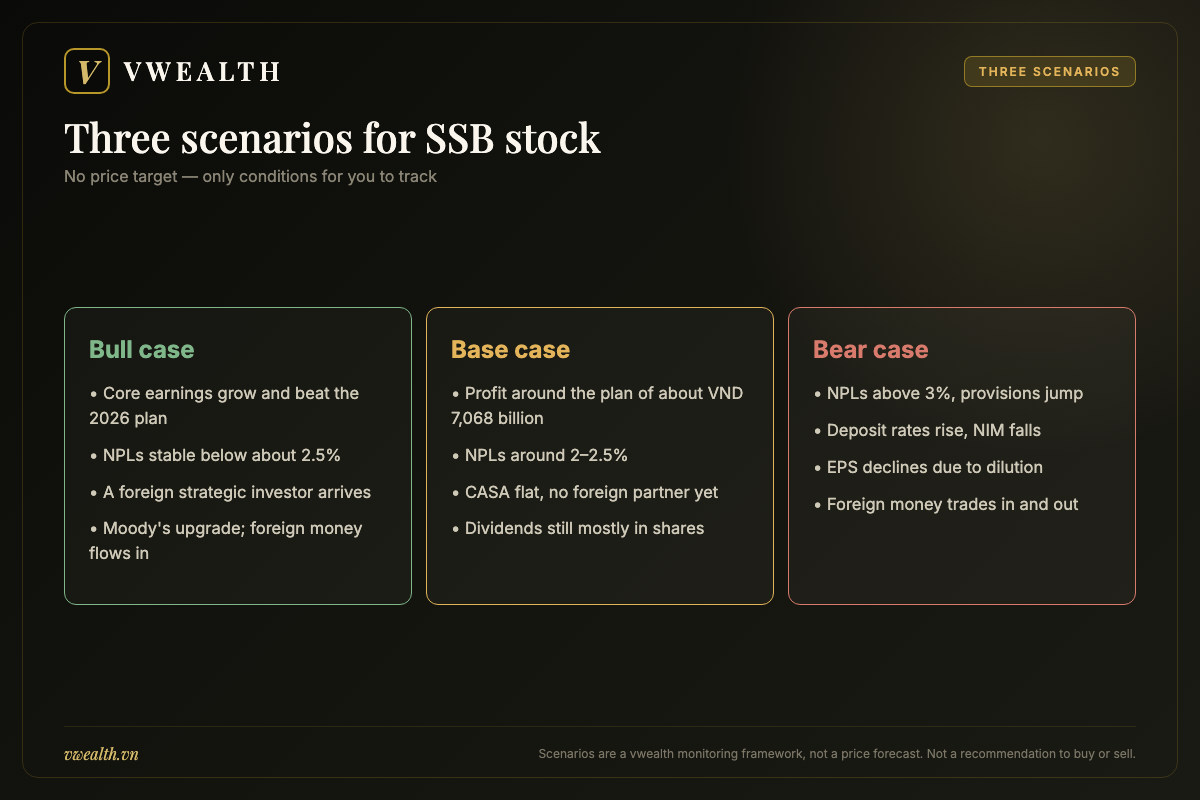
Outlook: three scenarios for SSB stock and the conditions behind each
Nobody knows where SSB will trade next year, and vwealth does not publish price targets. What we can do is identify the variables that drive the story and sketch scenarios with concrete conditions. When new information arrives, you only need to ask: which scenario does this push SeABank toward?
Six variables that will shape SeABank’s future
One: core earnings. Once the PTF gain is removed, can net interest income and fee income grow steadily with lending? The 2026 plan (pre-tax profit of about VND 7,068 billion) is the first test.
Two: bad debt. The NPL ratio moved from about 1.84% (Q1 2025) to about 2.06% (end-2025) and edged higher again in 2026. If the trend stops, the provisioning burden eases; if it continues, profits erode.
Three: funding costs and CASA. Does CASA stop falling, and can international money keep being raised on good terms?
Four: a foreign strategic investor. The room is open at 30%. A strategic partner buying in at a premium to book value would bring fresh capital and a stamp of quality at the same time.
Five: the pace of dilution. Will stock dividends and ESOPs continue at 15–20% a year, and can EPS still grow?
Six: the macro economy and property. Because most secured loans are backed by real estate, the health of the housing market directly affects the bank’s ability to recover bad loans.
Bull case: core earnings recover and a foreign strategic partner arrives
Conditions: credit grows close to the 17% plan while NPLs stay below roughly 2.5%; CASA stops falling and NIM stabilizes; SeABank announces a foreign strategic investor buying shares at a price favorable to existing shareholders; ASEAN Securities becomes a subsidiary and contributes non-interest income; Moody’s upgrades the rating from its current positive outlook. Passive foreign money following the FTSE upgrade keeps finding SSB because it still has plenty of room.
In this scenario, the market could re-rate SSB toward the valuations of private banks that have foreign partners. Core earnings grow fast enough for EPS to rise despite stock dividends. This is the scenario that some of those who bought SSB during the September 2026 rally are partly betting on.
Base case: moderate growth, a slow-burning strategic story
Conditions: pre-tax profit lands around plan — roughly flat versus reported 2025 but solidly above estimated 2025 core earnings; NPLs hover around 2–2.5%; CASA does not improve significantly; no foreign strategic partner within the next 12 months; dividends remain mostly in shares.
In this scenario, SSB moves roughly in line with the mid-sized bank group, lacking a strong catalyst of its own. After the fast rally of September 2026, the stock could trade sideways within a wide range as some of the foreign-capital expectations are gradually “handed back”. Long-term holders get moderate growth in book value per share.
Bear case: rising bad debt, squeezed margins and dilution outrunning profit
Conditions: the property market stalls, pushing NPLs above 3% and forcing SeABank to raise provisions sharply; deposit rates rise again while CASA stays low, cutting NIM; 2026 profit misses plan; stock dividends and ESOP keep pushing EPS backwards; no foreign partner appears and foreign money only trades in and out. On top of that, any negative news involving major shareholders or companies in their ecosystem — even unverified — could trigger short-term selling pressure.
In this scenario, SSB could give back much of its 2026 gains. Importantly, with CAR above 13%, SeABank has a fairly thick capital cushion to absorb a moderate bad-debt cycle without an emergency capital raise — the risk lies more in earnings and valuation than in the bank’s safety.
| Variable | Bull | Base | Bear |
|---|---|---|---|
| Core earnings | Clear growth, beat plan | Around the plan of about VND 7,068 billion | Miss plan |
| NPL ratio | Below about 2.5%, stable | About 2–2.5% | Above 3% |
| CASA and NIM | CASA recovers | Flat | CASA keeps falling, NIM declines |
| Foreign partner | Deal at a good price | None within 12 months | None, foreign money exits |
| Dilution | EPS still grows | EPS flat | EPS falls |
Illustrative example: a 20% stock dividend and your EPS
To see the effect of dilution clearly, consider an illustrative example with round numbers — not SeABank’s actual figures. Suppose a bank has 100 shares and after-tax profit of 1,000, so EPS is 10. The following year it pays a 20% stock dividend, taking the share count to 120.
Case A: profit grows 25% to 1,250. New EPS is 1,250 / 120 ≈ 10.4 — up about 4%. Shareholders genuinely benefit.
Case B: profit grows 10% to 1,100. New EPS is 1,100 / 120 ≈ 9.2 — down about 8%. Even though profit grew, each of your shares “earns” less than the year before.
Case C: profit is flat at 1,000. EPS falls to about 8.3 — down about 17%.
The lesson: with a stock like SSB that pays large stock dividends, do not look only at total profit; look at earnings per share and book value per share. For 2026, with the profit plan up only about 3% while the share count rises by more than 20% because of the 20.5% stock dividend and ESOP, simple arithmetic suggests that 2026 EPS may be lower than 2025 EPS if the bank merely meets its plan — this is a vwealth inference, not a bank forecast. But remember that 2025 EPS was inflated by the PTF gain, so compared with core EPS the picture is less gloomy.
So, should you buy SSB stock? A straight answer for each type of investor
By now you have been through more than 30 years of history, the ownership structure, the business model, financial health, the stock’s personality and SeABank’s scenarios. There is no single right answer to whether you should buy SSB stock — it depends on who you are, what you need from the investment and how much volatility you can stomach. This chapter puts the pros and cons on the scale.
The compelling positives
Strong capital. CAR of about 13.3–13.4% at the end of 2025, among the higher levels in the system, plus early adoption of Basel III. This cushion lets the bank absorb a moderate bad-debt cycle and leaves room for loan growth.
Lean operations. CIR of about 33% in 2025, low compared with many banks of similar size.
Access to international funding. The IFC, Proparco, FMO and other institutions have lent to SeABank or bought its bonds; international funding reached about US$1.1 billion by the first quarter of 2025. That is a governance stamp not every mid-sized bank can show.
Lower unsecured risk. No consumer finance subsidiary anymore; the loan book leans toward secured lending.
The foreign-room story. The room has just been raised from 5% to 30% while foreigners hold almost nothing; SSB was added to FTSE, MSCI and MarketVector indices just as Vietnam was upgraded. A foreign strategic investor, if one arrives, could be a major catalyst.
Positive rating outlook. Moody’s upgraded the outlook to “positive” in 2026 after several years unchanged.
The negatives you cannot ignore
Core earnings growth is unproven. By vwealth’s estimate, excluding the PTF gain, 2025 pre-tax profit was below 2024; the 2026 plan is only about 3% above reported 2025.
Fast dilution. The share count has grown about 2.8 times since listing (vwealth estimate); dividends are almost entirely in shares. Investors who need regular cash income will be disappointed.
Falling CASA, higher funding costs. SeABank was among the banks with the steepest CASA declines in 2025, according to press compilations, and relies more on interbank and international funding.
Rising bad debt. From about 1.84% to about 2.06% during 2025, and edging higher in 2026.
Risks tied to the shareholder ecosystem. A strong family shareholder group is an anchor, but it also creates concentration risk: news about major shareholders or companies in the BRG ecosystem can move the price sharply. Investors need to monitor related-party transactions.
An erratic trading personality. SSB has very fast rallies followed by deep corrections; insiders often sell when prices are high.
| For | Against |
|---|---|
| CAR of about 13.3–13.4%, Basel III | 2025 core earnings down, by vwealth estimate |
| CIR of about 33% | Dividends almost only in shares, fast dilution |
| International funding from IFC, Proparco, FMO | Sharp CASA decline in 2025 |
| No more consumer finance risk | Lost the high-margin PTF engine |
| 30% foreign room, foreigners hold almost nothing | No foreign strategic partner announced yet |
| Moody’s positive outlook | NPLs trending upward |
| Added to international indices | Sharp swings after hot rallies |
Who SSB stock suits — and who it does not
SSB suits medium- to long-term investors who believe in the foreign-capital story and want a mid-sized bank with strong capital and low unsecured risk; investors willing to hold for several years, collecting stock dividends while waiting for core earnings to grow; and investors who want to diversify their bank exposure with a name whose profile differs from VPB or HDB (no consumer finance arm). For them, a sensible approach is to run the seven questions in chapter 4 every quarter and keep the position size moderate.
SSB does not suit investors who need regular cash dividends — SSB pays almost none; investors looking for a fast-growing bank with top-tier ROE — the sector leaders fit better; investors who cannot tolerate volatility and panic at rumors; and anyone chasing the stock after hot rallies like September 2026 without a risk-management plan.
For foreign investors specifically, two practical points. First, although the room is now 30%, liquidity in SSB is lower than in the largest VN30 banks, so large orders can move the price; use limit orders rather than market orders. Second, stock dividends are credited to your account automatically after the ex-rights date, but fractional entitlements are typically rounded down under Vietnamese practice, and dividend taxation rules for foreign individuals should be checked with your broker.
Questions investors frequently ask about SSB stock
Which bank does the SSB ticker belong to? SSB is the stock code of Southeast Asia Commercial Joint Stock Bank (SeABank), listed on HOSE since March 24, 2021, and a member of the VN30 index since August 2023.
Is SeABank owned by Nguyen Thi Nga? Nguyen Thi Nga is Standing Vice Chair of SeABank’s Board and Chair of BRG Group. Her family (herself, Le Huu Bau, Le Thu Thuy and Le Tuan Anh) and related companies form the most influential shareholder group, holding roughly 9.5–13% of capital depending on scope and timing, according to disclosures and press compilations. The Chairman of the Board is Le Van Tan.
Does SSB pay cash dividends? In recent years SeABank has paid dividends mainly in shares (for example, 20.5% for 2025 profits) and in one year retained all profits (2024 profits). Check each year’s AGM resolutions for the exact policy.
Is the AEON dispute over PTF resolved? According to the July 31, 2025 announcement, the two sides agreed a resolution; AEON Financial Service withdrew its preliminary notice regarding reconsideration of the transaction and confirmed that SeABank neither participated in nor knew of the provisioning discrepancies at PTF.
What is SSB’s foreign ownership limit? Since June 2026, the foreign room has been 30%, up from 5%. For the actual foreign holding, check a live price board or the vwealth report.
Is SeABank related to MSB? No. Both banks have roots in Hai Phong, but they are separate legal entities with different shareholder groups.
What are SSB’s current price, P/B and P/E? This article does not state current figures because they change daily; check the SSB report on vwealth for up-to-date numbers and peer comparisons.
Final thoughts
SeABank has a long and winding résumé: from a Hai Phong joint-stock bank, through almost a decade of apprenticeship with Société Générale, to a VN30-listed bank led by a business family. It has real strengths — strong capital, lean operations, access to international funding, low unsecured risk — and real weaknesses — core earnings that have yet to break out, falling CASA, gradually rising bad debt and fast dilution from stock dividends.
The answer to whether you should buy SSB stock therefore lies not in the record profit of 2025, but in two things to watch over the next 12–18 months: whether core earnings grow fast enough for EPS to rise despite stock dividends, and whether the 30% foreign room actually brings in a genuine strategic investor. If both happen, SSB could be one of the more interesting bank stories of the post-upgrade era for Vietnam stocks. If not, it remains a well-capitalized bank whose shares will struggle to outperform.
This article is informational analysis, not a recommendation to buy or sell. Before deciding, check the updated figures — price, P/B, latest quarterly profit, NPLs, CASA — in the vwealth analysis reports, and consider your own risk tolerance. If you are building a view on Vietnamese banks, our analyses of VPBank, Techcombank, MSB, TPBank and VIB are useful comparison points, and our guide on how to invest in the Vietnam stock market covers the practical steps for foreign investors.
Research Vietnamese stocks in English with vwealth. Our AI-powered platform turns Vietnamese market data into full English analysis reports — with international payment support and a free 2-month trial for new accounts. Create your free account and read the latest reports.