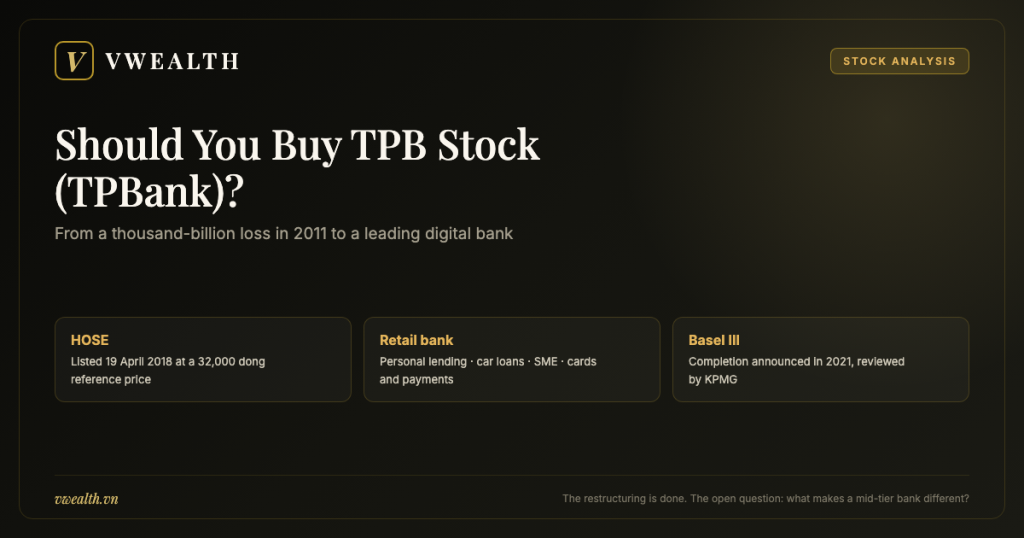
Should you buy TPB stock — the ticker of Tien Phong Commercial Joint Stock Bank, known to almost everyone as TPBank, listed on the Ho Chi Minh City Stock Exchange? It is a question that resurfaces every time Vietnamese bank shares catch a bid, and one that very few people answer honestly. The reason is simple: TPBank has a biography unlike any other bank in the country. It was founded in 2008 by technology and telecom shareholders rather than career bankers. Three years later it posted a loss large enough to land it on the central bank’s restructuring list. It was rescued by a family that had made its fortune in gold and jewellery, rebranded itself in purple, bet its entire future on digital banking while most of the market still treated that as science fiction, and finally listed on HOSE in 2018 at a market capitalisation close to 800 million US dollars. Eighteen years after it opened its doors, TPBank is no longer a bank on the brink — but it is not a market leader either. It sits in the middle, the part of the league table where both the opportunity and the risk are largest. This article walks through that entire story, teaches you how to read the financial statements of a mid-sized Vietnamese retail bank, and ends with a straight answer: what kind of investor TPB suits, and what kind of investor should stay well away.
Before we start, one convention needs to be agreed between you and this article, the same convention used throughout this series. You will meet a great many dates, names, transactions and historical figures — all drawn from information already made public through the bank’s own disclosures, filings sent to the stock exchange, and mainstream financial media. But this article will not quote the most recent quarter’s financials: what profit was booked last quarter, where the non-performing loan ratio stands today, what price-to-book multiple the stock trades at this morning. Not because numbers are unwelcome, but because for a bank those numbers change every ninety days, and an article meant to stay useful for two years becomes actively misleading three months after publication if it hard-codes a single quarter. Instead, you will learn where to look and how to interpret what you find, and you can pull the current figures from the analysis report on vwealth. It costs you a few minutes, but they are the right few minutes.
A second note, no less important. A bank is not a company you can analyse with the toolkit you would use on a manufacturer or a retailer. You do not calculate gross margin for a bank. You do not value one on a conventional price-to-earnings basis. You do not read negative operating cash flow as a warning sign. Banks have their own vocabulary: NIM, CASA, CIR, CAR, LDR, loan-loss coverage. It sounds like alphabet soup, but every term is explained in plain English at the point where it first appears, with a worked example. By the end of chapter four you will hold an eight-point checklist that works on any bank listed in Vietnam, not just this one. That may well be the most valuable part of the article, even if you ultimately decide against buying TPB.
One last piece of orientation for readers approaching Vietnam from abroad. The Vietnamese banking sector is where the country’s savings and its credit risk both concentrate, because companies here still borrow from banks rather than issue bonds. That makes bank stocks roughly a third of the entire market’s capitalisation and makes them the default instrument for anyone taking a view on Vietnamese growth. If the mechanics of the market itself are new to you — how foreign ownership limits work, how settlement runs, why daily price bands exist — start with our guide on how to invest in the Vietnam stock market and the broader Vietnam stock market guide, then come back here.
From near-collapse to digital banking poster child: the history of TPBank
If you had to nominate one Vietnamese bank whose first eighteen years contained the most hairpin turns, TPBank would be a heavyweight candidate. Most joint-stock banks follow a fairly flat curve: incorporate, open branches, raise capital, list. TPBank did not. It very nearly died once, was resuscitated with the money and reputation of an entirely new shareholder group, and then reinvented itself around a strategy its original founders had never imagined. To understand why the market prices TPB the way it does today — not as cheap as the problem banks, not as expensive as the leaders — you have to walk every one of those turns.
2008: a bank built by technology people
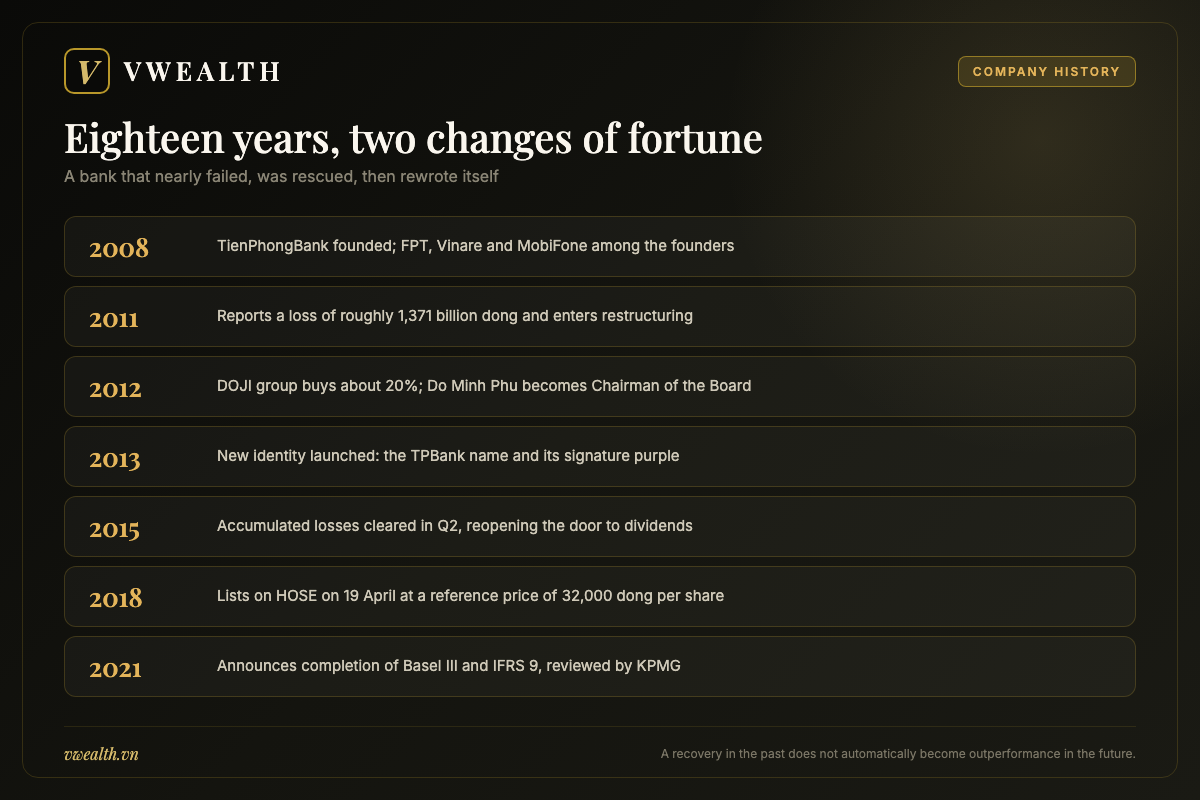
On 5 May 2008, Tien Phong Commercial Joint Stock Bank — then universally called TienPhongBank — opened for business. The interesting part is not the name but the founding shareholder register. People generally assume a new Vietnamese bank is founded by property tycoons or by long-established financial groups. TPBank was neither. Its founders included FPT Corporation, at the time Vietnam’s largest information technology group, with roughly 15 per cent of the capital; the Vietnam National Reinsurance Corporation (Vinare) and Vietnam Mobile Telecom Services Company (MobiFone), each with roughly 12.5 per cent. Later, the strategic shareholder list expanded to include SBI Ven Holdings Pte. Ltd. of Singapore — part of SBI Group, one of Japan’s major financial conglomerates — and the International Finance Corporation, the private-sector arm of the World Bank Group.
Pause on that detail, because it explains a great deal of what followed. A bank with FPT and MobiFone among its founders had technology in its DNA from day one. The name “Tien Phong”, which translates roughly as “pioneer” or “vanguard”, was not chosen at random either: the original ambition was to build a differentiated bank on the back of technology, serving young customers, using telecom and IT infrastructure as its competitive edge. The problem was that in 2008 Vietnam’s digital infrastructure was nowhere near ready for that ambition. Smartphones were not yet widespread, online payments were embryonic, and ordinary people still expected to queue at a counter. It was a correct idea that arrived roughly seven or eight years early. That lesson returns with force in the 2016 to 2020 period, when the very same idea, executed at the right moment, became a genuine advantage.
The 2011 stumble: a loss that almost erased a bank
The years from 2008 to 2011 were violent ones for the entire Vietnamese banking system. After the post-global-financial-crisis stimulus, credit exploded, deposit rates at one point pushed into double digits, and the interbank market turned into a casino that many small banks entered chasing spread. TienPhongBank was one of the names swept along. By 2011 the bank reported a loss of roughly 1,371 billion Vietnamese dong — an enormous figure relative to its capital base at the time.
To grasp how serious that was, consider the arithmetic. For a bank with charter capital of a few thousand billion dong, a loss of more than a thousand billion in a single year is not “a weak trading year”. It eats directly into shareholders’ equity, drags the capital adequacy ratio down, and destroys the confidence of both depositors and peer banks on the interbank market. In other words, it is the signature of an institution sliding toward a liquidity failure. TienPhongBank was placed among the credit institutions requiring restructuring — the group the State Bank of Vietnam supervises closely and requires to submit a concrete remediation plan.
The cause of the loss, according to public analysis at the time, was weak credit quality combined with high-risk investment and lending activity on the interbank market — precisely the kind of risk a young bank with immature credit risk management is most likely to run into when it wants to grow fast. This is the first lesson to take away when you look at any bank anywhere: rapid short-term credit growth is almost always a double-edged sword, and the price usually only surfaces two or three years later, when the loans mature.
2012: a gold-trading family walks in to rescue a bank
This is the single most important turn in TPBank’s history, and the most novelistic part of the story. In 2012, with TienPhongBank still under restructuring supervision, a shareholder group linked to DOJI Gold and Gems Group, led by Do Minh Phu, bought roughly 20 per cent of the bank and became a strategic shareholder. At the 2012 annual general meeting, Mr Do Minh Phu was elected Chairman of the Board — marking the transfer of controlling influence from the original founding group, FPT included, to the new one.
The reasoning behind that decision is worth sitting with. Mr Do Minh Phu was by then a highly successful entrepreneur in gold and jewellery. He was not short of money and had no experience running a bank. Putting capital into a heavily loss-making institution under special supervision is a decision most rational investors avoid. In subsequent public remarks, he described it as a ten-year restructuring journey full of difficulty — working through legacy bad debt, rebuilding the organisation, reconstructing the risk management framework, and above all winning back the market’s trust.
Around the same time, Do Anh Tu — Mr Do Minh Phu’s younger brother, widely known for building the Diana consumer brand before selling it to Japan’s Unicharm — also began his association with TPBank in 2012. He was later elected Vice Chairman of the Board for the 2023 to 2028 term, from April 2023. The two Do brothers became the public faces of the bank’s revival, and their story returns in chapter two with a turn nobody saw coming.
2013 to 2015: a new purple identity and the day the accumulated losses were cleared
On 10 December 2013 the bank unveiled a new brand identity: the shortened name TPBank in place of the unwieldy TienPhongBank, and, more consequentially, purple as its primary colour. The new logo used a triangular form — three points, three sides, signalling solidity — while the purple was framed as standing for trust, refinement and the bond between customer and bank.
On the face of it this is a branding story with no bearing on the share price. Do not skip past it. In Vietnamese retail banking, essentially the entire market uses blue, green or red. Choosing purple bought TPBank something very difficult to buy with money: instant recognition. Walk down a street with five bank branches on it, and the purple one is what your eye lands on first. For a bank that had just escaped a crisis and needed to rebuild its brand from below zero, that decision delivered marketing value far in excess of its cost. It is a textbook case of an investment in brand creating a durable intangible asset — one that never appears as a line on the balance sheet.
Three years after the new shareholder group took over, TPBank formally cleared its accumulated losses in the second quarter of 2015 — the point at which undistributed post-tax profit crossed from negative to positive. To an outsider that is one small line in a financial statement. To the bank it was the decisive milestone, because accumulated losses are a legal barrier that blocks dividend payments and complicates capital raising.
There is a technical detail here worth understanding, because it followed TPBank for years afterwards. During the restructuring the bank had to issue shares below par value, creating a negative share premium of roughly 1,020 billion dong. Share premium is the difference between issue price and par value; issue below par and that difference turns negative and sits within equity as a deduction. The bank then had to use profits from later years to work that negative balance down. In other words, clearing the accumulated loss was only step one; the accounting hangover from the crisis years lasted longer still. This is exactly the kind of detail a hurried reader misses, and exactly the reason TPBank’s dividend policy stayed so conservative for so many years.
2016 to 2018: LiveBank, the digital gamble, and listing day on HOSE
Here the story turns interesting. With the balance sheet stabilised, TPBank’s management faced the strategic question familiar to every mid-sized bank: how do you compete against institutions five or ten times your size in capital and branch network? Opening more branches is the traditional route and also the most expensive one — each new branch means premises, staff, running costs, and several years before it breaks even. Branch openings also depend on regulatory approval.
TPBank chose a different route: LiveBank, a network of automated banking points operating twenty-four hours a day, seven days a week. Launched in 2016 and showcased widely at the Banking Vietnam 2017 event, a LiveBank unit is a transaction booth with no staff physically present, where customers can still deposit and withdraw cash, open accounts, and speak to a teller through video technology — a video teller machine, in industry language. During 2017 the bank planned to open at least fifty-five LiveBank points nationwide, and the count subsequently rose into the hundreds.
It was a clever move for three reasons. First, the capital and running cost of a LiveBank point is far below that of a traditional transaction office, letting TPBank expand coverage quickly without inflating its cost base. Second, it runs around the clock — a real advantage for office workers, students and night-shift workers, precisely the customers traditional banks serve badly. Third, and most importantly for brand purposes, it built the image of a “technology bank” for TPBank, exactly the DNA that FPT and MobiFone had planted in 2008, only this time the market was ready.
It was on that stabilised foundation that TPBank went public. On 19 April 2018, TPB shares traded for the first time on the Ho Chi Minh City Stock Exchange. The reference price on debut was 32,000 dong per share, with 555 million shares registered for listing — around 95 per cent of total shares issued. Charter capital at the time was over 5,842 billion dong, and market capitalisation at the reference price came to roughly 17,760 billion dong, or close to 800 million US dollars. That placed TPBank ninth by market capitalisation among listed Vietnamese banks, behind Vietcombank, BIDV, VietinBank, VPBank, ACB, HDBank, VIB and MB.
The financial picture at listing, based on published full-year 2017 figures, showed a bank that had visibly recovered: consolidated total assets above 124,000 billion dong, total mobilised funds around 73,800 billion dong, pre-tax profit of 1,206 billion dong and a non-performing loan ratio of 1.08 per cent. Going from a 1,371 billion dong loss in 2011 to a 1,206 billion dong pre-tax profit in 2017 took six years — and it is the most persuasive evidence available that the restructuring genuinely worked.
2020 to 2021: eKYC, Basel III and the “leading digital bank” position
If LiveBank was step one, eKYC was step two and the decisive one. eKYC stands for electronic Know Your Customer — verifying a customer’s identity by electronic means. It allows someone to open a bank account entirely online, needing only a phone, an identity document and their own face, with no branch visit at all. In August 2020, TPBank announced comprehensive eKYC deployment on mobile and became the first bank in Vietnam to apply eKYC on its LiveBank 24/7 network, letting customers open an account and receive a card on the spot at an automated point.
Understand the economics here, because they matter far more than the technical veneer suggests. The cost of acquiring one new customer the traditional way — renting premises, paying a teller, printing paperwork — is far from trivial. eKYC pushes that cost down toward the marginal cost of software. A bank that masters eKYC expands its retail customer base materially faster, and a large retail customer base is the source of cheap non-term deposits, which is what ultimately determines a retail bank’s profitability. We return to this in chapter four under CASA.
In November 2021, TPBank announced it had completed all requirements of Basel III and the IFRS 9 accounting standard, reviewed and confirmed by an independent third party, KPMG Vietnam. Basel is the international standard set for bank capital adequacy issued by the Basel Committee: Basel II requires banks to hold capital scaled to the risk weighting of their assets; Basel III tightens the requirements further on capital quality, leverage ratios and liquidity metrics. A bank voluntarily adopting a standard stricter than domestic regulation demands is a positive signal on risk governance — though you should also remember that compliance with a standard is not immunity from risk. Standards help you detect and absorb losses better; they do not prevent them.
2023 to 2026: cash dividends, capital increases and new twists
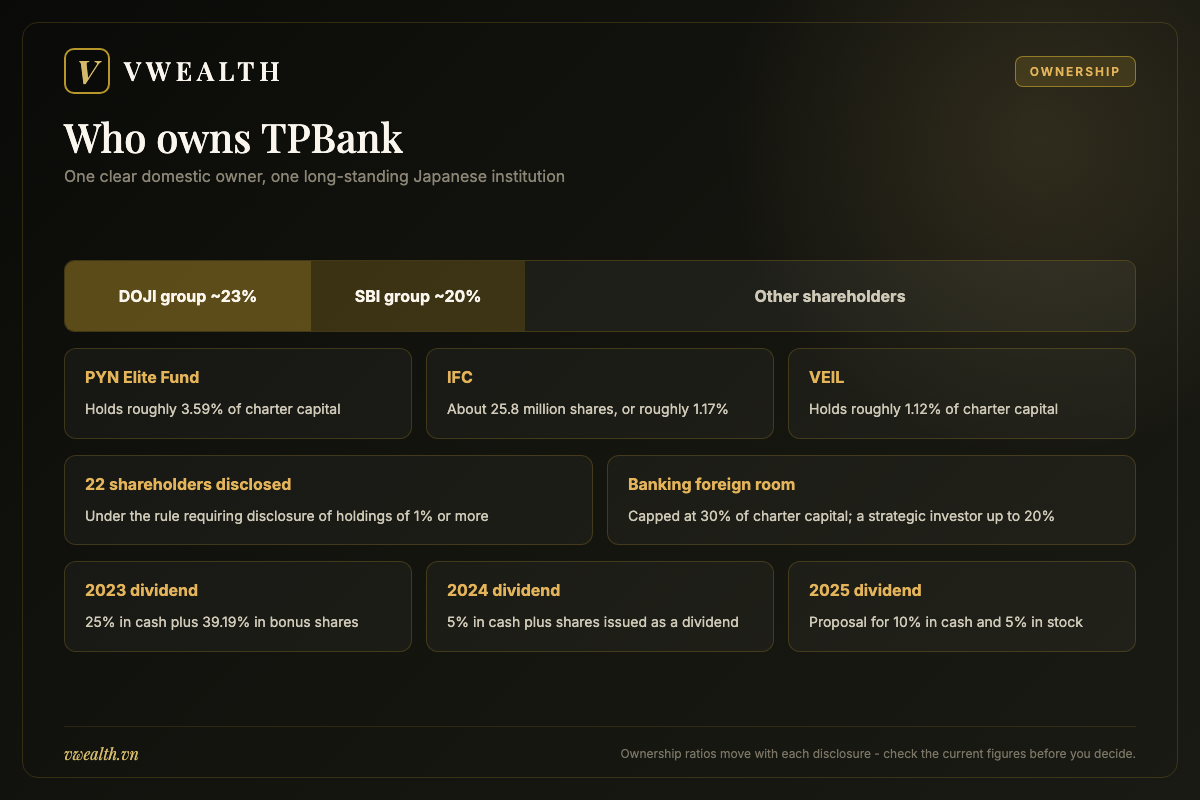
The most recent phase of TPBank’s story has three themes that matter to investors. The first is a wholesale change in dividend policy: after years of paying no cash at all, in 2023 the bank paid a cash dividend at a rate of 25 per cent — 2,500 dong per share, totalling roughly 4,000 billion dong — alongside a bonus share issue at 39.19 per cent. In 2024 the bank continued with a cash dividend at 5 per cent (roughly 1,100 billion dong in total) plus the issue of more than 440.3 million shares as a stock dividend, lifting charter capital from 22,016 billion dong to 26,420 billion dong. In 2025 the shareholder meeting documents proposed a 10 per cent cash dividend alongside 5 per cent in stock — a third consecutive year with cash.
The second theme is a long chain of capital increases. From 5,842 billion dong at listing in 2018 to more than 26,000 billion dong just seven years later, TPBank’s charter capital multiplied several times over. The upside is a stronger capital adequacy ratio and more room for credit growth. The consideration on the other side is that a larger share count divides profit across more shares, and the share price is technically adjusted after each distribution. We dissect that dilution effect in chapter five.
The third theme is senior personnel change during 2025 — a sensitive subject that deserves careful handling, and which is set out in full in chapter two using only what has been publicly disclosed.
| Date | Event | What it means for an investor |
|---|---|---|
| 5 May 2008 | TienPhongBank founded; founding shareholders include FPT (~15%), Vinare and MobiFone (~12.5% each) | Technology DNA from day one, but the market was not ready |
| 2011 | Loss of roughly 1,371 billion dong; placed under restructuring | A lesson in fast growth paired with weak risk management |
| 2012 | DOJI-linked group buys roughly 20%; Do Minh Phu becomes Chairman | Change of control opens a ten-year restructuring |
| 10 Dec 2013 | New identity launched: the TPBank name and the purple palette | Brand equity that never shows up on the balance sheet |
| Q2 2015 | Accumulated losses fully cleared | Reopens the door to dividends and capital raising |
| From 2016 | LiveBank 24/7 rollout, showcased at Banking Vietnam 2017 | Technology chosen over branches as the route to coverage |
| 19 Apr 2018 | HOSE listing at a 32,000 dong reference price, 555 million shares, market cap ~17,760 billion dong | Ninth-largest listed bank by market capitalisation at the time |
| Aug 2020 | First to deploy comprehensive eKYC on mobile and on LiveBank | Customer acquisition cost pushed toward software economics |
| Nov 2021 | Announces completion of Basel III and IFRS 9, reviewed by KPMG Vietnam | A signal on the quality of risk governance |
| 2023 | Cash dividend of 25% (~4,000 billion dong) and 39.19% bonus shares | A turning point in profit distribution policy |
| 2024 | Cash dividend of 5% plus stock; charter capital to 26,420 billion dong | Paying cash while retaining capital for growth |
| 2025 | Proposal for 10% cash and 5% stock; senior personnel changes | Third straight year with cash, alongside non-financial risk to monitor |
Look back across those eighteen years and you will see that TPBank is not a linear growth story but a recovery story. That is the crux of valuing TPB: the market has a long memory. A bank that once lost a thousand billion dong, even after a full recovery and Basel III adoption, needs many years before it is valued on a par with a bank that never had an incident. The question for you — the person weighing whether to buy TPB stock — is whether that discount is now fair, or whether the market is still punishing too hard.
Who steers TPBank, and who owns it?
For a bank, the question “who is in charge” matters far more than it does for a manufacturer. The reason lies in the business model itself: a bank lends other people’s money — mostly household and corporate deposits — at leverage that can exceed ten times shareholders’ equity. One bad decision by management does not merely dent profit; it can vaporise equity in a short space of time, exactly as TPBank experienced in 2011. So when you weigh up a bank share, you are betting on governance quality more than on any other single factor.
Do Minh Phu: the gold merchant and a ten-year restructuring
Do Minh Phu has been Chairman of TPBank’s Board of Directors since the 2012 annual general meeting, the point at which the DOJI-linked shareholder group took over the controlling role. Before he came to the bank, he built DOJI Gold and Gems Group into one of the largest businesses in Vietnam’s gold and jewellery trade.
What is notable here is not his reputation but the nature of the decision. Buying into a bank in 2012 that was losing a thousand billion dong a year and sitting under restructuring supervision meant acquiring assets worth close to nothing against obligations that were entirely real. Buyers in that situation usually fall into one of two categories: either they see value the market does not, or they are acquiring a financial instrument to serve their own corporate ecosystem. With TPBank, the outcome suggests the first case dominated: the bank was genuinely restructured, cleared its accumulated losses within three years, rebuilt its risk management framework and listed successfully.
One point international investors should register. Vietnamese law on credit institutions has progressively tightened the rules on one individual simultaneously leading a bank and leading another company, forcing executives to choose. The intent is to limit the “backyard bank” problem — where a bank becomes the preferred funding source for its own owner’s corporate ecosystem. When you assess any private Vietnamese bank, the degree of separation between the bank and its major shareholder’s ecosystem is one of the questions you must ask, and the answer lives in the related-party transactions note of the financial statements. That note is not decorative. Read it.
Nguyen Hung: a chief executive across three terms
If Do Minh Phu sets the direction, Nguyen Hung is the one who runs the machine. He has served as TPBank’s Chief Executive Officer since 2012 — the very moment the restructuring began — and has been reappointed for a third term covering 2022 to 2027, following written approval from the Governor of the State Bank of Vietnam.
That stability is a meaningful plus that many investors overlook. In banking, the chief executive’s chair changes hands frequently at institutions with governance problems or shareholder conflicts. A CEO in post for more than a decade, who has lived through the full arc from restructuring to listing to digital transformation, means strategy has been executed continuously rather than reset every few years. For a bank — where a credit cycle runs five to seven years — continuity in the executive team is a real asset.
It is only fair to note the flip side. A management team that has been together too long can settle into fixed patterns of thought and lose the capacity for self-criticism. The simplest way to check is to look at whether the bank keeps introducing new people into the executive team, and whether new business lines are handed to different individuals or concentrated in a small circle.
The 2025 developments: what has actually been disclosed
This section must be handled carefully, drawing only on publicly disclosed information, and governed by the presumption of innocence — meaning that a person is considered guilty only when a court has issued a legally effective conviction.
According to disclosure filings, on 18 March 2025 Mr Do Anh Tu submitted his resignation from the position of member of TPBank’s Board of Directors for the 2023 to 2028 term, citing personal reasons; the Board accepted that resignation under a resolution issued on 20 March 2025. At the same time he also resigned from his position at Tien Phong Securities Joint Stock Company (TPS), where he served as Chairman of the Board.
On 7 July 2025, media outlets reported that the Ministry of Public Security had commenced criminal proceedings against Mr Do Anh Tu in a case concerning bond issuance by Bamboo Capital, in which TPS acted as issuance advisor and Mr Do Anh Tu was at that time Chairman of the Board of TPS. The case involves multiple defendants facing proceedings over conduct alleged to constitute fraudulent appropriation of assets.
For its part, TPBank issued a statement affirming that the matter concerning Mr Do Anh Tu falls entirely within the scope of TPS’s operations, does not affect the governance or management of the bank, and does not relate to TPBank’s credit, financial or operational activities. One point needs to be made explicit to avoid a common confusion: TPS is a separate legal entity, not a subsidiary of TPBank; the two organisations share history in personnel and name but differ in ownership and governance.
In June 2025, TPBank carried out a reorganisation of its executive team: several deputy chief executives stepped away from previous roles to take up new assignments, while appointments were made to lead business divisions. The bank described this as an adjustment tied to a comprehensive renewal strategy.
So how should you, as an investor, process this information? The answer has three parts. One, do not ignore it: legal risk attaching to a person who formerly held a leadership position is a genuine category of non-financial risk, it affects market sentiment, and it can create selling pressure in the short term. Two, do not extrapolate: any conclusion about individual responsibility rests with the judicial authorities, and transferring responsibility from one legal entity to another is wrong both legally and analytically. Three, verify with numbers: the most objective way to assess the impact is to track the bank’s actual metrics quarter by quarter — deposit growth, non-performing loan ratio, cost of funds, CASA ratio. If those numbers do not deteriorate, the impact is essentially sentiment. If they deteriorate visibly, then you have a business problem.
The ownership structure: two large blocks and a wide float
Under the amended Law on Credit Institutions, Vietnamese banks must disclose the list of shareholders holding 1 per cent or more of charter capital — a large step forward in transparency, since previously only holders of 5 per cent and above had to be disclosed. TPBank published that list with 22 shareholders falling within the declaration threshold.
The ownership picture, based on public disclosures, looks like this: the shareholder group linked to Do Minh Phu’s DOJI Group holds roughly 23 per cent of charter capital; SBI Ven Holdings Pte. Ltd. and related parties hold roughly 20 per cent, corresponding to around 440 million shares; PYN Elite Fund holds roughly 3.59 per cent; the International Finance Corporation holds roughly 1.17 per cent (about 25.8 million shares); and Vietnam Enterprise Investments Limited holds roughly 1.12 per cent. The remainder is dispersed across tens of thousands of individual and small institutional shareholders.
That structure tells you three things. First, TPBank has a clearly identified domestic controlling shareholder in the DOJI group — meaning someone is accountable for long-term strategy, and the bank is not ownerless. Second, TPBank has a very large and long-standing foreign institutional shareholder in the SBI group of Japan. Foreign institutional shareholders typically bring two things: governance standards and discipline in disclosure. Third, TPBank’s foreign ownership ratio already sits high relative to the permitted ceiling — a detail with direct consequences for how much more foreign funds can buy, which the next section covers.
The 30 per cent foreign ownership limit: why this number matters for TPB
“Foreign room” is the everyday Vietnamese term for the cap on foreign investors’ aggregate shareholding in a company. In Vietnamese banking, total foreign ownership in a domestic joint-stock commercial bank is capped at 30 per cent of charter capital, within which a single foreign strategic investor may not exceed 20 per cent. There are separate, higher allowances that can be granted in specific restructuring situations, but the 30 per cent and 20 per cent figures are the standard framework you should work with.
For an international investor, the practical implications are concrete. When a bank’s foreign room is nearly full or entirely full, foreign funds wanting to buy have to wait for a seller, and they typically pay above the on-screen price to buy in a negotiated block — the phenomenon known locally as a “foreign room premium”. That creates a layer of latent demand supporting the price. But the reverse also holds: a full room means new foreign capital cannot flow in naturally through the order book, which reduces the stock’s ability to benefit directly when Vietnam attracts large foreign inflows — for instance from the long-running market reclassification story.
This is a material difference between TPB and banks that still have wide open foreign room. Before buying, check TPB’s remaining foreign room at that moment — the figure is updated daily on price boards and in the vwealth analysis report. If you are a foreign investor reading this from outside Vietnam, treat the remaining room as a hard constraint on execution, not a footnote: it determines whether you can build a position at all, and at what price.
Dividend policy: from a ten-year drought to three straight years of cash
With bank shares, the dividend is more a health indicator than an income stream. The logic: a bank that wants to grow credit must hold matching own capital to preserve its capital adequacy ratio, so a fast-growing bank usually retains earnings rather than paying them out. When a bank starts paying cash consistently, it is usually a signal that the capital buffer is thick enough and management is confident about asset quality.
TPBank followed exactly that path. For many years after the restructuring, it paid no cash because of the accumulated losses and the negative share premium. From 2023 the policy changed outright: 25 per cent cash in 2023, 5 per cent in 2024, and a 10 per cent proposal put to the 2025 meeting — three consecutive years. Running alongside were stock distributions to build charter capital.
| Year | Cash dividend | Stock / bonus shares | What to take from it |
|---|---|---|---|
| 2023 | 25% (2,500 dong per share, ~4,000 billion dong total) | Bonus shares at 39.19% | The turning point: paying cash and raising capital at once |
| 2024 | 5% (~1,100 billion dong total) | Over 440.3 million shares issued; charter capital 22,016 → 26,420 billion dong | Prioritising retained capital for credit growth |
| 2025 (proposal to AGM) | 10% (1,000 dong per share) | 5% in stock; charter capital projected above 27,740 billion dong | A third consecutive year with cash |
Read that table this way: TPBank’s cash dividend rate is not stable across years, swinging from 5 per cent to 25 per cent. Which means that if you buy TPB expecting a steady bond-like income stream, you will be disappointed. The dividend here reflects each year’s profit and capital requirements; it is not a commitment. If you want a bank share with a materially different distribution philosophy, compare against our analysis of whether to buy VCB stock of Vietcombank — a bank with an entirely different market position and capital philosophy.
How TPBank makes money: the anatomy of a mid-sized retail bank
There is a very common misconception that all banks are essentially the same: take deposits, lend them out, keep the spread. In principle that is true, but it is precisely the “lend to whom, fund from where, sell what else” that determines which bank earns high returns, which carries low risk, and which is simply a faded copy of a larger rival. This chapter dissects TPBank’s earnings engine line by line, and points out where the advantage is real and where it is marketing.
Start at the root. A bank raises money from depositors and pays them a rate; it then lends that money out at a higher rate. The difference, measured across all interest-earning assets, is called NIM — net interest margin. The formula is straightforward: NIM equals net interest income divided by average interest-earning assets.
A worked example to fix the idea: suppose a bank holds 100 units of interest-earning assets (mostly loans to customers plus bonds), collects 8 units of interest income in a year and pays 4.5 units of interest to depositors. Net interest income is 3.5 units and NIM is 3.5 per cent. That is an illustrative calculation only, not TPBank’s figure.
For a retail bank, NIM is usually higher than at a bank focused on large corporate lending, because personal loans carry higher rates and individual borrowers have less bargaining power. In exchange, the operating cost of servicing millions of small loans is far higher than servicing a few hundred large ones. That is the fundamental trade-off of the retail model, and it explains why technology matters so much to TPBank: technology is the thing that pulls the cost to serve each customer down far enough for the retail model to earn a return.
Retail customers: the backbone of TPBank
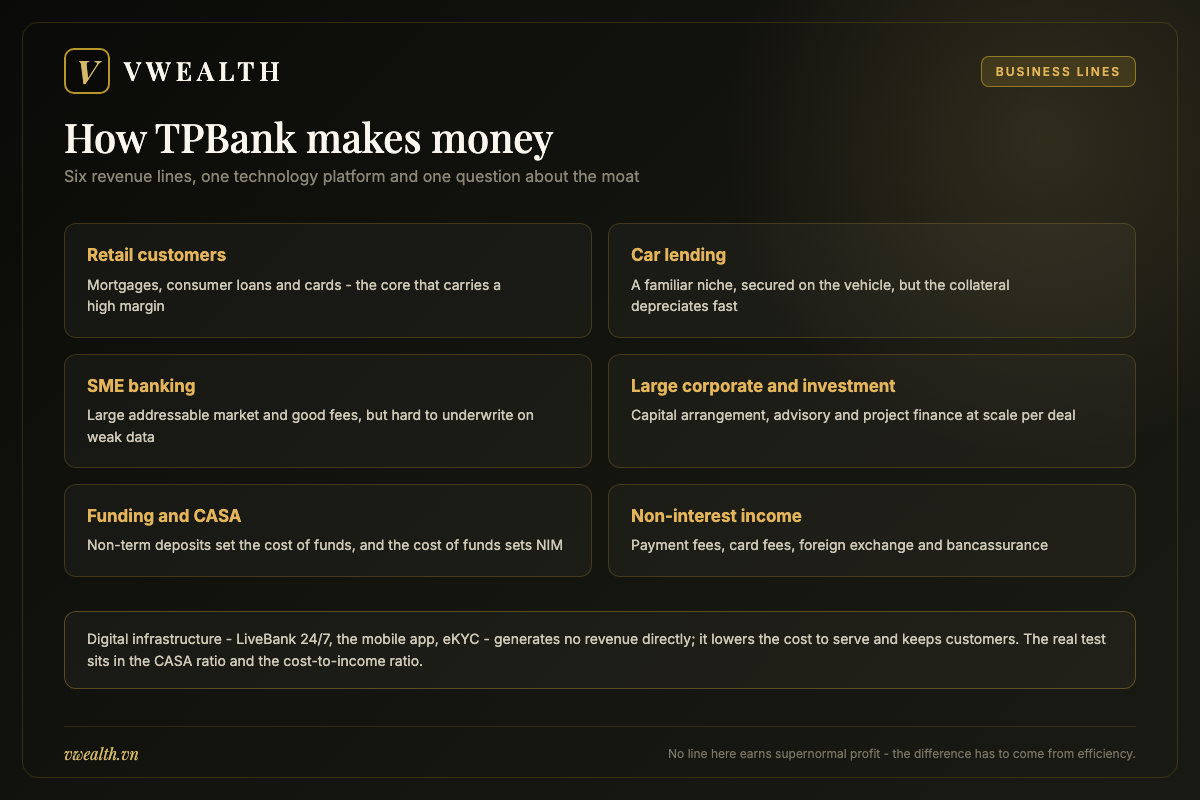
Individual customers are TPBank’s strategic centre of gravity and where the bank positions its brand most sharply. The core product set covers home loans, car loans, consumer lending, credit cards and deposit products.
Of these, car lending is the segment TPBank is most associated with in the market. It is a niche with attractive characteristics for a bank: the loan is secured on the vehicle itself, the ticket size is moderate (typically a few hundred million dong up to a little over a billion), the tenor is medium-term, and the borrower usually has stable income. Compared with unsecured consumer lending the risk is far lower; compared with mortgage lending the tenor is shorter, so the bank carries less maturity mismatch risk.
But you need to see the other side too. Collateral in the form of a car has one awkward property: it depreciates fast. A vehicle three years old may be worth only around half its original price. If the bank has lent at a high loan-to-value ratio and the borrower runs into difficulty in the first two years, the recovery value from selling the car may not cover the outstanding loan. This is why, when the economy turns down, car and consumer lending books are usually where bad debt appears first.
The corporate side: SMEs and large clients
Alongside retail, TPBank serves corporate customers, split into two main groups: small and medium enterprises (SMEs) and large corporates. In June 2025 the bank reorganised the leadership of both: one deputy chief executive moved across to head the large corporate and investment banking division, covering investment, advisory, capital arrangement and integrated financial solutions for corporate groups, while a division head was appointed to build out the SME franchise with credit products and trade finance.
The SME segment deserves attention because it is the customer group every bank says it wants to serve and very few serve well. The reasons: small companies lack standardised financial statements, lack collateral, and the underwriting cost per loan is high relative to the loan size. A bank that solves this with data — credit scoring based on cash flows through the account, transaction history and invoices, rather than collateral alone — unlocks a rich seam. This is where TPBank’s technology platform could genuinely differentiate, and it is also something you should track quarter by quarter: is the SME share of the loan book rising steadily, and what does asset quality in that book look like?
Funding and CASA: the battle for non-term deposits
If you were allowed only one metric to understand the long-run strength of a retail bank, many analysts would choose CASA. CASA stands for Current Account Savings Account — non-term and transactional deposits. This is money customers leave in their account for day-to-day spending, on which the bank pays almost no interest, or a token rate.
A worked example shows the power of CASA. Suppose two banks each raise 100 units of deposits. Bank A has 20 per cent in CASA and 80 per cent in term deposits at 5 per cent. Its cost of funds is roughly 4 units. Bank B has 40 per cent in CASA and 60 per cent in term deposits at the same 5 per cent. Its cost of funds is roughly 3 units. Lending out at an identical rate, B earns one more unit than A per 100 units of deposits — a full percentage point of NIM, purely from the deposit mix. At a balance sheet measured in hundreds of thousands of billions of dong, that percentage point is an enormous number.
The catch is that CASA cannot be bought with money. People keep their transactional balances at whichever bank is most convenient: a smooth app, fast transfers, free transactions, salary paid in, everyday payments linked. This is exactly why TPBank invested so heavily in its mobile application, in LiveBank and in eKYC — not to look modern, but to win CASA. The CASA race in Vietnamese banking over recent years has driven essentially the entire market to waive transfer fees, and the bank with the better digital experience keeps the customer.
When you read TPBank’s reports, look at the CASA ratio across a run of quarters rather than at a single point. CASA has a clear seasonal pattern (it typically falls when term deposit rates rise sharply, as households shift money into term products) and a cyclical pattern that tracks the general level of interest rates. A CASA ratio that grinds higher over many quarters is genuine evidence that the digital strategy is working; one that jumps around with the rate cycle suggests customers only came for the promotion.
Non-interest income: bancassurance, cards and service fees
Beyond the interest spread, a bank earns fees — and the market values this stream more highly because it consumes little capital and carries no credit risk. The main sources are payment and account service fees, credit card fees (including interchange from the card schemes and interest on card balances), guarantee and trade finance fees, and the distribution of insurance through the bank, known as bancassurance.
Bancassurance in particular needs a clear head. Between 2019 and 2022 it was the explosive fee source for the entire Vietnamese banking sector, with exclusive life insurance distribution agreements delivering very large upfront fees. But after a wave of inspections and a tightening of the rules on selling insurance alongside loans, sector-wide bancassurance revenue fell sharply and settled at a materially lower level than at the peak. When you look at any bank’s non-interest income, strip the insurance component out and check whether what remains — payment fees, card fees, foreign exchange — is genuinely growing.
Digital banking: real moat, or sunk cost?
This is the central question in valuing TPBank, and the one the market argues about most. TPBank positions itself as a leading digital bank with the LiveBank 24/7 ecosystem, the TPBank Mobile application, the TPBank Biz platform for businesses and a biometric data system. The question is whether any of that produces a durable economic moat.
The case in favour: technology lowers the cost of acquiring and serving customers, letting a mid-sized bank compete on reach without an enormous branch network; it also generates behavioural data for credit scoring and cross-selling. TPBank moved ahead of many rivals on eKYC and automated banking, and first-mover advantage in building user habits is real.
The case against — and you need to weigh this seriously: banking technology is no longer a high barrier to entry. Almost every Vietnamese bank now has a capable app, eKYC, instant free transfers. What differentiated TPBank in 2018 had become the industry baseline by 2026. On top of that, larger banks have much larger technology budgets, and the digital-only models backed by those larger banks compete directly for exactly the young customer base TPBank targets.
The balanced conclusion: digital banking is a necessary condition for TPBank to survive and hold its CASA, but it is no longer a sufficient condition to create outperformance. The most practical way to test the claim is not to listen to what the bank says but to watch two numbers: the CASA ratio and the cost-to-income ratio. If technology is genuinely creating efficiency, CASA should be high and CIR should trend down over time. If CIR does not fall despite years of technology spending, the investment has only helped retain customers, not improve operating efficiency.
| Business line | How it generates revenue | Strength | Risk to monitor |
|---|---|---|---|
| Retail lending | Interest spread on mortgages, car loans, consumer loans and cards | Higher NIM than large-corporate lending; broad customer base | Sensitive to household income; bad debt appears early in a downturn |
| Car lending | Secured lending against the vehicle | Collateralised, medium tenor, a familiar TPBank niche | Collateral depreciates fast, so recovery values are low |
| SME banking | Credit, trade finance, payment services | Large addressable market, good fee margins, deeper relationships | Hard to underwrite, weak financial data, sector concentration risk |
| Large corporate and investment banking | Capital arrangement, advisory, project finance | Large scale per transaction, low cost to serve | Concentration risk; sensitive to the property and bond cycle |
| Deposits and CASA | Cheap non-term deposits alongside term deposits | High CASA lowers funding cost and lifts NIM | CASA drains away when term deposit rates spike |
| Non-interest income | Payment fees, card fees, foreign exchange, bancassurance | Capital-light, creates no credit risk | Bancassurance is past its peak; regulation has tightened |
| Digital infrastructure (LiveBank, app, eKYC) | No direct revenue; lowers cost and retains customers | 24/7 coverage, low customer acquisition cost | Now an industry standard; demands continuous reinvestment |
Look at that table as a whole and you will see that TPBank is a fairly typical retail bank, with a tilt toward technology and one familiar niche in car lending. It has no monopoly business line producing supernormal profit — unlike some banks built around a distinctive ecosystem. To see the difference in model clearly, compare it against our analysis of whether to buy TCB stock of Techcombank — a bank that built its profitability around the property value chain and corporate bonds — or our analysis of VPB stock of VPBank, where consumer finance plays a very different role in the profit mix.
Position and financial health: eight things to check before you buy TPB stock
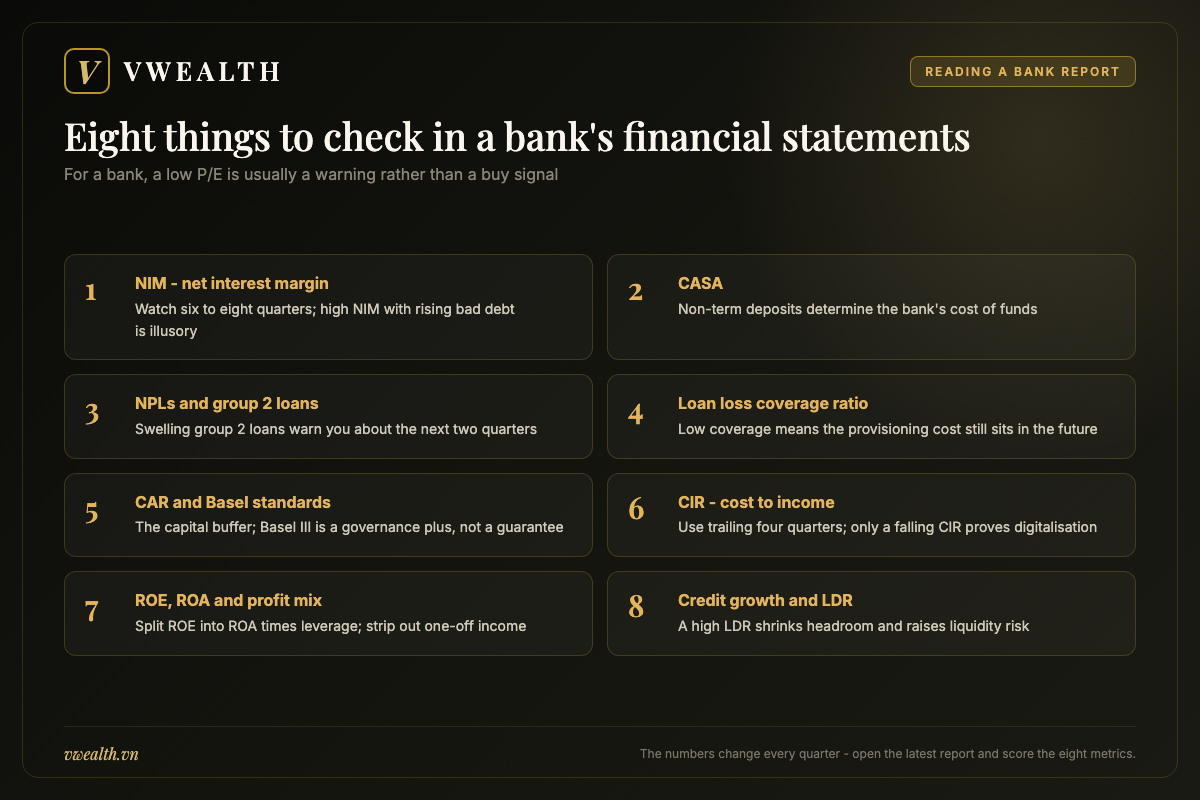
Now for the hardest and most useful part. If you have ever opened a bank’s financial statements and felt overwhelmed by hundreds of lines of numbers, you are not alone — bank reports are considerably harder to read than ordinary corporate reports, because for a bank the balance sheet is the business. This chapter hands you an eight-point checklist, explains each item in plain English, and tells you how to interpret a reading that comes in high or low. It works for TPBank and for every other bank listed in Vietnam.
One reminder before we begin: this article deliberately omits TPBank’s latest quarterly figures, because they change every ninety days. Open the TPB analysis report on vwealth for the current numbers, then read them against the interpretive framework below. The framework is the durable part; the numbers are the perishable part.
Points 1 and 2: NIM and CASA, the core profit engine
As explained in chapter three, NIM is the difference between interest earned on interest-earning assets and interest paid on funding, measured against average interest-earning assets. For TPBank — a retail bank — NIM typically sits above the level of banks focused on large corporates and above the state-owned banks.
What you need to look at is not the absolute level but the trend across six to eight consecutive quarters. NIM rising in a falling rate environment is a good signal: it means the bank is cutting its funding cost faster than lending rates are declining. NIM compressing over a sustained period is a sign the bank is competing on price — or is having to fund itself expensively because it is losing CASA.
A trap to avoid: a high NIM is not automatically good. If a bank achieves a high NIM by lending to high-risk borrowers at punitive rates, that spread will be eaten back by provisioning charges in later quarters. So NIM must always be read alongside asset quality, which is points 3 and 4.
On to the second metric. CASA determines funding cost, and funding cost determines NIM. For TPBank, CASA is also a direct measure of the entire digital banking strategy: if the app and LiveBank genuinely make customers choose TPBank as their primary account, CASA has to show it.
How to read it: compare TPBank’s CASA against the group of retail banks of similar size over multiple quarters. If TPBank maintains or widens the gap against the peer average, the digital banking argument has substance. If the gap narrows steadily, the first-mover advantage is being eroded — exactly as the counter-argument in chapter three warned.
You should also distinguish between two kinds of CASA. The first is money held by individual customers for everyday spending — sticky, dispersed, low volatility. The second is transactional deposits from a handful of large corporates — big balances that can be withdrawn in a single movement, causing CASA to drop abruptly. The notes to the financial statements break deposits down by customer type; that is where you check.
Points 3 and 4: bad debt and coverage, where true asset quality lives
Non-performing loans are the loans classified in groups 3, 4 and 5 under the State Bank of Vietnam’s classification: group 3 is substandard, group 4 is doubtful, group 5 is loss. The NPL ratio is the sum of those three groups divided by total loans to customers.
But if you only look at the headline number you miss the most important part. Look at the structure: group 2 loans (special mention — overdue between 10 and 90 days) are not counted as non-performing, yet they are precisely the feedstock for the next two quarters’ NPLs. A bank with a stable NPL ratio but a rapidly swelling group 2 balance is a bank with a problem coming that has not yet surfaced in the official figures.
For a retail bank like TPBank, a further point to watch is the speed of migration between groups. Consumer and car lending have the characteristic that when a borrower runs into financial difficulty they stop paying quickly and rarely recover — unlike a company, which can be restructured. So retail bad debt tends to appear earlier and reflects household income conditions more directly.
The fourth metric follows straight from the third. This is the one amateur investors skip and professionals look at first. The loan loss coverage ratio is the balance of loan loss provisions divided by total non-performing loans. In plain terms: how much money has the bank already set aside for each unit of bad debt it currently holds?
A worked example: if a bank has 100 units of bad debt and has provisioned 80 units, its coverage ratio is 80 per cent. If another bank also has 100 units of bad debt but has provisioned only 40, its ratio is 40 per cent. The two look identical on the NPL ratio, but the second bank still carries 60 units of latent loss that will have to run through the income statement in future, straight out of later quarters’ profit.
This is exactly why a bank can post a beautiful quarterly profit and see its shares go nowhere: the market is looking at the provisioning that has not been taken. Conversely, a bank that accepts heavy provisioning, reports an uglier quarter but lifts its coverage ratio, is genuinely accumulating strength for the future. With TPBank, track this ratio across quarters and against the sector average.
Point 5: CAR and Basel, the capital buffer
CAR, the capital adequacy ratio, is own capital divided by total risk-weighted assets. It answers the question: if the bank’s assets lose value, how much loss can shareholders’ capital absorb before depositors’ money is affected?
TPBank announced completion of the Basel III and IFRS 9 requirements in November 2021, independently reviewed by KPMG Vietnam. That has practical meaning: Basel III demands higher-quality capital (favouring common equity tier 1), adds capital buffers, and introduces liquidity metrics such as the liquidity coverage ratio. A bank that voluntarily adopts a standard stricter than domestic regulation requires generally has better risk governance discipline.
But keep a cool head: a standard is not insurance. Basel helps you measure and absorb risk better; it does not stop a loan book that is over-concentrated in one struggling sector from causing damage. Treat Basel III as a governance plus, not a guarantee of outcomes. It is also worth noting for international readers that Basel adoption in Vietnam has been staged and partly voluntary: the domestic regulatory floor has sat around Basel II standards, so a bank claiming Basel III compliance is claiming to be ahead of the mandatory schedule, not merely in line with it.
Point 6: CIR, the cost-to-income ratio
CIR equals total operating expenses divided by total operating income. It tells you how many units the bank must spend to generate one hundred units of income. A low CIR means efficient operations.
For TPBank, CIR is the most honest test of the digital banking story. The logic is simple: if technology genuinely replaces branches and headcount, operating expenses must grow more slowly than income, and CIR must fall over time. If the bank has invested in technology for years and CIR is flat or rising, technology has been an additional cost rather than a substitution.
One technical note: CIR fluctuates quarter to quarter because of year-end bonus accruals or one-off income items. Calculate CIR on a trailing four-quarter basis to strip out seasonal noise.
Point 7: ROE, ROA and the quality of profit
Return on equity and return on assets are the two most familiar metrics. For a bank, ROE is typically much higher than for an ordinary company because of leverage — that is normal, and it does not mean the bank is more efficient.
What you should do is decompose it: ROE equals ROA multiplied by leverage (total assets divided by equity). A bank with an 18 per cent ROE built on 1.8 per cent ROA and ten times leverage is a completely different animal from one with an 18 per cent ROE built on 1.2 per cent ROA and fifteen times leverage. The second is far more fragile: a few percentage points of asset impairment and equity is under threat.
You should also test profit quality by checking the share of one-off income items: asset sales, recoveries of previously written-off debt, provision write-backs, gains on investment securities trading. These flatter a single quarter but do not repeat. Durable profit comes from net interest income and service fees.
Point 8: credit growth, LDR and the quota question
Since 2011, Vietnamese banks have operated under a “credit room” regime — an annual credit growth quota assigned by the State Bank of Vietnam to each institution. The mechanism was introduced after the 2009 to 2010 period, when credit grew above 30 per cent a year, producing high inflation and macro instability.
For international investors this is one of the most distinctive features of Vietnamese banking and it deserves a moment. In most markets, a bank’s growth is limited by its capital, its funding and its ability to find borrowers. In Vietnam, it has also been limited by an administrative allocation. That has three implications. One, a bank’s growth rate is capped by its assigned quota, not just by its sales capability. Two, banks with strong safety metrics and those participating in the restructuring of weak credit institutions are typically considered for higher quotas. Three, when the mechanism changes — and it is changing, as chapter six explains — the competitive landscape will be reshuffled.
LDR, the loan-to-deposit ratio, is loans outstanding divided by deposits. A high LDR means the bank has already deployed nearly all of its deposit funding into lending, leaving little room to expand and making it more dependent on wholesale funding (interbank borrowing, issuance of valuable papers) — which is both more expensive and less stable. This is precisely the class of risk that contributed to TienPhongBank’s crisis in 2011, so for TPBank the metric carries an extra layer of historical meaning.
| # | Metric | The question it answers | How to interpret it |
|---|---|---|---|
| 1 | NIM — net interest margin | How much the bank earns per unit of interest-earning assets | Watch the six-to-eight-quarter trend; high NIM with rising bad debt is illusory NIM |
| 2 | CASA | How cheap the funding is, and whether customers treat this as their main bank | Only a durable multi-quarter rise counts; separate retail CASA from corporate CASA |
| 3 | NPL ratio and group 2 loans | Loan book quality now and in the near future | A fast-swelling group 2 balance is an early warning for the next two quarters |
| 4 | Loan loss coverage ratio | How much has been set aside per unit of bad debt | Low coverage means the provisioning cost still sits in the future |
| 5 | CAR and Basel standards | How much loss own capital can absorb | Basel III is a governance plus, not a guarantee of results |
| 6 | CIR — cost-to-income ratio | Whether operations are efficient and whether technology pays | Use trailing four quarters; only a falling CIR proves the digital story |
| 7 | ROE, ROA and profit mix | Returns driven by efficiency or by leverage | Decompose ROE = ROA × leverage; strip out one-off income |
| 8 | Credit growth and LDR | Whether there is room to expand and how dependent it is on wholesale funding | A high LDR shrinks headroom and raises liquidity risk |
Where TPBank sits on the sector map
After those eight metrics, the remaining question is: where does TPBank actually rank? The honest answer is the middle. By total assets and charter capital, TPBank belongs to the mid-sized private bank tier — larger than many small banks, but well behind the leaders: Vietcombank, BIDV and VietinBank among the state-controlled banks, and Techcombank, VPBank, MB and ACB among the private ones. At listing in 2018, TPBank ranked ninth by market capitalisation among listed banks, and that relative position still broadly reflects where it stands.
The middle position has two faces. The favourable one: a mid-sized bank grows from a lower base, so percentage growth rates are easier to make look good, and it is more agile in trialling new models. The unfavourable one: it lacks the funding-cost bargaining power of the large banks, it has no ready-made state enterprise client base, and in market drawdowns institutional money tends to leave the middle tier before it leaves the top tier.
To place TPBank in its proper context, read it alongside comparable-sized peers such as our analysis of STB stock of Sacombank — every bank in the middle tier has its own story about asset quality and its own recovery timeline, and lining them up next to one another is the fastest way to see which discount is deserved.
How the market treats TPB stock: portrait of a mid-tier bank share
A business is one thing; a share is another. There are excellent businesses with dull shares, and the reverse. This chapter is about TPB as a traded instrument: what yardstick values it, what “personality” it has, who is buying and selling it, and what can move it.
Why banks are valued on P/B rather than P/E
This is the first thing to grasp if you want to value any bank share. Price-to-earnings — price divided by earnings per share — is the standard yardstick for most companies, but for a bank it has a serious flaw: a bank’s profit depends heavily on how much it provisions for credit risk, and the level of provisioning is a management choice within a permitted range.
A worked example: two banks have identical loan books and experience an identical amount of bad debt. Bank A provisions heavily, profit falls sharply, and its P/E jumps, making it look expensive. Bank B provisions only to the regulatory minimum, profit looks good, and its P/E is low, making it look cheap. Pick on P/E and you buy Bank B — the one still carrying an unrecognised loss. That is the trap.
P/B — price to book value per share — partially solves this, because book value reflects equity accumulated over many years and is less distorted by one quarter’s accounting choices. For banks, P/B is the market’s standard yardstick, and it must always be read alongside ROE: for two banks at the same P/B, the one with the higher ROE is fundamentally cheaper, because each unit of its capital generates more profit.
How to read TPB’s P/B in relative terms
This article does not quote TPB’s current P/B — that number changes every session. Here instead is the framework for reading it yourself.
Step one: take TPB’s current P/B and compare it against its own P/B range over the last three to five years. Is the stock in the lower half or the upper half of its own historical band? This is a comparison against itself, which removes differences in business model.
Step two: compare TPB’s P/B against the average for private banks of similar size. TPBank generally trades at a discount to the leading banks — which is reasonable, given its smaller scale, shorter credit track record and its history of a serious incident. The question is whether that discount is proportionate to the difference in ROE.
Step three: cross-check against ROE. If TPB has an ROE in line with the leading group but a materially lower P/B, that is a sign of attractive valuation — provided asset quality (points 3 and 4 in the previous chapter) is no worse. If the lower ROE matches the lower P/B, the market is pricing it correctly and there is no special opportunity.
Those words “provided that” are where many people slip. A bank share that is cheap on P/B almost always has a reason, and the most common reason is that the market doubts asset quality — that is, it doubts the very book value figure you are using in the denominator.
The personality of TPB stock
If you had to characterise TPB in a few strokes: a mid-tier bank share, reasonably liquid, more volatile than the state-controlled banks but nowhere near as speculative as small securities or property names.
Bank shares in general have one important characteristic you need to understand: they move as a group more than as individual businesses. When money rotates into banks, essentially the whole group rises; when it rotates out, the whole group falls. The reason is that banking accounts for a very large share of index capitalisation, so funds trade the group as a basket and large investors use bank shares as their instrument for dialling market exposure up or down.
The practical consequence for you: in the short term, TPBank posting better-than-expected results is sometimes not enough to lift TPB if the whole banking group is being sold. Conversely, a sector rally can carry TPB sharply higher without any company-specific news. If you buy TPB, you are buying two things simultaneously: TPBank’s own story, and an exposure to the Vietnamese banking group as a whole.
Stock splits, cash dividends and what actually matters to you
TPBank distributes stock fairly regularly: 39.19 per cent bonus shares in 2023, over 440.3 million shares as a stock dividend in 2024, and a 5 per cent stock proposal put to the 2025 meeting. Charter capital has travelled from 5,842 billion dong at listing to over 26,000 billion dong.
You need to understand precisely what happens when a bank distributes stock. In accounting substance, it transfers retained earnings into charter capital — total equity is unchanged, only the internal allocation moves. The share count rises, and the reference price is adjusted downward correspondingly on the ex-rights date. Your wealth at that instant is unchanged: you hold more shares at a lower price each.
A worked example: you hold 1,000 shares at 20,000 dong, worth 20 million dong. The bank distributes stock at 20 per cent. Afterwards you hold 1,200 shares, the price adjusts to roughly 16,667 dong, and the total is still roughly 20 million dong. No new money has landed in your pocket.
What actually matters lies elsewhere: after the distribution, the bank’s profit has to be divided across more shares. If profit grows more slowly than the share count, earnings per share will stagnate or fall, and the share price will struggle to rise durably. So when you track TPB across years, do not just look at how much total profit grew; look at EPS and book value per share. Those are your numbers.
With TPB you receive two kinds of “dividend” and they are nothing alike. A cash dividend is real money into your account, it reduces the bank’s equity, and it cannot be taken back. A stock dividend is a bookkeeping entry, as described above.
TPBank’s payment history shows wide variation in the cash rate: 25 per cent in 2023, 5 per cent in 2024, a 10 per cent proposal for 2025. With that kind of range, TPB’s dividend yield is not the main reason to own it. If your objective is a steady income stream, bank shares in general — and TPB in particular — are not the optimal choice; look instead at companies with an explicitly committed dividend policy.
But there is another, more useful way to read it: treat the cash dividend as a signal of confidence. A bank only pays cash when its capital buffer is thick enough and management is not worried about heavy provisioning in the near future. Three consecutive years of cash payments is a positive signal about the state of the balance sheet — considerably stronger than anything said in an investor meeting.
Foreign investors and what can move TPB
TPBank’s foreign ownership already sits high, with the SBI group alone holding roughly 20 per cent. When foreign room is tight, new foreign capital struggles to enter through the order book, and the stock benefits little from foreign fund portfolio rebalancing. Conversely, if a large foreign shareholder reduces its stake, the market absorbs a meaningful block of supply — which usually creates short-term price pressure even though nothing about the underlying business has changed.
The factors that can move TPB, ranked by weight:
High impact: the direction of the banking group as a whole; changes in monetary policy and the general level of interest rates; major changes to the credit management framework such as the pilot removal of the credit quota; quarterly results, with asset quality as the focal point.
Medium impact: dividend and capital increase events; transactions by major shareholders; progress on the market reclassification story; developments in the property and corporate bond markets, since these feed through to asset quality across the whole sector.
Short-term but potentially sharp: news about senior personnel and legal matters involving people who formerly held leadership positions. This category typically produces a strong price reaction over a few sessions and then subsides if the operating numbers are unaffected — but it can also persist if the market becomes concerned about governance.
If you want to understand more precisely how a Vietnamese bank share responds to monetary policy, our analysis of whether to buy MBB stock of MB Bank works through the relationship between interest rates, CASA and bank share price behaviour in some detail.
The Vietnamese banking sector in 2026: the rules of the game are being rewritten
No bank share exists apart from its industry. For TPBank, four large changes are unfolding at once in this period, and they can affect results more powerfully than anything the bank does internally. This chapter goes through each and shows whether it helps or hurts a mid-sized retail bank.
First, a structural point about the setting. Vietnam’s economy has one very important structural characteristic: companies raise capital mainly through the banking channel rather than through capital markets. In developed economies, large corporates issue bonds and equity to fund most of their long-term needs; in Vietnam, that burden still rests on the banking system, including for medium and long-term funding requirements.
This creates two opposing consequences. On the positive side: the banking sector is large relative to the economy, its growth is tightly coupled to GDP growth, and banks have decent bargaining power. On the negative side: the risk of the whole economy concentrates in the banking system, and banks must use short-term funding to finance long-term needs — creating the maturity mismatch risk that regulators continually have to constrain through prudential ratios.
For TPBank the implication is specific: the bank’s growth is tied to the health of Vietnamese households and small businesses. When household income improves, demand for mortgages, car loans and consumer credit rises — precisely TPBank’s core. When the economy struggles, that same customer group runs into trouble first.
Change one: piloting the removal of the credit quota from 2026
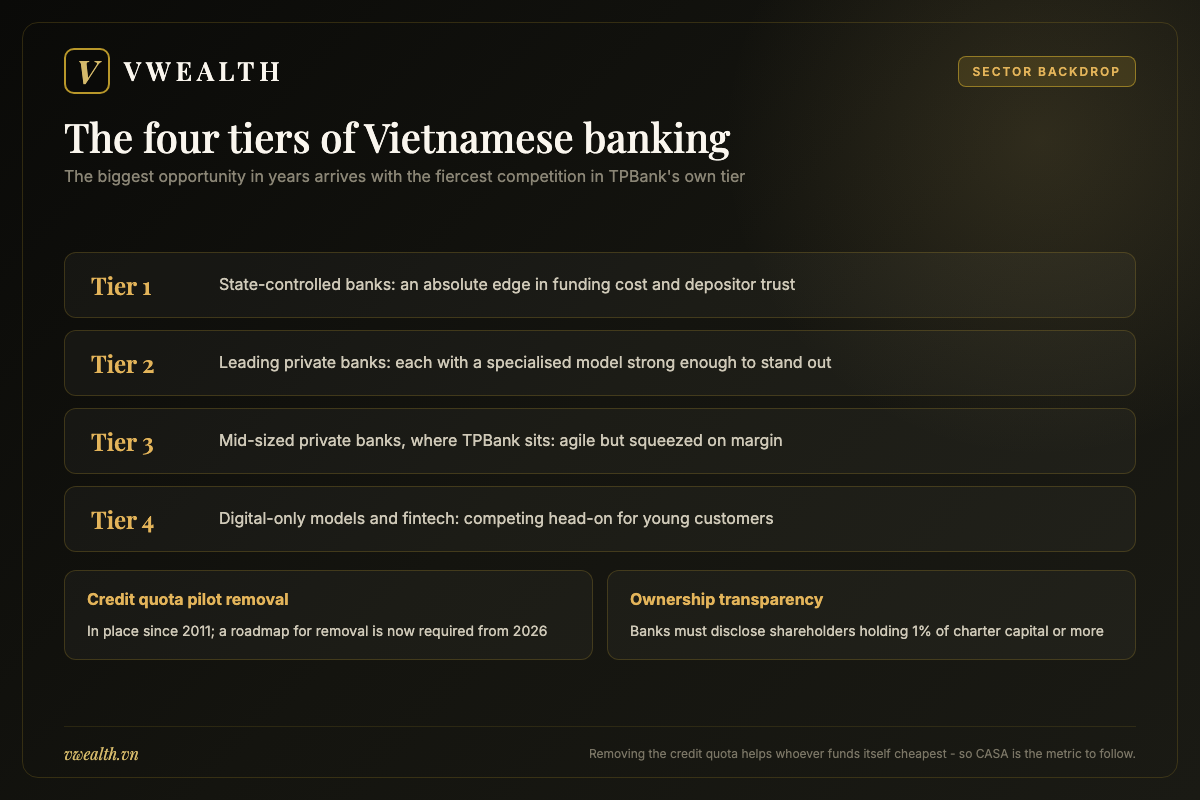
This is probably the most consequential policy change for Vietnamese banking in many years. The Prime Minister has directed the State Bank of Vietnam to move promptly to build a roadmap and pilot the removal of the practice of assigning credit growth targets, to be implemented from 2026.
To understand why this matters, recall the origin: credit quotas were introduced in 2011, after the 2009 to 2010 period when credit grew above 30 per cent a year, driving high inflation and macro instability. For fifteen years this has been the administrative tool through which the State Bank controlled total money supply. But it has a downside: in substance, a quota is a market-share allocation mechanism. When your ceiling is fixed, you have little incentive to compete on price, because cutting your lending rate does not let you lend any more.
If the quota goes, the landscape shifts: banks with ample own capital, sound risk management and low funding costs will be free to expand; competition on interest rates will intensify; and lending rates will tend to fall, supporting the wider economy.
For TPBank this is a clear double-edged sword. The upside: a bank that has already met Basel III standards with a healthy capital adequacy ratio is unshackled and no longer growth-limited by an administrative ceiling. The downside: when large banks with lower funding costs are free to expand, they will compete directly for the mid-tier banks’ customers and compress net interest margins. Put differently, removing the quota benefits banks with high CASA and low funding costs most — which is exactly why the CASA metric in chapter four matters so much.
Change two: a more transparent legal framework and better bad-debt tools
The amended Law on Credit Institutions introduced two clusters of provisions that matter to investors. The first is ownership transparency: banks must disclose shareholders holding 1 per cent or more of charter capital, rather than only 5 per cent and above as before; and the ownership limits on shareholders and their related parties have been tightened. The objective is to curb cross-ownership and the “backyard bank” phenomenon. TPBank has made this disclosure with 22 shareholders falling within the threshold.
The second cluster concerns bad-debt resolution, moving toward codifying into law the mechanisms that had previously been piloted — most importantly the right of a credit institution to seize collateral in order to resolve a debt. For a retail bank with a large volume of loans secured on real estate and vehicles, as TPBank has, a faster collateral resolution mechanism reduces the time and cost of recovery — which directly improves recovery rates on loans that have migrated into the problem categories. If you have followed Vietnamese banking for a while, you will know how long the sector campaigned for exactly this power; it is a genuine, if unglamorous, structural improvement.
Change three: retail competition and digitalisation enter a new phase
This is the largest challenge to the TPBank investment case. In 2017 and 2018, TPBank having LiveBank and eKYC was a real differentiator. By 2026, virtually every Vietnamese bank has a fully featured mobile app, online account opening, instant free transfers and QR code payments. What was once an advantage has become the baseline.
Competition now comes from three new directions as well. The first is digital-only banking models backed by the large banks themselves, aimed squarely at the young, middle-income customer segment — exactly TPBank’s target, but with the parent’s technology budget and funding cost behind them. The second is payment platforms and e-wallets, which capture the everyday transaction layer and blur the bank’s role in the user’s experience. The third is fintech lending companies competing in the small-ticket loan segment on speed of disbursement.
The consequence is that TPBank can no longer rely on the label “digital bank” to differentiate itself. The bank needs to prove its advantage with three concrete numbers: a CASA ratio sustained above the peer average, a falling CIR, and a low cost of acquiring new customers. If those three numbers do not support the case, the digital banking story is a brand rather than a moat.
Change four: the market reclassification story
Vietnam’s stock market being considered for an upgrade from frontier to emerging market status has been the most discussed story of the past two years. If it happens in full, index funds tracking the emerging market universe would have to allocate capital to Vietnamese equities, creating new foreign inflows.
But this is where you need a cool head, especially with TPB. Foreign capital can only flow into stocks that still have room. For a bank whose foreign ownership is already high, the direct benefit from reclassification is limited — the stock may benefit indirectly through general market sentiment and through the banking group as a whole being re-rated, but it will not receive new mechanical buying the way names with wide open room do. This is a distinction that catches out a lot of international investors who assume index inclusion lifts every large-cap equally.
The competitive map: who stands next to TPBank
To place TPBank properly, picture Vietnamese banking as four tiers. The top tier is the state-controlled and partly state-controlled banks — Vietcombank, BIDV, VietinBank — with an absolute advantage in funding cost, a large customer base and depositor trust. The upper-middle tier is the leading private banks — Techcombank, VPBank, MB, ACB — each with a distinctive model strong enough to generate above-average profitability. The middle tier is the mid-sized private banks, where TPBank sits, alongside HDBank, SHB, Sacombank, VIB, MSB and several others. The fourth tier is the digital-only models and fintech players.
| Tier | Representative names | Core advantage | TPBank versus this tier |
|---|---|---|---|
| State-controlled banks | Vietcombank, BIDV, VietinBank | The lowest funding cost in the system, state-linked client base, depositor trust | Cannot compete on funding cost; has to compensate with speed and experience |
| Leading private banks | Techcombank, VPBank, MB, ACB | Specialised models producing above-average profit; scale enough to invest heavily in technology | Materially smaller; no single line generating supernormal profit |
| Mid-sized private banks | TPBank, HDBank, SHB, Sacombank | Agile; percentage growth flatters off a low base | Same weight class; the differentiators are asset quality and CASA |
| Digital-only models and fintech | Digital banking platforms, e-wallets, technology lenders | Very low cost to serve, speed, superior experience | Competes head-on for TPBank’s young customer base |
The conclusion of this chapter: the 2026 sector backdrop simultaneously opens the largest opportunity in years — credit quota removal, a clearer legal framework for bad-debt resolution, potential foreign inflows — and tightens competition in exactly the segment where TPBank lives. For a mid-sized bank, this is an environment in which the gap between “doing well” and “doing averagely” widens very quickly. That is why the three scenarios in the next chapter have such a wide spread.
Looking ahead: three scenarios for TPB stock and what has to happen for each
Here is the part most readers look forward to, and the part most often done badly. This article will not give a price target for TPB, because anyone who gives a price target for a bank share without spelling out their assumptions on credit growth, NIM, provisioning cost and target P/B is selling you a meaningless number. What follows instead is three scenarios with observable conditions — so you can work out for yourself which one you are standing in at any given moment.
Four drivers ahead
Driver one — credit mechanics being unshackled. If the pilot roadmap for removing credit quotas is implemented in substance, banks meeting capital adequacy standards will be free to expand. TPBank, with Basel III already completed, sits in the group with scope to benefit — provided it keeps its funding cost competitive.
Driver two — the household consumption cycle. TPBank’s core is personal lending. As household income recovers and consumer confidence returns, demand for mortgages, car loans and consumer credit rises with it. This is a clearly cyclical driver, and you can track it through macro indicators such as retail sales, car sales and the residential property market.
Driver three — operating efficiency from digitalisation. If years of technology investment start converting into genuine efficiency, CIR falls and more of each additional unit of income drops to the bottom line. This is an internal driver, independent of the market — and the most reliable one if it materialises.
Driver four — a re-rating of the whole banking group. If Vietnamese banks are re-rated on the back of the macro outlook and foreign inflows, TPB gets carried along. This driver is outside the company’s control but carries a great deal of weight over the short and medium term.
Bull case: the mid-tier bank closes the gap
In this scenario TPBank capitalises on the new environment. Specifically, the following conditions all have to hold together.
First, credit mechanics loosen and TPBank grows its loan book faster than the sector average for at least four consecutive quarters, without a swelling group 2 balance alongside. Second, the CASA ratio holds above the average for private banks of comparable size and trends higher — proving the digital strategy still differentiates. Third, CIR falls visibly year on year, showing that technology investment has converted into operating efficiency. Fourth, the loan loss coverage ratio rises while profit still grows — meaning the bank is strong enough to provision and earn at the same time. Fifth, no new legal or governance risk emerges.
If all of those converge, the market has grounds to narrow TPB’s P/B discount to the leading private banks. It bears emphasising: this scenario requires many conditions to be right at once, so its real-world probability is not high.
Base case: in step with the sector, no faster
This is the most plausible scenario on ordinary logic. TPBank continues to grow roughly in line with the sector average, holds asset quality within an acceptable range, pays a dividend combining cash and stock, and TPB trades within its own historical P/B band, moving mainly to the rhythm of the banking group.
The conditions for this scenario are simple because it is the default state: no breakthrough in CASA or CIR, and no shock to asset quality. Macro conditions stable, interest rates fluctuating in a narrow band, retail competition remaining fierce but with nobody breaking away.
For an investor, the base case means this: your return from TPB will come mainly from buying at the right point in the banking sector’s cycle, plus the dividend, rather than from the company creating exceptional value. That is something you need to accept before you buy — if you are expecting a breakout growth story, TPB is not where you will find it.
Bear case: asset quality deteriorates while margins are squeezed
This scenario does not require a catastrophe, just a few negative factors coinciding. Specifically: the economy slows, household income weakens, and group 2 loans and non-performing loans in the retail book rise quickly; at the same time, post-quota competition drives the large banks to cut lending rates, compressing mid-tier net interest margins; and the bank is forced to raise provisioning, eating into profit for several consecutive quarters.
Three early warning signs to watch: group 2 loans growing faster than the loan book for two consecutive quarters; the loan loss coverage ratio declining even as bad debt rises; and a sharp drop in the CASA ratio, forcing the bank to fund itself at higher rates. These three signals typically appear about two to three quarters before profit deteriorates — that window is your opportunity to act.
One more variable belongs in the bear case: non-financial risk. Legal developments involving people who formerly held leadership positions, even though they fall outside the bank’s operations according to the bank’s own statement, can still create sentiment pressure on the stock and push the valuation discount deeper for a period.
| Scenario | Conditions that must hold together | Early identifying signals | Consequence for valuation |
|---|---|---|---|
| Bull | Credit unshackled; CASA rising durably; CIR falling clearly; coverage rising alongside profit; no new governance risk | Four consecutive quarters of above-sector loan growth without group 2 swelling | P/B discount to the leading group narrows |
| Base | Growth in line with the sector; stable asset quality; dividend combining cash and stock | Metrics moving sideways; price tracking the banking group’s rhythm | Trades within TPB’s own historical P/B band |
| Bear | Weak household income; rising retail bad debt; competition squeezing NIM; provisioning up sharply | Group 2 growing faster than the loan book for two straight quarters; coverage falling; CASA dropping | Valuation discounted below the historical band |
This is not a forecast; it is a framework for locating yourself. Using it correctly takes three steps. Step one: each quarter, when TPBank publishes its financial statements, pull out the eight metrics from chapter four and score them. Step two: match them against the table above to identify which scenario you are in. Step three: act on the plan you set before you bought, not on how you feel while reading the news.
The most important thing: do not try to guess which scenario will occur. Nobody knows the probabilities in advance, including the bank’s own management. Your job is to recognise early where you are and to have a prepared response for each case. Investors who win over the long run are not the ones who guess right; they are the ones who prepare enough.
So should you buy TPB stock? A straight answer
We have walked through eighteen years of history, the ownership structure, the earnings engine, eight financial metrics, how the market values the shares and three scenarios ahead. Now to pull it all together. The answer will not be “yes” or “no” — because that answer depends on who you are, not on what TPBank is. What this article can do is lay both sides of the scale out clearly and let you place your own risk appetite on it.
In favour: four reasons TPB deserves consideration
One — a completed restructuring, proven by time. This is not a promise; it is history. From a loss of 1,371 billion dong in 2011, the bank cleared its accumulated losses in the second quarter of 2015, listed on HOSE in 2018 with pre-tax profit of 1,206 billion dong for the preceding year, and completed Basel III and IFRS 9 in 2021. Thirteen consecutive years moving in the right direction under the same leadership is strong evidence of execution capability.
Two — a risk governance base above the mandatory floor. Voluntarily adopting Basel III and IFRS 9, with independent third-party review, puts TPBank in the group of banks with solid capital discipline. In the environment ahead — where the credit quota regime may be removed and any bank with enough capital will be free to expand — this is an advantage that can convert into growth.
Three — a retail model aligned with Vietnam’s long-run direction. The middle class is expanding, car ownership is rising, young people’s housing demand is large, and penetration of personal financial services remains low relative to regional peers. TPBank sits at the intersection of those trends, with a young customer base already accustomed to digital banking.
Four — a clear ownership structure with a large foreign institutional shareholder. The DOJI group holds the domestic controlling role, and Japan’s SBI group holds roughly 20 per cent with a long-standing commitment. A bank with an identifiable owner and a large foreign institutional shareholder typically has better disclosure discipline and governance standards than one with diffuse or opaque ownership.
Against: five risks you have to look at squarely
One — the technology advantage is being flattened. This is the biggest risk to the investment case. What defined TPBank between 2017 and 2020 has become the industry standard. If the bank cannot build a new layer of advantage — data, credit scoring, an ecosystem of services — then “digital bank” is just a marketing slogan, and TPBank will be assessed as exactly what it is: an ordinary mid-tier bank.
Two — the “middle of the table” position. No funding cost advantage like the state-controlled banks; no specialised model producing supernormal profit like the leading private banks. In the more intense competitive environment that follows credit quota removal, the middle tier is the group that bears the heaviest margin pressure.
Three — the asset quality risk inherent in the retail model. Personal, consumer and car lending are more sensitive to the economic cycle than large corporate lending backed by strong collateral. When household income falls, bad debt in this book rises fast, and collateral — cars especially — loses value quickly, reducing recovery rates.
Four — dilution risk from a chain of capital increases. Charter capital has risen from 5,842 billion dong to over 26,000 billion dong in seven years. Raising capital is necessary for growth, but if profit does not grow proportionately, EPS and book value per share stagnate — and the share price struggles to rise durably.
Five — non-financial risk and market sentiment. The legal developments during 2025 involving a person who formerly held a leadership position — even though the bank has affirmed they fall outside its own operations, and even though the presumption of innocence must be respected — still make some institutional investors more cautious about the stock. This class of risk is hard to quantify but it is real.
| In favour | Against |
|---|---|
| A completed restructuring, proven over thirteen years and one successful listing | A technology edge that was a differentiator and is now the industry standard |
| Basel III and IFRS 9 completed in 2021 with independent third-party review | Mid-tier position: no cheap funding like the state banks, no supernormal model like the leaders |
| A retail model matched to Vietnam’s rising middle class and digital adoption | Asset quality sensitive to the household income cycle; car collateral depreciates fast |
| Clear ownership with a Japanese institutional shareholder at roughly 20 per cent | A continuous chain of capital increases creating EPS dilution pressure |
| Three consecutive years of cash dividends — a signal about the capital buffer | Tight foreign room reduces the direct benefit from foreign inflows on reclassification |
| A stable executive team with a chief executive across three terms | Legal and sentiment risk relating to a former senior figure during 2025 |
Who TPB suits — and who it absolutely does not
On the basis of everything above, TPB suits three groups of investors.
Group one — investors playing the banking sector cycle. If your view is that Vietnamese bank shares are at a valuation trough and will be re-rated, TPB is a reasonable holding within your bank basket — particularly if you want a name trading at a discount to the leaders with higher sensitivity to a sector rally.
Group two — believers in the long-run retail and digitalisation story. If you believe that over the next decade the share of Vietnamese people using financial services will rise sharply and that banks with strong digital platforms will capture most of the new customers, TPBank is one way to participate — provided you can track CASA and CIR to test the thesis every quarter.
Group three — investors building a diversified banking portfolio. If you already hold one or two sector leaders and want to add a name with higher cyclical sensitivity, TPB plays a sensible complementary role in allocation terms. The principle is not to concentrate everything in one tier of the sector.
Conversely, there are four groups TPB does not suit — a section that matters just as much and needs to be said plainly.
Investors seeking a steady dividend stream. TPBank’s cash dividend rate has ranged from 5 per cent to 25 per cent depending on the year. This is not a stable income source on which to build a financial plan.
Investors wanting a breakout growth stock. TPBank is a mid-sized bank in a fiercely competitive industry with no monopoly line generating supernormal profit. Expecting a multi-fold increase within a few years is an expectation aimed at the wrong place.
Investors who cannot tolerate volatility or track quarterly reports. Bank shares move as a group, with a wide range, and asset quality only reveals itself through the financial statements. If you do not have time to open the report each quarter and check the eight metrics from chapter four, you are holding an asset whose risk you cannot control.
Investors allergic to non-financial risk. If your investment criteria exclude any company connected to legal proceedings — even where that connection belongs to a separate legal entity and the individual involved has left the organisation — you will not be comfortable holding TPB, and that discomfort will make you decide badly at exactly the wrong moment.
Three questions to answer before you place the order
Question one: are you buying the business or the sector cycle? If the answer is “the business”, you need a clear view on how TPBank will build a new advantage, and you must track CASA and CIR to verify it. If the answer is “the cycle”, you need an exit plan — because every cycle has two ends.
Question two: what percentage decline can you sit through and still sleep? Write that number down before you buy, then size the position so that such a decline does not break your financial plan. This is the step most investors skip and later pay for.
Question three: are you prepared to read the financial statements every quarter? With bank shares this is not optional; it is the minimum requirement. A bank’s asset quality changes quietly and only surfaces in the numbers. If you cannot do this, choose a different route — an open-ended fund or an index fund — rather than holding individual bank shares.
Closing: a bank that proved the hardest thing
There is one thing TPBank achieved that very few Vietnamese financial institutions have: it went through a crisis and survived with its dignity intact. Not by being bought out for a symbolic sum, not by being merged into another institution, but through a long restructuring with new owners who put real money in and stayed long enough to see the result. That counts for something, and it deserves recognition when you assess this bank’s management capability.
But a recovery in the past does not automatically translate into outperformance in the future. TPBank today faces a completely different problem from the one it faced in 2012: not how to survive, but how to be different in an industry where every technological advantage is copied within two or three years. The answer to that problem has not yet clearly emerged, and that is exactly why TPB still trades at a discount to the leading group.
So, should you buy TPB stock? If you understand that you are buying a well-governed, reasonably valued mid-sized retail bank waiting for a catalyst from policy or from the consumption cycle — and you accept that the catalyst may take several years to arrive — then TPB is a reasonable choice at a moderate portfolio weight. If you are buying because the price looks “cheap”, because a friend mentioned it, or because you believe bank shares “always go up eventually”, then you are buying on emotion, and emotion is the most expensive thing on any stock market.
One last thing to carry away: TPBank’s history and business model change slowly, but NIM, CASA, bad debt, coverage and valuation change every quarter. Before you place an order, open the latest analysis report and score the eight metrics from chapter four. It takes fifteen minutes, and they are the most valuable fifteen minutes in your whole decision process. If you do not yet have the tools to do that, create a vwealth account and let the platform read the reports for you.
Research Vietnamese stocks in English with vwealth. Our AI-powered platform turns Vietnamese market data into full English analysis reports — with international payment support and a free 2-month trial for new accounts. Create your free account and read the latest reports.