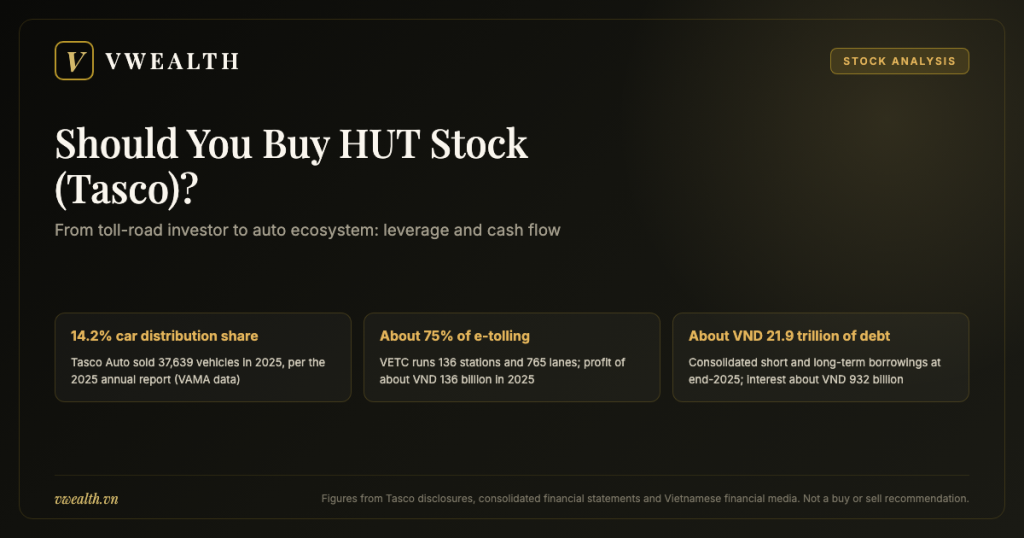
Should you buy HUT stock? HUT is the ticker of Tasco JSC, listed on the Hanoi Stock Exchange (HNX) since 2008, and it belongs to a company that has reinvented itself so many times that its name is almost the only thing left unchanged. Tasco began in 1971 as a bridge-building crew in the old province of Nam Ha, became known in the Vietnamese press as the “BOT king” of the northern delta for its toll-road concessions, and at one point looked trapped by those very toll booths. In 2023, through a share swap of nearly 544 million new shares, Tasco took full ownership of SVC Holdings, the parent of car dealer Savico, and consolidated revenue jumped from roughly VND 1 trillion to more than VND 36 trillion by 2025. Today Tasco describes itself as Vietnam’s largest car distribution and automotive services network, with electronic toll collection (VETC), insurance, car finance, clean water and real estate bolted on. Behind that revenue, however, sits a heavily borrowed balance sheet, a meaningful share of profit that belongs to minority shareholders in subsidiaries, and acquisition goodwill that has to be amortised year after year. Understanding how this ecosystem makes money, who is paying for its expansion and how much of the profit actually reaches HUT shareholders is the first step toward deciding whether to buy HUT stock.
A note on method before we go further, as with every company deep-dive in the vwealth series. Historical milestones, names, toll-station counts, showroom numbers and financial figures in this article come from published sources: Tasco’s corporate and investor-relations pages, the 2025 annual report (including audited consolidated financial statements), the reviewed 2026 interim consolidated statements, the minutes and resolutions of the 2026 shareholder meeting, disclosures filed with the HNX, VNDirect’s public financial and price data, and reporting by Vietnamese media such as CafeF, VnExpress, Bao Dau Tu, Vietstock, Tuoi Tre, Dan Tri, VietNamNet, Nguoi Quan Sat, Vietnambiz, VietnamFinance and Tai chinh Doanh nghiep. Where sources disagree, we show both figures. Any number that vwealth derived by dividing or multiplying published figures is labelled “vwealth estimate”. We deliberately do not quote today’s share price, current P/E or P/B, current market capitalisation or the latest quarterly profit, because those change daily; for live numbers, open the latest vwealth analysis report. All amounts are in Vietnamese dong (VND); as a rough guide, VND 1 trillion is around USD 38–40 million at recent exchange rates.
Tasco is hard to put in a single box. If you have read our CII stock analysis or our piece on HHV (Deo Ca), you will recognise the DNA of Vietnam’s private infrastructure investors: long-dated debt, toll revenue collected one car at a time, and fortunes tied to traffic volumes and toll policy. But most of Tasco’s revenue now comes from selling cars, which makes it closer to retailers like Mobile World (MWG) or FPT Retail (FRT): thin margins, inventory turnover is everything, and much of the bargaining power sits with the manufacturer. So this article reads Tasco through both lenses. If you are new to the market itself, start with our guide on how to invest in the Vietnam stock market, which explains exchanges, foreign ownership limits and settlement rules.
From a 1971 Bridge Crew to an Auto Ecosystem: Half a Century of Reinvention at Tasco
Some companies travel in a straight line: one trade, done better every year. Tasco did the opposite. Its history is a sequence of changes in business, ownership and focus, each leaving behind a layer of assets, a layer of debt and a new layer of shareholders. Buy HUT stock today and you are buying all of those layers at once: BOT roads still collecting tolls, a toll-technology business that lost money for years, land banks from the era of “land-for-infrastructure” deals, and a car-distribution empire bolted on with shares. Walking through that history is not nostalgia; it is the fastest way to understand why Tasco’s balance sheet looks the way it does.
1971–2000: a provincial bridge crew and the construction trade
According to the company’s history page, the Nam Ha Bridge Team was established in 1971 to build bridges and roads for the former Nam Ha province (today’s Nam Dinh and Ha Nam area). When provinces merged in 1976 the unit was reorganised: the notes to Tasco’s financial statements say the company was formally established on 27 March 1976 as Ha Nam Ninh Bridge Company, by merging the Nam Ha bridge team with the Ninh Binh Bridge and Road Construction Enterprise (the history page calls it the Ha Nam Ninh Bridge Team). In 1992, according to the history page, it was renamed Nam Ha Transport Works Company. For nearly three decades, this was a textbook provincial state-owned contractor: it won road and bridge jobs, lived on construction volume, stayed small and depended on the provincial budget.
The first turning point came in 2000, when the company was equitised (Vietnam’s term for partial privatisation of a state firm) as Nam Dinh Transport Construction and Infrastructure JSC. The notes to the financial statements date the equitisation to November 2000, under Decision 2616/2000/QD-UB of 20 November 2000 by the Nam Dinh People’s Committee, and the capital history in the annual report shows charter capital of only VND 7 billion at that point. In other words, Tasco was a small contractor: work meant revenue, no work meant shrinking. That trade gave the company two things that later became strengths, namely relationships with provincial authorities across the Red River Delta and road-building capability. It also left a lasting trait: cash flow depended on when clients signed off and paid.
2007–2008: a new name, a move to Hanoi and a listing on the HNX
On 26 December 2007 the company was renamed Tasco JSC. The history page links the move of the head office from Nam Dinh to Hanoi to 2007, while the notes to the financial statements say the business registration and head office were formally transferred to Hanoi in 2008. In 2008 HUT shares were listed on the Hanoi Stock Exchange; according to the notes to the financial statements, trading on the HNX began on 11 April 2008, just as Vietnam’s market was collapsing from its 2007 peak — hardly an ideal moment to meet investors.
More important than the listing was the change in role. Tasco’s history page says that from 2008 the company “became an investor in BT and BOT projects”. That is the fundamental difference between a contractor and an investor. A contractor is paid for work done. A BOT (build–operate–transfer) investor puts up its own capital, mostly bank loans, to build or upgrade a road, then collects tolls for many years to recover the investment and earn a return before handing the asset back to the state. A BT (build–transfer) investor is paid in land rather than cash. Both models turned Tasco into a highly leveraged company whose cash comes in slowly, spread over decades.
2008–2018: the “BOT king” of the northern delta
Over the next ten years Tasco became one of the familiar names in Vietnam’s BOT wave across the northern delta and central region. Tasco’s history page records completing the National Highway 1 – Quang Binh BOT in 2015, launching real estate projects such as Foresa Villa and the Phap Van building, and investing in Thang Long Corporation, a large bridge and road builder; in 2018 it completed a Hai Phong BOT and raised charter capital to VND 2,686 billion. The capital history in the annual report shows how intense fundraising was in this period: private placements to strategic shareholders in 2014 and 2015, a public offering in 2016, several conversions of convertible bonds into shares, and in 2017 an issue of 50 million shares to Winstar for VND 500 billion.
The model produced steady toll revenue but a debt-heavy balance sheet. Consolidated data show that even at the end of 2019, when revenue was only about VND 1,107 billion, Tasco carried short- and long-term borrowings of about VND 5,601 billion, mostly long-term loans tied to infrastructure projects, against equity of about VND 3,215 billion. For a BOT investor that structure is normal: borrow first, repay from tolls over many years. But it also means that any change in traffic, toll levels or exemption policy feeds straight into the ability to service debt.
From 2017, public anger over badly placed toll stations spread nationwide, toll exemption policies kept changing and BOT investors in general struggled to hit the traffic volumes in their financial models. Tasco’s history page calls 2008–2020 a period of “restructuring from business operations to investment”, as the company expanded into real estate and other fields alongside BOT. Profits deteriorated: consolidated data show Tasco posting a net loss of about VND 243 billion in 2020.
2015–2022: VETC, the toll-tech bet that was almost handed back
Alongside the roads, Tasco bet on something less visible: automated toll collection. According to Dan Tri, VETC began rolling out automated tolling in 2015; Tasco’s history page and annual report record that the VETC non-stop electronic toll collection system went into operation in 2016. Unlike a BOT road, this is technology infrastructure: tags stuck on cars, equipment in toll lanes, a reconciliation system and accounts for vehicle owners.
VETC’s early years were a lesson in costs arriving before revenue. According to Tasco’s half-year 2026 release (republished by Bao Dau Tu), for nearly eight years VETC gave away eTag stickers for free to encourage adoption, while BOT operators were slow to sign up. According to Doanh nhan (a publication of the Phap Luat newspaper) and Dan Tri, VETC lost money every year from 2016 to 2022, with the heaviest loss of around VND 300 billion in 2020, and in 2019 Tasco even proposed returning the project to the Ministry of Transport because of fears of insolvency. The turning point came in August 2022, when non-stop tolling was rolled out across expressways and VETC began charging for eTags. Figures for the ETC segment in Tasco’s financial statements, as compiled by CafeF, show revenue rising from VND 131 billion in 2020 to VND 346 billion in 2022 and about VND 504 billion in 2025, while results swung from a loss of about VND 300 billion (2020) to profits of about VND 33 billion (2024) and about VND 140 billion (2025). In April 2023 VETC was licensed as a payment intermediary, opening up a transport e-wallet business.
2021–2022: new hands on the wheel as investors from DNP Holding arrive
2021 was the year Tasco began to change hands in practice. Tasco’s history page and annual report describe 2021 as a year of “strong restructuring, divesting non-core businesses to streamline the organisation and focus on the main fields”. The capital history also shows charter capital rising from VND 2,686 billion to about VND 3,486 billion in 2021 (the consolidated cash flow statement shows about VND 800 billion raised from share issues that year) — a capital increase that came right in the middle of the restructuring.
The transformation accelerated when a group of investors associated with DNP Holding JSC — a group linked to the Dong Nai Plastics brand that grew into water supply, building materials and household goods — joined Tasco’s governance and management. At the annual meeting at the end of April 2022, according to Bao Dau Tu, Vu Dinh Do, described on Tasco’s website as an investor, co-founder and long-time backer of companies in the DNP Holding system, was elected chairman; the annual report shows Ho Viet Ha and Nguyen The Minh serving as vice chairmen from April 2022. The same meeting approved a large capital increase, laying the ground for the 2023 deal. Tasco’s history page also dates the founding of Tasco Land and Tasco Insurance to 2021–2022, along with a new vision to become “the number one choice for automotive services and smart transport infrastructure in Vietnam”.
The market reacted violently to the change-of-control story. VNDirect price data show HUT rising about fivefold in six months, from around VND 10,000 at the end of September 2021 to VND 46,700 per share on 18 March 2022. The same data show HUT’s highest close at VND 51,300 on 21 March 2022, before it fell to VND 10,800 in mid-November 2022 as the broader market slumped. We return to that episode in chapter five, because it shaped how Vietnamese retail investors perceive HUT.
2023: the SVC Holdings deal — turning a toll-road investor into a car distributor
If one event explains Tasco today, it is the 2023 share swap with SVC Holdings JSC. According to CafeF, in September 2023 Tasco completed a private placement of 543.9 million new shares to swap for all of SVC Holdings from 21 individual shareholders, at a swap ratio of 1:1 (one SVC Holdings share for one HUT share), raising charter capital by almost VND 5,439 billion at par value. Balance-sheet data show paid-in capital rising from about VND 3,486 billion at the end of 2022 to about VND 8,925 billion at the end of 2023, so the 21 new shareholders held roughly 61% of Tasco right after the swap (vwealth estimate: 5,439 divided by 8,925). According to Tai chinh Doanh nghiep, SVC Holdings then owned 54.07% of Savico (Saigon General Service Corporation, ticker SVC on the Ho Chi Minh City exchange, HOSE), one of the oldest car-dealer networks in southern Vietnam, selling Toyota, Ford, Mitsubishi, Hyundai and other brands. According to Vietnambiz, in January 2024 SVC Holdings was renamed Tasco Auto Co., Ltd., and in mid-2024 it became Tasco Auto JSC.
The structure matters more than the headline. Tasco did not pay cash for SVC Holdings; it paid with its own shares. Existing Tasco shareholders were heavily diluted, and the former owners of SVC Holdings became the majority holders of Tasco. On the accounting side, the deal brought all of Tasco Auto’s revenue, assets and debts onto Tasco’s consolidated books, and created goodwill — the gap between the purchase price and the fair value of net assets acquired — which Tasco must amortise over several years. According to the consolidated financial statements, Tasco’s total assets reached VND 26,749 billion at the end of 2023, and equity (including non-controlling interests) rose from VND 3,873 billion to about VND 11,313 billion; the annual report marks 2023 as the year revenue passed USD 1 billion. Consolidated data show 2023 net revenue of about VND 10,982 billion, roughly ten times 2022, even though Tasco Auto was consolidated for only the last few months of the year.
2024–2026: Volvo, Mitsui, Geely, a rights issue, DNP and VM Motors
The three years after the SVC deal have been a nonstop expansion. In July 2024, according to Hanoimoi, Tasco took over Sweden Auto, the exclusive importer and distributor of Volvo cars in Vietnam; the list of subsidiaries in the 2025 financial statements shows Sweden Auto as 100% owned by Tasco Auto. Also in 2024, according to the history page and annual report, Mitsui & Co. — one of Japan’s largest trading houses — became a strategic shareholder of Tasco Auto; the sources vwealth reviewed did not disclose Mitsui’s exact stake (Tasco owns 94.87% of Tasco Auto per its financial statements, so all other shareholders together hold only about 5%, a vwealth estimate). In September 2024, Tasco and Geely signed a joint venture to assemble and distribute cars in Vietnam, including a CKD (completely knocked-down kit assembly) plant with investment of about USD 168 million and first-phase capacity of 75,000 vehicles a year, with Tasco contributing 64% and Geely 36%.
In August 2025, Tasco completed a rights offering of more than 175.8 million shares to existing shareholders at a ratio of 5:1, raising more than VND 1,757 billion (the cash flow statement shows about VND 1,763 billion received from share issues in 2025) and lifting charter capital to almost VND 10,683 billion, or 1,068,285,581 voting shares. Also in 2025, DNP Holding officially became a Tasco subsidiary: according to CafeF, on 24 December 2025 Tasco Investment Co., Ltd. disclosed that it owned 72,522,667 shares, or 51.4% of DNP Holding, and DNP has been consolidated into Tasco’s accounts since December 2025. Tasco brought the Geely brand to Vietnam, and the company says revenue and total assets across its system exceeded USD 2 billion. In 2026, according to CafeF citing the Ho Chi Minh City People’s Committee office on 19 January 2026, Tasco Auto proposed buying Mercedes-Benz Group AG’s 70% stake in the Mercedes-Benz Vietnam joint venture; by the end of September 2026 the sources vwealth reviewed showed no announced outcome. On 18 September 2026, Tasco Auto said it had completed the purchase of part of the capital of Vinh Phat Motors (VM Motors), a truck assembler in Ho Chi Minh City, targeting its first batch of electric commercial vehicles in 2027.
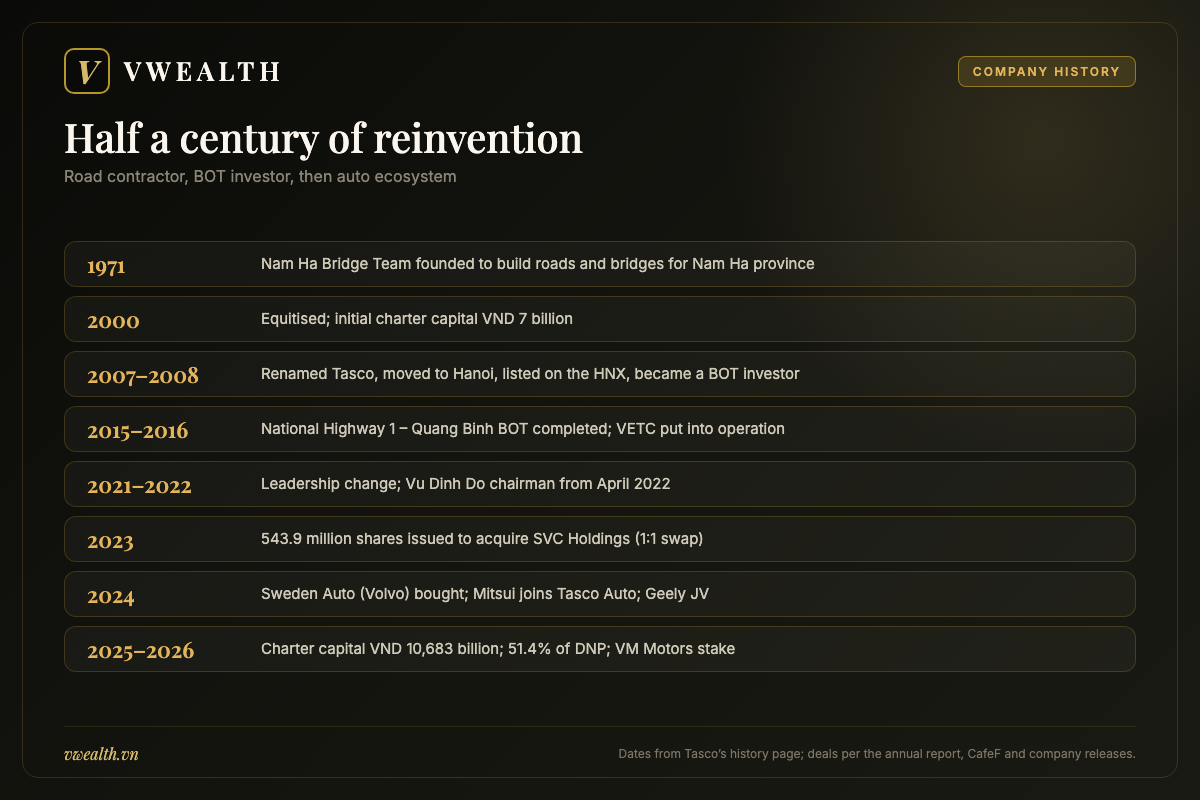
The table below gathers the key milestones. Note the pace: in its first four decades Tasco changed business twice; in the last five years there has been a major deal almost every year.
| Year | Event | What it meant for HUT shareholders |
|---|---|---|
| 1971 | Nam Ha Bridge Team founded | Roots as a provincial road and bridge contractor |
| 2000 | Equitised as Nam Dinh Transport Construction and Infrastructure JSC | Initial charter capital VND 7 billion; construction was the core trade |
| 2007–2008 | Renamed Tasco, moved to Hanoi, listed on HNX | Shift to BOT and BT investing |
| 2015–2016 | National Highway 1 – Quang Binh BOT completed; VETC non-stop tolling system put into operation | A new business that burned cash for years before turning profitable |
| 2017–2018 | Hai Phong BOT completed; charter capital VND 2,686 billion | Backlash against BOT tolls; profits start to slide |
| 2021–2022 | Leadership change; Vu Dinh Do chairman from April 2022; restructuring | Investors from DNP Holding take the helm |
| 2023 | 543.9 million shares issued to acquire SVC Holdings (1:1 swap) | Consolidated revenue up about tenfold; old shareholders diluted |
| 2024 | Sweden Auto (Volvo) acquired; Mitsui invests in Tasco Auto; Geely JV | Expansion into luxury and Chinese brands |
| 2025 | 175.8 million-share rights issue; charter capital VND 10,683 billion; VII Holding buys 30% of HUT; 51.4% of DNP (December 2025) | Consolidated total assets about VND 52,231 billion |
| 2026 | Proposal to buy 70% of Mercedes-Benz Vietnam (January); stake in VM Motors (September); CKD plant with Geely still in the plan | A move upstream into manufacturing and assembly |
Leadership and Ownership of HUT Stock: the DNP Group, Former SVC Holdings Owners and VII Holding
For many companies, the leadership chapter is the easiest to write: one founder, one family, one story. For Tasco it is a chapter to read slowly, because HUT’s ownership structure was created by deals rather than by gradual accumulation. The people running the company are not the founders of the 1971 bridge team, nor the BOT-era management, but a group of investors from the DNP Holding ecosystem. And the group that held a majority of the shares after 2023 are the former owners of SVC Holdings. Knowing who is steering and who owns the shares helps you anticipate the company’s priorities: scale, dividends or more M&A.
Vu Dinh Do and the investors from DNP Holding
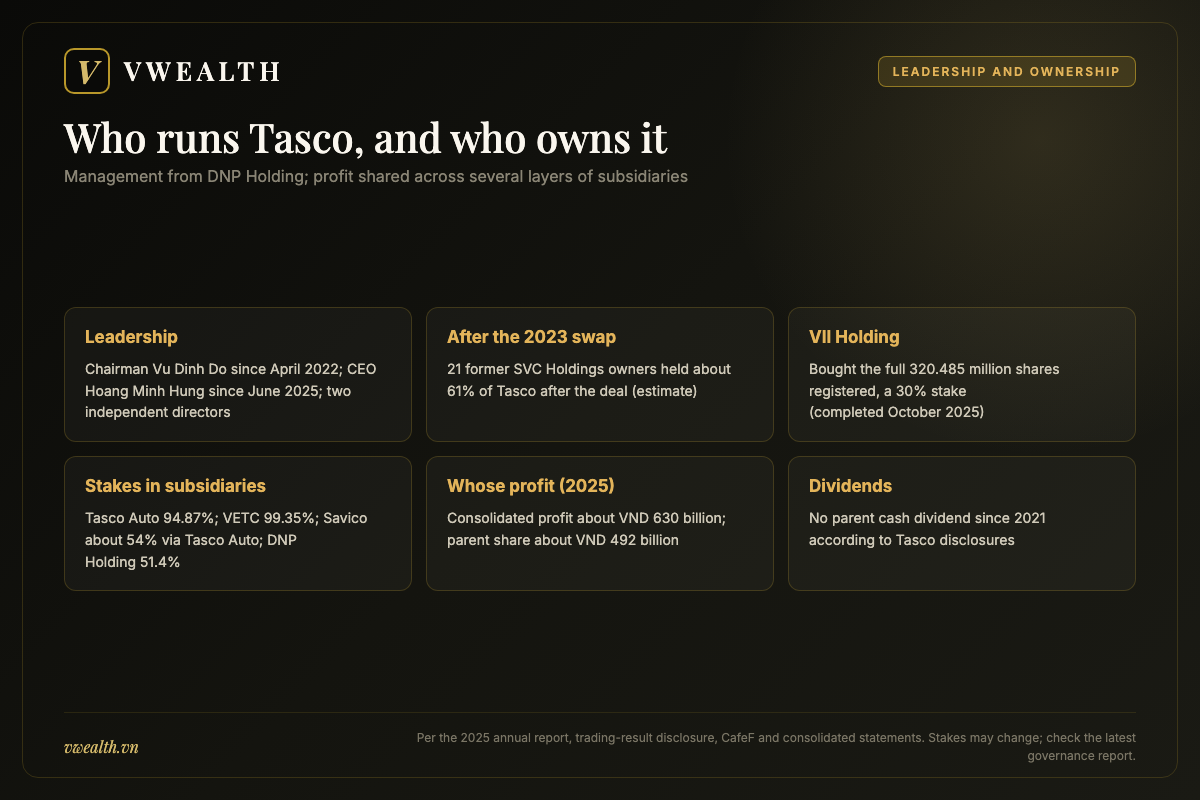
According to Tasco’s website and annual report, Vu Dinh Do has been chairman since April 2022. Tasco describes him as an investor, co-founder and long-time partner in the development of water-supply infrastructure companies, water-industry materials makers and building-materials producers within DNP Holding, with nearly 20 years of experience in strategy, organisational design, investment and operational management. According to Tai chinh Doanh nghiep magazine, at Savico’s shareholder meeting in late April 2023, as control was passing to Tasco, Mr Do was elected Savico’s chairman, a role that later passed to others during subsequent management reshuffles.
What stands out is less any individual than the group’s operating style. The DNP system grew by buying local water utilities, plugging them into a common platform, standardising governance and then inviting foreign strategic partners in at the subsidiary level. Look at Tasco in 2022–2026 and you see the same formula: buy SVC Holdings, buy Sweden Auto, buy into VM Motors, bring Mitsui into Tasco Auto, have Samsung E&A as a strategic shareholder in DNP Water (per the annual report and CafeF), and talk about IPOs for subsidiaries. That is the model of an investment group rather than a single-industry operator. Its strengths are speed and the ability to raise capital at several levels; its weaknesses are complex consolidated accounts and the fact that parent shareholders share profits with several layers of minority investors.
The board and management: audit, brokerage, water and technology
The board listed in the 2025 annual report and on Tasco’s website reflects the investment-group model. Ho Viet Ha, vice chairman since April 2022, has nearly 25 years in senior executive roles, including ten years as an audit director at firms such as KPMG and AA, group-level executive roles in high-end travel services, executive chairman of a water-infrastructure business, and more than five years running luxury car import and distribution chains within Tasco. Nguyen The Minh, vice chairman since April 2022 (also deputy CEO according to Tasco’s website), has nearly 30 years of experience and has been CEO of Saigon–Hanoi Securities, Maritime Bank Securities and SHB Securities. Ngo Duc Vu became vice chairman in mid-2025 (the annual report says May 2025, while the HNX disclosure gives 20 June 2025); he was previously CEO and vice chairman of DNP Holding, chairman of Dong Nai Plastics and CEO of Sao Viet Securities. Hoang Minh Hung, CEO since 20 June 2025, previously served as CEO and chairman of DNP Water and worked as a solutions architect at FPT IS, the IT services arm of FPT; the shareholder meeting on 20 April 2026 elected him to the board.
The two independent directors have deep finance backgrounds: Dam Bich Thuy, who chaired Fulbright University Vietnam for more than eight years and was previously CEO of ANZ Vietnam and Vietnam International Bank (VIB); and Bui Quang Bach, with more than 20 years in finance, formerly deputy CEO of Bao Viet Securities, Saigon–Hanoi Securities and Kim Long Securities. Both joined the board in April 2023. The board changed in 2026: on 1 April 2026, vice chairman Nguyen Danh Hieu and board member Phan Thi Thu Thao submitted resignations; the annual meeting on 20 April 2026 approved their dismissal, cut the board to seven members for the rest of the 2022–2027 term and elected Hoang Minh Hung. At subsidiary level, Savico had its latest senior reshuffle on 20 July 2026: according to Tai chinh Doanh nghiep, Ngo Duc Vu stepped down as chairman, Nguyen Hai Ha moved from CEO to chairman, and Diep Tran Bao was appointed CEO.
The picture is of a leadership team strong in finance, M&A, governance and technology, but lighter on hands-on auto retail experience at the parent level — that expertise sits mainly within Savico and Tasco Auto. The repeated management changes at Savico over three years, as summarised by Tai chinh Doanh nghiep, show a parent actively reshaping its distribution arm. For investors, that signals determination but is also something to watch in terms of management stability.
Shareholder structure: former SVC Holdings owners, a special transfer mechanism and VII Holding
After the 2023 swap, HUT’s shareholders fell into two broad groups: Tasco’s pre-existing shareholders, including retail investors on the exchange, and the 21 individuals who had owned SVC Holdings, who held roughly 61% right after the swap (vwealth estimate). According to a board proposal reported by CafeF, under Board Resolution 23/2023 this group could, after one year, transfer shares only to members of the same group or to other investors approved by the shareholder meeting, and the lock-up commitment runs until 31 August 2028. A shareholder resolution of 31 May 2024 allowed the group to transfer part or all of its shares to VII Holding JSC; in October 2025 Tasco polled shareholders to continue that mechanism and to add a new investor, VIAC Limited Partnership (Singapore), in both cases exempt from a public tender offer (normally required in Vietnam when crossing certain ownership thresholds). According to CafeF’s report on the 2026 annual meeting, the legal procedures for transfers to VIAC were completed in early December 2025; the sources vwealth reviewed do not disclose how many shares VIAC has received.
VII Holding, per CafeF, was set up in May 2024 with charter capital of VND 1,000 billion; Vu Dinh Do contributed 65% and is its chairman and legal representative (the two other shareholders hold 25% and 10%). Tasco’s 2025 annual report says the company is now named Tasco Holding JSC. In early September 2025, VII Holding registered to buy 320,485,000 HUT shares, or 30% of charter capital, between 10 September and 9 October 2025. On 5 September 2025, HUT briefly hit its daily limit-up at VND 20,000 before closing nearly 5% higher (VNDirect price data). The result: according to CafeF, VII Holding bought 83 million shares in a negotiated deal on 10 September, 77.95 million on 15 September, more than 106.1 million on 17 September and 35.5 million on 18 September 2025, about 302.6 million shares (28.32%) in total, and then bought the remainder; the trading-result report published on 15 October 2025 confirms that VII Holding bought the full 320,485,000 shares, lifting its stake from 0% to 30% and becoming Tasco’s largest institutional shareholder. CafeF estimated the cost at more than VND 6,000 billion based on market prices at the time; that is the newspaper’s estimate, as the execution price was not disclosed. The first tranche of 83 million shares (7.77%) was reported by some outlets as if it were the final result, but the primary documents show VII Holding bought the full registered volume.
From a governance standpoint, a company controlled by the chairman holding shares directly has two sides, and both deserve an objective mention. The positive: the financial interests of the person running the business are more closely tied to HUT’s value, and a company linked to the chairman taking 30% of the capital at 2025 prices is a signal of commitment. The point to monitor: when the major shareholder, the board and management are closely linked, the role of independent directors and the disclosure of related-party transactions become more important. That principle applies to any company with a controlling shareholder; it is not a specific comment on Tasco. For more on the governance framework, see our guide to corporate governance in Vietnam.
A small but useful technical point: major-shareholder data on some financial portals still carry entries from 2017–2022, listing individuals who were major holders before the restructuring. Those rows do not reflect the post-2023 structure. When checking ownership, rely on Tasco’s own semi-annual governance reports and latest annual report.
Dividends: years of retained earnings to fund expansion
If you want steady cash dividends, HUT is not a natural candidate. The capital history in the 2025 annual report shows that Tasco’s most recent dividends were paid in shares (7% for both 2016 and 2017), and disclosures since 2021 list shareholder meetings, written polls, additional listings and share issues; vwealth found no cash dividend from the parent company in that period. That is consistent with the strategy: a company buying businesses, building showrooms and plants, recapitalising an insurer and borrowing tens of trillions of dong has little room to pay cash out. The consolidated cash flow statement does show “dividends and profits paid to owners” of about VND 131 billion in 2024 and VND 82 billion in 2025; vwealth’s inference is that most of this is subsidiaries (such as Savico) paying their own minority shareholders rather than HUT paying its shareholders — check the notes to the financial statements to confirm.
Instead of dividends, HUT shareholders have recently received “rights”: the 2025 offering let existing holders buy one new share for every five held at the par value of VND 10,000. For those who did not subscribe, that meant dilution; for those who did, more capital committed to the company. Either way, cash has been flowing from shareholders into Tasco rather than the other way round — typical of a heavy investment phase.
Minority shareholders in subsidiaries: profit that never reaches HUT holders
This may be the most important point in the chapter, and the easiest to overlook. Tasco does not own 100% of everything it consolidates. According to the list of subsidiaries in the 2025 consolidated financial statements, Tasco owns 94.87% of Tasco Auto and a 99.35% interest in VETC; Tasco Auto in turn owns about 54% of Savico (Tai chinh Doanh nghiep gives 54.07% at the time of the deal). For DNP Holding, the stake disclosed in December 2025 was 51.4%, and below DNP Holding sit water companies with other shareholders, such as DNP Water, where Samsung E&A is a strategic shareholder. Every layer of partial ownership is another point at which profit is shared before it reaches HUT shareholders.
The consolidated numbers make this clear. In 2025, consolidated net profit was about VND 630 billion, but profit attributable to parent shareholders was about VND 492 billion (per the audited consolidated statements and VNDirect data). In 2024, the figures were about VND 305 billion and VND 156 billion. At the end of 2025, non-controlling interests on the balance sheet were about VND 7,173 billion out of total equity of about VND 17,942 billion, or roughly 40% (vwealth estimate). For the first half of 2026, the reviewed interim consolidated statements show after-tax profit of about VND 310.5 billion, of which only about VND 91.1 billion is attributable to the parent and about VND 219.4 billion to non-controlling interests — less than 30% of consolidated profit reaching HUT shareholders (vwealth estimate). Note that the unreviewed Q2 report had shown six-month profit of more than VND 324 billion, so August and September 2026 articles may quote different figures. Whichever you use, the direction is the same: after consolidating DNP, the share of profit flowing to minority holders rose sharply.
The lesson is simple and often forgotten: when you read a headline such as “Tasco profit triples”, look immediately for “profit after tax attributable to owners of the parent”. That is the number used for EPS and for HUT’s P/E ratio. We come back to this in chapter four.
| Entity | Role | Ownership as disclosed | Source |
|---|---|---|---|
| Tasco Auto | Car distribution, import and services | Tasco owns 94.87% | Tasco 2025 consolidated statements; Vietnambiz |
| Savico (SVC, HOSE) | Long-established southern dealer network | Tasco Auto owns about 54% | Tai chinh Doanh nghiep |
| VETC | Electronic toll collection, transport e-wallet | Tasco holds a 99.35% interest | 2025 consolidated statements |
| DNP Holding | Water, building materials, household goods | 51.4% (via Tasco Investment, 24 December 2025) | CafeF |
| DNP Water | Water infrastructure (within DNP Holding) | Samsung E&A is a strategic shareholder | 2025 annual report, CafeF |
| NVT Holdings | Linked to Ninh Van Bay (Six Senses, Ana Mandara) | 20% economic interest, 50% voting rights | 2025 consolidated statements |
| VII Holding (now Tasco Holding) in HUT | Largest shareholder, linked to the chairman | 30% of HUT (320,485,000 shares, October 2025) | Trading-result disclosure, 2025 annual report |
How Tasco Makes Money: Car Sales Are the Trunk, Everything Else Is a Branch
Picture a car buyer in Vietnam. She walks into a Savico Toyota showroom, signs a contract, takes a car loan arranged through the dealer, buys comprehensive insurance at the counter, gets an eTag sticker for the expressway, brings the car back for regular servicing, calls roadside assistance when it breaks down and, five years later, sells it as a used car. Each step is a revenue stream. Tasco’s strategy, in its own words, is to “serve customers across the entire life cycle of car ownership” by being present at as many of those steps as possible. It sounds sensible. The investor’s question is how big each step is, how profitable it is and which of them creates an advantage that is hard to copy.
Tasco Auto and Savico: about 150 showrooms and a 14.2% share of distribution
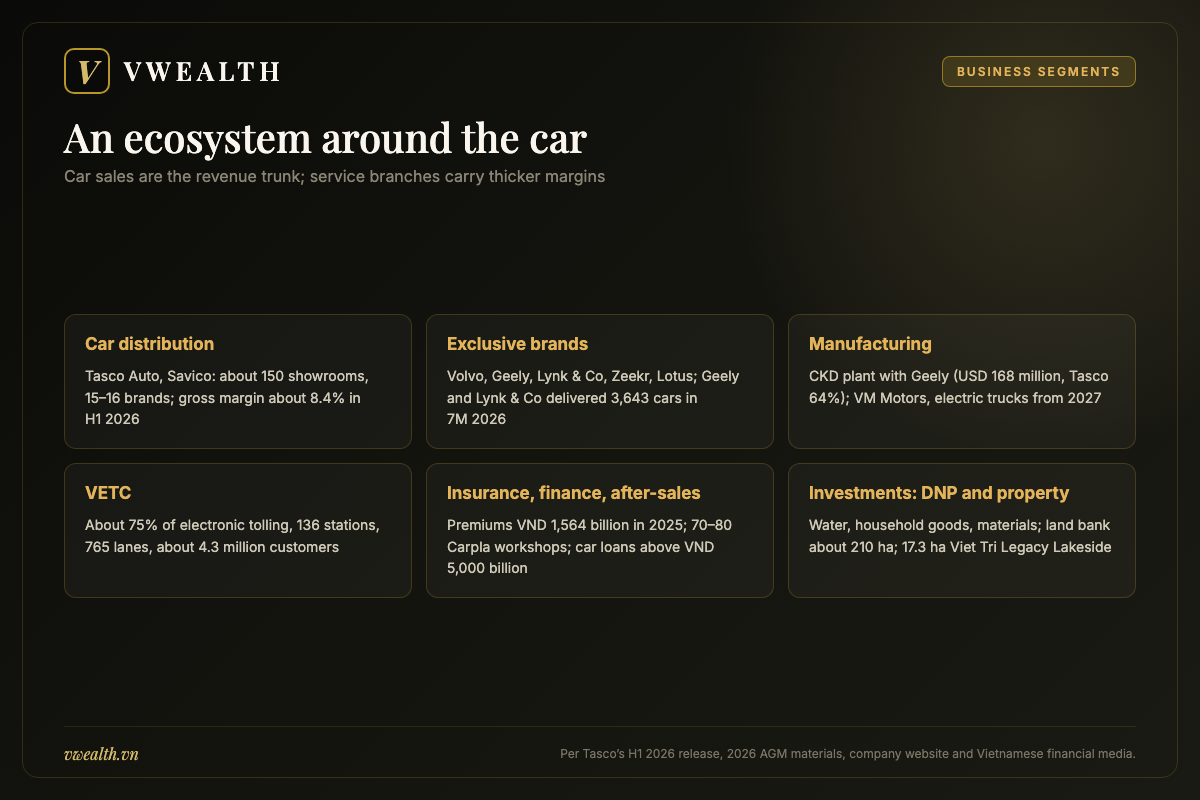
Car distribution is the trunk of the Tasco tree. According to the company’s first-half 2026 results release, net revenue from the auto business was about VND 14,304.8 billion for the six months, about 64.5% of consolidated net revenue. According to the 2025 annual report, Tasco Auto sold 37,639 vehicles in 2025, equal to a 14.2% market share based on data from the Vietnam Automobile Manufacturers’ Association (VAMA), through more than 200 outlets including 150 showrooms and more than 70 Carpla service workshops. By mid-2026, according to CafeF, the network had nearly 230 outlets, including 155 showrooms and 72 service workshops. In 2024, VietNamNet put the figure at 40,555 vehicles and about 13.7% share. Volume fell in 2025 while share rose; part of the explanation is that Tasco divested some under-performing auto units (the 2026 half-year release mentions these divestments), so be careful comparing unit numbers across years.
The network carries roughly 15–16 brands, depending on the date and the source (Vietnambiz says 15, CafeF 16): Toyota, Ford, Mitsubishi, Hyundai and some others as a dealer, plus Volvo, Lotus, Zeekr, Lynk & Co and Geely where Tasco is the exclusive distributor. These are very different roles. As a dealer for Toyota or Ford, Tasco buys cars from the manufacturer and sells them at retail, earning the spread plus commissions, volume bonuses and after-sales service revenue; the manufacturer sets recommended prices, promotions and allocations. As an exclusive distributor, Tasco sits between the brand and the Vietnamese market: it imports, markets, builds the dealer network and carries more inventory risk, but keeps a thicker slice of the margin.
How thin is the margin in car retail? According to the first-half 2026 release, the gross margin of Tasco’s auto segment improved from 7.53% to 8.42%, with gross profit of about VND 1,234 billion. So out of every VND 100 of car and service revenue, Tasco keeps around VND 8 before paying showroom staff, rent, advertising and interest on the inventory. For its traditional brands, Tasco said first-half 2026 gross profit was about 115% of the prior-year level for Toyota, 118% for Ford and 132% for Volvo, comparing on a basis “adjusted for divestments” — that is, excluding sold units from the prior-year base.
Volvo, Geely, Lynk & Co, Zeekr and Lotus: the exclusive-brand bet
The growth story Tasco emphasises most is its exclusive brands, especially the two from China’s Geely group. According to the half-year release, Geely and Lynk & Co delivered 2,473 vehicles in all of 2025, and 3,643 in the first seven months of 2026 alone — more than the whole previous year. Revenue from the two brands in the first half of 2026 rose 381.6% year on year and gross profit rose 608.3%. Tasco said the new brands “turned positive from June 2026”, and as of the end of August 2026 it had 2,624 customer deposits. After a little more than two years, the two brands have nearly 100 showrooms, supported by about 80 Carpla Service workshops.
“Turned positive from June 2026” is worth reading twice. It means that for almost two years before that, building the Geely and Lynk & Co brands consumed money: showrooms, advertising and promotions to persuade Vietnamese buyers to try Chinese cars. At the shareholder meeting on 20 April 2026, Tasco’s management said as much: in 2025 the company built more than 90 showrooms and 70 service workshops for the new brands, accepted losses during the ramp-up, and set an internal plan for the new-brand network to break even from 30 June 2026; in Q1 2026 Geely sold about 570 cars (with about 1,200 deposits) and Lynk & Co about 350. According to CafeF, the two brands recorded more than 4,300 cars sold and ordered in the first half of 2026, of which more than 2,000 had been delivered. The new brands turning profitable on schedule is encouraging, but one month or one quarter is not a trend; watch a few more quarters.
Volvo is a different story. Sweden Auto, the Volvo importer Tasco bought outright in 2024, brought in a luxury brand with higher margins than mass-market cars. At the 2026 meeting, Tasco’s management said Volvo has been on the market for more than eight years and remains profitable; the half-year 2026 release puts Volvo’s first-half gross profit at about 132% of the prior-year level.
The flip side of expansion shows up in Tasco Auto’s own accounts. According to Vietnambiz and VnExpress, citing Tasco Auto’s first-half 2026 financial disclosure, the subsidiary earned about VND 31 billion after tax in six months (versus less than VND 4.9 billion a year earlier, per VietNamNet; Vietnambiz describes the increase as about 5.4 times, VnExpress and Vietstock as about six times), but still had accumulated losses of nearly VND 2,084 billion. Liabilities were about VND 12,971 billion, including bank loans of almost VND 7,689 billion, nearly double a year earlier; its interest coverage ratio was only about 1.15 times (per Vietnambiz). VietNamNet explained in 2025 that the accumulated losses mainly stem from recognising and amortising goodwill on Tasco Auto’s acquisitions; excluding that, the company reported profit of about VND 175 billion in the first half of 2025. Even if the cause is accounting, an interest coverage ratio around one is not something to ignore.
Moving upstream: a CKD plant with Geely and the VM Motors deal
Every car distributor lives with one fear: the manufacturer can pull the distribution rights, set up its own subsidiary or switch partners. One way to reduce that fear is to get involved in production. Tasco is doing this on two fronts. The first is the Geely joint venture: according to Nguoi Quan Sat (25 September 2026), the CKD assembly plant is located in Tien Hai Industrial Park (formerly Thai Binh province, now part of Hung Yen after Vietnam’s 2025 provincial mergers), on about 30 hectares, with total investment of about USD 168 million, 64% from Tasco and 36% from Geely Auto, and first-phase capacity of 75,000 vehicles a year producing Geely and Lynk & Co models for the domestic market and export.
The project is behind its original schedule. VietNamNet reported in September 2025 that construction had been expected to start in the first half of 2025 with first deliveries in early 2026, but that there was still no news of groundbreaking, and Tasco was waiting for Geely’s next move. According to Vietstock, Tasco again put the CKD project into its plan for implementation at the 2026 meeting. The 2025 financial statements also show that money has started to flow in: construction in progress for the “CKD plant project” rose from about VND 29 billion at the start of the year to about VND 381 billion at the end of 2025. For investors, this is a catalyst that could create significant value if it happens, but also a large capital commitment: in vwealth’s reading, a USD 168 million project with Tasco funding 64% will raise its funding needs in coming years.
The second front is commercial vehicles. On 18 September 2026, according to Vietstock, Tuoi Tre, VnExpress and VietnamFinance, Tasco Auto said it had completed the purchase of part of the capital of Vinh Phat Motors. VM Motors was founded in 2015, has a plant in the Ho Chi Minh City Automotive Mechanical Industrial Park operating since 2017, and was chosen by Qingling Motors (a long-time Isuzu partner in China) for technology transfer to assemble trucks using Isuzu/Qingling components, with NK and FN light trucks and GINGA heavy trucks; it handed over its first electric vans at the end of 2024. After the deal, the two sides plan to upgrade the line to assemble and test electric vehicles, focusing on electric or new-energy trucks, vans and special-purpose vehicles, target a first product batch in 2027 and are considering a proprietary brand. Tasco Auto did not disclose its stake after the deal, the seller or the deal value.
VETC: non-stop tolling, a transport wallet and a database of car owners
VETC is small in revenue terms but holds a dominant market position. According to Tasco’s 2025 annual report, VETC has about 75% of Vietnam’s electronic toll collection market, connects 136 toll stations with 765 lanes, has about 4.3 million customers on its app and processes an average of 1.8 million transactions a day (peaking at 2.3 million), more than 700 million in 2025. According to CafeF, citing the same document, about 3 million customers use the VETC wallet. By mid-2026 Tasco said VETC served about 4.8 million vehicles. At the 2026 meeting, management said Vietnam expects to open 27 tolled expressways in total by 2027, including 11 routes in 2026 and early 2027, about two-thirds of which VETC already operates.
After years of losses, VETC is now profitable. According to its HNX disclosure as reported by Doanh nhan and Dan Tri, VETC earned about VND 136.3 billion after tax in 2025, roughly six times the previous year; accumulated losses shrank from more than VND 589 billion at the end of 2024 to about VND 468 billion at the end of 2025. In July 2025, according to the annual report, the International Finance Corporation (IFC), part of the World Bank Group, invested VND 500 billion in VETC through five-year convertible bonds; management said the money goes to new toll-station equipment in 2025–2027, a backup data centre and partial repayment of older debts. In the first half of 2026, according to Tasco and Dan Tri, VETC had revenue of about VND 327.1 billion and after-tax profit of VND 53.2 billion, with accumulated losses still above VND 420 billion. Full-year 2025 revenue figures differ by scope: the annual report gives VETC revenue of about VND 666 billion (up 35%), while ETC-segment figures in the consolidated statements, as compiled by CafeF, show about VND 504 billion.
In August 2026 VETC became the centre of public attention. According to CafeF, it announced a wallet fee of VND 6,600 a month for individuals and VND 66,000 for organisations from 1 August 2026, at a time when new rules require every transport account to be linked to a cashless payment method. After many customer complaints, on the morning of 20 August 2026 VETC announced it would not apply and would suspend the policy, stated that no fee had yet been collected, and acknowledged that the policy had not won customer consensus. On 24 August 2026, according to VnExpress, the Standing Deputy Prime Minister asked the Ministry of Construction to lead other ministries in inspecting and correcting any violations in electronic toll collection and related apps. The episode shows two things: a customer base of millions of accounts is commercially valuable, but the ability to monetise it is limited by public opinion and regulators, because road tolling is close to an essential service.
Tasco is turning VETC from a toll gate into a mobility app: parking and fuel payments, compulsory third-party insurance, 24/7 roadside assistance with more than 300 specialised vehicles plus 500 partner tow trucks, a loyalty programme and, since June 2026, a VETC Charging feature that lets electric car owners find, start and pay at charging stations of multiple brands. In vwealth’s reading, VETC’s biggest value to Tasco lies in data: knowing who owns a car, where they drive and how much, and being able to sell them insurance, rescue and maintenance.
Carpla, roadside assistance, Tasco Insurance and car finance: earning across the car’s life
Tasco’s “services around the car” come in several pieces. Carpla started as a used-car platform; Carpla Service is a chain of repair, maintenance and body-shop workshops. Counts differ with the scope: the 2025 annual report cites more than 70 Carpla service workshops in the system, while the first-half 2026 release says about 80 Carpla Services workshops support the Geely and Lynk & Co brands. According to that release, Carpla Services works not only on cars sold by Tasco but is also becoming a repair, maintenance and genuine-parts provider for several international car brands and leading insurers. According to VnExpress, Tasco Auto runs a parts warehouse of about 2,500 m² in Hanoi and plans another of about 1,000 m² in Ho Chi Minh City.
Tasco Insurance is the fastest-growing piece in percentage terms. According to the 2025 annual report, gross written premiums in 2025 were about VND 1,564 billion, up 141%, placing the company among the top seven motor insurers by market share, with 35 branches after just over two years. In the first half of 2026, insurance revenue was about VND 950 billion, 218% of the prior-year level, with gross direct premiums of about VND 1,263.5 billion, and the 2026 target is VND 3,000 billion in revenue. The logic is obvious: a buyer at a Tasco showroom is a natural customer for comprehensive cover, and VETC data help sell compulsory liability insurance. The risk is also clear: motor insurance is fiercely competitive, loss ratios are high, and very fast premium growth sometimes comes with weaker underwriting quality. Watch the loss ratio and underwriting result, not just revenue.
Tasco’s car-finance arm is not a bank; according to the annual report, Tasco builds this business through partnerships with banks, and in 2025 total outstanding car loans reached more than VND 5,000 billion. That figure is best understood as the scale of car lending in Tasco’s ecosystem; read the notes to see how much sits on Tasco’s own balance sheet.
DNP Holding, real estate and legacy BOT: the “investment” arm outside the car story
Since consolidating DNP Holding, Tasco has a large business unrelated to cars. According to the first-half 2026 release, essential-services investments (clean water, premium household goods, building materials) contributed about VND 6,072 billion of net revenue in six months, and DNP Holding’s consolidated after-tax profit was 242% of the prior-year level, thanks to higher gross margins from exports (its inochi household brand is sold in 20 countries) and consolidated production. DNP Water, part of the DNP system, runs more than 30 water plants in 11 provinces with total design capacity of about 1,000,000 cubic metres a day, according to CafeF. The half-year 2026 release says Tasco wants to channel resources into large inter-regional water projects in the Mekong Delta: Region 1 (Dong Thap – Tay Ninh – Vinh Long) and Region 2 (Can Tho – Ca Mau); the annual report notes that DNP Water broke ground on an inter-regional raw-water plant in 2025. According to a Vietnambiz headline, a unit in the Tasco ecosystem is considering an IPO from 2027.
Tasco Land manages a land bank of about 210 hectares according to the annual report. At the 2026 meeting, management listed the main projects: Chi Dong (about 46.9 hectares in former Me Linh, with an approved 1/500 zoning adjustment, about 64% of site clearance done and a target to start construction in late 2026 or early 2027), Xuan Phuong (31.4 hectares, tied to a BT project still awaiting a resolution mechanism), about 17 hectares along My Khe beach and 6 hectares on the Son Tra peninsula in Da Nang. The Viet Tri Legacy Lakeside project, about 17.3 hectares in Phu Tho with 92 villas, broke ground in March 2026 and, according to CafeF, could go on sale in 2026. Chairman Vu Dinh Do said Tasco will focus on extracting value from existing projects in 2026–2028 rather than starting new ones; in 2025, according to CafeF, Tasco sold its stake in the Can Gio high-end residential project to Gelex for VND 619 billion. In hospitality, the financial statements show a 20% economic interest and 50% of voting rights in NVT Holdings, linked to Six Senses Ninh Van Bay and Ana Mandara Villas Dalat; the annual report puts 2025 hospitality revenue at about VND 467 billion and gross profit at more than VND 282 billion. Finally, the BOT legacy lives on: according to CafeF’s report on the 2026 meeting, Tasco plans to join the PPP expansion of the Ho Chi Minh City – Trung Luong – My Thuan expressway (total investment of more than VND 36,000 billion) with a capital contribution of about VND 810 billion (see our CII analysis for more).
For HUT shareholders, this investment arm cuts both ways. It diversifies revenue, includes assets with stable cash flow (water) and assets that can be sold for profit (land, stakes). But it also makes Tasco look more like a leveraged investment fund than a pure auto company, complicates valuation and adds more layers of minority interest. Tasco has said plainly that it will “restructure the portfolio by divesting some operating projects to generate divestment gains”, and will raise more funds through convertible bonds — meaning part of future profit may come from asset sales, which do not recur predictably.
Which business feeds which, and where Tasco’s moat lies
Put the pieces together and the picture looks like this. Car sales generate most of the revenue and most of the absolute gross profit, but at thin margins and with heavy working capital needs (car inventory, prepayments to manufacturers). VETC earns better margins and dominates its niche, but it is small and tightly regulated. Insurance, finance and after-sales service have higher margins than car sales and “ride on” the customers who buy cars and use VETC. DNP and real estate are separate pillars, adding revenue and profit, but much of the benefit is shared with minority holders. The parent company acts as an internal bank: according to VietNamNet, in the first half of 2025 HUT lent Tasco Auto more than VND 869 billion and earned more than VND 77 billion in interest; at the end of June 2025, short-term loans receivable from Tasco Auto stood at VND 1,671 billion.
Tasco’s moat, in vwealth’s view, does not lie in any single business — anyone with capital can open a showroom, and dozens of firms sell motor insurance — but in the combination: a network large enough that new brands such as Geely choose it as a partner, plus a database of millions of car owners from VETC. If Tasco can turn that combination into high cross-selling rates (every car sold pulling in insurance, finance and servicing), consolidated margins should thicken over time. If not, Tasco is just a big distributor with lots of side businesses, and margins will stay thin. There is no definitive answer yet. The lesson from our Dien May Xanh (DMX) analysis is that retail scale only becomes an advantage when it translates into bargaining power with suppliers and lower operating costs than competitors.
| Segment | Latest disclosed scale | Profit profile | Main risk |
|---|---|---|---|
| Car distribution (Tasco Auto, Savico) | About VND 14,305 billion revenue in H1 2026; 37,639 vehicles in 2025; 14.2% share | Gross margin about 8.4% (H1 2026) | Price competition, inventory, dependence on brands |
| Exclusive brands (Geely, Lynk & Co, Volvo…) | 3,643 Geely + Lynk & Co vehicles in 7M 2026 | Profitable from June 2026, per Tasco | Buyer perception of Chinese cars, brand-building costs |
| VETC | 136 stations, 765 lanes, about 75% share; VND 136.3 billion profit in 2025 | High margin, dominant position | Fee policy, public opinion, remaining accumulated losses |
| Tasco Insurance | Premiums VND 1,564 billion in 2025; VND 3,000 billion target for 2026 | Depends on loss ratio | Rapid growth, competition |
| After-sales, Carpla, finance | 70–80+ Carpla workshops; car loans above VND 5,000 billion (2025) | Higher margin than car sales | Cross-selling efficiency not disclosed in detail |
| DNP Holding (water, household, materials) | About VND 6,072 billion revenue in H1 2026 | Stable, shared with minorities | Large capex for water projects |
| Real estate, hospitality, BOT | Land bank about 210 ha; 17.3 ha Viet Tri Legacy Lakeside; hospitality revenue VND 467 billion (2025) | Lumpy, depends on handovers and divestments | Legal approvals, property cycle |
Financial Health: Leverage, Cash Flow and Earnings Quality Before You Buy HUT Stock
Tasco’s financial statements are not easy to read, not because the company hides anything, but because they are the product of many deals in a short time. Revenue leapt because new companies were consolidated, not because more was sold; profit was dragged down by goodwill amortisation, not necessarily by weak trading; borrowings doubled in a year because DNP was consolidated, not only because Tasco borrowed more. If you read Tasco’s numbers like those of a stable business, you will reach the wrong conclusion in both directions: too optimistic because of revenue, or too pessimistic because of margins. This chapter goes layer by layer and tries to show you how to read Tasco’s own numbers.
Revenue from VND 1 trillion to 36 trillion: consolidated versus “aggregate” figures
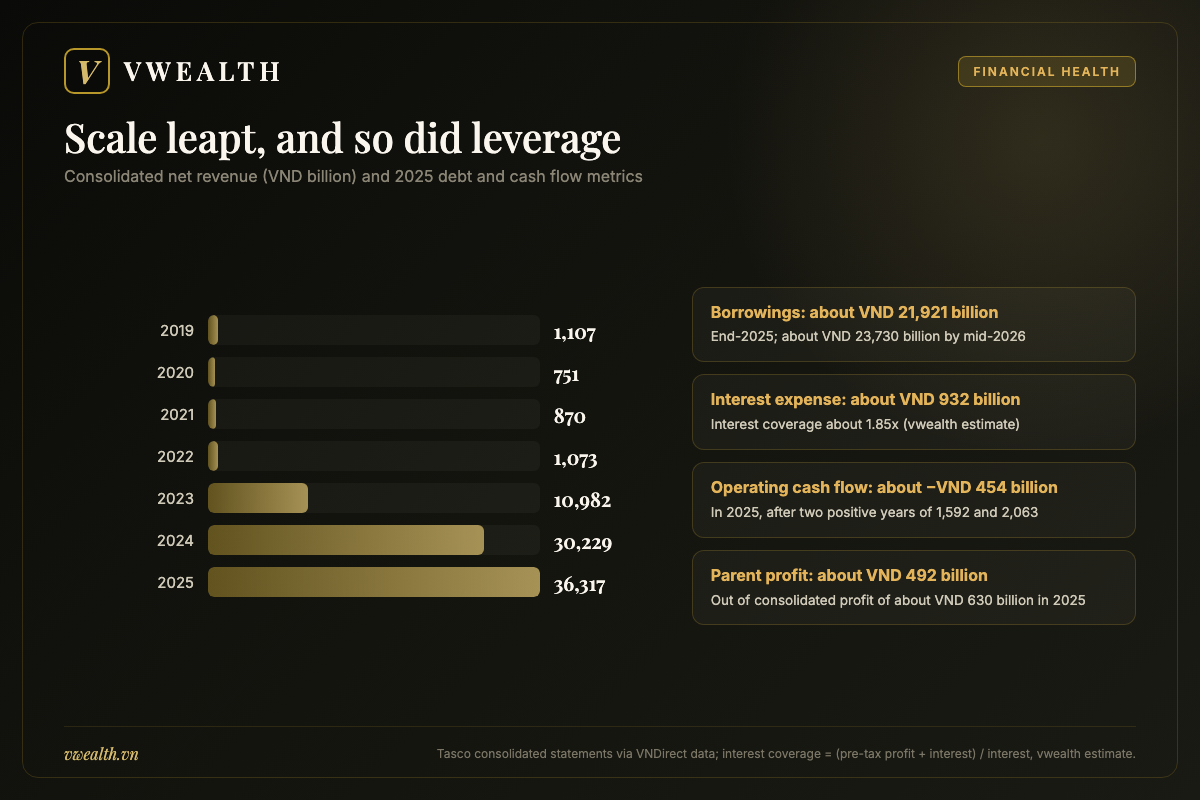
The table below uses annual consolidated financial statements (public data on VNDirect, rounded to billions of dong). Look at revenue: from about VND 1,073 billion in 2022 to VND 10,982 billion in 2023, VND 30,229 billion in 2024 and about VND 36,317 billion in 2025. This is not organic growth; it is the effect of consolidating Tasco Auto (from late 2023) and then DNP (from late 2025). Some outlets put 2025 revenue at more than VND 37,000 billion (CafeF citing Markettimes), while the annual report gives consolidated revenue of VND 36,380 billion, up 20% (36,380 is total operating revenue; net revenue is 36,317); the difference may reflect how revenue lines are added up or pre- versus post-audit figures. The annual report also uses yet another figure, “aggregate revenue” of VND 52,533 billion — the simple sum of revenue across all entities in the system, before eliminating intra-group transactions and without adjusting for ownership. Do not compare it with consolidated revenue or use it for valuation.
| Year | Net revenue | Gross profit | Consolidated NPAT | NPAT to parent | Total assets | Short + long-term borrowings | Total equity |
|---|---|---|---|---|---|---|---|
| 2019 | 1,107 | 342 | 45 | 54 | 11,018 | 5,601 | 3,215 |
| 2020 | 751 | 85 | -243 | -235 | 10,158 | 5,510 | 2,961 |
| 2021 | 870 | 280 | 44 | 62 | 10,725 | 5,238 | 3,718 |
| 2022 | 1,073 | 390 | 144 | 145 | 11,632 | 4,834 | 3,873 |
| 2023 | 10,982 | 1,032 | 56 | 47 | 26,749 | 8,224 | 11,313 |
| 2024 | 30,229 | 2,674 | 305 | 156 | 28,987 | 10,215 | 11,551 |
| 2025 | 36,317 | 3,374 | 630 | 492 | 52,231 | 21,921 | 17,942 |
Unit: VND billion. Source: Tasco’s consolidated financial statements via VNDirect data; “short + long-term borrowings” is the sum of the two borrowing and finance-lease line items as added by vwealth. Total equity includes non-controlling interests.
Three things stand out. First, in 2019–2022 Tasco was a company with about VND 1 trillion of revenue, volatile profit and one year of heavy losses. Second, after 2023 the scale grew tens of times, but profit attributable to parent shareholders rose only from tens to hundreds of billions of dong, because the share count also roughly tripled through the swap and the rights issue. Third, in 2025 total assets and borrowings nearly doubled in a single year, mainly because DNP was consolidated; that makes 2025 asset-based ratios (ROA, asset turnover) hard to compare with previous years.
Thin margins and the question of where profit comes from
In 2025 the consolidated gross margin was about 9.3% (3,374 divided by 36,317, vwealth estimate), versus about 8.8% in 2024. Selling and administrative expenses together were about VND 2,944 billion in 2025, or about 8.1% of revenue. So if you take gross profit minus selling and administrative costs, only about VND 430 billion is left (vwealth estimate). Meanwhile, financial income in 2025 was about VND 1,269 billion, financial expenses about VND 1,145 billion (including interest of about VND 932 billion), and other profit about VND 271 billion. Accounting profit before tax was about VND 788 billion.
How to read this: a meaningful part of Tasco’s pre-tax profit comes from financial and investment activities — interest on deposits and loans, divestment gains, dividends — and from other income, not only from selling cars, insurance or tolls. The 2025 cash flow statement shows “gains from investing activities” of about VND 1,262 billion (adjusted out of profit when calculating operating cash flow). That does not make the profit “fake”; an investment group is entitled to make money by buying and selling assets. But this kind of profit recurs less reliably, and markets usually pay a lower multiple for it. When Tasco talks about “divesting some operating projects to generate divestment gains”, expect future profits to keep including this component.
Goodwill, “adjusted profit” and who the profit belongs to
Tasco often reports two profit numbers. For 2025, according to the annual report, consolidated after-tax profit was VND 630 billion; excluding goodwill amortisation and asset revaluation effects it was VND 993 billion. For the first half of 2026, according to the post-review release, after-tax profit was VND 310.5 billion, or VND 553 billion on the adjusted basis (the pre-review version said VND 585.5 billion). For the 2026 plan, the annual report shows consolidated revenue of VND 54,980 billion (up 51%) and consolidated pre-tax profit of VND 1,599 billion, while CafeF’s report on the meeting gives a pre-tax profit target of VND 1,083 billion, up 37.5%. In vwealth’s reading, these two figures correspond to the two profit layers Tasco usually presents (before and after goodwill amortisation and revaluation effects), but the documents vwealth reviewed do not say so explicitly; when comparing results with the plan, use the matching layer.
What is goodwill? When Tasco (or Tasco Auto) buys a company for more than the fair value of its net assets, the excess is recorded as goodwill, while assets revalued to fair value (such as Savico’s properties) are depreciated at higher amounts. Under Vietnamese Accounting Standards (VAS), goodwill is amortised through the income statement over a maximum of ten years, unlike IFRS, where goodwill is only tested for impairment. So the “adjusted” number helps you gauge operating earning power, but the “reported” number is what builds retained earnings and EPS. Both are useful; what matters is not to compare Tasco’s adjusted figure with another company’s reported figure. Our guide to reading Vietnamese company financial statements explains these line items in more detail.
Then there is the question of whose profit it is, discussed in chapter two: in 2025 about 78% of consolidated profit belonged to parent shareholders (492 divided by 630, vwealth estimate), while in the first half of 2026 the share was only about 29% according to the reviewed statements (VND 91.1 billion out of VND 310.5 billion, vwealth estimate). If you want a rough EPS, divide profit attributable to the parent by the weighted average number of shares. With about 1,068 million shares corresponding to VND 10,683 billion of charter capital, every VND 100 billion of parent profit equals about VND 94 of EPS (illustrative example, vwealth estimate). That explains why HUT’s P/E often looks high: parent-level profit is still small relative to the number of shares issued in the deals.
Borrowings and interest costs: leverage across the whole ecosystem
This is the central axis of the Tasco story: from BOT contractor to auto ecosystem, the habit of using leverage survived intact; only its shape changed. In the BOT era, debt was long-term, financing roads and repaid from tolls over decades. In the auto era, debt increasingly became short-term, financing car inventory and working capital, turning over monthly. According to consolidated data, short-term borrowings rose from about VND 280 billion at the end of 2022 to about VND 3,320 billion at the end of 2023, VND 4,074 billion at the end of 2024 and VND 9,694 billion at the end of 2025; long-term borrowings were about VND 12,227 billion at the end of 2025. By mid-2026, total short and long-term borrowings were about VND 23,730 billion (VND 11,283 billion short-term and VND 12,447 billion long-term) according to the reviewed statements. Interest expense in the first half of 2026 alone was about VND 931 billion, roughly the same as all of 2025, partly because DNP is now consolidated.
A few ratios to help you get your bearings (all vwealth estimates based on end-2025 disclosures): total borrowings to equity of about 1.22 times; net debt (borrowings minus cash and equivalents of about VND 4,843 billion) of about VND 17,000 billion; liabilities to total assets of about 66%. Interest expense rose from about VND 386 billion in 2023 to VND 623 billion in 2024 and VND 932 billion in 2025. Taking pre-tax profit plus interest divided by interest, interest coverage was about 1.15 times in 2023, 1.7 times in 2024 and 1.85 times in 2025. It improved over three years but is still thin, and in the first half of 2026 it slipped back to about 1.43 times (pre-tax profit of about VND 400 billion plus interest of VND 931 billion, divided by VND 931 billion; vwealth estimate). A shock that halved full-year pre-tax profit from the 2025 level would likewise push it to about 1.4 times. At subsidiary level, as noted, Tasco Auto reported interest coverage of about 1.15 times in the first half of 2026 (per Vietnambiz). To secure more long-term funding, the 2026 annual meeting approved a public offering of convertible bonds; management put the total at about VND 3,560 billion with a five-year term, and on 25 May 2026 the board approved the detailed plan, the offering dossier and the listing of the bonds.
Why is leverage in car distribution so sensitive? Because cars are expensive inventory. Dealers must prepay manufacturers or borrow to pay them, then hold the cars until they sell. When the market slows, cars sit longer, interest accumulates and dealers must cut prices to clear stock — squeezing already thin margins. Tasco’s consolidated inventory rose from about VND 3,177 billion at the end of 2024 to about VND 5,936 billion at the end of 2025 and about VND 6,174 billion by mid-2026 (partly because of DNP). Car loan rates and dealer funding rates are two macro variables HUT shareholders must watch.
Cash flow: who is paying for the expansion
The consolidated cash flow statement tells a clear story. In 2023 and 2024, net cash from operating activities was solidly positive, about VND 1,592 billion and VND 2,063 billion. In 2025, operating cash flow was negative by about VND 454 billion, as cash was tied up in inventory (up about VND 1,103 billion) and receivables (up about VND 831 billion), and interest paid was about VND 723 billion. In the same year, Tasco spent about VND 2,112 billion on fixed assets and about VND 3,239 billion on investments in other entities, while receiving about VND 1,919 billion from divestments. To fill the gap, financing cash flow was positive by about VND 5,133 billion: new borrowings of about VND 29,180 billion, principal repayments of about VND 25,714 billion and about VND 1,763 billion raised from share issuance.
In short: in 2025, Tasco’s expansion was paid for with new debt and new shareholder money, not with cash generated by the business. That is normal for a company in a heavy investment phase, but it is sustainable only if the investments soon produce cash. The next two years are the test: if operating cash flow turns durably positive and covers capex, leverage will fall on its own; if not, Tasco will have to keep borrowing, issue shares or convertible bonds (a convertible bond plan has already been approved), or sell assets.
One item deserves a close look at the notes: short-term receivables rose from about VND 5,494 billion at the end of 2024 to about VND 14,752 billion at the end of 2025, including “other receivables” of about VND 7,399 billion and “prepayments to suppliers” of about VND 2,359 billion. Adding long-term other receivables (about VND 1,184 billion), total receivables at the end of 2025 exceeded VND 15,900 billion (vwealth estimate). By mid-2026, short-term receivables had fallen to about VND 7,254 billion, while “held-to-maturity investments” rose to about VND 10,049 billion; the shift may reflect collections, reclassification or cash moved into term deposits — you need the notes to the half-year report to know. For a group with many subsidiaries and related parties, the quality of other receivables and prepayments is the place to look hardest.
Seven questions to ask every time Tasco reports
Pulling it together, here is a checklist vwealth suggests using each quarter instead of reading only the “profit up X times” headline.
One: how much profit belongs to parent shareholders? That drives EPS. Two: where does the profit come from? Separate gross profit minus selling and admin costs (the core business) from financial income, divestment gains and other income. Three: is the auto gross margin holding around 8%? Especially for Geely and Lynk & Co. Four: is operating cash flow positive or negative, and does it cover capex? Five: which way are total borrowings and interest expense moving relative to pre-tax profit plus interest? Six: how are inventory and other receivables changing? Inventory growing faster than revenue is a warning sign. Seven: are there new acquisitions, share issues or convertible bonds? Every deal can change the share count and the profit structure.
If you are comparing HUT with other Vietnamese stocks for the first time, it also helps to understand how valuation multiples behave in this market; our overview of Vietnam stock market valuation puts P/E and P/B levels in context.
How the Market Treats HUT Stock: From Sub-Par Toll-Road Play to Ecosystem Story
If one phrase describes HUT’s price behaviour over the past decade, it is “expectation cycles”. The stock has rarely climbed steadily with profits; it jumps when there is a new story — a change of control, a big deal, a major shareholder buying — then corrects deeply while the market waits for numbers to confirm it. Understanding that character matters as much as understanding the business, because it shapes what holding the stock actually feels like: can you sit through a 70–80% drawdown from the peak?
Memorable price chapters
The table below lists selected closing prices from VNDirect data. These are actual closing prices at the time, not adjusted for later share issues; for long-term comparisons, use adjusted prices.
| Date | Close (VND per share) | Context |
|---|---|---|
| 16 Jan 2018 | 11,700 | 2018 high, late BOT era |
| 28 Dec 2018 | 3,800 | Falling profits, BOT troubles |
| 31 Mar 2020 | 1,300 | Covid-era low; 2020 net loss of about VND 243 billion |
| 31 Dec 2021 | 20,800 | Leadership change, restructuring |
| 21 Mar 2022 | 51,300 | Peak of a roughly fivefold rise in six months |
| 15 Nov 2022 | 10,800 | Broad market crash in late 2022 |
| 6 Sep 2023 | 28,500 | Around completion of the SVC Holdings swap |
| 22 Apr 2025 | 12,100 | Sharp market-wide correction in April 2025 |
| 14 Aug 2025 | 20,500 | After a roughly 70% rally over four months, before VII Holding’s registration |
From VND 1,300 in March 2020 to VND 51,300 in March 2022 is a gain of roughly 39 times in two years (vwealth estimate on unadjusted prices); from VND 51,300 to VND 10,800 eight months later is a drop of about 79%. Very few stocks among the most liquid names on the Hanoi exchange have swung like that. The 2021–2022 rally happened when Tasco’s 2021 revenue was only about VND 870 billion and profit a few tens of billions; the price ran far ahead of the business. The 2025 rally, from VND 12,100 on 22 April to VND 20,500 on 14 August, was about 70% in under four months (vwealth estimate on closing prices), before news that VII Holding had registered to buy 30% was published. The lesson is not “HUT is a speculative stock” — that is too simple — but that HUT’s price is more sensitive to ownership and deal stories than to quarterly profit.
Stock character: the HNX, share count and liquidity
HUT trades on the HNX, where the daily price limit is ±10% (wider than the ±7% limit on HOSE); our explainer on Vietnam trading hours and price bands covers these rules. With about 1,068 million shares outstanding, HUT is among the companies with the largest charter capital on the Hanoi exchange; check the latest HNX30 constituent list on the HNX website if index membership matters to you. Average daily matched volume, per VNDirect data, peaked at about 5.3 million shares in 2021, was about 3.3–3.8 million in 2022–2023, about 2.4–2.5 million in 2024–2025 and lower in 2026 (vwealth annual averages). Falling liquidity while the share count tripled suggests a large portion of shares sits with long-term holders (the former SVC Holdings owners, locked up until 31 August 2028, and VII Holding with 30%), so the effective free float on the exchange is smaller than charter capital implies. The annual report also shows foreign investors holding only about 1.11%, and the shareholder list of 18 March 2026 counted 14,901 shareholders.
The practical consequence: HUT can move sharply when large money flows in or out, and trading big blocks can move the price noticeably. For foreign investors, HUT is an HNX name rather than a familiar component of the big HOSE-based index portfolios; check the foreign ownership room rules and your broker’s access to HNX before trading.
Valuation: why HUT’s P/E is hard to read
This article does not quote current P/E or P/B; open the latest vwealth report for those. But there are three reasons familiar valuation metrics can mislead when applied to Tasco. First, P/E is based on parent-attributable profit, which is still small and swings between quarters because of goodwill amortisation, divestment gains and the share taken by minorities; a quarter with a divestment gain can make P/E look cheap, another can make it look very expensive. Second, P/B is based on parent equity, which contains goodwill from the deals — an intangible asset that will be amortised away. Third, large revenue makes price-to-sales look extremely low, but with a net margin of about 1.7% in 2025 (630 divided by 36,317, vwealth estimate), a low P/S is simply what car retail looks like, not a sign of cheapness.
A more sensible approach for a multi-layer group is sum-of-the-parts: estimate the value of each business — car distribution on distributor profit multiples, VETC on the cash flows of a near-monopoly infrastructure asset, insurance on book value, the DNP stake at the market price of DNP shares, real estate on land value — multiply each by Tasco’s ownership share, then subtract parent-level debt. It requires many assumptions, but it forces you to answer the right question: which business am I actually paying for?
Dilution: nearly four times as many shares in six years
Tasco’s charter capital, per its balance sheets, was about VND 2,686 billion in 2019–2020, about VND 3,486 billion in 2021–2022, about VND 8,925 billion in 2023–2024 and about VND 10,683 billion from 2025. With a par value of VND 10,000, the share count rose from about 268.6 million to about 1,068 million, nearly four times (vwealth estimate). The biggest jump was the 2023 SVC Holdings swap, shares for a business; the 2025 increase was a rights issue for cash.
Dilution is not automatically bad: if Tasco receives assets that generate more profit than the shares it issued, EPS still rises. But it sets the right yardstick: do not ask only “how many times did profit grow”, ask “how much did profit per share grow”. In 2022, parent profit was about VND 145 billion on about 348.6 million shares; in 2025 it was about VND 492 billion on about 1,068 million shares at year-end. Roughly, profit per share rose about 10% over three years, while absolute profit rose about 3.4 times (vwealth estimate, not using weighted average share counts). That is the correct way to measure what the restructuring has delivered for long-standing shareholders.
Catalysts that could change how the market sees HUT
For a stock as story-sensitive as HUT, knowing which events could shift expectations is useful. vwealth lists catalysts in both directions, without ranking their likelihood.
Positive. Geely and Lynk & Co stay profitable for several consecutive quarters and deposits convert into sales; the CKD plant in Hung Yen formally breaks ground with a clear production timeline; VM Motors delivers its first electric commercial vehicles in 2027 as planned; a subsidiary in the system (such as the water business) goes ahead with an IPO, giving the market a reference value; VETC settles on a wallet-fee approach accepted by customers and regulators, or opens new service revenue; consolidated operating cash flow turns durably positive; the share of profit attributable to the parent rises.
Negative. The car market stalls or a price war among brands (especially Chinese and electric models) erodes dealer margins; the CKD plant is delayed further or its budget rises; the roughly VND 3,560 billion convertible bond dilutes holders when converted into shares; rising interest rates push up funding costs across the system; Savico — the HOSE-listed subsidiary — runs into problems with its public-company status (according to CafeF, Savico disclosed that it did not meet public-company conditions because Tasco Auto and Ben Thanh Corporation held 94.88% of voting shares based on the shareholder list of 15 April 2026, and pledged to fix this within a year); or another public controversy like the VETC wallet fee.
One neutral catalyst to follow: major-shareholder transactions. VII Holding’s 2025 purchase is a lesson in reading the news: its first tranche of 83 million shares (7.77%) was reported by some outlets as the result, while the final trading-result report confirmed it bought the full 30%. When you read news of a major-shareholder trade, wait for the official results report. Likewise, how many shares the VIAC fund actually receives, and the outcome of the proposal to buy 70% of Mercedes-Benz Vietnam, are best judged on official disclosures.
Industry Context: Vietnam’s Car Market, Chinese Brands and Toll Infrastructure
No company is bigger than its market. Tasco can gain share, open showrooms and add brands, but over time its car volumes are tied to how many cars Vietnamese people buy each year, to car prices, loan rates, registration fees and competition among brands. VETC is tied to road-toll policy and the expressway network. DNP is tied to water infrastructure investment. This chapter places Tasco in those bigger pictures.
Vietnam’s car market: low ownership and a volatile buying cycle
Vietnam is still an early-stage car market: most families ride motorbikes, and car ownership is closely tied to a rising middle class. That long-term story underpins every car distributor. At the 2026 shareholder meeting, Tasco’s management said the market sold more than 600,000 new cars in 2025, up more than 14%; Tasco’s annual report forecasts growth of about 14–15% a year, to about 1.1 million cars by 2030. Those are the company’s own figures, so treat them as an optimistic scenario rather than a certainty. Government cuts to vehicle registration fees in recent years have created short bursts of demand, followed by slowdowns when the incentives expired.
For Tasco, what matters is not just how fast the market grows but where the growth comes from. If growth comes from cheap mass-market cars, domestic EVs or brands Tasco does not carry, its 14.2% share could be diluted. If it comes from brands Tasco holds (Toyota, Ford, Hyundai, Volvo, Geely), Tasco benefits directly. VAMA data have one limitation worth knowing: they do not fully cover sales of some non-member brands, so market share “according to VAMA” may differ from share of the total market.
Chinese brands, EVs and the price war
The biggest shift in Vietnam’s car market in 2024–2026 has been the arrival of Chinese brands and electric vehicles. Many Chinese marques have entered through different distributors, competing on price, equipment and technology, while domestic maker VinFast continues to push EVs. Tasco has bet on Geely, which its annual report describes as one of the world’s top seven carmakers; at the 2026 meeting, management said Geely launched two new models at the end of March 2026 and took about 1,200 deposits in five days.
The bet is logical but carries three specific risks. First, Vietnamese buyers’ perception of Chinese cars is still forming, and resale value is a major concern. Second, the price war: when many brands cut prices at once to win share, an exclusive distributor has to share the cost of promotions. Third, the relationship with the brand: an exclusive distributor always faces the possibility that the manufacturer changes its market strategy. The CKD joint venture with Tasco holding 64% is Tasco’s way of locking in the Geely relationship more deeply, but as noted, the project is behind its original timeline.
Non-stop tolling and transport accounts: policy is VETC’s number-one variable
VETC lives within a policy framework set by the state. The move to fully automated tolling on expressways from August 2022 is what rescued VETC from its loss-making years; conversely, the new rule requiring transport accounts to be linked to a cashless payment method, and the public reaction to the VND 6,600-a-month wallet fee, show that any change in how money is collected from drivers is scrutinised closely. Besides VETC, the market also has ePass; according to CafeF, 24h and VnExpress, ePass (through the Viettel Money wallet) also announced and then dropped a similar fee on the same day, 20 August 2026, after which the Standing Deputy Prime Minister ordered an inspection of electronic toll collection — suggesting this is a challenge for the transport-wallet model as a whole, not for one company.
On the positive side, Vietnam’s expressway network is expanding quickly thanks to public investment — every new kilometre of expressway means more toll lanes and more transactions. But VETC does not own the roads; it earns a service fee per transaction or under contracts with BOT investors and authorities. VETC’s profit will therefore always be small relative to Tasco’s total revenue; its role is a gateway to data and customers rather than the main profit engine.
Interest rates, car loans and motor insurance
Three macro variables hit Tasco at the same time. Car loan rates determine buyers’ purchasing power, since most Vietnamese car buyers borrow part of the price. Working-capital loan rates determine dealers’ cost of holding inventory. And interest rates in general determine the cost of more than VND 20 trillion of borrowings on the consolidated balance sheet. A low-rate cycle is a double tailwind for Tasco; a rising-rate cycle is a double headwind.
The motor insurance market has many large, long-established players, and competition is mostly about distribution — exactly where Tasco’s showrooms give it an edge. The risk in this business is the claims cycle: in years with more accidents or natural disasters, loss ratios spike. Rapid premium growth like Tasco Insurance’s is positive, but check the underwriting result and the insurer’s solvency margin whenever those numbers are published.
Tasco alongside Vietnam’s infrastructure and retail stocks
Because Tasco is a hybrid of infrastructure investor and retailer, the best way to position it is against both groups. The table below is a qualitative comparison based on company analyses already published on vwealth; follow the links for detail.
| Company | Core model | Profit source | Similar to Tasco | Different from Tasco |
|---|---|---|---|---|
| CII | BOT investor, real estate | Tolls, project sales | High leverage, BOT roots, interest in PPP expressway projects | No car retail business |
| HHV | Transport infrastructure investor | Tolls, construction | Lives by toll policy and traffic | Pure infrastructure, no consumer businesses |
| VCG | General contractor, diversified investor | Construction, real estate | Construction roots, land bank | Not exposed to the car cycle |
| CTD | Building contractor | Construction margin | Thin margins, working-capital management | Much less debt, no toll business |
| MWG / DMX | Phones, electronics, grocery retail | Retail margin, chain scale | Thin margins, inventory turnover is key | Lower-ticket goods, no BOT leverage |
| FRT | Device retail and pharmacy chain | Retail margin, new growth segment | A “feeding” business and a “fed” business | Not a multi-layer investment group |
Looking at the table, Tasco carries the risks of both groups: the leverage and policy dependence of infrastructure, and the thin margins and inventory pressure of retail. In exchange, it also has the potential of both: infrastructure-like cash flow from VETC and water, plus the operating leverage of a retail chain when volumes grow.
Outlook: Three Scenarios for HUT Stock and the Conditions Behind Each
Predicting share prices is something vwealth does not do; predicting conditions is something we can. Tasco’s future depends on a small number of variables you can track every quarter. This chapter sets out three scenarios — bull, base and bear — with the conditions under which each would unfold. No price targets, no probabilities; only milestones to help you judge which way the company is heading.
Five variables that will decide Tasco’s future
One: auto gross margin. The 8.42% of the first half of 2026 is the reference point. Holding or lifting it as volume grows would show Tasco has bargaining power with brands and control over promotions. Two: the performance of Geely and Lynk & Co. Tasco says they have been profitable since June 2026; the question is how long that lasts and whether deposits convert into durable sales. Three: leverage and interest costs. Total borrowings were about VND 23,730 billion in mid-2026; whether interest coverage improves or worsens will decide if Tasco has room to keep investing or must sell assets or issue more equity. Four: progress on upstream projects — the Geely CKD plant and VM Motors — which are both opportunities and big capital commitments. Five: the share of profit that reaches parent shareholders, because that ultimately determines the value of HUT stock.
Bull case: the ecosystem starts to click
In this scenario, Vietnam’s car market grows steadily on low interest rates and rising middle-class incomes; Tasco holds a share around or above 14%, and auto gross margin edges above 8.4% as exclusive brands and after-sales services make up a larger share of the mix. Geely and Lynk & Co stay profitable, the CKD plant breaks ground with a clear production roadmap, and VM Motors launches electric commercial vehicles on schedule in 2027. VETC opens new service revenue that customers accept; Tasco Insurance reaches its VND 3,000 billion revenue target without a deterioration in loss ratios. A subsidiary in the system completes a successful IPO, setting a value benchmark for that business.
Conditions for this scenario: consolidated operating cash flow positive enough to cover most capex, borrowings stop rising or fall, interest coverage above 2.5–3 times, and parent profit growing faster than the share count. At that point the market might begin to see Tasco as an integrated automotive services company rather than a heavily indebted distributor, and valuation could rerate. Remember that even in this scenario, HUT would likely remain volatile, true to its history.
Base case: revenue grows, margins improve slowly, leverage stays flat
This is where many diversified groups end up after an M&A phase: scale keeps growing and “adjusted” profit rises, but reported profit and the parent’s share improve slowly because of goodwill amortisation, interest costs and minority interests. Auto market share hovers around current levels, gross margin around 8%, the new brands are profitable but not spectacular. Upstream projects progress but slower than planned. Tasco keeps divesting some assets to book gains and raise cash, while borrowing more or issuing capital instruments to fund new projects.
Conditions: moderate growth in the economy and the car market, no big swings in interest rates, no policy shock for VETC. In this scenario HUT’s story is driven mainly by events (deals, subsidiary IPOs, major-shareholder trades) rather than quarterly profit, and the stock tends to trade in a wide range on shifting expectations.
Bear case: the car market stalls just as leverage peaks
The bear case does not need a disaster; it only needs a few bad things at once. Car demand slows because of a weak economy or rising rates; a price war among brands, especially Chinese and electric models, forces dealers to share the cost of promotions; inventory builds up and interest on it climbs. The new brands slip back into losses. The CKD plant is delayed again or its budget grows. VETC’s fee policy is tightened further. Tasco Insurance suffers a year of heavy claims. With borrowings above VND 20 trillion and interest coverage below two times, consolidated profit could fall sharply, and the parent’s share could approach break-even or turn negative.
Early warning signs: auto gross margin falling for two consecutive quarters, inventory growing faster than revenue, persistently negative operating cash flow, interest expense rising faster than pre-tax profit, and greater reliance on divestment gains to hold up earnings. HUT’s own history — from VND 51,300 to VND 10,800 in eight months in 2022 — is a reminder that when expectations reverse, the fall can be very deep.
Illustrative example: how sensitive Tasco’s profit is to margins and interest rates
To see why margins and rates matter so much, consider a simple illustration (illustrative example, vwealth estimate, not a forecast). Suppose full-year auto revenue is twice the first-half 2026 figure, about VND 28,600 billion. Each 1 percentage point change in gross margin equals about VND 286 billion of gross profit. At Vietnam’s 20% corporate income tax rate, that is about VND 229 billion after tax — roughly half of 2025 profit attributable to the parent. Similarly, with total borrowings of about VND 23,730 billion, each 1 percentage point change in the average interest rate equals about VND 237 billion of pre-tax interest expense a year.
The two numbers are about the same size, and both are large relative to parent-level profit. That is leverage in a nutshell: a small change in margin or rates produces a large change in bottom-line profit, in either direction. It is also why this article keeps urging you to watch gross margin and interest expense each quarter rather than revenue alone.
| Factor | Bull case | Base case | Bear case |
|---|---|---|---|
| Car market | Steady growth, low rates | Moderate growth | Stalls, fierce price war |
| Auto gross margin | Above the 8.4% of H1 2026 | Around 8% | Falling for consecutive quarters |
| Geely, Lynk & Co | Durably profitable, volumes rising | Profitable but thin | Back to losses |
| CKD plant, VM Motors | On schedule | Behind plan | Delayed, over budget |
| Debt and interest | Debt falling, coverage above 2.5–3x | Flat, around 2x | Rising, below 1.5x |
| Profit to parent | Growing faster than share count | Growing slowly | Near break-even |
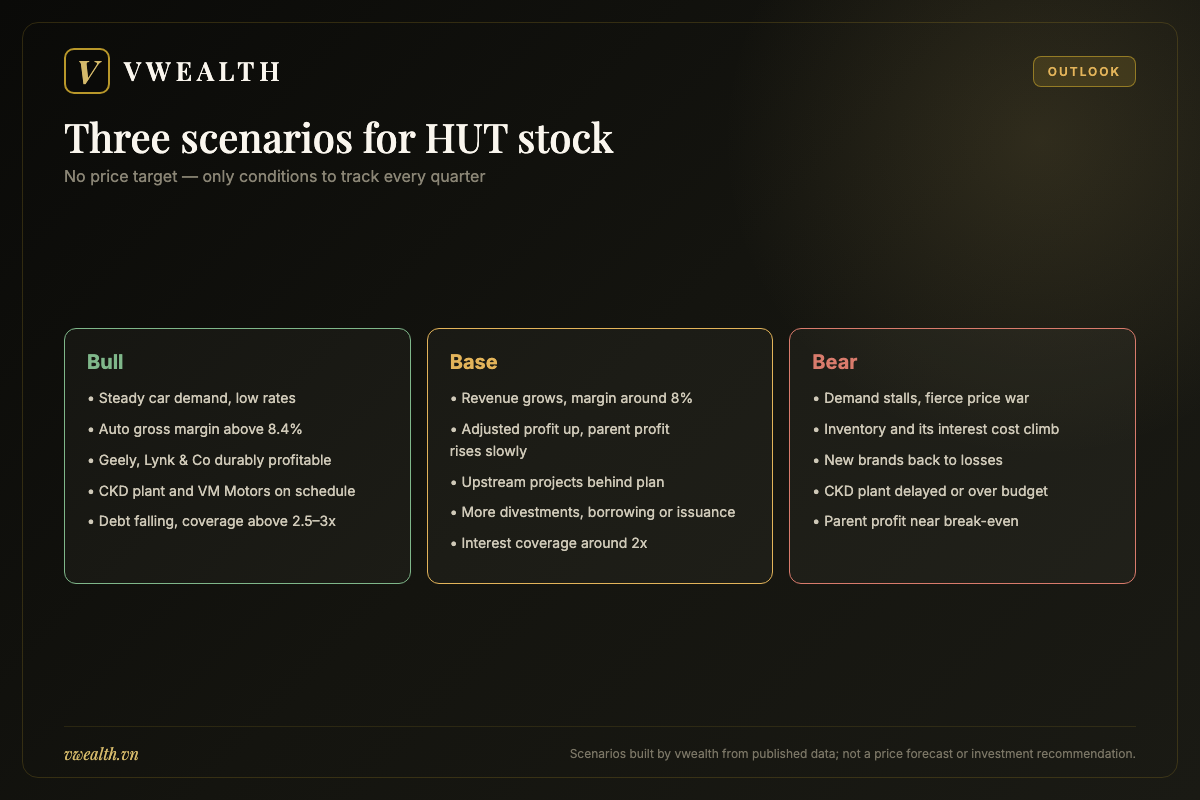
So, Should You Buy HUT Stock? Weighing the Pros and Cons Honestly
You now have the ingredients: a company that went from provincial bridge crew to BOT investor, then became an auto ecosystem through a share swap; a leadership team strong in finance and M&A; a business model whose trunk is thin-margin car retail with several higher-margin service branches; a highly leveraged balance sheet; and a stock with a history of violent swings. There is no single answer to whether you should buy HUT stock. It depends on what you believe about the future of the Tasco ecosystem and how much risk you can stomach.
The compelling positives
Scale and position. With about 150 showrooms, a 14.2% distribution share by VAMA data for 2025 and exclusive rights to several brands, Tasco is one of Vietnam’s largest car distributors — big enough for Geely to choose it as a JV partner and for Mitsui to become a strategic shareholder of Tasco Auto. VETC’s dominant niche. About 75% of electronic toll collection, millions of car-owner accounts, past its loss-making phase and earning more than VND 100 billion in 2025 — an asset that is hard to replicate. Real growth in services. Insurance premiums more than doubled, Carpla Service expanded to about 80 workshops, the new brands have started to make money: if higher-margin businesses grow as a share of the mix, consolidated margins could improve over time. International strategic partners at several levels (Mitsui, Geely, Samsung E&A, IFC), providing both capital and a form of outside validation. Management’s interests aligned with the stock, through VII Holding (now Tasco Holding), a company 65% owned by the chairman, acquiring 320,485,000 shares, or 30% of the capital, in 2025.
The negatives you cannot ignore
High leverage and thin interest coverage. Borrowings of about VND 23,730 billion in mid-2026, interest coverage below two times in 2025 (vwealth estimate); Tasco Auto on its own at about 1.15 times in the first half of 2026. Complex earnings quality. A meaningful share of profit comes from financial activities, divestments and other income; reported profit is weighed down by goodwill amortisation. Small parent-level profit relative to consolidated profit, especially after consolidating DNP. Negative operating cash flow in 2025, with expansion funded by debt and share issues. Historical and upcoming dilution: nearly four times as many shares in six years, and the 2026 annual meeting approved a public convertible bond offering of about VND 3,560 billion that can convert into shares over five years. No cash dividends for years. Execution risk on upstream projects, especially the CKD plant, which is behind its original timeline. Extreme volatility: the stock once fell about 79% in eight months in 2022.
| Pros | Cons |
|---|---|
| Large car distributor, 14.2% share (VAMA, 2025) | Auto gross margin only about 8.4% |
| VETC about 75% of electronic tolling, now profitable | Fee policy and public opinion limit monetisation |
| Fast growth in insurance, after-sales and finance | No detailed public data on cross-selling efficiency |
| International partners: Mitsui, Geely, Samsung E&A, IFC | Borrowings about VND 23,730 billion, interest coverage below 2x |
| 2025 “adjusted” profit of VND 993 billion | 2025 parent profit about VND 492 billion; far lower share in H1 2026 |
| Chairman-linked company holds 30% (VII Holding, now Tasco Holding) | Heavy dilution, no cash dividends for years |
Who HUT stock suits, and who it does not
HUT suits investors with a high risk tolerance who believe in Tasco’s “auto ecosystem” thesis and are willing to track each quarterly report with the seven-question checklist from chapter four. It suits those who understand they are buying a leveraged, multi-layer investment group rather than a simple retailer, and who accept that much of the value may come from events such as subsidiary IPOs, deals or a profit inflection at the new brands. It also suits investors with position-sizing discipline: given the volatility, HUT fits better as a small part of a portfolio than as a core holding. For foreign investors interested in Vietnam’s consumer cycle and a middle class buying its first cars, HUT is one of the few listed stocks offering direct exposure to that theme.
HUT does not suit those looking for steady cash dividends, those who need a conservative balance sheet, or those who do not want to read complex consolidated accounts. Nor does it suit heavy margin users: a stock that once fell almost 80% in eight months, with liquidity that is not abundant, combined with personal leverage is a double risk. If you like infrastructure but want a simpler model, our analyses of CII or HHV may be a better read; if you like retail but prefer less leverage, look at MWG or FRT. Our overview of the risks of investing in Vietnam is also worth reading before you commit.
Final thoughts
Tasco is a rare story on Vietnam’s stock market: a provincial BOT contractor that turned itself into one of the country’s largest auto ecosystems in a few years, using shares, debt and partners. The transformation has succeeded on scale: consolidated revenue is up tens of times, and its market share, network and brand portfolio are among the leaders. The other half — turning scale into sustainable profit per share and free cash flow — is still being tested. Coming back to the opening question, vwealth’s answer is this: HUT is a stock about a thesis, not yet about a result. Buying HUT means betting that the service branches will grow fast enough to carry the debt of the car-sales trunk before the car cycle or interest rates turn.
This article is not a recommendation to buy or sell. Before deciding, check the latest numbers — price, P/E, P/B, the most recent quarterly profit, profit attributable to the parent, total borrowings and operating cash flow — in the vwealth analysis report, and weigh your own risk tolerance. To compare HUT with other Vietnamese stocks, start from our guide on how to invest in the Vietnam stock market, and create a vwealth account to follow HUT’s reports each quarter.
Research Vietnamese stocks in English with vwealth. Our AI-powered platform turns Vietnamese market data into full English analysis reports — with international payment support and a free 2-month trial for new accounts. Create your free account and read the latest reports.


