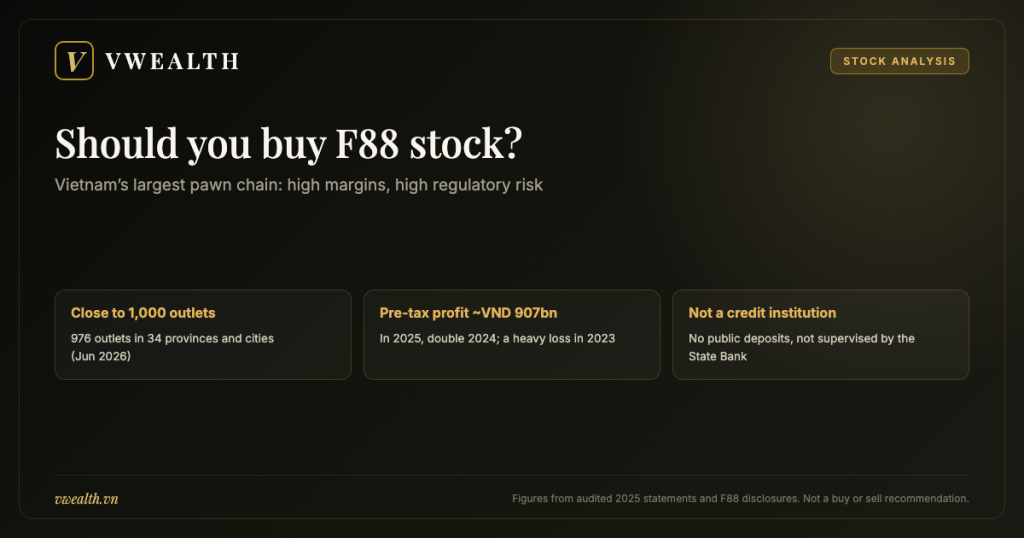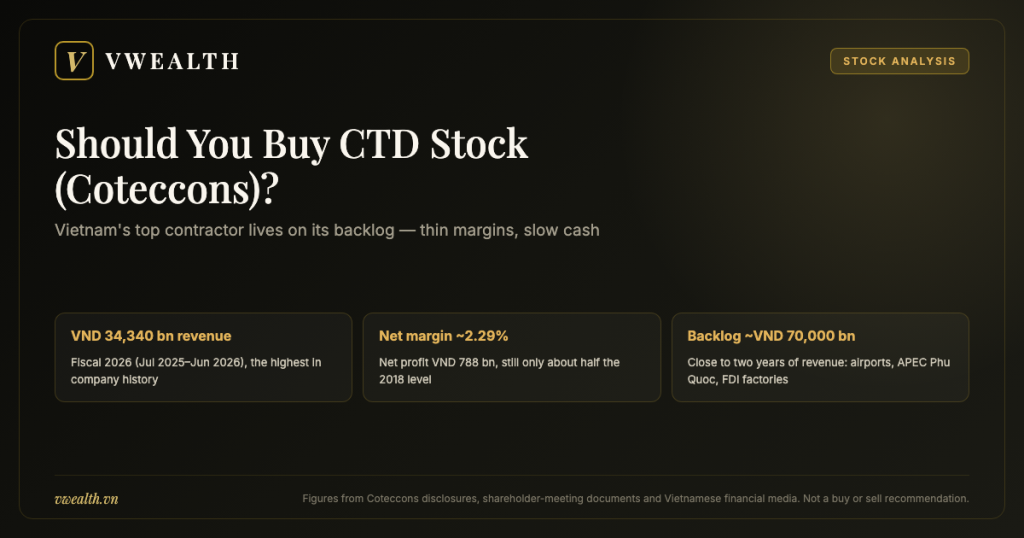
Should you buy CTD stock? CTD is the ticker of Coteccons Construction Joint Stock Company (Công ty Cổ phần Xây dựng Coteccons), listed on the Ho Chi Minh Stock Exchange (HOSE) since January 20, 2010, and it is the clearest example among Vietnam stocks of a business that turns over billions of dollars a year yet keeps less than three cents of profit from every dollar of revenue. In fiscal year 2026 (July 1, 2025 to June 30, 2026), Coteccons booked VND 34,340 billion in net revenue — the highest in its history — but only VND 788 billion in net profit according to its audited consolidated statements, a net margin of about 2.3% (vwealth estimate). At the same time, the value of contracts signed but not yet built — what the industry calls the backlog — stood at roughly VND 70,000 billion on June 30, 2026 according to the company itself, about two years of revenue. That is the portrait of Vietnam’s number-one general contractor: it lives on its backlog, its margins are paper-thin, and cash from project owners tends to arrive later than the bills from subcontractors. Understanding those three traits is the first step toward deciding whether to buy CTD stock.
A few ground rules first, the same ones used across the vwealth company-analysis series. Dates, names, project details and financial figures in this article come from public sources: Coteccons’ audited financial statements, annual report, investor newsletter and shareholder-meeting documents; financial and historical price data from VNDirect; and reporting by Vietnamese financial media (mainly CafeF, VnExpress and Nguoi Quan Sat), including brokerage research those outlets cite. Where sources disagree, we show both figures. Any number that vwealth calculated ourselves from disclosed figures is labeled “vwealth estimate”. We deliberately do not quote today’s share price, current P/E or P/B, current market capitalization or the latest quarterly profit, because those change daily; for live numbers, open the latest vwealth report. Amounts are in Vietnamese dong (VND); as a rough reference, VND 1,000 billion is on the order of USD 40 million at exchange rates of recent years.
If you are new to the market, our guide to investing in the Vietnam stock market explains the basics foreign investors need — account opening, foreign ownership limits, T+2 settlement and daily price limits of ±7% on HOSE. If you have read our analyses of Vinaconex (VCG) or Deo Ca (HHV), you will notice Coteccons is a very different kind of builder. Vinaconex and Deo Ca grew up on roads, bridges, tunnels and state-linked infrastructure. Coteccons grew up on high-rise towers, luxury apartments, resorts and factories for foreign manufacturers — in other words, on private money. Only in the last few years has it moved seriously into airports, convention centers and public investment. For a broader view of the sector, our overview of Vietnam manufacturing and industrial stocks is a good starting point.
From a Ministry of Construction Unit to Vietnam’s Top Contractor: 22 Years of Coteccons
Many of Vietnam’s large builders still carry the DNA of the state: a parent corporation, a supervising ministry, assets handed down from the planned-economy era. Coteccons started that way too, but within a few years of equitization it had become a thoroughly private business, living on contracts with private and foreign developers and competing on speed and site discipline. Its 22-year story falls into three acts: fast growth under its founder; a shareholder battle in 2020 followed by years of rock-bottom profits; and a recovery with record backlog under new leadership. Understand those three acts and you will understand why CTD was once called the “golden stock” of Vietnamese construction — and why it lost roughly four-fifths of its value in a single year.
2004: Equitization with VND 15.2 Billion and an Architect at the Helm
According to Coteccons’ own history page, the official starting point is Decision No. 1242/QĐ-BXD dated July 30, 2004 by the Minister of Construction, converting the business into Cotec Construction Joint Stock Company. The company’s financial statements show its first business registration certificate was issued on August 24, 2004. According to VnExpress, Coteccons grew out of the construction division of a technical and building-materials company under FiCO (Building Materials Corporation No. 1) of the Ministry of Construction, and had charter capital of only VND 15.2 billion when it was equitized in mid-2004. It was a small company whose main assets were its engineers and their site experience.
The man in charge from day one was Nguyen Ba Duong, whom CafeF refers to as “architect Nguyen Ba Duong” and VnExpress calls the “chief architect” of Coteccons. According to CafeF, he was the founder who ran Coteccons from 2004, first as general director and later as chairman, for more than 16 years. Under him, Coteccons chose a path quite different from state-rooted contractors: rather than chase budget-funded projects, it went straight for high-end private buildings, where owners pay for quality and on-time delivery. A portfolio of difficult, high-profile buildings became Coteccons’ main sales tool for years afterwards.
One detail captures how Coteccons grew. According to Wikipedia, from VND 15.2 billion at founding, charter capital reached VND 307.5 billion by the time of listing in early 2010 — about 20 times larger in just over five years. According to VnExpress, capital grew through bonus share issues and placements to strategic shareholders, not through borrowing. It became a defining feature of the golden years: a contractor that barely borrowed, sat on a thick cushion of cash, and used its own money to pre-fund its sites.
2006–2010: Foreign Funds Arrive, Luxury Projects and the HOSE Listing
The years 2006–2008 saw Ho Chi Minh City’s property market boom with apartments and premium offices for expatriates and high earners. Coteccons built projects such as RMIT University’s campus, The Manor and Grand View, followed by Ho Tram Sanctuary, River Garden and The Centre Point. According to company materials and Wikipedia, in 2007 Coteccons brought in capital from Dragon Capital, Indochina Capital and Tainan Spinning, lifting charter capital to VND 120 billion. The early presence of foreign funds is distinctive: from its first years, Coteccons was used to institutional-grade reporting and governance expectations.
On May 10, 2009, the company broke ground on its own head office, 100% self-funded — the building at 236/6 Dien Bien Phu Street in Ho Chi Minh City that is still its headquarters. Then on January 20, 2010, CTD shares began trading on HOSE. For investors, listing meant that every Coteccons number — revenue, profit, receivables, cash — would be published quarterly, and those numbers would tell the company’s story more honestly than any brochure.
You might ask what a “general contractor” actually is and why the term matters. A general contractor signs directly with the project owner, takes responsibility for the whole building, and then parcels out the work to subcontractors — mechanical and electrical systems, glass facades, foundations, concrete supply. The general contractor is the conductor: it sets the schedule, coordinates trades, answers for quality, and sits in the middle of the cash flow, collecting from the owner and paying the subcontractors. That position in the middle of the cash flow is the source of both Coteccons’ strength and its risk, as the financial-health chapter will show.
2011–2017: Ho Tram Casino, Kustocem, Design & Build and Landmark 81 — the Golden Years
On September 8, 2011, Coteccons signed as general contractor for The Grand Ho Tram casino resort complex developed by Asian Coast Development Ltd., one of the largest foreign-invested resort projects in the region at the time. The contract was proof that a Vietnamese builder could lead an internationally scaled project instead of working as a subcontractor for Korean or Japanese firms, as was common then.
In 2012 came a decision that would reshape the company eight years later. Coteccons signed a strategic partnership with Kustocem Pte. Ltd. of Singapore and issued it 10,430,000 new shares — VND 520 billion according to the company, or about USD 25 million according to Wikipedia. Kustocem belongs to Kusto Group, a diversified group with roots in Kazakhstan. At the time this was simply good news: a foreign strategic investor putting in fresh money and endorsing the company’s value. Nobody imagined that this same shareholder would one day sit on the opposite side of the table from the founder.
In 2013, Coteccons raised its stake in Unicons, another construction company, to 51.24% and began operating as a group. In 2014–2015 it pushed Design & Build contracts — design and construction in one package — for projects such as Masteri Thao Dien and Regina. Design & Build matters because it gives the contractor more control over engineering solutions and usually better margins than simply building to someone else’s drawings. The company’s annual report describes 2015–2017 as a period of “record growth in revenue and profit”.
Then came Landmark 81. In 2016, Coteccons began building the Landmark 81 tower in Ho Chi Minh City for developer Vingroup — the tallest building in Southeast Asia at completion, according to Wikipedia. For Coteccons it was more than a big contract; it was a business card. From then on, whenever a developer needed an iconic building, Coteccons was usually the first name on the list. In August 2017, the company started work on the Nam Hoi An casino resort, a contract worth nearly VND 7,000 billion. Between 2016 and 2018, according to financial-statement data on VNDirect, Coteccons earned about VND 1,422 billion, VND 1,653 billion and VND 1,510 billion in net profit; 2017 was the company’s profit peak. The share price rose more than fivefold from 2015 to a peak of VND 220,000 in November 2017 (price adjusted for corporate actions, per CafeF in 2019).
2018–2020: Peak Revenue, the Ricons Question and a Transfer of Control
2018 was the revenue peak of the founder era. According to CafeF, Coteccons booked VND 28,560 billion in revenue that year, up 5.1%, but net profit fell 8.6% to VND 1,510 billion as cost of sales and overheads rose. It was the first time revenue kept growing while profit turned down — a signal that, in hindsight, deserved attention. In 2019, revenue fell to VND 23,733 billion and net profit to VND 711 billion, less than half the prior year.
Alongside falling profits ran a governance story you will read about in detail in the next chapter: the relationship between Coteccons and Ricons, another contractor in which several Coteccons executives held important roles. In 2019, management proposed issuing shares to merge Ricons into Coteccons; the Kusto group opposed it and the merger proposal was shelved without a vote at the AGM. In 2020 the conflict came to a head, with large foreign shareholders demanding an extraordinary general meeting and the removal of directors, while management questioned whether those shareholders were acting together to take over the company.
The ending came quickly in the second half of 2020. In June, general director Nguyen Sy Cong stepped off the board, making room for representatives of Kusto and The8th. In August, the company appointed an acting general director. On October 2, 2020, Nguyen Ba Duong resigned as chairman and board member, citing personal wishes; in early October 2020, the board elected Bolat Duisenov, Kusto’s representative, as chairman. Over the following months, almost the entire former leadership team left.
2021–2023: Bottom-of-Cycle Profits, Bad-Debt Provisions and the LEGO Factory
The years after the handover were the hardest in the company’s history. According to CafeF, 2021 revenue shrank to VND 9,087 billion (about VND 9,078 billion in the audited data on VNDirect) — the first time below VND 10,000 billion since 2015 — and net profit was VND 24 billion, an unprecedented low that CafeF said was “not even one week” of profit from the peak years. Q4 2021 was the first quarter in which Coteccons sold below cost, with a gross loss of about VND 3 billion. In 2022 revenue recovered to VND 14,537 billion, but net profit was only about VND 21 billion, lower still. The causes piled up: the pandemic, surging steel and material prices, a property market that froze from late 2022, and large provisions for old receivables.
Yet in that same period, one contract changed the company’s direction. In August 2022, Coteccons signed with LEGO Manufacturing Vietnam to be general contractor for LEGO’s factory at VSIP III Industrial Park in Binh Duong — a project with a USD 1 billion investment license and roughly 163,000 m² of gross floor area for zones 1–5. Groundbreaking took place on November 3, 2022. LEGO said it spent eight months working with many potential partners before choosing Coteccons. By June 30, 2023, Coteccons’ balance sheet showed more than VND 1,174 billion in advance payments from LEGO. According to Coteccons’ annual report, the plant was completed in 33 months (August 2022–April 2025) and is LEGO’s sixth factory worldwide and second in Asia. LEGO proved that Coteccons could win the most demanding foreign clients, and industrial factories became a new pillar of the business.
In 2023, Coteccons switched its fiscal year to run from July 1 to June 30, with a six-month transition year (January 1 to June 30, 2023). The chief accountant explained at the 2022 AGM that the weeks before the Lunar New Year are when sites must accelerate — at times with 15,000–20,000 workers on Coteccons sites — which clashed with year-end closing, audits and budgeting. Also in 2023, the Hoa Lu consortium led by Coteccons was not selected for the roughly VND 35,000 billion package 5.10 for the Long Thanh airport passenger terminal, yet CTD shares nearly tripled over the year, according to CafeF, as the market began to believe in the turnaround.
2024–2026: Record Backlog, Infrastructure and Going Abroad
From fiscal 2024 onward, the numbers told a different story. Fiscal 2024 (July 2023–June 2024) revenue was VND 21,045 billion with audited net profit of about VND 310 billion. Fiscal 2025 revenue was VND 24,885 billion with net profit of VND 456 billion in the audited accounts (the earlier self-prepared Q4 report showed VND 24,867 billion and VND 454 billion). Fiscal 2026 revenue reached VND 34,340 billion and net profit VND 788 billion, up about 73%, beating the VND 30,000 billion and VND 700 billion targets set by shareholders. Backlog rose from VND 35,353 billion at the end of fiscal 2025 to nearly VND 65,500 billion at the end of March 2026 and about VND 70,000 billion at the end of fiscal 2026, according to the company’s investor newsletter.
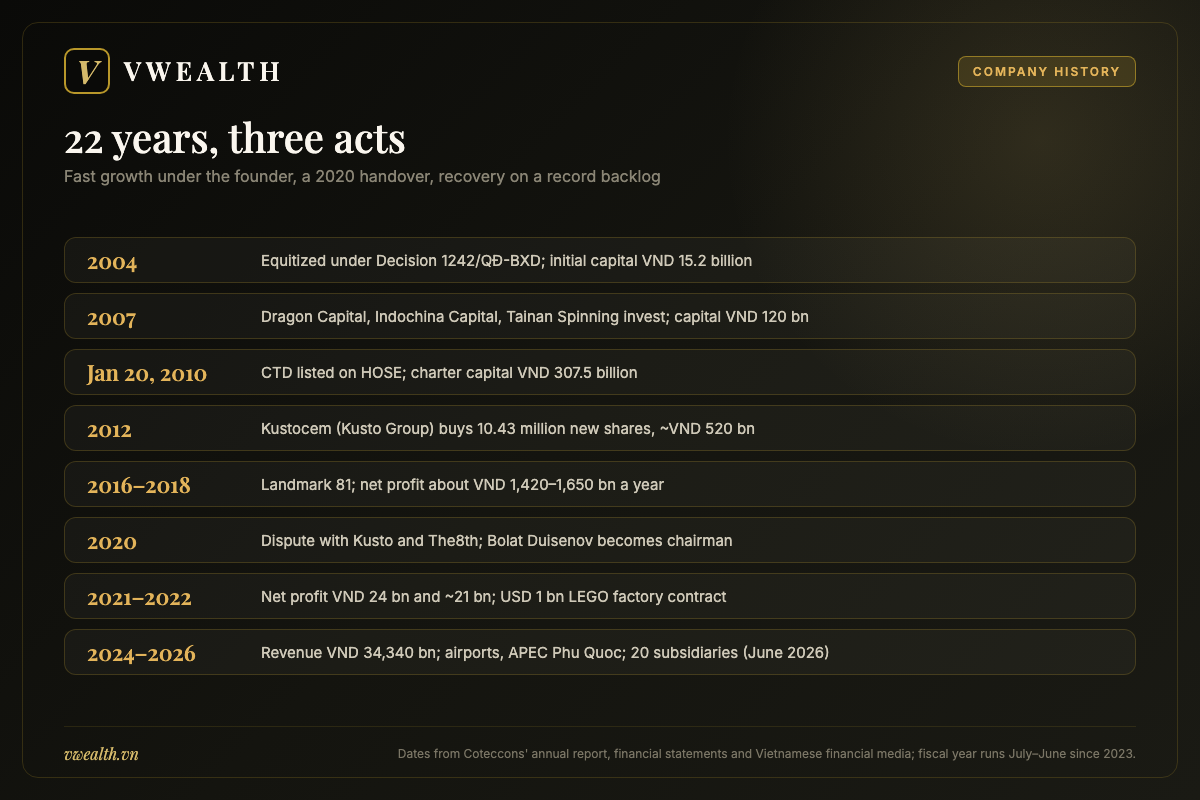
The project mix changed as well. Alongside apartments and townships, Coteccons now works on Long Thanh airport (two packages, including the parking building), Gia Binh international airport in Bac Ninh, the APEC Convention Center in Phu Quoc with a package of about VND 4,500 billion, the Can Gio bridge, The Global City and Cao Xa La. It has entities or projects in Taiwan, the United States, Kazakhstan, Georgia, Saudi Arabia, India, Cambodia and Singapore; on June 30, 2026, its audited statements showed 20 subsidiaries and 4,080 employees (versus 2,995 a year earlier). Its annual report and investor newsletter list inclusion in the Fortune Southeast Asia 500 in 2024, 2025 and 2026. The table below summarizes the key milestones.
| Year | Event | Why it matters to investors |
|---|---|---|
| 2004 | Equitized under Decision 1242/QĐ-BXD; initial capital VND 15.2 billion | Small start, built on site capability |
| 2007 | Dragon Capital, Indochina Capital, Tainan Spinning invest; capital VND 120 billion | Foreign funds present from early on |
| Jan 20, 2010 | CTD listed on HOSE; charter capital VND 307.5 billion | Quarterly disclosure begins |
| 2011–2012 | General contractor for The Grand Ho Tram; Kustocem buys 10.43 million new shares | A foreign strategic shareholder arrives |
| 2016–2018 | Landmark 81; net profit about VND 1,420–1,650 billion a year | Peak of the founder era |
| 2019–2020 | Ricons dispute; battle with Kusto and The8th; Bolat Duisenov becomes chairman | Transfer of control |
| 2021–2022 | Net profit VND 24 billion and about VND 21 billion; heavy provisions; LEGO contract | Profit trough, seeds of recovery |
| 2023 | Fiscal year moves to July–June; bonus shares at one new share for every three held | Year-on-year comparisons need care |
| 2024–2026 | Record backlog; airports, APEC Phu Quoc; 20 subsidiaries (June 2026); VND 1,400 billion bond | Bigger than the old peak, margins still thin |
Who Runs Coteccons: From Founder Nguyen Ba Duong to Chairman Bolat Duisenov, and CTD’s Shareholder Structure
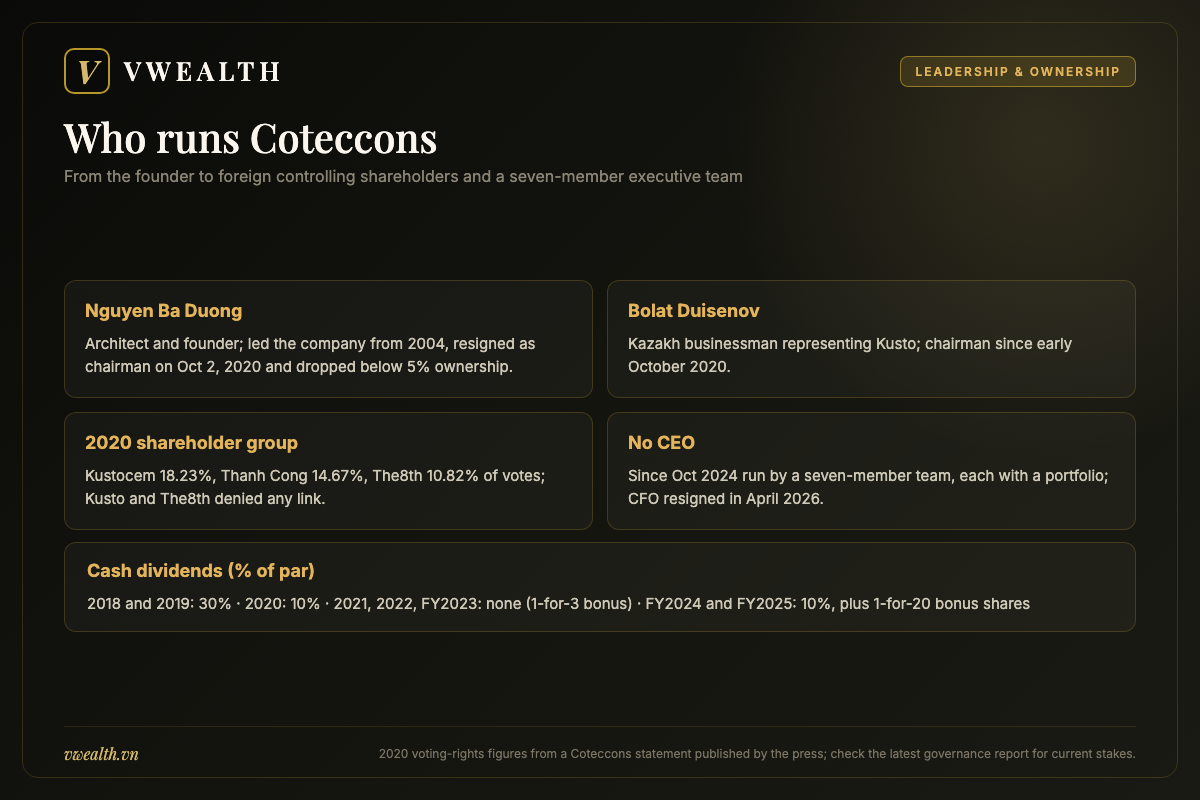
For a bank or a manufacturer, the most valuable assets might be a branch network or a production line. For a general contractor, the most valuable assets walk out of the office every evening: relationships with developers, bidding experience, the ability to look at a drawing and see instantly where costs will overrun. Nguyen Trinh Thuy Trang, deputy general director in charge of operations, put it bluntly at the 2025 AGM: “Coteccons has no mines and no factories. The only thing we have is people.” That is why the question of who runs Coteccons is not a side issue — it directly drives revenue, margins and even receivables. This chapter retells the 2020 transfer of control objectively, based on what each side disclosed, then looks at who owns CTD and how the company shares profit with shareholders.
Nguyen Ba Duong and the “Coteccons Group Ecosystem”
Under Nguyen Ba Duong, Coteccons did not stand alone. According to VnExpress and CafeF in 2020, the company was once part of a “Coteccons Group ecosystem” with related businesses such as Unicons, Ricons, F.D.C (the predecessor of Newtecons), BM Windows, Boho Décor, Dcons and S.M.A.R.T (later SOL E&C) — firms with close cross-relationships that for a long time had offices in the Coteccons building. Each specialized in a trade: glass and aluminum, interiors, waterproofing, general building. Coteccons was typically the general contractor; the others worked as subcontractors or co-participants.
The model had obvious strengths: the lead contractor could control quality and schedule through trusted subcontractors, staff could move flexibly, and the brand was shared. But it raised a governance question that outside shareholders soon asked: when the same group of people holds roles at both the general contractor and its subcontractors, who ensures profits are shared fairly with Coteccons’ shareholders? According to CafeF in May 2020, Nguyen Ba Duong (chairman of Coteccons), Nguyen Sy Cong (board member and general director of Coteccons) and Tran Quang Quan (deputy general director of Coteccons) were also three of the five board members of Ricons, with Mr. Quan serving as Ricons’ chairman.
On pay, the audited 2020 financial statements cited by CafeF showed that in 2019 Mr. Duong received more than VND 20.5 billion in salary, Mr. Cong nearly VND 13 billion and Mr. Quan nearly VND 11.5 billion. To be fair, this was the team that took a VND 15.2 billion company to VND 28,560 billion in revenue in 2018 and more than VND 1,400 billion in annual profit through 2016–2018, with no bank debt and thousands of engineers on the payroll.
Kusto, The8th and the 2020 Dispute, Told Objectively
The battle for control of Coteccons is one of the best-known episodes in Vietnam’s stock market. Because it involves real people and allegations in both directions, this article only recounts what the parties disclosed and draws no conclusion about who was right. Every characterization below is the view of the party that made it, not a finding by any authority.
In April 2019, one day before the AGM, Kustocem — then the largest shareholder — said it would not support issuing shares to merge Ricons, arguing the deal would bring no benefit to Coteccons’ operations. According to CafeF, investors possibly linked to Kusto held at least about 34.9% of voting rights at the time: Kustocem 18.2%, Talgat Turumbayev 2.1% and Thanh Cong Investment and Trading Co. 14.6%. The merger proposal was then shelved without a vote. In August 2019, The8th Pte. Ltd., an investment company set up in Singapore in June 2019 (according to a Coteccons statement), bought 7.84 million shares, taking its stake to about 10.8%; CafeF noted a same-day negotiated trade of 7.8 million shares at VND 123,000 per share.
In early June 2020, Kustocem requested an extraordinary general meeting to elect a new board and commission a special audit of conflicts of interest. On June 9, 2020, The8th (holding 10.42% of outstanding shares) asked to add to the AGM agenda the removal of Nguyen Ba Duong and Nguyen Sy Cong from the board. The fund PXP Vietnam Emerging Equity Fund (1.16%) also voiced support. By CafeF’s calculations, Kusto and like-minded shareholders controlled at least about 49% of voting rights. CafeF also reported that Coteccons’ supervisory board agreed with the view that the board and management had breached the company charter and the Law on Enterprises — that was the supervisory board’s opinion, not a finding by any authority.
Management responded with a statement: it was willing to hand over positions to candidates of sufficient standing and ability nominated by major shareholders, but it questioned whether Kusto (18.23% of voting rights), Thanh Cong (14.67%), The8th (10.82%), Ma Dao Trading (2.15%) and some individuals were acting in concert to remove the founders and take over the company, and whether rules on public tender offers had been breached. Kusto and The8th both denied any connection; Bolat Duisenov, then CEO of Kusto Vietnam, called them “independent entities”, and The8th’s Herwig Van Hove likewise said the two were fully independent. Kusto said it had no plan to divest.
The conflict was defused around the June 30, 2020 AGM: Nguyen Sy Cong and Tran Quyet Thang left the board, and Bolat Duisenov and Herwig Guido H. Van Hove joined it. Mr. Duong stayed on as chairman for a while, stepped down from the Ricons board and bought 555,000 CTD shares between July 9 and August 7, 2020, as promised to shareholders. On October 2, 2020, he resigned; on October 6 he sold more than 1.13 million shares, cutting his stake from about 5.7% to 4.2% and ceasing to be a major shareholder. After leaving, according to CafeF, he appeared as founding chairman of SOL E&C, while Newtecons — a firm the press places in the “ecosystem” associated with him — kept winning large contracts, including Masterise projects that Coteccons used to build. In August 2021, Coteccons’ executive board resolved not to sign new contracts, or to wind down existing ones, with nine firms including Ricons, Newtecons, SOL, BM Windows, Boho Décor and Dcons, citing conflicts of interest and direct competition.
Bolat Duisenov: From Shareholder Representative to Full-Time Chairman
Bolat Duisenov is a Kazakh businessman who, before becoming chairman of Coteccons, was general director of Kusto Vietnam. He joined the board at the June 2020 AGM, was named head of the strategy committee on September 25, 2020, and became chairman in early October 2020 (CafeF gives October 5 in its same-day report and October 6 in a 2025 article). In 2024, when Coteccons signed an agreement under which Kusto Group committed to co-invest USD 200 million in 2024–2028, he said he remained Kusto Group’s chief representative in Vietnam but stressed: “I do not work for the interests of any particular group of shareholders. I work for all Coteccons shareholders.”
His early years were not easy. According to CafeF, group headcount fell from 2,272 at the end of 2019 to 1,659 at the end of 2020; many long-standing clients moved to other contractors; profits hit unprecedented lows. At the April 2022 AGM, as one shareholder said he had lost 75% of his investment in CTD, the company set a profit target of just VND 20 billion — the chief accountant admitted the plan “will meet shareholder opposition, but this is the real picture”. Mr. Duisenov repeatedly urged patience; in early 2022 he said he had put his savings into CTD shares.
His style is recognizable from public remarks: lots of talk about culture, people and transparency; a fondness for metaphors; few promises about the share price. When CTD hit its daily limit-down on May 7, 2026 despite a sharp rise in quarterly profit, he wrote on his personal page: “Rumors can form overnight, but value takes time to build.” When a shareholder asked why the stock had never “taken off”, he quoted Warren Buffett on buying a share as buying part of a business. For investors, results matter more than words: from the profit trough of 2021–2022, the company reached VND 788 billion in net profit in fiscal 2026 — still well below the 2016–2018 level.
A Large Company Without a CEO: The Seven-Member Executive Committee
Here is something few listed companies have: Coteccons currently has no general director. On October 17, 2024, the board removed Vo Hoang Lam from the general director post so he could become deputy general director and head of Coteccons Business Unit 01, focusing on infrastructure, public investment, FDI and projects in central and southern Vietnam. Mr. Lam said the change was unrelated to business results and reflected the 2025–2029 strategy. The company’s website still lists him as a board member and head of BU1.
In place of a single CEO sits a seven-person executive team, which Ms. Trang called the Senior Committee (SCOM) at the 2025 AGM, with each member owning a portfolio: international markets and new businesses; the northern, central and southern regions; EPC and public investment; finance, legal and construction engineering; operations, people and culture. She was candid: “Frankly, we could not find the right person, but that does not mean we stop.” When a shareholder asked whether the CEO salary was “divided by seven or multiplied by seven”, Mr. Duisenov replied that the point was to make “the cake” bigger, not to slice it.
A collective model has the advantage of not depending on one person — an expensive lesson from 2020. But it also carries risk: who is ultimately accountable when a project loses money? Investors should watch the stability of this group. For example, Nguyen Van Dua, deputy general director and chief financial officer since October 2024, resigned for personal reasons effective April 26, 2026, according to CafeF; the company reclaimed his 100,000 ESOP shares at VND 10,000 each under plan rules. At the July 31, 2026 earnings call, finance questions were answered by Nguyen Hong Son, introduced in the company’s investor newsletter as chief financial officer. A change at the finance helm of a company managing tens of thousands of billions of dong in receivables always deserves attention.
Shareholders, the Foreign Ownership Limit and the Road to 100%
Coteccons is one of the few large listed Vietnamese companies whose controlling shareholders are foreign investors. The current board includes Bolat Duisenov (chairman), Talgat Turumbayev (a Kusto-group representative since before 2020), Herwig Guido H. Van Hove (associated with The8th), and Pham Quang Vu, Tong Van Nga, Tan Chin Tiong and Vo Hoang Lam, according to the company website. According to the fiscal 2025 annual report and the governance report for the first half of 2026, the three major shareholders have held roughly steady for years: Kustocem Pte. Ltd. about 17.9%, Thanh Cong Investment and Trading Co. about 14.4% and The8th Pte. Ltd. about 10.6%; Talgat Turumbayev holds about 2.05% and chairman Bolat Duisenov about 1.57%. The audited statements also disclose transactions with related parties of major shareholders — for example, construction revenue from Ladona Real Estate Co. (a related party of a major shareholder) of about VND 130.6 billion in fiscal 2026 and VND 594.3 billion the year before — notes that governance-minded investors should read every year. Holdings can change, so check the latest governance report or the CTD report on vwealth.
On share count: in January 2026, HOSE approved a bonus issue of 5,071,501 shares (one new share for every 20 held), lifting charter capital to about VND 1,087 billion; a second 20-to-1 bonus issue of 5,325,020 shares was completed in May 2026, bringing charter capital to VND 1,140.3 billion, according to the audited fiscal 2026 statements. Funds come and go: in May 2026, the KIM Vietnam group of Korean funds sold 950,000 shares, cutting its stake to 4.13% and ceasing to be a major shareholder; in 2023, VinaCapital also dropped below the major-shareholder threshold.
The foreign ownership limit — the “room” in Vietnamese market slang — is a story to follow. Under a board resolution dated July 20, 2026, reported by CafeF and MarketTimes, Coteccons announced a two-stage roadmap: stage one clarifies certain business lines (excluding activities such as wholesale and railway and road construction) to formally set the maximum foreign ownership at 50%; stage two amends business lines further to raise the limit to 100%, with a written shareholder vote scheduled for August 7–17, 2026. At the July 31, 2026 earnings call, the company said its application had been filed and it expected the process to finish around the third quarter of fiscal 2027, roughly six to nine months away, though timing depends on regulators. Why does this matter? When foreign room is full, a foreign buyer can only buy from another foreign holder, often at a premium; opening room can invite new capital, but it depends on regulatory procedures and there is no guaranteed timeline.
Dividends: From 30% in Cash to Three Silent Years and Back to 10%
Coteccons’ dividend history mirrors its three acts almost perfectly. (In Vietnam, dividends are quoted as a percentage of the VND 10,000 par value, so 10% means VND 1,000 per share.) In the golden years, shareholders received generous cash dividends: 30% for 2018 (record date in September 2019) and 30% for 2019 (paid September 16, 2020). With lower 2020 profits, the dividend fell to 10% (paid October 20, 2021). Then came three years without cash dividends — 2021, 2022 and the 2023 transition year — with a bonus share issue (one new share for every three held) in 2023 instead, lifting charter capital from VND 788 billion to VND 1,036 billion. Cash dividends returned at 10% for fiscal 2024 (paid January 14, 2025) and 10% for fiscal 2025 (payment scheduled for December 22, 2025), alongside two 20-to-1 bonus issues completed during fiscal 2026.
One detail shows that dividends at Coteccons are a considered decision rather than a default: for fiscal 2025, the 10% cash dividend (about VND 101.4 billion) was added at the October 20, 2025 meeting itself, according to CafeF; the AGM resolution showed VND 1,054 billion of accumulated undistributed profit before the payout. For fiscal 2026, AGM documents published in late September 2026 propose no appropriation to funds and no dividend, retaining the full VND 788 billion and lifting accumulated undistributed profit to about VND 1,741 billion, according to Nguoi Quan Sat. The final decision rests with the meeting, so check the official resolution afterwards. For a general contractor, cash is the blood that pre-funds its sites, so do not expect Coteccons to pay like a utility.
| Year / fiscal year | Cash dividend | Bonus shares | Context |
|---|---|---|---|
| 2018 | 30% | — | Net profit VND 1,510 billion |
| 2019 | 30% | — | Net profit VND 711 billion |
| 2020 | 10% | — | Year of the control transfer |
| 2021, 2022, FY2023 | None | 1 for 3 (2023) | Profit trough, cash preserved |
| FY2024 | 10% (paid Jan 14, 2025) | 1 for 20 (approved Oct 2024, completed Jan 2026) | Recovery |
| FY2025 | 10% (paid Dec 2025) | Another 1 for 20 (completed May 2026) | Backlog surging |
| FY2026 | AGM documents (Sep 2026) propose none | — | VND 788 billion retained |
A Top Contractor That Lives on Its Backlog: How Coteccons Makes Money
Picture Coteccons as a huge banquet hall that only takes wedding bookings in advance. The thicker the booking book — the backlog — the more confident the hall can be that its chefs will be busy for the next year or two. But a full book does not guarantee big profits: if meat and vegetable prices rise after the menu price is fixed, the hall absorbs the cost; if guests pay late after the party, the hall still has to pay its chefs and suppliers on time. Coteccons works much the same way, except each “banquet” is worth hundreds or thousands of billions of dong and lasts one to three years. This chapter walks through each business line to show where the money comes from, where the risks sit, and what Coteccons’ competitive moat really is.
The General Contractor Model: Win Big Jobs, Subcontract, Keep a Thin Spread
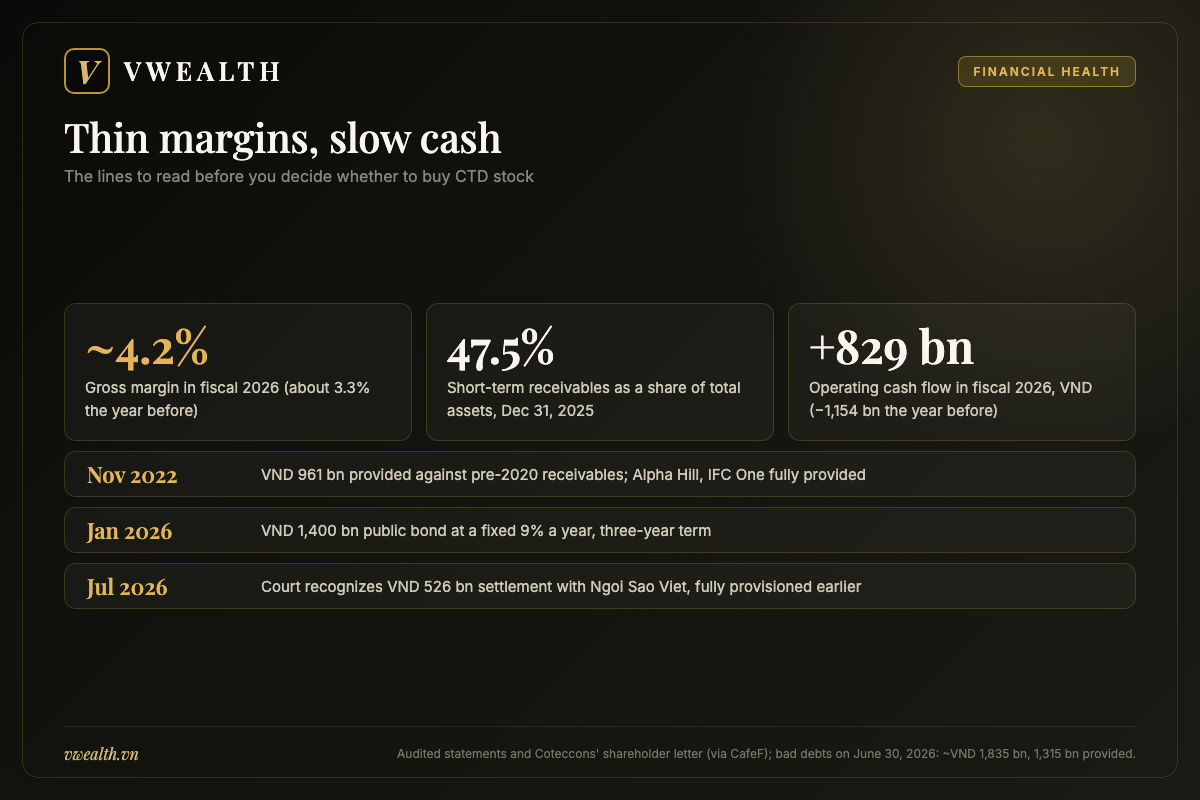
Almost all of Coteccons’ revenue is construction contract revenue. In Q2 of fiscal 2024, for instance, net revenue was VND 5,660 billion, of which nearly VND 5,653 billion came from construction contracts, according to CafeF. Revenue is recognized by percentage of completion: the share of work done determines the share of contract value booked. Most of the cost of sales is money paid to subcontractors, materials (steel, concrete, mechanical and electrical equipment), labor and machinery. What remains — gross profit — is usually just a few percent of revenue. Gross margin was about 3.3% in fiscal 2025 in the audited accounts (the self-prepared Q4 report had shown 3.13%) and 4.21% in fiscal 2026, per company disclosures.
Why so thin? First, bidding is a price race: many contractors bid on the same project, and the lowest capable bid usually wins. Chairman Duisenov said in 2023 that “many companies try to cut prices to win tenders”. Second, price-escalation risk: contracts are usually fixed-price at signing, so if steel or labor costs rise mid-project, as in 2021–2022, the contractor bears most of it. Third, the fixed costs of a drawn-out site: every month of delay adds site-management salaries, equipment rental and insurance. That is why, in the 2026 AGM documents, independent director Tong Van Nga urged the company to keep clear bid/no-bid criteria and be ready to turn down projects with legal risk, unclear funding, poor payment terms or prices that do not reflect the risk, according to Nguoi Quan Sat.
The key to understanding CTD stock is right here: with thin margins, a contractor’s profit is extremely sensitive to a few points of gross margin and to provisions. A bad debt of a few hundred billion dong can wipe out a year’s profit; conversely, a provision reversal can make one quarter’s profit jump. In Q4 of fiscal 2025, for example, Coteccons reversed VND 150 billion of doubtful-debt provisions, helping quarterly profit rise 185% year on year. When you read “profit surges”, always ask how much came from building and how much from provisions.
Civil Construction: Apartments, Townships and Developer Risk
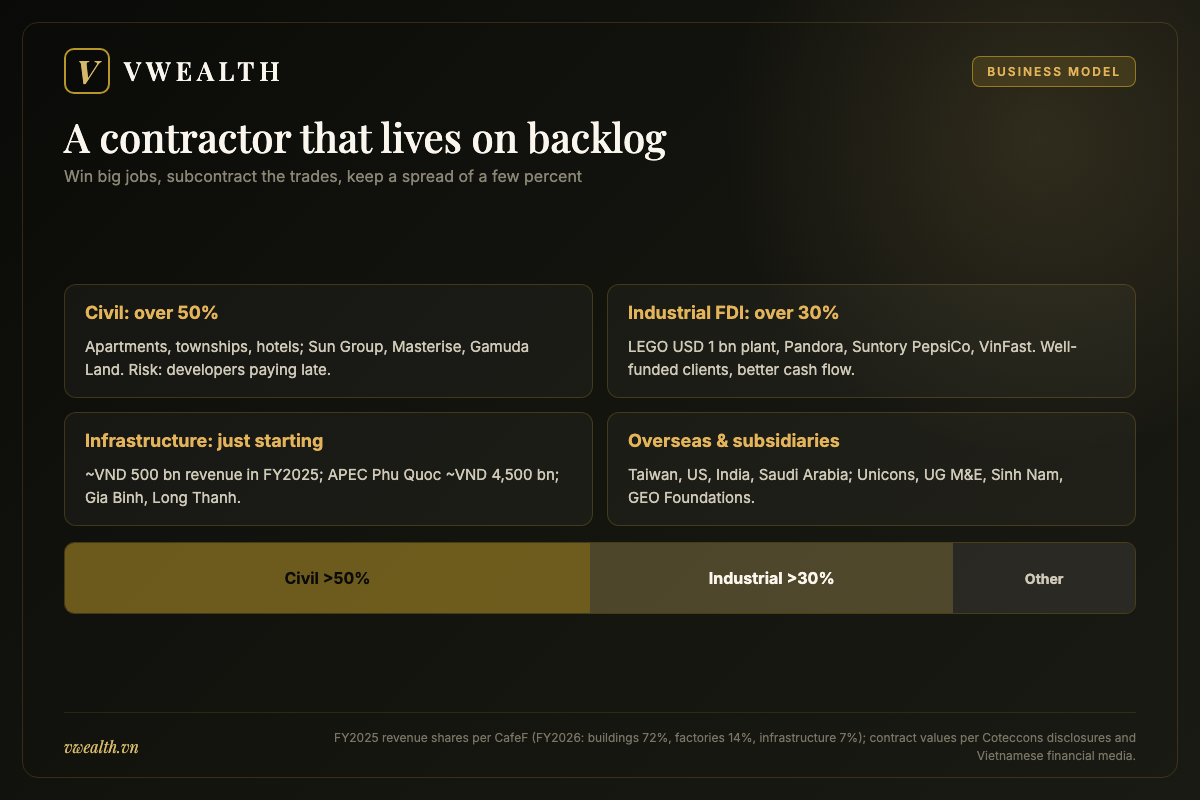
Civil construction — high-rise housing, townships, offices, hotels, resorts — is what made Coteccons famous. According to CafeF, civil work made up more than 50% of fiscal 2025 revenue (about VND 12,541 billion). In fiscal 2026, the company’s investor newsletter shows buildings accounting for 72% of VND 34,340 billion in revenue. Recent contract lists show familiar clients: Sun Group projects (Sun Urban City, Sam Son, Cat Ba), Masterise (The Global City), Gamuda Land (Eaton Park), SonKim Land (The 9 Stellars), Nam Long and Ecopark. The company calls this strategy “repeat sales”: the share of new contract value from returning clients was 75.8% in fiscal 2025 according to the annual report and about 72% in fiscal 2026 according to the investor newsletter.
The downside of civil work is developer risk. If a property developer runs short of cash — as during the corporate bond crisis of 2022 — the contractor may finish its work and still not get paid. Nearly all of Coteccons’ large bad debts come from property developers: Ngoi Sao Viet (part of Tan Hoang Minh Group), Saigon Glory (the Ben Thanh quadrangle project), Minh Viet (Tricon Towers), and the Alpha Hill and IFC Saigon Tower One projects linked to Van Thinh Phat. Management has repeatedly stressed that most current bad debts stem from contracts signed before 2022. The financial-health chapter examines these in detail.
In civil construction, Coteccons is also trying a new role: developer. In 2023 it partnered with Le Phong Group on The Emerald 68 apartment project in Thuan An (former Binh Duong province), with total investment of about VND 2,000 billion, two 39-storey towers and about 770 units by VCBS’s estimate; Coteccons holds 49%, and handover is expected from September 2026 according to SSI. In 2025, a BEHS–Covestcons consortium (Covestcons being a Coteccons subsidiary) was approved as investor for the Thanh Phu residential area in Ben Luc, Long An, covering about 85 hectares with total capital of more than VND 10,662 billion. Mr. Duisenov has said the company “will never go up against its clients” in property, according to CafeF in 2024. This business is still small, but it changes the risk profile: a pure contractor mainly bears collection risk, while a developer also bears sales and project-permitting risk.
Industrial Construction and FDI: LEGO, Pandora, Suntory PepsiCo
If civil work built the name, industrial construction is what carried Coteccons through the 2022–2024 property winter. According to CafeF, industrial construction was more than 30% of fiscal 2025 revenue (about VND 8,494 billion); at a September 2024 shareholder meeting, management said industrial work — mostly FDI projects — made up about 50% of revenue. By fiscal 2026, with LEGO handed over, factories were only about 14% of revenue and FDI clients about 20%, according to the investor newsletter. Flagship clients include LEGO (the USD 1 billion VSIP III plant), Pandora (about USD 150 million investment, built from Q2 2024 to 2026 according to SSI), Suntory PepsiCo (about USD 300 million), and warehouses for Logos. The company’s annual report also notes that Coteccons completed VinFast’s automotive complex in Hai Phong in 12 months of construction, a record pace.
The attraction of FDI clients is cash flow: they usually have funding in place, pay on contract milestones, and sometimes make large advance payments, as LEGO did with more than VND 1,100 billion by mid-2023. The difficulty is that FDI clients are exacting on safety, quality and environmental standards, and often pick contractors through several rounds of international price comparison. According to SSI (December 2024), LEGO was nearly 90% physically complete while revenue recognized was only about 50% of contract value — a reminder that revenue timing can differ sharply from what you see on site. Industrial construction also depends on global FDI flows, which are exposed to tariff policy and regional competition for investment.
Infrastructure and Public Investment: From Losing Long Thanh to Gia Binh and APEC Phu Quoc
Infrastructure is a business the founder-era Coteccons barely touched. After 2020, the new leadership made it a strategic direction. The first attempt failed in 2023: the Hoa Lu consortium led by Coteccons — eight contractors including Hoa Binh, Central, An Phong, Delta, Unicons, Thanh An and Thailand’s Power Line Engineering — was not selected for the roughly VND 35,000 billion package 5.10 for Long Thanh airport’s passenger terminal. But the company kept going. In early 2025, a consortium of Coteccons, Construction Corporation No. 1 (CC1) and FECON won package 11.5 for the Long Thanh parking building, with a contract value of nearly VND 3,144 billion, according to CafeF; at the July 2026 earnings call, the company said both Long Thanh packages it handles were on schedule.
In fiscal 2025, according to CafeF, Coteccons booked its first infrastructure revenue, about VND 500 billion — the first “harvest” after three years of pursuit. Larger projects followed. In November 2025, the company took on a package worth about VND 4,500 billion at the APEC Convention Center in Phu Quoc (reinforced-concrete structures for the multi-purpose arena and convention center, plus mechanical and electrical systems for casino and hotel components), built for APEC Leaders’ Week 2027. In December 2025, the board approved signing contracts with the general-contractor consortium for work at Gia Binh International Airport in Bac Ninh — a project covering more than 1,900 hectares with estimated total investment above VND 196,000 billion, developed by Masterise according to its environmental impact assessment. The end-fiscal-2026 backlog also includes the Can Gio bridge — Coteccons’ first bridge-and-road project, where it is a consortium member for the road bridge, the railway bridge and girder casting and launching — and the Cao Xa La project. At Gia Binh, the company says it finished the air traffic control tower in about six months. According to the investor newsletter, infrastructure was about 7% of fiscal 2026 revenue but 33% of new contract wins (VND 60,307 billion) and 16% of backlog.
Read these numbers carefully. The VND 196,000 billion figure is the total investment for the whole airport, not Coteccons’ contract value; the company’s actual share is far smaller and often split with consortium partners. Infrastructure also has its own traits: it needs different machinery and methods than high-rises, and working with state owners or public-private partnership projects involves different acceptance and payment procedures. Management acknowledged this when it spoke of hiring people experienced in working with state agencies and investing in equipment. In December 2025, Coteccons also approved in principle buying 100% of GEO Foundations Vietnam — formerly Bauer Vietnam, founded in November 2006 and specializing in foundation works — and completed the deal on May 25, 2026, according to its audited statements.
Going Abroad and Building Subsidiaries: MEP, Facades, Foundations, Software
From 2023, Coteccons began setting up overseas subsidiaries, funded with equity rather than borrowing according to board resolutions. By October 2025, management said the company had completed projects in Cambodia, Laos and India (a VinFast project where its engineers managed more than 1,000 local workers), was running three projects in Taiwan (Taipei twin towers, a Hsinchu complex and a university in Taipei), and had entities in the United States, Saudi Arabia, Kazakhstan and Georgia. According to Mr. Duisenov, Coteccons was the first Vietnamese construction company licensed to operate in Taiwan, after 15 months of legal preparation; in Saudi Arabia it took 18 months to set up a legal entity. The three priority markets are the United States, the Middle East and Taiwan.
On the revenue split, the audited fiscal 2026 statements still treat the group as a single geographic segment because activity is mainly in Vietnam, so overseas revenue remains small and is not disclosed separately; it is worth watching as that business grows. History suggests that going abroad is hard for Vietnamese contractors: CafeF noted that Hoa Binh began trying in 2015 and, nearly ten years later, still lacked a clear winning formula. Risks include different legal systems, the cost of deploying staff, currency swings and the difficulty of controlling costs thousands of kilometers from headquarters. On the positive side, overseas work reduces dependence on the domestic property cycle and often follows existing clients, as with VinFast in India.
Beyond core construction, Coteccons has been assembling support businesses. Unicons is a long-standing construction subsidiary. In February 2024, the company completed the purchase of 100% of Sinh Nam Metal (aluminum and glass facades, with a plant at VSIP Binh Duong) and UG M&E (mechanical and electrical works; its Singapore parent worked on ION Orchard, Marina Bay Sands and Jewel Changi). According to the audited fiscal 2026 statements, the group also includes VN Solutions (software), Sinh Nam Facade (the renamed Sinh Nam Metal), a Singapore subsidiary and GEO Foundation. The logic is to keep margin that used to go to subcontractors and control quality in the trades most prone to delay, such as MEP and facades. In a sense, Coteccons is rebuilding an “ecosystem” — this time made of subsidiaries it owns, rather than affiliated firms with shared leaders as before 2020.
Where Is the Moat, and Which Business Feeds Which?
A general contractor has no patents or mines, so where does its competitive advantage come from? For Coteccons, four things stand out. First, its track record: Landmark 81, LEGO, VinFast, casino resorts — projects a major developer looks at when shortlisting. Second, scale: more than VND 34,000 billion in revenue lets it run many sites at once, negotiate better material prices, and take on multi-trillion-dong packages that smaller contractors cannot guarantee financially. Third, returning clients: a repeat-sales ratio of about 72% means most new work comes from people who have hired Coteccons before. Fourth, its people and project-management systems — though, as 2020 showed, this is also the easiest asset to lose.
Still, this moat is shallower than in industries with natural monopolies. Developers can switch contractors — and did, when Coteccons was in turmoil in 2020–2021. As for which business feeds which: civil work brings scale and reputation but high collection risk; FDI industrial work brings cleaner cash flow and carried the company through the property winter; infrastructure and overseas work are being “fed” by today’s profits in the hope they become tomorrow’s growth engines. The table below summarizes each line.
| Business line | Disclosed scale / examples | Strength | Main risk |
|---|---|---|---|
| Civil construction | More than 50% of FY2025 revenue (~VND 12,541 billion); Sun Group, Masterise, Gamuda Land | Repeat clients, brand | Developers paying late, bad debts |
| Industrial / FDI | More than 30% of FY2025 revenue (~VND 8,494 billion); LEGO, Pandora, Suntory PepsiCo | Good cash flow, well-funded clients | International price competition, FDI cycles |
| Infrastructure / public investment | ~VND 500 billion FY2025 revenue, ~7% of FY2026 revenue; APEC Phu Quoc ~VND 4,500 billion; Gia Binh, Long Thanh, Can Gio bridge | Large market, many priority projects | New capability, payment procedures, consortia |
| International | Taiwan, US, India, Cambodia, Saudi Arabia; 20 subsidiaries in total at June 30, 2026 (incl. domestic) | Diversification, following existing clients | Legal, currency, remote cost control |
| Support businesses & investments | Unicons, UG M&E, Sinh Nam, GEO Foundations; Emerald 68, Thanh Phu | Keeps subcontractor margin in-house | Property sales and permitting risk |
To see which way the order book is tilting, compare the three slices published in Coteccons’ investor newsletter for Q4 fiscal 2026: revenue booked during the year, new contracts won during the year, and the remaining backlog. Revenue today is still mostly civil buildings, but new wins have swung sharply toward infrastructure. In other words, the revenue mix of the next two or three years could look quite different from the year just ended, with knock-on effects on margins, acceptance procedures and the pace of collections.
| Segment (company classification) | FY2026 revenue (VND 34,340 bn) | FY2026 new wins (VND 60,307 bn) | Backlog, Jun 30, 2026 (~VND 70,000 bn) |
|---|---|---|---|
| Buildings | 72% | 52% | 65% |
| Factories | 14% | 9% | 8% |
| Infrastructure | 7% | 33% | 16% |
| Villas and resorts | 3% | 4% | 6% |
| Other | 4% | 2% | 4% |
The table reproduces the percentages in the company’s newsletter; the same source says FDI clients accounted for about 20% of fiscal 2026 revenue, with domestic owners making up the rest. You can convert the shares into VND by multiplying by the relevant total, but treat the result as a rough estimate because the percentages are rounded.
Financial Health: Read the Reports Before You Buy CTD Stock
Reading a general contractor’s financial statements is very different from reading a retailer’s or a bank’s. Revenue can rise 40% while cash falls; profit can jump because of a single provision reversal; the balance sheet can look “healthy” with thousands of billions in deposits while most assets are money other people owe you. This chapter does not give you a valuation; it teaches you how to read Coteccons’ own numbers — what to look at first, and which lines are easy to misread. If you are new to Vietnamese accounts, our guide to reading Vietnamese company financial statements in English is a useful companion. For current figures such as the latest quarter, open the CTD report on vwealth.
Revenue and Profit Across Three Eras: Peak, Trough, Recovery
A technical note before comparing: since 2023, Coteccons’ fiscal year runs from July 1 to June 30. “Fiscal 2026” therefore means July 1, 2025 to June 30, 2026, not calendar 2026, and “fiscal 2023” lasted only six months. When you read “profit up X% year on year”, check which periods are being compared. The table below gathers the main figures from the audited accounts (via the annual report and VNDirect data), with press figures where needed.
| Period | Net revenue (VND billion) | Net profit (VND billion) | Note |
|---|---|---|---|
| 2018 | 28,560 | 1,510 | Revenue peak of the founder era |
| 2019 | 23,733 | 711 | Profit more than halved |
| 2020 | 14,558 | ~335 | Year of the control transfer |
| 2021 | 9,087 (audited ~9,078) | 24 | An unprecedented low |
| 2022 | 14,537 | ~21 | Operating cash flow minus VND 1,626 billion |
| FY2023 (6 months) | ~6,749 | ~52 | Transition year |
| FY2024 | 21,045 | ~310 | LEGO a major contributor |
| FY2025 | 24,885 | 456 | Operating cash flow minus VND 1,154 billion |
| FY2026 | 34,340 | 788 | Gross margin 4.21%; operating cash flow plus VND 829 billion |
Two things stand out. First, on revenue, Coteccons has surpassed its old peak: VND 34,340 billion in fiscal 2026 versus VND 28,560 billion in 2018. Second, on profit, it is still far from the peak: VND 788 billion versus VND 1,510 billion in 2018. A simple division puts the 2018 net margin at about 5.3%, against about 2.3% in fiscal 2026 (both vwealth estimates). In other words, today’s Coteccons does more work than in its heyday but keeps less than half as much profit from each dong of revenue. The most important investment question for CTD is therefore not whether revenue keeps growing, but whether margins keep recovering.
Thin Margins: What a 3–4% Gross Margin Means for Shareholders
Gross margin is what remains after cost of sales, divided by revenue. For Coteccons it hovers at a few percent: only about 1% in Q3 2022 according to CafeF; 3.30%, 2.25%, 3.39% and 3.28% for the four years through fiscal 2025 in the annual report’s five-year table; then 4.48% in Q3 fiscal 2026 and 4.21% for fiscal 2026 as a whole. For comparison, CafeF noted in 2019 that Hung Thinh Incons had a Q3 2019 gross margin of about 8%, double Coteccons’, and Hoa Binh about 6%. Low margins partly reflect Coteccons’ choice of large volumes, demanding clients and price competition, and partly contracts signed in periods of volatile material costs.
Thin margins have a consequence investors must remember: profit is easily distorted by items unrelated to construction. In Q3 fiscal 2026, CafeF reported that Coteccons drew on more than VND 52 billion of provisions for “high-risk contracts” and reversed more than VND 13.6 billion of inventory write-down provisions, booked directly as reductions in cost of sales, which lifted gross margin. This is standard accounting and nothing improper, but it means part of the margin improvement came from using provisions set aside earlier, not purely from better site execution. At the July 2026 earnings call, management said the margin gain came not from one-off income but from better management, centralized procurement and 6–12-month framework contracts for key materials; that is the company’s explanation, and investors should still check the provision notes every quarter.
Why does a single percentage point of gross margin matter so much? You will see a worked example in the outlook chapter. For now, remember the principle: on revenue above VND 30,000 billion, each percentage point of gross margin equals hundreds of billions of dong of gross profit — a very large share of annual net profit in the hundreds of billions. That operating leverage makes CTD attractive when margins improve and dangerous when they shrink.
Slow Cash: Receivables, Work in Progress and Negative Operating Cash Flow
If thin margins are the contractor’s first trait, slow cash is the second. At December 31, 2025, according to CafeF, Coteccons’ total assets were about VND 34,442 billion, of which short-term receivables were more than VND 16,354 billion (47.5% of total assets) and inventories nearly VND 7,569 billion (22%). A contractor’s inventory is mostly work in progress — work done but not yet certified or invoiced. Together, nearly 70% of assets were “money spent, waiting to come back” (vwealth estimate from the two ratios). At June 30, 2026, the audited balance sheet showed total assets of VND 38,696 billion, short-term receivables of about VND 16,522 billion and inventories of about VND 9,906 billion — roughly 43% and 26% of total assets (vwealth estimate).
The consequence shows up in the cash-flow statement. In 2022, despite a profit, operating cash flow was minus VND 1,626 billion as receivables and inventories jumped. In fiscal 2025, the supervisory board reported to the AGM that cash flow from core operations was minus VND 1,153 billion, attributing it to fast revenue growth causing slow collections and rising inventories. Even at the end of the golden era, financial-statement data on VNDirect show operating cash flow negative two years running: about minus VND 934 billion in 2018 and minus VND 339 billion in 2019. This is not a sign of fraud or crisis; it is the nature of the trade: when revenue grows fast, the contractor pre-funds sites before owners pay, so growth “eats” cash.
The sensible approach is to look at cash flow over several years rather than one. If operating cash flow stays negative while revenue has stalled, cash is getting stuck in projects or with hard-to-collect clients. If it is negative during a growth spurt and turns positive as big projects are handed over, that is a normal cycle. Fiscal 2026 is an example of the latter: the audited statements show operating cash flow of plus VND 829 billion despite 38% revenue growth, mainly because advances from customers rose from about VND 4,814 billion to VND 9,029 billion — cash prepaid by owners, not profit. For CTD, the question to ask every year is: has the cumulative profit of the last three years turned into actual cash?
Bad Debts and Disputes: Tan Hoang Minh, Saigon Glory, Van Thinh Phat and Former Affiliates
Each of Coteccons’ bad debts is a story about a property developer in trouble. In November 2022, as the share price hit limit-down repeatedly amid rumors, the company wrote to shareholders that it had provisioned VND 961 billion against receivables for revenue recognized in 2020 or earlier; two projects linked to Van Thinh Phat — Alpha Hill and IFC Saigon Tower One — were fully provisioned. In September 2024, the finance team said cumulative provisions had reached about VND 1,400 billion. According to the Q4 fiscal 2024 financial statements, bad debts were nearly VND 2,243 billion, mostly from Ngoi Sao Viet (Tan Hoang Minh Group), Saigon Glory and Minh Viet, with more than 60% provisioned.
The good news in recent months is that some of these have found a way out. On July 24–25, 2026, Coteccons announced that the Hanoi People’s Court had recognized a settlement with Ngoi Sao Viet worth VND 526 billion — a receivable that had been fully provisioned. The company said obligations would be performed on the agreed schedule and conditions, and that the amount would be recognized in its accounts upon completion. In August 2026, the Ho Chi Minh City People’s Court upheld a first-instance judgment in Coteccons’ favor in a construction-contract dispute at the Kenton Node project. On the remaining total, the “bad debt” note in the audited fiscal 2026 statements shows about VND 1,835 billion of bad debt at June 30, 2026, with VND 1,315 billion provisioned; the Ngoi Sao Viet receivable (about VND 526 billion) and the Minh Viet receivable (about VND 122 billion) are 100% provisioned. A year earlier, the equivalent figures were about VND 1,559 billion of bad debt and VND 1,244 billion of provisions.
On the other side, Coteccons has also been the paying party in disputes with firms from its former “ecosystem”. In July 2023, Ricons petitioned a court to open bankruptcy proceedings against Coteccons, alleging unpaid overdue debts; on September 29, 2023, the Ho Chi Minh City People’s Court decided not to open proceedings. Coteccons explained that its contracts with Ricons provided for paying subcontractors only after receiving payment from project owners. Nevertheless, an arbitral award dated October 24, 2024 required Coteccons to pay Ricons nearly VND 170 billion (principal of about VND 144.6 billion related to the Regina projects, late-payment interest from January 1, 2021 to September 24, 2024, and costs), and the Ho Chi Minh City court decided on May 8, 2025 not to annul the award. In 2024, Coteccons also had to pay Boho Decor nearly VND 22 billion under another arbitral award. These sums are small relative to the company, but they show that contract disputes from the pre-2020 era have dragged on for years.
Net Cash: From “No Borrowings” to a VND 1,400 Billion Bond
One reason CTD was so popular in 2015–2018 was its “clean” balance sheet: at September 30, 2018, according to CafeF, Coteccons held nearly VND 4,800 billion in bank deposits and no borrowings or finance leases at all, with equity of more than VND 8,081 billion. VnExpress described its bank borrowings in 2020 as having “always been zero” under the former leadership. Net cash — cash and deposits minus debt — was the cushion that let the contractor pre-fund its sites without paying bank interest.
From 2021 the picture changed. In April 2021, the company first said it would consider using financial leverage; a VND 500 billion bond plan dated from late 2021, and bond series CTD122015 was issued on January 14, 2022 with a three-year term (at maturity on January 14, 2025, Coteccons repaid VND 432 billion of principal plus nearly VND 20.7 billion of interest). At June 30, 2024, borrowings were VND 1,540 billion, while cash, equivalents and short-term investments totaled about VND 4,078 billion according to the annual report’s summary table. At December 31, 2025, borrowings and finance leases were about VND 5,242 billion. In January 2026, the company completed a public offering of 14 million bonds raising VND 1,400 billion at a fixed 9% a year for three years, unsecured and listed on the Hanoi Stock Exchange; proceeds go to subcontractors, suppliers and VND 250 billion of salaries and bonuses. At March 31, 2026, cash and short-term financial investments exceeded VND 6,100 billion, while total borrowings exceeded VND 7,035 billion, according to CafeF. By June 30, 2026, the audited balance sheet showed cash and equivalents of about VND 3,936 billion plus term deposits of about VND 3,887 billion, against short-term borrowings of about VND 4,401 billion and long-term borrowings (mostly the bond) of about VND 1,542 billion.
Matching figures from the same dates, Coteccons’ net cash was about VND 2,500 billion at June 30, 2024, about VND 1,300 billion at June 30, 2025, roughly minus VND 900 billion at March 31, 2026 and about VND 1,880 billion at June 30, 2026 (all vwealth estimates from disclosed figures). The cushion swings a lot from quarter to quarter and is much thinner than in 2018, when the company had no debt at all. This is a deliberate trade-off: using debt to fund revenue growth and a record backlog. It makes sense if margins cover the 9% cost of debt and owners pay on time; it is risky if several large owners pay late at once.
Seven Questions to Ask Every Time Coteccons Reports
Rather than memorizing dozens of figures, use a short checklist each quarter. One: what was gross margin this quarter, and did any of it come from using or reversing provisions? Two: are receivables and inventories growing faster or slower than revenue? Three: is year-to-date operating cash flow positive or negative? Four: how have bad debts and provisions changed, and was any large amount recovered (such as the VND 526 billion from Ngoi Sao Viet)? Five: how much did borrowings rise, and how much of gross profit does interest expense consume? Six: what were new contract wins and carried-forward backlog — civil, industrial or infrastructure? Seven: is the repeat-sales ratio still around 70% or higher, and are there major new clients?
If five of the seven answers point the right way — margin improvement from construction rather than provisions, positive cash flow, falling bad debts, controlled borrowings, growing backlog with reputable owners — the company is probably on track. If revenue grows fast while receivables and debt grow faster, remember the lesson of 2018–2019: profit usually turns before revenue does. The vwealth CTD report computes these indicators so you do not have to dig through every note, and our piece on Vietnam stock market valuation explains how P/E and P/B are typically used in this market.
How the Market Has Treated CTD Stock: From “Golden Stock” of Construction to Rumor-Driven Limit-Down Days
If you drew CTD’s price chart from 2015 to today, it would look like a mountain range: a high peak in 2017, a long slope down to late 2022, and a climb from 2023 with plenty of shaking along the way. Each stretch lines up with a chapter of the business story: record profits, a battle for control, bad debts, then record backlog. This chapter looks at how the market has priced Coteccons in each phase — not to predict future prices, but so you understand the stock’s “personality” before deciding whether to buy CTD stock. Prices below are historical prices as reported at the time, not adjusted for later bonus issues unless noted.
Memorable Price Phases
The first phase was the 2015–2017 peak. According to CafeF, CTD rose more than fivefold from 2015 to a peak of VND 220,000 in November 2017 (adjusted price). Coteccons was then the model of a “growth stock with cash”: steadily rising profits, no debt, generous cash dividends and heavy foreign fund ownership. But those high expectations made the stock very sensitive to slowing growth: according to CafeF, in the first half of 2018 it lost more than a third of its value from the peak.
The second phase was the 2018–2022 slide. In early September 2019, CTD closed around VND 91,800, down about 43% from its first session of the year; in January 2020 it traded at roughly VND 49,000–53,500 (unadjusted closing prices, VNDirect data). During the 2020 dispute, the stock hit the daily upper limit on two consecutive sessions to VND 72,500 (June 23, 2020) as the market believed the sides had found common ground. Then came 2022 — the worst year: from above VND 100,000 at the start of the year (a closing high of VND 113,600 on January 7, 2022), CTD fell to VND 25,200 on November 15, 2022, roughly a quarter to a fifth of its earlier level (VNDirect data), as profits hit bottom and the stock hit limit-down “repeatedly” in CafeF’s words, prompting the company to write to shareholders about its receivables.
The third phase is the recovery from 2023. Despite losing the Long Thanh package, CTD nearly tripled in 2023, according to CafeF. On February 13, 2025 it reached VND 90,000, its highest since Mr. Duisenov became chairman according to CafeF. In April 2025, CTD joined the VNDiamond index (effective April 28, 2025). In late October 2025, after two limit-up sessions and its best quarterly profit in seven years, CTD closed at VND 103,500. But volatility remains: on May 7, 2026, CTD fell to its limit-down price of VND 80,600 even though the company had just reported a 108% rise in quarterly profit; over the three sessions from May 7 to May 11, 2026, the price lost about 12% (VNDirect data). The company gave no specific cause, and the chairman spoke of “rumors”. The lesson: CTD’s price can react to rumors and short-term flows far more than to the financial statements.
Valuing a Contractor: P/E, P/B, Cash and the Trap of Trough Earnings
Valuing a contractor on P/E (price divided by earnings per share) runs into a classic trap: when profits are at the bottom, P/E looks very high; when profits peak, P/E looks cheap. In 2021, Coteccons earned just VND 24 billion; dividing the market capitalization at the time (about VND 7,100 billion in early February 2022, per CafeF) by that profit gives a P/E in the hundreds (vwealth estimate) — yet that was near the long-term low in the share price. Conversely, the low P/E of 2017 came right at the price peak. For cyclical businesses, look at P/E on normalized earnings over several years rather than a single year.
P/B (price divided by book value) is often more useful for Coteccons because equity has been fairly stable — roughly VND 8,000–9,700 billion for many years (VND 8,081 billion at September 30, 2018; about VND 8,590 billion at June 30, 2024; VND 8,965 billion at June 30, 2025; and VND 9,652 billion at June 30, 2026). When P/B is below 1, the market is implicitly saying return on equity (ROE) is low or that some assets — especially receivables — may not be worth their book value. When P/B is high, the market expects ROE to recover. With average equity of about VND 9,300 billion and fiscal 2026 profit of VND 788 billion, ROE is roughly 8.5% (vwealth estimate) — still low compared with 2016–2018.
Another lens is comparing market value with backlog and net cash. Be careful, though: backlog is future revenue, not profit; at a 2–3% net margin, a VND 70,000 billion backlog corresponds to only about VND 1,400–2,100 billion of net profit spread over two or three years if margins hold (illustrative example, vwealth estimate). And net cash, as discussed, is thinner than before. You can see CTD’s current P/E, P/B and ROE compared with peers in the latest vwealth report.
The Stock’s Personality: News-Driven, Volatile, Reactive to Tenders
CTD has three recognizable traits. First, it reacts to big tender news: on July 24, 2023, while the Long Thanh 35,000-billion terminal package was still being evaluated, CTD at one point hit limit-down and HBC fell more than 2%, while VCG, PHC, CC1 and HAN from the rival consortium hit their upper limits, according to CafeF; on December 9, 2022, Hoa Binh, Coteccons, Vinaconex and others rose to the limit on hopes that expressway and airport projects would soon start. Second, it reacts to governance and personnel news: the limit-up sessions of June 2020 coincided with board changes, and the May 7, 2026 limit-down came right after the company announced a change in the CFO position, although the company cited no link. Third, it tracks the property cycle: in 2022, when bonds and real estate froze, CTD fell with property stocks even though it is not a developer.
On HOSE, the daily price band is ±7% from the reference price; “limit-up” or “limit-down” means hitting that boundary. For a stock with CTD’s personality, several consecutive limit sessions are not unusual. If short-term swings easily sway you, prepare mentally or keep the position size moderate. Portfolio diversification is especially useful with cyclical sectors such as construction.
Foreign Investors, the Ownership Cap and Funds Coming and Going
CTD has always had a stronger foreign-investor imprint than most construction stocks. Dragon Capital, Indochina Capital and Tainan Spinning arrived in 2007; Kustocem in 2012; The8th in 2019; Korean KIM funds have repeatedly been major shareholders (selling more than 6.3 million shares in August 2019 to drop below 5%, and falling below 5% again in May 2026). With foreign controlling shareholders and a foreign ownership cap that is still limited — stage one of the 2026 roadmap is to formally set the maximum at 50% — there is little room left for new foreign funds, which is one reason the company is pursuing a path to 100%.
Inclusion in VNDiamond in April 2025 also matters: VNDiamond focuses on stocks with high foreign ownership close to their caps and is tracked by several ETFs; being in the basket brings passive flows, but also exposure to rebalancing. The bigger backdrop is the prospect of Vietnam’s market upgrade, which could draw more foreign capital into sector leaders; see our piece on the Vietnam stock market upgrade by FTSE Russell.
Catalysts That Could Change How the Market Sees CTD
Five developments could materially change how the market values Coteccons. One, recovering fully provisioned debts such as the VND 526 billion from Ngoi Sao Viet: collected cash would be reversed into profit and add to cash in the period recognized. Two, gross margin holding above 4% for several consecutive quarters without help from provision reversals — a sign that old low-priced contracts are behind it. Three, progress on raising the foreign ownership cap. Four, actual revenue from large infrastructure projects (Gia Binh, APEC Phu Quoc, Can Gio bridge) being recognized on schedule. Five, operating cash flow turning positive after a period of fast growth.
On the other side are negative catalysts to watch: a large developer paying late, further changes in the seven-member executive team, spikes in steel or labor costs, or a loss-making overseas contract. Nobody can predict the timing of such events; the investor’s job is to know they can happen and watch for early warning signs in quarterly reports.
Industry Context: Where Coteccons Sits Between Real Estate, FDI and Public Investment
A general contractor cannot grow faster than the number of buildings being started. To understand Coteccons, you need to understand the three big money flows into Vietnamese construction: developers’ money, FDI manufacturers’ money for new factories, and state money for infrastructure. Each has its own cycle, and Coteccons has shifted its center of gravity among them over time. This chapter places the company in the industry and compares it with familiar rivals: Hoa Binh, Vinaconex and Ricons.
Vietnam’s Construction Industry: Growing to the Rhythm of Real Estate
According to the General Statistics Office as cited by CafeF, Vietnam’s construction sector grew 9.62% in the first half of 2025, the fastest first-half pace in the 2011–2025 period. That reflects a recovery after 2022–2024, when the property market nearly froze amid a crisis of confidence in corporate bonds, many projects halted, and contractors faced hard-to-collect receivables. As early as 2019, some construction firms told the press they had gone months without signing new contracts while property projects were under prolonged review; 2022–2023 was harder still.
For Coteccons, the property cycle matters because civil work is still more than half of revenue. When real estate recovers, developers restart projects and civil backlog grows; but collection risk returns if developers are highly leveraged. Vietnam’s new property legal framework and the unblocking of stalled projects directly affect a contractor’s pipeline. For more on this cycle, see our overview of Vietnam real estate stocks.
Public Investment and Mega-Projects: A Big Pie With Many Forks
The second flow is public investment. In recent years the government has accelerated spending on the North–South expressway, Long Thanh airport, new airports and projects for APEC 2027. In early 2023, brokers such as VNDirect argued that leading contractors, Coteccons among them, would benefit from the Long Thanh mega-project and the North–South expressway. In Coteccons’ 2026 AGM documents, independent director Tong Van Nga pointed to the government’s 2026–2030 medium-term public investment plan of about VND 8.22 quadrillion (8.22 million billion dong) as a major opportunity, while warning that the segment requires management systems different from civil construction.
But public investment works differently from private projects. Most transport packages go to contractors with road-and-bridge heritage such as Vinaconex, Deo Ca and the Cienco corporations, and to infrastructure investors under public-private partnerships such as CII. Coteccons is strongest in the “building” part of infrastructure — terminals, convention centers, parking structures, cargo terminals — rather than roads, bridges and tunnels. So when you read “public investment boom”, do not assume every dong flows to CTD; check which components the company is working on and its own contract value.
FDI and Factories: The Engine That Carried Coteccons Through the Downturn
The third flow is FDI. Vietnam remains a destination for supply-chain relocation: LEGO chose Binh Duong for its sixth plant worldwide and second in Asia with USD 1 billion; Pandora and Suntory PepsiCo have expanded production. According to SSI (December 2024), factory absorption in the north remained fairly healthy while the south showed signs of recovery with demand exceeding new supply; supply-chain diversification creates opportunities for contractors focused on industrial construction such as Coteccons. The flip side is that global FDI flows remain sensitive to tariff policy and to regional competition for investment.
The FDI value chain has several listed links: industrial park landlords such as Kinh Bac (KBC), Becamex (BCM) and IDICO (IDC); factory builders such as Coteccons; and material suppliers such as steelmakers. An interesting footnote: in December 2020, Coteccons’ subsidiary Covestcons bought more than 24.4 million IDC shares (8.13%) after the Ministry of Construction sold its stake in IDICO, but just over a month later sold 22.5 million shares, according to CafeF. Coteccons seemed to weigh an entry into industrial real estate, then refocused on construction.
Coteccons Next to Hoa Binh, Vinaconex and Ricons
The three names most often compared with Coteccons are Hoa Binh (HBC), Vinaconex (VCG) and Ricons. Hoa Binh is the long-time direct rival in private civil construction. According to CafeF, after Coteccons’ 2020 shock, Hoa Binh briefly led the industry in 2021 revenue (VND 11,355 billion versus VND 9,087 billion), and HBC’s market value overtook CTD’s in November 2021 for the first time in ten years. But Hoa Binh then lost more than VND 1,200 billion in Q4 2022 alone and ran into serious financial difficulty; in 2024, HOSE notified it that HBC fell under compulsory delisting because accumulated losses exceeded paid-in capital. In 2025, according to VNDirect data, Hoa Binh had revenue of about VND 4,620 billion, net profit of about VND 250 billion and interest expense of about VND 384 billion; in September 2026 it completed an issue of more than 51.4 million shares to swap about VND 514 billion of debt for 99 creditors, while still carrying accumulated losses of more than VND 2,000 billion.
Vinaconex is a different kind of company: a leading infrastructure contractor (per our VCG analysis, it takes part in seven Long Thanh airport packages with total contract value of about VND 65,343.6 billion) with property and investment arms as well. Ricons is the former “sibling”: it grew fast, earning VND 545 billion in 2018, but by 2021 had revenue of VND 8,093 billion and net profit of just VND 80 billion; in 2021 Ricons elected Nguyen Sy Cong, the former Coteccons general director, as chairman, and in May 2026 the post passed to Pham Quan Luc, also a former Coteccons deputy general director. Coteccons still holds 14.43% of Ricons, carried as an equity investment at a cost of about VND 303.6 billion in its audited statements.
| Company | Core strength | Recent figures (press reports) | Watch point |
|---|---|---|---|
| Coteccons (CTD) | High-rise civil, FDI factories, expanding into infrastructure | FY2026: revenue VND 34,340 bn, net profit VND 788 bn; backlog ~VND 70,000 bn; FY2027 plan VND 42,000 / 1,050 bn | Thin margins, large receivables, rising debt |
| Hoa Binh (HBC) | Private civil contractor, abroad since 2015 | 2025: revenue ~VND 4,620 bn, profit ~VND 250 bn, interest expense ~VND 384 bn; accumulated losses above VND 2,000 bn | Restructuring, debt-to-equity swap |
| Vinaconex (VCG) | Major transport infrastructure, real estate | 7 Long Thanh packages ~VND 65,343.6 bn (total contract value); 2025 revenue ~VND 16,071 bn | Hybrid contractor + developer |
| Ricons | Civil general contractor, spun out of old ecosystem | 2021: revenue VND 8,093 bn, net profit VND 80 bn | Past receivables dispute with Coteccons |
Materials, Labor and the Price War in Tendering
For a thin-margin contractor, the two most painful macro variables are material prices and labor costs. In 2021–2022, steel and cement prices surged; in Q3 2022, Coteccons’ gross margin fell to about 1% according to CafeF, and the company’s November 2022 letter to shareholders explained that cost of sales had risen 192.3% year on year because of higher material, mobilization and labor costs. The company then built provisions for “high-risk contracts” and, as shown above, used part of them in fiscal 2026 to offset higher labor and material costs. To see how steel prices ripple through the chain, our analysis of Hoa Phat (HPG) is a useful read.
Labor is the longer-term variable. Coteccons is raising pay sharply: according to CafeF and Nguoi Quan Sat in September 2026, the company made two salary adjustments in fiscal 2026 (December 2025 and June 2026) with a budget of about 12% of payroll, above the 7.8% market average the company cited; many employees received 20–25% raises, and about 500 staff at four projects that beat profit targets received bonuses of 2 to 15 months’ salary. It is a double-edged sword: it keeps skilled engineers — a contractor’s most valuable asset — but raises overheads. Tender competition remains fierce, from domestic and foreign contractors alike; a contractor that wants to protect margins must be selective rather than chase revenue.
Outlook: Three Scenarios for CTD Stock and What Would Have to Happen
Forecasting a contractor’s profit a few years out is like forecasting the weather on an open-air construction site: you know which season tends to be wet, but not which day it will rain. So this chapter offers no price target. Instead, it identifies the variables that will decide Coteccons’ future, builds three scenarios — optimistic, base and adverse — with the conditions for each, and uses an illustrative example to show how sensitive profit is to gross margin. When new data arrives, you can slot it into this framework yourself.
Five Variables That Will Decide Coteccons’ Future
The first variable is gross margin. Having reached about 4.2% in fiscal 2026, can the company hold it or push toward the 5–6% of better past periods as older low-priced contracts are completed and the high-risk-contract provision is used up? The second is how quickly backlog converts into revenue: a VND 70,000 billion backlog is only worth something if projects proceed on schedule, and large infrastructure projects such as airports can be delayed by land clearance or procedures.
The third variable is receivables quality: whether new owners — many of them large developers — pay on time, and whether old bad debts continue to be recovered, as with Ngoi Sao Viet. The fourth is the cost of capital: borrowings have risen and the VND 1,400 billion bond carries 9% a year; if operating cash flow stays negative, debt will rise further and interest will eat into thin profits. The fifth is the performance of new businesses: overseas projects, infrastructure, and self-developed property such as Emerald 68 and Thanh Phu.
Optimistic Scenario: Sustained Margin Gains, Steady Collections, Old Debts Recovered
In this scenario, Coteccons keeps growing revenue thanks to its large backlog while gross margin keeps improving, because contracts signed after 2023 are better priced, the share of Design & Build and technically demanding packages rises, and the MEP, facade and foundation subsidiaries keep margin that used to go to subcontractors. More provisioned debts are recovered, producing reversals. Operating cash flow turns positive as big projects are handed over, allowing debt to fall. The roadmap to lift the foreign ownership cap is completed, opening the door to new capital.
Conditions: the property market keeps recovering steadily without a new credit shock; material and labor costs do not spike; large infrastructure projects proceed on schedule; the executive team stays stable. Signs to watch for: gross margin above 4% for several consecutive quarters without relying on reversals; receivables growing more slowly than revenue; positive full-year operating cash flow.
Base Scenario: Revenue Grows, Margins Flat, Cash Flow Uneven
The base scenario — in vwealth’s view the most likely absent a major shock — is that revenue keeps growing on the backlog but more slowly than in fiscal 2026, gross margin fluctuates around 3.5–4.5%, and profit grows moderately. Part of profit still comes from provision reversals or usage, so quarterly earnings may be volatile. Operating cash flow swings between negative and positive with the rhythm of handovers; debt stays above pre-2021 levels but under control. Cash dividends are uneven: around 10% in some years, full retention in others, as proposed for fiscal 2026.
For a reference point, use the company’s own plan: AGM documents published in late September 2026 target fiscal 2027 (July 2026–June 2027) consolidated revenue of VND 42,000 billion and net profit of VND 1,050 billion, up about 22% and 33% respectively; if achieved, that would be the highest profit since 2018, according to Nguoi Quan Sat. At the July 2026 earnings call, management also spoke of revenue growth of about 20–30% and a shift from “sales mode” to “saving mode” — optimizing costs on contracts already signed. This is the company’s plan, not a vwealth forecast; the gap between plan and reality is something to score every quarter.
In this scenario, CTD may keep trading on tender news and market sentiment, with its long-term direction depending on whether profit gradually moves back toward 2016–2018 levels. Investors holding through this scenario need patience and must accept that a contractor’s margins recover more slowly than its revenue.
Adverse Scenario: Owners Pay Late, Input Costs Rise, New Businesses Lose Money
The adverse scenario happens when several risks coincide. One or a few large property developers run into cash problems, forcing Coteccons to make new provisions — a repeat of 2021–2022. Steel, materials or labor costs jump while contracts are fixed-price, pushing gross margin back to 2–3%. Some overseas or infrastructure projects overrun. Persistently negative operating cash flow forces more borrowing and higher interest costs. Add management turnover, and profit could fall sharply even with high revenue.
Early warning signs: receivables and inventories growing faster than revenue for several quarters; new bad debts appearing in the notes; consecutive declines in gross margin; additional bond issues or a sharp rise in short-term borrowing; a cut in cash dividends. If you see three or more of these at once, revisit your investment thesis.
Illustrative Example: What One Percentage Point of Gross Margin Is Worth
The following is an illustrative example, not a forecast, to show the leverage of margins. Take fiscal 2026 revenue of VND 34,340 billion. If gross margin rose by one percentage point (say from 4.2% to 5.2%) with other costs unchanged, gross profit would increase by about VND 343 billion. Assuming 20% corporate income tax, net profit would rise by about VND 275 billion — roughly 35% of the VND 788 billion net profit in fiscal 2026 (vwealth estimate, illustrative). Conversely, a one-point drop in gross margin could erase about a third of net profit.
Similarly, a new VND 500 billion bad-debt provision would wipe out about VND 400 billion of after-tax profit (if the provision is tax-deductible; in practice it depends on the rules), roughly half of fiscal 2026 profit, while a reversal of the same size would work the other way (illustrative, vwealth estimate). That is why Coteccons’ profit can jump or plunge in a single quarter while site activity barely changes. When you read news about CTD, always separate “construction” from “provisions”.
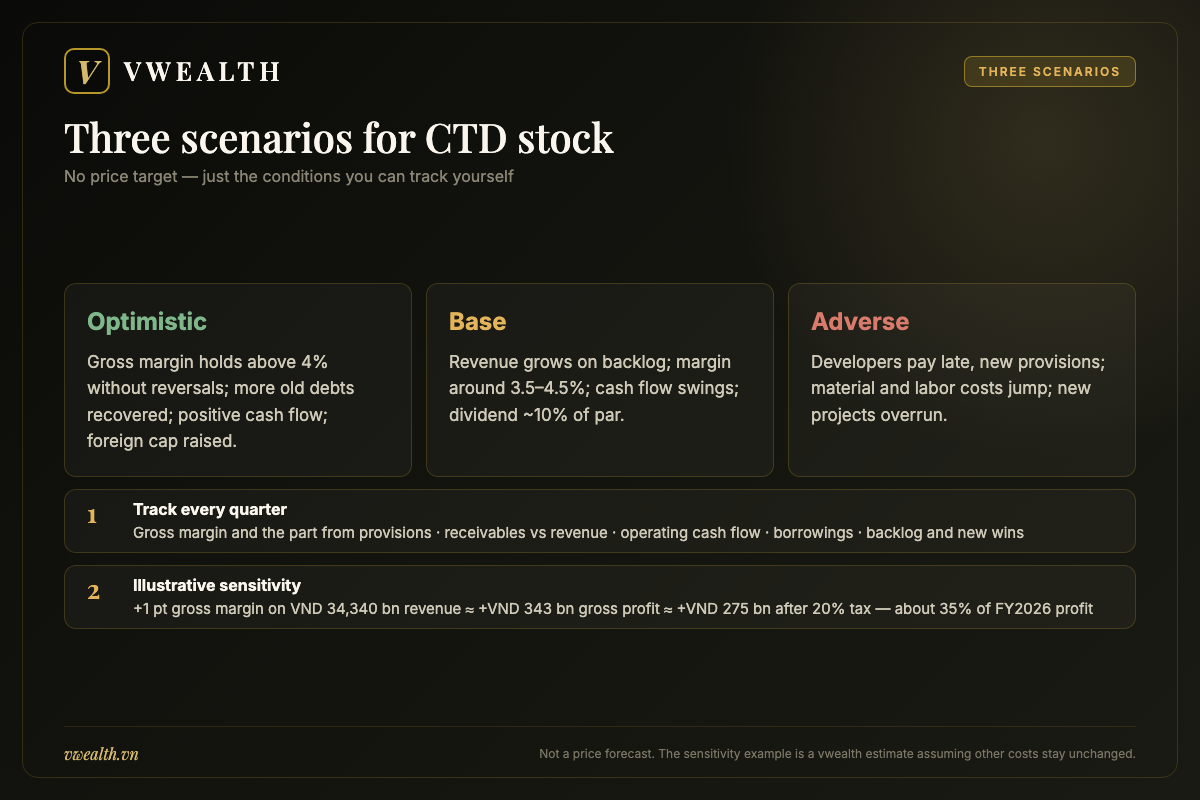
So, Should You Buy CTD Stock? A Balanced Verdict
By now you have followed Coteccons across 22 years: from a VND 15.2 billion construction unit, through the Landmark 81 heyday, the 2020 battle for control and the years of rock-bottom profits, to today’s record backlog. This final chapter puts everything on two sides of the scale and says plainly which kinds of investors the stock suits. As with every article in this series, this is not a buy or sell recommendation; the final answer to whether you should buy CTD stock depends on your goals, time horizon and risk tolerance.
The Case For
Scale and leadership. With VND 34,340 billion of revenue in fiscal 2026, Coteccons is far larger by revenue than the other listed contractors vwealth compared (Vinaconex had about VND 16,071 billion in 2025, per VNDirect data), is ranked first among Vietnam Report’s Top 10 reputable construction contractors, and has a track record few domestic contractors can match. Scale lets it bid for large packages, negotiate well with suppliers and make international developers’ shortlists.
Record backlog. About VND 70,000 billion of signed work, roughly two years of revenue, means the company has work for at least the next two years. A repeat-sales ratio of about 72% shows owners’ trust.
A more diversified client base. Once dependent on property developers, Coteccons now has a large FDI factory business and has begun booking infrastructure and overseas revenue, reducing dependence on a single cycle.
Room for provision reversals. Most bad debts are already heavily provisioned; each recovery — such as the VND 526 billion Ngoi Sao Viet settlement — can be reversed into profit. This is potential profit independent of construction, though timing and amounts are uncertain.
Profit still far below its old peak. Fiscal 2026 profit is only about half of 2018’s while revenue has surpassed its peak. If margins recover even partly toward past levels, the profit upside is meaningful — the core of the bull case on CTD.
The Case Against
Thin margins. A net margin of about 2.3% means every small move in materials, labor or provisions hits profit hard. This is inherent to general contracting and does not go away even when the company performs well.
Slow cash. Short-term receivables were still about 43% of total assets at June 30, 2026 (vwealth estimate), and operating cash flow was more than VND 1,100 billion negative in fiscal 2025 before turning positive by VND 829 billion in fiscal 2026 thanks to customer advances. Fast growth consumes cash, and the company has turned to borrowings and a 9% bond to fund it.
Developer risk. Coteccons’ bad-debt history — Tan Hoang Minh, Saigon Glory, Van Thinh Phat — shows that when property turns rough, the contractor is first to get hurt. Civil work is still more than half of revenue.
Governance and personnel risk. The company has no CEO and is run by a seven-member team; the CFO position changed in 2026. Controlling shareholders are a foreign group, and the 2020 dispute showed that relations between major shareholders and management can strongly affect the business.
A volatile stock. CTD lost about four-fifths of its value in 2022 and has hit limit-down on rumors despite rising profits. Investors who cannot stomach big swings will find it hard to hold.
| For | Against |
|---|---|
| Revenue scale leading listed contractors, strong track record | Net margin only about 2–3% |
| Backlog ~VND 70,000 billion, repeat sales ~72% | Receivables 40–50% of total assets, operating cash flow swings |
| Diversification into FDI, infrastructure, overseas | Civil work still above 50%, exposed to property developers |
| Bad debts heavily provisioned, reversible on recovery | Rising borrowings and a 9% bond |
| Profit far below 2018 peak, room for margin recovery | No CEO, CFO change; highly volatile stock |
Who CTD Stock May Suit
Investors playing the construction and property cycle. If you believe the property and public-investment cycle is on the upswing, CTD is one of the most direct ways in, with revenue that reflects new construction starts fairly quickly.
Patient investors waiting for margins to recover. The main thesis for CTD is the gap between record revenue and still-low profit. It suits someone willing to follow quarterly reports, score gross margin and cash flow, and wait a few years.
Investors comfortable with foreign-controlled governance. If you are at ease with a collective executive model, with major shareholders able to steer strategy, and can follow the foreign ownership cap story, CTD may be a reasonable holding within the cyclical part of a portfolio. Foreign investors should also note the ownership cap itself, which can affect how easily they can buy shares on the open market.
Who It May Not Suit
Income seekers. Coteccons went three years without cash dividends, paid 10% of par for each of the last two fiscal years plus bonus shares, and for fiscal 2026 its AGM documents propose no dividend. A contractor needs cash for its sites; if steady income is your priority, our overview of Vietnam dividend stocks points to better-suited names.
Investors who want stable, predictable earnings. Coteccons’ profit can leap or slump on a single provision or reversal. Those who prefer businesses with steady monthly cash flow will find CTD uncomfortable.
Short-term traders chasing rumors. CTD is news-driven, but the news usually concerns tenders and governance, which are hard to anticipate. Chasing limit-up and limit-down swings in a thin-margin stock is a risky game.
Final Thoughts
Coteccons is the story of a founder who built a contractor from VND 15.2 billion of capital into one of Vietnam’s leading builders, then left after a dispute with the very strategic shareholder he had once invited in; and of a new leadership team that took the company from a VND 24 billion profit trough to a VND 70,000 billion backlog. But whoever is at the wheel, the nature of the trade does not change: the top contractor lives on its backlog, its margins are thin and its cash arrives slowly. The question of whether to buy CTD stock boils down to this: do you believe Coteccons can turn its record backlog into profit at better margins, and into real cash, without running into a new wave of bad debts — and do you have the patience to wait for it?
This article is not a recommendation to buy or sell. Before deciding, check current figures — price, P/E, P/B, the latest quarterly profit, gross margin, receivables, borrowings and backlog — in the vwealth analysis report, and weigh your own risk tolerance. To compare CTD with peers, our Vietnam manufacturing and industrial stocks overview links to analyses of VCG, HHV, CII, KBC and other names, and our guide to investing in the Vietnam stock market covers the practical steps for foreign investors. You can sign up for vwealth to follow the CTD report as it updates each quarter.
Research Vietnamese stocks in English with vwealth. Our AI-powered platform turns Vietnamese market data into full English analysis reports — with international payment support and a free 2-month trial for new accounts. Create your free account and read the latest reports.