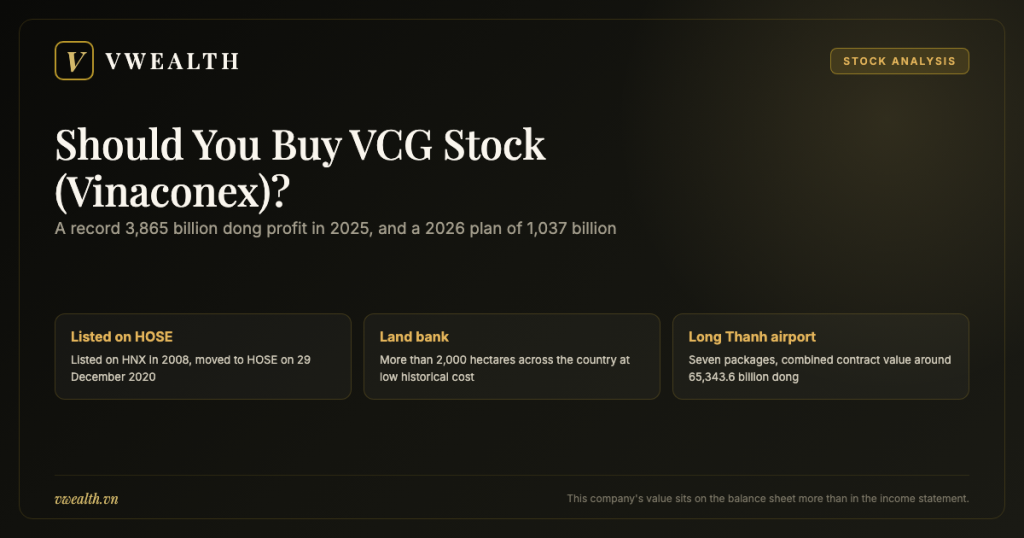
Should you buy VCG stock — the HOSE-listed shares of Vietnam Construction and Import-Export Joint Stock Corporation, known everywhere as Vinaconex — is a question you cannot answer by looking at last year’s profit. In 2025 the company reported consolidated net profit of 3,865 billion dong, the highest in its history. The very next year, management put a plan of 1,037 billion dong to shareholders, roughly 73% lower. There is no contradiction in that, and understanding why is the key to reading this business correctly. This article traces the company from a 1988 outfit that managed Vietnamese workers abroad, through the landmark 2018 state divestment, to the legal shock and leadership change of 2026 — and ends with a straight answer about which kind of investor this stock suits and which kind it does not.
Before we start, one convention between you and this article, the same one that governs every company analysis in this series. You will meet many dates, project names, individuals and scale figures. All come from public disclosure: exchange filings, shareholder meeting resolutions, statements from the competent authorities, and mainstream media. What you will not find is a valuation multiple as of today or a figure for the most recent quarter. For a construction contractor, quarterly results depend on the timing of works acceptance — meaning one quarter tells you almost nothing about long-term health. Instead this article teaches you where to look and how to read it; for current numbers, open the latest research reports on vwealth.
The second convention matters more, and it applies specifically to this ticker right now. Part of this article deals with a criminal case in which prosecutors have charged two people who held positions on the board and in management. The article states what has been officially disclosed: who was charged, under which article of the penal code, which authority approved the decision, and how the company handled it at the personnel level. The article does not speculate about outcomes, attributes no responsibility beyond what prosecutors have stated, and does not widen the scope of the matter. The presumption of innocence applies in full: a person who has been charged is not a person who has been convicted until a court judgment has taken legal effect.
The third convention: this is not a buy or sell recommendation. The final chapter states plainly who this stock suits, but the decision remains yours.
From managing workers abroad to a leading infrastructure contractor
One detail about Vinaconex’s origin surprises most investors, and it explains both the name and the way the company operates: Vinaconex did not begin as a construction company.
1988: created to manage Vietnamese labour overseas
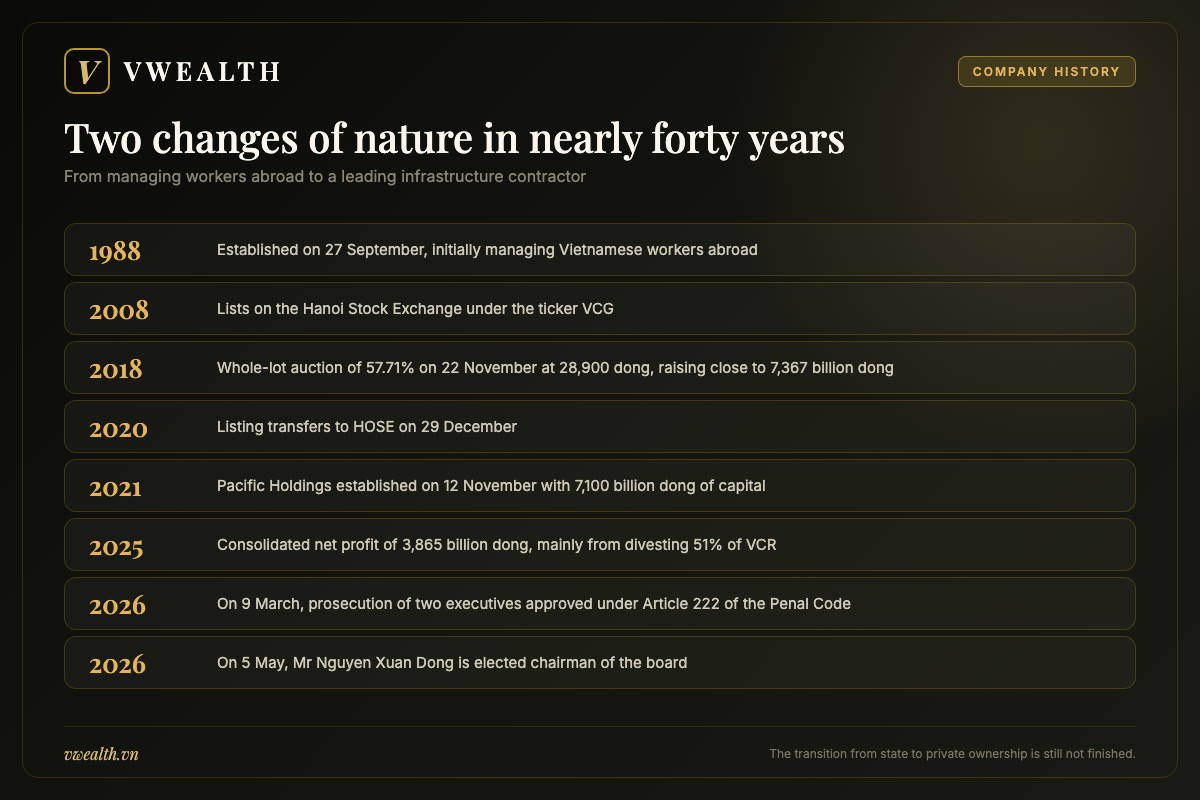
On 27 September 1988 the predecessor of Vinaconex was established as a foreign services and construction company under the Ministry of Construction, with the initial mandate of managing the Vietnamese workforce employed abroad.
Put that in context. In the late 1980s Vietnam sent tens of thousands of workers to Eastern Europe and the Middle East under labour cooperation agreements. Managing a workforce of that size required a single organising body to handle contracts and coordination. Vinaconex was created to do that job.
That detail explains a characteristic that persists today: the business has deep state-sector roots, experience organising large labour forces, and long-standing relationships within the construction administration. Those three things are simultaneously an asset and a constraint, and you will see both sides throughout this article.
From the 1990s to 2008: becoming a diversified construction corporation
As the overseas workforce returned, the company pivoted into the trade that workforce had learned: construction. From there Vinaconex expanded into a diversified corporation with construction contracting at the core, alongside real estate, building materials, water supply and education.
That model was typical of Vietnamese state corporations of the era: horizontal expansion into many fields through dozens of member companies. It leveraged the parent’s reputation and relationships, but it dispersed resources and created a very complex ownership structure.
In 2008 Vinaconex shares listed on the Hanoi Stock Exchange under the ticker VCG. From that point outside investors could, for the first time, see inside the company through periodic financial statements.
22 November 2018: the state divestment that changed the owner
This is the largest turning point in the company’s history, and it deserves telling properly.
In 2018 the state decided to divest entirely from Vinaconex. On 22 November 2018 a whole-lot auction of 254.9 million shares, equal to 57.71% of charter capital held by the State Capital Investment Corporation, was held at the Hanoi Stock Exchange. The winning price was 28,900 dong per share, bringing the seller close to 7,367 billion dong — considerably above the reserve price. An Quy Hung Company won that lot. In the same period the military telecommunications group Viettel also divested its stake, and the two auctions together raised close to 9,400 billion dong.
You need to grasp what 57.71% means to see why this was pivotal. That was not a financial investment. That was outright control of a leading construction corporation, with thousands of hectares of land and dozens of member companies, passing from the state to a private enterprise in a single auction.
The period immediately afterward was not smooth. Transferring control of a large corporation with many entrenched interests always brings governance disputes, and Vinaconex was no exception. But eventually the new shareholder group took operational control and began restructuring the business around three main pillars. The broader context of Vietnam’s state divestment programme is covered in our guide to Vietnamese state-owned enterprises.
29 December 2020: moving to the Ho Chi Minh City exchange
On 29 December 2020 VCG shares transferred their listing from the Hanoi Stock Exchange to the Ho Chi Minh City Stock Exchange.
For a business that had just changed owner, that was a practical step. HOSE offers deeper liquidity, indices that funds track, and higher disclosure standards. The move gave the stock access to a wider institutional investor base.
2021: Pacific Holdings and a rearranged ownership chain
On 12 November 2021 Pacific Holdings Joint Stock Company was established with charter capital of 7,100 billion dong, in which An Quy Hung Company held 99.92%, with the remainder split among several individuals who are company executives.
This restructured the ownership chain: the Vinaconex stake was concentrated into an intermediate holding entity rather than sitting directly with the parent enterprise. From there Pacific Holdings became the largest shareholder and at one point held as much as 62.9% of Vinaconex.
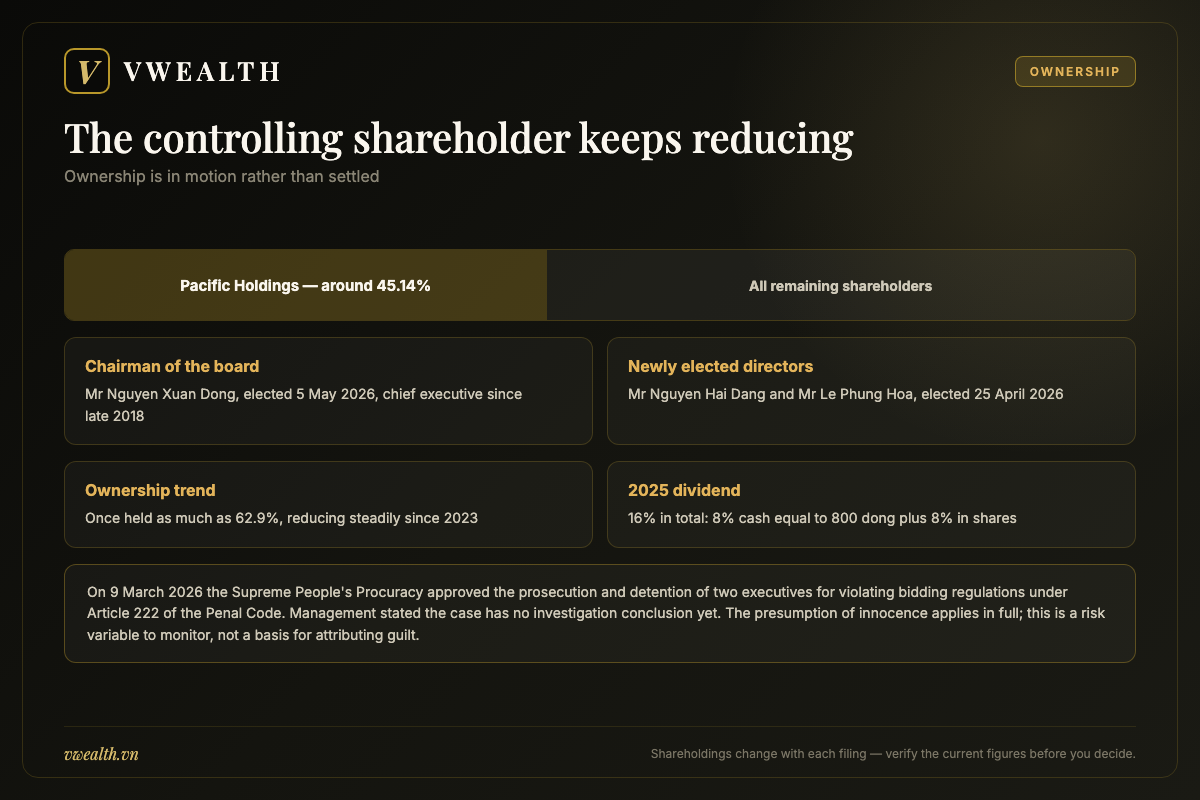
From 2023 Pacific Holdings sold down continuously, reducing its holding to around 45.14% as of mid-2025. In December 2025 Pacific Holdings itself sharply reduced its own charter capital, from 7,100 billion dong to 4,970 billion dong.
That sequence deserves attention rather than dismissal. When a controlling shareholder reduces its stake across multiple rounds, several explanations are possible and none is automatically correct. The right thing for a minority investor to do is to record the events, follow subsequent disclosures, and allow for the possibility that the ownership structure will keep changing.
2025: a record profit year built on selling an asset
In 2025 Vinaconex reported consolidated net profit of 3,865 billion dong, the highest in company history. Profit at the parent company alone was 1,287 billion dong.
The source of that record has been clearly disclosed: it came principally from divesting 51% of Vinaconex Tourism Real Estate Joint Stock Company, ticker VCR, the developer of the Cat Ba Amatina resort project.
This is the single most important detail in the article, so pause here. The 3,865 billion dong did not come from winning and executing construction contracts. It came from selling an investment. It is genuine profit, recorded correctly under accounting standards, and it brought in real cash. But it is one-off profit that does not repeat the following year. Chapter four will teach you how to separate the two kinds of profit, because that is the single most important skill when reading a construction and property business.
2026: a legal shock and a change at the top
In early 2026 the company entered its most difficult period since the change of ownership.
On 9 March 2026 the Supreme People’s Procuracy approved the decision to prosecute and the arrest warrants for temporary detention of Mr Nguyen Huu Toi, former chairman of the board and deputy general director, and Mr Duong Van Mau, board member and deputy general director, on the charge of violating bidding regulations causing serious consequences under Article 222 of the Penal Code.
At the annual general meeting on 25 April 2026, shareholders removed both individuals from the board and elected two new members, Mr Nguyen Hai Dang and Mr Le Phung Hoa. On 5 May 2026 Mr Nguyen Xuan Dong was elected chairman of the board for the 2022 to 2027 term.
On the operational impact, the chief executive told the meeting that the case has no investigation conclusion yet so the risk cannot be fully assessed, and that any effect would appear in the 2026 results rather than in 2025. That is the official statement and this article records it as such, without further interpretation.
A summary of the key milestones
| Date | Event | What it means for an investor today |
|---|---|---|
| 27 Sep 1988 | Predecessor established, initially managing Vietnamese workers abroad | Deep state-sector roots and experience organising large workforces |
| 1990s to 2007 | Expands into a diversified corporation with construction at the core | A structure of many member companies, complex and needing later restructuring |
| 2008 | Lists on HNX under the ticker VCG | First subject to listed-company disclosure standards |
| 22 Nov 2018 | Whole-lot auction of 254.9 million shares, 57.71% of capital, at 28,900 dong, raising close to 7,367 billion dong | Control passes from the state to the private sector |
| 2018 | Viettel also divests; the two auctions together raise close to 9,400 billion dong | The state exits the business entirely |
| 29 Dec 2020 | Listing transfers from HNX to HOSE | Deeper liquidity and a wider institutional base |
| 12 Nov 2021 | Pacific Holdings established with 7,100 billion dong capital, An Quy Hung holding 99.92% | The controlling stake is concentrated into an intermediate entity |
| 2023 to 2025 | Pacific Holdings reduces its holding to around 45.14%; cuts its own capital to 4,970 billion dong in December 2025 | The ownership structure is in motion; watch subsequent disclosures |
| 2025 | Consolidated net profit of 3,865 billion dong, principally from divesting 51% of VCR | One-off profit that does not repeat; must be separated from recurring earnings |
| 9 Mar 2026 | Prosecution and detention of two executives approved under Article 222 of the Penal Code | Legal risk at the individual level; monitor through official disclosure |
| 25 Apr 2026 | Shareholders remove two directors and elect Mr Nguyen Hai Dang and Mr Le Phung Hoa | Board reconstituted |
| 5 May 2026 | Mr Nguyen Xuan Dong elected chairman of the board | The long-serving chief executive takes the top seat as well |
Read the table vertically and you see a business that has changed its nature twice: once moving from labour management into construction, and once moving from state to private ownership. The second change happened less than a decade ago, and what is unfolding today is still part of it.
Who runs VCG and who actually owns it
For a construction contractor, the question of who is at the wheel matters in a very specific way: the person at the top decides which packages the company bids for, at what margin, and how much execution risk it accepts. A wrong decision at the tender stage can produce losses across several years of construction, because a signed contract cannot be rewritten.
Leadership after the 2026 reconstitution
On 5 May 2026 Mr Nguyen Xuan Dong was elected chairman of the board of Vinaconex for the 2022 to 2027 term. Mr Dong is not a newcomer: he has served as chief executive since late 2018 — immediately after the state divestment — and has sat on the board since early 2019.
Before that, at the annual general meeting on 25 April 2026, shareholders removed two board members and elected Mr Nguyen Hai Dang, currently a deputy general director, and Mr Le Phung Hoa, a construction sector executive.
Read this sequence as an analyst. Three things follow.
First, having the longest-serving executive also take the chair provides continuity during a turbulent period. For a contractor, relationships with project owners and with joint venture partners are assets, and continuity helps preserve them.
Second, combining the two most senior roles is always a governance point to note. Modern governance standards encourage separating the board’s oversight function from management’s executive function, precisely so the board can supervise management independently. When both roles sit with one person, that oversight function weakens. This is not an accusation of anything — it is a structural feature to record and to monitor through the role of independent directors. Our guide to corporate governance in Vietnam sets out the full checklist.
Third, adding two new directors after two were removed is procedurally correct. What you should watch is the degree of genuine independence on the reconstituted board, and whether the company strengthens internal control and compliance functions following the events.
The bidding regulations case: stating only what has been officially disclosed
This is the section to read slowly, and the article will write it slowly.
The officially disclosed facts are as follows. On 9 March 2026 the Supreme People’s Procuracy approved the decision to prosecute and the arrest warrants for temporary detention of Mr Nguyen Huu Toi and Mr Duong Van Mau, on the charge of violating bidding regulations causing serious consequences under Article 222 of the Penal Code. Mr Nguyen Huu Toi was formerly chairman of the board and deputy general director; Mr Duong Van Mau was a board member and deputy general director.
The company filed a disclosure about the matter, and at the annual general meeting on 25 April 2026 management answered shareholder questions on it. The official position stated was: the case has no investigation conclusion yet so the level of risk cannot be fully assessed, and any impact would appear in the 2026 results rather than in 2025.
Four things this article will not do, and which you should not do either in your own analysis.
One, no speculation about outcomes. Being charged is a procedural step, not a finding of guilt. Under the presumption of innocence written into Vietnam’s constitution and criminal procedure code, a person is considered guilty only when a court judgment convicting them has taken legal effect.
Two, no widening of scope. The individuals charged and the scope of the case are what the competent authorities have published. Speculating about other packages or other individuals is baseless.
Three, no conflation of individual liability with corporate liability. These are separate legal subjects, and individuals being charged does not automatically mean the corporate entity faces sanction.
Four, no conversion of the matter into an investment thesis in either direction. Do not buy assuming the risk has passed. Do not permanently exclude the stock assuming the business has been decided.
So what should an investor do with this? Treat it as a risk variable to monitor, and monitor through official channels. Specifically four: the company’s extraordinary disclosures; the notes on provisions and contingent liabilities in the audited financial statements; the auditor’s opinion; and the trend in newly signed contract value. The fourth is the most practical for a contractor, because if the ability to participate in tenders is affected, that will show up in new contract awards well before it shows up in profit.
This series has applied the same approach to other names with comparable histories. You can see how it was handled in the separate analysis of DGC, Duc Giang Chemicals, where stating the facts and attributing nothing is what keeps an analysis useful.
Ownership: a large shareholder that keeps reducing
Vinaconex’s largest shareholder is Pacific Holdings Joint Stock Company, holding 270.2 million VCG shares, equal to roughly 45.14% of charter capital as of mid-2025.
Pacific Holdings was established on 12 November 2021 with initial charter capital of 7,100 billion dong, in which An Quy Hung Company held 99.92%, the remainder split among several individuals who are company executives. At one point Pacific Holdings held as much as 62.9% of Vinaconex, then sold down continuously from 2023 to reach the current level. In December 2025 Pacific Holdings reduced its own charter capital from 7,100 billion dong to 4,970 billion dong.
Read this in three layers, because it is one of the most important elements of the investment case.
The first layer is the degree of control. A holding of roughly 45% is enough for practical control in most situations, because the remaining shareholders are dispersed and attendance at meetings rarely reaches the maximum. But it falls below the threshold needed to pass resolutions requiring a supermajority. Practical power is substantial but not absolute.
The second layer is the trend. The controlling shareholder reducing its stake across multiple rounds since 2023 is a fact to record. Several explanations are possible and this article will not guess. The correct position is to note that the ownership structure is in motion rather than settled, and to allow for further change.
The third layer is the consequence for minority holders. As the largest holder’s stake falls and the free float rises, liquidity usually improves — that is the favourable side. But each large sale creates supply pressure in the short term — that is the unfavourable side. Both are mechanical consequences, not judgments about anyone’s intentions.
Dividends and the capital increase
This is a notable difference between VCG and many other listed construction names: the company pays a regular cash dividend.
Under the plan put to the 2026 meeting, the 2025 dividend totals 16%, comprising 8% in cash equal to 800 dong per share and 8% in shares. The stock portion involves issuing roughly 51.7 million shares, raising charter capital from roughly 6,465 billion dong to roughly 6,982 billion dong.
Three things follow from this plan.
First, the cash portion is real money leaving the business, and for a contractor perpetually short of working capital, still being able to pay cash is a positive liquidity signal. That is especially meaningful in a year when the company received real cash from a divestment.
Second, the stock portion is not money. It simply divides the same pie into more slices. Your share count rises but your ownership percentage does not, and the reference price is adjusted accordingly. A great many retail investors misread this as a gain, and that misreading leads directly to mispricing.
Third, after the issue, every per-share metric must be recalculated on the new share count. Earnings per share and book value per share from prior years are no longer directly comparable unless you adjust them.
Ownership and leadership at a glance
| Item | Disclosed position | What an investor should take from it |
|---|---|---|
| Largest shareholder | Pacific Holdings with 270.2 million shares, roughly 45.14% as of mid-2025 | Practical control, but short of a supermajority |
| Structure above | Pacific Holdings established 12 November 2021, An Quy Hung holding 99.92% | Control sits in an intermediate holding entity |
| Ownership trend | Once held 62.9%, reducing since 2023; own capital cut to 4,970 billion dong in December 2025 | The ownership structure is in motion; follow subsequent disclosures |
| Chairman | Mr Nguyen Xuan Dong, elected 5 May 2026 for the 2022 to 2027 term | Long-serving executive, providing continuity through turbulence |
| New directors | Mr Nguyen Hai Dang and Mr Le Phung Hoa, elected 25 April 2026 | Board reconstituted after two members were removed |
| Legal matter | Prosecution and detention of two executives approved on 9 March 2026 under Article 222 | Monitor via official disclosure and newly signed contract value |
| Official statement | No investigation conclusion yet; any impact falls in 2026 | Recorded as stated, without further interpretation |
| 2025 dividend | 16% total: 8% cash equal to 800 dong per share plus 8% in shares | The cash portion is real; the stock portion only divides the same pie |
| Capital increase | Roughly 51.7 million shares issued; charter capital from roughly 6,465 to 6,982 billion dong | Every per-share metric must be recalculated on the new count |
How VCG makes money: three pillars and how they feed each other
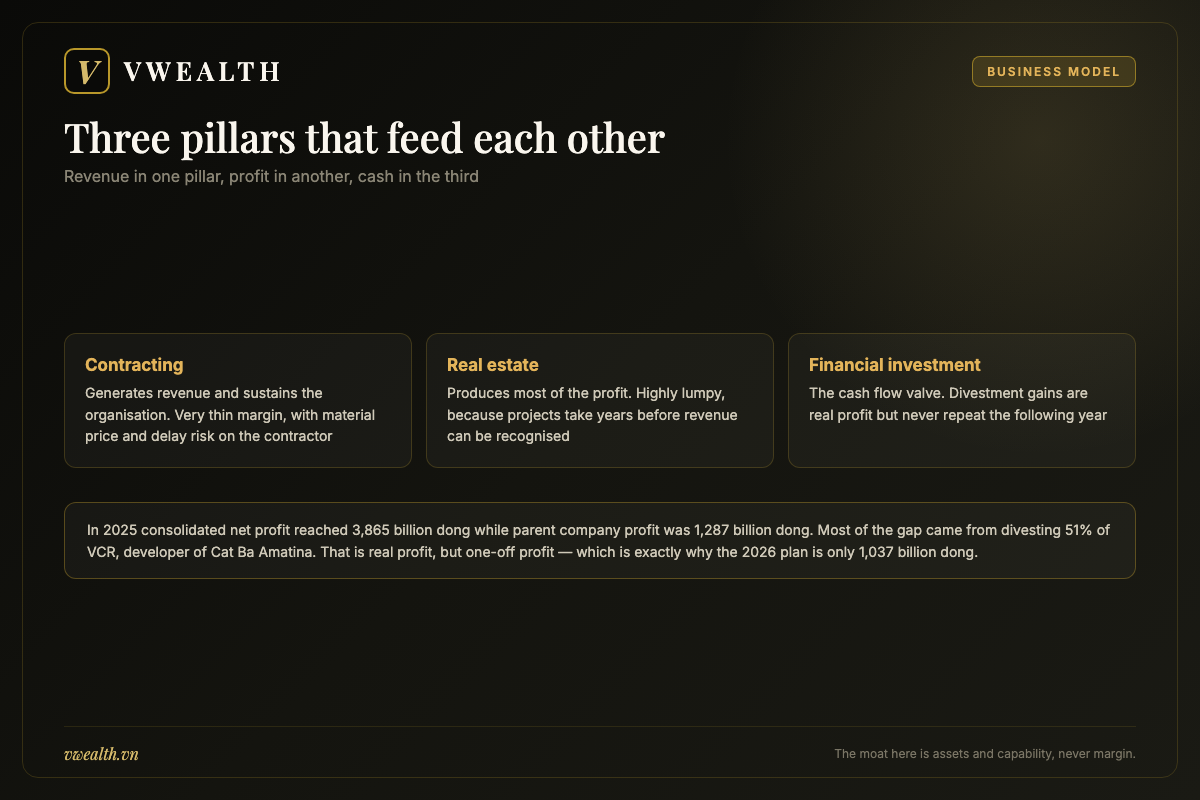
Vinaconex operates around three main pillars: construction contracting, real estate, and financial investment. They differ so fundamentally that each requires its own yardstick, and more importantly, you have to understand how they feed one another.
Pillar one: contracting — large scale, thin margin, heavy execution risk
This is the core trade and the pillar that generates most revenue. Vinaconex is among Vietnam’s largest contractors, involved in a series of major infrastructure works.
In expressways, the company has executed multiple packages within phase two of the North-South expressway, including the Bai Vot to Ham Nghi, Vung Ang to Bung, and Van Phong to Nha Trang sections.
In aviation, in 2023 the company took part in a joint venture that won package 5.10 for construction and equipment installation at the Long Thanh airport passenger terminal, valued at around 35,000 billion dong. In total, Vinaconex has participated in seven packages at the Long Thanh airport project with combined contract value of roughly 65,343.6 billion dong.
Those numbers sound very large, and they are. But you must understand three features of the contracting trade before treating them as good news.
The first: contract value is not one year’s revenue. A thirty-five thousand billion dong package is built over several years, split among several joint venture members, with each recording only the work it performs. Whenever you read a contract award headline, ask three questions: who is in the joint venture, what is the company’s share of the work, and over how many years.
The second: contracting margins are very thin. In competitive tendering, bid prices are pushed down close to cost. After materials, labour, equipment and overhead, what remains is typically a low single-digit percentage of revenue. That is why a contractor with tens of thousands of billions in revenue still earns only a few hundred billion in profit.
The third: risk sits with the contractor, not the project owner. If steel or asphalt prices rise after the contract is signed, if the works are delayed by site clearance problems, if weather is prolonged and bad, most of the damage falls on the contractor. Contracts may contain price adjustment clauses, but the adjustment process takes time and never fully compensates.
Put the three together and you have the correct picture of contracting: it generates revenue and keeps the machine and the workforce busy, it builds the credibility needed to keep winning tenders, but it is not where large profit is made.
What a construction contract actually commits the contractor to
Because the contract is where a contractor’s fate is decided, it is worth understanding what one commits the company to.
A large infrastructure contract typically fixes four things at signing. The scope of work, defined by drawings and specifications. The price, usually a lump sum or a schedule of unit rates. The programme, with milestone dates and liquidated damages for delay. And the payment terms, which normally involve monthly valuations, a percentage retained until completion, and a further retention held through the warranty period.
Three consequences follow, and they explain most of what you will observe in the accounts.
The first is that the contractor carries the cost risk between signing and completion. Price adjustment clauses exist, but they usually track published indices rather than the contractor’s actual procurement cost, and the gap between the two is absorbed by the contractor. In a period of sharply rising material prices, that gap alone can exceed the entire tender margin.
The second is that the contractor finances the project. Work is performed, then valued, then certified, then paid — and the retention is held for a long time after that. Every stage of that chain adds days to the cash conversion cycle, which is why contractors carry structural short-term debt and why receivables dominate their balance sheets.
The third is that delay is expensive in two directions at once. Liquidated damages may apply, and the contractor’s fixed costs — site establishment, plant, supervisory staff — continue to run while the programme extends. Delays caused by the project owner are recoverable in principle through claims, but claims take years and rarely recover in full.
This is why an experienced analyst reads a contract award as a commitment as much as an opportunity. A large win at a thin price on a difficult site is not obviously better than no win at all, and the difference will not be visible in the accounts for two or three years.
Pillar two: real estate — where the real profit sits, but out of phase
This pillar carries far thicker margins than contracting, and it is where asset value accumulates.
Vinaconex holds a land bank of more than 2,000 hectares spread from north to south, and is the developer of a number of projects. Among those in progress and mentioned at the 2026 meeting are the Dong Anh industrial park at 300 hectares, the Son Dong industrial cluster at 72.5 hectares with total investment of 1,552 billion dong and phase one site clearance around 82% complete, and high-tech zone infrastructure work.
The most important thing to understand about real estate inside a business like this is the phase lag. A property project takes years from land acquisition to revenue recognition: site clearance, legal procedures, infrastructure investment, then sale or lease. Throughout that period costs flow out continuously while revenue is zero, and the entire outlay sits on the balance sheet as work in progress.
The consequence is that earnings at a business with a large property arm are highly lumpy: several ordinary years, then one exceptional year when a project is recognised. If you look at annual profit and extrapolate, you will be wrong repeatedly. That is exactly why chapter four devotes an entire check to separating recurring profit from one-off profit.
Industrial parks: why the shift matters more than it looks
Of everything in the current portfolio, the move toward industrial park development deserves more attention than it usually receives, because it changes the character of the property pillar rather than merely adding to it.
Residential and resort development earns its money in a single act: build, sell, recognise, move on. The cash comes in a burst and then the project is finished. That is why property developers show such lumpy earnings and why they must continuously replenish the land bank simply to stand still.
Industrial park development can work the same way, through outright land use right transfers for the full lease term, but it also supports a different model: leasing land and factory space on recurring terms, plus selling utilities and services to tenants for as long as they operate. The second model produces a smaller number each year but produces it every year, and it comes with tenants who have sunk substantial capital into their facilities and are therefore extremely unlikely to leave.
For a business whose central weakness is earnings volatility, adding a recurring revenue stream is worth more than the revenue itself. It reduces the amplitude of the cycle, gives the balance sheet an asset that generates cash rather than consuming it, and gives the market something to value on a multiple rather than on speculation about the next recognition event.
The caveat is timing. Industrial park projects are slow: land clearance, infrastructure investment, then a fill-up period that can take years even in a strong foreign investment environment. The Son Dong cluster at 72.5 hectares with phase one clearance at around 82% is at an early stage of that journey, and the Dong Anh park at 300 hectares is larger and correspondingly slower.
What to watch, therefore, is not the announcement but the fill rate. Once a park begins leasing, the percentage of leasable area occupied, disclosed period by period, tells you whether the strategy is producing the recurring stream it promises. Until then, these projects are capital consuming rather than capital returning, and should be valued as such.
Pillar three: financial investment — and the lesson from 2025
The third pillar is the portfolio of stakes in member and associate companies. It is a legacy of the diversified state corporation model, and also the tool the company uses to restructure.
The most illustrative transaction is the 2025 divestment of 51% of Vinaconex Tourism Real Estate Joint Stock Company, ticker VCR, developer of the Cat Ba Amatina project. That transaction was the principal source of the 3,865 billion dong consolidated net profit — the highest in company history — while parent company profit alone was 1,287 billion dong.
Use this transaction as a lesson, because it illustrates three principles at once.
Principle one: divestment profit is real profit but does not repeat. It brings in real cash, genuinely improves the balance sheet, and can fund debt repayment or dividends. But the following year the company no longer owns that asset to sell. That is why the 2026 plan of 1,037 billion dong sits roughly 73% below the 2025 outcome — and that decline is not a sign of deterioration.
Principle two: selling a large project means selling that project’s future profit stream. Cat Ba Amatina is a large resort development, and in selling the controlling stake the company exchanged many years of future profit for cash today. Whether that was right depends on the price achieved and on what the cash is used for. There is no universal answer.
Principle three: the gap between consolidated profit and parent company profit is information, not noise. In 2025 those two figures were 3,865 billion dong and 1,287 billion dong. The gap tells you most of the result came from member companies and consolidation effects rather than from the parent’s own operations. For a business with many subsidiaries, comparing these two figures across years is one of the cheapest and most useful checks available.
How the three pillars feed one another
The elegance of this model is that the pillars are not independent.
Contracting produces steady revenue to sustain the organisation and retain the workforce. In construction, losing people means losing capability, and keeping a skilled site team requires continuous work — including thin-margin packages.
Real estate produces profit. And the best part: when the company develops its own property projects, it can award the construction work to itself. The margin that would otherwise go to an outside contractor stays inside the group. This is a genuine structural advantage of combining developer and contractor.
Financial investment acts as a regulating valve. When cash is needed, the company divests a stake. When opportunity appears, it invests in a new project.
The drawback must be stated equally clearly. All three pillars depend on a common variable: the investment and property cycle. When the property market freezes, the property arm stalls, the contracting arm loses private clients, and the value of financial investments falls too. The three pillars do not diversify risk the way the name suggests — they all lean the same way.
Comparing the three pillars
| Pillar | Role | Margin | Regularity | Principal risk |
|---|---|---|---|---|
| Contracting | Generates revenue, sustains the organisation and tender credibility | Very thin, a low single-digit share of revenue | Steady, following works acceptance progress | Material price rises after signing; delays; long receivables |
| Real estate | Produces most of the profit and accumulates asset value | Far thicker than contracting | Highly lumpy, concentrated in recognition years | Long legal procedures; costs parked as work in progress for years |
| Financial investment | Cash flow valve and portfolio restructuring tool | No recurring margin, only gains or losses on divestment | Irregular, entirely dependent on transaction timing | One-off profit easily mistaken for recurring capability |
The table is also a map for reading any VCG headline. A contract award belongs in the first row: good for revenue, limited meaning for profit. News about a project’s legal progress belongs in the second: important for profit several years out. A divestment belongs in the third: large immediate impact that does not repeat.
Where the moat is and where it is thin
For a construction contractor, moats are hard to build, because the product is close to identical and the contest is decided on bid price.
Three genuine sources of advantage exist: the capability to execute complex works, relationships with project owners and the administration, and the land bank.
On execution capability, participating in works like an airport passenger terminal and major expressway sections is evidence of technical and organisational capacity. That is a genuine moat but a bounded one: the number of Vietnamese contractors able to handle such works is small, but it is not one.
On relationships, this is a genuine moat in every construction market in the world, and also the most sensitive area. It is precisely because relationships have value that bidding regulation exists and keeps tightening. This article makes no further comment beyond recording that compliance risk in tendering is a structural risk of the whole industry rather than of any one company.
On land, more than 2,000 hectares spread across the country is an asset that cannot be recreated quickly. Land accumulated during the state corporation era typically carries a very low book cost relative to today’s values. This is probably the company’s most durable moat — but it only has value once brought into use, and bringing it into use depends on legal procedures beyond the company’s control.
The honest conclusion: VCG’s moat is an asset moat and a capability moat, not a margin moat. You do not buy this stock because it earns a lot on each dong of revenue — it does not. You buy it if you believe the asset base it holds will be converted into profit in the years ahead.
Position and financial health: seven things to check before you buy VCG stock
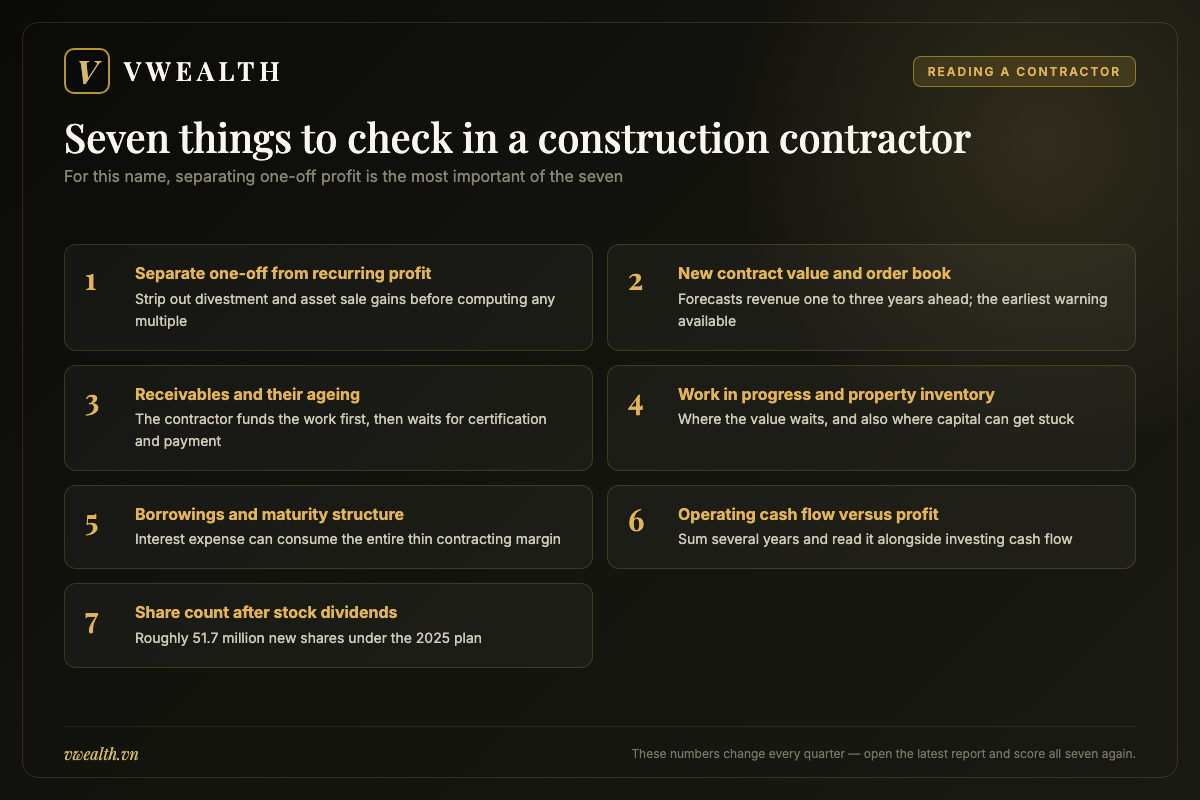
This chapter is the teaching section. The seven checks below form a framework for reading any construction contractor with a property arm, with notes on what each requires specifically for VCG.
Check 1: separate recurring profit from one-off profit
For this company this is the most important of the seven, and 2025 gave you a perfect example.
The method is simple and takes ten minutes. Open the income statement, find financial income and other income, read the notes to see whether they contain gains from divestment or asset sales, then subtract those from profit. What remains is core operating profit — the part with a chance of repeating next year.
For VCG, the gain from divesting 51% of VCR accounted for most of the record 3,865 billion dong in 2025. If you use 3,865 billion dong to compute a valuation multiple, you will get an extremely attractive number that is entirely wrong. The company itself gave you the clue: the 2026 plan is 1,037 billion dong, roughly 73% lower.
Check 2: newly signed contract value and the remaining order book
For a contractor this is the best forward indicator, because it tells you revenue one to three years out.
How to read it properly: track contract value signed during the year, and the total value of contracted work not yet executed. A contractor holding an order book equal to two or three years of revenue has reasonable visibility. A contractor whose backlog is thinning is losing momentum, however good this year’s result looks.
For VCG at present, this is also the indirect test of the legal risk question. If the ability to participate in tenders is affected, it will show up in newly signed contract value before it shows up in profit — potentially several quarters earlier. That is why this article recommends watching this metric more closely than any other in the period ahead.
Check 3: receivables and their ageing
This is the chronic condition of every Vietnamese construction contractor, and it is particularly severe on budget-funded works.
The mechanism is simple: the contractor buys materials, pays wages, completes the work, then waits for acceptance and payment. That wait can run several quarters, and years for retention amounts held against warranty. Throughout, the contractor funds itself with its own capital or with bank borrowings.
How to read it properly: compute average days of receivables and track it across periods; open the notes to see the share of overdue receivables and the provisions taken. Receivables growing faster than revenue is the earliest warning signal, because it means revenue is being recognised without cash being collected.
Check 4: work in progress and property inventory
This is where the property arm’s value waits, and where its risk waits too.
At a company with a large land bank this line is usually very large and grows year by year as projects are funded. That is normal. The question is whether it converts into revenue, and when.
How to read it properly: open the notes to see which projects the work in progress is allocated to, then compare with the legal and site clearance progress the company discloses. A project with large accumulated costs but legal progress frozen for years signals capital that is stuck. Conversely, a project like the Son Dong industrial cluster with phase one clearance at around 82% is genuinely advancing.
Check 5: borrowings and maturity structure
Construction contractors always carry debt, because the model requires funding working capital while waiting for payment. The questions are magnitude and structure.
How to read it properly: look at total borrowings to equity, split by maturity, and compute interest expense relative to operating profit. For a business with thin contracting margins, interest expense is large enough to consume that pillar’s entire profit.
For VCG, the company received a large sum from the 2025 divestment, so what deserves watching is where that money went. If used to reduce debt, the balance sheet strengthens and interest costs fall in subsequent years. If used to invest in new projects, asset scale grows but leverage does not fall. Both are reasonable choices, but they lead to very different risk profiles, and you need to know which one was made.
Check 6: operating cash flow versus profit
For a construction and property business, this is the most honest number in the whole report, and also the one most often negative.
Negative operating cash flow at a company developing many projects is normal, because cash is flowing into work in progress. What is not normal is negative cash flow across many consecutive years while profit is recorded steadily — at which point you must ask where that profit resides.
How to read it properly: sum operating cash flow across three to five years and compare with total net profit for the same span, and look alongside at investing cash flow for the complete picture. Our guide to reading Vietnamese financial statements covers where these items sit under local accounting standards.
Check 7: shares outstanding after stock dividends
This is basic but the most frequently skipped.
With the 2025 dividend plan including an 8% stock component, the company issues roughly 51.7 million additional shares and charter capital rises from roughly 6,465 billion dong to roughly 6,982 billion dong. After that, every per-share metric must be recalculated.
The check takes three minutes: take shares outstanding from the most recent statement, add every issuance approved by shareholders but not yet completed, and use that total as the denominator in all your calculations. The principle applies to every stock, not just VCG.
How the seven checks fit together
The seven checks are not an independent list to tick off. They form a chain, and reading them as a chain is what separates useful analysis from a spreadsheet exercise.
Start with the separation of one-off from recurring profit, because that establishes what the business actually earns. Then move to the order book, which tells you whether that earning power has fuel for the next few years. Then to receivables and work in progress, which tell you how much capital is tied up producing those earnings. Then to borrowings, which are the consequence of that capital being tied up. Then to cash flow, which reveals whether the whole chain is self-sustaining or continuously fed by external funding.
Reading it as a chain tells you which combinations are healthy and which are warnings. A stable order book with a shortening receivables cycle and positive cumulative operating cash flow is genuine health, however unspectacular the profit line. A growing order book alongside lengthening receivables and rising debt is growth being purchased with the balance sheet.
The most dangerous combination to recognise early is profit rising while working capital deteriorates. It looks like success in a headline and it is the standard early pattern of a contractor accepting work on terms it should have declined. When you see it, check whether receivables and work in progress grew faster than revenue. If both did, the profit is being lent to the counterparties rather than earned from them.
None of this requires sophisticated modelling. It requires four numbers from the balance sheet, three from the income statement, and one from the cash flow statement, computed consistently across several years. That is the whole exercise, and it is more informative than any target price you will read about this company.
What the seven checks say about VCG
Put them together and the financial portrait is clear. VCG is a very large contractor with thin contracting margins, holding a substantial land asset base that is not yet fully exploited, coming off a year of exceptional profit driven by an asset sale rather than by core operations, and entering a period with unresolved legal risk.
That is the portrait of a business whose value sits on the balance sheet more than in the income statement. For that kind of business, asset-based valuation carries more meaning than earnings-based valuation — which is the subject of the next chapter.
How the market treats VCG stock: a public investment name
The business is one thing; the stock is another. This chapter is about the second half.
Why asset-based valuation carries more meaning here
The price-to-earnings ratio is the most familiar tool, but for VCG it is close to useless in isolation, for the reason you saw in chapters three and four: profit is lumpy year to year, depending on which project is recognised and which stake is sold.
2025 is the perfect illustration. On 3,865 billion dong of profit, the earnings multiple looks very low. On the 2026 plan of 1,037 billion dong, the same share price produces a multiple almost four times higher. The business has not changed; only the denominator has.
Price to book is far steadier, because the denominator is equity, which moves slowly. But for a company with a large land bank, even this measure carries an important limitation you must know: land is carried at historical cost, not at market value. For land accumulated during the state corporation era, that cost can be far below today’s value.
The consequence is that book value may understate the real asset base. That is the familiar argument of anyone investing in property stocks with large land holdings. But that argument is only half right unless you ask the second question: when will the land be brought into use, and how much of it is genuinely developable from a legal standpoint? A hectare in a prime location entangled in procedure for ten years is worth far less in present value terms than a spreadsheet suggests. Our guide to Vietnamese real estate stocks covers how to handle this.
This article does not state VCG’s current valuation, in line with the convention at the top. Open the current research on vwealth for the day you are reading, and remember to adjust for the new share count after the stock dividend.
The personality of the stock
Every stock has a trading personality, and personality determines whether you can hold it comfortably.
VCG has a very strong one, for four reasons combined.
First, it is a public investment name. Whenever there is news about budget disbursement, a new infrastructure project, or policy to accelerate construction, the whole group reacts at once and reacts hard.
Second, it holds a large land bank. Stocks with land assets are always sensitive to expectations about the property market, and expectations shift far faster than reality.
Third, lumpy annual profit means valuation estimates vary widely between analysts, and that spread translates into price volatility.
Fourth, at present the stock carries an additional layer of volatility from news related to the legal matter and to the actions of the largest shareholder. Both types of news are hard to anticipate and both produce strong reactions.
Practical conclusion: this is not a stock for anyone who wants quiet. If you hold VCG, prepare for sharp sessions driven by a single headline, and for stretches where the price moves entirely against the operating results.
There is one more feature of the personality worth naming, because it is easy to misread as a defect. The market’s opinion of an asset-heavy business can change far faster than the assets themselves. A shift in expectations about how quickly a land bank will be developed, or about how favourably a legal matter will resolve, is a shift in a probability rather than in anything physical — and probabilities move in hours. Investors used to businesses where price roughly tracks operating reality find this disconcerting.
The correct response is not to trade around it. It is to accept that the price will be noisier than the business, to build the position in tranches rather than in one order, and to judge whether you were right by the operating indicators rather than by the quotation. If the order book holds, work in progress converts, and cash flow tracks profit over a full cycle, the thesis is intact regardless of what any three-month stretch of price action suggests.
Recognition timing: why quarterly comparisons mislead here
One practical point that trips up investors new to Vietnamese construction names: quarterly results are driven by recognition timing rather than by underlying activity, and the two can diverge substantially.
On the contracting side, revenue is recognised as work is certified. Certification depends on the project owner’s processes, on paperwork, and on how far along the programme sits — none of which follows a neat calendar. A quarter with heavy site activity but no certification milestone will look weak. A quarter where several milestones land together will look exceptional. Neither says much about the business.
On the property side, the effect is far larger. Revenue from a project is typically recognised in concentrated bursts once handover conditions are met. That means a single project can dominate a full year’s result, and its absence can make the following year look like collapse. This is the mechanism behind the 2025 to 2026 profile, amplified by the divestment gain.
The consequence is a discipline: compare each quarter with the same quarter a year earlier, never with the immediately preceding one, and when comparing full years, first identify which specific events drove each result. If you cannot name the events, you have not understood the comparison.
A second-order effect worth noting: because both revenue streams are recognition-driven, the operating cash flow statement often diverges sharply from reported profit in any single period. Over a full project cycle the two converge. Over a single year they may tell opposite stories, and the cash flow statement is the one closer to reality.
Dividends: a genuine advantage within the construction group
Among listed Vietnamese construction and property names, many pay no cash dividend at all because they are perpetually short of working capital. VCG maintaining a cash component is a difference worth recording.
With the 2025 plan including 8% in cash equal to 800 dong per share, you receive a periodic cash flow, however modest. The value is not in the absolute figure but in the signal: a company that can pay cash has cash, and in construction that is not a given.
But do not classify VCG as a dividend stock. The yield at this level is not enough to be the main reason to buy, and the lumpy nature of the business means there is no guarantee the payout is sustained evenly across years.
Foreign investors and liquidity
Construction is not among the sectors subject to a low foreign ownership cap. What matters more for this name is the trajectory of the free float.
As the largest shareholder’s stake fell from a peak of 62.9% toward around 45.14%, the freely tradable portion rose correspondingly. Over the long run that helps liquidity and the chance of appearing on index funds’ radar. In the short run, each large sale creates supply pressure. Those two effects run in opposite directions and you should keep them separate when reading price action.
Comparing VCG with the other choices in infrastructure and construction
The listed universe of businesses that benefit from public investment and construction is more varied than it looks.
| Model | Main revenue source | Advantage | Drawback |
|---|---|---|---|
| Contractor and developer combined, like VCG | Contracting plus property plus divestment gains | Retains the internal margin when building its own projects; holds land | Lumpy profit; all three pillars lean on one cycle |
| Infrastructure toll operator | Tolls from completed works | Steady, forecastable cash flow across many years | Very high leverage inherent to the model; depends on actual traffic |
| Pure contractor | Construction work only | Simple model, easy to read, little capital locked in projects | Very thin margin, no asset accumulation, wholly dependent on backlog |
| Building materials supplier | Sells materials to the whole industry | Benefits from every project, not tied to one owner | Commodity price cycle; fierce price competition |
For a full comparison, read the separate analyses in this series: CII represents the toll operator model with steady cash flow and high leverage, PC1 represents a specialist contractor with its own investment arm, HPG represents the materials supplier benefiting from every project, and KBC represents industrial park development — the very segment VCG is now pushing into. Against those four you will see which flavour of risk you are choosing.
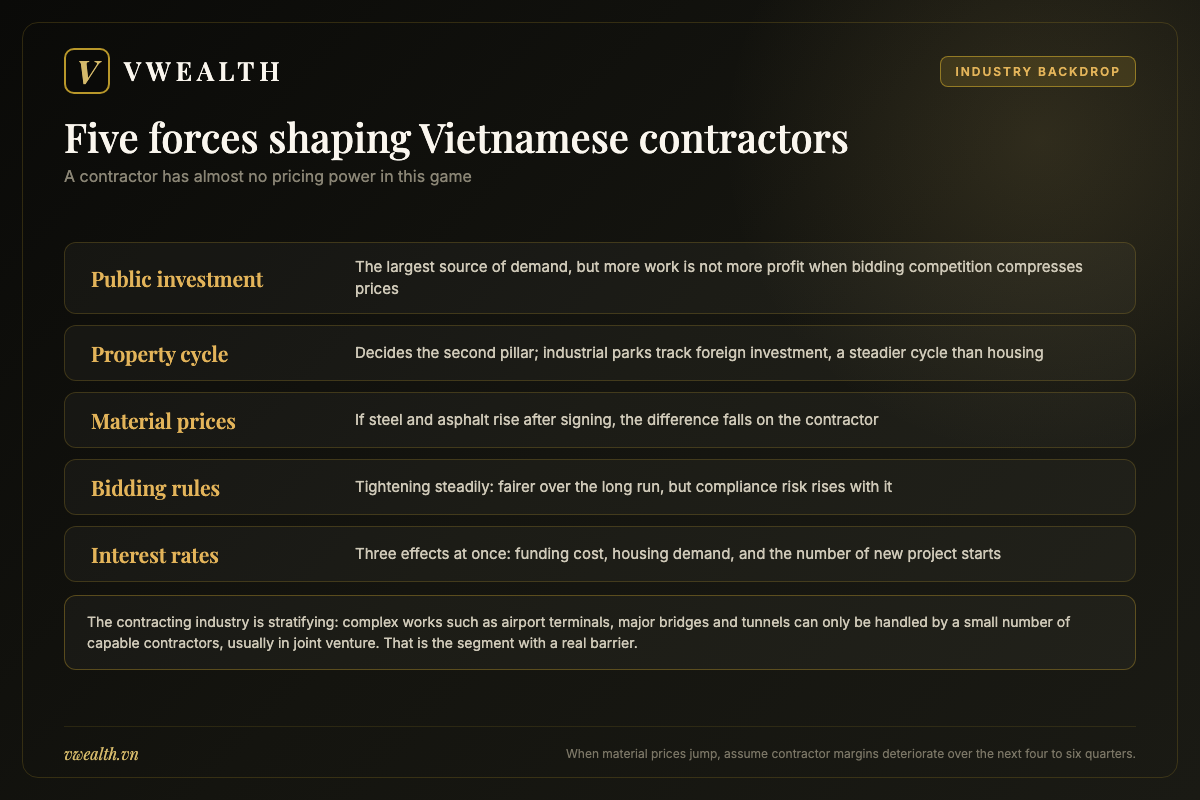
Industry backdrop: five forces shaping Vietnamese contractors
No business lives outside its industry. For a construction contractor the dependence is unusually high, because it has almost no pricing power.
Public investment: the largest and least predictable source of demand
For infrastructure contractors, public capital spending is the largest source of demand. When the budget disburses strongly, work is plentiful. When disbursement stalls, the whole industry goes hungry at once.
What investors most often misread is the link between disbursement news and contractor profit. Strong disbursement raises revenue, yes. But it does not automatically raise margins — it can do the opposite, because when more packages are tendered, more contractors bid, and competition pushes bid prices down. What a contractor actually needs is not more work but more work at sensible prices with payment on time. Our analysis of Vietnam’s industrial and construction complex covers how this demand chain works in practice.
The property cycle: the variable that decides pillar two
VCG’s property arm depends entirely on the broader market cycle, and in Vietnam that cycle has a very wide amplitude.
For the industrial park segment the company is now pushing, the story is different and somewhat more favourable: demand for industrial land is tied to foreign direct investment into manufacturing, not to household purchasing power for homes. Those are two different cycles, and shifting weight toward industrial parks is a sensible risk management move.
For the residential and resort segment, the cycle is far more sensitive to interest rates and to buyer sentiment.
Construction material prices: risk that sits entirely with the contractor
This is the most characteristic risk of the contracting trade and the one retail investors notice least.
The mechanism is simple. The contractor signs at a price based on material costs at bid time. The works take two to three years. Over that period the prices of steel, cement, sand and asphalt can all move sharply. If prices rise, the difference falls on the contractor.
Large contracts usually include index-based price adjustment clauses, but the adjustment process takes time and the compensation is usually insufficient. This is why a contractor can win a great deal of work and still earn very little.
The practical implication for you: when you see construction material prices rising sharply, assume contractor margins will deteriorate over the following four to six quarters, even while revenue keeps growing.
An increasingly strict bidding framework
Vietnam’s bidding legislation has been revised repeatedly toward greater strictness: higher contractor capability requirements, more transparent procedures, and more clearly defined responsibilities.
The effect on the industry cuts both ways. Stricter means fairer competition, and contractors with genuine capability benefit over the long run. But stricter also means compliance risk rises, and past irregularities are more likely to be detected and acted upon.
This is the context in which to place the case described in chapter two — not to comment on the specific matter but to understand that compliance risk in tendering is a structural risk of the entire industry. As an investor, the correct response is to favour businesses with strong internal control functions and boards with genuinely independent directors.
Interest rates and the sector’s capital structure
Construction and property are inherently high-leverage industries, because both require large capital outlays and long waits before cash returns.
When rates rise, three effects occur at once and all are unfavourable. The company’s own interest expense increases. Homebuyers find it harder to borrow, so property demand falls. And other developers find it harder to raise capital, so fewer new projects break ground, meaning less work for contractors.
Those three compound, making construction and property among the most rate-sensitive groups on the market.
Competition within contracting: a game with fewer players at the top
A notable trend of recent years is stratification within the contracting industry.
Large and complex works — airport terminals, major bridges, tunnels, technically demanding structures — can only be handled by a small number of Vietnamese contractors with sufficient capability and financial scale, usually in joint venture. That is the segment with a genuine barrier.
Ordinary works attract a great many bidders, and competition compresses margins to very little.
The implication: when assessing a contractor, look at where its workload sits. A business with a high share in the complex segment holds a materially better competitive position, even if the accounting margin looks similar. Vinaconex’s participation in airport terminal packages and major expressway sections is evidence it belongs in the upper tier.
Practical mechanics for a foreign investor buying this stock
If you are investing from outside Vietnam, several market mechanics shape what owning this stock feels like day to day.
Settlement runs on a cycle that means shares you buy are not immediately available to sell. Every stock also trades inside a daily price band, narrower on HOSE than on Vietnam’s other venues. The band cuts both ways: it slows panic, but in a genuine rush for the exit a stock can lock at the floor with no bid, and you simply cannot sell that day. For a name carrying both cyclical exposure and headline risk, that is not theoretical.
Access requires a securities trading code and a local custody arrangement, and account opening for a non-resident takes longer than in most markets. Currency adds a second layer of return you did not choose: your outcome in your home currency is the stock’s outcome multiplied by the dong’s move against it.
Disclosure is the third thing to plan for. Vietnamese companies file in Vietnamese first, and English versions are often summarised or delayed. For a name where the thesis depends on reading work-in-progress notes and project-level legal progress, you need a reliable route to the underlying filings rather than to headline figures alone. The broader practicalities are covered in our guide to investing in the Vietnamese stock market.
Looking ahead: three scenarios for VCG stock and what triggers each
This chapter contains no price target. For a business whose annual profit depends on which project is recognised and which stake is sold, a twelve-month price target is really a forecast of administrative timelines. What is useful instead is a set of conditions.
The four variables that decide the VCG outcome
The first variable is the course of the legal matter. This is the hardest to forecast and this article does not forecast it. What matters is that it affects two different things: direct financial risk if obligations arise, and indirect risk through tender eligibility and market sentiment.
The second is the legal progress of the property and industrial park projects. This determines profit in the years ahead, because most of the company’s value sits in unexploited assets. It is measurable through site clearance progress and disclosed approvals.
The third is newly signed contracting work. This reflects the health of the core pillar and doubles as an indirect gauge of the first variable’s impact.
The fourth is the largest shareholder’s next move. The ownership structure is in motion, and any significant change affects both share supply and the company’s direction.
The optimistic scenario: the legal matter closes and assets come into use
Four conditions must hold at once. The legal matter develops without generating material financial obligations for the corporate entity and without affecting tender eligibility. The industrial park projects complete their legal procedures and site clearance and begin leasing and recognising revenue. Public investment disbursement stays high and the company keeps signing new work. And interest rates stay low, helping both funding costs and property demand.
In this scenario the company enters a cycle where profit comes from core operations rather than from divestments — which matters far more than the absolute figure. The market begins to value VCG on an asset base being actively developed rather than on erratic earnings, and that change in valuation approach is the largest prize for shareholders.
Early signals: newly signed contract value not declining after the events, site clearance progress at the industrial park projects continuing as disclosed, and an annual audit report with no qualification or emphasis of matter relating to the case.
The base case: profit returns to a recurring level, assets develop slowly
This is the highest-probability path, and the company has itself described it through the 2026 plan.
Conditions: no further materially adverse legal developments but also no clear conclusion, so market sentiment stays cautious. Contracting continues at its usual thin margin. Property projects advance but more slowly than planned — which is what almost always happens with project procedures in Vietnam. No large divestment occurs.
Outcome: net profit lands around the plan level, far below 2025 but accurately reflecting recurring capability. The dividend continues at a moderate level. The share price moves with the rhythm of the public investment and property group.
For a shareholder this scenario is not bad but demands patience. The company’s value is in its assets, and assets need time to become profit. If you do not have at least a three-year horizon, this is not your stock.
The adverse scenario: legal risk widens, or the cycle turns
There are two distinct paths into the adverse case.
The first is company-specific: the legal matter develops less favourably, affecting tender eligibility or creating financial obligations for the entity. For a contractor, the ability to bid is the ability to exist, making this the most serious scenario.
The second is systemic: interest rates rise and the property market freezes at the same time that public investment disbursement slows. All three pillars then struggle simultaneously — precisely the warning issued in chapter three that the pillars do not diversify risk the way the name suggests. Interest still has to be paid, work in progress keeps accumulating, and receivables stretch further.
In that scenario, construction and property stocks typically fall further than the index, because the market prices earnings risk and liquidity risk at the same time. If you plan to buy this stock, decide in advance how you would behave through such a year.
The three scenarios side by side
| Scenario | Conditions required | How it shows in the accounts | Early signal |
|---|---|---|---|
| Optimistic | Legal matter creates no material obligations; industrial parks complete procedures; public investment stays high; rates low | Profit comes from core operations rather than divestment; work in progress converts to revenue | New contract value holds up; site clearance keeps advancing; clean audit opinion |
| Base case | No legal conclusion yet; contracting runs at thin margin; projects advance slower than planned | Profit lands around plan, far below the divestment year | Work in progress keeps rising without converting into revenue |
| Adverse | Legal developments turn less favourable; or rates rise alongside a frozen property market and slow disbursement | New work declines; receivables stretch; interest still payable | New contract value falling clearly across two consecutive quarters; emphasis of matter in the audit report |
These scenarios carry no fixed probabilities. The right way to use the table is to reopen it each quarter, compare with real data, and ask which column you are in.
What would change the picture, in either direction
A discipline worth adopting before you buy anything: write down in advance what evidence would make you change your view. Here are the items that should do it for VCG.
Evidence that would strengthen the case: newly signed contract value holding or growing through 2026 despite the legal matter; the Dong Anh and Son Dong projects clearing their remaining procedures and beginning to generate lease revenue; work in progress converting into recognised revenue rather than only accumulating; cumulative operating cash flow across a five-year window keeping pace with cumulative profit; the largest shareholder’s stake stabilising rather than continuing to fall; and an audit report free of qualification across the period the case is open.
Evidence that would weaken it: newly signed contract value falling clearly for two consecutive quarters; receivables lengthening while revenue is flat; work in progress rising for years on projects whose disclosed legal progress does not move; borrowings rising without a stated investment purpose; the emergence of an emphasis of matter or qualification in the audit report connected to the proceedings; or further large sales by the controlling shareholder without explanation.
The value of writing these down in advance is that it removes the temptation to reinterpret bad news as good. Construction businesses deteriorate slowly and visibly in the order book and working capital numbers long before the profit line reflects it, which means a disciplined investor genuinely has time to react — but only if they decided beforehand what they were watching for.
So should you buy VCG stock? The straight answer
You now have the facts. This chapter puts them on two sides of a scale and states plainly who this stock suits.
The case for: five reasons VCG deserves consideration
First, a contractor position in the hard segment. Participating in seven packages at the Long Thanh airport project with combined contract value of roughly 65,343.6 billion dong, plus multiple North-South expressway sections, is evidence of technical and organisational capability that few Vietnamese contractors possess.
Second, a large land bank at low historical cost. More than 2,000 hectares spread across the country is an asset that cannot be recreated quickly, and much of it is carried at book values set years ago.
Third, a shift toward industrial parks. The Dong Anh industrial park at 300 hectares and the Son Dong industrial cluster at 72.5 hectares are tied to foreign investment into manufacturing — a different and steadier cycle than residential property.
Fourth, real cash received and a cash dividend maintained. The VCR divestment brought in substantial cash, and the company kept a cash component in its profit distribution plan. In construction, being able to pay cash is a meaningful liquidity signal.
Fifth, the combined developer and contractor model. When the company builds its own projects, the margin that would otherwise go to an external contractor stays inside the group. That is a genuine structural advantage, not a marketing line.
The case against: six risks to look at squarely
First, unresolved legal risk. Two executives have been charged and detained under Article 222 of the Penal Code, and according to management’s own statement the case has no investigation conclusion yet so the risk cannot be fully assessed. You cannot size this risk in advance.
Second, 2025 profit was largely one-off. The 3,865 billion dong came from a divestment and does not repeat. The 2026 plan of 1,037 billion dong is far closer to recurring capability. Anyone valuing this stock on 2025 earnings is calculating incorrectly.
Third, very thin contracting margins. The pillar that generates the most revenue generates the least profit, and both material price risk and delay risk sit with the contractor.
Fourth, all three pillars lean on one cycle. Contracting, property and financial investment all depend on the investment and property cycle. This is not genuine diversification.
Fifth, the ownership structure is in motion. The largest shareholder has reduced from a peak of 62.9% to around 45.14% and cut its own charter capital at the end of 2025. That creates uncertainty about direction and supply pressure in the short term.
Sixth, value sits in unexploited assets. Land only has value once brought into operation, and that timeline depends on legal procedures beyond the company’s control. Capital locked in work in progress is a real opportunity cost to shareholders.
The scale, side by side
| In favour | Against |
|---|---|
| Execution capability in the complex works segment, a genuine barrier | Legal risk with no conclusion yet, impossible to size in advance |
| Land bank above 2,000 hectares at low historical cost | Assets only have value once developed, and the timeline is outside the company’s control |
| Shift toward industrial parks tied to the foreign investment cycle | The record 2025 profit was a one-off divestment gain |
| Real cash received from divestment while maintaining a cash dividend | Very thin contracting margins; material price risk sits with the contractor |
| Combined developer and contractor model retains the internal margin | All three pillars depend on the same cycle, so no real diversification |
| Leadership continuity preserves relationships with owners and partners | Ownership in motion; a combined chair and executive role weakens independent oversight |
| The HOSE listing and a rising free float improve liquidity | Each large sale by the major shareholder creates short-term supply pressure |
Who VCG suits and who it definitely does not
For the value investor with a long horizon: this is the best-fitting group, provided you do two things. Step one is valuing on assets rather than earnings, and within that, discounting the land bank by legal readiness rather than crediting it at full market value. Step two is accepting that the gap between asset value and share price can persist for years before it closes.
For the thematic public investment investor: the stock sits squarely in the theme, but remember the link between disbursement news and contractor profit is less direct than most assume. If you buy on a theme, decide in advance how long you will hold and what would make you sell.
For the income investor seeking cash dividends: the company does pay cash, but the level is not enough to be the main reason, and the lumpy nature of the business means there is no guarantee it is sustained evenly.
For the new investor or anyone with a low risk appetite: this is not a starting point at present. It stacks three layers of risk at once — sector cyclicality, capital locked in procedural delay, and unresolved legal risk. If you want exposure to Vietnam’s infrastructure story without carrying all three, consider a more diversified approach.
Four questions to answer before you place the order
Question one: have you separated one-off profit from recurring profit for the last three years? If not, every multiple you compute is wrong.
Question two: have you opened the work in progress note and compared it with each project’s legal progress? That is where most of the company’s value currently sits.
Question three: are you tracking newly signed contract value each quarter? For this name at this moment, that is the most important early warning indicator.
Question four: is this position small enough that you will stay calm if an unfavourable legal headline appears, or if the major shareholder announces further sales?
Three common mistakes when analysing VCG
Before the conclusion, three errors worth naming explicitly, because each recurs in discussions of this stock.
The first mistake is reading contract awards as earnings. A headline about a package worth tens of thousands of billions of dong describes work spread across several years and several joint venture partners, at a margin measured in low single digits. The correct mental conversion is to divide by the number of years, then by the company’s share of the joint venture, then multiply by a thin margin. What survives that arithmetic is usually far smaller than the headline suggests.
The second mistake is valuing on a divestment year. This is the specific trap 2025 set. A record profit built on selling an asset makes the earnings multiple look extraordinarily cheap, and anyone anchoring to that figure is anchoring to something that cannot recur. The company’s own 2026 plan is the corrective.
The third mistake is crediting the land bank at market value. More than 2,000 hectares sounds like a decisive argument, and it is a real asset. But land at different stages of legal readiness has very different present value. A parcel with approvals in place and clearance completed is worth close to market. A parcel awaiting procedures with no visible timeline is worth considerably less, and the discount should reflect both the delay and the probability that it never clears. Applying one valuation to the whole bank overstates the case substantially.
Avoid those three and you will analyse this business better than most of the commentary you will encounter about it.
Closing: a business whose value sits on the balance sheet
The story of Vinaconex is the story of a state corporation that has passed through privatisation, and that process is not finished. From a body created in 1988 to manage workers abroad, through a landmark 2018 auction transferring control of 57.71% of the capital, to an ownership structure still shifting and a legal matter without conclusion — this is a business still redefining itself.
What is notable is that throughout, the core has stayed intact: an organisation capable of building the hardest works in Vietnam, and a land base accumulated over decades. Neither disappears with turbulence at the top, and together they are the real reason to consider this stock.
But they remain potential until converted into profit. Undeveloped land is capital locked up. Idle execution capability is fixed cost. The whole VCG investment case reduces to whether the company can convert potential into results within a timeframe you are willing to wait for.
So should you buy VCG stock? If you understand that you are buying an asset base rather than a steady earnings stream, if you value on assets and know to discount what is not legally ready, if you are willing to wait years, and if you keep the position small enough that one adverse headline cannot damage your portfolio — then VCG is a reasonable choice for the high-risk sleeve of your holdings. If you buy because last year’s profit was a record, or because you read about a trillion-dong contract award, you are buying a number from the past rather than a business.
One last thing to carry with you. Vinaconex’s history, land bank and execution capability change slowly, but newly signed contract value, work in progress, receivables, borrowings, the share count and the valuation change every quarter. Before you place an order, open the latest research report and score the seven checks from chapter four again. It takes fifteen minutes, and it is the most valuable quarter hour in your entire decision process. If you do not yet have the tools to do it, create a free vwealth account and let the platform read the filings for you.
This article is provided for information and analysis purposes only and is not a recommendation to buy or sell any security. The references to criminal proceedings contained in this article are limited to matters officially disclosed by the competent authorities and by the company itself; the presumption of innocence applies in full and this article makes no attribution of guilt to any party. All investment decisions are your own and you bear responsibility for their outcome. Consider consulting a licensed financial adviser before acting.
Research Vietnamese stocks in English with vwealth. Our AI-powered platform turns Vietnamese market data into full English analysis reports — with international payment support and a free 2-month trial for new accounts. Create your free account and read the latest reports.