Whether to buy DPG stock — the equity ticker of Dat Phuong Group Joint Stock Company listed on the Ho Chi Minh City Stock Exchange (HOSE) — has become one of the most compelling and nuanced questions for foreign investors navigating Vietnam stocks in 2026. Across the first ten months of the year, the enterprise made headlines by securing major infrastructure packages that propelled its newly signed contract backlog to nearly VND 8,900 billion, marking high-profile entries into national high-speed railway projects and the Gia Binh airport expressway while simultaneously bringing a brand-new ultra-clear patterned solar glass manufacturing facility in Thua Thien Hue into commercial operation. Yet running parallel to this rapid operational expansion is an increasingly tight cash-flow dynamic, as interest-bearing financial debt surged to VND 4,818 billion by mid-2026, prompting the Board of Directors to borrow personal real estate assets from key corporate insiders to supplement bank collateral for critical credit facilities. When evaluating an infrastructure contractor transforming itself into a multi-sector conglomerate that spans run-of-river hydropower plants, prime coastal eco-resorts, and advanced industrial materials, deciding whether to buy DPG stock requires a rigorous, ground-level dissection of each operating segment and the underlying capital structure. This comprehensive research report provides institutional and retail investors with an unvarnished examination of DPG stock: uncovering its genuine long-term earnings drivers, assessing hidden balance sheet vulnerabilities, and identifying which specific investor profiles this complex equity actually suits.
Before examining each operational pillar in detail, international market participants must establish clarity regarding the corporate structure and regulatory parameters governing the company. Trading under the ticker DPG, the formal corporate entity is Dat Phuong Group Joint Stock Company (Cong ty Co phan Tap doan Dat Phuong), listed on HOSE under standard trading rules, including Vietnam’s T+2 settlement cycle, statutory plus-or-minus 7% daily price fluctuation bands, and foreign ownership limits (FOL). Established on March 12, 2002, the corporation maintains its executive headquarters on the 15th Floor, Handico Tower, Me Tri Ha New Urban Area, Pham Hung Street, Me Tri Ward, Nam Tu Liem District, Hanoi. The company has been led for over two decades by Mr. Luong Minh Tuan as Chairman of the Board of Directors, working alongside Mr. Tran Anh Tuan as Chief Executive Officer and Board Member, and Mr. Pham Kim Chau as Vice Chairman of the Board. This founding trio has guided Dat Phuong since its earliest formative years, providing exceptional management stability and strategic continuity across multiple economic cycles.
The core analytical philosophy maintained by vwealth throughout this report is an unwavering commitment to objective facts, verified corporate filings, and empirical financial data. Every quantitative figure, statutory timeline, project specification, and balance sheet item cited herein is extracted directly from official company disclosures: the Resolutions and Meeting Minutes of the 2026 Annual General Meeting of Shareholders (AGM), the audited 2025 consolidated financial statements, the reviewed H1 2026 semi-annual financial statements, statutory announcements published via the State Securities Commission of Vietnam (SSC) and HOSE, alongside verified coverage from mainstream Vietnamese financial publications. This report rigorously adheres to institutional compliance standards: it does not quote intraday stock prices, does not render transient judgments on daily price-to-earnings (P/E) multiples, and avoids subjective price targets or unconditional buy/sell mandates. Where internal modeling or illustrative computations are applied, they are explicitly designated as a “vwealth estimate” or an “illustrative example.” For foreign allocators seeking a structured macro framework on how state-backed capital allocation cascades through publicly traded equities, our comprehensive guide on how to invest in Vietnam stock market outlines the regulatory mechanisms and fiscal transmission channels governing public investment in the country.
The overarching strategic paradox driving this analysis centers on an extraordinary corporate transition: How did an engineering contractor that originated as a specialized bridge construction team succeed in amassing nearly VND 8,900 billion in newly signed infrastructure contracts over a ten-month stretch, while simultaneously preparing to hand over luxury riverside villas in Hoi An, commissioning a cutting-edge industrial glass furnace in Central Vietnam, and pledging personal residential properties owned by executive leadership to support comprehensive banking credit lines exceeding VND 11,000 billion? The answer does not lie in generic corporate branding, but in a twenty-four-year journey of disciplined capital accumulation, calculated risk-taking, and structural transformation across Vietnam’s infrastructure and real estate landscape.
Twenty-Four Years from a Bridge Construction Team to a Five-Pillar Conglomerate
The corporate history of Dat Phuong represents an archetypal case study of private infrastructure entrepreneurship in Vietnam. The company began by tackling the most technically demanding engineering niches in the transport sector, deployed its accumulated retained earnings to acquire stable cash-generating energy assets, and subsequently leveraged public infrastructure partnerships to secure prime, low-cost land reserves for residential property development. Understanding this twenty-four-year trajectory of strategic reinvestment is essential for foreign investors; without this historical context, one cannot comprehend how a civil works contractor evolved into an owner of high-margin hydropower cascades, premium waterfront hospitality developments, and high-tech manufacturing plants producing export-grade solar glass.
The 2002 Genesis and Specialization in Bridge Engineering
On March 12, 2002, Dat Phuong Joint Stock Company was officially incorporated in Hanoi. In the early 2000s, Vietnam entered an era of rapid trade liberalization and aggressive economic modernization, prompting substantial state expenditures on national transport networks. At that time, the vast majority of emerging domestic civil contractors elected to pursue general earthworks, site leveling, or basic highway asphalt paving. These sub-sectors featured lower capital barriers to entry, standard equipment requirements, and simple operational logistics relying heavily on abundant, low-cost general labor. However, Dat Phuong’s founders — formally trained bridge and highway engineers led by Luong Minh Tuan — chose a far more challenging and capital-intensive trajectory: dedicated specialization in complex bridge engineering.
Within the civil infrastructure spectrum, bridge engineering represents the highest structural complexity and the steepest geotechnical risks. Sinking bridge piers into deep, turbulent riverbeds, executing large-diameter bored piling through fractured geological strata, and mastering balanced cantilever construction across wide navigational spans demand rigorous structural engineering calculations, advanced hydraulic monitoring, and uncompromised site safety protocols. Conversely, these formidable technical hurdles create durable barriers to entry. Small-scale domestic contractors lacking specialized heavy machinery and proven engineering pedigrees are systematically disqualified during pre-qualification rounds for Tier-1 public tenders. Crucially, the gross profit margins attached to complex bridge and elevated viaduct structures have historically outpaced standard asphalt road paving, where intense price competition among generic contractors frequently erodes operating margins and where prolonged right-of-way site clearance disputes routinely cause ruinous project delays.
This early strategic positioning forged a durable competitive reputation for Dat Phuong among central project management units (PMUs) and provincial departments of transport. Rather than diluting scarce capital across multiple low-barrier civil segments, the company methodically concentrated its financial resources on specialized, heavy-duty construction equipment, imported hydraulic formwork systems, and continuous technical training for its engineering corps. Dat Phuong mastered advanced engineering methodologies, including long-span pre-stressed concrete girder casting, post-tensioned cable installation, and cable-stayed bridge erection across navigable waterways and environmentally fragile coastal floodplains. As landmark river crossings and elevated viaducts across Northern and Central Vietnam successfully opened to traffic, Dat Phuong’s delivery record earned the confidence of the Ministry of Transport (MoT), positioning the firm as a preferred domestic consortium partner on critical national infrastructure programs.
Nonetheless, executive leadership remained acutely conscious of the structural headwinds inherent to the pure-play contracting business. Civil construction remains heavily tethered to state budgetary disbursement cycles, exposed to protracted payment inspection and settlement protocols, and historically constrained by single-digit net profit margins. Even the most technically capable contractor faces operational instability whenever major public works contracts wind down, alongside balance sheet strain when project developers experience fiscal bottlenecks. To ensure generational resilience and transition toward a sustainable conglomerate model, Dat Phuong needed to build an autonomous cash-flow engine — a recurring, high-margin revenue pillar capable of generating dependable liquidity independent of third-party public procurement schedules.
Hydropower: The First Cash-Flow Engine
That strategic turning point materialized in the late 2000s, when Dat Phuong made the bold decision to expand into renewable energy development through small-to-medium run-of-river hydropower projects. While entering energy generation represented a major strategic leap, it was deeply grounded in the firm’s core civil engineering capabilities. Constructing concrete gravity dams, excavating subterranean water diversion tunnels through mountainous terrain, and executing reinforced structural foundations for powerhouse turbine bays shared immense operational overlap with the deep-foundation bridge and heavy geotechnical works the company had executed for years.
In 2010, Dat Phuong officially commenced commercial operations at the Song Bung 6 Hydropower Plant, featuring an installed capacity of 30 MW. Situated on the Bung River in the mountainous interior of Quang Nam Province, the facility rapidly demonstrated exceptional operational economics. Unlike civil construction contracts that require continuous invoice reconciliation, retention receivables monitoring, and protracted negotiations over material price escalations, an operational hydropower plant feeds directly into the national transmission grid under a multi-decade Power Purchase Agreement (PPA) signed with state-owned utility Vietnam Electricity (EVN). For every kilowatt-hour (kWh) dispatched, the project company collects cash receipts backed by the national utility.
Encouraged by the financial profile of Song Bung 6, Dat Phuong accelerated its capital deployment into clean energy by developing the Son Tra 1 hydropower cascade in Quang Ngai Province, boasting a cumulative installed capacity of 60 MW. Engineered as a stepped cascade to maximize the natural hydraulic head and seasonal run-off from the Truong Son mountain range, Son Tra 1 solidified the group’s positioning in Central Vietnam’s renewable power network. Once both Song Bung 6 and Son Tra 1 reached steady-state operational maturity, the fundamental quality of Dat Phuong’s consolidated earnings underwent a structural upgrade.
In corporate finance terms, small-scale run-of-river hydropower functions as a high-margin cash generator, with gross profit margins routinely fluctuating between 50% and 70% during favorable hydrological seasons. Variable production costs are negligible — river flow through hydraulic turbines incurs zero fossil fuel feedstock expenses, unlike coal-fired or combined-cycle gas thermal plants. Operating costs consist primarily of plant depreciation, routine maintenance, and debt service on project-level bank loans contracted during construction. As these amortizing bank loans are steadily repaid over their operational tenure, financial expenses decline precipitously, transforming the hydropower fleet into an abundant source of free cash flow for the parent enterprise. This stable energy cash flow served as a counter-cyclical stabilizer, funding the working capital needs of Dat Phuong’s construction operations during cyclical lulls in public infrastructure spending while providing the equity equity base required to finance large-scale corporate expansions.
The 2018 HOSE Listing and the Sequence of Bonus Shares
Following over a decade and a half of private corporate development, Dat Phuong entered the public capital markets in May 2018, officially listing its equity on HOSE under the ticker DPG. Upgrading to the nation’s premier stock exchange not only enhanced corporate visibility and corporate governance standards but also unlocked access to institutional domestic and foreign capital, setting the stage for balance sheet expansion.
Examining the historical trajectory of Dat Phuong’s charter capital reveals a distinct management policy: an aggressive sequence of bonus share distributions funded by accumulated capital reserves and undistributed earnings during phases of business scaling. In 2017, immediately preceding its public listing, the company executed a massive bonus share issuance to existing shareholders at a distribution ratio of 153%. In 2018, following its successful HOSE debut, the group maintained this shareholder enrichment policy with a 50% bonus share distribution, followed by another 40% bonus share issuance in 2019. This consecutive equity capitalization reflected a phase of rapid surplus accumulation from profitable construction and energy operations, while systematically expanding charter capital to satisfy stringent financial net worth thresholds required when bidding as a lead contractor for national transport megaprojects.
Between 2020 and 2023, however, Dat Phuong temporarily suspended bonus share distributions. This hiatus coincided with a challenging macroeconomic environment characterized by nationwide regulatory gridlock across the property sector and pandemic-related supply chain disruptions, during which management prioritized balance sheet conservatism and working capital preservation. That multi-year pause concluded decisively in 2025 as the Board resumed its aggressive equity capitalization strategy.
In June 2025, Dat Phuong finalized shareholder entitlements for a 60% bonus share issuance, issuing approximately 37.8 million new common shares to existing shareholders, with the ex-rights trading date falling on June 12, 2025. This sizable distribution propelled the company’s registered charter capital from VND 630 billion to over VND 1,007 billion. For long-term investors following DPG stock, this sequence of equity capitalizations demonstrated management’s commitment to converting retained operating cash flows into permanent corporate equity, bolstering bidding capacity and underwriting larger infrastructure and industrial ventures.
Accumulating Prime Land Banks Through Build-Transfer (BT) Bridge Contracts
Beyond the dependable cash streams generated by run-of-river hydropower, Dat Phuong unlocked a third high-return growth catalyst that drove substantial earnings inflections in recent fiscal years: an exceptionally prime real estate land bank situated in Central Vietnam, centered around the heritage tourism hub of Hoi An in former Quang Nam Province. The acquisition of these high-value land plots originated through a specialized infrastructure procurement framework widely implemented in Vietnam over the past two decades: the Build-Transfer (BT) contract mechanism.
Under a classic BT structure, a private contractor designs, finances, and builds a designated public infrastructure asset at its own expense. Upon completing and handing over the public work to local state authorities, the municipal or provincial government compensates the investor not through state cash disbursements, but by granting reciprocal land parcels of equivalent assessed economic value, which the contractor can subsequently master-plan, develop, and monetize as commercial residential real estate. In 2016, the People’s Committee of Quang Nam Province awarded Dat Phuong the investment contract to construct the De Vong Bridge in Hoi An, representing a total investment capital exceeding VND 390 billion. Spanning the scenic Co Co River, this critical transport link was paired with reciprocal land allocations situated in prime, environmentally protected riverfront and coastal corridors across Hoi An.
Through this BT agreement, Dat Phuong assembled a high-potential land portfolio that laid the foundation for its signature eco-residential developments: Casamia Hoi An (Vong Nhi), Casamia Calm Hoi An (Dong Na), and Casamia Balanca Hoi An (Con Tien New Urban Area). This mechanism resolved the single most difficult challenge facing private real estate developers in Vietnam: raw land acquisition costs. Because the underlying land rights were acquired in exchange for constructing physical bridge infrastructure, Dat Phuong secured land at a remarkably competitive historical cost basis. Applying its bridge engineering precision to master-planned residential landscaping — preserving the natural water channels of the UNESCO-adjacent Bay Mau Nipa Palm Forest, incorporating private yacht berths for individual riverfront villas, and executing low-density ecological architecture — the realized commercial selling prices of completed units appreciated dramatically relative to initial development outlays.
During the 2021–2022 property cycle, as the Casamia Vong Nhi phase was marketed and delivered to buyers, high-margin real estate receipts delivered record-breaking earnings for the group, establishing Dat Phuong as an upscale boutique developer in Central Vietnam. Nonetheless, international investors must recognize that BT frameworks entail significant regulatory complexities as national land laws and public-private partnership (PPP) statutes evolve. The Binh Duong Service and Resort Complex project (situated in former Quang Nam Province, now re-zoned within Thang An Commune, Da Nang), originally earmarked within the reciprocal land portfolio for the De Vong Bridge contract, experienced a decade-long administrative journey characterized by scope adjustments and protracted regulatory reviews. This trajectory illustrates that while BT land swaps can yield immense economic returns, they demand substantial corporate patience and financial endurance to navigate multi-year legal certifications.
2025: Record Revenue and Eight Consecutive Years of Expansion
Concluding the 2025 fiscal year, Dat Phuong achieved an impressive operational milestone. According to its audited consolidated financial statements, total net revenue reached VND 4,484 billion, representing a robust 25% year-over-year increase compared to net revenue of VND 3,577 billion recorded in 2024. This performance established the highest annual revenue ever recorded in Dat Phuong’s corporate history and marked the eighth consecutive year of positive top-line revenue growth, demonstrating operational resilience through macro volatility, property downturns, and raw material inflationary shocks.
On the bottom line, 2025 proved exceptionally profitable. Consolidated gross profit reached VND 667 billion, expanding 24% year-over-year; profit before tax (PBT) rose 41% to VND 485 billion; and consolidated profit after tax (PAT) achieved VND 444 billion, marking an outstanding 46% surge compared to the VND 304 billion delivered in 2024. Against its statutory corporate targets, Dat Phuong fulfilled 94% of its consolidated revenue budget while surpassing its annual PAT target by 17% (the 2025 AGM had established a consolidated PAT goal of VND 376.9 billion). This outperformance was propelled by favorable hydrological conditions across Central Vietnam’s river basins, which optimized hydropower dispatch, alongside an accelerated recovery in public transport infrastructure execution.
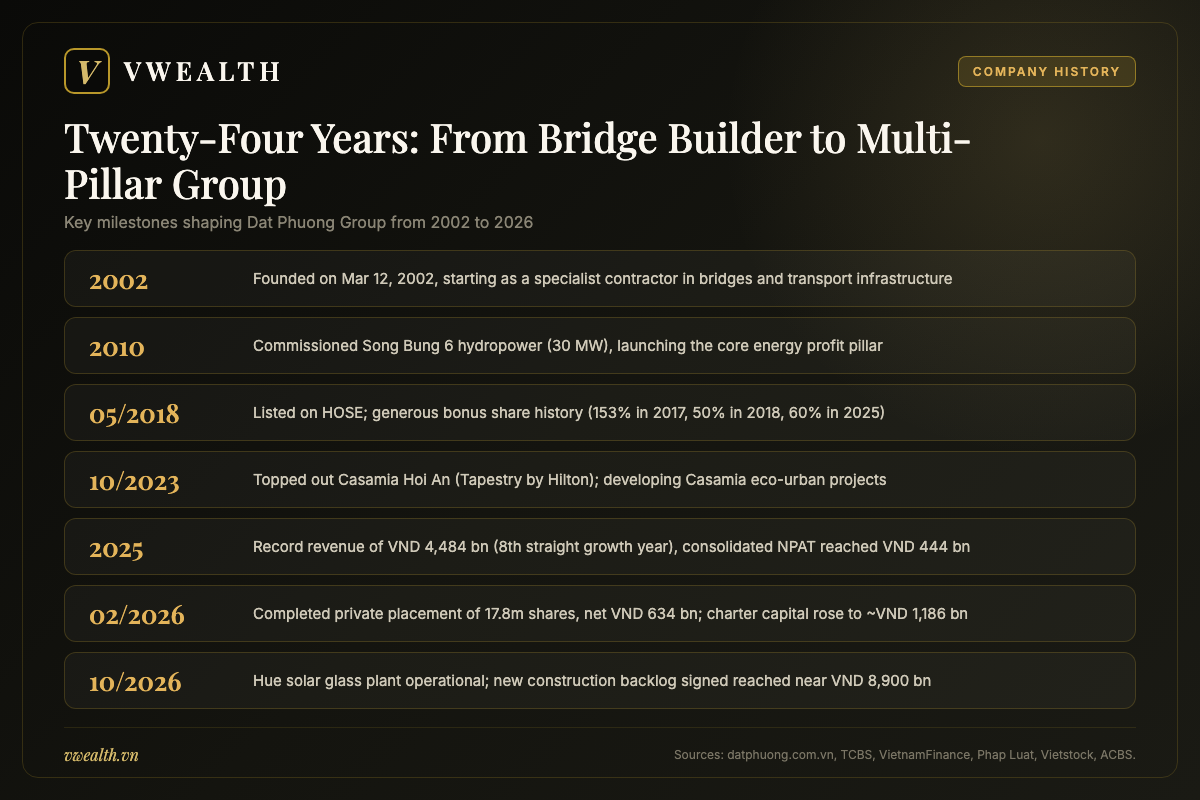
To provide institutional and individual investors with a unified overview of Dat Phuong’s nearly quarter-century trajectory, the following table delineates the pivotal milestones that shaped the conglomerate’s multi-pillar architecture:
| Year / Date | Major Corporate Milestone | Strategic Significance to Dat Phuong Group |
|---|---|---|
| March 12, 2002 | Establishment of Dat Phuong Joint Stock Company | Laid the foundational engineering core, dedicated to complex bridge construction and specialized civil works. |
| 2010 | Commissioning of Song Bung 6 Hydropower Plant (30 MW) | Inaugurated the renewable energy segment, creating the group’s first recurring, high-margin cash flow engine. |
| 2016 | Award of De Vong Bridge BT Investment Project in Hoi An | Secured low-cost reciprocal land allocations in prime Hoi An corridors, initiating the expansion into high-end real estate. |
| 2017 | 153% Bonus Share Distribution to Shareholders | Substantially broadened equity base using accumulated reserves prior to public exchange listing. |
| May 2018 | Official Listing of DPG Stock on the HOSE Exchange | Entered the public capital markets, expanding liquidity, institutional profile, and external financing access. |
| October 2023 | Topping Out of Casamia Hoi An Hotel | Entered luxury resort hospitality under the international brand Tapestry Collection by Hilton. |
| 2025 | Record Net Revenue of VND 4,484B, PAT of VND 444B; 60% Bonus Shares | Eighth straight year of top-line expansion; registered charter capital exceeded VND 1,007 billion. |
| February 11, 2026 | Completion of Private Placement Raising Over VND 640B | Expanded charter capital to nearly VND 1,186 billion, funding solar glass manufacturing and construction working capital. |
| April 25, 2026 | AGM Approves Ambitious VND 8,513B Net Revenue Plan | Elected Board of Directors for the 2026–2031 tenure; targeted doubling top-line scale via construction and real estate. |
| October 2026 | Commercial Launch of Ultra-Clear Patterned Glass Plant in Hue | Established the fifth operating pillar: specialized industrial manufacturing serving domestic solar and export markets. |
Who Steers Dat Phuong: Three Founders and an Anchor Foreign Institutional Fund
When foreign institutional investors evaluate emerging market equities, particularly civil contractors and real estate infrastructure developers within Vietnam stocks, the primary analytical inquiry extends far beyond mere project inventories or order backlogs. The decisive questions center on corporate stewardship: Who controls the executive decision-making apparatus? Are controlling shareholder interests structurally aligned with public minority investors? And how is voting power distributed across internal operators and external institutions? At Dat Phuong, the equity ownership architecture displays a distinct equilibrium: an enduring founding executive coalition that has managed operations for over twenty-four years, complemented by the steadfast presence of one of the longest-standing foreign asset managers in Vietnam’s capital market.
Mr. Luong Minh Tuan and the Founding Leadership Trio
The strategic compass and operational soul of Dat Phuong since its inception in 2002 is Mr. Luong Minh Tuan, Chairman of the Board of Directors. A bridge and tunnel engineer by training with decades of direct field experience across complex civil construction sites, Mr. Tuan embodies the professional ethos of a disciplined, pragmatic, and technically rigorous engineering executive. Under his stewardship, Dat Phuong avoided the common pitfall of over-leveraging balance sheets across low-margin commodity road building, choosing instead to concentrate engineering resources on high-difficulty bridge structures and leveraging execution expertise to secure high-value reciprocal project allocations. His personal leadership and contributions to Vietnamese industrial development were formally recognized when he received the Saint Giong Cup as an Outstanding Vietnamese Entrepreneur in 2026.
Crucially, Dat Phuong does not operate under a unilateral, one-man managerial hierarchy. Flanking Chairman Luong Minh Tuan are two veteran founding executives: Mr. Pham Kim Chau, Vice Chairman of the Board, and Mr. Tran Anh Tuan, Director and Chief Executive Officer. While Chairman Luong Minh Tuan shapes macro strategy, masterminds corporate expansion, and interfaces with ministerial stakeholders, CEO Tran Anh Tuan directly oversees the conglomerate’s day-to-day project execution, ensuring site management commands adhere to rigorous engineering milestones and tightly managing operating construction cash flows. Concurrently, Vice Chairman Pham Kim Chau serves as an indispensable bridge overseeing technical evaluation and governance across group subsidiaries.
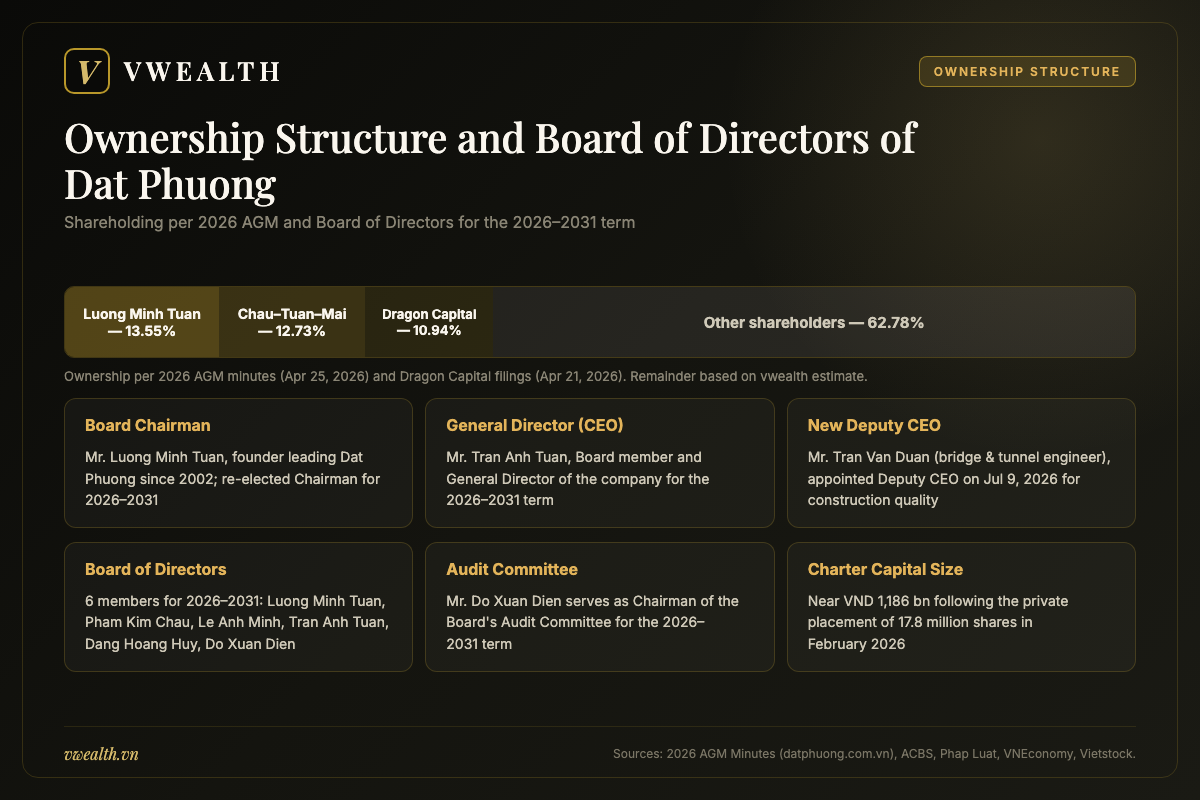
According to the official Meeting Minutes and Resolutions of the 2026 Annual General Meeting of Shareholders convened on April 25, 2026 — the highest-level verified corporate filing — the equity holdings of the founding executive core remain transparent and substantial. As of the AGM date, Chairman Luong Minh Tuan personally held 13.55% of Dat Phuong’s total voting shares. Mr. Tuan personally stood for re-election while nominating an independent board member. Meanwhile, an executive shareholder bloc comprising Mr. Pham Kim Chau, Mr. Tran Anh Tuan, and Mr. Le Hoang Mai collectively controlled 12.73% of voting shares, jointly nominating Mr. Chau and Mr. Tran Anh Tuan for the 2026–2031 board tenure.
This distribution establishes that the founding leadership trio and their direct operating associates command over 26% of the company’s total voting equity [vwealth estimate: 13.55% + 12.73% = 26.28%]. By comparison, an earlier research report published by ACBS Securities in October 2025 recorded personal holdings of 15.9% for Chairman Luong Minh Tuan, 6.6% for Vice Chairman Pham Kim Chau, and 5.7% for CEO Tran Anh Tuan. This mild percentage dilution in 2026 was primarily a technical consequence of the company’s private placement of 17.8 million new shares completed in February 2026. The pivotal takeaway for institutional allocators evaluating DPG stock is that insider ownership backed by personal capital remains exceptionally high relative to listed Vietnamese civil engineering peers — where executives frequently hold purely nominal equity stakes. When management’s personal wealth is intrinsically tied to equity value, agency conflicts diminish and leadership is strongly disincentivized from pursuing reckless capital allocations that could destroy shareholder net worth.
The Board of Directors for the 2026–2031 Tenure
The 2026 Annual General Meeting on April 25, 2026, marked an institutional milestone with the formal election of the Board of Directors for the 2026–2031 term. The slate of six nominees was approved unanimously with 100% of voting shares represented at the meeting. The newly constituted Board consists of six directors: Mr. Luong Minh Tuan, Mr. Pham Kim Chau, Mr. Le Anh Minh, Mr. Tran Anh Tuan, Mr. Dang Hoang Huy, and Mr. Do Xuan Dien. During its initial post-AGM organizational session, the Board unanimously re-elected Mr. Luong Minh Tuan to continue serving as Chairman of Dat Phuong Group.
A notable governance enhancement in this new five-year tenure is the appointment of Mr. Do Xuan Dien as Chairman of the Audit Committee under the Board of Directors. Under the corporate governance regulations overseen by the State Securities Commission of Vietnam (SSC) and international OECD standards, the Audit Committee operates as an independent governance safeguard tasked with auditing financial statements, scrutinizing related-party transactions, and evaluating internal risk control frameworks. Appointing experienced leadership to this supervisory role enhances transparency over capital allocation and cash disbursements across Dat Phuong’s multi-trillion-dong civil construction contracts.
At the executive operational tier, Dat Phuong strengthened its field command structure to handle the unprecedented surge in transport infrastructure contracts secured throughout 2026. On July 9, 2026, the Board of Directors issued a formal resolution appointing Mr. Tran Van Duan (born in 1980, a professional bridge and tunnel engineer) as Deputy Chief Executive Officer for a five-year term. Simultaneously, the group formally established a specialized Quality and Safety Management Department dedicated to standardizing site execution protocols, monitoring occupational health, and managing structural geotechnical risks across complex megaprojects, including high-speed railway foundations, deep bridge piers, and expressway viaducts. This organizational upgrade demonstrates deliberate capacity-building ahead of an intensive capital execution cycle extending through 2028.
Dragon Capital: The Anchor Foreign Institutional Shareholder
While the founding team acts as the internal operational anchor, the external institutional cornerstone of Dat Phuong’s shareholder register is Dragon Capital — the largest and longest-established foreign asset management group operating in Vietnam’s financial markets. Dragon Capital’s substantial equity position in Dat Phuong is not a short-term tactical trade, but a multi-year strategic holding spanning varying market cycles.
Regulatory filings published in April 2026 provide precise visibility into the foreign fund’s equity stake. Specifically, on April 9, 2026, member funds affiliated with Dragon Capital acquired an additional 162,000 DPG shares (in which Norges Bank purchased 150,000 shares and the Samsung Vietnam Securities Master Investment Trust acquired 12,000 shares), officially raising the institutional bloc’s ownership from 10.9567% to 11.0933%, representing approximately 13.16 million shares. Shortly thereafter, on April 21, 2026, Samsung Vietnam Securities Master Investment Trust executed a technical portfolio rebalancing by divesting 100,000 shares, bringing Dragon Capital’s consolidated stake to 10.9386%, maintaining their aggregate position at approximately 13 million shares.
Dragon Capital’s persistent ~11% holding carries significant analytical implications for global allocators assessing whether to buy DPG stock. First, institutional foreign funds enforce rigorous due diligence protocols regarding real cash generation, balance sheet integrity, and accounting governance before deploying capital into double-digit ownership stakes in emerging market infrastructure players. Dragon Capital’s ongoing presence as a principal shareholder through 2026 provides external validation of Dat Phuong’s operational legitimacy. Second, an institutional block of this size absorbs substantial free-float, reducing market churn. However, foreign investors must also recognize that periodic portfolio adjustments by institutional funds can occasionally introduce short-term liquidity fluctuations in daily market sessions on HOSE.
The VND 640 Billion Private Placement and Dilution Dynamics
Among the most transformative corporate finance transactions altering Dat Phuong’s capital structure in 2026 was the completion of a major private equity placement. This capital raise was initiated under the Extraordinary General Meeting (EGM) Resolution dated October 28, 2025, which authorized the private placement of 17.79 million new shares (equivalent to approximately 17.6% of outstanding shares at that time) to a maximum of 20 professional securities investors. The EGM mandated a floor offering price of VND 30,300 per share, accompanied by a statutory one-year transfer restriction.
On February 11, 2026, Dat Phuong announced the successful completion of this private offering, placing nearly 17.8 million shares at an average offering price of VND 36,000 per share. The realized placement price represented a substantial premium over the VND 30,300 floor approved by shareholders. Gross proceeds generated from the placement reached approximately VND 640.4 billion; after deducting transaction costs and underwriting advisory fees, net proceeds totaled VND 634.2 billion. This successful offering expanded Dat Phuong’s registered charter capital from over VND 1,007 billion to nearly VND 1,186 billion (as calculated by vwealth based on 2026 AGM quorum disclosures: 73,667,423 shares represented at the meeting equaled 62.121% of total voting shares, indicating an aggregate share count of approximately 118.6 million shares).
For discerning investors, evaluating a corporate capital increase of nearly 18% requires an immediate examination of capital deployment efficiency: Where were the proceeds directed, and does incremental earnings expansion offset near-term earnings per share (EPS) dilution? Dat Phuong’s statutory capital utilization update released on August 13, 2026, documented the exact disbursement status:
- VND 115.3 billion was fully disbursed as supplemental equity capital into Dat Phuong Glass Joint Stock Company, directly financing advanced automated production machinery for the ultra-clear patterned solar glass plant in Thua Thien Hue.
- VND 217.7 billion was fully deployed as operational working capital to fund procurement and heavy machinery mobilization across newly awarded transport infrastructure packages.
- Over VND 301 billion (out of approximately VND 307.4 billion originally earmarked for the Binh Duong Service and Resort Complex project) remained undisbursed as cash deposits at commercial banks. Management explained that disbursement was deferred pending formal administrative approvals for updated investment planning following regional territorial boundary restructuring and revised provincial zoning blueprints.
The fact that over VND 301 billion in newly raised equity sat idle in bank deposits through the first half of 2026 confirms project delays at the Binh Duong resort complex. This capital lag produced short-term return-on-equity (ROE) dilution, an operational inefficiency previously highlighted by domestic research analysts at ACBS Securities. Conversely, the successful equity injection provided Dat Phuong with vital liquidity during intensive industrial construction at the Hue glass plant, expanded shareholder equity, and strengthened the balance sheet to underwrite massive bidding bonds and advance-payment bank guarantees for transport megaprojects.
Insider Transactions and Related Parties
In the Vietnamese equity market, retail investor sentiment is acutely sensitive to trading activity by corporate executives and their immediate family members. In April 2026, regulatory disclosures revealed that Ms. Luong Thi Thanh — elder sister of Chairman Luong Minh Tuan — registered to sell 200,000 DPG shares, prompting localized discussion among retail market participants during a broader period of exchange volatility.
Institutional analysis requires evaluating such insider transactions through an objective, quantitative lens. A volume of 200,000 shares represents a negligible fraction of Dat Phuong’s total share base of nearly 118.6 million shares [vwealth estimate: 200,000 ÷ 118,600,000 ≈ 0.17%]. The divestment reflected personal liquidity requirements rather than a strategic retrenchment by core management. Crucially, Chairman Luong Minh Tuan and his executive peers on the Board did not sell down their core operating shareholdings, preserving the founding coalition’s governing control intact.
Investors must also maintain a rigorous distinction between corporate individuals to avoid factual confusion: Ms. Luong Thi Thanh (who registered to sell 200,000 shares in April 2026) and Ms. Luong Thi Lan (who, alongside other executive family members, executed collateral pledge contracts lending personal real estate to back group credit facilities in October 2026) are two entirely distinct legal individuals, despite sharing family ties with the Chairman. Distinguishing clearly between these legal actors is essential for an accurate reading of corporate disclosures and balance sheet commitments.
The 2024 Market Manipulation Case: External Actors and Official Clarifications
Another regulatory development involving DPG stock occurred in mid-2026 when the state securities regulator finalized an enforcement action. On June 29, 2026, the State Securities Commission of Vietnam (SSC) issued an administrative sanction imposing a VND 1.5 billion fine on Mr. Dang Van Vinh for employing multiple securities trading accounts (specifically 8 accounts, as reported by financial news agencies) to execute cross-trading and artificial transactions aimed at manipulating the market price of DPG stock between May 2, 2024, and July 2, 2024. Additionally, six individuals and organizations that lent trading accounts to Mr. Dang Van Vinh to facilitate these transactions were penalized in accordance with statutory securities law.
Following the public dissemination of the regulatory enforcement decree, Dat Phuong Group issued a formal corporate statement to shareholders and the investing public. In its official filing, the company categorically confirmed that the sanctioned individuals and entities possessed zero affiliation with Dat Phuong Group, were not registered corporate insiders or executive directors, and shared no familial or operational ties with management. The corporation firmly emphasized that it had never authorized, coordinated, or participated in any market-making or artificial trading activities conducted by these external parties.
For global investors assessing market integrity, this episode should be viewed through the lens of emerging market regulatory maturation. Decisive regulatory enforcement against illicit market manipulation enhances market transparency and protects long-term institutional capital. The violations occurred in mid-2024 and involved unaffiliated external actors. Most importantly, Dat Phuong’s core industrial activities — building critical bridges, generating clean hydroelectric power, and commissioning manufacturing facilities — operated completely uninterrupted by these historical trading irregularities.
To provide investors with a consolidated overview of Dat Phuong’s corporate ownership structure and governance framework as of mid-2026, the following table summarizes the verified shareholding blocks and their statutory sources:
| Shareholder Bloc / Governance Body | Ownership Stake / Share Count | As of Date | Legal Source & Official Documentation |
|---|---|---|---|
| Mr. Luong Minh Tuan (Chairman of the Board) | 13.55% of voting shares | April 25, 2026 | Minutes & Resolution of 2026 Annual General Meeting |
| Executive Bloc (Mr. Chau, Mr. Tuấn, Mr. Mai) | 12.73% of voting shares | April 25, 2026 | Minutes & Resolution of 2026 Annual General Meeting |
| Dragon Capital Group (Foreign Institutional Fund) | 10.9386% (~13 million shares) | April 21, 2026 | Major Shareholder Ownership Filing submitted to SSC |
| AGM Quorum (Participating Shareholders) | 62.121% (73,667,423 attending shares) | April 25, 2026 | Shareholder Eligibility Report at 2026 AGM |
| Private Placement to Professional Investors | ~17.8 million shares (1-year lock-up) | February 11, 2026 | Private Offering Results Filing submitted to SSC |
| Board of Directors (2026–2031 Tenure) | 6 members (Mr. Luong Minh Tuan re-elected Chair) | April 25, 2026 | Resolution of 2026 AGM (Approved by 100% of votes) |
Comparing Dat Phuong’s governance model with other leading civil infrastructure and residential engineering contractors listed on HOSE — such as the widely distributed institutional shareholding structure of CTD stock of Coteccons — underscores that Dat Phuong exhibits far greater operational authority concentrated in the hands of its domestic founding founders. This closely held operational architecture enables swift, decisive strategic pivots — such as allocating hundreds of billions of dong to construct an advanced solar glass manufacturing complex — executed with clear corporate alignment and unencumbered by protracted shareholder friction.
The Five Operating Pillars: Construction, Hydropower, Real Estate, Hospitality, and Ultra-Clear Glass
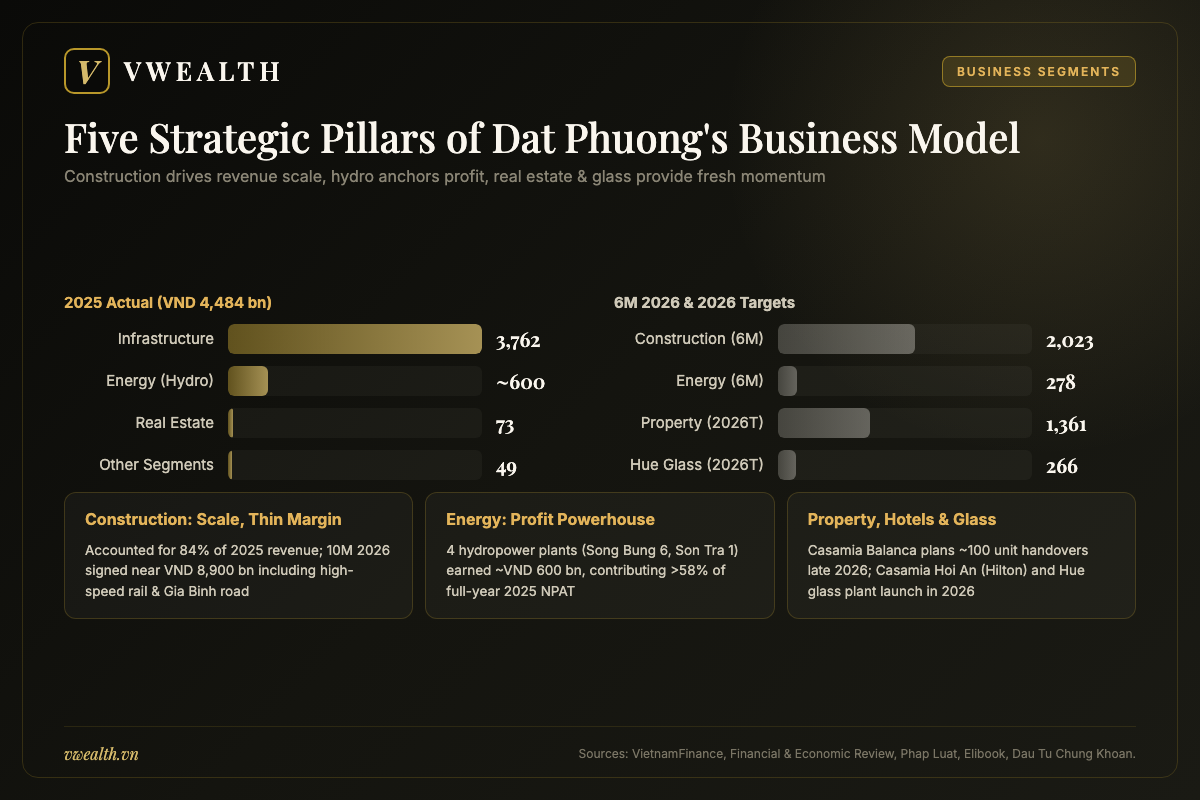
Analyzing Dat Phuong merely as a conventional civil works contractor overlooks more than half of the enterprise’s intrinsic economic value. Conversely, evaluating the group solely as a boutique coastal property developer fails to explain how the company reliably generates multi-trillion-dong revenues even during protracted freezes in domestic property markets. Entering 2026, Dat Phuong’s corporate structure has formally coalesced into a mutually reinforcing “five-pillar” ecosystem: transport infrastructure contracting generates massive top-line volume; hydropower generation delivers predictable, high-margin cash flow; residential property development produces sharp earnings inflections; luxury hospitality compounds long-term brand equity; and ultra-clear patterned glass manufacturing opens an industrial gateway into advanced solar materials. Deciphering how these five operational cylinders interlock and cross-subsidize each other is the analytical key to assessing whether to buy DPG stock.
Civil Contracting: 84% of Top-Line Revenue but the Thinnest Margins
Transport infrastructure contracting represents Dat Phuong’s engineering foundation and remains the dominant contributor to consolidated top-line scale. In the 2025 fiscal year, contracting revenue reached VND 3,762 billion, accounting for 84% of total net corporate revenue and expanding 22% over 2024. During the first half of 2026, contracting execution accelerated further, generating VND 2,023 billion in net revenue, an increase of 51% compared to the prior-year period.
However, commanding top-line volume does not translate into proportional bottom-line profits. Chairman Luong Minh Tuan has frequently reminded shareholders at annual general meetings that civil construction generates the narrowest margins across Dat Phuong’s entire operational footprint. Yet it fulfills several indispensable corporate functions: anchoring multi-trillion-dong turnover, employing thousands of technical personnel, maintaining active commercial banking credit limits, and establishing brand credibility before ministerial procurement committees. Corporate filings illustrate this margin profile vividly: during the first six months of 2026, despite producing VND 2,023 billion in revenue, the contracting division generated gross profit of VND 131 billion, translating into an operating gross margin of approximately 6.5% [vwealth estimate: 131 ÷ 2,023 ≈ 6.48%].
Why do contracting gross margins remain structurally compressed? Public works contracting in Vietnam is governed by rigid state-mandated unit pricing norms. Upon winning competitive public bids, general contractors bear the risk of input cost volatility across key commodities, including structural rebar, bulk cement, aggregate stone, leveling sand, and diesel fuel for heavy earthmoving machinery. While unit-adjusted contracts contain price escalation clauses, bureaucratic approvals for price adjustments entail protracted administrative audits that rarely compensate for 100% of actual field inflation. Furthermore, to balance equipment mobilization across multiple simultaneous expressway and bridge sites, Dat Phuong routinely subcontracts commoditized civil works to local partners, consciously relinquishing gross margin points in exchange for meeting stringent completion deadlines.
Despite these narrow margins, Dat Phuong possesses a durable competitive moat: specialized technical mastery in complex bridge structures and demanding subterranean foundations. Unlike commoditized asphalt highway paving — where dozens of generic local contractors compete through aggressive price undercutting — large-span river crossings, deep-water pier foundations, and balanced cantilever viaducts require heavy-duty tower cranes, specialized travelling formwork systems, and experienced geotechnical teams. Mastering this advanced engineering technology shields Dat Phuong from destructive bidding wars, limits costly on-site defects, and preserves a reliable 6% to 8% gross margin band — a commendable performance standard within Vietnam’s transport infrastructure contracting sector.
Hydropower: Modest Revenue Generating Outsized Bottom-Line Profits
In stark contrast to the high-volume, thin-margin contracting business, Dat Phuong’s renewable energy division — run-of-river hydropower — represents the quiet financial powerhouse that underpins the group’s economic durability. The company owns and operates two primary hydropower assets in Central Vietnam: the Song Bung 6 Hydropower Plant (30 MW installed capacity in Quang Nam Province, operated by subsidiary Song Bung JSC since 2010) and the Son Tra 1 Hydropower cascade (60 MW cumulative capacity across stepped reservoirs in Quang Ngai Province, managed by 304 Quang Ngai JSC).
Fiscal 2025 served as an extraordinary operating year for the energy division. Favorable La Niña hydrological patterns brought persistent rainfall and elevated reservoir inflows across Central Vietnam’s river basins, enabling turbines at both Song Bung 6 and Son Tra 1 to run at peak capacity factors throughout extended operating seasons. Energy division net revenue reached nearly VND 600 billion in 2025 — representing approximately 13% of consolidated group revenue. Remarkably, this segment generated over 58% of Dat Phuong’s consolidated profit after tax, delivering over VND 250 billion in net earnings. Operating gross profit margins in the hydropower division maintained an extraordinary level, exceeding 60%.
Nevertheless, hydropower generation remains inherently dependent on seasonal hydrology. During the first half of 2026, as meteorological patterns shifted and precipitation across Central Vietnam normalized from the previous year’s highs, energy division revenue contracted 12% year-over-year to VND 278 billion, while gross profit declined 17% to VND 196 billion. Even so, generating VND 196 billion in gross profit from VND 278 billion in top-line turnover equates to an extraordinary gross profit margin of 70.5% [vwealth estimate: 196 ÷ 278]. For international investors seeking comparative insight into power generation dynamics on the Vietnamese stock exchange, our detailed analysis of NT2 stock of Nhon Trach 2 Petroleum Power provides a useful contrast between thermal gas feedstock pricing volatility and the zero-fuel-cost structure of run-of-river hydro plants.
The free cash flow generated by hydropower serves as Dat Phuong’s balance sheet lifeline: it yields dependable cash liquidity to service monthly corporate debt obligations and provides the equity co-funding required to sustain working capital on large civil engineering projects subject to delayed state disbursements.
Casamia Balanca Hoi An: The Real Estate Cash Catalyst
While hydropower supplies steady liquidity, residential property development provides the explosive earnings surges that drive multi-year re-ratings. Following the nationwide property downturn across 2023 and 2024, Dat Phuong’s real estate division began a measured recovery, booking VND 73 billion in revenue during 2025. However, the operational focal point for the 2026–2027 fiscal cycle is the Casamia Balanca Hoi An urban ecological project (statutorily designated as the Con Tien New Urban Area).
Located on the banks of the Co Co River adjacent to Hoi An’s UNESCO-recognized Bay Mau Nipa Palm Forest in Cam Thanh Commune, Casamia Balanca is master-planned as a luxury eco-development comprising riverside villas, townhouses, and canal-front shophouses. Market demand for the project was validated during the Phase 1 commercial launch in Q3 2025: all 50 units released at price points ranging from VND 8.8 billion to VND 23.8 billion per unit were 100% absorbed by buyers within weeks, according to broker research. Crucially from a regulatory standpoint, Dat Phuong finalized 100% of its land-use levy obligations for the project in October 2025, eliminating the severe legal encumbrances that have paralyzed competing real estate developments throughout Central Vietnam.
Under the statutory 2026 business plan approved at the AGM, the real estate division is budgeted to generate over VND 1,361 billion in revenue, with Casamia Balanca serving as the principal driver targeting approximately VND 1,300 billion in recognized sales, supported by a planned handover cluster of approximately 100 finished villas scheduled for November and December 2026. Dat Phuong recorded zero real estate revenue during the first half of 2026 as villas underwent structural MEP fit-outs and detailed landscape architecture. Consequently, full-year 2026 earnings execution hinges critically on the precise timing of Q4 villa deliveries.
Institutional allocators must recognize an important valuation nuance: Casamia Balanca’s net profit margin will not replicate the extraordinary 30%-plus margins achieved on the earlier Casamia Vong Nhi development. Research from Vietcap Securities (VCSC) models Casamia Balanca’s net margin at approximately 8%. Management explained the background to this margin profile at the AGM: during site clearance at Con Tien, to settle multi-year compensation disputes with local residents and secure clean land handovers, the Board of Directors formally committed to re-selling over 8,000 square meters of residential land at preferential, discounted prices to displaced agricultural households. Sacrificing profitability on this specific land allocation was a pragmatic operational compromise: it unlocked immediate site access and accelerated development, but it inherently dilutes the blended net margin of the entire project.
The Real Estate Pipeline: Binh Duong 178 ha, Con Tien Social Housing, and Regional Reserves
To sustain development momentum beyond Casamia Balanca, Dat Phuong has assembled a pipeline of prime real estate reserves across Central Vietnam designed to secure development visibility through 2032:
- Binh Duong Service and Resort Complex (178 hectares): This flagship mega-project represents the largest reciprocal land parcel tied to the 2016 De Vong Bridge BT contract (which carried a bridge investment value of over VND 390 billion). The parcel experienced an intricate decade-long administrative journey: initially approved in March 2017, it was removed from the BT reciprocal portfolio in late 2021 following state asset decree revisions, before Dat Phuong’s developer status was formally reinstated in October 2025. Following recent municipal administrative boundary realignments, the site is situated in Thang An Commune, Da Nang, directly adjacent to the Vinpearl Nam Hoi An resort complex. Under the latest adjusted master plan, the project footprint was consolidated from 199 hectares to approximately 178 hectares (with actual usable land of roughly 172 hectares), while total estimated investment capital was revised from over VND 4,647 billion down to VND 3,000 billion (comprising VND 450 billion in equity capital and VND 2,550 billion in commercial debt). The development is master-planned into five distinct functional zones: an international standard 18-hole golf course spanning 68.4 hectares (total golf zone of 86 hectares), a golf resort residential area of nearly 28 hectares, a commercial-service tourism zone exceeding 28 hectares, an oceanfront beach resort spanning roughly 13 hectares, and an eco-agricultural park of approximately 18 hectares, anchored by a luxury 5-star hotel featuring 250 to 300 keys. Dat Phuong had invested over VND 250 billion into preparatory development as of June 30, 2026. Regulatory permitting and site clearance are scheduled to conclude by Q4 2027; construction duration is capped at 60 months following physical land handover, phased across two distinct cycles (Phase 1 from 2027 to 2029, and Phase 2 from 2030 to 2032).
- Con Tien Social Housing Project (Da Nang): In compliance with national housing mandates under the revised Land Law and Housing Law, Dat Phuong received in-principle investment approval from the Da Nang People’s Committee to develop the Con Tien Social Housing project, comprising 684 apartment units (nearly 700 units) with total projected investment capital of approximately VND 700 billion. The development was scheduled for physical groundbreaking in September 2026. While statutory social housing net profit margins are capped by law at 10%, such developments benefit from substantial land levy exemptions, corporate income tax reductions, preferential bank loan rates, and essential social infrastructure integration that enhances the value of Dat Phuong’s surrounding master-planned communities.
- Nam Phu Hai Urban Area (Phu Hai South): Designed to expand Dat Phuong’s footprint along the Central Vietnamese coastline, the group is collaborating with municipal planning authorities to complete detailed urban blueprints and advance site compensation.
- Dien Loc Industrial Park / Industrial Cluster: Located in Thua Thien Hue, this industrial park project is master-planned to capture manufacturing supply-chain relocations, with initial groundbreaking targeted for Q2 2026.
- 8-Hectare Land Parcel in Hue City: On June 23, 2026, state-owned lender VietinBank announced an asset auction for the land-use rights of a prime 79,140.5-square-meter parcel (nearly 8 hectares) situated in My Thuong Ward, Hue City (lease term extending to November 19, 2059) at a starting auction reserve price of approximately VND 218.1 billion. Dat Phuong’s Board of Directors passed a formal resolution authorizing executive participation in the competitive auction at a maximum ceiling bid of VND 252.86 billion (comprising land rights valued at VND 202.61 billion and attached assets of VND 50.25 billion, exclusive of VAT), representing a 15.9% premium over the bank reserve price. The acquisition aims to secure clean urban land for the Phu Thuong Residential Project, which carries an estimated total investment capital of VND 1,700 billion. Investors should note that as of late October 2026, the company had only authorized internal participation guidelines; no official notice of winning the auction or signing a binding transfer deed had been announced.
Hospitality Expansion in Partnership with Hilton
The fourth pillar supporting Dat Phuong’s corporate architecture is luxury hospitality and resort lodging. Rather than attempting to launch an untested homegrown hotel management brand, Dat Phuong pursued an institutional co-branding strategy by forming an operating partnership with Hilton Worldwide, one of the globe’s premier hospitality managers.
The pioneer development under this strategy is the Casamia Hoi An Hotel, which achieved its structural topping out in October 2023. The property is designed as the first hotel in Vietnam managed under the Tapestry Collection by Hilton — Hilton’s upscale boutique portfolio tailored for leisure destinations distinguished by unique vernacular heritage and natural settings. Located directly within the Casamia Hoi An ecological community, the hotel integrates with surrounding mangrove waterways. According to AGM disclosures, Casamia Hoi An Hotel was scheduled to achieve its commercial grand opening in August 2026, strategically positioning the property to capture the autumn-winter international inbound tourism peak.
Building on this foundation, Dat Phuong prepared to break ground on a second hospitality asset in the Dong Na precinct of Hoi An. Statutorily designated under the Hilton Garden Inn brand — Hilton’s focused-service chain targeting international business travelers and upscale family tourism — the project was slated for construction commencement in Q3 2026. While hospitality assets require substantial upfront capital outlays and multi-year cash-flow ramp-up periods spanning seven to ten years, they compound the asset value of surrounding residential master plans, elevate Dat Phuong’s corporate brand, and establish a recurring foreign currency cash stream as international tourism continues its structural expansion.
Ultra-Clear Patterned Glass in Hue: The New Advanced Materials Frontier
The fifth operational pillar — and the development that generated the greatest surprise among institutional analysts in 2026 — is Dat Phuong’s capital deployment into advanced materials through Dat Phuong Glass Joint Stock Company. The group developed an ultra-clear patterned solar glass manufacturing facility in Thua Thien Hue Province, featuring imported European processing lines representing equipment investment capital of USD 45 million.
Ultra-clear patterned glass (low-iron patterned glass) is an engineered material characterized by low iron content, delivering superior optical transmittance compared to standard float glass. It represents an essential, non-substitutable protective front-sheet for solar photovoltaic (PV) modules, while also finding extensive applications in high-efficiency architectural curtain walls requiring exceptional mechanical durability and solar thermal performance. Capitalizing on global solar installations and domestic import-substitution demands, Dat Phuong established a modern processing plant in Central Vietnam.
Civil construction of the plant infrastructure concluded in late May 2026. In August 2026, technical teams successfully completed furnace pre-heating — the decisive operational milestone preceding molten glass feeding. In October 2026, the facility officially commenced commercial operations. Total annualized nameplate capacity mobilized for 2026 is designed at approximately 5.17 million square meters of finished glass, split into two primary product lines: roughly 3.01 million square meters of premium architectural glass and 2.16 million square meters of dedicated solar photovoltaic protective glass.
Dat Phuong’s primary strategic advantage in this division is natural resource proximity: Thua Thien Hue and neighboring central provinces contain some of the highest-grade white silica quartz sand reserves in Southeast Asia, characterized by high silica purity and negligible iron contamination. Siting the manufacturing facility directly adjacent to raw quartz quarries minimizes long-haul logistics expenses — a dominant variable cost factor in glass furnace operations. To develop international sales channels, Dat Phuong signed a Memorandum of Understanding (MOU) for product offtake with a commercial trading partner in the United States. Executive leadership has expressed confidence that low domestic raw material extraction costs and automated processing will enable Dat Phuong’s solar glass to compete effectively against entrenched Chinese glass manufacturers in North American and regional markets.
Nonetheless, institutional investors must maintain financial conservatism during the initial operational year. Gaining entry into the US solar supply chain requires navigating extensive laboratory certifications, rigorous optical durability testing, and strict tariff and supply-chain origin verifications, a compliance process anticipated to extend through 2027. Consequently, the Hue facility will dedicate 100% of its initial 2026 output to domestic consumption. Under the corporate business plan approved at the AGM, the glass division is budgeted to generate approximately VND 266 billion in revenue during 2026, but is projected to register an accounting net loss of approximately VND 39 billion, reflecting initial fixed asset depreciation and furnace commissioning overhead. Executive management projects that the glass division will transition into positive net earnings contribution beginning in 2027.
The table below presents a comparative breakdown of Dat Phuong’s five operating pillars, delineating revenue generation, profit contribution, and ongoing development priorities:
| Operational Business Pillar | 2025 Revenue (VND Billion) | 2025 Consolidated PAT Contribution | H1 2026 Performance (VND Billion) | Economic Dynamics & Strategic Role in Ecosystem |
|---|---|---|---|---|
| Transport Infrastructure Contracting | VND 3,762B (84% of total) | Low gross margins (~6–8%) | Revenue VND 2,023B (+51%), Gross Profit VND 131B | Anchors multi-trillion-dong corporate scale, bank credit limits, and public tender pre-qualifications; technical moat in complex bridges. |
| Renewable Energy (Hydropower) | Nearly VND 600B (~13% of total) | Generated over 58% of consolidated PAT | Revenue VND 278B (-12%), Gross Profit VND 196B | Predictable cash engine; 60–70% gross margins; funds debt service and counter-cyclical contracting working capital. |
| Master-Planned Real Estate | VND 73B (nascent recovery) | Minor contribution in 2025 | Zero revenue recognized (handover skewed to Q4) | Produces sharp net profit surges; Casamia Balanca targets ~VND 1,300B revenue from ~100 villa deliveries in Nov–Dec 2026. |
| Hospitality & Leisure Lodging | Development phase | Zero profit contribution | Final fit-out ahead of commercial opening | Strategic tie-up with Hilton Worldwide (Tapestry and Garden Inn); enhances real estate asset values and yields long-term foreign currency cash flow. |
| High-Tech Ultra-Clear Glass | Equipment installation | Zero revenue recognized | Furnace heated Aug, commercial launch Oct 2026 | USD 45M processing line; 2026 plan targets VND 266B revenue, VND 39B planned ramp-up loss; long-term solar export play from 2027. |
An Order Backlog of Nearly VND 8,900 Billion: High-Speed Rail, Gia Binh Expressway, and Strategic Bridges
For an infrastructure engineering contractor, the unexecuted order backlog serves as the definitive forward-looking barometer predicting operational workload, equipment utilization, and recognized revenue over the subsequent 24 to 36 months. While Dat Phuong posted an impressive contracting performance in 2025 by securing 18 new construction awards, its procurement trajectory shifted into an unprecedented growth gear during the first ten months of 2026. Securing 10 major infrastructure packages in rapid succession, the total value of contracting work directly undertaken by Dat Phuong surged to nearly VND 8,900 billion (having surpassed VND 7,200 billion as of October 8, 2026, before leaping further with the award of Package XL-03 on the Gia Binh airport link). This aggregate backlog represents double the entire conglomerate’s 2025 net annual revenue, establishing Dat Phuong among the most active infrastructure builders in Vietnam.
Tran Hung Dao Bridge
Among the major transport infrastructure awards secured in early 2026, the Tran Hung Dao Bridge over the Red River in Hanoi stands out as a prestigious engineering centerpiece. Representing a critical urban transport project for the national capital with a total investment budget of approximately VND 8,190 billion, the project is executed under a public-private partnership combining Build-Transfer terms (PPP-BT), with Sun Group serving as the project developer.
Outperforming competing domestic civil engineering groups, Dat Phuong secured the primary bridge construction contract with an allocated work scope exceeding VND 2,896 billion, announced in January 2026. The Tran Hung Dao Bridge features an intricate undulating steel arch architectural design across wide navigational spans over the Red River, necessitating deep-water pier caissons, heavy bored piling, and specialized erection of massive structural steel segments amidst complex seasonal flood hydrology. Securing a contract valued at nearly VND 2,900 billion on a landmark capital city crossing reaffirms Dat Phuong’s elite bridge-building reputation among demanding private developers.
Crucially, to insulate the project against raw material price inflation that could erode multi-year contracting margins, executive leadership disclosed at the 2026 AGM that the company proactively implemented an early-hedging strategy, purchasing structural steel stockpiles and locking in firm-price supply agreements with major domestic mills at project commencement. This forward-procurement discipline serves as an essential cost-control mechanism safeguarding gross margin delivery on this flagship urban contract.
The Hanoi – Quang Ninh High-Speed Railway
While highway bridges represent Dat Phuong’s historical engineering base, entering high-speed passenger rail infrastructure marks a strategic milestone. The Hanoi – Quang Ninh High-Speed Railway, developed by VinSpeed Joint Stock Company, is a modern transport megaproject spanning 120 kilometers with total projected investment capital exceeding VND 147,000 billion. The megaproject officially commenced construction in April 2026, targeting commercial operation by 2028.
Within this transport corridor, Dat Phuong joined a contractor consortium that secured the precast beam fabrication and span-launching package covering the segment from Km0 to Km13+499. The aggregate consortium contract value totaled VND 2,293.99 billion, within which the work scope directly executed by Dat Phuong is valued at VND 917.596 billion, representing approximately 40% of the entire package volume. Concurrently along the same rail alignment, on March 18, 2026, Dat Phuong signed a separate contract to construct the rail flyover viaduct at chainage Km13+618, with an allocated contract value exceeding VND 175 billion.
High-speed rail viaduct engineering imposes structural tolerances far stricter than highway construction. Superstructure bridge decks and precast prestressed concrete box girders must meet stringent vertical deflection limits and vibration thresholds to guarantee operational safety for trainsets traveling at high speeds. Winning beam-launching packages valued at nearly VND 918 billion validates Dat Phuong’s heavy beam-casting logistics and hydraulic launching equipment. Furthermore, at the 2026 AGM, management revealed that Dat Phuong signed an in-principle agreement with SGC Investment and Construction JSC to execute 20 kilometers of the high-speed rail line along the Gia Binh – Quang Ninh segment, alongside entering preliminary technology collaboration Memoranda of Understanding (MOUs) with leading Chinese rail engineering conglomerates to prepare for Vietnam’s upcoming North-South high-speed rail corridor.
Gia Binh Airport Expressway Link
The most intensive construction sprint currently undertaken by Dat Phuong in 2026 is the Expressway Connecting Gia Binh Airport to Hanoi. Commissioned as an arterial corridor developed by Sun Group under a BT contract framework, the entire alignment carries total estimated investment capital of VND 83,000 billion. Construction commenced on December 19, 2025, operating under an urgent completion deadline: the entire expressway must open to traffic prior to December 31, 2026, to provide essential logistics support for the Asia-Pacific Economic Cooperation (APEC 2027) Summit.
The priority section currently under accelerated 24/7 construction spans 14.07 kilometers of main expressway combined with 2.5 kilometers of arterial ramps connecting to Tu Lien Bridge, representing a standalone capital investment of approximately VND 28,794 billion. The corridor is designed to an ultra-wide 120-meter right-of-way accommodating a 10-lane expressway profile, anchored by a 1.9-kilometer viaduct crossing over the Duong River. Dat Phuong established a dominant contracting presence on this arterial link through two major package awards:
- Package XL-02 (filing announced October 8, 2026): Dat Phuong partnered in a consortium to execute the balanced cantilever bridge crossing the left flood protection dike toward Hanoi extending to Km34+900, alongside the multi-level Ninh Hiep interchange. The aggregate contract value exceeds VND 10,253 billion (inclusive of VAT), with Dat Phuong’s directly executed scope totaling VND 1,217 billion.
- Package XL-03 (disclosed October 16, 2026): Dat Phuong was awarded the contract spanning Km34+900 to the expressway terminus, incorporating dedicated C-loop and Y-split directional ramps and viaduct approaches linking into Tu Lien Bridge. The total value of Package XL-03 reached nearly VND 4,388 billion (inclusive of VAT), within which Dat Phuong’s direct execution volume stands at nearly VND 1,629 billion (widely cited in financial press summaries as approximately VND 1,600 billion).
Combined, Packages XL-02 and XL-03 on the Gia Binh airport expressway provide Dat Phuong with nearly VND 2,850 billion in contracting workload [vwealth estimate: 1,217 + 1,629 = 2,846 billion]. Given the contractual mandate to achieve technical vehicle traffic opening before year-end 2026, this megaproject will drive significant recognized revenue throughout Q3 and Q4 2026, while serving as a demanding operational test of executive equipment mobilization and working capital management.
Quy Nhon – Pleiku Expressway
Across Central Vietnam and the Central Highlands, Dat Phuong extended its regional presence through participation in the Quy Nhon – Pleiku Expressway Project. Serving as an East-West economic corridor linking the agricultural hinterlands of the Central Highlands to deep-water seaports along the Central coast, the expressway spans 125 kilometers designed to a 4-lane expressway standard with a 100 km/h operating speed and total investment capital of approximately VND 43,734 billion. The expressway traverses challenging mountainous terrain, negotiating two of the steepest geographical passes on the Truong Son range: the An Khe Pass and Mang Yang Pass.
Under regulatory disclosures released on August 3, 2026, Dat Phuong signed the primary execution contract for Package XL03 under Sub-project 2 (covering chainage Km60 to Km77.51). The contractual scope encompasses complete cut-and-fill earthworks, asphalt pavement construction, reinforced drainage culverts, and intelligent transportation systems (ITS). Dat Phuong’s directly awarded contract volume stands at VND 1,315.5 billion.
An essential structural nuance regarding the cost architecture of Package XL03 is that out of Dat Phuong’s VND 1,315.5 billion contract value, approximately VND 635 billion in standardized roadbed earthworks is subcontracted to local regional contractors. Subcontracting serves as an operational strategy to decentralize grading machinery across mountainous terrain, allowing Dat Phuong to concentrate its core heavy equipment on elevated viaduct structures and difficult slope stabilization. However, this subcontracting allocation indicates that while top-line revenue expands, blended gross margin points on this package will be partially shared with local operating partners.
Medium and Specialized Municipal Packages
Alongside megaprojects exceeding VND 1,000 billion, Dat Phuong maintains a continuous flow of medium-sized civil engineering contracts nationwide, ensuring steady equipment utilization for specialized subsidiaries such as Dat Phuong Construction No. 1 and Dat Phuong Construction No. 2:
- Ring Road 4 – Hanoi Capital Region: Package XL-NS.01.01 encompassing Hong Ha Bridge and the Huu Hong right-dike flyover (awarded November 2025), with Dat Phuong’s contracted portion exceeding VND 1,221 billion. The project implements end-to-end Building Information Modeling (BIM) protocols, with steel supplies pre-hedged early in the procurement cycle.
- Tra Ly River Bridge: Situated along the coastal expressway corridor connecting Ninh Binh to Hai Phong, with Dat Phuong’s execution volume exceeding VND 369 billion.
- Saigon River Pedestrian Bridge (Ho Chi Minh City): A high-profile urban architectural landmark linking central waterfront districts across the Saigon River, carrying a contracted value exceeding VND 355 billion.
- Song Chanh Bridge (Quang Ninh Province): Located along Provincial Road DT.338, signed in April 2026 with a contract value of approximately VND 302 billion.
- Phu Quoc Tramway Transit Line: Dat Phuong secured two specialized underground and elevated packages, including the cut-and-cover tunnel at Km17 valued at approximately VND 216 billion (signed April 2026) and the elevated flyover at Km14 valued at roughly VND 85.5 billion (signed June 2026).
- Underpass HC1 on Ring Road 2 (Ho Chi Minh City): Executed on July 30, 2026, with a contract value of roughly VND 97 billion, underscoring specialized urban subterranean excavation capabilities.
Evaluating this contracting portfolio provides a sharp comparative contrast against other prominent Vietnamese infrastructure builders. For example, contrasting Dat Phuong’s profile with the specialized mountain-tunneling operations analyzed in our review of HHV stock of Deo Ca Group or the diversified airport and highway contracting examined in VCG stock of Vinaconex illustrates Dat Phuong’s focused differentiation: establishing an unassailable domestic technical reputation in large-span balanced cantilever river bridges and complex urban grade separations.
Massive Backlog Demands Substantial Working Capital
While an unexecuted order backlog approaching VND 8,900 billion secured in ten months represents a commercial triumph, in balance sheet terms, an enormous backlog acts as a double-edged sword. Converting contract text into certified engineering revenues requires immediate upfront capital: posting bid bonds, performance bonds, and advance-payment bank guarantees, followed by funding working capital to procure thousands of tons of rebar, cement, and aggregates, while meeting payroll for thousands of technical workers well before certified progress billings are reimbursed.
Progress payment schedules in civil construction feature structural administrative lags: between pouring a reinforced concrete bridge pier and completing technical audits, securing verified progress certificates, and receiving treasury or developer cash transfers, a lag of 3 to 6 months is standard. If operational volume doubles while credit liquidity remains static, a contractor faces working capital friction — sites stall from material shortages, machinery sits idle, and contractual delay penalties mount.
To support this VND 8,900 billion contracting expansion, Dat Phuong’s Board of Directors passed resolutions in September 2026 approving comprehensive credit and guarantee facilities for the 2026–2027 period totaling VND 11,150 billion across four commercial banking institutions:
- BIDV Thang Long Branch: Comprehensive credit line of VND 5,250 billion (acting as the primary lender underwriting core national transport packages).
- Techcombank Dong Do Branch: Working capital and project financing facility of VND 2,700 billion.
- National Citizen Bank (NCB): Credit line of VND 3,100 billion.
- Vietcombank Thang Long Branch: Contract performance guarantee line of VND 100 billion.
Securing over VND 11,000 billion in credit lines underscores domestic commercial banks’ confidence in Dat Phuong’s execution capabilities. Simultaneously, it indicates that actual bank debt will expand as physical construction peaks, driving higher quarterly interest expenses. The table below details the major infrastructure packages secured in 2026, providing visibility into Dat Phuong’s construction execution commitments:
| Award Date | Key Transport Infrastructure Project | Specific Construction Package | DPG Execution Value (VND Billion) | Project Developer / Procurement Model |
|---|---|---|---|---|
| January 2026 | Tran Hung Dao Bridge (Hanoi) | Main bridge superstructure construction | >VND 2,896B | Sun Group (PPP-BT Framework) |
| April 2026 | Hanoi – Quang Ninh High-Speed Rail | Box girder casting & launching (Km0–Km13+499) | VND 917.6B | VinSpeed Joint Stock Company |
| March 18, 2026 | Hanoi – Quang Ninh High-Speed Rail | Rail flyover viaduct at Km13+618 | >VND 175B | VinSpeed Joint Stock Company |
| October 8, 2026 | Gia Binh Airport Expressway Link | Package XL-02 (Cantilever bridge over left dike) | VND 1,217B (Total package >VND 10,253B) | Sun Group (BT Contract) |
| October 16, 2026 | Gia Binh Airport Expressway Link | Package XL-03 (Km34+900 to terminus & ramps) | Nearly VND 1,629B (Total package ~VND 4,388B) | Sun Group (BT Contract) |
| August 3, 2026 | Quy Nhon – Pleiku Expressway (Sub-project 2) | Package XL03 (Km60–Km77.51) | VND 1,315.5B (~VND 635B subcontracted) | Transport Project Management Unit |
| November 2025 | Ring Road 4 – Hanoi Capital Region | Package XL-NS.01.01 (Hong Ha Bridge) | >VND 1,221B | Hanoi Civil Construction PMU |
| April 2026 | Provincial Road DT.338 (Quang Ninh) | Song Chanh Bridge Construction | ~VND 302B | Provincial Department of Transport |
| April & June 2026 | Phu Quoc Tramway Transit System | Km17 Tunnel and Km14 Elevated Flyover | ~VND 301.5B (VND 216B + VND 85.5B) | Project Investment Developer |
| July 30, 2026 | Ring Road 2 (Ho Chi Minh City) | Underpass HC1 Construction | ~VND 97B | HCMC Urban Transport PMU |
Deciphering the Financial Statements: Steady Growth, Rapidly Escalating Debt
In professional equity analysis, an enduring market axiom holds that top-line revenue is vanity, accounting profit is an opinion, but operating cash flow and financial leverage reveal an enterprise’s true economic health. For Dat Phuong, the financial statements present a fascinating multi-layered dynamic. On one hand, investors observe eight consecutive years of uninterrupted revenue growth accompanied by record operational turnover. On the other hand, the corporate balance sheet reflects a rapid expansion in interest-bearing financial liabilities and capital construction-in-progress (CIP). To properly evaluate Dat Phuong’s fundamental solvency and earnings quality, this section dissects each core accounting metric across verified audited filings and official explanatory disclosures.
Revenue and Profit Dynamics Across the 2024–2025 Fiscal Years
Reviewing the 2024 and 2025 fiscal periods reveals Dat Phuong’s notable operational resilience during an era when numerous listed Vietnamese civil contractors and property developers suffered severe liquidity crises. In 2024, amid a widespread domestic real estate market freeze, Dat Phuong closed the year with net revenue of VND 3,577 billion (a modest 4% increase over 2023) and profit after tax (PAT) of VND 304 billion (up 8%), despite falling short of the ambitious targets established at its AGM (which had targeted net revenue of VND 4,566 billion and PAT of VND 343.5 billion). Remarkably, in Q2 2024 — when both the hydropower and real estate divisions experienced operational lulls due to adverse hydrology and weak property transactions — consolidated PAT rose over 33% year-over-year, driven by a 45% reduction in interest expenses that saved approximately VND 27 billion in financing overhead. By year-end 2024, Dat Phuong had accumulated a substantial equity buffer comprising VND 1,271 billion in undistributed retained earnings, VND 47 billion in corporate development funds, and VND 17 billion in share premium reserves. The company distributed a 10% cash dividend for 2024 (VND 1,000 per share, totaling approximately VND 63 billion), paid to shareholders commencing July 4, 2025.
In fiscal 2025, Dat Phuong staged a broad-based operational expansion. Consolidated net revenue reached VND 4,484 billion, a 25% year-over-year surge that established an all-time corporate record. Gross profit expanded 24% to VND 667 billion, sustaining a consolidated gross margin of 15.1%. Profit before tax rose 41% to VND 485 billion, and consolidated profit after tax reached VND 444 billion, representing an outstanding 46% surge compared to the VND 304 billion delivered in 2024. Against its statutory corporate budget, Dat Phuong achieved 94% of its top-line target (planned at VND 4,755.5 billion) while exceeding its annual net profit goal by 17% (planned at VND 376.9 billion). Net profit attributable to shareholders of the parent company reached VND 327 billion, marking a 46% increase over the prior year.
This 2025 earnings outperformance stemmed from three structural catalysts. First, record electricity dispatch from the group’s two hydropower complexes generated exceptionally high-margin cash flow. Second, disciplined corporate overhead control: general and administrative (G&A) expenses declined 8%, while selling expenses remained negligible at just VND 10 billion. Third, auxiliary contributions from net financial income (VND 17 billion) and associate earnings (VND 13 billion). During the fourth quarter of 2025 alone — the seasonal apex of state infrastructure disbursements — net revenue reached VND 1,639 billion (up 13%), delivering parent PAT of VND 117 billion and generating strong operational momentum entering 2026.
First Half of 2026: Revenue Surges 41%, Net Profit Gains 11%
While 2025 represented a banner financial year, operating results across the first six months of 2026 began reflecting the mathematical consequences of Dat Phuong’s shifting business mix. According to the official corporate earnings explanation filing for H1 2026 published on the group’s portal (statutory disclosure released August 2026) — the primary verified source of record — consolidated and parent entity performance diverged significantly:
- Consolidated H1 2026 Results: Net revenue reached VND 2,355 billion, an increase of 41.1% over H1 2025 (representing incremental top-line expansion of VND 686 billion). This revenue acceleration was driven almost entirely by heavy construction billing across national transport packages. However, consolidated profit after tax reached VND 227.086 billion, representing a modest increase of 11.03% (an incremental gain of approximately VND 22.5 billion over the VND 204.5 billion recorded in H1 2025). (Investors should note that the verified statutory audited figure is VND 227.086 billion, replacing preliminary press estimates of VND 232 billion).
- Parent Company H1 2026 Results: Net revenue at the parent entity increased by over VND 685 billion, lifting gross profit by VND 61 billion. Nevertheless, parent PAT reached VND 123.456 billion, advancing just 7.57% year-over-year. Parent earnings lagged top-line growth due to lower dividend income from subsidiaries, combined with higher project financing costs and expanding management overhead required to coordinate multiple regional construction sites.
- Consolidated Gross Margin Compression: Consolidated gross profit margin across H1 2026 compressed from 18.8% in H1 2025 to 14.1%. This contraction reflects a classic structural shift: lower-margin transport contracting (~6.5% gross margin) surged to comprise over 85% of recognized turnover, while high-margin hydropower generation contracted 12% on seasonal hydrology and the high-margin real estate division recognized zero sales handovers during the first half of the year.
Examining Q2 2026 in isolation highlights these operating mechanics: net quarterly revenue reached VND 1,858 billion, up 63% compared to Q2 2025. However, cost of goods sold (COGS) climbed 70.4% to VND 1,672 billion, resulting in gross profit rising 16% to VND 186.1 billion. Factoring in quarterly interest expenses of VND 35.6 billion, consolidated PAT for Q2 2026 reached VND 130.8 billion, a 25.7% increase year-over-year. These figures demonstrate that Dat Phuong is mobilizing substantial engineering labor to capture top-line expansion, but unit profitability per revenue dong is compressing due to the changing segment mix.
Balance Sheet Transformation: Assets Reach VND 8,126 Billion as Capital Work-in-Progress Doubles
Turning to the balance sheet, the scale of Dat Phuong’s asset base has expanded rapidly. As of December 31, 2025, total consolidated assets stood at VND 8,126 billion, representing a 26% expansion compared to the beginning of the year. In the asset mix at year-end 2025, short-term trade receivables accounted for 17.4% and inventory represented 27.2% of total assets. Long-term construction-in-progress (CIP) reached VND 1,167 billion — a 2.3-fold increase over the prior year — reflecting heavy capital deployment into the Hue ultra-clear patterned glass plant and the Casamia Hoi An Hotel development.
By June 30, 2026, construction assets expanded even more aggressively. Long-term CIP surged to VND 2,299 billion, marking a 102% increase in just six months — effectively doubling the capital tied up in unfinished assets compared to the start of the year. Over VND 2.2 trillion of corporate capital is currently invested in industrial machinery installation (the Hue glass facility), unfinished municipal infrastructure, and site development across residential land banks. While these assets are not yet generating commercial cash flow, the enterprise must fully service the capital costs incurred to finance them.
Debt Structure and Financial Expenses
How did Dat Phuong finance this doubling of capital work-in-progress alongside expanding contracting working capital? The balance sheet provides an unequivocal answer: commercial bank borrowings. Financial debt has accumulated at a rate significantly faster than the expansion of shareholder equity.
As of December 31, 2025, total liabilities stood at VND 5,210 billion (up 37% year-over-year), within which total interest-bearing financial debt (short-term and long-term borrowings) totaled VND 3,787 billion (a 53% increase). Concurrently, shareholder equity rose 12% to VND 2,924 billion. The group’s debt-to-equity (D/E) ratio stood at 1.78x at year-end 2025. A primary liquidity buffer during this period was cash and short-term bank deposits of approximately VND 800 billion.
By June 30, 2026, financial leverage expanded further. Total liabilities crossed VND 6,043 billion (an incremental 16% increase in six months). Total interest-bearing financial debt surged to VND 4,818 billion, up 25% from the beginning of the year and accounting for nearly 80% of total corporate liabilities. Among Dat Phuong’s institutional creditors, the Joint Stock Commercial Bank for Industry and Trade of Vietnam (VietinBank) Nam Thang Long Branch serves as the primary lender, with outstanding credit exposure of nearly VND 2,100 billion by mid-2026.
A financial debt load of VND 4,818 billion implies that quarterly interest service will remain a major deduction from operating profit in subsequent reporting periods. With Q2 2026 interest expenses alone reaching VND 35.6 billion, Dat Phuong faces estimated quarterly debt service obligations of VND 35 billion to VND 40 billion. Comparing this capital structure to peer infrastructure operators — such as the leveraged asset model analyzed in our report on CII stock of Ho Chi Minh City Infrastructure Investment — shows that Dat Phuong is traversing an intensive capital-leveraging phase: borrowing aggressively to build industrial capacity and infrastructure assets ahead of commercial cash-flow realization.
Cash Dividend Track Record and Equity Capitalization History
Despite accumulating significant leverage, Dat Phuong has maintained a disciplined shareholder distribution record, balancing regular cash dividends with periodic bonus share issuances:
- Cash Dividend Continuity: For fiscal 2024, Dat Phuong distributed a 10% cash dividend (VND 1,000 per share, disbursed in July 2025). For fiscal 2025, the AGM approved a 6% cash dividend (VND 600 per share). For fiscal 2026, the approved plan maintains a cash dividend target of 5% to 10% (equivalent to VND 500 to VND 1,000 per share). In an infrastructure sector where multiple contractors regularly defer dividend payments, Dat Phuong’s consistent cash returns demonstrate capital discipline.
- Equity Capitalization via Bonus Shares: The 60% bonus share distribution in June 2025 (issuing nearly 37.8 million new common shares) expanded charter capital beyond VND 1,000 billion, continuing the company’s historical capitalization practice from 2017–2019 (153%, 50%, and 40%). Combined with the VND 640 billion private placement finalized in February 2026, Dat Phuong’s registered charter capital expanded to nearly VND 1,186 billion.
The table below consolidates Dat Phuong’s core audited financial metrics from 2024 through the first half of 2026, illustrating the trajectory of revenue, profitability, asset expansion, and leverage:
| Consolidated Financial Indicator | FY 2024 Audited | FY 2025 Audited | H1 2026 Reviewed | Analytical Assessment & Balance Sheet Trend |
|---|---|---|---|---|
| Net Revenue (VND Billion) | VND 3,577B | VND 4,484B (+25%) | VND 2,355B (+41.1%) | Unbroken top-line expansion; infrastructure contracting drives volume growth. |
| Gross Profit (VND Billion) | — | VND 667B (15.1% margin) | — | Gross margin compressing as lower-margin contracting dominates mix. |
| Consolidated PAT (VND Billion) | VND 304B | VND 444B (+46%) | VND 227.086B (+11.03%) | Statutory filings verify H1 2026 net earnings at VND 227.086 billion. |
| Parent Company PAT (VND Billion) | — | VND 327B (+46%) | VND 123.456B (+7.57%) | Parent earnings lag consolidated totals due to financing costs. |
| Total Assets (VND Billion) | — | VND 8,126B (+26%) | — | Rapid asset expansion driven by heavy civil and industrial investments. |
| Long-Term Work-in-Progress (CIP) | — | VND 1,167B (2.3x YoY) | VND 2,299B (+102% vs Beg.) | Capital tied up in Hue glass factory, Casamia hotel, and urban land development. |
| Total Financial Debt (VND Billion) | — | VND 3,787B (+53%) | VND 4,818B (+25% vs Beg.) | Debt accelerating rapidly; VietinBank exposure reaches ~VND 2,100 billion. |
| Shareholder Equity (VND Billion) | — | VND 2,924B (+12%) | — | Expanded via retained earnings and VND 634B net private placement proceeds. |
Notice for Institutional and International Investors: As of late October 2026, Dat Phuong’s Q3 2026 interim financial report has not yet been officially released on corporate disclosure portals. To review updated trailing-twelve-month P/E, P/B multiples and examine in-depth valuation models upon the publication of Q3 results, investors should access the vwealth equity intelligence platform for real-time analytical coverage.
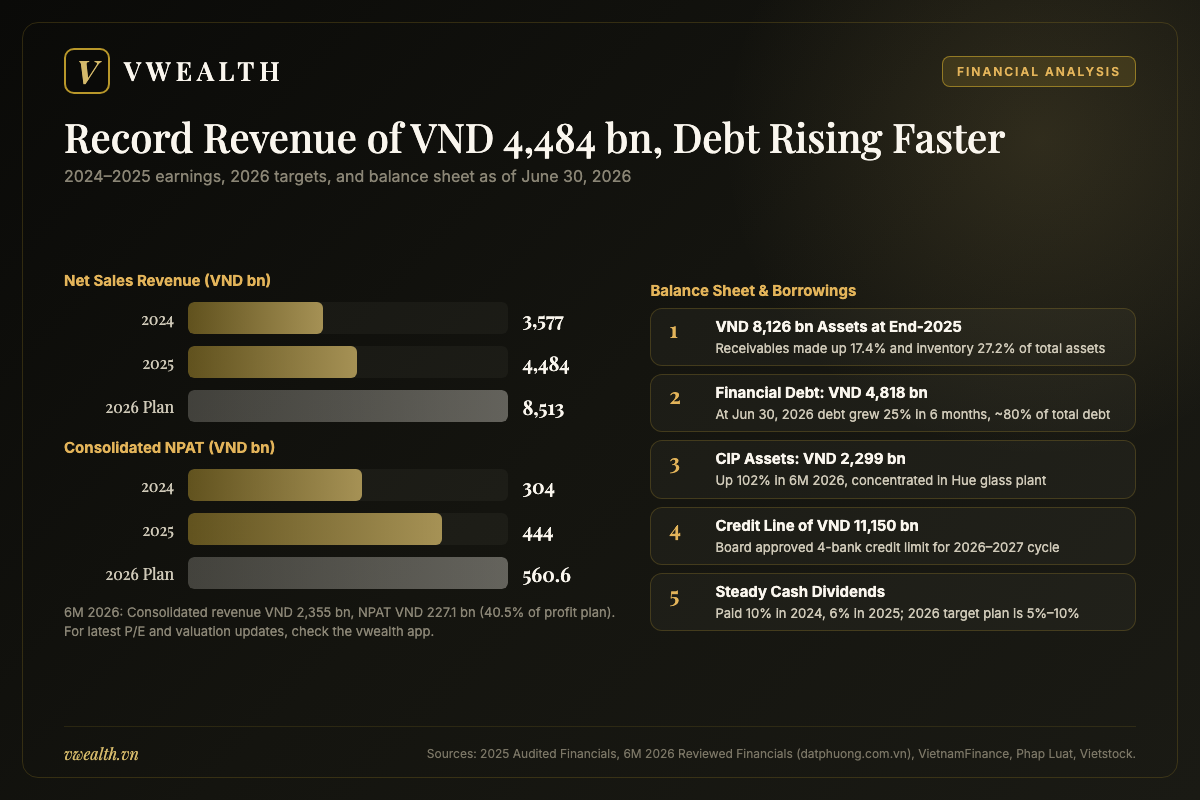
The 2026 Corporate Plan: An Ambitious Bid to Double Top-Line Revenue
The 2026 Annual General Meeting of Shareholders convened on April 25, 2026, took place amidst an ebullient corporate atmosphere. Following a record-breaking 2025 performance that delivered all-time highs in both top-line turnover and net earnings, executive leadership presented shareholders with arguably the most aggressive operational roadmap since the company’s founding: targeting a near-doubling of consolidated net revenue, propelling Dat Phuong into the elite tier of Vietnamese infrastructure conglomerates approaching the VND 10,000 billion turnover milestone. Yet beneath these headline targets lie precise engineering calculations and intense site delivery pressures confronting executive management.
Targets Approved at the April 25, 2026 AGM
According to the official Meeting Minutes and Resolutions of the 2026 AGM — approved by 99.98% of voting shares represented at the meeting — the core statutory operating targets for the 2026 fiscal year were formally established as follows:
- Consolidated Net Revenue Target: Established at VND 8,513 billion, representing an extraordinary 89.8% surge (nearly doubling) compared to realized net revenue of VND 4,484 billion in 2025.
- Consolidated Profit After Tax (PAT) Target: Budgeted at VND 560.6 billion, representing an increase of 26.3% over the VND 444 billion realized in 2025.
- Net Profit Attributable to Parent Company Shareholders (PAT-MI): Targeted at VND 455 billion, representing a 33% expansion compared to VND 327 billion delivered in 2025.
- Parent Entity Profit Distribution: The parent corporate entity is projected to contribute 74.6% to net profit and approximately 49% of consolidated group PAT.
- Segmental Revenue and Profit Weightings: The two foundation pillars — transport infrastructure contracting and renewable energy (hydropower) — remain the core operational ballast, projected to contribute approximately 81% of total consolidated revenue and roughly 80% of total PAT under the 2026 budget.
Budgeting an 89.8% expansion in top-line turnover alongside a more measured 26.3% increase in net earnings illustrates the corporate portfolio mechanics analyzed previously: Dat Phuong is driving massive top-line expansion by scaling up low-margin civil construction execution. While surging construction billings propel gross revenue toward historical records, net earnings expand at a measured pace due to high cost-of-goods-sold and incremental financing expenses.
The Real Estate Division: Carrying a VND 1,361 Billion Revenue Mandate
Although civil contracting and hydropower generate 81% of budgeted revenue, the swing factor determining whether Dat Phuong achieves its net profit goal of VND 560.6 billion rests with the master-planned real estate division. Under the approved 2026 budget, property development is mandated to generate over VND 1,361 billion in net revenue — an eighteen-fold expansion over the modest VND 73 billion booked during 2025.
This substantial delivery mandate rests entirely on the Casamia Balanca Hoi An project (Con Tien New Urban Area). Out of the VND 1,361 billion property target, Casamia Balanca is budgeted to generate approximately VND 1,300 billion in recognized revenue, driven by a planned delivery cluster of approximately 100 finished eco-villas scheduled for handover to buyers across November and December 2026. These properties represent units pre-sold under binding purchase agreements during the 2025 commercial campaign, currently undergoing final architectural MEP installation and landscape finishing.
However, institutional investors should avoid assuming the 25% to 30% net profit margins historically delivered by Dat Phuong’s earlier urban projects. Research analysts at Vietcap Securities (VCSC) highlighted that Dat Phuong formulated its corporate profit budget for Casamia Balanca assuming a conservative net profit margin of approximately 8%. This margin compression stems directly from management’s strategic concession during site clearance: the Board agreed to re-sell over 8,000 square meters of prime residential land at steep preferential discounts to displaced agricultural households to secure clean site clearance without protracted administrative litigation. Accepting compressed margins across this parcel was a rational operational tradeoff to secure site possession, but it structurally dilutes the blended net profit contribution of the entire development, yielding modest absolute net profits despite multi-trillion-dong turnover.
The Glass Division: From Capital Expenditure to Commercial Operation
The 2026 corporate roadmap marks the transition of Dat Phuong Glass Joint Stock Company from an intensive capital expenditure phase into active commercial manufacturing. During this initial operating year, management established realistic financial targets for the Hue manufacturing facility:
- Planned Glass Division Revenue: Budgeted at approximately VND 266 billion in 2026, corresponding to mobilized commercial production of roughly 5.17 million square meters (comprising 3.01 million square meters of premium architectural glass and 2.16 million square meters of solar PV protective glass).
- Budgeted Operating Earnings: Projected to incur a planned accounting net loss of approximately VND 39 billion.
For investors unaccustomed to industrial manufacturing cycles, budgeting a VND 39 billion net loss may initially appear concerning. However, in heavy process manufacturing, initial operating losses represent a standard economic reality. The facility completed civil structural works in late May 2026, conducted furnace heating in August 2026, and only commenced commercial manufacturing in October 2026. During these introductory months, the business absorbs full fixed-asset depreciation on its USD 45 million imported equipment line, allocated debt financing expenses, and raw material calibration losses during thermal ramp-up.
Furthermore, throughout 2026, production output cannot yet access the United States market, as international laboratory certifications and optical durability verifications require extended testing extending into 2027. Consequently, initial output is sold exclusively within the domestic Vietnamese market. Budgeting a VND 39 billion accounting loss in 2026 reflects financial conservatism, ensuring public markets are not surprised by introductory ramp-up expenses. Realized economic profitability from this advanced materials division is projected to materialize starting in 2027, as manufacturing capacity hits steady-state efficiency and direct North American export channels become operational.
Institutional Analyst Perspectives
Dat Phuong’s aggressive operating targets have attracted detailed coverage from domestic equity research desks, most notably from Vietcap Securities (VCSC) in April 2026:
According to VCSC’s published assessment, the AGM’s VND 8,513 billion revenue target was exceptionally aggressive, representing 135% of VCSC’s prior standalone revenue forecast for the conglomerate. Conversely, the parent company’s net profit target of VND 455 billion represented only 58% of the net earnings that VCSC had initially projected. This substantial divergence arose because Dat Phuong budgeted an 8% net profit margin for Casamia Balanca — well below the higher margins typical of luxury boutique coastal developments in Hoi An. Consequently, VCSC warned institutional clients of potential downward earnings revisions for DPG stock across 2026 to reflect this compressed real estate margin reality.
From a longer-term perspective, ACBS Securities maintained an Outperform rating on DPG stock in its October 2025 research note. Keep in mind that the note predates the February 2026 private placement of 17.8 million new shares and the disclosure of H1 2026 gross margin compression. Citing older securities-firm research shows past market expectations; it is not a promise about the future.
Mid-Year Execution Scorecard: The High-Stakes Fourth Quarter
Evaluating Dat Phuong’s H1 2026 realized financial results against its full-year statutory budget underscores the significant operational sprint required during the second half of the year:
- Top-Line Revenue Execution: Consolidated revenue of VND 2,355 billion achieved across the first six months fulfills only 27.7% of the full-year VND 8,513 billion budget (2,355 ÷ 8,513). To achieve its statutory target, Dat Phuong must generate over VND 6,150 billion in recognized revenue across the second half of 2026 [vwealth estimate: 8,513 − 2,355 = 6,158 billion].
- Net Profit After Tax Execution: Consolidated PAT of VND 227.086 billion achieved in H1 2026 (per official corporate filings) fulfills 40.5% of the annual VND 560.6 billion profit plan (227.086 ÷ 560.6). The group requires over VND 333 billion in incremental net profit across the remaining two quarters to fulfill its AGM mandate.
This wide variance between first-half delivery and full-year targets confirms that the ultimate outcome of Dat Phuong’s 2026 financial year rests entirely on operational execution in the fourth quarter. The company is relying on two decisive milestones: securing certified traffic opening and progress billings on Packages XL-02 and XL-03 of the Gia Binh airport expressway before December 31, 2026, alongside successfully executing the scheduled handover of approximately 100 Casamia Balanca villas across November and December 2026 to recognize roughly VND 1,300 billion in property turnover. If either of these operational catalysts encounters unexpected regulatory or engineering friction that delays formal acceptance into 2027, Dat Phuong will face the distinct probability of falling short of its ambitious full-year targets.
Factors That Could Derail the Strategic Script
Financial equity markets run on forward-looking expectations, but real-world corporate execution is continually tested by unforeseen operational variables. Even the most thoroughly modeled business plan faces derailment if fundamental underlying assumptions fail to materialize. For Dat Phuong, entering an aggressive expansion phase across 2026–2027 characterized by an order backlog of nearly VND 8,900 billion and interest-bearing financial debt of VND 4,818 billion (as of June 30, 2026), latent operational vulnerabilities have accumulated to a greater degree than during previous corporate cycles. Identifying these structural friction points is a mandatory prerequisite before allocating capital to DPG stock.
Debt Leverage and Personal Collateral Pledges from Executive Leadership
The most immediate balance sheet vulnerability confronting Dat Phuong is high financial leverage and tight working capital liquidity. As documented in corporate filings, total liabilities exceeded VND 6,043 billion by June 30, 2026, with interest-bearing financial borrowings reaching VND 4,818 billion (constituting nearly 80% of total liabilities). To fund massive mobilization across infrastructure megaprojects, the Board approved 2026–2027 credit limits totaling VND 11,150 billion across four commercial banks in September 2026, anchored by a VND 5,250 billion credit line from BIDV Thang Long Branch.
Coupled with this credit expansion is a regulatory event disclosed on October 28, 2026, reflecting the company’s requirement for eligible bank collateral. Under a formal Board Resolution, Dat Phuong approved executing contracts to borrow personal real estate properties from corporate insiders and affiliated family members to serve as supplemental collateral securing Dat Phuong’s credit facilities at BIDV Thang Long Branch. The list of individuals pledging personal real estate assets includes:
- Chairman of the Board Mr. Luong Minh Tuan and his spouse
- Vice Chairman of the Board Mr. Pham Kim Chau and his spouse
- Director and Chief Executive Officer Mr. Tran Anh Tuan and his spouse
- Ms. Luong Thi Lan and Mr. Trinh Viet Tuy (related parties of the Chairman)
Regulatory filings indicate that Dat Phuong will pay an asset borrowing fee to these individuals under specific contracts, while the exact asset schedules and fee amounts remain private commercial terms. Through an objective financial lens, this corporate maneuver presents two contrasting realities:
On the positive side, it demonstrates extraordinary personal commitment and “skin in the game” from the founding executive coalition. Company leaders are literally pledging their family residential properties to back corporate bank borrowing, underscoring their confidence in project cash flows. On the risk side, it sends an unmistakable technical signal: Dat Phuong’s corporate unencumbered fixed assets and project rights appear essentially pledged to existing credit facilities (with VietinBank, Techcombank, and NCB), compelling the enterprise to mobilize personal insider assets to satisfy bank borrowing covenants. With interest-bearing debt at VND 4,818 billion by mid-2026, any adverse shift in floating commercial loan rates or administrative delays in receiving certified project cash flows will immediately translate hundreds of billions in annual debt service into acute cash-flow strain.
Hydrological Volatility: The Most Lucrative Division Is Inherently Unpredictable
The second variable capable of disrupting Dat Phuong’s earnings trajectory is meteorological volatility in the hydropower segment. In 2025, hydropower generated over 58% of consolidated group PAT, serving as a financial stabilizer. However, relying heavily on run-of-river power also exposes corporate earnings to natural weather cycles.
Historical precedent demonstrates this cyclical exposure. In Q2 2024, an extended El Niño drought curtailed reservoir inflows across Central Vietnam, causing energy profits to drop sharply. In the first half of 2026, hydrology normalized, resulting in a 12% year-over-year decline in energy revenue (down to VND 278 billion) and a 17% drop in operating gross profit (down to VND 196 billion). If precipitation across Central Vietnam during late 2026 remains below historical averages, the hydropower division will be unable to repeat its 2025 earnings contribution, shifting the burden of profit delivery onto the contracting and real estate divisions.
Protracted Administrative Permitting Across Real Estate Holdings
While master-planned real estate offers potential profit windfalls, it also carries prolonged administrative risks. The clearest example is the Binh Duong Service and Resort Complex (re-zoned to 178 hectares with an adjusted investment budget of VND 3,000 billion).
Initially approved in March 2017 as reciprocal land for the 2016 De Vong Bridge BT agreement, the asset underwent a decade-long administrative saga: removed from the BT portfolio in late 2021, reinstated in October 2025, and subsequently re-scoped to reflect municipal boundary realignments. As a direct result, over VND 301 billion raised from the February 2026 private placement has remained parked in commercial bank deposits, unable to be deployed while waiting for revised master-planning approvals. With land clearance and regulatory permitting projected to extend through Q4 2027, this flagship coastal development will yield zero operational cash flow prior to 2028.
Even at the active Casamia Balanca Hoi An project, site acquisition challenges required management to negotiate a settlement re-selling over 8,000 square meters of residential land at steep discounts to affected agricultural residents. This resolved land clearance, but VCSC estimates it compressed project net margin to approximately 8%. Regarding the nearly 8-hectare parcel auctioned by VietinBank in Hue City, while the Board authorized bidding up to VND 252.86 billion, no formal confirmation of winning the auction or signing a binding transfer agreement had been released as of late October 2026, highlighting the procedural caution required when acquiring bank-distressed assets.
Thin Civil Contracting Margins and Input Price Volatility
In transport infrastructure contracting, the foremost risk to operating margins is raw material price inflation combined with aggressive site completion schedules. During the first half of 2026, Dat Phuong’s contracting gross margin stood at approximately 6.5% (VND 131 billion gross profit on VND 2,023 billion in revenue), pulling consolidated gross margin down to 14.1% from 18.8% in the prior year.
When gross margins operate within a 6% to 7% band, unexpected price spikes in structural steel, bulk asphalt, aggregates, or diesel fuel can erode projected contract profits. While Dat Phuong proactively hedged structural steel stockpiles for major projects like the Tran Hung Dao Bridge and Hong Ha Bridge, managing cost controls across an order backlog of nearly VND 8,900 billion dispersed across multiple provinces presents operational complexity. Furthermore, on challenging mountainous alignments such as the Quy Nhon – Pleiku Expressway (contract value of VND 1,315.5 billion), subcontracting approximately VND 635 billion in earthworks to regional firms requires sharing gross margin points while introducing third-party execution risks.
Advanced Glass Manufacturing: Trade Barriers and Chinese Competition
Entering ultra-clear patterned solar glass manufacturing in Thua Thien Hue immerses Dat Phuong in an industrial sector subject to global market dynamics. For 2026, management budgeted an accounting loss of approximately VND 39 billion for the glass division to absorb furnace commissioning and depreciation.
The central medium-term challenge involves international trade barriers and market penetration. Although Dat Phuong signed an offtake MOU with a commercial partner in the United States, commercial export of solar photovoltaic (PV) glass into North America requires passing rigorous optical transmittance standards and supply-chain origin certifications extending into 2027. Concurrently, dominant Chinese glass conglomerates — benefiting from massive economies of scale and integrated supply chains — frequently implement pricing pressure to defend market share. If international trade rules shift or US laboratory certifications face administrative delays, Dat Phuong will need to rely more heavily on domestic sales, competing within a more price-sensitive environment.
Three Potential Operating Scenarios for Investors
Alongside operational variables, historical share price volatility on the stock exchange offers valuable context for prospective allocators. Historical trading data indicates that DPG stock formed a major bottom at VND 26,000 per share on April 9, 2025, before rallying to VND 46,400 per share on June 18, 2025 (a multi-year peak representing an approximate 50% gain in roughly one month). In 2026, after testing peak levels in June 2026, DPG stock underwent a sharp market correction in July 2026, dropping toward VND 26,050 per share (a decline of over 30% from its recent peak). By October 8, 2026, DPG stock closed at VND 26,300 per share. This historical volatility profile demonstrates that DPG stock trades with a high beta, exhibiting significant sensitivity to public investment disbursements and broader market liquidity, comparable to the trading dynamics observed in our analysis of HUT stock of Tasco during large-scale corporate restructurings.
Synthesizing verified operating data and corporate guidance, we can construct three prospective business and earnings scenarios for Dat Phuong spanning late 2026 into 2027 (presented as illustrative analytical models based on AGM guidance, rather than price targets or valuation guarantees):
- Optimistic Scenario (Full Execution of AGM Targets):
- Operational Triggers: Dat Phuong successfully delivers all ~100 Casamia Balanca villas in Hoi An across November and December 2026, recognizing the full ~VND 1,300 billion in budgeted property revenue. Packages XL-02 and XL-03 on the Gia Binh airport link achieve vehicle traffic opening before December 31, 2026, with progress billings fully certified by Sun Group. Late-year rainfall across Central Vietnam supports robust fourth-quarter hydropower dispatch. The Hue glass plant operates smoothly, achieving budgeted revenue of VND 266 billion while containing accounting losses within VND 39 billion.
- Financial Impact: Full-year 2026 consolidated revenue approaches or meets the AGM target of VND 8,513 billion; consolidated PAT achieves or exceeds the VND 560.6 billion target (parent PAT ~VND 455 billion). Operating cash flow generated from real estate deliveries and contracting advances significantly relieves short-term balance sheet pressure.
- Base Case Scenario (Phased Execution with Year-End Lags):
- Operational Triggers: Casamia Balanca achieves partial villa handovers during December 2026, while the remaining deliveries slip into Q1 2027 due to client inspection schedules. The Gia Binh airport link opens to basic traffic, but progress certification audits carry over into early 2027. Hydropower output aligns with multi-year seasonal averages. Ultra-clear glass sales focus primarily on the domestic market, with US certification milestones proceeding toward a late-2027 launch.
- Financial Impact: Full-year revenue and net profit fall short of the aggressive AGM targets (VND 8,513 billion revenue and VND 560.6 billion PAT), yet deliver positive year-over-year earnings growth compared to 2025 actuals (VND 4,484 billion revenue and VND 444 billion PAT). Deferred real estate earnings provide an operational earnings cushion entering early 2027.
- Conservative Scenario (Dual Operational Bottlenecks):
- Operational Triggers: Construction handover protocols at Casamia Balanca encounter technical delays, pushing the bulk of property revenue recognition into the 2027 fiscal year. Severe late-season typhoons in Central and Northern Vietnam impede earthworks on the high-speed rail and Gia Binh airport alignments. Hydrological drought reduces seasonal power generation. Expanding interest expenses on VND 4,818 billion in financial debt erode operating margins, while introductory glass furnace losses exceed the VND 39 billion budget.
- Financial Impact: Full-year revenue misses the VND 8,513 billion target by a wide margin, and consolidated PAT falls well below the VND 560.6 billion budget, potentially dipping below 2025 realized earnings. The conglomerate faces tighter liquidity, requiring careful working capital management to service commercial bank debt obligations.
Monitoring verified villa delivery notifications at Hoi An and certified construction milestones on the Gia Binh expressway through the closing months of the year will allow institutional investors to determine which of these three paths Dat Phuong is tracking.
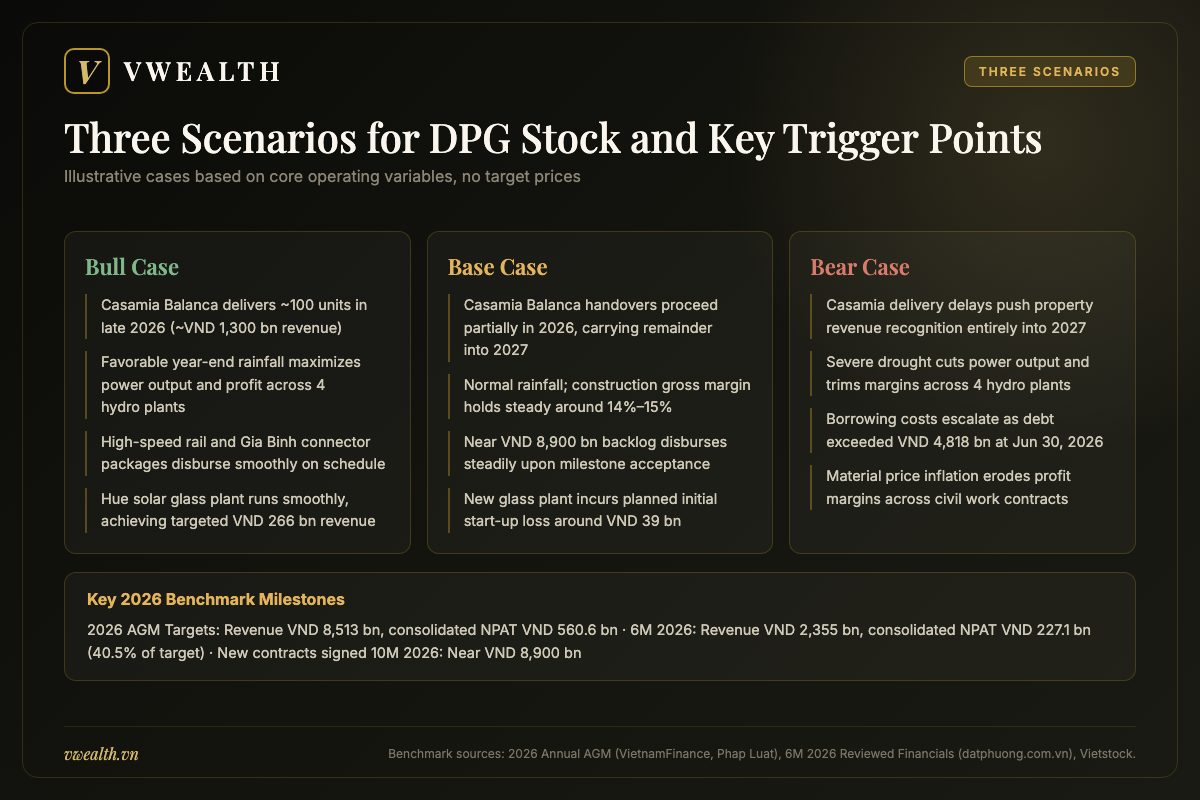
Should You Buy DPG Stock? Who It Is and Isn’t For
Having examined Dat Phuong’s nearly quarter-century corporate history, unpacked the equity holdings of the founding executive core, evaluated the operational mechanics across its five business pillars, reviewed the nearly VND 8,900 billion infrastructure order backlog, and confronted the reality of VND 4,818 billion in financial debt, we return to the decisive question facing international investors: Should you buy DPG stock at this stage of Vietnam’s economic cycle? In professional security analysis, the decision to buy DPG stock cannot be reduced to a simplistic binary recommendation. In institutional value investing, an equity asset is only attractive when paired with an investor whose capital horizon and volatility tolerance match the company’s underlying operating dynamics.
Core Competitive Strengths
A rigorous investment evaluation must first acknowledge the distinct competitive moats and strategic assets Dat Phuong has cultivated over more than two decades:
- Massive Order Backlog Securing Multi-Year Revenue Visibility: An unexecuted contracting backlog of nearly VND 8,900 billion secured across the first ten months of 2026 (spanning the Tran Hung Dao Bridge, Gia Binh airport link, Hanoi – Quang Ninh High-Speed Railway, and Quy Nhon – Pleiku Expressway) provides operational utilization and top-line visibility through 2028, insulating the group against contracting volume shortages during Vietnam’s transport infrastructure cycle.
- Defensible Engineering Moat in Complex Bridge Structures: Rather than competing in low-barrier earthworks or asphalt paving, Dat Phuong’s technical specialization in balanced cantilever bridges, long-span precast girders, and deep-river foundations creates an entry barrier that protects strategic relationships with top private developers like Sun Group and state transport PMUs.
- High-Margin Hydropower Cash Flows Providing Financial Stability: Despite seasonal variability, the Song Bung 6 and Son Tra 1 hydropower plants (90 MW aggregate capacity) operate with gross margins of 60% to 70%, generating dependable cash flow to service corporate debt and finance construction working capital.
- Low-Cost Master-Planned Land Reserves in Prime Tourism Hubs: Converting historical BT infrastructure projects into prime real estate allocations around Hoi An provided high-margin land. Casamia Balanca has finalized 100% of its land levies and is executing deliveries, while pipeline holdings in Binh Duong (178 hectares, Da Nang) and potential auction parcels in Hue provide development visibility for the next decade.
- Advanced Materials Pillar Aligned with Global Solar Transition: The ultra-clear patterned glass plant in Thua Thien Hue (5.17 million m² capacity) commenced commercial operations in October 2026, leveraging domestic high-purity silica sand reserves with long-term export potential into the United States market from 2027 onward.
- Disciplined Cash Dividend Record and Anchor Foreign Institutional Backing: Dat Phuong has maintained regular annual cash dividends of 5% to 10% (planning VND 500 to VND 1,000 per share in 2026), supported by an institutional shareholder base anchored by Dragon Capital holding over 10% of equity.
Critical Risk Factors to Monitor
Parallel to these commercial strengths, prospective allocators must weigh several operational and balance sheet challenges:
- Escalating Financial Debt and Heavy Interest Burden: Total interest-bearing debt reached VND 4,818 billion by mid-2026, generating quarterly interest expenses of VND 35 billion to VND 40 billion. Maintaining comprehensive credit lines of VND 11,150 billion requires disciplined working capital management to avoid short-term liquidity bottlenecks.
- Pledging Insider Personal Real Estate for Corporate Collateral: Board resolutions approving the borrowing of residential real estate from executive founders and their families to satisfy bank loan covenants at BIDV Thang Long indicate that corporate assets are heavily encumbered, reflecting capital intensity during this rapid expansion.
- Structural Compression in Gross and Net Operating Margins: Surging low-margin construction billings reduced consolidated gross margin to 14.1% in H1 2026. Furthermore, Casamia Balanca’s net margin is modeled at approximately 8% due to discounted land concessions made to settle local site clearance disputes.
- Operational Execution Skewed Heavily Toward the Fourth Quarter: H1 2026 realized consolidated PAT of VND 227.086 billion represents only 40.5% of the full-year VND 560.6 billion target. Achieving the annual budget depends on completing the Gia Binh airport link before December 31, 2026, and executing the scheduled delivery of approximately 100 Casamia Balanca villas during November and December.
- Hydrological Variability and Introductory Glass Division Losses: Hydropower revenue remains vulnerable to seasonal rainfall deficits, while the Hue glass facility is budgeted to incur a VND 39 billion accounting loss in 2026 during initial commissioning, with US export certifications extending into 2027.
- Information Reporting Lag: As of late October 2026, Dat Phuong has not released its Q3 2026 interim financial report, leaving third-quarter cash flows and debt levels subject to upcoming verification.
The matrix below summarizes the balance of operational opportunities and fundamental risks across Dat Phuong’s five operating pillars:
| Core Operational Pillar | Key Growth Catalysts & Positive Drivers (Pros) | Primary Balance Sheet Risks & Challenges (Cons) |
|---|---|---|
| 1. Civil Infrastructure Contracting | Backlog of nearly VND 8,900B; major contracts in bridges, high-speed rail, and airport links. | Thin gross margin (~6.5%); working capital demands and raw material price volatility. |
| 2. Renewable Energy (Hydropower) | Gross profit margins of 60–70%; generates recurring liquidity to service corporate bank loans. | Subject to regional rainfall variations; H1 2026 energy revenue dropped 12% on weather normalization. |
| 3. Master-Planned Real Estate | Casamia Balanca land levies fully paid; preparing to deliver ~100 villas in Q4 2026. | Blended net margin compressed to ~8% (VCSC); over VND 301B in Binh Duong capital awaiting permits. |
| 4. Capital Structure & Leverage | Regular 5–10% cash dividend; Dragon Capital maintains an anchor institutional stake >10%. | Debt climbed to VND 4,818B; corporate assets encumbered, requiring insider property pledges. |
| 5. Ultra-Clear Solar Glass | Commercial launch Oct 2026; direct access to low-cost Central Vietnam silica sand quarries. | Budgeted accounting loss of VND 39B in 2026; US export certifications extend into 2027. |
Investor Suitability Profile
Based on this multi-dimensional assessment, allocating capital to DPG stock represents an appropriate strategy for:
- Medium-to-Long-Term Cyclical Investors (1 to 3-Year Time Horizon): Investors who understand the cash-flow timing of Vietnamese public infrastructure spending and master-planned property handovers. Such allocators can look past near-term leverage to capture long-term value from the nearly VND 8,900 billion backlog, steady hydropower cash flows, and the scaling of the Hue solar glass plant into profitability by 2027.
- Investors Seeking Tangible Asset Moats and High Insider Alignment: Allocators who value substantial personal insider shareholdings (over 26% voting power held by founders), where executives demonstrate tangible “skin in the game” by pledging personal family assets to support bank facilities, while sustaining a dependable record of cash dividend distributions.
- Patient Market Participants Comfortable with Lumpy Quarterly Earnings: Investors who recognize that Dat Phuong’s earnings profile is non-linear, characterized by substantial earnings spikes when residential phases are delivered or large transport projects reach certified completion.
Conversely, DPG stock is structurally unsuitable for:
- Short-Term Momentum Traders and Daily Speculators: DPG stock has historically exhibited wide price swings (including a greater than 30% correction in July 2026). Retail traders attempting to trade around short-term news headlines risk selling into market drawdowns.
- Risk-Averse or Low-Leverage Equity Allocators: Conservative investors seeking pristine, debt-free balance sheets with minimal debt-to-equity ratios will find Dat Phuong’s VND 4,818 billion debt load and 1.78x D/E ratio misaligned with their risk parameters.
- Investors Mandating Smooth, Linear Earnings Progression: Operating thin-margin contracting, batch-delivery real estate, and weather-dependent hydropower guarantees that quarterly operating metrics will fluctuate significantly across reporting periods.
Pre-Investment Due Diligence Checklist
Before initiating or increasing an equity position in DPG stock, investors should systematically track the following six empirical milestones:
- Review the Forthcoming Q3 2026 Financial Report: Verify whether infrastructure contracting turnover maintained growth above 40%, check if quarterly interest expenses escalated significantly beyond the VND 35.6 billion incurred in Q2, and inspect whether operating cash flow (CFO) is inflecting toward positive territory.
- Confirm Realized Handover Progress at Casamia Balanca Hoi An: Track official corporate notifications verifying the physical handover of approximately 100 eco-villas during November and December 2026, which is critical to recognizing the budgeted VND 1,300 billion in property revenue and meeting annual profit guidance.
- Monitor the Traffic Opening of the Gia Binh Airport Expressway: Validate technical completion and progress billing acceptance on Packages XL-02 and XL-03 ahead of the December 31, 2026 deadline tied to APEC 2027 logistics.
- Evaluate Commercial Ramp-Up at the Hue Ultra-Clear Glass Facility: Assess domestic product absorption during Q4 2026 and monitor technical qualification milestones required for North American export access in 2027.
- Track Regional Precipitation and Reservoir Hydrology in Central Vietnam: Monitor seasonal water storage levels at Song Bung 6 and Son Tra 1 through the end of the year, as hydropower dispatch directly dictates high-margin cash generation.
- Verify Regulatory Progress on the Binh Duong Project: Confirm whether municipal investment planning approvals in Da Nang are finalized, enabling the deployment of the VND 301 billion in private placement proceeds currently held in commercial bank deposits.
Tracking DPG Stock with VWEALTH
Investing in a diversified infrastructure conglomerate with complex operating segments like Dat Phuong demands continuous tracking of verified regulatory filings, balance sheet transitions, and site-level construction milestones. Manually analyzing reviewed financial statements, separating inter-company cash transfers, and modeling revalued net asset values (RNAV) for multi-phase urban land banks requires significant research time.
To stay ahead of critical corporate developments — from upcoming quarterly financial disclosures to progress certifications on multi-trillion-dong infrastructure packages and real-time automated valuation analytics — institutional and individual allocators can access the vwealth intelligence platform. Visit our registration portal at vwealth.vn/dang-ky/ to activate specialized financial research tools designed to support institutional-grade investment decisions across Vietnam stocks.
Research Vietnamese stocks in English with vwealth. Our AI-powered platform turns Vietnamese market data into full English analysis reports — with international payment support and a free 2-month trial for new accounts. Create your free account and read the latest reports.


