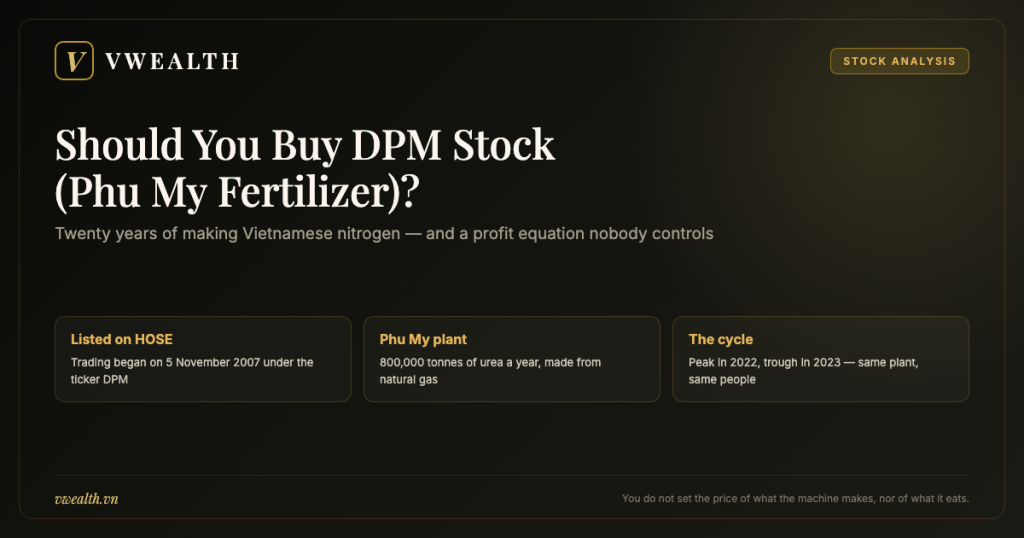
Should you buy DPM stock? The question has an unusual property: the most defensible answer this year can be the most expensive answer next year, without the company doing a single thing differently. DPM is the Ho Chi Minh City exchange ticker for PetroVietnam Fertilizer and Chemicals Corporation, known to every farmer in the country simply as Dam Phu My — Phu My Urea. In 2022 the company earned more than VND 6,600 billion, paid a cash dividend of 70% of par value, ran its plant flat out and made its shareholders feel like lottery winners. One year later more than ninety per cent of that profit had evaporated, down to the lowest level since 2019. Same plant, same production line, same people, same 800,000 tonnes of urea a year. What changed sat somewhere else entirely: the world urea price and the price of natural gas — two numbers that nobody at the company’s head office can influence. That is the nature of a cyclical commodity business, and it is why so many investors buy DPM at the exact moment every ratio looks its best, and then lose money. This article tells the story of the company that gave Vietnam its first industrial-scale domestic nitrogen, shows you how to read the financial statements of a business whose profits depend on the price of fuel oil in Singapore, and ends with a straight answer: which kind of investor DPM suits, and which kind it will ruin.
Two ground rules before we start. The first is about numbers. You will meet a lot of dated milestones, plant capacities, ownership percentages, declared dividend policies and enacted legislation — all of it public and verifiable. You will meet almost no current-quarter figures: no latest earnings, no today’s price-to-earnings ratio, no closing price, no target price. The reason is specific to DPM. This is a business whose profit margin can swing by a multiple within four quarters; it also shuts its plant for a full turnaround roughly every two years, which throws quarterly output wildly out of line; and since mid-2025 a tax change has broken the comparability of the historical series. Printing a P/E today would not just be useless six months from now, it would actively point you the wrong way — because, as Chapter 5 explains, with this class of stock the P/E that looks cheapest is the most expensive trap on the board. Instead of handing you a figure with a short shelf life, this article teaches you to read DPM’s own numbers. When you want today’s data, open the DPM report on the vwealth platform for the current metrics. The article gives you the framework; the report gives you the figures.
The second rule is about context. If you are approaching this from outside Vietnam, do not read DPM in isolation. Start with the mechanics: our guide to investing in the Vietnam stock market covers what a foreign investor has to sort out first — how to open an account, what the foreign ownership limit actually restricts, why the T+ settlement cycle and the daily price band change the way you should size a position — and the wider Vietnam stock market guide maps how the exchanges and the main sectors fit together. Then place DPM next to the companies that share its supply chain and its cycle. PV GAS sits on the other side of every feedstock contract DPM signs, which makes it the single most important company to understand alongside this one. PV Power shows you what the same state parent looks like in electricity, Petrolimex shows you the distribution end of the same oil-and-gas ecosystem, and Hoa Phat in steel is the cleanest local example of the same commodity-cycle arithmetic applied to a different raw material. Read across those four and DPM stops looking like an odd one-off and starts looking like what it is: a very particular species of listed company.
From a gas pipeline to a bag of Vietnamese urea: the history of DPM
Here is a detail most investors under forty have no reason to know: until the early 2000s, Vietnam imported almost all of its urea. A farming country, one of the world’s largest rice exporters, spending hard currency every year on millions of tonnes of nitrogen — and letting the domestic price of that nitrogen jump around with whatever ship happened to dock. Every winter–spring planting season, traders would hoard stock, prices would spike, and farmers absorbed it. The entire reason Dam Phu My exists is that sentence. And because it was created to solve a national problem rather than to maximise returns for shareholders, the company carries characteristics you need to understand before you press the buy button.
The hard-currency problem and the decision to make fertiliser out of gas
In the late 1990s Vietnam had one resource that was just beginning to flow in volume: associated gas and natural gas from the offshore fields in the south-east of the country. The Bach Ho pipeline brought that gas ashore, and the question became what to do with it. Every country with gas faces the same three classic options: burn it for power, liquefy it for export, or turn it into nitrogen fertiliser. Vietnam chose all three, and the fertiliser branch became DPM.
Hold on to one piece of simple chemistry, because every argument in this article rests on it. Urea is made from ammonia (NH3). Ammonia is synthesised from nitrogen and hydrogen. The nitrogen is free — the air around you is almost 80% nitrogen. The hydrogen has to come from somewhere, and the cheapest source is natural gas, which is mostly methane (CH4). In other words, a gas-based urea plant is a machine for converting gas into fertiliser. The gas is a feedstock, not merely a fuel. That distinction is the whole game. It is why gas does not sit in some minor “energy costs” line on DPM’s income statement but instead dominates cost of goods sold — industry analysis puts natural gas at roughly 50–60% of the cost structure, and higher still as a share of raw material inputs specifically.
If you are used to Western fertiliser producers, this will feel familiar and yet different. A European or North American nitrogen producer runs on the same chemistry, but buys gas at a hub price — TTF in the Netherlands, Henry Hub in the United States — that moves with its own supply and demand. As you will see in Chapter 4, DPM buys gas under a formula tied to something else entirely, and that difference is the most important single fact about this company.
Why Phu My: a pipeline, a deep-water port and the Mekong Delta
The site chosen was the Phu My I industrial park in what was then Ba Ria – Vung Tau province, on the Thi Vai river, where the gas pipeline runs past and a deep-water port allows product to be barged out across the Mekong Delta. Three things converged in one place: feedstock on site, a port on site, and the country’s largest consuming market immediately to the west. If you have ever wondered why DPM is overwhelmingly dominant in the south of Vietnam and struggles in the north, the answer is entirely contained in that map.
The plant was broken ground in 2001, built by an international contracting consortium using licensed technology from the world’s leading ammonia and urea process owners. Original design capacity was 740,000 tonnes of urea a year plus around 540,000 tonnes of ammonia. At the time it was one of the largest industrial projects Vietnam’s oil and gas sector had ever attempted, and it was assigned to Vietnam Oil and Gas Corporation — today the Vietnam National Industry and Energy Group, universally referred to as Petrovietnam.
A note on that name, because it recurs throughout this article and matters more than any operating metric. Petrovietnam is Vietnam’s state-owned national energy group: the entity that holds the country’s upstream oil and gas interests and controls the listed companies built around them, including PV GAS, PV Power, Binh Son Refining and DPM itself. It is not a portfolio investor. It is a state instrument with policy objectives, and it does not sell. If you have followed state-owned enterprises in China, India, Brazil or the Gulf, the model will be recognisable: professional management, disciplined operations, real assets — and a controlling shareholder whose objective function is not the share price.
One observation about the asset itself that shapes everything downstream. An ammonia–urea complex is extraordinarily expensive to build and extraordinarily durable to run. The initial capital outlay runs to hundreds of millions of US dollars and construction takes years; but once it is running, its life is measured in decades and its variable operating cost is relatively low provided the gas supply is steady. That cost structure creates a consequence shareholders live with permanently: when selling prices are good, almost the entire price differential drops straight to the bottom line, because the fixed costs were sunk long ago. When selling prices are bad, the plant keeps running anyway, because shutting an ammonia loop down costs more than operating it. That is the textbook definition of high operating leverage, and it explains the entire insane amplitude of DPM’s earnings over twenty years.
28 March 2003: a company that existed before its product did
On 28 March 2003, the Petrovietnam Fertilizer and Chemicals Company was established. The interesting detail is that it came into being while the plant was still a construction site. Its first job was not to sell anything but to prepare to receive, operate and commercialise the output of a factory that did not yet exist. An entire organisation was assembled in advance to learn how to run a complex chemical process, to build a distribution system from zero, and to name a brand that had no product behind it.
This tells you a great deal about a corporate culture you will keep bumping into. DPM did not grow from a small trading operation and expand outwards the way most private companies on the exchange did. It was designed top-down, at a predetermined scale, with state capital and a mission that was handed to it rather than chosen. That produces genuinely impressive operating discipline — the Phu My plant has earned operational excellence certifications for years running, and there have been stretches when the ammonia unit ran continuously for more than six hundred days without a stop. It also produces caution. This company rarely does anything abruptly, and every large decision has to pass through its state shareholder.
Late 2004: the first bag, and a market that changed hands
The company began operating in January 2004. During that year the plant was handed over, inaugurated, and the first bags of Dam Phu My reached the market. To an outsider that was just another new factory. To Vietnam’s fertiliser market it was a change of ownership.
Before 2004 the domestic urea price was essentially a function of the import price plus freight plus the importer’s margin. After 2004 there was a large domestic source, delivering by barge to dealers deep in the Mekong Delta in days rather than weeks. The stabilising effect showed up most clearly whenever the plant went down for maintenance: the urea market would tighten immediately and then cool the moment the plant came back. That is a quantitative signal of DPM’s weight that no financial statement records — the presence or absence of a single company moving the price level of an entire commodity in a country of a hundred million people.
The Dam Phu My brand was born in this period and became one of the very few industrial brands Vietnamese farmers know by name. In fertiliser, where counterfeiting is a chronic problem, a trusted name carries real commercial value: dealers move it more easily, and it holds a price premium over chemically identical product. That is the first piece of DPM’s moat, and we will come back to it.
2007: equitisation, and 5 November on the HOSE board
On 31 August 2007 the business converted into a joint stock company. On 5 November 2007 the DPM ticker was formally listed and began trading on the Ho Chi Minh City Stock Exchange, with a first-session reference price of VND 95,000. Read that number in context: this was the peak of Vietnam’s 2007 equity mania, when a wave of large state enterprises came to market for the first time and investors queued up regardless of valuation.
A word on what “equitisation” means here, because the term is specific to Vietnam and is not a synonym for privatisation. Equitisation converts a state enterprise into a joint stock company and sells a minority of the shares to the public and to strategic investors, while the state typically retains control. It is a change in legal form and in transparency obligations, not a change of owner. For a shareholder this is the most important date in the company’s history, because from here on every move in the world urea price is translated into a number on the trading board. But it is also where the story Chapter 2 tells begins: equitisation did not mean a change of control. Petrovietnam kept absolute command, and that ownership structure has barely moved in the twenty years since.
In 2008 the business was restructured as a corporation — Petrovietnam Fertilizer and Chemicals Corporation, international trading name PVFCCo. The “corporation” designation was not decorative: it came with the formation of regional distribution subsidiaries, a structure that Chapter 3 will argue is the single hardest asset in this company to copy.
2010–2014: debottlenecking to 800,000 tonnes, and a national brand
This was the period when DPM did well what it already knew how to do. In 2010 urea capacity was lifted from 740,000 to 800,000 tonnes a year — not by building another line, but by optimising operations and modifying equipment. This is the cheapest form of growth a chemical plant can have: extra volume with almost no extra capital. Process engineers call it debottlenecking, and it is worth more per dollar spent than almost any greenfield project.
In 2011 the company passed 5 million cumulative tonnes of nitrogen produced and completed the PVFCCo Tower head office. In 2013 it marked ten years and received the First Class Labour Medal. In 2014 the Dam Phu My brand was recognised as a Vietnam National Brand — an honour it received again in 2016, 2018 and 2020. In 2017 the plant crossed 10 million cumulative tonnes.
Underneath that record of achievement, though, sat a strategic problem management had spotted early: DPM was a one-product company. Its entire destiny was tied to urea, and urea is a homogeneous commodity — a DPM granule is chemically indistinguishable from a granule imported from the Middle East. When the product is homogeneous, the seller has no pricing power. You can be the best operator on earth and still lose money if the world price collapses. The question facing a mature corporation was straightforward: how do you escape the trap of selling only one thing whose price you do not set?
2015–2018: the NPK and chemicals bet
The answer was to move up the value chain. In 2015 the UFC85 unit entered commercial production — a UFC85/formaldehyde plant with design capacity of 15,000 tonnes a year and total investment of VND 497 billion. The product sounds technical but its purpose is mundane: UFC85 is an anti-caking additive for urea granules, which stops the product from setting solid in storage. Vietnam had previously imported it. This was the first time DPM manufactured something it had been buying.
The same year, two much larger projects broke ground simultaneously: an ammonia debottlenecking complex and the Phu My NPK plant. Both came onstream in 2018. The NH3 expansion added 90,000 tonnes of ammonia a year. The Phu My NPK plant has capacity of 250,000 tonnes a year and uses chemical granulation technology — meaning the nutrient elements are reacted and crystallised within a single granule — as distinct from mechanical bulk blending, which simply mixes three different types of granule into one bag.
That difference is the entire investment case for the NPK segment, so it is worth being precise. NPK stands for nitrogen, phosphorus and potassium, the three macronutrients every crop needs. With a bulk blend, a farmer spreading the product gets a different nutrient ratio in every handful, and the different granules segregate during transport and handling. With chemically granulated NPK, every granule contains all three elements in the specified ratio — consistent quality, a price premium, and, critically in this market, much harder to counterfeit. In a Vietnamese NPK market that contains hundreds of small blending operations, owning an industrial-scale chemical granulation plant is a genuine barrier.
Financially this was a real bet. Thousands of billions of dong went into a segment DPM had never operated, at a time when the 2015–2019 urea price was in a trough and corporate earnings were falling. Shareholders at the time questioned the capital intensity and the payback period. It took years for NPK to prove itself — and as Chapter 3 shows, by the middle of the 2020s it had become the most reliable growth engine the company owns.
2021–2026: the top of the cycle, the bottom of the cycle, and a new name
Then came the strangest stretch in the company’s history. The pandemic disrupted supply chains; conflict in Europe pushed gas prices to levels never previously seen, forcing nitrogen plants across Europe to shut down because running them lost money on every tonne; and China tightened fertiliser exports to keep product at home for its own farmers. Those three forces combined, and the world urea price spiked to an all-time high through 2021 and the first half of 2022.
DPM was on the lucky side of that equation. Its selling price rose with the world, while its input gas price was pegged to Singapore fuel oil — which also rose, but nowhere near as violently. The result: a record year across every line in 2022, with output of roughly 920,000 tonnes, exports of around 200,000 tonnes of urea, revenue of roughly VND 20,000 billion and profit above VND 6,600 billion. In the first nine months of 2022 alone, revenue reached VND 13,906 billion and pre-tax profit VND 5,435 billion. The cash dividend for 2022 was raised to 70% of par value — a level very few listed Vietnamese companies have ever paid.
And then the cycle turned. In 2023 the world urea price cooled, more than ninety per cent of DPM’s after-tax profit evaporated, and earnings fell to the lowest level since 2019. There was no scandal, no management error, no failed project. The commodity cycle simply did its job. If you take one lesson from this entire article, take that one.
What followed was a repositioning. In 2024 PVFCCo introduced a new name and brand identity — “Phu My” — with the message “Sharing prosperity” for its chemicals line, while “For a bountiful harvest” remains the message for fertilisers. This is not decoration: it reflects a company that wants to be seen as a fertiliser and chemicals business rather than a urea plant. In September 2025, charter capital was raised from VND 3,914 billion to VND 6,799.9 billion following a bonus share issue at a ratio of 73.7476% funded from the development investment fund. In late December 2025 the plant entered one of the largest total maintenance turnarounds in its history, with more than 5,500 individual work items and more than 1,700 personnel mobilised.
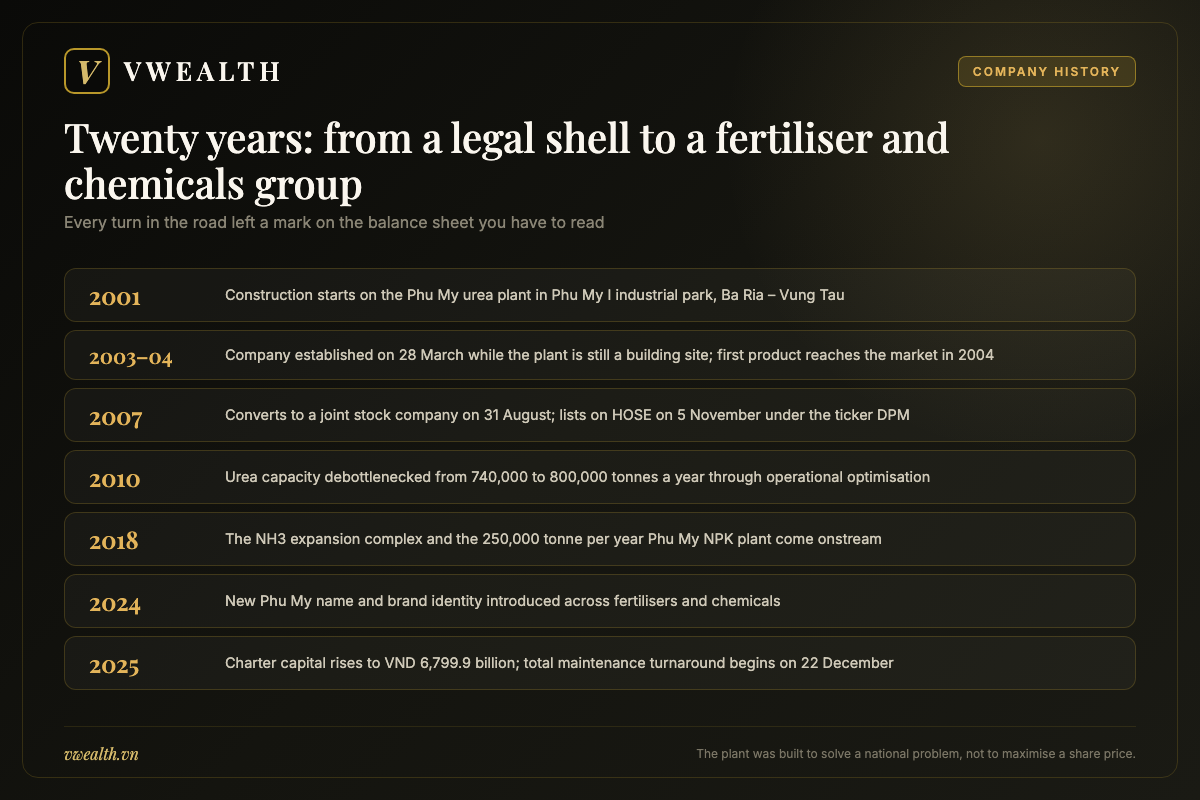
| Date | Event | Why it matters to an investor |
|---|---|---|
| 2001 | Construction starts on the Phu My urea plant in Phu My I industrial park | The core asset begins to exist |
| 28 March 2003 | Petrovietnam Fertilizer and Chemicals Company established | A legal entity created before it had a product |
| 2004 | Plant handed over and inaugurated; first product reaches the market | Vietnam gains a large-scale domestic urea source |
| 31 August 2007 | Converted into a joint stock company | Preparation for listing; state control retained |
| 5 November 2007 | Lists on HOSE at a reference price of VND 95,000 | DPM appears on the trading board at the top of a mania |
| 2008 | Restructured as a corporation, international name PVFCCo | Regional distribution network takes shape |
| 2010 | Urea capacity debottlenecked from 740,000 to 800,000 tonnes a year | Extra volume with almost no extra capital |
| 2011 | 5 million cumulative tonnes of nitrogen; PVFCCo Tower completed | Operating scale reaches maturity |
| 2014 | Dam Phu My named a Vietnam National Brand (again in 2016, 2018, 2020) | Brand equity with real commercial value |
| 2015 | UFC85 unit onstream (15,000 t/y, VND 497 billion); NH3 expansion and NPK break ground | The escape from one-product status begins |
| 2017 | 10 million cumulative tonnes of Phu My urea | Most of the original capital cost has been earned back |
| 2018 | NH3 expansion (+90,000 t/y) and Phu My NPK (250,000 t/y) come onstream | The company finally has a second story to tell |
| 2022 | Record year: ~920,000 t output, ~200,000 t exports, ~VND 20,000bn revenue, >VND 6,600bn profit | Cycle peak — and the biggest valuation trap in the company’s history |
| 2023 | More than 90% of after-tax profit evaporates, lowest since 2019 | The cyclical nature shows its true face |
| 2024 | New “Phu My” name and brand identity introduced | Repositioning: fertiliser and chemicals |
| 1 July 2025 | The 2024 VAT Law takes effect; fertiliser returns to a 5% VAT rate | Changes the profit structure of the entire industry |
| September 2025 | Charter capital rises to VND 6,799.9 billion (679,990,761 shares) | Every per-share metric is technically diluted |
| December 2025 | Total maintenance turnaround: >5,500 work items, >1,700 personnel | Output skews between quarters — never judge on one quarter |
The largest shareholder who almost never sells: DPM ownership and leadership
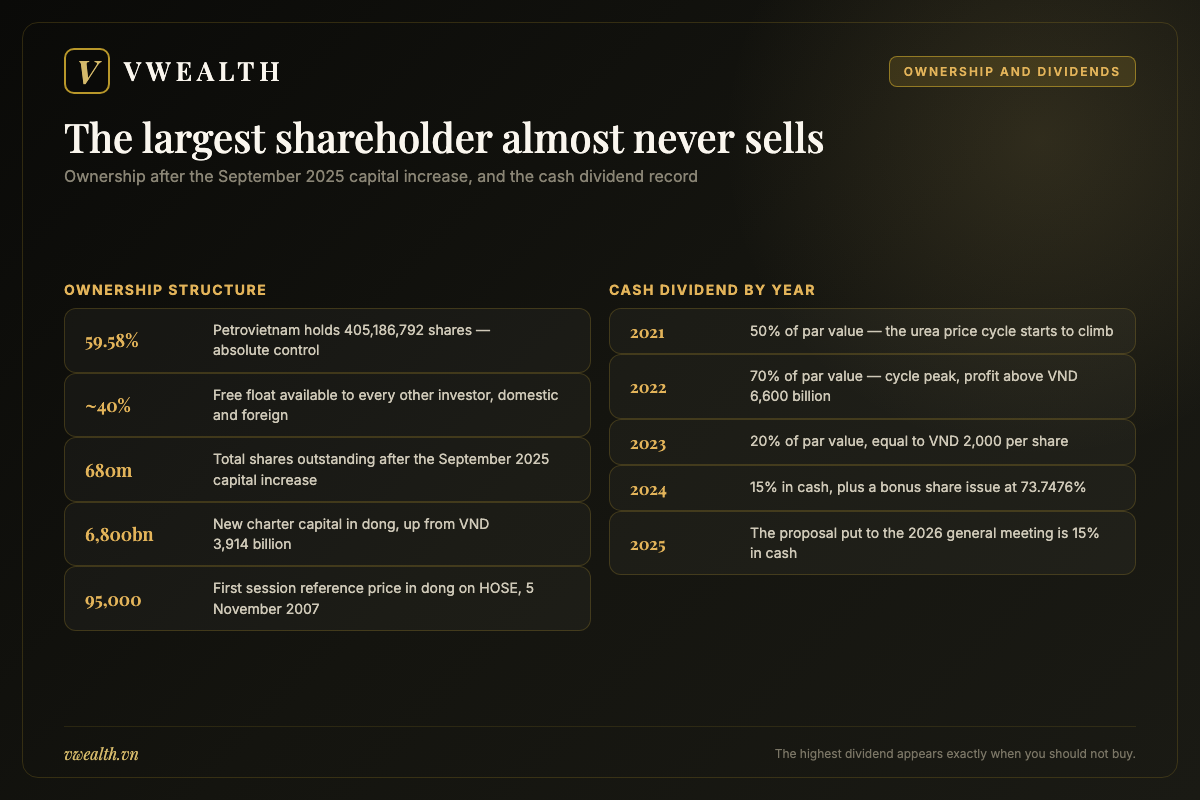
If you were allowed to know exactly one number about DPM before deciding whether to buy it, choose this one: Petrovietnam holds 405,186,792 shares out of 679,990,761 outstanding, or roughly 59.58% of the capital. Not plant efficiency, not the urea price, not the P/E. That 59.58% determines most of what you can and cannot expect from this stock — the dividend policy, the speed of decision-making, and the way the share price behaves when the market gets excited.
59.58%: absolute control and everything that follows from it
Under Vietnam’s Enterprise Law, ownership above 51% allows a shareholder to pass most ordinary general meeting resolutions; above 65% allows even the gravest matters to be carried. Petrovietnam sits between those thresholds, but in practice, with the remainder of the register highly fragmented, the state shareholder’s voice is decisive on everything that counts: senior appointments, investment plans, the dividend level, product strategy.
This has an upside and a downside, and a foreign investor should look coldly at both. The upside: the company faces essentially no hostile takeover risk, no risk of a large shareholder quietly liquidating and cratering the price, and none of the convoluted related-party asset shuffling that shows up periodically among family-controlled listed groups in this market. Financial statements are audited by major firms, disclosure is orderly, and the balance sheet is clean to the point of being boring. To an investor who values sleeping soundly, that is real value — and it is not the default in an emerging market.
The downside: the company is not run to maximise its share price. It is run to hit assigned targets — output, revenue, budgeted profit, contributions to the state budget, and assured fertiliser supply for agriculture. That last item deserves particular attention. When fertiliser prices spike, a state-owned producer comes under pressure to stabilise the domestic market, which means it is not free to maximise profit by pushing every available tonne into exports when the export price is higher. You cannot fault the company for this — it is the reason it was created — but you must price it in.
The second consequence is speed. A privately held company that spots an acquisition opportunity can sign within weeks. At DPM a new investment project must pass through appraisal, approval by the controlling shareholder, and sometimes the supervising authority above that. This is why DPM’s new chemical projects — hydrogen peroxide, off-gas recovery, and further out sulphuric acid or melamine — were discussed for years before anything broke ground. If you buy DPM expecting the company to pivot quickly, you are expecting the wrong thing from the wrong company.
The people at the top: technocrats rather than star entrepreneurs
The chairman of the board is Mr Nguyen Xuan Hoa; the general director, who also sits on the board, is Mr Phan Cong Thanh. If you are looking for headline-grabbing pronouncements, bold all-in bets or the celebrity-founder profile familiar from Vietnam’s large private conglomerates, you will not find it here. DPM’s leadership across every era has come from within the oil and gas industry, rising through technical and operational management roles.
This shapes the investment profile in very concrete ways. You will rarely see DPM buy a business outside its industry, rarely see high financial leverage, rarely see stray property or financial-investment ventures. What you will see are projects sited next to the existing plant, using infrastructure and feedstock already in place: expanding ammonia, making NPK out of its own ammonia, recovering off-gas that is currently wasted, producing hydrogen peroxide. This is slow growth, but it is growth that is unlikely to incinerate shareholder capital.
For an investor the right question is not “is this management team brilliant?” but “is this management team likely to break something?” In commodity businesses, profit comes from the cycle rather than from managerial genius; the worst thing a management team can do is invest heavily at the exact top of the cycle, or take on large debt immediately before prices turn. Over more than twenty years DPM has not made either mistake — and that, paradoxically, is its greatest achievement.
A 40% free float and what it does to the share price
When the state shareholder holds close to 60% and essentially never trades, the portion of shares genuinely circulating on the exchange — what the market calls the free float — is only about forty per cent. That produces two opposing effects you need to recognise.
The first: when money flows in, the price moves fast. There is very little stock genuinely available to sell, so a moderate amount of buying is enough to drive the price a long way. This is why Vietnam’s periodic “fertiliser waves” show price amplitude that looks absurd relative to the actual change in company earnings.
The second: when money flows out, the price falls just as fast, and no large holder steps in to support it. Petrovietnam does not buy more to defend the price; foreign funds are constrained by the size of the float and are usually too small to create steady demand. The result is a stock whose volatility is far wider than a debt-free, cash-rich business should logically exhibit.
If you are used to stocks with a deep institutional shareholder base, prepare yourself: DPM can fall thirty per cent with no negative news about the business at all, simply because a different investment theme is pulling money elsewhere. The same principle applies across the Petrovietnam family — you will see it in PV Power and in PV GAS, both of which carry the same structural feature of a very large, permanently inert controlling stake.
September 2025: when charter capital jumped and every ratio had to be recalculated
There is a technical event that, if you do not know about it, will cause you to misread DPM’s entire historical dataset. During 2025 the company issued shares to increase charter capital at a ratio of 73.7476% — meaning a holder of 100 shares received close to 74 additional shares. The issue was funded from the development investment fund as at 31 December 2024. The result: charter capital rose from VND 3,914 billion to VND 6,799.9 billion, and shares outstanding reached 679,990,761.
The important thing to understand is that this is not the company raising outside money, and it is not shareholders spontaneously becoming richer. The money was already inside equity in the form of a reserve; it has now been reclassified into charter capital and represented by new shares. Total enterprise value is unchanged. The same cake has simply been cut into more slices. In markets outside Vietnam this is usually called a bonus issue or a scrip issue, and it is economically identical to a stock split.
The practical consequence for anyone reading data is severe. Every per-share metric — earnings per share, book value per share, cash dividend per share — from before September 2025 cannot be compared directly with anything after it unless it has been restated. An unadjusted price chart will show an enormous apparent crash on the ex-rights date, and plenty of newer investors have panicked at exactly that chart. Whenever you pull historical DPM data, check whether the series has been retrospectively adjusted — on the vwealth platform these metrics are already normalised so you do not have to do the arithmetic yourself.
The second consequence is subtler. When the share count rises by nearly 74%, maintaining the same dividend expressed as a percentage of par value requires the company to pay out substantially more cash. A “15% dividend” after the capital increase costs materially more than a “15% dividend” did in previous years. Hold on to that as you read the next section.
Dividends: the biggest attraction, and the most honest cycle indicator
Before the table, one convention that trips up almost every foreign investor looking at Vietnamese stocks for the first time. Dividends here are declared as a percentage of par value, which is fixed at VND 10,000 per share for essentially every listed company, not as a percentage of the market price and not as a payout ratio. A “70% dividend” therefore means VND 7,000 in cash per share. Your actual yield depends entirely on what you paid: buy at VND 30,000 and a 15% declared dividend is a 5% yield; buy at VND 50,000 and the same declaration is a 3% yield. Vietnamese headlines routinely report the declared percentage, and it means nothing on its own.
DPM belongs to the most generous cash dividend payers on the Vietnamese market in good years. The reasons are clear: a mountain of cash, almost no annual capital requirement, and a controlling shareholder — the state — that wants dividends flowing into the budget. Those three factors together produce a strong distribution policy. But look at the table below and you will see the thing that actually matters: DPM’s dividend is not a stable income stream. It is a mirror held up to the commodity cycle, with roughly a one-year lag.
| Financial year | Cash dividend (% of par value) | Context |
|---|---|---|
| 2021 | 50% | World urea price enters a strong upcycle |
| 2022 | 70% | Cycle peak; profit above VND 6,600 billion |
| 2023 | 20% (VND 2,000 per share) | Urea price cools; profit falls sharply |
| 2024 | 15% (VND 1,500 per share) in cash plus a 73.7476% bonus share issue | Cycle trough, alongside a restructuring of charter capital |
| 2025 | Initial plan 12%; the proposal put to the 2026 general meeting is 15% | Calculated on the new charter capital, up nearly 74% |
Read that table the way it deserves to be read. An investor who bought DPM in late 2022 because “a 70% dividend yield is irresistible” bought the exact top — and the dividend two years later was a quarter to a fifth of that level. Conversely, the investor who bought at the trough, when the dividend was thin and everyone was bored, had the best odds available. This is the brutal law of every commodity stock: the highest dividend appears precisely when you should not buy, and the lowest dividend appears precisely when you should look hard.
If dividend income is your objective in this market, DPM should be understood as a lumpy contributor rather than a core holding — the kind of position that pays you a great deal in two years out of seven and very little in the other five.
The divestment story: a catalyst that has been discussed for a decade
One theme returns to the Vietnamese market every few years: the state will reduce its stake in the nitrogen producers. The argument for it is reasonable — fertiliser manufacturing is not a sector the state needs to control, a divestment would bring a large sum into the budget, and it would put the business in the hands of an operator motivated to maximise efficiency.
But the knot in this story sits somewhere few people look: gas supply and gas pricing. The entire value of a gas-based nitrogen plant depends on whether it has long-term gas supply and on what pricing formula. A potential buyer cannot value the business without knowing what it will pay for gas over the next ten or twenty years and where that gas will come from, at a time when the traditional south-eastern offshore fields are in natural decline and the shortfall must be covered by imported liquefied natural gas, which is considerably more expensive. And the gas seller is itself a member of the same family: PV GAS. Until the long-term gas source and pricing question has a clear answer, the divestment story stays parked.
The correct way to handle this theme as an investor is to treat it as a free option, not as an investment thesis. If it happens, the stock could be materially re-rated because the float widens and governance expectations change. If it does not happen — as it has not for ten years — you lose nothing, provided you did not pay for it in advance.
Four cash flows under one roof: the core business segments of Dam Phu My
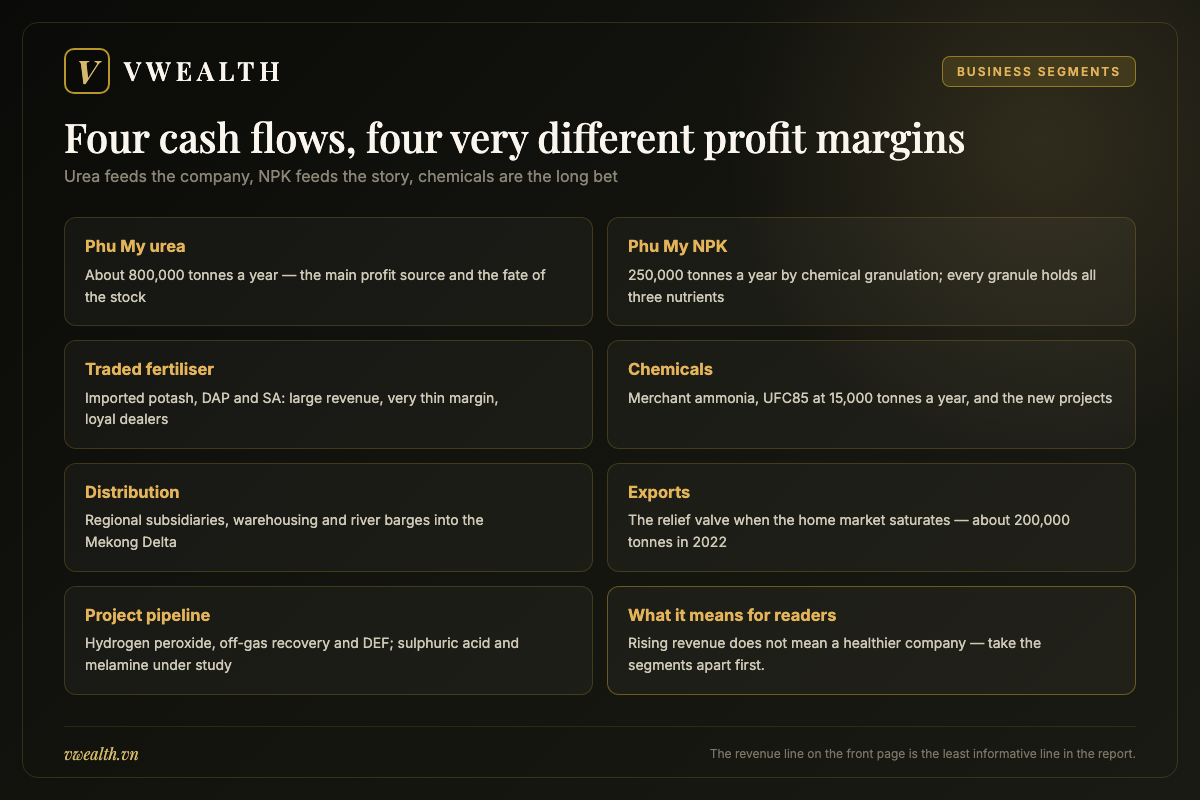
From the outside, DPM is “the company that sells urea”. Open the accounts and you find four groups of activity with entirely different economics, contributing revenue in proportions wildly out of line with their contribution to profit. One segment produces enormous revenue and almost no margin. Another produces modest revenue and a healthy margin. If you cannot separate them you will misread everything — you will see revenue jumping and feel pleased, when in reality the company is simply reselling imported goods at a few per cent.
The main engine: Phu My urea, 800,000 tonnes a year
This is the heart of the business and where most of the profit is generated. The Phu My plant has capacity of roughly 800,000 tonnes of urea and 540,000 tonnes of ammonia a year, with the 2018 NH3 debottlenecking project adding a further 90,000 tonnes of ammonia capacity.
The economics of this segment are brutally simple, and you can compress them into one line: profit ≈ (urea selling price − gas input cost − operating cost) × volume. Of those three variables, the company genuinely controls only the third, and the third is the smallest. The selling price is set by the world urea market. The gas price is set by a contractual formula linked to fuel oil. Volume is capped above by design capacity and capped below by the maintenance cycle.
Because of that, the question “did DPM manage itself well this year?” matters far less than the question “was the spread between the urea price and the gas price wide or narrow this year?” Commodity analysts call that gap the feedstock margin or the urea–gas spread, and the entire art of investing in nitrogen equities lies in judging whether that spread is about to widen or compress. It is the same discipline you would apply to a refinery’s crack spread or a smelter’s treatment charge — the plant is a converter, and what you own is the conversion margin.
One more characteristic of the urea segment that people overlook: seasonality. Domestic fertiliser demand clusters around the planting seasons, most heavily the winter–spring and summer–autumn crops. That makes DPM’s quarterly revenue lumpy, and comparing one quarter with the immediately preceding quarter is close to meaningless. The correct comparison is with the same quarter of the prior year — and even then you must check whether either year contained a total maintenance turnaround.
The growth engine: Phu My NPK and the war against bulk blends
If urea feeds the company, NPK feeds the growth story. The Phu My NPK plant, with 250,000 tonnes a year of capacity, has run since 2018 using chemical granulation rather than mechanical blending.
Why does this segment matter to an investor? Three reasons. First, the Vietnamese NPK market is considerably larger than the straight urea market, because crops need nitrogen, phosphorus and potassium rather than nitrogen alone. Second, NPK is a product that can be differentiated — bespoke formulations for a given crop, soil type and growth stage — which gives the seller a degree of pricing power that urea simply does not offer. Third, DPM has its own ammonia from its own plant as feedstock, meaning the NPK segment enjoys an integrated cost position that a pure blender cannot match.
Operationally this has worked. In the first half of 2026 the company disclosed Phu My NPK sales volume of roughly 144.2 thousand tonnes, exceeding the half-year plan by 45% and contributing more than VND 1,800 billion of revenue. For a plant with 250,000 tonnes of design capacity, that indicates a line running hot and a market that has accepted the product.
But do not draw a straight line upwards. The constraint on NPK is not the plant, it is the distribution channel and farmer habit. Vietnam’s NPK market contains hundreds of cheaper blending operations, and in many regions farmers still buy on price rather than on quality. DPM competes on brand and on consistency, which means it competes in the upper tier — a tier with better margins but a smaller addressable volume.
Big revenue, thin margin: the fertiliser trading business
This is the part most investors misread. Alongside its own production, DPM imports and distributes the fertilisers Vietnam either cannot produce or cannot produce in sufficient quantity: potash — Vietnam has essentially no commercial potash deposits — plus DAP, ammonium sulphate, and some imported urea when supply needs balancing.
In substance this is a trading operation: buy in, distribute through the existing dealer network, capture the spread. Gross margin on this segment is dramatically lower than on own production — typically only a few per cent, and thinner still in some periods. But revenue is large, because the goods themselves are valuable.
The consequence for anyone reading the accounts is very concrete: a sharp rise in DPM’s consolidated revenue does not automatically mean the business is getting healthier. If the increase came from trading, it drags almost no incremental profit with it. Conversely, there are quarters when revenue is flat but profit jumps, because the share of own-produced goods increased. When you open DPM’s financial statements, the first thing to find is the note breaking revenue down by product — not the headline revenue line on the front page.
So why keep a thin-margin business at all? Because it serves two strategic purposes. First, it locks in the dealer network: a dealer who can source the full range of fertilisers from a single supplier is far stickier than one who can only get urea. Second, it supports the company’s role in balancing domestic supply and demand — a duty attached to state ownership, as discussed in the previous chapter.
The long bet: chemicals
This is the direction management mentions most often when discussing strategy for the coming period: consolidate leadership in fertilisers while progressively raising the contribution from chemicals.
Today the segment comprises surplus ammonia sold to third parties — the portion of NH3 capacity not consumed internally by urea production — UFC85/formaldehyde at 15,000 tonnes a year, and a range of chemicals serving the oil and gas industry. The scale is still small next to fertiliser, but the logic is persuasive: the same gas stream, the same equipment complex, but output with better margins and less exposure to the agricultural calendar.
The disclosed project pipeline includes a hydrogen peroxide (H2O2) plant, an off-gas recovery project — capturing gas currently flared or vented during production and putting it back to use, which carries both an economic and an environmental argument — and an Agricultural Technology Innovation Centre. Further out, the company has said it is studying investment opportunities in products such as sulphuric acid (H2SO4) and melamine, and has been preparing for diesel exhaust fluid (DEF), the urea solution sold internationally under names such as AdBlue and used to reduce nitrogen oxide emissions from diesel engines.
The correct way to value this pipeline: do not add any of it into your model until there is a formal investment decision and a concrete schedule. At a state-owned enterprise, the distance from “under study” to “in commercial operation” is usually measured in years. But do not dismiss it either. If chemicals genuinely become a meaningful share of profit, the market has a legitimate reason to apply a higher multiple to DPM, because the cash flow depends less on one commodity.
The moat nobody photographs: distribution and packaging
Ask what DPM’s most durable competitive advantage is, and the answer is not the plant — anyone with enough capital can build a plant, and Ca Mau Fertilizer proved exactly that. The most durable advantage is the distribution system assembled over twenty years: regional fertiliser subsidiaries under the corporation, a network of first- and second-tier dealers running from the far north to the Mekong Delta, and a warehousing and inland-waterway logistics system feeding the south-west.
Why is this hard to copy? Because fertiliser is bulky and its value per tonne is not high, so freight and storage account for a meaningful share of the delivered cost at the farm gate. Whoever sits closer to the market, holds better warehousing and delivers on time during the planting window wins. On top of that, dealer relationships in this industry are heavily credit-based: the dealer takes stock on terms during the season and settles after selling. Building that requires years and a balance sheet strong enough to carry the receivables cycle.
The last piece of the moat is counterfeit resistance. Fake fertiliser is a chronic problem in Vietnam and farmers bear the loss directly. A trusted brand, with packaging carrying identifiers that are difficult to replicate and an official distribution chain behind it, commands a higher price than unbranded product with the same nutrient content. That is why two chemically identical urea granules can trade at two different prices in the same province.
The relief valve: exports
The final segment worth discussing is exports. Vietnam’s national urea production capacity exceeds domestic demand, so when the home market is saturated the surplus has to find a way out. In 2022 DPM exported roughly 200,000 tonnes of urea — a very large figure by its own standards, and part of the reason profits set a record that year, because export prices at the time were exceptional.
Exports are simultaneously an opportunity and a risk. The opportunity: when the world price exceeds the domestic price, every exported tonne carries a superior margin. The risk: export markets put you head to head with producers who have a decisive feedstock advantage — plants in the Middle East, Russia and North Africa buying gas at a fraction of the Vietnamese cost. In a low-price cycle, Vietnamese product struggles to compete on cost in international markets.
Then there is a policy variable. When domestic fertiliser prices tighten, the authorities may recommend or require that domestic supply be prioritised. You should treat DPM’s export share as an indicator of the state of the market rather than as a business line the company can expand at will.
| Activity | Scale / capacity | Margin characteristics | Decisive variable | Role in the overall picture |
|---|---|---|---|---|
| Phu My urea | ~800,000 t/y (NH3 ~540,000 t plus 90,000 t expansion) | Very wide when prices are good; can compress fast when they are not | Spread between the world urea price and the gas price | Main profit source; decides the fate of the stock |
| Phu My NPK | 250,000 t/y, chemical granulation | Steadier than urea, with a brand component | Distribution reach, input costs, farmer purchasing power | Growth engine and diversification |
| Traded fertiliser (potash, DAP, SA and others) | Sized to market demand | Very thin; essentially a trading spread | Import prices, exchange rate, dealer receivables cycle | Keeps the dealer network loyal; inflates revenue, adds little profit |
| Chemicals (merchant NH3, UFC85, H2O2 and off-gas projects) | UFC85 15,000 t/y; new projects in execution or study | Better margins, less seasonal | Project delivery schedule, industrial demand | The long bet on being less dependent on one commodity |
That table is the minimum map you need in hand when you open the accounts. The next chapter gets to the harder part: how to read those numbers without being fooled by them.
Before you ask whether to buy DPM stock: market position and financial health
DPM’s financial statements have a property that misleads people: at a glance they look suspiciously good. Borrowings are close to negligible, cash and bank deposits are stacked in a mountain, equity is thick, and fixed assets are largely depreciated. To an investor trained to hunt for financial risk, this is a dream. The problem is that a beautiful balance sheet does not protect you from this stock’s biggest risk — commodity price risk. This chapter teaches you to read DPM’s numbers in the order that actually matters.
Position: about a third of the urea market, and the number one slot in the south
Before the numbers, locate the company. Dam Phu My has for years held roughly 35% of Vietnam’s domestic urea market — a share very few Vietnamese companies command in any product category. But that share is not evenly spread. DPM dominates the south and the Central Highlands thanks to the location of its plant, its port and its distribution network; in the north, the coal-based nitrogen plants at Ha Bac and Ninh Binh sit closer to the market.
Nationally there are four principal urea plants. Two are gas-based and belong to the Petrovietnam family: Dam Phu My at 800,000 tonnes a year and Ca Mau Fertilizer at 800,000 tonnes a year. Two are coal-based and belong to Vinachem, the state chemicals group: Ha Bac Nitrogenous Fertilizer and Ninh Binh Nitrogenous Fertilizer. Ha Bac originally had 180,000 tonnes a year of capacity, lifted to 500,000 tonnes a year after an expansion and renovation project that reached commercial operation in April 2015. Ninh Binh has a design capacity of 560,000 tonnes a year.
Add those up and total national design capacity is around 2.6 million tonnes against domestic demand of more than 2 million tonnes. That is the most important number in this chapter: the industry has surplus capacity. In an industry with excess capacity and a homogeneous product, nobody has pricing power, and the best survivor is the lowest-cost producer. That is exactly where DPM’s advantage lies.
The profit equation: 46% of Singapore fuel oil, and why you must watch the oil price
DPM’s input gas price is not a fixed negotiated number. It is a formula. According to widely published industry analysis, the gas price for production at Dam Phu My is calculated as 46% of the monthly average fuel oil price in the Singapore market, plus a gas transportation tariff — a figure that has been cited at around US$0.96 per million British thermal units. The gas itself is supplied by PV GAS.
A short glossary, because this formula is doing an enormous amount of work. Fuel oil — often abbreviated FO or MFO, marine fuel oil — is the heavy residual product left at the bottom of the refining barrel, and Singapore is Asia’s benchmark pricing hub for it. It is quoted in US dollars per tonne and it moves broadly with crude oil. A million British thermal units, written mmBtu, is the standard energy unit in which natural gas is contracted worldwide; the North American Henry Hub benchmark and every LNG contract are quoted in it. So the formula reads: take the Singapore fuel oil price, take 46% of it, convert to an energy-equivalent basis, add roughly a dollar of pipeline tariff, and that is what the plant pays for its feedstock.
Now stop and think about what that formula means, because it is the key to the entire article. It means that the largest input cost of a fertiliser company is tied to… the price of oil. Meanwhile the selling price of its output is tied to the world urea price. Those two markets are correlated but not identical, and the gap between them creates or destroys DPM’s profit.
This is genuinely unusual by international standards. A US nitrogen producer buys gas at Henry Hub and enjoys a structural cost advantage when American gas is cheap and oil is expensive. A European producer buys at TTF and gets destroyed when European gas spikes. DPM sits in a third category: its feedstock cost tracks oil, which means the company can be squeezed in exactly the scenario where a US competitor thrives — high oil, ordinary urea. Any thesis you build on DPM has to survive that scenario.
An illustrative example so you can feel the sensitivity — the figures below are assumed purely to demonstrate the mechanism and are not the company’s actual data. Suppose one tonne of urea requires roughly 26 mmBtu of gas. If gas costs US$6 per mmBtu, the gas cost per tonne of urea is about US$156. If urea sells at US$300 a tonne, the spread before all other costs is US$144. Now suppose the urea price falls 20% to US$240 while the gas price is unchanged: the spread drops to US$84 — a fall of more than 40%. The selling price fell by a fifth; the margin fell by more than double that. That is operating leverage, and it is why in 2023 more than ninety per cent of DPM’s profit disappeared even though the world urea price did not fall by ninety per cent.
The reverse is equally true, and it is why 2022 was a record. When the urea price rises faster than the oil price, almost every extra dong of revenue flows straight to profit because fixed costs do not move. You do not need to forecast the urea price accurately; you need to understand that DPM’s earnings are an amplified function of the gap between two prices.
Trap one: rising revenue does not mean a healthier company
We covered this in Chapter 3, but it needs restating from the perspective of the accounts. DPM runs a trading segment with large revenue and very thin margins. As a result, the “net revenue” line on the front page of the report is the least informative line in the entire document.
The correct reading order: open the note that breaks revenue down by product; separate own-produced goods (urea, NPK, chemicals) from traded goods; then look at overall gross margin and ask where the change came from. If gross margin improves while revenue is flat, that is usually genuinely good news. If revenue jumps while gross margin compresses, the likely explanation is a rising share of traded goods — and that is not something to celebrate.
Trap two: the cash mountain, and what it is doing there
There have been periods when DPM held more than VND 10,000 billion in bank deposits. For a company whose charter capital at the time was under VND 4,000 billion, that is unusual by any conventional standard.
A cash mountain creates three consequences you should build into your valuation. First, it is a shock absorber: the company can survive several bad years in the cycle without borrowing, without selling assets, and without issuing shares that dilute existing holders. In a commodity industry, the ability to survive the trough is a genuine competitive advantage — weaker competitors will be forced to cut output or sell themselves at precisely the moment you are waiting for prices to recover.
Second, it generates a substantial financial income stream from deposit interest. In quarters when the operating business is limp, interest income can be a meaningful contributor to reported profit. This detail is an easy way to misjudge earnings quality: a quarter that “still made a profit” is sometimes a quarter that “still made a profit thanks to bank interest”, while the core operation broke even or lost money. Always separate operating profit from financial income.
Third — and this is the negative side — idle cash is cash that is not earning an appropriate return. A company holding very large bank deposits is telling you it has not found investment opportunities good enough to deploy them. The reasonable shareholder question is: will that money come back as dividends, or be committed to new chemical projects, and if the latter, what return is expected? That is a question worth asking at every annual general meeting.
Trap three: the turnaround cycle distorts quarterly data
DPM runs two types of maintenance: routine annual maintenance that does not require a shutdown, and a total maintenance turnaround roughly every two years that forces the entire production line to stop. The turnaround that began on 22 December 2025 was one of the largest in the plant’s history, with more than 5,500 individual work items, more than 1,700 personnel mobilised, and nearly twenty other significant items installed and tied in to prepare for upcoming projects.
For anyone reading the accounts the implication is concrete: a quarter containing a total turnaround will show materially lower output and concentrated maintenance costs, so profit deteriorates without reflecting any problem whatsoever with the health of the business. The quarter immediately after a turnaround usually shows high output, because the plant runs stably and the company makes up the shortfall.
The classic beginner’s mistake is to see one weak quarter and conclude the business is deteriorating, or to see one strong quarter and extrapolate it across the year. With DPM the minimum unit of assessment is a year, and ideally a full cycle. Before comparing any two quarters, check the maintenance calendar.
Trap four: from 1 July 2025 the data series breaks because of tax
This is the largest accounting change the Vietnamese fertiliser industry has been through in a decade, and it makes comparing figures either side of the date genuinely awkward.
The background needs unpacking for anyone unfamiliar with Vietnamese tax mechanics. A 2014 amendment, effective from 1 January 2015, removed fertiliser from the scope of value-added tax, with the stated goal of lowering the price farmers pay. That policy produced an unintended consequence. When the output product is outside the VAT system, the manufacturer cannot reclaim the input VAT it pays on raw materials, machinery and services. Under a normal VAT regime a producer charges VAT on what it sells, deducts the VAT it paid on what it bought, and remits the difference — the tax is genuinely borne by the final consumer. Take the output out of the system and the deduction disappears: the input VAT becomes a cost that has to be capitalised into the cost of goods, raising the production cost. For close to ten years domestic fertiliser producers carried that burden, while imported fertiliser suffered no equivalent disadvantage.
The 2024 VAT Law corrected it. The law has four chapters and seventeen articles, took effect on 1 July 2025, and returned fertiliser — along with machinery and equipment specialised for agricultural production and fishing vessels — to a 5% VAT rate. When the National Assembly voted, 234 deputies, equal to 72.67% of those participating, supported the provision.
For DPM and its peers this cuts two ways. The positive: input VAT is now deductible, so the cost that used to be buried in production cost is released, improving margins. The item to watch: the price paid by the buyer now carries an extra 5%, which may affect farmer purchasing power — though imported fertiliser now bears the same charge, so the competitive position against imports improves.
What to remember when you read the accounts: when you compare gross margins after July 2025 with those before, you are comparing two different tax regimes. Part of any improvement is policy rather than operations. Do not credit management with all of it, and do not extrapolate the improvement as an unbounded trend.
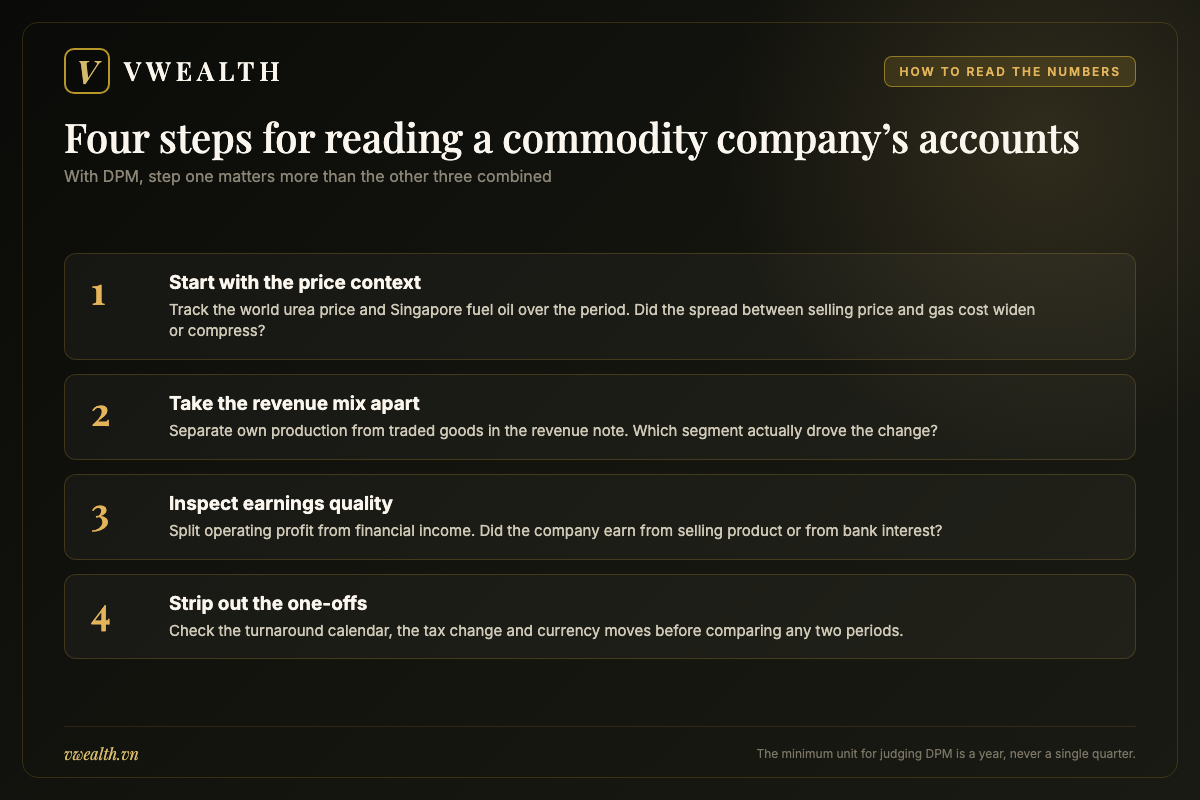
Putting all of that together, here is the process you should run every time the company publishes results.
| Step | What to do | Question to answer | Good sign | Bad sign |
|---|---|---|---|---|
| 1. Price context | Look at the world urea price and Singapore fuel oil over the period | Did the spread between selling price and gas cost widen or compress? | Urea rising faster than fuel oil | Fuel oil anchored high while urea is flat or falling |
| 2. Revenue mix | Separate own-produced from traded goods in the revenue note | Which segment drove the increase or decrease? | Urea, NPK and chemicals gaining share; gross margin improving | Revenue up on trading while gross margin compresses |
| 3. Earnings quality | Split operating profit from financial income and one-off items | Did the company earn from selling product or from bank interest? | Gross profit and operating profit improving together | Profit mostly interest income while the core operation breaks even |
| 4. One-off factors | Check the turnaround calendar, tax changes and currency movements | How much of the result will not repeat? | Result still holds up after stripping one-offs out | Result flattered by a turnaround-free quarter or a provision reversal |
Four steps sounds like work, but you only do it four times a year and it will save you from most of the common errors made with fertiliser stocks. If you want the shortcut, the DPM report on the vwealth platform already presents the metrics split by segment and adjusted for the capital increases — use it for the figures; the framework is in the table above.
A stock for dividend hunters and cycle hunters: how the market prices DPM
There is a saying among commodity investors: a cyclical stock is most expensive when its P/E is lowest, and cheapest when its P/E is highest. It sounds like wordplay, but applied to DPM it is a chillingly accurate description of nearly twenty years of trading history. This chapter is about how the market actually prices this stock — and why the valuation tools you would use on a growth company will lead you badly astray here.
The stock’s personality: waves of theme money, not a rising line
If you pull up DPM’s price chart since listing and look for a trend, you will be disappointed. What you see is a series of waves: a violent rise over one or two years, then a retreat and years of dormancy, then another rise.
The first wave was the listing itself, in late 2007, in the middle of a market-wide mania, with a first-session reference price of VND 95,000 — followed almost immediately by the global financial crisis. In 2010 and 2011 world fertiliser prices were high and the business did well. The 2015–2020 stretch was a long, tedious period: world urea prices in the trough, the company pouring money into the NPK and NH3 expansion projects, the stock more or less forgotten. Then 2021–2022 produced the most violent wave in its history, when three global forces aligned and profits set a record. After that came the retreat, exactly as every commodity cycle scripts it.
The lesson is not that DPM is a bad stock. The lesson is that DPM is not a stock to buy and forget. It is a stock where the timing of your entry determines most of your outcome, and where the patient investor who waits for the right phase usually beats the diligent investor who buys a fixed amount every month. That is a fundamental difference from a business that compounds internally, where time is on your side. Here, time is neutral at best.
The P/E trap: why the cheapest ratio appears in the most dangerous place
The price-to-earnings ratio is the share price divided by earnings per share. For a company with stable earnings, a low P/E usually means cheap. For a cyclical company that logic inverts, and you need to understand exactly why.
Take a purely hypothetical example, constructed only to expose the mechanism. Suppose at the cycle peak a company earns VND 6,000 billion and carries a market capitalisation of VND 30,000 billion. The P/E is 5 times — screamingly cheap. Investors see that and buy. A year later the cycle turns and profit falls to VND 600 billion. If the share price were unchanged, the P/E would instantly jump to 50 times. The market will not accept that, so the price has to fall. The investor who bought at a “cheap” 5 times bought at peak earnings, which is to say at the peak price.
The reverse holds too. At the trough, shrunken earnings push the P/E to a level that looks expensive, and everybody stays away. But that is usually the best buying zone, because the price already reflects a bleak outlook and every cyclical improvement arrives as a positive surprise.
The practical rule: with DPM, never use the trailing twelve-month P/E as your primary reference. If you want to use a P/E at all, use it against average earnings across a full cycle — say the mean of seven to ten years, including both the peak year and the trough year. This gives you a far more sensible mid-cycle earnings figure to compare with the current price. Practitioners in developed markets call this normalised earnings, and the cyclically adjusted P/E popularised for index-level analysis rests on the same idea. The principle applies identically to every commodity business on the exchange, from Hoa Phat in steel to the refining and distribution names in the oil chain such as Petrolimex.
P/B and replacement value: a better yardstick for a factory
If P/E is unreliable, what should you use instead? For a capital-heavy manufacturer like DPM, the price-to-book ratio — price divided by book value of equity — is usually more stable and gives a better signal.
The reason is that DPM’s book value consists mainly of the plant, the equipment and the cash. None of that evaporates when the urea price falls. When the shares trade around or below book value, you are essentially buying an 800,000-tonne urea plant plus a 250,000-tonne NPK plant plus a mountain of cash for at or below their carrying value — while the cost of building those assets new at today’s prices would be considerably higher.
The concept behind that observation is replacement value: how much money it would take to rebuild these exact assets from scratch. For industrial infrastructure twenty years old, largely depreciated on the books but still running well, replacement value typically exceeds book value by a wide margin. That is the real margin of safety in this stock at the bottom of the cycle, and it is the reason DPM rarely trades far below book for long.
But do not turn P/B into a magic wand. A plant is only worth something if it generates cash. In a low-price cycle that runs for several years, the assets sit there earning nothing while your money is trapped. That is opportunity cost — a real expense that appears in no ratio at all.
Dividend yield: the raft while you wait
The genuine attraction of DPM for a particular kind of investor is this: while you wait for the cycle to turn, you are being paid. The company carries almost no debt, holds a great deal of cash, and has a tradition of paying cash dividends even in difficult years.
But as the dividend table in Chapter 2 showed, the payout tracks the cycle with roughly a one-year lag. The correct way to use dividend yield with this stock is not to take the peak-year dividend, divide by today’s price and conclude that the yield is attractive. Take a multi-year average dividend, or the dividend from a normal year, and divide that by the price. The number you get is far more modest and far more honest.
One reminder about the 2025 capital increase: when the share count rises by nearly 74%, the same percentage-of-par dividend consumes considerably more cash. The fact that the company is maintaining its dividend ratio on the enlarged charter capital is therefore a more meaningful signal than the headline percentage suggests.
Foreign room, free float and liquidity: who is sitting at the table with you
Fertiliser manufacturing is not among the sectors subject to a restrictive foreign ownership cap in Vietnam, so DPM’s foreign room — the regulatory ceiling on aggregate foreign holdings, which is set at 50% for many sectors and lower for a handful of conditional ones such as banking — is theoretically wide. But in practice the binding constraint is the free float: with Petrovietnam holding close to 60%, only a little over forty per cent is available to every other investor, domestic and foreign combined.
That makes DPM difficult to hold as a core position for a large fund: accumulating a meaningful weight takes many days, and exiting takes just as long. The stock’s liquidity is therefore cyclical in the most literal sense — vibrant during fertiliser waves, and materially thinner in the forgotten years.
For an individual investor the practical implication is that if you intend to buy a substantial amount, plan to work the order over several sessions and accept that in a quiet market the daily traded volume may be lower than you are used to. Add to that Vietnam’s mechanical features that surprise newcomers: a daily price band that caps how far a HOSE-listed stock can move in one session, and a T+ settlement cycle that means shares you buy are not available to sell immediately. Neither is a fatal risk, but both belong in your position sizing before you place the first order rather than after.
If you follow DPM, this is the list of events capable of causing the market to re-rate the stock, ordered by estimated impact.
| Catalyst | Transmission mechanism | Degree of certainty |
|---|---|---|
| World urea price enters a sustained upcycle | Feedstock margin widens; profit is amplified several times over | Certain to matter, but the timing cannot be forecast |
| Singapore fuel oil falls while urea holds firm | Gas cost falls through the contract formula; margin improves with no price rise needed | Mechanism is clear; depends on the oil market |
| Chemicals (H2O2, off-gas, DEF) become a meaningful profit contributor | Cash flow less dependent on one commodity; the market gains a reason to pay a higher multiple | Requires years; depends on project delivery |
| NPK keeps growing volume while holding margin | Internal growth that does not need the commodity cycle to help | Already under way; monitor annually |
| The state reduces its shareholding | Float widens, governance expectations shift, institutional money can enter | Discussed for years, never delivered — treat as a free option |
| Long-term gas source and pricing mechanism clarified | Removes the single largest valuation knot in the company | Depends on gas sector policy and new supply timing |
A note on how to use that table: do not turn any single row into your sole reason to buy. With a cyclical stock, a catalyst only helps you if you bought at a price that already reflected a bleak scenario. Buy at a price that already reflects a good scenario and even a catalyst that materialises leaves you no room to make money.
A urea granule caught between gas, grain and policy: the industry context around DPM
There is an uncomfortable truth about fertiliser stocks: you can analyse the company perfectly and still be wrong, if you cannot read the industry. Most of DPM’s profit is decided by four things outside the company — the world urea price, the gas price, tax policy, and the financial health of the Vietnamese farmer. This chapter takes them one at a time.
An industry with surplus capacity: 2.6 million tonnes for 2 million tonnes of demand
The base number for the whole sector: total design capacity across the four domestic urea plants is around 2.6 million tonnes a year, against domestic nitrogen demand of more than 2 million tonnes. Vietnam has gone from importing nearly all its urea in the early 2000s to self-sufficiency, and has been exporting since around 2013 at volumes that can reach 500,000 to 700,000 tonnes.
That is a genuine milestone for the national economy, but for a shareholder in a nitrogen plant it cuts both ways. Surplus capacity means nobody gets to relax about price. When domestic demand is soft, the plants have to push product into export markets, where they run directly into producers with far cheaper gas.
It also explains why no new urea plant has been built in Vietnam for more than a decade. The industry already has enough capacity, and the capital cost of a new plant is far too large to be recovered from whatever slice of the market is still open. For DPM that is competitively good news: the barrier to entry is close to absolute, not because the technology is difficult but because the economics forbid it. A moat built by arithmetic is more durable than one built by patents.
The map of four plants: gas against coal, south against north
Vietnam’s nitrogen industry splits in two by technology, and that split determines who wins in each price phase.
The first half consists of the two gas-based plants in the Petrovietnam family: Dam Phu My in Ba Ria – Vung Tau and Ca Mau Fertilizer in Ca Mau province, each at 800,000 tonnes of urea a year. Gas technology is cleaner, runs more stably, costs less to maintain, and prices its feedstock off oil.
The second half consists of the two coal-based plants belonging to Vinachem: Ha Bac Nitrogenous Fertilizer — Vietnam’s first nitrogen plant, originally 180,000 tonnes a year, lifted to 500,000 tonnes a year after an expansion and renovation project that broke ground in November 2010 and reached commercial operation in April 2015 — and Ninh Binh Nitrogenous Fertilizer, with a design capacity of 560,000 tonnes a year.
The financial history of the two coal plants is an expensive lesson for the whole industry. Over 2015–2020, after its expansion came onstream, Ha Bac accumulated losses of VND 4,760 billion and negative equity of VND 2,037 billion; the company only recovered gradually through restructuring. Ninh Binh, as at 31 December 2018, carried accumulated losses of VND 4,946.94 billion and negative equity of VND 2,633 billion.
Why did the coal plants struggle so badly while the gas plants stayed healthy? Higher capital cost per tonne of capacity; far larger borrowings, so interest and foreign exchange movements crushed the results; coal-based gasification is more complex, with higher operating and maintenance costs; and heavier environmental costs on top. For a DPM investor this is valuable information: your direct domestic competitors are in a weaker financial position, and in a long low-price cycle they are the ones who have to cut output first.
Who actually sets the world urea price
If DPM’s profit depends on the world urea price, you need to know who holds the pen that writes it. There are four forces.
The first is the gas price in Europe and other production centres. European nitrogen plants run on expensive gas, so when European gas spikes they shut down because running loses money on every tonne. Global supply shrinks and the world urea price jumps. That is precisely the mechanism that created the 2021–2022 spike, and it is a perfect illustration of an event on the other side of the planet determining the profit of a plant in Ba Ria – Vung Tau.
The second is Chinese export policy. China is simultaneously the world’s largest urea producer and a huge domestic consumer. Whenever Beijing tightens exports to keep product available for its own farmers, a large block of supply vanishes from the international market and prices respond immediately. When it loosens, the reverse happens. For a Vietnamese investor, news about Chinese fertiliser export policy deserves closer reading than the quarterly report.
The third is India’s import tenders. India is a major urea importer, and its large periodic tenders can shift the regional price level within weeks. Fertiliser traders follow these daily; equity investors mostly do not, which is why the equity market is usually late to price them.
The fourth is the global crop calendar and agricultural commodity prices. When rice, corn and soybean prices are high, farmers everywhere have money and are willing to apply more fertiliser. When crop prices are low they cut back — and nitrogen is usually the last input cut, but it is still cut.
Put those four together and you have a useful mental model: DPM’s revenue line is written by European gas traders, Chinese policymakers, Indian procurement officials and the weather. Nobody in Vietnam has a vote.
Declining domestic gas: the long-term risk nobody talks about
This is, in my view, the most underrated item in DPM’s risk profile. The traditional offshore fields in Vietnam’s south-east — the source feeding the Phu My gas and industrial cluster — have been produced for many years and their output declines naturally over time. The shortfall must be covered either by new sources or by imported liquefied natural gas.
Imported LNG is considerably more expensive than domestic pipeline gas, because it carries the added cost of liquefaction, transport in specialised vessels, and regasification at an import terminal. If the share of expensive gas in the feed to a nitrogen plant rises and the contractual price formula is not adjusted to reflect it, the long-term margin of both DPM and Ca Mau Fertilizer will be eroded — not over one quarter, but over many years.
This is also exactly why the state divestment story stays parked, as Chapter 2 explained: nobody can value a nitrogen plant without knowing the long-term gas source and pricing mechanism. If you want to monitor a single indicator for DPM’s ten-year outlook, monitor progress on securing gas supply and on the pricing mechanism for industrial gas consumers. That process runs directly through PV GAS, the company sitting at the head of the entire chain, and more broadly through the whole Vietnamese energy sector, where the same LNG transition is reshaping the cost base of power producers and industrial users alike.
The 5% VAT: new rules for the whole industry from 1 July 2025
We covered the accounting mechanics in Chapter 4; here, look at the industry impact. Returning fertiliser to a 5% value-added tax rate from 1 July 2025 under the 2024 VAT Law changes the competitive balance in three directions.
The first: domestic manufacturers can now deduct input VAT, so the cost previously buried in production cost is released. Whoever invests most heavily in machinery and buys the most taxable raw materials benefits most — meaning large-scale producers such as DPM rather than small manual blending operations. That is a quiet consolidation force in a fragmented industry.
The second: imports now carry the same charge, so the relative advantage imported fertiliser used to enjoy narrows. This is the change domestic producers lobbied for over many years.
The third, and the one to watch: the price paid by farmers now carries an extra 5%. In theory the cost released at the input stage can partly offset the tax added at the output stage, but how much of that offset actually happens depends on competition in the market. If farmer purchasing power is weak, producers will have to absorb part of the tax and the net benefit will be smaller than the headline suggests.
There is also a broader lesson here for anyone investing in Vietnam. Policy is a first-order variable in this market, not a footnote. A single line in a tax law moved the entire margin structure of an industry — and it did so with a decade-long lag between the problem being identified and the fix being enacted. Build that patience into your expectations.
The Vietnamese farmer: the customer everyone forgets
Finally, and most importantly, every granule DPM makes ends its journey on a field. The financial health of the farmer is the foundation of all demand.
Two long-term trends belong on the table. The first is positive for the industry: Vietnamese agriculture is shifting towards higher-value crops — fruit, vegetables, industrial crops — which need balanced nutrition rather than nitrogen alone. That is the opportunity for high-quality NPK, precisely the segment DPM invested in.
The second is neutral to negative for traditional urea: sustainable farming programmes, emission reduction schemes and efficient fertiliser use all encourage farmers to apply less nitrogen but apply it better. Over the long run, total urea consumption per hectare may flatten or drift slightly lower, while the nutrient value per bag rises. The company that can shift from selling volume to selling value wins — and that is the logic behind DPM’s investment in NPK, in chemicals, and in an agricultural innovation centre.
| Criterion | Dam Phu My (DPM) | Ca Mau Fertilizer (DCM) | Ha Bac / Ninh Binh (Vinachem) |
|---|---|---|---|
| Feedstock | Natural gas | Natural gas | Coal |
| Urea capacity | ~800,000 t/y | ~800,000 t/y | Ha Bac 500,000 t/y; Ninh Binh 560,000 t/y (design) |
| Strongest market | The south and the Central Highlands | The Mekong Delta plus exports to Cambodia | The north |
| Controlling shareholder | Petrovietnam (~59.58%) | Petrovietnam | Vinachem |
| Financial profile | Effectively no borrowings, large cash balance | Similar; also in the cash-rich group | Historically large accumulated losses and negative equity; restructuring |
| Diversification | Chemically granulated NPK 250,000 t/y plus chemicals | NPK and other fertiliser products | Mainly urea plus some basic chemicals |
| Specific risk | Gas price tied to fuel oil; declining south-east gas fields | Similar gas exposure with its own supply arrangements | Debt burden plus coal and environmental costs |
Two closing observations on that table. First, DPM and Ca Mau are close to twins in technology but differ in geography, product mix and how the market prices them; anyone building a position in Vietnamese nitrogen should understand both rather than treating them as interchangeable. Second, the presence of two financially weak competitors is a hidden asset for DPM in a downturn — capacity that is forced offline by a balance sheet rather than by choice is capacity that stays offline for years.
Three roads ahead: should you buy DPM stock for the next three years?
By now you have all the pieces: a plant that has earned back most of its capital cost, a balance sheet with no debt, an NPK business that is growing, a state shareholder who does not sell, and a profit equation that depends on two commodity prices nobody can forecast. The remaining question is what the next three years look like. This section will not give you a target price — anybody offering a target price for a commodity stock is forecasting the world urea price without admitting it. Instead we build three scenarios with the conditions attached to each, so you can track for yourself which way reality is drifting.
Three long-term drivers that do not depend on the cycle
Before the scenarios, separate out what the company can do under its own power. This part holds in all three cases.
The first driver is NPK. This is the segment where DPM can grow volume and hold margin through sales effort, without waiting for the world urea price. The 250,000-tonne plant still has headroom, the domestic NPK market is large, and the disclosed 45% beat against the first-half 2026 sales plan shows the product has been accepted. If this segment sustains that momentum over several years, the share of profit that is independent of urea rises steadily — and that is the most legitimate reason for the market to pay a higher multiple for DPM.
The second driver is chemicals. The disclosed pipeline includes the hydrogen peroxide plant, the off-gas recovery project and the Agricultural Technology Innovation Centre, along with preparation for DEF and studies on sulphuric acid and melamine. The attraction of this group is that all of it sits next to the existing plant, sharing infrastructure and feedstock — meaning the capital required per additional dong of profit is far lower than a greenfield build. The drawback is that project delivery at a state-owned enterprise usually runs behind plan.
The third driver is the tax effect. The input VAT deduction available from 1 July 2025 is a structural improvement, not a one-off boost. It raises the baseline margin of domestic producers in every phase of the cycle. Structural improvements are worth more than cyclical ones precisely because you do not have to time them.
Set against those three drivers are three variables that neither management nor you can do anything about except observe.
The first variable is the world urea price, set by European gas costs, Chinese export policy, Indian import demand and the global crop calendar. The second is Singapore fuel oil, because it flows directly into the contractual gas price formula. The third is domestic gas supply and the long-term gas pricing mechanism — something that can shift the company’s cost base for years rather than quarters.
The three scenarios below are built by combining different states of those three variables with different rates of progress on the three internal drivers.
The bull case: the cycle returns just as the new segments mature
In this scenario the world urea price enters an upcycle — perhaps because global supply is squeezed by gas costs at the major production centres, perhaps because a large exporting country changes policy — while Singapore fuel oil does not rise proportionally. The feedstock margin widens, and with high operating leverage the profit from urea rises geometrically rather than arithmetically.
Two internal factors compound it: NPK has reached high volume with a stable margin, and the input VAT deduction is working in full. The company returns to the thousand-billion-dong profit tier, and given its tradition of generous distribution, the cash dividend is lifted substantially.
Conditions required for this scenario: the world urea price holds a high level for at least four to six consecutive quarters; Singapore fuel oil is flat or falling; the plant runs without a major incident; and domestic farmer purchasing power does not deteriorate. Early signals you can watch: reports of European nitrogen plants shutting down, Chinese restrictions on fertiliser exports, and large import tenders.
The warning inside this pretty scenario: this is exactly when the stock’s P/E looks cheapest, and exactly the most dangerous moment to add. The bull case is the phase in which you harvest, not the phase in which you commit money.
The base case: the business keeps running, the stock oscillates in a wide band
This is the highest-probability scenario and also the most boring. The world urea price fluctuates in a mid-range, neither spiking nor collapsing. Singapore fuel oil sits in familiar territory. The plant runs at capacity except in turnaround quarters. NPK grows steadily but not enough to change the nature of the company. The chemical projects advance slowly and do not yet contribute meaningfully to profit.
The result: moderate profit, enough to sustain a modest but regular cash dividend. The stock has no big story to tell, liquidity is subdued, and the price oscillates in a wide range driven by fertiliser price swings and by the general flow of money through the market.
What does a holder receive in this scenario? A cash dividend, a preserved real asset, and the right to wait. This is the scenario to size your position against: buy an amount you would be comfortable holding for three years while nothing happens. If that amount is smaller than you first thought, that is the correct answer rather than a disappointing one.
Signs that you are in the base case: annual profit around the multi-year average; a dividend maintained somewhere between the high single digits and about fifteen per cent of par value; and gross margin showing no dramatic move in either direction.
The bear case: weak prices, anchored gas costs, and new segments running late
The bear case does not arrive as a sudden shock. It arrives as slow erosion. The world urea price falls into a prolonged trough — perhaps because global supply becomes abundant again, perhaps because agricultural demand weakens on low crop prices. At the same time Singapore fuel oil stays anchored high, so the input gas price does not fall correspondingly. The feedstock margin compresses severely.
Layered on top is the structural risk: cheap domestic gas declines, the share of expensive gas rises, and the pricing mechanism is not adjusted. At that point the company’s cost base is permanently raised rather than cyclically raised. Simultaneously the chemical projects slip, and NPK meets fierce competition from cheap blends as farmers tighten spending.
In this scenario the company almost certainly survives — and that is the crucial difference from a highly leveraged business. With effectively no debt and a mountain of cash, DPM can endure several difficult years without raising capital. But “surviving” and “generating a return for shareholders” are different things. The dividend gets cut, profit shrinks, and your money is trapped in an asset that is not earning while the market offers opportunities elsewhere.
Early warning signs: gross margin compressing across several consecutive quarters with no turnaround to explain it; an unusual rise in the share of profit coming from deposit interest; a markedly more cautious annual business plan; and investment projects being pushed back.
The scenario table, and how to mark which way reality is drifting
| Scenario | Conditions required | How it appears in the accounts | What you should do |
|---|---|---|---|
| Bull | World urea price in a sustained upcycle; Singapore fuel oil flat or falling; NPK holding momentum; plant running stably | Gross margin widening over consecutive quarters; operating profit rising sharply; dividend raised | This is the harvest phase. Be suspicious of a low P/E — it signals the top, not cheapness |
| Base | Urea in a mid-range; gas cost stable; NPK growing steadily; chemical projects advancing slowly | Profit around the multi-year average; regular but modest dividend; gross margin without dramatic moves | Size the position at a level you can hold for three years. Collect the dividend and wait |
| Bear | Urea in a prolonged trough; Singapore fuel oil anchored high; cheap domestic gas declining; new projects late | Gross margin compressing over many quarters; profit mostly from deposit interest; dividend cut; cautious annual plan | Revisit the thesis. If the cause is structural (gas cost) rather than cyclical, that is a different problem entirely |
Using that table is simple: each quarter, instead of asking “will the stock go up or down”, ask “which column does this quarter’s data fit”. If three consecutive quarters fit the same column, you have a reliable read on the current phase of the cycle — and that is worth more than any target price.
One last point before the final chapter. The distinction between a bad cycle and a structural decline is the single most important line you have to be able to draw. A bad cycle passes — it always passes. A structural decline does not. For DPM the only structural question worth losing sleep over is the long-term gas source and gas price. Everything else — the urea price, farmer purchasing power, NPK competition — is cyclical.
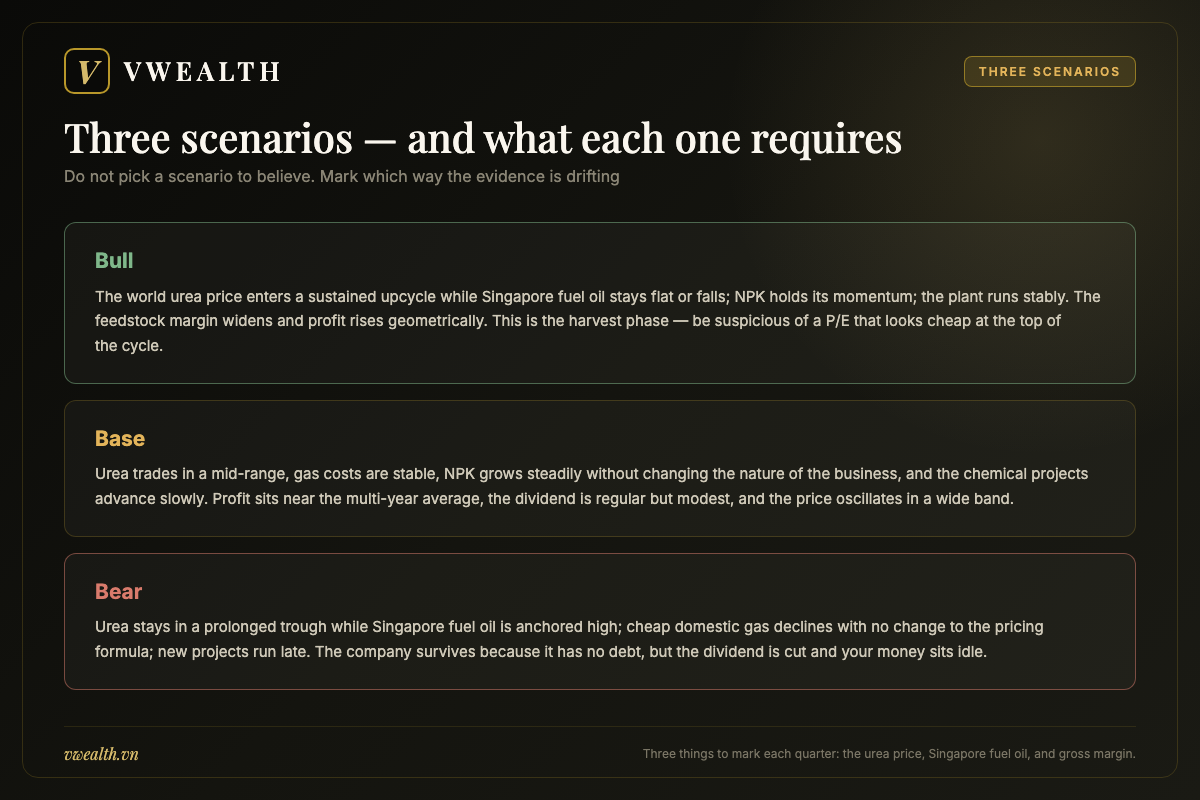
So, should you buy DPM stock?
After more than twenty years of history, four business segments, a profit equation tied to the price of fuel oil in Singapore and three scenarios ahead, it is time to answer plainly. And the most honest answer is that the question “should I buy DPM” is the wrong question. The right question is “should I buy DPM at this price, at this point in the cycle, given the kind of investor I am”. Those three clauses cannot be separated.
The case for: what DPM genuinely holds
First, a real asset that has earned back most of its capital cost. The Phu My plant has run since 2004 and had produced more than ten million tonnes of nitrogen by 2017, with most of the original investment now depreciated. Building an equivalent plant at today’s prices would cost considerably more. That is a genuine margin of safety, not an accounting one.
Second, a balance sheet with essentially no financial risk. The company carries almost no borrowings and has at times held more than VND 10,000 billion in bank deposits. In a commodity industry — where leveraged competitors are forced to sell themselves at the bottom of the cycle — the ability to survive without borrowing is a competitive advantage with real economic value.
Third, a market position that is difficult to dislodge: roughly 35% of the national urea market, an overwhelming number one position in the south, a brand farmers know by name and that has been recognised as a Vietnam National Brand several times, and a distribution system built over twenty years that nobody can replicate in a few.
Fourth, a near-absolute barrier to entry. The industry already has surplus capacity, with roughly 2.6 million tonnes of design capacity against demand above 2 million tonnes; there is no economic case for anyone to build a new urea plant in Vietnam. Domestic competition is a closed game among the players already present.
Fifth, a second segment that is genuinely growing. Phu My NPK, using chemical granulation, with 250,000 tonnes a year of capacity, beat its first-half 2026 sales plan by 45%. That is growth that does not need the commodity cycle’s assistance.
Sixth, a favourable policy change of a structural kind. Returning fertiliser to the 5% VAT band from 1 July 2025 allows input VAT to be deducted, removing a cost the industry carried for close to a decade.
Seventh, a tradition of generous cash distributions, supported both by abundant cash and by the state shareholder’s own appetite for dividend income.
The case against: what can cost you money
First, and larger than everything else on this list combined: you are not buying a company, you are buying a position on the spread between the urea price and the oil price. Profit above VND 6,600 billion in 2022; more than ninety per cent of it gone in 2023 — same plant, same people. If you cannot live with that fact, do not buy this stock at any price.
Second, the valuation trap. This stock looks cheapest at its most dangerous moment. A great many investors bought DPM on a single-digit P/E at the end of an upcycle and lost heavily. If your familiar valuation tool is the trailing P/E, you are holding an instrument that will betray you here.
Third, the structural gas risk. The traditional south-eastern fields are declining and the shortfall must come from more expensive sources. If the gas cost base is permanently raised and the pricing mechanism is not adjusted, this stops being a cyclical matter. It is the only risk on this list capable of changing the investment thesis outright.
Fourth, the company is not run to maximise the share price. The state shareholder holds roughly 59.58%, large decisions are slow, and there are periods when the company must prioritise stabilising the domestic market over maximising export profit.
Fifth, a thin float and cyclical liquidity. The price can swing violently on theme money with no connection to business fundamentals, and in a quiet market the traded volume may be thinner than you are accustomed to.
Sixth, opportunity cost during the waiting phase. The 2015–2020 stretch is the proof: the business was fine and kept paying dividends, but the stock was forgotten for years. Your money sat still while other sectors ran.
Seventh, the future projects should not yet be in your price. H2O2, off-gas, DEF, sulphuric acid and melamine are all worth watching, but at a state-owned enterprise the distance from “under study” to “in commercial operation” is measured in years.
| Dimension | In favour | Against |
|---|---|---|
| Assets | An 800,000-tonne urea plant, largely depreciated, with replacement value above book | The asset is only worth something while the feedstock margin is positive |
| Finances | Effectively no debt, large cash balance, able to survive the trough | Idle cash signals a lack of investment opportunities; deposit interest can mask a weak core |
| Market position | ~35% of the urea market, number one in the south, brand and distribution hard to copy | A homogeneous product means no pricing power; the industry has surplus capacity |
| Growth | NPK beating plan; chemicals opening a new direction | The new segments are still small; chemical projects run late |
| Policy | 5% VAT from 1 July 2025 allows input deduction — a structural improvement | The farm-gate price rises; how much is offset depends on purchasing power |
| Dividends | A tradition of generous cash payouts, and the cash to fund them | The payout swings with the cycle on a lag; the highest dividend arrives when you should not buy |
| Governance | Transparent, disciplined, no takeover or related-party risk | Slow decisions; not optimised for minority shareholders |
| Base risk | A near-absolute barrier to entry | Declining cheap domestic gas — the one structural risk that could break the thesis |
Who DPM suits, and who it absolutely does not
This stock suits three kinds of investor.
The first: the disciplined cycle hunter. You understand that the money is made by buying when the feedstock margin is narrow and everyone is discouraged, and selling when the margin is wide and everyone is complimentary. You do not need to call the bottom; you only need enough patience not to buy the top. For you, DPM is one of the cleanest instruments on the Vietnamese market for playing the fertiliser cycle, because the balance sheet carries no bankruptcy risk to muddy the signal.
The second: the long-term dividend builder who can accept an uneven cash flow. You do not expect the same payment every year, but you accept a lot in good years and a little in bad ones, in exchange for the comfort of knowing the company cannot be destroyed by debt.
The third: the investor who wants part of a portfolio anchored to real assets and commodities, as a counterweight to holdings in consumer, banking or technology names. DPM marches to its own rhythm and correlates poorly with those groups, which has genuine diversification value. If you are constructing an emerging-market allocation and want exposure to Vietnamese industry rather than to Vietnamese consumption, this is an honest way to get it — you can compare it against the infrastructure and energy end of the same market through names such as PC1 Group in grid construction and power generation.
This stock does not suit three kinds of investor.
The first: the investor looking for steady growth. If you want a business whose profit is predictably higher each year than the last, DPM will drive you mad. This company does not have a growth rate; it has a cycle phase.
The second: the screen-driven investor who trusts the P/E. If your process is to filter for low P/E and buy, DPM will walk you straight into the trap described in Chapter 5.
The third: the leveraged investor or the investor with a short horizon. The price amplitude here is far wider than the quality of the balance sheet would suggest, because the float is thin and theme money arrives and leaves in waves. If you have to sell within six months, your result depends more on luck than on analysis.
The closing thought: you own the machine, but not the prices
Here is an image worth carrying with you when you think about DPM. Imagine you own an enormous machine, fully paid for, that has run smoothly for more than twenty years turning gas into fertiliser every day. The machine owes nothing to anybody, it has a large box of cash beside it, and every year it sends you a cheque. It sounds like a dream investment.
Then you discover one detail: you do not get to set the price of what the machine produces, and you do not get to set the price of what it consumes. Both prices are decided by people in the Middle East, in China, and on the oil trading floor in Singapore. The only thing you can do is keep the machine well maintained and wait.
The entire art of investing in DPM lives in that word “wait” — waiting in the right place, at the right size, with a head that does not get turned by beautiful numbers printed at the top of a cycle. Do that, and this is one of the most transparent and durable businesses you can own on the Vietnamese exchange. Fail to do it, and however good the plant is, you will still be the person who bought high and sold low.
As for today’s numbers — the last closing price, last quarter’s gross margin, earnings per share restated after the capital increase, the declared dividend — this article deliberately leaves them out, because they change constantly and a stale figure is more dangerous than no figure. Open the DPM report on vwealth for the current dataset, then drop it into the four-step framework from Chapter 4 and the three-scenario table from Chapter 7. If you want to cross-check against companies on the same cycle, read our analysis of PV GAS at the top of the feedstock chain, PV Power in electricity generation and Hoa Phat in steel, and if you are still building the foundations, start from the guide to investing in the Vietnam stock market and the wider Vietnam stock market guide. The article gives you the framework; the data and the decision are yours.
This content is analytical and informational and does not constitute investment advice or a recommendation to buy or sell. All investment decisions and the risks attached to them rest with the investor.
Research Vietnamese stocks in English with vwealth. Our AI-powered platform turns Vietnamese market data into full English analysis reports — with international payment support and a free 2-month trial for new accounts. Create your free account and read the latest reports.