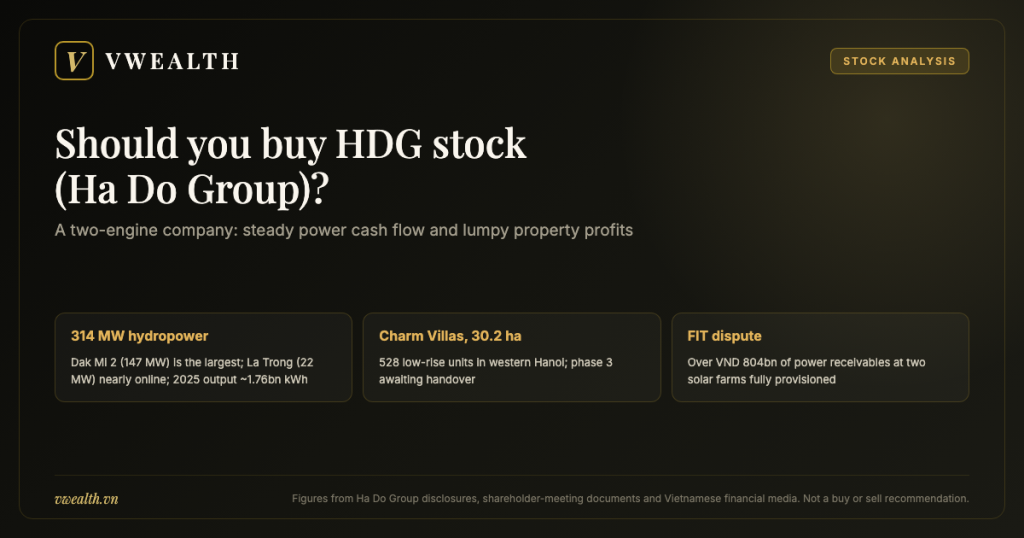
Should you buy HDG stock? HDG is the ticker of Ha Do Group Joint Stock Company (Công ty Cổ phần Tập đoàn Hà Đô), listed on the Ho Chi Minh Stock Exchange (HOSE), and it is one of the more unusual companies among Vietnam stocks: a business with two hearts beating to two different rhythms. One heart is a fleet of hydropower, solar and wind plants that generated about 1.76–1.79 billion kWh in 2025 (depending on which company document you read) and sells electricity every single month, like a toll road. The other heart is real estate — urban projects such as Hado Centrosa Garden in central Ho Chi Minh City and Hado Charm Villas on the western edge of Hanoi — which can deliver thousands of billions of dong in one year and almost nothing the next. In 2019, property made up roughly 64% of Ha Do’s revenue; by 2023, energy made up about two thirds. Yet the “steady” power business is also where the biggest shock of recent years came from: two solar farms were caught up in a review of Vietnam’s feed-in tariff (FIT) incentives, forcing hundreds of billions of dong in provisions, and by mid-2026 more than VND 804 billion owed by the state power buyer had been fully provisioned. Understanding how these two engines fit together is the first step toward deciding whether to buy HDG stock.
A few ground rules first, the same ones used across the vwealth company-analysis series. Dates, names, project details, plant capacities and financial figures in this article come from public sources: Ha Do’s own website and press releases, HOSE disclosures, financial statements and shareholder-meeting documents as reported by Vietnamese financial media (mainly CafeF), and brokerage research where explicitly cited. Where sources disagree, we show both figures. Any number that vwealth calculated ourselves from disclosed figures is labeled “vwealth estimate”. We deliberately do not quote today’s share price, current P/E or P/B, current market capitalization or the latest quarterly profit, because those change daily; for live numbers, open the latest vwealth report. Amounts are in Vietnamese dong (VND); as a rough reference, VND 1,000 billion is on the order of USD 40 million at exchange rates of recent years.
If you are new to the market, our guide to investing in the Vietnam stock market explains the basics foreign investors need — account opening, foreign ownership limits, T+2 settlement and daily price limits of ±7% on HOSE. If you have read our analyses of Khang Dien (KDH) or Nam Long (NLG), you will notice Ha Do is not a pure homebuilder. And if you know our work on PV Power (POW), you will see Ha Do is not a pure utility either. It sits between two worlds, which is why it is often misfiled: some sector classifications put HDG with property developers, while many investors treat it as a renewable-energy play. This article tries to look at both sides at once. For the wider property context, see our overview of Vietnam real estate stocks.
From a Military Construction Unit to a Two-Engine Group: 35 Years of Ha Do
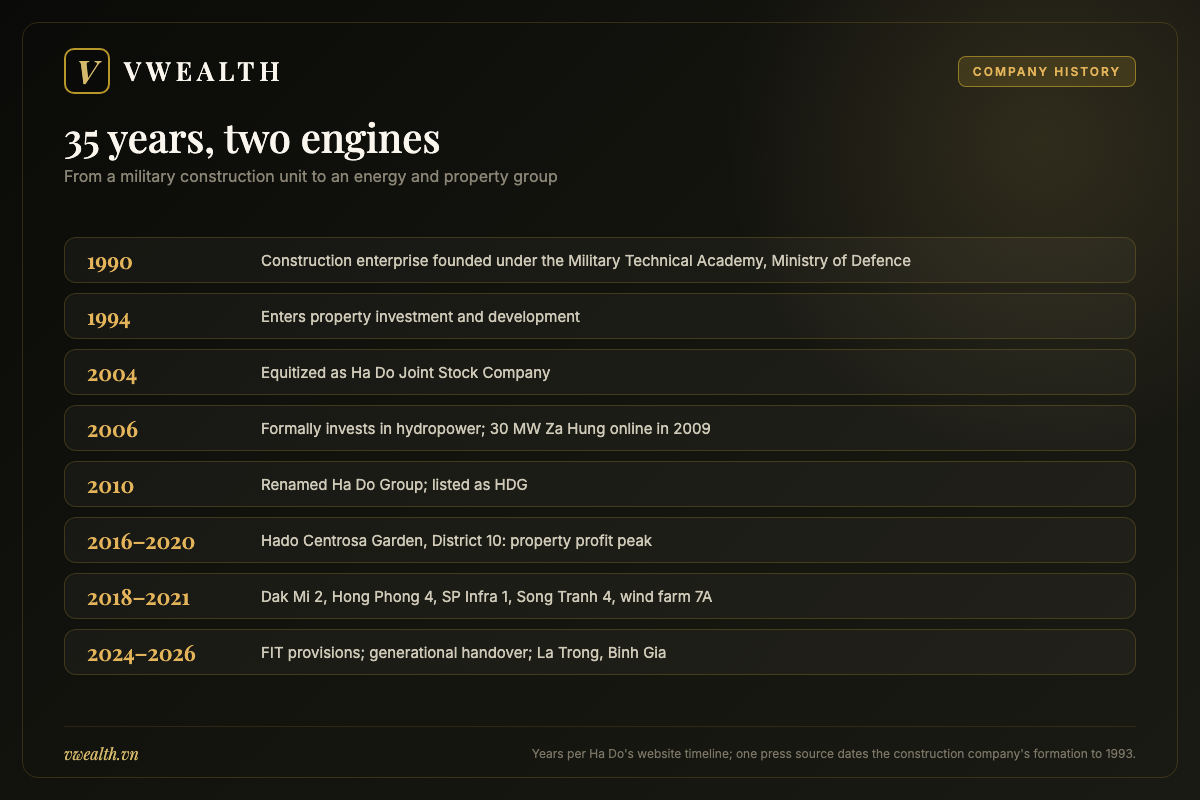
Many of Vietnam’s large property groups were born in the private-sector wave of the late 1990s or early 2000s. Ha Do’s origin story is different: it was born inside the military. In August 1990, a construction enterprise was set up under the Military Technical Academy (Viện Kỹ thuật Quân sự) of the Ministry of National Defence. Its head, Nguyen Trong Thong, had spent the previous twelve years in logistics at the same academy. Thirty-five years later, that small unit has become a group with about 19 member companies, according to the company, operating eight power plants with 462 MW of capacity (per its 2025 annual report), finishing several more small hydropower plants, and holding a property portfolio stretching from Hanoi and Ho Chi Minh City to Vientiane in Laos. That journey explains Ha Do’s cautious culture, why it moved into hydropower far earlier than its property peers, and why the generational handover now under way matters so much to shareholders.
1990–1996: a military builder takes its first step into property
According to CafeF’s account of the 2024 shareholder meeting, Mr. Thong recalled that Ha Do had been a state-owned business that started from zero, which is why it puts so much weight on sustainable growth. Press accounts of the company’s history describe the original mission as linking the academy’s research activities with an economic role — in plain terms, a military construction unit taking on civil and industrial projects at a time when Vietnam had just opened its economy and building demand was starting to rise.
According to the timeline on Ha Do’s website, in 1992 the enterprise became Ha Do Construction Company. (A 2024 CafeF article puts this step in 1993, by decision of the Ministry of Defence; the sources differ by a year, so we use the company’s date and flag the discrepancy.) In 1994, the company formally entered property investment and development — a very early move, when Vietnam’s housing market was still embryonic and the “new urban area” concept barely existed. In 1996, Ha Do Construction merged with an electromechanical equipment company and was renamed Ha Do Company.
That electromechanical detail sounds minor, but it hints at something important. From the mid-1990s, Ha Do had in-house mechanical and electrical engineering skills alongside construction. A decade later, when it entered hydropower, the ability to build civil works and install equipment allowed it to act as developer and contractor for its own plants in the mountains of Quang Nam and Nghe An provinces, rather than being a passive financial investor.
2004–2006: equitization and the decision to go into hydropower
In 2004, Ha Do Company was equitized — Vietnam’s term for converting a state enterprise into a joint-stock company — and became Ha Do Joint Stock Company. Mr. Thong became Chairman and CEO from December 2004. Equitization changed the rules of the game: the company was no longer a unit under the military but a shareholder-owned business that could raise capital and enter new sectors by shareholder decision.
Two years later, in 2006, Ha Do did two things at once: it converted its member enterprises into joint-stock companies, and it formally invested in hydropower. Looking back, this was the decision that shaped Ha Do’s next twenty years. In 2006, almost no listed property company was thinking about power plants. The housing market was heading into the 2007 boom, and the easiest money was in selling land plots and apartments. Committing capital to mountain hydropower projects that would take years to generate a single kilowatt-hour was a contrarian choice.
The first plant, the 30 MW Za Hung hydropower plant in Quang Nam, came online in 2009. The subsidiary that runs it, Za Hung Joint Stock Company, later became a pillar of the group’s energy arm — and one of the people who grew up at Za Hung, Le Xuan Long, is now Chairman of Ha Do’s Board.
2008–2013: a property boom, a stalled megaproject and a listing
In 2008, right after Ha Tay province was merged into Hanoi, Ha Do broke ground on Hado Dragon City — the An Khanh–An Thuong urban area in Hoai Duc district, covering more than 30 hectares. The market was at its peak, and the project was marketed with dozens of 30–40-storey towers for around 10,000 residents. You will meet this project again, because it is the clearest illustration of the slow rhythm of Ha Do’s property engine: it took more than ten years and a zoning revision that removed the high-rises altogether before it was renamed Hado Charm Villas and went on sale in late 2020.
In 2010, Ha Do Joint Stock Company changed its name to Ha Do Group Joint Stock Company and listed its shares under the ticker HDG. Listing gave Ha Do a new funding channel, but it also required regular disclosure — which is why today you can trace almost its entire financial history through quarterly reports.
The years 2011–2013 were a deep freeze for Vietnamese property after the boom. Many peers struggled with unsold inventory and debt. Ha Do felt it too — Hado Dragon City sat idle for years — but its hydropower business began to prove its worth. According to the company timeline, in 2013 Ha Do brought the 30 MW Nam Pong hydropower plant in Nghe An into operation. While selling homes was hard, Za Hung and Nam Pong kept generating and collecting cash. The third Nghe An plant, the 59 MW Nhan Hac, arrived later: the 2025 annual report records its inauguration in 2018, the same year consolidated profit rose about 2.8 times from 2017.
2016–2020: the golden years of Hado Centrosa Garden
If one project made Ha Do’s name in southern Vietnam, it is Hado Centrosa Garden, stretching along Ba Thang Hai and Cao Thang streets in the former District 10 of Ho Chi Minh City. The site covers about 6.85 hectares according to the company, with low-rise homes, apartment towers and a commercial component (the company lists areas of 34,341 m², 317,915 m² and 7,595 m² respectively), with Savills as investment adviser and Singapore’s Surbana on architecture and landscape. In a city where large inner-urban land plots had all but disappeared, a nearly seven-hectare township in the center was a rare asset, and cash from selling and handing over its apartment blocks lifted Ha Do to a new level.
The results showed up clearly in the financial statements. In 2019, Ha Do’s unaudited fourth-quarter report showed net revenue of nearly VND 4,327 billion and consolidated profit after tax of more than VND 1,026 billion — the highest in its history at the time; after audit, profit after tax was revised up to about VND 1,117 billion. About 64% of that year’s revenue came from property sales, mainly handovers at Hado Centrosa Garden and Hado Riverside (District 12, Ho Chi Minh City), about 15% from construction, while hydropower and solar contributed only about 14%. In 2020, profit after tax rose further to about VND 1,260 billion in the unaudited report (about VND 1,254 billion audited) on revenue of nearly VND 5,000 billion. According to the company timeline, Hado Centrosa Garden was fully inaugurated in 2020.
Yet in those very years of property success, Ha Do was quietly laying the foundation for its next phase. In 2018 it acquired the Dak Mi 2 hydropower project (147 MW) — now the largest plant in its portfolio — and began building the 48 MWp Hong Phong 4 solar farm in Binh Thuan province. In early 2020 it bought all of the capital of Surya Prakash Vietnam Energy Co., Ltd., owner of the 50 MWp SP Infra 1 solar farm in Ninh Thuan, a project with total investment of more than VND 1,600 billion according to press reports at the time.
2021–2022: the renewable wave and a change of axis
2021 was the year Ha Do completed its pivot toward energy. According to the company timeline, three new plants were connected to the grid that year: Dak Mi 2 hydropower (147 MW), Song Tranh 4 hydropower (48 MW) and the 7A wind farm (50 MW) in Ninh Thuan. Wind farm 7A made it into operation in 2021, the last year onshore wind projects could qualify for Vietnam’s feed-in tariff if they reached commercial operation before November 2021. Keep that detail in mind; it returns in later chapters.
In 2022, Ha Do completed Dak Mi 2’s third turbine and held its inauguration. Management told the 2023 shareholder meeting that the company had 462 MW of energy capacity in full operation: 314 MW of hydropower and 148 MW of wind and solar. (One press summary from the same year cites 332 MW of hydropower, 50 MW of wind and 80 MWp of solar; the gap likely reflects MW versus MWp conventions or timing. We use the figure management reported to shareholders.)
2022 also brought a symbolic milestone: for the first time, electricity revenue exceeded property revenue. Power sales brought in about VND 2,116 billion, up roughly 66% year on year and about 59% of total revenue, while property revenue fell about 44% to VND 1,112 billion. The power segment’s gross profit that year was about VND 1,520 billion, a gross margin of roughly 72%. Thanks to power, profit after tax for 2022 still edged up to about VND 1,361–1,362 billion according to the annual reports (versus about VND 1,343 billion in 2021).
2023–2024: a property winter and a headwind from power prices
2023 and 2024 were Ha Do’s toughest years in a decade. The housing market froze, project approvals stalled, and the company chose to delay the launch of Hado Charm Villas phase 3, saying the timing was “not yet right to optimize profit.” Property revenue fell almost 75% in 2023 to about VND 282 billion. Profit after tax dropped to about VND 906 billion according to the unaudited fourth-quarter statements (about VND 866 billion audited) — the first time in four years it fell below VND 1 trillion. The weather did not help either: according to the 2023 annual report, El Niño cut output at Ha Do’s hydropower plants by about 16% from 2022, to about 1,168 million kWh. In early 2024, Ha Do closed its southern branch.
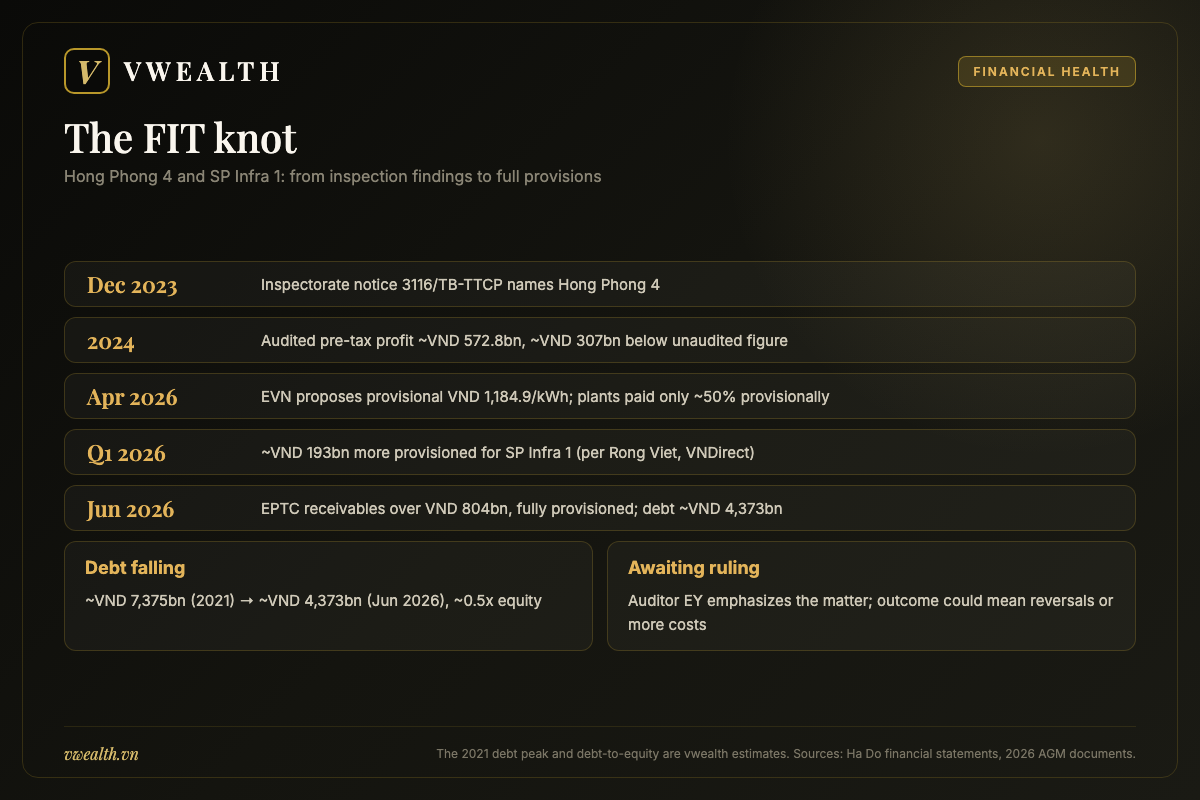
2024 was harder still, for a reason rooted in what looked like the safest part of the business. The Hong Phong 4 solar farm was among the projects named in a Government Inspectorate conclusion (notice No. 3116/TB-TTCP dated 25 December 2023) on the implementation of Vietnam’s Power Development Plan VII and its revision. When the 2024 accounts were audited, Ha Do booked additional provisions related to electricity revenue, cutting audited profit before tax to about VND 572.8 billion — around VND 307 billion lower than the company’s own unaudited figure. Chapter 4 covers this in detail.
In 2024, Ha Do also prepared its next energy investment cycle: in March it broke ground on the Son Nham hydropower plant in Quang Ngai, and in April it received an investment memorandum for the 80 MW Binh Gia wind project in Lang Son province. And in July 2024, founder Nguyen Trong Thong, then 71, submitted his resignation as Chairman — closing a 34-year chapter.
2025–2026: profit recovery, new plants, and waiting on power-price rulings
2025 — Ha Do’s 35th anniversary — was a clear recovery year. According to management’s report to the April 2026 shareholder meeting, consolidated revenue exceeded VND 2,800 billion and consolidated profit after tax was about VND 993 billion, of which about VND 770 billion was attributable to the parent company’s shareholders. Energy did the heavy lifting: Dak Mi 2 posted record revenue of about VND 734 billion, and the 7A wind farm was freed from curtailment requirements, with revenue of about VND 276 billion, up 26% on 2024. Ha Do also completed the acquisition of a hydropower cluster on the Gianh River, including the 22 MW La Trong plant, by buying shares in Truong Thinh Hydropower JSC. It was a project under development since 2007 and not yet generating when Ha Do bought it; according to local media at the end of August 2026, the main works were complete, both units were in 72-hour grid trials, and commercial operation was expected in September 2026.
For 2026, the company targets consolidated revenue of about VND 3,242 billion and profit after tax of about VND 1,151 billion, hoping Hado Charm Villas phase 3 will contribute again. But the first half of 2026 showed Ha Do’s two-engine nature perfectly: property profit jumped after a reassessment of land and cost of sales, while the solar business kept booking provisions as the power-price question remained unresolved. In May 2026, Ha Do set up Binh Gia Wind Power JSC with planned charter capital of VND 610.5 billion, and in September 2026 decided to buy out two executives’ small stakes to own 100% of it. Ha Do’s history, as you can see, has never run in a straight line.
| Year | Milestone | Why it matters to shareholders today |
|---|---|---|
| 1990 | Construction enterprise founded under the Military Technical Academy, Ministry of National Defence | Military roots; engineering-driven, cautious culture |
| 1992 | Becomes Ha Do Construction Company (one source says 1993) | Starts operating as an independent enterprise |
| 1994 | Enters property investment and development | Engine one is born |
| 2004 | Equitized as Ha Do Joint Stock Company | Shareholder-owned structure |
| 2006 | Formally invests in hydropower | Engine two is born, years ahead of peers |
| 2009 | 30 MW Za Hung hydropower plant begins operating | First power plant |
| 2010 | Renamed Ha Do Group, listed as HDG | Disclosure discipline, access to capital |
| 2013 | Nam Pong (30 MW) begins operating | Power carries the group through the property freeze |
| 2016–2020 | Hado Centrosa Garden launched, handed over, inaugurated | Property profit peak; earnings above VND 1 trillion |
| 2018–2021 | Nhan Hac (59 MW) inaugurated, Dak Mi 2 (147 MW) acquired, Hong Phong 4 built, SP Infra 1 bought, Song Tranh 4 and wind farm 7A online | Pivot to energy |
| 2022 | Power revenue overtakes property revenue | Energy becomes the pillar |
| 2024 | Hong Phong 4 provisions; founder steps down as Chairman | Power-price policy risk; generational handover |
| 2025–2026 | La Trong 22 MW acquired (in trials Aug 2026); Binh Gia wind company formed; more provisions for two solar farms | New investment cycle while awaiting FIT rulings |
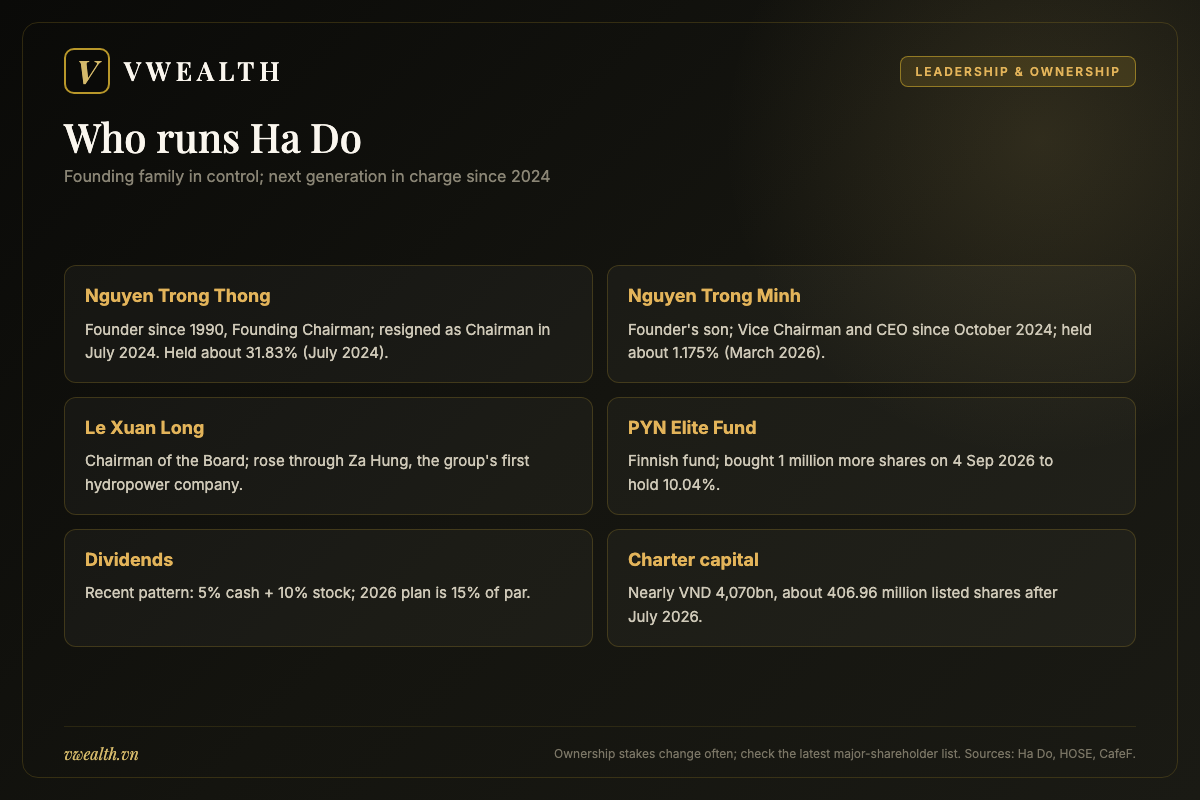
Who Runs Ha Do: The Founder, the Next Generation and HDG’s Shareholder Structure
In a family-controlled company, “who decides” matters as much as “what the company does.” At Ha Do, for more than three decades the answer was essentially one name: Nguyen Trong Thong. Since 2024, that answer has changed — at least on paper. This chapter explains who runs the business, how much the founding family owns, which foreign funds sit behind HDG stock, and what the dividend policy says about how the company shares cash with investors.
Nguyen Trong Thong: a logistics officer who built a group
Mr. Thong was born in 1953, is a civil and industrial construction engineer from Hanoi University of Civil Engineering, and holds the rank of Colonel in the Vietnam People’s Army. According to the biography on Ha Do’s website, from April 1978 to August 1990 he served as deputy head and then head of a logistics section at the Military Technical Academy. From August 1990 he directed the academy’s construction enterprise — in other words, he built Ha Do from day one. He went on to lead Ha Do Construction Company, then Ha Do Company, then served as Chairman and CEO after equitization, and as Chairman of the group from 2017.
His imprint on strategy is unmistakable. Under his leadership Ha Do went into hydropower in 2006, bought plants rather than only building homes, and repeatedly chose to delay project launches in weak markets rather than sell cheaply for cash. At shareholder meetings he tends to talk bluntly about risk. In 2024 he disclosed that two company projects were stuck on legal procedures and stressed that every investment “must be safe and lawful” for the business to be sustainable. He also admitted that Ha Do had “not really done well” in financial investment, since it had mostly been balancing internal cash flows.
In July 2024, Mr. Thong resigned as Chairman and left the Board, citing age, health and compliance with rules on related persons. In his letter he said he had prepared successors and had raised the issue at the 2022 and 2023 shareholder meetings. He kept the honorary role of “Founding Chairman” to advise the Board. At the company’s 2025 year-end conference in January 2026 he still delivered strategic remarks, and at the April 2026 shareholder meeting he was the one proposing that Ha Do study expanding into financial investment. Stepping down as chairman, in other words, did not mean stepping away from Ha Do. He said as much at the April 2026 meeting, according to VietnamMoi: “As Founding Chairman, I commit to continue taking part in leadership, developing people and handing over the brand so that Ha Do grows further.” At the same meeting he warned that solar and wind carry many risks because policy is unstable, transmission is not synchronized and power-price negotiations with EVN are uncertain — a rare admission from the man who approved those very plants.
The next generation: Nguyen Trong Minh and Le Xuan Long
Day-to-day management is now led by Nguyen Trong Minh, Mr. Thong’s son. Mr. Minh holds a bachelor’s degree in finance and business administration from Hamline University in the United States. He started as an accountant and then chief accountant at An Lac 1 Construction Investment JSC (2011–2014), joined Ha Do as deputy head of finance in 2014, became assistant to the Chairman, then Deputy CEO and Standing Deputy CEO while serving as Vice Chairman. Since October 2024 he has been Vice Chairman and CEO. A ten-year path through the finance department before taking the helm helps explain why he is usually the one answering questions on cash flow, power receivables and provisions at shareholder meetings.
Since 3 October 2024 the chairmanship has belonged to Le Xuan Long, a road-and-bridge engineer with a master’s in bridge and tunnel engineering and an MBA. Mr. Long joined Ha Do Construction as a technical officer in 1999, headed its organization and safety department in 2001–2005, and from 2005 has been a board member and CEO of Za Hung JSC — the subsidiary operating the group’s first hydropower plant; he joined Ha Do’s Board in 2018. Having a leader who rose through hydropower in the chair is a fairly clear signal of where energy sits in the strategy.
Other key figures include Le Xuan Tuan, Deputy CEO responsible for energy projects (he received the Binh Gia wind memorandum and briefs shareholders on the Hong Phong 4 resolution), Cao Thi Tam, board member and head of internal audit, Nguyen Hoang Trung, a board member from the finance department, and Tran Thi Quynh Anh, an independent director. The April 2024 meeting elected a 2024–2029 Board of seven members: five non-independent and two independent. After Mr. Thong left the Board in 2024 and another member resigned in April 2025, the 2025 annual report shows a five-member Board with one independent director — a leaner body than originally elected.
Succession: what the founder said and what shareholders should watch
At the April 2024 meeting, shareholders asked directly about succession. Mr. Thong’s answer is worth quoting: “This year I am over 70; my responsibility is to hand over as early as possible. Shareholders should support me in handing over sustainably — that is better for shareholders than me sitting here.” He added that for Ha Do to be sustainable it “must not depend on any single individual,” and required board candidates to present a proposal on corporate governance development.
For investors, succession is both a risk and an opportunity. The risk is that the new generation has not yet been tested through a full crisis at the very top, while the founder carries thirty years of credibility and relationships. The opportunity is a younger team with formal financial training that may be bolder on M&A and more systematic on governance. The practical way to judge it is not to guess personalities but to read results: are new projects on schedule (Son Nham, Son Linh, Binh Gia), is the power-price dispute resolved, and does property restart as promised?
One governance detail is also worth noting: the 2026 meeting set Board remuneration at 2% of consolidated profit after tax attributable to the parent for 2026 (total Board and committee remuneration and expenses for 2025 were VND 10.1 billion, per the resolution). Linking pay to profit aligns the Board with shareholders, though it can also create an incentive to optimize short-term earnings — keep that in mind when reading large provisions or reversals.
The founding family holds about a third; PYN holds about a tenth
According to a July 2024 disclosure, Mr. Thong owned more than 97.3 million HDG shares, about 31.83% of the company. His share count grows with each stock dividend while his percentage stays put: in the shareholder list dated 16 June 2025 shown in the 2025 annual report, he held about 117.76 million shares, still 31.83%. Mr. Minh, as of March 2026, owned more than 4.3 million shares, about 1.175%. When Ha Do paid a 5% cash dividend in early 2026, the press calculated that the Thong family would receive about VND 61 billion — another way to see the family’s controlling position.
The family has registered to buy more several times but has not always completed the purchases. In May 2025, Mr. Thong and his son registered to buy a combined 7.25 million shares (3.25 million and 4 million respectively); by late June 2025 the company reported the founder had bought none because terms did not meet expectations, while Mr. Minh bought about 3.56 million. In March 2026, Nguyen Thi Thu Ha — Mr. Thong’s wife and Mr. Minh’s mother — registered to buy 5 million shares between 16 March and 14 April 2026; in April the transaction report showed she had bought only 300,000 shares because the price did not meet expectations. Unfilled insider purchase registrations are not unusual in Vietnam, but they are a reminder not to treat every “registered to buy” filing as a firm signal.
Among institutions, the most visible name today is PYN Elite Fund (Non-UCITS), a Finnish fund. Its path in HDG has had several turns. On 19 February 2025 it bought 1 million shares, rising from about 4.8% to 5.1% to become a major shareholder; two weeks later it sold 500,000 shares and ceased to be one on 3 March 2025. From April 2025 it bought steadily again: by September 2025 it held about 8.27%, and the shareholder list in the 2025 annual report shows about 39.24 million shares, or 10.61%. In early June 2026 it sold 300,000 shares, dropping below 10%. Then, according to its ownership-change report to the securities regulator, on 4 September 2026 it bought another 1 million shares, lifting its holding from 39.87 million shares (9.80%) to 40.87 million (10.04%).
The same annual-report list shows a second large individual holder who is rarely mentioned: Mr. Nguyen Van To, identified by the company as the father of a Board member, with about 29.8 million shares, or 8.05%. Other foreign shareholders held about 9.45%, and other shareholders about 40%. Dragon Capital’s group has been a large holder in the past: it bought during the late-2022 sell-off (from 9.79% to 10.04% on 9 November 2022) and in December 2023 raised its stake to about 13.03%; however, it no longer appears among the major shareholders listed in the 2025 annual report. Fund stakes change constantly, so check the latest list of major shareholders before drawing conclusions.
According to HOSE, after the stock-dividend issue in mid-2026 HDG had nearly 406.96 million listed shares, equivalent to charter capital of nearly VND 4,070 billion. Add roughly a third held by the founding family, about 8% held by another large individual shareholder and about 10% held by PYN, and the genuinely free float is smaller than the listed share count suggests (a qualitative vwealth assessment, not a disclosed figure). That helps explain why HDG can move sharply when flows turn.
Dividends: from 40% in the boom years to “5% cash plus 10% stock”
Ha Do has paid dividends consistently, but mostly in shares. According to press coverage of the 2024 meeting, dividends for 2019–2022 were 40%, 30%, 30% and 25% of par value (VND 10,000 per share, so 10% equals VND 1,000). The 2019 payout comprised a 10% cash interim and 30% in shares; 2020 was 10% cash and 20% shares; 2021 was 10% cash paid in Q1 2022 and 20% in shares issued in Q3 2022, according to the 2022 annual report; 2022 was 25% in shares, issued in July 2023. For 2023, shareholders received 5% in cash (VND 500 per share) and 10% in shares in June 2024. For 2024, the company issued a 10% stock dividend in June 2025. For 2025, the total was 15%: 5% cash paid in March 2026 and 10% in shares issued in June 2026. The 2026 plan is 15% of charter capital, with timing and form delegated to the Board.
It is worth being precise about stock dividends. A 10% stock dividend increases your share count by 10%, but the share price is adjusted down on the ex-rights date, and your ownership of the company is unchanged. It retains cash inside the company and only creates value if management reinvests it better than you could. The steady increase in share count also dilutes earnings per share: profit must grow at least as fast as the issuance just to keep EPS flat. The 5% cash component is modest compared with pure utilities, so income-focused investors may find HDG less suitable.
| Fiscal year | Total | Cash | Shares | Note |
|---|---|---|---|---|
| 2019 | 40% | 10% (interim, Dec 2019) | 30% (Jun 2020) | Then-record profit year |
| 2020 | 30% | 10% (interim, early 2021) | 20% (Dec 2021) | Per 2021 AGM documents |
| 2021 | 30% | 10% (Q1 2022) | 20% (Q3 2022) | Per the 2022 annual report |
| 2022 | 25% | — | 25% (Jul 2023) | Cash retained in a tough property year |
| 2023 | 15% | 5% | 10% (Jun 2024) | Start of the 5% + 10% pattern |
| 2024 | — | — | 10% (Jun 2025) | Year hit by Hong Phong 4 provisions |
| 2025 | 15% | 5% (Mar 2026) | 10% (Jun 2026, nearly 37 million shares) | Charter capital rises to about VND 4,070bn |
| 2026 (plan) | 15% | Form and timing set by the Board | Per April 2026 AGM resolution | |
Ha Do’s Two Engines: Steady Power Cash Flow and Lumpy Property Profits
Picture Ha Do as a vehicle with two engines. The first is its power plants: always running, capacity almost fixed, a steady hum — but its pulling power depends on the weather. Heavy rain means hydropower runs hard; drought means it weakens. The second engine is property: idle most of the time, but when it fires — a project launch, a wave of handovers — it can drive the whole vehicle forward for a year or two before switching off again. This chapter takes each engine apart so you know where every dong of Ha Do’s profit comes from and how good that profit is.
Hydropower: the backbone of cash flow
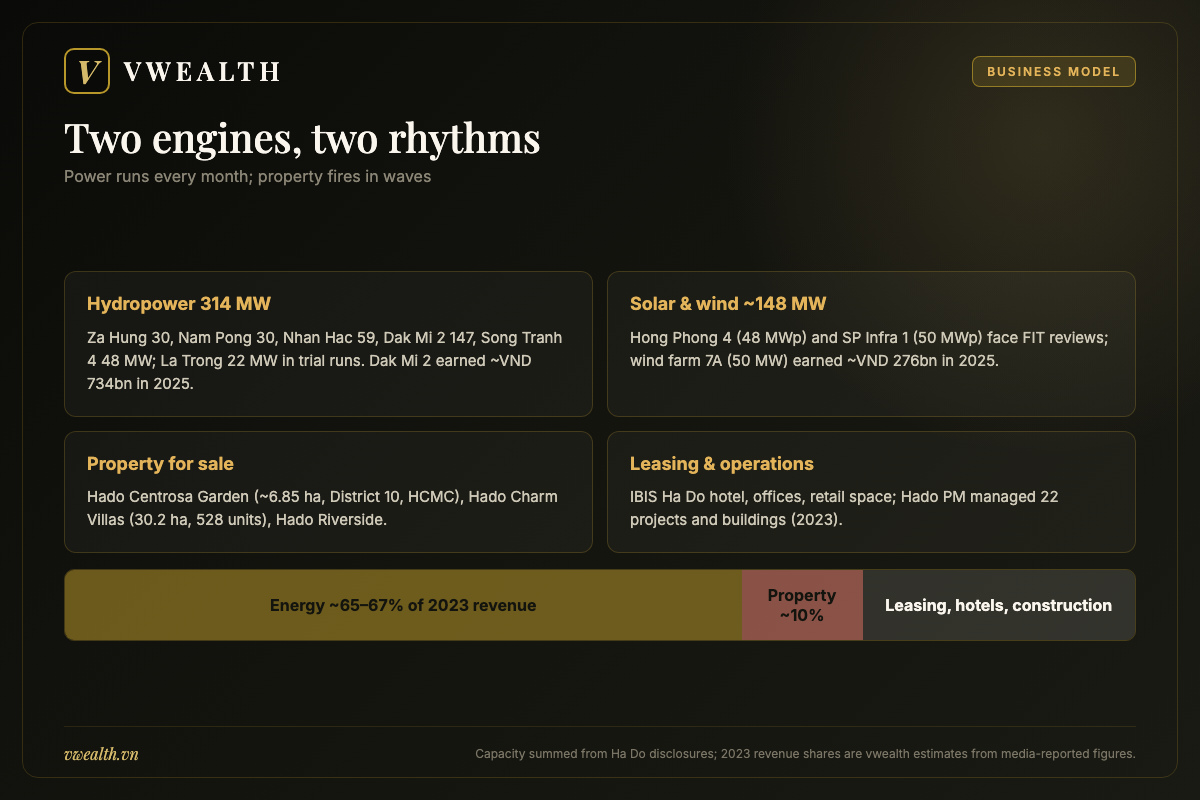
Ha Do’s hydropower portfolio was built over nearly twenty years. Based on the company’s timeline and disclosures, the five operating plants are: Za Hung, 30 MW (Quang Nam, operating since 2009); Nam Pong, 30 MW (Nghe An, operating since 2013); Nhan Hac, 59 MW (Nghe An, inaugurated in 2018); Dak Mi 2, 147 MW (Quang Nam, acquired in 2018, grid-connected in 2021, third unit inaugurated in 2022); and Song Tranh 4, 48 MW (Quang Nam, grid-connected in 2021). Together that is 314 MW, exactly the figure the company reported once Dak Mi 2 ran all three units. A sixth plant, the 22 MW La Trong on the Gianh River (Dan Hoa commune, Quang Tri province), was acquired in 2025 while still under construction: the reviewed 2026 half-year statements still carry about VND 830 billion of construction in progress for it, and local media reported at the end of August 2026 that it was in trial runs and expected to start commercial operation in September 2026. Once La Trong runs, hydropower capacity will be about 336 MW (vwealth estimate, adding up the plants above).
Dak Mi 2 is the crown jewel. In 2022 it produced about 582 million kWh and roughly VND 652 billion of revenue; in 2025 its revenue hit a record of about VND 734 billion according to the company’s year-end review. Nhan Hac ranked second by revenue in 2022 at about VND 314 billion. To put Dak Mi 2 in perspective, it alone generated roughly a quarter of group net revenue in 2025 (vwealth estimate: VND 734 billion divided by about VND 2,787 billion of net revenue). The energy segment as a whole brought in about VND 2,247 billion in 2025, up about 20% and around 81% of net revenue, according to the 2025 annual report.
Why is hydropower so valuable? Because of its cost structure. A hydropower plant is expensive to build — dams, tunnels, turbines, transmission lines — but once running, its variable cost is tiny: no coal, no gas, the “fuel” is rain. Most of the cost of sales is depreciation plus water-resource taxes and fees. That is why the power segment’s gross margin is high; in 2022 Ha Do’s power business had a gross margin of about 72%. As construction loans are repaid, almost every additional kilowatt-hour turns into cash.
The weakness is weather. In El Niño years, rainfall is below average, output drops and revenue follows, and the company can do nothing about it. 2023 is a real example: El Niño cut Ha Do’s hydropower output by about 16% from 2022, to about 1,168 million kWh. For 2026, SSI Research, as quoted by the press, projected hydropower output could fall about 8% to around 1,375 million kWh, with Nhan Hac down 18%, Nam Pong 15% and Dak Mi 2 12%; BSC, in a late-2025 report, warned of a drop of about 11% if El Niño returned. These are third-party forecasts, not results, but they show the range: one dry year can cut a meaningful slice of power revenue. Hydropower is “steady” in the sense that it does not follow the property cycle — not in the sense that every year looks the same.
Solar and wind: accelerated by FIT, then tangled up in it
Vietnam’s 2018–2021 renewable boom was ignited by feed-in tariffs (FIT): the state committed to buy power from qualifying projects at a fixed, attractive price for 20 years. For solar, the first FIT was 9.35 US cents/kWh for projects reaching commercial operation before 1 July 2019; for onshore wind it was 8.5 US cents/kWh for projects reaching commercial operation before 1 November 2021. Those deadlines triggered a construction race across the country, and Ha Do took part.
Ha Do owns three solar and wind plants. Hong Phong 4, a 48 MWp solar farm in Hong Phong commune, Bac Binh district, Binh Thuan province, is owned by subsidiary Ha Do Binh Thuan Co., Ltd.; it received its investment approval on 29 June 2018 and connected to the grid in 2019 according to the company timeline. SP Infra 1, a 50 MWp solar farm in Ninh Phuoc district, Ninh Thuan province, owned by Surya Prakash Vietnam Energy, was acquired in early 2020; according to financial-statement notes quoted in the press, it was recognized as commercially operating on 4 September 2020 and received the competent authority’s acceptance of construction on 28 February 2023. (Ha Do’s website timeline places Infra 1’s grid connection in 2019; we use the commercial operation date from the financial-statement notes.) Finally, wind farm 7A, 50 MW in Ninh Thuan, connected in 2021.
These three plants total about 148 MW — far less than hydropower — yet they have generated most of the headlines about Ha Do over the past three years, because both solar farms are caught up in the review of FIT eligibility. Wind farm 7A has a happier story: in 2025 it was freed from curtailment requirements and earned about VND 276 billion of revenue, up 26% on 2024. Chapter 4 analyzes the financial impact of the power-price issue in detail.
A lesser-known detail: Hong Phong 4 participates in the voluntary carbon market under the Verified Carbon Standard as project VCS 1975. According to the company, Ha Do Binh Thuan completed its fourth monitoring period (1 February 2023 – 31 May 2024) with its consultant and buyer Swiss Carbon Value Ltd. It is not yet a large revenue source, but it shows renewable plants can earn value beyond electricity sales.
Property for sale: big projects, long cycles
Ha Do’s property business shares one trait across projects: few projects, each very large, with many years between acquiring land and recognizing revenue. The flagship examples are Hado Centrosa Garden (about 6.85 hectares, District 10, Ho Chi Minh City) and Hado Charm Villas (30.2 hectares in An Khanh commune, Hanoi, formerly Hoai Duc district). The company has also developed Hado Riverside in Thoi An ward, District 12; the 183 Hoang Van Thai residential area (Thanh Xuan, Hanoi); the Dich Vong new urban area (Cau Giay, Hanoi); Hado ParkView; and Nongtha Central Park in Vientiane, Laos.
Hado Charm Villas deserves its own paragraph, because it will drive most property profit in the next few years. The project has 528 low-rise units — detached and semi-detached villas, townhouses and shophouses — with 33 on-site amenities and a building density of about 18.1% according to the developer, with Savills as operations adviser. The company says the exteriors of all 528 units are complete. Early phases sold from late 2020; the remaining phase 3 was repeatedly postponed in 2022–2024 because management judged the market unfavorable. In early 2024, Industry and Trade Magazine, citing MBS Securities, reported plans to launch about 130 phase-3 units at an expected VND 80–95 million per square meter. That plan slipped again. On 24 June 2025 Ha Do signed AHS Property as official distributor; by then the company described phase 3 as 108 units.
Actual sales show how rate-sensitive high-end villas are. According to the company’s year-end review as reported by VietnamBiz, the official sale of 25 of the 108 units only gathered pace near the end of Q3 2025, and by year-end just 4 units had been sold and recognized, with the other 21 carried into 2026. Pricing has moved far from 2024 levels: MBS put the phase-3 launch price at about VND 200 million per square meter, while SSI Research, quoted in April 2026, cited about VND 250 million per square meter and said Ha Do had no plan to cut prices, only to add promotions. At the April 2026 meeting, CEO Nguyen Trong Minh said the company expected to sell about 15–20 more units and that the project’s land-use fee obligations had been settled.
The key point for shareholders: Charm Villas’ land was acquired long ago (construction started in 2008), so land cost is low relative to today’s prices. In research cited by the press in March 2026, BSC Securities projected phase 3 could bring in more than VND 1,000 billion of revenue and about VND 407 billion of profit in 2026 thanks to that low cost base; VNDirect instead expects handovers to be spread over 2026–2029, contributing about VND 205 billion of profit in 2026 and VND 418 billion in 2027; SSI Research is more cautious still, assuming revenue from only about 10 units in 2026 (down from 40–45 previously). Three brokers, three timelines — a good illustration of how hard property earnings are to forecast. These are third-party projections, not company commitments.
Leasing, hotels and property management: the auxiliary engine
Between the two big engines sits a smaller but fairly stable business: office and retail leasing, hotels and property management services. Ha Do owns the IBIS Ha Do hotel (run as a branch), the HaDo Airport Building in Ho Chi Minh City, and commercial space within its own projects. In 2023, revenue from services and investment-property leasing was about VND 314 billion, and hotel revenue was about VND 107 billion, up roughly 78% as tourism recovered. According to the 2025 annual report, the IBIS hotel keeps occupancy at about 70–75%, and offices and management services run at 95–100%, providing stable income of more than VND 300 billion a year. In the first half of 2026, the segment note in the reviewed statements shows hotels, office leasing and other services brought in about VND 270 billion of revenue — far more than property sales in the same period.
Property management has also been professionalized. In 2023 the company separated its northern branch from its property management and operations company and created Ha Do Real Estate Management and Business Company; at that point, its two operating units in the north and south managed 22 projects and buildings. In December 2025, Hado PM signed new management contracts for the Xi Grand Court complex (759 apartments and offices, former District 10) and the 86 Tan Da apartment building (246 units, former District 5) after residents’ meetings voted for it. In April 2026 it was named among the top five reputable property management companies of 2026, according to a company release. The segment is small, but it has two virtues: recurring revenue, and maintaining living standards in Ha Do’s townships after handover — which supports pricing for later projects.
Construction and other activities: the legacy of a builder
Ha Do began as a construction company, and construction is still there, though much smaller. It was about 15% of revenue in 2019, almost nothing in 2022 (about VND 1.5 billion), and about VND 239 billion in 2023. It fluctuates with contracts, mainly internal projects plus some external work. Its biggest value is not revenue but the ability to act as general contractor on its own hydropower plants and townships, controlling cost and schedule.
Management has also floated new directions: industrial parks (in 2023–2024 the company said it was studying industrial projects totaling more than 1,000 hectares in Hung Yen, Thai Binh, Long An, Can Tho and Ninh Thuan, and proposed developing two industrial clusters totaling 100 hectares near the Ca Na industrial park in Ninh Thuan), a clean-water plant of about 100,000–150,000 cubic meters per day, and financial investment. None of the industrial or water projects contributes meaningful revenue yet; treat them as options on the future, not current engines. Financial investment, however, is already visible on the balance sheet: at end-June 2026 Ha Do held about VND 1,465 billion of short-term financial investments, including more than VND 1,107 billion of trading securities (per the Q2 report as covered by Bao Phap Luat Viet Nam), and at the April 2026 meeting Mr. Minh said financial investment was expected to contribute about VND 330–340 billion this year. For a power-and-property company, that is a volatile profit source worth separating when you read the reports. If industrial parks interest you, our IDICO (IDC) stock analysis covers a company that also combines industrial land with power generation.
Which engine feeds which, and where Ha Do’s moat lies
Over ten years a clear cycle emerges. In 2016–2020, profit from Centrosa and other property projects funded the purchase and construction of power plants (Dak Mi 2, Hong Phong 4, SP Infra 1, Song Tranh 4, 7A). In 2022–2025, with property nearly stalled, power cash flow carried the whole group: repaying loans, paying cash dividends, funding overheads and holding land for the right moment. That is what the two-engine model means in practice: when one runs, the other can rest.
Ha Do’s moat — its durable competitive advantage — is not a mass-market housing brand like some southern peers, but three things. First, completed hydropower plants: viable river sites in Vietnam have largely been used, so a 147 MW plant like Dak Mi 2 is very hard to replicate. Second, land banks acquired early at low cost in locations now very expensive, such as District 10 in Ho Chi Minh City and western Hanoi. Third, end-to-end capability — building, installing and operating — which helps control costs. The weakness of this moat is that it depends on policy: power prices are set by the state, and property approvals come from local authorities. Both engines run on permits.
| Criterion | Energy (hydro, solar, wind) | Property for sale | Leasing, hotels, management |
|---|---|---|---|
| Revenue rhythm | Monthly, by output | By launch and handover waves | Monthly, by lease contracts |
| Share of revenue | About 14% (2019) → nearly 60% (2022) → about 65–67% (2023) → about 81% (2025) | About 64% (2019) → about 31% (2022) → about 10% (2023) | The remainder, stable |
| Gross margin | High (about 72% for power in 2022) | Varies by project; high when land cost is low | Moderate |
| Main risks | Weather, FIT policy, curtailment | Project approvals, demand, interest rates | Tourism, office demand |
| Role | Funds cash flow, debt service, cash dividends | Creates cyclical profit peaks | Stabilizer; supports project value |
Revenue shares compiled from financial media reports and annual reports for each year; the 2023 property share is a vwealth estimate (about VND 282 billion divided by about VND 2,881 billion of net revenue); the 2025 energy share is from the 2025 annual report.
Financial Health: Read the Reports Before You Buy HDG Stock
Ha Do’s financial statements are harder to read than those of a pure utility or a pure homebuilder, because the two engines are mixed in the same tables. A quarter with soaring profit may simply reflect a few dozen villa handovers; a quarter with profit halved may reflect power-revenue provisions while the plants ran normally. This chapter does not aim to give you the “right” number for Ha Do today — check the vwealth report for current figures — but to teach you how to read this particular company’s numbers, based on what happened over the past decade. If you want a primer on reading Vietnamese statements, see our guide to Vietnamese company financial statements in English.
Revenue and profit trajectory: a peak in 2020–2022, a trough in 2024
The data show the two-engine rhythm clearly. In 2017, revenue was about VND 2,229 billion according to press compilations, with property about 52% and power about 14.5%. In 2018, the year Nhan Hac was inaugurated, profit after tax was about VND 752 billion unaudited and about VND 788 billion after audit. In 2019, thanks to Centrosa and Riverside handovers, revenue rose to about VND 4,327–4,343 billion and audited profit after tax to about VND 1,117 billion (the unaudited report showed just over VND 1,026 billion). In 2020, revenue neared VND 5,000 billion and profit after tax reached about VND 1,254 billion, with about VND 979 billion attributable to the parent. In 2022, net revenue was about VND 3,581 billion but profit after tax still reached about VND 1,362 billion thanks to power. Profit then fell to about VND 866 billion in 2023, bottomed at about VND 447 billion in 2024 on the Hong Phong 4 provisions, and recovered to about VND 993 billion in 2025.
| Year | Net revenue (VND bn) | Consolidated profit after tax (VND bn) | Parent share (VND bn) | Highlight |
|---|---|---|---|---|
| 2017 | About 2,297 | About 273 | About 178 | Property about 52% of revenue |
| 2018 | About 3,221 | About 788 | About 633 | Nhan Hac inaugurated; Hong Phong 4 built; Dak Mi 2 acquired |
| 2019 | About 4,343 | About 1,117 | About 932 | Centrosa and Riverside handovers |
| 2020 | About 4,999 | About 1,254 | About 979 | Revenue peak; first bond issues |
| 2021 | About 3,777 | About 1,343 | About 1,096 | Dak Mi 2, Song Tranh 4, wind farm 7A connected |
| 2022 | About 3,581 | About 1,362 | About 1,096 | Power revenue overtakes property |
| 2023 | About 2,889 | About 866 | About 665 | Property revenue down nearly 75%; El Niño |
| 2024 | About 2,717 | About 447 | About 348 | Hong Phong 4 power-revenue provisions |
| 2025 | About 2,787 | About 993 | About 770 | Energy about 81% of revenue |
| H1 2026 | About 1,175 | About 386 | About 301 | Charm Villas land-cost revision; power provisions |
| 2026 (plan) | Total revenue 3,242 | 1,151 | — | Relies on Charm Villas phase 3 |
Sources: audited or reviewed figures from consolidated financial-statement data compiled by VNDirect, cross-checked against Ha Do’s 2022 and 2025 annual reports (2021–2025 match); the 2026 plan is from the 24 April 2026 AGM resolution. The press usually reports unaudited fourth-quarter numbers before the audit, so you will meet other figures: for 2019, VND 1,026 billion (unaudited) versus 1,117 billion (audited); for 2020, 1,260 versus 1,254; for 2023, 906 versus 866; for 2025, the January 2026 year-end release gave VND 941 billion, the fourth-quarter report about 944 billion, and the audited figure is 993 billion. The 2017 revenue figure in press compilations is VND 2,229 billion. When figures conflict, prefer the audited statements.
The first lesson for reading HDG: do not extrapolate a single year. In 2022, looking only at falling revenue would have made you wrongly pessimistic; in 2020, extrapolating record profit would have been just as wrong. The better approach is to split profit into power and property and judge each on its own rhythm.
The power-price story: Hong Phong 4, SP Infra 1 and the provisions
This is the most important section of the chapter, and the one many investors misunderstand. Let’s go step by step.
Step one — why there is a problem. In December 2023, Vietnam’s Government Inspectorate issued a conclusion (notice No. 3116/TB-TTCP of 25 December 2023) on compliance in planning and investment of power projects under Power Development Plan VII and its revision. Hong Phong 4 was among the projects named. In December 2024, the Ministry of Industry and Trade issued report No. 321/BC-BCT on resolving the issues, setting out a principle: projects receiving FIT without fully meeting the conditions would lose FIT, have their power price re-determined, and repay the incentive already received through offsets against future power payments. For SP Infra 1 the issue is procedural: it was recognized as commercially operating on 4 September 2020, but only received the authority’s acceptance of construction on 28 February 2023, and it was on a list of 173 plants that received FIT before such acceptance.
Step two — the hit to the income statement. In its 2024 accounts, Ha Do estimated the possible impact on power revenue and booked provisions. After audit, 2024 profit before tax fell about VND 307 billion from the unaudited figure to about VND 572.8 billion; administrative expenses rose by about VND 93 billion and other expenses by about VND 223 billion, including a short-term provision for payables of about VND 209 billion. According to the notes to the 2026 half-year statements, at a working session on 13 April 2026 about SP Infra 1, EVN and its power-trading arm proposed a price of VND 1,184.9/kWh — the ceiling of the transitional generation price framework — for the period from commercial operation until construction acceptance, the contract price thereafter, and a clawback of the difference for the earlier period. It is still only a proposal. In Q1 2026 Ha Do booked about VND 193 billion of additional provisions for the gap between the FIT and the transitional ceiling at SP Infra 1, according to Rong Viet Securities and VNDirect research quoted by the press; Q1 administrative expenses jumped from about VND 55 billion to about VND 258 billion, and quarterly profit after tax roughly halved to about VND 104 billion.
Step three — the hit to cash flow. This part is often overlooked. At the April 2026 AGM, CEO Nguyen Trong Minh said that while awaiting a ruling, the plants were being paid only about 50% on a provisional basis at the transitional ceiling price, “significantly narrowing cash flow compared with the original financial plan.” He said the group had about VND 1,000 billion receivable from EVN for power sales and had booked more than VND 519 billion of doubtful-debt provisions at that point. By the end of June 2026, according to the reviewed half-year statements, receivables from the Electric Power Trading Company (EPTC, part of EVN) relating to Hong Phong 4 and SP Infra 1 had risen to more than VND 804 billion, from about VND 513 billion at the start of the year — an increase of about VND 292 billion in six months — and were fully provisioned. Total receivables classified as bad debt were about VND 939 billion, with provisions of about VND 936.5 billion.
Step four — no final ruling yet. When the 2026 half-year statements were published, Ha Do said it had not received an official conclusion; auditor Ernst & Young Vietnam included the matter as an “emphasis of matter.” At the April 2026 meeting, Deputy CEO Le Xuan Tuan said both projects were being handled under Government Resolution 233 together with the Prime Minister’s directions and inter-ministerial task forces; he hoped Hong Phong 4 would receive its construction acceptance certificate by the end of 2026, while acknowledging that the deadline set by the latest directive (before 30 June 2026) could slip into the third quarter because each file is complex. The half-year notes also cite Government Resolution 17/NQ-CP of 26 January 2026 and Ministry of Industry and Trade document 881/BCT-DT on clearing long-stalled projects, with both Hong Phong 4 and SP Infra 1 within scope. According to CafeF’s account of the meeting, about 14 solar projects nationwide face similar FIT-eligibility issues out of more than 170 renewable projects — an industry-wide policy problem, not one unique to Ha Do.
The lesson for reading the numbers: since most of the power receivables are already provisioned, a final ruling better than Ha Do’s provision could lead to reversals and one-off profit; a worse ruling — for example, a larger FIT clawback than estimated — would mean more costs. VNDirect, as quoted by the press, judged that provisions through Q1 2026 had addressed most of the risk for the two projects. That is a broker’s view; track the “provision for doubtful debts” and “provisions for payables” notes every quarter yourself.
Earnings quality: when unaudited and audited numbers diverge
A notable feature of HDG in recent years is the large gap between self-prepared and audited or reviewed results — in both directions. In 2024, audited profit was about 35% lower than the unaudited figure because of power provisions. In the first half of 2026 it went the other way: after review, profit after tax exceeded VND 386 billion, about VND 178 billion (roughly 86%) higher than the company’s own figure; profit attributable to the parent exceeded VND 301 billion, around three times higher. The reason was a reassessment of land-use costs and cumulative cost of sales in property, which cut cost of goods sold sharply to about VND 272 billion and lifted gross profit to nearly VND 904 billion on net revenue of about VND 1,175 billion. The trigger was a Hanoi People’s Committee decision dated 24 July 2026 approving the land price used to calculate land-use fees for the An Khanh–An Thuong project (Hado Charm Villas); although it came after the 30 June balance-sheet date, management treated it as additional evidence of conditions that already existed. As a result, in the first half the property segment booked only about VND 18 billion of revenue but about VND 216 billion of gross profit, while energy brought in about VND 888 billion of revenue and about VND 578 billion of gross profit. The notes warn the figures could still change once the tax authority settles the additional land-use fee.
What does this tell you? That at HDG, big accounting estimates — power provisions, land cost on projects stretching over decades — can move a period’s profit by hundreds of billions of dong. There is nothing wrong with revising estimates, but it means quarterly accounting profit is a poor gauge of underlying health. Better gauges are annual power gross profit (reflecting output and price), operating cash flow, and actual property handovers. In the same half-year, administrative expenses rose about 140–145% to about VND 316 billion, largely linked to provisions, while financial expenses fell about 40% to about VND 155–157 billion — mainly, according to the company’s explanation, because there was no longer a foreign-exchange revaluation loss on the 7A wind farm loan, plus lower debt.
Leverage: from a peak above VND 7,300 billion to about VND 4,400 billion
Building power plants takes a lot of long-term debt. At end-2019, Ha Do’s borrowings were about VND 5,821 billion, around 43% of total capital. In 2020 — the first year Ha Do issued bonds, according to its 2021 AGM documents — borrowings rose to about VND 6,500 billion. The peak came at end-2021, just after Dak Mi 2, Song Tranh 4 and wind farm 7A were completed: adding short- and long-term borrowings in the audited statements (as compiled by VNDirect) gives about VND 7,375 billion (vwealth estimate). Since then the company has deleveraged steadily: about VND 6,100 billion at end-2022 (vwealth estimate on the same basis), a year in which it repaid VND 300 billion of private bonds on time and converted the rest of its bonds with warrants, per the 2022 annual report; about VND 5,426 billion at end-2023, with bonds outstanding at zero after about VND 210 billion of maturing bonds were repaid; by end-June 2026, total borrowings were about VND 4,373 billion against equity of more than VND 8,501 billion and total assets of about VND 14,421 billion. That puts debt at roughly 0.5 times equity (vwealth estimate: 4,373 divided by 8,501).
For a company owning many power plants, that leverage is moderate. The asset mix matters too: fixed assets of about VND 7,816 billion, about 54% of total assets, are mostly power plants; long-term work in progress of about VND 2,130 billion, about 15%, is projects in preparation. One specific risk shareholders have raised is currency: part of the plant financing is in euros, and management said at the 2024 meeting that the company lost about VND 80 billion on exchange rates in 2022 and about VND 50 billion in 2023. The risk has not gone away: explaining its Q2 2026 results, the company said profit rose sharply mainly because there was no longer a revaluation loss on the 7A project loan. Check the currency breakdown of borrowings in the notes.
Cash flow: good profit is not always cash in the bank
In 2022, Ha Do’s net operating cash flow was about VND 1,941 billion; in 2023 it fell to about VND 461 billion in the unaudited fourth-quarter report (audited data compiled by VNDirect show about VND 794 billion) as there were no new property handovers. Financing cash flow that year was about negative VND 668 billion unaudited (about negative VND 859 billion audited) as debt was repaid. Operating cash flow then recovered to about VND 1,050 billion in 2024 and about VND 1,243 billion in 2025, while financing cash flow stayed negative at roughly VND 700–850 billion a year as the company repaid debt and paid dividends (per VNDirect data). From 2024, receivables from the two solar farms ballooned, meaning part of revenue was recognized but not fully collected. That is why you must read cash flow alongside profit: a healthy power company is one whose electricity revenue lands in the bank regularly, not one where it piles up under “trade receivables.”
At the April 2026 AGM, founder Nguyen Trong Thong said the company still keeps a reasonable cash balance to seize new investment opportunities, “although financial resources are not abundant.” It was a candid admission, and it raises the question for the coming years: can power cash flow, squeezed by the pricing dispute, fund Son Nham, Son Linh and Binh Gia, restart property projects, and keep paying cash dividends at the same time?
Seven questions to ask every time Ha Do reports
To turn this chapter into a tool, here are seven questions vwealth suggests you answer each quarter, using the financial statements and the latest vwealth report.
One — how did power output compare with a year earlier? Separate hydropower from wind and solar. Lower hydro output due to weather is seasonal; lower wind output due to curtailment is a grid problem.
Two — are receivables from the power buyer rising or falling? If still rising, cash is still being withheld; a sharp fall with provision reversals may mean the dispute has been resolved.
Three — how did doubtful-debt provisions and payable provisions change? This is where the FIT ruling will show up.
Four — which project did property revenue come from, and how many units? Property profit will come almost entirely from Charm Villas for the next few years, so its sales and handover pace is the key variable.
Five — was property cost of sales revised? The first half of 2026 showed that cost revisions can swing profit enormously; read the notes to know whether a gain is recurring or one-off.
Six — where are debt and interest costs heading? As new power plants are built, debt may rise again — normal if the projects stay on schedule.
Seven — does operating cash flow cover cash dividends and capital spending? If not, the company will borrow more or slow investment. For a refresher on valuation ratios, see our explainer on Vietnam stock market valuation.
How the Market Has Treated HDG Stock: From Sought-After Energy Play to Limit-Down Sessions
A good business is not a good stock at every price, and a rising stock does not always mean an improving business. With HDG, the way the market prices the shares shifts with the story investors believe: sometimes “a property stock with prime land,” sometimes “a renewable-energy stock riding the green trend,” sometimes “a company exposed to FIT risk.” This chapter recalls those phases, explains a sensible valuation approach for a two-engine business, and lists catalysts that could change the market’s view.
Memorable price phases
HDG listed in 2010, just as the market entered a long difficult stretch, and for years it was an overlooked mid-tier property stock. The turning point came in 2019–2021, when profit crossed VND 1 trillion and renewables became a hot theme. According to 2021 AGM documents, HDG hit its then all-time high in 2020, up about 60.7% from the start of the year; in April 2021 it traded around VND 44,300. In late 2021, the press listed HDG among renewable stocks “quietly breaking out to new highs”: from about VND 51,600 in July 2021 it climbed to trade around VND 76,000 after Ha Do set up Ha Do Energy JSC. In the Q1 2022 rebalancing, HDG was added to the MVIS Vietnam Index tracked by the VanEck Vietnam ETF (VNM), with an initial weight of about 0.41%.
In late 2022, as the market slumped amid the corporate-bond crisis, HDG fell hard: on 14 November 2022 it closed at VND 25,000, about 59% below its late-March peak, according to CafeF. That was when foreign funds bought: Dragon Capital’s group added 600,000 shares on 9 November 2022, lifting its stake to about 10.04%. In 2023–2024 the stock traded around VND 27,000–28,500 at points reported by the press (for example VND 27,050 on 16 February 2024 and VND 28,500 on 25 July 2024, when market capitalization exceeded VND 9,500 billion). Note that prices from different years are not directly comparable because Ha Do pays stock dividends almost every year; use adjusted prices for comparisons.
2026 has been volatile. In March 2026 the stock was at its highest level of the year and some brokers were positive. But in early July 2026, after a long correction, HDG fell sharply for two sessions, hitting the daily limit-down at VND 18,600 on the afternoon of 6 July — its lowest level in more than a year, with market capitalization below VND 7,600 billion by press estimates. At the time, the company had not disclosed any new adverse information that directly explained the move. A few weeks earlier there had been two soft signals from foreign flows: in the Q2 2026 review announced on 13 June, MarketVector removed HDG from the MarketVector Vietnam Local Index tracked by the VNM ETF, and PYN Elite Fund sold 300,000 shares on 3 June. On 4 September 2026 the stock closed at VND 17,500 — the same session in which PYN bought another 1 million shares to go above 10%. According to Tin Nhanh Chung Khoan, between 25 March and 21 September 2026 the shares fell about 42.5%, from VND 27,820 to VND 16,000. These are historical prices on specific dates, not today’s price; for the latest, see the vwealth report.
Valuing a two-engine business: sum of the parts
For HDG, a single P/E ratio is often misleading, because annual profit is distorted by property handover timing and provisions. Many analysts use a sum-of-the-parts approach: the energy business is valued by discounting each plant’s cash flows over its remaining life, or by EV/EBITDA multiples of power companies; the property business is valued by revalued net asset value (RNAV) of each project — the present value of expected profit when sold, net of costs and debt. Add the two, subtract group net debt and minority interests, and you arrive at value for parent shareholders.
This explains why analyst valuations of HDG can swing on a single assumption. In March 2026 research quoted by the press, BSC said that changing its valuation method for the Minh Long project had significantly raised its estimate of the company’s value. A change in project timing, expected selling prices or the FIT ruling can move value by thousands of billions of dong. You don’t need a complex model, but you should know what each report assumes for each part.
P/E, P/B and the traps in comparisons
If you still want to use P/E and P/B, watch for three traps. Trap one: one-off profit. A year with large provision reversals or cost revisions makes P/E look unusually cheap; a year with big provisions makes it look unusually expensive. Trap two: minority interests. Part of consolidated profit belongs to other shareholders of subsidiaries (in 2025, consolidated profit was about VND 993 billion but parent profit about VND 770 billion), so use parent-attributable profit for P/E. Trap three: dilution. Because stock dividends are paid every year, historical EPS must be adjusted for the new share count.
On P/B, book value reflects land at historical cost, so for long-held projects like Charm Villas true value may exceed book; power plants are carried at construction cost less depreciation, and their economic value depends on power prices — if the FIT for the two solar farms is cut, their economic value may be below book. In March 2026, BSC estimated HDG traded at a forward P/E of about 9.7x, below its five-year average; that was one broker’s view at one moment, not a current figure. For live P/E and P/B versus history, check the vwealth report.
Stock personality and foreign investors
HDG behaves like a mid-cap with concentrated ownership. The founding family holds about a third and a few foreign funds hold significant stakes, so the true free float is limited. When large funds accumulate, the price can climb quickly; when several holders exit together, as on 6 July 2026, the stock can hit the limit-down without new bad news. For individual investors, that means sizing positions carefully and keeping price discipline — don’t chase hot sessions, and don’t panic-sell in drops without a fundamental reason.
Foreign investors are an important part of the HDG story, with PYN Elite Fund and Dragon Capital both having been major holders. FTSE Russell has now formally upgraded Vietnam to secondary emerging-market status, effective from the 21 September 2026 session, with inclusion in its global indices phased over four tranches through September 2027. HDG was not among the 27 Vietnamese stocks added to the FTSE All-Cap index in the first review, so it is unlikely to be among the most direct beneficiaries of passive inflows; positive sentiment can still spill over, but it should not be the core of an investment case. See our article on the FTSE Russell upgrade for Vietnam for background.
Catalysts that could change how the market sees HDG
There are five main catalysts. First, the final power-price ruling for Hong Phong 4 and SP Infra 1: a clear ruling, good or bad, removes uncertainty, and part of the provisions may be reversed. Second, sales and handovers at Hado Charm Villas phase 3, the nearest property profit driver. Third, new plants coming online: La Trong (22 MW, commercial operation expected from September 2026), Son Nham (9 MW, targeted to generate from Q4 2026 per its groundbreaking announcement) and Son Linh (15 MW). Fourth, approvals for new property projects under National Assembly Resolution 171 on pilot commercial housing: 62 Phan Dinh Giot (Hanoi), Linh Trung and Tang Nhon Phu (Ho Chi Minh City). Fifth, the weather: a wet year can lift hydropower profit significantly, while a prolonged El Niño cuts it.
Each catalyst can cut both ways. The point is not to guess when they happen, but to know, when news arrives, which part of the value it affects: energy or property, cash flow or accounting profit, one-off or recurring.
Industry Context: Ha Do Between Vietnam’s Power Sector and Its Property Market
Judging HDG by looking only at the company is not enough, because both engines run on roads paved by policy. Power is tightly regulated in Vietnam: purchase prices, generation planning and the transmission grid are decided by state bodies and the state utility, EVN. Property depends on land law, credit and interest rates. This chapter places Ha Do in both contexts and compares it with companies you might be weighing at the same time.
The power sector: rising demand, a new master plan and the role of renewables
Vietnam’s electricity demand is among the fastest-growing in the region, driven by manufacturing and foreign direct investment. The national Power Development Plan for 2021–2030 with a vision to 2050 (Power Development Plan VIII), approved in 2023 and revised in 2025, aims to raise the share of renewables sharply, especially wind and solar, while keeping hydropower as a flexible baseload source. According to Ha Do’s management, the Binh Gia wind project in Lang Son is one of the first wind projects expected in that province under the plan.
For hydropower, room for new large projects in Vietnam is very limited: major rivers have largely been developed, what remains is mostly small and medium plants, and environmental and forest rules keep tightening. That makes operating hydropower plants a scarce asset — an anchor for the value of Ha Do’s energy arm. It also means that to add capacity, Ha Do must turn to wind or buy others’ plants, as it did with La Trong and the Son Nham–Son Linh cluster.
In 2024, the government introduced a direct power purchase agreement (DPPA) mechanism allowing renewable generators to sell to large industrial consumers. The press at the time named several listed companies that might benefit, including renewable developers. For Ha Do, DPPA opens the possibility of selling new wind and solar output directly to manufacturers seeking green power, not only to EVN. The mechanism is new, though; treat it as a medium-term opportunity rather than current revenue.
From FIT to transitional pricing: a policy lesson for the whole renewable sector
The Hong Phong 4 and SP Infra 1 story is not unique. In 2019–2021, FIT created an unprecedented wave of solar and wind investment, but also left problems: the grid could not keep up, leading to curtailment, and many projects rushed construction before legal procedures were complete. After the FIT schemes expired, projects that missed the deadlines had to negotiate prices under the transitional generation price framework issued by the Ministry of Industry and Trade in 2023, with a ceiling for ground-mounted solar of about VND 1,184.9/kWh — well below the earlier FIT.
The lesson for investors: with renewables, the selling price is not “signed and done.” Policy risk can emerge years after a plant starts operating, through inspections, eligibility reviews or new mechanisms. Ha Do has paid for that lesson with hundreds of billions of dong in provisions. On the positive side, the government has issued a dedicated resolution on resolving renewable-project issues, and the hydropower plants that make up most of Ha Do’s capacity are not part of this FIT review.
The property market: from freeze to a new legal framework
In 2022–2023, Vietnamese property went through a liquidity crisis: credit tightened, the corporate bond market seized up and project approvals stalled. Ha Do did not face bond pressure like many peers — its bonds outstanding fell to zero by end-2023 — but it could not launch new projects and had to postpone sales. Property revenue fell from about VND 1,112 billion in 2022 to about VND 282 billion in 2023.
From August 2024, three new laws took effect — the 2024 Land Law, the 2023 Housing Law and the 2023 Real Estate Business Law — alongside National Assembly Resolution 171/2024/QH15 piloting commercial housing projects via negotiated land-use rights or existing land rights. For Ha Do this resolution is especially important: according to the founder at the April 2026 meeting, three of its projects are on the pilot list — 62 Phan Dinh Giot (Hanoi, about 2.3 hectares), Linh Trung (Ho Chi Minh City, about 2.7–2.8 hectares depending on the document; added to the list on 7 November 2025, with site clearance done and land-use fees paid in one lump sum) and Tang Nhon Phu (Ho Chi Minh City) — and it is studying an additional project in the former District 8. These projects had been stuck for years on the mechanism for assigning developers.
In western Hanoi, home to Charm Villas, infrastructure investment is heavy: Thang Long Avenue, the Lien Khu 8 road, Ring Roads 3.5 and 4, and planned Metro Line 5. Good infrastructure supports villa and townhouse prices in the area. But the area also has plenty of competing low-rise supply, and demand in the high-end segment depends heavily on mortgage rates.
Ha Do versus listed property developers
Compared with the pure homebuilders vwealth has covered, Ha Do’s property business is smaller but its balance sheet is safer thanks to power cash flow. Khang Dien (KDH) and Nam Long (NLG) are housing developers focused on Ho Chi Minh City and surrounding areas, living on large land banks and steadier sales cycles. Novaland (NVL) illustrates the danger when high leverage meets a liquidity crisis — our NVL analysis shows the contrast.
The biggest difference: when the housing market freezes, pure developers can go several quarters without revenue, while Ha Do still has power revenue of around VND 2,000 billion a year (about VND 2,116 billion in 2022, about VND 1,938 billion in 2023 and about VND 2,247 billion in 2025). The flip side: when property booms, Ha Do lacks a large ready land bank to take full advantage, and its profit upside is usually more modest than developers with large land banks.
Ha Do versus listed energy companies
On the energy side, the names most often compared with Ha Do are REE, PC1, GEG (Gia Lai Electricity) and POW (PV Power). REE is also a multi-engine model — power, water, office leasing and M&E contracting — with a large hydropower portfolio through associates; see our REE stock analysis. PC1 combines power construction, hydropower, wind and industrial parks — our PC1 Group analysis shows another way of combining businesses. POW is a large state-controlled generator with gas, coal and hydropower. GEG is a purer renewable player that has also faced curtailment and pricing issues.
A useful comparison is the gross margin of power generation. According to PC1’s annual-report figures as compiled by the press, PC1’s generation segment earned about VND 1,820 billion of revenue and more than VND 1,046 billion of gross profit in 2025, a gross margin of about 57%. Ha Do’s energy segment had a gross margin of about 72% in 2022 — the first year all its plants ran at full capacity — and about 65% in the first half of 2026 (vwealth estimate: about VND 578 billion of gross profit divided by about VND 888 billion of energy revenue, per the segment note). The difference mostly reflects the generation mix: long-depreciated hydropower usually earns higher margins than newly built wind and solar. When comparing power companies, look at the mix before the margin.
| Company | Core model | Similar to Ha Do | Different from Ha Do |
|---|---|---|---|
| HDG (Ha Do) | Renewable energy + property | — | Two roughly balanced engines; founding family control |
| REE | Power, water, office leasing, M&E | Multi-engine; hydropower a pillar | Property mainly leasing, not lumpy sales |
| PC1 | Power construction, hydro, wind, industrial parks | Hydro and wind; moving into industrial land | Construction is a large share |
| POW | Gas, coal and hydro generation | Sells power to the grid | Large, state-controlled, little renewable exposure |
| KDH, NLG | Housing development | Large urban land banks | No power business to buffer cash flow |
| NVL | Large-scale development | Exposed to the property cycle | Very different leverage and capital structure |
A qualitative comparison of business models; for current financials of each company, see the vwealth reports.
Weather: a macro variable nobody controls
For a company with about 314 MW of operating hydropower, the ENSO cycle — alternating El Niño (dry) and La Niña (wet) — is a genuine macro variable. In 2023, El Niño cut Ha Do’s hydropower output by about 16%. In 2025 the reverse happened: favorable hydrology helped Dak Mi 2 set a revenue record and group output beat plan by nearly 20%, according to the company’s year-end release — the highest in five years, per the 2025 annual report. For 2026, brokers warned of a possible return to El Niño. Nobody can forecast weather years ahead, so rather than guess, accept that Ha Do’s hydropower profit will vary year to year, and judge the company on multi-year averages rather than one good or bad year.
Outlook: Three Scenarios for HDG Stock and What Would Have to Happen
Nobody knows where HDG’s share price will go, and this article offers no price target. What you can do is understand which variables decide Ha Do’s future and build scenarios with clear conditions to track. When news arrives, just ask: which scenario does this push the company toward?
Five variables that will shape Ha Do’s future
Variable one — the power-price ruling for the two solar farms. This is the most “binary” variable: a ruling will arrive at some point and determine how much provision Ha Do can reverse or must add, as well as the cash flow of Hong Phong 4 and SP Infra 1 for the rest of their lives. CEO Nguyen Trong Minh noted that while the projects were designed for a 25-year life, effective economic operation may be only about 15 years, reducing their payback.
Variable two — Hado Charm Villas phase 3. The company describes phase 3 as 108 low-rise units (early-2024 press reports cited about 130). Only 4 units had been sold and recognized by end-2025; at the April 2026 meeting the company expected to sell about 15–20 more. The sales pace depends on mortgage rates and sentiment in western Hanoi’s high-end segment. Three brokers offer different timelines (BSC expects a large recognition in 2026, VNDirect spreads it over 2026–2029, SSI assumes only about 10 units in 2026) — which is exactly the range of uncertainty. There is also an accounting variable: the project’s additional land-use fee is still being settled with the tax authority, so cost of sales could change again.
Variable three — new power capacity. Son Nham (9 MW) and Son Linh (15 MW) hydropower in Quang Ngai are planned for 2026–2027; La Trong (22 MW) has been Ha Do’s since 2025, is in trial runs and is expected to start commercial operation from September 2026; the Phuoc Huu wind project (50 MW, Khanh Hoa) and the Binh Gia wind project (80 MW in Lang Son, with expected investment of about VND 3,000 billion per the 2024 memorandum) could, in the company’s view, begin investment in 2026, adding about 130 MW. VNDirect estimates La Trong, Son Nham and Phuoc Huu wind could add about 13% to total output once running. The company’s long-term goal is roughly 1,000 MW of capacity (the 2024 AGM cited 2029; later releases cite 2030), with energy revenue of about VND 5,000 billion a year — more than double the 2025 level.
Variable four — approvals for new property projects. The list includes 62 Phan Dinh Giot (Hanoi, about 2.24–2.3 hectares), Linh Trung (Ho Chi Minh City, about 2.7–2.8 hectares), the Division 367 military housing project on Tang Nhon Phu Street (F367), the Binh An apartment project at 2735 Pham The Hien (former District 8, which the company calls Greenlane), and CC3 Dich Vong in Hanoi. In the glossary of the 2025 annual report, “Minh Long” is the name used for the Linh Trung residential project — matching the subsidiary Minh Long Dong Sai Gon; BSC describes Minh Long as about 2.7 hectares fronting Pham Van Dong Road, with total investment of about VND 4,500 billion, about 1,400 apartments and 30 low-rise units. At the April 2026 meeting, management said Linh Trung and Phan Dinh Giot are well placed to start investment from 2027, and that if construction starts in 2026 it can only be one of the two. According to VNDirect, projects such as 62 Phan Dinh Giot and Minh Long could start in 2027 and begin contributing revenue from 2029; SSI has pushed its sales assumptions for Minh Long and Green Lane to 2028–2030. This is the property engine for the cycle after Charm Villas.
Variable five — weather and interest rates. Weather drives hydropower output; interest rates drive both the cost of financing new plants and demand for property. Both are outside the company’s control but heavily influence each year’s results.
Bull case: power prices settled, Charm Villas sells well, new plants on time
Conditions: the authorities issue a power-price ruling for Hong Phong 4 and SP Infra 1 no worse than Ha Do has provisioned, and withheld cash is gradually paid; mortgage rates stay low, Charm Villas phase 3 sells quickly and is handed over in 2026–2027; Son Nham and Son Linh start on schedule; hydrology is favorable; one or two Resolution 171 projects receive investment approval.
What happens to the business: profit could beat plan as both engines fire together, plus a one-off provision reversal. Operating cash flow improves clearly, enough to fund new wind projects while maintaining dividends. The market could shift from seeing HDG as “a company with FIT risk” to “an energy-and-property group entering a new growth cycle.” Even here, remember that reversals are one-off profit and shouldn’t be capitalized at a P/E multiple like recurring earnings.
Base case: energy flat, property recognized gradually
Conditions: the power-price ruling is delayed into 2027, but most of the risk is already provisioned so there is no big new shock; Charm Villas phase 3 is sold and handed over gradually over several years, as in VNDirect’s timeline; hydrology is normal or slightly weak; new plants start a few quarters late; new property projects continue working through approvals.
What happens to the business: profit hovers around 2025–2026 levels, with energy as the pillar and property adding a portion. Dividends follow the roughly 5% cash plus stock pattern. The stock may trade on quarterly news without a clear trend until a power-price ruling or a new project launch. In this scenario, patience matters more than timing.
Bear case: adverse power-price ruling, a dry year and stalled property
Conditions: the final ruling requires a larger FIT clawback than Ha Do has provisioned, or the remaining selling price for the two solar farms is well below contract; a prolonged El Niño cuts hydropower output sharply; higher rates slow Charm Villas sales; new power projects overrun budgets or schedules; new property projects stay stuck.
What happens to the business: profit could fall sharply for a year or two from both extra provisions and lost hydropower revenue; tighter cash flow may force more borrowing or slower investment; cash dividends could be cut. Even so, the hydropower plants keep running and generating base cash flow, and leverage is moderate — so the risk of insolvency is low in vwealth’s qualitative assessment. The main risk of the bear case is “dead money” for several years, not collapse.
Illustrative example: how sensitive Ha Do’s profit is to hydropower output
To see why weather matters, try a simple calculation. This is an illustrative example with round numbers, not a forecast. Assume Ha Do’s energy revenue is about VND 2,000 billion a year (close to 2022–2023 levels and the company’s own 2024 description), mostly from hydropower. Because hydropower costs are largely fixed (depreciation, interest, operating staff), a 10% drop in output cuts revenue by about 10% while costs barely move. If hydropower revenue is assumed at VND 1,500 billion, a 10% output drop removes about VND 150 billion of revenue — and most of that falls straight to profit before tax, less a small amount of output-linked resource taxes and fees.
Compared with 2025 consolidated profit after tax of about VND 993 billion, VND 150 billion of pre-tax profit is significant — enough for one dry year to turn “growth” into “decline.” Conversely, a wet year can add a similar amount. The lesson: when assessing HDG, use multi-year average hydropower output, and don’t be surprised when a single year misses plan because of the weather.
| Scenario | Hong Phong 4 & SP Infra 1 pricing | Property | New capacity & weather | What to watch |
|---|---|---|---|---|
| Bull | Ruling no worse than provisions; reversals and collections | Charm Villas 3 sells fast; Resolution 171 projects approved | Son Nham, Son Linh on time; wet years | Provision reversals, falling power receivables, rising operating cash flow |
| Base | Ruling delayed, no new shock | Gradual sales and handovers 2026–2029 | New plants a few quarters late; normal hydrology | Profit near 2025–2026 levels, dividends maintained |
| Bear | Clawback larger than provisions; low remaining price | Slow sales on high rates; new projects stuck | Prolonged El Niño; cost overruns | More provisions, rising debt, lower cash dividends |
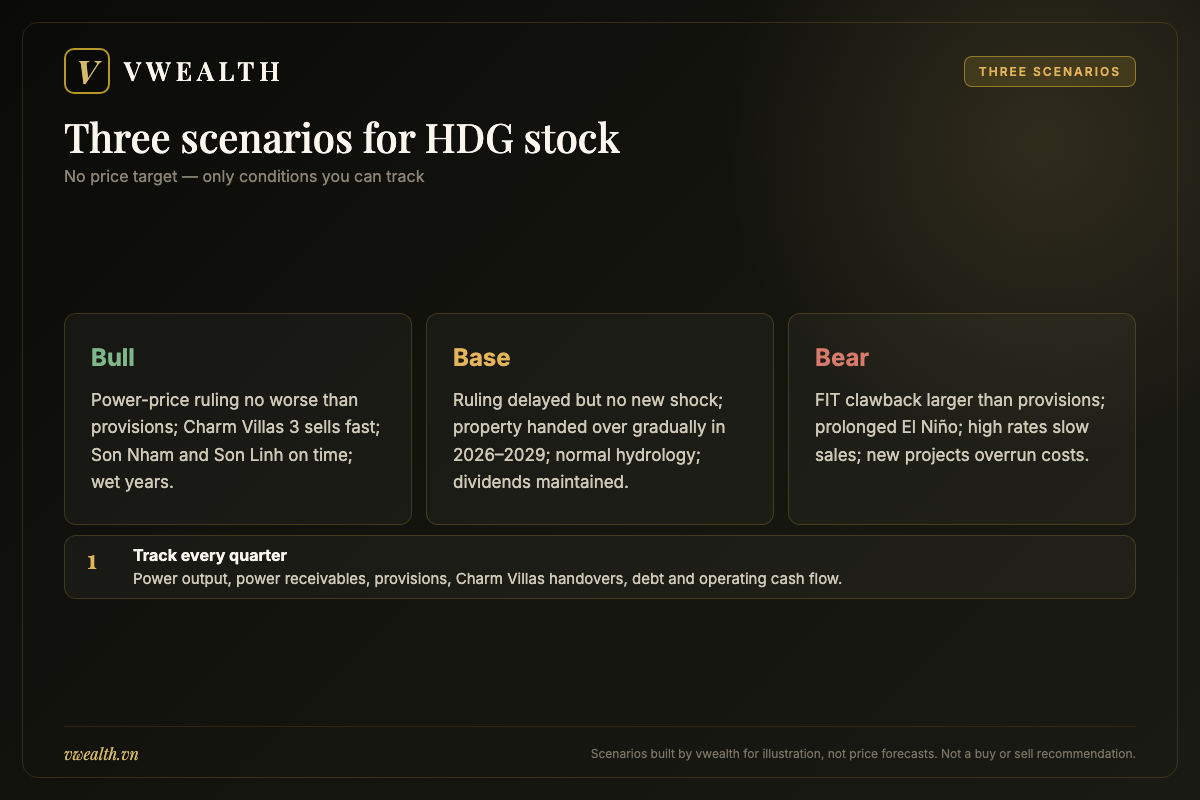
So, Should You Buy HDG Stock? A Balanced Verdict
After seven chapters, it is time to pull everything together. The answer to “should I buy HDG stock” is not a single number but whether you accept the nature of this business: a two-engine company whose steady power cash flow is governed by pricing policy, and whose large property profits arrive in waves — often later than hoped.
The compelling positives
Hard-to-replicate power assets. About 314 MW of operating hydropower (about 336 MW once La Trong starts commercial operation), including the 147 MW Dak Mi 2, is an asset a newcomer could hardly rebuild in Vietnam today because viable sites are largely taken. These plants are past their riskiest construction phase and in the cash-collection phase.
A two-engine model proven in a crisis. In 2022–2023, when many developers had no revenue and struggled with bonds, Ha Do still earned around or above VND 1 trillion a year thanks to power, and cut its bonds outstanding to zero.
Falling leverage and a healthier balance sheet. Borrowings fell from a peak of about VND 7,375 billion at end-2021 to about VND 4,373 billion by mid-2026, roughly half of equity (both the peak and the ratio are vwealth estimates from financial-statement data).
Low-cost land and a new project cycle. Charm Villas carries low land cost; Resolution 171 projects open the next property cycle; the energy arm has a clear expansion path with Son Nham, Son Linh, La Trong and Binh Gia.
Most of the power-price risk is already on the books. By mid-2026, the two solar farms’ power receivables were fully provisioned. If the final ruling is no worse, the chance of another major shock is limited, and reversals are possible.
The negatives you cannot ignore
Power-price policy risk remains open. There is no official ruling, the auditor still emphasizes the issue, and the two plants’ cash flow is being withheld. The sector’s lesson is that policy risk can surface years after a plant starts running.
Hard-to-forecast earnings with large accounting estimates. Gaps between Ha Do’s unaudited and audited or reviewed results have reached hundreds of billions of dong in both directions, complicating valuation and making the stock react sharply to each report.
Property moves slower than promised. Charm Villas took more than ten years from groundbreaking to sales; phase 3 was postponed for years; several projects mentioned at AGMs since 2021 are still in approvals. History suggests discounting the company’s timelines.
Weather dependence. Hydropower dominates capacity, and an El Niño year can remove hundreds of billions of dong of profit, as the illustrative example in chapter 7 shows.
Modest cash dividends and steady dilution. The 5% cash plus 10% stock pattern means the share count grows about 10% a year; profit must keep pace for EPS to hold. For income seekers, this is not ideal.
An untested succession. The new leadership has run the company only since 2024; its crisis management at the top has not been proven through a full cycle.
| Dimension | Pros | Cons |
|---|---|---|
| Energy engine | Scarce hydropower assets, high margins, recurring cash flow | FIT risk at two solar farms, weather, curtailment |
| Property engine | Low-cost land, Resolution 171 projects | Slow timelines, lengthy approvals, rate sensitivity |
| Finances | Falling debt, no bonds since end-2023 | Large accounting estimates, swelling power receivables |
| Shareholders | Founding family aligned, long-term foreign funds present | Low free float, high volatility, mostly stock dividends |
| Governance | Financially trained next generation | Succession not yet tested by a crisis |
Who HDG stock may suit
Investors who want renewable exposure without betting everything on solar and wind. Most of Ha Do’s capacity is hydropower that has run steadily for years; the FIT risk sits in a small part of capacity.
Patient, multi-year holders. Ha Do’s value is unlocked by events — a power-price ruling, a project launch, a new plant — that usually arrive late. A three-to-five-year horizon fits better than trading.
Investors willing to read the reports. If you are ready to split profit into two parts and read the provision and cash-flow notes each quarter, you will have an edge over those who only look at EPS. HDG rewards understanding.
Investors building a balanced, multi-sector Vietnam portfolio. Given its two-engine nature, HDG can be a relatively defensive piece within property or a growth piece within utilities. Our Vietnam investing guide covers portfolio basics for foreign investors.
Who it may not suit
Investors needing high, regular cash dividends. The roughly 5% cash component of recent years does not meet a passive-income need.
Investors who cannot stomach volatility. HDG has hit the 7% daily limit-down without new bad news. If that would keep you awake, keep the position small or look elsewhere.
Investors buying on a single headline. Buying HDG only on news of an imminent FIT resolution or a Charm Villas launch is a bet on timing — and the company’s history shows timelines tend to slip.
Investors who want a pure energy or pure property play. If you want to bet on one sector, there are purer companies; HDG will always carry a “rest of the business” unrelated to your thesis.
Final thoughts
Ha Do is the story of a military logistics officer who built a company from nothing, went against the crowd by investing in hydropower in 2006, and therefore came through the 2022–2024 property winter in better shape than many peers. It is also the story of the price paid for joining the 2019–2020 solar rush, when incomplete procedures left a policy debt that still lingers today. The question of whether to buy HDG stock thus boils down to this: do you believe the power engine will keep running steadily once the FIT knot is untied, that the property engine will restart at the right moment — and do you have the patience to wait for both?
This article is not a recommendation to buy or sell. Before deciding, check current data — price, P/E, P/B, the latest quarterly profit, power output, power receivables, Charm Villas sales progress — in the vwealth analysis report, and weigh your own risk tolerance. To compare HDG with peers among Vietnam stocks, see our analyses of KDH, REE and POW. You can sign up for vwealth to follow updated HDG reports every quarter.
Research Vietnamese stocks in English with vwealth. Our AI-powered platform turns Vietnamese market data into full English analysis reports — with international payment support and a free 2-month trial for new accounts. Create your free account and read the latest reports.