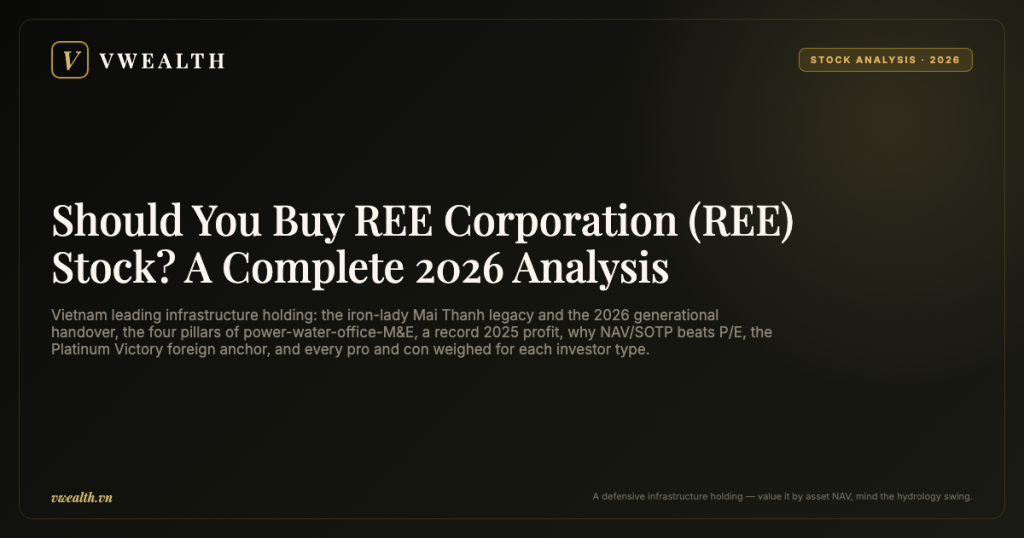
If you’ve ever walked past the lit-up office buildings in the Tan Binh district, switched on a Reetech air conditioner in an old office, turned on a clean-water tap in Saigon, or simply used electricity generated by a central-region hydropower plant — you may well have touched the ecosystem of a single business without realizing it: Refrigeration Electrical Engineering Corporation — REE Corporation (HOSE: REE). That’s what makes REE a special name on Vietnam stock market. It isn’t a company selling one thing; it’s a multi-industry infrastructure group, standing on four pillars at once: mechanical & electrical engineering (M&E), power, water, and office leasing.
The most accurate way to picture REE isn’t a manufacturer or a contractor, but an “infrastructure holding” — a parent company holding stakes in a series of power plants and water plants and owning a portfolio of leasing towers, then gathering a steady cash flow each year from those assets. This is a model that generates stable cash flow and steady dividends — what value investors hunt for, and what earns REE the nickname “the business of quiet cash flows.”
Tied to that journey is a name that has become legendary in Vietnamese business: the “iron lady” Nguyen Thi Mai Thanh — the woman who led REE for over four decades, turning a small state refrigeration-engineering enterprise into a billion-dollar group. And REE carries a historic mark few businesses have: it was one of the first two stocks listed in the opening session of Vietnam stock market on 28 July 2000. In other words, REE history is almost the history of the country stock market itself.
As of 19 June 2026, REE closed around 50,400 dong. The question many investors ask — and what this full analysis will get to the bottom of — is: should you buy REE at this price, and what kind of investor does it suit? A steady-cash-flow infrastructure stock like REE clearly isn’t for everyone; it picks its buyers in a very particular way. To answer thoroughly, you need to understand the nearly half-century journey REE has traveled — from a subsidy-era state enterprise to an infrastructure group that has just completed a historic generational handover in 2025–2026. Let’s start from that very root.
REE market data (updated 19 June 2026)
| Current price | 50,400đ | 2025 revenue | 10,011 bn (+19%) |
| Change (June) | −1.56% | 2025 after-tax profit | 3,149 bn (+31%) |
| P/E | P/B | ~8x | ~1.3–1.5x | 2025 dividend | 25% (10% cash + 15% shares) |
REE is a 4-pillar infrastructure HOLDING (power–water–office leasing–M&E) — valued reasonably by P/E + asset value (SOTP/NAV). Power profit swings with hydrology. Source: VWealth + REE 2025 reports. For reference only.
History and evolution
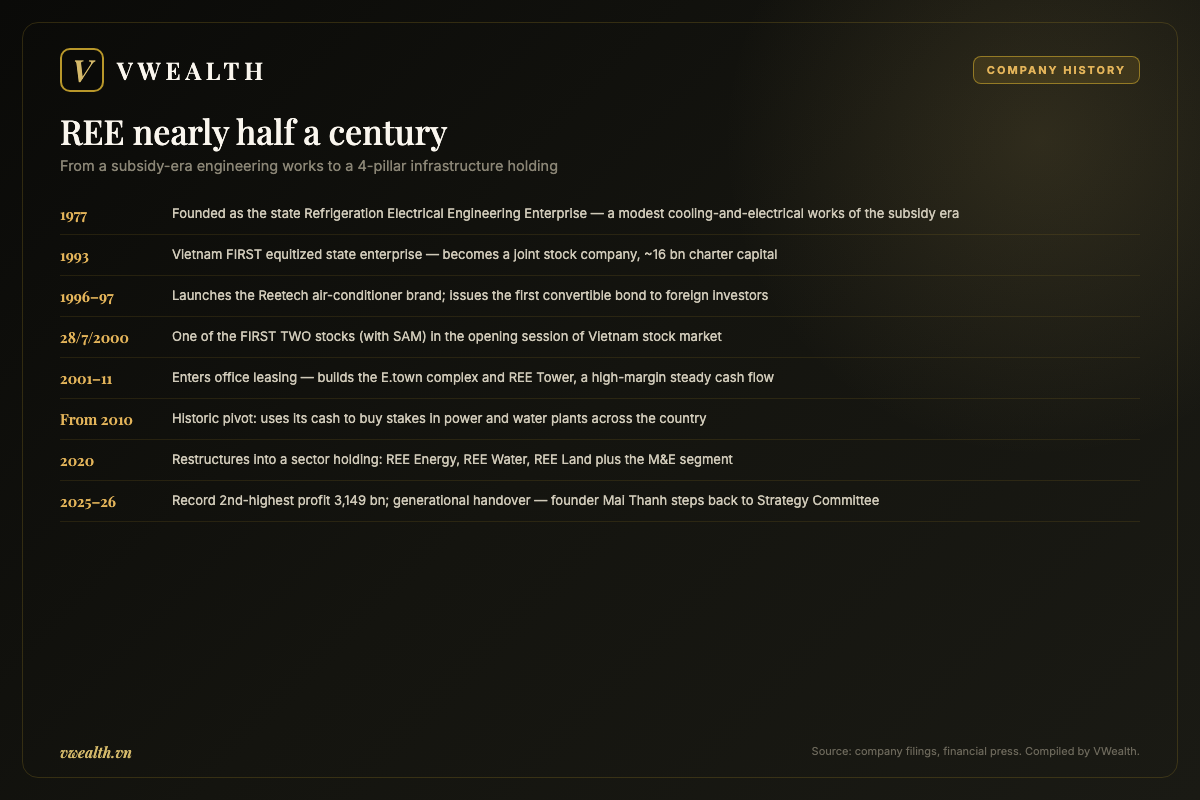
REE history is a rare story: a business that has passed nearly half a century without a single break in identity, though it has transformed many times. To understand why REE today is an “infrastructure cash-flow group,” you need to go back to 1977, when it wasn’t yet a joint stock company, had no shares, and Vietnam had no concept of a “stock market” at all.
Origin: the state Refrigeration Electrical Engineering Enterprise (1977)
REE forerunner was the state Refrigeration Electrical Engineering Enterprise, established in 1977 — just two years after national reunification. This was a state enterprise in mechanics and cooling equipment, born when the economy was still fully under the subsidy mechanism. At that time, “refrigeration electrical engineering” was a rather rugged technical field: repairing, installing and maintaining cooling systems and electrical equipment for factories, cold stores and offices. No one could imagine that this modest state enterprise, a few decades later, would own stakes in hydropower plants spread across the country and towers in the heart of Saigon.
The first turning point came from people, not capital or technology. Nguyen Thi Mai Thanh — an engineer graduated from the Karl-Marx-Stadt University of Technology (Germany) — joined the enterprise as an engineer, then was gradually promoted to management from the 1980s. She would be the one steering REE through the most important turns in Vietnamese business history: equitization, listing, diversification, and finally restructuring into a holding model. Her attachment to REE is almost total: over 40 years of her life belong to this company.
Equitization 1993 — Vietnam first equitized enterprise
The year 1993 marked a milestone few Vietnamese know the historical depth of: Refrigeration Electrical Engineering became the first equitized state enterprise in Vietnam. At the time, “equitization” was an entirely new, even sensitive concept — because it touched the fundamental question of transferring part of state ownership to private hands. REE being the pioneer wasn’t just a business decision; it was an institutional experiment, the first brick for the whole later state-enterprise-equitization process.
From a state enterprise, the company officially became Refrigeration Electrical Engineering JSC with modest initial charter capital of about 16 billion dong. That figure, versus REE charter capital of over 4,700 billion dong today, shows an astonishing growth journey. From equitization, Mai Thanh held both the Chairman and CEO roles — holding both strategic direction and management, and this is when she began deeply imprinting her personal mark on every big decision.
The meaning of this step, from an investor view, isn’t just the “first title.” More importantly, early equitization instilled in REE a market-oriented governance culture very early — transparent ownership, a board, capital discipline. That was the foundation for a few years later, when REE could do something even bolder: raise capital from foreign investors.
1996–1997: Reetech and the first convertible bond
After equitization, REE entered a phase of brand-building and expanding financial capacity. In 1996, the company launched the Reetech air-conditioner brand — seen as the first “made in Vietnam” air-conditioning brand. Reetech is a symbolic product: it tied the REE name to the “refrigeration engineering” image in the public mind, and to this day remains part of the group brand legacy, though its revenue contribution is no longer a pillar.
The very next year, 1997, REE achieved another “first”: the first convertible bond issued to foreign investors in Vietnam. This was a very subtle financial move. When the domestic capital market barely existed, REE raising foreign capital through a modern instrument like a convertible bond showed governance thinking ahead of its time. It also laid the foundation for a trait that runs through REE to this day: a very high foreign-ownership ratio (now around 49%), with the largest shareholder Platinum Victory Pte. Ltd. — a member of the Jardine Matheson group (Singapore), holding about 29.5%.
28 July 2000: One of the first two stocks on Vietnam market
This is perhaps the most symbolic moment in REE history. On 28 July 2000, the Ho Chi Minh City Securities Trading Center (forerunner of HOSE) held its opening session — the first in Vietnam stock-market history. And in that whole young market, only two tickers were listed: REE (Refrigeration Electrical Engineering) and SAM (Cable and Telecommunication Materials). The whole first session traded a mere 70.4 million dong — a number that today wouldn’t buy a single lot of many large businesses.
REE didn’t just list on Vietnam stock market — it was one of the first two bricks building that market. REE history and HOSE history, at the starting point, are one.
This “founding pillar” position isn’t just ceremonial pride. For a long-term investor, it says something very real: REE has survived and grown through a full 26 years of every boom and bust of Vietnam stock market — from the 2007 bubble, the 2008 crisis, the 2011–2012 recession, to later volatility. A business that exists and keeps expanding through all those cycles is living proof of governance capability and business-model resilience. Since listing, REE stock is estimated to have grown its market cap over 2,250-fold in 25 years — a figure illustrating what holding a good infrastructure asset long enough means.
2001–2011: Entering office leasing — the birth of E.town
The first big transformation after listing was REE leaving the “comfort zone” of refrigeration engineering to enter office leasing. In 2001, the company broke ground on E.town 1 — beginning the journey to build one of the oldest, most stable office complexes in the Tan Son Nhat airport area. By 2008, the E.town complex was fully operating with about 80,000 m² of leasable space. In 2011, REE put REE Tower into operation with about 18,000 m² more.
Why is office leasing important to the REE investment story? Because it’s a segment with a very high margin and extremely stable cash flow — the trait of an infrastructure asset. REE leadership once described this segment with a very vivid phrase: “take in 10 dong, earn 5” — i.e. a margin around 50%. When you lease offices to hundreds of businesses on long-term contracts, you have a near-“rent-collecting” income steady each month, little dependent on short-term economic swings. To date, REE office portfolio has reached about 145,000 m², serving about 200 businesses, with names like E.town, E.town Central, E.town 5, E.town 6 and REE Tower.
From 2010: The historic pivot — investing in power and water infrastructure through M&A
This is the most important chapter explaining why REE today is called an “infrastructure group,” and the strategy shaping the company entire financial profile. From 2010, REE began a bold strategic pivot: using the cash accumulated from engineering and real estate to buy stakes in power plants and water plants across the country.
The timing was extremely smart. In 2011–2012, Vietnam stock market plunged, and the valuation of many power and water businesses fell to very cheap levels. While most of the market panic-sold, REE quietly did the opposite: accumulating cheap stakes in good infrastructure assets. Some emblematic deals of this period include: raising its stake in BOO Thu Duc Water to 42% (buying 22% more), buying 35.48% of Thac Mo Hydropower, 24.32% of Ninh Binh Thermal Power, and contributing 30% to set up the Saigon Clean Water Investment and Business Company. By 2014, Thac Ba Hydropower became a REE subsidiary; in 2021, it was Vinh Son – Song Hinh Hydropower turn.
The logic of this “power-water infrastructure-stake M&A” strategy is very beautiful for a long-term investor:
- Each power plant, each water plant is a relatively stable “cash printer”: selling power to EVN, selling water to cities — essential needs, little elastic to the economic cycle.
- REE doesn’t need to build from scratch but buys stakes in already-operating plants, shortening time and reducing deployment risk.
- A diverse portfolio creates a “smoothed” cash flow: hydropower depends on weather, but combining many plants across regions plus the stable water segment makes the total cash flow smoother.
- Most is accounted for as associates, bringing steady profit and dividends — the very source nourishing REE “quiet cash flow.”
From 2011 to now, power and water make up over 70% of REE investment-portfolio structure. This is the core reason to call REE an “infrastructure holding”: most of the business value isn’t in production or construction, but in the portfolio of stakes in essential infrastructure assets. Later, REE also fine-tuned the portfolio by gradually divesting from coal thermal power and concentrating on hydropower and renewables (solar, wind) — starting from the Tra Vinh wind project and founding REE Solar Energy in 2019. The announced long-term goal is to raise total generation capacity to about 3GW by 2030.
2020: Restructuring into a sector-based holding model
By 2020, REE formalized its “infrastructure group” nature with a restructuring into a sector-based holding model. Four pillars were split into dedicated units: REE Energy (power), REE Water (water), REE Land (real estate), alongside the traditional M&E engineering segment. This was a governance maturity step: instead of one company doing everything, REE became a parent coordinating capital and strategy, so each segment is responsible for its own operating efficiency. This model helps make each profit stream transparent, ease capital allocation, and most importantly, ease valuation by the sum-of-the-parts method — very meaningful for investors.
2025: The peak of results and the generational handover
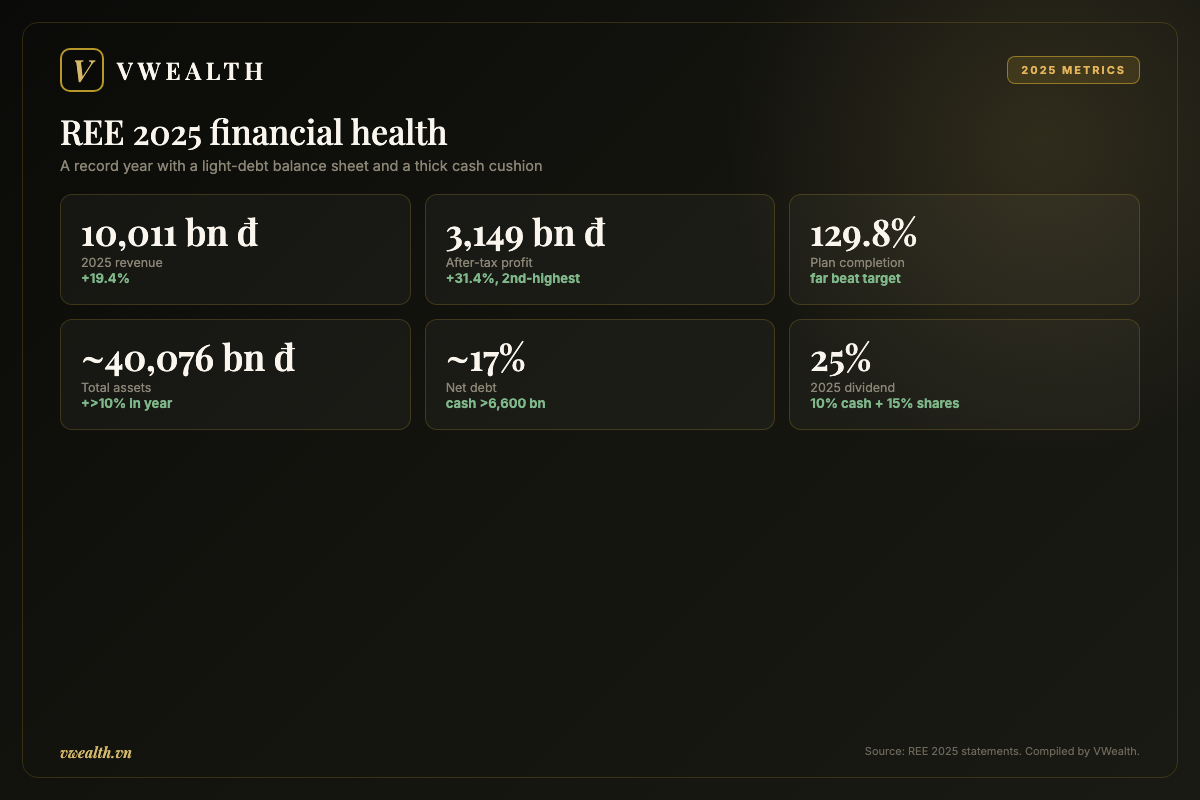
The year 2025 closed a brilliant chapter and opened a new one. On results, REE reached revenue of over 10,011 billion dong (up 19.4% year on year) and after-tax profit of over 3,149 billion dong (up 31.4%) — the second-highest profit in company history. Notably, REE completed up to 129.8% of its profit plan, showing the leadership still keeps the habit of setting cautious targets then far exceeding them. The balance sheet is also very “healthy”: net debt only around 17% and cash holdings over 4,000 billion dong — exactly the style of a business with solid cash flow.
| Metric (2025) | Value | Versus 2024 |
|---|---|---|
| Consolidated revenue | ~10,011 billion dong | +19.4% |
| After-tax profit | ~3,149 billion dong | +31.4% (2nd-highest ever) |
| Plan completion | 129.8% | Far exceeding target |
| Net debt ratio | ~17% | A healthy balance sheet |
But the biggest mark of 2025–2026 isn’t in the numbers, but in people. After over four decades of attachment, Nguyen Thi Mai Thanh officially left the Chairman seat, completing a historic generational handover. Per the roadmap, from 10 July 2026, the Chairman seat was handed to Lee Liang Whye (representing the large shareholder Platinum Victory), while her son — Nguyen Ngoc Thai Binh, who has worked at REE for about 18 years and once served as Deputy CEO — was appointed CEO. Mai Thanh herself didn’t fully retire, but shifted to Chair of the Strategy Committee, continuing to guide the long term and keep stability during the handover.
This handover is a dual variable for investors. On one hand, it marks the end of the “Mai Thanh era” — almost the soul of REE — and raises the question of whether the next generation can keep the capital discipline and strategic vision that made the REE brand. On the other, preparing successors from both the family and the large shareholder, plus Mai Thanh staying as strategic advisor, shows this is a prepared handover, not a sudden rupture.
From a refrigeration-engineering enterprise to an infrastructure group — the meaning of the whole journey
Looking back over nearly half a century, you can see REE consistent logic: each phase accumulates capability to unlock the next. Refrigeration engineering gave REE a foothold and technical skill. Early equitization and listing gave REE a transparent governance culture and access to foreign capital. Office real estate gave REE a high-margin, stable cash flow. And finally, that cash flow was reinvested into the power-water stake portfolio, turning REE into an infrastructure machine that feeds its own growth. That’s the “infrastructure holding” model generating stable cash flow and steady dividends we mentioned at the start.
This history isn’t just nostalgia. It directly shapes the answer to “should you buy REE”: a business built to generate durable cash flow through many cycles, just having gone through a leadership handover, suits an investor seeking stability and dividends more than one chasing hot growth. But to conclude with a basis, you need to look more closely at the people steering this ship in the next chapter. Let’s go deep into REE leadership — the faces who will decide whether the four-decade-plus legacy is worthily carried on.
Leadership and ownership structure
If there’s a name tied to REE stock almost to the point of being synonymous, it’s Nguyen Thi Mai Thanh. When you buy REE, you don’t just buy a portfolio of hydropower, thermal power, wind power, clean water and leasing real estate; you also buy into a governance legacy built over nearly four decades by the hand of the person investors affectionately call the “iron lady.” And just as you read this analysis, the business is going through a rare turning point: the leadership generational handover. Understanding who holds REE, who just left, who just stepped up, and which way the ownership leans — this is a prerequisite before you place long-term trust in this ticker.

Nguyen Thi Mai Thanh — the legendary “iron lady” and almost a whole career tied to REE
To understand REE, you need to understand the woman who shaped it. Per widely published business profiles, Nguyen Thi Mai Thanh was born in 1952 in Tay Ninh, daughter of Lieutenant General Nguyen Thoi Bung — an army general. She was sent to study in the German Democratic Republic (former East Germany), graduating in mechanics with a specialty in air conditioning — a technical foundation that later turned out to be a “fated bond” with the very name Refrigeration Electrical Engineering. Returning home, she joined as an engineer at the state Refrigeration Equipment Union Enterprise in Ho Chi Minh City, the forerunner of today REE.
The turning point came in the mid-1980s. Per press records, after the successful installation of a large-scale cooling system for the Hoa Binh Theater, she won the leadership trust, and by about 1985, in her early 30s, she was given authority to run the enterprise with about 200 people. This was a period when the country was still in the hard subsidy era, and a young woman engineer shouldering a whole state enterprise was far from ordinary.
The true historic milestone was 1993, when Refrigeration Electrical Engineering became one of the first state enterprises in Vietnam to equitize and shift to a public-company model. From then, Mai Thanh held both top positions — Chairman and CEO. And REE made history again: in 2000, it was one of the first stocks listed when the Ho Chi Minh Stock Exchange (HOSE) newly opened. In other words, REE and Mai Thanh didn’t just grow up with Vietnam stock market — they were part of giving birth to it.
What earns investors respect isn’t just the length of attachment, but the strategic vision. Instead of keeping REE forever a construction M&E contractor (the traditional segment), she gradually turned REE into an infrastructure-investment group on a holding model: pouring long-term capital into power (hydropower, thermal power, then wind, solar) and clean water — industries with stable, regulated, highly defensive cash flow. This was a generational decision: instead of chasing short-term profit, she chose to build infrastructure “cash cows” generating sustainable dividends. Because of that stature, in March 2019 Forbes Vietnam honored her in the “50 most influential women in Vietnam” list.
When you invest in REE, you should understand that most of the power-water infrastructure position the business holds today is the result of long-term investment decisions laid down under Mai Thanh. That’s both an asset and a question: will that legacy be carried on in full?
2026: the Chairman handover — you need to read the detail carefully
This is a part you must pay special attention to, because it just happened and can affect how you value REE governance risk. Per company disclosures and reporting by many financial outlets in May–June 2026, Nguyen Thi Mai Thanh submitted her resignation from the Chairman role and withdrew from the REE board. REE plans to convene an extraordinary general meeting on 10 July 2026 in Ho Chi Minh City to approve these personnel changes.
However, this needs cautious phrasing: per sources, Mai Thanh doesn’t fully leave REE. She is reported to shift to the role of Chair of the Strategy Committee under the board — a position letting her keep contributing long-term direction without directly managing. This is a fairly subtle arrangement: both executing the generational handover and keeping the business “strategic soul.”
So who succeeds the Chairman seat? This is easily confused, so remember it clearly. Per press sources, the person introduced to succeed the Chairman role for the rest of the 2023–2027 term is Lee Liang Whye — representing the strategic shareholder Platinum Victory, not Mai Thanh son. This is very notable on governance: the most powerful board seat goes to the largest foreign shareholder, reflecting REE actual ownership balance today.
Thus the new structure forms a clear role division: the Singaporean strategic partner holds the Chairman role (oversight, board-level direction), while the founding family holds day-to-day management. For a long-term investor like you, this is both a reassuring signal (the large shareholder is committed and directly involved in governance) and something to watch (how the power balance between the foreign group and the founding family plays out in practice).
The executive team: the son becomes CEO
Alongside the Chairman change is the CEO change. Per disclosure, Nguyen Ngoc Thai Binh — Mai Thanh son, then a board member and Deputy CEO — was appointed CEO and legal representative of REE, effective from 10 July 2026.
Thai Binh succeeds the CEO role from Ashok Ramachandran — an India-origin leader once appointed to run REE in the prior period and who left the role around late May 2026 per sources. Handing the CEO seat to the son carries a strong symbolic meaning of generational handover in a family-public business: the founding generation steps back to a strategic role, the next generation steps up to take the wheel.
You should view this in a balanced way. The positive: Thai Binh has spent many years in REE leadership, understands the subsidiary system and the holding model, so this isn’t a “newcomer” suddenly taking power. What to watch: every handover from a legendary founder to the next generation carries execution risk — will the disciplined capital-allocation style and long-term infrastructure vision be maintained? This is a qualitative variable the market will grade gradually through each coming quarter results.
Ownership structure: the balance leans to the Singaporean partner
REE ownership structure is perhaps one of the most special versus most large Vietnamese listed businesses, because the largest shareholder isn’t the founding group but a foreign partner. Picture the ownership through three main blocks.
First — Platinum Victory Pte. Ltd. (the Singaporean strategic partner). This is REE largest shareholder. Platinum Victory is an investment company of the Jardine Cycle & Carriage (JC&C) group — a member of the Jardine Matheson ecosystem, a long-standing conglomerate with Hong Kong roots listed in Singapore. This relationship traces to 2012 when REE issued a convertible bond to Platinum Victory, later converted to shares. Per sources, as of end-2025, Platinum Victory held about 225.8 million REE shares, about 41.7% of charter capital. More notably, in early 2026, Platinum Victory registered to buy about 17.8 million more shares to raise its stake near the room ceiling — about 44.99%. A foreign shareholder continually accumulating shares is usually interpreted as a signal of long-term commitment and belief in the business intrinsic value.
Second — the family of Nguyen Thi Mai Thanh. Though no longer the largest shareholder, the founding family still holds a significant weight. Per sources, Mai Thanh owns over 60.4 million shares (about 12.8% of charter capital), her husband — Nguyen Ngoc Hai — holds over 25.7 million shares (about 5.5%); including their children, the family group holds about 21.6% of REE charter capital. This ratio is large enough for the family to keep an important voice in governance, though no longer absolute control.
Third — other foreign shareholders, domestic institutions and free-float. The rest of REE shares are distributed among funds, institutions and individual investors trading freely on the exchange. Because the two large blocks (Platinum Victory and the founding family) already hold a very high weight, REE truly freely floating shares are relatively concentrated — a trait to note because it affects liquidity and price-swing range.
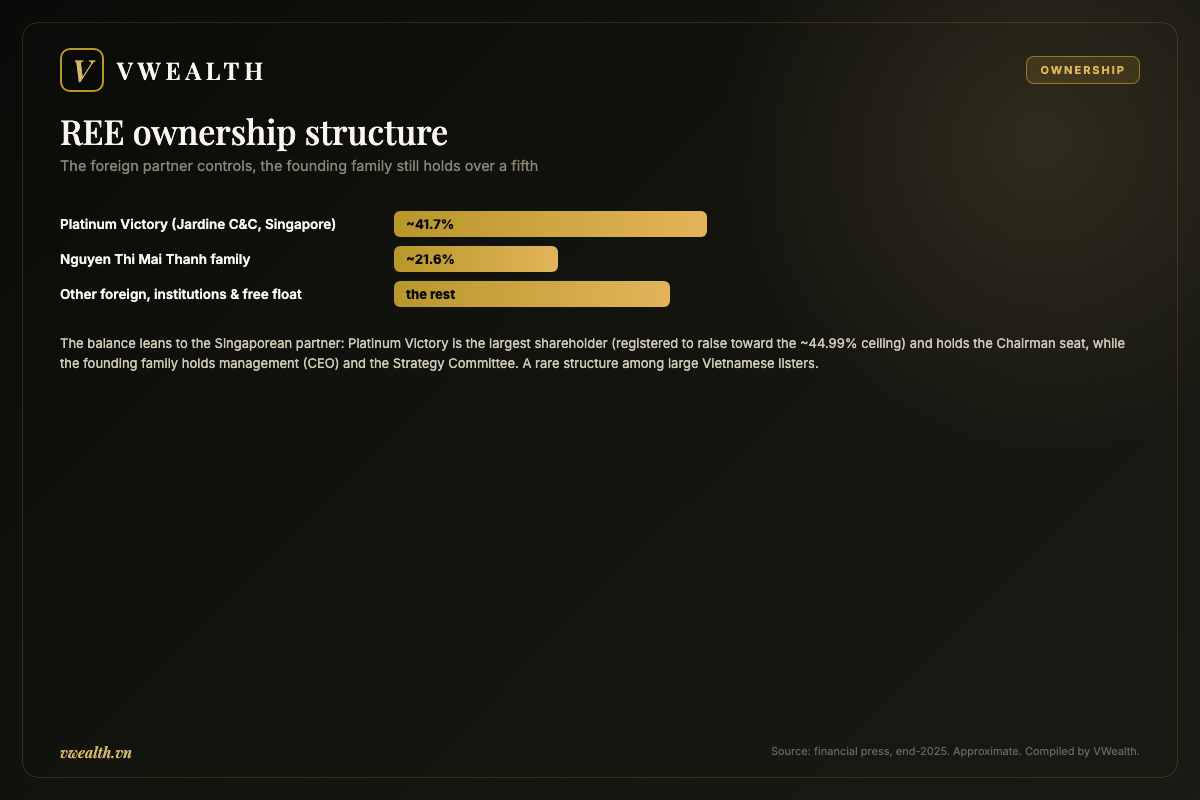
An important note for you: the ownership ratios above are compiled from financial press and may change after each large-shareholder trade or after REE issues stock dividends (which dilute the ratios). So before each investment decision, you should cross-check REE latest governance report, annual report and disclosures for accurate figures at the time.
| Ownership block | Role | Reference weight (end-2025) |
|---|---|---|
| Platinum Victory (of Jardine Cycle & Carriage, Singapore) | Largest strategic shareholder, holds the Chairman seat | ~41.7% (registered to raise to ~44.99% in early 2026) |
| Nguyen Thi Mai Thanh family | Founding group, holds management (CEO) and Strategy Committee | ~21.6% (Mai Thanh alone ~12.8%) |
| Other foreign shareholders, institutions & free investors | Free-float on HOSE | The rest |
Governance and dividends: why REE is called a “dividend machine”
One reason value investors love REE is dividend discipline. For many years, REE kept a steady, high dividend policy versus the average, reflecting the nature of an infrastructure holding with stable cash flow from power and water. For 2025, per the announced plan, the total dividend is 25%, including 10% in cash and 15% in shares. The 10% cash part alone is estimated at about 541.6 billion dong, while the 15% share part corresponds to issuing over 81 million new shares (a 100:15 ratio). Notably, this is recorded as the fourth consecutive year REE keeps a total dividend of 25% — a rare consistency.
You should understand the meaning of this “cash + shares” structure correctly. The cash part brings real income, satisfying investors seeking passive income and fitting the defensive profile of an infrastructure stock. The share part helps REE retain capital to reinvest in new power-water projects without external raising, while increasing charter-capital scale. In exchange, the share part dilutes share count and slightly changes the ownership ratio of shareholders who don’t buy more — which is why the ownership percentages need updating each period.
On governance quality, REE has long been rated one of the most transparent and professional businesses on the market, partly thanks to the presence of a foreign institutional shareholder like JC&C — which imposes international-practice reporting and governance standards. The board mixes foreign-shareholder representatives, the founding group and independent members; the holding model with dedicated committees (like the Strategy Committee Mai Thanh is set to lead) helps separate direction from management. For a long-term investor, these are important pluses on governance risk — a factor that is very “soft” but decides the durability of an infrastructure investment spanning decades.
In sum, REE leadership and ownership picture today can be captured in three ideas: a generational handover underway (Chairman to the Singaporean shareholder representative, CEO to the son, the founder stepping back to a strategic role); a concentrated ownership structure with the foreign partner Platinum Victory holding a controlling weight and the founding family still holding over a fifth; and a tradition of steady dividends reflecting the infrastructure-holding nature. To understand why REE can “birth” such a durable dividend flow, let’s move to the next section — where we dissect the four business pillars forming this group cash-generating machine.
Four business pillars
If you first look at REE Corporation (Refrigeration Electrical Engineering JSC, ticker REE on HOSE) and try to answer the seemingly simple question — “what does this company do?” — you’ll quickly realize there’s no neat answer. REE isn’t a pure power company like POW, nor a real-estate giant like VHM, nor a standalone construction contractor. In essence, REE is an infrastructure holding group — a structure where the parent holds and coordinates four distinct business segments, each generating cash by its own logic. To understand REE, you must understand all four pillars at once, because it’s the interweaving among them that creates this stock unique investment character.
In 2025, REE recorded consolidated revenue of about 10,011 billion dong (up nearly 19.4% year on year) and after-tax profit of about 3,149 billion dong — a record in company history. But if you only look at the total, you’ll miss the most interesting thing: that profit comes from four very different sources, some weather-dependent, some steady as house rent, some rising and falling with the construction cycle. Let me take you through each pillar, in order of cash-flow importance.
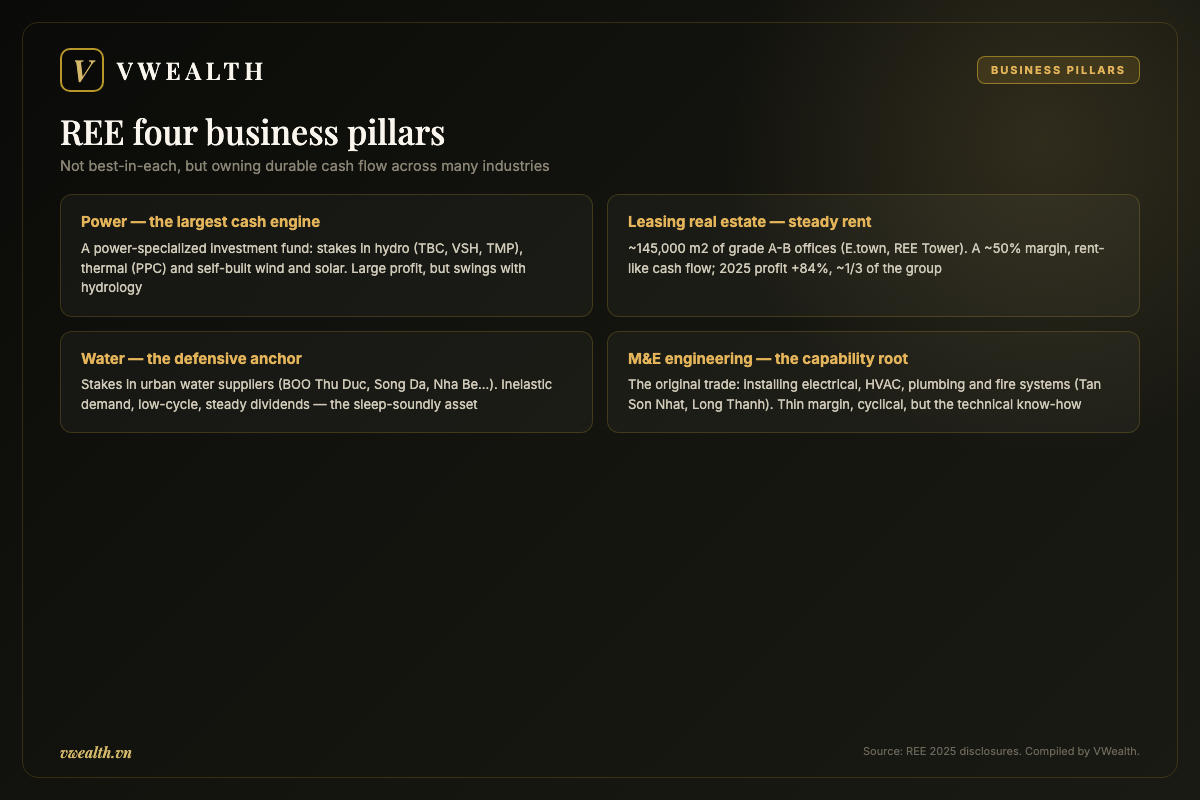
The easiest way to picture it: REE is like an “infrastructure portfolio” managed like a controlled investment fund. They don’t try to be the best in each industry — they try to own assets generating sustainable cash flow across many industries, so when one segment is weak, another offsets.
Pillar 1 — Power (Energy): the “power investment fund” and the largest cash flow
This is REE largest cash-flow pillar, and the one you need to understand most, because how REE does power is very different from a new investor typical image. Hearing “power company,” you might imagine REE runs plants, hires engineers to operate machines, sells power to EVN. In reality, mostly not so. REE mainly invests to own stakes in a series of independent power plants — it puts capital to buy controlling or large stakes, sends people to boards, then receives dividends and consolidates results. In other words, you should picture REE power segment as a power-specialized investment fund, rather than a single power plant.
REE power portfolio spans three technology lines, and this diversification isn’t accidental:
- Hydropower — the historic backbone of the portfolio. REE holds large stakes in many plants like Thac Ba Hydropower (TBC), Vinh Son – Song Hinh (VSH, REE owns over 50%), Thac Mo Hydropower (TMP), Song Ba Ha Hydropower, Muong Hum Hydropower and many others. Hydropower has a very high margin because the “material” is rainwater — nearly free. But in exchange, output depends heavily on hydrology: a wet year (like a La Niña phase) means profit booms, a dry year (El Niño) means output and profit fall. 2025 was among the favorable-hydrology years, and that’s part of why the power segment did well.
- Thermal power — a stable counterweight to hydropower. REE invests in stakes at Pha Lai Thermal Power (PPC), Ninh Binh Thermal Power and some others. Coal thermal power isn’t weather-dependent, so in dry years it’s the “support” for the portfolio when hydropower flags. The hydro-thermal pair thus creates a natural balance in REE power cash flow.
- Renewables — the segment REE self-develops rather than just buying stakes. These are wind projects (like the Tra Vinh wind cluster, Phu Lac/Thuan Binh wind) and solar. This is REE future direction, following Vietnam clean-energy-transition trend and the Net Zero commitment, but also a segment needing large investment and exposed to renewable-price policy.
In 2025, the power segment contributed revenue of about 4,452 billion dong (up about 5%) and profit of about 1,054 billion dong — still the largest single profit pillar in absolute terms. What to remember about this pillar: it’s both the cash-flow engine and the largest source of volatility for REE. Whether REE profits a lot or a little in most years, the first cause to check is whether that year hydrology was good or bad. When you read a REE quarterly report showing profit up strongly, don’t rush to rejoice — check whether it’s from assets sustainably improving, or just a favorable-weather year.
Another subtle point: because REE mainly owns stakes, part of the power profit comes via dividends and associate profit — i.e. real cash flowing to REE steadily. This makes REE power segment more durable than first thought: even without full consolidation, dividends from TBC, PPC, VSH… are steady cash feeding the parent and funding new investments.
Pillar 2 — Leasing real estate: high-margin, stable office “rent collection”
If the power pillar is the largest but most volatile cash source, the leasing pillar is the most stable and highest-margin source — the steady “rent collection” any value investor loves. Picture it: REE owns a chain of grade A/B office towers in Ho Chi Minh City, signs long-term leases with businesses, then collects rent monthly. Once a tower is built and filled, operating cost is low, the margin is very high, and cash flows in steady as tap water. This is the asset type investors call “rent-like cash flow” — you invest capital once to build, then enjoy passive income for decades.
REE leasing portfolio centers on the E.town brand and some large towers:
- The E.town cluster (Cong Hoa, Tan Binh) — the historic heart of the leasing segment, including E.town 1-4, E.town 5 and most recently E.town 6 (a grade-A tower adding nearly 36,800 m² of leasable floor when operational). This is among the most familiar office areas for the business community around Tan Son Nhat airport.
- REE Tower and Etown Central (District 4) — a tower cluster on Doan Van Bo street, with REE Tower about 20,000 m² and Etown Central about 34,000 m². These are grade-A towers near the center, targeting large businesses and multinationals.
Total leasable floor REE manages has passed 145,000 m². In 2025, real estate created the biggest surprise: revenue of about 2,112 billion dong — up as much as 84% year on year, with profit of about 803 billion dong, contributing nearly a third of the whole group profit. This is a very notable figure, because it shows real estate rose to a profit pillar on par with power, though smaller in revenue — proof of the leasing segment superior margin.
This 84% jump came from two drivers: putting new towers into operation (like E.town 6) and improving occupancy after the office market recovery. You should understand leasing real estate has a “staircase” trait: each time a new tower is completed and begins filling, revenue jumps to a new step then goes sideways at that high level. Because REE is in a new-tower-handover cycle, this segment will keep being a stable profit anchor in coming years — and more importantly, it doesn’t depend on hydrology or the construction cycle, so it “smooths” REE otherwise-volatile profit picture.
Pillar 3 — Water & Environment: quiet, low-cycle cash flow
The third pillar is the least mentioned but holds a trait defensive investors love: extremely stable cash flow, nearly immune to the economic cycle. The reason is very simple and you can verify from daily life: whether the economy is tough or prosperous, whether inflation or recession, people and businesses still use clean water every day. Water is an essential, undelayable need, so water companies revenue is nearly absolutely stable — this is a “sleep soundly” asset in the true sense.
Like the power segment, REE doesn’t run water plants traditionally but invests to own stakes in a series of water companies. REE entered the water industry in 2004 with its first investment in the B.O.O Thu Duc Water Plant (design capacity 300,000 m³/day). Over time, REE built a stake portfolio at many key water suppliers, including names like Thu Duc Water Supply, Song Da Clean Water Investment, Nha Be Water Supply, Saigon Clean Water, Tan Hiep Water plus many local companies. Total investment in the water segment (including accumulated profit) has passed 2,000 billion dong.
The cash-flow traits of the water pillar:
- Highly defensive — water demand is nearly fixed, not rising and falling with the economic cycle like real estate or construction.
- Steady dividends — water companies usually have good cash flow and pay stable dividends, flowing to REE as passive income.
- High entry barrier — urban water supply is a natural monopoly by area, so once holding stakes in these companies, REE holds a position hard to compete with.
What to note is that the water segment doesn’t create explosive growth — it grows slow and steady. But that very “boredom” is the value: in a portfolio with a volatile power segment, the water segment acts as an anchor, ensuring that whatever the year, REE still has a steady dividend flow. This is the portfolio-management thinking you should appreciate in REE: they deliberately hold “sleepy” assets to balance the “lively” ones.
Pillar 4 — Construction M&E: the original segment, thin margin, cyclical
The last pillar is the original segment — where REE started its career. The full name “Refrigeration Electrical Engineering” isn’t accidental: REE began as an M&E contractor. REE M&E segment (Mechanical & Electrical — construction M&E), operating through REE M&E, specializes in installing M&E systems for large projects: electrical, HVAC, plumbing, fire protection, elevators… for office towers, malls, industrial plants and airports.
REE M&E is seen as Vietnam leading M&E contractor, with almost no domestic rival of equal caliber in traditional M&E, and has left its mark on a series of national-scale projects. In 2025, the M&E segment signed an impressive volume of new contracts — over 5,100 billion dong — by winning many large projects, notably the package at Tan Son Nhat International Airport (worth about 2,534 billion dong), and REE was also approved to join the Long Thanh Airport project. The public-investment wave into aviation and transport infrastructure is becoming a big driver for this pillar.
Besides construction, REE also owns the Reetech air-conditioner and mechanical-equipment brand (born in 1996) — a “made in Vietnam” air-conditioner and mechanical-product brand with a place in the domestic market, supporting the M&E installation capability.
However, you need to understand this pillar distinct economics versus the other three:
- Thin margin — M&E construction is a competitive-bidding trade, with a margin far lower than office leasing or hydropower. This is a segment creating large revenue but relatively modest profit.
- Cyclical with construction — workload rises and falls with the economy infrastructure and real-estate investment. When public investment and construction are vibrant, M&E is busy; when the market is dull, contracts shrink.
- Uneven cash flow — unlike office “rent” or water dividends, M&E records revenue by project progress, so cash flow is project-based, uneven.
Even so, M&E keeps an important strategic role: it’s REE “capability root”, helping the group deeply understand technical infrastructure — this very knowledge supports investing in and operating power plants, buildings and water systems. In other words, M&E isn’t the highest-profit segment, but it’s the segment helping REE “know the trade” to do the other three well.
Four pillars form one model: a multi-cash-flow “infrastructure holding”
Combining the four pillars, REE strategic picture emerges clearly. This is an infrastructure-holding model deliberately designed so each segment offsets the others risk, creating a combined cash flow both large and durable:
| Pillar | Role in the portfolio | Cash-flow trait |
|---|---|---|
| Power (Energy) | The largest cash-flow engine | Large but swings with hydrology |
| Leasing real estate | The high-margin, stable profit pillar | Steady as “rent,” stepping up |
| Water & Environment | The defensive anchor | Stable, low-cycle, steady dividends |
| M&E engineering | The original segment, technical capability | Thin margin, cyclical with construction |
REE investment philosophy shows clearly in how it runs the four pillars: not trying to be the best in each individual industry, but trying to own infrastructure assets generating sustainable cash flow across many industries. When bad hydrology makes power flag, real estate and water support. When dull construction gives M&E little work, power and water dividends still flow. This diversification significantly reduces REE cyclicality versus a pure hydropower or construction company — and that’s why REE has maintained a stable dividend policy over years, making this stock a familiar choice for investors who love cash flow and durability.
But the holding model also has a downside to view soberly. First, because profit comes from dividends and associate profit of many subsidiaries/associates, REE financial picture is more complex than a single-industry business — you must peel it apart carefully to know where the money really comes from. Second, the best assets (hydropower, water) are gradually running out of natural growth room, so REE must continuously seek M&A and new-investment opportunities (offshore wind, new office projects) to maintain momentum — and each new investment carries its own risk. Third, some pillars (especially power) are heavily affected by electricity-price policy and national energy planning, which are beyond the business control.
In sum, REE four business pillars aren’t just four separate revenue sources, but four pieces of a unified strategy: building a diverse infrastructure portfolio to create a cash flow both large and durable, resilient enough to weather cycles and nourish steady dividends. Understanding this model, you have the key to move to the next section — where we scrutinize REE competitive position and financial health, to see how solid this beautiful holding structure on paper really is when put on the financial scale.
Position and financial health
When you look at REE Corporation, you don’t look at a company in the usual sense. You’re looking at Vietnam leading private infrastructure-holding group — a machine gathering cash flow from three real-economy segments: power, water and office leasing. In 2025, that machine brought net revenue of 10,011 billion dong and after-tax profit of 3,149 billion dong, the second-highest profit in the business entire operating history and about 30% above the year plan. But that total, however impressive, isn’t what makes REE special. What’s special lies in how that profit is generated — and that’s the part you need to understand well before valuing this stock.
A model no other listed company can copy
Put REE next to the rest of Vietnam stock market. You’ll find pure power companies (like PPC, NT2), pure water companies (like BWE, TDM), pure real-estate companies, pure construction-M&E companies. But you won’t find any business combining all four of these fields in one portfolio and running them as an infrastructure holding. REE is the only case. That’s both a competitive advantage and a valuation challenge — because you have no truly equivalent “comparable company” to apply a simple P/E or P/B.
This model has historical roots. REE started in refrigeration engineering (M&E — Mechanical & Electrical), then used its cash flow and technical due-diligence capability to buy strategic stakes in a series of power and water companies as they were being equitized. As a result, today REE owns a wide investment network: two hydropower subsidiaries (Thac Ba — TBC, and plants like Muong Hum, Nam Ban 2), a controlling stake in Vinh Son – Song Hinh Hydropower (VSH, holding raised to about 49.45%), plus stakes in many other listed thermal, hydro and water companies. Per analyst reports, REE energy portfolio includes about six hydropower companies, four thermal-power companies and one renewable-development unit.
You don’t buy a power plant when you buy REE. You buy a “basket” of power-water-real-estate stakes selected over more than three decades, plus the operating capability to control those assets.
Profit quality: four streams, little dependence on one industry
This is the point the writer wants you to pause on longer, because it’s the heart of the defensive argument. The 3,149-billion profit of 2025 doesn’t come from a single source, but is woven from many independent streams:
- The power segment contributed profit of about 1,054 billion dong — the largest pillar, from dividends and consolidated profit of hydro, thermal and wind projects.
- The real-estate segment brought about 803 billion dong, nearly a third of total profit — mainly from office leasing (REE owns about 145,000 m² of office floor in Ho Chi Minh City with the Etown towers) and partly from recognizing divestment profit at a real-estate associate.
- The M&E segment and the water segment share the rest. The water segment, though smaller, is an extremely stable cash flow thanks to steadily rising consumption and a price-adjustment mechanism — the Song Da Clean Water associate is an example contributing positively in the year.
Why does this structure matter to you? Because it creates natural defensiveness. When office leasing is pressured by a downturn in the real-estate cycle, power and water cash flow keeps flowing. When a poor-hydrology year cuts hydropower output, leasing and water keep the picture from collapsing. REE doesn’t put all eggs in one basket, and that’s why it maintained the ability to pay steady cash dividends even in 2022–2023 when many real-estate companies wrestled with debt.
But for balance, you also need to see the other side. The power pillar — especially hydropower — is tightly tied to hydrology. A wet year (usually a La Niña phase) means hydropower output and profit boom; a dry year (El Niño) means a clear fall. This very factor creates the profit-swing range between years you can’t ignore. The 2025 profit is high partly thanks to favorable hydrology; you should understand this is a peak with a cyclical factor, not to be extrapolated straight into every future year.
“Hidden asset value” — why the books don’t tell the whole story
This is a concept the writer believes investors often miss when viewing REE through the usual P/B lens. REE holds stakes in many listed power and water companies — PPC, VSH, TBC and others. The market value of these investments moves with the daily share price, while on REE balance sheet they may be recorded at cost or by the equity method — i.e. below the true market value. Add the office real-estate portfolio valued at historical book while its actual exploitation value is far higher, and you have a block of “hidden assets” not fully reflected in equity.
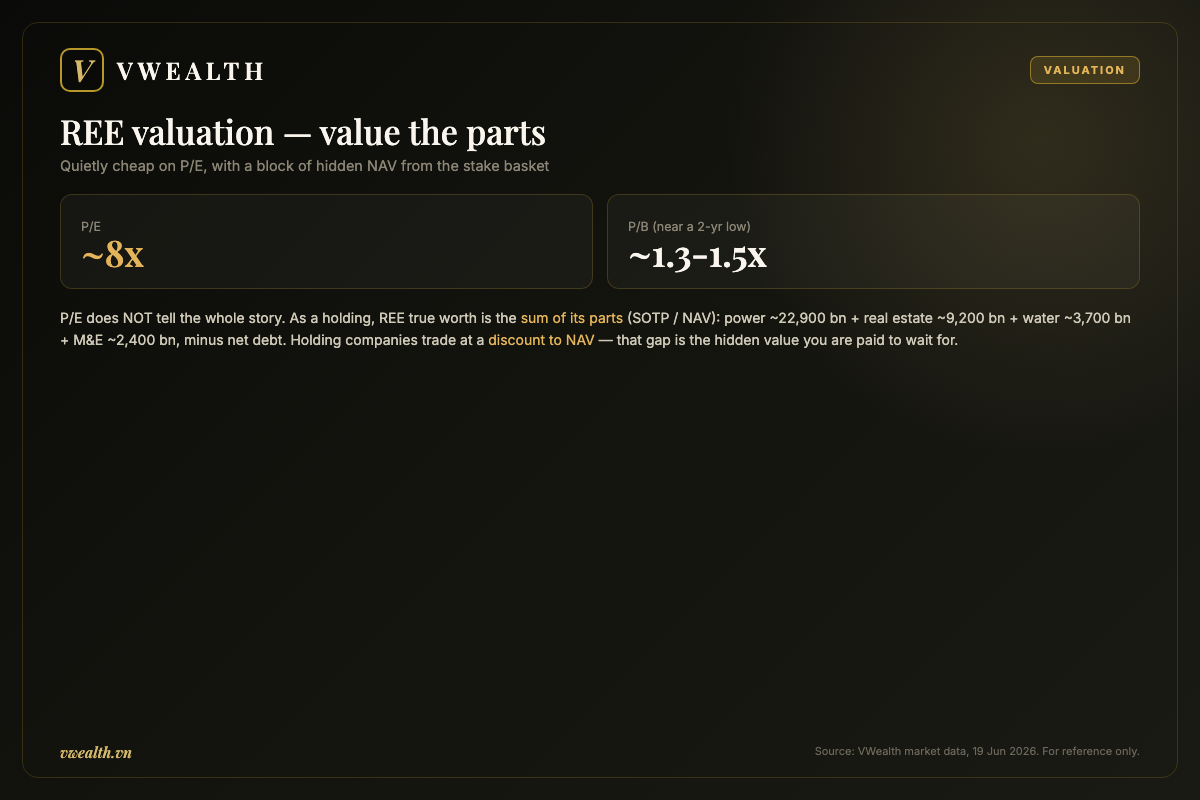
For that reason, analysts almost agree the most reasonable way to value REE is the SOTP (Sum Of The Parts) method — valuing each segment separately then summing, rather than applying one multiple to the whole group. A typical report values the generation segment at about 22,939 billion dong, real estate at 9,224 billion, water at 3,719 billion and M&E at 2,409 billion, then applies a holding discount of about 10%. Institutions like MBS once gave a target around 63,400 dong a share, while some others set higher targets (75,900 dong) depending on hydropower and water assumptions. What you need to remember isn’t the specific target — but the principle: valuing REE by NAV/SOTP gives a far more truthful picture than P/E or P/B alone.
Balance-sheet health: debt sits in the projects, the parent is lightly burdened
An infrastructure holding lives or dies by its debt structure. The good news with REE is this structure is fairly disciplined. At end-2025, REE total assets reached about 40,076 billion dong, up over 10% from the start of the year. Total financial debt was about 10,000–10,900 billion dong, of which most is long-term debt (about 9,380 billion dong). The total debt-to-assets ratio is about 38% — a healthy figure for an infrastructure business.
The subtle point to grasp: most of this debt is project finance sitting at the power plants — especially the wind and hydro projects needing large upfront investment. This is “good” debt in the sense it’s secured by the project own cash flow (long-term PPA offtake) and ring-fenced at the project level, not all piled on the parent shoulders. REE parent itself keeps a light-debt status, with over 6,600 billion dong of cash and deposits (over 16% of total assets), bringing net debt to only about 17%. In other words, REE has a thick cash cushion to absorb shocks and be proactive for new M&A deals.
| Metric | 2025 value | Note |
|---|---|---|
| Net revenue | ~10,011 billion dong | Record high, +~19% year on year |
| After-tax profit | ~3,149 billion dong | 2nd-highest ever, beating plan ~30% |
| Power-segment profit | ~1,054 billion dong | The largest pillar |
| Real-estate profit | ~803 billion dong | ~1/3 of total profit |
| M&E + water profit | The rest | Water very stable, good defense |
| Total assets | ~40,076 billion dong | +>10% from start of year |
| Financial debt | ~10,000–10,900 billion dong | Mostly long-term power-project debt |
| Debt / total assets | ~38% | A healthy level for infrastructure |
| Cash & deposits | >6,600 billion dong | Net debt only ~17% |
| ROE | ~13–15% | Fairly good capital efficiency |
| 2025 dividend (planned) | 25% (10% cash + 15% shares) | Steadily maintained |
Profitability and the dividend cash flow received
On capital efficiency, REE 2025 ROE is in the roughly 13–15% zone depending on timing and calculation (the consolidated report records over 15%, while the quarterly metric may be around 13.2%). This isn’t an explosive ROE like a hot-growth company, but for an infrastructure business with heavy assets and stable cash flow, it’s a durable and reliable figure. You’re looking at a steadily profitable machine, not a gamble.
What makes REE “holding” nature is the dividend cash flow received. Each year, the power and water companies in the portfolio remit dividends to REE, forming real cash for the parent to reinvest, repay debt and pay dividends to its own shareholders. This is a “quiet” but extremely valuable cash flow — it swings less than accounting profit and is the foundation for the 25% dividend commitment (including 10% cash and 15% shares) the leadership proposes for 2025. A small note: associate profit in 2025 fell about 15% to around 234 billion dong, an indicator reminding you that even a stable cash flow has lower years.
The risk picture: what should you be sober about?
No infrastructure holding is immune to risk, and balance requires the writer to point the weaknesses out to you squarely:
- Hydrology risk — the El Niño / La Niña cycle directly governs hydropower output. A dry year can erode hundreds of billions of power-segment profit, and this is a variable REE can’t control.
- Mechanism and electricity-price risk — pricing policy, the dispatch framework on the competitive electricity market, and regulatory changes on renewables can all affect the generation margin.
- Interest-rate risk — because the power-project debt is large and long-term, a rising-rate cycle will swell financial costs, eating into profit. The thick cash cushion eases but doesn’t erase this risk.
- The office-leasing cycle — new office supply in Ho Chi Minh City and business demand affect the occupancy and rent of the real-estate segment.
All combined, you face a business with a solid financial foundation, a unique model, multi-source defensive cash flow and a significant block of hidden assets — but also a business whose yearly profit swings with hydrology and is governed by macro variables beyond its hands. That’s exactly the kind of profile the market will “grade” in a very particular way — and that’s what we’ll dissect in the next section, looking at how the market receives REE stock.
Market reception
If you stand before the board and look at REE, you’ll notice something odd: a long-standing blue chip but rarely among the leaders in explosive market sessions, also rarely among the deepest fallers when the market panics. At 50,400 dong (close of 19 June 2026, per VWealth plugin data), REE is valued in a zone many value investors call the “comfortable zone” — not too expensive to worry, but interesting enough to consider for a long-term portfolio. The question in this section is: how is the market pricing REE, and is that price reasonable for the nature of an infrastructure holding?
This is where you need to shift your view. REE is no longer a pure refrigeration-engineering business as the original name “Refrigeration Electrical Engineering” suggests. It has become a holding parent holding controlling or large stakes in a series of listed power and water businesses, plus a grade A–B office-leasing portfolio and a construction-M&E segment. When you buy a REE share, you don’t buy a plant — you buy a basket of cash-generating infrastructure assets. And how you value a basket of assets is entirely different from how you value a single plant.
Valuation: quietly cheap on P/E
Let’s start with the easiest number. REE 2025 after-tax profit reached 3,149 billion dong — a record since founding, up about 31% year on year, on revenue over 10,000 billion. With shares outstanding around 471–490 million (before recent stock-dividend issues), this profit corresponds to EPS of about 6,500 dong a share. Dividing the 50,400-dong price by this EPS gives a P/E of about 8x.
Eight times earnings, for a business with among the most stable cash flow on HOSE, is a number worth pausing on. It isn’t alarmingly cheap (the kind of business about to hit trouble), but clearly not expensive either. To picture it: most defensive blue chips on Vietnam market — good banks, industry-leading consumer names, utilities — usually trade around a P/E of 10–15x. REE sits at the low edge of that band, even lower. On P/B, the stock trades around 1.3–1.5x book, near a two-year low, while ROE for 2026–2027 is forecast by many brokerages to stay at 10–11%.
A business with a stable double-digit ROE trading around 1.3–1.5x P/B and 8x P/E usually isn’t because the market “dislikes” it, but because the holding structure makes it hard for investors to see through the ownership layer to directly value the underlying assets. That’s both a risk and an opportunity for those willing to dig deep.
But P/E doesn’t tell the whole story: valuing by NAV/SOTP
This is the most important part to grasp when valuing REE, and the part buyers looking only at P/E usually miss. Because REE is a holding, its true value isn’t neatly in the consolidated profit stream, but scattered in the total value of its investments — a valuation method called SOTP (Sum-Of-The-Parts) or NAV (Net Asset Value).
Picture REE as a listed infrastructure fund. Inside it are:
- The power segment (Energy) — the largest pillar, contributing over half the group profit (about 52% in 2024). REE holds large stakes in many hydro, thermal and wind businesses, many of them listed. This part can be valued fairly closely to the market price of the stakes REE holds.
- The clean-water segment — stakes in water companies, a “sleepy” asset type but with extremely certain cash flow, contributing about 14% of profit.
- Leasing real estate — the grade A–B E.Town office chain with over 180,000 m² of floor, contributing about a quarter of profit, valued by leasing cash flow and asset value.
- Construction M&E — the traditional segment, with a thinner margin now but still brand value and a project backlog (including subcontracts at mega infrastructure projects).
When you add the market value of each part — especially the listed stakes with clear market prices — then subtract net debt at the parent, you get a NAV figure. The key point to remember: holding companies almost always trade at a discount to their NAV (holding discount). The reason is very human: investors don’t like paying full price for a basket of assets they don’t directly control, can’t sell part by part themselves, and must bear an extra layer of management cost at the parent. A holding discount of 20–40% is normal worldwide, and REE is no exception.
The practical consequence for you: REE 8x P/E doesn’t contradict the stock still being “cheap” versus net asset value. If the market price reflects a large holding discount to NAV, that gap is the “hidden value” — the part you’re paid for by patiently holding, waiting for the market to gradually recognize the true value, or waiting for an event (restructuring, divestment, spin-off) to reveal it. Conversely, you must also accept that this discount can persist very stubbornly — that’s the price of patience.
Price action: a true defensive blue chip
If you like drama, REE can bore you — and that’s exactly its strength. This stock has a clear defensive trait: it usually swings less than the general market. In hot up-waves, REE is rarely the fastest-running star; but when the market corrects or panics, it also usually doesn’t fall as deep as speculative stocks. For a long-term or income investor, this “low-shake” trait is an asset, not a flaw.
But “defensive” doesn’t mean “motionless.” REE price is sensitive to a few variables you should track:
- Hydrology — because power is the profit pillar, and a large part comes from hydropower, the El Niño / La Niña cycle directly affects output and profit. A wet year (La Niña) is usually good news for power-segment profit, and the market has repeatedly re-rated REE on this very hydrology story.
- The interest-rate level — like every dividend stock and every business using leverage to invest in infrastructure, REE benefits when rates fall (lower cost of capital, the dividend yield becomes more attractive than savings) and is pressured when rates rise.
- The renewable-power story and Power Plan VIII — this is the long-term growth driver. REE is highly rated for its wind-expansion direction, and pouring large capital into wind clusters shows the ambition to bet on the clean-energy trend Power Plan VIII is pushing.
In other words, REE isn’t a stock to surf on rumors. It’s a stock to buy a multi-year cash-flow story, accepting that the price line will rise slowly, disciplined, to the rhythm of hydrology, rates and power-project progress.
Dividends: a steady reward for patience
One reason REE is loved among income investors is its durable dividend policy. For 2025, REE keeps a total dividend of 25%, including 10% in cash (equivalent to 1,000 dong a share) and 15% in shares. On the cash part alone, the business plans to spend about 542 billion dong, with the record and payment dates announced on schedule.
You should understand these two components correctly, because they serve two different purposes:
- The cash part (10%) creates real cash into your pocket. At 50,400 dong and a 1,000-dong cash dividend, the cash dividend yield is about 2%; in lower-price years, this yield can touch the 3–4% zone. This isn’t a number that gets you rich fast, but a steady cash flow, year after year — exactly the spirit of a defensive investment.
- The share part (15%) retains money in the business to reinvest in power, water and infrastructure projects — while increasing the shares you hold. This is a signal that the leadership still sees growth opportunities worth retaining capital for, rather than paying it all out.
REE paying both cash and stock dividends for many consecutive years is a big quality plus. It tells you this is a business generating real money, not paper profit. For a “buy and hold” portfolio builder, it’s this steady dividend flow — plus reinvesting the stock dividend over time — that’s the quiet compounding machine you easily miss when only watching daily price swings.
Foreigners: Platinum Victory and the patient “accumulation”
You can’t discuss how the market receives REE without the shadow of foreigners, especially Platinum Victory Pte. Ltd. — a fund of the Jardine Cycle & Carriage group (Singapore), a branch of the renowned Jardine Matheson ecosystem. This is REE largest shareholder, accompanying the business for over a decade, now holding about 225.9 million shares, about 41.7% of charter capital. The announced ambition is to raise ownership to 44.99% — i.e. nearly the allowed ceiling.
The story here is worth pondering. In many registration rounds through 2025–2026, Platinum Victory continually failed to buy or matched only a tiny volume versus registration — one round registered over 18 million shares but gathered only tens to hundreds of thousands. Why? Because REE foreign room is basically very tight, and holding shareholders — including other foreign funds — aren’t willing to sell at the current price.
For you, this signal has two layers of meaning:
- Layer one — the confidence of smart money. When a Jardine fund patiently accumulates REE year after year, willing to make public offers at high prices (once tendering around 80,000 dong a share), it’s an affirmation that those who understand the assets inside this holding believe it’s worth more than the market price. That’s an expensive vote of confidence.
- Layer two — liquidity and room. The tight foreign room makes it very hard for new foreign investors to buy, and this pent-up foreign demand can be a “cushion” for the price. But it also means that if you’re a domestic individual investor, you’re playing on a field where the large shareholder has the upper hand and the freely floating shares aren’t too abundant.
To close: how is the market pricing REE?
Combining all the pieces, the picture is fairly clear. REE is a defensive infrastructure holding, valued by the market at a reasonable-to-attractive level: a P/E around 8x on record 2025 profit, a P/B around 1.3–1.5x near a two-year low, with a steady cash-dividend flow and a block of hidden NAV value from the power-water-real-estate stake basket that the usual P/E method doesn’t fully reflect. Plus the persistent presence of the Jardine foreign block as a long-term confidence anchor.
Of course, this isn’t a stock for someone wanting to double their account in a few months. The holding discount can persist, power profit depends on hydrology, and the tight foreign room limits the free float. But if you’re a long-term investor seeking the combination of reasonable valuation, steady dividends and hidden asset value, then how the market receives REE — quietly, without fanfare — is exactly the kind of “quiet” many value investors seek. To understand why this valuation holds and what could reveal the hidden value, you need to look more broadly at the industry picture — which we’ll dissect in the industry-context section right after.
Economic context and REE core industries
To understand a stock like REE, you can’t just look at the 2025 profit figure (3,149 billion dong) or the 50,400-dong price and rush to conclude. REE is an infrastructure holding — a parent holding stakes in many businesses across four pillars: power, water, office real estate and construction M&E. Each pillar is tightly tied to its own macroeconomic current. When you buy REE, you’re essentially betting on the health of four foundational Vietnamese industries at once. This section dissects each pillar, examines real industry numbers, and points out where the opportunity is and where the risk variable is to watch.
The power pillar: the biggest driver and also the most variable
Power is the largest contributor to REE results. In 2025, the energy segment alone brought about 5,000 billion dong of the over-10,000-billion consolidated revenue — nearly half. This is also why 2025 profit broke out: favorable hydrology helped the hydropower plants REE holds stakes in run at full capacity, reservoirs filled abundantly, power output sold surged. But before you get enthralled by this pretty figure, remember a core principle: hydropower is a weather-dependent industry. A wet year means big profit, a drought next year means profit can fall sharply. This is the first and most important variable to carve in when looking at REE.
Now place REE power segment in the industry picture. Vietnam is one of the fastest power-demand-growing economies in the region. Per Power Plan VIII (adjusted and re-approved in April 2025), the average commercial-power growth rate in 2021–2025 is about 9.3% a year, and 2026–2030 is expected to stay around 8.6% a year. In other words, each year the economy “thirsts” for nearly a tenth more power than the year before, to serve industrial production, FDI plants, data, urbanization and daily life. A country growing power 8–10% a year for a decade is fertile ground for any business investing in generation. This is the long-term tailwind behind REE.
More notable is the power-source structure. The adjusted Power Plan VIII makes renewables the focus: the renewable share (onshore wind, offshore wind, solar, biomass) is expected to be about 30.9–39.2% of total capacity by 2030, and heading to 74–75% by 2050. Specifically, by 2030 the onshore and nearshore wind capacity target is about 26,000–38,000 MW, solar about 46,000–73,000 MW. This is a massive shift in the national energy structure — and it opens exactly the path REE is on.
REE strategy is to gradually shift its power portfolio to renewables, targeting to raise total generation capacity by ownership from about 1.2 GW now to about 3 GW by 2030, with wind and solar playing the main role. Power Plan VIII is the policy map legalizing and prioritizing that path.
However, you shouldn’t read this as a sure-win ticket. Two big variables hang over the renewable segment. First is the price mechanism. Wind and solar prices in Vietnam have gone through many mechanism changes: from an attractive fixed FIT initially, to a transitional price frame, then a negotiation/auction mechanism. A renewable project can have very different returns depending on what price it signs and when EVN dispatches it to the grid. An unfavorable price mechanism or delays in relieving grid capacity can erode project profit even when technical output is very good. Second is hydrology — as noted, hydropower remains a large component and will keep swinging with the annual rain-drought cycle, El Niño/La Niña. So REE power segment is both the strongest growth driver and the largest profit-volatility source.
The water pillar: the quiet defensive shield
If the power segment is a high-capacity but shake-prone machine, the water segment is the shock-absorbing cushion. REE holds stakes in many urban water suppliers. What’s the trait of the water industry? Demand is nearly inelastic: whether the economy is good or bad, whether rates are high or low, people and businesses still use water every day. Vietnam urbanization — with millions moving to big cities each decade — makes urban water demand rise steadily, stable, low-cycle.
For an investor, the water segment brings exactly what a portfolio needs in tough years: steady dividend cash flow, easily predictable revenue, a stable margin and low risk. This is the “defensive” part of REE structure. When bad hydrology makes the power segment flag, or when the office market declines, water cash flow keeps flowing, helping REE maintain its dividend-paying ability. You can picture the water segment as an infrastructure bond sitting quietly inside a stock — not exciting for its slow growth, but a support when the storm comes.
The office real-estate pillar: quality assets in a tug-of-war market
REE owns about 145,000 m² of leasable office space, concentrated in Ho Chi Minh City with the e.town brand towers and the company office complex. This is a segment generating steady periodic cash flow (monthly/quarterly rent), a high margin and land-tied asset value — an important part of REE “hidden net asset value” (NAV) we’ll discuss in the conclusion.
So how is the Ho Chi Minh City office market? The picture has both bright and cautious sides. On the bright side, rents still anchor at good levels: the market-average rent is about $35/m²/month, and average occupancy is about 88% — with grade A about 90%, grade B about 85%. Total Ho Chi Minh City office supply is now about 2.9 million m² from nearly 400 projects. Leasing demand is strongly driven by FDI businesses — this group accounts for about 82% of total leased area, reflecting Vietnam appeal as an investment destination. As long as FDI keeps flowing in, demand for quality offices is supported.
But this is also where you need to be wary. The 82% dependence on FDI is a double-edged sword: if international capital stalls, office demand flags too. More importantly, the market is entering a cycle of abundant new supply: from now to end-2027, Ho Chi Minh City will add about 234,000 m² of new offices. Some forecasts see the vacancy rate possibly rising significantly (some estimates up to around 24%) as new towers come online, creating competitive pressure and possibly restraining rent growth. For REE, this means: existing towers still fill well thanks to location and quality, but short-term rent-growth room will be eroded, and any new office project REE develops must compete in a more crowded market.
The M&E pillar and the general interest-rate variable
The construction-M&E segment (installing electrical, air-conditioning and ventilation systems for construction projects) is REE origin trade — the name “Refrigeration Electrical Engineering” was born from it. This segment is cyclical with the construction and real-estate rhythm: when the construction market is vibrant, M&E orders are abundant; when construction freezes, this segment shrinks. It’s no longer the main profit driver but still contributes revenue and ties REE to the public-investment, infrastructure and real-estate cycle.
Finally, there’s a macro variable overarching all four pillars but especially heavy on the power segment: interest rates. Power projects — especially wind and solar — require very large upfront investment and are usually financed by long-term debt. When rates rise, these projects financial costs swell, eating into net profit; conversely, a low-rate environment improves project returns and encourages REE to expand investment. So when tracking REE, keep an eye on the rate level: it’s one of the levers deciding whether the “raise capacity to 3 GW by 2030” strategy profits well or has most of its fruit swallowed by the cost of capital.
REE trend forecast
Having understood the four pillars and the industry currents behind them, now let’s discuss what every investor is curious about: where will REE go? Let me say frankly from the start that no one can forecast a share price precisely. What we can do is sketch the strategy the business is pursuing, then build scenarios based on the variables analyzed, with trigger conditions and consequences of each. The purpose isn’t to “call” the price, but to help you picture the range of possible outcomes and prepare accordingly.
The strategy REE is pursuing
REE direction in coming years is fairly clear and consistent with its infrastructure-holding nature:
- Expanding renewables per Power Plan VIII. This is the central strategic axis. REE targets raising total generation capacity from about 1.2 GW to about 3 GW by 2030, with wind and solar as the main driver. The adjusted Power Plan VIII, targeting renewables at 30.9–39.2% of capacity by 2030, is both an opportunity and a legal framework backing this direction.
- Developing new office real-estate projects. Leveraging its land bank and operating capability, REE continues to expand leasable area to raise periodic cash flow and asset value — though it must face Ho Chi Minh City new-supply pressure.
- Power-water stake M&A. REE growth nature comes not just from self-building projects but from buying more stakes in good power and water businesses. This is how REE patiently “gathers” infrastructure cash flow over many years.
- Operating under new leadership. This is the newest and most notable factor. Per a mid-2026 disclosure, Nguyen Thi Mai Thanh — the “iron lady” tied to REE for decades — left the Chairman seat from 10 July 2026, shifting to Chair of the Strategy Advisory Committee. Nguyen Ngoc Thai Binh (her son, a 1980s-generation figure, then Deputy CEO) was appointed CEO, while the Chairman seat is held by the largest foreign shareholder representative (Platinum Victory). This is an orderly generational handover, but still an unknown on management style and the degree of continuity.
Three scenarios for REE
Based on the variables analyzed — hydrology, electricity-price mechanism, renewable progress, office demand and rates — we can build three scenarios. Remember: this is a condition-and-consequence thinking frame, not prophecy about numbers.
| Scenario | Trigger conditions | Consequence for profit and valuation |
|---|---|---|
| Positive | Favorable hydrology many years running; new renewable projects dispatched to the grid at reasonable prices; the capacity portfolio nears the 3 GW target; offices keep high occupancy; rates stay low. | Sustainable double-digit profit growth; the market begins to re-rate — valuing by the true NAV of the power-water-real-estate portfolio, narrowing the holding discount. This is the hidden-value-release scenario. |
| Base | Normal hydrology around the multi-year average; renewables expand to plan but no breakout; offices face new-supply pressure but stay well-filled; rates stable. | Profit flat to slightly up, cash flow and dividends steady. The P/E stays around the current level (~8x), the stock moves steadily as befits a defensive holding. This is the most likely scenario. |
| Negative | Drought hydrology (a prolonged El Niño); an unfavorable renewable-price mechanism or slow capacity relief; new office supply pushes vacancy up and rents stall; rising rates swell project-debt cost. | Profit falls clearly as the power segment flags; the holding discount widens; the stock faces downward pressure. Even so, the water shield and dividends still help REE hold better than many pure cyclical stocks. |
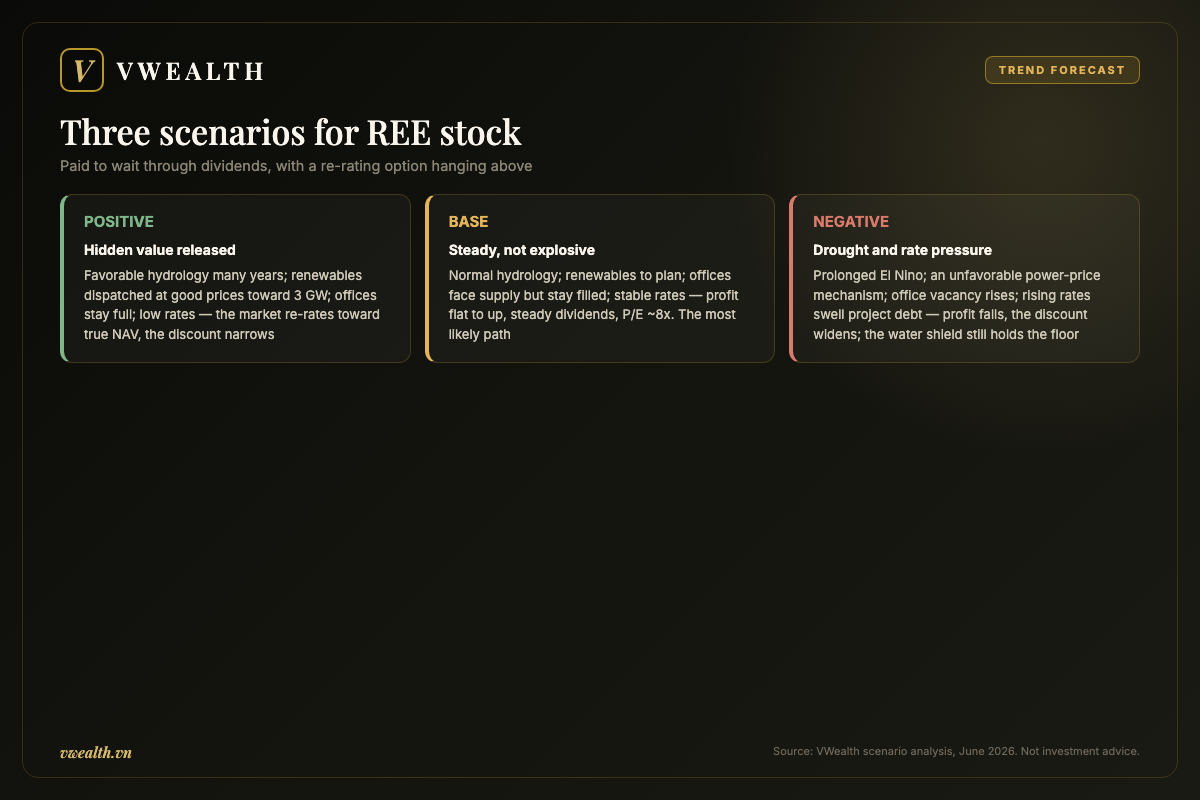
The takeaway from these three scenarios isn’t “which scenario will happen,” but REE risk shape. Notice that even in the negative scenario, REE still has the water shield and dividends supporting the floor — this is the defensive trait. And in the positive scenario, the biggest reward comes not from profit rising violently, but from the market re-rating the holding discount, bringing the price toward true net asset value. In other words, REE is the kind of stock where you’re paid to wait (through dividends), with a re-rating option hanging above — not the kind promising multi-fold gains in a short time.
Should you buy REE stock?
This is the question you really care about, and the part where we need to be most honest. The short answer: there’s no single answer for everyone. Whether a stock suits you depends on what kind of investor you are, what you expect and what risk you can bear. Our job here is to weigh both sides carefully — pros and cons — then match against each investor type, so you make your own decision.
Weighing the pros: why REE is attractive
- A defensive infrastructure holding with diverse cash flow. The four pillars power – water – real estate – M&E create a portfolio of cash flows little correlated. When one is weak, another carries. Power and water revenue and profit are far less cyclical than pure real estate, helping REE endure through market cycles.
- A steady, attractive dividend. With a dividend around 25% and a stable payment history, REE rewards shareholder patience with real, steady cash — highly valued by passive-income seekers.
- A cheap valuation and hidden NAV value. A P/E around 8x isn’t expensive for an infrastructure business with solid cash flow. More importantly, as a holding, REE market price is usually below the true total value of the assets it holds (hydropower, water stakes, office towers in central Ho Chi Minh City). That gap — the “hidden NAV value” — is room for the stock to be re-rated in the future.
- Benefiting from the power industry long-term trend. Vietnam power demand growing 8–10% a year and Power Plan VIII prioritizing renewables create a long-term tailwind for REE strategy to expand capacity to 3 GW.
- Reputable leadership. REE has a track record of good, transparent governance, trusted by foreigners (the Platinum Victory shareholder continually raising ownership). Though Mai Thanh left the Chairman seat, she still leads the Strategy Advisory Committee, helping keep continuity of vision.
Weighing the cons: risks you must not ignore
- Power profit depends on hydrology. This is the number-one risk. A dry year can drag profit down sharply, making results swing unpredictably between years.
- A persistent holding discount. The parent-holding-stakes structure makes the market usually value REE below true asset value. The “hidden value” can stay… hidden for many years without a re-rating catalyst.
- Slow, steady growth, not explosive. REE is a cash-flow machine, not a hot-growth stock. If you expect your account to double fast, REE will almost certainly disappoint you.
- Leadership-handover risk. The mid-2026 power handover happened in an orderly way, but the new leadership management style and the degree of governance-culture inheritance are still unknowns needing time to prove.
- Power-project debt sensitive to rates. Renewable projects use heavy debt; rising rates will erode profit and slow the capacity-expansion ambition.
- An uncertain electricity-price mechanism. Wind and solar price policy and the pace of grid-capacity relief still change a lot, directly affecting the returns of new projects.
What kind of investor does REE suit?
This is the most practical way to hold yourself against it. See which group you’re in among the four investor types below:
| Investor type | Does REE suit? | Reason |
|---|---|---|
| Seeking defense / dividend income | Very suitable | Diverse cash flow, a steady 25% dividend, a stable water shield — exactly what those wanting income-generating, low-shake assets need. |
| Long-term investor, accumulating infrastructure | Suitable | Benefiting from the power-growth + renewable trend for years, a cheap valuation, hidden NAV value with re-rating room. The reward goes to the patient. |
| Value investor | Relatively suitable | A ~8x P/E and the holding discount create a margin of safety — but you must accept the value may take years to be recognized by the market. |
| Seeking fast growth / short-term speculation | Less suitable | REE grows steadily, not explosively; low price volatility, undramatic cash flow — hard to satisfy those seeking large gains in a short time. |
In sum, REE is like a solid infrastructure building amid Vietnam economy: it generates steady income from power, water and offices; it’s valued not expensively; and it has a re-rating option hanging above if one day the market chooses to look at the true asset value. In exchange, you must accept profit swinging with the rain and sun, gradual rather than explosive growth, and a few unknowns about leadership and policy. REE suits those who see investing as a long-distance run with dividend rewards, rather than a speed game.
Disclaimer: All content in this analysis is for informational and reference-view purposes, based on public data at the time of writing. This is not a recommendation to buy, sell or hold any stock. The stock market always carries risk, and past results don’t guarantee the future. You should research thoroughly, assess your risk appetite and personal financial situation, and consider consulting a licensed investment advisor before any decision. Every investment decision and its risk belong to you.
Research Vietnamese stocks in English with vwealth. Our AI-powered platform turns Vietnamese market data into full English analysis reports — with international payment support and a free 2-month trial for new accounts. Create your free account and read the latest reports.