Ask whether you should buy PC1 stock and the honest answer changes depending on which month of 2026 you ask the question. In January, PC1 Group was the prettiest story in Vietnam’s energy-infrastructure sector: a sixty-three-year-old company that has physically built much of the national power grid, fresh off a landmark 500kV transmission project, sitting on its own nickel mine and a northern industrial-park land bank pointed straight at the foreign investment wave. Then on 16 May 2026 the company filed an extraordinary disclosure — its chairman and six other key personnel had been indicted and detained pending investigation. Four of the five board members were in custody, the board no longer had a quorum, the first-quarter financial statements were so late that the exchange issued two public reminders, and roughly a third of the market capitalisation evaporated inside a month. By late July the company had a new chairwoman born in 1999, while a group of financial investors quietly accumulated more than 12% of the shares. This article walks through that entire story using only what has been publicly disclosed, teaches you how to read the accounts of a multi-segment contractor — one of the hardest filings on the Ho Chi Minh exchange — and ends with a straight answer about who PC1 suits and who it absolutely does not.
Two ground rules before we start. The first is legal. Under Vietnamese law, and under the principle this article follows throughout, any individual who has been charged is presumed innocent until a court verdict takes legal effect. Everything below is drawn from the company’s own disclosures and mainstream reporting. We do not assign blame, we do not speculate about anyone’s motives, and we do not comment on the substance of an investigation that is still running. What we analyse is investment risk — specifically, how a governance vacuum and a long legal process affect cash flow, the ability to win tenders, and the quality of the information shareholders receive.
The second rule is about numbers. You will meet a great many dated events, project names and disclosed contract values. You will meet almost no current-quarter figures: no latest earnings, no today’s price-to-earnings ratio, no closing price, no target price. The reason is specific to PC1. This is a company with six separate profit engines running on six different rhythms — construction revenue recognised by project progress, steel tower manufacturing by order book, hydropower by the rainy season, wind power by the wind season, mining by the world nickel price, industrial parks by each individual land lease signed. One quarter includes an industrial land handover and profit spikes; the next quarter is construction only and the number collapses. Print a P/E today and it is close to meaningless three months from now — and this particular company is in the middle of a disclosure backlog anyway. Instead of handing you a figure with a short shelf life, this article teaches you to read PC1’s own numbers. When you need today’s data, open the PC1 report on the vwealth platform for the current metrics. The article gives you the framework; the report gives you the figures.
One more thing. If you are new to this market, read PC1 alongside the basics rather than in isolation. Our guide to investing in the Vietnam stock market covers the mechanics a foreign investor needs first — how to open an account, what the foreign ownership limit means, why the T+ settlement cycle and the daily price band change how you should size positions — and the broader Vietnam stock market guide maps out how the exchanges and the main sectors fit together. PC1 also becomes far clearer when placed next to companies that share its supply chain: Hoa Phat at the head of Vietnam’s steel chain, Kinh Bac City in northern industrial land, and CII, the Ho Chi Minh City infrastructure group — which, as you will see, turns out to be more than an analogy in this story.
From a 1963 power-line crew to a six-engine group: the history of PC1
There is a fast way to understand PC1. Look at the nearest high-voltage transmission tower on the road you drive. There is a decent chance this company put it there, and a decent chance the steel in it was galvanised at their own plant. But the fast way leads straight into the most common misunderstanding about PC1 — that it is a contractor. Over sixty-three years the company has moved from working for the power sector to owning power plants, digging its own mine and leasing its own industrial land. Every one of those turns left a mark on the balance sheet you are going to have to read.
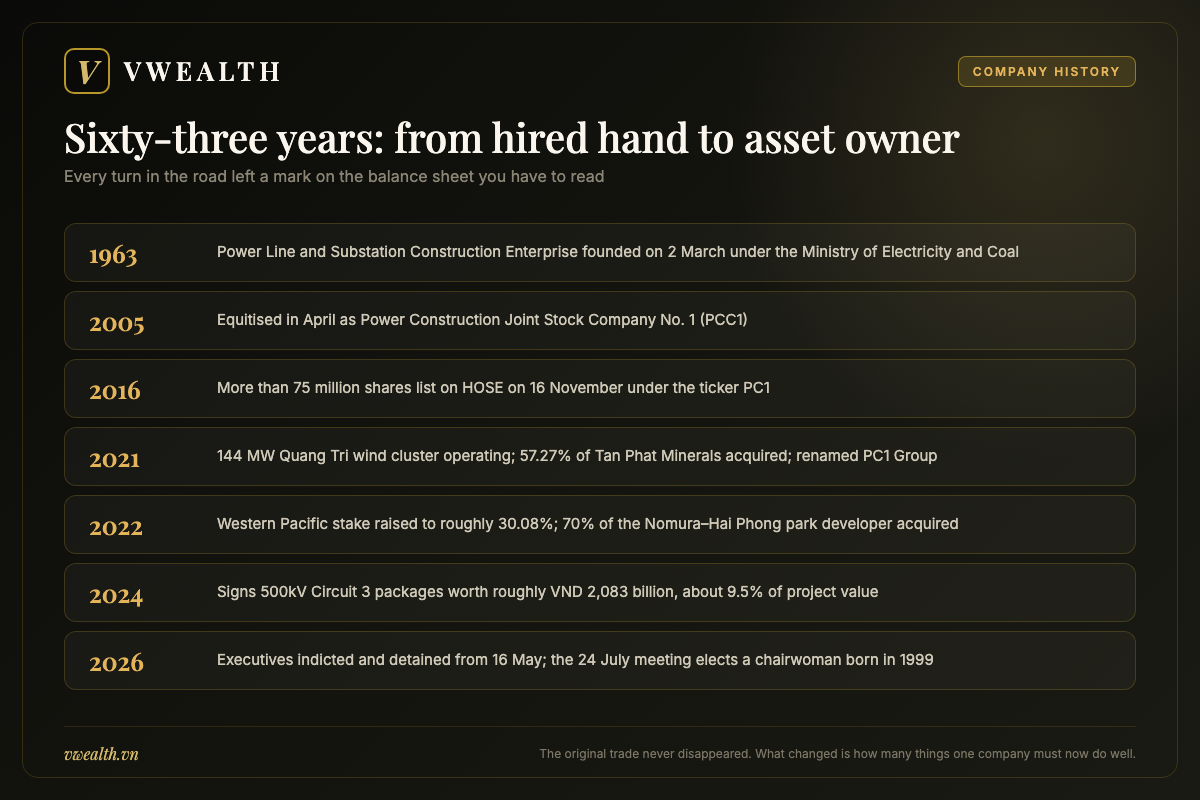
2 March 1963: a state enterprise in a country with no national grid
On 2 March 1963, the Power Line and Substation Construction Enterprise was established under Vietnam’s Ministry of Electricity and Coal. That entity is the direct ancestor of today’s PC1. Picture the context: northern Vietnam at the time had nothing you could call a national grid. Electricity existed as isolated generating clusters around a handful of cities and industrial zones. The enterprise’s job was to erect towers, string conductors and install transformer substations — pure muscle and engineering, executed on orders from the supervising ministry, with no concept of profit and loss in any market sense.
That detail sounds like ancient history but it matters enormously to an investor in 2026. A power-line construction company cannot be created overnight. To build a 500kV transmission line you need trained tower-climbing crews, specialised conductor-stringing equipment, capability certificates, and above all a track record of comparable completed projects — the very first thing any project owner checks in a tender file. Six uninterrupted decades doing one thing well is PC1’s natural defensive barrier, and it is not something a newly capitalised competitor can simply buy. In investment language this is a moat: the structural advantage that makes a business hard to copy.
The 1990s: the North–South 500kV line and the making of a profession
The turning point for Vietnam’s entire power-construction industry was the North–South 500kV transmission line, Circuit 1, started in 1992 and energised in 1994. Before it, the north had surplus power while the south ran short, and the two halves of the country could not be connected. After it, Vietnam had a unified electricity system for the first time.
For the construction units of the day, that project was the harshest and most valuable school imaginable: their first work at extra-high voltage, their first experience across hundreds of kilometres of mountain terrain, their first exposure to campaign-style schedule pressure. The engineers who came through it became the core cadre for the next thirty years. When you hear PC1 say it has experience building transmission lines at the highest voltage class, this is where the claim comes from.
April 2005: equitisation, and a state enterprise learns to count profit
In April 2005 the enterprise was equitised — Vietnam’s term for the partial privatisation of a state-owned company through a share sale — and became Power Construction Joint Stock Company No. 1, abbreviated PCC1. That abbreviation still appears on their residential property developments today. Equitisation is not just a change of stamp. It was the first time the people running the business had to answer a question a government agency never has to answer: when this project is finished, how much did we make, and if we lost money, who carries it?
It was also the moment when a management layer of electrical engineers started to hold genuine control rather than merely holding appointments. That pattern — a former state enterprise gradually becoming a private company stamped with the personality of one founder — is not unique to PC1. But at PC1 it went unusually far. Eighteen years later, the shareholder register showed essentially one significant ownership bloc: the family of the man at the top. Chapter two deals with this in detail, because it was simultaneously the company’s greatest strength and its fatal weakness.
16 November 2016: more than 75 million shares list on HOSE
On 9 November 2016 the Ho Chi Minh Stock Exchange issued the listing decision for Power Construction Joint Stock Company No. 1. On 16 November 2016, more than 75 million shares began trading under the ticker PC1. From that day, an ordinary person could own a slice of Vietnam’s power-construction industry for the price of a few hundred thousand dong.
Listing opened a door more important than simple tradability: access to capital. A pure contractor does not need much equity — it works for others, gets paid against progress, and recycles its capital. But if you want to own a hydropower plant or a wind farm, you need thousands of billions of dong sitting idle for years before the first revenue arrives. Only after listing did PC1 have the tools to dream that dream. And they dreamed fast.
2016–2020: from hired hand to plant owner
In this period PC1 executed the shift analysts describe as “moving from EPC to IPP”. Both acronyms need defining now because you will meet them repeatedly. EPC stands for Engineering, Procurement and Construction: a turnkey contract where the company handles design, equipment sourcing and construction, then hands the keys to the owner. That is hired work — paid once, thin margins, and it ends when the job ends. IPP stands for Independent Power Producer: you put up the capital, build the plant yourself and sell electricity into the system for twenty or thirty years. That is ownership — a large cheque up front, followed by decades of steady cash flow.
PC1 chose small and medium hydropower in the northern mountains as its first step, and the logic fits their capability precisely. Those projects need exactly three things PC1 already had: the ability to build in difficult terrain, the ability to connect to the grid, and long-standing relationships in the sector. By the end of this period the hydropower portfolio reached seven operating plants with combined capacity of roughly 212 MW and cumulative investment of over VND 6,800 billion. That 212 MW sounds modest next to a single thermal plant, but its significance is not scale — it is character. It is cash flow that does not depend on winning a tender this year.
2021: the pivotal year — 144 MW of wind, a nickel mine and a new name
If you had to pick one year that defines the modern PC1, it is 2021. Three large things happened almost at once.
The first was wind power. In October 2021 the three-farm cluster of Lien Lap, Phong Huy and Phong Nguyen in Quang Tri province — 48 MW each, 144 MW in total — reached commercial operation in time to qualify for the fixed-price regime. Here you need the term FiT, or feed-in tariff: a guaranteed electricity purchase price the state commits to pay renewable developers for a set number of years, designed to attract early-stage investment. Vietnam’s wind FiT had a hard expiry date, and projects across the country missed it. PC1 energising all three farms on time was a genuine construction achievement — and proof that being both builder and owner has real value, because the company was managing its own schedule with its own crews. Total investment in the cluster was around VND 6,000 billion, adding roughly 400 million kWh of annual output, financed with green loans from international development finance institutions and with a Japanese partner participating.
The second was mining. Also in 2021, PC1 acquired 57.27% of Tan Phat Minerals, which holds the extraction rights to a nickel–copper deposit in Quang Trung commune, Hoa An district, Cao Bang province. This is the strangest step in the company’s history: a power contractor suddenly digging a mine. We dissect it in chapter three, but note one thing now — from this point on, part of PC1’s profit depends on the price of a commodity traded on the London Metal Exchange that nobody in Vietnam can influence.
The third was the name change, from Power Construction Joint Stock Company No. 1 to PC1 Group Joint Stock Company. Renaming is cosmetic, but the declaration behind it was real: the company no longer wanted to be called a contractor.
2022–2024: industrial parks, inland ports, and the 500kV Circuit 3 megaproject
In early April 2022 PC1 completed the purchase of 7 million shares from existing shareholders and subscribed to a further 11.5 million newly issued shares in Western Pacific, raising its stake to roughly 30.08% and making it an associate company. Western Pacific is the developer of the Yen Phong II-A industrial park in Bac Ninh province and also brings experience in logistics, warehousing and ports. Then in November 2022, PC1 acquired the entire share capital of a Singapore-registered entity, thereby becoming the holder of 70% of the company that develops the Nomura–Hai Phong Industrial Zone, a roughly 153-hectare park with a history of attracting Japanese manufacturers going back to the 1990s.
Then came the project that put PC1’s name in the newspaper every day: the 500kV Circuit 3 transmission line, Quang Trach to Pho Noi section. Roughly 519 km long, total investment above VND 22,300 billion, ground broken on 25 January 2024 and completed on 29 August 2024 — a little over seven months for a workload international practice would normally measure in years. PC1 was among the most deeply involved contractors: as of end-April 2024, the total value of packages it had signed on the project reached roughly VND 2,083 billion, covering construction work, steel tower supply and equipment — equivalent to about 9.5% of the project’s total value. After that came the 500kV Lao Cai–Vinh Yen line, roughly 300 km with total investment of VND 7,410 billion, brought into operation in the fourth quarter of 2025, plus a consortium package worth roughly VND 1,800 billion to supply power to Con Dao island.
Sixty-three years in one table
| Date | Event | Why it matters to an investor |
|---|---|---|
| 2 March 1963 | Power Line and Substation Construction Enterprise founded under the Ministry of Electricity and Coal | The root of a grid-building capability that money cannot buy quickly |
| 1992–1994 | Vietnam’s power-construction industry builds the North–South 500kV Circuit 1 | Created the core engineering cadre for the next three decades |
| April 2005 | Equitised as Power Construction Joint Stock Company No. 1 (PCC1) | Starts operating on profit-and-loss logic; a controlling shareholder bloc forms |
| 16 November 2016 | More than 75 million shares list on HOSE under the ticker PC1 | Opens capital access to move from hired hand to asset owner |
| 2016–2020 | Builds a portfolio of seven hydropower plants, roughly 212 MW | First cash flow that does not depend on winning tenders |
| October 2021 | 144 MW Quang Tri wind cluster reaches commercial operation inside the FiT deadline | Proof that building for yourself is a schedule advantage |
| 2021 | Acquires 57.27% of Tan Phat Minerals — nickel and copper in Cao Bang | Earnings become partly tied to world commodity prices |
| 2021 | Renamed PC1 Group Joint Stock Company | A formal declaration of multi-sector ambition |
| April 2022 | Raises Western Pacific stake to roughly 30.08% | Entry into industrial real estate |
| November 2022 | Takes 70% of the Nomura–Hai Phong Industrial Zone developer | Acquires a fully occupied park with cash flow from day one |
| January–August 2024 | Signs 500kV Circuit 3 packages worth roughly VND 2,083 billion | Peak of its standing as a grid contractor |
| Q4 2025 | 500kV Lao Cai–Vinh Yen line enters operation | A continuous pipeline of transmission work |
| 16 May 2026 | Extraordinary disclosure: chairman and six key personnel indicted and detained | A governance vacuum — analysed in chapter two |
| 24 July 2026 | Extraordinary general meeting reconstitutes the board; a chairwoman born in 1999 takes over | Generational handover under duress |
One family, one vacuum and one unlikely buyer: PC1 leadership and ownership
For most listed companies, the chapter on management is the dullest one in the report: a few lines of biography, an ownership table, done. For PC1 in 2026 it is the single most important chapter in this article. Because the question “should you buy PC1 stock” right now has almost nothing to do with how well the business is trading. It has everything to do with who is steering, how long they can steer, and whether the numbers recorded in past years can be relied upon. We will go through it using only what has been disclosed, without adding a word of speculation.
Ownership before the shock: a single large shareholder bloc
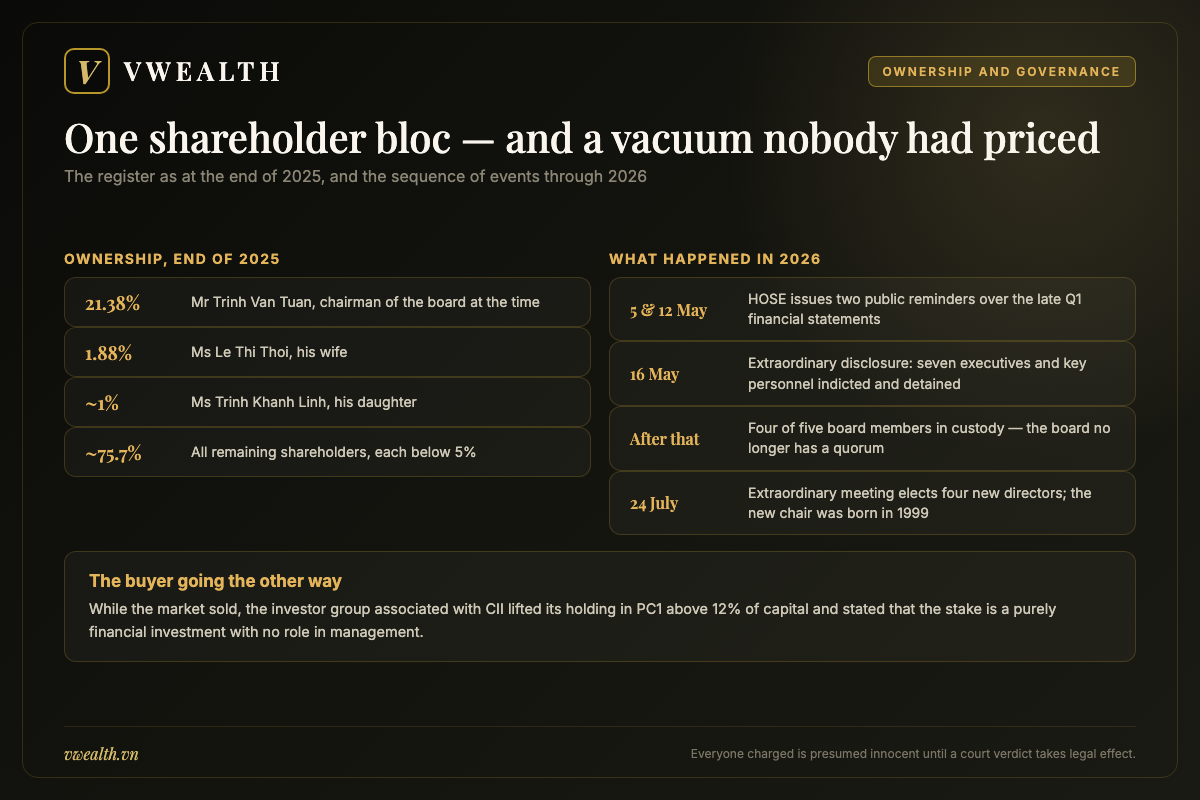
According to the shareholder structure as at the end of 2025, PC1 had exactly one shareholder above the 5% disclosure threshold: Mr Trinh Van Tuan, then Chairman of the Board, holding nearly 88 million shares, or 21.38% of charter capital. His wife, Ms Le Thi Thoi, held over 7.7 million shares, equal to 1.88%. His daughter, Ms Trinh Khanh Linh, bought a further 4 million shares in November 2025, lifting her holding to just under 1%. Together the family bloc held roughly 100 million shares, about 24.24% of charter capital. The remainder — roughly 75.7% — sat with small shareholders, each below 5%.
Pause on that structure, because it says several things at once. First, PC1 has no state shareholder at all, which sets it apart from many Vietnamese power-sector companies that still sit under a state parent group. Second, a bloc holding roughly a quarter of the capital is not legal control in the strict sense, but in practice in the Vietnamese market — where the rest is scattered across tens of thousands of retail accounts — a quarter of the register is usually enough to carry any resolution. Third, and this is the part investors forget, a “one person decides everything” structure produces very fast decision-making and simultaneously produces key man risk: if that person is absent for any reason at all, there is no ready-made replacement mechanism.
Key man risk is the sort of concept individual investors treat as a textbook abstraction. PC1 in 2026 is the clearest real-world demonstration the Vietnamese market has produced of how quickly it can become concrete.
16 May 2026: the extraordinary disclosure
On 16 May 2026, PC1 Group Joint Stock Company filed an extraordinary disclosure stating that the Investigation Police Agency of the Ministry of Public Security had indicted and detained a number of the company’s executives and key personnel for investigation into alleged violations of accounting regulations causing serious consequences, and misappropriation of assets. The list ran to seven people. Among them were Mr Trinh Van Tuan, Chairman of the Board; Mr Vu Anh Duong, board member and Chief Executive Officer; and Ms Tran Thi Minh Viet, Chief Accountant.
Let us restate the principle set out at the top of this article, because it is not a formality. This is an investigation stage. Under Vietnamese law, a person accused of an offence is considered not guilty until proven so through the legally prescribed process, and is presumed innocent until a court verdict takes legal effect. This article makes no comment on the substance of the case and offers no view whatsoever on whether any individual did or did not do what has been alleged. We record a disclosed fact and analyse its consequences for an investment.
Those consequences were immediate. With four of the five board members in custody, exactly one member remained — below the minimum required under Vietnam’s Enterprise Law to convene a valid board meeting. In other words, the company’s highest decision-making organ between shareholder meetings temporarily could not function. Very few investors have ever had to price that situation, which is a large part of why the market reaction was as violent as it was.
Consequence one: the financial statements froze
Under current Vietnamese rules, a listed company must publish quarterly financial statements within 30 days of quarter-end. PC1 missed. On 5 May 2026, HOSE issued a first public reminder about the late Q1 2026 statements. On 12 May the exchange issued a second, urging the company to publish separate and consolidated statements in both Vietnamese and English as required.
The explanation the company later gave was blunt: the personnel involved in preparing and approving the statements were working with the investigating authority and had been indicted and detained. There is a detail here worth filing away as a professional lesson: both exchange reminders came before the indictment news was disclosed. The market had an anomaly signal from early May — a large company with a professional finance function suddenly unable to produce quarterly accounts on time, without an adequate explanation — but most investors only understood what was happening after 16 May.
The lesson is not “learn to predict bad news”. The lesson is that a late financial statement is never a small thing. For an ordinary manufacturer, a few days’ delay can genuinely be an audit or consolidation issue. But delay accompanied by silence, followed by a second reminder, is the kind of signal a disciplined investor should treat as sufficient reason to cut position size and wait, no matter how attractive the business story is.
Consequence two: a third of the market value gone in a month
The price reaction followed the classic Vietnamese-market pattern for governance risk: sell at any price, never mind how many power plants the company still owns. According to figures reported in the press during May 2026, PC1 shares lost roughly a third of their value within a month, equivalent to about VND 3,250 billion of market capitalisation wiped out. One securities firm updating its view used the phrase “severe governance and disclosure risk” — a polite way of saying the valuation model was temporarily unusable, because its input is a financial statement and there wasn’t one.
What is striking is that the company’s physical assets did not change at all during that month. Seven hydropower plants kept generating. One hundred and forty-four megawatts of wind in Quang Tri kept turning. The Cao Bang mine kept producing. Signed construction contracts remained in force. What was lost was confidence in the numbers — and in equity markets, confidence in the numbers is precisely what creates a valuation. This is a live illustration of a principle value investors repeat: you do not buy assets, you buy the right to receive cash flows from assets through a governance mechanism. When the mechanism breaks, intact assets do not save the share price.
24 July 2026: a chairwoman born in 1999, and two independent directors
A little over two months after the shock, PC1 convened an extraordinary general meeting to reconstitute the Board for the 2025–2030 term. The meeting elected four additional directors: Ms Trinh Khanh Linh, Mr Trinh Tien Dung, Ms Vu Thi Minh Nhat and Mr Le Thanh Luong. Immediately afterwards the Board elected Ms Trinh Khanh Linh — born in 1999, Deputy Chief Financial Officer of the group, and the daughter of the former chairman — as Chair.
Those four names describe a deliberately balanced structure. Ms Trinh Khanh Linh represents the family bloc: she personally holds roughly 0.97% of capital and is authorised to represent a further stake of roughly 21.38%. Mr Trinh Tien Dung is chairman and chief executive of a large mechanical-construction group and is also the former chairman’s younger brother — a second family representative, but one arriving with large-scale manufacturing management experience. The other two were introduced as independent candidates: Ms Vu Thi Minh Nhat with a finance and audit background, and Mr Le Thanh Luong, a doctor of electrical engineering with sector expertise.
If you are a shareholder, read that list pragmatically. Bringing an audit-trained director onto the board immediately after a matter involving accounting regulations is a reasonable signal — though a signal is only a signal until results follow. Bringing on an electrical-engineering doctorate is also reasonable, because the core of the company’s value still sits in grids and power plants. But two of the four new seats still belong to the family bloc, meaning the underlying power structure has not fundamentally changed. The meeting also approved a list of three audit firms for the 2026 financial statements, from which the chief executive is to choose one — a procedural step, but one worth watching, because the choice of auditor after an accounting-related event says a great deal about how serious a transparency commitment is.
The real question, which nobody can answer today, is whether a 27-year-old — however strong her finance background and however well she knows the business from inside — has the weight to lead a six-segment group under simultaneous legal and liquidity pressure. Nobody knows. That is exactly the kind of uncertainty an investor has to price, and the way you price uncertainty is by demanding a discount, not by closing your eyes and believing or closing your eyes and walking away.
The CII group crosses 12%: buying while everyone else sells
While the market was running for the exit, one group of investors went the other way: the group associated with Ho Chi Minh City Infrastructure Investment Joint Stock Company, the listed infrastructure operator we analysed separately in our full breakdown of CII stock. By the end of June 2026 the group had raised its holding from more than 23.7 million shares (5.77%) to 37.245 million shares, or 9.06% of PC1’s charter capital. After a member company bought a further 1.59 million shares on 30 July, the group’s total holding passed 12%, equivalent to more than 49.66 million shares.
The most important element of this story is the buyer’s own statement: the investment in PC1 is purely financial in nature, and they have no plan to participate in management or administration, or to nominate personnel to PC1’s board or supervisory body. Read that literally, without embellishment. “Purely financial” means they see value in the assets after the fall and are buying for capital appreciation and dividends — not mounting a takeover.
So what should an individual investor take from it? Three things. One, a professional institution was willing to commit more than a thousand billion dong to PC1 after the shock — a vote of confidence in long-term asset value, but a vote cast by someone with a far higher tolerance for temporary losses and a far longer holding period than yours. Two, the arrival of a new large shareholder above 10% changes a register that previously had only one controlling bloc; in theory an additional independent voice of size is good for governance, even though the buyer has explicitly said it will not participate in management. Three, and most important: never buy simply because you saw an institution buy. You do not know their true cost basis, you do not know their time horizon, and you do not know what they may have hedged with.
Dividends: the habit, and the open question for this year
For many years PC1 paid dividends mainly in stock, with a modest cash component or, in some years, none. The old management’s logic was easy to follow and reasonably suited to the sector: the company constantly needed capital for power, mining and industrial-park projects — each one thousands of billions of dong tied up for years — so retaining earnings for reinvestment made more sense than paying cash out and borrowing it back at market rates.
But stock dividends carry a catch that newer investors routinely misread. When you receive bonus shares, your share count rises, but the reference price is adjusted down proportionately — the total value of your holding at that moment does not change by a single dong. What you actually receive is the expectation that the retained profit will generate additional value in future. If the company reinvests well, it is a bargain. If it reinvests badly, you are simply holding more pieces of paper claiming the same cake. For PC1 across 2021–2024, retained earnings turned into wind farms, a nickel mine and an industrial land bank — real assets. From 2026 onward, the open question is how the new leadership will allocate capital, and that is something you must track resolution by resolution rather than assume.
Six machines inside one company: the core business segments of PC1
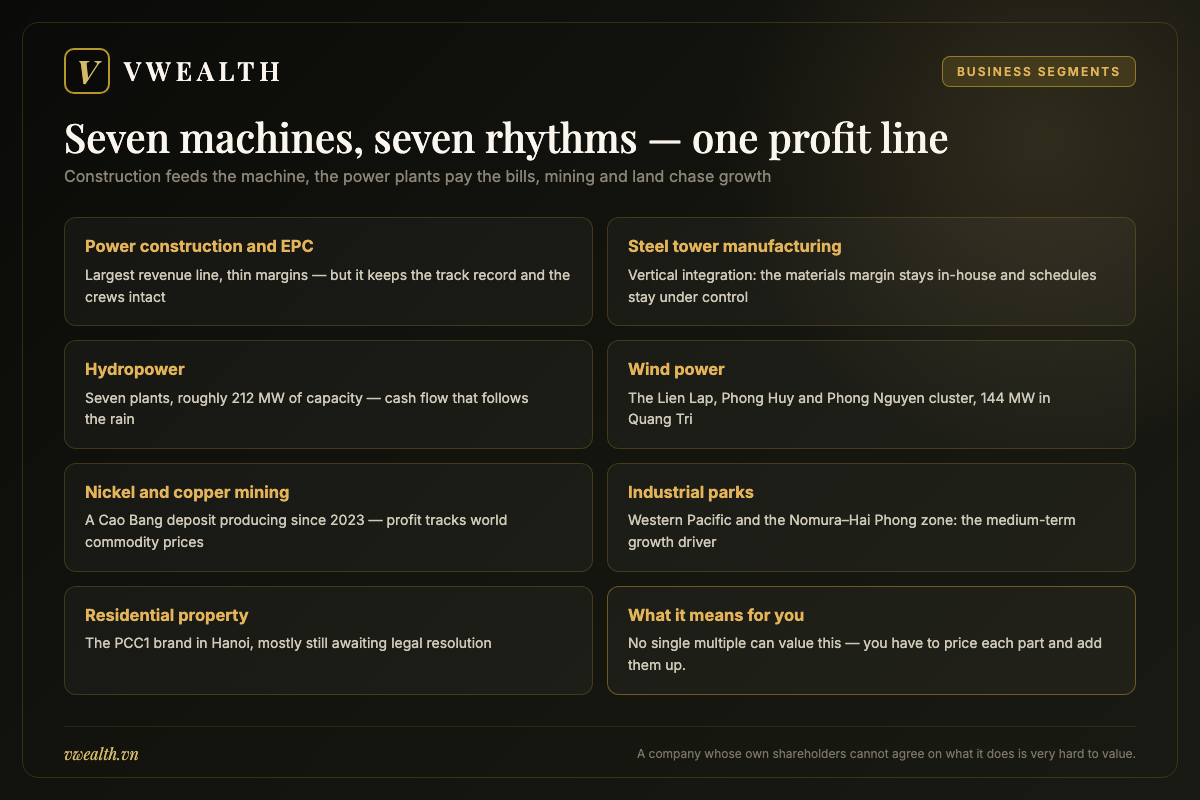
Try a small experiment. Ask ten investors who own PC1 what the company actually does. You will get at least four different answers: power construction, renewable energy, mining, industrial real estate. All four are partly right, and that is the problem. A company whose own shareholders cannot agree on what it does is extremely hard to value, because every segment has a different margin, a different cycle and a different risk. This chapter takes the machines apart one by one — which produces revenue, which produces profit, and which one feeds which.
Machine one: power construction and EPC — the name, the track record and the thin margin
This is the original trade and still the largest revenue contributor. PC1 takes contracts to build transmission lines and substations, and increasingly full EPC packages for both power plants and industrial-park infrastructure.
Its standing in the trade is real. On the 500kV Circuit 3 line, Quang Trach to Pho Noi section, PC1 signed packages worth roughly VND 2,083 billion, equal to about 9.5% of total project value — a share very few Vietnamese companies achieve on a national key project. The Quynh Luu–Thanh Hoa section alone accounted for three packages worth VND 207.4 billion; Quang Trach–Quynh Luu for four packages worth VND 286.3 billion; and Nam Dinh I Thermal Power Plant–Pho Noi for three packages worth VND 166 billion. The balance came from steel tower and equipment supply. After that came the 500kV Lao Cai–Vinh Yen line, roughly 300 km, VND 7,410 billion of total investment, operating from the fourth quarter of 2025.
But you have to understand the economics of the trade before those thousand-billion figures excite you. Construction is a thin-margin business: prices are set by competitive tender, input costs — mainly steel — move outside your control, and one weather event or one delayed site handover can eat the entire expected profit. Revenue in the billions here typically leaves a very modest profit behind. That does not make the segment useless. On the contrary, it keeps a workforce of thousands employed, keeps the capability record current, and — most importantly — lets PC1 build its own power plants at internal cost. But if you value PC1 like a manufacturer earning double-digit margins, you have gone wrong at the very first step.
One term you need for any construction company is backlog: the value of signed contracts not yet executed, meaning revenue already in the bag that will be recognised across coming quarters. Backlog is the best available indicator of a contractor’s near future, better than last quarter’s profit. When you open the PC1 report on the vwealth platform, that is the first number to look for, alongside the pace of new signings.
Machine two: industrial manufacturing — steel towers and the closed loop
Few investors pay attention to this segment, yet it is the piece that separates PC1 from a pure contractor. The company manufactures steel transmission towers, hot-dip galvanised steel structures and line accessories — precisely the materials a grid project consumes most of.
The benefit is double. First, when bidding for a package that covers both construction and tower supply, PC1 can quote more competitively than a rival that has to buy towers on the open market, because the manufacturing margin stays in-house. Second, on campaign-schedule projects like 500kV Circuit 3 — where the whole country mobilised dozens of contractors and steel tower supply became the bottleneck — owning your own plant is a scheduling advantage that money genuinely cannot buy.
This is the clearest illustration of vertical integration: instead of occupying one link in the chain, the company occupies several consecutive links to keep more of the margin and control its own inputs. The flip side is that you have to feed the plant even when there is no project, and you carry steel-price risk exactly like a steel company does. If you want to understand that second point properly, read our analysis of Hoa Phat, which sits at the head of Vietnam’s steel chain, and of Hoa Sen Group in coated and galvanised steel — together they show you the amplitude of the input-price swings PC1 has to absorb.
Machine three: hydropower — seven plants, 212 MW and cash flow that follows the rain
PC1 today operates seven hydropower plants with roughly 212 MW of combined capacity and cumulative investment above VND 6,800 billion, with more under construction. Two notable projects in the current pipeline are Bao Lac A and Thuong Ha, with cumulative investment to end-2025 of roughly VND 818 billion, expected to begin generating in the second half of 2026.
Hydropower has the prettiest economics in the whole group, and you should understand why. Once built, a hydro plant’s operating cost is very low — water is free, the operating headcount is small, there is no fuel bill. Most of the cost base is depreciation and interest, both fixed charges that decline over time. Which means that every kWh sold after the break-even point converts almost directly into profit. That is why a company with a good hydro portfolio typically shows a power-segment gross margin many times its construction margin.
But hydropower answers to a boss nobody can command: the weather. Output depends on rainfall, and rainfall in Vietnam is strongly influenced by the El Niño–La Niña climate cycle. In a La Niña year the rain is heavy, plants run at full load and power-segment profit surges. In an El Niño year the reservoirs run low, output falls, and you will see group profit drop sharply without any management error at all. Inexperienced investors confuse the two — they see profit fall and conclude the business has weakened, when in fact it simply did not rain. The correct approach is to look at generation output across several years combined, never to judge on a single quarter.
Machine four: wind power — 144 MW in Quang Tri and the currency question
The three farms at Lien Lap, Phong Huy and Phong Nguyen in Quang Tri province, 48 MW each for 144 MW total, reached commercial operation in October 2021 with total investment of roughly VND 6,000 billion and added annual output of roughly 400 million kWh. The project was developed alongside a Japanese partner using green loans from international development finance institutions.
Hitting commercial operation before the fixed-tariff deadline was this segment’s single biggest achievement, because it locked in a relatively attractive electricity price for years. But there is an attached risk that individual investors almost always ignore: foreign exchange risk. When you borrow in US dollars or Japanese yen to build a plant that sells electricity in Vietnamese dong, every depreciation of the dong against the borrowing currency inflates your debt as measured in dong, and that difference flows straight into financial expenses for the period. In years of sharp currency movement, the revaluation loss alone can consume a meaningful slice of profit even though the turbines are turning normally and the cash is arriving on schedule.
This is where you have to read the notes to the financial statements rather than just the profit line. The questions to ask: what percentage of PC1’s borrowings are in foreign currency, are they fixed or floating rate, and does the company use any hedging instrument? The current metrics on the vwealth platform will give you the present debt structure so you can answer for yourself.
Beyond Vietnam, the company has also taken a 58.5 MW wind EPC contract in the Philippines worth roughly VND 1,200 billion — a first step in exporting its construction capability regionally. This is worth watching: if the build capability travels, PC1 becomes less dependent on the domestic grid investment cycle.
Machine five: nickel and copper mining — a power contractor’s commodity bet
In 2021 PC1 acquired 57.27% of Tan Phat Minerals, which holds the rights to a nickel–copper deposit in Quang Trung commune, Hoa An district, Cao Bang province. Some published sources describe raw ore reserves of roughly 7.5–8 million tonnes, while others cite higher figures — a detail you should verify yourself in the annual report rather than trusting a single number. The processing plant has a design capacity of roughly 600,000 tonnes of ore per year, total investment of roughly VND 1,700 billion, an expected mine life of 15–20 years, and nickel and copper as its principal products.
The project entered production in 2023 and contributed revenue immediately: roughly VND 705 billion in 2023, jumping to roughly VND 1,710 billion in 2024, then roughly VND 1,139 billion in 2025 according to disclosed figures. Those three numbers tell a story more important than the numbers themselves: mining does not grow in a straight line, it moves with commodity prices.
Why nickel? The pitch is attractive: nickel is an important input for the cathodes of certain lithium-ion battery chemistries used in electric vehicles, and the global EV wave should support nickel demand for years. That argument has a real basis. But you must weigh it against three realities. First, the nickel price on the London Metal Exchange has gone through periods of extreme volatility, and no Vietnamese company has any say in how it is set. Second, battery technology is changing fast, with low-nickel and nickel-free chemistries increasingly dominant in the mass-market segment — if that trend wins, nickel demand will not rise as hoped. Third, maturing battery-recycling technology will introduce a secondary supply source over the coming decade.
The practical conclusion: treat mining as a segment capable of delivering exceptional profit in good price years, but do not put it in the “base value” bucket when you value the company. Earnings that depend on a world commodity price deserve a much heavier discount than earnings from a long-term power purchase agreement.
Machine six: industrial parks — land bank, FDI flows and a jackfruit strategy
This is the most anticipated segment over the medium term. PC1 approached industrial real estate along two parallel roads.
The first road is Western Pacific. Since April 2022 PC1 has held roughly 30.08%, making it an associate. Western Pacific owns 62% of the Yen Phong II-A industrial park in Bac Ninh, and in the second half of 2024 received investment approvals for three further parks in quick succession: Dong Van VI (roughly 250 ha, Ha Nam), Dong Van V phase 1 (roughly 237 ha, Ha Nam) and Yen Lu expansion phase 1 (roughly 120 ha, Bac Giang). The company was also approved for a 197-hectare park in Hai Phong.
The second road is the Nomura–Hai Phong Industrial Zone. In November 2022, PC1 acquired the entire share capital of a Singapore-registered entity to become the holder of 70% of the developer of this roughly 153-hectare park. Nomura–Hai Phong differs from the other projects in one crucial way: it is a long-established, fully occupied park with a stable base of Japanese tenants — meaning it produced cash flow from the day of purchase, with no waiting for compensation and site clearance.
This approach explains a phrase management once used about its industrial land ambitions: gather many small parcels around one axis until they form a single large mass. The strength of the industrial-park segment is high margin and large cash inflows whenever a lease is signed. The weakness is that it depends directly on foreign direct investment — which is exposed to global tariff policy, to competition from neighbouring countries, and to logistics infrastructure. To see the pure version of that exposure, compare it with Kinh Bac City, whose entire business is northern industrial land.
The unfinished seventh machine: residential real estate
PC1 also runs a residential property arm under the PCC1 brand, concentrated in Hanoi. According to information disclosed in 2025, the portfolio includes the Thap Vang–Gia Lam housing development under implementation, plus four projects in Bac Tu Liem, Dinh Cong, Yen Thuong and Vinh Hung which face regulatory and legal obstacles and are scheduled to be unblocked and developed in sequence. Late in the previous year the company also divested from one legal entity, thereby exiting the Vinh Hung project.
For an investor, this segment deserves the most conservative treatment of all seven. Legally stalled residential projects in Hanoi have been the story of a great many companies for a great many years, and nobody can forecast when a resolution arrives. The safe approach is to treat this segment as a free option: good news if it clears, but assign it no value when you do the maths.
Put together, the seven machines line up as follows — and if you remember only one thing from this chapter, make it this table.
| Segment | Role in the group | Margin character | Principal risk |
|---|---|---|---|
| Power construction and EPC | Largest revenue source; keeps the capability record and the workforce | Thin, driven by tender pricing and steel costs | Grid investment cycle; slow public capital disbursement |
| Steel tower and structure manufacturing | Supports construction, retains the materials margin in-house | Moderate, improves on large projects | Steel input prices; idle plant in quiet periods |
| Hydropower (7 plants, ~212 MW) | Steady cash flow; good collateral quality | High once past break-even | Weather; the El Niño–La Niña cycle |
| Wind power (144 MW, Quang Tri) | Long-duration cash flow locked to a tariff regime | High, but eroded by financial expenses | Currency risk on foreign borrowings; seasonal wind |
| Nickel–copper mining | Source of exceptional profit in good price years | Highly volatile with commodity prices | World nickel price; battery chemistry shifts |
| Industrial parks (Western Pacific, Nomura–Hai Phong) | Medium-term growth driver | High when leases are signed | FDI flows; global tariffs; permitting timelines |
| Residential property (PCC1) | Assets awaiting legal resolution | Undetermined | Prolonged permitting obstacles |
Look at that table and the operating logic of the whole group becomes visible: construction generates cash and keeps the organisation intact, manufacturing lifts the construction margin, the two together fund the equity contribution for power projects, the power plants generate steady cash flow that supports further borrowing, and any surplus is pushed into mining and industrial land in search of growth. Strategically, that is a coherent model. The price of it is that the consolidated financial statements become very hard to read — which is exactly the subject of the next chapter.
Reading the books of a diversified contractor: PC1’s market position and financial health
Here is a question to answer before you read on. If a company reports revenue up 40% while the cash in its bank account is flat or falling, is that good news or bad news? For a retailer it is very bad news. For a construction company it is so normal that if you did not know, you should not be buying stocks in this sector. This chapter teaches you to read PC1’s own numbers — in the right order, and with the specific traps that apply to this specific company.
Position: number one in a trade that is very hard to enter
Start with the strength nobody disputes. In power grid construction, particularly at high and extra-high voltage, PC1 has for years ranked at the top by revenue and by the scale of projects completed. That position rests on three barriers a newcomer would have to clear simultaneously.
The first barrier is the capability record. Owners of national transmission projects require contractors to have completed comparable work — and 500kV projects only come along every few years nationwide. A company that has never done one is not eligible to bid, and if you cannot bid you never acquire the experience. It is a closed loop that locks newcomers out.
The second barrier is people. Building extra-high-voltage lines across mountain terrain requires tower crews, stringing crews and safety supervision engineers — trades you cannot train in a few months. When the country throws its weight behind a megaproject, the company that keeps a permanent workforce beats the company that has to hire in a hurry.
The third barrier is the internal supply chain: your own steel tower plant, as covered in chapter three. Add the three together and you have a genuine moat — not the wide moat of a regulated infrastructure monopoly, but enough to hold share in an industry where the number of contractors of sufficient scale can be counted on one hand.
Trap one: revenue is recognised by progress, not by cash received
This is the fundamental difference between a contractor’s accounts and a merchant’s. Under a construction contract, the company recognises revenue on a percentage-of-completion basis: complete 40% of the physical work and you book 40% of the contract value as revenue, even if the project owner has not paid a single dong.
The result is that two balance-sheet items swell in ways new investors overlook. The first is receivables — money the owner still owes. The second is work in progress, or construction costs incurred on work performed but not yet certified for revenue. Both are paper assets, and their quality depends entirely on whether the project owner pays on time.
For PC1, the largest project owners come from the power sector — entities with a payment record above the national average, which is a genuine advantage over a residential contractor chasing property developers for money. But better does not mean fast: state-funded projects typically involve lengthy acceptance and final settlement procedures, and retention money for warranty is released only after many months or even years.
So when you read PC1’s accounts, the first thing you do is not look at profit. The first thing is to open the balance sheet and compare receivables and work in progress against revenue for the same period. If revenue grew 30% while receivables grew 60%, the company is selling more on credit — the profit looks good on paper but the cash has not come home.
Trap two: consolidated profit blends six different rhythms
PC1’s single net profit line is in reality the sum of six independent stories. Here is an illustrative example — the numbers below are invented for clarity and are not the company’s actual figures. Suppose in one year construction earns 200, hydropower earns 250, wind earns 150, mining earns 300, industrial parks earn 100, and group financial expenses are negative 400: total 600. The following year the nickel price halves, mining earns only 100, everything else is unchanged, and total profit falls to 400 — a drop of more than 30%. A careless reader concludes the business is deteriorating. A careful reader sees that the core did not weaken at all; only the commodity bonus disappeared.
Hence the mandatory rule when analysing PC1: always read the segment reporting note, the section at the back of the financial statements where the company splits revenue and profit by business line. Without it you cannot distinguish core quality from external luck.
Rule two: separate recurring profit from one-off profit. Selling an investment, revaluing assets when consolidating a newly acquired company, reversing a provision — all of these flatter the year’s profit without repeating the next year. For a group that continually buys and sells stakes in subsidiaries and associates, as PC1 does, this is not a rare occurrence.
Trap three: the leverage of a company that both builds and invests
PC1 carries the capital structure of two different business types at once, and that makes conventional ratios misleading.
A pure contractor typically has modest borrowings but very large receivables and payables — working capital is the main problem. A power plant owner is the opposite: enormous long-term debt occupying most of the balance sheet, but with contracted electricity cash flows to service it. When both models sit on one balance sheet, PC1’s debt-to-equity ratio looks alarmingly high if you compare it against an ordinary manufacturer.
The correct approach is to unbundle it. Ask three questions. One: of total borrowings, how much is project debt — debt tied to a specific plant, serviced by that plant’s own cash flow, usually secured on the plant itself? That kind of debt is far healthier than short-term working capital borrowing. Two: how much is foreign currency debt, and if the exchange rate moves 5%, how much does the financial expense rise? Three: which borrowings mature in the next twelve months, and what source is available to repay them?
The third question matters especially in 2026. A company with a governance vacuum and disclosure problems will find refinancing harder than usual: banks turn cautious, new bond issuance becomes difficult, and if assets have to be sold to repay debt they usually have to be sold cheaply. This is the mechanism by which governance risk turns into genuine financial risk — not through the newspapers, but through the interest expense line.
Trap four: cash flow is the part that tells the truth
If you could read only one page of PC1’s entire financial report, choose the cash flow statement. The reason is simple: profit is an opinion, cash is a fact. For a group that simultaneously takes contracts and develops projects, the three cash flow lines tell three different stories.
Operating cash flow tells you whether the machine can feed itself. A fast-growing contractor often runs negative operating cash flow during intense construction phases, because money goes into materials and labour before certification. Negative for a quarter or two is normal; negative for several consecutive years while reported profit stays positive is a warning that demands attention.
Investing cash flow tells you where the company sits in its cycle. Large negative means it is building plants and buying industrial-park stakes — the future may be bright, but cash is leaving the building today. Large positive means it is selling assets, and you must ask why.
Financing cash flow tells you where the money to bridge the gap comes from. New borrowing consistently exceeding repayments across several years, combined with weak operating cash flow, is the profile of growth funded by debt — a model that works extremely well when rates are low and credit is easy, and turns dangerous very quickly when either condition reverses.
For PC1 across 2021–2025 the typical picture was heavily negative investing cash flow and heavily positive financing cash flow — precisely the portrait of a company expanding on borrowed money. That is not inherently bad. But it does mean the quality of an investment in PC1 depends heavily on whether the projects already funded earn what the plan assumed, and that takes time to verify.
The new item to monitor from 2026: the reliability of the numbers themselves
Everything above assumes one thing: that the numbers in the statements can be trusted. The May 2026 event — with an investigation relating to accounting regulations — means that assumption has to be re-examined, at least until there is a formal conclusion and one full reporting period audited under the new management.
To be explicit, so this is not misread: this does not mean previous reports were wrong. Nobody is entitled to conclude that while the authorities have reached no conclusion. It means only that the degree of certainty has fallen, and in investing, when certainty falls the risk premium must rise — you demand a cheaper entry price to compensate for what you do not know.
Three specific milestones a disciplined investor should wait for before treating PC1 as a normal investment again. One: the company publishes all outstanding financial statements and files on time for at least two consecutive periods. Two: an annual audit report with an unqualified opinion and no emphasis-of-matter paragraph that gives cause for concern. Three: clear signals on the legal process together with a stabilised executive team. Those three are conditions, not promises — and chapter seven uses them again when building scenarios.
Four steps for reading PC1’s accounts, in order
| Step | What to open | Question to answer | Warning sign |
|---|---|---|---|
| 1. Check completeness | Disclosures, report issue dates, the auditor’s opinion | Did the report arrive on time? What did the auditor say? | Late filing, an unusual auditor change, a qualified opinion or an emphasis of matter |
| 2. Unbundle by segment | The segment reporting note | Which segment produced the profit? How much is recurring versus one-off? | Profit concentrated in mining or in gains on asset sales |
| 3. Inspect revenue quality | Receivables, work in progress, backlog | Is revenue growing faster or slower than receivables? | Receivables outgrowing revenue for several periods; rising bad-debt provisions |
| 4. Test resilience | Debt structure, foreign currency debt, maturity schedule, the three cash flow lines | What will repay the debt falling due in the next twelve months? | Short-term debt exceeding cash plus expected operating cash flow; high foreign currency debt in a tight FX environment |
Those four steps apply to any construction company, but for PC1 step one currently matters more than the other three combined. If you would rather skip the manual research, these metrics are already compiled in the analysis report on the vwealth platform and updated with each disclosure cycle.

A stock priced by themes: how the market values PC1
Open a PC1 price chart from 2016 to today knowing nothing about the company and you would guess it was a speculative stock. Long dull stretches sideways, then vertical runs lasting a few months, then falls just as vertical. That is not accidental. PC1 is the sort of stock the Vietnamese market prices by theme more than by cash flow — and understanding that mechanism matters as much as understanding the accounts.
The stock’s personality: four thematic waves in ten years
The first wave was renewable energy, around 2020–2021. The whole market went hunting for companies with wind and solar projects that could make the fixed-tariff deadline. PC1 was both the contractor building other people’s projects and the owner of its own 144 MW — exactly what the story needed.
The second wave was mining, around 2022–2023. When the Cao Bang nickel mine started up, PC1 was retold as “the only Vietnamese listed company with a commercial nickel mine”, tied to the global electric vehicle wave. A segment contributing a small share of total revenue was enough to change the personality of the entire stock.
The third wave was public investment and the grid, in 2024. The 500kV Circuit 3 line sprinted to completion, PC1’s name appeared in the press continuously, and the market bought the stock as a ticket into the national infrastructure programme.
The fourth wave was industrial real estate, running from 2023 into early 2026 alongside FDI flows into the north. Every time Western Pacific received approval for another park, the stock gained fresh narrative material.
Those four waves share one instructive characteristic: each was grounded in truth, yet the price increase typically ran far ahead of the actual near-term profit the theme delivered. That is how the Vietnamese market treats diversified companies — buyers pay for the future story, and when the story does not convert into numbers fast enough, they go and find another story. For a long-term investor the lesson is not to buy at the crest of a thematic wave. For a short-term trader the lesson is not to stay too long after the news is out.
Sum-of-the-parts: the only sensible way to value PC1
You cannot value PC1 on a single price-to-earnings multiple. The reason has been clear since chapter three: six segments with six different economic natures, and the market is willing to pay different multiples for each. The right tool is sum-of-the-parts valuation, usually abbreviated SOTP: value each segment separately using the method appropriate to it, add them up, subtract net debt, then divide by the share count.
In practice that works as follows. For construction and industrial manufacturing, use earnings or EBITDA multiples from comparable contractors — typically low multiples, because margins are thin and earnings unstable. For the power plants, use discounted cash flow: estimate output and electricity prices across the remaining asset life, deduct operating costs and debt service, then discount back to the present — the standard method for assets with long, forecastable cash flows. For mining, use a low multiple and conservative commodity price assumptions, because earnings swing hard. For industrial parks, value the remaining commercial land bank at expected net lease rates, discounted according to the absorption schedule. For legally stalled residential property, the safest treatment is to assign zero and treat any positive development as a bonus.
Finally — and this is the part most people forget — you must apply a conglomerate discount. Markets routinely pay less for a diversified group than the sum of its parts, because the head office costs money, because capital allocation between segments may be wrong, and because investors find it hard to monitor. For PC1 after the events of 2026, the discount the market demands is certainly larger than before. This is why the stock can trade below book value for a long stretch and still not be “cheap” in any margin-of-safety sense.
And if you are used to comparing a current multiple against a stock’s own multi-year average and concluding cheap or expensive, be careful. That method is useful, but with PC1 it carries two traps.
Trap one: the denominator of P/E — earnings — swings violently between years because of mining, hydrology and one-off items. A year of exceptional profit produces an artificially low P/E at exactly the moment the share price is high. Conversely, a weak profit year produces a high P/E at what may be a good moment to buy. For cyclical companies, a low P/E is often a danger signal rather than an opportunity — the classic paradox value investors always cite.
Trap two: the company of 2026 is not the company of 2019. The asset base changed completely with the addition of a mine, industrial parks and thousands of billions of project debt. Comparing today’s multiple against a ten-year average compares two different entities. The better approach is to compare against companies of similar current structure, adjusted for the level of transparency.
Price-to-book is a little more meaningful for PC1, because most of the asset base is tangible: power plants, a mine, a steel tower plant, land. But you still have to ask what that book value represents. A hydro plant that is nearly fully depreciated carries a low book value while its cash flow keeps running — meaning it is understated. Conversely, an unfinished project carried at cost incurred may never generate a commensurate cash flow at all.
Foreign ownership, the room, and liquidity
PC1 has attracted foreign investor interest in the past, partly because of the renewable energy narrative and partly because the company has experience working with international financial institutions on green loans. If you are new to this market, you need the concept of the foreign ownership limit, known locally as the “room” — the maximum percentage of a listed Vietnamese company that foreign investors may collectively hold. When the room is open, foreign capital can enter at any time; when the room is full, foreign buyers must transact off-market at a premium, which reduces the stock’s appeal. The mechanics of the room, along with settlement and price-band rules, are covered in our guide to investing in the Vietnam stock market.
After a governance shock, institutional money tends to split into two very different groups. Funds with strict corporate governance mandates typically have to reduce exposure regardless of valuation — not because they believe the company will collapse, but because internal rules do not allow holding a stock with disclosure problems. High-risk-tolerance value investors buy at precisely that moment, as the financial investor group that pushed above 12% did in chapter two. Those two opposing flows explain why PC1’s trading volume surged after May 2026 while the price stayed weak.
The catalysts worth tracking
In market language, a catalyst is an event capable of changing how the majority values a company within a short period. For PC1 in the period ahead the catalyst list is unusually clear, and the interesting part is that most of it has nothing to do with trading performance.
Governance catalysts: publication of the outstanding financial statements; the auditor’s opinion on the 2026 annual report; decisions from the legal process; the appointment of a chief executive and completion of the management team; and any change in the holdings of the new large shareholder.
Business catalysts: the value of newly signed construction contracts, particularly packages under the new grid investment programme; the commissioning schedule of the hydro plants under construction; occupancy rates and rental prices at the industrial parks; the world nickel price; and progress on unblocking the residential projects.
Macro catalysts: domestic interest rates, the exchange rate, the pace of public investment disbursement, and FDI flows into the northern provinces. Notice that PC1 is sensitive to almost every macro variable that matters in Vietnam — which is simultaneously its appeal for anyone wanting to bet on the country’s growth, and the reason this stock does not let you sleep well.
Power, land and metal: the economic and industry backdrop for PC1
Here is something few people say plainly: over the next decade, the single biggest determinant of PC1’s fate is not the quality of its management but whether Vietnam actually spends money on its power grid as planned. A capable company in an industry with no work is only capable on paper. This chapter looks outward — at the field PC1 is playing on.
The revised Power Development Plan VIII: USD 136.3 billion and a bottleneck called the grid
On 15 April 2025 the Prime Minister signed Decision 768/QD-TTg approving the revision of the National Power Development Plan for 2021–2030 with a vision to 2050 — commonly shortened to the revised Power Development Plan VIII, or PDP8. Under it, total investment in generation and transmission for the 2026–2030 period is equivalent to roughly USD 136.3 billion, comprising roughly USD 118.2 billion for generation and roughly USD 18.1 billion for the transmission grid.
For a foreign investor unfamiliar with Vietnamese policy documents, a word on what a power development plan is. It is the state’s binding master plan setting out what generation capacity is to be built where, by what technology and on what timetable, together with the transmission network needed to move that power. It is not a wish list — project approvals, land allocation and grid connection all flow from it. When the plan is revised, whole industries re-price. PDP8 is the document that made renewables boom in Vietnam in 2019–2021 and the document that now points the money at wires and substations.
The USD 18.1 billion transmission figure over five years is the single most important piece of context for PC1. For scale: the entire 500kV Circuit 3 line from Quang Trach to Pho Noi, the project treated as a national engineering feat, had total investment of over VND 22,300 billion — under one billion US dollars. Which means planned transmission investment amounts to many times that project, spread across five years.
Why has the grid become the priority? Because Vietnam has walked into a paradox in recent years: renewable generation has grown very fast in the centre and the south, while demand has grown fastest in the north, where the new industrial parks are. Without lines large enough to connect the two ends, power generated in one place cannot reach the place that needs it. That is precisely why 500kV Circuit 3 was built at campaign speed. And it is why PC1’s construction segment has a solid demand base for years, regardless of what happens at the top of the company.
But industry demand does not automatically become company profit — and this is where many investors make a logical error. The sector having USD 18.1 billion to spend does not mean contractors get rich. Three reasons.
First, competitive tendering grinds down margins. When there is plenty of work, contractors expand capacity; when volumes plateau, surplus capacity leads to low bids just to keep crews busy. This is the classic cycle of construction industries everywhere in the world.
Second, actual disbursement always lags the plan. A plan is a plan; capital allocation, site clearance and investment procedures determine when a contractor actually gets paid. A construction company can go through two hungry years in the middle of a cycle everyone is calling a boom.
Third, and most relevant to PC1 right now: to win large packages, a company needs credibility and financial capacity acceptable to the project owner. A company with disclosure problems and senior personnel upheaval will find that step harder — not necessarily disqualified, but negotiating from a weaker position. This is the most concrete transmission channel from governance risk to operating results, and it is something you should track through each tender award announcement.
The competitive map: where PC1 sits among its peers
Vietnam’s listed power-related companies fall into roughly four tiers, and PC1 is the rare case that stands in several tiers at once.
The upstream tier is fuel — companies supplying gas and coal to thermal plants. The generation tier is the plant owners. The transmission and distribution tier belongs largely to the state sector, but the construction work for that tier is open to private companies — and that is PC1’s home ground. The fourth tier is equipment and technical services.
What makes PC1 unusual is that it works for tier three, owns assets in tier two, and adds two out-of-sector segments in mining and industrial land. Direct comparison against any single peer is therefore always imperfect — which is exactly why the market struggles to value this stock.
The table below places four ways of making money from the same power industry side by side, so you can see what PC1 is really selling to investors.
| Model | Typical example | Main revenue source | What determines profit | Stability |
|---|---|---|---|---|
| Contractor and power plant owner combined | PC1 | Construction contracts, electricity sales, minerals, industrial land leases | Grid investment cycle, weather, nickel prices, FDI flows | Low — too many variables at once |
| Pure power plant owner | PV Power | Electricity sold into the system | Fuel costs, dispatch volumes, electricity market rules | Moderate |
| Financial investor in power and water infrastructure | REE Corporation | Dividends from a portfolio of power, water and office leasing assets | Performance of the portfolio companies | High — diversified cash flow |
| Upstream fuel supplier | PV GAS | Gas and LPG sales to industry and power | World oil and gas prices, field output | Moderate — commodity cyclical |
This table shows you something important: if your objective is a steady dividend stream and undisturbed sleep, PC1’s model is not the rational choice — other models in the same industry serve that objective far better. PC1 suits someone who wants to bet on the infrastructure investment cycle and will accept large swings in exchange for higher potential returns when the cycle runs their way. If you are still mapping the sectors of this market, the Vietnam stock market guide sets out how the industrial and energy group fits alongside banking, real estate and consumer names.
Two variables nobody controls: the world nickel price and the rain
The mining segment ties PC1 to a market no Vietnamese company can influence. Nickel prices are set by supply from the major producing nations — particularly the sharp supply growth from Southeast Asia in recent years — and by demand from two industries: stainless steel, still the largest consumer, and electric vehicle batteries.
The EV story is told often and needs careful reading. Not every battery type uses much nickel; mass-market chemistries built on iron and phosphate already hold a large share of the budget vehicle segment, and that trend is continuing. At the same time, battery recycling technology is maturing and promises a meaningful secondary supply source over the coming decade. Which means the claim that “nickel demand can only rise” is far less certain than it is usually presented.
For a PC1 investor, the practical response is: do not build your investment case on the nickel mine. Treat it as a conditional bonus. If you see an analysis that adds the mine’s value into the valuation using an assumption of high nickel prices sustained for twenty years, read the assumptions section carefully before believing the conclusion.
FDI, northern industrial parks and the tariff variable
PC1’s industrial-park segment sits in the core of the manufacturing relocation wave into Vietnam: Bac Ninh, Ha Nam, Bac Giang, Hai Phong — the northern industrial corridor tied to the electronics supply chain and its satellite factories.
The long-term drivers are solid: competitive labour costs, proximity to China, improving port and road infrastructure, and the supply-chain diversification strategies of global corporations. But three variables need watching. The first is tariff policy in major export markets — a large change in duties can slow decisions about where to place a new plant. The second is competition on land rents between parks in the same region, as northern industrial land supply grows quickly. The third is power infrastructure, and here the paradox is elegant: the new industrial parks are themselves creating the electricity demand that forces the transmission grid to expand. Two of PC1’s segments accidentally support each other at the macro level.
The last variable is the least discussed but the most directly connected to annual cash flow: rainfall. PC1’s roughly 212 MW hydropower portfolio sits mostly in the northern mountains, where output depends on the wet season and on temperature.
The El Niño–La Niña cycle typically runs for several years and has a pronounced effect on rainfall in Vietnam. Investors should treat it as short-term noise rather than a signal about business quality: a bad hydrology year reduces profit without removing a single megawatt of capacity. Equally, an unusually good hydrology year produces a profit level that should not be extrapolated. The correct reading is to use multi-year average output as your reference point.
Three roads ahead: should you buy PC1 stock for the next three years?
By now you have probably noticed something: the PC1 story today has two layers stacked on top of each other. The lower layer is a company with real assets, a real trade, and an industry entering a large investment cycle. The upper layer is an unresolved governance crisis. The share price over the next two to three years will be decided by how the upper layer is handled, not by how well the lower layer trades. This section builds three scenarios — not to forecast a price, but to tell you what to watch.
Three long-term drivers that depend on nobody
Before the scenarios, separate out the things that are close to certain regardless of what happens at the top of the company.
The first driver is Vietnamese electricity demand. An industrialising economy growing at a high rate, plus a wave of data centres and technology manufacturing, will consume steadily more power. That power has to be transmitted, and transmitting power requires towers, conductors and substations. PC1’s trade will have work for decades.
The second driver is the energy transition. The revised PDP8 sets a very high long-term renewable share, and the defining characteristic of wind and solar is that they are distributed — sited where the resource is, not where the demand is. The more renewable generation there is, the stronger and more flexible the grid must be, which means more work for grid contractors.
The third driver is foreign direct investment into northern manufacturing. As long as global corporations want factories in Vietnam, the industrial land held by PC1 and Western Pacific has tenants.
Those three are the “certain” part of the equation. The uncertain part — and unfortunately the decisive part — is in the three scenarios below.
Bull case: the governance crisis closes, the investment cycle opens
In this scenario PC1 publishes all outstanding financial statements within a short period, and those numbers contain no large negative surprise. The annual report is audited with an unqualified opinion. A new executive team is completed with qualified people in the key posts, responsibilities are clearly assigned, and internal financial control regulations are visibly tightened. The legal process proceeds in a way that stays confined to individual responsibility, without major legal consequences for the corporate entity itself.
In parallel, the construction segment keeps winning packages under the grid investment programme, and backlog recovers and grows. The two hydro plants under construction generate on schedule, adding steady cash flow. The new industrial parks complete their permitting and begin signing leases. Nickel prices move sideways or recover, enough for mining to contribute consistently.
What happens to the stock in this scenario is not a profit explosion but a compression of the risk discount. Investors are currently valuing PC1 with a large deduction for uncertainty; when the uncertainty falls, the deduction itself disappears. For stocks that have been through a governance crisis and recovered, most of the price appreciation comes from this mechanism rather than from business growth. It is also why risk-tolerant institutional investors are willing to buy at the worst moment.
The conditions for this scenario, written as a checklist: financial statements filed on time for two consecutive periods; a clean audit opinion; announcements of significant new contract wins; no further executives charged; and the new large shareholder maintaining or increasing its stake.
Base case: the business keeps running, the stock ranges widely
This is the highest-probability scenario on ordinary reasoning, and also the most uncomfortable one for anyone short on patience.
Here the power plants keep generating, the mine keeps producing, and signed construction contracts keep being executed. The company does not collapse — which matters, because PC1’s assets are physical cash-generating assets, not financial assets that can evaporate. But the legal process drags on, senior appointments take time, and while waiting the company turns cautious: fewer large new contracts, deferred major investment decisions, a preference for holding cash and servicing debt on schedule.
The result is flat or slightly lower profit, mostly from the power segment and legacy contracts. The stock oscillates inside a wide band: every positive governance headline lifts it, every fresh uncertainty pushes it down, and there is no clear trend for several quarters.
For an investor this scenario raises a question few people think about: opportunity cost. Suppose you buy PC1 near the lows and it does indeed recover two years later — but during those two years the same money in a more transparent company with steady growth might have produced a better result without you having to live with the uncertainty. Investing is not only about choosing what will rise; it is about choosing what will rise enough to compensate for the risk and the time you commit.
Bear case: risk migrates from individuals to the company
The bear case is not necessarily bankruptcy — with an asset portfolio like PC1’s, that is unlikely. The bear case is a chain of events that erodes shareholder value along several paths at once.
Path one: the delayed financial statements, when published, show a materially different picture from what the market assumed, or the auditor issues a qualified opinion. Every valuation model then has to be rebuilt from scratch, and markets typically respond by selling first and asking later.
Path two: the stock is placed under warning or control status for breaching disclosure obligations. The direct consequence is that many funds and securities firms remove it from their margin-eligible lists, sharply reducing demand and liquidity. This is a technical mechanism with a very real price impact.
Path three: refinancing difficulty. Banks tighten conditions, borrowing costs rise, planned bond issuance is postponed. For a company carrying large project debt, a few percentage points of extra funding cost is enough to erase an entire segment’s profit.
Path four: lost contracts. If reputational damage persists, the ability to win large packages declines, backlog runs down, and the largest revenue segment shrinks — forcing headcount cuts, and the workforce is precisely this company’s moat.
Path five: distressed asset sales. If cash is needed urgently, the company may have to sell power plants or industrial-park stakes — its best assets, and usually from a position of weakness.
Note one thing: those five paths are not independent. They tend to trigger one another in a chain. That is why professional investors classify governance risk as the kind of risk you should not attempt to bottom-fish with a large position, however cheap the valuation looks.
The three scenarios, together with the specific conditions you need to observe to know which way reality is drifting, are set side by side in the table below.
| Scenario | Conditions to watch | What happens to the business | How the stock behaves |
|---|---|---|---|
| Bull | All outstanding reports published; unqualified audit opinion; executive team completed; significant new contract wins; no further charges | Backlog recovers, two new hydro plants generate, industrial parks start leasing | The risk discount compresses — most of the upside comes from this, not from profit growth |
| Base | Reports arrive but late and piecemeal; the legal process drags; management rebuilt only in part | Assets keep operating, the company stays cautious, large investment deferred, cash preserved | Wide sideways range, sharp moves on each governance headline |
| Bear | Qualified audit opinion; stock placed under warning or control; borrowing costs rise; large packages lost | Backlog runs down, assets sold to balance cash flow, the organisation shrinks | Liquidity dries up as margin eligibility is withdrawn; a deep and prolonged decline |
To restate the principle behind this whole series: we do not publish target prices. Not out of modesty, but because for a company with six business segments and an ongoing legal process, any target price is merely a dressed-up assumption. Your job is not to guess the price. It is to track which scenario reality is drifting toward — and adjust your position size accordingly.

So, should you buy PC1 stock?
After everything above, this is where we answer plainly. And the most honest answer is neither yes nor no: PC1 today is two different investments sharing one ticker — an energy infrastructure company with real assets in a rising industry, and a special situation awaiting resolution. You need to know which one you are buying.
The case for: what PC1 actually holds
The first strength is professional standing. Sixty-three years of power construction, crews capable of building transmission lines at the highest voltage class, an in-house steel tower plant, and a capability record on national key projects. That is an advantage money cannot buy in the short term, and it does not vanish because of a legal matter.
The second strength is genuinely cash-generating assets. Seven hydropower plants of roughly 212 MW, a 144 MW wind cluster in Quang Tri, two hydro plants under construction. These are not paper assets — they generate electricity every day and collect money under long-term contracts, whoever occupies the chairman’s seat.
The third strength is industrial land sitting in the core of the northern FDI corridor, through Western Pacific and the Nomura–Hai Phong Industrial Zone. Nomura in particular is a rare kind of asset: a fully occupied park with stable tenants generating cash from day one.
The fourth strength is an industry entering a large investment cycle under the revised PDP8, with roughly USD 18.1 billion allocated to the transmission grid for 2026–2030. Being the leading contractor in an industry with a lot of money to spend is a good place to stand.
The fifth strength is situational: the stock has already fallen sharply, and a group of institutional investors committed more than a thousand billion dong to lift its holding above 12% of capital, stating that this is a purely financial investment. That guarantees nothing, but it tells you a professional party assesses the asset value above what the market is currently paying.
The case against: what could cost you money
The first risk, larger than all the others combined: uncertainty about governance and information quality. When four of five board members are in custody and the financial statements are late enough to draw two public reminders, fundamental analysis tools temporarily stop working. You cannot value what you cannot measure.
The second risk is the continuing legal process. Nobody knows how long it will run or where it leads. Under the presumption of innocence we pass no judgement on the outcome; but as an investor you have to accept that this is a variable you can neither forecast nor control.
The third risk is a diversified model that is hard to read. Six segments, six rhythms, one consolidated profit line. Even with perfect transparency, analysing PC1 takes several times the effort of a single-segment company.
The fourth risk is financial leverage. The company carries large project debt on its power plants, partly in foreign currency. Rising interest rates or a weakening dong both cut straight into profit, and in current circumstances refinancing is no longer as easy as it was.
The fifth risk is the set of variables outside anyone’s control: the world nickel price, annual rainfall, the pace of public investment disbursement, FDI flows and global tariff policy. A company sensitive to many macro variables simultaneously is a company with a very wide profit distribution.
The sixth risk is technical but very real: if the stock is placed under warning or control status for disclosure breaches, securities firms will remove it from margin-eligible lists. That evaporates a meaningful slice of demand, and the price can keep falling with no new bad news at all.
Put the two lists side by side and you see something interesting: almost every PC1 strength comes attached to a weakness born out of that same strength.
| Strength | The matching weakness |
|---|---|
| Leading position in grid construction, a moat built on track record and crews | Thin construction margins; damaged credibility weakens the bargaining position in tenders |
| Power assets generating real cash: ~212 MW hydro, 144 MW wind | Cash flow depends on weather and wind seasons; large project debt, partly in foreign currency |
| Industrial land in the heart of the northern FDI corridor | Dependent on FDI flows and tariff policy; rising competition on land rents |
| An operating nickel–copper mine, rare among Vietnamese listed companies | Profit swings with world commodity prices; battery chemistry could reduce nickel demand |
| An industry entering a large investment cycle under the revised PDP8 | Actual disbursement usually lags the plan; competitive tendering erodes margins |
| A new institutional shareholder above 12% after the sell-off | The buyer states the holding is purely financial and will not participate in management — not a governance lifeline |
| The board has been reconstituted with two independent directors with relevant expertise | Two of the four new seats still belong to the family bloc; the new chair is very young with no executive track record to assess |
| Assets are overwhelmingly tangible and hard to evaporate | Late financial statements leave every valuation method temporarily without a basis |
Who PC1 suits, and who it absolutely does not
PC1 may suit an investor already experienced with special situations, who understands they are buying a bet that a governance crisis gets resolved cleanly, and who uses only a small position — small enough that if it goes to zero the personal financial plan is undisturbed. That person must be able to read financial statements down to the notes, must follow disclosures regularly, and must have patience measured in years rather than quarters.
PC1 may also suit a long-term investor who believes in Vietnam’s power infrastructure investment cycle and wants to own a company with a moat in that industry — but only on the condition that they wait for the confirmation milestones listed in chapter four: reports back on schedule, a clean audit opinion, a stable executive team. Waiting means buying above the low, but in exchange you buy something measurable. In investing, paying a little more for certainty is usually a bargain.
PC1 absolutely does not suit four groups of people. Group one: anyone seeking steady cash dividends to cover living expenses — this company prioritises retaining earnings for reinvestment, and in current circumstances it needs cash even more. Group two: anyone using margin leverage — with a stock at risk of warning or control status, margin is the shortest route to being force-sold at the bottom. Group three: beginners who have never read the notes to a financial statement — this is one of the hardest filings on the exchange, and it is not the place to learn the craft. Group four: anyone who cannot tolerate volatility, who checks prices hourly and decides on emotion — this stock will cost you sleep and make you sell at the wrong moment.
The closing thought: buying assets is easy, buying trust is hard
There is something worth sitting with in the whole PC1 story of 2026. In the month when roughly a third of the market capitalisation evaporated, not one megawatt of capacity disappeared. Seven hydropower plants kept generating. The wind farms in Quang Tri kept turning. The mine in Cao Bang kept producing. The industrial parks kept collecting rent. If you value the company by adding up the things that physically exist, almost nothing changed.
What changed was the belief that the numbers you read reflect what is actually happening, and the belief that whoever holds the wheel will use those assets in the interest of all shareholders. A stock market, in the end, does not price assets — it prices the right to receive cash flows from assets through a governance mechanism. When the mechanism is in question, the gap between “asset value” and “share price” is the price of broken trust. That is the most expensive lesson PC1 shareholders learned this year, and it is one worth carrying with you when you look at any other company on any exchange.
So if you ask whether you should buy PC1 stock, our answer is: only buy if you can answer three questions. One, are you buying an energy infrastructure business or are you buying a special situation? Two, what would need to happen for you to conclude you were right, and what would need to happen for you to admit you were wrong? Three, if this position returns nothing for three years, does your financial life change? Answer all three and you are ready. Answer none of them and what you need right now is not a ticker but more time to study — and a data source reliable enough to follow the company through each disclosure cycle. You can start by opening a free vwealth account to receive updated analysis reports on PC1 and the rest of Vietnam’s industrial and energy names, instead of chasing every figure across a dozen scattered sources.
Research Vietnamese stocks in English with vwealth. Our AI-powered platform turns Vietnamese market data into full English analysis reports — with international payment support and a free 2-month trial for new accounts. Create your free account and read the latest reports.