Should you buy ORS stock — the HOSE-listed shares of Tien Phong Securities Joint Stock Company, known in the market as TPS — is rarely a question anyone asks calmly. Over the past two years the name has been attached to three very different storylines: a criminal case in which a former chairman of the company was charged, a capital raise that turned Tien Phong Commercial Joint Stock Bank into the controlling parent, and a stated ambition to break into Vietnam’s top ten brokerage houses within three years. Those three storylines pull the stock in three directions at once. This article separates them, handles each in turn, and handles the legal chapter the way this series has handled every sensitive name before it: reporting only what the authorities and the company have officially disclosed, applying the presumption of innocence in full, attributing no guilt and drawing no inferences. You will end with the facts you need to answer the question yourself, rather than a ready-made verdict.
Before we start, one convention between you and this article, the same convention that governs every company analysis in this series. You will meet a great many dates, names, charter capital figures and transaction details. All of them come from public disclosure: licences and decisions issued by the State Securities Commission, filings made to the stock exchange, shareholder meeting resolutions, the company’s own official statements, and mainstream financial media. What you will not find here is a figure for the most recent quarter or a valuation multiple as of today. For a securities firm those numbers move with market turnover, which nobody forecasts reliably. Instead this article teaches you where to look and how to read what you find; for the current numbers, open the latest research reports on vwealth.
The second convention matters more, and it applies specifically to this ticker. One chapter of this article deals with a criminal case in which investigators have charged a number of individuals, including a person who formerly chaired the company’s board. The article states what has been officially disclosed: who was charged, under what article of the penal code, what roles the company itself has confirmed it played in the bond issues concerned, and the legal status of the corporate entity. The article does not speculate about the outcome of proceedings, does not attribute responsibility to anyone beyond what prosecutors have stated, and does not convert the matter into an investment thesis in either direction. Under Vietnamese law, as under most legal systems, a person who has been charged is not a person who has been convicted until a court judgment has taken legal effect.
The third convention: this is not a buy or sell recommendation. The final chapter states plainly which kind of investor this stock suits and which kind it does not, but the decision remains yours.
From Oriental Securities to Tien Phong Securities: a company that has changed owners twice
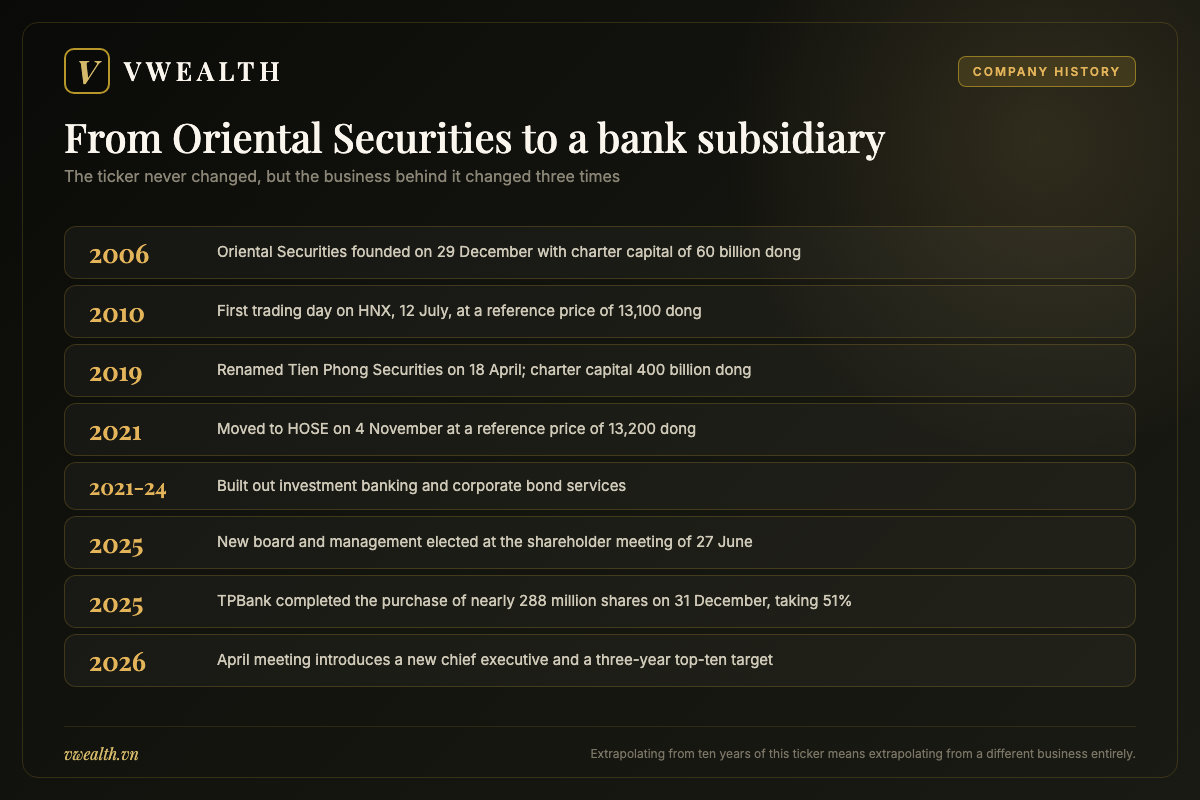
Here is a detail most newer investors miss: the three letters ORS have nothing to do with the name Tien Phong. They are a survival from the company’s original name, Oriental Securities. A Vietnamese ticker stays fixed when a company rebrands, so to this day you type ORS to find a firm that trades under the TPS brand. That small oddity captures the defining feature of this business: it has passed through several owners, and each change of owner brought a complete change of business model.
2006: born in the middle of Vietnam’s first equity boom
Oriental Securities Joint Stock Company was established on 29 December 2006 with initial charter capital of 60 billion dong. That sounds tiny by today’s standards, and it needs context.
2006 was the year Vietnam’s stock market went vertical for the first time. The VN-Index surged, new trading accounts multiplied, and the regulator licensed a large number of securities firms in a very short window. Everyone wanted a brokerage licence, because at that moment brokerage was a fat-margin business: commissions were high, competitors were few, and retail money was pouring in.
A great many Vietnamese brokerages alive today were born in that same window. What distinguishes them is not their birth year but what happened after the boom ended. For Oriental Securities, the years that followed were quiet. The firm sat in the small-cap tier, never appeared near the top of the exchange market-share tables, and left no meaningful brand imprint on retail investors.
Hold on to that, because it explains a characteristic that persists today. ORS does not carry the deep legacy retail franchise that firms which spent two decades building branch networks and broker teams enjoy. Its customer base has essentially been rebuilt within the last seven years, and that fact is simultaneously a weakness and something that can change quickly.
2010: listing on the Hanoi exchange at a 13,100 dong reference price
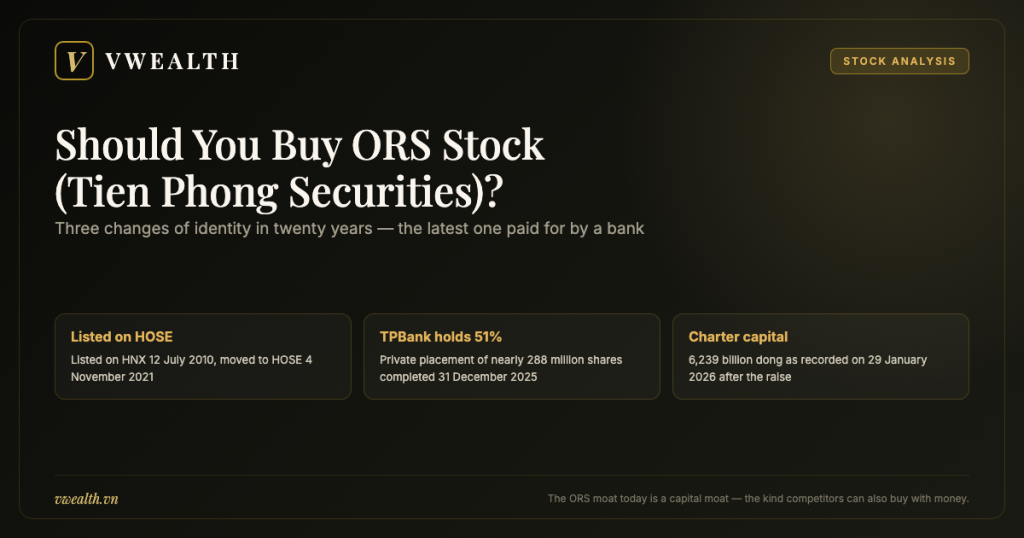
On 12 July 2010 ORS shares began trading on the Hanoi Stock Exchange at a reference price of 13,100 dong per share. That was a standard move for mid-sized and small brokerages at the time: list to open a funding channel and to raise the standard of disclosure.
But 2010 also opened an extremely hard stretch for the entire industry. Vietnamese equities entered a prolonged downcycle, turnover shrank, and brokerage went from a licence to print money to a business that bled cash. Numerous securities firms cut back, some had operating licences suspended for specific activities, and others quietly sold themselves to new owners.
That is the first lesson this company’s history teaches, and it applies to every brokerage rather than to ORS alone: the earnings of a securities firm depend more on market turnover than on the quality of its own management. A well-run firm can lose money in a dull year. An average firm can post record profits in a hot one. If you do not internalise this, you will misread the financial statements of the entire sector, year after year.
April 2019: joining the TPBank orbit and taking a new name
On 18 April 2019 the State Securities Commission issued an amended licence formally renaming Oriental Securities Joint Stock Company as Tien Phong Securities Joint Stock Company, abbreviated TPS and trading internationally as TP Securities. Charter capital at that point stood at 400 billion dong.
The rebrand came with the arrival on the board of individuals associated with the Tien Phong Commercial Joint Stock Bank ecosystem. From that point the market began to view the firm as a link in a financial group built around TPBank, even though the bank’s direct legal shareholding at the time was still very small.
You need to keep two concepts apart here, because retail investors confuse them constantly and the confusion is expensive. Belonging to an ecosystem and being a subsidiary are entirely different things. Belonging to an ecosystem means sharing a brand, people, customers and strategic direction. Being a subsidiary means another legal entity holds a controlling stake, consolidates your financial statements, and must comply with related-party transaction rules. From 2019 through the end of 2025, TPS was in the first state. Only from late 2025 did it move into the second — and that is the single largest turning point in the company’s history.
November 2021: moving up to the Ho Chi Minh City exchange
On 4 November 2021 ORS shares began trading on the Ho Chi Minh City Stock Exchange, with a first-session reference price of 13,200 dong per share.
Moving from HNX to HOSE is a practical decision rather than a vanity one. HOSE applies higher listing standards, its indices are the ones institutional funds track, and above all it offers a far deeper liquidity pool. For any stock, moving from a thin venue to a deep one tends to bring a higher relative valuation and greater institutional attention.
The timing is worth noting. Late 2021 was the peak of an unprecedented boom in Vietnamese equities. New account openings hit records, daily turnover repeatedly exceeded a billion dollars, and brokerage stocks were among the strongest performers on the market. Keep that backdrop in mind as you read the next section.
2021 to 2024: the investment banking model and the corporate bond business
During this period TPS built a commercial identity quite unlike most brokerages of similar size. Rather than fighting for market share in brokerage — where the fee war had already turned brutal — the firm pushed hard into investment banking, and specifically into services around privately placed corporate bonds: issuance advisory, issuing agency, depository agency, and bondholder representative.
You need to understand those four roles to read the legal chapter correctly. Issuance advisor means helping the issuer design the documentation and the terms of the bond. Issuing agent means distributing the bonds to investors. Depository agent means holding the bonds and recording ownership. Bondholder representative means acting on behalf of bondholders to monitor the issuer’s compliance with its covenants. The four differ in nature and in the level of responsibility attached, and a securities firm may take on one, several, or all of them.
2021 and 2022 were the hottest years Vietnam’s private corporate bond market has ever seen. Issuance volumes climbed rapidly, disclosure standards were loose, and intermediaries earned substantial fees. Then from late 2022 the market entered a crisis of confidence: a series of issuers failed to meet payment obligations on time, the legal framework was tightened, and investigators opened cases into a number of situations.
For TPS, having been an intermediary in a number of bond issues from that era is a historical fact. It produced very strong revenue in the early years and produced legal and reputational risk in the later ones. The second chapter of this article addresses that in the correct scope.
2025: a legal shock and a complete change at the top
2025 was the pivot year. In mid-March the company and the bank both announced that Mr Do Anh Tu was stepping down from his positions at his own request. In early July the Investigation Police Department of the Ministry of Public Security brought charges against fifteen individuals in the case at Bamboo Capital Group Joint Stock Company, including Mr Do Anh Tu, identified as former vice chairman of the board of TPBank and former chairman of the board of TPS.
On 9 July 2025 TPS issued an official statement. Three points in it matter most. First, the company confirmed that it had acted as advisor, issuing agent, depository agent and bondholder representative for bonds issued by entities within the Bamboo Capital ecosystem between 2021 and 2024. Second, the corporate entity TPS itself was not charged. Third, the company stated that it continued to operate normally and in full compliance with regulations.
On 27 June 2025 a shareholder meeting elected a new leadership team. That was an almost complete change at the top, and it leads directly into the next chapter of the story.
Late 2025 into 2026: TPBank becomes the parent
On 31 December 2025 TPS completed a private placement of nearly 288 million shares to Tien Phong Commercial Joint Stock Bank at 12,500 dong per share, for proceeds of roughly 3,600 billion dong. After the transaction TPBank’s holding rose from just over 30.2 million shares, around 9.01% of the company, to 318.2 million shares, or 51% of charter capital. The newly issued shares carry a one-year transfer restriction.
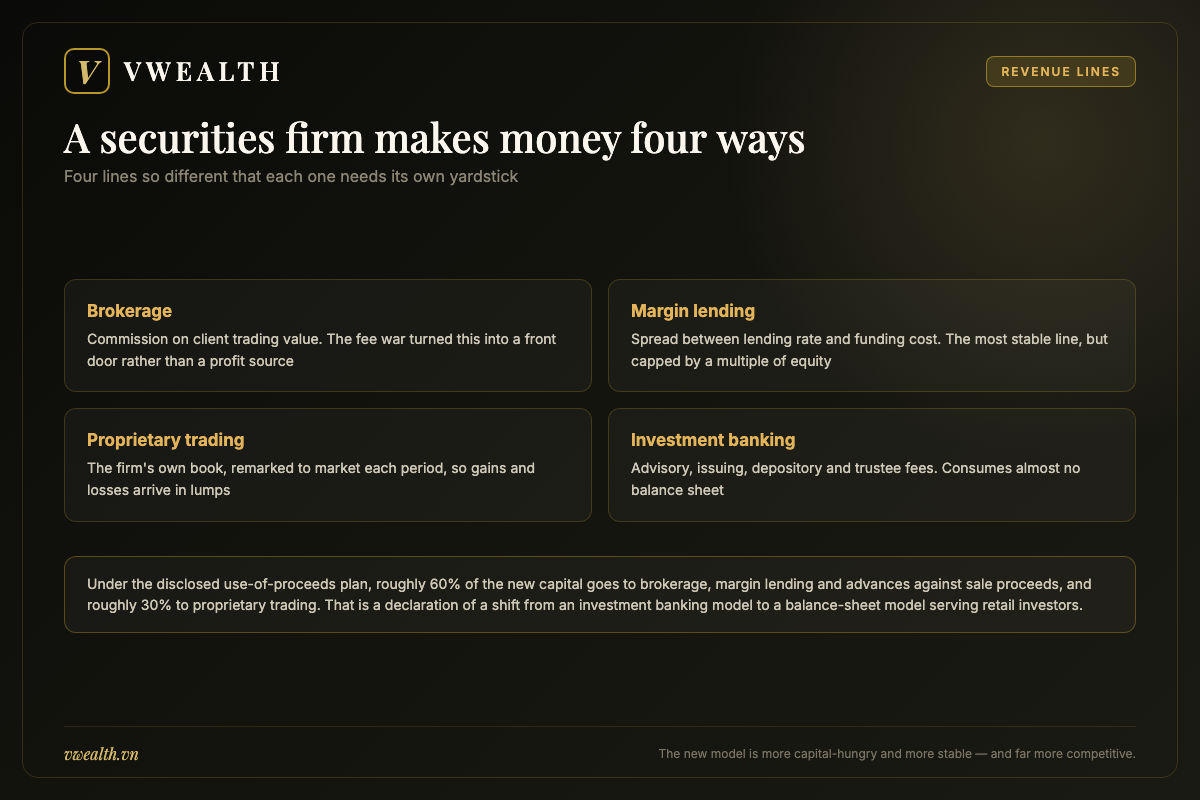
With that money in the door, TPS charter capital rose to 6,239 billion dong. Under the disclosed use-of-proceeds plan, roughly 60% of the new capital is allocated to brokerage, margin lending and advances against securities sale proceeds; roughly 30% to proprietary trading; and the remainder to other investment and business activities.
Pause on those three numbers, because together they change what this business is. Charter capital of 6,239 billion dong puts TPS into the well-capitalised tier of Vietnamese brokerages. A 51% shareholding makes it a consolidated subsidiary of a listed commercial bank. And allocating sixty per cent to brokerage and margin lending is a declaration that the firm is shifting from an investment banking model to a balance-sheet model serving retail investors — a completely different revenue structure and a completely different risk structure.
A summary table of the key milestones
| Date | Event | What it means for an investor today |
|---|---|---|
| 29 Dec 2006 | Oriental Securities Joint Stock Company established with charter capital of 60 billion dong | Explains why the ticker is ORS rather than TPS |
| 12 Jul 2010 | First trading day on HNX at a reference price of 13,100 dong | Entered the market at the start of a long sector downcycle; a low-profile decade followed |
| 18 Apr 2019 | Licence amended to rename the firm Tien Phong Securities; charter capital 400 billion dong | Brand tied to the TPBank ecosystem, but still not a subsidiary |
| 4 Nov 2021 | Moved to HOSE at a reference price of 13,200 dong | Materially deeper liquidity and a wider investor base |
| 2021 to 2024 | Built out investment banking and corporate bond services | Strong fee income early, legal and reputational exposure later |
| March 2025 | Mr Do Anh Tu stepped down from roles at the firm and the bank at his own request | Start of the leadership transition |
| 27 Jun 2025 | Shareholder meeting elected a new board and management team | Near-complete change of leadership |
| July 2025 | Fifteen individuals charged in the Bamboo Capital case, including the former chairman; the corporate entity was not charged | Legal risk at the individual level; proceedings to be monitored through official disclosure |
| 31 Dec 2025 | Private placement of nearly 288 million shares at 12,500 dong to TPBank completed | TPBank holds 51%; the firm becomes a bank subsidiary |
| 29 Jan 2026 | Charter capital recorded at 6,239 billion dong | Enters the well-capitalised tier of the industry |
| 22 Apr 2026 | Annual general meeting introduces a new chief executive and a three-year top-ten target | Formalises the shift toward brokerage and margin lending |
Read that table vertically and one conclusion is unavoidable: the ORS of today has almost nothing in common with the ORS of ten years ago. Same ticker, but a different controlling shareholder, a different leadership team, a different capital base and a different business model. Which means any analysis built on this company’s long-run historical numbers deserves extreme caution. If you chart ten years of earnings and extrapolate, you are extrapolating from a business that no longer exists.
Who runs ORS and who actually owns it
For a securities firm, the ownership question carries far more weight than it does at a manufacturer. The reason is simple: a brokerage trades on capital and on trust. Capital depends on whether the major shareholder will inject more. Trust depends substantially on who that shareholder is. A brokerage with a listed bank behind it borrows at a materially different cost from an independent firm of the same size. That is not a cosmetic difference; it lands directly on the income statement.
The leadership team after the 2025 overhaul
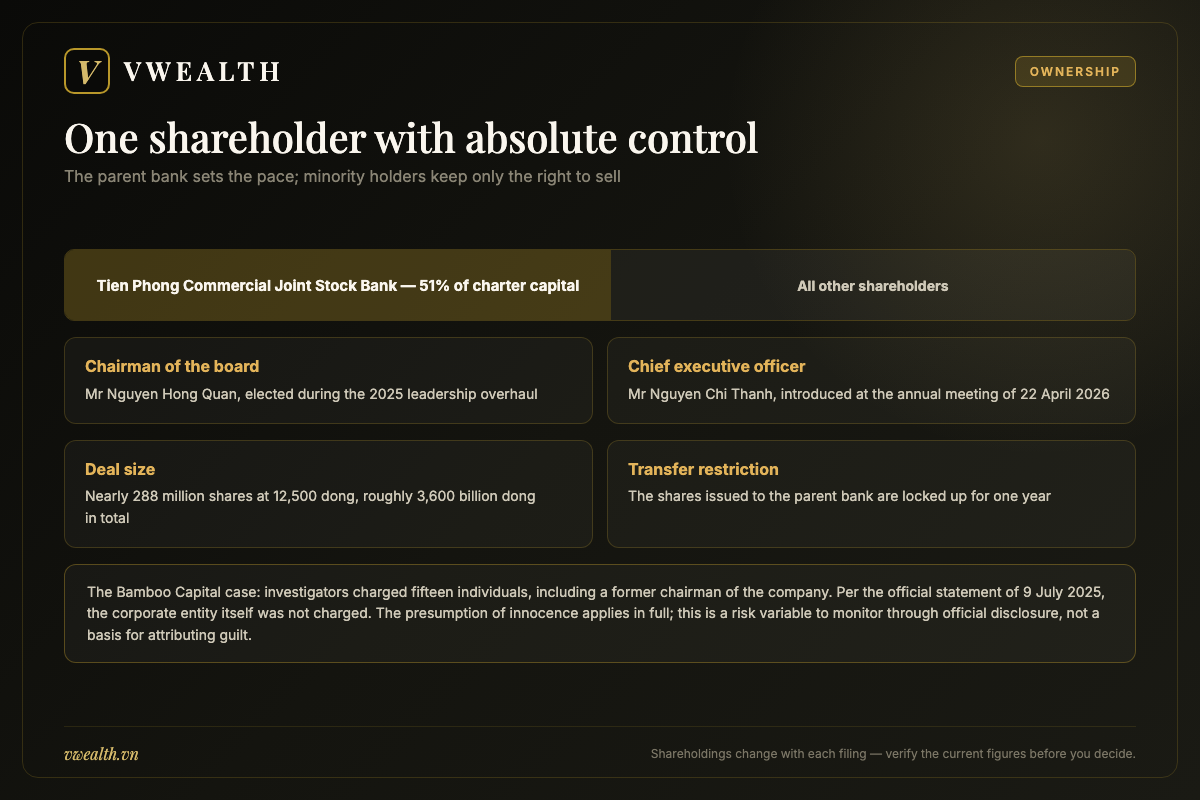
The board of Tien Phong Securities is chaired by Mr Nguyen Hong Quan. Ms Pham Thi Huyen Trang serves as vice chair. The remaining directors are Mr Tran Quang Huy, Ms Dang Thi Bich Thuy and Ms Dang Thi Huong Lan, the last of whom sits as an independent director. The supervisory board comprises Ms Nguyen Thi Ngoc Tu, Ms Ngo Thi Le Thanh and Ms Nguyen Thi Phuong Thuy.
At the annual general meeting held on 22 April 2026 the company introduced Mr Nguyen Chi Thanh as chief executive officer. According to the official introduction given at the meeting, Mr Thanh was born in 1980, holds an MBA from Boston University in the United States, and brings close to twenty years in finance and securities, including a chief executive role at another large Vietnamese brokerage.
Read that personnel information as an analyst rather than as a news consumer. Three things follow from it.
First, recruiting an executive with experience running a large brokerage is consistent with the ambition the company has stated. You do not hire someone used to operating at scale in order to keep a small firm small.
Second, the current leadership has essentially no connection to the 2021 to 2024 operating period now under legal scrutiny. From a governance standpoint that is positive for the entity, because it severs the personnel link between the old period and the new one.
Third, and this is the flip side, an entirely new leadership team means you have no track record for that team in this role. You are backing a group with no shared record at this particular business. Be honest with yourself about that instead of talking yourself into comfort using individual résumés. Vietnam’s broader governance environment is discussed in more depth in our guide to corporate governance in Vietnam, which is worth reading before you assess any recently restructured board.
Ownership: one shareholder with absolute control
After the private placement completed on 31 December 2025, the ORS share register is unusually simple by the standards of Vietnamese brokerages. Tien Phong Commercial Joint Stock Bank holds 318,204,761 shares, equal to 51% of charter capital. That is enough to control every ordinary shareholder resolution.
Beyond the controlling holder, disclosed major shareholders include Ms Nguyen Thi Van Anh with 18,228,272 shares. The remainder is spread among smaller holders.
A concentrated register like this produces two opposing consequences, and you have to weigh both.
The favourable side: strategic decisions move fast, there is no internal power struggle, and the controlling shareholder has an obvious incentive for the subsidiary to perform, since the results consolidate into the bank’s own accounts. When the firm needs capital or credit support, the odds of getting it are far better than for an independent brokerage.
The unfavourable side: minority shareholders have effectively no voice. Every issuance plan, every related-party transaction, every personnel change sits with one party. If the interests of the controlling shareholder and the minority diverge on a specific transaction, your only instrument is the sell button. That is a governance risk to accept before you buy, not to discover afterwards.
What becoming a bank subsidiary actually changes
This deserves time, because it is the largest change in the ORS investment case.
When a securities firm becomes the subsidiary of a commercial bank, four things change immediately.
The first is cost of funds. A brokerage earns most of its stable profit from margin lending — lending investors money to buy securities. The margin on that business is the spread between what clients pay and what the firm pays to fund itself. A firm with a bank parent typically funds cheaper, and every percentage point of funding advantage flows straight through to the spread.
The second is the customer funnel. According to the presentation at the 2026 annual meeting, becoming a subsidiary opens access to the parent bank’s retail base of roughly sixteen million customers, plus its corporate relationships. That is an impressive number, and it should be read carefully: access is not conversion. In every market, the share of a bank’s depositors who open a securities account and trade regularly is a small fraction. Sixteen million is the size of the top of the funnel, not the size of a future client base.
The third is risk management standards. Banks operate under State Bank of Vietnam supervision with demanding rules on capital adequacy and consolidated risk. A subsidiary consolidated into a bank gets pulled up to that standard. For a business that has just come through a legal shock, tighter standards are a positive for long-term shareholders, even if they slow near-term growth.
The fourth is concentration risk, and this one is rarely mentioned. When the parent is a bank, the fate of the subsidiary is tied to that bank’s health and strategy. If you hold both the parent bank’s shares and the brokerage subsidiary’s shares in the same portfolio, you are not diversified in the way you think — you have doubled a single bet. Before deciding, read the separate analysis of TPB, the parent bank itself, to understand where the parent stands.
The Bamboo Capital case: stating only what has been officially disclosed
This is the section to read slowly, and the article will write it slowly.
The officially disclosed facts are as follows. In early July 2025 the Investigation Police Department of the Ministry of Public Security brought charges against fifteen individuals in the case at Bamboo Capital Group Joint Stock Company, on allegations of fraudulent appropriation of assets under Article 174 of Vietnam’s Penal Code. Among those charged was Mr Do Anh Tu, identified as former vice chairman of the board of TPBank and former chairman of the board of TPS, and Mr Nguyen Ho Nam, founder of Bamboo Capital.
On 9 July 2025 TPS issued an official statement. In it the company confirmed that it had acted as issuance advisor, issuing agent, depository agent and bondholder representative for bonds issued by entities within the Bamboo Capital ecosystem during 2021 to 2024, the period during which Mr Do Anh Tu served as chairman. The company also stated that the corporate entity TPS was not itself charged, and that it continued to operate normally in full compliance with regulations.
Four things this article will not do, and which you should not do either in your own analysis.
One, no speculation about outcomes. Being charged is a procedural step, not a finding of guilt. Under the presumption of innocence written into Vietnam’s constitution and criminal procedure code, a person is considered guilty only when a court judgment convicting them has taken legal effect. Any judgment before that point belongs to public opinion, not to law.
Two, no widening of scope. The list of individuals charged is the list that has been published. Speculating that others were involved is baseless and potentially harmful to the people named.
Three, no conflation of an intermediary’s role with an issuer’s obligations. A securities firm acting as advisor and an enterprise issuing the bonds are separate parties with different legal duties under Vietnam’s private placement rules.
Four, no conversion of the matter into an investment thesis in either direction. Do not buy because you assume the legal risk is over. Do not avoid the stock permanently because you assume the business has been decided. Both are inference, not evidence.
So what should an investor actually do with this information? The practical answer is to treat it as a risk variable to monitor, and to monitor it through official channels. Specifically three: extraordinary disclosures the company files with the exchange, the notes on receivables and contingent liabilities in the audited financial statements, and the auditor’s opinion. If the auditor issues a qualified opinion or an emphasis of matter connected to the case, that is a signal to read very carefully. If audit reports come back clean across several periods, that is evidence pointing the other way and should be recorded as such.
Reputational risk: a real cost that is hard to measure
Beyond legal risk sits a second kind that financial statements do not record directly: reputational risk.
For a securities firm, reputation is a working asset rather than a matter of pride. Clients place cash and securities in accounts held at the firm. Corporates choose an issuance advisor on the basis of standing. Counterparties extend credit lines on the same basis. When a name appears in legal headlines, all three of those flows are affected, and the magnitude of the effect appears on no line of the income statement.
The only way to measure it indirectly is to track three items over several periods: client cash balances held at the firm, the quarterly brokerage market share tables published by the exchanges, and the value of new issuance advisory mandates. If those three recover steadily after a shock, that is real evidence that reputation is being rebuilt. If they flatline while the broader market grows, that is evidence to the contrary.
Dividends and the capital story
For brokerages in an expansion phase, cash dividends are almost always secondary. The reason lies in the business model: the margin loan book a Vietnamese securities firm may run is constrained by a multiple of its equity. To lend more, it must hold more equity. So every dong of retained earnings converts into additional lending capacity, and any management team chasing market share will want to retain.
In the case of ORS the point is even clearer. The company has just received roughly 3,600 billion dong of new equity from its controlling shareholder and has disclosed a plan to issue bonds of up to 3,000 billion dong with tenors of up to five years to fund operations. A business raising on both channels at once is in an investment phase, not a distribution phase.
Which leads to a blunt conclusion for income investors: if you want a steady dividend stream, Vietnamese brokerage stocks in general and this one in particular are not where to look. Consider instead the names discussed in our guide to Vietnamese dividend stocks.
Ownership and leadership at a glance
| Item | Disclosed position | What an investor should take from it |
|---|---|---|
| Controlling shareholder | Tien Phong Commercial Joint Stock Bank holds 318,204,761 shares, or 51% of charter capital | Absolute control of ordinary resolutions; minorities have no practical voice |
| Transaction | Private placement of nearly 288 million shares at 12,500 dong, completed 31 December 2025 | Those shares carry a one-year transfer restriction |
| Charter capital | 6,239 billion dong as recorded on 29 January 2026 | Places the firm in the well-capitalised tier of the sector |
| Chairman | Mr Nguyen Hong Quan | Elected during the 2025 leadership overhaul |
| Chief executive | Mr Nguyen Chi Thanh, introduced at the 22 April 2026 annual meeting | Prior chief executive experience at a large Vietnamese brokerage |
| Other directors | Ms Pham Thi Huyen Trang, Mr Tran Quang Huy, Ms Dang Thi Bich Thuy, Ms Dang Thi Huong Lan | Includes one independent director as required by governance rules |
| Individual major shareholder | Ms Nguyen Thi Van Anh with 18,228,272 shares as disclosed | Holdings change with each filing; verify current figures |
| Dividend policy | Retention of earnings plus additional capital raising to fund operations | Unsuitable for investors seeking cash income |
| Legal matter | Former chairman charged in the Bamboo Capital case; the corporate entity was not charged | A risk variable to monitor through official filings and the auditor’s opinion |
How ORS makes money: the anatomy of a Vietnamese securities firm
If you are used to analysing manufacturers, set that toolkit aside for the next fifteen minutes. A securities firm has no factory, no inventory, no gross margin in the conventional sense. What it sells is financial service, and what it sells it with is capital. The four revenue lines below differ so fundamentally that each requires its own yardstick.
Brokerage: the easiest line to understand and the thinnest
Brokerage is the original business. Clients place orders through the firm; the firm charges a commission on the traded value. Brokerage revenue equals market share multiplied by total market turnover multiplied by the average commission rate.
That three-variable formula explains why the business keeps getting harder. The third variable, average commission, has fallen almost continuously for years because dozens of firms compete on price and some foreign-backed houses pushed commissions close to zero to buy share. The second variable, market turnover, is beyond anyone’s control. That leaves market share, and buying share costs money.
The consequence: for most Vietnamese brokerages today, pure brokerage is no longer a meaningful profit source. It is the front door. Firms accept break-even or losses in brokerage to acquire accounts, then make real money in the margin book behind it. Understand that and you will read the strategy of every Vietnamese securities firm correctly, including the ones advertising zero commission. Our guide to choosing a Vietnamese brokerage walks through what this fee war means from the client side.
For ORS this is the line that must be built almost from scratch. The firm has not been near the top of the market-share tables, and the three-year top-ten ambition management stated at the 2026 meeting is essentially an ambition in this line. Verification is simple and public: the exchanges publish quarterly brokerage market-share rankings. Four checks a year tell you whether the strategy is working. It is one of the cheapest and cleanest ways a retail investor can hold a management team to its own promises.
Margin lending: the real profit engine of the new model
Margin lending means the firm lends investors money to buy more securities, secured against the securities in the account. It is the highest-quality and most stable earnings line in the industry.
Why stable? Because margin interest rates move slowly, loan balances change far more gradually than daily turnover, and credit risk is managed by an automatic forced-sale mechanism when collateral coverage falls below a threshold. In theory a brokerage can barely lose money on margin lending, provided the collateral pool is liquid enough.
Those last four words are where the real risk lives. If the collateral consists of thinly traded stocks, then in a sharp market decline the forced-sale orders cannot be filled, and the firm takes a genuine loss. Vietnamese market history contains a number of such episodes. So when you read the margin note, what matters is not only the total balance but the concentration: what share of the book sits with a small number of large clients, and which tickers make up the collateral. The mechanics from the borrower’s side are explained in our piece on Vietnam’s trading rules.
For ORS this is the explicitly prioritised line. Under the disclosed use-of-proceeds plan, roughly 60% of new capital goes to brokerage, margin lending and advances against sale proceeds. At the 2026 annual meeting management also cited a target margin book of 8,000 billion dong by year-end. Treat that as a disclosed target rather than a result, and track the actual figure through the quarterly statements.
Proprietary trading: where the prettiest and the ugliest numbers both live
Proprietary trading means the firm invests its own capital in equities, bonds, certificates of deposit and other financial assets. On the balance sheet most of this book is carried at fair value through profit or loss, abbreviated FVTPL.
That abbreviation is the single most misread item on a Vietnamese brokerage’s accounts, so let us be explicit. Fair value through profit or loss means that at each reporting date the firm remarks the book to market prices, and the resulting gain or loss goes straight into reported earnings — even if the firm has not sold a single share.
The implication is significant: a meaningful share of a brokerage’s reported profit can be a paper revaluation rather than cash. In a rising quarter the earnings look excellent. In a falling quarter the same mechanism manufactures a large loss even though the firm did nothing wrong. This is precisely why brokerage stocks are more volatile than almost any other Vietnamese sector.
For ORS, roughly 30% of the new capital is allocated to proprietary activity under the disclosed plan. When you read the accounts, split the book into three groups with very different risk profiles: deposits and certificates of deposit, which carry almost no price risk; bonds, which carry issuer credit risk; and listed equities, which carry full price risk. A book weighted to the first group produces steady but modest returns; a book weighted to the third produces lumpy ones. Neither is right or wrong, but you must know which one you are buying.
Investment banking and bond services: an old revenue line being redefined
This is the line that defined TPS between 2021 and 2024, and the line hit hardest by the crisis of confidence in Vietnam’s private corporate bond market.
Its nature is fee income: advisory fees on issuance documentation, issuing agency fees, depository fees, bondholder representative fees. The attraction is that it consumes almost no balance sheet, so return on capital employed is very high. The danger is that it ties the firm to the quality of the issuer in ways that are hard to quantify — through reputation, through monitoring duties, and in some circumstances through legal exposure.
After the regulatory framework for private bond placements was tightened, the business changed shape. The professional investor test became stricter, credit rating and disclosure requirements expanded, and the responsibilities of intermediaries were spelled out more clearly. The result is a smaller market with better-quality paper and fewer intermediaries capable of participating.
At the 2026 annual meeting management set out a revised approach to the bond business, described as applying bank-grade credit assessment standards before the firm will advise on or distribute an issue. In principle that is the right direction for a company emerging from a shock: use the parent bank’s credit discipline as the filter. But it is a stated intention, and the only way to verify it is to watch the outcome over several years — specifically the share of bonds the firm advised on or distributed that fall behind on principal or interest.
Where the moat is and where it is thin
An economic moat is whatever makes a business hard for competitors to copy. In Vietnamese brokerage, moats are thin almost everywhere, because the product is close to identical: same exchange, same order types, same settlement rules.
Three genuine sources of advantage exist in this industry: scale of capital, cost of capital, and a sticky client base.
On scale of capital, after raising charter capital to 6,239 billion dong, ORS now has real margin-lending capacity. That is a genuine moat, because regulation ties the loan book to equity, so an undercapitalised firm simply cannot compete in the sector’s best business.
On cost of capital, having a bank parent with a controlling stake is a structural advantage. Also genuine, but not unique: several other Vietnamese brokerages have banks behind them, and some foreign-owned houses access offshore funding that is cheaper still.
On client stickiness, this is where the moat is thinnest. The firm lacks a deep retail franchise, and switching costs in this business are close to zero — opening an account elsewhere takes fifteen minutes and costs nothing. Access to the parent bank’s customer base is an opportunity, but it has to be converted through product and experience; it does not happen automatically.
The honest conclusion: the ORS moat today is primarily a capital moat rather than a brand or franchise moat. Capital moats can be bought with money, which means competitors can buy them too. If you invest here, your thesis has to be about converting capital into market share, not about an advantage nobody can replicate.
Comparing the four revenue lines
| Revenue line | What it is | Stability | Capital intensive? | Principal risk |
|---|---|---|---|---|
| Brokerage | Commission on client trading value | Low; moves with market turnover | No, but share acquisition costs money | The fee war compresses margin to nothing |
| Margin lending | Spread between lending rate and funding cost | Highest of the four | Yes; constrained by a multiple of equity | Illiquid collateral and concentration in large clients |
| Proprietary trading | Gains and losses on the firm’s own book | Lowest; remarked to market each period | Yes; deploys equity directly | Paper profits reverse when the market falls |
| Investment banking and bond services | Advisory, issuing, depository and trustee fees | Moderate; follows the issuance cycle | Negligible | Reputational and legal exposure tied to issuers |
The table is also a map for reading the new ORS strategy: the company is shifting weight from the bottom row to the top two. That is a shift toward a more capital-hungry, more stable, and far more competitive model.
Position and financial health: seven things to check before you buy ORS stock
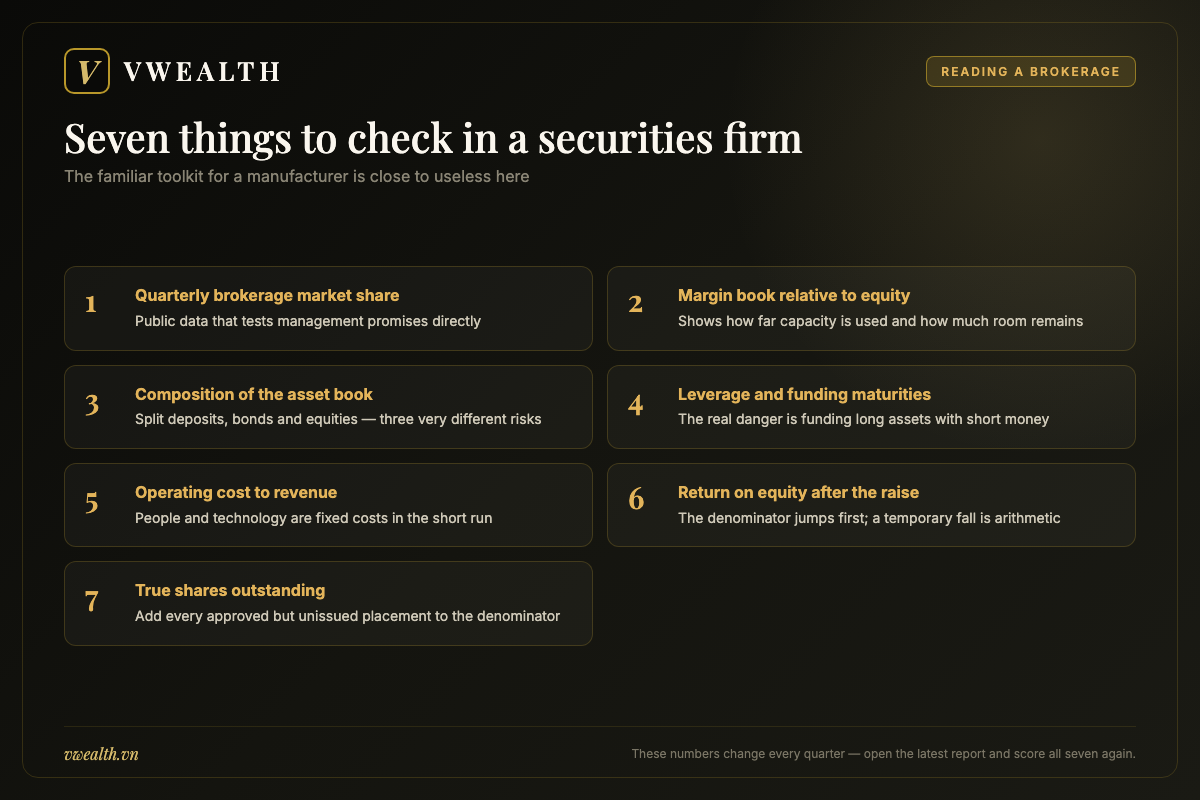
This chapter is the teaching section. The seven checks below form a framework for reading any Vietnamese securities firm, and the article notes what each one requires specifically in the ORS case. No current-period figures appear here — you look those up yourself, and the number you find is the one that matters at the moment you decide.
Check 1: quarterly brokerage market share and its trend
This is public, published quarterly by the exchanges, and it is the most honest test of the stated strategy.
How to read it properly: ignore any single quarter’s absolute figure and look at the trend across four to eight consecutive quarters relative to the market. A firm gaining share in a booming quarter has proved nothing; a firm gaining share steadily across good quarters and bad has genuinely won clients.
For ORS this is the single most important of the seven, because the entire growth case rests on converting bank customers into active securities accounts. If share has not moved two years after the new capital arrived, the thesis has not materialised and you should revisit it.
Check 2: the margin loan book relative to equity
Vietnamese regulation caps a securities firm’s total margin lending at a multiple of its equity. So the ratio of loan book to equity tells you two things at once: how far the firm is exploiting its capacity, and how much room remains before it must raise capital again.
How to read it properly: a low ratio may signal prudence, or it may signal that the firm cannot sell the service. Distinguish between them by looking alongside at the growth in accounts that actually trade. Plenty of capital with a small loan book and flat account growth is the worst case: idle equity diluting return on equity.
For ORS, after roughly 3,600 billion dong of new equity arrived, this ratio almost certainly dropped sharply in the short run as a matter of arithmetic. What matters is how quickly it recovers. The 8,000 billion dong year-end 2026 target management cited is a yardstick the company chose for itself, and you are entitled to use it.
Check 3: the composition and quality of the financial asset book
This is where the most risk hides on a brokerage balance sheet, and it is the section retail investors are least likely to open.
Open the note on financial assets at fair value through profit or loss, alongside the note on held-to-maturity investments, and split them into the three groups described earlier: deposits and certificates of deposit, bonds, and equities. For the bond bucket, go one level deeper: who is the issuer, is the paper listed, and is it secured?
For ORS, the company’s own history obliges you to look harder than usual. A firm that was active in corporate bond services may still carry related assets on its balance sheet, and the carrying value of those assets depends on management judgment and on the auditor’s view. Read the notes on provisions and on overdue receivables as well.
Check 4: leverage and the maturity structure of funding
A securities firm borrows in order to lend. Leverage is a tool of the trade, not a warning sign in itself. The issues are magnitude and maturity profile.
How to read it properly: look at total liabilities to equity, then break borrowings down by tenor and by source — bank loans, issued bonds, or borrowings from other institutions. The most dangerous pattern is maturity mismatch: funding long assets with short money. When liquidity tightens, that is what kills a firm first.
For ORS, management cited a leverage ratio of 1.9 times at the end of 2025 and disclosed a plan to issue up to 3,000 billion dong of bonds with tenors of up to five years. Five-year money funding a margin book is a sensible maturity match. What you should track is the actual coupon on those issues, because that coupon is the denominator of the margin business spread.
Check 5: operating and administrative costs relative to revenue
In this industry the largest costs are people and technology. Both are fixed in the short run, which means when revenue falls, profit falls faster.
How to read it properly: compute operating plus administrative expense as a share of total revenue and compare it across four to six periods. A steadily falling ratio shows operating leverage at work. A rising ratio alongside rising revenue shows a firm buying growth with cash.
For ORS, the company disclosed substantial cost reduction during 2025, with operating expenses down roughly 26% and administrative expenses down roughly 47% year on year. That is the result of a period of contraction and restructuring. Look forward with the opposite expectation: a firm chasing market share, with a disclosed technology budget of 79 billion dong, will see costs rise again. The right question is not whether costs rise but whether revenue rises faster.
Check 6: return on equity after the capital base nearly doubled
This is the most misinterpreted metric in the ORS case, so it deserves care.
When a company nearly doubles its equity in a single step, the denominator of return on equity jumps immediately while the numerator needs time to follow. The inevitable result is that return on equity falls for at least several quarters, even if the business is performing better in absolute terms than before.
If you do not grasp this, you will see a falling metric and conclude the business is deteriorating. Conversely, if you are too forgiving of it, you may miss a genuinely bad case. The balanced approach is to set yourself a deadline: give the business a reasonable window — say eight quarters — to bring return on equity back toward the sector average. If the window closes with the metric still depressed, the new capital is not being deployed effectively and your thesis is wrong.
Check 7: shares outstanding and true earnings per share
This is the classic lesson for any stock that has just completed a large issuance. Company profit can rise sharply while earnings per share stay flat or fall, simply because the denominator expanded.
For ORS, the private placement of nearly 288 million shares to the controlling shareholder increased the share count substantially. So when you hear the 2026 plan of 428 billion dong in pre-tax profit, representing roughly 190% growth over 2025, do not stop at the percentage. Divide by the new share count to get planned earnings per share, then compare with prior years on the same basis. That is the number you are actually buying.
The check takes three minutes: take shares outstanding from the most recent statement, add every issuance already approved by shareholders but not yet completed, and use that total as the denominator in all your calculations. The principle applies to every stock, not just this one.
What the seven checks say about the ORS position
Put the seven together and the financial portrait is clear enough. ORS is a brokerage that has just been heavily recapitalised, sits in a state of ample capital not yet fully deployed, enjoys favourable funding thanks to a bank parent, runs a cost base that has recently been cut, and carries an asset history that warrants closer inspection than usual.
That is the portrait of a business at the start of a transition. At this stage every efficiency metric looks temporarily poor as a matter of arithmetic, and every scale metric looks good. A good analyst distinguishes between the two. Someone buying on headlines does not.
How the market treats ORS stock: a share with a very strong personality
The business is one thing; the stock is another. Two people can agree entirely about the prospects of Tien Phong Securities and still disagree about whether to buy ORS shares today. This chapter is about the second half.
Why price to book is the primary tool for brokerage stocks
For a manufacturer, the price-to-earnings ratio is the familiar starting point. For a securities firm it is close to useless in isolation, for the reason set out earlier: reported earnings contain the mark-to-market on the proprietary book, so they swing with the market. A firm can show a very low multiple in a rising year and a very high or negative one in a falling year, with no change in the underlying business.
Price to book is far steadier, because the denominator is equity — something that moves slowly and is not driven by one quarter’s market. That is why analysts value Vietnamese brokerages primarily on price to book, combined with a judgment about the return on equity the firm can sustain.
The way to combine them is intuitive: a business that sustains a high return on equity deserves a high multiple of book, and vice versa. So when you see a brokerage trading above the sector’s typical multiple, the right question is not whether it is expensive but what return on equity the market is implicitly assuming, and whether that assumption is reasonable.
This article does not state the current ORS valuation, in line with the convention set at the top. Look it up on vwealth for the day you are reading, and note one technical point: after a large capital raise, book value per share changes materially, so any multiple computed from stale share-count data is wrong.
The personality of the stock
Every stock has a trading personality, and personality matters to you as much as business quality does, because it determines whether you can sleep while holding.
ORS sits firmly in the high-personality group. Three factors combine.
First, it is a brokerage stock. The whole group carries higher sensitivity to the index than the market average, because sector earnings are tied directly to turnover. When the market runs, brokerages usually lead and outrun it. When the market breaks, they fall further.
Second, it is a stock with stories attached. A change of owner, a legal case, a top-ten ambition — each generates news flow, and news flow generates volatility.
Third, its liquidity sits in the higher tier. High liquidity is a good thing: you can enter and exit without being trapped. But high liquidity comes with a heavy presence of short-horizon money, and that money arrives quickly and leaves just as quickly.
The practical conclusion: if you check your account daily and find red numbers stressful, this stock will wear you out. That is not a comment on the business; it is a comment on the fit between a stock and a person. If you want exposure to the sector with a gentler ride, look at the allocation approach described in our guide to investing in the Vietnamese stock market.
Dividends and cash flow expectations
As covered in chapter two, the business is in a retain-and-raise phase. For a minority shareholder that means the entire return comes from price appreciation, with nothing from periodic cash flow.
That is not a flaw, but it changes how you should manage the position. With no dividend, you have nothing to compensate you through extended flat stretches, and time becomes a genuine cost. Ask yourself before you buy: if this stock does nothing for two years, will you still be holding, or will you sell in month nine out of boredom?
Foreign investors and the free float question
Unlike commercial banks, Vietnamese securities firms are not subject to a 30% cap on foreign ownership. In principle that is a plus for the sector when foreign flows are strong. The general framework is explained in our guide to foreign ownership limits in Vietnamese stocks.
For ORS specifically there is a structural constraint you must see clearly: the controlling shareholder holds 51%, so the freely tradable portion of the register is much smaller than total charter capital. For a foreign fund, free float is a critical criterion, because it determines whether a meaningful position can be built without moving the price. A stock with a low free float is often ignored by index-tracking funds even when its market capitalisation qualifies.
This matters when you hear the argument that a market reclassification will pull foreign money into Vietnamese brokerages. The argument holds at the sector level but does not automatically hold for each name. Our analysis of Vietnam’s path from frontier to emerging market status explains how index funds actually allocate.
Comparing ORS with the other choices in the sector
Vietnam has enough listed brokerages to give you real choices, and the names differ more than they appear to.
| Type of brokerage | How to recognise it | Strength | Weakness |
|---|---|---|---|
| Long-standing share leaders | Consistently high brokerage market share, strong retail brand | Deep client base, revenue not dependent on one line | Limited room to gain share, rarely cheap |
| Bank-backed houses | Controlling shareholder is a commercial bank, favourable funding | Cheap capital, large customer funnel from the bank | Fate tied to the parent; concentration risk if you hold both |
| Foreign-backed houses | Major shareholder is an offshore financial institution | Lowest cost of funds, high governance standards | Strategy set abroad, less agile in the domestic cycle |
| Proprietary-heavy houses | Large investment book relative to equity | Explosive earnings in a rising market | Deep and rapid losses in a downcycle, hard to forecast |
| Repositioning houses | Recently changed owner or model, large new capital, share not yet matching | Wide scope for improvement if the strategy works | No execution evidence yet; genuine risk of failure |
ORS currently occupies the last two rows simultaneously: a bank-backed house and a repositioning house. That is the position with the widest range of possible outcomes — potentially very good if the transition succeeds, potentially unremarkable if the capital never converts into market share.
For a complete comparison, read the separate analyses in this series: SSI represents the long-standing share leaders, MBS is the closest analogue for the bank-backed model, HCM represents the foreign-backed group, and VIX illustrates the proprietary-heavy profile. Line those four up against ORS and you will see exactly which flavour of risk you are choosing.
Practical mechanics for a foreign investor buying this stock
If you are investing from outside Vietnam, several market mechanics shape what owning a brokerage stock actually feels like day to day, and they are worth spelling out because they differ from what you are used to.
Settlement runs on a cycle that means the shares you buy are not immediately available to sell, so intraday round trips of the kind common in developed markets are not possible in the same way. Every stock also trades inside a daily price band, with the permitted move on HOSE narrower than on the other Vietnamese venues. The band cuts both ways: it slows down panic, but in a genuine rush for the exit it can also mean a stock locks at the floor with no bid, and you simply cannot sell that day. For a high-personality name in a cyclical sector, that is not a theoretical concern.
Access itself requires a securities trading code and a local custody arrangement, and the account opening process for a non-resident takes longer than in most markets. Currency is a second layer of return you did not choose: your result in your home currency is the stock’s result multiplied by the dong’s move against it, and over a multi-year holding period that second factor is rarely trivial.
Disclosure is the third thing to plan for. Vietnamese companies file in Vietnamese first, and English versions of financial statements are often summarised, delayed, or absent altogether. For a name where the whole thesis rests on reading the notes to the accounts carefully — as it does here — you need a reliable route to the underlying Vietnamese filings rather than to headline figures alone.
Finally, a point about the accounting standards themselves. Vietnamese statements are prepared under national standards rather than international ones, and the differences matter most precisely in the areas that matter most for a securities firm: the classification of financial assets, the treatment of provisions, and disclosure of related-party transactions. If you are comparing ORS with a brokerage in another market, you are not comparing like with like unless you have adjusted for that.
None of this argues against owning Vietnamese equities. It argues for sizing the position with those frictions in mind, and for building the position over time rather than in a single order.
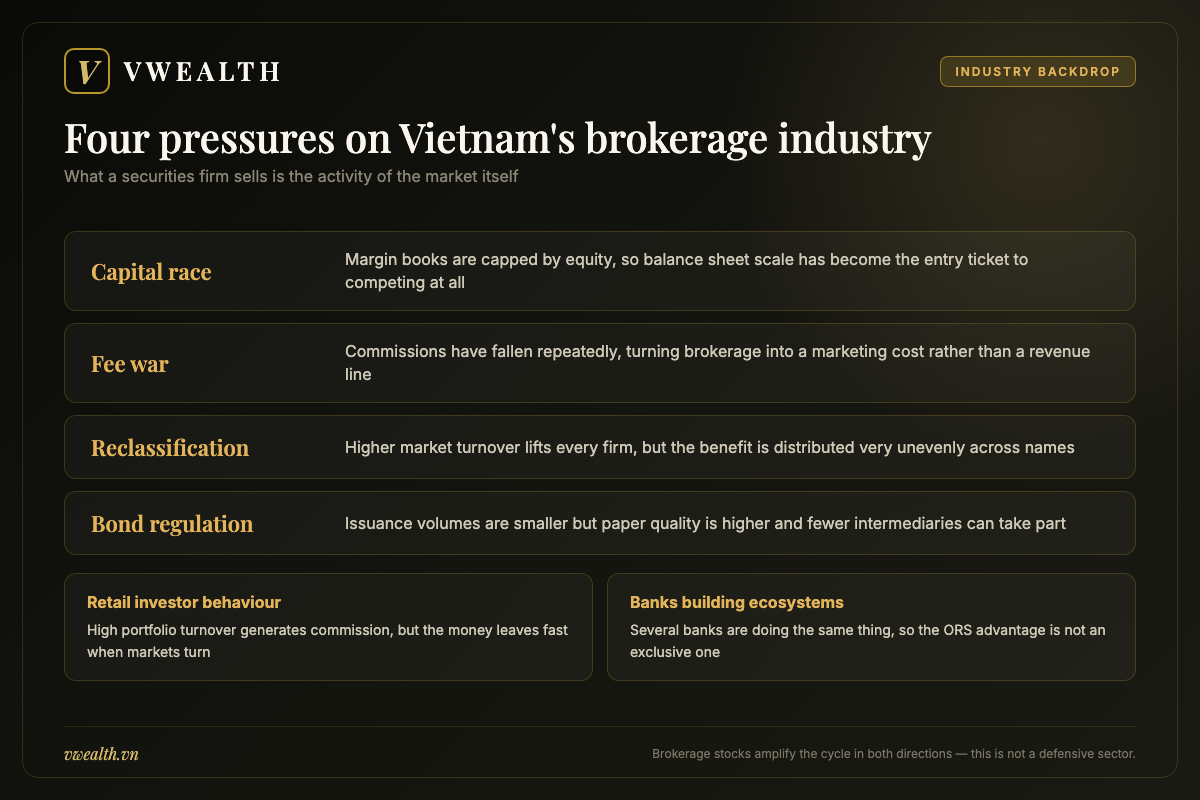
The Vietnamese brokerage industry: four pressures at once
No business lives outside its industry. For a securities firm the dependence runs deeper than almost anywhere else, because its product is the activity of the market itself.
The capital race: scale has become the entry ticket
Over roughly the last five years, Vietnam’s brokerage industry has run an unprecedented capital-raising race. The reason is practical: regulation ties the margin book to equity, and margin lending is the most stable earnings line. To grow, you need capital. There is no way around it.
The result is a clearly stratified industry. Well-capitalised houses compete with each other on lending rates and technology. Small-capital houses are progressively pushed out of the best business and must find a niche or accept contraction.
Raising charter capital to 6,239 billion dong puts ORS in the upper tier of that stratification. That is a necessary condition. But be precise about the logic: a necessary condition is not a sufficient one. Having the capital to enter the race is not the same as winning it.
The fee war: brokerage margin has been shaved very thin
Vietnamese brokerage commissions have fallen repeatedly over the past decade. Some firms cut them to token levels to acquire accounts. For those firms brokerage is a marketing cost rather than a revenue line.
Two implications for you. One, stop evaluating brokerages on brokerage revenue alone. Two, pay attention to what a firm actually spends to add one active account — a figure that does not appear in the accounts but can be estimated by dividing the increase in operating expense by the increase in trading accounts.
For ORS this pressure is head-on, because the firm is entering the fight as a latecomer. Latecomers always pay more per client won.
Trading infrastructure and the reclassification story
The two biggest market-level themes in Vietnam in recent years have been the modernisation of trading infrastructure and the prospect of reclassification from frontier to emerging market status.
Both favour the brokerage sector. New trading infrastructure opens the door to products and mechanisms the market previously lacked. Reclassification brings flows from funds tracking emerging market indices, lifting overall turnover — and when turnover rises, every brokerage benefits in both commission and margin lending.
Two cautions, though. First, these expectations have been debated for years and are typically partly priced in already. Second, the benefit is unevenly distributed: firms with institutional client bases and high free floats gain more than firms without.
The new legal framework for corporate bonds
After the confidence crisis, Vietnam’s rules on private corporate bond placements were revised in several directions at once: conditions on issuers, standards for professional investors, disclosure requirements, and the responsibilities of intermediaries.
The effect on the industry cuts both ways. Issuance volumes are smaller than at the peak, so fee income is lower. But the paper is better and fewer intermediaries have the capacity to take part, so what remains of the pie is more concentrated.
For ORS this is both a pressure and an opportunity. A pressure because what was once a strength is no longer easy. An opportunity because a firm with a bank parent applying bank-grade credit assessment should, in theory, have an edge in an environment that rewards diligence. The thing to watch is whether the firm actually applies that standard, and the evidence only arrives after several years.
Technology has become the second entry ticket
Capital is the first entry ticket to this industry. Technology has quietly become the second, and it is worth understanding why.
When commissions approach zero and every firm routes orders to the same exchange, the only remaining differences a client can feel are speed, reliability and the quality of the interface. A trading app that freezes during a high-volume session costs a firm accounts immediately, and those accounts rarely come back. Meanwhile the operating leverage in this business now runs through software rather than through branches: a firm that can onboard clients digitally, run risk checks automatically and price margin dynamically serves ten times the accounts with roughly the same headcount.
That is why the disclosed technology budget matters more than its size suggests. Spending on technology is not a cost line to be minimised in this industry; it is the mechanism by which a firm converts a customer funnel into revenue. A brokerage that has access to sixteen million bank customers but cannot open their accounts in minutes inside an app they already use will convert a fraction of what it could.
The competitive problem is that everyone knows this. The larger Vietnamese brokerages have been investing in platforms for years and are further along the curve. A latecomer must not only spend but spend faster, and must do so while the incumbent’s product keeps improving. This is the practical shape of the execution risk described earlier: it is not an abstract question of whether management is capable, but a concrete question of whether a specific product ships, works under load, and gets adopted.
For you as an investor there is a cheap way to check. Download the firm’s app yourself, open an account if you are able to, and use it. The experience of a real customer tells you more about execution in fifteen minutes than a strategy slide does in an hour. Then repeat the exercise on the two or three largest competitors and ask which product you would keep. That comparison is the closest thing to a leading indicator that a retail investor can generate without any special access.
Retail investor behaviour: both the lifeblood and the risk
Vietnam’s market has a very high share of retail participation compared with developed markets. This characteristic shapes the entire industry.
The favourable side: retail investors trade more than institutions, turn portfolios over faster, and therefore generate more commission per unit of capital. They also use margin more heavily.
The unfavourable side: retail flows move with sentiment. A sharp decline can shrink the number of active accounts very quickly while simultaneously contracting margin balances through forced selling. Those two happen together, which is why sector earnings deteriorate faster than most people model.
Which produces an allocation rule worth remembering: brokerage stocks amplify the cycle. They are not defensive, and they should not hold a large weight in the portfolio of anyone who needs stability.
Banks building financial ecosystems
A notable trend of recent years is large Vietnamese commercial banks consolidating or acquiring securities firms to complete their financial ecosystems. The logic is clear: the bank has customers and cheap funding, the brokerage has licences and investment products.
For ORS this trend is simultaneously the reason it exists in its current form and a source of competition. The reason it exists, because it is exactly why TPBank paid roughly 3,600 billion dong to move to 51%. A source of competition, because other banks are doing the same with their own brokerages, and the race to convert bank customers into securities customers is being run in several places at once.
Put differently: the advantage ORS has just acquired is not an exclusive one. Several competitors hold the same advantage, and the winner will be decided by execution rather than by who had the idea first.
Looking ahead: three scenarios for ORS stock and what triggers each
This chapter contains no price target. Anyone offering you a twelve-month price target for a Vietnamese brokerage is really forecasting market turnover, which nobody does consistently. What is useful instead is a set of conditions: if this happens, that scenario becomes real. You track conditions, not prophecies.
The four variables that decide the ORS outcome
The first variable is overall market turnover. It is the largest single factor and it sits entirely outside the company’s control. In a high-turnover year almost every brokerage does well. In a low-turnover year even excellent management only reduces the loss.
The second is the speed at which the parent bank’s customers convert. This is the variable the company controls most directly, and it decides whether the investment case is real. It is measurable through two public series: quarterly brokerage market share and the margin loan book.
The third is the productivity of the new capital. Roughly 3,600 billion dong of fresh equity must generate profit; if it does not, it simply dilutes efficiency metrics. Time is the key element here — the longer the capital sits idle, the more it drags return on equity down.
The fourth is the course of the legal matters and the quality of legacy assets. This is the hardest variable to forecast, and investors can only track it through official disclosure and the auditor’s opinion. This article does not forecast it, and neither should you.
The optimistic scenario: capital converts into share while the market cooperates
Four conditions must hold at once.
Market turnover stays high or rises, possibly helped by reclassification flows and by low deposit rates pushing savings into equities. Brokerage market share climbs steadily quarter after quarter as products integrated with the parent bank’s app reach customers. The margin book approaches the disclosed target, with funding costs held down by the bank relationship and by longer-dated bond issuance. And the legacy legal matters progress without generating material financial obligations for the corporate entity.
In this scenario the company meets or beats its disclosed profit plan, return on equity recovers toward the sector average within two years, and the market begins to value the stock alongside other bank-backed brokerages rather than alongside companies carrying unresolved issues. That re-rating — rather than the profit number itself — is the largest prize for shareholders in the optimistic case.
Early signals that this scenario is forming: brokerage market share rising three quarters in a row, and an annual audit report with no qualification relating to legacy assets.
The base case: bigger in scale, slower in efficiency
This is the highest-probability path based on how recently restructured businesses usually behave, simply because winning brokerage share always takes longer than the plan assumes.
Conditions: market turnover at moderate levels, neither booming nor drying up. The firm launches products integrated with the parent bank, but active account openings run below expectation because savers and equity investors are two populations with very different risk appetites. The margin book grows but falls short of target. Costs rise with technology and headcount investment.
Outcome: absolute profit rises against the prior year — near-certain given the low base and the additional capital — but earnings per share improve far more slowly because the share count has expanded sharply. Return on equity plateaus below the sector average.
For a shareholder, this scenario means the stock trades with the sector rhythm and earns no specific reward for the repositioning story. Which is precisely why time is a real cost when you hold a stock that pays nothing.
The adverse scenario: the market turns just as the company expands
Conditions: a macro shock cuts market turnover sharply; rising interest rates pull money out of equities while simultaneously raising the firm’s funding cost. In that setting the margin book contracts as clients deleverage and forced sales trigger. The proprietary book is remarked down, producing reported losses. If problems with legacy assets or adverse developments in the proceedings arrive at the same time, the effects compound.
This is the scenario in which the new capital structure becomes a burden rather than an advantage: large equity that is not earning, bond coupons that must still be paid, and efficiency metrics deteriorating quickly.
One point to remember: in this scenario brokerage stocks typically fall further than the index, because the market is pricing earnings risk and asset-quality risk at the same time. If you intend to buy this stock, decide in advance how you would behave through such a quarter. Answering in advance is cheap; answering afterwards is expensive.
The three scenarios side by side
| Scenario | Conditions required | How it shows in the accounts | Early signal |
|---|---|---|---|
| Optimistic | High market turnover; successful conversion of the bank customer base; legacy matters generate no material obligations | Meets or beats the profit plan; return on equity back to sector average within two years | Market share up three consecutive quarters; clean audit opinion |
| Base case | Moderate turnover; conversion slower than planned; costs rise with investment | Absolute profit rises but earnings per share improve slowly | Margin book grows but stays below the disclosed target; share flat |
| Adverse | Macro shock cuts turnover; rates rise; legacy assets develop problems | Proprietary book marked down; margin book contracts; coupons still due | Market-wide turnover falling for several months; emphasis of matter in the audit report |
These scenarios carry no fixed probabilities. The right way to use the table is to reopen it each quarter, compare it with the real data, and ask yourself which column you are in.
So should you buy ORS stock? The straight answer
You now have the facts. This chapter puts them on two sides of a scale and states plainly who this stock suits.
The case for: five reasons ORS deserves consideration
First, the capital base is genuinely different now. Charter capital of 6,239 billion dong gives the firm real competitive capacity in margin lending, the sector’s most stable earnings line. Before the raise, it simply was not large enough to play that game.
Second, a bank parent with a controlling stake. That brings three things at once: favourable funding, a large customer funnel, and higher risk management standards. For a business emerging from a shock, the third has value comparable to the first two.
Third, the new leadership has no connection to the period under scrutiny. From a governance standpoint, severing the personnel link with the past is a necessary condition for rebuilding market trust.
Fourth, the cost base has been cut. Operating and administrative expenses fell sharply during 2025, indicating the firm has already been through the painful trimming. Entering an expansion cycle from a low cost base is a far better starting point than having to expand and cut at the same time.
Fifth, a low comparison base. The 2025 result — total revenue of roughly 1,491 billion dong and pre-tax profit of roughly 147.5 billion dong — is a very low base against earlier years. The 2026 plan of 2,250 billion dong in revenue and 428 billion dong in pre-tax profit reflects exactly that. For a business with a low base, impressive growth rates come easily — which is also why you must always convert back to per-share numbers.
The case against: six risks to look at squarely
First, legal and reputational risk is not closed. The case involving the former chairman remains in proceedings. The corporate entity itself was not charged according to official disclosure, but proceedings continue and any development can affect sentiment toward the stock. This is a risk you cannot size in advance.
Second, dilution has happened and may continue. The share count rose sharply after the private placement. For a firm targeting the top ten, capital needs will recur, and every raise expands the denominator again.
Third, market share does not yet match the capital. This is the widest gap between current reality and stated ambition. Capital can be bought; share must be won one account at a time, and latecomers pay more.
Fourth, governance risk from the concentrated register. A shareholder with 51% decides everything. That is good when interests align and unhelpful when they do not. Minorities have no instrument other than the right to sell.
Fifth, sector cyclicality. Brokerage stocks amplify the market cycle in both directions. In a bad year this stock will fall further than the index, and that has nothing to do with management quality.
Sixth, legacy asset quality needs close inspection. The history of corporate bond activity between 2021 and 2024 obliges you to read the notes on receivables, investments and provisions more carefully than you would for a brokerage without that history.
The scale, side by side
| In favour | Against |
|---|---|
| Charter capital of 6,239 billion dong, enough to compete in margin lending | Brokerage market share does not match the capital base; must be won from scratch |
| Bank parent holding 51%, favourable funding and a large customer funnel | Concentrated ownership leaves minorities without a practical voice |
| New leadership with no link to the period under scrutiny | The new team has no shared track record at this particular business |
| Cost base already trimmed through the 2025 restructuring | Costs will rise again through the expansion and technology investment cycle |
| Low comparison base makes growth rates look strong | A much larger share count means per-share metrics improve slowly |
| Risk standards lifted toward the parent bank’s level | Legal and reputational risk remains open and cannot be quantified |
| Bond business redirected toward bank-grade credit assessment | Brokerage stocks amplify the market cycle in both directions |
Who ORS suits and who it definitely does not
For the growth investor with a high risk tolerance: this can fit, but only if you understand you are buying a transition with no proof of outcome yet. Your thesis must be specific and testable — how much market share must rise, and by when — rather than a vague sense that a bank parent makes everything fine. Set your falsification condition before you buy.
For the value investor: this name requires two extra steps most people skip. Step one is recalculating book value per share after the new capital, so you know what multiple of real book you are paying. Step two is assessing the quality of that book value by examining the financial asset portfolio and the receivables. A dong of equity sitting in bank deposits and a dong sitting in hard-to-value assets are worth very different amounts, even though the balance sheet treats them as equal.
For the income investor seeking steady cash dividends: this is not the place. The business is retaining earnings and raising more capital. Your entire return depends on price, and you must accept there is nothing to compensate you during flat stretches.
For the new investor or anyone with a low risk appetite: this is not a starting point. It stacks three layers of risk at once — sector cyclicality, execution risk on a strategy with no results yet, and an open legal matter. If you want exposure to the growth of Vietnam’s capital market without carrying those three layers, consider a more diversified approach or a name with a record proven across several cycles.
Four questions to answer before you place the order
Question one: have you opened the most recent audited financial statements and read the auditor’s opinion together with the notes on the financial asset portfolio? If not, you do not know what asset quality you are buying.
Question two: have you recalculated earnings per share and book value per share using the share count after the private placement? The old figures are no longer usable.
Question three: can your buying thesis be verified against a public metric? If your thesis is conversion of the bank’s customer base, the verifying metric is quarterly brokerage market share. Write down the level you expect and the deadline, before you buy.
Question four: is this position small enough that you will stay calm if the whole brokerage sector drops sharply in one quarter, or if an unfavourable legal headline appears?
Closing: a company buying back its own future
The story of Tien Phong Securities is the story of a business that has changed its nature three times in twenty years: a small brokerage born in the 2006 boom, an investment bank betting on corporate bonds around 2021, and now a bank subsidiary chasing brokerage market share. Each change came with new people and new capital.
What makes this change different from the previous two is that it was funded with a very large amount of real money by a shareholder with a clear long-term motive. Roughly 3,600 billion dong is not the sort of sum anyone commits as an experiment. That is strong evidence of commitment, and it deserves to be recorded as such.
But commitment is not outcome. In this industry, the distance between having capital and having customers is a distance many firms never cross. And in this particular case, the firm must cross it while carrying a history that is not yet closed.
So should you buy ORS stock? If you understand that you are buying a transition rather than a settled business, if you accept that efficiency metrics will look temporarily poor as a matter of arithmetic after the capital raise, if you are willing to read the asset notes every period and check brokerage market share every quarter, and if you keep the position small enough that one adverse headline cannot damage your portfolio — then ORS is a reasonable candidate for the high-risk sleeve of your holdings. If you are buying because a big bank stands behind it so it must be fine, or because the shares just ran and you fear missing out, then you are buying a story rather than a business.
One last thing to carry with you. The history, ownership and strategy of ORS change slowly, but brokerage market share, the margin book, the composition of the proprietary portfolio, the share count and the valuation change constantly. Before you place an order, open the latest research report and score the seven checks from chapter four again. It takes fifteen minutes, and it is the most valuable quarter hour in your entire decision process. If you do not yet have the tools to do it, create a free vwealth account and let the platform read the filings for you.
This article is provided for information and analysis purposes only and is not a recommendation to buy or sell any security. The references to criminal proceedings contained in this article are limited to matters officially disclosed by the competent authorities and by the company itself; the presumption of innocence applies in full and this article makes no attribution of guilt to any party. All investment decisions are your own and you bear responsibility for their outcome. Consider consulting a licensed financial adviser before acting.
Research Vietnamese stocks in English with vwealth. Our AI-powered platform turns Vietnamese market data into full English analysis reports — with international payment support and a free 2-month trial for new accounts. Create your free account and read the latest reports.