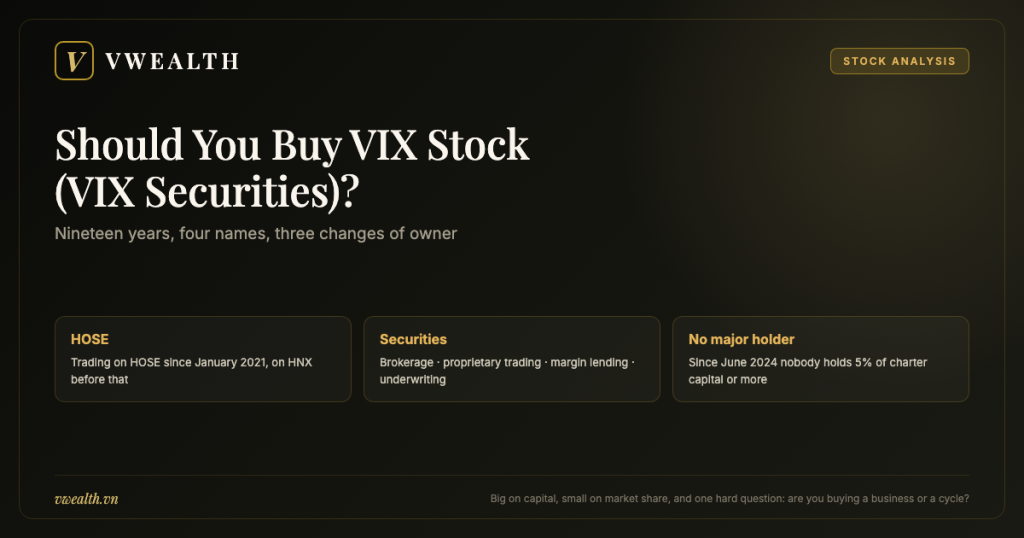
Should you buy VIX stock? It is a question almost every retail investor in Vietnam has asked at least once, and it usually gets asked on the days when the board is either bright green or deep red, because VIX Securities Joint Stock Company — ticker VIX on the Ho Chi Minh Stock Exchange — is almost always sitting near the top of the volume table when either of those things happens. This is one of the few tickers you can use as a mood ring for the entire market: when speculative money is confident, VIX is among the most actively traded names on the exchange; when the market cools, it goes quiet and falls faster than most. Behind that reputation sits one of the strangest corporate biographies on the Vietnamese market: nineteen years of existence under four different names, three changes of controlling owner, a capital-raising machine that took charter capital from a few hundred billion dong to more than twenty-four trillion, and — as of today — a top-tier brokerage by capital in which no single shareholder holds 5% or more of the company. This article walks through that entire story, teaches you how to read the financial statements of a broker whose profits are driven mainly by its own trading book, and ends with a blunt answer: which kind of investor VIX suits, and which kind should not touch it.
A word on method before we begin. You will find a great many dated facts in this article — founding dates, name changes, ownership percentages, capital increases, regulatory milestones — and all of them come from public disclosures. What you will almost never find is a current-quarter number: today’s P/B, last quarter’s profit in dong, the current margin loan book. The reason is practical rather than coy. For a securities firm whose earnings depend heavily on the market value of its own portfolio, those figures can reverse completely within a single quarter, sometimes within a single volatile month. A number written today has a real chance of being flatly wrong by the time you read this, and a confidently wrong number is worse than no number at all. Instead, this article teaches you to read the company’s own numbers yourself: where to look, what to compare against, and when an attractive-looking ratio is actually a warning sign. When you need current data, open the VIX analysis report on the vwealth platform. That is the right division of labour — the article gives you the framework, the report gives you today’s figures.
If you are investing in Vietnam from outside the country, one more note. Vietnamese market practice has its own vocabulary — the foreign ownership “room”, T+2 settlement, daily price bands, the regulatory cap that limits margin lending to twice a broker’s equity, the FTSE Russell reclassification timetable, the KRX trading system — and none of it maps cleanly onto US or European practice. Where those terms appear, they are explained in place. If the market itself is new to you, start with our guide on how to invest in the Vietnam stock market and the broader Vietnam stock market guide, then come back here. And read VIX beside its financial-sector peers rather than alone, because the contrast is where the insight lives: put it next to Vietcombank, the most conservatively run large bank on the exchange, next to Techcombank and its very different approach to balance-sheet risk, and next to MB Bank, which pays the kind of cash dividend VIX does not. Now, to the beginning of the story — which starts in a place almost no new investor expects. The first name of the company behind the ticker VIX was not VIX. It was Vincom.
Four names in nineteen years: the history behind VIX stock
Most listed companies have a linear story: one founder, one idea, one long march to the exchange. VIX does not. If you drew this company’s biography on paper it would look like a road broken three times, with each break bringing a new name, a new controlling owner and a new head office, and the only thing running unbroken from one end to the other is three letters on a price board. That detail matters far more than it sounds. When you buy VIX stock, you are not buying a brand built up over two decades the way you might buy a century-old bank. You are buying a legal entity with a full set of licences, a pool of capital and a balance sheet — and the substance underneath that entity has been rewritten several times, according to the intentions of several different owner groups. Understanding this at the outset saves you from a long list of illusions later.
2007–2009: a child of Vincom, born at the top of the first bubble
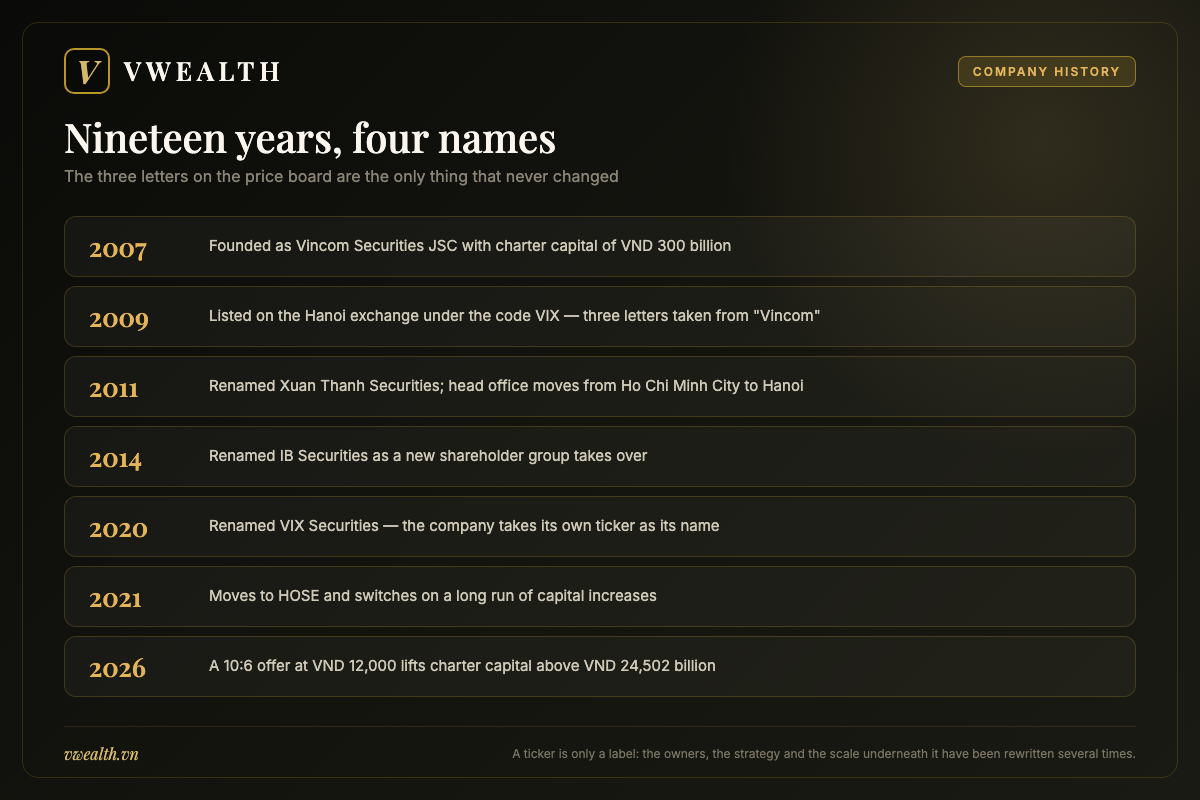
The company was established on 10 December 2007 under the name Vincom Securities Joint Stock Company — VincomSC — with charter capital of VND 300 billion. There were three founding shareholders: Vincom Joint Stock Company, BIDV Insurance Corporation, and an individual, Mr. Pham Khac Phuong. The context of 2007 explains almost everything about why it existed at all. That year was the peak of the first genuine equity mania in Vietnamese history; the VN-Index pushed above 1,170 points in March 2007, and opening a securities firm was treated as the obvious next move for any large group that wanted a complete financial ecosystem. Through 2007, a long line of new brokerages was licensed, most of them carrying the name of a bank, a property group or a state corporation.
What makes VincomSC’s timing remarkable is that it arrived almost exactly as the wave was about to break. Within months, the 2008 global financial crisis swept through, the VN-Index fell to around 235 points by February 2009, and the entire Vietnamese brokerage industry entered a long stretch of losses. A great many firms founded in the 2006–2008 window were later dissolved, merged, or had operating licences withdrawn. VincomSC survived — but the price of survival was that it never became a strategic piece of its founding shareholder’s ecosystem.
On 14 July 2009, Vincom bought out BIDV Insurance’s entire stake, lifting its own holding in the brokerage to 75%. On paper that is a consolidation of control. Read against what happened next, it looks more like tidying up before an exit than a long-term commitment.
On 29 December 2009, the company’s shares were formally listed on the Hanoi Stock Exchange under the code VIX. This is a small detail but the most quietly interesting one in the whole corporate biography: the ticker VIX was derived from the word “Vincom”, following the common local convention of building a code from the first letters of a company’s name. Years later, after two more name changes had severed any connection to Vincom, those three letters were still sitting on the board. And in 2020 the company did something delightfully backwards: rather than change the ticker to match the name, it changed the name to match the ticker.
For an investor, the lesson here is not about wordplay. It is a reminder that a ticker is only a label. A code can remain untouched while the ownership, the board, the strategy, the scale of capital and even the operational centre of gravity underneath it have all been replaced. If you are considering VIX because the code feels familiar after years of seeing it on the board, you are buying a feeling rather than a business.
2011–2014: Bau Thuy, then IB Securities — two owner changes in three years
In May 2011, the company was renamed Xuan Thanh Securities Joint Stock Company (XuanThanhSC) and moved its head office from Ho Chi Minh City to Hanoi. Earlier that year, from January 2011, Mr. Nguyen Duc Thuy — universally known in Vietnam as “bau Thuy”, a businessman associated with the Xuan Thanh Group and with Vietnamese football in that era — had taken the chairmanship after acquiring 23.8% of the company from the previous shareholder group.
The Xuan Thanh years produced the most concentrated ownership in the company’s history. Mr. Thuy raised his stake to 81.5% at the end of 2012, then held 74.17% at the end of 2013. In other words, at one point more than four-fifths of the company sat with a single individual — the structure local investors call a “one-person company”, where the genuinely tradable float is very thin, the price can be moved up or down on small volume, and every significant decision is one person’s decision.
What makes this period instructive is that 2011–2013 was also the deepest trough the Vietnamese brokerage industry has seen since the crisis. There were sessions when total HOSE turnover was only a few hundred billion dong; a series of brokers reported negative equity; and the State Securities Commission was regularly publishing lists of firms placed under special supervision. A small firm like XuanThanhSC survived that stretch largely because it was barely operating — it did not expand brokerage, did not push margin lending, did not carry large debt. It survived by staying still.
In April 2014, Mr. Thuy divested, transferring his shares to a new shareholder group. On 28 April 2014 the company changed its name for the second time, becoming IB Securities Joint Stock Company (IBSC) — the letters “IB” evoking investment banking, which reflected the positioning the incoming owners intended to build.
The new shareholder group formed around Mr. Nguyen Van Tuan, who would later become widely known as the chief executive of Gelex Group (ticker GEX), a diversified group operating in electrical equipment, infrastructure, clean water and industrial property. The ownership structure disclosed at the time comprised FTG Vietnam Joint Stock Company with 15%, Mr. Tuan with 10%, and his wife Ms. Duong Thi Hong Hanh with 1.67%. From 2016, Ms. Nguyen Thi Tuyet joined the board of directors and for many years afterwards alternated between chair and vice-chair, at times also serving as chief executive.
The IBSC era lasted six years and was the period in which the business began quietly rebuilding its own strength. Even so, the firm remained in the small tier of the industry, its brokerage market share was negligible, and its name essentially never appeared in league tables. If you look at a price chart of VIX stock over 2014–2019, you will see a near-flat line inside a narrow range on thin volume — the classic profile of a stock nobody is paying attention to.
2020: the company renames itself after its own ticker
In October 2020 the company changed its name for the third and, so far, final time: VIX Securities Joint Stock Company. This was a symbolic move more than a technical one. After three spells carrying somebody else’s identity — Vincom, then Xuan Thanh, then the abbreviation IB — the business chose to identify itself by the only thing the market had actually called it for eleven years: the three letters on the board.
Commercially, 2020 was also a hinge year. The pandemic drove deposit rates sharply lower, and a large cohort of first-time retail investors — the market calls them “F0 investors”, borrowing the epidemiological term for a patient zero — opened brokerage accounts for the first time. New account openings surged, market turnover exploded, and the entire securities industry entered the most profitable cycle in its history. In that year VIX’s charter capital reached VND 1,277 billion and the company appeared for the first time among the industry leaders on earnings per share. After thirteen years of near-anonymity, VIX suddenly became a name people mentioned.
2021: moving to HOSE and switching on the capital machine
In late December 2020, VIX announced its plan to leave the Hanoi exchange. On 8 January 2021, VIX shares traded for the first time on the Ho Chi Minh Stock Exchange. A cross-listing move like this is not merely a change of address. HOSE carries far higher turnover, concentrates the bulk of both domestic and foreign flows, and — most importantly — is the gateway to inclusion in the major index baskets, which is the precondition for attracting passive index money.
Alongside the move, VIX lifted charter capital to VND 2,746 billion. That was the starting point of a continuous run of capital increases that stretched across the following five years and became the single clearest identifying feature of this business. For a securities firm, capital is not decoration on a report. Shareholders’ equity directly determines the permitted margin lending ceiling — under Vietnamese regulation, total margin debt may not exceed twice a firm’s equity — it determines how large a proprietary trading book the firm can carry, and it determines underwriting capacity. If you want to be big, you have to raise capital. But every capital raise dilutes existing shareholders who do not put in more money, and that tension will be one of the central themes of this article.
2022–2026: from one trillion dong to more than twenty-four trillion
VIX’s rate of capital growth over the past half-decade is among the fastest in the industry. From VND 1,277 billion in 2020, charter capital rose to VND 2,746 billion in 2021, then continued through multiple rights issues, stock dividends and further placements to reach VND 15,314 billion in 2025.
The largest single jump came in 2026. The company offered shares to existing holders at a ratio of 10:6 — meaning every 10 shares held carried the right to subscribe for 6 new shares — at a price of VND 12,000 per share, raising approximately VND 11,026 billion. At the end of May 2026, nearly 919 million new shares were admitted to trading, taking total shares outstanding to roughly 2.45 billion and charter capital above VND 24,502 billion. On 24 July 2026, the board approved a further issue of more than 122.5 million shares as a 2025 stock dividend at a ratio of 20:1, expected to be executed in the third quarter of 2026, which would take charter capital to approximately VND 25,728 billion.
Pause for a moment on the size of that. In six years, this company’s charter capital increased roughly twentyfold. That is not growth; that is a rebirth in scale. A brokerage that was once anonymous now sits in the leading tier of the industry by both charter capital and shareholders’ equity. But hold onto one point, because it is the point most easily lost: large capital does not automatically create large earnings per share. If a company raises another ten trillion dong and absolute profit does not rise proportionally, then earnings per share falls and the share price has to adjust accordingly. Capital is fuel, not result.
| Date | Event | What it means for an investor |
|---|---|---|
| 10 Dec 2007 | Founded as Vincom Securities JSC, charter capital VND 300 billion | Born at the very top of the 2007 bubble, just before the crisis |
| 14 Jul 2009 | Vincom buys out BIDV Insurance’s stake, lifting its holding to 75% | Control consolidated shortly before an eventual exit |
| 29 Dec 2009 | Listed on the Hanoi Stock Exchange under the code VIX | Three letters that would outlive every company name |
| May 2011 | Renamed Xuan Thanh Securities JSC; head office moves to Hanoi | First change of owner; highly concentrated ownership |
| 2012–2013 | Mr. Nguyen Duc Thuy raises his stake to 81.5%, then holds 74.17% | Very thin free float, low liquidity |
| 28 Apr 2014 | Renamed IB Securities JSC; a new shareholder group arrives | Second change of owner; investment-banking positioning |
| From 2016 | Ms. Nguyen Thi Tuyet joins the board of directors | Start of a long period of stable governance |
| Oct 2020 | Renamed VIX Securities JSC; charter capital VND 1,277 billion | The company takes its own ticker as its name |
| 8 Jan 2021 | First trading session on HOSE; capital lifted to VND 2,746 billion | Entry into the deep-liquidity venue |
| 2025 | Charter capital reaches VND 15,314 billion | Joins the industry’s leading tier by capital |
| May 2026 | Nearly 919 million new shares listed from the 10:6 offer at VND 12,000 | Charter capital passes VND 24,502 billion; heavy dilution |
| 24 Jul 2026 | Board approves 122.5 million+ shares as a 20:1 stock dividend for 2025 | Charter capital expected to reach about VND 25,728 billion |
What this biography tells you about the company today
If you had to draw a single conclusion from those nineteen years, it would be this: VIX is a business shaped by whoever owned it at a given moment, not by a fixed commercial identity. There is no “VIX way” of doing things in the sense that some banks have a distinctive credit culture, or some brokers have a long tradition of strong research. What VIX has is a full set of operating licences, a balance sheet that has been repeatedly recapitalised, and an ability to pivot quickly toward whatever the market is currently rewarding.
That characteristic cuts both ways. On the positive side, the business is flexible, not trapped in an obsolete model, and able to concentrate resources wherever returns are best in a given cycle — the way it leaned into proprietary trading during favourable markets, or opened a line toward digital assets as a legal framework began to form. On the negative side, you cannot forecast what this business will be doing in five years, because its history shows that strategy changes when ownership changes. For a long-horizon investor used to holding for a decade, that is a serious mark against it. For an investor trading the cycle, it is not much of a problem at all.
Who owns VIX Securities? A top-tier broker with no major shareholder
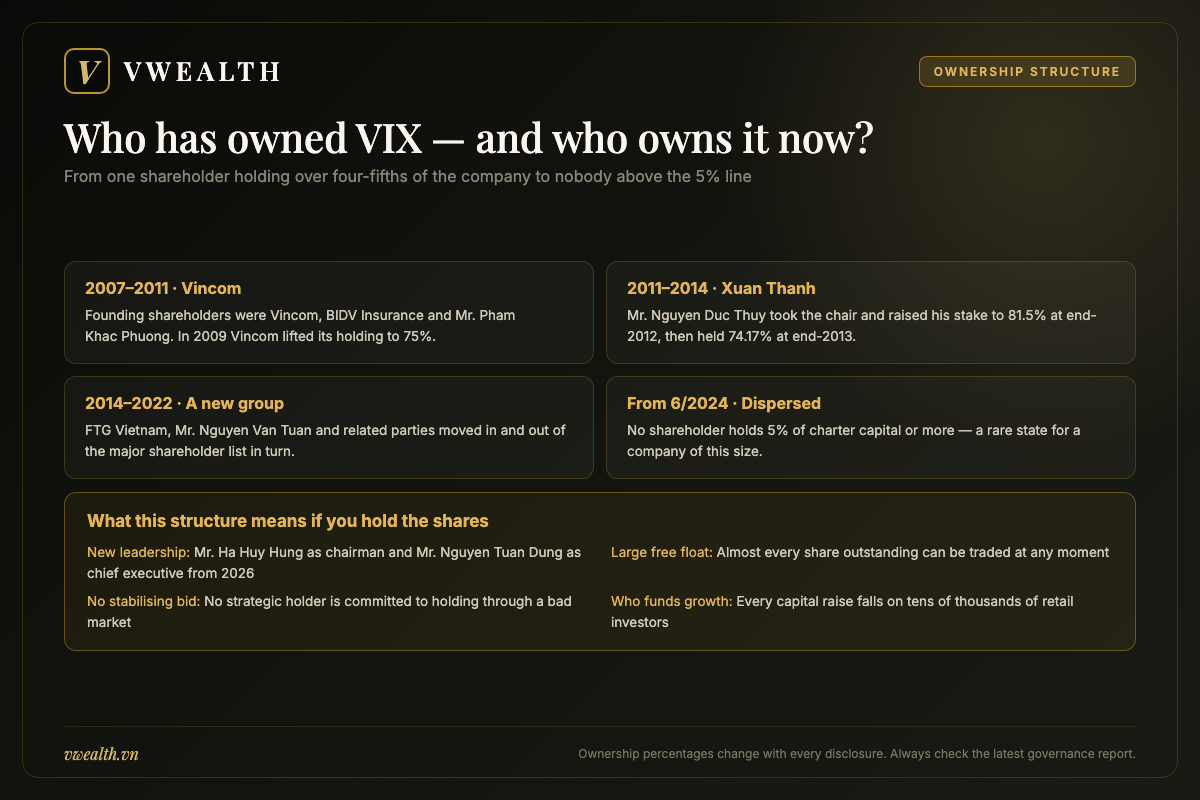
There is a line in VIX’s corporate governance reports that makes most investors read it twice on first encounter: the company has no shareholder holding 5% or more of charter capital. For a business with charter capital above twenty-four trillion dong and a place in the leading tier of its industry, that is rare enough that the local financial press has described it as a phenomenon. In Vietnam, the overwhelming majority of listed companies have an identifiable controlling bloc — a family, a parent group, or a residual state holding. VIX does not, at least on the disclosed record. This chapter traces the path to that condition, and, more importantly, explains what it means if you hold the shares.
2014–2022: the shareholder group around Nguyen Van Tuan
After Mr. Thuy exited in 2014, the incoming shareholder group at the company was associated with Mr. Nguyen Van Tuan. Mr. Tuan is a familiar figure on the Vietnamese market as chief executive of Gelex Group (ticker GEX), a diversified group active in electrical equipment, infrastructure, clean water and industrial real estate.
The composition of that group’s holdings shifted considerably over the years, and all of it was disclosed publicly under Vietnam’s rules governing transactions by major shareholders and insiders. At the point of the October 2020 rename to VIX Securities, FTG Vietnam JSC held 17.23% and Ms. Nguyen Thi Tuyet held 7.71%. By July 2021 the picture had moved: FTG Vietnam was down to 9.22%, Ms. Tuyet to 5.16%, while Mr. Tuan held 10.56%. In March 2022, Mr. Tuan bought nearly 52.5 million additional shares, lifting his stake to 14.84%, while both Ms. Tuyet and FTG Vietnam fell below the 5% threshold.
A necessary clarification about Gelex
One point needs stating plainly here, because it is the single most common misreading of this company by investors who have skimmed a headline. The fact that an individual serves as an executive of group A while simultaneously owning shares in company B does not make B a member company of A. Legally and for accounting purposes, those are two entirely different things. Gelex has issued a written statement affirming that VIX is not a member company within the group’s system.
Investors should anchor on official disclosure rather than inferring from personal relationships. This is not a VIX-specific caution; it is a general principle for reading any listed company in Vietnam, where cross-holdings, overlapping directorships and shared business histories are common enough that the temptation to join dots is constant. The disciplined approach is to treat what has been formally disclosed as fact, treat everything else as unknown, and refrain from speculating about motive. This article follows that rule throughout.
Nguyen Thi Tuyet, and the clean exit of December 2022
Across the whole nineteen years, the person most durably associated with leadership of this company is Ms. Nguyen Thi Tuyet. She joined the board in 2016 and through 2017–2023 alternated between chair and vice-chair, at times also holding the chief executive role. On 2 November 2022 she was elected chair of the board of directors for the remainder of the 2021–2026 term.
The period in which Ms. Tuyet was central is also the period in which VIX transformed most dramatically: the move to HOSE, the run of capital increases, the expansion of the proprietary book, and entry into the large-broker tier. If you plot the company’s shareholders’ equity over those years, you see a line that rises almost vertically compared with the flat decade before it.
Late 2022 was the hinge. Between 30 November and 7 December 2022, Mr. Nguyen Van Tuan sold his entire holding of more than 87.4 million VIX shares, equivalent to 15.02% of charter capital, through a combination of order-matching and put-through trades. FTG Vietnam also sold out of its remaining position over the same window.
The market context of that moment needs restating in order to read it correctly. Late 2022 was the height of the confidence crisis in Vietnam’s corporate bond market. The VN-Index fell from around 1,500 points early in the year to below 900 by November; a long list of stocks was hit by forced selling as pledged collateral was liquidated; and many company executives found themselves selling shares to meet personal financial obligations. A major shareholder divesting in that environment can have any number of causes, and this article does not speculate about motive. The one thing that is certain, and disclosed, is that after December 2022 this shareholder group no longer appeared on VIX’s list of major shareholders.
In July 2023, Ms. Nguyen Thi Tuyet returned to the major shareholder list with 5.03%. By June 2024 that had slipped to 4.98% — only just under the 5% line, but enough that she was no longer a major shareholder in the legal sense. From that point to today, VIX has been in a state where no shareholder holds 5% or more.
What “no shareholder above 5%” actually means for you
This is the section worth reading carefully, because it is misunderstood in both directions with remarkable consistency.
First, a piece of local mechanics that international readers need. Under Vietnam’s Securities Law, crossing 5% of a listed company’s voting shares makes you a “major shareholder”, which triggers disclosure obligations and reporting on subsequent transactions — broadly analogous in spirit to the 5% beneficial ownership reporting regime under US securities law, though the filing mechanics differ. The 5% line is therefore a disclosure threshold, not a control threshold. Everything below it is invisible in the public record.
The first misreading is to conclude that no major shareholder means the stock is “clean” — transparent, un-manipulable, free of coordinated interests. It does not follow. The absence of anyone above the disclosure threshold does not rule out the possibility of many separate accounts acting in the same direction, which an outside investor cannot observe and should not guess at. The only thing you can state with confidence is that nobody publicly holds a controlling position.
The second misreading is the opposite: that with no major shareholder, the company is ownerless and nobody is accountable. That is also wrong. The board and executive team continue to operate under the company charter, and major decisions — capital increases, dividend policy — still require shareholder meeting approval. Governance machinery does not evaporate because the register is dispersed.
So what is the practical significance? Three things are worth carrying with you. First, a dispersed register means a very large genuinely tradable free float, which is one of the main reasons VIX habitually tops the volume tables on HOSE. High liquidity is a real advantage for an active trader, but it also makes the price more sensitive to speculative flows than to fundamentals. Second, no long-term strategic shareholder means there is nobody who has committed to holding through a bad market — no natural stabilising bid when things get ugly. Third, large capital raises have no anchor investor able to underwrite them, so the burden of subscribing falls on tens of thousands of retail investors, which makes the take-up rate on each rights issue an indicator genuinely worth watching.
The new leadership from 2026: Ha Huy Hung and Nguyen Tuan Dung
Immediately after the 2026 annual general meeting, VIX changed both of its top positions at once. Mr. Ha Huy Hung was elected chairman of the board of directors, and Mr. Nguyen Tuan Dung took over as chief executive, replacing Mr. Truong Ngoc Lan. A complete simultaneous handover like this is unusual — companies more often replace one of the two roles and retain the other for continuity.
For an investor, a double change is both an opportunity and an unknown. It is an opportunity because new leadership typically arrives with a new strategy and a strong incentive to demonstrate competence. It is an unknown because you have no dataset on how these individuals make decisions, particularly the hard ones — cutting a large proprietary position at a loss, or tightening margin lending while the market is hot and competitors are loosening. The practical way to monitor it is to watch three things over the next four to six quarters: how quickly the composition of the proprietary portfolio changes, how fast the margin loan book grows, and what happens to dividend policy. Those three tell you more about operating philosophy than any speech will.
Dividends: what VIX actually pays you
This is where newer investors are most often disappointed. For several years now, VIX’s profit distribution policy has leaned entirely toward share issuance — stock dividends and bonus shares — rather than cash. The most recent plan is the issue of more than 122.5 million shares as the 2025 dividend at a ratio of 20:1, meaning every 20 shares held receive one additional share.
It is worth being precise about what that does. A stock dividend does not make you wealthier at the moment you receive it. When a company issues additional shares to distribute, the reference price on the ex-rights date is adjusted downward proportionally. You end up holding more shares, but each one represents a smaller slice of the same business. The value of your position at that instant is unchanged. The real benefit only materialises if the company deploys the retained earnings to generate a return above its cost of capital.
For a securities firm in expansion mode, retaining earnings makes commercial sense: thicker equity means a higher permitted margin lending ceiling and a greater capacity to carry a proprietary book. But if you are an investor who needs regular income — a retiree, or anyone living off portfolio distributions — this is clearly not a stock for you. Look instead toward the banking sector or businesses with a settled record of cash payouts; our analysis of ACB and its dividend approach makes a useful contrast, as does the Sacombank story, where the dividend question has its own long history.
How VIX makes money: four licences on paper, two engines in practice
Ask ten retail investors how a securities firm makes money and nine will say “trading commissions”. That was the right answer in 2010 and it is seriously wrong in 2026. The industry’s race to the bottom on fees has pushed brokerage commissions down to something close to symbolic, and several firms have gone to zero outright in order to attract accounts. The real revenue of a modern Vietnamese brokerage comes from somewhere else: from interest on margin loans, and from the portfolio of equities, bonds and other securities that the firm buys with its own money. At VIX, that shift has gone further than at most competitors — and you need to understand it before you place a buy order.
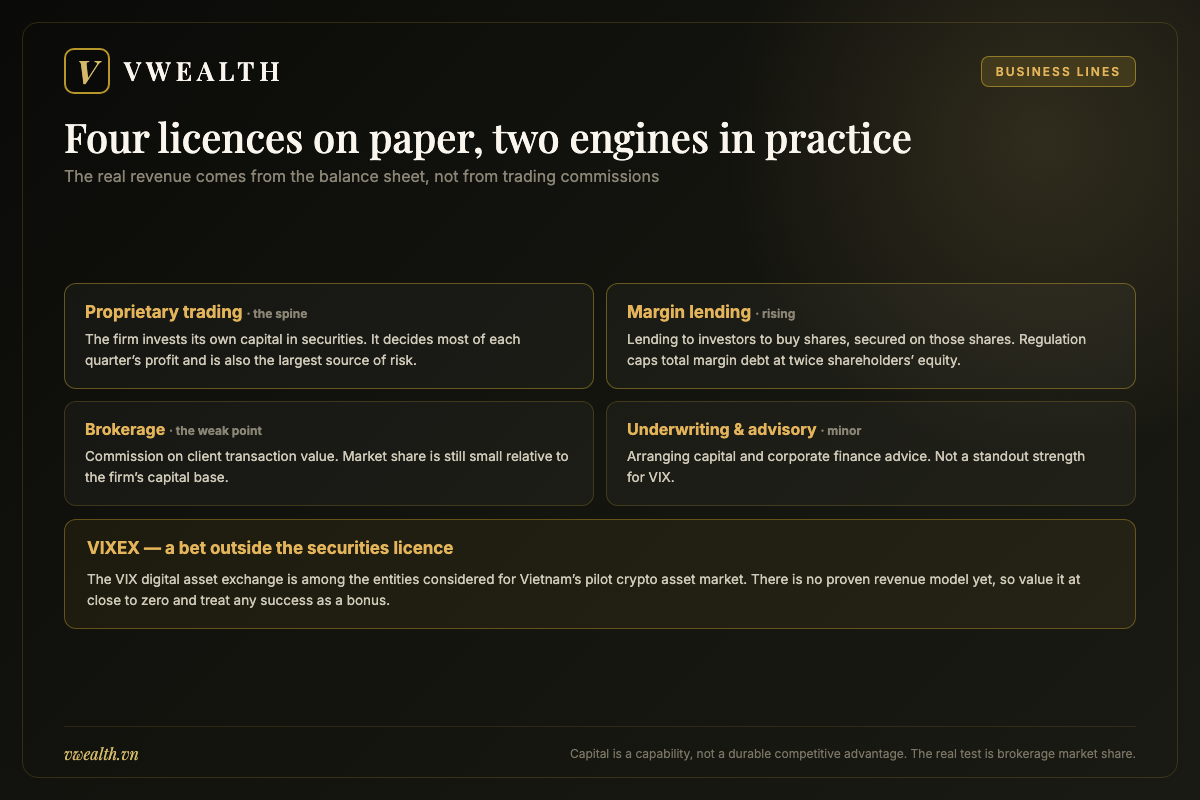
On the licensing record, VIX holds all four operating permissions a securities firm can hold in Vietnam: securities brokerage, proprietary trading, underwriting, and investment advisory. Holding all four is the precondition for being classified as a full-service firm; many smaller players hold only two or three.
But a licence tells you what a firm may do, not what it actually does. Revenue mix is what reveals the nature of the business. At VIX, that mix leans heavily toward two segments: proprietary trading and margin lending. The other two — brokerage, and underwriting and advisory — contribute far less than you would expect from a firm with top-tier capital.
Proprietary trading: the main engine, and the main risk
Proprietary trading, in plain terms, is the firm using its own money to buy and sell securities, capturing price differences and dividends. It is entirely different from brokerage: brokerage is a service performed for clients, proprietary trading is the house betting its own capital. In a rising market it is a money printer. In a falling market it is a hole.
International readers should note that the scale of proprietary desks at Vietnamese brokerages is a structural feature of this market rather than an aberration. Post-crisis regulation in the United States and Europe pushed banks’ proprietary risk-taking into separate vehicles; Vietnam never went down that road, and local brokers operate what are effectively in-house investment funds sitting on the same balance sheet as the client-facing business. That is legal, disclosed and normal here. It also means that when you buy shares in a Vietnamese broker, you are buying a partial claim on an equity portfolio managed by somebody else, geared by the firm’s own balance sheet.
For VIX, proprietary trading is not a supporting line item; it is the spine of the results. The pattern is visible across periods: in favourable quarters, profit jumps; in quarters when the portfolio marks down, profit collapses even while the other segments grow normally. The first half of 2026 offers an example so clean it could be a teaching case. Margin lending revenue rose strongly, brokerage was flat, and yet half-year pre-tax profit fell by roughly 90% year on year, because the value of the equities that make up the largest positions in the proprietary book had fallen relative to end-2025.
Read that again. Two service businesses running properly, and yet company-wide profit almost evaporated because a portfolio marked down. That is the portrait of a business whose results depend more on market direction than on operating execution. If you buy VIX, you have to accept that you are indirectly buying somebody else’s stock portfolio, with leverage supplied by the company’s balance sheet.
What is inside the proprietary book
Here is a genuine transparency advantage: Vietnamese regulation requires securities firms to disclose their financial asset holdings in the notes to their financial statements, so you can see exactly which names the firm owns and at what cost. Very few kinds of business let you look this far into the machinery.
According to published disclosures, as at 30 June 2026 the total market value of VIX’s financial asset portfolio stood above VND 20,800 billion, of which listed equities accounted for approximately VND 16,180 billion. The largest positions were concentrated in a handful of names including GEX (Gelex), GEE (Gelex Electric), EIB (Eximbank), VPX (VPBankS) and VSC (Viconship). The Eximbank position alone carried a cost basis of approximately VND 1,520 billion and was the largest single holding in the listed equity book. According to analysis published by several brokerages, VIX’s stake in Eximbank stood at roughly 4.83% as of April 2026 — below the 5% line, and therefore not a major shareholding in the legal sense.
There are three conclusions to draw from a portfolio shaped like this. First, it is a concentrated book, not a diversified index-like one. A small number of names carry heavy weight, which means the movement of a few stocks can determine an entire quarter’s result. Second, the book leans toward financials and industrials — high-beta sectors that swing hard with the cycle. Third, the ratio of the proprietary book to shareholders’ equity at VIX is among the highest in the industry, which means this stock’s sensitivity to the broad market is greater than most of its peers.
One caveat on how to read this: portfolio composition changes every quarter, and the firm can take profit on one name and accumulate another within a few weeks. The figures above are a snapshot at a disclosed date, not a permanent state. To know the current book you have to open the notes to the most recent financial statements — or read the consolidated view in the VIX analysis report on vwealth rather than working through PDF pages yourself.
Margin lending: the rising business, and the two-times rule
Margin lending is the firm lending money to investors to buy additional shares, taking those shares as collateral. It has the best economics in the industry: it is fundamentally secured lending against highly liquid, daily marked-to-market collateral, with a good spread and risk controlled through margin calls and forced liquidation.
At VIX, this segment is clearly growing. In the second quarter of 2026, margin lending revenue reached approximately VND 347.9 billion, up nearly 63% year on year. The reason is not mysterious: after the enormous capital raise, the firm’s equity thickened, and the permitted lending ceiling rose with it. Under current Vietnamese regulation, a securities firm’s total margin debt may not exceed twice its shareholders’ equity. Double the equity and you double the lending headroom.
That rule is worth dwelling on, because it is the hinge of the whole investment case and has no exact analogue in the US or European retail brokerage models most international readers know. In Vietnam, margin capacity is not primarily a function of client demand or funding markets — it is a hard regulatory function of the broker’s own equity. This makes capital raising and revenue growth mechanically linked in a way that is unusual: money raised from shareholders converts into lending capacity, and lending capacity converts into interest income. It explains exactly why VIX has raised capital so relentlessly.
If the firm genuinely deploys its lending headroom, this could become a stable revenue stream, far less volatile than proprietary trading, and over time it could change the character of the stock itself. But that “if” carries a lot of weight. Deployment depends on attracting enough borrowing clients, which in turn depends on brokerage market share — the very area where VIX is weakest.
Brokerage: surprisingly small for the size of the balance sheet
This is the central paradox of the VIX business model. Brokerage revenue in the second quarter of 2026 was slightly above VND 39 billion, down more than 7.8% year on year. Set that beside margin lending revenue of nearly VND 348 billion in the same quarter and you have a gap of almost nine times. VIX’s brokerage market share on HOSE has for years hovered at or below around 1% — very small relative to the leading group.
Why does this matter? Because in the industry’s standard model, brokerage is the front door. You attract clients with low fees and a good app, they open accounts, and then you sell them margin lending, where the real profit lives. A firm with small brokerage share but large lending ambitions faces an awkward question: lend to whom? Either it competes harder on rates and lending conditions, or it concentrates on a smaller number of large clients with concentrated borrowing needs. Both routes carry their own risk trade-offs — the first compresses margins, the second concentrates credit exposure.
Underwriting, advisory, and a bet on digital assets
Underwriting and corporate finance advisory are not standout strengths for VIX. That arena demands long-standing corporate relationships, a deep investment banking bench and accumulated credibility — things that firms with continuous operating histories and institutional client networks are better placed to supply.
The more notable expansion is in digital assets. In 2025, an entity related to VIX — VIX Crypto Asset Exchange Joint Stock Company, known as VIXEX — was established with capital in the thousand-billion-dong range. VIXEX is among the entities that filed and were considered for participation in Vietnam’s pilot regime for a crypto asset trading market. During 2026, VIXEX also made senior appointments, with Mr. Nguyen Thanh Que named chief executive and legal representative.
This is a bet of a very different character from the rest of the business. If the pilot framework is implemented smoothly and a legal digital asset market of meaningful size forms in Vietnam, an early licence holder gains a substantial head start. If the framework slows, tightens, or the market fails to reach expected scale, this becomes an expensive investment that generates nothing for years. Treat it as an option attached to the stock — potentially valuable, but not a reason to buy on its own.
| Segment | What it actually is | VIX’s position | Volatility | Role in the overall picture |
|---|---|---|---|---|
| Proprietary trading | The firm buys and sells securities with its own capital | The spine; large relative to shareholders’ equity | Very high — tracks the VN-Index closely | Determines most of quarterly profit |
| Margin lending | Lending to investors to buy shares, secured on those shares | Growing fast, with headroom left after the capital raise | Moderate — depends on market turnover | The steadier revenue line; potential new pillar |
| Brokerage | Commission on client transaction value | Small market share relative to capital base | Moderate — follows turnover | The client front door; currently the weak point |
| Underwriting & advisory | Fees for arranging capital and corporate finance advice | Not a standout strength | Low but lumpy, deal by deal | Minor contribution |
| Digital assets (via VIXEX) | Operating a digital asset exchange under a pilot regime | Among entities considered for the pilot | Not yet established | A growth option, no revenue contribution yet |
So where is VIX’s competitive advantage?
This question deserves a straight answer even when the answer is unflattering. VIX has no brand advantage — nineteen years and four names makes that impossible. No brokerage market share advantage. No research or investment banking advantage. No parent bank feeding clients across, the way some bank-affiliated brokers enjoy.
What VIX has is scale of capital. In the brokerage industry, capital is a genuine capability rather than a formal one: it sets the margin lending ceiling, determines the size of proprietary book you can carry, and determines how long you can withstand a bad cycle without being forced to sell assets. A thinly capitalised broker in a crash is forced to cut at the bottom; a well-capitalised one can wait. That difference is existential.
But draw the distinction clearly: capital is a capability, not a durable competitive advantage in the classical sense. Capital can be bought by issuing shares — any firm can do it if it can persuade its shareholders. It is not a thirty-year brand or a loyal client network. When the whole industry raises capital simultaneously — and 2025–2026 is precisely that — the relative advantage from capital erodes. What VIX has to prove over the next few years is that it can convert capital into genuine market share, rather than merely into a bigger investment portfolio.
Reading the financials: seven places to look before you buy VIX stock
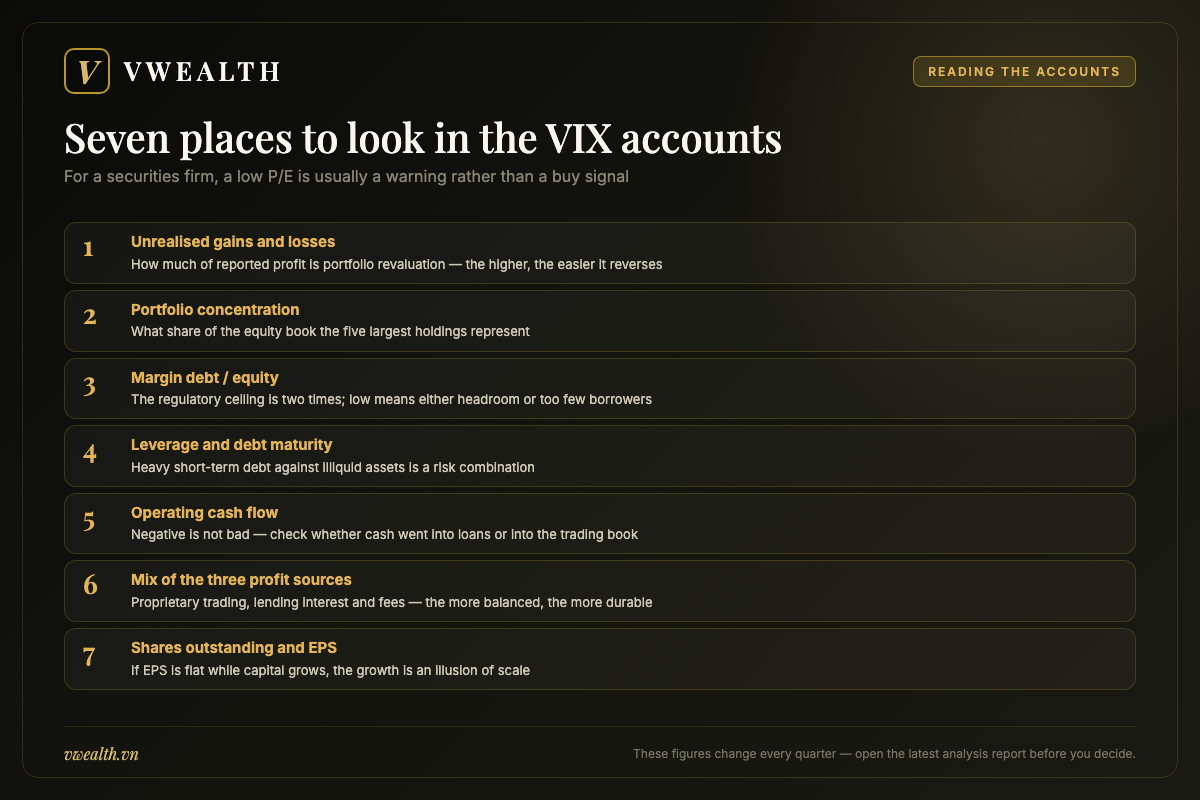
There is a common mistake that costs investors a great deal of money in brokerage stocks: they read a securities firm’s financial statements exactly as they would read a manufacturer’s. Look at revenue, look at profit, divide out a P/E, see a low number, conclude the stock is cheap. With VIX, that approach is not merely useless — it is actively dangerous, because the lowest P/E usually appears at precisely the moment you should be selling rather than buying. This chapter shows you seven places to look, and explains why each one matters specifically for this company.
Why P/E is nearly useless here, and P/B is the right lens
P/E is the ratio of share price to earnings per share. It works well for businesses with stable, forecastable profits — a retail chain, a dairy plant, a utility. It breaks down entirely for businesses with strongly cyclical earnings, and securities firms are the textbook case.
Here is the failure mechanism. At a cycle peak: the index is climbing, turnover is booming, the proprietary book is marking up hard, and profit hits a record. The denominator of P/E balloons, so P/E prints very low — the stock looks impossibly cheap. But that is the moment of maximum risk, because that level of profit is not repeatable. At the cycle trough the reverse happens: the market is dead, the proprietary book is losing money, profit shrinks or turns negative, and P/E jumps to dozens of times or becomes meaningless — the stock looks extremely expensive. Yet that is usually the best zone in which to accumulate.
Put bluntly: for a brokerage stock, a low P/E is a warning signal, not a buy signal. This runs against the instincts of most new investors, and it is exactly why this sector fleeces so many of them.
A far more appropriate measure is P/B, the ratio of market price to book value per share. The reason is intuitive: a securities firm’s assets are almost entirely financial — cash, equities, bonds, margin loans. They are carried at market value, or at cost with provisioning, which means book value tracks economic value reasonably closely. That is quite unlike a manufacturer, where the carrying value of an ageing plant may have nothing to do with what it is genuinely worth.
Reading P/B properly takes three steps. Step one, compare VIX’s current P/B against its own P/B history over the last five to seven years, so you know whether the market is currently paying more or less than its habit. Step two, compare against peers of similar size at the same point in time, because the whole sector rises and falls together and an absolute comparison will mislead you. Step three, ask the question that actually matters: is that P/B justified by return on equity? The general principle is that a firm producing a durably high ROE deserves a higher P/B. If a firm carries a high P/B on a low ROE, you are paying for expectation rather than performance.
With VIX, step three is the thorniest, because ROE swings hard from year to year given its dependence on proprietary trading, while the denominator — shareholders’ equity — keeps inflating through capital raises. You should look at average ROE across a full cycle, good years and bad, rather than anchoring on the ROE of a peak year.
Place one: FVTPL assets and unrealised gains
There is one line item in a Vietnamese securities firm’s accounts you must learn to read: financial assets at fair value through profit or loss, abbreviated FVTPL. This is where most of the proprietary book sits. Its defining feature is that it is remeasured to market value at each reporting date, and the difference — even if not a single share has been sold — flows straight into the income statement.
The consequence is large. A quarter in which VIX reports a profit in the trillions of dong may be a quarter in which the firm sold nothing at all, and the entire result came from the portfolio marking up. Conversely, a quarter of heavy losses may reflect nothing more than a temporary markdown. Both are paper results until the firm actually transacts.
So when reading VIX’s accounts, separate two things: realised gains and losses, from actual sales, and unrealised gains and losses, from revaluation. A company that repeatedly reports large profits of which most are unrealised, while operating cash flow is negative, is a situation that warrants a question mark. Not because anything is wrong, but because that profit has not yet become money and can evaporate next quarter.
Place two: portfolio concentration
Open the notes on financial assets and do one simple calculation: what percentage of the total equity portfolio do the five largest positions represent? For VIX, that number sits at the high end — the book is concentrated in a defined set of names rather than spread thin.
Concentration means you have to understand those names. If VIX holds a heavy weight in a bank stock, then banking sector risk becomes VIX’s risk. If it holds a heavy weight in an industrial, that sector’s cycle becomes VIX’s cycle. Put differently: when you buy VIX you are buying an indirect basket, and you ought to know what is in the basket rather than buying blind.
A practical habit: each quarter, after the financial statements are published, spend ten minutes comparing the current portfolio with the previous quarter’s. Which names were sold, which were accumulated, how did weights shift. That change reveals management’s actual market view far more clearly than any commentary.
Place three: margin debt against shareholders’ equity
Current regulation caps a securities firm’s total margin debt at twice shareholders’ equity. The ratio of margin debt to equity therefore functions as a dual indicator: it tells you how much of the permitted headroom the firm is using, and how much room is left to grow.
A low ratio has two opposite readings. The positive reading: the firm is conservative, has plenty of expansion room, and is safe if the market turns. The negative reading: the firm does not have enough borrowing clients, so the capital it raised is sitting idle or being pushed into proprietary trading, where risk is materially higher. For VIX, after the enormous 2026 capital raise, “where did the new capital go” is the central question that each quarterly report answers a piece of.
The reverse case also cuts both ways: a ratio near the ceiling means the resource is being used well, but there is no cushion left if the market falls sharply and forced liquidations begin.
Places four through seven: leverage, cash flow, earnings quality and dilution
Financial leverage. A securities firm borrows in order to lend and to invest. Look at total liabilities against shareholders’ equity, and more importantly at the maturity profile: heavy short-term debt funding assets that cannot be sold quickly in a bad market is a hazardous combination. That is precisely the shape of risk that caused difficulty for a number of financial companies in late 2022.
Operating cash flow. For a securities firm, operating cash flow is typically negative during expansion, because money is flowing into the investment portfolio and into loans. Negative in itself is not bad. What matters is why: negative because the firm is disbursing margin loans — interest-earning, collateralised assets — is a very different thing from negative because the firm is accumulating more equities into the proprietary book, which is pure market risk.
Earnings quality. Split profit into three sources: proprietary trading gains, lending interest, and service fees. The proportions tell you everything about the durability of the earnings. A firm deriving 80% of profit from proprietary trading will never be awarded the P/B that a firm deriving 60% from interest and fees receives, even if total profit is identical. That is the deep reason VIX tends to trade at a different valuation from firms with a more balanced revenue mix.
Dilution. This is the metric peculiar to VIX that its shareholders are obliged to track. Build a column in a spreadsheet: shares outstanding at the end of each year. You will see that number climb relentlessly. Now compute earnings per share for each year. If absolute profit grows more slowly than the share count, then however much the company “grows”, the value of each share you hold is being eroded. This is the harshest and the most honest test you can apply to a growth-by-issuance model.
| # | What to check | Where to find it | How to read it |
|---|---|---|---|
| 1 | Share of unrealised gains within reported profit | Notes on FVTPL assets, plus the income statement | The higher the share, the more easily profit reverses with the market |
| 2 | Portfolio concentration (top 5 holdings / total equity book) | Notes on financial assets | The more concentrated, the more a few names decide the quarter — know those names |
| 3 | Margin debt / shareholders’ equity | Balance sheet, loans section | Regulatory ceiling is 2x; low means either headroom or a shortage of borrowers |
| 4 | Total liabilities / equity, and debt maturity profile | Balance sheet and borrowing notes | Heavy short-term debt against illiquid assets is a risk combination |
| 5 | Operating cash flow | Cash flow statement | Negative is not bad; check whether cash went into loans or into the trading book |
| 6 | Mix of the three profit sources: proprietary / interest / fees | Income statement, operating revenue section | The more balanced, the more durable the earnings and the friendlier the valuation |
| 7 | Shares outstanding at each period end, and the matching EPS | Notes on shareholders’ equity | If EPS is flat or falling while capital grows, the growth is an illusion of scale |
Where VIX sits in the industry: big on capital, small on market share
Put it all together and the positioning is clear, and quite distinctive. Measured by charter capital and shareholders’ equity, this is one of the largest securities firms in Vietnam. Measured by total assets, also in the leading group. But measured by brokerage market share — the metric that reflects how many clients are actually trading through the firm — VIX sits in the modest tier.
That gap between “big on capital” and “small on market share” is the identifying signature of the VIX model. It says the business has chosen to make money through its balance sheet rather than through its client network. This is not a wrong model — a good many financial institutions worldwide operate exactly this way and do very well. But it is a model that demands excellent investment skill and high risk-management discipline, because there is no steady fee income to cushion the years when the investments go wrong.
It also produces a distinctive relationship with the banking sector. Because a broker’s balance sheet earns from lending and from securities, its economics rhyme with a bank’s in some respects and diverge sharply in others: there is no deposit franchise, no net interest margin protected by relationship stickiness, and no credit cycle that plays out over years rather than weeks. If you want to feel the contrast, read this alongside VPBank, a lender that also runs a high-risk, high-return balance sheet but with an entirely different funding structure. The comparison sharpens what is genuinely unusual about a brokerage’s earnings profile.
How the market treats VIX stock: portrait of a high-beta trading vehicle
Every stock on an exchange has a personality — a characteristic way of reacting to news, to flows, to crowd psychology. Some are slow, low-volatility names that funds hold for years. Some are impulsive, limit-up today and limit-down tomorrow. VIX belongs firmly in the second group, and there is nothing to be coy about in saying so. The question is not whether that personality is good or bad; it is whether it suits you. A race car is not a bad car merely because it is uncomfortable on a family weekend drive. This chapter describes VIX’s personality plainly, so you can judge whether you are the right driver for it.
Top-tier liquidity and very high beta
VIX is a near-permanent fixture among the highest-volume names on HOSE. In active market phases, single-session volume in VIX has run into the tens of millions of shares. Three factors compound to produce that.
The first is the dispersed ownership register. With no major shareholder holding for the long term, essentially the entire share count outstanding can be traded at any moment. A large genuine free float is the precondition for high liquidity. The second is price level. After multiple issues and bonus distributions, VIX trades in a band that small retail accounts find accessible — an account of a few tens of millions of dong can still buy several thousand shares, which creates the psychologically appealing sense of “getting a lot of shares”. The third is the sheer share count after the run of capital increases: with more than two billion shares in circulation, absolute traded volume is naturally large.
High liquidity is a real benefit. You can enter and exit sizeable positions without moving the price much, and you are not trapped the way you can be in small caps. But it comes with a shadow: highly liquid stocks are where speculative money concentrates, which means the price is driven by short-term sentiment more than by intrinsic value. That explains why VIX can rally hard through euphoric market phases even when results have not improved at all, and fall sharply through corrections even when there is no company-specific bad news.
Beta measures how much a stock moves relative to the broad index. A beta of 1 means it moves in line with the market. A beta above 1 means it amplifies — the market rises 1% and the stock rises more than 1%, and the same in reverse.
Brokerage stocks as a group carry high beta, and VIX sits at the high end of that high group. The reason is logical rather than accidental: the company’s earnings depend directly on market direction, through the proprietary portfolio and through overall turnover. When the VN-Index rises, investors expect both revenue engines to fire simultaneously, so they pay up immediately. When the index falls, the expectation reverses just as fast.
The market has another name for this phenomenon: brokerage stocks are “wave leaders”. They tend to rally before the market confirms an uptrend, and they tend to roll over before the market peaks. Experienced investors use the sector as a sentiment indicator: when brokerage stocks stop rising while the index still climbs, that is usually a sign that money is tiring.
The practical consequence for you is this: if you do not have a clear view on the direction of the broad market, you cannot really have a correct view on VIX. Buying VIX without a VN-Index opinion is like betting on a boat without looking at the tide.
Trading mechanics that shape the experience: bands, T+2 and the free float
International readers need three pieces of Vietnamese market plumbing to understand what holding this stock actually feels like.
The first is the daily price band. HOSE applies a limit of plus or minus 7% around the previous session’s reference price; the Hanoi exchange uses plus or minus 10%. On the upside this dampens euphoria. On the downside it produces the specific pathology known locally as a “locked floor”: the stock sits at minus 7% with a queue of sellers and no bids, and nothing trades at all. The next day it opens lower and may lock again. This is why a Vietnamese stock can lose a large fraction of its value in a short stretch without ever offering you an intermediate exit price. For a high-beta name like VIX, that mechanism should be built into your position sizing from the start.
The second is settlement. Vietnamese equities settle T+2, meaning shares bought today become available to sell two business days later. In a fast-moving name this imposes a compulsory holding window you did not choose. Combined with the band, a two-day adverse move can put a position materially underwater before you are legally able to act on it.
The third is the free float, which for VIX works in your favour. Because the register is dispersed and there is no locked-up strategic block, the tradable float is unusually large relative to market capitalisation. In practice this means VIX is one of the easier large-cap Vietnamese names to build and unwind a position in — a genuine advantage for anyone managing size, and one of the reasons the stock is a natural candidate for index inclusion.
Three big waves: 2021, 2023 and the upgrade trade
Look at a long-term chart of VIX and you will see a stock that was essentially inert through the years it was called IB Securities, then exploded in step with three major market waves.
The first wave was 2020–2021, when savings rates fell to record lows, retail investors poured into equities and the VN-Index set an all-time high above 1,500 points. This was also when VIX moved to HOSE and began its run of capital increases. The second was the 2023 recovery, after the market bottomed in late 2022 during the corporate bond crisis — brokerage stocks recovered earliest and hardest, precisely because they had been sold off hardest beforehand. The third is tied to the market reclassification story, following FTSE Russell’s announcement in October 2025 upgrading Vietnam, with an effective date set for September 2026.
What all three waves share: the driver came from market conditions and capital flows, not from an internal inflection at the company such as a new product or a step change in market share. That is worth remembering when you think about the future — with VIX, the question “what will the market do” matters more than the question “what will the company do”.
The price of growth by issuance: dilution as a permanent feature
This is the part that long-term holders of VIX find most bitter. You buy the shares, the business expands, total profit may well rise — and yet your slice of the business shrinks after every issue unless you keep writing cheques.
Take the 2026 offer as an illustration of the mechanism. A 10:6 ratio means that for every 10 shares you hold, you have the right to subscribe for 6 new shares at VND 12,000. Suppose you hold 10,000 shares. To keep your ownership percentage unchanged, you must find 6,000 × 12,000 = VND 72 million in cash. If you do not have that money available — or do not want to increase this stock’s weight in your portfolio — you can sell the rights, but your ownership stake in the company then falls by roughly 37.5%. This is an illustration of the mechanism, not a recommendation, and it does not reflect market prices at any particular moment.
Combine that with a dividend policy paid in shares rather than cash and the picture is clear: VIX is a stock that continually asks its shareholders for capital and essentially never returns cash. For a younger investor still accumulating assets who believes in the sector’s trajectory, that is acceptable. For an investor who needs cash flow, it is an absolute disqualifier.
Foreign investors and the room question
Securities firms in Vietnam belong to a category in which foreign investors are permitted to hold high ownership percentages — a number of firms in the industry have opened their limits to the maximum, and some are entirely foreign-controlled. This is a meaningful contrast with banking, where foreign ownership is capped at 30%, and with the general 49% ceiling that applies to most listed companies in non-conditional sectors. In local usage the available headroom is simply called “room”, and when room runs out, buying is blocked at the exchange level regardless of price.
Room, however, is rarely the binding constraint for VIX. The more relevant point is behavioural: foreign capital tends to seek businesses with forecastable models, governance aligned to international standards, and revenue mixes weighted toward fees. A firm whose profits swing hard with a concentrated proprietary book is unlikely to be a priority allocation for long-horizon institutional funds, however good the liquidity.
That could change once Vietnam formally enters FTSE Russell’s secondary emerging market category from September 2026. Index-tracking funds are obliged to buy the stocks in the basket, at the basket’s weights, regardless of what any individual manager thinks of a particular company — and the criteria that matter most for inclusion are market capitalisation and liquidity, both of which VIX has in abundance. This is one of the most notable catalysts attached to the stock, and we return to it in the next chapter.
VIX against three peers: four different ways of making money
| Criterion | VIX | SSI | VCI (Vietcap) | VND (VNDirect) |
|---|---|---|---|---|
| Primary earnings engine | Proprietary trading, with margin lending being added | Balanced: brokerage, lending, proprietary, institutional services | Investment banking and institutional clients, plus proprietary | Retail brokerage and margin lending |
| Brokerage market share | Small relative to capital base | Among the leaders for many years | Strong with institutions and foreign investors | Formerly among the retail leaders |
| Earnings stability | Low — swings hard with the market | Higher, thanks to diversified sources | Moderate — depends on deals and the portfolio | Moderate |
| Stock personality | Heavily speculative, very high beta, top-tier liquidity | The sector bellwether, widely held by institutions | Tied to the foreign flow and IB narrative | Volatile, tied to retail sentiment |
| Dividend policy | Predominantly in shares | A mix of cash and shares | Predominantly in shares | Predominantly in shares |
| Who it suits | Cycle traders who can tolerate large drawdowns | Investors wanting sector exposure with lower risk | Investors backing the upgrade and foreign-flow story | Investors tracking the retail cycle closely |
The table is not a ranking. Its purpose is to show that these four stocks, despite sharing an industry, are four fundamentally different investments. If you want exposure to the brokerage cycle with the least volatility available, VIX is not the instrument. If you want to amplify a sector move you believe is coming, VIX is precisely the amplifier.
The bottom line: VIX is a bet on the cycle, not on operating quality
If you compress this entire chapter into one sentence, it is this: buying VIX is taking a geared position on the Vietnamese equity market cycle, not buying a business with a superior competitive position. That does not make it a bad stock. A great many investors have made serious money on cycle bets, provided they knew what they were betting on and had the discipline to get out.
The danger arrives only when somebody buys VIX in the frame of mind appropriate to a durable compounder they intend to hold for a decade, then finds themselves bewildered when the account halves in a single bad quarter, and bewildered again when the number of shares they hold rises while the value does not. It is the mismatch between expectation and the nature of the asset that destroys capital — not the stock itself.
Vietnam’s brokerage industry in 2026: the best opportunity in a decade, the fiercest competition ever
An interesting paradox is playing out across Vietnam’s securities industry. Judged by prospects, this is arguably the brightest moment since the market opened in 2000: new trading infrastructure is running, the market is about to be reclassified upward, and legal frameworks for entirely new asset classes are taking shape. Judged by profitability, it is also the hardest period in which to make money, because virtually every firm has cut commissions to near zero and all of them are simultaneously raising capital to compete for the same pool of clients. Great opportunity and brutal competition are arriving at the same time — and VIX stands between those two forces.
How the race to zero commissions ended
Between roughly 2021 and 2024, Vietnam’s brokerage industry went through a price war whose outcome was more or less foreseeable: commissions were driven to a minimum, and a number of firms declared indefinite zero-fee trading in order to capture new accounts. The obvious beneficiary was the retail investor — the cost of trading today is a small fraction of what it was ten years ago.
For the firms, though, the consequence was a forced shift in the business model. When fees are no longer a revenue source, brokerage becomes a customer acquisition cost, and profit has to come from two other places: interest on margin loans, and proprietary investment. Put another way, the entire industry has been drifting toward looking more like VIX, rather than the other way round — the difference is one of degree.
Two implications follow. First, VIX’s relative advantage from having moved early into a balance-sheet-driven model will erode, because the competition is walking down the same road. Second, the entire sector becomes more sensitive to the market cycle, because the steadiest revenue line — fees — has been shaved thin. For anyone weighing brokerage stocks generally, that second point is the more consequential one: the sector’s earnings will be more correlated, more volatile and more simultaneous in their downturns than they were a decade ago.
The FTSE Russell upgrade and the KRX system
On 7 October 2025, FTSE Russell announced the reclassification of Vietnam’s stock market from frontier to secondary emerging status, with an effective date set for 21 September 2026. Through 2026, FTSE Russell went on to confirm that Vietnam had passed its review and that the timetable remained unchanged.
Why does this matter so much? Because market classification determines passive capital flows. An enormous pool of assets worldwide is managed against FTSE Russell indices — ETFs and index funds are obliged to buy exactly the stocks in the basket, at exactly the prescribed weights, regardless of what the manager thinks of any individual company. When Vietnam enters the emerging basket, a portion of that money flows automatically into qualifying Vietnamese stocks.
The group that benefits most directly and most obviously is the securities firms, for two reinforcing reasons. The first is mechanical: brokerage stocks with sufficient market capitalisation and liquidity have a chance of index inclusion and the passive buying that comes with it. The second is commercial: foreign money entering the market raises overall liquidity and traded value, which lifts brokerage revenue and margin lending demand across the whole industry.
A dose of realism is warranted, though. An upgrade is not a magic wand. Experience from other markets that have been reclassified shows that inflows typically arrive strongly around the effective date and then normalise; that share prices tend to price in the expectation very early, sometimes more than a year ahead; and that after the event, the market returns to the perennial question of whether the businesses actually make money. For a stock that has been valued on upgrade expectations for several quarters, the risk of a “sell the news” reaction is entirely real.
On 5 May 2025, the new information technology system for Vietnam’s stock market — widely referred to as the KRX system, after the Korean vendor — went live after years of delay. More than a month into operation, the system was running stably.
KRX matters not because the price board looks different but because of processing capacity. The new system allows trading volumes to scale and supports products and mechanisms the legacy platform could not carry — intraday trading, covered short selling, and shorter settlement cycles among them. To international institutions, these are basic table stakes rather than luxuries, and their absence was a long-standing reason for underweighting the market.
Circular 08/2026 and the non-pre-funding mechanism
Alongside the infrastructure, the legal framework has been completed. Circular 08/2026/TT-BTC establishes the legal basis for foreign investors’ market access through global securities firms, and finalises the rules around the mechanism that removes the pre-funding requirement — the arrangement that allows a foreign institutional investor to place a buy order without having the full cash amount in the account at the moment of the order. Pre-funding was for years one of the loudest complaints international institutions made about this market, because it forces a fund to park currency in Vietnam ahead of trading, creating both operational drag and FX exposure.
For securities firms, the new mechanism is simultaneously an opportunity and a risk. It is an opportunity because it opens the door to large foreign institutional clients. It is a risk because the securities firm is the party guaranteeing settlement on the client’s order before the client has paid — in other words, it carries the counterparty exposure. Anyone who wants a slice of this business needs thick capital and a solid risk management framework. This is where VIX’s large capital base is, in theory, an advantage — while its thin institutional client franchise is the obstacle.
The industry-wide capital raising race
If you think only VIX has been raising capital aggressively, you are missing the picture. The whole industry is doing it. Total new capital raised across Vietnamese securities firms has been recorded at a very large level, creating abundant margin lending headroom for 2026. The reasoning is transparent: everybody can see the upgrade opportunity, and everybody wants ammunition ready when the money arrives.
The consequence of that race deserves careful thought. When everyone raises capital at once, the supply of lending capacity grows faster than the demand to borrow, and competition shifts to margin lending rates. Spreads compress. At the same time, the aggregate share count across the sector rises materially, which means that simply to hold earnings per share constant, total industry profit must rise proportionally — not a trivial requirement.
This is precisely why “a sector with good prospects” does not automatically translate into “sector shares will rise”. If the market grows 50% while the share count of the securities firms grows 80%, existing shareholders are worse off. That arithmetic is the exercise every investor in this sector has to run for themselves.
Digital assets: a new arena whose rules are still being drafted
One of the more consequential shifts of 2025–2026 is that Vietnam has begun building a legal framework for digital assets, with a pilot mechanism and a number of exchange licence applications put out for consultation. VIXEX — the entity related to VIX — is among those considered for participation in the pilot.
On the opportunity side, this is a potentially large market with a Vietnamese user base already thoroughly familiar with digital assets through unofficial channels. Being licensed early in a market like that is a meaningful advantage.
On the risk side, candour is required: this is a field with no precedent in Vietnam, the legal framework is still forming, the revenue model is unproven, and the volatility of the asset class itself is far greater than equities. A business whose profits already swing hard with the equity market, now adding a line tied to an even more volatile market, does not reduce its total risk — it increases it. An investor should value this segment at close to zero today and treat any positive outcome as a bonus.
Macro drivers and the downside of a cyclical industry
The securities industry reflects the health of the wider economy and the level of interest rates. Three macro factors have the most direct influence.
Interest rates. This is the single most important variable. Low deposit rates push money from banks into equities and simultaneously lower the funding cost of margin lending. Rising rates do the reverse, and typically with a double effect: pulling money out of the market while also compressing equity valuations generally.
Economic growth and household income. The number of securities accounts in Vietnam has risen sharply over the past half-decade, but as a share of the population it remains low compared with developed markets in the region. The room to widen the investor base is substantial, and this is the genuine long-run driver of the industry.
The exchange rate and international capital flows. For a market about to enter the emerging category, movements in the dong and the level of global interest rates will bear directly on how foreign funds allocate. Currency risk is not incidental for an international holder of Vietnamese equities; it is a permanent component of the return.
The flip side of all of the above is cyclicality. The securities industry has no hard floor the way food or utilities do. When the market turns bad, turnover can fall by seventy or eighty per cent within a few months, the proprietary book loses money, the margin loan book shrinks as clients are liquidated and stop borrowing, and all three revenue lines deteriorate at once. Analysts call this correlation risk: the revenue sources are not independent, they degrade together under the same conditions. With VIX, given the weight of its proprietary book, the effect is amplified further.
Three scenarios for VIX stock, and the conditions behind each
There is no price target in this section. Anyone handing you a figure along the lines of “VIX will reach X within six months” is selling you manufactured certainty, and doing so about a stock whose profits depend on market movements is especially unhelpful. Something far more useful is a set of conditions: if A and B happen, the story goes this way; if C happens, it goes that way. Once you hold that conditional map in your head, you do not need to predict the future — you only need to observe which conditions are turning real, and act accordingly. That is the professional way to handle an asset with high uncertainty.
Three real drivers already in place
Before splitting into scenarios, list the drivers that already exist rather than the ones that are speculation.
Driver one: enormous margin lending headroom after the capital raise. With charter capital above VND 24,500 billion, the regulatory margin ceiling rises correspondingly. If the new leadership prioritises deploying into lending rather than expanding the proprietary book, the company’s profit mix could shift toward something considerably more stable over the next two to three years. This is the most important variable, and also the one most within the company’s own control.
Driver two: the market upgrade taking effect in September 2026. Higher overall liquidity benefits the whole industry, and a stock with large market capitalisation and top-tier liquidity like VIX is a natural candidate for emerging market index baskets.
Driver three: an early licence position in digital assets. If the pilot mechanism is implemented and VIXEX becomes operational, that is an entirely new revenue source that does not compete head-on with the twenty-odd other securities firms.
Bull case: capital turns into market share
Conditions required: the Vietnamese market sustains its positive momentum after the upgrade takes effect, with average daily turnover rising durably rather than merely spiking. The new leadership deploys most of the available capital into margin lending, and invests substantively in technology and staff to lift brokerage market share. The proprietary portfolio is restructured toward lower concentration. VIXEX receives formal licensing and begins generating revenue.
What you would expect to see: the profit mix migrates from “mostly proprietary” toward “more balanced between interest income and proprietary”. This change matters far more than any single quarter’s profit growth rate, because it changes the quality of earnings. When earnings become more durable, the market tends to accept a higher P/B for the same ROE — the phenomenon investors call a re-rating.
What to watch to confirm the bull case is materialising: the share of lending interest within total operating revenue rising steadily across four consecutive quarters; brokerage market share on HOSE improving visibly year on year; and, most importantly, earnings per share rising rather than only absolute profit rising. That last distinction is the one that separates real progress from the arithmetic of a bigger share count.
Base case: bigger but not different
Conditions required: the market behaves normally, with rising and falling phases alternating and no major shock. The company continues its existing model: most of the new capital goes into the proprietary book and a portion into margin lending, brokerage market share does not improve materially, and VIXEX operates without contributing meaningful revenue.
What you would expect to see: profit continues to swing violently quarter to quarter with the market — some quarters enormously profitable, some quarters barely profitable or loss-making, exactly as has happened in recent years and with particular clarity in the first half of 2026. The business is larger, but its nature is unchanged. The stock remains a vehicle for trading the sector wave rather than a long-term holding.
This article assesses the base case as the most likely of the three, for the straightforward reason that it is the continuation of inertia. Changing the profit mix of a securities firm requires years of building a client franchise, and cannot be completed in four to six quarters.
What it implies for you: if you believe the base case, the sensible approach is to trade the rhythm — accumulate when the market is pessimistic and P/B has fallen toward the low end of its own history, take profit when the market is euphoric and brokerage stocks are leading the wave. Holding passively for years under this scenario would produce a materially worse outcome than trading the cycle, because you would bear the volatility and the dilution without receiving any cash dividend in return.
Bear case: the cycle turns while the book is large
Conditions required: the equity market enters an extended decline — possibly driven by global rates rising again, by a domestic macro shock, or simply by a “sell the news” reaction once the upgrade takes effect and the expected flows prove smaller than the market had priced. In that environment, VIX’s large and concentrated proprietary book takes heavy revaluation losses, while the margin loan book contracts as clients are liquidated and stop borrowing.
What you would expect to see: all three revenue lines deteriorate simultaneously — the correlation risk described in the previous chapter. Profit could fall very sharply or turn negative for several quarters. The first half of 2026 provided a milder preview: pre-tax profit down roughly 90% year on year despite good growth in lending. In a genuine and prolonged bad cycle, the amplitude could be greater.
An additional risk: if the company proceeds with further capital raising into a weak market, existing shareholders are put in an unpleasant position — either write another cheque into a business currently losing money, or accept dilution at a low share price. This is the most painful scenario and also the one to which investors habitually assign too low a probability.
Early warning signals: average market-wide turnover declining for several consecutive months; brokerage stocks underperforming the VN-Index during rebounds; the proprietary portfolios of the large securities firms marking down together in quarterly reports; and the company announcing a new issue immediately after a loss-making quarter.
| Scenario | Key conditions | What happens to the business | Early signals to watch |
|---|---|---|---|
| Bull | Market momentum holds after the upgrade; new capital flows into margin lending; brokerage share improves; VIXEX operational | More balanced profit mix, higher earnings quality, scope for a re-rating | Lending interest share of revenue up four quarters running; EPS rising, not just absolute profit |
| Base | Market behaves normally; the company keeps its proprietary-led model | Larger scale, profit still swinging hard by quarter, nature of the stock unchanged | Revenue mix unchanged; brokerage share flat; proprietary book still concentrated |
| Bear | Extended market decline; “sell the news” after the upgrade; heavy proprietary losses | All three revenue lines fall together; profit collapses or turns negative; dilution pressure at low prices | Market turnover falling for months; brokers lagging the index; a new issue announced right after a loss |
How to actually use three scenarios
Do not pick one scenario and marry it. The correct use is to assign each scenario your own confidence level, then design a position that survives the bear case while still delivering a worthwhile return in the bull case. For a stock as volatile as VIX, that usually means a small weight in the overall portfolio, buying in tranches rather than all at once, and setting a stop level before you place the first order rather than after the position moves against you.
Position management matters more with this stock than entry timing does. That is a genuinely counterintuitive statement for most investors, who spend the bulk of their attention deciding when to buy and almost none deciding how much and when to exit. With a name whose amplitude is this wide, the second question dominates the first. If you are building a broader Vietnam portfolio around it, it is worth reading VIX beside a defensively positioned financial such as Vietcombank, so that you can see clearly how differently the two behave in the same market conditions and size them accordingly.
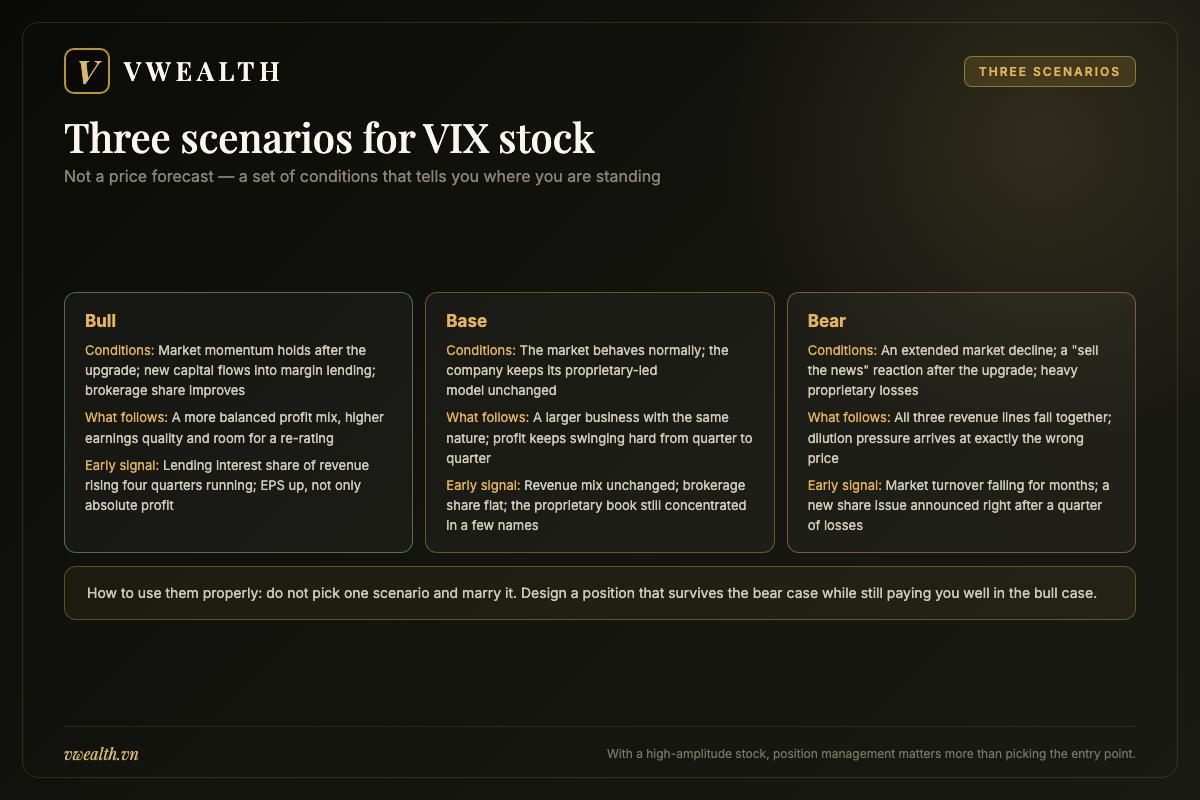
So, should you buy VIX stock? A straight answer
By now you have been through nineteen years of history, an unusual ownership structure, a business model tilted heavily toward proprietary trading, seven financial metrics worth tracking, the personality of the stock and three scenarios ahead. It is time to fold all of that into an answer. And the answer will not be a generic “yes” or “no” — because the same stock can be a reasonable choice for one investor and a serious mistake for another. A correct answer has to start with who you are.
The case for: what genuinely makes VIX attractive
Capital in the industry’s leading tier. After the run of raises, VIX carries a very thick equity base. In this industry that is a real capability: it sets the margin lending ceiling, determines how large a portfolio the firm can carry, and determines its staying power through a bad cycle. A thinly capitalised broker in a crash may be forced to sell assets at the bottom; a well-capitalised one can wait.
Very large growth headroom in lending. If the firm can deploy most of its permitted margin lending capacity, that is a good-margin revenue stream far steadier than proprietary trading. Lending revenue growing nearly 63% in the second quarter of 2026 shows the direction has at least been set.
Top-tier liquidity. For an investor with size, or one who trades actively, being able to enter and exit without getting stuck is a practical value that many fundamentally superior stocks do not offer.
Direct leverage on the industry cycle. If you believe Vietnam’s equity market is entering a long expansion driven by the reclassification, the KRX infrastructure and a widening investor base, VIX is one of the most powerful instruments on the exchange for expressing that belief.
A transparent portfolio. This one is rarely mentioned and genuinely valuable: you can open the notes to the financial statements and see which stocks the firm holds and at what cost. Very few businesses let you look at their internals this directly.
A free option on digital assets. At present the market is effectively assigning no value to this segment. If it works, that is upside; if it does not, you have lost nothing, because you did not pay for it.
The case against: what should give you pause
Profits depend far too heavily on proprietary trading. This is the largest risk, and it is structural rather than temporary. The first half of 2026 is the clearest possible evidence: two service segments performing well, and profit still down roughly 90% simply because the investment portfolio marked down. You cannot forecast the earnings of a business like that, and what cannot be forecast should not be valued with methods designed for stable companies.
A concentrated portfolio. Risk is not diversified. A handful of stocks determine an entire quarter’s result. This amplifies both directions.
Continuous dilution. This is a permanent feature rather than an incident. Shares outstanding have risen roughly twentyfold in six years. If absolute profit does not rise correspondingly, the value of each share you hold is eroded even as the business “grows”.
Essentially no cash dividend. If you need income from your portfolio, this stock does not provide it.
Brokerage market share small relative to capital. Without a strong client front door, converting capital into loan balances is difficult, and the firm easily falls into the habit of routing capital into the proprietary book because that is the fastest way to deploy it.
No durable competitive advantage in the classical sense. No long-established brand, no loyal client network, no parent bank ecosystem. The greatest advantage is capital — and competitors are raising capital too.
No long-term committed shareholder. Nobody is there to steady the stock when the market turns, and every capital raise depends entirely on the decisions of tens of thousands of individual investors.
The new leadership has no track record yet. Replacing both chairman and chief executive in 2026 means you are assessing a team you have never seen handle a bad cycle.
| Strength | The matching weakness | What to do with this information |
|---|---|---|
| Shareholders’ equity among the largest in the industry | Large capital but small brokerage share — not yet converted into clients | Track HOSE brokerage market share each quarter; this is the real test |
| Huge margin lending headroom, with that revenue growing fast | Needs borrowers to deploy it; if absent, capital drifts to proprietary trading | Track the ratio of margin debt to shareholders’ equity quarter by quarter |
| Top liquidity on the exchange | High liquidity attracts speculative flow that dominates the price | Only use it if you manage the position actively — never buy and forget |
| Strong leverage on the sector cycle and the upgrade narrative | Leverage works both ways; “sell the news” risk is real | Fix a stop level and a maximum portfolio weight in advance |
| A transparent, inspectable proprietary portfolio | Concentrated book where a few names decide the outcome | Compare the portfolio with the prior quarter each period; understand the top holdings |
| A growth option in digital assets | No precedent, no proven revenue model | Value it at close to zero and treat any success as a bonus |
| Paying in shares retains capital for expansion | No cash dividend, and permanent dilution | If you need cash flow, remove this stock from your list |
Who VIX suits
The sector cycle trader. This is the best fit. If you hold a clear view on the direction of the VN-Index, understand that brokerage stocks tend to lead the wave, and have the discipline to take profit into euphoria, VIX is one of the most efficient instruments available for expressing that view. You are not buying a business; you are buying a geared position on the cycle — and you know it.
The high-risk-tolerance investor sizing small. If you allocate a small slice of your portfolio — typically an amount that, if it halved, would not disturb your financial plan — to wide-amplitude bets, VIX fits that compartment. Diversification matters doubly with a name like this, and the right way to hold it is inside a portfolio that contains steadier financials such as MB Bank or Techcombank rather than as a concentrated sector position on its own.
The investor who believes in Vietnam’s long capital-market story and buys over time. If you believe the share of the population participating in the equity market will multiply over the next decade, and you buy steadily across cycles instead of once at a peak, timing risk falls substantially. Averaging in is a rational way to approach a high-amplitude name, provided you have first accepted that you will be buying into drawdowns as well as rallies, which is psychologically harder than it sounds when you plan it.
Who should stay away
Anyone who needs dividend income. There is no meaningful cash dividend. This is an absolute disqualifier, not a preference.
Any investor who has never lived through a down cycle. This is the most serious advice in the article. A stock that can fall a long way in a short time will test your psychology in ways you cannot imagine before you have actually experienced it. If this is one of the first stocks you own, the probability that you sell at the exact bottom out of panic is very high.
Anyone who buys and then stops paying attention. With VIX the proprietary portfolio changes every quarter, the capital structure changes with every issue, and the leadership has just been replaced. This is a stock that requires you to read the reports. If you do not have the time or the inclination, choose a different stock or an index fund.
Anyone using leverage to buy it. Borrowing on margin to buy a stock that already has very high beta doubles the risk on an already risky asset. In a sharp decline, this is the fastest available route to being force-sold at the worst possible price — and, given the daily price band, potentially without any chance to exit in between.
Anyone with no view on the broad market. As chapter five put it: without a view on the VN-Index, you are unlikely to hold a correct view on VIX.
The international investor uncomfortable with country-level characteristics. Currency risk on the dong, a market that can gap through a price band without letting you out, financial statements published in Vietnamese with English translations arriving later, and a legal environment in which administrative decisions genuinely move valuations. If any of those give you pause in the abstract, they will give you far more pause in a drawdown.
Three questions to answer before you place the order
First: are you buying a business or a cycle? If the answer is “a business”, go back and reread chapters three and four. VIX has not demonstrated a durable competitive advantage; it has demonstrated a large balance sheet. Those are different things. If the answer is “a cycle”, you are pointed in the right direction — and the next question is when you intend to leave.
Second: how large a decline can you sit through and still sleep? Answer with a specific number, written down, before you buy. Then size the position so that a decline of that magnitude does not break your financial plan. This is the step most investors skip and later pay for.
Third: are you prepared to write a cheque at every capital raise? Given VIX’s history, the odds are high that you will be offered subscription rights again in the future. If you have no plan for that, your ownership percentage will decline steadily. Work it out in advance.
A closing thought: a stock that is honest about what it is
There is something worth crediting to VIX that nobody says out loud: this stock does not pretend to be something else. It does not claim to be a durable compounder, does not promise a reliable dividend, and does not construct a narrative around a competitive advantage that is not there. It is what it is — a securities firm with a very large balance sheet, earning primarily by investing in the market, with a share price that swings hard with the cycle. Everything you need in order to understand that sits in public disclosure.
The problem, where there is one, sits on the buyer’s side. A great many investors arrive at VIX because they saw it at the top of the volume table, because the price looked “cheap”, because friends were talking about it — not because they had a view on the market cycle. They buy a geared asset with the mindset appropriate to a savings account. And when reality does not match expectation, they blame the stock.
If you have read this far, you have the framework needed to avoid that trap. You know where this business came from, who owned it and who runs it now, how the money is actually made, which seven metrics to check in the reports, what personality the stock has and which three scenarios could unfold. The rest — whether to buy, how much, when to leave — is yours, and it depends on your own risk appetite and financial goals, which no article can determine on your behalf.
The one thing this article wants you to carry away: make the decision on current data, not on the story. History and business model change slowly, but VIX’s proprietary portfolio, its loan book, its share count and its valuation change every quarter. Before you place an order, open the latest analysis report and check the seven metrics from chapter four. It takes fifteen minutes, and it is the most valuable quarter of an hour in the entire decision process. If you have not yet set up an account to do that, registering takes a couple of minutes and gives you the current figures for every name discussed here.
Research Vietnamese stocks in English with vwealth. Our AI-powered platform turns Vietnamese market data into full English analysis reports — with international payment support and a free 2-month trial for new accounts. Create your free account and read the latest reports.