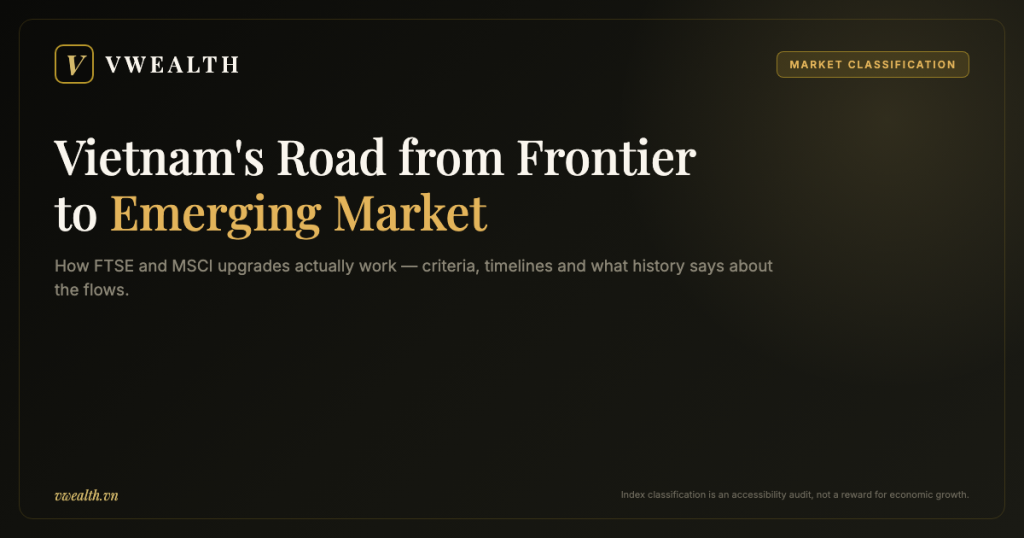
Every few months, a headline promises that the Vietnam emerging market upgrade is “just around the corner” — and every few months, investors who bought on that promise learn how little they understood about the machinery behind it. Index classification is not a prize handed out for economic growth. It is a technical audit, run by two private companies, against criteria that have almost nothing to do with GDP and everything to do with plumbing: how trades settle, how much foreigners can own, and whether an analyst in London can read a company’s filings without a translator. This guide explains how FTSE Russell and MSCI actually make these decisions, what history says happens to markets that graduate, and how a long-term investor can own the Vietnam story without gambling on a calendar date. That framing matters more than ever right now, because as of mid-2026 the two providers have diverged sharply: FTSE Russell has already committed Vietnam to a Secondary Emerging upgrade with a firm effective date, while MSCI has not even placed it on a watchlist. Understanding the machinery is the only way to make sense of why one door is open and the other is still shut.
What a market classification actually is — and why trillions of dollars care
Start with a question that sounds simple: when a pension fund in Toronto or a sovereign wealth fund in Oslo decides to invest in “emerging markets,” how does it know which countries count? The fund cannot make up its own list — its board, its auditors, and its clients all need an objective, third-party definition. That definition comes from index providers: companies that build and maintain lists of stocks, grouped by country and by development status.
An index is simply a rule-based list. The rules say which countries belong in which bucket — developed, emerging, or frontier — and which stocks within those countries are large and liquid enough to include. Once the list exists, money attaches itself to it in two ways. Passive funds, such as ETFs, replicate the list mechanically: if a stock is in the index at a 0.4 percent weight, the fund buys it at a 0.4 percent weight, no questions asked. Active funds use the index as a benchmark: a portfolio manager paid to beat the emerging-markets index will mostly pick stocks from inside that index, because straying too far from the benchmark is a career risk.
This is why classification matters so much more than it seems. The pools of money tracking emerging-market indices are vastly larger than the pools tracking frontier-market indices. Emerging markets sit in the mainstream of global asset allocation — nearly every large institution has a dedicated allocation to them. Frontier markets are a niche product, held by a small group of specialist funds. When a country moves from the frontier bucket to the emerging bucket, it does not just get a new label. It becomes visible, and investable, to an entirely different class of capital.
The three buckets are worth defining precisely, because the words are used loosely in everyday conversation:
| Classification | What it means in practice | Who invests there |
|---|---|---|
| Developed market | Large, highly liquid, fully open to foreign capital, with mature regulation and settlement systems (for example the US, Japan, Germany) | Virtually all global investors, from index funds to insurance companies |
| Emerging market | Sizable and growing, reasonably accessible to foreigners, but with some restrictions or operational quirks (for example India, Indonesia, Thailand) | Mainstream global institutions with dedicated emerging-market allocations |
| Frontier market | Smaller, less liquid, or harder to access — often due to settlement practices, ownership limits, or currency controls | A small universe of specialist frontier funds and adventurous active managers |
Notice what is missing from those definitions: economic growth. A country can grow at 7 percent a year for a decade and remain frontier, while a slower-growing economy sits comfortably in the emerging bucket. Classification measures how easy it is for foreign institutions to buy, hold, and sell stocks — not how exciting the underlying economy is. Vietnam has long been a textbook example of this gap: an economy with emerging-market fundamentals, held in the frontier bucket by operational details. If you are new to the market itself, our complete guide on how to invest in Vietnam’s stock market as a foreigner covers those fundamentals from the ground up; this article focuses on the classification machinery that sits above them.
Who FTSE Russell and MSCI are — and why their scorecards differ
Two organizations dominate the classification business for equity markets. MSCI, headquartered in New York, publishes the index family that most global emerging-market money tracks — when people say “the EM index,” they usually mean MSCI’s version. FTSE Russell, owned by the London Stock Exchange Group, publishes a competing family that also anchors very large pools of passive money, including some of the world’s biggest index funds. There are other providers — S&P Dow Jones runs its own country classification — but FTSE and MSCI are the two that move the needle, and they are the two whose decisions matter for Vietnam.
Both firms review country classifications on a formal annual cycle, with interim updates when circumstances change. Both publish their criteria openly. But they weigh things differently, and understanding the difference explains why a country can be upgraded by one provider years before the other.
FTSE Russell: a tiered system with a lower first rung
FTSE divides the emerging universe into two tiers: Secondary Emerging and Advanced Emerging. This matters enormously for Vietnam, because the entry bar for Secondary Emerging is lower than MSCI’s single emerging-market bar. FTSE’s assessment runs through a “Quality of Markets” matrix — a checklist covering the regulatory environment, custody and settlement, dealing landscape, and the presence of a functioning stock market. A country is first placed on a public watchlist, and FTSE then reviews it at each annual cycle until the outstanding criteria are met or the country is removed. FTSE placed Vietnam on its watchlist for possible reclassification to Secondary Emerging back in September 2018 — a public, documented starting point that illustrates just how long these processes can run. That particular process has now reached its conclusion: at its September 2025 country classification review, announced on 7 October 2025, FTSE Russell confirmed it would reclassify Vietnam from Frontier to Secondary Emerging, effective from the market open on 21 September 2026 — subject to a March 2026 interim check, which Vietnam duly passed. Nearly seven years on the watchlist, and the upgrade still arrives in slow motion.
MSCI: eighteen measures and a consultation culture
MSCI’s framework assesses each market against roughly eighteen measures grouped under five headings: openness to foreign ownership, ease of capital inflows and outflows, efficiency of the operational framework, availability of investment instruments, and stability of the institutional framework. Each measure is graded — essentially pass, needs improvement, or fail — in an annual Global Market Accessibility Review. Crucially, MSCI treats the opinions of international institutional investors as central evidence. Before any reclassification, MSCI runs a formal consultation, asking the funds that would actually have to trade the market whether the improvements work in practice. A rule changed on paper is not enough; the fix must be tested and endorsed by practitioners. This is why MSCI upgrades tend to lag legal reforms by a comfortable margin — the firm waits to see reforms functioning in the wild. Vietnam is a live example of the lag: as of the June 2026 Annual Market Classification Review, MSCI had still not even added Vietnam to its review watchlist for a potential upgrade, despite the same reforms that satisfied FTSE. MSCI’s published rationale pointed to two unresolved items — a central counterparty (CCP) clearing model that was not yet operational, and foreign ownership limits that still bind in many conditional sectors — meaning Vietnam’s earliest realistic shot at the MSCI watchlist is the 2027 review, and actual inclusion years beyond that. One provider has set a date; the other has not started the clock.
| Aspect | FTSE Russell | MSCI |
|---|---|---|
| Emerging tiers | Two (Secondary and Advanced Emerging) | One single emerging category |
| Entry difficulty | Lower bar for Secondary Emerging | Higher single bar |
| Process | Public watchlist, reviewed each annual cycle | Accessibility review plus formal investor consultation |
| Key evidence | Quality of Markets criteria checklist | Roughly 18 measures plus practitioner feedback |
| Typical sequence for a graduating market | Often upgrades first | Often follows later, sometimes by years |
The practical takeaway: “the upgrade” is not one event. It is at least two separate decisions, made by two separate committees, on two separate timelines — and the passive money attached to each index arrives separately as well. A market can spend years in the in-between state, emerging by FTSE’s definition and frontier by MSCI’s. Investors who treat the two as interchangeable set themselves up for disappointment twice.
The criteria that actually matter for Vietnam’s emerging market upgrade
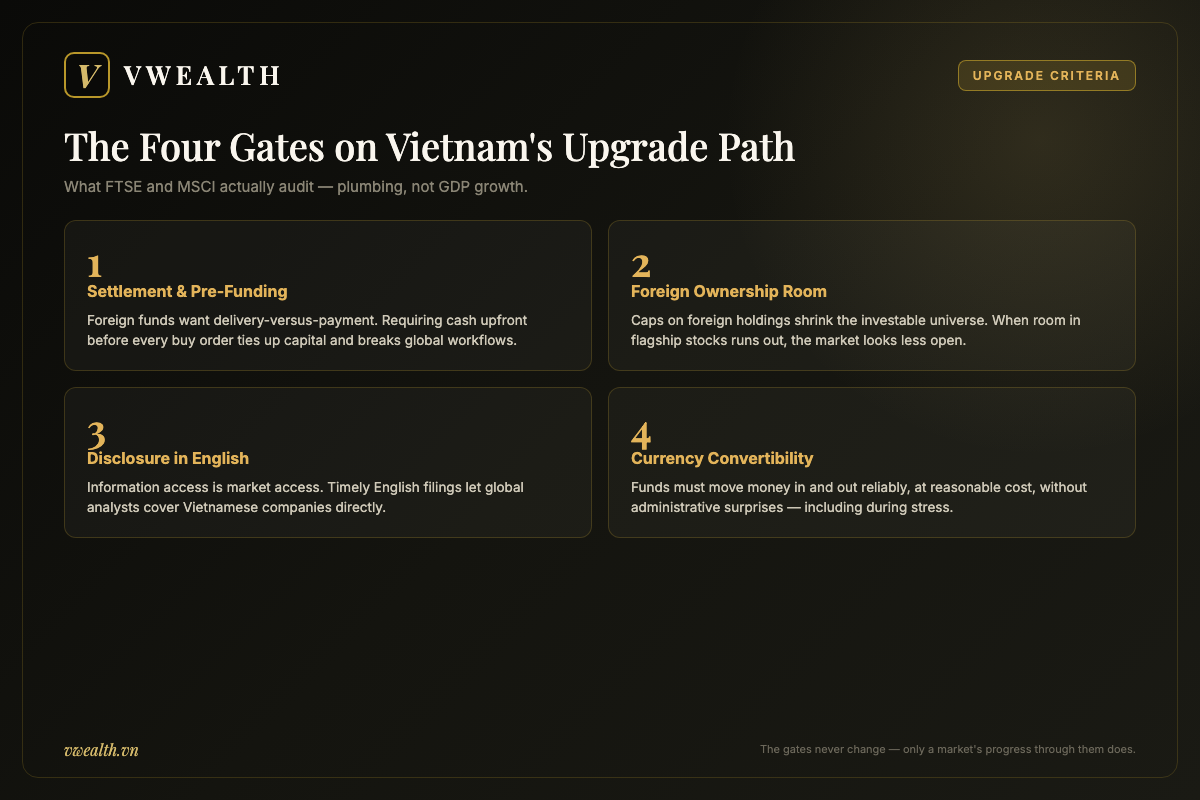
Every market on a watchlist has its own specific homework. For Vietnam, the recurring themes in both providers’ assessments cluster around four gates. None of them is glamorous. All of them are structural — which is exactly why this article can stay useful for years: the gates do not change, only Vietnam’s progress through them does.
Gate one: settlement and the pre-funding problem
Settlement is the process by which a trade becomes final: shares move to the buyer, cash moves to the seller. In most developed and emerging markets, this happens on a delivery-versus-payment basis — DvP for short — meaning the exchange of cash and shares occurs simultaneously, a day or two after the trade, and neither side needs to hand anything over in advance. Vietnam historically ran a stricter system: investors had to have the full cash amount sitting in their account before placing a buy order. This is called pre-funding.
Why does pre-funding offend institutional investors so much? Consider a hypothetical illustration: a global fund managing money across thirty markets wants to buy shares in Ho Chi Minh City on Thursday. Under pre-funding, it must wire dollars, convert them to dong, and park the cash locally before the order goes in — tying up capital that earns nothing while it waits, and creating currency exposure before a single share is owned. Multiply that friction across hundreds of trades a year and it becomes a measurable cost. Worse, it breaks the standard operational workflow that global custodian banks are built around. For index providers, pre-funding was long cited as the single largest obstacle in Vietnam’s file. The structural fixes — removing pre-funding requirements for foreign institutions, and ultimately building a central counterparty clearing system (a CCP, an intermediary that guarantees both sides of every trade so that no one needs to pre-deliver anything) — are precisely the kind of reform the index committees wait to see functioning smoothly, not just enacted.
This is the gate where Vietnam did its most decisive work, and where the two providers parted ways. The pivotal reform was Circular 68/2024/TT-BTC, signed by the Ministry of Finance in September 2024 and effective 2 November 2024, which scrapped the requirement that foreign institutional investors hold the full cash amount before placing a buy order. Under the new “non-prefunding” model, the broker assesses the client’s payment risk and the trade settles within the standard T+2 cycle, with a formal process now in place for handling any failed trade. In parallel, Vietnam finally switched on its long-delayed KRX trading platform on 5 May 2025 — the modern exchange backbone that same-day trading, shorter settlement and an eventual CCP all depend on, and a follow-up circular (Circular 08/2026/TT-BTC, effective February 2026) further smoothed trading, settlement and brokerage mechanics. FTSE Russell judged this package sufficient for Secondary Emerging status. MSCI, by contrast, has signalled it wants the CCP itself fully live and proven before it moves — a textbook illustration of the same reform clearing one provider’s bar while the other holds out for the plumbing to be finished.
Gate two: foreign ownership limits and what “investable” really means
Vietnam caps the share of many companies that foreigners can collectively own — 30 percent of charter capital for commercial banks (with a narrow exception, under Decree 69/2025, letting selected banks involved in restructuring go up to 49 percent), and varying levels elsewhere depending on the industry, with many conditional business lines still capped anywhere from zero to 75 percent. When the foreign quota in a popular stock is fully used, new foreign buyers simply cannot purchase shares on the exchange at the market price; they must wait for another foreigner to sell, or pay a premium in a negotiated deal. From an index provider’s perspective, this does two damaging things. First, it shrinks the investable universe: an index must reflect what foreigners can actually buy, so stocks with no remaining foreign room either get excluded or included at a reduced weight. Second, it distorts pricing, because the same share can be worth different amounts to different classes of buyer. The mechanics of these caps — why they exist, which sectors are tightest, and how to check remaining room before you trade — deserve their own deep dive, which you will find in our guide to foreign ownership limits in Vietnam and what “room” means for your portfolio. For classification purposes, the summary is: the more binding the limits, the smaller and more distorted the index weight, and the weaker the case that the market is genuinely open.
Gate three: disclosure in English
This one sounds trivial until you sit in the chair of an emerging-market analyst covering forty companies across a dozen countries. If a company publishes its financial statements, shareholder meeting materials, and market-moving announcements only in Vietnamese, that analyst either pays for translation, relies on secondhand summaries, or skips the stock. Index providers treat the availability of timely English-language disclosure as a core accessibility measure, because information access is market access. Vietnam’s regulators have moved along this path by phasing in English disclosure requirements, starting with the largest listed companies — a reform pattern worth watching not as news, but as a structural indicator: the deeper English disclosure penetrates the market, the stronger the file becomes. In the meantime, this gap is precisely the problem vwealth was built to solve for individual investors — the platform turns Vietnamese-language filings and data into full English analysis, which you can try by creating a free account.
Gate four: currency convertibility and capital flows
The Vietnamese dong is not freely convertible the way the yen or the euro is. Foreign investors move money in and out through registered channels — an indirect investment capital account — and the currency itself trades within a band managed by the central bank. Index providers do not demand a fully floating currency; plenty of emerging markets manage their exchange rates. What they assess is whether foreign institutions can convert and repatriate funds reliably, at reasonable cost, without administrative surprises. A developed offshore or onshore foreign-exchange market, clear repatriation rules, and consistent practice during stress periods all feed this measure. It is the least visible of the four gates, but it is the one that touches every single transaction a foreign fund makes.
How an upgrade actually unfolds: the typical timeline pattern
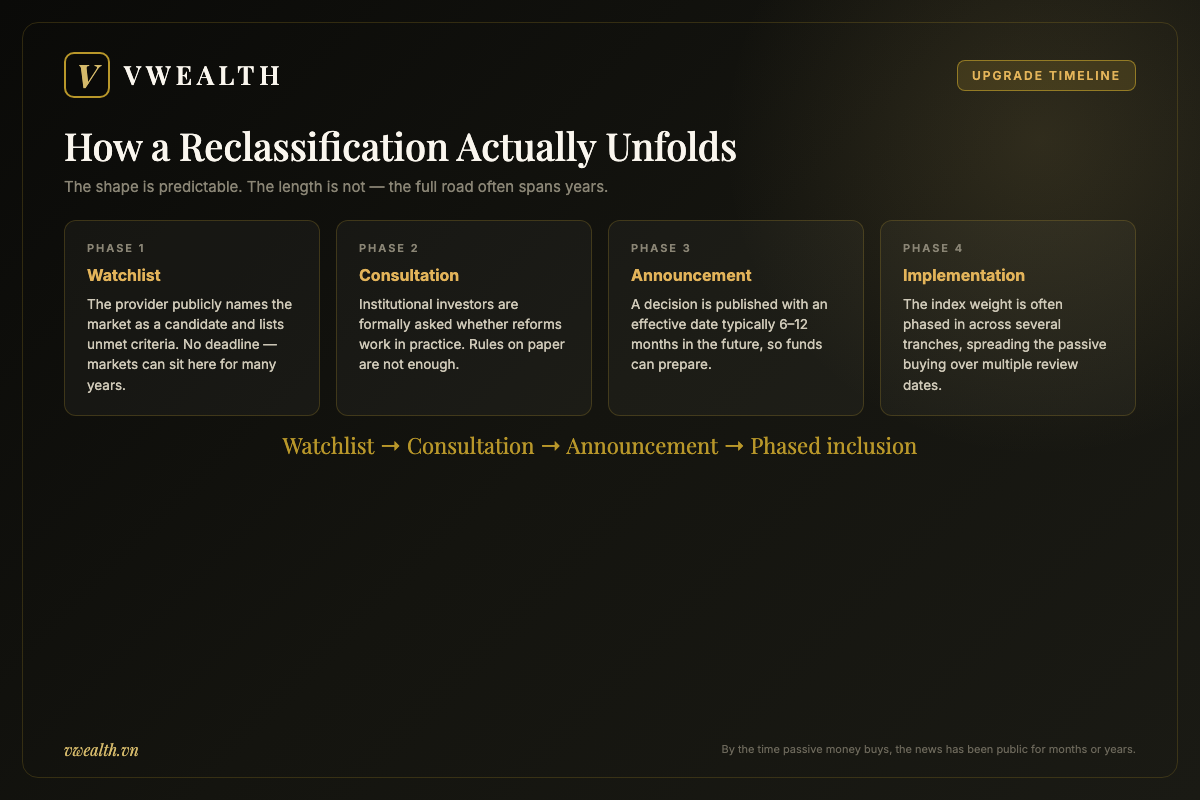
Because both providers publish their processes, the sequence of a reclassification is remarkably predictable in shape — even though its length is not. Understanding the shape protects you from the two classic mistakes: assuming an announcement means money arrives tomorrow, and assuming silence means nothing is happening.
The pattern runs in four phases. First comes the watchlist phase: the provider publicly names the market as a candidate and lists the unmet criteria. This phase has no deadline. Markets have sat on watchlists for many years — Vietnam’s own seven-year tenure on the FTSE watchlist, from 2018 until the 2025 decision, is proof — and a watchlist spot can also be lost if reforms stall. Second comes the consultation and decision phase: once the provider believes the criteria are substantially met, it consults the institutional investors who would have to live with the change, then announces a decision at one of its scheduled review dates. Third — and this is the part casual observers miss — comes the implementation gap: the announcement names an effective date typically six to twelve months in the future, giving funds time to prepare. Fourth comes implementation itself, which for larger markets is often split into several tranches — the index weight is phased in across multiple review dates rather than switched on overnight, so the forced buying is deliberately spread out.
Add the phases together and the road from “criteria met” to “fully weighted in the index” routinely spans two to three years — on top of however long the reform work itself took. This is why seasoned emerging-market investors treat upgrade timelines as ranges, not dates. Vietnam’s FTSE experience maps precisely onto this template: watchlist in September 2018, a decision announced in October 2025, a March 2026 interim confirmation, an effective date of 21 September 2026, and then a phased weight build-in from that date rather than a single overnight switch. Even with a firm date now on the calendar for FTSE, the flows still arrive in tranches over months — and MSCI’s separate timeline has not even begun, so a Vietnamese stock’s full journey through both providers’ indices will play out over years, not quarters.
One more structural detail rewards attention: the announcement and the flows are separated on purpose. Index providers learned long ago that surprising the market with immediate changes causes chaotic trading, so the modern process telegraphs everything. The paradoxical result is that by the time passive money actually buys, the information has been public for months or years — which reshapes how prices behave, as the historical record shows.
What upgrades meant for other markets: lessons from the historical record
Vietnam is not the first market to walk this road, and the markets that walked it before offer the closest thing we have to evidence. The honest summary: upgrades reliably changed who owned the market, usually boosted liquidity, and had a far messier relationship with short-term prices than the folklore suggests.
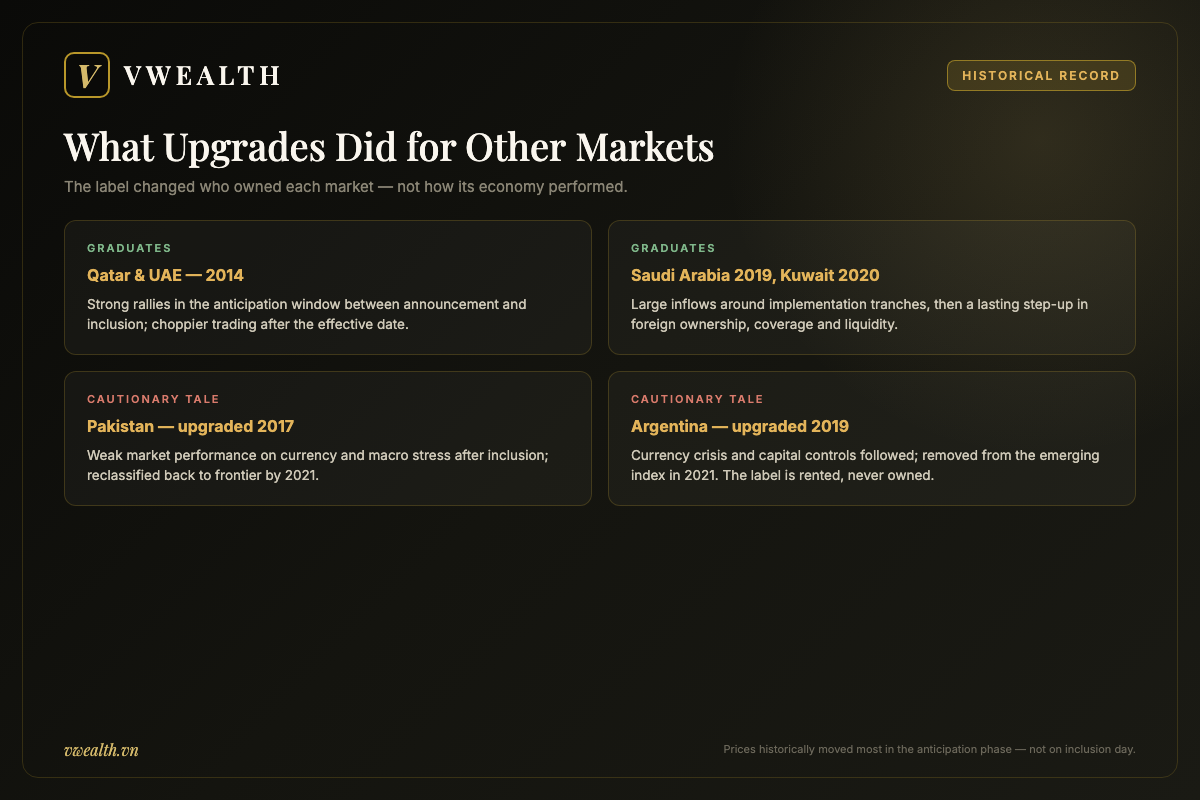
The graduates: Qatar, UAE, Saudi Arabia, Kuwait
MSCI announced in 2013 that Qatar and the United Arab Emirates would move from frontier to emerging status, effective 2014. Both markets rallied strongly in the anticipation window between announcement and implementation — and both saw choppier, less directional trading after the effective date, once the anticipated buying had been priced in and delivered. Saudi Arabia’s inclusion in 2019 — phased in across two tranches, in June and September of that year — and Kuwait’s in 2020 (delayed to November 2020 by COVID-related operational strain, a reminder that even effective dates can slip) followed the same broad script: large foreign inflows concentrated around the implementation tranches, a permanent step-up in foreign ownership and trading volumes, and a price path that rewarded early positioning far more than buying on inclusion day. The durable effect in all four cases was structural rather than spectacular: more research coverage, more institutional shareholders on the register, and deeper liquidity that persisted after the event.
The cautionary tales: Pakistan and Argentina
The record also contains warnings. Pakistan was upgraded to MSCI emerging-market status in 2017 amid considerable enthusiasm — and its market performed poorly in the years that followed, weighed down by currency and macroeconomic problems that no index label could fix. By November 2021 MSCI had reclassified it back to frontier, the trigger being that a depreciating currency had shrunk its companies’ dollar market values below the size-and-liquidity thresholds an emerging market must clear — proof that a label rests on continuing to meet the bar, not on having cleared it once. Argentina was upgraded effective 2019, then hit by a currency crisis and capital controls, and was removed from the emerging index in 2021. Two lessons follow. First, an upgrade is not a floor under prices: index inclusion changes the buyer base, not the quality of the underlying economy or the direction of its currency. Second, classification is reversible — the same committees that promote a market will demote it if accessibility deteriorates. Even Greece, once a developed market, was reclassified to emerging in 2013. The label is rented, never owned.
The pattern in the flows
Across these cases, the flow dynamics rhyme. Active frontier funds, which must sell a market when it leaves their benchmark, begin repositioning early. Active emerging-market funds, which gain the ability to buy, often build positions between announcement and implementation — they are not forced to wait for the effective date the way index funds are. Passive emerging-market funds buy mechanically at each implementation tranche, in size, on known dates. Because everyone can see the passive buying coming, prices tend to move most during the anticipation phase, not the implementation phase — and “sell the news” behavior around inclusion day is common enough that it should never surprise anyone. None of this is a forecast for Vietnam; it is the base rate that any forecast should start from.
The weight question: big fish in a small pond, small fish in the ocean
Here is the nuance that separates a considered view of the Vietnam emerging market upgrade from a slogan. In frontier indices, Vietnam has long been the dominant market — heading into the 2025 decision it carried the single largest country weight in the FTSE Frontier index, around 32 percent (with Morocco a distant second near 20 percent), which means frontier funds hold it in size. In an emerging-market index, Vietnam enters as a small market among giants: the emerging universe is dominated by China, India, Taiwan, and Korea-scale markets, and a newly included Vietnam commands a low weight. FTSE Russell’s own working estimate put Vietnam’s slice of its Emerging All Cap index at roughly 0.3 to 0.5 percent, based on data around March 2026, translating into an estimated US$5 to 6 billion of largely passive inflows around the phased inclusion (the World Bank has floated larger multi-year figures once active money is counted). Treat every one of those numbers as an estimate with a shelf life — the precise figure depends on market capitalization, foreign room, and free float at the moment each tranche is applied.
The arithmetic still favors the move, because one percent of an enormous pool can exceed twenty percent of a tiny pool. But the composition of the outcome deserves thought. On the day Vietnam leaves the frontier index, frontier funds become forced sellers of their largest holding at the same time emerging-market funds become new buyers — the transition is a handover between owner bases, not pure new demand. And after the handover, Vietnam’s stock market would live in a different regime: instead of being the star allocation that frontier specialists study deeply, it becomes a line item that most emerging-market managers can afford to ignore unless it earns their attention. Index flows would also tie the market more tightly to global emerging-market sentiment — when investors sell “EM” as an asset class, they would now be selling Vietnam mechanically along with everything else.
Which stocks feel the effect most is also predictable in shape. Index buying concentrates in the largest, most liquid names with available foreign room — the same handful of large capitalizations that dominate the local benchmarks. If you want to understand which companies sit at the top of that pyramid and how the local index is constructed, our explainer on the VN-Index and VN30 benchmarks maps the terrain. Smaller listed companies, however good their businesses, would see little direct index flow — their upgrade dividend arrives indirectly, through improved overall liquidity and broader research coverage, and it arrives slowly.
What could delay the story — and what could quietly derail it
An evergreen analysis owes you the failure modes, not just the happy path. Four stand out, and none of them expires.
First, reform implementation can disappoint in practice. Index providers do not grade legislation; they grade lived experience. A settlement reform that works smoothly in normal months but produces failed trades or operational confusion during a volatile stretch would reset the clock, because the consultation process specifically harvests practitioner complaints. The gap between a rule existing and a rule working is where upgrade timelines go to die.
Second, the foreign ownership gate can bind harder as success arrives. Ironically, the more attractive Vietnamese stocks become, the faster foreign room in the best companies fills up — and fully utilized limits in the market’s flagship names weaken the accessibility case even as everything else improves. Meaningful progress here requires either raised caps, or instruments that let foreigners hold economic exposure without voting rights, and both are policy choices with domestic political dimensions that outsiders cannot schedule.
Third, macro or currency stress can intervene. The Pakistan and Argentina episodes show that classification and crisis interact viciously: capital controls imposed during a currency emergency are precisely the kind of accessibility failure that gets markets demoted, and even short of controls, a stressed currency makes the convertibility measure harder to pass. A long-term investor should hold the upgrade thesis and the currency risk in the same head at the same time.
Fourth, the criteria themselves can tighten. Index providers periodically update their frameworks, and the direction of travel over the years has been toward stricter accessibility standards, not looser ones. A market chasing a moving target needs to overshoot, not merely touch, the current bar.
Notice what is not on this list: quarterly GDP numbers, this year’s corporate earnings, or which stocks rallied last month. The classification process is genuinely indifferent to those things. Investors who track the upgrade story through market-news headlines are watching the wrong dashboard; the right dashboard is the annual review documents both providers publish, the operational reforms actually shipping, and the foreign-room situation in the market’s largest stocks.
How a long-term investor should position — without betting the farm on a date
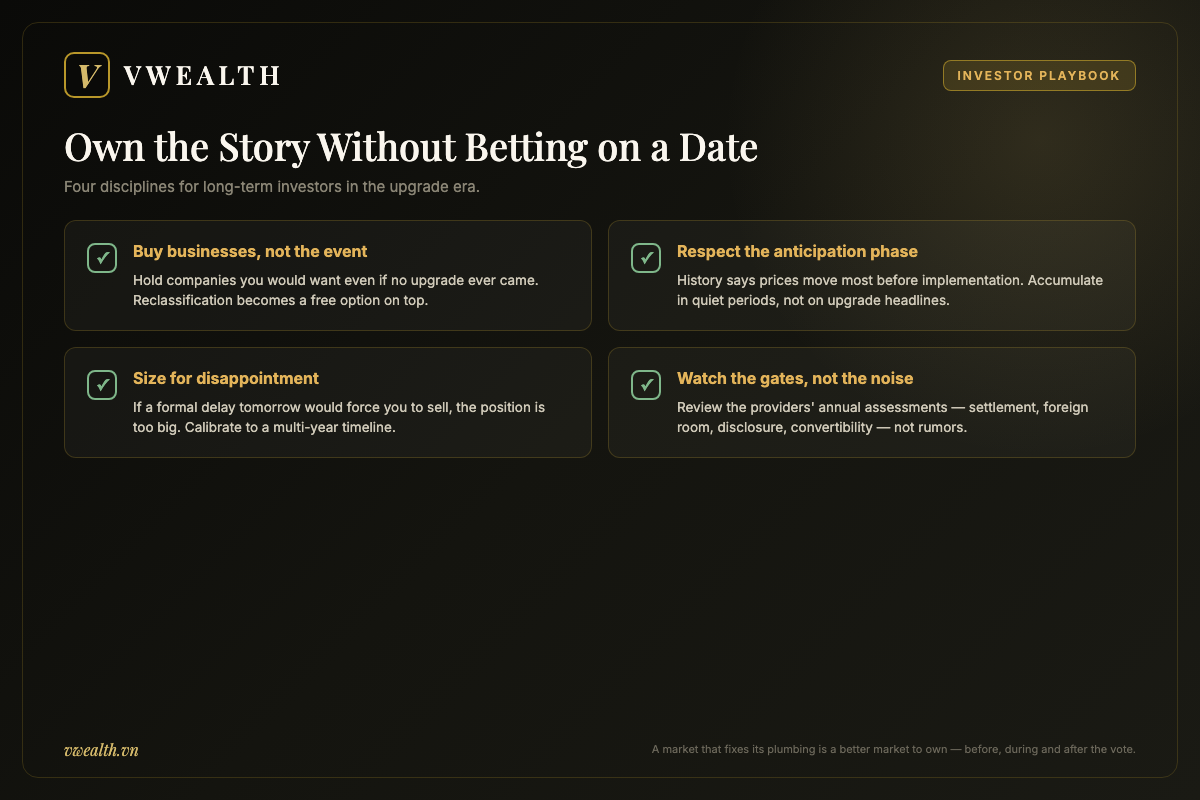
Everything above converges on one practical question: what should you actually do with this story? The framework that follows is deliberately boring, because the historical record punishes excitement.
Buy businesses, and treat the upgrade as a free option
The soundest posture is to own Vietnamese companies you would be happy holding if no upgrade ever happened — businesses with durable earnings, sensible balance sheets, and valuations you can defend on their own terms. The FTSE re-rating and liquidity that arrive with the September 2026 inclusion are then a bonus layered on top of returns you already wanted, and the much larger, still-undated MSCI leg becomes a free option rather than a thesis you are forced to bet on. If that MSCI step slips five years — which, with the CCP still to prove itself, is entirely plausible — you are not stranded holding an event bet with no event. Inverting this — buying weak businesses purely because index flows might lift them — is how the upgrade story converts optimists into bagholders, because index buying concentrates in quality large caps anyway and forgives nothing else.
Respect the anticipation-phase pattern, in both directions
History says prices move most between credible progress and implementation, not after. Two disciplines follow. On the way in: if you believe in the story, gradual accumulation during quiet periods beats chasing upgrade-headline rallies, because the headlines are precisely when the option is priced most expensively. On the way through: with the FTSE inclusion date of 21 September 2026 now public and the market having already rallied hard on the news (the VN-Index ran from around 1,100 in April 2025 to near 1,700 by the October 2025 announcement), remember that inclusion day itself has often been an anticlimax or worse in other markets — have a plan for what you will do when the anticipated becomes the actual, and write it down before the emotion arrives.
Size the position for the failure modes
Every risk in the previous section — implementation slippage, binding foreign limits, currency stress, demotion precedents — argues for position sizing that survives disappointment. A sensible allocation to Vietnamese equities is one you can hold through a multi-year delay without flinching; a foolish one is calibrated to a timeline you read in a headline. The test is simple: if the upgrade were formally postponed tomorrow, would you be a calm holder or a forced seller? Size until the honest answer is the former.
Watch the gates, not the noise
Build a short personal checklist from the four gates — settlement working in practice, foreign-room policy, English disclosure penetration, convertibility experience — and review it against the providers’ published annual assessments rather than against commentary about them. This takes perhaps two hours a year and will put you ahead of most participants, who track the story through rumor. For the company-level work underneath — actually researching the banks, developers, and exporters that would carry the index flows — an English-language research layer saves enormous time; that is the job a free vwealth account was designed to do, with AI-generated English reports on Vietnamese listed companies updated as filings land.
The upgrade is a milestone, not the destination
Strip away the noise and the Vietnam emerging market upgrade story reduces to a few durable truths. Classification is an accessibility audit run by FTSE Russell and MSCI against published criteria — settlement mechanics, foreign ownership room, English disclosure, and currency convertibility — and Vietnam’s file advances exactly as fast as those reforms ship and prove themselves, no faster. That is precisely why the two providers have split: the same non-prefunding reform and KRX system that earned FTSE’s Secondary Emerging upgrade (effective 21 September 2026) left MSCI still waiting on the room limits and a working CCP, with Vietnam not yet even on its watchlist as of mid-2026. The process is telegraphed years in advance, implemented in slow motion, and historically rewards patient positioning over event-chasing: the graduates gained deeper liquidity and a new investor base, while the cautionary tales remind us the label is reversible and cures nothing macroeconomic. The rational response is neither cynicism nor euphoria. It is to own good Vietnamese businesses at defensible prices, treat reclassification as an unpriced option rather than a scheduled payday, and check the actual gate-by-gate progress once or twice a year while everyone else trades the rumors.
A market that earns its way into the emerging bucket by fixing its plumbing is, almost by definition, a better market to invest in — before, during, and after the committees vote. That is the version of the story worth owning.
This article is educational analysis for reference only, not investment advice or a recommendation to buy or sell any security.
Research Vietnamese stocks in English with vwealth. Our AI-powered platform turns Vietnamese market data into full English analysis reports — with international payment support and a free 2-month trial for new accounts. Create your free account and read the latest reports.