Most guidance on Vietnam brokerage firms compares commission rates, which is the least useful thing a foreign investor can compare. Commission is a rounding error next to the things that actually determine whether you can operate in this market at all.
What matters is whether the firm produces statements your accountant can read, how custody is arranged, how much of the trading code process they handle, and — new since 2026 — how they operate now that the prefunding requirement has been removed.
This piece covers what genuinely differs between brokers here, the four pieces of structure that must exist before you can place a trade, and the questions worth asking before you sign anything. It is the companion to our step-by-step guide on opening an account as a foreigner.
What should a foreign investor compare between Vietnam brokerage firms?
Short answer: Four things, none of them commission. Whether reporting is available in English, how custody is arranged, how much of the securities trading code process the broker handles, and how they operate under the non-prefunding model introduced in 2026. Get those right and the fee difference is immaterial.
Four things that genuinely differ
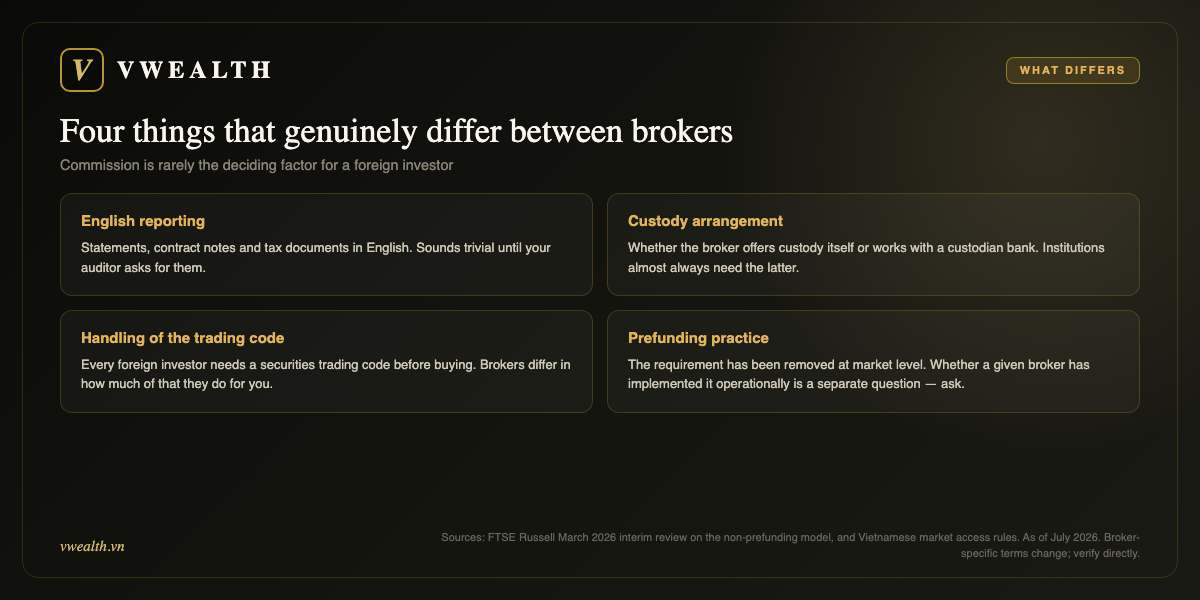
English reporting
Statements, contract notes and tax documentation in English. This sounds like a convenience until an auditor, a fund administrator or a tax adviser asks for source documents and you are handing over Vietnamese-language PDFs.
Ask specifically which documents are available in English and whether they are official versions or courtesy translations. The distinction matters for anything that goes into a formal filing.
Custody arrangement
Where your shares actually sit. A retail investor can generally hold through the broker. An institution almost always needs an independent custodian bank, both for internal policy reasons and because separating custody from execution is standard practice.
Not every local broker works smoothly with every custodian. If you already have a custodian relationship in the region, that constraint should drive the broker choice rather than the reverse.
How the trading code is handled
Every foreign investor needs a securities trading code before buying anything. It is issued to the investor, not to the broker, and the paperwork is the slow part of the whole process.
Brokers differ substantially in how much of this they manage for you. Some run it end to end; others hand you a checklist. For an individual investor abroad, that difference can be weeks.
Prefunding practice
This is the newest and least discussed differentiator. The requirement to place cash before trading has been removed at market level — it was the condition FTSE Russell named explicitly ahead of the reclassification effective 21 September 2026.
But a market-level rule and an individual broker’s operational workflow are not the same thing. Ask directly how they handle settlement under the new model, and what they require from you before accepting an order.
The four pieces of structure
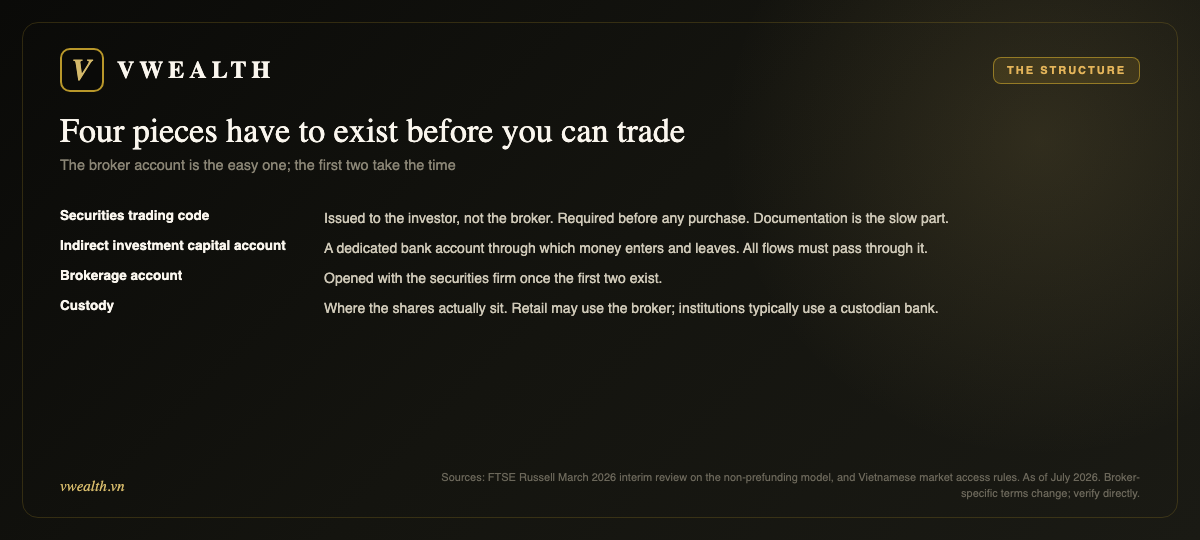
Before any trade happens, four things must exist. Understanding the order saves a great deal of confusion.
1. Securities trading code
Issued to you as an investor. Required before any purchase. The documentation requirements are the reason this step dominates the timeline — expect notarised and legalised documents, and expect that to take longer from some jurisdictions than others.
2. Indirect investment capital account
A dedicated bank account through which investment money enters and leaves the country. All flows must pass through it, in both directions.
This is the piece that surprises people most, because it has no equivalent in most developed markets. It also means your repatriation path is defined at the outset rather than improvised later.
3. Brokerage account
Opened with the securities firm. Straightforward once the first two exist.
4. Custody
Where the shares sit. Retail through the broker, institutions typically through a custodian bank.
What the prefunding change actually means
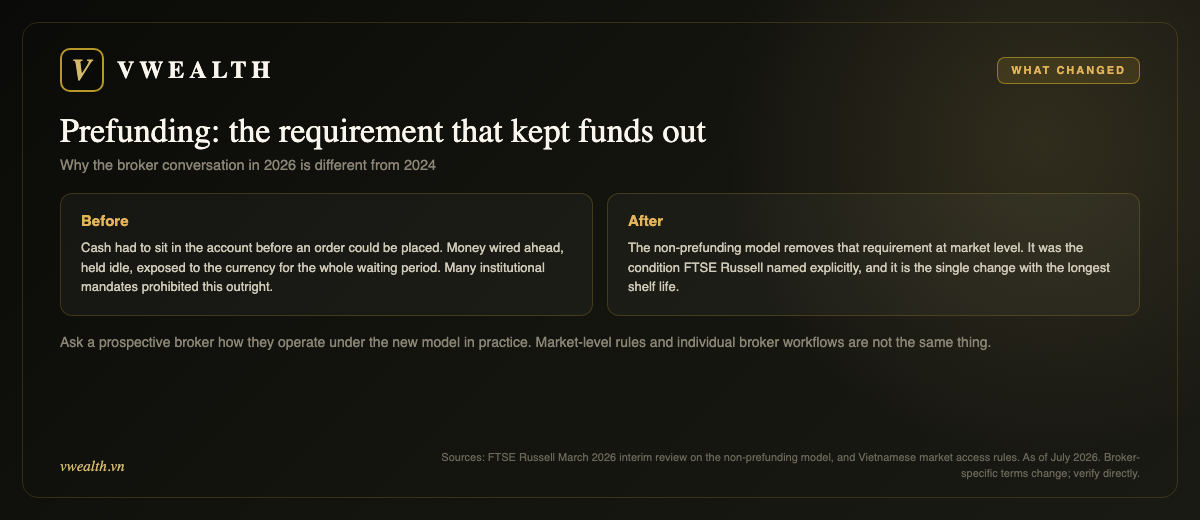
Under the old arrangement, a foreign institution had to have cash sitting in the account before an order could be placed. Money was wired ahead, sat idle, and carried currency exposure for the whole waiting period.
For a fund running billions across dozens of markets, that is a real operational cost. More importantly, many institutional mandates prohibited prefunding into a frontier market outright — meaning the constraint was not a preference but a hard block.
The move to a non-prefunding model removed that block. It is the single change from the upgrade process with the longest shelf life, because unlike index inclusion it does not depend on any review cycle. We cover the full timeline in what actually changes in September.
Why this belongs in a broker conversation
Because the practical implementation sits with intermediaries. The rule permits a workflow; the broker and custodian have to operate it.
If you are setting up now, ask what changed in their process, when it changed, and what they need from you at the point of order. A firm that answers precisely is telling you something useful about their institutional client base.
Questions worth asking before you sign
Written as questions because the answers vary and change.
Which documents are available in English, and are they official or courtesy versions?
Do you support my custodian, and have you done so before? Past experience with a specific custodian is worth more than a stated capability.
How much of the trading code application do you handle? Ask for a realistic timeline from a client in your jurisdiction, not a best case.
What is your process at the point of order under the non-prefunding model?
How does repatriation work in practice, and how long does it take? The rules define the path; the broker and bank determine the speed.
What happens if a name I want is at its foreign ownership cap? A good answer describes how they source foreign-eligible shares. See foreign room and the cap that blocks foreign money for why this comes up constantly.
Retail versus institutional: two different problems
Almost every guide written on this subject blurs the two, which is why so much of the advice reads as contradictory.
The individual investor abroad
Your constraint is documentation. The trading code process requires notarised and legalised papers, and the time cost sits almost entirely there rather than with the broker.
What to optimise for: a firm that walks you through the paperwork, and English statements you can hand to your own tax adviser. Custody through the broker is normally acceptable at this size.
What not to worry about: market share, research coverage, and commission. None of them will affect your outcome as much as a four-week delay in getting a trading code.
The institution
Your constraint is policy compliance. Independent custody is usually mandatory, settlement workflow has to satisfy operations, and reporting has to feed an existing administrator.
What to optimise for: demonstrated experience with your custodian, a settlement process your operations team can sign off, and clarity on how they operate post-prefunding.
What not to worry about: the retail-facing platform. You will not use it.
The family office in the middle
The awkward case, because you have institutional requirements at retail size. The practical approach is to be explicit early about what your administrator needs, rather than discovering the gap after the account is open.
Costs that are not commission
Since commission is the wrong thing to compare, here is what actually costs money.
Currency conversion. Money moves in and out through the capital account, and the spread applied on conversion is frequently larger than a year of brokerage commission. Ask how conversion is priced and whether you can negotiate it.
Custody fees. Charged as a percentage of assets, so they scale with your position in a way commission does not.
The foreign premium. Where a name is at its ownership cap, foreign-to-foreign trades often clear above the on-screen price. That premium is a real cost of entry and it appears nowhere on a fee schedule.
Idle cash. Less relevant now that prefunding has gone, but any cash held in-country between transactions carries currency exposure. Our piece on what the dong means for USD returns covers the mechanics.
Add those four and the picture looks nothing like a commission comparison table.
A realistic timeline
Stated as a sequence rather than a number of days, because the elapsed time depends on your jurisdiction.
Stage one — gather and legalise documents. This is where most of the calendar goes. Requirements differ for individuals and entities, and for entities the corporate documents multiply.
Stage two — trading code application. Submitted with the documents from stage one. Nothing can be bought before this exists.
Stage three — capital account. Opened at a bank. Often runs in parallel with stage two.
Stage four — brokerage account and custody. Fast, once everything above is in place.
Stage five — funding and the first trade. The first transfer is worth treating as a test: small size, confirm it arrives, confirm it appears where expected, before moving the real amount.
The single most common source of delay is discovering at stage two that a document from stage one was legalised incorrectly. Confirm the exact form required before starting the notarisation, not after.
Three mistakes worth avoiding
Choosing on research reputation
Local research quality varies and is largely published in Vietnamese. If you cannot read the primary output, you are choosing on a summary of it.
Opening with two brokers to compare
Tempting, and it doubles the documentation work for very little gained. Better to run the question list properly with two firms and open with one.
Leaving repatriation until you need it
The path is defined by the capital account structure at setup. Understand the process while you are opening the account, not when you want the money back.
What we deliberately do not rank
You will notice this article names no broker and publishes no market share table. That is a choice, for two reasons.
First, the terms that matter — English documentation, custody relationships, trading code handling, settlement workflow — are negotiated per client and change without announcement. A ranking published today would be misleading within a quarter.
Second, market share tells you about domestic retail volume, which correlates weakly with the quality of service to a foreign institution. The largest broker by turnover is not necessarily the one that will produce an English contract note.
What travels is the checklist. Run it against whichever firms you are considering.
What the broker cannot solve for you
Worth stating plainly, because expectations here are often misplaced.
Foreign ownership caps. No broker can obtain shares in a name that is full. The best ones will tell you quickly rather than leaving an order working indefinitely. This is a market structure fact, not a service level.
Currency risk. The dong does not float freely, and no execution arrangement hedges that away. If your return needs a stable exchange rate to work, that is a position you hold whether you intend to or not.
Liquidity. In thinner names, a large order moves the price against you regardless of who executes it. Sizing against average daily traded value is your job, not the broker’s.
Tax position. Brokers withhold and report; they do not advise. How Vietnamese tax interacts with your home jurisdiction is a question for your own adviser, and it is worth asking before the first trade rather than after the first sale.
How this fits the wider picture
The broker decision looks administrative and it is not, because it determines what you can do for years afterwards.
An investor with English documentation, a working custody relationship and a broker who understands the post-prefunding workflow can act on an opportunity in days. One without those spends the window doing paperwork.
That gap matters more than usual right now. The reclassification takes effect on 21 September 2026, the official constituent list is expected in August, and the period around index reviews tends to produce unusual trading volume. Anyone still gathering notarised documents in September is watching rather than participating.
None of which is an argument to rush the setup. It is an argument to start it early and to ask the right questions once, rather than the wrong questions twice.
Reading a Vietnamese contract note
Once the account is live, the first document that causes confusion is the contract note, because the line items do not map cleanly onto what a developed-market investor expects.
The components
Trade value. Straightforward: price multiplied by quantity.
Brokerage commission. A percentage of trade value, applied to both sides.
Tax on sale. Vietnam applies tax on the value of a sale rather than on the gain, which surprises investors used to capital gains treatment. It means a loss-making sale still incurs the charge. Our piece on taxes for foreign investors covers the mechanics.
Settlement date. Distinct from the trade date, and it determines when shares and cash actually move. Relevant if you are planning a sequence of trades.
Why it matters for broker choice
Because if these lines are not available in English, every one of them becomes a question you have to ask by email in a language you do not read, at the exact moment you need certainty.
This is the practical reason English documentation ranks above commission on the comparison list. It is not about convenience — it is about being able to verify what you were charged.
A short checklist to take into the conversation
Twelve lines. Print it, ask all of them, and record the answers with a date because they change.
English statements? Official or courtesy? Which documents specifically?
Custody options offered? Experience with my custodian?
Trading code: how much do you handle? Realistic timeline for my jurisdiction?
Capital account: which banks do you work with routinely?
Settlement workflow under the non-prefunding model — what do you need at the point of order?
Currency conversion — how is the rate set, is it negotiable?
Repatriation — process and realistic elapsed time?
Capped names — how do you source foreign-eligible shares?
Fee schedule in writing, including custody and conversion, not just commission?
Who is my contact, and in what language and time zone?
What happens if my order cannot fill because room ran out mid-session?
What reporting do you provide at year end for tax purposes?
If you are already invested through a fund
A large share of foreign exposure to Vietnam sits in pooled vehicles rather than direct holdings, and the broker question looks different from there.
You do not need any of this infrastructure. The fund holds the trading code, the capital account and the custody relationship. Your decision is fund selection, not broker selection.
But the constraints still reach you. Foreign ownership caps limit what the fund can hold, which is why several Vietnam funds look more alike than their mandates suggest. The capped names are unavailable to everyone equally.
And the premium is embedded. Where a fund buys into capped names, it pays the foreign premium, and that cost sits inside the net asset value rather than on a fee schedule.
The practical question for a fund investor is therefore not which broker, but whether the fund’s holdings are concentrated in capped names — because that determines how much of the upgrade story can actually reach the portfolio. Our piece on which stocks foreign funds must buy works through that logic.
The direction of travel
Two things are worth holding as context rather than prediction.
Market access in Vietnam has become steadily easier over two decades, in steps, usually attached to a specific policy goal. The removal of prefunding is the most recent and most consequential of those steps.
At the same time, the constraints that remain — the trading code, the capital account, the ownership caps — are structural rather than administrative. They exist by design, not by oversight, and they are unlikely to disappear because a market classification changed.
An investor setting up now should therefore optimise for operating well inside the current structure rather than waiting for it to relax further. The structure is the market.
Frequently asked questions
Can I open an account remotely?
Requirements vary by firm and by investor type, and documentation must generally be notarised and legalised. Ask for the specific list for your jurisdiction before assuming either way.
Do I need a Vietnamese bank account?
You need an indirect investment capital account, which is a specific type of account through which investment flows must pass. It is not the same as an ordinary personal account.
How long does the whole setup take?
The trading code is the long pole and depends heavily on how quickly documents can be notarised and legalised in your country. Ask your prospective broker for a realistic range based on clients from your jurisdiction.
Is commission worth comparing at all?
Marginally. For a long-term investor placing a handful of trades a year, the difference between the cheapest and most expensive local broker is small next to a delayed trading code or an unusable statement.
Should I use an offshore ETF instead?
For smaller allocations that avoids the entire account-opening problem, at the cost of tracking differences and fees. We compare the routes in Vietnam ETFs, onshore and offshore.
Does the upgrade change any of this?
It changes the prefunding piece, which is significant. It does not change the trading code, the capital account, or the foreign ownership caps.
Summary
Comparing Vietnam brokerage firms on commission is comparing the wrong variable. The differences that determine whether you can operate here are English documentation, custody compatibility, how much of the trading code process the firm absorbs, and how they work under the non-prefunding model.
Four pieces of structure must exist before a trade: trading code, indirect investment capital account, brokerage account, custody. The first two consume the timeline.
And the question that reveals the most about a firm is the one about foreign room — because it is the constraint you will meet most often once you start buying.
Further reading: the complete guide to the Vietnamese market, trading rules, settlement and price limits, and taxes for foreign investors.
This article is for information and education. It is not a recommendation of any firm or security, and it does not constitute legal or tax advice. Requirements are as of July 2026 and change — verify directly.