In the family of Vietnam’s listed banks, there are names you buy for the feeling of safety, and names you buy for the ambition of growth. If Vietcombank (VCB) is the symbol of “premium safety” — the best asset quality in the system, paid a premium valuation like a luxury brand — then MBB (Military Commercial Joint Stock Bank – MB Bank, HOSE: MBB) is an entirely different story. This is the banking group’s growth star: fast-growing, heavily profitable, and cheap.
At around 25,000 dong per share (close of 19 June 2026), MBB carries a rare paradox value investors always hunt for: growth among the industry’s highest paired with a valuation among the industry’s cheapest. In 2025, group pre-tax profit exceeded 34,200 billion dong (up 18.7%), total assets reached 1.6 quadrillion dong (up 35%), and credit growth hit 36.7% — a nearly unthinkable figure for a bank already at “big player” scale. Yet the stock still trades at a P/B of about 1.58 times and a P/E of about 7 times, below the industry average and far below VCB (over 2 times).
What allows a bank to grow so hot while staying so cheap? The answer lies in its very roots: MBB is the Army’s bank. Behind the three letters MBB is a distinctive customer ecosystem — army enterprises, Viettel, Tan Cang — bringing the bank an asset money cannot buy: an enormous, cheap pool of non-term deposits (CASA). MB’s CASA ratio regularly leads the system, at times touching nearly 39%. This is the “secret weapon” that lets MBB lend at high margins while staying price-competitive.
The central question of this full analysis is simple: should you buy MBB, and if so, which kind of investor does it suit? To answer thoroughly, you cannot just look at the price board. You need to understand where MBB came from, what turning points it passed through, and why a bank once with just 20 billion dong of charter capital became a 34,000-billion profit machine in three decades. This first section takes you back in time, so that when you reach the valuation numbers later, you understand exactly what you’re paying for.
MBB market data (updated 19 June 2026)
| Current price | 25,000đ | 2025 pre-tax profit | >34,200 bn (+18.7%) |
| Change (June) | −0.40% | Credit growth | 36.7% (highest) |
| P/E | P/B | ~6–7x | ~1.2–1.4x | CASA | ~40% (top) |
Source: VWealth price data + MB 2025 reports. Figures move session to session — for reference only.
History and evolution
To understand why MBB is “different” from the rest of the listed banks, you must start from a core truth: this bank was born not to serve the mass market, but a very specific community — army enterprises. That very “military DNA” shaped its entire competitive advantage, its disciplined culture, and even how the market values this stock to this day.
Origins in 1994: the Army’s bank, from 20 billion dong and 25 people
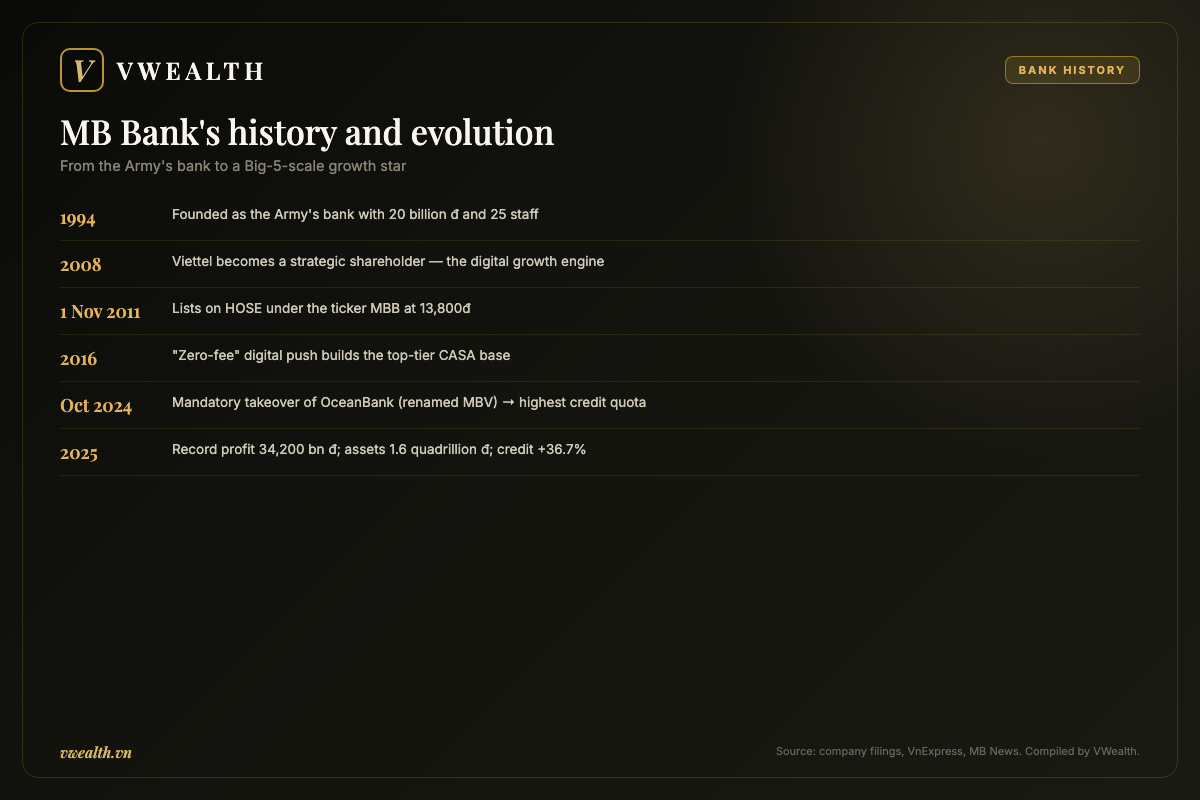
The Military Commercial Joint Stock Bank was founded on 4 November 1994, when Vietnam’s economy had only been open a few years and army enterprises were transforming into economic actors. MB’s starting point was modest to the point of being hard to believe against its current scale: initial charter capital of just 20 billion dong with only 25 staff. The name “MB” — short for Military Bank — makes the original mission clear: to be the financial arm of units and enterprises under the Ministry of Defence.
What you need to grasp here isn’t the 20-billion figure, but the original customer base. From day one, MB had a ready network of army-enterprise corporate customers — units with stable cash flows, high financial discipline and, most importantly, large deposits. This is the first foundation of the CASA advantage MBB maintains to this day. While many other joint-stock banks had to “burn money” in deposit-rate races to gather funds, MB already had a pool of cheap deposits flowing in from its own ecosystem.
Shareholder structure: why MBB is both a “private bank” and carries state character
A question investors often confuse: is MBB a state or private bank? The precise answer is a joint-stock commercial bank, but its shareholder structure carries a strong state and military character. This isn’t a dry administrative detail — it is exactly what creates MBB’s stability and unique business advantage.
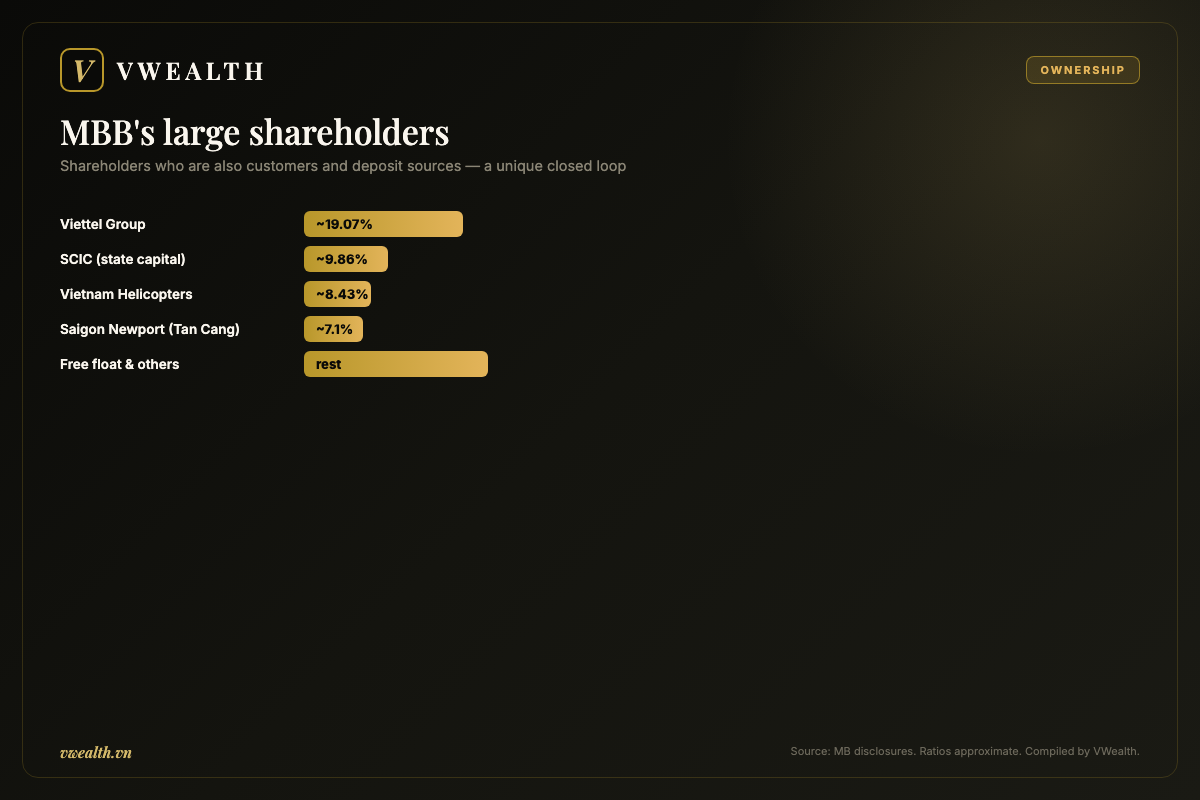
| Large shareholder | Ownership (approx.) | Role at MBB |
|---|---|---|
| Viettel Group | ~19.07% | Largest shareholder, strategic technology & customer partner |
| SCIC (state capital) | ~9.86% | Second-largest state shareholder |
| Vietnam Helicopters Corporation | ~8.43% | Army enterprise |
| Saigon Newport Corporation (Tan Cang) | ~7.1% | Army enterprise, large cash flow |
These four large shareholders together hold about 44.3% of charter capital. For you — an investor — this has three practical meanings. First, high stability: strategic shareholders hold nearly half the bank, so there’s little chance of chaotic takeovers or sudden ownership changes. Second, favourable state relationships: with SCIC and army enterprises in the structure, MB has a special position when applying for credit quotas or joining sector tasks. Third, and most importantly, customers coming from the shareholders themselves: Viettel and Tan Cang not only contribute capital but are enormous corporate customers, bringing both deposits and demand for loans, payments and services.
The key point to remember: MBB’s shareholders don’t just put money into the bank, they also bring customers and cheap deposits to it. This is a closed loop very few other private banks have.
2008 – Viettel enters: a fateful handshake with the “telecom giant”
2008 was the milestone that changed MB’s trajectory: the Military Telecommunications Group (Viettel) officially became a strategic shareholder. To picture the importance of this, think of a bank “marrying” Vietnam’s largest telecom group — an entity with tens of millions of subscribers, technology infrastructure covering the whole country, and top-tier digitalization capability.
This combination later became the foundation for MB’s digital-transformation breakthrough. Viettel brought two priceless things: technology capability (infrastructure, cloud, technical talent) and a customer-reach network. To this day, the two still cooperate to deploy over 2,000 financial transaction points nationwide and let customers use MB’s digital financial services right at Viettel stores. You can consider 2008 the year MB installed the “growth engine” that would only reach full power more than a decade later in the digital-banking era.
2011 – HOSE listing under MBB: stepping into the market’s light
On 1 November 2011, MB’s stock officially listed on the Ho Chi Minh City Stock Exchange (HOSE) under the ticker MBB, at a debut reference price of 13,800 dong per share. Listing wasn’t just about raising capital; it forced MB to operate transparently to public-company standards, disclosing periodically, under the scrutiny of tens of thousands of shareholders and analysts.
For you — an investor today — MBB being listed for over 14 years is a big plus on data reliability. You have a long history to examine: this bank passed through the 2012–2014 bad-debt cycle, credit-tightening periods, the pandemic, and held firm each time. A business with a long, clean track record on the exchange is always easier to value and more trustworthy than newcomers listed only a few years.
From a small bank to a growth leader: a journey of steady accumulation
The journey from 20 billion dong of charter capital in 1994 to a bank with 1.6 quadrillion dong of total assets in 2025 didn’t come from one lucky leap, but from disciplined accumulation over three decades — true to the “army” character. MB is famous for a tight, prudent risk-management style, putting capital safety first while still maintaining high profitability.
In 2024, MB rose to lead the Big 5 in asset-growth speed — a position few thought a joint-stock bank could seize from the state-owned “big brothers.” Notably, MB did this while keeping good asset quality and a return on equity (ROE) among the highest in the industry. This is why analysts often call MBB the “growth star” — not growth at all costs, but profitable, controlled growth.
Aggressive digital transformation: the MBBank app and conquering tens of millions of users
If you had to pick one factor that made MB’s biggest difference over the past decade, it is digital transformation. While many banks still fumbled with digitizing individual operations, MB set out to become a true “digital enterprise” and invested heavily in the MBBank super-app.
The results are staggering. The MBBank app reached about 28.6 million users as of Q2 2025, and MB has announced a milestone of nearly 30 million digital customers. In 2024 alone, the bank processed 6.2 billion digital transactions — 1.6 times the prior year, with a success rate of 99.97%. To picture it, MB’s digital-transaction volume is among the market leaders.
But for you, the financial meaning of digital transformation is what’s worth the money. Each new app user, each free transaction MB provides, is a “funnel” drawing non-term deposits into payment accounts. This is the CASA-pumping machine. Thanks to its huge digital base plus the army customer roots, MB’s CASA ratio rose to lead the system, at one point reaching 38.83%. High CASA means cheap funds, a high net interest margin (NIM), fat profit — a virtuous spiral few banks can copy.
Remember the formula that makes MBB: Army customers + the Viettel ecosystem + a tens-of-millions-user MBBank app = top-tier CASA = a cheap cost of funds = durable high profit. This is the core reason to consider this stock.
2024 – The turning point: the mandatory takeover of OceanBank (MBV)
If digital transformation is the long-term growth engine, the mandatory takeover of OceanBank in 2024 is the boost that opened a “runway” for MB to take off faster. This is the most important turning point in the bank’s recent history, and you need to understand both sides of it.
From 17 October 2024, MB completed the takeover of OceanBank and owns 100% of its charter capital. By 18 December 2024, OceanBank was officially renamed the Modern Bank of Vietnam — MBV — with new leadership from MB. This takeover made MB Group a group with an ecosystem of 3 banks (MB, MBCambodia, MBV) plus 6 member companies.
The bright side — the reward: In exchange for shouldering a weak bank, MB was granted by the State Bank the highest credit-growth quota in the whole industry. This is the key explaining the “huge” 36.7% credit growth in 2025 — while other banks were tightly quota-limited, MB was allowed to lend far more. For a bank with a ready good customer base and disbursement capacity, a high quota means the profit machine runs at full power.
The risk side — the price: Stay clear-headed too. OceanBank/MBV was a bank that once had heavily negative equity, along with a pile of bad debt and legal backlog. MB must spend resources, people and time to “revive” it. Even with special state support in the takeover mechanism, this remains a problem to watch closely in the later analysis. The credit-quota reward is real, but the MBV-restructuring burden is real too.
2025 – Setting records and the current picture
All these accumulated steps converged in the 2025 results — the year MB set historic records. Group pre-tax profit exceeded 34,200 billion dong, up 18.7%; total assets reached 1.6 quadrillion dong, up 35%; credit outstanding passed the 1 quadrillion dong mark with 36.7% growth — among the highest in the system.
More importantly, leadership has no intention of stopping. MB targets, for 2026, another 22% rise in total assets (over 2.1 quadrillion dong) and 25% credit growth, while keeping its digital-transformation lead. A bank already at quadrillion scale still targeting high double-digit growth — that’s something you rarely see in “big players” that have plateaued.
So when you set two pictures side by side — MBB with 36.7% credit growth, record profit, top CASA, trading at a P/B of just 1.58 times; and VCB, safe but valued above 2 times — you start to see clearly why MBB is called the “both high-growth and cheap” stock. Where that growth comes from, how sustainable it is, and whether the cheapness is a trap or an opportunity — all depend heavily on the quality of the people running this machine. That is why in the next section we dissect MB’s Leadership — the people who turned a 20-billion-dong bank into a quadrillion-scale empire.
Leadership and ownership structure
If you look at MBB only through a purely financial lens, you’ll miss what makes this bank fundamentally different from the rest: MB is not a commercial bank born from the market, but an institution that stepped out of the army ecosystem then learned to think like a market business. MBB’s ownership structure and leadership are where those two bloodlines meet. Understanding “who holds the shares” and “who’s at the wheel,” you’ll understand why MBB has a cost-of-funds advantage almost no private bank can copy, while also carrying distinctive constraints investors must weigh carefully.
Ownership structure: the mark of the “army ecosystem”
The first point to remember is that MBB has no dominant private owner of the “founding shareholder holds 40–50%” type like many other private banks. Instead, MB’s shares are spread among a group of large institutional shareholders, most tied to the military and the state. Per the bank’s disclosure at the start of 2025, the Military Industry and Telecoms Group (Viettel) is the largest shareholder, holding about 14.7% of charter capital. Behind it are the State Capital Investment Corporation (SCIC) with about 9.83%, Vietnam Helicopters Corporation about 8.43%, and Saigon Newport Corporation about 7.09%.
Pause on this list, because it says a great deal. Viettel is not just the largest shareholder but a strategic link: it’s Vietnam’s largest telecom-technology group with tens of millions of subscribers and a huge nationwide distribution network. Saigon Newport is a leading logistics-port business, handling most of the country’s container traffic. Vietnam Helicopters and other army units bring a stable institutional customer base, steady cash flow and high loyalty. When your large shareholders are simultaneously large customers, distribution partners and deposit sources, you have a structural competitive advantage, not a momentary one.
Beyond the “core” shareholders, MBB also shows an increasingly dense presence of domestic and foreign institutions. Per 2025 disclosures, the list of MB shareholders owning over 1% of capital has expanded to more than a dozen names, including familiar financial institutions like a member company of the Vietcombank system (about 4.28%), Viettel Commerce (about 4.03%), plus foreign institutions like J.P. Morgan Securities, UBS-group funds, Prudential Vietnam, Manulife Vietnam and some European funds. Large international financial institutions appearing in the shareholder structure is a notable signal, as these are usually investors who prize governance, transparency and long-term prospects. You can see it as a “vote of confidence” from professional money.
| Shareholder | Ownership (est.) | Role in the ecosystem |
|---|---|---|
| Viettel Group | ~14.7% | Largest shareholder, telecom-technology partner, distribution channel |
| SCIC | ~9.83% | State-capital representative |
| Vietnam Helicopters Corporation | ~8.43% | Army enterprise, institutional customer |
| Saigon Newport Corporation | ~7.09% | Logistics-port, large deposit source |
| Other institutional shareholders (Vietcombank, Viettel Commerce, foreign funds…) | each 1–4% | Diversification, more market character |
| Individual shareholders | ~22–23% | Free float trading on the exchange |
One overview point to note: MB’s ownership leans heavily institutional, with this group holding over 77% of charter capital, while individual shareholders make up only about 22–23%. This has two sides. The positive: it creates stability — most shares are held by long-horizon institutions, less prone to emotional selling, keeping MBB’s price less wildly volatile than many “manipulated” stocks. The other side: the truly free-floating shares are relatively narrow versus the market cap, meaning individual money has limited room to push the price, and real control still lies with the state-military shareholder group.
Financial meaning: the CASA advantage and a “brake” to note
Why does this distinctive ownership matter to your wallet? The answer fits in three words: cost of funds. When your large shareholders and customers are Viettel with tens of millions of subscribers, Tan Cang with enormous logistics-payment flows, and a system of army units whose salaries and spending flow through accounts, MB naturally owns an abundant non-term deposit (CASA) pool that rivals struggle to build.
The real data proves this clearly. MB has repeatedly led or been among the leaders in CASA. In the first half of 2025, MB’s CASA was recorded around 38–39%, with non-term deposit balances near 297,000–300,000 billion dong — among the highest in Vietnam’s banking system. Picture it: non-term deposits pay almost no interest, or very little. A bank with 38% of its funding from CASA has a markedly lower average cost of funds than a bank borrowing high-rate term deposits. That difference flows straight into NIM and ultimately into profit. This is the “secret weapon” letting MBB maintain top-tier profitability for years.
The most valuable thing about MB’s CASA advantage isn’t the number at one point in time, but its durability: non-term deposits can’t be “bought” with high rates, they must be built with a customer ecosystem and a digital platform. That’s something rivals find very hard to copy in the short term.
However, as an analyst, I want you to see the other side of the medal too. The state-military control is both a pillar and a “brake.” A pillar in that it brings backing, high credibility, and access to resources a purely private bank lacks. But it also means MB may have to shoulder some policy responsibilities, major decisions need the controlling group’s consensus, and both the foreign-investor room and free float are limited. For you, this means MBB suits a medium-to-long-term appetite seeking stability and steady dividends more than expecting short-term speculative waves.
Leadership: “an army bank, a market mindset”
If the ownership gives MBB its roots, the leadership gives it speed. The top helmsman now is Mr. Luu Trung Thai, Board Chairman, re-entrusted for the 2024–2029 term. Born in 1975, Mr. Thai has been with MB since the late 1990s and has passed through almost every key position: from head-office credit, regional branch director, HR director, to CEO then Chairman. A journey of over 25 years “riding the waves” with MB makes Mr. Thai not a manager “brought in from outside,” but someone steeped in the culture who understands every vein of this bank.
What draws analysts to Mr. Thai is a governance mindset leaning toward technology and efficiency over scale. He once said something worth pondering: “Being a bigger bank no longer matters; now what matters is who’s smarter, who’s faster.” His digital-transformation philosophy is also very pragmatic — “digital transformation starts with small experiments” rather than pouring in an enormous sum at once. The result of this philosophy is a striking number: for years, MB’s branch and headcount barely grew, but profit still grew steadily in double digits. That’s the sign of a machine that uses technology to multiply productivity rather than bloat.
The person directly running daily operations is Mr. Pham Nhu Anh, CEO. Born in 1980, of MB’s younger leadership class, he has been with the bank about 19 years and passed through many executive roles like branch director and executive-board member before being appointed CEO. A large bank like MB placing its top executive seat with a leader born in 1980 shows a spirit of rejuvenation and willingness to entrust the next generation — very different from the traditional image of a rigid, hierarchical “army bank.”
| Position | Person | Born | Notable trait |
|---|---|---|---|
| Board Chairman | Luu Trung Thai | 1975 | Over 25 years at MB, technology-efficiency mindset, pushes digitalization |
| CEO | Pham Nhu Anh | 1980 | Nearly 20 years at MB, young leader, runs the business |
You can sum up MB’s leadership style in one phrase: “an army bank but a market mindset.” The disciplined, stable, trustworthy roots of the military combined with the competitive, digital and youthful spirit of the executive team have created a very distinctive MB — both solid and nimble. This combination keeps MB consistently among the leaders in digital-transaction share, with most customer transactions shifted online, placing MB among Asia’s top in transaction digitalization.
Governance and risk: fast growth raises the asset-quality question
A fast-growing bank must always answer a core question: does asset quality keep up with the growth speed? MB is no exception, and as a careful analyst, I think you should pay special attention here. In recent shareholder meetings, one of the hottest questions shareholders posed to leadership was about credit exposure to some large enterprises in real estate and energy — names mentioned include Novaland and Trung Nam.
Let me present this cautiously and closely to official statements. Per shareholder meetings and press responses in 2025, MB’s leadership affirmed that credit related to these enterprises is still “under control.” Specifically, leadership said the related outstanding loans are still being repaid normally, classified in the standard-debt group, and importantly secured by collateral worth much more than the outstanding — the coverage cited around 2.5 to 3 times the loan. Leadership also noted that due to customer-confidentiality requirements, the bank does not disclose specific loan figures, but affirms it continues to monitor and control the situation closely.
“The loans to Trung Nam and Novaland are still under control” — this is the message MB’s leadership consistently delivers. As an investor, you should note this assertion but also monitor bad-debt developments quarter by quarter yourself, because real estate and renewable energy still have many variables.
The overall picture of MB’s asset quality, per disclosed data, is still in the well-controlled group: the NPL ratio is kept around 1% or so (before and after CIC reconciliation), and notably, even though credit growth at times reached over 30%, bad-debt growth stayed far below the loan-growth pace. This signals MB’s risk-management machine is running effectively. Even so, I want you to stay clear-headed: a low NPL ratio during a hot-growth phase needs to be tested through a cycle, especially when the portfolio has some weight in real estate and energy — sectors sensitive to rates and policy. MB’s leadership being confident about credit room and control is positive, but group-2 debt and restructured-debt trends are what you should track closely each quarterly report.
Dividend policy: paying both cash and stock to retain and grow fast
One reason MBB appeals to long-term investors is a fairly generous, balanced dividend policy. Unlike some banks that for years paid only stock dividends to keep capital, MB chose to pay both cash and stock. Per the plan approved at the 2026 meeting (for 2025 profit), MB plans a total dividend of 25%, of which about 10% in cash (about 8,000 billion dong) and 15% in stock (about 12,000 billion dong), a total payout over 20,000 billion dong.
This split speaks to the leadership’s financial philosophy. The cash portion is gratitude and shareholder retention, providing a real, steady income stream — something value investors prize. The stock portion helps MB retain profit to raise charter capital, strengthen its capital-safety base and create room for credit growth in the coming years. This is a wise balance between “returning to shareholders today” and “investing for tomorrow’s growth.”
| Metric | Value |
|---|---|
| Charter capital end-2025 | ~80,500 billion dong |
| Charter-capital plan (2026) | over 102,000 billion dong |
| Total dividend ratio (for 2025) | 25% (10% cash + 15% stock) |
| Total dividend payout value | over 20,000 billion dong |
The charter-capital picture shows MB’s expansion ambition clearly. From about 80,500 billion dong at end-2025, MB targets raising charter capital to over 102,000 billion dong through stock dividends combined with a private placement. A charter capital over 100,000 billion dong would place MB among the banks with the largest capital scale in the system, reinforcing safety ratios and building a base for profit-growth targets. For you, this has a dual meaning: MBB provides both a steady cash-dividend stream and intrinsic-value growth potential thanks to expanding capital and profit. In exchange, fast capital raising via stock dilutes shares outstanding, so you should look at earnings-per-share (EPS) growth, not just absolute profit.
All told, the leadership and ownership paint a very distinctive MBB portrait: a bank with army roots bringing stability, cheap deposits and a huge customer base; a young, pragmatic leadership betting heavily on digitalization; a balanced dividend policy and an ambitious capital roadmap. These factors don’t exist alone but interweave into a network of synergistic advantages. And that very network leads us to the next story — “MB’s ecosystem” — where the bank is no longer just a place to deposit and borrow, but an integrated finance-technology platform you’ll see more clearly next.
Ecosystem and business segments
If you’re new to bank stocks, there’s a seemingly simple question that’s the key to understanding everything: how does a bank make money? Answer it, and you’ll understand why analysts call MBB the sector’s “tank,” and why MB is not just a standalone bank but a true financial group. In this section, you and I will dissect each layer: from how the parent bank makes money, to the CASA “weapon” rivals covet, to the subsidiaries covering every financial need of a person and a business.
Picture MB as a building. The ground floor — where most profit is created — is the parent bank doing credit. The upper floors are six member companies and three banks, each serving a specific need. And running through the whole building is an “underground electrical system” few see but which decides everything: cheap cash flowing through the MBBank app in the phones of tens of millions of Vietnamese. We start on the ground floor.
How the parent bank makes money: net interest income and NIM
The core of every commercial bank lies in a very old business: raise cheap money and lend it at a higher rate. The bank takes your deposits and pays you some interest — the input cost of funds. Then it lends that money to others (to buy homes, cars, for business inventory) at a higher rate — the output rate. The difference between the interest earned from lending and the interest paid to depositors is net interest income (NII). This is the largest income source, the “bread and butter” of most Vietnamese banks, MB included.
To measure whether a bank “eats thick” or “eats thin” on each dong lent, people use NIM (Net Interest Margin). Think of NIM as the profit margin of lending, calculated as net interest income divided by average interest-earning assets. The higher the NIM, the more net interest a bank keeps per 100 dong of assets lent. A bank with a good NIM is like a restaurant with a high margin per dish: same volume sold, but more real profit in the pocket.
So what determines NIM? Two sides. The output side (lending rates) is fairly similar across banks because they face the same market rate and compete for customers. The real difference lies on the input side — the cost of funds. The bank that gathers more cheap deposits has a lower cost of funds, and when the input is cheap while the output holds, the margin widens. This is exactly where MB shines, and to understand why, you need to meet a concept called CASA.
Simply put: lending creates revenue, but a cheap cost of funds creates profit. The real race between banks is not who lends more, but who raises money more cheaply. MB is leading that race.
CASA – the “secret weapon” giving MB the cheapest funds in the system
CASA stands for Current Account – Savings Account, the ratio of non-term deposits to total deposits. Non-term deposits are money in your payment account — salary just arrived, money you keep ready to swipe cards, transfer, pay daily. The key point: on this money, the bank pays almost no interest, or very little (usually only 0.1–0.2% a year), because you can withdraw anytime so the bank doesn’t commit high interest like term savings.
You see the point immediately: the higher a bank’s CASA ratio, the more of its funding is nearly free. While rivals pay 5–6% a year to attract term savings, a CASA-rich bank pays near 0% on that non-term money. Its average cost of funds is therefore markedly lower, directly pushing NIM up. CASA is the thread connecting “the app in your pocket” to “profit on the financial statement.”
In 2025, MB maintained a CASA ratio around 39.5% — among the highest, even leading Vietnam’s whole banking system. This number is enormous against the general level: the industry average is only around 20%+. In other words, nearly four in ten dongs of deposits at MB are almost cost-free, while at an average bank it’s only two. This cost advantage isn’t momentary luck but the result of two very distinctive MB pillars: the MBBank app and the army–Viettel ecosystem.
Digital transformation: the MBBank app is the CASA pump
If you had to point to one thing that makes MB different from most banks of its size, it’s digital transformation. MB is one of Vietnam’s most aggressive pioneers in moving the whole banking experience to the phone. The MBBank app (plus Biz MBBank for businesses, MBBank Private for premium customers) is consistently among the most-downloaded banking apps in Vietnam’s app stores for years.
MB’s digitalization scale surprises many. By 2025, MB served about 30 million customers (the customer count grew fast each year, from over 27 million to nearly 33 million per disclosed milestones), and astonishingly, up to 97% of MB’s transactions run on digital channels. Meaning the traditional counter handles only a tiny part; the huge remainder runs automatically through the app, letting MB serve millions more without opening costly branches.
So what does this app have to do with CASA? The link is very direct. MB rolled out a policy of fully waiving transfers and account management, offering beautiful account numbers, a smooth experience, integrating all life utilities (bill payment, top-ups, investment, insurance…). When the app is convenient and free, users tend to leave their daily-living cash in MB accounts rather than withdraw to save elsewhere. Each dong of salary and business cash “parked” in a payment account is a dong of CASA — a dong of cheap funds. The MBBank app is therefore not just a utility tool, it is a CASA-pumping machine running non-stop, turning tens of millions of users into cheap funding that feeds the bank’s margin.
This is a self-reinforcing loop investors love: a good app → attracts more users and non-term deposits → high CASA → low cost of funds → room to waive service fees and invest in technology → an even better app. When a bank builds this spiral, rivals struggle to catch up because they must both burn money on technology and bear higher funding costs at the same time.
The army–Viettel ecosystem: a unique customer “funnel”
The second factor feeding MB’s CASA is something no private bank can copy: the army and Viettel ecosystem. MB was born from the Vietnam People’s Army, with large shareholders and a relationship network of army groups and corporations — with Viettel the standout name. This gives MB an extremely quality, stable customer “funnel.”
- Large corporate deposits: Army groups and Viettel, with enormous operating cash flows, usually keep payment accounts at MB. This is a large-scale non-term deposit source, contributing significantly to CASA.
- Individual customers who are staff and workers: Millions of soldiers, army-unit and Viettel employees receive salary via MB — salary into the account is CASA, and a loyal base that rarely leaves.
- Cross-selling advantage: From this base, MB sells credit cards, consumer loans, insurance and investments — raising non-interest income at nearly zero acquisition cost because customers are already in the system.
When you combine these two pillars — the MBBank app reaching the masses and the army/Viettel ecosystem anchoring large deposits — you understand why MB’s CASA is durable rather than momentary. This is a structural competitive advantage, what investors call an “economic moat.”
Credit: solid wholesale, accelerating retail
Back to the core business — lending. MB’s credit stands on two legs. The first is wholesale: lending to large enterprises, especially army enterprises, Viettel and partner groups. This is a large-scale, long-relationship base, letting MB disburse high-value credit quickly with well-controlled risk. The second is retail: lending to individuals for homes, cars, consumption, plus household businesses and SMEs. Retail has accelerated strongly in recent years, using the app and the 30-million customer base as a launchpad to sell loans to each user.
2025 was a booming year for MB’s scale. Total assets reached 1.6 quadrillion dong, making MB the asset-growth leader among the system’s largest banks. Even more notable, credit growth reached about 36.7% — among the highest in the whole industry, many times the system’s average credit-growth pace. This shows MB has not only cheap funds but also pushes capital into the economy very strongly — good input at a good price plus selling lots of product.
Of course, fast credit growth always raises the asset-quality and bad-debt question — which we’ll scrutinize in the “Position and financial health” section right after. But purely on the business-model angle, MB continuously being granted high credit quotas by the State Bank and using them fully is a sign the regulator values this bank’s governance capability.
A financial group: subsidiaries covering every need
Now we go to the building’s higher floors. What makes MB different from many banks is that it doesn’t stop at traditional banking but builds a complete financial group. MB Group’s structure includes three banks and six member companies, covering almost every financial need of an individual or a business: deposits, loans, securities investing, life insurance, property insurance, consumer loans, fund management.
Why is the “financial group” strategy powerful? Because once a customer is in MB’s ecosystem, the bank can cross-sell many products to the same person at almost no extra acquisition cost. A home borrower buys loan insurance (MIC), life insurance (MB Ageas Life), opens a securities account (MBS), puts idle money in a fund (MB Capital), and when needing quick cash borrows consumer credit (Mcredit). Each transaction adds an income source, and importantly most of this is non-interest income — the kind investors prize because it’s less risky and doesn’t “eat” credit quota.
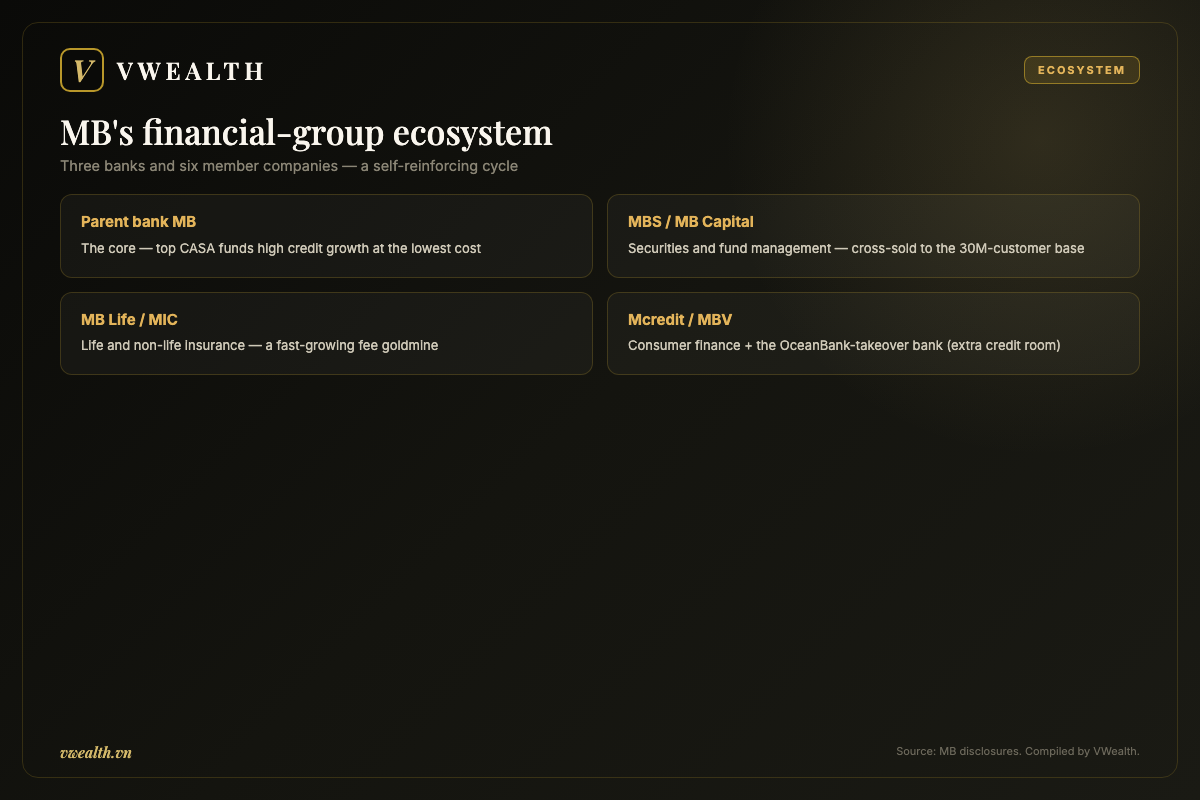
Let’s run through each member so you see what piece each holds in the picture:
- Parent bank MB: the group’s heart, creating most profit from credit and the hub of cheap CASA. Every subsidiary “rides” the parent’s customer base and cash flow.
- MBS (MB Securities): the securities company, serving stock and bond investing and issuance advisory. MBS is among the brokerage-share leaders (around top 7), leveraging the parent’s huge digital base to attract new investors.
- MB Ageas Life (renamed MB Life): the life-insurance company, a joint venture with the Ageas group. This is the bancassurance “goldmine,” leading in insurance revenue via the bank channel, with revenue growing very strongly in 2025.
- MIC (Military Insurance): the non-life insurer (property, vehicle, health, loan insurance). MIC is among the top-4 non-life market share, tied to the parent’s lending — where there’s a loan, there’s insurance demand.
- Mcredit (MB Consumer Finance): the consumer-finance company serving the mass, below-bank-standard segment. Mcredit is among the top-3 consumer-finance share, extending the customer range the parent doesn’t directly serve.
- MB Capital (MB Fund Management): the fund and asset-management company, serving customers wanting to entrust investments. MB Capital’s assets under management grew 67% in 2025, showing strong investment inflows.
- MBV (the OceanBank-takeover bank): a special strategic move. In late 2024, MB took over the weak OceanBank and renamed it MBV. MBV operates as an independent bank, backed by MB in technology, products and governance, targeting the young segment. In exchange, participating in restructuring a weak institution earns MB preferential mechanisms from the regulator, notably a higher credit-growth quota — a reason MB is continuously granted superior credit room versus the industry.
You should also know the group has MBCambodia (a bank in Cambodia, extending abroad) and MBAMC (a debt-management and asset-exploitation company handling bad debt for the whole system). Overall, the member companies reached total revenue of about 13,780 billion dong and pre-tax profit around 1,633 billion dong, up 39%, with a target of subsidiaries contributing up to 61% of profit growth in 2025. The two insurers MIC and MB Life alone reached revenue over 5,000 billion dong — showing insurance has become a truly significant income source, no longer a bank “side dish.”
Why ecosystem + CASA + digitalization creates a growth “moat”
By now you have enough pieces to see the big picture. MB’s strength lies not in a single factor, but in how three factors — the group ecosystem, leading CASA and digitalization capability — lock into a self-reinforcing cycle. Here’s how it runs:
- Digitalization pulls users into the app → a free, convenient app keeps living cash in accounts → CASA rises, cost of funds falls.
- A low cost of funds → high NIM, thick margin → good profit to reinvest in technology and waive services → the digital cycle strengthens again.
- The 30-million customer base in the app becomes a “marketplace” for MBS, MB Life, MIC, Mcredit, MB Capital to cross-sell → non-interest income rises, income diversifies, credit dependence falls.
- The army/Viettel ecosystem and the MBV takeover bring a large, stable deposit source and higher credit quota → MB has both plenty of cheap funds and plenty of lending room, pushing credit growth to the top.
Each arrow in the loop reinforces the next. A rival wanting to catch MB must simultaneously do all three well — build a top digital app, cultivate durable CASA, and assemble a full financial group — while MB is years ahead and backed by a unique army ecosystem. That’s the meaning of an “economic moat”: not that MB runs faster in one quarter, but that its business structure makes the gap very hard to close.
In short, MB doesn’t sell a product — it runs a cycle: digitalization draws CASA, CASA lowers the cost of funds, cheap funds feed growth, the huge customer base feeds the subsidiaries, and profit returns to reinvest in digitalization. This cycle is the “tank” the market often mentions.
But a strong business model is only half the investment story. However beautiful the cycle, it must be verified by real health numbers: does top-tier credit growth come with swelling bad debt? Is MB’s capital thick enough to absorb risk? Where do ROE and ROA stand versus peers? These are questions we’ll dissect in the next section — Position and financial health — where you’ll see how healthy this “tank” really is under the microscope.
Position and financial health
When you put MBB on the scale, the first thing to understand is that MB is no longer the modest “favourite child” army bank of two decades ago. In 2025, MB officially joined the ranks of Vietnam’s largest financial institutions, and more important than scale, it’s the fastest-growing name in the leading group. This is why every serious discussion of MBB must start from a core question: why does a bank already this large still run so fast, and is that speed sustainable or hiding risk?
This section dissects each layer of MB’s financial health: from its “Big 5” position and breakthrough growth driver, the CASA advantage creating superior margins, to the flip side of the hot-credit-growth story and asset quality. The goal isn’t to praise or smear, but to let you see the true nature of the numbers before deciding to invest.
The “Big 5” position and the growth star of the large-bank group
2025 closed with a notable milestone: MB’s total assets reached about 1.6 quadrillion dong, up 35% year on year. This puts MB among the banks with the largest assets in the system, alongside Vietcombank, BIDV, VietinBank and Agribank — the four state-owned banks that dominated the market for years. When a joint-stock bank like MB squeezes into the “Big 5 club” on scale, that’s itself a shift in the industry landscape.
But large scale isn’t what makes MB stand out. What’s truly notable is the speed. Looking at the 2020–2025 asset-growth curve, MB reached a compound annual growth rate (CAGR) of about 22% a year — far ahead of peers in the large group. To picture it, over the same period VietinBank grew about 15.5% a year, BIDV about 15%, and Vietcombank only about 12.4%. In other words, while the state-owned “big players” grew assets in the 12–16% zone, MB ran nearly 1.5 to 2 times faster. This is why many analysts call MB the “growth star” of the leading group.
On profit, in 2025 MB recorded pre-tax profit exceeding 34,200 billion dong, up about 18.7% from 2024. This is not only among the highest in Vietnamese banking but also shows the double-digit pace held steady even on a very large asset base. For a small bank, 18% profit growth is common; but for an institution already with 1.6 quadrillion dong of assets, holding nearly 19% growth is an admirable operating-quality achievement.
So what makes this difference? Three main pillars to remember:
- A distinctive customer ecosystem: MB accesses the army customer base, state defence enterprises, and strategic partners like Viettel — a stable deposit and credit-relationship source few joint-stock banks have.
- Digitalization ahead: MB is one of the heaviest investors in digital platforms (MB App, BIZ MBBank), attracting a huge user base and cutting operating costs, building a base for both non-term deposit growth and cost efficiency.
- The credit-“room” advantage: the mandatory takeover of a weak bank (MBV) opened a special credit-growth room for MB — a factor we’ll analyze in detail later.
Combining these three, you’ll understand why MB can be both large and fast — a rare combination the market values fairly highly.
The CASA and cost-of-funds advantage: the root of superior margins
If you could pick only one metric to understand why MB is so profitable, pick CASA. CASA — the ratio of non-term deposits to total deposits — is the “secret weapon” of the best banks. Non-term deposits are money customers keep in payment accounts, on which the bank pays almost no or very little interest. The higher the CASA ratio, the cheaper the bank’s input cost of funds, and the thicker the spread between lending rates and funding costs — the NIM.
In 2025, MB maintained CASA around 37.9% to above 40% depending on timing and method, among the highest in the system. To position it: across the whole market, only three names sustain CASA above 30% — Techcombank, MB and Vietcombank. Techcombank leads with CASA above 40%, and MB is right behind. In other words, MB is the runner-up on cheap-funding structure — an extremely valuable position in an industry where the cost of funds decides almost everything.
High CASA isn’t just a pretty number on a report. It’s the cushion letting MB lend at more competitive rates while keeping its margin, and providing resilience when deposit rates rise — because most of its input is already nearly free.
This CASA advantage reflects directly in profitability. In 2025, MB’s NIM was about 3.87% — a healthy figure amid an industry NIM thinning under competition and funding pressure. And the peak of the profitability story is the return on equity (ROE): MB sustains ROE above 20–21%, among the highest in banking and nearly double MB’s own level a decade ago. More importantly, MB’s ROE stayed steadily above 20% throughout 2019–2025 — meaning this isn’t a single lucky year, but a consistently run profit machine.
For you — an investor — a durable ROE above 20% has a very concrete meaning: each dong of shareholders’ capital left in the bank generates over 20 dong of profit a year. This is the sign of a business creating real value, not just bloating by injecting more capital.
High credit growth and the special-room story
Here we touch the factor that’s both MB’s biggest driver and biggest risk in this period: credit growth. In 2025, MB reached credit growth of nearly 36.7% to 40% — a nearly unthinkable figure for a Big-5-scale bank, and double the industry norm (about 19%). When your loan book has passed 1 quadrillion dong yet still grows nearly 40% in a year, that’s a phenomenon needing a thorough explanation.
The answer lies in two words: mandatory takeover. From late 2024, MB officially took over a weak bank — MBV (formerly OceanBank). This is part of the State Bank’s plan to restructure problem banks, and in exchange for shouldering a weak bank, MB earns special incentives — most importantly, a credit-growth quota among the highest in the market. Specifically, MB was assigned a minimum 25% credit-growth quota for the parent bank alone (excluding MBV), and maintains a high quota for the whole 2026–2028 period.
MBV itself “turned its life around” spectacularly under MB’s management: its total assets jumped from about 40,000 billion to over 91,500 billion dong in just a year — up 129%. This shows MB not only took on a burden but knew how to turn it into an additional growth engine.
But stay clear-headed: high credit growth is a double-edged sword. On one hand, it drives interest income and profit up strongly. On the other, fast lending in a short time always carries asset-quality risk: loans granted during a hot-growth phase usually haven’t “seasoned” — haven’t passed a full economic cycle to reveal bad debt. A bank can look very healthy in the growth year, then bear the consequences a year or two later when the loans start faltering. This is a lesson Vietnam’s banking market has learned many times.
Asset quality: bad debt, the provisioning buffer, and names to watch
So how is MB’s asset quality now? The good news is that, at least through end-2025, the numbers are still in the safe zone. The parent-bank NPL ratio is controlled at about 1.29% — below the 1.3% threshold and even down from the prior year. At the group-consolidated level (including the higher-risk consumer-finance company Mcredit), it’s a bit higher, around 1.6%, but still well-controlled versus the industry hovering around 2%.
No less important than the NPL number is the provisioning buffer — how much the bank has set aside in case these bad debts default. The metric reflecting this is the NPL coverage ratio (LLR). In 2025, MB’s coverage was about 93.75% — meaning for every 100 dong of bad debt, MB has prepared nearly 94 dong of provisions. This is a thick cushion, though no longer at the “huge” level of 2021–2022 when MB was among the highest-coverage in the system. Note this trend: MB’s provisioning buffer has thinned versus its peak, meaning the room to “absorb shocks” in the future has also narrowed somewhat.
A notable bright spot in the portfolio: MB’s real-estate lending is only about 10.42% of total loans, a fairly prudent level. Most credit is allocated to production-trade (about 27.8%), household lending (about 22.1%) and processing-manufacturing (about 17.5%). This structure shows MB doesn’t “go all-in” on real estate like some joint-stock banks, reducing concentration risk.
However, this is also where to stay alert. The market has long worried about MB’s exposure to some large real-estate and bond enterprises, especially Trung Nam and Novaland. At the August 2025 investor conference, MB Chairman Luu Trung Thai directly reassured: with Trung Nam, MB works on three projects with good repayment flows, and this customer paid about 1,000 billion dong more in debt than the prior year; with Novaland — a restructuring business — MB’s leadership affirmed “no bad debt has arisen from Novaland to date,” and its strategic projects have completed legal procedures to continue.
This reassurance is positive, but as an investor, keep a cautious view:
- “Not yet arisen” doesn’t mean “no risk.” Loans to large restructuring property firms always carry high uncertainty, depending on legal progress and the developer’s ability to sell.
- Concentration on a few large customers. Even if the total real-estate share is low, a large enough loan to a struggling firm can create a profit shock in one quarter.
- The provisioning buffer needs continuous watching. If bad debt ticks up while coverage falls, that’s an early-warning signal you shouldn’t ignore.
In short, MB’s asset quality is in a “healthy but watch-carefully” state: the official numbers are pretty, leadership is confident, but the high credit-growth pace and a few large exposures make this a zone you must track closely quarter by quarter.
Capital adequacy and operating efficiency: the foundation for durable growth
A fast-growing bank needs a solid capital base. On the capital adequacy ratio (CAR), MB maintains around 11% — a deliberate leadership choice. As MB’s Chairman explained, the bank intentionally keeps CAR in the middle zone: higher than state-owned banks (usually around 9%) but lower than the very-thick-CAR group (13–14%). The reason is to avoid “holding” too much non-earning capital, thereby keeping ROE and ROA high. This is a fairly sharp capital-management philosophy: optimizing capital efficiency rather than over-hoarding defensive capital. The downside is the safety margin isn’t overly generous, so MB’s continuous plans to raise charter capital (toward over 102,000 billion dong) should be seen as necessary to feed growth.
On operating efficiency, MB truly shines. The cost-to-income ratio (CIR) — measuring how many dongs of cost to create a dong of revenue — is only around 32% for MB, among the lowest in the industry. This is the direct fruit of digitalization: when millions of transactions are handled automatically via the digital platform rather than the counter, personnel and operating costs per dong of revenue fall sharply. One illustrative detail: in 2025, MB’s operating-cost growth was only about half its revenue growth — meaning the more the bank earns, the wider its margin, rather than being eroded by costs.
A low CIR combined with high CASA forms a virtuous spiral: cheap input plus lean operating costs both push the margin up, feeding a durable high ROE. This is the “formula” behind MB’s distinctive financial health versus most of the industry.
For an overview of MB’s key 2025 financial metrics, see the table below:
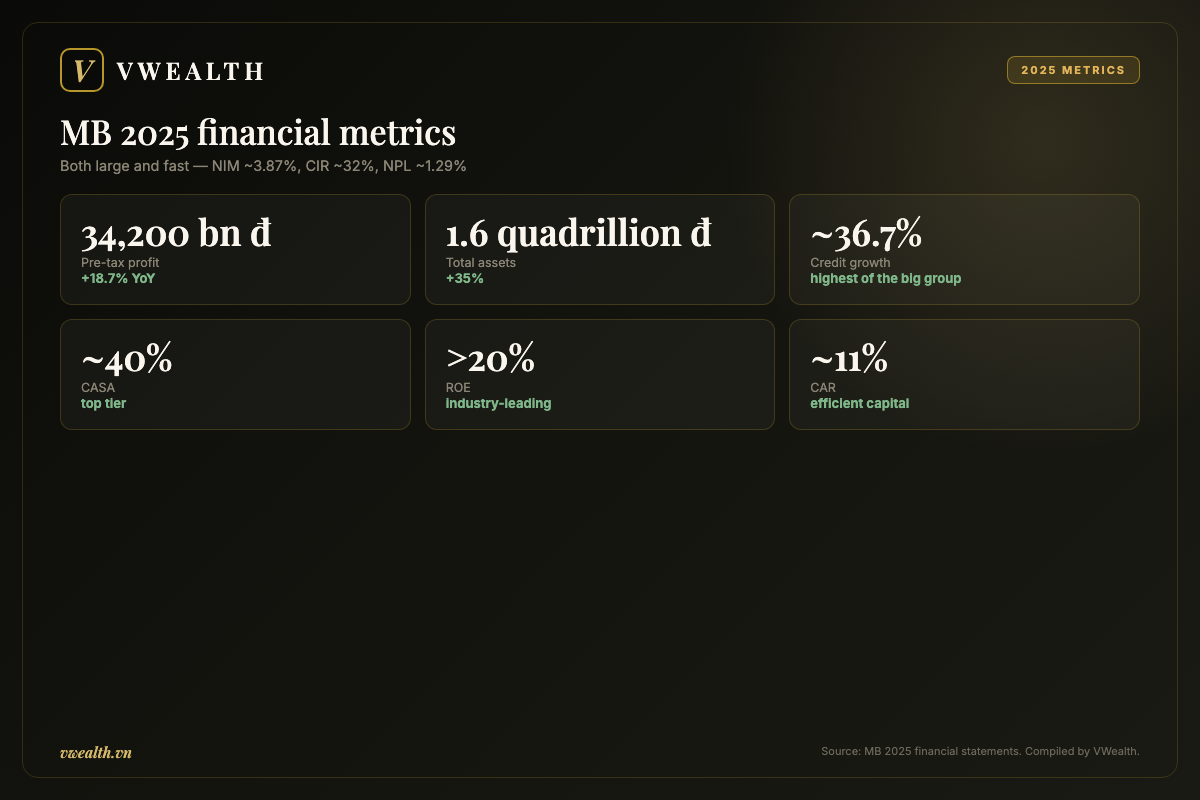
| Metric | MB 2025 | Meaning for the investor |
|---|---|---|
| Pre-tax profit | > 34,200 billion dong (+18.7%) | Double-digit pace held on a large asset base |
| Total assets | ~1.6 quadrillion dong (+35%) | Into the Big 5, fastest-growing of the large group |
| Credit growth | ~36.7% – 40% | Highest of the large group thanks to MBV’s special quota |
| CASA ratio | ~37.9% – above 40% | Market runner-up, after Techcombank → cheap funds |
| NIM | ~3.87% | Healthy amid a thinning industry NIM |
| ROE | > 20% – 21% | Among the highest, stable 2019–2025 |
| NPL ratio | ~1.29% (standalone) | Below 1.3%, well controlled |
| NPL coverage (LLR) | ~93.75% | Thick buffer but thinner than the peak |
| CIR | ~32% | Among the lowest thanks to digitalization |
| CAR | ~11% | Optimizing capital efficiency, needs raising to feed growth |
Overall, MB’s 2025 financial-health picture is one of rare balance: scale has reached the leading group, but the speed is still that of a rising bank; profitability is top-tier thanks to the CASA advantage and lean costs; asset quality is well-controlled on paper, though with points to watch closely on hot growth and property exposure. This is the portrait of a true “growth star” — and the foundation for understanding why the market reacts specially to MBB, which we analyze next.
How the market received the stock
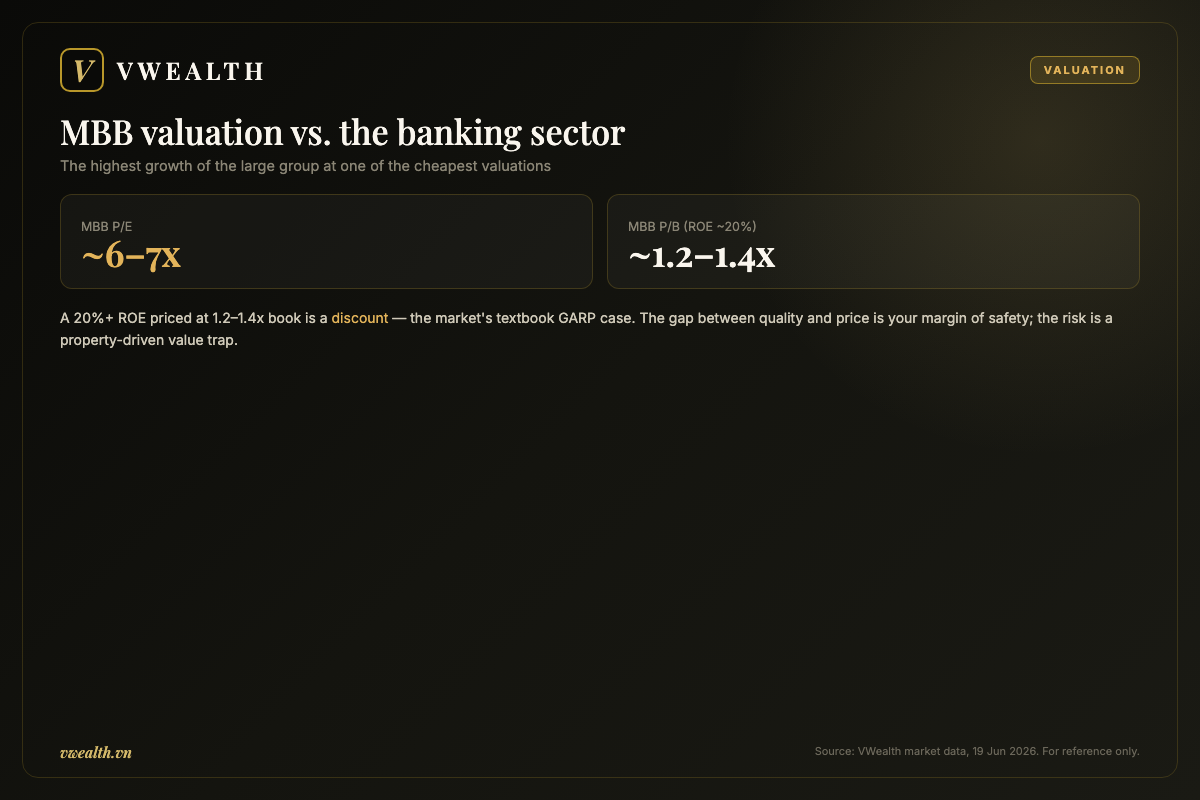
If you set two numbers side by side — a bank with ROE around 20–21%, double-digit profit growth almost every year, 2025 pre-tax profit over 34,200 billion dong — and a stock price of just 25,000đ (close of 19 June 2026, per VWealth real-price data), you’ll immediately see a paradox. A business this profitable, in most other sectors, would be highly valued by the market. But MBB trades at a P/E of about 6 times and a P/B of just 1.2–1.4 times. This section is for you and me to dissect: how the market values MBB, why such a good bank is so “cheap,” and most importantly — is this a real bargain, or a cleverly disguised value trap?
Let me state my view upfront so you have a reference frame: MBB is one of the few bank stocks on HOSE combining the three factors investors call “growth at a reasonable price” — high profit quality, still-strong growth, and a valuation far below that quality. But “cheap” is never an unconditional compliment in investing. Cheap always has a reason, and your job is to judge whether that reason is legitimate and temporary, or a structural crack.
The highlight — cheap valuation: why is a good bank discounted?
Start with the arithmetic, because bank valuation ultimately reduces to a few simple calculations. MBB has about 8 billion shares outstanding after many stock splits, corresponding to charter capital of about 80,550 billion dong (raised in September 2025). With 2025 consolidated pre-tax profit over 34,200 billion dong, after-tax profit attributable to the parent’s shareholders is about 26,000–27,000 billion dong. Divided by shares outstanding, basic EPS falls in the 3,300–3,500đ zone — and by the average shares at the profit-close, the trailing-12-month EPS could be even higher. Dividing 25,000đ by this EPS, you get a P/E around 6–7 times. That’s the valuation the market usually gives to businesses with almost no growth left, or facing serious risk — not to a bank just growing profit in double digits.
The price-to-book (P/B) says even more, because for a bank this is the core valuation measure. MBB’s P/B is now in the 1.2–1.4 zone. To picture it: a bank with 20% ROE trading at just 1.3x P/B means the market pays 1.3 dong for each dong of equity — while each dong of that equity generates 0.2 dong of profit a year. In other words, you’re buying a machine that earns 20% a year with a very modest “brand premium.” When comparable-quality international banks are usually valued at P/B 1.5–2.5 times, MBB’s 1.2–1.4 is clearly a discount.
The hidden rule of bank valuation: a fair P/B is roughly the ratio between ROE and the cost of equity. A bank with 20% ROE and a 13–14% cost of capital “deserves” a P/B around 1.5 times or higher if growth is sustained. MBB at 1.2–1.4 means the market is implicitly assuming ROE will decline, or that risk isn’t fully reflected.
So where does this “discount money” come from? I see four groups of worries the market is pricing in, and you should weigh each coldly:
- Worry about hot growth and asset quality. MBB has grown credit fast for years. Fast growth at a bank always raises the question: is the new lending truly quality, or is it “buying” growth by lowering credit standards? The market usually discounts hot-growth banks over fears bad debt will surface in 2–3 years when the cycle turns.
- Real-estate and corporate-bond exposure. This is the whole industry’s shared fear since the bond-market turmoil. Every bank with exposure to property developers or holding corporate bonds gets a “risk premium” added. MBB is no exception, and the 6x P/E partly reflects this caution.
- The state and army ownership factor. MB is the Military Bank, with large shareholders tied to the state and military (Viettel and related units). Some investors worry this structure could burden the bank with non-commercial tasks, or constrain capital-allocation decisions. This is a “governance” discount more than a financial one.
- Dilution from continuous stock splits. MB pays stock dividends almost every year, swelling shares outstanding fast — from a few billion to about 8 billion and heading toward over 10 billion per the plan to raise charter capital past 102,000 billion dong. When the denominator (shares) rises fast, EPS is “diluted,” and the per-share price is mechanically pulled down. This makes many investors feel MBB “keeps going sideways,” even as market cap and absolute profit still rise.
All four reasons are real, and you shouldn’t dismiss them. But the important question is: are they serious enough to justify a 6x P/E? In my view, the first three are cyclical and sector risks — they weigh on the entire Vietnamese banking group, not just MBB, so they don’t explain why MBB is cheaper than its own quality. The fourth — dilution — is actually an illusion: if an investor holds shares that get split, total holding value isn’t lost but just divided smaller; the “dilution” in price is offset by more shares. The one truly hurt is the person who looks at each absolute price and forgets the base has changed.
“Real cheap or a value trap?” — the question you must answer
A value trap is when a stock looks cheap on every metric, but cheap because future profit is about to plunge, and today’s “cheap” becomes “expensive” when profit falls. The way to tell a real bargain from a value trap lies in the direction of profit and asset quality, not the P/E number.
For MBB, the signs of a real bargain still outweigh the value-trap signs: ROE is still in the 20%+ zone, profit is still growing (2025 pre-tax over 34,200 billion and the 2026 target rising up to 20%), a large individual customer base thanks to the digital ecosystem, a low cost of funds thanks to top-tier CASA. A bank in decline would see ROE shrink, CASA fall, NIM wither — MBB shows none of those symptoms. The factor to watch most closely is asset quality: if the NPL ratio surges and coverage drops sharply for several consecutive quarters, then the “real cheap” thesis is shaken. But at present, I lean toward concluding this is a real cheap valuation rather than a value trap — on condition you accept this is a banking-sector stock, meaning you accept riding the credit cycle and the bad-debt risk of the whole economy.
Why banks are valued by P/B combined with growth
Many new investors are used to valuing businesses by P/E, so they get confused looking at bank stocks. Banks are valued mainly by P/B because of the nature of the balance sheet: for a bank, equity isn’t a dry accounting number but the direct “fuel” creating profit. A bank uses equity as a base to raise and lend many times over; each additional dong of equity allows expanding earning assets. So book value is the measure of a bank’s “earning capacity,” and P/B measures how much the market pays per unit of that capacity.
But P/B alone is meaningless — it must go with ROE and the growth rate. This is the trio you should always view together:
- ROE determines the “deserved” P/B. A 10%-ROE bank and a 20%-ROE bank can’t have the same P/B. A bank earning double on the same capital deserves a higher P/B. MBB with 20%+ ROE should theoretically have a higher P/B than 12–15%-ROE banks, but in reality trades on par or lower — that’s the anomaly.
- Growth determines the future P/B. A bank growing equity 15–20% a year sees its book value swell fast. If you buy at 1.3x P/B today and book value rises 18% next year while the price holds, the P/B “automatically” shrinks to around 1.1 — the stock gets cheaper over time. This is why valuing a growth bank must look forward, not just at the static current P/B.
- Asset quality is the brake. However high the ROE and growth, they’re meaningless if bad debt erodes capital. So the market always discounts the “uncertain” part of asset quality into P/B — part of why the whole Vietnamese banking sector’s P/B is lower than developed-market banks.
Putting these three together, MBB emerges as a classic case of the GARP strategy — “Growth At a Reasonable Price.” You don’t pay dearly to buy growth (as with high-valued tech stocks), nor buy a dying business cheap. You’re buying real growth, real quality, at a price the market — for many sector worries — has pushed low. For a patient investor, that’s the kind of valuation worth serious consideration.
Price action and liquidity: a “national” stock
One feature that sets MBB apart from the rest of the banking group is liquidity. This is one of the most actively traded stocks on HOSE, with millions to tens of millions of shares changing hands daily. For you — whether a small individual or a large portfolio manager — high liquidity means you can buy and sell with almost no price impact, without being “stuck” when you need to exit. This is an intangible but very real value: many stocks look attractive on valuation but have thin liquidity, and when you want to sell a large amount there’s no buyer.
The 25,000đ price also contributes to the “national stock” nickname. This is a very affordable zone: with a few million dong, an individual can buy a round lot. MB’s regular stock splits, beyond raising capital, incidentally keep the price low, keeping the stock “within reach” of the broad public. MB’s shareholder count jumped from about 120,000 at end-2024 to over 207,000 at end-2025 — proof of this mass appeal. A wide shareholder base builds thick liquidity, and thick liquidity draws more institutional money — a virtuous loop.
The downside of mass appeal is that the stock “breathes” with the general banking-sector sentiment. When the market worries about property bad debt, credit tightening, or narrowing NIM, MBB usually falls with the group regardless of its own fundamentals. Conversely, whenever money returns to the “king” group — bank stocks — MBB, thanks to its liquidity and scale, is often among those bought hardest. In the first three months of 2025, the price ranged around 20,000–23,000đ during profit-taking and macro caution, then recovered to the 25,000đ zone — a range showing this stock moves mainly with sector sentiment rather than company-specific shocks. See this as a characteristic, not a flaw: if you believe in MBB’s fundamentals, those whole-sector sell-offs are exactly the accumulation opportunities.
Dividends: combining cash and stock, raising capital fast
MB’s dividend policy is very notable, as it both returns real money to shareholders and retains capital to grow — a balance not every bank achieves. MB’s 2025 dividend has a total ratio of 35%, combining cash and stock: the cash portion about 10% (about 8,055 billion dong used to pay), the rest in stock.
- The cash portion gives you real cash flow immediately. At a 25,000đ price and a 1,000đ par-value cash dividend (10% on the 10,000đ par), the cash dividend yield is about 4% a year — a fairly good number for a stock still growing strongly, and higher than many banks that retain all profit.
- The stock portion is how MB raises charter capital fast without investors putting in more money. Charter capital has reached 80,550 billion dong and is heading toward over 102,000 billion per the 2026 plan (including stock splits, an offering to existing shareholders and a private placement). Thicker capital lets MB lend more, meet ever-stricter safety standards, and sustain credit growth — the fuel keeping the 20% ROE going.
You need to view this policy from both sides. For those preferring steady cash flow, the 4% cash dividend is a plus. For long-term growth investors, the stock portion is the real value: you’re “automatically reinvested” into a 20%-ROE bank at no fee, and your holding grows each year. The downside, as noted in valuation, is the EPS “dilution” that makes the absolute price hard to break out — but that’s a reasonable price for a bank raising capital fast and durably.
Foreigners and room: a door ajar
MBB’s foreign story is one of the most interesting factors and possibly a future re-rating catalyst. For years, MBB’s foreign room has usually been near-full or capped — foreign ownership limited around 23.2% and continuously “exhausted.” Whenever a bit of room opens — say via a private placement raising total shares, pulling the foreign ratio below the ceiling — foreigners usually rush to buy, one round spending over 400 billion dong just to refill the just-opened room. This shows a fact: foreign investor demand for MBB always exceeds the allowed room supply.
The room being regularly full has two sides. The downside: foreigners can’t buy more, reducing potential inflows and somewhat constraining valuation — another reason MBB is “cheap,” lacking buying from international funds willing to pay higher valuations. The upside: full room is proof of the stock’s appeal to professional money.
A catalyst to watch: per Decree 69/2025/ND-CP, banks participating in mandatory takeovers of weak credit institutions — including MB — may raise the foreign-ownership ceiling to a maximum of 49%. If and when MB officially loosens its room, a large amount of long-pent-up foreign capital could be released, creating strong demand capable of re-rating the stock.
Interestingly, MB’s leadership says it’s in no hurry to loosen room, wanting to keep the space to find a strategic investor to sell at a “higher price.” In other words, MB is deliberately holding a “potential asset” — the 49% room — and waiting for the optimal moment to turn it into value. For you, this is a free option attached to the stock: if the room loosening and strategic sale happen at a high valuation, existing shareholders benefit directly; and if it hasn’t happened yet, you lose nothing because the business fundamentals still grow.
To close: MBB is the banking sector’s GARP choice
Putting all the pieces together, the picture of how the market receives MBB is fairly clear. This is a high-quality bank — 20%+ ROE, top CASA, durable profit growth — but valued by the market like a mid-tier business, at a P/E around 6 times and P/B 1.2–1.4 times. That gap between quality and valuation is your margin of safety, and the reason MBB deserves a place in the GARP group — growth at a reasonable price — of Vietnamese banking.
This “cheapness” isn’t without cause: it’s the sum of credit-cycle fears, real-estate and bond exposure, the state-military ownership character, and the dilution effect from stock splits. But most of those worries are industry-wide risks or accounting illusions, not intrinsic cracks specific to MBB. As long as ROE stays around 20%, asset quality stays controlled, and the growth pace holds, the scale tilts toward “real cheap” over “value trap.” Add a 4% cash dividend, national liquidity letting you enter and exit easily, and the option of loosening foreign room to 49% as a latent catalyst — MBB is the kind of stock a disciplined investor can accumulate during whole-sector sell-offs and patiently wait for the market to recognize its value.
Of course, “cheap” and “good” don’t automatically mean “buy now at any price.” Every MBB thesis rests on the health of the whole banking industry and Vietnam’s economy — the credit cycle, property bad debt, monetary policy. So to complete the picture and know where MBB stands in the bigger game, you need to place it in the banking-industry context — which we analyze next.
Economic and banking-sector context
To understand a bank stock like MBB, you can’t look only at that bank’s balance sheet. A bank is a mirror of the whole economy: when businesses prosper, credit flows strongly and bank profit blooms; when the economy slows or property freezes, bad debt immediately gnaws at profit. So before deciding anything about MBB, place it in the right macro and industry picture it lives in.
An economy setting a double-digit growth ambition
The 2026 context has a special feature to remember: the National Assembly set a GDP growth target of 10% or more, while keeping inflation around 4.5%. This is a big ambition, placing Vietnam’s economy among the region’s fastest-growing. To realize it, total social investment capital in 2026 is estimated at about 5.1 quadrillion dong, of which bank credit alone must contribute about 1.8 quadrillion. In other words, the banking system remains the “main artery” pumping capital for the whole economy, and banks able to lend fast to the right targets will be direct beneficiaries.
Interestingly, the State Bank (SBV) set an industry-wide credit-growth target of about 15% for 2026 — markedly lower than the over-19% achieved in 2025. The “gap” between a double-digit GDP target and a credit room of just 15% is a signal to read carefully. It shows the regulator wants growth to lean more on public investment, FDI and capital markets (stocks, bonds) rather than over-depending on bank credit — a growth style with latent systemic risk. For a bank targeting credit growth of 36.7% like MB, this means credit room becomes a “scarce resource,” and MB continuously being allocated a higher-than-average quota reflects the regulator’s confidence in this bank’s governance.
Low rates stimulate credit, but erode margins
To support the growth target, the SBV continues to guide low rates, directing banks to cut deposit rates to “cool” lending rates. For borrowers and businesses, this is good news. But for the banks themselves, low rates are a double-edged sword.
You need to know a vital sector metric: NIM — the net interest margin, the spread between lending and deposit rates. NIM is a bank’s “core margin.” When rates are pressed low and lending competition is fierce, the industry NIM tends to narrow. Sector reports show that in 2026, banks continue to face liquidity pressure, eroding NIM and signs of weakening asset quality. In that environment, two types of banks clearly diverge: those depending on expensive funding get “squeezed” on profit, while those with abundant cheap funds keep their margins much better. This is exactly where MB stands out, and we’ll return to it shortly.
Systemic risk: property bad debt and corporate bonds
No honest bank analysis skips the dark side. The biggest risk for the whole industry — and for MBB specifically — lies in asset quality, specifically two “hot spots”: property credit and corporate bonds.
Per sector reports, bank asset quality has shown signs of weakening, and the system-wide NPL ratio is forecast to tick up to about 1.8% by end-2026, versus 1.76% at end-2025. The absolute number itself isn’t too scary, but the upward trend plus “three variables” adding pressure — floating rates on property loans, developers’ refinancing needs, and major planning adjustments — keep analysts watching very closely.
Because of this worry, the SBV issued new rules for 2026 to “brake” property credit: each credit institution’s property-credit growth may not exceed its own general credit growth. This is an important guardrail. For MB specifically, note this bank has exposure to some large enterprises and a certain weight in corporate bonds. Banks with high corporate-lending weight (including bonds) and thin NPL coverage will face greater provisioning pressure when the bad-debt cycle returns. MB is not outside this risk — something to weigh very seriously, not just to revel in the growth story.
A principle to engrave when investing in bank stocks: high credit growth is a double-edged sword. It creates today’s profit but can create tomorrow’s bad debt if underwriting quality is loosened. A bank growing 35% while keeping bad debt low is a treasure; growing 35% with swelling bad debt is a trap.
The market-upgrade and foreign-room story
Offsetting the worries above, a big “tailwind” is blowing into the whole market, and banking is one of the biggest beneficiaries: the stock-market upgrade story.
On 8 October 2025, FTSE Russell officially announced the upgrade of Vietnam’s stock market from frontier to secondary emerging. Adding Vietnamese stocks to the FTSE indices proceeds in four stages, starting September 2026 (adding 10% weight), rising 20% in March 2027, 35% in June 2027 and completing the final 35% in September 2027. The key conditions for upgrade — the KRX trading system going live, removing pre-funding, and loosening foreign-ownership limits — helped Vietnam meet international standards, paving the way for foreign inflows estimated at 3 to 6 billion USD.
Why does this matter to MBB? Because foreign index funds (ETFs, index funds) disbursing into Vietnam prioritize large-cap, high-liquidity stocks with large index weights — and leading banks like MBB are right at the centre. Additionally, loosening foreign room for banking (long capped tighter than other sectors) will directly unclog long-pent-up demand. For a stock trading at a cheap valuation like MBB, additional foreign flows could be a significant re-rating catalyst.
Why MB is well-positioned amid the industry’s NIM squeeze
Now put the pieces together. In an environment where the industry NIM is eroded by low rates, the decisive competitive advantage lies in two words: cost of funds. And this is MB’s home turf.
- Top-tier CASA (~40%): CASA is the non-term deposit ratio — deposits paying almost no or very little interest. MB’s ~40% CASA is among the highest in the system, meaning a large part of MB’s funding is nearly “free.” When the whole industry struggles with funding costs, MB keeps a low input cost, thereby protecting NIM far better than the norm.
- Digitalization driving CASA: MB’s high CASA isn’t luck but comes from aggressive digitalization. With 35 million customers, nearly 11 billion financial transactions a year (99% via digital channels) and digital-channel revenue over 50% of total, MB turned the banking app into where customers keep money daily — and money in payment accounts is cheap CASA.
- The army–Viettel ecosystem: As a bank tied to the army and Viettel ecosystem, MB has an advantage accessing a huge, stable institutional and individual customer base, both supplying abundant CASA and expanding credit at low acquisition cost.
In short: in a cycle where banks “eat” a thinning margin, MB is one of the few with a funding structure that allows both strong growth and a high margin. That’s the fundamental reason MB continuously achieves double-digit profit growth while many rivals plateau. Of course, this advantage isn’t immune to asset-quality risk — that’s the core trade-off you’ll have to weigh.
Trend forecast
Having understood the industry context, the next question is: where will MB go in the coming years, and how will that affect MBB’s price? This section isn’t about “declaring” a specific price — no one can do that honestly — but about laying out scenarios, trigger conditions and consequences of each, helping you prepare for every situation.
MB’s strategy: accelerating but selectively
MB enters the new phase with a fairly clear strategy around three pillars: digital transformation, ecosystem expansion and capital raising. More specifically:
- Profit and scale targets: MB plans 2026 pre-tax profit in the 39,400–41,121 billion dong range, up 15–20% from 2025. Alongside, the bank plans to raise charter capital to over 102,000 billion dong — placing MB among the banks with the largest charter capital, creating room for asset growth and ensuring capital safety.
- Handling MBV (the OceanBank takeover): MB took over OceanBank (now MBV) mandatorily under a plan approved by the Government and SBV. So far MBV has largely completed 20 key IT systems. Taking on a weak bank is a double-edged sword: short term a burden and risk, but in exchange MB enjoys preferential mechanisms (like a high credit quota, preferential funding costs) — and these mechanisms partly explain why MB is allowed to grow faster than the norm. If MBV is restructured successfully, it will shift from burden to a launchpad expanding the customer base.
- Pushing retail and digitalization: MB continues to see digital banking and retail as core growth drivers, both to raise cheap CASA and to diversify credit risk instead of concentrating on large corporates.
- Regional ambition: MB targets becoming a financial group among the region’s leaders, pushing ecosystem exploitation, expanding international operations and studying investments in finance companies to diversify non-interest income.
Three scenarios for MBB
From the strategy above and the industry context, you can picture three main scenarios. Read each scenario’s trigger conditions carefully — because tracking those conditions, not the price number, is what helps you decide wisely.
Positive scenario: the growth machine re-rates
Conditions: MB sustains high credit growth (over 30%) while keeping bad debt controlled; CASA keeps improving, keeping NIM stable despite the industry-wide narrowing trend; MBV restructures on schedule; and foreign flows from the FTSE upgrade disburse strongly from the second half of 2026.
Consequence: Durable double-digit profit growth, ROE staying in the high group. More importantly, the current P/B of ~1.2–1.4 times — cheap versus quality — can be re-rated higher as investors realize MB deserves a “premium” versus the norm. The combination of profit growth (E rising) and multiple expansion (P/B rising) is the dream scenario for a stock, because the price can rise faster than profit.
Base scenario: steady growth, flat valuation
Conditions: MB completes its 15–20% profit-growth plan; bad debt ticks up slightly with the industry trend but stays in the safe zone thanks to the provisioning buffer; upgrade flows disburse gradually, without a sudden boost.
Consequence: The price moves mainly with profit growth, P/B holds around the current zone. Investors earn a “yield” from the bank’s intrinsic growth and dividend, rather than from re-rating. This is the highest-probability scenario under normal conditions, and it’s not bad at all for an already-cheap stock.
Negative scenario: hot growth backfires
Conditions: Property and corporate-bond bad debt erupts stronger than forecast, especially if a few large enterprises MB is exposed to hit liquidity trouble. Then the very high credit-growth pace (~36.7%) — a bright spot — backfires, because a large loan book means a large “risk denominator.” Surging provisioning pressure erodes profit.
Consequence: Profit misses the plan, ROE declines, and the market punishes by lowering the valuation — P/B may shrink to a lower zone. In this scenario, today’s “cheap valuation” may not be as cheap as you think, because cheap on a declining profit is the classic value trap. Add the dilution factor from stock splits, and the pressure on the per-share price is even clearer.
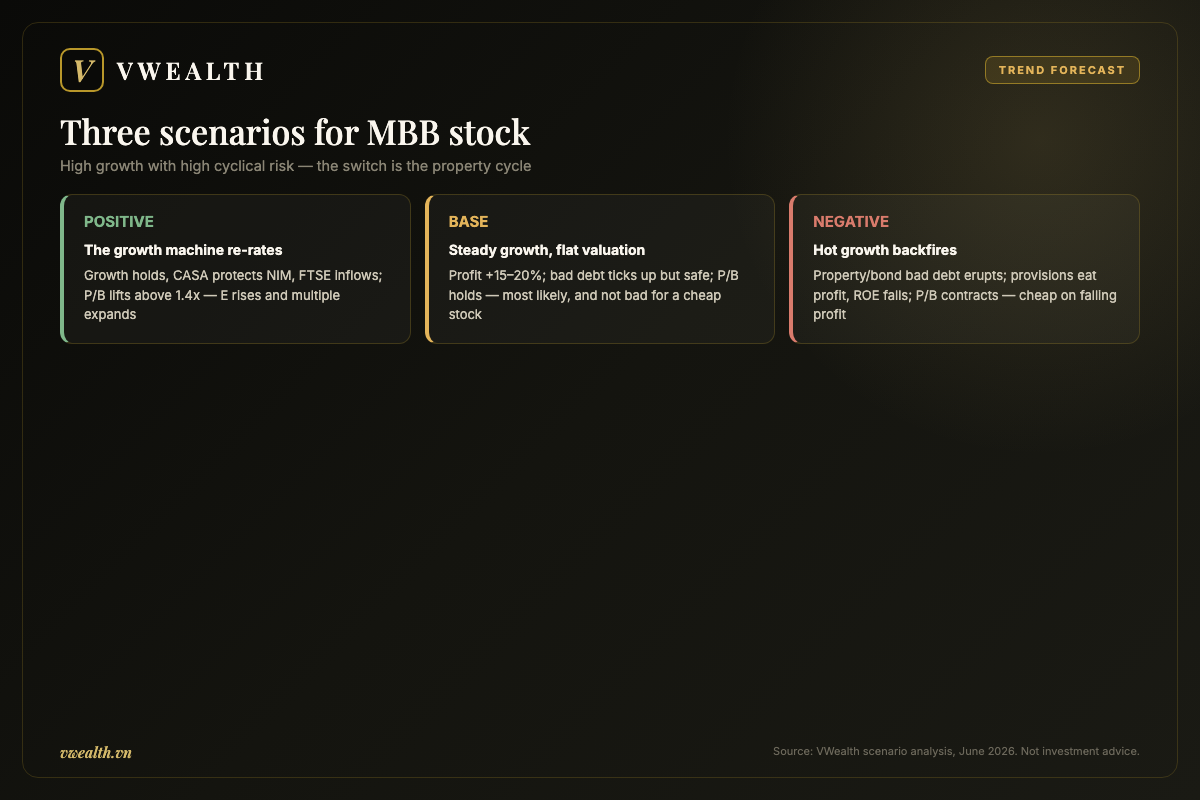
What you should take from these three scenarios isn’t “which one to bet on,” but recognizing that MBB is a story of high growth paired with high cyclical risk. Its reward and risk are larger than a slow, safe-growth bank. Your job is to track the “switches” that flip the scenario: quarterly bad-debt trends, the NPL coverage ratio, bond/property exposure details, and the disbursement progress of foreign flows.
Should you buy MBB stock?
This is the question you’ve probably awaited from the start. But let the author be honest: this section won’t tell you to buy or sell. No one — even the most veteran analysts — has the right to make that decision for you, because it depends on your risk appetite, financial goals and circumstances. What this section does, honestly, is put all the benefits and harms on the scale, then help you see whether MBB fits the kind of investor you are.
Weighing pros and cons
| ADVANTAGES (Bull case) | RISKS (Bear case) |
|---|---|
| Highest growth of the large-bank group: credit ~36.7%, 2025 pre-tax profit over 34,200 bn (+18.7%), plan to keep growing 15–20%. | Asset-quality risk from hot growth: a large loan book means a large risk denominator if underwriting is loosened. |
| Top CASA (~40%) → the lowest cost of funds in the group, protecting NIM amid an industry-wide margin squeeze. | Real-estate and corporate-bond exposure tied to a few large enterprises — a vulnerability when the bad-debt cycle returns. |
| High ROE among the leaders, superior return on capital. | Bad debt is cyclical: low today doesn’t guarantee tomorrow; system-wide NPL forecast to tick up to ~1.8%. |
| Cheap valuation: P/E ~6 times, P/B ~1.2–1.4 times — low versus quality and growth speed. | Dilution from stock splits to raise capital (to over 102,000 bn) lowers earnings per share. |
| The army–Viettel ecosystem: a stable customer and CASA source, a hard-to-copy competitive advantage. | The state/army ownership factor: both a support and a reason decisions sometimes aren’t purely commercial; carrying the MBV-takeover task. |
| Direct beneficiary of the FTSE upgrade and foreign-room loosening — a re-rating catalyst. | If the negative scenario plays out, “cheap” on a declining profit could be a value trap. |
Looking at the table, you’ll see MBB is not a “flawless” stock, nor a high-risk gamble. It is a very clear trade-off: you pay a cheap price to buy the highest growth of the large-bank group, in exchange for accepting the asset-quality risk of a fast-growing bank in an economy with many real-estate and bond unknowns.
Which kind of investor does MBB suit?
To answer “should you buy,” examine yourself against the four common investor types below:
- Cautious value investor (deep value, capital-preservation first): You seek cheap stocks with minimal risk, hate volatility and worry about bad debt. For you, MBB’s cheap valuation is attractive, but the property/bond exposure and hot-growth nature may keep you up at night. MBB only partly fits your appetite.
- Growth-at-a-reasonable-price investor (GARP): You seek high-growth businesses valued reasonably or cheaply. This is exactly the “portrait” MBB fits best: top growth of the large group, high ROE, at just ~6x P/E and ~1.2–1.4x P/B. If you’re in this group and can accept cyclical bank risk, MBB is very much worth deep research.
- Aggressive growth investor (high growth, high volatility tolerance): You hunt explosive stories, ready to bear big risk. MBB’s growth and upgrade catalyst appeal to you, but as a large bank, it can’t deliver the “many-times” gains of a small-cap.
- Income investor (steady dividends first): You want a steady cash-dividend stream. MB does pay dividends but leans toward stock to keep capital for growth, so cash flow isn’t its strongest point for you.
So the picture is fairly clear: MBB is the stock for those seeking growth at a reasonable price (GARP), willing to trade absolute peace of mind for re-rating potential, and most importantly, who clearly understand and accept the cyclical risk nature of a fast-growing bank. If, reading this, every mention of “property bad debt” makes you uneasy, that’s your body telling you this risk level may not fit you — and listening to that signal is also part of wise investing.
Closing words
MBB is one of the most watchable stories in Vietnamese banking this period: a growth machine run on a rare CASA and digitalization base, valued cheaply, standing before the tailwind of the market upgrade — but also carrying very real asset-quality risks. Your job isn’t to find a “yes” or “no” answer from this article, but to use the facts here to ask yourself the right question: is this risk level within my tolerance, and does today’s price give me enough margin of safety?
Disclaimer: This article is produced for informational and reference-analysis purposes, and is not a recommendation to buy, sell or hold any security. The figures and forecasts are compiled from public sources at the time of writing and may change. Investing always carries risk, including capital loss. You should do your own thorough research and/or consult a licensed financial advisor before making any investment decision. vwealth.vn and the author bear no responsibility for any gains or losses arising from the use of information in this article.
Research Vietnamese stocks in English with vwealth. Our AI-powered platform turns Vietnamese market data into full English analysis reports — with international payment support and a free 2-month trial for new accounts. Create your free account and read the latest reports.
Read more sector analysis: Vietnam’s Banking Sector: A Foreign Investor’s Guide to the Market’s Backbone