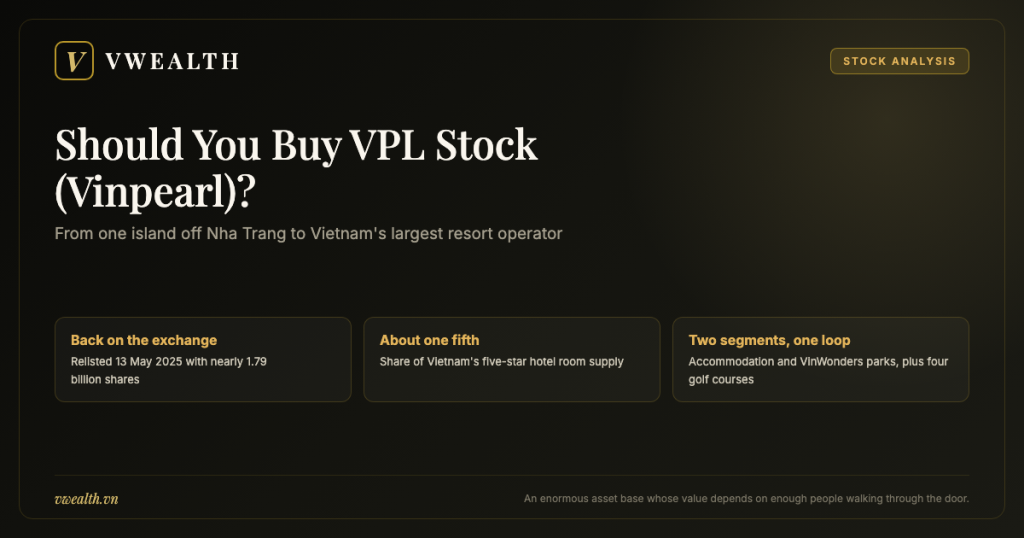
Should you buy VPL stock — the ticker for Vinpearl Joint Stock Company on Vietnam’s Ho Chi Minh City exchange — is a question with a feature no other name in this series shares: this stock has listed, been delisted, and come back. It traded under those same three letters from 2008. At the end of 2011 it vanished, absorbed into a larger group. In May 2025 it returned, carrying a business that bears almost no resemblance to its former self. From a single resort on an island off Nha Trang, Vinpearl has become the largest hospitality and leisure operator in Vietnam, holding roughly a fifth of the country’s five-star hotel room supply. This article walks through that story, teaches you how to read the financial statements of a hospitality and leisure business — a category where the standard industrial toolkit will almost certainly mislead you — and ends with a direct answer: which kind of investor VPL suits, and which kind it absolutely does not.
Before we begin, one convention between you and this article, the same one used across this series. You will encounter many dates, names, projects and scale figures, all drawn from publicly disclosed sources: the listing prospectus and exchange filings, shareholder meeting resolutions, and mainstream financial media. What you will not find is a current market figure — today’s share price, today’s market capitalisation, recent average turnover, the current earnings multiple. Not because the article avoids numbers, but because for a stock that returned to the exchange relatively recently, those figures are still finding their level and change fast. Instead, the article teaches you where to look and how to look; for current numbers, open the research reports on vwealth.
One more note, and it determines how you should read everything that follows. Vinpearl is part of the Vingroup ecosystem, but it is not a miniature copy of its parent. Vingroup is a diversified story now centred on industry and property; Vinhomes is a residential development story; Vincom Retail is a retail leasing story. Vinpearl is something different again: it sells experiences by the room-night and by the ticket, its revenue depends on real tourists physically walking through a door, and its results are markedly seasonal. If you have read the Vingroup analysis, set that framework aside. This article uses the toolkit of the hotel industry, not that of property development.
From an island project off Nha Trang to Vietnam’s largest resort operator
The Vinpearl story starts in a place that in the early 2000s almost nobody considered a business location: an island off the coast of Nha Trang, without reliable grid power, without a road, connected to the mainland only by boat. Twenty-five years later, that same island is the first image Vietnamese people picture when they hear the name. To understand how the business operates today, you have to walk each bend of that road.
25 July 2001: a tourism company is founded in Nha Trang
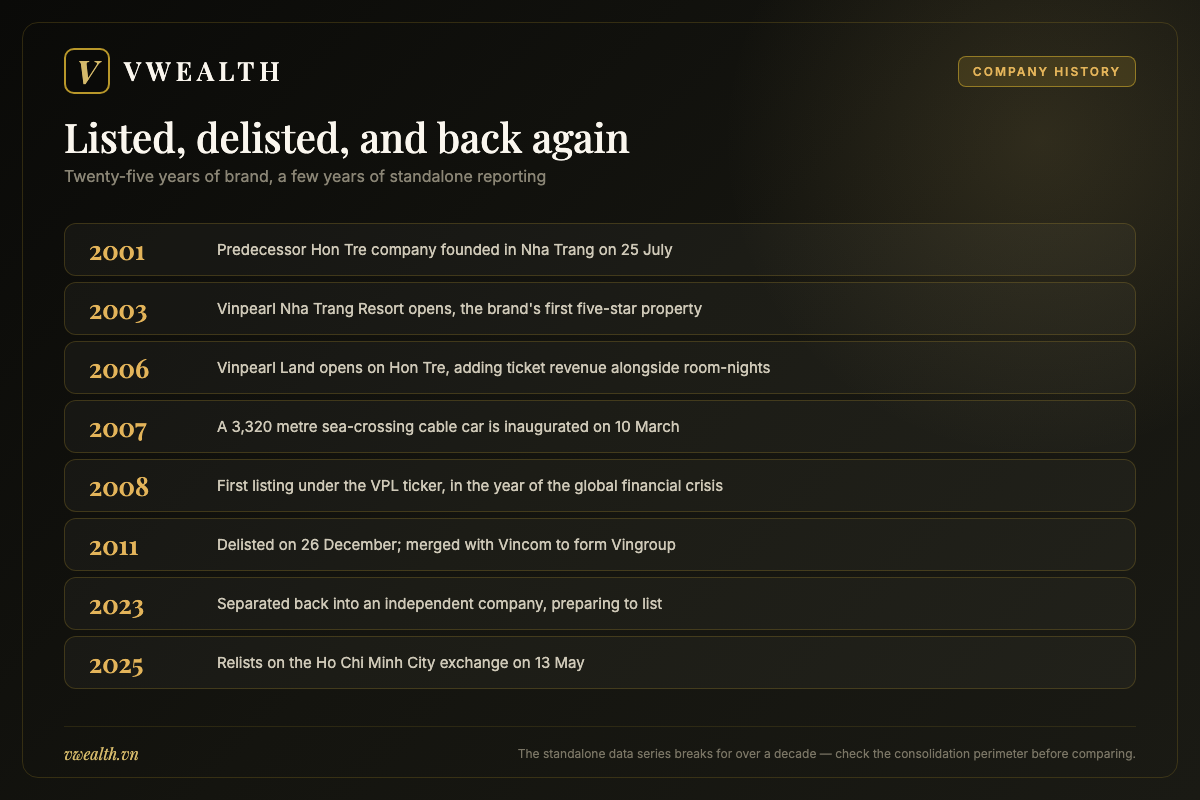
On 25 July 2001, Hon Tre Tourism, Trade and Service Investment and Development Company Limited was established in Nha Trang. It is the direct predecessor of today’s Vinpearl Joint Stock Company. That long, literal name captures the nature of the original project precisely: a company created to develop one specific island, not a hotel brand looking for properties to manage.
This point matters throughout the article. Vinpearl did not grow the way international hotel groups grow — by selling a brand and management capability while somebody else owns the real estate and collects the property risk. Vinpearl grew by ownership: acquire the land, build the hotel, build the park, then operate it. That model demands enormous capital and produces a very asset-heavy balance sheet, but in exchange it keeps the entire operating profit rather than sharing it with a property owner. Every advantage and every drawback of VPL stock traces back to this single choice.
2003: the first five-star resort under the Vinpearl name
In 2003, Vinpearl Nha Trang Resort opened — the first five-star resort carrying the Vinpearl brand. At that time, the idea of a five-star island resort was unfamiliar to Vietnamese travellers and to many domestic tour operators. The product arrived ahead of the demand, not after it.
This is a recurring pattern in the company’s history and worth noting when you assess future projects. Vinpearl tends to build first, create a destination, and wait for the traffic to arrive. When that works, it produces a near-monopoly position at a specific location. When it does not, or when visitor flows arrive more slowly than planned, it leaves behind an enormous depreciating asset that is not yet generating enough cash. Both outcomes have occurred within this company’s portfolio.
2006 and 2007: a park and a cable car create an icon
In 2006, Vinpearl Land opened on Hon Tre island. This was a change of business model rather than simply an additional product: having sold only room-nights, the company began selling admission tickets. The two revenue streams behave very differently, and that difference is the key to understanding Vinpearl’s profit structure today.
On 10 March 2007, a sea-crossing cable car 3,320 metres long, linking the mainland to Hon Tre island, was inaugurated after construction began in April 2006. At the time it ranked among the longest over-water cable car systems in the world, and it immediately became the visual signature of the city of Nha Trang.
Look at that cable car not as a construction item but as a commercial decision. It converted the trip to the island from a time-consuming boat ride into a ten-minute experience that is itself an attraction. The capital cost was heavy, but it removed the single largest friction between customer and product. This is the kind of asset a competitor cannot easily replicate, because it is tied to a specific geography and a specific permit. In investment language, that is a moat built on a unique asset.
2008: the first listing
In 2008, Vinpearl shares listed on the Ho Chi Minh City Stock Exchange under the ticker VPL. The company was expanding rapidly, and the equity market was the natural funding channel for a business model this capital-hungry.
The context is worth noting: 2008 was the year of the global financial crisis, Vietnamese equities fell hard, and tourism was hit directly as international arrivals dropped. A resort operator that listed in that particular year learned early exactly how sensitive this industry is to the economic cycle. That lesson remains fully relevant to you today.
End of 2011: disappearing from the board
On 26 December 2011, VPL was formally delisted. Vinpearl merged with Vincom to form Vingroup, and VPL holders received VIC shares in exchange. From that point, Vinpearl existed as a business division inside a diversified group, with no separate public financial statements.
The following eleven years were the period of Vinpearl’s greatest expansion, and simultaneously the period in which public investors could see the least. The system spread from Nha Trang to Phu Quoc, Hoi An, Da Nang, Ha Long, Hai Phong and other provinces; the VinWonders brand gradually replaced the Vinpearl Land name for the parks business; golf courses came into operation. All of it happened under the consolidated reporting of the parent.
For an analyst, this leaves a practical consequence: Vinpearl’s standalone financial series before 2023 is neither continuous nor easily comparable. When you read an analysis quoting long-run growth for this company, check where the figure comes from and whether it genuinely covers the same consolidation perimeter.
2012 to 2022: what was built while nobody could see it
The decade inside Vingroup deserves more than a passing mention, because almost every asset generating cash today was created during it. Nha Trang remained the flagship, but the system spread to Phu Quoc, where the company built a resort cluster combined with a theme park and a safari park; to Hoi An and Da Nang along the central coast; to Ha Long and Hai Phong in the north; and to several inland provinces. The Vinpearl Land brand was gradually retired in favour of VinWonders for the leisure arm, a rebranding that signalled the parks were being treated as a business in their own right rather than as amenities attached to hotels.
Two features of that decade matter for how you value the company now. The first is that expansion was funded from within a much larger group, meaning the cost of capital and the allocation decisions were made at parent level. A subsidiary building under those conditions can move faster than a standalone company, but it can also inherit projects whose economics were judged on group-level rather than segment-level returns. When you look at the current asset base, some properties will be strong performers and some will be legacy decisions from that period.
The second is timing. A substantial part of the expansion completed shortly before global travel was interrupted, which meant a large body of new capacity opened into a market with almost no international visitors. Any hospitality operator that expanded on that schedule carried the cost of that timing on its balance sheet for years. Understanding this is essential to reading the recovery figures reported since: some of the growth reflects genuine new demand, and some reflects capacity that existed all along finally being used.
The practical instruction: when you see a headline growth rate for this company, ask whether the comparison base is a normal year or a depressed one. Growth measured from a low base tells you about recovery, not about the sustainable trajectory. The most informative comparison available today is against pre-interruption performance at the same properties, where such a comparison is disclosed.
2023 and 2025: separated, then back on the board
In 2023, Vinpearl was separated back into an independent company within the Vingroup ecosystem. This was the necessary preparation for a listing: a company going public needs its own financial statements, its own governance apparatus, and clear asset boundaries with the parent.
On 13 May 2025, nearly 1.79 billion VPL shares began trading again on the Ho Chi Minh City exchange. This is a rare event in Vietnamese market history: a ticker returning to the board after delisting, and only the second stock in the market’s history to do so. The shares rose to the daily limit in the opening session.
The return means more than an ordinary listing event. It allows investors, for the first time in fourteen years, to buy Vingroup’s hospitality business directly without also buying the property, industrial and other divisions. For anyone wanting a pure bet on Vietnamese tourism, it is an instrument that did not exist at this scale on the exchange before May 2025.
Milestone summary table
| Date | Event | Why it matters to an investor today |
|---|---|---|
| 25 July 2001 | Predecessor Hon Tre company established in Nha Trang | The business was born on an ownership model, not a brand-management model |
| 2003 | Vinpearl Nha Trang Resort opens, the brand’s first five-star property | Build first, create a destination, wait for traffic — a pattern that repeats |
| 2006 | Vinpearl Land opens on Hon Tre island | Ticket revenue added alongside room-night revenue |
| 10 March 2007 | A 3,320 metre sea-crossing cable car to Hon Tre is inaugurated | A unique, location-bound asset that competitors cannot replicate |
| 2008 | First listing on the Ho Chi Minh City exchange under VPL | Immediately experienced how cyclical the tourism industry is |
| 26 December 2011 | Delisted; merged with Vincom to form Vingroup | The standalone financial series breaks for more than a decade |
| 2012 to 2022 | System expands across many provinces under the parent’s consolidation | Scale was built during the period public investors could see least |
| 2023 | Separated back into an independent company | Required preparation for standalone reporting and governance |
| 13 May 2025 | Nearly 1.79 billion VPL shares relist on the Ho Chi Minh City exchange | First direct access to Vingroup’s hospitality arm in fourteen years |
Read that table vertically and you see a business with a twenty-five year operating history but only a few years of independent public disclosure. That asymmetry is worth holding in mind: the brand history is long, while the verifiable financial history is short.
Who runs Vinpearl and who actually owns it
For a listed subsidiary inside a large group, the ownership question is not a footnote — it determines almost everything, from strategic autonomy, to dividend policy, to the liquidity of the stock itself. At Vinpearl, that structure is unusually clear and unusually concentrated.
How much Vingroup holds, and what that means
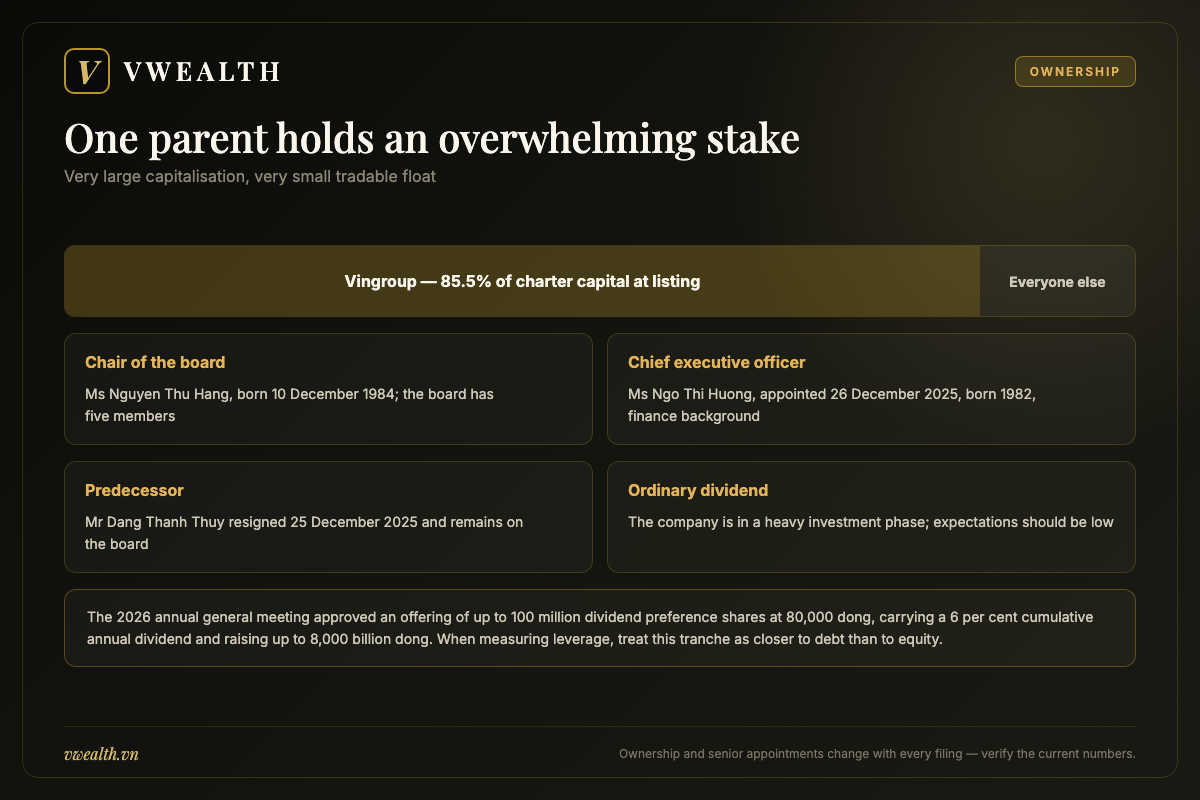
Vingroup is the largest shareholder of Vinpearl, holding roughly 1.5 billion VPL shares, equivalent to 85.5 per cent of charter capital according to the disclosure at the time of listing. The remainder sits with financial institutions, investment funds and individual investors.
That 85.5 per cent figure carries three consequences you should weigh before placing an order. First, the free float is very thin — less than one seventh of charter capital. For a company of this market size, having only a small fraction of shares genuinely circulating produces sharp price moves on modest volume, and makes large positions expensive to build or exit.
Second, every material decision at shareholder meetings sits with the parent. Minority holders cannot block any resolution. This is not automatically a negative — many companies with dominant shareholders are run well — but it means you are buying a business whose strategy is decided elsewhere.
Third, a stake this high usually faces gradual downward pressure over time, because free float standards affect index eligibility and the ability to attract institutional capital. Watch major shareholder disclosure filings: each parent sell-down improves liquidity while creating short-term supply pressure.
Nguyen Thu Hang: a chair drawn from within the ecosystem
The Vinpearl board has five members and is chaired by Ms Nguyen Thu Hang. According to disclosed information, she was born on 10 December 1984 and simultaneously holds a senior role at another member company within the Vingroup ecosystem.
Cross-appointment across group companies is characteristic of large Vietnamese conglomerates and has its own logic: it keeps subsidiary strategy aligned with group direction and allows managerial experience to circulate between divisions. It also raises the question of independence in decisions where interests could conflict, for instance when a subsidiary transacts in assets with its parent.
The most objective way to test this is not speculation but reading the related-party transaction notes in the financial statements alongside the periodic corporate governance report. Those two documents disclose the scale and terms of internal transactions. That is data, not intuition.
Ngo Thi Huong: a chief executive from the finance side
On 25 December 2025, Mr Dang Thanh Thuy resigned as chief executive officer and legal representative of Vinpearl, while remaining a member of the board. The following day, 26 December 2025, Ms Ngo Thi Huong was appointed chief executive officer.
According to disclosed information, Ms Ngo Thi Huong was born in 1982, holds a master’s degree from the University of London along with finance and accounting qualifications. She joined Vingroup in 2017, previously served as deputy general director of the logistics support division at Vincom, and headed Vinpearl’s own finance and accounting function before her appointment.
A finance background is a strategically meaningful detail. In hospitality and leisure, rapid expansion phases are typically led by operators or development executives; efficiency consolidation phases are typically led by finance executives. Placing a finance professional in the top operating seat in the year after listing signals that the emphasis is tilting towards capital discipline and margins rather than purely towards growth pace.
The other side, stated honestly: replacing the chief executive little more than a year after the predecessor took the role is a notable change at the highest level. Watch the stability of the executive team over coming reporting periods, because for a business operating dozens of properties nationwide, continuity in management has practical value.
What kind of parent is Vingroup, and why it matters here
International readers meeting this structure for the first time should understand what Vingroup is, because the whole VPL case rests on it. Vingroup is Vietnam’s largest private conglomerate by market capitalisation, listed in Ho Chi Minh City, with businesses spanning residential and commercial property, electric vehicles, healthcare, education, retail and hospitality. It has repeatedly used the same playbook: build a business inside the group, scale it, then list it separately once it can stand alone. Vinhomes and Vincom Retail followed that path before Vinpearl did.
Three features of that parent bear directly on Vinpearl. The first is capital: a group of this size can fund a subsidiary’s expansion at a pace an independent operator could not match, and has shown willingness to do so. The second is land: Vingroup’s property arm controls large development sites at destinations where Vinpearl operates, which creates both opportunity for co-development and the related-party complexity discussed earlier. The third is brand reach: the group’s ecosystem touches a very large number of Vietnamese households, which is a distribution advantage for a domestic-facing leisure business.
The risk sitting beside those advantages is capital allocation. A conglomerate deploys capital where it expects the highest return, and the ranking of businesses within the group can change. Vinpearl currently sits in a favourable position as a growth engine, but a minority shareholder in the subsidiary has no vote in that ranking. When you buy VPL, you accept that a material part of your investment case is decided in a boardroom you cannot attend.
A practical consequence: follow the parent’s disclosures as closely as the subsidiary’s. Commentary at Vingroup’s annual general meeting about capital allocation between businesses, about the role of hospitality within the group, and about any plans to adjust stakes in listed subsidiaries is often more informative about the VPL trajectory than anything Vinpearl publishes itself.
Dividend preference shares: an instrument rarely seen in Vietnam
At the 2026 annual general meeting, Vinpearl approved an offering of up to 100 million dividend preference shares priced at 80,000 dong each, expected to raise up to approximately 8,000 billion dong. The preferential dividend was set at 6 per cent per year on the offer price, on a cumulative basis.
This is an uncommon instrument in the Vietnamese market, so it deserves explanation. A dividend preference share receives a fixed dividend, paid ahead of ordinary shareholders, and typically carries restricted voting rights. Cumulative means that if the company fails to pay in full in any year, the shortfall accrues and must be settled in future before ordinary shareholders receive anything.
For ordinary shareholders, the instrument cuts both ways. Favourably, it raises substantial capital without diluting voting control, at a cost of capital known in advance. Unfavourably, it creates a payment obligation that ranks ahead of you, functioning like soft debt. When assessing the company’s leverage, treat this tranche as closer to debt than to pure equity, especially in a difficult year.
Dividend policy and what you should expect
For a business in heavy expansion, committing thousands of billions of dong to new projects each year, the reasonable expectation for ordinary cash dividends is low. Operating cash has more urgent claims: interest, preferential dividends, and funding projects under construction.
None of this is unusual in hospitality and leisure. A five-star hotel or a theme park needs several years from capital outlay to stabilised occupancy, and during that stretch cash flows out faster than it flows in. The problem only arises when a company expands so continuously that it never posts a year of meaningful positive free cash flow. That is the metric to watch, and chapter four covers how.
Ownership and leadership at a glance
| Item | What has been disclosed | What you should track |
|---|---|---|
| Largest shareholder | Vingroup, approximately 1.5 billion shares, equal to 85.5 per cent of charter capital at listing | Major shareholder filings; the stake may be adjusted over time |
| Free float | Less than one seventh of charter capital | Directly affects liquidity and index eligibility |
| Chair of the board | Ms Nguyen Thu Hang, born 10 December 1984; five-member board | Independence in related-party decisions |
| Chief executive officer | Ms Ngo Thi Huong, appointed 26 December 2025, born 1982, finance background | Whether the operating emphasis shifts towards capital efficiency and margin |
| Predecessor | Mr Dang Thanh Thuy resigned 25 December 2025, remains a board member | Stability of the executive team in coming periods |
| Dividend preference shares | Offering of up to 100 million shares at 80,000 dong, 6 per cent cumulative annual dividend | Treat as closer to debt than equity when measuring leverage |
| Ordinary dividend | Company in a heavy investment phase | Whether free cash flow after investment turns meaningfully positive in any year |
Again, a reminder: ownership percentages and senior appointments change with each disclosure. Before deciding, open the most recent filing or the current research report on vwealth to verify.
How Vinpearl makes money: anatomy of an experience business
If you remember one thing from this chapter, remember this: Vinpearl has two main revenue streams with very different financial characteristics, and understanding that difference correctly determines most of the quality of your analysis.
System scale: the foundation numbers
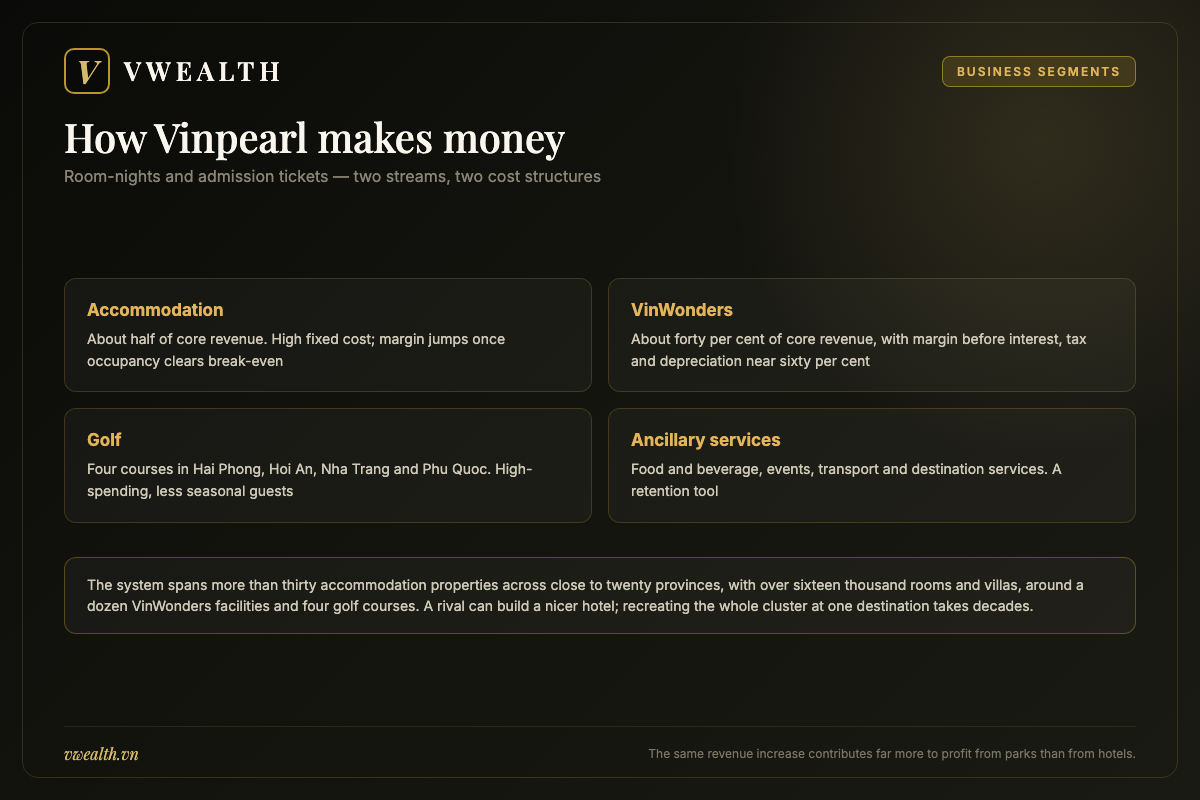
According to disclosures around the listing, the Vinpearl system comprises more than thirty accommodation properties spread across close to twenty provinces and cities, with over sixteen thousand hotel rooms and villas — equivalent to roughly a fifth of Vietnam’s five-star room supply. Alongside sit around a dozen VinWonders facilities including theme parks, water parks, a semi-wild safari park and an equestrian academy, plus four golf courses in Hai Phong, Hoi An, Nha Trang and Phu Quoc.
The one-fifth of national five-star supply figure is worth pausing on. In hotels, national market share rarely means much because competition is local — a traveller heading to Nha Trang does not compare prices with a hotel in Ha Long. But when a single operator holds a share this large in the upper segment, it gains three things: negotiating power with online distribution channels, the ability to sell multi-destination packages, and customer data at a scale no domestic competitor can match.
Accommodation: selling room-nights, and the occupancy problem
Accommodation contributes roughly half of core revenue. It is the easiest segment to picture and the one with the harshest cost structure.
A hotel carries very high fixed costs: building depreciation, interest, minimum staffing, utilities and maintenance must all be paid whether rooms are full or empty. So the occupancy break-even point is the decisive number. Below it, every empty room-night is a loss; above it, almost all incremental revenue drops straight to profit. This is why a hotel chain’s margin can swing from negative to handsome on a change of a few percentage points in occupancy.
The practical implication for an analyst: accommodation revenue is not the most important metric. What matters more is the trio of occupancy rate, average daily rate, and revenue per available room. Chapter four explains how to use them, because that trio is the standard language of the global hotel industry.
VinWonders: smaller in revenue, larger in margin
The leisure segment contributes roughly forty per cent of core revenue but carries a very high margin before interest, tax, depreciation and amortisation — close to sixty per cent according to disclosed information. That figure explains why VinWonders matters to Vinpearl far more than its revenue share suggests.
The reason lies in the cost structure. Once built, a theme park has very low variable cost per visitor: another thousand guests through the gate barely raises operating cost beyond some electricity and staffing. The entire investment sits in the construction phase. A theme park is therefore maximum operating leverage: very hard to profit from when quiet, and very profitable when busy.
There is a further layer of value the accounts do not show directly. Parks and attractions increase the reason for a guest to stay an extra night at a Vinpearl hotel, and increase the odds that a family chooses this destination over another. The two segments feed each other: hotels supply visitors to the parks, and parks supply a reason to stay at the hotels. That integrated resort model is Vinpearl’s genuine moat.
Golf and ancillary services: small segments with a distinctive customer
Four golf courses in Hai Phong, Hoi An, Nha Trang and Phu Quoc serve a very particular guest: high spending, longer staying, and notably less seasonal than the typical leisure traveller. In many Asian markets, golf tourism generates the highest revenue per guest in the entire hospitality sector.
For Vinpearl, golf is not a large revenue segment but plays two strategic roles. It draws international visitors from Northeast Asian markets where golf travel is an established habit. And it helps fill rooms during periods that are low season for conventional leisure demand. When reading the accounts, pay attention to management commentary on source-market mix, because that is where the role of golf becomes visible.
Distribution: how the rooms actually get filled
A question rarely asked but central to hotel economics: through which channel does the guest book? The answer determines how much of the room rate the operator keeps.
There are four main channels, ranked roughly by cost to the operator. Direct booking through the company’s own website or app is cheapest and most valuable, because it carries no commission and generates customer data. Corporate and event contracts are next, offering volume at negotiated rates. Tour operator and wholesale contracts deliver blocks of rooms, often at deep discounts, and matter most for source markets where package travel dominates. Online travel agencies are the most expensive channel, charging commissions that can take a meaningful slice of the rate, but they provide reach into markets where the operator has no brand presence.
For Vinpearl the channel mix is a strategic issue with two sides. On the domestic side, the company’s brand recognition and its parent’s ecosystem support a high share of direct booking, which is a genuine cost advantage over international brands operating in Vietnam. On the international side, the position reverses: a global chain brings its own reservation system and a loyalty programme with tens of millions of members, so it fills rooms at lower acquisition cost than a domestic brand can. This asymmetry is exactly why building international brand recognition sits in Vinpearl’s stated strategy, and why partnerships and international expansion appear in its plans.
What to watch: any disclosure about the share of direct bookings, the growth of the loyalty programme, and the mix between package and independent travellers. A rising share of direct and independent bookings signals brand strength and protects margin. A rising dependence on wholesale and agency channels signals the opposite, even if occupancy numbers look healthy.
The ownership model: what it buys and what it costs
It is time to be direct about this company’s foundational choice. Vinpearl predominantly owns the real estate it operates rather than leasing it or managing it on behalf of others. In the global hotel industry, this runs counter to the direction the large international groups have taken, having shifted almost entirely to asset-light models: sell the brand and management capability, collect fees, and let someone else carry the property.
Ownership brings three advantages. The company keeps the whole operating profit instead of sharing it. The company controls product, pricing and upgrade investment entirely. And the company holds a body of assets with intrinsic value, typically land in prime locations that could not be bought today at the historical cost.
The three disadvantages are the mirror image. Enormous upfront capital, usually funded with debt, creating fixed interest cost. Heavy depreciation that suppresses accounting profit even when cash generation is far healthier than the earnings line suggests. And most importantly, the company cannot shrink quickly when the industry turns: an underperforming hotel cannot be handed back the way an expiring management contract can. This is precisely what happened to every asset-owning hospitality business worldwide during the period when global travel was interrupted.
The honest conclusion: Vinpearl’s model captures more profit when the industry is favourable and carries more risk when it is not. It is neither better nor worse than the asset-light model — it is different, and it must be valued differently.
The business segments compared
| Segment | Nature of revenue | Margin characteristics | What decides success |
|---|---|---|---|
| Accommodation | Hotel room-nights and villa stays | High fixed cost; margin jumps once occupancy clears break-even | Occupancy, average daily rate and source-market mix |
| VinWonders leisure | Admission tickets plus in-park spending | Very high once built; low variable cost per visitor | Visitor numbers, ticket price and secondary spend per head |
| Golf | Green fees, ancillary services and golf packages | Stable; high-spending, less seasonal clientele | International visitors from golf-oriented source markets |
| Ancillary services | Food and beverage, events, transport and destination services | Varied; more a retention tool than a profit centre | Ability to sell more to guests already inside the system |
Read that table and you understand why an integrated resort operator is hard to copy. A rival can build a nicer hotel, but recreating an entire cluster of hotel plus park plus golf course plus connecting infrastructure at the same destination takes decades and billions of dollars. That is a moat built on integrated scale at a location, not on brand.
Financial position and health: seven checks before you decide on VPL stock
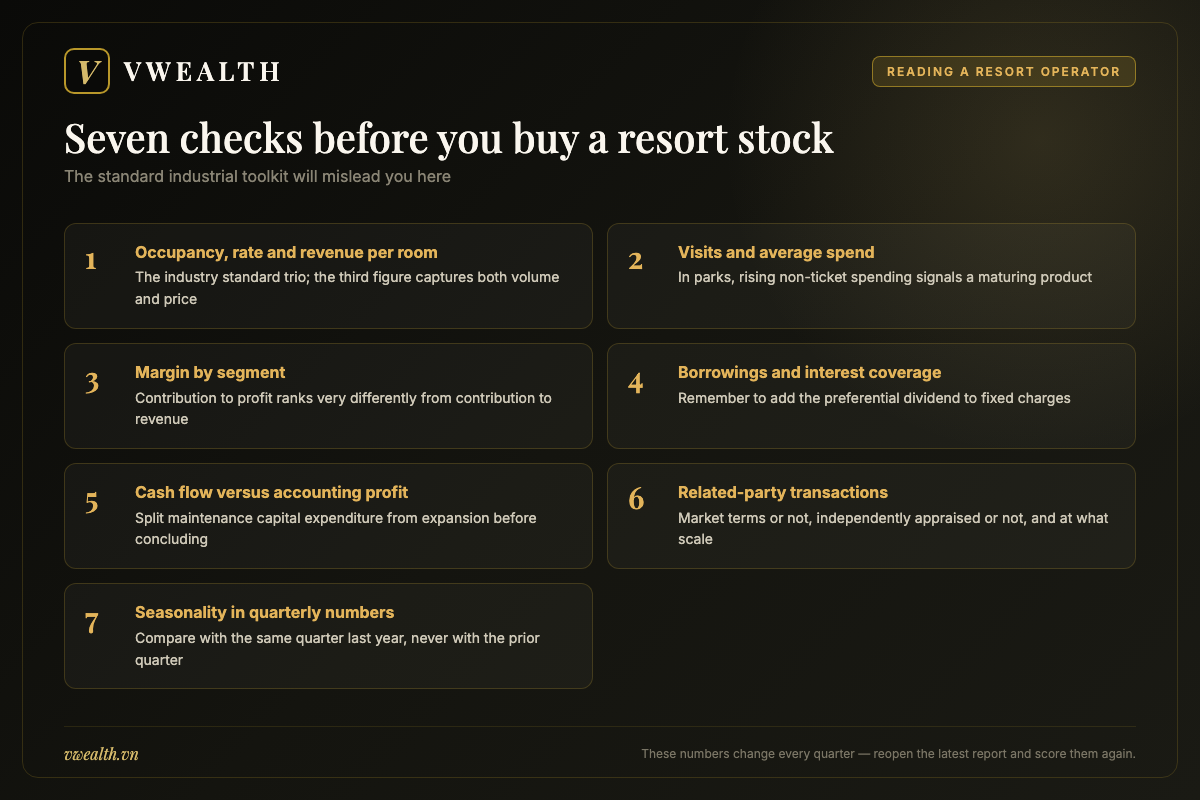
This is the most important chapter in the article. Hospitality and leisure has its own metric set, and if you read Vinpearl’s accounts with the toolkit built for manufacturers or property developers, you will reach wrong conclusions systematically. The seven checks below are the replacement.
Check 1: occupancy, average daily rate and revenue per available room
These three are the standard language of the global hotel industry. Occupancy is the proportion of available rooms sold. Average daily rate is room revenue divided by room-nights sold. Revenue per available room is the product of the two, and it is the most important single figure because it captures both volume and price.
How to read them: an operator that raises occupancy by cutting rates can show rising revenue while revenue per available room stagnates or falls — that is low-quality growth. Conversely, an operator holding occupancy while raising rate is demonstrating brand strength. Track all three together and compare them against the company’s own prior periods, since peer comparison in Vietnam is difficult given differences in segment and geography.
For Vinpearl there is one technical caveat: the company continually brings new properties into operation. New properties typically run at low occupancy for their first few quarters, dragging system-wide averages down even when mature properties perform well. If the reporting separates stabilised properties, use that figure to judge underlying operating capability.
Check 2: visitor numbers and average spend per visit
For the VinWonders segment, the equivalent pairing is total visits and revenue per visit. According to disclosed figures for 2024, the Vinpearl system welcomed approximately 10.9 million visits, up around fifty per cent on the prior year, with revenue of 14,376 billion dong and net profit of 2,550 billion dong.
What you need to watch is not only total visits but average spend. A mature theme park typically grows revenue more through in-park spending — food, merchandise, premium services — than through gate price. A rising share of non-ticket spending signals a product maturing well.
You should also watch the relationship between park visits and room-nights sold. If the two rise in step, the integrated model is working as designed. If parks are busy while hotels are quiet, the company is serving day visitors rather than staying guests — a far less valuable customer.
Check 3: segment-level margin before interest, tax, depreciation and amortisation
For an asset-heavy business, net profit is largely obscured by depreciation, hiding the true cash-generating capability. This is why the global hotel industry uses earnings before interest, tax, depreciation and amortisation as its primary operating measure.
According to disclosed information, Vinpearl’s two main segments carry very different margins: leisure runs near sixty per cent at that level, while accommodation is materially lower though expected to improve. The gap means the revenue mix between segments affects consolidated profit more than you might assume: the same revenue increase contributes far more to profit when it comes from parks than from hotels.
When reading the accounts, find the segment note and calculate each segment’s contribution to profit yourself rather than looking only at revenue share. At Vinpearl these two rankings are not the same.
Check 4: borrowings, interest cost and coverage
An ownership model means substantial debt. Three metrics to track: total borrowings to equity, the maturity profile of that debt, and the ratio of operating earnings before depreciation to interest expense.
The third matters most and is calculated least often. It tells you how many dong of operating cash the company generates for each dong of interest owed. For a hospitality operator, the higher this ratio, the better it can survive a weak tourist season. When it falls towards one, the business is in a state where all operating cash merely services interest.
For Vinpearl, remember to add the preferential dividend obligation to fixed charges in this calculation, if the preference share offering proceeds. Legally it is not debt, but in cash-flow terms it behaves very much like it.
Check 5: operating cash flow versus accounting profit, and free cash flow
This is where asset-heavy businesses are misread in both directions. First direction: because depreciation is heavy, operating cash flow typically runs well above accounting profit. Anyone looking only at the earnings line undervalues the business.
Second direction: because the company continually invests in new projects, free cash flow — operating cash less capital expenditure — can be negative for years despite strong operating cash flow. Anyone looking only at operating cash flow overvalues the business.
The right method is to split capital expenditure into two parts where disclosure allows: maintenance of existing assets, and expansion into new projects. Maintenance is a compulsory cost and must be deducted when measuring true cash-generating power. Expansion is a choice, and the company could in principle pause it. A business with strongly positive operating cash flow after maintenance capital expenditure is healthy, even if total free cash flow is negative because of expansion.
Check 6: related-party transactions
This is the check every listed subsidiary inside a large group must face, and Vinpearl is no exception. The company transacts extensively with its parent and sister companies: leasing assets, co-developing projects, providing reciprocal services, forming joint ventures.
Investment plans disclosed at the 2026 annual general meeting show the scale of this activity: over three thousand billion dong for a joint venture with the parent at a leisure project, over one thousand billion dong to lease a hotel, several hundred billion dong for a hotel cooperation in another province, and around two thousand eight hundred billion dong for an entertainment park in the same area. This is ordinary activity within an ecosystem, but you need to read the terms of each transaction.
Three self-check questions: are transactions executed at market prices, are they independently appraised, and what proportion of total assets do related-party transactions represent. The notes to the financial statements are required to disclose this. If you find a large proportion combined with unclear terms, that is legitimate grounds to demand a valuation discount.
Check 7: seasonality and how to read quarterly numbers
Vietnamese tourism is markedly seasonal and not uniformly so across regions: peak season for central coastal resorts differs from peak season in the north, and the international season differs from the domestic one. A company with properties nationwide, like Vinpearl, therefore has a complex seasonal profile.
The practical consequence: comparing one quarter with the immediately preceding quarter is close to meaningless for this business. You must compare with the same quarter of the prior year. This is the single most common error investors make when reading tourism company accounts, and it produces both unwarranted panic and unwarranted excitement.
Also watch one-off factors within each quarter: a major international event, a new visa policy, a newly launched flight route, or conversely a storm arriving in peak season at a key location. For an accommodation business, weather is a genuine commercial variable, not a footnote.
A practical checklist for running the seven checks
Reading seven metrics sounds straightforward until you sit in front of an actual set of Vietnamese financial statements, which follow a presentation most international investors will not recognise. A few practical notes will save you time.
Occupancy and average daily rate are rarely stated directly in the statutory accounts. They appear in management presentations, analyst briefings and the annual report’s operating review, so those documents matter more here than for most sectors. Segment revenue and profit appear in the segment note, which is where you calculate margin by business line. Property, plant and equipment plus the depreciation schedule tell you the age profile of the estate, which in turn indicates when major refurbishment cycles are due — a real cost in hospitality, where a tired property loses rate quickly.
Borrowings and their maturity sit in the liabilities notes; interest expense is in the income statement, and dividing one by average borrowings gives cost of debt. Capital expenditure appears in the cash flow statement’s investing section, though the split between maintenance and expansion usually has to be inferred from the annual report commentary rather than read directly.
Related-party transactions have a dedicated note and are worth reading in full rather than skimming. Monthly international arrival statistics come from the national tourism authority and are the easiest external data to verify independently.
Set the seven checks up once as a simple spreadsheet with one column per quarter, and updating later takes fifteen minutes rather than an afternoon. That habit converts a one-time analysis into ongoing monitoring, which is what owning a cyclical asset-heavy business actually requires.
Seasonality in practice: what a full year actually looks like
It helps to picture a calendar year at a nationwide Vietnamese resort operator, because the shape of it explains a great deal about the reported numbers.
The early months carry the Lunar New Year holiday, the single largest domestic travel event of the year, compressed into roughly two weeks of very high demand and very high rates. Northern destinations remain cool and comparatively quiet outside that window, while central and southern coastal resorts enter their strongest stretch as the dry season holds. The middle of the year brings the domestic summer peak, when families travel during the school break and occupancy at beach destinations runs highest. The later months shift towards international visitors, particularly from long-haul markets escaping northern-hemisphere winter, and towards the conference and incentive travel that fills rooms midweek.
Cutting across that pattern is weather. The central coast has a storm season that can close a destination for days at a time, and a single storm arriving in a peak week does measurable damage to a quarter’s numbers. Island destinations face the same exposure with the added complication that transport links are more easily interrupted.
Holiday timing shifts the Lunar New Year peak between the first and second calendar months from one year to the next, which alone can make two consecutive first quarters look very different without anything changing in the business itself. Two practical conclusions follow. First, a nationwide portfolio is genuinely more resilient than a single-destination one, because peaks in different regions fall at different times and a weather event rarely affects the whole country at once. Second, any quarter can be distorted by factors that say nothing about the underlying business, which is why the year-on-year comparison discipline described earlier is not a technicality but the only way to read this company honestly.
What the seven checks say about Vinpearl’s position
Taken together, the portrait is this. Vinpearl is Vietnam’s largest hospitality and leisure operator by five-star room count, owns a set of assets that cannot be replicated at key destinations, runs a very high-margin park segment that supports a thinner-margin hotel segment, and is in a heavy investment phase funded by both debt and newly raised capital. That is the profile of an asset-heavy growth business, not a defensive one.
If you want to compare this framework with other companies along the tourism value chain, read the analyses of Vietnam Airlines and Vietjet Air — two businesses driven by the same visitor flows with entirely different economics.
How the market treats VPL stock: a very large company with a very small float
Understanding a business is one thing; understanding how the market prices it is another. With VPL the gap is wider than usual, because the stock returned to the exchange recently and its trading level is still forming.
Why EV/EBITDA fits resort stocks better than P/E
The price-to-earnings ratio is the most familiar tool, but for an asset-heavy, debt-funded business it misleads in two places. First, heavy depreciation pushes accounting profit far below cash-generating capability, making the multiple look artificially expensive. Second, the ratio ignores debt, so two companies with identical earnings but very different leverage appear identical.
The global hotel industry therefore uses enterprise value over earnings before interest, tax, depreciation and amortisation. Enterprise value equals market capitalisation plus net debt, so it reflects both the equity and the debt claims. The denominator strips out depreciation and tax policy, allowing comparison between businesses with assets of different ages.
With Vinpearl there is an additional layer. If the dividend preference share offering proceeds, that capital should sit closer to debt when computing enterprise value, because it creates a fixed payment obligation. Ignoring this detail will produce a valuation that understates the true cost of the business.
The character of the VPL ticker
If you had to describe VPL in one sentence, it would be this: a very large capitalisation with a very small free float, representing the tourism sector, recently returned to the exchange.
Three consequences follow. First, the price can move sharply on modest volume, because the tradable supply is limited. Second, the stock is more sensitive to sector and policy news — international arrival statistics, visa policy, new flight routes — than to company-specific announcements. Third, because of its large capitalisation, the ticker can influence the broader index, which attracts flows from investors with no particular view on tourism.
Practical implication: if you buy VPL, be prepared for a wide trading range and for the price to move sometimes for technical market reasons rather than business reasons. With a thin float, avoid large market orders, and avoid using leverage on a name you cannot be sure of exiting at a fair price.
Dividends: do not buy VPL for income
For ordinary shareholders, the reasonable expectation for cash dividends is low in the current phase. The company is executing large projects, servicing debt, and if the preference share issue proceeds must prioritise a fixed dividend to that class ahead of you.
None of this is a flaw if you are buying for growth. But it is a decisive exclusion if you want steady income. For international readers new to this market, the practical mechanics of dividends, settlement and foreign ownership in Vietnam are covered in the pillar article on how to invest in the Vietnam stock market.
Foreign ownership and the real constraint
Accommodation services are not among the sectors subject to tight foreign ownership caps in Vietnam, so in principle the room available to foreign investors is broad. Vietnam applies sector-specific limits, known locally as the room, and hospitality sits far from the restrictive end of that spectrum where banking sits.
But at VPL, the binding constraint is not the legal ceiling — it is share supply. With the parent holding an overwhelming stake, the volume genuinely purchasable in the market is tightly limited, and that makes it hard for institutional funds to build meaningful positions. This is why a large-capitalisation stock can still be absent from many fund portfolios.
Both the remaining room and current foreign ownership change daily. Check the exchange disclosure system or a current research report before using either as the basis for a decision.
What a relisted stock tends to do in its first years
There is a specific dynamic around newly listed and relisted large-capitalisation stocks that is worth understanding before you form a view on price behaviour.
In the first period after listing, the shareholder register is unusually concentrated and the trading population is unusually narrow. Analyst coverage is thin because the standalone financial history is short. Index providers have not yet made decisions about inclusion. Under those conditions, price discovery is incomplete: the market has not settled on what multiple this business deserves, and modest flows can move the price considerably.
Over the following years, three things typically change. Analyst coverage broadens as more quarters of standalone reporting accumulate, which narrows the range of opinion. Index decisions get made, which either adds a durable source of passive demand or confirms its absence. And the free float usually widens, whether through parent sell-downs, new issuance, or lock-up expiries. Each of those steps tends to reduce volatility and improve the reliability of the valuation the market assigns.
The practical implication for you: the early period offers both the largest mispricing opportunity and the largest chance of being wrong, because the information base is thin. If you buy during this phase, size the position accordingly and be prepared for the market’s view of the company to shift substantially as more data arrives. If you prefer to wait for a fuller record, that is a defensible choice too — you will pay a fairer price for a business you understand better.
Catalysts worth tracking
There are four groups of catalysts around this stock, and you should keep clear which are certain and which remain expectation.
The first group is projects approaching operation. At the 2026 annual general meeting, management outlined plans to launch major projects at several new locations. Each new property is additional revenue, but also additional depreciation and interest during its first quarters. Do not expect immediate profit contribution.
The second group is the international event calendar. Phu Quoc has been selected to host a high-level international summit in 2027, which brings a very large local infrastructure programme, from an international convention and exhibition centre to transport upgrades. Vinpearl has a substantial system on the island and benefits indirectly both during preparation and afterwards. This is a catalyst with a defined date, which is rare in tourism.
The third group is visa policy and international route expansion. These lie outside the company’s control but bear directly on international arrivals.
The fourth group is the potential to improve free float and gain index inclusion. This is a technical market catalyst but one that can materially affect valuation, as seen with other large-capitalisation names.
VPL against other ways to play Vietnamese tourism
| Criterion | Vinpearl (VPL) | Airlines (HVN, VJC) | Airport infrastructure (ACV) |
|---|---|---|---|
| Position in the chain | The final destination, where guests spend most and stay longest | Transport, deciding whether the traveller can arrive at all | Monopoly infrastructure charging on every passenger |
| Asset structure | Very heavy; owns real estate and leisure infrastructure | Heavy; fleets usually mix ownership and leasing | Very heavy; terminals and runways |
| Operating leverage | Very high; margin jumps once occupancy clears break-even | Very high; sensitive to fuel price and load factor | High; large fixed costs spread over passenger volume |
| Distinctive risk | Seasonality, weather, dependence on arrivals at each specific destination | Fuel prices, currency, lease and maintenance costs | Public investment timing and service pricing mechanisms |
| Timing of benefit as arrivals rise | Later, once guests have arrived and stayed | Earliest, the moment tickets are booked | Early, the moment the aircraft lands |
This table makes a practical point: if you believe international arrivals to Vietnam will grow strongly, there are several ways to express that belief, and each responds on a different timeline. Airlines and airport infrastructure typically reflect it earlier; accommodation and leisure reflect it later but with higher margins once the flow stabilises.
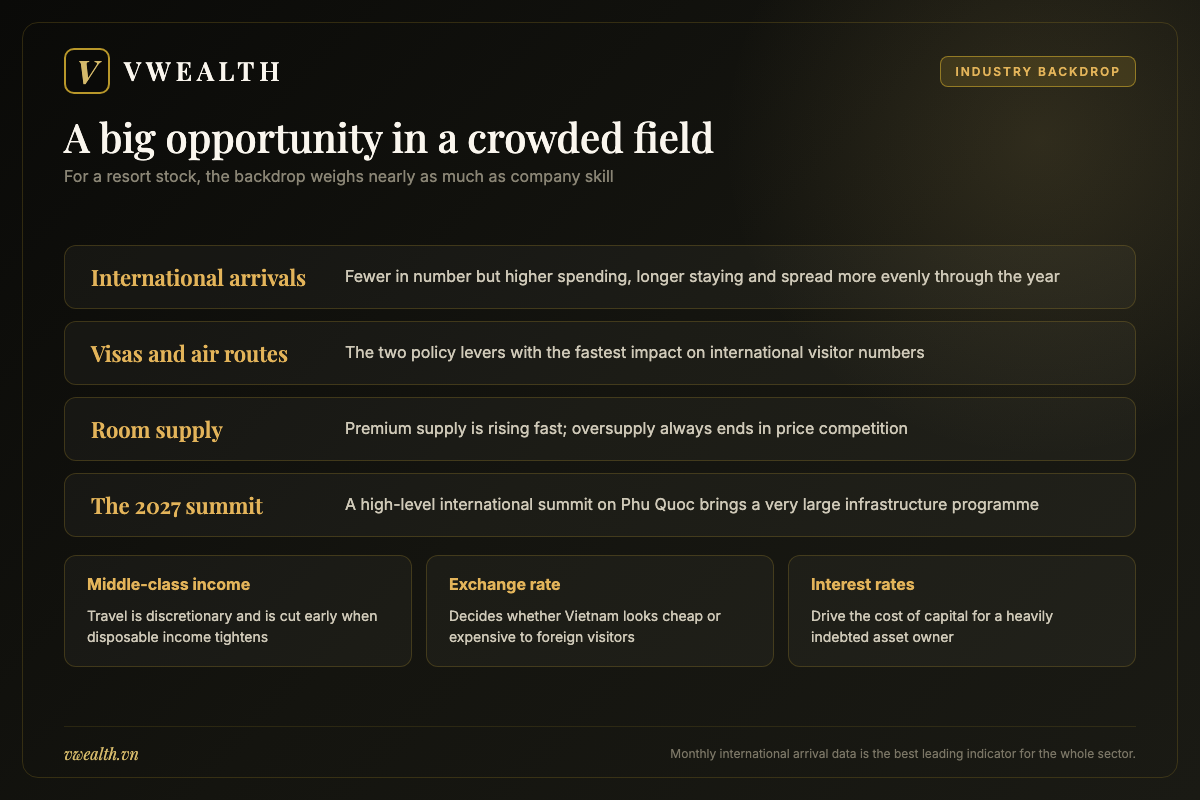
The Vietnamese tourism backdrop: a big opportunity in an increasingly crowded field
Resort stocks are the category where the industry backdrop matters nearly as much as company-specific skill. An excellently run hotel chain in a weak visitor year still posts poor results. So this chapter is not supplementary material.
International arrivals: the main driver and the hardest variable to forecast
Vietnamese tourism has two visitor pools with very different characteristics. Domestic travellers are numerous, spend less per trip, stay for shorter periods, and cluster around public holidays. International travellers are fewer in number but spend considerably more, stay longer, and spread more evenly through the year.
For a five-star operator like Vinpearl, the international mix matters especially, because this is the group willing to pay premium room rates. Management has disclosed a diversification strategy: consolidating existing core source markets while expanding into higher-spending long-haul markets. That strategy is sound risk management, since dependence on one or two source markets has previously caused significant damage to Vietnamese tourism.
What you should track is the monthly international arrivals data and its breakdown by nationality. This is public information published far more frequently than financial statements, and it is the best leading indicator for the whole accommodation sector.
Visa policy and connectivity
The two policy levers with the fastest impact on international arrivals are visa rules and the number of direct flight routes. A visa waiver decision for a large source market can change the visitor mix within a few quarters; a new direct route to a source city can create steady demand for an entire destination.
For Vinpearl the link is direct, because its system is concentrated at leisure destinations with international airports: Nha Trang, Phu Quoc, Da Nang, Hoi An, Ha Long and Hai Phong. Every change in flight frequency into those airports feeds through into the company’s occupancy within months.
The race to add premium rooms
This is the largest structural risk in the sector and the article will state it plainly. Vietnam is in a boom phase for premium hotel supply, with domestic conglomerates and international brands expanding simultaneously at the key destinations. When supply grows faster than demand, the consequence in hotels is always the same: rates get compressed and occupancy gets shared.
Vinpearl has two lines of defence. The first is scale and location: long-established properties sit on sites that could not be acquired today. The second is the integrated model: guests choose Vinpearl not only for the room but for the bundle of park, golf and destination services. A competitor opening a new hotel next door does not recreate that bundle.
But defence is not immunity. In an oversupplied market, even the leader must choose between holding rate and holding occupancy. This is what you monitor through the trio of metrics in chapter four, particularly the trend in average daily rate.
The competitive map: who competes with Vinpearl directly
Competition in accommodation happens on three tiers, and Vinpearl faces different rivals on each.
The first tier is domestic conglomerates also pursuing owned, integrated resort complexes at key destinations. This is the most head-on competition, because the commercial logic is identical: build a cluster of hotel, park and leisure infrastructure at a location, then turn that location into a brand. Against this group, the contest is not only about room rate but about who secured the best sites and who opens first.
The second tier is international hotel brands present in Vietnam under management contracts. They do not own the property but partner with domestic developers, bringing a global reservation system and loyalty programmes with tens of millions of members. Their advantage lies in international distribution, something a domestic operator cannot match quickly. This is precisely why building the brand to international standard sits within Vinpearl’s stated strategy.
The third tier is independent properties and short-term rental platforms. This group does not compete directly in the five-star segment, but it absorbs a portion of domestic and younger international demand away from traditional hotels, especially in price-sensitive periods.
The practical implication: when assessing Vinpearl’s position, do not look only at national five-star share. Look at how many new competing rooms are due to open at each specific destination over the next two years. That is the number that determines average rates in the seasons ahead.
Domestic demand: the underrated half of the story
International arrivals attract most of the commentary, but for a company with properties across the whole country, domestic demand is the larger and steadier base. Vietnam has a rapidly growing middle class, a young population, and a domestic travel culture that has expanded significantly over the past decade as incomes and transport connections improved.
Domestic demand has three characteristics worth understanding. It concentrates heavily around public holidays and the summer school break, producing sharp peaks that a nationwide operator can partially smooth by shifting capacity between regions. It is more price-sensitive than international demand, which means domestic-heavy periods tend to run at lower average rates. And it is far less exposed to external shocks — visa policy, flight capacity, geopolitical events — that can interrupt international flows without warning.
That last point is the strategically important one. A hospitality business dependent almost entirely on international visitors is fragile in a way that one with a strong domestic base is not. The years when global travel was interrupted demonstrated this across Asia: operators with genuine domestic demand survived on reduced but real revenue, while those serving only foreign visitors saw revenue approach zero.
For Vinpearl, brand recognition among Vietnamese families is an asset that does not appear on the balance sheet but provides real downside protection. When assessing the company, do not treat domestic guests as the lower-value residual. Treat them as the floor beneath the business, and treat international guests as the upside that determines whether a good year becomes an excellent one.
Phu Quoc and the 2027 international event
Phu Quoc’s selection to host a high-level international summit in 2027 has triggered a very large infrastructure programme on the island, including an international convention and exhibition centre and supporting facilities. For accommodation operators already present, that brings three layers of benefit: higher room demand during preparation and the event itself, lasting upgrades to local infrastructure, and international recognition for the destination afterwards.
To balance the picture: a major international event also draws a wave of competing investment into the same location, meaning room supply on Phu Quoc will rise substantially. The net benefit depends on whether post-event demand can be sustained, and the record of major global events shows widely varying outcomes by destination.
Policy and planning: land, zoning and the coastal pipeline
One factor that shapes this industry more than most investors realise is land policy. Coastal and island resort development in Vietnam depends on land allocation, zoning approvals and coastal management rules, all of which are set by provincial and national authorities. A change in how quickly those approvals move can accelerate or freeze an entire development pipeline, and it affects incumbents and newcomers differently.
For an incumbent like Vinpearl, tighter approval regimes are a mixed blessing. On one hand, they slow the arrival of competing supply at destinations where the company already operates, protecting rates. On the other, they slow the company’s own expansion plans and can leave capital tied up in projects awaiting permission. The net effect depends entirely on where the company sits in its own development cycle relative to competitors.
A second policy strand is environmental and infrastructure regulation at island destinations, where waste treatment, freshwater supply and electricity capacity are genuine constraints on how many rooms a location can support. Several Vietnamese island destinations have run into these limits, and the resulting infrastructure investment tends to arrive in waves rather than smoothly. An operator with existing capacity and existing utility connections has an advantage over one still seeking them.
What to watch: provincial master plans for the destinations where Vinpearl is concentrated, and any national policy on coastal tourism development. These are slow-moving variables that rarely make headlines but determine the competitive landscape over a five-year view far more than any single quarter’s results.
Macro conditions and spending power
Travel is discretionary spending. When disposable income is squeezed, it is among the first items cut — and in the premium segment, the cut is usually a downgrade rather than a cancellation: the traveller still goes but chooses a four-star hotel instead of a five-star one. For a company concentrated at the top end, that is a specific risk.
Three macro variables to track: growth in domestic middle-class incomes, the exchange rate — because it determines whether Vietnam looks cheap or expensive to foreign visitors — and the level of interest rates, because it drives the cost of capital for a heavily indebted business. For an international investor, the currency variable deserves particular attention, since it affects both the tourist demand side and the returns you realise when converting back.
Looking forward: three scenarios for VPL stock and the conditions for each
This section offers no price target, because any number would be stale before you finished reading. Instead it describes three future states and the specific conditions that identify which one is unfolding. Reopen this table each quarter and mark off what has actually occurred.
The four variables that decide the outcome
The first variable is visitor numbers, split between international and domestic. This is the foundation, published monthly, and the earliest indicator for the whole sector.
The second is the ability to hold room rates while premium supply grows quickly. A company can raise visitor numbers by cutting prices, but growth of that kind creates no value. Revenue per available room is the figure that separates the two kinds of growth.
The third is the timing and effectiveness of projects under construction. The company has committed thousands of billions of dong to new developments. If they open on schedule and reach occupancy quickly, operating leverage amplifies profit. If they are late or fill slowly, they merely add depreciation and interest.
The fourth is capital structure: the level of debt, interest cost, and whether the preference share programme proceeds. This variable determines how long the business can withstand a difficult year.
The optimistic scenario: strong international recovery meets new capacity opening
In this case international arrivals grow steadily on favourable visa policy and expanding air connectivity. New properties open on schedule and reach occupancy faster than expected. The infrastructure programme tied to the 2027 international event upgrades Phu Quoc as a destination and attracts higher-spending visitors. The company holds rates thanks to its premium positioning and integrated model.
Identifying conditions: revenue per available room rises against the same quarter of the prior year across several consecutive quarters, rather than just absolute revenue rising; the accommodation segment margin before interest, tax, depreciation and amortisation improves visibly; the ratio of operating earnings to interest expense rises; operating cash flow after maintenance capital expenditure is strongly positive.
In that scenario, the operating leverage of the asset-heavy model works in its favourable direction: incremental revenue drops largely to profit, and the market typically responds by raising the valuation multiple at the same time as earnings rise.
The base scenario: larger and busier, but not much better
This is the outcome the article regards as most likely. Visitor numbers rise steadily, the company opens new properties on plan, revenue grows accordingly. But premium room supply across the market also grows quickly, making rate increases difficult. New properties need several quarters to reach occupancy, holding system-wide averages flat. Interest costs and preferential dividend obligations absorb a meaningful share of the incremental operating profit.
Identifying conditions: revenue rises while revenue per available room is roughly flat; consolidated margin does not improve despite greater scale; free cash flow remains negative because of continuous expansion capital expenditure.
For an investor, the base case means the stock trades mainly on market flows and sector news rather than on a measurable fundamental improvement. In that state, your entry point determines almost the entire result.
The adverse scenario: oversupply meets weakening spending power
The adverse case does not require a major shock. It requires only two things at once: premium room supply at key destinations growing faster than demand, and visitor spending power weakening because of economic conditions or an unfavourable exchange rate. At that point the company must choose between cutting rates to hold occupancy or holding rates and accepting empty rooms. Either choice reduces revenue per available room.
In that state, the asset-heavy model shows its true weakness: fixed costs do not contract with revenue, depreciation continues, interest must still be paid. If the company is simultaneously in a heavy investment phase, cash-flow pressure rises significantly and may force project delays or capital raising on unfavourable terms.
Identifying conditions: average daily rate declining year on year across several quarters; the ratio of operating earnings to interest expense falling; the company deferring or revising announced investment plans; rising short-term borrowing to bridge cash flow.
What would make this analysis wrong
Every analysis rests on assumptions, and stating them explicitly is more useful than pretending they do not exist. Three assumptions underpin everything above, and each could fail.
The first is that the integrated resort model retains its advantage. This assumes guests continue to value a bundled destination experience over independent, self-assembled travel. Traveller preferences do shift, and younger international travellers in particular have moved towards independent itineraries and non-hotel accommodation. If that shift accelerates in Vietnam, the value of an integrated cluster falls and the analysis above overstates the moat.
The second is that the parent continues to prioritise this business. The article has flagged this repeatedly, but it bears restating as an assumption rather than a fact. A conglomerate reallocating capital away from hospitality would change both the growth trajectory and the terms on which the subsidiary funds itself.
The third is that Vietnam’s tourism growth trajectory continues broadly upward. This is the most consensual assumption in the entire article, which is precisely why it deserves scrutiny. Tourism growth depends on regional competition — other Southeast Asian destinations are investing heavily too — on aviation capacity, and on Vietnam remaining attractively priced relative to alternatives. None of those is guaranteed.
If you disagree with any of these three assumptions, the conclusions in chapter eight change accordingly. That is not a weakness of the analysis; it is how analysis is supposed to work. The value of writing assumptions down is that you can check them against reality later, rather than discovering afterwards that you never knew what you were relying on.
The three scenarios summarised
| Scenario | Required conditions | Early signals | Consequence for shareholders |
|---|---|---|---|
| Optimistic | Sustained international arrival growth; new properties reach occupancy quickly; rates hold | Revenue per available room rises year on year; accommodation margin improves; interest coverage rises | Operating leverage amplifies profit; the multiple usually rises alongside |
| Base | Visitors grow but premium supply grows too; new properties fill slowly | Revenue rises while revenue per available room is flat; consolidated margin unchanged | The stock trades on flows and sector news; entry point determines the result |
| Adverse | Premium oversupply plus weak spending; unfavourable exchange rate | Average daily rate falls year on year; interest coverage declines; projects deferred | Fixed costs do not contract; cash-flow pressure may force unfavourable capital raising |
To be explicit: no probabilities are attached, because any probability would merely be an opinion. The value of the table sits in the early signals column — things you can verify from disclosed data.
So should you buy VPL stock? A straight answer
After seven chapters it is time to answer the question in the title. The article will not tell you to buy or not to buy, because that decision is yours and depends on things the article cannot know: your time horizon, your risk appetite, your existing portfolio and your personal financial position. What the article can do is put the case for and the case against on the scales honestly.
The case for: five reasons VPL deserves consideration
First, this is the most direct way to take a large-scale position in Vietnamese tourism. Before May 2025, an investor wanting Vingroup’s hospitality arm had to buy the whole conglomerate. Now there is a dedicated instrument, and no other listed ticker offers access to the premium accommodation segment at comparable scale.
Second, an asset base that cannot be replicated. Long-established properties occupy prime sites at leading destinations, alongside associated infrastructure such as the sea-crossing cable car. A well-funded competitor still cannot buy those locations today.
Third, the integrated model linking accommodation and leisure creates two mutually reinforcing loops, and the park segment carries a very high margin before interest, tax, depreciation and amortisation. That profit structure is considerably better than a pure hotel chain’s.
Fourth, high operating leverage. Once visitor numbers clear the break-even point, incremental revenue drops largely to profit. This is why businesses in this industry can grow earnings much faster than revenue during a favourable cycle.
Fifth, there are catalysts with defined timing, particularly the infrastructure programme on Phu Quoc tied to the 2027 international event — a rarity in an industry where catalysts are usually vague about dates.
The case against: six risks you must look at squarely
First, the free float is very thin. With the parent holding an overwhelming stake, the shares can move sharply on small volume, institutions find the name difficult, and exiting a large position is expensive.
Second, the asset-heavy model brings substantial debt and fixed costs that cannot contract. In a weak year for the industry, the company has limited room to cut.
Third, the risk of premium room oversupply at precisely the destinations that matter most. This is a structural risk for the entire sector, and leadership only reduces it rather than removing it.
Fourth, related-party transactions at significant scale. As a subsidiary within an ecosystem, Vinpearl transacts extensively with its parent and sister companies. This is ordinary activity, but it requires you to read the notes carefully and to accept some valuation discount.
Fifth, a capital structure more complex than it appears. The dividend preference share programme creates a fixed obligation ranking ahead of ordinary shareholders. If you measure leverage while ignoring it, you are understating risk.
Sixth, a short independent public track record. The business has existed for twenty-five years but has produced standalone reporting only recently, and those years include a period of tourism recovering from a low base. You have not yet seen this company navigate a full cycle as an independently listed entity.
The case for and against, side by side
| For | Against |
|---|---|
| The most direct large-scale exposure to Vietnamese tourism available on the exchange | A very thin free float; liquidity is a genuine constraint |
| Prime-location assets that cannot be recreated with money today | Asset-heavy model; fixed costs and interest do not contract in a downturn |
| Integrated accommodation and leisure model with a very high-margin park segment | Premium room supply rising quickly at exactly the key destinations |
| High operating leverage; profit grows faster than revenue in a favourable cycle | Operating leverage is symmetric; profit falls faster than revenue when demand weakens |
| A catalyst with a defined date in the 2027 international event on Phu Quoc | That event also pulls competing investment into the same location |
| New chief executive from a finance background, suited to an efficiency phase | Chief executive replaced after little more than a year; short independent data history |
Who VPL suits, and who it definitely does not
For the growth investor with a long horizon who believes in the Vietnamese tourism story: VPL is a reasonable choice, particularly if you want the premium segment rather than the mass market. The condition is that you accept large price swings, accept no meaningful dividend for years, and have the patience to wait while new properties reach occupancy.
For the value investor looking for a business trading below asset value: VPL requires one important extra step — valuing resort real estate on its cash-generating capability rather than on book value or land value. A beautiful resort in a prime location with low occupancy has far less economic value than its carrying amount suggests. Skip that step and you will conclude the stock is cheap when it is not.
For the income investor seeking steady cash dividends: this name does not fit in the current phase. The company is investing heavily, servicing debt, and if the preference shares are issued that class ranks ahead of you.
For the newcomer or the low-risk-tolerance investor: think carefully. Stocks with thin free floats are typically volatile and difficult to trade in size. If you want exposure to the Vietnamese tourism story without single-name risk, a diversified approach across the value chain or through funds is the more sensible route.
For the international investor specifically, two further points. First, currency: your return in dollar or euro terms depends on the dong as well as on the share price, and the same currency movement that helps tourist demand can hurt your repatriated return. Second, market access: settlement runs on a T plus two cycle with daily price bands, and combined with a thin float this means position sizing matters more here than in a developed market.
Four questions to answer before you place an order
Question one: what is your view on international arrivals to Vietnam over the next two to three years? If you have none, spend time with the monthly arrivals data before buying any tourism stock.
Question two: have you calculated leverage including the preferential dividend obligation? If not, the leverage figure you are using is lower than reality.
Question three: are you comfortable with a strategy determined by a parent holding an overwhelming stake? If not, this is not the ownership structure for you.
Question four: is your position small enough that you would sleep soundly if it fell sharply in a quarter because of sector news entirely outside the company’s control?
Closing: one island, twenty-five years, and a return
The Vinpearl story is the story of a business that bet early on something Vietnam did not yet have: premium leisure tourism. From an island off Nha Trang it built the country’s largest accommodation and leisure system, disappeared from the exchange for more than a decade, and returned at a scale its 2011 shareholders would have struggled to imagine.
But scale does not automatically become profit. The entire value of that enormous asset base depends on something very simple and very hard to control: whether enough people walk through the door, and whether they are willing to pay the rate the company wants. The business can execute superbly and still endure several difficult years, if visitor flows slow or if too many new rooms open at once.
So should you buy VPL stock? If you understand that you are buying an asset-heavy business with high operating leverage, betting on visitor flows to Vietnam over many years, accepting thin liquidity and no meaningful dividend, and you have a horizon long enough and a position small enough to sleep at night — then VPL is a defensible choice within the leisure sector. If you are buying because the brand is familiar, because the stock has just run, or because you assume a large parent group makes losses impossible, then you are buying a feeling rather than a business.
One last thing to carry with you: the history, assets and business model of Vinpearl change slowly, but occupancy, average daily rate, visitor numbers, segment margins, borrowings and valuation change every quarter. Before you place an order, open the latest research report and score the seven checks from chapter four again. It takes fifteen minutes, and they are the most valuable fifteen minutes in the whole decision process. If you do not yet have the tools to do that, create a vwealth account and let the platform read the filings for you.
This article provides information and analysis for reference purposes only and is not a recommendation to buy or sell any security. All investment decisions are your own and you bear responsibility for their outcomes. Consider consulting a licensed financial adviser before acting.
Research Vietnamese stocks in English with vwealth. Our AI-powered platform turns Vietnamese market data into full English analysis reports — with international payment support and a free 2-month trial for new accounts. Create your free account and read the latest reports.